EP1047271A2 - Compression and decompression of reference frames in a video decoder - Google Patents
Compression and decompression of reference frames in a video decoder Download PDFInfo
- Publication number
- EP1047271A2 EP1047271A2 EP00104350A EP00104350A EP1047271A2 EP 1047271 A2 EP1047271 A2 EP 1047271A2 EP 00104350 A EP00104350 A EP 00104350A EP 00104350 A EP00104350 A EP 00104350A EP 1047271 A2 EP1047271 A2 EP 1047271A2
- Authority
- EP
- European Patent Office
- Prior art keywords
- block
- coefficients
- bit
- coding
- run
- Prior art date
- Legal status (The legal status is an assumption and is not a legal conclusion. Google has not performed a legal analysis and makes no representation as to the accuracy of the status listed.)
- Withdrawn
Links
Images


Classifications
-
- H—ELECTRICITY
- H04—ELECTRIC COMMUNICATION TECHNIQUE
- H04N—PICTORIAL COMMUNICATION, e.g. TELEVISION
- H04N19/00—Methods or arrangements for coding, decoding, compressing or decompressing digital video signals
- H04N19/42—Methods or arrangements for coding, decoding, compressing or decompressing digital video signals characterised by implementation details or hardware specially adapted for video compression or decompression, e.g. dedicated software implementation
- H04N19/423—Methods or arrangements for coding, decoding, compressing or decompressing digital video signals characterised by implementation details or hardware specially adapted for video compression or decompression, e.g. dedicated software implementation characterised by memory arrangements
- H04N19/426—Methods or arrangements for coding, decoding, compressing or decompressing digital video signals characterised by implementation details or hardware specially adapted for video compression or decompression, e.g. dedicated software implementation characterised by memory arrangements using memory downsizing methods
- H04N19/428—Recompression, e.g. by spatial or temporal decimation
-
- H—ELECTRICITY
- H04—ELECTRIC COMMUNICATION TECHNIQUE
- H04N—PICTORIAL COMMUNICATION, e.g. TELEVISION
- H04N19/00—Methods or arrangements for coding, decoding, compressing or decompressing digital video signals
- H04N19/10—Methods or arrangements for coding, decoding, compressing or decompressing digital video signals using adaptive coding
- H04N19/102—Methods or arrangements for coding, decoding, compressing or decompressing digital video signals using adaptive coding characterised by the element, parameter or selection affected or controlled by the adaptive coding
- H04N19/129—Scanning of coding units, e.g. zig-zag scan of transform coefficients or flexible macroblock ordering [FMO]
-
- H—ELECTRICITY
- H04—ELECTRIC COMMUNICATION TECHNIQUE
- H04N—PICTORIAL COMMUNICATION, e.g. TELEVISION
- H04N19/00—Methods or arrangements for coding, decoding, compressing or decompressing digital video signals
- H04N19/10—Methods or arrangements for coding, decoding, compressing or decompressing digital video signals using adaptive coding
- H04N19/169—Methods or arrangements for coding, decoding, compressing or decompressing digital video signals using adaptive coding characterised by the coding unit, i.e. the structural portion or semantic portion of the video signal being the object or the subject of the adaptive coding
- H04N19/186—Methods or arrangements for coding, decoding, compressing or decompressing digital video signals using adaptive coding characterised by the coding unit, i.e. the structural portion or semantic portion of the video signal being the object or the subject of the adaptive coding the unit being a colour or a chrominance component
-
- H—ELECTRICITY
- H04—ELECTRIC COMMUNICATION TECHNIQUE
- H04N—PICTORIAL COMMUNICATION, e.g. TELEVISION
- H04N19/00—Methods or arrangements for coding, decoding, compressing or decompressing digital video signals
- H04N19/42—Methods or arrangements for coding, decoding, compressing or decompressing digital video signals characterised by implementation details or hardware specially adapted for video compression or decompression, e.g. dedicated software implementation
- H04N19/423—Methods or arrangements for coding, decoding, compressing or decompressing digital video signals characterised by implementation details or hardware specially adapted for video compression or decompression, e.g. dedicated software implementation characterised by memory arrangements
-
- H—ELECTRICITY
- H04—ELECTRIC COMMUNICATION TECHNIQUE
- H04N—PICTORIAL COMMUNICATION, e.g. TELEVISION
- H04N19/00—Methods or arrangements for coding, decoding, compressing or decompressing digital video signals
- H04N19/60—Methods or arrangements for coding, decoding, compressing or decompressing digital video signals using transform coding
- H04N19/61—Methods or arrangements for coding, decoding, compressing or decompressing digital video signals using transform coding in combination with predictive coding
-
- H—ELECTRICITY
- H04—ELECTRIC COMMUNICATION TECHNIQUE
- H04N—PICTORIAL COMMUNICATION, e.g. TELEVISION
- H04N19/00—Methods or arrangements for coding, decoding, compressing or decompressing digital video signals
- H04N19/60—Methods or arrangements for coding, decoding, compressing or decompressing digital video signals using transform coding
- H04N19/63—Methods or arrangements for coding, decoding, compressing or decompressing digital video signals using transform coding using sub-band based transform, e.g. wavelets
-
- H—ELECTRICITY
- H04—ELECTRIC COMMUNICATION TECHNIQUE
- H04N—PICTORIAL COMMUNICATION, e.g. TELEVISION
- H04N19/00—Methods or arrangements for coding, decoding, compressing or decompressing digital video signals
- H04N19/60—Methods or arrangements for coding, decoding, compressing or decompressing digital video signals using transform coding
- H04N19/63—Methods or arrangements for coding, decoding, compressing or decompressing digital video signals using transform coding using sub-band based transform, e.g. wavelets
- H04N19/64—Methods or arrangements for coding, decoding, compressing or decompressing digital video signals using transform coding using sub-band based transform, e.g. wavelets characterised by ordering of coefficients or of bits for transmission
-
- H—ELECTRICITY
- H04—ELECTRIC COMMUNICATION TECHNIQUE
- H04N—PICTORIAL COMMUNICATION, e.g. TELEVISION
- H04N19/00—Methods or arrangements for coding, decoding, compressing or decompressing digital video signals
- H04N19/10—Methods or arrangements for coding, decoding, compressing or decompressing digital video signals using adaptive coding
- H04N19/102—Methods or arrangements for coding, decoding, compressing or decompressing digital video signals using adaptive coding characterised by the element, parameter or selection affected or controlled by the adaptive coding
- H04N19/13—Adaptive entropy coding, e.g. adaptive variable length coding [AVLC] or context adaptive binary arithmetic coding [CABAC]
Definitions
- This present invention relates to the transmission and storage of images, and in particular, to interframe video encoding and decoding.
- interframe coding e.g. motion predictive coding
- the most popular video coding standards including H.261, MPEG-1, MPEG-2, H.263, and the new MPEG4 standard, all use motion predictive coding to remove temporal redundancy.
- frame memory is usually required to store a reference frame(s) (e.g., a previous frame). The cost of this frame memory can be a very significant part of a digital video decoder, especially for higher-resolution video. By far, the memory cost predominates in the cost of an HDTV MPEG-2 decoder.
- U.S. Patent 5,614,952 proposes that reference frames be either subsampled at a lower resolution, or that pixel values be truncated to a lower precision.
- U.S. Patent 5,825,424 implements this method in a configurable processor that can be used in different configurations with different amounts of memory. Systems such as these are relatively low in complexity, but tend to suffer greatly from drift. Drift typically manifests itself as visible temporal cycling in reconstructed picture quality, due to the errors introduced in interframe decoding by throwing away part of the reference information during downsampling.
- U.S. Patent 5,777,677 proposes Hadamard transforming a reference frame and quantizing the transform to achieve compression.
- European Patent Application 0,794,673 A2 proposes multiplying image blocks by a one-dimensional "Harr" transform matrix and quantizing the product to achieve compression.
- U.S. Patent 5,680,129 codes pixel values directly with a predictive coder.
- European Patent Application 0,778,709 A1 codes pixel values directly with an adaptive pulse-code modulation technique.
- European Patent Application 0,687,111 A2 compresses reference frames using an MPEG-like approach with a DCT, quantizer, and variable-length coder.
- the SPIHT algorithm and other similar embedded coding techniques achieve compression by exploiting the hierarchical and contextual redundancies present in a wavelet transform coefficient array.
- the present invention avoids the complexity of these methods while achieving similar performance.
- the present invention recognizes, for the first time, that the bit planes of a relatively small wavelet transform coefficient array can be efficiently coded with a run-length encoder, if the coefficients are first reordered to group coefficient subbands with similar expected bit-level run-length statistics together.
- a method for compressing a digital image comprises wavelet transforming a block of data from a digital image, thereby generating a multiple-subband transform coefficient array.
- the coefficients of the transform coefficient array are then reordered so as to group coefficient subbands with similar expected bit-level run-length statistics together.
- the reordered coefficients are then coded using an embedded run-length encoder.
- a method for storing and retrieving reference frames in a digital video decoder comprises the steps of dividing each reference frame to be stored into a group of compression blocks, and storing a wavelet-transformed and embedded run-length coded version of each compression block in a compressed block memory.
- the method also entails the step of retrieving a specified compression block by run-length embedded decoding and inverse wavelet transforming the version of that block stored in the compressed block memory, when that compression block is needed by the decoder.
- a digital video decoder having a reference frame storage and retrieval subsystem comprising a compressed block memory, and a compressor for block-wise compressing reference frame information into the compressed block memory.
- the compressor stores reference frame information from a given block of a reference frame in a wavelet-transformed, embedded run-length coded format.
- the subsystem further comprises a decompressor for block-wise decompressing reference frame information out of the compressed block memory as needed by the decoder.
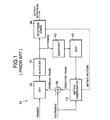
- Figure 1 shows the general architecture for an MPEG-like video coder 30.
- An input image stream is divided into I, P, and B frames for input to the system.
- I (intracoded) frames are directly coded
- P (predicted) and B (bidirectionally predicted) frames are partially indirectly coded (i.e., intercoded) using information from other frames.
- An operator may select the frequency of I, P, and B frames in the image sequence, with the restriction that at least some I frames must be used.
- An I frame and its dependent P and B frames are generally referred to as a group of pictures (GOP).
- GOP group of pictures
- DCT 32 operates on 8x8 pixel blocks of an input image (see Figure 2).
- image 50 is divided into horizontal slices 52a-f (the number of slices shown is chosen for illustration, and is not fixed in general) for processing.
- each slice is 16 pixels high.
- the corresponding chroma components of the image are commonly sampled at half the spatial frequency of the luma component, such that a chroma slice is 8 pixels high.
- Each slice (see slice 52a) is further partitioned into macroblocks 54a-f (the number of macroblocks shown is chosen for illustration, and is not fixed in general).
- Each macroblock contains six blocks (e.g., blocks 56a-f), such that the first four blocks 56a-d together cover a 16x16 pixel area from the luma component of the current slice, and the fifth and sixth blocks 56e and 56f cover corresponding 8x8 areas taken respectively from the two chroma components of the slice.
- DCT 32 performs a two-dimensional discrete cosine transform on each 8x8 pixel block to produce a corresponding 8x8 block of transform coefficients.
- Quantizer 34 of Figure 1 scales the coefficients to a scale commensurate with their range of values.
- Bitstream coder 36 typically utilizes variable-length entropy coding to losslessly compress the quantized coefficients.
- the bitstream output of bitstream coder 36 comprises a block-by-block coding as described, with headers inserted at the macroblock, slice, frame, and group of pictures level.
- the group of pictures sequence is used to determine whether the next incoming frame will be an I, P, or B frame.
- I frames are input directly to DCT 32.
- P and B frames are not input directly to DCT 32, but instead go through a prediction channel that attempts to exploit the temporal redundancies found in most video sequences.
- Motion compensator 44 attempts to match the blocks of a P or B frame with the blocks of a prediction frame or frames. For instance, the first P frame following an I frame is predicted from that I frame.
- the quantized I frame appearing at the output of quantizer 34 is "decoded" by an inverse quantizer 40 and an inverse DCT 42 to represent the I frame as it will be seen by a decoder operating on the bitstream output of coder 30.
- Motion compensator 44 attempts to find a best fit prediction for each macroblock of the P frame, based on the quantized prediction frame produced by inverse DCT 42.
- the offset from the P frame macroblock location to the prediction frame location with the best fit is described by a motion vector. In some cases (such as where a new object is introduced to the scene) prediction can be poor, and motion compensator 44 opts not to predict that macroblock, but to let it be intracoded like an I frame instead.
- Motion compensator 44 produces two outputs for each input P or B frame: a set of motion vectors and a predicted frame.
- the motion vectors are supplied to bitstream coder 36 for output coding.
- the predicted frame is subtracted from the input P or B frame in image adder 38 to form a residual frame.
- the residual frame is then input to DCT 32 in the same manner as an I frame.
- Figure 3 shows a video decoder 60 appropriate for decoding a bitstream produced by video coder 30.
- a bitstream decoder 64 recovers the transform coefficient and motion vector information from the coded bitstream.
- the transform coefficient information is passed through inverse quantizer 40 and inverse DCT 42.
- the I frames are fully reconstructed at this point, and can be output, as well as stored in reference frame memory 66.
- Reference frame memory 66 reconstructs predicted frames using the motion vector information and appropriate I and P frame data.
- Image adder 68 combines predicted frames with residual frames to reconstruct P and B frames.
- decoder 70 of Figure 4 In order to reduce the size of reference frame memory 66, several researchers have proposed some variation on decoder 70 of Figure 4. Three blocks were added, i.e., a compressor 72, a decompressor 76, and block memory 78 (whose size can be as small as a motion compensation block). Compressed frame memory 74 is then designed to be significantly smaller than the original reference frame memory 66 of Figure 3.
- compressor 72 operates on reference frames block-wise, each block being compressed to a corresponding compressed block occupying a fixed number of bits or less.
- decompressor 76 can easily retrieve the compressed blocks needed for motion compensation specified by the motion vector. Decompressor 76 decompresses the compressed blocks, as needed, into block memory 78.
- lossless compression would be selected for decoder 70.
- the present invention has some lossless aspects-if a block can be compressed to fit within its allocated memory space without loss, it will be stored losslessly without further effort. More importantly, the present invention stores block information roughly in order of importance, image quality-wise, such that when the allocated memory space is full, the most important block information has already been preserved.
- the present invention can achieve high quality compression with target compression ratios from 2:1 to 8:1. This approach gives a possible tradeoff between quality and memory size-for many applications, there is a tradeoff point where the resulting quality degradation is invisible or acceptable, but the resulting memory reduction is significant.
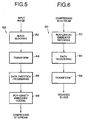
- Figures 5 and 6 show, respectively, general block diagrams for a fast compressor 80 and a fast decompressor 90 according to the invention.
- fast compressor 80 replaces prior art compressor 72
- fast decompressor 90 replaces decompressor 76.
- the four steps required for compression are image blocking 82, a transform 84, data partitioning/reordering 86, and run-length embedded coding 88.
- Decompressor 90 essentially reverses these steps using run-length embedded decoding 92, data reordering 94, and inverse transform 96.
- the input image to compressor 80 is preferably a group of 8x8 pixel blocks extracted from a reference frame.
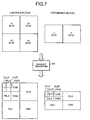
- the preferred compression block size produced by image blocking 82 is a 16x16 luminance (Y) block and two associated 8x8 chrominance (U and V) blocks (assuming 4:1:1 color format), as shown in Figure 7.
- This compression block size corresponds to the macroblock structure of most current video coding standards, e.g., H.261, H.263, H.263+, MPEG1, MPEG2, and MPEG4.
- the decoded compression blocks have the same structure as the input compression blocks.
- Transform 84 can be any linear transform, and inverse transform 96 is just its inverse operation.
- the preferred transform is a wavelet transform with Haar filters, (1/ ⁇ 2, 1/ ⁇ 2) and (1/ ⁇ 2, -1/ ⁇ 2).
- Multiple layers of a wavelet transform are formed by successive transforms of the LL band.
- the preferred number of wavelet transform layers is three.
- Figure 7 shows a three-layer wavelet transform of the preferred compression block.
- X (2 i, 2 j ) [ C ( i,j ) + C ( M / 2 + i,j ) + C ( i,N / 2 + j ) + C ( M / 2+ i,N / 2+ j )]/2
- X (2 i +1,2 j ) [ C ( i,j ) - C ( M / 2+ i,j ) + C ( i,N / 2+ j ) - C ( M / 2+ i,N / 2+ j )]/2
- X (2 i, 2 j + 1) [ C ( i,j ) + C ( M / 2 + i,j ) - C ( i,N / 2+ j ) - C ( M / 2 + i,N / 2 + j )]/2
- the transform coefficient array is partitioned into groups and reordered to place coefficients with similar statistics into the same group.
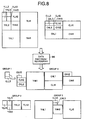
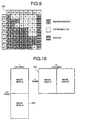
- the preferred partition is to divide the wavelet subbands into four groups as shown in Figure 8 and listed as follows:
- the partitioned subband data is scanned into 1D format.
- the preferred scan order follows the subband order listed above within each group, row by row from top to bottom within each subband, and from left to right within each row. Note that the reordering and scanning operations need not require physical movement of coefficient values within memory, as some embodiments can implement these steps by appropriate address sequencing.
- Data reordering (block 94 of Figure 6) inverts the above operations, i.e., places the 1D data back into subbands in their proper wavelet transform coefficient array configuration.
- the wavelet-transformed compression block After subband grouping, the wavelet-transformed compression block generally remains at full precision. Compression is achieved in the present invention by embedded coding the groups of subbands using a run-length encoder.
- Embedded coding differs from standard coefficient coding, both in operation and in effect.
- Figure 9 shows a block of coefficients w0-w7 represented with eight bits per coefficient.
- w0 for instance, would be coded first, followed by each coefficient in order.
- coding order proceeds by bit-plane rather than by coefficient. For instance, the most significant bit-plane (column b6 of Figure 9) may be coded first, followed by the second most significant bit-plane b5, and so on. If the coding process must be stopped before all bit-planes have been coded, partial information has been received for each coefficient, whereas with standard coefficient coding, premature termination of the coding process may leave some coefficients completely uncoded. Further, by coding the most significant bit-planes first, an embedded coding order generally minimizes reconstructed image distortion much better than standard coefficient coding order when the coding process is terminated prematurely.
- each coefficient in sign/magnitude binary representation
- the bits in each coefficient can be divided into three categories as shown by the shading in Figure 9: the sign bit, s, the significance bits, and the refinement bits.
- the sign bit is obviously the sign of the coefficient.
- the significance bits are the bits before and including the leading "1" bit of the coefficient, assuming the magnitude bits are ordered from the most significant bit to the least significant bit.
- the refinement bits are the rest of magnitude bits, other than the significance bits. For example, coefficient w1 has a value of "0011101" (a binary representation of 29) ⁇ the leading three magnitude bits, "001", are significance bits, and the remaining four magnitude bits are refinement bits.
- the preferred embedded coding method codes bits differently based on their category. Statistically, the sign bits and the refinement bits of all coefficients are almost randomly distributed between "0" and "1". Therefore, they are not entropy coded, but are instead stored explicitly in this low-complexity system. On the other hand, the significance bits statistically contain many 0's and very few 1's. The present invention efficiently codes significance bits with low-complexity run-length encoding.
- Run-length encoding groups bits into symbols, each symbol representing a "run” in the data of either consecutive 0's or consecutive 1's (typically, runs of 0's are coded). These zero-run symbols can then be efficiently coded using variable-length codes.
- the present invention run-length encodes significance bits using Golomb-Rice codes ⁇ a special subset of Huffman codes.
- Golomb codes were first introduced in S. W. Golomb, "Run-length Encodings," IEEE Trans. Information Theory, vol. IT-12, pp. 399-401, July 1966, for encoding nonnegative run lengths.
- the Golomb code G m encodes a nonnegative number n in two parts: a unary representation of the quotient of n/m and a binary representation of the remainder of n/m.
- a preferred adaptive parameter method uses a one-dimensional array J whose elements consist of non-decreasing values for parameter k.
- J [] ⁇ 0,0,0,1,1,2,2,3,4,5,6,7,8 ⁇ .
- the index represents the current state of the Golomb-Rice coder and is denoted by s.
- the Golomb-Rice coder (or decoder) is initialized with an appropriate k value by choosing the k value's corresponding index in the J array as a starting index s.
- the coder increments the index s by one each time a full zero run (i.e., 2 J [ s ] 0's) is encoded (decoded) and decrements s by one when any other symbol is encoded (decoded).
- the coder generally responds to m -length runs by moving towards larger m, and to sub- m -length runs by moving towards smaller m.
- initial k values are 1, 6, 8, and 8, respectively. These initial values are set by initial s indices of 3, 10, 12, and 12, respectively. Note that the indices should be limited at the ends of the J array, i.e., s cannot increment past 12 or decrement past 0 for the preferred J array.
- This context-based approach then requires that the eight neighbors of each wavelet coefficient, the parent of the coefficient, and the higher-order bits for each of these coefficients be examined at each bit-plane in order to classify the bit-plane into "subsequences".
- the coefficients belonging to each subsequence are coded with a Golomb coder.
- the Golomb code parameter is adapted on the fly by measuring statistics of the subsequences during coding.
- the preferred embodiment of the invention as described thus far presents a much less complex application of a wavelet transform and run-length coding to image compression.
- the employed wavelet transform requires only add and shift operations, and is orthogonal. No contextual knowledge (other than whether the present bit is significant) is required.
- the scan arrangement is by-subband raster scanning.
- the Golomb code parameter is determined without statistical estimation.
- the present invention performs well with small, block-sized wavelet transforms, as well as with full-sized images.
- each group on a particular bit-plane there are two scans of the bit-plane.
- the significance identifier bits are run-length/Golomb-Rice coded.
- the sign bit of a coefficient that becomes significant on that bit plane is sent explicitly right after its significance identifier bit, which should be "1", is coded.
- a transform coefficient is said to be significant if and only if its absolute value is greater than or equal to the value of the currently scanned bit plane.
- every Golomb-Rice codeword except the codeword "0" for the full length runs, is followed by a sign bit.
- the refinement bits (whose coefficients already became significant on a previous bit-plane) are sent explicitly.
- the encoding procedure is stopped when the specified number of coded bits is reached, or when all the coefficients are losslessly coded, whichever comes first.
- the following steps provide an implementation:
- the present invention is extremely straightforward, requiring no complex decisions or operations. As such, it is particularly suited for block-based fast compression and decompression as needed in an interframe video decoder.
- Configuration 140 partitions a compressed memory space into 2m “rows” and n "columns", where reference images are divided into m blocks for compression, and a fixed block size of a bits is allocated for storage of each compressed block.
- Configuration 140 partitions a compressed memory space into 2m "rows" and n "columns", where reference images are divided into m blocks for compression, and a fixed block size of a bits is allocated for storage of each compressed block.
- a first image is received and compression begins, its first compressed block is written into the first row of Image Area A, until either all bits are coded or n compressed bits have been created.
- the second compressed block is written into the row immediately below it, and so on, until the top half of configuration 140 holds the first image.
- the second image arrives, its blocks are likewise compressed into Image Area B.
- memory configuration 142 has only m rows but 2n columns.
- Image Area A and Image Area B are side-by-side, such that, physically, blocks from Area A are interleaved with blocks from Area B.
- the first block of the first image is written in the first compressed block space, and the second block of the first image is written to the third compressed block space.
- the second image arrives, its first block is written into the second compressed block space.
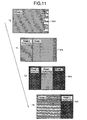
- FIG. 11 shows a reconfigurable memory 144 at four times T0-T3, corresponding to the arrival of four consecutive compressed reference frames Frame 0-Frame 3.
- memory 144 Prior to time T0, memory 144 is empty. Frame 0 is therefore allowed to compress each block into two consecutive compressed block spaces, if necessary (as pictured, some compressed blocks may not require the entire two block spaces).
- blocks from Frame 1 At time T1, blocks from Frame 1 begin to arrive. The compressed blocks from Frame 1 are allowed to overwrite an end portion of the corresponding blocks from Frame 0, truncating Frame 0 and effecting a higher compression rate for that frame. Because the code is embedded, it can be truncated in this manner while saving the most important block information, without further concern (although the decoding algorithm must recognize the size change of the data block).
- Frame 2 arrives and is allowed to overwrite an end portion of Frame 1, truncating it likewise. Note that Frame 2 also "wraps" to overwrite the truncated Frame 0. Finally, at time T3, Frame 3 overwrites the end portion of Frame 2 as well as the truncated Frame 1.
- the present invention can provide even lower drift and improved PSNR.
- This effect stems from the storage of more recent reference frames at lower compression than older reference frames. Since errors (and therefore drift) propagate forward from the latest reference frame, storing this frame at lower compression improves performance as compared to an equal allocation of memory between the two frames. Note, however, that it is preferable that blocks from an earlier frame not be truncated before they are used to construct the later reference frame (if so used). This may require some attention to the method of truncation, e.g., some block data from the new frame may initially be written to the stale frame memory segment, and then copied so as to truncate the older current frame blocks after those blocks have been used to create the newer current frame.
- the first method is the SPIHT algorithm as used in parent application 08/975,922.
- the second method is quad-tree embedded coding, as disclosed in S. Lei and J. Li, "A Quad-tree Embedded Image Compression and Decompression Method and Apparatus," U.S. Patent Applicantion No. 09/209,318, filed Dec. 9, 1998.
- the third method is run-length/embedded coding as described above. The PSNR performance of these three methods at three compression ratios is shown in Table 2.
- the compression/decompression system presented in this disclosure can be used as one component of a complete video transmission or storage system. Minor modifications to the disclosed embodiments may be appropriate in some circumstances. For instance, it may be preferable to code some groups (i.e., group 1) without run-length encoding, or to code more bits planes of one group before an equal number of bit planes from another group has been coded. Likewise, refinement bit coding need not directly follow significance coding for each group and bit plane, with several alternative coding priorities being possible.
- the Haar transform and Golomb-Rice coding are preferred for their simplicity, although the system can function with more complex equivalents.
- the grouping of subbands is designed to group coefficients expected to have similar statistics; as such, many alternative groupings may be appropriate and workable.
- variable-length compressed block spaces are also envisioned. For instance, if a block does not use all of it allocated space to reach a given coding level, that space may be used by other blocks that require more space to reach the same coding level. Note also that with a closed GOP format (one where an I- frame is not referred to by previous B- frames), each new I frame may overwrite the entire compressed block memory.
- the size of the compression block is a design parameter.
- the larger the compression block usually the more efficient the compression algorithm becomes, but more pixels outside of the motion compensation block need to be decoded, i.e., more computations.
- a suitable block size has to be chosen by compromising between these two factors.
- the preferred block size is a 16x16 luminance (Y) block and two associated 8x8 chrominance (U and V) blocks, corresponding to the macro-block structure of most current video coding standards, e.g., H.261, H.263, H.263+, MPEG1, MPEG2, and MPEG4.
- a further advantage of the orthogonal wavelet transform used in the preferred embodiment is that a block need not be completely decompressed if only a portion of it is needed for the current prediction block.
- the present invention can retrieve each needed prediction block in roughly the same amount of time (after Golomb/Rice decoding), even if the prediction block overlaps four compressed blocks.
- the block memory may store the motion compensation prediction block only in an implementation.
- the prediction block memory can be made large enough to store each overlapping compression block after decompression. This group of blocks usually covers an area larger than a motion compensation block because the compression blocks may not align with the motion compensation block. Because the next motion compensation block is very likely partially covered by the decompressed blocks already, the computations for decompression may be reduced.
Landscapes
- Engineering & Computer Science (AREA)
- Multimedia (AREA)
- Signal Processing (AREA)
- Compression, Expansion, Code Conversion, And Decoders (AREA)
- Compression Or Coding Systems Of Tv Signals (AREA)
Abstract
Description


Claims (24)
- A method (80) for compressing a digital image, the method (80) comprising the steps of:linear transforming (84) a block of data from a digital image, representing a subset of the digital image, thereby generating a transform coefficient array having multiple subbands;reordering (86) the coefficients of the transform coefficient array to group coefficient subbands with similar expected bit-level run-length statistics together; andembedded coding (88) the reordered coefficients using a run-length encoder.
- The method (80) of claim 1, wherein the linear transforming step (84) uses a two-dimensional Haar wavelet transform.
- The method (80) of claim 1, wherein the block of data is selected to be equivalent to the size of a motion compensation block of the digital image.
- The method (80) of claim 1, wherein the embedded coding step (88) comprises:for each bit plane of the reordered coefficients, run-length encoding the significance bits of the bit plane, and explicitly coding the refinement bits of the bit plane; andexplicitly coding the sign bit of a coefficient at the time the coefficient becomes significant.
- The method (80) of claim 1, wherein the embedded coding step (88) is halted at a predetermined bit rate.
- The method (80) of claim 4, wherein the run-length encoding step (88) uses Golomb codes.
- The method (80) of claim 4, wherein the run-length encoding step (88) uses Golomb-Rice codes.
- The method (80) of claim 4, wherein reordering (86) the coefficients of the transform coefficient array comprises creating first and second groups of coefficients.
- The method (80) of claim 8, wherein the significance bits for the first group of coefficients are Golomb-Rice coded using a first model parameter, and the significance bits for the second group of coefficients are Golomb-Rice coded using a second model parameter.
- The method (80) of claim 9, wherein the first model parameter is adaptive.
- The method (80) of claim 9, wherein the first and second model parameters are independently adaptive.
- The method (80) of claim 11, wherein each parameter adapts by the step of looking up parameter values from a sequence stored in a look-up table.
- The method (80) of claim 8, wherein the significance bits for a bit-plane of the first and second groups of coefficients are both coded prior to the coding of the refinement bits for the same bit-plane of the first and second groups of coefficients.
- The method (80) of claim 8, wherein the refinement bits for a bit-plane of the first group of coefficients are coded prior to the coding of the significance bits for the same bit-plane of the second group of coefficients.
- The method (80) of claim 8, wherein the significance bits for the first two bit-planes of the first group of coefficients are coded prior to the coding of the significance bits for the first bit-plane of the second group of coefficients.
- The method (80) of claim 1, further comprising:dividing (82) the digital image into a regular group of subimage blocks;performing the linear transforming, reordering, and embedded coding steps on each subimage block; andstoring the embedded code for each block in a memory.
- The method (80) of claim 16, wherein a fixed block size is allocated in the memory for storing the embedded code for each block.
- The method (80) of claim 16, wherein a variable block size is allocated in the memory for storing the embedded code for each block.
- A method (80, 90) for storing and retrieving reference frames in a digital video decoder, the method (80, 90) comprising the steps of:dividing (82) each reference frame to be stored into a group of compression blocks;storing a linear-transformed (84) and embedded run-length coded (88) version of each compression block in a compressed block memory; andretrieving a specified compression block as needed by the decoder by run-length embedded decoding (92) and inverse linear transforming (96) the version of that block stored in the compressed block memory.
- The method (80, 90) of claim 19, wherein the linear transform (84) used in the storing a linear-transformed and embedded run-length coded version step comprises a Haar wavelet transform.
- The method (80, 90) of claim 19, wherein when only a segment of a specified compression block is needed, the retrieving step performs the inverse linear transforming step (96) only on the portion of the linear transformed version corresponding to that segment.
- The method (80, 90) of claim 21, wherein the linear transform used in the storing a linear-transformed and embedded run-length coded version step comprises a Haar wavelet transform.
- A digital video decoder having a reference frame storage and retrieval subsystem comprising:a compressed block memory;a compressor for block-wise compressing reference frame information into the compressed block memory, the compressor storing reference frame information from a given block of a reference frame in a linear-transformed, embedded run-length coded format; anda decompressor for block-wise decompressing reference frame information out of the compressed block memory as needed by the decoder.
- The digital video decoder of claim 23, wherein the linear transform used by the compressor is a Haar wavelet transform.
Applications Claiming Priority (2)
| Application Number | Priority Date | Filing Date | Title |
|---|---|---|---|
| US295233 | 1999-04-19 | ||
| US09/295,233 US6272180B1 (en) | 1997-11-21 | 1999-04-19 | Compression and decompression of reference frames in a video decoder |
Publications (2)
| Publication Number | Publication Date |
|---|---|
| EP1047271A2 true EP1047271A2 (en) | 2000-10-25 |
| EP1047271A3 EP1047271A3 (en) | 2000-11-15 |
Family
ID=23136818
Family Applications (1)
| Application Number | Title | Priority Date | Filing Date |
|---|---|---|---|
| EP00104350A Withdrawn EP1047271A3 (en) | 1999-04-19 | 2000-03-02 | Compression and decompression of reference frames in a video decoder |
Country Status (3)
| Country | Link |
|---|---|
| US (1) | US6272180B1 (en) |
| EP (1) | EP1047271A3 (en) |
| JP (1) | JP2000308059A (en) |
Cited By (4)
| Publication number | Priority date | Publication date | Assignee | Title |
|---|---|---|---|---|
| EP1333679A1 (en) * | 2002-02-05 | 2003-08-06 | Siemens Aktiengesellschaft | Data compression |
| WO2003096700A1 (en) * | 2002-05-09 | 2003-11-20 | Mitsubishi Denki Kabushiki Kaisha | Method for decoding video encoded as compressed bitstream encoded as a plurality of blocks |
| WO2005088983A3 (en) * | 2004-03-08 | 2007-08-16 | Koninkl Philips Electronics Nv | Video decoder with scalable compression and buffer for storing and retrieving reference frame data |
| GB2483342A (en) * | 2010-08-31 | 2012-03-07 | Advanced Risc Mach Ltd | Reducing reference frame data store bandwidth requirements in video decoders |
Families Citing this family (92)
| Publication number | Priority date | Publication date | Assignee | Title |
|---|---|---|---|---|
| US6665343B1 (en) * | 1997-09-12 | 2003-12-16 | Samsung Electronics Co., Ltd. | Methods and arrangements for a converting a high definition image to a lower definition image using wavelet transforms |
| US7130351B1 (en) * | 1998-05-14 | 2006-10-31 | Vulcan Patents Llc | Storage reduction during compression |
| US6643405B1 (en) * | 1998-09-30 | 2003-11-04 | Canon Kabushiki Kaisha | Image processing apparatus and method and computer-readable storage medium |
| JP2000115782A (en) * | 1998-10-06 | 2000-04-21 | Canon Inc | Encoding device and method, and storage medium |
| KR100317279B1 (en) * | 1998-11-04 | 2002-01-15 | 구자홍 | Lossless entropy coder for image coder |
| WO2000031878A1 (en) * | 1998-11-20 | 2000-06-02 | Interval Research Corporation | Low cost video compression using fast, modified z-coding of wavelet pyramids |
| US6584154B1 (en) * | 1998-11-26 | 2003-06-24 | Oki Electric Industry Co., Ltd. | Moving-picture coding and decoding method and apparatus with reduced computational cost |
| US8416847B2 (en) * | 1998-12-21 | 2013-04-09 | Zin Stai Pte. In, Llc | Separate plane compression using plurality of compression methods including ZLN and ZLD methods |
| US6678419B1 (en) * | 1999-03-26 | 2004-01-13 | Microsoft Corporation | Reordering wavelet coefficients for improved encoding |
| US6850649B1 (en) * | 1999-03-26 | 2005-02-01 | Microsoft Corporation | Image encoding using reordering and blocking of wavelet coefficients combined with adaptive encoding |
| JP2000305822A (en) * | 1999-04-26 | 2000-11-02 | Denso Corp | Database management device, database record extraction device, database management method, and database record extraction method |
| US6553069B1 (en) * | 1999-06-17 | 2003-04-22 | Samsung Electronics Co., Ltd. | Digital image segmenting method and device |
| US6865299B1 (en) * | 1999-07-27 | 2005-03-08 | Canon Kabushiki Kaisha | Coding apparatus and method |
| US6625217B1 (en) * | 1999-10-15 | 2003-09-23 | Lucent Technologies Inc. | Constrained wavelet packet for tree-structured video coders |
| US6680974B1 (en) * | 1999-12-02 | 2004-01-20 | Lucent Technologies Inc. | Methods and apparatus for context selection of block transform coefficients |
| US6693961B1 (en) * | 2000-01-10 | 2004-02-17 | Conexant Systems, Inc. | System and method of video frame memory reduction of video decoders |
| DE10049571C1 (en) * | 2000-10-06 | 2002-06-13 | Siemens Ag | Method and arrangement for transmitting a vector |
| WO2002031673A1 (en) * | 2000-10-13 | 2002-04-18 | Thin Multimedia, Inc. | Method and apparatus for streaming video data |
| KR100366382B1 (en) * | 2001-02-12 | 2002-12-31 | (주) 멀티비아 | Apparatus and method for coding moving picture |
| JP3643777B2 (en) * | 2001-02-28 | 2005-04-27 | 三洋電機株式会社 | Moving picture decoding apparatus and moving picture decoding method |
| US6832005B2 (en) * | 2001-03-23 | 2004-12-14 | Microsoft Corporation | Adaptive encoding and decoding of bi-level images |
| US6961475B2 (en) * | 2001-03-30 | 2005-11-01 | Ricoh Co., Ltd. | Context model access to memory based on run and skip counts and context model skipping |
| US6650784B2 (en) * | 2001-07-02 | 2003-11-18 | Qualcomm, Incorporated | Lossless intraframe encoding using Golomb-Rice |
| US7630569B2 (en) * | 2002-02-26 | 2009-12-08 | Decegama Angel | Real-time software video/audio transmission and display with content protection against camcorder piracy |
| US7844122B2 (en) * | 2002-06-21 | 2010-11-30 | Droplet Technology, Inc. | Chroma temporal rate reduction and high-quality pause system and method |
| US20030198395A1 (en) * | 2002-04-19 | 2003-10-23 | Droplet Technology, Inc. | Wavelet transform system, method and computer program product |
| US20030229773A1 (en) * | 2002-05-28 | 2003-12-11 | Droplet Technology, Inc. | Pile processing system and method for parallel processors |
| US20030206597A1 (en) * | 2002-04-19 | 2003-11-06 | Droplet Technology, Inc. | System, method and computer program product for image and video transcoding |
| US6825780B2 (en) * | 2002-04-19 | 2004-11-30 | Droplet Technology, Inc. | Multiple codec-imager system and method |
| US6847317B2 (en) * | 2002-05-28 | 2005-01-25 | Droplet Technology, Inc. | System and method for a dyadic-monotonic (DM) codec |
| US7782784B2 (en) * | 2003-01-10 | 2010-08-24 | Cisco Technology, Inc. | Port analyzer adapter |
| US7899048B1 (en) | 2003-01-15 | 2011-03-01 | Cisco Technology, Inc. | Method and apparatus for remotely monitoring network traffic through a generic network |
| CN100450181C (en) * | 2003-07-23 | 2009-01-07 | 西北工业大学 | An Embedded Image Compression Technology Based on Wavelet Transform |
| US8165136B1 (en) | 2003-09-03 | 2012-04-24 | Cisco Technology, Inc. | Virtual port based SPAN |
| US7474666B2 (en) | 2003-09-03 | 2009-01-06 | Cisco Technology, Inc. | Switch port analyzers |
| JP2005295505A (en) * | 2004-03-12 | 2005-10-20 | Canon Inc | Moving picture coding apparatus, moving picture decoding apparatus, control method thereof, computer program, and computer-readable storage medium |
| JP4702928B2 (en) * | 2004-03-12 | 2011-06-15 | キヤノン株式会社 | Moving picture encoding apparatus and decoding apparatus, control method therefor, computer program, and computer-readable storage medium |
| US7689051B2 (en) * | 2004-04-15 | 2010-03-30 | Microsoft Corporation | Predictive lossless coding of images and video |
| GB2429593A (en) * | 2005-08-26 | 2007-02-28 | Electrosonic Ltd | Data compressing using a wavelet compression scheme |
| US8102916B1 (en) | 2006-01-12 | 2012-01-24 | Zenverge, Inc. | Dynamically changing media compression format in compressed domain |
| US7830800B1 (en) | 2006-01-12 | 2010-11-09 | Zenverge, Inc. | Architecture for combining media processing with networking |
| US20090034634A1 (en) * | 2006-03-03 | 2009-02-05 | Koninklijke Philips Electronics N.V. | Differential coding with lossy embedded compression |
| US7845571B2 (en) * | 2006-06-19 | 2010-12-07 | Monro Donald M | Data compression |
| JP4655013B2 (en) * | 2006-09-15 | 2011-03-23 | 日本電気株式会社 | Encoding apparatus and method thereof, decoding apparatus and method thereof, and encoding and decoding program |
| US8311114B1 (en) | 2006-12-06 | 2012-11-13 | Zenverge, Inc. | Streamlined transcoder architecture |
| KR101375662B1 (en) * | 2007-08-06 | 2014-03-18 | 삼성전자주식회사 | Method and apparatus for image data compression |
| US8605786B2 (en) * | 2007-09-04 | 2013-12-10 | The Regents Of The University Of California | Hierarchical motion vector processing method, software and devices |
| US8121189B2 (en) * | 2007-09-20 | 2012-02-21 | Microsoft Corporation | Video decoding using created reference pictures |
| US7728739B2 (en) * | 2007-10-10 | 2010-06-01 | Apple Inc. | Entropy codec with variable divisor |
| US8599921B2 (en) * | 2009-03-27 | 2013-12-03 | Vixs Systems, Inc | Adaptive partition subset selection module and method for use therewith |
| WO2009097284A1 (en) * | 2008-02-01 | 2009-08-06 | Zenverge, Inc. | Intermediate compression of reference frames for transcoding |
| US8265168B1 (en) | 2008-02-01 | 2012-09-11 | Zenverge, Inc. | Providing trick mode for video stream transmitted over network |
| US9848209B2 (en) * | 2008-04-02 | 2017-12-19 | Microsoft Technology Licensing, Llc | Adaptive error detection for MPEG-2 error concealment |
| JP2009267689A (en) * | 2008-04-24 | 2009-11-12 | Panasonic Corp | Moving image coding device, and moving image coding method |
| US8452111B2 (en) * | 2008-06-05 | 2013-05-28 | Microsoft Corporation | Real-time compression and decompression of wavelet-compressed images |
| US8577165B2 (en) * | 2008-06-30 | 2013-11-05 | Samsung Electronics Co., Ltd. | Method and apparatus for bandwidth-reduced image encoding and decoding |
| US9924184B2 (en) * | 2008-06-30 | 2018-03-20 | Microsoft Technology Licensing, Llc | Error detection, protection and recovery for video decoding |
| US9788018B2 (en) * | 2008-06-30 | 2017-10-10 | Microsoft Technology Licensing, Llc | Error concealment techniques in video decoding |
| EP2141815A1 (en) * | 2008-07-01 | 2010-01-06 | Deutsche Thomson OHG | Method for a hybrid Golomb-Elias gamma coding |
| US20100065343A1 (en) * | 2008-09-18 | 2010-03-18 | Chien-Liang Liu | Fingertip Touch Pen |
| US9131241B2 (en) * | 2008-11-25 | 2015-09-08 | Microsoft Technology Licensing, Llc | Adjusting hardware acceleration for video playback based on error detection |
| US8457425B2 (en) * | 2009-06-09 | 2013-06-04 | Sony Corporation | Embedded graphics coding for images with sparse histograms |
| US8964851B2 (en) * | 2009-06-09 | 2015-02-24 | Sony Corporation | Dual-mode compression of images and videos for reliable real-time transmission |
| JP5413007B2 (en) * | 2009-07-15 | 2014-02-12 | 株式会社ニコン | Image compression apparatus, imaging apparatus, program, and image expansion apparatus |
| JP4650592B1 (en) * | 2009-07-17 | 2011-03-16 | 日本電気株式会社 | Wavelet transform coding / decoding method and apparatus |
| US8340510B2 (en) * | 2009-07-17 | 2012-12-25 | Microsoft Corporation | Implementing channel start and file seek for decoder |
| US8285062B2 (en) * | 2009-08-05 | 2012-10-09 | Sony Corporation | Method for improving the performance of embedded graphics coding |
| KR20110017719A (en) | 2009-08-14 | 2011-02-22 | 삼성전자주식회사 | Video encoding method and apparatus, video decoding method and apparatus |
| US8611652B2 (en) * | 2009-12-16 | 2013-12-17 | Red.Com, Inc. | Resolution based formatting of compressed image data |
| US8971413B2 (en) * | 2010-05-24 | 2015-03-03 | Intel Corporation | Techniques for storing and retrieving pixel data |
| US20110317759A1 (en) * | 2010-06-25 | 2011-12-29 | Thomas Vinay S | System, method, and computer program product for parameter estimation for lossless video compression |
| US8634668B2 (en) | 2011-02-25 | 2014-01-21 | Sony Corporation | Method of compression of digital images using a fixed number of bits per block |
| US9767642B2 (en) | 2011-10-14 | 2017-09-19 | Bally Gaming, Inc. | System and method for cross platform persistent gaming sessions using a mobile device |
| US9659437B2 (en) | 2012-09-28 | 2017-05-23 | Bally Gaming, Inc. | System and method for cross platform persistent gaming sessions using a mobile device |
| US20130093779A1 (en) * | 2011-10-14 | 2013-04-18 | Bally Gaming, Inc. | Graphics processing unit memory usage reduction |
| US9672688B2 (en) | 2011-10-14 | 2017-06-06 | Bally Gaming, Inc. | System and method for cross platform persistent gaming sessions using a mobile device |
| US9503750B2 (en) * | 2011-11-04 | 2016-11-22 | Futurewei Technologies, Inc. | Binarization of prediction residuals for lossless video coding |
| US20130121410A1 (en) * | 2011-11-14 | 2013-05-16 | Mediatek Inc. | Method and Apparatus of Video Encoding with Partitioned Bitstream |
| JP5933742B2 (en) * | 2011-11-25 | 2016-06-15 | トムソン ライセンシングThomson Licensing | Method and apparatus for generating iterative structure discovery based 3D model compressed bitstream |
| US10142636B2 (en) * | 2014-06-09 | 2018-11-27 | Sony Corporation | Communication system with coding mechanism and method of operation thereof |
| US9357237B2 (en) | 2014-10-28 | 2016-05-31 | Sony Corporation | Image processing system with bitstream reduction and method of operation thereof |
| US9294782B1 (en) | 2014-10-28 | 2016-03-22 | Sony Corporation | Image processing system with artifact reduction mechanism and method of operation thereof |
| US9357232B2 (en) | 2014-10-28 | 2016-05-31 | Sony Corporation | Image processing system with binary decomposition and method of operation thereof |
| US10356410B2 (en) | 2014-10-28 | 2019-07-16 | Sony Corporation | Image processing system with joint encoding and method of operation thereof |
| US9674554B2 (en) | 2014-10-28 | 2017-06-06 | Sony Corporation | Image processing system with coding mode and method of operation thereof |
| US10063889B2 (en) | 2014-10-28 | 2018-08-28 | Sony Corporation | Image processing system with conditional coding and method of operation thereof |
| JP6512927B2 (en) * | 2015-04-28 | 2019-05-15 | キヤノン株式会社 | Image coding apparatus and control method thereof |
| EP3350993A1 (en) * | 2015-09-18 | 2018-07-25 | Koninklijke Philips N.V. | Method and apparatus for fast and efficient image compression and decompression |
| US9992252B2 (en) | 2015-09-29 | 2018-06-05 | Rgb Systems, Inc. | Method and apparatus for adaptively compressing streaming video |
| US10897635B2 (en) | 2016-09-06 | 2021-01-19 | Apple Inc. | Memory compression systems and methods |
| JP7190026B2 (en) * | 2019-03-25 | 2022-12-14 | 株式会社ソニー・インタラクティブエンタテインメント | Image transmission/reception system, image transmission device, image reception device, image transmission/reception method and program |
| CN112445384A (en) * | 2019-08-29 | 2021-03-05 | 北京小米移动软件有限公司 | Information screen display method and device, processor and display equipment |
Family Cites Families (21)
| Publication number | Priority date | Publication date | Assignee | Title |
|---|---|---|---|---|
| FR687111A (en) | 1929-12-23 | 1930-08-05 | Method and device for sorting beans and other seeds of small dimensions | |
| US5262854A (en) | 1992-02-21 | 1993-11-16 | Rca Thomson Licensing Corporation | Lower resolution HDTV receivers |
| US5614952A (en) | 1994-10-11 | 1997-03-25 | Hitachi America, Ltd. | Digital video decoder for decoding digital high definition and/or digital standard definition television signals |
| US5436666A (en) | 1993-05-21 | 1995-07-25 | Intel Corporation | Limited-domain motion estimation/compensation for video encoding/decoding |
| US5585852A (en) | 1993-06-16 | 1996-12-17 | Intel Corporation | Processing video signals for scalable video playback using independently encoded component-plane bands |
| US5539664A (en) | 1994-06-20 | 1996-07-23 | Intel Corporation | Process, apparatus, and system for two-dimensional caching to perform motion estimation in video processing |
| US5526295A (en) | 1994-12-30 | 1996-06-11 | Intel Corporation | Efficient block comparisons for motion estimation |
| US5680129A (en) | 1995-07-18 | 1997-10-21 | Hewlett-Packard Company | System and method for lossless image compression |
| US5808683A (en) | 1995-10-26 | 1998-09-15 | Sony Corporation | Subband image coding and decoding |
| EP0778709B1 (en) | 1995-12-04 | 2001-05-23 | STMicroelectronics S.r.l. | MPEG-2 decoding with a reduced RAM requisite by ADPCM recompression before storing MPEG decompressed data |
| US5847762A (en) | 1995-12-27 | 1998-12-08 | Thomson Consumer Electronics, Inc. | MPEG system which decompresses and then recompresses MPEG video data before storing said recompressed MPEG video data into memory |
| US5764374A (en) | 1996-02-05 | 1998-06-09 | Hewlett-Packard Company | System and method for lossless image compression having improved sequential determination of golomb parameter |
| US5777677A (en) | 1996-02-09 | 1998-07-07 | International Business Machines Corporation | Approximate MPEG decoder with compressed reference frames |
| US5701158A (en) | 1996-03-04 | 1997-12-23 | Mitsubishi Denki Kabushiki Kaisha | Digital image decoding apparatus |
| JP3575508B2 (en) | 1996-03-04 | 2004-10-13 | Kddi株式会社 | Encoded video playback device |
| US6215910B1 (en) | 1996-03-28 | 2001-04-10 | Microsoft Corporation | Table-based compression with embedded coding |
| US5818530A (en) | 1996-06-19 | 1998-10-06 | Thomson Consumer Electronics, Inc. | MPEG compatible decoder including a dual stage data reduction network |
| US5825424A (en) | 1996-06-19 | 1998-10-20 | Thomson Consumer Electronics, Inc. | MPEG system which decompresses and recompresses image data before storing image data in a memory and in accordance with a resolution of a display device |
| TR199901722T2 (en) * | 1997-02-03 | 2000-08-21 | Sanofi-Synthelabo S.A. | Drug with the neurotropic effect of 1-$4-(3-Trifluoromethylphenyl)-1,2,3,6-tetrahydropyrid-1-yl]-2-(6,7-dimethoxynaphth-2-yl)ethane To be used in the preparation of works |
| JP3213561B2 (en) | 1997-02-05 | 2001-10-02 | シャープ株式会社 | Image encoding device and image decoding device |
| US6130911A (en) * | 1997-11-21 | 2000-10-10 | Sharp Laboratories Of America, Inc. | Method and apparatus for compressing reference frames in an interframe video codec |
-
1999
- 1999-04-19 US US09/295,233 patent/US6272180B1/en not_active Expired - Lifetime
-
2000
- 2000-02-18 JP JP2000041645A patent/JP2000308059A/en active Pending
- 2000-03-02 EP EP00104350A patent/EP1047271A3/en not_active Withdrawn
Cited By (9)
| Publication number | Priority date | Publication date | Assignee | Title |
|---|---|---|---|---|
| EP1333679A1 (en) * | 2002-02-05 | 2003-08-06 | Siemens Aktiengesellschaft | Data compression |
| WO2003067763A3 (en) * | 2002-02-05 | 2003-12-18 | Siemens Ag | Video compression using analytical entropy coding |
| WO2003096700A1 (en) * | 2002-05-09 | 2003-11-20 | Mitsubishi Denki Kabushiki Kaisha | Method for decoding video encoded as compressed bitstream encoded as a plurality of blocks |
| WO2005088983A3 (en) * | 2004-03-08 | 2007-08-16 | Koninkl Philips Electronics Nv | Video decoder with scalable compression and buffer for storing and retrieving reference frame data |
| CN101208954B (en) * | 2004-03-08 | 2010-09-08 | Nxp股份有限公司 | Video decoder with variable compression ratio and buffer for storing and retrieving reference frame data and video decoding method |
| CN101924945B (en) * | 2004-03-08 | 2012-07-18 | 三叉微系统(远东)有限公司 | Video decoder with scalable compression and buffer for storing and retrieving reference frame data |
| GB2483342A (en) * | 2010-08-31 | 2012-03-07 | Advanced Risc Mach Ltd | Reducing reference frame data store bandwidth requirements in video decoders |
| US8594177B2 (en) | 2010-08-31 | 2013-11-26 | Arm Limited | Reducing reference frame data store bandwidth requirements in video decoders |
| GB2483342B (en) * | 2010-08-31 | 2016-07-13 | Advanced Risc Mach Ltd | Reducing reference frame data store bandwidth requirements in video decoders |
Also Published As
| Publication number | Publication date |
|---|---|
| JP2000308059A (en) | 2000-11-02 |
| EP1047271A3 (en) | 2000-11-15 |
| US6272180B1 (en) | 2001-08-07 |
Similar Documents
| Publication | Publication Date | Title |
|---|---|---|
| US6272180B1 (en) | Compression and decompression of reference frames in a video decoder | |
| CN100392671C (en) | Method and system for context-based adaptive variable length coding for adaptive block transforms | |
| CN1327395C (en) | Method and system for context-based adaptive binary arithmetic coding | |
| Marcellin et al. | An overview of JPEG-2000 | |
| KR100946600B1 (en) | Apparatus and method for encoding digital image data in a lossless manner | |
| JP3204645B2 (en) | Video encoding and decoding method and apparatus | |
| Kiely et al. | The ICER progressive wavelet image compressor | |
| EP1033036B1 (en) | Adaptive entropy coding in adaptive quantization framework for video signal coding systems and processes | |
| KR100636229B1 (en) | Method and apparatus for adaptive entropy encoding and decoding for scalable video coding | |
| US20040136457A1 (en) | Method and system for supercompression of compressed digital video | |
| US20040234141A1 (en) | Embedded DCT-based still image coding algorithm | |
| AU2002334271A1 (en) | Method and system for context-based adaptive binary arithmetic coding | |
| US20120163470A1 (en) | Image and video decoding implementations | |
| CN103918272A (en) | Data encoding and decoding | |
| JP2022539311A (en) | Separate CABAC for subsections of pictures | |
| US20070036222A1 (en) | Non-zero coefficient block pattern coding | |
| US6011499A (en) | Encoding/decoding video signals using multiple run-val mapping tables | |
| EP1083752A1 (en) | Video decoder with reduced memory | |
| KR100801967B1 (en) | Context-Based Adaptive Variable Length Coding Encoder and Decoder, Context-Based Adaptive Variable Length Coding Method and Decoding Method, and Video Transmission System Using the Same. | |
| WO2002073974A1 (en) | Video encoder and recording apparatus | |
| Civanlar et al. | Scalable video coding in frequency domain | |
| EP1768416A1 (en) | Frequency selective video compression and quantization | |
| EP1933568A2 (en) | Method and system for context-based adaptive binary arithmetic coding | |
| AU2014202978B2 (en) | Method and system for context-based adaptive binary arithmetic coding | |
| Mandal | Digital image compression techniques |
Legal Events
| Date | Code | Title | Description |
|---|---|---|---|
| PUAI | Public reference made under article 153(3) epc to a published international application that has entered the european phase |
Free format text: ORIGINAL CODE: 0009012 |
|
| PUAL | Search report despatched |
Free format text: ORIGINAL CODE: 0009013 |
|
| AK | Designated contracting states |
Kind code of ref document: A2 Designated state(s): DE FR GB |
|
| AX | Request for extension of the european patent |
Free format text: AL;LT;LV;MK;RO;SI |
|
| AK | Designated contracting states |
Kind code of ref document: A3 Designated state(s): AT BE CH CY DE DK ES FI FR GB GR IE IT LI LU MC NL PT SE |
|
| AX | Request for extension of the european patent |
Free format text: AL;LT;LV;MK;RO;SI |
|
| 17P | Request for examination filed |
Effective date: 20010108 |
|
| AKX | Designation fees paid |
Free format text: DE FR GB |
|
| 17Q | First examination report despatched |
Effective date: 20060807 |
|
| STAA | Information on the status of an ep patent application or granted ep patent |
Free format text: STATUS: THE APPLICATION IS DEEMED TO BE WITHDRAWN |
|
| 18D | Application deemed to be withdrawn |
Effective date: 20061218 |