EP1045622A2 - Arc lamp ballast - Google Patents
Arc lamp ballast Download PDFInfo
- Publication number
- EP1045622A2 EP1045622A2 EP00102007A EP00102007A EP1045622A2 EP 1045622 A2 EP1045622 A2 EP 1045622A2 EP 00102007 A EP00102007 A EP 00102007A EP 00102007 A EP00102007 A EP 00102007A EP 1045622 A2 EP1045622 A2 EP 1045622A2
- Authority
- EP
- European Patent Office
- Prior art keywords
- free
- mercury
- metal halide
- square
- halide lamp
- Prior art date
- Legal status (The legal status is an assumption and is not a legal conclusion. Google has not performed a legal analysis and makes no representation as to the accuracy of the status listed.)
- Withdrawn
Links
Images

Classifications
-
- H—ELECTRICITY
- H05—ELECTRIC TECHNIQUES NOT OTHERWISE PROVIDED FOR
- H05B—ELECTRIC HEATING; ELECTRIC LIGHT SOURCES NOT OTHERWISE PROVIDED FOR; CIRCUIT ARRANGEMENTS FOR ELECTRIC LIGHT SOURCES, IN GENERAL
- H05B41/00—Circuit arrangements or apparatus for igniting or operating discharge lamps
- H05B41/14—Circuit arrangements
-
- H—ELECTRICITY
- H05—ELECTRIC TECHNIQUES NOT OTHERWISE PROVIDED FOR
- H05B—ELECTRIC HEATING; ELECTRIC LIGHT SOURCES NOT OTHERWISE PROVIDED FOR; CIRCUIT ARRANGEMENTS FOR ELECTRIC LIGHT SOURCES, IN GENERAL
- H05B41/00—Circuit arrangements or apparatus for igniting or operating discharge lamps
- H05B41/14—Circuit arrangements
- H05B41/26—Circuit arrangements in which the lamp is fed by power derived from DC by means of a converter, e.g. by high-voltage DC
- H05B41/28—Circuit arrangements in which the lamp is fed by power derived from DC by means of a converter, e.g. by high-voltage DC using static converters
- H05B41/288—Circuit arrangements in which the lamp is fed by power derived from DC by means of a converter, e.g. by high-voltage DC using static converters with semiconductor devices and specially adapted for lamps without preheating electrodes, e.g. for high-intensity discharge lamps, high-pressure mercury or sodium lamps or low-pressure sodium lamps
- H05B41/292—Arrangements for protecting lamps or circuits against abnormal operating conditions
- H05B41/2928—Arrangements for protecting lamps or circuits against abnormal operating conditions for protecting the lamp against abnormal operating conditions
-
- H—ELECTRICITY
- H05—ELECTRIC TECHNIQUES NOT OTHERWISE PROVIDED FOR
- H05B—ELECTRIC HEATING; ELECTRIC LIGHT SOURCES NOT OTHERWISE PROVIDED FOR; CIRCUIT ARRANGEMENTS FOR ELECTRIC LIGHT SOURCES, IN GENERAL
- H05B41/00—Circuit arrangements or apparatus for igniting or operating discharge lamps
- H05B41/14—Circuit arrangements
- H05B41/26—Circuit arrangements in which the lamp is fed by power derived from DC by means of a converter, e.g. by high-voltage DC
- H05B41/28—Circuit arrangements in which the lamp is fed by power derived from DC by means of a converter, e.g. by high-voltage DC using static converters
- H05B41/288—Circuit arrangements in which the lamp is fed by power derived from DC by means of a converter, e.g. by high-voltage DC using static converters with semiconductor devices and specially adapted for lamps without preheating electrodes, e.g. for high-intensity discharge lamps, high-pressure mercury or sodium lamps or low-pressure sodium lamps
- H05B41/2881—Load circuits; Control thereof
- H05B41/2882—Load circuits; Control thereof the control resulting from an action on the static converter
- H05B41/2883—Load circuits; Control thereof the control resulting from an action on the static converter the controlled element being a DC/AC converter in the final stage, e.g. by harmonic mode starting
-
- Y—GENERAL TAGGING OF NEW TECHNOLOGICAL DEVELOPMENTS; GENERAL TAGGING OF CROSS-SECTIONAL TECHNOLOGIES SPANNING OVER SEVERAL SECTIONS OF THE IPC; TECHNICAL SUBJECTS COVERED BY FORMER USPC CROSS-REFERENCE ART COLLECTIONS [XRACs] AND DIGESTS
- Y10—TECHNICAL SUBJECTS COVERED BY FORMER USPC
- Y10S—TECHNICAL SUBJECTS COVERED BY FORMER USPC CROSS-REFERENCE ART COLLECTIONS [XRACs] AND DIGESTS
- Y10S315/00—Electric lamp and discharge devices: systems
- Y10S315/05—Starting and operating circuit for fluorescent lamp
Definitions
- This invention relates to metal halide arc lamps and, more particularly, to a ballast for a mercury-free, metal halide arc lamp having an arc containing envelope of fused silica or ceramic.
- Re-ignition voltage occurs as the alternating current passes through zero.
- the free iodine in the lamp envelope quenches the arc, which then partially extinguishes.
- the voltage In order to reestablish the arc with the current in the opposite direction, the voltage must be caused to rise, momentarily well above the sustaining voltage. The more free iodine in the lamp, the greater the re-ignition voltage.
- the ratio of the re-ignition voltage to the RMS (or crest factor) voltage is about 1.2 to 1.5.
- a mercury-free lamp such as that described in copending United States patent applications entitled MERCURY-FREE METAL HALIDE ARC LAMP and CHEMICAL COMPOSITION FOR MERCURY-FREE METAL HALIDE LAMP, by P. B. Newell et al., application serial nos. (Attorney Docket No.
- the present invention features a ballast having a square-wave power supply for a mercury-free, metal halide arc lamp having a fused silica or ceramic envelope of, for example, polycrystalline alumina.
- the square-wave power supply reduces and, in some cases, eliminates the re-ignition voltage in the mercury-free arc lamp.
- the supply works by reversing the voltage polarity and reestablishing the arc current in the opposite direction before the free halogen (e.g., iodine) in the envelope can quench the arc. Switching times less than one microsecond accomplish this goal. Small inductances in series with the lamp from an igniter, for example, slow the switching time. The re-ignition voltages may then reappear.
- Square-wave electronic ballasts for mercury-free, metal halide lamps are known.
- the lamp has a ceramic discharge vessel, a luminous efficacy of at least 75 lumens/W, and a color rendering index of at least 75.
- the voltage variation rate is at least 0.3 V/ ⁇ s, and is preferably 3.0 V/ ⁇ s.
- the switching rate of the known lamp is much higher.
- a ballast for a mercury-free, metal halide arc lamp having a quartz or fused silica envelope.
- the ballast provides a square-wave voltage, which substantially reduces or eliminates the re-ignition voltage in the mercury-free, metal halide arc lamp.
- the ballast reverses the voltage polarity and re-establishes the arc current in the opposite direction, before the free halogen in the envelope can quench the arc. Switching times are less than one microsecond.
- the invention features a ballast for a mercury-free, metal halide arc lamp having a quartz or fused silica envelope.
- the ballast provides a square-wave voltage, which substantially reduces or eliminates the re-ignition voltage in the mercury-free, metal halide arc lamp.
- the ballast reverses the voltage polarity and reestablishes the arc current in the opposite direction, before the free halogen in the envelope can quench the arc. Switching times are less than one microsecond.
- a mercury-free, metal halide arc lamp 10 is shown being powered by a ballast 12 that provides the lamp 10 with a square-wave voltage.
- the envelope 14 of the lamp 10 is either quartz or fused silica.
- the switching time of the ballast 12 is less than approximately one microsecond.
- the ballast can operate in a range of frequencies from 50 to 5000 Hz with a preferred ranges being 300 to 400 Hz.
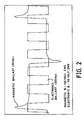
- a voltage waveform of the mercury-free, metal halide lamp 10 illustrated in FIGURE 1 operates on a square-wave electronic ballast 12.
- the square-wave voltage is superimposed upon the voltage waveform of a magnetic ballast. It can be observed that no re-ignition voltage occurs with the electronic ballast 12 supplying the square-wave voltage.
- the electronic ballast 12 of this invention operated at 300 Hz and delivered 400 watts to the lamp 10.
- the ballast 12 of the invention operated the mercury-free lamp 10 with more efficacy.
- the lamp 10 produced significantly more light operating on a square-wave ballast than when operating on a magnetic ballast.
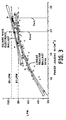
- FIGURE 3 it can be observed that efficacy in lumens per watt versus power loading (in watts per square centimeter of envelope wall) produces a higher light output.
- the graph depicts a number of arc tubes with bores ranging from 6mm to 10mm. The curves with 95% confidence intervals represent a mathematical "best fit" to the data.
- the predicted efficacy of a 7mm bore lamp operating on a magnetic ballast at 400 watts is 83 lumens per watt, while the predicted efficacy of the same lamp operating on a square-wave ballast is 95 lumens per watt. This is a 15% increase in efficacy.
- a preferred embodiment of this invention consists of a mercury-free lamp, such as described in the aforementioned patent applications, Serial Nos. (Attorney Docket No. 98-1-311) and (Attorney Docket No.: 98-1-322), operating on a 300 Hz square-wave ballast with a switching time less than one microsecond. If an igniter is used in the circuit, its inductance must be so small that it does not increase switching time to the point where re-ignition voltages reappear.
Landscapes
- Engineering & Computer Science (AREA)
- Power Engineering (AREA)
- Circuit Arrangements For Discharge Lamps (AREA)
- Discharge Lamp (AREA)
Abstract
Description
Claims (8)
- A mercury-free, metal halide lamp having an arc containing envelope, and square-wave electronic ballast supplying a square-wave voltage to said mercury-free, metal halide lamp, said square-wave voltage substantially eliminating re-ignition voltages from said mercury-free, metal halide lamp.
- The mercury-free, metal halide lamp and square-wave electronic ballast in accordance with claim 1, operating in a frequency range from approximately 50 to 5000 Hz.
- A mercury-free, metal halide lamp having a fused silica envelope, and square-wave electronic ballast supplying a square-wave voltage to said mercury-free, metal halide lamp, said square-wave voltage substantially eliminating re-ignition voltages from said mercury-free, metal halide lamp.
- The mercury-free, metal halide lamp and square-wave electronic ballast in accordance with claim 3, operating in a frequency range from approximately 50 to 5000 Hz.
- A mercury-free, metal halide lamp and square-wave electronic ballast supplying a square-wave voltage to said mercury-free, metal halide lamp, said square-wave voltage substantially eliminating re-ignition voltages from said mercury-free, metal halide lamp, and having a switching time of less than approximately one microsecond.
- The mercury-free, metal halide lamp and square-wave electronic ballast in accordance with claim 5, operating in a frequency range from approximately 50 to 5000 Hz.
- The mercury-free, metal halide lamp of Claim 1 wherein said arc containing envelope is a ceramic material.
- The mercury-free, metal halide lamp of Claim 7 wherein said ceramic material is polycrystalline alumina.
Applications Claiming Priority (4)
| Application Number | Priority Date | Filing Date | Title |
|---|---|---|---|
| US12924499P | 1999-04-14 | 1999-04-14 | |
| US129244P | 1999-04-14 | ||
| US09/413,924 US6166495A (en) | 1999-04-14 | 1999-10-07 | Square wave ballast for mercury free arc lamp |
| US413924P | 2002-09-25 |
Publications (2)
| Publication Number | Publication Date |
|---|---|
| EP1045622A2 true EP1045622A2 (en) | 2000-10-18 |
| EP1045622A3 EP1045622A3 (en) | 2003-10-29 |
Family
ID=26827402
Family Applications (1)
| Application Number | Title | Priority Date | Filing Date |
|---|---|---|---|
| EP00102007A Withdrawn EP1045622A3 (en) | 1999-04-14 | 2000-02-02 | Arc lamp ballast |
Country Status (6)
| Country | Link |
|---|---|
| US (1) | US6166495A (en) |
| EP (1) | EP1045622A3 (en) |
| JP (1) | JP2000331789A (en) |
| KR (1) | KR100399811B1 (en) |
| CA (1) | CA2295412A1 (en) |
| TW (1) | TW530520B (en) |
Cited By (1)
| Publication number | Priority date | Publication date | Assignee | Title |
|---|---|---|---|---|
| WO2006000932A1 (en) * | 2004-06-21 | 2006-01-05 | Koninklijke Philips Electronics N.V. | Method and driving circuit for operating a hid lamp |
Families Citing this family (4)
| Publication number | Priority date | Publication date | Assignee | Title |
|---|---|---|---|---|
| JP3728983B2 (en) * | 1999-06-25 | 2005-12-21 | スタンレー電気株式会社 | Metal halide lamps and vehicle headlamps |
| US7221107B2 (en) * | 2005-04-13 | 2007-05-22 | Ballastronic, Inc. | Low frequency electronic ballast for gas discharge lamps |
| DE102005031835A1 (en) * | 2005-07-06 | 2007-01-18 | Patent-Treuhand-Gesellschaft für elektrische Glühlampen mbH | Device for operating a high-pressure discharge lamp |
| KR100841572B1 (en) * | 2007-03-05 | 2008-06-26 | 최인실 | Magnetic ballast |
Family Cites Families (5)
| Publication number | Priority date | Publication date | Assignee | Title |
|---|---|---|---|---|
| US4170746A (en) * | 1977-12-27 | 1979-10-09 | General Electric Company | High frequency operation of miniature metal vapor discharge lamps |
| US5198727A (en) * | 1990-02-20 | 1993-03-30 | General Electric Company | Acoustic resonance operation of xenon-metal halide lamps on unidirectional current |
| EP0507396B1 (en) * | 1991-04-04 | 1998-06-10 | Koninklijke Philips Electronics N.V. | Circuit arrangement |
| TW343348B (en) * | 1996-12-04 | 1998-10-21 | Philips Electronics Nv | Metal halide lamp |
| DE19731168A1 (en) * | 1997-07-21 | 1999-01-28 | Patent Treuhand Ges Fuer Elektrische Gluehlampen Mbh | Illumination system |
-
1999
- 1999-10-07 US US09/413,924 patent/US6166495A/en not_active Expired - Lifetime
-
2000
- 2000-01-13 CA CA002295412A patent/CA2295412A1/en not_active Abandoned
- 2000-02-02 EP EP00102007A patent/EP1045622A3/en not_active Withdrawn
- 2000-03-07 TW TW089104050A patent/TW530520B/en not_active IP Right Cessation
- 2000-04-14 KR KR10-2000-0019523A patent/KR100399811B1/en not_active Expired - Fee Related
- 2000-04-14 JP JP2000114071A patent/JP2000331789A/en active Pending
Cited By (1)
| Publication number | Priority date | Publication date | Assignee | Title |
|---|---|---|---|---|
| WO2006000932A1 (en) * | 2004-06-21 | 2006-01-05 | Koninklijke Philips Electronics N.V. | Method and driving circuit for operating a hid lamp |
Also Published As
| Publication number | Publication date |
|---|---|
| JP2000331789A (en) | 2000-11-30 |
| TW530520B (en) | 2003-05-01 |
| US6166495A (en) | 2000-12-26 |
| KR100399811B1 (en) | 2003-09-29 |
| EP1045622A3 (en) | 2003-10-29 |
| KR20000071691A (en) | 2000-11-25 |
| CA2295412A1 (en) | 2000-10-14 |
Similar Documents
| Publication | Publication Date | Title |
|---|---|---|
| US6184633B1 (en) | Reduction of vertical segregation in a discharge lamp | |
| CA1115766A (en) | High frequency operation of miniature metal vapor discharge lamps | |
| EP1379112B1 (en) | Device for operating a high pressure discharge lamp | |
| US7928669B2 (en) | Color control of a discharge lamp during dimming | |
| JPH0439896A (en) | Rare gas discharge fluorescent lamp device | |
| AU750993B2 (en) | Non-thermionic ballast-free energy-efficient light-producing gas discharge system and method | |
| US6166495A (en) | Square wave ballast for mercury free arc lamp | |
| GB2375444A (en) | Improved lamp colour control for dimmed high intensity discharge lamps | |
| US6369518B1 (en) | Lamps with electronic control of color temperature and color rendering index | |
| JP2001006611A (en) | High-brightness discharge lamp | |
| AU6497499A (en) | Non-thermionic ballast-free energy-efficient light-producing gas discharge system and method | |
| EP1045620A2 (en) | System for and method of operating a mercury free discharge lamp | |
| JP2003229296A (en) | High pressure discharge lamp device | |
| JP2007157721A (en) | Method and circuit for instantaneous high temperature re-starting of high brightness discharge lamp | |
| US4321501A (en) | Low wattage, high pressure metal vapor discharge lamp for minimizing detrimental glow time | |
| US5637965A (en) | Low pressure sodium-mercury lamp yielding substantially white light | |
| EP0079969B1 (en) | Low pressure mercury vapor discharge lamp unit | |
| EP1657969A1 (en) | Current fed electronic ballast for striation control of gas discharge lamps | |
| JPH1131591A (en) | Discharge device driving method, discharge device driving device, lighting device, and liquid crystal display device | |
| JP2006093007A (en) | Mercury-free metal halide lamp | |
| WO2004045257A1 (en) | Improved lamp colour control for dimmed high intensity discharge lamps | |
| JPH10294089A (en) | Electrodeless metal halid lamp device | |
| KR20020090642A (en) | Method of pole disposal of useing low power metal halide lamp for argon discharge | |
| JPS6122599A (en) | Compact fluorescent lamp unit | |
| JPH10294082A (en) | Electrodeless metal halid lamp and its lighting device |
Legal Events
| Date | Code | Title | Description |
|---|---|---|---|
| PUAI | Public reference made under article 153(3) epc to a published international application that has entered the european phase |
Free format text: ORIGINAL CODE: 0009012 |
|
| AK | Designated contracting states |
Kind code of ref document: A2 Designated state(s): AT BE CH CY DE DK ES FI FR GB GR IE IT LI LU MC NL PT SE |
|
| AX | Request for extension of the european patent |
Free format text: AL;LT;LV;MK;RO;SI |
|
| PUAL | Search report despatched |
Free format text: ORIGINAL CODE: 0009013 |
|
| AK | Designated contracting states |
Kind code of ref document: A3 Designated state(s): AT BE CH CY DE DK ES FI FR GB GR IE IT LI LU MC NL PT SE |
|
| AX | Request for extension of the european patent |
Extension state: AL LT LV MK RO SI |
|
| RIC1 | Information provided on ipc code assigned before grant |
Ipc: 7H 05B 41/292 B Ipc: 7H 05B 41/288 B Ipc: 7H 05B 41/38 A |
|
| 17P | Request for examination filed |
Effective date: 20040419 |
|
| AKX | Designation fees paid |
Designated state(s): AT BE CH CY DE DK ES FI FR GB GR IE IT LI LU MC NL PT SE |
|
| STAA | Information on the status of an ep patent application or granted ep patent |
Free format text: STATUS: THE APPLICATION IS DEEMED TO BE WITHDRAWN |
|
| 18D | Application deemed to be withdrawn |
Effective date: 20060927 |