EP1045372A2 - Speech sound communication system - Google Patents
Speech sound communication system Download PDFInfo
- Publication number
- EP1045372A2 EP1045372A2 EP00108287A EP00108287A EP1045372A2 EP 1045372 A2 EP1045372 A2 EP 1045372A2 EP 00108287 A EP00108287 A EP 00108287A EP 00108287 A EP00108287 A EP 00108287A EP 1045372 A2 EP1045372 A2 EP 1045372A2
- Authority
- EP
- European Patent Office
- Prior art keywords
- information
- speech
- prosody
- phonetic transcription
- speech sound
- Prior art date
- Legal status (The legal status is an assumption and is not a legal conclusion. Google has not performed a legal analysis and makes no representation as to the accuracy of the status listed.)
- Withdrawn
Links
Images






Classifications
-
- G—PHYSICS
- G10—MUSICAL INSTRUMENTS; ACOUSTICS
- G10L—SPEECH ANALYSIS TECHNIQUES OR SPEECH SYNTHESIS; SPEECH RECOGNITION; SPEECH OR VOICE PROCESSING TECHNIQUES; SPEECH OR AUDIO CODING OR DECODING
- G10L13/00—Speech synthesis; Text to speech systems
- G10L13/08—Text analysis or generation of parameters for speech synthesis out of text, e.g. grapheme to phoneme translation, prosody generation or stress or intonation determination
Definitions
- the present invention relates to a method for carrying out information transmission by using speech sounds on a portable telephone, Internet or the like.
- Speech sound communication systems are constructed by connecting transmitters and receivers via wire communication paths such as coaxial cables or radio communication paths such as electromagnetic waves.
- wire communication paths such as coaxial cables or radio communication paths such as electromagnetic waves.
- analog communications were the mainstream where acoustic signals are propagated directly or by being modulated into carrier waves on those communication paths
- digital communications have been becoming mainstream where acoustic signals are propagated after being coded once for the purpose of increasing communication quality with respect to anti-noise properties or distortion and increasing the number of communication channels.
- CELP Code-Excited Linear prediction
- Fig 7 shows an exemplary configuration example of the CELP speech coding and decoding system.
- the processing on the coding end is as follows.
- Speech sound signals are processed by partition into frames of, for example, 10 ms or the like.
- the inputted speech sounds undergo LPC (Linear Prediction Coding) analysis at the LPC analysis part 200 to be converted to a LPC coefficient ⁇ 1 representing a vocal tract transmission function.
- LPC Linear Prediction Coding
- the LPC coefficient ⁇ 1 is converted and quantized to a LSP (Line Spectrum Pair) coefficient ⁇ qi at an LSP parameter quantization part 201.
- ⁇ qi is given to a synthesizing filter 202 to synthesize a speech sound wave form by a voicing wave form source read out from an adaptive code book 203 corresponding to a code number c a .
- the speech sound wave form is inputted as a periodic wave form in accordance with a pitch period T 0 calculated out by using an auto-correlation method or the like in parallel with the previous processing.
- the synthesized speech sound wave form is subtracted from the inputted speech sound to be inputted into a distortion calculation part 207 via an auditory weighting filter 206.
- the distortion calculation part 207 calculates out the energy of the difference between the synthetic wave form and the inputted wave form repetitively while changing the code number c a for the adaptive code book 203 and determines the code number c a that makes the energy value the minimum.
- the voicing source wave form read out under the determined c a and the noise source wave form read out according to the code number c r from the noise code book 204 are added to determine the code number c r that makes the distortion minimum following similar processing.
- the gain values are also determined which are to be added to both voicing source and noise source wave forms through the previously accomplished processing so that the most suitable gain vector corresponding to them is selected from the gain code book to determine the code number c g .
- the LSP coefficient ⁇ qi , the pitch period T 0 , the adaptive code number c a , the noise code number c r , the gain code number c g which have been determined as described above are collected into one data series to be transmitted on the communication path.
- the data series received from the communication path is again divided into the LSP coefficient ⁇ qi , the pitch period T 0 , the adaptive code number c a , the noise code number c r , and the gain code number c g .
- the periodic voicing source is read out from the adaptive code book 208 in accordance with the pitch period T 0 and the adaptive code number c a
- the noise source wave form is read out from the noise code book 209 in accordance with the noise code number c r .
- Each voicing source receives an amplitude adjustment by the gain represented by the gain vector read out from the gain code book 210 in accordance with the gain code number c g to be inputted into the synthesizing filter 211.
- the synthesizing filter 211 synthesizes speech sound in accordance with the LSP coefficient ⁇ qi .
- the speech sound communication system as described above has the main purpose of propagating speech sound efficiently with a limited communication path capacitance by compression coding inputted speech sound. That is to say the communication object is solely speech sound emitted by human beings.
- Today's communications services are not limited to only speech sound communications between human beings in distant locations but services such as e-mail or short messages are becoming widely used where data are transmitted to a remote reception terminal by inputting text utilizing transmission terminals. And it has become important to provide speech sound from apparatuses to human beings such as those supplying a variety of information by speech sound represented by the CTI (Computer Telephony Integration) or providing operating methods of the apparatuses in speech sound. Moreover, by using the speech sound rule synthesizing technology which converts text information into speech sound it has become possible to listen to the contents of e-mails, news or the like on the phone, which has been attracting attention recently.
- CTI Computer Telephony Integration
- One is a method for transmitting speech sound synthesized on the service supplying end to the users by using normal speech sound transmissions.
- the terminal apparatuses on the reception end only receive and reproduce the speech sound signals in the same way as the prior art and common hardware can be used.
- Vocalizing a large amount of text means to keep speech sounds flowing for a long period of time into the communication path and in the case of using communication systems such as portable telephones it becomes necessary to maintain the connection for a long period of time. Accordingly, there is the problem that communication charges becomes too expensive.
- the other is a method for letting the users hear the speech sound converted by a speech sound synthesizing apparatus of the reception terminals after the information is transmitted on the communication path in the form of text.
- the information transmission amount is an extremely small amount such as one several hundredths of a speech sound which makes it possible to be transmitted in a very short period of time. Accordingly, the communication charges are held low and it becomes possible for the user to listen to the information by conversion into speech sounds whenever desired if the text is stored in the reception terminal.
- different types of voices such as male or female, speech rates, high pitch or low pitch or the like can be selected at the time of conversion to speech sounds.
- the speech sound synthesizing apparatus to be installed as a terminal apparatus on the reception end has different circuits from that used as an ordinary reception terminal such as a portable telephone, therefore, new circuits for synthesizing speech sounds should be mounted; which leads to the problem that the circuit scale is increased and the cost for the terminal apparatus is increased.
- the present invention provides a speech sound communication apparatus
- the 1 st invention of the present invention (corresponding to claim 1)is a speech sound communication system comprising;
- the 2 nd invention of the present invention (corresponding to claim 3) is a speech sound communication system comprising a transmission part having a text input means, a language analysis means and a transmission means as well as a reception part having a reception means, a prosody generation means, an segment data memory means, an segment read-out means and a synthesizing means, wherein, said text input means inputs text information;
- the 3 rd invention of the present invention is a speech sound communication system comprising a transmission part having a text input means, a language analysis means, a prosody generation means and a transmission means as well as a reception part having a reception means, an segment data memory means, an segment read-out means and a synthesizing means, wherein, said text input means inputs text information;
- the 4 th invention of the present invention (corresponding to claim 7)is a speech sound communication system comprising:
- the 5 th invention of the present invention (corresponding to claim 9)is a speech sound communication system comprising:
- the 6 th invention of the present invention (corresponding to claim 11)is a speech sound communications system comprising a transmission part having a text input means, a language analysis means and a first transmission means, a repeater part having a first reception means, prosody generation means and second transmission means and a reception part having a second reception means, an segment data memory means, an segment read-out means and a synthesizing means, wherein, said text input means inputs text information;
- Fig 1 shows the first embodiment of a speech sound communication system according to the present invention.
- the speech sound communication system comprises a transmission terminal and a reception terminal, which are connected by a communication path.
- the transmission path contains a repeater including an exchange or the like.
- the transmission terminal is provided with a text inputting part 100 of which the output is connected to a multiplexing part 104.
- a speech sound inputting part 101 is also provided, of which the output is connected to the multiplexing part 104 via an AD converting part 102 and a speech coding part 103.
- the output of the multiplexing part 104 is connected to a transmission part 105.
- the reception terminal is provided with a reception part 106, of which the output is connected to a separation part 107.
- the output of the separation part 107 is connected to a language analysis part 108 and a synthesis part 115.
- a dictionary 109 is connected to the language analysis part 108.
- the output of the language analysis part 108 is connected to a prosody generation part 110.
- a prosody data base 111 is connected to the prosody generation part 110.
- the output of the prosody generation part 110 is connected to the prosody transformation part 112 of which the output is connected to an segment read-out part 113.
- An segment data base 114 is connected to the segment read-out part 113.
- the outputs of both the prosody transformation part 112 and the segment read-out part 113 are connected to the synthesis part 115.
- the output of the synthesis part 115 is connected to the speech sound outputting part 117 via a DA conversion part 116.
- a parameter inputting part 118 is also provided, which is connected to the prosody transformation part 112 and the segment read-out part 113.
- the speech coding part 103 analyses speech sounds in the same way as the prior art so as to code the information of the LSP coefficient ⁇ qi , the pitch period T 0 , the adaptive code number c a , the noise code number c r , and the gain code number c g to be outputted to the multiplexing part 104 as a speech code series.
- the text inputting part 100 inputs the text information inputted from a keyboard or the like by the user as the desired text, which is converted into a desired form if necessary to be outputted from the multiplexing part 104.
- the multiplexing part 104 multiplexes the speech code series and the text information according to the time division so as to be rearranged into a sequence of data series to be transmitted on the communication path via the transmission part 105.
- Such a multiplexing method has become possible by means of a data communication method used in a short message service or the like of a portable telephone generally used at present.
- the reception part 106 receives the above described data series from the communication path to be outputted to the separation part 107.
- the separation part 107 separates the data series into a speech code series and text information so that the speech code series is outputted to the synthesis part 115 and the text information is outputted to the language analysis part 108, respectively.
- the speech code series is converted into a speech sound signal at the synthesis part 115 through the same process as the prior art to be outputted as a speech sound via the DA conversion part 116 and the speech sound outputting part 117.
- the text information is converted into phonetic transcription information which is information for pronounciation, accenting or the like, by utilizing the dictionary 109 or the like in the language analysis part 108 and is inputted to the prosody generation part 110.
- the prosody generation part 110 adds prosody information which relates to timing for each phoneme, pitch for each phoneme, amplitude for each phoneme in reference to the prosody data base 111 by using mainly accent information and pronounciation information if necessary to be converted to phonetic transcription information with prosody information.
- the prosody information is transformed if necessary by the prosody transformation part 112.
- the prosody information is trans formed according to parameters such as speech speed, high pitch or low pitch or the like set by the user accordingly as desired.
- the speech speed is changed by transforming timing information for each phoneme and high pitch or low pitch are changed by transforming pitch information for each phoneme.
- Such settings are established by the user accordingly as desired at the parameter inputting part 118.
- the phonetic transcription information with prosody information which has its prosody transformed by the prosody transformation part 112 is divided into the pitch period information T 0 and the remaining information, and T 0 is inputted to the synthesis part 115.
- the remaining information is inputted to the segment read-out part 113.
- the segment read-out part 113 reads out the proper segments from the segment data base 114 by using the information received from the prosody transformation part 112 and outputs the LSP parameter ⁇ qi , the adaptive code number c a , the noise code number c r and the gain code number c g memorized as data of the segments to the synthesis part 115.
- the synthesis part 115 synthesizes speech sounds from those pieces of information T 0 , ⁇ qi , c a , c r and c g to be outputted as speech sound via the DA conversion part and the speech sound outputting part 117.
- Fig 8 depicts the manner of the processing of the language analysis part 108.
- Fig 8(a) shows an example of Japanese
- Fig 8(b) shows an example of English
- Fig 8(c) shows an example of Chinese.
- the example of Japanese in Fig 8(a) is described in the following.
- the upper box of Fig 8 (a) shows a text of the input.
- the input text is, "It's fine today.”
- This text is converted ultimately to phonetic transcription (phonetic symbols, accent information etc.) in the lower box via mode morph analysis, syntactic analysis or the like utilizing the dictionary 109.
- "Kyo” or “o” depict a pronunciation of one mora (one syllable unit) of Japanese, ",” represents a pause and "/" represents a separation of an accent phrase.
- "'” added to the phonetic symbol represents an accent core.
- Fig 9 shows a prosody generation part 110, prosody transformation part 112, an segment read-out part 113, a synthesizing part 115 and the configurations around them.
- speech sound codes are inputted from the separation part 107 to the synthesizing part 115, which is the normal operation for speech sound decoding.
- the data are inputted from the prosody transformation part 112 and the segment read-out part 113, which is the operation in the case where speech sound synthesis is carried out using the text.
- the segment data base 114 stores segment data that has been CELP coded. Phoneme, mora, syllable and the like are generally used for the unit of the segment.
- the coded data are stored as an LSP coefficient ⁇ qi , an adaptive code number c a , a noise code number c r , a gain code number c g , and the value of each of them is arranged for each frame period.
- the segment read-out part 113 is provided with the segment selection part 113-1, which designates one of the segments stored in the segment data base 114 utilizing the phonetic transcription information among the phonetic transcription information together with the prosody information transmitted from the prosody transformation part 112.
- the data read-out part 113-2 reads out the data of the segments designated from the segment data base 114 to be transmitted to the synthesizing part.
- the time of the segment data is expanded or reduced utilizing the timing information included in the phonetic transcription information together with the prosody information transmitted from the prosody transformation part 112.
- V m ⁇ v m0 , v m1 , ⁇ v mk ⁇
- m is an segment number
- k is a frame number for each segment.
- v m for each frame is the CELP data as shown in Equation 2.
- V m ⁇ q0 ,..., ⁇ qn , c a , c r , c g ⁇
- the data read-out part 113-2 calculates out the necessary time length from the timing information and converts it to the frame number k'.
- the information may be read out one piece at a time in the order of V mo , v m1 , v m2 .
- k> k' that is to say the time length of the segment is desired to be used in reduced form, v m0 , v m2 , v m4 , are properly scanned.
- the frame data are repeated if necessary in such a form as v m0 , v m0 , v m1 , v m2 , v m2 .
- the data generated in this way are inputted into the synthesizing part 115.
- c a is inputted to the adaptive code book115-1
- c g is inputted to the noise code book
- c g is inputted to the gain code book
- ⁇ qi is inputted to the synthesizing filter, respectively.
- T 0 is inputted from the prosody transformation part 112.
- the adaptive code book115-1 Since the adaptive code book115-1 repeatedly generates the voicing source wave form shown by c a with a period of T 0 , the spectrum characteristics follow the segment so that the voicing source wave form is generated with a pitch in accordance with the output from the prosody transformation part 112. The rest is according to the same operation as the normal speech decoding.
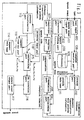
- Phonetic transcription information is inputted into the prosody generation part 110.
- the value of the pitch for each mora is registered with the prosody data base 111 in accordance with the number of moras in the accent phrase and the accent type.
- Fig 10 represents the manner where the value of the pitch is registered in the form of frequency (with a unit of Hz) .
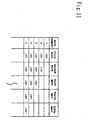
- the time length of each mora is registered with the prosody database 111 corresponding to the number of moras in the accent phrase.
- Fig 11 represents that manner.
- the unit of the time length in Fig 11 is milliseconds.
- Fig 12 represents the input/output data of the prosody generation part 110.
- the input is the phonetic transcription which is the output of the language processing resulting Fig 8.
- the outputs are the phonetic transcription, the time length and the pitch.
- the phonetic transcription is the transcription of each syllable of the input after the accent symbols have been eliminated.
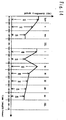
- the value of pitch frequency determined for each mora is converted to the frequency F 0 for each frame using liner interpolation or a spline interpolation, which is converted by Equation 3 utilizing the sampling frequency F s .
- T 0 F s / F 0
- Fig 14 shows the way the pitch frequency F is liner interpolated.
- a line is interpolated between 2 moras and the flat frequency is outputted as much as possible by using the closest value at the beginning of the sentence or just before and after SIL.
- both the speech sound communication and the text speech sound conversion are realized to make it possible to limit the amount of increase of the hardware scale to the minimum by utilizing the synthesizing part 115, the DA conversion part 116 and the speech sound outputting part 117 within the reception terminal apparatus.
- processing is also possible such as the display of text on the display screen of the reception terminal and the transformation of the text to the form suitable for the speech sound synthesis, because the text information is sent to the reception terminal as it is.
- the prosody generation part 110 and the prosody data base 111 are provided on the reception terminal end, it becomes possible for the user to select from a plurality of prosody patterns as desired and to set different prosodys for each reception terminal apparatus.
- the user can vary the parameters of the speech sound such as the speech rate and/or the pitch as desired.
- segment read-out part 113 and the segment data base 114 are mounted on the reception terminal end, it becomes possible for the user to switch between male and female voices and to switch between speakers or to select speech sounds of different speakers for each apparatus as desired.
- the user inputs an arbitrary text from the keyboard or the like to the text inputting part 100
- the text may be read out from memory media such as a hard disc, networks such as the Internet, LAN or from a data base. And it may also make it possible to input the text using the speech sound recognition system instead of the keyboard.
- the pitch and the time length are used in the prosody generation part 110 with reference to the table using the mora numbers and accent forms for each accent phrase, this may be performed in another method.
- the pitch may be generated as the value of consecutive pitch frequency by using a function in a production model such as a Fujisaki model.
- the time length may be found statistically as a characteristic amount for each phoneme.
- a basic CELP system is used as an example of a speech coding and decoding system
- a variety of improved systems based on this such as the CS-ACELP system (ITU-T Recommendation G. 729), maybe capable of being applied.
- the present invention is able to be applied to any systems where speech sound signals are coded by dividing them into the voicing source and the vocal tract characteristics such as an LPC coefficient and an LSP coefficient.
- Fig 2 shows the second embodiment of the speech sound communication system according to the present invention.
- the speech sound communication system comprises the transmission terminal and the reception terminal with a communication path connecting them.
- a text inputting part 100 is provided on the transmission terminal of which output is connected to the language analysis part 108.
- the output of the language analysis part 108 is transmitted to the communication path through the multiplexing part 104 and the transmission part 105.
- a reception part 106 is provided on the reception terminal, of which the output is connected to the separation part 107.
- the output of the separation part 107 is connected to the prosody generation part 110 and the synthesizing part 115.
- the remaining parts are the same as the first embodiment.
- the speech sound communication system configured in this way operates in the same way as the first embodiment.
- the text inputting part 100 outputs the text information directly to the language analysis part 108 instead of the multiplexing part 104
- the phonetic transcription information which is the output of the language analysis part 108 is outputted to the multiplexing part 104
- the separation part 107 separates the received data series into the speech code series and the phonetic transcription information and the separated phonetic transcription information is inputted into the prosody generation part 110.
- the circuit scale of the reception terminal can be further made smaller. This is an advantage in the case that the reception end is a terminal of a portable type and the transmission side is a large scale apparatus such as a computer server.
- the user can also change the speech sound parameters such as the speech rate or the pitch as desired since the prosody transformation part 112 is provided on the reception terminal end.
- segment read-out part 113 and the segment data base 114 are mounted on the reception terminal end, it is also possible for the user to switch between male and female voices and to switch between different speakers as desired and to set speech sounds of different speakers for each apparatus.
- Fig 3 shows the third embodiment of the speech sound communication system according to the present invention.
- the speech sound communications system comprises the transmission terminal and the reception terminal with a communication path connecting them.
- the prosody generation part 110 and the prosody data base 111 are mounted on the transmission terminal instead of the reception terminal. Accordingly, the phonetic transcription information, which is the output of the language analysis part 108, is directly inputted to the prosody generation part 110, and the phonetic transcription information together with the prosody information, which is the output of the prosody generation part 110 is transmitted to the communication path via the multiplexing part 104 and the transmission part 105 of the transmission terminal.
- the data series received via the reception part 106 is separated into the speech code series and the phonetic transcription information together with the prosody information by the separation part 107 so that the speech code series is inputted into the synthesizing part 115 and the phonetic transcription information together with the prosody information is inputted into the prosody transformation part 112.
- the circuit scale of the reception terminal can further be made smaller.
- the reception end is a terminal of a portable type and the transmission end is a large scale apparatus such as a computer server.
- the user can change the speech sound parameters such as the speech rate or the pitch as desired.
- segment read-out part 113 and the segment data base 114 are mounted on the reception terminal's side, it also becomes possible for the user to switch between male and female voices and the switch between different speakers as desired and to set the speech sounds of different speakers for each apparatus.
- Fig 4 shows the fourth embodiment of the speech sound communication system according to the present invention.
- the speech sound communication system comprises, unlike that of the first, the second and the third embodiments, a repeater in addition to the transmission terminal and the reception terminal with communication paths connecting between them.
- the transmission terminal is provided with the text inputting part 100, of which the output is connected to the multiplexing part 104-a. It is also provided with the speech sound inputting part 101, of which the output is connected to the multiplexing part 104-a via the AD conversion part 102 and the speech coding part 103. The output of the multiplexing part 104-a is transmitted to the communication path via the transmission part 105-a.
- the repeater is provided with the reception part 106-a of which the output is connected to the separation part 107-a.
- One output of the separation part 107-a is connected to the language analysis part 108 of which the output is connected to the multiplexing pare 104-b.
- the language analysis part 108 is connected with the dictionary 109.
- the other output of the separation part 107-a is connected to the multiplexing part 104-b, of which the output is transmitted to the communication part via the transmission part 105-b.
- the reception terminal is provided with the reception part 106-b, of which the output is connected to the separation part 107-b.
- One output of the separation part 107-b is connected to the prosody generation part 110.
- the prosody generation part 110 is connected with the prosody data base 111.
- the output of the prosody generation part 110 is connected to the prosody transformation part 112, of which the output is connected to the segment read-out part 113.
- the segment data base 114 is connected to the segment read-out part 113.
- Both outputs of the prosody transformation part 112 and the segment read-out part 113 are connected to the synthesizing part 115. And the output of the synthesizing part 115 is connected to the speech sound outputting part 117 via the DA conversion part 116. It is also provided with the parameter inputting part 118 which is connected to the prosody transformation part 112 and the segment read-out part 113.
- the operation of the speech sound communication system configured in this way is the same as that of the first embodiment according to the present invention with respect to the transmission terminal. And with respect to the reception terminal it is the same as that of the third embodiment according to the present invention.
- the operation in the repeater is as follows.
- the reception part 106 receives the above described data series from the communication path to be outputted to the separation part 107.
- the separation part 107 separates the data series into the speech code series and the text information so that the speech code series is outputted to the multiplexing part 104-b and the text information is outputted to the language analysis part 108, respectively.
- the text information is processed in the same way as in the other embodiments and converted into the phonetic transcription information to be outputted to the multiplexing part 104-b.
- the multiplexing part 104-b multiplexes the speech code series and the phonetic transcription information to form a data series to be transmitted to the communication path via the transmission part 105-b.
- the prosody generation part 110 and the prosody data base 111 are provided on the reception terminal end, it is possible for the user to select the desired setting form a plurality of prosody patterns or to set different prosodies for each reception terminal apparatus.
- the prosody transformation part 112 Since the prosody transformation part 112 is mounted on the reception terminal end, the user can change the speech sound parameters such as vocalization rate and the pitch as desired.
- segment read-out part 113 and the segment database 114 are mounted on the reception terminal's end,it is also possible for the user to switch between male and female voices and to switch between different speakers and to set speech voices of different speakers for each apparatus.
- Fig 5 shows the fifth embodiment of the speech sound communication system according to the present invention.
- the speech sound communication system comprises a transmission terminal, a repeater and a reception terminal with communication paths connecting them.
- the prosody generation part 110 and the prosody data base 111 are mounted in the repeater instead of in the reception terminal. Therefore, the phonetic transcription information which is the output of the language analysis part 108 is directly inputted into the prosody generation part 110 and the phonetic transcription information with the prosody information which is the output of the prosody generation part 110 is transmitted to the communication path through the multiplexing part 104-b and the transmission part 105-b.
- the transmission terminal operates in the same way as that of the fourth embodiment according to the present invention and the reception terminal operates in the same way as that of the third embodiment according to the present invention.
- the language analysis part 108 and the dictionary 109 need not be mounted on either the transmission terminal or on the reception terminal, which makes it possible to further reduce the scale of both circuits. This becomes more advantageous in the case that both the transmission end and reception end are terminal apparatuses of a portable type.
- the user can change the speech sound parameters such as the speech rate and the pitch as desired.
- segment read-out part 113 and the segment data base 114 are mounted on the reception terminal end, it is possible for the user to switch between male and female voices and to switch between different speakers and to set speech sounds of different speakers for each apparatus as desired.
- the transmission end it is set so that a certain language can be inputted and in the repeater a language analysis part and a prosody generation part are prepared to cope with multiple languages.
- the kinds of languages can be specified by referring to the data base when the transmission terminal is recognized. Or the information with respect to the kinds of languages may be transmitted each time from the transmission terminal.
- the prosody generation part 110 can transcribe the prosody information without depending on the language by utilizing a prosody information description method such as ToBI (Tones and Break Indices, M.E. Beckman and G.M. Ayers, The ToBI Handbook, Tech. Rept. (Ohio State University, Columbus, U.S.A. 1993)) physical amounts such as phoneme time length, pitch frequency, amplitude value.
- ToBI Tones and Break Indices, M.E. Beckman and G.M. Ayers, The ToBI Handbook, Tech. Rept. (Ohio State University, Columbus, U.S.A. 1993)
- the voicing source wave form can be generated with a proper period and a proper amplitude and proper code numbers are generated according to the phonetic transcription and the prosody information so that the speech sound of any language can be synthesized with a common circuit.
- Fig 6 shows the sixth embodiment of the speech sound communication system according to the present invention.
- the speech sound communication system comprises a transmission terminal, a repeater and a reception terminal with communication parts connecting them to each other.
- the language analysis part 108 and the dictionary 109 are mounted on the transmission terminal instead of on the repeater.
- the transmission terminal operates in the same way as the second embodiment according to the present invention.
- the reception terminal operates in the same way as the third embodiment according to the present invention.
- the data series received from the communication path through the reception part 106-a is separated into the phonetic transcription information and the speech code series in the separation part 107-a.
- the phonetic transcription information is converted into the phonetic transcription information with the prosody information by using prosody data base 111 in prosody generation part 110.
- the speech code series is also inputted to the multiplexing part 104-b, which is multiplexed with the phonetic transcription information with the prosody information to be one data series that is transmitted to the communication path via the transmission part 105-b.
- the prosody generation part 110 and the prosody data base 111 need not be mounted on the reception terminal in the same way as the fifth embodiment according to the present invention, which makes it possible to reduce the circuit scale.
- the user can change the speech sound parameters such as the speech rate or the pitch as desired.
- segment read-out part 113 and the segment data base 114 are mounted on the reception terminal end, it is possible for the user to switch between male and female voices and to switch between different speakers and to set speech sounds of different speakers for each apparatus as desired.
- the transmission terminal end has a language analysis part to cope with a certain language.
- the connection to an arbitrary person is possible in the system through an exchange such as in a portable telephone system, the communication can always be established as far as the reception end not depending on a language. In such circumstances the transmission end can be allowed to have the language dependence.
- a speech sound rule synthesizing function can be added simply by adding a small amount of software and a table.
- the segment table has a large size but, in the case that wave form segments used in a general rule synthesizing system are utilized, 100 kB or more becomes necessary. On the contrary, in the case that it is formed into a table with code numbers approximately 10 kB are required for configuration.
- the software is also unnecessary in the wave form generation part such as in the rule synthesizing system. Accordingly, all of those functions can be implemented in a single chip.
- the application range is expanded. For example, it is possible to listen to the contents of the latest news information by converting it to speech sound after completing the communication by accessing the server on a portable telephone to download instantly. It is also possible to output with speech sound with the display of characters for the apparatus with a pager function built in.
- the speech sound rule synthesizing function can make the pitch or the rate variable by changing the parameters, therefore, it has the advantage that the appropriate pitch height or rate can be selected for comfortable listening in accordance with environmental noise.
- a built-in high level text processing function needs complicated software and a large-scale dictionary, therefore, they can be built into the relay station it becomes possible to realize the same function at low cost.
- the language processing part and the prosody generation part are built into the transmission terminal or into the relay station it becomes possible to implement a reception terminal which doesn't depend on any languages.
Landscapes
- Engineering & Computer Science (AREA)
- Computational Linguistics (AREA)
- Health & Medical Sciences (AREA)
- Audiology, Speech & Language Pathology (AREA)
- Human Computer Interaction (AREA)
- Physics & Mathematics (AREA)
- Acoustics & Sound (AREA)
- Multimedia (AREA)
- Machine Translation (AREA)
- Telephone Function (AREA)
- Telephonic Communication Services (AREA)
- Document Processing Apparatus (AREA)
Abstract
Description
wherein, said text input means inputs text information;
wherein, said text input means inputs text information;
wherein, said text input means inputs text information;
wherein, said text input means inputs text information;
wherein, said text input means inputs text information;
wherein, said text input means inputs text information;
- 100
- text input part
- 101
- speech sound input part
- 102
- AD conversion part
- 103
- speech coding part
- 104
- multiplexing part
- 104-a
- multiplexing part
- 104-b
- multiplexing part
- 105
- transmission part
- 105-a
- transmission part
- 105-b
- transmission part
- 106
- reception part
- 106-a
- reception part
- 106-b
- reception part
- 107
- separation part
- 107-a
- separation part
- 107-b
- separation part
- 108
- language analysis part
- 109
- dictionary
- 110
- prosody generation part
- 111
- prosody data base
- 112
- prosody transformation part
- 113
- segment read-out part
- 113-1
- segment selection part
- 113-2
- data read-out part
- 114
- segment data base
- 115
- synthesizing part
- 115-1
- adaptive code book
- 115-2
- noise code book
- 115-3
- gain code book
- 115-4
- synthesizing filter
- 116
- DA conversion part
- 117
- speech sound output part
- 200
- LPC analysis part
- 201
- LPC parameter quantization part
- 202
- synthesizing filter
- 203
- adaptive code book
- 204
- noise code book
- 205
- gain code book
- 206
- auditory weighting filter
- 207
- distortion calculation part
- 208
- adaptive code book
- 209
- noise code book
- 210
- gain code book
- 211
- synthesizing filter
Claims (18)
- A speech sound communication system comprising;a transmission part having a text input means and a transmission means;a reception part having a reception means, a language analysis means, a prosody generation means, an segment data memory means, an segment read-out means and a synthesizing means,
wherein, said text input means inputs text information;said transmission means transmits said text information to a communication path;said reception means receives said text information from said communication path;said language analysis means analyses said text information so that said text information is converted to phonetic transcription information;said prosody generation means converts said phonetic transcription information into phonetic transcription with prosody information;said segment read-out means reads out segment data from said segment data memory means in accordance with said phonetic transcription information with prosody information;said synthesizing means synthesizes a speech sound by utilizing said phonetic transcription information with prosody information and said segment data;said segment data memory means stores voicing source characteristics and vocal tract transmission characteristics information; andsaid synthesizing part synthesizes speech sound by generating a voicing source wave form having a period in accordance with said prosody information and having characteristics in accordance with said voicing source characteristics and by filter processing said voicing source wave form in accordance with said vocal tract transmission characteristics information. - A speech sound communication system according to Claim 1 wherein:said transmission part has a speech sound input means, a speech coding means and a multiplexing means;said reception part has a separation means;said speech sound input means inputs speech sound signals;said speech coding means converts said inputted speech sound signals into a speech code series by analyzing the pitch, the voicing source characteristics and the vocal tract transmission characteristics of the signal to be coded;said multiplexing means multiplies said text information and Said sound speech code series to be converted into one code series;said separation means separates said code series into said text information and said speech code series; andsaid synthesizing means converts said speech code series into speech sound signals.
- A speech sound communication system comprising a transmission part having a text input means, a language analysis means and a transmission means as well as a reception part having a reception means, a prosody generation means, an segment data memory means, an segment read-out means and a synthesizing means,
wherein, said text input means inputs text information;said language analysis means converts said text information into phonetic transcription information;said transmission means transmits said phonetic transcription information into a communication path;said reception means receives said phonetic transcription information from said communication path;said prosody generation means converts said phonetic transcription information into phonetic transcription information with prosody information;said segment read-out means reads out segment data from said segment data memory means in accordance with said phonetic transcription information with prosody information;said synthesizing means synthesizes a speech sound by utilizing said phonetic transcription information with prosody information and said segment data;said segment data memory means stores voicing source characteristics and vocal tract transmission characteristics information; andsaid synthesizing means synthesizes speech sound by generating a voicing source wave form having a period in accordance with said prosody information and having characteristics in accordance with said voicing source characteristics and by filter processing said voicing source wave form in accordance with said vocal tract transmission characteristics information. - A speech sound communication system according to Claim 3 wherein:said transmission part has a speech sound input means, a speech coding means and a multiplexing means;said reception part has a separation means;said speech sound input means inputs speech sound signals;said speech coding means converts said inputted speech sound signals into a speech code series by analyzing the pitch, the voicing source characteristics and the vocal tract transmission characteristics of the signal to be coded;said multiplexing means multiplies said text information and said speech code series to generate one code series;said separation means separates said code series into said text information and said speech code series; andsaid synthesizing means converts said speech code series into speech sound signals.
- A speech sound communication system comprising a transmission part having a text input means, a language analysis means, a prosody generation means and a transmission means as well as a reception part having a reception means, an segment data memory means, an segment read-out means and a synthesizing means,
wherein, said text input means inputs text information;said language analysis means converts said text information into phonetic transcription information;said prosody generation means converts said phonetic transcription information into phonetic transcription information with prosody information;said transmission means transmits said phonetic transcription information with prosody information into a communication path;said reception means receives said phonetic transcription information with prosody information from said communication path;said segment read-out means reads out segment data from said segment data memory means in accordance with said phonetic transcription information with prosody information;said synthesizing means synthesizes a speech sound by utilizing said phonetic transcription information with prosody information and said segment data;said segment data memory means stores voicing source characteristics and vocal tract transmission characteristics information; andsaid synthesizing part synthesizes speech sound by generating a voicing source wave form having a period in accordance with said prosody information and having characteristics in accordance with said voicing source characteristics and by filter processing said voicing source wave form in accordance with said vocal tract transmission characteristics information. - A speech sound communication system according to Claim 5 wherein;said transmission part has a speech input means, a speech coding means and a multiplexing means;said reception part has a separation means;said speech sound input means inputs speech sound signals;said speech coding means converts said speech sound signals into a speech code series by analyzing the pitch, the voicing source characteristics and the vocal tract transmission characteristics of the signal to be coded;said multiplexing means multiplies said phonetic transcription information with prosody information and said speech code series to generate one code series;said separation means separates said code series into said phonetic transcription information with prosody information and said speech code series; andsaid synthesizing means converts said speech code series into speech sound signals.
- A speech sound communication system comprising:a transmission part having a text input means and a first transmission means;a repeater part having a first reception means, a language analysis means and a second transmission means; anda reception part having a second reception means, a prosody generation means, an segment data memory means, an segment read-out means and a synthesizing means;
wherein, said text input means inputs text information;said first transmission means transmits said text information to a first communication path;said first reception means receives said text information from said first communication path;said language analysis means converts said text information into phonetic transcription information;said second transmission means transmits said phonetic transcription information into a second communication path;said second reception means receives said phonetic transcription information from said second communication path;said prosody generation means converts said phonetic transcription information into phonetic transcription information with prosody information;said segment read-out means reads out segment data from said segment data memory means in accordance with said phonetic transcription information with prosody information;said synthesizing means synthesizes speech sounds by utilizing said phonetic transcription information with prosody information and said segment data;said segment data memory means stores voicing source characteristics and vocal tract transmission characteristics information; andsaid synthesizing means synthesizes speech sounds by generating a voicing source wave form having a period in accordance with said prosody information and having characteristics in accordance with said sound characteristics and by filter processing said voicing source wave form in accordance with said vocal tract transmission characteristics information. - A speech sound communication system according to Claim 7 wherein:said transmission part has a speech sound input means, a speech coding means and a first multiplexing means;said repeater part has a first separation means and a second multiplexing means;said reception part has a second separation means;said speech sound input means inputs speech sound signals;said speech coding means converts said speech sound signals into a speech code series by analyzing the pitch, the voicing source characteristics and the vocal tract transmission characteristics of the signals to be coded;said first multiplexing means multiplexes said text information and said speech code series to generate one code series;said first separation means separates said code series into said text information and said speech code series;said second multiplexing means multiplexes said phonetic transcription information and said speech code series to generate one code series;said second separation means separates the code series multiplexed by said second multiplexing means into said phonetic transcription information and said speech code series; andsaid synthesizing means converts said speech code series into speech sound signals.
- A speech sound communication system comprising:a transmission part having a text input means and a first transmission means;a repeater part having a first reception means, a language analysis means, a prosody generation means and a second transmission means; anda reception part having a second reception means, an segment data memory means, an segment read-out means and a synthesizing means;
wherein, said text input means inputs text information;said first transmission means transmits said text information to a first communication path;said first reception means receives said text information from said first communication path;said language analysis means converts said text information into phonetic transcription information;said prosody generation means converts said phonetic transcription information into phonetic transcription information with prosody information;said second transmission part transmits said phonetic transcription information with prosody information into a second communication path;said second reception part receives said phonetic transcription information with prosody information from said second communication path;said segment read-out means reads out segment data from said segment data memory means in accordance with said phonetic transcription information with prosody information;said synthesizing means synthesizes speech sounds by utilizing said phonetic transcription information with prosody information and said segment data;said segment data memory means stores voicing source characteristics and vocal tract transmission characteristics information; andsaid synthesizing part synthesizes speech sounds by generating a voicing source wave form having a period in accordance with said prosody information and having characteristics in accordance with said voicing source characteristics and by filter processing said voicing source wave form in accordance with said vocal tract transmission characteristics information. - A speech sound communication system according to Claim 9 wherein:said transmission part has a speech sound input means, a speech coding means and a first multiplexing means, said repeater part has a first separation means and a second multiplexing means, and said reception part has a second separation means;said speech sound input means inputs speech sound signals;said speech coding means converts said speech sound signals into a speech code series by analyzing the pitch, the voicing source characteristics and the vocal tract transmission characteristics of the signal to be coded;said first multiplexing means multiplexes said text information and said speech code series to generate one code series;said first separation means separates said code series into said text information and said sound code series;said second multiplexing means multiplexes said phonetic transcription information with prosody information and said speech code series to generate one code series;said second separation means separates said code series multiplexed by said second multiplexing means into said phonetic transcription information with prosody information and said speech code series; andsaid synthesizing means converts said speech code series into speech sound signals.
- A speech sound communications system comprising a transmission part having a text input means, a language analysis means and a first transmission means, a repeater part having a first reception means, prosody generation means and second transmission means and a reception part having a second reception means, an segment data memory means, an segment read-out means and a synthesizing means,
wherein, said text input means inputs text information;said language analysis means converts said text information into phonetic transcription information;said first transmission means transmits said phonetic transcription information into a first communication path;said first reception means receives phonetic transcription information from said first communication path;said prosody generation means converts said phonetic transcription information into phonetic transcription information with prosody information;said second transmission means transmits said phonetic transcription information with prosody information to a second communication path;said second reception means receives said phonetic transcription information with prosody information from said second communication path;said segment read-out means reads out segment data from said segment data memory means in accordance with said phonetic transcription information with prosody information;said synthesizing means synthesizes speech sounds by using said phonetic transcription information with prosody information and said segment data;said segment data memory means stores the voicing source characteristics and the vocal tract transmission characteristics information; andsaid synthesizing part synthesizes speech sounds by generating a voicing source wave form having a period in accordance with said prosody information and having characteristics in accordance with said voicing source characteristics and by filter- processing said voicing source wave form in accordance with said vocal tract transmission characteristics information. - A speech sound communication system according to Claim 11 characterized in that:said transmission part has a speech sound input means, a speech coding means and a first multiplexing means, said repeater part has a first separation means and a second multiplexing means, and said reception part has a second separation means;said speech sound input means inputs speech sound signals;said speech coding means converts said speech sound signals into a speech code series by analyzing the pitch, the voicing source characteristics and the vocal tract transmission characteristics of the signal to be coded;said first multiplexing means multiplexes said phonetic transcription information and said speech code series to generate one code series;said first separation means separates said code series into said phonetic transcription information and said sound code series;said second multiplexing means multiplexes said phonetic transcription information with prosody information and said speech code series to generate one code series;said second separation means separates said code series multiplexed by said second multiplexing means into said phonetic transcription information with prosody information and said speech code series; andsaid synthesizing means converts said speech code series into speech sound signals.
- A speech sound communication system according to Claims 1, 3, 5, 7, 9 or 11 wherein the user can input an arbitrary text into said text input means.
- A speech sound communication system according to Claims 1, 3, 5, 7, 9 or 11 wherein said text input means carries out input by reading out a text from a memory medium, network like Internet, LAN or a data base.
- A speech sound communication system according to Claims 1,3,5,7, 9 or 11, further comprising a parameter input means and in that the user can input parameter values of speech sounds as desired by said parameter input means and said prosody generation means and said segment read-out means output values modified in accordance with said parameter values.
- A speech sound communication system according to Claims 2, 4, 6, 8, 10 or 12 wherein the user can input and arbitrary text into said text input means.
- A speech sound communication system according to Claims 2, 4, 6, 8, 10 or 12 wherein said text input means carries out input by reading out a text from a memory medium, network like Internet, LAN or a data base.
- A speech sound communication system according to Claims 2, 4, 6, 8, 10 or 12, further comprising said parameter input means and in that the user can input parameter values of speech sounds as desired by said parameter input means and said prosody generation means and said segment read-out means output values modified in accordance with said parameter values.
Applications Claiming Priority (2)
| Application Number | Priority Date | Filing Date | Title |
|---|---|---|---|
| JP10932999 | 1999-04-16 | ||
| JP10932999 | 1999-04-16 |
Publications (2)
| Publication Number | Publication Date |
|---|---|
| EP1045372A2 true EP1045372A2 (en) | 2000-10-18 |
| EP1045372A3 EP1045372A3 (en) | 2001-08-29 |
Family
ID=14507474
Family Applications (1)
| Application Number | Title | Priority Date | Filing Date |
|---|---|---|---|
| EP00108287A Withdrawn EP1045372A3 (en) | 1999-04-16 | 2000-04-14 | Speech sound communication system |
Country Status (3)
| Country | Link |
|---|---|
| US (1) | US6516298B1 (en) |
| EP (1) | EP1045372A3 (en) |
| CN (1) | CN1171396C (en) |
Families Citing this family (22)
| Publication number | Priority date | Publication date | Assignee | Title |
|---|---|---|---|---|
| JP3361291B2 (en) * | 1999-07-23 | 2003-01-07 | コナミ株式会社 | Speech synthesis method, speech synthesis device, and computer-readable medium recording speech synthesis program |
| US7031924B2 (en) * | 2000-06-30 | 2006-04-18 | Canon Kabushiki Kaisha | Voice synthesizing apparatus, voice synthesizing system, voice synthesizing method and storage medium |
| US6681208B2 (en) * | 2001-09-25 | 2004-01-20 | Motorola, Inc. | Text-to-speech native coding in a communication system |
| US7013282B2 (en) * | 2003-04-18 | 2006-03-14 | At&T Corp. | System and method for text-to-speech processing in a portable device |
| WO2005071664A1 (en) * | 2004-01-27 | 2005-08-04 | Matsushita Electric Industrial Co., Ltd. | Voice synthesis device |
| CN100524457C (en) * | 2004-05-31 | 2009-08-05 | 国际商业机器公司 | Device and method for text-to-speech conversion and corpus adjustment |
| US7788098B2 (en) * | 2004-08-02 | 2010-08-31 | Nokia Corporation | Predicting tone pattern information for textual information used in telecommunication systems |
| US7558389B2 (en) * | 2004-10-01 | 2009-07-07 | At&T Intellectual Property Ii, L.P. | Method and system of generating a speech signal with overlayed random frequency signal |
| JP4025355B2 (en) * | 2004-10-13 | 2007-12-19 | 松下電器産業株式会社 | Speech synthesis apparatus and speech synthesis method |
| US20070027691A1 (en) * | 2005-08-01 | 2007-02-01 | Brenner David S | Spatialized audio enhanced text communication and methods |
| US8224647B2 (en) * | 2005-10-03 | 2012-07-17 | Nuance Communications, Inc. | Text-to-speech user's voice cooperative server for instant messaging clients |
| CN100487788C (en) * | 2005-10-21 | 2009-05-13 | 华为技术有限公司 | Method for realizing text-to-speech function |
| JP4882899B2 (en) * | 2007-07-25 | 2012-02-22 | ソニー株式会社 | Speech analysis apparatus, speech analysis method, and computer program |
| JP4455633B2 (en) * | 2007-09-10 | 2010-04-21 | 株式会社東芝 | Basic frequency pattern generation apparatus, basic frequency pattern generation method and program |
| US8856003B2 (en) * | 2008-04-30 | 2014-10-07 | Motorola Solutions, Inc. | Method for dual channel monitoring on a radio device |
| CN101894547A (en) * | 2010-06-30 | 2010-11-24 | 北京捷通华声语音技术有限公司 | Speech synthesis method and system |
| CN103165126A (en) * | 2011-12-15 | 2013-06-19 | 无锡中星微电子有限公司 | Method for voice playing of mobile phone text short messages |
| EP3239981B1 (en) * | 2016-04-26 | 2018-12-12 | Nokia Technologies Oy | Methods, apparatuses and computer programs relating to modification of a characteristic associated with a separated audio signal |
| CN109215670B (en) * | 2018-09-21 | 2021-01-29 | 西安蜂语信息科技有限公司 | Audio data transmission method and device, computer equipment and storage medium |
| CN110211562B (en) * | 2019-06-05 | 2022-03-29 | 达闼机器人有限公司 | Voice synthesis method, electronic equipment and readable storage medium |
| US11276392B2 (en) * | 2019-12-12 | 2022-03-15 | Sorenson Ip Holdings, Llc | Communication of transcriptions |
| KR102548618B1 (en) * | 2021-01-25 | 2023-06-27 | 박상래 | Wireless communication apparatus using speech recognition and speech synthesis |
Family Cites Families (7)
| Publication number | Priority date | Publication date | Assignee | Title |
|---|---|---|---|---|
| US3704345A (en) * | 1971-03-19 | 1972-11-28 | Bell Telephone Labor Inc | Conversion of printed text into synthetic speech |
| US5696879A (en) * | 1995-05-31 | 1997-12-09 | International Business Machines Corporation | Method and apparatus for improved voice transmission |
| ATE195828T1 (en) * | 1995-06-02 | 2000-09-15 | Koninkl Philips Electronics Nv | DEVICE FOR GENERATING CODED SPEECH ELEMENTS IN A VEHICLE |
| EP0762384A2 (en) * | 1995-09-01 | 1997-03-12 | AT&T IPM Corp. | Method and apparatus for modifying voice characteristics of synthesized speech |
| IL116103A0 (en) * | 1995-11-23 | 1996-01-31 | Wireless Links International L | Mobile data terminals with text to speech capability |
| US5905972A (en) * | 1996-09-30 | 1999-05-18 | Microsoft Corporation | Prosodic databases holding fundamental frequency templates for use in speech synthesis |
| US6226614B1 (en) * | 1997-05-21 | 2001-05-01 | Nippon Telegraph And Telephone Corporation | Method and apparatus for editing/creating synthetic speech message and recording medium with the method recorded thereon |
-
2000
- 2000-04-14 EP EP00108287A patent/EP1045372A3/en not_active Withdrawn
- 2000-04-17 CN CNB001068253A patent/CN1171396C/en not_active Expired - Fee Related
- 2000-04-17 US US09/550,891 patent/US6516298B1/en not_active Expired - Fee Related
Also Published As
| Publication number | Publication date |
|---|---|
| CN1271216A (en) | 2000-10-25 |
| US6516298B1 (en) | 2003-02-04 |
| EP1045372A3 (en) | 2001-08-29 |
| CN1171396C (en) | 2004-10-13 |
Similar Documents
| Publication | Publication Date | Title |
|---|---|---|
| US6516298B1 (en) | System and method for synthesizing multiplexed speech and text at a receiving terminal | |
| US6810379B1 (en) | Client/server architecture for text-to-speech synthesis | |
| RU2294565C2 (en) | Method and system for dynamic adaptation of speech synthesizer for increasing legibility of speech synthesized by it | |
| US5995923A (en) | Method and apparatus for improving the voice quality of tandemed vocoders | |
| JPH10260692A (en) | Speech recognition / synthesis encoding / decoding method and speech encoding / decoding system | |
| JP2006099124A (en) | Automatic voice/speaker recognition on digital radio channel | |
| KR20070007882A (en) | Voice Over Short Message Service | |
| KR19990037291A (en) | Speech synthesis method and apparatus and speech band extension method and apparatus | |
| RU2333546C2 (en) | Voice modulation device and technique | |
| KR20000047944A (en) | Receiving apparatus and method, and communicating apparatus and method | |
| JP2000209663A (en) | Method for transmitting non-voice information in voice channel | |
| CN111246469B (en) | Artificial intelligence secret communication system and communication method | |
| JPH0644195B2 (en) | Speech analysis and synthesis system having energy normalization and unvoiced frame suppression function and method thereof | |
| JP3473204B2 (en) | Translation device and portable terminal device | |
| JP4420562B2 (en) | System and method for improving the quality of encoded speech in which background noise coexists | |
| JP2000356995A (en) | Voice communication system | |
| EP1298647B1 (en) | A communication device and a method for transmitting and receiving of natural speech, comprising a speech recognition module coupled to an encoder | |
| JP2000068925A (en) | Method and system for transmitting data over a voice channel | |
| CN102857650A (en) | Method for dynamically regulating voice | |
| AU1839001A (en) | Mobile to mobile digital wireless connection having enhanced voice quality | |
| EP1159738B1 (en) | Speech synthesizer based on variable rate speech coding | |
| JP3404055B2 (en) | Speech synthesizer | |
| Holmes | A survey of methods for digitally encoding speech signals | |
| JPH03288898A (en) | speech synthesizer | |
| JPWO2007015319A1 (en) | Audio output device, audio communication device, and audio output method |
Legal Events
| Date | Code | Title | Description |
|---|---|---|---|
| PUAI | Public reference made under article 153(3) epc to a published international application that has entered the european phase |
Free format text: ORIGINAL CODE: 0009012 |
|
| AK | Designated contracting states |
Kind code of ref document: A2 Designated state(s): AT BE CH CY DE DK ES FI FR GB GR IE IT LI LU MC NL PT SE |
|
| AX | Request for extension of the european patent |
Free format text: AL;LT;LV;MK;RO;SI |
|
| PUAL | Search report despatched |
Free format text: ORIGINAL CODE: 0009013 |
|
| AK | Designated contracting states |
Kind code of ref document: A3 Designated state(s): AT BE CH CY DE DK ES FI FR GB GR IE IT LI LU MC NL PT SE |
|
| AX | Request for extension of the european patent |
Free format text: AL;LT;LV;MK;RO;SI |
|
| RIC1 | Information provided on ipc code assigned before grant |
Free format text: 7G 10L 13/08 A, 7G 10L 19/00 B |
|
| 17P | Request for examination filed |
Effective date: 20011211 |
|
| AKX | Designation fees paid |
Free format text: DE FR GB |
|
| 17Q | First examination report despatched |
Effective date: 20021216 |
|
| STAA | Information on the status of an ep patent application or granted ep patent |
Free format text: STATUS: THE APPLICATION IS DEEMED TO BE WITHDRAWN |
|
| 18D | Application deemed to be withdrawn |
Effective date: 20040220 |