EP1044973A2 - Process for the dehalogenation of thiochroman and dihydrobenzothiophene derivatives - Google Patents
Process for the dehalogenation of thiochroman and dihydrobenzothiophene derivatives Download PDFInfo
- Publication number
- EP1044973A2 EP1044973A2 EP00302887A EP00302887A EP1044973A2 EP 1044973 A2 EP1044973 A2 EP 1044973A2 EP 00302887 A EP00302887 A EP 00302887A EP 00302887 A EP00302887 A EP 00302887A EP 1044973 A2 EP1044973 A2 EP 1044973A2
- Authority
- EP
- European Patent Office
- Prior art keywords
- formula
- alkyl
- compound
- process according
- independently
- Prior art date
- Legal status (The legal status is an assumption and is not a legal conclusion. Google has not performed a legal analysis and makes no representation as to the accuracy of the status listed.)
- Granted
Links
- 0 CC(*)(*)*c1c(*)c(*)c(*)c(*I)c1C(C)(*)* Chemical compound CC(*)(*)*c1c(*)c(*)c(*)c(*I)c1C(C)(*)* 0.000 description 2
Classifications
-
- C—CHEMISTRY; METALLURGY
- C07—ORGANIC CHEMISTRY
- C07D—HETEROCYCLIC COMPOUNDS
- C07D333/00—Heterocyclic compounds containing five-membered rings having one sulfur atom as the only ring hetero atom
- C07D333/50—Heterocyclic compounds containing five-membered rings having one sulfur atom as the only ring hetero atom condensed with carbocyclic rings or ring systems
- C07D333/52—Benzo[b]thiophenes; Hydrogenated benzo[b]thiophenes
- C07D333/54—Benzo[b]thiophenes; Hydrogenated benzo[b]thiophenes with only hydrogen atoms, hydrocarbon or substituted hydrocarbon radicals, directly attached to carbon atoms of the hetero ring
-
- C—CHEMISTRY; METALLURGY
- C07—ORGANIC CHEMISTRY
- C07D—HETEROCYCLIC COMPOUNDS
- C07D333/00—Heterocyclic compounds containing five-membered rings having one sulfur atom as the only ring hetero atom
- C07D333/50—Heterocyclic compounds containing five-membered rings having one sulfur atom as the only ring hetero atom condensed with carbocyclic rings or ring systems
- C07D333/52—Benzo[b]thiophenes; Hydrogenated benzo[b]thiophenes
- C07D333/62—Benzo[b]thiophenes; Hydrogenated benzo[b]thiophenes with hetero atoms or with carbon atoms having three bonds to hetero atoms with at the most one bond to halogen, e.g. ester or nitrile radicals, directly attached to carbon atoms of the hetero ring
- C07D333/68—Carbon atoms having three bonds to hetero atoms with at the most one bond to halogen
-
- C—CHEMISTRY; METALLURGY
- C07—ORGANIC CHEMISTRY
- C07D—HETEROCYCLIC COMPOUNDS
- C07D335/00—Heterocyclic compounds containing six-membered rings having one sulfur atom as the only ring hetero atom
- C07D335/04—Heterocyclic compounds containing six-membered rings having one sulfur atom as the only ring hetero atom condensed with carbocyclic rings or ring systems
- C07D335/06—Benzothiopyrans; Hydrogenated benzothiopyrans
-
- C—CHEMISTRY; METALLURGY
- C07—ORGANIC CHEMISTRY
- C07D—HETEROCYCLIC COMPOUNDS
- C07D409/00—Heterocyclic compounds containing two or more hetero rings, at least one ring having sulfur atoms as the only ring hetero atoms
- C07D409/02—Heterocyclic compounds containing two or more hetero rings, at least one ring having sulfur atoms as the only ring hetero atoms containing two hetero rings
- C07D409/06—Heterocyclic compounds containing two or more hetero rings, at least one ring having sulfur atoms as the only ring hetero atoms containing two hetero rings linked by a carbon chain containing only aliphatic carbon atoms
Definitions
- a common route to prepare these useful herbicidal agents entails the dehalogenation of an 8-halo-6-carbethoxythiochroman or 7-halo-5-carbethoxydihydrobenzothiophene intermediate compound.
- methods to dehalogenate said intermediate compound required high pressure hydrogenation techniques. Further, product yield and quality may be less than satisfactory.
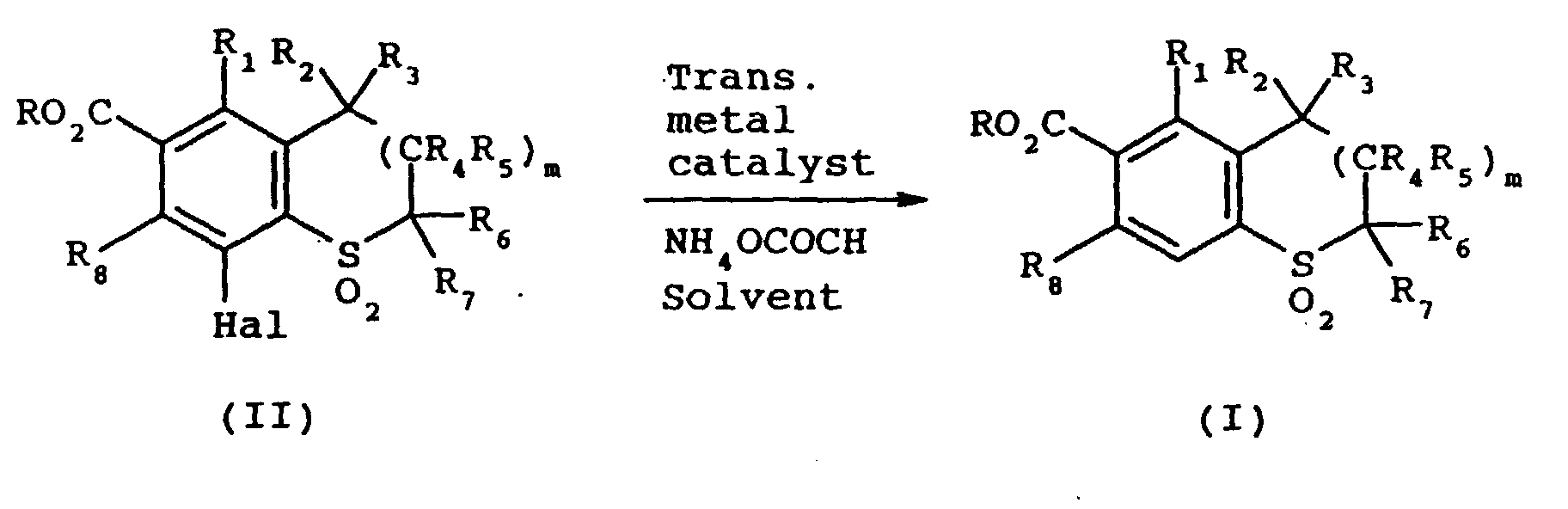
- the present invention provides a safe efficient process for the preparation of a compound of formula I wherein
- Polar solvents suitable for use in the process of the invention include alkanols, carboxylic acids or mixtures thereof, preferably methanol, ethanol or a mixture thereof.
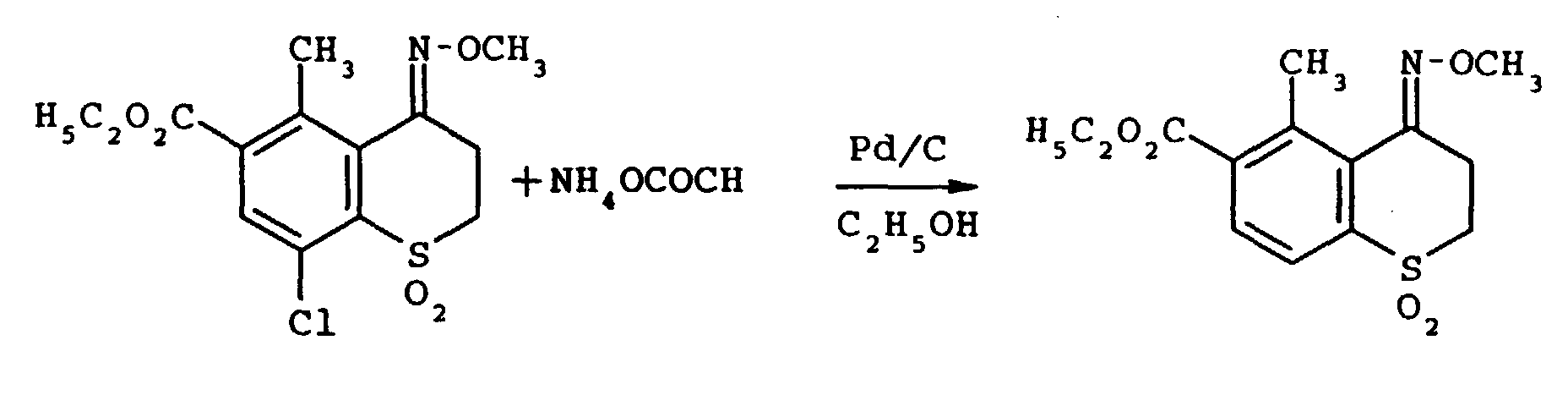
- Transition metal catalysts suitable for use in the inventive process include those transition metals commonly used in catalytic hydrogenation procedures such as Pt, Pd, Ni, Rh and similar conventional transition metals, preferably Pd.
- a catalytic amount designates that amount of catalyst required to facilitate the reaction and may range from an equimolar amount to a trace amount, preferably about 5 mole% to 20 mole%.
- Suitable reaction temperatures useful in the inventive process may range from ambient temperatures to the reflux temperature of the solvent or solvent mixture. In general, increased reaction temperature leads to increased reaction rate and drives the reaction to completion. However, excessively high temperatures may be detrimental and are not required. Preferable reaction temperatures are about 25°C-200°C, more preferably about 50°C-150°C.
- the inventive process requires at least 2 molar equivalents of ammonium formate in order to go to completion, however excess amounts of ammonium formate may be employed without detrimental effect.
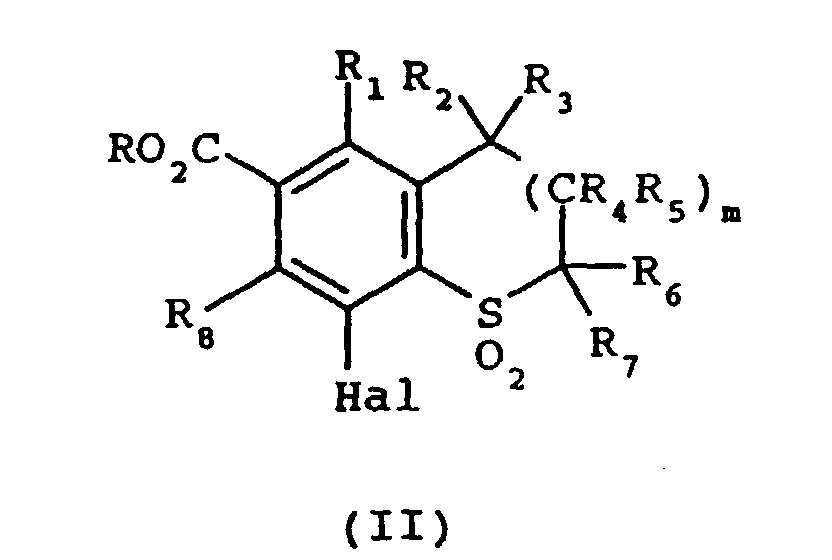
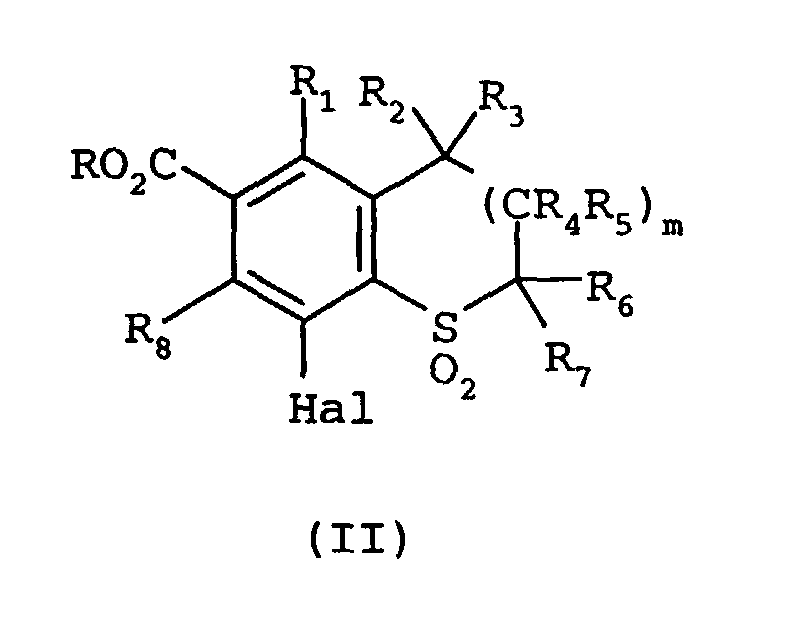
- a compound of formula II preferably wherein Hal is chlorine
- a polar solvent preferably an alkanol, acetic acid or a mixture thereof
- ammonium formate preferably 3 to 5 molar equivalents
- a catalytic amount of a transition metal catalyst preferably Pd on carbon (Pd/C) at temperatures ranging from ambient temperatures to the reflux temperature of the solvent, preferably about 25°C - 200°C, more preferably about 50°C - 150°C, to obtain the desired formula I compound.
- Another group of formula II compounds preferred for use in the inventive process are those compounds wherein Hal is Cl; m is 0; and R 2 and R 3 are each independently C 1 -C 4 alkyl.
- Thiochroman and dihydrobentothiophene herbicidal agents may be prepared from compounds of formula II via the inventive process to form the intermediate compound of formula I; when R is C 1 -C 4 alkyl, hydrolyzing the formula I compound to the corresponding carboxylic acid of formula III; and reacting the formula III acid with an hydroxypyrazolyl compound of formula IV to obtain the arylcarbonyl compound of formula V, optionally reacting the formula V compound with a sulfonyl chloride of formula VI to obtain the arylcarbonyl compound of formula VII.
- the formula V and formula VII arylcarbonylthiochromans and dihydrobenzothiophenes are potent herbicidal agents.
- R 10 is C 3 -C 4 alkyl
- R 11 is H or C 1 -C 4 alkyl
- R 12 is C 1 -C 6 alkyl or phenyl optionally substituted with one to three halogen, NO 2 , C 1 -C 4 alkyl, or C 1 -C 4 alkoxy groups.
- herbicidal agents of formula V and formula VII and their preparation from compounds of formula I are described in U.S. patents 5,506,194 and 5,607,898.
- the hydrolysis and sulfonation steps described above may be accomplished using conventional methods.
- the coupling of the hydroxypyrazole compound of formula IV and the subsequent rearrangement to the desired compound of formula V may be performed using standard methods such as those described in U.S. 5,506,194 and U.S. 5,607,898, i.e. in the presence of a base and a dehydrating agent.
- 1 HNMR and 13 CNMR designate proton and carbon 13 nuclear magnetic resonance, respectively.
- IR designates infrared spectroscopy.
- HPLC designates high performance liquid chromatography.
- the filtercake is slurried in tetrahydrofuran (THF) and filtered several times. All filtrates are combined, concentrated to about 1/3 the original volume and filtered though a bed of diatomaceous earth. The filtercake is washed with additional THF. The filtrates are combined, labelled filtrate A and set aside.
- THF tetrahydrofuran
- filtrates from this repeated reaction are combined and labelled filtrate B.
- Filtrates A and B are combined and concentrated in vacuo to about 1/5 the original volume, poured into water (about 6-fold volume) and filtered.
- the filtercake is washed with water and dried in vacuo at 55°-60°C for 16 hours to give the title product as a pale yellow solid, 1,230.0g (85.4% yield), 98.1% pure by HPLC analysis, identified by 1 HNMR, 13 CNMR and IR analyses.
Landscapes
- Chemical & Material Sciences (AREA)
- Organic Chemistry (AREA)
- Low-Molecular Organic Synthesis Reactions Using Catalysts (AREA)
- Organic Low-Molecular-Weight Compounds And Preparation Thereof (AREA)
- Plural Heterocyclic Compounds (AREA)
- Agricultural Chemicals And Associated Chemicals (AREA)
- Heterocyclic Compounds Containing Sulfur Atoms (AREA)
- Catalysts (AREA)
- Heterocyclic Carbon Compounds Containing A Hetero Ring Having Oxygen Or Sulfur (AREA)
Abstract
Description




Claims (12)
- A process for the preparation of a compound of formula (I)wherein
 which process comprises reacting a compound of formula IIR and R1 are each independently H or C1-C4alkyl;R2 and R3 are each independently H, C1-C4alkyl or R2 and R3 may be taken together with the atom to which they are attached to form a group C=NOR9 or C=O;R4, R5, R6, R7, R8 and R9 are each independently H or C1-C4alkyl; andm is 0 or 1wherein Hal is Cl, Br or I and R, R1, R2, R3, R4, R5, R6, R7, R8, R9 and m are as defined hereinabove with a catalytic amount of a transition metal catalyst and at least two molar equivalents of ammonium formate in the presence of a polar solvent optionally at an elevated temperature, and optionally hydrolyzing a formula (I) compound wherein R is C1-C4alkyl with base to give the corresponding carboxylic acid.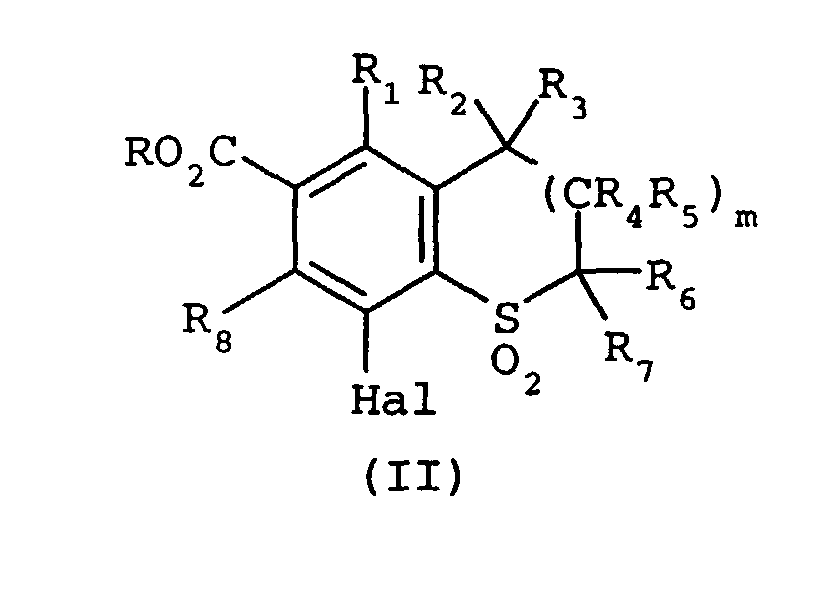
- A process according the claim 1 wherein the solvent is a C1-C6alkanol, a C1-C6carboxylic acid, or a mixture thereof.
- A process according to claim 1 or claim 2 wherein the transition metal is Pd.
- A process according to any one of claims 1 to 3 wherein Hal is Cl.
- A process according to any one of claims 1 to 4 wherein the temperature is from about 25°C to about 200°C.
- The process according to claim 5 wherein the temperature is about 50°C-150°C
- A process according to any one of claims 1 to 6 wherein m is 0 and R2 and R3 are each independently C1-C4alkyl.
- A process according to any one of claims 1 to 6 wherein R1, R2 and R3 are methyl; R6, R7 and R8 are H; and m is 0.
- A process according to any one of claims 1 to 6 wherein m is 1; R2 and R3 are taken together with the atom to which they are attached to form a group C=NOR9; and R9 is C1-C4alkyl.
- A process according to any one of claims 1 to to 6 wherein R1 is methyl; R2 and R3 are taken together with the atom to which they are attached to form a group C=NOR9; R9 is methyl; R4, R5, R6, R7 and R8 are H; and m is 1.
- A process for the preparation of a herbicidal compound of formula V or formula VIIwherein
 which process comprises the following steps:R1, R2, R4, R5, R6, R7, R8, R9 and R11 are each independently H or C1-C4alkyl;R2 and R3 are each independently H or C1-C4alkyl or R2 and R3 may be taken together with the atom to which they are attached to form a group C=NOR9 or C=O;R10 is C1-C4alkyl;R12 is C1-C6alkyl or phenyl optionally substituted with one to three halogen, NO2, C1-C4alkyl or C1-C4alkoxy groups; andm is 0 or 1(a) reacting a compound of formula (II)wherein Hal is Cl, Br or I; R1-8 and m are as defined above and R is H or C1-4alkyl with a catalytic amount of a transition metal catalyst and at least two molar equivalents of ammonium formate in the presence of a polar solvent optionally at an elevated temperature to give a corresponding compound of formula (I)
 and where the product is a compound of formula (I) wherein R is C1-C4alkyl, hydrolysing with base to give the corresponding carboxylic acid; and
 (b) reacting the product of step (a) wherein R is H with a compound of formula IVto obtain the desired herbicidal compound of formula V, optionally reacting said formula V compound with a sulfonyl chloride R12SO2Cl to obtain the desired herbicidal compound of formula VII.
- A process according to claim 11 in which step a) is carried out according to any one of claims 2 to 10.
Applications Claiming Priority (2)
| Application Number | Priority Date | Filing Date | Title |
|---|---|---|---|
| US28686799A | 1999-04-06 | 1999-04-06 | |
| US286867 | 1999-04-06 |
Publications (4)
| Publication Number | Publication Date |
|---|---|
| EP1044973A2 true EP1044973A2 (en) | 2000-10-18 |
| EP1044973A3 EP1044973A3 (en) | 2001-01-10 |
| EP1044973A9 EP1044973A9 (en) | 2001-03-28 |
| EP1044973B1 EP1044973B1 (en) | 2003-10-08 |
Family
ID=23100514
Family Applications (1)
| Application Number | Title | Priority Date | Filing Date |
|---|---|---|---|
| EP00302887A Expired - Lifetime EP1044973B1 (en) | 1999-04-06 | 2000-04-05 | Process for the dehalogenation of thiochroman and dihydrobenzothiophene derivatives |
Country Status (18)
| Country | Link |
|---|---|
| EP (1) | EP1044973B1 (en) |
| JP (1) | JP2002541149A (en) |
| KR (1) | KR20010071408A (en) |
| CN (1) | CN1310717A (en) |
| AR (1) | AR029746A1 (en) |
| AT (1) | ATE251620T1 (en) |
| AU (1) | AU3881500A (en) |
| BR (1) | BR0006017A (en) |
| CA (1) | CA2334478A1 (en) |
| CZ (1) | CZ200150A3 (en) |
| DE (1) | DE60005734D1 (en) |
| EA (1) | EA200100017A1 (en) |
| HU (1) | HUP0102649A3 (en) |
| IL (1) | IL139830A0 (en) |
| PL (1) | PL344666A1 (en) |
| SK (1) | SK19452000A3 (en) |
| UA (1) | UA58599C2 (en) |
| WO (1) | WO2000059898A2 (en) |
Families Citing this family (1)
| Publication number | Priority date | Publication date | Assignee | Title |
|---|---|---|---|---|
| CN119876973B (en) * | 2023-10-25 | 2025-10-10 | 安阳工学院 | Electrochemical preparation method and application of 2, 3-dihydrobenzo-oxidized thiophene compound |
Family Cites Families (2)
| Publication number | Priority date | Publication date | Assignee | Title |
|---|---|---|---|---|
| US5607898A (en) * | 1993-08-02 | 1997-03-04 | Idemitsu Kosan Company, Ltd. | Pyrazole derivatives |
| US5420295A (en) * | 1994-01-19 | 1995-05-30 | Allergan, Inc. | Process for preparing 4,4-dialkyl-6-halo-chromans or thiochromans useful as pharmaceutical intermediates |
-
2000
- 2000-03-14 JP JP2000609409A patent/JP2002541149A/en active Pending
- 2000-03-14 PL PL00344666A patent/PL344666A1/en not_active Application Discontinuation
- 2000-03-14 BR BR0006017-8A patent/BR0006017A/en not_active IP Right Cessation
- 2000-03-14 IL IL13983000A patent/IL139830A0/en unknown
- 2000-03-14 SK SK1945-2000A patent/SK19452000A3/en unknown
- 2000-03-14 EA EA200100017A patent/EA200100017A1/en unknown
- 2000-03-14 WO PCT/US2000/006601 patent/WO2000059898A2/en not_active Ceased
- 2000-03-14 AU AU38815/00A patent/AU3881500A/en not_active Abandoned
- 2000-03-14 CZ CZ200150A patent/CZ200150A3/en unknown
- 2000-03-14 KR KR1020007013761A patent/KR20010071408A/en not_active Abandoned
- 2000-03-14 HU HU0102649A patent/HUP0102649A3/en unknown
- 2000-03-14 CA CA002334478A patent/CA2334478A1/en not_active Abandoned
- 2000-03-14 CN CN00800514A patent/CN1310717A/en active Pending
- 2000-03-14 UA UA2001010135A patent/UA58599C2/en unknown
- 2000-04-05 EP EP00302887A patent/EP1044973B1/en not_active Expired - Lifetime
- 2000-04-05 DE DE60005734T patent/DE60005734D1/en not_active Expired - Lifetime
- 2000-04-05 AR ARP000101561A patent/AR029746A1/en not_active Application Discontinuation
- 2000-04-05 AT AT00302887T patent/ATE251620T1/en not_active IP Right Cessation
Also Published As
| Publication number | Publication date |
|---|---|
| SK19452000A3 (en) | 2001-09-11 |
| AR029746A1 (en) | 2003-07-16 |
| WO2000059898A2 (en) | 2000-10-12 |
| AU3881500A (en) | 2000-10-23 |
| DE60005734D1 (en) | 2003-11-13 |
| KR20010071408A (en) | 2001-07-28 |
| WO2000059898A3 (en) | 2001-02-08 |
| CZ200150A3 (en) | 2002-03-13 |
| EP1044973A9 (en) | 2001-03-28 |
| HUP0102649A3 (en) | 2002-03-28 |
| JP2002541149A (en) | 2002-12-03 |
| HUP0102649A2 (en) | 2001-11-28 |
| IL139830A0 (en) | 2002-02-10 |
| CN1310717A (en) | 2001-08-29 |
| ATE251620T1 (en) | 2003-10-15 |
| EP1044973B1 (en) | 2003-10-08 |
| EP1044973A3 (en) | 2001-01-10 |
| CA2334478A1 (en) | 2000-10-12 |
| UA58599C2 (en) | 2003-08-15 |
| BR0006017A (en) | 2001-03-06 |
| EA200100017A1 (en) | 2001-08-27 |
| PL344666A1 (en) | 2001-11-19 |
Similar Documents
| Publication | Publication Date | Title |
|---|---|---|
| CA2099537C (en) | Herbicide intermediate o-nitrophenyl cyclopropyl ketone and a method for the preparation thereof | |
| DD280320A5 (en) | PREPARATION OF INTERMEDIATE PRODUCTS OF OXOPHTHALAZINYL VINEGAR ACIDS WITH BENZOTHIAZOLE OR OTHER HETEROCYCLIC SIDE CHAINS | |
| EP1044973B1 (en) | Process for the dehalogenation of thiochroman and dihydrobenzothiophene derivatives | |
| US6180797B1 (en) | Process for the dehalogenation of thiochroman and dihydrobenzothiophene derivatives | |
| EP0493606B1 (en) | Heterocycle-substituted benzene derivative, production thereof, and herbicide containing the same as active ingredient | |
| KR100585407B1 (en) | Process and intermediates for the manufacture of pyridine-2,3-dicarboxylate compounds | |
| Jagdmann Jr et al. | A mild efficient procedure for the conversion of carboxylic acid esters to primary amides using formamide/methanolic sodium methoxide | |
| US4313000A (en) | Process for preparing 5-(2-chloro-4-trifluoromethylphenoxy)-2-nitro-N-alkanesulphonyl benzamides from a toluene derivative and intermediates | |
| EP0852224B1 (en) | Aryne intermediates towards the preparation of herbicidal sulfamoyl urea and a process for their preparation | |
| EP0275971A1 (en) | Process and intermediates for quinolonecaboxylic acid | |
| MXPA00012029A (en) | Stable dosage forms of fluoxetine and its enantiomers | |
| US4216340A (en) | Preparation of 5-(2,4-difluorophenyl)salicylic acid and derivatives | |
| US5856576A (en) | Aryne intermediates and a process for the preparation thereof | |
| JP3981771B2 (en) | 2-Benzyloxy-6-alkoxybenzoic acid derivative, method for producing the same, and agricultural and horticultural fungicide | |
| JPH05155881A (en) | Production of 2-substituted benzo(b)thiophene and its intermediate | |
| EP0211588B1 (en) | Process for preparing 2-acyl-3,4-dialkoxyanilines | |
| US4369316A (en) | 3,1 Benzoxazine 2,4-dione | |
| KR19990036612A (en) | Process for preparing benzyl bromide derivative | |
| JPH05117214A (en) | Production of diphenylamine derivative | |
| JP2809483B2 (en) | 6-Indolizinecarboxamide derivatives, intermediates thereof, methods for their preparation and herbicides | |
| JP4172931B2 (en) | Process for producing 1-alkyl-5-hydroxypyrazole | |
| JP4831897B2 (en) | Method for producing (2,6-dichloropyridin-4-yl) methanol | |
| JPH0825970B2 (en) | Process for producing tetrahydrophthalimide compound, intermediate thereof and process for producing the intermediate | |
| JPH09255648A (en) | Production of benzamidoxime compound | |
| JPH08157472A (en) | Method for producing pyrazole derivative |
Legal Events
| Date | Code | Title | Description |
|---|---|---|---|
| PUAI | Public reference made under article 153(3) epc to a published international application that has entered the european phase |
Free format text: ORIGINAL CODE: 0009012 |
|
| AK | Designated contracting states |
Kind code of ref document: A2 Designated state(s): AT BE CH CY DE DK ES FI FR GB GR IE IT LI LU MC NL PT SE |
|
| AX | Request for extension of the european patent |
Free format text: AL;LT;LV;MK;RO;SI |
|
| PUAL | Search report despatched |
Free format text: ORIGINAL CODE: 0009013 |
|
| AK | Designated contracting states |
Kind code of ref document: A3 Designated state(s): AT BE CH CY DE DK ES FI FR GB GR IE IT LI LU MC NL PT SE |
|
| AX | Request for extension of the european patent |
Free format text: AL;LT;LV;MK;RO;SI |
|
| K1C1 | Correction of patent application (title page) published |
Effective date: 20001018 |
|
| RAP1 | Party data changed (applicant data changed or rights of an application transferred) |
Owner name: IDEMITSU KOSAN CO., LTD. Owner name: AMERICAN CYANAMID COMPANY |
|
| 17P | Request for examination filed |
Effective date: 20010405 |
|
| 17Q | First examination report despatched |
Effective date: 20010627 |
|
| AKX | Designation fees paid |
Free format text: AT BE CH CY DE DK ES FI FR GB GR IE IT LI LU MC NL PT SE |
|
| AXX | Extension fees paid |
Free format text: AL PAYMENT 20010405;LT PAYMENT 20010405;LV PAYMENT 20010405;MK PAYMENT 20010405;RO PAYMENT 20010405;SI PAYMENT 20010405 |
|
| GRAH | Despatch of communication of intention to grant a patent |
Free format text: ORIGINAL CODE: EPIDOS IGRA |
|
| GRAS | Grant fee paid |
Free format text: ORIGINAL CODE: EPIDOSNIGR3 |
|
| GRAA | (expected) grant |
Free format text: ORIGINAL CODE: 0009210 |
|
| AK | Designated contracting states |
Kind code of ref document: B1 Designated state(s): AT BE CH CY DE DK ES FI FR GB GR IE IT LI LU MC NL PT SE |
|
| AX | Request for extension of the european patent |
Extension state: AL LT LV MK RO SI |
|
| PG25 | Lapsed in a contracting state [announced via postgrant information from national office to epo] |
Ref country code: NL Free format text: LAPSE BECAUSE OF FAILURE TO SUBMIT A TRANSLATION OF THE DESCRIPTION OR TO PAY THE FEE WITHIN THE PRESCRIBED TIME-LIMIT Effective date: 20031008 Ref country code: LI Free format text: LAPSE BECAUSE OF FAILURE TO SUBMIT A TRANSLATION OF THE DESCRIPTION OR TO PAY THE FEE WITHIN THE PRESCRIBED TIME-LIMIT Effective date: 20031008 Ref country code: IT Free format text: LAPSE BECAUSE OF FAILURE TO SUBMIT A TRANSLATION OF THE DESCRIPTION OR TO PAY THE FEE WITHIN THE PRESCRIBED TIME-LIMIT;WARNING: LAPSES OF ITALIAN PATENTS WITH EFFECTIVE DATE BEFORE 2007 MAY HAVE OCCURRED AT ANY TIME BEFORE 2007. THE CORRECT EFFECTIVE DATE MAY BE DIFFERENT FROM THE ONE RECORDED. Effective date: 20031008 Ref country code: FR Free format text: LAPSE BECAUSE OF FAILURE TO SUBMIT A TRANSLATION OF THE DESCRIPTION OR TO PAY THE FEE WITHIN THE PRESCRIBED TIME-LIMIT Effective date: 20031008 Ref country code: FI Free format text: LAPSE BECAUSE OF FAILURE TO SUBMIT A TRANSLATION OF THE DESCRIPTION OR TO PAY THE FEE WITHIN THE PRESCRIBED TIME-LIMIT Effective date: 20031008 Ref country code: CY Free format text: LAPSE BECAUSE OF FAILURE TO SUBMIT A TRANSLATION OF THE DESCRIPTION OR TO PAY THE FEE WITHIN THE PRESCRIBED TIME-LIMIT Effective date: 20031008 Ref country code: CH Free format text: LAPSE BECAUSE OF FAILURE TO SUBMIT A TRANSLATION OF THE DESCRIPTION OR TO PAY THE FEE WITHIN THE PRESCRIBED TIME-LIMIT Effective date: 20031008 Ref country code: BE Free format text: LAPSE BECAUSE OF FAILURE TO SUBMIT A TRANSLATION OF THE DESCRIPTION OR TO PAY THE FEE WITHIN THE PRESCRIBED TIME-LIMIT Effective date: 20031008 Ref country code: AT Free format text: LAPSE BECAUSE OF FAILURE TO SUBMIT A TRANSLATION OF THE DESCRIPTION OR TO PAY THE FEE WITHIN THE PRESCRIBED TIME-LIMIT Effective date: 20031008 |
|
| REG | Reference to a national code |
Ref country code: GB Ref legal event code: FG4D |
|
| REG | Reference to a national code |
Ref country code: CH Ref legal event code: EP |
|
| REG | Reference to a national code |
Ref country code: IE Ref legal event code: FG4D |
|
| REF | Corresponds to: |
Ref document number: 60005734 Country of ref document: DE Date of ref document: 20031113 Kind code of ref document: P |
|
| PG25 | Lapsed in a contracting state [announced via postgrant information from national office to epo] |
Ref country code: SE Free format text: LAPSE BECAUSE OF FAILURE TO SUBMIT A TRANSLATION OF THE DESCRIPTION OR TO PAY THE FEE WITHIN THE PRESCRIBED TIME-LIMIT Effective date: 20040108 Ref country code: GR Free format text: LAPSE BECAUSE OF FAILURE TO SUBMIT A TRANSLATION OF THE DESCRIPTION OR TO PAY THE FEE WITHIN THE PRESCRIBED TIME-LIMIT Effective date: 20040108 Ref country code: DK Free format text: LAPSE BECAUSE OF FAILURE TO SUBMIT A TRANSLATION OF THE DESCRIPTION OR TO PAY THE FEE WITHIN THE PRESCRIBED TIME-LIMIT Effective date: 20040108 |
|
| PG25 | Lapsed in a contracting state [announced via postgrant information from national office to epo] |
Ref country code: DE Free format text: LAPSE BECAUSE OF FAILURE TO SUBMIT A TRANSLATION OF THE DESCRIPTION OR TO PAY THE FEE WITHIN THE PRESCRIBED TIME-LIMIT Effective date: 20040109 |
|
| PG25 | Lapsed in a contracting state [announced via postgrant information from national office to epo] |
Ref country code: ES Free format text: LAPSE BECAUSE OF FAILURE TO SUBMIT A TRANSLATION OF THE DESCRIPTION OR TO PAY THE FEE WITHIN THE PRESCRIBED TIME-LIMIT Effective date: 20040119 |
|
| NLV1 | Nl: lapsed or annulled due to failure to fulfill the requirements of art. 29p and 29m of the patents act | ||
| LTIE | Lt: invalidation of european patent or patent extension |
Effective date: 20031008 |
|
| PG25 | Lapsed in a contracting state [announced via postgrant information from national office to epo] |
Ref country code: LU Free format text: LAPSE BECAUSE OF NON-PAYMENT OF DUE FEES Effective date: 20040405 Ref country code: IE Free format text: LAPSE BECAUSE OF NON-PAYMENT OF DUE FEES Effective date: 20040405 Ref country code: GB Free format text: LAPSE BECAUSE OF NON-PAYMENT OF DUE FEES Effective date: 20040405 |
|
| REG | Reference to a national code |
Ref country code: CH Ref legal event code: PL |
|
| PG25 | Lapsed in a contracting state [announced via postgrant information from national office to epo] |
Ref country code: MC Free format text: LAPSE BECAUSE OF NON-PAYMENT OF DUE FEES Effective date: 20040430 |
|
| PLBE | No opposition filed within time limit |
Free format text: ORIGINAL CODE: 0009261 |
|
| STAA | Information on the status of an ep patent application or granted ep patent |
Free format text: STATUS: NO OPPOSITION FILED WITHIN TIME LIMIT |
|
| 26N | No opposition filed |
Effective date: 20040709 |
|
| EN | Fr: translation not filed | ||
| GBPC | Gb: european patent ceased through non-payment of renewal fee | ||
| REG | Reference to a national code |
Ref country code: IE Ref legal event code: MM4A |
|
| PG25 | Lapsed in a contracting state [announced via postgrant information from national office to epo] |
Ref country code: PT Free format text: LAPSE BECAUSE OF NON-PAYMENT OF DUE FEES Effective date: 20040308 |