EP1044192B1 - Process for preparing triazole compounds - Google Patents
Process for preparing triazole compounds Download PDFInfo
- Publication number
- EP1044192B1 EP1044192B1 EP98958910A EP98958910A EP1044192B1 EP 1044192 B1 EP1044192 B1 EP 1044192B1 EP 98958910 A EP98958910 A EP 98958910A EP 98958910 A EP98958910 A EP 98958910A EP 1044192 B1 EP1044192 B1 EP 1044192B1
- Authority
- EP
- European Patent Office
- Prior art keywords
- formula
- compound
- defined above
- give
- treatment
- Prior art date
- Legal status (The legal status is an assumption and is not a legal conclusion. Google has not performed a legal analysis and makes no representation as to the accuracy of the status listed.)
- Expired - Lifetime
Links
- -1 triazole compounds Chemical class 0.000 title claims abstract description 14
- 238000004519 manufacturing process Methods 0.000 title 1
- 150000001875 compounds Chemical class 0.000 claims abstract description 40
- 150000002576 ketones Chemical class 0.000 claims abstract description 12
- 238000000034 method Methods 0.000 claims abstract description 12
- 150000001299 aldehydes Chemical class 0.000 claims abstract description 11
- 125000002887 hydroxy group Chemical group [H]O* 0.000 claims abstract description 11
- 229910052801 chlorine Inorganic materials 0.000 claims abstract description 10
- 229910052731 fluorine Inorganic materials 0.000 claims abstract description 8
- 125000004178 (C1-C4) alkyl group Chemical group 0.000 claims abstract description 7
- NSPMIYGKQJPBQR-UHFFFAOYSA-N 4H-1,2,4-triazole Chemical compound C=1N=CNN=1 NSPMIYGKQJPBQR-UHFFFAOYSA-N 0.000 claims abstract description 7
- 238000002360 preparation method Methods 0.000 claims abstract description 7
- 150000003839 salts Chemical class 0.000 claims abstract description 7
- WNXJIVFYUVYPPR-UHFFFAOYSA-N 1,3-dioxolane Chemical compound C1COCO1 WNXJIVFYUVYPPR-UHFFFAOYSA-N 0.000 claims abstract description 6
- XSTXAVWGXDQKEL-UHFFFAOYSA-N Trichloroethylene Chemical compound ClC=C(Cl)Cl XSTXAVWGXDQKEL-UHFFFAOYSA-N 0.000 claims abstract description 6
- 229910052739 hydrogen Inorganic materials 0.000 claims abstract description 4
- 239000000460 chlorine Substances 0.000 claims description 8
- 239000002253 acid Substances 0.000 claims description 7
- 230000002378 acidificating effect Effects 0.000 claims description 7
- PXGOKWXKJXAPGV-UHFFFAOYSA-N Fluorine Chemical group FF PXGOKWXKJXAPGV-UHFFFAOYSA-N 0.000 claims description 6
- 239000011737 fluorine Chemical group 0.000 claims description 6
- 125000002023 trifluoromethyl group Chemical group FC(F)(F)* 0.000 claims description 6
- ZAMOUSCENKQFHK-UHFFFAOYSA-N Chlorine atom Chemical group [Cl] ZAMOUSCENKQFHK-UHFFFAOYSA-N 0.000 claims description 5
- 229910000102 alkali metal hydride Inorganic materials 0.000 claims description 5
- 150000008046 alkali metal hydrides Chemical class 0.000 claims description 5
- 238000006243 chemical reaction Methods 0.000 claims description 5
- 239000003795 chemical substances by application Substances 0.000 claims description 4
- 230000002140 halogenating effect Effects 0.000 claims description 4
- 238000011065 in-situ storage Methods 0.000 claims description 4
- 125000003107 substituted aryl group Chemical group 0.000 claims description 4
- 125000001309 chloro group Chemical group Cl* 0.000 claims description 3
- 229910052736 halogen Inorganic materials 0.000 claims description 3
- 125000005843 halogen group Chemical group 0.000 claims description 3
- 150000002367 halogens Chemical class 0.000 claims description 3
- 239000001257 hydrogen Substances 0.000 claims description 3
- 150000002431 hydrogen Chemical group 0.000 claims description 3
- XSXHWVKGUXMUQE-UHFFFAOYSA-N osmium dioxide Inorganic materials O=[Os]=O XSXHWVKGUXMUQE-UHFFFAOYSA-N 0.000 claims description 3
- WKBOTKDWSSQWDR-UHFFFAOYSA-N Bromine atom Chemical compound [Br] WKBOTKDWSSQWDR-UHFFFAOYSA-N 0.000 claims description 2
- 150000007513 acids Chemical class 0.000 claims description 2
- GDTBXPJZTBHREO-UHFFFAOYSA-N bromine Substances BrBr GDTBXPJZTBHREO-UHFFFAOYSA-N 0.000 claims description 2
- 229910052794 bromium Inorganic materials 0.000 claims description 2
- 125000001153 fluoro group Chemical group F* 0.000 claims description 2
- 125000003118 aryl group Chemical group 0.000 claims 4
- 239000003429 antifungal agent Substances 0.000 abstract description 3
- 229940121375 antifungal agent Drugs 0.000 abstract description 2
- 150000007980 azole derivatives Chemical class 0.000 abstract 1
- IAZDPXIOMUYVGZ-UHFFFAOYSA-N Dimethylsulphoxide Chemical compound CS(C)=O IAZDPXIOMUYVGZ-UHFFFAOYSA-N 0.000 description 18
- XEKOWRVHYACXOJ-UHFFFAOYSA-N Ethyl acetate Chemical compound CCOC(C)=O XEKOWRVHYACXOJ-UHFFFAOYSA-N 0.000 description 15
- XLYOFNOQVPJJNP-UHFFFAOYSA-N water Substances O XLYOFNOQVPJJNP-UHFFFAOYSA-N 0.000 description 13
- YXFVVABEGXRONW-UHFFFAOYSA-N Toluene Chemical compound CC1=CC=CC=C1 YXFVVABEGXRONW-UHFFFAOYSA-N 0.000 description 12
- IJGRMHOSHXDMSA-UHFFFAOYSA-N Atomic nitrogen Chemical compound N#N IJGRMHOSHXDMSA-UHFFFAOYSA-N 0.000 description 10
- VYPSYNLAJGMNEJ-UHFFFAOYSA-N Silicium dioxide Chemical compound O=[Si]=O VYPSYNLAJGMNEJ-UHFFFAOYSA-N 0.000 description 10
- IMNFDUFMRHMDMM-UHFFFAOYSA-N N-Heptane Chemical compound CCCCCCC IMNFDUFMRHMDMM-UHFFFAOYSA-N 0.000 description 9
- 230000015572 biosynthetic process Effects 0.000 description 8
- 238000003786 synthesis reaction Methods 0.000 description 8
- 0 *[C@@](CO)[C@](*)(CO)c(ccc(*)c1)c1[Rn] Chemical compound *[C@@](CO)[C@](*)(CO)c(ccc(*)c1)c1[Rn] 0.000 description 7
- 238000005160 1H NMR spectroscopy Methods 0.000 description 6
- YMWUJEATGCHHMB-UHFFFAOYSA-N Dichloromethane Chemical compound ClCCl YMWUJEATGCHHMB-UHFFFAOYSA-N 0.000 description 6
- OKKJLVBELUTLKV-UHFFFAOYSA-N Methanol Chemical compound OC OKKJLVBELUTLKV-UHFFFAOYSA-N 0.000 description 6
- 239000007832 Na2SO4 Substances 0.000 description 6
- PMZURENOXWZQFD-UHFFFAOYSA-L Sodium Sulfate Chemical compound [Na+].[Na+].[O-]S([O-])(=O)=O PMZURENOXWZQFD-UHFFFAOYSA-L 0.000 description 6
- VLKZOEOYAKHREP-UHFFFAOYSA-N n-Hexane Chemical compound CCCCCC VLKZOEOYAKHREP-UHFFFAOYSA-N 0.000 description 6
- 239000012074 organic phase Substances 0.000 description 6
- 229910052938 sodium sulfate Inorganic materials 0.000 description 6
- LFQSCWFLJHTTHZ-UHFFFAOYSA-N Ethanol Chemical compound CCO LFQSCWFLJHTTHZ-UHFFFAOYSA-N 0.000 description 5
- 229910052681 coesite Inorganic materials 0.000 description 5
- 229910052906 cristobalite Inorganic materials 0.000 description 5
- 238000003818 flash chromatography Methods 0.000 description 5
- 239000000543 intermediate Substances 0.000 description 5
- 229910052757 nitrogen Inorganic materials 0.000 description 5
- 239000000377 silicon dioxide Substances 0.000 description 5
- 229910052682 stishovite Inorganic materials 0.000 description 5
- 229910052905 tridymite Inorganic materials 0.000 description 5
- CSCPPACGZOOCGX-UHFFFAOYSA-N Acetone Chemical compound CC(C)=O CSCPPACGZOOCGX-UHFFFAOYSA-N 0.000 description 4
- 239000000203 mixture Substances 0.000 description 4
- 229910000104 sodium hydride Inorganic materials 0.000 description 4
- IOUSKNXDCFIQQD-MGPUTAFESA-N (2r,3s)-2-(2,4-dichlorophenyl)-3-methyl-4-phenylmethoxy-1-(1,2,4-triazol-1-yl)butan-2-ol Chemical compound C([C@H](C)[C@](O)(CN1N=CN=C1)C=1C(=CC(Cl)=CC=1)Cl)OCC1=CC=CC=C1 IOUSKNXDCFIQQD-MGPUTAFESA-N 0.000 description 3
- WTLDGYXIBAZNED-BONVTDFDSA-N (2s)-3-[(4r)-4-(2,4-dichlorophenyl)-2,2-dimethyl-1,3-dioxolan-4-yl]-2-methylpropan-1-ol Chemical compound C=1C=C(Cl)C=C(Cl)C=1[C@]1(C[C@@H](CO)C)COC(C)(C)O1 WTLDGYXIBAZNED-BONVTDFDSA-N 0.000 description 3
- YYROPELSRYBVMQ-UHFFFAOYSA-N 4-toluenesulfonyl chloride Chemical compound CC1=CC=C(S(Cl)(=O)=O)C=C1 YYROPELSRYBVMQ-UHFFFAOYSA-N 0.000 description 3
- HEMHJVSKTPXQMS-UHFFFAOYSA-M Sodium hydroxide Chemical compound [OH-].[Na+] HEMHJVSKTPXQMS-UHFFFAOYSA-M 0.000 description 3
- 230000001857 anti-mycotic effect Effects 0.000 description 3
- QDDHDJWGQRHCPF-TVQRCGJNSA-N (2s,3r)-3-(2,4-dichlorophenyl)-2-methyl-4-(1,2,4-triazol-1-yl)butane-1,3-diol Chemical compound C([C@@](O)([C@H](CO)C)C=1C(=CC(Cl)=CC=1)Cl)N1C=NC=N1 QDDHDJWGQRHCPF-TVQRCGJNSA-N 0.000 description 2
- JUJWROOIHBZHMG-UHFFFAOYSA-N Pyridine Chemical compound C1=CC=NC=C1 JUJWROOIHBZHMG-UHFFFAOYSA-N 0.000 description 2
- KEAYESYHFKHZAL-UHFFFAOYSA-N Sodium Chemical compound [Na] KEAYESYHFKHZAL-UHFFFAOYSA-N 0.000 description 2
- 125000000217 alkyl group Chemical group 0.000 description 2
- JHIVVAPYMSGYDF-UHFFFAOYSA-N cyclohexanone Chemical compound O=C1CCCCC1 JHIVVAPYMSGYDF-UHFFFAOYSA-N 0.000 description 2
- 125000006239 protecting group Chemical group 0.000 description 2
- 239000012312 sodium hydride Substances 0.000 description 2
- 238000003756 stirring Methods 0.000 description 2
- FYSNRJHAOHDILO-UHFFFAOYSA-N thionyl chloride Chemical compound ClS(Cl)=O FYSNRJHAOHDILO-UHFFFAOYSA-N 0.000 description 2
- FGQCQKRQXGLGDQ-WRWORJQWSA-N (2r,3s)-2-(2,4-dichlorophenyl)-3-methylbutane-1,2,4-triol Chemical compound OC[C@H](C)[C@](O)(CO)C1=CC=C(Cl)C=C1Cl FGQCQKRQXGLGDQ-WRWORJQWSA-N 0.000 description 1
- LSNNMFCWUKXFEE-UHFFFAOYSA-M Bisulfite Chemical compound OS([O-])=O LSNNMFCWUKXFEE-UHFFFAOYSA-M 0.000 description 1
- QAOWNCQODCNURD-UHFFFAOYSA-N Sulfuric acid Chemical compound OS(O)(=O)=O QAOWNCQODCNURD-UHFFFAOYSA-N 0.000 description 1
- 125000003545 alkoxy group Chemical group 0.000 description 1
- 239000002543 antimycotic Substances 0.000 description 1
- 125000005002 aryl methyl group Chemical group 0.000 description 1
- 150000003851 azoles Chemical class 0.000 description 1
- KCXMKQUNVWSEMD-UHFFFAOYSA-N benzyl chloride Chemical compound ClCC1=CC=CC=C1 KCXMKQUNVWSEMD-UHFFFAOYSA-N 0.000 description 1
- 229940073608 benzyl chloride Drugs 0.000 description 1
- 125000001797 benzyl group Chemical group [H]C1=C([H])C([H])=C(C([H])=C1[H])C([H])([H])* 0.000 description 1
- 238000001816 cooling Methods 0.000 description 1
- 244000053095 fungal pathogen Species 0.000 description 1
- 239000007789 gas Substances 0.000 description 1
- 238000005984 hydrogenation reaction Methods 0.000 description 1
- QARBMVPHQWIHKH-UHFFFAOYSA-N methanesulfonyl chloride Chemical compound CS(Cl)(=O)=O QARBMVPHQWIHKH-UHFFFAOYSA-N 0.000 description 1
- 125000002496 methyl group Chemical group [H]C([H])([H])* 0.000 description 1
- 150000004682 monohydrates Chemical class 0.000 description 1
- UHZYTMXLRWXGPK-UHFFFAOYSA-N phosphorus pentachloride Chemical compound ClP(Cl)(Cl)(Cl)Cl UHZYTMXLRWXGPK-UHFFFAOYSA-N 0.000 description 1
- IPNPIHIZVLFAFP-UHFFFAOYSA-N phosphorus tribromide Chemical compound BrP(Br)Br IPNPIHIZVLFAFP-UHFFFAOYSA-N 0.000 description 1
- UMJSCPRVCHMLSP-UHFFFAOYSA-N pyridine Natural products COC1=CC=CN=C1 UMJSCPRVCHMLSP-UHFFFAOYSA-N 0.000 description 1
- 239000000758 substrate Substances 0.000 description 1
- 239000000725 suspension Substances 0.000 description 1
- JOXIMZWYDAKGHI-UHFFFAOYSA-N toluene-4-sulfonic acid Chemical compound CC1=CC=C(S(O)(=O)=O)C=C1 JOXIMZWYDAKGHI-UHFFFAOYSA-N 0.000 description 1
Classifications
-
- C—CHEMISTRY; METALLURGY
- C07—ORGANIC CHEMISTRY
- C07D—HETEROCYCLIC COMPOUNDS
- C07D231/00—Heterocyclic compounds containing 1,2-diazole or hydrogenated 1,2-diazole rings
- C07D231/02—Heterocyclic compounds containing 1,2-diazole or hydrogenated 1,2-diazole rings not condensed with other rings
- C07D231/10—Heterocyclic compounds containing 1,2-diazole or hydrogenated 1,2-diazole rings not condensed with other rings having two or three double bonds between ring members or between ring members and non-ring members
- C07D231/12—Heterocyclic compounds containing 1,2-diazole or hydrogenated 1,2-diazole rings not condensed with other rings having two or three double bonds between ring members or between ring members and non-ring members with only hydrogen atoms, hydrocarbon or substituted hydrocarbon radicals, directly attached to ring carbon atoms
-
- C—CHEMISTRY; METALLURGY
- C07—ORGANIC CHEMISTRY
- C07D—HETEROCYCLIC COMPOUNDS
- C07D233/00—Heterocyclic compounds containing 1,3-diazole or hydrogenated 1,3-diazole rings, not condensed with other rings
- C07D233/54—Heterocyclic compounds containing 1,3-diazole or hydrogenated 1,3-diazole rings, not condensed with other rings having two double bonds between ring members or between ring members and non-ring members
- C07D233/56—Heterocyclic compounds containing 1,3-diazole or hydrogenated 1,3-diazole rings, not condensed with other rings having two double bonds between ring members or between ring members and non-ring members with only hydrogen atoms or radicals containing only hydrogen and carbon atoms, attached to ring carbon atoms
-
- C—CHEMISTRY; METALLURGY
- C07—ORGANIC CHEMISTRY
- C07D—HETEROCYCLIC COMPOUNDS
- C07D249/00—Heterocyclic compounds containing five-membered rings having three nitrogen atoms as the only ring hetero atoms
- C07D249/02—Heterocyclic compounds containing five-membered rings having three nitrogen atoms as the only ring hetero atoms not condensed with other rings
- C07D249/08—1,2,4-Triazoles; Hydrogenated 1,2,4-triazoles
Definitions
- the present invention refers to a process for the preparation of azole compounds endowed with antimycotic activity.
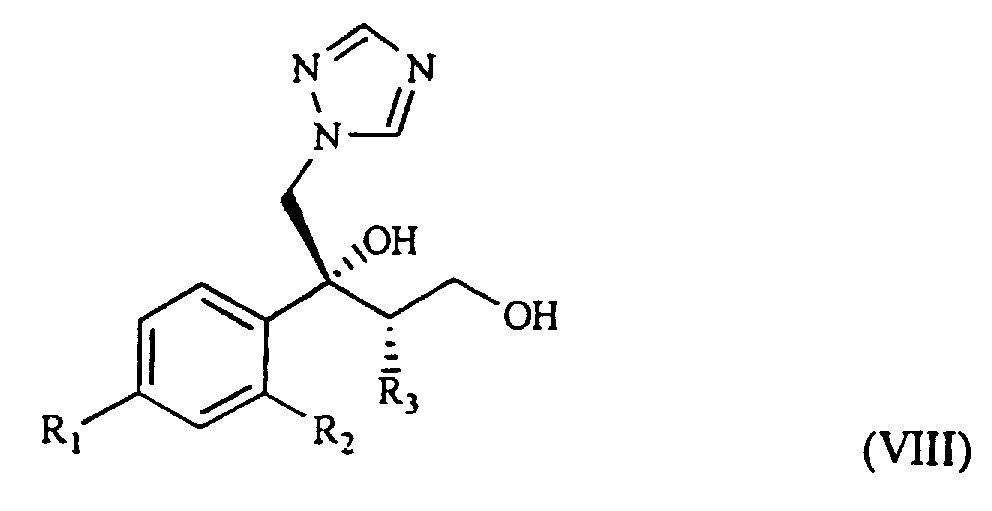
- the present invention refers to a method for preparing compounds of formula VIII as illustrated hereinbelow.
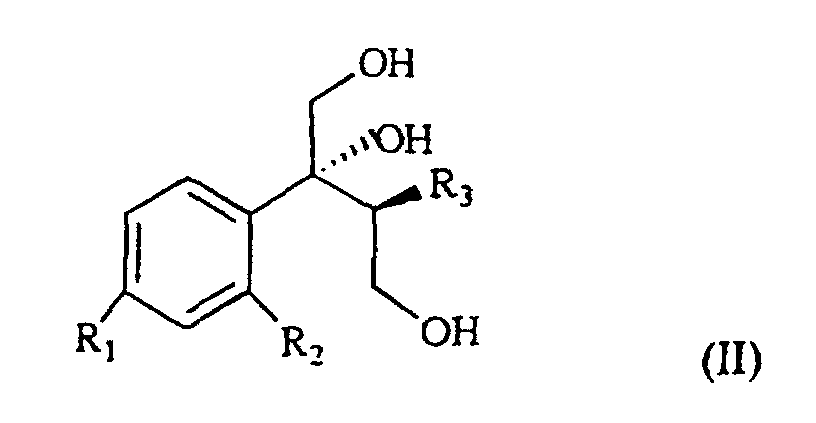
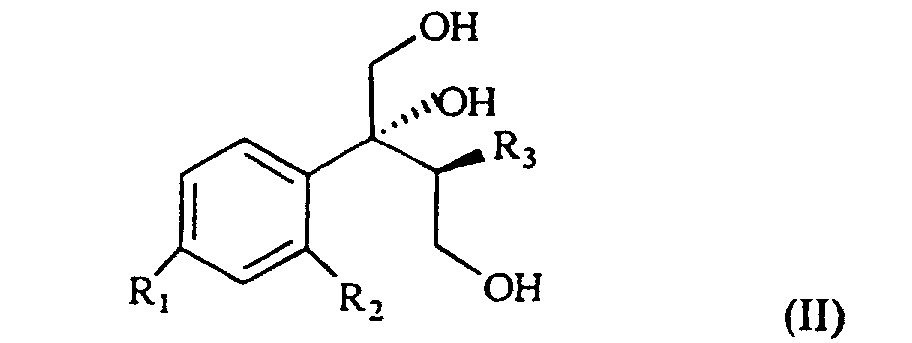
- the synthesis of the compounds of formula VIII according to the present invention starts from the triol of formula II wherein R 1 , R 2 and R 3 are as defined above. This is treated with a suitable ketone or aldehyde in acidic medium, for example in p-toluensulfonic acid, to selectively protect the two OH groups in ⁇ -position each other. For avoiding the formation of a further stereogenic centre it is preferred to use a symmetric ketone such as, for example, acetone or cyclohexanone.
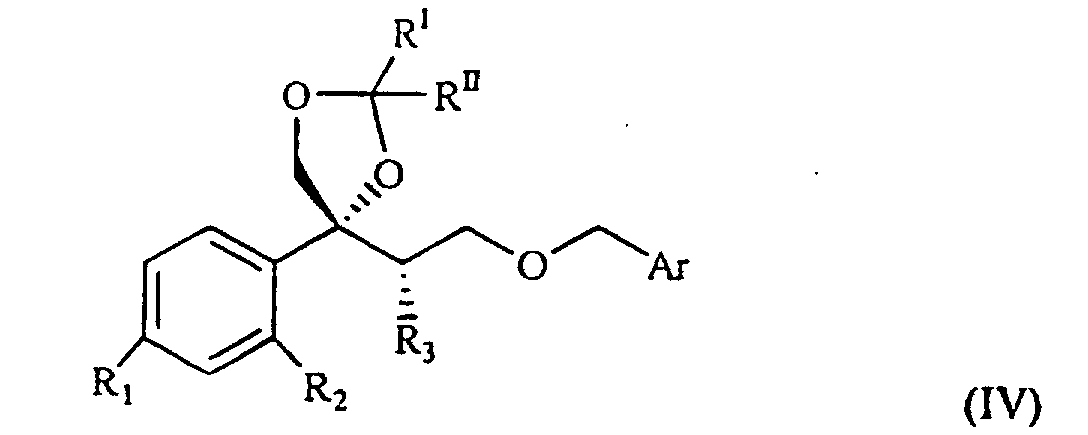
- Ar is an optionally substituted aryl group.
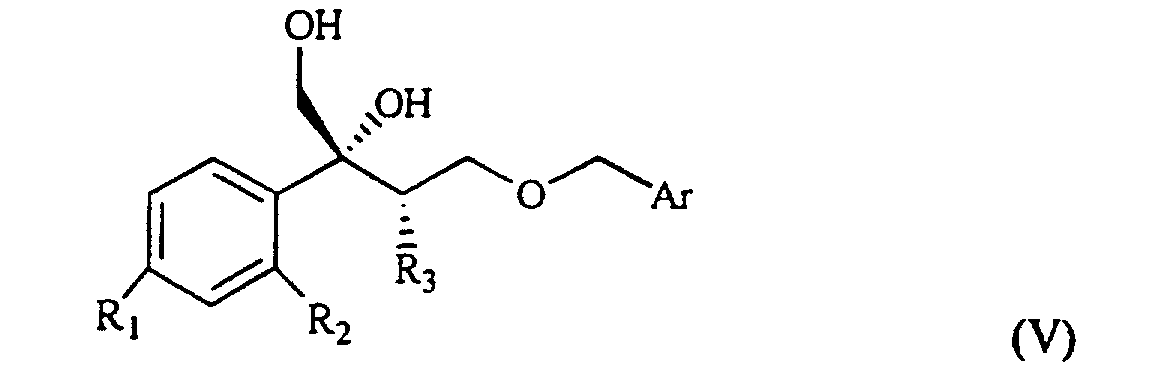
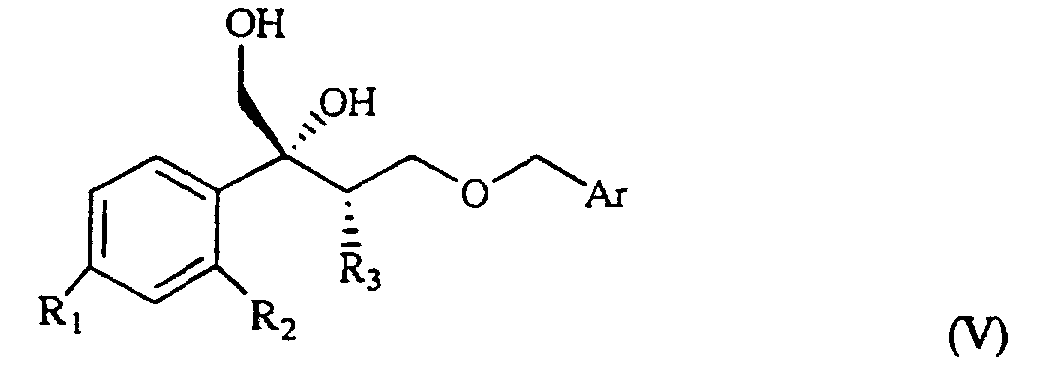
- This is hydrolysed in strong acidic medium according to common methods, preferably in alcohol, for example ethanol, to give the compound of formula V wherein R 1 , R 2 , R 3 and Ar are as defined above, which is functionalized on the primary hydroxy group by a leaving group Lg through reaction with a sulfonic acid chloride, such as methansulfonyl-chloride or tosyl chloride, or with a halogenating agent such as, for example, phosphorous tribromide, thionyl chloride or phosphorous pentachloride, thus obtaining the compound of formula VI wherein R 1 , R 2 , R 3 and Ar are as defined above, Lg is halogen or a OSO 2 R IV group wherein R IV is a (C 1-4 )alkyl or an optionally methyl-substituted phenyl group.
- a sulfonic acid chloride such as methansulfon
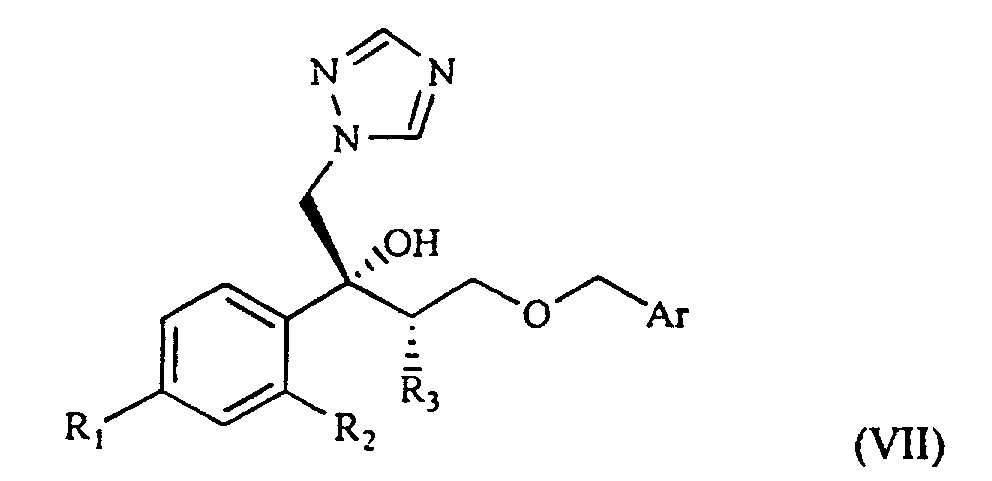
- the compound of formula VI is treated with a salt of 1,2,4-triazole prepared previously or in situ , for example, with 1,2,4-triazole in the presence of sodium hydride and gives the compound of formula VII wherein R 1 , R 2 , R 3 and Ar are as defined above. Then the cleaving of the protected hydroxy group is effected by common techniques (see, for example, T.W. Greene and P.G.M. Wuts, Protective Groups in Organic Synthesis, John Wiley & Sons, New York), thus yielding the desired compound of formula VIII.
- intermediates V and VI are known (patent application EP 667346 in the name of Eisai).
- intermediate V is said to be obtained from one of the following compounds wherein Xs are halogen atoms, Pr is a protecting group, R is a lower alkyl group, R 3 is methyl or a lower alkoxy group and R 2 is a lower alkyl group.
- the intermediate of formula VI is obtained from the intermediate of formula V.
- the substrate of formula II is known too and may be obtained both via literature methods and using a synthetic route claimed in a co-pending patent application filed in the same date of the present one by the Applicant (WO 99/29675), starting from a new compound claimed in another co-pending patent application filed in the same date of the present one by the Applicant.
Landscapes
- Chemical & Material Sciences (AREA)
- Organic Chemistry (AREA)
- Pharmaceuticals Containing Other Organic And Inorganic Compounds (AREA)
- Plural Heterocyclic Compounds (AREA)
- Preparation Of Compounds By Using Micro-Organisms (AREA)
- Agricultural Chemicals And Associated Chemicals (AREA)
Abstract
Description
- The present invention refers to a process for the preparation of azole compounds endowed with antimycotic activity.
- The compounds of formula Iwherein

- R1 is chlorine, fluorine or trifluoromethyl;
- R2 is hydrogen, chlorine, fluorine or trifluoromethyl;
- R3 is C1-4 alkyl; and
- R4 is a C1-5 polyfluoroalkyl group containing at least two fluorine atoms and optionally other halogen atoms selected from chlorine and bromine; and their salts with pharmaceutically acceptable acids, are known as antimycotic and antifungal agents.
-
- The patent application WO 97/31903 (in the Applicant's name) shows a class of compounds which those of formula I above fall within, as broad spectrum antimycotics against human and animal pathogenic fungi. Such compounds are obtained from the intermediate of formula VIIIwherein R1, R2 and R3 are as defined above, which reacted with the suitable polyfluoroalkyl derivative provides the desired compound of formula I.
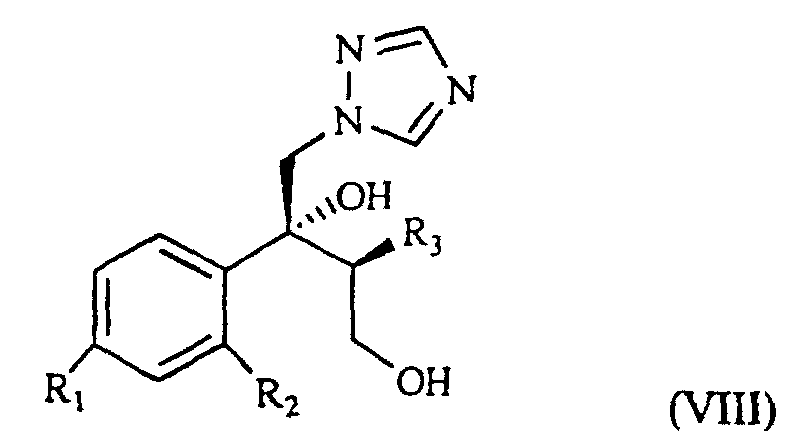
- It has been now found a new method for preparing the compounds of formula VIII constituting an alternative to the synthetic routes described in the above cited prior art.
- Therefore the present invention refers to a method for preparing compounds of formula VIII as illustrated hereinbelow.
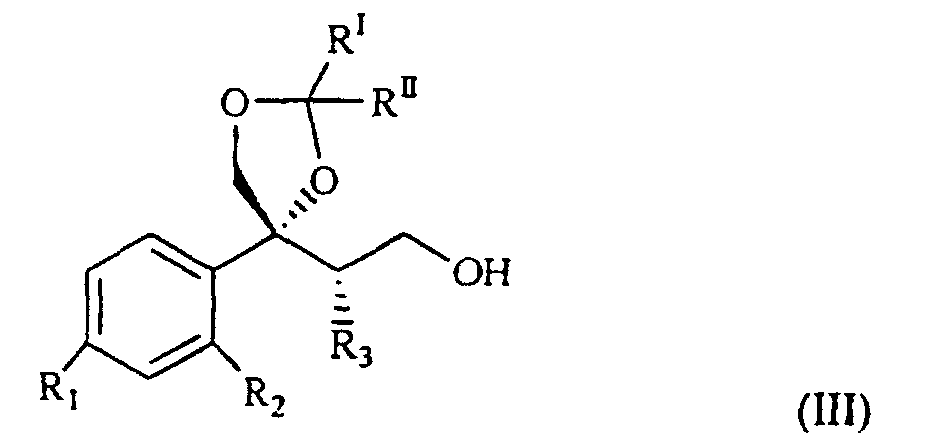
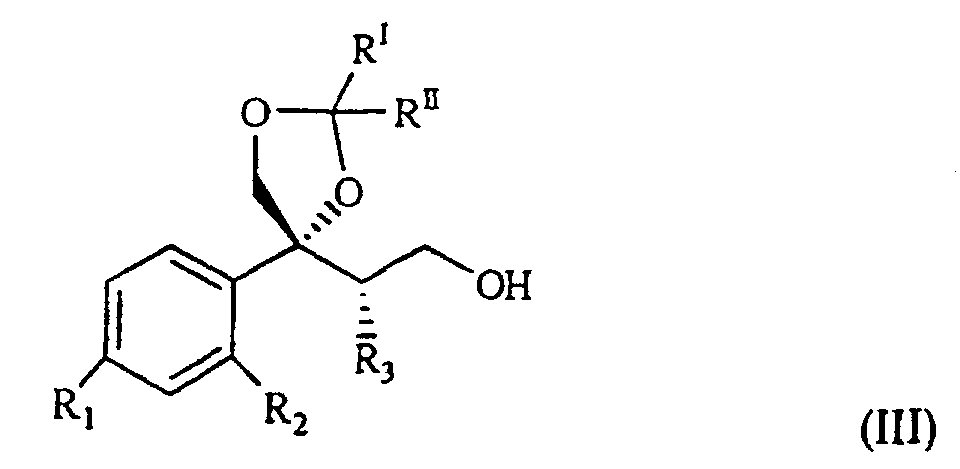
- The synthesis of the compounds of formula VIII according to the present invention starts from the triol of formula IIwherein R1, R2 and R3 are as defined above. This is treated with a suitable ketone or aldehyde in acidic medium, for example in p-toluensulfonic acid, to selectively protect the two OH groups in α-position each other. For avoiding the formation of a further stereogenic centre it is preferred to use a symmetric ketone such as, for example, acetone or cyclohexanone. It is thus obtained the dioxolane of formula III
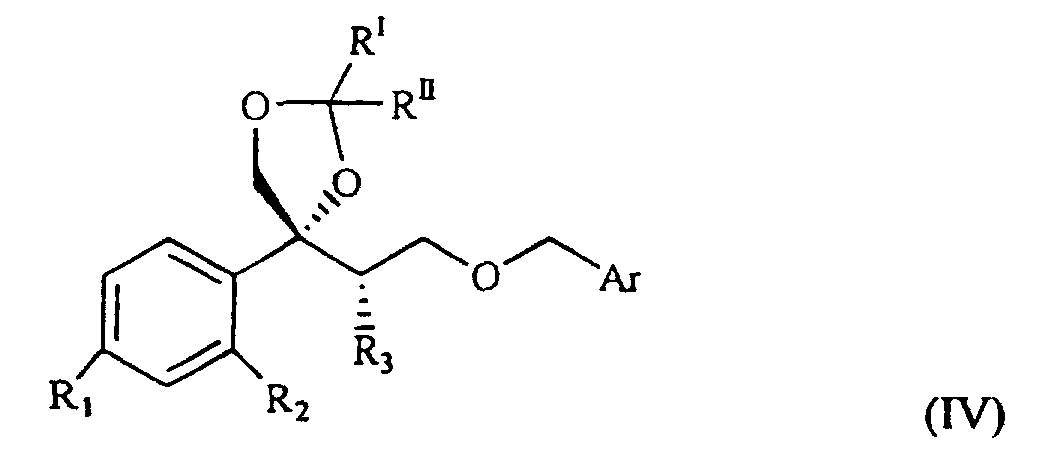
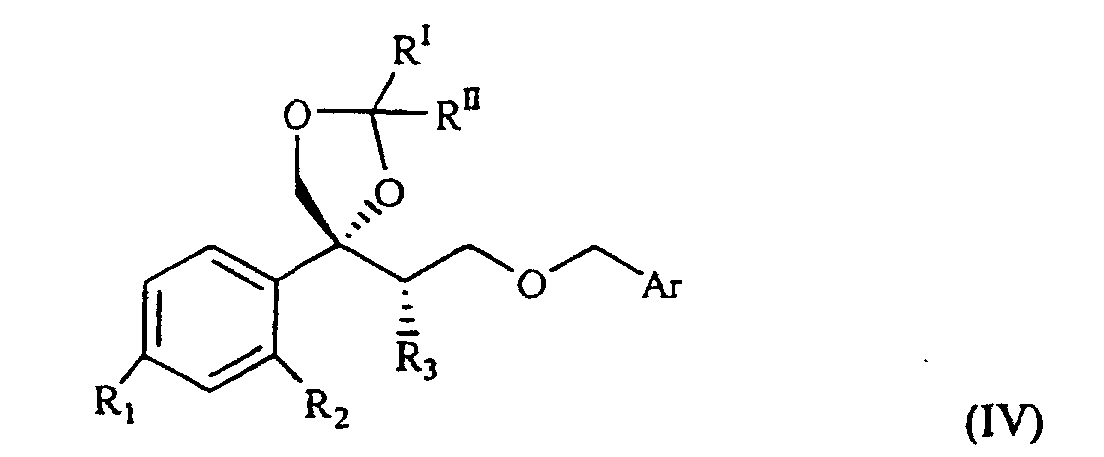
 wherein R1, R2 and R3 are as defined above, and R1 and R11 are depending on the aldehyde or ketone employed, which is duly protected on the free hydroxy moiety with an easily removable group, whereas resistant in acidic or weakly basic medium. Preferred examples of such groups are aryl-methyl such as benzyl or furfuryl-methyl optionally substituted which may be removed by hydrogenation. The protection reaction is effected, for example with an arylmethyl halide in the presence of an alkali metal hydride, for example sodium hydride, and provides the compound of formula IV
 wherein R1, R2, R3, RI and RII arc as defined above. and Ar is an optionally substituted aryl group. This is hydrolysed in strong acidic medium according to common methods, preferably in alcohol, for example ethanol, to give the compound of formula V
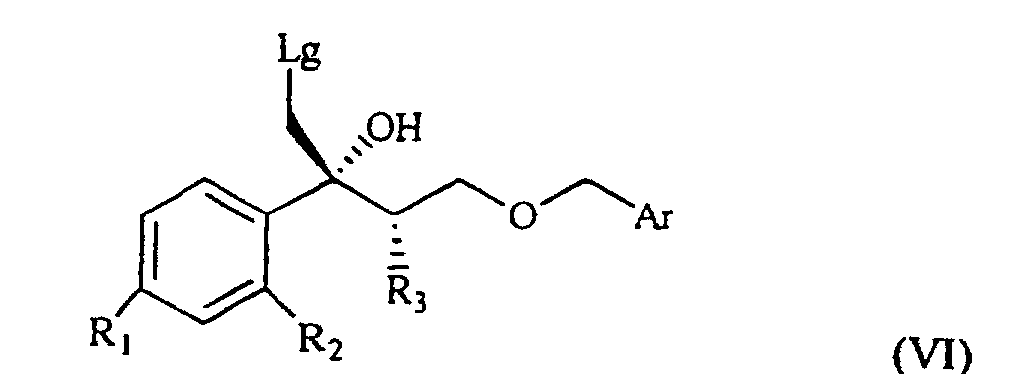
 wherein R1, R2, R3 and Ar are as defined above, which is functionalized on the primary hydroxy group by a leaving group Lg through reaction with a sulfonic acid chloride, such as methansulfonyl-chloride or tosyl chloride, or with a halogenating agent such as, for example, phosphorous tribromide, thionyl chloride or phosphorous pentachloride, thus obtaining the compound of formula VI
 wherein R1, R2, R3 and Ar are as defined above, Lg is halogen or a OSO2RIV group wherein RIV is a (C1-4)alkyl or an optionally methyl-substituted phenyl group. The compound of formula VI is treated with a salt of 1,2,4-triazole prepared previously or in situ, for example, with 1,2,4-triazole in the presence of sodium hydride and gives the compound of formula VII
 wherein R1, R2, R3 and Ar are as defined above. Then the cleaving of the protected hydroxy group is effected by common techniques (see, for example, T.W. Greene and P.G.M. Wuts, Protective Groups in Organic Synthesis, John Wiley & Sons, New York), thus yielding the desired compound of formula VIII.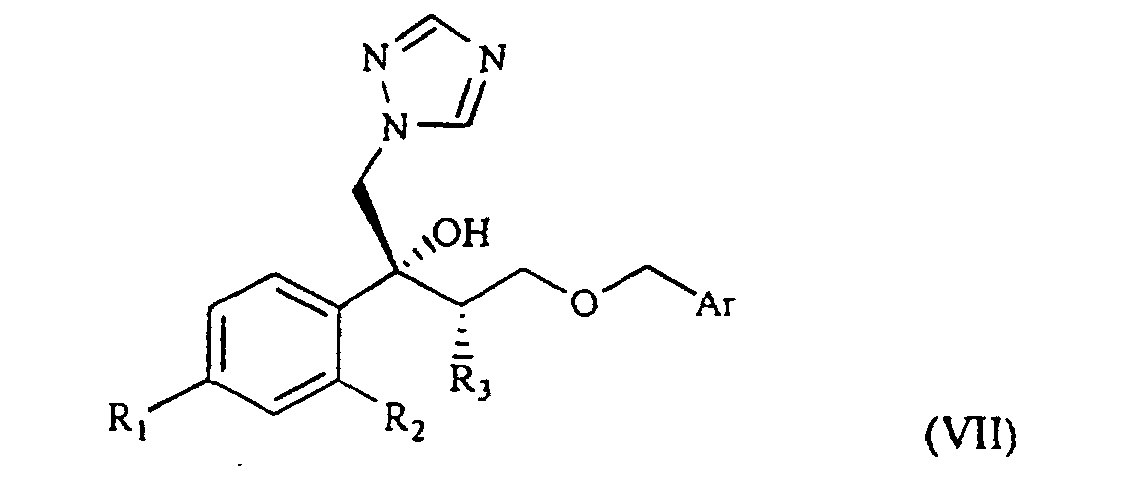
- The intermediates V and VI are known (patent application EP 667346 in the name of Eisai). In particular, intermediate V is said to be obtained from one of the following compoundswherein Xs are halogen atoms, Pr is a protecting group, R is a lower alkyl group, R3 is methyl or a lower alkoxy group and R2 is a lower alkyl group. The intermediate of formula VI is obtained from the intermediate of formula V.

- The substrate of formula II is known too and may be obtained both via literature methods and using a synthetic route claimed in a co-pending patent application filed in the same date of the present one by the Applicant (WO 99/29675), starting from a new compound claimed in another co-pending patent application filed in the same date of the present one by the Applicant.
- Hereinbelow fulfilment examples of the present invention are provided.
- A solution of (2R,3S)-2-(2,4-dichlorophenyl)-3-methyl-1,2,4-trihydroxy-butane (2.65 g; 10 mmoles; enantiomeric excess: 97.8%) and p-toluensolfonic acid monohydrate (0.19 g; 1 mmole) in acetone (25 ml) was refluxed for 60 minutes, then cooled to 20°C, poured into water (100 ml) and extracted with toluene (25 ml x 3). The joined organic phases were washed with water (50 ml), anhydrified on dry Na2SO4. dried. 3.05 g Of (2S,4R)-2,2-dimethyl-4-(2,4-dichlorophenyl)-4-(2-methyl-3-hydroxypropyl)-1,3-dioxolane were obtained as a viscous oil.
1H-NMR (300MHz, DMSO, δ=ppm, J=Hz): 0.55 (d, 3H, J=6.90): 1.10 (s, 3H); 1.40 (s, 3H); 2.23 (ddq, 1H, J=8.30, J=6.90, J=3.95); 3.17 (ddt, 1H, J=11.20, J=8.30, J=5.30); 3.77 (ddt, 1H, J=11.20, J=3.95, J=5.30); 4.06 (d, 1H, J=9.29); 4.50 (t, 1H, J=5.30); 4.72 (d, 1H, J=9.20); 7.43 (dd, 1H, J=8.50, J=2.16); 7.59 (d, 1H, J=2.16); 7.63 (d, 1H, J=8.50). - A solution of crude (2S,4R)-2,2-dimethyl-4-(2,4-dichlorophenyl)-4-(2-methyl-3-hydroxypropyl)-1,3-dioxolane obtained in example 1 (3.05 g; 10 mmoles) in DMF (20 ml) cooled to 15°C under nitrogen was portionwise added with 60% NaH (0.5 g; 12.5 mmoles). The suspension was stirred for 30 minutes, then slowly added, in about 1 hour, with benzyl chloride (1.58 g; 12.5 mmoles) diluted in DMF (5 ml) and the mixture was kept under stirring at 15°C under nitrogen for further 20 hours, then poured into water (150 ml) and extracted with toluene (30 ml x 3). The organic phases were washed with water (50 ml), anhydrified over dry Na2SO4, dried. The crude was purified by flash chromatography (SiO2; n-heptane/ethyl acetate 90/10) to give 3.82 g of (2S,4R)-2,2-dimethyl-4-(2,4-dichlorophenyl)-4-(2-methyl-3-phenylmethoxy)-propyl-1,3-dioxolane (yield 97%) as a colourless oil.
1H-NMR (300 MHz, DMSO, δ=ppm, J=Hz): 0.59(d,3H, J=6.85); 1.05(s,3H); 1.41(s,3H); 2.55(ddq,1H, J=7.60, J=4.70, J=6.85); 3.26(dd,1H, J=9.50, J=7.60); 3.76(dd,1H, J=9.50, J=4.70); 4.05(d,1H, J=9.20); 4.46(d,1H, J=11.90); 4.52(d,1H, J=11.90); 4.75(d, 1H, J=9.20); 7.25-7.40(m, 5H); 7.44(dd, 1H, J=8.50, J=2.20); 7.62(d, 1H, J=2.20); 7.64(d, 1H, J=8.50). - A solution of (2S,4R)-2,2-dimethyl-4-(2,4-dichlorophenyl)-4-(2-methyl-3-phenylmethoxy)-propyl-1,3-dioxolane obtained in example 2 (3.75 g; 9.5 mmoles), 37% HCl (3.75 ml) and water (3.75 ml) in ethanol (37.5 ml) was refluxed for 24 hours, then cooled to room temperature, poured into water (150 ml) and extracted with toluene (30 ml x 3). The organic phases were washed with water (50 ml), anhydrified over dry Na2SO4, dried. The crude was purified by flash chromatography (SiO2; n-heptane/ethyl acetate 75/25) to give 2.32 g of (2R,3S)-1-(2,4-dichlorophenyl)-1-[(2-phenylmethoxy-1-methyl)-ethyl]-ethandiol (yield 73%) as a colourless oil.
1H-NMR (300MHz, DMSO, δ=ppm, J=Hz): 0.58 (d, 3H, J=7.00); 2.65 (ddq, 1H, J=6.90, J=5.20, J=7.00); 3.32 (dd, 1H, J=9.70, J=6.90); 3.76 (dd, 1H, J=9.70, J=5.20); 3.80 (dd, 1H, J=11.80, J=5.13); 4.25 (dd, 1H, J=11.80, J=5.50); 4.47 (t, 2H, J=14.10); 4.52 (dd, 1H, J=5.49, J=5.10); 5.00 (s, 1H); 7.25-7.5 (m, 7H); 7.76 (d, 1H, J=8.70). - A solution of (2R,3S)-1-(2,4-dichlorophenyl)-1-[(2-phenylmethoxy-1-methyl)-ethyl]-ethandiol obtained in example 3 (2.15 g; 6.05 mmoles) in pyridine (15 ml) cooled to 15-17°C under nitrogen was portionwise added in about 30 minutes with p-toluensulfonyl chloride (1.32 g; 6.9 mmoles) and the solution was stirred at 15°C under nitrogen for further 16 hours, then poured into water (100 ml), acidified to pH≤2 with 50% H2SO4 and extracted with toluene (30 ml x 3). The joined organic phases were washed with water (50 ml), anhydrified over dry Na2SO4, dried. The crude was purified by flash chromatography (SiO2; n-heptane/ethyl acetate 85/15) to give 2.80 g of (2R,3S)-1-(2,4-dichlorophenyl)-[(2-phenylmethoxy-1-methyl)-ethyl]-ethandiol-2-p-toluensulfonate (yield 91%).
1H-NMR (300MHz, DMSO, δ=ppm, J=Hz): 0.45(d, 3H, J=7.00); 2.40(s, 3H); 2.67(ddq, 1H, J=9.50, J=4.10, J=7.00); 3.26(dd, 1H, J=9.90, J=4.10); 3.72(dd, 1H, J=9.90, J=9.50); 4.42(s, 2H); 4.44(d, 1H, J=10.50); 4.85 (d, 1H, J=10.50); 5.85 (bs, 1H); 7.20-7.70 (m, 12H). - A solution of 1,2,4-triazole (0.56 g, 8.1 mmoles) in DMF (6 ml) cooled to 16°C was portionwise added, under nitrogen, with 60% NaH (0.32 g; 8 mmoles) keeping the temperature at 15-20°C. The mixture was stirred at room temperature until the end of the gas generation, then heated to 125°C, slowly added in 30 minutes with a solution of (2R,3S)-1-(2,4-dichlorophenyl)-[(2-phenylmethoxy-1-methyl)-ethyl]-ethandiol-2-p-toluensulfonate obtained in example 4 (1.02 g; 2 mmoles) in DMF (2 ml), then kept under stirring at 125°C for further 90 minutes. The mixture was then poured into water (40 ml) and extracted with methylene chloride (20 ml x 3). The joined organic phases were washed with water (50 ml), anhydrified over dry Na2SO4, dried. The crude was purified by flash chromatography (SiO2; hexane/ethyl acetate/methanol 80/20/5) to give 0.66 g of (2R,3S)-2-(2,4-dichlorophenyl)-2-hydroxy-3-methyl-1-(1,2,4-triazol-1-yl)-4-benzyloxy-butane (yield 82%).
1H-NMR (300MHz, DMSO, δ=ppm, J=Hz): 0.69 (d, 3H, J=7.00); 3.07 (ddq, 1H, J=6.60, J=5.50, J=7.00); 3.45 (dd, 1H, J=9.50, J=5.50); 3.90 (dd, 1H, J=9.50, J=6.60); 4.53 (d, 1H, J=12.00); 4.60 (d, 1H, J=12.00); 4.74 (d, 1H, J=14.60); 5.18 (d, 1H, J=14.60); 5.65 (s, 1H); 7.18-7.50 (m, 9H); 7.60 (s, 1H); 8.22 (s, 1H). - A solution of (2R,3S)-2-(2,4-dichlorophenyl)-2-hydroxy-3-methyl-1-(1,2,4-triazol-1-yl)-4-benzyloxy-butane obtained in example 5 (0.66 g; 1.64 mmoles) in 37% HCl (10 ml) was heated to 125°C for 30 minutes. After cooling to room temperature, the mixture was poured into ice (20 g), alkalinized to pH≥10 by 30% NaOH and extracted with methylene chloride (15 ml x 3). The joined organic phases were washed with water (50 ml), anhydrified over dry Na2SO4, dried. The crude was purified by flash chromatography (SiO2; hexane/ethyl acetate/methanol 70/30/10) to give 0.44 g of (2R,3S)-2-(2,4-dichlorophenyl)-3-methyl-1-(1H-1,2,4-triazol-1-yl)-2,4-butandiol (yield 86%; enantiomeric excess: 97%).
1H-NMR (300MHz, DMSO, δ=ppm, J=Hz): 0.56(d, 3H, J=7.00); 2.86(ddq, 1H, J=5.60, J=5.30, J=7.00); 3.58(ddd, 1H, J=11.00, J=5.30, J=5.00); 3.83(ddd, 1H, J=11.00, J=5.60, J=5.00); 4.78(d, 1H, J=4.60); 5.05(t, 1H, J=5.00); 5.2(d, 1H, J=4.60); 5.63 (s, 1H); 7.20 (dd, 1H, J=8.60, J=2.20); 7.36 (d, 1H, J=8.60); 7.47 (d, 1H, J=2.20); 7.70 (s, 1H); 8.25 s, 1H).
Claims (5)
- Process for the preparation of a compound of formula VIIIwherein
 wherein R1, R2 and R3 are as defined above, with a ketone or an aldehyde in strong acid to give the dioxolane of formula IIIR1 is chlorine, fluorine or trifluoromethyl;R2 is hydrogen, chlorine, fluorine or trifluoromethyl; andR3 is C1-4 alkyl; which comprises the treatment of a triol of formula II
 wherein R1, R2 and R3 are as defined above, and RI and RII are depending on the aldehyde or ketone employed, which by treatment with an aryl-methyl halide optionally substituted on the aromatic ring and in the presence of an alkali metal hydride gives the compound of formula IV
 wherein R1, R2, R3, RI and RII are as defined above, and Ar is optionally substituted aryl, which is hydrolyzed in acidic medium to give the compound of formula V
 wherein R1, R2, R3 and Ar are as defined above, which is functionalized on the primary hydroxy group by a leaving group Lg through a reaction with a sulfonic acid halide or a halogenating agent, thus yielding the compound of formula VI
 wherein R1, R2, R3 and Ar are as defined above, and Lg is halogen or a OSO2RIV group wherein RIV is a (C1-4)alkyl or an optionally methyl-substituted phenyl group, which treated with a salt of 1,2,4-triazole prepared previously or in situ, yields the compound of formula VII
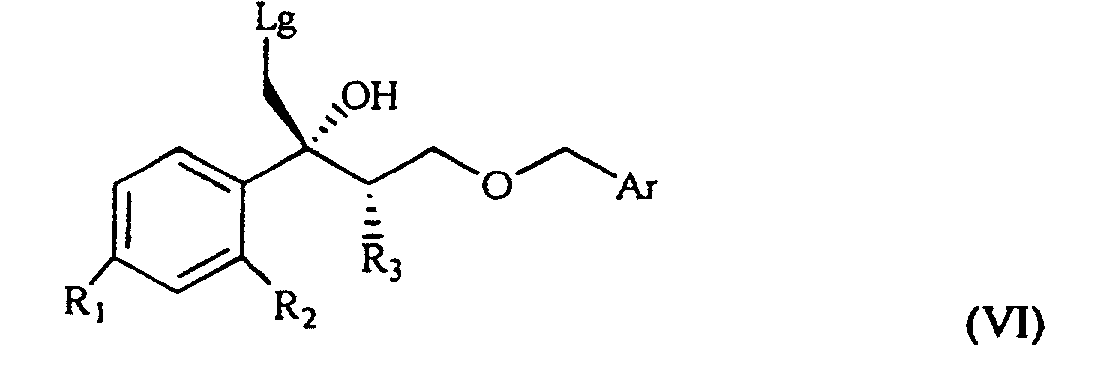 wherein R1, R2, R3 and Ar are as defined above; then the cleaving of the protected hydroxy group is effected.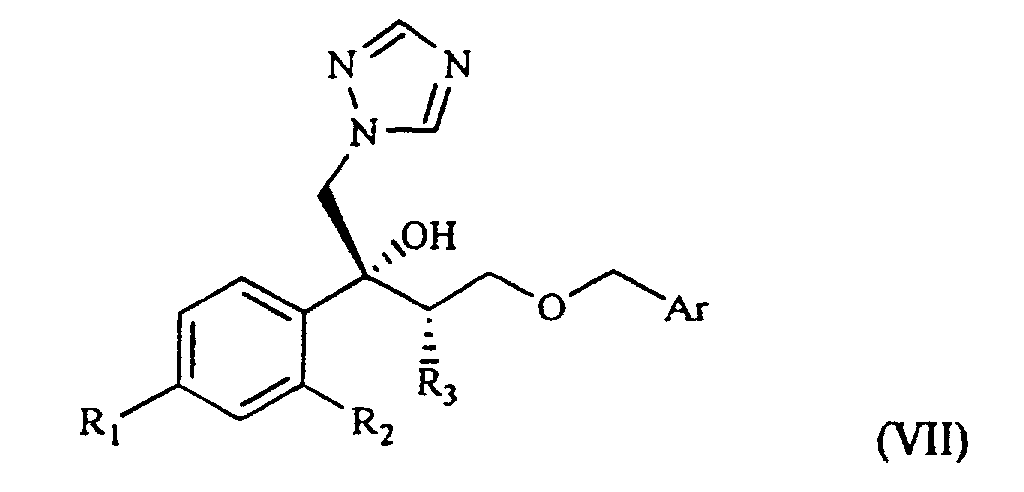
- Process for the preparation of a compound of formula 1wherein
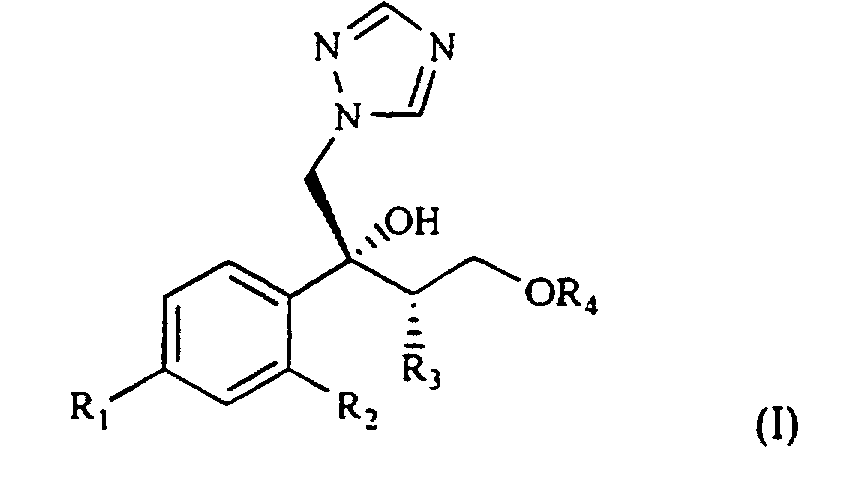 and their salts with pharmaceutically acceptable acids, which comprises the treatment of a triol of formula IIR1 is chlorine, fluorine or trifluoromethyl;R2 is hydrogen, chlorine, fluorine or trifluoromethyl;R3 is C1-4 alkyl; andR4 is a C1-5 polyfluoroalkyl group containing at least two fluorine atoms and optionally other halogen atoms selected from chlorine and bromine;wherein R1, R2 and R3 are as defined above, with a ketone or an aldehyde in strong acid to give the dioxolane of formula III
 wherein R1, R2 and R3 are as defined above, and RI and RII are depending on the aldehyde or ketone used, which by treatment with an aryl-methyl halide optionally substituted on the aromatic ring and in the presence of an alkali metal hydride gives the compound of formula IV
 wherein R1, R2, R3, RI and RII are as defined above, and Ar is optionally substituted aryl, which is hydrolyzed in acidic medium to give the compound of formula V
 wherein R1, R2, R3 and Ar are as defined above, which is functionalized on the primary hydroxy group by a leaving group Lg through a reaction with a sulfonic acid halide or a halogenating agent, thus yielding the compound of formula VI
 wherein R1, R2, R3 and Ar are as defined above, and Lg is halogen or a OSO2RIV group wherein RIV is a (C1-4)alkyl or an optionally methyl-substituted phenyl group, which treated with a salt of 1,2,4-triazole prepared previously or in situ, yields the compound of formula VII
 wherein R1, R2, R3 and Ar are as defined above; then the cleaving of the protected hydroxy group is effected thus giving a compound of formula VIII
 wherein R1, R2 and R3 are as defined above, which is reacted with the suitable polyfluoroalkyl derivative.
- Process for the preparation of a compound of formula VIII according to claim 1, which comprises the treatment of a triol of formula IIwherein R1, R2 and R3 are as defined in claim 1, with a ketone or an aldehyde in strong acid to give the dioxolane of formula III
 wherein R1, R2 and R3 are as defined in claim 1, and RI and RII are depending on the aldehyde or ketone used, which by treatment with an aryl-methyl halide optionally substituted on the aromatic ring and in the presence of an alkali metal hydride gives the compound of formula IV
 wherein R1, R2, R3, RI and RII are as defined in claim 1, and Ar is optionally substituted aryl, which is hydrolyzed in acidic medium to give the compound of formula V
 wherein R1, R2, R3 and Ar are as defined in claim 1.
- Process for the preparation of a compound of formula VIII according to claim 1, which comprises the treatment of a triol of formula IIwherein R1, R2 and R3 are as defined in claim 1, with a ketone or an aldehyde in strong acid to give the dioxolane of formula III
 wherein R1, R2 and R3 are as defined in claim 1, and R1 and R11 are depending on the aldehyde or ketone used, which by treatment with an aryl-methyl halide optionally substituted on the aromatic ring and in the presence of an alkali metal hydride gives the compound of formula IV
 wherein R1, R2, R3, RI, RII and Ar are as defined in claim 1, which is hydrolyzed in acidic medium to give the compound of formula V
 wherein R1, R2, R3 and Ar are as defined in claim 1, which is functionalized on the primary hydroxy group by a leaving group Lg through a reaction with a sulfonic acid halide or a halogenating agent, thus yielding the compound of formula VI
 wherein R1, R2, R3, Lg and Ar are as defined in claim 1.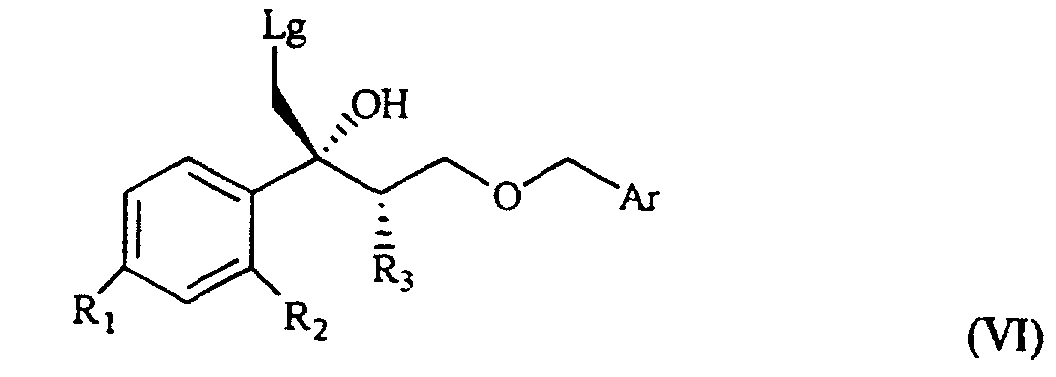
- A process for the preparation of a compound of formula VIII according to claim 1, which comprises the treatment of the compound of formula VIwherein R1, R2, R3, Ar and Lg are as defined in claim 1, with a salt of 1,2,4-triazole prepared previously or in situ, to yield the compound of formula VII
 wherein R1, R2, R3 and Ar are as defined in claim 1; then the cleaving of the protected hydroxy group.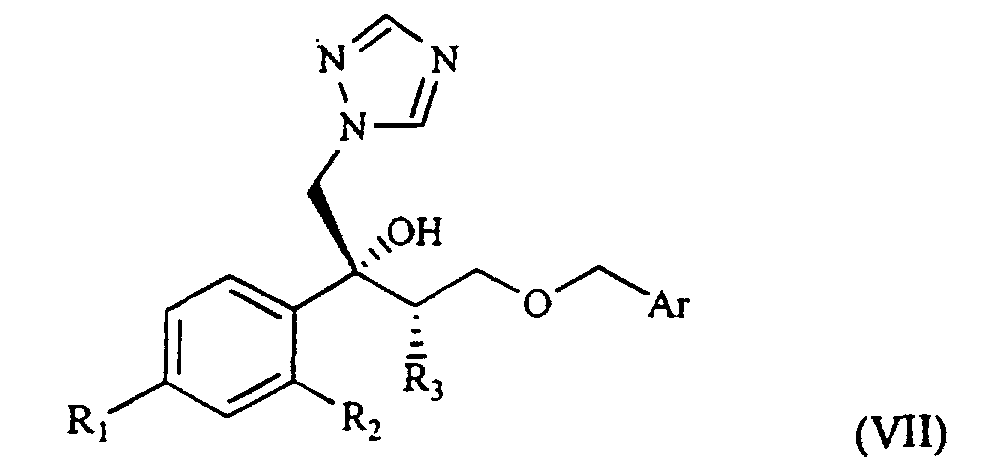
Applications Claiming Priority (3)
| Application Number | Priority Date | Filing Date | Title |
|---|---|---|---|
| IT97MI002698A IT1296926B1 (en) | 1997-12-05 | 1997-12-05 | PROCEDURE FOR THE PREPARATION OF COMPOUNDS WITH ANTI-Fungal Activities |
| ITMI972698 | 1997-12-05 | ||
| PCT/EP1998/007482 WO1999029676A1 (en) | 1997-12-05 | 1998-11-20 | Process for preparing triazole compounds |
Publications (2)
| Publication Number | Publication Date |
|---|---|
| EP1044192A1 EP1044192A1 (en) | 2000-10-18 |
| EP1044192B1 true EP1044192B1 (en) | 2004-08-18 |
Family
ID=11378319
Family Applications (1)
| Application Number | Title | Priority Date | Filing Date |
|---|---|---|---|
| EP98958910A Expired - Lifetime EP1044192B1 (en) | 1997-12-05 | 1998-11-20 | Process for preparing triazole compounds |
Country Status (8)
| Country | Link |
|---|---|
| EP (1) | EP1044192B1 (en) |
| AT (1) | ATE273963T1 (en) |
| CA (1) | CA2312785A1 (en) |
| DE (1) | DE69825784T2 (en) |
| ES (1) | ES2227897T3 (en) |
| IL (1) | IL136741A (en) |
| IT (1) | IT1296926B1 (en) |
| WO (1) | WO1999029676A1 (en) |
Families Citing this family (1)
| Publication number | Priority date | Publication date | Assignee | Title |
|---|---|---|---|---|
| SMT202200091T1 (en) * | 2014-12-19 | 2022-03-21 | Geistlich Pharma Ag | Processes for preparing oxathiazin-like compounds |
Family Cites Families (5)
| Publication number | Priority date | Publication date | Assignee | Title |
|---|---|---|---|---|
| DE3004661A1 (en) * | 1980-02-08 | 1981-08-13 | Henkel KGaA, 4000 Düsseldorf | USE OF ALKYL-SUBSTITUTED 1,3-DIOXOLANES AS A FRAGRANCE, AS WELL AS THESE COMPOSITIONS CONTAINING IT |
| JPS6025990A (en) * | 1983-07-20 | 1985-02-08 | Shionogi & Co Ltd | Triazole dioxolane derivative |
| CA1321588C (en) * | 1986-07-02 | 1993-08-24 | Katherine Eleanor Flynn | Alpha-aryl-alpha-phenylethyl-1h-1,2,4-triazole-1- propanenitriles |
| IT1198240B (en) * | 1986-12-23 | 1988-12-21 | Agrimont Spa | FUNGICIDAL AZOLYL DERIVATIVES |
| US5510493A (en) * | 1994-11-14 | 1996-04-23 | Rohm And Haas Company | Process for alkylation with triazoles |
-
1997
- 1997-12-05 IT IT97MI002698A patent/IT1296926B1/en active IP Right Grant
-
1998
- 1998-11-20 IL IL13674198A patent/IL136741A/en not_active IP Right Cessation
- 1998-11-20 EP EP98958910A patent/EP1044192B1/en not_active Expired - Lifetime
- 1998-11-20 DE DE69825784T patent/DE69825784T2/en not_active Expired - Fee Related
- 1998-11-20 CA CA002312785A patent/CA2312785A1/en not_active Abandoned
- 1998-11-20 WO PCT/EP1998/007482 patent/WO1999029676A1/en not_active Ceased
- 1998-11-20 AT AT98958910T patent/ATE273963T1/en not_active IP Right Cessation
- 1998-11-20 ES ES98958910T patent/ES2227897T3/en not_active Expired - Lifetime
Also Published As
| Publication number | Publication date |
|---|---|
| WO1999029676A1 (en) | 1999-06-17 |
| CA2312785A1 (en) | 1999-06-17 |
| ITMI972698A1 (en) | 1999-06-05 |
| IL136741A (en) | 2005-03-20 |
| IL136741A0 (en) | 2001-06-14 |
| ES2227897T3 (en) | 2005-04-01 |
| DE69825784D1 (en) | 2004-09-23 |
| EP1044192A1 (en) | 2000-10-18 |
| ATE273963T1 (en) | 2004-09-15 |
| DE69825784T2 (en) | 2005-11-17 |
| IT1296926B1 (en) | 1999-08-03 |
Similar Documents
| Publication | Publication Date | Title |
|---|---|---|
| EP0630374B1 (en) | Imidazole, triazole and tetrazole derivatives | |
| US5567726A (en) | Imidazole, Triazole and tetrazole derivatives | |
| CN102753532B (en) | Process for preparation of medetomidine | |
| AU653082B2 (en) | Optically active azole compounds their production and use | |
| CA1130296A (en) | Hydroxypropyl-triazole compounds, their production and their medicinal use | |
| US7709661B2 (en) | Synthetic methodology for the reductive alkylation at the C-3 position of indoles | |
| EP0219929B1 (en) | Process for the preparation of 3-imidazolylmethyltetrahydrocarbazolones | |
| AU688505B2 (en) | Palladium catalyzed ring closure of triazolyl tryptamine | |
| US5717104A (en) | Process for preparing indole derivatives containing a 1,2,4-triazol-1-yl substituent | |
| US5981529A (en) | Substituted indolylpropyl-piperazine derivatives as 5-HT1D α agonists | |
| JP3415865B2 (en) | Optically active azole compound and use thereof | |
| US4480114A (en) | 2-(4-Biphenylyl)-2-(halophenyl)-oxirane compounds | |
| FI101222B (en) | Process for the preparation of therapeutically active quinolin-2-ylmethoxy phenyl derivatives | |
| CA2111469A1 (en) | New selective aromatase inhibiting 4(5)-imidazoles | |
| US4859691A (en) | Certain 1,2-benzisoxazole derivatives | |
| JPS6146474B2 (en) | ||
| EP1044192A1 (en) | Process for preparing triazole compounds | |
| EP1044193B1 (en) | Process for preparing triazole antimycotic compounds | |
| US5902819A (en) | Triazole derivatives | |
| CZ20002090A3 (en) | Process for the production of triazole derivatives | |
| EP0360324B1 (en) | Tricyclic aromatase inhibitors | |
| US4767867A (en) | 5-(alkoxyalkyl)-3-phenyl-3-(1H-imidazol-1-ylmethyl)-2-methylisoxazolidines | |
| HRP20000680A2 (en) | Process for the preparation of fluconazole | |
| PL141652B1 (en) | Process for preparing novel derivatives of triazole | |
| HK1009045B (en) | Palladium catalyzed ring closure of triazolyl tryptamine |
Legal Events
| Date | Code | Title | Description |
|---|---|---|---|
| PUAI | Public reference made under article 153(3) epc to a published international application that has entered the european phase |
Free format text: ORIGINAL CODE: 0009012 |
|
| 17P | Request for examination filed |
Effective date: 20000421 |
|
| AK | Designated contracting states |
Kind code of ref document: A1 Designated state(s): AT BE CH DE DK ES FI FR GB GR IE IT LI LU NL PT SE |
|
| AX | Request for extension of the european patent |
Free format text: SI PAYMENT 20000418 |
|
| 17Q | First examination report despatched |
Effective date: 20030521 |
|
| GRAP | Despatch of communication of intention to grant a patent |
Free format text: ORIGINAL CODE: EPIDOSNIGR1 |
|
| GRAS | Grant fee paid |
Free format text: ORIGINAL CODE: EPIDOSNIGR3 |
|
| GRAA | (expected) grant |
Free format text: ORIGINAL CODE: 0009210 |
|
| AK | Designated contracting states |
Kind code of ref document: B1 Designated state(s): AT BE CH DE DK ES FI FR GB GR IE IT LI LU NL PT SE |
|
| AX | Request for extension of the european patent |
Extension state: SI |
|
| PG25 | Lapsed in a contracting state [announced via postgrant information from national office to epo] |
Ref country code: NL Free format text: LAPSE BECAUSE OF FAILURE TO SUBMIT A TRANSLATION OF THE DESCRIPTION OR TO PAY THE FEE WITHIN THE PRESCRIBED TIME-LIMIT Effective date: 20040818 Ref country code: IT Free format text: LAPSE BECAUSE OF FAILURE TO SUBMIT A TRANSLATION OF THE DESCRIPTION OR TO PAY THE FEE WITHIN THE PRESCRIBED TIME-LIMIT;WARNING: LAPSES OF ITALIAN PATENTS WITH EFFECTIVE DATE BEFORE 2007 MAY HAVE OCCURRED AT ANY TIME BEFORE 2007. THE CORRECT EFFECTIVE DATE MAY BE DIFFERENT FROM THE ONE RECORDED. Effective date: 20040818 Ref country code: FI Free format text: LAPSE BECAUSE OF FAILURE TO SUBMIT A TRANSLATION OF THE DESCRIPTION OR TO PAY THE FEE WITHIN THE PRESCRIBED TIME-LIMIT Effective date: 20040818 Ref country code: AT Free format text: LAPSE BECAUSE OF FAILURE TO SUBMIT A TRANSLATION OF THE DESCRIPTION OR TO PAY THE FEE WITHIN THE PRESCRIBED TIME-LIMIT Effective date: 20040818 |
|
| REG | Reference to a national code |
Ref country code: GB Ref legal event code: FG4D |
|
| REG | Reference to a national code |
Ref country code: CH Ref legal event code: EP |
|
| REG | Reference to a national code |
Ref country code: IE Ref legal event code: FG4D |
|
| REF | Corresponds to: |
Ref document number: 69825784 Country of ref document: DE Date of ref document: 20040923 Kind code of ref document: P |
|
| PGFP | Annual fee paid to national office [announced via postgrant information from national office to epo] |
Ref country code: GR Payment date: 20040924 Year of fee payment: 7 |
|
| PGFP | Annual fee paid to national office [announced via postgrant information from national office to epo] |
Ref country code: FR Payment date: 20041109 Year of fee payment: 7 |
|
| PGFP | Annual fee paid to national office [announced via postgrant information from national office to epo] |
Ref country code: GB Payment date: 20041117 Year of fee payment: 7 |
|
| PG25 | Lapsed in a contracting state [announced via postgrant information from national office to epo] |
Ref country code: SE Free format text: LAPSE BECAUSE OF FAILURE TO SUBMIT A TRANSLATION OF THE DESCRIPTION OR TO PAY THE FEE WITHIN THE PRESCRIBED TIME-LIMIT Effective date: 20041118 Ref country code: GR Free format text: LAPSE BECAUSE OF FAILURE TO SUBMIT A TRANSLATION OF THE DESCRIPTION OR TO PAY THE FEE WITHIN THE PRESCRIBED TIME-LIMIT Effective date: 20041118 Ref country code: DK Free format text: LAPSE BECAUSE OF FAILURE TO SUBMIT A TRANSLATION OF THE DESCRIPTION OR TO PAY THE FEE WITHIN THE PRESCRIBED TIME-LIMIT Effective date: 20041118 |
|
| PGFP | Annual fee paid to national office [announced via postgrant information from national office to epo] |
Ref country code: DE Payment date: 20041118 Year of fee payment: 7 |
|
| PG25 | Lapsed in a contracting state [announced via postgrant information from national office to epo] |
Ref country code: IE Free format text: LAPSE BECAUSE OF NON-PAYMENT OF DUE FEES Effective date: 20041122 |
|
| PGFP | Annual fee paid to national office [announced via postgrant information from national office to epo] |
Ref country code: CH Payment date: 20041129 Year of fee payment: 7 |
|
| PG25 | Lapsed in a contracting state [announced via postgrant information from national office to epo] |
Ref country code: LU Free format text: LAPSE BECAUSE OF NON-PAYMENT OF DUE FEES Effective date: 20041130 |
|
| PGFP | Annual fee paid to national office [announced via postgrant information from national office to epo] |
Ref country code: LU Payment date: 20041130 Year of fee payment: 7 |
|
| PGFP | Annual fee paid to national office [announced via postgrant information from national office to epo] |
Ref country code: ES Payment date: 20041214 Year of fee payment: 7 |
|
| NLV1 | Nl: lapsed or annulled due to failure to fulfill the requirements of art. 29p and 29m of the patents act | ||
| PGFP | Annual fee paid to national office [announced via postgrant information from national office to epo] |
Ref country code: BE Payment date: 20050215 Year of fee payment: 7 |
|
| REG | Reference to a national code |
Ref country code: ES Ref legal event code: FG2A Ref document number: 2227897 Country of ref document: ES Kind code of ref document: T3 |
|
| PLBE | No opposition filed within time limit |
Free format text: ORIGINAL CODE: 0009261 |
|
| STAA | Information on the status of an ep patent application or granted ep patent |
Free format text: STATUS: NO OPPOSITION FILED WITHIN TIME LIMIT |
|
| ET | Fr: translation filed | ||
| 26N | No opposition filed |
Effective date: 20050519 |
|
| PG25 | Lapsed in a contracting state [announced via postgrant information from national office to epo] |
Ref country code: GB Free format text: LAPSE BECAUSE OF NON-PAYMENT OF DUE FEES Effective date: 20051120 |
|
| PG25 | Lapsed in a contracting state [announced via postgrant information from national office to epo] |
Ref country code: ES Free format text: LAPSE BECAUSE OF NON-PAYMENT OF DUE FEES Effective date: 20051121 |
|
| PG25 | Lapsed in a contracting state [announced via postgrant information from national office to epo] |
Ref country code: LI Free format text: LAPSE BECAUSE OF NON-PAYMENT OF DUE FEES Effective date: 20051130 Ref country code: CH Free format text: LAPSE BECAUSE OF NON-PAYMENT OF DUE FEES Effective date: 20051130 Ref country code: BE Free format text: LAPSE BECAUSE OF NON-PAYMENT OF DUE FEES Effective date: 20051130 |
|
| REG | Reference to a national code |
Ref country code: IE Ref legal event code: MM4A |
|
| PG25 | Lapsed in a contracting state [announced via postgrant information from national office to epo] |
Ref country code: DE Free format text: LAPSE BECAUSE OF NON-PAYMENT OF DUE FEES Effective date: 20060601 |
|
| REG | Reference to a national code |
Ref country code: CH Ref legal event code: PL |
|
| GBPC | Gb: european patent ceased through non-payment of renewal fee |
Effective date: 20051120 |
|
| PG25 | Lapsed in a contracting state [announced via postgrant information from national office to epo] |
Ref country code: FR Free format text: LAPSE BECAUSE OF NON-PAYMENT OF DUE FEES Effective date: 20060731 |
|
| REG | Reference to a national code |
Ref country code: FR Ref legal event code: ST Effective date: 20060731 |
|
| REG | Reference to a national code |
Ref country code: ES Ref legal event code: FD2A Effective date: 20051121 |
|
| BERE | Be: lapsed |
Owner name: *ZAMBON GROUP S.P.A. Effective date: 20051130 |
|
| PG25 | Lapsed in a contracting state [announced via postgrant information from national office to epo] |
Ref country code: PT Free format text: LAPSE BECAUSE OF NON-PAYMENT OF DUE FEES Effective date: 20050118 |