EP1043995B1 - INHIBITION OF p38 KINASE ACTIVITY USING ARYL AND HETEROARYL SUBSTITUTED HETEROCYCLIC UREAS - Google Patents
INHIBITION OF p38 KINASE ACTIVITY USING ARYL AND HETEROARYL SUBSTITUTED HETEROCYCLIC UREAS Download PDFInfo
- Publication number
- EP1043995B1 EP1043995B1 EP98964708A EP98964708A EP1043995B1 EP 1043995 B1 EP1043995 B1 EP 1043995B1 EP 98964708 A EP98964708 A EP 98964708A EP 98964708 A EP98964708 A EP 98964708A EP 1043995 B1 EP1043995 B1 EP 1043995B1
- Authority
- EP
- European Patent Office
- Prior art keywords
- substituted
- group
- per
- alkyl
- aryl
- Prior art date
- Legal status (The legal status is an assumption and is not a legal conclusion. Google has not performed a legal analysis and makes no representation as to the accuracy of the status listed.)
- Expired - Lifetime
Links
- 0 *CC1CCCC1 Chemical compound *CC1CCCC1 0.000 description 8
- YVPKXWSWHRSVLN-UHFFFAOYSA-N CC(C)(C)c1cc(N)c[s]1 Chemical compound CC(C)(C)c1cc(N)c[s]1 YVPKXWSWHRSVLN-UHFFFAOYSA-N 0.000 description 1
Classifications
-
- A—HUMAN NECESSITIES
- A61—MEDICAL OR VETERINARY SCIENCE; HYGIENE
- A61K—PREPARATIONS FOR MEDICAL, DENTAL OR TOILETRY PURPOSES
- A61K31/00—Medicinal preparations containing organic active ingredients
- A61K31/33—Heterocyclic compounds
- A61K31/395—Heterocyclic compounds having nitrogen as a ring hetero atom, e.g. guanethidine or rifamycins
- A61K31/41—Heterocyclic compounds having nitrogen as a ring hetero atom, e.g. guanethidine or rifamycins having five-membered rings with two or more ring hetero atoms, at least one of which being nitrogen, e.g. tetrazole
- A61K31/415—1,2-Diazoles
-
- A—HUMAN NECESSITIES
- A61—MEDICAL OR VETERINARY SCIENCE; HYGIENE
- A61K—PREPARATIONS FOR MEDICAL, DENTAL OR TOILETRY PURPOSES
- A61K31/00—Medicinal preparations containing organic active ingredients
-
- A—HUMAN NECESSITIES
- A61—MEDICAL OR VETERINARY SCIENCE; HYGIENE
- A61P—SPECIFIC THERAPEUTIC ACTIVITY OF CHEMICAL COMPOUNDS OR MEDICINAL PREPARATIONS
- A61P1/00—Drugs for disorders of the alimentary tract or the digestive system
- A61P1/04—Drugs for disorders of the alimentary tract or the digestive system for ulcers, gastritis or reflux esophagitis, e.g. antacids, inhibitors of acid secretion, mucosal protectants
-
- A—HUMAN NECESSITIES
- A61—MEDICAL OR VETERINARY SCIENCE; HYGIENE
- A61P—SPECIFIC THERAPEUTIC ACTIVITY OF CHEMICAL COMPOUNDS OR MEDICINAL PREPARATIONS
- A61P11/00—Drugs for disorders of the respiratory system
- A61P11/06—Antiasthmatics
-
- A—HUMAN NECESSITIES
- A61—MEDICAL OR VETERINARY SCIENCE; HYGIENE
- A61P—SPECIFIC THERAPEUTIC ACTIVITY OF CHEMICAL COMPOUNDS OR MEDICINAL PREPARATIONS
- A61P19/00—Drugs for skeletal disorders
- A61P19/02—Drugs for skeletal disorders for joint disorders, e.g. arthritis, arthrosis
-
- A—HUMAN NECESSITIES
- A61—MEDICAL OR VETERINARY SCIENCE; HYGIENE
- A61P—SPECIFIC THERAPEUTIC ACTIVITY OF CHEMICAL COMPOUNDS OR MEDICINAL PREPARATIONS
- A61P19/00—Drugs for skeletal disorders
- A61P19/08—Drugs for skeletal disorders for bone diseases, e.g. rachitism, Paget's disease
- A61P19/10—Drugs for skeletal disorders for bone diseases, e.g. rachitism, Paget's disease for osteoporosis
-
- A—HUMAN NECESSITIES
- A61—MEDICAL OR VETERINARY SCIENCE; HYGIENE
- A61P—SPECIFIC THERAPEUTIC ACTIVITY OF CHEMICAL COMPOUNDS OR MEDICINAL PREPARATIONS
- A61P29/00—Non-central analgesic, antipyretic or antiinflammatory agents, e.g. antirheumatic agents; Non-steroidal antiinflammatory drugs [NSAID]
-
- A—HUMAN NECESSITIES
- A61—MEDICAL OR VETERINARY SCIENCE; HYGIENE
- A61P—SPECIFIC THERAPEUTIC ACTIVITY OF CHEMICAL COMPOUNDS OR MEDICINAL PREPARATIONS
- A61P43/00—Drugs for specific purposes, not provided for in groups A61P1/00-A61P41/00
-
- A—HUMAN NECESSITIES
- A61—MEDICAL OR VETERINARY SCIENCE; HYGIENE
- A61P—SPECIFIC THERAPEUTIC ACTIVITY OF CHEMICAL COMPOUNDS OR MEDICINAL PREPARATIONS
- A61P9/00—Drugs for disorders of the cardiovascular system
- A61P9/02—Non-specific cardiovascular stimulants, e.g. drugs for syncope, antihypotensives
-
- Y—GENERAL TAGGING OF NEW TECHNOLOGICAL DEVELOPMENTS; GENERAL TAGGING OF CROSS-SECTIONAL TECHNOLOGIES SPANNING OVER SEVERAL SECTIONS OF THE IPC; TECHNICAL SUBJECTS COVERED BY FORMER USPC CROSS-REFERENCE ART COLLECTIONS [XRACs] AND DIGESTS
- Y02—TECHNOLOGIES OR APPLICATIONS FOR MITIGATION OR ADAPTATION AGAINST CLIMATE CHANGE
- Y02A—TECHNOLOGIES FOR ADAPTATION TO CLIMATE CHANGE
- Y02A50/00—TECHNOLOGIES FOR ADAPTATION TO CLIMATE CHANGE in human health protection, e.g. against extreme weather
- Y02A50/30—Against vector-borne diseases, e.g. mosquito-borne, fly-borne, tick-borne or waterborne diseases whose impact is exacerbated by climate change
Definitions
- This invention relates to the use of a group of aryl ureas in treating cytokine mediated diseases and proteolytic enzyme mediated diseases, and pharmaceutical compositions for use in such therapy.
- effector molecules which are critical for the progression of rheumatoid arthritis are pro-inflammatory cytokines and tissue degrading proteases. Recently, a family of kinases was described which is instrumental in controlling the transcription and translation of the structural genes coding for these effector molecules.
- the mitogen-activated protein (MAP) kinase family is made up of a series of structurally related proline-directed serine/threonine kinases which are activated either by growth factors (such as EGF) and phorbol esters (ERK), or by IL-1, TNF ⁇ or stress (p38, JNK).
- the MAP kinases are responsible for the activation of a wide variety of transcription factors and proteins involved in transcriptional control of cytokine production.
- a pair of novel protein kinases involved in the regulation of cytokine synthesis was recently described by a group from SmithKline Beecham (Lee et al. Nature 1994, 372 , 739).
- CSAIDSs cytokine suppressive antiinflammatory drugs
- CSAIDs function by interfering with m-RNA translational events during cytokine biosynthesis. Inhibition of p38 has been shown to inhibit both cytokine production (eg., TNF ⁇ , IL-1, IL-6, IL-8) and proteolytic enzyme production (eg., MMP-1, MMP-3) in vitro and/or in vivo.
- cytokine production eg., TNF ⁇ , IL-1, IL-6, IL-8
- proteolytic enzyme production eg., MMP-1, MMP-3
- TNF ⁇ production and/or signaling have linked TNF ⁇ production and/or signaling to a number of diseases including rheumatoid arthritis (Maini. J. Royal Coll. Physicians London 1996, 30, 344).
- excessive levels of TNF ⁇ have been implicated in a wide variety of inflammatory and/or immunomodulatory diseases, including acute rheumatic fever (Yegin et al. Lancet 1997 , 349, 170), bone resorption (Pacifici et al. J. Clin. Endocrinol. Metabol. 1997, 82, 29), postmenopausal osteoperosis (Pacifici et al. J. Bone Mineral Res. 1996, 11, 1043), sepsis (Blackwell et al. Br. J. Anaesth.
- TNF ⁇ levels have also been related to host-versus-graft reactions (Piguet et al. Immunol. Ser. 1992 , 56, 409) including ischemia reperfusion injury (Colletti et al. J. Clin. Invest. 1989 , 85 , 1333) and allograft rejections including those of the kidney (Maury et al. J. Exp. Med. 1987 , 166 , 1132), liver (Imagawa et al. Transplantation 1990 , 50, 219), heart (Bolling et al. Transplantation 1992 , 53 , 283), and skin (Stevens et al. Transplant. Proc.
- TNF ⁇ has also been linked to infectious diseases (review: Beutler et al. Crit. Care Med. 1993 , 21 , 5423; Degre.
- Sendai virus (Goldfield et al. Proc. Nat'l. Acad. Sci. USA 1989, 87, 1490), Theiler's encephalomyelitis virus (Sierra et al. Immunology 1993 , 78, 399), and the human immunodeficiency virus (HIV; Poli. Proc. Nat'l. Acad. Sci. USA 1990 , 87 , 782; Vyakaram et al. AIDS 1990, 4, 21; Badley et al. J. Exp. Med. 1997 , 185 , 55).
- p38 inhibitors will be useful in treatment of the above listed diseases.
- MMP matrix-destroying metalloprotease
- TMPs tissue inhibitors of metalloproteinases
- p38 inhibitors will be useful in treatment of the above listed diseases.
- Inhibitors of p38 are active in animal models of TNF ⁇ production, including a muirne lipopolysaccharide (LPS) model of TNF ⁇ production. Inhibitors of p38 are active in a number of standard animal models of inflammatory diseases, including carrageenan-induced edema in the rat paw, arachadonic acid-induced edema in the rat paw, arachadonic acid-induced peritonitis in the mouse, fetal rat long bone resorption, murine type II collagen-induced arthritis, and Fruend's adjuvant-induced arthritis in the rat. Thus, inhibitors of p38 will be useful in treating diseases mediated by one or more of the above-mentioned cytokines and/or proteolytic enzymes.
- LPS muirne lipopolysaccharide
- arthritic diseases The primary disabling effect of osteoarthritis, rheumatoid arthritis and septic arthritis is the progressive loss of articular cartilage and thereby normal joint function. No marketed pharmaceutical agent is able to prevent or slow this cartilage loss, although nonsteroidal antiinflammatory drugs (NSAIDs) have been given to control pain and swelling. The end result of these diseases is total loss of joint function which is only treatable by joint replacement surgery. P38 inhibitors will halt or reverse the progression of cartilage loss and obviate or delay surgical intervention.
- NSAIDs nonsteroidal antiinflammatory drugs
- US 5,162,360 relates to N-substituted aryl-N'-heterocyclic substituented ureas for the treatment of hypercholesterolemia and atherosclerosis.
- WO 96/40673 relates to the use of phenyl ureas and thioureas to prevent and treat cell proliferative disorders or cell differentiation disorders associated with particular tyrosine kinases by inhibiting abnormal tyrosine kinase activities.
- This invention provides compounds, generally described as aryl ureas, including both aryl and heteroaryl analogues, which inhibit p38 mediated events and thus inhibit the production of cytokines (such as TNF ⁇ , IL-1 and IL-8) and proteolytic enzymes (such as MMP-1 and MMP-3).
- cytokines such as TNF ⁇ , IL-1 and IL-8
- proteolytic enzymes such as MMP-1 and MMP-3
- the invention also provides the use of the compounds of the present invention for the preparation of a medicament for treating a cytokine mediated disease state in humans or mammals, wherein the cytokine is one whose production is affected by p38.
- cytokines include, but are not limited to TNF ⁇ , IL-1 and IL-8.
- the invention also provides the use of the compounds of the present invention for the preparation of a medicament for treating a protease mediated disease state in humans or mammals, wherein the protease is one whose production is affected by p38.
- proteases include, but are not limited to collagenase (MMP-1) and stromelysin (MMP-3).
- these compounds are useful therapeutic agents for such acute and chronic inflammatory and/or immunomodulatory diseases other than cancer, such as rheumatoid arthritis, osteoarthritis, septic arthritis, rheumatic fever, bone resorption, osteoporosis, postmenopausal osteoperosis, sepsis, gram negative sepsis, septic shock, endotoxic shock, toxic shock syndrome, systemic inflammatory response syndrome, inflammatory bowel diseases including Crohn's disease and ulcerative colitis, Jarisch-Herxheimer reactions, asthma, adult respiratory distress syndrome, acute pulmonary fibrotic diseases, pulmonary sarcoidosis, allergic respiratory diseases, silicosis, coal worker's pneumoconiosis, alveolar injury, hepatic failure, liver disease during acute inflammation, severe alcoholic hepatitis, malaria including Plasmodium falciparum malaria and cerebral malaria, non-insulin-dependent diabetes mellitus (NIDDM), congestive heart failure, damage following heart disease, at
- HIV human immunodeficiency virus
- the present invention therefore, provides compounds generally described as aryl ureas, including both aryl and heteroaryl analogues, which inhibit the p38 pathway.
- the invention also provides the use of the compounds of the present invention for the preparation of a medicament for treatment of p38-mediated disease states in humans or mammals, e.g., disease states mediated by one or more cytokines or proteolytic enzymes produced and/or activated by a p38 mediated process.
- the invention is directed to compounds of Formula I and its use for the preparation of a medicament for the treatment of diseases mediated by p38 kinase, wherein B is generally an up to tricyclic, aryl or heteroaryl moiety with up to 30 carbon atoms with at least one 5 or 6 member aromatic structure containing 0-4 members of the group consisting of nitrogen, oxygen and sulfur substituted by -Y-Ar, and B is optionally substituted by one or more substituents, independently selected from the group consisting of halogen, up to per-halosubstitution, and X n , therein n is 0-2.
- A is a heteroaryl moiety discussed in more detail below.
- the aryl and heteroaryl moiety of B may contain separate cyclic structures and can include a combination of aryl, heteroaryl and cycloalkyl structures.
- the substituents for these aryl and heteroaryl moieties can vary widely and include halogen, hydrogen, hydrosulfide, cyano, nitro, amines and various carbon-based moieties, including those which contain one or more of sulfur, nitrogen, oxygen and/or halogen and are discussed more particularly below.
- Suitable aryl and heteroaryl moieties for B of formula I include, but are not limited to aromatic ring structures containing 4-30 carbon atoms and 1-3 rings, at least one of which is a 5-6 member aromatic ring. One or more of these rings may have 1-4 carbon atoms replaced by oxygen, nitrogen and/or sulfur atoms.
- aromatic ring structures include phenyl, pyridinyl, naphthyl, pyrimidinyl, benzothiozolyl, quinoline, isoquinoline, phthalimidinyl and combinations thereof, such as diphenyl ether (phenyloxyphenyl), diphenyl thioether (phenylthiophenyl), phenylaminophenyl, phenylpyridinyl ether (pyridinyloxyphenyl), pyridinylmethylphenyl, phenylpyridinyl thioether (pyridinylthiophenyl), phenylbenzothiazolyl ether (benzothiazolyloxyphenyl), phenylbenzothiazolyl thioether (benzothiazolylthiophenyl), phenylpyrimidinyl ether, phenylquinoline thioether, phenylnaphthyl ether, pyridinyl and
- heteroaryl groups include, but are not limited to, 5-12 carbon-atom aromatic rings or ring systems containing 1-3 rings, at least one of which is aromatic, in which one or more, e.g., 1-4 carbon atoms in one or more of the rings can be replaced by oxygen, nitrogen or sulfur atoms.
- Each ring typically has 3-7 atoms.
- B can be 2- or 3-furyl, 2- or 3-thienyl, 2- or 4-triazinyl, 1-, 2- or 3-pyrrolyl, 1-, 2-, 4- or 5-imidazolyl, 1-, 3-, 4- or 5-pyrazolyl, 2-, 4- or 5-oxazolyl, 3-, 4-or 5-isoxazolyl, 2-, 4- or 5-thiazolyl, 3-, 4- or 5-isothiazolyl, 2-, 3- or 4-pyridyl, 2-, 4-, 5- or 6-pyrimidinyl, 1,2,3-triazol-1-, -4- or-5-yl, 1,2,4-triazol-1-, -3- or-5-yl, 1- or 5-tetrazolyl, 1,2,3-oxadiazol-4- or -5-yl, 1,2,4-oxadiazol-3- or -5-yl, 1,3,4-thiadiazol-2-or -5-yl, 1,2,4-oxadiazol-3- or -5-yl, 1,3,4-thiadiazol-2
- B can be 4-methyl-phenyl, 5-methyl-2-thienyl, 4-methyl-2-thienyl, 1-methyl-3-pyrryl, 1-methyl-3-pyrazolyl, 5-methyl-2-thiazolyl or 5-methyl-1,2,4-thiadiazol-2-yl.
- Suitable alkyl groups and alkyl portions of groups, e.g., alkoxy, etc., throughout include methyl, ethyl, propyl, butyl, etc., including all straight-chain and branched isomers such as isopropyl, isobutyl, sec -butyl, tert -butyl, etc.
- Suitable aryl groups include, for example, phenyl and 1- and 2-naphthyl.
- Suitable cycloalkyl groups include cyclopropyl, cyclobutyl, cyclohexyl, etc.
- cycloalkyl refers to cyclic structures with or without alkyl substituents such that, for example, "C 4 cycloalkyl” includes methyl substituted cyclopropyl groups as well as cyclobutyl groups.
- cycloalkyl also includes saturated heterocycles.
- Suitable halogens include F, Cl, Br, and/or I, from one to persubstitution (i.e., all H atoms on the group are replaced by halogen atom), being possible, mixed substitution of halogen atom types also being possible on a given moiety.
- these ring systems can be unsubstituted or substituted by substituents such as halogen up to per-halosubstitution.
- substituents for the moieties of B are generally referred to as X and X' herein, and are independently selected from the group consisting of -CN, -CO 2 R 5 , -C(O)NR 5 R 5' , -C(O)R 5 , -NO 2 , -OR 5 , -SR 5 , -NR 5 R 5' , -NR 5 C(O)OR 5' , -NR 5 C(O)R 5' , C 1 -C 10 alkyl, C 2-10 -alkenyl, C 1-10 -alkoxy, C 3 -C 10 cycloalkyl, C 6 -C 14 aryl, C 7 -C 24 alkaryl, C 3 -C 13 heteroaryl, C 4 -C 23 alkheteroaryl, substituted C 1 -C
- substituents independently selected from the group consisting of -CN, -CO 2 R 5 , -C(O)R 5 , -C(O)NR 5 R 5' , -OR 5 , -SR 5 , -NR 5 R 5' , -NO 2 , -NR 5 C(O)R 5' , -NR 5 C(O)OR 5' and halogen up to per-halo substitution.
- the moieties R 5 and R 5' are independently selected from H, C 1 -C 10 alkyl, C 2-10 -alkenyl, C 3 -C 10 cycloalkyl, C 6 -C 14 aryl, C 3 -C 13 heteroaryl, C 7 -C 24 alkaryl, C 4 -C 23 alkheteroaryl, up to per-halosubstituted C 1 -C 10 alkyl, up to per-halosubstituted C 2-10 -alkenyl , up to per-halosubstituted C 3 -C 10 cycloalkyl, up to per-halosubstituted C 6 -C 14 aryl and up to per-halosubstituted C 3 -C 13 heteroaryl.
- the moiety Ar is a 5-10 member aromatic structure containing 0-4 members of the group consisting of nitrogen, oxygen and sulfur which is unsubstituted or substituted by halogen up to per-halosubstitution and optionally substituted by Z n1 , wherein n1 is 0 to 3.
- Each Z substituent is independently selected from the group consisting of -CN, -CO 2 R 5 , -C(O)NR 5 R 5' , -C(O)-NR 5 H, -NO 2 , -OR 5 , -SR 5 , -NR 5 R 5' , -NR 5 C(O)OR 5' , -C(O)R 5 , -NR 5 C(O)R 5' , C 1 -C 10 alkyl, C 3 -C 10 cycloalkyl, C 6 -C 14 aryl, C 3 -C 13 heteroaryl, C 7 -C 24 alkaryl, C 4 -C 23 alkheteroaryl, substituted C 1 -C 10 alkyl, substituted C 3 -C 10 cycloalkyl, substituted C 7 -C 24 alkaryl and substituted C 4 -C 23 alkheteroaryl.
- Z is a substituted group, it is substituted by the one or more substituents independently selected from the group consisting of -CN, -CO 2 R 5 , -C(O)NR 5 R 5' , - OR 5 , -SR 5 , -NO 2 , -NR 5 R 5' , -NR 5 C(O)R 5' and -NR 5 C(O)OR 5' .
- aryl and heteroaryl moieties of B of Formula I are preferably selected from the group consisting of which are unsubstituted or substituted by halogen, up to per-halosubstitution.
- aryl and heteroaryl moieties of B are more preferably of the formula: wherein Y is selected from the group consisting of -O-, -S-, -CH 2 -, -SCH 2 -, -CH 2 S-, -CH(OH)-, -C(O)-, -CX a 2 , -CX a H-, -CH 2 O- and -OCH 2 - and X a is halogen.
- Q is a six member aromatic structure containing 0-2 nitrogen, substituted or unsubstituted by halogen, up to per-halosubstitution and Q 1 is a mono- or bicyclic aromatic structure of 3 to 10 carbon atoms and 0-4 members of the group consisting of N, O and S, unsubstituted or unsubstituted by halogen up to per-halosubstitution.
- Q is phenyl or pyridinyl, substituted or unsubstituted by halogen, up to per-halosubstitution and Q 1 is selected from the group consisting of phenyl, pyridinyl, naphthyl, pyrimidinyl, quinoline, isoquinoline, imidazole and benzothiazolyl, substituted or unsubstituted by halogen, up to per-halo substitution, or -Y-Q 1 is phthalimidinyl substituted or unsubstituted by halogen up to per-halo substitution.
- Z and X are preferably independently selected from the group consisting of -R 6 , -OR 6 and -NHR 7 , wherein R 6 is hydrogen, C 1 -C 10 -alkyl or C 3 -C 10 -cycloalkyl and R 7 is preferably selected from the group consisting of hydrogen, C 3 -C 10 -alkyl, C 3 -C 6 -cycloalkyl and C 6 -C 10 -aryl, wherein R 6 and R 7 can be substituted by halogen or up to per-halosubstitution.
- the heteroaryl moiety A of formula I is selected from the group consisting of: wherein R 1 is selected from the group consisting of C 3 -C 10 alkyl, C 3 -C 10 cycloalkyl, up to per-halosubstituted C 1 -C 10 alkyl and up to per-halosubstituted C 3 -C 10 cycloalkyl and R 2 is C 6 -C 14 aryl, C 3 -C 14 heteroaryl, substituted C 6 -C 14 aryl or substituted C 3 -C 14 heteroaryl.
- Each V is independently selected from the group consisting of -CN, -OC(O)NR 5 R 5' , -CO 2 R 5 , -C(O)NR 5 R 5' , -OR 5 , -SR 5 , -NR 5 R 5' , -C(O)R 5 , -NR 5 C(O)OR 5' , -SO 2 R 5 , -SOR 5 , -NR 5 C(O)R 5' , -NO 2 , C 1 -C 10 alkyl, C 3 -C 10 cycloalkyl, C 6 -C 14 aryl, C 3 -C 13 heteroaryl, C 7 -C 24 alkaryl, C 4 -C 24 alkheteroaryl, substituted C 1 -C 10 alkyl, substituted C 3 -C 10 cycloalkyl, substituted C 6 -C 14 aryl, substituted C 3 -C 13 heteroaryl, substituted C 7 -C 24 al
- V is a substituted group, it is substituted by one or more substituents independently selected from the group consisting of halogen, up to per-halosubstitution, -CN, -CO 2 R 5 , -C(O)R 5 , -C(O)NR 5 R 5 , - NR 5 R 5' , -OR 5 , -SR 5 , - NR 5 C(O)R 5' , -NR 5 C(O)OR 5' and -NO 2 .
- the compound of the present invention is preferably one of the formulae or or a pharmaceutically acceptable salt thereof, wherein B and R 2 are as defined herein.
- the substituents R 5 and R 5' are preferably each independently selected form the group consisting of H, C 1 -C 10 alkyl, C 3 -C 10 cycloalkyl, C 6 -C 14 aryl, C 3 -C 13 heteroaryl, C 7 -C 24 alkaryl, C 4 -C 23 alkheteroaryl, up to per-halosubstituted C 1 -C 10 alkyl, up to per-halosubstituted C 3 -C 10 cycloalkyl, up to per-halosubstituted C 6 -C 14 aryl and up to per-halosubstituted C 3 -C 13 heteroaryl.
- Each V 1 is preferably independently selected from the group consisting of substituted and unsubstituted C 1 -C 6 alkyl, C 3 -C 10 cycloalkyl, C 6 -C 10 aryl, -NO 2 , -NH 2 , -C(O)-C 1-6 alkyl, -C(O)N-(C 1-6 alkyl) 2 , -C(O)NH-C 1-6 alkyl, -O-C 1-6 alkyl, -NHC(O)H, -NHC(O)OH, -N(C 1-6 alkyl), C(O)-C 1-6 alkyl, -N-(C 1-6 alkyl)C(O)-C 1-6 alkyl, -OC(O)NH-C 6 -C 14 aryl, -NHC(O)-C 1-6 alkyl, -OC(O)NH-C-NHC(O)O-C 1-6 alkyl, -S(O
- W is selected from the group consisting of -NO 2 , -C 1-3 alkyl, -NH(O)CH 3 , -CF 3 , -OCH 3 , -F, -Cl, -NH 2 , -OC(O)NH, -SO 2 CH 3 , pyridinyl, phenyl, up to per-halosubstituted phenyl and C 1 -C 6 alkyl substituted phenyl.
- Suitable pharmaceutically acceptable salts are well known to those skilled in the art and include basic salts of inorganic and organic acids, such as hydrochloric acid, hydrobromic acid, sulphuric acid, phosphoric acid, methanesulphonic acid, sulphonic acid, acetic acid, trifluoroacetic acid, malic acid, tartaric acid, citric acid, lactic acid, oxalic acid, succinic acid, fumaric acid, maleic acid, benzoic acid, salicylic acid, phenylacetic acid, and mandelic acid.
- basic salts of inorganic and organic acids such as hydrochloric acid, hydrobromic acid, sulphuric acid, phosphoric acid, methanesulphonic acid, sulphonic acid, acetic acid, trifluoroacetic acid, malic acid, tartaric acid, citric acid, lactic acid, oxalic acid, succinic acid, fumaric acid, maleic acid, benzoic acid, salicylic acid,
- pharmaceutically acceptable salts include acid salts of inorganic bases, such as salts containing alkaline cations (e.g., Li + Na + or K + ), alkaline earth cations (e.g., Mg +2 , Ca +2 or Ba +2 ), the ammonium cation, as well as acid salts of organic bases, including aliphatic and aromatic substituted ammonium, and quaternary ammonium cations such as those arising from protonation or peralkylation of triethylamine, N,N -diethylamine, N,N -dicyclohexylamine, pyridine, N,N- dimethylaminopyridine (DMAP), 1,4-diazabiclo[2.2.2]octane (DABCO), 1,5-diazabicyclo[4.3.0]non-5-ene (DBN) and 1,8-diazabicyclo[5.4.0]undec-7-ene (DBU).
- a number of the compounds of Formula I possess asymmetric carbons and can therefore exist in racemic and optically active forms. Methods of separation of enantiomeric and diastereomeric mixtures are well known to one skilled in the art.
- the present invention encompasses any isolated racemic or optically active form of compounds described in Formula I which possess p38 kinase inhibitory activity.
- the compounds of Formula I may be prepared by use of known chemical reactions and procedures. Nevertheless, the following general preparative methods are presented to aid one of skill in the art in synthesizing the inhibitors, with more detailed particular examples being presented in the experimental section describing the working examples.
- the compounds of Formula I may be prepared by the use of known chemical reactions and procedures, some from starting materials which are commercially available. Nevertheless, general preparative methods are provided below to aid one skilled in the art in synthesizing these compounds, with more detailed examples being provided in the Experimental section which follows.
- Heterocyclic amines may be synthesized utilizing known methodology (Katritzky, et al. Comprehensive Heterocyclic Chemistry; Permagon Press: Oxford, UK (1984). March. Advanced Organic Chemistry, 3 rd Ed.; John Wiley: New York (1985)).
- Cyanoketone 2 is available from the reaction of acetamidate ion with an appropriate acyl derivative, such as an ester, an acid halide, or an acid anhydride.
- an appropriate acyl derivative such as an ester, an acid halide, or an acid anhydride.
- 2-aryl-and 2-heteroarylfurans may be synthesized from a Mitsunobu reaction of cyanoketone 2 with alcohol 5 , followed by base catalyzed cyclization of enol ether 6 to give furylamine 7 .
- aryl amines are commonly synthesized by reduction of nitroaryls using a metal catalyst, such as Ni, Pd, or Pt, and H 2 or a hydride transfer agent, such as formate, cyclohexadiene, or a borohydride (Rylander. Hydrogenation Methods; Academic Press: London, UK (1985)). Nitroaryls may also be directly reduced using a strong hydride source, such as LiAlH 4 (Seyden-Penne.
- Nitroaryls are commonly formed by electrophilic aromatic nitration using HNO 3 , or an alternative NO 2 + source. Nitro aryls may be further elaborated prior to reduction. Thus, nitroaryls substituted with potential leaving groups (eg. F, Cl, Br, etc.) may undergo substitution reactions on treatment with nucleophiles, such as thiolate (exemplified in Scheme III) or phenoxide. Nitroaryls may also undergo Ullman-type coupling reactions (Scheme III).
- potential leaving groups eg. F, Cl, Br, etc.
- nucleophiles such as thiolate (exemplified in Scheme III) or phenoxide. Nitroaryls may also undergo Ullman-type coupling reactions (Scheme III).
- urea formation may involve reaction of a heteroaryl isocyanate ( 12 ) with an aryl amine ( 11 ).
- the heteroaryl isocyanate may be synthesized from a heteroaryl amine by treatment with phosgene or a phosgene equivalent, such as trichloromethyl chloroformate (diphosgene), bis(trichloromethyl) carbonate (triphosgene), or N,N' -carbonyldiimidazole (CDI).
- the isocyanate may also be derived from a heterocyclic carboxylic acid derivative, such as an ester, an acid halide or an anhydride by a Curtius-type rearrangement.
- reaction of acid derivative 16 with an azide source affords the isocyanate.
- the corresponding carboxylic acid ( 17 ) may also be subjected to Curtius-type rearrangements using diphenylphosphoryl azide (DPPA) or a similar reagent.
- DPPA diphenylphosphoryl azide
- a urea may also be generated from the reaction of an aryl isocyanate ( 15 ) with a heterocyclic amine.
- ureas may be further manipulated using methods familiar to those skilled in the art.
- 2-aryl and 2-heteroarylthienyl ureas are available from the corresponding 2-halothienyl urea through transition metal mediated cross coupling reactions (exemplified with 2-bromothiophene 25 , Scheme V).
- reaction of nitrile 20 with an ⁇ -thioacetate ester gives 5-substituted-3-amino-2-thiophenecarboxylate 21 (Ishizaki et al. JP 6025221).
- Decarboxylation of ester 21 may be achieved by protection of the amine, for example as the tert -butoxy (BOC) carbamate ( 22 ), followed by saponification and treatment with acid.
- decarboxylation may be accompanied by deprotection giving the substituted 3-thiopheneammonium salt 23 .
- the invention also includes pharmaceutical compositions including a compound of Formula I, and a physiologically acceptable carrier.
- the compounds may be administered orally, topically, parenterally, by inhalation or spray or vaginally, rectally or sublingually in dosage unit formulations.
- administration includes intravenous, intramuscular, subcutaneous and parenteral injections, as well as use of infusion techniques.
- Dermal administration may include topical application or transdermal administration.
- One or more compounds may be present in association with one or more non-toxic pharmaceutically acceptable carriers and if desired other active ingredients.
- compositions intended for oral use may be prepared according to any suitable method known to the art for the manufacture of pharmaceutical compositions.
- Such compositions may contain one or more agents selected from the group consisting of diluents, sweetening agents, flavoring agents, coloring agents and preserving agents in order to provide palatable preparations.
- Tablets contain the active ingredient in admixture with non-toxic pharmaceutically acceptable excipients which are suitable for the manufacture of tablets.
- excipients may be, for example, inert diluents, such as calcium carbonate, sodium carbonate, lactose, calcium phosphate or sodium phosphate; granulating and disintegrating agents, for example, corn starch, or alginic acid; and binding agents, for example magnesium stearate, stearic acid or talc.
- the tablets may be uncoated or they may be coated by known techniques to delay disintegration and adsorption in the gastrointestinal tract and thereby provide a sustained action over a longer period.
- a time delay material such as glyceryl monostearate or glyceryl distearate may be employed.
- These compounds may also be prepared in solid, rapidly released form.
- Formulations for oral use may also be presented as hard gelatin capsules wherein the active ingredient is mixed with an inert solid diluent, for example, calcium carbonate, calcium phosphate or kaolin, or as soft gelatin capsules wherein the active ingredient is mixed with water or an oil medium, for example peanut oil, liquid paraffin or olive oil.
- an inert solid diluent for example, calcium carbonate, calcium phosphate or kaolin
- water or an oil medium for example peanut oil, liquid paraffin or olive oil.
- Aqueous suspensions containing the active materials in admixture with excipients suitable for the manufacture of aqueous suspensions may also be used.
- excipients are suspending agents, for example sodium carboxymethylcellulose, methylcellulose, hydroxypropyl-methylcellulose, sodium alginate, polyvinylpyrrolidone, gum tragacanth and gum acacia; dispersing or wetting agents may be a naturally-occurring phosphatide, for example, lecithin, or condensation products of an alkylene oxide with fatty acids, for example polyoxyethylene stearate, or condensation products of ethylene oxide with long chain aliphatic alcohols, for example heptadecaethyleneoxycetanol, or condensation products of ethylene oxide with partial esters derived from fatty acids and hexitol such as polyoxyethylene sorbitol monooleate, or condensation products of ethylene oxide with partial esters derived from fatty acids and hexitol anhydrides, for example polyethylene sorbit
- the aqueous suspensions may also contain one or more preservatives, for example ethyl, or n-propyl, p -hydroxybenzoate, one or more coloring agents, one or more flavoring agents, and one or more sweetening agents, such as sucrose or saccharin.
- preservatives for example ethyl, or n-propyl, p -hydroxybenzoate
- coloring agents for example ethyl, or n-propyl, p -hydroxybenzoate
- coloring agents for example ethyl, or n-propyl, p -hydroxybenzoate
- flavoring agents for example ethyl, or n-propyl, p -hydroxybenzoate
- sweetening agents such as sucrose or saccharin.
- Dispersible powders and granules suitable for preparation of an aqueous suspension by the addition of water provide the active ingredient in admixture with a dispersing or wetting agent, suspending agent and one or more preservatives.
- a dispersing or wetting agent e.g., talc, kaolin, kaolin, kaolin, kaolin, kaolin, kaolin, kaolin, kaolin, kaolin, kaolin, kaolin, kaolin, kaolin, kaolin, kaolin, sorbitol, sorbitol, sorbitol, sorbitol, sorbitol, sorbitol, sorbitol, sorbitol, sorbitol, sorbitol, sorbitol, mannitol, mannitol, mannitol, mannitol, mannitol, mannitol, mannitol, mannitol,
- the compounds may also be in the form of non-aqueous liquid formulations, e.g., oily suspensions which may be formulated by suspending the active ingredients in a vegetable oil, for example arachis oil, olive oil, sesame oil or peanut oil, or in a mineral oil such as liquid paraffin.
- oily suspensions may contain a thickening agent, for example beeswax, hard paraffin or cetyl alcohol. Sweetening agents such as those set forth above, and flavoring agents may be added to provide palatable oral preparations. These compositions may be preserved by the addition of an anti-oxidant such as ascorbic acid.
- compositions of the invention may also be in the form of oil-in-water emulsions.
- the oil phase may be a vegetable oil, for example olive oil or arachis oil, or a mineral oil, for example liquid paraffin or mixtures of these.
- Suitable emulsifying agents may be naturally-occurring gums, for example gum acacia or gum tragacanth, naturally-occurring phosphatides, for example soy bean, lecithin, and esters or partial esters derived from fatty acids and hexitol anhydrides, for example sorbitan monooleate, and condensation products of the said partial esters with ethylene oxide, for example polyoxyethylene sorbitan monooleate.
- the emulsions may also contain sweetening and flavoring agents.
- Syrups and elixirs may be formulated with sweetening agents, for example glycerol, propylene glycol, sorbitol or sucrose. Such formulations may also contain a demulcent, a preservative and flavoring and coloring agents.
- sweetening agents for example glycerol, propylene glycol, sorbitol or sucrose.
- Such formulations may also contain a demulcent, a preservative and flavoring and coloring agents.
- the compounds may also be administered in the form of suppositories for rectal or vaginal administration of the drug.
- suppositories for rectal or vaginal administration of the drug.
- These compositions can be prepared by mixing the drug with a suitable non-irritating excipient which is solid at ordinary temperatures but liquid at the rectal or vaginal temperature and will therefore melt in the rectum or vagina to release the drug.
- suitable non-irritating excipient which is solid at ordinary temperatures but liquid at the rectal or vaginal temperature and will therefore melt in the rectum or vagina to release the drug.
- Such materials include cocoa butter and polyethylene glycols.
- Compounds of the invention may also be administrated transdermally using methods known to those skilled in the art (see, for example: Chien; “Transdermal Controlled Systemic Medications”; Marcel Dekker, Inc.; 1987. Lipp et al. WO94/04157 3Mar94).
- a solution or suspension of a compound of Formula I in a suitable volatile solvent optionally containing penetration enhancing agents can be combined with additional additives known to those skilled in the art, such as matrix materials and bacteriocides. After sterilization, the resulting mixture can be formulated following known procedures into dosage forms.
- a solution or suspension of a compound of Formula I may be formulated into a lotion or salve.
- Suitable solvents for processing transdermal delivery systems are known to those skilled in the art, and include lower alcohols such as ethanol or isopropyl alcohol, lower ketones such as acetone, lower carboxylic acid esters such as ethyl acetate, polar ethers such as tetrahydrofuran, lower hydrocarbons such as hexane, cyclohexane or benzene, or halogenated hydrocarbons such as dichloromethane, chloroform, trichlorotrifluoroethane, or trichlorofluoroethane.
- Suitable solvents may also include mixtures of one or more materials selected from lower alcohols, lower ketones, lower carboxylic acid esters, polar ethers, lower hydrocarbons, halogenated hydrocarbons.
- Suitable penetration enhancing materials for transdermal delivery system include, for example, monohydroxy or polyhydroxy alcohols such as ethanol, propylene glycol or benzyl alcohol, saturated or unsaturated C 8 -C 18 fatty alcohols such as lauryl alcohol or cetyl alcohol, saturated or unsaturated C 8 -C 18 fatty acids such as stearic acid, saturated or unsaturated fatty esters with up to 24 carbons such as methyl, ethyl, propyl, isopropyl, n-butyl, sec-butyl, isobutyl, tertbutyl or monoglycerin esters of acetic acid, capronic acid, lauric acid, myristinic acid, stearic acid, or palmitic acid, or diesters of saturated or unsaturated dicarboxylic acids with a total of up to 24 carbons such as diisopropyl adipate, diisobutyl adipate, diiso
- Additional penetration enhancing materials include phosphatidyl derivatives such as lecithin or cephalin, terpenes, amides, ketones, ureas and their derivatives, and ethers such as dimethyl isosorbid and diethyleneglycol monoethyl ether.
- Suitable penetration enhancing formulations may also include mixtures of one or more materials selected from monohydroxy or polyhydroxy alcohols, saturated or unsaturated C 8 -C 18 fatty alcohols, saturated or unsaturated C 8 -C 18 fatty acids, saturated or unsaturated fatty esters with up to 24 carbons, diesters of saturated or unsaturated discarboxylic acids with a total of up to 24 carbons, phosphatidyl derivatives, terpenes, amides, ketones, ureas and their derivatives, and ethers.
- Suitable binding materials for transdermal delivery systems include polyacrylates, silicones, polyurethanes, block polymers, styrenebutadiene coploymers, and natural and synthetic rubbers.
- Cellulose ethers, derivatized polyethylenes, and silicates may also be used as matrix components. Additional additives, such as viscous resins or oils may be added to increase the viscosity of the matrix.
- the daily oral dosage regimen will preferably be from 0.01 to 200 mg/Kg of total body weight.
- the daily dosage for administration by injection including intravenous, intramuscular, subcutaneous and parenteral injections, and use of infusion techniques will preferably be from 0.01 to 200 mg/Kg of total body weight.
- the daily vaginal dosage regimen will preferably be from 0.01 to 200 mg/Kg of total body weight.
- the daily rectal dosage regimen will preferably be from 0.01 to 200 mg/Kg of total body weight.
- the daily topical dosage regimen will preferably be from 0.1 to 200 mg administered between one to four times daily.
- the transdermal concentration will preferably be that required to maintain a daily dose of from 0.01 to 200 mg/Kg.
- the daily inhalation dosage regimen will preferably be from 0.01 to 10 mg/Kg of total body weight.
- the particular method of administration will depend on a variety of factors, all of which are considered routinely when administering therapeutics. It will also be understood, however, that the specific dose level for any given patient will depend upon a variety of factors, including, the activity of the specific compound employed, the age of the patient, the body weight of the patient, the general health of the patient, the gender of the patient, the diet of the patient, time of administration, route of administration, rate of excretion, drug combinations, and the severity of the condition undergoing therapy.
- the optimal course of treatment ie, the mode of treatment and the daily number of doses of a compound of Formulae I or a pharmaceutically acceptable salt thereof given for a defined number of days, can be ascertained by those skilled in the art using conventional course of treatment tests.
- TLC Thin-layer chromatography
- Visualization of plates was effected by one or more of the following techniques: (a) ultraviolet illumination, (b) exposure to iodine vapor, (c) immersion of the plate in a 10% solution of phosphomolybdic acid in ethanol followed by heating, (d) immersion of the plate in a cerium sulfate solution followed by heating, and/or (e) immersion of the plate in an acidic ethanol solution of 2,4-dinitrophenylhydrazine followed by heating.
- Column chromatography flash chromatography
- EI electron impact
- FAB fast atom bombardment
- CI-MS Chemical ionization mass spectra
- HPLC - electrospray mass spectra were obtained using a Hewlett-Packard 1100 HPLC equipped with a quaternary pump, a variable wavelength detector, a C-18 column, and a Finnigan LCQ ion trap mass spectrometer with electrospray ionization. Spectra were scanned from 120-800 amu using a variable ion time according to the number of ions in the source.
- GC-MS Gas chromatography - ion selective mass spectra
- Elemental analyses were conducted by Robertson Microlit Labs, Madison NJ. All ureas displayed NMR spectra, LRMS and either elemental analysis or HRMS consistant with assigned structures.
- N 1 -(4-Methoxyphenyl)-5-amino-3- tert -butylpyrazole A mixture of 4-methoxyphenylhydrazine hydrochloride (3.5 g), 4,4-dimethyl-3-oxopentanenitrile (2.5 g), EtOH (30 mL), and AcOH (1 mL) was heated at the reflux temperature for 3 h, cooled to room temp., and poured into a mixture of Et 2 O (100 mL) and a 10% Na 2 CO 3 solution (100 mL). The organic layer was washed with a saturated NaCl solution, dried (MgSO 4 ) and concentrated under reduced pressure.
- Step 1 4,4-Dimethyl-3-(4-pyridinylmethoxy)-2-pentenenitrile: A solution of triphenylphosphine (2.93 g, 11.2 mmol) in anh THF (50 mL) was treated with diethyl azodicarboxylate (1.95 g, 11.2 mmol) and 4-pyridinylmethanol (1.22 g, 11.2 mmol), then stirred for 15 min. The resulting white slurry was treated with 4,4-dimethyl-3-oxopentanenitrile (1.00 g, 7.99 mmol), then stirred for 15 min. The reaction mixture was concentrated under reduced pressure.
- Step 1 Methyl 3-( tert -Butoxycarbonylamino)-5- tert -butyl-2-thiophenecarboxylate: To a solution of methyl 3-amino-5- tert -butyl-2-thiophenecarboxylate (150 g, 0.70 mol) in pyridine (2.8 L) at 5 °C was added di- tert -butyl dicarbonate (171.08 g, 0.78 mol, 1.1 equiv) and N,N -dimethylaminopyridine (86 g, 0.70 mol, 1.00 equiv) and the resulting mixture was stirred at room temp for 7 d.
- di- tert -butyl dicarbonate 17.8 g, 0.78 mol, 1.1 equiv
- N,N -dimethylaminopyridine 86 g, 0.70 mol, 1.00 equiv
- the resulting dark solution was concentrated under reduced pressure (approximately 0.4 mmHg) at approximately 20 °C.
- the resulting red solids were dissolved in CH 2 Cl 2 (3 L) and sequentially washed with a 1 M H 3 PO 4 solution (2 x 750 mL), a saturated NaHCO 3 solution (800 mL) and a saturated NaCl solution (2 x 800 mL), dried (Na 2 SO 4 ) and concentrated under reduced pressure.
- the resulting orange solids were dissolved in abs.
- Step 2 3-( tert -Butoxytarbonylamino)-5- tert -butyl-2-thiophenecarboxylic Acid: To a solution of methyl 3-( tert -butoxycarbonylamino)-5- tert- butyl-2-thiophenecarboxylate (90.0 g, 0.287 mol) in THF (630 mL) and MeOH (630 mL) was added a solution of NaOH (42.5 g, 1.06 mL) in water (630 mL). The resulting mixture was heated at 60 °C for 2 h, concentrated to approximately 700 mL under reduced pressure, and cooled to 0 °C.
- the pH was adjusted to approximately 7 with a 1.0 N HCl solution (approximately 1 L) while maintaining the internal temperature at approximately 0 °C.
- the resulting mixture was treated with EtOAc (4 L).
- the pH was adjusted to approximately 2 with a 1.0 N HCl solution (500 mL).
- the organic phase was washed with a saturated NaCl solution (4 x 1.5 L), dried (Na 2 SO 4 ), and concentrated to approximately 200 mL under reduced pressure.
- the residue was treated with hexane (1 L) to form a light pink (41.6 g).
- Step 3 5- tert -Butyl-3-thiopheneammonium Chloride: A solution of 3-( tert- butoxycarbonylamino)-5- tert -butyl-2-thiophenecarboxylic acid (3.0 g, 0.010 mol) in dioxane (20 mL) was treated with an HCl solution (4.0 M in dioxane, 12.5 mL, 0.050 mol, 5.0 equiv), and the resulting mixture was heated at 80 °C for 2 h. The resulting cloudy solution was allowed to cool to room temp forming some precipitate. The slurry was diluted with EtOAc (50 mL) and cooled to -20 °C.
- EtOAc 50 mL
- 3-(4-Pyridinylthio)aniline To a solution of 3-aminothiophenol (3.8 mL, 34 mmoles) in anh DMF (90mL) was added 4-chloropyridine hydrochloride (5.4 g, 35.6 mmoles) followed by K 2 CO 3 (16.7 g, 121 mmoles). The reaction mixture was stirred at room temp. for 1.5 h, then diluted with EtOAc (100 mL) and water (100mL). The aqueous layer was back-extracted with EtOAc (2 x 100 mL). The combined organic layers were washed with a saturated NaCl solution (100 mL), dried (MgSO 4 ), and concentrated under reduced pressure.
- N -(1-(4-Methoxyphenyl)-3- tert -butyl-5-pyrazolyl)- N' -(2,3-dichlorophenyl)urea To a stirring solution of 1-(4-methoxyphenyl)-3- tert -butyl-5-aminopyrazole (0.342 g, 1.39 mmol) in anh toluene (9 mL) was added 2,3-dichlorophenyl isocyanate (0.276 mL, 2.09 mmol). The solution was sealed and stirred in the dark for 96 h at 60 °C. After this time, the reaction mixture was diluted with EtOAc (200 mL).
- N -(2-(4-Pyridinyl)-5- tert -butyl-3-furyl)- N' -(2,3-dichlorophenyl)urea A solution of 3-amino-2-(4-pyridinyl)-5- tert -butylfuran (Method A2; 0.10 g, 0.46 mmol) and 2,3-dichlorophenyl isocyanate (0.13 g, 0.69 mmol) in CH 2 Cl 2 was stirred at room temp. for 2 h, then was treated with 2-(dimethylamino)ethylamine (0.081 g, 0.92 mmol) and stirred for an additional 30 min.
- the resulting mixture was diluted with EtOAc (50 mL), then was sequentially washed with a 1 N HCl solution (50 mL), a saturated NaHCO 3 solution (50 mL) and a saturated NaCl solution (50 mL), dried (Na 2 SO 4 ), and concentrated under reduced pressure.
- N -(5- tert -Butyl-3-thienyl)- N' -(2,3-dichlorophenyl)urea Pyridine (0.163 mL, 2.02 mmol) was added to a slurry of 5- tert -butylthiopheneammonium chloride (Method A4c; 0.30 g, 1.56 mmol) and 2,3-dichlorophenyl isocyanate (0.32 mL, 2.02 mmol) in CH 2 Cl 2 (10 mL) to clarify the mixture and the resulting solution was stirred at room temp. overnight. The reaction mixture was then concentrated under reduced pressure and the residue was separated between EtOAc (15 mL) and water (15 mL).
- the organic layer was sequentially washed with a saturated NaHCO 3 solution (15 mL), a 1N HCl solution (15 mL) and a saturated NaCl solution (15 mL), dried (Na 2 SO 4 ), and concentrated under reduced pressure.
- N -(1-Phenyl-3- tert -butyl-5-pyrazolyl)- N' -(4-(4-pyridinylmethyl)phenyl)urea A solution of 4-(4-pyridinylmethyl)aniline (0.25 g, 1.38 mmol) and N,N'- carbonyldiimidazole (0.23 g, 1.42 mmol) in CH 2 Cl 2 11 mL) at room temp. was stirred for 2 h, then treated with 5-amino-1-phenyl-3- tert -butyl-5-pyrazole (0.30 g, 1.38 mmol) and the resulting mixture was stirred at 50 °C overnight.
- N- (2-Bromo-5- tert -butyl-3-thienyl)- N' -(2-3-dichlorophenyl)urea To a slurry of N- (5- tert -butyl-3-thienyl)- N '-(2,3-dichlorophenyl)urea (Method C1c; 3.00 g, 8.74 mmol) in CHCl 3 (200 mL) at room temp was slowly added a solution of Br 2 (0.46 mL, 1.7 mmol) in CHCl 3 (150 mL) via addition funnel over 2.5 h, causing the reaction mixture to become homogeneous. Stirring was continued 20 min after which TLC analysis indicated complete reaction.
- N -(2-Phenyl-5- tert -butyl-3-thienyl)- N' -(2,3-dichlorophenyl)urea To a solution of N -(3-(2-bromo-5- tert -butylthienyl)- N' -(2,3-dichlorophenyl)urea (0.50 g, 1.18 mmol) and phenyltrimethyltin (0.21 mL, 1.18 mmol) in DMF (15 mL) was added Pd(PPh 3 ) 2 Cl 2 (0.082 g, 0.12 mmol), and the resulting suspension was heated at 80°C overnight.
- the reaction mixture was diluted with EtOAc (50 mL) and water (50 mL), and the organic layer sequentially washed with water (3 x 50 mL) and a saturated NaCl solution (50 mL), then dried (Na 2 SO 4 ) and concentrated under reduced pressure.
- the residue was purified by MPLC (Biotage ® ; gradient from 100% hexane to 5% EtOAc/95% hexane) followed by preparative HPLC (C-18 column; 70% CH 3 CN/30% water/0.05% TFA). The HPLC fractions were concentrated under reduced pressure and the resulting aqueous mixture was extracted with EtOAc (2 x 50 mL).
- N -(1-(3-Aminophenyl)-3- tert -butyl-5-pyrazolyl)- N' -(4-(4-pyridinylthio)phenyl)urea A solution of N -(1-(3-nitrophenyl)-3- tert -butyl-5-pyrazolyl]- N' -(4-(4-pyridinylthio)phenyl)urea (Prepared in methods analogous to those described in A1 and C1a; 0.310 g, 0.635 mmol) in acetic acid (20 mL) was placed under an atmosphere of Ar using a vacuum-degassed and argon-purge protocol.
- N -(1-(3-Acetamidophenyl)-3- tert -butyl-5-pyrazolyl)- N' -(4-phenoxyphenyl)urea To a solution of N -(1-(3-aminophenyl)-3- tert -butyl-5-pyrazolyl)- N' -(4-phenoxyphenyl)urea (prepared using methods analogous to those described in A1, C1a and D3; 0.154 g, 0.349 mmol) in CH 2 Cl 2 (10 mL) was added pyridine (0.05 mL) followed by acetyl chloride (0.030 mL, 0.417 mmol).
- reaction mixture was stirred under argon at room temp. for 3 h, at which time TLC analysis indicated the absence of starting material.
- the reaction mixture was diluted with CH 2 Cl 2 (20 mL), then the resulting solution was sequentially washed with water (30 mL) and a saturated NaCl solution (30 mL), dried (MgSO 4 ) and concentrated under reduced pressure.
- the in vitro inhibitory properties of compounds were determined using a p38 kinase inhibition assay.
- P38 activity was detected using an in vitro kinase assay run in 96-well microtiter plates.
- Recombinant human p38 0.5 ⁇ g/mL was mixed with substrate (myelin basic protein, 5 ⁇ g/mL) in kinase buffer (25 mM Hepes, 20 mM MgCl 2 and 150 mM NaCl) and compound.
- substrate myelin basic protein, 5 ⁇ g/mL
- kinase buffer 25 mM Hepes, 20 mM MgCl 2 and 150 mM NaCl
- One ⁇ Ci/well of 33 P-labeled ATP (10 ⁇ M) was added to a final volume of 100 ⁇ L.
- the reaction was run at 32 °C for 30 min. and stopped with a 1M HCl solution.
- the in vivo inhibitory properties of selected compounds were determined using a murine LPS induced TNF ⁇ production in vivo model.
- BALB/c mice Charles River Breeding Laboratories; Springfield, NY
- endotoxin E. coli lipopolysaccharide (LPS) 100 ⁇ g
- LPS lipopolysaccharide
- animals were euthanized by carbon dioxide asphyxiation and plasma was obtained from individual animal by cardiac puncture ionto heparinized tubes.
- the samples were clarified by centrifugation at 12,500 x g for 5 min at 4 °C.
- the supernatants were decanted to new tubes, which were stored as needed at -20 °C.
- TNF ⁇ levels in sera were measured using a commercial murine TNF ELISA kit (Genzyme).
- the preceeding examples can be repeated with similar success by substituting the generically of specifically described reactants and/or operating conditions of this invention for those used in the preceeding examples.
Landscapes
- Health & Medical Sciences (AREA)
- Pharmacology & Pharmacy (AREA)
- Veterinary Medicine (AREA)
- Chemical & Material Sciences (AREA)
- Public Health (AREA)
- General Health & Medical Sciences (AREA)
- Medicinal Chemistry (AREA)
- Animal Behavior & Ethology (AREA)
- Life Sciences & Earth Sciences (AREA)
- Nuclear Medicine, Radiotherapy & Molecular Imaging (AREA)
- Organic Chemistry (AREA)
- Engineering & Computer Science (AREA)
- General Chemical & Material Sciences (AREA)
- Chemical Kinetics & Catalysis (AREA)
- Bioinformatics & Cheminformatics (AREA)
- Rheumatology (AREA)
- Physical Education & Sports Medicine (AREA)
- Orthopedic Medicine & Surgery (AREA)
- Pulmonology (AREA)
- Epidemiology (AREA)
- Cardiology (AREA)
- Heart & Thoracic Surgery (AREA)
- Immunology (AREA)
- Pain & Pain Management (AREA)
- Pharmaceuticals Containing Other Organic And Inorganic Compounds (AREA)
- Plural Heterocyclic Compounds (AREA)
- Acyclic And Carbocyclic Compounds In Medicinal Compositions (AREA)
- Pyridine Compounds (AREA)
- Heterocyclic Compounds Containing Sulfur Atoms (AREA)
Abstract
Description
- This invention relates to the use of a group of aryl ureas in treating cytokine mediated diseases and proteolytic enzyme mediated diseases, and pharmaceutical compositions for use in such therapy.
- Two classes of effector molecules which are critical for the progression of rheumatoid arthritis are pro-inflammatory cytokines and tissue degrading proteases. Recently, a family of kinases was described which is instrumental in controlling the transcription and translation of the structural genes coding for these effector molecules.
- The mitogen-activated protein (MAP) kinase family is made up of a series of structurally related proline-directed serine/threonine kinases which are activated either by growth factors (such as EGF) and phorbol esters (ERK), or by IL-1, TNFα or stress (p38, JNK). The MAP kinases are responsible for the activation of a wide variety of transcription factors and proteins involved in transcriptional control of cytokine production. A pair of novel protein kinases involved in the regulation of cytokine synthesis was recently described by a group from SmithKline Beecham (Lee et al. Nature 1994, 372, 739). These enzymes were isolated based on their affinity to bond to a class of compounds, named CSAIDSs (cytokine suppressive antiinflammatory drugs) by SKB. The CSAIDs, pyridinyl imidazoles, have been shown to have cytokine inhibitory activity both in vitro and in vivo. The isolated enzymes, CSBP-1 and -2 (CSAID binding protein 1 and 2) have been cloned and expressed. A murine homologue for CSBP-2, p38, has also been reported (Han et al. Science 1994, 265, 808).
- Early studies suggested that CSAIDs function by interfering with m-RNA translational events during cytokine biosynthesis. Inhibition of p38 has been shown to inhibit both cytokine production (eg., TNFα, IL-1, IL-6, IL-8) and proteolytic enzyme production (eg., MMP-1, MMP-3) in vitro and/or in vivo.
- Clinical studies have linked TNFα production and/or signaling to a number of diseases including rheumatoid arthritis (Maini. J. Royal Coll. Physicians London 1996, 30, 344). In addition, excessive levels of TNFα have been implicated in a wide variety of inflammatory and/or immunomodulatory diseases, including acute rheumatic fever (Yegin et al. Lancet 1997, 349, 170), bone resorption (Pacifici et al. J. Clin. Endocrinol. Metabol. 1997, 82, 29), postmenopausal osteoperosis (Pacifici et al. J. Bone Mineral Res. 1996, 11, 1043), sepsis (Blackwell et al. Br. J. Anaesth. 1996, 77, 110), gram negative sepsis (Debets et al. Prog. Clin. Biol. Res. 1989, 308, 463), septic shock (Tracey et al. Nature 1987 , 330, 662; Girardin et al. New England J. Med. 1988, 319, 397), endotoxic shock (Beutler et al. Science 1985, 229, 869; Ashkenasi et al. Proc. Nat'l. Acad. Sci. USA 1991, 88, 10535), toxic shock syndrome, (Saha et al. J. Immunol. 1996, 157, 3869; Lina et al. FEMS Immunol. Med. Microbiol. 1996, 13, 81), systemic inflammatory response syndrome (Anon. Crit. Care Med. 1992, 20, 864), inflammatory bowel diseases (Stokkers et al. J. Inflamm. 1995-6, 47, 97) including Crohn's disease (van Deventer et al. Aliment. Pharmacol. Therapeu. 1996, 10 (Suppl. 2), 107; van Dullemen et al. Gastroenterology 1995, 109, 129) and ulcerative colitis (Masuda et al. J. Clin. Lab. Immunol. 1995, 46, 111), Jarisch-Herxheimer reactions (Fekade et al. New England J. Med. 1996, 335, 311), asthma (Amrani et al. Rev. Malad. Respir. 1996, 13, 539), adult respiratory distress syndrome (Roten et al. Am. Rev. Respir. Dis. 1991, 143, 590; Suter et al. Am. Rev. Respir. Dis. 1992, 145, 1016), acute pulmonary fibrotic diseases (Pan et al. Pathol. Int. 1996, 46, 91), pulmonary sarcoidosis (Ishioka et al. Sarcoidosis Vasculitis Diffuse Lung Dis. 1996, 13, 139), allergic respiratory diseases (Casale et al. Am. J. Respir. Cell Mol. Biol. 1996, 15, 35), silicosis (Gossart et al. J. Immunol. 1996, 156, 1540; Vanhee et al. Eur. Respir. J. 1995, 8, 834), coal worker's pneumoconiosis (Borm et al. Am. Rev. Respir. Dis. 1988, 138, 1589), alveolar injury (Horinouchi et al. Am. J. Respir. Cell Mol. Biol. 1996, 14, 1044), hepatic failure (Gantner et al. J. Pharmacol. Exp. Therap. 1997, 280, 53), liver disease during acute inflammation (Kim et al. J. Biol. Chem. 1997, 272, 1402), severe alcoholic hepatitis (Bird et al. Ann. Intern. Med. 1990, 112, 917), malaria (Grau et al. Immunol. Rev. 1989, 112, 49; Taverne et al. Parasitol. Today 1996, 12, 290) including Plasmodium falciparum malaria (Perlmann et al. Infect. Immunit. 1997, 65, 116) and cerebral malaria (Rudin et al. Am. J. Pathol. 1997, 150, 257), non-insulin-dependent diabetes mellitus (NIDDM; Stephens et al. J. Biol. Chem. 1997, 272, 971; Ofei et al. Diabetes 1996, 45, 881), congestive heart failure (Doyama et al. Int. J. Cardiol. 1996, 54, 217; McMurray et al. Br. Heart J. 1991, 66, 356), damage following heart disease (Malkiel et al. Mol. Med. Today 1996, 2, 336), atherosclerosis (Parums et al. J. Pathol. 1996, 179, A46), Alzheimer's disease (Fagarasan et al. Brain Res. 1996, 723, 231; Aisen et al. Gerontology 1997, 43, 143), acute encephalitis (Ichiyama et al. J. Neurol. 1996, 243, 457), brain injury (Cannon et al. Crit. Care Med. 1992 , 20, 1414; Hansbrough et al. Surg. Clin. N. Am. 1987, 67, 69; Marano et al. Surg. Gynecol. Obstetr. 1990, 170, 32), multiple sclerosis (M.S.; Coyle. Adv. Neuroimmunol. 1996, 6, 143; Matusevicius et al. J. Neuroimmunol. 1996, 66, 115) including demyelation and oligiodendrocyte loss in multiple sclerosis (Brosnan et al. Brain Pathol. 1996, 6, 243), advanced cancer (MucWierzgon et al. J. Biol. Regulators Homeostatic Agents 1996, 10, 25), lymphoid malignancies (Levy et al. Crit. Rev. Immunol. 1996, 16, 31), pancreatitis (Exley et al. Gut 1992, 33, 1126) including systemic complications in acute pancreatitis (McKay et al. Br. J. Surg. 1996, 83, 919), impaired wound healing in infection inflammation and cancer (Buck et al. Am. J. Pathol. 1996, 149, 195), myelodysplastic syndromes (Raza et al. Int. J. Hematol. 1996, 63, 265), systemic lupus erythematosus (Maury et al. Arthritis Rheum. 1989, 32, 146), biliary cirrhosis (Miller et al. Am. J. Gasteroenterolog. 1992, 87, 465), bowel necrosis (Sun et al. J. Clin. Invest. 1988, 81, 1328), psoriasis (Christophers. Austr. J. Dermatol. 1996, 37, S4), radiation injury (Redlich et al. J. Immunol. 1996, 157, 1705), and toxicity following administration of monoclonal antibodies such as OKT3 (Brod et al. Neurology 1996, 46, 1633). TNFα levels have also been related to host-versus-graft reactions (Piguet et al. Immunol. Ser. 1992, 56, 409) including ischemia reperfusion injury (Colletti et al. J. Clin. Invest. 1989, 85, 1333) and allograft rejections including those of the kidney (Maury et al. J. Exp. Med. 1987, 166, 1132), liver (Imagawa et al. Transplantation 1990, 50, 219), heart (Bolling et al. Transplantation 1992, 53, 283), and skin (Stevens et al. Transplant. Proc. 1990, 22, 1924), lung allograft rejection (Grossman et al. Immunol. Allergy Clin. N. Am. 1989, 9, 153) including chronic lung allograft rejection (obliterative bronchitis; LoCicero et al. J. Thorac. Cardiovasc. Surg. 1990, 99, 1059), as well as complications due to total hip replacement (Cirino et al. Life Sci. 1996, 59, 86). TNFα has also been linked to infectious diseases (review: Beutler et al. Crit. Care Med. 1993, 21, 5423; Degre. Biotherapy 1996, 8, 219) including tuberculosis (Rook et al. Med Malad. Infect. 1996, 26, 904), Helicobacter pylori infection during peptic ulcer disease (Beales et al. Gastroenterology 1997, 112, 136), Chaga's disease resulting from Trypanosoma cruzi infection (Chandrasekar et al. Biochem. Biophys. Res. Commun. 1996, 223, 365), effects of Shiga-like toxin resulting from E. coli infection (Harel et al. J. Clin. Invest. 1992, 56, 40), the effects of enterotoxin A resulting from Staphylococcus infection (Fischer et al. J. Immunol. 1990, 144, 4663), meningococcal infection (Waage et al. Lancet 1987, 355; Ossege et al. J. Neurolog. Sci. 1996, 144, 1), and infections from Borrelia burgdorferi (Brandt et al. Infect. Immunol. 1990, 58, 983), Treponema pallidum (Chamberlin et al. Infect. Immunol. 1989, 57, 2872), cytomegalovirus (CMV; Geist et al. Am. J. Respir. Cell Mol. Biol. 1997, 16, 31), influenza virus (Beutler et al. Clin. Res. 1986, 34, 491a), Sendai virus (Goldfield et al. Proc. Nat'l. Acad. Sci. USA 1989, 87, 1490), Theiler's encephalomyelitis virus (Sierra et al. Immunology 1993, 78, 399), and the human immunodeficiency virus (HIV; Poli. Proc. Nat'l. Acad. Sci. USA 1990, 87, 782; Vyakaram et al. AIDS 1990, 4, 21; Badley et al. J. Exp. Med. 1997,185, 55).
- Because inhibition of p38 leads to inhibition of TNFα production, p38 inhibitors will be useful in treatment of the above listed diseases.
- A number of diseases are thought to be mediated by excess or undesired matrix-destroying metalloprotease (MMP) activity or by an imbalance in the ratio of the MMPs to the tissue inhibitors of metalloproteinases (TIMPs). These include osteoarthritis (Woessner et al. J. Biol. Chem. 1984, 259, 3633), rheumatoid arthritis (Mullins et al. Biochim. Biophys. Acta 1983, 695, 117; Woolley et al. Arthritis Rheum. 1977, 20, 1231; Gravallese et al. Arthritis Rheum. 1991, 34, 1076), septic arthritis (Williams et al. Arthritis Rheum. 1990, 33, 533), tumor metastasis (Reich et al. Cancer Res. 1988, 48, 3307; Matrisian et al. Proc. Nat'l. Acad. Sci., USA 1986, 83, 9413), periodontal diseases (Overall et al. J. Periodontal Res. 1987, 22, 81), corneal ulceration (Bums et al. Invest. Opthalmol. Vis. Sci. 1989, 30, 1569), proteinuria (Baricos et al. Biochem. J. 1988 , 254, 609), coronary thrombosis from atherosclerotic plaque rupture (Henney et al. Proc. Nat'l. Acad. Sci., USA 1991, 88, 8154), aneurysmal aortic disease (Vine et al. Clin. Sci. 1991, 81, 233), birth control (Woessner et al. Steroids 1989, 54, 491), dystrophobic epidermolysis bullosa (Kronberger et al. J. Invest. Dermatol. 1982, 79, 208), degenerative cartilage loss following traumatic joint injury, osteopenias mediated by MMP activity, tempero mandibular joint disease, and demyelating diseases of the nervous system (Chantry et al. J. Neurochem. 1988, 50, 688).
- Because inhibition of p38 leads to inhibition of MMP production, p38 inhibitors will be useful in treatment of the above listed diseases.
- Inhibitors of p38 are active in animal models of TNFα production, including a muirne lipopolysaccharide (LPS) model of TNFα production. Inhibitors of p38 are active in a number of standard animal models of inflammatory diseases, including carrageenan-induced edema in the rat paw, arachadonic acid-induced edema in the rat paw, arachadonic acid-induced peritonitis in the mouse, fetal rat long bone resorption, murine type II collagen-induced arthritis, and Fruend's adjuvant-induced arthritis in the rat. Thus, inhibitors of p38 will be useful in treating diseases mediated by one or more of the above-mentioned cytokines and/or proteolytic enzymes.
- The need for new therapies is especially important in the case of arthritic diseases. The primary disabling effect of osteoarthritis, rheumatoid arthritis and septic arthritis is the progressive loss of articular cartilage and thereby normal joint function. No marketed pharmaceutical agent is able to prevent or slow this cartilage loss, although nonsteroidal antiinflammatory drugs (NSAIDs) have been given to control pain and swelling. The end result of these diseases is total loss of joint function which is only treatable by joint replacement surgery. P38 inhibitors will halt or reverse the progression of cartilage loss and obviate or delay surgical intervention.
- Several patents have appeared claiming polyarylimidazoles and/or compounds containing polyarylimidazoles as inhibitors of p38 (for example, Lee et al. WO 95/07922; Adams et al. WO 95/02591; Adams et al. WO 95/13067; Adams et al. WO 95/31451). It has been reported that arylimidazoles complex to the ferric form of cytochrome P450cam (Harris et al. Mol. Eng. 1995, 5, 143, and references therein), causing concern that these compounds may display structure-related toxicity (Howard-Martin et al. Toxicol. Pathol. 1987, 15, 369). Therefore, there remains a need for improved p38 inhibitors.
- US 5,162,360 relates to N-substituted aryl-N'-heterocyclic substituented ureas for the treatment of hypercholesterolemia and atherosclerosis.
- WO 96/40673 relates to the use of phenyl ureas and thioureas to prevent and treat cell proliferative disorders or cell differentiation disorders associated with particular tyrosine kinases by inhibiting abnormal tyrosine kinase activities.
- This invention provides compounds, generally described as aryl ureas, including both aryl and heteroaryl analogues, which inhibit p38 mediated events and thus inhibit the production of cytokines (such as TNFα, IL-1 and IL-8) and proteolytic enzymes (such as MMP-1 and MMP-3). The invention also provides the use of the compounds of the present invention for the preparation of a medicament for treating a cytokine mediated disease state in humans or mammals, wherein the cytokine is one whose production is affected by p38. Examples of such cytokines include, but are not limited to TNFα, IL-1 and IL-8. The invention also provides the use of the compounds of the present invention for the preparation of a medicament for treating a protease mediated disease state in humans or mammals, wherein the protease is one whose production is affected by p38. Examples of such proteases include, but are not limited to collagenase (MMP-1) and stromelysin (MMP-3).
- Accordingly, these compounds are useful therapeutic agents for such acute and chronic inflammatory and/or immunomodulatory diseases other than cancer, such as rheumatoid arthritis, osteoarthritis, septic arthritis, rheumatic fever, bone resorption, osteoporosis, postmenopausal osteoperosis, sepsis, gram negative sepsis, septic shock, endotoxic shock, toxic shock syndrome, systemic inflammatory response syndrome, inflammatory bowel diseases including Crohn's disease and ulcerative colitis, Jarisch-Herxheimer reactions, asthma, adult respiratory distress syndrome, acute pulmonary fibrotic diseases, pulmonary sarcoidosis, allergic respiratory diseases, silicosis, coal worker's pneumoconiosis, alveolar injury, hepatic failure, liver disease during acute inflammation, severe alcoholic hepatitis, malaria including Plasmodium falciparum malaria and cerebral malaria, non-insulin-dependent diabetes mellitus (NIDDM), congestive heart failure, damage following heart disease, atherosclerosis, Alzheimer's disease, acute encephalitis, brain injury, multiple sclerosis including demyelation and oligiodendrocyte loss in multiple sclerosis, lymphoid malignancies, pancreatitis, including systemic complications in acute pancreatitis, impaired wound healing in infection, inflammation, periodontal diseases, corneal ulceration, proteinuria, myelodysplastic syndromes, systemic lupus erythematosus, biliary cirrhosis, bowel necrosis, psoriasis, radiation injury, toxicity following administration of monoclonal antibodies such as OKT3, host-versus-graft reactions including ischemia reperfusion injury and allograft rejections including kidney, liver, heart, and skin allograft rejections, lung allograft rejection including chronic lung allograft rejection (obliterative bronchitis) as well as complications due to total hip replacement, and infectious diseases including tuberculosis, Helicobacter pylori infection during peptic ulcer disease, Chaga's disease resulting from Trypanosoma cruzi infection, effects of Shiga-like toxin resulting from E. coli infection, effects of enterotoxin A resulting from Staphylococcus infection, meningococcal infection, and infections from Borrelia burgdorferi, Treponema pallidum, cytomegalovirus, influenza virus, Theiler's encephalomyelitis virus, and the human immunodeficiency virus (HIV).
- The present invention, therefore, provides compounds generally described as aryl ureas, including both aryl and heteroaryl analogues, which inhibit the p38 pathway. The invention also provides the use of the compounds of the present invention for the preparation of a medicament for treatment of p38-mediated disease states in humans or mammals, e.g., disease states mediated by one or more cytokines or proteolytic enzymes produced and/or activated by a p38 mediated process. Thus, the invention is directed to compounds of Formula I and its use for the preparation of a medicament for the treatment of diseases mediated by p38 kinase,

- The aryl and heteroaryl moiety of B may contain separate cyclic structures and can include a combination of aryl, heteroaryl and cycloalkyl structures. The substituents for these aryl and heteroaryl moieties can vary widely and include halogen, hydrogen, hydrosulfide, cyano, nitro, amines and various carbon-based moieties, including those which contain one or more of sulfur, nitrogen, oxygen and/or halogen and are discussed more particularly below.
- Suitable aryl and heteroaryl moieties for B of formula I include, but are not limited to aromatic ring structures containing 4-30 carbon atoms and 1-3 rings, at least one of which is a 5-6 member aromatic ring. One or more of these rings may have 1-4 carbon atoms replaced by oxygen, nitrogen and/or sulfur atoms.
- Examples of suitable aromatic ring structures include phenyl, pyridinyl, naphthyl, pyrimidinyl, benzothiozolyl, quinoline, isoquinoline, phthalimidinyl and combinations thereof, such as diphenyl ether (phenyloxyphenyl), diphenyl thioether (phenylthiophenyl), phenylaminophenyl, phenylpyridinyl ether (pyridinyloxyphenyl), pyridinylmethylphenyl, phenylpyridinyl thioether (pyridinylthiophenyl), phenylbenzothiazolyl ether (benzothiazolyloxyphenyl), phenylbenzothiazolyl thioether (benzothiazolylthiophenyl), phenylpyrimidinyl ether, phenylquinoline thioether, phenylnaphthyl ether, pyridinylnapthyl ether, pyridinylnaphthyl thioether, and phthalimidylmethylphenyl.
- Examples of suitable heteroaryl groups include, but are not limited to, 5-12 carbon-atom aromatic rings or ring systems containing 1-3 rings, at least one of which is aromatic, in which one or more, e.g., 1-4 carbon atoms in one or more of the rings can be replaced by oxygen, nitrogen or sulfur atoms. Each ring typically has 3-7 atoms. For example, B can be 2- or 3-furyl, 2- or 3-thienyl, 2- or 4-triazinyl, 1-, 2- or 3-pyrrolyl, 1-, 2-, 4- or 5-imidazolyl, 1-, 3-, 4- or 5-pyrazolyl, 2-, 4- or 5-oxazolyl, 3-, 4-or 5-isoxazolyl, 2-, 4- or 5-thiazolyl, 3-, 4- or 5-isothiazolyl, 2-, 3- or 4-pyridyl, 2-, 4-, 5- or 6-pyrimidinyl, 1,2,3-triazol-1-, -4- or-5-yl, 1,2,4-triazol-1-, -3- or-5-yl, 1- or 5-tetrazolyl, 1,2,3-oxadiazol-4- or -5-yl, 1,2,4-oxadiazol-3- or -5-yl, 1,3,4-thiadiazol-2-or -5-yl, 1,2,4-oxadiazol-3- or -5-yl, 1,3,4-thiadiazol-2- or -5-yl, 1,3,4-thiadiazol-3-or -5-yl, 1,2,3-thiadiazol-4- or -5-yl, 2-, 3-, 4-, 5- or 6-2H-thiopyranyl, 2-, 3- or 4-4H-thiopyranyl, 3- or 4-pyridazinyl, pyrazinyl, 2-, 3-, 4-, 5-, 6- or 7-benzofuryl, 2-, 3-, 4-, 5-, 6- or 7-benzothienyl, 1-, 2-, 3-, 4-, 5-, 6- or 7-indolyl, 1-, 2-, 4- or 5-benzimidazolyl, 1-, 3-, 4-, 5-, 6- or 7-benzopyrazolyl, 2-, 4-, 5-, 6- or 7-benzoxazolyl, 3-, 4-, 5- 6- or 7-benzisoxazolyl, 1-, 3-, 4-, 5-, 6- or 7-benzothiazolyl, 2-, 4-, 5-, 6- or 7-benzisothiazolyl, 2-, 4-, 5-, 6- or 7-benz-1,3-oxadiazolyl, 2-, 3-, 4-, 5-, 6-, 7- or 8-quinolinyl, 1-, 3-, 4-, 5-, 6-, 7-, 8- isoquinolinyl, 1-, 2-, 3-, 4- or 9-carbazolyl, 1-, 2-, 3-, 4-, 5-, 6-, 7-, 8- or 9-acridinyl, or 2-, 4-, 5-, 6-, 7- or 8-quinazolinyl, or additionally optionally substituted phenyl, 2- or 3-thienyl, 1,3,4-thiadiazolyl, 3-pyrryl, 3-pyrazolyl, 2-thiazolyl or 5-thiazolyl, etc. For example, B can be 4-methyl-phenyl, 5-methyl-2-thienyl, 4-methyl-2-thienyl, 1-methyl-3-pyrryl, 1-methyl-3-pyrazolyl, 5-methyl-2-thiazolyl or 5-methyl-1,2,4-thiadiazol-2-yl.
- Suitable alkyl groups and alkyl portions of groups, e.g., alkoxy, etc., throughout include methyl, ethyl, propyl, butyl, etc., including all straight-chain and branched isomers such as isopropyl, isobutyl, sec-butyl, tert-butyl, etc.
- Suitable aryl groups include, for example, phenyl and 1- and 2-naphthyl.
- Suitable cycloalkyl groups include cyclopropyl, cyclobutyl, cyclohexyl, etc. The term "cycloalkyl", as used herein, refers to cyclic structures with or without alkyl substituents such that, for example, "C4 cycloalkyl" includes methyl substituted cyclopropyl groups as well as cyclobutyl groups. The term "cycloalkyl also includes saturated heterocycles.
- Suitable halogens include F, Cl, Br, and/or I, from one to persubstitution (i.e., all H atoms on the group are replaced by halogen atom), being possible, mixed substitution of halogen atom types also being possible on a given moiety.
- As indicated above, these ring systems can be unsubstituted or substituted by substituents such as halogen up to per-halosubstitution. Other suitable substituents for the moieties of B are generally referred to as X and X' herein, and are independently selected from the group consisting of -CN, -CO2R5, -C(O)NR5R5', -C(O)R5, -NO2, -OR5, -SR5, -NR5R5', -NR5C(O)OR5', -NR5C(O)R5', C1-C10 alkyl, C2-10-alkenyl, C1-10-alkoxy, C3-C10 cycloalkyl, C6-C14 aryl, C7-C24 alkaryl, C3-C13 heteroaryl, C4-C23 alkheteroaryl, substituted C1-C10 alkyl, substituted C2-10-alkenyl, substituted C1-10-alkoxy, substituted C3-C10 cycloalkyl, substituted C4-C23 alkheteroaryl and -Y-Ar.
- Where a substituent, X or X', is a substituted group, it is substituted by one or more substituents independently selected from the group consisting of -CN, -CO2R5, -C(O)R5, -C(O)NR5R5', -OR5, -SR5, -NR5R5', -NO2, -NR5C(O)R5', -NR5C(O)OR5' and halogen up to per-halo substitution.
- The moieties R5 and R5' are independently selected from H, C1-C10 alkyl, C2-10-alkenyl, C3-C10 cycloalkyl, C6-C14 aryl, C3-C13 heteroaryl, C7-C24 alkaryl, C4-C23 alkheteroaryl, up to per-halosubstituted C1-C10 alkyl, up to per-halosubstituted C2-10-alkenyl , up to per-halosubstituted C3-C10 cycloalkyl, up to per-halosubstituted C6-C14 aryl and up to per-halosubstituted C3-C13 heteroaryl.
- The bridging group Y is selected from the group consisting of -O-, -S-, -N(R5)-, -(CH2)-m, -C(O)-, -CH(OH)-, -NR5C(O)NR5R5'-, -NR5C(O)-, -C(O)NR5-, -(CH2)mO-, -(CH2)mS-, -(CH2)mN(R5)-, -O(CH2)m-, -CHXa, -CXa 2-, -S-(CH2)m- and -N(R-5)(CH2)m-, where m = 1-3, and Xa is halogen.
- The moiety Ar is a 5-10 member aromatic structure containing 0-4 members of the group consisting of nitrogen, oxygen and sulfur which is unsubstituted or substituted by halogen up to per-halosubstitution and optionally substituted by Zn1, wherein n1 is 0 to 3.
- Each Z substituent is independently selected from the group consisting of -CN, -CO2R5, -C(O)NR5R5', -C(O)-NR5H, -NO2, -OR5, -SR5, -NR5R5', -NR5C(O)OR5', -C(O)R5, -NR5C(O)R5', C1-C10 alkyl, C3-C10 cycloalkyl, C6-C14 aryl, C3-C13 heteroaryl, C7-C24 alkaryl, C4-C23 alkheteroaryl, substituted C1-C10 alkyl, substituted C3-C10 cycloalkyl, substituted C7-C24 alkaryl and substituted C4-C23 alkheteroaryl. If Z is a substituted group, it is substituted by the one or more substituents independently selected from the group consisting of -CN, -CO2R5, -C(O)NR5R5', - OR5, -SR5, -NO2, -NR5R5', -NR5C(O)R5' and -NR5C(O)OR5'.
- The aryl and heteroaryl moieties of B of Formula I are preferably selected from the group consisting of

- The aryl and heteroaryl moieties of B are more preferably of the formula:
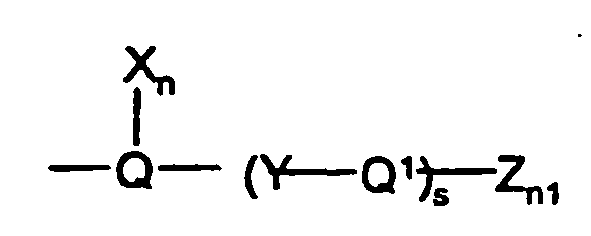
- Q is a six member aromatic structure containing 0-2 nitrogen, substituted or unsubstituted by halogen, up to per-halosubstitution and Q1 is a mono- or bicyclic aromatic structure of 3 to 10 carbon atoms and 0-4 members of the group consisting of N, O and S, unsubstituted or unsubstituted by halogen up to per-halosubstitution. X, Z, n and n 1 are as defined above and s = 0 or 1.
- In preferred embodiments, Q is phenyl or pyridinyl, substituted or unsubstituted by halogen, up to per-halosubstitution and Q1 is selected from the group consisting of phenyl, pyridinyl, naphthyl, pyrimidinyl, quinoline, isoquinoline, imidazole and benzothiazolyl, substituted or unsubstituted by halogen, up to per-halo substitution, or -Y-Q1 is phthalimidinyl substituted or unsubstituted by halogen up to per-halo substitution. Z and X are preferably independently selected from the group consisting of -R6, -OR6 and -NHR7, wherein R6 is hydrogen, C1-C10-alkyl or C3-C10-cycloalkyl and R7 is preferably selected from the group consisting of hydrogen, C3-C10-alkyl, C3-C6-cycloalkyl and C6-C10-aryl, wherein R6 and R7 can be substituted by halogen or up to per-halosubstitution.
- The heteroaryl moiety A of formula I is selected from the group consisting of:

- Where R2 is a substituted group, it is substituted by one or more substituents independently selected from the group consisting of halogen, up to per-halosubstitution, and Vn, where n = 0-3.
- Each V is independently selected from the group consisting of -CN, -OC(O)NR5R5', -CO2R5, -C(O)NR5R5', -OR5, -SR5, -NR5R5', -C(O)R5, -NR5C(O)OR5', -SO2R5, -SOR5, -NR5C(O)R5', -NO2, C1-C10 alkyl, C3-C10 cycloalkyl, C6-C14 aryl, C3-C13 heteroaryl, C7-C24 alkaryl, C4-C24 alkheteroaryl, substituted C1-C10 alkyl, substituted C3-C10 cycloalkyl, substituted C6-C14 aryl, substituted C3-C13 heteroaryl, substituted C7-C24 alkaryl and substituted C4-C24 alkheteroaryl.
- If V is a substituted group, it is substituted by one or more substituents independently selected from the group consisting of halogen, up to per-halosubstitution, -CN, -CO2R5, -C(O)R5, -C(O)NR5R5, - NR5R5', -OR5, -SR5, - NR5C(O)R5', -NR5C(O)OR5' and -NO2.
- The compound of the present invention is preferably one of the formulae


wherein B and R2 are as defined herein. - The substituents R5 and R5' are preferably each independently selected form the group consisting of H, C1-C10 alkyl, C3-C10 cycloalkyl, C6-C14 aryl, C3-C13 heteroaryl, C7-C24 alkaryl, C4-C23 alkheteroaryl, up to per-halosubstituted C1-C10 alkyl, up to per-halosubstituted C3-C10 cycloalkyl, up to per-halosubstituted C6-C14 aryl and up to per-halosubstituted C3-C13 heteroaryl.
- R2 is preferably substituted or unsubstituted phenyl or pyridinyl, where the substituents for R2 are selected from the group consisting of halogen, up to per-halosubstituition and Vn 1, wherein n = 0-3. Each V1 is preferably independently selected from the group consisting of substituted and unsubstituted C1-C6 alkyl, C3-C10 cycloalkyl, C6-C10 aryl, -NO2, -NH2, -C(O)-C1-6 alkyl, -C(O)N-(C1-6 alkyl)2, -C(O)NH-C1-6 alkyl, -O-C1-6 alkyl, -NHC(O)H, -NHC(O)OH, -N(C1-6 alkyl), C(O)-C1-6 alkyl, -N-(C1-6 alkyl)C(O)-C1-6 alkyl, -OC(O)NH-C6 -C14 aryl, -NHC(O)-C1-6alkyl, -OC(O)NH-C-NHC(O)O-C1-6alkyl, -S(O)-C1-6 alkyl and -SO2-C1-6 alkyl. Where V1 is a substituted group, it is preferably substituted by one or more halogen, up to per-halosubstitution.
- Most preferably, R2 is selected from substituted and unsubstituted phenyl or pyridinyl groups, where the substituents are halogen and Wn (n = 0-3).
- W is selected from the group consisting of -NO2, -C1-3 alkyl, -NH(O)CH3, -CF3, -OCH3, -F, -Cl, -NH2, -OC(O)NH, -SO2CH3, pyridinyl, phenyl, up to per-halosubstituted phenyl and C1-C6 alkyl substituted phenyl.
- The present invention is also directed to pharmaceutically acceptable salts of formula I. Suitable pharmaceutically acceptable salts are well known to those skilled in the art and include basic salts of inorganic and organic acids, such as hydrochloric acid, hydrobromic acid, sulphuric acid, phosphoric acid, methanesulphonic acid, sulphonic acid, acetic acid, trifluoroacetic acid, malic acid, tartaric acid, citric acid, lactic acid, oxalic acid, succinic acid, fumaric acid, maleic acid, benzoic acid, salicylic acid, phenylacetic acid, and mandelic acid.
- In addition, pharmaceutically acceptable salts include acid salts of inorganic bases, such as salts containing alkaline cations (e.g., Li+ Na+ or K+), alkaline earth cations (e.g., Mg+2, Ca+2 or Ba+2), the ammonium cation, as well as acid salts of organic bases, including aliphatic and aromatic substituted ammonium, and quaternary ammonium cations such as those arising from protonation or peralkylation of triethylamine, N,N-diethylamine, N,N-dicyclohexylamine, pyridine, N,N-dimethylaminopyridine (DMAP), 1,4-diazabiclo[2.2.2]octane (DABCO), 1,5-diazabicyclo[4.3.0]non-5-ene (DBN) and 1,8-diazabicyclo[5.4.0]undec-7-ene (DBU).
- A number of the compounds of Formula I possess asymmetric carbons and can therefore exist in racemic and optically active forms. Methods of separation of enantiomeric and diastereomeric mixtures are well known to one skilled in the art. The present invention encompasses any isolated racemic or optically active form of compounds described in Formula I which possess p38 kinase inhibitory activity.
- The compounds of Formula I may be prepared by use of known chemical reactions and procedures. Nevertheless, the following general preparative methods are presented to aid one of skill in the art in synthesizing the inhibitors, with more detailed particular examples being presented in the experimental section describing the working examples.
- The compounds of Formula I may be prepared by the use of known chemical reactions and procedures, some from starting materials which are commercially available. Nevertheless, general preparative methods are provided below to aid one skilled in the art in synthesizing these compounds, with more detailed examples being provided in the Experimental section which follows.
- Heterocyclic amines may be synthesized utilizing known methodology (Katritzky, et al. Comprehensive Heterocyclic Chemistry; Permagon Press: Oxford, UK (1984). March. Advanced Organic Chemistry, 3rd Ed.; John Wiley: New York (1985)). For example, as shown in Scheme I, 5-aminopyrazoles substituted at the N-1 position with either aryl or heteroaryl moieties may be synthesized by the reaction of an α-cyanoketone (2) with the appropriate aryl- or heteroaryl hydrazine (3, R2=aryl or heteroaryl). Cyanoketone 2, in turn, is available from the reaction of acetamidate ion with an appropriate acyl derivative, such as an ester, an acid halide, or an acid anhydride. In cases where the R2 moiety offers suitable anion stabilization, 2-aryl-and 2-heteroarylfurans may be synthesized from a Mitsunobu reaction of cyanoketone 2 with alcohol 5, followed by base catalyzed cyclization of enol ether 6 to give furylamine 7.

- Substituted anilines may be generated using standard methods (March. Advanced Organic Chemistry, 3rd Ed.; John Wiley: New York (1985). Larock. Comprehensive Organic Transformations; VCH Publishers: New York (1989)). As shown in Scheme II, aryl amines are commonly synthesized by reduction of nitroaryls using a metal catalyst, such as Ni, Pd, or Pt, and H2 or a hydride transfer agent, such as formate, cyclohexadiene, or a borohydride (Rylander. Hydrogenation Methods; Academic Press: London, UK (1985)). Nitroaryls may also be directly reduced using a strong hydride source, such as LiAlH4 (Seyden-Penne. Reductions by the Alumino- and Borohydrides in Organic Synthesis; VCH Publishers: New York (1991)), or using a zero valent metal, such as Fe, Sn or Ca, often in acidic media. Many methods exist for the synthesis of nitroaryls (March. Advanced Organic Chemistry, 3rd Ed.; John Wiley: New York (1985). Larock. Comprehensive Organic Transformations; VCH Publishers: New York (1989)).

- Nitroaryls are commonly formed by electrophilic aromatic nitration using HNO3, or an alternative NO2 + source. Nitro aryls may be further elaborated prior to reduction. Thus, nitroaryls substituted with


- As shown in Scheme IV, urea formation may involve reaction of a heteroaryl isocyanate (12) with an aryl amine (11). The heteroaryl isocyanate may be synthesized from a heteroaryl amine by treatment with phosgene or a phosgene equivalent, such as trichloromethyl chloroformate (diphosgene), bis(trichloromethyl) carbonate (triphosgene), or N,N'-carbonyldiimidazole (CDI). The isocyanate may also be derived from a heterocyclic carboxylic acid derivative, such as an ester, an acid halide or an anhydride by a Curtius-type rearrangement. Thus, reaction of acid derivative 16 with an azide source, followed by rearrangement affords the isocyanate. The corresponding carboxylic acid (17) may also be subjected to Curtius-type rearrangements using diphenylphosphoryl azide (DPPA) or a similar reagent. A urea may also be generated from the reaction of an aryl isocyanate (15) with a heterocyclic amine.


- The compounds may be administered orally, topically, parenterally, by inhalation or spray or vaginally, rectally or sublingually in dosage unit formulations. The term 'administration by injection' includes intravenous, intramuscular, subcutaneous and parenteral injections, as well as use of infusion techniques. Dermal administration may include topical application or transdermal administration. One or more compounds may be present in association with one or more non-toxic pharmaceutically acceptable carriers and if desired other active ingredients.
- Compositions intended for oral use may be prepared according to any suitable method known to the art for the manufacture of pharmaceutical compositions. Such compositions may contain one or more agents selected from the group consisting of diluents, sweetening agents, flavoring agents, coloring agents and preserving agents in order to provide palatable preparations. Tablets contain the active ingredient in admixture with non-toxic pharmaceutically acceptable excipients which are suitable for the manufacture of tablets. These excipients may be, for example, inert diluents, such as calcium carbonate, sodium carbonate, lactose, calcium phosphate or sodium phosphate; granulating and disintegrating agents, for example, corn starch, or alginic acid; and binding agents, for example magnesium stearate, stearic acid or talc. The tablets may be uncoated or they may be coated by known techniques to delay disintegration and adsorption in the gastrointestinal tract and thereby provide a sustained action over a longer period. For example, a time delay material such as glyceryl monostearate or glyceryl distearate may be employed. These compounds may also be prepared in solid, rapidly released form.
- Formulations for oral use may also be presented as hard gelatin capsules wherein the active ingredient is mixed with an inert solid diluent, for example, calcium carbonate, calcium phosphate or kaolin, or as soft gelatin capsules wherein the active ingredient is mixed with water or an oil medium, for example peanut oil, liquid paraffin or olive oil.
- Aqueous suspensions containing the active materials in admixture with excipients suitable for the manufacture of aqueous suspensions may also be used. Such excipients are suspending agents, for example sodium carboxymethylcellulose, methylcellulose, hydroxypropyl-methylcellulose, sodium alginate, polyvinylpyrrolidone, gum tragacanth and gum acacia; dispersing or wetting agents may be a naturally-occurring phosphatide, for example, lecithin, or condensation products of an alkylene oxide with fatty acids, for example polyoxyethylene stearate, or condensation products of ethylene oxide with long chain aliphatic alcohols, for example heptadecaethyleneoxycetanol, or condensation products of ethylene oxide with partial esters derived from fatty acids and hexitol such as polyoxyethylene sorbitol monooleate, or condensation products of ethylene oxide with partial esters derived from fatty acids and hexitol anhydrides, for example polyethylene sorbitan monooleate. The aqueous suspensions may also contain one or more preservatives, for example ethyl, or n-propyl, p-hydroxybenzoate, one or more coloring agents, one or more flavoring agents, and one or more sweetening agents, such as sucrose or saccharin.
- Dispersible powders and granules suitable for preparation of an aqueous suspension by the addition of water provide the active ingredient in admixture with a dispersing or wetting agent, suspending agent and one or more preservatives. Suitable dispersing or wetting agents and suspending agents are exemplified by those already mentioned above. Additional excipients, for example, sweetening, flavoring and coloring agents, may also be present.
- The compounds may also be in the form of non-aqueous liquid formulations, e.g., oily suspensions which may be formulated by suspending the active ingredients in a vegetable oil, for example arachis oil, olive oil, sesame oil or peanut oil, or in a mineral oil such as liquid paraffin. The oily suspensions may contain a thickening agent, for example beeswax, hard paraffin or cetyl alcohol. Sweetening agents such as those set forth above, and flavoring agents may be added to provide palatable oral preparations. These compositions may be preserved by the addition of an anti-oxidant such as ascorbic acid.
- Pharmaceutical compositions of the invention may also be in the form of oil-in-water emulsions. The oil phase may be a vegetable oil, for example olive oil or arachis oil, or a mineral oil, for example liquid paraffin or mixtures of these. Suitable emulsifying agents may be naturally-occurring gums, for example gum acacia or gum tragacanth, naturally-occurring phosphatides, for example soy bean, lecithin, and esters or partial esters derived from fatty acids and hexitol anhydrides, for example sorbitan monooleate, and condensation products of the said partial esters with ethylene oxide, for example polyoxyethylene sorbitan monooleate. The emulsions may also contain sweetening and flavoring agents.
- Syrups and elixirs may be formulated with sweetening agents, for example glycerol, propylene glycol, sorbitol or sucrose. Such formulations may also contain a demulcent, a preservative and flavoring and coloring agents.
- The compounds may also be administered in the form of suppositories for rectal or vaginal administration of the drug. These compositions can be prepared by mixing the drug with a suitable non-irritating excipient which is solid at ordinary temperatures but liquid at the rectal or vaginal temperature and will therefore melt in the rectum or vagina to release the drug. Such materials include cocoa butter and polyethylene glycols.
- Compounds of the invention may also be administrated transdermally using methods known to those skilled in the art (see, for example: Chien; "Transdermal Controlled Systemic Medications"; Marcel Dekker, Inc.; 1987. Lipp et al. WO94/04157 3Mar94). For example, a solution or suspension of a compound of Formula I in a suitable volatile solvent optionally containing penetration enhancing agents can be combined with additional additives known to those skilled in the art, such as matrix materials and bacteriocides. After sterilization, the resulting mixture can be formulated following known procedures into dosage forms. In addition, on treatment with emulsifying agents and water, a solution or suspension of a compound of Formula I may be formulated into a lotion or salve.
- Suitable solvents for processing transdermal delivery systems are known to those skilled in the art, and include lower alcohols such as ethanol or isopropyl alcohol, lower ketones such as acetone, lower carboxylic acid esters such as ethyl acetate, polar ethers such as tetrahydrofuran, lower hydrocarbons such as hexane, cyclohexane or benzene, or halogenated hydrocarbons such as dichloromethane, chloroform, trichlorotrifluoroethane, or trichlorofluoroethane. Suitable solvents may also include mixtures of one or more materials selected from lower alcohols, lower ketones, lower carboxylic acid esters, polar ethers, lower hydrocarbons, halogenated hydrocarbons.
- Suitable penetration enhancing materials for transdermal delivery system are known to those skilled in the art, and include, for example, monohydroxy or polyhydroxy alcohols such as ethanol, propylene glycol or benzyl alcohol, saturated or unsaturated C8-C18 fatty alcohols such as lauryl alcohol or cetyl alcohol, saturated or unsaturated C8-C18 fatty acids such as stearic acid, saturated or unsaturated fatty esters with up to 24 carbons such as methyl, ethyl, propyl, isopropyl, n-butyl, sec-butyl, isobutyl, tertbutyl or monoglycerin esters of acetic acid, capronic acid, lauric acid, myristinic acid, stearic acid, or palmitic acid, or diesters of saturated or unsaturated dicarboxylic acids with a total of up to 24 carbons such as diisopropyl adipate, diisobutyl adipate, diisopropyl sebacate, diisopropyl maleate, or diisopropyl fumarate. Additional penetration enhancing materials include phosphatidyl derivatives such as lecithin or cephalin, terpenes, amides, ketones, ureas and their derivatives, and ethers such as dimethyl isosorbid and diethyleneglycol monoethyl ether. Suitable penetration enhancing formulations may also include mixtures of one or more materials selected from monohydroxy or polyhydroxy alcohols, saturated or unsaturated C8-C18 fatty alcohols, saturated or unsaturated C8-C18 fatty acids, saturated or unsaturated fatty esters with up to 24 carbons, diesters of saturated or unsaturated discarboxylic acids with a total of up to 24 carbons, phosphatidyl derivatives, terpenes, amides, ketones, ureas and their derivatives, and ethers.
- Suitable binding materials for transdermal delivery systems are known to those skilled in the art and include polyacrylates, silicones, polyurethanes, block polymers, styrenebutadiene coploymers, and natural and synthetic rubbers. Cellulose ethers, derivatized polyethylenes, and silicates may also be used as matrix components. Additional additives, such as viscous resins or oils may be added to increase the viscosity of the matrix.
- For all regimens of use disclosed herein for compounds of Formula I, the daily oral dosage regimen will preferably be from 0.01 to 200 mg/Kg of total body weight. The daily dosage for administration by injection, including intravenous, intramuscular, subcutaneous and parenteral injections, and use of infusion techniques will preferably be from 0.01 to 200 mg/Kg of total body weight. The daily vaginal dosage regimen will preferably be from 0.01 to 200 mg/Kg of total body weight. The daily rectal dosage regimen will preferably be from 0.01 to 200 mg/Kg of total body weight. The daily topical dosage regimen will preferably be from 0.1 to 200 mg administered between one to four times daily. The transdermal concentration will preferably be that required to maintain a daily dose of from 0.01 to 200 mg/Kg. The daily inhalation dosage regimen will preferably be from 0.01 to 10 mg/Kg of total body weight.
- It will be appreciated by those skilled in the art that the particular method of administration will depend on a variety of factors, all of which are considered routinely when administering therapeutics. It will also be understood, however, that the specific dose level for any given patient will depend upon a variety of factors, including, the activity of the specific compound employed, the age of the patient, the body weight of the patient, the general health of the patient, the gender of the patient, the diet of the patient, time of administration, route of administration, rate of excretion, drug combinations, and the severity of the condition undergoing therapy. It will be further appreciated by one skilled in the art that the optimal course of treatment, ie, the mode of treatment and the daily number of doses of a compound of Formulae I or a pharmaceutically acceptable salt thereof given for a defined number of days, can be ascertained by those skilled in the art using conventional course of treatment tests.
- The entire disclosure of all applications, patents and publications cited above and below are hereby incorporated by reference, including provisional application (Attorney Docket Number BAYER 12V1), filed on December 22, 1997, as SN 08/995,751, and converted on December 22, 1998.
- The following examples are for illustrative purposes only and are not intended, nor should they be construed to limit the invention in any way.
- All reactions were performed in flame-dried or oven-dried glassware under a positive pressure of dry argon or dry nitrogen, and were stirred magnetically unless otherwise indicated. Sensitive liquids and solutions were transferred via syringe or cannula, and introduced into reaction vessels through rubber septa. Unless otherwise stated, the term 'concentration under reduced pressure' refers to use of a Buchi rotary evaporator at approximately 15 mmHg.
- All temperatures are reported uncorrected in degrees Celsius (°C). Unless otherwise indicated, all parts and percentages are by weight.
- Commercial grade reagents and solvents were used without further purification. Thin-layer chromatography (TLC) was performed on Whatman® pre-coated glass-backed silica gel 60A F-254 250 µm plates. Visualization of plates was effected by one or more of the following techniques: (a) ultraviolet illumination, (b) exposure to iodine vapor, (c) immersion of the plate in a 10% solution of phosphomolybdic acid in ethanol followed by heating, (d) immersion of the plate in a cerium sulfate solution followed by heating, and/or (e) immersion of the plate in an acidic ethanol solution of 2,4-dinitrophenylhydrazine followed by heating. Column chromatography (flash chromatography) was performed using 230-400 mesh EM Science® silica gel.
- Melting points (mp) were determined using a Thomas-Hoover melting point apparatus or a Mettler FP66 automated melting point apparatus and are uncorrected. Proton (1H) nuclear magnetic resonance (NMR) spectra were measured with a General Electric GN-Omega 300 (300 MHz) spectrometer with either Me4Si (δ 0.00) or residual protonated solvent (CHCl3 δ 7.26; MeOH δ 3.30; DMSO δ 2.49) as standard. Carbon (13C) NMR spectra were measured with a General Electric GN-Omega 300 (75 MHz) spectrometer with solvent (CDCl3 δ 77.0; MeOD-d3; δ 49.0; DMSO-d6 δ 39.5) as standard. Low resolution mass spectra (MS) and high resolution mass spectra (HRMS) were either obtained as electron impact (EI) mass spectra or as fast atom bombardment (FAB) mass spectra. Electron impact mass spectra (EI-MS) were obtained with a Hewlett Packard 5989A mass spectrometer equipped with a Vacumetrics Desorption Chemical Ionization Probe for sample introduction. The ion source was maintained at 250 °C. Electron impact ionization was performed with electron energy of 70 eV and a trap current of 300 µA. Liquid-cesium secondary ion mass spectra (FAB-MS), an updated version of fast atom bombardment were obtained using a Kratos Concept 1-H spectrometer. Chemical ionization mass spectra (CI-MS) were obtained using a Hewlett Packard MS-Engine (5989A) with methane as the reagent gas (1x10⁻⁴ torr to 2.5x10⁻⁴ torr). The direct insertion desorption chemical ionization (DCI) probe (Vaccumetrics, Inc.) was ramped from 0-1.5 amps in 10 sec and held at 10 amps until all traces of the sample disappeared (~1-2 min). Spectra were scanned from 50-800 amu at 2 sec per scan. HPLC - electrospray mass spectra (HPLC ES-MS) were obtained using a Hewlett-Packard 1100 HPLC equipped with a quaternary pump, a variable wavelength detector, a C-18 column, and a Finnigan LCQ ion trap mass spectrometer with electrospray ionization. Spectra were scanned from 120-800 amu using a variable ion time according to the number of ions in the source. Gas chromatography - ion selective mass spectra (GC-MS) were obtained with a Hewlett Packard 5890 gas chromatograph equipped with an HP-1 methyl silicone column (0.33 mM coating; 25 m x 0.2 mm) and a Hewlett Packard 5971 Mass Selective Detector (ionization energy 70 eV).
- Elemental analyses were conducted by Robertson Microlit Labs, Madison NJ. All ureas displayed NMR spectra, LRMS and either elemental analysis or HRMS consistant with assigned structures.
-
- AcOH
- acetic acid
- anh
- anhydrous
- BOC
- tert-butoxycarbonyl
- cone
- concentrated
- dec
- decomposition
- DMPU
- 1,3-dimethyl-3,4,5,6-tetrahydro-2(1H)-pyrimidinone
- DMF
- N,N-dimethylformamide
- DMSO
- dimethylsulfoxide
- DPPA
- diphenylphosphoryl azide
- EtOAc
- ethyl acetate
- EtOH
- ethanol (100%)
- Et2O
- diethyl ether
- Et3N
- triethylamine
- m-CPBA
- 3-chloroperoxybenzoic acid
- MeOH
- methanol
- pet. ether
- petroleum ether (boiling range 30-60 °C)
- THF
- tetrahydrofuran
- TFA
- trifluoroacetic acid
- Tf
- trifluoromethanesulfonyl
-

- N 1 -(4-Methoxyphenyl)-5-amino-3-tert-butylpyrazole: A mixture of 4-methoxyphenylhydrazine hydrochloride (3.5 g), 4,4-dimethyl-3-oxopentanenitrile (2.5 g), EtOH (30 mL), and AcOH (1 mL) was heated at the reflux temperature for 3 h, cooled to room temp., and poured into a mixture of Et2O (100 mL) and a 10% Na2CO3 solution (100 mL). The organic layer was washed with a saturated NaCl solution, dried (MgSO4) and concentrated under reduced pressure. The solid residue was washed with pentane to afford the desired pyrazole as a pale brown solid. (4.25g): 1H-NMR (DMSO-d6) δ 1.18 (s, 9H); 3.78 (s, 3H); 5.02 (br s, 2H); 5.34 (s, 1H); 6.99 (d, J=8 Hz, 2H); 7.42 (d, J=8 Hz, 2H).
-

- Step 1. 4,4-Dimethyl-3-(4-pyridinylmethoxy)-2-pentenenitrile: A solution of triphenylphosphine (2.93 g, 11.2 mmol) in anh THF (50 mL) was treated with diethyl azodicarboxylate (1.95 g, 11.2 mmol) and 4-pyridinylmethanol (1.22 g, 11.2 mmol), then stirred for 15 min. The resulting white slurry was treated with 4,4-dimethyl-3-oxopentanenitrile (1.00 g, 7.99 mmol), then stirred for 15 min. The reaction mixture was concentrated under reduced pressure. The residue was purified by column chromatography (30% EtOAc/70% hexane) to give the desired nitrile as a yellow solid (1.83 g, 76%): TLC (20% EtOAc/80% hexane) R f 0.13; 1H-NMR (CDCl3) δ 1.13 (s, 9H), 4.60 (s, 1H), 5.51 (s, 2H), 7.27 (d, J=5.88 Hz, 2H), 8.60 (d, J=6.25 Hz, 2H); 13C-NMR (CDCl3) δ 27.9 (3C), 38.2, 67.5, 70.8, 117.6, 121.2 (2C), 144.5, 149.9 (2C), 180.7; CI-MS m/z (rel abundance) 217 ((M+H)+, 100%).

- Step 2. 3-Amino-2-(4-pyridinyl)-5-tert-butylfuran: A solution of 4,4-dimethyl-3-(4-pyridinylmethoxy)-2-pentenenitrile (1.55 g, 7.14 mmol) in anh DMSO (75 mL) was treated with potassium tert-butoxide (0.88 g, 7.86 mmol) and stirred at room temp for 10 min. The resulting mixture was treated with EtOAc (300 mL), then sequentially washed with water (2 x 200 mL) and a saturated NaCl solution (100 mL). Combined aqueous phases were back-extracted with EtOAc (100 mL). The combined organic phases were dried (Na2SO4) and concentrated under reduced pressure. The residue was purified by column chromatography (gradient from 30% EtOAc/70% hexane to 100% EtOAc) to give the desired product as an orange oil (0.88 g, 57%): TLC (40% EtOAc/60% hexane) R f 0.09; 1H-NMR (CDCl3) δ 1.28 (s, 9H), 3.65 (br s, 2H), 5.79 (s, 1H), 7.30 (d, J=6.25 Hz, 2H), 8.47 (d, J=6.25 Hz, 2H); EI-MS m/z (rel abundance) 216 (M+, 30%).
-

- Step 1. Methyl 3-(tert-Butoxycarbonylamino)-5-tert-butyl-2-thiophenecarboxylate: To a solution of methyl 3-amino-5-tert-butyl-2-thiophenecarboxylate (150 g, 0.70 mol) in pyridine (2.8 L) at 5 °C was added di-tert-butyl dicarbonate (171.08 g, 0.78 mol, 1.1 equiv) and N,N-dimethylaminopyridine (86 g, 0.70 mol, 1.00 equiv) and the resulting mixture was stirred at room temp for 7 d. The resulting dark solution was concentrated under reduced pressure (approximately 0.4 mmHg) at approximately 20 °C. The resulting red solids were dissolved in CH2Cl2 (3 L) and sequentially washed with a 1 M H3PO4 solution (2 x 750 mL), a saturated NaHCO3 solution (800 mL) and a saturated NaCl solution (2 x 800 mL), dried (Na2SO4) and concentrated under reduced pressure. The resulting orange solids were dissolved in abs. EtOH (2 L) by warming to 49 °C, then treated with water (500 mL) to afford the desired product as an off-white solid (163 g, 74%): 1H-NMR (CDCl3) δ 1.38 (s, 9H), 1.51 (s, 9H), 3.84 (s, 3H), 7.68 (s, 1H), 9.35 (br s, 1H); FAB-MS m/z (rel abundance) 314 ((M+H)+, 45%).

- Step 2. 3-(tert-Butoxytarbonylamino)-5-tert-butyl-2-thiophenecarboxylic Acid: To a solution of methyl 3-(tert-butoxycarbonylamino)-5-tert-butyl-2-thiophenecarboxylate (90.0 g, 0.287 mol) in THF (630 mL) and MeOH (630 mL) was added a solution of NaOH (42.5 g, 1.06 mL) in water (630 mL). The resulting mixture was heated at 60 °C for 2 h, concentrated to approximately 700 mL under reduced pressure, and cooled to 0 °C. The pH was adjusted to approximately 7 with a 1.0 N HCl solution (approximately 1 L) while maintaining the internal temperature at approximately 0 °C. The resulting mixture was treated with EtOAc (4 L). The pH was adjusted to approximately 2 with a 1.0 N HCl solution (500 mL). The organic phase was washed with a saturated NaCl solution (4 x 1.5 L), dried (Na2SO4), and concentrated to approximately 200 mL under reduced pressure. The residue was treated with hexane (1 L) to form a light pink (41.6 g). Resubmission of the mother liquor to the concentration-precipitation protocol afforded additional product (38.4 g, 93% total yield): 1H-NMR (CDCl3) δ 1.94 (s, 9H), 1.54 (s, 9H), 7.73 (s, 1H), 9.19 (br s, 1H); FAB-MS m/z (rel abundance) 300 ((M+H)+, 50%).

- Step 3. 5-tert-Butyl-3-thiopheneammonium Chloride: A solution of 3-(tert-butoxycarbonylamino)-5-tert-butyl-2-thiophenecarboxylic acid (3.0 g, 0.010 mol) in dioxane (20 mL) was treated with an HCl solution (4.0 M in dioxane, 12.5 mL, 0.050 mol, 5.0 equiv), and the resulting mixture was heated at 80 °C for 2 h. The resulting cloudy solution was allowed to cool to room temp forming some precipitate. The slurry was diluted with EtOAc (50 mL) and cooled to -20 °C. The resulting solids were collected and dried overnight under reduced pressure to give the desired salt as an off-white solid (1.72 g, 90%): 1H-NMR (DMSO-d6) δ 1.31 (s, 9H), 6.84 (d, J=1.48 Hz, 1H), 7.31 (d, J=1.47 Hz, 1H), 10.27 (br s, 3H).
-

- 3-(4-Pyridinylthio)aniline: To a solution of 3-aminothiophenol (3.8 mL, 34 mmoles) in anh DMF (90mL) was added 4-chloropyridine hydrochloride (5.4 g, 35.6 mmoles) followed by K2CO3 (16.7 g, 121 mmoles). The reaction mixture was stirred at room temp. for 1.5 h, then diluted with EtOAc (100 mL) and water (100mL). The aqueous layer was back-extracted with EtOAc (2 x 100 mL). The combined organic layers were washed with a saturated NaCl solution (100 mL), dried (MgSO4), and concentrated under reduced pressure. The residue was filtered through a pad of silica (gradient from 50% EtOAc/50% hexane to 70% EtOAc/30% hexane) and the resulting material was triturated with a Et2O/hexane solution to afford the desired product (4.6 g, 66%): TLC (100 % ethyl acetate) R f 0.29; 1H-NMR (DMSO-d6) δ 5.41 (s, 2H), 6.64-6.74 (m, 3H), 7.01 (d, J=4.8, 2H), 7.14 (t, J=7.8 Hz, 1H), 8.32 (d, J=4.8, 2H).
-

- N-(1-(4-Methoxyphenyl)-3-tert-butyl-5-pyrazolyl)-N'-(2,3-dichlorophenyl)urea: To a stirring solution of 1-(4-methoxyphenyl)-3-tert-butyl-5-aminopyrazole (0.342 g, 1.39 mmol) in anh toluene (9 mL) was added 2,3-dichlorophenyl isocyanate (0.276 mL, 2.09 mmol). The solution was sealed and stirred in the dark for 96 h at 60 °C. After this time, the reaction mixture was diluted with EtOAc (200 mL). The resulting mixture was sequentially washed with a 1 M HCl solution (2 x 125 mL) and a saturated NaCl solution (50 mL), dried (MgSO4), and concentrated under reduced pressure. The residue was purified by column chromatography (20% EtOAc/80% hexane) to give the product as a white solid (0.335 g, 56%): TLC (20% EtOAc/80% hexane) R f 0.22; 1H NMR (DMSO-d6) δ 1.24 (s, 9H), 3.79 (s, 3H), 6.33 (s, 1H), 7.05 (d, J=9 Hz, 2H), 7.28 (m, 2H), 7.38 (d, J=9 Hz, 2H), 8.05 (dd, J=3, 6 Hz, 1H), 8.75 (s, 1H), 9.12 (s, 1H); FAB-MS m/z 433 ((M+H)+).
-

- N-(2-(4-Pyridinyl)-5-tert-butyl-3-furyl)-N'-(2,3-dichlorophenyl)urea: A solution of 3-amino-2-(4-pyridinyl)-5-tert-butylfuran (Method A2; 0.10 g, 0.46 mmol) and 2,3-dichlorophenyl isocyanate (0.13 g, 0.69 mmol) in CH2Cl2 was stirred at room temp. for 2 h, then was treated with 2-(dimethylamino)ethylamine (0.081 g, 0.92 mmol) and stirred for an additional 30 min. The resulting mixture was diluted with EtOAc (50 mL), then was sequentially washed with a 1 N HCl solution (50 mL), a saturated NaHCO3 solution (50 mL) and a saturated NaCl solution (50 mL), dried (Na2SO4), and concentrated under reduced pressure. The residue was purified using column chromatography (gradient from 10% EtOAc/90% hexane to 40% EtOAc/60% hexane) to give the desired compound as a white solid (0.12 g, 63%): mp 195-198 °C; TLC (60% EtOAc/40% hexane ) R f 0.47; 1H NMR (DMSO-d6) δ 1.30 (s, 9H); 6.63 (s, 1H); 7.30-7.32 (m, 2H), 7.58 (dm, J=6.62 Hz, 2H), 8.16 (dd, J=2.57, 6.99 Hz, 1H), 8.60 (dm, J=6.25 Hz, 2H), 8.83 (s, 1H), 9.17 (s, 1H); 13C NMR (DMSO-d6) δ 28.5 (3C), 32.5, 103.7, 117.3 (2C), 119.8, 120.4, 123.7, 125.6, 128.1, 131.6, 135.7, 136.5, 137.9, 150.0 (2C), 152.2, 163.5; CI-MS m/z (rel abundance) 404 ((M+H)+, 15%), 406 ((M+H+2)+, 8%).
-

- N-(5-tert-Butyl-3-thienyl)-N'-(2,3-dichlorophenyl)urea: Pyridine (0.163 mL, 2.02 mmol) was added to a slurry of 5-tert-butylthiopheneammonium chloride (Method A4c; 0.30 g, 1.56 mmol) and 2,3-dichlorophenyl isocyanate (0.32 mL, 2.02 mmol) in CH2Cl2 (10 mL) to clarify the mixture and the resulting solution was stirred at room temp. overnight. The reaction mixture was then concentrated under reduced pressure and the residue was separated between EtOAc (15 mL) and water (15 mL). The organic layer was sequentially washed with a saturated NaHCO3 solution (15 mL), a 1N HCl solution (15 mL) and a saturated NaCl solution (15 mL), dried (Na2SO4), and concentrated under reduced pressure. A portion of the residue was by preparative HPLC (C-18 column; 60% acetonitrile/40% water/0.05% TFA) to give the desired urea (0.180 g, 34%): mp 169-170 °C; TLC (20% EtOAc/80% hexane) R f 0.57; 1H-NMR (DMSO-d6) δ 1.31 (s, 9H), 6.79 (s, 1H), 7.03 (s, 1H), 7.24-7.33 (m, 2H), 8.16 (dd, J=1.84, 7.72 Hz, 1H), 8.35 (s, 1H), 9.60 (s, 1H); 13C-NMR (DMSO-d6) δ 31.9 (3C), 34.0, 103.4, 116.1, 119.3, 120.0, 123.4, 128.1, 131.6, 135.6, 138.1, 151.7, 155.2; FAB-MS m/z (rel abundance) 343 ((M+H)+, 83%), 345 ((M+H+2)+, 56%), 347 ((M+H+4)+, 12%).
-

- N-(1-Phenyl-3-tert-butyl-5-pyrazolyl)-N'-(4-(4-pyridinylmethyl)phenyl)urea: A solution of 4-(4-pyridinylmethyl)aniline (0.25 g, 1.38 mmol) and N,N'-carbonyldiimidazole (0.23 g, 1.42 mmol) in CH2Cl2 11 mL) at room temp. was stirred for 2 h, then treated with 5-amino-1-phenyl-3-tert-butyl-5-pyrazole (0.30 g, 1.38 mmol) and the resulting mixture was stirred at 50 °C overnight. The reaction mixture was diluted with EtOAc (25 mL), then sequentially washed with water (30 mL) and a saturated NaCl solution (30 mL), dried (MgSO4), and concentrated under reduced pressure. The residue was purified by column chromatography (gradient from 100% CH2Cl2 to 30% acetone/70% CH2Cl2) and the resulting material was recrystallized (EtOAc/Et2O) to give the desired product complexed with 0.25 equiv H2O (0.30 g): TLC (60% acetone/40% CH2Cl2) R f 0.56; 1H-NMR (DMSO-d6) δ 1.25 (s, 9H); 3.86 (s, 2H), 6.34 (s, 1H), 7.11 (d, J=8.82 Hz, 2H), 7.19 (dm, J=6.25 Hz, 2H), 7.31 (d, J=1.84 Hz, 2H), 7.35-7.51 (m, 5 H), 8.34 (s, 1H), 8.42 (dm, J=5.98 Hz, 2H), 8.95 (s, 1H); FAB-MS m/z (rel abundance) 426 ((M+H)+, 100%).
-

- N-(2-Bromo-5-tert-butyl-3-thienyl)-N'-(2-3-dichlorophenyl)urea: To a slurry of N-(5-tert-butyl-3-thienyl)-N'-(2,3-dichlorophenyl)urea (Method C1c; 3.00 g, 8.74 mmol) in CHCl3 (200 mL) at room temp was slowly added a solution of Br2 (0.46 mL, 1.7 mmol) in CHCl3 (150 mL) via addition funnel over 2.5 h, causing the reaction mixture to become homogeneous. Stirring was continued 20 min after which TLC analysis indicated complete reaction. The reaction mixture was concentrated under reduced pressure, and the residue triturated (Et2O/hexane) and the resulting solids were washed (hexane) to give the brominated product as a pink powder (3.45 g, 93%): mp 180-183 °C; TLC (10% EtOAc/90% hexane) R f 0.68; 1H NMR (DMSO-d6) δ 1.28 (s, 9H), 7.27-7.31 (m, 2H), 7.33 (s, 1H), 8.11 (dd, J=3.3, 6.6 Hz, 1H), 8.95 (s, 1H), 9.12 (s, 1H); 13C NMR (DMSO-d6) δ 31.5 (3C), 34.7, 91.1, 117.9, 120.1, 120.5, 123.8, 128.0, 131.6, 135.5, 137.9, 151.6, 155.3; FAB-MS m/z (rel abundance) 421 ((M+H)+, 7%), 423 (M+2+H)+, 10%).
-

- N-(2-Phenyl-5-tert-butyl-3-thienyl)-N'-(2,3-dichlorophenyl)urea: To a solution of N-(3-(2-bromo-5-tert-butylthienyl)-N'-(2,3-dichlorophenyl)urea (0.50 g, 1.18 mmol) and phenyltrimethyltin (0.21 mL, 1.18 mmol) in DMF (15 mL) was added Pd(PPh3)2Cl2 (0.082 g, 0.12 mmol), and the resulting suspension was heated at 80°C overnight. The reaction mixture was diluted with EtOAc (50 mL) and water (50 mL), and the organic layer sequentially washed with water (3 x 50 mL) and a saturated NaCl solution (50 mL), then dried (Na2SO4) and concentrated under reduced pressure. The residue was purified by MPLC (Biotage®; gradient from 100% hexane to 5% EtOAc/95% hexane) followed by preparative HPLC (C-18 column; 70% CH3CN/30% water/0.05% TFA). The HPLC fractions were concentrated under reduced pressure and the resulting aqueous mixture was extracted with EtOAc (2 x 50 mL). The combined organic layers were dried (Na2SO4) and concentrated under reduced pressure to give a gummy semi-solid, which was triturated with hexane to afford the desired product as a white solid (0.050 g, 10%): mp 171-173 °C; TLC (5% EtOAc/95% hexane) R f 0.25; 1H NMR (CDCl3) δ 1.42 (s, 9H), 6.48 (br s, 1H), 7.01 (s, 1H), 7.10-7.18 (m, 2H), 7.26-7.30 (m, 1H), 7.36 (app t, J=7.72 Hz, 2H), 7.39 (br s, 1H), 7.50 (dm, J=6.99 Hz, 2H), 7.16 (dd, J=2.20, 7.72 Hz, 1H); 13C NMR (CDCl3) δ 32.1 (3C), 34.8, 118.4, 118.8, 120.7, 121.1, 124.2, 127.7, 127.9, 128.2 (2C), 128.5, 129.0 (2C), 132.4, 132.5, 136.9, 153.1, 156.3; FAB-MS m/z (rel abundance) 419 ((M+H)+, 6%), 421 ((M+H+2)+, 4%).
-

- N-(1-(3-Aminophenyl)-3-tert-butyl-5-pyrazolyl)-N'-(4-(4-pyridinylthio)phenyl)urea: A solution of N-(1-(3-nitrophenyl)-3-tert-butyl-5-pyrazolyl]-N'-(4-(4-pyridinylthio)phenyl)urea (Prepared in methods analogous to those described in A1 and C1a; 0.310 g, 0.635 mmol) in acetic acid (20 mL) was placed under an atmosphere of Ar using a vacuum-degassed and argon-purge protocol. To this was added water (0.2 mL) followed by iron powder (325 mesh; 0.354 g, 6.35 mmol). The reaction mixture was stirred vigorously under argon at room temp. for 18 h, at which time TLC indicated the absence of starting material. The reaction mixture was filtered and the solids were washed copiously with water (300 mL). The orange solution was then brought to pH 4.5 by addition of NaOH pellets (a white precipitate forms). The resulting suspension was extracted with Et2O (3 x 250 mL), and the combined organic layers were washed with a saturated NaHCO3 solution (2 x 300 mL) until foaming ceased. The resulting solution was dried (MgSO4) and concentrated under reduced pressure. The resulting white solid was purified by column chromatography (gradient from 30% acetone/70% CH2Cl2 to 50% acetone/50% CH2Cl2) to give the product as a white solid (0.165 g, 57%): TLC (50% acetone/50% CH2Cl2) R f 0.50; 1H NMR (DMSO-d6) δ 1.24 (s, 9H), 5.40 (br s, 2H), 6.34 (s, 1H), 6.57 (d, J=8 Hz, 2H), 6.67 (s, 1H), 6.94 (d, J=6 Hz, 2H), 7.12 (app t, J=8 Hz, 1H), 7.47 (d, J=9 Hz, 2H), 7.57 (d, J=9 Hz, 2H), 8.31 (d, J=6 Hz, 2H), 8.43 (s, 1H), 9.39 (s, 1H); FAB-MS m/z 459 ((M+H)+).
-

- N-(1-(3-Acetamidophenyl)-3-tert-butyl-5-pyrazolyl)-N'-(4-phenoxyphenyl)urea: To a solution of N-(1-(3-aminophenyl)-3-tert-butyl-5-pyrazolyl)-N'-(4-phenoxyphenyl)urea (prepared using methods analogous to those described in A1, C1a and D3; 0.154 g, 0.349 mmol) in CH2Cl2 (10 mL) was added pyridine (0.05 mL) followed by acetyl chloride (0.030 mL, 0.417 mmol). The reaction mixture was stirred under argon at room temp. for 3 h, at which time TLC analysis indicated the absence of starting material. The reaction mixture was diluted with CH2Cl2(20 mL), then the resulting solution was sequentially washed with water (30 mL) and a saturated NaCl solution (30 mL), dried (MgSO4) and concentrated under reduced pressure. The resulting residue was purified by column chromatography (gradient from 5% EtOAc/95% hexane to 75% EtOAc/25% hexane) to give the product as a white solid (0.049 g, 30%): TLC (70% EtOAc/30% hexane) R f 0.32; 1H NMR (DMSO-d6) δ 1.26 (s, 9H), 2.05 (s, 3H), 6.35 (s, 1H), 6.92-6.97 (m, 4H), 7.05-7.18 (m, 2H), 7.32-7.45 (m, 5H), 7.64-7.73 (m, 2H), 8.38 (s, 1H), 9.00 (s, 1H), 10.16 (s, 1H); FAB-MS m/z 484 ((M+H)+).
- The following compounds have been synthesized according to the General Methods listed above:
Table 1. 2-Substituted-5-tert-butylpyrazolyl Ureas 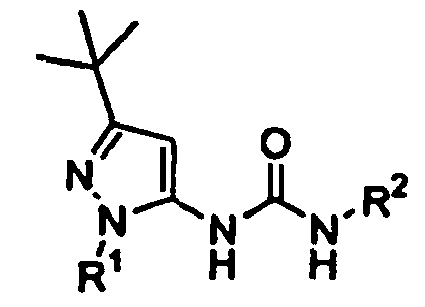
Entry R1 R2 mp (°C) TLC Rf Solvent System Mass Spec. [Source] Synth. Method 18 

0.31 70% EtOAc/ 30% hexane 484 (M+H)+ [FAB] A1, C1a, D3, D4 19 

0.14 50% EtOAc/ 50% hexane 442 (M+H)+ [FAB] A1, C1a, D3 20 

0.19 30% EtOAc/ 70% hexane 472 (M+H)+ [FAB] Al, C1a 21 

0.56 60% acetone /40% CH2Cl 2 426 (M+H)+ [FAB] A1, C2 22 

0.34 10% MeOH/ 90% CH2Cl 2 427 (M+H)+ [FAB] A1, C2 23 

0.44 40% acetone /60% CH2Cl 2 494 (M+H)+ [FAB] A1, C2 24 

0.44 40% acetone / 60% CH2C1 2 444 (M+H)+ [FAB] A1, C2 25 

0.46 40% acetone /60% CH2Cl 2 440 (M+H)+ [FAB] A1, C2 26 

0.48 40% acetone /60% CH2Cl 2 444 (M+H)+ [FAB] A1, C2 27 

0.34 40% acetone / 60% CH2C1 2 504 (M+H)+ A1, C2 28 

0.47 40% acetone / 60% CH2Cl 2 471 (M+H)+ [FAB] A1, C2 29 

0.51 60% acetone /40% CH2Cl 2 456 (M+H)+ [FAB] A1, C2 30 

0.50 50% acetone /50% CH2Cl 2 441 (M+H)+ [FAB] A1, C2, D3 31 
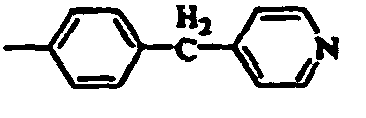
0.43 30% acetone /70% CH2Cl 2 471 (M+H)+ [FAB] A1, C2 32 

0.50 50% acetone /50% CH2Cl 2 459 (M+H)+ [FAB] A1, C2, D3 33 

0.47 30% acetone /70% CH2C1 2 489 (M+H)+ [FAB] A1, C2 34 

461 (M+H)+ [FAB] A1, C2 35 

461 (M+H)+ [FAB] A1, C2 36 

445 (M+H)+ [FAB] A1, C2 37 

445 (M+H)+ [FAB] A1, C2 - The in vitro inhibitory properties of compounds were determined using a p38 kinase inhibition assay. P38 activity was detected using an in vitro kinase assay run in 96-well microtiter plates. Recombinant human p38 (0.5 µg/mL) was mixed with substrate (myelin basic protein, 5 µg/mL) in kinase buffer (25 mM Hepes, 20 mM MgCl2 and 150 mM NaCl) and compound. One µCi/well of 33P-labeled ATP (10 µM) was added to a final volume of 100 µL. The reaction was run at 32 °C for 30 min. and stopped with a 1M HCl solution. The amount of radioactivity incorporated into the substrate was determined by trapping the labeled substrate onto negatively charged glass fiber filter paper using a 1% phosphoric acid solution and read with a scintillation counter. Negative controls include substrate plus ATP alone.
- All compounds exemplified displayed p38 IC50s of between 1 nM and 10 µM.
- The in vivo inhibitory properties of selected compounds were determined using a murine LPS induced TNFα production in vivo model. BALB/c mice (Charles River Breeding Laboratories; Kingston, NY) in groups of ten were treated with either vehicle or compound by the route noted. After one hour, endotoxin (E. coli lipopolysaccharide (LPS) 100 µg) was administered intraperitoneally (i.p.). After 90 min, animals were euthanized by carbon dioxide asphyxiation and plasma was obtained from individual animal by cardiac puncture ionto heparinized tubes. The samples were clarified by centrifugation at 12,500 x g for 5 min at 4 °C. The supernatants were decanted to new tubes, which were stored as needed at -20 °C. TNFα levels in sera were measured using a commercial murine TNF ELISA kit (Genzyme).
- The preceeding examples can be repeated with similar success by substituting the generically of specifically described reactants and/or operating conditions of this invention for those used in the preceeding examples.
Claims (13)
- Use of a compound of formula I or a pharmaceutically acceptable salt thereof


wherein B is an up to tricyclic, aryl or heteroaryl moiety of up to 30 carbon atoms with at least one 5- or 6-member aromatic structure containing 0-4 members of the group consisting of nitrogen, oxygen and sulfur
substituted by -Y-Ar; and is optionally substituted by one or more substitutents independently selected from the group consisting of halogen, up to per-halosubstitution, and Xn,
wherein n is 0-2 and each X is independently selected from the group consisting of -CN, CO2R5, -C(O)NR5R5', -C(O)R5, -NO2, -OR5, -SR5, -NR5R5', -NR5C(O)OR5', -NR5C(O)R5', C1-C10 alkyl, C2-10-alkenyl, C1-10-alkoxy, C3-C10 cycloalkyl, C6-C14 aryl, C7-C24 alkaryl, C3-C13 heteroaryl, C4-C23 alkheteroaryl, substituted C1-C10 alkyl, substituted C2-10-alkenyl, substituted C1-10-alkoxy, substituted C5-C10 cycloalkyl, substituted C4-C23 alkheteroaryl and -Y-Ar,
where X is a substituted group, it is substituted by one or more substituents independently selected from the group consisting of -CN, -CO2R5, -C(O)R5, -C(O)NR5R5, -OR5, -SR5, -NR5R5', -NO2, -NR5C(O)R5', -NR5C(O)OR5' and halogen up to per-halosubstitution;
wherein R5 and R5' are independently selected from H, C1-C10 alkyl, C2-10-alkenyl, C3-C10 cycloalkyl, C6-C14 aryl, C3-C13 heteroaryl, C7-C24 alkaryl, C4-C23 alkheteroaryl, up to per-halosubstituted C1-C10 alkyl, up to per-halosubstituted C2-10-alkenyl, up to per-halosubstituted C3-C10 cycloalkyl, up to per-halosubstituted C6-C14 aryl and up to per-halosubstituted C3-C13 heteroaryl,
wherein Y is selected from the group consisting of -O-, -S-, -N(R5)-, -(CH2)-m, -C(O)-, -CH(OH)-, -(CH2)mO-, -NR5C(O)NR5R5'-, -NR5C(O)-, -C(O)NR5-, -(CH2)mS-, -(CH2)mN(R5)-, -O(CH2)m-, -CHXa-, -CXa 2-, -S-(CH2)m- and -N(R5)(CH2)m-,
m = 1-3, and Xa is halogen; and
Ar is a 5-10 member aromatic structure containing 0-2 members of the group consisting of nitrogen, oxygen and sulfur which is unsubstituted or substituted by halogen up to per-halosubstitution and optionally substituted by Zm1, wherein n1 is 0 to 3 and each Z is independently selected from the group consisting of -CN, -CO2R5, -C(O)NR5R5', -C(O)NR5H,-NO2, -OR5, -SR5, -NR5R5', -NR5C(O)OR5', -OC(O)R5, -NR5C(O)R5', C1-C10 alkyl, C3-C10 cycloalkyl, C6-C14 aryl, C3-C13 heteroaryl, C7-C24 alkaryl, C4-C23 alkheteroaryl, substituted C1-C10 alkyl, substituted C3-C10 cycloalkyl, substituted C7-C24 alkaryl and substituted C4-C23 alkheteroaryl;
wherein if Z is a substituted group, it is substituted by the one or more substituents independently selected from the group consisting of -CN, -CO2R5, -C(O)NR5R5', -OR5, -SR5, -NO2, -NR5R5, -NR5C(O)R5' and -NR5C(O)OR5', and
wherein R2 is C6-C14 aryl, C3-C14 heteroaryl, substituted C6-C14 aryl or substituted C3-C14 heteroaryl ,
wherein if R2 is a substituted group, it is substituted by one or more substituents independently selected from the group consisting of halogen, up to per-halosubstitution, and Vn,
wherein n = 0-3 and each V is independently selected from the group consisting of -CN, -CO2R5, -C(O)NR5R5', -OR5, -SR5, -NR5R5', -C(O)R5, -OC(O)NR5R5', -NR5C(O)OR5', -SO2R5, -SOR5, -NR5C(O)R5', -NO2 C1-C10 alkyl, C3-C10 cycloalkyl, C6-C14 aryl, C3-C13 heteroaryl, C7-C24 alkaryl, C4-C24 alkheteroaryl, substituted C1-C10 alkyl, substituted C3-C10 cycloalkyl, substituted C6-C14 aryl, substituted C3-C13 heteroaryl, substituted C7-C24 alkaryl and substituted C4-C24 alkheteroaryl,
where V is a substituted group, it is substituted by one or more substituents independently selected from the group consisting of halogen, up to per-halosubstitution, -CN, -CO2R5, -C(O)R5, -C(O)NR5R5, -NR5R5', -OR5, -SR5, -NR5C(O)R5, -NR5C(O)OR5 and -NO2,
wherein R5 and R5' are each independently as defined above, for the preparation of a medicament for the treatment of acute and chronic inflammatory and/or immunomodulatory diseases other than cancer. - Use as in claim 1 wherein R2 is phenyl, substituted phenyl, pyridinyl or substituted pyridinyl.
- Use as in claim 1, wherein B is an aromatic ring structure selected from the group consisting of

n=1-3 and
at least one X is -Y-Ar, and
any additional X is independently selected from the group consisting of -CN, -CO2R5, -C(O)NR5R5', -C(O)R5, -NO2, -OR5, - SR5, - NR5R5', -NR5C(O)OR5', -NR5C(O)R5', C1-C10 alkyl, C3-C10 cycloalkyl, C6-C14 aryl, C7-C24 alkaryl, C3-C13 heteroaryl, C4-C23 alkheteroaryl, and substituted C1-C10 alkyl, substituted C3-C10 cycloalkyl, substituted C4-C23 alkheteroaryl and -Y-Ar;
wherein if X is a substituted group, it is substituted by one or more substituents independently selected from the group consisting of -CN, -CO2R5, -C(O)R5, -C(O)NR5R5', -OR5, -SR5, -NR5R5', -NO2, -NR5C(O)R5', -NR5C(O)OR5' and halogen up to per-halosubstitution;
wherein R5 and R5' are independently selected from H, C1-C10 alkyl, C5-C10 cycloalkyl, C6-C14 aryl, C3-C13 heteroaryl, C7-C24 alkaryl, C4-C23 alkheteroaryl, up to per-halosubstituted C1-C10 alkyl, up to per-halosubstituted C3-C10 cycloalkyl, up to per-halosubstituted C6-C14 aryl and up to per-halosubstituted C3-C13 heteroaryl,
wherein Y is selected from the group consisting of -O-, -S-, -N(R5)-, -(CH2)-m, -C(O)-, -CH(OH)-, -(CH2)mO-, -(CH2)mS-, -(CH2)mN(R5)-, -O(CH2)m-, -CHXa-, -CXa 2-, -S-(CH2)m- and -N-(R5)(CH2)m-,
m = 1-3, and Xa is halogen; and
Ar is a 5- or 6-member aromatic structure containing 0-2 members of the group consisting of nitrogen, oxygen and sulfur which is unsubstituted or substituted by halogen up to per-halosubsntution and optionally substituted by Zn1, wherein n1 is 0 to 3 and each Z is independently selected from the group consisting of -CN, -CO2R5, -C(O)NR5R5', -C(O)R5, -NO2, -OR5, - SR5, - NR5R5', -NR5C(O)OR5', -NR5C(O)R5', C1-C10 alkyl, C3-C10 cycloalkyl, C6-C14 aryl, C3-C13 heteroaryl, C7-C24 alkaryl, C4-C23 alkheteroaryl, substituted C1-C10 alkyl, substituted C3-C10 cycloalkyl, substituted C7-C24 alkaryl and substituted C4-C23 alkheteroaryl; wherein if Z is a substituted group, it is substituted by one or more substituents independently selected from the group consisting of -CN, -CO2R5, -C(O)NR5R5', -OR5, -SR5, -NO2, -NR5R5', -NR5C(O)R5' and -NR5C(O)OR5'. - Use as in claim 1, wherein Y is selected from the group consisting of -S-, -CH2-, -SCH2-, -CH2S-, -CH(OH)-, -C(O)-, -CXa 2, -CXaH-, -CH2O- and -OCH2-, and Xa is halogen.
- Use as in claim 1, wherein Y is -0- or -CH2-,
- Use as in claim 1, wherein Ar is phenyl or pyridinyl.
- Use as in claim 4, wherein B is phenyl and Ar is phenyl or pyridinyl.
- Use as in claim 5, wherein B is phenyl and Ar is phenyl or pyridinyl.
- Use as in claim 6, wherein B is phenyl.
- Use as in claim 1, wherein the compound is one of the formulae or a pharmaceutically acceptable salt thereof:


- Use as in claim 3, wherein R2 is selected from substituted and unsubstituted members of the group consisting of phenyl and pyridinyl, wherein if R2 is a substituted group, it is substituted by one or more substituents selected from the group consisting of halogen and Wn, wherein n = 0-3, and W is selected from the group consisting of -NO2, -C1-3 alkyl, -NH(O)CH3, -CF3, -OCH3, -F, -Cl, -NH2, -SO2CH3, pyridinyl, phenyl, up to per-halosubstituted phenyl and C1-C6 alkyl substituted phenyl.
- Use as in claim 1, wherein the compound of formula I displays p38 activity (IC50) better than 10µM as determined by an in-vitro kinase assay.
- Use according to claim 1, wherein the disease is rheumatoid arthritis, osteoarthritis, septic arthritis; osteoporosis, postmenopausal osteoporosis, asthma, septic shock, inflammatory bowel disease or the result of host-versus-graft reactions.
Priority Applications (2)
| Application Number | Priority Date | Filing Date | Title |
|---|---|---|---|
| SI9830869T SI1043995T1 (en) | 1997-12-22 | 1998-12-22 | INHIBITION OF p38 KINASE ACTIVITY USING ARYL AND HETEROARYL SUBSTITUTED HETEROCYCLIC UREAS |
| CY20071100063T CY1107995T1 (en) | 1997-12-22 | 2007-01-16 | Suspension of p38 MOTIVATION ACTIVITY USING ARYL AND ETHEPOARYL Substituted EEG |
Applications Claiming Priority (3)
| Application Number | Priority Date | Filing Date | Title |
|---|---|---|---|
| US99575197A | 1997-12-22 | 1997-12-22 | |
| US995751 | 1997-12-22 | ||
| PCT/US1998/026079 WO1999032110A1 (en) | 1997-12-22 | 1998-12-22 | INHIBITION OF p38 KINASE ACTIVITY USING ARYL AND HETEROARYL SUBSTITUTED HETEROCYCLIC UREAS |
Publications (4)
| Publication Number | Publication Date |
|---|---|
| EP1043995A1 EP1043995A1 (en) | 2000-10-18 |
| EP1043995A4 EP1043995A4 (en) | 2003-05-07 |
| EP1043995B1 true EP1043995B1 (en) | 2006-11-29 |
| EP1043995B9 EP1043995B9 (en) | 2008-10-08 |
Family
ID=25542169
Family Applications (1)
| Application Number | Title | Priority Date | Filing Date |
|---|---|---|---|
| EP98964708A Expired - Lifetime EP1043995B9 (en) | 1997-12-22 | 1998-12-22 | INHIBITION OF p38 KINASE ACTIVITY USING ARYL AND HETEROARYL SUBSTITUTED HETEROCYCLIC UREAS |
Country Status (13)
| Country | Link |
|---|---|
| EP (1) | EP1043995B9 (en) |
| JP (1) | JP2001526222A (en) |
| AT (1) | ATE346600T1 (en) |
| AU (1) | AU762077B2 (en) |
| CA (1) | CA2315647C (en) |
| CY (1) | CY1107995T1 (en) |
| DE (2) | DE1043995T1 (en) |
| DK (1) | DK1043995T3 (en) |
| ES (1) | ES2155817T3 (en) |
| GR (1) | GR20010300018T1 (en) |
| IL (2) | IL136768A0 (en) |
| PT (1) | PT1043995E (en) |
| WO (1) | WO1999032110A1 (en) |
Cited By (12)
| Publication number | Priority date | Publication date | Assignee | Title |
|---|---|---|---|---|
| US9546156B2 (en) | 2012-11-13 | 2017-01-17 | Array Biopharma Inc. | N-bicyclic aryl,N'-pyrazolyl urea, thiourea, guanidine cyanoguanidine compounds as TrkA kinase inhibitors |
| US9562055B2 (en) | 2011-05-13 | 2017-02-07 | Array Biopharma Inc. | Pyrrolidinyl urea, pyrrolidinyl thiourea and pyrrolidinyl guanidine compounds as TrkA kinase inhibitors |
| US9790210B2 (en) | 2012-11-13 | 2017-10-17 | Array Biopharma Inc. | N-(monocyclic aryl),N'-pyrazolyl-urea, thiourea, guanidine and cyanoguanidine compounds as TrkA kinase inhibitors |
| US9790178B2 (en) | 2012-11-13 | 2017-10-17 | Array Biopharma Inc. | Pyrrolidinyl urea, thiourea, guanidine and cyanoguanidine compounds as TrkA kinase inhibitors |
| US9809578B2 (en) | 2012-11-13 | 2017-11-07 | Array Biopharma Inc. | Pyrazolyl urea, thiourea, guanidine and cyanoguanidine compounds as trkA kinase inhibitors |
| US9822118B2 (en) | 2012-11-13 | 2017-11-21 | Array Biopharma Inc. | Bicyclic heteroaryl urea, thiourea, guanidine and cyanoguanidine compounds as TrkA kinase inhibitors |
| US9828360B2 (en) | 2012-11-13 | 2017-11-28 | Array Biopharma Inc. | Pyrrolidinyl urea, thiourea, guanidine and cyanoguanidine compounds as TrkA kinase inhibitors |
| US9896435B2 (en) | 2012-11-13 | 2018-02-20 | Array Biopharma Inc. | N-pyrrolidinyl,N′-pyrazolyl-urea, thiourea, guanidine and cyanoguanidine compounds as TrkA kinase inhibitors |
| US9969694B2 (en) | 2012-11-13 | 2018-05-15 | Array Biopharma Inc. | N-(arylalkyl)-N′-pyrazolyl-urea, thiourea, guanidine and cyanoguanidine compounds as TrkA kinase inhibitors |
| US9981959B2 (en) | 2012-11-13 | 2018-05-29 | Array Biopharma Inc. | Thiazolyl and oxazolyl urea, thiourea, guanidine and cyanoguanidine compounds as TrkA kinase inhibitors |
| US10351575B2 (en) | 2012-11-13 | 2019-07-16 | Array Biopharma Inc. | Bicyclic urea, thiourea, guanidine and cyanoguanidine compounds useful for the treatment of pain |
| US10835533B2 (en) | 2014-05-15 | 2020-11-17 | Array Biopharma Inc. | 1 -((3S,4R)-4-(3-fluorophenyl)-1-(2-methoxyethyl)pyrrolidin-3-yl)-3-(4-methyl-3-(2-methylpyrimidin-5-yl)-1-phenyl-1H-pyrazol-5-yl)urea as a TrkA kinase inhibitor |
Families Citing this family (131)
| Publication number | Priority date | Publication date | Assignee | Title |
|---|---|---|---|---|
| US7301021B2 (en) | 1997-07-02 | 2007-11-27 | Smithkline Beecham Corporation | Substituted imidazole compounds |
| US6080763A (en) * | 1997-11-03 | 2000-06-27 | Boehringer Ingelheim Pharmaceuticals, Inc. | Aromatic heterocyclic compounds and their use as anti-inflammatory agents |
| EP1473292A1 (en) * | 1997-11-03 | 2004-11-03 | Boehringer Ingelheim Pharmaceuticals, Inc. | Aromatic heterocyclic compounds as anti-inflammatory agents |
| SK285371B6 (en) * | 1997-12-22 | 2006-12-07 | Bayer Corporation | Aryl and heteroaryl substituted heterocyclic ureas, their use and pharmaceutical composition containing thereof |
| US7517880B2 (en) | 1997-12-22 | 2009-04-14 | Bayer Pharmaceuticals Corporation | Inhibition of p38 kinase using symmetrical and unsymmetrical diphenyl ureas |
| US7329670B1 (en) | 1997-12-22 | 2008-02-12 | Bayer Pharmaceuticals Corporation | Inhibition of RAF kinase using aryl and heteroaryl substituted heterocyclic ureas |
| ES2154253T3 (en) * | 1997-12-22 | 2012-01-27 | Bayer Healthcare Llc | INHIBITION OF THE ACTIVITY OF P38 CINASA USING REPLACED HETEROCYCLIC UREAS. |
| US6858617B2 (en) | 1998-05-26 | 2005-02-22 | Smithkline Beecham Corporation | Substituted imidazole compounds |
| US6548503B1 (en) | 1998-11-04 | 2003-04-15 | Smithkline Beecham Corporation | Pyridin-4-yl or pyrimidin-4-yl substituted pyrazines |
| EP1140840B1 (en) | 1999-01-13 | 2006-03-22 | Bayer Pharmaceuticals Corp. | -g(v)-carboxyaryl substituted diphenyl ureas as raf kinase inhibitors |
| US8124630B2 (en) | 1999-01-13 | 2012-02-28 | Bayer Healthcare Llc | ω-carboxyaryl substituted diphenyl ureas as raf kinase inhibitors |
| SI1140840T1 (en) * | 1999-01-13 | 2006-06-30 | Bayer Pharmaceuticals Corp | -g(v)-carboxyaryl substituted diphenyl ureas as raf kinase inhibitors |
| US7351834B1 (en) | 1999-01-13 | 2008-04-01 | Bayer Pharmaceuticals Corporation | ω-Carboxyaryl substituted diphenyl ureas as raf kinase inhibitors |
| CA2359244C (en) | 1999-01-13 | 2013-10-08 | Bayer Healthcare Llc | .omega.-carboxy aryl substituted diphenyl ureas as p38 kinase inhibitors |
| UA73492C2 (en) * | 1999-01-19 | 2005-08-15 | Aromatic heterocyclic compounds as antiinflammatory agents | |
| JP2002537397A (en) | 1999-02-22 | 2002-11-05 | ベーリンガー インゲルハイム ファーマシューティカルズ インコーポレイテッド | Polycyclic heterocyclic derivatives as anti-inflammatory agents |
| HUP0202248A3 (en) | 1999-03-12 | 2006-06-28 | Boehringer Ingelheim Pharma | Compounds useful as anti-inflammatory agents |
| EP1163236B1 (en) * | 1999-03-12 | 2005-11-09 | Boehringer Ingelheim Pharmaceuticals Inc. | Aromatic heterocyclic compounds as anti-inflammatory agents |
| MXPA02000314A (en) | 1999-07-09 | 2004-06-22 | Boehringer Ingelheim Pharma | Novel process for synthesis of heteroaryl-substituted urea compounds. |
| MXPA02004879A (en) | 1999-11-16 | 2002-08-30 | Boehringer Ingelheim Pharma | Urea derivatives as anti inflammatory agents. |
| WO2001038314A1 (en) | 1999-11-23 | 2001-05-31 | Smithkline Beecham Corporation | 3,4-dihydro-(1h)quinazolin-2-one compounds as csbp/p38 kinase inhibitors |
| US7053099B1 (en) | 1999-11-23 | 2006-05-30 | Smithkline Beecham Corporation | 3,4-dihydro-(1H)quinazolin-2-one compounds as CSBP/p38 kinase inhibitors |
| JP2003528043A (en) | 1999-11-23 | 2003-09-24 | スミスクライン・ビーチャム・コーポレイション | 3,4-Dihydro- (1H) quinazolin-2-one compounds as CSBP / p38 kinase inhibitors |
| US6525046B1 (en) | 2000-01-18 | 2003-02-25 | Boehringer Ingelheim Pharmaceuticals, Inc. | Aromatic heterocyclic compounds as antiinflammatory agents |
| US6608052B2 (en) | 2000-02-16 | 2003-08-19 | Boehringer Ingelheim Pharmaceuticals, Inc. | Compounds useful as anti-inflammatory agents |
| US7235551B2 (en) | 2000-03-02 | 2007-06-26 | Smithkline Beecham Corporation | 1,5-disubstituted-3,4-dihydro-1h-pyrimido[4,5-d]pyrimidin-2-one compounds and their use in treating csbp/p38 kinase mediated diseases |
| WO2001070695A1 (en) * | 2000-03-22 | 2001-09-27 | Vertex Pharmaceuticals Incorporated | Pyridine derivatives as inhibitors of p38 |
| US6645990B2 (en) | 2000-08-15 | 2003-11-11 | Amgen Inc. | Thiazolyl urea compounds and methods of uses |
| EP1415987B1 (en) | 2000-10-20 | 2007-02-28 | Eisai R&D Management Co., Ltd. | Nitrogenous aromatic ring compounds as anti cancer agents |
| AU2002232439A1 (en) | 2000-11-29 | 2002-06-11 | Glaxo Group Limited | Benzimidazole derivatives useful as tie-2 and/or vegfr-2 inhibitors |
| US7235576B1 (en) | 2001-01-12 | 2007-06-26 | Bayer Pharmaceuticals Corporation | Omega-carboxyaryl substituted diphenyl ureas as raf kinase inhibitors |
| DE10109204A1 (en) * | 2001-02-26 | 2002-09-19 | 4Sc Ag | Use of new and known diphenylurea compounds for the preparation of a medicament for the inhibition of intracellular protein-degradation pathway |
| US6949567B2 (en) | 2001-02-26 | 2005-09-27 | 4Sc Ag | Compounds for the treatment of protozoal diseases |
| US7371763B2 (en) | 2001-04-20 | 2008-05-13 | Bayer Pharmaceuticals Corporation | Inhibition of raf kinase using quinolyl, isoquinolyl or pyridyl ureas |
| WO2002092576A1 (en) | 2001-05-16 | 2002-11-21 | Boehringer Ingelheim Pharmaceuticals, Inc. | Diarylurea derivatives useful as anti-inflammatory agents |
| EP1395561A1 (en) | 2001-05-25 | 2004-03-10 | Boehringer Ingelheim Pharmaceuticals Inc. | Carbamate and oxamide compounds as inhibitors of cytokine production |
| DE60214392T2 (en) | 2001-06-05 | 2008-01-17 | Boehringer Ingelheim Pharmaceuticals, Inc., Ridgefield | 1,4-Disubstituted benzo-fused cycloalkyl urea compounds |
| EP1408950B1 (en) | 2001-07-11 | 2007-04-25 | Boehringer Ingelheim Pharmaceuticals Inc. | Methods of treating cytokine mediated diseases |
| JP2005506350A (en) | 2001-10-18 | 2005-03-03 | ベーリンガー インゲルハイム ファーマシューティカルズ インコーポレイテッド | 1,4-Disubstituted benzo-condensed urea compounds as cytokine inhibitors |
| DE10203086A1 (en) * | 2002-01-28 | 2003-07-31 | Bayer Ag | 5-ring heterocycles |
| EP2324825A1 (en) | 2002-02-11 | 2011-05-25 | Bayer Healthcare LLC | Aryl ureas with angiogenesis inhibiting activity |
| WO2003068223A1 (en) * | 2002-02-11 | 2003-08-21 | Bayer Corporation | Aryl ureas with raf kinase and angiogenesis inhibiting activity |
| SI1580188T1 (en) | 2002-02-11 | 2012-02-29 | Bayer Healthcare Llc | Aryl ureas as kinase inhibitors |
| US7041669B2 (en) | 2002-02-25 | 2006-05-09 | Boehringer Ingelheim Pharmaceuticals, Inc. | 1,4-benzofused urea compounds useful in treating cytokine mediated diseases |
| WO2004004725A2 (en) | 2002-07-09 | 2004-01-15 | Boehringer Ingelheim Pharma Gmbh & Co. Kg | Pharmaceutical compositions of anticholinergics and p38 kinase inhibitors in the treatment of respiratory diseases |
| JP2006504667A (en) | 2002-08-08 | 2006-02-09 | ベーリンガー インゲルハイム ファーマシューティカルズ インコーポレイテッド | Fluorinated phenyl-naphthalenyl-urea compounds as inhibitors of cytokines involved in inflammatory processes |
| WO2004019873A2 (en) | 2002-08-29 | 2004-03-11 | Scios Inc. | Methods of promoting osteogenesis |
| US7202257B2 (en) | 2003-12-24 | 2007-04-10 | Deciphera Pharmaceuticals, Llc | Anti-inflammatory medicaments |
| US7144911B2 (en) | 2002-12-31 | 2006-12-05 | Deciphera Pharmaceuticals Llc | Anti-inflammatory medicaments |
| JP5229853B2 (en) | 2003-02-28 | 2013-07-03 | ニッポネックス インコーポレイテッド | Novel bicyclic urea derivatives useful for the treatment of cancer and other diseases |
| WO2004085433A2 (en) * | 2003-03-28 | 2004-10-07 | Pharmacia & Upjohn Company Llc | Positive allosteric modulators of the nicotinic acetylcholine receptor |
| GB0320244D0 (en) | 2003-05-06 | 2003-10-01 | Aventis Pharma Inc | Pyrazoles as inhibitors of tumour necrosis factor |
| DE602004007382T2 (en) | 2003-05-20 | 2008-04-17 | Bayer Pharmaceuticals Corp., West Haven | DIARYL UREAS FOR PDGFR MEDIATED DISEASES |
| DK1663978T3 (en) | 2003-07-23 | 2008-04-07 | Bayer Pharmaceuticals Corp | Fluoro-substituted omega-carboxyaryl-diphenylurea for the treatment and prevention of diseases and disorders |
| MXPA06002853A (en) | 2003-09-11 | 2006-06-14 | Kemia Inc | Cytokine inhibitors. |
| US7244441B2 (en) | 2003-09-25 | 2007-07-17 | Scios, Inc. | Stents and intra-luminal prostheses containing map kinase inhibitors |
| WO2005044788A1 (en) | 2003-11-11 | 2005-05-19 | Eisai Co., Ltd. | Urea derivative and process for producing the same |
| TW200530236A (en) | 2004-02-23 | 2005-09-16 | Chugai Pharmaceutical Co Ltd | Heteroaryl phenylurea |
| US20060211752A1 (en) | 2004-03-16 | 2006-09-21 | Kohn Leonard D | Use of phenylmethimazoles, methimazole derivatives, and tautomeric cyclic thiones for the treatment of autoimmune/inflammatory diseases associated with toll-like receptor overexpression |
| JP2007535565A (en) | 2004-04-30 | 2007-12-06 | バイエル ファーマシューティカルス コーポレーション | Substituted pyrazolyl urea derivatives useful for the treatment of cancer |
| US20060035893A1 (en) | 2004-08-07 | 2006-02-16 | Boehringer Ingelheim International Gmbh | Pharmaceutical compositions for treatment of respiratory and gastrointestinal disorders |
| ATE428421T1 (en) | 2004-09-17 | 2009-05-15 | Eisai R&D Man Co Ltd | MEDICAL COMPOSITION WITH IMPROVED STABILITY AND REDUCED GELING PROPERTIES |
| JP2008523072A (en) | 2004-12-07 | 2008-07-03 | ルーカス ファーマシューティカルズ, インコーポレイテッド | Inhibitors of protein kinases |
| CA2589271A1 (en) | 2004-12-07 | 2006-06-15 | Locus Pharmaceuticals, Inc. | Urea inhibitors of map kinases |
| JP2008524213A (en) * | 2004-12-20 | 2008-07-10 | アストラゼネカ・アクチエボラーグ | Novel pyrazole derivatives and their use as modulators of nicotinic acetylcholine receptors |
| WO2006071940A2 (en) * | 2004-12-23 | 2006-07-06 | Deciphera Pharmaceuticals, Llc | Enzyme modulators and treatments |
| PE20060777A1 (en) | 2004-12-24 | 2006-10-06 | Boehringer Ingelheim Int | INDOLINONE DERIVATIVES FOR THE TREATMENT OR PREVENTION OF FIBROTIC DISEASES |
| EP1676574A3 (en) | 2004-12-30 | 2006-07-26 | Johnson & Johnson Vision Care, Inc. | Methods for promoting survival of transplanted tissues and cells |
| GB0500435D0 (en) * | 2005-01-10 | 2005-02-16 | Novartis Ag | Organic compounds |
| KR101335932B1 (en) | 2005-03-07 | 2013-12-04 | 바이엘 헬스케어 엘엘씨 | Pharmaceutical composition comprising an omega-carboxyaryl substituted diphenyl urea for the treatment of cancer |
| DE102005015253A1 (en) * | 2005-04-04 | 2006-10-05 | Merck Patent Gmbh | New pyrazole derivatives are tyrosine kinase inhibitors useful to treat e.g. solid tumors, diabetic retinopathy, age-related macular degeneration or inflammatory disease, osteoarthritis and rickets |
| EP1925676A4 (en) | 2005-08-02 | 2010-11-10 | Eisai R&D Man Co Ltd | METHOD FOR ANALYZING THE EFFECT OF A VASCULARIZATION INHIBITOR |
| DE102005037499A1 (en) * | 2005-08-09 | 2007-02-15 | Merck Patent Gmbh | pyrazole |
| JP2009513649A (en) * | 2005-10-28 | 2009-04-02 | イーライ リリー アンド カンパニー | Kinase inhibitor |
| AR056582A1 (en) | 2005-10-28 | 2007-10-10 | Lilly Co Eli | PIRAZOLIL UREA COMPOUNDS WITH INHIBITORY ACTIVITY OF CINASA P38 AND PHARMACEUTICAL FORMULATION THAT INCLUDES IT |
| CA2634084C (en) | 2005-12-21 | 2015-04-07 | Roger Smith | Substituted pyrimidine derivatives useful in the treatment of cancer and other disorders |
| WO2007136103A1 (en) | 2006-05-18 | 2007-11-29 | Eisai R & D Management Co., Ltd. | Antitumor agent for thyroid cancer |
| EP2338488A1 (en) | 2006-05-26 | 2011-06-29 | Bayer HealthCare, LLC | Drug combinations with substituted diaryl ureas for the treatment of cancer |
| KR101472600B1 (en) | 2006-08-28 | 2014-12-15 | 에자이 알앤드디 매니지먼트 가부시키가이샤 | Antitumor agent for undifferentiated gastric cancer |
| CA2672951A1 (en) | 2006-12-20 | 2008-07-03 | Bayer Healthcare Llc | Hydroxy methyl phenyl pyrazolyl urea compound useful in the treatment of cancer |
| EP2119707B1 (en) | 2007-01-29 | 2015-01-14 | Eisai R&D Management Co., Ltd. | Composition for treatment of undifferentiated-type of gastric cancer |
| JP5396379B2 (en) | 2007-04-02 | 2014-01-22 | エボテック・アーゲー | Pyrid-2-yl fused heterocyclic compounds and compositions and uses thereof |
| CA2684950A1 (en) | 2007-04-20 | 2008-10-30 | Deciphera Pharmaceuticals, Llc | Kinase inhibitors useful for the treatment of myleoproliferative diseases and other proliferative diseases |
| EP1992344A1 (en) | 2007-05-18 | 2008-11-19 | Institut Curie | P38 alpha as a therapeutic target in pathologies linked to FGFR3 mutation |
| WO2009035949A2 (en) * | 2007-09-13 | 2009-03-19 | Arete Therapeutics, Inc. | Soluble epoxide hydrolase inhibitors |
| CN101848895B (en) | 2007-11-09 | 2013-10-23 | 卫材R&D管理有限公司 | Combined use of angiogenesis inhibitory substance and antitumor platinum complex |
| KR20110070887A (en) | 2008-10-02 | 2011-06-24 | 레스피버트 리미티드 | P38 MP Kinase Inhibitor |
| GB0818033D0 (en) | 2008-10-02 | 2008-11-05 | Respivert Ltd | Novel compound |
| JP5670912B2 (en) * | 2008-12-11 | 2015-02-18 | レスピバート・リミテツド | p38 MAP kinase inhibitor |
| JP6093110B2 (en) | 2008-12-17 | 2017-03-08 | ザ スクリプス リサーチ インスティテュート | Production and maintenance of stem cells |
| GB0905955D0 (en) | 2009-04-06 | 2009-05-20 | Respivert Ltd | Novel compounds |
| BR112012003592B8 (en) | 2009-08-19 | 2021-05-25 | Eisai R&D Man Co Ltd | pharmaceutical composition containing quinoline derivative |
| EP2556067B1 (en) | 2010-04-08 | 2016-02-24 | Respivert Limited | Pyrazolyl ureas as p38 map kinase inhibitors |
| CA2802644C (en) | 2010-06-25 | 2017-02-21 | Eisai R & D Management Co., Ltd. | Antitumor agent using compounds having kinase inhibitory effect in combination |
| EP2595628A1 (en) | 2010-07-19 | 2013-05-29 | Bayer HealthCare LLC | Drug combinations with fluoro-substituted omega-carboxyaryl diphenyl urea for the treatment and prevention of diseases and conditions |
| EP2700403B1 (en) | 2011-04-18 | 2015-11-25 | Eisai R&D Management Co., Ltd. | Therapeutic agent for tumor |
| WO2012166899A2 (en) | 2011-06-03 | 2012-12-06 | Eisai R&D Management Co., Ltd. | Biomarkers for predicting and assessing responsiveness of thyroid and kidney cancer subjects to lenvatinib compounds |
| PE20142355A1 (en) | 2011-10-03 | 2015-01-10 | Respivert Ltd | 1-PIRAZOLIL-3- (4 - ((2-ANILINOPYRIMIDIN-4-IL) OXI) NAPHTHALEN-1-IL) UREAS AS INHIBITORS OF MITOGEN P38-ACTIVATED PROTEIN KINES |
| EP2578582A1 (en) | 2011-10-03 | 2013-04-10 | Respivert Limited | 1-Pyrazolyl-3-(4-((2-anilinopyrimidin-4-yl)oxy)napththalen-1-yl)ureas as p38 MAP kinase inhibitors |
| UY34539A (en) * | 2011-12-23 | 2013-06-28 | Millennium Pharm Inc | HETEROARILOS AND USES OF THE SAME |
| EP2799537B1 (en) | 2011-12-28 | 2021-09-22 | Kyoto Prefectural Public University Corporation | Normalization of culture of corneal endothelial cells |
| WO2013162027A1 (en) | 2012-04-27 | 2013-10-31 | 学校法人 慶應義塾 | Neuronal differentiation promoter |
| US8461179B1 (en) | 2012-06-07 | 2013-06-11 | Deciphera Pharmaceuticals, Llc | Dihydronaphthyridines and related compounds useful as kinase inhibitors for the treatment of proliferative diseases |
| GB201214750D0 (en) | 2012-08-17 | 2012-10-03 | Respivert Ltd | Compounds |
| GB201215357D0 (en) | 2012-08-29 | 2012-10-10 | Respivert Ltd | Compounds |
| AU2013364953A1 (en) | 2012-12-21 | 2015-04-30 | Eisai R&D Management Co., Ltd. | Amorphous form of quinoline derivative, and method for producing same |
| WO2014140582A1 (en) | 2013-03-14 | 2014-09-18 | Respivert Limited | Kinase inhibitors |
| CN105264380B (en) | 2013-05-14 | 2017-09-05 | 卫材R&D管理有限公司 | Biomarkers for predicting and evaluating responsiveness of endometrial cancer subjects to lenvatinib compounds |
| WO2015066490A1 (en) | 2013-10-31 | 2015-05-07 | Ohio University | Prevention and treatment of non-alcoholic fatty liver disease |
| CA2928626C (en) | 2013-11-14 | 2023-03-14 | The Doshisha | Drug for treating corneal endothelium by promoting cell proliferation or inhibiting cell damage |
| PT3357919T (en) | 2014-02-14 | 2020-02-20 | Respivert Ltd | Aromatic heterocyclic compounds as antiinflammatory compounds |
| WO2016010611A1 (en) | 2014-07-18 | 2016-01-21 | Ohio University | Methods and compositions to modify gsk-3 activity |
| CA2957005C (en) | 2014-08-28 | 2021-10-12 | Eisai R&D Management Co., Ltd. | High-purity quinoline derivative and method for manufacturing same |
| SG11201706630UA (en) | 2015-02-25 | 2017-09-28 | Eisai R&D Man Co Ltd | Method for suppressing bitterness of quinoline derivative |
| WO2016140717A1 (en) | 2015-03-04 | 2016-09-09 | Merck Sharp & Dohme Corp. | Combination of a pd-1 antagonist and a vegfr/fgfr/ret tyrosine kinase inhibitor for treating cancer |
| BR112017027227B1 (en) | 2015-06-16 | 2023-12-12 | Eisai R&D Management Co., Ltd | ANTI-CANCER AGENT |
| JP6553726B2 (en) | 2015-08-20 | 2019-07-31 | エーザイ・アール・アンド・ディー・マネジメント株式会社 | Tumor therapeutic agent |
| US12303505B2 (en) | 2017-02-08 | 2025-05-20 | Eisai R&D Management Co., Ltd. | Tumor-treating pharmaceutical composition |
| BR112019023064A2 (en) | 2017-05-16 | 2020-06-09 | Eisai R&D Man Co Ltd | treatment of hepatocellular carcinoma |
| EP3746059B1 (en) | 2018-01-31 | 2026-03-04 | Deciphera Pharmaceuticals, LLC | Combination therapy for the treatment of gastrointestinal stromal tumors |
| AU2019216351B2 (en) | 2018-01-31 | 2024-07-25 | Deciphera Pharmaceuticals, Llc | Combination therapy for the treatment of mastocytosis |
| MD3762368T2 (en) | 2018-03-08 | 2022-07-31 | Incyte Corp | Aminopyrazine diol compounds as pi3k-y inhibitors |
| JP2021519334A (en) | 2018-03-26 | 2021-08-10 | クリア クリーク バイオ, インコーポレイテッド | Compositions and Methods for Inhibiting Dihydroorotoic Acid Dehydrogenase |
| US11046658B2 (en) | 2018-07-02 | 2021-06-29 | Incyte Corporation | Aminopyrazine derivatives as PI3K-γ inhibitors |
| WO2020185812A1 (en) | 2019-03-11 | 2020-09-17 | Teva Pharmaceuticals International Gmbh | Solid state forms of ripretinib |
| FI4013412T3 (en) | 2019-08-12 | 2026-03-24 | Deciphera Pharmaceuticals Llc | Ripretinib for treating gastrointestinal stromal tumors |
| TWI878335B (en) | 2019-08-12 | 2025-04-01 | 美商迪賽孚爾製藥有限公司 | Methods of treating gastrointestinal stromal tumors |
| AU2020419197B2 (en) | 2019-12-30 | 2023-08-31 | Deciphera Pharmaceuticals, Llc | Amorphous kinase inhibitor formulations and methods of use thereof |
| PL4084779T3 (en) | 2019-12-30 | 2025-02-24 | Deciphera Pharmaceuticals, Llc | 1-(4-BROMO-5-(1-ETHYL-7-(METHYLAMINE)-2-OXO-1,2-DIHYDRO-1,6-NAPHTHYRIDIN-3-YL)-2-FLUOROPHENYL)-3-PHENYLUREA COMPOSITIONS |
| US20210300873A1 (en) | 2020-03-20 | 2021-09-30 | Clear Creek Bio, Inc. | Stable polymorphic compositions of brequinar sodium and methods of use and manufacture thereof |
| US11779572B1 (en) | 2022-09-02 | 2023-10-10 | Deciphera Pharmaceuticals, Llc | Methods of treating gastrointestinal stromal tumors |
Family Cites Families (10)
| Publication number | Priority date | Publication date | Assignee | Title |
|---|---|---|---|---|
| DE3172167D1 (en) * | 1980-12-23 | 1985-10-10 | Wellcome Found | Pyrazoline derivatives, processes for their preparation and pharmaceutical formulations containing them |
| GB8417453D0 (en) * | 1984-07-09 | 1984-08-15 | Fujisawa Pharmaceutical Co | Semicarbazide derivatives |
| US5319099A (en) * | 1991-01-21 | 1994-06-07 | Shionogi Seiyaku Kabushiki Kaisha | 3-benzylidene-1-carbamoyl-2-pyrrolidone compounds useful as antiinflammatory agents |
| US5162360A (en) * | 1991-06-24 | 1992-11-10 | Warner-Lambert Company | 2-heteroatom containing urea and thiourea ACAT inhibitors |
| AU686669B2 (en) * | 1993-09-17 | 1998-02-12 | Smithkline Beecham Corporation | Drug binding protein |
| US5559137A (en) * | 1994-05-16 | 1996-09-24 | Smithkline Beecham Corp. | Compounds |
| US5773459A (en) * | 1995-06-07 | 1998-06-30 | Sugen, Inc. | Urea- and thiourea-type compounds |
| CZ298463B6 (en) * | 1996-04-23 | 2007-10-10 | Vertex Pharmaceuticals Incorporated | Urea derivatives intended for use as IMPDH enzyme inhibitors and pharmaceutical compositions in which the derivatives are comprised |
| US6080763A (en) * | 1997-11-03 | 2000-06-27 | Boehringer Ingelheim Pharmaceuticals, Inc. | Aromatic heterocyclic compounds and their use as anti-inflammatory agents |
| SK285371B6 (en) * | 1997-12-22 | 2006-12-07 | Bayer Corporation | Aryl and heteroaryl substituted heterocyclic ureas, their use and pharmaceutical composition containing thereof |
-
1998
- 1998-12-22 WO PCT/US1998/026079 patent/WO1999032110A1/en not_active Ceased
- 1998-12-22 DK DK98964708T patent/DK1043995T3/en active
- 1998-12-22 DE DE1043995T patent/DE1043995T1/en active Pending
- 1998-12-22 PT PT98964708T patent/PT1043995E/en unknown
- 1998-12-22 IL IL13676898A patent/IL136768A0/en active IP Right Grant
- 1998-12-22 JP JP2000525101A patent/JP2001526222A/en active Pending
- 1998-12-22 EP EP98964708A patent/EP1043995B9/en not_active Expired - Lifetime
- 1998-12-22 AT AT98964708T patent/ATE346600T1/en active
- 1998-12-22 CA CA002315647A patent/CA2315647C/en not_active Expired - Fee Related
- 1998-12-22 AU AU19970/99A patent/AU762077B2/en not_active Ceased
- 1998-12-22 DE DE69836563T patent/DE69836563T2/en not_active Expired - Lifetime
- 1998-12-22 ES ES98964708T patent/ES2155817T3/en not_active Expired - Lifetime
-
2000
- 2000-06-14 IL IL136768A patent/IL136768A/en not_active IP Right Cessation
-
2001
- 2001-05-31 GR GR20010300018T patent/GR20010300018T1/en unknown
-
2007
- 2007-01-16 CY CY20071100063T patent/CY1107995T1/en unknown
Cited By (16)
| Publication number | Priority date | Publication date | Assignee | Title |
|---|---|---|---|---|
| US9878997B2 (en) | 2011-05-13 | 2018-01-30 | Array Biopharma Inc. | Pyrrolidinyl urea, pyrrolidinyl thiourea and pyrrolidinyl guanidine compounds as TrkA kinase inhibitors |
| US9562055B2 (en) | 2011-05-13 | 2017-02-07 | Array Biopharma Inc. | Pyrrolidinyl urea, pyrrolidinyl thiourea and pyrrolidinyl guanidine compounds as TrkA kinase inhibitors |
| US10323022B2 (en) | 2011-05-13 | 2019-06-18 | Array Biopharma Inc. | Pyrrolidinyl urea, pyrrolidinyl thiourea and pyrrolidinyl guanidine compounds as TrkA kinase inhibitors |
| US9896435B2 (en) | 2012-11-13 | 2018-02-20 | Array Biopharma Inc. | N-pyrrolidinyl,N′-pyrazolyl-urea, thiourea, guanidine and cyanoguanidine compounds as TrkA kinase inhibitors |
| US9809578B2 (en) | 2012-11-13 | 2017-11-07 | Array Biopharma Inc. | Pyrazolyl urea, thiourea, guanidine and cyanoguanidine compounds as trkA kinase inhibitors |
| US9822118B2 (en) | 2012-11-13 | 2017-11-21 | Array Biopharma Inc. | Bicyclic heteroaryl urea, thiourea, guanidine and cyanoguanidine compounds as TrkA kinase inhibitors |
| US9828360B2 (en) | 2012-11-13 | 2017-11-28 | Array Biopharma Inc. | Pyrrolidinyl urea, thiourea, guanidine and cyanoguanidine compounds as TrkA kinase inhibitors |
| US9790178B2 (en) | 2012-11-13 | 2017-10-17 | Array Biopharma Inc. | Pyrrolidinyl urea, thiourea, guanidine and cyanoguanidine compounds as TrkA kinase inhibitors |
| US9546156B2 (en) | 2012-11-13 | 2017-01-17 | Array Biopharma Inc. | N-bicyclic aryl,N'-pyrazolyl urea, thiourea, guanidine cyanoguanidine compounds as TrkA kinase inhibitors |
| US9969694B2 (en) | 2012-11-13 | 2018-05-15 | Array Biopharma Inc. | N-(arylalkyl)-N′-pyrazolyl-urea, thiourea, guanidine and cyanoguanidine compounds as TrkA kinase inhibitors |
| US9981959B2 (en) | 2012-11-13 | 2018-05-29 | Array Biopharma Inc. | Thiazolyl and oxazolyl urea, thiourea, guanidine and cyanoguanidine compounds as TrkA kinase inhibitors |
| US9790210B2 (en) | 2012-11-13 | 2017-10-17 | Array Biopharma Inc. | N-(monocyclic aryl),N'-pyrazolyl-urea, thiourea, guanidine and cyanoguanidine compounds as TrkA kinase inhibitors |
| US10351575B2 (en) | 2012-11-13 | 2019-07-16 | Array Biopharma Inc. | Bicyclic urea, thiourea, guanidine and cyanoguanidine compounds useful for the treatment of pain |
| US10851080B2 (en) | 2012-11-13 | 2020-12-01 | Array Biopharma Inc. | Methods of treatment using pyrrolidinyl urea, thiourea, guanidine and cyanoguanidine compounds |
| US10889589B2 (en) | 2012-11-13 | 2021-01-12 | Array Biopharma Inc. | Bicyclic urea, thiourea, guanidine and cyanoguanidine compounds useful for the treatment of pain |
| US10835533B2 (en) | 2014-05-15 | 2020-11-17 | Array Biopharma Inc. | 1 -((3S,4R)-4-(3-fluorophenyl)-1-(2-methoxyethyl)pyrrolidin-3-yl)-3-(4-methyl-3-(2-methylpyrimidin-5-yl)-1-phenyl-1H-pyrazol-5-yl)urea as a TrkA kinase inhibitor |
Also Published As
| Publication number | Publication date |
|---|---|
| CY1107995T1 (en) | 2013-09-04 |
| DK1043995T3 (en) | 2007-03-05 |
| GR20010300018T1 (en) | 2001-05-31 |
| CA2315647A1 (en) | 1999-07-01 |
| EP1043995B9 (en) | 2008-10-08 |
| AU1997099A (en) | 1999-07-12 |
| IL136768A (en) | 2006-10-31 |
| AU762077B2 (en) | 2003-06-19 |
| HK1031832A1 (en) | 2001-06-29 |
| CA2315647C (en) | 2009-09-29 |
| PT1043995E (en) | 2007-01-31 |
| DE69836563T2 (en) | 2007-05-16 |
| EP1043995A4 (en) | 2003-05-07 |
| EP1043995A1 (en) | 2000-10-18 |
| ES2155817T3 (en) | 2007-06-16 |
| IL136768A0 (en) | 2001-06-14 |
| DE1043995T1 (en) | 2001-06-07 |
| ATE346600T1 (en) | 2006-12-15 |
| ES2155817T1 (en) | 2001-06-01 |
| DE69836563D1 (en) | 2007-01-11 |
| WO1999032110A1 (en) | 1999-07-01 |
| JP2001526222A (en) | 2001-12-18 |
Similar Documents
| Publication | Publication Date | Title |
|---|---|---|
| EP1043995B9 (en) | INHIBITION OF p38 KINASE ACTIVITY USING ARYL AND HETEROARYL SUBSTITUTED HETEROCYCLIC UREAS | |
| US20080300281A1 (en) | Inhibition of p38 Kinase Activity Using Aryl and Heteroaryl Substituted Heterocyclic Ureas | |
| EP1041982B1 (en) | INHIBITION OF p38 KINASE ACTIVITY USING SUBSTITUTED HETEROCYCLIC UREAS | |
| EP1379507B1 (en) | HETEROARYL UREAS CONTAINING NITROGEN HETERO-ATOMS AS p38 KINASE INHIBITORS | |
| EP1042305B1 (en) | INHIBITION OF p38 KINASE USING SYMMETRICAL AND UNSYMMETRICAL DIPHENYL UREAS | |
| US7517880B2 (en) | Inhibition of p38 kinase using symmetrical and unsymmetrical diphenyl ureas | |
| EP1158985B1 (en) | OMEGA-CARBOXY ARYL SUBSTITUTED DIPHENYL UREAS AS p38 KINASE INHIBITORS | |
| US20120149706A1 (en) | Inhibition of p38 kinase activity using substituted heterocyclic ureas | |
| HK1031832B (en) | Inhibition of p38 kinase activity using aryl and heteroaryl substituted heterocyclic ureas | |
| MXPA00006232A (en) | INHIBITION OF p38 KINASE ACTIVITY USING ARYL AND HETEROARYL SUBSTITUTED HETEROCYCLIC UREAS | |
| HK1160131A (en) | Heteroaryl ureas containing nitrogen hetero-atoms as p38 kinase inhibitors | |
| HK1062440B (en) | Heteroaryl ureas containing nitrogen hetero-atoms as p38 kinase inhibitors | |
| HK1032050B (en) | Inhibition of p38 kinase using symmetrical and unsymmetrical diphenyl ureas | |
| HK1081198A (en) | Inhibition of p38 kinase using symmetrical and unsymmetrical diphenyl ureas |
Legal Events
| Date | Code | Title | Description |
|---|---|---|---|
| PUAI | Public reference made under article 153(3) epc to a published international application that has entered the european phase |
Free format text: ORIGINAL CODE: 0009012 |
|
| 17P | Request for examination filed |
Effective date: 20000621 |
|
| AK | Designated contracting states |
Kind code of ref document: A1 Designated state(s): AT BE CH CY DE DK ES FI FR GB GR IE IT LI LU MC NL PT SE |
|
| AX | Request for extension of the european patent |
Free format text: AL PAYMENT 20000621;LT PAYMENT 20000621;LV PAYMENT 20000621;MK PAYMENT 20000621;RO PAYMENT 20000621;SI PAYMENT 20000621 |
|
| RIN1 | Information on inventor provided before grant (corrected) |
Inventor name: HATOUM-MOKDAD, HOLIA Inventor name: WOOD, JILL, E. Inventor name: SMITH, ROGER, A. Inventor name: SCOTT, WILLIAM, J. Inventor name: RIEDL, BERND Inventor name: LOWINGER, TIMOTHY, BRUNO Inventor name: KHIRE, UDAY Inventor name: DUMAS, JACQUES |
|
| EL | Fr: translation of claims filed |
Inventor name: HATOUM-MOKDAD, HOLIA Inventor name: WOOD, JILL, E. Inventor name: SMITH, ROGER, A. Inventor name: SCOTT, WILLIAM, J. Inventor name: RIEDL, BERND Inventor name: LOWINGER, TIMOTHY, BRUNO Inventor name: KHIRE, UDAY |
|
| TCNL | Nl: translation of patent claims filed |
Inventor name: HATOUM-MOKDAD, HOLIA Inventor name: WOOD, JILL, E. Inventor name: SMITH, ROGER, A. Inventor name: SCOTT, WILLIAM, J. Inventor name: RIEDL, BERND Inventor name: LOWINGER, TIMOTHY, BRUNO Inventor name: KHIRE, UDAY |
|
| TCAT | At: translation of patent claims filed |
Inventor name: HATOUM-MOKDAD, HOLIA Inventor name: WOOD, JILL, E. Inventor name: SMITH, ROGER, A. Inventor name: SCOTT, WILLIAM, J. Inventor name: RIEDL, BERND Inventor name: LOWINGER, TIMOTHY, BRUNO Inventor name: KHIRE, UDAY |
|
| REG | Reference to a national code |
Ref country code: ES Ref legal event code: BA2A Ref document number: 2155817 Country of ref document: ES Kind code of ref document: T1 |
|
| DET | De: translation of patent claims | ||
| A4 | Supplementary search report drawn up and despatched |
Effective date: 20030320 |
|
| RIC1 | Information provided on ipc code assigned before grant |
Ipc: 7A 61K 31/44 B Ipc: 7A 61K 31/415 B Ipc: 7A 61K 31/38 A |
|
| 17Q | First examination report despatched |
Effective date: 20030804 |
|
| RAP1 | Party data changed (applicant data changed or rights of an application transferred) |
Owner name: BAYER PHARMACEUTICALS CORP. |
|
| GRAP | Despatch of communication of intention to grant a patent |
Free format text: ORIGINAL CODE: EPIDOSNIGR1 |
|
| GRAS | Grant fee paid |
Free format text: ORIGINAL CODE: EPIDOSNIGR3 |
|
| GRAA | (expected) grant |
Free format text: ORIGINAL CODE: 0009210 |
|
| AK | Designated contracting states |
Kind code of ref document: B1 Designated state(s): AT BE CH CY DE DK ES FI FR GB GR IE IT LI LU MC NL PT SE |
|
| AX | Request for extension of the european patent |
Extension state: AL LT LV MK RO SI |
|
| REG | Reference to a national code |
Ref country code: GB Ref legal event code: FG4D |
|
| REG | Reference to a national code |
Ref country code: IE Ref legal event code: FG4D Ref country code: CH Ref legal event code: EP |
|
| REG | Reference to a national code |
Ref country code: IE Ref legal event code: FG4D |
|
| REF | Corresponds to: |
Ref document number: 69836563 Country of ref document: DE Date of ref document: 20070111 Kind code of ref document: P |
|
| REG | Reference to a national code |
Ref country code: PT Ref legal event code: SC4A Free format text: AVAILABILITY OF NATIONAL TRANSLATION Effective date: 20061228 |
|
| REG | Reference to a national code |
Ref country code: GR Ref legal event code: EP Ref document number: 20070400083 Country of ref document: GR |
|
| REG | Reference to a national code |
Ref country code: DK Ref legal event code: T3 |
|
| REG | Reference to a national code |
Ref country code: SE Ref legal event code: TRGR |
|
| REG | Reference to a national code |
Ref country code: CH Ref legal event code: NV Representative=s name: A. BRAUN, BRAUN, HERITIER, ESCHMANN AG PATENTANWAE |
|
| ET | Fr: translation filed | ||
| REG | Reference to a national code |
Ref country code: ES Ref legal event code: FG2A Ref document number: 2155817 Country of ref document: ES Kind code of ref document: T3 |
|
| PLBE | No opposition filed within time limit |
Free format text: ORIGINAL CODE: 0009261 |
|
| STAA | Information on the status of an ep patent application or granted ep patent |
Free format text: STATUS: NO OPPOSITION FILED WITHIN TIME LIMIT |
|
| 26N | No opposition filed |
Effective date: 20070830 |
|
| REG | Reference to a national code |
Ref country code: CH Ref legal event code: PFA Owner name: BAYER PHARMACEUTICALS CORP. Free format text: BAYER PHARMACEUTICALS CORP.#400 MORGAN LANE#WEST HAVEN, CT 06516 (US) -TRANSFER TO- BAYER PHARMACEUTICALS CORP.#400 MORGAN LANE#WEST HAVEN, CT 06516 (US) |
|
| PG25 | Lapsed in a contracting state [announced via postgrant information from national office to epo] |
Ref country code: CY Free format text: LAPSE BECAUSE OF NON-PAYMENT OF DUE FEES Effective date: 20071222 |
|
| REG | Reference to a national code |
Ref country code: HK Ref legal event code: GR Ref document number: 1031832 Country of ref document: HK |
|
| REG | Reference to a national code |
Ref country code: PT Ref legal event code: PC4A Owner name: BAYER HEALTHCARE LLC, US Effective date: 20091120 |
|
| REG | Reference to a national code |
Ref country code: GB Ref legal event code: 732E Free format text: REGISTERED BETWEEN 20091126 AND 20091202 |
|
| REG | Reference to a national code |
Ref country code: FR Ref legal event code: TP |
|
| REG | Reference to a national code |
Ref country code: NL Ref legal event code: SD Effective date: 20100423 |
|
| REG | Reference to a national code |
Ref country code: SI Ref legal event code: SP73 Owner name: BAYER HEALTHCARE LLC; US Effective date: 20100923 |
|
| REG | Reference to a national code |
Ref country code: ES Ref legal event code: PC2A Owner name: BAYER HEALTHCARE LLC Effective date: 20110225 |
|
| PGFP | Annual fee paid to national office [announced via postgrant information from national office to epo] |
Ref country code: IE Payment date: 20121226 Year of fee payment: 15 Ref country code: LU Payment date: 20121231 Year of fee payment: 15 Ref country code: DK Payment date: 20121228 Year of fee payment: 15 Ref country code: MC Payment date: 20121203 Year of fee payment: 15 Ref country code: CH Payment date: 20121226 Year of fee payment: 15 Ref country code: FI Payment date: 20121231 Year of fee payment: 15 |
|
| PGFP | Annual fee paid to national office [announced via postgrant information from national office to epo] |
Ref country code: IT Payment date: 20121221 Year of fee payment: 15 Ref country code: GR Payment date: 20121228 Year of fee payment: 15 Ref country code: PT Payment date: 20121207 Year of fee payment: 15 Ref country code: GB Payment date: 20121227 Year of fee payment: 15 |
|
| PGFP | Annual fee paid to national office [announced via postgrant information from national office to epo] |
Ref country code: AT Payment date: 20121204 Year of fee payment: 15 Ref country code: FR Payment date: 20130110 Year of fee payment: 15 |
|
| PGFP | Annual fee paid to national office [announced via postgrant information from national office to epo] |
Ref country code: DE Payment date: 20121231 Year of fee payment: 15 Ref country code: SE Payment date: 20130102 Year of fee payment: 15 Ref country code: ES Payment date: 20121226 Year of fee payment: 15 Ref country code: BE Payment date: 20121227 Year of fee payment: 15 |
|
| PGFP | Annual fee paid to national office [announced via postgrant information from national office to epo] |
Ref country code: CY Payment date: 20121219 Year of fee payment: 15 Ref country code: NL Payment date: 20121225 Year of fee payment: 15 |
|
| BERE | Be: lapsed |
Owner name: BAYER HEALTHCARE LLC Effective date: 20131231 |
|
| REG | Reference to a national code |
Ref country code: DE Ref legal event code: R119 Ref document number: 69836563 Country of ref document: DE Ref country code: PT Ref legal event code: MM4A Free format text: LAPSE DUE TO NON-PAYMENT OF FEES Effective date: 20140623 |
|
| REG | Reference to a national code |
Ref country code: DK Ref legal event code: EBP Effective date: 20131231 |
|
| REG | Reference to a national code |
Ref country code: NL Ref legal event code: V1 Effective date: 20140701 |
|
| REG | Reference to a national code |
Ref country code: SE Ref legal event code: EUG |
|
| PG25 | Lapsed in a contracting state [announced via postgrant information from national office to epo] |
Ref country code: MC Free format text: LAPSE BECAUSE OF NON-PAYMENT OF DUE FEES Effective date: 20131231 |
|
| REG | Reference to a national code |
Ref country code: CH Ref legal event code: PL |
|
| REG | Reference to a national code |
Ref country code: AT Ref legal event code: MM01 Ref document number: 346600 Country of ref document: AT Kind code of ref document: T Effective date: 20131222 |
|
| REG | Reference to a national code |
Ref country code: LT Ref legal event code: MM9D Effective date: 20131222 |
|
| GBPC | Gb: european patent ceased through non-payment of renewal fee |
Effective date: 20131222 |
|
| PG25 | Lapsed in a contracting state [announced via postgrant information from national office to epo] |
Ref country code: SE Free format text: LAPSE BECAUSE OF NON-PAYMENT OF DUE FEES Effective date: 20131223 Ref country code: FI Free format text: LAPSE BECAUSE OF NON-PAYMENT OF DUE FEES Effective date: 20131222 Ref country code: PT Free format text: LAPSE BECAUSE OF NON-PAYMENT OF DUE FEES Effective date: 20140623 Ref country code: CY Free format text: LAPSE BECAUSE OF NON-PAYMENT OF DUE FEES Effective date: 20131222 Ref country code: LU Free format text: LAPSE BECAUSE OF NON-PAYMENT OF DUE FEES Effective date: 20131222 |
|
| REG | Reference to a national code |
Ref country code: GR Ref legal event code: ML Ref document number: 20070400083 Country of ref document: GR Effective date: 20140702 |
|
| REG | Reference to a national code |
Ref country code: IE Ref legal event code: MM4A |
|
| REG | Reference to a national code |
Ref country code: FR Ref legal event code: ST Effective date: 20140829 |
|
| REG | Reference to a national code |
Ref country code: SI Ref legal event code: KO00 Effective date: 20140805 |
|
| REG | Reference to a national code |
Ref country code: DE Ref legal event code: R119 Ref document number: 69836563 Country of ref document: DE Effective date: 20140701 |
|
| PG25 | Lapsed in a contracting state [announced via postgrant information from national office to epo] |
Ref country code: LI Free format text: LAPSE BECAUSE OF NON-PAYMENT OF DUE FEES Effective date: 20131231 Ref country code: IE Free format text: LAPSE BECAUSE OF NON-PAYMENT OF DUE FEES Effective date: 20131222 Ref country code: NL Free format text: LAPSE BECAUSE OF NON-PAYMENT OF DUE FEES Effective date: 20140701 Ref country code: GR Free format text: LAPSE BECAUSE OF NON-PAYMENT OF DUE FEES Effective date: 20140702 Ref country code: BE Free format text: LAPSE BECAUSE OF NON-PAYMENT OF DUE FEES Effective date: 20131231 Ref country code: DE Free format text: LAPSE BECAUSE OF NON-PAYMENT OF DUE FEES Effective date: 20140701 Ref country code: CH Free format text: LAPSE BECAUSE OF NON-PAYMENT OF DUE FEES Effective date: 20131231 |
|
| PG25 | Lapsed in a contracting state [announced via postgrant information from national office to epo] |
Ref country code: GB Free format text: LAPSE BECAUSE OF NON-PAYMENT OF DUE FEES Effective date: 20131222 Ref country code: AT Free format text: LAPSE BECAUSE OF NON-PAYMENT OF DUE FEES Effective date: 20131222 Ref country code: FR Free format text: LAPSE BECAUSE OF NON-PAYMENT OF DUE FEES Effective date: 20131231 |
|
| PG25 | Lapsed in a contracting state [announced via postgrant information from national office to epo] |
Ref country code: DK Free format text: LAPSE BECAUSE OF NON-PAYMENT OF DUE FEES Effective date: 20131231 |
|
| REG | Reference to a national code |
Ref country code: ES Ref legal event code: FD2A Effective date: 20150330 |
|
| PG25 | Lapsed in a contracting state [announced via postgrant information from national office to epo] |
Ref country code: ES Free format text: LAPSE BECAUSE OF NON-PAYMENT OF DUE FEES Effective date: 20131223 |
|
| PG25 | Lapsed in a contracting state [announced via postgrant information from national office to epo] |
Ref country code: IT Free format text: LAPSE BECAUSE OF NON-PAYMENT OF DUE FEES Effective date: 20131231 |
|
| PG25 | Lapsed in a contracting state [announced via postgrant information from national office to epo] |
Ref country code: IT Free format text: LAPSE BECAUSE OF NON-PAYMENT OF DUE FEES Effective date: 20131222 |