EP1043862A2 - Generation of repeatable cryptographic key based on varying parameters - Google Patents
Generation of repeatable cryptographic key based on varying parameters Download PDFInfo
- Publication number
- EP1043862A2 EP1043862A2 EP00302540A EP00302540A EP1043862A2 EP 1043862 A2 EP1043862 A2 EP 1043862A2 EP 00302540 A EP00302540 A EP 00302540A EP 00302540 A EP00302540 A EP 00302540A EP 1043862 A2 EP1043862 A2 EP 1043862A2
- Authority
- EP
- European Patent Office
- Prior art keywords
- cryptographic
- share
- shares
- function
- generating
- Prior art date
- Legal status (The legal status is an assumption and is not a legal conclusion. Google has not performed a legal analysis and makes no representation as to the accuracy of the status listed.)
- Granted
Links
Images


Classifications
-
- H—ELECTRICITY
- H04—ELECTRIC COMMUNICATION TECHNIQUE
- H04L—TRANSMISSION OF DIGITAL INFORMATION, e.g. TELEGRAPHIC COMMUNICATION
- H04L9/00—Cryptographic mechanisms or cryptographic arrangements for secret or secure communications; Network security protocols
- H04L9/08—Key distribution or management, e.g. generation, sharing or updating, of cryptographic keys or passwords
- H04L9/0816—Key establishment, i.e. cryptographic processes or cryptographic protocols whereby a shared secret becomes available to two or more parties, for subsequent use
- H04L9/085—Secret sharing or secret splitting, e.g. threshold schemes
-
- G—PHYSICS
- G06—COMPUTING OR CALCULATING; COUNTING
- G06F—ELECTRIC DIGITAL DATA PROCESSING
- G06F21/00—Security arrangements for protecting computers, components thereof, programs or data against unauthorised activity
- G06F21/30—Authentication, i.e. establishing the identity or authorisation of security principals
- G06F21/31—User authentication
-
- G—PHYSICS
- G06—COMPUTING OR CALCULATING; COUNTING
- G06F—ELECTRIC DIGITAL DATA PROCESSING
- G06F21/00—Security arrangements for protecting computers, components thereof, programs or data against unauthorised activity
- G06F21/30—Authentication, i.e. establishing the identity or authorisation of security principals
- G06F21/31—User authentication
- G06F21/316—User authentication by observing the pattern of computer usage, e.g. typical user behaviour
-
- G—PHYSICS
- G06—COMPUTING OR CALCULATING; COUNTING
- G06F—ELECTRIC DIGITAL DATA PROCESSING
- G06F21/00—Security arrangements for protecting computers, components thereof, programs or data against unauthorised activity
- G06F21/30—Authentication, i.e. establishing the identity or authorisation of security principals
- G06F21/31—User authentication
- G06F21/32—User authentication using biometric data, e.g. fingerprints, iris scans or voiceprints
-
- G—PHYSICS
- G06—COMPUTING OR CALCULATING; COUNTING
- G06F—ELECTRIC DIGITAL DATA PROCESSING
- G06F21/00—Security arrangements for protecting computers, components thereof, programs or data against unauthorised activity
- G06F21/60—Protecting data
- G06F21/602—Providing cryptographic facilities or services
-
- H—ELECTRICITY
- H04—ELECTRIC COMMUNICATION TECHNIQUE
- H04L—TRANSMISSION OF DIGITAL INFORMATION, e.g. TELEGRAPHIC COMMUNICATION
- H04L9/00—Cryptographic mechanisms or cryptographic arrangements for secret or secure communications; Network security protocols
- H04L9/08—Key distribution or management, e.g. generation, sharing or updating, of cryptographic keys or passwords
- H04L9/0861—Generation of secret information including derivation or calculation of cryptographic keys or passwords
- H04L9/0866—Generation of secret information including derivation or calculation of cryptographic keys or passwords involving user or device identifiers, e.g. serial number, physical or biometrical information, DNA, hand-signature or measurable physical characteristics
-
- H—ELECTRICITY
- H04—ELECTRIC COMMUNICATION TECHNIQUE
- H04L—TRANSMISSION OF DIGITAL INFORMATION, e.g. TELEGRAPHIC COMMUNICATION
- H04L9/00—Cryptographic mechanisms or cryptographic arrangements for secret or secure communications; Network security protocols
- H04L9/32—Cryptographic mechanisms or cryptographic arrangements for secret or secure communications; Network security protocols including means for verifying the identity or authority of a user of the system or for message authentication, e.g. authorization, entity authentication, data integrity or data verification, non-repudiation, key authentication or verification of credentials
- H04L9/3226—Cryptographic mechanisms or cryptographic arrangements for secret or secure communications; Network security protocols including means for verifying the identity or authority of a user of the system or for message authentication, e.g. authorization, entity authentication, data integrity or data verification, non-repudiation, key authentication or verification of credentials using a predetermined code, e.g. password, passphrase or PIN
- H04L9/3231—Biological data, e.g. fingerprint, voice or retina
Definitions
- the present invention relates generally to computer security. More particularly, the present invention relates to the generation and use of cryptographic keys for computer security applications.
- authentication refers to confirming the identity of a user prior to allowing access to a computer system. Most authentication schemes are based on the user's knowledge of a secret, called a password . A user must have knowledge of a secret password in order to gain access to the computer system.
- encryption Another type of computer system security is referred to as encryption. Some, or all, of the information on the computer system may be encrypted such that the information is rendered unreadable or unusable until it is decrypted. Like authentication, decryption also relies on the knowledge of a secret, called a key , which is used to decrypt the information. Thus, even though a person may have access to information, that information may be useless to someone who does not possess the appropriate decryption key.
- a secret known by a user may serve as both a password and a decryption key.
- a computer system may employ both types of security techniques.
- passwords have been, and remain, the primary means of authenticating users.
- passwords have been shown to be a relatively weak mechanism for authentication.
- One known technique for strengthening passwords is to require not only that the correct password be typed, but also that the user's keystroke features (e.g. duration of keystrokes and latency between keystrokes) match a predetermined stored model of expected keystroke features.
- This technique is effective against so-called online attacks in which an adversary is attempting to gain access to a computer system through the computer's authentication system.
- this technique is not effective against a so-called off-line attack, in which an adversary gains physical access to the computer's data, for example by taking physical possession of a laptop computer or by otherwise circumventing the computer's authentication system.
- the above described keystroke feature technique is ineffective.
- the models may leak sensitive information which would then make it easier for the adversary to determine actual user passwords.
- U.S. patent no. 5,680,460 describes a technique in which a user's fingerprint characteristics are measured and various filters are applied to the measurements to generate a key which can then be used to authenticate the user on a computer system.
- Another example is G.I. Davida, Y. Frankel, and B.J. Matt, On Enabling Secure Applications Through Off-Line Biometric Identification, Proceedings of the 1998 IEEE Symposium on Security and Privacy, pp. 148-157, May 1998, in which error correcting parameters are used to decode biometric (e.g. iris scan) readings into a canonical form for a particular user. This canonical form may then be used to generate a key for authentication purposes.
- biometric e.g. iris scan
- the present invention provides for the generation of a repeatable cryptographic key based on potentially varying parameters which are received, for example, during a computer resource access attempt.
- the key is repeatable in that the same key may be generated using different received parameters.
- so-called cryptographic shares are retrieved from memory locations identified as a function of the parameters.
- the key may be determined from knowledge of a sufficient number of cryptographic shares.
- values of the received parameters are used to generate indices into a so-called share table which stores valid and invalid cryptographic shares.
- Valid cryptographic shares i.e., those which may be used to generate the key
- Invalid cryptographic shares i.e., those which may not be used to generate the key
- the share table may be configured to take into account expected variations in the received parameters.
- valid shares may be periodically replaced with invalid shares (and vice versa) based on a history of access attempts and a change in expected parameter values.
- the stored shares may be encrypted in various ways.
- the shares are encrypted using a value computed as a function of expected parameter values.
- one encrypted share is stored and associated with each parameter.
- the associated stored encrypted share is retrieved from memory and an attempt to decrypt the share is made using a value computed as a function of the parameter value. Only if the computed value is the same as the value used to encrypt the share (i.e., the expected value) will a valid share be obtained. Otherwise, an invalid share will be obtained.
- the cryptographic shares may be chosen so as to allow generation of the key even if some number of invalid shares are generated, as long as a sufficient number of valid shares are generated. This embodiment is particularly advantageous when the number of possible parameter values is very large. This embodiment is described in further detail below in accordance with an embodiment of the invention in which the contents of a database may be decrypted using parameters representing measured DNA information.
- Various secret sharing schemes may be used to generate the cryptographic shares.
- a so-called polynomial secret sharing scheme is used.
- the secret key is the point where the polynomial crosses the y axis and the cryptographic shares are points on the polynomial.
- Knowledge of a sufficient number of points on the polynomial i.e., cryptographic shares), allows for the determination of the polynomial, and thus determination of the key.
- These polynomial points may be stored in a straightforward manner by storing (x,y) pair values in the share table.
- compressed shares may be stored in the share table.
- the inventive techniques are used to implement a keystroke feature authentication system in which users are authenticated based on a combination of an entered password and the manner in which the password was typed.
- a share table contains a row for each keystroke feature to be considered (e.g., duration of keypresses, latencies between keypresses).
- a function chooses one of two columns in the share table associated with the parameter row, depending on a comparison of the parameter with a predetermined threshold. A history of legitimate authentications is kept.
- the associated keystroke feature When a measured keystroke parameter consistently results in the function choosing one of the two columns, the associated keystroke feature is considers a distinguishing feature, and the other of the two columns in the share table is updated to contain an invalid cryptographic share.
- the share table is updated such that only share table entries which are expected to be accessed during future legitimate access attempts contain valid cryptographic shares, while the share table entries which are not expected to be accessed during a legitimate access attempt contain invalid cryptographic shares. In this manner, an illegitimate access attempt will retrieve invalid cryptographic shares from the share table such that it will not be possible to generate the cryptographic key.
- the shares stored in the share table are encrypted using the password as the decryption key in order to add additional security.
- the present invention provides for the generation of a repeatable cryptographic key based on a set of potentially varying parameters.
- the cryptographic key is repeatable in that the same key is generated notwithstanding that the parameters, on which generation of the key is based, may vary from one generation of the key to the next.
- the parameters represent measurements of some physical characteristics of either a person or a thing.
- one class of physical characteristics is biometric characteristics of a person.
- biometric characteristics includes any measurable biological, physiological, or biomechanical characteristics of a person. Such characteristics include, for example, fingerprint, iris, DNA, typing patterns, voice, blood, etc.
- biometric characteristic or combination of biometric characteristics, which could reasonably identify a particular person would be appropriate.
- Another class of physical characteristics are the characteristics of things (e.g. non-biological items). Such characteristics include, for example, chemical or molecular composition, etc.
- the measured physical characteristic itself may be dynamic. For example, if the measured physical characteristic were the biometric characteristics of voice (e.g. pitch, amplitude) during the speaking of some word or phrase, it is expected that an individual's voice characteristics will not be exactly the same during repeated vocalizations of the same word or phrase. As such, the measured characteristics represented as parameters ⁇ 1 , ⁇ 2 , ⁇ m will be different even though the same person speaks the same word or phrase.
- the measured physical characteristic itself may be static, but the measurement of the physical characteristic may be imprecise or incomplete. For example, a person's fingerprint is static, but the results of different measurements of the same fingerprint may change slightly, due to imprecise measuring equipment, or because of an incomplete sample.
- the inventive technique is used to authenticate computer system users based on particular keystroke features during entry of a password. A user must be authenticated even though his/her keystroke features will change slightly during multiple entries of the same password.
- the present invention will generate a repeatable key for a particular user if the keystroke feature measurements vary within certain tolerances, thus authenticating the user.
- the invention may be used to protect information in a sensitive database containing private information.
- a database which contains private information of convicted felons which is only meant to be used for legitimate criminal investigation purposes. For example, if a criminal is suspected of a crime the database record for only that particular criminal should be accessible by investigators.
- each record in the database is encrypted and may only be decrypted using a key which is generated using DNA measurements of the associated person. This is to assure that prior to accessing potentially private information about a person, the person's DNA has already been recovered from a crime scene, thus making the person a suspect in a crime. While a person's DNA is not dynamic, imprecise measurement techniques or imprecise samples may result in having incomplete DNA measurements. In accordance with the techniques of the present invention, a repeatable key to unlock the database records could be generated with this incomplete DNA information.
- the invention may be implemented using a programmable computer.
- a computer comprises a processor for executing computer program code stored in a memory which is accessible by the processor.
- memory is used to refer to any computer readable medium, including without limitation, random access memory (RAM), read only memory (ROM), magnetic disk, optical disk, and holographic memory.
- the computer program code is stored in a high speed memory, such as a RAM, which is connected to the computer processor.
- the computer program code required to implement the invention may be written in any well known computer language. Given the present description of the invention, one of ordinary skill in the art to which the invention pertains could readily write the program code necessary to implement the invention.
- the data structures described below e.g.
- the share table are also stored in memory.
- a user interacts with the computer using well known input/output devices and techniques (e.g. display screen, keyboard, mouse).
- Programmable computers of the type described herein are well known in the art and as such, further details are not required here.
- the subscript m ' is used for the parameters ( ⁇ ) to indicate that there need not be the same number of parameters ( ⁇ ) and indices ( ⁇ )).
- the indices ⁇ 1 , ⁇ 2 , ⁇ m are used to access a set of stored values, where at least some of the stored values are so-called cryptographic shares of a secret sharing scheme.
- Secret sharing schemes and cryptographic shares will be described in further detail below. At this point, let it suffice to say that possession of a sufficient number of valid cryptographic shares of a secret sharing scheme may be used to generate the repeatable key.
- the particular values in the set of values which contain valid cryptographic shares are chosen to correspond to values of the indices ⁇ 1 , ⁇ 2 , ⁇ m which are expected to be generated during a legitimate attempt to access the computer resource.
- the other values in the set do not contain valid cryptographic shares. As will be described in further detail below, a designer of the security system will be able to identify the indices which would be expected to be generated during a legitimate access attempt.
- the physical measurement parameters ⁇ 1 , ⁇ 2 , ⁇ 3 , ⁇ 4 corresponding to 4 measured keystroke features of a particular user during the typing of a password.
- the function f when applied to these parameters, produces a set of indices, each in the range of 1-10.
- the indices in the range of 1-10 may be a result of normalizing the latency measurements.
- the user has engaged in a training session during which the user typed the password five times. After applying the function f to the parameters ⁇ 1 , ⁇ 2 , ⁇ 3 , ⁇ 4 generated during the training session, the indices ⁇ 1 , ⁇ 2 , ⁇ 3 , ⁇ 4 were generated as follows:
- the indices are used to select values from a data structure called a share table, so named because it contains cryptographic shares.
- An exemplary share table is shown in Fig. 1 as table 100.
- the indices select values from the share table as follows.
- the first index ⁇ 1 selects a value from the first row
- the second index ⁇ 2 selects a value from the second row
- the third index ⁇ 3 selects a value from the third row
- the fourth index ⁇ 4 selects a value from the fourth row.
- the value of the particular index determines the column from which the value is selected.
- the locations in the share table 100 corresponding to the expected values for each of the indices will be set to contain valid cryptographic shares such that the repeatable key may be generated from those valid cryptographic shares.
- Those locations which do not correspond to the expected values for each of the indices will be set to contain values which are not valid cryptographic shares, called invalid cryptographic shares, such that the repeatable key may not be generated from those values.
- locations in share table 100 which contain valid cryptographic shares are identified with a and locations which contain invalid cryptographic shares are identified with a ⁇ .
- errors, or variations, in measured physical characteristics may also be tolerated by selecting share table locations which were not actually indexed by the set of indices generated by the function f .
- This error tolerance is advantageously accomplished by selecting share table locations which are in the vicinity of locations actually indexed by the indices generated by the function f .
- the system may first attempt to vary the selection of a share table location associated with the first index ⁇ 1 by choosing, during two separate key generation attempts, the share table location on either side of the location indexed by ⁇ 1 . If the generation of the repeatable key is unsuccessful, the system may then attempt to vary the selection of a share table location associated with the second index ⁇ 2 in a similar manner. These steps of varying the actual chosen share table location may continue for each of the indices. Of course, this process of varying the selection of share table locations may be extended in order to implement an appropriate security scheme for different embodiments of the invention.
- one or more share table locations may be chosen using this variation technique.
- the amount of variation allowed for each location may vary. As described above, the variation consists of one table location on either side of the actual indexed location. However, the variation may also consist of more than one table location on either side of the actual indexed location. Additionally, depending on the implementation, it may be appropriate to vary the selection of a share table location for only certain of the indices. Of course, many other variation techniques may be used and are contemplated by this description.
- the invalid cryptographic shares in a share table should be chosen such that they cannot be readily recognized as invalid by an adversary who compromises the computer system data and gains access to the share table. In this way, the adversary would not be able to gain any information from the share table.
- the values in a share table may be encrypted for further security.
- the values in the share table are encrypted with the user's actual password in order to provide additional security.
- the techniques in accordance with the present invention allow a repeatable key to be generated notwithstanding variations in measured physical characteristics.
- the amount of variation allowed is defined by the configuration of the share table as well as the error tolerance technique described above.
- a share table contains at least some valid cryptographic shares of a secret sharing scheme.
- secret sharing schemes There are various types of secret sharing schemes, and various ones of these schemes may be used to generate the cryptographic shares for storage in the share table.
- One type of secret sharing scheme is a polynomial secret sharing scheme, the details of which are described in A. Shamir, How To Share A Secret , Communications of the ACM 22(11):612-613, November 1979, which is incorporated herein by reference. Since a detailed description of the scheme may be found in the reference, the scheme will only be described in general terms herein.
- a secret key k is chosen from the integers mod q , where q is prime.
- a threshold t is determined which represents how many cryptographic shares are required to generate the secret key k . This is a design choice that would be determined based on the particular embodiment of the invention.
- a polynomial of degree d can be determined from a knowledge of d +1 points on that polynomial by using well known interpolation techniques.
- p is a degree t -1 polynomial
- knowledge of t points on that polynomial are sufficient to determine p .
- p (0) can be determined, which is the secret key k .
- the secret key k can be determined as follows.
- the valid cryptographic shares which are stored in the share table are points on the polynomial p . Any number of polynomial points can be stored in the table, with an understanding that access to any t of those points will be enough to generate the secret key k .
- examples of points on the polynomial, and therefore valid cryptographic shares in the polynomial secret sharing scheme would be ( x 1 , p ( x 1 )),( x 2 , p ( x 2 )),( x 3 , p ( x 3 )),( x 4 ,p ( x 4 )).
- These valid cryptographic shares would be stored in share table locations which, as described above, correspond to expected index values which would be generated during a legitimate access attempt.
- Invalid cryptographic shares, to be stored in share table locations which do not correspond to expected index values can be chosen from points off the polynomial p , for example points 201, 202, 203.
- polynomial points are stored in the share table locations as pairs ( x i , p ( x i )).
- the cryptographic shares may be compressed in order to save memory space.
- the inherent sequential ordering of the share table locations is utilized and points on the polynomial are chosen accordingly.
- the share table 300 has 16 locations. In the upper left corner of each location is shown the standard ( row, column ) index of the location. In the upper right corner of each location is shown the sequence number of the location.
- sequence # ((row -1) ⁇ n) + column .
- a valid cryptographic share is entered into a table location having sequence number s i by placing in that location the value p ( s i ).
- the x value of the polynomial point is the sequence number of the share table location and can be derived from the standard (row,column) index. For example, in Fig. 3, location indexed by (3,2) would contain the value p (10).
- location indexed by (3,2) would contain the value p (10).
- the share table is stored as a plurality of rows (corresponding to the number of parameters/indices that may be generated) but a single column.
- the share table 400 stores cryptographic shares (e.g.
- the stored encrypted shares may only be decrypted when an expected index value is generated.
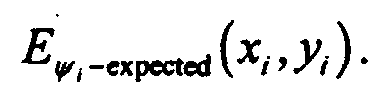
- the value stored in the share table 400 location corresponding to ⁇ 1 is which is a polynomial point ( x 1 , y 1 ) which has been encrypted using the expected value of ⁇ 1 as the encryption key.
- the polynomial point ( x 1 , y 1 ) can only be decrypted using the expected value of ⁇ 1 as the decryption key.
- the decrypted share will not be a valid polynomial point.
- the share table will accommodate any number of values which may be generated for an index ⁇ . Any index value which is not expected will not be able to decrypt the stored encrypted share.
- a certain amount of parameter variation may be tolerated by varying the degree of the polynomial from which points are chosen as shares.
- the degree of the polynomial may be chosen such that p may be determined from less than m points on the polynomial.
- the correct polynomial may still be determinable using other generated points which are on the polynomial.
- well known techniques may be used to exclude the bad points in the determination of p . For example, various subsets of the generated points may be used in multiple attempts to determine p , until some pattern emerges which indicates the valid and invalid points.
- the secret key k is computed as the determinant of am m ⁇ m matrix over the integers mod q .
- Another m random vectors u l ,..., u m are then computed so that ⁇ b ⁇ ⁇ 0,1 ⁇ m :
- 1
- b ( i ) denotes the i -th bit of b
- e i denotes the unit vector with a 1 in position i and 0 in all other positions.
- the vector w 0 i is the valid cryptographic share for the first column of the i -th row of the share table, and similarly w 1 / i is the valid cryptographic share for the second column of the i -th row of the share table. It then follows that for any b ⁇ ⁇ 0,1 ⁇ m ,
- k . That is, with one valid cryptographic share from each row, the secret key k can be computed.
- each user is associated with a password, identified as pwd .
- pwd a password
- m a certain number, of features of the user's keystroke features are measured or derived.
- a measured feature is one that is actually measured. For example, if the pwd is 8 characters, in one illustrative embodiment there are 15 measured features, including 8 keypress durations and 7 latencies between keypresses.
- a key k is chosen and cryptographic shares are generated using a secret sharing scheme as described above. Assume a polynomial secret sharing scheme is used and that the actual points of the polynomial are stored in the share table. Initially, 30 valid cryptographic shares are generated and each location in the share table 500 is initialized to contain a valid cryptographic share. In order to add an additional measure of security, all values in share table 500 are encrypted using pwd as the encryption key, and may be decrypted using pwd as the decryption key.
- the function f which generates the indices ⁇ i will now be described.
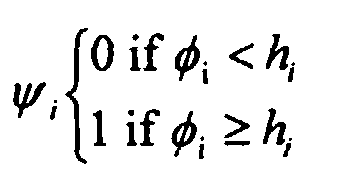
- the corresponding index generated by the function will be 0 if the parameter is less than the associated threshold and 1 if the parameter is greater than or equal to the associated threshold.
- the threshold h i may, for example, be a time value (e.g. 100ms).
- each of the 15 keystroke features will be measured as a parameter ⁇ i .
- the function f will compare the parameter ⁇ i to the threshold h i associated with that measurement and will generate ⁇ i as having a value of 0 or 1 depending on which side of the threshold ⁇ i falls on.
- the value of ⁇ i is then used as an index into the i th row of the table 500.
- the left column of row i is chosen if ⁇ i is 0, and the right column of row i is chosen if ⁇ i is 1.
- the value in the selected entry of the i th row is used as the cryptographic share from that particular row.
- cryptographic shares After cryptographic shares have been selected from all 15 rows, they are used as described above to generate the key k . As described above, the cryptographic shares must first be decrypted using pwd prior to using them to generate the key k .
- Each of the measured parameters can be analyzed to determine if one of the parameters is associated with a distinguishing feature.
- a distinguishing feature is one which can be used to distinguish this user from other users. If a parameter ⁇ i is consistently substantially more or less than the associated threshold h i , then the associated feature is considered a distinguishing feature, and the share table 500 may be rebuilt to make use of this distinguishing feature as follows. If a parameter ⁇ i in the history table 600 is consistently on one side of the associated threshold h i , then it is assumed that this parameter ⁇ i will continue to be on the same one side of the associated threshold h i during subsequent legitimate access attempts by the same user.
- the entry in the share table 500 corresponding to the other side of the threshold for this parameter will be changed to contain an invalid cryptographic share.
- the access structure defined by share table 500 is thus reduced and in this way the share table 500 is modified to reflect the typing patterns of the authorized user.
- the history table can be analyzed and corresponding changes made to the share table 500 on a periodic basis. This may be done after every successful access by the user, after some number of successful accesses, or after some time period has elapsed.
- the key k remains the same, but the entire table is rebuilt using new cryptographic shares which are points on a new polynomial p .
- the share table, and therefore the access structure dynamically adjust based on the user's typing patterns.
- the share table may be modified to contain more, or less, valid cryptographic shares.
- the degree of the polynomial p may be chosen to allow generation of the correct cryptographic key even tough one (or more) of the selected share table locations contain an invalid cryptographic share.
- the user in order for the correct k to be generated, the user must enter the correct pwd (so that the cryptographic shares in the share table can be decrypted), and the pwd must be entered using keystroke features that will result in a sufficient number of valid cryptographic shares being chosen from the share table.
- a user could then be authenticated on the basis of whether the correct secret key k was generated. For example, this could be verified by decrypting a file with k and seeing if a correctly formatted file results, or by hashing k and comparing the result to a previously stored hash value.
- the repeatable key k may also be used as an encryption key to encrypt the user's data in the computer.
- each record in the database is encrypted and may only be decrypted using a key which is generated using DNA measurements of the associated person. This is to assure that prior to accessing potentially private information about a person, the person's DNA has already been recovered from a crime scene, thus making the person a suspect in a crime. While a person's DNA is not dynamic, imprecise measurement techniques or imprecise samples may result in having incomplete DNA measurements. In accordance with the techniques of the present invention, a repeatable key to unlock the database records could be
- This embodiment of the invention utilizes the technique of storing shares generated with this incomplete DNA information.encrypted with expected index values, which was described above in conjunction with Fig. 4.
- a record containing sensitive information is to be stored in the database
- certain DNA measurement of a person are known.
- Fig. 4 assume that m DNA measurements have been taken.
- An appropriate polynomial p is chosen of degree t-1 , where it is desired that knowledge of t points on the polynomial will allow access to the record, where t ⁇ m .
- the record is encrypted using a key k which is the point on the polynomial p which crosses the y axis, and the encrypted record is stored in the database.
- a share table which would allow the record to be decrypted in appropriate circumstances is generated as follows.
- Each DNA measurement is assigned a sequence number (1, 2, ... m) which correspond to parameters ⁇ 1 , ⁇ 2 , ⁇ m representing those measurements.
- the function f may be a hash function.
- the stored record of a person may only be decrypted by someone in possession of the DNA of that person.
- the appropriate sequence of DNA measurements are made in order to generate the parameters ⁇ 1 , ⁇ 2 , ⁇ m representing those measurements.
- Each generated index ⁇ i is used to decrypt the corresponding encrypted share stored in the i th row of the share table in order to generate the polynomial point ( x i ,y i ).
- the set of generated polynomial points may be used as described above in order to generate the cryptographic key k , which is the point at which the polynomial crosses the y axis.
Landscapes
- Engineering & Computer Science (AREA)
- Computer Security & Cryptography (AREA)
- Theoretical Computer Science (AREA)
- Computer Hardware Design (AREA)
- General Engineering & Computer Science (AREA)
- General Physics & Mathematics (AREA)
- Physics & Mathematics (AREA)
- Software Systems (AREA)
- Signal Processing (AREA)
- Health & Medical Sciences (AREA)
- Computer Networks & Wireless Communication (AREA)
- General Health & Medical Sciences (AREA)
- Biomedical Technology (AREA)
- Biodiversity & Conservation Biology (AREA)
- Life Sciences & Earth Sciences (AREA)
- Bioethics (AREA)
- Social Psychology (AREA)
- Storage Device Security (AREA)
Abstract
Description
| INDEX | EXPECTED VALUES |
| ψ1 | 1,2,3 |
| ψ2 | 5,6 |
| ψ3 | 7,8,9 |
| ψ4 | 3,4 |




Claims (23)
- A method for generating a cryptographic key using at least one parameter comprising the steps of:retrieving at least one cryptographic share from a memory location identified as a function of said at least one parameter; andgenerating a cryptographic key based on said at least one cryptographic share.
- The method of claim 1 wherein said at least one retrieved cryptographic share is encrypted, said method further comprising the step of:decrypting said at least one cryptographic share.
- The method of claim 2 wherein said step of decrypting comprises the step of:decrypting using a value computed as a function of said at least one parameter.
- The method of claim 1 wherein said at least one retrieved cryptographic share is compressed, said method further comprising the step of:decompressing said at least one cryptographic share.
- The method of claim 4 wherein said step of decompressing comprises the step of:decompressing said at least one cryptographic share using an index of said memory location.
- The method of claim 1 wherein said at least one parameter represents at least one measurement of a physical property.
- The method of claim 1 further comprising the step of:generating at least one index as a function of said at least one parameter; andusing said index to identify said memory location.
- The method of claim 7 further comprising the step of:retrieving a cryptographic share from a memory location in the vicinity of said memory location identified by said index.
- The method of claim 7 wherein said step of generating at least one index comprises the step of generating the same index for a set of parameter values.
- The method of claim 9 wherein said set of parameter values are within a predetermined range of values.
- A method for generating a cryptographic key comprising the steps of:measuring a plurality of keystroke features during entry of a password;retrieving from a data structure a plurality of cryptographic shares as a function of said plurality of keystroke features; andgenerating a cryptographic key using said cryptographic shares.
- The method of claim 11 wherein said cryptographic shares represent points on a polynomial.
- The method of claim 11 wherein said cryptographic shares represent vectors.
- The method of claim 11 wherein said cryptographic shares are compressed.
- The method of claim 14 wherein said cryptographic shares comprise y values of points on a polynomial and the corresponding x values are derivable from a data structure location.
- The method of claim 11 further comprising the step of:generating a plurality of indices as a function of said keystroke features; andusing said plurality of indices to identify locations within said data structure from which to retrieve said cryptographic shares.
- The method of claim 16 wherein said step of generating a plurality of indices as a function of said keystroke features comprises the step of:for each of said keystroke features, generating one of two indices as a function of a threshold value.
- The method of claim 16 wherein said step of generating a plurality of indices as a function of said keystroke features comprises the step of:for each of said keystroke features, generating one of a plurality of indices as a function of a plurality of threshold values.
- The method of claim 11 wherein said cryptographic shares stored in said data structure are encrypted, said method further comprising the step of:decrypting said cryptographic shares using said password.
- The method of claim 11 further comprising the steps of:maintaining a history file containing information relating to prior successful key generation attempts; andbased on said history file, storing invalid cryptographic shares in data structure locations which are not expected to be accessed during subsequent legitimate key generation attempts.
- A method for generating a cryptographic key using a plurality of parameters having a sequence and representing physical measurements, said method comprising the steps of:for each of said plurality of parameters:retrieving an encrypted cryptographic share from a memory location as a function of the sequence of said parameter;decrypting said encrypted cryptographic share with a function of said parameter; andgenerating a cryptographic key using said decrypted cryptographic shares.
- The method of claim 21 wherein said physical measurements are measurements of DNA.
- The method of claim 21 wherein said function of said parameter used to decrypt said encrypted cryptographic share is a hash function.
Applications Claiming Priority (6)
| Application Number | Priority Date | Filing Date | Title |
|---|---|---|---|
| US128413 | 1980-03-10 | ||
| US147880 | 1988-01-25 | ||
| US12841399P | 1999-04-08 | 1999-04-08 | |
| US14788099P | 1999-08-09 | 1999-08-09 | |
| US501902 | 2000-02-10 | ||
| US09/501,902 US6901145B1 (en) | 1999-04-08 | 2000-02-10 | Generation of repeatable cryptographic key based on varying parameters |
Publications (3)
| Publication Number | Publication Date |
|---|---|
| EP1043862A2 true EP1043862A2 (en) | 2000-10-11 |
| EP1043862A3 EP1043862A3 (en) | 2002-07-31 |
| EP1043862B1 EP1043862B1 (en) | 2005-05-25 |
Family
ID=27383727
Family Applications (1)
| Application Number | Title | Priority Date | Filing Date |
|---|---|---|---|
| EP00302540A Expired - Lifetime EP1043862B1 (en) | 1999-04-08 | 2000-03-28 | Generation of repeatable cryptographic key based on varying parameters |
Country Status (4)
| Country | Link |
|---|---|
| US (1) | US6901145B1 (en) |
| EP (1) | EP1043862B1 (en) |
| JP (1) | JP2000315999A (en) |
| DE (1) | DE60020293T2 (en) |
Cited By (10)
| Publication number | Priority date | Publication date | Assignee | Title |
|---|---|---|---|---|
| EP1560362A1 (en) * | 2004-01-30 | 2005-08-03 | Hewlett-Packard Magyarorszag Szamitastechn. es Elektr. Berendezéseket Forgalmazo és Szolgaltato Korlatolt Felelösségü Tarsasag | Authentication method and system |
| US6950937B2 (en) * | 2001-05-30 | 2005-09-27 | Lucent Technologies Inc. | Secure distributed computation in cryptographic applications |
| US7219226B2 (en) | 2001-10-15 | 2007-05-15 | Hewlett-Packard Company | Method and apparatus for encrypting data |
| US7263191B2 (en) | 2001-10-15 | 2007-08-28 | Hewlett-Packard Development Company, L.P. | Method and apparatus for encrypting data |
| WO2008010773A1 (en) * | 2006-07-20 | 2008-01-24 | Privylink Pte Ltd | Method for generating cryptographic key from biometric data |
| US7330969B2 (en) | 2001-10-15 | 2008-02-12 | Hewlett-Packard Development Company, L.P. | Method and apparatus for data validation |
| FR2911021A1 (en) * | 2006-12-27 | 2008-07-04 | France Telecom | Secret representing method for e.g. user authentication, involves dividing representation of biometric data into parts, and calculating pairs of values so that one pair comprises reference comparison and image of code word by hash function |
| WO2009095289A1 (en) * | 2008-01-30 | 2009-08-06 | Siemens Aktiengesellschaft | Method and device for producing a cryptographic key on the basis of a dna |
| WO2010020658A1 (en) * | 2008-08-20 | 2010-02-25 | Psylock Gmbh | Cryptography method and identification method based on biometric data |
| WO2010026261A3 (en) * | 2008-09-08 | 2010-08-19 | Psylock Gmbh | Biometric identification method using feature vectors and analysis in comparison to multiple biometric samples |
Families Citing this family (39)
| Publication number | Priority date | Publication date | Assignee | Title |
|---|---|---|---|---|
| GB0113255D0 (en) * | 2001-05-31 | 2001-07-25 | Scient Generics Ltd | Number generator |
| US20040111625A1 (en) * | 2001-02-14 | 2004-06-10 | Duffy Dominic Gavan | Data processing apparatus and method |
| NO316489B1 (en) | 2001-10-01 | 2004-01-26 | Genkey As | System, portable device and method for digital authentication, encryption and signing by generating volatile but consistent and repeatable crypton keys |
| GB0228434D0 (en) * | 2002-12-05 | 2003-01-08 | Scient Generics Ltd | Error correction |
| DE60309176T2 (en) * | 2002-05-31 | 2007-09-06 | Scientific Generics Ltd., Harston | BIOMETRIC AUTHENTICATION SYSTEM |
| GB0229727D0 (en) * | 2002-12-19 | 2003-01-29 | Ibm | Improved password entry |
| US20040174995A1 (en) * | 2003-02-06 | 2004-09-09 | Singh Mukesh Kumar | Cryptosystems |
| US20050075836A1 (en) * | 2003-10-03 | 2005-04-07 | Jason Arthur Taylor | Forensic person tracking method and apparatus |
| GB0413034D0 (en) * | 2004-06-10 | 2004-07-14 | Scient Generics Ltd | Secure workflow engine |
| US8171498B2 (en) * | 2004-06-25 | 2012-05-01 | Apple Inc. | Adaptive service for handling notifications and synchronizing directories of a file system |
| TWI249314B (en) * | 2004-10-15 | 2006-02-11 | Ind Tech Res Inst | Biometrics-based cryptographic key generation system and method |
| KR100601706B1 (en) * | 2004-10-15 | 2006-07-18 | 삼성전자주식회사 | Method and apparatus for sharing and generating system key in a DRM system |
| EP1884059A2 (en) * | 2005-05-13 | 2008-02-06 | Temple University of the Commonwealth System of Higher Education | Secret sharing technique with low overhead information content |
| DE102005024379A1 (en) * | 2005-05-27 | 2006-11-30 | Universität Mannheim | A method for generating and / or embossing a recoverable cryptographic key in the production of a topographical structure |
| US20070016785A1 (en) * | 2005-07-14 | 2007-01-18 | Yannick Guay | System and method for digital signature and authentication |
| US8189788B2 (en) * | 2005-07-15 | 2012-05-29 | Tyfone, Inc. | Hybrid symmetric/asymmetric cryptography with user authentication |
| US7805615B2 (en) * | 2005-07-15 | 2010-09-28 | Tyfone, Inc. | Asymmetric cryptography with user authentication |
| US8477940B2 (en) * | 2005-07-15 | 2013-07-02 | Tyfone, Inc. | Symmetric cryptography with user authentication |
| US8151322B2 (en) | 2006-05-16 | 2012-04-03 | A10 Networks, Inc. | Systems and methods for user access authentication based on network access point |
| US7716378B2 (en) | 2006-10-17 | 2010-05-11 | A10 Networks, Inc. | System and method to associate a private user identity with a public user identity |
| US8312507B2 (en) | 2006-10-17 | 2012-11-13 | A10 Networks, Inc. | System and method to apply network traffic policy to an application session |
| WO2008147577A2 (en) * | 2007-01-22 | 2008-12-04 | Spyrus, Inc. | Portable data encryption device with configurable security functionality and method for file encryption |
| KR101420683B1 (en) * | 2007-12-24 | 2014-07-17 | 삼성전자주식회사 | Method and system for information encryption / decryption of microarray |
| US8539220B2 (en) | 2010-02-26 | 2013-09-17 | Microsoft Corporation | Secure computation using a server module |
| US8549314B2 (en) | 2010-04-29 | 2013-10-01 | King Saud University | Password generation methods and systems |
| US20120246483A1 (en) * | 2011-03-25 | 2012-09-27 | Netanel Raisch | Authentication System With Time Attributes |
| US9122853B2 (en) | 2013-06-24 | 2015-09-01 | A10 Networks, Inc. | Location determination for user authentication |
| TWI528218B (en) * | 2013-11-29 | 2016-04-01 | 財團法人資訊工業策進會 | Smart data identification method and data leakage prevention system using the method |
| US11165770B1 (en) | 2013-12-06 | 2021-11-02 | A10 Networks, Inc. | Biometric verification of a human internet user |
| CN105900164B (en) * | 2014-01-17 | 2019-03-08 | 日本电信电话株式会社 | Secret computing method, secret computing system, picking device, and recording medium |
| ES2836849T3 (en) * | 2014-11-21 | 2021-06-28 | Nokia Technologies Oy | A device, procedure, and computer program to identify biometric traits |
| CN107251478A (en) * | 2015-02-12 | 2017-10-13 | 卡米纳利欧技术有限公司 | Computerized system and method for secret key management |
| US9805205B2 (en) * | 2015-02-19 | 2017-10-31 | Konvax Corporation | Adaptive system profile |
| WO2019066007A1 (en) * | 2017-09-29 | 2019-04-04 | 望 谷内江 | Encryption method, decryption method, encryption system and decryption system |
| GB2587438A (en) * | 2019-09-30 | 2021-03-31 | Governing Council Univ Toronto | Key generation for use in secured communication |
| KR102292526B1 (en) * | 2021-03-23 | 2021-08-24 | 주식회사 두두아이티 | Apparatus and method for authenticating network video recorder security |
| CN112926074B (en) * | 2021-03-26 | 2022-08-23 | 成都卫士通信息产业股份有限公司 | SM9 key thresholding generation method, device, equipment and storage medium |
| US11991400B2 (en) | 2022-07-15 | 2024-05-21 | Bank Of America Corporation | Device for executing audio cryptology in real-time for audio misappropriation prevention |
| US12627517B2 (en) | 2024-06-17 | 2026-05-12 | Artema Labs, Inc | Systems and methods for performing secure transactions on blockchain |
Family Cites Families (18)
| Publication number | Priority date | Publication date | Assignee | Title |
|---|---|---|---|---|
| US4805222A (en) | 1985-12-23 | 1989-02-14 | International Bioaccess Systems Corporation | Method and apparatus for verifying an individual's identity |
| US4876725A (en) | 1987-10-08 | 1989-10-24 | Mytec Technologies Inc. | Method and apparatus for fingerprint verification |
| US5557686A (en) * | 1993-01-13 | 1996-09-17 | University Of Alabama | Method and apparatus for verification of a computer user's identification, based on keystroke characteristics |
| US5369707A (en) * | 1993-01-27 | 1994-11-29 | Tecsec Incorporated | Secure network method and apparatus |
| US5557346A (en) * | 1994-08-11 | 1996-09-17 | Trusted Information Systems, Inc. | System and method for key escrow encryption |
| US5557765A (en) | 1994-08-11 | 1996-09-17 | Trusted Information Systems, Inc. | System and method for data recovery |
| US5680460A (en) | 1994-09-07 | 1997-10-21 | Mytec Technologies, Inc. | Biometric controlled key generation |
| US5712912A (en) * | 1995-07-28 | 1998-01-27 | Mytec Technologies Inc. | Method and apparatus for securely handling a personal identification number or cryptographic key using biometric techniques |
| US5541994A (en) | 1994-09-07 | 1996-07-30 | Mytec Technologies Inc. | Fingerprint controlled public key cryptographic system |
| US5737420A (en) | 1994-09-07 | 1998-04-07 | Mytec Technologies Inc. | Method for secure data transmission between remote stations |
| US5625692A (en) * | 1995-01-23 | 1997-04-29 | International Business Machines Corporation | Method and system for a public key cryptosystem having proactive, robust, and recoverable distributed threshold secret sharing |
| US5761330A (en) | 1995-06-07 | 1998-06-02 | Mytec Technologies, Inc. | Hybrid optical-digital method and apparatus for fingerprint verification |
| US5740276A (en) | 1995-07-27 | 1998-04-14 | Mytec Technologies Inc. | Holographic method for encrypting and decrypting information using a fingerprint |
| US5790668A (en) | 1995-12-19 | 1998-08-04 | Mytec Technologies Inc. | Method and apparatus for securely handling data in a database of biometrics and associated data |
| US5802175A (en) * | 1996-09-18 | 1998-09-01 | Kara; Salim G. | Computer file backup encryption system and method |
| US5991408A (en) * | 1997-05-16 | 1999-11-23 | Veridicom, Inc. | Identification and security using biometric measurements |
| US6035042A (en) * | 1997-12-10 | 2000-03-07 | Allegheny Teledyne Inc. | High speed and method of providing high speed table generation for block encryption |
| US6317834B1 (en) * | 1999-01-29 | 2001-11-13 | International Business Machines Corporation | Biometric authentication system with encrypted models |
-
2000
- 2000-02-10 US US09/501,902 patent/US6901145B1/en not_active Expired - Fee Related
- 2000-03-28 EP EP00302540A patent/EP1043862B1/en not_active Expired - Lifetime
- 2000-03-28 DE DE60020293T patent/DE60020293T2/en not_active Expired - Fee Related
- 2000-04-10 JP JP2000108519A patent/JP2000315999A/en not_active Abandoned
Cited By (11)
| Publication number | Priority date | Publication date | Assignee | Title |
|---|---|---|---|---|
| US6950937B2 (en) * | 2001-05-30 | 2005-09-27 | Lucent Technologies Inc. | Secure distributed computation in cryptographic applications |
| US7219226B2 (en) | 2001-10-15 | 2007-05-15 | Hewlett-Packard Company | Method and apparatus for encrypting data |
| US7263191B2 (en) | 2001-10-15 | 2007-08-28 | Hewlett-Packard Development Company, L.P. | Method and apparatus for encrypting data |
| US7330969B2 (en) | 2001-10-15 | 2008-02-12 | Hewlett-Packard Development Company, L.P. | Method and apparatus for data validation |
| EP1560362A1 (en) * | 2004-01-30 | 2005-08-03 | Hewlett-Packard Magyarorszag Szamitastechn. es Elektr. Berendezéseket Forgalmazo és Szolgaltato Korlatolt Felelösségü Tarsasag | Authentication method and system |
| WO2008010773A1 (en) * | 2006-07-20 | 2008-01-24 | Privylink Pte Ltd | Method for generating cryptographic key from biometric data |
| FR2911021A1 (en) * | 2006-12-27 | 2008-07-04 | France Telecom | Secret representing method for e.g. user authentication, involves dividing representation of biometric data into parts, and calculating pairs of values so that one pair comprises reference comparison and image of code word by hash function |
| WO2008081136A3 (en) * | 2006-12-27 | 2008-09-12 | France Telecom | Method or extracting a secret from biometric data |
| WO2009095289A1 (en) * | 2008-01-30 | 2009-08-06 | Siemens Aktiengesellschaft | Method and device for producing a cryptographic key on the basis of a dna |
| WO2010020658A1 (en) * | 2008-08-20 | 2010-02-25 | Psylock Gmbh | Cryptography method and identification method based on biometric data |
| WO2010026261A3 (en) * | 2008-09-08 | 2010-08-19 | Psylock Gmbh | Biometric identification method using feature vectors and analysis in comparison to multiple biometric samples |
Also Published As
| Publication number | Publication date |
|---|---|
| EP1043862A3 (en) | 2002-07-31 |
| DE60020293D1 (en) | 2005-06-30 |
| US6901145B1 (en) | 2005-05-31 |
| EP1043862B1 (en) | 2005-05-25 |
| JP2000315999A (en) | 2000-11-14 |
| DE60020293T2 (en) | 2006-02-02 |
Similar Documents
| Publication | Publication Date | Title |
|---|---|---|
| US6901145B1 (en) | Generation of repeatable cryptographic key based on varying parameters | |
| US9740849B2 (en) | Registration and authentication of computing devices using a digital skeleton key | |
| US7739733B2 (en) | Storing digital secrets in a vault | |
| Monrose et al. | Password hardening based on keystroke dynamics | |
| EP2248298B1 (en) | Secure and usable protection of a roamable credentials store | |
| US6317834B1 (en) | Biometric authentication system with encrypted models | |
| JP5058600B2 (en) | System and method for providing contactless authentication | |
| US20090265559A1 (en) | User authentication by linking randomly-generated authentication secret with personalized secret | |
| EP2339777A2 (en) | Method of authenticating a user to use a system | |
| EP3729713B1 (en) | Homomorphic encryption for password authentication | |
| US20100185870A1 (en) | Method and System for Managing a Hierarchy of Passwords | |
| US20070031009A1 (en) | Method and system for string-based biometric authentication | |
| Singamaneni et al. | An improved dynamic polynomial integrity based QCP-ABE framework on large cloud data security | |
| WO2009073144A2 (en) | Bio-cryptography: secure cryptographic protocols with bipartite biotokens | |
| US12417273B2 (en) | Management system and method for user authentication on password based systems | |
| JP4612951B2 (en) | Method and apparatus for securely distributing authentication credentials to roaming users | |
| WO2009023421A2 (en) | System and method of generating and providing a set of randomly selected substitute characters in place of a user entered key phrase | |
| Cappos et al. | PolyPasswordHasher: protecting passwords in the event of a password file disclosure | |
| CA2302619C (en) | Generation of repeatable cryptographic key based on varying parameters | |
| Boonkrong | Password-based authentication | |
| Boonkrong | Security of passwords | |
| Khan et al. | Enhancing Two-Factor Authentication with Dynamic Ring-Based Password Transformation for Secure Login Processes | |
| Shomaji et al. | Blocker: a biometric locking paradigm for IoT and the connected person | |
| US20230155835A1 (en) | System, method, apparatus, and computer program product providing improved password security | |
| EP1416666A1 (en) | Method to simplify the management and enhance the security of passwords |
Legal Events
| Date | Code | Title | Description |
|---|---|---|---|
| PUAI | Public reference made under article 153(3) epc to a published international application that has entered the european phase |
Free format text: ORIGINAL CODE: 0009012 |
|
| AK | Designated contracting states |
Kind code of ref document: A2 Designated state(s): AT BE CH CY DE DK ES FI FR GB GR IE IT LI LU MC NL PT SE |
|
| AX | Request for extension of the european patent |
Free format text: AL;LT;LV;MK;RO;SI |
|
| PUAL | Search report despatched |
Free format text: ORIGINAL CODE: 0009013 |
|
| AK | Designated contracting states |
Kind code of ref document: A3 Designated state(s): AT BE CH CY DE DK ES FI FR GB GR IE IT LI LU MC NL PT SE |
|
| AX | Request for extension of the european patent |
Free format text: AL;LT;LV;MK;RO;SI |
|
| 17P | Request for examination filed |
Effective date: 20030123 |
|
| AKX | Designation fees paid |
Designated state(s): DE FR GB IT |
|
| 17Q | First examination report despatched |
Effective date: 20030409 |
|
| GRAP | Despatch of communication of intention to grant a patent |
Free format text: ORIGINAL CODE: EPIDOSNIGR1 |
|
| GRAS | Grant fee paid |
Free format text: ORIGINAL CODE: EPIDOSNIGR3 |
|
| GRAA | (expected) grant |
Free format text: ORIGINAL CODE: 0009210 |
|
| AK | Designated contracting states |
Kind code of ref document: B1 Designated state(s): DE FR GB IT |
|
| PG25 | Lapsed in a contracting state [announced via postgrant information from national office to epo] |
Ref country code: IT Free format text: LAPSE BECAUSE OF FAILURE TO SUBMIT A TRANSLATION OF THE DESCRIPTION OR TO PAY THE FEE WITHIN THE PRESCRIBED TIME-LIMIT;WARNING: LAPSES OF ITALIAN PATENTS WITH EFFECTIVE DATE BEFORE 2007 MAY HAVE OCCURRED AT ANY TIME BEFORE 2007. THE CORRECT EFFECTIVE DATE MAY BE DIFFERENT FROM THE ONE RECORDED. Effective date: 20050525 |
|
| REG | Reference to a national code |
Ref country code: GB Ref legal event code: FG4D |
|
| REG | Reference to a national code |
Ref country code: IE Ref legal event code: FG4D |
|
| REF | Corresponds to: |
Ref document number: 60020293 Country of ref document: DE Date of ref document: 20050630 Kind code of ref document: P |
|
| ET | Fr: translation filed | ||
| PLBE | No opposition filed within time limit |
Free format text: ORIGINAL CODE: 0009261 |
|
| STAA | Information on the status of an ep patent application or granted ep patent |
Free format text: STATUS: NO OPPOSITION FILED WITHIN TIME LIMIT |
|
| 26N | No opposition filed |
Effective date: 20060228 |
|
| PGFP | Annual fee paid to national office [announced via postgrant information from national office to epo] |
Ref country code: DE Payment date: 20070322 Year of fee payment: 8 |
|
| PGFP | Annual fee paid to national office [announced via postgrant information from national office to epo] |
Ref country code: GB Payment date: 20070328 Year of fee payment: 8 |
|
| PGFP | Annual fee paid to national office [announced via postgrant information from national office to epo] |
Ref country code: FR Payment date: 20070308 Year of fee payment: 8 |
|
| GBPC | Gb: european patent ceased through non-payment of renewal fee |
Effective date: 20080328 |
|
| REG | Reference to a national code |
Ref country code: FR Ref legal event code: ST Effective date: 20081125 |
|
| PG25 | Lapsed in a contracting state [announced via postgrant information from national office to epo] |
Ref country code: DE Free format text: LAPSE BECAUSE OF NON-PAYMENT OF DUE FEES Effective date: 20081001 |
|
| PG25 | Lapsed in a contracting state [announced via postgrant information from national office to epo] |
Ref country code: FR Free format text: LAPSE BECAUSE OF NON-PAYMENT OF DUE FEES Effective date: 20080331 |
|
| PG25 | Lapsed in a contracting state [announced via postgrant information from national office to epo] |
Ref country code: GB Free format text: LAPSE BECAUSE OF NON-PAYMENT OF DUE FEES Effective date: 20080328 |