EP1043794A2 - Secondary battery - Google Patents
Secondary battery Download PDFInfo
- Publication number
- EP1043794A2 EP1043794A2 EP00102959A EP00102959A EP1043794A2 EP 1043794 A2 EP1043794 A2 EP 1043794A2 EP 00102959 A EP00102959 A EP 00102959A EP 00102959 A EP00102959 A EP 00102959A EP 1043794 A2 EP1043794 A2 EP 1043794A2
- Authority
- EP
- European Patent Office
- Prior art keywords
- carbonate
- secondary battery
- group
- negative electrode
- lithium
- Prior art date
- Legal status (The legal status is an assumption and is not a legal conclusion. Google has not performed a legal analysis and makes no representation as to the accuracy of the status listed.)
- Withdrawn
Links
Images

Classifications
-
- H—ELECTRICITY
- H01—ELECTRIC ELEMENTS
- H01M—PROCESSES OR MEANS, e.g. BATTERIES, FOR THE DIRECT CONVERSION OF CHEMICAL ENERGY INTO ELECTRICAL ENERGY
- H01M10/00—Secondary cells; Manufacture thereof
- H01M10/05—Accumulators with non-aqueous electrolyte
- H01M10/056—Accumulators with non-aqueous electrolyte characterised by the materials used as electrolytes, e.g. mixed inorganic/organic electrolytes
- H01M10/0564—Accumulators with non-aqueous electrolyte characterised by the materials used as electrolytes, e.g. mixed inorganic/organic electrolytes the electrolyte being constituted of organic materials only
- H01M10/0566—Liquid materials
- H01M10/0567—Liquid materials characterised by the additives
-
- H—ELECTRICITY
- H01—ELECTRIC ELEMENTS
- H01M—PROCESSES OR MEANS, e.g. BATTERIES, FOR THE DIRECT CONVERSION OF CHEMICAL ENERGY INTO ELECTRICAL ENERGY
- H01M10/00—Secondary cells; Manufacture thereof
- H01M10/05—Accumulators with non-aqueous electrolyte
- H01M10/052—Li-accumulators
- H01M10/0525—Rocking-chair batteries, i.e. batteries with lithium insertion or intercalation in both electrodes; Lithium-ion batteries
-
- H—ELECTRICITY
- H01—ELECTRIC ELEMENTS
- H01M—PROCESSES OR MEANS, e.g. BATTERIES, FOR THE DIRECT CONVERSION OF CHEMICAL ENERGY INTO ELECTRICAL ENERGY
- H01M10/00—Secondary cells; Manufacture thereof
- H01M10/05—Accumulators with non-aqueous electrolyte
- H01M10/056—Accumulators with non-aqueous electrolyte characterised by the materials used as electrolytes, e.g. mixed inorganic/organic electrolytes
- H01M10/0564—Accumulators with non-aqueous electrolyte characterised by the materials used as electrolytes, e.g. mixed inorganic/organic electrolytes the electrolyte being constituted of organic materials only
- H01M10/0566—Liquid materials
- H01M10/0569—Liquid materials characterised by the solvents
-
- H—ELECTRICITY
- H01—ELECTRIC ELEMENTS
- H01M—PROCESSES OR MEANS, e.g. BATTERIES, FOR THE DIRECT CONVERSION OF CHEMICAL ENERGY INTO ELECTRICAL ENERGY
- H01M4/00—Electrodes
- H01M4/02—Electrodes composed of, or comprising, active material
- H01M4/36—Selection of substances as active materials, active masses, active liquids
- H01M4/48—Selection of substances as active materials, active masses, active liquids of inorganic oxides or hydroxides
- H01M4/52—Selection of substances as active materials, active masses, active liquids of inorganic oxides or hydroxides of nickel, cobalt or iron
- H01M4/525—Selection of substances as active materials, active masses, active liquids of inorganic oxides or hydroxides of nickel, cobalt or iron of mixed oxides or hydroxides containing iron, cobalt or nickel for inserting or intercalating light metals, e.g. LiNiO2, LiCoO2 or LiCoOxFy
-
- H—ELECTRICITY
- H01—ELECTRIC ELEMENTS
- H01M—PROCESSES OR MEANS, e.g. BATTERIES, FOR THE DIRECT CONVERSION OF CHEMICAL ENERGY INTO ELECTRICAL ENERGY
- H01M6/00—Primary cells; Manufacture thereof
- H01M6/14—Cells with non-aqueous electrolyte
- H01M6/16—Cells with non-aqueous electrolyte with organic electrolyte
- H01M6/162—Cells with non-aqueous electrolyte with organic electrolyte characterised by the electrolyte
- H01M6/164—Cells with non-aqueous electrolyte with organic electrolyte characterised by the electrolyte by the solvent
-
- H—ELECTRICITY
- H01—ELECTRIC ELEMENTS
- H01M—PROCESSES OR MEANS, e.g. BATTERIES, FOR THE DIRECT CONVERSION OF CHEMICAL ENERGY INTO ELECTRICAL ENERGY
- H01M6/00—Primary cells; Manufacture thereof
- H01M6/14—Cells with non-aqueous electrolyte
- H01M6/16—Cells with non-aqueous electrolyte with organic electrolyte
- H01M6/162—Cells with non-aqueous electrolyte with organic electrolyte characterised by the electrolyte
- H01M6/168—Cells with non-aqueous electrolyte with organic electrolyte characterised by the electrolyte by additives
-
- H—ELECTRICITY
- H01—ELECTRIC ELEMENTS
- H01M—PROCESSES OR MEANS, e.g. BATTERIES, FOR THE DIRECT CONVERSION OF CHEMICAL ENERGY INTO ELECTRICAL ENERGY
- H01M10/00—Secondary cells; Manufacture thereof
- H01M10/05—Accumulators with non-aqueous electrolyte
- H01M10/058—Construction or manufacture
- H01M10/0587—Construction or manufacture of accumulators having only wound construction elements, i.e. wound positive electrodes, wound negative electrodes and wound separators
-
- H—ELECTRICITY
- H01—ELECTRIC ELEMENTS
- H01M—PROCESSES OR MEANS, e.g. BATTERIES, FOR THE DIRECT CONVERSION OF CHEMICAL ENERGY INTO ELECTRICAL ENERGY
- H01M2300/00—Electrolytes
- H01M2300/0017—Non-aqueous electrolytes
-
- H—ELECTRICITY
- H01—ELECTRIC ELEMENTS
- H01M—PROCESSES OR MEANS, e.g. BATTERIES, FOR THE DIRECT CONVERSION OF CHEMICAL ENERGY INTO ELECTRICAL ENERGY
- H01M2300/00—Electrolytes
- H01M2300/0017—Non-aqueous electrolytes
- H01M2300/0025—Organic electrolyte
- H01M2300/0028—Organic electrolyte characterised by the solvent
- H01M2300/0037—Mixture of solvents
- H01M2300/004—Three solvents
-
- H—ELECTRICITY
- H01—ELECTRIC ELEMENTS
- H01M—PROCESSES OR MEANS, e.g. BATTERIES, FOR THE DIRECT CONVERSION OF CHEMICAL ENERGY INTO ELECTRICAL ENERGY
- H01M4/00—Electrodes
- H01M4/02—Electrodes composed of, or comprising, active material
- H01M4/13—Electrodes for accumulators with non-aqueous electrolyte, e.g. for lithium-accumulators; Processes of manufacture thereof
- H01M4/131—Electrodes based on mixed oxides or hydroxides, or on mixtures of oxides or hydroxides, e.g. LiCoOx
-
- H—ELECTRICITY
- H01—ELECTRIC ELEMENTS
- H01M—PROCESSES OR MEANS, e.g. BATTERIES, FOR THE DIRECT CONVERSION OF CHEMICAL ENERGY INTO ELECTRICAL ENERGY
- H01M4/00—Electrodes
- H01M4/02—Electrodes composed of, or comprising, active material
- H01M4/13—Electrodes for accumulators with non-aqueous electrolyte, e.g. for lithium-accumulators; Processes of manufacture thereof
- H01M4/133—Electrodes based on carbonaceous material, e.g. graphite-intercalation compounds or CFx
-
- H—ELECTRICITY
- H01—ELECTRIC ELEMENTS
- H01M—PROCESSES OR MEANS, e.g. BATTERIES, FOR THE DIRECT CONVERSION OF CHEMICAL ENERGY INTO ELECTRICAL ENERGY
- H01M4/00—Electrodes
- H01M4/02—Electrodes composed of, or comprising, active material
- H01M4/36—Selection of substances as active materials, active masses, active liquids
- H01M4/48—Selection of substances as active materials, active masses, active liquids of inorganic oxides or hydroxides
- H01M4/485—Selection of substances as active materials, active masses, active liquids of inorganic oxides or hydroxides of mixed oxides or hydroxides for inserting or intercalating light metals, e.g. LiTi2O4 or LiTi2OxFy
-
- H—ELECTRICITY
- H01—ELECTRIC ELEMENTS
- H01M—PROCESSES OR MEANS, e.g. BATTERIES, FOR THE DIRECT CONVERSION OF CHEMICAL ENERGY INTO ELECTRICAL ENERGY
- H01M4/00—Electrodes
- H01M4/02—Electrodes composed of, or comprising, active material
- H01M4/36—Selection of substances as active materials, active masses, active liquids
- H01M4/48—Selection of substances as active materials, active masses, active liquids of inorganic oxides or hydroxides
- H01M4/50—Selection of substances as active materials, active masses, active liquids of inorganic oxides or hydroxides of manganese
- H01M4/505—Selection of substances as active materials, active masses, active liquids of inorganic oxides or hydroxides of manganese of mixed oxides or hydroxides containing manganese for inserting or intercalating light metals, e.g. LiMn2O4 or LiMn2OxFy
-
- H—ELECTRICITY
- H01—ELECTRIC ELEMENTS
- H01M—PROCESSES OR MEANS, e.g. BATTERIES, FOR THE DIRECT CONVERSION OF CHEMICAL ENERGY INTO ELECTRICAL ENERGY
- H01M4/00—Electrodes
- H01M4/02—Electrodes composed of, or comprising, active material
- H01M4/36—Selection of substances as active materials, active masses, active liquids
- H01M4/58—Selection of substances as active materials, active masses, active liquids of inorganic compounds other than oxides or hydroxides, e.g. sulfides, selenides, tellurides, halogenides or LiCoFy; of polyanionic structures, e.g. phosphates, silicates or borates
- H01M4/583—Carbonaceous material, e.g. graphite-intercalation compounds or CFx
- H01M4/587—Carbonaceous material, e.g. graphite-intercalation compounds or CFx for inserting or intercalating light metals
-
- Y—GENERAL TAGGING OF NEW TECHNOLOGICAL DEVELOPMENTS; GENERAL TAGGING OF CROSS-SECTIONAL TECHNOLOGIES SPANNING OVER SEVERAL SECTIONS OF THE IPC; TECHNICAL SUBJECTS COVERED BY FORMER USPC CROSS-REFERENCE ART COLLECTIONS [XRACs] AND DIGESTS
- Y02—TECHNOLOGIES OR APPLICATIONS FOR MITIGATION OR ADAPTATION AGAINST CLIMATE CHANGE
- Y02E—REDUCTION OF GREENHOUSE GAS [GHG] EMISSIONS, RELATED TO ENERGY GENERATION, TRANSMISSION OR DISTRIBUTION
- Y02E60/00—Enabling technologies; Technologies with a potential or indirect contribution to GHG emissions mitigation
- Y02E60/10—Energy storage using batteries
-
- Y—GENERAL TAGGING OF NEW TECHNOLOGICAL DEVELOPMENTS; GENERAL TAGGING OF CROSS-SECTIONAL TECHNOLOGIES SPANNING OVER SEVERAL SECTIONS OF THE IPC; TECHNICAL SUBJECTS COVERED BY FORMER USPC CROSS-REFERENCE ART COLLECTIONS [XRACs] AND DIGESTS
- Y02—TECHNOLOGIES OR APPLICATIONS FOR MITIGATION OR ADAPTATION AGAINST CLIMATE CHANGE
- Y02P—CLIMATE CHANGE MITIGATION TECHNOLOGIES IN THE PRODUCTION OR PROCESSING OF GOODS
- Y02P70/00—Climate change mitigation technologies in the production process for final industrial or consumer products
- Y02P70/50—Manufacturing or production processes characterised by the final manufactured product
-
- Y—GENERAL TAGGING OF NEW TECHNOLOGICAL DEVELOPMENTS; GENERAL TAGGING OF CROSS-SECTIONAL TECHNOLOGIES SPANNING OVER SEVERAL SECTIONS OF THE IPC; TECHNICAL SUBJECTS COVERED BY FORMER USPC CROSS-REFERENCE ART COLLECTIONS [XRACs] AND DIGESTS
- Y02—TECHNOLOGIES OR APPLICATIONS FOR MITIGATION OR ADAPTATION AGAINST CLIMATE CHANGE
- Y02T—CLIMATE CHANGE MITIGATION TECHNOLOGIES RELATED TO TRANSPORTATION
- Y02T10/00—Road transport of goods or passengers
- Y02T10/60—Other road transportation technologies with climate change mitigation effect
- Y02T10/70—Energy storage systems for electromobility, e.g. batteries
Definitions
- the present invention relates to a secondary battery, and more particularly to a secondary battery using a nonaqueous electrolytic solution.
- the portable and cordless trend is rapidly promoted in electronic appliances such as AV appliances and personal computers.
- electronic appliances such as AV appliances and personal computers.
- the driving power source for these electronic appliances there is a mounting demand for secondary batteries having high energy density in spite of small size and light weight.
- the nonaqueous electrolyte secondary battery with negative electrode using lithium as active material is highly expected as a battery having high voltage and high energy density.
- the active material for the positive electrode is a metal oxide containing lithium showing a voltage in a class of 4 V such as LiCoO 2 , LiNiO 2 , or LiMn 2 O 4
- the negative electrode is a carbon material which is capable of intercalating and deintercalating lithium.
- the electrolytic solution to be used in such nonaqueous electrolyte battery is, for example, a nonaqueous solvent such as ethylene carbonate, propylene carbonate or other cyclic ester, tetrahydrofuran or other cyclic ether, dimethoxy ethane or other noncyclic ether, dimethyl carbonate, methyl propionate or other noncyclic ester, or a mixed solvent thereof.
- a nonaqueous solvent such as ethylene carbonate, propylene carbonate or other cyclic ester, tetrahydrofuran or other cyclic ether, dimethoxy ethane or other noncyclic ether, dimethyl carbonate, methyl propionate or other noncyclic ester, or a mixed solvent thereof.
- the secondary batteries are expected to be used in various applications, not only in portable data terminals (for example, cellular phones and notebook type personal computers), but also in electric vehicles and power storage. Accordingly, applications in severe environments are increasing. In particular, when used as the power source for an electric vehicle, the battery may be exposed to high temperature of over 80°C in summer, and the battery having a high reliability even in such severe ambient temperature is demanded.
- a nonaqueous organic solvent not electrochemical-decomposed at high voltage is used.
- Such batteries are particularly heightened in electrochemical oxidation catalytic function in the positive electrode in high temperature environment.
- the conventional nonaqueous solvent is oxidized on the surface of the positive electrode, the discharge characteristic deteriorates due to drop of conductivity of the electrolytic solution, and decomposition products (for example, carbon dioxide) are formed as gas. In a worst case, consequently, leakage of electrolytic solution occurred.
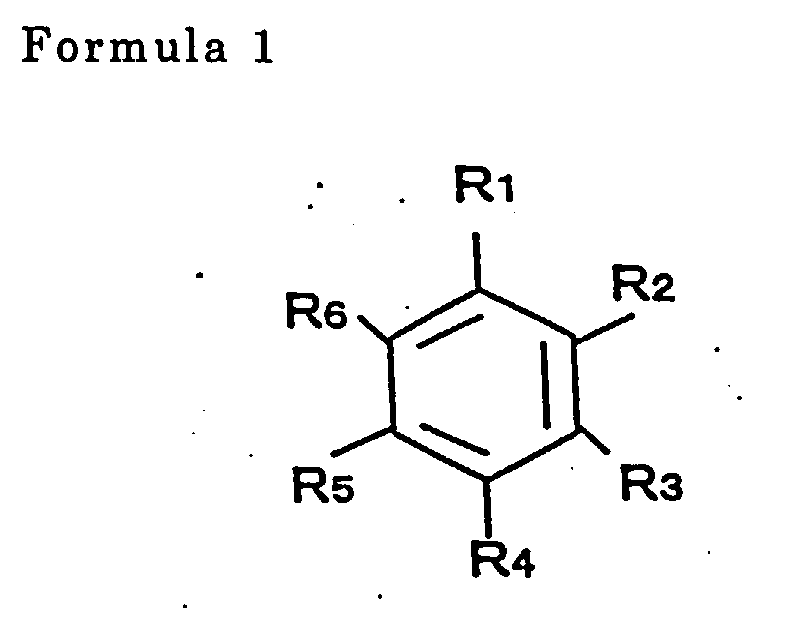
- the secondary battery of the invention comprises a positive electrode containing a positive electrode active material, a negative electrode containing a negative electrode material, and an electrolyte solution containing a nonaqueous solvent, an electrolyte, and an organic compound expressed in formula 1.
- each of R 1 , R 2 , R 3 , R 4 , R 5 , and R 6 has at least one of H and a group containing a vinyl group, and the number of H substituent is four or less.
- the positive electrode active material is an transition metal complex oxide containing lithium
- the negative electrode material has a material capable of storing and releasing lithium
- the organic compound has at least one selected from the group consisting of o-divinyl benzene, m-divinyl benzene, p-divinyl benzene, and 1,3,5-trivinyl benzene.
- the organic compound is contained in a range of about 0.1 wt.% to about 20 wt.% in the total weight of the electrolytic solution.
- Electrochemical oxidation occurs on the surface of a transition metal complex oxide containing lithium used as active material for positive electrode.
- the decomposed product contains lots of low molecular compounds. Such low molecular compounds are released outside of the electrolytic solution as gas, or dissolved in the electrolytic solution.
- active centre of the positive electrode active material maintain a high activity without being covered. Accordingly, the decomposition reaction of oxidation of the electrolytic solution progresses continuously, and the electrolytic solution is exhausted, or decomposition gas is generated massively, which may possibly lead to elevation of internal pressure of the battery or leakage of electrolytic solution.
- an organic compound expressed in formula 1 is added in the electrolytic solution.
- Such organic compound is likely to be oxidized and polymerized.
- a protective film is formed at active centre of the positive electrode surface, and continuous oxidation of the electrolytic solvent is prevented.
- R 1 , R 2 , R 3 , R 4 , R 5 , and R 6 are individually at least one of H and a group containing a vinyl group, and the number of H substituent is four or less.
- the organic compound expressed in formula 1 has plural vinyl groups bonded by benzene skeleton, and has a high pi-electron density. Such organic compound is likely to be oxidized and polymerized, and the product of oxidation and polymerization can cover the active centre of the positive electrode effectively.
- the constitution is specified below.
- the active material for positive electrode of transition metal complex oxide containing lithium includes Li x CoO 2 , Li x NiO 2 (U. S. Patent No. 4302518), Li x MnO 2 , Li x Co y Ni 1-y O 2 (Japanese Laid-open Patent No.
- x 0 to 1.2
- y 0 to 0.9
- f 0.9 to 0.98
- z 2.0 to 2.3
- a+b+c 1 , 0 ⁇ a ⁇ 1 0 ⁇ b ⁇ 1 0 ⁇ c ⁇ 1.
- the value of x is the value before start of discharging and charging, and the value of x increases or decreases by charging and discharging.
- the negative electrode material is a compound capable of storing and releasing lithium ions, such as lithium, lithium alloy, alloy, intermetallic compound, carbon, organic compound, inorganic compound, metal complex, and organic high molecular compound. These substances are used either alone or in mixture.
- the alloy or intermetallic compound a compound of transition metal and silicon, or a compound of transition metal and tin is used.
- a compound of nickel and silicon is preferable.
- carbonaceous material examples include coke, pyrolytic carbons, natural graphite, artificial graphite, mesocarbon microbeads, graphitized mesophase spherule, vapor phase growth carbon, glassy carbon, carbon fiber (polyacrylonitrile, pitch, cellulose, vapor phase growth carbon), amorphous carbon, and organic matter baked carbon. These materials are used either alone or in mixture. In particular, graphite materials are preferred, such as graphitized material of mesophase spherule, natural graphite and artificial graphite.
- a material containing different compounds such as O, B, P, N, S, SiC, and B4C are used, and the content of such different compounds is preferred to be 0 to 10 wt.%.
- the inorganic compound for example, tin compound or silicon compound is used.
- the mean particle size of carbon material is preferred to be in a range of about 0.1 ⁇ m to 60 ⁇ m, and more preferably about 0.5 ⁇ m to about 30 ⁇ m.
- the specific surface area is preferred to be 1 m 2 /g to 10 m 2 /g.
- the interval (d002) of hexagonal planes of carbon is 3.35 ⁇ to 3.40 ⁇ , and the size (Lc) of crystallite in the c-axis direction is 100 ⁇ or more.
- the electrolytic solution contains nonaqueous solvent and lithium salt to be dissolved in this solvent.
- cyclic carbonate examples include ethylene carbonate (EC), propylene carbonate (PC), butylene carbonate (BC), and vinylene carbonate (VC).
- noncyclic carbonate examples include dimethyl carbonate (DMC), diethyl carbonate (DEC), ethyl methyl carbonate (EMC), and dipropyl carbonate (DPC).
- DMC dimethyl carbonate
- DEC diethyl carbonate
- EMC ethyl methyl carbonate
- DPC dipropyl carbonate
- aliphatic ester carbonate examples include methyl formate, methyl acetate, methyl propionate, and ethyl propionate.
- the nonaqueous solvent is mainly composed of a solvent containing at least cyclic carbonate, a mixed solvent of cyclic carbonate and noncyclic carbonate, or a mixed solvent of cyclic carbonate, noncyclic carbonate, and aliphatic ester carbonate.
- lithium salt such as LiPF 6 is preferred.
- the dissolving amount of lithium salt in the nonaqueous solvent is not particularly specified, but it is preferably about 0.2 mol/liter to about 2 mol/liter, and more preferably about 0.5 mol/liter to about 1.5 mol/liter.
- the positive electrode active material at least one may be used as being selected from the group consisting of Li x CoO 2 , Li x NiO 2 , and Li x Mn 2 O 4 (where 0 ⁇ x ⁇ 1).
- the positive electrode current collector a net, sheet, foil, lath or other shape made of stainless steel or aluminum may be used.
- the negative electrode material instead of lithium metal alone, a compound containing at least one of alloy and carbonaceous material and lithium is used.
- the negative electrode current collector a net, sheet, foil, lath or other shape made of stainless steel or copper may be used.
- binder an electron conductor such as acetylene black or graphite is mixed.
- binder include polyvinylidene fluoride, polytetrafluoroethylene or other thermoplastic compound containing fluorine, polymer containing acrylic acid, styrene butadiene rubber, ethylene propylene terpolymer, or other elastomer, which may be used either alone or in mixture.
- the electrolytic solution contains at least (a) ethylene carbonate, (b) at least one of noncyclic carbonates such as diethyl carbonate, dimethyl carbonate, and ethyl methyl carbonate, or a mixed solvent of such noncyclic carbonate and methyl propionate, and (c) LiPF 6 as lithium salt.
- ethylene carbonate ethylene carbonate
- noncyclic carbonates such as diethyl carbonate, dimethyl carbonate, and ethyl methyl carbonate
- a mixed solvent of such noncyclic carbonate and methyl propionate a mixed solvent of such noncyclic carbonate and methyl propionate
- LiPF 6 LiPF 6 as lithium salt.
- polypropylene or polyethylene may be used either alone or in combination.
- the shape of the battery is not particularly limited, but it may be formed in cylindrical, flat, prismatic, square or other shape.
- the battery has means for assuring safety even in case of malfunction.
- the safety assuring means may include, for example, internal pressure relief safety valve, current shut-off safety valve, and separator for raising resistance at high temperature.
- Fig. 1 is a longitudinal sectional view of a secondary battery in an embodiment of the invention.
- the secondary battery comprises a battery case 1, a sealing plate 2 having a safety valve, an insulating packing 3, a plate group 4, two insulating rings 7, a positive electrode lead 5, and a negative electrode lead 6.
- the battery case 1 is manufactured by processing a stainless steel plate having resistance to organic electrolytic solution.
- the sealing plate 2 is disposed so as to cover the opening of the battery case 1.
- the plate group 4 has a positive electrode and a negative electrode wound spirally plural times through a separator, and is contained in the case 1.
- the positive electrode lead 5 is drawn out of the positive electrode, and is connected to the sealing plate 2.
- the negative electrode lead 6 is drawn out of the negative electrode, and is connected to the bottom of the battery case 1.
- the first insulating ring 7 is disposed in the upper part of the plate group 4, and the second insulating ring 7 is disposed in the lower part of the plate group 7.
- the positive electrode is manufactured in the following process.
- the negative electrode is manufactured in the following process.
- An aluminum lead is attached to the positive plate, and a nickel lead to the negative plate.
- the positive plate and negative plate were spirally wound through a polypropylene separator of 0.025 mm in thickness, 45 mm in width, and 950 mm in length, and put in a battery case 1 of 17.0 mm in diameter and 50.0 mm in height.
- the electrolytic solution was prepared in the following process.
- battery No. 5 was prepared in the same method as in the embodiment. This is a comparative battery 5.
- Capacity recovery rate (%) (capacity after storage / capacity before storage) ⁇ 100 No. Organic compound added Recovery rate after storage 1 o-divinyl benzene 90.3 2 m-divinyl benzene 92.8 3 p-divinyl benzene 91.9 4 1,3,5-trivinyl benzene 93.9 5 None 65.2
- the batteries of the embodiment, No. 1 to No. 4 had the capacity recovery rate (capacity maintenance rate) of over 90%.
- battery No. 5 not containing the organic compound in formula 1 had the capacity recovery rate of 65.2%.
- the batteries using the electrolyte solution containing the organic compound in formula 1 are known to have an excellent capacity recovery rate (capacity maintenance rate).
- various batteries were fabricated.
- the contents of the organic compounds specified in formula 1 in the total weight of the electrolytic solution were varied in a range of 0.05 wt.% to 30 wt.%.
- the same test as in the embodiment was conducted.
- the batteries using the electrolytic solution with the content of organic compound of 0.1 wt.% and higher are known to have a particularly excellent capacity recovery rate (capacity maintenance rate) after storage.
- the batteries using the electrolytic solution containing the organic compound by over 20 wt.% were lowered in the discharge characteristic of the battery.
- batteries having excellent characteristics are obtained even when stored in high temperature atmosphere.
Landscapes
- Chemical & Material Sciences (AREA)
- Electrochemistry (AREA)
- Engineering & Computer Science (AREA)
- General Chemical & Material Sciences (AREA)
- Chemical Kinetics & Catalysis (AREA)
- Manufacturing & Machinery (AREA)
- Inorganic Chemistry (AREA)
- Physics & Mathematics (AREA)
- Condensed Matter Physics & Semiconductors (AREA)
- General Physics & Mathematics (AREA)
- Materials Engineering (AREA)
- Secondary Cells (AREA)
- Battery Electrode And Active Subsutance (AREA)
Abstract

Description

- 1
- Battery case
- 2
- Sealing plate
- 3
- Insulating packing
- 4
- Plate group
- 5
- Positive electrode lead
- 6
- Negative electrode lead
- 7
- Insulating ring
| No. | Organic compound added | Recovery rate after storage |
| 1 | o-divinyl benzene | 90.3 |
| 2 | m-divinyl benzene | 92.8 |
| 3 | p-divinyl benzene | 91.9 |
| 4 | 1,3,5-trivinyl benzene | 93.9 |
| 5 | None | 65.2 |
Claims (10)
- A secondary battery comprising:a positive electrode containing a positive electrode active material,a negative electrode containing a negative electrode material, andan electrolyte solution containing a nonaqueous solvent, an electrolyte, and an organic compound expressed in formula 1.where each of R1, R2, R3, R4, R5 and R6 is at least one of H substituent and a group containing a vinyl group, and the number of H is four or less.

- The secondary battery of claim 1,
wherein said positive electrode active material has an transition metal complex oxide containing lithium, andsaid negative electrode material has a material capable of storing and releasing lithium. - The secondary battery of claim 1,
wherein said organic compound is at least one selected from the group consisting of o-divinyl benzene, m-divinyl benzene, p-divinyl benzene, and 1,3,5-trivinyl benzene. - The secondary battery of claim 1,
wherein said organic compound is contained in a range of about 0.1 wt.% to about 20 wt.% in the total weight of said electrolyte solution. - The secondary battery of claim 1,
wherein said positive electrode active material contains at least one selected from the group consisting of LixCoO2, LixNiO2, LixMnO2, LixCoyNi1-yO2, LixCofV1-fOz, LixNi1-yMyO2 (M=Ti, V, Mn, Fe), LixCoaNibMcO2 (M=Ti, Mn, Al, Mg, Fe, Zr), LixMn2O4, and LixMn2-yMyO4 (M=Na, Mg, Sc, Y, Fe, Co, Ni, Ti, Zr, Cu, Zn, Al, Pb, Sb),
where x=0 to 1.2, y=0 to 0.9, f=0.9 to 0.98, z=2.0 to 2.3,the value of x is the value before start of charging and discharging, and the value of x decreases or increases by charging and discharging. - the secondary battery of claim 1,
wherein said negative electrode material contains at least one selected from the group consisting of lithium, lithium alloy, alloy, intermetallic compound, carbon, organic compound, inorganic compound, metal complex, and organic high molecular compound, andsaid negative electrode material contains a compound capable of storing and releasing a lithium ion. - The secondary battery of claim 1,
wherein said nonaqueous solvent contains at least one selected from the group consisting of (a) cyclic carbonate, (b) cyclic carbonate and noncyclic carbonate, and (c) cyclic carbonate, noncyclic carbonate, and fatty acid ester carbonate,said cyclic carbonate contains at least one selected from the group consisting of ethylene carbonate, propylene carbonate, butylene carbonate, and vinylene carbonate,said noncyclic carbonate contains at least one selected from the group consisting of dimethyl carbonate, diethyl carbonate, ethyl methyl carbonate, and dipropyl carbonate, andsaid fatty acid ester carbonate contains at least one selected from the group consisting of methyl formate, methyl acetate, methyl propionate, and ethyl propionate. - The secondary battery of claim 1, wherein said electrolyte contains lithium salt.
- A secondary battery comprising:(a) a positive electrode active material containing LixCoO2 (x=0 to 1.2),(b) a negative electrode material containing graphite, and(c) an electrolyte solution containing LiPF6 (lithium hexafluorophosphate), o-divinyl benzene, ethylene carbonate, and noncyclic carbonate,
wherein said noncyclic carbonate contains at least one selected from the group consisting of dimethyl carbonate, diethyl carbonate, and ethyl methyl carbonate. - The secondary battery of claim 9, wherein said o-divinyl benzene is contained in a range of about 0.1 wt.% to about 20 wt.% in the total weight of said electrolyte solution.
Applications Claiming Priority (2)
| Application Number | Priority Date | Filing Date | Title |
|---|---|---|---|
| US09/289,589 US6165647A (en) | 1999-04-09 | 1999-04-09 | Secondary battery comprising a polymerizable material in its electrolyte solution |
| US289589 | 1999-04-09 |
Publications (2)
| Publication Number | Publication Date |
|---|---|
| EP1043794A2 true EP1043794A2 (en) | 2000-10-11 |
| EP1043794A3 EP1043794A3 (en) | 2002-12-18 |
Family
ID=23112190
Family Applications (1)
| Application Number | Title | Priority Date | Filing Date |
|---|---|---|---|
| EP00102959A Withdrawn EP1043794A3 (en) | 1999-04-09 | 2000-02-14 | Secondary battery |
Country Status (4)
| Country | Link |
|---|---|
| US (1) | US6165647A (en) |
| EP (1) | EP1043794A3 (en) |
| KR (1) | KR100354235B1 (en) |
| CN (1) | CN1162934C (en) |
Cited By (1)
| Publication number | Priority date | Publication date | Assignee | Title |
|---|---|---|---|---|
| EP1215745A4 (en) * | 1999-06-30 | 2007-11-28 | Matsushita Electric Industrial Co Ltd | NON-AQUEOUS ELECTROLYTIC ACCUMULATOR AND DEVICE CONTAINING THE SAME |
Families Citing this family (9)
| Publication number | Priority date | Publication date | Assignee | Title |
|---|---|---|---|---|
| GB9717220D0 (en) * | 1997-08-15 | 1997-10-22 | Aea Technology Plc | Eklectrolyte for a rechargeable cell |
| JP2000090895A (en) * | 1998-09-14 | 2000-03-31 | Ngk Insulators Ltd | Lithium secondary battery for electric vehicles |
| JP2003017060A (en) * | 2001-04-25 | 2003-01-17 | Sony Corp | Cathode active material and non-aqueous electrolyte battery |
| CN1263184C (en) * | 2001-11-20 | 2006-07-05 | Tdk株式会社 | Electrode active material, electrode, lithium ion secondary cell, method for producing electrode active material, and method for producing lithium ion secondary cell |
| KR100515332B1 (en) * | 2003-04-28 | 2005-09-15 | 삼성에스디아이 주식회사 | An electrolyte for a lithium battery and a lithium battery comprising the same |
| JP4297133B2 (en) * | 2006-05-15 | 2009-07-15 | ソニー株式会社 | Lithium ion battery |
| KR101115028B1 (en) | 2007-05-15 | 2012-03-09 | 주식회사 엘지화학 | Additive for non-aqueous electrolyte and secondary battery using the same |
| WO2015012650A1 (en) | 2013-07-26 | 2015-01-29 | 주식회사 엘지화학 | Anode active material and method for manufacturing same |
| CN115275407B (en) * | 2022-09-30 | 2022-12-20 | 北京金羽新材科技有限公司 | Charging method of nickel-zinc battery |
Family Cites Families (13)
| Publication number | Priority date | Publication date | Assignee | Title |
|---|---|---|---|---|
| JPS6065478A (en) * | 1983-09-21 | 1985-04-15 | Hitachi Ltd | Polymer secondary battery |
| US4952466A (en) * | 1987-01-16 | 1990-08-28 | The Dow Chemical Company | Solid electrolyte battery |
| DE3920129A1 (en) * | 1988-06-21 | 1989-12-28 | Ricoh Kk | ELECTROCHEMICAL DEVICE |
| US5256504A (en) * | 1991-09-13 | 1993-10-26 | Matsushita Electric Industrial Co., Ltd. | Monaqueous electrolyte secondary batteries |
| US5378550A (en) * | 1993-11-15 | 1995-01-03 | The United States Of America As Represented By The United States Department Of Energy | Electrolytes for power sources |
| US5426005A (en) * | 1994-02-18 | 1995-06-20 | Motorola, Inc. | Interpenetrating polymer network electrolytes and electrochemical cells using same |
| US5552244A (en) * | 1995-02-14 | 1996-09-03 | Eric Blair Griffen | Reversible high energy capacity metal-sulfur battery and method of making same |
| JP3493873B2 (en) * | 1995-04-28 | 2004-02-03 | ソニー株式会社 | Non-aqueous electrolyte secondary battery |
| JP3669024B2 (en) * | 1995-05-26 | 2005-07-06 | ソニー株式会社 | Non-aqueous electrolyte secondary battery |
| JPH1064586A (en) * | 1996-08-14 | 1998-03-06 | Furukawa Electric Co Ltd:The | Method for producing electrode-solid electrolyte composite, and all-solid-state Li battery using the composite |
| JPH1092470A (en) * | 1996-09-17 | 1998-04-10 | Teruya Ozawa | Lithium ion battery and method for producing the same |
| JP3436033B2 (en) * | 1996-12-27 | 2003-08-11 | ソニー株式会社 | Non-aqueous electrolyte secondary battery |
| GB9717220D0 (en) * | 1997-08-15 | 1997-10-22 | Aea Technology Plc | Eklectrolyte for a rechargeable cell |
-
1999
- 1999-04-09 US US09/289,589 patent/US6165647A/en not_active Expired - Lifetime
-
2000
- 2000-02-14 EP EP00102959A patent/EP1043794A3/en not_active Withdrawn
- 2000-02-29 CN CNB00103653XA patent/CN1162934C/en not_active Expired - Fee Related
- 2000-02-29 KR KR1020000010070A patent/KR100354235B1/en not_active Expired - Fee Related
Cited By (1)
| Publication number | Priority date | Publication date | Assignee | Title |
|---|---|---|---|---|
| EP1215745A4 (en) * | 1999-06-30 | 2007-11-28 | Matsushita Electric Industrial Co Ltd | NON-AQUEOUS ELECTROLYTIC ACCUMULATOR AND DEVICE CONTAINING THE SAME |
Also Published As
| Publication number | Publication date |
|---|---|
| KR20000071394A (en) | 2000-11-25 |
| KR100354235B1 (en) | 2002-09-28 |
| CN1162934C (en) | 2004-08-18 |
| CN1270424A (en) | 2000-10-18 |
| EP1043794A3 (en) | 2002-12-18 |
| US6165647A (en) | 2000-12-26 |
Similar Documents
| Publication | Publication Date | Title |
|---|---|---|
| EP1043793B1 (en) | Secondary battery | |
| KR102425513B1 (en) | Lithium secondary battery | |
| US7718314B2 (en) | Cathode material and battery | |
| JP5972513B2 (en) | Cathode and lithium battery using the same | |
| US9088036B2 (en) | Rechargeable lithium battery | |
| KR100747382B1 (en) | Electrolyte for Non-Aqueous Battery and Non-Aqueous Secondary Battery | |
| EP1903627B1 (en) | Cathode active material for a lithium battery | |
| EP1256995B1 (en) | Nonaqueous electrolytic secondary battery | |
| CN1190863C (en) | Non-aqueous electrolytic solution and lithium secondary battery using the non-aqueous electrolytic solution | |
| EP0997957B1 (en) | Secondary non-aqueous electrolyte cell containing lithium cobalt oxide and a titanium compound in the cathode | |
| JP4374661B2 (en) | Non-aqueous electrolyte secondary battery | |
| EP1739768A1 (en) | Lithium ion secondary battery and charge/discharge controlling system thereof | |
| JPH05290843A (en) | Lithium secondary battery | |
| CA2124177C (en) | Non-aqueous liquid electrolyte secondary cell | |
| US7767350B2 (en) | Nonaqueous electrolyte battery | |
| JP3229635B2 (en) | Lithium secondary battery | |
| KR100323002B1 (en) | Method of manufacturing cathode active material and nonaqueous electrolyte secondary battery | |
| US6165647A (en) | Secondary battery comprising a polymerizable material in its electrolyte solution | |
| JP3564756B2 (en) | Non-aqueous electrolyte secondary battery | |
| JPH0684542A (en) | Nonaqueous electrolytic solution secondary battery | |
| JP3480764B2 (en) | Non-aqueous electrolyte secondary battery | |
| JPH04329269A (en) | Nonaqueous electrolyte secondary battery | |
| US6451482B1 (en) | Non-aqueous electrolyte secondary batteries | |
| US20240186485A1 (en) | Anode for lithium secondary battery and lithium secondary battery including the same | |
| JPH07201360A (en) | Non-aqueous electrolyte secondary battery |
Legal Events
| Date | Code | Title | Description |
|---|---|---|---|
| PUAI | Public reference made under article 153(3) epc to a published international application that has entered the european phase |
Free format text: ORIGINAL CODE: 0009012 |
|
| AK | Designated contracting states |
Kind code of ref document: A2 Designated state(s): AT BE CH CY DE DK ES FI FR GB GR IE IT LI LU MC NL PT SE |
|
| AX | Request for extension of the european patent |
Free format text: AL;LT;LV;MK;RO;SI |
|
| PUAL | Search report despatched |
Free format text: ORIGINAL CODE: 0009013 |
|
| AK | Designated contracting states |
Kind code of ref document: A3 Designated state(s): AT BE CH CY DE DK ES FI FR GB GR IE IT LI LU MC NL PT SE |
|
| AX | Request for extension of the european patent |
Free format text: AL;LT;LV;MK;RO;SI |
|
| 17P | Request for examination filed |
Effective date: 20030213 |
|
| AKX | Designation fees paid |
Designated state(s): DE FR GB |
|
| 17Q | First examination report despatched |
Effective date: 20080429 |
|
| RAP1 | Party data changed (applicant data changed or rights of an application transferred) |
Owner name: PANASONIC CORPORATION |
|
| 18D | Application deemed to be withdrawn |
Effective date: 20080830 |
|
| STAA | Information on the status of an ep patent application or granted ep patent |
Free format text: STATUS: THE APPLICATION IS DEEMED TO BE WITHDRAWN |
|
| R18D | Application deemed to be withdrawn (corrected) |
Effective date: 20080910 |