EP1043708A2 - Recognising and adjusting display characteristics - Google Patents
Recognising and adjusting display characteristics Download PDFInfo
- Publication number
- EP1043708A2 EP1043708A2 EP00300833A EP00300833A EP1043708A2 EP 1043708 A2 EP1043708 A2 EP 1043708A2 EP 00300833 A EP00300833 A EP 00300833A EP 00300833 A EP00300833 A EP 00300833A EP 1043708 A2 EP1043708 A2 EP 1043708A2
- Authority
- EP
- European Patent Office
- Prior art keywords
- color
- display
- display unit
- display characteristics
- signal
- Prior art date
- Legal status (The legal status is an assumption and is not a legal conclusion. Google has not performed a legal analysis and makes no representation as to the accuracy of the status listed.)
- Withdrawn
Links
Images






Classifications
-
- H—ELECTRICITY
- H04—ELECTRIC COMMUNICATION TECHNIQUE
- H04N—PICTORIAL COMMUNICATION, e.g. TELEVISION
- H04N17/00—Diagnosis, testing or measuring for television systems or their details
- H04N17/04—Diagnosis, testing or measuring for television systems or their details for receivers
-
- G—PHYSICS
- G06—COMPUTING OR CALCULATING; COUNTING
- G06F—ELECTRIC DIGITAL DATA PROCESSING
- G06F3/00—Input arrangements for transferring data to be processed into a form capable of being handled by the computer; Output arrangements for transferring data from processing unit to output unit, e.g. interface arrangements
- G06F3/01—Input arrangements or combined input and output arrangements for interaction between user and computer
- G06F3/048—Interaction techniques based on graphical user interfaces [GUI]
- G06F3/0487—Interaction techniques based on graphical user interfaces [GUI] using specific features provided by the input device, e.g. functions controlled by the rotation of a mouse with dual sensing arrangements, or of the nature of the input device, e.g. tap gestures based on pressure sensed by a digitiser
- G06F3/0489—Interaction techniques based on graphical user interfaces [GUI] using specific features provided by the input device, e.g. functions controlled by the rotation of a mouse with dual sensing arrangements, or of the nature of the input device, e.g. tap gestures based on pressure sensed by a digitiser using dedicated keyboard keys or combinations thereof
- G06F3/04897—Special input arrangements or commands for improving display capability
-
- G—PHYSICS
- G09—EDUCATION; CRYPTOGRAPHY; DISPLAY; ADVERTISING; SEALS
- G09G—ARRANGEMENTS OR CIRCUITS FOR CONTROL OF INDICATING DEVICES USING STATIC MEANS TO PRESENT VARIABLE INFORMATION
- G09G5/00—Control arrangements or circuits for visual indicators common to cathode-ray tube indicators and other visual indicators
- G09G5/02—Control arrangements or circuits for visual indicators common to cathode-ray tube indicators and other visual indicators characterised by the way in which colour is displayed
-
- G—PHYSICS
- G09—EDUCATION; CRYPTOGRAPHY; DISPLAY; ADVERTISING; SEALS
- G09G—ARRANGEMENTS OR CIRCUITS FOR CONTROL OF INDICATING DEVICES USING STATIC MEANS TO PRESENT VARIABLE INFORMATION
- G09G2320/00—Control of display operating conditions
- G09G2320/02—Improving the quality of display appearance
-
- G—PHYSICS
- G09—EDUCATION; CRYPTOGRAPHY; DISPLAY; ADVERTISING; SEALS
- G09G—ARRANGEMENTS OR CIRCUITS FOR CONTROL OF INDICATING DEVICES USING STATIC MEANS TO PRESENT VARIABLE INFORMATION
- G09G5/00—Control arrangements or circuits for visual indicators common to cathode-ray tube indicators and other visual indicators
- G09G5/003—Details of a display terminal, the details relating to the control arrangement of the display terminal and to the interfaces thereto
- G09G5/006—Details of the interface to the display terminal
-
- H—ELECTRICITY
- H04—ELECTRIC COMMUNICATION TECHNIQUE
- H04N—PICTORIAL COMMUNICATION, e.g. TELEVISION
- H04N17/00—Diagnosis, testing or measuring for television systems or their details
- H04N17/02—Diagnosis, testing or measuring for television systems or their details for colour television signals
Definitions
- the present invention relates to a display characteristics recognition apparatus for determining display characteristics of a display unit, a display characteristics recognition program storage medium storing a display characteristics recognition program which causes a computer system to operate as such a display characteristics recognition apparatus, a computer system operative as such a display characteristics recognition apparatus, a display characteristics adjusting apparatus for adjusting display characteristics of the display unit, a display characteristics adjusting program storage medium storing a display characteristics adjusting program which causes a computer system to operate as such a display characteristics adjusting apparatus, and a computer system operative as such a display characteristics adjusting apparatus.
- CMS color management system
- ICM 1.0(Image Color Matching) of windows 95 and ColorSync 2.0 of Macintosh which are registered trade mark
- the CMS is incorporated in the operating system (OS) level.
- OS operating system
- An offer of a predetermined type of device profile used in ICM 1.0 or ColorSync 2.0 to a user by a maker of color input and output units makes it possible that the user obtains an image with which the user does not feel something is wrong, even between images of different devices, for example, a displayed image on a display and a printed image by a printer.
- the device profile of ICM 1.0 and ColorSync 2.0 is based on the ICC (International Color Consortium) profile advocated by the ICC.
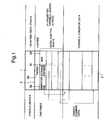
- Fig. 1 of the accompanying drawings is a schematic diagram of an ICC profile.
- the ICC profile is divided into three parts of a profile header 1 for storing information as to the profile per se such as a file size and a making out date, information indicative of kinds of objective machines (output units), a tagged element data 2 storing information indicative of color display characteristics of an output unit, and a tag table 3 indicative of stored information and storage address of the stored information in the tagged element data 2.
- the profile header 1 is a fixed length of data.
- the tagged element data 2 is a variable length of data.
- the tag table 3 is a variable length of data of (4 + 12n) bytes including data 3a representative of the number of tags (n) stored in the tagged element data 2, and data 3b, 3c and 3d representative of an identifier, a storage address, a size on each of n pieces of tag, respectively, each of the data 3b, 3c and 3d consisting of 4 bytes.
- a CIEXYZ value of white is stored, as standard white information of the output unit, in wtpt tag with a standardized value in which D50 is adopted as a standard light source.
- the standard white information of the output unit there is known a color temperature indicating white in accordance with a blackbody radiation other than the CIEXYZ value of white.
- the CIEXYZ value of white is stored in the tagged element data 2. It is possible to perform a transformation between the CIEXYZ value of white and the color temperature in accordance with the conventional scheme. In the following explanation, it happens that the CIEXYZ value of white and the color temperature are used without distinction.
- CIEXYZ values of red, green and blue are stored, as information indicative of a range of color capable of reproduction by the output unit, in rXYZ tag, gXYZ tag and bXYZ tag, respectively, with a standardized value in which D50 is adopted as a standard light source.
- input-output characteristics ( ⁇ -characteristics) of the output unit of red, green and blue are stored, as information indicative of ⁇ -characteristics, in rTRC tag, gTRC tag and bTRC tag, respectively, and in general, gradation values are stored where a range between an input 0 and the maximum input is divided into n equal parts.
- the tagged element data 2 of the ICC profile of the display unit stores seven sorts of information as mentioned above. Those sorts of information are obtained through such a manner that a specific color image data is inputted to a display or the like so that a color image is displayed, and the color is measured through the use of a dedicated measuring apparatus (a color measuring apparatus).
- the ICC profiler is provided nowadays from a color equipment maker to a user in conjunction with a product. Since a color equipment is associated with a difference in display due to a difference among types of the equipment per se and a usage environment, the ICC profile provided by a maker does not always have characteristics of the equipment used by the user. For example, in case of a display, it often happens that a difference in color display characteristics occurs owing to a production lot and a user sets up a display state of a display by a regulatory function (contrast, brightness, RGB balance, color temperature setting) so as to meet the user's desire, and thus usually, the display profile provided by a maker is not suitable for a display which is actually used by a user.
- a regulatory function contrast, brightness, RGB balance, color temperature setting
- a display characteristics recognition apparatus capable of determining display characteristics of a display unit even for a general user having no color measuring apparatus as mentioned above
- a display characteristics recognition program storage medium storing a display characteristics recognition program which causes a computer system to operate as such a display characteristics recognition apparatus
- a computer system operative as such a display characteristics recognition apparatus a display characteristics adjusting apparatus capable of adjusting display characteristics of the display unit even for a general user having no color measuring apparatus as mentioned above
- a display characteristics adjusting program storage medium storing a display characteristics adjusting program which causes a computer system to operate as such a display characteristics adjusting apparatus
- a computer system operative as such a display characteristics adjusting apparatus operative as such a display characteristics adjusting apparatus.
- a display characteristics recognition apparatus comprising:
- the "monochrome figure” is not restricted to the figure of a primary color according to a color developing principle of a display unit.
- Sandra is acceptable, as the “monochrome figure”, which is a single color of figure on a visual basis.
- display characteristics recognition apparatus display characteristics may be determined by the display characteristics identification means when a user enters a name of a color through the color name input means.
- display characteristics may be determined by the display characteristics identification means when a user enters a name of a color through the color name input means.
- said display characteristics identification means determines, as the display characteristics, a relationship between a signal representative of a white image and a color of an image displayed on said display unit in accordance with the signal.
- said display unit is selectively set up to anyone of a plurality of display characteristics, and said display characteristics identification means determines display characteristics to which said display unit is now set up.
- a relationship between a signal representative of a white image and a color of an image displayed on said display unit in accordance with the signal is indexed, for example, with a temperature in accordance with a blackbody radiation, and the temperature is referred to as a color temperature.
- the color temperature of a display unit is selectively set up from among typical color temperatures, for example, 5000K, 6500K, 9300K.
- accuracy of a decision of the color temperature in many cases, it is sufficient that it can be determined as to whether the color temperature set up on the display matches with the actual color temperature. Therefore, it is possible to determine display characteristics simply and exactly through a decision of the color temperature as to which a color temperature is set up of those typical color temperatures.
- said display unit is a display in which an image is displayed through emission of light
- said signal output means outputs such a color chart signal that a color of an adjacent area as to colors adjacent to one another on a chromaticity diagram of a plurality of colors perceived as mutually different colors in name is displayed in chromaticity according to display characteristics.
- the color displayed on the display unit in accordance with the color chart signal outputted from the signal output means is great in accuracy of display characteristics determined on the basis of a name of a color, since variation of a color to variation of display characteristics is extremely sensitive for human's visual sensation, which will be described later in details.
- said color name input means enters a name of a color selected from among a plurality of colors perceived as mutually different colors in name.
- said signal output means outputs a plurality of color chart signals each representative of a monochrome figure to said display unit;
- display characteristics is determined in accordance with a plurality of color chart signals and a plurality of names of color. Thus, it is possible to determine display characteristics with greater accuracy.
- said signal output means outputs the color chart signal to said display unit, and in addition outputs to said display unit a signal causing black to be displayed around the monochrome figure displayed on said display unit according to the color chart signal.
- said signal output means outputs the color chart signal to said display unit, and in addition outputs to said display unit a signal causing gray to be displayed around the monochrome figure displayed on said display unit according to the color chart signal and further causing black to be displayed around the gray.
- an achromatic color is displayed around the monochrome figure displayed on said display unit.
- a pure color of the monochrome figure is perceived by a user and the name of the color is entered, and thereby determining display characteristics with great accuracy.
- black is displayed around the monochrome figure.
- gray is displayed around the monochrome figure.
- said signal output means outputs a series of color chart signals such that a series of colors in adjacent areas for two sorts of colors adjacent to one another on a chromaticity diagram are displayed, and
- said display characteristics recognition apparatus further comprises profile producing means for generating data representative of display characteristics determined by said display characteristics identification means in a predetermined format to produce a profile representative of characteristics as to display of an image by said display unit including the data.
- said display characteristics recognition apparatus further comprises:
- a display characteristics recognition apparatus having the profile producing means and the profile selection means, there is determined a profile suitable for the display unit.
- the CMS matching between appearance of color displayed on the display unit and appearance of color displayed on another display unit.
- a display characteristics recognition program storage medium storing a display characteristics recognition program comprising:
- a computer system comprising:
- a computer system comprising:
- said main frame unit outputs to said display unit the series of color chart signals, and in addition a message signal representative of a message inquiring as to from which color of the series of colors displayed on said display unit an operator visually identifies it as a color of a specified color name.
- a computer system comprising:
- said main frame unit outputs color chart signals representative of a plurality of monochrome figures associated with mutually different luminance of said display unit, each of the plurality of monochrome figures being displayed with such a color that persons of a predetermined ratio and up recognize it as the color of the specified color name under an associated luminance.
- a display characteristics adjusting apparatus for adjusting display characteristics of a display unit for displaying an image according to a signal entered, said display unit displaying the image with a color according to both the signal and display characteristics of said display unit, said display characteristics adjusting apparatus comprising:
- a color displayed on a display unit in accordance with the color chart signal can be adjusted suitably in display characteristics using the variation of color as a criterion, since variation of a color to variation of display characteristics is extremely sensitive for human's visual sensation, which will be described later in details.
- a display characteristics adjusting program storage medium storing a display characteristics adjusting program incorporated into a computer system, said display characteristics adjusting program causing said computer system to operate a display characteristics adjusting apparatus for adjusting display characteristics of a display unit for displaying an image according to a signal entered, said display unit displaying the image with a color according to both the signal and display characteristics of said display unit, said display characteristics adjusting program comprising:
- a computer system comprising:
- a term such as signal output means is applied to the structural element for those apparatus and programs.
- the term indicates a combination of software and hardware having such a function.
- the display characteristics recognition program and the display characteristics adjusting program it indicates only software having such a function.
- Fig. 2 is a chromaticity diagram showing a distribution of colors which are perceived by a human.
- one point on the chromaticity diagram denotes one color.
- a triangular domain 10 shown in the chromaticity diagram is an area of colors which can be reproduced by a display.
- Tops 10a, 10b and 10c of the triangle denote colors displayed by a display in the event that RGB values entered to the display are (0, 0, 255), (0, 255, 0), (255, 0, 0), respectively.
- a wide region 20 covering the triangular domain 10 is an area of colors which can be perceived by a human.
- the categorical color perception As one which is indicative of powers of perception of human for colors, there is known a perception method referred to as the categorical color perception. According to the categorical color perception, it is said that colors perceived by a human are perceived through a classification of 11 to 13 colors or so regardless of a race, a region and nationality. Hereinafter, there will be explained by way of example a case where colors perceived by a human are perceived through a classification of 11 colors. 11 colors designated by the categorical color perception are "white”, “orange”, “brown”, “gray”, “yellow”, “purple”, “pink”, “red”, “green”, “blue” and “black”. According to the chromaticity diagram shown in Fig.
- the triangular domain 10 is partitioned in color domain into 8 colors of blue, green, brown, orange, red, pink, purple, and gray. These eight domains 11, 12, 13, 14, 15, 16, 17 and 18 are referred to as categorical areas, hereinafter.
- the categorical area 18 of "gray” of the chromaticity diagram includes “white” and "black”. While the chromaticity diagram omits the categorical area of "yellow", in view of the lightness, the categorical area of "yellow” exists between the categorical area 12 of "green” and the categorical area 13 of "brown".
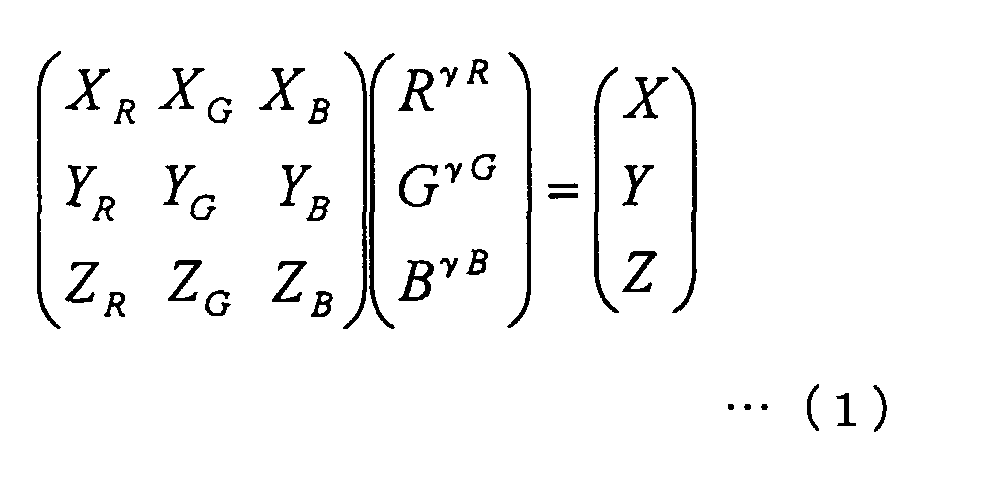
- RGB values entered to a display and CIEXYZ values of a color displayed on the display
- R, G, B denote RGB values entered to the display
- X R , Y R , Z R denote CIEXYZ values of red
- X G , Y G , Z G denote CIEXYZ values of green
- X B , Y B , Z B denote CIEXYZ values of blue
- ⁇ R , ⁇ G , ⁇ B denote ⁇ coefficient
- X, Y, Z denote CIEXYZ values of an output.
- Bezold-Br ⁇ cke Effect when intensity of the color light (luminance) is increased, a tinge of blue or yellow of chromatic color other than blue, green, yellow and red is increased, and oppositely when intensity of the color light is decreased, a tinge of green or red is increased.
- the RGB value X and the associated display color can be used as a criterion for identifying a color temperature of the display.
- the luminance it is possible to determine the luminance, according as a user recognizes a displayed color as what color when a certain RGB value is entered and displayed as a criterion.
- both the RGB value used as the criterion and the figure displayed with the associated display color are referred to as a "color chart" without a distinction therebetween.
- a display color near the boundary of the mutually adjacent categorical areas is seen extremely differently in accordance with a change of a display setting (for example, a color temperature, a display luminance).
- a display setting for example, a color temperature, a display luminance.
- RGB value for example, a color temperature, a display luminance.
- the color chart for determining a color temperature through an appearance of a display color there is considered a color near the boundary between the categorical areas of, for example, blue and purple.
- an RGB value is preferable as the color chart for determining a color temperature.
- X Y Z x y 5000K 7.11 3.55 28.56 0.181285 0.090515 6500K 13.53 6.54 61.78 0.165302 0.079902 9300K 19.22 9.1 93.51 0.157761 0.074694
- X, Y and Z columns of Table 1 show measured values of CIEXYZ values of the respective display colors wherein a color temperature is 5000K, 6500K and 9300K.
- x and y columns of Table 1 show xy-chromaticity values calculated from the measured values of the CIEXYZ values.
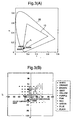
- Fig. 3(A) is an xy-chromaticity diagram showing the measurement result in Table 1.
- Fig. 3(B) is a chromaticity diagram of CIELAB space.
- Fig. 3(A) is an xy-chromaticity diagram which is similar to Fig. 2, in which a domain 10 of colors which can be reproduced by a display and a domain 20 of colors which can be perceived by a human are shown in a similar fashion to that of Fig. 2.
- the boundary between the categorical area of blue and the categorical area of purple is shown by a straight line L, and positions of the respective display colors wherein a color temperature is 5000K, 6500K and 9300K are shown on the chromaticity diagram with square marks together with the color temperature.
- Fig. 3(B) The axis of abscissas and the axis of ordinates of Fig. 3(B) denote a* value and b* value of the respective CIELABs, respectively.
- Fig. 3(B) a distribution of eleven colors designated by the categorical perception is shown with eleven sorts of marks. Further, in Fig. 3(B), positions of the respective display colors wherein a color temperature is 5000K and 9300K are shown with star marks together with the color temperature.
- the display color of the color chart wherein the RGB value is (R,G,B) (75, 0, 255) belongs, in the event that the color temperature is 5000K, to the categorical area of purple, and belongs, in the event that the color temperature is 6500K and 9300K, to the categorical area of blue.
- a color temperature and an RGB balance of the display are controlled in accordance with the display color of the color chart. This feature makes it possible to perform a more suitable adjustment.
- Fig. 4 is a view showing a first embodiment of a display characteristics recognition apparatus according to the present invention.
- a display characteristics recognition apparatus 30 which is constructed in the form of a computer system, comprises: a main frame 31 incorporated thereinto a CPU, a RAM, a hard disk, a communication board, etc.; a CRT display 32 for performing a screen display on a fluorescent screen 32a in accordance with an instruction from the main frame 31; a keyboard 33 for entering character information and an instruction of an operator to the computer system; and a mouse 34 for entering an instruction according to an icon and the like displayed at an arbitrary position on the fluorescent screen 32a.
- the CRT display 32 is a part of the present embodiment and also an example of a display unit of which display characteristics are recognized in accordance with an embodiment of the present invention.
- the main frame 31 is provided with a floppy disk loading aperture 31a adapted for loading a floppy disk and a CDROM loading aperture 31b adapted for loading a CDROM 40, and also incorporates therein a floppy disk driver for driving a loaded floppy disk and a CDROM driver for driving the loaded CDROM 40.
- the CDROM 40 stores a display characteristics recognition program.
- the display characteristics recognition program stored in the CDROM 40 is installed into the hard disk of the computer system by the CDROM driver.
- the display characteristics recognition program installed into the hard disk of the computer system is driven, the computer system is operative as a display characteristics recognition apparatus according to an embodiment of the present invention.
- the CDROM 40 storing a display characteristics recognition program corresponds to embodiment of a display characteristics recognition program storage medium according to the present invention.
- the display characteristics recognition program stored in the CDROM 40 is installed in the hard disk of the computer system in accordance with the manner as mentioned above.
- the hard disk, in which the display characteristics recognition program is installed also corresponds to an embodiment of a display characteristics recognition program storage medium according to the present invention.
- the floppy disk which stores the display characteristics recognition program thus down loaded, also corresponds to an embodiment of a display characteristics recognition program storage medium according to the present invention.
- Fig. 5 is a functional block diagram of a display characteristics recognition apparatus (computer system) which has an appearance shown in Fig. 4.
- the display characteristics recognition apparatus shown in Fig. 5 comprises: a color chart data holder 51 for holding RGB data and the like for each of a predetermined number of color charts which is determined in accordance with a distribution and the like of categorical areas; and a color chart data output unit 52 for outputting data held in the color chart data holder 51 to the CRT display 32 shown in Fig. 4.
- the color chart data output unit 52 is an example of the color chart signal output unit referred to in the present invention.
- the color chart data holder 51 is, for example, a hard disk and a CDROM.
- the color chart data output unit 52 includes a so-called display card and a device driver.
- it is not always needed that the color chart is held in the computer system, but it is acceptable, for example, that the computer system is connected to a network so that a color chart is properly transmitted from a remote server via the network.
- the display characteristics recognition apparatus shown in Fig. 5 further comprises a color name input unit 53 for entering a name of a color of a color chart.
- a user sees a color chart displayed on the CRT display 32 to identify a color of the color chart, and operates the keyboard 33 and the mouse 34 to enter the name of the color.
- the display characteristics recognition apparatus shown in Fig. 5 furthermore comprises: a characteristic information holder 54 for holding a plurality of characteristic information data which indicate several typical display characteristics (color temperatures) in the form of numerical values; and a display characteristics identification unit 55 for identifying one suitable as a color temperature of the display 32, of the typical color temperatures held in the characteristic information holder 54, in accordance with data of the color chart outputted from the color chart data output unit 52 and the name of the color entered through the color name input unit 53.
- the display characteristics identification unit 55 is an example of the display characteristics identification means referred to in the present invention and serves to derive characteristic information data from the characteristic information holder 54 in accordance with an identification result. Further, the display characteristics identification unit 55 instructs the color chart data output unit 52 what color chart data is to be outputted in accordance with the name of the color entered through the color name input unit 53, so that an identification of the display characteristics is performed after the color chart data is outputted.
- the display characteristics recognition apparatus shown in Fig. 5 still further comprises a profile producing unit 56 for producing a profile in accordance with characteristic information derived from the display characteristics identification unit 55.
- the profile producing unit 56 also derives information data, excepting information as to a color temperature, which is necessary for producing the profile, in accordance with a way which will be described later.
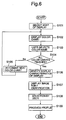
- Fig. 6 is a flowchart useful for understanding an operating procedure of the first embodiment of the display characteristics recognition apparatus according to the present invention, as shown in Figs. 4 and 5. Hereinafter, there will be explained the flowchart shown in Fig. 6 referring to Figs. 7 to 14.
- a CIEXYZ value (chromaticity value) on each color of red, green and blue, which is information indicative of a range of color reproducible by the color chart data output unit 52, is determined for production of the ICC profile. It is known that while the chromaticity values of red, green and blue greatly depend on a sort of a display such as a CRT and an LCD, but does not almost depend on a type of an apparatus. Therefore, it is sufficient for a determination of the chromaticity values of red, green and blue that a type of an apparatus is identified. While Fig.
- step S101 a sort of a display is selected by a user to determine a chromaticity value according to the selected sort of the display.
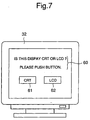
- Fig. 7 is a view showing a display screen displayed on the display in the step S101 in Fig. 6.
- Fig. 7 shows a display screen 32 on which a character string 60 such as "Is this display CRT or LCD ?" and "Please push button” is displayed, and in addition a button 61 for selecting the CRT and a button 62 for selecting the LCD. Click of these buttons 61 and 62 may select the sort of the display.
- a character string 60 such as "Is this display CRT or LCD ?" and "Please push button” is displayed, and in addition a button 61 for selecting the CRT and a button 62 for selecting the LCD. Click of these buttons 61 and 62 may select the sort of the display.
- Fig. 7 shows the display screen by way of example.
- a user selects a type of an apparatus and designates a maker. Further, a dependency on a maker for a chromaticity value is greater on a case where an LCD is concerned as compared with a case where a CRT is concerned. In view of this matter, only in case of the LCD, a user may additionally designate a maker.
- Windows 95 registered trademark
- HKEY_LOCAL_MACHINE System/CurrentControlset/Services/class/monitor/0000.
- a color temperature is determined in steps S102 to S106 shown in Fig. 6 as described above.
- the process goes to the step S102 in which data held in the color chart data holder 51 shown in Fig. 5 is derived by the color chart data output unit 52 so that the associated color chart is displayed on the display.
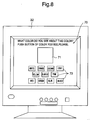
- Fig. 8 is a view showing a state that a color chart is displayed on a display.
- Fig. 8 shows the display 32 on which a character string 70 such as "What color do you see about this color ? Push button of color you see, please" is displayed at the top, a square color chart 71 is displayed at the center, and eleven buttons 72 for selecting a color name are displayed on the bottom.
- a character string 70 such as "What color do you see about this color ? Push button of color you see, please” is displayed at the top
- a square color chart 71 is displayed at the center
- eleven buttons 72 for selecting a color name are displayed on the bottom.
- a color name according to the color chart 71 is selected and entered to the color name input unit 53 shown in Fig. 5 (step S103). It is noted that only a part of these eleven buttons 72 is active in accordance with a sort of the displayed color chart.
- a color name As an input way of a color name, there is considered a method of entering an arbitrary color name by a user through a keyboard. In this case, there is prepared a dictionary indicative of a correspondence between the respective colors represented by the various color names and the categorical colors of the eleven colors. Thus, when the user enters any color name, the entered color name is rounded into anyone of the categorical colors of the eleven colors, and it is understood that the one categorical color is selected. Further, there is considered an alternative method in which a series of color charts is displayed in such a manner that a series of colors across the adjacent two categorical areas is displayed, and a color chart corresponding to the boundary of the adjacent two categorical areas is selected.
- Fig. 9 is a view of a screen on which a series of color charts are displayed to select a color chart corresponding to the boundary.
- Fig. 9 shows five color charts 80, 81, 82, 83 and 84.
- Display colors of these five color charts 80, 81, 82, 83 and 84 are a series of colors from green to blue.
- a character string 85 such as "Following colors change from green to blue. Which do you see green from ?”.
- the periphery of those color charts is black or gray.
- Fig. 10(A) is a view showing a case where the periphery of the color chart is black
- Fig. 10(B) is a view showing a case where the periphery of the color chart is gray.
- a color chart 90 is solely displayed at the center of a background 91 of the whole black.
- the color chart 90 is displayed with an edge 92 of gray.
- the black background has no color interfering with a perception for colors.
- a user determines a color name in accordance with only an impression as to a display color of the color chart.
- a user observe a pure color of the color chart displayed on the display.
- step S104 in which it is determined whether a selection of the color name is finished over all the color charts.
- step S105 in which a color chart to be next displayed is determined, and returns to the step S102. Thereafter, the steps S102 to 104 are repeated.
- step S104 in the event that it is decided that a selection of the color name is finished over all the color charts, the process goes to a step S106 in which display characteristics of the display is identified by the display characteristics identification unit 55 so that characteristics information according to the identification result is derived from the characteristic information holder 54.
- Fig. 11 is an illustration useful for understanding an example of a procedure in which a color chart is selected to decide display characteristics.
- Fig. 11 shows a procedure that display characteristics is classified into seven sorts by five sorts of color chart, in which to decide display characteristics of one display two or three color charts are used.
- the procedure for the classification proceeds from the left to the right of the figure.
- the first color chart is displayed (S102_1) in which as a color name of the first color chart blue or green is selected.
- the second color chart (S102_2) or the third color chart (S102_3) is displayed in accordance with the selected color name.
- the fourth color chart (S102_4) or the fifth color chart (S102_5) is displayed in accordance with the selected color name.
- the display characteristics is determined as the first display characteristics or the second display characteristics in accordance with the selection of the color name of the fourth color chart.
- the display characteristics is determined as the third display characteristics or the fourth display characteristics in accordance with the selection of the color name of the fifth color chart.
- red, brown or orange is selected.
- the display characteristics is determined as the fifth, sixth or seventh display characteristics in accordance with the selection of the color name of the third color chart.
- a chromaticity value representative of a color temperature is derived from the characteristic information holder 54 shown in Fig. 5 in form of the characteristic information in accordance with a determination result.
- a color temperature of the display can be set up to the typical color temperatures such as 5000K, 6500K, 9300K.
- the color temperature of 5000K corresponds to a color temperature under illumination of the general fluorescent light.
- a color temperature of the display is set up to 5000K.
- a color displayed on the display is determined in accordance with a combination of a main body of the display and a control side (for example, a graphic card of a personal computer).
- a value of the color temperature set up onto the display is simply associated with an accuracy of standards or so.
- 6500K is set up onto the display, it happens indeed, when the display is combined with the graphic card, that 5000K is established, or 8000K is established.
- Fig. 11 shows a state that display characteristics is classified into seven sorts.
- the color temperature according to the seven sorts of display characteristics are mutually differentiated.
- a possibility that the color temperature is properly distinguished through appearances of the second color chart by a person is about 75%.
- the distinction is modified in accordance with selection of a color name of the color chart.
- step S106 when the display characteristics of the display is determined to derive the color temperature, the process goes to step S107 and step S108 in which ⁇ characteristics is identified.
- step S107 an image for identification of ⁇ characteristics is displayed on the display.
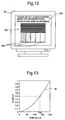
- Fig. 12 is a view showing images for discriminating ⁇ characteristics.
- Fig. 12 shows a display 32 on which displayed are a bar image 101 wherein black and white lines are alternately repeated and a plurality of concentration gray images 102 wherein they are mutually different in lightness. Further, above the images 101 and 102, there is displayed a character string 103 such as "Please select concentration image you see brightness which is the same as bar image". Thus, a user selects from among the plurality of concentration gray images 102 a concentration gray image on which the user see brightness which is the same as bar image 101 (step S108 in Fig. 6).
- Fig. 13 is a graph showing an example of input-output characteristics of a display.
- the axis of abscissas denotes an RGB value of an input and the axis of ordinates denotes the normalized output.
- the RGB value of the input is expressed by X
- the output is expressed by Y
- the bar image 101 shown in Fig. 12 corresponds to the output 0.5.
- the ⁇ coefficient is ⁇ 1.75.
- Fig. 14 is a view showing a concrete example of an ICC profile.
- the ICC profile consists of, as mentioned above, the profile header 1, the tagged element data 2 and the tag table 3. An explanation of the profile header 1 and the tag table 3 will be omitted to avoid the redundancy.
- the tagged element data 2 shown in Fig. 14 stores data related to the display itself as well as data of CIEXYZ values of white as the above-mentioned standard white information. All the data related to the display itself are character strings.
- a character string such as "Fujitsu” is stored in a desc tag 110
- a character string such as "Sample” is stored in a dmnd tag 111 and a dmdd tag 112
- a character string such as "Copyright (C) Fujitsu LTD. and Fujitsu Laboratories LTD. 1998" is stored in a cprt tag 113.
- the values obtained through calculation by these equations (3), (4) and (5) are stored in the ICC profile.
- the CIEXYZ value is expressed in 16 bits (code 1 bit; integer part 7 bits; decimal part 8 bits).
- the ICC profile shown in Fig. 14 stores, as the CIEXYZ value, (0.92955, 1.00000, 1.262257).
- Fig. 14 shows an example in which information indicative of an range of colors reproducible by a CRT display is stored.
- the range of colors reproducible by a CRT display is represented in form of a triangle area on the xy chromaticity diagram. The xy chromaticity value of the top of the triangle area is given by the substantially constant value as set forth below regardless of makers.
- ⁇ characteristics for red, green and blue are stored in an rTRC tag 118, a gTRC tag 119 and a bTRC tag 120, respectively.
- ⁇ characteristics the respective gradation values in 0 input, 1/2 input and the maximum input are stored.
- the gradation values are stored in form of 16 bits of value where the maximum value is 65535.
- Fig. 14 shows an example in which ⁇ coefficient is identified 2.0.
- the gradation values for red, green and blue are as follows:
- Those values are stored in the rTRC tag 118, the gTRC tag 119 and the bTRC tag 120.
- the second embodiment is substantially the same as the first embodiment except for the point that while the first embodiment is to produce the profile, according to the second embodiment, a plurality of profiles are previously prepared and held, and the optimum profile for display characteristics of a display is selected from among the plurality of profiles.
- Fig. 15 is a functional block diagram showing a second embodiment of a display characteristics recognition apparatus according to the present invention.
- the profile producing unit 56 is replaced by a profile selection unit 120 and a profile holding unit 121 for holding a plurality of profiles.
- the profile selection unit 120 selects one profile from among the plurality of profiles held by the profile holding unit 121 in accordance with the characteristic information obtained from the characteristic information holder 54 by the display characteristics identification unit 55. In other words, it is not always necessary that the characteristic information held in the characteristic information holder 54 is associated with the profile held in the profile holding unit 121.
- the profile selection unit 120 selects a suitable profile in accordance with a criterion such that a value indicative of display characteristics is close.
- a display of the color chart and a selection of the color name are repeated over a plurality of number of times.
- a display characteristics recognition apparatus embodying the present invention it is acceptable that a series of color charts are displayed at a time on a display, and color names of the respective color charts are entered on a batch basis.
- the first embodiment of the present invention is to determine a color temperature as display characteristics
- the third embodiment of the present invention is to determine a display luminance as display characteristics.
- Fig. 16 is a functional block diagram showing a third embodiment of a display characteristics recognition apparatus according to the present invention.
- the display characteristics identification unit 55, the characteristic information holder 54 and the profile producing unit 56 are replaced by a luminance identification unit 130 for identifying luminance in accordance with data of a color chart outputted from the color chart data output unit 52 and a color name entered to the color name input unit 53.
- Fig. 17 is a flowchart useful for understanding an operating procedure of the third embodiment of the display characteristics recognition apparatus according to the present invention.
- the color chart based on the above-mentioned Bezold-Br ⁇ cke Effect is displayed on the display (step S201).
- the Bezold-Br ⁇ cke Effect it is known that as intensity of the color light (luminance) is increased, a tinge of blue or yellow of chromatic color other than blue, green, yellow and red is increased, and oppositely as intensity of the color light is decreased, a tinge of green or red is increased.
- a color light of 600 nm looking like orange is increased in lightness
- a tingle of yellow is increased and finally does not look like orange (cf. "Color Science Dictionary” published by Color Society of Japan, pp 222).
- Fig. 18 is a view showing a state that a color chart is displayed in the third embodiment.
- Fig. 18 shows a display 32 on which three color charts 140 at the center of a display screen.
- These color charts 140 are concerned with such a color chart that a display color is over an range from a yellow area to an orange area in the categorical color perception.
- Those color charts 140 are ones in which a relationship between a display luminance and an appearance of orange is previously determined through a subjective estimation experience.
- the left color chart of the three color charts 140 is concerned with a color chart on which persons over 50 % recognized it as orange in the display of 100 cd/m 2
- the center color chart and the right color chart are concerned with a color chart on which persons over 50 % recognized it as orange in 150 cd/m 2 and 200 cd/m 2 , respectively.
- a character string 141 such as "Please see the following three colors. What color do you see orange ?".
- a character string 142 such as "Please click color you see orange”.
- step S202 in Fig. 17 when the selection by a user is performed, the process goes to a step S203 in which a display luminance is identified in accordance with a selection result.
- a strict value of the display luminance is not determined, but it is determined as to which group the display luminance belongs to among groups (for example, three groups of 150 cd/m 2 or more, 100 cd/m 2 or more, and less than 100 cd/m 2 ) of display luminance suitably set up.
- Fig. 18 shows a state that the plurality of color charts are simultaneously displayed, it is acceptable that the plurality of color charts are sequentially displayed one by one.
- the embodiment of a display characteristics adjusting apparatus is constructed with the computer system shown in Fig. 4.
- the CDROM 40 shown in Fig. 4 is an example of a display characteristics adjusting program storage medium referred to here.
- the display 32 is a part of the display characteristics adjusting apparatus and is also a subject to be adjusted in display characteristics by the display characteristics adjusting apparatus.
- color charts are displayed on the display 32.
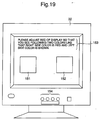
- Fig. 19 is a view showing a state that color charts are displayed by a display characteristics adjusting apparatus.
- Fig. 19 shows a display 32 on which two color charts 151 and 152 are displayed. Above those color charts 151 and 152, there is displayed a character string 153 such as "Please adjust red of display so that you see following two colors like that right side color is red and left side color is brown".
- a color display of the display Added to the general display are various control mechanisms for altering a color display of the display, such as contrast, brightness, color temperature, RGB level, etc.
- the display 32 shown in Fig. 19 is provided with setting buttons 154 for altering a color display.
- An operation of the setting buttons 154 by a user such that a color display is adjusted in accordance with an appearance of a display color of a color chart makes it possible to adjust display characteristics of the display properly.
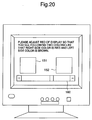
- Fig. 20 is a view showing a display screen in a case where an adjustment of the display is performed utilizing such a software.
- a slide bar 160 is displayed below the color charts 151 and 152.
- an operation of the slide bar 160 by a user makes it possible to adjust a display intensity of red.
- an alternation of sorts of a color chart or the like makes it possible to perform an adjustment for green and blue as well as red.
- Some of the recent display boards have a function capable of adjusting R,G,B displays of the display by a display driver. In case of such a display board, it is acceptable to adjust a display using such a function.
- a display characteristics recognition program stored in a display characteristics recognition program storage medium embodying the present invention causes a computer system to operate as such a display characteristics recognition apparatus. Further, a computer system embodying the present invention serves as such a display characteristics recognition apparatus.
- a display characteristics adjusting program stored in a display characteristics adjusting program storage medium causes a computer system to operate as such a display characteristics adjusting apparatus. Further, a computer system embodying the present invention serves as such a display characteristics adjusting apparatus.
Landscapes
- Engineering & Computer Science (AREA)
- Theoretical Computer Science (AREA)
- General Engineering & Computer Science (AREA)
- Physics & Mathematics (AREA)
- General Physics & Mathematics (AREA)
- Computer Hardware Design (AREA)
- Human Computer Interaction (AREA)
- Health & Medical Sciences (AREA)
- Biomedical Technology (AREA)
- General Health & Medical Sciences (AREA)
- Multimedia (AREA)
- Signal Processing (AREA)
- Controls And Circuits For Display Device (AREA)
- Processing Of Color Television Signals (AREA)
- Testing, Inspecting, Measuring Of Stereoscopic Televisions And Televisions (AREA)
Abstract
Description
wherein said main frame unit determines display characteristics of said display unit in accordance with the color chart signal outputted toward said display unit and the color name entered through said input unit.
wherein said main frame unit determines display characteristics of said display unit in accordance with the color chart signal outputted toward said display unit and the color entered through said input unit.
wherein said main frame unit determines luminance of said display unit in accordance with the color chart signal outputted toward said display unit and the monochrome figure entered through said input unit.
| X | Y | | x | y | ||
| 5000K | 7.11 | 3.55 | 28.56 | 0.181285 | 0.090515 | |
| 6500K | 13.53 | 6.54 | 61.78 | 0.165302 | 0.079902 | |
| 9300K | 19.22 | 9.1 | 93.51 | 0.157761 | 0.074694 |
| Color | | Blue | |
| 5000K | |||
| 6 | 2 | ||
| 9300K | 0 persons | 8 persons |
Claims (24)
- A display characteristics recognition apparatus comprising:signal output means connected to a display unit for displaying an image according to a signal entered, said display unit displaying the image with a color according to both the signal and display characteristics of said display unit, said signal output means outputting a color chart signal representative of a monochrome figure to said display unit;color name input means for entering a name of a color displayed on said display unit in accordance with the color chart signal outputted from said signal output means; anddisplay characteristics identification means for determining display characteristics of said display unit in accordance with the color chart signal outputted from said signal output means and the name of the color entered through said color name input means.
- A display characteristics recognition apparatus according to claim 1, wherein said display characteristics identification means determines, as the display characteristics, a relationship between a signal representative of a white image and a color of an image displayed on said display unit in accordance with the signal.
- A display characteristics recognition apparatus according to claim 2, wherein said display unit is selectively set up to anyone of a plurality of display characteristics, andsaid display characteristics identification means determines display characteristics to which said display unit is now set up.
- A display characteristics recognition apparatus according to claim 1, 2 or 3, wherein said display unit is a display in which an image is displayed through emission of light, andsaid display characteristics identification means determines, as the display characteristics, luminance of said display.
- A display characteristics recognition apparatus according to any preceding claim, wherein said signal output means outputs such a color chart signal that a color of an adjacent area as to colors adjacent to one another on a chromaticity diagram of a plurality of colors perceived as mutually different colors in name is displayed in chromaticity according to display characteristics.
- A display characteristics recognition apparatus according to any preceding claim, wherein said color name input means enters a name of a color selected from among a plurality of colors perceived as mutually different colors in name.
- A display characteristics recognition apparatus according to any preceding claim, wherein said signal output means outputs a plurality of color chart signals each representative of a monochrome figure to said display unit;said color name input means enters a name of a color of each of a plurality of monochrome figures; andsaid display characteristics identification means determines display characteristics of said display unit in accordance with the plurality of color chart signals outputted from said signal output means and the plurality of names of the color entered through said color name input means.
- A display characteristics recognition apparatus according to claim 7, wherein said signal output means outputs one of the plurality of color chart signals, and thereafter outputs, of the plurality of color chart signals, a color chart signal according to the name entered through said color name input means to said display unit.
- A display characteristics recognition apparatus according to any preceding claim, wherein said signal output means outputs the color chart signal to said display unit, and in addition outputs to said display unit a signal causing black to be displayed around the monochrome figure displayed on said display unit according to the color chart signal.
- A display characteristics recognition apparatus according to any one of claims 1 to 8, wherein said signal output means outputs the color chart signal to said display unit, and in addition outputs to said display unit a signal causing gray to be displayed around the monochrome figure displayed on said display unit according to the color chart signal and further causing black to be displayed around the gray.
- A display characteristics recognition apparatus according to any preceding claim, wherein said signal output means outputs a series of color chart signals such that a series of colors in adjacent areas for two sorts of colors adjacent to one another on a chromaticity diagram are displayed, andsaid color name input means selects a color corresponding to a boundary of the two sorts of colors from among the displayed series of colors.
- A display characteristics recognition apparatus according to any preceding claim, wherein said display characteristics recognition apparatus further comprises profile producing means for generating data representative of display characteristics determined by said display characteristics identification means in a predetermined format to produce a profile representative of characteristics as to display of an image by said display unit including the data.
- A display characteristics recognition apparatus according to any preceding claim, wherein said display characteristics recognition apparatus further comprises:profile storage means for storing various sorts of profiles each representative of characteristics as to display of an image by a display unit including data indicative of various display characteristics in a common format; andprofile selection means for selecting one profile from among the various sorts of profiles stored in said profile storage means in accordance with the display characteristics determined by said display characteristics identification means.
- A display characteristics recognition program storage medium storing a display characteristics recognition program comprising:signal output means connected to a display unit for displaying an image according to a signal entered, said display unit displaying the image with a color according to both the signal and display characteristics of said display unit, said signal output means outputting a color chart signal representative of a monochrome figure to said display unit;color name input means for entering a name of a color displayed on said display unit in accordance with the color chart signal outputted from said signal output means; anddisplay characteristics identification means for determining display characteristics of said display unit in accordance with the color chart signal outputted from said signal output means and the name of the color entered through said color name input means.
- A computer system comprising:a display unit for displaying an image according to a signal entered, said display unit displaying the image with a color according to both the signal and display characteristics of said display unit;a main frame unit for outputting to said display unit a color chart signal representative of a monochrome figure and color name signals, which are representative of a plurality of color names, respectively; andinput unit for entering a color name selected from among said plurality of color names to said main frame unit in accordance with an operation,
wherein said main frame unit determines display characteristics of said display unit in accordance with the color chart signal outputted toward said display unit and the color name entered through said input unit. - A computer system comprising:a display unit for displaying an image according to a signal entered, said display unit displaying the image with a color according to both the signal and display characteristics of said display unit;a main frame unit for outputting to said display unit a series of color chart signals such that a series of colors in adjacent areas for two sorts of colors adjacent to one another on a chromaticity diagram are displayed; andinput unit for entering a color corresponding to a boundary of the two sorts of colors, which is selected from among the series of colors displayed on said display unit, to said main frame unit in accordance with an operation,
wherein said main frame unit determines display characteristics of said display unit in accordance with the color chart signal outputted toward said display unit and the color entered through said input unit. - A computer system according to claim 16 wherein said main frame unit outputs to said display unit the series of color chart signals, and in addition a message signal representative of a message inquiring as to from which color of the series of colors displayed on said display unit an operator visually identifies it as a color of a specified color name.
- A computer system comprising:a display unit for displaying an image according to a signal entered, said display unit displaying on a luminous display basis the image with a color according to both the signal and display characteristics of said display unit;a main frame unit for outputting to said display unit color chart signals representative of a plurality of monochrome figures associated with mutually different luminance of said display unit, each of the plurality of monochrome figures being displayed with a color of a specified color name under an associated luminance; andinput unit for selectively entering a monochrome figure displayed with a color of the specified color name of the plurality of monochrome figures displayed on said display unit, to said main frame unit in accordance with an operation,
wherein said main frame unit determines luminance of said display unit in accordance with the color chart signal outputted toward said display unit and the monochrome figure entered through said input unit. - A computer system according to claim 18, wherein said main frame unit outputs color chart signals representative of a plurality of monochrome figures associated with mutually different luminance of said display unit, each of the plurality of monochrome figures being displayed with such a color that persons of a predetermined ratio and up recognize it as the color of the specified color name under an associated luminance.
- A display characteristics adjusting apparatus for adjusting display characteristics of a display unit for displaying an image according to a signal entered, said display unit displaying the image with a color according to both the signal and display characteristics of said display unit, said display characteristics adjusting apparatus comprising:signal output means for outputting to said display unit such a color chart signal that a color belonging to an adjacent area as to colors adjacent to one another on a chromaticity diagram of a plurality of colors perceived as mutually different colors in name is displayed on said display unit in accordance with display characteristics of said display unit.
- A display characteristics adjusting program storage medium storing a display characteristics adjusting program incorporated into a computer system, said display characteristics adjusting program causing said computer system to operate a display characteristics adjusting apparatus for adjusting display characteristics of a display unit for displaying an image according to a signal entered, said display unit displaying the image with a color according to both the signal and display characteristics of said display unit, said display characteristics adjusting program comprising:signal output means for outputting to said display unit such a color chart signal that a color belonging to an adjacent area as to colors adjacent to one another on a chromaticity diagram of a plurality of colors perceived as mutually different colors in name is displayed on said display unit in accordance with display characteristics of said display unit.
- A computer system comprising:a display unit for displaying an image according to a signal entered, said display unit displaying the image with a color according to both the signal and display characteristics of said display unit;adjusting means for adjusting display characteristics of said display unit in accordance with an operation; anda main frame unit for outputting to said display unit such a color chart signal that a color belonging to an adjacent area as to colors adjacent to one another on a chromaticity diagram of a plurality of colors perceived as mutually different colors in name is displayed on said display unit in accordance with display characteristics of said display unit.
- A computer program which, when run on a computer, causes the computer to become a display characteristics recognition apparatus as claimed in any one of claims 1 to 13.
- A computer program which, when run on a computer, causes the computer to become a display characteristics adjusting apparatus as claimed in claim 20.
Applications Claiming Priority (2)
| Application Number | Priority Date | Filing Date | Title |
|---|---|---|---|
| JP10008299 | 1999-04-04 | ||
| JP10008299A JP4427125B2 (en) | 1999-04-07 | 1999-04-07 | Display characteristic recognition apparatus, display characteristic recognition program storage medium, display characteristic adjustment apparatus, and display characteristic adjustment program storage medium |
Publications (2)
| Publication Number | Publication Date |
|---|---|
| EP1043708A2 true EP1043708A2 (en) | 2000-10-11 |
| EP1043708A3 EP1043708A3 (en) | 2003-11-19 |
Family
ID=14264531
Family Applications (1)
| Application Number | Title | Priority Date | Filing Date |
|---|---|---|---|
| EP00300833A Withdrawn EP1043708A3 (en) | 1999-04-04 | 2000-02-03 | Recognising and adjusting display characteristics |
Country Status (3)
| Country | Link |
|---|---|
| US (1) | US6850245B1 (en) |
| EP (1) | EP1043708A3 (en) |
| JP (1) | JP4427125B2 (en) |
Cited By (1)
| Publication number | Priority date | Publication date | Assignee | Title |
|---|---|---|---|---|
| GB2368436A (en) * | 2000-05-16 | 2002-05-01 | Hewlett Packard Co | Named colour sustitution |
Families Citing this family (22)
| Publication number | Priority date | Publication date | Assignee | Title |
|---|---|---|---|---|
| JP4524371B2 (en) * | 2000-10-23 | 2010-08-18 | 独立行政法人 国立印刷局 | Magnetic information recording printed matter and authenticity determination method |
| US7006130B2 (en) * | 2001-05-11 | 2006-02-28 | John H. Harshbarger, Jr. | Visual cue for display testing having one bit resolution |
| US7133148B2 (en) * | 2002-01-25 | 2006-11-07 | Hewlett-Packard Development Company, L.P. | Digital camera for image device calibration |
| KR100499149B1 (en) * | 2003-06-30 | 2005-07-04 | 삼성전자주식회사 | Method for visual measurement of the lightness characteristic of the ambient light source of a display |
| US20050073530A1 (en) * | 2003-10-03 | 2005-04-07 | Jay Kapur | System and method for display calibration |
| JP4533156B2 (en) * | 2004-02-02 | 2010-09-01 | キヤノン株式会社 | Adjustment circuit and method |
| JP4677323B2 (en) * | 2004-11-01 | 2011-04-27 | キヤノン株式会社 | Image processing apparatus and image processing method |
| KR20070087354A (en) * | 2006-02-23 | 2007-08-28 | 삼성전자주식회사 | Q & A screen providing device and method |
| US7876356B2 (en) * | 2006-03-16 | 2011-01-25 | Samsung Electronics Co., Ltd. | Methods and systems for display color calibration using remote control |
| US7808526B2 (en) * | 2006-04-04 | 2010-10-05 | Samsung Electronics Co., Ltd. | Methods and systems for example-based TV color calibration |
| JP5198740B2 (en) * | 2006-05-18 | 2013-05-15 | 三菱電機株式会社 | Color management system and color management method |
| TW200809716A (en) * | 2006-08-08 | 2008-02-16 | Colorart Technology Inc | Flat panel display capable of correcting color characteristics automatically and the method thereof |
| TWI353531B (en) * | 2008-05-13 | 2011-12-01 | Wistron Corp | Method and a device of adjusting a color temperatu |
| CN101685591B (en) * | 2008-09-26 | 2011-06-22 | 鸿富锦精密工业(深圳)有限公司 | Detection device and method for automatically detecting picture format supported by display device |
| JP5106349B2 (en) * | 2008-10-28 | 2012-12-26 | キヤノン株式会社 | Color processing apparatus and color processing method |
| EP2200268B1 (en) | 2008-12-22 | 2012-02-08 | Thomson Licensing | Method of calibration of a target color reproduction device |
| US8881058B2 (en) * | 2011-04-01 | 2014-11-04 | Arthur Austin Ollivierre | System and method for displaying objects in a user interface based on a visual acuity of a viewer |
| US20130342562A1 (en) * | 2012-06-26 | 2013-12-26 | Peter Rae Shintani | Visual Accessibility for Vision Impaired |
| JP2015066262A (en) * | 2013-09-30 | 2015-04-13 | 富士フイルム株式会社 | Image processing apparatus, image processing system, and image processing method |
| TWI551114B (en) * | 2014-09-30 | 2016-09-21 | 和碩聯合科技股份有限公司 | Multimedia interface detecting system and detecting method |
| KR102317118B1 (en) * | 2015-09-09 | 2021-10-25 | 삼성디스플레이 주식회사 | Image compensating device and display device having the same |
| CN113396319B (en) * | 2019-02-05 | 2024-04-30 | 凸版印刷株式会社 | Color conversion information generation method, color conversion information generation system, and program |
Family Cites Families (18)
| Publication number | Priority date | Publication date | Assignee | Title |
|---|---|---|---|---|
| GB9115809D0 (en) * | 1991-07-22 | 1991-09-04 | Philips Electronic Associated | Display apparatus and method of storing pictures |
| US5216504A (en) * | 1991-09-25 | 1993-06-01 | Display Laboratories, Inc. | Automatic precision video monitor alignment system |
| US5416890A (en) * | 1991-12-11 | 1995-05-16 | Xerox Corporation | Graphical user interface for controlling color gamut clipping |
| US5459678A (en) * | 1992-07-02 | 1995-10-17 | Feasey; Michael F. | Method and calibration apparatus for calibrating computer monitors used in the printing and textile industries |
| US5956044A (en) * | 1993-05-07 | 1999-09-21 | Eastman Kodak Company | Imaging device to media compatibility and color appearance matching with flare, luminance, and white point comparison |
| JP3159416B2 (en) | 1993-05-18 | 2001-04-23 | 富士写真フイルム株式会社 | Image processing method and apparatus |
| US5381349A (en) * | 1993-06-29 | 1995-01-10 | Hewlett-Packard Company | System for calibrating a color display to enable color-matching |
| EP0674430A1 (en) * | 1994-03-24 | 1995-09-27 | Eastman Kodak Company | Method and apparatus for interactive color transformation of color values between color spaces |
| US5483259A (en) * | 1994-04-12 | 1996-01-09 | Digital Light & Color Inc. | Color calibration of display devices |
| US5786803A (en) * | 1994-05-09 | 1998-07-28 | Apple Computer, Inc. | System and method for adjusting the illumination characteristics of an output device |
| US5670985A (en) * | 1994-05-09 | 1997-09-23 | Apple Computer, Inc. | System and method for adjusting the output of an output device to compensate for ambient illumination |
| US5499040A (en) * | 1994-06-27 | 1996-03-12 | Radius Inc. | Method and apparatus for display calibration and control |
| AU3232595A (en) | 1994-07-01 | 1996-01-25 | Apple Computer, Inc. | Method and system for embedding a device profile into a document and extracting a device profile from a document in a color management system |
| US5611030A (en) * | 1994-09-16 | 1997-03-11 | Apple Computer, Inc. | Subjectively pleasing color gamut mapping in a color computer graphics system |
| US5638117A (en) | 1994-11-14 | 1997-06-10 | Sonnetech, Ltd. | Interactive method and system for color characterization and calibration of display device |
| JPH0918902A (en) | 1995-06-21 | 1997-01-17 | Eastman Kodak Co | Visual characterization using display model |
| US5943036A (en) * | 1995-07-27 | 1999-08-24 | Akio Tanaka | Flicker reduction system for computer graphical interlaced display |
| US6313824B1 (en) * | 1998-04-10 | 2001-11-06 | Adobe Systems Incorporated | Image preview system |
-
1999
- 1999-04-07 JP JP10008299A patent/JP4427125B2/en not_active Expired - Fee Related
-
2000
- 2000-01-31 US US09/494,534 patent/US6850245B1/en not_active Expired - Fee Related
- 2000-02-03 EP EP00300833A patent/EP1043708A3/en not_active Withdrawn
Cited By (2)
| Publication number | Priority date | Publication date | Assignee | Title |
|---|---|---|---|---|
| GB2368436A (en) * | 2000-05-16 | 2002-05-01 | Hewlett Packard Co | Named colour sustitution |
| GB2368436B (en) * | 2000-05-16 | 2004-06-09 | Hewlett Packard Co | Named color substitution |
Also Published As
| Publication number | Publication date |
|---|---|
| EP1043708A3 (en) | 2003-11-19 |
| US6850245B1 (en) | 2005-02-01 |
| JP4427125B2 (en) | 2010-03-03 |
| JP2000293129A (en) | 2000-10-20 |
Similar Documents
| Publication | Publication Date | Title |
|---|---|---|
| EP1043708A2 (en) | Recognising and adjusting display characteristics | |
| US8345338B2 (en) | Method of modifying color composition for a color-blind person in a mobile displaying apparatus | |
| JP3890211B2 (en) | Image processing method, image processing apparatus, program, and storage medium | |
| US7737992B2 (en) | Method and system for transforming adaptively visual contents according to terminal user's color vision characteristics | |
| EP1300827B1 (en) | Image processing device for transmitting color with fidelity and image data providing method | |
| US7480405B2 (en) | Methods for selecting high visual contrast colors in user-interface design | |
| JPWO2002005256A1 (en) | Image processing device that faithfully transmits colors and method for providing image data | |
| CN115131221A (en) | Color correction method, correctable display method, electronic device and chip | |
| US6078309A (en) | System and method for visually measuring color characteristics of a display | |
| EP0987528B1 (en) | Information processing apparatus with color display unit | |
| Shen et al. | Measuring and modeling display observer metamerism | |
| Laird et al. | Development and evaluation of gamut extension algorithms | |
| Bai et al. | Observer variability study and method to implement observer categories for novel light source projection system | |
| Bao et al. | Testing the performance of CIECAM02 from 100 to 3500 cd/m2 | |
| US20030125566A1 (en) | Visual display characterization | |
| Gao et al. | Perceived white region of displays with varied color gamuts | |
| JP2005109583A (en) | Image processor, image processing method, image processing program, and storage medium | |
| US7425965B2 (en) | Colour calibration | |
| JP2019062285A (en) | Display device primary color design system, display device primary color design method, and program | |
| CN117043844A (en) | Image display system, image display method, image display program and image display device | |
| Xu et al. | Evaluation of the colour quality of display primary: Part I. Chromaticity based methods | |
| LeHoty et al. | Comparing Displays Using Luma Contours and Color Volumes | |
| Motomura | Analysis of gamut mapping algorithms from the viewpoint of color name matching | |
| JP2006319751A (en) | Printing performance judgment device, printing performance judgment method, or printing performance judgment system | |
| KR100787665B1 (en) | Image processing apparatus and image data providing method that faithfully delivers color |
Legal Events
| Date | Code | Title | Description |
|---|---|---|---|
| PUAI | Public reference made under article 153(3) epc to a published international application that has entered the european phase |
Free format text: ORIGINAL CODE: 0009012 |
|
| AK | Designated contracting states |
Kind code of ref document: A2 Designated state(s): AT BE CH CY DE DK ES FI FR GB GR IE IT LI LU MC NL PT SE |
|
| AX | Request for extension of the european patent |
Free format text: AL;LT;LV;MK;RO;SI |
|
| PUAL | Search report despatched |
Free format text: ORIGINAL CODE: 0009013 |
|
| AK | Designated contracting states |
Kind code of ref document: A3 Designated state(s): AT BE CH CY DE DK ES FI FR GB GR IE IT LI LU MC NL PT SE |
|
| AX | Request for extension of the european patent |
Extension state: AL LT LV MK RO SI |
|
| RIC1 | Information provided on ipc code assigned before grant |
Ipc: 7H 04N 17/04 B Ipc: 7G 09G 5/02 B Ipc: 7G 09G 5/00 A |
|
| 17P | Request for examination filed |
Effective date: 20031217 |
|
| AKX | Designation fees paid |
Designated state(s): DE FR GB |
|
| 17Q | First examination report despatched |
Effective date: 20090507 |
|
| STAA | Information on the status of an ep patent application or granted ep patent |
Free format text: STATUS: THE APPLICATION IS DEEMED TO BE WITHDRAWN |
|
| 18D | Application deemed to be withdrawn |
Effective date: 20140130 |