EP1043583A2 - Detection of hydrogen sulfide in hydride gases - Google Patents
Detection of hydrogen sulfide in hydride gases Download PDFInfo
- Publication number
- EP1043583A2 EP1043583A2 EP00106265A EP00106265A EP1043583A2 EP 1043583 A2 EP1043583 A2 EP 1043583A2 EP 00106265 A EP00106265 A EP 00106265A EP 00106265 A EP00106265 A EP 00106265A EP 1043583 A2 EP1043583 A2 EP 1043583A2
- Authority
- EP
- European Patent Office
- Prior art keywords
- gas
- hydrogen sulfide
- stream
- acetate
- hydride
- Prior art date
- Legal status (The legal status is an assumption and is not a legal conclusion. Google has not performed a legal analysis and makes no representation as to the accuracy of the status listed.)
- Withdrawn
Links
Images

Classifications
-
- G—PHYSICS
- G01—MEASURING; TESTING
- G01N—INVESTIGATING OR ANALYSING MATERIALS BY DETERMINING THEIR CHEMICAL OR PHYSICAL PROPERTIES
- G01N21/00—Investigating or analysing materials by the use of optical means, i.e. using sub-millimetre waves, infrared, visible or ultraviolet light
- G01N21/84—Systems specially adapted for particular applications
- G01N21/8483—Investigating reagent band
-
- G—PHYSICS
- G01—MEASURING; TESTING
- G01N—INVESTIGATING OR ANALYSING MATERIALS BY DETERMINING THEIR CHEMICAL OR PHYSICAL PROPERTIES
- G01N33/00—Investigating or analysing materials by specific methods not covered by groups G01N1/00 - G01N31/00
- G01N33/0004—Gaseous mixtures, e.g. polluted air
- G01N33/0009—General constructional details of gas analysers, e.g. portable test equipment
- G01N33/0027—General constructional details of gas analysers, e.g. portable test equipment concerning the detector
- G01N33/0036—General constructional details of gas analysers, e.g. portable test equipment concerning the detector specially adapted to detect a particular component
- G01N33/0044—Sulphides, e.g. H2S
-
- G—PHYSICS
- G01—MEASURING; TESTING
- G01N—INVESTIGATING OR ANALYSING MATERIALS BY DETERMINING THEIR CHEMICAL OR PHYSICAL PROPERTIES
- G01N21/00—Investigating or analysing materials by the use of optical means, i.e. using sub-millimetre waves, infrared, visible or ultraviolet light
- G01N21/75—Systems in which material is subjected to a chemical reaction, the progress or the result of the reaction being investigated
- G01N21/77—Systems in which material is subjected to a chemical reaction, the progress or the result of the reaction being investigated by observing the effect on a chemical indicator
- G01N21/78—Systems in which material is subjected to a chemical reaction, the progress or the result of the reaction being investigated by observing the effect on a chemical indicator producing a change of colour
- G01N21/783—Systems in which material is subjected to a chemical reaction, the progress or the result of the reaction being investigated by observing the effect on a chemical indicator producing a change of colour for analysing gases
-
- Y—GENERAL TAGGING OF NEW TECHNOLOGICAL DEVELOPMENTS; GENERAL TAGGING OF CROSS-SECTIONAL TECHNOLOGIES SPANNING OVER SEVERAL SECTIONS OF THE IPC; TECHNICAL SUBJECTS COVERED BY FORMER USPC CROSS-REFERENCE ART COLLECTIONS [XRACs] AND DIGESTS
- Y10—TECHNICAL SUBJECTS COVERED BY FORMER USPC
- Y10T—TECHNICAL SUBJECTS COVERED BY FORMER US CLASSIFICATION
- Y10T436/00—Chemistry: analytical and immunological testing
- Y10T436/11—Automated chemical analysis
-
- Y—GENERAL TAGGING OF NEW TECHNOLOGICAL DEVELOPMENTS; GENERAL TAGGING OF CROSS-SECTIONAL TECHNOLOGIES SPANNING OVER SEVERAL SECTIONS OF THE IPC; TECHNICAL SUBJECTS COVERED BY FORMER USPC CROSS-REFERENCE ART COLLECTIONS [XRACs] AND DIGESTS
- Y10—TECHNICAL SUBJECTS COVERED BY FORMER USPC
- Y10T—TECHNICAL SUBJECTS COVERED BY FORMER US CLASSIFICATION
- Y10T436/00—Chemistry: analytical and immunological testing
- Y10T436/11—Automated chemical analysis
- Y10T436/110833—Utilizing a moving indicator strip or tape
-
- Y—GENERAL TAGGING OF NEW TECHNOLOGICAL DEVELOPMENTS; GENERAL TAGGING OF CROSS-SECTIONAL TECHNOLOGIES SPANNING OVER SEVERAL SECTIONS OF THE IPC; TECHNICAL SUBJECTS COVERED BY FORMER USPC CROSS-REFERENCE ART COLLECTIONS [XRACs] AND DIGESTS
- Y10—TECHNICAL SUBJECTS COVERED BY FORMER USPC
- Y10T—TECHNICAL SUBJECTS COVERED BY FORMER US CLASSIFICATION
- Y10T436/00—Chemistry: analytical and immunological testing
- Y10T436/16—Phosphorus containing
-
- Y—GENERAL TAGGING OF NEW TECHNOLOGICAL DEVELOPMENTS; GENERAL TAGGING OF CROSS-SECTIONAL TECHNOLOGIES SPANNING OVER SEVERAL SECTIONS OF THE IPC; TECHNICAL SUBJECTS COVERED BY FORMER USPC CROSS-REFERENCE ART COLLECTIONS [XRACs] AND DIGESTS
- Y10—TECHNICAL SUBJECTS COVERED BY FORMER USPC
- Y10T—TECHNICAL SUBJECTS COVERED BY FORMER US CLASSIFICATION
- Y10T436/00—Chemistry: analytical and immunological testing
- Y10T436/18—Sulfur containing
-
- Y—GENERAL TAGGING OF NEW TECHNOLOGICAL DEVELOPMENTS; GENERAL TAGGING OF CROSS-SECTIONAL TECHNOLOGIES SPANNING OVER SEVERAL SECTIONS OF THE IPC; TECHNICAL SUBJECTS COVERED BY FORMER USPC CROSS-REFERENCE ART COLLECTIONS [XRACs] AND DIGESTS
- Y10—TECHNICAL SUBJECTS COVERED BY FORMER USPC
- Y10T—TECHNICAL SUBJECTS COVERED BY FORMER US CLASSIFICATION
- Y10T436/00—Chemistry: analytical and immunological testing
- Y10T436/18—Sulfur containing
- Y10T436/182—Organic or sulfhydryl containing [e.g., mercaptan, hydrogen, sulfide, etc.]
- Y10T436/184—Only hydrogen sulfide
Definitions
- Phosphine is a reagent used in the manufacture of light emitting devices (LEDs) by metal-organic chemical vapor deposition (MOCVD) techniques.
- MOCVD metal-organic chemical vapor deposition
- manufacturers use phosphine to produce AlInGaP (aluminum indium gallium phosphide) LEDs.
- sulfur in the high parts per billion (ppb) or low parts per million (ppm) ranges adversely impacts LED properties.
- ppb high parts per billion
- ppm low parts per million
- Hydrogen sulfide is the most common source of this contamination.
- gas manufacturers require an analytical method for measuring hydrogen sulfide (H 2 S) in phosphine (PH 3 ) on the order of 100 parts ppb or lower to improve the product by purification.
- Extrapolating the semiconductor sulfur analysis back to the phosphine gas is not acceptable as a quality control or product monitoring for a phosphine plant. This process is expensive and highly resource-intensive.
- Total sulfur analyzers based on reduction to H 2 S in hydrogen cannot be used because PH 3 would decompose on the catalyst at the reduction temperatures required.
- analyzing total sulfur by oxidation in oxygen to SO 2 would be hazardous, because of the flammability of PH 3 .
- Gas chromatography provides a problematic technique for measuring trace H 2 S levels in hydride gases. This technique, while theoretically possible, is impracticable because separating trace H 2 S from streams of approximately 100 percent PH 3 is difficult due to the closeness of the elution times and "stickiness" of the H 2 S. Furthermore, PH 3 also interferes with the signal from trace H 2 S sensors.
- V. J. Altieri describes a qualitative test for hydrogen sulfide in gases using a filter paper strip soaked in 5 percent lead acetate solution. The process visually compares the darkness of the paper to paper not exposed to the gas.
- D. V. Moses et al. in "H 2 S Recorder", U.S. Pat. No. 2,232,622 describe a lead acetate paper tape analyzer. An illuminating gas passes through the tape that is drawn through a roller at a fixed rate. The darkness of the stain is read optically with reflected light to a photocell and compared with unexposed tape.
- Kimbell in "Gas Detector", U.S. Pat. No. 3,464,799, describes a technique for using an analyzer in explosive environments.
- Kimbell in "Periodic Sampling Concentration Indicator", U.S. Pat. No. 4,127,780, describes the operation of the Houston-Atlas lead acetate tape hydrogen sulfide analyzer. This process relies on an electronic differentiating circuit to measure darkening rate. The process can determine darkening rate in a period that is substantially linear with hydrogen sulfide concentration.
- the method measures hydrogen sulfide concentrations in hydride gases in a sealed vessel.
- the sealed vessel has a gas inlet to receive a stream of hydride gas, a gas outlet to remove the stream of hydride gas and a metal acetate substrate.
- the stream of hydride gas contains a concentration of hydrogen sulfide gas.
- Introducing the stream of hydride gas through the gas inlet contacts the acetate substrate with the stream of hydride gas.
- Reacting the hydrogen sulfide gas contained in the stream of hydride gas with the acetate substrate modifies optical properties of the acetate substrate.
- measuring the optical properties of the acetate substrate determines the concentration of the hydrogen sulfide gas contained in the stream of hydride gas.
- the apparatus for measuring hydrogen sulfide concentrations in gas streams includes a sealed vessel having a gas inlet for receiving a stream of hydrogen sulfide-containing gas and a gas outlet for discharging the stream of hydrogen sulfide-containing gas.
- a test cell within the vessel connects to the gas inlet and the gas outlet, the test cell is for reacting the stream of hydrogen sulfide-containing gas received from the gas inlet with a metal acetate substrate and for modifying optical properties of the acetate substrate.
- a purge chamber connected to the test cell has an inlet for receiving an inert gas and an outlet for removing the inert gas.
- An optical sensor measures the modified optical properties of the acetate substrate and determines the hydrogen sulfide gas concentration.
- the improved design for hydrides such as PH 3 includes a tape box isolated from the electronics. This enables sealing and purging of the box with all of the purge gas directed to a phosphine scrubber.
- the design also uses a humidified purge gas that prevents the metal acetate substrate from drying out. The process operates with metal acetate deposited on any substrate. Most advantageously, the substrate consists of a tape.
- the humidified purge gas moistens the metal acetate to facilitate the darkening reaction with the metal acetate.
- the metal acetate is an element selected from the group consisting of lead and zinc.
- An optional improvement in this design is to direct the humidified stream at the lead acetate tape to provide a constant-humidified flow. This eliminates any requirement to rely on diffusion of moisture from remote parts of the tape box. Since the design's sample gas stream does not humidify the metal acetate, it allows the sample gas stream to flow directly to the tape without passing through a bubbler or other humidifying device. In this way, the sample gas remains dry.
- phosphine usually contains less than about 1 ppm water. This also has the advantage that the process produces no aqueous phosphine solutions--long after analyzing hydrogen sulfide content, residual phosphine solutions have the potential to decompose or to outgas toxic phosphine.
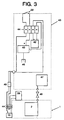
- the phosphine gas handling system is separated from the electronics (not shown).
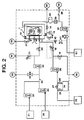
- a lead acetate tape box 2 is placed inside a stainless steel NEMA 4X sealed purge box 1.
- the tape box 2 contains a roll of lead acetate impregnated or coated tape 3, mechanized tape advance spools 4, a gas sample test cell 5, and a fiber optic sensor assembly 6.
- the white lead acetate tape 3 turns brown with exposure to H 2 S.
- the purge box 1 contains gas tight entry and exit ports (at 7, 8, 9, 10 and 11).
- the purge box contains a humidified nitrogen purge gas inlet 7, a purge gas outlet 8, a sample gas outlet 9, a fiber optic sensor entrance 10, a sample gas inlet 11, a humidified purge gas direction tube 12 and a lid safety switch 13.
- the purge box has two sealed entrance and exit ports (not illustrated) for the tape drive and safety lid switch.
- a purge outlet manifold, connected to the purge box at purge gas outlet 8 contains a pressure gage 15, a purge gas monitoring valve 16 and a vent scrubber isolation valve 14.
- the sample gas outlet 9 also has a scrubber isolation valve 17.
- the sample and calibration gas feed manifold utilizes four pneumatically actuated diaphragm valves 18, 19, 20, and 21 to direct the flow to the cell or to the scrubber vent.
- the phosphine delivery system consists of a regulated PH 3 source 23 that feeds a PH 3 purifier 24 through a valve manifold consisting of inlet, outlet, and bypass valves 25, 26, and 27, respectively.
- the PH 3 flow to valves 18 and 19 is controlled with a flowmeter 28.
- the apparatus substitutes the flowmeters with mass flow controllers for improved accuracy.
- the calibration gas is prepared by: 1) metering a regulated H 2 S-in-nitrogen standard 29 through a flowmeter 30; and 2) blending it through calibrated gas supply line 33 with a regulated nitrogen diluent source 31 controlled with a flowmeter 32.
- the resulting blend is measured with an additional flowmeter 34 as it passes to the analyzer through the valve 20 or vents through the valve 21. Excess calibration blend is vented through a discharge valve 35. All vents are directed to a gas scrubber system 50.
- a regulator 36 and flowmeter 37 regulate a nitrogen purge gas source 51 through a flow switch 39 and a humidifier 40.
- the nitrogen source 51 also serves as the pneumatic actuator supply for valves 18 and 19.
- the nitrogen source 51 is delivered through a regulator 41 and electrically controlled by a solenoid 42. Another optional modification is to make the delivery system and tape box gas tight so that both sample and purge gases can be directed essentially completely to a phosphine scrubber for safe disposal.
- an electronics compartment 43 is electrically connected to purge box 1 with electrical connectors 48 and 49. Wires are terminated at terminal blocks 44.
- Other components of the electronics compartment 43 are a 12-volt DC power supply 45, a 120-volt AC main power supply 46, and a tape advance motor power supply 47.
- the safety system is designed to stop the flow of phosphine to the analyzer and to direct it to vent by closing the valve 18 and opening the valve 19 ( Figures 1 and 2).
- EXAMPLE 1 Phosphine from a cylinder was passed through a specially prepared H 2 S absorption unit to remove hydrogen sulfide. The purified phosphine was then analyzed by the standard addition method with the modified lead acetate paper tape analyzer described in Figures 1-3. The method utilized a seven-minute tape equilibration time with the 90 percent phosphine-10 percent nitrogen-H 2 S blend, followed by a seven-minute read time. The equilibration time facilitated making subsequent optical darkness readings more linear with H 2 S concentration.
- EXAMPLE 2 Phosphine from a cylinder was analyzed by the standard addition method to determine the H 2 S content. The tape calibration, equilibration and read method were the same as in Example 1. Table 1 below provides the results of this method. Standard Addition (ppb H 2 S) Beginning Darkness Final Darkness Change in Darkness Ppb H 2 S Displayed Ppb H 2 S from Phosphine Sample 0.00 26.03 26.18 0.15 1.63 -- 150.00 29.30 40.53 11.23 182.86 32.86 200.00 33.46 47.82 14.36 234.42 34.42
- the beginning darkness was an optical readout expressed as percentage darkening at the beginning of the read period; and the final darkness was the readout at the end of the seven-minute read period.
- the tape darkened very little, indicating that the concentration was low and that a standard addition must be made to bring the darkness level into the linear range.
- the darkness change indicated a level of 183 and 234 ppb H 2 S, respectively. Since this was 33-34 ppb above the level of the standard addition, the phosphine contributed 33-34 ppb. Therefore, since the nitrogen diluted the sample by 10 percent, the H 2 S in the original cylinder phosphine contained 37-38 ppb H 2 S.
- the analyzer with components from a lead acetate paper tape hydrogen sulfide analyzer, such as a Houston Atlas analyzer.
- the Houston Atlas analyzer contains components that monitor the rate of darkening of the tape or the final darkness count over a specific period with fiber optics.
- the sample gas flows over (not through) the tape.
- the apparatus operates with any method that could detect the darkening of a metal acetate tape with H 2 S. In some designs, transmitted light could be monitored, or the gas could be passed through the tape rather than over the tape.
- Other lead acetate tape H 2 S analyzers and air monitors are commercially available, e.g . from Trace Environmental, Del Mar Scientific, and MDA Scientific. The most important modifications are to isolate the gas delivery system and tape from the electronics so that the tape box can be purged and humidified with an inert gas stream, preferably nitrogen or argon.
- the process can improve its sensitivity by increasing the tape exposure time (both equilibration and read times). This allows a lower H 2 S concentration in the standard addition (or even no standard addition if enough H 2 S is in the sample). Furthermore, controlling the humidity at higher levels could improve sensitivity.
- adding moisture to the purge gas can be accomplished simply by bubbling it through water or by passing it over water. It is most advantageous to direct the humidified purge gas onto the lead acetate tape at a point before it advances into the sample exposure position.
- the purge flow rate should be sufficient to maintain the purge box essentially free of air, but otherwise is not critical (the test used about 10 Liters/minute).
- a preferred mode of operation is to calibrate by standard additions.
- hydrogen sulfide as a dilute standard in nitrogen (or argon) is blended into the actual phosphine sample.
- This internal standard is delivered preferably in ratios such that the phosphine is not diluted to less than 75 percent of its original concentration.
- the process typically operated at 90 percent PH 3 - 10 percent N 2 standard containing H 2 S. By using internal standards, the process can calculate the H 2 S in the phosphine sample without actually having a pre-made standard of H 2 S in PH 3 .
- the optical readings of the brown lead sulfide stain are substantially linear with H 2 S concentration within a certain concentration range.
- This substantially linear range consists of an area whose linear extrapolation introduces less than ten percent error in the result.
- the linear range is also the most sensitive range. [Below or above this range, the readings are nonlinear.] Thus, it is most advantageous to be within this range when analyzing a sample.
- the linear range will vary with conditions chosen, for example the time of tape exposure, flow rate, humidity, temperature, among other factors.
- the measuring of the darkened lead acetate substrate or tape consists of an initial exposure to a stream of phosphine gas for 1 to 30 minutes and a second exposure of 1 to 30 minutes to measure the change in optical properties or H 2 S concentration. Typically, operating with a tape exposure time of 14 minutes (seven minutes equilibration, seven minutes optical read time), 150 mL/min flow rate, 20 percent relative humidity, and ambient temperature produced reliable ppb measurements.
- H 2 S The optimum range for linear measurement of H 2 S is approximately 100-250 ppbv for lead acetate tape. If samples are in this range, they do not require standard additions to provide reliable measurements. Industry demands however require measurement of lower H 2 S levels. For example, some commercial processes require H 2 S levels to be below 50 ppb. At these low levels, it is preferable to add a calibrated primer gas and use the standard addition method. Furthermore, it is also possible to use the nonlinear portion of the H 2 S calibration curve for measurements below 100 ppb without making standard additions. For H 2 S levels below about 50 ppb however, the tape darkness reading changes so little (for the 14-minute exposure time) that sensitivity and accuracy of the readings are poor.
- the process of the invention operates to measure hydrogen sulfide in hydride gases such as phosphine, arsine (AsH 3 ), silane (SiH 4 ) and germane (GeH 4 ). Since some hydrides such as arsine can react with lead acetate however, the process may require a different metal acetate tape that is non-reactive. Optionally, it may be possible to control test conditions to ensure that the metal acetate tape does not react with the hydride.
- hydride gases such as phosphine, arsine (AsH 3 ), silane (SiH 4 ) and germane (GeH 4 ). Since some hydrides such as arsine can react with lead acetate however, the process may require a different metal acetate tape that is non-reactive. Optionally, it may be possible to control test conditions to ensure that the metal acetate tape does not react with the hydride.
- the device and method of the invention provide for accurate and reliable testing of H 2 S in hydride gases.
- the process measures hydrogen sulfide present in a phosphine gas. It measures H 2 S in this gas in the parts per billion range. Moistening the metal acetate tape with a separate purge gas allows for measurement without humidity fluctuations associated with air.
Landscapes
- Chemical & Material Sciences (AREA)
- Life Sciences & Earth Sciences (AREA)
- Health & Medical Sciences (AREA)
- General Physics & Mathematics (AREA)
- Pathology (AREA)
- Analytical Chemistry (AREA)
- Biochemistry (AREA)
- General Health & Medical Sciences (AREA)
- Engineering & Computer Science (AREA)
- Immunology (AREA)
- Physics & Mathematics (AREA)
- Molecular Biology (AREA)
- Combustion & Propulsion (AREA)
- Food Science & Technology (AREA)
- Medicinal Chemistry (AREA)
- Investigating Or Analyzing Non-Biological Materials By The Use Of Chemical Means (AREA)
- Investigating Or Analysing Materials By The Use Of Chemical Reactions (AREA)
- Solid-Sorbent Or Filter-Aiding Compositions (AREA)
- Investigating Or Analysing Materials By Optical Means (AREA)
Abstract
Description
| Standard Addition (ppb H2S) | Beginning Darkness | Final Darkness | Change in Darkness | Ppb H2S Displayed | Ppb H2S from Phosphine Sample |
| 0.00 | 26.03 | 26.18 | 0.15 | 1.63 | -- |
| 150.00 | 29.30 | 40.53 | 11.23 | 182.86 | 32.86 |
| 200.00 | 33.46 | 47.82 | 14.36 | 234.42 | 34.42 |
Claims (10)
- A method of measuring hydrogen sulfide concentrations in hydride gases comprising the steps of:a) providing a sealed vessel, said vessel having a gas inlet to receive a stream of hydride gas, a gas outlet to remove said stream of hydride gas and a metal acetate substrate, said stream of hydride gas containing a concentration of hydrogen sulfide gas;b) introducing said stream of hydride gas through said gas inlet to contact said acetate substrate with said stream of hydride gas;c) reacting said hydrogen sulfide gas contained in said stream of hydride gas with said acetate substrate to modify optical properties of said acetate substrate; andd) measuring said optical properties of said acetate substrate to determine said concentration of said hydrogen sulfide gas contained in said stream of hydride gas.
- The method of claim 1 including the additional step of purging said vessel with a mixture of an inert gas and water vapor to moisten said acetate substrate before said reacting of said hydrogen sulfide gas with said acetate substrate.
- The method of claim 1 including the additional step of exposing said acetate substrate to a calibrated hydrogen sulfide-containing primer gas before said introducing of said stream of hydride gas to pre-darken said acetate substrate and to allow said measuring of said optical properties of said acetate substrate with a substantially linear relationship between said concentration of said hydrogen sulfide gas and darkness.
- The method of claim 1 wherein said measuring includes comparing a darkened acetate substrate to a standard, said standard being prepared from a known hydrogen sulfide concentration.
- The method of claim 1 wherein said metal acetate is formed with an element selected from the group selected of lead and zinc.
- The method of claim 1 wherein said acetate substrate consists of a lead acetate tape and said lead acetate tape darkens by browning upon exposure to said hydrogen sulfide gas.
- An apparatus for measuring hydrogen sulfide concentrations in gas streams comprising:a sealed vessel having a gas inlet for receiving a stream of hydrogen sulfide-containing gas and a gas outlet for discharging the stream of hydrogen sulfide-containing gas;a test cell within said vessel connected to said gas inlet and said gas outlet, said test cell being for reacting the stream of hydrogen sulfide-containing gas received from said gas inlet with a metal acetate substrate and for modifying optical properties of the acetate substrate;a purge chamber connected to said test cell, said purge chamber having an inlet for receiving an inert gas and having an outlet for removing the inert gas; andan optical sensor for measuring the modified optical properties of the acetate substrate and for determining hydrogen sulfide gas concentration.
- The apparatus of claim 7 wherein said purge chamber contains a set of spools for supporting lead acetate tape connected between said spools and for feeding the lead acetate tape into said test cell.
- The apparatus of claim 8 wherein said purge chamber contains a purge tube for directing a water vapor-containing gas at the lead acetate tape before the lead acetate substrate feeds into said test cell.
- The apparatus of claim 7 wherein said sealed vessel connects to a calibrated hydrogen sulfide gas supply line for priming the acetate substrate and for allowing measurement of the hydrogen sulfide gas concentration with a substantially linear relationship between the hydrogen gas concentration and darkness of the acetate substrate.
Applications Claiming Priority (2)
| Application Number | Priority Date | Filing Date | Title |
|---|---|---|---|
| US275574 | 1988-11-23 | ||
| US09/275,574 US6319722B1 (en) | 1999-03-24 | 1999-03-24 | Analysis of hydrogen sulfide in hydride gases |
Publications (2)
| Publication Number | Publication Date |
|---|---|
| EP1043583A2 true EP1043583A2 (en) | 2000-10-11 |
| EP1043583A3 EP1043583A3 (en) | 2001-04-18 |
Family
ID=23052907
Family Applications (1)
| Application Number | Title | Priority Date | Filing Date |
|---|---|---|---|
| EP00106265A Withdrawn EP1043583A3 (en) | 1999-03-24 | 2000-03-22 | Detection of hydrogen sulfide in hydride gases |
Country Status (5)
| Country | Link |
|---|---|
| US (1) | US6319722B1 (en) |
| EP (1) | EP1043583A3 (en) |
| JP (1) | JP2000298124A (en) |
| CN (1) | CN1268664A (en) |
| CA (1) | CA2302380A1 (en) |
Cited By (8)
| Publication number | Priority date | Publication date | Assignee | Title |
|---|---|---|---|---|
| EP1820013A1 (en) * | 2004-12-07 | 2007-08-22 | Honeywell Analytics AG | Gas detection method and system |
| EP1646409A4 (en) * | 2003-07-22 | 2008-05-07 | Steris Corp | VISUAL DETECTION SYSTEM FOR VAPORIZED HYDROGEN PEROXIDE |
| CN103743731A (en) * | 2013-12-23 | 2014-04-23 | 广西科技大学 | Sulfuretted hydrogen detection reagent |
| EP2871462A1 (en) * | 2013-11-11 | 2015-05-13 | Halliburton Energy Services, Inc. | Improved determination of fluid compositions |
| WO2017139568A1 (en) * | 2016-02-11 | 2017-08-17 | Honeywell International Inc. | Probing film that absorbs and reacts with gases, with transmitted light for higher gas sensitivity |
| CN115789458A (en) * | 2022-11-25 | 2023-03-14 | 电子科技大学长三角研究院(湖州) | Equipment for detecting hydrogen sulfide content in industrial park |
| US12111265B2 (en) | 2016-02-11 | 2024-10-08 | Honeywell International Inc. | Probing film that absorbs and reacts with gases, with light of different wavelengths for higher gas sensitivity |
| US12535427B2 (en) | 2016-02-11 | 2026-01-27 | Honeywell International Inc. | Probing film that absorbs and reacts with gases, with light of different wavelengths, humidity detection, and optionally temperature detection |
Families Citing this family (12)
| Publication number | Priority date | Publication date | Assignee | Title |
|---|---|---|---|---|
| US6947138B2 (en) * | 2003-06-16 | 2005-09-20 | Advanced Technology Materials, Inc. | Optical sensor system and method for detection of hydrides and acid gases |
| US20050135970A1 (en) * | 2003-12-18 | 2005-06-23 | Mroczynski Shawn A. | Hydrogen sulfide monitoring system |
| US7519479B2 (en) * | 2006-11-22 | 2009-04-14 | Galvanic Applied Sciences Inc. | Slope detection for measuring gas concentration |
| GB0712922D0 (en) * | 2007-07-03 | 2007-08-15 | Swedish Biomimetics 3000 Ltd | Solid phase reaction method |
| FR2930340B1 (en) * | 2008-04-22 | 2013-03-22 | Total Sa | METHOD FOR SAMPLING HYDROGEN SULFIDE |
| WO2010079349A1 (en) * | 2009-01-07 | 2010-07-15 | Swedish Biomimetics 3000 Limited | Dual mobile phase apparatus and method |
| US10656095B2 (en) * | 2011-02-09 | 2020-05-19 | Honeywell International Inc. | Systems and methods for wavelength spectrum analysis for detection of various gases using a treated tape |
| CN104297392B (en) * | 2014-11-03 | 2015-12-30 | 常州宏福高端膦技术研发中心有限公司 | Detect the method and apparatus of phosphine gas purity |
| WO2018206243A1 (en) | 2017-05-10 | 2018-11-15 | Opsis Ab | Method and system for determining a content of h2s |
| US11821823B2 (en) | 2021-08-02 | 2023-11-21 | Saudi Arabian Oil Company | Creating a hydrogen sulfide crude oil reference standard |
| CN115308200B (en) * | 2022-10-12 | 2022-12-13 | 东营钧辰石油设备有限责任公司 | Sealed gas detector adopting lead acetate paper method |
| KR102602190B1 (en) * | 2023-01-02 | 2023-11-15 | (주)엠지케이 | Treatment method using a toxic and hazardous residual gas treatment system |
Family Cites Families (14)
| Publication number | Priority date | Publication date | Assignee | Title |
|---|---|---|---|---|
| US2232622A (en) | 1940-03-23 | 1941-02-18 | Du Pont | H2s recorder |
| US2551281A (en) | 1944-11-29 | 1951-05-01 | Du Pont | Automatic gas analyzer |
| US2800397A (en) | 1953-08-18 | 1957-07-23 | Standard Oil Co | Method and apparatus for analyzing a reactive gas |
| US2895807A (en) | 1957-07-22 | 1959-07-21 | Standard Oil Co | Multiple stream gas analyzer |
| FR1438625A (en) | 1965-04-27 | 1966-05-13 | Zimmer Verfahrenstechnik | Method and apparatus for continuously dosing a component in a gas mixture |
| US3464799A (en) | 1965-06-14 | 1969-09-02 | Charles L Kimbell | Gas detector |
| FR1539930A (en) * | 1967-08-10 | 1968-09-20 | Aquitaine Petrole | Method and device for measuring quantities of reactant compounds |
| US4032297A (en) * | 1974-06-14 | 1977-06-28 | Combustion Equipment Associates, Inc. | Pollution monitoring apparatus |
| US4127780A (en) | 1975-06-30 | 1978-11-28 | Kimbell Charles L | Periodic sampling concentration indicator |
| FR2540882A1 (en) * | 1983-02-15 | 1984-08-17 | Shell Int Research | CATALYTIC HYDRODESULFURATION OF HYDROCARBON MIXTURES |
| JPH0510938A (en) * | 1991-07-01 | 1993-01-19 | Nippon Steel Corp | Method and apparatus for analyzing phosphorus and sulfur in metal samples |
| JPH0534291A (en) * | 1991-07-29 | 1993-02-09 | Nippon Steel Corp | Method and apparatus for analysis of trace amounts of phosphorus and sulfur in metal samples |
| JPH06186221A (en) * | 1992-09-24 | 1994-07-08 | Nippon Steel Corp | Method and apparatus for simultaneous analysis of sulfur and phosphorus in metal samples |
| JPH08178910A (en) * | 1994-12-21 | 1996-07-12 | Nippon Steel Corp | Method and apparatus for analyzing sulfur and phosphorus in metal sample |
-
1999
- 1999-03-24 US US09/275,574 patent/US6319722B1/en not_active Expired - Fee Related
-
2000
- 2000-03-22 JP JP2000079846A patent/JP2000298124A/en active Pending
- 2000-03-22 CN CN00104399A patent/CN1268664A/en active Pending
- 2000-03-22 EP EP00106265A patent/EP1043583A3/en not_active Withdrawn
- 2000-03-22 CA CA002302380A patent/CA2302380A1/en not_active Abandoned
Cited By (11)
| Publication number | Priority date | Publication date | Assignee | Title |
|---|---|---|---|---|
| EP1646409A4 (en) * | 2003-07-22 | 2008-05-07 | Steris Corp | VISUAL DETECTION SYSTEM FOR VAPORIZED HYDROGEN PEROXIDE |
| CN101832989A (en) * | 2003-07-22 | 2010-09-15 | 史戴瑞思公司 | Indicator to confirm minimum concentration of vaporized hydrogen peroxide |
| EP1820013A1 (en) * | 2004-12-07 | 2007-08-22 | Honeywell Analytics AG | Gas detection method and system |
| EP2871462A1 (en) * | 2013-11-11 | 2015-05-13 | Halliburton Energy Services, Inc. | Improved determination of fluid compositions |
| US9624769B2 (en) | 2013-11-11 | 2017-04-18 | Halliburton Energy Services, Inc. | Determination of fluid compositions |
| CN103743731A (en) * | 2013-12-23 | 2014-04-23 | 广西科技大学 | Sulfuretted hydrogen detection reagent |
| WO2017139568A1 (en) * | 2016-02-11 | 2017-08-17 | Honeywell International Inc. | Probing film that absorbs and reacts with gases, with transmitted light for higher gas sensitivity |
| US11788970B2 (en) | 2016-02-11 | 2023-10-17 | Honeywell International Inc. | Probing film that absorbs and reacts with gases, with transmitted light for higher gas sensitivity |
| US12111265B2 (en) | 2016-02-11 | 2024-10-08 | Honeywell International Inc. | Probing film that absorbs and reacts with gases, with light of different wavelengths for higher gas sensitivity |
| US12535427B2 (en) | 2016-02-11 | 2026-01-27 | Honeywell International Inc. | Probing film that absorbs and reacts with gases, with light of different wavelengths, humidity detection, and optionally temperature detection |
| CN115789458A (en) * | 2022-11-25 | 2023-03-14 | 电子科技大学长三角研究院(湖州) | Equipment for detecting hydrogen sulfide content in industrial park |
Also Published As
| Publication number | Publication date |
|---|---|
| CA2302380A1 (en) | 2000-09-24 |
| CN1268664A (en) | 2000-10-04 |
| US6319722B1 (en) | 2001-11-20 |
| JP2000298124A (en) | 2000-10-24 |
| EP1043583A3 (en) | 2001-04-18 |
Similar Documents
| Publication | Publication Date | Title |
|---|---|---|
| US6319722B1 (en) | Analysis of hydrogen sulfide in hydride gases | |
| US5661036A (en) | Process for the detection of sulfur | |
| US5214952A (en) | Calibration for ultra high purity gas analysis | |
| KR970007065B1 (en) | Diagnostic gas monitoring method | |
| US3826618A (en) | Automatic mercury monitor | |
| US4738147A (en) | Low flow sampling and analysis system | |
| JPS5810131Y2 (en) | Sulfur dioxide fluorescence detection device | |
| Tanaka et al. | High quality measurements of the concentration of atmospheric carbon dioxide | |
| US4005983A (en) | Method and apparatus for colorimetric analysis | |
| US5080867A (en) | Portable carbonyl sulfide analyzer | |
| CN215953498U (en) | Sulphide diluting device | |
| US3713776A (en) | Automatic mercury monitor | |
| GB2216262A (en) | Ozone calibrating method | |
| US3969626A (en) | Method and apparatus for detecting total reduced sulfur | |
| JP2006514310A (en) | Hydrogen sulfide monitoring device | |
| US6472223B1 (en) | Method and system for continuously monitoring and controlling a process stream | |
| Hochheiser | Methods of measuring and monitoring atmospheric sulfur dioxide | |
| US4977093A (en) | Process for analyzing carbonyl sulfide in a gas | |
| WO1993017333A2 (en) | Carbon analyser | |
| EP0440815B1 (en) | Method of and device for measuring extremely small quantity of oxygen in gas | |
| Paré | A new tape reagent for the determination of hydrogen sulfide in air | |
| US5734097A (en) | Analyzer and method for measuring water in liquids | |
| US4211748A (en) | Stack gas analyzer and thermal oxidation device therefor | |
| JPH08254523A (en) | Measuring apparatus and method for measuring oxygen permeability of sample | |
| CN120427506B (en) | Acceleration simulation device and simulation method for pigment degradation of ancient mural |
Legal Events
| Date | Code | Title | Description |
|---|---|---|---|
| PUAI | Public reference made under article 153(3) epc to a published international application that has entered the european phase |
Free format text: ORIGINAL CODE: 0009012 |
|
| AK | Designated contracting states |
Kind code of ref document: A2 Designated state(s): DE ES FR GB IT NL |
|
| AX | Request for extension of the european patent |
Free format text: AL;LT;LV;MK;RO;SI |
|
| RIN1 | Information on inventor provided before grant (corrected) |
Inventor name: LITWIN, MICHAEL MARK Inventor name: GODDARD, JOHN BURNHAM Inventor name: SALIM, SATERIA |
|
| PUAL | Search report despatched |
Free format text: ORIGINAL CODE: 0009013 |
|
| AK | Designated contracting states |
Kind code of ref document: A3 Designated state(s): AT BE CH CY DE DK ES FI FR GB GR IE IT LI LU MC NL PT SE |
|
| AX | Request for extension of the european patent |
Free format text: AL;LT;LV;MK;RO;SI |
|
| 17P | Request for examination filed |
Effective date: 20010430 |
|
| AKX | Designation fees paid |
Free format text: DE ES FR GB IT NL |
|
| STAA | Information on the status of an ep patent application or granted ep patent |
Free format text: STATUS: THE APPLICATION HAS BEEN WITHDRAWN |
|
| 18W | Application withdrawn |
Withdrawal date: 20020513 |