EP1043040A2 - A device for use in the application of cricoid pressure (force) and/or in training for such application - Google Patents
A device for use in the application of cricoid pressure (force) and/or in training for such application Download PDFInfo
- Publication number
- EP1043040A2 EP1043040A2 EP00301980A EP00301980A EP1043040A2 EP 1043040 A2 EP1043040 A2 EP 1043040A2 EP 00301980 A EP00301980 A EP 00301980A EP 00301980 A EP00301980 A EP 00301980A EP 1043040 A2 EP1043040 A2 EP 1043040A2
- Authority
- EP
- European Patent Office
- Prior art keywords
- force
- patient
- force applied
- cricoid
- monitoring
- Prior art date
- Legal status (The legal status is an assumption and is not a legal conclusion. Google has not performed a legal analysis and makes no representation as to the accuracy of the status listed.)
- Withdrawn
Links
- 238000000034 method Methods 0.000 claims abstract description 29
- 238000012544 monitoring process Methods 0.000 claims abstract description 18
- 238000002627 tracheal intubation Methods 0.000 claims abstract description 12
- 210000003685 cricoid cartilage Anatomy 0.000 claims description 22
- 230000006835 compression Effects 0.000 claims description 3
- 238000007906 compression Methods 0.000 claims description 3
- 239000006260 foam Substances 0.000 claims description 3
- 239000004033 plastic Substances 0.000 claims description 3
- 229920003023 plastic Polymers 0.000 claims description 3
- 238000004891 communication Methods 0.000 claims description 2
- 239000000463 material Substances 0.000 claims 1
- 210000003811 finger Anatomy 0.000 description 7
- 206010002091 Anaesthesia Diseases 0.000 description 4
- 238000001949 anaesthesia Methods 0.000 description 4
- 230000037005 anaesthesia Effects 0.000 description 4
- 210000003813 thumb Anatomy 0.000 description 4
- 230000003444 anaesthetic effect Effects 0.000 description 2
- 210000003736 gastrointestinal content Anatomy 0.000 description 2
- 210000000867 larynx Anatomy 0.000 description 2
- 210000004072 lung Anatomy 0.000 description 2
- 210000003437 trachea Anatomy 0.000 description 2
- 206010063349 Endotracheal intubation complication Diseases 0.000 description 1
- 206010061218 Inflammation Diseases 0.000 description 1
- 239000000853 adhesive Substances 0.000 description 1
- 238000010586 diagram Methods 0.000 description 1
- 230000005611 electricity Effects 0.000 description 1
- 230000006698 induction Effects 0.000 description 1
- 230000004054 inflammatory process Effects 0.000 description 1
- 238000007689 inspection Methods 0.000 description 1
- 230000014759 maintenance of location Effects 0.000 description 1
- 210000004916 vomit Anatomy 0.000 description 1
- 230000008673 vomiting Effects 0.000 description 1
- 238000005303 weighing Methods 0.000 description 1
Images


Classifications
-
- A—HUMAN NECESSITIES
- A61—MEDICAL OR VETERINARY SCIENCE; HYGIENE
- A61M—DEVICES FOR INTRODUCING MEDIA INTO, OR ONTO, THE BODY; DEVICES FOR TRANSDUCING BODY MEDIA OR FOR TAKING MEDIA FROM THE BODY; DEVICES FOR PRODUCING OR ENDING SLEEP OR STUPOR
- A61M16/00—Devices for influencing the respiratory system of patients by gas treatment, e.g. ventilators; Tracheal tubes
- A61M16/04—Tracheal tubes
- A61M16/0488—Mouthpieces; Means for guiding, securing or introducing the tubes
-
- A—HUMAN NECESSITIES
- A61—MEDICAL OR VETERINARY SCIENCE; HYGIENE
- A61M—DEVICES FOR INTRODUCING MEDIA INTO, OR ONTO, THE BODY; DEVICES FOR TRANSDUCING BODY MEDIA OR FOR TAKING MEDIA FROM THE BODY; DEVICES FOR PRODUCING OR ENDING SLEEP OR STUPOR
- A61M16/00—Devices for influencing the respiratory system of patients by gas treatment, e.g. ventilators; Tracheal tubes
- A61M16/04—Tracheal tubes
- A61M16/0465—Tracheostomy tubes; Devices for performing a tracheostomy; Accessories therefor, e.g. masks, filters
- A61M16/0472—Devices for performing a tracheostomy
-
- A—HUMAN NECESSITIES
- A61—MEDICAL OR VETERINARY SCIENCE; HYGIENE
- A61M—DEVICES FOR INTRODUCING MEDIA INTO, OR ONTO, THE BODY; DEVICES FOR TRANSDUCING BODY MEDIA OR FOR TAKING MEDIA FROM THE BODY; DEVICES FOR PRODUCING OR ENDING SLEEP OR STUPOR
- A61M16/00—Devices for influencing the respiratory system of patients by gas treatment, e.g. ventilators; Tracheal tubes
- A61M16/0003—Accessories therefor, e.g. sensors, vibrators, negative pressure
- A61M2016/0027—Accessories therefor, e.g. sensors, vibrators, negative pressure pressure meter
-
- A—HUMAN NECESSITIES
- A61—MEDICAL OR VETERINARY SCIENCE; HYGIENE
- A61M—DEVICES FOR INTRODUCING MEDIA INTO, OR ONTO, THE BODY; DEVICES FOR TRANSDUCING BODY MEDIA OR FOR TAKING MEDIA FROM THE BODY; DEVICES FOR PRODUCING OR ENDING SLEEP OR STUPOR
- A61M2205/00—General characteristics of the apparatus
- A61M2205/33—Controlling, regulating or measuring
- A61M2205/332—Force measuring means
-
- A—HUMAN NECESSITIES
- A61—MEDICAL OR VETERINARY SCIENCE; HYGIENE
- A61M—DEVICES FOR INTRODUCING MEDIA INTO, OR ONTO, THE BODY; DEVICES FOR TRANSDUCING BODY MEDIA OR FOR TAKING MEDIA FROM THE BODY; DEVICES FOR PRODUCING OR ENDING SLEEP OR STUPOR
- A61M2209/00—Ancillary equipment
- A61M2209/02—Equipment for testing the apparatus
Definitions
- This invention relates to a device for training an operative, for example medical personnel and anaesthetic assistants, in the correct application and monitoring of force to the cricoid cartilage of a patient undergoing tracheal intubation, for example at the onset of anaesthesia. It can also be used as device for use directly on patients to apply said force.
- the application of cricoid force is an important technique, which is routinely used during emergency and obstetric anaesthesia.
- the technique involves the application of external force on the cricoid cartilage (at the front of the neck) to occlude the lumen of the oesophagus which lies behind it.
- the aim of the technique is to prevent the inhalation of regurgitated stomach contents into the lungs when the patient loses consciousness at the onset of anaesthesia.
- the inhalation of vomit should it occur is very serious as it causes severe inflammation of the lungs and the outcome may be fatal.
- a device for use in the application of force to the cricoid cartilage of a patient undergoing tracheal intubation including means for transmitting force applied to the device to the cricoid cartilage and means for monitoring the force applied.
- a device for use in training an operative in the reproduction of a desired force intended to be applied by the person so trained to the cricoid cartilage of a patient undergoing tracheal intubation including means for transmitting force applied to the device to a patient substitute and means for monitoring the force applied.
- kits of parts for use in both the training of an operative in the application of force to the cricoid cartilage of a patient undergoing tracheal intubation and in the actual application of said force to such a patient, the kit comprising a device having means for transmitting force applied to the device to a patient or a patient substitute and means for monitoring the force applied, together with an intermediate component for connecting between the device and the cricoid cartilage of a patient.
- the device comprises a first part which may be placed directly, or indirectly by means of an intermediate component, on the cricoid cartilage, and a second part coupled to said first part whereby force applied to the second part is transmitted to the first part.
- the second part includes a cylinder and the first part includes a piston disposed within the cylinder for movement relative thereto into and out of one end of the cylinder.
- a seal is provided between the piston and the other end of the cylinder.
- the means for monitoring the force applied comprises means for monitoring the degree of compression of the space within the cylinder above the piston against a resistive force.
- the resistive force may be supplied by a spring disposed between the first part and the second part.
- the spring is calibrated to indicate the force applied to the device.
- the resistive force may be supplied by a pressure gauge in communication with the space within the cylinder above the piston.
- the device preferably includes extension means on which one or more fingers may be placed to apply force manually to the device.
- the extension means may comprise one or more wings.
- the device may be used as it is for the purpose of training an operative in the use of the ACF procedure, by placing the tip (distal end) of the piston on a hard surface or on a manikin, but in order that the same device may be used in the actual application of ACF to a patient, an intermediate component in the form of a U-shaped cricoid yoke is provided between the first part and the patient's cricoid cartilage.
- This yoke which is preferably moulded from rubber or foam, is conveniently fixed onto the distal end of the piston, to convert the device from a training device into a device for using the ACF procedure on a patient.
- a method of applying a desired force to the cricoid cartilage of a patient undergoing tracheal intubation including using on said patient a device having means for transmitting force applied to the device to the patient, and monitoring the force applied.
- a method of training an operative in the technique of applied cricoid force comprising applying force to a patient substitute such as a hard surface or a manikin using a device having means for monitoring the force applied.
- a first embodiment of the invention comprises a plastic cylinder 1, a piston 2 with seal 10 and an aneroid pressure gauge 3 connected to the nozzle of the cylinder 4 either directly as in figure 2 or via a plastic tubing 5 as in figure 3.
- a second embodiment of the invention is shown in figure 4. It is similar to the first embodiment except that instead of the pressure gauge, a calibrated spring 6, inserted inside the barrel of the cylinder 1 in the space between the seal 10 and the nozzle, is used for monitoring the ACF. Any conventional scale can similarly be used to calibrate this prototype. The values of force obtained on the weight scale are then marked on a self-adhesive label 7 attached along the barrel of the cylinder. The end of the cylinder 1 above the piston has air outlets to allow compression of the spring.
- Figure 5 shows the cricoid yoke. Both embodiments can be converted into cricoid devices for direct use on patients by slotting the distal end of the piston of either prototype into this compatible U-shaped, rubber or foam-moulded cricoid yoke 9.
- the devices When the devices are not connected to the cricoid yoke they can be used as training tools to allow trainees to practice the correct force e.g. on a bench, a table or a manikin in order to be able subsequently to use the correct force when applying a three-finger technique directly to a patient.
- the procedure of using the devices as training tools is as follows:
- the devices After attaching the compatible yoke to the tip of the piston the devices can be used directly on patients as follows:
Landscapes
- Health & Medical Sciences (AREA)
- Pulmonology (AREA)
- Biomedical Technology (AREA)
- Emergency Medicine (AREA)
- Engineering & Computer Science (AREA)
- Anesthesiology (AREA)
- Otolaryngology (AREA)
- Heart & Thoracic Surgery (AREA)
- Hematology (AREA)
- Life Sciences & Earth Sciences (AREA)
- Animal Behavior & Ethology (AREA)
- General Health & Medical Sciences (AREA)
- Public Health (AREA)
- Veterinary Medicine (AREA)
- Instructional Devices (AREA)
Abstract
Description
- This invention relates to a device for training an operative, for example medical personnel and anaesthetic assistants, in the correct application and monitoring of force to the cricoid cartilage of a patient undergoing tracheal intubation, for example at the onset of anaesthesia. It can also be used as device for use directly on patients to apply said force.
- The application of cricoid force is an important technique, which is routinely used during emergency and obstetric anaesthesia. The technique involves the application of external force on the cricoid cartilage (at the front of the neck) to occlude the lumen of the oesophagus which lies behind it. The aim of the technique is to prevent the inhalation of regurgitated stomach contents into the lungs when the patient loses consciousness at the onset of anaesthesia. The inhalation of vomit should it occur is very serious as it causes severe inflammation of the lungs and the outcome may be fatal. Although the technique will be referred to hereinafter with reference to force (as in "applied cricoid force" or ACF) it should be appreciated that the technique is also commonly referred to with reference to pressure (as in "applied cricoid pressure" or ACP). Thus, "force" as used herein is to be interpreted as encompassing "pressure" and vice versa except where such an interpretation would be contrary to the contextual meaning.
- Sellick first described the ACF technique, in 1961. It involves the use of three fingers; the index finger is used to apply pressure on the cricoid cartilage and the middle finger and the thumb to stabilise the larynx during the procedure. The force required is equal to 40 Newtons. The anaesthetist's assistant during induction of anaesthesia should consistently maintain this force until the anaesthetist secures the patient airway by inserting a cuffed tracheal tube in the trachea (windpipe).
- It is important that the exact force should be applied as the application of an excessive force on the cricoid cartilage distorts the larynx and makes tracheal intubation difficult. On the other hand, if the force applied is inadequate, the patient may be subjected to the dangers of inhalation of stomach contents.
- Several studies have shown that it is difficult to consistently apply the exact cricoid force and that there is wide individual variation in the ACF with 47%-61% of medical staff applying an inadequate force. It has also been shown that to apply the correct force, frequent training in the manoeuvre is required as retention of skills after acquiring the experience is short lived. To gain experience, trainees practice on weight scales to be able to manually reproduce the correct ACF. It is also possible to train anaesthetic assistants to reproduce the correct force during simulated ACF but mechanical simulators are not readily available and are expensive. It is, therefore, necessary to provide a simple and readily available training tool to allow frequent training and to maintain skills. No training devices currently exist but a few devices for the application of the ACF directly on a patient are available. However, they have not been widely adopted in clinical practice. This is largely because of various shortcomings including complexity, expense, reliance on electricity/battery supply, delay in setting up the equipment when urgently required or they are heavy resulting in laryngeal distortion and difficult tracheal intubation. For these reasons, currently, manual application of cricoid pressure, with its aforesaid shortcomings, remains the predominant method.
- It is one aim of the present invention to provide means for enabling ACF to be applied correctly, and consistently, for a sufficient period of time. It is a further aim of the present invention to provide means for training an operative in the ACF procedure.
- It is yet a further aim of the present invention to provide means for both the application of cricoid force to a patient, and for training an operative to do so.
- It is yet a further aim of the present invention to provide an ACF device and/or training device which addresses the problems of prior art devices of this type, whether referred to herein or otherwise.
- According to a first aspect of the present invention there is provided a device for use in the application of force to the cricoid cartilage of a patient undergoing tracheal intubation, the device including means for transmitting force applied to the device to the cricoid cartilage and means for monitoring the force applied.
- According to a second aspect of the present invention there is provided a device for use in training an operative in the reproduction of a desired force intended to be applied by the person so trained to the cricoid cartilage of a patient undergoing tracheal intubation, the device including means for transmitting force applied to the device to a patient substitute and means for monitoring the force applied.
- According to a third aspect of the present invention there is provided a kit of parts for use in both the training of an operative in the application of force to the cricoid cartilage of a patient undergoing tracheal intubation and in the actual application of said force to such a patient, the kit comprising a device having means for transmitting force applied to the device to a patient or a patient substitute and means for monitoring the force applied, together with an intermediate component for connecting between the device and the cricoid cartilage of a patient.
- Preferably, the device comprises a first part which may be placed directly, or indirectly by means of an intermediate component, on the cricoid cartilage, and a second part coupled to said first part whereby force applied to the second part is transmitted to the first part.
- Conveniently, the second part includes a cylinder and the first part includes a piston disposed within the cylinder for movement relative thereto into and out of one end of the cylinder.
- Preferably, a seal is provided between the piston and the other end of the cylinder.
- Preferably, the means for monitoring the force applied comprises means for monitoring the degree of compression of the space within the cylinder above the piston against a resistive force.
- The resistive force may be supplied by a spring disposed between the first part and the second part.
- Preferably, the spring is calibrated to indicate the force applied to the device.
- Alternatively, the resistive force may be supplied by a pressure gauge in communication with the space within the cylinder above the piston.
- For convenience of use, the device preferably includes extension means on which one or more fingers may be placed to apply force manually to the device. For example, the extension means may comprise one or more wings.
- The device may be used as it is for the purpose of training an operative in the use of the ACF procedure, by placing the tip (distal end) of the piston on a hard surface or on a manikin, but in order that the same device may be used in the actual application of ACF to a patient, an intermediate component in the form of a U-shaped cricoid yoke is provided between the first part and the patient's cricoid cartilage.
- This yoke, which is preferably moulded from rubber or foam, is conveniently fixed onto the distal end of the piston, to convert the device from a training device into a device for using the ACF procedure on a patient.
- According to a fourth aspect of the present invention there is provided a method of applying a desired force to the cricoid cartilage of a patient undergoing tracheal intubation, the method including using on said patient a device having means for transmitting force applied to the device to the patient, and monitoring the force applied.
- According to a fifth aspect of the present invention there is provided a method of training an operative in the technique of applied cricoid force (ACF), the method comprising applying force to a patient substitute such as a hard surface or a manikin using a device having means for monitoring the force applied.
- Embodiments of the present invention will now be described by way of example only with reference to the accompanying drawings in which:
- Figure 1 is a schematic diagram to illustrate the ACF manoeuvre using a first embodiment of the invention.
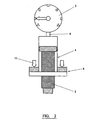
- Figure 2 shows the embodiment of figure 1 with an aneroid pressure gauge attached to the nozzle of the syringe cylinder.
- Figure 3 shows a variant of the embodiment of figure 1 with the gauge connected to the nozzle of the cylinder via an extension tubing to monitor the ACF at a distance from the patient.
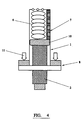
- Figure 4 shows a second embodiment of the invention; and
- Figure 5 shows the intermediate component, namely a U-shaped rubber or foam cricoid yoke with a compatible slot to fit the tip of the piston.
-
- Referring to the drawings, a first embodiment of the invention comprises a
plastic cylinder 1, apiston 2 withseal 10 and ananeroid pressure gauge 3 connected to the nozzle of thecylinder 4 either directly as in figure 2 or via aplastic tubing 5 as in figure 3. The device of figures 1, 2 and 3 can be calibrated to indicate the ACF using any conventional scales weighing up to 10kg (1kg = 9.81N). The calibration should be done at room temperature and after the device has warmed up in hand to simulate normal operating temperature. To calibrate the device, the piston was drawn to a distance half way inside the cylinder. Force was applied with the thumb on one wing of the cylinder and the index and middle fingers on the second wing and gradually increased until a calibration point is reached (e.g. 20N=2.04kg). The value of force obtained on the weight scale was matched with that recorded by the gauge. The procedure was repeated to mark the 40N or 4.09kg and other intermediate points. - A second embodiment of the invention is shown in figure 4. It is similar to the first embodiment except that instead of the pressure gauge, a
calibrated spring 6, inserted inside the barrel of thecylinder 1 in the space between theseal 10 and the nozzle, is used for monitoring the ACF. Any conventional scale can similarly be used to calibrate this prototype. The values of force obtained on the weight scale are then marked on a self-adhesive label 7 attached along the barrel of the cylinder. The end of thecylinder 1 above the piston has air outlets to allow compression of the spring. - Figure 5 shows the cricoid yoke. Both embodiments can be converted into cricoid devices for direct use on patients by slotting the distal end of the piston of either prototype into this compatible U-shaped, rubber or foam-moulded
cricoid yoke 9. When the devices are not connected to the cricoid yoke they can be used as training tools to allow trainees to practice the correct force e.g. on a bench, a table or a manikin in order to be able subsequently to use the correct force when applying a three-finger technique directly to a patient. The procedure of using the devices as training tools is as follows: - 1. Hold the device like a pen with a tip of the
piston 2 pointing downward. - 2. Place the tip of the piston on a hard surface (e.g. bench or table).
- 3. Place the tips of the index and middle fingers on one
wing 8 of the cylinder and that of the thumb on thesecond wing 8. - 4. Apply pressure on the wings of the cylinder.
- 5. Read the Applied pressure/force off the attached
scale/
gauge 7/3. - 6. Continue training until it is possible to reproduce the correct force.
-
- After attaching the compatible yoke to the tip of the piston the devices can be used directly on patients as follows:
- First, palpate the front of the neck to localise the cricoid cartilage. Then, place the
U-shaped rubber yoke 9 over it. To apply the desired pressure or force on the cricoid cartilage, hold the device like a pen and place the thumb on one of thewings 8 on the cylinder and the index and middle fingers on thesecond wing 8. Then press downwards (see the direction of thearrows 11 and read the cricoid pressure/force off thegauge 3 or thescale 7. This applied force or pressure should be maintained until the trachea is intubated. - Any feature of any aspect of any invention or embodiment described herein may be combined with any feature of any aspect of any other invention or embodiment described herein.
- The reader's attention is directed to all papers and documents which are filed concurrently with or previous to this specification in connection with this application and which are open to public inspection with this specification, and the contents of all such papers and documents are incorporated herein by reference.
- All of the features disclosed in this specification (including any accompanying claims, abstract and drawings), and/or all of the steps of any method or process so disclosed, may be combined in any combination, except combinations where at least some of such features and/or steps are mutually exclusive.
- Each feature disclosed in this specification (including any accompanying claims, abstract and drawings), may be replaced by alternative features serving the same, equivalent or similar purpose, unless expressly stated otherwise. Thus, unless expressly stated otherwise, each feature disclosed is one example only of a generic series of equivalent or similar features.
- The invention is not restricted to the details of the foregoing embodiment(s). The invention extends to any novel one, or any novel combination, of the features disclosed in this specification (including any accompanying claims, abstract and drawings), or to any novel one, or any novel combination, of the steps of any method or process so disclosed.
Claims (18)
- A device for use in training an operative in the reproduction of a desired force intended to be applied by the person so trained to the cricoid cartilage of a patient undergoing tracheal intubation, the device including means (1,2,8) for transmitting force applied to the device to a patient substitute and means (3;6,7) for monitoring the force applied.
- A device for use in the application of force to the cricoid cartilage of a patient undergoing tracheal intubation, the device including means (1,2,8,9) for transmitting force applied to the device to the cricoid cartilage and means for monitoring the force applied.
- A kit of parts for use in both the training of an operative in the application of force to the cricoid cartilage of a patient undergoing tracheal intubation and in the actual application of said force to such a patient, the kit comprising a device having means (1,2,8) for transmitting force applied to the device to a patient or a patient substitute and means (3;6,7) for monitoring the force applied, together with an intermediate component (9) for connecting between the device and the cricoid cartilage of a patient.
- A training device according to claim 1 or claim 3 wherein the patient substitute is a hard surface or a manikin.
- A device according to any of the preceding claims and including a first part (2) which may be placed directly, or indirectly by means of an intermediate component (9), on the cricoid cartilage, and a second part (1) coupled to said first part whereby force applied to the second part is transmitted to the first part.
- A device according to any of the preceding claims wherein the second part includes a cylinder (1) and the first part includes a piston (2) disposed within the cylinder for movement relative thereto into and out of one end of the cylinder.
- A device according to claim 6 wherein a seal (10) is provided between the piston and the other end of the cylinder.
- A device according to claim 6 or claim 7 wherein the means for monitoring the force applied comprises means (3;6,7) for monitoring the degree of compression of the space within the cylinder above the piston against a resistive force.
- A device according to claim 8 wherein the resistive force is supplied by a spring (6) disposed between the piston and the other end of the cylinder.
- A device according to claim 9 wherein the spring (6) is calibrated to indicate the force applied to the device.
- A device according to claim 8 wherein the resistive force is supplied by a pressure gauge (3) in communication with the space within the cylinder above the piston.
- A device according to any of the preceding claims, wherein the device is provided with extension means (8) on which one or more fingers may be placed to apply force manually to the device.
- A device according to claim 12 wherein said extension means (8) comprises one or more wings.
- A device according to any of the preceding claims wherein an intermediate component in the form of a U-shaped cricoid yoke (9) is provided between the first part and the patient's cricoid cartilage.
- A device according to claim 14 wherein the yoke (9) is moulded from rubber or foam.
- A device according to any of claims 5 to 15 wherein the second part is made from plastics material.
- A method of training an operative in the technique of applied cricoid force (ACF), the method comprising applying force to a patient substitute such as a hard surface or a manikin using a device having means (3;6,7) for monitoring the force applied.
- A method of applying a desired force to the cricoid cartilage of a patient undergoing tracheal intubation, the method including using on said patient a device having means (1,2,8,9) for transmitting force applied to the device to the patient, and monitoring the force applied.
Applications Claiming Priority (4)
| Application Number | Priority Date | Filing Date | Title |
|---|---|---|---|
| GBGB9907877.6A GB9907877D0 (en) | 1999-04-08 | 1999-04-08 | A training device for the correct application and monitoring of cricoid pressure |
| GB9907877 | 1999-04-08 | ||
| GB0003128A GB0003128D0 (en) | 1999-04-08 | 2000-02-14 | A training device and a cricoid yoke |
| GB0003128 | 2000-02-14 |
Publications (2)
| Publication Number | Publication Date |
|---|---|
| EP1043040A2 true EP1043040A2 (en) | 2000-10-11 |
| EP1043040A3 EP1043040A3 (en) | 2005-08-17 |
Family
ID=26243626
Family Applications (1)
| Application Number | Title | Priority Date | Filing Date |
|---|---|---|---|
| EP00301980A Withdrawn EP1043040A3 (en) | 1999-04-08 | 2000-03-10 | A device for use in the application of cricoid pressure (force) and/or in training for such application |
Country Status (4)
| Country | Link |
|---|---|
| US (1) | US6422873B1 (en) |
| EP (1) | EP1043040A3 (en) |
| AU (1) | AU2261600A (en) |
| GB (1) | GB2349500A (en) |
Cited By (2)
| Publication number | Priority date | Publication date | Assignee | Title |
|---|---|---|---|---|
| WO2002037453A1 (en) * | 2000-11-02 | 2002-05-10 | Flinders Technologies Pty Ltd | Method and apparatus for measuring application of pressure to an imitation body part |
| US7794412B2 (en) | 2005-05-12 | 2010-09-14 | T Medical, Inc. | Device for applying and gauging cricoid pressure |
Families Citing this family (10)
| Publication number | Priority date | Publication date | Assignee | Title |
|---|---|---|---|---|
| GB2407430B (en) * | 2003-08-15 | 2006-01-18 | Mohamed Osman Abdelatti | A cricoid pressure training device |
| US20060194179A1 (en) * | 2005-02-28 | 2006-08-31 | Abdelatti Mohamed O | Cricoid pressure training device |
| US20080262479A1 (en) * | 2007-04-20 | 2008-10-23 | Daniel Barela | Medical device for preventing passive regurgitation |
| US9526449B2 (en) * | 2010-06-07 | 2016-12-27 | The Medical College Of Wisconsin, Inc. | Detection and treatment of abnormal esophageal sphincter functionality |
| US20120031400A1 (en) | 2010-08-03 | 2012-02-09 | Peter Shimm | Cricoid manipulating apparatus for anesthesia assistance and tracheal intubation |
| GB2482556B (en) * | 2010-08-06 | 2016-02-24 | Khurram Ayub | Pressure applicator for applying pressure to the cricoid cartilage of a patient |
| BR112015028683A2 (en) | 2013-05-17 | 2017-07-25 | Somna Therapeutics Llc | Compression device and pressure sensor for treatment of abnormal upper esophageal sphincter functionality |
| US10297169B2 (en) | 2014-01-05 | 2019-05-21 | Health Research, Inc. | Intubation simulator and method |
| CN104799985B (en) * | 2015-04-10 | 2016-11-30 | 郑则广 | A kind of device of tracheotomy patients voice training rehabilitation |
| US11141105B2 (en) | 2016-03-11 | 2021-10-12 | Respiratory Technology Corporation | Long-term therapeutic pressure applicator and real-time monitoring system |
Family Cites Families (7)
| Publication number | Priority date | Publication date | Assignee | Title |
|---|---|---|---|---|
| US3276147A (en) * | 1964-01-17 | 1966-10-04 | Univ Iowa State Res Found Inc | Heart-lung resuscitation training device |
| SU912162A1 (en) * | 1980-05-29 | 1982-03-15 | Ивановский Областной Отдел Здравоохранения Исполкома Областного Совета Депутатв Трудящихся | Device for prevention of regurgitation and vomit |
| US5181522A (en) * | 1987-04-03 | 1993-01-26 | Abatis Medical Technologies Limited | Tourniquet for sensing and regulation of applied pressure |
| GB9026403D0 (en) | 1990-12-05 | 1991-01-23 | Smiths Industries Plc | Pressure monitors |
| US5483974A (en) * | 1993-05-20 | 1996-01-16 | Crangle; Richard | Device to apply, hold, and measure cricoid pressure during endotracheal intubation or cricothyroidotomies, or other medical airway procedures |
| US5882206A (en) * | 1995-03-29 | 1999-03-16 | Gillio; Robert G. | Virtual surgery system |
| GB9625590D0 (en) * | 1996-12-10 | 1997-01-29 | Kamath Belady S K | Apparatus for use in anaesthetics |
-
2000
- 2000-03-10 EP EP00301980A patent/EP1043040A3/en not_active Withdrawn
- 2000-03-13 US US09/524,343 patent/US6422873B1/en not_active Expired - Fee Related
- 2000-03-17 GB GB0006340A patent/GB2349500A/en not_active Withdrawn
- 2000-03-28 AU AU22616/00A patent/AU2261600A/en not_active Abandoned
Non-Patent Citations (1)
| Title |
|---|
| None |
Cited By (2)
| Publication number | Priority date | Publication date | Assignee | Title |
|---|---|---|---|---|
| WO2002037453A1 (en) * | 2000-11-02 | 2002-05-10 | Flinders Technologies Pty Ltd | Method and apparatus for measuring application of pressure to an imitation body part |
| US7794412B2 (en) | 2005-05-12 | 2010-09-14 | T Medical, Inc. | Device for applying and gauging cricoid pressure |
Also Published As
| Publication number | Publication date |
|---|---|
| AU2261600A (en) | 2000-10-12 |
| GB0006340D0 (en) | 2000-05-03 |
| US6422873B1 (en) | 2002-07-23 |
| GB2349500A (en) | 2000-11-01 |
| EP1043040A3 (en) | 2005-08-17 |
Similar Documents
| Publication | Publication Date | Title |
|---|---|---|
| US6422873B1 (en) | Device for use in the application of cricoid pressure (force) and/or in training for such application | |
| US20210183269A1 (en) | Physiological training system | |
| Levitan et al. | Use of the intubating laryngeal mask airway by medical and nonmedical personnel | |
| US20120202180A1 (en) | Training Device For Medical Procedures | |
| US20160140879A1 (en) | Anatomically correct movement or deformation of simulated bodily structures | |
| Suzuki et al. | Airtraq® for awake tracheal intubation | |
| Dyson et al. | Rapidity and accuracy of tracheal intubation in a mannequin: comparison of the fibreoptic with the Bullard laryngoscope | |
| CN114842719B (en) | Emergency surgical airway surgery simulator | |
| Zhang et al. | Blind nasal intubation: teaching a dying art | |
| McLure et al. | A laboratory comparison of two techniques of emergency percutaneous tracheostomy | |
| Sung et al. | Laryngeal mask airway: use and clinical applications | |
| Chandler et al. | Rationalization of the selection of tracheal tubes | |
| Bucx et al. | Does experience influence the forces exerted on maxillary incisors during laryngoscopy? A manikin study using the Macintosh laryngoscope | |
| Asai et al. | Use of the videolaryngoscope | |
| WO2002037453A1 (en) | Method and apparatus for measuring application of pressure to an imitation body part | |
| Walburn et al. | Fibreoptic intubation through a laryngeal mask airway facilitated by a guide wire. | |
| US12033529B2 (en) | Airway simulator | |
| US20060194179A1 (en) | Cricoid pressure training device | |
| Brimacombe et al. | The effect of introducing fibreoptic bronchoscopes on gas flow in laryngeal masks and tracheal tubes | |
| EP2072074A1 (en) | Tracheostomy device | |
| Babu et al. | A comparative study of airtraq® and McCoy laryngoscopes for endotracheal intubation in adult patients with simulated difficult airway using a rigid cervical collar in elective surgeries under general anaesthesia | |
| GB2407430A (en) | Cricoid pressure training device. | |
| CN218768500U (en) | Simulation trachea cannula model based on 3D prints | |
| TW443937B (en) | Method and device for positioning cannula in human trachea | |
| Tansatit et al. | Snake scope camera assisted endotracheal intubation: a procedural skills training in cadaver to prepare preclinical students for their clerkships |
Legal Events
| Date | Code | Title | Description |
|---|---|---|---|
| PUAI | Public reference made under article 153(3) epc to a published international application that has entered the european phase |
Free format text: ORIGINAL CODE: 0009012 |
|
| AK | Designated contracting states |
Kind code of ref document: A2 Designated state(s): AT BE CH CY DE DK ES FI FR GB GR IE IT LI LU MC NL PT SE |
|
| AX | Request for extension of the european patent |
Free format text: AL;LT;LV;MK;RO;SI |
|
| PUAL | Search report despatched |
Free format text: ORIGINAL CODE: 0009013 |
|
| RIC1 | Information provided on ipc code assigned before grant |
Ipc: 7A 61M 16/04 B Ipc: 7G 09B 23/28 A |
|
| AK | Designated contracting states |
Kind code of ref document: A3 Designated state(s): AT BE CH CY DE DK ES FI FR GB GR IE IT LI LU MC NL PT SE |
|
| AX | Request for extension of the european patent |
Extension state: AL LT LV MK RO SI |
|
| AKX | Designation fees paid | ||
| REG | Reference to a national code |
Ref country code: DE Ref legal event code: 8566 |
|
| STAA | Information on the status of an ep patent application or granted ep patent |
Free format text: STATUS: THE APPLICATION IS DEEMED TO BE WITHDRAWN |
|
| 18D | Application deemed to be withdrawn |
Effective date: 20060218 |