EP1042831B1 - Modified lithium vanadium oxide electrode materials; products and methods - Google Patents
Modified lithium vanadium oxide electrode materials; products and methods Download PDFInfo
- Publication number
- EP1042831B1 EP1042831B1 EP98961880A EP98961880A EP1042831B1 EP 1042831 B1 EP1042831 B1 EP 1042831B1 EP 98961880 A EP98961880 A EP 98961880A EP 98961880 A EP98961880 A EP 98961880A EP 1042831 B1 EP1042831 B1 EP 1042831B1
- Authority
- EP
- European Patent Office
- Prior art keywords
- vanadium oxide
- vanadium
- lithium
- electrode
- fluorine
- Prior art date
- Legal status (The legal status is an assumption and is not a legal conclusion. Google has not performed a legal analysis and makes no representation as to the accuracy of the status listed.)
- Expired - Lifetime
Links
- 238000000034 method Methods 0.000 title claims description 15
- 239000007772 electrode material Substances 0.000 title claims description 11
- RLTFLELMPUMVEH-UHFFFAOYSA-N [Li+].[O--].[O--].[O--].[V+5] Chemical class [Li+].[O--].[O--].[O--].[V+5] RLTFLELMPUMVEH-UHFFFAOYSA-N 0.000 title description 10
- 239000000463 material Substances 0.000 claims description 37
- 239000000203 mixture Substances 0.000 claims description 30
- 150000001768 cations Chemical class 0.000 claims description 29
- XHCLAFWTIXFWPH-UHFFFAOYSA-N [O-2].[O-2].[O-2].[O-2].[O-2].[V+5].[V+5] Chemical compound [O-2].[O-2].[O-2].[O-2].[O-2].[V+5].[V+5] XHCLAFWTIXFWPH-UHFFFAOYSA-N 0.000 claims description 21
- 229910001935 vanadium oxide Inorganic materials 0.000 claims description 21
- 229910052720 vanadium Inorganic materials 0.000 claims description 20
- LEONUFNNVUYDNQ-UHFFFAOYSA-N vanadium atom Chemical compound [V] LEONUFNNVUYDNQ-UHFFFAOYSA-N 0.000 claims description 20
- 229910052719 titanium Inorganic materials 0.000 claims description 17
- 229910052726 zirconium Inorganic materials 0.000 claims description 17
- 230000003647 oxidation Effects 0.000 claims description 15
- 238000007254 oxidation reaction Methods 0.000 claims description 15
- 238000009472 formulation Methods 0.000 claims description 9
- 229910052750 molybdenum Inorganic materials 0.000 claims description 7
- 229910052782 aluminium Inorganic materials 0.000 claims description 6
- 229910052802 copper Inorganic materials 0.000 claims description 6
- 229910052758 niobium Inorganic materials 0.000 claims description 6
- 229910052698 phosphorus Inorganic materials 0.000 claims description 6
- 229910052706 scandium Inorganic materials 0.000 claims description 6
- 229910052710 silicon Inorganic materials 0.000 claims description 6
- 229910015084 LixV3O8 Inorganic materials 0.000 claims description 5
- 229910052804 chromium Inorganic materials 0.000 claims description 5
- 229910052742 iron Inorganic materials 0.000 claims description 5
- 229910052748 manganese Inorganic materials 0.000 claims description 5
- 229910052759 nickel Inorganic materials 0.000 claims description 5
- 229910052725 zinc Inorganic materials 0.000 claims description 5
- 229910052727 yttrium Inorganic materials 0.000 claims description 4
- 229910003006 LixMy Inorganic materials 0.000 claims description 3
- 239000011230 binding agent Substances 0.000 claims description 3
- 239000004020 conductor Substances 0.000 claims 1
- OKKJLVBELUTLKV-UHFFFAOYSA-N Methanol Chemical compound OC OKKJLVBELUTLKV-UHFFFAOYSA-N 0.000 description 39
- 229910009327 Li1.2V3O8 Inorganic materials 0.000 description 34
- 239000010936 titanium Substances 0.000 description 26
- 229910052744 lithium Inorganic materials 0.000 description 25
- WHXSMMKQMYFTQS-UHFFFAOYSA-N Lithium Chemical compound [Li] WHXSMMKQMYFTQS-UHFFFAOYSA-N 0.000 description 21
- WMFOQBRAJBCJND-UHFFFAOYSA-M Lithium hydroxide Chemical compound [Li+].[OH-] WMFOQBRAJBCJND-UHFFFAOYSA-M 0.000 description 19
- 239000011737 fluorine Substances 0.000 description 17
- 229910052731 fluorine Inorganic materials 0.000 description 17
- -1 lithium cations Chemical class 0.000 description 14
- 238000002441 X-ray diffraction Methods 0.000 description 12
- HBBGRARXTFLTSG-UHFFFAOYSA-N Lithium ion Chemical compound [Li+] HBBGRARXTFLTSG-UHFFFAOYSA-N 0.000 description 11
- 229910001416 lithium ion Inorganic materials 0.000 description 11
- 239000003792 electrolyte Substances 0.000 description 9
- 229910052760 oxygen Inorganic materials 0.000 description 9
- 239000001301 oxygen Substances 0.000 description 9
- 238000002360 preparation method Methods 0.000 description 9
- 229910001456 vanadium ion Inorganic materials 0.000 description 9
- YCKRFDGAMUMZLT-UHFFFAOYSA-N Fluorine atom Chemical compound [F] YCKRFDGAMUMZLT-UHFFFAOYSA-N 0.000 description 8
- 239000013078 crystal Substances 0.000 description 8
- 238000006467 substitution reaction Methods 0.000 description 8
- 229910009855 Li1.2 V2.8 Ti0.1 Mo0.1 O7.9 F0.1 Inorganic materials 0.000 description 7
- 229910010153 Li1.25 V2.95 O7.8 F0.2 Inorganic materials 0.000 description 7
- 229910003206 NH4VO3 Inorganic materials 0.000 description 7
- 229910000686 lithium vanadium oxide Inorganic materials 0.000 description 7
- 239000000843 powder Substances 0.000 description 7
- 239000002243 precursor Substances 0.000 description 7
- 239000007787 solid Substances 0.000 description 7
- 229910009876 Li1.2 V3 O8-δ Inorganic materials 0.000 description 6
- 229910010544 Li4V3O8 Inorganic materials 0.000 description 6
- 238000001816 cooling Methods 0.000 description 6
- 238000000634 powder X-ray diffraction Methods 0.000 description 6
- 229910012970 LiV3O8 Inorganic materials 0.000 description 5
- RTAQQCXQSZGOHL-UHFFFAOYSA-N Titanium Chemical compound [Ti] RTAQQCXQSZGOHL-UHFFFAOYSA-N 0.000 description 5
- QCWXUUIWCKQGHC-UHFFFAOYSA-N Zirconium Chemical compound [Zr] QCWXUUIWCKQGHC-UHFFFAOYSA-N 0.000 description 5
- 238000010276 construction Methods 0.000 description 4
- 150000002500 ions Chemical class 0.000 description 4
- JKQOBWVOAYFWKG-UHFFFAOYSA-N molybdenum trioxide Chemical compound O=[Mo](=O)=O JKQOBWVOAYFWKG-UHFFFAOYSA-N 0.000 description 4
- 230000008569 process Effects 0.000 description 4
- 238000012360 testing method Methods 0.000 description 4
- 229910009857 Li1.2 V3 O7.8 F0.2 Inorganic materials 0.000 description 3
- 229910009877 Li1.2 V3 O7.9 F0.1 Inorganic materials 0.000 description 3
- 229910001290 LiPF6 Inorganic materials 0.000 description 3
- YXFVVABEGXRONW-UHFFFAOYSA-N Toluene Chemical compound CC1=CC=CC=C1 YXFVVABEGXRONW-UHFFFAOYSA-N 0.000 description 3
- 239000010406 cathode material Substances 0.000 description 3
- 239000010949 copper Substances 0.000 description 3
- IEJIGPNLZYLLBP-UHFFFAOYSA-N dimethyl carbonate Chemical compound COC(=O)OC IEJIGPNLZYLLBP-UHFFFAOYSA-N 0.000 description 3
- 238000009830 intercalation Methods 0.000 description 3
- 230000002687 intercalation Effects 0.000 description 3
- 239000011244 liquid electrolyte Substances 0.000 description 3
- 229910052751 metal Inorganic materials 0.000 description 3
- 239000002184 metal Substances 0.000 description 3
- 238000012986 modification Methods 0.000 description 3
- 230000004048 modification Effects 0.000 description 3
- 230000002441 reversible effect Effects 0.000 description 3
- 230000006641 stabilisation Effects 0.000 description 3
- 238000011105 stabilization Methods 0.000 description 3
- OKTJSMMVPCPJKN-UHFFFAOYSA-N Carbon Chemical compound [C] OKTJSMMVPCPJKN-UHFFFAOYSA-N 0.000 description 2
- ZOKXTWBITQBERF-UHFFFAOYSA-N Molybdenum Chemical compound [Mo] ZOKXTWBITQBERF-UHFFFAOYSA-N 0.000 description 2
- WYURNTSHIVDZCO-UHFFFAOYSA-N Tetrahydrofuran Chemical compound C1CCOC1 WYURNTSHIVDZCO-UHFFFAOYSA-N 0.000 description 2
- ZOOXRKVNLALQEQ-UHFFFAOYSA-N [F].[V] Chemical compound [F].[V] ZOOXRKVNLALQEQ-UHFFFAOYSA-N 0.000 description 2
- QVGXLLKOCUKJST-UHFFFAOYSA-N atomic oxygen Chemical compound [O] QVGXLLKOCUKJST-UHFFFAOYSA-N 0.000 description 2
- 229910052799 carbon Inorganic materials 0.000 description 2
- 239000011248 coating agent Substances 0.000 description 2
- 238000000576 coating method Methods 0.000 description 2
- 150000001875 compounds Chemical class 0.000 description 2
- 150000002221 fluorine Chemical class 0.000 description 2
- 125000001153 fluoro group Chemical group F* 0.000 description 2
- 230000006872 improvement Effects 0.000 description 2
- 239000012535 impurity Substances 0.000 description 2
- 230000002401 inhibitory effect Effects 0.000 description 2
- 238000004519 manufacturing process Methods 0.000 description 2
- 238000013508 migration Methods 0.000 description 2
- 230000005012 migration Effects 0.000 description 2
- 239000011733 molybdenum Substances 0.000 description 2
- 239000002245 particle Substances 0.000 description 2
- 239000005518 polymer electrolyte Substances 0.000 description 2
- 239000007784 solid electrolyte Substances 0.000 description 2
- BQCIDUSAKPWEOX-UHFFFAOYSA-N 1,1-Difluoroethene Chemical compound FC(F)=C BQCIDUSAKPWEOX-UHFFFAOYSA-N 0.000 description 1
- 238000012935 Averaging Methods 0.000 description 1
- XTHFKEDIFFGKHM-UHFFFAOYSA-N Dimethoxyethane Chemical compound COCCOC XTHFKEDIFFGKHM-UHFFFAOYSA-N 0.000 description 1
- KMTRUDSVKNLOMY-UHFFFAOYSA-N Ethylene carbonate Chemical compound O=C1OCCO1 KMTRUDSVKNLOMY-UHFFFAOYSA-N 0.000 description 1
- 229920006370 Kynar Polymers 0.000 description 1
- 229910009856 Li1.2 V2.8 Mo0.1 Ti0.1 O7.9 F0.1 Inorganic materials 0.000 description 1
- 229910009860 Li1.2 V2.8 Ti0.2 O0.9 F0.1 Inorganic materials 0.000 description 1
- 229910009859 Li1.2 V2.8 Zr0.1 Mo0.1 O7.9 F0.1 Inorganic materials 0.000 description 1
- 229910009862 Li1.2 V2.85 Fe0.15 O7.9 F0.1 Inorganic materials 0.000 description 1
- 229910009861 Li1.2 V2.85 Ti0.075 Mo0.075 O7.95 F0.05 Inorganic materials 0.000 description 1
- 229910009858 Li1.2 V2.93 Ni0.07 O7.8 F0.2 Inorganic materials 0.000 description 1
- 229910009881 Li1.2+x′V3O8 Inorganic materials 0.000 description 1
- 239000004743 Polypropylene Substances 0.000 description 1
- FAPWRFPIFSIZLT-UHFFFAOYSA-M Sodium chloride Chemical group [Na+].[Cl-] FAPWRFPIFSIZLT-UHFFFAOYSA-M 0.000 description 1
- YZSKZXUDGLALTQ-UHFFFAOYSA-N [Li][C] Chemical class [Li][C] YZSKZXUDGLALTQ-UHFFFAOYSA-N 0.000 description 1
- 150000001242 acetic acid derivatives Chemical class 0.000 description 1
- 150000004703 alkoxides Chemical class 0.000 description 1
- 229910045601 alloy Inorganic materials 0.000 description 1
- 239000000956 alloy Substances 0.000 description 1
- 230000008901 benefit Effects 0.000 description 1
- 238000006243 chemical reaction Methods 0.000 description 1
- 239000003153 chemical reaction reagent Substances 0.000 description 1
- 230000000052 comparative effect Effects 0.000 description 1
- 230000001351 cycling effect Effects 0.000 description 1
- 230000007547 defect Effects 0.000 description 1
- 230000006866 deterioration Effects 0.000 description 1
- 238000004090 dissolution Methods 0.000 description 1
- 239000002019 doping agent Substances 0.000 description 1
- 238000001035 drying Methods 0.000 description 1
- 230000000694 effects Effects 0.000 description 1
- 238000004146 energy storage Methods 0.000 description 1
- 238000011156 evaluation Methods 0.000 description 1
- 238000002474 experimental method Methods 0.000 description 1
- 238000000605 extraction Methods 0.000 description 1
- 238000010304 firing Methods 0.000 description 1
- 150000004679 hydroxides Chemical class 0.000 description 1
- 238000003780 insertion Methods 0.000 description 1
- 230000037431 insertion Effects 0.000 description 1
- 229910052746 lanthanum Inorganic materials 0.000 description 1
- 229910021450 lithium metal oxide Inorganic materials 0.000 description 1
- 238000003801 milling Methods 0.000 description 1
- 238000002156 mixing Methods 0.000 description 1
- 239000004570 mortar (masonry) Substances 0.000 description 1
- 150000002823 nitrates Chemical class 0.000 description 1
- 150000003891 oxalate salts Chemical class 0.000 description 1
- 150000002927 oxygen compounds Chemical class 0.000 description 1
- 229920001155 polypropylene Polymers 0.000 description 1
- 238000012545 processing Methods 0.000 description 1
- 239000011541 reaction mixture Substances 0.000 description 1
- 150000003839 salts Chemical class 0.000 description 1
- 239000002002 slurry Substances 0.000 description 1
- 235000002639 sodium chloride Nutrition 0.000 description 1
- 239000002904 solvent Substances 0.000 description 1
- 125000006850 spacer group Chemical group 0.000 description 1
- 238000003860 storage Methods 0.000 description 1
- 239000000126 substance Substances 0.000 description 1
- 125000001424 substituent group Chemical group 0.000 description 1
- YLQBMQCUIZJEEH-UHFFFAOYSA-N tetrahydrofuran Natural products C=1C=COC=1 YLQBMQCUIZJEEH-UHFFFAOYSA-N 0.000 description 1
- OGIDPMRJRNCKJF-UHFFFAOYSA-N titanium(II) oxide Chemical compound [Ti]=O OGIDPMRJRNCKJF-UHFFFAOYSA-N 0.000 description 1
- 230000007704 transition Effects 0.000 description 1
- IBYSTTGVDIFUAY-UHFFFAOYSA-N vanadium monoxide Chemical compound [V]=O IBYSTTGVDIFUAY-UHFFFAOYSA-N 0.000 description 1
Images






Classifications
-
- H—ELECTRICITY
- H01—ELECTRIC ELEMENTS
- H01M—PROCESSES OR MEANS, e.g. BATTERIES, FOR THE DIRECT CONVERSION OF CHEMICAL ENERGY INTO ELECTRICAL ENERGY
- H01M4/00—Electrodes
- H01M4/02—Electrodes composed of, or comprising, active material
- H01M4/13—Electrodes for accumulators with non-aqueous electrolyte, e.g. for lithium-accumulators; Processes of manufacture thereof
- H01M4/139—Processes of manufacture
- H01M4/1397—Processes of manufacture of electrodes based on inorganic compounds other than oxides or hydroxides, e.g. sulfides, selenides, tellurides, halogenides or LiCoFy
-
- C—CHEMISTRY; METALLURGY
- C01—INORGANIC CHEMISTRY
- C01G—COMPOUNDS CONTAINING METALS NOT COVERED BY SUBCLASSES C01D OR C01F
- C01G31/00—Compounds of vanadium
- C01G31/006—Compounds containing vanadium, with or without oxygen or hydrogen, and containing two or more other elements
-
- C—CHEMISTRY; METALLURGY
- C01—INORGANIC CHEMISTRY
- C01G—COMPOUNDS CONTAINING METALS NOT COVERED BY SUBCLASSES C01D OR C01F
- C01G39/00—Compounds of molybdenum
- C01G39/006—Compounds containing molybdenum, with or without oxygen or hydrogen, and containing two or more other elements
-
- H—ELECTRICITY
- H01—ELECTRIC ELEMENTS
- H01M—PROCESSES OR MEANS, e.g. BATTERIES, FOR THE DIRECT CONVERSION OF CHEMICAL ENERGY INTO ELECTRICAL ENERGY
- H01M4/00—Electrodes
- H01M4/02—Electrodes composed of, or comprising, active material
- H01M4/36—Selection of substances as active materials, active masses, active liquids
- H01M4/48—Selection of substances as active materials, active masses, active liquids of inorganic oxides or hydroxides
- H01M4/485—Selection of substances as active materials, active masses, active liquids of inorganic oxides or hydroxides of mixed oxides or hydroxides for inserting or intercalating light metals, e.g. LiTi2O4 or LiTi2OxFy
-
- H—ELECTRICITY
- H01—ELECTRIC ELEMENTS
- H01M—PROCESSES OR MEANS, e.g. BATTERIES, FOR THE DIRECT CONVERSION OF CHEMICAL ENERGY INTO ELECTRICAL ENERGY
- H01M4/00—Electrodes
- H01M4/02—Electrodes composed of, or comprising, active material
- H01M4/36—Selection of substances as active materials, active masses, active liquids
- H01M4/58—Selection of substances as active materials, active masses, active liquids of inorganic compounds other than oxides or hydroxides, e.g. sulfides, selenides, tellurides, halogenides or LiCoFy; of polyanionic structures, e.g. phosphates, silicates or borates
- H01M4/582—Halogenides
-
- H—ELECTRICITY
- H01—ELECTRIC ELEMENTS
- H01M—PROCESSES OR MEANS, e.g. BATTERIES, FOR THE DIRECT CONVERSION OF CHEMICAL ENERGY INTO ELECTRICAL ENERGY
- H01M4/00—Electrodes
- H01M4/02—Electrodes composed of, or comprising, active material
- H01M4/36—Selection of substances as active materials, active masses, active liquids
- H01M4/58—Selection of substances as active materials, active masses, active liquids of inorganic compounds other than oxides or hydroxides, e.g. sulfides, selenides, tellurides, halogenides or LiCoFy; of polyanionic structures, e.g. phosphates, silicates or borates
- H01M4/5825—Oxygenated metallic salts or polyanionic structures, e.g. borates, phosphates, silicates, olivines
-
- C—CHEMISTRY; METALLURGY
- C01—INORGANIC CHEMISTRY
- C01P—INDEXING SCHEME RELATING TO STRUCTURAL AND PHYSICAL ASPECTS OF SOLID INORGANIC COMPOUNDS
- C01P2002/00—Crystal-structural characteristics
- C01P2002/50—Solid solutions
- C01P2002/52—Solid solutions containing elements as dopants
- C01P2002/54—Solid solutions containing elements as dopants one element only
-
- C—CHEMISTRY; METALLURGY
- C01—INORGANIC CHEMISTRY
- C01P—INDEXING SCHEME RELATING TO STRUCTURAL AND PHYSICAL ASPECTS OF SOLID INORGANIC COMPOUNDS
- C01P2002/00—Crystal-structural characteristics
- C01P2002/70—Crystal-structural characteristics defined by measured X-ray, neutron or electron diffraction data
- C01P2002/72—Crystal-structural characteristics defined by measured X-ray, neutron or electron diffraction data by d-values or two theta-values, e.g. as X-ray diagram
-
- C—CHEMISTRY; METALLURGY
- C01—INORGANIC CHEMISTRY
- C01P—INDEXING SCHEME RELATING TO STRUCTURAL AND PHYSICAL ASPECTS OF SOLID INORGANIC COMPOUNDS
- C01P2002/00—Crystal-structural characteristics
- C01P2002/70—Crystal-structural characteristics defined by measured X-ray, neutron or electron diffraction data
- C01P2002/77—Crystal-structural characteristics defined by measured X-ray, neutron or electron diffraction data by unit-cell parameters, atom positions or structure diagrams
-
- C—CHEMISTRY; METALLURGY
- C01—INORGANIC CHEMISTRY
- C01P—INDEXING SCHEME RELATING TO STRUCTURAL AND PHYSICAL ASPECTS OF SOLID INORGANIC COMPOUNDS
- C01P2006/00—Physical properties of inorganic compounds
- C01P2006/40—Electric properties
-
- Y—GENERAL TAGGING OF NEW TECHNOLOGICAL DEVELOPMENTS; GENERAL TAGGING OF CROSS-SECTIONAL TECHNOLOGIES SPANNING OVER SEVERAL SECTIONS OF THE IPC; TECHNICAL SUBJECTS COVERED BY FORMER USPC CROSS-REFERENCE ART COLLECTIONS [XRACs] AND DIGESTS
- Y02—TECHNOLOGIES OR APPLICATIONS FOR MITIGATION OR ADAPTATION AGAINST CLIMATE CHANGE
- Y02E—REDUCTION OF GREENHOUSE GAS [GHG] EMISSIONS, RELATED TO ENERGY GENERATION, TRANSMISSION OR DISTRIBUTION
- Y02E60/00—Enabling technologies; Technologies with a potential or indirect contribution to GHG emissions mitigation
- Y02E60/10—Energy storage using batteries
Definitions
- the present invention relates to certain modified lithium vanadium oxides. Included are preferred oxides according to the general formula Li 1.2 V 3 O 8- ⁇ F ⁇ and certain related oxides such as Li 1.2 V 3- ⁇ ' M ⁇ ' O 8- ⁇ F ⁇ , wherein M can be a variety of cations (or a mixture of cations).
- the invention concerns the utilization of such oxide materials as electrode materials, for example, as cathode materials in lithium batteries.
- the disclosure concerns preferred formulations of such materials, preferred methods for preparation of them, products including such materials and methods of use.
- the negative electrode (anode) of a high density lithium battery typically comprises one or more of a variety of any suitable lithium-containing substances such as: metallic lithium; lithium-metal alloys; lithium metal oxides; or, lithium carbon composites.
- the positive electrode (cathode) is typically a lithium vanadium oxide, of the nominal or base formula LiV 3 O 8 .
- the electrodes may be coupled using a liquid electrolyte or a solid electrolyte such as a solid polymer electrolyte, or a combination of liquid and solid electrolytes.
- the electrolyte may specifically be a "plasticized" electrolyte in which a liquid electrolyte component is contained within a polymer electrolyte.
- lithium ions are electrochemically inserted into the lithium vanadium oxide structure by a process that is commonly referred to as intercalation.
- a reverse process occurs during charge.
- the vanadium ions of the host electrode structure are reduced and oxidized during discharge and charge, respectively.
- the negative electrode is oxidized during discharge when lithium ions are released from the electrode into the electrolyte, and it is reduced during the reverse process on charge. Lithium ions, therefore, shuttle between the two electrodes during the electrochemical discharge and charge processes.
- batteries such as lithium batteries
- a high electrochemical "capacity” or energy storage capability In lithium batteries, this can be achieved if the positive and negative electrodes can accommodate a significant amount of lithium.
- the positive and negative electrodes should have the ability to accommodate and release lithium in a reversible manner, i.e., without significant "capacity fade". Thus, the structural integrity of the electrodes should be maintained during lithium insertion/extraction for numerous cycles.
- a vanadium oxide material doped with fluorine is provided.
- the invention also concerns the provision of electrodes including lithium vanadium oxide according to the preferred general formula; and, batteries including an electrode as characterized.
- the invention further concerns a method of modifying a nominal vanadium oxide formula through fluorine doping.
- a preferred vanadium oxide electrode material for use with respect to lithium batteries of concern to the present invention will be referenced generally as having a "nominal" formula of Li x V 3 O 8 , wherein x is typically at least 1.0, usually about 1.0-1.5 and often about 1.2.
- x is typically at least 1.0, usually about 1.0-1.5 and often about 1.2.
- the crystalline structure of this material is relatively stable, and is preferential with respect to intercalation.
- This nominal or base formula is the approximate formula at complete charge.
- Oxides of nominal formula Li x V 3 O 8 exhibit a distinctive X-ray diffraction pattern (XRD) and crystalline structure, as discussed below.
- the specific preferred stoichiometry for the most stable electrode in the charged state is Li 1.2 V 3 O 8 .
- the preferred material is formulated from precursor materials such that in a fully charged cell the average formulation of the cathode, with respect to the vanadium oxide component, is Li 1.2 V 3 O 8 .
- the average (calculated) vanadium valence in Li 1.2 V 3 O 8 is 4.933 or "nominally" 5.
- lithium cations are inserted into the crystalline Li 1.2 V 3 O 8 electrode structure. This reduces the average oxidation state of the vanadium ions from 4.933 in Li 1.2 V 3 O 8 to 4.0 in Li 4 V 3 O 8 , which represents the approximate composition of the positive electrode in a discharged cell.
- the nominal LiV 3 O 8 structure typically and preferably Li 1.2 V 3 O 8
- the modification in part, concerns "doping" with fluorine.
- the substitution of fluorine ions for some oxygen ions can lead to stabilization, as discussed below.
- the "fluorine doping" is accompanied by a preferred introduction of further cations, for example, additional lithium cations or other cations, into the crystalline structure.
- a lithium vanadium oxide of the general (base or nominal) formula Li x V 3 O 8 preferably wherein x >1 (typically 1.0 to 1.5 and more preferably is about 1.2) is modified by fluorine substitution (doping) to lead to a preferred fluorine-doped material.
- the oxygen ions may be partially substituted by fluorine, preferably leading to a material having the general formula Li 1.2 V 3 O 8- ⁇ F ⁇ wherein 0 ⁇ ⁇ ⁇ 1.0.
- ⁇ is within the range of 0.05 to 0.3.
- Li 1.2 V 3 O 8 the mean oxidation state of vanadium is 4.933.
- a class of stabilized lithium vanadium oxides (base formulation) according to this aspect of the invention would preferably be characterized by the following general formula: Li 1.2+ ⁇ ' V 3- ⁇ ' O 8- ⁇ F ⁇ wherein ⁇ ' is equal to 0.254 ⁇ . The value for ⁇ 'results from a calculation as follows:
- valence type The type of calculation discussed above is sometimes referred to herein as a "valence type" calculation and can be applied to determine a variety of unknowns.
- substitution of vanadium by another element preferably a cation in addition to lithium, is used.
- This can also be a method of maintaining the average, calculated, oxidation state of vanadium at or near 4.933, or more generally at a value of at least 4.6 (usually at least 4.8, typically and preferably at least 4.9) in the fully charged state.
- a base formula for a preferred group of such stabilized compounds would be as follows: Li 1.2 V 3- ⁇ ' M ⁇ ' O 8- ⁇ F ⁇ wherein M is a cation selected from Al, Si, P, Sc, Ti, Cr, Mn, Fe, Co, Ni, Cu, Zn, Ge, Y, Zr, Nb, Mo, La and mixtures thereof.
- Preferred cations, M are those that form strong M-O bonds, such as Al, Si, P, Sc, Ti, Ge, Y, Zr, Nb, Mo and La.
- a preferred formula would be Li 1.2 V 2.8925 Ti 0.1075 O 7.9 F 0.1 .
- transition element "M” (or mixture of elements of "M") which does not, in the amounts used, generate a significant amount of a second impurity phase along with Li 1.2 V 3 O 8 .
- vanadium ions it is possible to use two or more different cations as substituents for some of the vanadium ions.
- V +5 pentavalent vanadium ions
- Mo +6 hexavalent molybdenum
- Zr +4 tetravalent zirconium
- Ti +4 titanium
- Li 1.2 V 3 O 8 electrode materials can be manufactured by reaction of LiOH with NH 4 VO 3 in methanol, with follow up firing to 400°C; as described further in the experimental section.
- Fluorine introduction can be readily achieved by introducing LiF in place of some of the lithium hydroxide, in an appropriate amount to achieve the desired stoichiometry. Additional modifications in lithium can be introduced by adding further LiOH.
- titanium can be introduced by the addition of Ti[OCH(CH 3 ) 2 ] 4 to the reaction mixture, zirconium by Zr[OCH(CH 3 ) 2 ] 4 (CH 3 ) 2 CH 2 OH and molybdenum by MoO 3 .
- the compounds can be selected from oxides, hydroxides or salts such as alkoxides, oxalates, acetates and nitrates.
- Electrodes can be prepared from the oxide base by coating onto a metallic current collector a slurry containing the oxide base, a polymeric binder such as polyvinylidinefluoride (PVDF), electrically conductive particles such as conductive carbon particles, and a solvent such as toluene, and drying the coating, to form the electrode.
- PVDF polyvinylidinefluoride
- electrically conductive particles such as conductive carbon particles
- solvent such as toluene
- Electrode materials of the type described herein would typically be used in high energy density lithium storage batteries.
- the capacity fade that occurs with time for certain types of such batteries during repeated discharge and charge can be attributed to a number of possible factors.
- Li 1.2 V 3 O 8 has a layered-type crystal structure. During discharge, lithium ions are inserted into a Li 1.2+x' V 3 O 8 structure (typically 0 ⁇ x' ⁇ 2.8).
- Capacity fade phenomena could result for example, either from (1) structural fatigue due to anisotropic variations in the lattice parameters during charge and discharge, or (2) migration of vanadium ions from their original positions into the layers occupied by lithium, thereby, restricting lithium mobility, or (3) the dissolution of some vanadium from the crystal lattice into the electrolyte, or a combination of (1), (2) and (3).
- the vanadium is in an average oxidation state approaching V +5 (typically and preferably about 4.933, more generally at least 4.6) and at the end of discharge it is closer to V +4 .
- Vanadium in lower oxidation states is believed to be somewhat more soluble in certain electrolytes than at higher oxidation states. This could be partly responsible for some of the observed deterioration of the cathode operation, with cycling for certain types of batteries.
- the fluorine-doped systems are stabilized by introduction of the fluorine ions and M cations into the crystal structure.
- a possible reason for this could be differences in strength between vanadium-fluorine, vanadium-oxygen, and M-oxygen bonds.
- the minor introduction of fluorine ions and, if desired M cations may add integrity to the vanadium oxide crystalline structure, as a result of the introduction of strong vanadium-fluorine and M-oxygen bonds.
- the net result of this could be either or both of inhibiting vanadium migration and/or inhibiting solubility. In some instances this may manifest itself by a lessening of capacity fade.
- the crystalline structure of Li 1.2 V 3 O 8 is layered.
- Three vanadium ions and one lithium ion typically occupy octahedral sites in the Li 1.2 V 3 O 8 structure; the remaining (for example 0.2) lithium ions occupy tetrahedral sites.
- the lithium ions migrate into neighboring octahedral sites to generate a stable defect rocksalt structure.
- the approximate composition at the end of discharge is Li 4 V 3 O 8 .
- Preferred cations to introduce for this purpose are titanium and/or zirconium, although other cations and even mixtures, can be used.
- the titanium or zirconium doped systems are advantageous because of the relatively strong titanium-oxygen or zirconium-oxygen bonds in the crystal structure. It can be reasoned that such bonds will serve to strengthen and maintain the integrity of the overall crystal structure, particularly during cell operation when lithium is being repeatedly inserted into and extracted from the structure.
- a general formula of a preferred vanadium oxide material, useable as a cathode material as described above at least when defined in the charged state, would be as follows: Li x M y V z O 8- ⁇ F ⁇ wherein preferably:
- Preferred electrodes comprise a vanadium oxide base according at least one of the preferred formulae recited above; and, preferred battery constructions include at least one preferred electrode as characterized.
- M may be a mixture of cations and thus M y would comprise such formulae as: M' y' M" y" ; M' y' M" y" M"' y"' ;... etc.
- M y is intended to include mixtures of this type. In such instances the limitation on "y” is intended to be on the averaged cation "M” resulting from averaging the valence of the various M', M", etc., using a mole-weighted, valence charge balance calculation analogous to the ones discussed above.
- Preferred electrodes which contain a mixture of cations are those in which M is derived from Ti, Y, Zr and Mo.
- the formulae given herein for the preferred vanadium oxide materials are generally in reference to the material as it would be found in an electrode in the fully charged state. During discharge, and intercalation, a lithium ion introduction will modify the formulae.
- Various useable conventional constructions are described in Handbook of Batteries , 2d Ed., edited by D. Linden et al., McGraw-Hill, 1995, the disclosure of which is incorporated herein by reference.
- FIG. 18 An example cell is shown in Fig. 18.
- the cell may generally be according to the description of U.S. Patent 4,803,137, incorporated herein by reference, except in that the cathode includes a vanadium oxide material as described herein.
- the cell depicted includes: a cathode 1; a positive electrode current collector 2; a positive electrode casing 3; an anode U; a negative electrode current collector 5; a negative electrode casing 6; separator/electrolyte 7; and, insulating polypropylene gasket 8.
- a vanadium oxide material as described herein, the cell would operate in the otherwise typical fashion.
- FIG. 19 Another schematic illustration of the electrochemical cell is shown in Fig. 19.
- the cell is designated 15, and the anode (negative electrode), electrolyte and cathode (positive electrode) are designated 11, 12, and 13, respectively, with the anode 11 separated from the cathode 13 by the electrolyte 12.
- Suitable terminals designated 14 are provided in electric contact with the anode 11 and the cathode 13.
- the cell 15 is contained in a housing, designated 16, which insulates the anode from the cathode.
- the cell 15 may include, at the cathode 13, vanadium oxide material according to the present invention.
- Example 1 Li 1.2 V 3 O 8 (A comparative example)
- Example 7 The materials of Examples 1-6 were screened for electrochemical performance in standard 1225 coin cells.
- a cathode laminate of each material was prepared by mixing, by weight: 81% active (test) material; 10% Kynar (binder available from ELF Autochem North America, Inc. of Philadelphia, PA); and, 9% carbon (VX C72 available from CABOT Corp. of Boston, MA), with milling in tetrahydrofuran.
- active (test) material 10% Kynar (binder available from ELF Autochem North America, Inc. of Philadelphia, PA); and, 9% carbon (VX C72 available from CABOT Corp. of Boston, MA)
- VX C72 available from CABOT Corp. of Boston, MA
- the laminate mixture was poured onto a smooth surface and applied with a doctor-blade to uniform thickness.
- a laminate disk approximately 1 ⁇ 4 inch (6.35 mm) in diameter was punched out.
- the disks were dried in a vacuum overnight at about 80°C.
- the coin cells were then prepared by stacking, in order: can (hardware); copper spacer, lithium disk; separator; a few drops of dimethoxyethane (to help wet the separator); 1.0 M LiPF 6 in ethylene carbonate/dimethylcarbonate, 50%/50% by weight (electrolyte); cathode laminate; insulating spacer, to assure stack height of 75/80 mil.; and cap (hardware).
- the coin cells were crimped in a hydraulic press.
- Li/1.0M LiPF 6 , DMC, EC/Li 1.2 V 3 O 8 (or doped) material were cycled at constant current (typically 0.1 mA) between 3.1-2.1 V for at least 20 cycles.
- the test equipment was a Series 2000 Maccor Cycler.
- Table 1 summarizes the typical electrochemical data that were obtained from fluorine-doped and M-doped LiV 3 O 8 electrodes in accordance with this invention
- the relative stability of the various electrodes is given as a function of capacity fade between cycle 2 and cycle 20, and compared with the performance of a standard electrode of nominal composition Li 1.2 V 3 O 8 .
- Table I demonstrates a general improvement in the electrochemical performance of the modified Li 1.2 V 3 O 8 electrodes in terms of both capacity and capacity fade after 20 cycles compared with the standard Li 1.2 V 3 O 8 electrode, and particularly those electrodes that were doped with both fluorine and M cations.
- Table 1 demonstrates that a wide variety of dopant M cations can be used to improve the Li 1.2 V 3 O 8 electrode performance, particularly in terms of improving the capacity fade of the electrochemical cell.
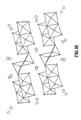
- Fig. 16 represents the typical structure of LiV 3 O 8 , and applies to the lithium vanadium oxide "base” materials according to the present invention
- the gray spheres represent lithium cations which are located in octahedra and tetrahedra.
- the vanadium layers are depicted as a combination of [VO 6 ] octahedra and [VO 5 ] square pyramids.
- the small open spheres on the polyhedra represent the oxygen ions.
- Figure 16 is also representative of the fluorine-doped systems, in which the fluorine ions partially substitute for some of the oxygen ions.
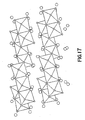
- Figure 17 is a typical structural representation of a discharged electrode product Li 4 V 3 O 8 .
- the gray spheres represent lithium ions and the small open spheres the oxygen ions.
- the vanadium ions and lithium ions are all octahedrally coordinated.
- Figure 17 is also generally representative of the discharged fluorine-doped electrodes according to the present invention.
Landscapes
- Chemical & Material Sciences (AREA)
- Inorganic Chemistry (AREA)
- Chemical Kinetics & Catalysis (AREA)
- Electrochemistry (AREA)
- General Chemical & Material Sciences (AREA)
- Organic Chemistry (AREA)
- Engineering & Computer Science (AREA)
- Crystallography & Structural Chemistry (AREA)
- Manufacturing & Machinery (AREA)
- Materials Engineering (AREA)
- Battery Electrode And Active Subsutance (AREA)
- Secondary Cells (AREA)
Description
- The present invention relates to certain modified lithium vanadium oxides. Included are preferred oxides according to the general formula Li1.2V3O8-δFδ and certain related oxides such as Li1.2V3-δ'Mδ'O8-δFδ, wherein M can be a variety of cations (or a mixture of cations). The invention concerns the utilization of such oxide materials as electrode materials, for example, as cathode materials in lithium batteries. The disclosure concerns preferred formulations of such materials, preferred methods for preparation of them, products including such materials and methods of use.
- The negative electrode (anode) of a high density lithium battery typically comprises one or more of a variety of any suitable lithium-containing substances such as: metallic lithium; lithium-metal alloys; lithium metal oxides; or, lithium carbon composites. The positive electrode (cathode) is typically a lithium vanadium oxide, of the nominal or base formula LiV3O8. The electrodes may be coupled using a liquid electrolyte or a solid electrolyte such as a solid polymer electrolyte, or a combination of liquid and solid electrolytes. The electrolyte may specifically be a "plasticized" electrolyte in which a liquid electrolyte component is contained within a polymer electrolyte.
- During discharge, lithium ions are electrochemically inserted into the lithium vanadium oxide structure by a process that is commonly referred to as intercalation. A reverse process occurs during charge. The vanadium ions of the host electrode structure are reduced and oxidized during discharge and charge, respectively. Conversely, the negative electrode is oxidized during discharge when lithium ions are released from the electrode into the electrolyte, and it is reduced during the reverse process on charge. Lithium ions, therefore, shuttle between the two electrodes during the electrochemical discharge and charge processes.
- It is advantageous for batteries, such as lithium batteries, to have a high electrochemical "capacity" or energy storage capability. In lithium batteries, this can be achieved if the positive and negative electrodes can accommodate a significant amount of lithium. Furthermore, in order to have a good cycle life, the positive and negative electrodes should have the ability to accommodate and release lithium in a reversible manner, i.e., without significant "capacity fade". Thus, the structural integrity of the electrodes should be maintained during lithium insertion/extraction for numerous cycles.
- According to the present invention, a vanadium oxide material doped with fluorine is provided. Preferred formulations, providing for an overall charge balance in which the average, calculated, oxidation state of vanadium is at least 4.6, usually at least 4.8 and preferably at least 4.9, are provided.
- The invention also concerns the provision of electrodes including lithium vanadium oxide according to the preferred general formula; and, batteries including an electrode as characterized. The invention further concerns a method of modifying a nominal vanadium oxide formula through fluorine doping.
-
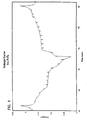
- Figure 1 is a discharge/charge profile of an electrochemical cell having, as an electrode, Li1.2V3O8.
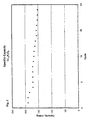
- Figure 2 is an individual plot of discharge capacity versus the cycle number for a battery having as an electrode, Li1.2V3O8.
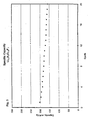
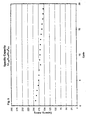
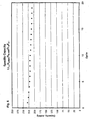
- Figure 3 is a plot of discharge capacity v. cycle number for a fluorine-doped electrode, specifically Li1.2V3O7.9F0.1.
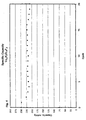
- Figure 4 is a plot of discharge capacity v. cycle number for a fluorine-doped electrode, specifically Li1.2V3O7.8F0.2.
- Figure 5 is a plot of discharge capacity v. cycle number for a fluorine-doped electrode, specifically Li1.25V2.95O7.8F0.2.
- Figure 6 is a plot of discharge capacity v. cycle number for a fluorine-doped electrode, specifically Li1.2V2.8925Ti0.1075O7.9F0.1.
- Figure 7 is a plot of discharge capacity v. cycle number for a fluorine-doped electrode, specifically Li1.2V2.8925Zr0.1075O7.9F0.1.
- Figure 8 is a plot of discharge capacity v. cycle number for a fluorine-doped electrode, specifically Li1.2V2.8Ti0.1Mo0.1O7.9F0.1.
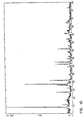
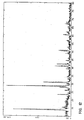
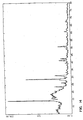
- Figure 9 is an X-ray diffraction pattern for Li1.2V3O8.
- Figure 10 is an X-ray diffraction pattern for Li1.2V3O7.9F0.1.
- Figure 11 is an X-ray diffraction pattern for Li1.2V3O7.8F0.2.
- Figure 12 is an X-ray diffraction pattern for Li1.25V2.95O7.8F0.2.
- Figure 13 is an X-ray diffraction pattern for Li1.2V2.8925Ti0.1075O7.9F0.1.
- Figure 14 is an X-ray diffraction pattern for Li1.2V2.8925Zr0.1075O7.9F0.1.
- Figure 15 is an X-ray diffraction pattern for Li1.2V2.8Ti0.1Mo0.1O7.9F0.1.
- Figure 16 is a representation of the structure of Li1.2V3O8.
- Figure 17 is a structural representation of a discharged electrode product Li4V3O8.
- Figure 18 is a cross-sectional representation of a cell incorporating an electrode according to the present invention.
- Figure 19 is a second schematic illustration of a cell.
-
- A preferred vanadium oxide electrode material for use with respect to lithium batteries of concern to the present invention will be referenced generally as having a "nominal" formula of LixV3O8, wherein x is typically at least 1.0, usually about 1.0-1.5 and often about 1.2. The crystalline structure of this material is relatively stable, and is preferential with respect to intercalation. This nominal or base formula is the approximate formula at complete charge.
- Oxides of nominal formula LixV3O8 exhibit a distinctive X-ray diffraction pattern (XRD) and crystalline structure, as discussed below.
- The specific preferred stoichiometry for the most stable electrode in the charged state is Li1.2V3O8. By this it is meant that the preferred material is formulated from precursor materials such that in a fully charged cell the average formulation of the cathode, with respect to the vanadium oxide component, is Li1.2V3O8. The average (calculated) vanadium valence in Li1.2V3O8 is 4.933 or "nominally" 5.
- As the battery is discharged, lithium cations are inserted into the crystalline Li1.2V3O8 electrode structure. This reduces the average oxidation state of the vanadium ions from 4.933 in Li1.2V3O8 to 4.0 in Li4V3O8, which represents the approximate composition of the positive electrode in a discharged cell.
- According to the present invention, the nominal LiV3O8 structure, typically and preferably Li1.2V3O8, is modified to advantage. The modification, in part, concerns "doping" with fluorine. The substitution of fluorine ions for some oxygen ions can lead to stabilization, as discussed below. In some instances, the "fluorine doping" is accompanied by a preferred introduction of further cations, for example, additional lithium cations or other cations, into the crystalline structure.
- According to this aspect of the present invention, preparation of a lithium vanadium oxide of the general (base or nominal) formula LixV3O8 preferably wherein x >1 (typically 1.0 to 1.5 and more preferably is about 1.2) is modified by fluorine substitution (doping) to lead to a preferred fluorine-doped material. For example, in a particular embodiment, the oxygen ions may be partially substituted by fluorine, preferably leading to a material having the general formula Li1.2V3O8-δFδ wherein 0 < δ ≤1.0. Typically and preferably, δ is within the range of 0.05 to 0.3.
- In Li1.2V3O8 the mean oxidation state of vanadium is 4.933. Substitution of fluorine for oxygen as characterized in the previous paragraph, but in such a manner that the vanadium oxidation state is kept equal to or close to its relatively high original value of 4.933, more generally at least 4.6 (usually at least 4.8, typically and preferably at least 4.9), can be achieved by substituting some lithium ions for some of the vanadium ions. A class of stabilized lithium vanadium oxides (base formulation) according to this aspect of the invention would preferably be characterized by the following general formula: Li1.2+δ'V3-δ'O8-δFδ wherein δ' is equal to 0.254δ. The value for δ'results from a calculation as follows:
- The charge balance must be zero, so:
- Assuming a "preferred" average oxidation state for V ions of 4.933 in a
fully-charged electrode, then:
-
- Thus, for example, for δ=0.2, the formula would be: Li1.25V2.95O7.8F0.2.
- The type of calculation discussed above is sometimes referred to herein as a "valence type" calculation and can be applied to determine a variety of unknowns.
- In further embodiments of the present invention, in addition to substitution of fluorine for some oxygen compounds, substitution of vanadium by another element, preferably a cation in addition to lithium, is used. This can also be a method of maintaining the average, calculated, oxidation state of vanadium at or near 4.933, or more generally at a value of at least 4.6 (usually at least 4.8, typically and preferably at least 4.9) in the fully charged state.
- Substitution of a metal cation for some of the vanadium in the material results in a general formula as follows: Li1.2V3-δ'Mδ'O8-δFδ wherein the relationship between δ and δ' can be calculated in a like manner as given above, with an additional term corresponding to the valency of the cation M. For example, if the cation M is chosen to be a tetravalent cation such as titanium (Ti+4) or zirconium (Zr+4), the relationship between δ and δ' (calculated analogously to the calculation given above) is: δ' = 1.075δ
- A base formula for a preferred group of such stabilized compounds would be as follows: Li1.2V3-δ'Mδ'O8-δFδ wherein M is a cation selected from Al, Si, P, Sc, Ti, Cr, Mn, Fe, Co, Ni, Cu, Zn, Ge, Y, Zr, Nb, Mo, La and mixtures thereof. Preferred cations, M, are those that form strong M-O bonds, such as Al, Si, P, Sc, Ti, Ge, Y, Zr, Nb, Mo and La. As an example, and using the valence calculation discussed above; for δ = 0.1 and M=Ti, a preferred formula would be Li1.2V2.8925Ti0.1075O7.9F0.1.
- In general, it is preferred to use a transition element "M" (or mixture of elements of "M") which does not, in the amounts used, generate a significant amount of a second impurity phase along with Li1.2V3O8.
- In various embodiments of the present invention, it is possible to use two or more different cations as substituents for some of the vanadium ions. For example, it is possible to replace two pentavalent vanadium ions (V+5) in the lithium-vanadium-oxide crystal lattice by one hexavalent molybdenum (Mo+6) ion and one tetravalent zirconium (Zr+4) or titanium (Ti+4) ion. In this instance, substitution of two metal cations for some of the vanadium in the material results in the general formula: Li1.2V3-2δ'M'δ'M"δ'O8-δFδ wherein the relationship between δ and δ' can be calculated in a like manner as given above.
- Thus, as an example, for M'= Mo+6, M"= Ti+4, δ=0.1 and δ'=0.1, a preferred formula would be: Li1.2V2.8Mo0.1Ti0.1O7.9F0.1.
- Materials according to the present invention can be readily prepared by modifications to known techniques for manufacture of LixV3O8.
- For example, Li1.2V3O8 electrode materials can be manufactured by reaction of LiOH with NH4VO3 in methanol, with follow up firing to 400°C; as described further in the experimental section.
- Fluorine introduction can be readily achieved by introducing LiF in place of some of the lithium hydroxide, in an appropriate amount to achieve the desired stoichiometry. Additional modifications in lithium can be introduced by adding further LiOH.
- Similarly, other metal cations can be introduced into the crystal structure of the electrode. For example, titanium can be introduced by the addition of Ti[OCH(CH3)2]4 to the reaction mixture, zirconium by Zr[OCH(CH3)2]4 (CH3)2CH2OH and molybdenum by MoO3. For other cations, the compounds can be selected from oxides, hydroxides or salts such as alkoxides, oxalates, acetates and nitrates.
- Electrodes can be prepared from the oxide base by coating onto a metallic current collector a slurry containing the oxide base, a polymeric binder such as polyvinylidinefluoride (PVDF), electrically conductive particles such as conductive carbon particles, and a solvent such as toluene, and drying the coating, to form the electrode.
- Electrode materials of the type described herein would typically be used in high energy density lithium storage batteries. The capacity fade that occurs with time for certain types of such batteries during repeated discharge and charge can be attributed to a number of possible factors. Li1.2V3O8 has a layered-type crystal structure. During discharge, lithium ions are inserted into a Li1.2+x'V3O8 structure (typically 0≤x'≤2.8). Capacity fade phenomena could result for example, either from (1) structural fatigue due to anisotropic variations in the lattice parameters during charge and discharge, or (2) migration of vanadium ions from their original positions into the layers occupied by lithium, thereby, restricting lithium mobility, or (3) the dissolution of some vanadium from the crystal lattice into the electrolyte, or a combination of (1), (2) and (3).
- In preferred lithium vanadium oxide cathode arrangements according to the present invention, at the "top of the charge", the vanadium is in an average oxidation state approaching V+5 (typically and preferably about 4.933, more generally at least 4.6) and at the end of discharge it is closer to V+4. Vanadium in lower oxidation states is believed to be somewhat more soluble in certain electrolytes than at higher oxidation states. This could be partly responsible for some of the observed deterioration of the cathode operation, with cycling for certain types of batteries.
- Without being bound to any particular theory, it is presently believed that the fluorine-doped systems (in particular the fluorine-doped and M-cation doped systems) are stabilized by introduction of the fluorine ions and M cations into the crystal structure. A possible reason for this could be differences in strength between vanadium-fluorine, vanadium-oxygen, and M-oxygen bonds. It can be reasoned that the minor introduction of fluorine ions and, if desired M cations, may add integrity to the vanadium oxide crystalline structure, as a result of the introduction of strong vanadium-fluorine and M-oxygen bonds. The net result of this could be either or both of inhibiting vanadium migration and/or inhibiting solubility. In some instances this may manifest itself by a lessening of capacity fade.
- In general, the preferred formulations provided are arrived at by focusing on two principal factors:
- 1. A desire to maintain the vanadium valence state, at the top of charge, as close to 4.933 as reasonably possible, and more generally at least 4.6 (usually at least 4.8 and preferably at least 4.9) in the stabilized Li1.2V3O8 (base) crystal structure.
- 2. Introduction of no more fluorine ions into the crystalline structure than is useful to achieve the desired level of stabilization, because of a desire not to greatly depart from the stoichiometry of the Li1.2V3O8 base, and to keep the level of fluorine ( a chemically aggressive reagent) in the oxide as low as reasonably possible.
-
- In general, the crystalline structure of Li1.2V3O8 is layered. Three vanadium ions and one lithium ion typically occupy octahedral sites in the Li1.2V3O8 structure; the remaining (for example 0.2) lithium ions occupy tetrahedral sites. During discharge, the lithium ions migrate into neighboring octahedral sites to generate a stable defect rocksalt structure. The approximate composition at the end of discharge is Li4V3O8.
- Substitution of oxygen with fluorine in Li1.2V3O8-δFδ results in a lowering of the average oxidation state of the vanadium ions in the structure. Compensation for this can be accomplished by increasing the presence of other cations, for example, by introduction of more lithium or by introduction of other cations. As a result, a charge balance, with the average vanadium charge of about 4.933 (generally at least 4.6, usually at least 4.8 and preferably at least 4.9), calculated as discussed above, can be maintained.
- Preferred cations to introduce for this purpose are titanium and/or zirconium, although other cations and even mixtures, can be used. The titanium or zirconium doped systems are advantageous because of the relatively strong titanium-oxygen or zirconium-oxygen bonds in the crystal structure. It can be reasoned that such bonds will serve to strengthen and maintain the integrity of the overall crystal structure, particularly during cell operation when lithium is being repeatedly inserted into and extracted from the structure.
- A general formula of a preferred vanadium oxide material, useable as a cathode material as described above at least when defined in the charged state, would be as follows:
- (a) 0 < δ ≤ 1 (preferably 0.05 ≤ δ ≤ 0.3)
- (b) 0 ≤ y ≤ 0.5
- (c) x is non-zero (typically and preferably 1 ≤ x < 1.5, usually x is about 1.2).
- (d) x, y and z are selected such that the average, calculated, oxidation state of V is at least 4.6, more preferably at least 4.8 and most preferably at least 4.9; and,
- (e) M is selected from ions of Al, Si, P, Sc, Ti, Cr, Mn, Fe, Co, Ni, Cu, Zn, Ge, Y, Zr, Nb, Mo, La and mixtures thereof (preferably Ti, Y, Zr, Mo and mixtures thereof).
-
- In one preferred embodiment: y=0; z=3; and, x=1.2. If lithium presence is increased to maintain a preferred calculated valence for the vanadium, in one preferred embodiment: y=0; z=3-δ'; and x=1.2 + δ', wherein δ' = 0.254δ. In those formulations in which y>0, preferably: M is Ti or Zr; x=1.2; z=3-δ'; and y=δ'; wherein δ'=1.075δ.
- Preferred electrodes comprise a vanadium oxide base according at least one of the preferred formulae recited above; and, preferred battery constructions include at least one preferred electrode as characterized.
- It should be appreciated that in some instances M may be a mixture of cations and thus My would comprise such formulae as: M'y' M"y"; M'y' M"y" M"'y"';... etc. The term "My" is intended to include mixtures of this type. In such instances the limitation on "y" is intended to be on the averaged cation "M" resulting from averaging the valence of the various M', M", etc., using a mole-weighted, valence charge balance calculation analogous to the ones discussed above. Preferred electrodes which contain a mixture of cations are those in which M is derived from Ti, Y, Zr and Mo.
- As indicated above, the formulae given herein for the preferred vanadium oxide materials are generally in reference to the material as it would be found in an electrode in the fully charged state. During discharge, and intercalation, a lithium ion introduction will modify the formulae.
- Typically battery constructions that can use the preferred cathode materials according to the present invention include otherwise conventional coin cells, wound cells and stacked cells in which the cathode oxide is replaced with the preferred oxide(s) described herein. Various useable conventional constructions are described in Handbook of Batteries, 2d Ed., edited by D. Linden et al., McGraw-Hill, 1995, the disclosure of which is incorporated herein by reference.
- An example cell is shown in Fig. 18. The cell may generally be according to the description of U.S. Patent 4,803,137, incorporated herein by reference, except in that the cathode includes a vanadium oxide material as described herein. Referring to Fig. 18, the cell depicted includes: a
cathode 1; a positive electrodecurrent collector 2; apositive electrode casing 3; an anode U; a negative electrodecurrent collector 5; anegative electrode casing 6; separator/electrolyte 7; and, insulatingpolypropylene gasket 8. With a vanadium oxide material as described herein, the cell would operate in the otherwise typical fashion. - Another schematic illustration of the electrochemical cell is shown in Fig. 19. The cell is designated 15, and the anode (negative electrode), electrolyte and cathode (positive electrode) are designated 11, 12, and 13, respectively, with the anode 11 separated from the
cathode 13 by theelectrolyte 12. Suitable terminals designated 14 are provided in electric contact with the anode 11 and thecathode 13. Thecell 15 is contained in a housing, designated 16, which insulates the anode from the cathode. Thecell 15 may include, at thecathode 13, vanadium oxide material according to the present invention. - For this preparation, 1.2 moles of LiOH·H2O and 3 moles of NH4VO3 were suspended in methanol and milled for 48 hours. The methanol was evaporated and the dry solid precursor heated in air. The sample was heated to 400°C at a rate of 1°C/min. and held at 400°C for 24 hours. It was then allowed to cool to room temperature (at about a 1°C/min. cooling rate). The product was ground to a fine powder by mortar and pestle and submitted for phase identification by X-ray powder diffraction.
- For these preparations, 1.2-δ moles of LiOH·H2O, δ moles of LiF and 3 moles of NH4VO3 were suspended in methanol and milled for 48 hours. The methanol was evaporated and the dry solid precursor, slightly yellow in color when compared to Li1.2V3O8, was heated in air. The sample was heated to 400°C at a rate of 1 °C/min. and held at 400°C for 24 hours, then allowed to cool to room temperature (at about a 1 °C/min. cooling rate). The product was ground to a fine powder and submitted for phase identification by X-ray powder diffraction.
- For this preparation, 1.05 moles of LiOH·H2O, 0.2 moles of LiF and 2.95 moles NH4VO3 were suspended in methanol and milled for 48 hours. The methanol was evaporated and the dry solid precursor heat treated in air. The sample was heated to 400°C at a rate of 1 °C/min. and held at 400°C for 24 hours, then allowed to cool to room temperature (at about a 1 °C/min. cooling rate). The product was ground to a fine powder and submitted for phase identification by X-ray powder diffraction.
- For this preparation, 1.1 moles of LiOH·H2O, 0.1 moles of LiF, 0.1075 moles of Ti[OCH(CH3)2]4, and 2.8925 moles of NH4VO3 were suspended in methanol and milled for 48 hours. The methanol was evaporated and the dry solid precursor heat treated in air. The sample was heated to 400°C at a rate of 1°C/min. and held at 400°C for 24 hours, then allowed to cool to room temperature (at about a 1°C/min. cooling rate). The product was ground to a fine powder and submitted for phase identification by X-ray powder diffraction.
- For this preparation, 1.1 moles of LiOH·H2O, 0.1 moles of LiF, 0.1075 moles of Zr[OCH(CH3)2]4(CH3)2CH2OH and 2.8925 moles of NH4VO3 were suspended in methanol and milled for 48 hours. The methanol was evaporated and the dry solid precursor was heat treated in air. The sample was heated to 400°C at a rate of 1°C/min. and held at 400°C for 24 hours, then allowed to cool to room temperature (at about a 1°C/min. cooling rate). The product was ground to a fine powder and submitted for phase identification by X-ray powder diffraction.
- 1.1 moles of LiOH·H2O, 0.1 moles of LiF, 0.1 moles of Ti[OCH(CH3)2]4, 0.1 moles of MoO3 and 2.8 moles of NH4VO3 were suspended in methanol and milled for 48 hours. The methanol was evaporated and the dry solid precursor was heat treated in air. The sample was heated to 400°C at a rate of 1°C/min. and held at 400°C for 24 hours, then allowed to cool to room temperature (at about a 1 °C/min. cooling rate). The product was ground to a fine powder and submitted for phase identification by X-ray powder diffraction.
- Example 7. The materials of Examples 1-6 were screened for electrochemical performance in standard 1225 coin cells. A cathode laminate of each material was prepared by mixing, by weight: 81% active (test) material; 10% Kynar (binder available from ELF Autochem North America, Inc. of Philadelphia, PA); and, 9% carbon (VX C72 available from CABOT Corp. of Boston, MA), with milling in tetrahydrofuran. For Li1.2V3O8, two separate cathode laminates were made and evaluated, to examine possible variance based on production variables.
- To prepare the cathode, the laminate mixture was poured onto a smooth surface and applied with a doctor-blade to uniform thickness. When the mixture was sufficiently dry, a laminate disk approximately ¼ inch (6.35 mm) in diameter was punched out. The disks were dried in a vacuum overnight at about 80°C. The coin cells were then prepared by stacking, in order: can (hardware); copper spacer, lithium disk; separator; a few drops of dimethoxyethane (to help wet the separator); 1.0 M LiPF6 in ethylene carbonate/dimethylcarbonate, 50%/50% by weight (electrolyte); cathode laminate; insulating spacer, to assure stack height of 75/80 mil.; and cap (hardware). The coin cells were crimped in a hydraulic press.
- Coin cells of general notation, Li/1.0M LiPF6, DMC, EC/Li1.2V3O8 (or doped) material were cycled at constant current (typically 0.1 mA) between 3.1-2.1 V for at least 20 cycles. The test equipment was a Series 2000 Maccor Cycler.
- A typical discharge/charge profile of a Li/1.0M LiPF6, DMC, EC/Li1.2V3O8 cell is shown in Figure 1. This figure is also representative of the typical voltage profiles of a cell containing the fluorine-doped electrodes. The principles of the invention were demonstrated in the electrochemical data obtained from standard (undoped) Li1.2V3O8 electrodes and from various fluorinated electrodes. Individual plots of discharge capacity vs. cycle number are provided in Figures 2 to 8 for: (1) standard (base) Li1.2V3O8,
(Example 1, Fig. 2); (2) Li1.2V3O8-δFδ with δ=0.1 (Example 2, Fig. 3) and δ=0.2 (Example 2, Fig. 4); (3) Li1.2+δ'V3-δ'O8-δFδ with δ'=0.05 and δ=0.2, i.e., Li1.25V2.95O7.8F0.2 (Example 3, Fig. 5); (4) Li1.2V2.8925Ti0.1075O7.9F0.1 (Example 4, Fig. 6), Li1.2V2.8925Zr0.1075O7.9F0.1 (Example 5, Fig. 7); and (5) Li1.2V2.8Ti0.1Mo0.1O7.9F0.1
(Example 6, Fig. 8). It was observed that, in general, the fluoride-doped electrodes led to higher capacities compared to the standard (base) Li1.2V3O8 material. The best electrode materials observed to date in the experiments, with respect to capacity fade, included the Li1.2V2.8925Ti0.1075O7.9F0.1 and Li1.2V2.8Ti0.1Mo0.1O7.9F0.1 samples. It is believed that further improvements in the performance of these fluorine-doped materials can be expected, once the composition and processing techniques and conditions are optimized. - Table 1 summarizes the typical electrochemical data that were obtained from fluorine-doped and M-doped LiV3O8 electrodes in accordance with this invention The relative stability of the various electrodes is given as a function of capacity fade between
cycle 2 andcycle 20, and compared with the performance of a standard electrode of nominal composition Li1.2V3O8. - Table I demonstrates a general improvement in the electrochemical performance of the modified Li1.2V3O8 electrodes in terms of both capacity and capacity fade after 20 cycles compared with the standard Li1.2V3O8 electrode, and particularly those electrodes that were doped with both fluorine and M cations. Table 1 demonstrates that a wide variety of dopant M cations can be used to improve the Li1.2V3O8 electrode performance, particularly in terms of improving the capacity fade of the electrochemical cell.
Material Capacity Cycle 2 (mAh/g) Cycle 20Capacity Fade (%) Li1.2V3O8 191 151 21 Li1.2V3O7.9F0.1 203 161 21 Li1.2V3O7.8F0.2 227 209 7 Li1.25V2.95O7.8F0.2 191 153 20 Li1.2V2.8925Ti0.1075O7.9F0.1 232 208 10 Li1.2V2.8925Zr0.1075O7.9F0.1 232 203 12 Li1.2V2.8Ti0.1Mo0.1O7.9F0.1 237 229 3 Li1.2V2.85Ti0.075Mo0.075O7.95F0.05 245 210 14 Li1.2V2.8Zr0.1Mo0.1O7.9F0.1 163 168 -3 Li1.2V2.85Fe0.15O7.9F0.1 209 188 10 Li1.2V2.93Ni0.07O7.8F0.2 219 180 18 Li1.2V2.8Ti0.2O0.9F0.1 208 183 12 - Powder X-ray patterns of the various samples (1) standard (base) Li1.2V3O8 (Fig. 9); (2) Li1.2V3O8-δFδ with δ=0.1 (Fig. 10) and δ=0.2 (Fig. 11); (3) Li1.2+δ'V3-δ'O8-δFδ with δ'=0.05 and δ=0.2, i.e., Li1.25V2.95O7.8F0.2 (Fig. 12); (4) Li1.2V2.8925Ti0.1075O7.9F0.1 (Fig. 13); (5) Li1.2V2.8925Zr 0.1075O7.9F0.1 (Fig. 14); and, (6) Li1.2V2.8Ti0.1Mo0.1O7.9F0.1 (Fig. 15) are provided in the Figures.
- From the X-ray diffraction data it can be seen that most of the fluorinated samples are essentially single phase systems and can be indexed to the same structure as the parent Li1.2V3O8 material.
- Structural representations of Li1.2V3O8 and Li4V3O8 are shown in Figures 16 and 17.
- Referring first to Fig. 16, which represents the typical structure of LiV3O8, and applies to the lithium vanadium oxide "base" materials according to the present invention, the gray spheres represent lithium cations which are located in octahedra and tetrahedra. The vanadium layers are depicted as a combination of [VO6] octahedra and [VO5] square pyramids. The small open spheres on the polyhedra represent the oxygen ions. Figure 16 is also representative of the fluorine-doped systems, in which the fluorine ions partially substitute for some of the oxygen ions.
- Figure 17 is a typical structural representation of a discharged electrode product Li4V3O8. As before, the gray spheres represent lithium ions and the small open spheres the oxygen ions. In Li4V3O8, the vanadium ions and lithium ions are all octahedrally coordinated. The vanadium layers, therefore, consist of only [VO6] octahedra. Figure 17 is also generally representative of the discharged fluorine-doped electrodes according to the present invention.
Claims (12)
- A vanadium oxide material according to the average formula:(a) 0 < δ ≤ 1;(b) 0 ≤ y ≤ 0.5;(c) x is non-zero;(d) x, y and z are selected such that the average, calculated, oxidation state of V is at least 4.6; and(e) M is selected from Al, Si, P, Sc, Ti, Cr, Mn, Fe, Co, Ni, Cu, Zn, Ge, Y, Zr, Nb, Mo, La and mixtures thereof.
- A vanadium oxide material according to claim 1, wherein:(a) y = 0;(b) z = 3; and(c) 1 ≤ x ≤ 1.5.
- A vanadium oxide material according to claim 1, wherein:wherein δ' = 0.2545.(a) y = 0;(b) z = 3-δ'; and(c) x = 1.2 + δ'
- A vanadium oxide material according to claim 1, wherein:(a) the average oxidation state of V is at least 4.8.
- A vanadium oxide material according to claim 1 wherein:(a) y is non-zero; and(b) M is selected from Ti, Y, Zr, Mo and mixtures thereof.
- A vanadium oxide material according to claim 1, wherein:(a) x = 1.2;(b) z=3-δ';(c) y = δ', wherein δ' = 1.075δ; and(d) M is selected from Ti, Zr and mixtures thereof.
- A vanadium oxide material according to claim 1 wherein:(a) 1 ≤ x ≤ 1.5;(b) z = 2.8;(c) δ = 0.1;(d) y is non-zero; and(e) M is selected from Ti, Y, Zr, Mo and mixtures thereof.
- An electrode comprising:a vanadium oxide material according to any of claims 1 to 7 as a base.
- An electrode according to claim 8 further comprising:(a) binder; and(b) conductive material.
- An electrochemical cell comprising:wherein:(a) a cathode comprising a vanadium oxide base according to the average formula:(i) 0 < δ ≤ 1;(ii) 0 ≤ y ≤ 0.5;(iii) x is non-zero;(iv) x, y and z are selected such that the average oxidation state of V is at least 4.6; and(v) M is selected from Al, Si, P, Sc, Ti, Cr, Mn, Fe, Co, Ni, Cu, Zn, Ge, Y, Zr, Nb, Mo, La and mixtures thereof.
- A method of modifying a nominal vanadium oxide formulation, of LixV3O8, wherein 1 ≤ x ≤ 1.5, for use as an electrode material; said method comprising a step of:(a) providing fluorine-doping of the formulation to form a fluorine-doped base formulation, having an average vanadium oxidation state of at least 4.6.
- A method according to claim 11 further including a step of:(a) also doping with cation M selected from the group Al, Si, P, Sc, Ti, Cr, Mn, Fe, Co, Ni, Cu, Zn, Ge, Y, Zr, Nb, Mo, La and mixtures thereof.
Applications Claiming Priority (3)
| Application Number | Priority Date | Filing Date | Title |
|---|---|---|---|
| US08/985,441 US6004697A (en) | 1997-12-05 | 1997-12-05 | Modified lithium vanadium oxide electrode materials products and methods |
| US985441 | 1997-12-05 | ||
| PCT/US1998/025613 WO1999030378A1 (en) | 1997-12-05 | 1998-12-03 | Modified lithium vanadium oxide electrode materials; products and methods |
Publications (2)
| Publication Number | Publication Date |
|---|---|
| EP1042831A1 EP1042831A1 (en) | 2000-10-11 |
| EP1042831B1 true EP1042831B1 (en) | 2002-06-05 |
Family
ID=25531496
Family Applications (1)
| Application Number | Title | Priority Date | Filing Date |
|---|---|---|---|
| EP98961880A Expired - Lifetime EP1042831B1 (en) | 1997-12-05 | 1998-12-03 | Modified lithium vanadium oxide electrode materials; products and methods |
Country Status (7)
| Country | Link |
|---|---|
| US (1) | US6004697A (en) |
| EP (1) | EP1042831B1 (en) |
| JP (1) | JP2001526449A (en) |
| AU (1) | AU1709199A (en) |
| CA (1) | CA2313020A1 (en) |
| DE (1) | DE69805853T2 (en) |
| WO (1) | WO1999030378A1 (en) |
Families Citing this family (23)
| Publication number | Priority date | Publication date | Assignee | Title |
|---|---|---|---|---|
| EP1049183B1 (en) * | 1998-11-10 | 2011-08-03 | Panasonic Corporation | Lithium secondary cell |
| US6153333A (en) | 1999-03-23 | 2000-11-28 | Valence Technology, Inc. | Lithium-containing phosphate active materials |
| KR100296878B1 (en) * | 1999-06-12 | 2001-07-12 | 김순택 | Positive active material for lithium secondary battery and lithium secondary battery comprising the same |
| US6322928B1 (en) | 1999-09-23 | 2001-11-27 | 3M Innovative Properties Company | Modified lithium vanadium oxide electrode materials and products |
| CN1209834C (en) * | 2000-04-19 | 2005-07-06 | 日本电池株式会社 | Positive electrode active material for secondary battery, method for producing same, and nonaqueous electrolyte secondary battery containing same |
| US8057769B2 (en) * | 2000-04-27 | 2011-11-15 | Valence Technology, Inc. | Method for making phosphate-based electrode active materials |
| US6777132B2 (en) * | 2000-04-27 | 2004-08-17 | Valence Technology, Inc. | Alkali/transition metal halo—and hydroxy-phosphates and related electrode active materials |
| US7524584B2 (en) | 2000-04-27 | 2009-04-28 | Valence Technology, Inc. | Electrode active material for a secondary electrochemical cell |
| US6387568B1 (en) * | 2000-04-27 | 2002-05-14 | Valence Technology, Inc. | Lithium metal fluorophosphate materials and preparation thereof |
| US6964827B2 (en) * | 2000-04-27 | 2005-11-15 | Valence Technology, Inc. | Alkali/transition metal halo- and hydroxy-phosphates and related electrode active materials |
| EP1164649A1 (en) * | 2000-06-13 | 2001-12-19 | Japan Storage Battery Company Limited | Positive active material for secondary battery, process for preparation thereof and non-aqueous secondary battery comprising same |
| CN1444778A (en) | 2000-08-04 | 2003-09-24 | 纳幕尔杜邦公司 | Trivanadium oxide hydrate compositions |
| FR2831715B1 (en) * | 2001-10-25 | 2004-03-19 | Centre Nat Rech Scient | LITHIUM AND VANADIUM OXIDE, ITS USE AS AN ACTIVE ELECTRODE MATERIAL |
| US7422823B2 (en) * | 2002-04-03 | 2008-09-09 | Valence Technology, Inc. | Alkali-iron-cobalt phosphates and related electrode active materials |
| US7482097B2 (en) * | 2002-04-03 | 2009-01-27 | Valence Technology, Inc. | Alkali-transition metal phosphates having a +3 valence non-transition element and related electrode active materials |
| UA67135A (en) * | 2003-07-25 | 2004-06-15 | Subsidiary Entpr With Foreign | Method for producing lithium battery |
| FR2876997B1 (en) * | 2004-10-22 | 2007-01-19 | Batscap Sa | LITHIUM AND VANADIUM OXIDE, PROCESS FOR PREPARATION THEREOF |
| US7718319B2 (en) | 2006-09-25 | 2010-05-18 | Board Of Regents, The University Of Texas System | Cation-substituted spinel oxide and oxyfluoride cathodes for lithium ion batteries |
| KR101208910B1 (en) | 2010-09-29 | 2012-12-06 | 전자부품연구원 | Manufacturing method of negative composition for Lithium secondary battery using lithium vanadium oxide substituted other metal |
| EP2784847B1 (en) * | 2013-03-26 | 2015-09-30 | Belenos Clean Power Holding AG | Surface modified lithiated H2V3O8 |
| CN109553133A (en) * | 2018-10-23 | 2019-04-02 | 开封大学 | It is a kind of to prepare lithium battery anode material lithium barium oxide LiV3O8Method |
| CN111653782A (en) * | 2020-06-12 | 2020-09-11 | 昆山宝创新能源科技有限公司 | Positive electrode material and preparation method and application thereof |
| CN113921805B (en) * | 2021-10-14 | 2022-12-20 | 合肥工业大学 | A preparation method of anion-doped vanadium trioxide positive electrode material for aqueous zinc-ion battery |
Family Cites Families (13)
| Publication number | Priority date | Publication date | Assignee | Title |
|---|---|---|---|---|
| US4803137A (en) * | 1987-05-19 | 1989-02-07 | Bridgestone Corporation | Non-aqueous electrolyte secondary cell |
| IT1231750B (en) * | 1989-05-12 | 1991-12-21 | Consiglio Nazionale Ricerche | HIGH ENERGY AND POWER LITHIUM ACCUMULATORS AND RELATED PRODUCTION METHOD |
| JPH02288068A (en) * | 1989-04-26 | 1990-11-28 | Bridgestone Corp | Nonaqueous electrolyte secondary battery |
| US5221453A (en) * | 1990-09-27 | 1993-06-22 | Medtronic, Inc. | Silver vanadium oxide cathode material and method of preparation |
| US5326545A (en) * | 1993-03-30 | 1994-07-05 | Valence Technology, Inc. | Method of making lithium battery electrode compositions |
| US5334334A (en) * | 1993-03-30 | 1994-08-02 | Valence Technology, Inc. | Method of preparing lithium battery electrode compositions |
| US5425932A (en) * | 1993-05-19 | 1995-06-20 | Bell Communications Research, Inc. | Method for synthesis of high capacity Lix Mn2 O4 secondary battery electrode compounds |
| US5389472A (en) * | 1993-06-03 | 1995-02-14 | Wilson Greatbatch Ltd. | Preparation of silver vanadium oxide cathodes using AG (O) and V2 O5 as starting materials |
| US5336572A (en) * | 1993-06-14 | 1994-08-09 | Valence Technology, Inc. | Vanadium oxide cathode active material and method of making same |
| JP3112138B2 (en) * | 1993-07-20 | 2000-11-27 | セントラル硝子株式会社 | Lithium-containing metal halide oxide and method for producing the same |
| US5618640A (en) * | 1993-10-22 | 1997-04-08 | Fuji Photo Film Co., Ltd. | Nonaqueous secondary battery |
| US5674645A (en) * | 1996-09-06 | 1997-10-07 | Bell Communications Research, Inc. | Lithium manganese oxy-fluorides for li-ion rechargeable battery electrodes |
| US5759720A (en) * | 1997-06-04 | 1998-06-02 | Bell Communications Research, Inc. | Lithium aluminum manganese oxy-fluorides for Li-ion rechargeable battery electrodes |
-
1997
- 1997-12-05 US US08/985,441 patent/US6004697A/en not_active Expired - Lifetime
-
1998
- 1998-12-03 DE DE69805853T patent/DE69805853T2/en not_active Expired - Lifetime
- 1998-12-03 WO PCT/US1998/025613 patent/WO1999030378A1/en not_active Ceased
- 1998-12-03 AU AU17091/99A patent/AU1709199A/en not_active Abandoned
- 1998-12-03 CA CA002313020A patent/CA2313020A1/en not_active Abandoned
- 1998-12-03 EP EP98961880A patent/EP1042831B1/en not_active Expired - Lifetime
- 1998-12-03 JP JP2000524832A patent/JP2001526449A/en active Pending
Also Published As
| Publication number | Publication date |
|---|---|
| DE69805853T2 (en) | 2003-01-23 |
| EP1042831A1 (en) | 2000-10-11 |
| US6004697A (en) | 1999-12-21 |
| JP2001526449A (en) | 2001-12-18 |
| CA2313020A1 (en) | 1999-06-17 |
| AU1709199A (en) | 1999-06-28 |
| WO1999030378A1 (en) | 1999-06-17 |
| WO1999030378A9 (en) | 1999-09-16 |
| DE69805853D1 (en) | 2002-07-11 |
Similar Documents
| Publication | Publication Date | Title |
|---|---|---|
| US6004697A (en) | Modified lithium vanadium oxide electrode materials products and methods | |
| KR102754047B1 (en) | Composite cathode active material, cathode and lithium battery containing composite cathode active material, and preparation method thereof | |
| US6322928B1 (en) | Modified lithium vanadium oxide electrode materials and products | |
| US7541114B2 (en) | Anode active material, manufacturing method thereof, and non-aqueous electrolyte secondary battery | |
| US7927506B2 (en) | Cathode active material and lithium battery using the same | |
| EP1909345B1 (en) | Cathode active material for a lithium battery | |
| US6372384B1 (en) | Rechargeable lithium battery comprising substituted lithium titanate electrodes | |
| US6596435B2 (en) | Lithium manganese oxide-based active material | |
| US9391325B2 (en) | Positive electrode active material, production method thereof and non-aqueous electrolyte secondary battery | |
| EP2006940B1 (en) | Cathode mix and nonaqueous electrolyte battery | |
| KR100965240B1 (en) | Anode active material for nonaqueous secondary battery, and nonaqueous secondary battery comprising same | |
| EP1443575B1 (en) | Positive plate material and cell comprising it | |
| KR20090120506A (en) | Anode and nonaqueous electrolyte secondary battery for nonaqueous electrolyte secondary battery | |
| WO2000013250A1 (en) | Nonaqueous electrolyte secondary cell | |
| EP2599146A2 (en) | Niobium oxide compositions and methods for using same | |
| KR20060041933A (en) | Positive electrode active material and nonaqueous electrolyte secondary battery | |
| KR20250053071A (en) | Sodium layered oxide, uses thereof and methods of preparation thereof | |
| KR20200022359A (en) | Positive active material, method of manufacturing the same, and positive electrode and rechargeable lithium battery including the same | |
| JP3975502B2 (en) | Non-aqueous electrolyte secondary battery | |
| US12278342B2 (en) | Alkaline and acidified metal oxide blended active materials | |
| KR20060029048A (en) | Cathode active material for lithium secondary battery and manufacturing method thereof | |
| KR102436440B1 (en) | Cathode, method for manufacturing the same, and rechargeable lithium battery comprising the same | |
| KR20130100625A (en) | Lithium battery | |
| KR20180094567A (en) | Positive active material for lithium secondary battery | |
| US12021244B2 (en) | Cathode including base-resistant compound and lithium-air battery including the same |
Legal Events
| Date | Code | Title | Description |
|---|---|---|---|
| PUAI | Public reference made under article 153(3) epc to a published international application that has entered the european phase |
Free format text: ORIGINAL CODE: 0009012 |
|
| 17P | Request for examination filed |
Effective date: 20000704 |
|
| AK | Designated contracting states |
Kind code of ref document: A1 Designated state(s): DE FR GB IT |
|
| GRAG | Despatch of communication of intention to grant |
Free format text: ORIGINAL CODE: EPIDOS AGRA |
|
| 17Q | First examination report despatched |
Effective date: 20010315 |
|
| GRAG | Despatch of communication of intention to grant |
Free format text: ORIGINAL CODE: EPIDOS AGRA |
|
| GRAG | Despatch of communication of intention to grant |
Free format text: ORIGINAL CODE: EPIDOS AGRA |
|
| GRAH | Despatch of communication of intention to grant a patent |
Free format text: ORIGINAL CODE: EPIDOS IGRA |
|
| GRAH | Despatch of communication of intention to grant a patent |
Free format text: ORIGINAL CODE: EPIDOS IGRA |
|
| GRAA | (expected) grant |
Free format text: ORIGINAL CODE: 0009210 |
|
| AK | Designated contracting states |
Kind code of ref document: B1 Designated state(s): DE FR GB IT |
|
| REG | Reference to a national code |
Ref country code: GB Ref legal event code: FG4D |
|
| REF | Corresponds to: |
Ref document number: 69805853 Country of ref document: DE Date of ref document: 20020711 |
|
| ET | Fr: translation filed | ||
| PLBE | No opposition filed within time limit |
Free format text: ORIGINAL CODE: 0009261 |
|
| STAA | Information on the status of an ep patent application or granted ep patent |
Free format text: STATUS: NO OPPOSITION FILED WITHIN TIME LIMIT |
|
| 26N | No opposition filed |
Effective date: 20030306 |
|
| REG | Reference to a national code |
Ref country code: GB Ref legal event code: 732E |
|
| REG | Reference to a national code |
Ref country code: FR Ref legal event code: TQ |
|
| PGFP | Annual fee paid to national office [announced via postgrant information from national office to epo] |
Ref country code: IT Payment date: 20081218 Year of fee payment: 11 |
|
| PG25 | Lapsed in a contracting state [announced via postgrant information from national office to epo] |
Ref country code: IT Free format text: LAPSE BECAUSE OF NON-PAYMENT OF DUE FEES Effective date: 20091203 |
|
| REG | Reference to a national code |
Ref country code: FR Ref legal event code: PLFP Year of fee payment: 18 |
|
| PGFP | Annual fee paid to national office [announced via postgrant information from national office to epo] |
Ref country code: GB Payment date: 20151125 Year of fee payment: 18 |
|
| PGFP | Annual fee paid to national office [announced via postgrant information from national office to epo] |
Ref country code: FR Payment date: 20151123 Year of fee payment: 18 |
|
| PGFP | Annual fee paid to national office [announced via postgrant information from national office to epo] |
Ref country code: DE Payment date: 20161129 Year of fee payment: 19 |
|
| GBPC | Gb: european patent ceased through non-payment of renewal fee |
Effective date: 20161203 |
|
| REG | Reference to a national code |
Ref country code: FR Ref legal event code: ST Effective date: 20170831 |
|
| PG25 | Lapsed in a contracting state [announced via postgrant information from national office to epo] |
Ref country code: FR Free format text: LAPSE BECAUSE OF NON-PAYMENT OF DUE FEES Effective date: 20170102 |
|
| PG25 | Lapsed in a contracting state [announced via postgrant information from national office to epo] |
Ref country code: GB Free format text: LAPSE BECAUSE OF NON-PAYMENT OF DUE FEES Effective date: 20161203 |
|
| REG | Reference to a national code |
Ref country code: DE Ref legal event code: R119 Ref document number: 69805853 Country of ref document: DE |
|
| PG25 | Lapsed in a contracting state [announced via postgrant information from national office to epo] |
Ref country code: DE Free format text: LAPSE BECAUSE OF NON-PAYMENT OF DUE FEES Effective date: 20180703 |