EP1042553B1 - Method and equipment for controlling properties of paper - Google Patents
Method and equipment for controlling properties of paper Download PDFInfo
- Publication number
- EP1042553B1 EP1042553B1 EP98955624A EP98955624A EP1042553B1 EP 1042553 B1 EP1042553 B1 EP 1042553B1 EP 98955624 A EP98955624 A EP 98955624A EP 98955624 A EP98955624 A EP 98955624A EP 1042553 B1 EP1042553 B1 EP 1042553B1
- Authority
- EP
- European Patent Office
- Prior art keywords
- flow
- paper
- stock
- ash
- retention agent
- Prior art date
- Legal status (The legal status is an assumption and is not a legal conclusion. Google has not performed a legal analysis and makes no representation as to the accuracy of the status listed.)
- Expired - Lifetime
Links
Images
Classifications
-
- D—TEXTILES; PAPER
- D21—PAPER-MAKING; PRODUCTION OF CELLULOSE
- D21G—CALENDERS; ACCESSORIES FOR PAPER-MAKING MACHINES
- D21G9/00—Other accessories for paper-making machines
- D21G9/0009—Paper-making control systems
- D21G9/0027—Paper-making control systems controlling the forming section
-
- D—TEXTILES; PAPER
- D21—PAPER-MAKING; PRODUCTION OF CELLULOSE
- D21F—PAPER-MAKING MACHINES; METHODS OF PRODUCING PAPER THEREON
- D21F7/00—Other details of machines for making continuous webs of paper
- D21F7/06—Indicating or regulating the thickness of the layer; Signal devices
-
- D—TEXTILES; PAPER
- D21—PAPER-MAKING; PRODUCTION OF CELLULOSE
- D21H—PULP COMPOSITIONS; PREPARATION THEREOF NOT COVERED BY SUBCLASSES D21C OR D21D; IMPREGNATING OR COATING OF PAPER; TREATMENT OF FINISHED PAPER NOT COVERED BY CLASS B31 OR SUBCLASS D21G; PAPER NOT OTHERWISE PROVIDED FOR
- D21H23/00—Processes or apparatus for adding material to the pulp or to the paper
- D21H23/02—Processes or apparatus for adding material to the pulp or to the paper characterised by the manner in which substances are added
- D21H23/04—Addition to the pulp; After-treatment of added substances in the pulp
- D21H23/06—Controlling the addition
- D21H23/12—Controlling the addition by measuring properties of the formed web
-
- G—PHYSICS
- G01—MEASURING; TESTING
- G01N—INVESTIGATING OR ANALYSING MATERIALS BY DETERMINING THEIR CHEMICAL OR PHYSICAL PROPERTIES
- G01N33/00—Investigating or analysing materials by specific methods not covered by groups G01N1/00 - G01N31/00
- G01N33/34—Paper
- G01N33/343—Paper pulp
-
- Y—GENERAL TAGGING OF NEW TECHNOLOGICAL DEVELOPMENTS; GENERAL TAGGING OF CROSS-SECTIONAL TECHNOLOGIES SPANNING OVER SEVERAL SECTIONS OF THE IPC; TECHNICAL SUBJECTS COVERED BY FORMER USPC CROSS-REFERENCE ART COLLECTIONS [XRACs] AND DIGESTS
- Y10—TECHNICAL SUBJECTS COVERED BY FORMER USPC
- Y10S—TECHNICAL SUBJECTS COVERED BY FORMER USPC CROSS-REFERENCE ART COLLECTIONS [XRACs] AND DIGESTS
- Y10S162/00—Paper making and fiber liberation
- Y10S162/06—Moisture and basic weight
-
- Y—GENERAL TAGGING OF NEW TECHNOLOGICAL DEVELOPMENTS; GENERAL TAGGING OF CROSS-SECTIONAL TECHNOLOGIES SPANNING OVER SEVERAL SECTIONS OF THE IPC; TECHNICAL SUBJECTS COVERED BY FORMER USPC CROSS-REFERENCE ART COLLECTIONS [XRACs] AND DIGESTS
- Y10—TECHNICAL SUBJECTS COVERED BY FORMER USPC
- Y10S—TECHNICAL SUBJECTS COVERED BY FORMER USPC CROSS-REFERENCE ART COLLECTIONS [XRACs] AND DIGESTS
- Y10S162/00—Paper making and fiber liberation
- Y10S162/09—Uses for paper making sludge
- Y10S162/10—Computer control of paper making variables
- Y10S162/11—Wet end paper making variables
Definitions
- the invention relates to a method for controlling properties of paper, in which method the basis weight of the paper is measured and the basis weight is adjusted by controlling the stock flow on the basis of the measurement result of the paper basis weight.
- the invention also relates to equipment for controlling properties of paper, comprising means for measuring the basis weight of the paper and control means for controlling the stock flow in order to adjust the basis weight based on the measurement result.
- paper properties are controlled at present for example by adjusting the white water total consistency through adjustment of the flow rate of the retention agent.
- the result of the measurement of the white water consistency forms the basis for controlling a retention agent pump or valve in order to adjust the flow rate of the retention agent to be supplied.
- the ash content of paper is controlled by measuring the ash content for example from the finished paper with a measuring beam and/or by measuring the ash content in the headbox and/or the ash content of the stock and by controlling the flow rate of the filler to be added to the stock.
- the basis weight of the paper is controlled by means of stock flow control, which also takes into account changes in the stock consistency on the basis of total headbox consistency and/or a measurement result obtained from the measuring beam on the basis weight of the paper.
- stock flow control which also takes into account changes in the stock consistency on the basis of total headbox consistency and/or a measurement result obtained from the measuring beam on the basis weight of the paper.
- Each control operates independently regardless of the other controls.
- Such an arrangement is disclosed for example in the reference "Lyhyen kierron sakeussäädöt, AEUINSKO P906202/96 V, Nokelainen J., 1996” (consistency controls in the short circulation). Controlling one property also affects other properties; for example variation in the amount of retention agent and/or filler affects the basis weight, and therefore one or more controls are adjusted to operate so slowly that they do not interfere with the faster controls.
- the purpose of the present invention is to provide a method and equipment for rapid and effective control of paper properties.
- the method according to the invention is characterized by modelling the effect of the flow of retention agent and the stock flow on the basis weight of the paper and adjusting, on the basis of said modelling, the basis weight by simultaneously controlling the flow of retention agent and the stock flow.
- the equipment according to the invention is characterized in that the equipment comprises a model of the effect of the flow of retention agent and the stock flow on the basis weight of the paper, and that the control means comprise means for controlling simultaneously the flow of retention agent and the stock flow in order to adjust the basis weight of the paper based on said model.
- the invention is based on the idea of modelling the effect of the amount of retention agent on the basis weight of the paper and similarly the effect of the stock flow on the basis weight of the paper, and the executed modelling is used to adjust the basis weight of the paper by controlling simultaneously the flow of retention agent and the stock flow.
- the idea of a preferred embodiment is to model the effect of the flows of retention agent and filler both on the amount of filler in the white water and on the paper ash content and to adjust the latter two by controlling simultaneously the flow of retention agent and the flow of filler on the basis of the modelling.
- paper also refers to board in addition to paper.
- the invention has the advantage that it provides faster and more effective control of paper properties in paper machine short circulation than the previous methods.
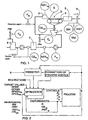
- FIG. 1 shows schematically a papermaking process.
- Stock is supplied to a paper machine via a wire pit silo 1. Water is mixed into the stock arriving from the wire pit silo 1 in order to adjust the consistency to a suitable level.
- the stock is thereafter supplied to a headbox 2, from which the stock is supplied to a former section 3, where it is formed into a fibre web 4.
- the fibre web 4 is dried in a dryer section 5, which is followed by a measuring beam 6.
- the paper machine also comprises for example a press section and a reel, and it may also comprise e.g. size presses or a calender, which are not shown in the accompanying figure for the sake of clarity.
- the operation of a paper machine is known per se to a person skilled in the art and therefore it will not be described in greater detail in this connection.
- the basis weight BW and the ash content ASH of the paper are measured from the measuring beam 6.
- the variable "paper ash content ASH" may be for example the proportion of ash from the basis weight or dry weight of the paper or the amount of ash, i.e. the mass flow, in a time unit. Paper moisture Moi can also be measured from the measuring beam 6 if the total ash content is to be determined, for example.
- headbox ash content ASH hb and white water total consistency CS ww are measured. Instead of the white water total consistency CS ww it is possible to measure some other variable that describes the filler content of white water, such as the consistency of the bottom, top, inner or outer white water or for example the white water ash content.
- Disturbance variables that are measured for the purpose of optimization include the machine speed S and the stock ash content ASH ts .
- the machine speed S can be measured from either one or several points, for example from the former section 3 or the reel or from both points.
- the flow of retention agent F ra is controlled by a flow regulator.
- Retention agents increase the retention of fines and fillers and simultaneously speed up drainage in a manner known per se.
- Retention agents may be inorganic retention agents, natural organic retention agents or synthetic water-soluble organic polymers in a manner known per se.
- the stock flow F ts is controlled by a separate flow regulator.
- the control system according to the invention can be used to simultaneously adjust the flow of filler F fi with a flow regulator.
- a filler is, among other things, to improve paper formation, surface properties, opacity, brightness and printability and to decrease manufacturing costs.
- a filler may be, for example, kaolin, calcium carbonate, titanium dioxide or talc in a manner known per se.
- a flow regulator that is used to control the flow of retention agent or filler or the stock flow can be for example a valve or a use-controlled pump or both.
- Flow adjustment and control refer in the present application specifically to controlling the flow rate, which can be denoted for example in the following manners that are known per se: l/min or g/ton of production.
- Figure 2 shows a structure of optimizing the control arrangement according to the invention.
- Parameters of process models include the necessary coefficients and time constants, which have been determined by utilizing both knowledge obtained from designing a paper machine and process tests carried out at different operating points.
- Models used by a predictor may be different from those used for the optimization.
- the predictor may calculate a new model for the optimization during each round of execution, and the model takes into account changes occurring in the speed S and the production rate PS ts and changes that will take place in the future and that may be known in advance for example during a grade change. Determining a model is known per se to a person skilled in the art and therefore it is not discussed in greater detail in this connection.
- the predictor receives as input a disturbance variable that is the machine speed S, and the predictor takes it into account in case of change and provides for optimization a model which is in a required form and which takes into account the change in the speed.
- the optimization is a block with rather simple operation utilizing the models that are produced by the predictor and that describe for example the effect of a change in the flow of retention agent and filler on the paper ash content and on the white water total consistency.
- the predictor provides a prediction and produces a new process model for the optimization.
- the predictor contains diverse functions and takes into account different situations and changes therein from various aspects. For example, the predictor takes into account the effect of variation in the machine speed and/or the draw on the basis weight of the paper. Further, a part of the web edge is typically cut off and returned to the wire pit silo, and if changes occur in the size of the section that was cut off, the predictor takes into account and predicts the resulting change in the white water total consistency.
- the target values include the basis weight SPBW, the paper ash content SPASH, the headbox ash content SPASH hb and the white water total consistency SPCS ww .
- a process model is a dynamic model having as input variables the stock flow F ts , the total consistency of stock CS ts , the flow of retention agent F ra , the speed of the paper machine S and possibly also the stock ash content ASH ts and the flow of filler F fi .
- Output variables of the dynamic process model include the white water total consistency CS ww and the basis weight of the paper BW and, if desired, the headbox ash content ASH hb and the paper ash content ASH.
- Control variables used in an optimal control include the stock flow F ts and the flow of retention agent F ra .
- a model-based optimal control algorithm calculates a guide value trajectory for a control variable on the basis of the target value trajectory of the controls and the predicted output variables, and this guide value trajectory guides the process optimally to the target values in the desired manner at each moment.
- This data is forwarded to an automation system.
- An essential feature of the method used is that the optimal control algorithm is independent of the dynamic model used, and during each control round it is possible to use a dynamic model that is determined separately and the optimal control algorithm may utilize different weighting coefficients in different situations during a run and in principle during each control round. Such an arrangement is particularly important during grade changes where this type of operation makes it possible to predict the situation at each moment.
- each of the four target values can be assigned a set value, but in the optimization the paper ash content ASH is weighted more than the headbox ash content ASH hb .
- the headbox ash content ASH hb can be assigned a set value and the paper ash content ASH can be disregarded entirely.
- normal operation is resumed.
- the paper ash content ASH can be replaced with a value provided by the model during the break, and normal operation that is based on measurements can be resumed after the break.
- the process control can be implemented by means of the model according to the invention such that the value of the total headbox consistency is utilized during a break.
Landscapes
- Paper (AREA)
- Saccharide Compounds (AREA)
- Agricultural Chemicals And Associated Chemicals (AREA)
Abstract
Description
Claims (13)
- A method for controlling properties of paper, in which method the basis weight of the paper (BW) is measured and the basis weight (BW) is adjusted by controlling the stock flow (Fts) on the basis of the measurement result of the paper basis weight (BW), characterized by modelling the effect of the flow of retention agent (Fra) and the stock flow (Fts) on the basis weight of the paper (BW) and adjusting, on the basis of said modelling, the basis weight (BW) by simultaneously controlling the flow of retention agent (Fra) and the stock flow (Fts).
- A method according to claim 1, characterized by modelling the effect of the flow of retention agent (Fra) and the flow of filler (Ffi) on the paper ash content (ASH) and on the amount of filler in the white water (CSww) and adjusting, on the basis of said modelling, the amount of filler in the white water (CSww) and the paper ash content (ASH) by simultaneously controlling the flow of retention agent (Fra) and the flow of filler (Ffi).
- A method according to claim 1, characterized by utilizing a dynamic model, which comprises as input variables the stock flow (Fts), the consistency of stock (CSts), the flow of retention agent (Fra) and the speed of the paper machine (S), and the output variables include the white water consistency (CSww) and the basis weight of the paper (BW), and the control variables include the flow of retention agent (Fra) and the stock flow (Fts).
- A method according to claim 2, characterized by utilizing a dynamic model, which comprises as input variables the stock flow (Fts), the consistency of stock (CSts), the flow of retention agent (Fra), the flow of filler (Ffi) and the speed of the paper machine (S), and the output variables include the headbox ash content (ASHhb), the white water consistency (CSww), the basis weight of the paper (BW) and the paper ash content (ASH), and the control variables include the flow of filler (Ffi), the flow of retention agent (Fra) and the stock flow (Fts).
- A method according to claim 3 or 4, characterized in that the input variables of the model also include the stock ash content (ASHts).
- A method according to any one of claims 3, 4 or 5, characterized by utilizing a predictor and an optimization, such that the predictor takes into account situations and changes in the process and provides a prediction and a new process model on the basis thereof, and the optimization utilizes the process model produced by the predictor.
- A method according to claim 6, characterized in that the predictor produces a new process model for the optimization during each control round.
- Equipment for controlling properties of paper, comprising means for measuring the basis weight of the paper (BW) and control means for controlling the stock flow (Fts) in order to adjust the basis weight (BW) based on the measurement result, characterized in that the equipment comprises a model of the effect of the flow of retention agent (Fra) and the stock flow (Fts) on the basis weight of the paper (BW), and that the control means comprise means for controlling simultaneously, based on said model, the flow of retention agent (Fra) and the stock flow (Fts) in order to adjust the basis weight (BW).
- Equipment according to claim 8, characterized in that the equipment comprises a model that includes the effect of the flow of retention agent (Fra) and the flow of filler (Ffi) on the white water consistency (CSww) and on the paper ash content (ASH), and that the control means comprise means for simultaneously controlling, on the basis of said model, the flow of retention agent (Fra) and the flow of filler (Ffi) in order to adjust the white water total consistency (CSww) and the paper ash content (ASH).
- Equipment according to claim 8, characterized in that the model is a dynamic model, which comprises as input variables the stock flow (Fts), the consistency of stock (CSts), the flow of retention agent (Fra), the flow of filler (Ffi) and the speed of the paper machine (S), and the output variables include the headbox ash content (ASHhb), the white water consistency (CSww), the basis weight of the paper (BW) and the paper ash content (ASH), and the control variables include the flow of retention agent (Fra) and the stock flow (Fts).
- Equipment according to claim 9, characterized in that the model is a dynamic model, which comprises as input variables the stock flow (Fts), the consistency of stock (CSts), the flow of retention agent (Fra), the flow of filler (Ffi) and the speed of the paper machine (S), and the output variables include the headbox ash content (ASHhb), the white water consistency (CSww), the basis weight of the paper (BW) and the paper ash content (ASH), and the control variables include the flow of filler (Ffi), the flow of retention agent (Fra) and the stock flow (Fts).
- Equipment according to claim 10 or 11, characterized in that the input variables of the model also include the stock ash content (ASHts).
- Equipment according to any one of claims 10, 11 or 12, characterized in that the equipment comprises a predictor means and an optimization means, such that the predictor means comprises means for taking into account situations and changes in the process and for producing a prediction and a process model, and the optimization means comprises means for utilizing the process model produced by the predictor means.
Applications Claiming Priority (3)
| Application Number | Priority Date | Filing Date | Title |
|---|---|---|---|
| FI974328 | 1997-11-25 | ||
| FI974328A FI974328L (en) | 1997-11-25 | 1997-11-25 | Method and apparatus for adjusting paper properties |
| PCT/FI1998/000918 WO1999027183A1 (en) | 1997-11-25 | 1998-11-23 | Method and equipment for controlling properties of paper |
Publications (2)
| Publication Number | Publication Date |
|---|---|
| EP1042553A1 EP1042553A1 (en) | 2000-10-11 |
| EP1042553B1 true EP1042553B1 (en) | 2003-05-07 |
Family
ID=8550010
Family Applications (1)
| Application Number | Title | Priority Date | Filing Date |
|---|---|---|---|
| EP98955624A Expired - Lifetime EP1042553B1 (en) | 1997-11-25 | 1998-11-23 | Method and equipment for controlling properties of paper |
Country Status (8)
| Country | Link |
|---|---|
| US (1) | US6328851B1 (en) |
| EP (1) | EP1042553B1 (en) |
| AT (1) | ATE239823T1 (en) |
| AU (1) | AU1239499A (en) |
| CA (1) | CA2311550C (en) |
| DE (1) | DE69814463T2 (en) |
| FI (1) | FI974328L (en) |
| WO (1) | WO1999027183A1 (en) |
Cited By (1)
| Publication number | Priority date | Publication date | Assignee | Title |
|---|---|---|---|---|
| DE102007049775B3 (en) * | 2007-10-17 | 2009-02-26 | Siemens Ag | Control device and method for basis weight control and paper machine equipped therewith |
Families Citing this family (17)
| Publication number | Priority date | Publication date | Assignee | Title |
|---|---|---|---|---|
| DE19910910A1 (en) * | 1999-03-11 | 2000-09-28 | Voith Sulzer Papiertech Patent | Process for carrying out an optimized fiber or paper production process |
| DE19922817A1 (en) * | 1999-05-19 | 2000-11-23 | Voith Sulzer Papiertech Patent | Device and method for controlling or regulating the basis weight of a paper or cardboard web |
| US6640152B1 (en) * | 2000-03-24 | 2003-10-28 | Abb Automation, Inc. | Modeling and control of sheet weight and moisture for paper machine transition |
| SE518577C2 (en) * | 2000-12-08 | 2002-10-29 | Real Sverige Ab M | Process for making paper with constant filler content |
| FI115539B (en) * | 2001-02-23 | 2005-05-31 | Metso Automation Oy | Method and apparatus for controlling in a paper machine or the corresponding short circulation |
| US20030000669A1 (en) * | 2001-05-11 | 2003-01-02 | Invensys Systems, Inc. | Methods and systems for controlling paper quality by adjusting fiber filter parameters |
| FI115081B (en) * | 2001-10-19 | 2005-02-28 | Metso Automation Oy | Method and apparatus for controlling the operation of a pulp department of a paper machine |
| FI116241B (en) * | 2002-05-06 | 2005-10-14 | Metso Automation Oy | Method and apparatus for determining retention of a wire portion of a paper machine |
| SE522691C3 (en) * | 2002-06-12 | 2004-04-07 | Abb Ab | Dynamic on-line optimization of production processes |
| US7376472B2 (en) * | 2002-09-11 | 2008-05-20 | Fisher-Rosemount Systems, Inc. | Integrated model predictive control and optimization within a process control system |
| US7451004B2 (en) | 2005-09-30 | 2008-11-11 | Fisher-Rosemount Systems, Inc. | On-line adaptive model predictive control in a process control system |
| DE102005051656A1 (en) * | 2005-10-28 | 2007-05-03 | Voith Patent Gmbh | Method and device for producing a fibrous web |
| DE102005054825A1 (en) * | 2005-11-15 | 2007-05-24 | Voith Patent Gmbh | Method for determining paper strength |
| DE102006003637A1 (en) * | 2006-01-26 | 2007-08-02 | Voith Patent Gmbh | Process for producing or treating a fibrous web |
| DE102008040688A1 (en) * | 2008-07-24 | 2010-01-28 | Voith Patent Gmbh | Method for optimizing the energy balance in forming units in machines for producing fibrous webs and forming unit |
| US20150292158A1 (en) | 2012-09-28 | 2015-10-15 | Voith Patent Gmbh | Method for controlling the formation of a fiber web of a fiber or paper producing process |
| US9309625B2 (en) * | 2012-10-18 | 2016-04-12 | Honeywell Asca Inc. | Concept to separate wet end and dry end paper machine control through estimation of physical properties at the wire |
Family Cites Families (1)
| Publication number | Priority date | Publication date | Assignee | Title |
|---|---|---|---|---|
| SU495400A1 (en) | 1974-01-03 | 1975-12-15 | Украинский научно-исследовательский институт целлюлозно-бумажной промышленности | Method for automatic control of mass inlet on paper-making machine grid |
-
1997
- 1997-11-25 FI FI974328A patent/FI974328L/en unknown
-
1998
- 1998-11-17 US US09/193,428 patent/US6328851B1/en not_active Expired - Lifetime
- 1998-11-23 AU AU12394/99A patent/AU1239499A/en not_active Abandoned
- 1998-11-23 CA CA002311550A patent/CA2311550C/en not_active Expired - Lifetime
- 1998-11-23 DE DE69814463T patent/DE69814463T2/en not_active Expired - Lifetime
- 1998-11-23 AT AT98955624T patent/ATE239823T1/en not_active IP Right Cessation
- 1998-11-23 WO PCT/FI1998/000918 patent/WO1999027183A1/en not_active Ceased
- 1998-11-23 EP EP98955624A patent/EP1042553B1/en not_active Expired - Lifetime
Cited By (1)
| Publication number | Priority date | Publication date | Assignee | Title |
|---|---|---|---|---|
| DE102007049775B3 (en) * | 2007-10-17 | 2009-02-26 | Siemens Ag | Control device and method for basis weight control and paper machine equipped therewith |
Also Published As
| Publication number | Publication date |
|---|---|
| CA2311550C (en) | 2006-10-31 |
| DE69814463D1 (en) | 2003-06-12 |
| CA2311550A1 (en) | 1999-06-03 |
| WO1999027183A1 (en) | 1999-06-03 |
| FI974328A7 (en) | 1999-05-26 |
| ATE239823T1 (en) | 2003-05-15 |
| FI974328A0 (en) | 1997-11-25 |
| AU1239499A (en) | 1999-06-15 |
| FI974328L (en) | 1999-05-26 |
| US6328851B1 (en) | 2001-12-11 |
| EP1042553A1 (en) | 2000-10-11 |
| DE69814463T2 (en) | 2004-02-19 |
Similar Documents
| Publication | Publication Date | Title |
|---|---|---|
| EP1071845B1 (en) | Method and equipment for controlling properties of paper | |
| CA2311550C (en) | Method and equipment for controlling properties of paper | |
| US5825653A (en) | Method for overall regulation of a former of a paper machine or equivalent | |
| US20050016704A1 (en) | Method and apparatus for controlling the operation of stock preparation of a paper machine | |
| US8206554B2 (en) | Method and a system for controlling the manufacturing or finishing process of a fiber web | |
| US20020060017A1 (en) | Method and equipment for controlling properties of paper | |
| US9309625B2 (en) | Concept to separate wet end and dry end paper machine control through estimation of physical properties at the wire | |
| EP0970277B1 (en) | Method and apparatus for control of a headbox in a paper machine | |
| FI942270A0 (en) | Comprehensive management system for different cross-sectional profiles of a web web produced on a web material making machine such as a board or paper machine and / or a finishing machine | |
| US6284100B1 (en) | Method and apparatus for controlling a headbox in a paper machine | |
| US20160122946A1 (en) | Measurement of web | |
| US7566382B2 (en) | Method and arrangement for controlling short circulation in a paper machine or the like | |
| US7198696B2 (en) | Method for manufacturing paper with a constant filler content | |
| US6993408B2 (en) | Method for the control of quality in a paper web | |
| JP3248534B2 (en) | Method of continuous overall adjustment of headbox and / or former | |
| AU2002217175A1 (en) | A method for manufacturing paper with a constant filler content | |
| US7763148B2 (en) | Method and apparatus for producing a fibrous web | |
| FI130085B (en) | Monitoring method and apparatus | |
| EP1785525B1 (en) | Measurement of paper/board process | |
| EP1155191A1 (en) | Method for executing grade change on a paper machine | |
| KR20070103436A (en) | Apparatus and method for producing a fibrous web | |
| Karlsson et al. | Controllability of paper making | |
| Laakso et al. | Filling SC Paper with PCC; A Holistic Approach |
Legal Events
| Date | Code | Title | Description |
|---|---|---|---|
| PUAI | Public reference made under article 153(3) epc to a published international application that has entered the european phase |
Free format text: ORIGINAL CODE: 0009012 |
|
| 17P | Request for examination filed |
Effective date: 20000515 |
|
| AK | Designated contracting states |
Kind code of ref document: A1 Designated state(s): AT BE CH CY DE DK ES FI FR GB GR IE IT LI LU MC NL PT SE |
|
| RAP1 | Party data changed (applicant data changed or rights of an application transferred) |
Owner name: NELES PAPER AUTOMATION OY |
|
| RAP1 | Party data changed (applicant data changed or rights of an application transferred) |
Owner name: METSO PAPER AUTOMATION OY |
|
| GRAG | Despatch of communication of intention to grant |
Free format text: ORIGINAL CODE: EPIDOS AGRA |
|
| 17Q | First examination report despatched |
Effective date: 20020611 |
|
| GRAG | Despatch of communication of intention to grant |
Free format text: ORIGINAL CODE: EPIDOS AGRA |
|
| GRAH | Despatch of communication of intention to grant a patent |
Free format text: ORIGINAL CODE: EPIDOS IGRA |
|
| GRAH | Despatch of communication of intention to grant a patent |
Free format text: ORIGINAL CODE: EPIDOS IGRA |
|
| GRAA | (expected) grant |
Free format text: ORIGINAL CODE: 0009210 |
|
| RAP1 | Party data changed (applicant data changed or rights of an application transferred) |
Owner name: METSO AUTOMATION OY |
|
| AK | Designated contracting states |
Designated state(s): AT BE CH CY DE DK ES FI FR GB GR IE IT LI LU MC NL PT SE |
|
| PG25 | Lapsed in a contracting state [announced via postgrant information from national office to epo] |
Ref country code: NL Free format text: LAPSE BECAUSE OF FAILURE TO SUBMIT A TRANSLATION OF THE DESCRIPTION OR TO PAY THE FEE WITHIN THE PRESCRIBED TIME-LIMIT Effective date: 20030507 Ref country code: LI Free format text: LAPSE BECAUSE OF FAILURE TO SUBMIT A TRANSLATION OF THE DESCRIPTION OR TO PAY THE FEE WITHIN THE PRESCRIBED TIME-LIMIT Effective date: 20030507 Ref country code: IT Free format text: LAPSE BECAUSE OF FAILURE TO SUBMIT A TRANSLATION OF THE DESCRIPTION OR TO PAY THE FEE WITHIN THE PRESCRIBED TIME-LIMIT;WARNING: LAPSES OF ITALIAN PATENTS WITH EFFECTIVE DATE BEFORE 2007 MAY HAVE OCCURRED AT ANY TIME BEFORE 2007. THE CORRECT EFFECTIVE DATE MAY BE DIFFERENT FROM THE ONE RECORDED. Effective date: 20030507 Ref country code: CH Free format text: LAPSE BECAUSE OF FAILURE TO SUBMIT A TRANSLATION OF THE DESCRIPTION OR TO PAY THE FEE WITHIN THE PRESCRIBED TIME-LIMIT Effective date: 20030507 Ref country code: BE Free format text: LAPSE BECAUSE OF FAILURE TO SUBMIT A TRANSLATION OF THE DESCRIPTION OR TO PAY THE FEE WITHIN THE PRESCRIBED TIME-LIMIT Effective date: 20030507 Ref country code: AT Free format text: LAPSE BECAUSE OF FAILURE TO SUBMIT A TRANSLATION OF THE DESCRIPTION OR TO PAY THE FEE WITHIN THE PRESCRIBED TIME-LIMIT Effective date: 20030507 |
|
| REG | Reference to a national code |
Ref country code: GB Ref legal event code: FG4D |
|
| REG | Reference to a national code |
Ref country code: CH Ref legal event code: EP |
|
| REG | Reference to a national code |
Ref country code: IE Ref legal event code: FG4D |
|
| REF | Corresponds to: |
Ref document number: 69814463 Country of ref document: DE Date of ref document: 20030612 Kind code of ref document: P |
|
| PG25 | Lapsed in a contracting state [announced via postgrant information from national office to epo] |
Ref country code: PT Free format text: LAPSE BECAUSE OF FAILURE TO SUBMIT A TRANSLATION OF THE DESCRIPTION OR TO PAY THE FEE WITHIN THE PRESCRIBED TIME-LIMIT Effective date: 20030807 Ref country code: GR Free format text: LAPSE BECAUSE OF FAILURE TO SUBMIT A TRANSLATION OF THE DESCRIPTION OR TO PAY THE FEE WITHIN THE PRESCRIBED TIME-LIMIT Effective date: 20030807 Ref country code: DK Free format text: LAPSE BECAUSE OF FAILURE TO SUBMIT A TRANSLATION OF THE DESCRIPTION OR TO PAY THE FEE WITHIN THE PRESCRIBED TIME-LIMIT Effective date: 20030807 |
|
| PG25 | Lapsed in a contracting state [announced via postgrant information from national office to epo] |
Ref country code: ES Free format text: LAPSE BECAUSE OF FAILURE TO SUBMIT A TRANSLATION OF THE DESCRIPTION OR TO PAY THE FEE WITHIN THE PRESCRIBED TIME-LIMIT Effective date: 20030818 |
|
| REG | Reference to a national code |
Ref country code: SE Ref legal event code: TRGR |
|
| NLV1 | Nl: lapsed or annulled due to failure to fulfill the requirements of art. 29p and 29m of the patents act | ||
| PG25 | Lapsed in a contracting state [announced via postgrant information from national office to epo] |
Ref country code: LU Free format text: LAPSE BECAUSE OF NON-PAYMENT OF DUE FEES Effective date: 20031123 Ref country code: GB Free format text: LAPSE BECAUSE OF NON-PAYMENT OF DUE FEES Effective date: 20031123 Ref country code: CY Free format text: LAPSE BECAUSE OF FAILURE TO SUBMIT A TRANSLATION OF THE DESCRIPTION OR TO PAY THE FEE WITHIN THE PRESCRIBED TIME-LIMIT Effective date: 20031123 |
|
| PG25 | Lapsed in a contracting state [announced via postgrant information from national office to epo] |
Ref country code: IE Free format text: LAPSE BECAUSE OF NON-PAYMENT OF DUE FEES Effective date: 20031124 |
|
| REG | Reference to a national code |
Ref country code: CH Ref legal event code: PL |
|
| PG25 | Lapsed in a contracting state [announced via postgrant information from national office to epo] |
Ref country code: MC Free format text: LAPSE BECAUSE OF NON-PAYMENT OF DUE FEES Effective date: 20031130 |
|
| ET | Fr: translation filed | ||
| PLBE | No opposition filed within time limit |
Free format text: ORIGINAL CODE: 0009261 |
|
| STAA | Information on the status of an ep patent application or granted ep patent |
Free format text: STATUS: NO OPPOSITION FILED WITHIN TIME LIMIT |
|
| 26N | No opposition filed |
Effective date: 20040210 |
|
| GBPC | Gb: european patent ceased through non-payment of renewal fee |
Effective date: 20031123 |
|
| REG | Reference to a national code |
Ref country code: IE Ref legal event code: MM4A |
|
| REG | Reference to a national code |
Ref country code: FR Ref legal event code: PLFP Year of fee payment: 18 |
|
| REG | Reference to a national code |
Ref country code: FR Ref legal event code: PLFP Year of fee payment: 19 |
|
| REG | Reference to a national code |
Ref country code: FR Ref legal event code: PLFP Year of fee payment: 20 |
|
| PGFP | Annual fee paid to national office [announced via postgrant information from national office to epo] |
Ref country code: FR Payment date: 20171121 Year of fee payment: 20 Ref country code: FI Payment date: 20171121 Year of fee payment: 20 Ref country code: DE Payment date: 20171121 Year of fee payment: 20 |
|
| PGFP | Annual fee paid to national office [announced via postgrant information from national office to epo] |
Ref country code: SE Payment date: 20171120 Year of fee payment: 20 |
|
| REG | Reference to a national code |
Ref country code: DE Ref legal event code: R071 Ref document number: 69814463 Country of ref document: DE |
|
| REG | Reference to a national code |
Ref country code: SE Ref legal event code: EUG |