EP1042315B1 - Cyclic imide-substituted pyridylalkane, alkene, and alkine carboxamides useful as cytostatic and immunosuppressive agents - Google Patents
Cyclic imide-substituted pyridylalkane, alkene, and alkine carboxamides useful as cytostatic and immunosuppressive agents Download PDFInfo
- Publication number
- EP1042315B1 EP1042315B1 EP98966634A EP98966634A EP1042315B1 EP 1042315 B1 EP1042315 B1 EP 1042315B1 EP 98966634 A EP98966634 A EP 98966634A EP 98966634 A EP98966634 A EP 98966634A EP 1042315 B1 EP1042315 B1 EP 1042315B1
- Authority
- EP
- European Patent Office
- Prior art keywords
- dione
- alkyl
- dicarboximide
- hydroxy
- pyridin
- Prior art date
- Legal status (The legal status is an assumption and is not a legal conclusion. Google has not performed a legal analysis and makes no representation as to the accuracy of the status listed.)
- Expired - Lifetime
Links
- -1 alkine carboxamides Chemical class 0.000 title claims abstract description 364
- 239000000824 cytostatic agent Substances 0.000 title claims abstract description 13
- 229940125721 immunosuppressive agent Drugs 0.000 title claims abstract description 4
- 239000003018 immunosuppressive agent Substances 0.000 title claims abstract description 4
- 230000001085 cytostatic effect Effects 0.000 title claims description 5
- 150000001336 alkenes Chemical class 0.000 title abstract description 3
- 125000004122 cyclic group Chemical group 0.000 title description 7
- 150000001875 compounds Chemical class 0.000 claims abstract description 116
- 238000004519 manufacturing process Methods 0.000 claims abstract description 45
- 150000003949 imides Chemical class 0.000 claims abstract description 37
- 229920006395 saturated elastomer Polymers 0.000 claims abstract description 35
- 239000003814 drug Substances 0.000 claims abstract description 27
- 238000000034 method Methods 0.000 claims abstract description 26
- 238000011282 treatment Methods 0.000 claims abstract description 19
- 230000001225 therapeutic effect Effects 0.000 claims abstract description 12
- 230000010261 cell growth Effects 0.000 claims abstract description 7
- 230000002159 abnormal effect Effects 0.000 claims abstract description 4
- 230000002265 prevention Effects 0.000 claims abstract description 4
- 239000004480 active ingredient Substances 0.000 claims description 74
- 125000002887 hydroxy group Chemical group [H]O* 0.000 claims description 72
- 239000000203 mixture Substances 0.000 claims description 62
- 125000001434 methanylylidene group Chemical group [H]C#[*] 0.000 claims description 53
- 239000011737 fluorine Substances 0.000 claims description 46
- 229910052731 fluorine Inorganic materials 0.000 claims description 46
- 229910052757 nitrogen Inorganic materials 0.000 claims description 42
- 125000001997 phenyl group Chemical group [H]C1=C([H])C([H])=C(*)C([H])=C1[H] 0.000 claims description 40
- 125000004169 (C1-C6) alkyl group Chemical group 0.000 claims description 37
- 125000006413 ring segment Chemical group 0.000 claims description 36
- 125000004191 (C1-C6) alkoxy group Chemical group 0.000 claims description 35
- 125000001570 methylene group Chemical group [H]C([H])([*:1])[*:2] 0.000 claims description 34
- 125000003118 aryl group Chemical group 0.000 claims description 33
- 125000004093 cyano group Chemical group *C#N 0.000 claims description 33
- 239000001257 hydrogen Substances 0.000 claims description 33
- 229910052739 hydrogen Inorganic materials 0.000 claims description 33
- 239000000243 solution Substances 0.000 claims description 33
- 125000003003 spiro group Chemical group 0.000 claims description 33
- 125000005842 heteroatom Chemical group 0.000 claims description 32
- 125000002023 trifluoromethyl group Chemical group FC(F)(F)* 0.000 claims description 32
- PXGOKWXKJXAPGV-UHFFFAOYSA-N Fluorine Chemical compound FF PXGOKWXKJXAPGV-UHFFFAOYSA-N 0.000 claims description 30
- 229910052736 halogen Inorganic materials 0.000 claims description 27
- 150000002367 halogens Chemical class 0.000 claims description 27
- 150000002431 hydrogen Chemical class 0.000 claims description 27
- 229910052760 oxygen Inorganic materials 0.000 claims description 27
- 125000002496 methyl group Chemical group [H]C([H])([H])* 0.000 claims description 26
- XLYOFNOQVPJJNP-UHFFFAOYSA-N water Substances O XLYOFNOQVPJJNP-UHFFFAOYSA-N 0.000 claims description 25
- 239000002904 solvent Substances 0.000 claims description 24
- 239000000843 powder Substances 0.000 claims description 23
- 229910052717 sulfur Inorganic materials 0.000 claims description 22
- 125000006273 (C1-C3) alkyl group Chemical group 0.000 claims description 21
- 239000002671 adjuvant Substances 0.000 claims description 21
- 238000006243 chemical reaction Methods 0.000 claims description 21
- 239000003795 chemical substances by application Substances 0.000 claims description 21
- 150000003839 salts Chemical class 0.000 claims description 21
- 239000003826 tablet Substances 0.000 claims description 21
- 238000009472 formulation Methods 0.000 claims description 20
- 125000006828 (C2-C7) alkoxycarbonyl group Chemical group 0.000 claims description 19
- 125000006552 (C3-C8) cycloalkyl group Chemical group 0.000 claims description 19
- 125000001153 fluoro group Chemical group F* 0.000 claims description 19
- 239000000443 aerosol Substances 0.000 claims description 18
- 125000001584 benzyloxycarbonyl group Chemical group C(=O)(OCC1=CC=CC=C1)* 0.000 claims description 18
- UYWQUFXKFGHYNT-UHFFFAOYSA-N phenylmethyl ester of formic acid Natural products O=COCC1=CC=CC=C1 UYWQUFXKFGHYNT-UHFFFAOYSA-N 0.000 claims description 18
- 125000001424 substituent group Chemical group 0.000 claims description 18
- 238000006467 substitution reaction Methods 0.000 claims description 18
- 239000002253 acid Substances 0.000 claims description 17
- 125000002924 primary amino group Chemical group [H]N([H])* 0.000 claims description 17
- 125000001797 benzyl group Chemical group [H]C1=C([H])C([H])=C(C([H])=C1[H])C([H])([H])* 0.000 claims description 16
- 125000000051 benzyloxy group Chemical group [H]C1=C([H])C([H])=C(C([H])=C1[H])C([H])([H])O* 0.000 claims description 15
- 125000000229 (C1-C4)alkoxy group Chemical group 0.000 claims description 14
- 125000000623 heterocyclic group Chemical group 0.000 claims description 14
- 239000000725 suspension Substances 0.000 claims description 14
- 125000006577 C1-C6 hydroxyalkyl group Chemical group 0.000 claims description 13
- 125000006700 (C1-C6) alkylthio group Chemical group 0.000 claims description 12
- 239000008194 pharmaceutical composition Substances 0.000 claims description 11
- 238000002360 preparation method Methods 0.000 claims description 11
- KZNICNPSHKQLFF-UHFFFAOYSA-N succinimide Chemical compound O=C1CCC(=O)N1 KZNICNPSHKQLFF-UHFFFAOYSA-N 0.000 claims description 11
- 239000002775 capsule Substances 0.000 claims description 10
- 239000003380 propellant Substances 0.000 claims description 10
- 239000000969 carrier Substances 0.000 claims description 9
- 239000000839 emulsion Substances 0.000 claims description 9
- 125000001072 heteroaryl group Chemical group 0.000 claims description 9
- 238000002347 injection Methods 0.000 claims description 9
- 239000007924 injection Substances 0.000 claims description 9
- 239000007787 solid Substances 0.000 claims description 9
- 125000004178 (C1-C4) alkyl group Chemical group 0.000 claims description 8
- ZOBPZXTWZATXDG-UHFFFAOYSA-N 1,3-thiazolidine-2,4-dione Chemical compound O=C1CSC(=O)N1 ZOBPZXTWZATXDG-UHFFFAOYSA-N 0.000 claims description 8
- 125000003277 amino group Chemical group 0.000 claims description 8
- 125000002619 bicyclic group Chemical group 0.000 claims description 8
- 230000015572 biosynthetic process Effects 0.000 claims description 8
- 230000002496 gastric effect Effects 0.000 claims description 8
- 239000002674 ointment Substances 0.000 claims description 8
- XKJCHHZQLQNZHY-UHFFFAOYSA-N phthalimide Chemical compound C1=CC=C2C(=O)NC(=O)C2=C1 XKJCHHZQLQNZHY-UHFFFAOYSA-N 0.000 claims description 8
- 125000004076 pyridyl group Chemical group 0.000 claims description 8
- GPIUUMROPXDNRH-UHFFFAOYSA-N 3647-74-3 Chemical compound C1C2C3C(=O)NC(=O)C3C1C=C2 GPIUUMROPXDNRH-UHFFFAOYSA-N 0.000 claims description 7
- BSEKZMOBPPOFFB-UHFFFAOYSA-N 3a,4,7,7a-tetrahydro-octahydro-1h-4,7-epoxyisoindole-1,3-dione Chemical compound O1C2C3C(=O)NC(=O)C3C1C=C2 BSEKZMOBPPOFFB-UHFFFAOYSA-N 0.000 claims description 7
- QGNQEODJYRGEJX-UHFFFAOYSA-N 4h-isoquinoline-1,3-dione Chemical compound C1=CC=C2C(=O)NC(=O)CC2=C1 QGNQEODJYRGEJX-UHFFFAOYSA-N 0.000 claims description 7
- ZAMOUSCENKQFHK-UHFFFAOYSA-N Chlorine atom Chemical compound [Cl] ZAMOUSCENKQFHK-UHFFFAOYSA-N 0.000 claims description 7
- PEEHTFAAVSWFBL-UHFFFAOYSA-N Maleimide Chemical compound O=C1NC(=O)C=C1 PEEHTFAAVSWFBL-UHFFFAOYSA-N 0.000 claims description 7
- 125000003368 amide group Chemical group 0.000 claims description 7
- 150000001408 amides Chemical class 0.000 claims description 7
- XJHABGPPCLHLLV-UHFFFAOYSA-N benzo[de]isoquinoline-1,3-dione Chemical compound C1=CC(C(=O)NC2=O)=C3C2=CC=CC3=C1 XJHABGPPCLHLLV-UHFFFAOYSA-N 0.000 claims description 7
- 125000003917 carbamoyl group Chemical group [H]N([H])C(*)=O 0.000 claims description 7
- 239000000460 chlorine Substances 0.000 claims description 7
- 229910052801 chlorine Inorganic materials 0.000 claims description 7
- 125000005677 ethinylene group Chemical group [*:2]C#C[*:1] 0.000 claims description 7
- 239000012530 fluid Substances 0.000 claims description 7
- WJRBRSLFGCUECM-UHFFFAOYSA-N hydantoin Chemical compound O=C1CNC(=O)N1 WJRBRSLFGCUECM-UHFFFAOYSA-N 0.000 claims description 7
- 150000004677 hydrates Chemical class 0.000 claims description 7
- 230000001506 immunosuppresive effect Effects 0.000 claims description 7
- 125000005146 naphthylsulfonyl group Chemical group C1(=CC=CC2=CC=CC=C12)S(=O)(=O)* 0.000 claims description 7
- COWNFYYYZFRNOY-UHFFFAOYSA-N oxazolidinedione Chemical compound O=C1COC(=O)N1 COWNFYYYZFRNOY-UHFFFAOYSA-N 0.000 claims description 7
- ZFLIKDUSUDBGCD-UHFFFAOYSA-N parabanic acid Chemical compound O=C1NC(=O)C(=O)N1 ZFLIKDUSUDBGCD-UHFFFAOYSA-N 0.000 claims description 7
- 125000003170 phenylsulfonyl group Chemical group C1(=CC=CC=C1)S(=O)(=O)* 0.000 claims description 7
- CYJAWBVQRMVFEO-UHFFFAOYSA-N piperazine-2,6-dione Chemical compound O=C1CNCC(=O)N1 CYJAWBVQRMVFEO-UHFFFAOYSA-N 0.000 claims description 7
- KNCYXPMJDCCGSJ-UHFFFAOYSA-N piperidine-2,6-dione Chemical compound O=C1CCCC(=O)N1 KNCYXPMJDCCGSJ-UHFFFAOYSA-N 0.000 claims description 7
- 125000003386 piperidinyl group Chemical group 0.000 claims description 7
- ZRKGTINFVOLLNT-UHFFFAOYSA-N pyrrolo[3,4-b]pyridine-5,7-dione Chemical compound C1=CC=C2C(=O)NC(=O)C2=N1 ZRKGTINFVOLLNT-UHFFFAOYSA-N 0.000 claims description 7
- SJSABZBUTDSWMJ-UHFFFAOYSA-N pyrrolo[3,4-c]pyridine-1,3-dione Chemical compound N1=CC=C2C(=O)NC(=O)C2=C1 SJSABZBUTDSWMJ-UHFFFAOYSA-N 0.000 claims description 7
- 239000012453 solvate Substances 0.000 claims description 7
- 125000002221 trityl group Chemical group [H]C1=C([H])C([H])=C([H])C([H])=C1C([*])(C1=C(C(=C(C(=C1[H])[H])[H])[H])[H])C1=C([H])C([H])=C([H])C([H])=C1[H] 0.000 claims description 7
- 125000006274 (C1-C3)alkoxy group Chemical group 0.000 claims description 6
- 125000004070 6 membered heterocyclic group Chemical group 0.000 claims description 6
- UFHFLCQGNIYNRP-UHFFFAOYSA-N Hydrogen Chemical compound [H][H] UFHFLCQGNIYNRP-UHFFFAOYSA-N 0.000 claims description 6
- 239000007788 liquid Substances 0.000 claims description 6
- CVHZOJJKTDOEJC-UHFFFAOYSA-N saccharin Chemical compound C1=CC=C2C(=O)NS(=O)(=O)C2=C1 CVHZOJJKTDOEJC-UHFFFAOYSA-N 0.000 claims description 6
- 239000007921 spray Substances 0.000 claims description 6
- 125000003161 (C1-C6) alkylene group Chemical group 0.000 claims description 5
- FOAJHECUQGKOIF-UHFFFAOYSA-N 1,2,5-triazepane-4,6-dione Chemical compound O=C1CNNCC(=O)N1 FOAJHECUQGKOIF-UHFFFAOYSA-N 0.000 claims description 5
- JTTFXYHJDZZDQK-UHFFFAOYSA-N 1,3-diazaspiro[4.4]nonane-2,4-dione Chemical compound N1C(=O)NC(=O)C11CCCC1 JTTFXYHJDZZDQK-UHFFFAOYSA-N 0.000 claims description 5
- GOFALJDPGWIYKL-UHFFFAOYSA-N 1,3-diazepane-2,4-dione Chemical compound O=C1CCCNC(=O)N1 GOFALJDPGWIYKL-UHFFFAOYSA-N 0.000 claims description 5
- JKINULMYFQTXCS-UHFFFAOYSA-N 1,4-diazepane-2,7-dione Chemical compound O=C1CCNCC(=O)N1 JKINULMYFQTXCS-UHFFFAOYSA-N 0.000 claims description 5
- SAVWGIMTEIZIGL-UHFFFAOYSA-N 1-oxa-3,7-diazaspiro[4.4]nonane-2,4-dione Chemical compound O1C(=O)NC(=O)C11CNCC1 SAVWGIMTEIZIGL-UHFFFAOYSA-N 0.000 claims description 5
- QTYNRNCLRXPYHQ-UHFFFAOYSA-N 1-oxa-3,8-diazaspiro[4.5]decane-2,4-dione Chemical compound O1C(=O)NC(=O)C11CCNCC1 QTYNRNCLRXPYHQ-UHFFFAOYSA-N 0.000 claims description 5
- MCUKDEMJLVLCOM-UHFFFAOYSA-N 1-thia-3-azaspiro[4.4]nonane-2,4-dione Chemical compound S1C(=O)NC(=O)C11CCCC1 MCUKDEMJLVLCOM-UHFFFAOYSA-N 0.000 claims description 5
- JQPYINKVAWEQDQ-UHFFFAOYSA-N 1h-pyrido[2,3-d]pyrimidine-2,4-dione Chemical compound C1=CC=C2C(=O)NC(=O)NC2=N1 JQPYINKVAWEQDQ-UHFFFAOYSA-N 0.000 claims description 5
- NKHUXLDXYURVLX-UHFFFAOYSA-N 2h-pyrrolo[3,4-c]pyrrole-4,6-dione Chemical compound N1C=C2C(=O)NC(=O)C2=C1 NKHUXLDXYURVLX-UHFFFAOYSA-N 0.000 claims description 5
- CCEHUZJNDSXPCB-UHFFFAOYSA-N 3,6-dihydroazepine-2,7-dione Chemical compound O=C1CC=CCC(=O)N1 CCEHUZJNDSXPCB-UHFFFAOYSA-N 0.000 claims description 5
- GIZSKOXLQJIYIB-UHFFFAOYSA-N 3-azabicyclo[3.2.2]non-6-ene-2,4-dione Chemical compound O=C1NC(=O)C2C=CC1CC2 GIZSKOXLQJIYIB-UHFFFAOYSA-N 0.000 claims description 5
- FZEIFGXIEWUEHU-UHFFFAOYSA-N 4h-2,6-naphthyridine-1,3-dione Chemical compound N1=CC=C2C(=O)NC(=O)CC2=C1 FZEIFGXIEWUEHU-UHFFFAOYSA-N 0.000 claims description 5
- AGFYXNWRDSDSRA-UHFFFAOYSA-N 6h-pyrrolo[3,4-c]carbazole-1,3-dione Chemical compound N1C2=CC=CC=C2C2=C1C=CC1=C2C(=O)NC1=O AGFYXNWRDSDSRA-UHFFFAOYSA-N 0.000 claims description 5
- WKBOTKDWSSQWDR-UHFFFAOYSA-N Bromine atom Chemical compound [Br] WKBOTKDWSSQWDR-UHFFFAOYSA-N 0.000 claims description 5
- FIVCGVZFJQUSBD-UHFFFAOYSA-N [1]benzothiolo[2,3-c]pyrrole-1,3-dione Chemical compound S1C2=CC=CC=C2C2=C1C(=O)NC2=O FIVCGVZFJQUSBD-UHFFFAOYSA-N 0.000 claims description 5
- RKZPDFAYYJDHJH-UHFFFAOYSA-N ac1lbdme Chemical compound C1CC2C3C(=O)NC(=O)C3C1C=C2 RKZPDFAYYJDHJH-UHFFFAOYSA-N 0.000 claims description 5
- KWUXACIWMYKRCI-UHFFFAOYSA-N ac1lcbnu Chemical compound C1CCC2=CC=CC3=C2C21C(=O)NC(=O)C2C3=O KWUXACIWMYKRCI-UHFFFAOYSA-N 0.000 claims description 5
- 125000002490 anilino group Chemical group [H]N(*)C1=C([H])C([H])=C([H])C([H])=C1[H] 0.000 claims description 5
- OSNDUYDDOHEKEE-UHFFFAOYSA-N azepane-2,7-dione Chemical compound O=C1CCCCC(=O)N1 OSNDUYDDOHEKEE-UHFFFAOYSA-N 0.000 claims description 5
- 125000004618 benzofuryl group Chemical group O1C(=CC2=C1C=CC=C2)* 0.000 claims description 5
- 125000005872 benzooxazolyl group Chemical group 0.000 claims description 5
- 125000001164 benzothiazolyl group Chemical group S1C(=NC2=C1C=CC=C2)* 0.000 claims description 5
- 125000004196 benzothienyl group Chemical group S1C(=CC2=C1C=CC=C2)* 0.000 claims description 5
- GDTBXPJZTBHREO-UHFFFAOYSA-N bromine Substances BrBr GDTBXPJZTBHREO-UHFFFAOYSA-N 0.000 claims description 5
- 229910052794 bromium Inorganic materials 0.000 claims description 5
- 238000009833 condensation Methods 0.000 claims description 5
- 230000005494 condensation Effects 0.000 claims description 5
- 125000002541 furyl group Chemical group 0.000 claims description 5
- 125000001041 indolyl group Chemical group 0.000 claims description 5
- 238000001802 infusion Methods 0.000 claims description 5
- 125000002183 isoquinolinyl group Chemical group C1(=NC=CC2=CC=CC=C12)* 0.000 claims description 5
- MXAJVDHGJCYEKL-UHFFFAOYSA-N morpholine-3,5-dione Chemical compound O=C1COCC(=O)N1 MXAJVDHGJCYEKL-UHFFFAOYSA-N 0.000 claims description 5
- 125000001624 naphthyl group Chemical group 0.000 claims description 5
- 125000004193 piperazinyl group Chemical group 0.000 claims description 5
- ULWIWAZTAPACCR-UHFFFAOYSA-N pyrrolo[3,4-c]pyridazine-5,7-dione Chemical compound N1=CC=C2C(=O)NC(=O)C2=N1 ULWIWAZTAPACCR-UHFFFAOYSA-N 0.000 claims description 5
- QZJNDGBYEZOZPW-UHFFFAOYSA-N pyrrolo[3,4-g]quinoline-6,8-dione Chemical compound C1=CC=C2C=C3C(=O)NC(=O)C3=CC2=N1 QZJNDGBYEZOZPW-UHFFFAOYSA-N 0.000 claims description 5
- 230000002459 sustained effect Effects 0.000 claims description 5
- 125000000335 thiazolyl group Chemical group 0.000 claims description 5
- GKTQKQTXHNUFSP-UHFFFAOYSA-N thieno[3,4-c]pyrrole-4,6-dione Chemical compound S1C=C2C(=O)NC(=O)C2=C1 GKTQKQTXHNUFSP-UHFFFAOYSA-N 0.000 claims description 5
- 125000001544 thienyl group Chemical group 0.000 claims description 5
- WHPWLUGDBCVLLK-UHFFFAOYSA-N 1,2-dihydro-3h-dibenz[de,h]isoquinoline-1,3-dione Chemical compound C1=CC(C(=O)NC2=O)=C3C2=C(C=CC=C2)C2=CC3=C1 WHPWLUGDBCVLLK-UHFFFAOYSA-N 0.000 claims description 4
- CXCNSNHPXLOUNF-UHFFFAOYSA-N 3-azabicyclo[3.2.1]octane-2,4-dione Chemical compound O=C1NC(=O)C2CCC1C2 CXCNSNHPXLOUNF-UHFFFAOYSA-N 0.000 claims description 4
- 125000002853 C1-C4 hydroxyalkyl group Chemical group 0.000 claims description 4
- 241001465754 Metazoa Species 0.000 claims description 4
- 230000001028 anti-proliverative effect Effects 0.000 claims description 4
- 230000003327 cancerostatic effect Effects 0.000 claims description 4
- 150000001735 carboxylic acids Chemical class 0.000 claims description 4
- 125000001559 cyclopropyl group Chemical group [H]C1([H])C([H])([H])C1([H])* 0.000 claims description 4
- 125000005982 diphenylmethyl group Chemical group [H]C1=C([H])C([H])=C(C([H])=C1[H])C([H])(*)C1=C([H])C([H])=C([H])C([H])=C1[H] 0.000 claims description 4
- 125000004634 hexahydroazepinyl group Chemical group N1(CCCCCC1)* 0.000 claims description 4
- 239000007943 implant Substances 0.000 claims description 4
- 125000006301 indolyl methyl group Chemical group 0.000 claims description 4
- 125000002757 morpholinyl group Chemical group 0.000 claims description 4
- RSBSRWDEJMIRSW-UHFFFAOYSA-N n-[4-(1,3-dioxobenzo[de]isoquinolin-2-yl)butyl]-3-pyridin-3-ylprop-2-enamide Chemical compound O=C1C(C=23)=CC=CC3=CC=CC=2C(=O)N1CCCCNC(=O)C=CC1=CC=CN=C1 RSBSRWDEJMIRSW-UHFFFAOYSA-N 0.000 claims description 4
- WURUEAGEEANDFN-UHFFFAOYSA-N naphtho[2,3-f]isoindole-1,3-dione Chemical compound C1=CC=C2C=C(C=C3C(=O)NC(=O)C3=C3)C3=CC2=C1 WURUEAGEEANDFN-UHFFFAOYSA-N 0.000 claims description 4
- 125000004923 naphthylmethyl group Chemical group C1(=CC=CC2=CC=CC=C12)C* 0.000 claims description 4
- LCCQEESYPUHVCT-UHFFFAOYSA-N phenanthro[9,10-c]pyrrole-1,3-dione Chemical compound C12=CC=CC=C2C2=CC=CC=C2C2=C1C(=O)NC2=O LCCQEESYPUHVCT-UHFFFAOYSA-N 0.000 claims description 4
- 125000005344 pyridylmethyl group Chemical group [H]C1=C([H])C([H])=C([H])C(=N1)C([H])([H])* 0.000 claims description 4
- 125000000719 pyrrolidinyl group Chemical group 0.000 claims description 4
- 239000007858 starting material Substances 0.000 claims description 4
- 229960002317 succinimide Drugs 0.000 claims description 4
- 125000005302 thiazolylmethyl group Chemical group [H]C1=C([H])N=C(S1)C([H])([H])* 0.000 claims description 4
- OSEFDTSYKYIFNC-UHFFFAOYSA-N thieno[2,3-c]pyrrole-4,6-dione Chemical compound S1C=CC2=C1C(=O)NC2=O OSEFDTSYKYIFNC-UHFFFAOYSA-N 0.000 claims description 4
- 125000005301 thienylmethyl group Chemical group [H]C1=C([H])C([H])=C(S1)C([H])([H])* 0.000 claims description 4
- 125000004568 thiomorpholinyl group Chemical group 0.000 claims description 4
- 125000006823 (C1-C6) acyl group Chemical group 0.000 claims description 3
- 125000004761 (C2-C7) alkylaminocarbonyl group Chemical group 0.000 claims description 3
- 125000004763 (C3-C13) dialkylaminocarbonyl group Chemical group 0.000 claims description 3
- NDGLRAOUKJGNIL-UHFFFAOYSA-N 1,2,3,4-tetrahydropyrrolo[3,4-g]quinazoline-6,8-dione Chemical compound N1CNCC2=C1C=C1C(=O)NC(=O)C1=C2 NDGLRAOUKJGNIL-UHFFFAOYSA-N 0.000 claims description 3
- YRYCOOMEQSXVLJ-UHFFFAOYSA-N 1,3,7-triazaspiro[4.4]nonane-2,4-dione Chemical compound N1C(=O)NC(=O)C11CNCC1 YRYCOOMEQSXVLJ-UHFFFAOYSA-N 0.000 claims description 3
- MEZFDLNHBQSENG-UHFFFAOYSA-N 1-oxa-3-azaspiro[4.4]nonane-2,4-dione Chemical compound O1C(=O)NC(=O)C11CCCC1 MEZFDLNHBQSENG-UHFFFAOYSA-N 0.000 claims description 3
- YBYIRNPNPLQARY-UHFFFAOYSA-N 1H-indene Natural products C1=CC=C2CC=CC2=C1 YBYIRNPNPLQARY-UHFFFAOYSA-N 0.000 claims description 3
- MNNWQAIAFUMNOS-UHFFFAOYSA-N 1h-pyrido[3,4-d]pyrimidine-2,4-dione Chemical compound N1=CC=C2C(=O)NC(=O)NC2=C1 MNNWQAIAFUMNOS-UHFFFAOYSA-N 0.000 claims description 3
- SDQJTWBNWQABLE-UHFFFAOYSA-N 1h-quinazoline-2,4-dione Chemical compound C1=CC=C2C(=O)NC(=O)NC2=C1 SDQJTWBNWQABLE-UHFFFAOYSA-N 0.000 claims description 3
- WODIALSWFWKWMM-UHFFFAOYSA-N 2,8-diazaspiro[4.5]decane-1,3-dione Chemical compound O=C1NC(=O)CC11CCNCC1 WODIALSWFWKWMM-UHFFFAOYSA-N 0.000 claims description 3
- HRSWSISJJJDBOQ-UHFFFAOYSA-N 2-oxo-1,3-diaza-8-azoniaspiro[4.5]dec-3-en-4-olate Chemical compound N1C(=O)NC(=O)C11CCNCC1 HRSWSISJJJDBOQ-UHFFFAOYSA-N 0.000 claims description 3
- 125000003903 2-propenyl group Chemical group [H]C([*])([H])C([H])=C([H])[H] 0.000 claims description 3
- NIGYDJPVACIJDC-UHFFFAOYSA-N 3,7-dihydro-1,2,5-triazepine-4,6-dione Chemical compound O=C1CN=NCC(=O)N1 NIGYDJPVACIJDC-UHFFFAOYSA-N 0.000 claims description 3
- ZUZCKEXVEMUZEE-UHFFFAOYSA-N 3-azabicyclo[3.2.1]oct-6-ene-2,4-dione Chemical compound O=C1NC(=O)C2C=CC1C2 ZUZCKEXVEMUZEE-UHFFFAOYSA-N 0.000 claims description 3
- UEDNPRXCMKPGRL-UHFFFAOYSA-N 3-azabicyclo[3.2.2]nonane-2,4-dione Chemical compound O=C1NC(=O)C2CCC1CC2 UEDNPRXCMKPGRL-UHFFFAOYSA-N 0.000 claims description 3
- JPBGMJCVEVKVCB-UHFFFAOYSA-N 3-pyridin-3-yl-N-[4-(2,12,14-trioxo-13-azatetracyclo[7.5.1.01,11.05,15]pentadeca-3,5,9(15)-trien-13-yl)butyl]prop-2-enamide Chemical compound O=C1C2CC(CCC=3)=C4C=3C=CC(=O)C24C(=O)N1CCCCNC(=O)C=CC1=CC=CN=C1 JPBGMJCVEVKVCB-UHFFFAOYSA-N 0.000 claims description 3
- ZTKRMYNMVHUXEQ-UHFFFAOYSA-N 3a,3b,4,5-tetrahydronaphtho[2,1-e]isoindole-1,3-dione Chemical compound C1=CC=C2C3=CC=C4C(=O)NC(=O)C4C3CCC2=C1 ZTKRMYNMVHUXEQ-UHFFFAOYSA-N 0.000 claims description 3
- WLDMPODMCFGWAA-UHFFFAOYSA-N 3a,4,5,6,7,7a-hexahydroisoindole-1,3-dione Chemical compound C1CCCC2C(=O)NC(=O)C21 WLDMPODMCFGWAA-UHFFFAOYSA-N 0.000 claims description 3
- UZTZKICRSWXRFQ-UHFFFAOYSA-N 3a,4,5,6-tetrahydroisoindole-1,3-dione Chemical compound C1CCC2C(=O)NC(=O)C2=C1 UZTZKICRSWXRFQ-UHFFFAOYSA-N 0.000 claims description 3
- ZLBWZEARBDLCFH-UHFFFAOYSA-N 3h-pyridine-2,6-dione Chemical compound O=C1CC=CC(=O)N1 ZLBWZEARBDLCFH-UHFFFAOYSA-N 0.000 claims description 3
- GWZMCNGIPHSLLG-UHFFFAOYSA-N 4h-benzo[h]isoquinoline-1,3-dione Chemical compound C1=CC=CC2=C(C(=O)NC(=O)C3)C3=CC=C21 GWZMCNGIPHSLLG-UHFFFAOYSA-N 0.000 claims description 3
- CLHGAFMJSNFVRM-UHFFFAOYSA-N 5,6,7,7a-tetrahydropyrrolo[1,2-c]imidazole-1,3-dione Chemical compound C1CCC2C(=O)NC(=O)N21 CLHGAFMJSNFVRM-UHFFFAOYSA-N 0.000 claims description 3
- DPISFQNMHMNBNG-UHFFFAOYSA-N 5h-1,7-naphthyridine-6,8-dione Chemical compound C1=CN=C2C(=O)NC(=O)CC2=C1 DPISFQNMHMNBNG-UHFFFAOYSA-N 0.000 claims description 3
- PJFTYRMJCNBHTQ-UHFFFAOYSA-N 7-azaspiro[4.5]decane-6,8-dione Chemical compound O=C1NC(=O)CCC11CCCC1 PJFTYRMJCNBHTQ-UHFFFAOYSA-N 0.000 claims description 3
- HBAQYPYDRFILMT-UHFFFAOYSA-N 8-[3-(1-cyclopropylpyrazol-4-yl)-1H-pyrazolo[4,3-d]pyrimidin-5-yl]-3-methyl-3,8-diazabicyclo[3.2.1]octan-2-one Chemical class C1(CC1)N1N=CC(=C1)C1=NNC2=C1N=C(N=C2)N1C2C(N(CC1CC2)C)=O HBAQYPYDRFILMT-UHFFFAOYSA-N 0.000 claims description 3
- HLDHOQDVPXKHGG-UHFFFAOYSA-N C1(NC(C2CCC3C(=C12)C=CC=C3)=O)=O Chemical compound C1(NC(C2CCC3C(=C12)C=CC=C3)=O)=O HLDHOQDVPXKHGG-UHFFFAOYSA-N 0.000 claims description 3
- 125000006615 aromatic heterocyclic group Chemical group 0.000 claims description 3
- 125000004429 atom Chemical group 0.000 claims description 3
- FJQZWODWLBQDBR-UHFFFAOYSA-N azepine-2,7-dione Chemical compound O=C1C=CC=CC(=O)N1 FJQZWODWLBQDBR-UHFFFAOYSA-N 0.000 claims description 3
- ZWXOIMOUNGHTRA-UHFFFAOYSA-N benzo[e]isoindole-1,3-dione Chemical compound C1=CC2=CC=CC=C2C2=C1C(=O)NC2=O ZWXOIMOUNGHTRA-UHFFFAOYSA-N 0.000 claims description 3
- 125000003354 benzotriazolyl group Chemical group N1N=NC2=C1C=CC=C2* 0.000 claims description 3
- GZCMBOIXKWSTSJ-UHFFFAOYSA-N bicyclo[2.2.2]octane-2,3-dicarboximide Chemical compound C1CC2C3C(=O)NC(=O)C3C1CC2 GZCMBOIXKWSTSJ-UHFFFAOYSA-N 0.000 claims description 3
- 125000003178 carboxy group Chemical group [H]OC(*)=O 0.000 claims description 3
- 125000003016 chromanyl group Chemical group O1C(CCC2=CC=CC=C12)* 0.000 claims description 3
- 239000012141 concentrate Substances 0.000 claims description 3
- 239000003937 drug carrier Substances 0.000 claims description 3
- 125000005678 ethenylene group Chemical group [H]C([*:1])=C([H])[*:2] 0.000 claims description 3
- 125000001495 ethyl group Chemical group [H]C([H])([H])C([H])([H])* 0.000 claims description 3
- 125000002534 ethynyl group Chemical group [H]C#C* 0.000 claims description 3
- ZMEOAJYBWAJZFK-UHFFFAOYSA-N furo[3,4-c]pyrrole-4,6-dione Chemical compound O1C=C2C(=O)NC(=O)C2=C1 ZMEOAJYBWAJZFK-UHFFFAOYSA-N 0.000 claims description 3
- 125000002883 imidazolyl group Chemical group 0.000 claims description 3
- 125000003392 indanyl group Chemical group C1(CCC2=CC=CC=C12)* 0.000 claims description 3
- 125000003453 indazolyl group Chemical group N1N=C(C2=C1C=CC=C2)* 0.000 claims description 3
- 125000003454 indenyl group Chemical group C1(C=CC2=CC=CC=C12)* 0.000 claims description 3
- 125000003387 indolinyl group Chemical group N1(CCC2=CC=CC=C12)* 0.000 claims description 3
- 230000002401 inhibitory effect Effects 0.000 claims description 3
- 125000000842 isoxazolyl group Chemical group 0.000 claims description 3
- 125000000956 methoxy group Chemical group [H]C([H])([H])O* 0.000 claims description 3
- AZCHUHIVSUJYTO-UHFFFAOYSA-N n-[2-(1,3-dioxobenzo[de]isoquinolin-2-yl)ethyl]-3-pyridin-3-ylprop-2-enamide Chemical compound O=C1C(C=23)=CC=CC3=CC=CC=2C(=O)N1CCNC(=O)C=CC1=CC=CN=C1 AZCHUHIVSUJYTO-UHFFFAOYSA-N 0.000 claims description 3
- JJYQDFQPXQTTHI-UHFFFAOYSA-N n-[3-(2,5-dioxo-3,4-diphenylpyrrol-1-yl)propyl]-3-pyridin-3-ylprop-2-enamide Chemical compound C=1C=CN=CC=1C=CC(=O)NCCCN(C1=O)C(=O)C(C=2C=CC=CC=2)=C1C1=CC=CC=C1 JJYQDFQPXQTTHI-UHFFFAOYSA-N 0.000 claims description 3
- YQQZGQFSZHKNGN-UHFFFAOYSA-N n-[4-(1,3-dioxo-4,5,6,7-tetraphenylisoindol-2-yl)butyl]-3-pyridin-3-ylprop-2-enamide Chemical compound C=1C=CN=CC=1C=CC(=O)NCCCCN(C1=O)C(=O)C(C(=C(C=2C=CC=CC=2)C=2C=3C=CC=CC=3)C=3C=CC=CC=3)=C1C=2C1=CC=CC=C1 YQQZGQFSZHKNGN-UHFFFAOYSA-N 0.000 claims description 3
- SHAODPHIADZBPK-UHFFFAOYSA-N n-[4-(1,3-dioxobenzo[de]isoquinolin-2-yl)butyl]-3-(1-oxidopyridin-1-ium-3-yl)prop-2-enamide Chemical compound [O-][N+]1=CC=CC(C=CC(=O)NCCCCN2C(C=3C=CC=C4C=CC=C(C=34)C2=O)=O)=C1 SHAODPHIADZBPK-UHFFFAOYSA-N 0.000 claims description 3
- ODYYZJLSWWQTJI-UHFFFAOYSA-N n-[4-(1,3-dioxoisoindol-2-yl)butyl]-3-pyridin-3-ylprop-2-enamide Chemical compound O=C1C2=CC=CC=C2C(=O)N1CCCCNC(=O)C=CC1=CC=CN=C1 ODYYZJLSWWQTJI-UHFFFAOYSA-N 0.000 claims description 3
- UXVGFBLSUTZGTR-UHFFFAOYSA-N n-[4-(2,5-dioxo-3,4-diphenylpyrrol-1-yl)butyl]-3-pyridin-3-ylprop-2-enamide Chemical compound C=1C=CN=CC=1C=CC(=O)NCCCCN(C1=O)C(=O)C(C=2C=CC=CC=2)=C1C1=CC=CC=C1 UXVGFBLSUTZGTR-UHFFFAOYSA-N 0.000 claims description 3
- WPVUZWIIHHGWPX-UHFFFAOYSA-N n-[4-(2,5-dioxo-3,4-diphenylpyrrol-1-yl)butyl]-3-pyridin-3-ylpropanamide Chemical compound O=C1C(C=2C=CC=CC=2)=C(C=2C=CC=CC=2)C(=O)N1CCCCNC(=O)CCC1=CC=CN=C1 WPVUZWIIHHGWPX-UHFFFAOYSA-N 0.000 claims description 3
- DTQSPKBITNPUGD-UHFFFAOYSA-N n-[4-(2,5-dioxo-3-phenylpyrrol-1-yl)butyl]-3-pyridin-3-ylprop-2-enamide Chemical compound C=1C=CN=CC=1C=CC(=O)NCCCCN(C1=O)C(=O)C=C1C1=CC=CC=C1 DTQSPKBITNPUGD-UHFFFAOYSA-N 0.000 claims description 3
- ICEPIXBJALVIJL-UHFFFAOYSA-N n-[4-(2,6-dioxo-4-phenylpiperidin-1-yl)butyl]-3-pyridin-3-ylprop-2-enamide Chemical compound C=1C=CN=CC=1C=CC(=O)NCCCCN(C(C1)=O)C(=O)CC1C1=CC=CC=C1 ICEPIXBJALVIJL-UHFFFAOYSA-N 0.000 claims description 3
- BBLHUAQGJZGSFA-UHFFFAOYSA-N n-[4-(3-benzyl-2,4,5-trioxoimidazolidin-1-yl)butyl]-3-pyridin-3-ylprop-2-enamide Chemical compound C=1C=CN=CC=1C=CC(=O)NCCCCN(C(C1=O)=O)C(=O)N1CC1=CC=CC=C1 BBLHUAQGJZGSFA-UHFFFAOYSA-N 0.000 claims description 3
- WYJPOJTUEYSIBC-UHFFFAOYSA-N n-[4-(4-benzyl-2,6-dioxopiperazin-1-yl)butyl]-3-pyridin-3-ylprop-2-enamide Chemical compound C=1C=CN=CC=1C=CC(=O)NCCCCN(C(C1)=O)C(=O)CN1CC1=CC=CC=C1 WYJPOJTUEYSIBC-UHFFFAOYSA-N 0.000 claims description 3
- LSHBVTSVZKMOJP-UHFFFAOYSA-N n-[4-(5-benzylidene-2,4-dioxo-1,3-thiazolidin-3-yl)butyl]-3-pyridin-3-ylprop-2-enamide Chemical compound C=1C=CN=CC=1C=CC(=O)NCCCCN(C1=O)C(=O)SC1=CC1=CC=CC=C1 LSHBVTSVZKMOJP-UHFFFAOYSA-N 0.000 claims description 3
- GGWHHTKGUWLHMJ-UHFFFAOYSA-N n-[6-(1,3-dioxobenzo[de]isoquinolin-2-yl)hexyl]-3-pyridin-3-ylprop-2-enamide Chemical compound O=C1C(C=23)=CC=CC3=CC=CC=2C(=O)N1CCCCCCNC(=O)C=CC1=CC=CN=C1 GGWHHTKGUWLHMJ-UHFFFAOYSA-N 0.000 claims description 3
- LVAMMJOZTZWEMR-UHFFFAOYSA-N n-[6-(2,5-dioxo-3,4-diphenylpyrrol-1-yl)hexyl]-3-pyridin-3-ylprop-2-enamide Chemical compound C=1C=CN=CC=1C=CC(=O)NCCCCCCN(C1=O)C(=O)C(C=2C=CC=CC=2)=C1C1=CC=CC=C1 LVAMMJOZTZWEMR-UHFFFAOYSA-N 0.000 claims description 3
- PIXICFMFSJMSJM-UHFFFAOYSA-N naphtho[2,1-e]isoindole-1,3-dione Chemical compound C1=CC2=CC=CC=C2C(C=C2)=C1C1=C2C(=O)NC1=O PIXICFMFSJMSJM-UHFFFAOYSA-N 0.000 claims description 3
- 125000004433 nitrogen atom Chemical group N* 0.000 claims description 3
- 125000001715 oxadiazolyl group Chemical group 0.000 claims description 3
- 125000002971 oxazolyl group Chemical group 0.000 claims description 3
- 125000003373 pyrazinyl group Chemical group 0.000 claims description 3
- 125000005554 pyridyloxy group Chemical group 0.000 claims description 3
- 125000000714 pyrimidinyl group Chemical group 0.000 claims description 3
- OYKUMLNMYNHCHY-UHFFFAOYSA-N pyrrolo[3,4-d][1,3]thiazole-4,6-dione Chemical compound S1C=NC2=C1C(=O)NC2=O OYKUMLNMYNHCHY-UHFFFAOYSA-N 0.000 claims description 3
- 125000002294 quinazolinyl group Chemical group N1=C(N=CC2=CC=CC=C12)* 0.000 claims description 3
- 125000002943 quinolinyl group Chemical group N1=C(C=CC2=CC=CC=C12)* 0.000 claims description 3
- 230000009885 systemic effect Effects 0.000 claims description 3
- 125000001712 tetrahydronaphthyl group Chemical group C1(CCCC2=CC=CC=C12)* 0.000 claims description 3
- 125000000147 tetrahydroquinolinyl group Chemical group N1(CCCC2=CC=CC=C12)* 0.000 claims description 3
- DEWUUFNGBLWGMI-UHFFFAOYSA-N 12-azatetracyclo[8.7.1.03,8.014,18]octadeca-1,3,5,7,14,16-hexaene-11,13-dione Chemical compound C1C(C23)C(=O)NC(=O)C2=CC=CC3=CC2=CC=CC=C21 DEWUUFNGBLWGMI-UHFFFAOYSA-N 0.000 claims description 2
- RJZFGLWZBSRLGG-UHFFFAOYSA-N 2,3-dihydro-1H-pyrrolo[3,4-c]pyrrole-4,6-dione Chemical compound C1NCC2=C1C(=O)NC2=O RJZFGLWZBSRLGG-UHFFFAOYSA-N 0.000 claims description 2
- SXVIZQDVYFRQFF-UHFFFAOYSA-N 3a,4,5,9b-tetrahydrobenzo[e]isoindole-1,3-dione Chemical compound C1=CC=C2C3C(=O)NC(=O)C3CCC2=C1 SXVIZQDVYFRQFF-UHFFFAOYSA-N 0.000 claims description 2
- CIFFBTOJCKSRJY-UHFFFAOYSA-N 3α,4,7,7α-tetrahydro-1h-isoindole-1,3(2h)-dione Chemical compound C1C=CCC2C(=O)NC(=O)C21 CIFFBTOJCKSRJY-UHFFFAOYSA-N 0.000 claims description 2
- VGGSQFUCUMXWEO-UHFFFAOYSA-N Ethene Chemical compound C=C VGGSQFUCUMXWEO-UHFFFAOYSA-N 0.000 claims description 2
- 239000005977 Ethylene Substances 0.000 claims description 2
- 206010027476 Metastases Diseases 0.000 claims description 2
- 238000006751 Mitsunobu reaction Methods 0.000 claims description 2
- 150000001414 amino alcohols Chemical class 0.000 claims description 2
- 125000003310 benzodiazepinyl group Chemical group N1N=C(C=CC2=C1C=CC=C2)* 0.000 claims description 2
- 239000007938 effervescent tablet Substances 0.000 claims description 2
- 125000000816 ethylene group Chemical group [H]C([H])([*:1])C([H])([H])[*:2] 0.000 claims description 2
- 125000004705 ethylthio group Chemical group C(C)S* 0.000 claims description 2
- 210000004392 genitalia Anatomy 0.000 claims description 2
- AQYSYJUIMQTRMV-UHFFFAOYSA-N hypofluorous acid Chemical compound FO AQYSYJUIMQTRMV-UHFFFAOYSA-N 0.000 claims description 2
- 125000005945 imidazopyridyl group Chemical group 0.000 claims description 2
- 239000011261 inert gas Substances 0.000 claims description 2
- 125000004805 propylene group Chemical group [H]C([H])([H])C([H])([*:1])C([H])([H])[*:2] 0.000 claims description 2
- BOBXWNGHNLULEA-UHFFFAOYSA-N pyrrolo[3,4-g]quinazoline-6,8-dione Chemical compound C1=NC=C2C=C3C(=O)NC(=O)C3=CC2=N1 BOBXWNGHNLULEA-UHFFFAOYSA-N 0.000 claims description 2
- 239000000829 suppository Substances 0.000 claims description 2
- 125000000383 tetramethylene group Chemical group [H]C([H])([*:1])C([H])([H])C([H])([H])C([H])([H])[*:2] 0.000 claims description 2
- 229940124597 therapeutic agent Drugs 0.000 claims description 2
- GFPWDTHUXSNJHK-UHFFFAOYSA-N thieno[3,2-e]isoindole-1,3-dione Chemical compound O=C1NC(=O)C2=C1C=CC1=C2C=CS1 GFPWDTHUXSNJHK-UHFFFAOYSA-N 0.000 claims description 2
- 241000021559 Dicerandra Species 0.000 claims 1
- 235000010654 Melissa officinalis Nutrition 0.000 claims 1
- 239000000865 liniment Substances 0.000 claims 1
- 239000011505 plaster Substances 0.000 claims 1
- 206010028980 Neoplasm Diseases 0.000 abstract description 26
- 150000002430 hydrocarbons Chemical group 0.000 abstract description 6
- 208000023275 Autoimmune disease Diseases 0.000 abstract description 4
- 230000005764 inhibitory process Effects 0.000 abstract description 4
- 125000002843 carboxylic acid group Chemical group 0.000 abstract description 2
- 230000008105 immune reaction Effects 0.000 abstract description 2
- 229930195735 unsaturated hydrocarbon Natural products 0.000 abstract description 2
- 239000000126 substance Substances 0.000 description 74
- HEDRZPFGACZZDS-UHFFFAOYSA-N Chloroform Chemical compound ClC(Cl)Cl HEDRZPFGACZZDS-UHFFFAOYSA-N 0.000 description 66
- YXFVVABEGXRONW-UHFFFAOYSA-N Toluene Chemical compound CC1=CC=CC=C1 YXFVVABEGXRONW-UHFFFAOYSA-N 0.000 description 45
- OKKJLVBELUTLKV-UHFFFAOYSA-N Methanol Chemical compound OC OKKJLVBELUTLKV-UHFFFAOYSA-N 0.000 description 43
- LFQSCWFLJHTTHZ-UHFFFAOYSA-N Ethanol Chemical compound CCO LFQSCWFLJHTTHZ-UHFFFAOYSA-N 0.000 description 42
- VEXZGXHMUGYJMC-UHFFFAOYSA-N Hydrochloric acid Chemical compound Cl VEXZGXHMUGYJMC-UHFFFAOYSA-N 0.000 description 36
- HEDRZPFGACZZDS-MICDWDOJSA-N Trichloro(2H)methane Chemical compound [2H]C(Cl)(Cl)Cl HEDRZPFGACZZDS-MICDWDOJSA-N 0.000 description 34
- YMWUJEATGCHHMB-UHFFFAOYSA-N Dichloromethane Chemical compound ClCCl YMWUJEATGCHHMB-UHFFFAOYSA-N 0.000 description 33
- XEKOWRVHYACXOJ-UHFFFAOYSA-N Ethyl acetate Chemical compound CCOC(C)=O XEKOWRVHYACXOJ-UHFFFAOYSA-N 0.000 description 32
- 238000000746 purification Methods 0.000 description 31
- WYURNTSHIVDZCO-UHFFFAOYSA-N Tetrahydrofuran Chemical compound C1CCOC1 WYURNTSHIVDZCO-UHFFFAOYSA-N 0.000 description 30
- 238000012360 testing method Methods 0.000 description 27
- ZMANZCXQSJIPKH-UHFFFAOYSA-N Triethylamine Chemical compound CCN(CC)CC ZMANZCXQSJIPKH-UHFFFAOYSA-N 0.000 description 24
- CTSLXHKWHWQRSH-UHFFFAOYSA-N oxalyl chloride Chemical compound ClC(=O)C(Cl)=O CTSLXHKWHWQRSH-UHFFFAOYSA-N 0.000 description 22
- VYPSYNLAJGMNEJ-UHFFFAOYSA-N Silicium dioxide Chemical compound O=[Si]=O VYPSYNLAJGMNEJ-UHFFFAOYSA-N 0.000 description 21
- 238000004587 chromatography analysis Methods 0.000 description 19
- 238000000425 proton nuclear magnetic resonance spectrum Methods 0.000 description 19
- 238000002329 infrared spectrum Methods 0.000 description 18
- 210000004027 cell Anatomy 0.000 description 17
- 125000000217 alkyl group Chemical group 0.000 description 16
- 239000013078 crystal Substances 0.000 description 16
- HEMHJVSKTPXQMS-UHFFFAOYSA-M Sodium hydroxide Chemical compound [OH-].[Na+] HEMHJVSKTPXQMS-UHFFFAOYSA-M 0.000 description 15
- 125000003545 alkoxy group Chemical group 0.000 description 15
- 150000001412 amines Chemical class 0.000 description 15
- JUJWROOIHBZHMG-UHFFFAOYSA-N Pyridine Chemical group C1=CC=NC=C1 JUJWROOIHBZHMG-UHFFFAOYSA-N 0.000 description 14
- 230000000694 effects Effects 0.000 description 14
- RIOQSEWOXXDEQQ-UHFFFAOYSA-N triphenylphosphine Chemical compound C1=CC=CC=C1P(C=1C=CC=CC=1)C1=CC=CC=C1 RIOQSEWOXXDEQQ-UHFFFAOYSA-N 0.000 description 14
- 239000012043 crude product Substances 0.000 description 13
- 239000001828 Gelatine Substances 0.000 description 12
- GUBGYTABKSRVRQ-QKKXKWKRSA-N Lactose Natural products OC[C@H]1O[C@@H](O[C@H]2[C@H](O)[C@@H](O)C(O)O[C@@H]2CO)[C@H](O)[C@@H](O)[C@H]1O GUBGYTABKSRVRQ-QKKXKWKRSA-N 0.000 description 12
- DNIAPMSPPWPWGF-UHFFFAOYSA-N Propylene glycol Chemical compound CC(O)CO DNIAPMSPPWPWGF-UHFFFAOYSA-N 0.000 description 12
- 229920000159 gelatin Polymers 0.000 description 12
- 239000008101 lactose Substances 0.000 description 12
- 239000000741 silica gel Substances 0.000 description 12
- 229910002027 silica gel Inorganic materials 0.000 description 12
- VUVORVXMOLQFMO-ONEGZZNKSA-N (e)-3-pyridin-3-ylprop-2-enoic acid Chemical compound OC(=O)\C=C\C1=CC=CN=C1 VUVORVXMOLQFMO-ONEGZZNKSA-N 0.000 description 11
- 239000006185 dispersion Substances 0.000 description 11
- 235000019322 gelatine Nutrition 0.000 description 11
- 150000008064 anhydrides Chemical class 0.000 description 10
- 239000002585 base Substances 0.000 description 10
- 238000001816 cooling Methods 0.000 description 10
- 238000002425 crystallisation Methods 0.000 description 10
- 230000008025 crystallization Effects 0.000 description 10
- 235000014113 dietary fatty acids Nutrition 0.000 description 10
- 239000000194 fatty acid Substances 0.000 description 10
- 229930195729 fatty acid Natural products 0.000 description 10
- 239000008188 pellet Substances 0.000 description 10
- WEVYAHXRMPXWCK-UHFFFAOYSA-N Acetonitrile Chemical compound CC#N WEVYAHXRMPXWCK-UHFFFAOYSA-N 0.000 description 9
- WVDDGKGOMKODPV-UHFFFAOYSA-N Benzyl alcohol Chemical compound OCC1=CC=CC=C1 WVDDGKGOMKODPV-UHFFFAOYSA-N 0.000 description 9
- 239000007789 gas Substances 0.000 description 9
- 239000003921 oil Substances 0.000 description 9
- 235000019198 oils Nutrition 0.000 description 9
- 238000002560 therapeutic procedure Methods 0.000 description 9
- KFZMGEQAYNKOFK-UHFFFAOYSA-N Isopropanol Chemical compound CC(C)O KFZMGEQAYNKOFK-UHFFFAOYSA-N 0.000 description 8
- ZMXDDKWLCZADIW-UHFFFAOYSA-N N,N-Dimethylformamide Chemical compound CN(C)C=O ZMXDDKWLCZADIW-UHFFFAOYSA-N 0.000 description 8
- PMZURENOXWZQFD-UHFFFAOYSA-L Sodium Sulfate Chemical compound [Na+].[Na+].[O-]S([O-])(=O)=O PMZURENOXWZQFD-UHFFFAOYSA-L 0.000 description 8
- 239000003925 fat Substances 0.000 description 8
- 235000019197 fats Nutrition 0.000 description 8
- 239000000499 gel Substances 0.000 description 8
- 239000002609 medium Substances 0.000 description 8
- FTRRKKMCTNYAHV-UHFFFAOYSA-N n-(4-hydroxybutyl)-3-pyridin-3-ylprop-2-enamide Chemical compound OCCCCNC(=O)C=CC1=CC=CN=C1 FTRRKKMCTNYAHV-UHFFFAOYSA-N 0.000 description 8
- 229920000642 polymer Polymers 0.000 description 8
- 239000011541 reaction mixture Substances 0.000 description 8
- 229910052938 sodium sulfate Inorganic materials 0.000 description 8
- 235000011152 sodium sulphate Nutrition 0.000 description 8
- RYHBNJHYFVUHQT-UHFFFAOYSA-N 1,4-Dioxane Chemical compound C1COCCO1 RYHBNJHYFVUHQT-UHFFFAOYSA-N 0.000 description 7
- RTZKZFJDLAIYFH-UHFFFAOYSA-N Diethyl ether Chemical compound CCOCC RTZKZFJDLAIYFH-UHFFFAOYSA-N 0.000 description 7
- 229920002472 Starch Polymers 0.000 description 7
- PFKFTWBEEFSNDU-UHFFFAOYSA-N carbonyldiimidazole Chemical compound C1=CN=CN1C(=O)N1C=CN=C1 PFKFTWBEEFSNDU-UHFFFAOYSA-N 0.000 description 7
- 239000012074 organic phase Substances 0.000 description 7
- 238000010992 reflux Methods 0.000 description 7
- 239000008107 starch Substances 0.000 description 7
- 235000019698 starch Nutrition 0.000 description 7
- 210000004881 tumor cell Anatomy 0.000 description 7
- LVGUZGTVOIAKKC-UHFFFAOYSA-N 1,1,1,2-tetrafluoroethane Chemical compound FCC(F)(F)F LVGUZGTVOIAKKC-UHFFFAOYSA-N 0.000 description 6
- YEDUAINPPJYDJZ-UHFFFAOYSA-N 2-hydroxybenzothiazole Chemical compound C1=CC=C2SC(O)=NC2=C1 YEDUAINPPJYDJZ-UHFFFAOYSA-N 0.000 description 6
- UHOVQNZJYSORNB-UHFFFAOYSA-N Benzene Chemical compound C1=CC=CC=C1 UHOVQNZJYSORNB-UHFFFAOYSA-N 0.000 description 6
- FAPWRFPIFSIZLT-UHFFFAOYSA-M Sodium chloride Chemical class [Na+].[Cl-] FAPWRFPIFSIZLT-UHFFFAOYSA-M 0.000 description 6
- XSQUKJJJFZCRTK-UHFFFAOYSA-N Urea Chemical compound NC(N)=O XSQUKJJJFZCRTK-UHFFFAOYSA-N 0.000 description 6
- 230000009471 action Effects 0.000 description 6
- 125000004453 alkoxycarbonyl group Chemical group 0.000 description 6
- 239000006071 cream Substances 0.000 description 6
- FAMRKDQNMBBFBR-UHFFFAOYSA-N ethyl n-ethoxycarbonyliminocarbamate Chemical compound CCOC(=O)N=NC(=O)OCC FAMRKDQNMBBFBR-UHFFFAOYSA-N 0.000 description 6
- HQKMJHAJHXVSDF-UHFFFAOYSA-L magnesium stearate Chemical compound [Mg+2].CCCCCCCCCCCCCCCCCC([O-])=O.CCCCCCCCCCCCCCCCCC([O-])=O HQKMJHAJHXVSDF-UHFFFAOYSA-L 0.000 description 6
- 235000015097 nutrients Nutrition 0.000 description 6
- 239000008347 soybean phospholipid Substances 0.000 description 6
- 238000001228 spectrum Methods 0.000 description 6
- 239000003381 stabilizer Substances 0.000 description 6
- 238000003786 synthesis reaction Methods 0.000 description 6
- DYHSDKLCOJIUFX-UHFFFAOYSA-N tert-butoxycarbonyl anhydride Chemical compound CC(C)(C)OC(=O)OC(=O)OC(C)(C)C DYHSDKLCOJIUFX-UHFFFAOYSA-N 0.000 description 6
- ZFQWJXFJJZUVPI-UHFFFAOYSA-N tert-butyl n-(4-aminobutyl)carbamate Chemical compound CC(C)(C)OC(=O)NCCCCN ZFQWJXFJJZUVPI-UHFFFAOYSA-N 0.000 description 6
- 210000001519 tissue Anatomy 0.000 description 6
- WSLDOOZREJYCGB-UHFFFAOYSA-N 1,2-Dichloroethane Chemical compound ClCCCl WSLDOOZREJYCGB-UHFFFAOYSA-N 0.000 description 5
- GLUUGHFHXGJENI-UHFFFAOYSA-N Piperazine Chemical compound C1CNCCN1 GLUUGHFHXGJENI-UHFFFAOYSA-N 0.000 description 5
- 125000003342 alkenyl group Chemical group 0.000 description 5
- 125000004414 alkyl thio group Chemical group 0.000 description 5
- 125000002947 alkylene group Chemical group 0.000 description 5
- 239000000872 buffer Substances 0.000 description 5
- 244000309466 calf Species 0.000 description 5
- 235000013877 carbamide Nutrition 0.000 description 5
- 229920002678 cellulose Polymers 0.000 description 5
- 231100000673 dose–response relationship Toxicity 0.000 description 5
- 230000007717 exclusion Effects 0.000 description 5
- 238000011534 incubation Methods 0.000 description 5
- 150000007522 mineralic acids Chemical class 0.000 description 5
- 230000000144 pharmacologic effect Effects 0.000 description 5
- 229920003023 plastic Polymers 0.000 description 5
- 239000004033 plastic Substances 0.000 description 5
- 229920001223 polyethylene glycol Polymers 0.000 description 5
- 210000002966 serum Anatomy 0.000 description 5
- LMDZBCPBFSXMTL-UHFFFAOYSA-N 1-Ethyl-3-(3-dimethylaminopropyl)carbodiimide Substances CCN=C=NCCCN(C)C LMDZBCPBFSXMTL-UHFFFAOYSA-N 0.000 description 4
- FBPFZTCFMRRESA-KVTDHHQDSA-N D-Mannitol Chemical compound OC[C@@H](O)[C@@H](O)[C@H](O)[C@H](O)CO FBPFZTCFMRRESA-KVTDHHQDSA-N 0.000 description 4
- LCGLNKUTAGEVQW-UHFFFAOYSA-N Dimethyl ether Chemical compound COC LCGLNKUTAGEVQW-UHFFFAOYSA-N 0.000 description 4
- WQZGKKKJIJFFOK-GASJEMHNSA-N Glucose Natural products OC[C@H]1OC(O)[C@H](O)[C@@H](O)[C@@H]1O WQZGKKKJIJFFOK-GASJEMHNSA-N 0.000 description 4
- 229920000168 Microcrystalline cellulose Polymers 0.000 description 4
- HSHXDCVZWHOWCS-UHFFFAOYSA-N N'-hexadecylthiophene-2-carbohydrazide Chemical class CCCCCCCCCCCCCCCCNNC(=O)c1cccs1 HSHXDCVZWHOWCS-UHFFFAOYSA-N 0.000 description 4
- NQRYJNQNLNOLGT-UHFFFAOYSA-N Piperidine Chemical compound C1CCNCC1 NQRYJNQNLNOLGT-UHFFFAOYSA-N 0.000 description 4
- 229920001214 Polysorbate 60 Polymers 0.000 description 4
- ATUOYWHBWRKTHZ-UHFFFAOYSA-N Propane Chemical compound CCC ATUOYWHBWRKTHZ-UHFFFAOYSA-N 0.000 description 4
- UIIMBOGNXHQVGW-UHFFFAOYSA-M Sodium bicarbonate Chemical compound [Na+].OC([O-])=O UIIMBOGNXHQVGW-UHFFFAOYSA-M 0.000 description 4
- 229920002125 Sokalan® Polymers 0.000 description 4
- 235000021355 Stearic acid Nutrition 0.000 description 4
- 125000002252 acyl group Chemical group 0.000 description 4
- 125000004423 acyloxy group Chemical group 0.000 description 4
- 125000004450 alkenylene group Chemical group 0.000 description 4
- 125000006193 alkinyl group Chemical group 0.000 description 4
- 239000002246 antineoplastic agent Substances 0.000 description 4
- 125000002102 aryl alkyloxo group Chemical group 0.000 description 4
- 125000004104 aryloxy group Chemical group 0.000 description 4
- 235000010980 cellulose Nutrition 0.000 description 4
- 239000001913 cellulose Substances 0.000 description 4
- 230000000052 comparative effect Effects 0.000 description 4
- 125000000753 cycloalkyl group Chemical group 0.000 description 4
- 239000003085 diluting agent Substances 0.000 description 4
- 235000021186 dishes Nutrition 0.000 description 4
- 239000000706 filtrate Substances 0.000 description 4
- 239000008103 glucose Substances 0.000 description 4
- 239000001963 growth medium Substances 0.000 description 4
- 125000002768 hydroxyalkyl group Chemical group 0.000 description 4
- 239000001866 hydroxypropyl methyl cellulose Chemical class 0.000 description 4
- 229920003088 hydroxypropyl methyl cellulose Chemical class 0.000 description 4
- 235000010979 hydroxypropyl methyl cellulose Nutrition 0.000 description 4
- 235000010355 mannitol Nutrition 0.000 description 4
- 238000005259 measurement Methods 0.000 description 4
- 235000019813 microcrystalline cellulose Nutrition 0.000 description 4
- 239000008108 microcrystalline cellulose Substances 0.000 description 4
- 229940016286 microcrystalline cellulose Drugs 0.000 description 4
- QIQXTHQIDYTFRH-UHFFFAOYSA-N octadecanoic acid Chemical compound CCCCCCCCCCCCCCCCCC(O)=O QIQXTHQIDYTFRH-UHFFFAOYSA-N 0.000 description 4
- OQCDKBAXFALNLD-UHFFFAOYSA-N octadecanoic acid Natural products CCCCCCCC(C)CCCCCCCCC(O)=O OQCDKBAXFALNLD-UHFFFAOYSA-N 0.000 description 4
- 150000007524 organic acids Chemical class 0.000 description 4
- 230000036961 partial effect Effects 0.000 description 4
- 229920000036 polyvinylpyrrolidone Polymers 0.000 description 4
- 235000013855 polyvinylpyrrolidone Nutrition 0.000 description 4
- 239000003755 preservative agent Substances 0.000 description 4
- 102000004169 proteins and genes Human genes 0.000 description 4
- 108090000623 proteins and genes Proteins 0.000 description 4
- KIDHWZJUCRJVML-UHFFFAOYSA-N putrescine Chemical compound NCCCCN KIDHWZJUCRJVML-UHFFFAOYSA-N 0.000 description 4
- UMJSCPRVCHMLSP-UHFFFAOYSA-N pyridine Natural products COC1=CC=CN=C1 UMJSCPRVCHMLSP-UHFFFAOYSA-N 0.000 description 4
- 239000000377 silicon dioxide Substances 0.000 description 4
- 239000000344 soap Substances 0.000 description 4
- 239000008117 stearic acid Substances 0.000 description 4
- 239000000454 talc Substances 0.000 description 4
- 235000012222 talc Nutrition 0.000 description 4
- 229910052623 talc Inorganic materials 0.000 description 4
- YLQBMQCUIZJEEH-UHFFFAOYSA-N tetrahydrofuran Natural products C=1C=COC=1 YLQBMQCUIZJEEH-UHFFFAOYSA-N 0.000 description 4
- 229940099259 vaseline Drugs 0.000 description 4
- YFMFNYKEUDLDTL-UHFFFAOYSA-N 1,1,1,2,3,3,3-heptafluoropropane Chemical compound FC(F)(F)C(F)C(F)(F)F YFMFNYKEUDLDTL-UHFFFAOYSA-N 0.000 description 3
- YOKGFBPYKCEWTO-UHFFFAOYSA-N 1-(3-aminopropyl)-3,4-diphenylpyrrole-2,5-dione Chemical compound O=C1N(CCCN)C(=O)C(C=2C=CC=CC=2)=C1C1=CC=CC=C1 YOKGFBPYKCEWTO-UHFFFAOYSA-N 0.000 description 3
- DXNKYQDRSUFEJY-UHFFFAOYSA-N 1-(4-aminobutyl)-3,4-diphenylpyrrole-2,5-dione Chemical compound O=C1N(CCCCN)C(=O)C(C=2C=CC=CC=2)=C1C1=CC=CC=C1 DXNKYQDRSUFEJY-UHFFFAOYSA-N 0.000 description 3
- SENBDKVVUKVMNN-UHFFFAOYSA-N 1-(4-aminobutyl)-4-benzylpiperazine-2,6-dione Chemical compound C1C(=O)N(CCCCN)C(=O)CN1CC1=CC=CC=C1 SENBDKVVUKVMNN-UHFFFAOYSA-N 0.000 description 3
- FVLNBMRRIHPHDF-UHFFFAOYSA-N 1-(6-aminohexyl)-3,4-diphenylpyrrole-2,5-dione Chemical compound O=C1N(CCCCCCN)C(=O)C(C=2C=CC=CC=2)=C1C1=CC=CC=C1 FVLNBMRRIHPHDF-UHFFFAOYSA-N 0.000 description 3
- ASOKPJOREAFHNY-UHFFFAOYSA-N 1-Hydroxybenzotriazole Chemical compound C1=CC=C2N(O)N=NC2=C1 ASOKPJOREAFHNY-UHFFFAOYSA-N 0.000 description 3
- VFWCMGCRMGJXDK-UHFFFAOYSA-N 1-chlorobutane Chemical compound CCCCCl VFWCMGCRMGJXDK-UHFFFAOYSA-N 0.000 description 3
- OUJCFCNZIUTYBH-UHFFFAOYSA-N 3,4-diphenylfuran-2,5-dione Chemical compound O=C1OC(=O)C(C=2C=CC=CC=2)=C1C1=CC=CC=C1 OUJCFCNZIUTYBH-UHFFFAOYSA-N 0.000 description 3
- HIQIXEFWDLTDED-UHFFFAOYSA-N 4-hydroxy-1-piperidin-4-ylpyrrolidin-2-one Chemical compound O=C1CC(O)CN1C1CCNCC1 HIQIXEFWDLTDED-UHFFFAOYSA-N 0.000 description 3
- 201000009030 Carcinoma Diseases 0.000 description 3
- 229920002307 Dextran Polymers 0.000 description 3
- 239000001856 Ethyl cellulose Substances 0.000 description 3
- ZZSNKZQZMQGXPY-UHFFFAOYSA-N Ethyl cellulose Chemical class CCOCC1OC(OC)C(OCC)C(OCC)C1OC1C(O)C(O)C(OC)C(CO)O1 ZZSNKZQZMQGXPY-UHFFFAOYSA-N 0.000 description 3
- 229920003134 Eudragit® polymer Polymers 0.000 description 3
- CPELXLSAUQHCOX-UHFFFAOYSA-N Hydrogen bromide Chemical class Br CPELXLSAUQHCOX-UHFFFAOYSA-N 0.000 description 3
- 206010058467 Lung neoplasm malignant Diseases 0.000 description 3
- NQTADLQHYWFPDB-UHFFFAOYSA-N N-Hydroxysuccinimide Chemical compound ON1C(=O)CCC1=O NQTADLQHYWFPDB-UHFFFAOYSA-N 0.000 description 3
- SJRJJKPEHAURKC-UHFFFAOYSA-N N-Methylmorpholine Chemical compound CN1CCOCC1 SJRJJKPEHAURKC-UHFFFAOYSA-N 0.000 description 3
- GRSMWKLPSNHDHA-UHFFFAOYSA-N Naphthalic anhydride Chemical compound C1=CC(C(=O)OC2=O)=C3C2=CC=CC3=C1 GRSMWKLPSNHDHA-UHFFFAOYSA-N 0.000 description 3
- 229910019142 PO4 Inorganic materials 0.000 description 3
- 239000004721 Polyphenylene oxide Substances 0.000 description 3
- RWRDLPDLKQPQOW-UHFFFAOYSA-N Pyrrolidine Chemical compound C1CCNC1 RWRDLPDLKQPQOW-UHFFFAOYSA-N 0.000 description 3
- 125000004390 alkyl sulfonyl group Chemical group 0.000 description 3
- 125000004419 alkynylene group Chemical group 0.000 description 3
- 229940041181 antineoplastic drug Drugs 0.000 description 3
- 239000003963 antioxidant agent Substances 0.000 description 3
- 235000006708 antioxidants Nutrition 0.000 description 3
- 239000007864 aqueous solution Substances 0.000 description 3
- 125000003710 aryl alkyl group Chemical group 0.000 description 3
- 125000005110 aryl thio group Chemical group 0.000 description 3
- 125000005603 azodicarboxylic group Chemical group 0.000 description 3
- 235000019445 benzyl alcohol Nutrition 0.000 description 3
- 229920002988 biodegradable polymer Polymers 0.000 description 3
- 239000004621 biodegradable polymer Substances 0.000 description 3
- 201000011510 cancer Diseases 0.000 description 3
- 239000004202 carbamide Substances 0.000 description 3
- 125000002915 carbonyl group Chemical group [*:2]C([*:1])=O 0.000 description 3
- 239000007795 chemical reaction product Substances 0.000 description 3
- 239000003153 chemical reaction reagent Substances 0.000 description 3
- KRKNYBCHXYNGOX-UHFFFAOYSA-N citric acid Chemical compound OC(=O)CC(O)(C(O)=O)CC(O)=O KRKNYBCHXYNGOX-UHFFFAOYSA-N 0.000 description 3
- 239000012230 colorless oil Substances 0.000 description 3
- 238000013270 controlled release Methods 0.000 description 3
- 238000002784 cytotoxicity assay Methods 0.000 description 3
- 231100000263 cytotoxicity test Toxicity 0.000 description 3
- 238000007877 drug screening Methods 0.000 description 3
- 150000002148 esters Chemical class 0.000 description 3
- 235000019325 ethyl cellulose Nutrition 0.000 description 3
- 229920001249 ethyl cellulose Polymers 0.000 description 3
- 235000003599 food sweetener Nutrition 0.000 description 3
- 239000012737 fresh medium Substances 0.000 description 3
- 210000001035 gastrointestinal tract Anatomy 0.000 description 3
- 239000008187 granular material Substances 0.000 description 3
- 229930195733 hydrocarbon Natural products 0.000 description 3
- NPZTUJOABDZTLV-UHFFFAOYSA-N hydroxybenzotriazole Substances O=C1C=CC=C2NNN=C12 NPZTUJOABDZTLV-UHFFFAOYSA-N 0.000 description 3
- 125000005462 imide group Chemical group 0.000 description 3
- 201000005296 lung carcinoma Diseases 0.000 description 3
- 210000004698 lymphocyte Anatomy 0.000 description 3
- 235000019359 magnesium stearate Nutrition 0.000 description 3
- 230000007246 mechanism Effects 0.000 description 3
- 239000012528 membrane Substances 0.000 description 3
- 235000005985 organic acids Nutrition 0.000 description 3
- 239000003960 organic solvent Substances 0.000 description 3
- 239000012188 paraffin wax Substances 0.000 description 3
- 210000003800 pharynx Anatomy 0.000 description 3
- 239000012071 phase Substances 0.000 description 3
- 235000021317 phosphate Nutrition 0.000 description 3
- 238000007747 plating Methods 0.000 description 3
- 229920000570 polyether Polymers 0.000 description 3
- 229920000193 polymethacrylate Polymers 0.000 description 3
- 239000001267 polyvinylpyrrolidone Substances 0.000 description 3
- 229940100486 rice starch Drugs 0.000 description 3
- 238000003756 stirring Methods 0.000 description 3
- 238000007920 subcutaneous administration Methods 0.000 description 3
- 239000004094 surface-active agent Substances 0.000 description 3
- 239000003765 sweetening agent Substances 0.000 description 3
- 150000003626 triacylglycerols Chemical class 0.000 description 3
- 150000003673 urethanes Chemical class 0.000 description 3
- 239000008215 water for injection Substances 0.000 description 3
- WRIDQFICGBMAFQ-UHFFFAOYSA-N (E)-8-Octadecenoic acid Natural products CCCCCCCCCC=CCCCCCCC(O)=O WRIDQFICGBMAFQ-UHFFFAOYSA-N 0.000 description 2
- QLDQYRDCPNBPII-UHFFFAOYSA-N 1,2-benzoxazol-3-one Chemical compound C1=CC=C2C(O)=NOC2=C1 QLDQYRDCPNBPII-UHFFFAOYSA-N 0.000 description 2
- UPTCNKRUCGMURI-UHFFFAOYSA-N 1-(4-aminobutyl)-3-phenylpyrrole-2,5-dione Chemical compound O=C1N(CCCCN)C(=O)C=C1C1=CC=CC=C1 UPTCNKRUCGMURI-UHFFFAOYSA-N 0.000 description 2
- SEWZPYPLFLUCCE-UHFFFAOYSA-N 2-(2-aminoethyl)benzo[de]isoquinoline-1,3-dione Chemical compound C1=CC(C(N(CCN)C2=O)=O)=C3C2=CC=CC3=C1 SEWZPYPLFLUCCE-UHFFFAOYSA-N 0.000 description 2
- HZOCHKRRNYWRJD-UHFFFAOYSA-N 2-(4-aminobutyl)-4,5,6,7-tetraphenylisoindole-1,3-dione Chemical compound O=C1N(CCCCN)C(=O)C(C(=C(C=2C=CC=CC=2)C=2C=3C=CC=CC=3)C=3C=CC=CC=3)=C1C=2C1=CC=CC=C1 HZOCHKRRNYWRJD-UHFFFAOYSA-N 0.000 description 2
- OCUPYAUUJSPFJM-UHFFFAOYSA-N 2-(4-aminobutyl)benzo[de]isoquinoline-1,3-dione Chemical compound C1=CC(C(N(CCCCN)C2=O)=O)=C3C2=CC=CC3=C1 OCUPYAUUJSPFJM-UHFFFAOYSA-N 0.000 description 2
- DGCAXQXPUJNDSY-UHFFFAOYSA-N 2-(6-aminohexyl)benzo[de]isoquinoline-1,3-dione Chemical compound C1=CC(C(N(CCCCCCN)C2=O)=O)=C3C2=CC=CC3=C1 DGCAXQXPUJNDSY-UHFFFAOYSA-N 0.000 description 2
- ASSKVPFEZFQQNQ-UHFFFAOYSA-N 2-benzoxazolinone Chemical compound C1=CC=C2OC(O)=NC2=C1 ASSKVPFEZFQQNQ-UHFFFAOYSA-N 0.000 description 2
- CFMZSMGAMPBRBE-UHFFFAOYSA-N 2-hydroxyisoindole-1,3-dione Chemical class C1=CC=C2C(=O)N(O)C(=O)C2=C1 CFMZSMGAMPBRBE-UHFFFAOYSA-N 0.000 description 2
- LQJBNNIYVWPHFW-UHFFFAOYSA-N 20:1omega9c fatty acid Natural products CCCCCCCCCCC=CCCCCCCCC(O)=O LQJBNNIYVWPHFW-UHFFFAOYSA-N 0.000 description 2
- FPQQSJJWHUJYPU-UHFFFAOYSA-N 3-(dimethylamino)propyliminomethylidene-ethylazanium;chloride Chemical compound Cl.CCN=C=NCCCN(C)C FPQQSJJWHUJYPU-UHFFFAOYSA-N 0.000 description 2
- TXVCGCJYCUKMIM-UHFFFAOYSA-N 4-oxo-2,3,3a,6a-tetrahydro-1h-pyrrolo[3,4-c]pyrrol-2-ium-6-olate Chemical compound C1NCC2C(=O)NC(=O)C21 TXVCGCJYCUKMIM-UHFFFAOYSA-N 0.000 description 2
- LIEGIQPEUGHGAI-UHFFFAOYSA-N 4-phenylpiperidine-2,6-dione Chemical compound C1C(=O)NC(=O)CC1C1=CC=CC=C1 LIEGIQPEUGHGAI-UHFFFAOYSA-N 0.000 description 2
- SGIZECXZFLAGBW-UHFFFAOYSA-N 5-benzylidene-1,3-thiazolidine-2,4-dione Chemical compound S1C(=O)NC(=O)C1=CC1=CC=CC=C1 SGIZECXZFLAGBW-UHFFFAOYSA-N 0.000 description 2
- QSBYPNXLFMSGKH-UHFFFAOYSA-N 9-Heptadecensaeure Natural products CCCCCCCC=CCCCCCCCC(O)=O QSBYPNXLFMSGKH-UHFFFAOYSA-N 0.000 description 2
- 208000024827 Alzheimer disease Diseases 0.000 description 2
- 235000003911 Arachis Nutrition 0.000 description 2
- 244000105624 Arachis hypogaea Species 0.000 description 2
- CIWBSHSKHKDKBQ-JLAZNSOCSA-N Ascorbic acid Chemical compound OC[C@H](O)[C@H]1OC(=O)C(O)=C1O CIWBSHSKHKDKBQ-JLAZNSOCSA-N 0.000 description 2
- IJGRMHOSHXDMSA-UHFFFAOYSA-N Atomic nitrogen Chemical compound N#N IJGRMHOSHXDMSA-UHFFFAOYSA-N 0.000 description 2
- 0 CC(C)(C=CC(N[N+](*(*)ON)[O-])=C1)C=*1O Chemical compound CC(C)(C=CC(N[N+](*(*)ON)[O-])=C1)C=*1O 0.000 description 2
- 229920002134 Carboxymethyl cellulose Polymers 0.000 description 2
- KRKNYBCHXYNGOX-UHFFFAOYSA-K Citrate Chemical compound [O-]C(=O)CC(O)(CC([O-])=O)C([O-])=O KRKNYBCHXYNGOX-UHFFFAOYSA-K 0.000 description 2
- 206010009944 Colon cancer Diseases 0.000 description 2
- GHVNFZFCNZKVNT-UHFFFAOYSA-N Decanoic acid Natural products CCCCCCCCCC(O)=O GHVNFZFCNZKVNT-UHFFFAOYSA-N 0.000 description 2
- QOSSAOTZNIDXMA-UHFFFAOYSA-N Dicylcohexylcarbodiimide Chemical compound C1CCCCC1N=C=NC1CCCCC1 QOSSAOTZNIDXMA-UHFFFAOYSA-N 0.000 description 2
- XTHFKEDIFFGKHM-UHFFFAOYSA-N Dimethoxyethane Chemical compound COCCOC XTHFKEDIFFGKHM-UHFFFAOYSA-N 0.000 description 2
- IAZDPXIOMUYVGZ-UHFFFAOYSA-N Dimethylsulphoxide Chemical compound CS(C)=O IAZDPXIOMUYVGZ-UHFFFAOYSA-N 0.000 description 2
- AOJJSUZBOXZQNB-TZSSRYMLSA-N Doxorubicin Chemical compound O([C@H]1C[C@@](O)(CC=2C(O)=C3C(=O)C=4C=CC=C(C=4C(=O)C3=C(O)C=21)OC)C(=O)CO)[C@H]1C[C@H](N)[C@H](O)[C@H](C)O1 AOJJSUZBOXZQNB-TZSSRYMLSA-N 0.000 description 2
- KCXVZYZYPLLWCC-UHFFFAOYSA-N EDTA Chemical compound OC(=O)CN(CC(O)=O)CCN(CC(O)=O)CC(O)=O KCXVZYZYPLLWCC-UHFFFAOYSA-N 0.000 description 2
- 241000792859 Enema Species 0.000 description 2
- PEDCQBHIVMGVHV-UHFFFAOYSA-N Glycerine Chemical compound OCC(O)CO PEDCQBHIVMGVHV-UHFFFAOYSA-N 0.000 description 2
- AEMRFAOFKBGASW-UHFFFAOYSA-N Glycolic acid Chemical compound OCC(O)=O AEMRFAOFKBGASW-UHFFFAOYSA-N 0.000 description 2
- 241000282412 Homo Species 0.000 description 2
- 206010062016 Immunosuppression Diseases 0.000 description 2
- SIKJAQJRHWYJAI-UHFFFAOYSA-N Indole Chemical compound C1=CC=C2NC=CC2=C1 SIKJAQJRHWYJAI-UHFFFAOYSA-N 0.000 description 2
- JVTAAEKCZFNVCJ-UHFFFAOYSA-N Lactic Acid Natural products CC(O)C(O)=O JVTAAEKCZFNVCJ-UHFFFAOYSA-N 0.000 description 2
- 239000004166 Lanolin Substances 0.000 description 2
- 206010024305 Leukaemia monocytic Diseases 0.000 description 2
- 206010025323 Lymphomas Diseases 0.000 description 2
- QPJVMBTYPHYUOC-UHFFFAOYSA-N Methyl benzoate Natural products COC(=O)C1=CC=CC=C1 QPJVMBTYPHYUOC-UHFFFAOYSA-N 0.000 description 2
- BZLVMXJERCGZMT-UHFFFAOYSA-N Methyl tert-butyl ether Chemical compound COC(C)(C)C BZLVMXJERCGZMT-UHFFFAOYSA-N 0.000 description 2
- YNAVUWVOSKDBBP-UHFFFAOYSA-N Morpholine Chemical compound C1COCCN1 YNAVUWVOSKDBBP-UHFFFAOYSA-N 0.000 description 2
- NWIBSHFKIJFRCO-WUDYKRTCSA-N Mytomycin Chemical compound C1N2C(C(C(C)=C(N)C3=O)=O)=C3[C@@H](COC(N)=O)[C@@]2(OC)[C@@H]2[C@H]1N2 NWIBSHFKIJFRCO-WUDYKRTCSA-N 0.000 description 2
- KWYHDKDOAIKMQN-UHFFFAOYSA-N N,N,N',N'-tetramethylethylenediamine Chemical compound CN(C)CCN(C)C KWYHDKDOAIKMQN-UHFFFAOYSA-N 0.000 description 2
- CTQNGGLPUBDAKN-UHFFFAOYSA-N O-Xylene Chemical compound CC1=CC=CC=C1C CTQNGGLPUBDAKN-UHFFFAOYSA-N 0.000 description 2
- 239000005642 Oleic acid Substances 0.000 description 2
- ZQPPMHVWECSIRJ-UHFFFAOYSA-N Oleic acid Natural products CCCCCCCCC=CCCCCCCCC(O)=O ZQPPMHVWECSIRJ-UHFFFAOYSA-N 0.000 description 2
- 239000005700 Putrescine Substances 0.000 description 2
- CDBYLPFSWZWCQE-UHFFFAOYSA-L Sodium Carbonate Chemical compound [Na+].[Na+].[O-]C([O-])=O CDBYLPFSWZWCQE-UHFFFAOYSA-L 0.000 description 2
- 239000004147 Sorbitan trioleate Substances 0.000 description 2
- PRXRUNOAOLTIEF-ADSICKODSA-N Sorbitan trioleate Chemical compound CCCCCCCC\C=C/CCCCCCCC(=O)OC[C@@H](OC(=O)CCCCCCC\C=C/CCCCCCCC)[C@H]1OC[C@H](O)[C@H]1OC(=O)CCCCCCC\C=C/CCCCCCCC PRXRUNOAOLTIEF-ADSICKODSA-N 0.000 description 2
- 229930006000 Sucrose Natural products 0.000 description 2
- CZMRCDWAGMRECN-UGDNZRGBSA-N Sucrose Chemical compound O[C@H]1[C@H](O)[C@@H](CO)O[C@@]1(CO)O[C@@H]1[C@H](O)[C@@H](O)[C@H](O)[C@@H](CO)O1 CZMRCDWAGMRECN-UGDNZRGBSA-N 0.000 description 2
- YTPLMLYBLZKORZ-UHFFFAOYSA-N Thiophene Chemical compound C=1C=CSC=1 YTPLMLYBLZKORZ-UHFFFAOYSA-N 0.000 description 2
- XSTXAVWGXDQKEL-UHFFFAOYSA-N Trichloroethylene Chemical group ClC=C(Cl)Cl XSTXAVWGXDQKEL-UHFFFAOYSA-N 0.000 description 2
- DOOTYTYQINUNNV-UHFFFAOYSA-N Triethyl citrate Chemical compound CCOC(=O)CC(O)(C(=O)OCC)CC(=O)OCC DOOTYTYQINUNNV-UHFFFAOYSA-N 0.000 description 2
- 241000209140 Triticum Species 0.000 description 2
- 235000021307 Triticum Nutrition 0.000 description 2
- 208000007097 Urinary Bladder Neoplasms Diseases 0.000 description 2
- RJURFGZVJUQBHK-UHFFFAOYSA-N actinomycin D Natural products CC1OC(=O)C(C(C)C)N(C)C(=O)CN(C)C(=O)C2CCCN2C(=O)C(C(C)C)NC(=O)C1NC(=O)C1=C(N)C(=O)C(C)=C2OC(C(C)=CC=C3C(=O)NC4C(=O)NC(C(N5CCCC5C(=O)N(C)CC(=O)N(C)C(C(C)C)C(=O)OC4C)=O)C(C)C)=C3N=C21 RJURFGZVJUQBHK-UHFFFAOYSA-N 0.000 description 2
- 239000013543 active substance Substances 0.000 description 2
- 239000000654 additive Substances 0.000 description 2
- 125000001931 aliphatic group Chemical group 0.000 description 2
- 125000004457 alkyl amino carbonyl group Chemical group 0.000 description 2
- 125000003282 alkyl amino group Chemical group 0.000 description 2
- 125000001118 alkylidene group Chemical group 0.000 description 2
- 125000004103 aminoalkyl group Chemical group 0.000 description 2
- 230000003266 anti-allergic effect Effects 0.000 description 2
- 150000004945 aromatic hydrocarbons Chemical class 0.000 description 2
- 125000005098 aryl alkoxy carbonyl group Chemical group 0.000 description 2
- HUMNYLRZRPPJDN-UHFFFAOYSA-N benzaldehyde Chemical compound O=CC1=CC=CC=C1 HUMNYLRZRPPJDN-UHFFFAOYSA-N 0.000 description 2
- 239000000227 bioadhesive Substances 0.000 description 2
- 239000001273 butane Substances 0.000 description 2
- CJZGTCYPCWQAJB-UHFFFAOYSA-L calcium stearate Chemical class [Ca+2].CCCCCCCCCCCCCCCCCC([O-])=O.CCCCCCCCCCCCCCCCCC([O-])=O CJZGTCYPCWQAJB-UHFFFAOYSA-L 0.000 description 2
- 125000004432 carbon atom Chemical group C* 0.000 description 2
- 239000001768 carboxy methyl cellulose Substances 0.000 description 2
- 235000010948 carboxy methyl cellulose Nutrition 0.000 description 2
- 125000005019 carboxyalkenyl group Chemical group 0.000 description 2
- 125000004181 carboxyalkyl group Chemical group 0.000 description 2
- 239000008112 carboxymethyl-cellulose Substances 0.000 description 2
- 239000004359 castor oil Substances 0.000 description 2
- 235000019438 castor oil Nutrition 0.000 description 2
- 125000002091 cationic group Chemical group 0.000 description 2
- 150000001860 citric acid derivatives Chemical class 0.000 description 2
- 239000003086 colorant Substances 0.000 description 2
- 230000001472 cytotoxic effect Effects 0.000 description 2
- 230000003247 decreasing effect Effects 0.000 description 2
- 125000004663 dialkyl amino group Chemical group 0.000 description 2
- 125000004473 dialkylaminocarbonyl group Chemical group 0.000 description 2
- 150000004985 diamines Chemical class 0.000 description 2
- 235000013681 dietary sucrose Nutrition 0.000 description 2
- 239000006196 drop Substances 0.000 description 2
- 239000003995 emulsifying agent Substances 0.000 description 2
- 239000007920 enema Substances 0.000 description 2
- 229940095399 enema Drugs 0.000 description 2
- 150000002170 ethers Chemical class 0.000 description 2
- 229940093499 ethyl acetate Drugs 0.000 description 2
- 235000019439 ethyl acetate Nutrition 0.000 description 2
- 150000002191 fatty alcohols Chemical class 0.000 description 2
- 238000003818 flash chromatography Methods 0.000 description 2
- 235000011389 fruit/vegetable juice Nutrition 0.000 description 2
- ZEMPKEQAKRGZGQ-XOQCFJPHSA-N glycerol triricinoleate Natural products CCCCCC[C@@H](O)CC=CCCCCCCCC(=O)OC[C@@H](COC(=O)CCCCCCCC=CC[C@@H](O)CCCCCC)OC(=O)CCCCCCCC=CC[C@H](O)CCCCCC ZEMPKEQAKRGZGQ-XOQCFJPHSA-N 0.000 description 2
- 150000008282 halocarbons Chemical class 0.000 description 2
- UKACHOXRXFQJFN-UHFFFAOYSA-N heptafluoropropane Chemical compound FC(F)C(F)(F)C(F)(F)F UKACHOXRXFQJFN-UHFFFAOYSA-N 0.000 description 2
- 125000005368 heteroarylthio group Chemical group 0.000 description 2
- NAQMVNRVTILPCV-UHFFFAOYSA-N hexane-1,6-diamine Chemical compound NCCCCCCN NAQMVNRVTILPCV-UHFFFAOYSA-N 0.000 description 2
- 150000003840 hydrochlorides Chemical class 0.000 description 2
- XMBWDFGMSWQBCA-UHFFFAOYSA-N hydrogen iodide Chemical class I XMBWDFGMSWQBCA-UHFFFAOYSA-N 0.000 description 2
- 238000000338 in vitro Methods 0.000 description 2
- 239000007972 injectable composition Substances 0.000 description 2
- JXDYKVIHCLTXOP-UHFFFAOYSA-N isatin Chemical compound C1=CC=C2C(=O)C(=O)NC2=C1 JXDYKVIHCLTXOP-UHFFFAOYSA-N 0.000 description 2
- QXJSBBXBKPUZAA-UHFFFAOYSA-N isooleic acid Natural products CCCCCCCC=CCCCCCCCCC(O)=O QXJSBBXBKPUZAA-UHFFFAOYSA-N 0.000 description 2
- 235000019388 lanolin Nutrition 0.000 description 2
- 239000000787 lecithin Substances 0.000 description 2
- 235000010445 lecithin Nutrition 0.000 description 2
- 239000002502 liposome Substances 0.000 description 2
- 210000004185 liver Anatomy 0.000 description 2
- 208000014018 liver neoplasm Diseases 0.000 description 2
- 239000000314 lubricant Substances 0.000 description 2
- GLVAUDGFNGKCSF-UHFFFAOYSA-N mercaptopurine Chemical compound S=C1NC=NC2=C1NC=N2 GLVAUDGFNGKCSF-UHFFFAOYSA-N 0.000 description 2
- POULHZVOKOAJMA-UHFFFAOYSA-N methyl undecanoic acid Natural products CCCCCCCCCCCC(O)=O POULHZVOKOAJMA-UHFFFAOYSA-N 0.000 description 2
- 201000006894 monocytic leukemia Diseases 0.000 description 2
- 210000003097 mucus Anatomy 0.000 description 2
- IJDNQMDRQITEOD-UHFFFAOYSA-N n-butane Chemical compound CCCC IJDNQMDRQITEOD-UHFFFAOYSA-N 0.000 description 2
- LKPFBGKZCCBZDK-UHFFFAOYSA-N n-hydroxypiperidine Chemical compound ON1CCCCC1 LKPFBGKZCCBZDK-UHFFFAOYSA-N 0.000 description 2
- OFBQJSOFQDEBGM-UHFFFAOYSA-N n-pentane Natural products CCCCC OFBQJSOFQDEBGM-UHFFFAOYSA-N 0.000 description 2
- 230000007935 neutral effect Effects 0.000 description 2
- ZQPPMHVWECSIRJ-KTKRTIGZSA-N oleic acid Chemical compound CCCCCCCC\C=C/CCCCCCCC(O)=O ZQPPMHVWECSIRJ-KTKRTIGZSA-N 0.000 description 2
- 210000000056 organ Anatomy 0.000 description 2
- 230000003204 osmotic effect Effects 0.000 description 2
- 125000004430 oxygen atom Chemical group O* 0.000 description 2
- 239000002245 particle Substances 0.000 description 2
- 230000010412 perfusion Effects 0.000 description 2
- 125000003884 phenylalkyl group Chemical group 0.000 description 2
- 125000003356 phenylsulfanyl group Chemical group [*]SC1=C([H])C([H])=C([H])C([H])=C1[H] 0.000 description 2
- NBIIXXVUZAFLBC-UHFFFAOYSA-K phosphate Chemical compound [O-]P([O-])([O-])=O NBIIXXVUZAFLBC-UHFFFAOYSA-K 0.000 description 2
- 239000010452 phosphate Substances 0.000 description 2
- 150000003904 phospholipids Chemical class 0.000 description 2
- CNMOHEDUVVUVPP-UHFFFAOYSA-N piperidine-2,3-dione Chemical compound O=C1CCCNC1=O CNMOHEDUVVUVPP-UHFFFAOYSA-N 0.000 description 2
- 229920001308 poly(aminoacid) Polymers 0.000 description 2
- 229920000747 poly(lactic acid) Polymers 0.000 description 2
- 239000008389 polyethoxylated castor oil Substances 0.000 description 2
- 239000004626 polylactic acid Substances 0.000 description 2
- BWHMMNNQKKPAPP-UHFFFAOYSA-L potassium carbonate Chemical compound [K+].[K+].[O-]C([O-])=O BWHMMNNQKKPAPP-UHFFFAOYSA-L 0.000 description 2
- TYJJADVDDVDEDZ-UHFFFAOYSA-M potassium hydrogencarbonate Chemical compound [K+].OC([O-])=O TYJJADVDDVDEDZ-UHFFFAOYSA-M 0.000 description 2
- 239000002244 precipitate Substances 0.000 description 2
- 239000001294 propane Substances 0.000 description 2
- UBQKCCHYAOITMY-UHFFFAOYSA-N pyridin-2-ol Chemical compound OC1=CC=CC=N1 UBQKCCHYAOITMY-UHFFFAOYSA-N 0.000 description 2
- 125000005030 pyridylthio group Chemical group N1=C(C=CC=C1)S* 0.000 description 2
- 108700042226 ras Genes Proteins 0.000 description 2
- 230000009257 reactivity Effects 0.000 description 2
- 239000003340 retarding agent Substances 0.000 description 2
- YGSDEFSMJLZEOE-UHFFFAOYSA-M salicylate Chemical compound OC1=CC=CC=C1C([O-])=O YGSDEFSMJLZEOE-UHFFFAOYSA-M 0.000 description 2
- 235000012239 silicon dioxide Nutrition 0.000 description 2
- 210000000813 small intestine Anatomy 0.000 description 2
- 239000011780 sodium chloride Substances 0.000 description 2
- GEHJYWRUCIMESM-UHFFFAOYSA-L sodium sulfite Chemical compound [Na+].[Na+].[O-]S([O-])=O GEHJYWRUCIMESM-UHFFFAOYSA-L 0.000 description 2
- 235000019337 sorbitan trioleate Nutrition 0.000 description 2
- 229960000391 sorbitan trioleate Drugs 0.000 description 2
- 238000001179 sorption measurement Methods 0.000 description 2
- 239000006190 sub-lingual tablet Substances 0.000 description 2
- 229960004793 sucrose Drugs 0.000 description 2
- 150000003467 sulfuric acid derivatives Chemical class 0.000 description 2
- 238000007910 systemic administration Methods 0.000 description 2
- POHWAQLZBIMPRN-UHFFFAOYSA-N tert-butyl n-(3-aminopropyl)carbamate Chemical compound CC(C)(C)OC(=O)NCCCN POHWAQLZBIMPRN-UHFFFAOYSA-N 0.000 description 2
- RVZPDKXEHIRFPM-UHFFFAOYSA-N tert-butyl n-(6-aminohexyl)carbamate Chemical compound CC(C)(C)OC(=O)NCCCCCCN RVZPDKXEHIRFPM-UHFFFAOYSA-N 0.000 description 2
- WURYNOOMFSPTAW-UHFFFAOYSA-N tert-butyl n-[3-(2,5-dioxo-3,4-diphenylpyrrol-1-yl)propyl]carbamate Chemical compound O=C1N(CCCNC(=O)OC(C)(C)C)C(=O)C(C=2C=CC=CC=2)=C1C1=CC=CC=C1 WURYNOOMFSPTAW-UHFFFAOYSA-N 0.000 description 2
- IQYYCURXHCKCQU-UHFFFAOYSA-N tert-butyl n-[4-(1,3-dioxo-4,5,6,7-tetraphenylisoindol-2-yl)butyl]carbamate Chemical compound O=C1N(CCCCNC(=O)OC(C)(C)C)C(=O)C(C(=C(C=2C=CC=CC=2)C=2C=3C=CC=CC=3)C=3C=CC=CC=3)=C1C=2C1=CC=CC=C1 IQYYCURXHCKCQU-UHFFFAOYSA-N 0.000 description 2
- AXCGTLYPKXIHMF-UHFFFAOYSA-N tert-butyl n-[4-(2,5-dioxo-3,4-diphenylpyrrol-1-yl)butyl]carbamate Chemical compound O=C1N(CCCCNC(=O)OC(C)(C)C)C(=O)C(C=2C=CC=CC=2)=C1C1=CC=CC=C1 AXCGTLYPKXIHMF-UHFFFAOYSA-N 0.000 description 2
- LVMNERTTWONSSB-UHFFFAOYSA-N tert-butyl n-[4-(2,5-dioxo-3-phenylpyrrol-1-yl)butyl]carbamate Chemical compound O=C1N(CCCCNC(=O)OC(C)(C)C)C(=O)C=C1C1=CC=CC=C1 LVMNERTTWONSSB-UHFFFAOYSA-N 0.000 description 2
- ZMCCMNLLABMFEA-UHFFFAOYSA-N tert-butyl n-[4-(4-benzyl-2,6-dioxopiperazin-1-yl)butyl]carbamate Chemical compound C1C(=O)N(CCCCNC(=O)OC(C)(C)C)C(=O)CN1CC1=CC=CC=C1 ZMCCMNLLABMFEA-UHFFFAOYSA-N 0.000 description 2
- QYLQAOBUKREJRV-UHFFFAOYSA-N tert-butyl n-[6-(2,5-dioxo-3,4-diphenylpyrrol-1-yl)hexyl]carbamate Chemical compound O=C1N(CCCCCCNC(=O)OC(C)(C)C)C(=O)C(C=2C=CC=CC=2)=C1C1=CC=CC=C1 QYLQAOBUKREJRV-UHFFFAOYSA-N 0.000 description 2
- 239000001069 triethyl citrate Substances 0.000 description 2
- 235000013769 triethyl citrate Nutrition 0.000 description 2
- VMYFZRTXGLUXMZ-UHFFFAOYSA-N triethyl citrate Natural products CCOC(=O)C(O)(C(=O)OCC)C(=O)OCC VMYFZRTXGLUXMZ-UHFFFAOYSA-N 0.000 description 2
- XFNJVJPLKCPIBV-UHFFFAOYSA-N trimethylenediamine Chemical compound NCCCN XFNJVJPLKCPIBV-UHFFFAOYSA-N 0.000 description 2
- 230000004614 tumor growth Effects 0.000 description 2
- 238000002604 ultrasonography Methods 0.000 description 2
- 235000013343 vitamin Nutrition 0.000 description 2
- 239000011782 vitamin Substances 0.000 description 2
- 229940088594 vitamin Drugs 0.000 description 2
- 229930003231 vitamin Natural products 0.000 description 2
- 238000010626 work up procedure Methods 0.000 description 2
- 239000008096 xylene Substances 0.000 description 2
- DIGQNXIGRZPYDK-WKSCXVIASA-N (2R)-6-amino-2-[[2-[[(2S)-2-[[2-[[(2R)-2-[[(2S)-2-[[(2R,3S)-2-[[2-[[(2S)-2-[[2-[[(2S)-2-[[(2S)-2-[[(2R)-2-[[(2S,3S)-2-[[(2R)-2-[[(2S)-2-[[(2S)-2-[[(2S)-2-[[2-[[(2S)-2-[[(2R)-2-[[2-[[2-[[2-[(2-amino-1-hydroxyethylidene)amino]-3-carboxy-1-hydroxypropylidene]amino]-1-hydroxy-3-sulfanylpropylidene]amino]-1-hydroxyethylidene]amino]-1-hydroxy-3-sulfanylpropylidene]amino]-1,3-dihydroxypropylidene]amino]-1-hydroxyethylidene]amino]-1-hydroxypropylidene]amino]-1,3-dihydroxypropylidene]amino]-1,3-dihydroxypropylidene]amino]-1-hydroxy-3-sulfanylpropylidene]amino]-1,3-dihydroxybutylidene]amino]-1-hydroxy-3-sulfanylpropylidene]amino]-1-hydroxypropylidene]amino]-1,3-dihydroxypropylidene]amino]-1-hydroxyethylidene]amino]-1,5-dihydroxy-5-iminopentylidene]amino]-1-hydroxy-3-sulfanylpropylidene]amino]-1,3-dihydroxybutylidene]amino]-1-hydroxy-3-sulfanylpropylidene]amino]-1,3-dihydroxypropylidene]amino]-1-hydroxyethylidene]amino]-1-hydroxy-3-sulfanylpropylidene]amino]-1-hydroxyethylidene]amino]hexanoic acid Chemical compound C[C@@H]([C@@H](C(=N[C@@H](CS)C(=N[C@@H](C)C(=N[C@@H](CO)C(=NCC(=N[C@@H](CCC(=N)O)C(=NC(CS)C(=N[C@H]([C@H](C)O)C(=N[C@H](CS)C(=N[C@H](CO)C(=NCC(=N[C@H](CS)C(=NCC(=N[C@H](CCCCN)C(=O)O)O)O)O)O)O)O)O)O)O)O)O)O)O)N=C([C@H](CS)N=C([C@H](CO)N=C([C@H](CO)N=C([C@H](C)N=C(CN=C([C@H](CO)N=C([C@H](CS)N=C(CN=C(C(CS)N=C(C(CC(=O)O)N=C(CN)O)O)O)O)O)O)O)O)O)O)O)O DIGQNXIGRZPYDK-WKSCXVIASA-N 0.000 description 1
- QDZOEBFLNHCSSF-PFFBOGFISA-N (2S)-2-[[(2R)-2-[[(2S)-1-[(2S)-6-amino-2-[[(2S)-1-[(2R)-2-amino-5-carbamimidamidopentanoyl]pyrrolidine-2-carbonyl]amino]hexanoyl]pyrrolidine-2-carbonyl]amino]-3-(1H-indol-3-yl)propanoyl]amino]-N-[(2R)-1-[[(2S)-1-[[(2R)-1-[[(2S)-1-[[(2S)-1-amino-4-methyl-1-oxopentan-2-yl]amino]-4-methyl-1-oxopentan-2-yl]amino]-3-(1H-indol-3-yl)-1-oxopropan-2-yl]amino]-1-oxo-3-phenylpropan-2-yl]amino]-3-(1H-indol-3-yl)-1-oxopropan-2-yl]pentanediamide Chemical compound C([C@@H](C(=O)N[C@H](CC=1C2=CC=CC=C2NC=1)C(=O)N[C@@H](CC(C)C)C(=O)N[C@@H](CC(C)C)C(N)=O)NC(=O)[C@@H](CC=1C2=CC=CC=C2NC=1)NC(=O)[C@H](CCC(N)=O)NC(=O)[C@@H](CC=1C2=CC=CC=C2NC=1)NC(=O)[C@H]1N(CCC1)C(=O)[C@H](CCCCN)NC(=O)[C@H]1N(CCC1)C(=O)[C@H](N)CCCNC(N)=N)C1=CC=CC=C1 QDZOEBFLNHCSSF-PFFBOGFISA-N 0.000 description 1
- JNYAEWCLZODPBN-JGWLITMVSA-N (2r,3r,4s)-2-[(1r)-1,2-dihydroxyethyl]oxolane-3,4-diol Chemical compound OC[C@@H](O)[C@H]1OC[C@H](O)[C@H]1O JNYAEWCLZODPBN-JGWLITMVSA-N 0.000 description 1
- BLUGYPPOFIHFJS-UUFHNPECSA-N (2s)-n-[(2s)-1-[[(3r,4s,5s)-3-methoxy-1-[(2s)-2-[(1r,2r)-1-methoxy-2-methyl-3-oxo-3-[[(1s)-2-phenyl-1-(1,3-thiazol-2-yl)ethyl]amino]propyl]pyrrolidin-1-yl]-5-methyl-1-oxoheptan-4-yl]-methylamino]-3-methyl-1-oxobutan-2-yl]-3-methyl-2-(methylamino)butanamid Chemical compound CN[C@@H](C(C)C)C(=O)N[C@@H](C(C)C)C(=O)N(C)[C@@H]([C@@H](C)CC)[C@H](OC)CC(=O)N1CCC[C@H]1[C@H](OC)[C@@H](C)C(=O)N[C@H](C=1SC=CN=1)CC1=CC=CC=C1 BLUGYPPOFIHFJS-UUFHNPECSA-N 0.000 description 1
- 125000004890 (C1-C6) alkylamino group Chemical group 0.000 description 1
- FDKXTQMXEQVLRF-ZHACJKMWSA-N (E)-dacarbazine Chemical compound CN(C)\N=N\c1[nH]cnc1C(N)=O FDKXTQMXEQVLRF-ZHACJKMWSA-N 0.000 description 1
- XDENVSFWQSKKLZ-UHFFFAOYSA-N 1,2,4-oxadiazolidine-3,5-dione Chemical compound O=C1NOC(=O)N1 XDENVSFWQSKKLZ-UHFFFAOYSA-N 0.000 description 1
- KANAPVJGZDNSCZ-UHFFFAOYSA-N 1,2-benzothiazole 1-oxide Chemical compound C1=CC=C2S(=O)N=CC2=C1 KANAPVJGZDNSCZ-UHFFFAOYSA-N 0.000 description 1
- SWEICGMKXPNXNU-UHFFFAOYSA-N 1,2-dihydroindazol-3-one Chemical compound C1=CC=C2C(O)=NNC2=C1 SWEICGMKXPNXNU-UHFFFAOYSA-N 0.000 description 1
- DLKOTTCVRHRHKE-UHFFFAOYSA-N 1,3,3a,6a-tetrahydrofuro[3,4-c]pyrrole-4,6-dione Chemical compound C1OCC2C(=O)NC(=O)C21 DLKOTTCVRHRHKE-UHFFFAOYSA-N 0.000 description 1
- VGZHIKGJZCVAEC-UHFFFAOYSA-N 1,3,3a,6a-tetrahydrothieno[3,4-c]pyrrole-4,6-dione Chemical compound C1SCC2C(=O)NC(=O)C21 VGZHIKGJZCVAEC-UHFFFAOYSA-N 0.000 description 1
- HRVRAYIYXRVAPR-UHFFFAOYSA-N 1,3,4,5-tetrahydro-1-benzazepin-2-one Chemical class N1C(=O)CCCC2=CC=CC=C21 HRVRAYIYXRVAPR-UHFFFAOYSA-N 0.000 description 1
- PLFDWSDBRBNQLQ-UHFFFAOYSA-N 1,3,9-triazaspiro[4.5]decane-2,4-dione Chemical compound N1C(=O)NC(=O)C11CNCCC1 PLFDWSDBRBNQLQ-UHFFFAOYSA-N 0.000 description 1
- SILNNFMWIMZVEQ-UHFFFAOYSA-N 1,3-dihydrobenzimidazol-2-one Chemical compound C1=CC=C2NC(O)=NC2=C1 SILNNFMWIMZVEQ-UHFFFAOYSA-N 0.000 description 1
- FQUYSHZXSKYCSY-UHFFFAOYSA-N 1,4-diazepane Chemical group C1CNCCNC1 FQUYSHZXSKYCSY-UHFFFAOYSA-N 0.000 description 1
- AXVRWYHDATVNRC-UHFFFAOYSA-N 1,4-diazepine-2,7-dione Chemical compound O=C1C=CN=CC(=O)N1 AXVRWYHDATVNRC-UHFFFAOYSA-N 0.000 description 1
- NDOVLWQBFFJETK-UHFFFAOYSA-N 1,4-thiazinane 1,1-dioxide Chemical compound O=S1(=O)CCNCC1 NDOVLWQBFFJETK-UHFFFAOYSA-N 0.000 description 1
- OQCGCRKLFAZBEJ-UHFFFAOYSA-N 1-(4-aminobutyl)-3,4-diphenylpyrrole-2,5-dione;hydrochloride Chemical compound Cl.O=C1N(CCCCN)C(=O)C(C=2C=CC=CC=2)=C1C1=CC=CC=C1 OQCGCRKLFAZBEJ-UHFFFAOYSA-N 0.000 description 1
- FSWZPKFKHRKRPW-UHFFFAOYSA-N 1-(4-aminobutyl)-3-phenylpyrrole-2,5-dione;hydrochloride Chemical compound Cl.O=C1N(CCCCN)C(=O)C=C1C1=CC=CC=C1 FSWZPKFKHRKRPW-UHFFFAOYSA-N 0.000 description 1
- 102100025573 1-alkyl-2-acetylglycerophosphocholine esterase Human genes 0.000 description 1
- GGLAGGHAVVZWSQ-UHFFFAOYSA-N 1-benzylimidazolidine-2,4,5-trione Chemical compound O=C1NC(=O)C(=O)N1CC1=CC=CC=C1 GGLAGGHAVVZWSQ-UHFFFAOYSA-N 0.000 description 1
- AXTGDCSMTYGJND-UHFFFAOYSA-N 1-dodecylazepan-2-one Chemical compound CCCCCCCCCCCCN1CCCCCC1=O AXTGDCSMTYGJND-UHFFFAOYSA-N 0.000 description 1
- XHLHPRDBBAGVEG-UHFFFAOYSA-N 1-tetralone Chemical compound C1=CC=C2C(=O)CCCC2=C1 XHLHPRDBBAGVEG-UHFFFAOYSA-N 0.000 description 1
- HYZJCKYKOHLVJF-UHFFFAOYSA-N 1H-benzimidazole Chemical compound C1=CC=C2NC=NC2=C1 HYZJCKYKOHLVJF-UHFFFAOYSA-N 0.000 description 1
- BAXOFTOLAUCFNW-UHFFFAOYSA-N 1H-indazole Chemical compound C1=CC=C2C=NNC2=C1 BAXOFTOLAUCFNW-UHFFFAOYSA-N 0.000 description 1
- WMHUJCUGZGULNJ-UHFFFAOYSA-N 1h-benzo[f]isoquinoline-2,4-dione Chemical compound C1=CC=C2C(CC(NC3=O)=O)=C3C=CC2=C1 WMHUJCUGZGULNJ-UHFFFAOYSA-N 0.000 description 1
- BJLUORNGPCXNHM-UHFFFAOYSA-N 1h-pyrido[3,2-d]pyrimidine-2,4-dione Chemical compound C1=CN=C2C(=O)NC(=O)NC2=C1 BJLUORNGPCXNHM-UHFFFAOYSA-N 0.000 description 1
- TVIWRNMTKUCHTA-UHFFFAOYSA-N 1h-pyrrolo[3,4-b]pyrrole-4,6-dione Chemical compound N1C=CC2=C1C(=O)NC2=O TVIWRNMTKUCHTA-UHFFFAOYSA-N 0.000 description 1
- 125000004793 2,2,2-trifluoroethoxy group Chemical group FC(CO*)(F)F 0.000 description 1
- 125000006067 2,2-dimethyl-3-butenyl group Chemical group 0.000 description 1
- JVSFQJZRHXAUGT-UHFFFAOYSA-N 2,2-dimethylpropanoyl chloride Chemical compound CC(C)(C)C(Cl)=O JVSFQJZRHXAUGT-UHFFFAOYSA-N 0.000 description 1
- PUOUTQGZJYAODK-UHFFFAOYSA-N 2,3,3a,6a-tetrahydro-1h-pyrrolo[2,3-c]pyrrole-4,6-dione Chemical compound N1CCC2C(=O)NC(=O)C21 PUOUTQGZJYAODK-UHFFFAOYSA-N 0.000 description 1
- MUTFMQSOOSRRDG-UHFFFAOYSA-N 2,3,4,4a-tetrahydrobenzo[7]annulen-1-one Chemical group C1=CC=CC=C2C(=O)CCCC21 MUTFMQSOOSRRDG-UHFFFAOYSA-N 0.000 description 1
- SCEIUGQQBYRBPP-UHFFFAOYSA-N 2,3,4,5-tetrahydro-1h-azepine Chemical compound C1CCC=CNC1 SCEIUGQQBYRBPP-UHFFFAOYSA-N 0.000 description 1
- VCXLPWQUPBNBSC-UHFFFAOYSA-N 2,7-diazaspiro[4.4]nonane-1,3-dione Chemical compound O=C1NC(=O)CC11CNCC1 VCXLPWQUPBNBSC-UHFFFAOYSA-N 0.000 description 1
- SMZOUWXMTYCWNB-UHFFFAOYSA-N 2-(2-methoxy-5-methylphenyl)ethanamine Chemical compound COC1=CC=C(C)C=C1CCN SMZOUWXMTYCWNB-UHFFFAOYSA-N 0.000 description 1
- NIXOWILDQLNWCW-UHFFFAOYSA-N 2-Propenoic acid Natural products OC(=O)C=C NIXOWILDQLNWCW-UHFFFAOYSA-N 0.000 description 1
- NGNBDVOYPDDBFK-UHFFFAOYSA-N 2-[2,4-di(pentan-2-yl)phenoxy]acetyl chloride Chemical compound CCCC(C)C1=CC=C(OCC(Cl)=O)C(C(C)CCC)=C1 NGNBDVOYPDDBFK-UHFFFAOYSA-N 0.000 description 1
- SZQUPQVVCLFZLC-UHFFFAOYSA-N 2-[benzyl(carboxymethyl)amino]acetic acid Chemical compound OC(=O)CN(CC(O)=O)CC1=CC=CC=C1 SZQUPQVVCLFZLC-UHFFFAOYSA-N 0.000 description 1
- 125000000022 2-aminoethyl group Chemical group [H]C([*])([H])C([H])([H])N([H])[H] 0.000 description 1
- BGTYXSMQJAWTJV-UHFFFAOYSA-N 2-azaspiro[4.4]nonane-1,3-dione Chemical compound O=C1NC(=O)CC11CCCC1 BGTYXSMQJAWTJV-UHFFFAOYSA-N 0.000 description 1
- BBZBYWMNNPPFKA-UHFFFAOYSA-N 2-azaspiro[4.5]decane-1,3-dione Chemical compound O=C1NC(=O)CC11CCCCC1 BBZBYWMNNPPFKA-UHFFFAOYSA-N 0.000 description 1
- MLSYADHNDJDKKL-UHFFFAOYSA-N 2-azaspiro[5.5]undecane-1,3-dione Chemical compound O=C1NC(=O)CCC11CCCCC1 MLSYADHNDJDKKL-UHFFFAOYSA-N 0.000 description 1
- 125000006040 2-hexenyl group Chemical group 0.000 description 1
- 125000006029 2-methyl-2-butenyl group Chemical group 0.000 description 1
- VSWICNJIUPRZIK-UHFFFAOYSA-N 2-piperideine Chemical compound C1CNC=CC1 VSWICNJIUPRZIK-UHFFFAOYSA-N 0.000 description 1
- YEYKMVJDLWJFOA-UHFFFAOYSA-N 2-propoxyethanol Chemical compound CCCOCCO YEYKMVJDLWJFOA-UHFFFAOYSA-N 0.000 description 1
- TZOYXRMEFDYWDQ-UHFFFAOYSA-N 3,4-dihydro-1h-quinolin-2-one Chemical compound C1=CC=C2NC(=O)CCC2=C1 TZOYXRMEFDYWDQ-UHFFFAOYSA-N 0.000 description 1
- WDGXIUUWINKTGP-UHFFFAOYSA-N 3-(3-pyridinyl)propanoic acid Chemical compound OC(=O)CCC1=CC=CN=C1 WDGXIUUWINKTGP-UHFFFAOYSA-N 0.000 description 1
- FBQYMPSEZMQHKY-UHFFFAOYSA-N 3-azabicyclo[3.1.1]heptane-2,4-dione Chemical compound O=C1NC(=O)C2CC1C2 FBQYMPSEZMQHKY-UHFFFAOYSA-N 0.000 description 1
- FNIPRNMPSXNBDI-UHFFFAOYSA-N 3-azaspiro[5.5]undecane-2,4-dione Chemical compound C1C(=O)NC(=O)CC11CCCCC1 FNIPRNMPSXNBDI-UHFFFAOYSA-N 0.000 description 1
- NHQDETIJWKXCTC-UHFFFAOYSA-N 3-chloroperbenzoic acid Chemical compound OOC(=O)C1=CC=CC(Cl)=C1 NHQDETIJWKXCTC-UHFFFAOYSA-N 0.000 description 1
- BZISNWGGPWSXTK-UHFFFAOYSA-N 3-hydroxypropyl benzoate Chemical compound OCCCOC(=O)C1=CC=CC=C1 BZISNWGGPWSXTK-UHFFFAOYSA-N 0.000 description 1
- QZYCWJVSPFQUQC-UHFFFAOYSA-N 3-phenylfuran-2,5-dione Chemical compound O=C1OC(=O)C(C=2C=CC=CC=2)=C1 QZYCWJVSPFQUQC-UHFFFAOYSA-N 0.000 description 1
- RZOKZOYSUCSPDF-UHFFFAOYSA-N 3-phenylpentanedioic acid Chemical compound OC(=O)CC(CC(O)=O)C1=CC=CC=C1 RZOKZOYSUCSPDF-UHFFFAOYSA-N 0.000 description 1
- 125000003349 3-pyridyl group Chemical group N1=C([H])C([*])=C([H])C([H])=C1[H] 0.000 description 1
- RSKXGCFFFZIWNC-UHFFFAOYSA-N 4,5,6,7-tetraphenyl-2-benzofuran-1,3-dione Chemical compound O=C1OC(=O)C(C(=C(C=2C=CC=CC=2)C=2C=3C=CC=CC=3)C=3C=CC=CC=3)=C1C=2C1=CC=CC=C1 RSKXGCFFFZIWNC-UHFFFAOYSA-N 0.000 description 1
- MSTDXOZUKAQDRL-UHFFFAOYSA-N 4-Chromanone Chemical compound C1=CC=C2C(=O)CCOC2=C1 MSTDXOZUKAQDRL-UHFFFAOYSA-N 0.000 description 1
- BLFRQYKZFKYQLO-UHFFFAOYSA-N 4-aminobutan-1-ol Chemical compound NCCCCO BLFRQYKZFKYQLO-UHFFFAOYSA-N 0.000 description 1
- XRHGYUZYPHTUJZ-UHFFFAOYSA-M 4-chlorobenzoate Chemical compound [O-]C(=O)C1=CC=C(Cl)C=C1 XRHGYUZYPHTUJZ-UHFFFAOYSA-M 0.000 description 1
- FJKROLUGYXJWQN-UHFFFAOYSA-M 4-hydroxybenzoate Chemical compound OC1=CC=C(C([O-])=O)C=C1 FJKROLUGYXJWQN-UHFFFAOYSA-M 0.000 description 1
- ZEYHEAKUIGZSGI-UHFFFAOYSA-N 4-methoxybenzoic acid Chemical compound COC1=CC=C(C(O)=O)C=C1 ZEYHEAKUIGZSGI-UHFFFAOYSA-N 0.000 description 1
- 125000003119 4-methyl-3-pentenyl group Chemical group [H]\C(=C(/C([H])([H])[H])C([H])([H])[H])C([H])([H])C([H])([H])* 0.000 description 1
- ZZVUBQHXUJBQOJ-UHFFFAOYSA-N 4h-2,7-naphthyridine-1,3-dione Chemical compound C1=NC=C2C(=O)NC(=O)CC2=C1 ZZVUBQHXUJBQOJ-UHFFFAOYSA-N 0.000 description 1
- QONARAZORIXWJV-UHFFFAOYSA-N 4h-[1]benzothiolo[2,3-c]pyridine-1,3-dione Chemical compound C1=CC=C2C(CC(NC3=O)=O)=C3SC2=C1 QONARAZORIXWJV-UHFFFAOYSA-N 0.000 description 1
- 125000006043 5-hexenyl group Chemical group 0.000 description 1
- SHQGGHPCNQKWRC-UHFFFAOYSA-N 6-azatetracyclo[6.6.2.04,16.011,15]hexadeca-1(15),2,4(16),8,10,12-hexaene-5,7-dione Chemical compound C1=CCC2=CC=C3C(=O)NC(=O)C4=CC=C1C2=C43 SHQGGHPCNQKWRC-UHFFFAOYSA-N 0.000 description 1
- RIVOBMOBWMOLDJ-UHFFFAOYSA-N 6713-41-3 Chemical compound C1CC2C3C(=O)NC(=O)C3C1C2 RIVOBMOBWMOLDJ-UHFFFAOYSA-N 0.000 description 1
- STQGQHZAVUOBTE-UHFFFAOYSA-N 7-Cyan-hept-2t-en-4,6-diinsaeure Natural products C1=2C(O)=C3C(=O)C=4C(OC)=CC=CC=4C(=O)C3=C(O)C=2CC(O)(C(C)=O)CC1OC1CC(N)C(O)C(C)O1 STQGQHZAVUOBTE-UHFFFAOYSA-N 0.000 description 1
- ZCYVEMRRCGMTRW-UHFFFAOYSA-N 7553-56-2 Chemical compound [I] ZCYVEMRRCGMTRW-UHFFFAOYSA-N 0.000 description 1
- VZBCWLJDUPYVKF-UHFFFAOYSA-N 8h-1,6-naphthyridine-5,7-dione Chemical compound C1=CC=C2C(=O)NC(=O)CC2=N1 VZBCWLJDUPYVKF-UHFFFAOYSA-N 0.000 description 1
- GJCOSYZMQJWQCA-UHFFFAOYSA-N 9H-xanthene Chemical compound C1=CC=C2CC3=CC=CC=C3OC2=C1 GJCOSYZMQJWQCA-UHFFFAOYSA-N 0.000 description 1
- 208000007934 ACTH-independent macronodular adrenal hyperplasia Diseases 0.000 description 1
- 102100033350 ATP-dependent translocase ABCB1 Human genes 0.000 description 1
- QTBSBXVTEAMEQO-UHFFFAOYSA-M Acetate Chemical compound CC([O-])=O QTBSBXVTEAMEQO-UHFFFAOYSA-M 0.000 description 1
- QTBSBXVTEAMEQO-UHFFFAOYSA-N Acetic acid Chemical compound CC(O)=O QTBSBXVTEAMEQO-UHFFFAOYSA-N 0.000 description 1
- 206010000830 Acute leukaemia Diseases 0.000 description 1
- 102000009027 Albumins Human genes 0.000 description 1
- 108010088751 Albumins Proteins 0.000 description 1
- VHUUQVKOLVNVRT-UHFFFAOYSA-N Ammonium hydroxide Chemical compound [NH4+].[OH-] VHUUQVKOLVNVRT-UHFFFAOYSA-N 0.000 description 1
- 208000000044 Amnesia Diseases 0.000 description 1
- 208000031091 Amnestic disease Diseases 0.000 description 1
- 102000001381 Arachidonate 5-Lipoxygenase Human genes 0.000 description 1
- 108010093579 Arachidonate 5-lipoxygenase Proteins 0.000 description 1
- 108010024976 Asparaginase Proteins 0.000 description 1
- 108010006654 Bleomycin Proteins 0.000 description 1
- 206010006187 Breast cancer Diseases 0.000 description 1
- 208000026310 Breast neoplasm Diseases 0.000 description 1
- YBTUAQVLTCLYSN-UHFFFAOYSA-N C12C(=O)NC(=O)C2C2CC1C2 Chemical compound C12C(=O)NC(=O)C2C2CC1C2 YBTUAQVLTCLYSN-UHFFFAOYSA-N 0.000 description 1
- 208000010667 Carcinoma of liver and intrahepatic biliary tract Diseases 0.000 description 1
- DLGOEMSEDOSKAD-UHFFFAOYSA-N Carmustine Chemical compound ClCCNC(=O)N(N=O)CCCl DLGOEMSEDOSKAD-UHFFFAOYSA-N 0.000 description 1
- 244000060011 Cocos nucifera Species 0.000 description 1
- 235000013162 Cocos nucifera Nutrition 0.000 description 1
- OCUCCJIRFHNWBP-IYEMJOQQSA-L Copper gluconate Chemical class [Cu+2].OC[C@@H](O)[C@@H](O)[C@H](O)[C@@H](O)C([O-])=O.OC[C@@H](O)[C@@H](O)[C@H](O)[C@@H](O)C([O-])=O OCUCCJIRFHNWBP-IYEMJOQQSA-L 0.000 description 1
- 229920002261 Corn starch Polymers 0.000 description 1
- 244000303965 Cyamopsis psoralioides Species 0.000 description 1
- 229920000858 Cyclodextrin Polymers 0.000 description 1
- CMSMOCZEIVJLDB-UHFFFAOYSA-N Cyclophosphamide Chemical compound ClCCN(CCCl)P1(=O)NCCCO1 CMSMOCZEIVJLDB-UHFFFAOYSA-N 0.000 description 1
- 229930105110 Cyclosporin A Natural products 0.000 description 1
- PMATZTZNYRCHOR-CGLBZJNRSA-N Cyclosporin A Chemical compound CC[C@@H]1NC(=O)[C@H]([C@H](O)[C@H](C)C\C=C\C)N(C)C(=O)[C@H](C(C)C)N(C)C(=O)[C@H](CC(C)C)N(C)C(=O)[C@H](CC(C)C)N(C)C(=O)[C@@H](C)NC(=O)[C@H](C)NC(=O)[C@H](CC(C)C)N(C)C(=O)[C@H](C(C)C)NC(=O)[C@H](CC(C)C)N(C)C(=O)CN(C)C1=O PMATZTZNYRCHOR-CGLBZJNRSA-N 0.000 description 1
- 108010036949 Cyclosporine Proteins 0.000 description 1
- UHDGCWIWMRVCDJ-CCXZUQQUSA-N Cytarabine Chemical compound O=C1N=C(N)C=CN1[C@H]1[C@@H](O)[C@H](O)[C@@H](CO)O1 UHDGCWIWMRVCDJ-CCXZUQQUSA-N 0.000 description 1
- FBPFZTCFMRRESA-JGWLITMVSA-N D-glucitol Chemical compound OC[C@H](O)[C@@H](O)[C@H](O)[C@H](O)CO FBPFZTCFMRRESA-JGWLITMVSA-N 0.000 description 1
- RGHNJXZEOKUKBD-SQOUGZDYSA-M D-gluconate Chemical compound OC[C@@H](O)[C@@H](O)[C@H](O)[C@@H](O)C([O-])=O RGHNJXZEOKUKBD-SQOUGZDYSA-M 0.000 description 1
- 108010092160 Dactinomycin Proteins 0.000 description 1
- FEWJPZIEWOKRBE-JCYAYHJZSA-N Dextrotartaric acid Chemical compound OC(=O)[C@H](O)[C@@H](O)C(O)=O FEWJPZIEWOKRBE-JCYAYHJZSA-N 0.000 description 1
- 235000019739 Dicalciumphosphate Nutrition 0.000 description 1
- ZAFNJMIOTHYJRJ-UHFFFAOYSA-N Diisopropyl ether Chemical compound CC(C)OC(C)C ZAFNJMIOTHYJRJ-UHFFFAOYSA-N 0.000 description 1
- GKQLYSROISKDLL-UHFFFAOYSA-N EEDQ Chemical compound C1=CC=C2N(C(=O)OCC)C(OCC)C=CC2=C1 GKQLYSROISKDLL-UHFFFAOYSA-N 0.000 description 1
- 238000002965 ELISA Methods 0.000 description 1
- LVGKNOAMLMIIKO-UHFFFAOYSA-N Elaidinsaeure-aethylester Natural products CCCCCCCCC=CCCCCCCCC(=O)OCC LVGKNOAMLMIIKO-UHFFFAOYSA-N 0.000 description 1
- PIICEJLVQHRZGT-UHFFFAOYSA-N Ethylenediamine Chemical compound NCCN PIICEJLVQHRZGT-UHFFFAOYSA-N 0.000 description 1
- 229920001917 Ficoll Polymers 0.000 description 1
- GHASVSINZRGABV-UHFFFAOYSA-N Fluorouracil Chemical compound FC1=CNC(=O)NC1=O GHASVSINZRGABV-UHFFFAOYSA-N 0.000 description 1
- BDAGIHXWWSANSR-UHFFFAOYSA-M Formate Chemical compound [O-]C=O BDAGIHXWWSANSR-UHFFFAOYSA-M 0.000 description 1
- 229930091371 Fructose Natural products 0.000 description 1
- 239000005715 Fructose Substances 0.000 description 1
- RFSUNEUAIZKAJO-ARQDHWQXSA-N Fructose Chemical compound OC[C@H]1O[C@](O)(CO)[C@@H](O)[C@@H]1O RFSUNEUAIZKAJO-ARQDHWQXSA-N 0.000 description 1
- 102000005720 Glutathione transferase Human genes 0.000 description 1
- 108010070675 Glutathione transferase Proteins 0.000 description 1
- BLCLNMBMMGCOAS-URPVMXJPSA-N Goserelin Chemical compound C([C@@H](C(=O)N[C@H](COC(C)(C)C)C(=O)N[C@@H](CC(C)C)C(=O)N[C@@H](CCCN=C(N)N)C(=O)N1[C@@H](CCC1)C(=O)NNC(N)=O)NC(=O)[C@H](CO)NC(=O)[C@H](CC=1C2=CC=CC=C2NC=1)NC(=O)[C@H](CC=1NC=NC=1)NC(=O)[C@H]1NC(=O)CC1)C1=CC=C(O)C=C1 BLCLNMBMMGCOAS-URPVMXJPSA-N 0.000 description 1
- 206010073069 Hepatic cancer Diseases 0.000 description 1
- 206010019695 Hepatic neoplasm Diseases 0.000 description 1
- 208000017604 Hodgkin disease Diseases 0.000 description 1
- 208000010747 Hodgkins lymphoma Diseases 0.000 description 1
- 102000008100 Human Serum Albumin Human genes 0.000 description 1
- 108091006905 Human Serum Albumin Proteins 0.000 description 1
- 229920002153 Hydroxypropyl cellulose Polymers 0.000 description 1
- VSNHCAURESNICA-UHFFFAOYSA-N Hydroxyurea Chemical compound NC(=O)NO VSNHCAURESNICA-UHFFFAOYSA-N 0.000 description 1
- 206010020651 Hyperkinesia Diseases 0.000 description 1
- 208000000269 Hyperkinesis Diseases 0.000 description 1
- DGAQECJNVWCQMB-PUAWFVPOSA-M Ilexoside XXIX Chemical compound C[C@@H]1CC[C@@]2(CC[C@@]3(C(=CC[C@H]4[C@]3(CC[C@@H]5[C@@]4(CC[C@@H](C5(C)C)OS(=O)(=O)[O-])C)C)[C@@H]2[C@]1(C)O)C)C(=O)O[C@H]6[C@@H]([C@H]([C@@H]([C@H](O6)CO)O)O)O.[Na+] DGAQECJNVWCQMB-PUAWFVPOSA-M 0.000 description 1
- 208000008839 Kidney Neoplasms Diseases 0.000 description 1
- FBOZXECLQNJBKD-ZDUSSCGKSA-N L-methotrexate Chemical compound C=1N=C2N=C(N)N=C(N)C2=NC=1CN(C)C1=CC=C(C(=O)N[C@@H](CCC(O)=O)C(O)=O)C=C1 FBOZXECLQNJBKD-ZDUSSCGKSA-N 0.000 description 1
- JVTAAEKCZFNVCJ-UHFFFAOYSA-M Lactate Chemical compound CC(O)C([O-])=O JVTAAEKCZFNVCJ-UHFFFAOYSA-M 0.000 description 1
- 239000005639 Lauric acid Substances 0.000 description 1
- 206010026749 Mania Diseases 0.000 description 1
- 238000003820 Medium-pressure liquid chromatography Methods 0.000 description 1
- 108010047230 Member 1 Subfamily B ATP Binding Cassette Transporter Proteins 0.000 description 1
- 102000003792 Metallothionein Human genes 0.000 description 1
- 108090000157 Metallothionein Proteins 0.000 description 1
- AFVFQIVMOAPDHO-UHFFFAOYSA-N Methanesulfonic acid Chemical compound CS(O)(=O)=O AFVFQIVMOAPDHO-UHFFFAOYSA-N 0.000 description 1
- 206010028400 Mutagenic effect Diseases 0.000 description 1
- JGFZNNIVVJXRND-UHFFFAOYSA-N N,N-Diisopropylethylamine (DIPEA) Chemical compound CCN(C(C)C)C(C)C JGFZNNIVVJXRND-UHFFFAOYSA-N 0.000 description 1
- FXHOOIRPVKKKFG-UHFFFAOYSA-N N,N-Dimethylacetamide Chemical compound CN(C)C(C)=O FXHOOIRPVKKKFG-UHFFFAOYSA-N 0.000 description 1
- SECXISVLQFMRJM-UHFFFAOYSA-N N-Methylpyrrolidone Chemical compound CN1CCCC1=O SECXISVLQFMRJM-UHFFFAOYSA-N 0.000 description 1
- 102000009493 Neurokinin receptors Human genes 0.000 description 1
- 108050000302 Neurokinin receptors Proteins 0.000 description 1
- 206010033128 Ovarian cancer Diseases 0.000 description 1
- 229930012538 Paclitaxel Natural products 0.000 description 1
- 239000005662 Paraffin oil Substances 0.000 description 1
- 235000019483 Peanut oil Nutrition 0.000 description 1
- CXOFVDLJLONNDW-UHFFFAOYSA-N Phenytoin Chemical compound N1C(=O)NC(=O)C1(C=1C=CC=CC=1)C1=CC=CC=C1 CXOFVDLJLONNDW-UHFFFAOYSA-N 0.000 description 1
- 239000002202 Polyethylene glycol Substances 0.000 description 1
- 229920000954 Polyglycolide Polymers 0.000 description 1
- KWYUFKZDYYNOTN-UHFFFAOYSA-M Potassium hydroxide Chemical compound [OH-].[K+] KWYUFKZDYYNOTN-UHFFFAOYSA-M 0.000 description 1
- 206010060862 Prostate cancer Diseases 0.000 description 1
- 102100024304 Protachykinin-1 Human genes 0.000 description 1
- 201000004681 Psoriasis Diseases 0.000 description 1
- 208000028017 Psychotic disease Diseases 0.000 description 1
- 239000012980 RPMI-1640 medium Substances 0.000 description 1
- 206010038389 Renal cancer Diseases 0.000 description 1
- 206010039491 Sarcoma Diseases 0.000 description 1
- 206010039966 Senile dementia Diseases 0.000 description 1
- 208000000453 Skin Neoplasms Diseases 0.000 description 1
- 231100000632 Spindle poison Toxicity 0.000 description 1
- 208000005718 Stomach Neoplasms Diseases 0.000 description 1
- 101800003906 Substance P Proteins 0.000 description 1
- QAOWNCQODCNURD-UHFFFAOYSA-L Sulfate Chemical compound [O-]S([O-])(=O)=O QAOWNCQODCNURD-UHFFFAOYSA-L 0.000 description 1
- NINIDFKCEFEMDL-UHFFFAOYSA-N Sulfur Chemical group [S] NINIDFKCEFEMDL-UHFFFAOYSA-N 0.000 description 1
- QJJXYPPXXYFBGM-LFZNUXCKSA-N Tacrolimus Chemical compound C1C[C@@H](O)[C@H](OC)C[C@@H]1\C=C(/C)[C@@H]1[C@H](C)[C@@H](O)CC(=O)[C@H](CC=C)/C=C(C)/C[C@H](C)C[C@H](OC)[C@H]([C@H](C[C@H]2C)OC)O[C@@]2(O)C(=O)C(=O)N2CCCC[C@H]2C(=O)O1 QJJXYPPXXYFBGM-LFZNUXCKSA-N 0.000 description 1
- NKANXQFJJICGDU-QPLCGJKRSA-N Tamoxifen Chemical compound C=1C=CC=CC=1C(/CC)=C(C=1C=CC(OCCN(C)C)=CC=1)/C1=CC=CC=C1 NKANXQFJJICGDU-QPLCGJKRSA-N 0.000 description 1
- GUGOEEXESWIERI-UHFFFAOYSA-N Terfenadine Chemical compound C1=CC(C(C)(C)C)=CC=C1C(O)CCCN1CCC(C(O)(C=2C=CC=CC=2)C=2C=CC=CC=2)CC1 GUGOEEXESWIERI-UHFFFAOYSA-N 0.000 description 1
- DHXVGJBLRPWPCS-UHFFFAOYSA-N Tetrahydropyran Chemical compound C1CCOCC1 DHXVGJBLRPWPCS-UHFFFAOYSA-N 0.000 description 1
- FOCVUCIESVLUNU-UHFFFAOYSA-N Thiotepa Chemical compound C1CN1P(N1CC1)(=S)N1CC1 FOCVUCIESVLUNU-UHFFFAOYSA-N 0.000 description 1
- 208000024770 Thyroid neoplasm Diseases 0.000 description 1
- 102000004357 Transferases Human genes 0.000 description 1
- 108090000992 Transferases Proteins 0.000 description 1
- GSEJCLTVZPLZKY-UHFFFAOYSA-N Triethanolamine Chemical compound OCCN(CCO)CCO GSEJCLTVZPLZKY-UHFFFAOYSA-N 0.000 description 1
- 240000008042 Zea mays Species 0.000 description 1
- 235000005824 Zea mays ssp. parviglumis Nutrition 0.000 description 1
- 235000002017 Zea mays subsp mays Nutrition 0.000 description 1
- 150000001242 acetic acid derivatives Chemical class 0.000 description 1
- 150000007513 acids Chemical class 0.000 description 1
- 150000001252 acrylic acid derivatives Chemical class 0.000 description 1
- RJURFGZVJUQBHK-IIXSONLDSA-N actinomycin D Chemical compound C[C@H]1OC(=O)[C@H](C(C)C)N(C)C(=O)CN(C)C(=O)[C@@H]2CCCN2C(=O)[C@@H](C(C)C)NC(=O)[C@H]1NC(=O)C1=C(N)C(=O)C(C)=C2OC(C(C)=CC=C3C(=O)N[C@@H]4C(=O)N[C@@H](C(N5CCC[C@H]5C(=O)N(C)CC(=O)N(C)[C@@H](C(C)C)C(=O)O[C@@H]4C)=O)C(C)C)=C3N=C21 RJURFGZVJUQBHK-IIXSONLDSA-N 0.000 description 1
- 230000001154 acute effect Effects 0.000 description 1
- WNLRTRBMVRJNCN-UHFFFAOYSA-N adipic acid Chemical class OC(=O)CCCCC(O)=O WNLRTRBMVRJNCN-UHFFFAOYSA-N 0.000 description 1
- 208000024447 adrenal gland neoplasm Diseases 0.000 description 1
- 229910052783 alkali metal Inorganic materials 0.000 description 1
- 229910000288 alkali metal carbonate Inorganic materials 0.000 description 1
- 150000008041 alkali metal carbonates Chemical class 0.000 description 1
- 125000005907 alkyl ester group Chemical group 0.000 description 1
- 229940100198 alkylating agent Drugs 0.000 description 1
- 239000002168 alkylating agent Substances 0.000 description 1
- WNROFYMDJYEPJX-UHFFFAOYSA-K aluminium hydroxide Chemical class [OH-].[OH-].[OH-].[Al+3] WNROFYMDJYEPJX-UHFFFAOYSA-K 0.000 description 1
- 229910021502 aluminium hydroxide Inorganic materials 0.000 description 1
- CEGOLXSVJUTHNZ-UHFFFAOYSA-K aluminium tristearate Chemical compound [Al+3].CCCCCCCCCCCCCCCCCC([O-])=O.CCCCCCCCCCCCCCCCCC([O-])=O.CCCCCCCCCCCCCCCCCC([O-])=O CEGOLXSVJUTHNZ-UHFFFAOYSA-K 0.000 description 1
- 235000001014 amino acid Nutrition 0.000 description 1
- 150000001413 amino acids Chemical class 0.000 description 1
- 239000003708 ampul Substances 0.000 description 1
- 125000000129 anionic group Chemical group 0.000 description 1
- 239000005557 antagonist Substances 0.000 description 1
- 230000003288 anthiarrhythmic effect Effects 0.000 description 1
- 230000001387 anti-histamine Effects 0.000 description 1
- 230000000340 anti-metabolite Effects 0.000 description 1
- 230000000118 anti-neoplastic effect Effects 0.000 description 1
- 230000000259 anti-tumor effect Effects 0.000 description 1
- 229940053202 antiepileptics carboxamide derivative Drugs 0.000 description 1
- 239000000739 antihistaminic agent Substances 0.000 description 1
- 229940100197 antimetabolite Drugs 0.000 description 1
- 239000002256 antimetabolite Substances 0.000 description 1
- 239000000010 aprotic solvent Substances 0.000 description 1
- 239000003125 aqueous solvent Substances 0.000 description 1
- 239000007900 aqueous suspension Substances 0.000 description 1
- 239000008122 artificial sweetener Substances 0.000 description 1
- 125000001691 aryl alkyl amino group Chemical group 0.000 description 1
- 125000001769 aryl amino group Chemical group 0.000 description 1
- 125000004391 aryl sulfonyl group Chemical group 0.000 description 1
- 229940072107 ascorbate Drugs 0.000 description 1
- 235000010323 ascorbic acid Nutrition 0.000 description 1
- 239000011668 ascorbic acid Substances 0.000 description 1
- 239000012298 atmosphere Substances 0.000 description 1
- 238000006701 autoxidation reaction Methods 0.000 description 1
- 239000012752 auxiliary agent Substances 0.000 description 1
- VSRXQHXAPYXROS-UHFFFAOYSA-N azanide;cyclobutane-1,1-dicarboxylic acid;platinum(2+) Chemical compound [NH2-].[NH2-].[Pt+2].OC(=O)C1(C(O)=O)CCC1 VSRXQHXAPYXROS-UHFFFAOYSA-N 0.000 description 1
- YRTHJMQKDCXPAY-UHFFFAOYSA-N azaspirodecanedione Chemical compound C1C(=O)NC(=O)CC11CCCC1 YRTHJMQKDCXPAY-UHFFFAOYSA-N 0.000 description 1
- LMEKQMALGUDUQG-UHFFFAOYSA-N azathioprine Chemical compound CN1C=NC([N+]([O-])=O)=C1SC1=NC=NC2=C1NC=N2 LMEKQMALGUDUQG-UHFFFAOYSA-N 0.000 description 1
- 229960002170 azathioprine Drugs 0.000 description 1
- ZSIQJIWKELUFRJ-UHFFFAOYSA-N azepane Chemical compound C1CCCNCC1 ZSIQJIWKELUFRJ-UHFFFAOYSA-N 0.000 description 1
- HONIICLYMWZJFZ-UHFFFAOYSA-N azetidine Chemical compound C1CNC1 HONIICLYMWZJFZ-UHFFFAOYSA-N 0.000 description 1
- 235000019399 azodicarbonamide Nutrition 0.000 description 1
- 206010061691 benign mesothelioma Diseases 0.000 description 1
- 235000012216 bentonite Nutrition 0.000 description 1
- MYONAGGJKCJOBT-UHFFFAOYSA-N benzimidazol-2-one Chemical compound C1=CC=CC2=NC(=O)N=C21 MYONAGGJKCJOBT-UHFFFAOYSA-N 0.000 description 1
- BZKDDMQCFKHILQ-UHFFFAOYSA-N benzo[7]annulen-1-one Chemical compound C1=CC=CC=C2C(=O)C=CC=C21 BZKDDMQCFKHILQ-UHFFFAOYSA-N 0.000 description 1
- DMSMPAJRVJJAGA-UHFFFAOYSA-N benzo[d]isothiazol-3-one Chemical compound C1=CC=C2C(=O)NSC2=C1 DMSMPAJRVJJAGA-UHFFFAOYSA-N 0.000 description 1
- WPYMKLBDIGXBTP-UHFFFAOYSA-N benzoic acid Chemical compound OC(=O)C1=CC=CC=C1 WPYMKLBDIGXBTP-UHFFFAOYSA-N 0.000 description 1
- 150000001558 benzoic acid derivatives Chemical class 0.000 description 1
- UDEWPOVQBGFNGE-UHFFFAOYSA-N benzoic acid n-propyl ester Natural products CCCOC(=O)C1=CC=CC=C1 UDEWPOVQBGFNGE-UHFFFAOYSA-N 0.000 description 1
- 125000004619 benzopyranyl group Chemical group O1C(C=CC2=C1C=CC=C2)* 0.000 description 1
- 125000005874 benzothiadiazolyl group Chemical group 0.000 description 1
- HSDAJNMJOMSNEV-UHFFFAOYSA-N benzyl chloroformate Chemical compound ClC(=O)OCC1=CC=CC=C1 HSDAJNMJOMSNEV-UHFFFAOYSA-N 0.000 description 1
- WQZGKKKJIJFFOK-VFUOTHLCSA-N beta-D-glucose Chemical compound OC[C@H]1O[C@@H](O)[C@H](O)[C@@H](O)[C@@H]1O WQZGKKKJIJFFOK-VFUOTHLCSA-N 0.000 description 1
- 239000011230 binding agent Substances 0.000 description 1
- 229960001561 bleomycin Drugs 0.000 description 1
- OYVAGSVQBOHSSS-UAPAGMARSA-O bleomycin A2 Chemical compound N([C@H](C(=O)N[C@H](C)[C@@H](O)[C@H](C)C(=O)N[C@@H]([C@H](O)C)C(=O)NCCC=1SC=C(N=1)C=1SC=C(N=1)C(=O)NCCC[S+](C)C)[C@@H](O[C@H]1[C@H]([C@@H](O)[C@H](O)[C@H](CO)O1)O[C@@H]1[C@H]([C@@H](OC(N)=O)[C@H](O)[C@@H](CO)O1)O)C=1N=CNC=1)C(=O)C1=NC([C@H](CC(N)=O)NC[C@H](N)C(N)=O)=NC(N)=C1C OYVAGSVQBOHSSS-UAPAGMARSA-O 0.000 description 1
- 210000000601 blood cell Anatomy 0.000 description 1
- 210000001124 body fluid Anatomy 0.000 description 1
- 239000010839 body fluid Substances 0.000 description 1
- 238000009835 boiling Methods 0.000 description 1
- 206010006007 bone sarcoma Diseases 0.000 description 1
- 210000000621 bronchi Anatomy 0.000 description 1
- 208000003362 bronchogenic carcinoma Diseases 0.000 description 1
- 239000013590 bulk material Substances 0.000 description 1
- 244000309464 bull Species 0.000 description 1
- 239000001506 calcium phosphate Substances 0.000 description 1
- 235000013539 calcium stearate Nutrition 0.000 description 1
- 239000008116 calcium stearate Substances 0.000 description 1
- 150000001718 carbodiimides Chemical class 0.000 description 1
- 229910052799 carbon Inorganic materials 0.000 description 1
- 125000005521 carbonamide group Chemical group 0.000 description 1
- 229960004562 carboplatin Drugs 0.000 description 1
- 229960005243 carmustine Drugs 0.000 description 1
- 230000001364 causal effect Effects 0.000 description 1
- 239000006285 cell suspension Substances 0.000 description 1
- 238000012512 characterization method Methods 0.000 description 1
- 238000002512 chemotherapy Methods 0.000 description 1
- 239000007910 chewable tablet Substances 0.000 description 1
- 150000001805 chlorine compounds Chemical class 0.000 description 1
- AOGYCOYQMAVAFD-UHFFFAOYSA-N chlorocarbonic acid Chemical class OC(Cl)=O AOGYCOYQMAVAFD-UHFFFAOYSA-N 0.000 description 1
- 239000000544 cholinesterase inhibitor Substances 0.000 description 1
- OTAFHZMPRISVEM-UHFFFAOYSA-N chromone Chemical compound C1=CC=C2C(=O)C=COC2=C1 OTAFHZMPRISVEM-UHFFFAOYSA-N 0.000 description 1
- 208000024207 chronic leukemia Diseases 0.000 description 1
- 229960001265 ciclosporin Drugs 0.000 description 1
- DQLATGHUWYMOKM-UHFFFAOYSA-L cisplatin Chemical compound N[Pt](N)(Cl)Cl DQLATGHUWYMOKM-UHFFFAOYSA-L 0.000 description 1
- 229960004316 cisplatin Drugs 0.000 description 1
- 239000011248 coating agent Substances 0.000 description 1
- 238000000576 coating method Methods 0.000 description 1
- 239000010941 cobalt Substances 0.000 description 1
- 229910017052 cobalt Inorganic materials 0.000 description 1
- GUTLYIVDDKVIGB-UHFFFAOYSA-N cobalt atom Chemical compound [Co] GUTLYIVDDKVIGB-UHFFFAOYSA-N 0.000 description 1
- 239000003240 coconut oil Substances 0.000 description 1
- 235000019864 coconut oil Nutrition 0.000 description 1
- 238000002648 combination therapy Methods 0.000 description 1
- 235000005822 corn Nutrition 0.000 description 1
- 239000008120 corn starch Substances 0.000 description 1
- 238000009109 curative therapy Methods 0.000 description 1
- 125000000000 cycloalkoxy group Chemical group 0.000 description 1
- 125000001995 cyclobutyl group Chemical group [H]C1([H])C([H])([H])C([H])(*)C1([H])[H] 0.000 description 1
- 125000004850 cyclobutylmethyl group Chemical group C1(CCC1)C* 0.000 description 1
- 229940097362 cyclodextrins Drugs 0.000 description 1
- 125000000582 cycloheptyl group Chemical group [H]C1([H])C([H])([H])C([H])([H])C([H])([H])C([H])(*)C([H])([H])C1([H])[H] 0.000 description 1
- 125000000113 cyclohexyl group Chemical group [H]C1([H])C([H])([H])C([H])([H])C([H])(*)C([H])([H])C1([H])[H] 0.000 description 1
- 125000002933 cyclohexyloxy group Chemical group C1(CCCCC1)O* 0.000 description 1
- 125000000640 cyclooctyl group Chemical group [H]C1([H])C([H])([H])C([H])([H])C([H])([H])C([H])(*)C([H])([H])C([H])([H])C1([H])[H] 0.000 description 1
- 125000001511 cyclopentyl group Chemical group [H]C1([H])C([H])([H])C([H])([H])C([H])(*)C1([H])[H] 0.000 description 1
- 125000001887 cyclopentyloxy group Chemical group C1(CCCC1)O* 0.000 description 1
- 229960004397 cyclophosphamide Drugs 0.000 description 1
- 229960000684 cytarabine Drugs 0.000 description 1
- 231100000433 cytotoxic Toxicity 0.000 description 1
- 229960003901 dacarbazine Drugs 0.000 description 1
- 229960000640 dactinomycin Drugs 0.000 description 1
- STQGQHZAVUOBTE-VGBVRHCVSA-N daunorubicin Chemical compound O([C@H]1C[C@@](O)(CC=2C(O)=C3C(=O)C=4C=CC=C(C=4C(=O)C3=C(O)C=21)OC)C(C)=O)[C@H]1C[C@H](N)[C@H](O)[C@H](C)O1 STQGQHZAVUOBTE-VGBVRHCVSA-N 0.000 description 1
- 229960000975 daunorubicin Drugs 0.000 description 1
- 239000003405 delayed action preparation Substances 0.000 description 1
- 238000003745 diagnosis Methods 0.000 description 1
- QPMLSUSACCOBDK-UHFFFAOYSA-N diazepane Chemical compound C1CCNNCC1 QPMLSUSACCOBDK-UHFFFAOYSA-N 0.000 description 1
- NEFBYIFKOOEVPA-UHFFFAOYSA-K dicalcium phosphate Chemical compound [Ca+2].[Ca+2].[O-]P([O-])([O-])=O NEFBYIFKOOEVPA-UHFFFAOYSA-K 0.000 description 1
- 229940038472 dicalcium phosphate Drugs 0.000 description 1
- 229910000390 dicalcium phosphate Inorganic materials 0.000 description 1
- 230000004069 differentiation Effects 0.000 description 1
- 238000009792 diffusion process Methods 0.000 description 1
- 125000004786 difluoromethoxy group Chemical group [H]C(F)(F)O* 0.000 description 1
- 125000004598 dihydrobenzofuryl group Chemical group O1C(CC2=C1C=CC=C2)* 0.000 description 1
- 125000004582 dihydrobenzothienyl group Chemical group S1C(CC2=C1C=CC=C2)* 0.000 description 1
- 125000005046 dihydronaphthyl group Chemical group 0.000 description 1
- 125000004925 dihydropyridyl group Chemical group N1(CC=CC=C1)* 0.000 description 1
- 125000005044 dihydroquinolinyl group Chemical group N1(CC=CC2=CC=CC=C12)* 0.000 description 1
- 238000010790 dilution Methods 0.000 description 1
- 239000012895 dilution Substances 0.000 description 1
- 230000003292 diminished effect Effects 0.000 description 1
- MPFLRYZEEAQMLQ-UHFFFAOYSA-N dinicotinic acid Chemical class OC(=O)C1=CN=CC(C(O)=O)=C1 MPFLRYZEEAQMLQ-UHFFFAOYSA-N 0.000 description 1
- FPAFDBFIGPHWGO-UHFFFAOYSA-N dioxosilane;oxomagnesium;hydrate Chemical compound O.[Mg]=O.[Mg]=O.[Mg]=O.O=[Si]=O.O=[Si]=O.O=[Si]=O.O=[Si]=O FPAFDBFIGPHWGO-UHFFFAOYSA-N 0.000 description 1
- 239000003534 dna topoisomerase inhibitor Substances 0.000 description 1
- 229960004679 doxorubicin Drugs 0.000 description 1
- 230000035622 drinking Effects 0.000 description 1
- JROGBPMEKVAPEH-GXGBFOEMSA-N emetine dihydrochloride Chemical compound Cl.Cl.N1CCC2=CC(OC)=C(OC)C=C2[C@H]1C[C@H]1C[C@H]2C3=CC(OC)=C(OC)C=C3CCN2C[C@@H]1CC JROGBPMEKVAPEH-GXGBFOEMSA-N 0.000 description 1
- 238000004945 emulsification Methods 0.000 description 1
- 238000005538 encapsulation Methods 0.000 description 1
- 238000005516 engineering process Methods 0.000 description 1
- 230000003628 erosive effect Effects 0.000 description 1
- BEFDCLMNVWHSGT-UHFFFAOYSA-N ethenylcyclopentane Chemical compound C=CC1CCCC1 BEFDCLMNVWHSGT-UHFFFAOYSA-N 0.000 description 1
- 125000001301 ethoxy group Chemical group [H]C([H])([H])C([H])([H])O* 0.000 description 1
- 125000003754 ethoxycarbonyl group Chemical group C(=O)(OCC)* 0.000 description 1
- 125000004494 ethyl ester group Chemical group 0.000 description 1
- LVGKNOAMLMIIKO-QXMHVHEDSA-N ethyl oleate Chemical compound CCCCCCCC\C=C/CCCCCCCC(=O)OCC LVGKNOAMLMIIKO-QXMHVHEDSA-N 0.000 description 1
- 229940093471 ethyl oleate Drugs 0.000 description 1
- VJJPUSNTGOMMGY-MRVIYFEKSA-N etoposide Chemical compound COC1=C(O)C(OC)=CC([C@@H]2C3=CC=4OCOC=4C=C3[C@@H](O[C@H]3[C@@H]([C@@H](O)[C@@H]4O[C@H](C)OC[C@H]4O3)O)[C@@H]3[C@@H]2C(OC3)=O)=C1 VJJPUSNTGOMMGY-MRVIYFEKSA-N 0.000 description 1
- 229960005420 etoposide Drugs 0.000 description 1
- 238000011156 evaluation Methods 0.000 description 1
- 208000021045 exocrine pancreatic carcinoma Diseases 0.000 description 1
- 238000000605 extraction Methods 0.000 description 1
- 239000003885 eye ointment Substances 0.000 description 1
- 125000004030 farnesyl group Chemical group [H]C([*])([H])C([H])=C(C([H])([H])[H])C([H])([H])C([H])([H])C([H])=C(C([H])([H])[H])C([H])([H])C([H])([H])C([H])=C(C([H])([H])[H])C([H])([H])[H] 0.000 description 1
- 150000004665 fatty acids Chemical class 0.000 description 1
- 239000010685 fatty oil Substances 0.000 description 1
- 230000002349 favourable effect Effects 0.000 description 1
- 239000000945 filler Substances 0.000 description 1
- 238000011049 filling Methods 0.000 description 1
- 239000000796 flavoring agent Substances 0.000 description 1
- 235000019634 flavors Nutrition 0.000 description 1
- 238000007667 floating Methods 0.000 description 1
- 239000007850 fluorescent dye Substances 0.000 description 1
- 229960002949 fluorouracil Drugs 0.000 description 1
- MKXKFYHWDHIYRV-UHFFFAOYSA-N flutamide Chemical compound CC(C)C(=O)NC1=CC=C([N+]([O-])=O)C(C(F)(F)F)=C1 MKXKFYHWDHIYRV-UHFFFAOYSA-N 0.000 description 1
- 229960002074 flutamide Drugs 0.000 description 1
- 230000004907 flux Effects 0.000 description 1
- 239000006260 foam Substances 0.000 description 1
- 230000037406 food intake Effects 0.000 description 1
- OSVMTWJCGUFAOD-KZQROQTASA-N formestane Chemical compound O=C1CC[C@]2(C)[C@H]3CC[C@](C)(C(CC4)=O)[C@@H]4[C@@H]3CCC2=C1O OSVMTWJCGUFAOD-KZQROQTASA-N 0.000 description 1
- 229960004421 formestane Drugs 0.000 description 1
- VZCYOOQTPOCHFL-OWOJBTEDSA-L fumarate(2-) Chemical class [O-]C(=O)\C=C\C([O-])=O VZCYOOQTPOCHFL-OWOJBTEDSA-L 0.000 description 1
- 206010017758 gastric cancer Diseases 0.000 description 1
- 239000011521 glass Substances 0.000 description 1
- 239000003862 glucocorticoid Substances 0.000 description 1
- 229940050410 gluconate Drugs 0.000 description 1
- JFCQEDHGNNZCLN-UHFFFAOYSA-N glutaric acid Chemical compound OC(=O)CCCC(O)=O JFCQEDHGNNZCLN-UHFFFAOYSA-N 0.000 description 1
- 150000004676 glycans Chemical class 0.000 description 1
- 235000011187 glycerol Nutrition 0.000 description 1
- 239000003979 granulating agent Substances 0.000 description 1
- 238000005469 granulation Methods 0.000 description 1
- 230000003179 granulation Effects 0.000 description 1
- 230000012010 growth Effects 0.000 description 1
- 230000009036 growth inhibition Effects 0.000 description 1
- JEGUKCSWCFPDGT-UHFFFAOYSA-N h2o hydrate Chemical compound O.O JEGUKCSWCFPDGT-UHFFFAOYSA-N 0.000 description 1
- 150000004820 halides Chemical class 0.000 description 1
- 238000010438 heat treatment Methods 0.000 description 1
- 230000010224 hepatic metabolism Effects 0.000 description 1
- 206010073071 hepatocellular carcinoma Diseases 0.000 description 1
- 239000008131 herbal destillate Substances 0.000 description 1
- 125000005241 heteroarylamino group Chemical group 0.000 description 1
- 125000005553 heteroaryloxy group Chemical group 0.000 description 1
- 125000005143 heteroarylsulfonyl group Chemical group 0.000 description 1
- 125000004051 hexyl group Chemical group [H]C([H])([H])C([H])([H])C([H])([H])C([H])([H])C([H])([H])C([H])([H])* 0.000 description 1
- 238000000265 homogenisation Methods 0.000 description 1
- 239000000017 hydrogel Substances 0.000 description 1
- 239000008311 hydrophilic ointment Substances 0.000 description 1
- 230000002209 hydrophobic effect Effects 0.000 description 1
- 229960001330 hydroxycarbamide Drugs 0.000 description 1
- RIMIDGSPFGJFCN-UHFFFAOYSA-N hydroxymethyl benzoate Chemical compound OCOC(=O)C1=CC=CC=C1 RIMIDGSPFGJFCN-UHFFFAOYSA-N 0.000 description 1
- 239000001863 hydroxypropyl cellulose Substances 0.000 description 1
- 235000010977 hydroxypropyl cellulose Nutrition 0.000 description 1
- 229940031704 hydroxypropyl methylcellulose phthalate Drugs 0.000 description 1
- 229920003132 hydroxypropyl methylcellulose phthalate Polymers 0.000 description 1
- 208000026278 immune system disease Diseases 0.000 description 1
- 238000002650 immunosuppressive therapy Methods 0.000 description 1
- 238000002513 implantation Methods 0.000 description 1
- 238000011065 in-situ storage Methods 0.000 description 1
- QNXSIUBBGPHDDE-UHFFFAOYSA-N indan-1-one Chemical compound C1=CC=C2C(=O)CCC2=C1 QNXSIUBBGPHDDE-UHFFFAOYSA-N 0.000 description 1
- PZOUSPYUWWUPPK-UHFFFAOYSA-N indole Natural products CC1=CC=CC2=C1C=CN2 PZOUSPYUWWUPPK-UHFFFAOYSA-N 0.000 description 1
- RKJUIXBNRJVNHR-UHFFFAOYSA-N indolenine Natural products C1=CC=C2CC=NC2=C1 RKJUIXBNRJVNHR-UHFFFAOYSA-N 0.000 description 1
- JYGFTBXVXVMTGB-UHFFFAOYSA-N indolin-2-one Chemical compound C1=CC=C2NC(=O)CC2=C1 JYGFTBXVXVMTGB-UHFFFAOYSA-N 0.000 description 1
- 239000012442 inert solvent Substances 0.000 description 1
- 230000008595 infiltration Effects 0.000 description 1
- 238000001764 infiltration Methods 0.000 description 1
- 239000003978 infusion fluid Substances 0.000 description 1
- 230000010354 integration Effects 0.000 description 1
- 230000003993 interaction Effects 0.000 description 1
- 238000009830 intercalation Methods 0.000 description 1
- 201000002313 intestinal cancer Diseases 0.000 description 1
- 238000007918 intramuscular administration Methods 0.000 description 1
- 238000001990 intravenous administration Methods 0.000 description 1
- 239000011630 iodine Substances 0.000 description 1
- 229910052740 iodine Inorganic materials 0.000 description 1
- 239000003456 ion exchange resin Substances 0.000 description 1
- 229920003303 ion-exchange polymer Polymers 0.000 description 1
- 125000005929 isobutyloxycarbonyl group Chemical group [H]C([H])([H])C([H])(C([H])([H])[H])C([H])([H])OC(*)=O 0.000 description 1
- 125000004594 isoindolinyl group Chemical group C1(NCC2=CC=CC=C12)* 0.000 description 1
- FZWBNHMXJMCXLU-BLAUPYHCSA-N isomaltotriose Chemical compound O[C@@H]1[C@@H](O)[C@H](O)[C@@H](CO)O[C@@H]1OC[C@@H]1[C@@H](O)[C@H](O)[C@@H](O)[C@@H](OC[C@@H](O)[C@@H](O)[C@H](O)[C@@H](O)C=O)O1 FZWBNHMXJMCXLU-BLAUPYHCSA-N 0.000 description 1
- 125000003253 isopropoxy group Chemical group [H]C([H])([H])C([H])(O*)C([H])([H])[H] 0.000 description 1
- 125000001449 isopropyl group Chemical group [H]C([H])([H])C([H])(*)C([H])([H])[H] 0.000 description 1
- 125000005928 isopropyloxycarbonyl group Chemical group [H]C([H])([H])C([H])(OC(*)=O)C([H])([H])[H] 0.000 description 1
- 125000001786 isothiazolyl group Chemical group 0.000 description 1
- 239000000644 isotonic solution Substances 0.000 description 1
- 201000010982 kidney cancer Diseases 0.000 description 1
- 150000003893 lactate salts Chemical class 0.000 description 1
- 229940039717 lanolin Drugs 0.000 description 1
- 210000002429 large intestine Anatomy 0.000 description 1
- 150000002605 large molecules Chemical class 0.000 description 1
- 210000000867 larynx Anatomy 0.000 description 1
- 208000032839 leukemia Diseases 0.000 description 1
- QDLAGTHXVHQKRE-UHFFFAOYSA-N lichenxanthone Natural products COC1=CC(O)=C2C(=O)C3=C(C)C=C(OC)C=C3OC2=C1 QDLAGTHXVHQKRE-UHFFFAOYSA-N 0.000 description 1
- 238000012538 light obscuration Methods 0.000 description 1
- 230000000670 limiting effect Effects 0.000 description 1
- 150000002632 lipids Chemical class 0.000 description 1
- 238000004811 liquid chromatography Methods 0.000 description 1
- 239000012669 liquid formulation Substances 0.000 description 1
- 201000007270 liver cancer Diseases 0.000 description 1
- 201000002250 liver carcinoma Diseases 0.000 description 1
- 230000007774 longterm Effects 0.000 description 1
- 239000007937 lozenge Substances 0.000 description 1
- 210000004072 lung Anatomy 0.000 description 1
- 230000014759 maintenance of location Effects 0.000 description 1
- VZCYOOQTPOCHFL-UPHRSURJSA-N maleic acid Chemical compound OC(=O)\C=C/C(O)=O VZCYOOQTPOCHFL-UPHRSURJSA-N 0.000 description 1
- 150000002688 maleic acid derivatives Chemical class 0.000 description 1
- 150000004701 malic acid derivatives Chemical class 0.000 description 1
- 230000003211 malignant effect Effects 0.000 description 1
- 208000006178 malignant mesothelioma Diseases 0.000 description 1
- 230000000873 masking effect Effects 0.000 description 1
- 239000000463 material Substances 0.000 description 1
- 239000011159 matrix material Substances 0.000 description 1
- 201000001441 melanoma Diseases 0.000 description 1
- 238000002844 melting Methods 0.000 description 1
- 230000008018 melting Effects 0.000 description 1
- 229960001428 mercaptopurine Drugs 0.000 description 1
- HEBKCHPVOIAQTA-UHFFFAOYSA-N meso ribitol Natural products OCC(O)C(O)C(O)CO HEBKCHPVOIAQTA-UHFFFAOYSA-N 0.000 description 1
- 230000009401 metastasis Effects 0.000 description 1
- AFVFQIVMOAPDHO-UHFFFAOYSA-M methanesulfonate group Chemical class CS(=O)(=O)[O-] AFVFQIVMOAPDHO-UHFFFAOYSA-M 0.000 description 1
- 229960000485 methotrexate Drugs 0.000 description 1
- 125000001160 methoxycarbonyl group Chemical group [H]C([H])([H])OC(*)=O 0.000 description 1
- OJURWUUOVGOHJZ-UHFFFAOYSA-N methyl 2-[(2-acetyloxyphenyl)methyl-[2-[(2-acetyloxyphenyl)methyl-(2-methoxy-2-oxoethyl)amino]ethyl]amino]acetate Chemical compound C=1C=CC=C(OC(C)=O)C=1CN(CC(=O)OC)CCN(CC(=O)OC)CC1=CC=CC=C1OC(C)=O OJURWUUOVGOHJZ-UHFFFAOYSA-N 0.000 description 1
- 229920000609 methyl cellulose Polymers 0.000 description 1
- XMJHPCRAQCTCFT-UHFFFAOYSA-N methyl chloroformate Chemical compound COC(Cl)=O XMJHPCRAQCTCFT-UHFFFAOYSA-N 0.000 description 1
- 239000004292 methyl p-hydroxybenzoate Substances 0.000 description 1
- 235000010270 methyl p-hydroxybenzoate Nutrition 0.000 description 1
- OLXYLDUSSBULGU-UHFFFAOYSA-N methyl pyridine-4-carboxylate Chemical compound COC(=O)C1=CC=NC=C1 OLXYLDUSSBULGU-UHFFFAOYSA-N 0.000 description 1
- UJNZOIKQAUQOCN-UHFFFAOYSA-N methyl(diphenyl)phosphane Chemical compound C=1C=CC=CC=1P(C)C1=CC=CC=C1 UJNZOIKQAUQOCN-UHFFFAOYSA-N 0.000 description 1
- 239000001923 methylcellulose Substances 0.000 description 1
- LXCFILQKKLGQFO-UHFFFAOYSA-N methylparaben Chemical compound COC(=O)C1=CC=C(O)C=C1 LXCFILQKKLGQFO-UHFFFAOYSA-N 0.000 description 1
- 239000004530 micro-emulsion Substances 0.000 description 1
- 239000003094 microcapsule Substances 0.000 description 1
- 239000004200 microcrystalline wax Substances 0.000 description 1
- 235000019808 microcrystalline wax Nutrition 0.000 description 1
- 239000011859 microparticle Substances 0.000 description 1
- 229960004857 mitomycin Drugs 0.000 description 1
- KKZJGLLVHKMTCM-UHFFFAOYSA-N mitoxantrone Chemical compound O=C1C2=C(O)C=CC(O)=C2C(=O)C2=C1C(NCCNCCO)=CC=C2NCCNCCO KKZJGLLVHKMTCM-UHFFFAOYSA-N 0.000 description 1
- 229960001156 mitoxantrone Drugs 0.000 description 1
- 231100000243 mutagenic effect Toxicity 0.000 description 1
- 230000003505 mutagenic effect Effects 0.000 description 1
- OQJBFFCUFALWQL-UHFFFAOYSA-N n-(piperidine-1-carbonylimino)piperidine-1-carboxamide Chemical compound C1CCCCN1C(=O)N=NC(=O)N1CCCCC1 OQJBFFCUFALWQL-UHFFFAOYSA-N 0.000 description 1
- 239000002105 nanoparticle Substances 0.000 description 1
- 125000005029 naphthylthio group Chemical group C1(=CC=CC2=CC=CC=C12)S* 0.000 description 1
- 229940100662 nasal drops Drugs 0.000 description 1
- 229940086322 navelbine Drugs 0.000 description 1
- 235000021313 oleic acid Nutrition 0.000 description 1
- 150000007530 organic bases Chemical class 0.000 description 1
- 150000003891 oxalate salts Chemical class 0.000 description 1
- AQNQGBUEVCAVML-UHFFFAOYSA-N oxazepane Chemical compound C1CCNOCC1 AQNQGBUEVCAVML-UHFFFAOYSA-N 0.000 description 1
- 239000005022 packaging material Substances 0.000 description 1
- 238000004806 packaging method and process Methods 0.000 description 1
- 229960001592 paclitaxel Drugs 0.000 description 1
- 238000002638 palliative care Methods 0.000 description 1
- 208000008443 pancreatic carcinoma Diseases 0.000 description 1
- 208000003154 papilloma Diseases 0.000 description 1
- 208000029211 papillomatosis Diseases 0.000 description 1
- QNGNSVIICDLXHT-UHFFFAOYSA-N para-ethylbenzaldehyde Natural products CCC1=CC=C(C=O)C=C1 QNGNSVIICDLXHT-UHFFFAOYSA-N 0.000 description 1
- 239000003182 parenteral nutrition solution Substances 0.000 description 1
- 239000006072 paste Substances 0.000 description 1
- 239000000312 peanut oil Substances 0.000 description 1
- 230000035515 penetration Effects 0.000 description 1
- 229940021222 peritoneal dialysis isotonic solution Drugs 0.000 description 1
- 238000005191 phase separation Methods 0.000 description 1
- 125000000951 phenoxy group Chemical group [H]C1=C([H])C([H])=C(O*)C([H])=C1[H] 0.000 description 1
- AHWALFGBDFAJAI-UHFFFAOYSA-N phenyl carbonochloridate Chemical compound ClC(=O)OC1=CC=CC=C1 AHWALFGBDFAJAI-UHFFFAOYSA-N 0.000 description 1
- WVDDGKGOMKODPV-ZQBYOMGUSA-N phenyl(114C)methanol Chemical compound O[14CH2]C1=CC=CC=C1 WVDDGKGOMKODPV-ZQBYOMGUSA-N 0.000 description 1
- AQSJGOWTSHOLKH-UHFFFAOYSA-N phosphite(3-) Chemical class [O-]P([O-])[O-] AQSJGOWTSHOLKH-UHFFFAOYSA-N 0.000 description 1
- 150000003013 phosphoric acid derivatives Chemical class 0.000 description 1
- 150000003053 piperidines Chemical class 0.000 description 1
- 239000003880 polar aprotic solvent Substances 0.000 description 1
- 229920001983 poloxamer Polymers 0.000 description 1
- 239000004584 polyacrylic acid Substances 0.000 description 1
- 239000004633 polyglycolic acid Substances 0.000 description 1
- 229920001282 polysaccharide Polymers 0.000 description 1
- 239000005017 polysaccharide Substances 0.000 description 1
- 229920000136 polysorbate Polymers 0.000 description 1
- 229920002223 polystyrene Polymers 0.000 description 1
- 229910000028 potassium bicarbonate Inorganic materials 0.000 description 1
- 235000015497 potassium bicarbonate Nutrition 0.000 description 1
- 239000011736 potassium bicarbonate Substances 0.000 description 1
- 229910000027 potassium carbonate Inorganic materials 0.000 description 1
- 235000011181 potassium carbonates Nutrition 0.000 description 1
- 229940086066 potassium hydrogencarbonate Drugs 0.000 description 1
- 125000001844 prenyl group Chemical group [H]C([*])([H])C([H])=C(C([H])([H])[H])C([H])([H])[H] 0.000 description 1
- 238000003825 pressing Methods 0.000 description 1
- 230000008569 process Effects 0.000 description 1
- 238000012545 processing Methods 0.000 description 1
- 239000000047 product Substances 0.000 description 1
- VVWRJUBEIPHGQF-UHFFFAOYSA-N propan-2-yl n-propan-2-yloxycarbonyliminocarbamate Chemical compound CC(C)OC(=O)N=NC(=O)OC(C)C VVWRJUBEIPHGQF-UHFFFAOYSA-N 0.000 description 1
- 230000000069 prophylactic effect Effects 0.000 description 1
- XJMOSONTPMZWPB-UHFFFAOYSA-M propidium iodide Chemical compound [I-].[I-].C12=CC(N)=CC=C2C2=CC=C(N)C=C2[N+](CCC[N+](C)(CC)CC)=C1C1=CC=CC=C1 XJMOSONTPMZWPB-UHFFFAOYSA-M 0.000 description 1
- 125000006412 propinylene group Chemical group [H]C#CC([H])([H])* 0.000 description 1
- 125000001436 propyl group Chemical group [H]C([*])([H])C([H])([H])C([H])([H])[H] 0.000 description 1
- 201000001514 prostate carcinoma Diseases 0.000 description 1
- 230000001681 protective effect Effects 0.000 description 1
- 239000008213 purified water Substances 0.000 description 1
- USPWKWBDZOARPV-UHFFFAOYSA-N pyrazolidine Chemical compound C1CNNC1 USPWKWBDZOARPV-UHFFFAOYSA-N 0.000 description 1
- 125000003226 pyrazolyl group Chemical group 0.000 description 1
- 125000002098 pyridazinyl group Chemical group 0.000 description 1
- WHMDPDGBKYUEMW-UHFFFAOYSA-N pyridine-2-thiol Chemical compound SC1=CC=CC=N1 WHMDPDGBKYUEMW-UHFFFAOYSA-N 0.000 description 1
- RLAXHYNSNGHAAE-UHFFFAOYSA-N pyrrolo[1,2-c]imidazole-1,3-dione Chemical compound C1=CC=C2C(=O)NC(=O)N21 RLAXHYNSNGHAAE-UHFFFAOYSA-N 0.000 description 1
- 125000000168 pyrrolyl group Chemical group 0.000 description 1
- LISFMEBWQUVKPJ-UHFFFAOYSA-N quinolin-2-ol Chemical compound C1=CC=C2NC(=O)C=CC2=C1 LISFMEBWQUVKPJ-UHFFFAOYSA-N 0.000 description 1
- 229930185107 quinolinone Natural products 0.000 description 1
- 125000001567 quinoxalinyl group Chemical group N1=C(C=NC2=CC=CC=C12)* 0.000 description 1
- 230000005855 radiation Effects 0.000 description 1
- 230000002285 radioactive effect Effects 0.000 description 1
- ZAHRKKWIAAJSAO-UHFFFAOYSA-N rapamycin Natural products COCC(O)C(=C/C(C)C(=O)CC(OC(=O)C1CCCCN1C(=O)C(=O)C2(O)OC(CC(OC)C(=CC=CC=CC(C)CC(C)C(=O)C)C)CCC2C)C(C)CC3CCC(O)C(C3)OC)C ZAHRKKWIAAJSAO-UHFFFAOYSA-N 0.000 description 1
- 230000035484 reaction time Effects 0.000 description 1
- 206010038038 rectal cancer Diseases 0.000 description 1
- 208000020615 rectal carcinoma Diseases 0.000 description 1
- 239000011347 resin Substances 0.000 description 1
- 229920005989 resin Polymers 0.000 description 1
- 230000000979 retarding effect Effects 0.000 description 1
- 239000000901 saccharin and its Na,K and Ca salt Substances 0.000 description 1
- 229960001860 salicylate Drugs 0.000 description 1
- 238000012216 screening Methods 0.000 description 1
- 239000013049 sediment Substances 0.000 description 1
- QFJCIRLUMZQUOT-HPLJOQBZSA-N sirolimus Chemical compound C1C[C@@H](O)[C@H](OC)C[C@@H]1C[C@@H](C)[C@H]1OC(=O)[C@@H]2CCCCN2C(=O)C(=O)[C@](O)(O2)[C@H](C)CC[C@H]2C[C@H](OC)/C(C)=C/C=C/C=C/[C@@H](C)C[C@@H](C)C(=O)[C@H](OC)[C@H](O)/C(C)=C/[C@@H](C)C(=O)C1 QFJCIRLUMZQUOT-HPLJOQBZSA-N 0.000 description 1
- 229960002930 sirolimus Drugs 0.000 description 1
- 201000000849 skin cancer Diseases 0.000 description 1
- 150000003384 small molecules Chemical class 0.000 description 1
- 229910052708 sodium Inorganic materials 0.000 description 1
- 239000011734 sodium Substances 0.000 description 1
- HELHAJAZNSDZJO-OLXYHTOASA-L sodium L-tartrate Chemical compound [Na+].[Na+].[O-]C(=O)[C@H](O)[C@@H](O)C([O-])=O HELHAJAZNSDZJO-OLXYHTOASA-L 0.000 description 1
- 229910000030 sodium bicarbonate Inorganic materials 0.000 description 1
- 235000017557 sodium bicarbonate Nutrition 0.000 description 1
- 229910000029 sodium carbonate Inorganic materials 0.000 description 1
- AJPJDKMHJJGVTQ-UHFFFAOYSA-M sodium dihydrogen phosphate Chemical compound [Na+].OP(O)([O-])=O AJPJDKMHJJGVTQ-UHFFFAOYSA-M 0.000 description 1
- 235000010265 sodium sulphite Nutrition 0.000 description 1
- 239000001433 sodium tartrate Substances 0.000 description 1
- 229960002167 sodium tartrate Drugs 0.000 description 1
- 235000011004 sodium tartrates Nutrition 0.000 description 1
- JUJBNYBVVQSIOU-UHFFFAOYSA-M sodium;4-[2-(4-iodophenyl)-3-(4-nitrophenyl)tetrazol-2-ium-5-yl]benzene-1,3-disulfonate Chemical compound [Na+].C1=CC([N+](=O)[O-])=CC=C1N1[N+](C=2C=CC(I)=CC=2)=NC(C=2C(=CC(=CC=2)S([O-])(=O)=O)S([O-])(=O)=O)=N1 JUJBNYBVVQSIOU-UHFFFAOYSA-M 0.000 description 1
- 238000000935 solvent evaporation Methods 0.000 description 1
- 239000004334 sorbic acid Substances 0.000 description 1
- 235000010199 sorbic acid Nutrition 0.000 description 1
- 229940075582 sorbic acid Drugs 0.000 description 1
- 239000003549 soybean oil Substances 0.000 description 1
- 235000012424 soybean oil Nutrition 0.000 description 1
- 125000006850 spacer group Chemical group 0.000 description 1
- 210000000952 spleen Anatomy 0.000 description 1
- 210000004989 spleen cell Anatomy 0.000 description 1
- 238000001694 spray drying Methods 0.000 description 1
- 238000005507 spraying Methods 0.000 description 1
- 239000008223 sterile water Substances 0.000 description 1
- 230000001954 sterilising effect Effects 0.000 description 1
- 238000004659 sterilization and disinfection Methods 0.000 description 1
- 201000011549 stomach cancer Diseases 0.000 description 1
- 150000003890 succinate salts Chemical class 0.000 description 1
- KDYFGRWQOYBRFD-UHFFFAOYSA-L succinate(2-) Chemical compound [O-]C(=O)CCC([O-])=O KDYFGRWQOYBRFD-UHFFFAOYSA-L 0.000 description 1
- 235000000346 sugar Nutrition 0.000 description 1
- 229940124530 sulfonamide Drugs 0.000 description 1
- 150000003456 sulfonamides Chemical class 0.000 description 1
- 239000002511 suppository base Substances 0.000 description 1
- 230000009897 systematic effect Effects 0.000 description 1
- 229940037128 systemic glucocorticoids Drugs 0.000 description 1
- QJJXYPPXXYFBGM-SHYZHZOCSA-N tacrolimus Natural products CO[C@H]1C[C@H](CC[C@@H]1O)C=C(C)[C@H]2OC(=O)[C@H]3CCCCN3C(=O)C(=O)[C@@]4(O)O[C@@H]([C@H](C[C@H]4C)OC)[C@@H](C[C@H](C)CC(=C[C@@H](CC=C)C(=O)C[C@H](O)[C@H]2C)C)OC QJJXYPPXXYFBGM-SHYZHZOCSA-N 0.000 description 1
- 229960001967 tacrolimus Drugs 0.000 description 1
- 229960001603 tamoxifen Drugs 0.000 description 1
- 229940095064 tartrate Drugs 0.000 description 1
- 150000003892 tartrate salts Chemical class 0.000 description 1
- RCINICONZNJXQF-MZXODVADSA-N taxol Chemical compound O([C@@H]1[C@@]2(C[C@@H](C(C)=C(C2(C)C)[C@H](C([C@]2(C)[C@@H](O)C[C@H]3OC[C@]3([C@H]21)OC(C)=O)=O)OC(=O)C)OC(=O)[C@H](O)[C@@H](NC(=O)C=1C=CC=CC=1)C=1C=CC=CC=1)O)C(=O)C1=CC=CC=C1 RCINICONZNJXQF-MZXODVADSA-N 0.000 description 1
- NRUKOCRGYNPUPR-QBPJDGROSA-N teniposide Chemical compound COC1=C(O)C(OC)=CC([C@@H]2C3=CC=4OCOC=4C=C3[C@@H](O[C@H]3[C@@H]([C@@H](O)[C@@H]4O[C@@H](OC[C@H]4O3)C=3SC=CC=3)O)[C@@H]3[C@@H]2C(OC3)=O)=C1 NRUKOCRGYNPUPR-QBPJDGROSA-N 0.000 description 1
- 229960001278 teniposide Drugs 0.000 description 1
- 125000004213 tert-butoxy group Chemical group [H]C([H])([H])C(O*)(C([H])([H])[H])C([H])([H])[H] 0.000 description 1
- 125000006318 tert-butyl amino group Chemical group [H]N(*)C(C([H])([H])[H])(C([H])([H])[H])C([H])([H])[H] 0.000 description 1
- 125000005931 tert-butyloxycarbonyl group Chemical group [H]C([H])([H])C(OC(*)=O)(C([H])([H])[H])C([H])([H])[H] 0.000 description 1
- 210000001550 testis Anatomy 0.000 description 1
- RAOIDOHSFRTOEL-UHFFFAOYSA-N tetrahydrothiophene Chemical compound C1CCSC1 RAOIDOHSFRTOEL-UHFFFAOYSA-N 0.000 description 1
- 125000001113 thiadiazolyl group Chemical group 0.000 description 1
- 239000002562 thickening agent Substances 0.000 description 1
- BRNULMACUQOKMR-UHFFFAOYSA-N thiomorpholine Chemical compound C1CSCCN1 BRNULMACUQOKMR-UHFFFAOYSA-N 0.000 description 1
- GVJBLPOCCUVISD-UHFFFAOYSA-N thiomorpholine-3,5-dione Chemical compound O=C1CSCC(=O)N1 GVJBLPOCCUVISD-UHFFFAOYSA-N 0.000 description 1
- 229930192474 thiophene Natural products 0.000 description 1
- 229960001196 thiotepa Drugs 0.000 description 1
- 230000009974 thixotropic effect Effects 0.000 description 1
- 201000002510 thyroid cancer Diseases 0.000 description 1
- 229940044693 topoisomerase inhibitor Drugs 0.000 description 1
- UCFGDBYHRUNTLO-QHCPKHFHSA-N topotecan Chemical compound C1=C(O)C(CN(C)C)=C2C=C(CN3C4=CC5=C(C3=O)COC(=O)[C@]5(O)CC)C4=NC2=C1 UCFGDBYHRUNTLO-QHCPKHFHSA-N 0.000 description 1
- 125000005490 tosylate group Chemical group 0.000 description 1
- VZCYOOQTPOCHFL-UHFFFAOYSA-N trans-butenedioic acid Natural products OC(=O)C=CC(O)=O VZCYOOQTPOCHFL-UHFFFAOYSA-N 0.000 description 1
- 238000002054 transplantation Methods 0.000 description 1
- 125000004306 triazinyl group Chemical group 0.000 description 1
- 125000001425 triazolyl group Chemical group 0.000 description 1
- XTTGYFREQJCEML-UHFFFAOYSA-N tributyl phosphite Chemical compound CCCCOP(OCCCC)OCCCC XTTGYFREQJCEML-UHFFFAOYSA-N 0.000 description 1
- IMFACGCPASFAPR-UHFFFAOYSA-N tributylamine Chemical compound CCCCN(CCCC)CCCC IMFACGCPASFAPR-UHFFFAOYSA-N 0.000 description 1
- TUQOTMZNTHZOKS-UHFFFAOYSA-N tributylphosphine Chemical compound CCCCP(CCCC)CCCC TUQOTMZNTHZOKS-UHFFFAOYSA-N 0.000 description 1
- KQTIIICEAUMSDG-UHFFFAOYSA-N tricarballylic acid Chemical compound OC(=O)CC(C(O)=O)CC(O)=O KQTIIICEAUMSDG-UHFFFAOYSA-N 0.000 description 1
- UBOXGVDOUJQMTN-UHFFFAOYSA-N trichloroethylene Natural products ClCC(Cl)Cl UBOXGVDOUJQMTN-UHFFFAOYSA-N 0.000 description 1
- BDZBKCUKTQZUTL-UHFFFAOYSA-N triethyl phosphite Chemical compound CCOP(OCC)OCC BDZBKCUKTQZUTL-UHFFFAOYSA-N 0.000 description 1
- 125000000876 trifluoromethoxy group Chemical group FC(F)(F)O* 0.000 description 1
- UFTFJSFQGQCHQW-UHFFFAOYSA-N triformin Chemical compound O=COCC(OC=O)COC=O UFTFJSFQGQCHQW-UHFFFAOYSA-N 0.000 description 1
- CYTQBVOFDCPGCX-UHFFFAOYSA-N trimethyl phosphite Chemical compound COP(OC)OC CYTQBVOFDCPGCX-UHFFFAOYSA-N 0.000 description 1
- 150000003672 ureas Chemical class 0.000 description 1
- 235000015112 vegetable and seed oil Nutrition 0.000 description 1
- 239000008158 vegetable oil Substances 0.000 description 1
- OGWKCGZFUXNPDA-XQKSVPLYSA-N vincristine Chemical compound C([N@]1C[C@@H](C[C@]2(C(=O)OC)C=3C(=CC4=C([C@]56[C@H]([C@@]([C@H](OC(C)=O)[C@]7(CC)C=CCN([C@H]67)CC5)(O)C(=O)OC)N4C=O)C=3)OC)C[C@@](C1)(O)CC)CC1=C2NC2=CC=CC=C12 OGWKCGZFUXNPDA-XQKSVPLYSA-N 0.000 description 1
- 229960004528 vincristine Drugs 0.000 description 1
- OGWKCGZFUXNPDA-UHFFFAOYSA-N vincristine Natural products C1C(CC)(O)CC(CC2(C(=O)OC)C=3C(=CC4=C(C56C(C(C(OC(C)=O)C7(CC)C=CCN(C67)CC5)(O)C(=O)OC)N4C=O)C=3)OC)CN1CCC1=C2NC2=CC=CC=C12 OGWKCGZFUXNPDA-UHFFFAOYSA-N 0.000 description 1
- CILBMBUYJCWATM-PYGJLNRPSA-N vinorelbine ditartrate Chemical compound OC(=O)[C@H](O)[C@@H](O)C(O)=O.OC(=O)[C@H](O)[C@@H](O)C(O)=O.C1N(CC=2C3=CC=CC=C3NC=22)CC(CC)=C[C@H]1C[C@]2(C(=O)OC)C1=CC([C@]23[C@H]([C@@]([C@H](OC(C)=O)[C@]4(CC)C=CCN([C@H]34)CC2)(O)C(=O)OC)N2C)=C2C=C1OC CILBMBUYJCWATM-PYGJLNRPSA-N 0.000 description 1
- 239000001993 wax Substances 0.000 description 1
- 230000003313 weakening effect Effects 0.000 description 1
- 229940100445 wheat starch Drugs 0.000 description 1
- 235000010447 xylitol Nutrition 0.000 description 1
- HEBKCHPVOIAQTA-SCDXWVJYSA-N xylitol Chemical compound OC[C@H](O)[C@@H](O)[C@H](O)CO HEBKCHPVOIAQTA-SCDXWVJYSA-N 0.000 description 1
Classifications
-
- C—CHEMISTRY; METALLURGY
- C07—ORGANIC CHEMISTRY
- C07D—HETEROCYCLIC COMPOUNDS
- C07D401/00—Heterocyclic compounds containing two or more hetero rings, having nitrogen atoms as the only ring hetero atoms, at least one ring being a six-membered ring with only one nitrogen atom
- C07D401/02—Heterocyclic compounds containing two or more hetero rings, having nitrogen atoms as the only ring hetero atoms, at least one ring being a six-membered ring with only one nitrogen atom containing two hetero rings
- C07D401/12—Heterocyclic compounds containing two or more hetero rings, having nitrogen atoms as the only ring hetero atoms, at least one ring being a six-membered ring with only one nitrogen atom containing two hetero rings linked by a chain containing hetero atoms as chain links
-
- A—HUMAN NECESSITIES
- A61—MEDICAL OR VETERINARY SCIENCE; HYGIENE
- A61P—SPECIFIC THERAPEUTIC ACTIVITY OF CHEMICAL COMPOUNDS OR MEDICINAL PREPARATIONS
- A61P35/00—Antineoplastic agents
-
- A—HUMAN NECESSITIES
- A61—MEDICAL OR VETERINARY SCIENCE; HYGIENE
- A61P—SPECIFIC THERAPEUTIC ACTIVITY OF CHEMICAL COMPOUNDS OR MEDICINAL PREPARATIONS
- A61P37/00—Drugs for immunological or allergic disorders
- A61P37/02—Immunomodulators
- A61P37/06—Immunosuppressants, e.g. drugs for graft rejection
-
- A—HUMAN NECESSITIES
- A61—MEDICAL OR VETERINARY SCIENCE; HYGIENE
- A61P—SPECIFIC THERAPEUTIC ACTIVITY OF CHEMICAL COMPOUNDS OR MEDICINAL PREPARATIONS
- A61P43/00—Drugs for specific purposes, not provided for in groups A61P1/00-A61P41/00
-
- C—CHEMISTRY; METALLURGY
- C07—ORGANIC CHEMISTRY
- C07D—HETEROCYCLIC COMPOUNDS
- C07D401/00—Heterocyclic compounds containing two or more hetero rings, having nitrogen atoms as the only ring hetero atoms, at least one ring being a six-membered ring with only one nitrogen atom
- C07D401/14—Heterocyclic compounds containing two or more hetero rings, having nitrogen atoms as the only ring hetero atoms, at least one ring being a six-membered ring with only one nitrogen atom containing three or more hetero rings
-
- C—CHEMISTRY; METALLURGY
- C07—ORGANIC CHEMISTRY
- C07D—HETEROCYCLIC COMPOUNDS
- C07D409/00—Heterocyclic compounds containing two or more hetero rings, at least one ring having sulfur atoms as the only ring hetero atoms
- C07D409/14—Heterocyclic compounds containing two or more hetero rings, at least one ring having sulfur atoms as the only ring hetero atoms containing three or more hetero rings
-
- C—CHEMISTRY; METALLURGY
- C07—ORGANIC CHEMISTRY
- C07D—HETEROCYCLIC COMPOUNDS
- C07D417/00—Heterocyclic compounds containing two or more hetero rings, at least one ring having nitrogen and sulfur atoms as the only ring hetero atoms, not provided for by group C07D415/00
- C07D417/02—Heterocyclic compounds containing two or more hetero rings, at least one ring having nitrogen and sulfur atoms as the only ring hetero atoms, not provided for by group C07D415/00 containing two hetero rings
- C07D417/12—Heterocyclic compounds containing two or more hetero rings, at least one ring having nitrogen and sulfur atoms as the only ring hetero atoms, not provided for by group C07D415/00 containing two hetero rings linked by a chain containing hetero atoms as chain links
-
- C—CHEMISTRY; METALLURGY
- C07—ORGANIC CHEMISTRY
- C07D—HETEROCYCLIC COMPOUNDS
- C07D417/00—Heterocyclic compounds containing two or more hetero rings, at least one ring having nitrogen and sulfur atoms as the only ring hetero atoms, not provided for by group C07D415/00
- C07D417/14—Heterocyclic compounds containing two or more hetero rings, at least one ring having nitrogen and sulfur atoms as the only ring hetero atoms, not provided for by group C07D415/00 containing three or more hetero rings
Definitions
- the invention relates to new pyridylalkane, alkene and alkine carboxamides substituted with a cyclic imide and with a saturated or one or several-fold unsaturated hydrocarbon residue in the carboxylic acid group, methods for the synthesis of these compounds, medicaments containing these and their production as well as their therapeutic use especially as cytostatic agents and immunosuppresive agents, for example, in the treatment or prevention of various types of tumors inhibition of abnormal cell growth and control of immune reactions, for example of autoimmune diseases.
- radiation for example X-rays, radioactive elements, such as cobalt, or linear accelerator, etc.
- ⁇ -pyridyl alkane and/or alkene amides with anti-allergic activity are described in EP 0 210 782 which are referred to as having a 5-lipoxygenase-inhibiting and antihistamine action, wherein the amide components of these compounds contain a piperizine or homopiperizine ring and the pyridine ring can be linked together in the 2-, 3- or 4-position.
- JP 63,179,869 describes further pyridyl amides, ⁇ -pyridyl alkane and alkene amides as anti-allergic effective substances containing a substituted piperidine ring in the amine component.
- structured compounds with the same properties are mentioned in Chem. Pharm. Bull 37, 100-105 (1989) as well as in J. Med. Chem. 1989, 583-593.
- heterocyclic carboxamides which can be substituted at an end of the molecule by completely different heterocycles such as thiophene, guinoline, indole, benzimidazole or indazole as well as pyridine are described in J. Med. Chem., 1996, pages 4692-4706. However, these compounds possess an activity directed against psychoses.
- Pyridyl ureas, pyridyl thioureas and pyridyl carbonamides, wherein the amide portion is bound over an aryl-substituted alkyl chain with a piperidine ring or piperidine ring or piperazine ring, are described for example in EP-A-0 428 434 or in EP-A-0 512 902 as antagonists of the neurokinin receptor and substance P.
- pyridyl(alkyl)carbonamides pyridyl(alkyl)sulfonamides and analogous ureas, wherein the pyridine ring is bound directly or over a methylene bridge with the amide group are disclosed in EP-A-0 479 601 as active ingredients with anti-arrhythmic properties.
- WO 91/15 485 the production of pyridine-3,5-dicarboxylic acid esters and amides as well as their use for the treatment of tumor conditions is described.
- These compounds differ from the compounds according to the invention described below with the pharmaphoric cyclic imide group in very important structural features, for example by their dicarboxyl grouping on the pyridine ring or the absence of the hydrocarbon chain between the pyridine ring and the amide grouping.
- the compounds disclosed in WO 89/07 443 in the form of optically pure R(-)-niguldipin and further analogous dihydropyridines with cytotoxic activity have larger structural differences.
- the compounds according to the invention unexpectedly possess a better activity and a wider spectrum of action despite the large structural differences.
- tricyclic amide compounds which possess an anti-proliferative activity. All of these compounds described therein are distinguished in that they must imperatively possess a tricyclic anellated ring system with at least one nitrogen atom, for example 6, 11-dihydro-5H-benzo[5,6]cyclohepta[1,2-b]pyridinyl ring system as a pharmaphoric group, whereby the molecule portion opposite this tricyclic anellated system is uncommonly variable and represents one of numerous variation possibilities among numerous substitution possibilities of the given pyridyl substitution.
- a further meaningful difference in the substitution of these molecules in comparison to the compounds according to the invention is to be seen in the lack of the present structural element D as well as the absence of the cyclic imide group which must be present.
- a further essential difference of the compounds according to the invention in comparison to these tricyclic compounds is to be recognized in the presence of the terminal 3-pyridyl-substitution which must be present.
- the presence of this particular type of imide required according to the invention as well as the particular bond in the 3-position of the pyridine ring according to the substitution of the invention in comparison to the above mentioned anti-proliferative compounds of the state of the art indicates that this 3-pyridyl substitution as well as the cyclic imide group can be a factor for the anti-tumor action.
- the compounds according to the invention cover a different tumor spectrum from those named in the PCT/WO publications with this necessarily present tricyclic anellated ring system.
- a treatment possibility in tumors is merely mentioned which is made in connection with a potential inhibition of the farnesyl protein transferase, whereby this mechanism relates to the expression of the activated ras-oncogene.
- the compounds according to the invention with the 3-pyridyl-substitution required according to the invention are not limited to the therapy of tumor cells of this type with abnormal production of the ras-oncogene; rather, the therapy possibilities with the new compounds according to the invention extend to the combat of numerous other types of tumors with different causal mechanisms as well as immunosuppressive treatment possibilities such as autoimmune diseases.
- Subject matter of the invention are further pharmacologically acceptable acid addition salts of the compounds of Formula (I) with inorganic or organic acids.
- Preferable examples for addition salts with suitable inorganic acids are hydrochlorides, hydrobromides, hydroiodides, sulfates and phosphates.
- Addition salts of organic acids are preferably acetates, benzoates, citrates, fumarates, gluconates, malates, maleates, methanesulfonates, lactates, oxalates, succinates, tartrates and tosylates.
- Compounds of Formula (I) as well as their acid addition salts can also be optionally present as hydrates or other solvates.
- the invention includes such hydrates and solvates.
- Alkylene signifies for example methylene, ethylene, propylene, tetramethylene, pentamethylene, hexamethylene, heptamethylene, octamethylene, nonamethylene or decamethylene.
- Alkenyl preferably signifies C 3 -C 6 -alkenyl and can be straight chained or branched and preferably signifies an allyl-, 2-butenyl-, 3-butenyl-, 2-methyl-2-propenyl-, 2-pentenyl-, 4-pentenyl-, 2-methyl-2-butenyl-, 3-methyl-2-butenyl-, 2-hexenyl-, 5-hexenyl-, 4-methyl-3-pentenyl- or 2,2-dimethyl-3-butenyl-group.
- Alkenylene signifies for example ethenylene, propenylene, butenylene, pentenylene, hexenylene, hexadienylene, heptenylene, octenylene, nonenylene or decenylene.
- Alkinyl preferably signifies C 2 -C 6 -alkinyl which can be straight chained or branched and can preferably signify an ethinyl-, propargyl-, 2-butinyl-, 3-butinyl-, 4-pentinyl-, 5-hexinyl- or 4-methyl-2-pentinyl group.
- Alkinylene signifies for example propinylene, butinylene, pentinylene, hexinylene, hexeninylene, heptinylene, octinylene, noninylene or decinylene.
- Cycloalkyl is preferably a C 3 -C 8 -cycloalkyl residue, especially a cyclopropyl-, cyclobutyl-, cyclopentyl-, cyclohexyl-, cycloheptyl- or cyclooctyl group.
- Hydroxyalkyl contains a hydroxyl group in one of the above mentioned alkyl residues, especially in a C 1 -C 6 -alkyl residue, whereby among the C 1 -C 6 -hydroxyalkyl residues, the hydroxymethyl- and the hydroxyethyl residue are preferred.
- alkoxy residues preferably C 1 -C 6 -alkoxy or C 3 -C 8 -cycloalkyloxyl contain one of the above mentioned preferred C 1 -C 6 -alkyl-, or C 3 -C 8 -cycloalkyl residues.
- Particularly preferred groups for this are the methoxy-, ethoxy-, isopropoxy-, tert-butoxy-, cyclopentyloxy- and cyclohexyloxy groups.
- Alkoxy especially C 1 -C 6 -alkoxy, entirely or partially replaced by fluorine is for example difluoromethoxy, trifluoromethoxy or 2,2,2-trifluoroethoxy.
- Aralkyl such as phenylalkyl, especially phenyl-C 1 -C 3 -alkyl and/or diarylalkyl such as diphenyl-C 1 -C 3 -alkyl contain one and/or two phenyl groups on a methyl-, ethyl-, propyl- or isopropyl group at any position.
- Alkylidene residues especially C 1 -C 6 -alkylidene, C 3 -C 8 -cycloalkylidene, phenyl-C 1 -C 3 -alkylidene and diphenyl-C 1 -C 3 -alkylidene correspond to the above named preferred C 1 -C 6 -alkyl-, C 3 -C 8 -cycloalkyl-, phenyl-C 1 -C 3 -alkyl- and diphenyl-C 1 -C 3 -alkyl groups, but are respectively bound over a double bond.
- alkylthio residues contain one of the above mentioned preferred C 1 -C 6 -alkyl groups. Particularly preferred groups are the methylthio-, ethylthio-, isopropylthio- and tert-butylthio groups.
- Cyclopentyloxy- and cyclopentylthio- and/or cyclohexyloxy- and cyclohexylthio residues represent preferred C 3 -C 8 -cycloalkyloxy and C 3 -C 8 -cycloalkylthio.
- alkanoyloxy residues preferably contain an aliphatic acyl group with 1 to 7 carbon atoms.
- alkanoyloxy groups are the acetoxy-, propionyloxy- and pivaloyloxy groups.
- Alkoxycarbonyl groups preferably C 2 -C 7 -alkoxycarbonyl groups contain, aside from the carbonyl group, one of the above mentioned alkoxy groups, especially C 1 -C 6 -alkoxy groups.
- Preferred alkoxycarbonyl groups are the methoxycarbonyl-, ethoxycarbonyl-, isopropoxycarbonyl-, isobutoxycarbonyl- and tert-butoxycarbonyl groups.
- alkylaminocarbonyl especially C 2 -C 7 -alkylaminocarbonyl and dialkylaminocarbonyl groups, preferably C 3 -C 13 -dialkylaminocarbonyl groups, contain an alkylamino- and/or dialkylamino residue whose alkyl groups correspond especially to the C 1 -C 6 -alkyl groups of the above description.
- Preferred groups are the dimethylaminocarbonyl-, diethylaminocarbonyl- and diisopropylaminocarbonyl groups.
- C 2 -C 7 -carboxyalkyl and C 3 -C 7 -carboxyalkenyl contain a carbonyl group on one of the above named C 1 -C 6 -alkylene and/or C 2 -C 6 -alkenylene residues.
- Preferred are the carboxymethyl-, carboxyethyl-, carboxyethenyl-, carboxybutyl- and carboxybutadienyl groups.
- C 1 -C 6 -aminoalkyl contains an amino group in one of the above named C 1 -C 6 -alkyl residues. Preferred are the aminomethyl- and the aminoethyl residues.
- amino groups of the Formula NR 4 R 5 are one of the below mentioned alkylamino groups, especially C 1 -C 6 -alkylamino groups and/or dialkylamino groups, especially di-(C 1 -C 6 -alkyl)amino groups.
- Alkylamino especially contains one of the above mentioned C 1 -C 6 -alkyl groups.
- Preferred groups are the methylamino-, ethylamino-, propylamino-, isopropylamino-, butylamino-, and the tert-butylamino groups.
- Phenyl- C 1 -C 3 -alkylamino contains a phenyl group on a methylamino-, ethylamino-, propylamino- or isopropylamino residue on any carbon atom.
- the preferred di-(C 1 -C 6 -alkyl)amino residue carries two of the same or different of the above mentioned C 1 -C 6 -alkyl groups on the nitrogen atom.
- Preferred groups are the dimethylamino-, diethylamino-, dipropylamino-, diisopropylamino-, isopropyl-, methylamino-, dibutylamino- or tert-butylmethylamino groups.
- Acyl especially C 1 -C 6 -acyl, signifies the residue of an aliphatic saturated or unsaturated, straight chained, branched or cyclic carboxylic acid.
- Preferred acyl residues are formyl-, acetyl-, propionyl-, acryloyl-, butyryl-, isobutyryl-, methacryloyl-, cyclopropylcarbonyl-, pentanoyl-, pivaloyl-, cyclobutylcarbonyl-, hexanoyl- and dimethylacryloyl groups.
- Alkanesulfonyl especially C 1 -C 6 -alkanesulfonyl is preferably the methanesulfonyl-, ethanesulfonyl-, propanesulfonyl-, butanesulfonyl-, pentanesulfonyl- or hexanesulfonyl groups.
- Saturated or unsaturated monocyclic imides with 5 to 7 ring atoms among which, aside from the essential imide nitrogen atom, one or two further hetero-atoms can be present are for example pyrrol-2,5-dione, pyrrolidin-2,5-dione, imidazolidin-2,4-dione, oxazolidin-2,4-dione, thiazolidin-2,4-dione, imidazolidin-2,4,5-trione, 1,2,4-oxadiazolidin-3,5-dione, piperidin-2,6-dione, 3H-pyridin-2,6-dione, piperazin-2,6-dione, morpholin-3,5-dione, thiomorpholin-3,5-dione, azepin-2,7-dione, 3,6-dihydroazepin-2,7-dione, hexahydroazepin-2,7-dione, hexahydr
- Saturated or unsaturated or aromatic anellated, bi-, tri- or tetracyclic imides with 8 to 18 ring atoms among which, aside from the essential imide nitrogen, one to three further hetero-atoms can be present, are for example dihydro-cyclopentapyrrol-1,3-dione, tetrahydrocyclopentapyrrol-1,3-dione, pyrrolo[3,4-c]pyrrol-1,3-dione, dihydropyrrolo[3,4-c]pyrrol-1,3-dione, tetrahydropyrrolo[3,4-c]pyrrol-1,3-dione, pyrrolo[3,4-b]pyrrol-4,6-dione, dihydropyrrolo[3,4-b]pyrrol-4,6-dione, tetrahydropyrrolo[3,4-b]pyrrol-4,6-dione, pyrrolo[1,2-c]imidazol-1,3-dione
- Saturated or unsaturated, bridged bi-, tri-, tetra- or pentacyclic imides with 8 to 22 ring atoms among which, aside from the essential imide nitrogen atom, one to three further hetero-atoms can be present, are for example 3-aza-bicyclo[3.1.1]heptan-2,4-dione, 3-aza-bicyclo[3.2.1]octan-2,4-dione, 3-aza-bicyclo[3.2.1]oct-6-en-2,4-dione, 3-aza-bicyclo-[3.2.2]nonan-2,4-dione, 3-aza-bicyclo[3.2.2]non-6-en-2,4-dione, 4-aza-tricyclo[5.1.1.0 2,6]nonan-3,5-dione, 4-aza-tricyclo-[5.2.1.0 2,6]decan-3,5-dione, 4-aza-tricyclo[5.2.1.0 2,6]dec-8-en-3,5-dione, 10-o
- Saturated or unsaturated spirocyclic imides optionally anellated once or twice, and with a total of 9 to 23 ring atoms among which, aside from the essential imide nitrogen atom, one to three further hetero-atoms can be present are for example 2-azaspiro[4.4]nonan-1,3-dione, 2,7-diazaspiro[4.4]nonan-1,3-dione, 1,3-diazaspiro[4.4]nonan-2,4-dione, 1-thia-3-azaspiro[4.4]nonan-2,4-dione, 1-oxa-3-azaspiro[4.4]nonan-2,4-dione, 1,3,7-triazaspiro[4.4]nonan-2,4-dione, 1-oxa-3,7-diazaspiro-[4.4]nonan-2,4-dione, 2-azaspiro[4.5]decan-1,3-dione, 2,8-di-aza
- Saturated or unstaturated four- to seven-membered heterocycles with one or two hetero-atoms are for example azetidine, tetrahydrofuran, tetrahydrothiophene, pyrrolidine, tetrahydropyran, tetrahydropyridine, piperidine, tetrahydroazepine, hexahydroazepine, pyrazolidine, piperazine, morpholine, thiomorpholine, thiomorpholin-1,1-dioxide, hexahydrodiazepine or hexahydrooxazepine.
- Monocyclic aromatic five- or six-membered heterocycles with one to three hetero-atoms are for example furyl, thienyl, pyrrolyl, oxazolyl, isoxazolyl, thiazolyl, isothiazolyl, imidazolyl, pyrazolyl, oxadiazolyl, thiadiazolyl, triazolyl, pyridinyl, pyrazinyl, pyridazinyl, pyrimidinyl or triazinyl.
- Anellated bicyclic aromatic or partially hydrated carbocyclic ring systems with 8 to 12 ring atoms are preferably benzocyclobutyl, indanyl, indenyl, naphthyl, dihydronaphthyl, tetrahydronaphthyl, benzocycloheptenyl, tetrahydrobenzocycloheptenyl, benzocyclooctenyl or hexahydrobenzocyclooctenyl.
- partially hydrated carbocyclic ring systems their mono- or dioxo-derivates also included, i.e. for example, the indanone, tetralone, benzocycloheptenone or tetrahydrobenzocycloheptenone groups.
- Anellated bicyclic aromatic or partially hydrated heterocyclic ring systems with 8 to 12 ring atoms are for example imidazothiazolyl, benzofuryl, dihydrobenzofuryl, benzothienyl, dihydrobenzothienyl, indolyl, indolinyl, isoindolinyl, benzoimidazolyl, indazolyl, benzooxazolyl, benzoisoxazolyl, benzothiazolyl, benzoisothiazolyl, benzothiadiazolyl, benzotriazolyl, chromanyl, benzopyranyl, quinolinyl, isoquinolinyl, dihydroquinolinyl, tetrahydroquinolinyl, benzodioxanyl, quinoxalinyl, quinazolinyl, tetrahydrobenzooxepinyl, tetrahydrobenzothiepinyl, benzoaze
- heterocyclic ring systems their mono- or dioxo derivates and/or optionally their possible tautomers are additionally included, i.e. for example, ring systems such as indolinone, isatin, benzooxazolone and/or its tautomer hydroxybenzooxazole, as well as benzoisoxazolone, benzothiazolone, benzoisothiazolone and benzoimidazolone and/or their tautomers hydroxybenzoisoxazole, as well as hydroxybenzothiazole, hydroxybenzoisothiazole and hydroxybenzoimidazole, indazolinone, and chromanone, chromone, quinolinone, dihydroquinolinone and tetrahydrobenzoazepinones.
- ring systems such as indolinone, isatin, benzooxazolone and/or its tautomer hydroxybenzooxazole, as well as benzoisox
- the invention concretely relates to new imide-substituted pyridylalkane, pyridylalkene and pyridylalkine acid amides of the general Formula (I) wherein the substituents have the following meanings:
- the imide-substituted pyridylalkane, pyridylalkene and pyridylalkine acid amides of formula (I) have the following substituent meanings:
- the invention relates to compounds of the general formula (I) wherein the substituents have the following meanings:
- the invention relates to compounds of the general formula (I) wherein the substituents have the following meanings:
- Reactive derivatives of compound (II) can be, for example, its activated esters, anhydrides, acid halides (especially acid chlorides) or simple low alkyl esters.
- Suitable activated esters are, for example, p-nitrophenyl ester, 2,4,6-trichlorophenyl ester, pentachlorophenyl ester, cyanomethyl ester, esters of N-hydroxysuccinimide, N-hydroxyphthalimides, 1-hydroxybenzotriazole, N-hydroxypiperidine, 2-hydroxypyridine, 2-mercaptopyridine, etc.
- Anhydrides can be symmetric anhydrides or mixed, as they are obtained, for example, with pivaloyl chloride or with chloroformates.
- Aromatic for example chloroformic phenyl ester
- araliphatic for example chloroformic benzyl ester
- aliphatic chloroformates for example chloroformic methyl ester, ethyl ester or isobutyl ester
- Reaction of compounds (II) with compounds (III) can also be carried out in the presence of condensation agents such as dicyclohexylcarbodiimide, 1-ethyl-3-(3-dimethylaminopropyl)-carbodiimide hydrochloride, N,N'-carbonyldiimidazole, 1-ethoxycarbonyl-2-ethoxy-1,2-dihydroquinoline, etc.
- condensation agents such as dicyclohexylcarbodiimide, 1-ethyl-3-(3-dimethylaminopropyl)-carbodiimide hydrochloride, N,N'-carbonyldiimidazole, 1-ethoxycarbonyl-2-ethoxy-1,2-dihydroquinoline, etc.
- condensation agent such as dicyclohexylcarbodiimide, 1-ethyl-3-(3-dimethylaminopropyl)-carbodiimide hydrochloride, N,N'-carbon
- Compounds of formula (III) can be used for reaction as free bases as well as in the form of their acid addition salts.
- the salts of inorganic acids are to be preferred, i.e. hydrochlorides, hydrobromides or sulfates for example.
- Reaction of compounds (II) or their reactive derivatives with compounds (III) is normally carried out in a suitable, preferably inert solvent.
- aromatic hydrocarbons such as benzene, toluene, xylene, halogenated hydrocarbons (for example dichloromethane, chloroform, 1,2-dichloroethane, trichloroethylene), ethers (for example diethyl ether, tetrahydrofuran, dioxane, glycol dimethyl ether), ethyl acetate, acetonitrile or polar aprotic solvents such as, for example, dimethylsulfoxide, dimethylformamide or N-methyl-pyrrolidone are to be named. Pure solvents, as well as mixtures of two or more, can be used.
- the reaction is optionally carried out in the presence of an auxiliary base.
- auxiliary base Suitable examples for this are alkali metal carbonates (sodium carbonate, potassium carbonate), alkali metal hydrogen carbonates (sodium hydrogen carbonate, potassium hydrogen carbonate), or organic bases such as, for example, triethylamine, ethyl diisopropylamine, tributylamine, N-methylmorpholine or pyridine.
- a suitable excess of compound (III) can also be used as a base. If compounds (III) are used in form of their acid addition salts, then it is appropriate to consider the amount of auxiliary base used as equivalent.
- reaction temperatures can - depending on reactivity of the educts - vary in a wide range. Generally, the reaction is carried out at temperatures between -40°C and 180°C, preferably between -10°C and 130°C, especially at the boiling point of the solvent used.
- the starting compounds (II) and (III) are known and/or can be produced according to known methods in an analogous manner. Moreover, the production of representative examples is described below.
- Suitable organophosphorous III compounds are triarylphosphines particularly such as triphenylphosphine or trialkylphosphines particularly such as tributylphosphine.
- triarylphosphines particularly such as triphenylphosphine or trialkylphosphines particularly such as tributylphosphine.
- mixed aryl-alkylphosphines can also be used such as for example methyldiphenylphosphine, or trialkyl phosphites such as trimethyl phosphite, triethyl phosphite or tributyl phosphite.
- Suitable aliphatic azo compounds are, for example, azodicarboxylic esters such as azodicarboxylic dimethyl ester, but especially azodicarboxylic diethyl ester and azodicarboxylic acid diisopropyl ester.
- Azodicarboxamides can be used as further aliphatic azo compounds such as, for example, N,N,N',N'-tetramethylazodicarboxadiamide, N,N,N',N'-tetraisopropylazodicarboxadiamide or 1,1'-(azodicarbonyl)-di-piperidine.
- newer reagents are named in Org. Prep. Proced. Int. 28, 129-164 (1996).
- Reaction of compounds (IV) with compounds (V) is normally carried out in a suitable, preferably aprotic solvent.
- aromatic hydrocarbons such as benzene, toluene, xylene, halogenated hydrocarbons (for example, dichloromethane, chloroform, 1,2-dichlorethane, trichlorethylene), ethylacetate, acetonitrile and especially ethers such as diethyl ether, diisopropyl ether, methyl-tert-butyl ether, glycoldimethyl ether, dioxane and, particularly preferred, tetrahydrofuran are to be named. Pure solvents as well as mixtures of two or more can be used.
- the reaction is generally carried out in the manner such that the compounds of formula (IV) and (V) and the organophosphorous III compound are dissolved together in the suitable solvent and the solution of the aliphatic azo compound is stirred into this.
- a solution of compounds of formulas (IV) and (V) and the aliphatic azo compound can be added to the solution of the organophosphorous III compound.
- the reaction is suitably carried out under inert gas.
- the reaction temperature can vary, depending on the reactivity of the components, in the range of -20°C to 120°C, preferably between -10°C and 80°C, particularly preferred between 0°C and 30°C.
- the starting compounds of formula (IV) can be obtained themselves in that carboxylic acids of the formula (II) are reacted with amino alcohols of formula (VI), in which R 3 and D have the meaning given above under conditions as they are described under method (A).
- the acid chloride obtained in this manner is suspended in 30 ml abs. dichloromethane without further purification and cooled to ca. 0°C in an ice bath under moisture exclusion. 6.3 g (17.6 mmol) 4-(2,5-dioxo-3,4-diphenyl-2,5-dihydropyrrol-1-yl)-butylamine•hydrochloride in 80 ml abs. dichloromethane together with 4.0 g (39.5 mmol) TEA are added together dropwise to this suspension. After complete addition, the ice bath is removed and the reaction is stirred further for two hours at RT.
- the mixture is subsequently concentrated, taken up in 10% sodium hydroxide solution and extracted three times with acetic acid ethyl ester.
- the combined organic phases are washed with saturated NaCl solution, dried over sodium sulfate and the solvent is removed under vacuum.
- the residue is chromatographically purified over silica gel with CHCl 3 /CH 3 OH (96/4) and, after withdraw of the solvent, crystallized from 65 ml acetic acid ethyl ester: Yellow crystals with MP. 135 - 137°C; Yield 5.1 g (64%).
- Batch size 4.4 g (20.0 mmol) N-(4-hydroxybutyl)-3-pyridin-3-yl-acrylamide, 5.2 g (19.8 mmol) triphenylphosphine, 4.1 g (20.1 mmol) 3-benzyl-2,4,5-trioxo-imidazolidine (production according to Ishii et al., J.Med.Chem. 39 ,1924(1996)) and 3.5 g (20.0 mmol) azodicarboxylic acid diethyl ester in 60 ml THF.
- Batch size 4.4 g (20.0 mmol) N-(4-hydroxy-butyl)-3-pyridin-3-yl-acrylamide, 5.2 g (19.8 mmol) triphenylphosphine, 4.8 g (19.9 mmol) 7,8-dihydroacenaphthen-2(6H)-on-1,8a-dicarboximide and 3.5 g (20.0 mmol) azodicarboxylic acid diethyl ester in 65 ml THF.
- pre-purification chromatography first occurs with CHCl 3 /CH 3 OH (95/5 to 90/10) and this is further purified by flash chromatography with CHCl 3 /CH 3 OH (95/5) : Amorphous solid with MP. 83 - 85°C; Yield 0.9 g (7%).
- the residue is chromatographically purified over silica gel with CHCl 3 /CH 3 OH (98/2 to 90/10) and, after withdraw of the solvent, crystallized from 300 ml ethanol.
- the crystalizate is dissolved in methanol and evaporated several times in a rotary evaporator under addition of toluene: Yield 1.8 g (35%) as an amorphous solid.
- the reaction mixture is heated under reflux for 5 hours.
- Batch size 42.1 g (0.193 mol) di-tert-butyldicarbonate and 100 g (1.35 mol) 1,3-diaminopropane in 1000 ml dioxane.
- Batch size 7.0 g (28.0 mmol) 2,3-diphenylmaleinic acid anhydride and 4.9 g (28.0 mmol) N-(tert-butoxycarbonyl)-1,3-diaminopropane in 140 ml toluene.
- the reaction mixture is heated under reflux for 10 hours.
- the filtrate is first extracted with 50 ml toluene and thereafter with 200 ml dichloromethane.
- the combined organic phases are washed three times each with 20 ml water, dried over sodium sulfate and, subsequently, the solvent is removed under vacuum.
- the accumulated crude product is further processed without further purification: Yield 24.6 g (79%) of a colorless oil.
- Batch size 5.0 g (20.0 mmol) 2,3-diphenylmaleinic acid anhydride and 4.3 g (20.0 mmol) N-(tert-butoxycarbonyl)-1,6-diaminohexane in 100 ml toluene.
- the accumulated crude product is further processed without further purification: Yield 5.6 g (90%) of a yellow amorphous solid.
- the active ingredients according to the invention can be processed to the desired medicaments in the form of their acid addition salts, hydrates or solvates individually or in combination with each other, optionally under addition of other active ingredients.
- these can also optionally be separately present next to each other in the medicine packaging, for example as tablets next to vials, depending on the requirements.
- the invention relates to a compound or compound mixture according to formula (I) for use in a therapeutic method in which the therapeutic use is carried out in connection with one or more medical indications with tumors or for immunosuppression, optimally in combination with further pharmaceuticals suitable for the named indications.
- a method for the production of medicaments with an amount of one or more compounds according to formula (I) which are suitable for the processing of these active ingredients together with respective suitable pharmaceutically acceptable carriers and adjuvants for finished medicinal forms equally belongs to the scope of protection according to the invention.
- the respective suitable medicinal form is selected for the suitable therapeutic application.
- 0.001 to 1000, 2000, 3000, 4000 or 5000 mg, preferably 0.01 to 100 mg, in a preferred manner 1 to 10 mg, especially also 1, 2, 5, 10, 20, 25, 30, 50, 100, 200, 300, 400, 500, 600 or 800 mg single doses are considered as applicable dose units.
- medicaments with an amount of one or more compounds according to the invention and/or their use in the application according to the invention occurs in the customary manner by means of common pharmaceutical technology methods.
- the active ingredients as such or in the form of their salts are processed together with suitable, pharmaceutically acceptable adjuvants and carriers to medicinal forms suitable for the various indications and types of application.
- the medicaments can be produced in such a manner that the respective desired release rate is obtained, for example a quick flooding and/or a sustained or depot effect.
- injections are administered for the treatment of tumors.
- These are prepared either in the form of vials or also as so-called ready-to-use injection preparations, for example as ready-to-use syringes or single use syringes in addition to perforation bottles for multiple withdrawals.
- Administration of the injection preparations can occur in the form of subcutaneous (s.c.), intramuscular (i.m.), intravenous (i.v.) or intracutaneous (i.c.) application.
- the respective suitable injection forms can especially be produced as solutions, crystal suspensions, nanoparticular or colloid-disperse systems, such as for example, hydrosols.
- the injectable formulations can also be produced as concentrates which can be adjusted with aqueous isotonic dilution agents to the desired active ingredient dosage. Furthermore, they can also be produced as powders, such as for example lyophilisates, which are then preferably dissolved or dispersed immediately before application with suitable diluents.
- the infusions can also be formulated in the form of isotonic solutions, fat emulsions, liposome formulations, microemulsions and liquids based on mixed micells, for example, based on phospholipids.
- infusion formulations can also be prepared in the form of concentrates to dilute.
- the injectable formulations can also be applied in the form of continuous infusions as in stationary as well as in outpatient therapy, for example in the form of mini-pumps.
- Albumin, plasma expanders, surface active compounds, organic solvents, pH influencing compounds, complex forming compounds or polymeric compounds can be added to the parenteral medicinal forms, especially as substances for influencing the adsorption of the active ingredients to protein or polymers or also with the aim of decreasing the adsorption of the active ingredient to materials such as injection instruments or packaging materials, for example plastic or glass.
- the active ingredients can be bound to nanoparticles in the preparations for parenteral use, for example on finely dispersed particles based on poly(meth)acrylates, polyacetates, polyglycolates, polyamino acids or polyether urethanes.
- the parenteral formulations can also be constructively modified as depot preparations, for example on the multiple unit principle, where the active ingredients are incorporated in a most finely distributed and/or dispersed, suspended form or as crystal suspensions, or on the single unit principle, where the active ingredient is enclosed in a medicinal form, for example, a tablet or a seed which is subsequently implanted.
- these implantations or depot medicaments in single unit and multiple unit medicinal forms consist of so-called biodegradable polymers, such as for example, polyether urethanes of lactic and glycolic acid, polyether urethanes, polyamino acids, poly(meth)acrylates or polysaccharides.
- biodegradable polymers such as for example, polyether urethanes of lactic and glycolic acid, polyether urethanes, polyamino acids, poly(meth)acrylates or polysaccharides.
- Sterilized water pH value influencing substances, such as for example organic and inorganic acids or bases as well as their salts, buffer substances for setting the pH value, agents for isotonicity, such as for example sodium chloride, monosodium carbonate, glucose and fructose, tensides and/or surface active substances and emulsifiers, such as for example, partial fatty acid esters of polyoxyethylene sorbitan (Tween®) or for example fatty acid esters of polyoxethylene (Cremophor®), fatty oils such as for example peanut oil, soybean oil and castor oil, synthetic fatty acid esters, such as for example ethyl oleate, isopropyl myristate and neutral oil (Miglyol®) as well as polymer adjuvants such as for example gelatine, dextran, polyvinylpyrrolidone, organic solvent additives which increase solubility, such as for example propylene glycol, ethanol, N,N-dimethylacet
- thickening agents to prevent the settling of the active ingredients from tensides and peptizers, to secure the ability of the sediment to be shaken, or complex formers, such as EDTA, ensues.
- This can also be achieved with the various polymeric agent complexes, for example with polyethylene glycols, polystyrol, carboxymethylcellulose, Pluronics® or polyethylene glycol sorbitan fatty acid esters.
- the active ingredient can also be incorporated in liquid formulations in the form of inclusion compounds, for example with cyclodextrins.
- dispersion agents are also suitable.
- builders are also used, such as for example mannite, dextran, saccharose, human albumin, lactose, PVP or gelatine varieties.
- the active ingredients are not incorporated in the liquid medicinal formulations in the form of a base, they are used in the form of their acid addition salts, hydrates or solvates in the preparations for parenteral use.
- a further systemic application form of importance is peroral administration as tablets, hard or soft gelatine capsules, coated tablets, powders, pellets, microcapsules, oblong compressives, granules, chewable tablets, lozenges, gums or sachets.
- These solid peroral administration forms can also be prepared as sustained action and/or depot systems.
- film or matrix forming substances such as for example ethylcellulose, hydroxypropylmethylcellulose, poly(meth)acrylate derivatives (for example Eudragit®), hydroxypropylmethylcellulose phthalate are suitable in organic solutions as well as in the form of aqueous dispersions.
- bio-adhesive preparations are also to be named in which the increased retention time in the body is achieved by intensive contact with the mucus membranes of the body.
- An example of a bio-adhesive polymer is the group of Carbomers®.
- compressives such as for example non-disintegrating tablets in oblong form of a suitable size with a slow release of active ingredient
- compressives are especially suitable.
- mixtures of pellets which release at the various places are employable, for example mixtures of gastric fluid soluble and small intestine soluble and/or gastric fluid resistant and large intestine soluble pellets.
- the same goal of releasing at various sections of the gastrointestinal tract can also be conceived by suitably produced laminated tablets with a core, whereby the coating of the agent is quickly released in gastric fluid and the core of the agent is slowly released in the small intestine milieu.
- the goal of controlled release at various sections of the gastrointestinal tract can also be attained by multilayer tablets.
- the pellet mixtures with differentially released agent can be filled into hard gelatine capsules.
- Anti-stick and lubricant and separating agents such as flame dispersed silicone dioxide, disintegrates, such as various starch types, PVC, cellulose esters as granulating or retarding agents, such as for example wax-like and/or polymeric compounds on the basis of Eudragit®, cellulose or Cremophor® are used as a further adjuvants for the production of compressives, such as for example tablets or hard and soft gelatine capsules as well as coated tablets and granulates.
- Anti-oxidants such as for example saccharose, xylite or mannite, masking flavors, aromatics, preservatives, colorants, buffer substances, direct tableting agents, such as for example microcrystalline cellulose, starch and starch hydrolysates (for example Celutab®), lactose, polyethylene glycols, polyvinylpyrrolidone and dicalcium phosphate, lubricants, fillers, such as lactose or starch, binding agents in the form of lactose, starch varieties, such as for example wheat or corn and/or rice starch, cellulose derivatives, for example methylcellulose, hydroxypropylcellulose or silica, talcum powder, stearates, such as for example magnesium stearate, aluminium stearate, calcium stearate, talc, siliconized talc, stearic acid, acetyl alcohol or hydrated fats, etc. are also used.
- direct tableting agents such as for example microcrystalline cellulose, starch and starch
- oral therapeutic systems constructed especially on osmotic principles, such as for example GIT (gastrointestinal therapeutic system) or OROS (oral osmotic system), are also to be mentioned.
- GIT gastrointestinal therapeutic system
- OROS oral osmotic system
- Effervescent tablets or tabsolute both of which represent immediately drinkable instant medicinal forms which are quickly dissolved or suspended in water are among the perorally administrable compressives.
- perorally administrable forms are also solutions, for example drops, juices and suspensions, which can be produced according to the above given method, and can still contain preservatives for increasing stability and optionally aromatics for reasons of easier intake, and colorants for better differentiation as well as antioxidants and/or vitamins and sweeteners such as sugar or artificial sweetening agents.
- preservatives for increasing stability and optionally aromatics for reasons of easier intake, and colorants for better differentiation as well as antioxidants and/or vitamins and sweeteners such as sugar or artificial sweetening agents.
- Ion exchange resins in combination with one or more active ingredients are also to be mentioned for the production of liquid injestable forms.
- a special release form consists in the preparation of so-called floating medicinal forms, for example based on tablets or pellets which develop gas after contact with body fluids and therefore float on the surface of the gastric fluid.
- so-called electronically controlled release systems can also be formulated by which active ingredient release can be selectively adjusted to individual needs.
- a further group of systemic administration and also optionally topically effective medicinal forms are represented by rectally applicable medicaments.
- suppositories and enema formulations.
- the enema formulations can be prepared based on tablets with aqueous solvents for producing this administration form.
- Rectal capsules can also be made available based on gelatine or other carriers.
- Hardened fat such as for example Witepsol®, Massa Estarinum®, Novata®, coconut fat, glycerol-gelatine masses, glycerol-soap-gels and polyethylene glycols are suitable as suppository bases.
- pressed implants are suitable which are preferably formulated on the basis of so-called biodegradable polymers.
- transdermal systems are also to be emphasized which distinguish themselves, as with the above-mentioned rectal forms, by circumventing the liver circulation system and/or liver metabolism.
- These plasters can be especially prepared as transdermal systems which are capable of releasing the active ingredient in a controlled manner over longer or shorter time periods based on different layers and/or mixtures of suitable adjuvants and carriers.
- membrane infiltration increasing substances and/or permeation promoters such as for example oleic acid, Azone®, adipinic acid derivatives, ethanol, urea, propylglycol are suitable in the production of transdermal systems of this type for the purpose of improved and/or accelerated penetration.
- vaginally or genitally applicable emulsions creams, foam tablets, depot implants, ovular or transurethral administration instillation solutions.
- highly sterile eye ointments, solutions and/or drops or creams and emulsions are suitable.
- otological drops, ointments or creams can be designated for application to the ear.
- semi-solid formulations such as for example gels based on Carbopols® or other polymer compounds such as for example polyvinylpyrolidone and cellulose derivatives is also possible.
- Sodium algenate as a gel builder for production of a suitable foundation or cellulose derivatives such as for example guar or xanthene gum
- inorganic gel builders such as for example aluminium hydroxides or bentonites (so-called thixotropic gel builder)
- polyacrylic acid derivatives such as for example Carbopol®, polyvinylpyrolidone, microcrystalline cellulose or carboxymethylcellulose are suitable as adjuvants and/or carriers.
- amphiphilic low and high molecular weight compounds as well as phospholipids are suitable.
- the gels can be present either as hydrogels based on water or as hydrophobic organogels, for example based on mixtures of low and high molecular paraffin hydrocarbons and Vaseline.
- Anionic, cationic or neutral tensides can be employed as emulsifiers, for example alkalized soaps, methyl soaps, amine soaps, sulfonated compounds, cationic soaps, high fatty alcohols, partial fatty acid esters of sorbitan and polyoxyethylene sorbitan, for example lanette types, wool wax, lanolin, or other synthetic products for the production of oil/water and/or water/oil emulsions.
- Hydrophilic organogels can be formulated, for example, on the basis of high molecular polyethylene glycols. These gel-like forms are washable.
- Osmotically effective acids and bases such as for example hydrochloric acid, citric acid, sodium hydroxide solution, potassium hydroxide solution, monosodium carbonate, further buffer systems, such as for example citrate, phosphate, tries-buffer or triethanolamine are used for adjusting the pH value.
- Preservatives for example such as methyl- or propyl benzoate (parabenes) or sorbic acid can be added for increasing stability.
- Pastes powders or solutions are to be mentioned as further topically applicable forms.
- Pastes often contain lipophilic and hydrophilic auxiliary agents with very high amounts of fatty matter as a consistency-giving base.
- Powders or topically applicable powders can contain for example starch varieties such as wheat or rice starch, flame dispersed silicon dioxide or silica, which also serve as diluents, for increasing flowability as well as lubricity as well as for preventing agglomerates.
- starch varieties such as wheat or rice starch
- flame dispersed silicon dioxide or silica which also serve as diluents, for increasing flowability as well as lubricity as well as for preventing agglomerates.
- Nose drops or nose sprays serve as nasal applicaticn forms.
- nebulizers or nose creams or ointments can come to use.
- nose spray or dry powder formulations as well as controlled dosage aerosols are also suitable for systemic administration of the active ingredients.
- these pressure and/or controlled dosage aerosols and dry powder formulations can be inhaled and/or insufflated. Administration forms of this type also certainly have importance for direct, regional application in the lung or bronchi and larynx.
- the dry powder compositions can be formulated for example as active ingredient-soft pellets, as an active ingredient-pellet mixture with suitable carriers, such as for example lactose and/or glucose.
- suitable carriers such as for example lactose and/or glucose.
- suitable carriers such as for example lactose and/or glucose.
- suitable carriers such as for example lactose and/or glucose.
- suitable carriers such as for example lactose and/or glucose.
- suitable carriers such as for example lactose and/or glucose.
- suitable carriers such as for example lactose and/or glucose.
- suitable carriers such as for example lactose and/or glucose.
- suitable carriers such as for example lactose and/or glucose.
- suitable carriers such as for example lactose and/or glucose
- propellant gas for aerosol spray formulations and/or controlled dosage aerosols tetrafluoroethane or HFC 134a and /or heptafluoropropane or HFC 227 are suitable, wherein non-fluorinated hydrocarbons or other propellants which are gaseous at normal pressure and room temperature, such as for example propane, butane or dimethyl ether can be preferred.
- propellant-free, manual pump systems can also be used.
- the propellant gas aerosols can also suitably contain surface active adjuvants, such as for example isopropyl myristate, polyoxyethylene sorbitan fatty acid ester, sorbitan trioleate, lecithins or soya lecithin.
- surface active adjuvants such as for example isopropyl myristate, polyoxyethylene sorbitan fatty acid ester, sorbitan trioleate, lecithins or soya lecithin.
- solutions for instillation for example for transurethral administration in bladder tumors or genital tumors, or for profusion in liver tumors or other organ carcinomas are suitable.
- the respective suitable medicinal forms can be produced in accordance with the prescription and procedures based on pharmaceutical-physical fundamentals as they are described for example in the following handbooks and are included in the present inventive subject-matter with respect to the production of the respective suitable medicaments:
- active ingredient used according to the invention 5.000 g acid sodium phosphate 5.000 g sodium tartrate 12.000 g benzyl alcohol 7.500 g water for injection purposes to 1000.000 ml
- the solution is produced according to the customary method, sterilized and filled into 10 ml vials.
- One vial contains 50 mg of the compound according to the invention.
- active ingredient used according to the invention 1.000 g hydrochloric acid, dilute 5.000 g sodium chloride 6.000 g water for injection purposes to 1000.000 ml
- the solution is produced according to a customary method by stirring; the medicinal form is adjusted to a suitable pH value by acid addition and subsequently filled into 100 ml vials and sterilized.
- a vial contains 100 mg of the compound according to the invention.
- active ingredient used according to the invention 10.000 g soya lecithin 20.000 g saturated triglycerides 100.000 g sodium hydroxide 7.650 g water for injection purposes to 1000.000 ml
- the active ingredient(s) used according to the invention is dispersed in the saturated triglycerides. Then the soya lecithin is added under stirring, and subsequent to this, the aqueous solution of sodium hydroxide is added with subsequent homogenization. The dispersion is sterilized and filled into 10 ml vials. A vial contains 50 mg of the compound according to the invention.
- active ingredient used according to the invention 10.000 g polylactic acid /polygylcolic acid polymer 70.000 g polyvinylpyrrolidone 0.200 g gelatine 2.000 g soya lecithin 2.000 g isotonic sodium chloride solution to 1000.000 ml
- the active ingredient is incorporated into the biodegradable polymer comprising polylactic acid and polyglycolic acid by a suitable method (spray drying, solvent-evaporation or phase separation) and subsequently subjected to a sterilization process.
- the particles are introduced into a 2-chamber ready-made syringe in which the adjuvant solution, which is also produced in a sterile manner, is filled.
- the biodegradable microparticles are mixed with the dispersion agent shortly before application and dispersed.
- a ready-made syringe contains 200 mg of the active compound according to the invention.
- active ingredient used according to the invention 25,000 g soya lecithin 25,000 g arachis oil 400,000 g benzyl alcohol 50,000 g Miglyole® to 1000,000 g
- the active ingredient is dispersed together with soya lecithin and arachis oil.
- the benzyl alcohol is dissolved in Miglyole® and added to the dispersion.
- the entire dispersion is sterilized and subsequently filled into vials with 2 ml content.
- a vial contains 50 mg active ingredient.
- the solution named under example b) can also be used for perfusion of liver for example.
- so-called perforation bottles which can also be optionally preserved, and infusion solutions with an amount of one or more active ingredients according to the invention can also be made available in the customary manner under addition of buffer substances for adjustment of physiological pH value and/or the isotonicity and/or a best possible suitable pH value for the medicinal form (euhydria) and optional further required nutrients, vitamins, amino acids, stablizers and other necessary adjuvants, possibly in combination with further medicinal agents suitable for the mentioned indications.
- buffer substances for adjustment of physiological pH value and/or the isotonicity and/or a best possible suitable pH value for the medicinal form (euhydria) and optional further required nutrients, vitamins, amino acids, stablizers and other necessary adjuvants, possibly in combination with further medicinal agents suitable for the mentioned indications.
- active ingredient used according to the invention 10.000 g lactose 5.200 g starch, soluble 1.800 g hydroxypropylmethylcellulose 900 g magnesium stearate 100 g
- the above components are mixed with each other and compacted in a conventional manner, wherein a tablet weight of 180 mg is set. Each tablet contains 100 mg active ingredient. If desired, the tablets obtained in this manner are coated, provided with a film coat and/or enterically coated.
- active ingredient used according to the invention 10.000 g flame dispersed silicon dioxide 500 g corn starch 2.250 g stearic acid 350 g ethanol 3.0 l gelatine 900 g purified water 10.0 l talcum 300 g magnesium stearate 180 g
- a granulate is produced which is pressed to the desired coated tablet cores.
- Each core contains 50 mg of active ingredient.
- the core can be further processed in a customary manner to coated tablets. If desired, a gastric fluid resistant or retarding film coat can be applied in a known manner.
- active ingredient used according to the invention 0.050 g glycerine 0.500 g sorbite, 70% solution 0.500 g sodium saccharinate 0.010 g methyl-p-hydroxybenzoate 0.040 g aromatic agent q.s. sterile water q.s. to 5 ml
- the above-mentioned components are mixed in a customary manner to a suspension and filled in a suitable drink vial having 5 ml content.
- active ingredient used according to the invention 0.030 g lactose 0.100 g stearic acid 0.004 g talcum purum 0.015 g sweetener q.s. aromatic agent q.s. rice starch q.s. to 0.500 g
- the active ingredient is compacted together with the adjuvants under high pressure to sublingual tablets, favourably in oblong form.
- active ingredient used according to the invention 0.050 g fatty acid glyceride mixture (Miglyole®) q.s. to 0.500 g
- the active ingredient is impasted together with the fluid carrier mixture and mixed together with further adjuvants suitable for the encapsulation and filled into elastic soft gelatine capsules which are sealed.
- active ingredient used according to the invention 0.150 g microcrystalline cellulose 0.100 g hydroxypropylmethylcellulose 0.030 g mannite 0.100 g ethylcellulose 0.050 g triethyl citrate 0.010 g
- the active ingredient is mixed together with the adjuvants, microcrystalline cellulose, hydroxypropylmethylcellulose and mannite, wet with granulation liquid and formed into pellets. These are subsequently coated with a solution of ethylcellulose and triethyl citrate in organic solvents in a fluidized-bed apparatus.
- a hard gelatine capsule contains 150 mg of active ingredient.
- active ingredient used according to the invention 0.500 g Eucerinum® anhydricum 60.000 g microcrystalline wax 15.000 g Vaseline oil q.s. to 100.000 g
- active ingredient used according to the invention 10.000 g propylene glycol 50.000 g paraffin, liquid 100.000 g paraffin wax 100.000 g Vaseline to 1000.000 ml
- the active ingredient(s) used according to the invention is dissolved in propylene glycol at ca. 60°C.
- the lipophilic components are melted at 60-70°C and subsequently combined with the active ingredient solution.
- the ointment is emulsified at first at 60-70°C and subsequently cooled to 35-40°C under constant emulsification and then filled in 10 g tubes.
- a tube contains 100 mg of the compound according to the invention.
- compositions which is characterized in that it contains an active ingredient(s) used according to the invention as a base or a physiologically acceptable salt thereof together with carriers and/or diluents customary for this and suitable for administration by means of inhalation.
- physiologically acceptable salts of the active ingredients are, as already illustrated in the synthesis section, acid addition salts derived from inorganic or organic acids such as for example especially hydrochloride, hydrobromide, sulfate, phosphate, maleate, tartrate, citrate, benzoate, 4-methoxybenzoate, 2- or 4-hydroxybenzoate, 4-chlorobenzoate, p-tosylate, methane sulfonate, ascorbate, salicylate, acetate, formate, succinate, lactate, glutarate, gluconate or tricarballylate.
- inorganic or organic acids such as for example especially hydrochloride, hydrobromide, sulfate, phosphate, maleate, tartrate, citrate, benzoate, 4-methoxybenzoate, 2- or 4-hydroxybenzoate, 4-chlorobenzoate, p-tosylate, methane sulfonate, ascorbate, salicylate, acetate, formate,
- the administration of the active ingredient(s) used of the invention by means of inhalation occurs according to the invention in conventional ways customary for administrations of this form, for example in the form of a commercial controlled dosage aerosol or in combination with a spacer.
- a metering valve is delivered with whose help, a dosed amount of the composition is administered.
- the present compositions can be formulated for example as aqueous solutions or suspensions and be administered by means of an atomizer.
- Aerosol spray formulations in which the active ingredient is either suspended with one or two stabilizers in a propellant as a carrier and/or diluent, for example tetrafluoroethane or HFC 134a and/or heptafluoropropane or HFC 227 can equally be used, whereby however, non-fluorinated hydrocarbons or other propellants which are gaseous at normal pressure and room temperature, such as propane, butane or dimethyl ether, can be preferred. Thereby, propellant-free manual pump systems or dry powder systems as described below can also be used.
- the propellant aerosols can also contain surface active adjuvants, such as for example isopropyl myristate, polyoxyethylene sorbitan fatty acid ester, sorbitan trioleate, lecithins, oleic acid.
- surface active adjuvants such as for example isopropyl myristate, polyoxyethylene sorbitan fatty acid ester, sorbitan trioleate, lecithins, oleic acid.
- the medicaments with an amount of compounds according to the invention can also be formulated in the form of dry powder compositions, for example as active ingredient-soft pellets or as an active ingredient-powder mixture with a suitable carrier, such as for example lactose and/or glucose.
- a suitable carrier such as for example lactose and/or glucose.
- the powder compositions can be formulated and administered as single doses or as multiple doses.
- the compounds according to the invention are preferably administered by means of a controlled dosage aerosol or in the form of a dry powder dosage formulation, wherein the latter preferably contains glucose and/or lactose as a carrier substance.
- all applicators are generally suitable which are suitable for controlled dosage aerosols and/or a dry powder dosage formulation, such as for example usual applicators for the nose, mouth and or pharynx, or also devices standing under propellant gas for the delivery of a spray (as controlled dosage aerosol or dry powder dosage formulation) as they are also used for inhalations in the nose, mouth and/or pharynx.
- a further embodiment can also consist of an aqueous solution of the active ingredient(s) used according to the invention, which also optionally contains further active ingredients and/or additives, which are applied by means of an ultrasound atomizer.
- Intended dose per stroke per aerosol % by weight active ingredient used according to the invention 0.500 mg 0.66 stabilizer 0.075 mg 0.10 HFC 134a 75.500 mg 99.24
- Intended dose per stroke per aerosol % by weight active ingredient used according to the invention 0.250 mg 0.32 Stabilizer 0.038 mg 0.05 HFC 227 79.180 mg 99.63
- the micronized active ingredient is, after previous dispersion in a small amount of the stabilizer, placed in a suspension vessel in which the bulk amount of propellant gas solution is found.
- the corresponding suspension is dispersed by means of a suitable stirring system (for example high performance mixer or ultrasound mixer) until an ultra-fine dispersion results.
- the suspension is then continuously held in flux in a filling apparatus suitable for cold propellants or pressure fillings.
- the suspension can also be produced in a suitable cooled stabilizer solution in HFC 134a/227.
- mg/dose active ingredient used according to the invention 0.500 mg lactose Ph.Eur. to 2.5 mg or to 5.0 mg
- mg/dose active ingredient used according to the invention 0.250 mg lactose Ph.Eur. to 2.5 mg or to 5.0 mg
- the active ingredient is formulated after micronization under addition of steam as pellets with an MMAD between 0,1 and 0,3 mm diameter and brought to use in a multi-dose powder applicator.
- the active ingredient is micronized, thereafter, bulk material is mixed with the lactose in the given amounts, and subsequently, filled in a multi-dose powder inhalator.
- the active ingredient or the medicinal agent in the form of the respective suitable pharmaceutical acceptable salt and/or acid addition salts can be present, insofar as the base is not preferred in each case.
- the tumor growth inhibiting activity of the substances was determined on human tumor cells in standardized in vitro test systems. In the screening tests, the substances gave IC 50 -values in a concentration range of 0.1 nM to 10 ⁇ M.
- FCS foetal calf serum
- the test was ended and the protein amount in the individual wells was determined with the sulforhodamin-B-method (according to P. Skehan et al.: New Colorimetric Cytotoxicity Assay for Anticancer-Drug Screening. J. Natl. Cancer Inst. 82: 1107-1112, 1990).
- the IC 50 -values (defined as that concentration in which the cell growth was inhibited by 50%) was taken from the dose-response curves and given as a comparative measurement for the activity of the test compounds.
- FCS foetal calf serum
- the test was ended and the protein amount in the individual wells was determined with the sulforhodamin-B-method (according to P. Skehan et al.: New Colorimetric Cytotoxicity Assay for Anticancer-Drug Screening. J. Natl. Cancer Inst. 82: 1107-1112, 1990).
- the IC 50 -values (defined as that concentration in which the cell growth was inhibited by 50%) was taken from the dose-response curves and given as a comparative measurement for the activity of the test compounds.
- HT-29 cells derived from a human colon carcinoma plated at a density of 20,000 cells/ml in 12-well plastic dishes. Cultivation occurred in Richters IMEM-ZO nutrient medium with 5% foetal calf serum (FCS) in a tissue culture incubator with a gas mixture of 5% CO 2 and 95% air at a temperature of 37°C.
- FCS foetal calf serum
- THP-1 cells derived from a human monocytic leukemia plated at a density of 200,000 cells/ml in 96-well plastic dishes. Cultivation occurred in RPMI 1640 nutrient medium with 10% foetal calf serum (FCS) in a tissue culture incubator with a gas mixture of 5% CO 2 and 95% air at a temperature of 37°C. For the individual concentrations and the controls without test substances as well as for the background with nutrient medium but without cells, three-fold batches were done for each. After four days of substance incubation 20 ⁇ l WST-1 reagent (Boehringer Mannheim) was respectfully pipetted in each individual well.
- FCS foetal calf serum
- the IC 50 -values (defined as that concentration in which the cell growth was inhibited by 50%) was taken from the dose-response curves and given as a comparative measurement for the activity of the test compounds.
- the compounds of formula (I) and their salts permit a therapeutic use in malignant illnesses of humans and animals through their excellent inhibition of the growth of tumor cells.
- the anti-neoplastic activity of the described substances can be used for prophylactic, adjunct, palliative, and curative treatment of solid tumors, leukemic illnesses and lymphomas as well as for decreasing or preventing metastasis formation in humans and animals.
- the therapeutic use is possible in the following illnesses for example: gynaecological tumors, ovarian carcinomas, testicle tumors, prostate carcinomas, skin cancer, kidney cancer, bladder tumors, oesophagus carcinomas, stomach cancer, rectal carcinomas, pancreas carcinomas, thyroid cancer, adrenal tumors, leukemia and lymphomas, Hodgkin's disease, tumor illnesses of the CNS, soft-tissue sarcomas, bone sarcomas, benign and malignant mesotheliomas, but especially intestine cancer, liver cancer, breast cancer, bronchial and lung carcinomas, melanomas, acute and chronic leukemias. Benign papillomatosis tumors can also be limited in their growth with the named substances.
- the novelty of the compounds can be expected to have an independent activity profile in the effectiveness against the various tumor types.
- tumors which are resistant to customary cytostatic agents, for example can respond entirely to these substances.
- combinations of the new compounds with known pharmaceuticals used in chemotherapy are promising as long as their properties are complimented in a suitable manner.
- antimetabolites for example cytarabine, 5-fluorouracil, 6-mercaptopurine, methotrexate
- alkylating agents for example busulfane, carmustine, cisplatin, carboplatin, cyclophosphamide, dacarbazine, melphalane, thiotepa
- DNA-intercalating substances and topoisomerase inhibitors for example actinomycin D, daunorubicin, doxorubicin, mitomycin C, mitoxantrone, etoposide, teniposide, topotecane, irinotecane
- spindle poisons for example vincristine, navelbine, taxol, taxoter
- hormonally active agents for example tamoxifene, flutamide, formestane, gosereline
- the spleen of a Swiss mouse served as a lymphocyte source.
- the lymphocyte population was isolated from the spleen cell suspension over a ficoll gradient and taken up in IMEM-ZO culture medium with 0,1% dextran 70,000 and 2% foetal calf serum.
- the cells were plated at a density of ca. 500,000 cells/well/ml in a 12-well plate, 1 ml doubly concentrated test substance solution was pipetted per well and this was subsequently incubated in a tissue culture incubator at 37°C and 5% CO 2 .
- IC 50 -values were calculated which were also employed in the following Tables for the characterization of the individual substances: Test Substance No. IC 50 value [ ⁇ M] 12 0.06 23 0.04 40 0.0006 43 0.0003 88 0.09 92 0.08 119 1 195 0.001
- the independent structural class of the compounds can also be expected to be successful for an efficient combination with known immunosuppressive agents such as for example cyclosporin A, tacrolimus, rapamycin, azathioprine and glucocorticoids.
- immunosuppressive agents such as for example cyclosporin A, tacrolimus, rapamycin, azathioprine and glucocorticoids.
Landscapes
- Chemical & Material Sciences (AREA)
- Organic Chemistry (AREA)
- Health & Medical Sciences (AREA)
- Veterinary Medicine (AREA)
- Bioinformatics & Cheminformatics (AREA)
- Medicinal Chemistry (AREA)
- Nuclear Medicine, Radiotherapy & Molecular Imaging (AREA)
- Pharmacology & Pharmacy (AREA)
- Life Sciences & Earth Sciences (AREA)
- Animal Behavior & Ethology (AREA)
- General Health & Medical Sciences (AREA)
- Public Health (AREA)
- Chemical Kinetics & Catalysis (AREA)
- Engineering & Computer Science (AREA)
- General Chemical & Material Sciences (AREA)
- Immunology (AREA)
- Transplantation (AREA)
- Pharmaceuticals Containing Other Organic And Inorganic Compounds (AREA)
- Nitrogen Condensed Heterocyclic Rings (AREA)
- Plural Heterocyclic Compounds (AREA)
- Heterocyclic Carbon Compounds Containing A Hetero Ring Having Oxygen Or Sulfur (AREA)
- Nitrogen And Oxygen Or Sulfur-Condensed Heterocyclic Ring Systems (AREA)
- Acyclic And Carbocyclic Compounds In Medicinal Compositions (AREA)
- Medicines Containing Material From Animals Or Micro-Organisms (AREA)
- Peptides Or Proteins (AREA)
Abstract
Description
- The invention relates to new pyridylalkane, alkene and alkine carboxamides substituted with a cyclic imide and with a saturated or one or several-fold unsaturated hydrocarbon residue in the carboxylic acid group, methods for the synthesis of these compounds, medicaments containing these and their production as well as their therapeutic use especially as cytostatic agents and immunosuppresive agents, for example, in the treatment or prevention of various types of tumors inhibition of abnormal cell growth and control of immune reactions, for example of autoimmune diseases.
- A pressing need exists for new pharmaceuticals and/or medicaments for cytostatic therapy which not only possess a strong activity, but also exert diminished side effects in comparison to many classical cancerostatic agents, whereby treatment of a broad as possible spectrum of tumors should be made accessible. Furthermore, effective cytostatic agents for an efficient therapy should be made available. Active ingredients of this type should also be exceptionally suitable in the mentioned indications for a combination therapy, be it in connection with other cytostatic agents or with radiation (for example X-rays, radioactive elements, such as cobalt, or linear accelerator, etc.), with operative procedures, heat treatment, etc.
- Additionally, from another point of view, there exists a strong need in the field of tumor therapy for new compounds, for example for overcoming or avoiding resistances, which enrich the pallet of cancerostatics based on new modes of action in the ideal case.
- This object was successfully solved by the creation of the pyridylalkane, -alkene and -alkine carboxamide derivatives substituted with a cyclic imide as defined in detail in the claims and medicaments containing these as well as the use of these compounds optionally in combination with other suitable active ingredients and adjuvants, especially for cytostatic and immunosuppressive therapy or prevention.
- It is known from the art that various pyridine compounds substituted in a specific manner have pharmacologically useful properties; however, in contrast to the actions of the compounds according to the invention, these lie in completely different fields of indication.
- Thus, ω-pyridyl alkane and/or alkene amides with anti-allergic activity are described in EP 0 210 782 which are referred to as having a 5-lipoxygenase-inhibiting and antihistamine action, wherein the amide components of these compounds contain a piperizine or homopiperizine ring and the pyridine ring can be linked together in the 2-, 3- or 4-position.
- JP 63,179,869 describes further pyridyl amides, ω-pyridyl alkane and alkene amides as anti-allergic effective substances containing a substituted piperidine ring in the amine component. Similarly structured compounds with the same properties are mentioned in Chem. Pharm. Bull 37, 100-105 (1989) as well as in J. Med. Chem. 1989, 583-593.
- The synthesis and pharmacological evaluation of heterocyclic carboxamides which can be substituted at an end of the molecule by completely different heterocycles such as thiophene, guinoline, indole, benzimidazole or indazole as well as pyridine are described in J. Med. Chem., 1996, pages 4692-4706. However, these compounds possess an activity directed against psychoses.
- Pyridyl ureas, pyridyl thioureas and pyridyl carbonamides, wherein the amide portion is bound over an aryl-substituted alkyl chain with a piperidine ring or piperidine ring or piperazine ring, are described for example in EP-A-0 428 434 or in EP-A-0 512 902 as antagonists of the neurokinin receptor and substance P. Furthermore, pyridyl(alkyl)carbonamides, pyridyl(alkyl)sulfonamides and analogous ureas, wherein the pyridine ring is bound directly or over a methylene bridge with the amide group are disclosed in EP-A-0 479 601 as active ingredients with anti-arrhythmic properties.
- Further structurally closely related compounds are represented by the piperidine compounds described in EP-A-0 330 026. These known compounds are distinguished by an anticholinesterase activity, an anti-amnesia activity as well as activities directed against hyperkinesia, senile dementia, mania and Alzheimer's disease.
- In WO 91/15 485, the production of pyridine-3,5-dicarboxylic acid esters and amides as well as their use for the treatment of tumor conditions is described. These compounds differ from the compounds according to the invention described below with the pharmaphoric cyclic imide group in very important structural features, for example by their dicarboxyl grouping on the pyridine ring or the absence of the hydrocarbon chain between the pyridine ring and the amide grouping. The compounds disclosed in WO 89/07 443 in the form of optically pure R(-)-niguldipin and further analogous dihydropyridines with cytotoxic activity have larger structural differences. However, as compared to these known compounds, the compounds according to the invention unexpectedly possess a better activity and a wider spectrum of action despite the large structural differences.
- In the international PCT patent applications WO 95/10516, WO 96/31477, WO 96/31478 or for example in WO 95/10515, tricyclic amide compounds are described which possess an anti-proliferative activity. All of these compounds described therein are distinguished in that they must imperatively possess a tricyclic anellated ring system with at least one nitrogen atom, for example 6, 11-dihydro-5H-benzo[5,6]cyclohepta[1,2-b]pyridinyl ring system as a pharmaphoric group, whereby the molecule portion opposite this tricyclic anellated system is uncommonly variable and represents one of numerous variation possibilities among numerous substitution possibilities of the given pyridyl substitution. A further meaningful difference in the substitution of these molecules in comparison to the compounds according to the invention is to be seen in the lack of the present structural element D as well as the absence of the cyclic imide group which must be present.
- A further essential difference of the compounds according to the invention in comparison to these tricyclic compounds is to be recognized in the presence of the terminal 3-pyridyl-substitution which must be present. The presence of this particular type of imide required according to the invention as well as the particular bond in the 3-position of the pyridine ring according to the substitution of the invention in comparison to the above mentioned anti-proliferative compounds of the state of the art indicates that this 3-pyridyl substitution as well as the cyclic imide group can be a factor for the anti-tumor action.
- In fact, the compounds according to the invention cover a different tumor spectrum from those named in the PCT/WO publications with this necessarily present tricyclic anellated ring system. In the mentioned PCT/WO publications of the state of the art, a treatment possibility in tumors is merely mentioned which is made in connection with a potential inhibition of the farnesyl protein transferase, whereby this mechanism relates to the expression of the activated ras-oncogene. In contrast to this, the compounds according to the invention with the 3-pyridyl-substitution required according to the invention are not limited to the therapy of tumor cells of this type with abnormal production of the ras-oncogene; rather, the therapy possibilities with the new compounds according to the invention extend to the combat of numerous other types of tumors with different causal mechanisms as well as immunosuppressive treatment possibilities such as autoimmune diseases.
- In view of this art, the finding that the compounds according to the general formula (I) with the particular substitutions defined below have superior pharmacological activities which make them particularly suitable in an excellent manner for the therapy of tumor illnesses over a broad anti-proliferative spectrum, was completely unexpected. The pharmacological finding that, aside from the cytostatic effectiveness, especially with different tumor spectra, the compounds according to the invention also possess immunosuppressive properties and additionally favorable abortive properties without harmful mutagenic effects is to be considered as equally surprising.
- As a result of this particular molecular structure now found, a further class of compounds with, among others, pronounced cancerostatic activity with a novel mode of action is offered.
- The new pyridyl carboxamides substituted with cyclic imide correspond to the following general formula:wherein
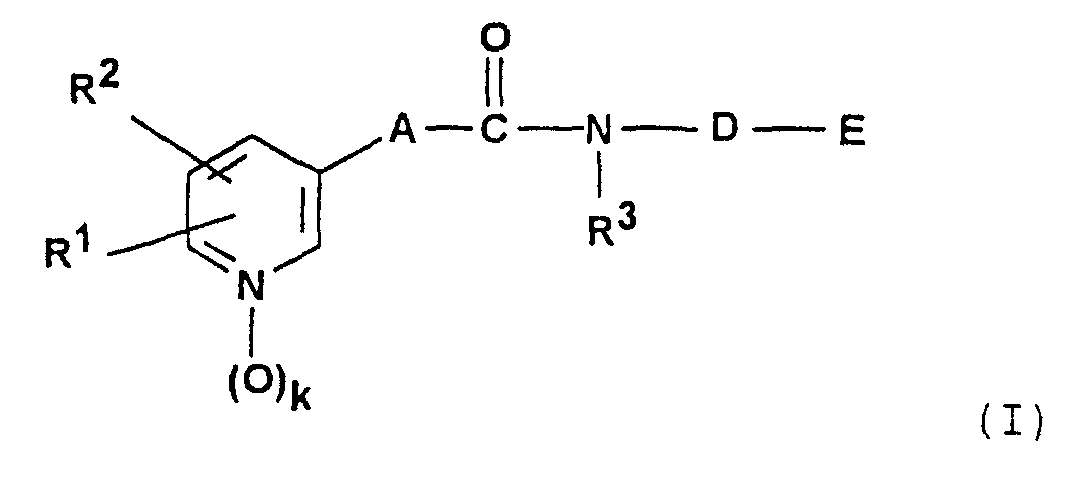
- E
- represents a cyclic imide of the general formula
or
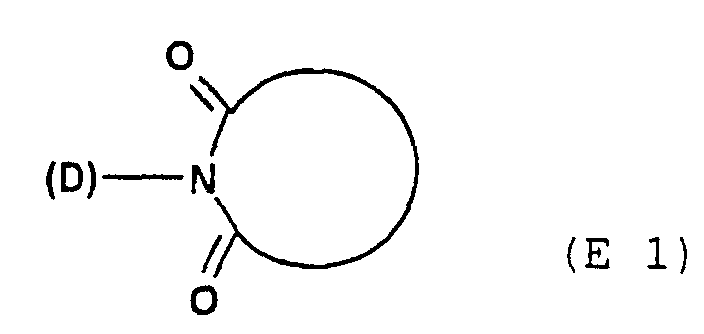 bound over the imide nitrogen atom to D selected from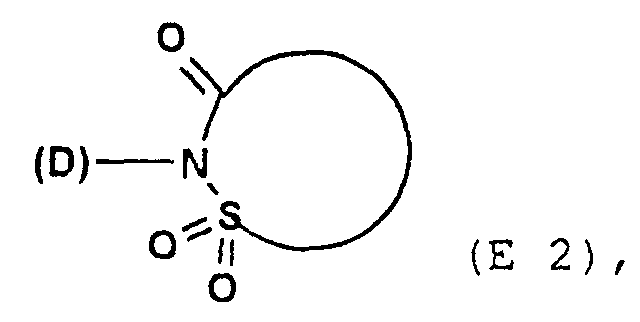
saturated or unsaturated monocyclic imides with 5 to 7 ring atoms whereby in this imide ring, aside from the essential imide nitrogen atom, one or two further hetero-atoms can be present selected from N and/or S and/or O;
saturated unsaturated or aromatic anellated bi-, tri- or tetracyclic imides with 8 to 18 ring atoms of which, aside from the essential imide nitrogen atom, one to three further hetero-atoms can be present selected from N and/or S and/or O;
saturated or unsaturated, bridged bi-, tri-, tetra- or pentacyclic imides with 8 to 22 ring atoms, among which, aside from the essential imide nitrogen atom, one to three further hetero-atoms can be present selected from N and/or S and/or O;
saturated or unsaturated spirocyclic imides, optionally anellated once or twice, and with a total of 9 to 23 ring atoms among which, aside from the essential imide nitrogen atom, one to three further hetero-atoms can be present selected from N and/or S and/or O;
whereby these cyclic imides can be substituted independently of each other by one to five of the same or different groups as described in detail below: - Subject matter of the invention are further pharmacologically acceptable acid addition salts of the compounds of Formula (I) with inorganic or organic acids. Preferable examples for addition salts with suitable inorganic acids are hydrochlorides, hydrobromides, hydroiodides, sulfates and phosphates. Addition salts of organic acids are preferably acetates, benzoates, citrates, fumarates, gluconates, malates, maleates, methanesulfonates, lactates, oxalates, succinates, tartrates and tosylates.
- Compounds of Formula (I) as well as their acid addition salts can also be optionally present as hydrates or other solvates. The invention includes such hydrates and solvates.
- In the compounds of Formula (I) which are defined below and in detail in the claims, the definitions for their atoms or atomic groups preferably have the following meanings:
- Halogen means fluorine, chlorine, bromine or iodine;
- Alkyl can be straight chained or branched and preferably signifies a C1-C6-alkyl residue, especially a methyl-, ethyl-, propyl-, isopropyl-, butyl-, isobutyl-, sec-butyl-, tert-butyl-, cyclopropylmethyl-, pentyl-, isopentyl-, tert-pentyl-, neopentyl-, cyclopropylethyl-, cyclobutylmethyl- or hexyl group.
-
- Alkylene signifies for example methylene, ethylene, propylene, tetramethylene, pentamethylene, hexamethylene, heptamethylene, octamethylene, nonamethylene or decamethylene.
- Alkenyl preferably signifies C3-C6-alkenyl and can be straight chained or branched and preferably signifies an allyl-, 2-butenyl-, 3-butenyl-, 2-methyl-2-propenyl-, 2-pentenyl-, 4-pentenyl-, 2-methyl-2-butenyl-, 3-methyl-2-butenyl-, 2-hexenyl-, 5-hexenyl-, 4-methyl-3-pentenyl- or 2,2-dimethyl-3-butenyl-group.
- Alkenylene signifies for example ethenylene, propenylene, butenylene, pentenylene, hexenylene, hexadienylene, heptenylene, octenylene, nonenylene or decenylene.
- Alkinyl preferably signifies C2-C6-alkinyl which can be straight chained or branched and can preferably signify an ethinyl-, propargyl-, 2-butinyl-, 3-butinyl-, 4-pentinyl-, 5-hexinyl- or 4-methyl-2-pentinyl group.
- Alkinylene signifies for example propinylene, butinylene, pentinylene, hexinylene, hexeninylene, heptinylene, octinylene, noninylene or decinylene.
- Cycloalkyl is preferably a C3-C8-cycloalkyl residue, especially a cyclopropyl-, cyclobutyl-, cyclopentyl-, cyclohexyl-, cycloheptyl- or cyclooctyl group.
- Hydroxyalkyl contains a hydroxyl group in one of the above mentioned alkyl residues, especially in a C1-C6-alkyl residue, whereby among the C1-C6-hydroxyalkyl residues, the hydroxymethyl- and the hydroxyethyl residue are preferred.
- Aside from the oxygen atom, alkoxy residues, preferably C1-C6-alkoxy or C3-C8-cycloalkyloxyl contain one of the above mentioned preferred C1-C6-alkyl-, or C3-C8-cycloalkyl residues. Particularly preferred groups for this are the methoxy-, ethoxy-, isopropoxy-, tert-butoxy-, cyclopentyloxy- and cyclohexyloxy groups.
- Alkoxy, especially C1-C6-alkoxy, entirely or partially replaced by fluorine is for example difluoromethoxy, trifluoromethoxy or 2,2,2-trifluoroethoxy.
- Aralkyl such as phenylalkyl, especially phenyl-C1-C3-alkyl and/or diarylalkyl such as diphenyl-C1-C3-alkyl contain one and/or two phenyl groups on a methyl-, ethyl-, propyl- or isopropyl group at any position.
- Alkylidene residues, especially C1-C6-alkylidene, C3-C8-cycloalkylidene, phenyl-C1-C3-alkylidene and diphenyl-C1-C3-alkylidene correspond to the above named preferred C1-C6-alkyl-, C3-C8-cycloalkyl-, phenyl-C1-C3-alkyl- and diphenyl-C1-C3-alkyl groups, but are respectively bound over a double bond.
- Aside from the sulphur atom, alkylthio residues contain one of the above mentioned preferred C1-C6-alkyl groups. Particularly preferred groups are the methylthio-, ethylthio-, isopropylthio- and tert-butylthio groups.
- Cyclopentyloxy- and cyclopentylthio- and/or cyclohexyloxy- and cyclohexylthio residues represent preferred C3-C8-cycloalkyloxy and C3-C8-cycloalkylthio.
- Aside from the oxygen atom, alkanoyloxy residues preferably contain an aliphatic acyl group with 1 to 7 carbon atoms. Among preferred alkanoyloxy groups are the acetoxy-, propionyloxy- and pivaloyloxy groups.
- Alkoxycarbonyl groups, preferably C2-C7-alkoxycarbonyl groups contain, aside from the carbonyl group, one of the above mentioned alkoxy groups, especially C1-C6-alkoxy groups. Preferred alkoxycarbonyl groups are the methoxycarbonyl-, ethoxycarbonyl-, isopropoxycarbonyl-, isobutoxycarbonyl- and tert-butoxycarbonyl groups.
- Aside from the carbonyl group, alkylaminocarbonyl, especially C2-C7-alkylaminocarbonyl and dialkylaminocarbonyl groups, preferably C3-C13-dialkylaminocarbonyl groups, contain an alkylamino- and/or dialkylamino residue whose alkyl groups correspond especially to the C1-C6-alkyl groups of the above description. Preferred groups are the dimethylaminocarbonyl-, diethylaminocarbonyl- and diisopropylaminocarbonyl groups.
- C2-C7-carboxyalkyl and C3-C7-carboxyalkenyl contain a carbonyl group on one of the above named C1-C6-alkylene and/or C2-C6-alkenylene residues. Preferred are the carboxymethyl-, carboxyethyl-, carboxyethenyl-, carboxybutyl- and carboxybutadienyl groups.
- C1-C6-aminoalkyl contains an amino group in one of the above named C1-C6-alkyl residues. Preferred are the aminomethyl- and the aminoethyl residues.
- Aside from the unsubstituted amino group, amino groups of the Formula NR4R5 are one of the below mentioned alkylamino groups, especially C1-C6-alkylamino groups and/or dialkylamino groups, especially di-(C1-C6-alkyl)amino groups.
- Alkylamino especially contains one of the above mentioned C1-C6-alkyl groups. Preferred groups are the methylamino-, ethylamino-, propylamino-, isopropylamino-, butylamino-, and the tert-butylamino groups.
- Phenyl- C1-C3-alkylamino contains a phenyl group on a methylamino-, ethylamino-, propylamino- or isopropylamino residue on any carbon atom.
- The preferred di-(C1-C6-alkyl)amino residue carries two of the same or different of the above mentioned C1-C6-alkyl groups on the nitrogen atom. Preferred groups are the dimethylamino-, diethylamino-, dipropylamino-, diisopropylamino-, isopropyl-, methylamino-, dibutylamino- or tert-butylmethylamino groups.
- Acyl, especially C1-C6-acyl, signifies the residue of an aliphatic saturated or unsaturated, straight chained, branched or cyclic carboxylic acid. Preferred acyl residues are formyl-, acetyl-, propionyl-, acryloyl-, butyryl-, isobutyryl-, methacryloyl-, cyclopropylcarbonyl-, pentanoyl-, pivaloyl-, cyclobutylcarbonyl-, hexanoyl- and dimethylacryloyl groups.
- Alkanesulfonyl, especially C1-C6-alkanesulfonyl is preferably the methanesulfonyl-, ethanesulfonyl-, propanesulfonyl-, butanesulfonyl-, pentanesulfonyl- or hexanesulfonyl groups.
- Saturated or unsaturated monocyclic imides with 5 to 7 ring atoms among which, aside from the essential imide nitrogen atom, one or two further hetero-atoms can be present are for example pyrrol-2,5-dione, pyrrolidin-2,5-dione, imidazolidin-2,4-dione, oxazolidin-2,4-dione, thiazolidin-2,4-dione, imidazolidin-2,4,5-trione, 1,2,4-oxadiazolidin-3,5-dione, piperidin-2,6-dione, 3H-pyridin-2,6-dione, piperazin-2,6-dione, morpholin-3,5-dione, thiomorpholin-3,5-dione, azepin-2,7-dione, 3,6-dihydroazepin-2,7-dione, hexahydroazepin-2,7-dione, hexahydro-1,3-diazepin-2,4-dione, 1,2-dihydro-1,4-diazepin-2,7-dione, hexahydro-1,4-diazepin-2,7-dione, 3,7-dihydro-1,2,5-triazepin-4,6-dione or hexahydro-1,2,5-triazepin-4,6-dione.
- Saturated or unsaturated or aromatic anellated, bi-, tri- or tetracyclic imides with 8 to 18 ring atoms among which, aside from the essential imide nitrogen, one to three further hetero-atoms can be present, are for example dihydro-cyclopentapyrrol-1,3-dione, tetrahydrocyclopentapyrrol-1,3-dione, pyrrolo[3,4-c]pyrrol-1,3-dione, dihydropyrrolo[3,4-c]pyrrol-1,3-dione, tetrahydropyrrolo[3,4-c]pyrrol-1,3-dione, pyrrolo[3,4-b]pyrrol-4,6-dione, dihydropyrrolo[3,4-b]pyrrol-4,6-dione, tetrahydropyrrolo[3,4-b]pyrrol-4,6-dione, pyrrolo[1,2-c]imidazol-1,3-dione, tetrahydropyrrolo[1,2-c]imidazol-1,3-dione, thieno-[2,3-c]pyrrol-4,5-dione, thieno[3,4-c]pyrrol-4,6-dione, tetrahydrothieno[3,4-c]pyrrol-4,6-dione, furo[3,4-c]pyrrol-4,6-dione, tetrahydrofuro[3,4-c]pyrrol-4,6-dione, pyrrolo[3,4-d]thiazol-4,6-dione, isoindol-1,3-dione, tetrahydroisoindol-1,3-dione, hexahydroisoindol-1,3-dione, pyrrolo[3,4-b]pyridin-5,7-dione, pyrrolo[3,4-c]pyridin-1,3-dione, pyrrolo[3,4-c]pyridazin-5,7-dione, 1,1-dioxo-benzo[d]isothiazol-3-one, dihydropurin-2,6-dione, 4H-isoquinolin-1,3-dione, 8H-[1,6]naphthyridin-5,7-dione, 5H-[1,7]naphthyridin-6,8-dione, 4H-[2,6]naphthyridin-1,3-dione, 4H-[2,7]naphthyridin-1,3-dione, 1H-quinazolin-2,4-dione, 1H-pyrido-[2,3-d]pyrimidin-2,4-dione, 1H-pyrido[3,2-d]pyrimidin-2,4-dione, 1H-pyrido[3,4-d]pyrimidin-2,4-dione, benzo[4,5]thieno[2,3-c]-pyrrol-1,3-dione, furoisoindol-1,3-dione, thienoisoindol-1,3-dione, benzoisoindol-1,3-dione, dihydrobenzoisoindol-1,3-dione, tetrahydrobenzoisoindol-1,3-dione, pyrrolo[3,4-g]quinolin-6,8-dione, dihydroimidazo[1,5-b]isoquinolin-1,3-dione, dihydropyrrolo[3,4-g]quinazolin-6,8-dione, tetrahydropyrrolo[3,4-g]quinazolin-6,8-dione, 1,2,4-triazolo[1,2-a]cinnolin-7,9-dione, dihydrocarbolin-1,3-dione, 4H-benzo[4,5]thieno[2,3-c]pyridin-1,3-dione, 1H-benzo[f]isoquinolin-2,4-dione, 4H-benzo[h]isoquinolin-1,3-dione, benzo[de]isoquinolin-1,3-dione, dibenzo[c,e]azepin-5,7-dione, 4H-naphtho[1,8-c,d]azepin-1,3-dione, dihydro-4H-ace-naphtho[1,8-a,c]pyrrol-1,3,10-trione, 6H-pyrrolo[3,4-c]carbazol-1,3-dione, dibenzoisoindol-1,3-dione, dihydrodibenzoisoindol-1,3-dione, naphthoisoindol-1,3-dione, dihydronaphthoisoindol-1,3-dione, tetrahydronaphthoisoindol-1,3-dione, dibenzo[de,h]isoquinolin-1,3-dione, 6H-2-azapyren-1,3-dione, dihydro-12H-2-azapleia-den-1,3-dione, 1H-anthraceno[1,9-c,d]azepin-2,4-dione or 4H-anthraceno[9,1-c,d]azepin-1,3-dione.
- Saturated or unsaturated, bridged bi-, tri-, tetra- or pentacyclic imides with 8 to 22 ring atoms among which, aside from the essential imide nitrogen atom, one to three further hetero-atoms can be present, are for example 3-aza-bicyclo[3.1.1]heptan-2,4-dione, 3-aza-bicyclo[3.2.1]octan-2,4-dione, 3-aza-bicyclo[3.2.1]oct-6-en-2,4-dione, 3-aza-bicyclo-[3.2.2]nonan-2,4-dione, 3-aza-bicyclo[3.2.2]non-6-en-2,4-dione, 4-aza-tricyclo[5.1.1.0 2,6]nonan-3,5-dione, 4-aza-tricyclo-[5.2.1.0 2,6]decan-3,5-dione, 4-aza-tricyclo[5.2.1.0 2,6]dec-8-en-3,5-dione, 10-oxa-4-aza-tricyclo[5.2.1.0 2,6]dec-8-en-3,5-dione, 4-aza-tricyclo[5.2.2.0 2,6]undecan-3,5-dione, 4-aza-tricyclo[5.2.2.0 2,6]undec-8-en-3,5-dione, 4-aza-benzo[8,9]tricyclo[5.2.2.0 2,6]undecan-3,5-dione, 4-aza-dibenzo[8,9:10,11]tricyclo[5.2.2.0 2,6]undecan-3,5-dione, 4-aza-dibenzo[9,10:11,12]-tricyclo[6.2.2.0 2,7]duodecan-3,5-dione, or 5-aza-dibenzo-[10,11:12,13]tricyclo[7.2.2.0 2,8]tridecan-3,5-dione.
- Saturated or unsaturated spirocyclic imides, optionally anellated once or twice, and with a total of 9 to 23 ring atoms among which, aside from the essential imide nitrogen atom, one to three further hetero-atoms can be present are for example 2-azaspiro[4.4]nonan-1,3-dione, 2,7-diazaspiro[4.4]nonan-1,3-dione, 1,3-diazaspiro[4.4]nonan-2,4-dione, 1-thia-3-azaspiro[4.4]nonan-2,4-dione, 1-oxa-3-azaspiro[4.4]nonan-2,4-dione, 1,3,7-triazaspiro[4.4]nonan-2,4-dione, 1-oxa-3,7-diazaspiro-[4.4]nonan-2,4-dione, 2-azaspiro[4.5]decan-1,3-dione, 2,8-di-azaspiro[4.5]decan-1,3-dione, 1,3,7-triazaspiro[4.5]decan-2,4-dione, 1,3,8-triazaspiro[4.5]decan-2,4-dione, 1-oxa-3,8-diazaspiro[4.5]decan-2,4-dione, 8-azaspiro[4.5]decan-7,9-dione, 7-azaspiro[4.5]decan-6,8-dione, 3-azaspiro[5.5]undecan-2,4-dione, 2-azaspiro[5.5]undecan-1,3-dione, as well as spiro[dioxoimidazolidin-indanes], spiro[oxoindolindioxoimidazolidines], spiro[dioxoimid-azolidintetrahydronaphthalines], spiro[dioxoimidazolidinpiperi-dines], and spiro[2,6-dioxopiperidin-tetrahydronaphthalines].
- Saturated or unstaturated four- to seven-membered heterocycles with one or two hetero-atoms are for example azetidine, tetrahydrofuran, tetrahydrothiophene, pyrrolidine, tetrahydropyran, tetrahydropyridine, piperidine, tetrahydroazepine, hexahydroazepine, pyrazolidine, piperazine, morpholine, thiomorpholine, thiomorpholin-1,1-dioxide, hexahydrodiazepine or hexahydrooxazepine.
- Monocyclic aromatic five- or six-membered heterocycles with one to three hetero-atoms are for example furyl, thienyl, pyrrolyl, oxazolyl, isoxazolyl, thiazolyl, isothiazolyl, imidazolyl, pyrazolyl, oxadiazolyl, thiadiazolyl, triazolyl, pyridinyl, pyrazinyl, pyridazinyl, pyrimidinyl or triazinyl.
- Anellated bicyclic aromatic or partially hydrated carbocyclic ring systems with 8 to 12 ring atoms are preferably benzocyclobutyl, indanyl, indenyl, naphthyl, dihydronaphthyl, tetrahydronaphthyl, benzocycloheptenyl, tetrahydrobenzocycloheptenyl, benzocyclooctenyl or hexahydrobenzocyclooctenyl. Among partially hydrated carbocyclic ring systems, their mono- or dioxo-derivates also included, i.e. for example, the indanone, tetralone, benzocycloheptenone or tetrahydrobenzocycloheptenone groups.
- Anellated bicyclic aromatic or partially hydrated heterocyclic ring systems with 8 to 12 ring atoms are for example imidazothiazolyl, benzofuryl, dihydrobenzofuryl, benzothienyl, dihydrobenzothienyl, indolyl, indolinyl, isoindolinyl, benzoimidazolyl, indazolyl, benzooxazolyl, benzoisoxazolyl, benzothiazolyl, benzoisothiazolyl, benzothiadiazolyl, benzotriazolyl, chromanyl, benzopyranyl, quinolinyl, isoquinolinyl, dihydroquinolinyl, tetrahydroquinolinyl, benzodioxanyl, quinoxalinyl, quinazolinyl, tetrahydrobenzooxepinyl, tetrahydrobenzothiepinyl, benzoazepinyl, and tetrahydrobenzoazepinyl.
- Among partially hydrated heterocyclic ring systems, their mono- or dioxo derivates and/or optionally their possible tautomers are additionally included, i.e. for example, ring systems such as indolinone, isatin, benzooxazolone and/or its tautomer hydroxybenzooxazole, as well as benzoisoxazolone, benzothiazolone, benzoisothiazolone and benzoimidazolone and/or their tautomers hydroxybenzoisoxazole, as well as hydroxybenzothiazole, hydroxybenzoisothiazole and hydroxybenzoimidazole, indazolinone, and chromanone, chromone, quinolinone, dihydroquinolinone and tetrahydrobenzoazepinones.
- Hence, the invention concretely relates to new imide-substituted pyridylalkane, pyridylalkene and pyridylalkine acid amides of the general Formula (I)wherein the substituents have the following meanings:

- R1
- is selected from
hydrogen, halogen, cyano, alkyl, alkenyl, alkinyl, trifluoromethyl, cycloalkyl, hydroxyalkyl, hydroxy, alkoxy, cycloalkyloxy, aralkyloxy such as benzyloxy, alkanoyloxy, alkylthio, alkoxycarbonyl, alkanoyloxy, alkylthio, alkoxycarbonyl, aminocarbonyl, alkylaminocarbonyl, dialkylaminocarbonyl, carboxy, aryl such as phenyl, aryloxy such as phenoxy, arylthio such as phenylthio, heteroaryloxy such as pyridyloxy, heteroarylthio such as pyridylthio, and NR4R5 , whereby - R4 and R5
- are selected independently from each other from hydrogen, alkyl, alkenyl, alkinyl, aralkyl such as benzyl and aryl such as phenyl;
- R2
- is selected from
hydrogen, halogen, cyano, alkyl, trifluoromethyl, hydroxy, alkoxy and aralkyloxy such as benzyloxy; - R3
- is selected from
hydrogen, alkyl, alkenyl, alkinyl, hydroxy, alkoxy and aryloxy such as benzyloxy; - k
- is 0 or 1,
- A
- is selected from
alkylene, optionally substituted one to three-fold by alkyl, hydroxy, alkoxy, fluorine, or aryl such as phenyl,
alkylene, wherein a methylene unit is isosterically replaced by O, S, NR6 , CO, SO or SO2, whereby, with the exception of CO, the isosteric substitution cannot be adjacent to the amine group and R6 is selected from hydrogen, alkyl, alkenyl, acyl or alkanesulfonyl;
1,2-cyclopropylene;
alkenylene, optionally substituted once or twice by alkyl, hydroxy, alkoxy, fluorine, cyano or aryl such as phenyl;
alkadienylene, optionally substituted once or twice by alkyl, fluorine, cyano or aryl such as phenyl;
hexatrienylene, optionally substituted by C1-C3-alkyl, fluorine, cyano or phenyl; as well as
ethinylene; - D
- is selected from
alkylene, optionally substituted once or twice by alkyl, hydroxy, or alkoxy;
alkenylene, optionally substituted once or twice by alkyl, hydroxy, or alkoxy;
alkinylene, optionally substituted once or twice by alkyl, hydroxy, or alkoxy; as well as
alkylene, alkenylene or alkinylene, in which one to three methylene units are isosterically replaced by O, S, NR7 , CO, SO or SO2, whereby R7 is synonymous with R6 , but is selected independently thereof; - E
- is a cyclic imide of the general formula
or
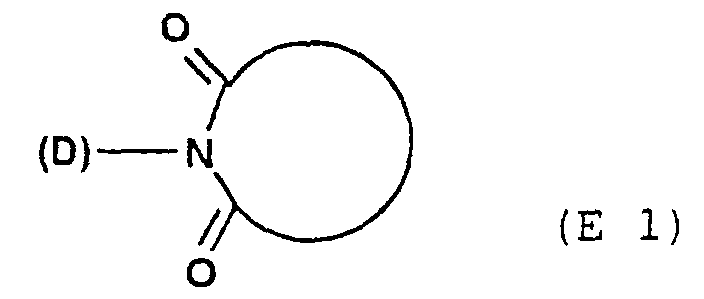 bound over the imide nitrogen atom to D selected from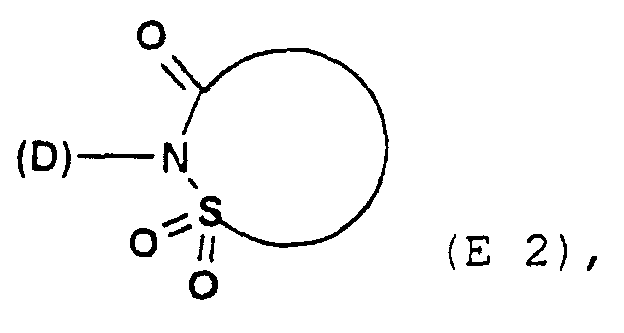
saturated or unsaturated monocyclic imides with 5 to 7 ring atoms, whereby, aside from the essential imide nitrogen atom, one or two further hetero-atoms can be present selected from N and/or S and/or O in this imide ring;
saturated, unsaturated or aromatic anellated bi-, tri- or tetracyclic imides with 8 to 18 ring atoms of which, aside from the essential imide nitrogen atom, one to three further hetero-atoms can be present selected from N and/or S and/or O;
saturated or unsaturated, bridged bi-, tri- tetra- or pentacyclic imides with 8 to 22 ring atoms of which, aside from the essential imide nitrogen atom, one to three further hetero-atoms can be present selected from N and/or S and/or O;
saturated or unsaturated spirocyclic imides, optionally anellated once or twice, and with a total of 9 to 23 ring atoms of which, aside from the essential imide nitrogen atom, one to three further hetero-atoms can be present selected from N and/or S and/or O; - According to a preferred embodiment, the imide-substituted pyridylalkane, pyridylalkene and pyridylalkine acid amides of formula (I)have the following substituent meanings:

- R1
- is selected from
hydrogen, halogen, cyano, C1-C6-alkyl, C3-C6-alkenyl, C2-C6-alkinyl, trifluoromethyl, C3-C8-cycloalkyl, C1-C6-hydroxyalkyl, hydroxy, C1-C6-alkoxy, C3-C8-cycloalkyloxy, benzyloxy, C1-C7-alkanoyloxy, C1-C6-alkylthio, C2-C7-alkoxycarbonyl, aminocarbonyl, C2-C7-alkylaminocarbonyl, C3-C13-dialkylaminocarbonyl, carboxy, phenyl, phenoxy, phenylthio, pyridyloxy, pyridylthio, and NR4R5 , whereby - R4 and R5
- are selected independently from each other from hydrogen, C1-C6-alkyl, C3-C6-alkenyl, C3-C6-alkinyl, benzyl and phenyl;
- R2
- is selected from
hydrogen, halogen, cyano, C1-C6-alkyl, trifluoromethyl, hydroxy, C1-C6-alkoxy and benzyloxy; - R3
- is selected from
hydrogen, C1-C6-alkyl, C3-C6-alkenyl, C3-C6-alkinyl, hydroxy, C1-C6-alkoxy and benzyloxy; - k
- is 0 or 1,
- A
- is selected from
C1-C6-alkylene, optionally substituted one to three-fold by C1-C3-alkyl, hydroxy, C1-C3-alkoxy, fluorine, or phenyl;
C2-C6-alkylene, in which a methylene unit is isosterically replaced by O, S, NR6 , CO, SO or SO2, whereby, with the exception of CO, the isosteric substitution cannot be adjacent to the amide group and R6 is selected from hydrogen, C1-C6-alkyl, C3-C6-alkenyl, C1-C6-acyl or C1-C6-alkanesulfonyl;
1,2-cyclopropylene;
C2-C6-alkenylene, optionally substituted once or twice by C1-C3-alkyl, hydroxy, C1-C3-alkoxy, fluorine, cyano or phenyl;
C4-C6-alkadienylene, optionally substituted once to twice by C1-C3-alkyl, fluorine, cyano or phenyl;
1,3,5-hexatrienylene, optionally substituted by C1-C3-alkyl, fluorine, cyano or phenyl; as well as
ethinylene; - D
- is selected from
C2-C10-alkylene, optionally substituted once or twice by C1-C6-alkyl, hydroxy, or C1-C6-alkoxy;
C4-C10-alkenylene, optionally substituted once or twice by C1-C6-alkyl, hydroxy, or C1-C6-alkoxy;
C4-C10-alkinylene, optionally substituted once or twice by C1-C6-alkyl, hydroxy, or C1-C6-alkoxy; as well as
C2-C10-alkylene, C4-C10-alkenylene or C4-C10-alkinylene, in which one to three methylene units is isosterically replaced by O, S, NR7 , CO, SO or SO2, whereby R7 is synonymous with R6 , but is selected independently thereof; - E
- is a cyclic imide of the general formula
or
 bound over the imide nitrogen atom to D selected from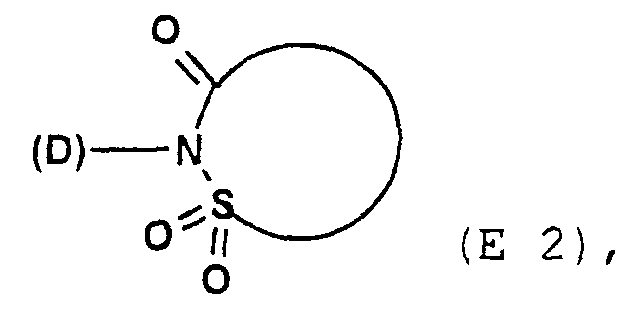
saturated or unsaturated monocyclic imides with 5 to 7 ring atoms of which, aside from the essential imide nitrogen atom, one or two further hetero-atoms can be present selected from N and/or S and/or O;
saturated, unsaturated or aromatic anellated, bi-, tri- or tetracyclic imides with 8 to 18 ring atoms of which, aside from the essential imide nitrogen atom, one to three further hetero-atoms can be present selected from N and/or S and/or O;
saturated or unsaturated, bridged bi-, tri- tetra- or pentacyclic imides with 8 to 22 ring atoms of which, aside from the essential imide nitrogen atom, one to three further hetero-atoms can be present selected from N and/or S and/or O;
saturated or unsaturated spirocyclic imides, optionally anellated once or twice, and with a total of 9 to 23 ring atoms of which, aside from the essential imide nitrogen atom, one to three further hetero-atoms can be present selected from N and/or S and/or O; - According to a particularly preferred embodiment, the invention relates to compounds of the general formula (I)wherein the substituents have the following meanings:

- R1
- is selected from
hydrogen, halogen, cyano, C1-C6-alkyl, trifluoromethyl, ethinyl, hydroxy, C1-C4-alkoxy, benzyloxy, C1-C4-alkylthio, C2-C5-alkoxycarbonyl, aminocarbonyl, C3-C9-dialkylaminocarbonyl, carboxy, phenoxy, phenylthio and pyridyloxy; - R2
- is selected from
hydrogen, fluorine, chlorine, bromine, C1-C4-alkyl, trifluoromethyl, hydroxy, C1-C4-alkoxy; - R3
- is selected from
hydrogen, C1-C3-alkyl, allyl, hydroxy, C1-C3-alkoxy and benzyloxy; - k
- is 0 or 1,
- A
- is selected from
C1-C6-alkylene, optionally substituted once or twice by C1-C3-alkyl, hydroxy, fluorine or phenyl;
C2-C6-alkylene, wherein a methylene unit is isosterically replaced by O, S, NH, N(CH3) or CO, whereby, with the exception of CO, the isosteric substitution cannot be adjacent to the amide group; and
1,2-cyclopropylene;
C2-C6-alkenylene, optionally substituted once or twice by C1-C3-alkyl, phenyl, hydroxy and/or fluorine;
C4-C6-alkadienylene, optionally substituted once to twice by methyl or fluorine;
1,3,5-hexatrienylene, optionally substituted by methyl or fluorine; as well as
ethinylene - D
- is selected from
C2-C8-alkylene, optionally substituted once or twice by C1-C3-alkyl or hydroxy;
C4-C8-alkenylene, optionally substituted once or twice by C1-C3-alkyl or hydroxy;
C4-C8-alkinylene, optionally substituted once or twice by C1-C3-alkyl or hydroxy; as well as
C2-C8-alkylene, C4-C8-alkenylene or C4-C8-alkinylene, wherein one to three methylene units are isosterically replaced by O, S, NH, N(CH3), N(COCH3), N(SO2CH3), CO or SO2; - E
- is selected from
saturated or unsaturated monocyclic imides with 5 to 7 ring atoms, for example, pyrrol-2,5-dione, pyrrolidin-2,5-dione, imidazolidin-2,4-dione, oxazolidin-2,4-dione, thiazolidin-2,4-dione, imidazolidin-2,4,5-trione, piperidin-2,6-dione, 3H-pyridin-2,6-dione, piperazin-2,6-dione, morpholin-3,5-dione, azepin-2,7-dione, 3,6-dihydroazepin-2,7-dione, hexahydroazepin-2,7-dione, hexahydro-1,3-diazepin-2,4-dione, hexahydro-1,4-diazepin-2,7-dione, 3,7-dihydro-1,2,5-triazepin-4,6-dione, hexahydro-1,2,5-triazepin-4,6-dione,
saturated, unsaturated or aromatic anellated bicyclic imides, for example, pyrrolo[3,4-c]pyrrol-1,3-dione, dihydropyrrolo[3,4-c]pyrrol-1,3-dione, tetrahydropyrrolo[3,4-c]pyrrol-1,3-dione, tetrahydropyrrolo[1,2-c]imidazol-1,3-dione, thieno[2,3-c]pyrrol-4,6-dione, thieno[3,4-c]pyrrol-4,6-dione, furo[3,4-c]pyrrol-4,6-dione, pyrrolo[3,4-d]thiazol-4,6-dione, isoindol-1,3-dione, tetrahydroisoindol-1,3-dione, hexahydroisoindol-1,3-dione, pyrrolo[3,4-b]pyridin-5,7-dione, pyrrolo[3,4-c]pyridin-1,3-dione, pyrrolo[3,4-c]pyridazin-5,7-dione, 1,1-dioxo-benzo[d]isothiazol-3-one, dihydropurin-2,6-dione, 4H-isoquinolin-1,3-dione, 5H-[1,7]naphthyridin-6,8-dione, 4H-[2,6]naphthyridin-1,3-dione, 1H-quinazolin-2,4-dione, 1H-pyrido[2,3-d]pyrimidin-2,4-dione, 1H-pyrido[3,4-d]pyrimidin-2,4-dione,
unsaturated or aromatic anellated tricyclic imides, such as, for example, benzo[4,5]thieno[2,3-c]pyrrol-1,3-dione, thienoisoindol-1,3-dione, benzoisoindol-1,3-dione, dihydrobenzoisoindol-1,3-dione, tetrahydrobenzoisoindol-1,3-dione, pyrrolo[3,4-g]quinolin-6,8-dione, tetrahydropyrrolo[3,4-g]quinazolin-6,8-dione, 1,2,4-triazolo[1,2-a]cinnolin-7,9-dione, dihydrocarbolin-1,3-dione, 4H-benzo[h]isoquinolin-1,3-dione, benzo[de]isoquinolin-1,3-dione, dibenzo[c,e]azepin-5,7-dione, 4H-naphtho[1,8-c,d]azepin-1,3-dione,
unsaturated or aromatic anellated tetracyclic imides, such as, for example, dihydro-4H-acenaphtho-[1,8-a,c]pyrrol-1,3,10-trione, 6H-pyrrolo[3,4-c]carbazol-1,3-dione, dibenzoisoindol-1,3-dione, naphthoisoindol-1,3-dione, tetrahydronaphthoisoindol-1,3-dione, dibenzo[de,h]-isoquinolin-1,3-dione, dihydro-12H-2-azapleiaden-1,3-dione, 1H-anthra[1,9-c,d]azepin-2,4-dione, 4H-anthra[9,1-c,d]azepin-1,3-dione,
saturated or unsaturated, bridged bi-, tri-, tetra- or pentacyclic imides such as, for example, 3-azabicyclo[3.2.1]octan-2,9-dione, 3-aza-bicyclo[3.2.1]oct-6-en-2,4-dione, 3-aza-bicyclo[3.2.2]nonan-2,4-dione, 3- aza-bicyclo[3.2.2]non-6-en-2,4-dione, 4-azatricyclo[5.2.1.0 2,6]dec-8-en-3,5-dione, 10-oxa-4-azatricyclo[5.2.1.0 2,6]dec-8-en-3,5-dione, 4-azatricyclo[5.2.2.0 2,6]undecan-3,5-dione, 4-azatricyclo[5.2.2.0 2,6]undec-8-en-3,5-dione, 4-azabenzo[8,9]tricyclo[5.2.2.0 2,6]undecan-3,5-dione, 4-azadibenzo[8,9:10,11]tricyclo[5.2.2.0 2,6]undecan-3,5-dione, 5-aza-dibenzo[10,11:12,13]tricyclo[7.2.2.0 2,8]tri-decan-3,5-dione, and
saturated or unsaturated spirocyclic imides which are optionally benzoanellated once or twice such as 1,3-diazaspiro[4.4]nonan-2,4-dione, 1-thia-3-azaspiro[4.4]nonan-2,4-dione, 1-oxa-3-azaspiro[4.4]-nonan-2,4-dione, 1,3,7-tri-azaspiro[4.4]nonan-2,4-dione, 1-oxa-3,7-diazaspiro[4.4]-nonan-2,4-dione, 2,8-diazaspiro[4.5]decan-1,3-dione, 1,3,8-triazaspiro[4.5]decan-2,4-dione, 1-oxa-3,8-diazaspiro[4.5]-decan-2,4-dione, 7-azaspiro[4.5]decan-6,8-dione, spiro[dioxoimidazolidin-indanes], spiro[oxoindolin-dioxoimidazolidines], spiro[dioxoimidazolidin-tetrahydronaphthalines], spiro[dioxoimidazolidin-piperidines], and spiro[2,6-dioxopiperidin-tetrahydronaphthalines], - According to a further preferred embodiment the invention relates to compounds of the general formula (I)wherein the substituents have the following meanings:
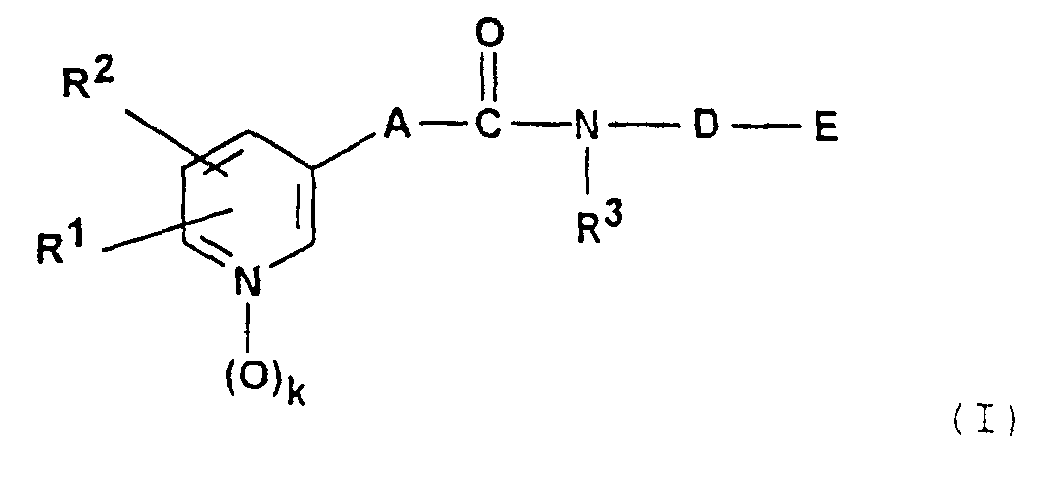
- R1
- is selected from
hydrogen, fluorine, chlorine, bromine, methyl, ethyl, trifluoromethyl, hydroxy, C1-C4-alkoxy, phenoxy, methylthio, ethylthio, methoxycarbonyl, aminocarbonyl and carboxy; - R2
- is selected from
hydrogen, chlorine, methyl, hydroxy and methoxy; - R3
- is hydrogen;
- k
- is 0,
- A
- is selected from
C2-C6-alkylene, optionally substituted once or twice by hydroxy or fluorine;
C2-C6-alkylene, in which a methylene unit is isosterically replaced by O, S, or CO, whereby, with the exception of CO, the isosteric substitution cannot be adjacent to the amide group;
C2-C6-alkenylene, optionally substituted by methyl and/or fluorine;
C4-C6-alkadienylene, optionally substituted by methyl;
ethinylene; - D
- is selected from
C2-C8-alkylene, optionally substituted by methyl or hydroxy;
C4-C8-alkenylene, optionally substituted by methyl or hydroxy;
C4-C8-alkinylene, optionally substituted by hydroxy;
C2-C8-alkylene, C4-C8-alkenylene or C4-C8-alkinylene, in which a methylene unit is isosterically replaced by O, NH, N(CH3), or CO, or an ethylene group is isosterically replaced by a group NH-CO and/or CO-NH, or a propylene group is isosterically replaced by a group NH-CO-NH or NH-CO-O and/or O-CO-NH; - E
- is selected from
monocyclic imides such as succinimide, maleinimide, glutarimide, adipinimide, imidazolidindione, imidazolidintrione, thiazolidindione, oxazolidindione, piperazin-2,6-dione, morpholin-3,5-dione, 3,6-dihydroazepin-2,7-dione, hexahydro-1,3-diazepin-2,4-dione, hexahydro-1,4-diazepin-2,7-dione, hexahydro-1,2,5-triazepin-4,6-dione,
anellated bicyclic imides such as phthalimide, tetrahydrophthalimide, homophthalimide, pyrrol-3,4-dicarboximide, 2,5-dihydropyrrol-3,4-dicarboximide, thiophen-2,3-dicarboximide, thiophen-3,4-dicarboximide, pyridin-2,3-dicarboximide, pyridin-3,4-dicarboximide, pyridazin-3,4-dicarboximide, 1,1-dioxo-benzo[d]-isothiazol-3-one, isatoic acid imide, 4H-2,6-naphthyridin-1,3-dione, 1H-pyrido[2,3-d]pyrimidin-2,4-dione,
anellated tricyclic imides such as naphthalin-1,2-dicarboximide, 1,2,3,4-tetrahydronaphthalin-1,2-dicarboximide, naphthalin-2,3-dicarboximide, 1,8-naphthalimide, diphenic acid imide, benzothiophen-2,3-dicarboximide, benzothiophen-4,5- dicarboximide, quinolin-6,7-dicarboximide, quinazolin-6,7-dicarboximide,
anellated tetracyclic imides such as 7,8-dihydroacenaphthen-2(6H)-on-1,8a-dicarboximide, anthracen-2,3-dicarboximide, anthracen-1,9-dicarboximide, phenanthren-9,10-dicarboximide, 12a,12b-dihydro-12H-2-azapleiaden-1,3-dione, 1H-anthraceno[1,9-c,d]azepin-2,4-dione, carbazol-5,6-dicarboximide,
bridged polycyclic imides such as cyclopentan-1,3-dicarboximide, cyclohex-2-en-1,4-dicarboximide, bicyclo[2.2.1]-hept-5-en-2,3-dicarboximide, 7-oxabicyclo[2.2.1]-hept-5-en-2,3-dicarboximide, bicyclo[2.2.2]-oct-5-en-2,3-dicarboximide, benzobicyclo[2.2.2]-octan-2,3-dicarboximide, dibenzobicyclo[2.2.2]-octan-2,3-dicarboximide, dibenzobicyclo[2.2.2]-octan-2,3-diacetic acid imide and
spirocyclic imides such as 1,3-diazaspiro[4.4]nonan-2,4-dione, 1-thia-3-azaspiro[4.4]nonan-2,4-dione, 1-oxa-3,7-diazaspiro[4.4]nonan-2,4-dione, 1-oxa-3,8-diazaspiro[4.5]decan-2,4-dione, spiro[dioxoimidazolidin-indane], spiro[dioxoimidazolidin-piperidine], spiro[dioxoimidazolidin-oxoindoline] spiro[dioxoimidazolidin-tetrahydronaphthaline], and spiro[2,6-dioxopiperidin-tetrahydronaphthaline], - Likewise, those compounds of the general formula (I)are particularly preferred wherein the substituents have the following meanings:

- R1
- is selected from
hydrogen, fluorine, methyl, trifluoromethyl, ethylthio; - R2
- is hydrogen;
- R3
- is hydrogen;
- k
- is 0,
- A
- is selected from
ethylene or butylene, optionally substituted by hydroxy or one or two fluorine atoms, or
OCH2, SCH2,
ethenylene or 1,3-butadienylene; - D
- is selected from
C4-C6-alkylene, optionally substituted by hydroxy;
C4-C6-alkenylene;
C4-C6-alkinylene; or
C4-C6-alkylene, C4-C6-alkenylene or C4-C6-alkinylene, wherein one or two methylene units is isosterically replaced by O, NH or CO; - E
- is selected from
monocyclic imides such as succinimide, maleinimide, glutarimide, imidazolidindione, imidazolidintrione, thiazolidindione, oxazolidindione, piperazin-2,6-dione,
hexahydrodiazepin-2,7-dione,
anellated bicyclic imides such as phthalimide, homophthalimide, pyridin-2,3-dicarboximide, pyridin-3,4-dicarboximide, isatoic acid imide,
anellated tricyclic imides such as naphthalin-1,2-dicarboximide, naphthalin-2,3-dicarboximide, 1,8-naphthalimide, diphenic acid imide,
anellated tetracyclic imides such as 7,8-dihydroacenaphthen-2(6H)-on-1,8a-dicarboximide, anthracen-2,3-dicarboximide, anthracen-1,9-dicarboximide, phenanthren-9,10-dicarboximide,
bridged polycyclic imides such as bicyclo[2.2.1]-hept-5-en-2,3-dicarboximide, 7-oxa-bicyclo[2.2.1]-hept-5-en-2,3-dicarboximide, benzobicyclo[2.2.2]-octan-2,3-dicarboximide, dibenzobicyclo[2.2.2]-octan-2,3-dicarboximide, and
spirocyclic imides such as spiro[dioxoimidazolidinindane], spiro[dioxoimidazolidin-piperidine], spiro[dioxoimidazolidin-oxoindoline] and spiro[dioxoimidazolidin-tetrahydronaphthaline], - The following end products represent very particular concrete preferred embodiments of the invention:
- 1) N-[4-(2,5-dioxo-3,4-diphenyl-2,5-dihydro-pyrrol-1-yl)-butyl]-3-pyridin-3-yl-acrylamide (substance 43)
- 2) N-[4-(2,6-dioxo-4-phenyl-piperidin-1-yl)-butyl]-3-pyridin-3-yl-acrylamide (substance 88)
- 3) N-[4-(1,3-dioxo-4,5,6,7-tetraphenyl-1,3-dihydro-isoindol-2-yl)-butyl]-3-pyridin-3-yl-acrylamide (substance 145)
- 4) N-[4-(3-benzyl-2,4,5-trioxo-imidazolidin-1-yl)-butyl]-3-pyridin-3-yl-acrylamide (substance 16)
- 5) N-[4-(1,3,10-trioxo-1,4,5,6,10,10a-hexahydro-acenaphtho[1,8a-c]pyrrol-2-yl)-butyl]-3-pyridin-3-yl-acrylamide (substance 226)
- 6) N-[4-(2,5-dioxo-4,4-diphenyl-imidazolidin-1-yl)-butyl-3-pyridin-3-yl-acrylamide (substance 12)
- 7) N-[4-(2,5-dioxo-3-phenyl-2,5-dihydro-pyrrol-1-yl)-butyl]-3-pyridin-3-yl-acrylamide (substance 28)
- 8) N-[3-(2,5-dioxo-3,4-diphenyl-2,5-dihydro-pyrrol-1-yl)-propyl]-3-pyridin-3-yl-acrylamide (substance 38)
- 9) N-[4-(3-pyridin-3-yl-acroylamino)-butyl]-2,3:5,6-dibenzobicyclo[2.2.2]octan-7,8-dicarboximide (substance 276)
- 10) N-[4-(5-benzyliden-2,4-dioxo-thiazolidin-3-yl)-butyl]-3-pyridin-3-yl-acrylamide (substance 23)
- 11) N-[4-(4-benzyl-2,6-dioxo-piperazin-1-yl)-butyl]-3-pyridin-3-yl-acrylamide (substance 92)
- 12) N-[6-(2,5-dioxo-3,4-diphenyl-2,5-dihydro-pyrrol-1-yl)-hexyl]-3-pyridin-3-yl-acrylamide (substance 58)
- 13) N-[4-(2,5-dioxo-3,4-diphenyl-2,5-dihydro-pyrrol-1-yl)-butyl]-3-pyridin-3-yl-propionamide (substance 40)
- 14) N-[4-(1,3-dioxo-1,3-dihydro-isoindol-2-yl)-butyl]-3-pyridin-3-yl-acrylamide (substance 119)
- 15) N-[4-(1,3-dioxo-2H,3H-benzo[de]isoquinolin-2-yl)-butyl]-3-(1-oxidopyridin-3-yl)-acrylamide (substance 196)
- 16) N-[6-(1,3-dioxo-1H,3H-benzo[de]isoquinolin-2-yl)-hexyl]-3-pyridin-3-yl-acrylamide (substance 204)
- 17) N-[2-(1,3-dioxo-1H,3H-benzo[de]isoquinolin-2-yl)-ethyl]-3-pyridin-3-yl-acrylamide (substance 189)
- 18) N-[4-(1,3-dioxo-1H,3H-benzo[de]isoquinolin-2-yl)-butyl]-3-pyridin-3-yl-acrylamide (substance 195)
-
- Further subject-matter of the invention are known analogous methods for the production of the compounds of the above defined and exemplified formula (I) according to the invention.
- Compounds of formula (I) can be obtained by reacting carboxylic acids of formula (II)in which R1, R2, A and k have the meaning given above or their reactive derivatives with compounds of formula (III)
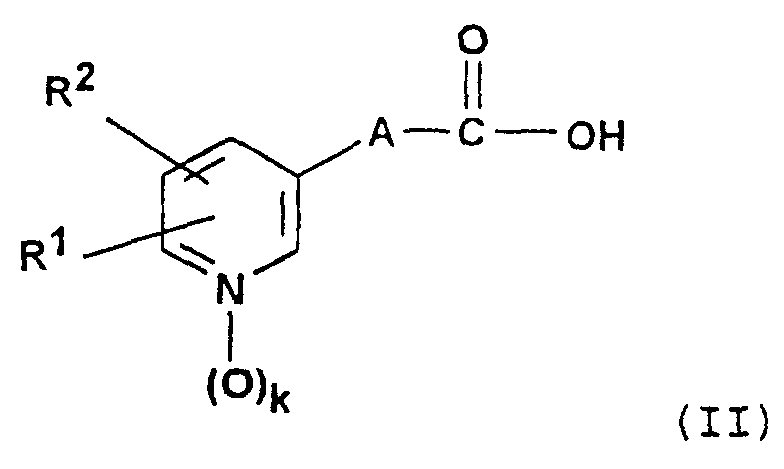 wherein D, E and R3 are defined as above.
- Reactive derivatives of compound (II) can be, for example, its activated esters, anhydrides, acid halides (especially acid chlorides) or simple low alkyl esters. Suitable activated esters are, for example, p-nitrophenyl ester, 2,4,6-trichlorophenyl ester, pentachlorophenyl ester, cyanomethyl ester, esters of N-hydroxysuccinimide, N-hydroxyphthalimides, 1-hydroxybenzotriazole, N-hydroxypiperidine, 2-hydroxypyridine, 2-mercaptopyridine, etc. Anhydrides can be symmetric anhydrides or mixed, as they are obtained, for example, with pivaloyl chloride or with chloroformates. Aromatic (for example chloroformic phenyl ester), araliphatic (for example chloroformic benzyl ester) or aliphatic chloroformates (for example chloroformic methyl ester, ethyl ester or isobutyl ester) can be used for this.
- Reaction of compounds (II) with compounds (III) can also be carried out in the presence of condensation agents such as dicyclohexylcarbodiimide, 1-ethyl-3-(3-dimethylaminopropyl)-carbodiimide hydrochloride, N,N'-carbonyldiimidazole, 1-ethoxycarbonyl-2-ethoxy-1,2-dihydroquinoline, etc. If carbodiimides are used as the condensation agent, reagents such as N-hydroxysuccinimide, N-hydroxyphthalimide, 1-hydroxybenzotriazole, N-hydroxypiperidine, etc. can be advantageously added.
- Compounds of formula (III) can be used for reaction as free bases as well as in the form of their acid addition salts. For this, the salts of inorganic acids are to be preferred, i.e. hydrochlorides, hydrobromides or sulfates for example.
- Reaction of compounds (II) or their reactive derivatives with compounds (III) is normally carried out in a suitable, preferably inert solvent. As examples, aromatic hydrocarbons such as benzene, toluene, xylene, halogenated hydrocarbons (for example dichloromethane, chloroform, 1,2-dichloroethane, trichloroethylene), ethers (for example diethyl ether, tetrahydrofuran, dioxane, glycol dimethyl ether), ethyl acetate, acetonitrile or polar aprotic solvents such as, for example, dimethylsulfoxide, dimethylformamide or N-methyl-pyrrolidone are to be named. Pure solvents, as well as mixtures of two or more, can be used.
- The reaction is optionally carried out in the presence of an auxiliary base. Suitable examples for this are alkali metal carbonates (sodium carbonate, potassium carbonate), alkali metal hydrogen carbonates (sodium hydrogen carbonate, potassium hydrogen carbonate), or organic bases such as, for example, triethylamine, ethyl diisopropylamine, tributylamine, N-methylmorpholine or pyridine. A suitable excess of compound (III) can also be used as a base. If compounds (III) are used in form of their acid addition salts, then it is appropriate to consider the amount of auxiliary base used as equivalent.
- The reaction temperatures can - depending on reactivity of the educts - vary in a wide range. Generally, the reaction is carried out at temperatures between -40°C and 180°C, preferably between -10°C and 130°C, especially at the boiling point of the solvent used.
- The starting compounds (II) and (III) are known and/or can be produced according to known methods in an analogous manner. Moreover, the production of representative examples is described below.
- Compounds of formula (I) can also be produced in that compounds of formula (IV),wherein R1, R2, R3, A, D and k have the meaning given above are reacted with imides of the general formula (V),
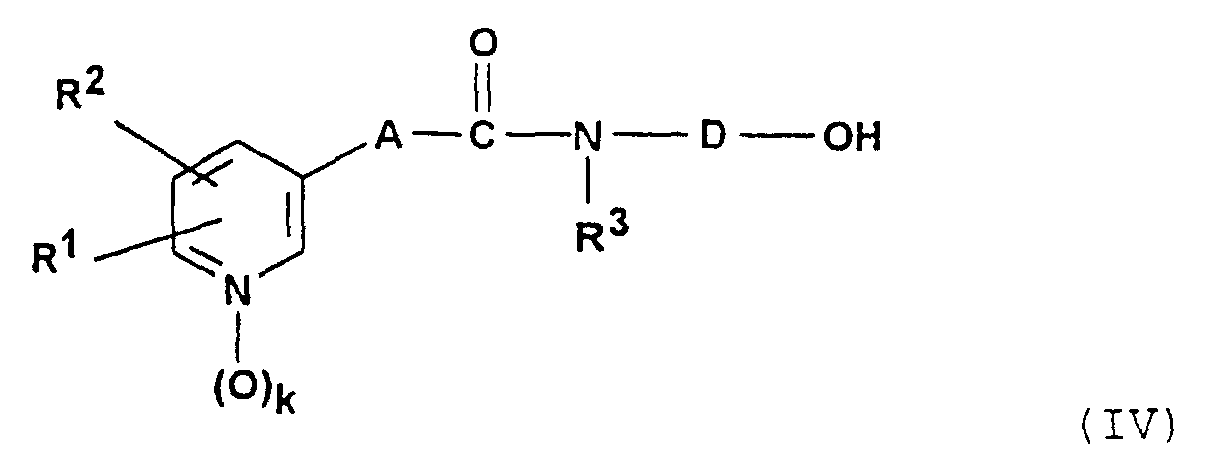
- Suitable organophosphorousIII compounds are triarylphosphines particularly such as triphenylphosphine or trialkylphosphines particularly such as tributylphosphine. However, mixed aryl-alkylphosphines can also be used such as for example methyldiphenylphosphine, or trialkyl phosphites such as trimethyl phosphite, triethyl phosphite or tributyl phosphite.
- Suitable aliphatic azo compounds are, for example, azodicarboxylic esters such as azodicarboxylic dimethyl ester, but especially azodicarboxylic diethyl ester and azodicarboxylic acid diisopropyl ester. Azodicarboxamides can be used as further aliphatic azo compounds such as, for example, N,N,N',N'-tetramethylazodicarboxadiamide, N,N,N',N'-tetraisopropylazodicarboxadiamide or 1,1'-(azodicarbonyl)-di-piperidine. Further, newer reagents are named in Org. Prep. Proced. Int. 28, 129-164 (1996).
- Reaction of compounds (IV) with compounds (V) is normally carried out in a suitable, preferably aprotic solvent. As examples, aromatic hydrocarbons such as benzene, toluene, xylene, halogenated hydrocarbons (for example, dichloromethane, chloroform, 1,2-dichlorethane, trichlorethylene), ethylacetate, acetonitrile and especially ethers such as diethyl ether, diisopropyl ether, methyl-tert-butyl ether, glycoldimethyl ether, dioxane and, particularly preferred, tetrahydrofuran are to be named. Pure solvents as well as mixtures of two or more can be used.
- The reaction is generally carried out in the manner such that the compounds of formula (IV) and (V) and the organophosphorousIII compound are dissolved together in the suitable solvent and the solution of the aliphatic azo compound is stirred into this. Alternatively, a solution of compounds of formulas (IV) and (V) and the aliphatic azo compound can be added to the solution of the organophosphorousIII compound. In order to avoid autoxidation of the organophosphorousIII compound, the reaction is suitably carried out under inert gas.
- The reaction temperature can vary, depending on the reactivity of the components, in the range of -20°C to 120°C, preferably between -10°C and 80°C, particularly preferred between 0°C and 30°C.
- The starting compounds of formula (IV) can be obtained themselves in that carboxylic acids of the formula (II) are reacted with amino alcohols of formula (VI),in which R3 and D have the meaning given above under conditions as they are described under method (A).
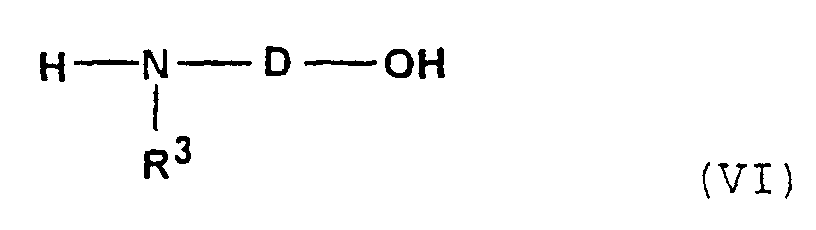
- In the following, a series of compounds are listed in tabular form and, in connection with this, further examples for their synthesis are given for a more close illustration of the above described methods for production of the compounds according to the invention.


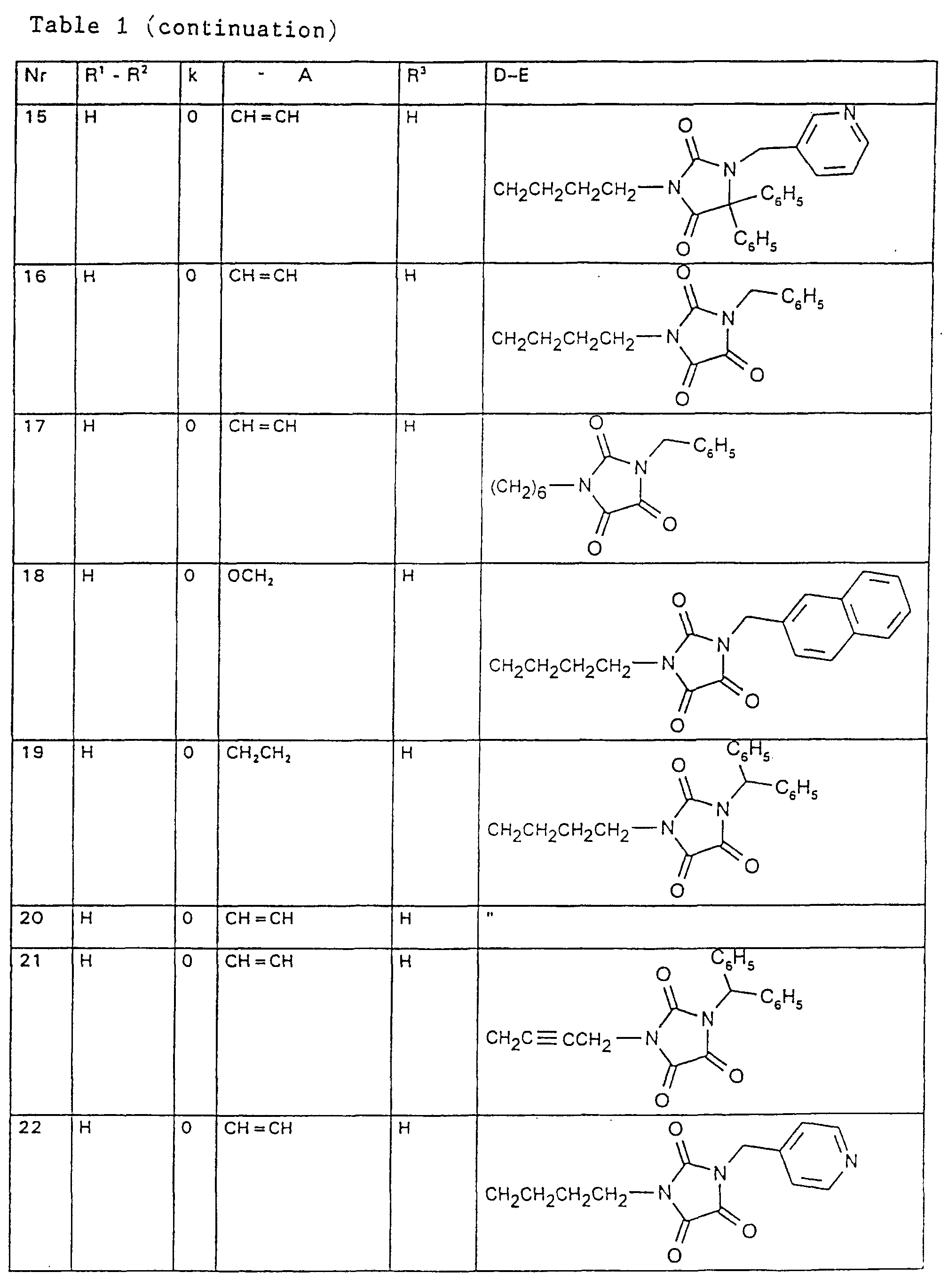


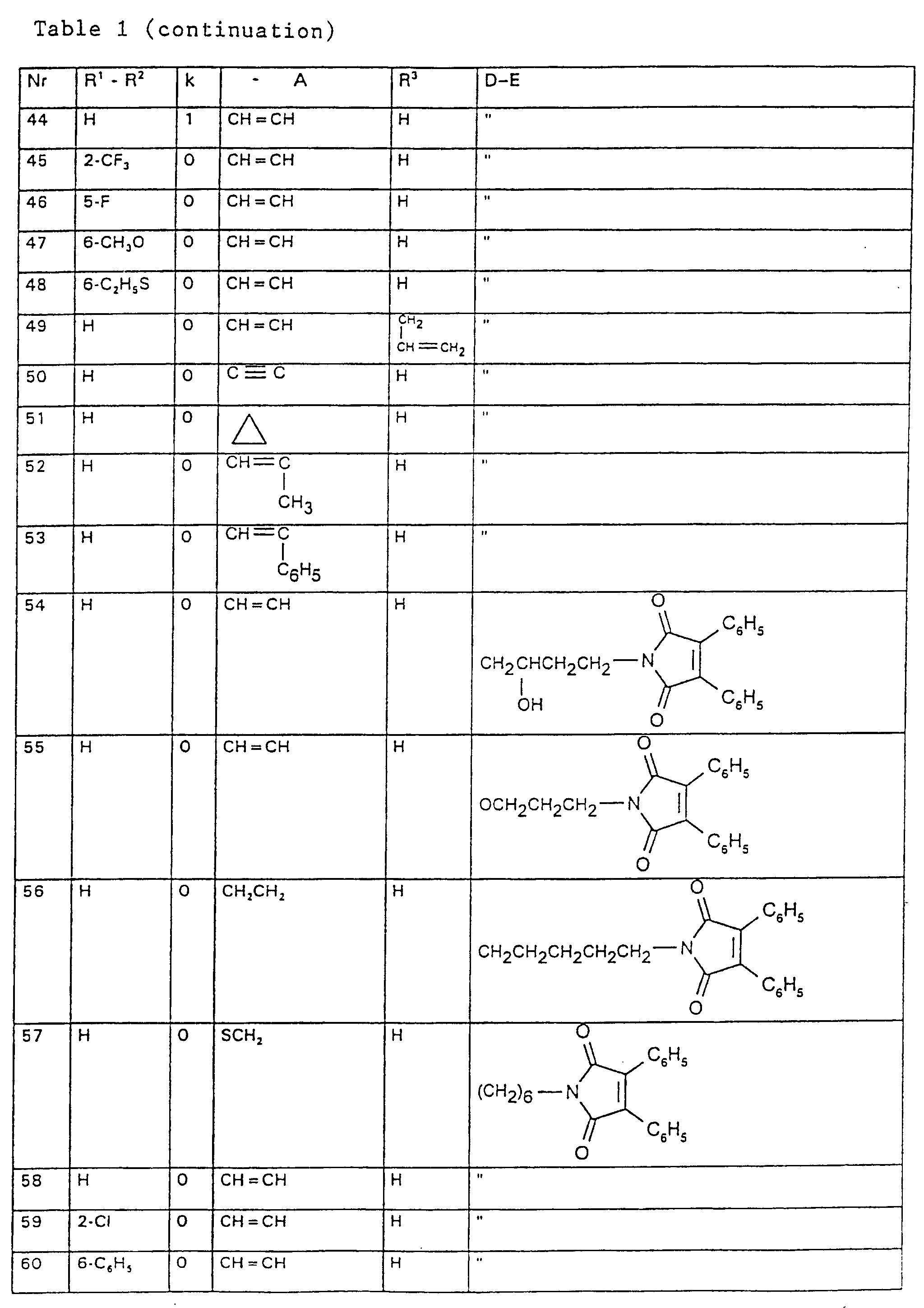
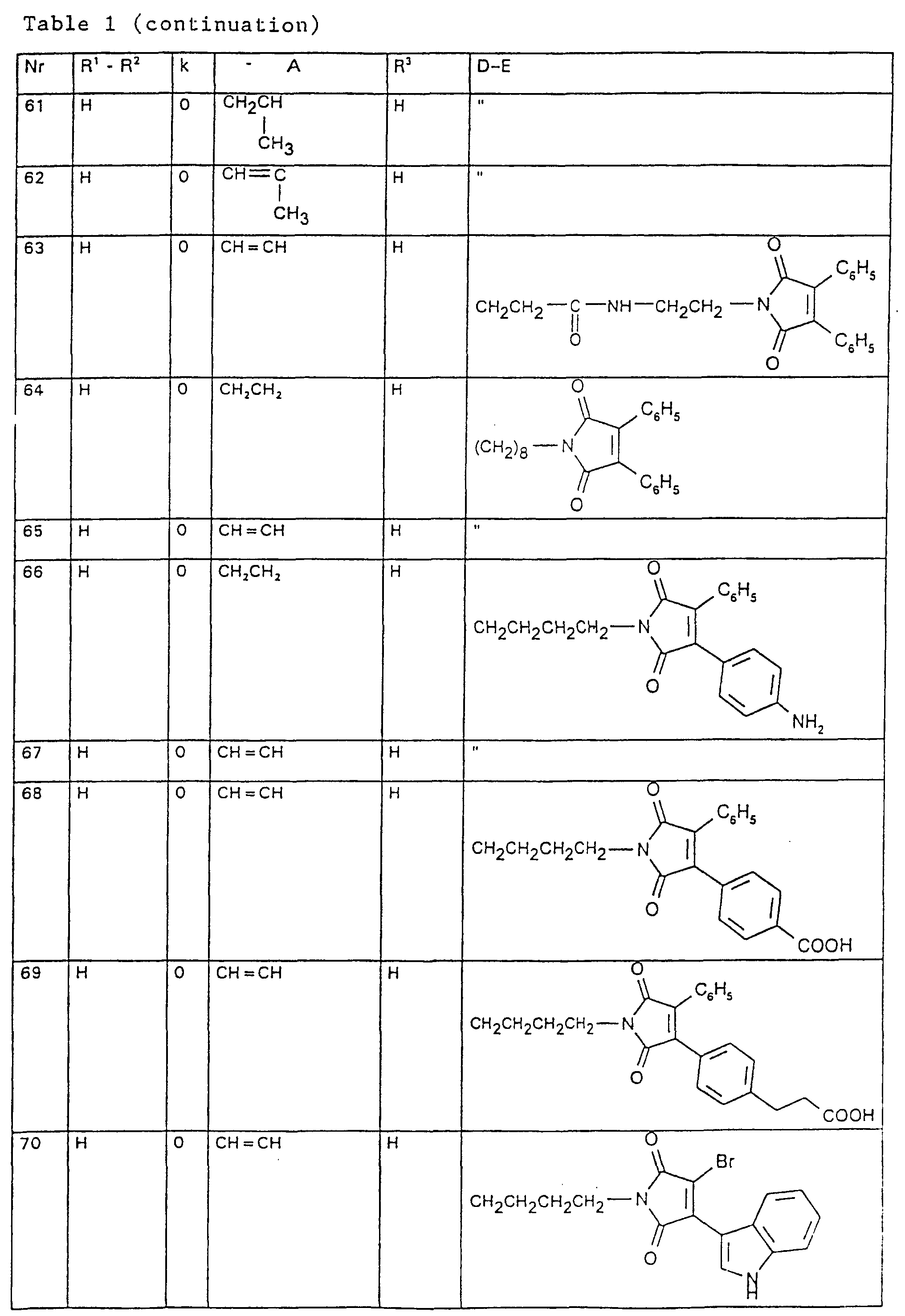

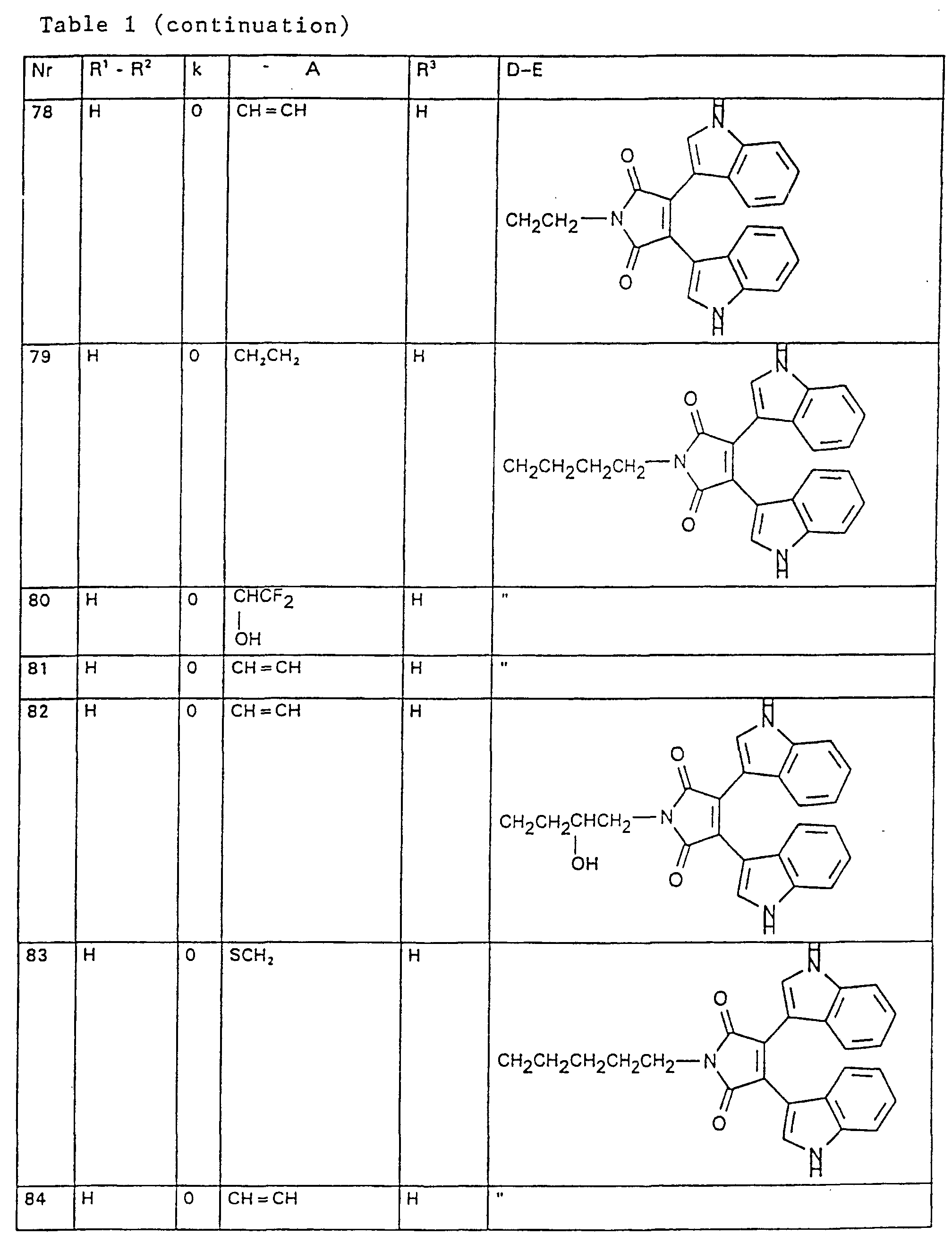
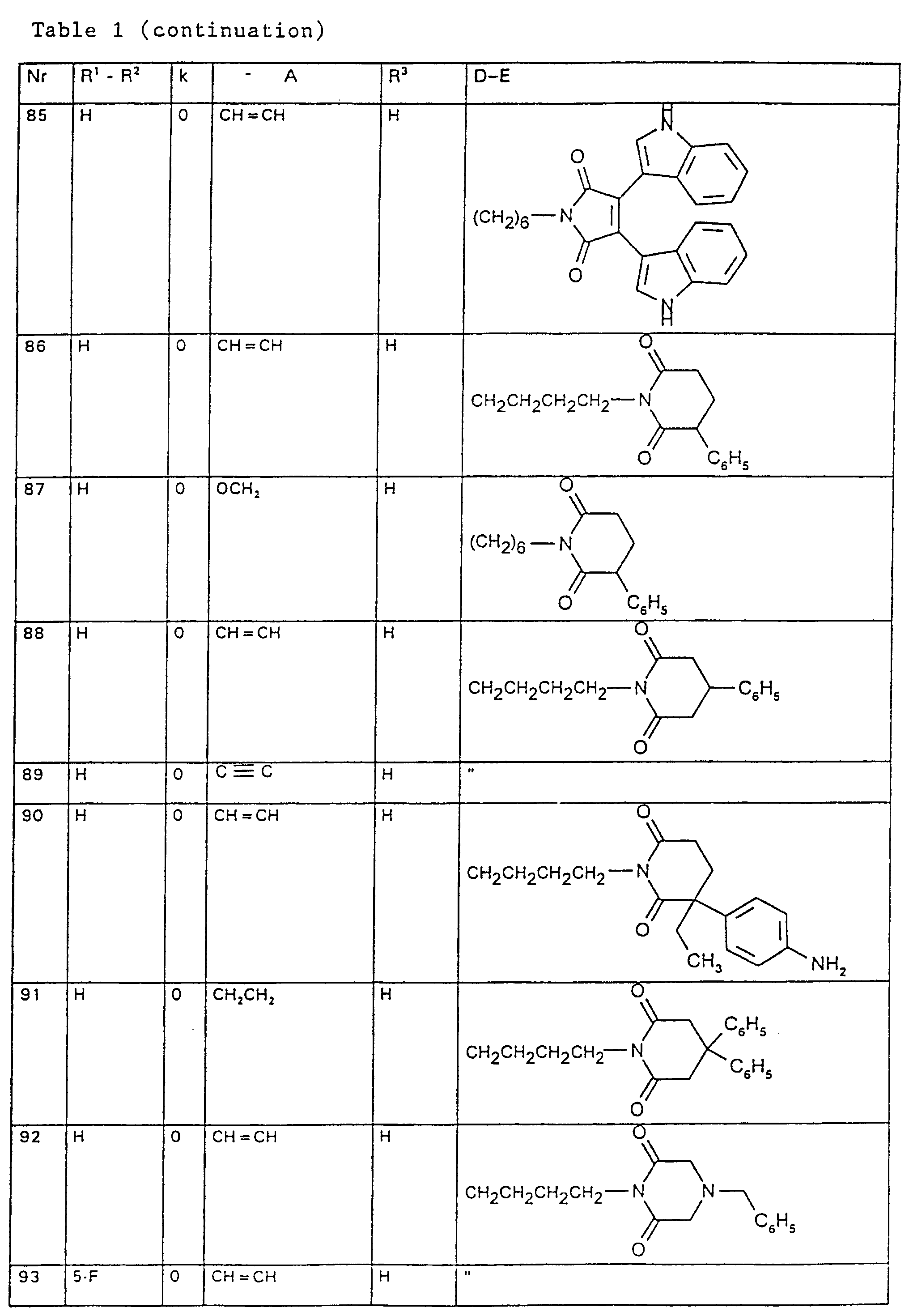
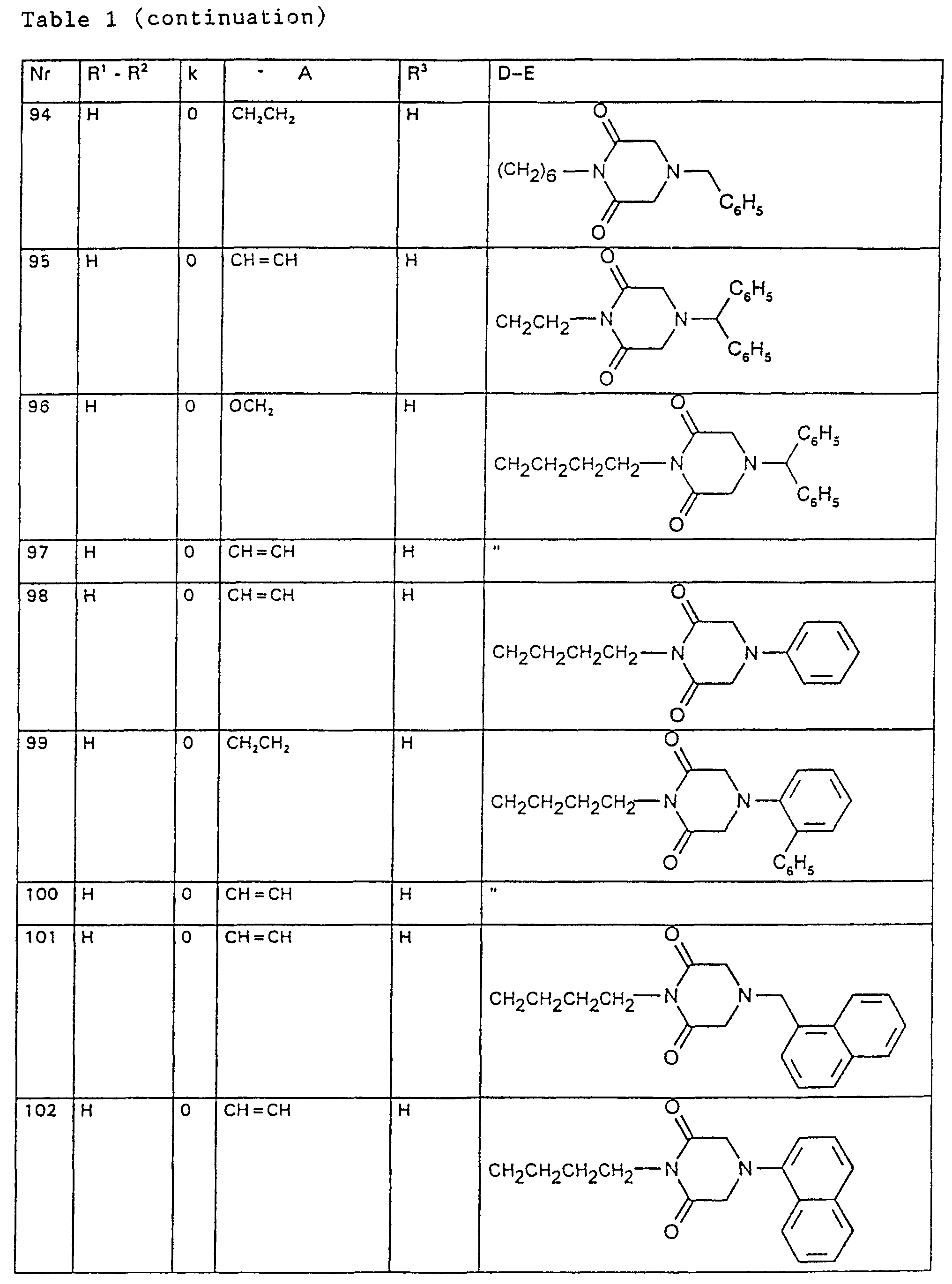


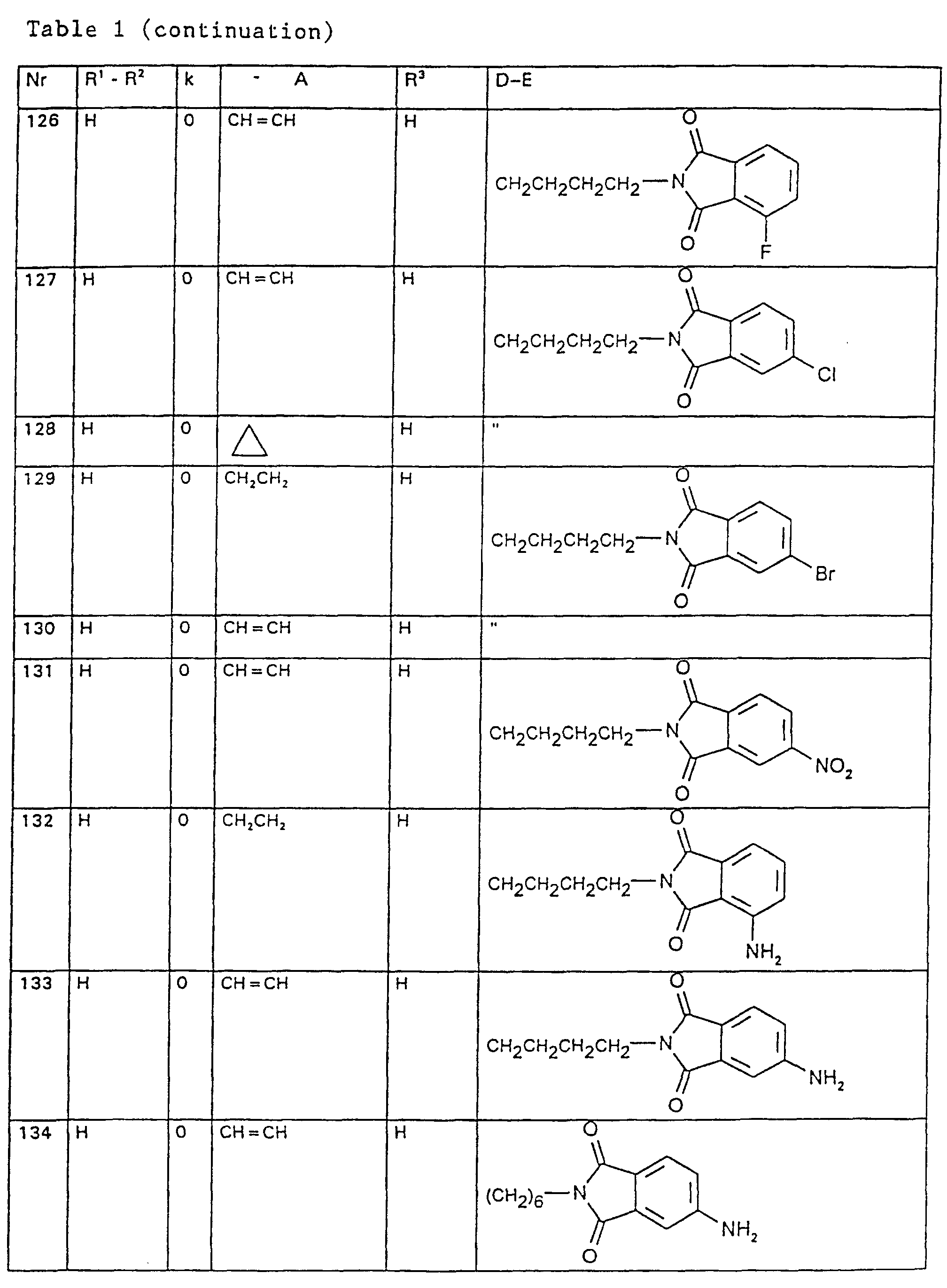


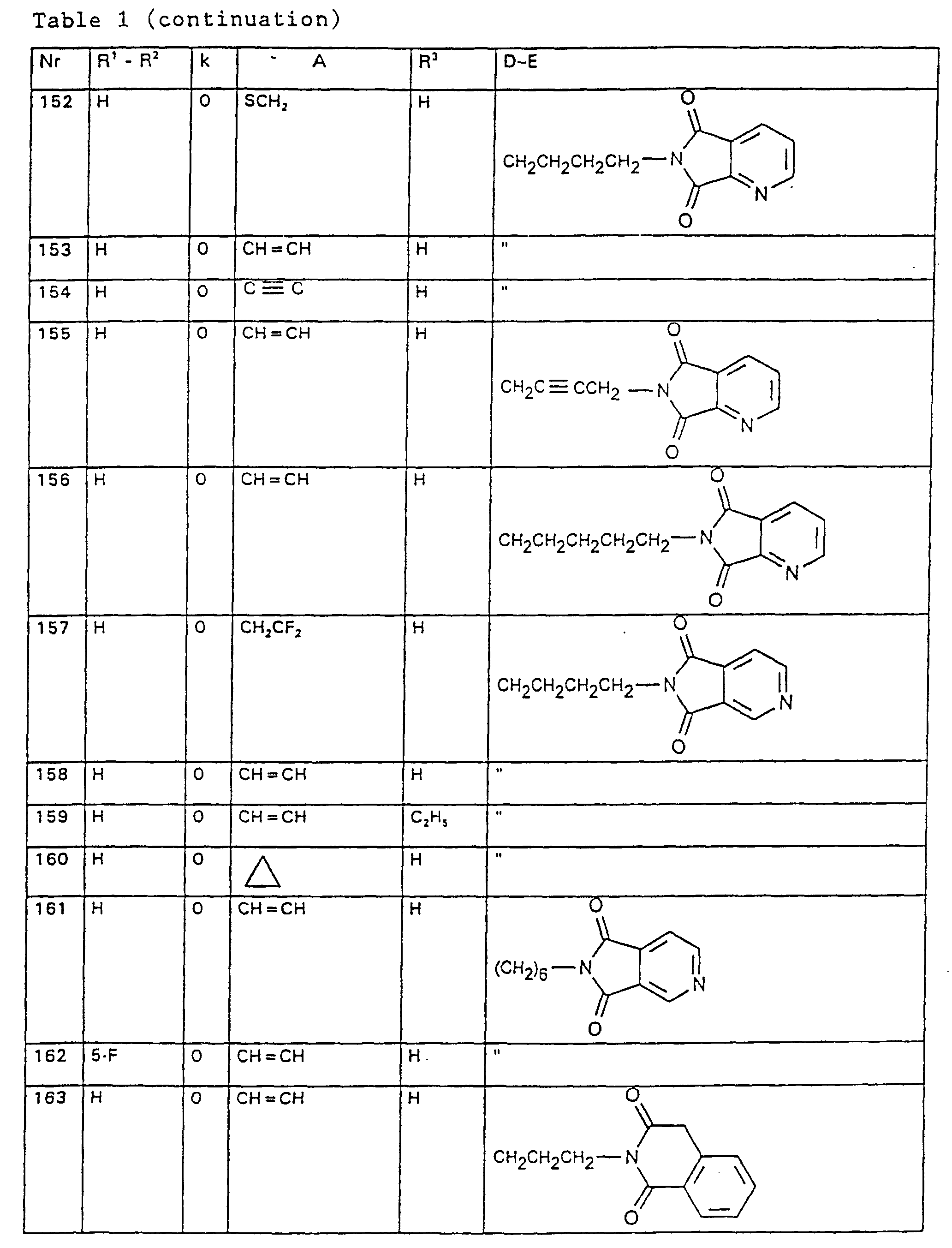
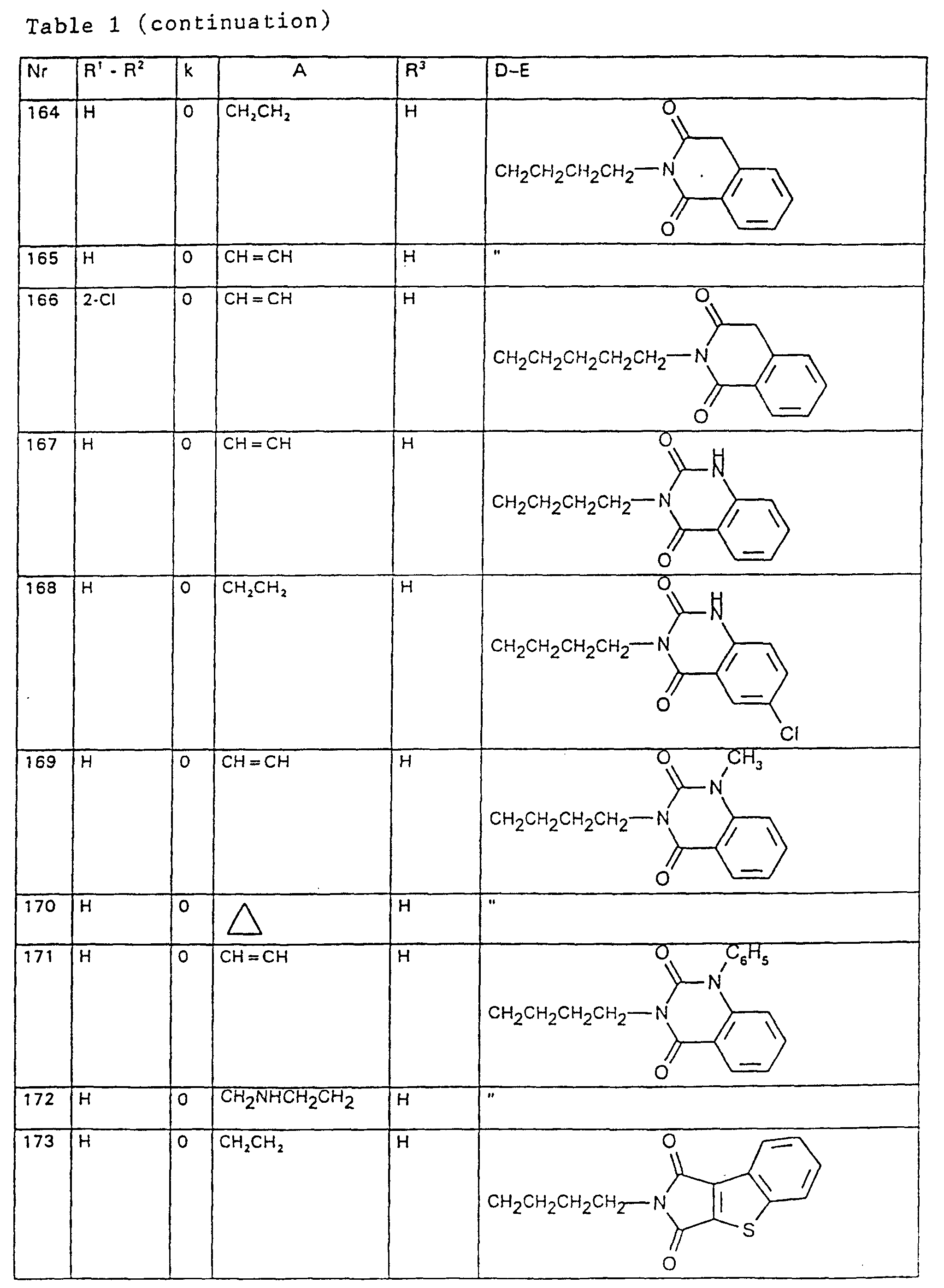

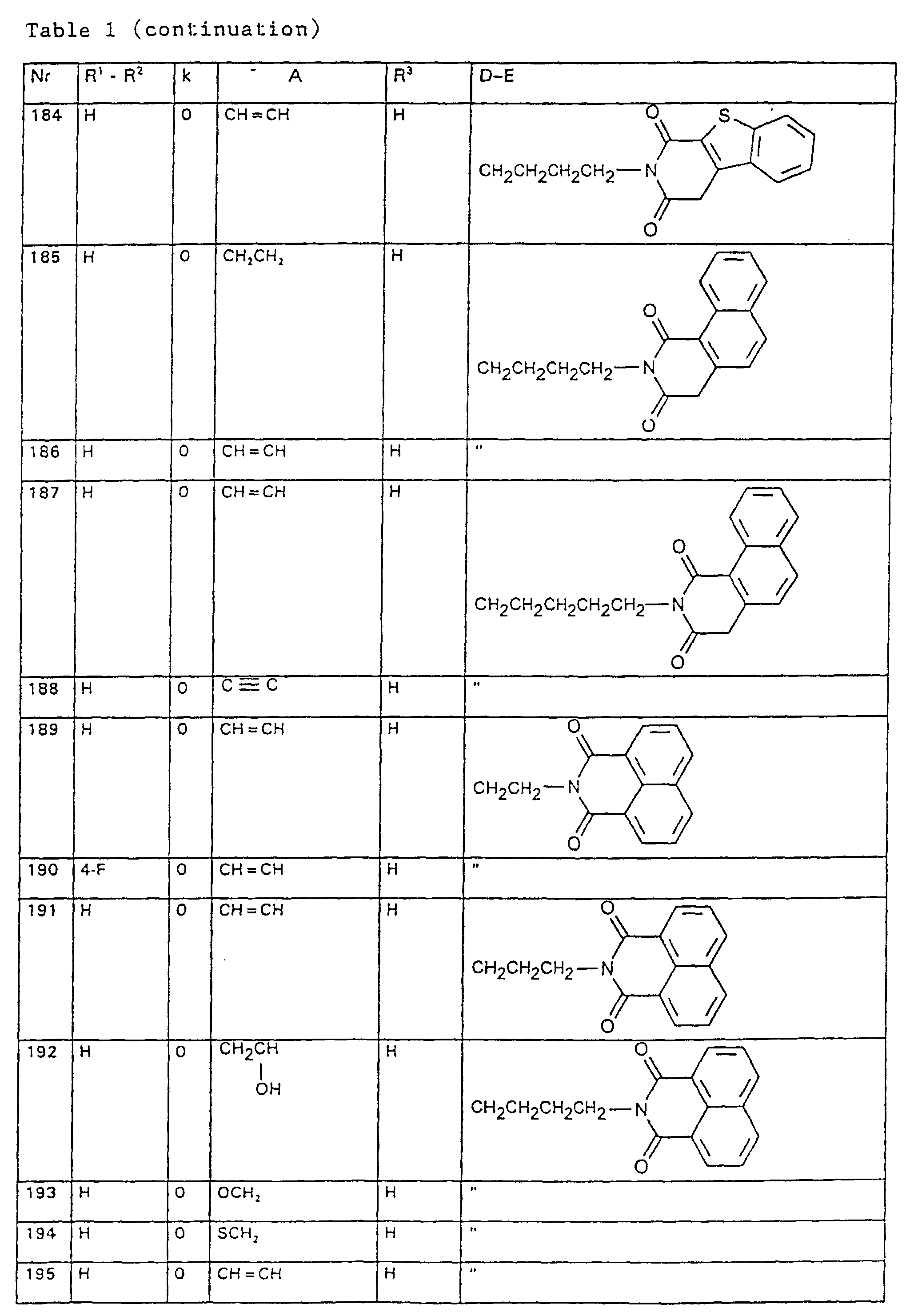


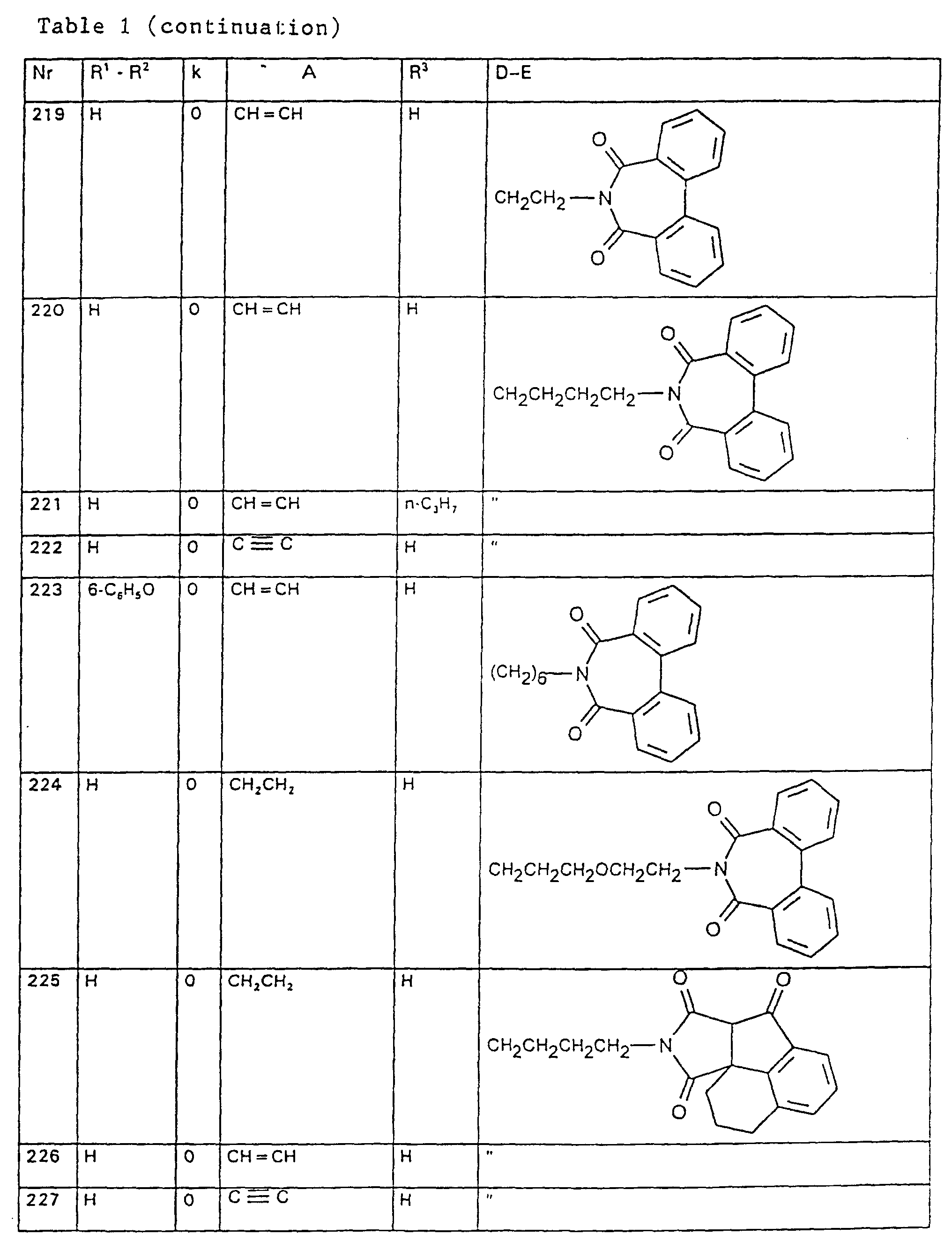


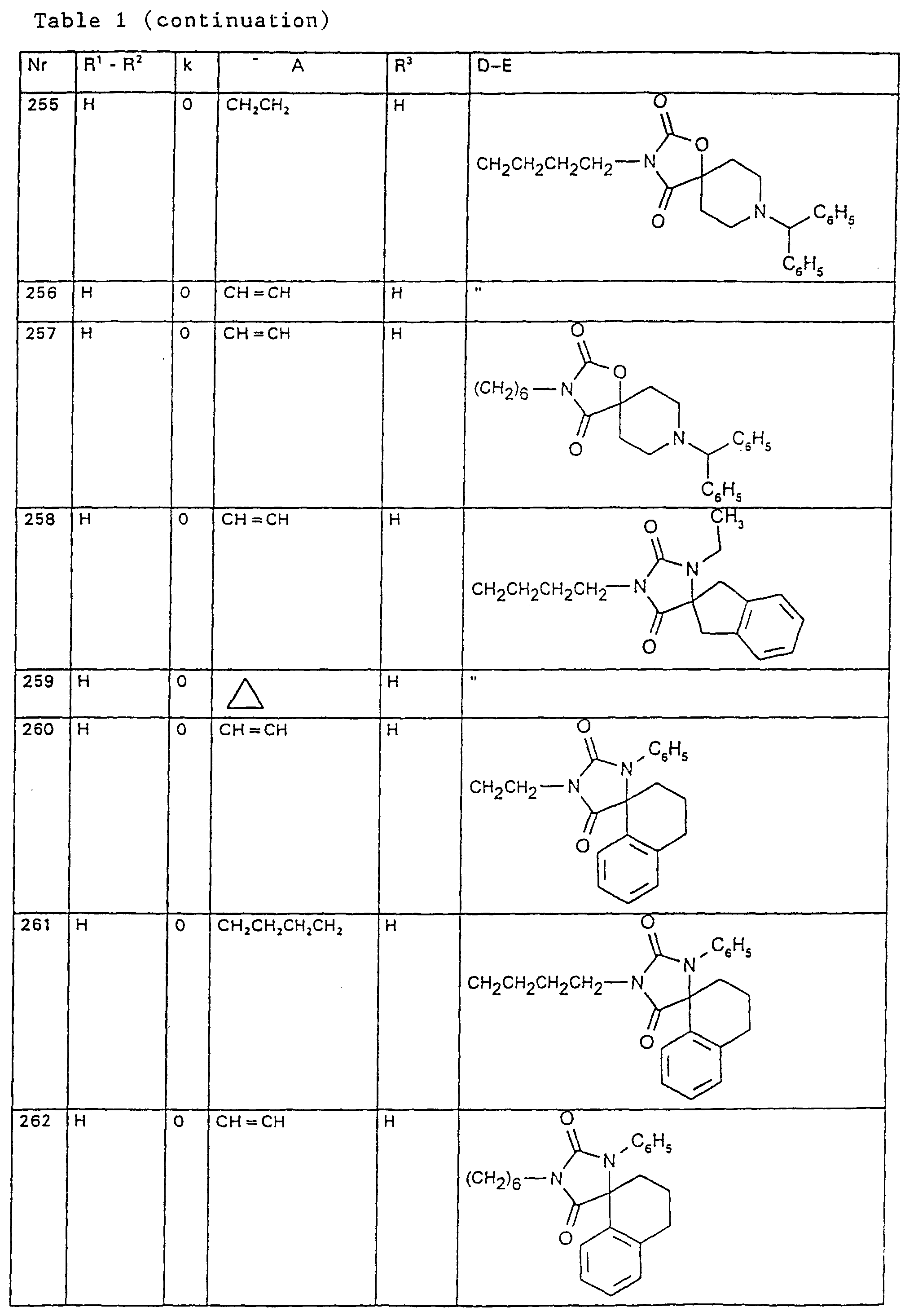

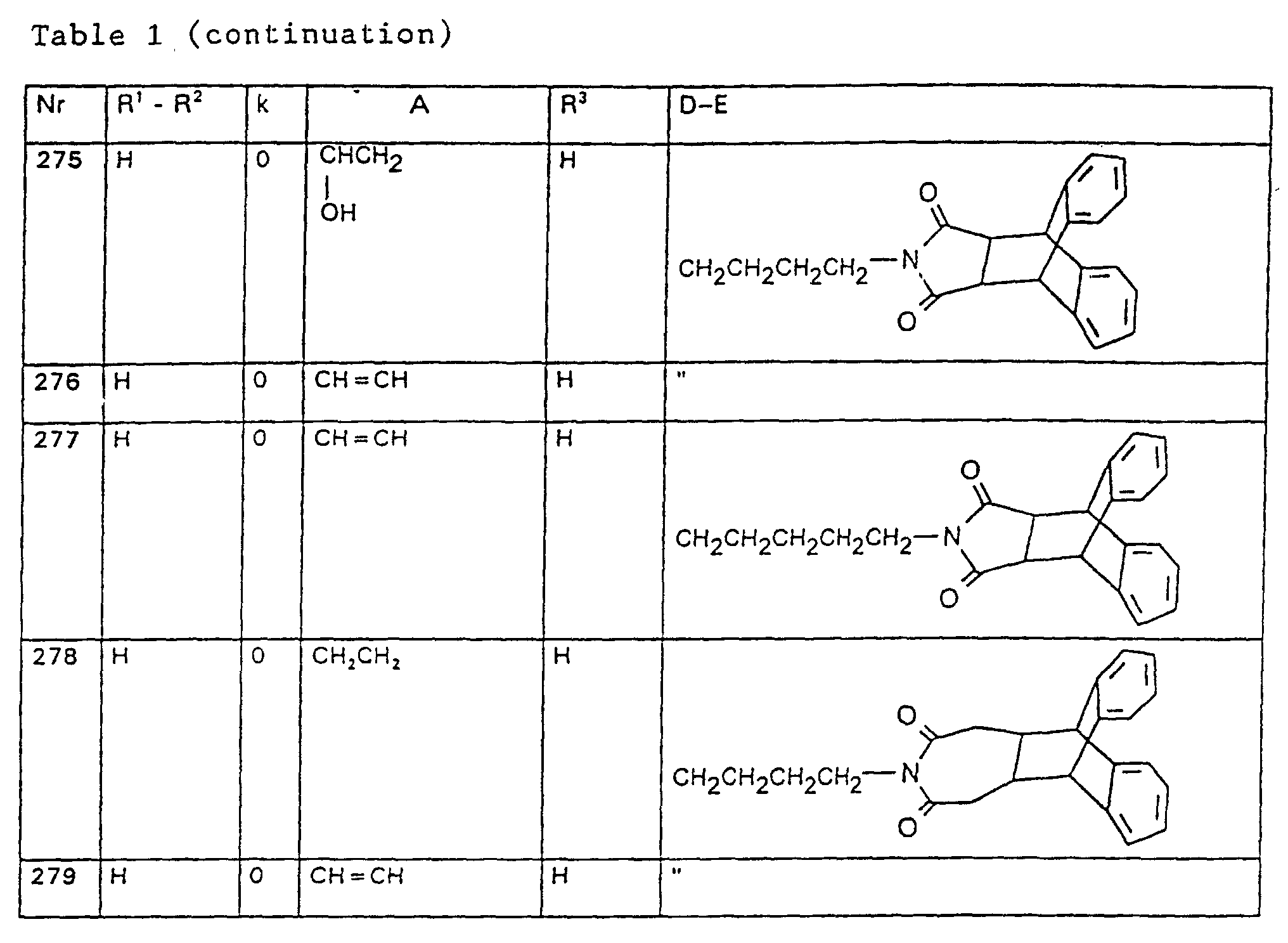
- In the production examples for the end products, the abbreviations stand for the following terms:
- MP =
- melting point,
- RT =
- room temperature,
- MPLC =
- intermediate pressure liquid chromatography
- THF =
- tetrahydrofuran,
- DMF =
- dimethylformamide,
- abs. =
- absolute,
- CDI =
- carbonyldiimidazole,
- EDC =
- N-(3-dimethylaminopropyl)-N'-ethyl-carbodiimide hydrochloride,
- HOBT =
- 1-hydroxybenzotriazole,
- TEA =
- triethylamine.
- 1H-NMR-Spectrum = proton resonance spectrum, taken at 100 MHz. The chemical shifts are given in ppm against TMS as a standard (δ = 0.0), whereby
- s =
- singlet,
- d =
- doublet,
- t =
- triplet,
- dt =
- doublet-triplet,
- m =
- multiplet,
- ar =
- aromatic,
- py =
- pyridine.
- 3.0 g (20.0 mmol) 3-(3-pyridyl)-acrylic acid are suspended in 40 ml abs. dichloromethane, and after addition of two drops pyridine are cooled to ca. 0°C in a ice bath under moisture exclusion. 4 ml (46.9 mmol) oxalyl chloride are slowly added and the mixture is first stirred 30 min under ice-cooling and then overnight at RT. Subsequently, the solvent and excess oxalyl chloride are distilled off on a rotary evaporator. In order to completely remove the oxalyl chloride, the colorless residue is further dried for two hours under high vacuum. The acid chloride obtained in this manner is suspended in 30 ml abs. dichloromethane without further purification and cooled to ca. 0°C in an ice bath under moisture exclusion. 6.3 g (17.6 mmol) 4-(2,5-dioxo-3,4-diphenyl-2,5-dihydropyrrol-1-yl)-butylamine•hydrochloride in 80 ml abs. dichloromethane together with 4.0 g (39.5 mmol) TEA are added together dropwise to this suspension. After complete addition, the ice bath is removed and the reaction is stirred further for two hours at RT. The mixture is subsequently concentrated, taken up in 10% sodium hydroxide solution and extracted three times with acetic acid ethyl ester. The combined organic phases are washed with saturated NaCl solution, dried over sodium sulfate and the solvent is removed under vacuum. The residue is chromatographically purified over silica gel with CHCl3/CH3OH (96/4) and, after withdraw of the solvent, crystallized from 65 ml acetic acid ethyl ester: Yellow crystals with MP. 135 - 137°C; Yield 5.1 g (64%).
C28H25N3O3 (451.5) IR-Spectrum (KBr) ν (NH) 3280 cm-1 ν (C=O) 1700, 1660, 1540 cm-1 ν (C=C) 1630 cm-1 1H-NMR-Spectrum (CDCl3) 1.45 - 1.95 (4H, m, C-CH2-CH2-C) 3.45 (2H, dt, CONHCH 2, J=6.3 Hz, J=12.3 Hz) 3.69 (2H, t, (CO)2NCH2, J=6.4 Hz) 6.20 - 6.40 (1H, m, NH) 6.50 (1H, d, CH=CHCO, J=15.7 Hz) 7.20 - 7.55 (11H, m, Ar, Py, 7.60 (1H, d, CH=CHCO, J=15.7 Hz) 7.65 - 7.80 (1H, m, Py) 8.45 - 8.60 (1H, m, Py) 8.65 - 8.80 (1H, m, Py) - 9.3 g (42.3 mmol) N-(4-hydroxy-butyl)-3-pyridin-3-yl-acrylamide, 11.1 g (42.3 mmol) triphenylphosphine and 8.0 g (42.3 mmol) 4-phenyl-piperidin-2,6-dione are suspended in 120 ml THF, thereafter 6.7 ml (42.3 mmol) azodicarboxylic acid diethyl ester dissolved in 60 ml THF are added dropwise within three hours under protective atmosphere and light cooling (to ca. 15°C). The mixture is left standing overnight without further cooling at RT. Subsequently, the solvent is removed under vacuum and the residue is chromatographically purified over silica gel with CHCl3/CH3OH (95/5) and, after withdraw of the solvent, crystallized from acetic acid ethyl ester: Colorless crystals with MP. 160 - 161°C; Yield 3.8 g (23%).
C23H25N3O3 (391.5) IR-Spectrum (KBr) ν (NH) 3250 cm-1 ν (C=O) 1720, 1650, 1550 cm-1 ν (C=C) 1610 cm-1 1H-NMR-Spectrum (CDCl3) 1.35 - 1.95 (4H, m, C-CH2-CH2-C) 2.45 - 3.20 (4H, m, piperidindione) 3.20 - 3.70 (3H, m, piperidindione, CONHCH 2) 3.70 - 4.10 (2H, m, (CO)2NCH2) 6.35 - 6.60 (1H, m, NH) 6.54 (1H, d, CH=CHCO, J=15.6 Hz) 7.05 - 7.95 (7H, m, Ar, Py) 7.61 (1H, d, CH=CHCO, J=15.6 Hz) 8.40 - 8.65 (1H, m, Py) 8.65 - 8.90 (1H, m, Py) - Batch size: 1.2 g (8.0 mmol) 3-(3-pyridyl)-acrylic acid, 1.0 ml (11.7 mmol) oxalyl chloride, 1.0 ml (7.3 mmol) TEA and 4.0 g (7.3 mmol) 4-(1,3-dioxo-4,5,6,7-tetraphenyl-1,3-dihydro-isoindolin-2-yl)-butylamine•hydrochloride.
- In the purification, chromatography first occurs with CHCl3/CH3OH (96/4); subsequently, crystallization occurs twice from 40 ml 1-chlorobutane and 30 ml acetonitrile: Colorless crystals with MP. 228 - 230°C; Yield 2.7 g (56%).
C44H35N3O3 (653.8) IR-Spectrum (KBr) ν (NH) 3280 cm-1 ν (C=O) 1760, 1700, 1670, 1550 cm-1 ν (C=C) 1630 cm-1 1H-NMR-Spectrum (CDCl3) 1.45 - 1.85 (4H, m, C-CH2-CH2-C) 3.25 - 3.50 (2H, m, CONHCH 2) 3.50 - 3.75 (2H, m, (CO)2NCH2) 5.80 - 6.05 (1H, m, NH) 6.40 (1H, d, CH=CHCO, J=15.7 Hz) 6.65 - 7.40 (21H, m, Ar, Py) 7.58 (1H, d, CH=CHCO, J=15.7 Hz) 7.70 - 7.85 (1H, m, Py) 8.50 - 8.65 (1H, m, Py) 8.70 - 8.80 (1H, m, Py) - Batch size: 4.4 g (20.0 mmol) N-(4-hydroxybutyl)-3-pyridin-3-yl-acrylamide, 5.2 g (19.8 mmol) triphenylphosphine, 4.1 g (20.1 mmol) 3-benzyl-2,4,5-trioxo-imidazolidine (production according to Ishii et al., J.Med.Chem. 39,1924(1996)) and 3.5 g (20.0 mmol) azodicarboxylic acid diethyl ester in 60 ml THF.
- In the purification, chromatography first occurs with CHCl3/CH3OH (95/5); subsequently, crystallization occurs twice from 50 ml and 30 ml acetic acid ethyl ester: Colorless crystals with MP. 115 - 117°C; Yield 1.6 g (19%).
C22H22N4O4 (406.4) IR-Spectrum (KBr) ν (NH) 3280 cm-1 ν (C=O) 1810, 1780, 1730, 1660, 1550 cm-1 ν (C=C) 1620 cm-1 1H-NMR-Spectrum (CDCl3) 1.45 - 2.00 (4H, m, C-CH2-CH2-C) 3.30 - 3.55 (2H, m, CONHCH 2) 3.66 (2H, t, (CO)2NCH2, J=6.3 Hz) 4.77 (2H, s, Ar-CH2) 6.10 - 6.35 (1H, m, NH) 6.49 (1H, d, CH=CHCO, J=15.7 Hz) 7.20 - 7.60 (6H, m, Ar, Py) 7.59 (1H, d, CH=CHCO, J=15.7 Hz) 7.65 - 7.90 (1H, m, Py) 8.50 - 8.65 (1H, m, Py) 8.65 - 8.85 (1H, m, Py) - Batch size: 4.4 g (20.0 mmol) N-(4-hydroxy-butyl)-3-pyridin-3-yl-acrylamide, 5.2 g (19.8 mmol) triphenylphosphine, 4.8 g (19.9 mmol) 7,8-dihydroacenaphthen-2(6H)-on-1,8a-dicarboximide and 3.5 g (20.0 mmol) azodicarboxylic acid diethyl ester in 65 ml THF.
- In the purification, chromatography first occurs with CHCl3/CH3OH (95/5 to 92/8); subsequently, crystallization occurs twice from 70 ml and 90 acetic acid ethyl ester: Colorless crystals with MP. 159 - 161°C in a Yield of 5.0 g (56%).
C26H25N3O4 (443.5) IR-Spectrum (KBr) ν (NH) 3320 cm-1 ν (C=O) 1770, 1710, 1680, 1650, 1540 cm-1 ν (C=C) 1620 cm-1 1H-NMR-Spectrum (CDCl3) 1.20 - 2.15 (6H, m, C-CH2-CH2-C, Ring) 2.20 - 3.00 (3H, m, Ring) 3.15 - 3.75 (5H, m, CONHCH 2, (CO)2NCH2, Ring) 3,64 (1H, s, CO-CH-CO) 6.40 - 6.70 (1H, m, NH) 6.57 (1H, d, CH=CHCO, J=15.6 Hz) 7.20 - 7.90 (6H, m, Ar, Py, CH=CHCO) 8.45 - 8.65 (1H, m, Py) 8.65 - 8.90 (1H, m, Py) - Batch size: 6.0 g (27.2 mmol) N-(4-hydroxybutyl)-3-pyridin-3-yl-acrylamide, 7.1 g (27.2 mmol) triphenylphosphine, 6.9 g (27.2 mmol) 5,5-diphenylhydantoin and 4.3 ml (27.2 mmol) azodicarboxylic acid diethyl ester in 100 ml THF.
- In the purification, pre-purification chromatography first occurs with CHCl3/CH3OH (95/5 to 90/10) and this is further purified by flash chromatography with CHCl3/CH3OH (95/5) : Amorphous solid with MP. 83 - 85°C; Yield 0.9 g (7%).
C27H26N4O3 (454.5) IR-Spectrum (KBr) ν (NH) 3250 cm-1 ν (C=O) 1760, 1700, 1655, 1540 cm-1 ν (C=C) 1615 cm-1 1H-NMR-Spectrum (CDCl3) 1.40 - 1.90 (4H, m, C-CH2-CH2-C) 3.20 - 3.75 (4H, m, CONHCH 2, (CO)2NCH2) 6.25 - 6.45 (1H, m, NH) 6.46 (1H, d, CH=CHCO, J=15.7 Hz) 7.15 - 7.45 (12H, m, Ar, Py, NH) 7.58 (1H, d, CH=CHCO, J=15.7 Hz) 7.60 - 7.85 (1H, m, Py) 8.45 - 8.60 (1H, m, Py) 8.60 - 8.80 (1H, m, Py) - 2.7 g (17.8 mmol) 3-(3-pyridyl)-acrylic acid and 1.8 g (17.8 mmol) TEA are suspended in 50 ml abs. dichloromethane and cooled to ca. 0°C under moisture exclusion. 3.1 g (17.8 mmol) 88% HOBT and 3.4 g (17.8 mmol) EDC are added and the mixture is stirred for 30 min under ice cooling. 5.0 g (17.8 mmol) 4-(2,5-dioxo-3-phenyl-2,5-dihydropyrrol-1-yl)-butylamine hydrochloride are dissolved in 30 ml abs. dichloromethane and added dropwise under ice cooling. The mixture is stirred overnight at RT without further cooling. Subsequently, the batch is washed with 25 ml 1M NaOH and with 50 ml water. The organic phase is dried over sodium sulfate and the solvent is removed under vacuum. The resinous residue is chromatography pre-purified over silica gel with CHCl3/CH3OH (95/5) and further purified by flash chromatography with CHCl3/CH3OH (95/5). After withdraw of the solvent, this is crystallized from acetic acid ethyl ester: Colorless crystals with MP. 141 - 143°C; Yield 0.6 g (9%).
C22H21N3O3 (375.4) IR-Spectrum (KBr) ν (NH) 3270 cm-1 ν (C=O) 1750, 1690, 1650, 1540 cm-1 ν (C=C) 1610 cm-1 1H-NMR-Spectrum (CDCl3) 1.35 - 2.00 (4H, m, C-CH2-CH2-C) 3.20 - 3.80 (4H, m, CONHCH 2, (CO)2NCH2) 6.15 - 6.45 (1H, m, NH) 6.51 (1H, d, CH=CHCO, J=15.7 Hz) 6.73 (1H, s, CH=C) 7.15 - 8.10 (8H, m, Ar, Py, CH=CHCO) 8.45 - 8.65 (1H, m, Py) 8.65 - 8.85 (1H, m, Py) - Batch size: 3.4 g (23.1 mmol) 3-(3-pyridyl)-acrylic acid, 5.3 g (42,0 mmol) oxalyl chloride, 4.2 g (42.0 mmol) TEA and 7.2 g (21.0 mmol) 3-(2,5-dioxo-3,4-diphenyl-2,5-dihydropyrrol-1-yl)-propylamine•hydrochloride.
- In the purification, chromatography first occurs with CHCl3/CH3OH (90/10); subsequently, crystallization occurs twice from 400 ml acetic acid ethyl ester and 150 ml ethanol: Colorless crystals with MP. 163 - 164°C; Yield 1.6 g (17%).
C27H23N3O3 (437.5) IR-Spectrum (KBr) ν (NH) 3270 cm-1 ν (C=O) 1760, 1690, 1660, 1535 cm-1 ν (C=C) 1620 cm-1 1H-NMR-Spectrum (CDCl3) 1.75 - 2.15 (2H, m, C-CH2-C) 3.42 (2H, dt, CONHCH 2, J=6.1 Hz, J=12.1 Hz) 3.78 (2H, t, (CO)2NCH2, J=6.1 Hz) 6.54 (1H, d, CH=CHCO, J=15.7 Hz) 6.55 - 6.80 (1H, m, NH) 7.20 - 7.60 (11H, m, Ar, Py) 7.63 (1H, d, CH=CHCO, J=15.7 Hz) 7.70 - 7.90 (1H, m, Py) 8.50 - 8.60 (1H, m, Py) 8.65 - 8.80 (1H, m, Py) - Batch size: 1.7 g (11.4 mmol) 3-(3-pyridyl)-acrylic acid, 2.2 g (17.5 mmol) oxalyl chloride, 1.6 ml (11.7 mmol) TEA and 4.5 g (11.7 mmol) N-(4-amino-butyl)-2,3:5,6-dibenzobicyclo[2.2.2]oc-tan-7,8-dicarboximide•hydrochloride.
- In the purification, chromatography first occurs with CHCl3/CH3OH (95/5) and this is subsequently crystallized from 100 ml 1-chlorobutane: Yellow crystals with MP. 213 - 215°C; Yield 2.5 g (45%).
C30H27N3O3 (477.6) IR-Spectrum (KBr) ν (NH) 3360 cm-1 ν (C=O) 1780, 1690, 1670, 1550 cm-1 ν (C=C) 1630 cm-1 1H-NMR-Spectrum (CDCl3) 0.70 - 1.30 (4H, m, C-CH2-CH2-C) 2.90 - 3.50 (6H, m, CONHCH 2, (CO)2NCH2, ArCH) 4.79 (2H, s, COCHCHCO) 5.90 - 6.10 (1H, m, NH) 6.49 (1H, d, CH=CHCO, J=15.7 Hz) 7.00 - 7.60 (9H, m, Ar, Py, 7.63 (1H, d, CH=CHCO, J=15.7 Hz) 7.70 - 7.95 (1H, m, Py) 8.50 - 8.70 (1H, m, Py) 8.70 - 8.95 (1H, m, Py - Batch size: 13.5 g (61.3 mmol) N-(4-hydroxybutyl)-3-pyridin-3-yl-acrylamide, 16.1 g (61.3 mmol) triphenylphosphine, 12.6 g (61.3 mmol) 5-benzyliden-thiazolidin-2,4-dione and 9.7 ml (61.3 mmol) azodicarboxylic acid diethyl ester in 250 ml THF.
- A precipitate forms in the reaction. This is filtered off and crystallized twice from methanol: Colorless solid with MP. 161 - 162°C; Yield 11.0 g (44%).
C22H21N3O3S (407.5) IR-Spectrum (KBr) ν (NH) 3330 cm-1 ν (C=O) 1735, 1670, 1650, 1520 cm-1 ν (C=C) 1610 cm-1 1H-NMR-Spectrum (CDCl3) 1.45 - 2.00 (4H, m, C-CH2-CH2-C) 3.30 - 3.60 (2H, m, CONHCH 2) 3.81 (2H, t, (CO)2NCH2, J=6.6 Hz) 6.00 - 6.30 (1H, m, NH) 6.49 (1H, d, CH=CHCO, J=15.7 Hz) 7.20 - 7.60 (6H, m, Ar, Py) 7.62 (1H, d, CH=CHCO, J=15.7 Hz) 7.60 - 7.90 (1H, m, Py) 7.90 (1H, s, Ar-CH) 8.50 - 8.65 (1H, m, Py) 8.65 - 8.80 (1H, m, Py) - Batch size: 1.9 g (12.7 mmol) 3-(3-pyridyl)-acrylic acid, 6.2 ml (44.3 mmol) TEA, 2.4 g (15.6 mmol) 88% HOBT, 3.0 g (15.6 mmol) EDC and 5.0 g (14.3 mmol) 4-(4-benzyl-2,6-dioxo-piperazin-1-yl)-butylamine•dihydrochloride in 70 ml abs. dichloromethane.
- For purification, this is chromatographically purified over silica gel with CHCl3/CH3OH (96/4 to 95/5); Yield of colorless resin 3.3 g (62%).
C23H26N4O3 (406.5) IR-Spectrum (KBr) ν (NH) 3270 cm-1 ν (C=O) 1730, 1670, 1540 cm-1 ν (C=C) 1620 cm-1 1H-NMR-Spectrum (CDCl3) 1.45 - 1.80 (4H, m, C-CH2-CH2-C) 3.30 - 3.95 (10H, m, CONHCH 2, piperazine, (CO)2NCH2, NCH2) 6.00 - 6.25 (1H, m, NH) 6.48 (1H, d, CH=CHCO, J=15.7 Hz) 7.15 - 7.45 (6H, m, Ar, Py) 7.61 (1H, d, CH=CHCO, J=15.7 Hz) 7.65 - 7.90 (1H, m, Py) 8.50 - 8.65 (1H, m, Py) 8.65 - 8.80 (1H, m, Py) - Batch size: 2.6 g (17.4 mmol) 3-(3-pyridyl)-acrylic acid, 4.1 ml (47.4 mmol) oxalyl chloride, 4.8 ml (34.7 mmol) TEA and 5.5 g (15.8 mmol) 6-(2,5-dioxo-3,4-diphenyl-2,5-dihydropyrrol-1-yl)-hexylamine•hydrochloride.
- In the purification, chromatography first occurs with CHCl3/CH3OH/NH4OH (90/10/1) and subsequently, crystallization occurs twice from 1-chlorobutane and acetic acid ethyl ester respectively: Colorless crystals with MP. 102 - 104°C. Yield 1.3 g (17%).
C30H29N3O3 (479.6) IR-Spectrum (KBr) ν (NH) 3250 cm-1 ν (C=O) 1760, 1690, 1660, 1540 cm-1 ν (C=C) 1620 cm-1 1H-NMR-Spectrum (CDCl3) 1.10 - 1.90 (8H, m, C-(CH2)4-C) 3.20 - 3.50 (2H, m, CONHCH 2) 3.66 (2H, t, (CO)2NCH2, J=6.6 Hz) 6.00 - 6.25 (1H, m, NH) 6.51 (1H, d, CH=CHCO, J=15.7 Hz) 7.10 - 7.60 (11H, m, Ar, Py) 7.60 (1H, d, CH=CHCO, J=15.7 Hz) 7.65 - 7.85 (1H, m, Py) 8.45 - 8.65 (1H, m, Py) 8.65 - 8.80 (1H, m, Py) - Batch size: 2.1 g (13.8 mmol) 3-(3-pyridyl)-propionic acid, 1.6 ml (47.4 mmol) oxalyl chloride, 3.8 ml (27.4 mmol) TEA and 4.0 g (12.5 mmol) 4-(2,5-dioxo-3,4-diphenyl-2,5-dihydropyrrol-1-yl)-butylamine•hydrochloride.
- In the purification, chromatography first occurs with CHCl3/CH3OH (95/5) and subsequently crystallization occurs from 50 ml isopropanol: Colorless crystals with MP. 121 - 123°C; Yield 3.7 g (65%).
C28H27N3O3 (453.5) IR-Spectrum (KBr) ν (NH) 3280 cm-1 ν (C=O) 1770, 1700, 1650, 1540 cm-1 1H-NMR-Spectrum (CDCl3) 1.25 - 1.85 (4H, m, C-CH2-CH2-C) 2.45 (2H, t, CO-CH2, J=7.3 Hz) 2.97 (2H, t, Py-CH2, J=7.4 Hz) 3.28 (2H, dt, CONHCH 2, J=6.5 Hz, J=12.5 Hz) 3.63 (2H, t, (CO)2NCH2, J=6.5 Hz) 5.70 - 5.95 (1H, m, NH) 7.10 - 7.70 (12H, m, Ar, Py) 8.35 - 8.55 (2H, m, Py) - Batch size: 7.8 g (35.4 mmol) N-(4-hydroxybutyl)-3-pyridin-3-yl-acrylamide, 9.3 g (35.4 mmol) triphenylphosphine, 5.2 g (35.4 mmol) phthalimide and 6.2 g (35.4 mmol) azodicarboxylic acid diethyl ester in 100 ml THF.
- In the purification, chromatography first occurs with CHCl3/CH3OH (100/0 to 90/10) and subsequently crystallization occurs twice from 130 ml and 100 ml isopropanol. Colorless crystals with MP. 172 - 174°C. Yield 2.4 g (19%).
C20H19N3O3 (349.4) IR-Spectrum (KBr) ν (NH) 3380 cm-1 ν (C=O) 1800, 1730, 1680, 1560 cm-1 ν (C=C) 1640 cm-1 1H-NMR-Spectrum (CDCl3) 1.40 - 2.00 (4H, m, C-CH2-CH2-C) 3.46 (2H, dt, CONHCH 2, J=6.3 Hz, J=11.9 Hz) 3.73 (2H, t, (CO)2NCH2, J=6.5 Hz) 6.20 - 6.55 (1H, m, NH) 6.52 (1H, d, CH=CHCO, J=15.7 Hz) 7.20 - 7.40 (1H, m, Py) 7.61 (1H, d, CH=CHCO, J=15.7 Hz) 7.60 - 8.00 (5H, m, Ar, Py) 8.50 - 8.65 (1H, m, Py) 8.65 - 8.85 (1H, m, Py) - 5.0 g (12.5 mmol) N-[4-(1,3-dioxo-1H,3H-benzo[de]isoquinolin-2-yl)-butyl]-3-pyridin-3-yl-acrylamide (substance 195) are dissolved in chloroform and cooled to ca. 0°C under moisture exclusion. 2.8 g (11.3 mmol) 3-chloroperoxybenzoic acid (ca. 70%) are dissolved in chloroform and added dropwise. The mixture is stirred without further cooling for two hours at RT. Subsequently, 30 ml saturated potassium carbonate solution is added and the batch is extracted with 100 ml chloroform. The organic phase is dried over sodium sulfate and the solvent is removed under vacuum. The residue is chromatographically purified over silica gel with CHCl3/CH3OH (98/2 to 90/10) and, after withdraw of the solvent, crystallized from 300 ml ethanol. The crystalizate is dissolved in methanol and evaporated several times in a rotary evaporator under addition of toluene: Yield 1.8 g (35%) as an amorphous solid.
C24H21N3O4 (415.4) IR-Spectrum (KBr) ν (NH) 3180 cm-1 ν (C=O) 1690, 1660, 1580, 1540 cm-1 ν (C=C) 1620 cm-1 1H-NMR-Spectrum ( (CD3) 2SO) 1.35 - 1.90 (4H, m, C-CH2-CH2-C) 3.10 - 3.50 (2H, m, CONHCH 2) 3.95 - 4.20 (2H, m, (CO)2NCH2) 6.70 (1H, d, CH=CHCO, J=15.8 Hz) 7.15 - 7.60 (3H, m, Py, CH=CHCO) 7.75 - 8.00 (2H, m, Ar) 8.10 - 8.35 (2H, m, Ar) 8.40 - 8.65 (5H, m, Py, Ar, NH) - Batch size: 5.3 g (35.5 mmol) 3-(3-pyridyl)-acrylic acid, 12.4 g (97.9 mmol) oxalyl chloride and 8.6 g (32.6 mmol) 6-(1,3-dioxo-1H,3H-benzo[de]isoquinolin-2-yl)-hexylamine.
- In the purification, chromatography first occurs with CHCl3/CH3OH (97/3), and subsequently crystallization occurs twice from 500 ml and 400 ml acetic acid ethyl ester: Colorless crystals with MP. 146 - 148°C; Yield 3.8 g (27%).
C26H25N3O3 (427.5) IR-Spectrum (KBr) ν (NH) 3250 cm-1 ν (C=O) 1690, 1650, 1585, 1560 cm-1 ν (C=C) 1610 cm-1 1H-NMR-Spectrum (CDCl3) 1.35 - 2.00 (8H, m, C-(CH2)4-C) 3.40 (2H, dt, CONHCH 2, J=6.0 Hz, J=11.8 Hz) 4.19 (2H, t, (CO)2NCH2, J=6.8 Hz) 6.15 - 6.40 (1H, m, NH) 6.58 (1H, d, CH=CHCO, J=15.7 Hz) 7.20 - 7.35 (1H, m, Py) 7.62 (1H, d, CH=CHCO, J=15.7 Hz) 7.65 - 7.90 (3H, m, Ar, Py) 8.10 - 8.30 (2H, m, Ar) 8.45 - 8.85 (4H, m, Ar, Py) - Batch size: 7.5 g (50.4 mmol) 3-(3-pyridyl)-acrylic acid, 17.4 g (137.4 mmol) oxalyl chloride and 11.0 g (45.8 mmol) 2-(1,3-dioxo-1H,3H-benzo[de]isoquinolin-2-yl)-ethylamine.
- In the purification, chromatography first occurs with CHCl3/CH3OH (97/3), and subsequently crystallization occurs from 1000 ml isopropanol: Colorless crystals with MP. 195°C; Yield 8.8 g (52%).
C22H17N3O3 (371.4) IR-Spectrum (KBr) ν (NH) 3270 cm-1 ν (C=O) 1690, 1650, 1580, 1550 cm-1 ν (C=C) 1615 cm-1 1H-NMR-Spectrum (CDCl3) 3.80 (2H, dt, CONHCH 2, J=5.1 Hz, J=10.6 Hz) 4.49 (2H, t, (CO)2NCH2, J=5.3 Hz) 6.42 (1H, d, CH=CHCO, J=15.7 Hz) 6.60 - 6.85 (1H, m, NH) 7.15 - 7.35 (1H, m, Py) 7.48 (1H, d, CH=CHCO, J=15.7 Hz) 7.60 - 7.85 (3H, m, Ar, Py) 8.05 - 8.30 (2H, m, Ar) 8.40 - 8.75 (4H, m, Ar, Py) - Batch size: 6.1 g (41.0 mmol) 3-(3-pyridyl)-acrylic acid, 14.2 g (111.8 mmol) oxalyl chloride and 10.0 g (37.3 mmol) 4-(1,3-dioxo-1H,3H-benzo[de]isoquinolin-2-yl)-butylamine.
- In the purification, chromatography first occurs with CHCl3/CH3OH (99/1 to 97/3), and subsequently crystallization occurs from 650 ml acetic acid ethyl ester. Colorless crystals with MP. 166 - 167°C. Yield 6.6 g (44%).
C24H21N3O3 (399.5) IR-Spectrum (KBr) ν (NH) 3280 cm-1 ν (C=O) 1690, 1650, 1580, 1550 cm-1 ν (C=C) 1615 cm-1 1H-NMR-Spectrum (CDCl3) 1.50 - 2.00 (4H, m, C-CH2-CH2-C) 3.52 (2H, dt, CONHCH 2, J=6.4 Hz, J=12.3 Hz) 4.22 (2H, t, (CO)2NCH2, J=7.0 Hz) 6.35 - 6.60 (1H, m, NH) 6.55 (1H, d, CH=CHCO, J=15.7 Hz) 7.15 - 7.40 (1H, m, Py) 7.61 (1H, d, CH=CHCO, J=15.7 Hz) 7.65 - 7.85 (3H, m, Ar, Py) 8.05 - 8.30 (2H, m, Ar) 8.40 - 8.80 (4H, m, Ar, Py) - 38 g (0.6 mol) di-tert-butyldicarbonate, dissolved in 300 ml dioxane, are added dropwise to a solution of 110 g (1.25 mol) 1,4-diaminobutane in dioxane. Subsequently, the suspension is left standing overnight. The mixture is filtered and the filtrate is concentrated under vacuum. The residue is taken up in 700 ml water and filtered again. The filtrate is extracted first with 50 ml toluene and thereafer three times each with 200 ml dichloromethane. The combined dichloromethane phases are washed three times with 20 ml water each, dried over sodium sulfate; subsequently, the solvent is removed under vacuum. The accumulated crude product is further processed without further purification: Yield 23.0 g (76%).
- 3.4 g (18 mmol) N-(tert-butoxycarbonyl)-1,4-diaminobutane, dissolved in 50 ml toluene, are added dropwise at RT to a solution of 4.5 g (18 mmol) 2,3-diphenylmaleinic acid anhydride in 120 ml toluene; thereafter, the mixture is subsequently stirred for 10 hours at RT. After withdraw of the solvent, the residue is dissolved in 200 ml chloroform and washed with 50 ml water. The organic phase is dried over sodium sulfate and the solvent is removed under vacuum. The residue is chromatographically purified over silica gel with CHCl3/CH3OH (97/3): Yield 8.2 g.
- 8.2 g (< 18 mmol) N-[4-(2,5-dioxo-3,4-diphenyl-2,5-dihydropyr-rol-1-yl)-butyl]-carbamic acid tert-butylester are dissolved in 80 ml ethanol and heated under reflux for two hours after addition of 4.5 ml (54 mmol) concentrated hydrochloric acid. The cooled solution is concentrated under vacuum and the residue is dried under high vacuum. The accumulated crude product is further processed without further purification: Yield 6.3 g of a yellow solid.
- 38.5 g (335 mmol) N-hydroxysuccinimide and 76.0 g (369 mmol) dicyclohexylcarbodiimide are dissolved in 700 ml dioxane and 50.0 g (335 mmol) 3-(3-pyridyl)-acrylic acid are added. The suspension is stirred at RT for 20 hours. The mixture is filtered and the filtrate is concentrated under vacuum. The residue is recrystallized twice each from 400 ml isopropanol: Yield 36.2 g (44%).
- 19 g (77.1 mmol) 3-(pyridin-3-yl)-acrylic acid-(N-hydroxysuccinimide ester) are dissolved in 200 ml THF and 6.9 g (77.1 mmol) 4-amino-1-butanol are added. The mixture is stirred at RT for three days. After withdraw of the solvent, the residue is chromatography purified over silica gel with CHCl3/CH3OH (90/10) : Yield 10.7 g (63%).
- 29.0 g (139 mmol) 3-phenylglutaric acid and 8.4 g (139 mmol) urea are stirred at 150°C for 1.5 hours. After cooling, the reaction mixture is recrystallized from methanol: Yield 20.9 g (79%).
- The reaction of the anhydride with the amine occurs analogously to Example i)b).
- Batch size: 4.8 g (10.6 mmol) tetraphenylphthalic acid anhydride and 1.9 g (10.6 mmol) N-(tert-butoxycarbonyl)-1,4-diaminobutane in 40 ml toluene.
- The reaction mixture is heated under reflux for 5 hours.
- Purification occurs by chromatography on silica gel with chloroform. Yield 6.3 g (95%).
- The release of the amine occurs analogously to Example i)c).
- Batch size: 5.3 g (8.5 mmol) N-[4-(1,3-dioxo-4,5,6,7-tetraphenyl-1,3-dihydro-isoindol-2-yl)-butyl]-carbamic acid tert-butyl ester and 2.8 ml (33 mmol) concentrated hydrochloric acid in 100 ml ethanol.
- The reaction time is increased to four hours and the accumulated crude product is further processed without further purification: Yield 4.2 g (76%).
- Reaction of the anhydride with the amine occurs analogously to Example i)b).
- Batch size: 6.8 g (39.0 mmol) phenylmaleinic acid anhydride and 7.4 g (39.0 mmol) N-(tert-butoxycarbonyl)-1,4-diaminobutane in 200 ml toluene.
- The reaction mixture is stirred at 80°C for 6 hours, thereafter, purification occurs by chromatography on silica gel with chloroform/methanol (97/3): Yield 6.3 g (47%).
- The release of the amine occurs analogously to Example 19c.
- Batch size: 6.2 g (18.0 mmol) N-[4-(2,5-dioxo-3-phenyl-2,5-dihydropyrrol-1-yl)-butyl]-carbamic acid tert-butyl ester and 4.0 ml (48 mmol) concentrated hydrochloric acid in 70 ml ethanol.
- The accumulated crude product is further processed without further purification: Yield 5.0 g (99%).
- The production of the mono-protected diamine occurs analogously to Example i)a).
- Batch size: 42.1 g (0.193 mol) di-tert-butyldicarbonate and 100 g (1.35 mol) 1,3-diaminopropane in 1000 ml dioxane.
- The accumulated crude product is further processed without further purification. Yield 23.7 g (70%) of a colorless oil.
- The reaction of the anhydride with the amine occurs analogously to Example 19b.
- Batch size: 7.0 g (28.0 mmol) 2,3-diphenylmaleinic acid anhydride and 4.9 g (28.0 mmol) N-(tert-butoxycarbonyl)-1,3-diaminopropane in 140 ml toluene.
- The reaction mixture is stirred at 80°C for 3 hours. Purification occurs by chromatography on silica gel with chloroform/methanol (98/2): Yield 9.7 g (85%).
- The release of the amine occurs analogously to Example 19c.
- Batch size: 9.7 g (23.9 mmol) N-[3-(2,5-dioxo-3,4-diphenyl-2,5-dihydropyrrol-1-yl)-propyl]-carbamic acid tert-butyl ester and 5.4 ml (65 mmol) concentrated hydrochloric acid in 90 ml ethanol.
- The accumulated crude product is further processed without further purification: Yield 7.4 g (90%).
- The reaction of the anhydride with the amine occurs analogously to Example I)b).
- Batch size: 11.1 g (40.2 mmol) 2,3:5,6-dibenzobicyclo[2.2.2]-octan-7,8-dicarboxylic acid anhydride (production according to Kalindjian et al., J.Med.Chem. 38,4294(1995)) and 8.3 g (44.1 mmol) N-(tert-butoxycarbonyl)-1,4-diaminobutane in 200 ml toluene.
- The accumulated crude product is further processed without further purification. Yield 16.7 g (93%).
- The release of the amine occurs analogously to Example i)c).
- Batch size: 16.7 g (37.4 mmol) N-[4-(tert-butoxycarbonyl)-aminobutyl]-2,3:5,6-dibenzobicyclo[2.2.2]octan-7,8-dicarboximide and 8.9 ml (108 mmol) concentrated hydrochloric acid in 200 ml ethanol.
- The reaction mixture is heated under reflux for 10 hours.
- The accumulated crude product is recrystallized from 600 ml ethanol: Yield 9.0 g (62%).
- 13.6 ml (135.0 mmol) benzaldehyde, 23.7 g (202.5 mmol) 2,4-thiazolidindione and 2.7 ml (27.0 mmol) piperidine are stirred in 400 ml ethanol under reflux for 13 hours. The resulting precipitate is filtered off and dried: Yield 17.1 g (61%).
- 17.2 g (72.2 mmol) N-benzyliminodiacetic acid and 28.4 g (173.4 mmol) CDI are heated under reflux and under moisture exclusion in 250 ml THF. After an hour, this is cooled to RT and 13.6 g (72.2 mmol) N-(tert-butoxycarbonyl)-1,4-diaminobutane, dissolved in 20 ml THF, are added dropwise. After complete addition, the mixture is heated under reflux for a further 24 hours. After cooling, this is concentrated under vacuum. The residue is taken up in 150 ml acetic acid ethyl ester and washed three times each with 70 ml water. The organic phase is dried over sodium sulfate and the solvent is removed under vacuum. The residue is purified by chromatography over silica gel with CHCl3/CH3OH (98/2): Yield 15.0 g (55%) of a).
- The release of the amine occurs analogously to Example i)c).
- Batch size: 14.5 g (38.6 mmol) N-[4-(4-benzyl-2,6-dioxo-piperazine-1-yl)-butyl]-carbamic acid tert-butyl ester and 9.5 ml (115 mmol) concentrated hydrochloric acid in 100 ml ethanol.
- The reaction mixture is heated under reflux for three hours. Subsequent thereto, the accumulated crude product is recrystallized from 80 ml methanol: Yield 8.1 g (60%).
- The production of the mono-protected diamine occurs analogously to Example i)a).
- Batch size: 31.2 g (0.143 mol) di-tert-butyl dicarbonate and 116 g (1.0 mol) 1,6-diaminohexane in 1000 ml dioxane.
- In the work-up, the filtrate is first extracted with 50 ml toluene and thereafter with 200 ml dichloromethane. The combined organic phases are washed three times each with 20 ml water, dried over sodium sulfate and, subsequently, the solvent is removed under vacuum. The accumulated crude product is further processed without further purification: Yield 24.6 g (79%) of a colorless oil.
- The reaction of the anhydride with the amine occurs analogously to Example i)b).
- Batch size: 5.0 g (20.0 mmol) 2,3-diphenylmaleinic acid anhydride and 4.3 g (20.0 mmol) N-(tert-butoxycarbonyl)-1,6-diaminohexane in 100 ml toluene.
- The reaction mixture is stirred at 80°C for 5 hours. The purification occurs by chromatography on silica gel with chloroform/methanol (97/3): Yield 8.9 g (99%).
- The release of the amine occurs analogously to Example i)c).
- Batch size: 8.0 g (17.8 mmol) N-[6-(2,5-dioxo-3,4-diphenyl-2,5-dihydropyrrol-1-yl)-hexyl]-carbamic acid tert-butyl ester and 4.0 ml (48 mmol) concentrated hydrochloric acid in 70 ml ethanol.
- The accumulated crude product is further processed without further purification: Yield 5.6 g (90%) of a yellow amorphous solid.
- 20 g (100.9 mmol) naphthalic acid anhydride and 9.9 g (111.0 mmol) 1,4-diaminobutane are stirred in 250 ml toluene at 80°C for 6 hours. After cooling, the reaction mixture is concentrated under vacuum, taken up in 200 ml water and extracted three times each with 300 ml chloroform. The combined organic phases are dried over sodium sulfate and the solvent is removed under vacuum. The residue is taken up with 150 ml acetic acid ethyl ester and filtered off from the insoluble portion. The solvent is removed under vacuum and the accumulated crude product is further processed without further purification: Yield 13.0 g (48%).
- The reaction of the anhydride with the amine occurs analogously to Example x).
- Batch size: 15.0 g (75.7 mmol) naphthalic acid anhydride and 9.7 g (83.2 mmol) 1,6-diaminohexane in 200 ml toluene.
- The accumulated crude product is further processed without further purification: Yield 8.6 g (43%).
- The reaction of the anhydride with the amine occurs analogously to Example x).
- Batch size: 15.0 g (75.7 mmol) naphthalic acid anhydride and 5.0 g (83.2 mmol) ethylenediamine in 180 ml toluene.
- In the work-up, the extraction residue is not taken up in acetic acid ethyl ester, but rather, is further processed without further purification: Yield 13.8 g (76%) of a colorless oil.
- The active ingredients according to the invention can be processed to the desired medicaments in the form of their acid addition salts, hydrates or solvates individually or in combination with each other, optionally under addition of other active ingredients. In the case of the combination of active ingredients according to the invention with other medicinals, these can also optionally be separately present next to each other in the medicine packaging, for example as tablets next to vials, depending on the requirements.
- Furthermore, the invention relates to a compound or compound mixture according to formula (I) for use in a therapeutic method in which the therapeutic use is carried out in connection with one or more medical indications with tumors or for immunosuppression, optimally in combination with further pharmaceuticals suitable for the named indications.
- The use of one or more compounds according to formula (I), for the production of medicaments for the treatment of the human or animal body, especially in connection with one or more medical indications in the treatment of tumors or for immunosuppression, optimally in combination with further pharmaceuticals suitable in these indications or the use of compounds according to formula (I) in a corresponding diagnosis method also represent an embodiment according to the invention.
- The respective suitable tumor indications are illustrated in the last section of the description in the discussion of the pharmacological test results.
- A method for the production of medicaments with an amount of one or more compounds according to formula (I) which are suitable for the processing of these active ingredients together with respective suitable pharmaceutically acceptable carriers and adjuvants for finished medicinal forms equally belongs to the scope of protection according to the invention.
- Depending on the medical indication being considered, the respective suitable medicinal form is selected for the suitable therapeutic application. In this connection, especially 0.001 to 1000, 2000, 3000, 4000 or 5000 mg, preferably 0.01 to 100 mg, in a preferred manner 1 to 10 mg, especially also 1, 2, 5, 10, 20, 25, 30, 50, 100, 200, 300, 400, 500, 600 or 800 mg single doses are considered as applicable dose units.
- In the following, the production methods for the respective suitable medicaments as well as a series of examples for medicinal forms and pharmacological activities are described for more easy understanding of the invention. These examples provided in the following as well as the above synthesis examples serve for illustration of the claims without limiting the scope of protection. The skilled person can correspondingly modify the invention within the framework of his abilities without deviating from the scope of protection.
- The production of medicaments with an amount of one or more compounds according to the invention and/or their use in the application according to the invention occurs in the customary manner by means of common pharmaceutical technology methods. For this, the active ingredients as such or in the form of their salts are processed together with suitable, pharmaceutically acceptable adjuvants and carriers to medicinal forms suitable for the various indications and types of application. Thereby, the medicaments can be produced in such a manner that the respective desired release rate is obtained, for example a quick flooding and/or a sustained or depot effect.
- Preparations for parenteral use, to which injections and infusions belong, are among the most important systemically employed medicaments for tumor treatment as well as for other indications.
- Preferably, injections are administered for the treatment of tumors. These are prepared either in the form of vials or also as so-called ready-to-use injection preparations, for example as ready-to-use syringes or single use syringes in addition to perforation bottles for multiple withdrawals. Administration of the injection preparations can occur in the form of subcutaneous (s.c.), intramuscular (i.m.), intravenous (i.v.) or intracutaneous (i.c.) application. The respective suitable injection forms can especially be produced as solutions, crystal suspensions, nanoparticular or colloid-disperse systems, such as for example, hydrosols.
- The injectable formulations can also be produced as concentrates which can be adjusted with aqueous isotonic dilution agents to the desired active ingredient dosage. Furthermore, they can also be produced as powders, such as for example lyophilisates, which are then preferably dissolved or dispersed immediately before application with suitable diluents. The infusions can also be formulated in the form of isotonic solutions, fat emulsions, liposome formulations, microemulsions and liquids based on mixed micells, for example, based on phospholipids. As with injection preparations, infusion formulations can also be prepared in the form of concentrates to dilute. The injectable formulations can also be applied in the form of continuous infusions as in stationary as well as in outpatient therapy, for example in the form of mini-pumps.
- Albumin, plasma expanders, surface active compounds, organic solvents, pH influencing compounds, complex forming compounds or polymeric compounds can be added to the parenteral medicinal forms, especially as substances for influencing the adsorption of the active ingredients to protein or polymers or also with the aim of decreasing the adsorption of the active ingredient to materials such as injection instruments or packaging materials, for example plastic or glass.
- The active ingredients can be bound to nanoparticles in the preparations for parenteral use, for example on finely dispersed particles based on poly(meth)acrylates, polyacetates, polyglycolates, polyamino acids or polyether urethanes. The parenteral formulations can also be constructively modified as depot preparations, for example on the multiple unit principle, where the active ingredients are incorporated in a most finely distributed and/or dispersed, suspended form or as crystal suspensions, or on the single unit principle, where the active ingredient is enclosed in a medicinal form, for example, a tablet or a seed which is subsequently implanted. Often, these implantations or depot medicaments in single unit and multiple unit medicinal forms consist of so-called biodegradable polymers, such as for example, polyether urethanes of lactic and glycolic acid, polyether urethanes, polyamino acids, poly(meth)acrylates or polysaccharides.
- Sterilized water, pH value influencing substances, such as for example organic and inorganic acids or bases as well as their salts, buffer substances for setting the pH value, agents for isotonicity, such as for example sodium chloride, monosodium carbonate, glucose and fructose, tensides and/or surface active substances and emulsifiers, such as for example, partial fatty acid esters of polyoxyethylene sorbitan (Tween®) or for example fatty acid esters of polyoxethylene (Cremophor®), fatty oils such as for example peanut oil, soybean oil and castor oil, synthetic fatty acid esters, such as for example ethyl oleate, isopropyl myristate and neutral oil (Miglyol®) as well as polymer adjuvants such as for example gelatine, dextran, polyvinylpyrrolidone, organic solvent additives which increase solubility, such as for example propylene glycol, ethanol, N,N-dimethylacetamide, propylene glycol or complex forming compounds such as for example citrates and urea, preservatives, such as for example hydroxypropyl benzoate and hydroxymethyl benzoate, benzyl alcohol, anti-oxidants, such as for example sodium sulphite and stabilizers, such as for example EDTA, are suitable as adjuvants and carriers in the production of preparations for parenteral use.
- In suspensions, addition of thickening agents to prevent the settling of the active ingredients from tensides and peptizers, to secure the ability of the sediment to be shaken, or complex formers, such as EDTA, ensues. This can also be achieved with the various polymeric agent complexes, for example with polyethylene glycols, polystyrol, carboxymethylcellulose, Pluronics® or polyethylene glycol sorbitan fatty acid esters. The active ingredient can also be incorporated in liquid formulations in the form of inclusion compounds, for example with cyclodextrins. As further adjuvants, dispersion agents are also suitable. For production of lyophilisates, builders are also used, such as for example mannite, dextran, saccharose, human albumin, lactose, PVP or gelatine varieties.
- As long as the active ingredients are not incorporated in the liquid medicinal formulations in the form of a base, they are used in the form of their acid addition salts, hydrates or solvates in the preparations for parenteral use.
- A further systemic application form of importance is peroral administration as tablets, hard or soft gelatine capsules, coated tablets, powders, pellets, microcapsules, oblong compressives, granules, chewable tablets, lozenges, gums or sachets. These solid peroral administration forms can also be prepared as sustained action and/or depot systems. Among these are medicaments with an amount of one or more micronized active ingredients, diffusions and erosion forms based on matrices, for example by using fats, wax-like and/or polymeric compounds, or so-called reservoir systems. As a retarding agent and/or agent for controlled release, film or matrix forming substances, such as for example ethylcellulose, hydroxypropylmethylcellulose, poly(meth)acrylate derivatives (for example Eudragit®), hydroxypropylmethylcellulose phthalate are suitable in organic solutions as well as in the form of aqueous dispersions. In this connection, so-called bio-adhesive preparations are also to be named in which the increased retention time in the body is achieved by intensive contact with the mucus membranes of the body. An example of a bio-adhesive polymer is the group of Carbomers®.
- For sublingual application, compressives, such as for example non-disintegrating tablets in oblong form of a suitable size with a slow release of active ingredient, are especially suitable. For purposes of a targeted release of active ingredients in the various sections of the gastrointestinal tract, mixtures of pellets which release at the various places are employable, for example mixtures of gastric fluid soluble and small intestine soluble and/or gastric fluid resistant and large intestine soluble pellets. The same goal of releasing at various sections of the gastrointestinal tract can also be conceived by suitably produced laminated tablets with a core, whereby the coating of the agent is quickly released in gastric fluid and the core of the agent is slowly released in the small intestine milieu. The goal of controlled release at various sections of the gastrointestinal tract can also be attained by multilayer tablets. The pellet mixtures with differentially released agent can be filled into hard gelatine capsules.
- Anti-stick and lubricant and separating agents, dispersion agents such as flame dispersed silicone dioxide, disintegrates, such as various starch types, PVC, cellulose esters as granulating or retarding agents, such as for example wax-like and/or polymeric compounds on the basis of Eudragit®, cellulose or Cremophor® are used as a further adjuvants for the production of compressives, such as for example tablets or hard and soft gelatine capsules as well as coated tablets and granulates.
- Anti-oxidants, sweetening agents, such as for example saccharose, xylite or mannite, masking flavors, aromatics, preservatives, colorants, buffer substances, direct tableting agents, such as for example microcrystalline cellulose, starch and starch hydrolysates (for example Celutab®), lactose, polyethylene glycols, polyvinylpyrrolidone and dicalcium phosphate, lubricants, fillers, such as lactose or starch, binding agents in the form of lactose, starch varieties, such as for example wheat or corn and/or rice starch, cellulose derivatives, for example methylcellulose, hydroxypropylcellulose or silica, talcum powder, stearates, such as for example magnesium stearate, aluminium stearate, calcium stearate, talc, siliconized talc, stearic acid, acetyl alcohol or hydrated fats, etc. are also used.
- In this connection, oral therapeutic systems constructed especially on osmotic principles, such as for example GIT (gastrointestinal therapeutic system) or OROS (oral osmotic system), are also to be mentioned.
- Effervescent tablets or tabsolute both of which represent immediately drinkable instant medicinal forms which are quickly dissolved or suspended in water are among the perorally administrable compressives.
- Among the perorally administrable forms are also solutions, for example drops, juices and suspensions, which can be produced according to the above given method, and can still contain preservatives for increasing stability and optionally aromatics for reasons of easier intake, and colorants for better differentiation as well as antioxidants and/or vitamins and sweeteners such as sugar or artificial sweetening agents. This is also true for inspissated juices which are formulated with water before ingestion. Ion exchange resins in combination with one or more active ingredients are also to be mentioned for the production of liquid injestable forms.
- A special release form consists in the preparation of so-called floating medicinal forms, for example based on tablets or pellets which develop gas after contact with body fluids and therefore float on the surface of the gastric fluid. Furthermore, so-called electronically controlled release systems can also be formulated by which active ingredient release can be selectively adjusted to individual needs.
- A further group of systemic administration and also optionally topically effective medicinal forms are represented by rectally applicable medicaments. Among these are suppositories and enema formulations. The enema formulations can be prepared based on tablets with aqueous solvents for producing this administration form. Rectal capsules can also be made available based on gelatine or other carriers.
- Hardened fat, such as for example Witepsol®, Massa Estarinum®, Novata®, coconut fat, glycerol-gelatine masses, glycerol-soap-gels and polyethylene glycols are suitable as suppository bases.
- For long-term application with a systematic active ingredient release up to several weeks, pressed implants are suitable which are preferably formulated on the basis of so-called biodegradable polymers.
- As a further important group of systemically active medicaments, transdermal systems are also to be emphasized which distinguish themselves, as with the above-mentioned rectal forms, by circumventing the liver circulation system and/or liver metabolism. These plasters can be especially prepared as transdermal systems which are capable of releasing the active ingredient in a controlled manner over longer or shorter time periods based on different layers and/or mixtures of suitable adjuvants and carriers. Aside from suitable adjuvants and carriers such as solvents and polymeric components, for example based on Eudragit®, membrane infiltration increasing substances and/or permeation promoters, such as for example oleic acid, Azone®, adipinic acid derivatives, ethanol, urea, propylglycol are suitable in the production of transdermal systems of this type for the purpose of improved and/or accelerated penetration.
- As topically, locally or regionally administration medicaments, the following are suitable as special formulations: vaginally or genitally applicable emulsions, creams, foam tablets, depot implants, ovular or transurethral administration instillation solutions. For opthalmological application, highly sterile eye ointments, solutions and/or drops or creams and emulsions are suitable.
- In the same manner, corresponding otological drops, ointments or creams can be designated for application to the ear. For both of the above-mentioned applications, the administration of semi-solid formulations, such as for example gels based on Carbopols® or other polymer compounds such as for example polyvinylpyrolidone and cellulose derivatives is also possible.
- For customary application to the skin or also to the mucus membrane, normal emulsions, gels, ointments, creams or mixed phase and/or amphiphilic emulsion systems (oil/water-water/oil mixed phase) as well as liposomes and transfersomes can be named. Sodium algenate as a gel builder for production of a suitable foundation or cellulose derivatives, such as for example guar or xanthene gum, inorganic gel builders, such as for example aluminium hydroxides or bentonites (so-called thixotropic gel builder), polyacrylic acid derivatives, such as for example Carbopol®, polyvinylpyrolidone, microcrystalline cellulose or carboxymethylcellulose are suitable as adjuvants and/or carriers. Furthermore, amphiphilic low and high molecular weight compounds as well as phospholipids are suitable. The gels can be present either as hydrogels based on water or as hydrophobic organogels, for example based on mixtures of low and high molecular paraffin hydrocarbons and Vaseline.
- Anionic, cationic or neutral tensides can be employed as emulsifiers, for example alkalized soaps, methyl soaps, amine soaps, sulfonated compounds, cationic soaps, high fatty alcohols, partial fatty acid esters of sorbitan and polyoxyethylene sorbitan, for example lanette types, wool wax, lanolin, or other synthetic products for the production of oil/water and/or water/oil emulsions.
- Hydrophilic organogels can be formulated, for example, on the basis of high molecular polyethylene glycols. These gel-like forms are washable. Vaseline, natural or synthetic waxes, fatty acids, fatty alcohols, fatty acid esters, for example as mono-, di-, or triglycerides, paraffin oil or vegetable oils, hardened castor oil or coconut oil, pig fat, synthetic fats, for example based on acrylic, caprinic, lauric and stearic acid, such as for example Softisan® or triglyceride mixtures such as Miglyol® are employed as lipids in the form of fat and/or oil and/or wax-like components for the production of ointments, creams or emulsions.
- Osmotically effective acids and bases, such as for example hydrochloric acid, citric acid, sodium hydroxide solution, potassium hydroxide solution, monosodium carbonate, further buffer systems, such as for example citrate, phosphate, tries-buffer or triethanolamine are used for adjusting the pH value.
- Preservatives, for example such as methyl- or propyl benzoate (parabenes) or sorbic acid can be added for increasing stability.
- Pastes, powders or solutions are to be mentioned as further topically applicable forms. Pastes often contain lipophilic and hydrophilic auxiliary agents with very high amounts of fatty matter as a consistency-giving base.
- Powders or topically applicable powders can contain for example starch varieties such as wheat or rice starch, flame dispersed silicon dioxide or silica, which also serve as diluents, for increasing flowability as well as lubricity as well as for preventing agglomerates.
- Nose drops or nose sprays serve as nasal applicaticn forms. In this connection, nebulizers or nose creams or ointments can come to use.
- Furthermore, nose spray or dry powder formulations as well as controlled dosage aerosols are also suitable for systemic administration of the active ingredients.
- These pressure and/or controlled dosage aerosols and dry powder formulations can be inhaled and/or insufflated. Administration forms of this type also certainly have importance for direct, regional application in the lung or bronchi and larynx. Thereby, the dry powder compositions can be formulated for example as active ingredient-soft pellets, as an active ingredient-pellet mixture with suitable carriers, such as for example lactose and/or glucose. For inhalation or insufflation, common applicators are suitable which are suitable for the treatment of the nose, mouth and/or pharynx. The active ingredients can also be applied by means of an ultrasonic nebulizing device. As a propellant gas for aerosol spray formulations and/or controlled dosage aerosols, tetrafluoroethane or HFC 134a and /or heptafluoropropane or HFC 227 are suitable, wherein non-fluorinated hydrocarbons or other propellants which are gaseous at normal pressure and room temperature, such as for example propane, butane or dimethyl ether can be preferred. Instead of controlled dosage aerosols, propellant-free, manual pump systems can also be used.
- The propellant gas aerosols can also suitably contain surface active adjuvants, such as for example isopropyl myristate, polyoxyethylene sorbitan fatty acid ester, sorbitan trioleate, lecithins or soya lecithin.
- For regional application in situ, solutions for instillation, for example for transurethral administration in bladder tumors or genital tumors, or for profusion in liver tumors or other organ carcinomas are suitable.
- The respective suitable medicinal forms can be produced in accordance with the prescription and procedures based on pharmaceutical-physical fundamentals as they are described for example in the following handbooks and are included in the present inventive subject-matter with respect to the production of the respective suitable medicaments:
- Physical Pharmacy (A.N. Martin, J. Swarbrick, A. Cammarata), 2nd Ed., Philadelphia Pennsylvania, (1970), German version: Physikalische Pharmazie, (1987), 3rd edition, Stuttgart;
- R. Voigt, M. Bornschein, Lehrbuch der pharmazeutischen Technologie, Verlag Chemie, Weinheim, (1984), 5th edition;
- P.H. List, Arzneimformenlehre, Wissenschaftliche Verlagsgesellschaft mbH, Stuttgart, (1985), 4th edition;
- H. Sucker, P. Fuchs, P. Speiser, Pharmazeutische Technologie, Georg Thieme Verlag, Stuttgart - New York, (1991), 2nd edition;
- A.T. Florence, D. Attwood, Physicochemical Principles of Pharmacy, The Maximillan Press Ltd., Hong Kong, (1981);
- L.A. Trissel, Handbook on Injectable Drugs, American Society of Hospital Pharmacists, (1994), 8th edition;
- Y.W. Chien, Transdermal Controlled Systemic Medications, Marcel Dekker Inc., New York - Basel, (1987);
- K.E. Avis, L. Lachmann, H.A. Liebermann, Pharmaceutical Dosage Forms: Parenteral Medications, volume 2, Marcel Dekker Inc., New York - Basel, (1986);
- B.W. Müller, Controlled Drug Delivery, Paperback APV, volume 17, Wissenschaftliche Verlagsgesellschaft mbH, Stuttgart, (1987);
- H. Asch, D. acetic , P.C. Schmidt, Technologie von Salben, Suspensionen and Emulsionen, Wissenschaftliche Verlagsgesellschaft mbH, Stuttgart, (1984);
- H.A. Liebermann, L. Lachman, J.B. Schwartz, Pharmaceutical Desage forms: Tablets, Volume 1, Marcel Dekker Inc., New York, 2nd Edition (1989);
- D. Chulin, M. Deleuil, Y. Pourcelot, Powder Technology and Pharmaceutical Processes, in J.C. Williams, T. Allen, Handbook of Powder Technology, Elsevier Amsterdam - London - New York - Tokyo, (1994);
- J.T. Carstensen, Pharmaceutical Principles of Solid Dosage Forms, Technomic Publishing Co., Inc., Lancaster - Basel, (1993).
-
-
active ingredient used according to the invention 5.000 g acid sodium phosphate 5.000 g sodium tartrate 12.000 g benzyl alcohol 7.500 g water for injection purposes to 1000.000 ml - The solution is produced according to the customary method, sterilized and filled into 10 ml vials. One vial contains 50 mg of the compound according to the invention.
-
active ingredient used according to the invention 1.000 g hydrochloric acid, dilute 5.000 g sodium chloride 6.000 g water for injection purposes to 1000.000 ml - The solution is produced according to a customary method by stirring; the medicinal form is adjusted to a suitable pH value by acid addition and subsequently filled into 100 ml vials and sterilized. A vial contains 100 mg of the compound according to the invention.
-
active ingredient used according to the invention 10.000 g soya lecithin 20.000 g saturated triglycerides 100.000 g sodium hydroxide 7.650 g water for injection purposes to 1000.000 ml - The active ingredient(s) used according to the invention is dispersed in the saturated triglycerides. Then the soya lecithin is added under stirring, and subsequent to this, the aqueous solution of sodium hydroxide is added with subsequent homogenization. The dispersion is sterilized and filled into 10 ml vials. A vial contains 50 mg of the compound according to the invention.
-
active ingredient used according to the invention 10.000 g polylactic acid /polygylcolic acid polymer 70.000 g polyvinylpyrrolidone 0.200 g gelatine 2.000 g soya lecithin 2.000 g isotonic sodium chloride solution to 1000.000 ml - First, the active ingredient is incorporated into the biodegradable polymer comprising polylactic acid and polyglycolic acid by a suitable method (spray drying, solvent-evaporation or phase separation) and subsequently subjected to a sterilization process. The particles are introduced into a 2-chamber ready-made syringe in which the adjuvant solution, which is also produced in a sterile manner, is filled. The biodegradable microparticles are mixed with the dispersion agent shortly before application and dispersed. A ready-made syringe contains 200 mg of the active compound according to the invention.
-
active ingredient used according to the invention 25,000 g soya lecithin 25,000 g arachis oil 400,000 g benzyl alcohol 50,000 g Miglyole® to 1000,000 g - The active ingredient is dispersed together with soya lecithin and arachis oil. The benzyl alcohol is dissolved in Miglyole® and added to the dispersion. The entire dispersion is sterilized and subsequently filled into vials with 2 ml content. A vial contains 50 mg active ingredient.
- The solution named under example b) can also be used for perfusion of liver for example.
- According to need, instead of ampules with injection solution, so-called perforation bottles (vials), which can also be optionally preserved, and infusion solutions with an amount of one or more active ingredients according to the invention can also be made available in the customary manner under addition of buffer substances for adjustment of physiological pH value and/or the isotonicity and/or a best possible suitable pH value for the medicinal form (euhydria) and optional further required nutrients, vitamins, amino acids, stablizers and other necessary adjuvants, possibly in combination with further medicinal agents suitable for the mentioned indications.
-
active ingredient used according to the invention 10.000 g lactose 5.200 g starch, soluble 1.800 g hydroxypropylmethylcellulose 900 g magnesium stearate 100 g - The above components are mixed with each other and compacted in a conventional manner, wherein a tablet weight of 180 mg is set. Each tablet contains 100 mg active ingredient. If desired, the tablets obtained in this manner are coated, provided with a film coat and/or enterically coated.
-
active ingredient used according to the invention 10.000 g flame dispersed silicon dioxide 500 g corn starch 2.250 g stearic acid 350 g ethanol 3.0 l gelatine 900 g purified water 10.0 l talcum 300 g magnesium stearate 180 g - From these components, a granulate is produced which is pressed to the desired coated tablet cores. Each core contains 50 mg of active ingredient. The core can be further processed in a customary manner to coated tablets. If desired, a gastric fluid resistant or retarding film coat can be applied in a known manner.
-
active ingredient used according to the invention 0.050 g glycerine 0.500 g sorbite, 70% solution 0.500 g sodium saccharinate 0.010 g methyl-p-hydroxybenzoate 0.040 g aromatic agent q.s. sterile water q.s. to 5 ml - The above-mentioned components are mixed in a customary manner to a suspension and filled in a suitable drink vial having 5 ml content.
-
active ingredient used according to the invention 0.030 g lactose 0.100 g stearic acid 0.004 g talcum purum 0.015 g sweetener q.s. aromatic agent q.s. rice starch q.s. to 0.500 g - The active ingredient is compacted together with the adjuvants under high pressure to sublingual tablets, favourably in oblong form.
-
active ingredient used according to the invention 0.050 g fatty acid glyceride mixture (Miglyole®) q.s. to 0.500 g - The active ingredient is impasted together with the fluid carrier mixture and mixed together with further adjuvants suitable for the encapsulation and filled into elastic soft gelatine capsules which are sealed.
-
active ingredient used according to the invention 0.150 g microcrystalline cellulose 0.100 g hydroxypropylmethylcellulose 0.030 g mannite 0.100 g ethylcellulose 0.050 g triethyl citrate 0.010 g - The active ingredient is mixed together with the adjuvants, microcrystalline cellulose, hydroxypropylmethylcellulose and mannite, wet with granulation liquid and formed into pellets. These are subsequently coated with a solution of ethylcellulose and triethyl citrate in organic solvents in a fluidized-bed apparatus. A hard gelatine capsule contains 150 mg of active ingredient.
-
active ingredient used according to the invention 0.500 g Eucerinum® anhydricum 60.000 g microcrystalline wax 15.000 g Vaseline oil q.s. to 100.000 g - The above-mentioned adjuvants are melted and further processed together with the active ingredient to an ointment in a customary manner.
-
active ingredient used according to the invention 10.000 g propylene glycol 50.000 g paraffin, liquid 100.000 g paraffin wax 100.000 g Vaseline to 1000.000 ml - The active ingredient(s) used according to the invention is dissolved in propylene glycol at ca. 60°C. At the same time, the lipophilic components are melted at 60-70°C and subsequently combined with the active ingredient solution. The ointment is emulsified at first at 60-70°C and subsequently cooled to 35-40°C under constant emulsification and then filled in 10 g tubes. A tube contains 100 mg of the compound according to the invention.
- Further subject-matter is a pharmaceutical formulation which is characterized in that it contains an active ingredient(s) used according to the invention as a base or a physiologically acceptable salt thereof together with carriers and/or diluents customary for this and suitable for administration by means of inhalation.
- In connection with the production of the medicaments, particularly suitable physiologically acceptable salts of the active ingredients are, as already illustrated in the synthesis section, acid addition salts derived from inorganic or organic acids such as for example especially hydrochloride, hydrobromide, sulfate, phosphate, maleate, tartrate, citrate, benzoate, 4-methoxybenzoate, 2- or 4-hydroxybenzoate, 4-chlorobenzoate, p-tosylate, methane sulfonate, ascorbate, salicylate, acetate, formate, succinate, lactate, glutarate, gluconate or tricarballylate.
- The administration of the active ingredient(s) used of the invention by means of inhalation occurs according to the invention in conventional ways customary for administrations of this form, for example in the form of a commercial controlled dosage aerosol or in combination with a spacer. In controlled dosage aerosols, a metering valve is delivered with whose help, a dosed amount of the composition is administered. For spraying, the present compositions can be formulated for example as aqueous solutions or suspensions and be administered by means of an atomizer. Aerosol spray formulations in which the active ingredient is either suspended with one or two stabilizers in a propellant as a carrier and/or diluent, for example tetrafluoroethane or HFC 134a and/or heptafluoropropane or HFC 227 can equally be used, whereby however, non-fluorinated hydrocarbons or other propellants which are gaseous at normal pressure and room temperature, such as propane, butane or dimethyl ether, can be preferred. Thereby, propellant-free manual pump systems or dry powder systems as described below can also be used.
- Suitably, the propellant aerosols can also contain surface active adjuvants, such as for example isopropyl myristate, polyoxyethylene sorbitan fatty acid ester, sorbitan trioleate, lecithins, oleic acid.
- For administration by means of inhalation and/or insufflation, the medicaments with an amount of compounds according to the invention can also be formulated in the form of dry powder compositions, for example as active ingredient-soft pellets or as an active ingredient-powder mixture with a suitable carrier, such as for example lactose and/or glucose. The powder compositions can be formulated and administered as single doses or as multiple doses.
- The compounds according to the invention are preferably administered by means of a controlled dosage aerosol or in the form of a dry powder dosage formulation, wherein the latter preferably contains glucose and/or lactose as a carrier substance.
- As applicators for inhalation of the pharmaceutical formulations containing one or more of the active ingredient(s) used according to the invention, all applicators are generally suitable which are suitable for controlled dosage aerosols and/or a dry powder dosage formulation, such as for example usual applicators for the nose, mouth and or pharynx, or also devices standing under propellant gas for the delivery of a spray (as controlled dosage aerosol or dry powder dosage formulation) as they are also used for inhalations in the nose, mouth and/or pharynx.
- A further embodiment can also consist of an aqueous solution of the active ingredient(s) used according to the invention, which also optionally contains further active ingredients and/or additives, which are applied by means of an ultrasound atomizer.
-
Intended dose
per strokeper aerosol
% by weightactive ingredient used according to the invention 0.500 mg 0.66 stabilizer 0.075 mg 0.10 HFC 134a 75.500 mg 99.24 -
Intended dose
per strokeper aerosol
% by weightactive ingredient used according to the invention 0.250 mg 0.32 Stabilizer 0.038 mg 0.05 HFC 227 79.180 mg 99.63 - In the examples a) and b) the micronized active ingredient is, after previous dispersion in a small amount of the stabilizer, placed in a suspension vessel in which the bulk amount of propellant gas solution is found. The corresponding suspension is dispersed by means of a suitable stirring system (for example high performance mixer or ultrasound mixer) until an ultra-fine dispersion results. The suspension is then continuously held in flux in a filling apparatus suitable for cold propellants or pressure fillings. Alternatively, the suspension can also be produced in a suitable cooled stabilizer solution in HFC 134a/227.
- The examples c) to d) describe the composition and production of dosage dry powder formulations.
-
mg/dose active ingredient used according to the invention 0.500 mg -
mg/dose active ingredient used according to the invention 0.500 mg lactose Ph.Eur. to 2.5 mg or to 5.0 mg -
mg/dose active ingredient used according to the invention 0.250 mg lactose Ph.Eur. to 2.5 mg or to 5.0 mg - In example c) the active ingredient is formulated after micronization under addition of steam as pellets with an MMAD between 0,1 and 0,3 mm diameter and brought to use in a multi-dose powder applicator.
- In the examples d) and e) the active ingredient is micronized, thereafter, bulk material is mixed with the lactose in the given amounts, and subsequently, filled in a multi-dose powder inhalator.
- In all of the examples set forth above, the active ingredient or the medicinal agent in the form of the respective suitable pharmaceutical acceptable salt and/or acid addition salts can be present, insofar as the base is not preferred in each case.
- The tumor growth inhibiting activity of the substances was determined on human tumor cells in standardized in vitro test systems. In the screening tests, the substances gave IC50-values in a concentration range of 0.1 nM to 10 µM.
- HepG2 cells derived from a human liver carcinoma plated at a density of 20,000 cells/ml in 12-well plastic dishes. Cultivation occurred in Richters IMEM-ZO nutrient medium with 5% foetal calf serum (FCS) in a tissue culture incubator with a gas mixture of 5% CO2 and 95% air at a temperature of 37°C. One day after plating, the culture medium was aspirated from the cells and replaced by fresh medium which contained the respective concentrations of the test substances. For the individual concentrations and the controls without test substances, three-fold batches were done for each. Three days after the beginning of treatment, the medium was again renewed with the test compounds. After six days of substance incubation, the test was ended and the protein amount in the individual wells was determined with the sulforhodamin-B-method (according to P. Skehan et al.: New Colorimetric Cytotoxicity Assay for Anticancer-Drug Screening. J. Natl. Cancer Inst. 82: 1107-1112, 1990). The IC50-values (defined as that concentration in which the cell growth was inhibited by 50%) was taken from the dose-response curves and given as a comparative measurement for the activity of the test compounds.
- The following results were obtained:
Test substance No. IC50-value [µM] 12 0.5 28 0.2 38 0.6 43 0.0002 92 0.04 189 0.8 196 10 278 0.3 - A549 cells derived from a human lung carcinoma plated at a density of 20,000 cells/ml in 12-well plastic dishes. Cultivation occurred in Richters IMEM-ZO nutrient medium with 5% foetal calf serum (FCS) in a tissue culture incubator with a gas mixture of 5% CO2 and 95% air at a temperature of 37°C. One day after plating, the culture medium was aspirated from the cells and replaced by fresh medium which contained the respective concentrations of the test substances. For the individual concentrations and the controls without test substances, three-fold batches were done for each. Three days after the beginning of treatment, the medium was again renewed with the test compounds. After four days of substance incubation, the test was ended and the protein amount in the individual wells was determined with the sulforhodamin-B-method (according to P. Skehan et al.: New Colorimetric Cytotoxicity Assay for Anticancer-Drug Screening. J. Natl. Cancer Inst. 82: 1107-1112, 1990). The IC50-values (defined as that concentration in which the cell growth was inhibited by 50%) was taken from the dose-response curves and given as a comparative measurement for the activity of the test compounds.
- The following results were obtained:
Test substance No. IC50-value [µM] 16 2 40 0.003 43 0.0003 58 0.04 88 0.2 119 2 145 0.2 204 0.03 226 0.7 - HT-29 cells derived from a human colon carcinoma plated at a density of 20,000 cells/ml in 12-well plastic dishes. Cultivation occurred in Richters IMEM-ZO nutrient medium with 5% foetal calf serum (FCS) in a tissue culture incubator with a gas mixture of 5% CO2 and 95% air at a temperature of 37°C. One day after plating, the culture medium was aspirated from the cells and replaced by fresh medium which contained the respective concentrations of the test substances. For the individual concentrations and the controls without test substances, three-fold batches were done for each. Three days after the beginning of treatment, the medium was again renewed with the test compounds. After four days of substance incubation, the test was ended and the protein amount in the individual wells was determined with the sulforhodamin-B-method (according to P. Skehan et al.: New Colorimetric Cytotoxicity Assay for Anticancer-Drug Screening. J. Natl. Cancer Inst. 82: 1107-1112, 1990). The IC50-values (defined as that concentration in which the cell growth was inhibited by 50%) was taken from the dose-response curves and given as a comparative measurement for the activity of the test compounds as follows:
Test substance No. IC50-value [µM] 195 0.005 - THP-1 cells derived from a human monocytic leukemia plated at a density of 200,000 cells/ml in 96-well plastic dishes. Cultivation occurred in RPMI 1640 nutrient medium with 10% foetal calf serum (FCS) in a tissue culture incubator with a gas mixture of 5% CO2 and 95% air at a temperature of 37°C. For the individual concentrations and the controls without test substances as well as for the background with nutrient medium but without cells, three-fold batches were done for each. After four days of substance incubation 20 µl WST-1 reagent (Boehringer Mannheim) was respectfully pipetted in each individual well. After 30 to 60 minute incubation in the tissue culture incubator at 37°C and 5% CO2, the light extinction was measured in an ELISA reader at 450 nm wave length. The backgrounds were each subtracted from the typical measured valves. (The IC50-values (defined as that concentration in which the cell growth was inhibited by 50%) was taken from the dose-response curves and given as a comparative measurement for the activity of the test compounds.
- The following results were obtained:
Test substance No. IC50-value [µM] 23 0.004 43 0.0002 195 0.001 204 0.005 - The compounds of formula (I) and their salts permit a therapeutic use in malignant illnesses of humans and animals through their excellent inhibition of the growth of tumor cells. The anti-neoplastic activity of the described substances can be used for prophylactic, adjunct, palliative, and curative treatment of solid tumors, leukemic illnesses and lymphomas as well as for decreasing or preventing metastasis formation in humans and animals. The therapeutic use is possible in the following illnesses for example: gynaecological tumors, ovarian carcinomas, testicle tumors, prostate carcinomas, skin cancer, kidney cancer, bladder tumors, oesophagus carcinomas, stomach cancer, rectal carcinomas, pancreas carcinomas, thyroid cancer, adrenal tumors, leukemia and lymphomas, Hodgkin's disease, tumor illnesses of the CNS, soft-tissue sarcomas, bone sarcomas, benign and malignant mesotheliomas, but especially intestine cancer, liver cancer, breast cancer, bronchial and lung carcinomas, melanomas, acute and chronic leukemias. Benign papillomatosis tumors can also be limited in their growth with the named substances. The broad effectiveness of the new compounds were tested for example in very different human tumor cells in vitro according to the methods described in point 1. Thereby, the following IC50 valves were obtained for the compound Nr. 195 for example:
Cell line Source IC50-values
[mM]HT-29 colon carcinoma 0.005 A549 lung carcinoma 0.008 HepG2 hepatocelluar carcinoma 0.04 THP-1 monocytic leukemia 0.001 - The novelty of the compounds can be expected to have an independent activity profile in the effectiveness against the various tumor types. Thus, tumors which are resistant to customary cytostatic agents, for example, can respond entirely to these substances. In addition, based on the independent characteristics, combinations of the new compounds with known pharmaceuticals used in chemotherapy are promising as long as their properties are complimented in a suitable manner. The integration of the new structures in a therapy scheme could be successful with one or more substances from the following classes for example: antimetabolites (for example cytarabine, 5-fluorouracil, 6-mercaptopurine, methotrexate), alkylating agents (for example busulfane, carmustine, cisplatin, carboplatin, cyclophosphamide, dacarbazine, melphalane, thiotepa), DNA-intercalating substances and topoisomerase inhibitors (for example actinomycin D, daunorubicin, doxorubicin, mitomycin C, mitoxantrone, etoposide, teniposide, topotecane, irinotecane), spindle poisons (for example vincristine, navelbine, taxol, taxoter), hormonally active agents (for example tamoxifene, flutamide, formestane, gosereline) or other cytostatic agents with complex modes of action (for example L-asparaginase, bleomycin, hydroxyurea). Resistant tumor cells can be made sensitive again for example by interaction of the new compounds with a mechanism of resistance for common cytostatic agents (for example P-glycoprotein, MRP, glutathione-S-transferase, metallothionein).
- Many anti-tumor agents have not only a cytotoxic effect on tumor cells, but also on the blood cell system. This leads to a weakening of the immune defence, which can, in turn, be specifically employed to suppress the rejection reaction after an organ transplantation for example. Also use of the main compounds, optionally in combination with other immunological diseases (for example, psoriasis or autoimmune diseases) seems likely. In order to test the possibility for a therapeutic use in illnesses of this type, the substance activity was tested on freshly isolated lymphocytes as follows:
- The spleen of a Swiss mouse served as a lymphocyte source. The lymphocyte population was isolated from the spleen cell suspension over a ficoll gradient and taken up in IMEM-ZO culture medium with 0,1% dextran 70,000 and 2% foetal calf serum. The cells were plated at a density of ca. 500,000 cells/well/ml in a 12-well plate, 1 ml doubly concentrated test substance solution was pipetted per well and this was subsequently incubated in a tissue culture incubator at 37°C and 5% CO2. After 2 days, a 1 ml-aliquot with 5 µl of the fluorescent dye solutions propidium iodide (8 mg/ml) and 3,3'-dihexyloxacarbocyanin iodide (40 µg/ml) each was added per well, and incubated for 3 minutes at room temperature. Subsequently, 10,000 cells per each sample were measured on a flow-through cytometer and the percentage amount of vital cells in the population was determined. By means of the dose-response curves, IC50-values were calculated which were also employed in the following Tables for the characterization of the individual substances:
Test Substance No. IC50 value [µM] 12 0.06 23 0.04 40 0.0006 43 0.0003 88 0.09 92 0.08 119 1 195 0.001 - The independent structural class of the compounds can also be expected to be successful for an efficient combination with known immunosuppressive agents such as for example cyclosporin A, tacrolimus, rapamycin, azathioprine and glucocorticoids.
halogen, cyano, alkyl, alkylidene, trifluoromethyl, cycloalkyl, cycloalkylidene, phenylalkyl, phenylalkylidene, diphenylalkyl, diphenylalkylidene, triphenylmethyl, aryl such as phenyl, hydroxy, hydroxyalkyl, alkoxy, alkoxy entirely or partially substituted by fluorine, aralkyloxy such as benzyloxy, aryloxy such as phenoxy, naphthyloxy, mercapto, alkylthio, arylthio such as phenylthio or naphthylthio, heteroarylthio such as pyridylthio, alkanesulfonyl, arylsulfonyl such as phenylsulfonyl or naphthylsulfonyl, heteroarylsulfonyl such as pyridylsulfonyl, sulfo, carboxy, carboxyalkyl, carboxyalkenyl, alkoxycarbonyl, aralkyloxycarbonyl such as benzyloxycarbonyl, nitro, amino, aminoalkyl, mono-alkylamino, di-(alkyl)amino, arylamino such as phenylamino, arylalkylamino such as phenylalkylamino, heteroarylamino such as pyridylamino,
saturated or unsaturated, four- to seven-membered heterocycles which can contain one or two hetero-atoms selected from N and/or S and/or O and are either bound directly or bound over a methylene group or a methine group,
monocyclic aromatic five- or six-membered heterocycles which can contain one to three hetero-atoms selected from N and/or S and/or O and are either bound directly or bound over a methylene group or a methine group,
anellated bicyclic, aromatic or partial hydrated carbocyclic ring systems with 8 to 12 ring atoms which are either bound directly or bound over a methylene or a methine group,
anellated bicyclic aromatic or partially hydrated heterocyclic ring systems with 8 to 12 ring atoms, whereby one to three ring atoms can be selected from N and/or S and/or O and are either bound directly or bound over a methylene or a methine group,
and whereby aryl and heteroaryl residues as substituents of the cyclic imides can be substituted themselves by one to three of the same or different groups selected from
halogen, cyano, alkyl, trifluoromethyl, cycloalkyl, aralkyl such as benzyl, aryl such as phenyl, hydroxy, hydroxyalkyl, alkoxy, alkoxy entirely or partially substituted by fluorine, aralkyloxy such as benzyloxy, aryloxy such as phenoxy, mercapto, alkylthio, arylthio such as phenylthio, carboxy, carboxyalkyl, carboxyalkenyl, alkoxycarbonyl, aralkyloxycarbonyl such as benzyloxycarbonyl, nitro, amino, aminoalkyl, mono-alkylamino, di-(alkyl)amino and, for two adjacent residues, methylenedioxy;
their cis- and trans-isomers, E- and Z-isomers of the above defined compounds, especially in the case that A is a cyclopropane ring or D contains one or more double bonds, including the enantiomers, diastereomers and other isomers of the above defined compounds, as well as their racemic and/or non-racemic mixtures, as well as the pure endo- and/or exo-isomers of the above defined compounds in the case that the imide ring system is bicyclic, as well as their mixtures;
their tautomeric compounds in the optimal case that E contains a heterocyclic aromatic ring with simultaneous substitution by free hydroxy, mercapto or amino groups as well as the acid addition salts of the above defined compounds including their hydrates and solvates.
saturated or unsaturated, four- to seven-membered heterocycles which can contain one or two hetero-atoms selected from N and/or S and/or 0 and are either bound directly or bound over a methylene group or a methine group,
monocyclic aromatic five- or six-membered heterocycles which can contain one to three hetero-atoms selected from N and/or S and/or O and are either bound directly or bound over a methylene group or a methine group,
anellated bicyclic, aromatic or partial hydrated carbocyclic ring systems with 8 to 12 ring atoms which are either bound directly or bound over a methylene or a methine group,
anellated bicyclic aromatic or partially hydrated heterocyclic ring systems with 8 to 12 ring atoms, whereby one to three ring atoms can be selected from N and/or S and/or O and are either bound directly or bound over a methylene or a methine group,
and whereby aryl and heteroaryl residues as substituents of the cyclic imides can be substituted themselves by one to three of the same or different groups selected from
halogen, cyano, C1-C6-alkyl, trifluoromethyl, C3-C8-cycloalkyl, benzyl, phenyl, hydroxy, C1-C6-hydroxyalkyl, C1-C6-alkoxy, C1-C6-alkoxy entirely or partially substituted by fluorine, benzyloxy, phenoxy, mercapto, C1-C6-alkylthio, phenylthio, carboxy, C2-C7-carboxyalkyl, C2-C7-carboxyalkenyl, C2-C7-alkoxycarbonyl, benzyloxycarbonyl, nitro, amino, C1-C6-aminoalkyl, mono-C1-C6-alkylamino, di(C1-C6-alkyl)amino and, for two adjacent residues, methylenedioxy;
their cis- and trans-isomers, E- and Z-isomers of the above defined compounds, especially in the case that A is a cyclopropane ring or D contains one or more double bonds, including the enantiomers, diastereomers and other isomers of the above defined compounds, as well as their racemic and/or non-racemic mixtures, as well as the pure endo- and/or exo-isomers of the above defined compounds in the case that the imide ring system is bicyclic, as well as their mixtures;
their tautomeric compounds in the optimal case that E contains a heterocyclic aromatic ring with simultaneous substitution by free hydroxy, mercapto or amino groups; and the corresponding acid addition salts of the above defined compounds including their hydrates and solvates.
halogen, cyano, C1-C4-alkyl, C1-C4-alkylidene, trifluoromethyl, C3-C8-cycloalkyl, phenyl-C1-C3-alkyl, phenyl-C1-C3-alkylidene, diphenyl-C1-C3-alkyl, diphenyl-C1-C3-alkylidene, triphenylmethyl, phenyl, hydroxy, C1-C4-hydroxyalkyl, C1-C4-alkoxy, C1-C4-Alkoxy entirely or partially substituted by fluorine, benzyloxy, phenoxy, naphthyloxy, mercapto, C1-C4-alkylthio, phenylthio, pyridylthio, C1-C4-alkanesulfonyl, phenylsulfonyl, naphthylsulfonyl, pyridylsulfonyl, sulfo, carboxy, C2-C7-carboxyalkyl, C2-C7-carboxyalkenyl, C2-C7-alkoxycarbonyl, benzyloxycarbonyl, nitro, amino, C1-C4-aminoalkyl, mono-C1-C4-alkylamino, di-(C1-C4-alkyl)amino, phenylamino, phenyl-C1-C3-alkylamino, pyridylamino,
saturated or unsaturated, four- to seven-membered heterocycles which can contain one or two hetero-atoms selected from N and/or S and/or O,
monocyclic aromatic five- or six-membered heterocycles, which can contain one to three hetero-atoms selected from N and/or S and/or O and are either bound directly or bound over a methylene group or a methine group,
anellated bicyclic, aromatic or partially hydrated carbocyclic ring systems with 8 to 11 ring atoms which are either bound directly or bound over a methylene group or a methine group,
anellated bicyclic aromatic or partially hydrated heterocyclic rings systems with 8 to 11 rings atoms, whereby one to three ring atoms can be selected from N and/or S and/or O and are either bound directly or bound over a methylene group or a methine group,
and whereby aryl and heteroaryl residues as substituents of the cyclic imides can be substituted themselves by one to three of the same or different groups selected from
halogen, cyano, C1-C6-alkyl, trifluoromethyl, C3-C8-cycloalkyl, benzyl, phenyl, hydroxy, C1-C6-hydroxyalkyl, C1-C6-alkoxy, C1-C6-alkoxy entirely or partially substituted by fluorine, benzyloxy, phenoxy, mercapto, C1-C6-alkylthio, phenylthio, carboxy, C2-C7-carboxyalkyl, C2-C7-carboxyalkenyl, C2-C7-alkoxycarbonyl, benzyloxycarbonyl, nitro, amino, C1-C6-aminoalkyl, mono-C1-C6-alkylamino, di(C1-C6-alkyl)amino and, for two adjacent residues, methylenedioxy.
halogen, cyano, C1-C4-alkyl, trifluoromethyl, C3-C8-cycloalkyl, hydroxy, C1-C4-hydroxyalkyl, C1-C4-alkoxy, C1-C4-alkoxy entirely or partially substituted by fluorine, benzyloxy, phenoxy, naphthyloxy, C1-C4-alkylthio, phenylthio, pyridylthio, C1-C4-alkanesulfonyl, phenylsulfonyl, naphthylsulfonyl, pyridylsulfonyl, sulfo, carboxy, C2-C7-carboxyalkyl, C2-C7-carboxyalkenyl, C2-C7-alkoxycarbonyl, benzyloxycarbonyl, nitro, amino, C1-C4-aminoalkyl, di-(C1-C4-alkyl)amino, phenylamino, pyridylamino;
benzyl, benzylidene, phenylethyl, phenylethylidene, phenylpropyl, diphenylmethyl, diphenylmethylene, diphenylethyl, triphenylmethyl;
phenyl, indanyl, indenyl, indenylmethyl, naphthyl, naphthylmethyl, tetrahydronaphthyl, benzocycloheptenyl, tetrahydrobenzocycloheptenyl;
pyrrolidinyl, piperidinyl, morpholinyl, thiomorpholinyl, piperazinyl, hexahydroazepinyl, hexahydrodiazepinyl;
furyl, furylmethyl, thienyl, thienylmethyl, oxazolyl, isoxazolyl, thiazolyl, thiazolylmethyl, imidazolyl, oxadiazolyl, pyridyl, pyridylmethyl, pyrazinyl, pyrimidinyl;
benzofuryl, benzofurylmethyl, benzothienyl, benzothienylmethyl, indolyl, indolylmethyl, indolinyl, oxoindolinyl, dioxoindolinyl, benzooxazolyl, oxobenzooxazolinyl, benzothiazolyl, benzothiazolylmethyl, oxobenzothiazolinyl, benzoimidazolyl, benzoimidazolylmethyl, oxobenzoimidazolinyl, indazolyl, oxoindazolinyl, benzotriazolyl, oxazolopyridyl, oxazolopyridylmethyl, oxodihydrooxazolopyridyl, thiazolopyridyl, oxodihydrothiazolopyridyl, imidazopyridyl, oxodihydroimidazopyridyl, chromanyl, chromanonyl, oxazolopyridyl, oxazolopyridylmethyl, isoquinolinyl, oxodihydroquinolinyl, tetrahydroquinolinyl, oxotetrahydroquinolinyl, benzodioxanyl, quinazolinyl, benzoazepinyl, tetrahydrobenzoazepinyl, benzodiazepinyl, tetrahydrobenzodiazepinyl, benzooxazepinyl, benzothiazepinyl;
and whereby aryl and heteroaryl residues as substituents of the cyclic imides can be substituted themselves by one to three of the same or different groups selected from
halogen, cyano, C1-C6-alkyl, trifluoromethyl, C3-C8-cycloalkyl, benzyl, phenyl, hydroxy, C1-C6-hydroxyalkyl, C1-C6-alkoxy, C1-C6-alkoxy entirely or partially substituted by fluorine, benzyloxy, phenoxy, mercapto, C1-C6-alkylthio, phenylthio, carboxy, C2-C7-carboxyalkyl, C2-C7-carboxyalkenyl, C2-C7-alkoxycarbonyl, benzyloxycarbonyl, nitro, amino, C1-C6-aminoalkyl, mono-C1-C6-alkylamino, di(C1-C6-alkyl)amino and, for two adjacent residues, methylenedioxy as well.
halogen, C1-C4-Alkyl, trifluoromethyl, hydroxy, hydroxymethyl, methoxy, ethoxy, tert-butoxy, trifluoromethoxy, benzyloxy, phenoxy, phenylthio, pyridylthio, phenylsulfonyl, sulfo, carboxy, C2-C7-carboxyalkyl, C2-C7-carboxyalkenyl, C2-C7-alkoxycarbonyl, benzyloxycarbonyl, nitro, amino, aminomethyl, dimethylamino, diethylamino, phenylamino, pyridylamino;
benzyl, benzylidene, phenylethyl, naphthylmethyl, diphenylmethyl, diphenylmethylene, triphenylmethyl, phenyl, naphthyl;
pyrrolidinyl, piperidinyl, morpholinyl, thiomorpholinyl, piperazinyl, hexahydroazepinyl, hexahydrodiazepinyl;
furyl, furylmethyl, thienyl, thienylmethyl, thiazolyl, thiazolylmethyl, pyridyl, pyridylmethyl;
benzofuryl, benzothienyl, indolyl, indolylmethyl, oxodihydro-indolyl, benzoimidazolyl, benzoimidazolylmethyl, oxodihydrobenzoimidazolyl, benzooxazolyl, oxodihydrobenzooxazolyl, benzothiazolyl, oxodihydrobenzothiazolyl, quinolinyl, quinolinylmethyl, oxodihydroquinolinyl, isoquinolinyl, oxodihydroisoquinolinyl,
and whereby aryl and heteroaryl residues as substituents of the cyclic imides can be substituted themselves by one to three of the same or different groups selected from
halogen, cyano, C1-C6-Alkyl, trifluoromethyl, C3-C8-cycloalkyl, benzyl, phenyl, hydroxy, C1-C6-hydroxyalkyl, C1-C6-alkoxy, C1-C6-alkoxy entirely or partially substituted by fluorine, benzyloxy, phenoxy, mercapto, C1-C6-alkylthio, phenylthio, carboxy, C2-C7-carboxyalkyl, C2-C7-carboxyalkenyl, C2-C7-alkoxycarbonyl, benzyloxycarbonyl, nitro, amino, C1-C6-aminoalkyl, mono-C1-C6-alkylamino, di(C1-C6-alkyl)amino and, for two adjacent residues, methylenedioxy.
Claims (15)
- Imide-substituted pyridylalkane, pyridylalkene and pyridylalkine acid amides of formula (I)wherein the substituents have the following meanings:
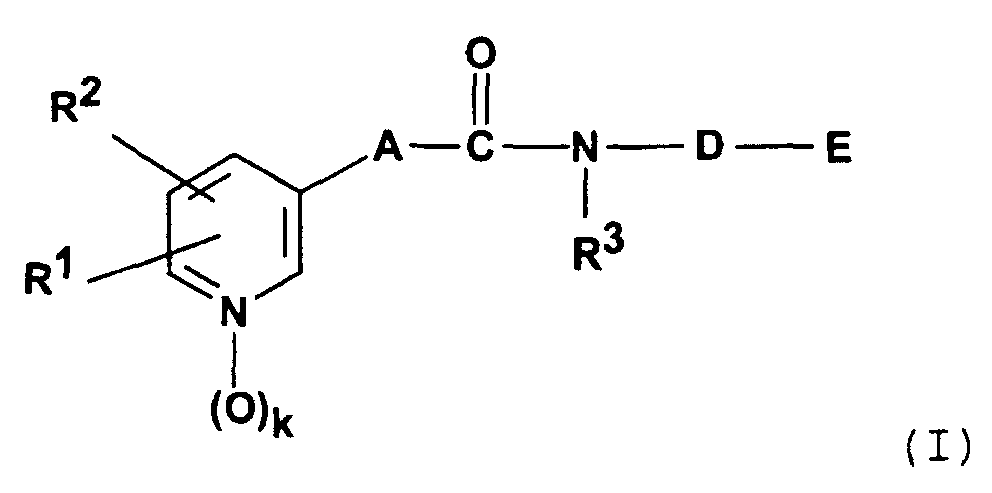
- R1
- is selected from
hydrogen, halogen, cyano, C1-C6-alkyl, C3-C6-alkenyl, C2-C6-alkinyl, trifluoromethyl, C3-C8-cycloalkyl, C1-C6-hydroxyalkyl, hydroxy, C1-C6-alkoxy, C3-C8-cycloalkyloxy, benzyloxy, C1-C7-alkanoyloxy, C1-C6-alkylthio, C2-C7-alkoxycarbonyl, aminocarbonyl, C2-C7-alkylaminocarbonyl, C3-C13-dialkylaminocarbonyl, carboxy, phenyl, phenoxy, phenylthio, pyridyloxy, pyridylthio, and NR4R5 , wherein - R4 and R5
- are selected independently from each other from hydrogen, C1-C6-alkyl, C3-C6-alkenyl, C3-C6-alkinyl, benzyl and phenyl;
- R2
- is selected from
hydrogen, halogen, cyano, C1-C6-alkyl, trifluoromethyl, hydroxy, C1-C6-alkoxy and benzyloxy; - R3
- is selected from
hydrogen, C1-C6-alkyl, C3-C6-alkenyl, C3-C6-alkinyl, hydroxy, C1-C6-alkoxy and benzyloxy; - k
- is 0 or 1,
- A
- is selected from
C1-C6-alkylene, optionally substituted one to three-fold by C1-C3-alkyl, hydroxy, C1-C3-alkoxy, fluorine, or phenyl;
C2-C6-alkylene, in which a methylene unit is isosterically replaced by O, S, NR6, CO, SO or SO2, wherein, with the exception of CO, the isosteric substitution is not adjacent to the amide group and R6 is selected from hydrogen, C1-C6-alkyl, C3-C6-alkenyl, C1-C6-acyl and C1-C6-alkanesulfonyl;
1,2-cyclopropylene;
C2-C6-alkenylene, optionally substituted once or twice by C1-C3-alkyl, hydroxy, C1-C3-alkoxy, fluorine, cyano or phenyl;
C4-C6-alkadienylene, optionally substituted once or twice by C1-C3-alkyl, fluorine, cyano or phenyl;
1,3,5-hexatrienylene, optionally substituted by C1-C3-alkyl, fluorine, cyano or phenyl; and
ethinylene; - D
- is selected from
C2-C10-alkylene, optionally substituted once or twice by C1-C6-alkyl, hydroxy, or C1-C6-alkoxy;
C4-C10-alkenylene, optionally substituted once or twice by C1-C6-alkyl, hydroxy, or C1-C6-alkoxy;
C4-C10-alkinylene, optionally substituted once or twice by C1-C6-alkyl, hydroxy, or C1-C6-alkoxy; and
the group consisting of C2-C10-alkylene, C4-C10-alkenylene and C4-C10-alkinylene, in which one to three methylene units are isosterically replaced by O, S, NR7, CO, SO or SO2, wherein R7 has the same meaning as R6, but is selected independently thereof; - E
- is a cyclic imide of the general formula
or
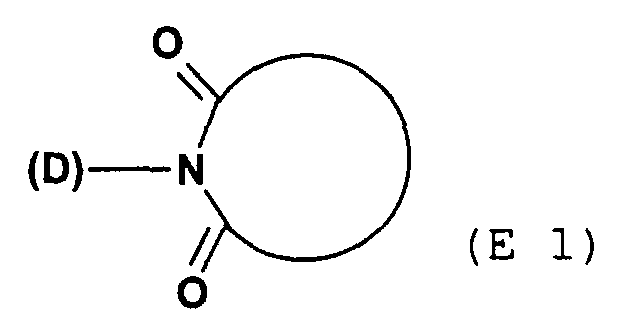 bound over the imide nitrogen atom to D, and is selected from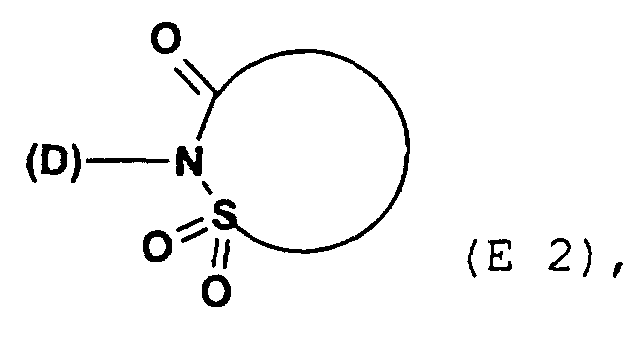
the group consisting of saturated and unsaturated monocyclic imides with 5 to 7 ring atoms of which, aside from the essential imide nitrogen atom, one or two further hetero-atoms optionally are present selected from N, S and O;
the group consisting of saturated, unsaturated and aromatic anellated, bi-, tri- or tetracyclic imides with 8 to 18 ring atoms of which, aside from the essential imide nitrogen atom, one to three further hetero-atoms optionally are present selected from N, S and O;
the group consisting of saturated and unsaturated, bridged bi-, tri- , tetra- or pentacyclic imides with 8 to 22 ring atoms of which, aside from the essential imide nitrogen atom, one to three further hetero-atoms optionally are present selected from N, S and O; and
the group consisting of saturated and unsaturated spirocyclic imides, optionally anellated once or twice and with a total of 9 to 23 ring atoms of which, aside from the essential imide nitrogen atom, one to three further hetero-atoms optionally are present selected from N, S and O;
halogen, cyano, C1-C6-alkyl, C1-C6-alkylidene, trifluoromethyl, C3-C8-cycloalkyl, C3-C8-cycloalkylidene, phenyl-C1-C3-alkyl, phenyl-C1-C3-alkylidene, diphenyl-C1-C3-alkyl, diphenyl-C1-C3-alkylidene, triphenylmethyl, phenyl, hydroxy, C1-C6-hydroxyalkyl, C1-C6-alkoxy, C1-C6-alkoxy entirely or partially substituted by fluorine; benzyloxy, phenoxy, naphthyloxy, mercapto, C1-C6-alkylthio, phenylthio, naphthylthio, pyridylthio, C1-C6-alkanesulfonyl, phenylsulfonyl, naphthylsulfonyl, pyridylsulfonyl, sulfo, carboxy, C2-C7-carboxyalkyl, C2-C7-carboxyalkenyl, C2-C7-alkoxycarbonyl, benzyloxycarbonyl, nitro, amino, C1-C6-aminoalkyl, mono-C1-C6-alkylamino, di-(C1-C6-alkyl)amino, phenylamino, phenyl-C1-C3-alkylamino, pyridylamino,
the group consisting of saturated and unsaturated, four-to seven-membered heterocycles which optionally contain one or two further hetero-atoms selected from N, S and O and are either bound directly or bound over a methylene group or a methine group,
the group consisting of monocyclic aromatic five- and six-membered heterocycles which contain one to three hetero-atoms selected from N, S and O and are either bound directly or bound over a methylene group or a methine group,
the group consisting of anellated bicyclic, aromatic and partially hydrogenated carbocyclic ring systems with 8 to 12 ring atoms which are either bound directly or bound over a methylene or a methine group, and
the group consisting of anellated bicyclic aromatic or partially hydrogenated heterocyclic ring systems with 8 to 12 ring atoms, wherein one to three ring atoms are selected from N, S and O, and are either bound directly or bound over a methylene or a methine group,
and wherein aryl and heteroaryl residues as substituents of the cyclic imides optionally are substituted by one to three groups independently selected from
halogen, cyano, C1-C6-alkyl, trifluoromethyl, C3-C8-cycloalkyl, benzyl, phenyl, hydroxy, C1-C6-hydroxyalkyl, C1-C6-alkoxy, C1-C6-alkoxy entirely or partially substituted by fluorine; benzyloxy, phenoxy, mercapto, C1-C6-alkylthio, phenylthio, carboxy, C2-C7-carboxyalkyl, C2-C7-carboxyalkenyl, C2-C7-alkoxycarbonyl, benzyloxycarbonyl, nitro, amino, C1-C6-aminoalkyl, mono-C1-C6-alkylamino, di-(C1-C6-alkyl)amino and, for two adjacent residues, methylenedioxy;
their cis- and trans-isomers, E- and Z-isomers of the above defined compounds, especially in the case that A is a cyclopropane ring or D contains one or more double bonds, including the enantiomers, diastereomers and other isomers of the above defined compounds, as well as their racemic and/or non-racemic mixtures, as well as the pure endo- and/or exo-isomers of the above defined compounds in the case that the imide ring system is bicyclic, as well as their mixtures; their tautomeric compounds in the optimal case that E contains a heterocyclic aromatic ring with simultaneous substitution by free hydroxy, mercapto or amino groups; and the corresponding acid addition salts of the above defined compounds including their hydrates and solvates. - Compounds according to claim 1, wherein the substituents have the following meanings:
- R1
- is selected from
hydrogen, halogen, cyano, C1-C6-alkyl, trifluoromethyl, ethinyl, hydroxy, C1-C4-alkoxy, benzyloxy, C1-C4-alkylthio, C2-C5-alkoxycarbonyl, aminocarbonyl, C3-C9-dialkylaminocarbonyl, carboxy, phenoxy, phenylthio and pyridyloxy; - R2
- is selected from
hydrogen, fluorine, chlorine, bromine, C1-C4-alkyl, trifluoromethyl, hydroxy, and C1-C4-alkoxy; - R3
- is selected from
hydrogen, C1-C3-alkyl, allyl, hydroxy, C1-C3-alkoxy and benzyloxy; - k
- is 0 or 1,
- A
- is selected from
C1-C6-alkylene, optionally substituted once or twice by C1-C3-alkyl, hydroxy, fluorine or phenyl;
C2-C6-alkylene, wherein a methylene unit is isosterically replaced by O, S, NH, N(CH3) or CO, wherein, with the exception of CO, the isosteric substitution is not adjacent to the amide group;
1,2-cyclopropylene;
C2-C6-alkenylene, optionally substituted once or twice by C1-C3-alkyl, phenyl, hydroxy or fluorine;
C4-C6-alkadienylene, optionally substituted once or twice by methyl or fluorine;
1,3,5-hexatrienylene, optionally substituted by methyl or fluorine; and
ethinylene, - D
- is selected from
C2-C8-alkylene, optionally substituted once or twice by C1-C3-alkyl or hydroxy;
C4-C8-alkenylene, optionally substituted once or twice by C1-C3-alkyl or hydroxy;
C4-C8-alkinylene, optionally substituted once or twice by C1-C3-alkyl or hydroxy; and
the group consisting of C2-C8-alkylene, C4-C8-alkenylene and C4-C8-alkinylene, wherein one to three methylene units are isosterically replaced by O, S, NH, N(CH3), N(COCH3), N(SO2CH3), CO or SO2; - E
- is selected from
pyrrol-2,5-dione, pyrrolidin-2,5-dione, imidazolidin-2,4-dione, oxazolidin-2,4-dione, thiazolidin-2,4-dione, imidazolidin-2,4,5-trione, piperidin-2,6-dione, 3H-pyridin-2,6-dione, piperazin-2,6-dione, morpholin-3,5-dione, azepin-2,7-dione, 3,6-dihydroazepin-2,7-dione, hexahydroazepin-2,7-dione, hexahydro-1,3-diazepin-2,4-dione, hexahydro-1,4-diazepin-2,7-dione, 3,7-dihydro-1,2,5-triazepin-4,6-dione, hexahydro-1,2,5-triazepin-4,6-dione,
pyrrolo[3,4-c]pyrrol-1,3-dione, dihydropyrrolo[3,4-c]pyrrol-1,3-dione, tetra-hydropyrrolo[3,4-c]pyrrol-1,3-dione, tetrahydropyrrolo[1,2-c]imidazol-1,3-dione, thieno[2,3-c]pyrrol-4,6-dione, thieno[3,4-c]pyrrol-4,6-dione, furo[3,4-c]pyrrol-4,6-dione, pyrrolo[3,4-d]thiazol-4,6-dione, isoindol-1,3-dione, tetrahydroisoindol-1,3-dione, hexahydroisoindol-1,3-dione, pyrrolo[3,4-b]pyridin-5,7-dione, pyrrolo[3,4-c]pyridin-1,3-dione, pyrrolo[3,4-c]pyridazin-5,7-dione, 1,1-dioxo-benzo[d]isothiazol-3-one, dihydropurin-2,6-dione, 4H-isoquinolin-1,3-dione, 5H-[1,7]naphthyridin-6,8-dione, 4H-[2,6]naphthyridin-1,3-dione, 1H-quinazolin-2,4-dione, 1H-pyrido[2,3-d]pyrimidin-2,4-dione, 1H-pyrido[3,4-d]pyrimidin-2,4-dione,
benzo[4,5]thieno[2,3-c]pyrrol-1,3-dione, thienoisoindol-1,3-dione, benzoisoindol-1,3-dione, dihydrobenzoisoindol-1,3-dione, tetrahydrobenzoisoindol-1,3-dione, pyrrolo[3,4-g]quinolin-6,8-dione, tetrahydropyrrolo[3,4-g]quinazolin-6,8-dione, 1,2,4-triazolo[1,2-a]cinnolin-7,9-dione, dihydrocarbolin-1,3-dione, 4H-benzo[h]isoquinolin-1,3-dione, benzo[de]isoquinolin-1,3-dione, dibenzo[c,e]azepin-5,7-dione, 4H-naphtho[1,8-c,d]azepin-1,3-dione,
dihydro-4H-acenaphtho-[1,8-a,c]pyrrol-1,3,10-trione, 6H-pyrrolo[3,4-c]carbazol-1,3-dione, dibenzoisoindol-1,3-dione, naphthoisoindol-1,3-dione, tetrahydronaphthoisoindol-1,3-dione, dibenzo[de,h]-isoquinolin-1,3-dione, dihydro-12H-2-aza-pleiaden-1,3-dione, 1H-anthra[1,9-c,d]azepin-2,4-dione, 4H-anthra[9,1-c,d]azepin-1,3-dione,
3-aza-bicyclo[3.2.1]octan-2,4-dione, 3-azabicyclo[3.2.1]oct-6-en-2,4-dione, 3-azabicyclo[3.2.2]nonan-2,4-dione, 3-aza-bicyclo[3.2.2]non-6-en-2,4-dione, 4-aza-tricyclo[5.2.1.0 2,6]dec-8-en-3,5-dione, 10-oxa-4-aza-tricyclo[5.2.1.0 2,6]dec-8-en-3,5-dione, 4-aza-tricyclo[5.2.2.0 2,6]undecan-3,5-dione, 4-aza-tricyclo[5.2.2.0 2,6]undec-8-en-3,5-dione, 4-azabenzo[8,9]tricyclo[5.2.2.0 2,6]undecan-3,5-dione, 4-azadibenzo[8,9:10,11]tricyclo[5.2.2.0 2,6]undecan-3,5-dione, 5-aza-dibenzo[10,11:12,13]tricyclo[7.2.2.0 2,8]tri-decan-3,5-dione,
1,3-diazaspiro[4.4]nonan-2,4-dione, 1-thia-3-azaspiro[4.4]nonan-2,4-dione, 1-oxa-3-azaspiro[4.4]nonan-2,4-dione, 1,3,7-tri-azaspiro[4.4]nonan-2,4-dione, 1-oxa-3,7-diazaspiro[4.4]-nonan-2,4-dione, 2,8-diazaspiro[4.5]decan-1,3-dione, 1,3,8-triazaspiro[4.5]decan-2,4-dione, 1-oxa-3,8-diazaspiro[4.5]-decan-2,4-dione, 7-azaspiro[4.5]decan-6,8-dione, spiro[dioxoimidazolidin-indane], spiro[oxoindolin-dioxoimidazolidine], spiro[dioxoimidazolidin-tetrahydronaphthaline], spiro[dioxoimidazolidin-piperidine], and spiro[2,6-dioxopiperidin-tetrahydronaphthaline],
halogen, cyano, C1-C4-alkyl, C1-C4-alkylidene, trifluoromethyl, C3-C8-cycloalkyl, phenyl-C1-C3-alkyl, phenyl-C1-C3-alkylidene, diphenyl-C1-C3-alkyl, diphenyl-C1-C3-alkylidene, triphenylmethyl, phenyl, hydroxy, C1-C4-hydroxyalkyl, C1-C4-alkoxy, C1-C4-alkoxy entirely or partially substituted by fluorine, benzyloxy, phenoxy, naphthyloxy, mercapto, C1-C4-alkylthio, phenylthio, pyridylthio, C1-C4-alkanesulfonyl, phenylsulfonyl, naphthylsulfonyl, pyridylsulfonyl, sulfo, carboxy, C2-C7-carboxyalkyl, C2-C7-carboxyalkenyl, C2-C7-alkoxycarbonyl, benzyloxycarbonyl, nitro, amino, C1-C4-aminoalkyl, mono-C1-C4-alkylamino, di-(C1-C4-alkyl)amino, phenylamino, phenyl-C1-C3-alkylamino, pyridylamino,
the group consisting of saturated and unsaturated, four-to seven-membered heterocycles which contain one or two hetero-atoms selected from N, S and O,
the group consisting of monocyclic aromatic five- and six-membered heterocycles, which contain one to three hetero-atoms selected from N, S and O and are either bound directly or bound over a methylene group or a methine group,
the group consisting of anellated bicyclic, aromatic and partially hydrogenated carbocyclic ring systems with 8 to 11 ring atoms which are either bound directly or bound over a methylene group or a methine group, and
the group consisting of anellated bicyclic aromatic and partially hydrogenated heterocyclic rings systems with 8 to 11 rings atoms, wherein one to three ring atoms are selected from N, S and O, and are either bound directly or bound over a methylene group or a methine group,
and wherein aryl and heteroaryl residues as substituents of the cyclic imides optionally are substituted by one to three groups independently selected from
halogen, cyano, C1-C6-alkyl, trifluoromethyl, C3-C8-cycloalkyl, benzyl, phenyl, hydroxy, C1-C6-hydroxyalkyl, C1-C6-alkoxy, C1-C6-alkoxy entirely or partially substituted by fluorine, benzyloxy, phenoxy, mercapto, C1-C6-alkylthio, phenylthio, carboxy, C2-C7-carboxyalkyl, C2-C7-carboxyalkenyl, C2-C7-alkoxycarbonyl, benzyloxycarbonyl, nitro, amino, C1-C6-aminoalkyl, mono-C1-C6-alkylamino, di-(C1-C6-alkyl)amino and, for two adjacent residues, methylenedioxy. - Compounds according to claim 1 or 2, wherein the substituents have the following meanings:
- R1
- is selected from
hydrogen, fluorine, chlorine, bromine, methyl, ethyl, trifluoromethyl, hydroxy, C1-C4-alkoxy, phenoxy, methylthio, ethylthio, methoxycarbonyl, aminocarbonyl and carboxy; - R2
- is selected from
hydrogen, chlorine, methyl, hydroxy and methoxy; - R3
- is hydrogen;
- k
- is 0,
- A
- is selected from
C2-C6-alkylene, optionally substituted once or twice by hydroxy or fluorine;
C2-C6-alkylene, in which a methylene unit is isosterically replaced by O, S, or CO, wherein, with the exception of CO, the isosteric substitution is not adjacent to the amide group;
C2-C6-alkenylene, optionally substituted by methyl or fluorine;
C4-C6-alkadienylene, optionally substituted by methyl; and
ethinylene; - D
- is selected from
C2-C8-alkylene, optionally substituted by methyl or hydroxy;
C4-C8-alkenylene, optionally substituted by methyl or hydroxy;
C4-C8-alkinylene, optionally substituted by hydroxy; and
the group consisting of C2-C8-alkylene, C4-C8-alkenylene and C4-C8-alkinylene, in which a methylene unit is isosterically replaced by O, NH, N(CH3), or CO, or an ethylene group is isosterically replaced by a group NH-CO or CO-NH, or a propylene group is isosterically replaced by a group NH-CO-NH, NH-CO-O or O-CO-NH; - E
- is selected from
succinimide, maleinimide, glutarimide, adipinimide, imidazolidindione, imidazolidintrione, thiazolidindione, oxazolidindione, piperazin-2,6-dione, morpholin-3,5-dione, 3,6-dihydroazepin-2,7-dione, hexahydro-1,3-diazepin-2,4-dione, hexahydro-1,4-diazepin-2,7-dione, hexahydro-1,2,5-triazepin-4,6-dione,
phthalimide, tetra-hydrophthalimide, homophthalimide, pyrrol-3,4-dicarboximide, 2,5-dihydropyrrol-3,4-dicarboximide, thiophen-2,3-dicarboximide, thiophen-3,4-dicarboximide, pyridin-2,3-dicarboximide, pyridin-3,4-dicarboximide, pyridazin-3,4-dicarboximide, 1,1-dioxobenzo[d]isothiazol-3-one, isatoic acid imide, 4H-2,6-naphthyridin-1,3-dione, 1H-pyrido[2,3-d]pyrimidin-2,4-dione,
naphthalin-1,2-dicarboximide, 1,2,3,4-tetrahydronaphthalin-1,2-dicarboximide, naphthalin-2,3-dicarboximide, 1,8-naphthalimide, diphenic acid imide, benzothiophen-2,3-dicarboximide, benzothiophen-4,5-dicarboximide, quinolin-6,7-dicarboximide, quinazolin-6,7-dicarboximide,
7,8-dihydroacenaphthen-2(6h)-on-1,8a-dicarboximide, anthracen-2,3-dicarboximide, anthracen-1,9-dicarboximide, phenanthren-9,10-dicarboximide, 12a,12b-dihydro-12h-2-azapleiaden-1,3-dione, 1H-anthraceno[1,9-c,d]azepin-2,4-dione, carbazol-5,6-dicarboximide,
cyclopentan-1,3-dicarboximide, cyclohex-2-en-1,4-dicarboximide, bicyclo[2.2.1]-hept-5-en-2,3-dicarboximide, 7-oxa-bicyclo[2.2.1]-hept-5-en-2,3-dicarboximide, bicyclo[2.2.2]-oct-5-en-2,3-dicarboximide, benzobicyclo[2.2.2]-octan-2,3-dicarboximide, dibenzobicyc-lo[2.2.2]-octan-2,3-dicarboximide, dibenzobicyc-lo[2.2.2]-octan-2,3-diacetic acid imide 1,3-diazaspiro[4.4]nonan-2,4-dione, 1-thia-3-azaspiro[4.4]nonan-2,4-dione, 1-oxa-3,7-diazaspiro[4.4]nonan-2,4-dione, 1-oxa-3,8-diazaspiro[4.5]decan-2,4-dione, spiro[dioxoimidazolidin-indane], spiro[dioxoimidazolidin-piperidine], spiro[dioxoimidazolidin-oxoindoline], spiro[dioxoimidazolidin-tetrahydronaphthaline], and spiro[2,6-dioxopiperidin-tetrahydronaphthaline],
halogen, cyano, C1-C4-alkyl, trifluoromethyl, C3-C8-cycloalkyl, hydroxy, C1-C4-hydroxyalkyl, C1-C4-alkoxy, C1-C4-alkoxy entirely or partially substituted by fluorine, benzyloxy, phenoxy, naphthyloxy, C1-C4-alkylthio, phenylthio, pyridylthio, C1-C4-alkanesulfonyl, phenylsulfonyl, naphthylsulfonyl, pyridylsulfonyl, sulfo, carboxy, C2-C7-carboxyalkyl, C2-C7-carboxyalkenyl, C2-C7-alkoxycarbonyl, benzyloxycarbonyl, nitro, amino, C1-C4-aminoalkyl, di-(C1-C4-alkyl)amino, phenylamino, pyridylamino;
benzyl, benzylidene, phenylethyl, phenylethylidene, phenylpropyl, diphenylmethyl, diphenylmethylene, diphenylethyl, triphenylmethyl;
phenyl, indanyl, indenyl, indenylmethyl, naphthyl, naphthyl-methyl, tetrahydronaphthyl, benzocycloheptenyl, tetrahydrobenzocycloheptenyl;
pyrrolidinyl, piperidinyl, morpholinyl, thiomorpholinyl, piperazinyl, hexahydroazepinyl, hexahydrodiazepinyl;
furyl, furylmethyl, thienyl, thienylmethyl, oxazolyl, isoxazolyl, thiazolyl, thiazolylmethyl, imidazolyl, oxadiazolyl, pyridyl, pyridylmethyl, pyrazinyl, pyrimidinyl;
benzofuryl, benzofurylmethyl, benzothienyl, benzothienylmethyl, indolyl, indolylmethyl, indolinyl, oxoindolinyl, dioxoindolinyl, benzooxazolyl, oxobenzooxazolinyl, benzothiazolyl, benzothiazolylmethyl, oxobenzothiazolinyl, benzoimidazolyl, benzoimidazolylmethyl, oxobenzoimidazolinyl, indazolyl, oxoindazolinyl, benzotriazolyl, oxazolopyridyl, oxazolopyridylmethyl, oxodihydrooxazolopyridyl, thiazolopyridyl, oxodihydrothiazolopyridyl, imidazopyridyl, oxodihydroimidazopyridyl, chromanyl, chromanonyl, oxazolopyridyl, oxazolopyridylmethyl, isoquinolinyl, oxodihydroquinolinyl, tetrahydroquinolinyl, oxotetrahydroquinolinyl, benzodioxanyl, quinazolinyl, benzoazepinyl, tetrahydrobenzoazepinyl, benzodiazepinyl, tetrahydrobenzodiazepinyl, benzooxazepinyl, and benzothiazepinyl;
and wherein aryl and heteroaryl residues as substituents of the cyclic imides optionally are substituted by one to three groups independently selected from
halogen, cyano, C1-C6-alkyl, trifluoromethyl, C3-C8-cycloalkyl, benzyl, phenyl, hydroxy, C1-C6-hydroxyalkyl, C1-C6-alkoxy, C1-C6-alkoxy entirely or partially substituted by fluorine, benzyloxy, phenoxy, mercapto, C1-C6-alkylthio, phenylthio, carboxy, C2-C7-carboxyalkyl, C2-C7-carboxyalkenyl, C2-C7-alkoxycarbonyl, benzyloxycarbonyl, nitro, amino, C1-C6-aminoalkyl, mono-C1-C6-alkylamino, di-(C1-C6-alkyl)amino and, for two adjacent residues, methylenedioxy. - Compounds according to claims 1 to 3, wherein the substituents have the following meanings:
- R1
- is selected from
hydrogen, fluorine, methyl, trifluoromethyl, and ethylthio; - R2
- is hydrogen;
- R3
- is hydrogen;
- k
- is 0,
- A
- is selected from
ethylene , optionally substituted by hydroxy or one or two fluorine atoms,
butylene, optionally substituted by hydroxy or one or two fluorine atoms,
OCH2, SCH2,
ethenylene and 1,3-butadienylene; - D
- is selected from
C4-C6-alkylene, optionally substituted by hydroxy;
C4-C6-alkenylene;
C4-C6-alkinylene; and
the group consisting of C4-C6-alkylene, C4-C6-alkenylene and C4-C6-alkinylene, wherein one or two methylene units are isosterically replaced by O, NH or CO; - E
- is selected from
succinimide, maleinimide, glutarimide, imidazolidindione, imidazolidintrione, thiazolidindione, oxazolidindione, piperazin-2,6-dione, hexahydrodiazepin-2,7-dione,
phthalimide, homo-phthalimide, pyridin-2,3-dicarboximide, pyridin-3,4-dicarboximide, isatoic acid imide,
naphthalin-1,2-dicarboximide, naphthalin-2,3-dicarboximide, 1,8-naphthalimide, diphenic acid imide,
7,8-dihydroace-naphthen-2(6H)-on-1,8a-dicarboximide, anthracen-2,3-dicarboximide, anthracen-1,9-dicarboximide, phenanthren-9,10-dicarboximide,
bicyclo[2.2.1]-hept-5-en-2,3-dicarboximide, 7-oxabicyclo[2.2.1]-hept-5-en-2,3dicarboximide,
benzobicyclo[2.2.2]-octan-2,3-dicarboximide, dibenzobicyclo[2.2.2]-octan-2,3-dicarboximide,
spiro[dioxoimidazolidin-indane], spiro[dioxoimidazolidin-piperidine], spiro[dioxoimidazolidin-oxoindoline] and spiro[dioxoimidazolidin-tetrahydronaphthaline],
halogen, C1-C4-alkyl, trifluoromethyl, hydroxy, hydroxymethyl, methoxy, ethoxy, tert-butoxy, trifluoromethoxy, benzyloxy, phenoxy, phenylthio, pyridylthio, phenylsulfonyl, sulfo, carboxy, C2-C7-carboxyalkyl, C2-C7-carboxyalkenyl, C2-C7-alkoxycarbonyl, benzyloxycarbonyl, nitro, amino, aminomethyl, dimethylamino, diethylamino, phenylamino, pyridylamino;
benzyl, benzylidene, phenylethyl, naphthylmethyl, diphenylmethyl, diphenylmethylene, triphenylmethyl, phenyl, naphthyl;
pyrrolidinyl, piperidinyl, morpholinyl, thiomorpholinyl, piperazinyl, hexahydroazepinyl, hexahydrodiazepinyl;
furyl, furylmethyl, thienyl, thienylmethyl, thiazolyl, thiazolylmethyl, pyridyl, pyridylmethyl;
benzofuryl, benzothienyl, indolyl, indolylmethyl, oxodihydro-indolyl, benzoimidazolyl, benzoimidazolylmethyl, oxodihydrobenzoimidazolyl, benzooxazolyl, oxodihydrobenzooxazolyl, benzothiazolyl, oxodihydrobenzothiazolyl, quinolinyl, quinolinylmethyl, oxodihydroquinolinyl, isoquinolinyl, and oxodihydroisoquinolinyl,
and wherein aryl and heteroaryl residues as substituents of the cyclic imides optionally are substituted by one to three groups independently selected from
halogen, cyano, C1-C6-alkyl, trifluoromethyl, C3-C8-cycloalkyl, benzyl, phenyl, hydroxy, C1-C6-hydroxyalkyl, C1-C6-alkoxy, C1-C6-alkoxy entirely or partially substituted by fluorine, benzyloxy, phenoxy, mercapto, C1-C6-alkylthio, phenylthio, carboxy, C2-C7-carboxyalkyl, C2-C7-carboxyalkenyl, C2-C7-alkoxycarbonyl, benzyloxycarbonyl, nitro, amino, C1-C6-aminoalkyl, mono-C1-C6-alkylamino, di-(C1-C6-alkyl)amino and, for two adjacent residues, methylenedioxy. - Compound according to claims 1 to 4, selected from:N-[4-(2,5-dioxo-3,4-diphenyl-2,5-dihydro-pyrrol-1-yl)-butyl]-3-pyridin-3-yl-acrylamide,N-[4-(2,6-dioxo-4-phenyl-piperidin-1-yl)-butyl]-3-pyridin-3-yl-acrylamide,N-[4-(1,3-dioxo-4,5,6,7-tetraphenyl-1,3-dihydro-isoindol-2-yl)-butyl]-3-pyridin-3-yl-acrylamide,N-[4-(3-benzyl-2,4,5-trioxo-imidazolidin-1-yl)-butyl]-3-pyridin-3-yl-acrylamide,N-[4-(1,3,10-trioxo-1,4,5,6,10,10a-hexahydro-acenaphtho[1,8a-c]pyrrol-2-yl)-butyl]-3-pyridin-3-yl-acrylamide,N-[4-(2,5-dioxo-4,4-diphenyl-imidazolidin-1-yl)-butyl-3-pyridin-3-yl-acrylamide,N-[4-(2,5-dioxo-3-phenyl-2,5-dihydro-pyrrol-1-yl)-butyl]-3-pyridin-3-yl-acrylamide,N-[3-(2,5-dioxo-3,4-diphenyl-2,5-dihydro-pyrrol-1-yl)-propyl]-3-pyridin-3-yl-acrylamide,N-[4-(3-pyridin-3-yl-acroylamino)-butyl]-2,3:5,6-dibenzobicyclo[2.2.2]octan-7,8-dicarboximide,N-[4-(5-benzyliden-2,4-dioxo-thiazolidin-3-yl)-butyl]-3-pyridin-3-yl-acrylamide,N-[4-(4-benzyl-2,6-dioxo-piperazin-1-yl)-butyl]-3-pyridin-3-yl-acrylamide,N-[6-(2,5-dioxo-3,4-diphenyl-2,5-dihydro-pyrrol-1-yl)-hexyl]-3-pyridin-3-yl-acrylamide,N-[4-(2,5-dioxo-3,4-diphenyl-2,5-dihydro-pyrrol-1-yl)-butyl]-3-pyridin-3-yl-propionamide,N-[4-(1,3-dioxo-1,3-dihydro-isoindol-2-yl)-butyl]-3-pyridin-3-yl-acrylamide,N-[4-(1,3-dioxo-1H,3H-benzo[de]isoquinolin-2-yl)-butyl]-3-(1-oxidopyridin-3-yl)-acrylamide,N-[6-(1,3-dioxo-1H,3H-benzo[de]isoquinolin-2-yl)-hexyl]-3-pyridin-3-yl-acrylamide,N-[2-(1,3-dioxo-1H,3H-benzo[de]isoquinolin-2-yl)-ethyl]-3-pyridin-3-yl-acrylamide, andN-[4-(1,3-dioxo-1H,3H-benzo[de]isoquinolin-2-yl)-butyl]-3-pyridin-3-yl-acrylamide.
- Method for the production of compounds according to claims 1 to 5, wherein
according to method (A) carboxylic acids of formula (II)wherein R1, R2, A and k have the meanings given in claims 1 to 4 or their reactive derivatives are reacted with compounds of general formula (III)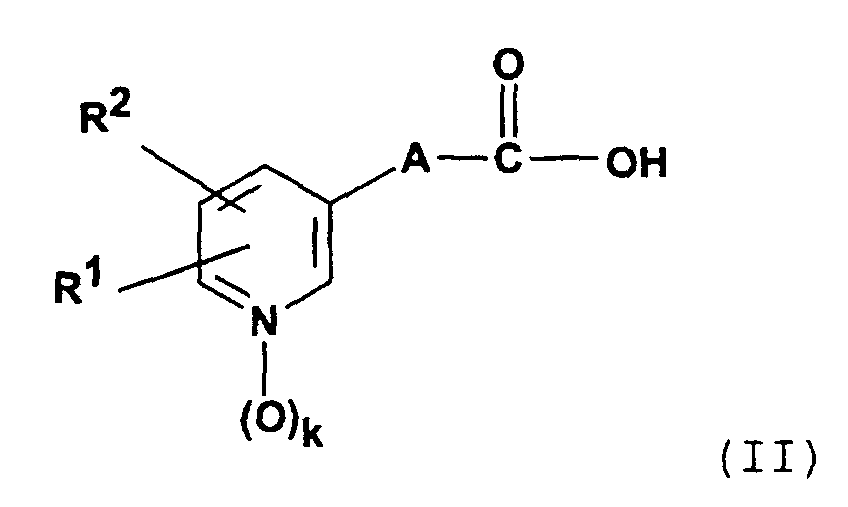 wherein D, E, and R3 have the meanings given in the above claims, in form of their free bases or acid addition salts, in a solvent or a mixture of one or more different solvents, at a temperature of between -40°C and 180°C, optionally in the presence of condensation agents or an auxiliary base, or
according to method (B), compounds of formula (IV)wherein R1, R2, R3, A, D and k have the meaning given in the above claims which were obtained by reacting carboxylic acids of formula (II) with amino alcohols of formula (VI), wherein R3 and D have the meaning given in the above claims under conditions as they are described for method (A),
are reacted with imides of the general formula (V) . - Pharmaceutical composition comprising one or more of the compounds according to claims 1 to 5 optionally together with (a) pharmaceutically acceptable carrier(s), (a) toxicologically safe adjuvant(s), and/or in combination with other active ingredients.
- Pharmaceutical composition according to claim 7, which is
in a solid, peroral administrable form as a tablet, capsule, coated tablet, optionally as sustained action or gastric fluid-resistant preparation or as a liquid, peroral administrable solution, suspension, effervescent tablet, in the form of tabs or sachets, optionally in sustained action form,
in the form of a suitable injection or infusion preparation together with suitable pharmaceutically acceptable carriers and adjuvants, optionally in sustained action form or as a parenteral depot medicinal form or implant or in the form of a concentrate, powder or lyophilisate,
in the form of an inhalation therapeutic agent, in the form of a spray together with suitable pharmaceutically acceptable propellants, carriers and adjuvants,
in the form of a transdermal therapeutic system for systemic treatment,
in the form of a gastrointestinal therapeutic system (GITS) for systemic treatment,
in the form of a salve, suspension, emulsion, a balm or plaster or in the form of an externally applicable solution,
in the form of a rectal, genital, or transurethral administrable emulsions, a solution, a liposomal solution, an implant, suppository or a capsule,
in the form of a composition capable of being applied nasally, otologically or ophthalmologically, or
in a buccally applicable form. - Pharmaceutical composition according to claim 8 for administration by means of a controlled dosage aerosol or in the form of a dry powder dosage formulation.
- Pharmaceutical composition according to claims 7 to 9, wherein a dosage unit for administration contains 0.001 to 1000, 2000, 3000, 4000 or 5000 mg, single dose active ingredient according to the claims 1 to 5.
- Pharmaceutical composition according to claim 10, wherein a dosage unit for administration contains 0.01 - 100 mg single dose active ingredient according to the claims 1 to 5.
- Pharmaceutical composition according to claim 11, wherein a dosage unit for administration contains 1 - 10 mg single dose active ingredient according to the claims 1 to 5.
- Pharmaceutical composition according to claim 10, wherein a dosage unit for administration contains 1, 2, 5, 10, 20, 25, 30, 50, 75, 100, 200, 300, 400, 500, 600, or 800 mg single dose active ingredient according to the claims 1 to 5.
- Pharmaceutical composition according to any one of claims 7 to 13, which is present in combination with a further cytostatic agent or immunosuppressive agent, optionally in the form of separate dosage units in the pharmaceutical package.
- Use of a compound according to any one of claims 1 to 5 for the manufacture of a pharmaceutical composition according to any one claims 7 to 14 for the treatment of the human or animal body wherein the treatment is in connection with cancerostatic, anti-proliferative, cytostatic, abnormal cell growth-inhibiting or immunosuppressive treatment or prevention of the formation of metastases.
Applications Claiming Priority (3)
| Application Number | Priority Date | Filing Date | Title |
|---|---|---|---|
| DE19756212A DE19756212A1 (en) | 1997-12-17 | 1997-12-17 | New cyclic imide-substituted pyridylalkane, alkene and alkyarboxylic acid amides |
| DE19756212 | 1997-12-17 | ||
| PCT/EP1998/008267 WO1999031087A1 (en) | 1997-12-17 | 1998-12-16 | Cyclic imide-substituted pyridylalkane, alkene and alkine carboxamides useful as cytostatic and immunosuppressive agents |
Publications (2)
| Publication Number | Publication Date |
|---|---|
| EP1042315A1 EP1042315A1 (en) | 2000-10-11 |
| EP1042315B1 true EP1042315B1 (en) | 2004-04-14 |
Family
ID=7852321
Family Applications (1)
| Application Number | Title | Priority Date | Filing Date |
|---|---|---|---|
| EP98966634A Expired - Lifetime EP1042315B1 (en) | 1997-12-17 | 1998-12-16 | Cyclic imide-substituted pyridylalkane, alkene, and alkine carboxamides useful as cytostatic and immunosuppressive agents |
Country Status (11)
| Country | Link |
|---|---|
| US (1) | US7192967B1 (en) |
| EP (1) | EP1042315B1 (en) |
| JP (1) | JP4527877B2 (en) |
| AT (1) | ATE264321T1 (en) |
| AU (1) | AU2414699A (en) |
| DE (2) | DE19756212A1 (en) |
| DK (1) | DK1042315T3 (en) |
| ES (1) | ES2218881T3 (en) |
| PT (1) | PT1042315E (en) |
| WO (1) | WO1999031087A1 (en) |
| ZA (1) | ZA9811231B (en) |
Families Citing this family (23)
| Publication number | Priority date | Publication date | Assignee | Title |
|---|---|---|---|---|
| EP1031564A1 (en) | 1999-02-26 | 2000-08-30 | Klinge Pharma GmbH | Inhibitors of cellular nicotinamide mononucleotide formation and their use in cancer therapy |
| EP1348434A1 (en) * | 2002-03-27 | 2003-10-01 | Fujisawa Deutschland GmbH | Use of pyridyl amides as inhibitors of angiogenesis |
| WO2006115509A2 (en) | 2004-06-24 | 2006-11-02 | Novartis Vaccines And Diagnostics Inc. | Small molecule immunopotentiators and assays for their detection |
| EP2098231A1 (en) | 2008-03-05 | 2009-09-09 | Topotarget Switzerland SA | Use of NAD formation inhibitors for the treatment of ischemia-reperfusion injury |
| CN102186822A (en) | 2008-08-29 | 2011-09-14 | 顶标公司 | Novel urea and thiourea derivatives |
| WO2010066709A1 (en) * | 2008-12-09 | 2010-06-17 | Topotarget A/S | Novel pyridinyl acrylamide derivatives |
| EP2453883A1 (en) | 2009-07-17 | 2012-05-23 | Topo Target A/S | Method for predicting the utility of administering nicotinic acid or a precursor or prodrug thereof to reduce the severity of side-effects of cancer treatment with nicotinamide phosphoribosyltransferase inhibitors |
| RU2593759C2 (en) | 2010-09-03 | 2016-08-10 | ФОРМА ТиЭм, ЭлЭлСИ | Guanidine compounds and compositions for inhibiting nampt |
| WO2012031197A1 (en) | 2010-09-03 | 2012-03-08 | Forma Therapeutics, Inc. | Novel compounds and compositions for the inhibition of nampt |
| JP6038792B2 (en) | 2010-09-03 | 2016-12-07 | フォーマ ティーエム, エルエルシー. | 4-{[((Pyridin-3-yl-methyl) aminocarbonyl] amino} benzene-sulfone derivatives as NAMPT inhibitors for the treatment of diseases such as cancer |
| CA2834746A1 (en) | 2011-05-04 | 2012-11-08 | Forma Tm, Llc | Novel compounds and compositions for the inhibition of nampt |
| US9555039B2 (en) | 2011-05-09 | 2017-01-31 | Forma Tm, Llc. | Piperidine derivatives and compositions for the inhibition of nicotinamide phosphoribosyltransferase (NAMPT) |
| JP6450323B2 (en) | 2013-01-07 | 2019-01-09 | ユニバーシティ オブ サザン カリフォルニア | Deoxyuridine triphosphatase inhibitor |
| GB201507937D0 (en) | 2015-05-08 | 2015-06-24 | Univ Hertfordshire Higher Education Corp | Compounds for treatment of pancreatic cancer |
| SI3319939T1 (en) | 2015-07-08 | 2025-04-30 | Cv6 Therapeutics (Ni) Limited | Hydantoin containing deoxyuridine triphosphatase inhibitors |
| WO2017006271A1 (en) | 2015-07-08 | 2017-01-12 | University Of Southern California | Deoxyuridine triphosphatase inhibitors containing amino sulfonyl linkage |
| WO2017006270A1 (en) | 2015-07-08 | 2017-01-12 | University Of Southern California | Deoxyuridine triphosphatase inhibitors |
| WO2017006283A1 (en) | 2015-07-08 | 2017-01-12 | Cv6 Therapeutics (Ni) Limited | Deoxyuridine triphosphatase inhibitors containing cyclopropano linkage |
| US11168059B2 (en) | 2016-11-23 | 2021-11-09 | Cv6 Therapeutics (Ni) Limited | Amino sulfonyl compounds |
| US11174271B2 (en) | 2016-11-23 | 2021-11-16 | Cv6 Therapeutics (Ni) Limited | 6-membered uracil isosteres |
| WO2018098208A1 (en) | 2016-11-23 | 2018-05-31 | Cv6 Therapeutics (Ni) Limited | Nitrogen ring linked deoxyuridine triphosphatase inhibitors |
| US11247984B2 (en) | 2017-01-05 | 2022-02-15 | Cv6 Therapeutics (Ni) Limited | Uracil containing compounds |
| CN116332823B (en) * | 2022-07-01 | 2024-09-03 | 湘潭大学 | A method for preparing isoindole-dione derivatives |
Family Cites Families (37)
| Publication number | Priority date | Publication date | Assignee | Title |
|---|---|---|---|---|
| US4283541A (en) | 1980-05-27 | 1981-08-11 | Usv Pharmaceutical Corporation | Pyridylacyl-hydroxamates |
| NL8005133A (en) | 1980-09-12 | 1982-04-01 | Duphar Int Res | PHENYLPIPERAZINE DERIVATIVES WITH ANTIAGRESSIVE ACTION. |
| JPS57136518A (en) | 1981-02-18 | 1982-08-23 | Eisai Co Ltd | Immunoregulator |
| US5326772A (en) | 1984-09-28 | 1994-07-05 | Byk Gulden Lomberg Chemische Fabrik Gmbh | Diaryl compounds for their use |
| US4778796A (en) | 1985-07-19 | 1988-10-18 | Dainippon Pharmaceutical Co., Ltd. | ω-(3-pyridyl)alkenamide derivatives and anti-allergenic pharmaceutical compositions containing same |
| DE3641822A1 (en) | 1986-12-06 | 1988-06-16 | Goedecke Ag | USE OF DIHYDROPHENYLAMINOSAE DERIVATIVES AND MEDICINAL PRODUCTS CONTAINING THEM FOR IMMUNULATION AND CYTOSTASE |
| JPS63179869A (en) | 1987-01-20 | 1988-07-23 | Dainippon Pharmaceut Co Ltd | Piperidine derivative |
| JP2832979B2 (en) | 1988-02-15 | 1998-12-09 | 武田薬品工業株式会社 | Unsaturated carboxylic acid amide derivative |
| WO1989007443A1 (en) | 1988-02-19 | 1989-08-24 | Byk Gulden Lomberg Chemische Fabrik Gmbh | Optically pure r-(-)-niguldipine and its derivatives for treating tumorous diseases |
| EP0343307A1 (en) | 1988-05-26 | 1989-11-29 | Fabrica Espanola De Productos Quimicos Y Farmaceuticos, S.A. | 4-Piperidinealkanamine derivatives |
| IE903196A1 (en) | 1989-09-05 | 1991-03-13 | Searle & Co | Substituted n-benzylpiperidine amides |
| IE903957A1 (en) | 1989-11-06 | 1991-05-08 | Sanofi Sa | Aromatic amine compounds, their method of preparation and¹pharmaceutical compositions in which they are present |
| WO1991015485A1 (en) * | 1990-04-10 | 1991-10-17 | Byk Gulden Lomberg Chemische Fabrik Gmbh | Novel pyridine esters |
| CA2080127A1 (en) | 1990-04-10 | 1991-10-11 | Peter Zimmermann | Pyridines as medicaments |
| US5260323A (en) | 1990-06-28 | 1993-11-09 | Hoechst Aktiengesellschaft | 2,4- and 2,5-substituted pyridine-N-oxides, processes for their preparation and their use |
| DE4020570A1 (en) | 1990-06-28 | 1992-01-02 | Hoechst Ag | 2,4- AND 2,5-SUBSTITUTED PYRIDINE-N-OXIDES, METHOD FOR THE PRODUCTION AND USE THEREOF |
| ES2069137T3 (en) | 1990-07-30 | 1995-05-01 | Takeda Chemical Industries Ltd | DERIVATIVES OF IMIDAZOPYRIDINE AND ITS USE. |
| DE69131842T2 (en) | 1990-10-05 | 2000-07-27 | Ajinomoto Co., Inc. | Piperidine derivatives and their use as antiarrhythmic agents |
| FR2676053B1 (en) | 1991-05-03 | 1993-08-27 | Sanofi Elf | NOVEL DIALKYLENEPIPERIDINO COMPOUNDS AND THEIR ENANTIOMERS, PROCESS FOR THEIR PREPARATION AND PHARMACEUTICAL COMPOSITIONS CONTAINING THEM. |
| JPH05125048A (en) * | 1991-05-10 | 1993-05-21 | Takeda Chem Ind Ltd | Pyridine derivative, method for producing the same, and pharmaceutical preparation containing the same |
| US5246948A (en) * | 1991-05-10 | 1993-09-21 | Takeda Chemical Industries, Ltd. | Pyridine derivatives, their production and use |
| US5208247A (en) | 1991-08-01 | 1993-05-04 | American Cyanamid Company | Pyridinium compounds which are useful as antagonists of platelet activating factor |
| CA2085954A1 (en) | 1991-12-24 | 1993-06-25 | Klaus Weidmann | Substituted pyridine n-oxides, processes for their preparation, and their use |
| EP0619814A1 (en) | 1991-12-31 | 1994-10-19 | Fujisawa Pharmaceutical Co., Ltd. | Oxadiazole derivatives having acetylcholinesterase-inhibitory and muscarinic agonist activity |
| FR2686084B1 (en) | 1992-01-10 | 1995-12-22 | Bioprojet Soc Civ | NEW IMIDAZOLE DERIVATIVES, THEIR PREPARATION AND THEIR THERAPEUTIC APPLICATIONS. |
| GB9200535D0 (en) | 1992-01-10 | 1992-02-26 | Fujisawa Pharmaceutical Co | New compound |
| AU4713293A (en) | 1992-07-13 | 1994-01-31 | Merck Sharp & Dohme Limited | Heterocyclic amide derivatives as tachykinin derivatives |
| SG48750A1 (en) * | 1993-10-15 | 1998-05-18 | Schering Corp | Tricyclic carbonate compounds useful for inhabition of g-protein function for treatment of proliferative diseases |
| EP0723539B1 (en) * | 1993-10-15 | 2001-12-12 | Schering Corporation | Tricyclic sulfonamide compounds useful for inhibition of g-protein function and for treatment of proliferative diseases |
| IL111235A (en) * | 1993-10-15 | 2001-03-19 | Schering Plough Corp | Pharmaceutical compositions for inhibition of g-protein function and for treatment of proliferative diseases containing tricyclic compounds some such compounds and process for preparing part of them |
| EP0750496A1 (en) | 1994-03-14 | 1997-01-02 | THE GOVERNMENT OF THE UNITED STATES OF AMERICA, as represented by THE SECRETARY, DEPARTMENT OF HEALTH AND HUMAN SERVICES | Use of lipoxygenase inhibitors as anti-cancer therapeutic and intervention agents |
| IL117798A (en) * | 1995-04-07 | 2001-11-25 | Schering Plough Corp | Tricyclic compounds useful for inhibition of g-protein function and for treatment of proliferative diseases and pharmaceutical compositions comprising them |
| US5712280A (en) * | 1995-04-07 | 1998-01-27 | Schering Corporation | Tricyclic compounds useful for inhibition of G-protein function and for treatment of proliferative diseases |
| FR2738245B1 (en) | 1995-08-28 | 1997-11-21 | Sanofi Sa | NOVEL PIPERIDINE DERIVATIVES, PROCESS FOR THEIR PRODUCTION AND PHARMACEUTICAL COMPOSITIONS CONTAINING THEM |
| DE19624668A1 (en) * | 1996-06-20 | 1998-02-19 | Klinge Co Chem Pharm Fab | Use of pyridylalkane, pyridylalken or pyridylalkynamides |
| DE19624704A1 (en) * | 1996-06-20 | 1998-01-08 | Klinge Co Chem Pharm Fab | New pyridylalkanoic acid amides |
| DE19624659A1 (en) * | 1996-06-20 | 1998-01-08 | Klinge Co Chem Pharm Fab | New pyridylalkene and pyridylalkanoic acid amides |
-
1997
- 1997-12-17 DE DE19756212A patent/DE19756212A1/en not_active Ceased
-
1998
- 1998-12-08 ZA ZA9811231A patent/ZA9811231B/en unknown
- 1998-12-16 AT AT98966634T patent/ATE264321T1/en active
- 1998-12-16 WO PCT/EP1998/008267 patent/WO1999031087A1/en not_active Ceased
- 1998-12-16 JP JP2000539011A patent/JP4527877B2/en not_active Expired - Fee Related
- 1998-12-16 DK DK98966634T patent/DK1042315T3/en active
- 1998-12-16 EP EP98966634A patent/EP1042315B1/en not_active Expired - Lifetime
- 1998-12-16 ES ES98966634T patent/ES2218881T3/en not_active Expired - Lifetime
- 1998-12-16 PT PT98966634T patent/PT1042315E/en unknown
- 1998-12-16 AU AU24146/99A patent/AU2414699A/en not_active Abandoned
- 1998-12-16 DE DE69823229T patent/DE69823229T2/en not_active Expired - Lifetime
-
2000
- 2000-06-16 US US09/595,218 patent/US7192967B1/en not_active Expired - Fee Related
Also Published As
| Publication number | Publication date |
|---|---|
| ZA9811231B (en) | 1999-06-08 |
| ATE264321T1 (en) | 2004-04-15 |
| AU2414699A (en) | 1999-07-05 |
| ES2218881T3 (en) | 2004-11-16 |
| DE69823229D1 (en) | 2004-05-19 |
| EP1042315A1 (en) | 2000-10-11 |
| DE19756212A1 (en) | 1999-07-01 |
| US7192967B1 (en) | 2007-03-20 |
| JP4527877B2 (en) | 2010-08-18 |
| PT1042315E (en) | 2004-08-31 |
| JP2002508367A (en) | 2002-03-19 |
| WO1999031087A1 (en) | 1999-06-24 |
| DK1042315T3 (en) | 2004-07-12 |
| DE69823229T2 (en) | 2005-03-10 |
Similar Documents
| Publication | Publication Date | Title |
|---|---|---|
| US6593344B1 (en) | Piperadinyl-substituted pyridylalkane, alkene and alkine carboxamides | |
| US7192967B1 (en) | Cyclic imide-substituted pyridylalkane, alkene, alkine carboxamides useful as cytostatic and immunosuppressive agents | |
| EP1042291B1 (en) | Aryl-substituted pyridylalkane, alkene, and alkine carboxamides useful as cytostatic and immunosuppressive agents | |
| CA2257448C (en) | Pyridyl alkene- and pyridyl alkine-acid amides as cytostatics and immunosuppressives | |
| EP1060163B1 (en) | New piperazinyl-substituted pyridylalkane, alkene and alkine carboxamides | |
| US6451816B1 (en) | Use of pyridyl alkane, pyridyl alkene and/or pyridyl alkine acid amides in the treatment of tumors or for immunosuppression | |
| US6903118B1 (en) | Piperazinyl-substituted pyridylalkane, alkene and alkine carboxamides | |
| EP0934309B1 (en) | New pyridyl alkane acid amides as cytostatics and immunosuppressives | |
| KR100478405B1 (en) | Pyridylalkene- and pyridylalkyne-acidamides as cytostatic and immunosuppressive agents | |
| HK1021974B (en) | Pyridyl alkene-and pyridyl alkine-acid amides as cytostatics and immunosuppressives |
Legal Events
| Date | Code | Title | Description |
|---|---|---|---|
| PUAI | Public reference made under article 153(3) epc to a published international application that has entered the european phase |
Free format text: ORIGINAL CODE: 0009012 |
|
| 17P | Request for examination filed |
Effective date: 20000524 |
|
| AK | Designated contracting states |
Kind code of ref document: A1 Designated state(s): AT BE CH CY DE DK ES FI FR GB GR IE IT LI LU MC NL PT SE |
|
| 17Q | First examination report despatched |
Effective date: 20030115 |
|
| GRAP | Despatch of communication of intention to grant a patent |
Free format text: ORIGINAL CODE: EPIDOSNIGR1 |
|
| GRAS | Grant fee paid |
Free format text: ORIGINAL CODE: EPIDOSNIGR3 |
|
| GRAA | (expected) grant |
Free format text: ORIGINAL CODE: 0009210 |
|
| AK | Designated contracting states |
Kind code of ref document: B1 Designated state(s): AT BE CH CY DE DK ES FI FR GB GR IE IT LI LU MC NL PT SE |
|
| REG | Reference to a national code |
Ref country code: GB Ref legal event code: FG4D |
|
| REG | Reference to a national code |
Ref country code: CH Ref legal event code: EP |
|
| REF | Corresponds to: |
Ref document number: 69823229 Country of ref document: DE Date of ref document: 20040519 Kind code of ref document: P |
|
| REG | Reference to a national code |
Ref country code: IE Ref legal event code: FG4D |
|
| REG | Reference to a national code |
Ref country code: DK Ref legal event code: T3 |
|
| REG | Reference to a national code |
Ref country code: GR Ref legal event code: EP Ref document number: 20040401972 Country of ref document: GR |
|
| REG | Reference to a national code |
Ref country code: SE Ref legal event code: TRGR |
|
| REG | Reference to a national code |
Ref country code: CH Ref legal event code: NV Representative=s name: E. BLUM & CO. PATENTANWAELTE |
|
| REG | Reference to a national code |
Ref country code: PT Ref legal event code: SC4A Free format text: AVAILABILITY OF NATIONAL TRANSLATION Effective date: 20040621 |
|
| REG | Reference to a national code |
Ref country code: ES Ref legal event code: FG2A Ref document number: 2218881 Country of ref document: ES Kind code of ref document: T3 |
|
| ET | Fr: translation filed | ||
| PLBE | No opposition filed within time limit |
Free format text: ORIGINAL CODE: 0009261 |
|
| STAA | Information on the status of an ep patent application or granted ep patent |
Free format text: STATUS: NO OPPOSITION FILED WITHIN TIME LIMIT |
|
| 26N | No opposition filed |
Effective date: 20050117 |
|
| REG | Reference to a national code |
Ref country code: GB Ref legal event code: 732E |
|
| REG | Reference to a national code |
Ref country code: GB Ref legal event code: 732E |
|
| REG | Reference to a national code |
Ref country code: CH Ref legal event code: PUE Owner name: ASTELLAS DEUTSCHLAND GMBH Free format text: KLINGE PHARMA GMBH#BERG-AM-LAIM-STRASSE 129#D-81673 MUENCHEN (DE) -TRANSFER TO- ASTELLAS DEUTSCHLAND GMBH#NEUMARKTER STRASSE 61#81673 MUENCHEN (DE) Ref country code: CH Ref legal event code: NV Representative=s name: E. BLUM & CO. AG PATENT- UND MARKENANWAELTE VSP |
|
| REG | Reference to a national code |
Ref country code: PT Ref legal event code: PD4A Owner name: ASTELLAS PHARMA GMBH, DE Effective date: 20070628 Ref country code: PT Ref legal event code: PD4A Owner name: FUJISAWA DEUTSCHLAND GMBH, DE Effective date: 20070628 Ref country code: PT Ref legal event code: PC4A Owner name: ASTELLAS DEUTSCHLAND GMBH, DE Effective date: 20070628 Ref country code: PT Ref legal event code: PC4A Owner name: FUJISAWA GMBH, DE Effective date: 20070628 |
|
| NLS | Nl: assignments of ep-patents |
Owner name: FUJISAWA GMBH Effective date: 20070611 Owner name: ASTELLAS DEUTSCHLAND GMBH Effective date: 20070611 |
|
| NLT1 | Nl: modifications of names registered in virtue of documents presented to the patent office pursuant to art. 16 a, paragraph 1 |
Owner name: FUJISAWA DEUTSCHLAND GMBH Owner name: ASTELLAS PHARMA GMBH |
|
| REG | Reference to a national code |
Ref country code: FR Ref legal event code: TP Ref country code: FR Ref legal event code: CD Ref country code: FR Ref legal event code: CA |
|
| BECH | Be: change of holder |
Owner name: *ASTELLAS DEUTSCHLAND G.M.B.H. Effective date: 20070727 |
|
| BECN | Be: change of holder's name |
Owner name: *ASTELLAS DEUTSCHLAND G.M.B.H. Effective date: 20070727 |
|
| PGFP | Annual fee paid to national office [announced via postgrant information from national office to epo] |
Ref country code: AT Payment date: 20101214 Year of fee payment: 13 |
|
| PGFP | Annual fee paid to national office [announced via postgrant information from national office to epo] |
Ref country code: GR Payment date: 20101229 Year of fee payment: 13 Ref country code: GB Payment date: 20101129 Year of fee payment: 13 |
|
| PGFP | Annual fee paid to national office [announced via postgrant information from national office to epo] |
Ref country code: DE Payment date: 20101222 Year of fee payment: 13 |
|
| PGFP | Annual fee paid to national office [announced via postgrant information from national office to epo] |
Ref country code: IT Payment date: 20101209 Year of fee payment: 13 |
|
| PGFP | Annual fee paid to national office [announced via postgrant information from national office to epo] |
Ref country code: SE Payment date: 20111219 Year of fee payment: 14 Ref country code: PT Payment date: 20111215 Year of fee payment: 14 Ref country code: CH Payment date: 20111109 Year of fee payment: 14 Ref country code: LU Payment date: 20111223 Year of fee payment: 14 Ref country code: MC Payment date: 20111103 Year of fee payment: 14 Ref country code: FR Payment date: 20111213 Year of fee payment: 14 Ref country code: DK Payment date: 20111201 Year of fee payment: 14 Ref country code: FI Payment date: 20111215 Year of fee payment: 14 Ref country code: ES Payment date: 20111205 Year of fee payment: 14 Ref country code: NL Payment date: 20111101 Year of fee payment: 14 Ref country code: IE Payment date: 20111227 Year of fee payment: 14 |
|
| PGFP | Annual fee paid to national office [announced via postgrant information from national office to epo] |
Ref country code: BE Payment date: 20111115 Year of fee payment: 14 |
|
| PGFP | Annual fee paid to national office [announced via postgrant information from national office to epo] |
Ref country code: CY Payment date: 20111214 Year of fee payment: 14 |
|
| REG | Reference to a national code |
Ref country code: PT Ref legal event code: MM4A Free format text: LAPSE DUE TO NON-PAYMENT OF FEES Effective date: 20130617 |
|
| BERE | Be: lapsed |
Owner name: *ASTELLAS DEUTSCHLAND G.M.B.H. Effective date: 20121231 |
|
| REG | Reference to a national code |
Ref country code: NL Ref legal event code: V1 Effective date: 20130701 |
|
| PG25 | Lapsed in a contracting state [announced via postgrant information from national office to epo] |
Ref country code: SE Free format text: LAPSE BECAUSE OF NON-PAYMENT OF DUE FEES Effective date: 20121217 Ref country code: MC Free format text: LAPSE BECAUSE OF NON-PAYMENT OF DUE FEES Effective date: 20121231 Ref country code: CY Free format text: LAPSE BECAUSE OF NON-PAYMENT OF DUE FEES Effective date: 20121216 |
|
| REG | Reference to a national code |
Ref country code: CH Ref legal event code: PL |
|
| REG | Reference to a national code |
Ref country code: AT Ref legal event code: MM01 Ref document number: 264321 Country of ref document: AT Kind code of ref document: T Effective date: 20121216 |
|
| REG | Reference to a national code |
Ref country code: DK Ref legal event code: EBP |
|
| GBPC | Gb: european patent ceased through non-payment of renewal fee |
Effective date: 20121216 |
|
| PG25 | Lapsed in a contracting state [announced via postgrant information from national office to epo] |
Ref country code: FI Free format text: LAPSE BECAUSE OF NON-PAYMENT OF DUE FEES Effective date: 20121216 Ref country code: PT Free format text: LAPSE BECAUSE OF NON-PAYMENT OF DUE FEES Effective date: 20130617 |
|
| REG | Reference to a national code |
Ref country code: GR Ref legal event code: ML Ref document number: 20040401972 Country of ref document: GR Effective date: 20130703 |
|
| REG | Reference to a national code |
Ref country code: IE Ref legal event code: MM4A |
|
| REG | Reference to a national code |
Ref country code: FR Ref legal event code: ST Effective date: 20130830 |
|
| PG25 | Lapsed in a contracting state [announced via postgrant information from national office to epo] |
Ref country code: BE Free format text: LAPSE BECAUSE OF NON-PAYMENT OF DUE FEES Effective date: 20121231 |
|
| REG | Reference to a national code |
Ref country code: DE Ref legal event code: R119 Ref document number: 69823229 Country of ref document: DE Effective date: 20130702 |
|
| PG25 | Lapsed in a contracting state [announced via postgrant information from national office to epo] |
Ref country code: LI Free format text: LAPSE BECAUSE OF NON-PAYMENT OF DUE FEES Effective date: 20121231 Ref country code: CH Free format text: LAPSE BECAUSE OF NON-PAYMENT OF DUE FEES Effective date: 20121231 Ref country code: IE Free format text: LAPSE BECAUSE OF NON-PAYMENT OF DUE FEES Effective date: 20121216 Ref country code: NL Free format text: LAPSE BECAUSE OF NON-PAYMENT OF DUE FEES Effective date: 20130701 Ref country code: AT Free format text: LAPSE BECAUSE OF NON-PAYMENT OF DUE FEES Effective date: 20121216 Ref country code: DE Free format text: LAPSE BECAUSE OF NON-PAYMENT OF DUE FEES Effective date: 20130702 Ref country code: GR Free format text: LAPSE BECAUSE OF NON-PAYMENT OF DUE FEES Effective date: 20130703 |
|
| PG25 | Lapsed in a contracting state [announced via postgrant information from national office to epo] |
Ref country code: GB Free format text: LAPSE BECAUSE OF NON-PAYMENT OF DUE FEES Effective date: 20121216 Ref country code: FR Free format text: LAPSE BECAUSE OF NON-PAYMENT OF DUE FEES Effective date: 20130102 |
|
| PG25 | Lapsed in a contracting state [announced via postgrant information from national office to epo] |
Ref country code: IT Free format text: LAPSE BECAUSE OF NON-PAYMENT OF DUE FEES Effective date: 20121216 |
|
| PG25 | Lapsed in a contracting state [announced via postgrant information from national office to epo] |
Ref country code: DK Free format text: LAPSE BECAUSE OF NON-PAYMENT OF DUE FEES Effective date: 20130102 |
|
| REG | Reference to a national code |
Ref country code: ES Ref legal event code: FD2A Effective date: 20140306 |
|
| PG25 | Lapsed in a contracting state [announced via postgrant information from national office to epo] |
Ref country code: ES Free format text: LAPSE BECAUSE OF NON-PAYMENT OF DUE FEES Effective date: 20121217 Ref country code: LU Free format text: LAPSE BECAUSE OF NON-PAYMENT OF DUE FEES Effective date: 20121216 |