EP1041774A2 - Method and apparatus for dynamic call admission control - Google Patents
Method and apparatus for dynamic call admission control Download PDFInfo
- Publication number
- EP1041774A2 EP1041774A2 EP00302447A EP00302447A EP1041774A2 EP 1041774 A2 EP1041774 A2 EP 1041774A2 EP 00302447 A EP00302447 A EP 00302447A EP 00302447 A EP00302447 A EP 00302447A EP 1041774 A2 EP1041774 A2 EP 1041774A2
- Authority
- EP
- European Patent Office
- Prior art keywords
- connections
- switch
- port mechanism
- traffic
- controller
- Prior art date
- Legal status (The legal status is an assumption and is not a legal conclusion. Google has not performed a legal analysis and makes no representation as to the accuracy of the status listed.)
- Withdrawn
Links
Images





Classifications
-
- H—ELECTRICITY
- H04—ELECTRIC COMMUNICATION TECHNIQUE
- H04L—TRANSMISSION OF DIGITAL INFORMATION, e.g. TELEGRAPHIC COMMUNICATION
- H04L12/00—Data switching networks
- H04L12/54—Store-and-forward switching systems
- H04L12/56—Packet switching systems
- H04L12/5601—Transfer mode dependent, e.g. ATM
- H04L12/5602—Bandwidth control in ATM Networks, e.g. leaky bucket
-
- H—ELECTRICITY
- H04—ELECTRIC COMMUNICATION TECHNIQUE
- H04Q—SELECTING
- H04Q11/00—Selecting arrangements for multiplex systems
- H04Q11/04—Selecting arrangements for multiplex systems for time-division multiplexing
- H04Q11/0428—Integrated services digital network, i.e. systems for transmission of different types of digitised signals, e.g. speech, data, telecentral, television signals
- H04Q11/0478—Provisions for broadband connections
-
- H—ELECTRICITY
- H04—ELECTRIC COMMUNICATION TECHNIQUE
- H04L—TRANSMISSION OF DIGITAL INFORMATION, e.g. TELEGRAPHIC COMMUNICATION
- H04L12/00—Data switching networks
- H04L12/54—Store-and-forward switching systems
- H04L12/56—Packet switching systems
- H04L12/5601—Transfer mode dependent, e.g. ATM
- H04L2012/5629—Admission control
- H04L2012/5631—Resource management and allocation
- H04L2012/5632—Bandwidth allocation
-
- H—ELECTRICITY
- H04—ELECTRIC COMMUNICATION TECHNIQUE
- H04L—TRANSMISSION OF DIGITAL INFORMATION, e.g. TELEGRAPHIC COMMUNICATION
- H04L12/00—Data switching networks
- H04L12/54—Store-and-forward switching systems
- H04L12/56—Packet switching systems
- H04L12/5601—Transfer mode dependent, e.g. ATM
- H04L2012/5629—Admission control
- H04L2012/5631—Resource management and allocation
- H04L2012/5636—Monitoring or policing, e.g. compliance with allocated rate, corrective actions
Definitions
- the present invention pertains to a switch which releases connections according to a connection's priority when a predetermined condition exists in the switch. More specifically, the present invention pertains to a switch which releases connections according to a connection's priority when an overload condition exists in the switch.
- CAC Current call admission control
- High-speed fast-packet-switched network architectures are capable of supporting a wide range of connections with different bandwidth requirements and traffic characteristics.
- QoS quality of service
- Providing quality of service (QoS) in networks in terms of delay and bandwidth requires provisioning of network resources. While this environment provides increased flexibility in supporting various services, its dynamic nature poses difficult traffic control problems when trying to achieve efficient use of network resources.
- One such problem is the issue of bandwidth management and allocation. Due to the statistical multiplexing of all connections at the physical layer and the varying transmission rates by connections, it is important to characterize, both the effective bandwidth of a single connection and several multiplexed connections. Such characterization can be used to compute metrics for efficient bandwidth management, routing, and call control procedures. Based on statistical characteristics and desired grade of service, researchers in R. Guerin, H. Ahmadi, and M.
- the present invention provides a dynamic CAC to overcome the problem of under-utilization of link bandwidth.
- the scheme using periodic measurements, keeps track of various utilization parameters. These include the current link utilization, the variation in link utilization, buffer occupancy, and rate of change of buffer occupancy. Based on the above measurements a dynamic estimate of the effective bandwidth of the aggregate traffic on link is computed and admittance of new calls judged based on this.
- the present invention pertains to a switch for a network.
- the switch comprises an input port mechanism which receives traffic of connections from the network. Each connection has a priority.
- the switch comprises an output port mechanism which sends traffic of connections to the network.
- the switch comprises a controller which serves connections and which monitors the connections received by the input port mechanism and sent by the output port mechanism and releases connections according to a connection's priority when a predetermined condition exists in the switch.
- the controller is connected to the input port mechanism and the output port mechanism. Each connection requests a specific bandwidth from the controller.
- the present invention pertains to a method for switching connections.
- the method comprises the steps of monitoring traffic of connections received by a switch. Then there is the step of releasing connections from the switch according to the connection's priority when a predetermined condition in the switch exists.
- the present invention pertains to a switch for a network.
- the switch comprises an input port mechanism which receives traffic of connections from the network.
- the switch comprises an output port mechanism which sends traffic of connections to the network.
- the switch comprises a controller which provides service to traffic of connections received at the input port mechanism and which are to be sent out the output port mechanism.
- the controller monitoring the traffic of connections received by the input port mechanism and sent out the output port mechanism and adjusting the service provided to the connections based on the traffic of connections received by the input port mechanism and sent out the output port mechanism.
- the controller is connected to the input port mechanism and the output port mechanism.
- the present invention pertains to a switch for a network.
- the switch comprises an input port mechanism which receives cells of connections from the network.
- the switch comprises an output port mechanism which sends cells of connections to the network.
- the switch comprises a buffer mechanism for storing cells.
- the buffer mechanism is connected to the input port mechanism and the output port mechanism.
- the switch comprises a controller which provides service to traffic of connections received at the input port mechanism and which are to be sent out the output port mechanism.
- the controller monitors the change in the number of cells in the buffer mechanism and adjusts the service provided to the connections based on the change in the number of cells in the buffer mechanism.
- the controller is connected to the buffer mechanism.
- the present invention pertains to a method for switching connections by a switch of a network.
- the method comprises the steps of monitoring the traffic of connections received by the switch and sent out the switch. Then there is the step of adjusting the service provided to the connections by the switch based on the traffic of connections received by the switch and sent out the switch.
- the switch 10 for a network 12.
- the switch 10 comprises an input port mechanism 14 which receives traffic of connections from the network 12. Each connection has a priority.
- the switch 10 comprises an output port mechanism 16 which sends traffic of connections to the network 12.
- the switch 10 comprises a controller 18 which serves connections and which monitors the connections received by the input port mechanism 14 and sent by the output port mechanism 16 and releases connections according to a connection's priority when a predetermined condition exists in the switch 10.
- the controller 18 is connected to the input port mechanism 14 and the output port mechanism 16. Each connection requests a specific bandwidth from the controller 18.
- the predetermined condition includes an overload condition of the switch 10.
- the overload condition preferably includes receiving more traffic on connections received by the input port mechanism 14 than the controller 18 can process at a given time.
- the controller 18 determines excess bandwidth associated with the overload condition, and the controller 18 releases the connection, for a given priority, with the closest match to the excess bandwidth.
- the controller 18 preferably releases connections according to the connections' traffic class, where UBR connections are released first, then ABR connections are released next, then VBR connections are released next and then CBR connections are released from the switch 10.
- the input port mechanism 14 comprises I input ports 20 connected to the controller 18, where I is an integer and greater than or equal to 1; and wherein the output mechanism comprises O output ports 22 connected to the controller 18, where O is an integer greater than or equal to 1.
- the controller 18 preferably releases the connection with the lowest priority.
- the controller 18 releases connections whose sum of requested bandwidths most closely matches the excess bandwidth.
- the switch includes a buffer mechanism connected to the output port mechanism.
- the overload condition preferably exists if the sum of requested bandwidths of connections on an output port is greater than the output port's bandwidth and buffer resources associated with it are being exceeded if (Q vcbr > T) and (B l eff >B link ) where Qvcbr is the buffer occupancy for VBR/CBR traffic, T is a threshold, B l eff is the aggregate effective bandwidth of connections on link 1, and B link is the maximum link capacity or line rate.
- the present invention pertains to a method for switch 10ing connections.
- the method comprises the steps of monitoring traffic of connections received by a switch 10. Then there is the step of releasing connections from the switch 10 according to the connection's priority when a predetermined condition in the switch 10 exists.
- the monitoring step includes the step of monitoring traffic of connections received by and sent out from the switch 10.
- the releasing step preferably includes the step of releasing connections when the predetermined condition of overload exists in the switch 10 where there is more traffic of connections received by the switch 10 than the switch 10 can process.
- the releasing step includes the steps of determining, when the overload condition exists, the excess bandwidth associated with the overload condition; choosing a connection, for a given priority, with the closest match to the excess bandwidth; and releasing the connection with the closest match to the excess bandwidth.
- the choosing step preferably includes the step of choosing the connection with the lowest priority.
- the choosing step includes the step of choosing the connections whose sum of requested bandwidths most closely matches the excess bandwidth.
- the choosing step preferably includes the step of choosing a connection according to traffic class for release, where UBR connections are released first, then ABR connections are released next, then VBR connections are released next and then CBR connections are released.
- the present invention pertains to a switch 10 for a network 12.
- the switch 10 comprises an input port mechanism 14 which receives traffic of connections from the network 12.
- the switch 10 comprises an output port mechanism 16 which sends traffic of connections to the network 12.
- the switch 10 comprises a controller 18 which provides service to traffic of connections received at the input port mechanism 14 and which are to be sent out the output port mechanism 16.
- the controller 18 monitoring the traffic of connections received by the input port mechanism 14 and sent out the output port mechanism 16 and adjusting the service provided to the connections based on the traffic of connections received by the input port mechanism 14 and sent out the output port mechanism 16.
- the controller 18 is connected to the input port mechanism 14 and the output port mechanism 16.
- the present invention pertains to a switch 10 for a network 12.
- the switch 10 comprises an input port mechanism 14 which receives cells of connections from the network 12.
- the switch 10 comprises an output port mechanism 16 which sends cells of connections to the network 12.
- the switch 10 comprises a buffer mechanism 24 for storing cells.
- the buffer mechanism 24 is connected to the input port mechanism 14 and the output port mechanism 16.
- the switch 10 comprises a controller 18 which provides service to traffic of connections received at the input port mechanism 14 and which are to be sent out the output port mechanism 16.
- the controller 18 monitors the change in the number of cells in the buffer mechanism 24 and adjusts the service provided to the connections based on the change in the number of cells in the buffer mechanism 24.
- the controller 18 is connected to the buffer mechanism 24.
- the controller 18 also monitors the number of cells of connections received by the input port mechanism 14 and sent out the output port mechanism 16 and adjusting the service provided to the connections based also on the number of cells of connections received by the input port mechanism 14 and sent out the output port mechanism 16.
- the controller 18 preferably admits a new connection to the output port mechanism 16 of the switch 10 if B c eff + B int eff + B l act ⁇ B link where B c eff is the effective bandwidth of the new connect ion, B int eff is the aggregate effective bandwidth of connections admitted within a current measurement interval int , B l act reflects an actual aggregate measured traffic on link 1 on the network 12 connected with the switch 10 determined at the beginning of the current interval, and B link is the maximum link capacity or line rate of 1.
- B act is preferably based on current link utilization, variation in link utilization, buffer occupancy, and rate of change of buffer occupancy.
- the present invention pertains to a method for switching connections by a switch 10 of a network 12.
- the method comprises the steps of monitoring the traffic of connections received by the switch 10 and sent out the switch 10. Then there is the step of adjusting the service provided to the connections by the switch 10 based on the traffic of connections received by the switch 10 and sent out the switch 10.
- the monitoring step includes the step of monitoring the change in the number of cells in a buffer mechanism 24 of the switch 10 and adjusting the service provided to the connections based on the change in the number of cells in the buffer mechanism 24.
- a dynamic CAC is used to overcome the problem of under-utilization of link bandwidth.
- the scheme using periodic measurements, keeps track of various utilization parameters. These include the current link utilization, the variation in link utilization, buffer occupancy, and rate of change of buffer occupancy. Based on the above measurements a dynamic estimate of the effective bandwidth of the aggregate traffic on link, denoted by B l act , is computed.
- Avoiding over-allocation in a measurement interval can be achieved in the following manner. Multiple new connections arriving between two measurements, based on Eqn. 2, will see the same last measured value of link utilization, B l act . Thus, the bandwidth taken up by admitted connections in a measurement interval is not reflected on subsequent admissions in the same interval.
- B int eff the aggregate effective bandwidth of connections admitted within the interval
- B int eff For a connection being torn down, a similar adjustment to B int eff can be made to reflect the freed up bandwidth. However, without actual per-connection usage statistics, it is not clear what the value of this credit should be. Clearly, B c eff may be an over-estimation, and should not be used. Thus, preferably, bandwidth is chosen not to be credited for connections torn down during an interval. An accurate impact of torn-down connections is obtained at the next link rate measurement.
- a link can also become over-allocated when some or all admitted connections send traffic corresponding to their B c eff .
- the system allows for this to be detected and then recovered from.
- Congestion due to over-allocation is detected based on two conditions occurring: a) the buffer occupancy for VBR/CBR traffic, denoted by Q vcbr , crossing a certain high threshold, T , and b) B l eff , computed based on Eqn. 1 being greater than B link .
- IMA Inverse Multiplexing on ATM
- a link of larger capacity is emulated using multiple smaller capacity links. For example, a 6 Mbps link can be emulated using 4 DS-1 (1.5)Mbps) links using reverse multiplexing. With one or more of these smaller capacity links going down, IMA requires the emulation to continue on the remaining active links. However, the remaining capacity may not be adequate to support all the connections. Thus, it also requires some connections to be dropped.
- the ATM Forum Traffic Management Specification version 4.0 specifies traffic classes such as CBR, VBR, ABR, and, UBR. This classification determines the service received, in terms of rate, cell delay, and jitter, by a given connectaon in an ATM network 12.
- traffic classes such as CBR, VBR, ABR, and, UBR.
- This classification determines the service received, in terms of rate, cell delay, and jitter, by a given connectaon in an ATM network 12.
- a call release priority based on which calls can be ordered while dropping to avoid congestion.
- Each connection in the system has such a call release priority .
- Such a priority could be either specified by the user at call set-up or determined by the network 12 itself based on call characteristics.
- an estimate of the excess rate causing the congestion can be estimated from the rate of change of buffer occupancy and link utilization. Calls can then be released in decreasing order of their call release priority until congestion no longer holds. To minimize the number of calls being released, for a given priority, preferably the call with the closest match to the excess bandwidth is released first.
- the LINK_MONITOR_TASK task periodically monitors the transmitted CBR/VBR cell rate on each link.
- the period size is determined by a parameter LINK_MON_INTRVL_SIZE.
- the task keeps track of the measured rates from last N_INTRVLS (window size). Every interval a mean transmission rate and variance is computed based on a weighted function of the data points. For each link the task then uses the mean and variance to compute equivalent capacity.
- the CONNECTION_ADMISSION_CONTROL routine for a new connection with given mean, peak, and burst_size computes its equivalent capacity. It then checks if the connection can be admitted without overallocating that link. It also updates the link capacity to reflect new call admitted in between measurements as discussed above.
- semaphores are used.
- a single semaphore for all links in the switch 10 is used.
- Other mutual exclusion mechanisms, with or without semaphores, can be envisioned. For example, even with semaphores, the granularity of mutual exclusion by associating a semaphore with each link capacity variable can be extended.
- two different equivalent capacity measures are kept track of.
- the first one based on the stationary model maintains the mean and variance (M,V) of traffic.
- the second method is based on a flow model maintains a parameter c ⁇ as discussed in R. Guerin, H. Ahmadi, and M. Naghshineh, incorporated by reference herein.
- Equivalent capacity and its application to bandwidth allocation in high-speed networks 12. IEEE Journal on Selected Areas in Communication , 9(7) :968-981, Sept. 1991, incorporated by reference herein. Both measures have the property that they are additive.
- (Ml, V1) and (M2, V2) leads to (M1 + M2, V1 + V2).
- VBR entity parameters
- Figures 1a-1g show characteristics of calls generated in simulations. Plots depict distribution of pcr, scr, and mbs requested by calls during CAC. The distribution of actual pcr, scr, and mbs generated by calls are also depicted alongside. The distribution of the transfer size is also depicted. In this experiment, total number of calls generated were ⁇ 45,000. Note, these statistics are for all calls, accepted/rejected.
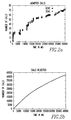
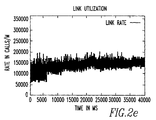
- Figures 2a-2e show plots which depict observed number of calls admitted by gcac, number of calls rejected, gcac parameters, link utilization, and vbr buffer occupancy. Note average link utilization with GCAC is around 150,000 cells/s or 40% line rate.
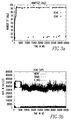
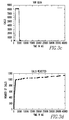
- Figures 3a-3f depicts the plots for observed number of calls admitted by GCAC, number of calls rejected, gcac parameters, link utilization, and vbr buffer occupancy. Note average link utilization with GCAC is around 150,000 cells/s or 40% line rate. From these observations, it can be concluded that for the calls being generated in this experiment, the average value of CAC was only 40% of requested value.
- the above experiment was repeated with DCAC.
- the link bandwidth available to DCAC was set to 80% of line rate.
- the idea being to reserve some bandwidth, in this case 20% line rate, to allow for admitted calls to intermittently burst up to their requested CAC parameters.
Landscapes
- Engineering & Computer Science (AREA)
- Computer Networks & Wireless Communication (AREA)
- Signal Processing (AREA)
- Data Exchanges In Wide-Area Networks (AREA)
Abstract
Description
- The present invention pertains to a switch which releases connections according to a connection's priority when a predetermined condition exists in the switch. More specifically, the present invention pertains to a switch which releases connections according to a connection's priority when an overload condition exists in the switch.
- Current call admission control (CAC) algorithms generally are based only on traffic characteristics specified by a user. However, for most connections, it is very difficult to predict the nature of traffic accurately. Typically, the traffic characteristics of such connections are either over- or under-estimated. Let us consider the impact on overall link utilization while relying on traffic characteristics specified by user. Under-estimation of traffic can lead to excess traffic to link. However, with policing/shaping of traffic at the user network interface (UNI), this situation is avoided. Over-estimation, on the other hand, can lead to the resultant traffic being lower than expected leading to under-utilization of link bandwidth.
- High-speed fast-packet-switched network architectures are capable of supporting a wide range of connections with different bandwidth requirements and traffic characteristics. Providing quality of service (QoS) in networks in terms of delay and bandwidth requires provisioning of network resources. While this environment provides increased flexibility in supporting various services, its dynamic nature poses difficult traffic control problems when trying to achieve efficient use of network resources. One such problem is the issue of bandwidth management and allocation. Due to the statistical multiplexing of all connections at the physical layer and the varying transmission rates by connections, it is important to characterize, both the effective bandwidth of a single connection and several multiplexed connections. Such characterization can be used to compute metrics for efficient bandwidth management, routing, and call control procedures. Based on statistical characteristics and desired grade of service, researchers in R. Guerin, H. Ahmadi, and M. Naghshineh. Equivalent capacity and its application to bandwidth allocation in high-speed networks. IEEE Journal on Selected Areas in Communication, 9(7) :968-981, Sept. 1991, incorporated by reference herein, have proposed approximate expressions for effective bandwidth or equivalent capacity computations.
- A CAC algorithm based on a metric of effective bandwidth, can be summarized as follows. At any given time a new connection is admitted if:
- While the above approach is simple, it relies on the user/network being able to predetermine the traffic characteristics of a connection. However, for most connections, it is very difficult to predict the nature of traffic accurately. Typically, the traffic characteristics of such connections are either over- or under-estimated. Let us consider the impact on overall link utilization while relying on traffic characteristics specified by user. Under-estimation of traffic can lead to excess traffic to link. However, with policing/shaping of traffic at the user network interface (UNI), this situation is avoided. Over-estimation, on the other hand, can lead to the resultant traffic being lower than expected leading to under-utilization of link bandwidth.
- The present invention provides a dynamic CAC to overcome the problem of under-utilization of link bandwidth. The scheme, using periodic measurements, keeps track of various utilization parameters. These include the current link utilization, the variation in link utilization, buffer occupancy, and rate of change of buffer occupancy. Based on the above measurements a dynamic estimate of the effective bandwidth of the aggregate traffic on link is computed and admittance of new calls judged based on this.
- The present invention pertains to a switch for a network. The switch comprises an input port mechanism which receives traffic of connections from the network. Each connection has a priority. The switch comprises an output port mechanism which sends traffic of connections to the network. The switch comprises a controller which serves connections and which monitors the connections received by the input port mechanism and sent by the output port mechanism and releases connections according to a connection's priority when a predetermined condition exists in the switch. The controller is connected to the input port mechanism and the output port mechanism. Each connection requests a specific bandwidth from the controller.
- The present invention pertains to a method for switching connections. The method comprises the steps of monitoring traffic of connections received by a switch. Then there is the step of releasing connections from the switch according to the connection's priority when a predetermined condition in the switch exists.
- The present invention pertains to a switch for a network. The switch comprises an input port mechanism which receives traffic of connections from the network. The switch comprises an output port mechanism which sends traffic of connections to the network. The switch comprises a controller which provides service to traffic of connections received at the input port mechanism and which are to be sent out the output port mechanism. The controller monitoring the traffic of connections received by the input port mechanism and sent out the output port mechanism and adjusting the service provided to the connections based on the traffic of connections received by the input port mechanism and sent out the output port mechanism. The controller is connected to the input port mechanism and the output port mechanism.
- The present invention pertains to a switch for a network. The switch comprises an input port mechanism which receives cells of connections from the network. The switch comprises an output port mechanism which sends cells of connections to the network. The switch comprises a buffer mechanism for storing cells. The buffer mechanism is connected to the input port mechanism and the output port mechanism. The switch comprises a controller which provides service to traffic of connections received at the input port mechanism and which are to be sent out the output port mechanism. The controller monitors the change in the number of cells in the buffer mechanism and adjusts the service provided to the connections based on the change in the number of cells in the buffer mechanism. The controller is connected to the buffer mechanism.
- The present invention pertains to a method for switching connections by a switch of a network. The method comprises the steps of monitoring the traffic of connections received by the switch and sent out the switch. Then there is the step of adjusting the service provided to the connections by the switch based on the traffic of connections received by the switch and sent out the switch.
- In the accompanying drawings, the preferred embodiment of the invention and preferred methods of practicing the invention are illustrated in which:
- Figures 1a-1g show characteristics of calls generated in simulations.
- Figures 2a-2e show plots which depict observed number of calls admitted by gcac, number of calls rejected, gcac parameters, link utilization, and vbr buffer occupancy.
- Figures 3a-3f are plots which depict observed number of calls admitted by dcac, number of calls rejected, dcac parameters, d-gcac parameters, link utilization, and vbr buffer occupancy. Note average link utilization with DCAC, remaining the pre-set 80% line rate or 292,400 cells/s, is much higher with dcac than with gcac as shown in earlier plots.
- Figure 4 is a schematic representation of a switch of the present invention.
-
- Referring now to the drawings wherein like reference numerals refer to similar or identical parts throughout the several views, and more specifically to figure 4 thereof, there is shown a
switch 10 for anetwork 12. Theswitch 10 comprises aninput port mechanism 14 which receives traffic of connections from thenetwork 12. Each connection has a priority. Theswitch 10 comprises anoutput port mechanism 16 which sends traffic of connections to thenetwork 12. Theswitch 10 comprises acontroller 18 which serves connections and which monitors the connections received by theinput port mechanism 14 and sent by theoutput port mechanism 16 and releases connections according to a connection's priority when a predetermined condition exists in theswitch 10. Thecontroller 18 is connected to theinput port mechanism 14 and theoutput port mechanism 16. Each connection requests a specific bandwidth from thecontroller 18. - Preferably, the predetermined condition includes an overload condition of the
switch 10. The overload condition preferably includes receiving more traffic on connections received by theinput port mechanism 14 than thecontroller 18 can process at a given time. Preferably, thecontroller 18 determines excess bandwidth associated with the overload condition, and thecontroller 18 releases the connection, for a given priority, with the closest match to the excess bandwidth. - The
controller 18 preferably releases connections according to the connections' traffic class, where UBR connections are released first, then ABR connections are released next, then VBR connections are released next and then CBR connections are released from theswitch 10. Preferably, theinput port mechanism 14 comprises I inputports 20 connected to thecontroller 18, where I is an integer and greater than or equal to 1; and wherein the output mechanism comprisesO output ports 22 connected to thecontroller 18, where O is an integer greater than or equal to 1. Thecontroller 18 preferably releases the connection with the lowest priority. - Preferably, the
controller 18 releases connections whose sum of requested bandwidths most closely matches the excess bandwidth. Preferably, the switch includes a buffer mechanism connected to the output port mechanism. The overload condition preferably exists if the sum of requested bandwidths of connections on an output port is greater than the output port's bandwidth and buffer resources associated with it are being exceededlink 1, and Blink is the maximum link capacity or line rate. - The present invention pertains to a method for switch 10ing connections. The method comprises the steps of monitoring traffic of connections received by a
switch 10. Then there is the step of releasing connections from theswitch 10 according to the connection's priority when a predetermined condition in theswitch 10 exists. - Preferably, the monitoring step includes the step of monitoring traffic of connections received by and sent out from the
switch 10. The releasing step preferably includes the step of releasing connections when the predetermined condition of overload exists in theswitch 10 where there is more traffic of connections received by theswitch 10 than theswitch 10 can process. - Preferably, the releasing step includes the steps of determining, when the overload condition exists, the excess bandwidth associated with the overload condition; choosing a connection, for a given priority, with the closest match to the excess bandwidth; and releasing the connection with the closest match to the excess bandwidth. The choosing step preferably includes the step of choosing the connection with the lowest priority.
- Preferably, the choosing step includes the step of choosing the connections whose sum of requested bandwidths most closely matches the excess bandwidth. The choosing step preferably includes the step of choosing a connection according to traffic class for release, where UBR connections are released first, then ABR connections are released next, then VBR connections are released next and then CBR connections are released.
- The present invention pertains to a
switch 10 for anetwork 12. Theswitch 10 comprises aninput port mechanism 14 which receives traffic of connections from thenetwork 12. Theswitch 10 comprises anoutput port mechanism 16 which sends traffic of connections to thenetwork 12. Theswitch 10 comprises acontroller 18 which provides service to traffic of connections received at theinput port mechanism 14 and which are to be sent out theoutput port mechanism 16. Thecontroller 18 monitoring the traffic of connections received by theinput port mechanism 14 and sent out theoutput port mechanism 16 and adjusting the service provided to the connections based on the traffic of connections received by theinput port mechanism 14 and sent out theoutput port mechanism 16. Thecontroller 18 is connected to theinput port mechanism 14 and theoutput port mechanism 16. - The present invention pertains to a
switch 10 for anetwork 12. Theswitch 10 comprises aninput port mechanism 14 which receives cells of connections from thenetwork 12. Theswitch 10 comprises anoutput port mechanism 16 which sends cells of connections to thenetwork 12. Theswitch 10 comprises abuffer mechanism 24 for storing cells. Thebuffer mechanism 24 is connected to theinput port mechanism 14 and theoutput port mechanism 16. Theswitch 10 comprises acontroller 18 which provides service to traffic of connections received at theinput port mechanism 14 and which are to be sent out theoutput port mechanism 16. Thecontroller 18 monitors the change in the number of cells in thebuffer mechanism 24 and adjusts the service provided to the connections based on the change in the number of cells in thebuffer mechanism 24. Thecontroller 18 is connected to thebuffer mechanism 24. - Preferably, the
controller 18 also monitors the number of cells of connections received by theinput port mechanism 14 and sent out theoutput port mechanism 16 and adjusting the service provided to the connections based also on the number of cells of connections received by theinput port mechanism 14 and sent out theoutput port mechanism 16. Thecontroller 18 preferably admits a new connection to theoutput port mechanism 16 of theswitch 10 iflink 1 on thenetwork 12 connected with theswitch 10 determined at the beginning of the current interval, and Blink is the maximum link capacity or line rate of 1. Preferably, thecontroller 18 updates Bint eff during an interval if the connection Bc eff is admitted by - The present invention pertains to a method for switching connections by a
switch 10 of anetwork 12. The method comprises the steps of monitoring the traffic of connections received by theswitch 10 and sent out theswitch 10. Then there is the step of adjusting the service provided to the connections by theswitch 10 based on the traffic of connections received by theswitch 10 and sent out theswitch 10. - Preferably, the monitoring step includes the step of monitoring the change in the number of cells in a
buffer mechanism 24 of theswitch 10 and adjusting the service provided to the connections based on the change in the number of cells in thebuffer mechanism 24. - In the operation of the invention, a dynamic CAC is used to overcome the problem of under-utilization of link bandwidth. The scheme, using periodic measurements, keeps track of various utilization parameters. These include the current link utilization, the variation in link utilization, buffer occupancy, and rate of change of buffer occupancy. Based on the above measurements a dynamic estimate of the effective bandwidth of the aggregate traffic on link, denoted by Bl act , is computed.
- A new connection with effective bandwidth, Bc eff , is admitted if:
- The above approach using measurements is more realistic and leads to link bandwidth being maximally allocated and utilized. To compare the performance of this approach with the previous approach, Bl eff is tracked based on Eqn. 1. Thus, connections can be admitted in this scheme even with Bl eff > Blink for achieving better link bandwidth utilization. The flip side to this is the possible over-allocation of link bandwidth, leading to loss in QoS of connections.
- Avoiding over-allocation in a measurement interval can be achieved in the following manner. Multiple new connections arriving between two measurements, based on Eqn. 2, will see the same last measured value of link utilization, Bl act . Thus, the bandwidth taken up by admitted connections in a measurement interval is not reflected on subsequent admissions in the same interval. The above problem is solved by keeping track of the aggregate effective bandwidth of connections admitted within the interval, denoted by Bint eff , and modifying Eqn. 2 as follows:
- Bint eff is reset to zero at the beginning of any interval, once the value of Bl act has been updated based on measurement. During the interval if a connection is admitted, the parameter Bint eff is updated as,
- For a connection being torn down, a similar adjustment to Bint eff can be made to reflect the freed up bandwidth. However, without actual per-connection usage statistics, it is not clear what the value of this credit should be. Clearly, Bc eff may be an over-estimation, and should not be used. Thus, preferably, bandwidth is chosen not to be credited for connections torn down during an interval. An accurate impact of torn-down connections is obtained at the next link rate measurement.
- Detecting and recovering from over-allocation in the long run can be accomplished. A link can also become over-allocated when some or all admitted connections send traffic corresponding to their Bc eff . The system allows for this to be detected and then recovered from. Congestion due to over-allocation is detected based on two conditions occurring: a) the buffer occupancy for VBR/CBR traffic, denoted by Q vcbr , crossing a certain high threshold, T, and b) Bl eff , computed based on Eqn. 1 being greater than Blink . The condition is expressed as:
- When over-allocation congestion is detected, recovery requires some connections to be released. A similar problem is also faced in an
ATM network 12 using Inverse Multiplexing on ATM (IMA). In IMA, a link of larger capacity is emulated using multiple smaller capacity links. For example, a 6 Mbps link can be emulated using 4 DS-1 (1.5)Mbps) links using reverse multiplexing. With one or more of these smaller capacity links going down, IMA requires the emulation to continue on the remaining active links. However, the remaining capacity may not be adequate to support all the connections. Thus, it also requires some connections to be dropped. - Currently, The ATM Forum Traffic Management Specification version 4.0, incorporated by reference herein, specifies traffic classes such as CBR, VBR, ABR, and, UBR. This classification determines the service received, in terms of rate, cell delay, and jitter, by a given connectaon in an
ATM network 12. However, there is no notion of a call release priority based on which calls can be ordered while dropping to avoid congestion. Each connection in the system has such a call release priority. Such a priority could be either specified by the user at call set-up or determined by thenetwork 12 itself based on call characteristics. - When congestion is detected based on Eqn. 4, an estimate of the excess rate causing the congestion can be estimated from the rate of change of buffer occupancy and link utilization. Calls can then be released in decreasing order of their call release priority until congestion no longer holds. To minimize the number of calls being released, for a given priority, preferably the call with the closest match to the excess bandwidth is released first.
- The details of a preferred embodiment of the algorithm is provided through the following pseudo-code.
- The LINK_MONITOR_TASK task periodically monitors the transmitted CBR/VBR cell rate on each link. The period size is determined by a parameter LINK_MON_INTRVL_SIZE. The task keeps track of the measured rates from last N_INTRVLS (window size). Every interval a mean transmission rate and variance is computed based on a weighted function of the data points. For each link the task then uses the mean and variance to compute equivalent capacity.


- The CONNECTION_ADMISSION_CONTROL routine, for a new connection with given mean, peak, and burst_size computes its equivalent capacity. It then checks if the connection can be admitted without overallocating that link. It also updates the link capacity to reflect new call admitted in between measurements as discussed above.
- To provide mutual exclusion in accessing the link capacity variables by the CONNECTION_ADMISSION_CONTROL and LINK_MONITOR_TASK task, semaphores are used. In the pseudo-code below, a single semaphore for all links in the
switch 10 is used. Other mutual exclusion mechanisms, with or without semaphores, can be envisioned. For example, even with semaphores, the granularity of mutual exclusion by associating a semaphore with each link capacity variable can be extended.

- In a preferred embodiment, two different equivalent capacity measures are kept track of. The first one based on the stationary model maintains the mean and variance (M,V) of traffic. The second method is based on a flow model maintains a parameter c ∧ as discussed in R. Guerin, H. Ahmadi, and M. Naghshineh, incorporated by reference herein. Equivalent capacity and its application to bandwidth allocation in high-
speed networks 12. IEEE Journal on Selected Areas in Communication, 9(7) :968-981, Sept. 1991, incorporated by reference herein. Both measures have the property that they are additive. Thus, for the stationary model combining two different equivalent capacities, (Ml, V1) and (M2, V2) leads to (M1 + M2, V1 + V2). Similarly, in the flow model combining two different equivalent capacities, (c ∧ 1) and (c ∧ 2) leads to(c ∧ 1+ c ∧ 2). The translation from the metric of equivalent capacity to required bandwidth (BW) is as follows. In the stationary model,

-
- Modeling Assumptions
- Traffic model
-
-
- Period between calls [O,100.00] ms
- Range of CAC_PCR [0.5,50.0] Mbps
- Range of CAC_SCR [0.45,CAC_PCR] Mbps
- Range of CAC_MBS [1 cell, 1000] us
- Mean CAC_MIS = mean CAC_MBS
- Range of ACT_PCR [0.45,CAC_PCR] Mbps
- Range of ACT_MBS [5, CAC_MBS] us
- Range of ACT_MIS [CAC_MIS, 250+CAC_MIS] us
- Range of transfer size [0.1,100] Mbits
-
-
- VBR: queue sz 256, VBR_OB 10O,
VBR_BUFF_OB 100 -
-
- Max. allowed util by VBR 0.80 LR
- Link monitoring interval 5.000000 ms
- Monitoring data maintained for 4 windows: Window weights: 0.50 0.25 0.15 0.10
-
- Figures 1a-1g show characteristics of calls generated in simulations. Plots depict distribution of pcr, scr, and mbs requested by calls during CAC. The distribution of actual pcr, scr, and mbs generated by calls are also depicted alongside. The distribution of the transfer size is also depicted. In this experiment, total number of calls generated were ≈ 45,000. Note, these statistics are for all calls, accepted/rejected.
- Figures 2a-2e show plots which depict observed number of calls admitted by gcac, number of calls rejected, gcac parameters, link utilization, and vbr buffer occupancy. Note average link utilization with GCAC is around 150,000 cells/s or 40% line rate.
- Figures 3a-3f depicts the plots for observed number of calls admitted by GCAC, number of calls rejected, gcac parameters, link utilization, and vbr buffer occupancy. Note average link utilization with GCAC is around 150,000 cells/s or 40% line rate. From these observations, it can be concluded that for the calls being generated in this experiment, the average value of CAC was only 40% of requested value.
- The above experiment was repeated with DCAC. The link bandwidth available to DCAC was set to 80% of line rate. The idea being to reserve some bandwidth, in this
case 20% line rate, to allow for admitted calls to intermittently burst up to their requested CAC parameters. - Although the invention has been described in detail in the foregoing embodiments for the purpose of illustration, it is to be understood that such detail is solely for that purpose and that variations can be made therein by those skilled in the art without departing from the spirit and scope of the invention except as it may be described by the following claims.
Claims (24)
- A switch for a network comprising:an input port mechanism which receives traffic of connections from the network, each connection having a priority;an output port mechanism which sends traffic of connections to the network; anda controller which serves connections and which monitors the connections received by the input port mechanism and sent by the output port mechanism and releases connections according to a connection's priority when a predetermined condition exists in the switch, said controller connected to the input port mechanism and the output port mechanism, each connection requesting a specific bandwidth from the controller.
- A switch as described in Claim 1 wherein the predetermined condition includes an overload condition of the switch.
- A switch as described in Claim 2 wherein the overload condition includes receiving more traffic on connections received by the input port mechanism than the controller can process at a given time.
- A switch as described in Claim 3 wherein the controller determines excess bandwidth associated with the overload condition, and the controller releases the connection, for a given priority, with the closest match to the excess bandwidth.
- A switch as described in Claim 4 wherein the controller releases connections according to the connections' traffic class, where UBR connections are released first, then ABR connections are released next, then VBR connections are released next and then CBR connections are released from the switch.
- A switch as described in Claim 5 wherein the input port mechanism comprises I input ports connected to the controller, where I is an integer and greater than or equal to 1; and wherein the output mechanism comprises O output ports connected to the controller, where O is an integer greater than or equal to 1.
- A switch as described in Claim 6 wherein the controller releases the connection with the lowest priority.
- A switch as described in Claim 7 wherein the controller releases connections whose sum of requested bandwidths most closely matches the excess bandwidth.
- A switch as described in Claim 8 including a buffer mechanism connected to the output port mechanism and wherein the overload condition exists if the sum of requested bandwidths of connections on an output port is greater than the output port's bandwidth and buffer resources associated with it are being exceeded.
- A method for switching connections comprising:monitoring traffic of connections received by a switch;releasing connections from the switch according to the connection's priority when a predetermined condition in the switch exists.
- A method as described in Claim 10 wherein the monitoring step includes the step of monitoring traffic of connections received by and sent out from the switch.
- A method as described in Claim 11 wherein the releasing step includes the step of releasing connections when the predetermined condition of overload exists in the switch where there is more traffic of connections received by the switch than the switch can process.
- A method as described in Claim 12 wherein the releasing step includes the steps of determining, when the overload condition exists, the excess bandwidth associated with the overload condition; choosing a connection, for a given priority, with the closest match to the excess bandwidth; and releasing the connection with the closest match to the excess bandwidth.
- A method as described in Claim 13 wherein the choosing step includes the step of choosing the connection with the lowest priority.
- A method as described in Claim 14 wherein the choosing step includes the step of choosing the connections whose sum of requested bandwidths most closely matches the excess bandwidth.
- A method as described in Claim 15 wherein the choosing step includes the step of choosing a connection according to traffic class for release, where UBR connections are released first, then ABR connections are released next, then VBR connections are released next and then CBR connections are released.
- A switch for a network comprising:an input port mechanism which receives traffic of connections from the network;an output port mechanism which sends traffic of connections to the network; anda controller which provides service to traffic of connections received at the input port mechanism and which are to be sent out the output port mechanism, said controller monitoring the traffic of connections received by the input port mechanism and sent out the output port mechanism and adjusting the service provided to the connections based on the traffic of connections received by the input port mechanism and sent out the output port mechanism, said controller connected to the input port mechanism and the output port mechanism.
- A switch for a network comprising:an input port mechanism which receives cells of connections from the network;an output port mechanism which sends cells of connections to the network;a buffer mechanism for storing cells, said buffer mechanism connected to the input port mechanism and the output port mechanism; anda controller which provides service to traffic of connections received at the input port mechanism and which are to be sent out the output port mechanism, said controller monitoring the change in the number of cells in the buffer mechanism and adjusting the service provided to the connections based on the change in the number of cells in the buffer mechanism, said controller connected to the buffer mechanism.
- A switch as described in Claim 18 wherein the controller also monitors the number of cells of connections received by the input port mechanism and sent out the output port mechanism and adjusting the service provided to the connections based also on the number of cells of connections received by the input port mechanism and sent out the output port mechanism.
- A switch as described in Claim 19 wherein the controller admits a new connection to the output port mechanism of the switch if
- A switch as described in Claim 20 wherein the controller updates Bint eff during an interval if the connection Bc eff is admitted by
- A switch as described in Claim 21 wherein Bact is based on current link utilization, variation in link utilization, buffer occupancy, and rate of change of buffer occupancy.
- A method for switching connections by a switch of a network comprising the steps of:monitoring the traffic of connections received by the switch and sent out the switch; andadjusting the service provided to the connections by the switch based on the traffic of connections received by the switch and sent out the switch.
- A method as described in Claim 23 wherein the monitoring step includes the step of monitoring the change in the number of cells in a buffer mechanism of the switch and adjusting the service provided to the connections based on the change in the number of cells in the buffer mechanism.
Applications Claiming Priority (2)
| Application Number | Priority Date | Filing Date | Title |
|---|---|---|---|
| US282980 | 1994-07-29 | ||
| US09/282,980 US6771648B1 (en) | 1999-03-31 | 1999-03-31 | Method and apparatus for a dynamic call admission control algorithm |
Publications (1)
| Publication Number | Publication Date |
|---|---|
| EP1041774A2 true EP1041774A2 (en) | 2000-10-04 |
Family
ID=23083972
Family Applications (1)
| Application Number | Title | Priority Date | Filing Date |
|---|---|---|---|
| EP00302447A Withdrawn EP1041774A2 (en) | 1999-03-31 | 2000-03-24 | Method and apparatus for dynamic call admission control |
Country Status (3)
| Country | Link |
|---|---|
| US (1) | US6771648B1 (en) |
| EP (1) | EP1041774A2 (en) |
| JP (1) | JP2000307610A (en) |
Cited By (1)
| Publication number | Priority date | Publication date | Assignee | Title |
|---|---|---|---|---|
| EP1471764A3 (en) * | 2003-04-22 | 2005-06-08 | NTT DoCoMo, Inc. | Call-admission controller and method of call-admission control |
Families Citing this family (19)
| Publication number | Priority date | Publication date | Assignee | Title |
|---|---|---|---|---|
| GB9822550D0 (en) * | 1998-10-15 | 1998-12-09 | British Telecomm | Computer communications |
| FI107505B (en) * | 1999-02-16 | 2001-08-15 | Nokia Networks Oy | Access control procedure |
| US20090219879A1 (en) * | 1999-05-21 | 2009-09-03 | Wi-Lan, Inc. | Method and apparatus for bandwidth request/grant protocols in a wireless communication system |
| US7006530B2 (en) | 2000-12-22 | 2006-02-28 | Wi-Lan, Inc. | Method and system for adaptively obtaining bandwidth allocation requests |
| US8462810B2 (en) | 1999-05-21 | 2013-06-11 | Wi-Lan, Inc. | Method and system for adaptively obtaining bandwidth allocation requests |
| US6925068B1 (en) | 1999-05-21 | 2005-08-02 | Wi-Lan, Inc. | Method and apparatus for allocating bandwidth in a wireless communication system |
| US6898180B2 (en) * | 1999-06-08 | 2005-05-24 | Nokia Corporation | Connection admission in a communications network |
| JP3407696B2 (en) * | 1999-07-13 | 2003-05-19 | 日本電気株式会社 | ATM exchange and call acceptance processing method |
| DE10063390A1 (en) * | 2000-12-19 | 2002-06-20 | Bosch Gmbh Robert | Method for controlling connections in a communication system therefor |
| US7363371B2 (en) * | 2000-12-28 | 2008-04-22 | Nortel Networks Limited | Traffic flow management in a communications network |
| KR100736937B1 (en) | 2001-02-06 | 2007-07-10 | 삼성전자주식회사 | Traffic performance analysis apparatus and method of ATM switch and ATM switching system using the same |
| US6956857B2 (en) * | 2001-09-24 | 2005-10-18 | Lucent Technologies Inc. | Guaranteed admission and incremental bandwidth allocation in a packet network |
| US7353538B2 (en) * | 2002-11-08 | 2008-04-01 | Federal Network Systems Llc | Server resource management, analysis, and intrusion negation |
| US7369559B2 (en) * | 2003-10-06 | 2008-05-06 | Cisco Technology Inc. | Adaptive call admission control for calls handled over a compressed clear channel |
| CN1926905A (en) * | 2004-04-08 | 2007-03-07 | 诺基亚公司 | Controlling transmission resources in mobile wireless systems with dual transmission modes |
| US7630392B2 (en) * | 2005-05-31 | 2009-12-08 | Cisco Technology, Inc. | Multi-homing using controlled route leakage at a backup service provider |
| JP4606333B2 (en) * | 2005-09-20 | 2011-01-05 | 富士通株式会社 | Routing control method |
| US8089870B2 (en) * | 2009-07-22 | 2012-01-03 | Cisco Technology, Inc. | QoE based admission control |
| JP6117512B2 (en) * | 2012-10-26 | 2017-04-19 | エヌ・ティ・ティ・コミュニケーションズ株式会社 | Edge node device, resource control method, and program |
Family Cites Families (19)
| Publication number | Priority date | Publication date | Assignee | Title |
|---|---|---|---|---|
| JPH05160851A (en) * | 1991-12-04 | 1993-06-25 | Nec Corp | Electronic exchange method for asynchronous transfer mode communication system |
| JPH05336165A (en) * | 1992-06-03 | 1993-12-17 | Nec Corp | Voice packet priority connection system |
| JPH06177879A (en) * | 1992-12-08 | 1994-06-24 | Nippon Telegr & Teleph Corp <Ntt> | Network congestion control method |
| KR100293920B1 (en) * | 1993-06-12 | 2001-09-17 | 윤종용 | Apparatus and method for controlling traffic of atm user network interface |
| JPH0758748A (en) * | 1993-08-10 | 1995-03-03 | Nippon Telegr & Teleph Corp <Ntt> | Congestion elimination ATM exchange and congestion elimination control method in ATM exchange |
| EP0714192A1 (en) * | 1994-11-24 | 1996-05-29 | International Business Machines Corporation | Method for preempting connections in high speed packet switching networks |
| JPH08307420A (en) * | 1995-03-03 | 1996-11-22 | Fujitsu Ltd | Congestion control method in cell switching |
| JP3162975B2 (en) * | 1995-10-16 | 2001-05-08 | 株式会社日立製作所 | ATM switch using discard priority control management system |
| JP3652759B2 (en) * | 1995-11-27 | 2005-05-25 | 富士通株式会社 | Packet flow monitoring and control method |
| JP3644108B2 (en) * | 1995-12-19 | 2005-04-27 | ソニー株式会社 | Call system, connection device, communication terminal device, and call method |
| JPH1013426A (en) * | 1996-06-21 | 1998-01-16 | Fujitsu Ltd | Automatic virtual path setting method in loop type ATM network |
| US6144639A (en) * | 1996-09-03 | 2000-11-07 | Sbc Technology Resources, Inc. | Apparatus and method for congestion control in high speed networks |
| US5953338A (en) * | 1996-12-13 | 1999-09-14 | Northern Telecom Limited | Dynamic control processes and systems for asynchronous transfer mode networks |
| US6097722A (en) * | 1996-12-13 | 2000-08-01 | Nortel Networks Corporation | Bandwidth management processes and systems for asynchronous transfer mode networks using variable virtual paths |
| US6046981A (en) * | 1997-02-28 | 2000-04-04 | Nec Usa, Inc. | Multi-class connection admission control method for Asynchronous Transfer Mode (ATM) switches |
| US6141322A (en) * | 1997-05-09 | 2000-10-31 | General Datacomm, Inc. | Method and apparatus for precedence and preemption in ATM connection admission control |
| US6160818A (en) * | 1997-07-17 | 2000-12-12 | At &T Corp | Traffic management in packet communication networks having service priorities and employing effective bandwidths |
| KR100248410B1 (en) * | 1997-12-22 | 2000-03-15 | 이계철 | Call control method using AT call call gap method |
| US6459681B1 (en) * | 1998-11-13 | 2002-10-01 | Sprint Communications Company L.P. | Method and system for connection admission control |
-
1999
- 1999-03-31 US US09/282,980 patent/US6771648B1/en not_active Expired - Lifetime
-
2000
- 2000-03-24 EP EP00302447A patent/EP1041774A2/en not_active Withdrawn
- 2000-03-30 JP JP2000093705A patent/JP2000307610A/en active Pending
Cited By (2)
| Publication number | Priority date | Publication date | Assignee | Title |
|---|---|---|---|---|
| EP1471764A3 (en) * | 2003-04-22 | 2005-06-08 | NTT DoCoMo, Inc. | Call-admission controller and method of call-admission control |
| US7388832B2 (en) | 2003-04-22 | 2008-06-17 | Ntt Docomo, Inc. | Call-admission controller and method of call-admission control |
Also Published As
| Publication number | Publication date |
|---|---|
| JP2000307610A (en) | 2000-11-02 |
| US6771648B1 (en) | 2004-08-03 |
Similar Documents
| Publication | Publication Date | Title |
|---|---|---|
| US6771648B1 (en) | Method and apparatus for a dynamic call admission control algorithm | |
| EP0643514B1 (en) | Dynamic bandwidth estimation and adaptation for packet communications networks | |
| US6788646B1 (en) | Link capacity sharing for throughput-blocking optimality | |
| JP3070677B2 (en) | Multi-class connection admission control method for asynchronous transfer mode (ATM) switch and ATM switch | |
| US7266122B1 (en) | System and method for allocating bandwidth in a communications environment | |
| US6400685B1 (en) | Heterogenous traffic connection admission control system for ATM networks and a method thereof | |
| US6442138B1 (en) | Method and apparatus for controlling admission of connection requests | |
| US6459681B1 (en) | Method and system for connection admission control | |
| US6304551B1 (en) | Real-time estimation and dynamic renegotiation of UPC values for arbitrary traffic sources in ATM networks | |
| US6512743B1 (en) | Bandwidth allocation for ATM available bit rate service | |
| US6243359B1 (en) | Methods and apparatus for managing traffic in an atm network | |
| Rosenberg et al. | Functionality at the edge: Designing scalable multiservice ATM networks | |
| US7542416B2 (en) | Connection admission control for bursty real-time traffic in a network with multiple service classes | |
| JP3087941B2 (en) | ATM communication network | |
| KR100319457B1 (en) | Traffic control method for ATM switches | |
| EP0979022B1 (en) | Method and apparatus for a simple explicit rate indication algorithm (SERIA) | |
| Braun et al. | Performance evaluation of dynamic and static bandwidth management methods for ATM networks | |
| Fulp et al. | Dynamic bandwidth allocation techniques | |
| JP2000124916A (en) | ABR service quality estimation device | |
| Zhang | A congestion control method for real-time applications in ATM networks | |
| Cheah et al. | Application of rate and buffer occupancy measurements in congestion detection and management: a simulation study | |
| Schwamb et al. | Performance analysis of a dynamic bandwidth allocation algorithm in a circuit-switched communications network | |
| Chew et al. | Active fairness: improved fairness with dynamic VC weights and generalized fairness in the ATM ABR service | |
| Hussain et al. | An explicit rate ABR algorithm for new‐generation ATM switches | |
| WO2000005846A1 (en) | Explicit rate abr algorithm for use in an atm switch |
Legal Events
| Date | Code | Title | Description |
|---|---|---|---|
| PUAI | Public reference made under article 153(3) epc to a published international application that has entered the european phase |
Free format text: ORIGINAL CODE: 0009012 |
|
| AK | Designated contracting states |
Kind code of ref document: A2 Designated state(s): AT BE CH CY DE DK ES FI FR GB GR IE IT LI LU MC NL PT SE |
|
| AX | Request for extension of the european patent |
Free format text: AL;LT;LV;MK;RO;SI |
|
| RIN1 | Information on inventor provided before grant (corrected) |
Inventor name: BASAK, DEBASHIS Inventor name: KIM, HYONG S. |
|
| RAP1 | Party data changed (applicant data changed or rights of an application transferred) |
Owner name: MARCONI COMMUNICATIONS, INC. |
|
| RAP1 | Party data changed (applicant data changed or rights of an application transferred) |
Owner name: MARCONI INTELLECTUAL PROPERTY (RINGFENCE) INC. |
|
| STAA | Information on the status of an ep patent application or granted ep patent |
Free format text: STATUS: THE APPLICATION IS DEEMED TO BE WITHDRAWN |
|
| 18D | Application deemed to be withdrawn |
Effective date: 20031001 |