EP1041132A2 - Luminescent organic material for light-emitting devices - Google Patents
Luminescent organic material for light-emitting devices Download PDFInfo
- Publication number
- EP1041132A2 EP1041132A2 EP00106874A EP00106874A EP1041132A2 EP 1041132 A2 EP1041132 A2 EP 1041132A2 EP 00106874 A EP00106874 A EP 00106874A EP 00106874 A EP00106874 A EP 00106874A EP 1041132 A2 EP1041132 A2 EP 1041132A2
- Authority
- EP
- European Patent Office
- Prior art keywords
- light
- thienyl
- luminescent
- organic material
- dioxide
- Prior art date
- Legal status (The legal status is an assumption and is not a legal conclusion. Google has not performed a legal analysis and makes no representation as to the accuracy of the status listed.)
- Ceased
Links
Images
Classifications
-
- C—CHEMISTRY; METALLURGY
- C09—DYES; PAINTS; POLISHES; NATURAL RESINS; ADHESIVES; COMPOSITIONS NOT OTHERWISE PROVIDED FOR; APPLICATIONS OF MATERIALS NOT OTHERWISE PROVIDED FOR
- C09K—MATERIALS FOR MISCELLANEOUS APPLICATIONS, NOT PROVIDED FOR ELSEWHERE
- C09K11/00—Luminescent materials, e.g. electroluminescent or chemiluminescent
- C09K11/06—Luminescent materials, e.g. electroluminescent or chemiluminescent containing organic luminescent materials
Definitions
- the present invention relates to a luminescent organic material for light-emitting devices, in particular, organic LEDs.
- the luminescent organic materials such as PPV and Alq3, currently used for making thin films in light-emitting devices, such as light-emitting diodes or LEDs, have numerous drawbacks.
- LEDs light-emitting devices, in particular, LEDs, designed to eliminate the aforementioned drawbacks, and which, in particular, make encapsulation and the insertion of metal contacts superfluous, enable LEDs to be made of organic material and using the same class of material for all the emission wavelengths in the visible spectrum, are more reliable, and are easier to produce.
- a luminescent material for light-emitting devices comprising at least one thienyl-S,S-dioxide unit.
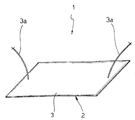
- Number 1 in Figure 1 indicates as a whole an organic LED comprising a support 2, for instance a plastic foil, a film 3 on a side of the support 2 and respective power supplying elements; the film 3 is made of a material containing at least one thienyl-S,S-dioxide unit and directly incorporates the elements 3, without the necessity of contacting and welding; if the film 3 is self-supporting, the support 2 may be avoided.
- tiophene based materials may be selectively oxidised at the thienyl sulfurs to the corresponding thiophene-S,S-dioxides by reactions already described in the literature and therefore not reported in details.
- Thiophene-based molecules can be properly engineered by controlling the length of the chain and by inserting some functional groups, in order to tune the HOMO-LUMO gap from the blue to the red, resulting in the unprecedentedly wide tunability of the emitted light.
- thienyl-S,S-dioxide based materials have an high quantum efficiency and also the following properties: wide spectral tunability, no degradation in time (thus avoiding the requirement of encapsulation), completely plastic device (no metal contacts) suitable for technologies over plastic substrates.
- Thienyl-S,S-dioxide materials may therefore be used in thin films useful in organic light emitters.
- Thienyl-S,S-dioxide materials show the highest photoluminesce efficiency ever measured for thiophene based materials in the solid state.
- the obtained values (mainly > 37%) are even higher than that of the organic luminescent materials which are currently under investigation for application in organic electroluminescent devices.
- Main features of the thienyl-S,S-dioxide materials according to the present invention are the functionalization of the thienyl sulfur with oxygen atoms (in order to modify the HOMO and LUMO energies and to facilitate charge injection), which is carried out such as the material comprises at least one thiophene ring in the ⁇ position of the ring of said thienyl-S,S-dioxide and grafting some alkyl substituents in the ⁇ position of the ring of said thienyl-S,S-dioxide to prevent the formation of planar or partly planar structures (in order to avoid ⁇ , ⁇ stacking), leading to unprecedently efficient photoluminescence.
- the oligomers containing a thienyl-S,S-dioxide moiety are characterized by much greater electron affinities and slightly higher oxidation potentials than their 'fully aromatic' counterparts. This results in a substantial enhancement of the electron injection capability of the compound, With strong impact on the electrical performance of the device.
- the oxygen atoms modify the self organization properties of the molecules in the solid state.
- the molecular packing of these new molecules is characterized by the presence of a number of extremely short van der Waals separations, all involving the oxygen atoms.
- the peculiar molecular packing causes a strong enhancement of the quantum efficiency of the thiophene solid films.
- thienyl-S,S-dioxide based materials allow to achieve all the modifications needed to optimize the electronic properties and the solid state morphology of thiophenes required for LED applications.
- the luminescent material used in the organic LED according to the present invention provides for wide tunability of the energy emitted, from blue to infrared, and high quantum efficiency.
- functionalizing the sulfur in the thiophene ring with oxygen atoms provides for increasing the electron affinity of the molecule to ensure improved electron injection; increasing ionization potential to make the molecule more stable with respect to water and oxygen; modulating HOMO and LUMO energies and the HOMO-LUMO energy gap by appropriately alternating modified and non modified thiopehene rings.
- oligothiophenes of appropriate length and symmetry provides for maintaining or increasing intrinsic quantum efficiency and for modulating the wavelength of the emitted light.
Landscapes
- Chemical & Material Sciences (AREA)
- Engineering & Computer Science (AREA)
- Materials Engineering (AREA)
- Organic Chemistry (AREA)
- Electroluminescent Light Sources (AREA)
- Compositions Of Macromolecular Compounds (AREA)
- Luminescent Compositions (AREA)
- Heterocyclic Carbon Compounds Containing A Hetero Ring Having Oxygen Or Sulfur (AREA)
Abstract
Description
- The present invention relates to a luminescent organic material for light-emitting devices, in particular, organic LEDs.
- The luminescent organic materials, such as PPV and Alq3, currently used for making thin films in light-emitting devices, such as light-emitting diodes or LEDs, have numerous drawbacks.
- These are normally solved by encapsulating the materials and inserting metal contacts embedded in the films.
- Moreover, the quantum efficiency and emission wavelength tunability of known materials are poor.
- Research is therefore being conducted into materials enabling organic LEDs to be made entirely of plastic material.
- It is therefore an object of the present invention to provide light-emitting devices, in particular, LEDs, designed to eliminate the aforementioned drawbacks, and which, in particular, make encapsulation and the insertion of metal contacts superfluous, enable LEDs to be made of organic material and using the same class of material for all the emission wavelengths in the visible spectrum, are more reliable, and are easier to produce.
- According to the present invention, there is provided a luminescent material for light-emitting devices, comprising at least one thienyl-S,S-dioxide unit.
- The present invention is described in detail below, with reference also to the accompanying drawing showing a view in perspective of an organic LED in accordance with the present invention.
-
Number 1 in Figure 1 indicates as a whole an organic LED comprising asupport 2, for instance a plastic foil, afilm 3 on a side of thesupport 2 and respective power supplying elements; thefilm 3 is made of a material containing at least one thienyl-S,S-dioxide unit and directly incorporates theelements 3, without the necessity of contacting and welding; if thefilm 3 is self-supporting, thesupport 2 may be avoided. - It is well known that tiophene based materials may be selectively oxidised at the thienyl sulfurs to the corresponding thiophene-S,S-dioxides by reactions already described in the literature and therefore not reported in details.
- Thiophene-based molecules can be properly engineered by controlling the length of the chain and by inserting some functional groups, in order to tune the HOMO-LUMO gap from the blue to the red, resulting in the unprecedentedly wide tunability of the emitted light.
- It has been surprisingly found that thienyl-S,S-dioxide based materials have an high quantum efficiency and also the following properties: wide spectral tunability, no degradation in time (thus avoiding the requirement of encapsulation), completely plastic device (no metal contacts) suitable for technologies over plastic substrates.
- Thienyl-S,S-dioxide materials may therefore be used in thin films useful in organic light emitters.
- Thienyl-S,S-dioxide materials show the highest photoluminesce efficiency ever measured for thiophene based materials in the solid state. The obtained values (mainly > 37%) are even higher than that of the organic luminescent materials which are currently under investigation for application in organic electroluminescent devices.
- Main features of the thienyl-S,S-dioxide materials according to the present invention are the functionalization of the thienyl sulfur with oxygen atoms (in order to modify the HOMO and LUMO energies and to facilitate charge injection), which is carried out such as the material comprises at least one thiophene ring in the α position of the ring of said thienyl-S,S-dioxide and grafting some alkyl substituents in the β position of the ring of said thienyl-S,S-dioxide to prevent the formation of planar or partly planar structures (in order to avoid π,π stacking), leading to unprecedently efficient photoluminescence.
- The insertion of one non-aromatic thienyl-S,S-dioxide unit within the skeleton of an oligothiophene does not modify the π,π* character of the frontier orbitals but decreases their energy and that of the LUMO more than that of the HOMO.
- The oligomers containing a thienyl-S,S-dioxide moiety are characterized by much greater electron affinities and slightly higher oxidation potentials than their 'fully aromatic' counterparts. This results in a substantial enhancement of the electron injection capability of the compound, With strong impact on the electrical performance of the device.
- Furthermore, the oxygen atoms modify the self organization properties of the molecules in the solid state. Indeed, the molecular packing of these new molecules is characterized by the presence of a number of extremely short van der Waals separations, all involving the oxygen atoms. The peculiar molecular packing causes a strong enhancement of the quantum efficiency of the thiophene solid films.
- In conclusion, thienyl-S,S-dioxide based materials allow to achieve all the modifications needed to optimize the electronic properties and the solid state morphology of thiophenes required for LED applications.
- The advantages of the luminescent material according to the present invention will be clear from the foregoing description.
- In this way one can envisage the application of a new generation of solid state thiophene films for high-efficiency, colour-tunable LEDs operating with reduced currents and without relevant problems of chemical stability.
In particular, the luminescent material used in the organic LED according to the present invention provides for wide tunability of the energy emitted, from blue to infrared, and high quantum efficiency. - Moreover, functionalizing the sulfur in the thiophene ring with oxygen atoms provides for increasing the electron affinity of the molecule to ensure improved electron injection; increasing ionization potential to make the molecule more stable with respect to water and oxygen; modulating HOMO and LUMO energies and the HOMO-LUMO energy gap by appropriately alternating modified and non modified thiopehene rings.
- Moreover, inserting a thiophene ring functionalized with oxygen atoms in oligothiophenes of appropriate length and symmetry provides for maintaining or increasing intrinsic quantum efficiency and for modulating the wavelength of the emitted light.
- Finally, functionalizing modified oligothiophenes by insertion of appropriate alkyl substituents prevents π-π stacking and the formation of planar or partly planar structures in the oligothiophene films.
- The invention will now be described with reference to examples, however, it should be observed that several modifications obvious for the specialist are possible within the framework of the idea of the invention.
- In table 1 the properties are compared of known luminescent materials for LEDs and of the new materials according to the present invention.
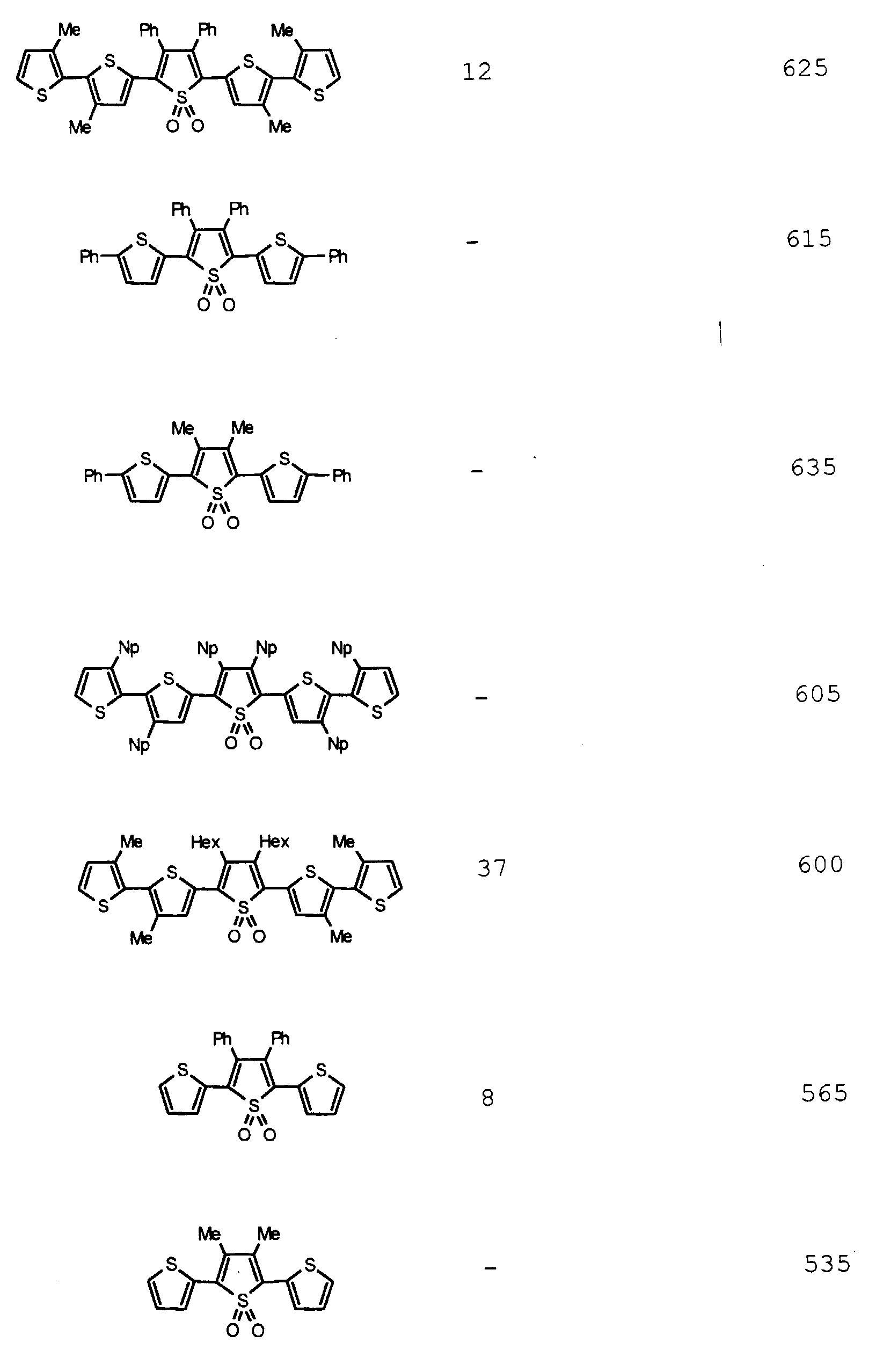
Quantum Efficiency Electrical Conductivity Degradation Processing Tunability Thiophenes Low Good No Easy Yes PPV High Low Yes Encapsulation + contacts Weak Al(q3) High Low Weak Encapsulation + contacts No - In table 2 are reported molecular structure, fluorescence frequencies and efficiency of selected oligothiophene-S,S-dioxides which have been obtained according to the present invention, operating in conventional manner the necessary chemical reactions, which are accordingly not reported.


Claims (8)
- A luminescent organic material for light-emitting devices, characterized by comprising at least one thienyl-S,S-dioxide unit.
- A luminescent organic material as claimed in Claim 1, characterized by comprising at least one thiophene ring in the α position of the ring of said thienyl-S,S-dioxide.
- A luminescent organic material as claimed in Claim 2, characterized by having at least one alkyl or aryl substituent in the β position of the ring of said thienyl-S,S-dioxide.
- A luminescent organic material as claimed in Claim 3, characterized in that said alkyl substituents are of such a form as to prevent π-π stacking and the formation of planar or partly planar structures.
- A luminescent organic material for light-emitting devices, characterized by comprising at least one substance selected from the group consisting of :
 wherein Me = methyl; Hex = n-hexyl; Np = neo-pentyl; Ph = phenyl; Ph-Ph = p-biphenyl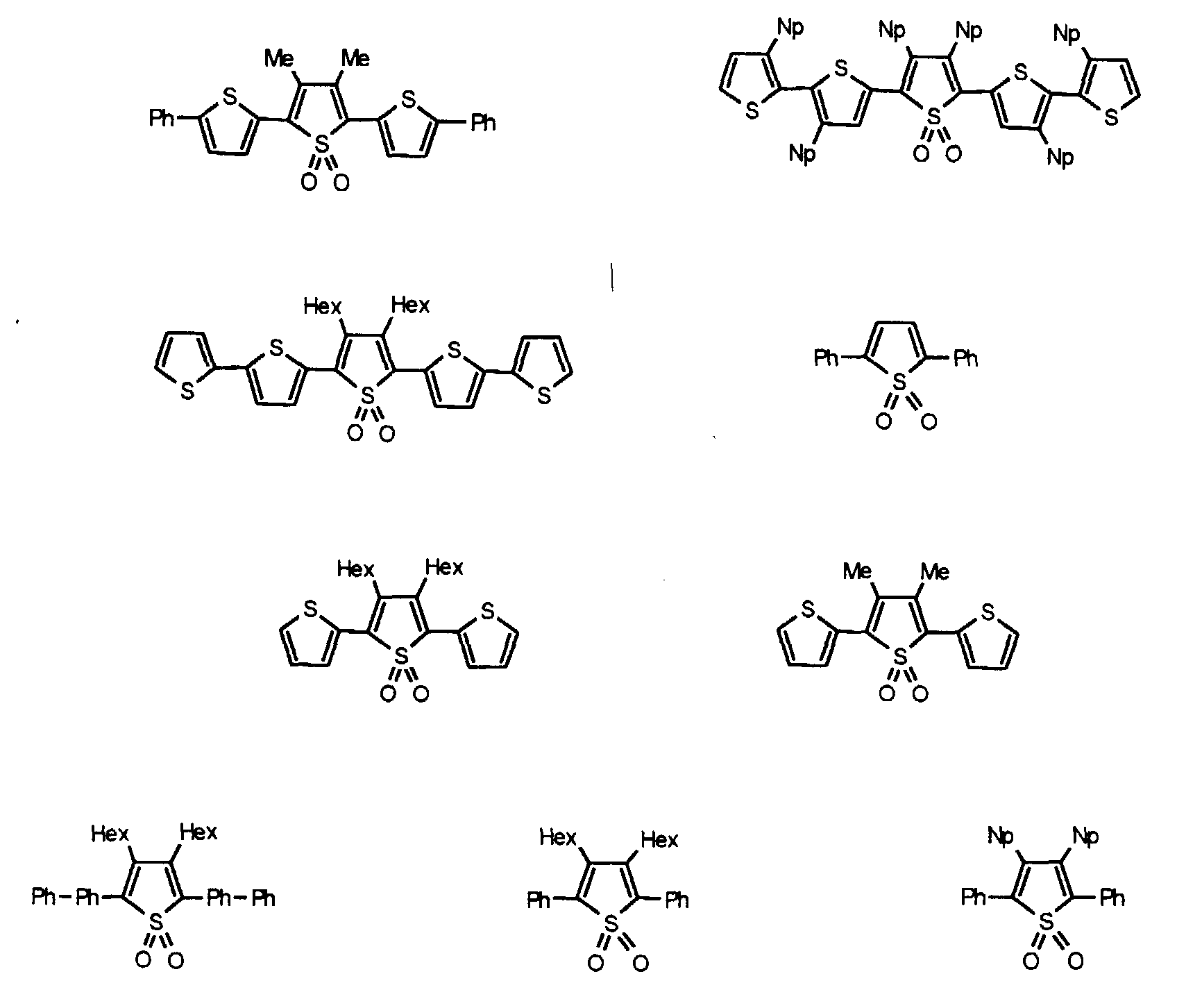
- Use of a luminescent material as claimed in Claims 1 to 5 in contacts.
- Use of a luminescent material as claimed in Claims 1 to 5 in organic LEDs.
- A light-emitting diode comprising a luminescent material, characterized in that said luminescent material comprises at least a thienyl-S,S-dioxide.
Applications Claiming Priority (2)
| Application Number | Priority Date | Filing Date | Title |
|---|---|---|---|
| IT1999BA000010 IT1307890B1 (en) | 1999-04-01 | 1999-04-01 | MODIFIED OLIGOTIOPHENES WITH HIGH QUANTUM LUMINESCENCE EFFICIENCY FOR ORGANIC LEDS. |
| ITBA990010 | 1999-04-01 |
Publications (2)
| Publication Number | Publication Date |
|---|---|
| EP1041132A2 true EP1041132A2 (en) | 2000-10-04 |
| EP1041132A3 EP1041132A3 (en) | 2000-11-08 |
Family
ID=11335957
Family Applications (1)
| Application Number | Title | Priority Date | Filing Date |
|---|---|---|---|
| EP00106874A Ceased EP1041132A3 (en) | 1999-04-01 | 2000-03-30 | Luminescent organic material for light-emitting devices |
Country Status (2)
| Country | Link |
|---|---|
| EP (1) | EP1041132A3 (en) |
| IT (1) | IT1307890B1 (en) |
Cited By (3)
| Publication number | Priority date | Publication date | Assignee | Title |
|---|---|---|---|---|
| US6927298B2 (en) | 2002-09-02 | 2005-08-09 | Agfa-Gevaert | 3,4-alkylenedioxythiophenedioxide compounds and polymers comprising monomeric units thereof |
| CN103897154A (en) * | 2012-12-27 | 2014-07-02 | 海洋王照明科技股份有限公司 | Polymer containing thiophene sulfone and preparation method thereof, and organic electroluminescent device |
| CN103896931A (en) * | 2012-12-27 | 2014-07-02 | 海洋王照明科技股份有限公司 | Organic semiconductor material and preparation method thereof, and electroluminescent device |
-
1999
- 1999-04-01 IT IT1999BA000010 patent/IT1307890B1/en active
-
2000
- 2000-03-30 EP EP00106874A patent/EP1041132A3/en not_active Ceased
Non-Patent Citations (6)
Cited By (4)
| Publication number | Priority date | Publication date | Assignee | Title |
|---|---|---|---|---|
| US6927298B2 (en) | 2002-09-02 | 2005-08-09 | Agfa-Gevaert | 3,4-alkylenedioxythiophenedioxide compounds and polymers comprising monomeric units thereof |
| CN103897154A (en) * | 2012-12-27 | 2014-07-02 | 海洋王照明科技股份有限公司 | Polymer containing thiophene sulfone and preparation method thereof, and organic electroluminescent device |
| CN103896931A (en) * | 2012-12-27 | 2014-07-02 | 海洋王照明科技股份有限公司 | Organic semiconductor material and preparation method thereof, and electroluminescent device |
| CN103897154B (en) * | 2012-12-27 | 2016-05-11 | 海洋王照明科技股份有限公司 | Contain polymer of thiophene sulfone and preparation method thereof and organic electroluminescence device |
Also Published As
| Publication number | Publication date |
|---|---|
| EP1041132A3 (en) | 2000-11-08 |
| ITBA990010A1 (en) | 2000-10-01 |
| IT1307890B1 (en) | 2001-11-19 |
Similar Documents
| Publication | Publication Date | Title |
|---|---|---|
| Nannen et al. | Light‐Emitting Electrochemical Cells Based on Color‐Tunable Inorganic Colloidal Quantum Dots | |
| Kang et al. | Highly improved quantum efficiency in blend polymer LEDs | |
| CN108389982B (en) | LED device and display device | |
| Zhang et al. | Organic light‐emitting transistors: materials, device configurations, and operations | |
| Sekine et al. | Recent progress of high performance polymer OLED and OPV materials for organic printed electronics | |
| Fadhel et al. | Tunable organophosphorus dopants for bright white organic light-emitting diodes with simple structures | |
| Ostrowski et al. | Near‐Infrared Electroluminescent Light‐Emitting Devices Based on Ethyne‐Bridged Porphyrin Fluorophores | |
| Pei et al. | Bright blue electroluminescence from an oxadiazole‐containing copolymer | |
| US20060093852A1 (en) | Phosphorescent and luminescent conjugated polymers and their use in electroluminescent assemblies | |
| Yao et al. | Aromatic s-heterocycle and fluorene derivatives as solution-processed blue fluorescent emitters: Structure–property relationships for different sulfur oxidation states | |
| Bolink et al. | Highly phosphorescent perfect green emitting iridium (III) complex for application in OLEDs | |
| CA2333731A1 (en) | Organometallic complex molecule and organic electroluminescent device using the same | |
| CN102738413B (en) | A kind of organic electroluminescence device and preparation method thereof | |
| KR101292715B1 (en) | Compound for organic electroluminescence and organic electroluminescent device | |
| JP2009170819A (en) | Fluorene derivative and organic electroluminescent device containing the same | |
| JP4227628B2 (en) | Compound and organic light emitting device | |
| Matsuo et al. | Synthesis, Electrochemical and Photophysical Properties, and Electroluminescent Performance of the Octa‐and Deca (aryl)[60] fullerene Derivatives | |
| JP2009170818A (en) | Quinoxaline derivative and organic electroluminescent device containing the same | |
| Pedersen et al. | Dianthracenylazatrioxa [8] circulene: synthesis, characterization and application in OLEDs | |
| JP5620163B2 (en) | Organic thin film electroluminescent element, lighting device and self-assembled monolayer material used therefor | |
| US20020128492A1 (en) | Luminescent organic material for light-emitting devices | |
| JP2009170813A (en) | Organic electroluminescence device | |
| Suzuki et al. | Electroluminescent features of oligothiophenes dispersed as a dopant in host matrices | |
| JP7030276B2 (en) | Semiconductor fine particle compositions and quantum dots, coating liquids and ink compositions containing them, inkjet inks, and coatings and printed materials using them, wavelength conversion films, color filters, light emitting elements | |
| Thakur et al. | Solution-processed hybrid hosts: a way to explore high triplet energy with admirable current and power efficiency without outcoupling techniques for phosphorescent OLEDs |
Legal Events
| Date | Code | Title | Description |
|---|---|---|---|
| PUAI | Public reference made under article 153(3) epc to a published international application that has entered the european phase |
Free format text: ORIGINAL CODE: 0009012 |
|
| PUAL | Search report despatched |
Free format text: ORIGINAL CODE: 0009013 |
|
| AK | Designated contracting states |
Kind code of ref document: A2 Designated state(s): AT BE CH CY DE DK ES FI FR GB GR IE IT LI LU MC NL PT SE |
|
| AX | Request for extension of the european patent |
Free format text: AL;LT;LV;MK;RO;SI |
|
| RIC1 | Information provided on ipc code assigned before grant |
Free format text: 7C 09K 11/06 A, 7H 05B 33/14 B, 7H 01L 51/20 B |
|
| AK | Designated contracting states |
Kind code of ref document: A3 Designated state(s): AT BE CH CY DE DK ES FI FR GB GR IE IT LI LU MC NL PT SE |
|
| AX | Request for extension of the european patent |
Free format text: AL;LT;LV;MK;RO;SI |
|
| RAP1 | Party data changed (applicant data changed or rights of an application transferred) |
Owner name: CONSIGLIO NAZIONALE DELLE RICERCHE Owner name: ISTITUTO NAZIONALE PER LA FISICA DELLA MATERIA |
|
| RIN1 | Information on inventor provided before grant (corrected) |
Inventor name: ZAMBIANCHI, MASSIMO Inventor name: GIGLI, GIUSEPPE Inventor name: CINGOLANI, ROBERTO Inventor name: BARBARELLA, GIOVANNA Inventor name: FAVARETTO, LAURA |
|
| RIN1 | Information on inventor provided before grant (corrected) |
Inventor name: GIGLI, GIUSEPPE UNIVERSITA DI LECCE Inventor name: FAVARETTO, LAURA Inventor name: ZAMBIANCHI, MASSIMO Inventor name: CINGOLANI, ROBERTO C/O UNIVERSITA DI LECCE Inventor name: BARBARELLA, GIOVANNA |
|
| 17P | Request for examination filed |
Effective date: 20010403 |
|
| AKX | Designation fees paid |
Free format text: AT BE CH CY DE DK ES FI FR GB GR IE IT LI LU MC NL PT SE |
|
| AXX | Extension fees paid |
Free format text: AL PAYMENT 20010403;LT PAYMENT 20010403;LV PAYMENT 20010403;MK PAYMENT 20010403;RO PAYMENT 20010403;SI PAYMENT 20010403 |
|
| 17Q | First examination report despatched |
Effective date: 20011115 |
|
| STAA | Information on the status of an ep patent application or granted ep patent |
Free format text: STATUS: THE APPLICATION HAS BEEN REFUSED |
|
| 18R | Application refused |
Effective date: 20040202 |