EP1041122A1 - Reactive dyes, process for their preparation and their use - Google Patents
Reactive dyes, process for their preparation and their use Download PDFInfo
- Publication number
- EP1041122A1 EP1041122A1 EP00810235A EP00810235A EP1041122A1 EP 1041122 A1 EP1041122 A1 EP 1041122A1 EP 00810235 A EP00810235 A EP 00810235A EP 00810235 A EP00810235 A EP 00810235A EP 1041122 A1 EP1041122 A1 EP 1041122A1
- Authority
- EP
- European Patent Office
- Prior art keywords
- formula
- radical
- alkyl
- substituted
- hydrogen
- Prior art date
- Legal status (The legal status is an assumption and is not a legal conclusion. Google has not performed a legal analysis and makes no representation as to the accuracy of the status listed.)
- Granted
Links
- 239000000985 reactive dye Substances 0.000 title claims abstract description 32
- 238000000034 method Methods 0.000 title claims description 20
- 238000002360 preparation method Methods 0.000 title claims description 4
- -1 carboxy, sulfo Chemical group 0.000 claims abstract description 115
- 125000004178 (C1-C4) alkyl group Chemical group 0.000 claims abstract description 51
- 125000000229 (C1-C4)alkoxy group Chemical group 0.000 claims abstract description 40
- 229910052736 halogen Inorganic materials 0.000 claims abstract description 38
- 229910052739 hydrogen Inorganic materials 0.000 claims abstract description 38
- 239000001257 hydrogen Substances 0.000 claims abstract description 37
- 125000004435 hydrogen atom Chemical group [H]* 0.000 claims abstract description 29
- 125000001309 chloro group Chemical group Cl* 0.000 claims abstract description 25
- 238000004043 dyeing Methods 0.000 claims abstract description 24
- 125000000391 vinyl group Chemical group [H]C([*])=C([H])[H] 0.000 claims abstract description 23
- 229920002554 vinyl polymer Polymers 0.000 claims abstract description 22
- UHOVQNZJYSORNB-UHFFFAOYSA-N Benzene Chemical compound C1=CC=CC=C1 UHOVQNZJYSORNB-UHFFFAOYSA-N 0.000 claims abstract description 21
- 125000001997 phenyl group Chemical group [H]C1=C([H])C([H])=C(*)C([H])=C1[H] 0.000 claims abstract description 21
- 125000002887 hydroxy group Chemical group [H]O* 0.000 claims abstract description 20
- 125000005843 halogen group Chemical group 0.000 claims abstract description 16
- 229920000742 Cotton Polymers 0.000 claims abstract description 15
- 125000001246 bromo group Chemical group Br* 0.000 claims abstract description 14
- 125000002924 primary amino group Chemical group [H]N([H])* 0.000 claims abstract description 11
- 239000003513 alkali Substances 0.000 claims abstract description 6
- 150000002790 naphthalenes Chemical class 0.000 claims abstract description 6
- 125000000664 diazo group Chemical group [N-]=[N+]=[*] 0.000 claims abstract description 5
- 125000005647 linker group Chemical group 0.000 claims abstract description 5
- 125000001624 naphthyl group Chemical group 0.000 claims abstract description 5
- 125000001931 aliphatic group Chemical group 0.000 claims abstract description 4
- 125000005842 heteroatom Chemical group 0.000 claims abstract description 4
- CIUQDSCDWFSTQR-UHFFFAOYSA-N [C]1=CC=CC=C1 Chemical compound [C]1=CC=CC=C1 CIUQDSCDWFSTQR-UHFFFAOYSA-N 0.000 claims abstract description 3
- 150000001875 compounds Chemical class 0.000 claims description 36
- 125000000020 sulfo group Chemical group O=S(=O)([*])O[H] 0.000 claims description 32
- 150000002367 halogens Chemical class 0.000 claims description 23
- 125000002496 methyl group Chemical group [H]C([H])([H])* 0.000 claims description 23
- 125000001424 substituent group Chemical group 0.000 claims description 22
- 150000001412 amines Chemical class 0.000 claims description 19
- 125000001153 fluoro group Chemical group F* 0.000 claims description 15
- 125000003178 carboxy group Chemical group [H]OC(*)=O 0.000 claims description 14
- 125000003917 carbamoyl group Chemical group [H]N([H])C(*)=O 0.000 claims description 12
- 125000000217 alkyl group Chemical group 0.000 claims description 11
- 239000000463 material Substances 0.000 claims description 11
- 125000004093 cyano group Chemical group *C#N 0.000 claims description 10
- 239000000835 fiber Substances 0.000 claims description 10
- NAWXUBYGYWOOIX-SFHVURJKSA-N (2s)-2-[[4-[2-(2,4-diaminoquinazolin-6-yl)ethyl]benzoyl]amino]-4-methylidenepentanedioic acid Chemical compound C1=CC2=NC(N)=NC(N)=C2C=C1CCC1=CC=C(C(=O)N[C@@H](CC(=C)C(O)=O)C(O)=O)C=C1 NAWXUBYGYWOOIX-SFHVURJKSA-N 0.000 claims description 5
- UFHFLCQGNIYNRP-UHFFFAOYSA-N Hydrogen Chemical compound [H][H] UFHFLCQGNIYNRP-UHFFFAOYSA-N 0.000 claims description 5
- 125000001951 carbamoylamino group Chemical group C(N)(=O)N* 0.000 claims description 3
- QJGQUHMNIGDVPM-UHFFFAOYSA-N nitrogen group Chemical group [N] QJGQUHMNIGDVPM-UHFFFAOYSA-N 0.000 claims description 3
- 150000002431 hydrogen Chemical group 0.000 claims 3
- 239000000975 dye Substances 0.000 description 39
- 239000000243 solution Substances 0.000 description 38
- XLYOFNOQVPJJNP-UHFFFAOYSA-N water Substances O XLYOFNOQVPJJNP-UHFFFAOYSA-N 0.000 description 20
- HEMHJVSKTPXQMS-UHFFFAOYSA-M Sodium hydroxide Chemical compound [OH-].[Na+] HEMHJVSKTPXQMS-UHFFFAOYSA-M 0.000 description 18
- VEXZGXHMUGYJMC-UHFFFAOYSA-N Hydrochloric acid Chemical compound Cl VEXZGXHMUGYJMC-UHFFFAOYSA-N 0.000 description 16
- 239000000203 mixture Substances 0.000 description 16
- 238000006243 chemical reaction Methods 0.000 description 12
- 125000001495 ethyl group Chemical group [H]C([H])([H])C([H])([H])* 0.000 description 11
- CDBYLPFSWZWCQE-UHFFFAOYSA-L Sodium Carbonate Chemical compound [Na+].[Na+].[O-]C([O-])=O CDBYLPFSWZWCQE-UHFFFAOYSA-L 0.000 description 10
- 210000002268 wool Anatomy 0.000 description 9
- 150000003839 salts Chemical class 0.000 description 8
- LPXPTNMVRIOKMN-UHFFFAOYSA-M sodium nitrite Chemical compound [Na+].[O-]N=O LPXPTNMVRIOKMN-UHFFFAOYSA-M 0.000 description 8
- 239000002253 acid Substances 0.000 description 7
- 238000005859 coupling reaction Methods 0.000 description 7
- 125000000956 methoxy group Chemical group [H]C([H])([H])O* 0.000 description 7
- XEKOWRVHYACXOJ-UHFFFAOYSA-N Ethyl acetate Chemical compound CCOC(C)=O XEKOWRVHYACXOJ-UHFFFAOYSA-N 0.000 description 6
- UIIMBOGNXHQVGW-UHFFFAOYSA-M Sodium bicarbonate Chemical compound [Na+].OC([O-])=O UIIMBOGNXHQVGW-UHFFFAOYSA-M 0.000 description 6
- 230000008878 coupling Effects 0.000 description 6
- 238000010168 coupling process Methods 0.000 description 6
- 239000004744 fabric Substances 0.000 description 6
- 230000007935 neutral effect Effects 0.000 description 6
- 239000011541 reaction mixture Substances 0.000 description 6
- 0 C*(C=C*(*)C=C1)C=C1N=N[C@]1C(O)=C(C=CC(C)=C2S(O)(=O)=O)C2=CC1S(O)(=O)=O Chemical compound C*(C=C*(*)C=C1)C=C1N=N[C@]1C(O)=C(C=CC(C)=C2S(O)(=O)=O)C2=CC1S(O)(=O)=O 0.000 description 5
- 125000001449 isopropyl group Chemical group [H]C([H])([H])C([H])(*)C([H])([H])[H] 0.000 description 5
- 125000004108 n-butyl group Chemical group [H]C([H])([H])C([H])([H])C([H])([H])C([H])([H])* 0.000 description 5
- 125000004123 n-propyl group Chemical group [H]C([H])([H])C([H])([H])C([H])([H])* 0.000 description 5
- 229910000029 sodium carbonate Inorganic materials 0.000 description 5
- CSCPPACGZOOCGX-UHFFFAOYSA-N Acetone Chemical compound CC(C)=O CSCPPACGZOOCGX-UHFFFAOYSA-N 0.000 description 4
- LFQSCWFLJHTTHZ-UHFFFAOYSA-N Ethanol Chemical compound CCO LFQSCWFLJHTTHZ-UHFFFAOYSA-N 0.000 description 4
- 229910004727 OSO3H Inorganic materials 0.000 description 4
- WCUXLLCKKVVCTQ-UHFFFAOYSA-M Potassium chloride Chemical compound [Cl-].[K+] WCUXLLCKKVVCTQ-UHFFFAOYSA-M 0.000 description 4
- QAOWNCQODCNURD-UHFFFAOYSA-N Sulfuric acid Chemical compound OS(O)(=O)=O QAOWNCQODCNURD-UHFFFAOYSA-N 0.000 description 4
- 238000001914 filtration Methods 0.000 description 4
- SQYUJKVKVFILNB-UHFFFAOYSA-N methyl 2-amino-4-[(2,5-dichlorophenyl)carbamoyl]benzoate Chemical compound C1=C(N)C(C(=O)OC)=CC=C1C(=O)NC1=CC(Cl)=CC=C1Cl SQYUJKVKVFILNB-UHFFFAOYSA-N 0.000 description 4
- 125000004573 morpholin-4-yl group Chemical group N1(CCOCC1)* 0.000 description 4
- 125000000449 nitro group Chemical group [O-][N+](*)=O 0.000 description 4
- 235000010288 sodium nitrite Nutrition 0.000 description 4
- 125000004769 (C1-C4) alkylsulfonyl group Chemical group 0.000 description 3
- QTBSBXVTEAMEQO-UHFFFAOYSA-N Acetic acid Chemical compound CC(O)=O QTBSBXVTEAMEQO-UHFFFAOYSA-N 0.000 description 3
- 239000004952 Polyamide Substances 0.000 description 3
- FAPWRFPIFSIZLT-UHFFFAOYSA-M Sodium chloride Chemical compound [Na+].[Cl-] FAPWRFPIFSIZLT-UHFFFAOYSA-M 0.000 description 3
- 125000004397 aminosulfonyl group Chemical group NS(=O)(=O)* 0.000 description 3
- 125000002490 anilino group Chemical group [H]N(*)C1=C([H])C([H])=C([H])C([H])=C1[H] 0.000 description 3
- 229920002678 cellulose Polymers 0.000 description 3
- 239000001913 cellulose Substances 0.000 description 3
- VMKJWLXVLHBJNK-UHFFFAOYSA-N cyanuric fluoride Chemical compound FC1=NC(F)=NC(F)=N1 VMKJWLXVLHBJNK-UHFFFAOYSA-N 0.000 description 3
- 125000000959 isobutyl group Chemical group [H]C([H])([H])C([H])(C([H])([H])[H])C([H])([H])* 0.000 description 3
- 125000004170 methylsulfonyl group Chemical group [H]C([H])([H])S(*)(=O)=O 0.000 description 3
- 229920002647 polyamide Polymers 0.000 description 3
- 239000000047 product Substances 0.000 description 3
- 125000002914 sec-butyl group Chemical group [H]C([H])([H])C([H])([H])C([H])(*)C([H])([H])[H] 0.000 description 3
- 239000011734 sodium Substances 0.000 description 3
- 235000017557 sodium bicarbonate Nutrition 0.000 description 3
- 229910000030 sodium bicarbonate Inorganic materials 0.000 description 3
- 125000000999 tert-butyl group Chemical group [H]C([H])([H])C(*)(C([H])([H])[H])C([H])([H])[H] 0.000 description 3
- 125000002023 trifluoromethyl group Chemical group FC(F)(F)* 0.000 description 3
- 125000004760 (C1-C4) alkylsulfonylamino group Chemical group 0.000 description 2
- ZYVYEJXMYBUCMN-UHFFFAOYSA-N 1-methoxy-2-methylpropane Chemical compound COCC(C)C ZYVYEJXMYBUCMN-UHFFFAOYSA-N 0.000 description 2
- NLXLAEXVIDQMFP-UHFFFAOYSA-N Ammonium chloride Substances [NH4+].[Cl-] NLXLAEXVIDQMFP-UHFFFAOYSA-N 0.000 description 2
- VHUUQVKOLVNVRT-UHFFFAOYSA-N Ammonium hydroxide Chemical compound [NH4+].[OH-] VHUUQVKOLVNVRT-UHFFFAOYSA-N 0.000 description 2
- UFWIBTONFRDIAS-UHFFFAOYSA-N Naphthalene Chemical compound C1=CC=CC2=CC=CC=C21 UFWIBTONFRDIAS-UHFFFAOYSA-N 0.000 description 2
- QGZKDVFQNNGYKY-UHFFFAOYSA-N ammonia Natural products N QGZKDVFQNNGYKY-UHFFFAOYSA-N 0.000 description 2
- 235000011114 ammonium hydroxide Nutrition 0.000 description 2
- 150000003863 ammonium salts Chemical class 0.000 description 2
- 125000000732 arylene group Chemical group 0.000 description 2
- 125000000043 benzamido group Chemical group [H]N([*])C(=O)C1=C([H])C([H])=C([H])C([H])=C1[H] 0.000 description 2
- MGNCLNQXLYJVJD-UHFFFAOYSA-N cyanuric chloride Chemical compound ClC1=NC(Cl)=NC(Cl)=N1 MGNCLNQXLYJVJD-UHFFFAOYSA-N 0.000 description 2
- 238000000502 dialysis Methods 0.000 description 2
- BNIILDVGGAEEIG-UHFFFAOYSA-L disodium hydrogen phosphate Chemical compound [Na+].[Na+].OP([O-])([O-])=O BNIILDVGGAEEIG-UHFFFAOYSA-L 0.000 description 2
- ZIUSEGSNTOUIPT-UHFFFAOYSA-N ethyl 2-cyanoacetate Chemical compound CCOC(=O)CC#N ZIUSEGSNTOUIPT-UHFFFAOYSA-N 0.000 description 2
- 125000006125 ethylsulfonyl group Chemical group 0.000 description 2
- 238000001704 evaporation Methods 0.000 description 2
- 230000008020 evaporation Effects 0.000 description 2
- 125000002510 isobutoxy group Chemical group [H]C([H])([H])C([H])(C([H])([H])[H])C([H])([H])O* 0.000 description 2
- 125000003253 isopropoxy group Chemical group [H]C([H])([H])C([H])(O*)C([H])([H])[H] 0.000 description 2
- 125000003506 n-propoxy group Chemical group [H]C([H])([H])C([H])([H])C([H])([H])O* 0.000 description 2
- 125000005184 naphthylamino group Chemical group C1(=CC=CC2=CC=CC=C12)N* 0.000 description 2
- 239000001103 potassium chloride Substances 0.000 description 2
- 235000011164 potassium chloride Nutrition 0.000 description 2
- 239000002244 precipitate Substances 0.000 description 2
- 230000009257 reactivity Effects 0.000 description 2
- 230000000630 rising effect Effects 0.000 description 2
- 238000007127 saponification reaction Methods 0.000 description 2
- DHHKPEUQJIEKOA-UHFFFAOYSA-N tert-butyl 2-[6-(nitromethyl)-6-bicyclo[3.2.0]hept-3-enyl]acetate Chemical compound C1C=CC2C(CC(=O)OC(C)(C)C)(C[N+]([O-])=O)CC21 DHHKPEUQJIEKOA-UHFFFAOYSA-N 0.000 description 2
- 230000008719 thickening Effects 0.000 description 2
- 238000005406 washing Methods 0.000 description 2
- IXPNQXFRVYWDDI-UHFFFAOYSA-N 1-methyl-2,4-dioxo-1,3-diazinane-5-carboximidamide Chemical compound CN1CC(C(N)=N)C(=O)NC1=O IXPNQXFRVYWDDI-UHFFFAOYSA-N 0.000 description 1
- WDJHALXBUFZDSR-UHFFFAOYSA-N Acetoacetic acid Natural products CC(=O)CC(O)=O WDJHALXBUFZDSR-UHFFFAOYSA-N 0.000 description 1
- 244000025254 Cannabis sativa Species 0.000 description 1
- 235000012766 Cannabis sativa ssp. sativa var. sativa Nutrition 0.000 description 1
- 235000012765 Cannabis sativa ssp. sativa var. spontanea Nutrition 0.000 description 1
- 229920003043 Cellulose fiber Polymers 0.000 description 1
- RPNUMPOLZDHAAY-UHFFFAOYSA-N Diethylenetriamine Chemical compound NCCNCCN RPNUMPOLZDHAAY-UHFFFAOYSA-N 0.000 description 1
- VGGSQFUCUMXWEO-UHFFFAOYSA-N Ethene Chemical compound C=C VGGSQFUCUMXWEO-UHFFFAOYSA-N 0.000 description 1
- 239000005977 Ethylene Substances 0.000 description 1
- IAYPIBMASNFSPL-UHFFFAOYSA-N Ethylene oxide Chemical compound C1CO1 IAYPIBMASNFSPL-UHFFFAOYSA-N 0.000 description 1
- PIICEJLVQHRZGT-UHFFFAOYSA-N Ethylenediamine Chemical compound NCCN PIICEJLVQHRZGT-UHFFFAOYSA-N 0.000 description 1
- DGAQECJNVWCQMB-PUAWFVPOSA-M Ilexoside XXIX Chemical compound C[C@@H]1CC[C@@]2(CC[C@@]3(C(=CC[C@H]4[C@]3(CC[C@@H]5[C@@]4(CC[C@@H](C5(C)C)OS(=O)(=O)[O-])C)C)[C@@H]2[C@]1(C)O)C)C(=O)O[C@H]6[C@@H]([C@H]([C@@H]([C@H](O6)CO)O)O)O.[Na+] DGAQECJNVWCQMB-PUAWFVPOSA-M 0.000 description 1
- WHXSMMKQMYFTQS-UHFFFAOYSA-N Lithium Chemical compound [Li] WHXSMMKQMYFTQS-UHFFFAOYSA-N 0.000 description 1
- IOVCWXUNBOPUCH-UHFFFAOYSA-M Nitrite anion Chemical compound [O-]N=O IOVCWXUNBOPUCH-UHFFFAOYSA-M 0.000 description 1
- ZLMJMSJWJFRBEC-UHFFFAOYSA-N Potassium Chemical compound [K] ZLMJMSJWJFRBEC-UHFFFAOYSA-N 0.000 description 1
- PMZURENOXWZQFD-UHFFFAOYSA-L Sodium Sulfate Chemical compound [Na+].[Na+].[O-]S([O-])(=O)=O PMZURENOXWZQFD-UHFFFAOYSA-L 0.000 description 1
- VMHLLURERBWHNL-UHFFFAOYSA-M Sodium acetate Chemical compound [Na+].CC([O-])=O VMHLLURERBWHNL-UHFFFAOYSA-M 0.000 description 1
- GSEJCLTVZPLZKY-UHFFFAOYSA-N Triethanolamine Chemical compound OCCN(CCO)CCO GSEJCLTVZPLZKY-UHFFFAOYSA-N 0.000 description 1
- XSQUKJJJFZCRTK-UHFFFAOYSA-N Urea Chemical compound NC(N)=O XSQUKJJJFZCRTK-UHFFFAOYSA-N 0.000 description 1
- 239000003929 acidic solution Substances 0.000 description 1
- 229910052783 alkali metal Inorganic materials 0.000 description 1
- 229910052784 alkaline earth metal Inorganic materials 0.000 description 1
- 239000007864 aqueous solution Substances 0.000 description 1
- 230000015572 biosynthetic process Effects 0.000 description 1
- 235000009120 camo Nutrition 0.000 description 1
- 239000004202 carbamide Substances 0.000 description 1
- 235000005607 chanvre indien Nutrition 0.000 description 1
- 239000007795 chemical reaction product Substances 0.000 description 1
- 239000003795 chemical substances by application Substances 0.000 description 1
- 238000006482 condensation reaction Methods 0.000 description 1
- 125000000753 cycloalkyl group Chemical group 0.000 description 1
- 230000001419 dependent effect Effects 0.000 description 1
- 239000003599 detergent Substances 0.000 description 1
- WOWBFOBYOAGEEA-UHFFFAOYSA-N diafenthiuron Chemical compound CC(C)C1=C(NC(=S)NC(C)(C)C)C(C(C)C)=CC(OC=2C=CC=CC=2)=C1 WOWBFOBYOAGEEA-UHFFFAOYSA-N 0.000 description 1
- 150000001989 diazonium salts Chemical class 0.000 description 1
- ZBCBWPMODOFKDW-UHFFFAOYSA-N diethanolamine Chemical compound OCCNCCO ZBCBWPMODOFKDW-UHFFFAOYSA-N 0.000 description 1
- 238000009792 diffusion process Methods 0.000 description 1
- 239000002270 dispersing agent Substances 0.000 description 1
- 125000001301 ethoxy group Chemical group [H]C([H])([H])C([H])([H])O* 0.000 description 1
- 125000003754 ethoxycarbonyl group Chemical group C(=O)(OCC)* 0.000 description 1
- 125000004705 ethylthio group Chemical group C(C)S* 0.000 description 1
- 238000010016 exhaust dyeing Methods 0.000 description 1
- 239000000706 filtrate Substances 0.000 description 1
- 239000011487 hemp Substances 0.000 description 1
- 229910052500 inorganic mineral Inorganic materials 0.000 description 1
- 238000010409 ironing Methods 0.000 description 1
- 239000010985 leather Substances 0.000 description 1
- 229910052744 lithium Inorganic materials 0.000 description 1
- 125000001160 methoxycarbonyl group Chemical group [H]C([H])([H])OC(*)=O 0.000 description 1
- 235000010755 mineral Nutrition 0.000 description 1
- 239000011707 mineral Substances 0.000 description 1
- 125000006606 n-butoxy group Chemical group 0.000 description 1
- 125000004708 n-butylthio group Chemical group C(CCC)S* 0.000 description 1
- 125000004706 n-propylthio group Chemical group C(CC)S* 0.000 description 1
- 125000004433 nitrogen atom Chemical group N* 0.000 description 1
- 238000009980 pad dyeing Methods 0.000 description 1
- 125000000951 phenoxy group Chemical group [H]C1=C([H])C([H])=C(O*)C([H])=C1[H] 0.000 description 1
- 125000000843 phenylene group Chemical group C1(=C(C=CC=C1)*)* 0.000 description 1
- 125000000587 piperidin-1-yl group Chemical group [H]C1([H])N(*)C([H])([H])C([H])([H])C([H])([H])C1([H])[H] 0.000 description 1
- 229920000728 polyester Polymers 0.000 description 1
- 229920002635 polyurethane Polymers 0.000 description 1
- 239000004814 polyurethane Substances 0.000 description 1
- 229910052700 potassium Inorganic materials 0.000 description 1
- 239000011591 potassium Substances 0.000 description 1
- 239000002243 precursor Substances 0.000 description 1
- 230000001737 promoting effect Effects 0.000 description 1
- JEXVQSWXXUJEMA-UHFFFAOYSA-N pyrazol-3-one Chemical compound O=C1C=CN=N1 JEXVQSWXXUJEMA-UHFFFAOYSA-N 0.000 description 1
- 239000004627 regenerated cellulose Substances 0.000 description 1
- 229920006395 saturated elastomer Polymers 0.000 description 1
- 239000013535 sea water Substances 0.000 description 1
- 125000005920 sec-butoxy group Chemical group 0.000 description 1
- 239000000344 soap Substances 0.000 description 1
- 229910052708 sodium Inorganic materials 0.000 description 1
- 239000001632 sodium acetate Substances 0.000 description 1
- 235000017281 sodium acetate Nutrition 0.000 description 1
- 239000000661 sodium alginate Substances 0.000 description 1
- 235000010413 sodium alginate Nutrition 0.000 description 1
- 229940005550 sodium alginate Drugs 0.000 description 1
- 239000011780 sodium chloride Substances 0.000 description 1
- 229910052938 sodium sulfate Inorganic materials 0.000 description 1
- 235000011152 sodium sulphate Nutrition 0.000 description 1
- LJRGBERXYNQPJI-UHFFFAOYSA-M sodium;3-nitrobenzenesulfonate Chemical compound [Na+].[O-][N+](=O)C1=CC=CC(S([O-])(=O)=O)=C1 LJRGBERXYNQPJI-UHFFFAOYSA-M 0.000 description 1
- 238000010025 steaming Methods 0.000 description 1
- 238000003756 stirring Methods 0.000 description 1
- 239000000126 substance Substances 0.000 description 1
- 239000000725 suspension Substances 0.000 description 1
- 125000004213 tert-butoxy group Chemical group [H]C([H])([H])C(O*)(C([H])([H])[H])C([H])([H])[H] 0.000 description 1
- 125000003396 thiol group Chemical group [H]S* 0.000 description 1
- 125000004306 triazinyl group Chemical group 0.000 description 1
- 239000000080 wetting agent Substances 0.000 description 1
Classifications
-
- C—CHEMISTRY; METALLURGY
- C09—DYES; PAINTS; POLISHES; NATURAL RESINS; ADHESIVES; COMPOSITIONS NOT OTHERWISE PROVIDED FOR; APPLICATIONS OF MATERIALS NOT OTHERWISE PROVIDED FOR
- C09B—ORGANIC DYES OR CLOSELY-RELATED COMPOUNDS FOR PRODUCING DYES, e.g. PIGMENTS; MORDANTS; LAKES
- C09B62/00—Reactive dyes, i.e. dyes which form covalent bonds with the substrates or which polymerise with themselves
- C09B62/02—Reactive dyes, i.e. dyes which form covalent bonds with the substrates or which polymerise with themselves with the reactive group directly attached to a heterocyclic ring
- C09B62/022—Reactive dyes, i.e. dyes which form covalent bonds with the substrates or which polymerise with themselves with the reactive group directly attached to a heterocyclic ring the heterocyclic ring being alternatively specified
- C09B62/026—Azo dyes
- C09B62/03—Disazo or polyazo dyes
-
- C—CHEMISTRY; METALLURGY
- C09—DYES; PAINTS; POLISHES; NATURAL RESINS; ADHESIVES; COMPOSITIONS NOT OTHERWISE PROVIDED FOR; APPLICATIONS OF MATERIALS NOT OTHERWISE PROVIDED FOR
- C09B—ORGANIC DYES OR CLOSELY-RELATED COMPOUNDS FOR PRODUCING DYES, e.g. PIGMENTS; MORDANTS; LAKES
- C09B62/00—Reactive dyes, i.e. dyes which form covalent bonds with the substrates or which polymerise with themselves
- C09B62/02—Reactive dyes, i.e. dyes which form covalent bonds with the substrates or which polymerise with themselves with the reactive group directly attached to a heterocyclic ring
- C09B62/04—Reactive dyes, i.e. dyes which form covalent bonds with the substrates or which polymerise with themselves with the reactive group directly attached to a heterocyclic ring to a triazine ring
- C09B62/08—Azo dyes
- C09B62/09—Disazo or polyazo dyes
-
- C—CHEMISTRY; METALLURGY
- C09—DYES; PAINTS; POLISHES; NATURAL RESINS; ADHESIVES; COMPOSITIONS NOT OTHERWISE PROVIDED FOR; APPLICATIONS OF MATERIALS NOT OTHERWISE PROVIDED FOR
- C09B—ORGANIC DYES OR CLOSELY-RELATED COMPOUNDS FOR PRODUCING DYES, e.g. PIGMENTS; MORDANTS; LAKES
- C09B62/00—Reactive dyes, i.e. dyes which form covalent bonds with the substrates or which polymerise with themselves
- C09B62/44—Reactive dyes, i.e. dyes which form covalent bonds with the substrates or which polymerise with themselves with the reactive group not directly attached to a heterocyclic ring
- C09B62/4401—Reactive dyes, i.e. dyes which form covalent bonds with the substrates or which polymerise with themselves with the reactive group not directly attached to a heterocyclic ring with two or more reactive groups at least one of them being directly attached to a heterocyclic system and at least one of them being directly attached to a non-heterocyclic system
- C09B62/4403—Reactive dyes, i.e. dyes which form covalent bonds with the substrates or which polymerise with themselves with the reactive group not directly attached to a heterocyclic ring with two or more reactive groups at least one of them being directly attached to a heterocyclic system and at least one of them being directly attached to a non-heterocyclic system the heterocyclic system being a triazine ring
- C09B62/4411—Azo dyes
- C09B62/4415—Disazo or polyazo dyes
Definitions
- the present invention relates to novel reactive dyes, to processes for their preparation and to their use for dyeing or printing fibre materials.
- Dyeing today calls for reactive dyes which have sufficient substantivity and which at the same time have good washing off properties with respect to unfixed dye.
- the dyes shall have a good tinctorial yield and high reactivity, and they shall also give, in particular, dyeings with high degrees of fixation.
- the dyes of the prior art do not meet these requirements in all respects.
- This invention therefore has for its object to provide novel improved reactive dyes for dyeing and printing fibre materials and which have the above specified qualities to a high degree.
- the novel dyes shall be distinguished in particular by excellent fixation yields and superior fibre-dye bond stability, and further they shall have the property of being easily washed off to remove unfixed dye. They shall also produce dyeings with good allround fastness properties, for example lightfastness and wetfastness.
- This invention thus relates to reactive dyes of formula (1) wherein
- the novel dyes of formula (1) are fibre-reactive.
- Fibre-reactive compounds are to be understood as meaning compounds which are capable of reacting with the hydroxyl groups of the cellulose, amino, carboxy, hydroxy or thiol groups in wool and silk, or with the amino and, optionally, with the carboxy groups of synthetic polyamides with formation of covalent chemical bonds.
- At least one of the radicals A and D contains a fibre-reactive group, or X 1 is halogen.
- the dyes of formula (1) contain at least one, preferably 2 to 6 and, more preferably, 2 to 4, sulfo groups, which are either in the form of their free acid or, preferably, in the form of their salts.
- Suitable salts are, for example, the alkali metal salts, alkaline earth metal salts or ammonium salts, the salts of an organic amine, or mixtures thereof. Examples to be mentioned are the sodium, lithium, potassium or ammonium salts, the salt of mono-, di- or triethanolamine, or Na/Li- or Na/Li/NH 4 mixed salts.
- R and R 1 defined as unsubstituted or substituted C 1 -C 4 alkyl may be methyl, ethyl, n- or isopropyl or n-, sec-, tert- or isobutyl which is unsubstituted or substituted e.g. by hydroxy, sulfo, sulfato, carboxy, cyano, halogen, C 1 -C 4 alkoxycarbonyl or carbamoyl, preferably by hydroxy, sulfo, sulfato or carboxy.
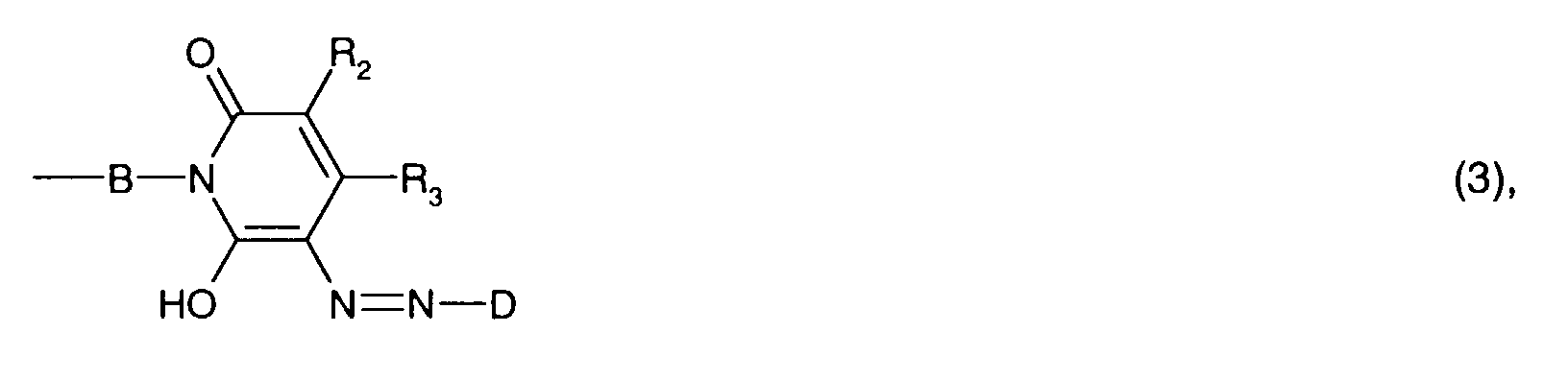
- R is preferably hydrogen, unsubstituted or hydroxy-substituted C 1 -C 4 alkyl or a radical of formula (3), particularly preferably hydrogen, methyl, ethyl or ⁇ -hydroxyethyl or a radical (3) and, very particularly preferably, hydrogen or a radical (3), wherein B, D, R 2 and R 3 have the meanings cited above.
- R is a radical of formula (3).
- R 1 is preferably hydrogen or C 1 -C 4 alkyl, particularly preferably hydrogen, methyl or ethyl and, very particularly preferably, hydrogen.
- R 2 is preferably carbamoyl or sulfomethyl, more preferably carbamoyl.
- R 3 defined as C 1 -C 4 alkyl is, for example, methyl, ethyl, n- or isopropyl or n-, sec-, tert- or isobutyl, preferably methyl or ethyl.
- R 3 is preferably methyl or ethyl, more preferably methyl.
- R 2 is preferably carbamoyl or sulfomethyl, more preferably carbamoyl, and R 3 is C 1 -C 4 alkyl, more preferably methyl.
- the aliphatic linking group B is, for example, straight-chain or branched C 2 -C 12 alkylene which is unsubstituted or substituted by hydroxy, C 1 -C 4 alkoxy, sulfato or sulfo and/or interrupted once or several times by -O- or -NR 4 - , wherein R 4 is hydrogen or C 1 -C 4 alkyl, preferably hydrogen, methyl or ethyl, particularly preferably hydrogen.
- B is preferably straight-chain or branched C 2 -C 6 alkylene which is unsubstituted or substituted by hydroxy, sulfo or sulfato and, particularly preferably, unsubstituted straight-chain or branched C 2 -C 6 alkylene.
- particularly preferred linking groups B are 1,2-ethylene, 1,3-propylene, 2-hydroxy-1,3-propylene, 1,4-butylene, 2-methyl-1,5-pentylene, 1,6-hexylene, particularly preferably 1,2-propylene and 1,2-ethylene and, very particularly preferably, 1,2-ethylene.
- X 1 defined as halogen is e.g. fluoro, chloro or bromo.
- X 1 defined as C 1 -C 4 alkoxy is suitably, for example, methoxy, ethoxy, n-propoxy, isopropoxy, n-butoxy or isobutoxy, preferably methoxy or ethoxy and, particularly preferably, methoxy.
- X 1 defined as C 1 -C 4 alkylthio is, for example, methylthio, ethylthio, n-propylthio, isopropylthio or n-butylthio, preferably ethylthio or n-propylthio.
- the cited radicals are unsubstituted or substituted in the alkyl moiety by hydroxy, carboxy or sulfo. The substituted radicals are preferred.
- X 1 defined as unsubstituted or substituted amino is amino which is unsubstituted or substituted at the N-atom, for example the following radicals:
- X 1 defined as a N-heterocycle which may contain further heteroatoms is suitably, for example, morpholino or piperidin-1-yl.
- X 1 is preferably fluoro or chloro.
- the group U which may be removed with alkali is suitably, for example, -Cl, -Br, -F, -OSO 3 H, -SSO 3 H, -OCO-CH 3 , -OPO 3 H 2 , -OCO-C 6 H 5 , -OSO 2 -C 1 -C 4 alkyl or -OSO 2 -N(C 1 -C 4 alkyl) 2 .
- U is preferably a group of formula -Cl, -OSO 3 H, -SSO 3 H, -OCO-CH 3 , -OCO-C 6 H 5 or -OPO 3 H 2 , more preferably -Cl or -OSO 3 H and, particularly preferably -OSO 3 H.
- Suitable radicals Y are correspondingly vinyl, ⁇ -bromo- or ⁇ -chloroethyl, ⁇ -acetoxyethyl, ⁇ -benzoyloxyethyl, ⁇ -phosphatoethyl, ⁇ -sulfatoethyl and ⁇ -thiosulfatoethyl.
- Y is preferably vinyl, ⁇ -chloroethyl or ⁇ -sulfatoethyl and, more preferably vinyl or ⁇ -sulfatoethyl.
- Hal is preferably bromo.
- I and m are each independently of the other preferably the number 2 or 3.
- I is the number 3 and m is the number 2.
- Substituents which are customary in dyes are suitable for D.
- the following examples may be mentioned: C 1 -C 4 alkyl, meaning methyl, ethyl, n- or isopropyl, n-, iso-, sec- or tert-butyl; C 1 -C 4 alkoxy, meaning methoxy, ethoxy, n- or isopropoxy or n-, iso-, sec- or tert-butoxy; hydroxy-C 1 -C 4 alkoxy; phenoxy; C 2 -C 6 alkanoylamino which is unsubstituted or substituted in the alkyl moiety by hydroxy or C 1 -C 4 alkoxy, for example acetylamino, hydroxyacetylamino, methoxyacetylamino or propionylamino; benzoylamino which is unsubstituted or substituted in the phenyl moiety by hydroxy, sulf
- methoxy- or ethoxycarbonyl trifluoromethyl; nitro; cyano; halogen, generally meaning e.g. fluoro, bromo or, preferably, chloro; ureido; hydroxy; carboxy; sulfo; sulfomethyl; carbamoyl; N-C 1 -C 4 alkylcarbamoyl, such as N-methylcarbamoyl or N-ethylcarbamoyl; carbamido; sulfamoyl; N-C 1 -C 4 alkylsulfamoyl, such as N-methylsulfamoyl or N-ethylsulfamoyl; N-phenylsulfamoyl or N-C 1 -C 4 alkyl-N-phenylsulfamoyl which is unsubstituted or substituted in the phenyl moiety by sulfo or carboxy; C 1
- Suitable substituents for D are also fibre-reactive radicals.
- Fibre-reactive radicals for D are, for example, the radicals of formula (2a), (2b), (2c), (2d) or (2e), wherein Y, Hal, I and m have the meanings and preferred meanings cited above, or (2f) or (2g) or wherein
- R 5 defined as C 1 -C 4 alkyl is, for example, methyl, ethyl, n- or isopropyl, n-, iso- or tert-butyl.
- R 5 is preferably hydrogen, methyl or ethyl and, particularly preferably, hydrogen.
- T 1 defined as a non-reactive substituent may be, for example, hydroxy; C 1 -C 4 alkoxy; C 1 -C 4 -alkylthio which is unsubstituted or substituted by hydroxy, carboxy or sulfo; amino; amino which is mono- or disubstituted by C 1 -C 8 alkyl, wherein the alkyl may be further substituted e.g.
- sulfo by sulfo, sulfato, hydroxy, carboxy or phenyl, preferably by sulfo or hydroxy and may be interrupted by an -O- radical; cyclohexylamino; morpholino; N-C 1 -C 4 alkyl-N-phenylamino or phenylamino or naphthylamino, wherein phenyl or naphthyl is unsubstituted or substituted by e.g. C 1 -C 4 alkyl, C 1 -C 4 alkoxy, carboxy, sulfo or halogen.
- non-reactive substituents T 1 are amino, methylamino, ethylamino, ⁇ -hydroxyethylamino, N,N-di- ⁇ -hydroxyethylamino, ⁇ -sulfoethylamino, cyclohexylamino, morpholino, 2-, 3- or 4-chlorophenylamino, 2-, 3- or 4-methylphenylamino, 2-, 3- or 4-methoxyphenylamino, 2-, 3- or 4-sulfophenylamino, disulfophenylamino, 2-, 3- or 4-carboxyphenylamino, 1- or 2-naphthylamino, 1-sulfo-2-naphthylamino, 4,8-disulfo-2-naphthylamino, N-ethyl-N-phenylamino, N-methyl-N-phenylamino, methoxy, ethoxy, n- or
- T 1 is preferably C 1 -C 4 alkoxy; C 1 -C 4 alkylthio which is unsubstituted or substituted by hydroxy, carboxy or sulfo; hydroxy, amino; N-mono- or N,N-di-C 1 -C 4 alkylamino which is unsubstituted or substituted in the alkyl moiety by hydroxy, sulfato or sulfo; morpholino; phenylamino or N-C 1 -C 4 alkyl-N-phenylamino which is unsubstituted or substituted in the phenyl ring by sulfo, carboxy, acetylamino, chloro, methyl or methoxy, wherein the alkyl is unsubstituted or substituted by hydroxy, sulfo or sulfato, or naphthylamino which is unsubstituted or substituted by
- radicals T 1 which are not fibre-reactive are amino, N-methylamino, N-ethylamino, N- ⁇ -hydroxyethylamino, N-methyl-N- ⁇ -hydroxyethylamino, N-ethyl-N- ⁇ -hydroxyethylamino, N,N-di- ⁇ -hydroxyethylamino, morpholino, 2-, 3- or 4-carboxyphenylamino, 2-, 3- or 4-sulfophenylamino or N-C 1 -C 4 alkyl-N-phenylamino.
- X 2 defined as halogen is, for example, fluoro, chloro or bromo and, preferably, chloro or fluoro.
- Arylene is preferably a phenylene radical, particularly preferably a 1,3- or 1,4-phenylene radical which is unsubstituted or substituted e.g. by sulfo, methyl or methoxy.
- T 2 , X 3 and X 4 defined as halogen are, for example, fluoro, chloro or bromo, preferably chloro or fluoro.
- X 3 defined as C 1 -C 4 alkylsulfonyl is, for example, ethylsulfonyl or methylsulfonyl, preferably methylsulfonyl.
- X 4 defined as C 1 -C 4 alkyl is, for example, methyl , ethyl, n- or isopropyl, n-, iso- or tert-butyl, preferably methyl.
- X 3 and X 4 are preferably each independently of the other chloro or fluoro.
- T 2 is preferably cyano or chloro.
- Y is preferably ⁇ -chloroethyl.
- Y is preferably vinyl or ⁇ -sulfatoethyl.
- Suitable fibre-reactive radicals D are preferably radicals of formula (2a), (2b), (2c), (2d), (2e), (2f) or (2g), wherein Y is vinyl, ⁇ -chloroethyl or ⁇ -sulfatoethyl, Hal is bromo, I and m are each independently of the other the number 2 or 3, R 5 is hydrogen, and X 2 , X 3 and X 4 are each independently of one another chloro or fluoro, T 1 is a fibre-reactive radical of formula (4c') or (4d'), or preferably (4c'), wherein Y is vinyl or ⁇ -sulfatoethyl, and T 2 is cyano or chloro.
- D is preferably a phenyl or naphthyl radical which may be further substituted by substituents customarily used for dyes, preferably by C 1 -C 4 alkyl, C 1 -C 4 alkoxy, halogen, sulfo, nitro, carboxy or a fibre-reactive radical of formula (2a), (2b), (2c), (2d), (2e), (2f) or (2g), the above meanings and preferred meanings applying to the cited fibre-reactive radicals.
- D carries one or more than one non-reactive substituent, then it is preferably sulfo, C 1 -C 4 -alkyl, C 1 -C 4 alkoxy or halogen and, particularly preferably, sulfo, methyl or methoxy.
- Suitable substituents for D*, K* and K** which are not fibre-reactive are preferably C 1 -C 4 alkyl or C 1 -C 4 alkoxy which may be further substituted by hydroxy, C 1 -C 4 alkoxy, sulfo or sulfato; halogen, carboxy, sulfo, nitro, cyano, trifluoromethyl, sulfamoyl, carbamoyl, amino, ureido, hydroxy, sulfomethyl, C 2 -C 4 alkanoylamino, C 1 -C 4 alkylsulfonylamino; benzoylamino which is unsubstituted or substituted in the phenyl ring by C 1 -C 4 alkyl, C 1 -C 4 alkoxy, halogen or sulfo, or phenyl which is unsubstituted or substituted by C 1 -C 4 alkyl, C 1 -C
- Suitable fibre-reactive substituents for D*, K* and K** are preferably the radicals of formula (2a), (2c), (2d), (2e) or (2f), preferably (2a), the above meanings and preferred meanings applying to the cited radicals.
- the monoazo radicals of formula (5) or (6) preferably contain at least one sulfo group.
- Preferred monoazo radicals D of formula (6) correspond to the radicals of formula (6a), (6b), (6c), (6d), (6e), (6f), (6g), (6h), (6i) or (6j) wherein (R 6 ) 0-3 is 0 to 3 identical or different substituents from the C 1 -C 4 alkyl, C 1 -C 4 alkoxy, halogen, carboxy and sulfo group, and Z 1 is a fibre-reactive radical of formula (2a), (2c), (2d), (2e) or (2f), preferably (2a), (2c), (2d) or (2e), particularly preferably (2a), the above meanings and preferred meanings applying to the cited fibre-reactive radicals, or wherein (R 6 ) 0-3 has the above meaning, (R 7 ) 0-3 is 0 to 3 identical or different substituents selected from the group consisting of halogen, nitro, cyano, trifluoromethyl, sulfamoyl, carbamoyl, C 1 -
- Particularly preferred monoazo radicals D of formula (6) correspond to the radicals of formula (6a), (6b), (6c), (6d) or (6j), in particular (6j), the above meanings applying to (R 6 ) 0-3 , (R 7 ) 0-3 and Z 1 .
- D preferably corresponds to a radical of formula (7) wherein
- D is particularly preferably a radical of formula (7a), (7b), (7c), (7d) or (7e) or wherein
- D is preferably a radical of formula (7a), (7b) or (7e).
- Suitable radicals A correspond, for example, to a radical of formula (7), wherein (R 8 ) 0-3 has the above meanings, and Z 2 is a radical of formula (2a), (2b), (2c), (2d) or (2e), the above meanings and preferred meanings applying to Y, Hal, I and m; preferably a radical of formula (7a), (7b), (7c) or (7d), in particular (7a) or (7b), wherein (R 8 ) 0-2 , Y, Y 1 and m have the meanings and preferred meanings given for formulae (7a), (7b), (7c) and (7d).
- Suitable radicals A containing no fibre-reactive group are, for example, the following radicals: 2-,3- or 4-sulfophenyl, 2,4-di-sulfophenyl, 2,5-di-sulfophenyl, 1,5-di-sulfonaphth-2-yl or 1,6-di-sulfonaphth-2-yl and, preferably, 2,5-di-sulfophenyl.
- A is preferably phenyl which is substituted by 1 to 2 identical or different substituents selected from the methyl, methoxy, sulfo and fibre-reactive group of formula (2a), wherein Y is vinyl or ⁇ -sulfatoethyl.
- A is particularly preferably 2,5-di-sulfophenyl or 4-( ⁇ -sulfatoethylsulfonyl)phenyl.
- novel reactive dyes correspond to formula (1a) wherein
- This invention also relates to a process for the preparation of the novel reactive dyes, which comprises reacting about 1 molar equivalent each of an amine of formula (8) of a compound of formula (9) and of a compound of formula (10) in any sequence with each other, wherein A, B, D, R 1 , R 2 , R 3 and R have the above meanings and X is halogen, preferably fluoro or chloro.
- the individual process steps described above can be carried out in different order, some of them, where appropriate, also simultaneously, so that different process variants are possible.
- the reaction is usually carried out in stepwise succession, the sequence of the single reactions between the individual reaction components advantageously being dependent on the particular conditions.
- One process variant is that, wherein a compound of formula (8) is condensed with cyanuric chloride or cyanuric fluoride and the product obtained is reacted with a compound of formula (10).
- condensation reactions between the compounds of formulae (8), (9) and (10) are usually carried out in analogy to known processes, normally in aqueous solution at temperatures in the range from e.g. 0 to 35°C and at a pH from e.g. 3 to 8.5.
- B, D, R 2 , R 3 and R have the meanings given above.
- the compound of formula (10) is obtained by diazotising an amine of formula (12) and coupling the diazonium compound so obtained to a compound of formula (11).
- the diazotisation of the compound of formula (12) and its coupling to the compound of formula (11), or to the condensate obtained according to the above procedure from the compound of formula (11), is carried out in customary manner, for example by diazotising the compound of formula (12) in mineral acidic solution, e.g. in hydrochloric solution, with a nitrite, e.g. sodium nitrite, at a low temperature, e.g. from 0 to 5°C, and then coupling the compound so obtained at a neutral to slightly acid pH, e.g. at a pH from 3 to 8.5, and at low temperatures, e.g. from 0 to 30°C, with the corresponding coupling component.
- mineral acidic solution e.g. in hydrochloric solution
- a nitrite e.g. sodium nitrite
- the triazinyl compounds obtainable according to the process described above contain a halogen atom which, by reaction with a compound of formula X 1 -H and at an elevated temperature, preferably from 20 to 70°C, and at a neutral to slightly alkaline pH which, depending on the compound of formula X 1 -H used, may be e.g. from 7 to 9, can be converted into a X 1 group, wherein X 1 has the meanings given above except halogen. It is advantageous to use an excess of the compound of formula X 1 -H.
- the end product may also be subjected to a conversion reaction.
- a conversion reaction is, for example, the conversion of a vinylatable reactive group present in A and/or D into its vinyl form by treatment with dilute sodium hydroxide solution, for example the conversion of the ⁇ -sulfatoethylsulfonyl or ⁇ -chloroethylsulfonyl group into the vinyl sulfonyl radical.
- a conversion reaction is, for example, the conversion of a vinylatable reactive group present in A and/or D into its vinyl form by treatment with dilute sodium hydroxide solution, for example the conversion of the ⁇ -sulfatoethylsulfonyl or ⁇ -chloroethylsulfonyl group into the vinyl sulfonyl radical.
- dilute sodium hydroxide solution for example the conversion of the ⁇ -sulfatoethylsulfonyl or ⁇ -chloroethylsulfon
- the novel compounds of formula (1) are suitable as dyes for dyeing or printing a very wide range of materials, such as hydroxyl group-containing or nitrogen-containing fibre materials. Typical examples of such materials are silk, leather, wool, polyamide fibres and polyurethanes.
- the novel reactive dyes are particularly suitable for dyeing and printing cellulosic fibre materials of all kinds. Such cellulosic fibre materials are, for example, natural cellulose fibres, such as cotton, linen and hemp, as well as cellulose and regenerated cellulose, preferably cotton.
- the novel reactive dyes are also suitable for dyeing or printing cellulose-containing blended fabrics, e.g. blends of cotton and polyamide fibres or, in particular, cotton/ polyester fibre blends.
- novel reactive dyes may applied and fixed to the fibre material in different manners, preferably in the form of aqueous dye solutions and printing pastes. They are suitable both for the exhaust process and for dyeing by the pad-dyeing process, in which the goods are impregnated with aqueous dye solutions which may contain salts, and the dyes are fixed after treatment with alkali, or in the presence of alkali, with or without the application of heat or by being stored for several hours at room temperature. After fixation, the dyeings or prints are thoroughly rinsed with cold and hot water, where appropriate with addition of a dispersant promoting the diffusion of the unfixed dye.
- the novel reactive dyes are distinguished by high reactivity, good fixation and excellent build-up. They can therefore be used by the exhaust dyeing process at low dyeing temperatures and require only short steaming times in the pad-steam process.
- the degrees of fixation are high, and unfixed dye can be readily washed off.
- the differences between degree of exhaustion and degree of fixation is remarkably small, i.e. the soap loss is very small.
- the dyes of this invention are also particularly suitable for printing, especially on cotton, and for printing nitrogen-containing fibres, e.g. wool or silk, or blends containing wool or silk.
- the dyeings and prints obtained with the dyes of this invention have excellent tinctorial strength and excellent fibre-dye bond stability both in the acid and in the alkaline range, and they also have good lightfastness and excellent wetfastness properties such as fastness to washing, water, sea-water, cross-dyeing and perspiration, as well as good fastness to pleating, ironing and rubbing.
- a neutral solution of 18.2 parts of an amine of formula D 10 -NH 2 in 150 parts of water, wherein D 10 is a radical of formula is charged with 15 parts of a 4 N sodium nitrite solution.
- a mixture consisting of 30 parts of ice/water and 15 parts of conc. hydrochloric acid is added to this solution at 0°C.
- the reaction mixture is stirred for one hour at 0°C.
- This mixture is then charged with 175 parts of the solution obtained according to Example 3 at 2 to 6°C, the pH being adjusted with sodium hydrogencarbonate first to 6.2 and then with a 20% sodium carbonate solution to 8.5.
- the mixture is stirred for one hour at 6 to 20°C and the pH is then adjusted to 6.2 with 2 N hydrochloric acid.
- dyes of the following general formula (102) are obtained if the amine of formula A 10 -NH 2 is replaced with the equimolar amount of an amine of formula A xy -NH 2 and/or if the amine of formula D 10 -NH 2 is replaced with the equimolar amount of an amine of formula D xy -NH 2 , wherein A xy and D xy each correspond to the radicals listed in Table 2, these radicals each having the meanings cited in Examples 3, 4 and in Table 1.
- the dyes dye cotton and wool in a yellowish orange shade having good allround fastness properties.
- Example A xy D xy Example A xy D xy Example A xy D xy 5 A 10 D 11 23 A 23 D 11 6 A 10 D 12 24 A 23 D 13 7 A 10 D 13 25 A 24 D 11 8 A 17 D 11 26 A 24 D 13 9 A 17 D 12 27 A 25 D 11 10 A 17 D 13 28 A 25 D 13 11 A 18 D 11 29 A 26 D 11 12 A 18 D 12 30 A 26 D 13 13 A 18 D 13 31 A 27 D 11 14 A 19 D 11 32 A 27 D 13 15 A 19 D 12 33 A 28 D 11 16 A 19 D 13 34 A 28 D 13 17 A 20 D 11 35 A 29 D 11 18 A 20 D 13 36 A 29 D 12 19 A 21 D 11 37 A 30 D 11 20 A 21 D 13 38 A 30 D 13 21 A 22 D 11 39 A 31 D 11 22 A 22 D 13 40 A 31 D 12
- a neutral solution of 14.1 parts of an amine of formula D 14 -NH 2 in 120 parts of water, wherein D 14 is a radical of formula is charged with 12.5 parts of a 4 N sodium nitrite solution.
- a mixture consisting of 30 parts of ice/water and 12.5 parts of conc. hydrochloric acid is added to this solution at 0°C.
- the reaction mixture is stirred for one hour at 0 to 5°C and is then added to 179 parts of the solution obtained according to Example 41 at 5 to 7°C, the pH being adjusted over 30 minutes to 6 with sodium hydrogencarbonate. To complete the reaction, the mixture is stirred for another 30 minutes at 7 to 15°C.
- the resulting solution is freed from salt by dialysis and concentrated by evaporation. This yields 24.2 parts of a compound which, in the form of the free acid, corresponds to formula (103) and which dyes cotton in a yellow shade having good allround fastness properties.
- the dyes of the following general formula (104) are obtained if aniline-2,5-disulfonic acid (A 11 -NH 2 ) is replaced with the equimolar amount of an amine of formula A xy -NH 2 and/or if an amine of formula D 14 -NH 2 is replaced with the equimolar amount of an amine of formula D xy -NH 2 , wherein A xy and D xy each correspond to the radicals listed in Table 3, each of these radicals having the meanings cited in Table 1.
- the dyes dye cotton and wool in a yellowish orange shade having good allround fastness properties.
- a neutral solution of 25.2 parts of an amine of formula D 35a -NH 2 in 300 parts of water, wherein D 35a is a radical of formula is charged with 44 parts of a 1 N sodium nitrite solute.
- the pH of this solution is adjusted to 1.6 at 0°C with 2 N hydrochloric acid and the solution is stirred for one hour at 0 to 5°C.
- This mixture is charged at 2°C with 285 parts of the solution obtained according to Example 76.
- the pH is adjusted over 30 minutes with a 20% sodium carbonate solution to 8.5 and, after the reaction is complete, with 2 N hydrochloric acid to 6.4.
- the resulting solution is charged with 280 parts of acetone and 90 parts of potassium chloride.
- the dyes of the following general formula are obtained (106) if aniline-2,5-disulfonic acid (A 11 -NH 2 ) is replaced with the equimolar amount of an amine of formula A xy -NH 2 and/or if an amine of formula D 35a -NH 2 is replaced with the equimolar amount of an amine of formula D xy -NH 2 , wherein A xy and D xy each correspond to the radicals listed in Table 4, which radicals have the meanings cited in the Examples 3 and 4 and in Table 1.
- the dyes dye cotton and wool in a yellowish orange shade having good allround fastness properties.
- 0.1 Part of the dye of Example 4 is dissolved in 200 parts of water and then 0.5 part of sodium sulfate, 0.1 part of a levelling agent (based on the condensate from a higher aliphatic amine and ethylene oxide) and 0.5 part of sodium acetate are added.
- the pH is then adjusted to 5.5 with acetic acid (80%).
- the dye bath is heated for 10 minutes to 50°C and 10 parts of a wool fabric are then added.
- the dye bath is then heated over about 50 minutes to 100°C and dyeing is carried out at this temperature for 60 minutes.
- the dye bath is then allowed to cool to 90°C and the dyed goods are taken out.
- the wool fabric is washed with warm and cold water and is then spun and dried.
- Example 4 3 Parts of the dye obtained in Example 4 are sprinkled, with rapid stirring, into 100 parts of a stock thickening which contains 50 parts of 5 % sodium alginate thickening, 27.8 parts of water, 20 parts of urea, 1 part of sodium m-nitrobenzenesulfonate and 1.2 parts of sodium hydrogen carbonate.
- a cotton fabric is printed with the printing paste so obtained and dried. The printed fabric is steamed for 2 minutes at 102°C in saturated steam, then rinsed, if necessary soaped at the boil, then rinsed once more and subsequently dried.
Landscapes
- Chemical & Material Sciences (AREA)
- Organic Chemistry (AREA)
- Coloring (AREA)
Abstract

Description
- The present invention relates to novel reactive dyes, to processes for their preparation and to their use for dyeing or printing fibre materials.
- The practice of dyeing with reactive dyes has given rise in recent times to more stringent demands being made on the quality of the dyeings and on the economy of the dyeing process. For this reason, there is still a need for novel reactive dyes with improved properties, especially application properties.
- Dyeing today calls for reactive dyes which have sufficient substantivity and which at the same time have good washing off properties with respect to unfixed dye. In addition, the dyes shall have a good tinctorial yield and high reactivity, and they shall also give, in particular, dyeings with high degrees of fixation. The dyes of the prior art do not meet these requirements in all respects.
- This invention therefore has for its object to provide novel improved reactive dyes for dyeing and printing fibre materials and which have the above specified qualities to a high degree. The novel dyes shall be distinguished in particular by excellent fixation yields and superior fibre-dye bond stability, and further they shall have the property of being easily washed off to remove unfixed dye. They shall also produce dyeings with good allround fastness properties, for example lightfastness and wetfastness.
- It has been found that this object is substantially achieved with the novel reactive dyes defined below.
- This invention thus relates to reactive dyes of formula (1)wherein

- A is phenyl or naphthyl, each of which is unsubstituted or substituted by halogen, C1-C4alkyl,
C1-C4alkoxy, carboxy, sulfo or a fibre-reactive group of formula (2a), (2b), (2c), (2d) or (2e)
- B is an aliphatic linking group,
- D is the radical of a diazo component of the benzene or naphthalene series,
- R1 is hydrogen or unsubstituted or substituted C1-C4alkyl,
- R2 is hydrogen, cyano, carbamoyl or sulfomethyl,
- R3 is hydrogen or C1-C4alkyl,
- R is hydrogen or unsubstituted or substituted C1-C4alkyl or corresponds to a radical of formula
(3)
wherein B, D, R2 and R3 have the meanings cited above,

- X1 is halogen, hydroxy, C1-C4alkoxy, unsubstituted or substituted C1-C4alkylthio or amino, or a N-heterocycle which may contain additional heteroatoms,
- Hal is chloro or bromo,
- Y is vinyl or a -CH2-CH2-U radical, U is a group a which is removable with alkali, and I and m are each independently of the other the number 2, 3 or 4, with the proviso that A and D are not simultaneously a phenyl radical which is substituted by the radical of formula (2a) if R is β-hydroxyethyl or β-sulfatoethyl and R1 is C1-C4alkyl.
-
- The novel dyes of formula (1) are fibre-reactive. Fibre-reactive compounds are to be understood as meaning compounds which are capable of reacting with the hydroxyl groups of the cellulose, amino, carboxy, hydroxy or thiol groups in wool and silk, or with the amino and, optionally, with the carboxy groups of synthetic polyamides with formation of covalent chemical bonds.
- In the novel reactive dyes of formula (1) at least one of the radicals A and D contains a fibre-reactive group, or X1 is halogen.
- The dyes of formula (1) contain at least one, preferably 2 to 6 and, more preferably, 2 to 4, sulfo groups, which are either in the form of their free acid or, preferably, in the form of their salts. Suitable salts are, for example, the alkali metal salts, alkaline earth metal salts or ammonium salts, the salts of an organic amine, or mixtures thereof. Examples to be mentioned are the sodium, lithium, potassium or ammonium salts, the salt of mono-, di- or triethanolamine, or Na/Li- or Na/Li/NH4 mixed salts.
- R and R1 defined as unsubstituted or substituted C1-C4alkyl may be methyl, ethyl, n- or isopropyl or n-, sec-, tert- or isobutyl which is unsubstituted or substituted e.g. by hydroxy, sulfo, sulfato, carboxy, cyano, halogen, C1-C4alkoxycarbonyl or carbamoyl, preferably by hydroxy, sulfo, sulfato or carboxy.
- R is preferably hydrogen, unsubstituted or hydroxy-substituted C1-C4alkyl or a radical of formula (3), particularly preferably hydrogen, methyl, ethyl or β-hydroxyethyl or a radical (3) and, very particularly preferably, hydrogen or a radical (3), wherein B, D, R2 and R3 have the meanings cited above. In a very particularly preferred embodiment of this invention, R is a radical of formula (3).
- R1 is preferably hydrogen or C1-C4alkyl, particularly preferably hydrogen, methyl or ethyl and, very particularly preferably, hydrogen.
- R2 is preferably carbamoyl or sulfomethyl, more preferably carbamoyl.
- R3 defined as C1-C4alkyl is, for example, methyl, ethyl, n- or isopropyl or n-, sec-, tert- or isobutyl, preferably methyl or ethyl.
- R3 is preferably methyl or ethyl, more preferably methyl.
- R2 is preferably carbamoyl or sulfomethyl, more preferably carbamoyl, and
R3 is C1-C4alkyl, more preferably methyl. - The aliphatic linking group B is, for example, straight-chain or branched C2-C12alkylene which is unsubstituted or substituted by hydroxy, C1-C4alkoxy, sulfato or sulfo and/or interrupted once or several times by -O- or -NR4- , wherein R4 is hydrogen or C1-C4alkyl, preferably hydrogen, methyl or ethyl, particularly preferably hydrogen. B is preferably straight-chain or branched C2-C6alkylene which is unsubstituted or substituted by hydroxy, sulfo or sulfato and, particularly preferably, unsubstituted straight-chain or branched C2-C6alkylene. Examples of particularly preferred linking groups B are 1,2-ethylene, 1,3-propylene, 2-hydroxy-1,3-propylene, 1,4-butylene, 2-methyl-1,5-pentylene, 1,6-hexylene, particularly preferably 1,2-propylene and 1,2-ethylene and, very particularly preferably, 1,2-ethylene.
- X1 defined as halogen is e.g. fluoro, chloro or bromo.
- X1 defined as C1-C4alkoxy is suitably, for example, methoxy, ethoxy, n-propoxy, isopropoxy, n-butoxy or isobutoxy, preferably methoxy or ethoxy and, particularly preferably, methoxy.
- X1 defined as C1-C4alkylthio is, for example, methylthio, ethylthio, n-propylthio, isopropylthio or n-butylthio, preferably ethylthio or n-propylthio. The cited radicals are unsubstituted or substituted in the alkyl moiety by hydroxy, carboxy or sulfo. The substituted radicals are preferred.
- X1 defined as unsubstituted or substituted amino is amino which is unsubstituted or substituted at the N-atom, for example the following radicals:
- N-mono- or N,N-di-C1-C4alkylamino, which encompasses both the unsubstituted radicals and the radicals which are substituted in the alkyl moiety, for example by C1-C4alkoxy, hydroxy, carboxy, sulfo or sulfato; the radicals substituted in the alkyl moiety being preferred;
- C5-C7cycloalkylamino, which encompasses both the unsubstituted radicals and the radicals which are substituted in the cycloalkyl ring, for example by C1-C4alkyl, preferably methyl; of such radicals the corresponding cyclohexyl radicals are preferred;
- phenylamino or N-C1-C4alkyl-N-phenylamino, which encompasses both the unsubstituted radicals and the radicals which are substituted in the phenyl ring, for example by C1-C4alkyl, C1-C4alkoxy, halogen, carboxy or sulfo; these radicals are preferably unsubstituted or sulfo- substituted in the phenyl ring.
-
- X1 defined as a N-heterocycle which may contain further heteroatoms is suitably, for example, morpholino or piperidin-1-yl.
- X1 is preferably fluoro or chloro.
- The group U which may be removed with alkali is suitably, for example, -Cl, -Br, -F, -OSO3H, -SSO3H, -OCO-CH3, -OPO3H2, -OCO-C6H5, -OSO2-C1-C4alkyl or -OSO2-N(C1-C4alkyl)2. U is preferably a group of formula -Cl, -OSO3H, -SSO3H, -OCO-CH3, -OCO-C6H5 or -OPO3H2, more preferably -Cl or -OSO3H and, particularly preferably -OSO3H.
- Examples of suitable radicals Y are correspondingly vinyl, β-bromo- or β-chloroethyl, β-acetoxyethyl, β-benzoyloxyethyl, β-phosphatoethyl, β-sulfatoethyl and β-thiosulfatoethyl. Y is preferably vinyl, β-chloroethyl or β-sulfatoethyl and, more preferably vinyl or β-sulfatoethyl.
- Hal is preferably bromo.
- I and m are each independently of the other preferably the number 2 or 3.
- Particularly preferably, I is the number 3 and m is the number 2.
- Substituents which are customary in dyes are suitable for D. The following examples may be mentioned: C1-C4alkyl, meaning methyl, ethyl, n- or isopropyl, n-, iso-, sec- or tert-butyl; C1-C4alkoxy, meaning methoxy, ethoxy, n- or isopropoxy or n-, iso-, sec- or tert-butoxy; hydroxy-C1-C4alkoxy; phenoxy; C2-C6alkanoylamino which is unsubstituted or substituted in the alkyl moiety by hydroxy or C1-C4alkoxy, for example acetylamino, hydroxyacetylamino, methoxyacetylamino or propionylamino; benzoylamino which is unsubstituted or substituted in the phenyl moiety by hydroxy, sulfo, halogen, C1-C4alkyl or C1-C4alkoxy; C1-C6alkoxycarbonylamino which is unsubstituted or substituted in the alkyl moiety by hydroxy, C1-C4alkyl or C1-C4alkoxy; phenoxycarbonylamino which is unsubstituted or substituted in the phenyl moiety by hydroxy, C1-C4alkyl or C1-C4alkoxy; amino; N-C1-C4alkyl- or N,N-di-C1-C4alkylamino which unsubstituted or substituted in the alkyl moiety by hydroxy, C1-C4alkoxy, carboxy, cyano, halogen, sulfo, sulfato, phenyl or sulfophenyl, for example methylamino, ethylamino, N,N-dimethylamino, N,N-diethylamino, β-cyanoethylamino, β-hydroxyethylamino, N,N-di-β-hydroxyethylamino, β-sulfoethylamino, γ-sulfo-n-propylamino, β-sulfatoethylamino, N-(3-sul-fobenzyl)amino, N-ethyl-N-(3-sulfobenzyl)amino, N-(β-sulfoethyl)-N-benzylamino; cyclohexylamino; N-phenylamino or N-C1-C4alkyl-N-phenylamino which is unsubstituted or substituted in the phenyl moiety by nitro, C1-C4alkyl, C1-C4alkoxy, carboxy, halogen or sulfo; C1-C4alkoxycarbonyl, e.g. methoxy- or ethoxycarbonyl; trifluoromethyl; nitro; cyano; halogen, generally meaning e.g. fluoro, bromo or, preferably, chloro; ureido; hydroxy; carboxy; sulfo; sulfomethyl; carbamoyl; N-C1-C4alkylcarbamoyl, such as N-methylcarbamoyl or N-ethylcarbamoyl; carbamido; sulfamoyl; N-C1-C4alkylsulfamoyl, such as N-methylsulfamoyl or N-ethylsulfamoyl; N-phenylsulfamoyl or N-C1-C4alkyl-N-phenylsulfamoyl which is unsubstituted or substituted in the phenyl moiety by sulfo or carboxy; C1-C4alkylsulfonyl, such as methyl- or ethylsulfonyl.
- Suitable substituents for D are also fibre-reactive radicals.
- Fibre-reactive radicals for D are, for example, the radicals of formula (2a), (2b), (2c), (2d) or (2e), wherein Y, Hal, I and m have the meanings and preferred meanings cited above, or (2f) or (2g)or
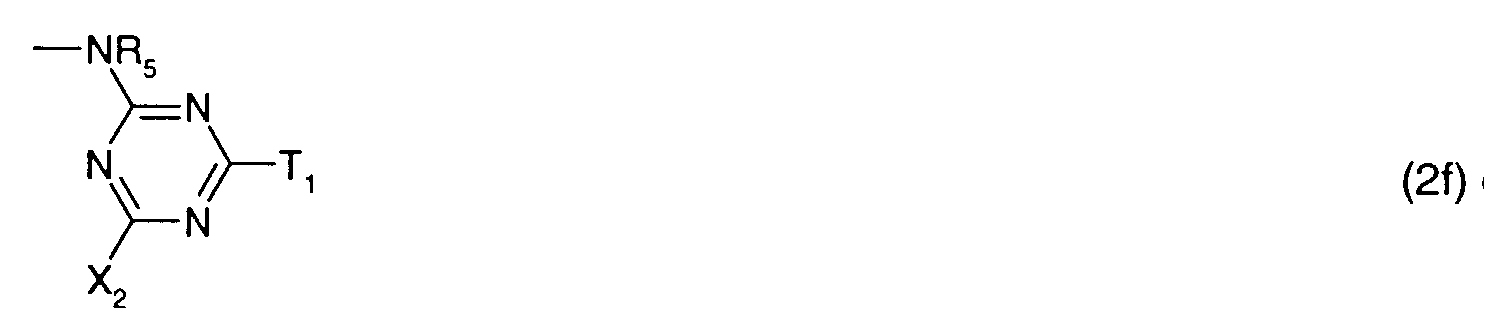 wherein
- X2 is halogen, 3-carboxypyridin-1 -yl or 3-carbamoylpyridin-1 -yl;
- T1 has each independently of one another the meaning of X2, a substituent which is not fibre-reactive
or a fibre-reactive radical of formula (4a), (4b), (4c), (4d) or (4e)

- R5 is hydrogen or C1-C4alkyl,
- arylene is a phenylene or naphthylene radical which is unsubstituted or substituted by sulfo, carboxy, C1-C4alkyl, C1-C4alkoxy or halogen,
- T2 is hydrogen, cyano or halogen,
- X3 is halogen or C1-C4alkylsulfonyl,
- X4 is halogen or C1-C4alkyl,
- Y has the meanings and preferred meanings cited above,
- Y1 is a group -CH(Hal)-CH2Hal or -C(Hal)=CH2, and Hal has the meanings and preferred meanings cited above.
-
- R5 defined as C1-C4alkyl is, for example, methyl, ethyl, n- or isopropyl, n-, iso- or tert-butyl.
- R5 is preferably hydrogen, methyl or ethyl and, particularly preferably, hydrogen.
- T1 defined as a non-reactive substituent may be, for example, hydroxy; C1-C4alkoxy; C1-C4-alkylthio which is unsubstituted or substituted by hydroxy, carboxy or sulfo; amino; amino which is mono- or disubstituted by C1-C8alkyl, wherein the alkyl may be further substituted e.g. by sulfo, sulfato, hydroxy, carboxy or phenyl, preferably by sulfo or hydroxy and may be interrupted by an -O- radical; cyclohexylamino; morpholino; N-C1-C4alkyl-N-phenylamino or phenylamino or naphthylamino, wherein phenyl or naphthyl is unsubstituted or substituted by e.g. C1-C4alkyl, C1-C4alkoxy, carboxy, sulfo or halogen.
- Examples of suitable non-reactive substituents T1 are amino, methylamino, ethylamino, β-hydroxyethylamino, N,N-di-β-hydroxyethylamino, β-sulfoethylamino, cyclohexylamino, morpholino, 2-, 3- or 4-chlorophenylamino, 2-, 3- or 4-methylphenylamino, 2-, 3- or 4-methoxyphenylamino, 2-, 3- or 4-sulfophenylamino, disulfophenylamino, 2-, 3- or 4-carboxyphenylamino, 1- or 2-naphthylamino, 1-sulfo-2-naphthylamino, 4,8-disulfo-2-naphthylamino, N-ethyl-N-phenylamino, N-methyl-N-phenylamino, methoxy, ethoxy, n- or isopropoxy and hydroxy.
- As a radical which is not fibre-reactive, T1 is preferably C1-C4alkoxy; C1-C4alkylthio which is unsubstituted or substituted by hydroxy, carboxy or sulfo; hydroxy, amino; N-mono- or N,N-di-C1-C4alkylamino which is unsubstituted or substituted in the alkyl moiety by hydroxy, sulfato or sulfo; morpholino; phenylamino or N-C1-C4alkyl-N-phenylamino which is unsubstituted or substituted in the phenyl ring by sulfo, carboxy, acetylamino, chloro, methyl or methoxy, wherein the alkyl is unsubstituted or substituted by hydroxy, sulfo or sulfato, or naphthylamino which is unsubstituted or substituted by 1 to 3 sulfo groups.
- Particularly preferred radicals T1 which are not fibre-reactive are amino, N-methylamino, N-ethylamino, N-β-hydroxyethylamino, N-methyl-N-β-hydroxyethylamino, N-ethyl-N-β-hydroxyethylamino, N,N-di-β-hydroxyethylamino, morpholino, 2-, 3- or 4-carboxyphenylamino, 2-, 3- or 4-sulfophenylamino or N-C1-C4alkyl-N-phenylamino.
- X2 defined as halogen is, for example, fluoro, chloro or bromo and, preferably, chloro or fluoro.
- Arylene is preferably a phenylene radical, particularly preferably a 1,3- or 1,4-phenylene radical which is unsubstituted or substituted e.g. by sulfo, methyl or methoxy.
- T2, X3 and X4 defined as halogen are, for example, fluoro, chloro or bromo, preferably chloro or fluoro.
- X3 defined as C1-C4alkylsulfonyl is, for example, ethylsulfonyl or methylsulfonyl, preferably methylsulfonyl.
- X4 defined as C1-C4alkyl is, for example, methyl , ethyl, n- or isopropyl, n-, iso- or tert-butyl, preferably methyl.
- X3 and X4 are preferably each independently of the other chloro or fluoro.
- T2 is preferably cyano or chloro.
- In the case of the radicals of formulae (4a) and (4b), Y is preferably β-chloroethyl. In the case of the radicals of formulae (4c) and (4d), Y is preferably vinyl or β-sulfatoethyl.
- Suitable fibre-reactive radicals D are preferably radicals of formula (2a), (2b), (2c), (2d), (2e), (2f) or (2g), wherein Y is vinyl, β-chloroethyl or β-sulfatoethyl, Hal is bromo, I and m are each independently of the other the number 2 or 3, R5 is hydrogen, and X2, X3 and X4 are each independently of one another chloro or fluoro, T1 is a fibre-reactive radical of formula (4c') or (4d'),or
 preferably (4c'), wherein Y is vinyl or β-sulfatoethyl, and T2 is cyano or chloro.
- Those novel reactive dyes are preferred, wherein at least one of the radicals A and D contains a fibre-reactive group.
- D is preferably a phenyl or naphthyl radical which may be further substituted by substituents customarily used for dyes, preferably by C1-C4alkyl, C1-C4alkoxy, halogen, sulfo, nitro, carboxy or a fibre-reactive radical of formula (2a), (2b), (2c), (2d), (2e), (2f) or (2g), the above meanings and preferred meanings applying to the cited fibre-reactive radicals.
- If D carries one or more than one non-reactive substituent, then it is preferably sulfo, C1-C4-alkyl, C1-C4alkoxy or halogen and, particularly preferably, sulfo, methyl or methoxy.
- D defined as a radical of an unsubstituted or substituted diazo component of the benzene or naphthalene series also encompasses monoazo radicals, for example those of formula (5) or (6)
- Suitable substituents for D*, K* and K** which are not fibre-reactive are preferably C1-C4alkyl or C1-C4alkoxy which may be further substituted by hydroxy, C1-C4alkoxy, sulfo or sulfato; halogen, carboxy, sulfo, nitro, cyano, trifluoromethyl, sulfamoyl, carbamoyl, amino, ureido, hydroxy, sulfomethyl, C2-C4alkanoylamino, C1-C4alkylsulfonylamino; benzoylamino which is unsubstituted or substituted in the phenyl ring by C1-C4alkyl, C1-C4alkoxy, halogen or sulfo, or phenyl which is unsubstituted or substituted by C1-C4alkyl, C1-C4alkoxy, halogen, carboxy or sulfo.
- Suitable fibre-reactive substituents for D*, K* and K** are preferably the radicals of formula (2a), (2c), (2d), (2e) or (2f), preferably (2a), the above meanings and preferred meanings applying to the cited radicals.
- The monoazo radicals of formula (5) or (6) preferably contain at least one sulfo group.
- Preferred monoazo radicals D of formula (6) correspond to the radicals of formula (6a), (6b), (6c), (6d), (6e), (6f), (6g), (6h), (6i) or (6j)


 wherein (R6)0-3 is 0 to 3 identical or different substituents from the C1-C4alkyl, C1-C4alkoxy, halogen, carboxy and sulfo group, and Z1 is a fibre-reactive radical of formula (2a), (2c), (2d), (2e) or (2f), preferably (2a), (2c), (2d) or (2e), particularly preferably (2a), the above meanings and preferred meanings applying to the cited fibre-reactive radicals,


 or
or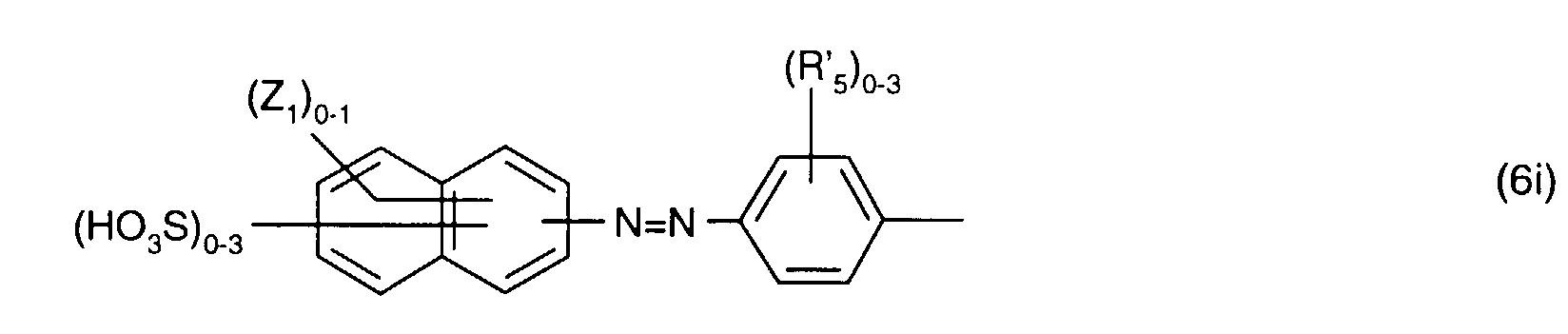 wherein (R6)0-3 has the above meaning, (R7)0-3 is 0 to 3 identical or different substituents selected from the group consisting of halogen, nitro, cyano, trifluoromethyl, sulfamoyl, carbamoyl, C1-C4alkyl, C1-C4alkoxy which is unsubstituted or substituted by hydroxy, sulfato or C1-C4alkoxy, amino, C2-C4alkanoylamino, ureido, hydroxy, carboxy, sulfomethyl, C1-C4alkylsulfonylamino and sulfo, and Z1 has the meanings and preferred meanings given above.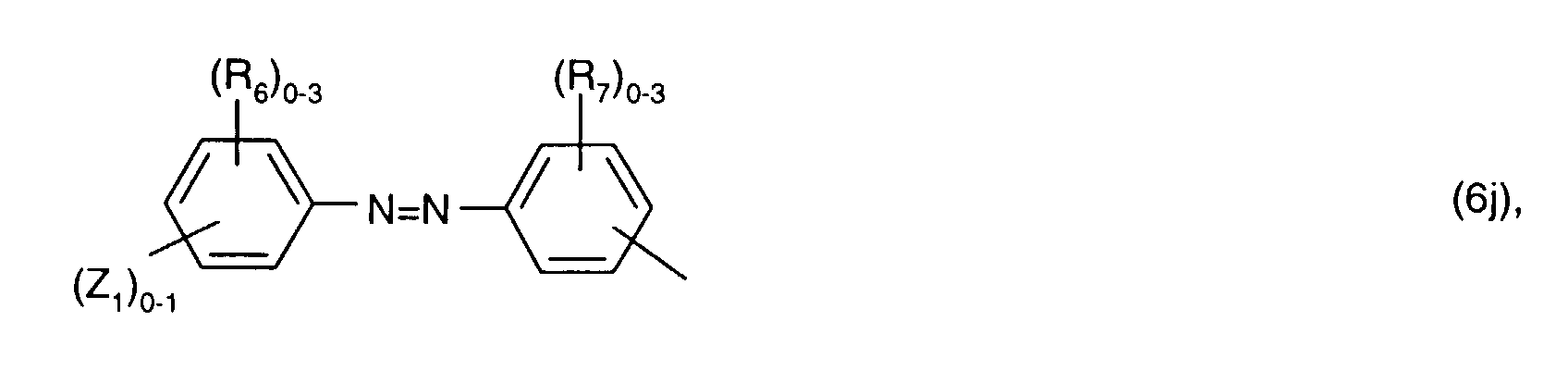
- The numbers at the naphthyl rings of the radicals of formulae (6a), (6b), (6e) and (6f) characterise the possible bonding positions.
- Particularly preferred monoazo radicals D of formula (6) correspond to the radicals of formula (6a), (6b), (6c), (6d) or (6j), in particular (6j), the above meanings applying to (R6)0-3, (R7)0-3 and Z1.
- Very particularly preferred monoazo radicals D of formula (6) correspond to the radical of formula (6j')wherein
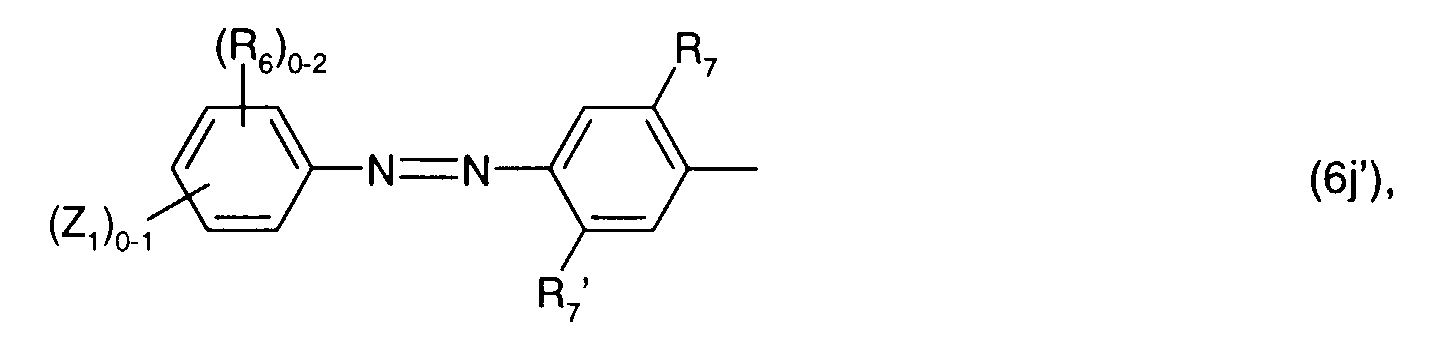
- Z1 may be a radical of formula (2a), wherein Y is vinyl or β-sulfatoethyl,
- (R6)0-2 is 0 to 2 identical or different substituents from the C1-C4alkyl, C1-C4alkoxy, halogen, carboxy and sulfo group, preferably methyl, methoxy or sulfo, R7 is hydrogen, sulfo, or C1-C4alkoxy which is unsubstituted or substituted in the alkyl moiety by hydroxy or sulfato, and R7' is hydrogen, C1-C4alkyl, C1-C4alkoxy, C2-C4alkanoylamino or ureido.
-
- D preferably corresponds to a radical of formula (7)wherein
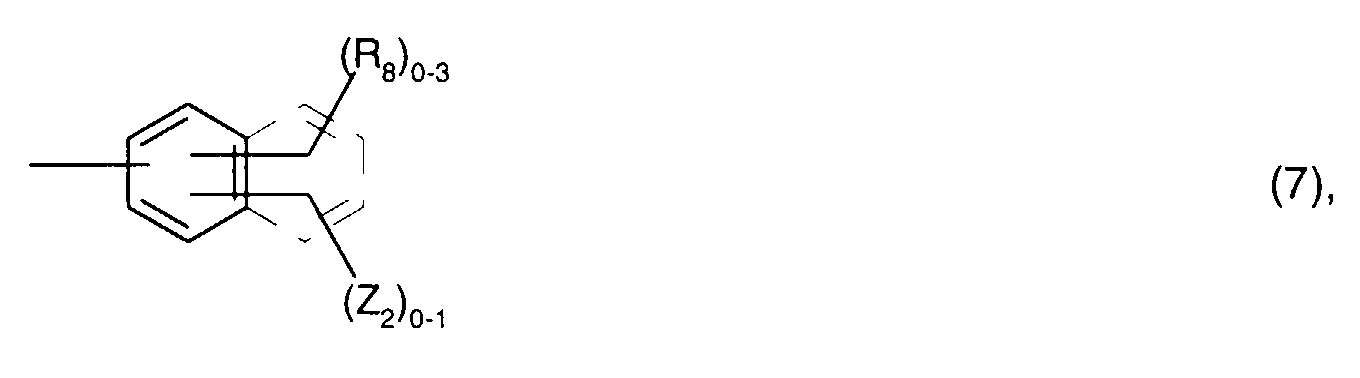
- (R8)0-3 is 0 to 3 identical or different substituents selected from the group consisting of halogen, C1-C4alkyl, C1-C4alkoxy, carboxy and sulfo,
- Z2 may be a radical of formula (2a), (2b), (2c), (2d), (2e), (2f) or (2g), wherein Y is vinyl, β-chloroethyl
or β-sulfatoethyl, Hal is bromo, I and m are each independently of the other the
number 2 or 3, R5 is hydrogen, and X2, X3 and X4 are each independently of one another
chloro or fluoro, T1 is a fibre-reactive radical of formula (4c') or (4d'),
or
 preferably (4c'), wherein Y is vinyl or β-sulfatoethyl, and T2 is cyano or chloro; or
- a monoazo radical of formula (6j'), wherein (R6)0-2, R7, R7' and Z1 have the meanings and preferred meanings cited for formula (6j').
-
- D is particularly preferably a radical of formula (7a), (7b), (7c), (7d) or (7e)
 or
or wherein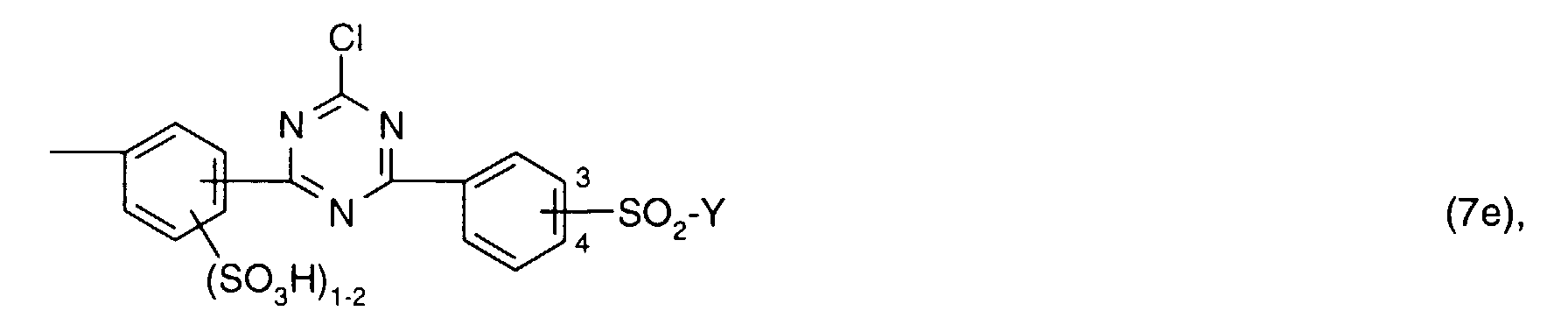
- (R8)0-2 is 0 to 2 identical or different substituents selected from the halogen, C1-C4alkyl, C1-C4alkoxy and sulfo group, preferably methyl, methoxy and sulfo,
- Y1 is a radical -CH(Br)-CH2-Br or -C(Br)=CH2,
- Y is vinyl, β-chloroethyl or β-sulfatoethyl, preferably vinyl or β-sulfatoethyl, and
- m is the number 2 or 3, preferably 2.
-
- The numbers in the radicals of formulae (7a), (7c), (7d) and (7e) characterise the possible bonding positions of the fibre-reactive radical.
- D is preferably a radical of formula (7a), (7b) or (7e).
- Suitable radicals A correspond, for example, to a radical of formula (7), wherein (R8)0-3 has the above meanings, and Z2 is a radical of formula (2a), (2b), (2c), (2d) or (2e), the above meanings and preferred meanings applying to Y, Hal, I and m; preferably a radical of formula (7a), (7b), (7c) or (7d), in particular (7a) or (7b), wherein (R8)0-2, Y, Y1 and m have the meanings and preferred meanings given for formulae (7a), (7b), (7c) and (7d).
- Suitable radicals A containing no fibre-reactive group are, for example, the following radicals: 2-,3- or 4-sulfophenyl, 2,4-di-sulfophenyl, 2,5-di-sulfophenyl, 1,5-di-sulfonaphth-2-yl or 1,6-di-sulfonaphth-2-yl and, preferably, 2,5-di-sulfophenyl.
- A is preferably phenyl which is substituted by 1 to 2 identical or different substituents selected from the methyl, methoxy, sulfo and fibre-reactive group of formula (2a), wherein Y is vinyl or β-sulfatoethyl.
- A is particularly preferably 2,5-di-sulfophenyl or 4-(β-sulfatoethylsulfonyl)phenyl.
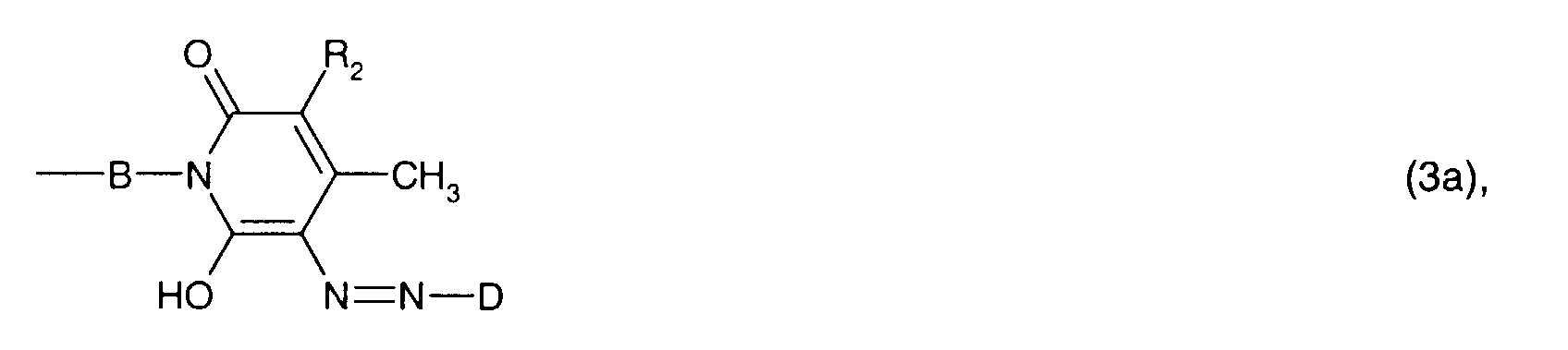
- In a preferred embodiment of this invention, the novel reactive dyes correspond to formula (1a)wherein
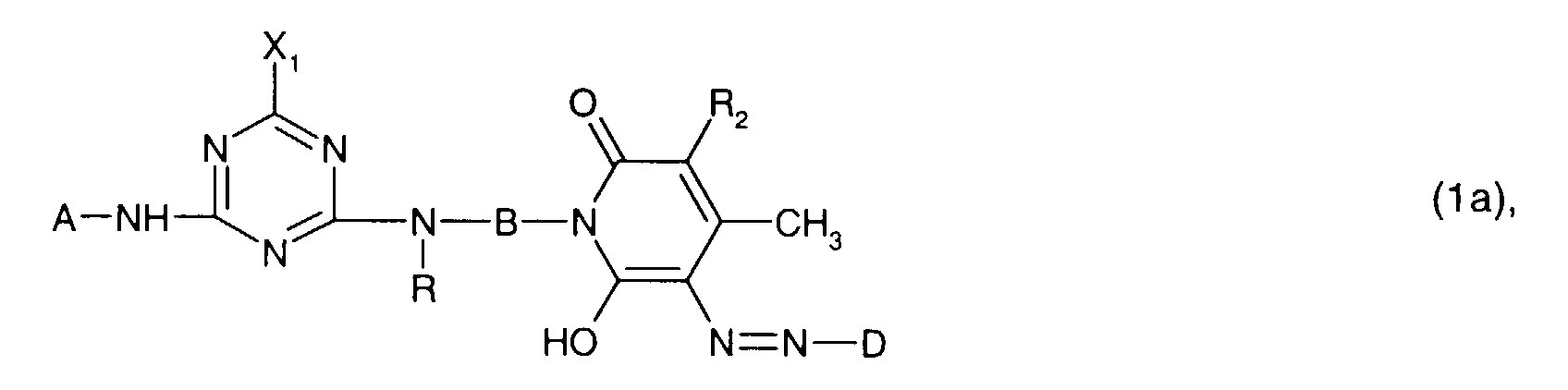
- A is phenyl which is substituted by 1 to 2 identical or different substituents selected from the group consisting of methyl, methoxy, sulfo and fibre-reactive group of formula -SO2-Y (2a), wherein Y is vinyl or β-sulfatoethyl,
- B is straight-chain or branched C2-C6alkylene, preferably ethylene,
- D corresponds to a radical of formula (7a), (7b), (7c), (7d) or (7e), preferably to (7a), (7b) or (7e), wherein (R8)0-2, Y, Y1 and m have the above meanings and preferred meanings,
- R2 is carbamoyl or sulfomethyl, preferably carbamoyl,
- R is hydrogen or corresponds to a radical of formula (3a)
wherein B, D and R2 have the meanings and preferred meanings cited above, and X1 is chloro or fluoro.
-
- This invention also relates to a process for the preparation of the novel reactive dyes, which comprises reacting about 1 molar equivalent each of an amine of formula (8)of a compound of formula (9)
 and of a compound of formula (10)
 in any sequence with each other, wherein A, B, D, R1, R2, R3 and R have the above meanings and X is halogen, preferably fluoro or chloro.
- The individual process steps described above can be carried out in different order, some of them, where appropriate, also simultaneously, so that different process variants are possible. The reaction is usually carried out in stepwise succession, the sequence of the single reactions between the individual reaction components advantageously being dependent on the particular conditions.
- One process variant is that, wherein a compound of formula (8) is condensed with cyanuric chloride or cyanuric fluoride and the product obtained is reacted with a compound of formula (10).
- The condensation reactions between the compounds of formulae (8), (9) and (10) are usually carried out in analogy to known processes, normally in aqueous solution at temperatures in the range from e.g. 0 to 35°C and at a pH from e.g. 3 to 8.5. In the process in it also possible to replace the compound of formula (10) with the corresponding precursor of formula (11)and to complete the azo chromophore only in the further course of the process by diazotisation of an amine of formula (12)
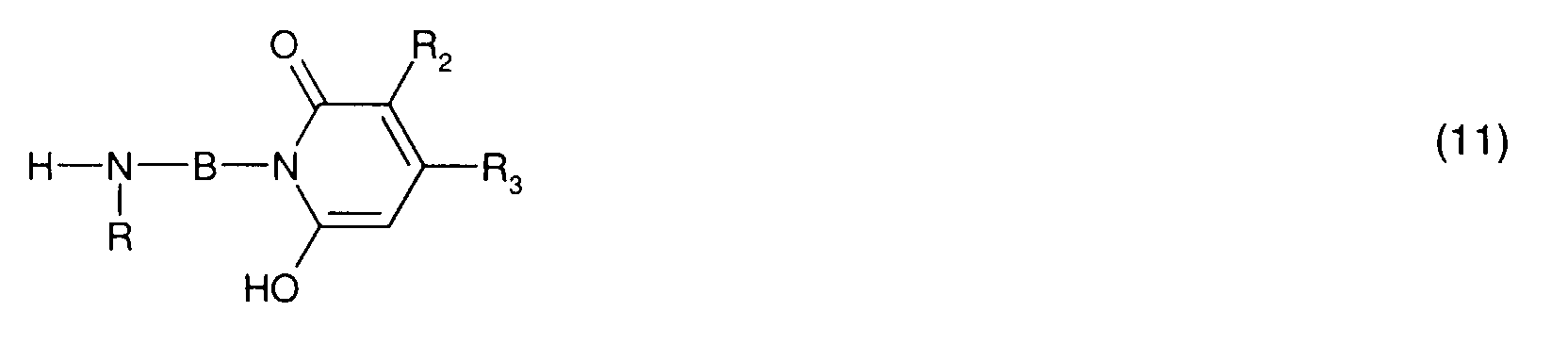
- The compound of formula (10) is obtained by diazotising an amine of formula (12) and coupling the diazonium compound so obtained to a compound of formula (11).
- The diazotisation of the compound of formula (12) and its coupling to the compound of formula (11), or to the condensate obtained according to the above procedure from the compound of formula (11), is carried out in customary manner, for example by diazotising the compound of formula (12) in mineral acidic solution, e.g. in hydrochloric solution, with a nitrite, e.g. sodium nitrite, at a low temperature, e.g. from 0 to 5°C, and then coupling the compound so obtained at a neutral to slightly acid pH, e.g. at a pH from 3 to 8.5, and at low temperatures, e.g. from 0 to 30°C, with the corresponding coupling component.
- The compounds of formulae (8), (11) and (12) are known or can be prepared in analogy to known compounds.
- The triazinyl compounds obtainable according to the process described above contain a halogen atom which, by reaction with a compound of formula X1-H and at an elevated temperature, preferably from 20 to 70°C, and at a neutral to slightly alkaline pH which, depending on the compound of formula X1-H used, may be e.g. from 7 to 9, can be converted into a X1 group, wherein X1 has the meanings given above except halogen. It is advantageous to use an excess of the compound of formula X1-H.
- The end product may also be subjected to a conversion reaction. Such a conversion reaction is, for example, the conversion of a vinylatable reactive group present in A and/or D into its vinyl form by treatment with dilute sodium hydroxide solution, for example the conversion of the β-sulfatoethylsulfonyl or β-chloroethylsulfonyl group into the vinyl sulfonyl radical. Such reactions are known per se.
- The novel compounds of formula (1) are suitable as dyes for dyeing or printing a very wide range of materials, such as hydroxyl group-containing or nitrogen-containing fibre materials. Typical examples of such materials are silk, leather, wool, polyamide fibres and polyurethanes. The novel reactive dyes are particularly suitable for dyeing and printing cellulosic fibre materials of all kinds. Such cellulosic fibre materials are, for example, natural cellulose fibres, such as cotton, linen and hemp, as well as cellulose and regenerated cellulose, preferably cotton. The novel reactive dyes are also suitable for dyeing or printing cellulose-containing blended fabrics, e.g. blends of cotton and polyamide fibres or, in particular, cotton/ polyester fibre blends.
- The novel reactive dyes may applied and fixed to the fibre material in different manners, preferably in the form of aqueous dye solutions and printing pastes. They are suitable both for the exhaust process and for dyeing by the pad-dyeing process, in which the goods are impregnated with aqueous dye solutions which may contain salts, and the dyes are fixed after treatment with alkali, or in the presence of alkali, with or without the application of heat or by being stored for several hours at room temperature. After fixation, the dyeings or prints are thoroughly rinsed with cold and hot water, where appropriate with addition of a dispersant promoting the diffusion of the unfixed dye.
- The novel reactive dyes are distinguished by high reactivity, good fixation and excellent build-up. They can therefore be used by the exhaust dyeing process at low dyeing temperatures and require only short steaming times in the pad-steam process. The degrees of fixation are high, and unfixed dye can be readily washed off. The differences between degree of exhaustion and degree of fixation is remarkably small, i.e. the soap loss is very small. The dyes of this invention are also particularly suitable for printing, especially on cotton, and for printing nitrogen-containing fibres, e.g. wool or silk, or blends containing wool or silk.
- The dyeings and prints obtained with the dyes of this invention have excellent tinctorial strength and excellent fibre-dye bond stability both in the acid and in the alkaline range, and they also have good lightfastness and excellent wetfastness properties such as fastness to washing, water, sea-water, cross-dyeing and perspiration, as well as good fastness to pleating, ironing and rubbing.
- The following Examples illustrate the invention in more detail. Temperatures are given in degrees Celsius, and parts and percentages are by weight, unless otherwise stated. The ratio of parts by weight to parts by volume is the same as that of the kilogram to the litre.
- 373 Parts of ethyl cyanoacetate are slowly added to 152 parts of diethylene triamine at 80 to 85°C. After the addition is complete, the resulting ethanol is distilled off under a weak vacuum. Subsequently, 750 parts of water are added to the reaction mixture and this mixture is distilled again under a weak vacuum. After charging the residue with 429 parts of ethyl acetate and 255 parts of a 30% aqueous ammonia solution, the temperature is raised to 90 to 95°C and the resulting water is distilled off under a weak vacuum. Subsequently, the reaction mixture is added to 1000 parts of an aqueous potassium chloride solution and the precipitated product is subjected to filtration and then dried. This yields 771 parts of a compound of formulafrom which the compound of formula
 is obtained via saponification with sulfuric acid.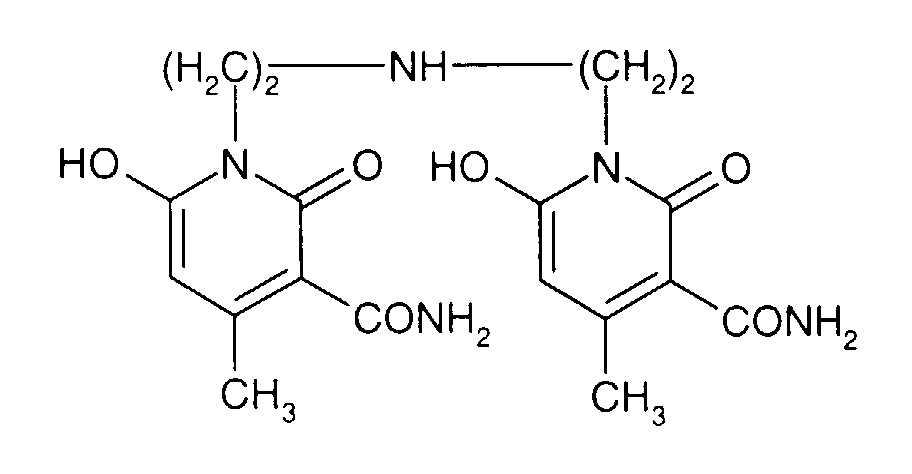
- 204 parts of ethyl cyanoacetate are added slowly to 322 parts of ethylenediamine at 80°C. After the addition is complete, the resulting ethanol is distilled off under a weak vacuum. Subsequently, 720 parts of water, 234 parts of ethyl acetate and 162 parts of a 30% aqueous ammonia solution are added to the reaction mixture. The temperature is raised to 90 to 100°C and the batch is refluxed for 2 hours. Subsequently, the hot reaction mixture is added to 1800 parts of an ice/water mixture. The pH is adjusted to 7 with hydrochloric acid and the product which precipitates at room temperature is subjected to filtration and then dried. This yields 312 parts of a compound of formulafrom which the compound of formula
 is obtained via saponification with sulfuric acid.
- 42.2 Parts of an amine of formula A10-NH2, wherein A10 is a radical of formulaare dissolved in 200 parts of water with addition of a 20% sodium carbonate solution at room temperature and at pH 3.2, and a solution of 1.5 g of disodium hydrogenphosphate in 20 parts of water is then added. 21.3 Parts of cyanuric fluoride are added dropwise to this solution at a temperature below 2°C and at pH 6.2, which pH is kept constant by addition of a 2 N sodium hydroxide solution. A solution of 48.6 parts of the compound obtained according to Example 1 in 200 parts of water is added to the suspension so obtained, the pH being kept at 6.8 to 7.5 through addition of a 20% sodium carbonate solution and the temperature being kept at 10 to 20°C. To complete the reaction, the mixture is stirred for one hour at room temperature and the pH is then adjusted to 6.2 with 2 N of hydrochloric acid. This yields 700 parts of a solution containing a compound of formula

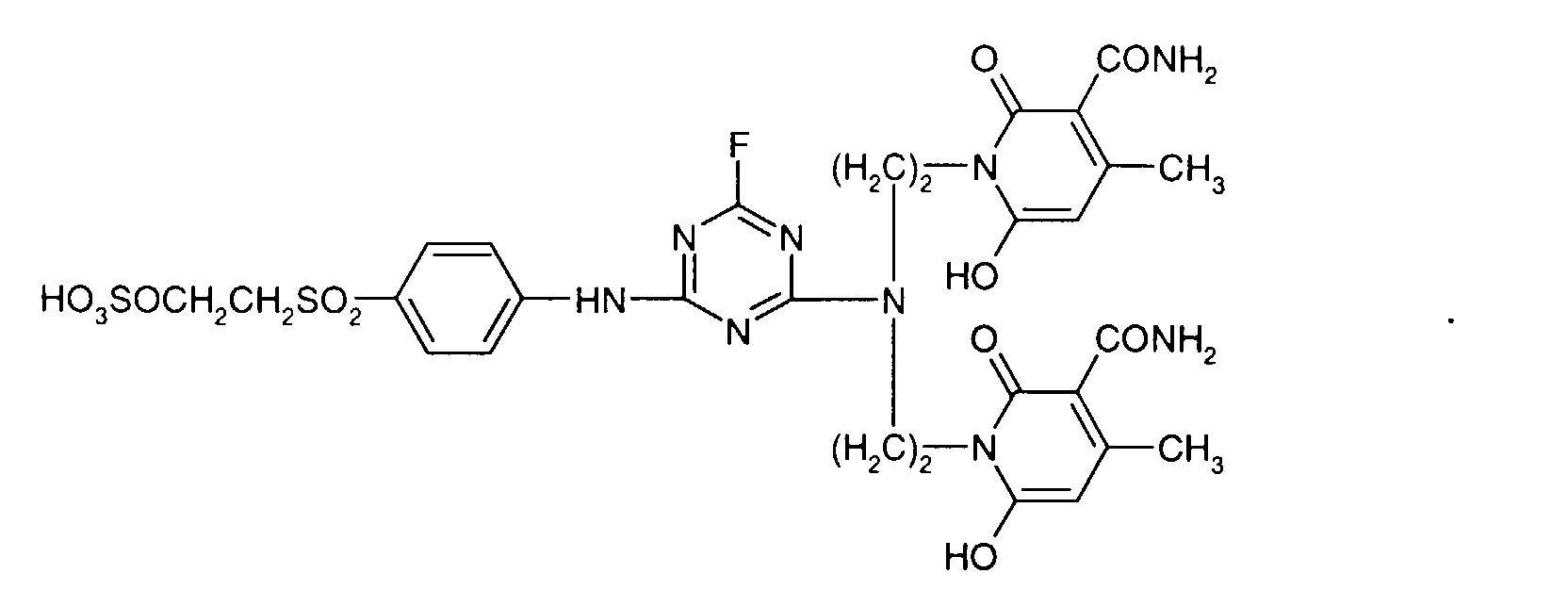
- A neutral solution of 18.2 parts of an amine of formula D10-NH2 in 150 parts of water, wherein D10 is a radical of formulais charged with 15 parts of a 4 N sodium nitrite solution. A mixture consisting of 30 parts of ice/water and 15 parts of conc. hydrochloric acid is added to this solution at 0°C. The reaction mixture is stirred for one hour at 0°C. This mixture is then charged with 175 parts of the solution obtained according to Example 3 at 2 to 6°C, the pH being adjusted with sodium hydrogencarbonate first to 6.2 and then with a 20% sodium carbonate solution to 8.5. To complete the reaction, the mixture is stirred for one hour at 6 to 20°C and the pH is then adjusted to 6.2 with 2 N hydrochloric acid. The solution so obtained is then freed from salt by dialysis and is concentrated by evaporation, yielding 30.9 parts of a compound which, in the form of the free acid, corresponds to formula (101)
 and which dyes cotton in a yellow shade having good allround fastness properties.
- In analogy to the procedure described in Examples 3 and 4, dyes of the following general formula (102) are obtainedif the amine of formula A10-NH2 is replaced with the equimolar amount of an amine of formula Axy-NH2 and/or if the amine of formula D10-NH2 is replaced with the equimolar amount of an amine of formula Dxy-NH2, wherein Axy and Dxy each correspond to the radicals listed in Table 2, these radicals each having the meanings cited in Examples 3, 4 and in Table 1. The dyes dye cotton and wool in a yellowish orange shade having good allround fastness properties.
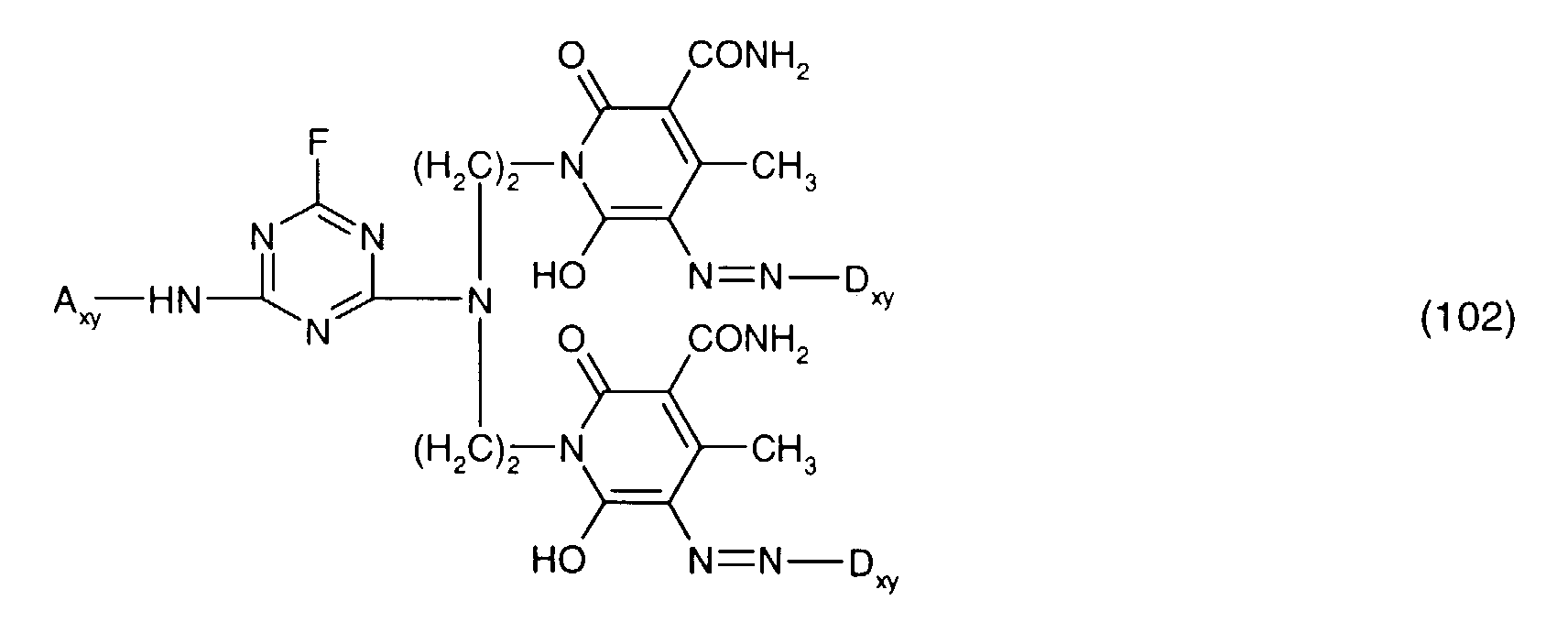

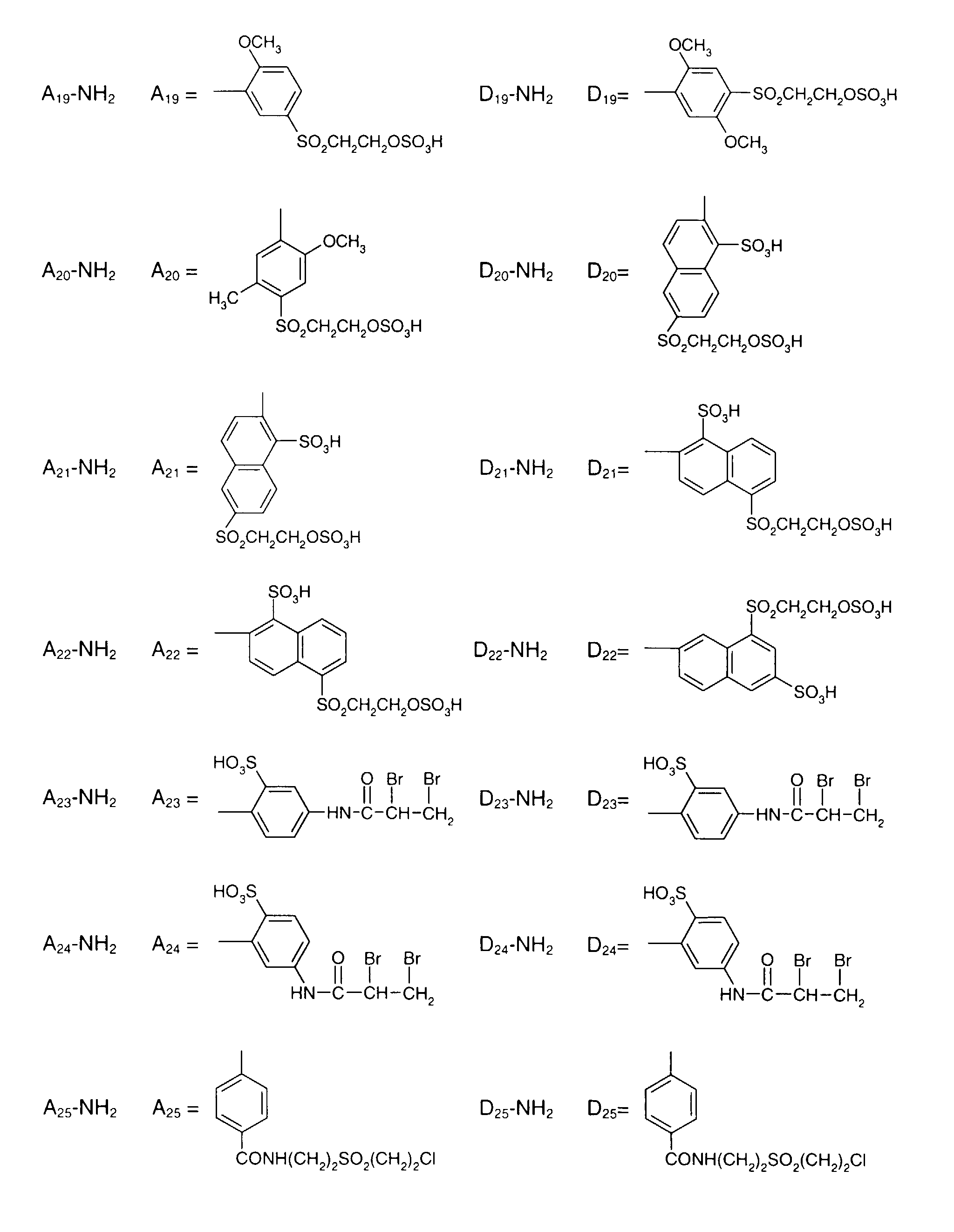

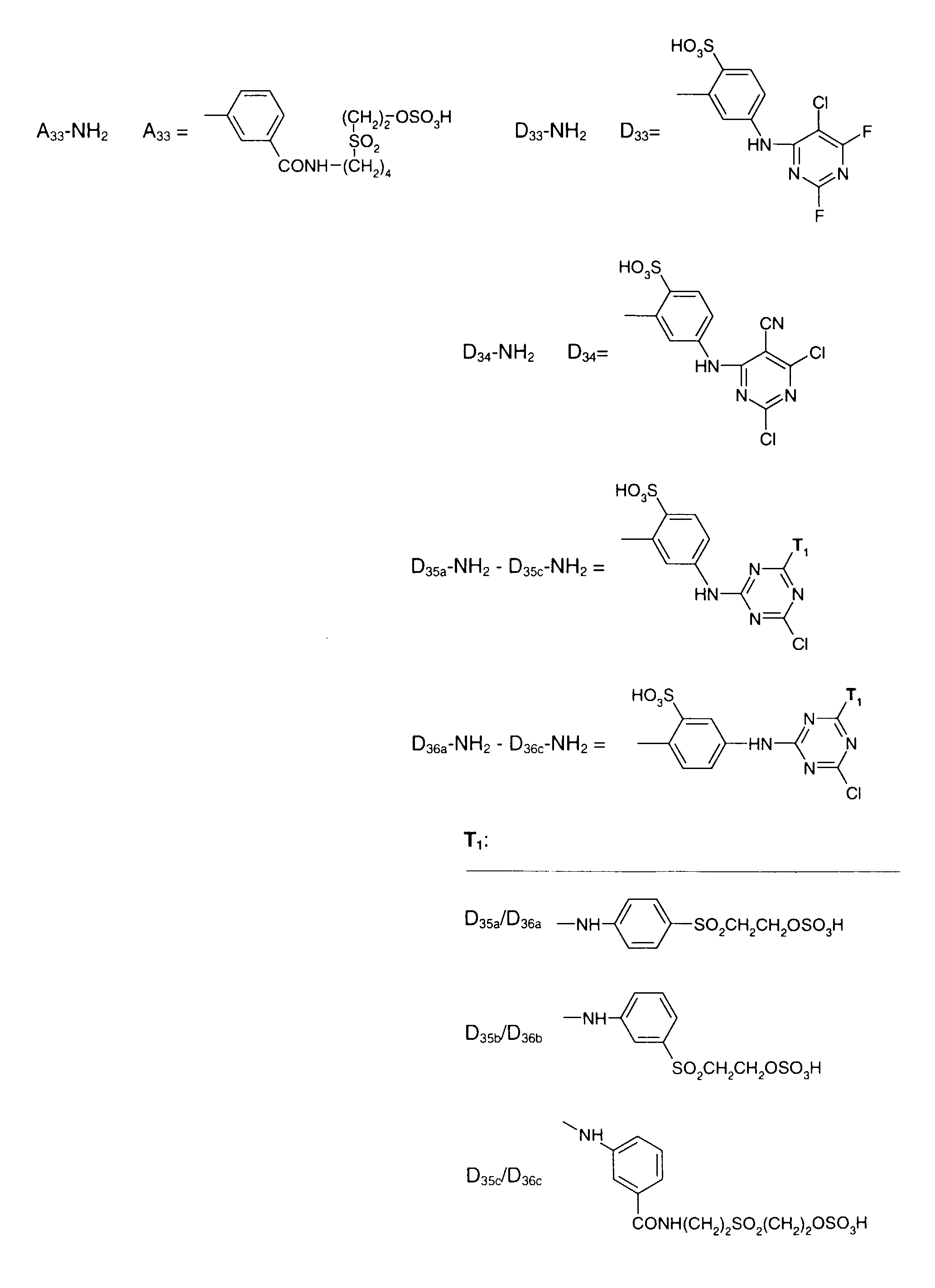
Example Axy Dxy Example Axy Dxy 5 A10 D11 23 A23 D11 6 A10 D12 24 A23 D13 7 A10 D13 25 A24 D11 8 A17 D11 26 A24 D13 9 A17 D12 27 A25 D11 10 A17 D13 28 A25 D13 11 A18 D11 29 A26 D11 12 A18 D12 30 A26 D13 13 A18 D13 31 A27 D11 14 A19 D11 32 A27 D13 15 A19 D12 33 A28 D11 16 A19 D13 34 A28 D13 17 A20 D11 35 A29 D11 18 A20 D13 36 A29 D12 19 A21 D11 37 A30 D11 20 A21 D13 38 A30 D13 21 A22 D11 39 A31 D11 22 A22 D13 40 A31 D12 - 20.3 Parts of cyanuric chloride are thoroughly stirred in 150 parts of water with addition of a wetting agent at a temperature from 0°C. 27.8 Parts of aniline-2,5-disulfonic acid (A11-NH2) are added to this mixture. The temperature is kept for 5 hours at 0 to 5 °C and the pH is kept at 3 to 4 by addition of 2 N sodium hydroxide solution. The pH is then adjusted to 7 and the mixture is clarified by filtration. The resulting filtrate is charged over 2.5 hours with 40.5 parts of the compound obtained according to Example 1, the pH being kept at 7.5 to 8.5 by addition of a 2 N sodium hydroxide solution, the temperature rising to 36°C. To complete the reaction, the mixture is stirred for one hour at room temperature and the pH is then adjusted to 7 with 2 N hydrochloric acid. This yields 714 parts of a solution containing a compound which, in the form of the free acid, corresponds to formula

- A neutral solution of 14.1 parts of an amine of formula D14-NH2 in 120 parts of water, wherein D14 is a radical of formulais charged with 12.5 parts of a 4 N sodium nitrite solution. A mixture consisting of 30 parts of ice/water and 12.5 parts of conc. hydrochloric acid is added to this solution at 0°C. The reaction mixture is stirred for one hour at 0 to 5°C and is then added to 179 parts of the solution obtained according to Example 41 at 5 to 7°C, the pH being adjusted over 30 minutes to 6 with sodium hydrogencarbonate. To complete the reaction, the mixture is stirred for another 30 minutes at 7 to 15°C. The resulting solution is freed from salt by dialysis and concentrated by evaporation. This yields 24.2 parts of a compound which, in the form of the free acid, corresponds to formula (103)
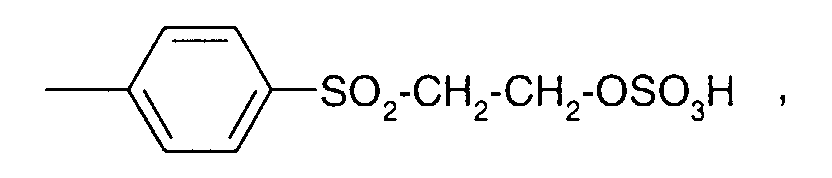 and which dyes cotton in a yellow shade having good allround fastness properties.
- In analogy to the procedure described in Examples 41 and 42, the dyes of the following general formula (104) are obtainedif aniline-2,5-disulfonic acid (A11-NH2) is replaced with the equimolar amount of an amine of formula Axy-NH2 and/or if an amine of formula D14-NH2 is replaced with the equimolar amount of an amine of formula Dxy-NH2, wherein Axy and Dxy each correspond to the radicals listed in Table 3, each of these radicals having the meanings cited in Table 1. The dyes dye cotton and wool in a yellowish orange shade having good allround fastness properties.
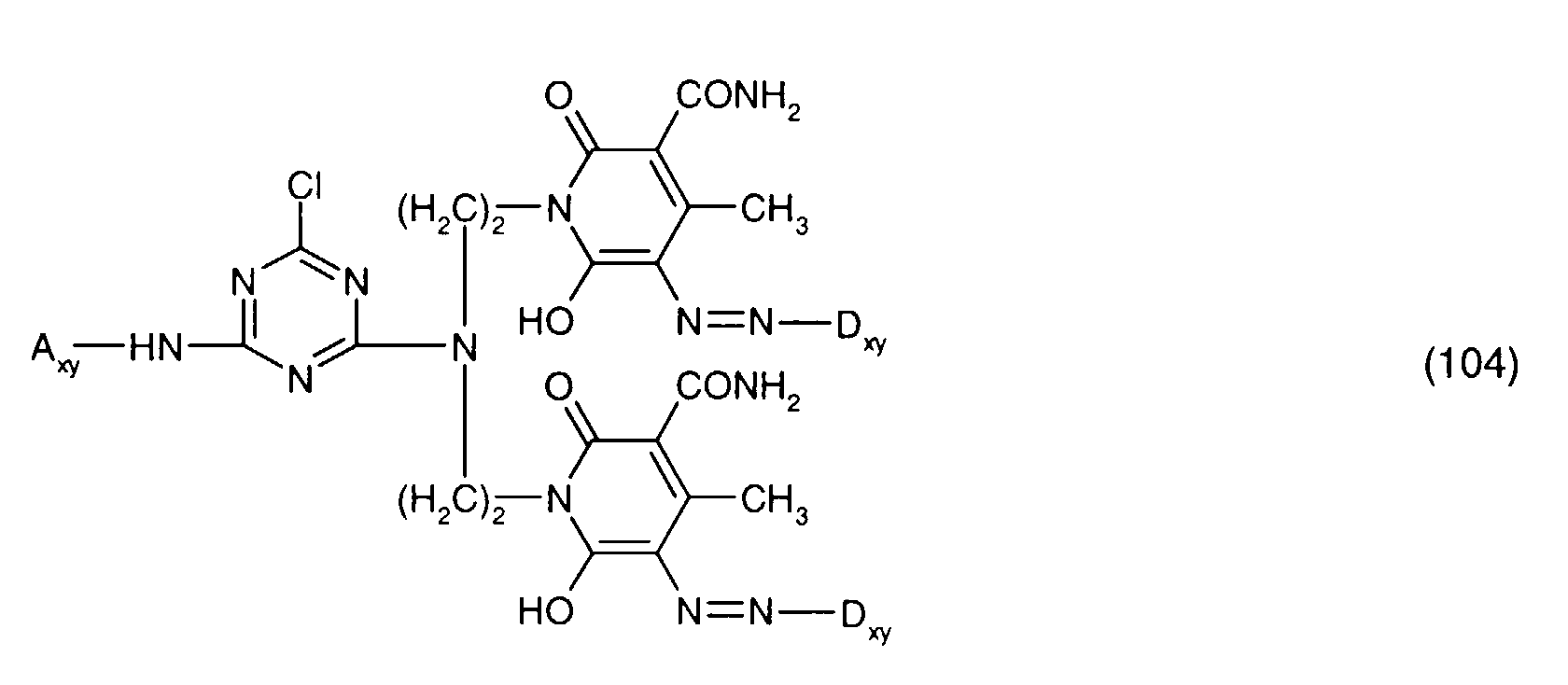
Example Axy Dxy Example Axy Dxy 43 A11 D20 60 A13 D15 44 A11 D21 61 A13 D16 45 A11 D22 62 A13 D23 46 A11 D17 63 A13 D24 47 A11 D18 64 A13 D26 48 A11 D25 65 A13 D28 49 A11 D27 66 A13 D30 50 A11 D29 67 A13 D31 51 A11 D19 68 A14 D15 52 A12 D20 69 A14 D16 53 A15 D15 70 A11 D35a 54 A15 D16 71 A11 D35b 55 A15 D23 72 A11 D36a 56 A15 D24 73 A12 D36c 57 A15 D26 74 A12 D33 58 A16 D28 75 A11 D34 59 A16 D16 - 30.4 Parts of aniline-2,5-disulfonic acid (A11-NH2) are dissolved in 300 parts of water until neutral and a solution of 1.5 g of disodium hydrogenphosphate in 20 parts of water is added. This solution is charged at a temperature below 2°C and at pH 6.8 with 17 parts of cyanuric fluoride, the pH being kept constant by addition of 2 N sodium hydroxide solution. The solution so obtained is charged with 21.1 parts of the compound obtained according to Example 2 over 2 hours, the pH being kept at 7.5 to 8.5 with a 2 N sodium hydroxide solution and the temperature rising to 22°C. This yields 648 parts of a solution which contains a compound of formula

- A neutral solution of 25.2 parts of an amine of formula D35a-NH2 in 300 parts of water, wherein D35a is a radical of formulais charged with 44 parts of a 1 N sodium nitrite solute. The pH of this solution is adjusted to 1.6 at 0°C with 2 N hydrochloric acid and the solution is stirred for one hour at 0 to 5°C. This mixture is charged at 2°C with 285 parts of the solution obtained according to Example 76. The pH is adjusted over 30 minutes with a 20% sodium carbonate solution to 8.5 and, after the reaction is complete, with 2 N hydrochloric acid to 6.4. The resulting solution is charged with 280 parts of acetone and 90 parts of potassium chloride. The precipitate is subjected to filtration and is then washed with acetone and dried. This yields 41.3 parts of a compound which, in the form of the free acid, corresponds to formula (105)
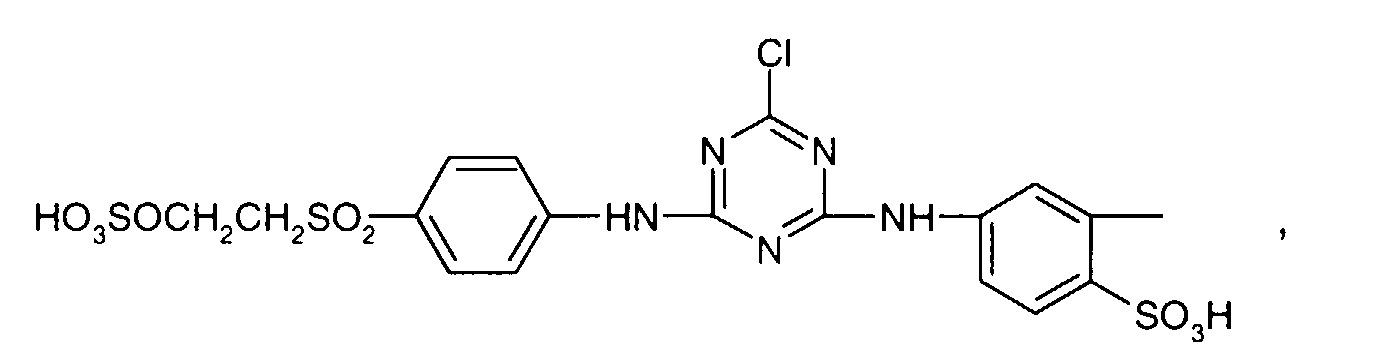 and which dyes cotton in a yellow shade having good allround fastness properties.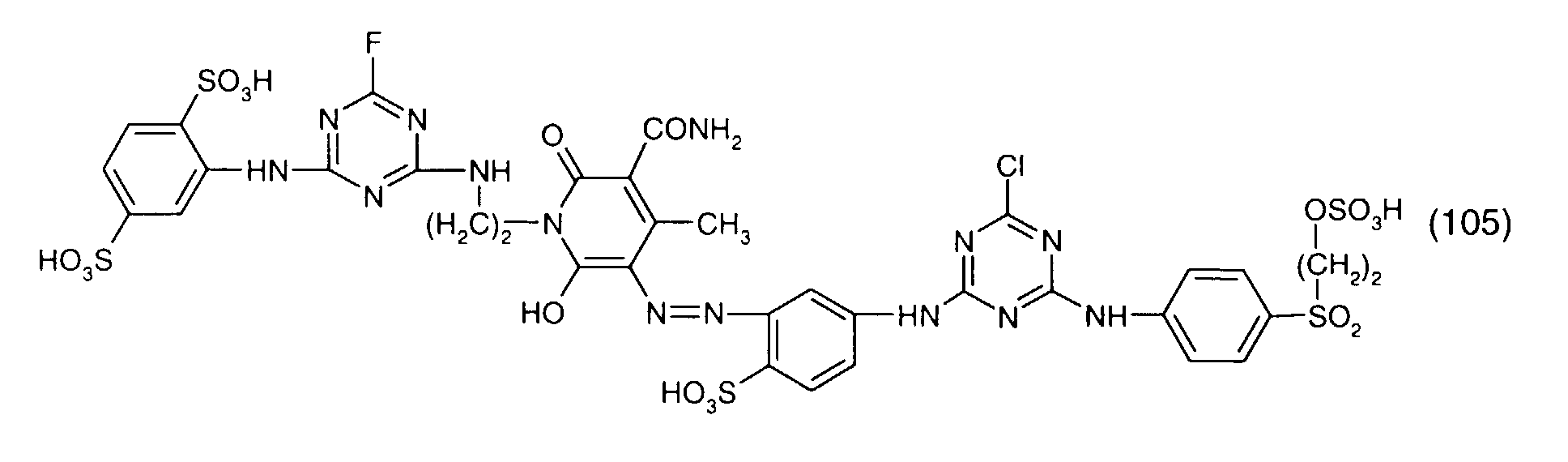
- In analogy to the procedure described in Examples 76 and 77, the dyes of the following general formula are obtained (106)if aniline-2,5-disulfonic acid (A11-NH2) is replaced with the equimolar amount of an amine of formula Axy-NH2 and/or if an amine of formula D35a-NH2 is replaced with the equimolar amount of an amine of formula Dxy-NH2, wherein Axy and Dxy each correspond to the radicals listed in Table 4, which radicals have the meanings cited in the Examples 3 and 4 and in Table 1. The dyes dye cotton and wool in a yellowish orange shade having good allround fastness properties.
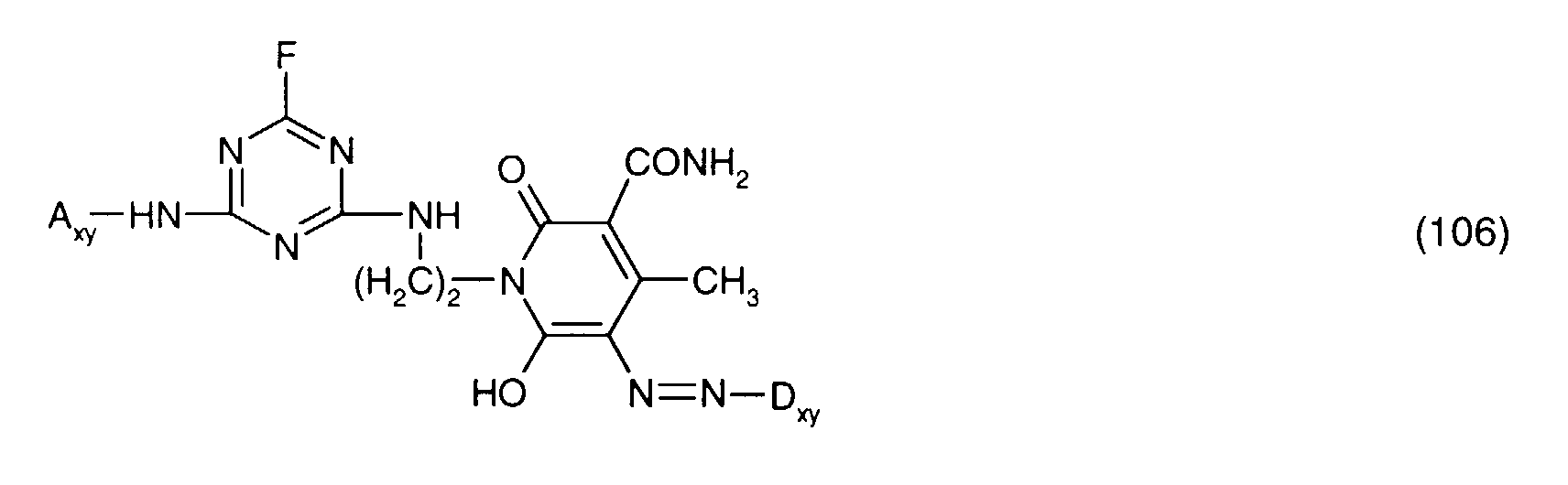
Example Axy Dxy Example Axy Dxy 78 A11 D36a 91 A13 D15 79 A11 D35b 92 A13 D16 80 A11 D35c 93 A14 D23 81 A12 D36a 94 A13 D26 82 A11 D23 95 A13 D28 83 A11 D24 96 A13 D32 84 A11 D14 97 A13 D34 85 A15 D15 98 A11 D18 86 A11 D17 99 A17 D13 87 A10 D10 100 A17 D11 88 A10 D12 101 A18 D10 89 A29 D10 102 A33 D10 90 A32 D11 - 100 Parts of cotton fabric are placed at 60°C in 1500 parts of a dye liquor containing 45 g/l of sodium chloride and 2 parts of the reactive dye obtained according to Example 4. After 45 minutes at 60°C, 20 g/l of calcined sodium carbonate are added. Dyeing is continued for another 45 minutes at this temperature. The dyed goods are then rinsed, soaped at the boil for a quarter of an hour with a non-ionic detergent, rinsed again and dried.
- Alternatively to the above instruction, it is also possible to dye at 80°C instead of at 60°C.
- 0.1 Part of the dye of Example 4 is dissolved in 200 parts of water and then 0.5 part of sodium sulfate, 0.1 part of a levelling agent (based on the condensate from a higher aliphatic amine and ethylene oxide) and 0.5 part of sodium acetate are added. The pH is then adjusted to 5.5 with acetic acid (80%). The dye bath is heated for 10 minutes to 50°C and 10 parts of a wool fabric are then added. The dye bath is then heated over about 50 minutes to 100°C and dyeing is carried out at this temperature for 60 minutes. The dye bath is then allowed to cool to 90°C and the dyed goods are taken out. The wool fabric is washed with warm and cold water and is then spun and dried.
- 3 Parts of the dye obtained in Example 4 are sprinkled, with rapid stirring, into 100 parts of a stock thickening which contains 50 parts of 5 % sodium alginate thickening, 27.8 parts of water, 20 parts of urea, 1 part of sodium m-nitrobenzenesulfonate and 1.2 parts of sodium hydrogen carbonate. A cotton fabric is printed with the printing paste so obtained and dried. The printed fabric is steamed for 2 minutes at 102°C in saturated steam, then rinsed, if necessary soaped at the boil, then rinsed once more and subsequently dried.
Claims (14)
- A reactive dye of formula (1)wherein
 with the proviso that A and D are not simultaneously a phenyl radical which is substituted by the radical of formula (2a) if R is β-hydroxyethyl or β-sulfatoethyl and R1 is C1-C4alkyl.A is phenyl or naphthyl, each of which is unsubstituted or substituted by halogen, C1-C4alkyl, C1-C4alkoxy, carboxy, sulfo or a fibre-reactive group of formula (2a), (2b), (2c), (2d) or (2e)B is an aliphatic linking group,D is the radical of a diazo component of the benzene or naphthalene series,R1 is hydrogen or unsubstituted or substituted C1-C4alkyl,R2 is hydrogen, cyano, carbamoyl or sulfomethyl,R3 is hydrogen or C1-C4alkyl,R is hydrogen or unsubstituted or substituted C1-C4alkyl or corresponds to a radical of formula (3)wherein B, D, R2 and R3 have the meanings cited above,
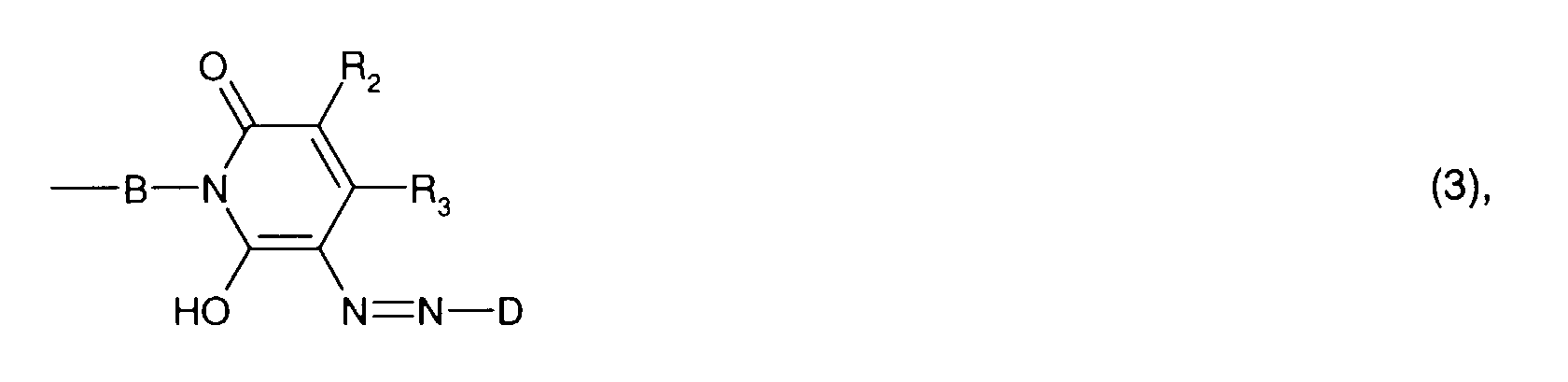 X1 is halogen, hydroxy, C1-C4alkoxy, unsubstituted or substituted C1-C4alkylthio or amino, or a N-heterocycle which may contain additional heteroatoms,Hal is chloro or bromo,Y is vinyl or a -CH2-CH2-U radical, U is a group a which is removable with alkali, and I and m are each independently of the other the number 2, 3 or 4,
 - A reactive dye according to claim 1, wherein
A is phenyl which is substituted by 1 to 2 identical or different substituents selected from the group consisting of methyl, methoxy, sulfo and a fibre-reactive group of formula (2a), wherein Y is vinyl or β-sulfatoethyl. - A reactive dye according to either claim 1 or claim 2, wherein
B is straight-chain or branched C2-C6alkylene. - A reactive dye according to any one of claims 1 to 3, wherein
R1 is hydrogen or C1-C4alkyl, preferably hydrogen. - A reactive dye according to any one of claims 1 to 4, whereinR2 is carbamoyl or sulfomethyl, andR3 is C1-C4alkyl.
- A reactive dye according to any one of claims 1 to 5, wherein
R is hydrogen or a radical of formula (3), wherein B, D, R2 and R3 have the meanings cited in claim 1. - A reactive dye according to any one of claims 1 to 6, wherein
X1 is chloro or fluoro. - A reactive dye according to any one of claims 1 to 7, wherein
at least one of A and D contains a fibre-reactive group. - A reactive dye according to any one of claims 1 to 8, whereinD is a radical of formula (7) or (6j')wherein
 (R8)0-3 is 0 to 3 identical or different substituents selected from the group consisting of halogen, C1-C4alkyl, C1-C4alkoxy, carboxy and sulfo,Z2 may be a radical of formula (2a), (2b), (2c), (2d), (2e), (2f) or (2g)or
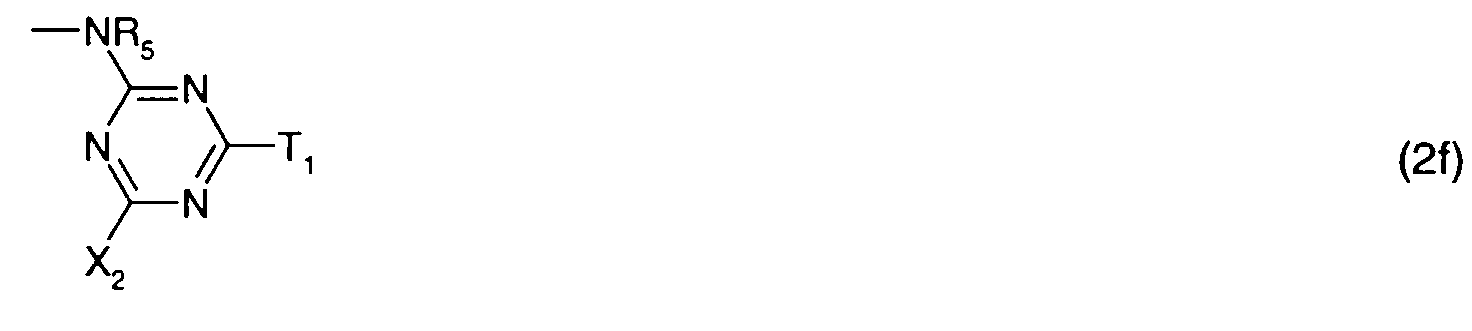 wherein
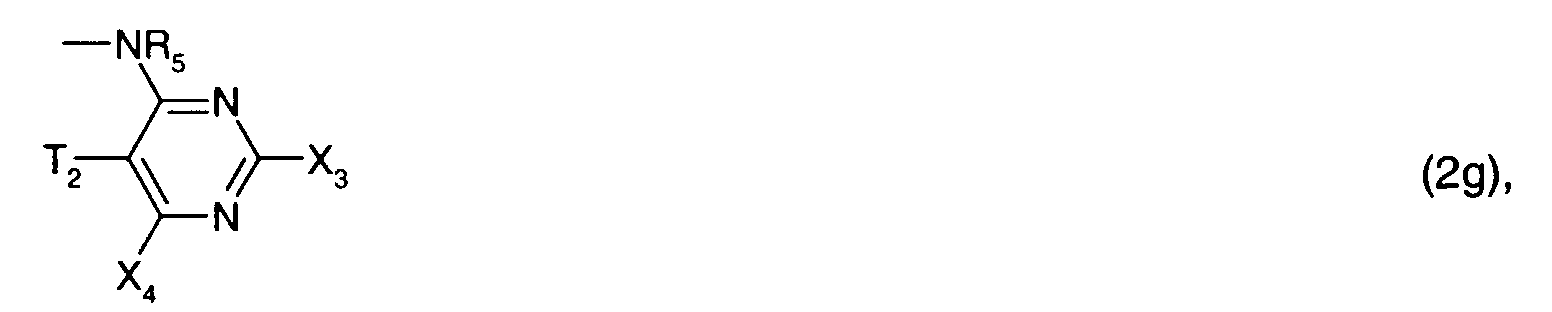 Y is vinyl, β-chloroethyl or β-sulfatoethyl, Hal is bromo, I and m are each independently of the other the number 2 or 3, R5 is hydrogen and X2, X3 and X4 are each independently of one another chloro or fluoro, T1 is a fibre-reactive radical of formula (4c') or (4d'),or
 wherein Y is vinyl or β-sulfatoethyl, and T2 is cyano or chloro; or
 wherein
 Z1 may be a radical of formula (2a),wherein Y is vinyl or β-sulfatoethyl,(R6)0-2 is 0 to 2 identical or different substituents from the C1-C4alkyl, C1-C4alkoxy, halogen, carboxy and sulfo group,R7 is hydrogen, sulfo, or C1-C4alkoxy which is unsubstituted or substituted in the alkyl moiety by hydroxy or sulfato, andR7' is hydrogen, C1-C4alkyl, C1-C4alkoxy, C2-C4alkanoylamino or ureido.
 - A reactive dye according to any one of claims 1 to 9, whereinD corresponds to a radical of formula (7a), (7b), (7c), (7d) or (7e)
 or
or wherein
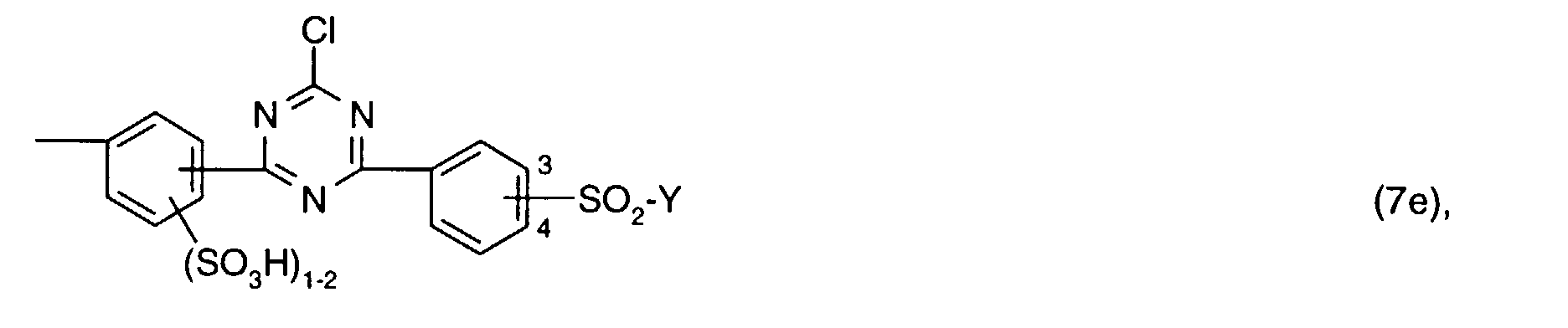 (R8)0-2 is 0 to 2 identical or different substituents selected from the group consisting of halogen, C1-C4alkyl, C1-C4alkoxy and sulfo,Y1 is a -CH(Br)-CH2-Br or -C(Br)=CH2 radical,Y is vinyl, β-chloroethyl or β-sulfatoethyl, andm is the number 2 or 3.
 - A reactive dye according to claim 10, which corresponds to formula (1a)wherein
 A is phenyl which is substituted by 1 to 2 identical or different substituents selected from the group consisting of methyl, methoxy, sulfo and the fibre-reactive group of formula -SO2-Y (2a), wherein Y is vinyl or β-sulfatoethyl,B is straight-chain or branched C2-C6alkylene,D corresponds to a radical of formula (7a), (7b), (7c), (7d) or (7e), wherein (R8)0-2, Y, Y1 andm have the meanings and preferred meanings given in claim 10,R2 is carbamoyl or sulfomethyl,R is hydrogen or corresponds to a radical of formula (3a)wherein B, D and R2 have the meanings cited above, and
 X1 is chloro or fluoro.
 - A process for the preparation of a reactive dye according to claim 1, which comprises reacting about 1 molar equivalent each of an amine of formula (8)of a compound of formula (9)
 and of a compound of formula (10)
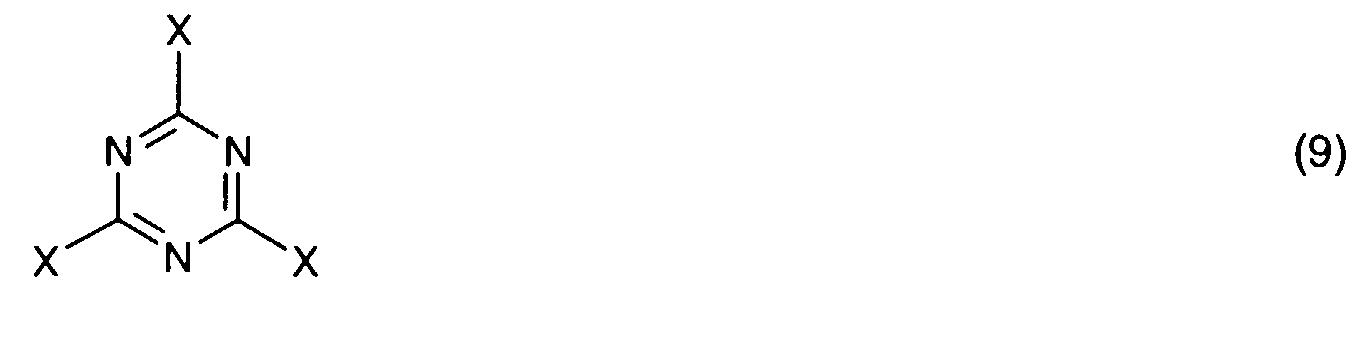 in any sequence with each other, wherein A, B, D, R1, R2, R3 and R have the meanings given in claim 1 and X is halogen.
- Use of a reactive dye according to any one of claims 1 to 11 or of the reactive dyes obtained according to claim 12 for dyeing or printing hydroxyl group-containing or nitrogen-containing fibre materials.
- Use according to claim 13, which comprises dyeing or printing cellulosic fibre materials, preferably cotton-containing fibre materials.
Priority Applications (1)
| Application Number | Priority Date | Filing Date | Title |
|---|---|---|---|
| EP20000810235 EP1041122B1 (en) | 1999-03-30 | 2000-03-21 | Reactive dyes, process for their preparation and their use |
Applications Claiming Priority (3)
| Application Number | Priority Date | Filing Date | Title |
|---|---|---|---|
| EP99810271 | 1999-03-30 | ||
| EP99810271 | 1999-03-30 | ||
| EP20000810235 EP1041122B1 (en) | 1999-03-30 | 2000-03-21 | Reactive dyes, process for their preparation and their use |
Publications (2)
| Publication Number | Publication Date |
|---|---|
| EP1041122A1 true EP1041122A1 (en) | 2000-10-04 |
| EP1041122B1 EP1041122B1 (en) | 2004-05-06 |
Family
ID=26073813
Family Applications (1)
| Application Number | Title | Priority Date | Filing Date |
|---|---|---|---|
| EP20000810235 Expired - Lifetime EP1041122B1 (en) | 1999-03-30 | 2000-03-21 | Reactive dyes, process for their preparation and their use |
Country Status (1)
| Country | Link |
|---|---|
| EP (1) | EP1041122B1 (en) |
Cited By (1)
| Publication number | Priority date | Publication date | Assignee | Title |
|---|---|---|---|---|
| WO2001070888A1 (en) * | 2000-03-22 | 2001-09-27 | Ciba Specialty Chemicals Holding Inc. | Fibre reactive naphthylazonaphthyl triazinyl dyes |
Citations (5)
| Publication number | Priority date | Publication date | Assignee | Title |
|---|---|---|---|---|
| JPS57161175A (en) * | 1981-03-24 | 1982-10-04 | Sumitomo Chemical Co | Dyeing of cellulosic fiber |
| JPS58168660A (en) * | 1982-03-30 | 1983-10-05 | Sumitomo Chem Co Ltd | Bis-azo compound and method for dyeing fiber by using same |
| EP0486176A1 (en) * | 1990-11-16 | 1992-05-20 | Zeneca Limited | Reactive dyes |
| EP0679696A1 (en) * | 1994-04-25 | 1995-11-02 | Hoechst Aktiengesellschaft | Water-soluble pyridone-disazo compounds, process for their preparation and their use as dyestuffs |
| WO1997027249A1 (en) * | 1996-01-27 | 1997-07-31 | Zeneca Limited | Heteropolyfunctional reactive disaro dyes |
-
2000
- 2000-03-21 EP EP20000810235 patent/EP1041122B1/en not_active Expired - Lifetime
Patent Citations (5)
| Publication number | Priority date | Publication date | Assignee | Title |
|---|---|---|---|---|
| JPS57161175A (en) * | 1981-03-24 | 1982-10-04 | Sumitomo Chemical Co | Dyeing of cellulosic fiber |
| JPS58168660A (en) * | 1982-03-30 | 1983-10-05 | Sumitomo Chem Co Ltd | Bis-azo compound and method for dyeing fiber by using same |
| EP0486176A1 (en) * | 1990-11-16 | 1992-05-20 | Zeneca Limited | Reactive dyes |
| EP0679696A1 (en) * | 1994-04-25 | 1995-11-02 | Hoechst Aktiengesellschaft | Water-soluble pyridone-disazo compounds, process for their preparation and their use as dyestuffs |
| WO1997027249A1 (en) * | 1996-01-27 | 1997-07-31 | Zeneca Limited | Heteropolyfunctional reactive disaro dyes |
Non-Patent Citations (2)
| Title |
|---|
| DATABASE WPI Week 8245, Derwent World Patents Index; AN 82-96633E[45], XP002114180, "Dyeing cellullose fibre" * |
| PATENT ABSTRACTS OF JAPAN vol. 007, no. 289 (C - 202) 23 December 1983 (1983-12-23) * |
Cited By (2)
| Publication number | Priority date | Publication date | Assignee | Title |
|---|---|---|---|---|
| WO2001070888A1 (en) * | 2000-03-22 | 2001-09-27 | Ciba Specialty Chemicals Holding Inc. | Fibre reactive naphthylazonaphthyl triazinyl dyes |
| US6518409B2 (en) | 2000-03-22 | 2003-02-11 | Ciba Specialty Chemicals Corporation | Reactive dyes, processes for the preparation thereof and the use thereof |
Also Published As
| Publication number | Publication date |
|---|---|
| EP1041122B1 (en) | 2004-05-06 |
Similar Documents
| Publication | Publication Date | Title |
|---|---|---|
| US6537332B1 (en) | Reactive colorants, mixtures of reactive colorants and production and use thereof | |
| JP4778600B2 (en) | Azo dye, its preparation method and its use | |
| US20040261199A1 (en) | Fibre-reactive dyes their preparation and their use | |
| US5629410A (en) | Reactive azo dyes containing an aminocarbonyl or aminosulfonyl bridge member | |
| EP1470195B1 (en) | Fibre-reactive azo dyes, their preparation and their use | |
| US5750662A (en) | Disazo dyes containing haloacryloylamino or dihalopropionylamino and substituted triazinyl reactive groups | |
| US6670457B2 (en) | Reactive dyes, their preparation and use | |
| KR100429698B1 (en) | A dye, a process for its preparation and a process for dyeing or printing using the same | |
| US6592634B1 (en) | Reactive dyes, processes for their preparation and their use | |
| US6353094B1 (en) | Dyes, a process for their preparation and their use | |
| US6451072B1 (en) | Reactive dyes, process for their preparation and their use | |
| JP3804873B2 (en) | Reactive dyes, methods for producing them, and uses thereof | |
| EP1041122B1 (en) | Reactive dyes, process for their preparation and their use | |
| JPH09165525A (en) | Fiber-reactive dye and its production | |
| EP1913094B1 (en) | Reactive dyes, their preparation and their use | |
| JP3754712B2 (en) | Reactive dyes, processes for their production and their use | |
| KR100429699B1 (en) | Dye mixtures, preparation methods thereof, and dyeing or printing methods using the same | |
| US6518408B1 (en) | Reactive colorants, production and use thereof | |
| JP3739416B2 (en) | Reactive dyes, production methods thereof and uses thereof | |
| KR100622456B1 (en) | Azo dyes, preparation method thereof and use thereof | |
| KR20080093113A (en) | Reactive dyes, preparation methods thereof and uses thereof | |
| US6518409B2 (en) | Reactive dyes, processes for the preparation thereof and the use thereof | |
| EP1036825A1 (en) | Reactive dyestuffs, process for their preparation and use thereof |
Legal Events
| Date | Code | Title | Description |
|---|---|---|---|
| PUAI | Public reference made under article 153(3) epc to a published international application that has entered the european phase |
Free format text: ORIGINAL CODE: 0009012 |
|
| AK | Designated contracting states |
Kind code of ref document: A1 Designated state(s): CH DE ES FR GB IT LI |
|
| AX | Request for extension of the european patent |
Free format text: AL;LT;LV;MK;RO;SI |
|
| 17P | Request for examination filed |
Effective date: 20010315 |
|
| AKX | Designation fees paid |
Free format text: CH DE ES FR GB IT LI |
|
| 17Q | First examination report despatched |
Effective date: 20030203 |
|
| GRAP | Despatch of communication of intention to grant a patent |
Free format text: ORIGINAL CODE: EPIDOSNIGR1 |
|
| GRAS | Grant fee paid |
Free format text: ORIGINAL CODE: EPIDOSNIGR3 |
|
| GRAA | (expected) grant |
Free format text: ORIGINAL CODE: 0009210 |
|
| AK | Designated contracting states |
Kind code of ref document: B1 Designated state(s): CH DE ES FR GB IT LI |
|
| PG25 | Lapsed in a contracting state [announced via postgrant information from national office to epo] |
Ref country code: CH Free format text: LAPSE BECAUSE OF FAILURE TO SUBMIT A TRANSLATION OF THE DESCRIPTION OR TO PAY THE FEE WITHIN THE PRESCRIBED TIME-LIMIT Effective date: 20040506 Ref country code: LI Free format text: LAPSE BECAUSE OF FAILURE TO SUBMIT A TRANSLATION OF THE DESCRIPTION OR TO PAY THE FEE WITHIN THE PRESCRIBED TIME-LIMIT Effective date: 20040506 |
|
| REG | Reference to a national code |
Ref country code: GB Ref legal event code: FG4D |
|
| REG | Reference to a national code |
Ref country code: CH Ref legal event code: EP |
|
| REF | Corresponds to: |
Ref document number: 60010362 Country of ref document: DE Date of ref document: 20040609 Kind code of ref document: P |
|
| REG | Reference to a national code |
Ref country code: CH Ref legal event code: PL |
|
| REG | Reference to a national code |
Ref country code: ES Ref legal event code: FG2A Ref document number: 2219290 Country of ref document: ES Kind code of ref document: T3 |
|
| ET | Fr: translation filed | ||
| PLBE | No opposition filed within time limit |
Free format text: ORIGINAL CODE: 0009261 |
|
| STAA | Information on the status of an ep patent application or granted ep patent |
Free format text: STATUS: NO OPPOSITION FILED WITHIN TIME LIMIT |
|
| 26N | No opposition filed |
Effective date: 20050208 |
|
| PGFP | Annual fee paid to national office [announced via postgrant information from national office to epo] |
Ref country code: DE Payment date: 20070316 Year of fee payment: 8 |
|
| PGFP | Annual fee paid to national office [announced via postgrant information from national office to epo] |
Ref country code: GB Payment date: 20070322 Year of fee payment: 8 |
|
| PGFP | Annual fee paid to national office [announced via postgrant information from national office to epo] |
Ref country code: ES Payment date: 20070329 Year of fee payment: 8 |
|
| PGFP | Annual fee paid to national office [announced via postgrant information from national office to epo] |
Ref country code: IT Payment date: 20070611 Year of fee payment: 8 |
|
| PGFP | Annual fee paid to national office [announced via postgrant information from national office to epo] |
Ref country code: FR Payment date: 20070319 Year of fee payment: 8 |
|
| GBPC | Gb: european patent ceased through non-payment of renewal fee |
Effective date: 20080321 |
|
| REG | Reference to a national code |
Ref country code: FR Ref legal event code: ST Effective date: 20081125 |
|
| PG25 | Lapsed in a contracting state [announced via postgrant information from national office to epo] |
Ref country code: DE Free format text: LAPSE BECAUSE OF NON-PAYMENT OF DUE FEES Effective date: 20081001 |
|
| PG25 | Lapsed in a contracting state [announced via postgrant information from national office to epo] |
Ref country code: FR Free format text: LAPSE BECAUSE OF NON-PAYMENT OF DUE FEES Effective date: 20080331 |
|
| REG | Reference to a national code |
Ref country code: ES Ref legal event code: FD2A Effective date: 20080322 |
|
| PG25 | Lapsed in a contracting state [announced via postgrant information from national office to epo] |
Ref country code: GB Free format text: LAPSE BECAUSE OF NON-PAYMENT OF DUE FEES Effective date: 20080321 |
|
| PG25 | Lapsed in a contracting state [announced via postgrant information from national office to epo] |
Ref country code: ES Free format text: LAPSE BECAUSE OF NON-PAYMENT OF DUE FEES Effective date: 20080322 |
|
| PG25 | Lapsed in a contracting state [announced via postgrant information from national office to epo] |
Ref country code: IT Free format text: LAPSE BECAUSE OF NON-PAYMENT OF DUE FEES Effective date: 20080321 |