EP1040831A2 - Use of corticotropin releasing factor (CRF) antagonists to prevent sudden death - Google Patents
Use of corticotropin releasing factor (CRF) antagonists to prevent sudden death Download PDFInfo
- Publication number
- EP1040831A2 EP1040831A2 EP00302253A EP00302253A EP1040831A2 EP 1040831 A2 EP1040831 A2 EP 1040831A2 EP 00302253 A EP00302253 A EP 00302253A EP 00302253 A EP00302253 A EP 00302253A EP 1040831 A2 EP1040831 A2 EP 1040831A2
- Authority
- EP
- European Patent Office
- Prior art keywords
- alkyl
- dimethyl
- ethyl
- amine
- trimethyl
- Prior art date
- Legal status (The legal status is an assumption and is not a legal conclusion. Google has not performed a legal analysis and makes no representation as to the accuracy of the status listed.)
- Withdrawn
Links
Classifications
-
- A—HUMAN NECESSITIES
- A61—MEDICAL OR VETERINARY SCIENCE; HYGIENE
- A61K—PREPARATIONS FOR MEDICAL, DENTAL OR TOILETRY PURPOSES
- A61K31/00—Medicinal preparations containing organic active ingredients
- A61K31/33—Heterocyclic compounds
- A61K31/395—Heterocyclic compounds having nitrogen as a ring hetero atom, e.g. guanethidine or rifamycins
- A61K31/41—Heterocyclic compounds having nitrogen as a ring hetero atom, e.g. guanethidine or rifamycins having five-membered rings with two or more ring hetero atoms, at least one of which being nitrogen, e.g. tetrazole
-
- A—HUMAN NECESSITIES
- A61—MEDICAL OR VETERINARY SCIENCE; HYGIENE
- A61K—PREPARATIONS FOR MEDICAL, DENTAL OR TOILETRY PURPOSES
- A61K31/00—Medicinal preparations containing organic active ingredients
- A61K31/33—Heterocyclic compounds
- A61K31/395—Heterocyclic compounds having nitrogen as a ring hetero atom, e.g. guanethidine or rifamycins
- A61K31/435—Heterocyclic compounds having nitrogen as a ring hetero atom, e.g. guanethidine or rifamycins having six-membered rings with one nitrogen as the only ring hetero atom
- A61K31/4353—Heterocyclic compounds having nitrogen as a ring hetero atom, e.g. guanethidine or rifamycins having six-membered rings with one nitrogen as the only ring hetero atom ortho- or peri-condensed with heterocyclic ring systems
- A61K31/437—Heterocyclic compounds having nitrogen as a ring hetero atom, e.g. guanethidine or rifamycins having six-membered rings with one nitrogen as the only ring hetero atom ortho- or peri-condensed with heterocyclic ring systems the heterocyclic ring system containing a five-membered ring having nitrogen as a ring hetero atom, e.g. indolizine, beta-carboline
-
- A—HUMAN NECESSITIES
- A61—MEDICAL OR VETERINARY SCIENCE; HYGIENE
- A61K—PREPARATIONS FOR MEDICAL, DENTAL OR TOILETRY PURPOSES
- A61K31/00—Medicinal preparations containing organic active ingredients
- A61K31/33—Heterocyclic compounds
- A61K31/395—Heterocyclic compounds having nitrogen as a ring hetero atom, e.g. guanethidine or rifamycins
- A61K31/435—Heterocyclic compounds having nitrogen as a ring hetero atom, e.g. guanethidine or rifamycins having six-membered rings with one nitrogen as the only ring hetero atom
- A61K31/44—Non condensed pyridines; Hydrogenated derivatives thereof
-
- A—HUMAN NECESSITIES
- A61—MEDICAL OR VETERINARY SCIENCE; HYGIENE
- A61K—PREPARATIONS FOR MEDICAL, DENTAL OR TOILETRY PURPOSES
- A61K31/00—Medicinal preparations containing organic active ingredients
- A61K31/33—Heterocyclic compounds
- A61K31/395—Heterocyclic compounds having nitrogen as a ring hetero atom, e.g. guanethidine or rifamycins
- A61K31/435—Heterocyclic compounds having nitrogen as a ring hetero atom, e.g. guanethidine or rifamycins having six-membered rings with one nitrogen as the only ring hetero atom
- A61K31/44—Non condensed pyridines; Hydrogenated derivatives thereof
- A61K31/455—Nicotinic acids, e.g. niacin; Derivatives thereof, e.g. esters, amides
-
- A—HUMAN NECESSITIES
- A61—MEDICAL OR VETERINARY SCIENCE; HYGIENE
- A61K—PREPARATIONS FOR MEDICAL, DENTAL OR TOILETRY PURPOSES
- A61K31/00—Medicinal preparations containing organic active ingredients
- A61K31/33—Heterocyclic compounds
- A61K31/395—Heterocyclic compounds having nitrogen as a ring hetero atom, e.g. guanethidine or rifamycins
- A61K31/495—Heterocyclic compounds having nitrogen as a ring hetero atom, e.g. guanethidine or rifamycins having six-membered rings with two or more nitrogen atoms as the only ring heteroatoms, e.g. piperazine or tetrazines
- A61K31/505—Pyrimidines; Hydrogenated pyrimidines, e.g. trimethoprim
-
- A—HUMAN NECESSITIES
- A61—MEDICAL OR VETERINARY SCIENCE; HYGIENE
- A61K—PREPARATIONS FOR MEDICAL, DENTAL OR TOILETRY PURPOSES
- A61K31/00—Medicinal preparations containing organic active ingredients
- A61K31/33—Heterocyclic compounds
- A61K31/395—Heterocyclic compounds having nitrogen as a ring hetero atom, e.g. guanethidine or rifamycins
- A61K31/495—Heterocyclic compounds having nitrogen as a ring hetero atom, e.g. guanethidine or rifamycins having six-membered rings with two or more nitrogen atoms as the only ring heteroatoms, e.g. piperazine or tetrazines
- A61K31/505—Pyrimidines; Hydrogenated pyrimidines, e.g. trimethoprim
- A61K31/506—Pyrimidines; Hydrogenated pyrimidines, e.g. trimethoprim not condensed and containing further heterocyclic rings
-
- A—HUMAN NECESSITIES
- A61—MEDICAL OR VETERINARY SCIENCE; HYGIENE
- A61K—PREPARATIONS FOR MEDICAL, DENTAL OR TOILETRY PURPOSES
- A61K31/00—Medicinal preparations containing organic active ingredients
- A61K31/33—Heterocyclic compounds
- A61K31/395—Heterocyclic compounds having nitrogen as a ring hetero atom, e.g. guanethidine or rifamycins
- A61K31/495—Heterocyclic compounds having nitrogen as a ring hetero atom, e.g. guanethidine or rifamycins having six-membered rings with two or more nitrogen atoms as the only ring heteroatoms, e.g. piperazine or tetrazines
- A61K31/505—Pyrimidines; Hydrogenated pyrimidines, e.g. trimethoprim
- A61K31/519—Pyrimidines; Hydrogenated pyrimidines, e.g. trimethoprim ortho- or peri-condensed with heterocyclic rings
-
- A—HUMAN NECESSITIES
- A61—MEDICAL OR VETERINARY SCIENCE; HYGIENE
- A61K—PREPARATIONS FOR MEDICAL, DENTAL OR TOILETRY PURPOSES
- A61K31/00—Medicinal preparations containing organic active ingredients
- A61K31/33—Heterocyclic compounds
- A61K31/395—Heterocyclic compounds having nitrogen as a ring hetero atom, e.g. guanethidine or rifamycins
- A61K31/495—Heterocyclic compounds having nitrogen as a ring hetero atom, e.g. guanethidine or rifamycins having six-membered rings with two or more nitrogen atoms as the only ring heteroatoms, e.g. piperazine or tetrazines
- A61K31/505—Pyrimidines; Hydrogenated pyrimidines, e.g. trimethoprim
- A61K31/519—Pyrimidines; Hydrogenated pyrimidines, e.g. trimethoprim ortho- or peri-condensed with heterocyclic rings
- A61K31/52—Purines, e.g. adenine
-
- A—HUMAN NECESSITIES
- A61—MEDICAL OR VETERINARY SCIENCE; HYGIENE
- A61P—SPECIFIC THERAPEUTIC ACTIVITY OF CHEMICAL COMPOUNDS OR MEDICINAL PREPARATIONS
- A61P43/00—Drugs for specific purposes, not provided for in groups A61P1/00-A61P41/00
-
- A—HUMAN NECESSITIES
- A61—MEDICAL OR VETERINARY SCIENCE; HYGIENE
- A61P—SPECIFIC THERAPEUTIC ACTIVITY OF CHEMICAL COMPOUNDS OR MEDICINAL PREPARATIONS
- A61P9/00—Drugs for disorders of the cardiovascular system
- A61P9/04—Inotropic agents, i.e. stimulants of cardiac contraction; Drugs for heart failure
Definitions
- This invention relates to methods for reducing the incidence of sudden death in certain patients by administering thereto a pharmaceutically effective amount of a corticotropin releasing factor (CRF) antagonist. It is currently believed that CRF antagonists reduce the incidence of sudden death in patients by improving their QT dispersion and heart rate variability.
- CRF corticotropin releasing factor
- CRF antagonists that can be used to treat the disorders recited in the method of this invention are referred to in PCT international patent application numbers PCT/IB95/00318 (published as WO 95/33727), PCT/IB97/00918 (published as WO 98/05661), PCT/IB97/00904 (published as WO 98/08846), and PCT/IB97/00922 (published as WO 98/08847), PCT/EP98/02267 (published as WO 98/47874), PCT/EP98/02268 (published as WO 98/47903), PCT/US98/09861 (published as WO 98/51312), PCT/US98/13840 (published as WO 99/01439), PCT/US98/13913 (published as WO 99/01454), as well as in United States Patents 5,063,245, 5,109,111, 5,132,111, 5,245,009, 5,464,847, 5,49
- CRF antagonists are set out in the literature, e.g., as discussed in U.S. Patent 5,063,245, which is incorporated herein by reference in its entirety.
- a recent outline of the different activities possessed by CRF antagonists is found in M. J. Owens et al., Pharm. Rev ., 43:425-73 (1991), also incorporated herein by reference in its entirety.
- PCT international patent application PCT/US98/07831 discloses the usefulness of substituted pyrrolopyridines in the treatment of inflammatory diseases.
- the disclosed compounds inhibit the production of certain inflammatory cytokines, namely TNF- ⁇ and IL-1 ⁇ .
- TNF- ⁇ and IL-1 ⁇ are inflammatory cytokines that are involved in the production of certain inflammatory cytokines.
- cytokine-related inflammatory diseases is congestive heart failure.
- QT dispersion or heart rate variability is made.
- the present invention relates to a method of preventing sudden death in an animal comprising administering to said animal, preferably a human, a therapeutically effective amount of a corticotropin releasing factor antagonist.
- the method of the present invention is most useful in preventing sudden death in specific patients, particularly those suffering from cardiovascular or heart related diseases such as hypertension, tachycardia, congestive heart failure, and the like, as well as other diseases such as stroke, osteoporosis, premature birth, psychosocial dwarfism, stress-induced fever, ulcer, diarrhea, post-operative ileus, colonic hypersensitivity associated with psychopathological disturbance and stress, and the like.
- cardiovascular or heart related diseases such as hypertension, tachycardia, congestive heart failure, and the like
- other diseases such as stroke, osteoporosis, premature birth, psychosocial dwarfism, stress-induced fever, ulcer, diarrhea, post-operative ileus, colonic hypersensitivity associated with psychopathological disturbance and stress, and the like.
- the method of the present invention is also useful in preventing sudden death in diabetic patients, as well as in patients suffering from many neurological disorders such as brain damage, Guillain-Barre syndrome, sudden infant death syndrome, congenital hypoventilation syndrome, uremic neuropathy
- the present invention is practiced using a compound of Formula I or II: or a pharmaceutically acceptable salt thereof, wherein
- Heart rate variability is the amount of fluctuations around the mean heart rate, and can be used as a correlate of the cardiorespiratory control system.
- Low heart rate variability i.e., predominance of either the parasympathetic or sympathetic system, is associated with sudden cardiac death in diabetic, heart failure, and post-infarction patients and in many neurological disorders such as brain damage, Guillain-Barre syndrome, sudden infant death syndrome, congenital hypoventilation syndrome, uremic neuropathy, and the like.
- CRF antagonists decrease the incidence of sudden death due to a centrally mediated imbalance in the neural outflow to the heart and respiratory system in a number of disorders. Patients at risk can be easily and inexpensively monitored by means of electrocardiogram QT dispersion and heart rate variability to determine if they would benefit from such therapy.
- certain drugs administered to a patient to alleviate other symptoms may cause or result in QT dispersion and/or heart rate variability.
- examples of such drugs include phenothiazine and atypical antipsychotics (e.g., chlorpromazine, respiradone), class 1A and class III antiarrhythmics (e.g., quinidine and sotolol), anesthetic agents (e.g., enflurane, isoflurane), and the like.
- phenothiazine and atypical antipsychotics e.g., chlorpromazine, respiradone
- class 1A and class III antiarrhythmics e.g., quinidine and sotolol
- anesthetic agents e.g., enflurane, isoflurane
- CRF antagonists alone will decrease the incidence of sudden death in certain patients, it may be preferable to combine the CRF antagonist with another drug.
- other drugs that are also able to balance the neural outflow to heart and/or respiratory system may improve the efficacy of the CRF antagonist in a synergistic manner.
- Preferred for use in the methods of the present invention are the compounds of formulas I and II, and their pharmaceutically acceptable salts, which are readily prepared.
- the compounds of formula II wherein A, D, and Y are N, a double bond connects E and D, and E is -CR 4 are prepared by one or more of the synthetic methods described in PCT publication WO 94/13677, referred to above.
- the compounds of formula II wherein A and Y are N, a double bond connects E and D, E is -CR 4 , and D is -CR 10 are prepared by one or more of the synthetic methods described in PCT publication WO 94/13676, referred to above.
- the compounds of formula II wherein A is -CR 7 , a double bond connects E and D, E is -CR 4 , D is N or -CR 10 , and Y is N, are prepared by one or more of the synthetic methods described in PCT publication WO 95/34563, referred to above.
- the remaining compounds of formula II and the compounds of formula I are prepared by one or more of the synthetic methods described in PCT publication WO 95/33750, referred to above. Additional information useful in preparing certain of the described compounds is provided in PCT/IB95/00437 (published as WO 96/39388), which described the production of certain intermediates.
- Pharmaceutically acceptable salts of the compounds of formulas I and II include salts of acidic or basic groups.
- pharmaceutically acceptable salts include sodium, calcium, and potassium salts of acidic groups, such as when the R 10 substituent is carboxy.
- Such salts are generally prepared by combining a compound of formula I or II with one molar equivalent of NaOH or KOH in a suitable solvent, pharmaceutically acceptable acid addition salts of basic groups, such as amino groups, are formed by reacting the base form of a compound of formula I or II with an appropriate acid.
- salts of basic groups include hydrochloride, hydrobromide, sulfate, hydrogen sulfate, phosphate, hydrogen phosphate, dihydrogen phosphate, acetate, succinate, citrate, tartrate, lactate, mandelate, methanesulfonate (mesylate), and p-toluenesulfonate (tosylate) salts.
- the salt is of a monobasic acid (e.g., the hydrochloride, the hydrobromide, the p-toluenesulfonate, the acetate)
- at least one molar equivalent and usually a molar excess of the acid is employed.
- salts as the sulfate, the hemisuccinate, the hydrogen phosphate, or the phosphate
- the appropriate and exact chemical equivalents of acid will generally be used.
- the free base and the acid are usually combined in a co-solvent from which the desired salt precipitates, or can be otherwise isolated by concentration or addition of a non-solvent.
- R 2 or R 5 is a heterocyclic group, the group is attached through a carbon atom.
- Formulas I and II are intended to include all stereoisomers (e.g., all geometric and optical isomers) as well as racemates of all compounds within the depicted genus.
- the compounds of formulas I and II, and their pharmaceutically acceptable salts can be administered alone or in combination with pharmaceutically acceptable carriers, in either single or multiple doses.
- suitable pharmaceutical carriers include inert solid diluents or fillers, sterile aqueous solutions, and various organic solvents.
- the pharmaceutical compositions formed by combining the active compounds and the pharmaceutically acceptable carriers are then readily administered in a variety of dosage forms such as tablets, powders, lozenges, syrups, injectable solutions, and the like.
- These pharmaceutical compositions can, if desired, contain additional ingredients such as flavorings, binders, excipients, and the like.
- tablets containing various excipients such as sodium citrate, calcium carbonate, and calcium phosphate may be employed along with various disintegrants such as starch, alginic acid, and certain complex silicates, together with binding agents such as polyvinylpyrrolidone, sucrose, gelatin, and acacia.
- binding agents such as polyvinylpyrrolidone, sucrose, gelatin, and acacia.
- lubricating agents such as magnesium stearate, sodium lauryl sulfate, and talc are often useful for tabletting purposes.
- Solid compositions of a similar type can also be employed as fillers in soft and hard filled gelatin capsules. Preferred materials for this include lactose or milk sugar and high molecular weight polyethylene glycols.
- the essential active ingredient therein may be combined with various sweetening or flavoring agents, coloring matter or dyes and, if desired, emulsifying or suspending agents, together with diluents such as water, ethanol, propylene glycol, glycerin, and combinations thereof.
- Oral administration is generally preferred. However, if the patient is unable to swallow, or oral absorption is otherwise impaired, another route of administration such as suppositories, parenteral, or topical administration will be appropriate.
- solutions of the active compound in sesame or peanut oil, aqueous propylene glycol, or in sterile aqueous solution can be employed.
- aqueous solutions should be suitably buffered if necessary and the liquid diluent first rendered isotonic with sufficient saline or glucose.
- aqueous solutions are especially suitable for intravenous, intramuscular, subcutaneous, and intraperitoneal administration.
- the sterile aqueous media employed are all readily available by standard techniques known to those skilled in the art.
- dilute, sterile, aqueous or partially aqueous solutions are employed.
- the effective dosage for the compounds of formulas I and II, and their pharmaceutically acceptable salts depends on the intended route of administration and other factors such as age and weight of the patient, as generally known to a physician.
- the daily dosage will preferably be about 0.1 mg/kg to about 50 mg/kg of the body weight of the patient to be treated. More preferably, the daily dosage will be about 1.0 mg/kg to about 20 mg/kg of body weight.
- the daily dosage may be given in a single dose or in divided doses.
- the methods of screening the compounds of formulas I and II, and their pharmaceutically acceptable salts, for CRF antagonist activity are as described in Wynn et al., Endocrinology , 116:1653-1659 (1985) and Grigoriadis et al., Peptides , 10:179-188 (1989). These methods determine the binding affinity of a test compound for a CRF receptor, which is highly related to its expected activity as a CRF antagonist.
- the binding affinities for the active compounds, expressed as IC 50 values generally range from about 0.2 nanomolar to about 10 micromolar.
Landscapes
- Health & Medical Sciences (AREA)
- Pharmacology & Pharmacy (AREA)
- Veterinary Medicine (AREA)
- Public Health (AREA)
- Chemical & Material Sciences (AREA)
- General Health & Medical Sciences (AREA)
- Animal Behavior & Ethology (AREA)
- Medicinal Chemistry (AREA)
- Life Sciences & Earth Sciences (AREA)
- Epidemiology (AREA)
- Engineering & Computer Science (AREA)
- Bioinformatics & Cheminformatics (AREA)
- Nuclear Medicine, Radiotherapy & Molecular Imaging (AREA)
- Organic Chemistry (AREA)
- General Chemical & Material Sciences (AREA)
- Chemical Kinetics & Catalysis (AREA)
- Cardiology (AREA)
- Heart & Thoracic Surgery (AREA)
- Hospice & Palliative Care (AREA)
- Pharmaceuticals Containing Other Organic And Inorganic Compounds (AREA)
- Medicines That Contain Protein Lipid Enzymes And Other Medicines (AREA)
- Pyridine Compounds (AREA)
- Nitrogen Condensed Heterocyclic Rings (AREA)
Abstract
Description

Claims (10)
- A method of preventing sudden death in an animal comprising administering to said animal a therapeutically effective amount of a corticotropin releasing factor antagonist.
- The method of claim 1, wherein said corticotropin releasing factor antagonist is a compound of Formula I or II:or a pharmaceutically acceptable salt thereof, wherein
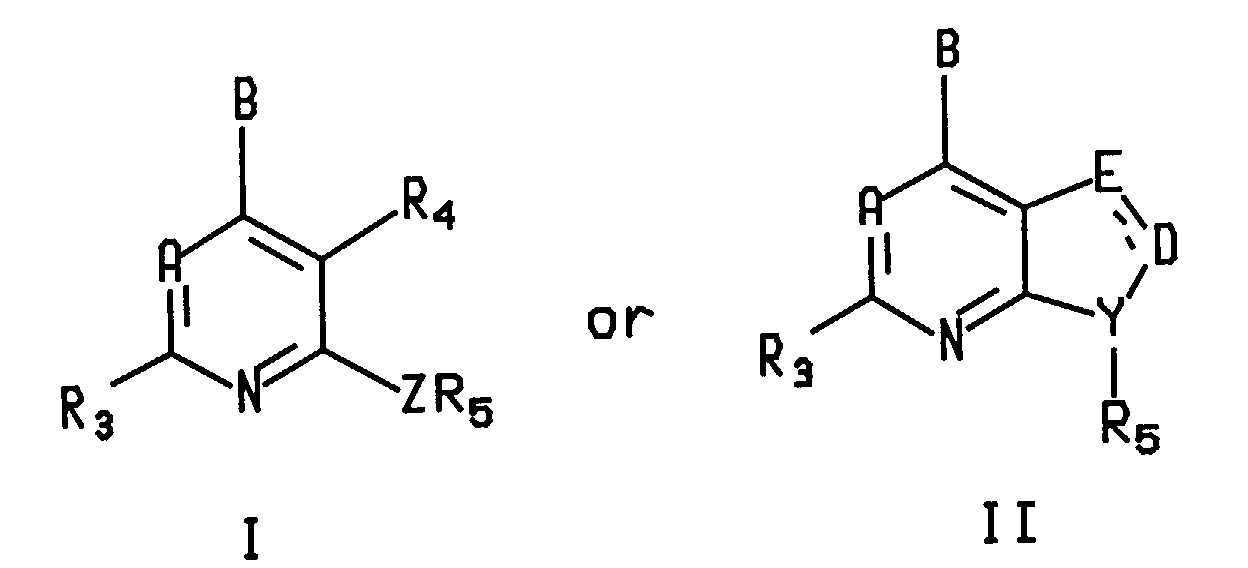 the dashed line represents an optional double bond;A is -CR7 or N;B is -NR1R2, -CR1R2R11, -C(=CR1R12)R2, -NHCR11R1R2, -OCR11R1R2, -SCR11 R1 R2, -CR11R2OR1, -CR11 R2SR1, -C(S)R2, -NHNR1R2, -CR2R11NHR1 or -C(O)R2;D isN or -CR10 when a double bond connects E and D and E is -CR4;-CR10 when a double bond connects E and D and E is N; or-CR8R9, -CHR10, -C=O, -C=S, -C=NH, or -C=NCH3 when a single bond connects E and D;E is -CR4 or N when a double bond connects E and D, and E is -CR4R6 or -NR6 when a single bond connects E and D;Y is N or -CH;Z is NH, O, S, -N(C1-C2 alkyl), or -CR12R13, wherein R12 and R13 are each, independently, hydrogen, trifluoromethyl, or methyl, or one of R12 and R13 is cyano and the other is hydrogen or methyl;R1 is hydrogen or C1-C6 alkyl which is optionally substituted with up to two substituents independently selected from hydroxy, cyano, nitro, fluoro, chloro, bromo, iodo, CF3, C1-C4 alkoxy, -O-CO-(C1-C4 alkyl), -O-CO-NH(C1-C4 alkyl), -O-CO-N(C1-C4 alkyl)(C1-C2 alkyl), -NH(C1-C4 alkyl), -N(C1-C2 alkyl)(C1-C4 alkyl), -S(C1-C4 alkyl), -N(C1-C4alkyl)CO(C1-C4 alkyl), -NHCO(C1-C4 alkyl), -CO2(C1-C4 alkyl), -CONH(C1-C4 alkyl), -CON(C1-C4 alkyl)(C1-C2 alkyl), (C1-C4 alkyl)sulfinyl, (C1-C4 alkyl)sulfonyl, and (C1-C4 alkyl)sulfanyl, and wherein said C1-C6 alkyl, C1-C4 alkoxy, and C1-C4 alkyl moieties in the foregoing R1 groups optionally contain one double or triple bond;R2 is C1-C6 alkyl, heteroaryl, aryl, heteroaryl (C1-C4 alkyl), or aryl (C1-C4 alkyl), wherein said aryl and the aryl moiety of said (aryl)C1-C4 alkyl are selected from the group consisting of phenyl and naphthyl, and said heteroaryl and the heteroaryl moiety of said (heteroaryl)C1-C4 alkyl is selected from the group consisting of thienyl, benzothienyl, pyridyl, thiazolyl, quinolyl, pyrazinyl, pyrimidyl, imidazolyl, furanyl, benzofuranyl, benzothiazolyl, isothiazolyl, benzisothiazolyl, benzisoxazolyl, benzimidazolyl, indolyl, and benzoxazolyl; or R2 is C3-C8 cycloalkyl or (C3-C8 cycloalkyl)C1-C6 alkyl, wherein one or two of the ring carbons of said cycloalkyl having at least 4 ring members and the cycloalkyl moiety of said (C3-C8 cycloalkyl)C1-C6 alkyl having at least 4 ring members is optionally replaced by an oxygen or sulfur atom or by -NR14 wherein R14 is hydrogen or C1-C4 alkyl; and wherein each of the foregoing R2 groups is optionally substituted by up to three substituents independently selected from chloro, fluoro, and C1-C4 alkyl, or by one substituent selected from bromo, iodo, cyano, nitro, C1-C6 alkoxy, -O-CO-(C1-C4 alkyl), -O-CO-N(C1-C4 alkyl)(C1-C2 alkyl), -CO2(C1-C4 alkyl), (C1-C4 alkyl)sulfanyl, (C1-C4 alkyl)sulfinyl, and (C1-C4 alkyl)sulfonyl, and wherein said C1-C4 alkyl and C1-C6 alkyl moieties of the foregoing R2 groups optionally contain one carbon-carbon double or triple bond;or R1 and R2 of said -NR1R2 and said -CR1R2R11 are taken together to form a saturated or partially saturated 5- to 8-membered ring, wherein said ring optionally contains one or two carbon-carbon double bonds, and wherein one or two of the ring carbons is optionally replaced by a heteroatom selected from O, S, and N;R3 is hydrogen, C1-C6 alkyl, fluoro, chloro, bromo, iodo, hydroxy, amino, SH, -NH(C1-C4 alkyl), -N(C1-C4 alkyl)(C1-C2 alkyl), -CH2OH, -CH2OCH3, -O(C1-C4 alkyl), (C1-C4 alkyl)sulfanyl, (C1-C4 alkyl)sulfonyl, or (C1-C4 alkyl)sulfinyl, wherein said C1-C6 alkyl and C1-C4 alkyl moieties of the foregoing R3 groups optionally contain one double or triple bond and are optionally substituted by from one to three substituents independently selected from hydroxy, amino, C1-C3 alkoxy, -NH(C1-C2 alkyl), -N(C1-C2 alkyl)2, -NHCOCH3, fluoro, chloro, and C1-C3 thioalkyl;R4 is hydrogen, C1-C6 alkyl, fluoro, chloro, bromo, iodo, C1-C6 alkoxy, formyl, trifluoromethoxy, -CH2OCH3, -CH2OCH2CH3, -CH2CH2OCH3, -CH2CF3, CF3, amino, nitro, -NH(C1-C4 alkyl), -N(CH3)2, -NHCOCH3, -NHCONHCH3, (C1-C4 alkyl)sulfanyl, (C1-C4 alky)sulfinyl, (C1-C4 alkyl)sulfonyl, cyano, hydroxy, -CO(C1-C4 alkyl), -CHO, or -CO2(C1-C4 alkyl), wherein said alkyl, C1-C6 alkoxy, and C1-C4 alkyl moieties of the foregoing R4 groups optionally contain one double or triple bond and are optionally substituted with one substituent selected from hydroxy, amino, -NHCOCH3, -NH(C1-C2 alkyl), -N(C1-C2 alkyl)2, -CO2(C1-C4 alkyl), -CO(C1-C4 alkyl), C1-C3 alkoxy, (C1-C3 alkyl)sulfanyl, fluoro, chloro, cyano, and nitro;R5 is phenyl, naphthyl, thienyl, benzothienyl, pyridyl, quinolyl, pyrazinolyl, pyrimidyl, imidazolyl, furanyl, benzofuranyl, benzothiazolyl, isothiazolyl, benzoisothiazolyl, thiazolyl, isoxazolyl, benzisoxazolyl, benzimidazolyl, triazolyl, pyrazolyl, pyrrolyl, indolyl, azaindolyl, benzoxazolyl, oxazolyl, pyrrolidinyl, thiazolidinyl, morpholinyl, pyridinyl, tetrazolyl, or a 3- to 8-membered cycloalkyl ring or a 9- to 12-membered bicycloalkyl ring system, wherein said cycloalkyl ring and said bicycloalkyl ring system optionally contain one or two of O, S, or -N-G wherein G is hydrogen, C1-C4 alkyl, C1-C4 alkanoyl, phenyl, or benzyl, wherein each of the above R5 groups is optionally substituted by up to three substituents independently selected from fluoro, chloro, C1-C6 alkyl, C1-C6 alkoxy, and trifluoromethyl, or one substituent selected from bromo, iodo, cyano, nitro, amino, -NH(C1-C4 alkyl), -N(C1-C4 alkyl)(C1-C2 alkyl), -CO2(C1-C4 alkyl), -CO(C1-C4 alkyl), -SO2NH(C1-C4 alkyl), -SO2N(C1-C4 alkyl)(C1-C2 alkyl), -SO2NH2, -NHSO2(C1-C4 alkyl), -S(C1-C4 alkyl), and -SO2(C1-C4 alkyl), wherein said C1-C4 alkyl and C1-C6 alkyl moieties of the foregoing R5 groups optionally contain one double or triple bond and are optionally substituted by one or two substituents independently selected from fluoro, chloro, hydroxy, amino, methylamino, dimethylamino, and acetyl;R6 is hydrogen or C1-C6 alkyl, wherein said C1-C6 alkyl is optionally substituted by a single hydroxy, methoxy, ethoxy, or fluoro group;R7 is hydrogen, C1-C4 alkyl, fluoro, chloro, bromo, iodo, cyano, hydroxy, C1-C4 alkoxy, -CO(C1-C4 alkyl), -CO2(C1-C4 alkyl), -OCF3, CF3, -CH2OH, -CH2OCH3, or -CH2OCH2CH3;R8 and R9 are each, independently, hydrogen, hydroxy, methyl, ethyl, methoxy, or ethoxy;or R8 and R9 together form an oxo (=O) group;R10 is hydrogen, C1-C6 alkyl, fluoro, chloro, bromo, iodo, C1-C6 alkoxy, formyl, amino, -NH(C1-C4 alkyl), -N(C1-C4 alkyl)(C1-C2 alkyl), cyano, carboxy, amido, or -SOn(C1-C4 alkyl) wherein n is 0, 1, or 2, wherein said C1-C6 alkyl and C1-C4 alkyl moieties of the foregoing R10 groups are optionally substituted by one of hydroxy, trifluoromethyl, amino, carboxy, amido, -NHCO(C1-C4 alkyl), -NH(C1-C4 alkyl), -N(C1-C4 alkyl)(C1-C2 alkyl), -CO2(C1-C4 alkyl), C1-C3 alkoxy, C1-C3 thioalkyl, fluoro, bromo, chloro, iodo, cyano, or nitro; andR11 is hydrogen, hydroxy, fluoro, or methoxy.
 - The method of claim 2 wherein B is -NR1R2, -NHCHR1R2, -CR1R2R11, -SCHR1R2, or -OCHR1R2; R1 is C1-C6 alkyl optionally substituted with a single hydroxy, fluoro, or C1-C2 alkoxy group and optionally containing one carbon-carbon double or triple bond; R2 is benzyl or C1-C6 alkyl optionally containing one carbon-carbon double or triple bond, wherein said C1-C6 alkyl and the phenyl moiety of said benzyl are optionally substituted with fluoro, C1-C2 alkyl, or C1-C2 alkoxy; and R11 is hydrogen or fluoro.
- The method of claim 2 wherein R2 is (aryl)C1-C4 alkyl or (heteroaryl)C1-C4 alkyl in which said aryl moiety is phenyl, furanyl, or benzofuranyl, and said heteroaryl moiety is thienyl, benzothienyl, thiazolyl, pyridyl, or benzothiazolyl.
- The method of claim 2 wherein B is NR1R2 or CHR1R2 in which R1 and R2 are taken together with N or CH to form a 5- or 6-membered ring optionally having sulfur, oxygen, or, where B is NR1R2, one more nitrogen in said ring.
- The method of claim 2 wherein B is -NHCHR1R2 or -OCHR1R2, wherein the CHR1R2 moiety is a 5- or 6-membered ring optionally containing one oxygen or sulfur.
- The method of claim 2 wherein R3 is methyl, chloro, or methoxy; R4 is methyl, -CH2OH, cyano, trifluoromethoxy, methoxy, trifluoromethyl, chloro, -CO2CH3, -CH2OCH3, -CH2Cl, -CH2F, amino, or nitro; R6 is hydrogen, methylsulfinyl, methylsulfanyl, methylsulfonyl, or ethyl; and R5 is phenyl or pyridyl wherein said phenyl or pyridyl is substituted by one substituent independently selected from fluoro, chloro, bromo, iodo, C1-C4 alkoxy, trifluoromethyl, C1-C3 hydroxyalkyl, -CO2(C1-C2 alkyl), C1-C2 alkylamino, -CO(C1-C4 alkyl), and C1-C6 alkyl, wherein said C1-C6 alkyl and said C1-C4 alkyl are optionally substituted by a single hydroxy or fluoro group and optionally contain one carbon-carbon double or triple bond.
- The method of claim 2 wherein the compound of formula I or II is selected from the group consisting of:4-(1-ethyl-propoxy)-2,5-dimethy-6-(2,4,6-trimethyl-benzyl)-pyrimidine;2-(4-bromo-2,6-dimethyl-phenoxy)-4-(1-ethyl-propoxy)-3,6-dimethyl pyridine;2-(4-ethyl-2,6-dimethyl-phenoxy)-4-(1-ethyl-propoxy)-3,6-dimethyl pyridine;3-ethyl-4-(1-ethyl-propoxy)-6-methyl-2-(2,4,6-trimethyl-phenoxy)-pyridine;2-(2,6-dimethyl-4-propyl-phenoxy)-4-(1-ethyl-propoxy)-3,6-dimethyl-pyridine;4-(1-ethyl-propoxy)-2-(4-methoxy-2,6-dimethyl-phenoxy)-3,6-dimethyl-pyridine;2-(4-ethoxy-2,6-dimethyl-phenoxy)-4-(1-ethyl-propoxy)-3,6-dimethyl-pyridine;2-(4-chloro-2,6-dimethyl-phenoxy)-4-(1-ethyl-propoxy)-3,6-dimethyl-pyridine;4-(1-methoxymethol-propoxy)-3,6-dimethyl-2-(2,4,6-trimethyl-phenoxy)-pyridine;[3,6-dimethyl-2-(2,4,6-trimethyl-phenoxy)-pyridin-4-yl]-diethyl-amine;[3,6-dimethyl-2-(2,4,6-trimethyl-phenoxy)-pyridin-4-yl]-ethyl-propyl-amine;[2,5-dimethyl-6-(2,4,6-trimethyl-phenoxy)-pyrimidin-4-yl](1-ethyl-propyl)-amine;butyl-[3,6-dimethyl-2-(2,4,6-trimethyl-phenoxy)-pyridin-4-yl]-ethyl-amine;4-(1-ethyl-propoxy)-3,6-dimethyl-2-(2,4,6-trimethyl-phenylsulfanyl)-pyridine;butyl-[2-(4-chloro-2 ,6-dimethyl-phenoxy)-3,6-dimethyl-pyridin-4-yl]-ethyl-amine;4-(1-ethyl-propylamino)-6-methyl-2-(2,4,6-trimethyl-phenoxy)-nicotinic acid methyl ester;[3,6-dimethyl-2-(2,4,6-trimethyl-phenylsulfanyl)-pyridin-4-yl]-ethyl-propyl-amine;[4-(1-ethyl-propylamino)-6-methyl-2-(2,4,6-trimethyl-phenoxy)-pyridin-3-yl]-methanol;[2-(4-chloro-2,6-dimethyl-phenoxy)-3,6-dimethyl-pyridin-4-yl]-ethyl-propyl-amine;1-(ethyl-propyl)-[6-methyl-3-nitro-2-(2,4,6-trimethyl-phenoxy)-pyridin-4-yl]-amine;N4-(1-ethyl-propyl)-6-methyl-3-nitro-N2-(2,4,6-trimethyl-phenyl)-pyridine-2,4-diamine;N4-(1-ethyl-propyl)-6-methyl-2-(2,4,6-trimethyl-phenoxy)-pyridine-3,4-diamine;N4-(1-ethyl-propyl)-6-methyl-N2-(2,4,6-trimethyl-phenyl)-pyridine-2,3,4-triamine;[3,6-dimethyl-2-(2,4,6-trimethyl-phenoxy)-pyridin-4-yl]-ethyl-(2,2,2-trifluoro-ethyl)-amine;[3-chloromethyl-6-methyl-2-(2,4,6-trimethyl-phenoxy)pyridin-4-yl]-(1-ethyl-propyl)-amine;[3,6-dimethyl-2-(2,4,6-trimethyl-phenoxy)-pyridin-4-yl]-(1-ethyl-propyl)-amine;(1-ethyl-propyl)-[2-methyl-5-nitro-6-(2,4,6-trimethyl-pyridin-3-yloxy)-pyrimidin-4-yl]-amine;(1-ethyl-propyl)-[3-methoxymethyl-6-methyl-2-(2,4,6-trimethyl-phenoxy)-pyridin-4-yl]-amine;N-(1-ethyl-propyl)-2-methyl-5-nitro-N-(2,4,6-trimethyl-pyridin-3-yl)-pyrimidine-4,6-diamine;[2-(4-chloro-2,6-dimethyl-phenoxy)-3,6-dimethyl-pyridin-4-yl]-diethyl-amine;4-(1-ethyl-propoxy)-3,6-dimethyl-2-(2,4,6-trimethylphenoxy)-pyridine;butyl-[2,5-dimethyl-7-(2,4,6-trimethylphenyl)-6,7-dihydro-5H-pyrrolo[2,3-d]pyrimidin-4-yl]-ethyl-amine;4-(butyl-ethylamino)-2,5-dimethyl-7-(2,4,6-trimethylphenyl)-5,7-dihydro-pyrrolo[2,3-d]pyrimidin-6-one;4-(1-ethylpropoxy)-2,5-dimethyl-6-(2,4,6-trimethylphenoxy)-pyrimidine;N-butyl-N-ethyl-2,5-dimethyl-N-(2,4,6-trimethylphenyl)-pyrimidine-4,6-diamine;(1-ethyl-propyl)-[5-methyl-3-(2,4,6-trimethyl-phenyl)-3H-imidazo[4,5-b]pyridin-7-yl]-amine;[2,5-dimethyl-3-(2,4,6-trimethyl-phenyl)-3H-imidazo[4,5-b]pyridin-7-yl]-(1-ethyl-propyl)-amine;N4-(1-ethyl-propyl)-6,N3-dimethyl-2-(2,4,6-trimethyl-phenoxy)-pyridine-3,4-diamine;N4-(1-ethyl-propyl)-6,N3,N3-trimethyl-2-(2,4,6-trimethyl-phenoxy)-pyridine-3,4-diamine;6-(1-ethyl-propoxy)-2-methyl-N4-(2,4,6-trimethyl-phenyl)-pyrimidine-4,5-diamine;[4-(1-ethyl-propoxy)-3,6-dimethyl-pyridin-2-yl]-(2,4,6-trimethylphenyl)-amine; and6-(ethyl-propyl-amino)-2,7-dimethyl-9-(2,4,6-trimethylphenyl)-7,9-dihydro-purin-8-one.
- The method of claim 2 wherein said compound is selected from the group consisting of:butyl-[3,6-dimethyl-1-(2,4,6-trimethylphenyl)-1H-pyrazolo[3,4-b]pyridin-4-yl]-ethylamine;3,6-dimethyl-4-(tetrahydrofuran-3-yloxy)-1-(2,4,6-trimethylphenyl)-1H-pyrazolo[3,4-b]pyridine;[3,6-dimethyl-1-(2,4,6-trimethylphenyl)-1H-pyrazolo[3,4,b]pyridin-4-yl]-(1-methoxymethylpropyl)-amine;4-(1-methoxymethylpropoxy)-3,6-dimethyl-1-(2,4,6-trimethylphenyl)-1H-pyrazolo[3,4-b]pyridine;(1-ethylpropyl)-[3,5,6-trimethyl-1-(2,4,6-trimethylphenyl)-1H-pyrazolo[3,4-b]pyridin-4-yl]-amine;4-(1-ethylpropoxy)-2,5-dimethyl-7-(2,4,6-trimethylphenyl)-7H-pyrrolo[2,3-b]pyridine;4-(1-ethylpropoxy)-2,5,6-trimethyl-7-(2,4,6-trimethyiphenyl)-7H-pyrrolo[2,3-b]pyridine;4-(1-ethylpropoxy)-2,5-dimethyl-7-(2,6-dimethyl-4-bromophenyl)-7H-pyrrolo[2,3-b]pyridine;3-{(4-methyl-benzyl)-[3,6-dimethyl-1-(2,4,6-trimethylphenyl)-1H-pyrazolo[3,4-d]pyrimidin-4-yl]-amino}-propan-1-ol;diethyl-[6-methyl-3-methylsulfanyl-1-(2,4,6-trichlorophenyl)-1H-pyrazolo[3,4-d]pyrimidin-4-yl]-amine;2-{butyl-[6-methyl-3-methylsulfanyl-1-(2,4,6-trichlorophenyl)-1H-pyrazolo[3,4-d]pyrimidin-4-yl]-amino}-ethanol;dibutyl-[6-methyl-3-methylsulfanyl-1-(2,4,6-trichlorophenyl)-1H-pyrazolo[3,4-d]pyrimidin-4-yl}-amine;butyl-ethyl-[6-methyl-3-methylsulfanyl-1-(2,4,6-trichlorophenyl)-1H-pyrazolo[3,4-d]pyrimidin-4-yl]-amine;butyl-ethyl-[6-methyl-3-methylsulfonyl-1-(2,4,6-trichlorophenyl)-1H-pyrazolo[3,4-d]pyrimidin-4-yl]-amine;butyl-cyclopropylmethyl-[6-methyl-3-methylsulfanyl-1-(2,4,6-trichlorophenyl)-1H-pyrazolo[3,4-d]pyrimidin-4-yl]-amine;di-1-propyl-[6-methyl-3-methylsulfanyl-1-(2,4,6-trichlorophenyl)-1H-pyrazolo[3,4-d]pyrimidin-4-yl]-amine;diallyl-[6-methyl-3-methylsulfanyl-1-(2,4,6-trichlorophenyl)-1H-pyrazolo[3,4-d]pyrimidin-4-yl]-amine;butyl-ethyl-[6-chloro-3-methylsulfanyl-1-(2,4,6-trichlorophenyl)-1H-pyrazolo[3,4-d]pyrimidin-4-yl]-amine;butyl-ethyl-[6-methoxy-3-methylsulfanyl-1-(2,4,6-trichlorophenyl)-1H-pyrazolo[3,4-d]pyrimidin-4-yl]-amine;propyl-ethyl-[3,6-dimethyl-1-(2,4,6-trimethylphenyl)-1H-pyrazolo[3,4-d]pyrimidin-4-yl]-amine;4-(1 ethyl-propyl)-6-methyl-3-methylsulfanyl-1-(2,4,6-trimethylphenyl)-1H-pyrazolo[3,4-d]pyrimidine;2-[3,6-dimethyl-1-(2,4,6-trimethylphenyl)-1H-pyrazolo[3,4-d]pyrimidin-4-ylamine]-butan-1-ol;[3,6-dimethyl-1-(2,4,6-trimethylphenyl)-1H-pyrazolo-[3,4-d]pyrimidin-4-yl]-(1-methylpropyl)amine;4-(1-methoxymethylpropoxy)-3,6-dimethyl-1-(2,4,6-trimethylphenyl)-1H-pyrazolo[3,4-d]pyrimidine;n-butyl-ethyl-[2,5-dimethyl-7-(2,4,6-trimethylphenyl)-7H-pyrrolo[2,3-d]pyrimidin-4-yl]amine;di-n-propyl-[2,5-dimethyl-7-(2,4,6-trimethylphenyl)-7H-pyrrolo[2,3-d]pyrimidin-4-yl]amine;ethyl-n-propyl-[2,5-dimethyl-7-(2,4,6-trimethylphenyl)-7H-pyrrolo[2,3-d]pyrimidin-4-yl]amine;diethyl-2,5-dimethyl-7-(2,4,6-trimethylphenyl)-7H-pyrrolo[2,3-d]pyrimidin-4-yl]amine;n-butyl-ethyl-[2,5,6-trimethyl-7-(2,4,6-trimethylphenyl)-7H-pyrrolo[2,3-d]pyrimidin-4-yl]amine;2-{N-n-butyl-N-[2,5-dimethyl-7-(2,4,6-trimethylphenyl)-7H-pyrrolo[2,3-d]pyrimidin-4-yl]amino}-ethanol;4-(1-ethyl-propyl)-2,5,6-trimethyl-7-(2,4,6-trimethylphenyl)-7H-pyrrolo[2,3-d]pyrimidine;n-butyl-ethyl-[2,5-dimethyl-7-(2,4-dimethylphenyl)-7H-pyrrolo[2,3-d]pyrimidin-4-yl]amine;2,5-dimethyl-7-(2,4,6-trimethylphenyl)-7H-pyrrolo[2,3-d]pyrimidyl-4-yl]-(1-ethyl-propyl)amine;2-[7-(4-bromo-2,6-dimethylphenyl)-2,5-dimethyl-7H-pyrrolo[2,3-d]pyrimidin-4-ylamino]-butan-1-ol;2-(S)-[7-(4-bromo-2,6-dimethylphenyl)-2,5-dimethyl-7H-pyrrolo[2,3-d]pyrimidin-4-ylamino]-butan-1-ol;4-(1-ethyl-propoxy)-2,5,6-trimethyl-7-(2,4,6-trimethylphenyl)-7H-pyrrolo[2,3-d]pyrimidine;4-(1-methoxymethyl-propoxy)-2,5,6-trimethyl-7-(2,4,6-trimethylphenyl)-7H-pyrrolo[2,3-d]pyrimidine;4-(1-ethyl-butyl)-2,5,6-trimethyl-7-(2,4,6-trimethylphenyl)-7H-pyrrolo-[2,3-d]pyrimidine;[7-(4-bromo-2,6-dimethyl-phenyl)-2,5-dimethyl-7H-pyrrolo[2,3-d]pyrimidin-4-yl]-(1-methoxymethyl-propyl)-amine;2-[7-(2-bromo-4,6-dimethyl-phenyl)-2,5-dimethyl-7H-pyrrolo[2,3-d]pyrimidin-4-ylamino]-butan-1-ol;2-[7-(4-ethyl-2,6-dimethyl-phenyl)-2,5-dimethyl-7H-pyrrolo[2,3-d]pyrimidin-4-ylamino]-butan-1-ol;2-[7-(2-ethyl-4,6-dimethylphenyl)-2,5-dimethyl-7H-pyrrolo[2,3-d]pyrimidin-4-ylamino]-butan-1-ol; and2-[7-(2-fluoromethyl-4,6-dimethylphenyl)-2,5-dimethyl-7H-pyrrolo[2,3-d]pyrimidin-4-ylamino]-butan-1-ol.
- The method of claim 1 wherein the risk of sudden death is related to the presence of a disease state in said animal, wherein said disease state is heart disease, hypertension, tachycardia, congestive heart failure, stroke, osteoporosis, premature birth, psychosocial dwarfism, stress-induced fever, ulcer, diarrhea, post-operative ileus, colonic hypersensitivity associated with psychopathological disturbance and stress, diabetes, neurological disorders, brain damage, Guillain-Barre syndrome, sudden infant death syndrome, congenital hypoventilation syndrome, or uremic neuropathy.
Applications Claiming Priority (2)
| Application Number | Priority Date | Filing Date | Title |
|---|---|---|---|
| US12765999P | 1999-04-02 | 1999-04-02 | |
| US127659P | 1999-04-02 |
Publications (2)
| Publication Number | Publication Date |
|---|---|
| EP1040831A2 true EP1040831A2 (en) | 2000-10-04 |
| EP1040831A3 EP1040831A3 (en) | 2003-05-02 |
Family
ID=22431233
Family Applications (1)
| Application Number | Title | Priority Date | Filing Date |
|---|---|---|---|
| EP00302253A Withdrawn EP1040831A3 (en) | 1999-04-02 | 2000-03-20 | Use of corticotropin releasing factor (CRF) antagonists to prevent sudden death |
Country Status (12)
| Country | Link |
|---|---|
| US (1) | US6384039B1 (en) |
| EP (1) | EP1040831A3 (en) |
| JP (1) | JP2000302693A (en) |
| KR (1) | KR20010014678A (en) |
| AU (1) | AU761694B2 (en) |
| CA (1) | CA2303577C (en) |
| HU (1) | HUP0001358A2 (en) |
| IL (1) | IL135296A0 (en) |
| MY (1) | MY133228A (en) |
| NZ (1) | NZ503703A (en) |
| PE (1) | PE20001643A1 (en) |
| ZA (1) | ZA200001610B (en) |
Cited By (30)
| Publication number | Priority date | Publication date | Assignee | Title |
|---|---|---|---|---|
| WO2001053263A1 (en) * | 2000-01-18 | 2001-07-26 | Pfizer Products Inc. | Corticotropin releasing factor antagonists |
| WO2004009602A1 (en) * | 2002-07-23 | 2004-01-29 | Smithkline Beecham Corporation | Pyrazolopyrimidines as kinase inhibitors |
| US6844351B1 (en) | 1995-11-08 | 2005-01-18 | Pfizer Inc. | Corticotropin releasing factor antagonists |
| US6872724B2 (en) | 2002-07-24 | 2005-03-29 | Merck & Co., Inc. | Polymorphs with tyrosine kinase activity |
| WO2005007658A3 (en) * | 2003-07-14 | 2005-06-16 | Arena Pharm Inc | Fused-aryl and heteroaryl derivatives as modulators of metabolism and the prophylaxis and treatment of disorders related thereto |
| WO2005079807A1 (en) * | 2004-02-13 | 2005-09-01 | Pfizer Products Inc. | Therapeutic combinations of atypical antipsychotics with corticotropin releasing factor antagonists |
| US6939874B2 (en) | 2001-08-22 | 2005-09-06 | Amgen Inc. | Substituted pyrimidinyl derivatives and methods of use |
| US6956047B1 (en) | 1995-06-06 | 2005-10-18 | Pfizer Inc. | Corticotropin releasing factor antagonists |
| US7067664B1 (en) | 1995-06-06 | 2006-06-27 | Pfizer Inc. | Corticotropin releasing factor antagonists |
| US7074789B2 (en) | 1999-10-07 | 2006-07-11 | Amgen Inc. | Kinase inhibitors |
| US7115617B2 (en) | 2001-08-22 | 2006-10-03 | Amgen Inc. | Amino-substituted pyrimidinyl derivatives and methods of use |
| US7115597B2 (en) | 2000-12-04 | 2006-10-03 | Merck & Co., Inc. | Tyrosine kinase inhibitors |
| US7244729B2 (en) | 2001-08-07 | 2007-07-17 | Novartis Ag | 4-amino-6-phenyl-pyrrolo[2,3-d]pyrimidine derivatives |
| US7253284B2 (en) | 2001-07-17 | 2007-08-07 | Giaxo Group Limited | Chemical compounds |
| US7279474B2 (en) | 2001-04-30 | 2007-10-09 | Glaxo Group Limited | Substituted pyrrolo[2,3-d]pyrimidines as antagonists of the corticotropin releasing factor (CRF) |
| US7282504B2 (en) | 2000-02-17 | 2007-10-16 | Amgen Inc. | Kinase inhibitors |
| US7323469B2 (en) | 2001-08-07 | 2008-01-29 | Novartis Ag | 7H-pyrrolo[2,3-d]pyrimidine derivatives |
| US7427630B2 (en) | 2003-04-09 | 2008-09-23 | Sb Pharmaco Puerto Rico Inc. | Condensed N-heterocyclic compounds and their use as CRF receptor antagonists |
| US7470699B2 (en) | 2003-07-11 | 2008-12-30 | Arena Pharmaceuticals, Inc. | Trisubstituted aryl and heteroaryl derivatives as modulators of metabolism and the prophylaxis and treatment of disorders related thereto |
| WO2009037467A1 (en) * | 2007-09-21 | 2009-03-26 | Vernalis (R & D) Ltd. | Pyrrolopyrimidine compounds |
| US7812159B2 (en) | 2005-01-10 | 2010-10-12 | Arena Pharamaceuticals, Inc. | Processes for preparing aromatic ethers |
| US7915286B2 (en) | 2005-09-16 | 2011-03-29 | Ranbaxy Laboratories Limited | Substituted pyrazolo [3,4-b] pyridines as phosphodiesterase inhibitors |
| EP2404603A1 (en) | 2000-10-23 | 2012-01-11 | Glaxosmithkline LLC | Novel trisubstituted-8H-pyrido[2,3-d]pyrimidin-7-one compounds for the treatment of CSBP/p38 kinase mediated diseases |
| EP2436686A1 (en) | 2005-03-25 | 2012-04-04 | Glaxo Group Limited | Pyrimidopyridine compound used as a CSBP/RK/p38 modulator |
| US8293751B2 (en) | 2003-01-14 | 2012-10-23 | Arena Pharmaceuticals, Inc. | 1,2,3-trisubstituted aryl and heteroaryl derivatives as modulators of metabolism and the prophylaxis and treatment of disorders related thereto such as diabetes and hyperglycemia |
| US8362248B2 (en) | 2005-01-10 | 2013-01-29 | Arena Pharmaceuticals, Inc. | Substituted pyridinyl and pyrimidinyl derivatives as modulators of metabolism and the treatment of disorders related thereto |
| US10894787B2 (en) | 2010-09-22 | 2021-01-19 | Arena Pharmaceuticals, Inc. | Modulators of the GPR119 receptor and the treatment of disorders related thereto |
| US11007175B2 (en) | 2015-01-06 | 2021-05-18 | Arena Pharmaceuticals, Inc. | Methods of treating conditions related to the S1P1 receptor |
| US11884626B2 (en) | 2015-06-22 | 2024-01-30 | Arena Pharmaceuticals, Inc. | Crystalline L-arginine salt of (R)-2-(7-(4-cyclopentyl-3-(trifluoromethyl)benzyloxy)-1,2,3,4-tetrahydrocyclo-penta [b]indol-3-yl)acetic acid(Compound1) for use in S1P1 receptor-associated disorders |
| US12156866B2 (en) | 2018-06-06 | 2024-12-03 | Arena Pharmaceuticals, Inc. | Methods of treating conditions related to the S1P1 receptor |
Families Citing this family (47)
| Publication number | Priority date | Publication date | Assignee | Title |
|---|---|---|---|---|
| EP1149583A3 (en) * | 2000-04-13 | 2001-11-14 | Pfizer Products Inc. | Combinations of corticotropin releasing factor antagonists and growth hormone secretagogues |
| AR040456A1 (en) * | 2002-06-27 | 2005-04-06 | Bristol Myers Squibb Co | PIRIDINE N-OXIDES 2,4-USEFUL DISPOSALS AS INHIBITORS OF REVERSE TRANSCRIPTASE OF THE HUMAN IMMUNODEFICIENCY VIRUS |
| US9512125B2 (en) * | 2004-11-19 | 2016-12-06 | The Regents Of The University Of California | Substituted pyrazolo[3.4-D] pyrimidines as anti-inflammatory agents |
| US7983742B2 (en) * | 2006-02-27 | 2011-07-19 | Vito Starc | Multi-channel system for beat to beat QT interval variability |
| KR20150038395A (en) * | 2006-04-04 | 2015-04-08 | 더 리젠트스 오브 더 유니이버시티 오브 캘리포니아 | Kinase antagonists |
| KR101088239B1 (en) * | 2006-09-20 | 2011-11-30 | 일라이 릴리 앤드 캄파니 | Thiazole pyrazolopyrimidine as a CrF1 receptor antagonist |
| US20110160232A1 (en) * | 2007-10-04 | 2011-06-30 | Pingda Ren | Certain chemical entities and therapeutic uses thereof |
| US8193182B2 (en) | 2008-01-04 | 2012-06-05 | Intellikine, Inc. | Substituted isoquinolin-1(2H)-ones, and methods of use thereof |
| BRPI0906473A8 (en) | 2008-01-04 | 2016-02-10 | Intellikine Inc | CERTAIN CHEMICAL ENTITIES, COMPOSITIONS AND METHODS |
| WO2009114870A2 (en) * | 2008-03-14 | 2009-09-17 | Intellikine, Inc. | Kinase inhibitors and methods of use |
| US8993580B2 (en) | 2008-03-14 | 2015-03-31 | Intellikine Llc | Benzothiazole kinase inhibitors and methods of use |
| MX2011000216A (en) * | 2008-07-08 | 2011-03-29 | Intellikine Inc | Kinase inhibitors and methods of use. |
| US20110224223A1 (en) * | 2008-07-08 | 2011-09-15 | The Regents Of The University Of California, A California Corporation | MTOR Modulators and Uses Thereof |
| WO2010036380A1 (en) | 2008-09-26 | 2010-04-01 | Intellikine, Inc. | Heterocyclic kinase inhibitors |
| AU2009305669A1 (en) | 2008-10-16 | 2010-04-22 | The Regents Of The University Of California | Fused ring heteroaryl kinase inhibitors |
| US8476431B2 (en) | 2008-11-03 | 2013-07-02 | Itellikine LLC | Benzoxazole kinase inhibitors and methods of use |
| JP5789252B2 (en) | 2009-05-07 | 2015-10-07 | インテリカイン, エルエルシー | Heterocyclic compounds and uses thereof |
| US8980899B2 (en) | 2009-10-16 | 2015-03-17 | The Regents Of The University Of California | Methods of inhibiting Ire1 |
| JP5951600B2 (en) | 2010-05-21 | 2016-07-13 | インフィニティー ファーマシューティカルズ, インコーポレイテッド | Compounds, compositions and methods for kinase regulation |
| WO2012064973A2 (en) | 2010-11-10 | 2012-05-18 | Infinity Pharmaceuticals, Inc. | Heterocyclic compounds and uses thereof |
| EP3238722B1 (en) | 2011-01-10 | 2019-03-13 | Infinity Pharmaceuticals, Inc. | Solid forms of isoquinolinones |
| TWI592411B (en) | 2011-02-23 | 2017-07-21 | 英特爾立秦有限責任公司 | Combination of kinase inhibitors and uses thereof |
| US9056877B2 (en) | 2011-07-19 | 2015-06-16 | Infinity Pharmaceuticals, Inc. | Heterocyclic compounds and uses thereof |
| EP2734520B1 (en) | 2011-07-19 | 2016-09-14 | Infinity Pharmaceuticals, Inc. | Heterocyclic compounds and uses thereof |
| PE20141371A1 (en) | 2011-08-29 | 2014-10-13 | Infinity Pharmaceuticals Inc | HETEROCYCLIC COMPOUNDS AND USES OF THEM |
| WO2013077921A2 (en) | 2011-09-02 | 2013-05-30 | The Regents Of The University Of California | Substituted pyrazolo[3,4-d]pyrimidines and uses thereof |
| US8940742B2 (en) | 2012-04-10 | 2015-01-27 | Infinity Pharmaceuticals, Inc. | Heterocyclic compounds and uses thereof |
| US8828998B2 (en) | 2012-06-25 | 2014-09-09 | Infinity Pharmaceuticals, Inc. | Treatment of lupus, fibrotic conditions, and inflammatory myopathies and other disorders using PI3 kinase inhibitors |
| CA2886240A1 (en) | 2012-09-26 | 2014-04-03 | The Regents Of The University Of California | Modulation of ire1 |
| RU2702908C2 (en) | 2012-11-01 | 2019-10-14 | Инфинити Фармасьютикалз, Инк. | Treating malignant tumours using modulators of pi3-kinase isoforms |
| EA027879B1 (en) | 2013-02-22 | 2017-09-29 | Пфайзер Инк. | PYRROLO[2,3-d]PYRIMIDINE DERIVATIVES AS INHIBITORS OF JANUS- RELATED KINASES (JAK) |
| US9481667B2 (en) | 2013-03-15 | 2016-11-01 | Infinity Pharmaceuticals, Inc. | Salts and solid forms of isoquinolinones and composition comprising and methods of using the same |
| EP3964507A1 (en) | 2013-10-04 | 2022-03-09 | Infinity Pharmaceuticals, Inc. | Heterocyclic compounds and uses thereof |
| WO2015051241A1 (en) | 2013-10-04 | 2015-04-09 | Infinity Pharmaceuticals, Inc. | Heterocyclic compounds and uses thereof |
| CN106456628A (en) | 2014-03-19 | 2017-02-22 | 无限药品股份有限公司 | Heterocyclic compounds for the treatment of PI3K‑γ-mediated disorders |
| WO2015160975A2 (en) | 2014-04-16 | 2015-10-22 | Infinity Pharmaceuticals, Inc. | Combination therapies |
| WO2016024185A1 (en) | 2014-08-12 | 2016-02-18 | Pfizer Inc. | Pyrrolo[2,3-d]pyrimidine derivatives useful for inhibiting janus kinase |
| US20160051179A1 (en) * | 2014-08-20 | 2016-02-25 | Daniel Curtis Herman | Detecting and monitoring recovery from traumatic brain injury with photoplethysmography |
| WO2016054491A1 (en) | 2014-10-03 | 2016-04-07 | Infinity Pharmaceuticals, Inc. | Heterocyclic compounds and uses thereof |
| CN114230571B (en) | 2015-09-14 | 2025-07-08 | 无限药品股份有限公司 | Solid forms of isoquinolinones, methods of making, compositions comprising, and methods of using the same |
| WO2017161116A1 (en) | 2016-03-17 | 2017-09-21 | Infinity Pharmaceuticals, Inc. | Isotopologues of isoquinolinone and quinazolinone compounds and uses thereof as pi3k kinase inhibitors |
| US10919914B2 (en) | 2016-06-08 | 2021-02-16 | Infinity Pharmaceuticals, Inc. | Heterocyclic compounds and uses thereof |
| EP3474856B1 (en) | 2016-06-24 | 2022-09-14 | Infinity Pharmaceuticals, Inc. | Combination therapies |
| BR112020002967A2 (en) | 2017-08-14 | 2020-08-11 | Spruce Biosciences, Inc. | corticotropin releasing factor receptor antagonists |
| MX2020011344A (en) | 2018-04-27 | 2021-02-09 | Spruce Biosciences Inc | Methods for treating testicular and ovarian adrenal rest tumors. |
| JP2023537598A (en) | 2020-08-12 | 2023-09-04 | スプルース バイオサイエンシーズ,インク. | Methods and compositions for treating polycystic ovary syndrome |
| US11708372B2 (en) | 2021-11-19 | 2023-07-25 | Spruce Biosciences, Inc. | Crystalline composition of tildacerfont and methods of use and preparation thereof |
Family Cites Families (8)
| Publication number | Priority date | Publication date | Assignee | Title |
|---|---|---|---|---|
| US5063245A (en) | 1990-03-28 | 1991-11-05 | Nova Pharmaceutical Corporation | Corticotropin-releasing factor antagonism compounds |
| TW370529B (en) | 1992-12-17 | 1999-09-21 | Pfizer | Pyrazolopyrimidines |
| BR9307646A (en) | 1992-12-17 | 1999-05-25 | Pfizer | Pyrrolopyrimidines as crf antagonists |
| TW574214B (en) * | 1994-06-08 | 2004-02-01 | Pfizer | Corticotropin releasing factor antagonists |
| ES2135062T3 (en) * | 1994-06-16 | 1999-10-16 | Pfizer | PIRAZOLO AND PYRROLOPYRIDINS. |
| US6403599B1 (en) * | 1995-11-08 | 2002-06-11 | Pfizer Inc | Corticotropin releasing factor antagonists |
| ZA973884B (en) * | 1996-05-23 | 1998-11-06 | Du Pont Merck Pharma | Tetrahydropteridines and pyridylpiperazines for treatment of neurological disorders |
| PL332040A1 (en) * | 1996-08-28 | 1999-08-16 | Pfizer | Substitution 6,5-heterobicyclic derivatives |
-
2000
- 2000-03-20 EP EP00302253A patent/EP1040831A3/en not_active Withdrawn
- 2000-03-27 IL IL13529600A patent/IL135296A0/en unknown
- 2000-03-28 AU AU22634/00A patent/AU761694B2/en not_active Ceased
- 2000-03-30 MY MYPI20001276A patent/MY133228A/en unknown
- 2000-03-30 ZA ZA200001610A patent/ZA200001610B/en unknown
- 2000-03-31 US US09/540,439 patent/US6384039B1/en not_active Expired - Fee Related
- 2000-03-31 HU HU0001358A patent/HUP0001358A2/en unknown
- 2000-03-31 NZ NZ503703A patent/NZ503703A/en unknown
- 2000-03-31 CA CA002303577A patent/CA2303577C/en not_active Expired - Fee Related
- 2000-03-31 PE PE2000000288A patent/PE20001643A1/en not_active Application Discontinuation
- 2000-04-01 KR KR1020000017139A patent/KR20010014678A/en not_active Ceased
- 2000-04-03 JP JP2000100606A patent/JP2000302693A/en active Pending
Cited By (43)
| Publication number | Priority date | Publication date | Assignee | Title |
|---|---|---|---|---|
| US7125880B1 (en) | 1995-06-06 | 2006-10-24 | Pfizer Inc. | Corticotropin releasing factor antagonists |
| US6956047B1 (en) | 1995-06-06 | 2005-10-18 | Pfizer Inc. | Corticotropin releasing factor antagonists |
| US7067664B1 (en) | 1995-06-06 | 2006-06-27 | Pfizer Inc. | Corticotropin releasing factor antagonists |
| US6844351B1 (en) | 1995-11-08 | 2005-01-18 | Pfizer Inc. | Corticotropin releasing factor antagonists |
| US7074789B2 (en) | 1999-10-07 | 2006-07-11 | Amgen Inc. | Kinase inhibitors |
| WO2001053263A1 (en) * | 2000-01-18 | 2001-07-26 | Pfizer Products Inc. | Corticotropin releasing factor antagonists |
| US7282504B2 (en) | 2000-02-17 | 2007-10-16 | Amgen Inc. | Kinase inhibitors |
| EP2404603A1 (en) | 2000-10-23 | 2012-01-11 | Glaxosmithkline LLC | Novel trisubstituted-8H-pyrido[2,3-d]pyrimidin-7-one compounds for the treatment of CSBP/p38 kinase mediated diseases |
| US7115597B2 (en) | 2000-12-04 | 2006-10-03 | Merck & Co., Inc. | Tyrosine kinase inhibitors |
| US7279474B2 (en) | 2001-04-30 | 2007-10-09 | Glaxo Group Limited | Substituted pyrrolo[2,3-d]pyrimidines as antagonists of the corticotropin releasing factor (CRF) |
| US7253284B2 (en) | 2001-07-17 | 2007-08-07 | Giaxo Group Limited | Chemical compounds |
| US7244729B2 (en) | 2001-08-07 | 2007-07-17 | Novartis Ag | 4-amino-6-phenyl-pyrrolo[2,3-d]pyrimidine derivatives |
| US7323469B2 (en) | 2001-08-07 | 2008-01-29 | Novartis Ag | 7H-pyrrolo[2,3-d]pyrimidine derivatives |
| US7390805B2 (en) | 2001-08-07 | 2008-06-24 | Novartis Ag | 4-amino-6-phenyl-pyrrolo[2,3-d]pyrimidine derivatives |
| US7115617B2 (en) | 2001-08-22 | 2006-10-03 | Amgen Inc. | Amino-substituted pyrimidinyl derivatives and methods of use |
| US6939874B2 (en) | 2001-08-22 | 2005-09-06 | Amgen Inc. | Substituted pyrimidinyl derivatives and methods of use |
| WO2004009602A1 (en) * | 2002-07-23 | 2004-01-29 | Smithkline Beecham Corporation | Pyrazolopyrimidines as kinase inhibitors |
| US6872724B2 (en) | 2002-07-24 | 2005-03-29 | Merck & Co., Inc. | Polymorphs with tyrosine kinase activity |
| US8293751B2 (en) | 2003-01-14 | 2012-10-23 | Arena Pharmaceuticals, Inc. | 1,2,3-trisubstituted aryl and heteroaryl derivatives as modulators of metabolism and the prophylaxis and treatment of disorders related thereto such as diabetes and hyperglycemia |
| US8933083B2 (en) | 2003-01-14 | 2015-01-13 | Arena Pharmaceuticals, Inc. | 1,2,3-trisubstituted aryl and heteroaryl derivatives as modulators of metabolism and the prophylaxis and treatment of disorders related thereto such as diabetes and hyperglycemia |
| US7427630B2 (en) | 2003-04-09 | 2008-09-23 | Sb Pharmaco Puerto Rico Inc. | Condensed N-heterocyclic compounds and their use as CRF receptor antagonists |
| US7838525B2 (en) | 2003-07-11 | 2010-11-23 | Arena Pharmaceuticals, Inc. | Trisubstituted aryl and heteroaryl derivatives as modulators of metabolism and the prophylaxis and treatment of disorders related thereto |
| US7470699B2 (en) | 2003-07-11 | 2008-12-30 | Arena Pharmaceuticals, Inc. | Trisubstituted aryl and heteroaryl derivatives as modulators of metabolism and the prophylaxis and treatment of disorders related thereto |
| EA010023B1 (en) * | 2003-07-14 | 2008-06-30 | Арена Фармасьютикалз, Инк. | Fused-aryl and heteroaryl derivatives as modulators of metabolism and the prophylaxis and treatment of disorders related thereto |
| AU2004257267B2 (en) * | 2003-07-14 | 2009-12-03 | Arena Pharmaceuticals,Inc | Fused-aryl and heteroaryl derivatives as modulators of metabolism and the prophylaxis and treatment of disorders related thereto |
| WO2005007658A3 (en) * | 2003-07-14 | 2005-06-16 | Arena Pharm Inc | Fused-aryl and heteroaryl derivatives as modulators of metabolism and the prophylaxis and treatment of disorders related thereto |
| US8410119B2 (en) | 2003-07-14 | 2013-04-02 | Arena Pharmaceuticals, Inc. | Fused-aryl and heteroaryl derivatives as modulators of metabolism and the prophylaxis and treatment of disorders related thereto |
| US7625906B2 (en) | 2003-07-14 | 2009-12-01 | Arena Pharmaceuticals, Inc. | Fused-aryl and heteroaryl derivatives as modulators of metabolism and the prophylaxis and treatment of disorders related thereto |
| EP2287165A3 (en) * | 2003-07-14 | 2011-06-22 | Arena Pharmaceuticals, Inc. | Fused-aryl and heteroaryl derivatives as modulators of metabolism and the prophylaxis and treatment of disorders related thereto |
| EP2287166A3 (en) * | 2003-07-14 | 2011-06-22 | Arena Pharmaceuticals, Inc. | Fused-aryl and heteroaryl derivatives as modulators of metabolism and the prophylaxis and treatment of disorders related thereto |
| EP2292620A3 (en) * | 2003-07-14 | 2011-06-22 | Arena Pharmaceuticals, Inc. | Fused-aryl and heteroaryl derivatives as modulators of metabolism and the prohylaxis and treatment of disorders related thereto |
| US7132426B2 (en) | 2003-07-14 | 2006-11-07 | Arena Pharmaceuticals, Inc. | Fused-aryl and heteroaryl derivatives as modulators of metabolism and the prophylaxis and treatment of disorders related thereto |
| WO2005079807A1 (en) * | 2004-02-13 | 2005-09-01 | Pfizer Products Inc. | Therapeutic combinations of atypical antipsychotics with corticotropin releasing factor antagonists |
| US8362248B2 (en) | 2005-01-10 | 2013-01-29 | Arena Pharmaceuticals, Inc. | Substituted pyridinyl and pyrimidinyl derivatives as modulators of metabolism and the treatment of disorders related thereto |
| US7812159B2 (en) | 2005-01-10 | 2010-10-12 | Arena Pharamaceuticals, Inc. | Processes for preparing aromatic ethers |
| EP2447266A1 (en) | 2005-03-25 | 2012-05-02 | Glaxo Group Limited | Pyrimidopyridine compound used as a CSBP/RK/p38 modulator |
| EP2436686A1 (en) | 2005-03-25 | 2012-04-04 | Glaxo Group Limited | Pyrimidopyridine compound used as a CSBP/RK/p38 modulator |
| US7915286B2 (en) | 2005-09-16 | 2011-03-29 | Ranbaxy Laboratories Limited | Substituted pyrazolo [3,4-b] pyridines as phosphodiesterase inhibitors |
| WO2009037467A1 (en) * | 2007-09-21 | 2009-03-26 | Vernalis (R & D) Ltd. | Pyrrolopyrimidine compounds |
| US10894787B2 (en) | 2010-09-22 | 2021-01-19 | Arena Pharmaceuticals, Inc. | Modulators of the GPR119 receptor and the treatment of disorders related thereto |
| US11007175B2 (en) | 2015-01-06 | 2021-05-18 | Arena Pharmaceuticals, Inc. | Methods of treating conditions related to the S1P1 receptor |
| US11884626B2 (en) | 2015-06-22 | 2024-01-30 | Arena Pharmaceuticals, Inc. | Crystalline L-arginine salt of (R)-2-(7-(4-cyclopentyl-3-(trifluoromethyl)benzyloxy)-1,2,3,4-tetrahydrocyclo-penta [b]indol-3-yl)acetic acid(Compound1) for use in S1P1 receptor-associated disorders |
| US12156866B2 (en) | 2018-06-06 | 2024-12-03 | Arena Pharmaceuticals, Inc. | Methods of treating conditions related to the S1P1 receptor |
Also Published As
| Publication number | Publication date |
|---|---|
| HU0001358D0 (en) | 2000-06-28 |
| AU2263400A (en) | 2000-10-05 |
| IL135296A0 (en) | 2001-05-20 |
| US6384039B1 (en) | 2002-05-07 |
| AU761694B2 (en) | 2003-06-05 |
| CA2303577A1 (en) | 2000-10-02 |
| NZ503703A (en) | 2005-02-25 |
| KR20010014678A (en) | 2001-02-26 |
| ZA200001610B (en) | 2001-10-01 |
| JP2000302693A (en) | 2000-10-31 |
| PE20001643A1 (en) | 2001-01-25 |
| MY133228A (en) | 2007-10-31 |
| HUP0001358A2 (en) | 2001-01-29 |
| CA2303577C (en) | 2003-06-10 |
| EP1040831A3 (en) | 2003-05-02 |
Similar Documents
| Publication | Publication Date | Title |
|---|---|---|
| US6384039B1 (en) | QT dispersion and heart rate variability improvement with CRF antagonists to prevent sudden death | |
| US6403599B1 (en) | Corticotropin releasing factor antagonists | |
| JP2000001434A (en) | Pharmaceutical composition comprising a corticotropin releasing factor antagonist | |
| US6432989B1 (en) | Use of CRF antagonists to treat circadian rhythm disorders | |
| CN101980708B (en) | Imidazoquinolines and pyrimidine derivatives as potent modulators of VEGF-driven angiogenic processes | |
| AU776724B2 (en) | Use of corticotropin releasing factor antagonists and related compositions | |
| AU2016204638B2 (en) | Compositions and methods of treating pulmonary hypertension | |
| JP2007332156A (en) | Combination effective for treatment of impotence | |
| EP0729758A2 (en) | Pyrazolopyrimidines and pyrrolopyrimidines for treatment of neuronal and other disorders | |
| EP0691128A1 (en) | Methods of administering CRF antagonists | |
| EP1059100A2 (en) | Combinations of CRF antagonists and renin-angiotensin system inhibitors | |
| WO2008049000A2 (en) | Combination therapy for pulmonary arterial hypertension | |
| KR101951220B1 (en) | Combination als therapy | |
| CN1511036B (en) | Combination Forms Containing Signal Transduction Inhibitors and Epothilone Derivatives | |
| JP2019516728A (en) | Anti-cancer combination treatment | |
| CA2433409C (en) | Use of mglur5 antagonists for the treatment of pruritic conditions | |
| CN120548182A (en) | ROCK2 inhibitors for the treatment of viral infections | |
| EP4029503A1 (en) | Drug combination containing tlr7 agonist | |
| EP1449532A1 (en) | Compound [2-(4-chloro-2,6-dimethyl-phenoxy)- 3,6-dimethyl-pyridin-4-yl]- (1-ethyl-propyl)- amine and use as CRF antagonist | |
| TH2201001216A (en) | Triazolopyrimidine as an A2A/A2B inhibitor. | |
| HK1227306A1 (en) | Compositions and methods of treating pulmonary hypertension | |
| MXPA00009614A (en) | Combination effective for the treatment of impotence comprising a potassium-channel-opener and a cgmp elevator | |
| HK1188716B (en) | Compositions and methods of treating pulmonary hypertension |
Legal Events
| Date | Code | Title | Description |
|---|---|---|---|
| PUAI | Public reference made under article 153(3) epc to a published international application that has entered the european phase |
Free format text: ORIGINAL CODE: 0009012 |
|
| 17P | Request for examination filed |
Effective date: 20000407 |
|
| AK | Designated contracting states |
Kind code of ref document: A2 Designated state(s): AT BE CH CY DE DK ES FI FR GB GR IE IT LI LU MC NL PT SE |
|
| AX | Request for extension of the european patent |
Free format text: AL;LT;LV;MK;RO;SI |
|
| PUAL | Search report despatched |
Free format text: ORIGINAL CODE: 0009013 |
|
| AK | Designated contracting states |
Designated state(s): AT BE CH CY DE DK ES FI FR GB GR IE IT LI LU MC NL PT SE |
|
| AX | Request for extension of the european patent |
Extension state: AL LT LV MK RO SI |
|
| 17Q | First examination report despatched |
Effective date: 20030910 |
|
| AKX | Designation fees paid |
Designated state(s): AT BE CH CY DE DK ES FI FR GB GR IE IT LI LU MC NL PT SE |
|
| STAA | Information on the status of an ep patent application or granted ep patent |
Free format text: STATUS: THE APPLICATION IS DEEMED TO BE WITHDRAWN |
|
| 18D | Application deemed to be withdrawn |
Effective date: 20041214 |