EP1039658A2 - Method of operating a communication circuit - Google Patents
Method of operating a communication circuit Download PDFInfo
- Publication number
- EP1039658A2 EP1039658A2 EP00200685A EP00200685A EP1039658A2 EP 1039658 A2 EP1039658 A2 EP 1039658A2 EP 00200685 A EP00200685 A EP 00200685A EP 00200685 A EP00200685 A EP 00200685A EP 1039658 A2 EP1039658 A2 EP 1039658A2
- Authority
- EP
- European Patent Office
- Prior art keywords
- signal
- transmitters
- signals
- transmitting
- remote
- Prior art date
- Legal status (The legal status is an assumption and is not a legal conclusion. Google has not performed a legal analysis and makes no representation as to the accuracy of the status listed.)
- Granted
Links
Images



Classifications
-
- H—ELECTRICITY
- H04—ELECTRIC COMMUNICATION TECHNIQUE
- H04L—TRANSMISSION OF DIGITAL INFORMATION, e.g. TELEGRAPHIC COMMUNICATION
- H04L1/00—Arrangements for detecting or preventing errors in the information received
- H04L1/02—Arrangements for detecting or preventing errors in the information received by diversity reception
- H04L1/06—Arrangements for detecting or preventing errors in the information received by diversity reception using space diversity
- H04L1/0618—Space-time coding
-
- H—ELECTRICITY
- H04—ELECTRIC COMMUNICATION TECHNIQUE
- H04B—TRANSMISSION
- H04B7/00—Radio transmission systems, i.e. using radiation field
- H04B7/02—Diversity systems; Multi-antenna system, i.e. transmission or reception using multiple antennas
- H04B7/022—Site diversity; Macro-diversity
-
- H—ELECTRICITY
- H04—ELECTRIC COMMUNICATION TECHNIQUE
- H04B—TRANSMISSION
- H04B7/00—Radio transmission systems, i.e. using radiation field
- H04B7/02—Diversity systems; Multi-antenna system, i.e. transmission or reception using multiple antennas
- H04B7/04—Diversity systems; Multi-antenna system, i.e. transmission or reception using multiple antennas using two or more spaced independent antennas
- H04B7/06—Diversity systems; Multi-antenna system, i.e. transmission or reception using multiple antennas using two or more spaced independent antennas at the transmitting station
- H04B7/0613—Diversity systems; Multi-antenna system, i.e. transmission or reception using multiple antennas using two or more spaced independent antennas at the transmitting station using simultaneous transmission
- H04B7/0667—Diversity systems; Multi-antenna system, i.e. transmission or reception using multiple antennas using two or more spaced independent antennas at the transmitting station using simultaneous transmission of delayed versions of same signal
- H04B7/0669—Diversity systems; Multi-antenna system, i.e. transmission or reception using multiple antennas using two or more spaced independent antennas at the transmitting station using simultaneous transmission of delayed versions of same signal using different channel coding between antennas
-
- H—ELECTRICITY
- H04—ELECTRIC COMMUNICATION TECHNIQUE
- H04L—TRANSMISSION OF DIGITAL INFORMATION, e.g. TELEGRAPHIC COMMUNICATION
- H04L1/00—Arrangements for detecting or preventing errors in the information received
- H04L1/004—Arrangements for detecting or preventing errors in the information received by using forward error control
- H04L1/0045—Arrangements at the receiver end
- H04L1/0054—Maximum-likelihood or sequential decoding, e.g. Viterbi, Fano, ZJ algorithms
-
- H—ELECTRICITY
- H04—ELECTRIC COMMUNICATION TECHNIQUE
- H04L—TRANSMISSION OF DIGITAL INFORMATION, e.g. TELEGRAPHIC COMMUNICATION
- H04L1/00—Arrangements for detecting or preventing errors in the information received
- H04L1/20—Arrangements for detecting or preventing errors in the information received using signal quality detector
- H04L1/203—Details of error rate determination, e.g. BER, FER or WER
-
- H—ELECTRICITY
- H04—ELECTRIC COMMUNICATION TECHNIQUE
- H04L—TRANSMISSION OF DIGITAL INFORMATION, e.g. TELEGRAPHIC COMMUNICATION
- H04L1/00—Arrangements for detecting or preventing errors in the information received
- H04L2001/0092—Error control systems characterised by the topology of the transmission link
-
- H—ELECTRICITY
- H04—ELECTRIC COMMUNICATION TECHNIQUE
- H04W—WIRELESS COMMUNICATION NETWORKS
- H04W52/00—Power management, e.g. Transmission Power Control [TPC] or power classes
- H04W52/04—Transmission power control [TPC]
- H04W52/38—TPC being performed in particular situations
- H04W52/40—TPC being performed in particular situations during macro-diversity or soft handoff
Definitions
- This invention relates generally to the field of communication systems, and more particularly to site selection diversity (SSDT) power control with space-time transmit diversity (STTD)for wideband code division multiple access (WCDMA) signals in a communication system.
- SSDT site selection diversity
- STTD space-time transmit diversity
- WCDMA wideband code division multiple access
- WCDMA wideband code division multiple access
- QPSK quadrature phase shift keyed
- the frames may propagate in a discontinuous transmission (DTX) mode.
- DTX discontinuous transmission
- voice traffic transmission of user data occurs when the user speaks, but no data symbol transmission occurs when the user is silent.
- packet data the user data may be transmitted only when packets are ready to be sent.
- the frames are subdivided into fifteen equal time slots of 0.67 milliseconds each.
- Each time slot is further subdivided into equal symbol times. At a data rate of 30 KSPS, for example, each time slot includes twenty symbol times.
- Each frame includes pilot symbols as well as other control symbols such as transmit power control (TPC) symbols and rate information (RI) symbols. These control symbols include multiple bits otherwise known as chips to distinguish them from data bits.
- TPC transmit power control
- RI rate information
- These control symbols include multiple bits otherwise known as chips to distinguish them from data bits.
- the chip transmission time ( T C ) is equal to the symbol time rate ( T ) divided by the number of chips in the symbol ( N ).
- a method of operating a communication circuit comprising the steps of receiving a plurality of signals from a plurality of remote transmitters and determining which of the plurality of remote transmitters use transmit diversity. A signal strength of each respective signal of the plurality of signals is calculated. One of the remote transmitters is selected in response to the steps of determining and calculating.
- the present invention reduces interference at the mobile receiver. Transmit power within the cell is reduced.
- FIG. 1 there is a simplified block diagram of a typical transmitter using Space Time Transit Diversity (STTD).
- the transmitter circuit receives pilot symbols, TPC symbols, RI symbols and data symbols on leads 100, 102, 104 and 106, respectively.
- Each of the symbols is encoded by a respective STTD encoder (112; 114; 116; 118) as will be explained in detail.
- Each STTD encoder (112; 114; 116; 118) produces two output signals that are applied to multiplex circuit 120.
- the multiplex circuit 120 produces each encoded symbol in a respective symbol time of a frame.
- a serial sequence of symbols in each frame is simultaneously applied to each respective multiplier circuit 124 and 126.
- a channel orthogonal code C m is multiplied by each symbol to provide a unique signal for a designated receiver.
- the STTD encoded frames are then applied to antennas 128 and 130 for transmission.
- FIG. 2 there is a block diagram showing signal flow in an STTD encoder 112 that may be used with the transmitter of FIG. 1 for pilot symbol encoding.
- the pilot symbols are predetermined control signals that may be used for channel estimation and other functions as will be described in detail. Operation of the STTD encoder 112 will be explained with reference to TABLE 1.
- the STTD encoder 112 receives pilot symbol 11 at symbol time T , pilot symbol S 1 at symbol time 2T , pilot symbol 11 at symbol time 3T and pilot symbol S 2 at symbol time 4T on lead 100 for each of sixteen time slots of a frame.
- the STTD encoder 112 produces a sequence of four pilot symbols for each of two antennas corresponding to leads 204 and 206, respectively, for each of the sixteen time slots of TABLE 1.
- the STTD encoder 112 produces pilot symbols B 1 , S 1 , B 2 and S 2 at symbol times T - 4T , respectively, for a first antenna at lead 204.
- the STTD encoder 112 simultaneously produces pilot symbols B 1 , - S * / 2 , - B 2 and S ⁇ / 1 at symbol times T - 4T , respectively , at lead 206 for a second antenna.
- Each symbol includes two bits representing a real and imaginary component.
- Pilot symbol values for the first time slot for the first antenna at lead 204 are 11, 11, 11 and 11.
- Corresponding pilot symbols for the second antenna at lead 206 are 11, 01, 00 and 10.
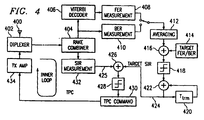
- Pilot symbols from the rake combiner 404 are applied to the SIR measurement circuit 432. These pilot symbols are obtained from a common pilot channel similar to a broadcast channel.
- the SIR measurement circuit produces a received signal strength indicator (RSSI) estimate from an average of received pilot symbols.
- the SIR measurement circuit also produces an interference signal strength indicator (ISSI) estimate from an average of interference signals from base stations and other mobile systems over many time slots.
- the SIR measurement circuit produces an SIR estimate from a ratio of the RSSI signal to the ISSI signal. This SIR estimate is compared with a target SIR by circuit 426. This comparison result is applied to TPC command circuit 430 via circuit 428.
- the TPC command circuit 430 sets a TPC symbol control signal that is transmitted to a remote base station. This TPC symbol instructs the base station to either increase or decrease transmit power by preferably 1 dB for subsequent transmission.
- the communication network includes a network control station 500 connected to each remote base station 502-506.
- the network control station transmits and receives frames of data in predetermined time slots via the base stations.
- the network control station performs many other functions including power control and communicating with other communication networks.
- the network control station initiates SSDT communication with the mobile unit 512 preferably during a soft handoff period such as when the mobile unit moves from one base station to another. This soft handoff period requires the mobile unit 512 to select one of base stations 502-506 with which to communicate.
- the mobile unit receives an active list from the network control station by which it may identify each base station.
- the mobile unit also receives information on transmit diversity for each respective base station.
- the mobile unit determines that base station 502 employs STTD and that base stations 504 and 506 employ no diversity.
- the mobile unit calculates a SIR from received pilot symbols for each base station and selects one of the base stations as a primary base station.
- the mobile transmits 510 the identity of this primary base station back to the network control station via a base station.
- the network control station then terminates transmission of data symbols to the mobile unit 512 in the next data frame from all except the selected base station. This greatly reduces interference at the mobile unit during soft handoff.
- FIG. 6 there is a flow diagram showing base station selection.
- the mobile unit receives an active list from the network control station upon SSDT initialization.
- the mobile unit calculates a SIR for each base station on this active list from the received pilot symbols.
- the respective SIR signals for each base station are applied via leads 600-604 to selection circuit 620.
- Selection circuit 620 receives diversity signals corresponding to each base station on leads 606-610. These diversity signals indicate whether the respective base station employs transmit diversity.
- the selection circuit receives a reference signal ⁇ on lead 612. This reference signal together with SIR and diversity signals is used to select a primary base station as indicated in TABLE 2.
- TABLE 2 show each condition for selecting between base stations BTSx and BTSy. These selection criteria, however, are generally applicable to any number of base stations. Transmit diversity is indicated as STTD but generally applies to any type of diversity. An absence of diversity is indicated as no diversity (ND). For the case where BTSx and BTSy have the same diversity, selection circuit 620 selects the base station with the greatest SIR. Alternatively, when one of the base stations employs transmit diversity, selection circuit 620 selects it as the primary base station if it has a greater SIR than the corresponding base station without diversity.
- mobile unit After the selection circuit 620 identifies a primary base station according to the selection criteria of TABLE I, mobile unit sends the identity of the primary base station back to the network control station 500 via a base station 630. For the case where base station 502 is selected, the network control station then terminates transmission of data symbols to the mobile unit 512 from base stations 504 and 506 for the next frame 640. All data symbols designated for mobile unit 512 are transmitted only by base station 502 in the next data frame. Pilot symbols, however, are transmitted for each base station. Thus, the mobile unit may repeat the base station selection process for subsequent data frames. This greatly reduces interference at the mobile unit during soft handoff. Moreover, the addition of transmit diversity in the selection criteria greatly improves communication within the system as will be discussed in detail.
- FIG. 8 there is a diagram showing simulation parameters for the simulation results of FIG. 9.
- the simulation is based on a Doppler rate for 3-kmph pedestrian travel with respect to the base station.
- the non-diversity simulation considers that three base stations transmit pilot symbols to the mobile unit. None of the simulated base stations employ transmit diversity. Thus, selection is based on maximum SIR.
- the diversity simulation considers that three base stations transmit pilot symbols to the mobile unit. All of the simulated base stations employ STTD. Thus, base station selection is again based on maximum SIR.
- the STTD and SSDT dashed curve shows a 1.1 dB improvement over the SSDT solid curve for a 10 -3 coded bit error rate (BER).
- BER coded bit error rate
Landscapes
- Engineering & Computer Science (AREA)
- Computer Networks & Wireless Communication (AREA)
- Signal Processing (AREA)
- Quality & Reliability (AREA)
- Artificial Intelligence (AREA)
- Mobile Radio Communication Systems (AREA)
- Radio Transmission System (AREA)
- Variable-Direction Aerials And Aerial Arrays (AREA)
Abstract
Description
| ANTENNA 1 | ANTENNA 2 | |||||||
| SLOT | B 1 | S 1 | B 2 | S 2 | B 1 | -S * / 2 | -B 2 | S * / 1 |
| 1 | 11 | 11 | 11 | 11 | 11 | 01 | 00 | 10 |
| 2 | 11 | 11 | 11 | 01 | 11 | 11 | 00 | 10 |
| 3 | 11 | 01 | 11 | 01 | 11 | 11 | 00 | 00 |
| 4 | 11 | 10 | 11 | 01 | 11 | 11 | 00 | 11 |
| 5 | 11 | 10 | 11 | 11 | 11 | 01 | 00 | 11 |
| 6 | 11 | 10 | 11 | 11 | 11 | 01 | 00 | 11 |
| 7 | 11 | 01 | 11 | 00 | 11 | 10 | 00 | 00 |
| 8 | 11 | 10 | 11 | 01 | 11 | 11 | 00 | 11 |
| 9 | 11 | 11 | 11 | 00 | 11 | 10 | 00 | 10 |
| 10 | 11 | 01 | 11 | 01 | 11 | 11 | 00 | 00 |
| 11 | 11 | 11 | 11 | 10 | 11 | 00 | 00 | 10 |
| 12 | 11 | 01 | 11 | 01 | 11 | 11 | 00 | 00 |
| 13 | 11 | 00 | 11 | 01 | 11 | 11 | 00 | 01 |
| 14 | 11 | 10 | 11 | 00 | 11 | 10 | 00 | 11 |
| 15 | 11 | 01 | 11 | 00 | 11 | 10 | 00 | 00 |
| 16 | 11 | 00 | 11 | 00 | 11 | 10 | 00 | 01 |
| BTSx | BTSy | Criteria | Selection |
| ND | ND | SIRx > SIRy | BTSx |
| SIRy > SIRx | BTSy | ||
| STTD | STTD | SIRx > SIRy | BTSx |
| SIRy > SIRx | BTSy | ||
| STTD | ND | SIRx > SIRy | BTSx |
| SIRy > SIRx and | |||
| SIRy - SIRx > ηBTSy | |||
| else | BTSx | ||
| ND | STTD | SIRy > SIRx | BTSy |
| SIRx > SIRy and | |||
| SIRx - SIRy > ηBTSX | |||
| else | BTSy |
Claims (14)
- A method of operating a communication circuit, comprising the steps of:receiving a plurality of signals from a plurality of remote transmitters;determining which of the plurality of remote transmitters use transmit diversity;calculating a signal strength of each respective signal of the plurality of signals; andselecting one of the remote transmitters in response to the steps of determining and calculating.
- A method as in claim 1, wherein the step of calculating the signal strength comprises calculating a signal-to-interference ratio.
- A method as in claim 2, wherein the step of selecting comprises selecting a remote transmitter having the greatest signal-to-interference ratio of the plurality of remote transmitters.
- A method as in any of claims 1 to 3, wherein the step of receiving the plurality of signals from the plurality of remote transmitters comprises receiving one or more pilot symbols.
- A method as in any of claims 1 to 4, further comprising the step of:transmitting an identity of said one of the remote transmitters to a remote receiver.
- A method as in claim 5, further comprising the step of:receiving a plurality of data signals from said one of the remote transmitters in response to the transmitting step.
- A method as in any of claims 1 to 6, wherein the step of determining which of the plurality of remote transmitters use transmit diversity comprises determining which of the plurality of remote transmitters use space-time transmit diversity.
- A method as in any of claims 1 to 7, further comprising the step of:comparing a reference value to a difference between signal strengths of the plurality of transmitters, wherein the selecting step further comprises the step of comparing.
- A method of operating a communication circuit, comprising the steps of:transmitting a plurality of signals from a respective plurality of transmitters;receiving an identity of a selected transmitter of the plurality of transmitters in response to transmit diversity and signal strength of each respective transmitter; andtransmitting from the selected transmitter and not transmitting at least one signal from at least another transmitter in response to the step of receiving.
- A method as in claim 9, wherein the step of receiving the plurality of signals comprises receiving one ore more pilot symbols.
- A method as in claim 9 or claim 10, wherein the step of determining which of the plurality of remote transmitters use transmit diversity comprises determining which of the plurality of remote transmitters use space-time transmit diversity.
- A method as in any of claims 9 to 11, wherein the step of determining signal strength comprises determining a signal-to-interference ratio.
- A method as in any of claims 9 to 12, wherein the step of transmitting from the selected transmitter comprises transmitting data symbols, and wherein the step of not transmitting at least one signal comprises not transmitting at least one data symbol.
- A method as in any of claims 9 to 13, further comprising:transmitting a list of active transmitters from the respective plurality of transmitters.
Applications Claiming Priority (2)
| Application Number | Priority Date | Filing Date | Title |
|---|---|---|---|
| US12178999P | 1999-02-26 | 1999-02-26 | |
| US121789P | 1999-02-26 |
Publications (3)
| Publication Number | Publication Date |
|---|---|
| EP1039658A2 true EP1039658A2 (en) | 2000-09-27 |
| EP1039658A3 EP1039658A3 (en) | 2003-10-29 |
| EP1039658B1 EP1039658B1 (en) | 2007-11-07 |
Family
ID=22398805
Family Applications (1)
| Application Number | Title | Priority Date | Filing Date |
|---|---|---|---|
| EP00200685A Expired - Lifetime EP1039658B1 (en) | 1999-02-26 | 2000-02-28 | Method of operating a communication circuit |
Country Status (3)
| Country | Link |
|---|---|
| EP (1) | EP1039658B1 (en) |
| JP (1) | JP4542221B2 (en) |
| DE (1) | DE60036973T2 (en) |
Cited By (10)
| Publication number | Priority date | Publication date | Assignee | Title |
|---|---|---|---|---|
| GB2353439A (en) * | 1999-08-20 | 2001-02-21 | Nec Corp | Power or interference control for mobile communications |
| WO2002052883A1 (en) * | 2000-12-27 | 2002-07-04 | Matsushita Electric Industrial Co., Ltd. | Communication terminal device, base station device and communication method |
| WO2003037027A1 (en) * | 2001-10-18 | 2003-05-01 | Fujitsu Limited | Mobile communication system and communication method thereof |
| WO2004010606A1 (en) * | 2002-07-19 | 2004-01-29 | Huawei Technologies Co., Ltd. | Method and apparatus for receiving an adaptive weight sttd |
| WO2005071863A1 (en) * | 2004-01-20 | 2005-08-04 | Aeroflex Cambridge Limited | Pilot signal manipulation in transmit diversity communications |
| DE102004017488A1 (en) * | 2004-04-08 | 2005-11-03 | Infineon Technologies Ag | Symbols combining method for rake receiver, involves maintaining fixed and unitary input-output time schedule independent of mode of diversity of transmitting antenna, while weighing path and compensating antenna-diversity of symbols |
| WO2005109676A1 (en) * | 2004-05-05 | 2005-11-17 | Siemens Aktiengesellschaft | Methods for receiving sequentially sent data in a mobile radio system having reception gaps |
| WO2005109675A1 (en) * | 2004-05-05 | 2005-11-17 | Siemens Aktiengesellschaft | Method for receiving data sent in a sequence in a mobile telephony system with radiopockets |
| KR100828284B1 (en) | 2002-02-18 | 2008-05-07 | 엘지전자 주식회사 | Forward power control method in SST |
| EP3376805A1 (en) * | 2010-04-29 | 2018-09-19 | On-Ramp Wireless, Inc. | Forward error correction media access control system |
Families Citing this family (4)
| Publication number | Priority date | Publication date | Assignee | Title |
|---|---|---|---|---|
| KR20020039859A (en) * | 2000-11-22 | 2002-05-30 | 조정남 | Method for processing a hand-off by using site selection diversity transmission in mobile communication system |
| JP4719932B2 (en) * | 2001-07-10 | 2011-07-06 | 学校法人慶應義塾 | Transmission site diversity system |
| CN1625854A (en) * | 2002-04-30 | 2005-06-08 | 三菱电机株式会社 | Mobile station |
| US8059608B2 (en) | 2005-06-14 | 2011-11-15 | Qualcomm Incorporated | Transmit spatial diversity for cellular single frequency networks |
Family Cites Families (3)
| Publication number | Priority date | Publication date | Assignee | Title |
|---|---|---|---|---|
| DE69325844T2 (en) * | 1992-04-17 | 2000-08-31 | Ericsson Inc., Research Triangle Park | Mobile-assisted handoff with code division multiple access |
| JP3368439B2 (en) * | 1994-03-17 | 2003-01-20 | 富士通株式会社 | Mobile communication system |
| JP3078216B2 (en) * | 1995-12-13 | 2000-08-21 | 株式会社エヌ・ティ・ティ・ドコモ | Base station selection method |
-
2000
- 2000-02-28 DE DE60036973T patent/DE60036973T2/en not_active Expired - Lifetime
- 2000-02-28 EP EP00200685A patent/EP1039658B1/en not_active Expired - Lifetime
- 2000-02-28 JP JP2000102826A patent/JP4542221B2/en not_active Expired - Lifetime
Cited By (17)
| Publication number | Priority date | Publication date | Assignee | Title |
|---|---|---|---|---|
| GB2353439B (en) * | 1999-08-20 | 2004-04-28 | Nec Corp | Power control for mobile communications |
| GB2353439A (en) * | 1999-08-20 | 2001-02-21 | Nec Corp | Power or interference control for mobile communications |
| WO2002052883A1 (en) * | 2000-12-27 | 2002-07-04 | Matsushita Electric Industrial Co., Ltd. | Communication terminal device, base station device and communication method |
| US7366538B2 (en) | 2001-10-18 | 2008-04-29 | Fujitsu Limited | Mobile communication system and communication method for mobile communication system |
| WO2003037027A1 (en) * | 2001-10-18 | 2003-05-01 | Fujitsu Limited | Mobile communication system and communication method thereof |
| EP1437906A4 (en) * | 2001-10-18 | 2007-08-15 | Fujitsu Ltd | MOBILE COMMUNICATION SYSTEM AND METHOD FOR COMMUNICATING WITH SAID SYSTEM |
| US7133682B2 (en) | 2001-10-18 | 2006-11-07 | Fujitsu Limited | Mobile communication system and communication method for mobile communication system |
| KR100828284B1 (en) | 2002-02-18 | 2008-05-07 | 엘지전자 주식회사 | Forward power control method in SST |
| WO2004010606A1 (en) * | 2002-07-19 | 2004-01-29 | Huawei Technologies Co., Ltd. | Method and apparatus for receiving an adaptive weight sttd |
| WO2005071863A1 (en) * | 2004-01-20 | 2005-08-04 | Aeroflex Cambridge Limited | Pilot signal manipulation in transmit diversity communications |
| DE102004017488B4 (en) * | 2004-04-08 | 2006-11-09 | Infineon Technologies Ag | A method and apparatus for combining symbols for different transmit antenna diversity modes in a Rake receiver |
| DE102004017488A1 (en) * | 2004-04-08 | 2005-11-03 | Infineon Technologies Ag | Symbols combining method for rake receiver, involves maintaining fixed and unitary input-output time schedule independent of mode of diversity of transmitting antenna, while weighing path and compensating antenna-diversity of symbols |
| WO2005109675A1 (en) * | 2004-05-05 | 2005-11-17 | Siemens Aktiengesellschaft | Method for receiving data sent in a sequence in a mobile telephony system with radiopockets |
| WO2005109676A1 (en) * | 2004-05-05 | 2005-11-17 | Siemens Aktiengesellschaft | Methods for receiving sequentially sent data in a mobile radio system having reception gaps |
| US7873051B2 (en) | 2004-05-05 | 2011-01-18 | Siemens Aktiengesellschaft | Method for receiving data sent in a sequence in a mobile radio system with reception gaps |
| CN1981455B (en) * | 2004-05-05 | 2013-01-02 | 西门子公司 | Method for receiving data sent in a sequence in a mobile telephony system with radiopockets |
| EP3376805A1 (en) * | 2010-04-29 | 2018-09-19 | On-Ramp Wireless, Inc. | Forward error correction media access control system |
Also Published As
| Publication number | Publication date |
|---|---|
| EP1039658A3 (en) | 2003-10-29 |
| EP1039658B1 (en) | 2007-11-07 |
| DE60036973T2 (en) | 2008-08-28 |
| JP4542221B2 (en) | 2010-09-08 |
| JP2001057528A (en) | 2001-02-27 |
| DE60036973D1 (en) | 2007-12-20 |
Similar Documents
| Publication | Publication Date | Title |
|---|---|---|
| US6804311B1 (en) | Diversity detection for WCDMA | |
| USRE42919E1 (en) | Power control with space time transmit diversity | |
| US6404826B1 (en) | Iterative signal-to-interference ratio estimation for WCDMA | |
| US7555068B2 (en) | Producing control signals indicating transmit diversity and no transmit diversity | |
| US7613259B2 (en) | Mobile receiver phase correction circuit | |
| US6862275B1 (en) | Cell selection with STTD and SSDT | |
| JP3877713B2 (en) | Adaptive transmission antenna diversity apparatus and method in mobile communication system | |
| JP3335570B2 (en) | Spread spectrum communication equipment | |
| US6724828B1 (en) | Mobile switching between STTD and non-diversity mode | |
| US6356605B1 (en) | Frame synchronization in space time block coded transmit antenna diversity for WCDMA | |
| EP1039658B1 (en) | Method of operating a communication circuit | |
| US7142888B2 (en) | Radio communication method, base station and mobile station | |
| EP0993129A2 (en) | Channel estimation in space time block coded transmit antenna diversity for WCDMA | |
| Thompson et al. | Downlink transmit diversity schemes for CDMA networks | |
| EP1056237B1 (en) | Diversity detection for WCDMA |
Legal Events
| Date | Code | Title | Description |
|---|---|---|---|
| PUAI | Public reference made under article 153(3) epc to a published international application that has entered the european phase |
Free format text: ORIGINAL CODE: 0009012 |
|
| AK | Designated contracting states |
Kind code of ref document: A2 Designated state(s): AT BE CH CY DE DK ES FI FR GB GR IE IT LI LU MC NL PT SE |
|
| AX | Request for extension of the european patent |
Free format text: AL;LT;LV;MK;RO;SI |
|
| PUAL | Search report despatched |
Free format text: ORIGINAL CODE: 0009013 |
|
| RIC1 | Information provided on ipc code assigned before grant |
Ipc: 7H 04B 7/02 B Ipc: 7H 04L 1/06 B Ipc: 7H 04B 7/06 A |
|
| AK | Designated contracting states |
Kind code of ref document: A3 Designated state(s): AT BE CH CY DE DK ES FI FR GB GR IE IT LI LU MC NL PT SE |
|
| AX | Request for extension of the european patent |
Extension state: AL LT LV MK RO SI |
|
| 17P | Request for examination filed |
Effective date: 20040429 |
|
| AKX | Designation fees paid |
Designated state(s): DE FR GB |
|
| 17Q | First examination report despatched |
Effective date: 20040608 |
|
| GRAP | Despatch of communication of intention to grant a patent |
Free format text: ORIGINAL CODE: EPIDOSNIGR1 |
|
| GRAS | Grant fee paid |
Free format text: ORIGINAL CODE: EPIDOSNIGR3 |
|
| GRAA | (expected) grant |
Free format text: ORIGINAL CODE: 0009210 |
|
| AK | Designated contracting states |
Kind code of ref document: B1 Designated state(s): DE FR GB |
|
| REG | Reference to a national code |
Ref country code: GB Ref legal event code: FG4D |
|
| REF | Corresponds to: |
Ref document number: 60036973 Country of ref document: DE Date of ref document: 20071220 Kind code of ref document: P |
|
| ET | Fr: translation filed | ||
| PLBE | No opposition filed within time limit |
Free format text: ORIGINAL CODE: 0009261 |
|
| STAA | Information on the status of an ep patent application or granted ep patent |
Free format text: STATUS: NO OPPOSITION FILED WITHIN TIME LIMIT |
|
| 26N | No opposition filed |
Effective date: 20080808 |
|
| REG | Reference to a national code |
Ref country code: FR Ref legal event code: PLFP Year of fee payment: 17 |
|
| REG | Reference to a national code |
Ref country code: FR Ref legal event code: PLFP Year of fee payment: 18 |
|
| REG | Reference to a national code |
Ref country code: FR Ref legal event code: PLFP Year of fee payment: 19 |
|
| PGFP | Annual fee paid to national office [announced via postgrant information from national office to epo] |
Ref country code: GB Payment date: 20190128 Year of fee payment: 20 Ref country code: FR Payment date: 20190117 Year of fee payment: 20 Ref country code: DE Payment date: 20190115 Year of fee payment: 20 |
|
| REG | Reference to a national code |
Ref country code: DE Ref legal event code: R071 Ref document number: 60036973 Country of ref document: DE |
|
| REG | Reference to a national code |
Ref country code: GB Ref legal event code: PE20 Expiry date: 20200227 |
|
| PG25 | Lapsed in a contracting state [announced via postgrant information from national office to epo] |
Ref country code: GB Free format text: LAPSE BECAUSE OF EXPIRATION OF PROTECTION Effective date: 20200227 |