EP1039645A1 - Method and apparatus for data compression - Google Patents
Method and apparatus for data compression Download PDFInfo
- Publication number
- EP1039645A1 EP1039645A1 EP00302040A EP00302040A EP1039645A1 EP 1039645 A1 EP1039645 A1 EP 1039645A1 EP 00302040 A EP00302040 A EP 00302040A EP 00302040 A EP00302040 A EP 00302040A EP 1039645 A1 EP1039645 A1 EP 1039645A1
- Authority
- EP
- European Patent Office
- Prior art keywords
- data
- input stream
- characters
- block
- stream
- Prior art date
- Legal status (The legal status is an assumption and is not a legal conclusion. Google has not performed a legal analysis and makes no representation as to the accuracy of the status listed.)
- Granted
Links
Images



Classifications
-
- G—PHYSICS
- G06—COMPUTING OR CALCULATING; COUNTING
- G06T—IMAGE DATA PROCESSING OR GENERATION, IN GENERAL
- G06T9/00—Image coding
- G06T9/005—Statistical coding, e.g. Huffman, run length coding
-
- H—ELECTRICITY
- H03—ELECTRONIC CIRCUITRY
- H03M—CODING; DECODING; CODE CONVERSION IN GENERAL
- H03M7/00—Conversion of a code where information is represented by a given sequence or number of digits to a code where the same, similar or subset of information is represented by a different sequence or number of digits
- H03M7/30—Compression; Expansion; Suppression of unnecessary data, e.g. redundancy reduction
- H03M7/3084—Compression; Expansion; Suppression of unnecessary data, e.g. redundancy reduction using adaptive string matching, e.g. the Lempel-Ziv method
Definitions
- the present invention relates generally to data storage and communications systems and, more particularly, to improving the capacity and use of such data storage and communications systems.
- Conventional data compression techniques and systems encode a stream of digital data into a compressed code stream and decode the compressed code stream back into a corresponding original data stream.
- the code stream is referred to as "compressed" because the steam typically consists of a smaller number of codes than symbols contained in the original data stream. Such smaller codes can be advantageously stored in a corresponding smaller amount of memory than the original data.
- the compressed code stream can be transmitted in a communications system, e.g., a wired, wireless, or optical fiber communications system, in a corresponding shorter period of time than the uncompressed original data.
- a communications system e.g., a wired, wireless, or optical fiber communications system
- Special purpose compression techniques are designed for compressing special types of data and are often relatively inexpensive to implement.
- well-known special purpose compression techniques include run-length encoding, zero-suppression encoding, null-compression encoding, and pattern substitution. These techniques generally have relatively small compression ratios due to the fact that they compress data which typically possesses common characteristics and redundancies. As will be appreciated, a compression ratio is the measure of the length of the compressed codes relative to the length of the original data.
- special purpose compression techniques tend to be ineffective at compressing data of a more general nature, i.e., data that does not possess a high degree of common characteristics and the like.
- the LZ1 (also referred to and known in the art as "LZ77”) data compression process is based on the principle that a repeated sequence of characters can be replaced by a reference to an earlier occurrence of the sequence, i.e., matching sequences.
- the reference e.g., a pointer
- the reference typically includes an indication of the position of the earlier occurrence, e.g., expressed as a byte offset from the start of the repeated sequence, and the number of characters, i.e., the matched length, that are repeated.
- the references are represented as " ⁇ offset, length ⁇ " pairs in accordance with conventional LZ1 coding.
- LZ2 also referred to and known in the art as "LZ78" compression parses a stream of input data characters into coded values based on an adaptively growing look-up table or dictionary that is produced during the compression. That is, LZ2 does not find matches on any byte boundary and with any length as in LZ1 coding, but instead when a dictionary word is matched by a source string, a new word is added to the dictionary which consists of the matched word plus the following source string byte. In accordance with LZ2 coding, matches are coded as pointers or indexes to the words in the dictionary.
- these compression techniques compress a stream of data characters into a compressed stream of codes by serially searching the character stream and generating codes based on sequences of encountered symbols that match corresponding longest possible strings previously stored in the table, i.e., dictionary. As each match is made and a code symbol is generated, the process also stores a new string entry in the dictionary that comprises the matched sequence in the data stream plus the next character symbol encounter in the data stream.
- Lempel-Ziv coding finds strings and substrings which are repeated in the original data stream, e.g., in a document to be transmitted.
- the repeated phrases in the document under compression are replaced with a pointer to a place where they have occurred earlier in the original data stream, e.g., document.
- decoding data e.g., text
- one primary design consideration in employing Lempel-Ziv coding is determining whether to set a limit on how far back a pointer can reach, and what that limit should be.
- Lempel-Ziv coding involves which substrings within the desired limit may be a target of a pointer. That is, the reach of a pointer into earlier text may be unrestricted, i.e., a so-called growing window, or may be restricted to a fixed size window of the previous "N" characters, where N is typically in the range of several thousand characters, e.g., 3 kilobytes. In accordance with this coding repetitions of strings are discovered and compressed only if they both appear in the window. As will be appreciated, the considerations made regarding such Lempel-Ziv coding design choices represent a compromise between speed, memory requirements, and compression ratio. Sliding windows do, however, present at least one drawback: sliding windows do not find strings that occur far apart, e.g., 10,000 character, in the input text.
- the present invention provides a method and apparatus for achieving relatively low compression ratios based on our realization of using a longer history and longer common strings of the input data stream as an initial evaluation of the input data prior to applying a compression process, e.g., any Lempel-Ziv compression methodology. That is, given that typical compression processes utilize a relatively short, i.e., the most current few kilobytes, history of the input data to effect the desired compression, we have recognized that utilizing a longer history in conjunction with longer common string sequences provides increased compression efficiencies particularly when compressing larger input streams having larger numbers of repeated long strings.
- a compression process e.g., any Lempel-Ziv compression methodology. That is, given that typical compression processes utilize a relatively short, i.e., the most current few kilobytes, history of the input data to effect the desired compression, we have recognized that utilizing a longer history in conjunction with longer common string sequences provides increased compression efficiencies particularly when compressing larger input streams having larger numbers of repeated long strings.
- the input data is preprocessed by applying string-matching to the extract long common strings.
- the input data is divided into a series of blocks with each individual block having a uniform size, illustratively, 1000 characters in length.
- a so-called fingerprint is computed and stored for each block.
- a fingerprint is a relatively small signature of a large text string. For example, a 1000 character string may be mapped into a 32 bit long fingerprint. As such, identical strings will always have the same fingerprint. Furthermore, unequal strings almost always have unequal fingerprints (within a certain probability factor).
- the input data stream is traversed and comparison is made between interim fingerprints computed from a particular set of characters of the input stream, illustratively, on a character-by-character basis, and the previously computed and stored fingerprints.
- the input stream is traversed as a function of a sliding window having a uniform block size and the interim fingerprints are computed from the present window of characters and compared to the previously stored fingerprints.
- the input stream is encoded with an identifier determined as function of the detected match.
- the encoded identifier contains a starting position of the matching string in the original input stream and the string length.
- a larger history of the input data is examined with the identification of longer common strings without a significant increase in overall storage requirements.
- greater compression ratios are achieved in accordance with the invention with a wide variety of compression methods. That is, the principles of the invention are independent of any particular one compression scheme and, therefore, the advantages of employing the various aspects of invention are realized with a wide variety of compression methodologies.
- Fingerprinting as a string-matching mechanism, is not new. Fingerprints have been used previously for string-matching in text-processing systems and, in particular, for searching for long common strings in a text file.
- R. M. Karp and M. O. Rabin "Efficient Randomized Pattern-Matching Algorithms", IBM J. Res. Develop. , Vol. 31, No. 2, pp. 249-260, March 1987, which is hereby incorporated by reference for all purposes, describe the use of fingerprints in the context of string searching. It has, however, remained for the inventors herein to recognize that fingerprinting can be employed in the delivery of an elegant compression tool by which enhanced data compression can be delivered to significantly larger input data streams having large numbers of repeated long strings without a significant increase in overall storage requirements.
- the present invention provides a method and apparatus for achieving relatively low compression ratios based on our realization of using a longer history and longer common strings of the input data stream as an initial evaluation of the input data prior to applying a compression process, e.g., any Lempel-Ziv compression methodology. That is, given that typical compression processes utilize a relatively short, i.e., the most current bytes, history of the input data to effect the desired compression, we have recognized that utilizing a longer history in conjunction with longer common string sequences provides increased compression efficiencies particularly when compressing larger input streams, e.g., large databases, having larger numbers of repeated long strings.
- a compression process e.g., any Lempel-Ziv compression methodology. That is, given that typical compression processes utilize a relatively short, i.e., the most current bytes, history of the input data to effect the desired compression, we have recognized that utilizing a longer history in conjunction with longer common string sequences provides increased compression efficiencies particularly when compressing larger input streams, e.g., large databases, having
- the present invention can be embodied in the form of methods and apparatuses for practicing those methods.
- the invention can also be embodied in the form of program code embodied in tangible media, such as floppy diskettes, CD-ROMs, hard drives, or any other machine-readable storage medium, wherein, when the program code is loaded into and executed by a machine, such as a computer, the machine becomes an apparatus for practicing the invention.
- the invention can also be embodied in the form of program code, for example, in a storage medium, loaded into and/or executed by a machine, or transmitted over some transmission medium, such as over electrical wiring or cabling, through fiber optics, or via electromagnetic radiation, wherein, when the program code is loaded into and executed by a machine, such as a computer, the machine becomes an apparatus for practicing the invention.
- program code segments When implemented on a general-purpose processor, the program code segments combine with the processor to provide a unique device that operates analogously to specific logic circuits.
- FIG. 1 shows a block diagram of an illustrative system 100 for compressing and decompressing data in accordance with the invention.
- System 100 is useful for transmitting and receiving information over a transmission medium, e.g. wire, wireless, or optical fiber, to name just a few.
- system 100 is alternatively useful for recording information to, and reading information from, for example, a magnetic medium such as computer disk drives, or optical-readable medium such as CD-ROM's.
- a magnetic medium such as computer disk drives, or optical-readable medium such as CD-ROM's.
- FIG. 1 shows a block diagram of an illustrative system 100 for compressing and decompressing data in accordance with the invention.
- System 100 is useful for transmitting and receiving information over a transmission medium, e.g. wire, wireless, or
- input data stream 105 e.g., text
- input data encoder 110 preprocesses and encodes the input data stream, in accordance with the invention, by applying a string-matching technique to the extract long common strings.
- encoded input data stream 115 produced in accordance with the invention is passed to compressor 120.
- Compressor 120 applies Lempel-Ziv compression, in particular, LZ77 coding as discussed above to compress encoded input data stream 115 to compressed data 125.
- LZ77 coding As mentioned above, it will again be noted that any Lempel-Ziv type compression can be used effectively in compressing encoded input data stream 115 in accordance with the invention and for realizing the advantageous aspects of the invention as described herein.
- Compressed data 125 is then encoded by channel encoder 130 to produce channel encoded information 135.
- channel encoding adds information to the compressed information to enable error detection and/or correction in the data reading process.
- Conventional channel encoding techniques include well-known Reed-Solomon encoding which encodes a sequence of symbols wherein each symbol is represented by one or more data bits. These symbols are then modulation encoded by modulation encoder 140 which produces modulated data stream 145 which defines a channel sequence that is transmitted through transmission channel or recorded on medium 150.
- modulation decoder 155 and channel decoder 160 receive modulated data stream 145 with the noise and, in a well-known manner, reverse the encoding processes of channel encoder 130 and modulation encoder 140, respectively.
- the data stream from channel decoder 160 corresponds to compressed data 125 generated by compressor 120.
- This data stream is then decompressed by decompressor 165 and decoded by data decoder 170 producing output data stream 175, in accordance with the invention, as described in detail below with regard to FIG. 7 and FIG. 11.
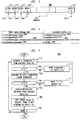
- FIG. 2 shows a flowchart of illustrative operations for compressing data in accordance with the invention and useful in the illustrative system of FIG. 1 as described above. More particularly, an input data stream, e.g., a text file, is received (block 210) and a particular compression block size " b " is selected (block 220) wherein b is, illustratively, a particular number of characters. In accordance with the preferred embodiments of the invention, b is selected to be in the range of 20 to 1000 characters.
- the input data stream is divided into a series of blocks (block 230) of size b . Thereafter, in accordance with the invention, a fingerprint is computed and stored (block 240) for each block of the series of blocks.
- the fingerprints are computed in accordance with the technique described in Karp et al., supra .
- Karp et al. (hereinafter referred to as "Karp") originally used fingerprints as an aid to string searching, i.e., does a string of length n contain a search pattern of length m ?
- Karp interprets the m characters of the pattern as a polynomial modulo a large prime number.
- the resulting fingerprint can be stored as, e.g., a 32-bit word.
- Karp's technique scans down the input string and computes the same fingerprints for each of the n ⁇ m + 1 substrings of length m .
- the fingerprints can be computed quickly, i.e., a fingerprint can be initialized in O ( m ) time and updated by sliding one position in O (1) time; (2) fingerprints yield false matches, i.e., unequal strings are extremely likely to have unequal fingerprints (the probability of two unequal strings having the same 32-bit fingerprint is shown to be approximately 2 -32 ); and (3) large primes can be chosen at random to yield randomized algorithms for text string searching.
- fingerprinting can be employed in the delivery of an elegant compression tool by which enhanced data compression can be delivered to significantly larger input data streams having repeated strings.
- a larger history of the input data is examined with the identification of longer common strings without a significant increase in overall storage requirements. That is, in accordance with the invention, a data compression arrangement is employed which recognizes a correlation between different strings.
- the second occurrence of a particular text string is recognized as repetitious and this second occurrence is replaced with an encoded reference to the first string.
- the computed fingerprints are stored for each block (block 240.)
- a fingerprint is stored on each block boundary of the input stream.
- a primary data structure stores the fingerprint of each non-overlapping block of b bytes. That is, in accordance with the preferred embodiment of the invention, fingerprints are stored of bytes 1... b , b + 1...2 b , 2 b + 1...3 b and so forth.
- approximately n / b fingerprints are stored where n is the string length as described above.
- the fingerprints are stored and represented in a hash table (a well-known data structure) together with an integer designating the sequence's location in the input data stream.
- FIG. 3 shows illustrative data structure 300 for storing the fingerprints computed in accordance with the illustrative operations of the invention of FIG. 2.
- data structure 300 stores each block of the input stream (e.g., block 1 through block m shown as blocks 305-325, respectively, in FIG. 3).
- the computed fingerprint in stored, (e.g., FP 1 through FP m shown as fingerprints 330-350, respectively, in FIG. 3).
- sliding window 355 is employed for traversing the input data stream, i.e., data structure 300, to compare the current window of characters with the stored fingerprints to detect a match as discussed below.
- the input data stream is traversed and a comparison is made (block 250) between the input characters and the stored fingerprints to detect a match (block 260). That is, a sliding window, e.g., sliding window 355, is employed for traversing the input data stream and for the current window of characters so-called "interim" fingerprints are computed, illustratively, on a character-by-character basis through the current window of characters. These interim fingerprints computed across the current window of characters are compared with the stored fingerprints to detect a match. In particular, as the input text is scanned, the hash table is employed to find common fingerprints and thereby locate common strings. If a match occurs, in accordance with the invention, the match is encoded (block 270) using the sequence " ⁇ start , length ⁇ ", where start is the initial position and length is the size of the common sequence. For example, consider the following input data stream:
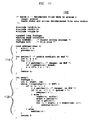
- FIG.'s 9-10 show an illustrative C source code program 900 for compressing data in accordance with the invention.
- Illustrative source code program 900 includes program source code section 910 having program instructions which in a well-known manner define certain data types, variables, and data structures used throughout source code program 900.
- Program source code section 920 includes program instructions which implement the string matching operations in accordance with the invention as described above.
- Program source code section 930 includes program instructions which assist in defining and populating the hash table data structure used for storing the computed fingerprints in accordance with the invention as described above.
- Program source code sections 940 and 950 include program instructions which complete the compression for producing the encoded data file, in accordance with the invention, as described above.
- C source code program 900 is illustrative in nature and presented to further the understanding of the present invention. Those skilled in the art will be able to readily develop other programs which, although not explicitly described or shown herein, embody the principles of the invention and are included within its scope.
- FIG. 4 shows a series of short illustrative uncompressed input data streams 400 with a corresponding series of encoded output data streams 410 encoded in accordance with the invention.
- input data streams 420-450 have each been processed, in accordance with the invention, with a encoded designation of matching strings as shown in encoded output 460-490, respectively.
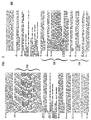
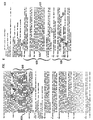
- FIG. 5 and FIG. 6 illustrate the application of the principles of the invention on a larger input data file, in particular, the Constitution of the United States of America.
- FIG. 5 shows illustrative input data file 500 which consists of a select portion of the Constitution. Compression of the text of the Constitution in accordance with the invention is particularly advantageous given the frequent appearance of the same long strings. For example, text sections 510, 520, and 530, respectively, of input data file 500 contain several long repeated strings.
- FIG. 6 shows illustrative encoded data file 600 shown in FIG. 6. As can be seen in FIG.
- encoded data file 600 includes encoded sections 610, 620, and 630 which respectively correspond to text sections 510, 520, and 530 of input data file 500.
- encoding 635 indicates that beginning in character position 391, a matching sequence of 47 characters, i.e., a matching string, has been detected and encoded.
- encoding 675 indicates that beginning in character position 2439, a matching sequence of 103 characters has been detected and encoded.
- our realization of using fingerprints in an initial evaluation, i.e., preprocessing, of the input data prior to applying a compression process results in achieving relatively low compression ratios based using a longer history and longer common strings of the input data stream.
- our invention does not require a significant increase in storage requirements and is independent of any particular one compression technique. That is, the invention can be employed with a wide variety of well-known compression algorithms for achieving significant compression ratios thereby reducing storage requirements and transmission times.
- FIG. 7 shows a flowchart of illustrative operations 700 for decompressing data in accordance with a further aspect of the invention.
- individual characters "c" are retrieved (block 710), illustratively, on a character-by-character basis.
- a determination is made as to whether the particular character c matches the symbol " ⁇ " (block 720).
- the character c is written to the output file in accordance with the decompression process (block 730) and the next character is retrieved from the encoded data file. If a match occurs, the next character is retrieved from the encoded data file (block 740). Again, a determination is made as to whether the particular character c matches the symbol " ⁇ " (block 750). If a match occurs, the symbol " ⁇ " is written to the output file (block 760) and the next character is retrieved. If no match occurs, the " ⁇ start, length ⁇ " encoding, as described above in great detail, is read (block 770) from the encoded file.
- a string is copied to the output file from the encoded file beginning at the "start" position and which has a length equal to the "length” information (block 780). That is, in accordance with the invention, the previously encoded matching string is now decompressed in its entirety and written to the output file. If more characters remain (block 790) the decompression process continues. If not, the decompression process is completed and the output file is complete.
- FIG. 11 shows an illustrative C source code program 1100 for implementing the illustrative operations for decompressing data in accordance with the invention as shown in FIG. 7.
- source code program section 1110 defines an array for manipulating the encoded data file and the individual characters contained therein.
- Source code program section 1120 executes the main part of the program for processing the characters, in accordance with the invention and as described above, and decompressing the encoded file to produce an output file.
- C source code program 1100 is illustrative in nature and presented to further the understanding of the present invention. Those skilled in the art will be able to readily develop other programs which, although not explicitly described or shown herein, embody the principles of the invention and are included within its scope.
- FIG. 8 shows comparison results 800 of compressing the concatenation of the Project Gutenberg CD's text files.
- the file sizes show in the comparison results are given in megabytes, and the percentages show the effectiveness of each compression, and, in particular, the effect of changing the block size b (column 810.)
- Column 820, having the heading "com b”, shows the effect of applying the present invention and the resulting change in the size of the input text file.
- Column 830 (having the heading "com %”) shows the compression percentage achieved, in accordance with the invention, by varying block sizes.
- any element expressed as a means for performing a specified function is intended to encompass any way of performing that function, including, for example, a) a combination of circuit elements which performs that function; or b) software in any form (including, therefore, firmware, object code, microcode or the like) combined with appropriate circuitry for executing that software to perform the function.
Landscapes
- Engineering & Computer Science (AREA)
- Theoretical Computer Science (AREA)
- Multimedia (AREA)
- Physics & Mathematics (AREA)
- General Physics & Mathematics (AREA)
- Compression, Expansion, Code Conversion, And Decoders (AREA)
Abstract
Description
- The present invention relates generally to data storage and communications systems and, more particularly, to improving the capacity and use of such data storage and communications systems.
- Conventional data compression techniques and systems encode a stream of digital data into a compressed code stream and decode the compressed code stream back into a corresponding original data stream. The code stream is referred to as "compressed" because the steam typically consists of a smaller number of codes than symbols contained in the original data stream. Such smaller codes can be advantageously stored in a corresponding smaller amount of memory than the original data. Further, the compressed code stream can be transmitted in a communications system, e.g., a wired, wireless, or optical fiber communications system, in a corresponding shorter period of time than the uncompressed original data. The demand for data transmission and storage capacity in today's communications networks, as required by the significant increase in content exchanges across such networks, is ever-increasing. Thus, data compression plays an integral role in most modem transmission protocols and communications networks.
- As is well-known, two classes of compression techniques useful in the compression of data are so-called special purpose compression and general purpose compression. Special purpose compression techniques are designed for compressing special types of data and are often relatively inexpensive to implement. For example, well-known special purpose compression techniques include run-length encoding, zero-suppression encoding, null-compression encoding, and pattern substitution. These techniques generally have relatively small compression ratios due to the fact that they compress data which typically possesses common characteristics and redundancies. As will be appreciated, a compression ratio is the measure of the length of the compressed codes relative to the length of the original data. However, special purpose compression techniques tend to be ineffective at compressing data of a more general nature, i.e., data that does not possess a high degree of common characteristics and the like.
- In contrast, general purpose compression techniques are not designed for specifically compressing one type of data and are often adapted to different types of data during the actual compression process. Some of the most well-known and useful general purpose compression techniques emanate from a family of algorithms developed by, J. Ziv and A. Lempel, and commonly referred to in the art as "Lempel-Ziv coding". In particular, Ziv et al., "A Universal Algorithm for Sequential Data Compression", IEEE Transactions on Information Theory, IT-23(3):337-343, May 1977 (describing the commonly denominated "LZ1" algorithm), and Ziv et al., "Compression of Individual Sequences Via Variable-Rate Coding", IEEE Transactions on Information Technology, IT-24(5):530-536, September 1978 (describing the commonly denominated "LZ2" algorithm), which are each hereby incorporated by reference for all purposes. The LZ1 and LZ2 data compression schemes are well-known in the art and need not be discussed in great detail herein.
- In brief, the LZ1 (also referred to and known in the art as "LZ77") data compression process is based on the principle that a repeated sequence of characters can be replaced by a reference to an earlier occurrence of the sequence, i.e., matching sequences. The reference, e.g., a pointer, typically includes an indication of the position of the earlier occurrence, e.g., expressed as a byte offset from the start of the repeated sequence, and the number of characters, i.e., the matched length, that are repeated. Typically, the references are represented as "〈offset, length〉" pairs in accordance with conventional LZ1 coding. In contrast, LZ2 (also referred to and known in the art as "LZ78") compression parses a stream of input data characters into coded values based on an adaptively growing look-up table or dictionary that is produced during the compression. That is, LZ2 does not find matches on any byte boundary and with any length as in LZ1 coding, but instead when a dictionary word is matched by a source string, a new word is added to the dictionary which consists of the matched word plus the following source string byte. In accordance with LZ2 coding, matches are coded as pointers or indexes to the words in the dictionary.
- As mentioned above, the art is replete with compression schemes derived on the basic principles embodied by the LZ1 and LZ2 algorithms. For example, Terry A. Welch (see, T. A. Welch, "A Technique for High Performance Data Compression", IEEE Computer, pp. 8-19, June 1984, and U.S. Patent No. 4,558,302, issued to Welch on December 10, 1985, each of which is incorporated by reference for all purposes) later refined the LZ2 coding process to the well-known "Lempel-Ziv-Welch" ("LZW") compression process. Both the LZ2 and LZW compression techniques are based on the generation and use of a so-called string table that maps strings of input characters into fixed-length codes. More particularly, these compression techniques compress a stream of data characters into a compressed stream of codes by serially searching the character stream and generating codes based on sequences of encountered symbols that match corresponding longest possible strings previously stored in the table, i.e., dictionary. As each match is made and a code symbol is generated, the process also stores a new string entry in the dictionary that comprises the matched sequence in the data stream plus the next character symbol encounter in the data stream.
- As will be appreciated and as detailed above, the essence of Lempel-Ziv coding is finding strings and substrings which are repeated in the original data stream, e.g., in a document to be transmitted. The repeated phrases in the document under compression are replaced with a pointer to a place where they have occurred earlier in the original data stream, e.g., document. As such, decoding data, e.g., text, which is compressed in this manner simply requires replacing the pointers with the already decoded text to which it points. As is well-known, one primary design consideration in employing Lempel-Ziv coding is determining whether to set a limit on how far back a pointer can reach, and what that limit should be. A further design consideration of Lempel-Ziv coding involves which substrings within the desired limit may be a target of a pointer. That is, the reach of a pointer into earlier text may be unrestricted, i.e., a so-called growing window, or may be restricted to a fixed size window of the previous "N" characters, where N is typically in the range of several thousand characters, e.g., 3 kilobytes. In accordance with this coding repetitions of strings are discovered and compressed only if they both appear in the window. As will be appreciated, the considerations made regarding such Lempel-Ziv coding design choices represent a compromise between speed, memory requirements, and compression ratio. Sliding windows do, however, present at least one drawback: sliding windows do not find strings that occur far apart, e.g., 10,000 character, in the input text.
- While prior art compression schemes, such as the aforementioned LZ1, LZ2, and LZW compression methods, provide effective data compression, efforts continue to search for even greater compression to reduce storage requirements and transmission times.
- The present invention provides a method and apparatus for achieving relatively low compression ratios based on our realization of using a longer history and longer common strings of the input data stream as an initial evaluation of the input data prior to applying a compression process, e.g., any Lempel-Ziv compression methodology. That is, given that typical compression processes utilize a relatively short, i.e., the most current few kilobytes, history of the input data to effect the desired compression, we have recognized that utilizing a longer history in conjunction with longer common string sequences provides increased compression efficiencies particularly when compressing larger input streams having larger numbers of repeated long strings.
- More particularly, in accordance with the invention, the input data is preprocessed by applying string-matching to the extract long common strings. In accordance with the preferred embodiment, the input data is divided into a series of blocks with each individual block having a uniform size, illustratively, 1000 characters in length. Further, in accordance with the preferred embodiment of the invention, a so-called fingerprint is computed and stored for each block. A fingerprint is a relatively small signature of a large text string. For example, a 1000 character string may be mapped into a 32 bit long fingerprint. As such, identical strings will always have the same fingerprint. Furthermore, unequal strings almost always have unequal fingerprints (within a certain probability factor). In accordance with the invention, the input data stream is traversed and comparison is made between interim fingerprints computed from a particular set of characters of the input stream, illustratively, on a character-by-character basis, and the previously computed and stored fingerprints. In accordance with the preferred embodiment, the input stream is traversed as a function of a sliding window having a uniform block size and the interim fingerprints are computed from the present window of characters and compared to the previously stored fingerprints. Upon detecting a match between the fingerprints, in accordance with the preferred embodiment, the input stream is encoded with an identifier determined as function of the detected match. Illustratively, the encoded identifier contains a starting position of the matching string in the original input stream and the string length. Thereafter, in accordance with the preferred embodiment, a further compression of the preprocessed and encoded input stream is made using Lempel-Ziv compression.
- Advantageously, in accordance with the invention, a larger history of the input data is examined with the identification of longer common strings without a significant increase in overall storage requirements. Thus, greater compression ratios are achieved in accordance with the invention with a wide variety of compression methods. That is, the principles of the invention are independent of any particular one compression scheme and, therefore, the advantages of employing the various aspects of invention are realized with a wide variety of compression methodologies.
- Fingerprinting, as a string-matching mechanism, is not new. Fingerprints have been used previously for string-matching in text-processing systems and, in particular, for searching for long common strings in a text file. For example, R. M. Karp and M. O. Rabin, "Efficient Randomized Pattern-Matching Algorithms", IBM J. Res. Develop., Vol. 31, No. 2, pp. 249-260, March 1987, which is hereby incorporated by reference for all purposes, describe the use of fingerprints in the context of string searching. It has, however, remained for the inventors herein to recognize that fingerprinting can be employed in the delivery of an elegant compression tool by which enhanced data compression can be delivered to significantly larger input data streams having large numbers of repeated long strings without a significant increase in overall storage requirements.
-
- FIG. 1 shows a block diagram of an illustrative system for compressing and decompressing data in accordance with the invention;
- FIG. 2 shows a flowchart of illustrative operations for compressing data in accordance with the invention and useful in the illustrative system of FIG. 1;
- FIG. 3 shows an illustrative data structure for storing the input data steam and the fingerprints computed in accordance with the illustrative operations of the invention of FIG. 2;
- FIG. 4 shows a series of illustrative uncompressed data streams with a corresponding series of encoded data streams encoded in accordance with the invention;
- FIG. 5 shows a select portion of an illustrative input data file;
- FIG. 6 shows a select portion of an illustrative encoded data file encoded from the illustrative input data file of FIG. 5 in accordance with the principles of the invention;
- FIG. 7 shows a flowchart of illustrative operations for decompressing data in accordance with the invention;
- FIG. 8 shows comparison results of compressing text files in accordance with the invention;
- FIG.'s 9-10 show an illustrative C source code program for compressing data in accordance with the invention as shown in FIG. 2; and
- FIG. 11 shows an illustrative C source code program for decompressing data in accordance with the invention as shown in FIG. 7.
-
- Throughout this disclosure, unless otherwise noted, like elements, blocks, components or sections in the figures are denoted by the same reference designations.
- The present invention provides a method and apparatus for achieving relatively low compression ratios based on our realization of using a longer history and longer common strings of the input data stream as an initial evaluation of the input data prior to applying a compression process, e.g., any Lempel-Ziv compression methodology. That is, given that typical compression processes utilize a relatively short, i.e., the most current bytes, history of the input data to effect the desired compression, we have recognized that utilizing a longer history in conjunction with longer common string sequences provides increased compression efficiencies particularly when compressing larger input streams, e.g., large databases, having larger numbers of repeated long strings.
- The present invention can be embodied in the form of methods and apparatuses for practicing those methods. The invention can also be embodied in the form of program code embodied in tangible media, such as floppy diskettes, CD-ROMs, hard drives, or any other machine-readable storage medium, wherein, when the program code is loaded into and executed by a machine, such as a computer, the machine becomes an apparatus for practicing the invention. The invention can also be embodied in the form of program code, for example, in a storage medium, loaded into and/or executed by a machine, or transmitted over some transmission medium, such as over electrical wiring or cabling, through fiber optics, or via electromagnetic radiation, wherein, when the program code is loaded into and executed by a machine, such as a computer, the machine becomes an apparatus for practicing the invention. When implemented on a general-purpose processor, the program code segments combine with the processor to provide a unique device that operates analogously to specific logic circuits.
- FIG. 1 shows a block diagram of an
illustrative system 100 for compressing and decompressing data in accordance with the invention.System 100, inter alia., is useful for transmitting and receiving information over a transmission medium, e.g. wire, wireless, or optical fiber, to name just a few. Further,system 100 is alternatively useful for recording information to, and reading information from, for example, a magnetic medium such as computer disk drives, or optical-readable medium such as CD-ROM's. As such, it is possible to record data compressed in accordance with the invention on to recordable medium including magnetic medium, e.g., magnet disk drives, and optical recordable medium, e.g., CD-ROM's. In FIG. 1,input data stream 105, e.g., text, is provided to inputdata encoder 110. As discussed in greater detail below,input data encoder 110, in accordance with the invention, preprocesses and encodes the input data stream, in accordance with the invention, by applying a string-matching technique to the extract long common strings. The various aspects of the invention directed at this encoding process axe described in greater detail below with particular reference to the illustrative operations shown in FIG. 2. - Turning our attention back to FIG. 1, encoded
input data stream 115 produced in accordance with the invention is passed tocompressor 120.Compressor 120, in accordance with the preferred embodiment of the invention, applies Lempel-Ziv compression, in particular, LZ77 coding as discussed above to compress encodedinput data stream 115 tocompressed data 125. As mentioned above, it will again be noted that any Lempel-Ziv type compression can be used effectively in compressing encodedinput data stream 115 in accordance with the invention and for realizing the advantageous aspects of the invention as described herein.Compressed data 125 is then encoded bychannel encoder 130 to produce channel encodedinformation 135. As will be appreciated, channel encoding adds information to the compressed information to enable error detection and/or correction in the data reading process. Conventional channel encoding techniques include well-known Reed-Solomon encoding which encodes a sequence of symbols wherein each symbol is represented by one or more data bits. These symbols are then modulation encoded bymodulation encoder 140 which produces modulateddata stream 145 which defines a channel sequence that is transmitted through transmission channel or recorded onmedium 150. - Noise and interference are often times introduced in channel/
medium 150 during the transmission or recording of the data stream. As such,modulation decoder 155 andchannel decoder 160 receive modulateddata stream 145 with the noise and, in a well-known manner, reverse the encoding processes ofchannel encoder 130 andmodulation encoder 140, respectively. The data stream fromchannel decoder 160 corresponds tocompressed data 125 generated bycompressor 120. This data stream is then decompressed bydecompressor 165 and decoded bydata decoder 170 producingoutput data stream 175, in accordance with the invention, as described in detail below with regard to FIG. 7 and FIG. 11. - The various aspects of the invention are directed to realizing significant compression reductions and transmission efficiencies. FIG. 2 shows a flowchart of illustrative operations for compressing data in accordance with the invention and useful in the illustrative system of FIG. 1 as described above. More particularly, an input data stream, e.g., a text file, is received (block 210) and a particular compression block size "b" is selected (block 220) wherein b is, illustratively, a particular number of characters. In accordance with the preferred embodiments of the invention, b is selected to be in the range of 20 to 1000 characters. The input data stream is divided into a series of blocks (block 230) of size b. Thereafter, in accordance with the invention, a fingerprint is computed and stored (block 240) for each block of the series of blocks.
- In accordance with the preferred embodiment of the invention, the fingerprints are computed in accordance with the technique described in Karp et al., supra. In brief, Karp et al. (hereinafter referred to as "Karp") originally used fingerprints as an aid to string searching, i.e., does a string of length n contain a search pattern of length m? Karp interprets the m characters of the pattern as a polynomial modulo a large prime number. As such, the resulting fingerprint can be stored as, e.g., a 32-bit word. Karp's technique scans down the input string and computes the same fingerprints for each of the
- In accordance with the invention, we have recognized that fingerprinting can be employed in the delivery of an elegant compression tool by which enhanced data compression can be delivered to significantly larger input data streams having repeated strings. Advantageously, in accordance with the invention, a larger history of the input data is examined with the identification of longer common strings without a significant increase in overall storage requirements. That is, in accordance with the invention, a data compression arrangement is employed which recognizes a correlation between different strings. In particular, in accordance with the invention, the second occurrence of a particular text string is recognized as repetitious and this second occurrence is replaced with an encoded reference to the first string. Thus, greater compression ratios are achieved in accordance with the invention with a wide variety of compression methods.
- The recognition of string repetitions in particular compression schemes is known. For example, J. G. Cleary et al., "Unbounded length contexts for PPM",
Computer Journal 40, 2/3, pp. 67-75, 1997, and C. G. Neville-Manning et al., "A space-economical suffix tree construction algorithm", Journal of Artificial Intelligence Research, pp. 67-82, September 1997, each of which is hereby incorporated by reference for all purposes, describe particular compression schemes which recognize string repetitions. However, in contrast to the present invention, these prior schemes require a significant amount of memory, i.e., approximately n words of primary memory to process a file of n characters, and do not employ the use of fingerprints. As will be seen from the discussion below, greater compression ratios are achieved in accordance with the invention without a dramatic increase in storage requirements. - Turning our attention back to FIG. 2, in accordance with the preferred embodiment, the computed fingerprints are stored for each block (block 240.) In particular, a fingerprint is stored on each block boundary of the input stream. Further, in accordance with the invention, a primary data structure stores the fingerprint of each non-overlapping block of b bytes. That is, in accordance with the preferred embodiment of the invention, fingerprints are stored of
bytes 1...b, b + 1...2b, 2b + 1...3b and so forth. In accordance with the preferred embodiment, approximately n/b fingerprints are stored where n is the string length as described above. Advantageously, in accordance with the invention, only a small fraction of the original input stream is stored thereby keeping the necessary storage requirements low. Further, in accordance with the preferred embodiment, the fingerprints are stored and represented in a hash table (a well-known data structure) together with an integer designating the sequence's location in the input data stream. - FIG. 3 shows
illustrative data structure 300 for storing the fingerprints computed in accordance with the illustrative operations of the invention of FIG. 2. In particular,data structure 300 stores each block of the input stream (e.g., block 1 through block m shown as blocks 305-325, respectively, in FIG. 3). In addition, for each block, the computed fingerprint in stored, (e.g.,FP 1 through FP m shown as fingerprints 330-350, respectively, in FIG. 3). Further, in accordance with the invention and as further discussed below, slidingwindow 355 is employed for traversing the input data stream, i.e.,data structure 300, to compare the current window of characters with the stored fingerprints to detect a match as discussed below. - More particularly, turning our attention back to FIG. 2, in accordance with the invention, the input data stream is traversed and a comparison is made (block 250) between the input characters and the stored fingerprints to detect a match (block 260). That is, a sliding window, e.g., sliding
window 355, is employed for traversing the input data stream and for the current window of characters so-called "interim" fingerprints are computed, illustratively, on a character-by-character basis through the current window of characters. These interim fingerprints computed across the current window of characters are compared with the stored fingerprints to detect a match. In particular, as the input text is scanned, the hash table is employed to find common fingerprints and thereby locate common strings. If a match occurs, in accordance with the invention, the match is encoded (block 270) using the sequence "〈start, length〉", where start is the initial position and length is the size of the common sequence. For example, consider the following input data stream: - "The Constitution of the United States, PREAMBLE We, the people of the United States, in order to form a more perfect union..." Applying the principles of the invention as described above, results in an encoded data stream of:
- "The Constitution of the United States, PREAMBLE We, the people 〈16, 21〉, in order to form a more perfect union..."
-
- The following pseudocode describes the fingerprint comparison and encoding aspects of the invention as described above wherein the variable "fp" represents the fingerprint and the function "checkformatch" looks up the fingerprint in the hash table and encodes a match if found:
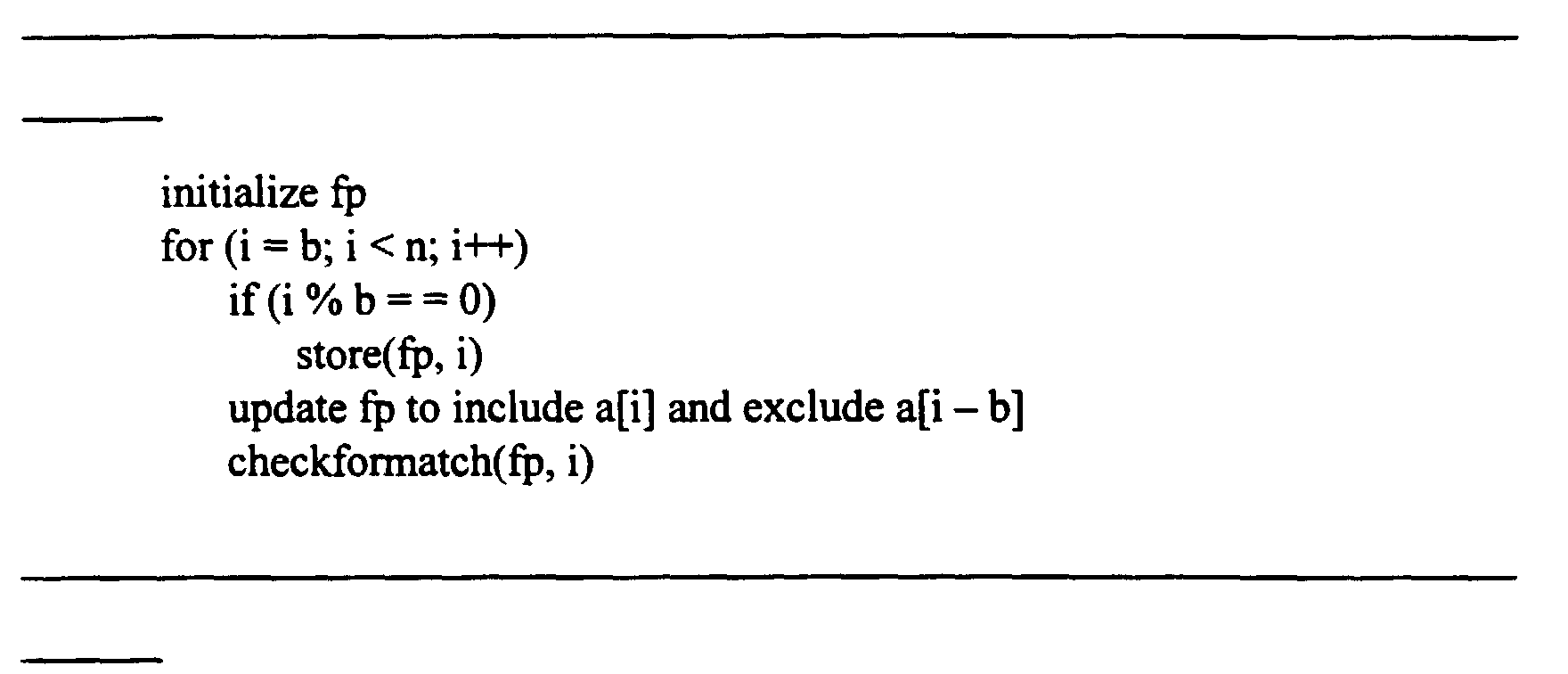
- As will be appreciated, the above-described pseudocode can be used by those skilled in the art to develop a variety of programs, e.g., a C program, for execution in a processor for implementing the invention. For example, FIG.'s 9-10 show an illustrative C
source code program 900 for compressing data in accordance with the invention. Illustrativesource code program 900 includes programsource code section 910 having program instructions which in a well-known manner define certain data types, variables, and data structures used throughoutsource code program 900. Programsource code section 920 includes program instructions which implement the string matching operations in accordance with the invention as described above. Programsource code section 930 includes program instructions which assist in defining and populating the hash table data structure used for storing the computed fingerprints in accordance with the invention as described above. Programsource code sections 940 and 950 (see, FIG. 10) include program instructions which complete the compression for producing the encoded data file, in accordance with the invention, as described above. As will be appreciated, Csource code program 900 is illustrative in nature and presented to further the understanding of the present invention. Those skilled in the art will be able to readily develop other programs which, although not explicitly described or shown herein, embody the principles of the invention and are included within its scope. - In order to further illustrate the various aspects of the inventions as described above, FIG. 4 shows a series of short illustrative uncompressed input data streams 400 with a corresponding series of encoded output data streams 410 encoded in accordance with the invention. As one can see from examination of FIG. 4, input data streams 420-450 have each been processed, in accordance with the invention, with a encoded designation of matching strings as shown in encoded output 460-490, respectively.
- Further, a more comprehensive illustration of the invention is shown in FIG. 5 and FIG. 6 which illustrate the application of the principles of the invention on a larger input data file, in particular, the Constitution of the United States of America. More particularly, FIG. 5 shows illustrative input data file 500 which consists of a select portion of the Constitution. Compression of the text of the Constitution in accordance with the invention is particularly advantageous given the frequent appearance of the same long strings. For example,
text sections sections sections sections - Our realization of using fingerprints in an initial evaluation, i.e., preprocessing, of the input data prior to applying a compression process results in achieving relatively low compression ratios based using a longer history and longer common strings of the input data stream. Significantly, our invention does not require a significant increase in storage requirements and is independent of any particular one compression technique. That is, the invention can be employed with a wide variety of well-known compression algorithms for achieving significant compression ratios thereby reducing storage requirements and transmission times.
- Prior to describing certain compression testing results which further detail the advantages of various aspects of the invention, the decompression of the encoded data files which result in using the invention will now be discussed. In particular, FIG. 7 shows a flowchart of
illustrative operations 700 for decompressing data in accordance with a further aspect of the invention. In particular, from the encoded data file of the invention, e.g., encoded data file 600 as described above, individual characters "c" are retrieved (block 710), illustratively, on a character-by-character basis. In accordance this aspect of the invention, a determination is made as to whether the particular character c matches the symbol "〈" (block 720). If no match occurs, the character c is written to the output file in accordance with the decompression process (block 730) and the next character is retrieved from the encoded data file. If a match occurs, the next character is retrieved from the encoded data file (block 740). Again, a determination is made as to whether the particular character c matches the symbol "〈" (block 750). If a match occurs, the symbol "〈" is written to the output file (block 760) and the next character is retrieved. If no match occurs, the "〈start, length〉" encoding, as described above in great detail, is read (block 770) from the encoded file. In accordance with this embodiment of the invention, using the 〈start, length〉 information, a string is copied to the output file from the encoded file beginning at the "start" position and which has a length equal to the "length" information (block 780). That is, in accordance with the invention, the previously encoded matching string is now decompressed in its entirety and written to the output file. If more characters remain (block 790) the decompression process continues. If not, the decompression process is completed and the output file is complete. - The decompression process of the invention as described above, can be illustratively executed by a computer, processor or DSP, and the like. More particularly, FIG. 11 shows an illustrative C
source code program 1100 for implementing the illustrative operations for decompressing data in accordance with the invention as shown in FIG. 7. In particular, sourcecode program section 1110 defines an array for manipulating the encoded data file and the individual characters contained therein. Sourcecode program section 1120 executes the main part of the program for processing the characters, in accordance with the invention and as described above, and decompressing the encoded file to produce an output file. As will be appreciated, Csource code program 1100 is illustrative in nature and presented to further the understanding of the present invention. Those skilled in the art will be able to readily develop other programs which, although not explicitly described or shown herein, embody the principles of the invention and are included within its scope. - To illustrate the various aspects of the invention and their advantages, we applied our invention in the context of a very large file and compared a variety of results in compression of that file. More particularly, this illustrative example concatenated all of the text files contained in the well-known "Project Gutenberg Compact Disc" available on CD-ROM from Walnut Creek CDROM, Walnut Creek, CA. The Project Gutenberg CD is a 1994 compilation of documents which include: the U.S. Constitution, the Declaration of Independence, inaugural speeches given by several U.S. Presidents, fiction works such as Alice in Wonderland and O, Pioneers!, to name just a few. In accordance with the illustrative test, we concatenated all of the text files using the well-known UNIX "cat" command, in particular, the UNIX command string was "cat */* .txt 〉gut94all.txt". Such a concatenation resulted in an illustrative input file of 66.122 megabytes to which the principles of the invention were applied.
- More particularly, FIG. 8 shows comparison results 800 of compressing the concatenation of the Project Gutenberg CD's text files. The file sizes show in the comparison results are given in megabytes, and the percentages show the effectiveness of each compression, and, in particular, the effect of changing the block size b (
column 810.)Column 820, having the heading "com b", shows the effect of applying the present invention and the resulting change in the size of the input text file. Column 830 (having the heading "com %") shows the compression percentage achieved, in accordance with the invention, by varying block sizes. Column 840 (having the heading "com b | gzip") and column 850 (having the heading "gzip %") show the results of applying the well-known "gzip" compression algorithm, i.e., the well-known GNU gzip implementation of LZ77, in conjunction with principles of the invention. For example, using a block size of 1000 and applying gzip in conjunction with the invention results in reducing the original file size by 19.7%. As one can see, as the block size b decreases the compression obtainable, in accordance with the invention, increases until reaching some non-optimal point, i.e., too small a block size for efficient compression. Further, column 860 (having the heading "total %") shows that the optimal choice of b is 31 wherein corn gives a 22.5% reduction in file size beyond that of gzip. - The foregoing merely illustrates the principles of the present invention. It will thus be appreciated that those skilled in the art will be able to devise various arrangements which, although not explicitly described or shown herein, embody the principles of the invention and are included within its scope. Furthermore, all examples and conditional language recited herein are principally intended expressly to be only for pedagogical purposes to aid the reader in understanding the principles of the invention and the concepts contributed by the Applicant(s) to furthering the art, and are to be construed as being without limitation to such specifically recited examples and conditions.
- Thus, for example, it will be appreciated by those skilled in the art that the block diagrams herein represent conceptual views of illustrative circuitry embodying the principles of the invention. Similarly, it will be appreciated that any flowcharts, flow diagrams, state transition diagrams, pseudocode, program code, and the like represent various processes which may be substantially represented in computer readable medium and so executed by a computer, machine, or processor, whether or not such computer, machine, or processor, is explicitly shown.
- Further, in the claims hereof any element expressed as a means for performing a specified function is intended to encompass any way of performing that function, including, for example, a) a combination of circuit elements which performs that function; or b) software in any form (including, therefore, firmware, object code, microcode or the like) combined with appropriate circuitry for executing that software to perform the function.
Claims (23)
- A method for compressing an input stream of data comprising:dividing the input stream of data into a plurality of data blocks;computing a plurality of fingerprints, each fingerprint of the plurality of fingerprints corresponding to a different one data block of the plurality of data blocks;comparing the input stream of data to the plurality of fingerprints, and if a match occurs between a particular fingerprint and the input stream of data, encoding the match within the input stream of data; andcompressing the encoded input stream of data into a compressed data stream.
- The method of claim 1 wherein the input stream of data comprises a series of characters.
- The method of claim 2 wherein the comparing the input stream of data operation serially traverses the input stream as a function of individual characters of the series of characters and computes a interim fingerprint as a function of each of the individual characters.
- The method of claim 3 wherein the comparing the input stream of data operation compares the interim fingerprint to the particular fingerprint.
- The method of any of claims 2 to 4 further comprising:storing the plurality of data blocks together with the plurality of fingerprints in a data structure.
- The method of any of claims 2 to 5 wherein the comparing the input stream of data operation further comprises:identifying a longest match sequence from the series of characters which matches the particular fingerprint.
- The method of claim 6 wherein the encoding the match operation encodes a starting position within the input stream of data of the longest match sequence and a length of the longest match sequence.
- The method of claim 2 wherein:each block contains a particular number of characters of the plurality of characters;said comparing step comprises comparing the plurality of blocks to the plurality of fingerprints to determine whether a match occurs between a particular fingerprint and any portion of a particular block.
- The method of claim 8 wherein the comparing operation further comprises:selecting a window size; andtraversing the plurality of blocks as a function of the window size.
- The method of claim 9 wherein the window size is a particular number of characters.
- The method of claim 9 or claim 10 wherein the comparing the plurality of blocks operation further comprises:computing a interim fingerprint for the block at each character of the particular number contained in the block; andcomparing the interim fingerprint to the particular fingerprint.
- The method of any of claims 9 to 11 wherein each block of the plurality of blocks is of a equal block size.
- The method of claim 12 wherein the equal block size is in a range of 10 to 1000 characters.
- The method of any of claims 9 to 13 wherein the traversing of the plurality of blocks is done serially through the particular number of characters contained in the block.
- The method of any of claims 8 to 14 further comprising:storing the plurality of blocks together with the plurality of fingerprints in a data structure, the data structure storing each fingerprint with its respective different one corresponding block.
- The method of any of claims 8 to 15 wherein the encoding step comprises encoding, for each match, a identifier within the input stream of data, the identifier including at least a starting position within the input stream of data of the matching portion of the particular block and a length of the matching portion.
- The method of claim 16 wherein the starting position is a character position within the input stream of data and the length of the matching portion is a number of characters.
- The method of any of the preceding claims wherein the compressing the encoded input stream of data operation is performed according to a Lempel-Ziv coding technique.
- A data compression apparatus comprising means arranged to carry out a method as claimed in any of the preceding claims.
- A data storage system for storing a digital data stream in compressed data form, the data storage system comprising means arranged to carry out a method as claimed in any of claims 1 to 18.
- An apparatus for processing a compressed digital signal, the compressed digital signal being produced by a method as claimed in any of claims 1 to 18, the apparatus comprising:a receiver for receiving the compressed digital signal from the communications channel; anda decompressor for decompressing the received compressed digital signal, and recovering the input stream of digital data from the decompressed digital signal.
- A machine-readable medium having stored thereon a plurality of instructions, the plurality of instructions including instructions that, when executed by a machine, cause the machine to perform a method as claimed in any of claims 1 to 18.
- A storage medium, for example a magnetic disk or a CD-ROM, manufactured in accordance with a process including the operations of:compressing an input stream of data by a method as claimed in any of claims 1 to 18 to produce a compressed data stream;applying a recording signal to the storage medium, the recording signal representing the compressed data stream; andrecording the recording signal onto the storage medium.
Applications Claiming Priority (2)
| Application Number | Priority Date | Filing Date | Title |
|---|---|---|---|
| US09/273,840 US6611213B1 (en) | 1999-03-22 | 1999-03-22 | Method and apparatus for data compression using fingerprinting |
| US273840 | 1999-03-22 |
Publications (2)
| Publication Number | Publication Date |
|---|---|
| EP1039645A1 true EP1039645A1 (en) | 2000-09-27 |
| EP1039645B1 EP1039645B1 (en) | 2002-09-04 |
Family
ID=23045627
Family Applications (1)
| Application Number | Title | Priority Date | Filing Date |
|---|---|---|---|
| EP00302040A Expired - Lifetime EP1039645B1 (en) | 1999-03-22 | 2000-03-14 | Method and apparatus for data compression |
Country Status (5)
| Country | Link |
|---|---|
| US (1) | US6611213B1 (en) |
| EP (1) | EP1039645B1 (en) |
| JP (1) | JP3634711B2 (en) |
| CA (1) | CA2299902C (en) |
| DE (1) | DE60000380T2 (en) |
Families Citing this family (29)
| Publication number | Priority date | Publication date | Assignee | Title |
|---|---|---|---|---|
| JP3434756B2 (en) * | 1999-12-07 | 2003-08-11 | エヌイーシ−カスタムテクニカ株式会社 | Fingerprint authentication method and device |
| US7509420B2 (en) * | 2000-02-18 | 2009-03-24 | Emc Corporation | System and method for intelligent, globally distributed network storage |
| US8121843B2 (en) | 2000-05-02 | 2012-02-21 | Digimarc Corporation | Fingerprint methods and systems for media signals |
| US6810398B2 (en) * | 2000-11-06 | 2004-10-26 | Avamar Technologies, Inc. | System and method for unorchestrated determination of data sequences using sticky byte factoring to determine breakpoints in digital sequences |
| US7164369B2 (en) * | 2001-06-19 | 2007-01-16 | Sharp Laboratories Of America, Inc. | System for improving storage efficiency of digital files |
| US7071854B1 (en) * | 2002-05-13 | 2006-07-04 | Unisys Corporation | Hardware-implemented LZW data decompression |
| JP3584032B2 (en) | 2003-02-24 | 2004-11-04 | 沖電気工業株式会社 | Data compression device and data decompression device |
| US7320009B1 (en) | 2003-03-28 | 2008-01-15 | Novell, Inc. | Methods and systems for file replication utilizing differences between versions of files |
| US8135683B2 (en) * | 2003-12-16 | 2012-03-13 | International Business Machines Corporation | Method and apparatus for data redundancy elimination at the block level |
| US7019674B2 (en) * | 2004-02-05 | 2006-03-28 | Nec Laboratories America, Inc. | Content-based information retrieval architecture |
| US7747635B1 (en) | 2004-12-21 | 2010-06-29 | Oracle America, Inc. | Automatically generating efficient string matching code |
| US7592935B2 (en) * | 2005-03-10 | 2009-09-22 | Nec Laboratories America, Inc. | Information retrieval architecture for packet classification |
| US7098815B1 (en) * | 2005-03-25 | 2006-08-29 | Orbital Data Corporation | Method and apparatus for efficient compression |
| US7095342B1 (en) * | 2005-03-31 | 2006-08-22 | Intel Corporation | Compressing microcode |
| US7102552B1 (en) * | 2005-06-07 | 2006-09-05 | Windspring, Inc. | Data compression with edit-in-place capability for compressed data |
| US7882084B1 (en) * | 2005-12-30 | 2011-02-01 | F5 Networks, Inc. | Compression of data transmitted over a network |
| US20070220026A1 (en) * | 2006-03-17 | 2007-09-20 | Microsoft Corporation | Efficient caching for large scale distributed computations |
| US9772981B2 (en) * | 2006-03-29 | 2017-09-26 | EMC IP Holding Company LLC | Combined content indexing and data reduction |
| US8175875B1 (en) | 2006-05-19 | 2012-05-08 | Google Inc. | Efficient indexing of documents with similar content |
| US7747078B2 (en) * | 2006-07-06 | 2010-06-29 | Intel Corporation | Substring detection system and method |
| WO2009057459A1 (en) * | 2007-10-30 | 2009-05-07 | Nec Corporation | Data compression method |
| US8032757B1 (en) * | 2008-05-16 | 2011-10-04 | Trend Micro Incorporated | Methods and apparatus for content fingerprinting for information leakage prevention |
| EP2366156B1 (en) * | 2008-12-16 | 2013-03-20 | Telefonaktiebolaget LM Ericsson (publ) | String matching method and apparatus |
| KR101049699B1 (en) * | 2009-07-17 | 2011-07-15 | (주)이스트소프트 | Data Compression Method |
| JP6048251B2 (en) * | 2013-03-21 | 2016-12-21 | 富士通株式会社 | Data compression device, data compression method, data compression program, data restoration device, data restoration method, and data restoration program |
| US9648144B2 (en) * | 2014-01-24 | 2017-05-09 | Mediatek Inc. | Data compression method and decompression method |
| CN104216666A (en) * | 2014-09-03 | 2014-12-17 | 浪潮(北京)电子信息产业有限公司 | Method and device for managing writing of disk data |
| US10840943B1 (en) * | 2019-10-15 | 2020-11-17 | EMC IP Holding Company LLC | System and method of data compression between backup server and storage |
| US12547450B2 (en) * | 2023-01-20 | 2026-02-10 | Arm Limited | Reading data within a compressed data stream |
Citations (1)
| Publication number | Priority date | Publication date | Assignee | Title |
|---|---|---|---|---|
| GB2311635A (en) * | 1996-03-27 | 1997-10-01 | Memory Corp Plc | Compression of data for storage using two CAM dictionaries in parallel |
Family Cites Families (21)
| Publication number | Priority date | Publication date | Assignee | Title |
|---|---|---|---|---|
| US4464650A (en) | 1981-08-10 | 1984-08-07 | Sperry Corporation | Apparatus and method for compressing data signals and restoring the compressed data signals |
| US4558302A (en) | 1983-06-20 | 1985-12-10 | Sperry Corporation | High speed data compression and decompression apparatus and method |
| US5146221A (en) | 1989-01-13 | 1992-09-08 | Stac, Inc. | Data compression apparatus and method |
| FR2646575A1 (en) * | 1989-04-26 | 1990-11-02 | Labo Electronique Physique | METHOD AND STRUCTURE FOR DATA COMPRESSION |
| US5045852A (en) * | 1990-03-30 | 1991-09-03 | International Business Machines Corporation | Dynamic model selection during data compression |
| US5373290A (en) * | 1991-09-25 | 1994-12-13 | Hewlett-Packard Corporation | Apparatus and method for managing multiple dictionaries in content addressable memory based data compression |
| US5371499A (en) * | 1992-02-28 | 1994-12-06 | Intersecting Concepts, Inc. | Data compression using hashing |
| US5442350A (en) | 1992-10-29 | 1995-08-15 | International Business Machines Corporation | Method and means providing static dictionary structures for compressing character data and expanding compressed data |
| US5550540A (en) | 1992-11-12 | 1996-08-27 | Internatioal Business Machines Corporation | Distributed coding and prediction by use of contexts |
| US5408234A (en) * | 1993-04-30 | 1995-04-18 | Apple Computer, Inc. | Multi-codebook coding process |
| US5369605A (en) | 1993-07-07 | 1994-11-29 | Dell Usa, L.P. | Incremental search content addressable memory for increased data compression efficiency |
| JP3397431B2 (en) | 1994-03-16 | 2003-04-14 | 富士通株式会社 | Data compression method and device and data decompression method and device |
| US5701125A (en) | 1994-06-15 | 1997-12-23 | The United States Of America As Represented By The United States Department Of Energy | Method for compression of data using single pass LZSS and run-length encoding |
| US5572206A (en) | 1994-07-06 | 1996-11-05 | Microsoft Corporation | Data compression method and system |
| US5572209A (en) | 1994-08-16 | 1996-11-05 | International Business Machines Corporation | Method and apparatus for compressing and decompressing data |
| EP0718980A1 (en) | 1994-12-20 | 1996-06-26 | International Business Machines Corporation | Data compression method of individual sequences of strings of a data stream based on a dictionary and device for performing the same |
| US5608396A (en) | 1995-02-28 | 1997-03-04 | International Business Machines Corporation | Efficient Ziv-Lempel LZI data compression system using variable code fields |
| US5663721A (en) | 1995-03-20 | 1997-09-02 | Compaq Computer Corporation | Method and apparatus using code values and length fields for compressing computer data |
| US5729223A (en) * | 1996-03-20 | 1998-03-17 | Motorola Inc. | Method and apparatus for data compression and restoration |
| US5703581A (en) | 1996-06-14 | 1997-12-30 | Lucent Technologies Inc. | Method and apparatus for data compression and decompression |
| US6084229A (en) | 1998-03-16 | 2000-07-04 | Photon Vision Systems, Llc | Complimentary metal oxide semiconductor imaging device |
-
1999
- 1999-03-22 US US09/273,840 patent/US6611213B1/en not_active Expired - Lifetime
-
2000
- 2000-02-29 CA CA002299902A patent/CA2299902C/en not_active Expired - Fee Related
- 2000-03-14 EP EP00302040A patent/EP1039645B1/en not_active Expired - Lifetime
- 2000-03-14 DE DE60000380T patent/DE60000380T2/en not_active Expired - Lifetime
- 2000-03-21 JP JP2000078069A patent/JP3634711B2/en not_active Expired - Lifetime
Patent Citations (1)
| Publication number | Priority date | Publication date | Assignee | Title |
|---|---|---|---|---|
| GB2311635A (en) * | 1996-03-27 | 1997-10-01 | Memory Corp Plc | Compression of data for storage using two CAM dictionaries in parallel |
Non-Patent Citations (3)
| Title |
|---|
| BENTLEY ET AL.: "Data Compression using Long Common Strings", PROCEEDINGS OF THE 1999 DATA COMPRESSION CONFERENCE, DCC '99, 29 March 1999 (1999-03-29), pages 287 - 295, XP002142027 * |
| KARP R M ET AL: "EFFICIENT RANDOMIZED PATTERN-MATCHING ALGORITHMS", IBM JOURNAL OF RESEARCH AND DEVELOPMENT,US,IBM CORPORATION, ARMONK, vol. 31, no. 2, 1 March 1987 (1987-03-01), pages 249 - 260, XP000022500, ISSN: 0018-8646 * |
| WANG J T -L ET AL: "FAST RETRIEVAL OF ELECTRONIC MESSAGES THAT CONTAIN MISTYPED WORDS OR SPELLING ERRORS", IEEE TRANSACTIONS ON SYSTEMS, MAN AND CYBERNETICS. PART B: CYBERNETICS,US,IEEE SERVICE CENTER, vol. 27, no. 3, 1 June 1997 (1997-06-01), pages 441 - 451, XP000692641, ISSN: 1083-4419 * |
Also Published As
| Publication number | Publication date |
|---|---|
| DE60000380D1 (en) | 2002-10-10 |
| JP2000315954A (en) | 2000-11-14 |
| DE60000380T2 (en) | 2003-05-15 |
| EP1039645B1 (en) | 2002-09-04 |
| CA2299902A1 (en) | 2000-09-22 |
| US6611213B1 (en) | 2003-08-26 |
| CA2299902C (en) | 2004-08-17 |
| JP3634711B2 (en) | 2005-03-30 |
Similar Documents
| Publication | Publication Date | Title |
|---|---|---|
| EP1039645B1 (en) | Method and apparatus for data compression | |
| CN108880556B (en) | Lossless data compression method, error repair method, encoder and decoder based on LZ77 | |
| CN108768403B (en) | Lossless data compression and decompression method based on LZW and LZW encoder and decoder | |
| JP3665271B2 (en) | Method and apparatus for compressing network packet data using a per-packet hash table | |
| US6388584B1 (en) | Method and apparatus for data compression of network packets | |
| US6597812B1 (en) | System and method for lossless data compression and decompression | |
| JP3009727B2 (en) | Improved data compression device | |
| US10938410B2 (en) | Hardware friendly data compression | |
| JP3231663B2 (en) | Data compression method | |
| US20090121906A1 (en) | Alternative encoding for lzss output | |
| US5874908A (en) | Method and apparatus for encoding Lempel-Ziv 1 variants | |
| US5877711A (en) | Method and apparatus for performing adaptive data compression | |
| EP0435802B1 (en) | Method of decompressing compressed data | |
| US5010344A (en) | Method of decoding compressed data | |
| JP2536422B2 (en) | Data compression device and data decompression device | |
| EP1941617A1 (en) | Method and system for compressing data | |
| US6819272B2 (en) | System, method and computer readable medium for compressing a data sequence for partial decompressing | |
| Savari | Redundancy of the lempel-ziv-welch code | |
| KR101906036B1 (en) | Error detection method of lz78 compression data and encoder using the same | |
| Bender et al. | An improved sliding window data compression algorithm based on the Lempel-Ziv data compression algorithm (magnetic recording) | |
| Zhang | Tutorial on Lempel-Ziv Data Compression Algorithm | |
| GB2360916A (en) | Compression encoder which transmits difference between new data word and recent data word where this falls within a threshold |
Legal Events
| Date | Code | Title | Description |
|---|---|---|---|
| PUAI | Public reference made under article 153(3) epc to a published international application that has entered the european phase |
Free format text: ORIGINAL CODE: 0009012 |
|
| 17P | Request for examination filed |
Effective date: 20000323 |
|
| AK | Designated contracting states |
Kind code of ref document: A1 Designated state(s): DE FR GB |
|
| AX | Request for extension of the european patent |
Free format text: AL;LT;LV;MK;RO;SI |
|
| 17Q | First examination report despatched |
Effective date: 20001121 |
|
| AKX | Designation fees paid |
Free format text: DE FR GB |
|
| GRAG | Despatch of communication of intention to grant |
Free format text: ORIGINAL CODE: EPIDOS AGRA |
|
| GRAG | Despatch of communication of intention to grant |
Free format text: ORIGINAL CODE: EPIDOS AGRA |
|
| GRAG | Despatch of communication of intention to grant |
Free format text: ORIGINAL CODE: EPIDOS AGRA |
|
| GRAH | Despatch of communication of intention to grant a patent |
Free format text: ORIGINAL CODE: EPIDOS IGRA |
|
| GRAH | Despatch of communication of intention to grant a patent |
Free format text: ORIGINAL CODE: EPIDOS IGRA |
|
| GRAA | (expected) grant |
Free format text: ORIGINAL CODE: 0009210 |
|
| AK | Designated contracting states |
Kind code of ref document: B1 Designated state(s): DE FR GB |
|
| REG | Reference to a national code |
Ref country code: GB Ref legal event code: FG4D |
|
| REF | Corresponds to: |
Ref document number: 60000380 Country of ref document: DE Date of ref document: 20021010 |
|
| ET | Fr: translation filed | ||
| PLBE | No opposition filed within time limit |
Free format text: ORIGINAL CODE: 0009261 |
|
| STAA | Information on the status of an ep patent application or granted ep patent |
Free format text: STATUS: NO OPPOSITION FILED WITHIN TIME LIMIT |
|
| 26N | No opposition filed |
Effective date: 20030605 |
|
| REG | Reference to a national code |
Ref country code: GB Ref legal event code: 732E Free format text: REGISTERED BETWEEN 20131107 AND 20131113 |
|
| REG | Reference to a national code |
Ref country code: FR Ref legal event code: CD Owner name: ALCATEL-LUCENT USA INC. Effective date: 20131122 |
|
| REG | Reference to a national code |
Ref country code: FR Ref legal event code: GC Effective date: 20140410 |
|
| REG | Reference to a national code |
Ref country code: FR Ref legal event code: RG Effective date: 20141015 |
|
| REG | Reference to a national code |
Ref country code: FR Ref legal event code: PLFP Year of fee payment: 17 |
|
| REG | Reference to a national code |
Ref country code: FR Ref legal event code: PLFP Year of fee payment: 18 |
|
| REG | Reference to a national code |
Ref country code: FR Ref legal event code: PLFP Year of fee payment: 19 |
|
| PGFP | Annual fee paid to national office [announced via postgrant information from national office to epo] |
Ref country code: GB Payment date: 20190327 Year of fee payment: 20 Ref country code: FR Payment date: 20190328 Year of fee payment: 20 |
|
| PGFP | Annual fee paid to national office [announced via postgrant information from national office to epo] |
Ref country code: DE Payment date: 20190528 Year of fee payment: 20 |
|
| REG | Reference to a national code |
Ref country code: DE Ref legal event code: R071 Ref document number: 60000380 Country of ref document: DE |
|
| REG | Reference to a national code |
Ref country code: GB Ref legal event code: PE20 Expiry date: 20200313 |
|
| PG25 | Lapsed in a contracting state [announced via postgrant information from national office to epo] |
Ref country code: GB Free format text: LAPSE BECAUSE OF EXPIRATION OF PROTECTION Effective date: 20200313 |