EP1039374A2 - Instruction execution mechanism - Google Patents
Instruction execution mechanism Download PDFInfo
- Publication number
- EP1039374A2 EP1039374A2 EP00301541A EP00301541A EP1039374A2 EP 1039374 A2 EP1039374 A2 EP 1039374A2 EP 00301541 A EP00301541 A EP 00301541A EP 00301541 A EP00301541 A EP 00301541A EP 1039374 A2 EP1039374 A2 EP 1039374A2
- Authority
- EP
- European Patent Office
- Prior art keywords
- block
- successor
- blocks
- instructions
- egress
- Prior art date
- Legal status (The legal status is an assumption and is not a legal conclusion. Google has not performed a legal analysis and makes no representation as to the accuracy of the status listed.)
- Granted
Links
Images

Classifications
-
- G—PHYSICS
- G06—COMPUTING OR CALCULATING; COUNTING
- G06F—ELECTRIC DIGITAL DATA PROCESSING
- G06F9/00—Arrangements for program control, e.g. control units
- G06F9/06—Arrangements for program control, e.g. control units using stored programs, i.e. using an internal store of processing equipment to receive or retain programs
- G06F9/44—Arrangements for executing specific programs
- G06F9/455—Emulation; Interpretation; Software simulation, e.g. virtualisation or emulation of application or operating system execution engines
- G06F9/45504—Abstract machines for programme code execution, e.g. Java virtual machine [JVM], interpreters, emulators
- G06F9/45508—Runtime interpretation or emulation, e g. emulator loops, bytecode interpretation
-
- G—PHYSICS
- G06—COMPUTING OR CALCULATING; COUNTING
- G06F—ELECTRIC DIGITAL DATA PROCESSING
- G06F8/00—Arrangements for software engineering
- G06F8/40—Transformation of program code
- G06F8/41—Compilation
- G06F8/48—Incremental compilation
-
- G—PHYSICS
- G06—COMPUTING OR CALCULATING; COUNTING
- G06F—ELECTRIC DIGITAL DATA PROCESSING
- G06F9/00—Arrangements for program control, e.g. control units
- G06F9/06—Arrangements for program control, e.g. control units using stored programs, i.e. using an internal store of processing equipment to receive or retain programs
- G06F9/30—Arrangements for executing machine instructions, e.g. instruction decode
- G06F9/38—Concurrent instruction execution, e.g. pipeline or look ahead
- G06F9/3836—Instruction issuing, e.g. dynamic instruction scheduling or out of order instruction execution
-
- G—PHYSICS
- G06—COMPUTING OR CALCULATING; COUNTING
- G06F—ELECTRIC DIGITAL DATA PROCESSING
- G06F9/00—Arrangements for program control, e.g. control units
- G06F9/06—Arrangements for program control, e.g. control units using stored programs, i.e. using an internal store of processing equipment to receive or retain programs
- G06F9/30—Arrangements for executing machine instructions, e.g. instruction decode
- G06F9/38—Concurrent instruction execution, e.g. pipeline or look ahead
- G06F9/3854—Instruction completion, e.g. retiring, committing or graduating
-
- G—PHYSICS
- G06—COMPUTING OR CALCULATING; COUNTING
- G06F—ELECTRIC DIGITAL DATA PROCESSING
- G06F9/00—Arrangements for program control, e.g. control units
- G06F9/06—Arrangements for program control, e.g. control units using stored programs, i.e. using an internal store of processing equipment to receive or retain programs
- G06F9/44—Arrangements for executing specific programs
- G06F9/455—Emulation; Interpretation; Software simulation, e.g. virtualisation or emulation of application or operating system execution engines
- G06F9/45504—Abstract machines for programme code execution, e.g. Java virtual machine [JVM], interpreters, emulators
Definitions
- This invention relates to a mechanism for executing instructions in a computer system.
- the invention is particularly concerned with a computer system in which source code instructions are translated into target code instructions for execution on a particular processor. This may be required, for example, where one processor is being used to emulate another, in which case the instructions for the processor being emulated must be translated into instructions for the emulating processor.
- interpretation is to create a software model of the instruction set of the processor being emulated. This model operates by reading each target instruction, decoding it, and selecting one of a number of sequences that perform the same function as the instruction being emulated. This fetch/decode/execute sequence is repeated for each source code instruction in turn.
- a more efficient approach is to translate a block of source code instructions, rather than a single instruction. That is, the source code is divided into blocks, and each source code block is translated into a block of target code instructions, functionally equivalent to the source code block.
- a block has a single entry point and one or more exit points. The entry point is the target of a source code jump, while the (or each) exit is a source code jump.
- Translating blocks is potentially much more efficient, since it provides opportunities for eliminating redundant instructions within the target code block, and other optimisations.
- Known optimising compiler techniques may be employed for this purpose.
- the target code blocks may be held in main memory and/or a cache store, so that they are available for re-use if the same section of code is executed again, without the need to translate the block.
- the present invention is concerned with the problem of sequencing the execution of such blocks, to ensure that each block is followed by an appropriate successor block.
- the object of the present invention is to provide an improved method for sequencing execution of code blocks.
- a method of executing instructions in a computer system comprises:
- the invention permits the use of multiple blocks for different entry conditions.
- the use of such multiple blocks is advantageous, in that each block can be tailored to its specific entry conditions, thereby improving its efficiency of execution.
- a preferred form of the invention also allows block-following code to be planted in the blocks, to optimise the sequencing between the blocks.
- Figure 1 shows a host computer system 10, including a disk memory 11, and a main memory 12.
- the disk memory holds a number of source code blocks 13. As will be described, these blocks are copied (paged) into the main memory on demand. Therefore, at any given time, the main memory holds a number of source code blocks 14, corresponding to a subset of the blocks 13 in the disk memory.
- the source code blocks consist of sequences of instructions in a source instruction set, which in this example is assumed to be the ICL VME instruction set.
- Each of the source code blocks has a set of entry conditions associated with it, these entry conditions consisting of:
- An interpreter program 15 is provided for executing the source code blocks 14 in the cache.
- the interpreter takes each source code instruction in turn, decodes it, and selects one of a number of target code sequences in the instruction set of the host computer that perform the same function as the source code instruction. Details of the interpreter are not relevant to the present invention, and so it will not be described in any further detail.
- a translator program 16 is also provided. This can be called, as will be described, to translate a selected source code block 14 into a target code block 17, in the instruction set of the host computer.
- the translation takes account of the current entry conditions for the block, so that each translated block is specific to a particular set of entry conditions. Details of the translator are not relevant to the present invention, and so it will not be described in any further detail.
- Each source code block may have a block descriptor 18 associated with it.
- Each block descriptor contains the following information:
- an existing block descriptor may be reused.
- a block descriptor Every time a block descriptor is created or reused, it is allocated a new block identifier BID equal to a global block identifier value GLOBAL_BID, and GLOBAL_BID is then incremented. This ensures that each block has a unique BID value. (When GLOBAL_BID eventually reaches its maximum value, it will be reset to zero, and in this case all existing block descriptors and target code blocks must be flushed from the cache. However, this will happen only rarely).
- Each block descriptor may have one or more egresses linked to it.
- Each egress contains information relating to a potential successor block for the current block, as follows:
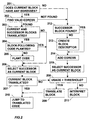
- a block completion process 20 is executed, to select the appropriate successor block.
- a translated block contains block-following code.
- the block-following code may cause a jump to the required successor block, directly from the translated code, without executing the block completion process, as will be described.
- Step 201 The process first accesses the block descriptor 18 associated with the current code block (i.e. the code block that has just completed), and checks whether this descriptor has any egresses 19 linked to it.
- Step 202 If there are one or more egresses linked to the current block, the process selects each egress in turn, and performs a test to check whether this is a valid egress for the current conditions.
- the first line of this test checks that the BLK value in the egress is not null, i.e. the egress points to a valid successor block.
- the second line checks that the current program counter value (PC) is equal to the BPC value in the egress.
- the third line checks that the current accumulator size (ACS) is equal to the BACS value in the descriptor pointed to by the BLK value in the egress.
- the second and third lines therefore check that the entry conditions for the successor block are the same as the conditions on exit from the current block.
- the fourth line is a consistency check, which confirms that the BID value in the egress equals the BID value in the descriptor pointed to by the BLK value in the egress.
- Step 203 If a valid egress is found in Step 202, the process performs a test to check whether both the current block and the successor block have been translated:
- the first line of this test checks that the BNIB value in the descriptor pointed to by the BLK value in the egress is not null.
- the second line checks that the BNIB value in the current block descriptor is not null. If both of these conditions are true, the process continues at Step 204; otherwise it goes to Step 206.
- Step 204 The process checks the BOPT flag in the selected egress to determine whether or not block-following code has been planted for this particular block-to-block link. If BOPT is False, the process continues at Step 205; otherwise it goes to Step 206.
- Step 205 The process plants block-following code into the current translated block, to link the current block to its successor. This code will be performed next time this block is executed.
- Step 206 The process then performs the action:
- Step 207 The process then checks the BNIB value in the current block descriptor. If it is null, this indicates that the block has not been translated, and the process continues at Step 208. Otherwise, it continues at Step 210.
- Step 208 The process checks whether the USAGE count in the current block descriptor is greater than a predetermined threshold value, indicating that the (as yet untranslated) block has been executed more than a certain number of times. If the USAGE count is greater than the threshold, the process continues at Step 209; otherwise, it proceeds to Step 211.
- Step 209 The process calls the translator 16, to translate the block.
- the translated code is stored in the main memory, and the BNIB value in the current block descriptor is set equal to the address of the translated code.
- the translated code has two entry points: a first entry point which is used when entry is made from the block completion process, and a second entry point for use when entry is made from block-following code.
- Step 210 A jump is then made to the first entry point of the translated code, and this code is executed.
- Step 211 If the USAGE count is not greater than the threshold, the process calls the interpreter 15, to execute the source code block. The USAGE count is incremented.
- Step 212 If it was found at Step 201 that the current block does not have any egresses, or if no valid egresses were found at Step 202, the process searches through the block descriptors 14, looking for a successor block whose entry conditions match the exit conditions (PC, ACS) of the current block.
- Step 213 If the required successor block is not found in the current set of block descriptors, then the source code 13,14 is explored to find the required successor block, i.e. to find the source code block whose entry conditions match the exit conditions (PC, ACS) of the current block, and a new block descriptor 18 is created to describe it.
- BACS and BPC are set equal to the values of ACS and PC on exit from the current block, BNIB is set to NULL, and USAGE is set to 0.
- Step 214 A new egress, pointing to the successor block, is then created and linked to the current block descriptor.
- the BOPT flag in the new egress is set to FALSE.
- Step 215 The process then designates the successor block as the new current block. Operation continues at Step 208 as described above.
- the block completion process searches for potential successor blocks. For each potential successor, the entry conditions (PC, ACS) associated with that block are compared with the conditions on exit from the current block. If they match, the successor block becomes the new current block, and a jump is made to it.
- PC PC, ACS
- the block-following code planted at Step 205 above will now be described.
- the block-following code planted depends on whether the values of PC and ACS on exit from the block are predictable at the time the block-following code is planted, or can be determined only at run time. There are four cases, as follows.
- the block-following code is optimised, in that it contains tests for entry conditions only if the results of those tests are unknown or unpredictable at the time the block-following code is planted.
- current_block.egress.PC, current_block.egress.BLK and current_block.egress.BLK->BACS are planted as literal values, and hence do not require access to the egress data structure.
- each translated target code block 17 has two entry points: a first entry point which is used when entry is made from the block completion process 20, and a second entry point for use when entry is made from the block-following code.
- the second entry point performs the following consistency check:
- parent_block.BID is planted as a literal value, and hence does not require access to the egress data structure.
- This consistency check confirms that the block identifier of the block being entered is equal to the expected block identifier. If so, this block is designated as the new current block, and execution of the translated code continues. Otherwise, the block completion process 20 is returned to.
Landscapes
- Engineering & Computer Science (AREA)
- Software Systems (AREA)
- Theoretical Computer Science (AREA)
- General Engineering & Computer Science (AREA)
- Physics & Mathematics (AREA)
- General Physics & Mathematics (AREA)
- Devices For Executing Special Programs (AREA)
- Test And Diagnosis Of Digital Computers (AREA)
- Memory System Of A Hierarchy Structure (AREA)
Abstract
Description
- The program counter (PC) value at entry to the block.
- The accumulator size (ACS) value at entry to the block.
- BID
- An identity number, uniquely identifying this block descriptor.
- BACS
- The accumulator size (ACS) on entry into the block.
- BPC
- The program counter (PC) value on entry into the block.
- BNIB
- The address of the translated target code (if any) corresponding to the source code block.
- USAGE
- A count of the number of times the block has been executed.
- BPC
- The program counter (PC) value on entry into the successor block.
- BID
- The identity number of the block descriptor associated with the successor block.
- BLK
- The address of the block descriptor associated with the successor block.
- BOPT
- A flag, indicating whether or not block-following code has been planted into the target code for this egress.
| current_block.egress.BLK != NULL | AND |
| PC == current_block.egress.BPC | AND |
| ACS == current_block.egress.BLK->BACS | AND |
| Current_block.egress.BID == current_block.egress.BLK->BID |
Claims (15)
- A method of executing instructions in a computer system, the method comprising:(a) storing a plurality of blocks of instructions, each block having a specified set of entry conditions associated with it;(b) on completion of execution of a current block of instructions, searching for potential successor blocks; and(c) for each potential successor block, comparing the set of entry conditions associated with that block with the exit conditions of the current block of instructions and, if a match is found, selecting the potential successor block as the current block and executing it.
- A method according to Claim 1, further including selectively translating blocks from a source instruction set into a target instruction set.
- A method according to Claim 2 wherein, if the selected successor block has not been translated, then(a) if usage of the block exceeds a threshold level, the block is translated and then executed;(b) if usage of the block does not exceed the threshold level, it is executed by an interpreter, without being translated.
- A method according to any preceding claim, further including selectively planting block-following code into at least some of said blocks, to call a successor block directly, thereby bypassing steps (b) and (c) in Claim 1.
- A method according to Claim 4 wherein the planted block-following code is optimised, in that it contains tests for entry conditions only if the results of those tests are not known at the time the block-following code is planted.
- A method according to any preceding claim, including the steps:(a) creating a number of block descriptors, each of which holds information relating to a particular block; and(b) creating a number of egress data structures, each associated with one of the block descriptors, each egress pointing to a potential successor block.
- A method according to Claim 6 including accessing the egress data structure for the potential successor block to obtain the entry conditions for that block.
- A method according to Claim 6 wherein:(a) each block descriptor contains a unique block identity;(b) each egress contains the expected block identity of the successor block pointed to by that egress; and(c) the method includes a consistency check involving comparing the expected block identity in the egress with the block identity of the successor block pointed to by the egress.
- A method of executing instructions in a computer system, the method comprising:(a) storing a plurality of blocks of instructions, each block having a specified set of entry conditions associated with it; and(b) planting block-following code into at least some of said blocks, said block-following code including tests to determine whether the exit conditions for the current block match the entry conditions for a specified successor block;(c) wherein if said tests are satisfied the block-following code causes a jump directly to the specified successor block.
- A method according to Claim 9 wherein the block-following code is optimised, in that it contains tests for exit conditions only if those exit conditions are unpredictable at the time the block-following code is planted.
- A method according to Claim 9 or 10 wherein, if said tests are not successful, the block-following code calls a block-completion process to search for a successor block whose entry conditions match the exit conditions of the current block.
- A method according to any one of Claims 9 to 11 wherein, on entry from the block-following code of a predecessor block, the successor block performs a consistency check to confirm that it is the correct successor block and, if this consistency check is unsuccessful, the successor block calls a block-completion process to search for a successor block whose entry conditions match the exit conditions of the predecessor block.
- A method according to any one of Claims 9 to 12 wherein the block-following code is planted into a block only if that block and its successor block have both been translated into the native instruction code of the computer system.
- A method of executing instructions in a computer system, the method comprising:(a) storing a plurality of blocks of instructions;(b) storing a number of data structures holding information on entry conditions and potential successor blocks for each of the blocks of instructions;(c) on completion of execution of a current block of instructions, searching the data structures to locate a successor block whose entry conditions match the exit conditions of the current block of instructions; and(d) if a successor block whose entry conditions match the exit conditions of the current block of instructions is found, selecting that successor block as the current block and executing it.
- A method according to Claim 14 wherein the data structures comprise:(a) a number of block descriptors, each associated with a particular block of instructions, and each having a unique block identifier; and(b) each block descriptor having an associated egress data structure holding pointers to a number of potential successor blocks and the expected block identifiers of those potential successor blocks;(c) wherein, when a successor block has been located, a consistency check is performed by comparing the expected block identifier of that successor block with the actual block identifier of that successor block.
Applications Claiming Priority (2)
| Application Number | Priority Date | Filing Date | Title |
|---|---|---|---|
| GB9906652A GB2348305A (en) | 1999-03-24 | 1999-03-24 | Instruction execution mechanism |
| GB9906652 | 1999-03-24 |
Publications (3)
| Publication Number | Publication Date |
|---|---|
| EP1039374A2 true EP1039374A2 (en) | 2000-09-27 |
| EP1039374A3 EP1039374A3 (en) | 2001-02-14 |
| EP1039374B1 EP1039374B1 (en) | 2012-11-21 |
Family
ID=10850179
Family Applications (1)
| Application Number | Title | Priority Date | Filing Date |
|---|---|---|---|
| EP00301541A Expired - Lifetime EP1039374B1 (en) | 1999-03-24 | 2000-02-28 | Instruction execution mechanism |
Country Status (3)
| Country | Link |
|---|---|
| US (1) | US6564373B1 (en) |
| EP (1) | EP1039374B1 (en) |
| GB (1) | GB2348305A (en) |
Cited By (15)
| Publication number | Priority date | Publication date | Assignee | Title |
|---|---|---|---|---|
| GB2393274A (en) * | 2002-09-20 | 2004-03-24 | Advanced Risc Mach Ltd | Efficient translation in a data processing system having an external and an internal instruction set |
| WO2005008479A3 (en) * | 2003-07-15 | 2005-08-18 | Transitive Ltd | Shared code caching method and apparatus for program code conversion |
| CN100458687C (en) * | 2003-07-15 | 2009-02-04 | 可递有限公司 | Shared code cache method and device for program code conversion |
| WO2016210030A1 (en) * | 2015-06-26 | 2016-12-29 | Microsoft Technology Licensing, Llc | Determination of target location for transfer of processor control |
| US9940136B2 (en) | 2015-06-26 | 2018-04-10 | Microsoft Technology Licensing, Llc | Reuse of decoded instructions |
| US9946548B2 (en) | 2015-06-26 | 2018-04-17 | Microsoft Technology Licensing, Llc | Age-based management of instruction blocks in a processor instruction window |
| US9952867B2 (en) | 2015-06-26 | 2018-04-24 | Microsoft Technology Licensing, Llc | Mapping instruction blocks based on block size |
| US10095519B2 (en) | 2015-09-19 | 2018-10-09 | Microsoft Technology Licensing, Llc | Instruction block address register |
| US10169044B2 (en) | 2015-06-26 | 2019-01-01 | Microsoft Technology Licensing, Llc | Processing an encoding format field to interpret header information regarding a group of instructions |
| US10175988B2 (en) | 2015-06-26 | 2019-01-08 | Microsoft Technology Licensing, Llc | Explicit instruction scheduler state information for a processor |
| US10191747B2 (en) | 2015-06-26 | 2019-01-29 | Microsoft Technology Licensing, Llc | Locking operand values for groups of instructions executed atomically |
| US10346168B2 (en) | 2015-06-26 | 2019-07-09 | Microsoft Technology Licensing, Llc | Decoupled processor instruction window and operand buffer |
| US10409599B2 (en) | 2015-06-26 | 2019-09-10 | Microsoft Technology Licensing, Llc | Decoding information about a group of instructions including a size of the group of instructions |
| US10409606B2 (en) | 2015-06-26 | 2019-09-10 | Microsoft Technology Licensing, Llc | Verifying branch targets |
| US11755484B2 (en) | 2015-06-26 | 2023-09-12 | Microsoft Technology Licensing, Llc | Instruction block allocation |
Families Citing this family (4)
| Publication number | Priority date | Publication date | Assignee | Title |
|---|---|---|---|---|
| US6986128B2 (en) * | 2000-01-07 | 2006-01-10 | Sony Computer Entertainment Inc. | Multiple stage program recompiler and method |
| US20020199179A1 (en) * | 2001-06-21 | 2002-12-26 | Lavery Daniel M. | Method and apparatus for compiler-generated triggering of auxiliary codes |
| US7765539B1 (en) | 2004-05-19 | 2010-07-27 | Nintendo Co., Ltd. | System and method for trans-compiling video games |
| US9703615B2 (en) * | 2014-07-18 | 2017-07-11 | Facebook, Inc. | Stepped sizing of code execution |
Family Cites Families (12)
| Publication number | Priority date | Publication date | Assignee | Title |
|---|---|---|---|---|
| US5428786A (en) * | 1991-03-07 | 1995-06-27 | Digital Equipment Corporation | Branch resolution via backward symbolic execution |
| US5507030A (en) * | 1991-03-07 | 1996-04-09 | Digitial Equipment Corporation | Successive translation, execution and interpretation of computer program having code at unknown locations due to execution transfer instructions having computed destination addresses |
| US5590329A (en) * | 1994-02-04 | 1996-12-31 | Lucent Technologies Inc. | Method and apparatus for detecting memory access errors |
| US5613118A (en) * | 1994-06-20 | 1997-03-18 | International Business Machines Corporation | Profile-based preprocessor for optimizing programs |
| US5751982A (en) * | 1995-03-31 | 1998-05-12 | Apple Computer, Inc. | Software emulation system with dynamic translation of emulated instructions for increased processing speed |
| US5721927A (en) * | 1996-08-07 | 1998-02-24 | Intel Corporation | Method for verifying contiquity of a binary translated block of instructions by attaching a compare and/or branch instruction to predecessor block of instructions |
| US5894576A (en) * | 1996-11-12 | 1999-04-13 | Intel Corporation | Method and apparatus for instruction scheduling to reduce negative effects of compensation code |
| US6044220A (en) * | 1997-02-25 | 2000-03-28 | Motorola, Inc. | Method and apparatus for operating a data processor to execute software written using a foreign instruction set |
| US5950009A (en) * | 1997-03-10 | 1999-09-07 | International Business Machines Coporation | Method and apparatus for profile-based reordering of program portions in a computer program |
| US6041402A (en) * | 1998-01-05 | 2000-03-21 | Trw Inc. | Direct vectored legacy instruction set emulation |
| US6112280A (en) * | 1998-01-06 | 2000-08-29 | Hewlett-Packard Company | Method and apparatus for distinct instruction pointer storage in a partitioned cache memory |
| US6192513B1 (en) * | 1998-11-02 | 2001-02-20 | Hewlett-Packard Company | Mechanism for finding spare registers in binary code |
-
1999
- 1999-03-24 GB GB9906652A patent/GB2348305A/en not_active Withdrawn
-
2000
- 2000-02-28 EP EP00301541A patent/EP1039374B1/en not_active Expired - Lifetime
- 2000-03-10 US US09/522,579 patent/US6564373B1/en not_active Expired - Lifetime
Cited By (19)
| Publication number | Priority date | Publication date | Assignee | Title |
|---|---|---|---|---|
| GB2393274A (en) * | 2002-09-20 | 2004-03-24 | Advanced Risc Mach Ltd | Efficient translation in a data processing system having an external and an internal instruction set |
| GB2393274B (en) * | 2002-09-20 | 2006-03-15 | Advanced Risc Mach Ltd | Data processing system having an external instruction set and an internal instruction set |
| US7406585B2 (en) | 2002-09-20 | 2008-07-29 | Arm Limited | Data processing system having an external instruction set and an internal instruction set |
| WO2005008479A3 (en) * | 2003-07-15 | 2005-08-18 | Transitive Ltd | Shared code caching method and apparatus for program code conversion |
| CN100458687C (en) * | 2003-07-15 | 2009-02-04 | 可递有限公司 | Shared code cache method and device for program code conversion |
| US7805710B2 (en) | 2003-07-15 | 2010-09-28 | International Business Machines Corporation | Shared code caching for program code conversion |
| KR101107797B1 (en) * | 2003-07-15 | 2012-01-25 | 인터내셔널 비지네스 머신즈 코포레이션 | Shared code caching method and apparatus for program code conversion |
| US9940136B2 (en) | 2015-06-26 | 2018-04-10 | Microsoft Technology Licensing, Llc | Reuse of decoded instructions |
| WO2016210030A1 (en) * | 2015-06-26 | 2016-12-29 | Microsoft Technology Licensing, Llc | Determination of target location for transfer of processor control |
| US9946548B2 (en) | 2015-06-26 | 2018-04-17 | Microsoft Technology Licensing, Llc | Age-based management of instruction blocks in a processor instruction window |
| US9952867B2 (en) | 2015-06-26 | 2018-04-24 | Microsoft Technology Licensing, Llc | Mapping instruction blocks based on block size |
| US10169044B2 (en) | 2015-06-26 | 2019-01-01 | Microsoft Technology Licensing, Llc | Processing an encoding format field to interpret header information regarding a group of instructions |
| US10175988B2 (en) | 2015-06-26 | 2019-01-08 | Microsoft Technology Licensing, Llc | Explicit instruction scheduler state information for a processor |
| US10191747B2 (en) | 2015-06-26 | 2019-01-29 | Microsoft Technology Licensing, Llc | Locking operand values for groups of instructions executed atomically |
| US10346168B2 (en) | 2015-06-26 | 2019-07-09 | Microsoft Technology Licensing, Llc | Decoupled processor instruction window and operand buffer |
| US10409599B2 (en) | 2015-06-26 | 2019-09-10 | Microsoft Technology Licensing, Llc | Decoding information about a group of instructions including a size of the group of instructions |
| US10409606B2 (en) | 2015-06-26 | 2019-09-10 | Microsoft Technology Licensing, Llc | Verifying branch targets |
| US11755484B2 (en) | 2015-06-26 | 2023-09-12 | Microsoft Technology Licensing, Llc | Instruction block allocation |
| US10095519B2 (en) | 2015-09-19 | 2018-10-09 | Microsoft Technology Licensing, Llc | Instruction block address register |
Also Published As
| Publication number | Publication date |
|---|---|
| US6564373B1 (en) | 2003-05-13 |
| GB2348305A (en) | 2000-09-27 |
| EP1039374B1 (en) | 2012-11-21 |
| EP1039374A3 (en) | 2001-02-14 |
| GB9906652D0 (en) | 1999-05-19 |
Similar Documents
| Publication | Publication Date | Title |
|---|---|---|
| US6564373B1 (en) | Instruction execution mechanism | |
| US6304867B1 (en) | System and method for enhanced performance of a relational database management system through the use of application-specific memory-resident data | |
| EP1226492B1 (en) | Method and apparatus for maintaining context while executing translated instructions | |
| KR100463810B1 (en) | Memory controller for a microprocessor for detecting a failure of speculation on the physical nature of a component being addressed | |
| US8381194B2 (en) | Methods and apparatuses for selective code coverage | |
| US6542167B1 (en) | System and method for flexible software linking | |
| EP0373361B1 (en) | Generating efficient code for a computer with dissimilar register spaces | |
| JPH0778741B2 (en) | Object Module Generation Method | |
| US9336125B2 (en) | Systems and methods for hardware-assisted type checking | |
| JP2001504957A (en) | Memory data aliasing method and apparatus in advanced processor | |
| JP2001519953A (en) | Microprocessor improvements | |
| TWI743698B (en) | Method and device for interpreting execution byte code instruction stream | |
| US6519768B1 (en) | Instruction translation method | |
| US20020174418A1 (en) | Constant return optimization transforming indirect calls to data fetches | |
| US6272676B1 (en) | Method and apparatus for finding loop— lever parallelism in a pointer based application | |
| US10146565B2 (en) | Method for executing a computer program with a parameterised function | |
| JP2001519955A (en) | Translation memory protector for advanced processors | |
| KR100522468B1 (en) | Host microprocessor with apparatus for temporarily holding target processor state | |
| US7065754B1 (en) | Method and apparatus for switching between multiple implementations of a routine | |
| US10802854B2 (en) | Method and apparatus for interpreting bytecode instruction stream | |
| US6532532B1 (en) | Instruction execution mechanism | |
| CN111090576B (en) | Generating test sequences of codes based on directed sequences of codes and randomly selected instructions | |
| US5243601A (en) | Apparatus and method for detecting a runaway firmware control unit | |
| EP1033650A2 (en) | Instruction translation method | |
| US10140135B2 (en) | Method for executing a computer program with a parameterised function |
Legal Events
| Date | Code | Title | Description |
|---|---|---|---|
| PUAI | Public reference made under article 153(3) epc to a published international application that has entered the european phase |
Free format text: ORIGINAL CODE: 0009012 |
|
| AK | Designated contracting states |
Kind code of ref document: A2 Designated state(s): DE FR GB |
|
| AX | Request for extension of the european patent |
Free format text: AL;LT;LV;MK;RO;SI |
|
| PUAL | Search report despatched |
Free format text: ORIGINAL CODE: 0009013 |
|
| AK | Designated contracting states |
Kind code of ref document: A3 Designated state(s): AT BE CH CY DE DK ES FI FR GB GR IE IT LI LU MC NL PT SE |
|
| AX | Request for extension of the european patent |
Free format text: AL;LT;LV;MK;RO;SI |
|
| 17P | Request for examination filed |
Effective date: 20010226 |
|
| AKX | Designation fees paid |
Free format text: DE FR GB |
|
| RAP1 | Party data changed (applicant data changed or rights of an application transferred) |
Owner name: FUJITSU SERVICES LIMITED |
|
| 17Q | First examination report despatched |
Effective date: 20070110 |
|
| REG | Reference to a national code |
Ref country code: DE Ref legal event code: R079 Ref document number: 60047647 Country of ref document: DE Free format text: PREVIOUS MAIN CLASS: G06F0009318000 Ipc: G06F0009455000 |
|
| RIC1 | Information provided on ipc code assigned before grant |
Ipc: G06F 9/30 20060101ALI20120103BHEP Ipc: G06F 9/455 20060101AFI20120103BHEP Ipc: G06F 9/45 20060101ALI20120103BHEP Ipc: G06F 9/38 20060101ALI20120103BHEP |
|
| GRAP | Despatch of communication of intention to grant a patent |
Free format text: ORIGINAL CODE: EPIDOSNIGR1 |
|
| GRAS | Grant fee paid |
Free format text: ORIGINAL CODE: EPIDOSNIGR3 |
|
| GRAA | (expected) grant |
Free format text: ORIGINAL CODE: 0009210 |
|
| AK | Designated contracting states |
Kind code of ref document: B1 Designated state(s): DE FR GB |
|
| REG | Reference to a national code |
Ref country code: GB Ref legal event code: FG4D |
|
| REG | Reference to a national code |
Ref country code: DE Ref legal event code: R096 Ref document number: 60047647 Country of ref document: DE Effective date: 20130117 |
|
| PLBE | No opposition filed within time limit |
Free format text: ORIGINAL CODE: 0009261 |
|
| STAA | Information on the status of an ep patent application or granted ep patent |
Free format text: STATUS: NO OPPOSITION FILED WITHIN TIME LIMIT |
|
| 26N | No opposition filed |
Effective date: 20130822 |
|
| REG | Reference to a national code |
Ref country code: DE Ref legal event code: R097 Ref document number: 60047647 Country of ref document: DE Effective date: 20130822 |
|
| REG | Reference to a national code |
Ref country code: FR Ref legal event code: PLFP Year of fee payment: 17 |
|
| REG | Reference to a national code |
Ref country code: FR Ref legal event code: PLFP Year of fee payment: 18 |
|
| REG | Reference to a national code |
Ref country code: FR Ref legal event code: PLFP Year of fee payment: 19 |
|
| PGFP | Annual fee paid to national office [announced via postgrant information from national office to epo] |
Ref country code: GB Payment date: 20190218 Year of fee payment: 20 Ref country code: DE Payment date: 20190219 Year of fee payment: 20 |
|
| PGFP | Annual fee paid to national office [announced via postgrant information from national office to epo] |
Ref country code: FR Payment date: 20190219 Year of fee payment: 20 |
|
| REG | Reference to a national code |
Ref country code: DE Ref legal event code: R071 Ref document number: 60047647 Country of ref document: DE |
|
| REG | Reference to a national code |
Ref country code: GB Ref legal event code: PE20 Expiry date: 20200227 |
|
| PG25 | Lapsed in a contracting state [announced via postgrant information from national office to epo] |
Ref country code: GB Free format text: LAPSE BECAUSE OF EXPIRATION OF PROTECTION Effective date: 20200227 |