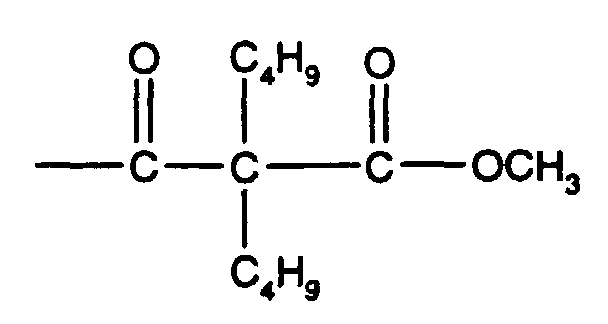
Certain high molecular weight hindered hydrocarbyloxyamine stabilizers are found to be
especially efficacious towards stabilizing organic material subject to degradation induced by
light, heat or oxidation.
Disclosed are stabilized compositions comprising
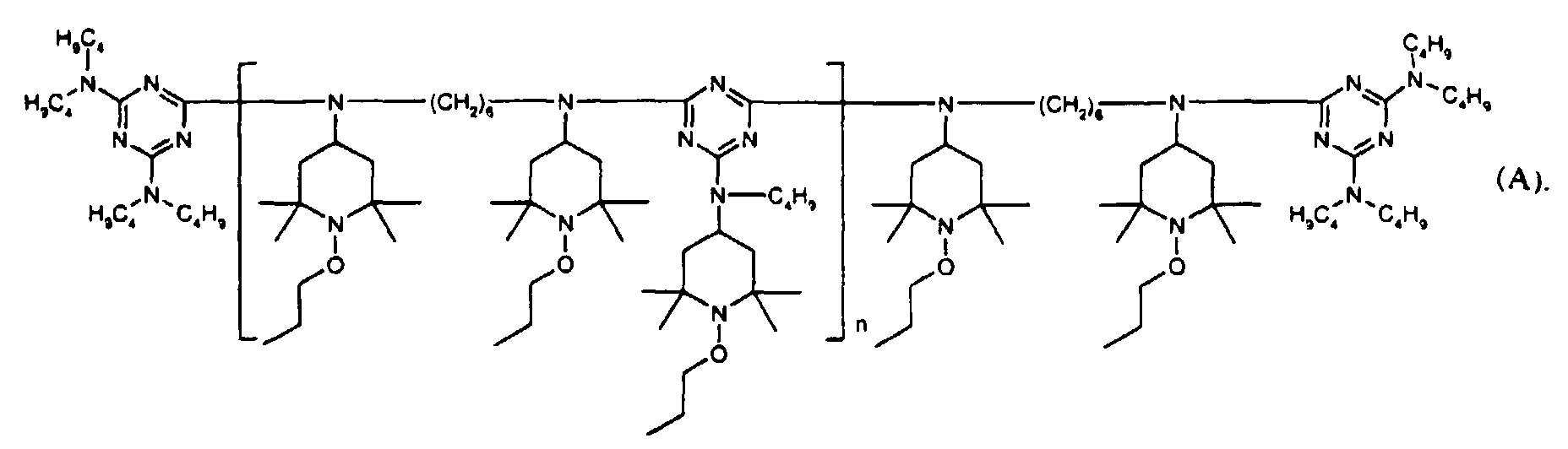
The high molecular weight hindered hydrocarbyloxyamine stabilizer of the formula (A),
CAS # 247243-62-5, is the NO-n-propyl derivative of the block oligomer Chimassorb® 2020
(CAS # 192268-64-7, Ciba Specialty Chemicals Corp.):
The high molecular weight hindered hydrocarbyloxyamine stabilizer of formula (A) is
disclosed in GB 2334717.
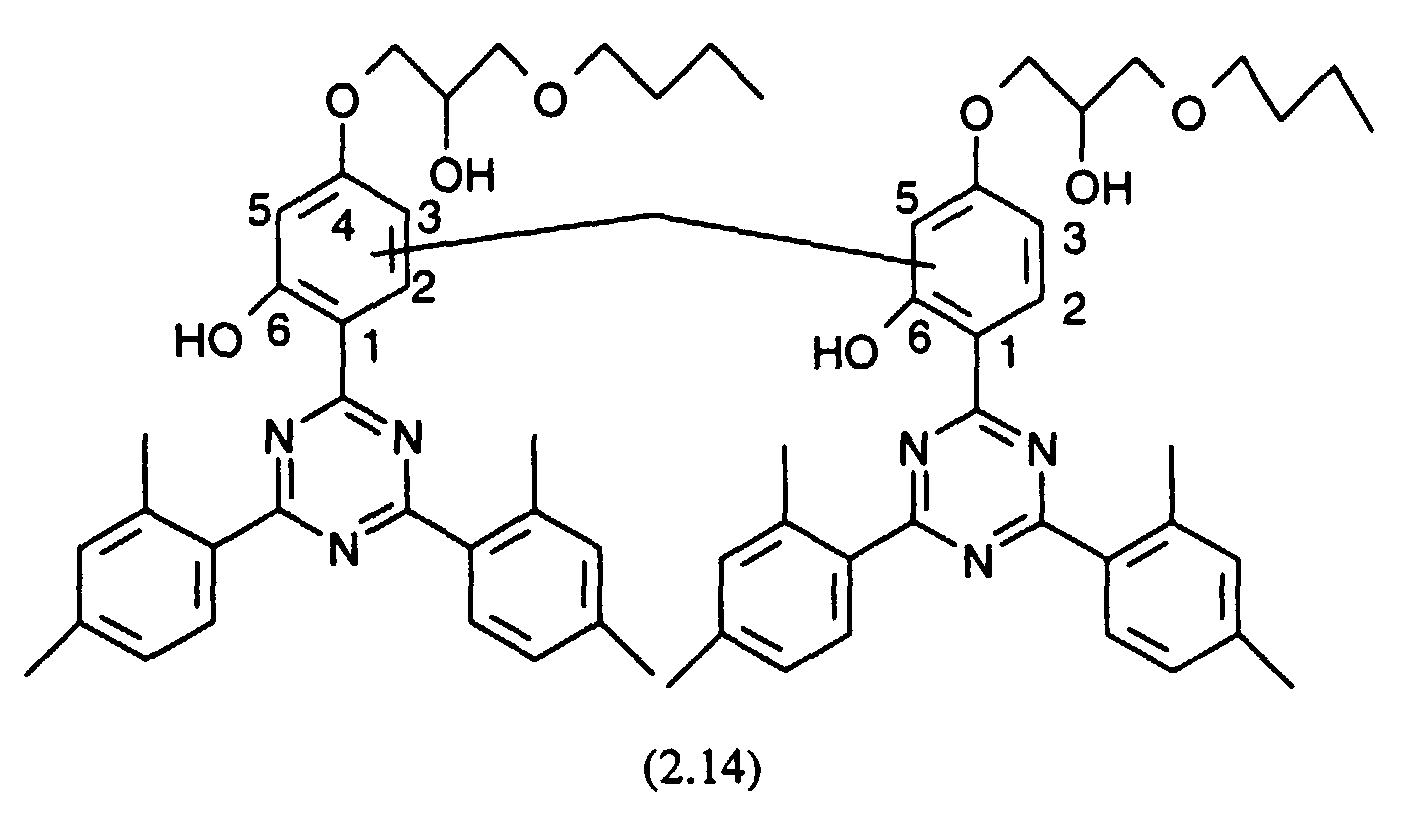
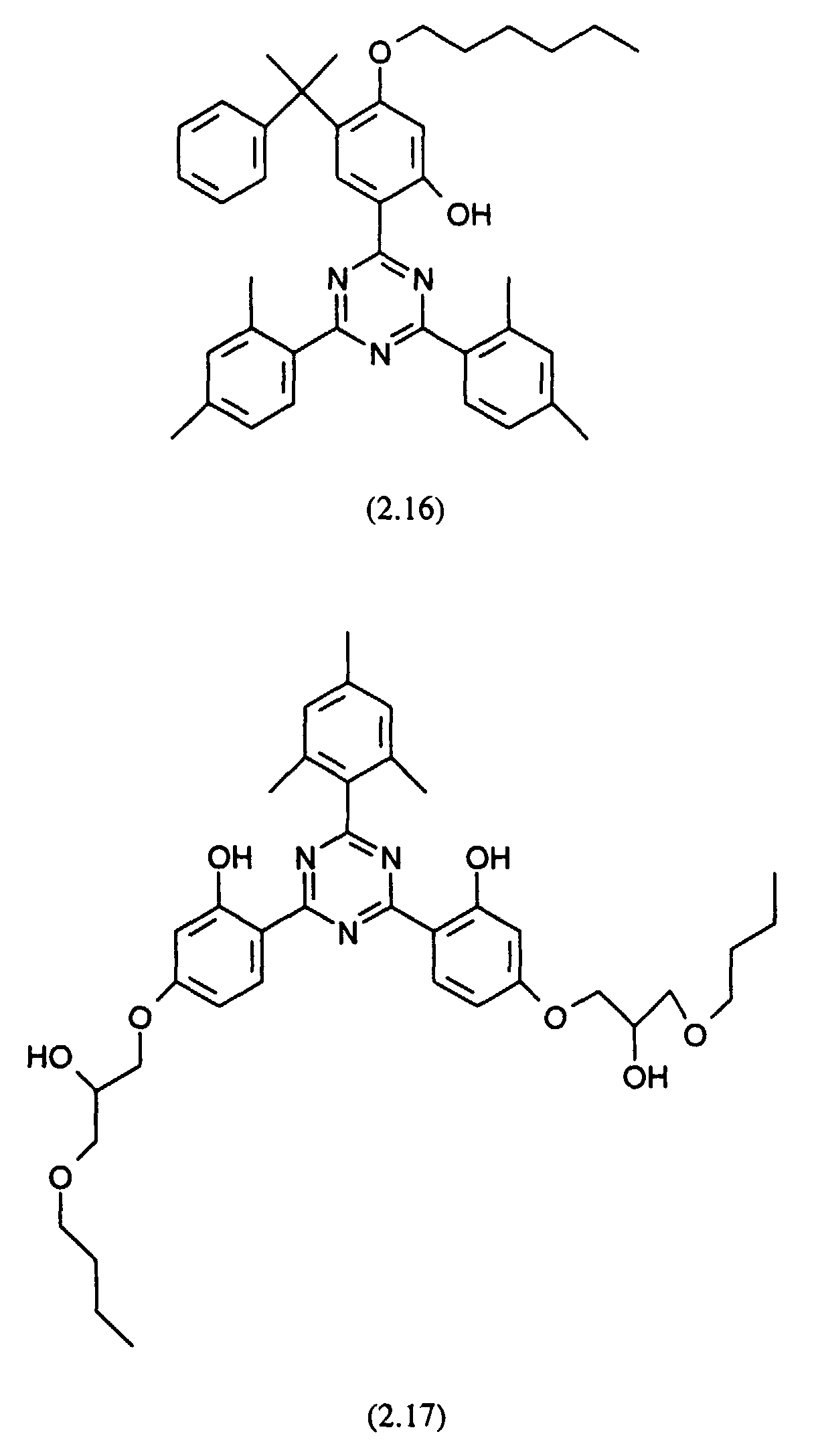
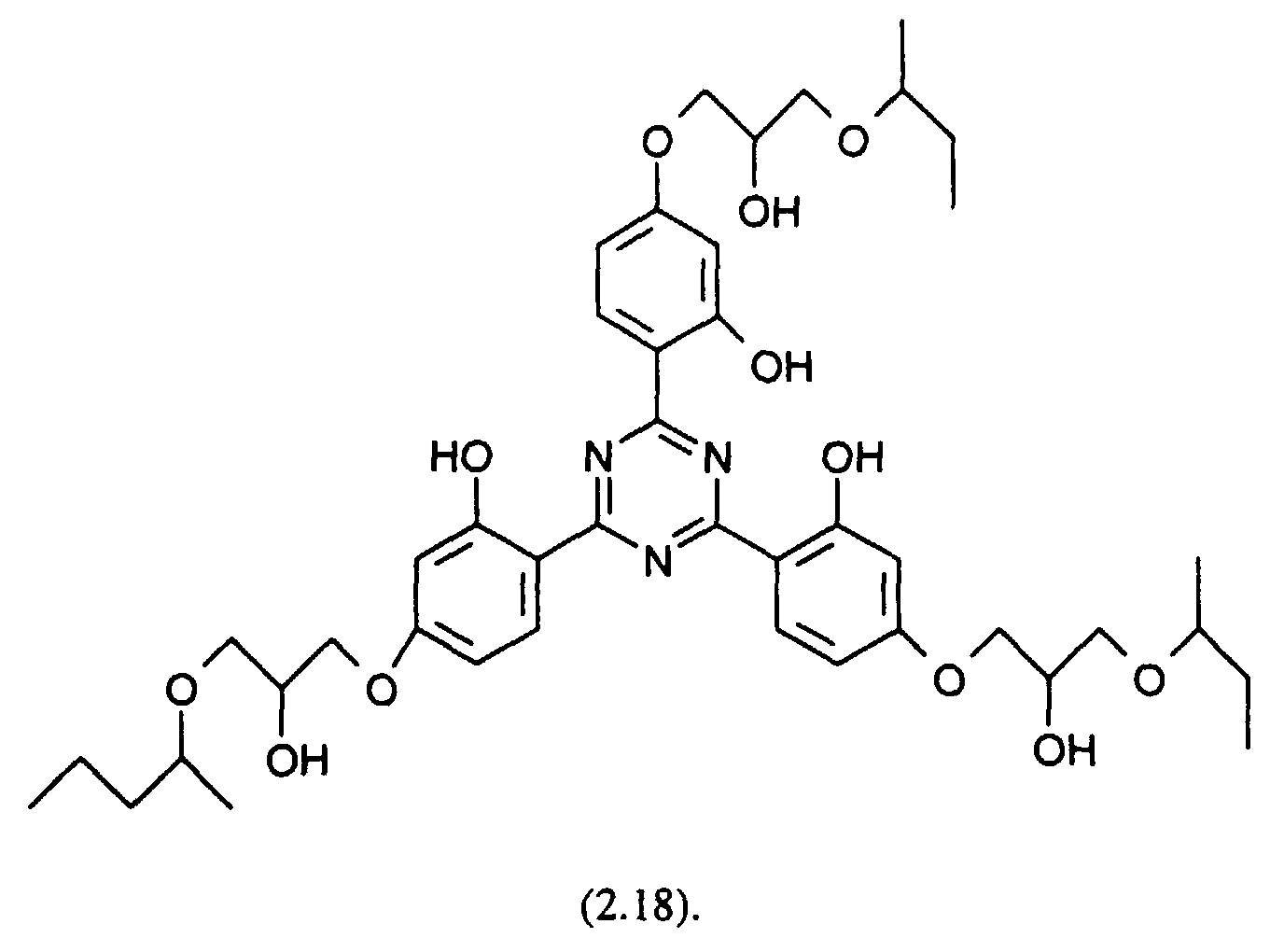
The stabilized compositions may further comprise ultraviolet (UV) light absorbers, for
example the following UV absorbers:
methylene bridged dimer mixture bridged in the 3:5', 5:5' and 3:3' positions in a 5:4:1 ratio
3.) 2-Hydroxy-benzophenones, for example, the 4-hydroxy-, 4-methoxy-, 4-octyloxy, 4-decyloxy-,
4-dodecyloxy-, 4-benzyloxy, 4,2',4'-trihydroxy- and 2'-hydroxy-4,4'-dimethoxy
derivatives. 4.) Esters of optionally substituted benzoic acids for example, phenyl salicylate, 4-tert-butylphenyl
salicylate, octylphenyl salicylate, dibenzoylresorcinol, bis-(4-tert-butylbenzoyl)-resorcinol,
benzoylresorcinol, 3,5-di-tert-butyl-4-hydroxybenzoic acid 2,4-di-tert-butylphenyl
ester and 3,5-di-tert-butyl-4-hydroxybenzoic acid hexadecyl ester. 5.) Acrylates and malonates, for example, α-cyano-β,β-diphenylacrylic acid ethyl ester or
isooctyl ester, α-carbomethoxy-cinnamic acid methyl ester, α-cyano-β-methyl-p-methoxy-cinnamic
acid methyl ester or butyl ester, α-carbomethoxy-p-methoxy-cinnamic acid methyl
ester, N-(β-carbomethoxy-β-cyanovinyl)-2-methyl-indoline, Sanduvor® PR25, dimethyl p-methoxybenzylidenemalonate
(CAS# 7443-25-6), and Sanduvor® PR31, di-(1,2,2,6,6-pentamethylpiperidin-4-yl)
p-methoxybenzylidenemalonate (CAS #147783-69-5). 6.) Oxalic acid diamides, for example, 4,4'-di-octyloxy-oxanilide, 2,2'-di-octyloxy-5,5'-di-tert-butyl-oxanilide,
2,2'-di-dodecyloxy-5,5'-di-tert-butyl-oxanilide, 2-ethoxy-2'-ethyl-oxanilide,
N,N'-bis (3-dimethylaminopropyl)-oxalamide, 2-ethoxy-5-tert-butyl-2'-ethyloxanilide
and its mixture with 2-ethoxy-2'-ethyl-5,4'-di-tert-butyloxanilide and mixtures of ortho- and
para-methoxy- as well as of o- and p-ethoxy-disubstituted oxanilides.
The stabilized compositions may also contain light stabilizers of the class of: 7.) Nickel compounds, for example nickel complexes of 2,2'-thio-bis-[4-(1,1,3,3-tetramethylbutyl)phenol],
such as the 1:1 or 1:2 complex, with or without additional ligands such
as n-butylamine, triethanolamine or N-cyclohexyldiethanolamine, nickel dibutyldithiocarbamate,
nickel salts of the monoalkyl esters, e.g. the methyl or ethyl ester, of 4-hydroxy-3,5-di-tert-butylbenzylphosphonic
acid, nickel complexes of ketoximes, e.g. of 2-hydroxy-4-methylphenylundecylketoxime,
nickel complexes of 1-phenyl-4-lauroyl-5-hydroxypyrazole, with or without
additional ligands.
The stabilized compositions may further comprise, if desired, other stabilizers of the
following classes: 8.) Antioxidants 8.1) Alkylated monophenols, for example,
2,6-di-tert-butyl-4-methylphenol 2-tert-butyl-4,6-dimethylphenol 2,6-di-tert-butyl-4-ethylphenol 2,6-di-tert-butyl-4-n-butylphenol 2,6-di-tert-butyl-4-i-butylphenol 2,6-di-cyclopentyl-4-methylphenol 2-(α-methylcyclohexyl)-4,6-dimethylphenol 2,6-di-octadecyl-4-methylphenol 2,4,6-tri-cyclohexylphenol 2,6-di-tert-butyl-4-methoxymethylphenol 8.2) Alkylated hydroquinones, for example,
2,6-di-tert-butyl-4-methoxyphenol 2,5-di-tert-butyl-hydroquinone 2,5-di-tert-amyl-hydroquinone 2,6-diphenyl-4-octadecyloxyphenol 8.3) Hydroxylated thiodiphenyl ethers, for example,
2,2'-thio-bis-(6-tert-butyl-4-methylphenol) 2,2'-thio-bis-(4-octylphenol) 4,4'-thio-bis-(6-tert-butyl-3-methylphenol) 4,4'-thio-bis-(6-tert-butyl-2-methylphenol) 8.4) Alkylidene-bisphenols, for example,
2,2'-methylene-bis-(6-tert-butyl-4-methylphenol) 2,2'-methylene-bis-(6-tert-butyl-4-ethylphenol) 2,2'-methylene-bis-[4-methyl-6-(α-methylcyclohexyl)-phenol] 2,2'-methylene-bis-(4-methyl-6-cyclohexylphenol) 2,2'-methylene-bis-(6-nonyl-4-methylphenol) 2,2'-methylene-bis-[6-(α-methylbenzyl)-4-nonylphenol] 2,2'-methylene-bis-[6-(α,α-dimethylbenzyl)-4-nonylphenol] 2,2'-methylene-bis-(4,6-di-tert-butylphenol) 2,2'-ethylidene-bis-(4,6-di-tert-butylphenol) 2,2'-ethylidene-bis-(6-tert-butyl-4-isobutylphenol) 4,4'-methylene-bis-(2,6-di-tert-butylphenol) 4,4'-methylene-bis-(6-tert-butyl-2-methylphenol) 1,1-bis-(5-tert-butyl-4-hydroxy-2-methylphenyl)-butane 2,6-di-(3-tert-butyl-5-methyl-2-hydroxybenzyl)-4-methylphenol 1,1,3-tris-(5-tert-butyl-4-hydroxy-2-methylphenyl)-butane 1,1-bis-(5-tert-butyl-4-hydroxy-2-methylphenyl)-3-n-dodecylmercaptobutane
ethyleneglycol bis-[3,3-bis-(3'-tert-butyl-4'-hydroxyphenyl)-butyrate] di-(3-tert-butyl-4-hydroxy-5-methylphenyl)-dicyclopentadiene di-[2-(3'-tert-butyl-2'-hydroxy-5'-methyl-benzyl)-6-tert-butyl-4-methylphenyl]
terephthalate. 8.5) Benzyl compounds, for example,
1,3,5-tri-(3,5-di-tert-butyl-4-hydroxybenzyl)-2,4,6-trimethylbenzene
di-(3,5-di-tert-butyl-4-hydroxybenzyl) sulfide 3,5-di-tert-butyl-4-hydroxybenzyl-mercapto-acetic acid isooctyl ester
bis-(4-tert-butyl-3-hydroxy-2,6-dimethylbenzyl)dithiol terephthalate 1,3,5-tris-(3,5-di-tert-butyl-4-hydroxybenzyl) isocyanurate 1,3,5-tris-(4-tert-butyl-3-hydroxy-2,6-dimethylbenzyl) isocyanurate 3,5-di-tert-butyl-4-hydroxybenzyl-phosphoric acid dioctadecyl ester 3,5-di-tert-butyl-4-hydroxybenzyl-phosphoric acid monoethyl ester, calcium-salt 8.6) Acylaminophenols, for example,
4-hydroxy-lauric acid anilide 4-hydroxy-stearic acid anilide 2,4-bis-octylmercapto-6-(3,5-tert-butyl-4-hydroxyanilino)-s-triazine
octyl-N-(3,5-di-tert-butyl-4-hydroxyphenyl)-carbamate 8.7) Esters of β-(3,5-di-tert-butyl-4-hydroxyphenyl)-propionic acid with monohydric or
polyhydric alcohols, for example,
| methanol | diethylene glycol |
| octadecanol | triethylene glycol |
| 1,6-hexanediol | pentaerythritol |
| neopentyl glycol | tris-hydroxyethyl isocyanurate |
| thiodiethylene glycol | di-hydroxyethyl oxalic acid diamide |
| triethanolamine | triisopropanolamine |
8.8) Esters of β-(5-tert-butyl-4-hydroxy-3-methylphenyl)-propionic acid with
monohydric or polyhydric alcohols, for example,
| methanol | diethylene glycol |
| octadecanol | triethylene glycol |
| 1,6-hexanediol | pentaerythritol |
| neopentyl glycol | tris-hydroxyethyl isocyanurate |
| thiodiethylene glycol | di-hydroxyethyl oxalic acid diamide |
| triethanolamine | triisopropanolamine |
8.9) Amides of β-(3,5-di-tert-butyl-4-hydroxyphenyl)-propionic acid for example,
N,N'-di-(3,5-di-tert-butyl-4-hydroxyphenylpropionyl)-hexamethylenediamine N,N'-di-(3,5-di-tert-butyl-4-hydroxyphenylpropionyl)-trimethylenediamine N,N'-di-(3,5-di-tert-butyl-4-hydroxyphenylpropionyl)-hydrazine. 9.) Phosphites and phosphonites, for example, triphenyl phosphite, diphenylalkyl
phosphites, phenyldialkyl phosphites, tri-(nonylphenyl) phosphite, trilauryl phosphite,
trioctadecyl phosphite, di-stearyl-pentaerythritol diphosphite, tris-(2,4-di-tert-butylphenyl)
phosphite, di-isodecylpentaerythritol diphosphite, di-(2,4,6-tri-tert-butylphenyl)-pentaerythritol
diphosphite, di-(2,4-di-tert-butyl-6-methylphenyl)-pentaerythritol diphosphite, di-(2,4-di-tert-butylphenyl)pentaerythritol
diphosphite, tristearyl-sorbitol triphosphite, tetrakis-(2,4-di-tert-butylphenyl)
4,4'-diphenylylenediphosphonite. 10.) Compounds which destroy peroxide, for example, esters of β-thiodipropionic acid,
for example the lauryl, stearyl, myristyl or tridecyl esters, mercapto-benzimidazole or the zinc
salt of 2-mercaptobenzimidazole, zinc dibutyl-dithiocarbamate, dioctadecyl disulfide,
pentaerythritol tetrakis-(β-dodecylmercapto)-propionate. 11.) Hydroxylamines, for example, N,N-dibenzylhydroxylamine, N,N-diethylhydroxylamine,
N,N-dioctylhydroxylamine, N,N-dilaurylhydroxylamine, N,N-ditetradecylhydroxylamine,
N,N-dihexadecylhydroxylamine, N,N-dioctadecylhydroxylamine, N-hexadecyl-N-octadecylhydroxylamine,
N-heptadecyl-N-octadecylhydroxylamine, N,N-dialkylhydroxylamine
derived from hydrogenated tallow amine. 12.) Nitrones, for example, N-benzyl-alpha-phenyl nitrone, N-ethyl-alpha-methyl
nitrone, N-octyl-alpha-heptyl nitrone, N-lauryl-alpha-undecyl nitrone, N-tetradecyl-alpha-tridecyl
nitrone, N-hexadecyl-alpha-pentadecyl nitrone, N-octadecyl-alpha-heptadecylnitrone, N-hexadecyl-alpha-heptadecyl
nitrone, N-octadecyl-alpha-pentadecyl nitrone, N-heptadecyl-alpha-heptadecyl
nitrone, N-octadecyl-alpha-hexadecyl nitrone, nitrone derived from N,N-dialkylhydroxylamine
derived from hydrogenated tallow amine. 13.) Amine oxides, for example amine oxide derivatives as disclosed in U.S. Patent Nos.
5,844,029 and 5,880,191, didecyl methyl amine oxide, tridecyl amine oxide, tridodecyl amine
oxide and trihexadecyl amine oxide. 14.) Polyamide stabilizers, for example copper salts in combination with iodides and/or
phosphorus compounds and salts of divalent manganese. 15.) Basic co-stabilizers, for example, melamine, polyvinylpyrrolidone, dicyandiamide,
triallyl cyanurate, urea derivatives, hydrazine derivatives, amines, polyamides, polyurethanes,
alkali metal salts and alkaline earth metal salts of higher fatty acids for example Ca stearate, Zn
stearate, Mg stearate, Na ricinoleate and K palmitate, antimony pyrocatecholate or zinc
pyrocatecholate. 16.) Nucleating agents, for example, inorganic substances such as talcum, metal oxides
such as titanium dioxide or magnesium oxide, phosphates, carbonates or sulfates of, preferably,
alkaline earth metals; organic compounds such as mono- or polycarboxylic acids and the salts
thereof, e.g. 4-tert-butylbenzoic acid, adipic acid, diphenylacetic acid, sodium succinate or
sodium benzoate; polymeric compounds such as ionic copolymers (ionomers). 17.) Fillers and reinforcing agents, for example, calcium carbonate, silicates, glass fibers,
asbestos, talc, kaolin, mica, barium sulfate, metal oxides and hydroxides, carbon black, graphite,
wood flour and flours or fibers of other natural products, synthetic fibers. 18.) Other additives, for example, plasticizers, lubricants, emulsifiers, pigments,
rheology additives, catalysts, flow-control agents, optical brighteners, clarifiers such as
substituted and unsubstituted bisbenzylidene sorbitols, flameproofing agents, anti-static agents,
benzoxazinone UV absorbers, blowing agents and thiosynergists such as dilauryl
thiodipropionate or distearyl thiodipropionate. 19.) Benzofuranones and indolinones, for example those disclosed in U.S. Patent Nos.
4,325,863, 4,338,244 or 5,175,312, or 3-[4-(2-acetoxyethoxy)phenyl]-5,7-di-tert-butyl-benzofuran-2-one,
5,7-di-tert-butyl-3-[4-(2-stearoyloxyethoxy)phenyl]benzofuran-2-one, 3,3'-bis[5,7-di-tert-butyl-3-(4-[2-hydroxyethoxy]phenyl)benzofuran-2-one],
5,7-di-tert-butyl-3-(4-ethoxyphenyl)benzofuran-2-one,
3-(4-acetoxy-3,5-dimethylphenyl)-5,7-di-tert-butyl-benzofuran-2-one, 3-(3,5-dimethyl-4-pivaloyloxyphenyl)-5,7-di-tert-butyl-benzofuran-2-one,
3-(3,4-dimethylphenyl)-5,7-di-tert-butyl-benzofuran-2-one,
Irganox® HP-136, Ciba Specialty Chemicals Corp., and 3-(2,3-dimethylphenyl)-5,7-di-tert-butyl-benzofuran-2-one. 20.) Metal deactivators, for example N,N'-diphenyloxamide, N-salicylal-N'-salicyloyl
hydrazine, N,N'-bis(salicyloyl) hydrazine, N,N'-bis(3,5-di-tert-butyl-4-hydroxyphenylpropionyl)
hydrazine, 3-salicyloylamino-1,2,4-triazole, bis(benzylidene)oxalyl dihydrazide, oxanilide,
isophthaloyl dihydrazide, sebacoyl bisphenylhydrazide, N,N'-diacetyladipoyl dihydrazide, N,N'-bis(salicyloyl)oxalyl
dihydrazide, N,N'-bis(salicyloyl)thiopropionyl dihydrazide.
The stabilized compositions may also comprise further hindered amines, for example, one
or more of the following compounds of sections 21.) and 22.). Blends of hindered amine
stabilizers are disclosed for example in EP 947546. The hindered amine of formula (A) may
be blended with one or more appropriate additional hindered amines as per the disclosure of
EP 947546, substituting the compound of formula (A) for the component (α) of the EP
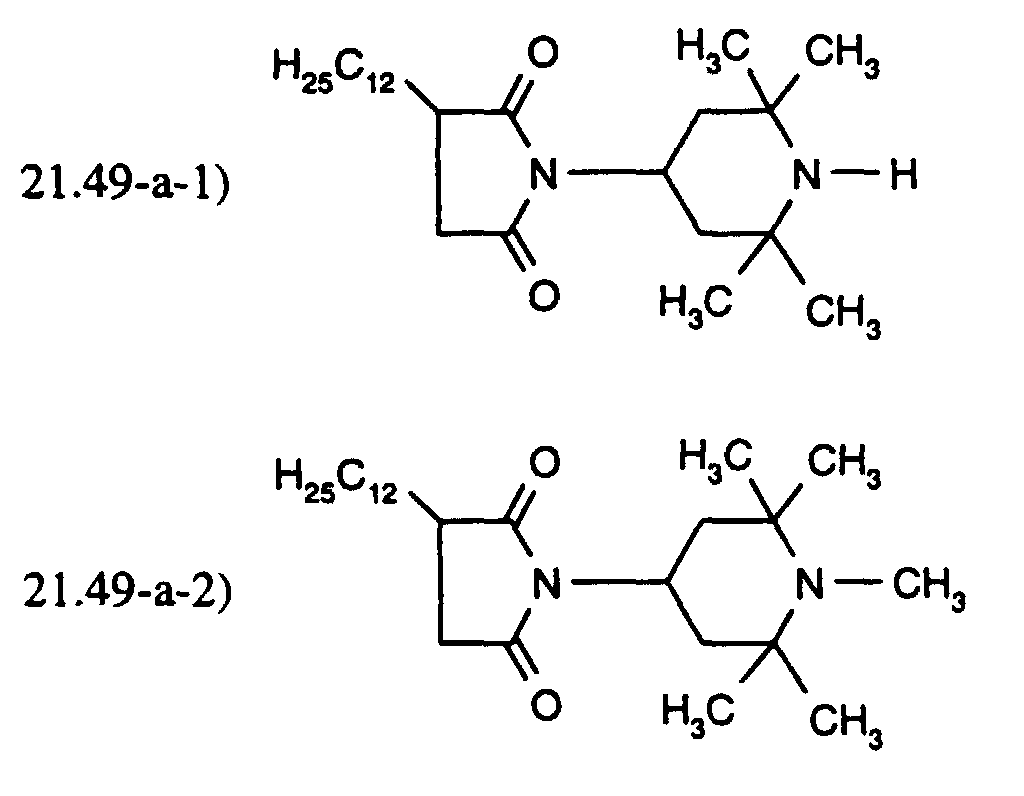
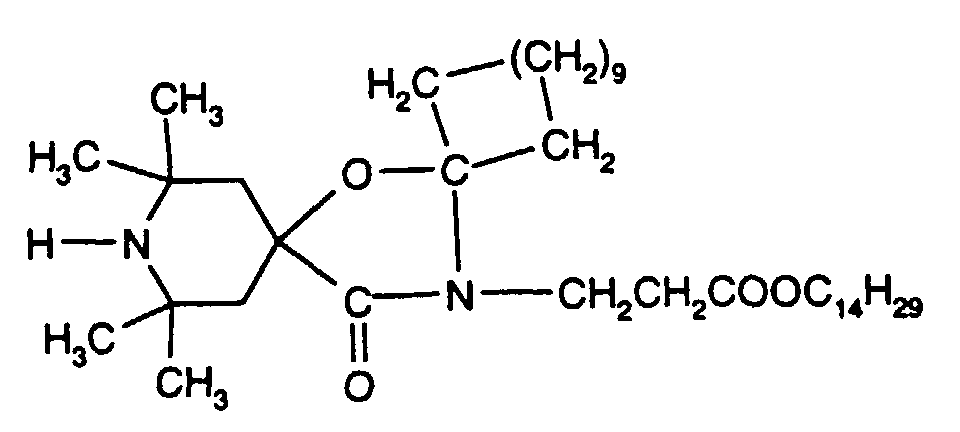
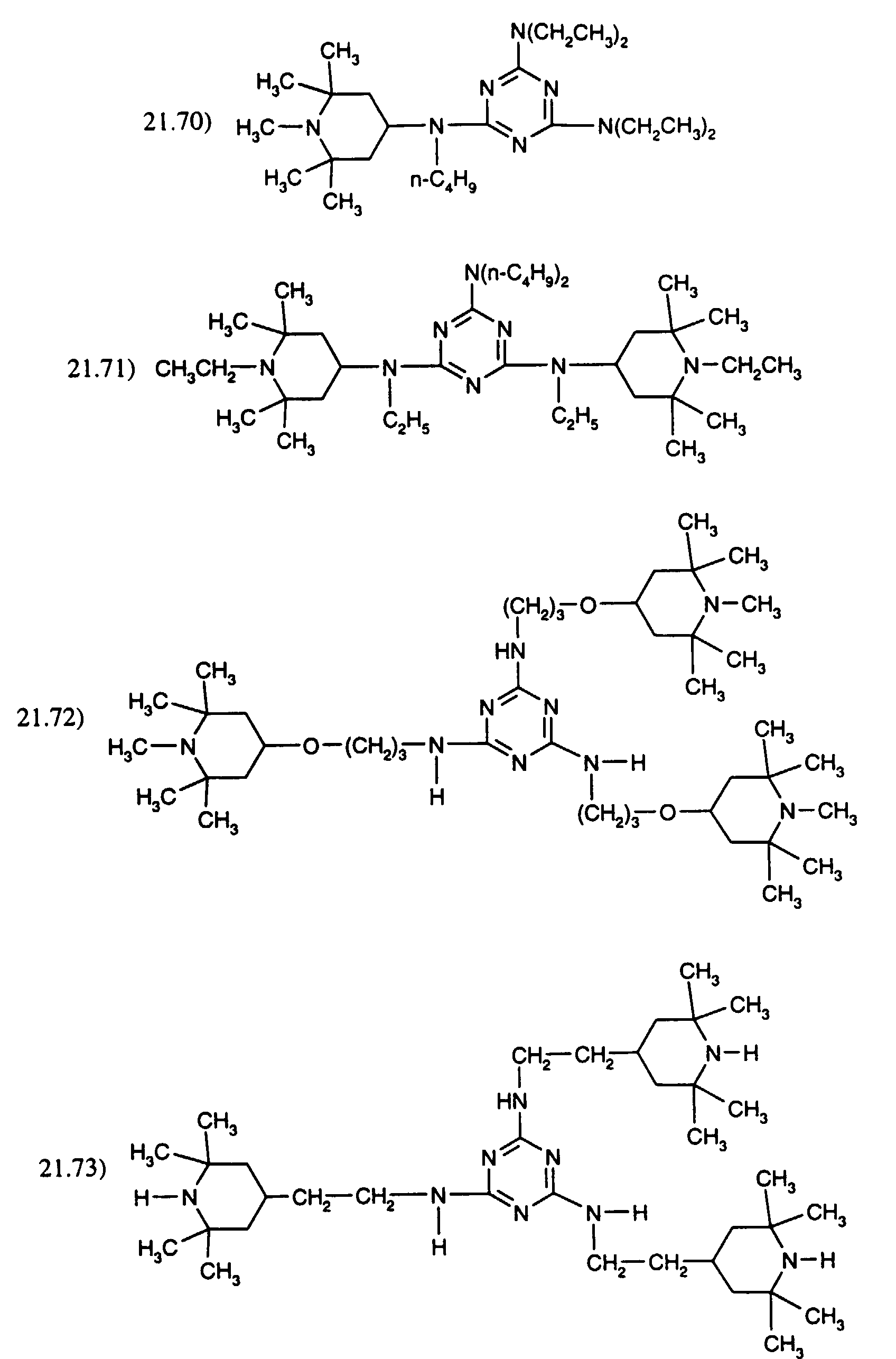
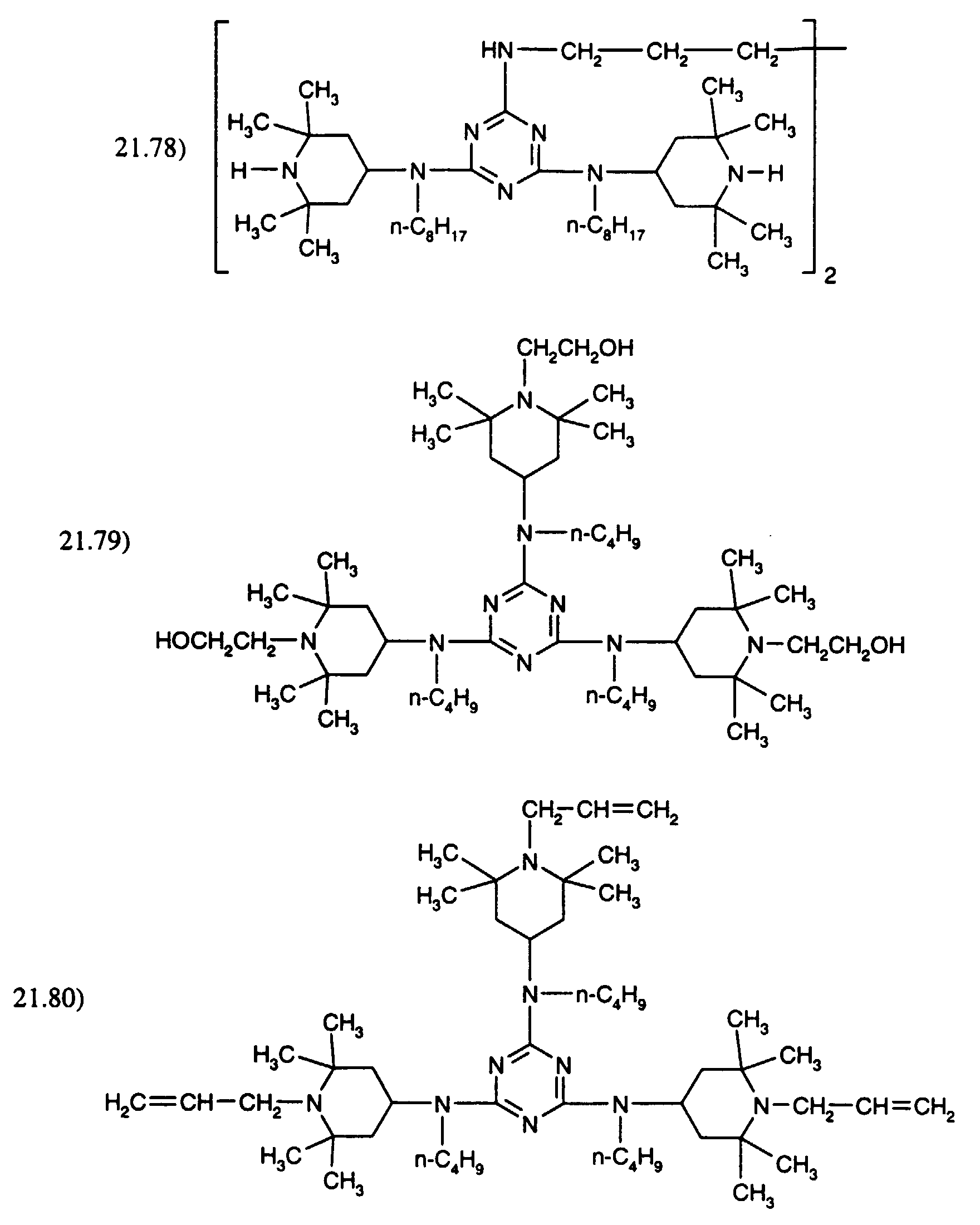
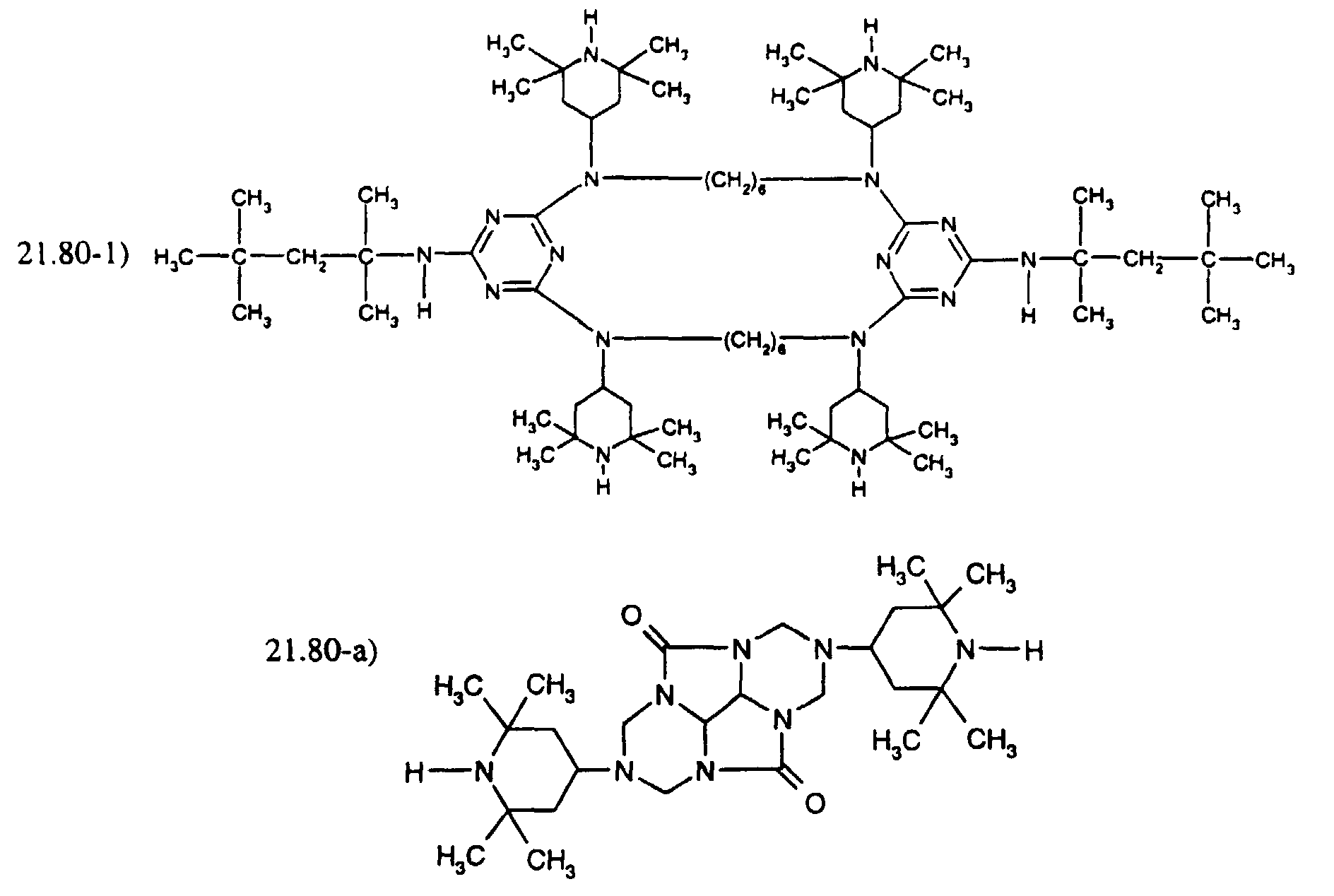
disclosure. 21.) Sterically hindered amine stabilizers 21.1) 4-hydroxy-2,2,6,6-tetramethylpiperidine 21.2) 1-allyl-4-hydroxy-2,2,6,6-tetramethylpiperidine 21.3) 1-benzyl-4-hydroxy-2,2,6,6-tetramethylpiperidine 21.4) 1-(4-tert-butyl-2-butenyl)-4-hydroxy-2,2,6,6-tetramethylpiperidine 21.5) 4-stearoyloxy-2,2,6,6-tetramethylpiperidine 21.6) 1-ethyl-4-salicyloyloxy-2,2,6,6-tetramethylpiperidine 21.7) 4-methacryloyloxy-1,2,2,6,6-pentamethylpiperidine 21.8) 1,2,2,6,6-pentamethylpiperidin-4-yl β-(3,5-di-tert-butyl-4-hydroxyphenyl)propionate 21.9) di(1-benzyl-2,2,6,6-tetramethylpiperidin-4-yl) maleate 21.10) di(2,2,6,6-tetramethylpiperidin-4-yl) succinate 21.11) di(2,2,6,6-tetramethylpiperidin-4-yl) glutarate 21.12) di(2,2,6,6-tetramethylpiperidin-4-yl) adipate 21.13) di(2,2,6,6-tetramethylpiperidin-4-yl) sebacate 21.14) di(1,2,2,6,6-pentamethylpiperidin-4-yl) sebacate 21.15) di(1,2,3,6-tetramethyl-2,6-diethyl-piperidin-4-yl) sebacate 21.16) di(1-allyl-2,2,6,6-tetramethylpiperidin-4-yl) phthalate 21.17) 1-hydroxy-4-β-cyanoethoxy-2,2,6,6-tetramethylpiperidine 21.18) 1-acetyl-2,2,6,6-tetramethylpiperidin-4-yl acetate 21.19) tri(2,2,6,6-tetramethylpiperidin-4-yl) trimellitate 21.20) 1-acryloyl-4-benzyloxy-2,2,6,6-tetramethylpiperidine 21.21) di(2,2,6,6-tetramethylpiperidin-4-yl) diethylmalonate 21.22) di(1,2,2,6,6-pentamethylpiperidin-4-yl) dibutylmalonate 21.23) di(1,2,2,6,6-pentamethylpiperidin-4-yl) butyl(3,5-di-tert-butyl-4-hydroxybenzyl)
malonate 21.24) di(1-octyloxy-2,2,6,6-tetramethylpiperidin-4-yl) sebacate 21.25) di(1-cyclohexyloxy-2,2,6,6-tetramethylpiperidin-4-yl) sebacate 21.26) hexane-1',6'-bis(4-carbamoyloxy-1-n-butyl-2,2,6,6-tetramethylpiperidine) 21.27) toluene-2',4'-bis-(4-carbamoyloxy-1-n-propyl-2,2,6,6-tetramethylpiperidine) 21.28) dimethylbis(2,2,6,6-tetramethylpiperidin-4-oxy)silane 21.29) phenyltris(2,2,6,6-tetramethylpiperidin-4-oxy)silane 21.30) tris(1-propyl-2,2,6,6-tetramethylpiperidin-4-yl) phosphite 21.30-a) tris(1-methyl-2,2,6,6-tetramethylpiperidin-4-yl) phosphite 21.31) tris(1-propyl-2,2,6,6-tetramethylpiperidin-4-yl) phosphate 21.32) phenyl bis(1,2,2,6,6-pentamethylpiperidin-4-yl) phosphonate 21.33) 4-hydroxy-1,2,2,6,6-pentamethylpiperidine 21.34) 4-hydroxy-N-hydroxyethyl-2,2,6,6-tetramethylpiperidine 21.35) 4-hydroxy-N-(2-hydroxypropyl)-2,2,6,6-tetramethylpiperidine 21.36) 1-glycidyl-4-hydroxy-2,2,6,6-tetramethylpiperidine 21.36-a-1) 1,2,3,4-tetrakis[2,2,6.6-tetramethylpiperidin-4-yloxycarbonyl]butane 21.36-a-2) bis[2,2,6,6-terramethylpiperidin-4-yloxycarbonyl]-bis[tridecyloxycarbonyl]butane 21.36-b-1) 1 ,2,3,4-tetrakis[1,2,2,6,6-pentamethylpiperidin-4-yloxycarbonyl]butane 21.36-b-2) bis[1,2,2,6,6-pentamethylpiperidin-4-yloxycarbonyl]-bis[tridecyloxycarbonyl]butane 21.36-c) 2,2,6,6-tetramethylpiperidin-4-yloxycarbonyl(C15-C17alkane)
21.37) N,N'-bis(2,2,6,6-tetramethylpiperidin-4-yl)hexamethylene-1,6-diamine 21.38) N,N'-bis(2,2,6,6-tetramethylpiperidin-4-yl)hexamethylene-1,6-diacetamide 21.39) bis(2,2,6,6-tetramethylpiperidin-4-yl)amine 21.40) 4-benzoylamino-2,2,6,6-tetramethylpiperidine 21.41) N,N'-bis(2,2,6,6-tetramethylpiperidin-4-yl)-N,N'-dibutyladipamide 21.42) N,N'-bis(2,2,6,6-tetramethylpiperidin-4-yl)-N,N'-dicyclohexyl-2-hydroxypropylene-1,3-diamine 21.43) N,N'-bis(2,2,6,6-tetramethylpiperidin-4-yl)-p-xylylenediamine 21.44) N,N'-bis(2,2,6,6-tetramethylpiperidin-4-yl)succinamide 21.45) bis(2,2,6,6-tetramethylpiperidin-4-yl) N-(2,2,6,6-tetramethylpiperidin-4-yl)-β-aminodipropionate
21.47) 4-(bis-2-hydroxyethylamino)-1,2,2,6,6-pentamethylpiperidine 21.48) 4-(3-methyl-4-hydroxy-5-tert-butyl-benzamido)-2,2,6,6-tetramethylpiperidine 21.49) 4-methacrylamido-1,2,2,6,6-pentamethylpiperidine
21.49-b) N,N',N''-tris[2,2,6,6-tetramethylpiperidin-4-ylamino(2-hydroxypropylene)]isocyanurate 21.49-c) 2-(2,2,6,6-tetramethylpiperidin-4-ylamino)-2-(2,2,6,6-tetramethylpiperidin-4-yl-aminocarbonyl)propane 21.49-d) 1,6-bis[N-(2,2,6,6-tetramethylpiperidin-4-yl)formylamino]hexane 21.49-e) 1-(2,2,6,6-tetramethylpiperidin-4-ylamino)-2-(2,2,6,6-tetramethylpiperidin-4-yl-aminocarbonyl)ethane 21.50) 9-aza-8,8,10,10-tetramethyl-1,5-dioxaspiro[5.5]undecane 21.51) 9-aza-8,8,10,10-tetramethyl-3-ethyl-1,5-dioxaspiro[5.5]undecane 21.52) 8-aza-2,7,7,8,9,9-hexamethyl-1,4-dioxaspiro[4.5]decane 21.53) 9-aza-3-hydroxymethyl-3-ethyl-8,8,9,10,10-pentamethyl-1,5-dioxaspiro[5.5]undecane 21.54) 9-aza-3-ethyl-3-acetoxymethyl-9-acetyl-8,8,10,10-tetramethyl-1,5-dioxaspiro
[5.5]-undecane 21.55) 2,2,6,6-tetramethylpiperidine-4-spiro-2'-(1',3'-dioxane)-5'-spiro-5''-(1'',3''-dioxane)-2''-spiro-4'''-(2''',2''',6''',6'''-tetramethylpiperidine) 21.56) 3-benzyl-1,3,8-triaza-7,7,9,9-tetramethylspiro[4.5]decane-2,4-dione 21.57) 3-n-octyl-1,3,8-triaza-7,7,9,9-tetramethylspiro[4.5]decane-2,4-dione 21.58) 3-allyl-1,3,8-triaza-1,7,7,9,9-pentamethylspiro[4.5]decane-2,4-dione 21.59) 3-glycidyl-1,3,8-triaza-7,7,8,9,9-pentamethylspiro[4.5]decane-2,4-dione 21.60) 1,3,7,7,8,9,9-heptamethyl-1,3,8-triazaspiro[4.5]decane-2,4-dione 21.61) 2-isopropyl-7,7,9,9-tetramethyl-1-oxa-3,8-diaza-4-oxospiro[4.5]decane 21.62) 2,2-dibutyl-7,7,9,9-tetramethyl-1-oxa-3,8-diaza-4-oxospiro[4.5]decane 21.63) 2,2,4,4-tetramethyl-7-oxa-3,20-diaza-21-oxodispiro[5.1.11.2]heneicosane 21.64) 2-butyl-7,7,9,9-tetramethyl-1-oxa-4,8-diaza-3-oxospiro[4.5]decane 21.65) 8-acetyl-3-dodecyl-1,3,8-triaza-7,7,9,9-tetramethylspiro[4.5]decane-2,4-dione
21.69-b) mixture of 60 % by weight of
and 40% by weight of
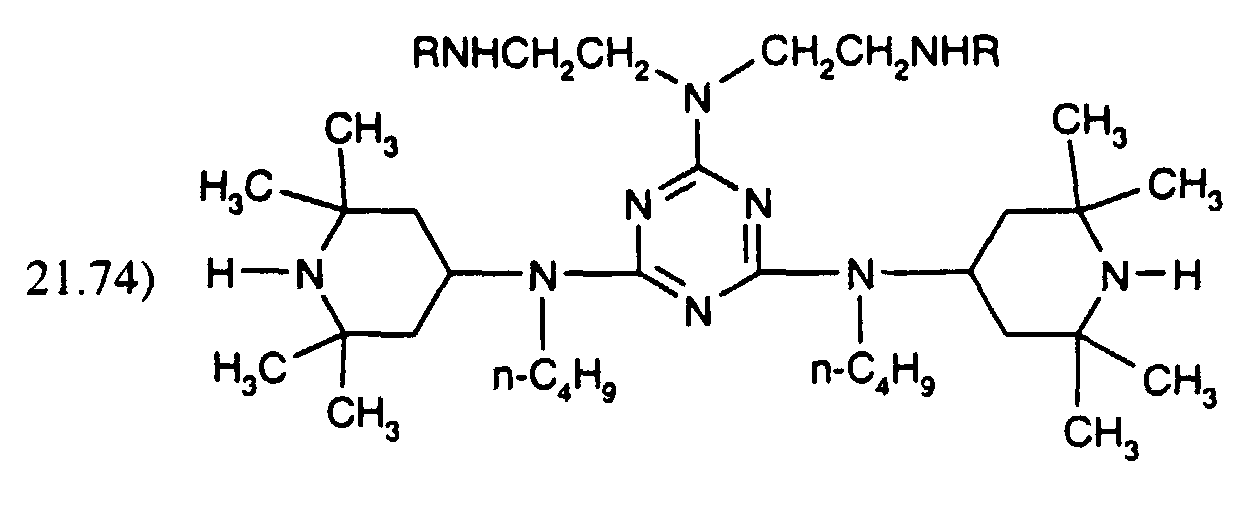
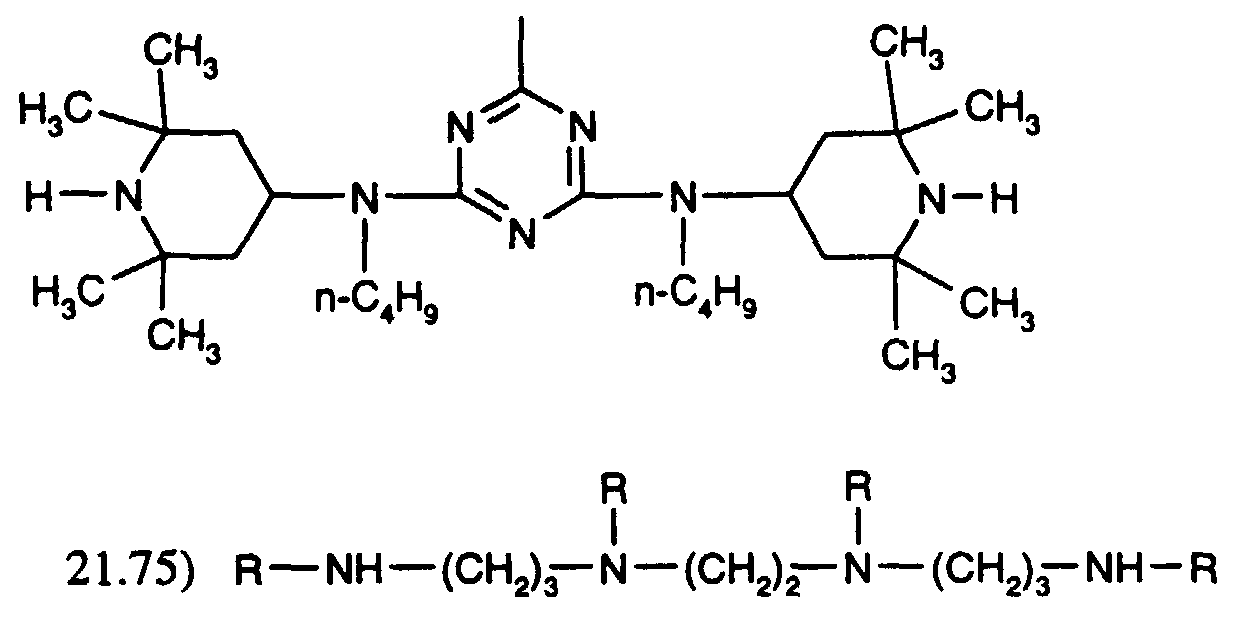
where R is
where R has the same meaning as in compound 21.74
where R' is
where R' has the same meaning as in compound (21.76)
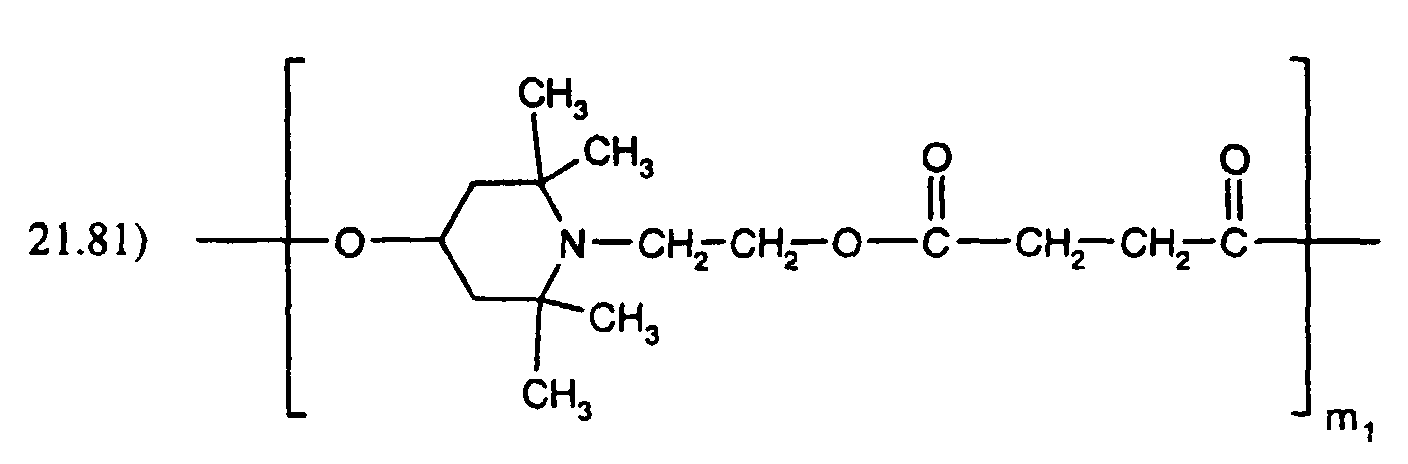
In the following compounds (21.81) to (21.83), (21.84-1), (21.84-2) and (21.85) to
(21.91), (21.91-1), (21.92-1), (21.92-2), (21.93) and (21.94), m
1 to m
14 is a number from 2 to
about 200, preferably 2 to 100, for example 2 to 50, 2 to 40 or 3 to 40 or 4 to 10.
In the compounds (21.81) and (21.82), the end group bonded to the -O- can be, for
example, hydrogen or a group -CO-(CH
2)
2-COO-Y or -CO-(CH
2)
4-COO-Y, respectively, with Y
being hydrogen or C
1-C
4alkyl and the end group bonded to the diacyl can be, for example, -O-Y
or a group
In the compound (21.83), the end group bonded to the amino residue can be, for example,
a group
and the end group bonded to the diacyl residue can be, for
example, Cl.
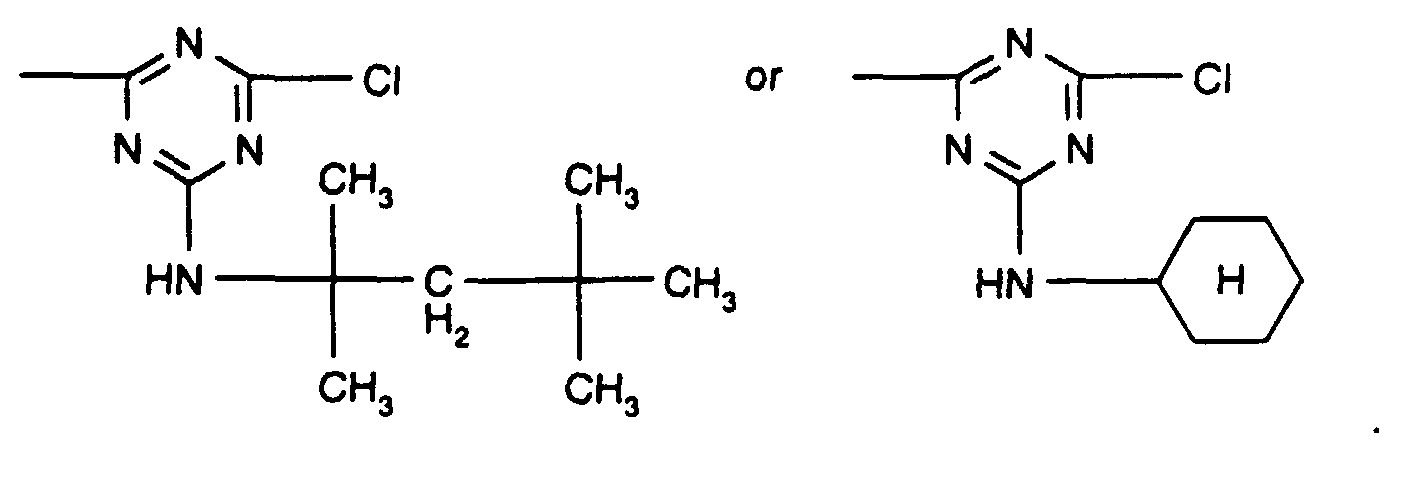
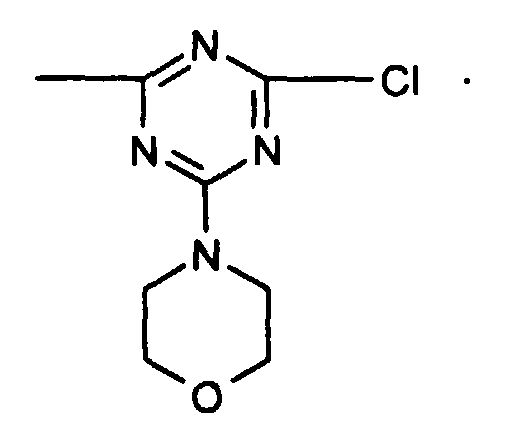
In the compounds (21.84-1) and (21.84-2), the end group bonded to the triazine residue
can be, for example, chlorine or a group
and the end group bonded to the diamino group can be, for example, hydrogen or a group
It may be convenient to replace the chlorine attached to the triazine by e.g. -OH or an
amino group. Suitable amino groups are typically: pyrrolidin-1-yl, morpholino, -NH
2,-N(C
1-C
8alkyl)
2
and -NY'(C
1-C
8alkyl) wherein Y' is hydrogen or a group of the formula
In the compound (21.85), the end group bonded to the 2,2,6,6-tetramethylpiperidin-4-ylamino
residue can be, for example, hydrogen and the end group bonded to the
2-hydroxypropylene residue can be, for example,
In the compound (21.86), the end group bonded to the -O- can be, for example, hydrogen or
and the end group bonded to the diacyl residue can be, for
example, -OCH
3 or Cl.
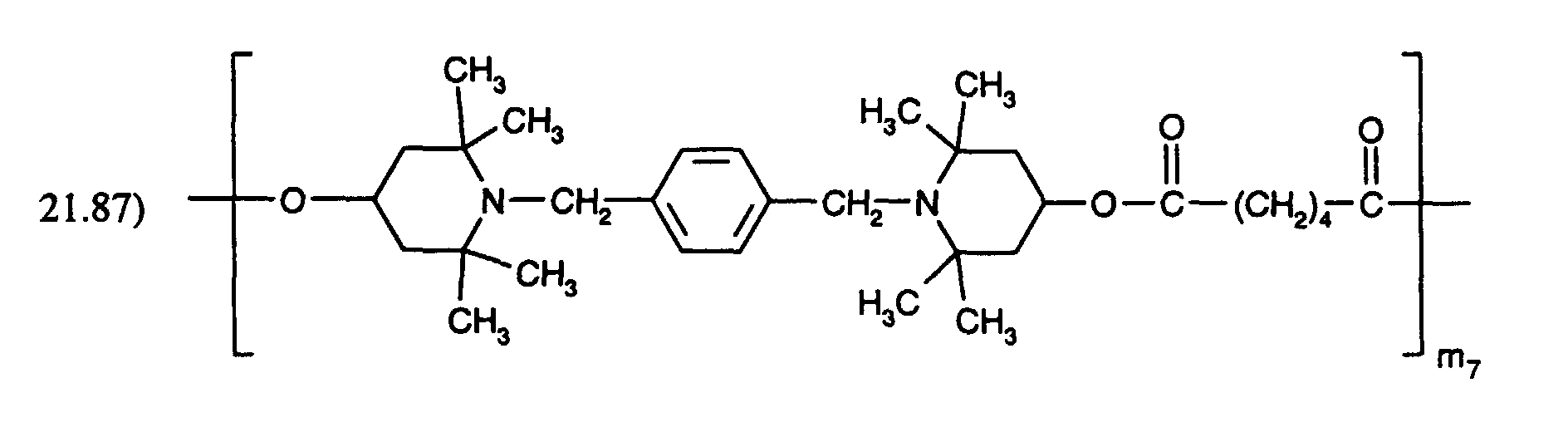
In the compound (21.87), the end group bonded to the -O- can be, for example, hydrogen
or
and the end group bonded to the diacyl radical can be, for
example, -OCH
3 or Cl.
In the compound (21.88), the end group bonded to the -O- can be, for example, hydrogen
or
and the end group bonded to the diacyl radical can be, for
example, -OCH
3 or Cl.
In the compound (21.89), the end group bonded to the -CH
2- can be, for example,
hydrogen and the end group bonded to the ester residue can be, for example,
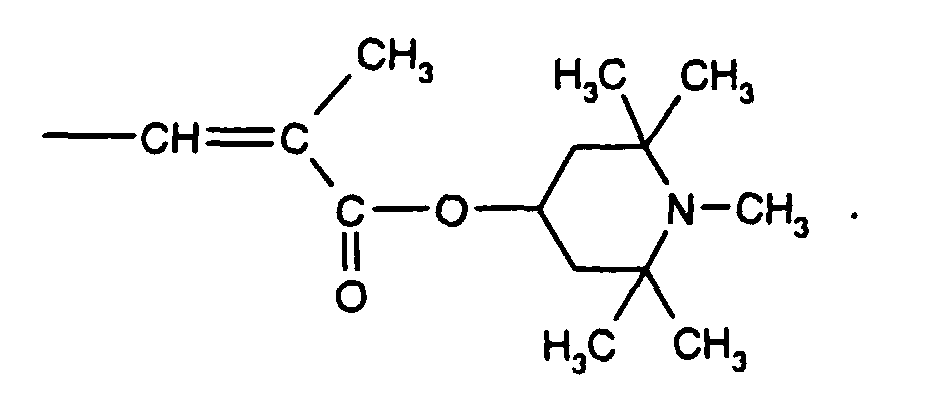
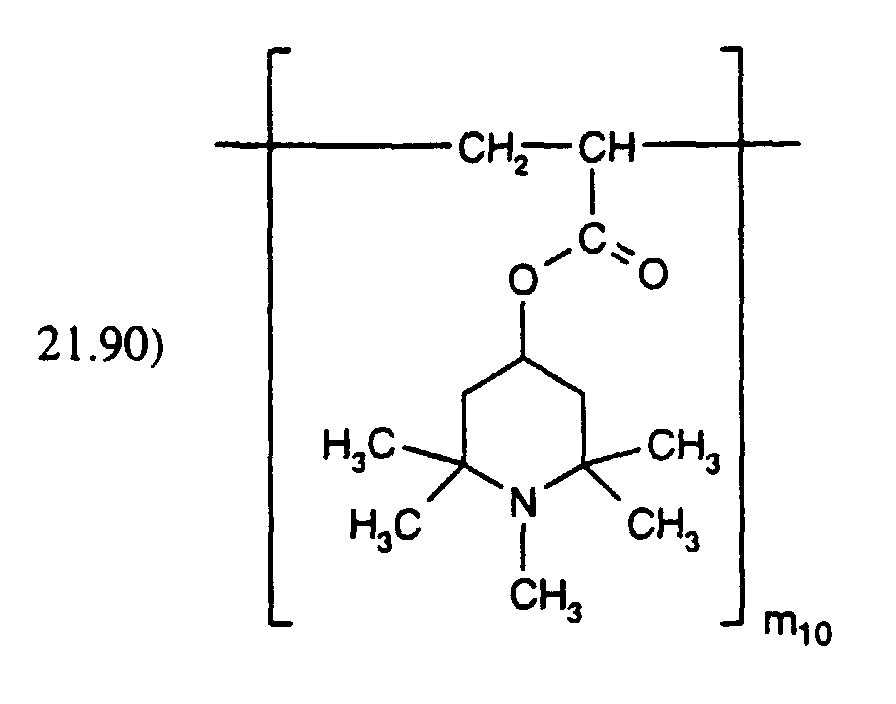
In the compound (21.90), the end group bonded to the -CH
2- can be, for example,
hydrogen and the end group bonded to the ester residue can be, for example,
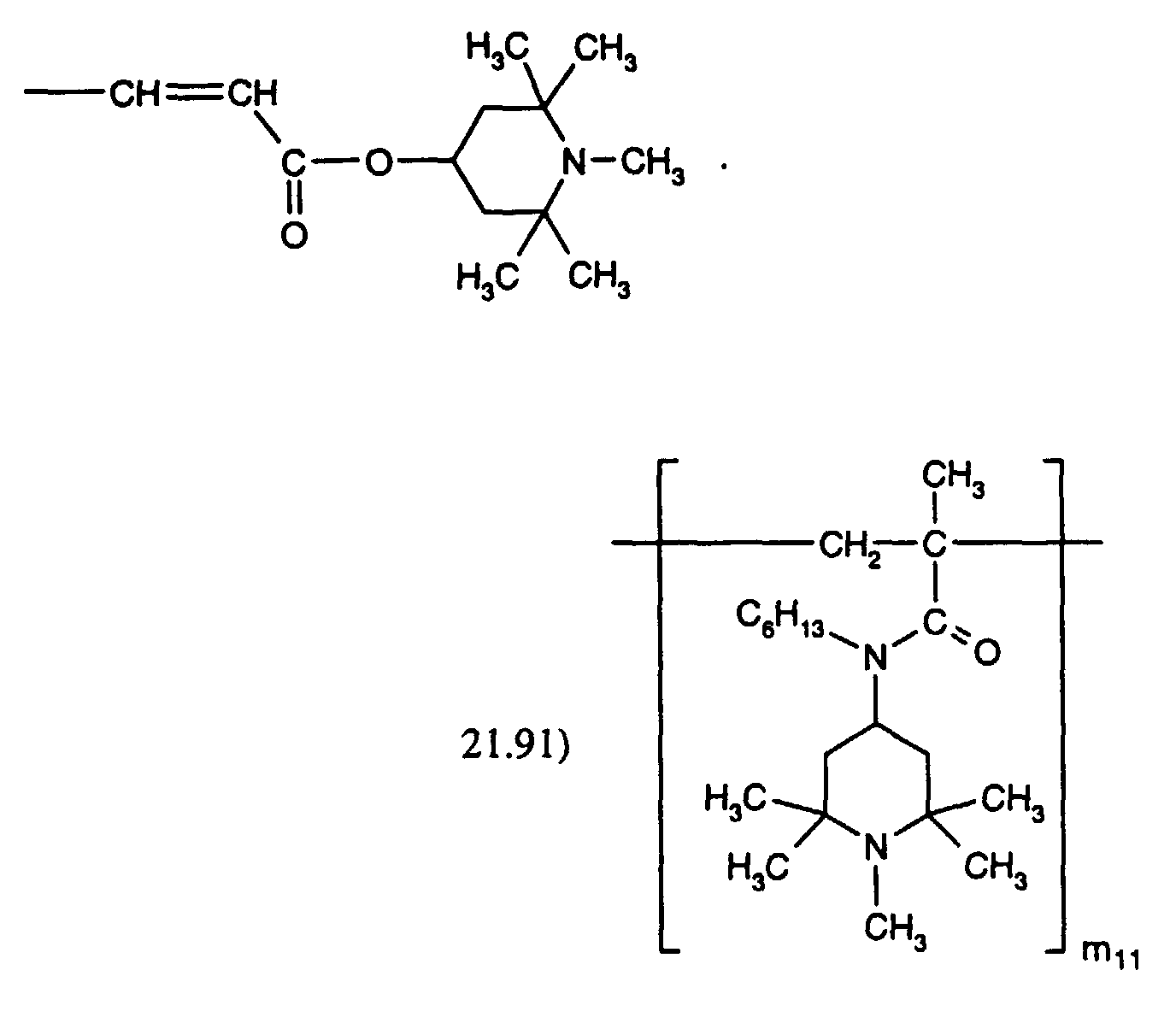
In the compound (21.91), the end group bonded to the -CH
2- can be, for example.
hydrogen and the end group bonded to the amide residue can be, for example,
wherein m
11* is as defined for m
11, the radicals R* independently of one another are ethyl
or 2,2,6,6-tetramethylpiperidin-4-yl, with the proviso that at least 50 % of the radicals R* are
2,2,6,6-tetramethylpiperidin-4-yl and the remaining radicals R* are ethyl. In the compound
(21.91-1), the terminal groups are for example hydrogen.
In the compounds (21.92-1) and (21.92-2), the end group bonded to the triazine residue
can be, for example, chlorine or a group
in the compound (21.92-1), and
a group
in the compound (21.92-2),
and the end group bonded to the diamino residue can be, for example, hydrogen or a group
It may be convenient to replace the chlorine attached to the triazine by e.g. -OH or an
amino group. Suitable amino groups are typically: pyrrolidin-1-yl, morpholino, -NH
2, -N(C
1-C
8alkyl)
2
and -NY'(C
1-C
8alkyl) wherein Y' is hydrogen or a group of the formula
In the compound (21.93), the end group bonded to the diamino residue can be, for
example, hydrogen and the end group bonded to the -CH
2CH
2- residue can be, for example,
In the compound (21.94), the end group bonded to the diamino residue can be, for
example, hydrogen and the end group bonded to the diacyl residue can be, for example, Cl.
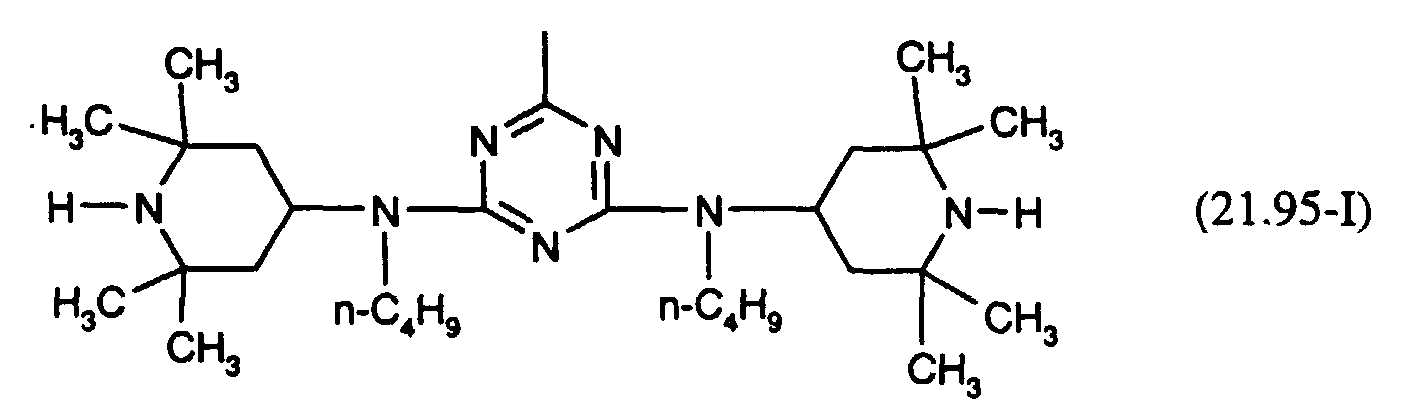
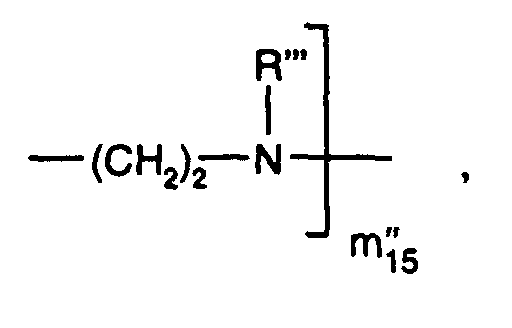
- in which R'' is a group of the formula
or the chain branching
- R''' is a group of the formula (95-I), and
- m'15 and m''15 are each a number from 0 to 200, preferably 0 to 100, in particular 0 to 50,
with the proviso that m'15 + m''15 is a number from 2 to 200, preferably 2 to 100, in particular 2
to 50. In the compound 95, the end group bonded to the diamino residue can be, for example,
hydrogen and the end group bonded to the -CH2CH2- group can be, for example, halogen, in
particular Cl or Br.
21.96) the compound of the formula (21.96-I) or (21.96-II)
wherein m16 and m16 * are a number from 2 to 50.
During the preparation, the compounds of the formulae (21.96-I) and (21.96-II) can be
obtained together as a mixture and therefore, can also be employed as such. The (21.96-I):(21.96-II)
ratio is, for example, from 20:1 to 1:20 or from 1:10 to 10:1.In the compounds of the formula (21.96-I), the terminal group bonded to the nitrogen can
be, for example, hydrogen and the terminal group bonded to the 2-hydroxypropylene radical can
be, for example, a
group.In the compounds of the formula (21.96-II), the terminal group bonded to the dimethylene
radical can be, for example, -OH, and the terminal group bonded to the oxygen can be, for
example, hydrogen. The terminal groups can also be polyether radicals.
wherein the variables m16** are independently of one another as defined for
m16.
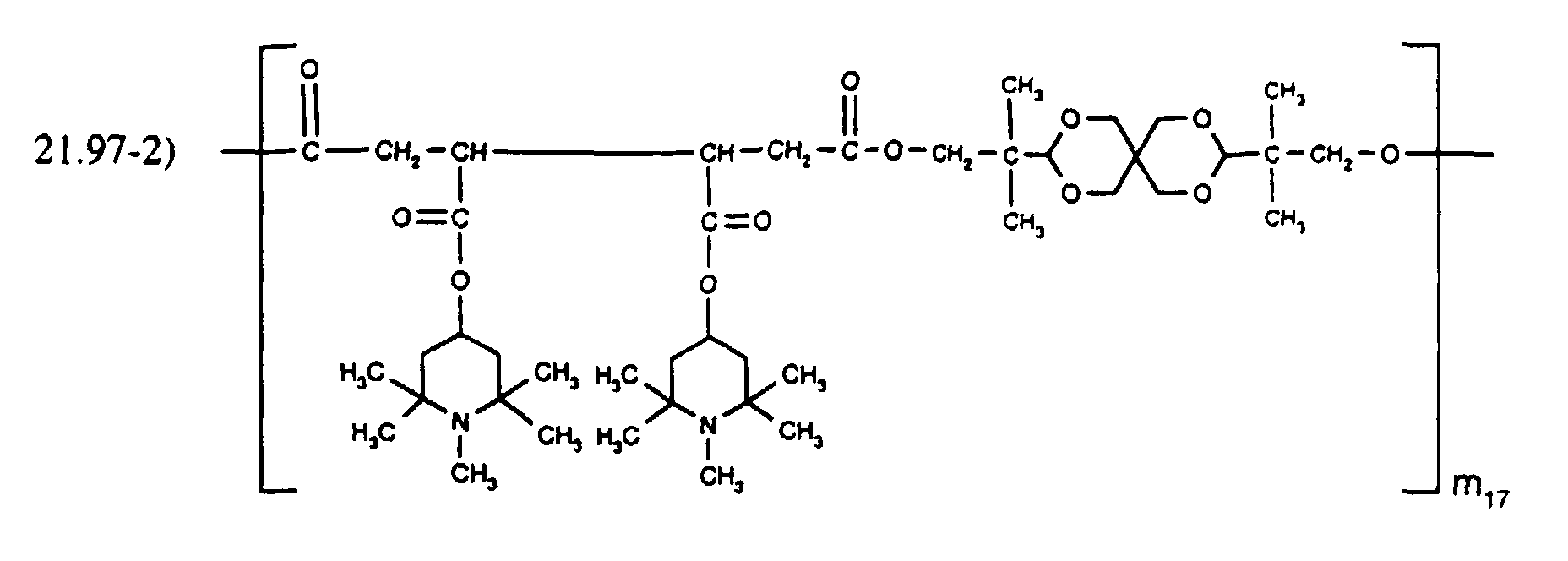
In the compounds (21.97-1) and (21.97-2) the mean value of m17 is 2.5 and the end group
bonded to the >C=O group can be, for example,
in the compound
(21.97-1) and
in the compound 97-2); and the end group bonded to
the oxygen can be, for example
in compound
(21.97-1) and
in compound 21.97-2).
wherein approximately one third of the
radicals RIV are -C2H5 and the others are a
group and m18 is a number in the
range from 2 to 200, preferably 2 to 100, in particular 2 to 50.In the compound (21.98), the end group bonded to the -CH2- residue can be, for example,
hydrogen and the end group bonded to the -CH(CO2RIV)- residue can be, for example,
-CH=CH-COORIV.
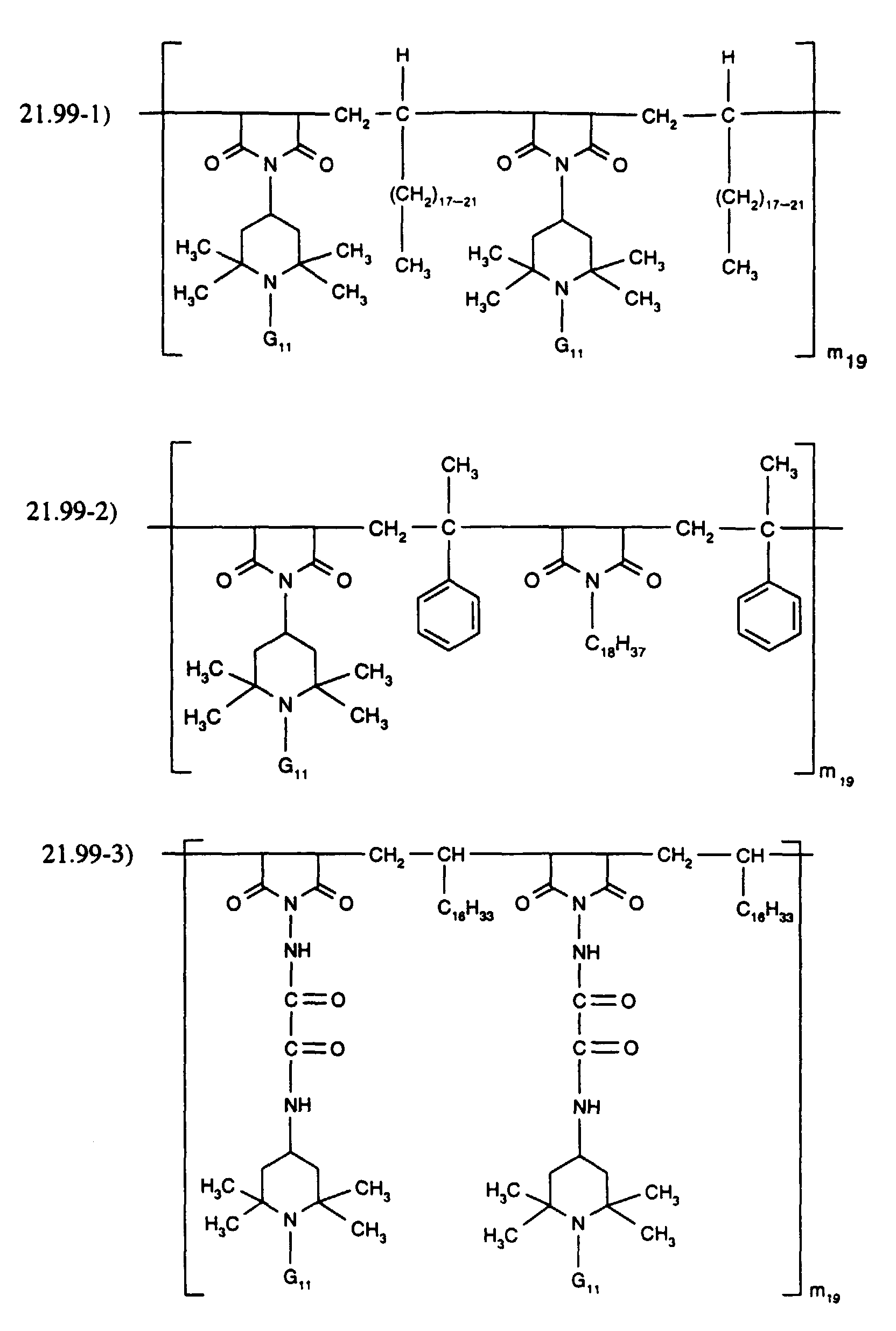
In the compounds (21.99-1), (21.99-2) and (21.99-3), G11 is hydrogen or methyl, and m19
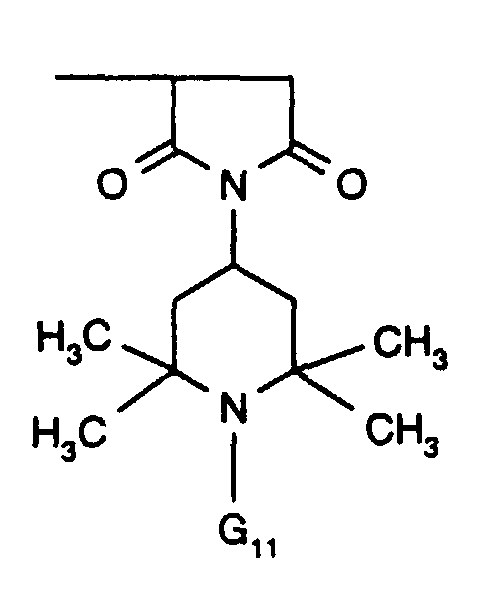
is a number from 1 to 25. In the compounds (21.99-1), (21.99-2) or (21.99-3), the end group bonded to the 2,5-dioxopyrrolidine
ring can be, for example, hydrogen, and the other end group can be, for
example,
a group of the formula
in the compounds (21.99-1) and (21.99-2), and
a group of the formula
in compound (21.99-3). 21.100) A product obtainable by reacting a product, obtained by reaction of a polyamine
of the formula (21.100a) with cyanuric chloride, with a compound of the formula (21.100b)
in which m'20, m''20 and m'''20, independently of one another, are a number from 2 to 12,
G36 is hydrogen, C1-C12alkyl, C5-C12cycloalkyl, phenyl or C7-C9phenylalkyl, and
G11 is hydrogen or methyl. The product with G11 being hydrogen has the Chemical Abstracts-CAS
No. 136 504-96-6.
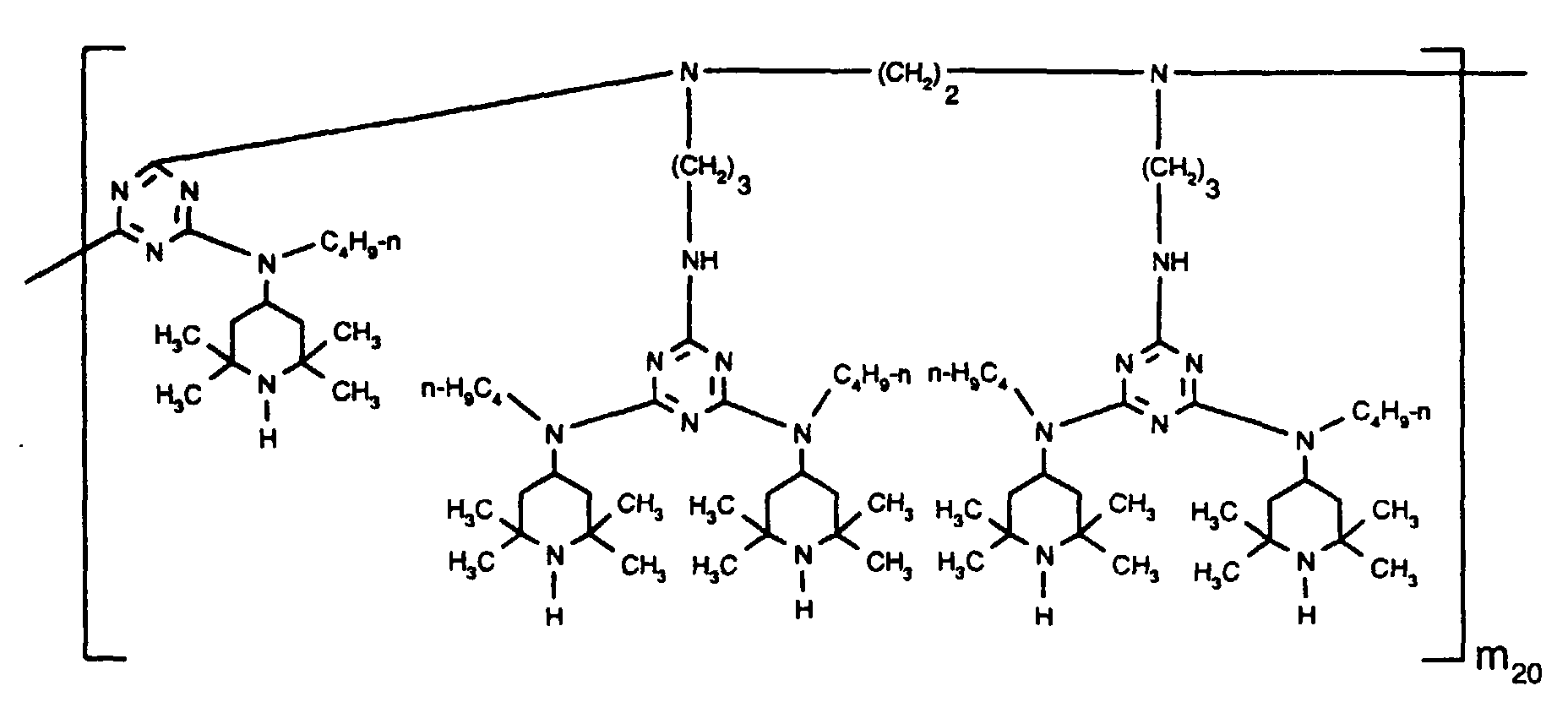
In general, the above reaction product can be represented for example by a compound of
the formula (21.100-1), (21.100-2) or (21.100-3). It can also be in the form of a mixture of these
three compounds.
A preferred meaning of the formula (21.100-1) is
A preferred meaning of the formula (21.100-2) is
A preferred meaning of the formula (21.100-3) is
In the above formulae (21.100-1) to (21.100-3), m20 is e.g. 1 to 20, preferably 2 to 20.
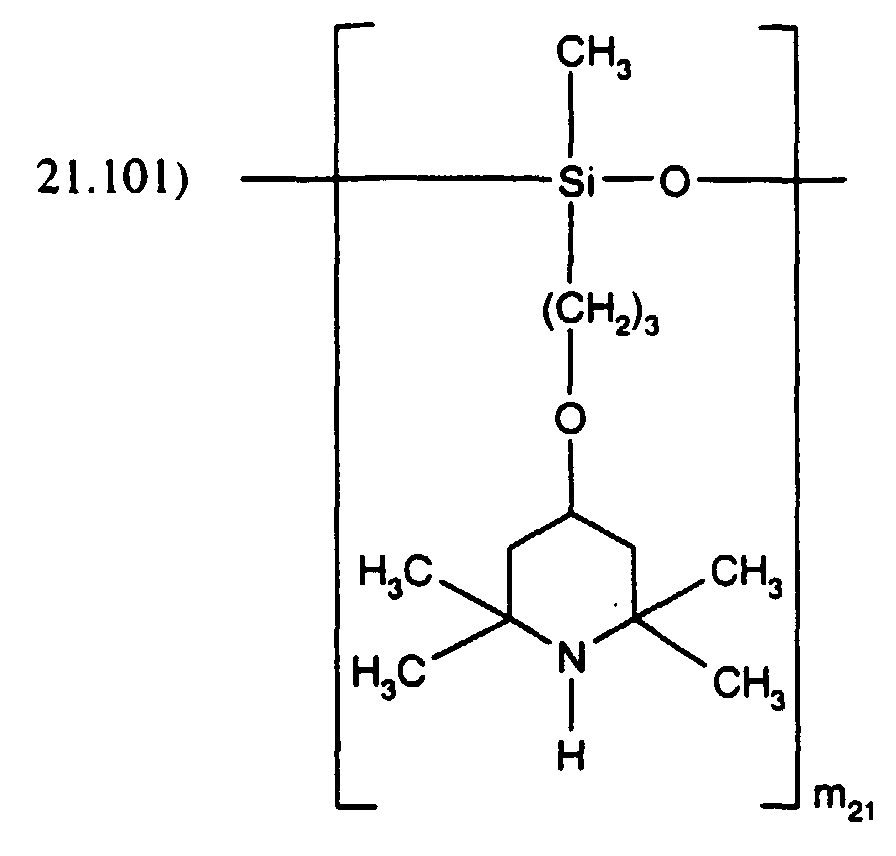
with m21 being a number from 1 to 20.In the compound (21.101), the terminal group bonded to the silicon atom can be, for
example, (CH3)3Si-O-, and the terminal group bonded to the oxygen can be, for example,-Si(CH3)3.The compounds (21.101) can also be in the form of cyclic compounds if m21 is a number
from 3 to 10, i.e. the free valences shown in the structural formula then form a direct bond.
The sterically hindered amine of section 21.) can also be one of the compounds described
in GB-A-2,301,106 as component I-a), I-b), I-c), I-d), I-e), I-f), I-g), I-h), I-i), I-j), I-k) or I-l), in
particular the light stabilizer 1-a-1, 1-a-2, 1-b-1, 1-c-1, 1-c-2, 1-d-1, 1-d-3, 1-e-1, 1-f-1, 1-g-1,
1-g-2 or 1-k-1 listed on pages 68 to 73 of said GB-A-2,301,106.The sterically hindered amine of section 21.) may also be one of the compounds
described in EP 782994, for example compounds as described in claims 10 or 38 or in Examples
1-12 or D-1 to D-5 therein.Blends of the high molecular weight hindered hydrocarbyloxyamine of formula (A) with
commercially available hindered amines are particularly useful as stabilizers for organic
materials, especially polyolefins. For example blends of a compound of formula (A) with each
of the following:
| TINUVIN® 770 | TINUVIN® 123 | TINUVIN® 765 |
| TINUVIN® 440 | TINUVIN® 144 | CHIMASSORB® 966 |
| DASTIB® 845 | DIACETAM® 5 | GOODRITE® UV 3034 |
| GOODRITE® UV 3150 | GOODRITE® UV 3159 | CYASORB® UV 3581 |
| CYASORB® UV 3604 | HOSTAVIN® N 20 | HOSTAVIN® N 24 |
| MARK® LA 52 | MARK® LA 57 | MARK® LA 62 |
| MARK® LA 67 | SUMISORB® TM 61 | UVINUL® 4049 |
| UVINUL® 4050 H | SANDUVOR® 3050 | SANDUVOR® PR-31 |
| UVASIL® 299 LM | UVASIL® 2000 LM | TINUVIN® 622 |
| CHIMASSORB® 944 | CHIMASSORB® 119 | CYASORB® UV 3346 |
| CYASORB® UV 3529 | DASTIB® 1082 | FERRO® AM 806 |
| LUCHEM® HA-B18 | HOSTAVIN® N 30 | MARK® LA 63 |
| MARK® LA 68 | UVINUL® 5050 H | UVASIL® 299 HM |
| UVASIL® 2000 HM | UVASORB® HA 88 | CHIMASSORB® 2020 |
| LICHTSCHUTZSTOFF® UV 31 |
Particularly preferred are the mixtures with TINUVIN® 770, CYASORB® UV 3581,
HOSTAVIN® N 20, MARK® LA 57, UVINUL® 4050 H, SANDUVOR® 3050, UVASIL® 299
LM, UVASIL® 2000 LM, TINUVIN® 622, CMIMASSORB® 944, CYASORB® UV 3346,
HOSTAVIN® N 30, UVASIL® 299 HM, UVASIL® 2000 HM, UVASORB® HA 88 and
CHIMASSORB® 2020. 22.) Sterically hindered amines substituted on the N-atom by a hydroxy-substituted alkoxy
group, for example compounds such as 1-(2-hydroxy-2-methylpropoxy)-4-octadecanoyloxy-2,2,6,6-tetramethylpiperidine,
1-(2-hydroxy-2-methylpropoxy)-4-hydroxy-2,2,6,6-tetranethyl-piperidine,
1-(2-hydroxy-2-methylpropoxy)-4-oxo-2,2,6,6-tetramethylpiperidine, bis(1-(2-hydroxy-2-methylpropoxy)-2,2,6,6-tetramethylpiperidin-4-yl)
sebacate, bis(1-(2-hydroxy-2-methylpropoxy)-2,2,6,6-tetramethylpiperidin-4-yl)
adipate, bis(1-(2-hydroxy-2-methylpropoxy)-2,2,6,6-tetramethylpiperidin-4-yl)
succinate, bis(1-(2-hydroxy-2-methylpropoxy)-2,2,6,6-tetramethylpiperidin-4-yl)
glutarate and 2,4-bis {N-[1-(2-hydroxy-2-methylpropoxy)-2,2,6,6-tetramethylpiperidin-4-yl]-N-butylamino}-6-(2-hydroxyethylamino)-s-triazine.
The weight ratio of the hindered hydrocarbyloxyamine of component (b) to the additional
hindered amine of sections 21.) or 22.) is preferably 20:1 to 1:20, for example 10:1 to 1:10, 5:1 to
1:5, 3:1 to 1:3 or 2:1 to 1:2, in particular 1:1.
Preferably, the organic material of component (a) is a natural, semi-synthetic or synthetic
polymer, especially a thermoplastic polymer.
Most preferably, the polymer is a polyolefin, for example a thermoplastic polyolefin useful
in automotive coatings and applications or a urethane based automotive coating.
The present compounds of component (b) exhibit superior hydrolytic stability, handling
and storage stability as well as good resistance to extractability when present in a stabilized
composition.
In general polymers which can be stabilized include:
The stabilizer(s) of component (b) and optional further stabilizers are preferably present
in the material to be stabilized in an amount of 0.01 to 10% by weight, relative to the material to
be stabilized. An amount of 0.01 to 5% by weight or 0.05 to 2% by weight, in particular 0.05 to
0.5% by weight is especially preferred.
The stabilizer(s) of component (b) and optional further stabilizers may be added to the
material to be stabilized of component (a), e.g. the polyolefin, individually or mixed with one
another. If desired, the individual components of a stabilizer mixture can be mixed with one
another in the melt (melt blending) before incorporation into the material to be stabilized.
The incorporation of component (b) and optional further additives into the material to be
stabilized is carried out by known methods such as dry mixing in the form of a powder, or wet
mixing in the form of solutions or suspensions. Component (b) and optional further additives
may be incorporated, for example, before or after molding or also by applying the dissolved or
dispersed stabilizer mixture to the material to be stabilized, with or without subsequent
evaporation of the solvent. The stabilizer(s) of component (b) and optional further additives can
also be added to the material to be stabilized in the form of a masterbatch which contains these
components in a concentration of, for example, about 2.5 % to about 25 % by weight; in such
operations, the polymer can be used in the form of powder, granules, solutions, suspensions or in
the form of latices.
Component (b) and optional further additives can also be added before, during or after
polymerization or crosslinking.
Component (b) and optional further additives can be incorporated into the material to be
stabilized in pure form or encapsulated in waxes, oils or polymers.
Component (b) and optional further additives can also be sprayed onto the material to be
stabilized. They are able to dilute other additives (for example the conventional additives
indicated above) or their melts so that they can be sprayed also together with these additives onto
the material to be stabilized. Addition by spraying during the deactivation of the polymerization
catalysts is particularly advantageous, it being possible to carry out spraying using, for example,
the steam used for deactivation.
In the case of spherically polymerized polyolefins it may, for example, be advantageous
to apply components (b) and optionally together with other additives, by spraying.
The compositions comprising a high molecular weight sterically hindered
hydrocarbyloxyamine of formula (A) are useful for many applications including the following:
| Thermoplastic olefins | Paintable thermoplastic olefins |
| Polypropylene molded articles | Polypropylene fiber |
| Polyethylene film | Polyethylene film for greenhouse |
| Polyethylene agricultural mulch film | Polypropylene fiber with brominated flame retardants |
| Molded polypropylene with brominated flame retardants |
| Molded thermoplastic olefin with brominated flame retardants |
| Polethylene film with brominated flame retardants |
| Thermoplastic elastomers with other costabilizers |
| Grease-filled wire and cable insulation |
| Gamma-irradiated polyolefins |
| Coatings over plastic substrates | Polycarbonate blends, e.g. PC/ABS, PC/PA |
| Polyolefin tanks or containers containing chemicals |
| Polyethylene gas pipes |
| Polypropylene non-woven fabric for agricultural applications, e.g. shade cloth | Polyolefin films with an antifog agent |
| | Polyolefin films with IR thermal fillers such as hydrotalcites, e.g. DHT4A |
| Polyolefin films with an antistatic agent |
| Polypropylene tape or slit film | Polypropylene non-woven fabrics |
| Polyethylene non-woven fabrics | Flame-resistant molded polypropylene articles |
| Flame-resistant polypropylene fiber |
| | Flame-resistant molded thermoplastic olefins |
| Flame-resistant polethylene film |
| Automotive coatings | Two-component polyester urethane coatings |
| Two-component acrylic urethane coatings |
| | Water-borne wood varnishes |
| Pigmented Automotive OEM coatings |
| | High solids acid catalyzed thermoset acrylic resin enamels |
| White polyester/melamine based oil-free alkyd coil coatings |
| | Tung oil phenolic varnishes |
| Aromatic urethane varnishes |
| | Acrylic alkyd refinish enamels |
| Medium oil alkyd enamels |
| | Electrocoat compositions |
| Abrasion resistant coating compositions |
| | Coatings over polycarbonate |
| Chromogenic photographic layers |
| | Glycidyl methacrylate-based powder clearcoats |
| Oil modified urethane alkyds for wood applications |
| | Pre-formed films for lamination to plastic substrates |
| Polyolefin articles in contact with chlorinated water, e.g. polyethylene or polypropylene pressure pipes, optionally containing acid scavengers and/or benzofuranones |
The materials containing the stabilizer mixtures described herein can be used for the
production of moldings, rotomolded articles, injection molded articles, blow molded articles,
films, tapes, mono-filaments, fibers, surface coatings and the like.
In the above compositions and application fields, the compound of formula (A) may be
fully or partially replaced by the compound mixture of formula (B):
where R is
and one of the 2 R' is R and the other is H.
The compound mixture of formula (B), CAS # 191680-81-6, is disclosed in U.S. Patent
No. 5,844,026.
Thus, formulations or applications using the compound of formula (B) instead of the
compound of formula (A) as component (b) are a further subject of the present disclosure.
Likewise, formulations or applications using a mixture of compounds of formulae (A)
and (B) instead of the compound of formula (A) as component (b) are also a further subject of
the present disclosure.
The stabilized compositions disclosed herein are further illustrated by the following
examples:
Example 1
Stabilization of Thermoplastic Olefins
Molded test specimens are prepared by injection molding thermoplastic olefin (TPO)
pellets containing pigments, a phosphite, a phenolic antioxidant or hydroxylamine, a metal
stearate, ultraviolet light absorbers or a hindered amine stabilizer or a mixture of UV absorber
and hindered amine stabilizer.
Pigmented TPO pellets are prepared from pure pigment or pigment concentrate,
coadditives and commercially available TPO by mixing the components in a Superior/MPM 1"
single screw extruder with a general all-purpose screw (24:1 L/D) at 400°F (200°C), cooled in a
water bath and pelletized. The resulting pellets are molded into 60 mil (0.006 inch), 2"x2"
plaques at about 375°F (190°C) on a BOY 30M Injection Molding Machine.
Pigmented TPO formulation composed of polypropylene blended with a rubber modifier
where the rubber modifier is an in-situ reacted copolymer or blended product containing
copolymers of propylene and ethylene with or without a ternary component such as ethylidene
norbornene are stabilized with a base stabilization system consisting of an N,N-dialkylhydroxylamine
or a hindered phenolic antioxidant with or without an organophosphorus compound.
All additive and pigment concentrations in the final formulation are expressed as weight
percent based on the resin.
Formulations contain thermoplastic olefin pellets and one or more of the following
components:
The components are dry-blended in a tumble dryer prior to extrusion and molding.
Test plaques are mounted in metal frames and exposed in an Atlas Ci65 Xenon Arc
Weather-Ometer at 70°C black panel temperature, 0.55 W/m2 at 340 nanometers and 50%
relative humidity with intermittent light/dark cycles and water spray (Society of Automotive
Engineers - SAE J 1960 Test Procedure). Specimens are tested at approximately 625 kilojoule
intervals by performing color measurements on an Applied Color Systems spectrophotometer by
reflectance mode according to ASTM D 2244-79. Data collected include delta E, L*, a* and b*
values. Gloss measurements are conducted on a BYK-Gardner Haze/Gloss Meter at 60°
according to ASTM D 523.
UV Exposure Testing
Test specimens exposed to UV radiation exhibit exceptional resistance to
photodegradation when stabilized with light stabilizer systems comprising a combination of 2-(2-hydroxy-3,5-di-tert-amylphenyl)-2H-benzotriazole
(TINUVIN®328, Ciba), a compound of
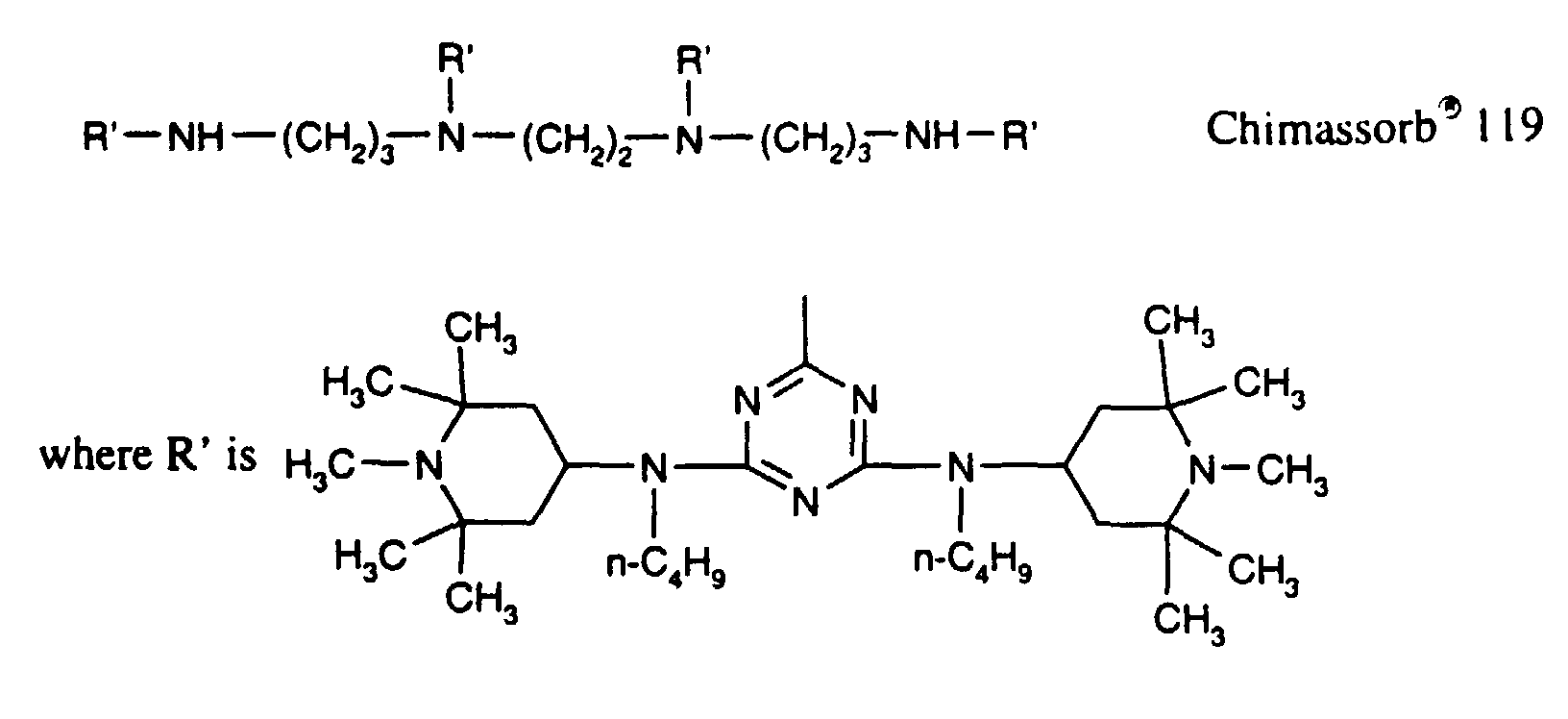
formula (A) or (B) and optionally an additional hindered amine such as N,N',N'',N'''-tetrakis[4,6-bis(butyl-(1,2,2,6,6-pentamethylpiperidin-4-yl)amino)-s-triazin-2-yl]-1,10-diamino-4,7-diazadecane (CHIMASSORB® 119, Ciba) or bis(2,2,6,6-tetramethylpiperidyl) sebacate
(Tinuvin® 770). The control sample consists of a stabilizer formulation commonly used in the
industry to impart UV stability. All of the samples contain a pigment, Pigment Red 177, and
talc.
The test plaques described earlier contain the following (all concentrations are weight
percent based on resin):
0.2% TINUVIN® 328; 0.1% calcium stearate; and 15% talc.
The Control plaques additionally contain
The five test plaques each contain 0.05% N,N,-dialkylhydroxylamine;
The test plaques NOR2-NOR5, containing the present hindered amines of formula (A) or
(B), show improved gloss retention compared to the plaques with the less effective control
system and the plaques containing the related hindered amine compound, TINUVIN® 123,
present in test plaques NOR1. Resistance to color change upon UV exposure is also enhanced.
Polymer blends containing an unsaturated ternary component, such as EPDM blends, are
especially benefited with the more efficient instant light stabilizer systems described above.
In all cases, the light stabilized formulations show much greater resistance to
photodegradation than unstabilized specimens which fail quickly under the UV exposure
conditions outlined above.
Example 2
Paintable TPO
Molded test specimens are prepared by injection molding thermoplastic olefin (TPO)
pellets containing the instant compounds, pigments and other coadditives as described in
Example 1.
The light stable formulations are painted with one-pack paint systems and tested for
TPO/paint interactions. Before painting, the test specimens are first washed in accordance with
GM998-4801 and dried for 15 minutes at 200°F (94°C). Adhesion promoter is applied to the dry
film thickness of 0.2-0.4 mils. The samples are dried for five minutes before a 1K basecoat is
applied to a film thickness of 1.2-1.4 mils. The painted panels are dried for three minutes, a
clearcoat is then applied to a dry film thickness of 1.2-1.5 mils followed by ten minutes flash
drying and a 30 minute oven bake at 250°F (121°C).
Paint adhesion is measured by Aggressive Adhesion Testing (proprietary test procedure
conducted at Technical Finishing, Inc.) and Taber Scuff. Painted panels which retain greater than
80% of the paint finish are considered acceptable. After Aggressive Adhesion Testing, samples
with less than 5% paint loss are deemed acceptable.
The control formulation contains 0.2% of bis(2,2,6,6-tetramethylpiperidin-4-yl) sebacate
(TINUVIN® 770), 0.2% CHIMASSORB® 944, 0.2% TINUVIN® 328, 500 ppm calcium stearate
and 750 ppm N,N-dialkylhydroxylamine in reactor-grade TPO.
Formulations A and B each contain 0.2% CHIMASSORB® 119,0.2% TINUVIN® 328,
500 ppm calcium stearate and 750 ppm N,N-dialkylhydroxylamine in reactor-grade TPO.
Formulations A and B also contain 0.2% of one of the compounds of formulae (A) and
(B) respectively.
Formulations C and D each contain 0.2% TINUVIN® 328, 500 ppm calcium stearate and
750 ppm N,N-dialkylhydroxylamine in reactor-grade TPO.
Formulations C and D also contain 0.4% of one of the compounds of formulae (A) and
(B) respectively.
Formulations A-D are superior to the control formulation as measured by the Taber Scuff
and Aggressive Adhesion Tests.
Example 3
Paintable TPO
Molded test specimens are prepared by injection molding thermoplastic olefin (TPO)
pellets containing the instant compounds, pigments and other coadditives as described in
Example 2.
The test specimens are painted with one-pack paint systems and tested for TPO/paint
interactions. Before painting, the test specimens are first wiped with iso-propanol and air blasted
to remove any dust. After a five minute flash, these specimens are coated with the adhesion
promoter, then the base coat, and then optionally a clear coat. Typical film thickness of these
various coatings are 0.1-0.3 mils for the adhesion promoter, 0.6-0.8 mils for the base coat, and
1.2-1.5 mils for the clear coat. After painting, the specimens are cured in an over at 120°C for 30
minutes.
Samples are tested to evaluate the TPO/paint interactions as follows: In the initial
adhesion test, a clear cellophane adhesive tape is used to pull on a 3 mm cross hatched paint
surface or; in the humidity test, the painted plaques are exposed for 240 hours at 38°C in an
atmosphere having 98% relative humidity. The blister rating is tested by visual observation
according to ASTM D 714.
The samples containing the present compounds of formulae (A) and (B) exhibit good
TPO/paint interaction properties as determined by the criteria above.
Example 4
Coatings over Plastic Substrates
A major application for hindered amines is in the protection of automotive topcoats
applied over plastic substrates. However, many low molecular weight, non-reactable light
stabilizers migrate into the plastic substrate during drying and cure. As a consequence, a
significant portion of the light stabilizer may be lost from the topcoat into the substrate and hence
be ineffective in protecting said topcoat.
The extent of migration of hindered amine stabilizers during application and cure of the
coating is determined by comparing the concentration of hindered amine in the cured clearcoat
applied over a plastic substrate versus the same clearcoat applied over a non-permeable substrate
such as glass or steel.
Hindered amine stabilizers under test are incorporated into a flexible thermoset
acrylic/melamine clear coating appropriate for use on automotive plastic substrates. The
hindered amine is incorporated at a level of 1.5% by weight based on total resins solids.
Each coating formulation is applied by an automatic spray apparatus onto automotive
grade RIM (Reacting Injection Molded) substrate and TPO (thermoplastic polyolefin). Both
substrates are in the form of 4" x 12" plaques. Each coating is applied to achieve a dry film
thickness of approximately 2.0 mils (50 microns). The coatings are cured by baking at 250°F
(121°C) for 20 minutes.
Triplicate samples of each cured coating formulation are removed from each substrate
and cryo-ground to a fine powder. A known amount of each sample is extracted in refluxing
toluene overnight. The hindered amine present is analyzed quantitatively by dilution to a known
volume and analyzed by HPLC or SFC chromatography. Calibration curves for each test
stabilizer compound are developed. The hindered amine content of each extracted coating is
determined by this method.
When the hindered amine is a high molecular weight hindered hydrocarbyloxyamine
selected from the present formulae (A) and (B), a higher percent recovery of the hindered amine
compound from the clearcoat over a plastic substrate is found indicating that much less of the
present hindered amines of component (b) migrate into the plastic substrate; thereby allowing for
better stabilization of the clear topcoat over such plastic substrates.
Example 5
Stabilization of Polypropylene Molded Articles
Molded test specimens are prepared by injection molding polypropylene pellets
containing pigments, a phosphite, a phenolic antioxidant or hydroxylamine, a metal stearate,
ultraviolet light absorbers or hindered amine stabilizers or a mixture of UV absorbers and
hindered amine stabilizers.
Pigmented polypropylene pellets are prepared from pure pigment or pigment
concentrates, stabilizers, co-additives and commercially available polypropylene by mixing the
components in a Superior/MPM 1" single screw extruder with a general all-purpose screw (24:1
L/D) at 475°F (250°C), cooled in a water bath and pelletized. The resulting pellets are molded
into 60 mil (0.06 inch thick) 2"x2" plaques at about 475°F (250°C) on a BOY 30M Injection
Molding Machine.
Pigmented polypropylene formulations composed of polypropylene homopolymer or
polypropylene copolymer are stabilized with a base stabilization system consisting of an N,N-dialkylhydroxylamine
or a hindered phenolic antioxidant with or without an organophosphorus
compound.
All additive and pigment concentrations in the final formulations are expressed as weight
percent based on the resin.
Formulations contained polypropylene pellets and one or more of the following
components;
The components are dry blended in a tumble dryer prior to extrusion and molding.
Test plaques are mounted in metal frames and exposed in an Atlas Ci65 Xenon Arc
Weather-Ometer at 70°C black panel temperature, 0.55 W/m2 at 340 nanometers and 50%
relative humidity with intermittent light/dark cycles and water spray (Society of Automotive
Engineers - SAE J 1960 Test Procedure). Specimens are tested at approximately 625 kilojoule
intervals by performing color measurements on an Applied Color Systems spectrophotometer by
reflectance mode according to ASTM D 2244-79. Data collected included delta E, L*, a* and b*
values. Gloss measurements are conducted on a BYK-GARDNER Haze/Gloss Meter at 60°
according to ASTM D523.
UV Exposure Testing
Test specimens exposed to UV radiation exhibit exceptional resistance to photodegradation
when stabilized with light stabilizer systems comprised of a combination of Tinuvin® 328, a
hindered amine stabilizer from sections 21.) or 22.) above and a compound of formula (A) or (B).
Test specimens also exhibit exceptional resistance to photodegradation when no additional
hindered amine or UV absorber is present and the only light stabilizer is a compound of formula
(A) or (B) or a combination thereof. The control sample consists of a stabilizer formulation
commonly used in the industry to impart UV stability, a mixture of Tinuvin® 328 and a hindered
amine stabilizer. All of the samples contain Pigment Red 177.
Each test sample contains a compound of formula (A) or (B), and optionally a further
hindered amine stabilizer from sections 21.) or 22.) above, for example 1-(2-Hydroxy-2-methylpropoxy)-4-octadecanoyloxy-2,2,6,6-tetramethylpiperidine,
bis-(1-octyloxy-2,2,6,6-tetramethylpiperidin-4-yl)
sebacate (Tinuvin® 123) and bis-(1-cyclohexyloxy-2,2,6,6-tetramethylpiperidin-4-yl)
succinate.
All formulations are base stabilized with 0.05% dialklyhydroxylamine in the final resin
formulation.
Polymer substrate is a commercially available polypropylene homopolymer - Profax 6501
(commercial supplier Montell Polyolefins).
Color package is 0.25% Red 3B - Pigment Red 177, C.I. # 65300 in the final resin
formulation.
Test formulations optionally contain a hydroxyphenyl benzotriazole UV absorber, for
example Tinuvin® 328, 2-(2-hydroxy-3,5-di-tert-amylphenyl)-2H-benzotriazole.
Each formulation contains 0.1% calcium stearate.
Samples are 60 mil thick 2" x 2" injection molded plaques.
UV exposures conducted under SAE J 1960 - Exterior Automotive conditions.
All additive and pigment concentrations in the final formulations are expressed as weight
percent on the resin.
The formulations containing a hindered hydrocarbyloxyamine of formula (A) or (B)
exhibit improved gloss retention and resistance to color change when compared to the control
formulation.
In all cases, the light stabilized formulations show much greater resistance to
photodegradation than unstabilized specimens which fail quickly under the UV exposure
conditions outlined above.
Example 6
Polypropylene Fiber
Fiber samples are prepared by extruding fiber-grade polypropylene with a present
hindered amine of formula (A) or (B), coadditives and pigments. Typical formulations contain
the hindered amines at levels from 0.05 to 2.0%, a metal stearate such as calcium stearate at 0.05
to 0.5%, pigments from 0 to 5%, UV absorbers at levels of 0.05 to 2.0%, phosphites at 0 to 0.1%,
phenolic antioxidants at 0 to 1.25%, N,N-dialkylhydroxylamines at 0 to 0.1 % and optionally
other hindered amines at levels of 0 to 2.0%. All additive and pigment concentrations in the final
formulations are given as weight percent based on the resin.
Pigment concentrates are prepared from pure pigment and polypropylene (PROFAX®,
Montell) by mixing the two components in a high shear mixer in a ratio of 25 % pigment and
75 % resin, pressing the resulting resin/pigment mixture on a Wabash Compression molder
(Model # 30-1515-4T3) into a tin sheet and dividing the sheet into fine chips for dispersion in
polypropylene at reduced concentrations. Alternatively, pigment concentrates are obtained as
pigment dispersions in a suitable carrier resin for subsequent blending in fiber at reduced
concentrations.
Formulations containing polypropylene, 0.05-0.1% phosphite, 0-1.25% phenolic
antioxidant, 0-0.1% dialkylhydroxylamine, 0.05-0.1% calcium stearate, 0-1.25% UV absorber,
0-1.25% hindered amine are dry blended in a tumble dryer, extruded on a Superior/MPM 1"
single screw extruder with a general all-purpose screw (24:1 L/D) at 475°F (246°C), cooled in a
water bath and pelletized. The resulting pellets are spun into fiber at about 475°F (246°C) on a
HILLS Research Fiber Extruder (Model # REM-3P-24) fitted with a 41 hole, delta configuration
spinneret. The spun tow is stretched at a draw ratio of 3.2:1 producing a final denier of 615/41.
Fiber samples are knitted into socks on a Lawson-Hemphill Fiber Analysis Knitter, cut
into appropriate lengths and exposed in an Atlas Ci65 Xenon Arc Weather-Ometer at 89°C black
panel temperature, 0.55 W/m2 at 340 nanometers and 50% relative humidity (Society of
Automotive Engineers - SAE J 1885 Test Procedure).
Fiber samples are tested by performing color measurements on an Applied Color Systems
spectrophotometer by reflectance mode according to ASTM D 2244-79. Identical, but separate,
fiber samples are examined for catastrophic failure and the time to failure is recorded.
The samples containing a present compound of formula (A) or (B) exhibit good
stabilization performance against the deleterious effects of UV light.
Example 7
Polypropylene Fiber
Other socks of propylene fiber as prepared in Example 6 are exposed in a Blue M forced
draft oven at 120°C. Failure is determined by the criterion set forth in Example 6. The longer it
takes for the catastrophic failure to occur, the more effective is the stabilizing system.
The socks containing a present compound of formula (A) or (B) exhibit good thermal
stabilization efficacy.
Example 8
UV Stabilization and Water Carry Over Effects in
Polypropylene Tapes
1 to 5 g of a hindered hydrocarbyloxyamine of formula (A) or (B), 1 g of tris(2,4-di-ter-butylphenyl)
phosphite, 0.5 g of pentaerythritol tetrakis (3-(3,5-di-tert-butyl-4-hydroxyphenyl)propionate)
and 1 g of calcium stearate are mixed in a turbomixer with 1000 g of
polypropylene powder having a melt index of 2.1 (measured at 230 °C and 2.16 Kg). The final
concentration of hindered amine is 0.1% to 0.5% in the PP.
The mixture is extruded at 200-220°C to give polymer granules which are subsequently
converted to stretched tapes of 50 microns thickness and 2.5 mm width, using a semi industrial
type of apparatus (Leonard-Sumirago(VA)-Italy) and working under the following conditions:
- Extruder temperature
- : 210 - 230 °C
- Head temperature
- : 240 - 260 °C
- Stretch ratio
- : 1 : 6
The tapes thus prepared are mounted on a white card and expose in Weather-Ometer 65
WR (ASTM D 2565-85) with a black panel temperature of 63°C.
The residual tensile strength is measured, by means of a constant velocity tensometer, on
a sample taken after various light exposure times; from this, the exposure time (in hours)
required to halve the initial tensile strength (T50) is measured.
The tapes containing a present hindered amine of formula (A) or (B) exhibit excellent UV
light stability.
Water carry-over is expressed as the rate at which a film or stretched tape can be extruded
before water from the water cooling bath is carried along with the film. The higher the water
carry-over value, the faster and more economically a film or stretched cape can be processed. It is
well known in the art that additives can have an effect on water carry-over. Films containing a
present hindered amine of formula (A) or (B) exhibit high production rates.
Example 9
Polyethylene Film
Film grade polyethylene is dry blended with approximately 10% by weight of a test
additive of formula (A) or (B), and then melt compounded at 200°C into "Masterbatch" pellets.
The fully formulated "Masterbatch" pellets are dry blended with polyethylene resin to get the
desired final stabilizer concentrations. Typical formulations contain a present compound of
formula (A) or (B) at levels from 0.05% to 2.0%, a metal stearate such as calcium stearate at
0.05% to 0.5%, a phosphite at 0% to 0.1%, a phenolic antioxidant at 0% to 1.25%, an N,N-dialkylhydroxylamine
at 0% to 0.1% and optionally a hindered amine at 0% to 2.0%. The
stabilized fully formulated resin is then blown at 200°C into a 150 micron thick film on a DOLCI
film line.
The blown films are exposed in an Atlas Xenon-Arc Weather-Ometer according to
ASTM G26 at 63°C bpt, 0.35 W/m2 at 340 nm with no spray cycle. Films are tested periodically
for any change in elongation using an Instron 112 tensile tester. Failure in this test is determined
by observation of the loss of % elongation in the film. The longer it takes for this loss to occur,
the more effective is the stabilizer system.
The films containing a present compound of formula (A) or (B) exhibit good light
stabilizing efficacy as shown in the following table.
| Compound | Time to 50% Residual Elongation |
| Compound (A) | 7100 hr. |
| Compound (B) | 6500 hr. |
| Chimassorb® 119 | 6200 hr. |
Film grade polyethylene is dry blended with 10% loading of a test additive of formula (A)
or (B), as described in Example 9, and then melt compounded at 200°C into fully formulated
master batch pellets. The master batch pellets are dry blended with the polyethylene resin to get
the final stabilizer concentration. The fully formulated resin is then blown at 200°C into a 150
micron thick film using a DOLCI film line.
The resulting films are exposed on a greenhouse on galvanized iron backing. Treatment
includes applications of pesticides on a regular basis (i.e. sodium N-methyldithiocarbamate,
VAPAM® every six months and SESMETRIN® every month). Performance is measured by
monitoring the percent residual elongation. Failure is defined as the time to a 50% loss of
original elongation.
The films containing a present compound of formula (A) or (B) show good resistance to
pesticides.
The films may further contain commercially available antifog agents such as Atmer® 103,
a sorbitan ester, or Atmer® 502, an ethoxylated ether. Such films exhibit good UV light stability
and good antifog resistance.
The films may further contain antistatic agents such as glycerol monostearate (GMS) or
ethoxylated fatty amines. Such films exhibit good UV light stability and good antistatic
properties.
The films may further contain IR thermal fillers such as hydrotalcites, e.g. DHT4A.
Example 11
Polyethylene Mulch Film
Master batch pellets prepared as described in Example 9 are dry blended into
polyethylene resin to get the final stabilizer concentration. The fully formulated resin is then
blown at 200°C into a 25 micron thick film using a DOLCI film line.
The resulting films are exposed on a soil to simulate agricultural mulch film conditions.
Treatment includes exposure to methyl bromide fumigant for three days at 60 g/m3. Performance
is measured by monitoring the time to physical embrittlement.
The films containing a present compound of formula (A) or (B) show good resistance to
fumigants.
Example 12
Polyethylene Film for Greenhouse
Greenhouse film samples are prepared as described in Example 10, and in addition to a
present compound of formula (A) or (B), also contain a metal stearate and a metal oxide. Typical
formulations contain from 0.05 to 2% by weight of a hindered hydrocarbyloxyamine of formula
(A) or (B), 0.05 to 0.5% of a metal stearate such as calcium stearate, and 0.05 to 0.5% of a metal
oxide such as zinc oxide, magnesium oxide or calcium oxide.
Effectiveness is monitored as described in Example 10. The films containing a present
compound of formula (A) or (B) exhibit good light stability.
Example 13
Thermoplastic Elastomers
Resin materials of the general class known as thermoplastic elastomers, examples of
which include, copolymers of styrene with butadiene or isoprene and/or ethylene-cobutylene such
as SBS, SEBS and SIS, are dry blended with a present compound of formula (A) or (B) and melt
compounded into pellets. Typical formulations contain the instant compounds at levels from
0.05% to 2.0%, a metal stearate such as calcium stearate at 0.05% to 0.5%, pigments from 0% to
5%, UV absorbers at levels of 0.05% to 2.0%, phosphites at 0.0% - 0.1%, phenolic antioxidants
at 0.0% - 1.25%, N,N-dialkylhydroxylamine at 0.0% - 0.1%, and optionally other hindered
amine stabilizers at levels of 0.0% to 2.0%.
The pelletized fully formulated resin is then processed into a useful article such as blown
or cast extrusion into film; injection molded into a molded article; thermoformed into molded
articles; extruded into wire and cable housing; or rotational molded into hollow articles.
The materials containing a present compound of formula (A) or (B) exhibit stability
against deleterious effects of UV light and thermal exposure.
Example 14
Polyolefin Articles in Contact with Pool Chemicals (Chlorine)
Film grade polyethylene is dry blended with 10% loading of a test additive of formula (A)
or (B), as described in Example 9, and then melt compounded at 200°C into fully formulated
master batch pellets. The master batch pellets are dry blended with the polyethylene resin to get
the final stabilizer concentration. The fully formulated resin is then blown at 200°C into a 150
micron thick film using a DOLCI film line.
The resulting films are exposed for 4 hours to 20 liters of a aqueous solution containing
22.5ppm Chlorine. The chlorine was made available via Leslies Fast Dissolving Super Shock -
Super Chlorinator (Shock and Algae control) from OLIN Pool Products, Norwalk CT. This Super
Shock is 78% Calcium Hypochlorite was used accordingly to make the 22.5ppm Cl available.
After the 4 hours of the chlorine exposure the samples were rinsed in Distilled water 3 times, and
air dried to prepare them for accelerated weathering. A duplicate sample was exposed to distilled
water without the Chlorine. All the dipped samples are exposed for 250 hour intervals in a
Weather-O-meter 65 WR (ASTM D 2565-85 -dry) with a black panel temperature of 63°C.
After each 250 hour interval of accelerated weathering, the samples were again exposed to the
aqueous exposure as above. Failure is defined as the time to a 50% loss of original elongation.
This test is designed to simulate exposure to pool chemicals as would be experienced by pool
covers.
The films containing a present compound of formula (A) or (B) show good resistance to
pool chemicals containing chlorine.
Other polyolefin articles, such as pool hoses, exposed to pool chemicals containing a
present compound of formula (A) or (B) show good resistance to pool chemicals containing
chlorine.
Example 15
Stabilization of Polyolefins in Grease Filled Cable Construction
100 parts high density polyethylene are dry blended with 0.4 parts of Irganox® MD 1024
(1,2-bis(3,5-di-tert-butyl-4-hydroxyhydrocinnamoyl)hydrazine) and 0.2 parts of one of the
hindered amine derivatives listed in Table 1 below. The mixtures are melt compounded into
pellets at 230° C in a Superior/MPM extruder using a 24:1 L/D screw with Maddock mixing
head at 60 rpm.
The pelletized polyethylene containing the stabilizer mixtures are compression molded at
400° F into 10 mil (0.01 inch) thick films with Mylar backing. "Initial oxidation induction time"
(OIT) is measured on these test films.
The sample films are then submersed in Witcogel®, available from Witco, a typical
hydrocarbon cable filler grease used in telecom cables. The Witco filling compound contains
0.6 % Irganox® 1035, thiodiethylene bis[3-(3,5-di-tert-butyl-4-hydroxyphenyl)propionate]. The
sample films submersed in the filling compound are exposed in an air oven at 70° C for 14 days.
The samples are then wiped clean of the cable filler grease. "Aged oxidation induction time" is
measured on these samples.
OIT testing is accomplished using a differential scanning calorimeter as per ASTM
standard test method D3895. The test conditions are: Uncrimped aluminum pan; no screen;
heat up to 200° C under nitrogen, followed by a switch to a 100 milliliter/minute flow of oxygen.
Oxidation induction time (OIT) is the time interval between the start of oxygen flow and the
exothermic decomposition of the test specimen. OIT is reported in minutes; under the
conditions of this test the longer the OIT the more effective the stabilizer mixture is at delaying
the onset of oxidative degradation. Relative performance of stabilizer mixtures in grease filled
cable applications can be predicted by comparing the initial OIT values, the aged OIT values and
the differences between the initial OIT and aged OIT values.
| Hindered Amine | Initial OIT (minutes) | Aged OIT (minutes) |
| Tinuvin® 622 | 136 | 75 |
| Hindered Amine of formula (B) | 208 | 136 |
The stabilizer mixture of the N-alkoxy hindered amine of formula (B) with the metal
deactivator Irganox® MD 1024 (1,2-bis(3,5-di-tert-butyl-4-hydroxyhydrocinnamoyl)hydrazine)
outperforms the state of the art stabilizer mixture of Tinuvin® 622/Irganox® MD 1024 in initial
and aged OIT. Tinuvin® and Irganox® are trademarks of Ciba Specialty Chemicals Corporation.
When a hindered amine of formula (A) is substituted for the compound of formula (B) in
the above test, the stabilizer mixture of a compound of formula (A) with Irganox® MD 1024
outperforms the state of the art stabilizer mixture of Tinuvin® 622/Irganox® MD 1024.
Example 16
Retention of Physical Properties and Color Control of Gamma Irradiated Polypropylene
Unipol®, Union Carbide Corporation, gas phase polypropylene random copolymer with
an initial melt flow rate of ca. 2 dg/min is via addition of a dialkylperoxide. controlled rheology
modified to have a target melt flow rate of ca. 25 dg/min, an appropriate melt flow rate for
injection molding. A clarifier is added at ca. 2200 ppm to enhance the transparency of the
molded articles.
The formulations contain either a binary stabilizer system of a hindered
hydrocarbyloxyamine of formula (A) or (B)and an organophosphorus compound, a binary
system of a hindered hydrocarbyloxyamine of formula (A) or (B) and one or more compounds
selected from the group of hydroxylamine stabilizers, benzofuranone stabilizers and amine oxide
stabilizers, or a ternary system of a hindered hydrocarbyloxyamine of formula (A) or (B),one or
more compounds selected from the group of hydroxylamine stabilizers, benzofuranone stabilizers
and amine oxide stabilizers and an organophosphorus compound.
The hindered hydrocarbyloxyamines of formula (A) and (B)are typically present from
about 0.1 % to about 1 % by weight, the hydroxylamines, benzofuranones and/or amine oxides
are typically present from about 0.01 % to about 0.5 % by weight, and the organic phosphorus
compounds are typically present from 0.05 % to about 0.5 % by weight, based on the overall
formulation.
The formulations are prepared by dry blending the appropriate additives with the polymer
in a Turbula® blender for twenty minutes followed by melt compounding on a single screw
extruder at 500°F (260°C) using a polyolefin screw fitted with a Maddock mixing section. Each
formulation also contains 750 ppm calcium stearate, 250 ppm of the dialkylperoxide 2,5-bis(tert-butylperoxyl)-2,5-dimethylhexane
(90 % tech. grade) and 2200 ppm of the Clarifier-1 (Millad®
3988). Each 2 kg batch is split into 1 kg lots, where 1 kg is multiple pass extruded and the other
is injection molded into Type IV tensile bars. The Type IV tensile bars, and a set of 125 mil
plaques are split into three sets and treated with gamma irradiation from a 60Co radiation source
at 0, 30 and 60 Kilograys (or 0, 3 and 6 megarads) of exposure. The tensile bars are evaluated for
retention of tensile strength and % elongation (at yield, at break) as a function of irradiation dose.
The plaques are evaluated for changes in transparency or discoloration as a function of irradiation
dose. The irradiated tensile bars, as well as the 125 mil plaques are then oven aged at 60°C.
Color and haze development are measured weekly up to 4 weeks on the 125 mil plaques.
A typical organophosphorus stabilizer employed is Irgafos® 168, tris(2,4-di-tert-butylphenyl)
phosphite, Ultranox® 626, bis(2,4-di-tert-butylphenyl) pentaerythritol diphosphite,
Irgafos® P-EPQ, tetrakis (2,4-di-tert-butylphenyl) 4,4'-biphenylene-diphosphonite or Ultranox®
641, 2,4,6-tri-t-butylphenyl-(2-ethyl-2-propylpropylidene) phosphite. The amine oxide may be
Genox™ EP, a di(C16-C18)alkyl methyl amine oxide, CAS# 204933-93-7. The hydroxylamine
stabilizer is for example Irgastab® FS-042, an N,N-di(alkyl)hydroxylamine produced by the
direct oxidation of N,N-di(hydrogenated tallow)amine. The benzofuranone stabilizer may be
Irganox® HP-136, 3-(3,4-dimethylphenyl)-5,7-di-tert-butyl-benzofuran-2-one. Irgafos®,
Irgastab® and Irganox® are trademarks of Ciba Specialty Chemicals Corp. Genox™ and
Ultranox® are trademarks of GE Chemicals.
The formulations including a present compound of formula (A) or (B) show superior
physical property and color retention.
Example 17
Retention of Physical Properties and Color Control of Gamma Irradiated HDPE
Solution phase Ziegler/Natta high density polyethylene copolymer (d = 0.945 g/cm3) with
a nominal melt flow rate of ca. 17 dg/min (2.16 kg @ 190°C) samples are prepared with the
additives by adding a 5 % additive concentrate to the "additive free" pelleted base resin in a
Turbula® blender for twenty minutes followed by melt compounding on a single screw extruder
at 450°F (232°C) using a polyolefin screw fitted with a Maddock mixing section. The
formulations contain the same additives at the levels described in Example 16. Each formulation
contains 500 ppm of calcium stearate as an acid scavenger. Each 2 kg batch is split into 1 kg lots
and 1 kg is multiple pass extruded and the other is injection molded into Type IV tensile bars or
compression molded into 125 mil plaques.
The Type IV tensile bars, 125 mil plaques and 1st pass extrusion pellets are split into three
sets and treated with gamma irradiation from a 60Co radiation source at 0, 30 and 60 Kilograys
(or 0, 3 and 6 megarads) of exposure. The tensile bars are evaluated for retention of tensile
strength and % elongation (at yield, at break), the plaques are evaluated for discoloration, and the
pellets are tested for retention of melt flow rate, all as a function of irradiation dose. The
irradiated tensile bars, as well as the 125 mil plaques, are oven aged at 60°C. Color
development, tensile strength and % elongation are measured during oven aging at 60°C.
The formulations containing a hindered hydrocarbyloxyamine of formula (A) or (B) show
superior physical property and color retention.
Example 18
Retention of Physical Properties and Color Control of Gamma Irradiated
Polypropylene Homopolymer for Fiber
Polypropylene homopolymer, Ti/Al catalyst, bulk phase process, with a nominal melt
flow index of ca. 15 dg/min at 2.16 kg/230° C is extruded into fibers at 525° F and a draw ratio
of 3.5:1 and 15 Denier per filament. The fibers are knitted into socks. Samples are also
compression molded into plaques. The individual formulations each contain a 1:1 blend of
calcium stearate/dihydrotalcite at a total level of 500 ppm as an acid scavenger. Formulations are
otherwise prepared as per Example 16.
The fibers, socks and plaques are treated with gamma irradiation from a 60Co radiation
source at 0, 30, and 60 Kilograys (or 0, 3 and 6 megarads) of exposure.
The formulations containing a present hindered hydrocarbyloxyamine of formula (A) or
(B) show superior color and/or physical property retention.
Example 19
Retention of Physical Properties and Color Control of Gamma Irradiated
Liner Low Density Polyethylene for Film
Unipol®, Union Carbide Corporation, gas phase E/H LLDPE copolymer; Ti/Al catalyst;
melt index ca. 1 dg/min. at 2.16 kg/190° C is extruded into blown films at 450° F to produce 1.5
mil films. The individual formulations each contain zinc stearate at a total level of 500 ppm as
an acid scavenger. Formulations are otherwise prepared as per Example 16.
The films are treated with gamma irradiation from a 60Co radiation source at 0, 30 and 60
Kilograys (or 0, 3 and 6 megarads) of exposure.
The films containing the formulations of the present invention show superior physical
property and color retention.
Example 20
Non-Woven Polypropylene Fiber Agricultural Film
Forming spunbonded fabrics is a conventional process well know in the art. Fiber grade
polypropylene is dry blended with 10% loading of the test additive and then melt compounded at
220°C into masterbatch pellets. The master batch pellets are dry blended with polypropylene
resin (MFR = 35-50) at a ratio to yield 1.0% additive. Spunbonded fibers are prepared by
extrusion of molten polypropylene resin (die temperature = 230°C) as filaments from a plurality
of fine circular capillaries of a spinneret. Cooling air is fed into a quenching chamber (2,400
rpm) wherein the filaments are cooled. The cooling air is then sucked through a nozzle, which
accelerates the flow of air creating a force which draws the filaments. The drawn filaments are
then passed through a diffusor and deposited on a conveyor belt (33 m/min) to form a non woven
fabric.
Forming meltblown fabrics is a conventional process well know in the art. Polypropylene
is dry blended with 10% loading of a test additive of formula (A) or (B) and then melt
compounded at 220°C into masterbatch pellets. The master batch pellets are dry blended with
polypropylene resin (MFR 1200) at a ratio to yield 1.0% additive. Meltblown fibers are prepared
by extrusion of molten polypropylene resin as filaments from a plurality of fine circular
capillaries of a spinneret. A high-velocity heated air stream attenuates the filaments of molten
polypropylene to reduce their diameter. There after the meltblown fibers are carried by the high-velocity
heated air stream and are deposited on a collection surface to form a web of randomly
dispersed meltblown fibers. Thermal bonding of the web to retain integrity and strength occurs
as a separate downstream operation.
The nonwoven fabrics containing a present compound of formula (A) or (B) show good
UV stability in agricultural applications such as direct covers, small tunnel covers, and shade
cloths and also show good stability after exposure to agricultural chemicals such as pesticides
and herbicides.
Example 21
Preparation of Polyolefin Hollow Articles by the Rotomolding Process
100 parts medium density polyethylene, copolymerized with hexene (Novapol® TR-0735,
nominal melt index 6.8 g/10 min., density 0.935 g/cm3) are dry blended with 0.050 parts of
calcium stearate and a combination of additional stabilizers (see below). The mixtures are melt
compounded into pellets at 232°C in a Superior/MPM extruder using a 24:1 L/D screw with
Maddock mixing head at 100 rpm.
The compounded pellets are ground to a uniform particle size (150-500 µm) prior to the
rotational molding process. This grinding step increases the surface area of the particles leading
to a faster heat absorption, and thus reducing overall energy consumption.
The rotational molding process is performed in a laboratory scale equipment FSP M20
"Clamshell". The ground resin is placed in a cast aluminum mold, which is rotated biaxially in a
gas fired oven. Hot air is circulated by blowers in the chamber while the temperature is increased
to 288°C within 4 minutes. This temperature is maintained for a specific time (see Tables
below). Subsequently, the oven is opened and while still rotating, the mold is cooled with forced
air circulation for 7 minutes, followed by water spray mist for 7 minutes, and an additional air
cooling step for 2 minutes. Throughout the entire heating and cooling cycles, the speed of the
major axis is maintained at 6 rpm with a 4.5 : 1 ratio of rotation. After the cooling cycles, the
mold is opened and the hollow object removed.
Formulation A is additionally blended with a combination of 0.100 parts of the phosphite
process stabilizer Irgafos® 168, 0.050 parts of the hydroxylamine process stabilizer Irgastab® 042
and 0.200 parts of the compound of formula (A).
Formulation B is additionally blended with a combination of 0.100 parts of the
phosphonite process stabilizer Irgafos® P-EPQ, 0.050 parts of the hydroxylamine process
stabilizer Irgastab® 042 and 0.200 parts of the compound of formula (A).
Formulation C is additionally blended with a combination of 0.100 parts of the phosphite
process stabilizer Ultranox® 626, 0.050 parts of the hydroxylamine process stabilizer Irgastab®
042 and 0.200 parts of the compound of formula (A).
Formulations D-F are identical with Formulations A-C, replacing the compound of
formula (A) with the compound of formula (B).
Irgafos® 168 is tris-(2,4-di-tert-butylphenyl)phosphite. Ultranox® 626 is bis(2,4-di-tert-butylphenyl)
pentaerythritol diphosphite. Irgafos® P-EPQ is tetrakis(2,4-di-tert-butylphenyl)4,4' -
biphenylene-diphosphonite. Irgastab® 042 is the N,N-di(alkyl)hydroxylamine produced by the
direct oxidation of N,N-di(hydrogenated tallow)amine. Irganox® 1076 is octadecyl 3-(3,5-di-tert-butyl-4-hydroxyphenyl)propionate.
Tinuvin®, Irgafos®, Irgastab® and Irganox® are registered
trademarks of Ciba Specialty Chemicals Corporation. Ultranox® is a registered trademark of GE
Chemicals.
Formulations A-F are rotationally molded into hollow objects according to the general
procedure with hold times of 6 to 14 minutes.
Yellowness Index of the outer surface is determined on a DCI SF600 spectrophotometer
according to ASTM D 1925. An increase in yellowness corresponds to a positive increase in the
Yellowness Index. Formulations A-F are exhibit excellent color stability at these processing
conditions.
Low-temperature impact strength testing is performed with an instrumented drop weight
(11.34 kg / 50.8 cm) impact apparatus Dynatup® 8250. Test specimens are conditioned in an air
circulated freezer for no less than 12 hours at -40°C prior to test.
The impact strength results are reported in % brittleness. Formulations A-F exhibit
excellent stability with regard to the failure mode based on low-temperature impact strength
testing at these processing conditions.
Formulations A-F also exhibit excellent gas fading resistance. The stabilizer systems
described above also exhibit reduced cycle times in the polyolefin rotational molding process
compared to the current state of the art systems.
The phosphite Irgafos® 38 may be substituted for the organic phosphorus compounds in
the above formulations with excellent results. Irgafos® 38, available from Ciba Specialty
Chemicals Corporation, is bis(2,4-di-tert-butyl-6-methylphenyl) ethyl phosphite.
Hollow articles are also prepared replacing Irgastab® 042 of Formulations A-F with the
amine oxide Genox™ EP. Genox™ EP is a di(C16-C13)alkyl methyl amine oxide, CAS# 204933-93-7,
available from GE Specialty Chemicals. These formulations also exhibit excellent color
stability, mechanical stability and improved cycle times.
Example 22
Articles, films and fibers prepared according to Examples 1-21 which additionally
contain selected organic pigments as well as a present compound of formula (A) or (B) also
exhibit stability against the deleterious effects of actinic light and thermal exposure.
Example 23
Articles, films and fibers prepared according to Examples 1-21 which additionally
contain a hindered phenolic antioxidant selected from the group consisting of neopentanetetrayl
tetrakis(3,5-di-tert-butyl-4-hydroxyhydrocinnamate, octadecyl 3,5-di-tert-butyl-4-hydroxyhydrocinnamate,
1,3,5-trimethyl-2,4,6-tris(3,5,-di-tert-butyl-4-hydroxybenzyl)benzene, 1,2-bis(3,5-di-tert-butyl-4-hydroxyhydrocinnamoyl)hydrazine,
calcium [bis(monoethyl 3,5-ditert-butyl-4-hydroxybenzyl)phosphonate],
1,3,5-tris(3,5-di-tert-butyl-4-hydroxybenzyl) isocyanurate and
1,3,5-tris(3-hydroxy-4-tert-butyl-2,6-dimethylbenzyl) isocyanurate, as well as a present
compound of formula (A) or (B) also exhibit stability against the deleterious effects of actinic
light and thermal exposure.
Example 24
Articles, films and fibers prepared according to Examples 1-21 which additionally
contain an organophosphorus stabilizer selected from the group consisting of tris(2,4-di-tert-butylphenyl)
phosphite, bis(2,4-di-tert-butyl-6-methylphenyl) ethyl phosphite, 2,2',2''-nitrilo
[triethyl-tris-(3 3',5,5'-tetra-tert-butyl-1,1'-biphenyl-2,2'-diyl) phosphite], tetrakis(2,4-di-butyl
phenyl) 4,4'-biphenylenediphosphonite, tris(nonylphenyl) phosphite, bis(2,4-di-tert-butylphenyl)
pentaerythrityl diphosphite, 2,2'-ethylidenebis(2,4-di-tert-butylphenyl) fluorophosphite and 2-butyl-2-ethylpropan-1,3-diyl
2,4,6-tri-tert-butylphenyl phosphite as well as a present compound
of formula (A) or (B) also exhibit stability against the deleterious effects of actinic light and
thermal exposure.
Example 25
Articles, films and fibers prepared according to Examples 1-21 which additionally
contain a benzofuranone stabilizer which is 5,7-di-tert-butyl-3-(3,4-dimethylphenyl)-2H-benzofuran-2-one,
as well as a present compound of formula (A) or (B) also exhibit stability against
the deleterious effects of UV light and thermal exposure.
Example 26
Articles, films and fibers prepared according to Examples 1-21 which additionally
contain a dialkylhydroxylamine stabilizer which is an N,N-dialkylhydroxylamine made by the
direct oxidation of N,N-di(hydrogenated tallow)amine as well as a present compound of formula
(A) or (B) also exhibit stability against the deleterious effects of actinic light and thermal
exposure.
Example 27
Articles, films and fibers prepared according to Examples 1-21 which additionally
contain an amine oxide such as Genox™ EP as well as a present compound of formula (A) or (B)
also exhibit stability against the deleterious effects of actinic light and thermal exposure.
Genox™ EP is a di(C16-C18)alkyl methyl amine oxide, CAS# 204933-93-7, available from GE
Specialty Chemicals.
Example 28
Articles, films and fibers prepared according to Examples 1-21 which additionally
contain other hindered amine stabilizers selected from the group consisting of bis(2,2,6,6-tetramethylpiperidin-4-yl)
sebacate, the polycondensation product of 1-(2-hydroxyethyl)-2,2,6,6-tetramethyl-4-hydroxypiperidine
and succinic acid, N,N',N'',N'''-tetrakis[4,6-bis(butyl-1,2,2,6,6-penta
methylpiperidin-4-yl)amino-s-triazin-2-yl]-1,10-diamino-4,7-diazadecane, the polycondensation
product of 4,4'-hexamethylenebis(amino-2,2,6,6-tetramethylpiperidine) and 2,4-dichloro-6-tert-octylamino-s-triazine,
the polycondensation product of 4,4'-hexamethylenebis(amino-2,2.6,6-tetramethylpiperidine)
and 2,4-dichloro-6-morpholino-s-triazine, 2,2,6,6-tetramethylpiperidin-4-yl
octadecanoate, 3-dodecyl-1-(1-acetyl-2,2,6,6-tetramethylpiperidin-4-yl)-pyrrolidin-2,5-dione,
1,3,5-tris {N-cyclohexyl-N-[2-(2,2,6,6-tetramethylpiperazin-3-on-4-yl)ethyl]amino)-s-triazine,
poly[methyl 3-(2,2,6,6-tetramethylpiperidin-4-yloxy)propyl]siloxane, the polycondensation
product of 2,4-dichloro-6-(2,2,6,6-tetramethylpiperidin-4-yl)butylamino)-s-triazine and
2,2'ethylene-bis{[2,4-(2,2,6,6-tetramethylpiperidin-4-yl)butylamino-s-triazin-6-yl]amino-trimethyleneamino}
as well as a present compound of formula (A) or (B) also exhibit stability
against the deleterious effects of actinic light and thermal exposure.
Example 29
Articles, films and fibers prepared according to Examples 1-21 which additionally
contain other N-hydrocarbyloxy substituted hindered amines selected from the group consisting
of bis(1-octyloxy-2,2,6,6-tetramethylpiperidin-4-yl) sebacate, bis(1-octyloxy-2,2,6,6-tetramethylpiperidin-4-yl)
adipate, bis(1-cyclohexyloxy-2,2,6,6-tetramethylpiperidin-4-yl) adipate,
bis(1-cyclohexyloxy-2,2,6,6-tetramethylpiperidin-4-yl) sebacate, and 1-cyclohexyloxy-2,2,6,6-tetramethylpiperidin-4-yl
octadecanoate as well as a present compound of formula (A) or (B) also
exhibit stability against the deleterious effects of actinic light and thermal exposure.
Example 30
Articles, films and fibers prepared according to Examples 1-21 which additionally
contain a o-hydroxyphenyl-2H-benzotriazole, a hydroxyphenyl benzophenone, a o-hydroxyphenyl-s-triazine
or another UV absorber selected from the group consisting of 2-(2-hydroxy-3,5-di-α-cumylphenyl)-2H-benzotriazole,
2-(2-hydroxy-5-methylphenyl)-2H-benzotriazole, 5-chloro-2-(2-hydroxy-3,5-di-tert-butylphenyl)-2H-benzotriazole,
2-(2-hydroxy-3,5-di-tert-amyl-phenyl)-2H-benzotriazole,
2-(2-hydroxy-3-α-cumyl-5-tert-octylphenyl)-2H-benzotriazole, 2,4-di-tert-butylphenyl
3,5-di-tert-butyl-4-hydroxybenzoate, 2-hydroxy-4-n-octyloxybenzophenone,
2-hydroxy-4-methoxybenzophenone, 2-hydroxy-4-dodecyloxybenzophenone, 2,2'-dihydroxy-4,4'-dimethoxybenzophenone,
2,4-bis(2,4-dimethyphenyl)-6-(2-hydroxy-4-octyloxyphenyl)-s-triazine,
2,2'-p-phenylene-bis(3,1-benzoxazin-4-one), Cyasorb® 3638 (CAS# 18600-59-4),
Sanduvor® PR25, dimethyl p-methoxybenzylidenemalonate (CAS# 7443-25-6), and Sanduvor®
PR31, di-(1,2,2,6,6-pentamethylpiperidin-4-yl) p-methoxybenzylidenemalonate (CAS #147783-69-5)
as well as a present compound of formula (A) or (B) also exhibit stability against the
deleterious effects of UV light and thermal exposure.
Example 31
Stabilization of Recycled Plastics
Articles, films and fibers prepared according to Examples 1-21 which are fabricated using
recycled plastics as part of the formulation as well as a present compound of formula (A) or (B)
exhibit stability against the deleterious effects of actinic light and thermal exposure.
Example 32
Stabilization of Thermoplastic Polyolefins
Molded test specimens are prepared and tested as in Example 1 replacing N,N-dialkylhydroxylamine
stabilizer with the amine oxide, Genox™ EP. Light stabilizer formulations
comprising a mixture of components outlined in Example 1, an amine oxide and a present
compound of formula (A) or (B) exhibit good stabilization performance against deleterious
effects of UV light.
Example 33
Paintable Thermoplastic Polyolefins
Molded test specimens are prepared as in Example 2 replacing the N,N-dialkylhydroxylamine
stabilizer with the amine oxide, Genox™ EP. Formulations comprising a
mixture of components outlined in Example 2, an amine oxide and a present compound of
formula (A) or (B) exhibit good paint adhesion.
Example 34
Stabilization of Polypropylene Fiber
Fiber specimens are prepared and tested as in Example 6 replacing the N,N-dialkylhydroxylamine
stabilizer with the amine oxide, Genox™ EP. Light stabilizer formulations
comprising a mixture of components outlined in Example 6, an amine oxide and a present
compound of formula (A) or (B) exhibit good stabilization performance against deleterious
effects of UV light.
Example 35
Clear Polycarbonate/ABS Blends
All additives are commercial materials. Titanium dioxide is DuPont Ti-PURE® R-104.
Polycarbonate (PC) is LEXAN® 141-111 natural; ABS is Dow MAGNUM® 342EZ. Polymers
and additives are extrusion compounded in one pass using a twin screw extruder of screw design
18 mm, co-rotating, non-intermeshing; processing temperature 240°C., with a die melt
temperature 260°C. Injection molding of Izod bars (2.5"L x 0.5"W x 0.125"W) is done on a
BOY 30 machine, barrel temperature 475-515°F., die temperature 515°F.
Accelerated weathering is performed using an Atlas Ci65A Weather-Ometer ("XAW").
operated in either "Dry XAW" mode (ASTM G26-90 method C) or interior auto ("IAXAW')
(black panel temperature 89°C., light/dark cycle 3.8 hr/1.0 hr; irradiance 0.55 watt/m2, inner
filter-quartz, outer filter-high borate.
Yellowness Index and delta E color are performed as per ASTM D-1925, using a
Chroma-Sensor CS-5 Colorimeter, operated at 10 degree, small area view, specular included.
Chip impact is performed per ASTM D4508-90 on a TMI Monitor/Impact Tester using a
30 ft-lb weight. Per ASTM D4508-90 paragraph 4.6, the impact strength results are reported as a
complete break, a partial break or a non-break, with a non-break specimen exhibiting the most
desired impact retention, and partial break being the next desired impact retention. Data
presented are the average of ten replicate samples for each formulation.
Melt rheology is performed using a Kayeness Galaxy V capillary rheometer, equipped
with a 1000 pound load cell, a die of orifice radius 0.015 inch and orifice length 1.0000 inch.,
operated at the stated test temperature. Samples are pre-dried in a vacuum oven under nitrogen
atmosphere to an analyzed moisture level of less than 100 ppm prior to rheology testing.
The stabilizers used in the tests below are:
Chip impact bars are prepared and subjected to dry XAW accelerated weathering. The
samples are removed at selected intervals for color measurement and then for destructive chip
impact testing.
Formulations containing 0.75 weight percent of a present hindered amine of formula (A)
or (B) and 0.5 weight percent of Tinuvin® 234 exhibit outstanding color stability and retention of
useful mechanical properties as measured by chip impact strength.
All formulations contain 0.1% Irgafos 168; all are 50/50 wt/wt PC and ABS.
Example 36
Interior Auto XAW-Clear PC/ABS
Chip impact bars are prepared as per Example 35 and subjected to accelerated weathering
under interior auto Xenon Arc Weather-Ometer (IAXAW) conditions. Test samples are removed
at intervals for color measurement and then destructive chip impact testing. The IAXAW
conditions are more severe than dry Xenon (XAW) conditions due to higher temperature and
higher irradiance energy.
Formulations containing 0.75 weight percent of a present hindered amine of formula (A)
or (B) in addition to 0.5 weight percent of Tinuvin® 34 exhibit outstanding color stability and
retention of useful mechanical properties as measured by chip impact strength. All formulations
contain (0.1%) Irgafos 168; all are 50/50 wt/wt PC and ABS.
Example 37
Interior Auto XAW-Pigmented PC/ABS
Formulations of a 50/50 wt/wt blend of PC and ABS which contain 1.0 wt. % titanium
dioxide (TiO2), 0.75 weight percent of a hindered amine of formula (A) or (B) and 0.50 weight
percent of either TINUVIN® 1577 or TINUVIN® 234 are prepared and tested as per Example 35.
The formulations exhibit outstanding resistance to color change (delta E). The chip impact
values are favorably high as well. All formulations contain (0.1%) Irgafos 168; all are 50/50
wt/wt PC and ABS.
Example 38
Melt Stability of PC/ABS Blends
The retention of molecular weight during processing of a polymer or polymer blend is
critical for the successful production of a useful article. Additives which interact adversely with
the polymer substrate during processing are of limited or no value to the production of a final
useful article. The adverse interactions may be due to various factors, such as a chemical
reaction between the additive and the polymer which results in a reduction of polymer molecular
weight by chain cleavage. Also, if the additive itself degrades during the required high
temperature processing of the polymer, then the degradation products of the additive itself may
interact antagonistically with the polymer.
An acceptable hindered amine stabilizer for use in a polycarbonate blend should exhibit
minimal deleterious interaction with the polymers during their high temperature processing into
useful articles. Hindered amines which are basic (having a pKa value >7 typically) are known to
cause degradation of polycarbonates, especially during melt processing of the polymer as taught
by G. L. Gaines, Jr. (Polymer Degradation and Stability, 27 13-18 (1990)). Melt rheology testing
is an accepted method to assess the stability of a polymer in the melt state (see ASTM D 3835-90)
and thus to relate the interaction of additives to changes in molecular weight of the polymers.
Polymer molecular weight, and changes in molecular weight, may be expressed in terms of the
polymer apparent melt viscosity. A decrease in apparent melt viscosity over time of the test
indicates that polymer degradation and molecular weight reduction are occurring whereas an
increase in apparent melt viscosity over time indicates polymer degradation may be occurring by
a crosslinking or a molecular weight buildup mechanism. It is often convenient to represent this
change in melt viscosity as the melt viscosity ratio as taught by A. B. Auerbach et al., Polymer
Engineering and Science, 30, 1041-1050(1990). The melt viscosity ratio (MVR) maybe defined
as the change in melt viscosity (η) over time, and expressed as the ratio of a melt viscosity at
some extended test time (ηx), divided by the initial melt viscosity (ηo) ultimately expressed as (ηx
/ηo).
Formulations of 50/50 wt/wt PC/ABS samples containing a present hindered amine of
formula (A) or (B) alone and polymer samples additionally containing various additives which
were incorporated as described for Examples 35 and 36 exhibit low detrimental impact on
apparent melt viscosity of formulations.
The PC/ABS blends of Examples 35-38 may be replaced with PC/ASA blends which also
exhibit excellent color stability and mechanical stability as measured by impact strength and melt
flow stability.
The PC/ABS blends of Examples 35-38 may be replaced with PC/polyester blends such
as PC/PET and PC/PBT blends which also exhibit excellent color stability and mechanical
stability as measured by impact strength and melt flow stability.
ASA is acrylonitrile-styrene-acrylate, the acrylate is typically butyl acrylate. PET is
polyethylene terephthalate. PBT is polybutylene terephthalate. ABS is acrylonitrile-butadiene-styrene.
Example 39
Flame-Resistant Polypropylene Fiber
Fiber grade polypropylene, containing 0.05% by weight of calcium stearate and 0.05% of
tris(2,4-di-tert-butylphenyl) phosphite and 0.05% of a N,N-dihydroxylamine made by the direct
oxidation of N,N-di(hydrogenated tallow)amine is dry blended with a test additive of formula (A)
or (B) and then melt compounded at 234°C (450°F) into pellets. The pelletized fully formulated
resin is then spun at 246°C (475°F) into fiber using a Hills laboratory model fiber extruder. The
spun tow of 41 filaments is stretched at a ratio of 1:3.2 to give a final denier of 615/41.
Socks are knitted from the stabilized polypropylene fiber on a Lawson-Hemphill Analysis
Knitter and tested under NFPA 701 vertical burn procedure. The time in seconds for the knitted
sock to extinguish after the insult flame is removed is reported as "After Flame". Both the
maximum time for any one replicate and the total time for all ten replicates are measured.
Efficacy as a flame retardant is demonstrated when low After Flame times are observed relative
to a blank sample containing no flame retardant.
While conventional hindered amines have at best essentially a neutral effect on flame
retardancy, the instant 1-hydrocarbyloxy (NOR) hindered amines of formulae (A) and (B) are
very effective flame retardants. These NOR-hindered amines do not have the detrimental effects
associated with inorganic flame retardants.
Example 40
Flame-Resistant Polypropylene Molded Articles
Molding grade polypropylene is dry blended with a test additive of formula (A) or (B)
and then melt compounded into pellets. The pelletized fully formulated resin is then
compression molded into test specimens using a Wabash Compression Molder.
Test plaques are tested under UL-94 Vertical Burn test conditions. The average time in
seconds for the test sample to extinguish after the insult flame is removed is reported. Efficacy
as a flame retardant is demonstrated when low Flame times are observed relative to the blank
sample containing no flame retardant.
All samples containing the instant NOR-hindered amines self-extinguished after
application of the first flame. This shows that the instant NOR compounds of formulae (A) and
(B) exhibit discernible efficacy as flame retardants. The blank burned completely after
application of the first flame.
Example 41
Flame-Resistant Polyethylene Film
Film grade polyethylene is dry blended with a test additive of formula (A) or (B) and then
melt compounded into pellets. The pelletized fully formulated resin is then blown at 205°C using
a MPM Superior Blown film extruder.
The films are tested for flame retardancy under NFPA 701 test conditions. The films
containing an instant NOR compound of formula (A) or (B) show flame retardancy.
Film grade polypropylene is handled in a similar fashion and polypropylene films
containing the instant NOR compounds also show flame retardancy.
Example 42
Two-Component Polyester Urethane Coatings
A hindered amine test stabilizer of formula (A) or (B) are incorporated into a two-component
polyester urethane coating based on a commercially available polyester polyol
(DESMOPHEN® 670-80) and commercially available isocyanurate (DESMODUR® N-3390) at a
level of 2% by weight based on total resin solids. The coating system is catalyzed with 0.015%
dibutyl tin dilaurate based on total resin solids.
Each coating formulation is applied by drawdown onto transparent glass slides
approximately 4" x 6" to a film thickness of about 2 mils (0.002") in triplicate.
These triplicate glass plates are processed as seen below:
Starting at time zero, all plates are evaluated for visual appearance, noting the
development of any cloudiness within the coating and any exudate on the surface of the coating.
The results are observed for four days.
The results show that the instant compounds of formulae (A) and (B) have excellent
solubility and compatibility with the polyester urethane coating.
Experience teaches that, if the instant compounds are soluble and compatible in this
particular clearcoat, they will certainly be compatible and soluble in other resin systems.
Example 43
Stabilization of a Two-Component
Acrylic Urethane Clearcoat
A hindered amine test stabilizer of formula (A) or (B) is incorporated into a two-component
acrylic urethane coating as described in Example 42. The system is catalyzed with
0.02% by weight of dibutyltin dilaurate based on the total resin solids. The stabilizers are added
at the appropriate level to the acrylic polyol portion of the two-component coating which is then
combined with the isocyanate component immediately prior to application.
Steel panels 3" x 4" primed with an electrocoat primer are then coated with a light blue
metallic basecoat, then with the stabilized clearcoat. The basecoat is spray applied to a thickness
of 1.0 mil (25 microns) dry film thickness and the stabilized clearcoat is then applied to a
thickness of 2.0 mils (50 microns) dry film thickness. The coating is air-dried and aged for two
weeks. The panels are then exposed in a Xenon-Arc Weather-Ometer under the following
conditions:
20° Gloss is measured before exposure and at 500 hour intervals during exposure. Higher
gloss retention is desirable.
The data show that the instant compounds of formulae (A) and (B) give excellent 20°
Gloss Retention values.
Example 44
Stabilization of Waterborne Wood Varnish
Waterborne coatings comprise a significant and increasing proportion of the coatings in
use for a wide variety of applications including automotive basecoats, industrial coatings and
trade sale coatings. These coatings may be pigmented or transparent. The trends are also
towards higher solids formulation which in general depend on light stabilizers to maintain
properties on exterior exposure, and towards lower levels of cosolvents. This requires higher
solubility of stabilizers in such cosolvents (primarily water) or actual solubility in water.
A test stabilizer of formula (A) or (B) is incorporated into a waterborne dispersion by pre-dissolution
in a cosolvent blend. The waterborne dispersion is a commercially available
acrylic/urethane hybrid resin. The cosolvent blend is a 1:1 mixture of TEXANOL® (2,2,4-trimethyl-1,3-pentanediol,
Texaco) and ARCOSOLVE® TPM (tripropylene glycol methyl ether,
Atlantic Richfield).
0.45 gram of the test stabilizer is predissolved in 10 g of the cosolvent blend which is
then incorporated into the following composition:
| | ppw |
| FLEXTHANE® 630 (Air Products) | 100.0 |
| Foamaster VF | 0.1 |
| Water | 10.0 |
| TEXANOL/ARCOSOLVE/hindered amine | 10.5 |
| UV absorber (TINUVIN® 1130, Ciba) | 1.2 |
| BYK 346 | 0.5 |
| MICHEMLUBE® 162 | 2.0 |
Each coating is brush applied onto 6" x 6" sections of cedar and pine boards. The weight
of the coating applied is regulated by weighing the coating and brush before and after application
and ensuring that the same weight of coating is applied to each section.
The coated board sections are allowed to dry at ambient temperature for two weeks, then
evaluated for visual appearance, gloss and Hunter L*, a* and b* color. The sections are exposed
on racks at a 45° angle in South Florida for six months before being returned and evaluated for
visual appearance, gloss, color change and any other signs of degradation or delamination.
The present hindered amine compounds of formulae (A) and (B) provide excellent
stabilization efficacy in respect to visual appearance, gloss retention, resistance to color change
and to delamination.
Example 45
Stabilization of Pigmented Automotive OEM Basecoat
A basecoat pigmented with a mixture of Pigment Red 177 and mica is stabilized with 1%
by weight of a hindered amine stabilizer of present formula (A) or (B) based on the total basecoat
solids (pigment plus resin). The basecoat is spray applied at a dry film thickness of 1 mil (25
microns) to primed 4" x 12" steel panels, then topcoated with a high solids commercially
available automotive clearcoat. The coated panels are cured in an over at 250°F (121°C) for 30
minutes. The panels are then exposed in a Xenon-Arc Weather-Ometer under the following
conditions:
20° Gloss, Distinctness of Image, Hunter Color Space Values (L*, a*, b* and DE) are
measured before exposure and after 3000 hours of exposure.
The present hindered amine compounds of formulae (A) and (B) provide excellent
stabilization efficacy to the panels in respect to distinctness of image, gloss retention and
resistance to color change.
Example 46
Stabilization of High Solids Acid-catalyzed
Thermoset Acrylic Resin Enamel
A high solids (50% by weight) thermoset acrylic resin enamel, catalyzed by 0.8% by
weight of dodecylbenzenesulfonic acid, based on the film-forming resin is stabilized by the
addition of a present compound of formula (A) or (B). The high solids thermoset acrylic resin
enamel formulation (Acryloid AT 400 from Rohm and Haas) is based on hydroxyethyl
methacrylate, methyl methacrylate, styrene, butyl acrylate and butyl methacrylate and a melamine
curing agent.
Pieces of steel sheeting 4" x 12" (9.16 cm x 30.48 cm), coated with a primer based on
polyester/epoxy resin, are then coated with a TiO2-pigmented base coat based on a binder of 70%
of monomers such as hydroxyethyl acrylate, styrene, acrylonitrile, butyl acrylate and acrylic acid
with 30% of a melamine resin and an acid catalyst and finally with a clear finishing enamel. The
base coat is sprayed onto the sheet to a thickness of about 0.8 mil (0.0203 mm) and air dried for
three minutes. The clear finishing enamel is then sprayed onto the sheet to a thickness of about
2.0 mil. After 15 minutes air-drying, the coated sheets are baked for 30 minutes at 121°C.
The stabilizers under test are added to the thermoset acrylic resin finishing enamel in a
concentration of 1% by weight before the enamel is coated onto the base coat.
The coated sheets, after storage for three weeks in an air-conditioned room (23°C/50%
relative humidity), are subjected to weathering for 2000 hours according to SAE J1920 in a
Xenon arc Weather-Ometer. In this apparatus, samples are subjected to weathering in repeated
cycles of 180 minutes. The effectiveness of the stabilization is measured by the retention of 20°
gloss after weathering.
The sheets stabilized by a present compound of formula (A) or (B) exhibit good retention
of 20° gloss after weathering under extreme weather conditions.
Example 47
Stabilization of High Solids Acid-catalyzed
Thermoset Acrylic Resin Enamel
The samples prepared in Example 46 are also evaluated on the basis of Knoop Hardness
(ASTM D-1474-68) on baked and overbaked samples; on the distinction of image (DOI); on
Hunter Associates Apparatus; on 20° gloss (ASTM D-523-80); and on cracking based on visual
observation.
The samples stabilized by a present compound of formula (A) or (B) exhibit a pattern of
excellent retention of 20° gloss and DOI, and an absence of severe cracking after exposure.
Example 48
Stabilization of High Solids Acid-catalyzed
Thermoset Acrylic Resin Enamel
The thermoset acrylic enamel of Example 46 is formulated to include 3% by weight of a
benzotriazole UV absorber and 1.5% by weight of a present hindered amine test compound of
formula (A) or (B). The enamel is coated over a white base coat or over a silver metallic base
coat. Baking is conducted at 121°C normal bake or at 82°C automotive low bake repair
temperature.
The coated panels are exposed in a Xenon arc exposure apparatus and 20° gloss and
distinction of image (DOI) values are determined.
The samples stabilized by a present compound of formula (A) or (B) exhibit a pattern of
excellent retention of 20° gloss and DOI.
Example 49
Stabilization of High Solids Acid-catalyzed
Thermoset Acrylic Resin Enamel
Two thermoset acrylic enamels are formulated to include 3% by weight of a benzotriazole
UV absorber and 1% by weight of a present hindered amine test stabilizer of formula (A) or (B).
The thermoset acrylic enamels are based on a binder of 70% of monomers such as
hydroxyethyl acrylate, styrene, acrylonitrile, butyl acrylate and acrylic acid with 30% of a
melamine resin and an acid catalyst such as p-toluenesulfonic acid, dinonylnaphthalenedisulfonic
acid, dodecylbenzenesulfonic acid or phenyl acid phosphate.
Pieces of steel sheeting 4" x 12" (9.16 cm x 30.48 cm), coated with a primer based on
polyester/epoxy resin, are then coated with a base coat and finally with a clear finishing enamel.
The base coat is sprayed onto the sheet to a thickness of about 0.8 mil (0.0203 mm) and air dried
for three minutes. The clear finishing enamel is then sprayed onto the sheet to a thickness of
about 2.0 mil. After 15 minutes air-drying, the coated sheets are baked for 30 minutes at 121°C.
The coated panels are exposed in a Xenon arc exposure apparatus and 20° gloss and
distinction of image (DOI) values are determined.
The samples stabilized by a present compound of formula (A) or (B) exhibit a pattern of
excellent retention of 20° gloss and DOI.
Example 50
White Polyester/Melamine Based Oil-Free Alkyd Coil Coatings
A white polyester/melamine based oil-free alkyd coil coating is utilized in this example.
The fully formulated paint is applied over a primed steel sheet using a wire wound rod to give
0.6-0.8 mil dry film. The panels are baked for about 90 seconds at 220°C, removed from the
oven and immediately quenched in water. The coated panels are exposed in a Xenon Arc
Weather-Ometer, and in South Florida at an angle of 45° S to the sun. 20° gloss values are
determined.
The samples stabilized by a present compound of formula (A) or (B) exhibit a pattern of
excellent retention of 20° gloss.
Example 51
Stabilization of High Solids Acid-catalyzed
Thermoset Acrylic Resin Enamel
The thermoset acrylic enamel of Example 46 including 0.8% dodecylbenzenesulfonic
acid is formulated to include varying concentrations of benzotriazole or s-triazine UV absorbers
and the instant hindered amine test compounds. The enamel is coated over a silver metallic base
coat pursuant to the procedure of Example 46 and baking is conducted for 30 minutes at 121°C
the normal bake temperature.
The coated panels are exposed in a Xenon arc Weather-Ometer and the time to the 50%
loss of 20° gloss is determined.
The samples stabilized by a present compound of formula (A) or (B) and a UV absorber
exhibit an excellent retention of 20° gloss and a much longer time till 50% loss in 20° gloss is
observed.
Example 52
Thermoset Acrylic Melamine Enamel
A thermoset acrylic enamel based on a binder of 70% of monomers such as hydroxyethyl
acrylate, styrene, acrylonitrile, butyl acrylate and acrylic acid with 30% of a melamine resin and
an acid catalyst such as p-toluenesulfonic acid, dinonylnaphthalenedisulfonic acid or dodecylbenzenesulfonic
acid is formulated. Commercially available 9.16 cm x 30.48 cm Uniprime
panels are used as the substrate. The panels are coated with a silver metallic base coat and then
with a clear finishing enamel. The base coat is stabilized with 1% of a benzotriazole UV
absorber and 1% of a present hindered amine test compound of formula (A) or (B) (based on
solid resin) and is sprayed onto the panel to a thickness of about 0.6-0.8 mil and air dried for
three minutes. The clear coat including the above-noted stabilizers is then sprayed to a thickness
of 1.7-2.0 mils and after 10 minutes of air drying, the coated panels are baked for 30 minutes at
121°C. The coated panels are then exposed in a Xenon arc apparatus and the 20° gloss values
are determined.
The samples stabilized by a present compound of formula (A) or (B) and a UV absorber
exhibit excellent retention of 20° gloss.
Example 53
Water-Borne Acrylic Melamine Enamel
A water-borne acrylic melamine enamel is formulated as seen below:
| | Parts Resin Solids |
| Synthacryl VSW 6483 (acrylic dispersion from Hoechst) | 30 |
| Synthacryl VSW 6484 (50% acrylic resin in butyl diglycol, Hoechst) | 42 |
| Maprenal MF 915 (70% melamine resin in isobutanol) | 25 |
| Maprenal MF 927 (melamine resin) | 3 |
| 100 |
A water-based base coat/clear coat enamel is prepared by spray applying a 0.6-0.8 mil
thick film of commercial silver metallic waterborne base coat (from BASF) over an epoxy
primed coil coated aluminum panel. This material is baked at 80°C for five minutes and then
clear coated with 1.6-1.8 mil of the waterborne enamel. The system is baked at 80°C for ten
minutes and then at 140°C for a further 30 minutes. Prior to application of the clear coating, a
present test compound of formula (A) or (B) and a further light stabilizer are dissolved in a
minimum amount of butyl glycol acetate are added to the paint. The coated panels are exposed
in a Xenon arc apparatus for 975 hours. The distinction of image (DOI) retention of the panels is
measured.
The samples stabilized by an instant compound of formula (A) or (B) exhibit excellent
retention of DOI values.
Example 54
Stabilization of Tung Oil Phenolic Varnish
Pieces of 1.27 cm x 20.32 cm x 30.48 cm western red cedar panels having a fine radial
cut are used to test a commercially available tung oil phenolic varish (supplied by McCloskey).
One half of each panel is coated with two coats of unstabilized varnish. An equal amount of
varnish containing 5% by weight (based on resin solids) of a test stabilizer of formula (A) or (B)
is applied to the other half of the panel in two coats. After storage for two weeks at ambient
temperature, the wood panels are exposed outdoors at an angle of 45° S for a period of eight
months. The 60° gloss of each half of the panel is measured at the top, middle and bottom
portion of the panel and averaged according to ASTM D 523. Due to the lack of homogeneity of
wood substrates, the gloss retention of the same varnish tends to differ slightly from panel to
panel. Thus, the application of an unstabilized control varnish to every panel allows for a more
meaningful measurement of the improvement in gloss due to the presence of the instant test
compound.
The panels stabilized by a present compound of formula (A) or (B) show excellent gloss
retention after long exposure.
Example 55
Stabilization of an Aromatic Urethane Varnish
A sample of commercial aromatic urethane varnish (Flecto-Varathane #90) is tested by
the same method described in Example 54. After outdoor exposure at an angle of 45° S for a
period of five months, the 60° gloss retention values of unstabilized and stabilized portions of the
panels are determined.
The panels stabilized by a present compound of formula (A) or (B) show excellent gloss
retention.
Example 56
Stabilization of a White Two-Component
Polyester Urethane Gloss Enamel
A white polyester is formulated as shown below:
| | Parts |
| Component I |
| Desmophen 670-90 (polyester glycol, Mobay) | 132.4 |
| Titanium Dioxide | 198.6 |
| Cellosolve Acetate | 98.9 |
| Sand Mill |
| Desmophen 670-90 | 94.98 |
| Flow Aid | 0.28 |
| Tertiary Amine | 0.015 |
| Cellosolve Acetate | 332.6 |
| Component II |
| Desmodur N-100 (polyisocyanate, Mobay) | 93.9 |
| Cellosolve Acetate | 58.7 |
This material is spray applied at a dry film thickness of 1.5-2.0 mil onto Bonderite 40
cold rolled steel panels that have been previously primed wit a commerical epoxy polyamide
maintenance primer (Sherwin-Williams Tile Clad II). Prior to application, a present test
compound of formula (A) or (B) is added to the paint. After ambient storage for two weeks,
three panels of each formulation are exposed outdoors at an angle of 45° S for a period of nine
months. Thereafter, 20° gloss retention is determined by ASTM D 523-80 at the top, middle and
bottom portions of each panel. Thus, the average values for nine gloss retention measurements
for each triplicate set of panels are obtained.
The panels stabilized by a present compound of formula (A) or (B) show excellent gloss
retention.
Example 57
Stabilization of Acrylic Alkyd Refinish Enamel
A commercially available acrylic alkyd enamel pigmented with non-leafing aluminum
pigment and tinted a light blue is stabilized with a benzotriazole UV absorber and an instant
hindered amine test compound of formula (A) or (B) and is then spray applied onto Bonderite 40
panels primed with an alkyd primer. After the coating is allowed to cure at room temperature for
14 days, the panels are exposed outdoors at an angle of 45° S for a period of eight months. The
20° gloss of the exposed panels is measured.
The panels stabilized by a present compound of formula (A) or (B) show excellent gloss
retention.
Example 58
Stabilization of a Medium Oil Alkyd Enamel
A medium oil alkyd enamel pigmented with a non-leafing aluminum pigment and tinted
light blue is stabilized with a benzotriazole UV absorber and an instant hindered amine test
compound of formula (A) or (B) and is then sprayed applied onto cold rolled steel panels primed
with an epoxy primer. After the coating is allowed to cure at room temperature for two weeks,
the panels are exposed for accelerated weathering in a Xenon Arc Weather-Ometer for 840
hours. The 20° gloss values of the panels are determined before and after exposure.
The panels stabilized by a present compound of formula (A) or (B) show excellent gloss
retention.
Example 59
Electrocoat Composition
A typical E-coat composition is prepared by adding the diglyicidyl ether of bisphenol A,
polyethylene oxide diol, bisphenol A and xylene to a flask and heating to 135°C. The catalyst
dimethylbenzylamine in xylene is added and the temperature maintained at 143°C for two hours.
The weight per epoxy (WPE) is measured and a previously prepared crosslinker composed of
2,4-toluenediisocyanate, trimethylolpropane blocked with an alcohol is then added and
temperature reduced to 100°C. The remaining epoxy groups are then capped with two different
secondary amines, namely diketimine of diethylenetriamine and methylethanolamine, in phenyl
cellosolve. The temperature is maintained for one hour at 110°C and the crosslinker hexamethylenediisocyanate
blocked with an alcohol is added. The temperature is maintained near 100°C for
30 minutes and the resin mixture is added to deionized water, surfactant and lactic acid to give a
resin emulsion.
To this resin emulsion is added an instant hindered amine compound of formula (A) or
(B), additional epoxy resin, carbon black, dibutyltin oxide catalyst, titanium dioxide, lead
silicate, water and UV absorber. After dispersion using a sand mill to achieve proper fineness,
the mixture is incorporated into an electrocoat bath with water for electrocoating onto a metal
substrate.
The steel coating electrocoated with the above E-coat resin composition to a thickness of
23-30 mm and cured for 20 minutes at a temperature of 176-201°C. A pigmented resin layer is
coated thereover at a thickness of 20-51 mm using an acrylic coating composition in an organic
solvent, pigments and a UV absorber. The coated panels are then baked at 121-129°C to cure the
pigmented layer.
The panels are then exposed outdoors for four months. The panels containing a present
hindered amine compound of formula (A) or (B), particularly when used with a UV absorber,
provided excellent resistance to delamination of the E-coat layer from the metal substrate.
Example 60
Abrasion-Resistant Coating Compositions
A solution in isopropanol of 50% (by weight) of 1,6-hexanediol, 10% 3-methacryloyloxypropyltrimethoxysilane
and 40% colodial silica (in form of a 34% aqueous dispersion) is vacuum
stripped to remove volatiles and combined with an instant hindered amine compound of formula
(A) or (B), a benzotriazole UV absorber and 2,4,6-trimethylbenzoyldiphenylphosphine
photoinitiator. These compositions show no gelation on storage.
The compositions above are applied by roller coating to a 15 mil film of bisphenol A
polycarbonate and the coated films are passed under a mercury lamp at 43°C at a line speed of
610 cm/min. The compositions are cured to a colorless and optically clear coatings over the
polycarbonate substrate.
The coatings as measured by the Taber Abrasion Test (ASTM D1044) are abrasion
resistant.
The test specimens are also subjected to accelerated aging tests using an Atlas Ci35A
Xenon Arc Weather-Ometer. The results show that the coatings containing a present hindered
amine compound of formula (A) or (B) exhibit excellent resistance to yellowness and haze
formation.
Example 61
Coating over Polycarbonate
A two-component polyester urethane coating is stabilized by the addition of an instant
hindered amine compound of formula (A) or (B). The high-solids polyester polyol (Desmophen
670-80, Bayer) is crosslinked with an isocyanate based resin (Desmodue N-3390, Bayer). The
coating is catalyzed with 0.015% by weight of dibutyltin dilaurate catalyst.
Plaques of polycarbonate-based plastic substrate (Xenoy) 4" x 6" are coated with the
formulated clear coat at a thickness of approximately 1.5 mils. The coating is spray applied to
the substrate and then baked at 82°C for 20 minutes.
After storage for one week at room temperature, each plaque is cut into 2" x 3" strips with
five replicates being made for each formulation. Each strip is placed into a 8-oz jar along with 2
mL of distilled water and sealed. All samples are placed in an over at 54°C. A crosshatch
adhesion test is performed once a week on at least two of the replicate samples until the sample
failed (5% adhesion loss) or until 40 days elapses.
The samples containing a present hindered amine compound of formula (A) or (B)
exhibit excellent resistance to delamination.
Example 62
Chromogenic Photographic Layers
Chromogenic photographic layers are prepared by hand-coating a gelatin emulsion
containing silver bromide, yellow coupler and an additive on a polyethylene-coated paper.
The composition of the layer is as given in following table, amounts are in mg/m
2:
| Component | Amount in the layer |
| Gelatine | 5150 |
| AgBr | 520 |
| Yellow coupler | 1.07 mmol/m2 |
| Coupler solvent solv1 | 33% of the coupler weight/m2 |
| Additive of component (b) | 30% of the coupler weight/m2 |
| Hardener ha1 | 300 |
| Surfactant su1 | 340 |
The layers are dried for 7 days in a ventilated cabinet.
The dried samples are exposed to white light through a stepwedge of 0.3 logE exposure
steps. They are developed with the P94 process for negative colour paper from Agfa-Gevaert,
following the manufacturers' recommendations.
After exposure and processing, the remission density of the yellow dye is measured in the
blue channel. The samples are then exposed in an Atlas Weather-Ometer behind a separate UV
filter so as to receive 60kJ/cm2 light energy. The UV filter consists of an emulsion coated onto a
polyester transparent support, such that the layer contains 1g/m2 Tinuvin® B976. The
temperature is 43°C and the relative humidity 50%. The density loss starting from a blue-density
of 1 is determined. Low ΔD number are desired.
Samples including the present compounds of formula (A) or (B) exhibit improved light
stability of yellow photographic layers.
Example 63
Chromogenic Photographic Layers
Chromogenic photographic layers are prepared by hand-coating agelatine emulsion
containing silver bromide, yellow coupler and an additive on a polyethylene-coated paper.
The composition of the layer is as given in following table, amounts are in mg/m
2:
| Component | Amount in the layer |
| Gelatine | 5150 |
| AgBr | 520 |
| Yellow coupler | 1.07 mmol/m2 |
| Coupler solvent solv1 | 33% of the coupler weight/m2 |
| Additive of component (b) | 30% of the coupler weight/m2 |
| Hardener ha1 | 300 |
| Surfactant su1 | 340 |
The layers are dried for 7 days in a ventilated cabinet.
The dried samples are exposed to white light through a stepwedge of 0.3 logE exposure
steps. They are developed wit the P94 process for negative colour paper from Agfa-Gevaert,
following the manufacturers recommendations.
After exposure and processing, the remission density of the yellow dye is measured in the
blue channel. The samples are then subjected to storage in a Weiss climatic cabinet for 28 days.
The density loss starting from a blue-density of 1 is determined. Low DD numbers are desired.
Samples containing the present additives of formula (A) or (B) also exhibit improved
dark stability of yellow photographic layers.
Example 64
Stabilization of a Glycidyl Methacrylate-based Powder Clearcoat
One of the major new coating technologies which can be used to meet increasingly
stringent VOC solvent emission requirements is the use of powder coatings. Applications
requiring the use of light stabilizers include clearcoats for finishing of automotive topcoats,
finishing of garden implements, protection of automotive wheel covers. For optimum
incorporation and shelf stability, stabilizers used in a powder coating should be moderate-melting
(∼100°C) solids, nonvolatile, and heat stable at typical powder coating baking temperatures (140-180°C).
Prior to incorporation of a hindered amine light stabilizer of formula (A) or (B) under
test, a premix of commercially available GMA-based powder coating resin, UV absorber, and
flow aids is made by extruding together at 145°C. A present hindered amine of formula (A) or
(B) is then incorporated into portions of this premix, along with a commercially available 1,12
dodecanoic acid crosslinking resin. The final mix is extruded at 100°C, then the extrudate is
milled on an ultracentrifugal mill and powder cyclone, and sieved. The powders are
electrostatically sprayed onto a basecoat to a film thickness of 60 microns. The coatings are
cured for 30 minutes at 160°C.
The panels are weathered in a Xenon WeatherOmeter, and in Florida at 5° South angle.
Gloss and color are measured.
The panels stabilized by a present compound of formula (A) or (B) show excellent gloss
retention.
Example 65
Stabilization of an Oil Modified Urethane Alkyd for Wood Application
A hindered amine light stabilizer of formula (A) or (B) under test is incorporated into a
commercially available solvent-borne urethane alkyd McWhorter 43-4355. A 2-hydroxy
benzotriazole UV absorber is also incorporated into all formulations. After mixing, the clear
coatings are applied by brushing to white pine boards. Each board is divided into 8 sections
separated by a groove 1/8" deep, which is sealed with a film-forming clear varnish and the back
and sides are coated with a white chlorinated pool paint. The stabilized coatings are applied in
triplicate in three coats to sections of the boards in such a way as to ensure that a control
formulation is present on each of the boards for comparison. The wood samples are allowed to
dry for 1 week, then placed on exposure in Florida, Australia, and New York.
The panels stabilized by a present compound of formula (A) or (B) show good color
retention, cracking resistance, and visual gloss retention.
Example 66
Preformed Films for Lamination to Plastic Parts
A present hindered amine of formula (A) or (B) are also effective in protective and
decorative films which are preformed, then applied to a substrate via a dry paint transfer process.
These films consist of a single decorative layer which is applied to a carrier sheet, then laminated
to a self-supporting, thermoformable backing sheet. The carrier sheet is then removed from the
opposite side of the film, exposing the decorative layer. The composite film/backing sheet then
is thermoformed to a three-dimensional shape. Additionally, these films may also consist of
multiple layers, where, for example, a thermoplastic, thermoformable clearcoat is applied to the
carrier sheer, then hardened to form an optically clear film. A color coat is then applied to the
exposed face of the clearcoat, and hardened, resulting in a clear coat/color coat paint film
supported by the carrier. This composite is then laminated to a thermoformable backing sheet, as
above. The carrier sheet is removed, as above, and the composite clearcoat/colorcoat/backing is
then thermoformed, as above.
The polymeric resins for the above application must be thermoplastic, and may be
fluoropolymer/acrylic blends.
Example 67
Articles, films, fibers, coatings and photographic layers prepared according to Examples
1-66 are repeated employing blends of hindered amine stabilizers of formula (A) or (B) in place
of each hindered amine alone. Excellent results are achieved via stabilization with such hindered
amine blends.
Example 68
Light stabilizing action in greenhouse films.
The compound of the formula (A) is mixed via master batch with low density polyethylene
(LDPE) blown film grade pellets in a slow mixer.
The master batch is previously prepared by extruding powdered LDPE and 10 % by weight of
the compound of the formula (A) (component A) and the relevant concentrations of component
B (CHIMASSORB® 119 which has the structure 21.76) shown above).
The mixture is blow extruded at 200°C and films of 200 microns thickness are obtained.
The films are exposed on the south face roof of a greenhouse in Pontecchio Marconi (Bologna-Italy).
Sulphur burning and dusting are applied in the greenhouse.
During the exposure, the performance is periodically evaluated measuring the carbonyl
increment by means of a FT-IR spectrophotometer and mechanical properties.
The exposure is measured in kilolangley and/or months (Klys; energy per unit area); 100 Klys
corresponds to 1 year of exposure.
| | Concentration of component A | Concentration of component B |
| Sample 1 | 0.3 weight % | 0 |
| Sample 2 | 0.175 weight % | 0.175 weight % |
Light stabilizing action in greenhouse films.
The compound of the formula (A) and optionally CHIMASSORB® 119 which has the structure
21.76) shown above are mixed via master batch with LDPE pellets (Riblene® FF 29, supplied by
Montell®), characterised by a density of 0.921 g/cm3 and a melt flow index (190°C/2.16Kg) of
0.60 in a slow mixer.
The master batches are previously prepared by extruding, with a twin screw extruder,
powdered LDPE with 10 % by weight of the compound of the formula (A) (component A) or with
10% by weight of component B (CHIMASSORB® 119).
The mixture is blown at 200°C and films of 150 microns thickness are obtained.
The films are exposed on the south face roof of a greenhouse in Pontecchio Marconi (Bologna-Italy).
The following pesticide are applied in the greenhouse :
The greenhouse is treated with a solution of 4 litres of VAPAM® in 10 litres of water every 6
months, and with SESMETRIN® (5 g in 5 litres of water) every month.
During the exposure, the performance is periodically evaluated measuring the carbonyl
increment by means of a FT-IR spectrophotometer.
The exposure is measured in kilolangley (Klys; energy per unit area); 100 Klys corresponds to 1
year of exposure.
The increase of the carbonyl concentration (iCO) after 159 kLys exposure is shown in the
following Table:
| | Concentration of component A | Concentration of component B | iCO |
| Sample 1 | 0.2 weight % | 0 | 0.34 |
| Sample 2 | 0.4 weight % | 0 | 0.19 |
| Sample 3 | 0.2 weight % | 0.2 weight % | 0.10 |