BACKGROUND OF THE INVENTION
The present invention relates to polyamines containing secondary amino groups
resulting from the reaction of primary amino groups of the polyamines with maleic or
fumaric diesters and their use as amine chain extenders for polyurea coating
compositions, especially spray polyurea compositions.
There is considerable published literature on the topic of polyurea elastomers.
See U.S 5,162,388.
Spray polyurea systems are based on two-component technology involving an
isocyanate semi-prepolymer and an amine co-reactant, often an amine resin blend.
Typically, these systems comprise an isocyanate component, also known as the iso or A
side and an amine component, also known as the resin or B side. A typical A side is a
mixture of a 4,4'-diphenylmethane diisocyanate (MDI) semi-prepolymer, monomeric
MDI, and optionally propylene carbonate as a diluent. A typical B side comprises a
mixture of one or more poly(oxypropylene) diamines or triamines, one or more amine
chain extenders, and optionally pigments, fillers, and other additives.
The principal chain extender used in spray polyurea coatings is diethyltoluene-diamine
(DETDA). However, DETDA suffers from several disadvantages: (1) it is too
reactive towards isocyanates, giving in a typical formulation a gel time of about 3 to 4
seconds, and (2) it has been found to cause cancer in laboratory animals. In particular,
systems with gel times shorter than 4 seconds exhibit poor flow and leveling and poor
adhesion to unprimed concrete. Systems with gel times greater than about 20 seconds
do not allow a facility, e.g., a floor, to be put into service as quickly as desired by users
of spray polyurea coating technology.
To overcome the reactivity problem with DETDA, it is common practice in the
industry to replace at least a part of the chain extender with an auxiliary chain extender,
such as N,N'-bis(sec-butyl)methylene dianiline. Using a suitable combination of DETDA
and the dianiline derivative allows the formulator to achieve a suitable gel time.
However, the introduction of the dianiline derivative results in the following concerns:
(1) significantly higher system cost, and (2) reduced physical properties and chemical
resistance of the cured elastomeric coating. This reduction in physical properties and
chemical resistance may be due to the fact that the dianiline derivative is a di-secondary
amine versus DETDA, which is a di-primary amine. Secondary amines react with
isocyanates to form a trisubstituted urea, which may not be able to form hydrogen bonds
to the same extent as a di-substituted urea formed by the reaction of a primary amine
with an isocyanate. Hydrogen bonding is believed to contribute to the excellent physical
properties and chemical resistance of typical spray polyurea coatings.
U.S. 5,126,170 and U.S. 5,236,741 disclose a process for the preparation of a
polyurethane coating by coating the substrate with a coating composition containing a
polyisocyanate component and an isocyanate-reactive component containing at least
one compound corresponding to a polyaspartic acid derivative and curing the coating
composition to a temperature of 100°C or less.
U.S. 5,442,034 discloses spray polyurea elastomers made from an (A)
component and a (B) component, where the (A) component comprises a quasi-prepolymer
made from an isocyanate and an active hydrogen-containing material, such
as a polyoxyalkylene polyamine. The (B) component includes an amine resin, such as
an amine-terminated polyoxyalkylene polyamine which may be the same or different
from the polyoxyalkylene polyamine of the quasi-prepolymer. The viscosity of the (A)
component is reduced by the inclusion of an organic, alkylene carbonate.
U.S. 3,639,418 discloses carboxylic acid esters containing hydantoin groups
which can be prepared by reacting an ethylene-1,2-carboxylic acid diester with a primary
polyamine to yield an amino succinic acid group containing intermediate, further reacting
the intermediate with a monoisocyanate and cyclizing the resulting reacted intermediate
immediately or subsequently.
SUMMARY OF THE INVENTION
The present invention is directed to a process for the preparation of a polyurea
coating by coating a substrate with a coating composition comprising
and curing the coating composition at a temperature of 100°C or less.
As another embodiment, the invention provides a spray polyurea elastomer
made by reacting together (a) a polyisocyanate component and (b) an isocyanate-reactive
component containing at least one compound which is the reaction product of a
diester of maleic acid or fumaric acid with a polyamine component, the polyamine
component comprising a polyamine having 2 primary amino groups and at least one
other functional group which is reactive towards isocyanate at temperatures of less than
100°C, the diester and polyamine component reacted in ratio of <1 mole of diester per
equivalent of isocyanate reactive group to afford a reaction product having at least
10 eq% of free, i.e., unreacted, isocyanate-reactive groups, the functional isocyanate-reactive
groups comprising a primary aliphatic or aromatic amine, a secondary aliphatic
or aromatic amine which is not an aspartic ester, or a primary, secondary, or tertiary
alcohol, and combining the components (a) and (b) through a spray gun.
As yet another embodiment of the invention there is provided an isocyanate-reactive
composition containing at least one compound which is the reaction product of a
diester of maleic acid or fumaric acid with a polyamine component, the polyamine
component comprising a polyamine having 2 primary amino groups and at least one
other functional group which is reactive towards isocyanate at temperatures of less than
100°C, the diester and polyamine component reacted in ratio of <1 mole of diester per
equivalent of isocyanate reactive group to afford a reaction product having at least
10 eq% of free isocyanate-reactive groups, the functional isocyanate-reactive groups
comprising a primary aliphatic or aromatic amine, a secondary aliphatic or aromatic
amine which is not an aspartic ester, or a primary, secondary, or tertiary alcohol.
As an advantage of the present invention, there is provided an amine chain
extender for polyurea coatings with suitable reactivity and acceptable toxicology. The
amine chain extenders, when formulated into a spray polyurea coating, give suitable gel
times of greater than 5 seconds and less than 20 seconds.
DETAILED DESCRIPTION OF THE INVENTION
Suitable polyisocyanates for use as the polyisocyanate component (a) in
accordance with the present invention include the known polyisocyanates of
polyurethane and polyurea chemistry, including, for example, hexamethylene
diisocyanate, phenylene diisocyanate, toluene diisocyanate (TDI), and
4,4'-diphenylmethane diisocyanate (MDI). Especially suitable are the 2,4- and 2,6-TDIs
individually or together as they are commercially available mixtures. Other suitable
isocyanates are mixtures of diisocyanates known commercially as "crude MDI", also
known as PAPI, which contain about 60% of 4,4'-diphenylmethane diisocyanate, along
with other isomeric and analogous higher polyisocyanates.
It is preferred, however, to use derivatives of these monomeric polyisocyanates,
as is conventional in coatings technology. These derivatives include polyisocyanates
containing biuret groups, polyisocyanates containing isocyanurate groups,
polyisocyanates containing urethane groups, polyisocyanates containing carbodiimide
groups, and polyisocyanates containing allophanate groups. See U.S. 5,126,170 with
citations to patent literature regarding such derivatives of monomeric polyisocyanates.
Also suitable are "prepolymers" of these polyisocyanates comprising a partially
prereacted mixture of a polyisocyanate and a polyether or polyester polyol. Isocyanate
group-containing prepolymers and semi-prepolymers, also called quasi-prepolymers,
based on the monomeric simple or modified polyisocyanates exemplified above and
polyols are preferred for use as polyisocyanate component (a). These prepolymers and
semi-prepolymers generally have an isocyanate content of about 0.5 to 30% by weight,
preferably about 1 to 20% by weight, and are prepared in known manner by the reaction
of the above-mentioned starting materials at an NCO/OH equivalent ratio of about 1.05:1
to 10:1, preferably about 1.1:1 to 3:1 for "normal" prepolymers and 6:1 to 10:1 for semi-prepolymers.
For "normal" prepolymers this reaction is usually followed by distillation
removal of any unreacted volatile starting polyisocyanate while for semi-prepolymers the
products are not distilled and typically contain large amounts of unreacted starting
polyisocyanate.
The prepolymers and semi-prepolymers may suitably be prepared from low
molecular weight polyols having a molecular weight of 62 to 299, such as ethylene
glycol, propylene glycol, trimethylol propane, 1,6-dihydroxyhexane; low molecular
weight, hydroxyl-containing esters of these polyols with dicarboxylic acids of the type
exemplified hereinafter; low molecular weight ethoxylation and/or propoxylation products
of these polyols; and mixtures of the preceding polyvalent modified or unmodified
alcohols.
The prepolymers and semi-prepolymers are, however, preferably prepared from
the known, relatively high molecular weight polyhydroxyl compounds, or polyols, of
polyurethane chemistry which have a molecular weight of 300 to about 8000, preferably
about 1000 to 5000, as determined from the functionality and the OH number. These
polyhydroxyl compounds have at least two hydroxyl groups per molecule and generally
have a hydroxyl group content of about 0.5 to 17% by weight, preferably about 1 to 5%
by weight.
Examples of suitable, relatively high molecular weight polyhydroxyl compounds
which may be used for the preparation of the prepolymers and semi-prepolymers include
the polyester polyols based on the previously described low molecular weight
monomeric polyols and polycarboxylic acids such as adipic acid, sebacic acid, phthalic
acid, isophthalic acid, tetrahydrophthalic acid, hexahydrophthalic acid, maleic acid, the
anhydrides of these acids and mixtures of these acids and/or acid anhydrides. Hydroxyl
group-containing polylactones, especially poly-ε-caprolactones, are also suitable for the
preparation of prepolymers and semi-prepolymers.
Polyether polyols, which are obtained in known manner by the alkoxylation of
suitable starting molecules, are also suitable for the preparation of the isocyanate group-containing
prepolymers and semi-prepolymers. Examples of suitable starting molecules
for the polyether polyols include the previously described monomeric polyols, water,
organic polyamines having at least two NH bonds and any mixtures of these starting
molecules. Ethylene oxide and/or propylene oxide are particularly suitable alkylene
oxides for the alkoxylation reaction. These alkylene oxides may be introduced into the
alkoxylation reaction in any sequence or as a mixture.
Also suitable for the preparation of the prepolymers and semi-prepolymers are
the hydroxyl group-containing polycarbonates which may be prepared by the reaction of
the previously described monomeric diols with phosgene and diaryl carbonates, such as
diphenyl carbonate.
Component (b) is based in whole or in part on the reaction product of a diester of
maleic acid or fumaric acid, i.e., a maleate or fumarate diester, with a polyamine
component which comprises a polyamine having 2 primary amino groups and at least
one other functional group which is reactive towards isocyanate at temperatures of less
than 100°C, the functional isocyanate-reactive group being a primary aliphatic or
aromatic amine, a secondary aliphatic or aromatic amine which is not an aspartic ester,
or a primary, secondary, or tertiary alcohol. The diester and polyamine component are
reacted in a ratio of <1 mole of diester per equivalent of isocyanate reactive groups in
the polyamine component, preferably 0.1-0.9 moles, most preferably 0.5-0.75 moles,
diester per eq of isocyanate reactive group, to afford a reaction product having at least
10 eq%, preferably 10-90 eq%, and most preferably 25-50 eq%, of free isocyanate-reactive
group.
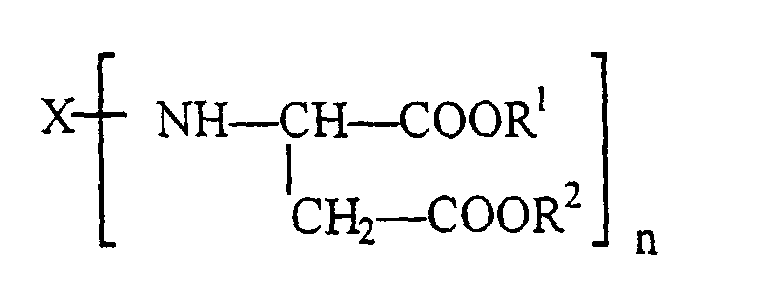
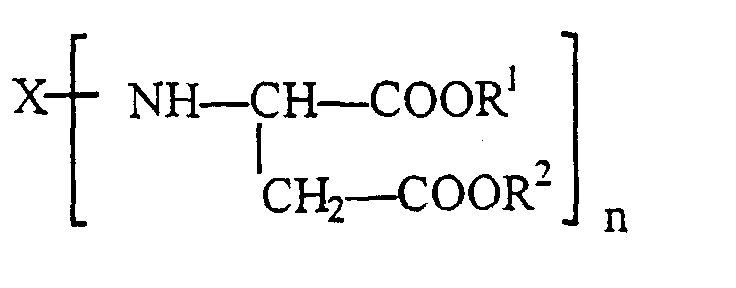
The reaction product will comprise at least one compound corresponding to
formula I, i.e., a polyaspartic acid derivative:
wherein X represents an organic group derived from a compound having n primary
amino groups and containing at least one functionality which is reactive towards
isocyanate groups at a temperature of 100°C or less, R
1 and R
2 may be identical or
different and represent organic groups which are inert towards isocyanate groups at a
temperature of 100°C or less, especially C1-C4 alkyl groups, and n represents an
integer with a value of at least 2, preferably 2 or 3.
Polyaspartic acid derivatives corresponding to the above formula include those
wherein X represents a divalent hydrocarbon group obtained by the removal of the
amino groups from polyamines containing at least three amino nitrogens, two of which
are primary amines such as diethylenetriamine and triethylenetetramine. X may also
represent a divalent hydrocarbon group obtained by the removal of the two primary
amino groups from polyamines containing at least two primary amines, and at least one
hydroxyl functionality which may be a primary, secondary, or tertiary hydroxyl group,
such as N,N-bis(aminopropyl) monoethanolamine. These polyaspartic acid derivatives
are prepared in known manner by reacting the primary polyamines corresponding to the
formula II
X-(NH2)n
with a maleic or fumaric acid diester corresponding to the formula III
R1OOC―CH=CH―COOR2
It is also possible to use a mixture of two or more polyamines according to
formula II or a mixture of one or more of such polyamines with diamines such as
ethylenediamine, 1,2-propanediamine, 1,4-butanediamine, 1,6-hexanediamine,
2,5-dimethylhexane, 2,2,4- and/or 2,4,4-trimethyl-1,6-hexanediamine, 1,11-undecanediamine,
1,12-dodecanediamine, 1-amino-3,3,5-trimethyl-5-aminomethylcyclohexane,
2,4- and/or 2,6-hexahydrotoluenediamine, 2,4' and/or 4,4'-dicyclohexylmethanediamine,
and 3,3'-dimethyl-4,4'-dicyclohexylmethanediamine. Aromatic polyamines such as
2,4- and/or 2,6-toluenediamine and 2,4'- and/or 4,4'-diphenylmethanediamine are also
suitable, but less preferred. Relatively high molecular weight polyether polyamines
containing an aliphatically bound primary amino groups, for example, products marketed
under the Jeffamine trademark by Huntsman are also suitable.
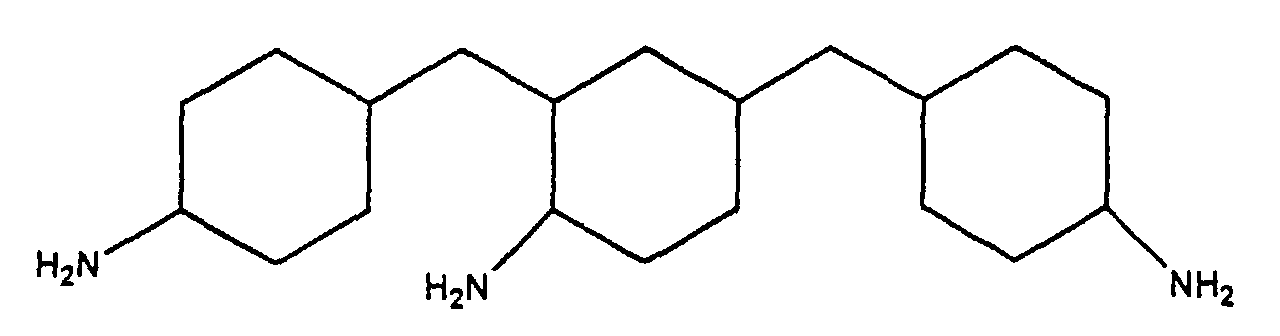
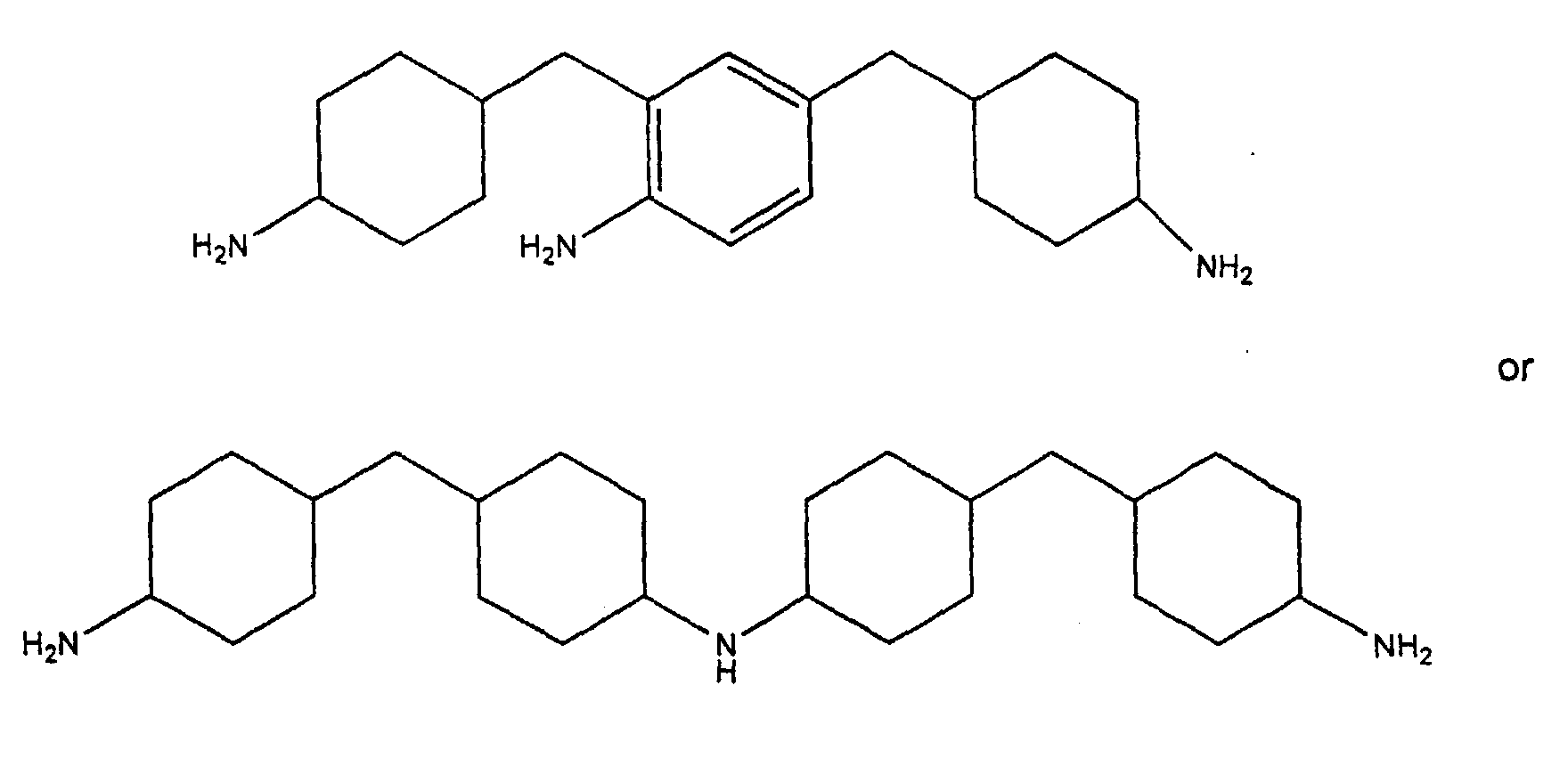
An especially suitable mixture of polyamines for reaction with the maleate or
fumarate diester is ANCAMINE® 2168 curing agent which comprises the following
components:
It is also desirable to use as the polyamine component any one of the above
three triamino-containing compounds or any combination thereof.
The only requirement for using mixtures of polyamines as the polyamine
component is that the mixture has a primary amino functionality of at least 2 and an
overall isocyanate-reactive group functionality of >2 so that when reacted in a ratio of <1
mole of diester per equivalent of isocyanate reactive groups in the polyamine component
a reaction product is provided having at least 10 eq% of free, unreacted isocyanate-reactive
groups.
Examples of maleic or fumaric acid diesters suitable for use in the preparation of
the compounds include dimethyl, diethyl, and di-n-butyl esters of maleic and fumaric
acid.
The preparation of the "polyaspartic acid derivative reaction products" from the
above-mentioned starting materials may be carried out, for example, at a temperature of
0 to 100°C using the starting materials in such proportions that less than 1, preferably,
less than 0.9, olefinic double bond is present for each isocyanate reactive group.
Excess starting materials may be removed by distillation after the reaction. The reaction
may be carried out solvent-free or in the presence of suitable solvents such as
methanol, ethanol, propanol, dioxane, and mixtures of such solvents.
The binders present in the coating compositions according to the invention are
based on mixtures of polyisocyanate component (a) with the isocyanate reactive
component (b) containing secondary polyamine reaction products corresponding to
formula I or mixtures of polyisocyanate component (a) with the isocyanate reactive
component (b) containing secondary polyamine reaction products and other isocyanate-reactive
compounds.
These other optionally used isocyanate-reactive compounds may be amine
resins such as polyoxypropyleneamines, or organic polyhydroxyl compounds known
from polyurethane chemistry and include both the low molecular weight polyols and the
relatively high molecular weight polyols previously set forth for the preparation of the
prepolymers and semi-prepolymers. When polyhydroxyl compounds are included, the
products are polyurethane/ureas. Preferably, polyoxypropyleneamines are used.
In the binders used according to the invention, components (a) and (b) are used
in amounts sufficient to provide an equivalents ratio of isocyanate groups to isocyanate-reactive
groups of about 0.8:1 to 20:1, preferably about 0.8:1 to 2:1, more preferably
about 0.8:1 to 1.2:1, and most preferably about 1.1:1. The optional polyhydroxy
compound may be present in component (b) in an amount such that up to 20 hydroxyl
groups are present for each secondary amino group from the compounds corresponding
to formula I, preferably, the equivalents ratio of hydroxyl groups to secondary amino
groups is about 10:1 to 1:10.
The coating compositions are prepared by mixing the individual components
together, although if present the optional polyols may be initially blended with the
compounds corresponding to formula I. Preparation of the coating compositions is
carried out solvent-free or in the presence of solvents conventionally used in the
polyurea coatings. It is an advantage of the process according to the invention that the
quantity of solvent used may be greatly reduced when compared with that required in
known two component systems.
Examples of suitable solvents include xylene, butyl acetate, methylisobutyl
ketone, methoxypropyl acetate, N-methylpyrrolidone, petroleum hydrocarbons,
isobutanol, butylglycol, chlorobenzenes, and mixtures of such solvents. The alcoholic
solvents previously mentioned may be used provided that the optional polyols are not
used.
In the coatings compositions, the weight ratio of the total quantity of components
(a) and (b) to the quantity of solvent is about 40:60 to 100:0, preferably, about 60:40 to
90:10.
The coating compositions may also contain other auxiliary agents and additives
conventionally used in polyurea coatings, in particular, pigments, fillers, leveling agents,
catalysts, anti-settling agents, and the like.
The properties of the coatings obtained according to the invention may be
adjusted in particular by suitable choice of the nature and proportions of starting
components (a) and (b). Thus, for example, the presence of relatively high molecular
weight linear polyols, either in the prepolymers or semi-prepolymers of component (a)
and/or in component (b), increases the elasticity of the coating, whereas, the absence of
such starting components increases the crosslinking density and hardness of the
resulting coatings.
Component (a) and component (b) of the present spray polyurea coating system
are combined or mixed under high pressure; most preferably, they are impingement
mixed directly in the high pressure spray equipment. In particular, a first and second
pressurized stream of components (a) and (b), respectively, are delivered from two
separate chambers of the proportioner and are impacted or impinged upon each other at
high velocity to effectuate an intimate mixing of the two components and, thus, the
formulation of the elastomer system, which is then coated onto the desired substrate via
the spray gun.
For carrying out the process according to the invention, the coating compositions
are applied as one or more layers to substrates by known methods such as brush
coating, immersion or flooding, by means of rollers or doctor applicators, or especially by
spraying. The process is suitable for the formation of coatings on any substrates, for
example, metals, plastics, wood, glass, or especially concrete.
After the substrates have been coated, the coatings are cured at a temperature
of about -20°C to 100°C. Curing is preferably carried out at a temperature of about 10°C
to 80°C by air drying or forced drying.
Example 1
1776 g (15.86 eq) of mixed polycycloaliphatic amines (MPCA; Ancamine 2168
curing agent) were heated to 60°C and charged to a 5L, 4-neck, round-bottom flask
equipped with a heating mantle, overhead condenser, and addition funnel. A nitrogen
blanket was maintained over the MPCA. Over a one-hour period, 1975.8 g (11.49
moles) of diethyl maleate was added in eight increments of approximately 250g each.
The reaction mixture exothermed to 82-83°C, was held at 60° for 6 hours and then
allowed to stand over the weekend. In this case sufficient diethyl maleate was added to
react with 72.4 eq% of the available isocyanate reactive groups.
The viscosity of the MPCA polyaspartic ester (MPCA/PAE) was measured as a
function of time to determine when the reaction was complete, as shown in the following
table.
| Days | Viscosity (cps) |
| 4 | 2,600 |
| 6 | 12,600 |
| 10 | 13,500 |
| 14 | 15,100 |
| 33 | 20,200 |
| 45 | 22,600 |
The reductive reaction product of meta-xylylenediamine and methylisobutyl
ketone (MXDA/MIBK) was prepared essentially according to the Example in US
3,596,782.
Example 3
This example shows the preparation of spray polyurea coatings using a Gusmer
spray gun apparatus. The components were used in parts by weight. Run A is a
standard prior art system and Run B is according to the invention.
| | Run A | Run B |
| ISOCYANATE SIDE A |
| Rubinate 9272 | 60 | 60 |
| Mondur ML | 30 | 30 |
| Propylene Carbonate | 10 | 10 |
| Eq Wt | 283.4 | 283.4 |
| |
| ISOCYANATE-REACTIVE SIDE B |
| Jeffamine D-2000 | 48.8 | 38.3 |
| Jeffamine T-5000 | 5 |
| DETDA | 19 |
| Unilink 4200 | 10 |
| MPCA/PAE-MXDA/MIBK (70/30 wt/wt) | | 44.5 |
| Epoxy Silane | 0.8 | 0.8 |
| Gray grind | 16.4 |
| Light gray grind | | 16.4 |
| |
| ISO/AMINE WT RATIO | 1.00 | 1.00 |
| ISO INDEX | 1.13 | 1.51 |
| |
| Gel Time (sec) | 8 | 13 |
The materials use were the following:
The data in Table 1 shows that the chain extenders are effective for producing
polyurea spray coatings with suitable gel times without the use of aromatic diamines
such as diethyltoluenediamine or dialkylmethylenedianiline.
STATEMENT OF INDUSTRIAL APPLICATION
The present invention provides an amine chain extender especially suitable for
spray polyurea coating compositions.