EP1038896A2 - Amido functional amine catalysts for the production of polyurethanes - Google Patents
Amido functional amine catalysts for the production of polyurethanes Download PDFInfo
- Publication number
- EP1038896A2 EP1038896A2 EP00106352A EP00106352A EP1038896A2 EP 1038896 A2 EP1038896 A2 EP 1038896A2 EP 00106352 A EP00106352 A EP 00106352A EP 00106352 A EP00106352 A EP 00106352A EP 1038896 A2 EP1038896 A2 EP 1038896A2
- Authority
- EP
- European Patent Office
- Prior art keywords
- dimethylamino
- propyl
- bis
- polyol
- reaction
- Prior art date
- Legal status (The legal status is an assumption and is not a legal conclusion. Google has not performed a legal analysis and makes no representation as to the accuracy of the status listed.)
- Withdrawn
Links
Classifications
-
- C—CHEMISTRY; METALLURGY
- C08—ORGANIC MACROMOLECULAR COMPOUNDS; THEIR PREPARATION OR CHEMICAL WORKING-UP; COMPOSITIONS BASED THEREON
- C08G—MACROMOLECULAR COMPOUNDS OBTAINED OTHERWISE THAN BY REACTIONS ONLY INVOLVING UNSATURATED CARBON-TO-CARBON BONDS
- C08G71/00—Macromolecular compounds obtained by reactions forming a ureide or urethane link, otherwise, than from isocyanate radicals in the main chain of the macromolecule
- C08G71/04—Polyurethanes
-
- C—CHEMISTRY; METALLURGY
- C08—ORGANIC MACROMOLECULAR COMPOUNDS; THEIR PREPARATION OR CHEMICAL WORKING-UP; COMPOSITIONS BASED THEREON
- C08G—MACROMOLECULAR COMPOUNDS OBTAINED OTHERWISE THAN BY REACTIONS ONLY INVOLVING UNSATURATED CARBON-TO-CARBON BONDS
- C08G18/00—Polymeric products of isocyanates or isothiocyanates
- C08G18/06—Polymeric products of isocyanates or isothiocyanates with compounds having active hydrogen
- C08G18/28—Polymeric products of isocyanates or isothiocyanates with compounds having active hydrogen characterised by the compounds used containing active hydrogen
- C08G18/40—High-molecular-weight compounds
- C08G18/4009—Two or more macromolecular compounds not provided for in one single group of groups C08G18/42 - C08G18/64
- C08G18/4072—Mixtures of compounds of group C08G18/63 with other macromolecular compounds
-
- C—CHEMISTRY; METALLURGY
- C08—ORGANIC MACROMOLECULAR COMPOUNDS; THEIR PREPARATION OR CHEMICAL WORKING-UP; COMPOSITIONS BASED THEREON
- C08G—MACROMOLECULAR COMPOUNDS OBTAINED OTHERWISE THAN BY REACTIONS ONLY INVOLVING UNSATURATED CARBON-TO-CARBON BONDS
- C08G18/00—Polymeric products of isocyanates or isothiocyanates
- C08G18/06—Polymeric products of isocyanates or isothiocyanates with compounds having active hydrogen
- C08G18/08—Processes
- C08G18/16—Catalysts
- C08G18/18—Catalysts containing secondary or tertiary amines or salts thereof
- C08G18/1841—Catalysts containing secondary or tertiary amines or salts thereof having carbonyl groups which may be linked to one or more nitrogen or oxygen atoms
-
- C—CHEMISTRY; METALLURGY
- C08—ORGANIC MACROMOLECULAR COMPOUNDS; THEIR PREPARATION OR CHEMICAL WORKING-UP; COMPOSITIONS BASED THEREON
- C08G—MACROMOLECULAR COMPOUNDS OBTAINED OTHERWISE THAN BY REACTIONS ONLY INVOLVING UNSATURATED CARBON-TO-CARBON BONDS
- C08G2101/00—Manufacture of cellular products
-
- Y—GENERAL TAGGING OF NEW TECHNOLOGICAL DEVELOPMENTS; GENERAL TAGGING OF CROSS-SECTIONAL TECHNOLOGIES SPANNING OVER SEVERAL SECTIONS OF THE IPC; TECHNICAL SUBJECTS COVERED BY FORMER USPC CROSS-REFERENCE ART COLLECTIONS [XRACs] AND DIGESTS
- Y10—TECHNICAL SUBJECTS COVERED BY FORMER USPC
- Y10S—TECHNICAL SUBJECTS COVERED BY FORMER USPC CROSS-REFERENCE ART COLLECTIONS [XRACs] AND DIGESTS
- Y10S521/00—Synthetic resins or natural rubbers -- part of the class 520 series
- Y10S521/902—Cellular polymer containing an isocyanurate structure
Definitions
- Polyurethanes are useful in a variety of applications.
- polyurethane elastomers are used in automotive pads, shoe soles, and other products in which toughness, flexibility, strength, abrasion resistance, and shock-absorbing properties are required.
- Polyurethanes are also used in coatings and in flexible and rigid foams.
- Polyurethanes in general, are produced by the reaction of a polyisocyanate and a polyol in the presence of a catalyst.
- the catalyst is typically a low molecular weight tertiary amine such as triethylenediamine.
- Polyurethane foams are produced through the reaction of a polyisocyanate with a polyol in the presence of various additives.
- One class of additives which is particularly effective as blowing agents is the chlorofluorocarbons (CFCs).
- CFCs vaporize as a result of the reaction exotherm during polymerization and cause the polymerizing mass to form a foam.
- CFCs deplete ozone in the stratosphere has resulted in mandates for restricting CFC use. Therefore, more efforts have gone into the development of alternatives to CFCs for forming urethane foams and water blowing has emerged as an important alternative. In this method, blowing occurs from carbon dioxide generated by the reaction of water with the polyisocyanate.
- Foams can be formed by a one-shot method or by formation of a prepolymer and subsequent reaction of the prepolymer with water in the presence of a catalyst to form the foam. Regardless of the method, a balance is needed between reaction of the isocyanate and the polyol (gelling) and the reaction of the isocyanate with water (blowing) in order to produce a polyurethane foam in which the cells are relatively uniform and the foam has specific properties depending on the anticipated application; for example, rigid foams, semi-rigid foams, and flexible foams.
- the ability of the catalyst to selectively promote either blowing or gelling is an important consideration in selecting a catalyst for the production of a polyurethane foam with specific properties. If a catalyst promotes the blowing reaction to too high a degree, carbon dioxide will be evolved before sufficient reaction of isocyanate with polyol has occurred. The carbon dioxide will bubble out of the formulation, resulting in collapse of the foam and production of a poor quality foam. At the opposite extreme, if a catalyst promotes the gelling reaction too strongly, a substantial portion of the carbon dioxide will be evolved after a significant degree of polymerization has occurred. Again, a poor quality foam is produced; characterized by high density, broken or poorly defined cells, or other undesirable features. Frequently, a gelling catalyst and a blowing catalyst are used together to achieve the desired balance of gelling and blowing in the foam.
- Tertiary amine catalysts have been used to in the production of polyurethanes.
- the tertiary amine catalysts accelerate both blowing (reaction of water with isocyanate to generate carbon dioxide) and gelling (reaction of polyol with isocyanate) and have been shown to be effective in balancing the blowing and gelling reactions to produce a desirable product.
- typical tertiary amines used as catalysts for polyurethane production generally have offensive odors and many are highly volatile due to low molecular weight. Release of tertiary amines during polyurethane production may present significant safety and toxicity problems, and release of residual amines from consumer products is generally undesirable.
- Amine catalysts which contain amide functionality have an increase in molecular weight and hydrogen bonding and reduced volatility and odor when compared to related compounds lacking amide functionality.
- An advantage of the use of compounds having amide functionality in the preparation of polyurethanes is that the amide chemically bonds with the urethane during the polymerization reaction and thus is not released from the finished product.
- catalyst structures which contain both amine and amide functionality typically have low to moderate activity and promote both the blowing and gelling reaction to varying extents.
- U.S. Patent No. 3,073,787 discloses an improved process for preparing isocyanate foams in which catalysts made from 3-dialkylaminopropionamide and 2-dialkylaminoacetamide are used.
- U.S. Patent No. 4,049,591 discloses a group of ⁇ -substituted bis-(N,N,-dimethylaminopropyl)amines as catalysts in reacting polyisocyanate with polyols.
- the substituted group can be cyano, amide, ester, or ketone.
- U.S. Patent No. 4,248,930 discloses several tertiary amines catalysts for the production of polyurethane resins.
- a mixture of bis(dimethylamino-n-propyl)amine and N-methyl-N -(3-formylaminopropyl)piperazine is used to form a PVC/polyurethane-foam laminate.
- U.S. Patent No. 4,548,902 discloses combining a polybasic amino compound, such as 3,3 - ⁇ [3-(dimethylamino)propyl]imino ⁇ bis-propanamide, with a direct or reactive dyestuff for use in cellulose dyeing applications.
- WO 94/01406 (Beller, et al., 1994) discloses a group of chelating agents, such as 3-[3-(N ,N -dimethylaminopropyl)-N-methyl]propionamide, and 3-[3-(dimethylamino)propyl]propionamide, suitable for producing paramagnetic complexes which can be used as contrast agents in magnetic resonance diagnosis applications.
- EP 799,821 (Gerkin, et al., 1997) discloses amine/amide catalysts, such as the following two compounds, for formation of polyurethanes.
- the catalysts are reported to have low fugitivity due to their reactivity with isocyanates.
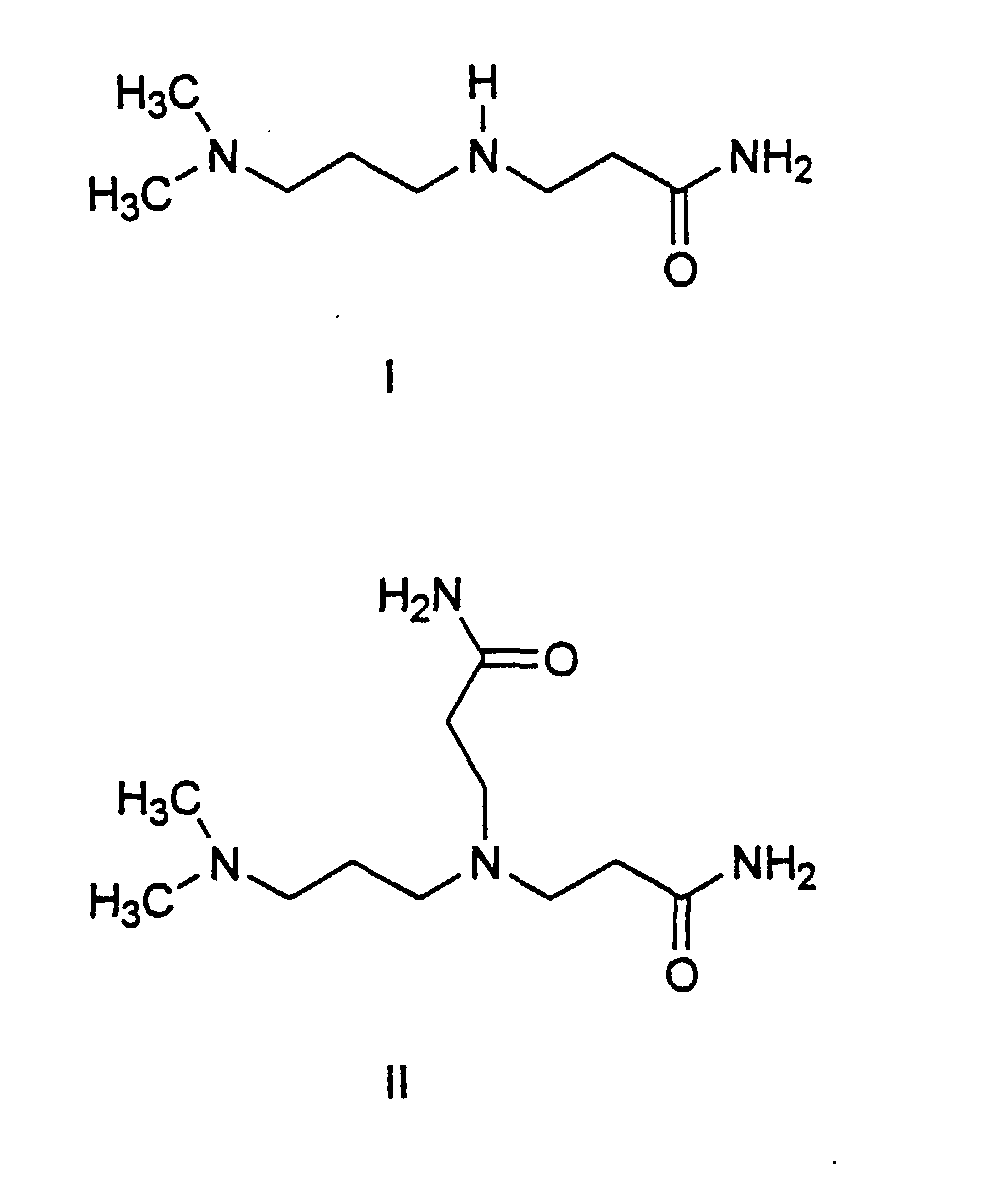
- the present invention is directed to the use of the following two compounds as catalysts in the production of polyurethanes: 3-[3-(dimethylamino)propyl]-propionamide (formula I below) and 3,3 - ⁇ [3-(dimethylamino)propyl]imino ⁇ bis-propanamide (Formula II below).
- the compounds represented by I and II are effective catalysts in the production of polyurethanes in which an organic polyisocyanate reacts with a compound containing a reactive hydrogen, such as, an alcohol, a polyol, an amine or water. They are particularly useful for the gelling reaction in which an organic polyisocyanate reacts with a polyol.
- a reactive hydrogen such as, an alcohol, a polyol, an amine or water.
- the compounds of this invention are readily prepared by the Michael addition of an amino functional amine to an acrylamide.
- the amino functional amine and acrylamide are present in the reaction mixture in molar ratio of from about 1:10 to about 20:1, and preferably at a ratio of 1 to 2 moles amino amine per equivalent of acrylamide. Air is used to saturate the reaction mixture in order to inhibit the free radical polymerization of acrylamide.
- the reaction is preferably carried out at atmospheric pressure; however other pressures can be used.
- the reaction can be carried out at a temperature ranging from 0 to 130 °C; preferably from 30 to 100 °C, and is allowed to run for 0.1 to 100 hours, preferably, 2 to 12 hours.
- the reagent monomer can be reacted in batch fashion, via staged addition, or continuously. Synthesis is advantageously performed in a mixture of the neat monomers, however, an inert solvent for both reactants may be employed.
- appropriate solvents include amides and ethers; preferred solvents are ethers.
- the catalyst compositions according to this invention can catalyze (1) the reaction between an isocyanate functionality and an active hydrogen-containing compound, such as, an alcohol, a polyol, an amine, or water; and (2) the trimerization of the isocyanate functionality to form polyisocyanurates.
- the compositions are especially useful as catalysts in the reaction between an organic polyisocyanate and a polyol and in the preparation of polyurethane foams in which an organic polyisocyanate reacts with a polyol in the presence of a blowing agent, such as water.
- Polyurethane products are prepared using any suitable organic polyisocyanates well known in the art including, for example, hexamethylene diisocyanate, phenylene diisocyanate, toluene diisocyanate (TDI) and 4, 4'-diphenylmethane diisocyanate (MDI).
- suitable organic polyisocyanates well known in the art including, for example, hexamethylene diisocyanate, phenylene diisocyanate, toluene diisocyanate (TDI) and 4, 4'-diphenylmethane diisocyanate (MDI).
- 2, 4- and 2, 6-TDI's individually or together as their commercially available mixtures.
- Other suitable isocyanates are mixtures of diisocyanates known commercially as "crude MDI", also known as PAPI, which contain about 60% of 4, 4'-diphenylmethane diisocyanate along with other isomeric and analogous higher polyisocyanates.
- polystyrene resin examples include the polyalkylene ether and polyester polyols.
- the polyalkylene ether polyols include the poly(alkylene oxide) polymers such as poly(ethylene oxide) and poly(propylene oxide) polymers and copolymers with terminal hydroxyl groups derived from polyhydric compounds, including diols and triols; for example, among others, ethylene glycol, propylene glycol, 1, 3-butane diol, 1, 4-butane diol, 1, 6-hexane diol, neopentyl glycol, diethylene glycol, dipropylene glycol, pentaerythritol, glycerol, diglycerol, trimethylol propane and like low molecular weight polyols.
- a single high molecular weight polyether polyol may be used.
- mixtures of high molecular weight polyether polyols such as mixtures of di- and trifunctional materials and/or different molecular weight or different chemical composition materials may be used.
- Useful polyester polyols include those produced by reacting a dicarboxylic acid with an excess of a diol, for example, adipic acid with ethylene glycol or butanediol, or reacting a lactone with an excess of a diol such as caprolactone with propylene glycol.
- the masterbatch or premix compositions frequently contain a polymer polyol.
- Polymer polyols are used in polyurethane foam to increase the foam's resistance to deformation, i.e. to increase the load-bearing properties of the foam.
- the first type described as a graft polyol, consists of a triol in which vinyl monomers are graft copolymerized. Styrene and acrylonitrile are the usual monomers of choice.
- the second type is a polyol containing a polyurea dispersion formed by the reaction of a diamine and TDI. Since TDI is used in excess, some of the TDI may react with both the polyol and polyurea.
- This second type of polymer polyol has a variant called PIPA polyol which is formed by the in-situ polymerization of TDI and alkanolamine in the polyol.
- polymer polyols may comprise 20-80% of the polyol portion of the masterbatch.
- chain extenders such as ethylene glycol and butanediol
- crosslinkers such as diethanolamine, diisopropanolamine, triethanolamine and tripropanolamine
- blowing agents such as water, methylene chloride, trichlorofluoromethane, and the like
- cell stabilizers such as silicones.
- a catalytically effective amount of the catalyst composition is used in the polyurethane formulation.
- Suitable amounts of the catalyst composition may range from about 0.01 to 10 parts per 100 hundred parts polyol (phpp). Preferred amounts range from 0.05 to 1.5 phpp.
- the catalyst composition may be used in combination with other tertiary amine, organotin and carboxylate urethane catalysts well known in the urethane art.
- suitable gelling catalysts include but are not limited to trimethylamine, triethylamine, tributyl-amine, trioctylamine, diethyl cyclohexylamine, N-methylmorpholine, N-ethylmorpholine, N-octadecylmorpholine (N-cocomorpholine), N-methyldiethanolamine, N,N-dimethylethanolamine, N,N'-bis(2-hydroxypropyl)piperazine, N,N,N',N'-tetramethylethylene-diamine, N,N,N',N'-tetramethyl-1,3-propanediamine, triethylenediamine (1,4-diaza-bicyclo[2.2.2]octane), 1,8-diazabicyclo(5.4.0)undecen
- Suitable blowing catalysts include but are not limited to bis(dimethylaminoethyl)ether, pentamethyldiethylenetriamine, 2-[N-(dimethylaminoethoxyethyl)-N-methylamino]ethanol, and the like.
- Suitable blowing catalysts include but are not limited to bis(dimethylaminoethyl)ether, pentamethyldiethylenetriamine, 2-[N-(dimethylaminoethoxyethyl)-N-methylamino]ethanol, and the like.
- a 50 ml 3 neck round bottom flask was fitted with the following: magnetic stirrer, reflux condenser, air bubbler, and a temperature controlled oil bath.
- the flask was charged with 7.1 g of acrylamide.
- 3-Dimethyl-1,3-propanediamine (10.2 g) was added in one portion to the reaction flask at ambient temperature.
- the reaction mixture was stirred at 85 °C for 4 hours.
- the viscosity of the liquid increased by the end of the reaction.
- the mixture was cooled to ambient temperature.
- the resulting mixture was filtered through a Celite layer. The filtrate was collected for foam application.
- 1 H NMR showed that the product was the desired structure, and that there was no residual acrylamide.
- a 50 ml 3 neck round bottom flask was fitted with the following: magnetic stirrer, reflux condenser, air bubbler, and a temperature controlled oil bath.
- the flask was charged with 14.2 g of acrylamide.
- 3-Dimethyl-1,3-propanediamine (10.2 g) was added in one portion to the reaction flask at ambient temperature.
- the reaction mixture was stirred at 101 °C for 8 hours and a stow stream of air was bubbled through the reaction mixture for the entire 8 hours.
- the mixture was cooled to ambient temperature.
- the resulting mixture was filtered through a Celite layer. The filtrate was collected for foam application.
- 1 H NMR showed that the product was the desired structure, and that there was only 6.5% residual acrylamide, with no evidence for acrylamide polymer formation.
- Polyurethane foams were prepared in a conventional manner using the following premix formulation: Premix Formulation Component Parts by Weight E-648 (ethylene oxide tipped polyether polyol, marketed by Arco) 60 E-519 (styrene-acrylonitrile copolymer filled polyether polyol, marketed by Arco) 40 Dabco® DC-5043 (silicone surfactant marketed by Air Products and Chemicals, Inc.) 1.5 Diethanolamine 1.75 Water 3.25 TDI 80 (mixture of 80 wt.% 2,4-TDI and 20 wt.% 2,6-TDI) 105 (isocyanate index)
- the catalyst was added to 202 g of the above premix in a 32 oz (951 ml) paper cup and the formulation was mixed for 20 seconds at 5000 RPM using an overhead stirrer fitted with a 2 inch (5.1 cm) diameter stirring paddle.
- the 32 oz. cup was dropped through a hole in the bottom of a 128 oz. (3804 ml) paper cup placed on a stand. The hole was sized to catch the lip of the 32 oz. cup.
- the total volume of the foam container was 160 oz. (4755 ml). Foams approximated this volume at the end of the foam forming process. Times to reach the top of the mixing cup (TOC1), the top of the 128 oz. cup (TOC2), and maximum foam height were recorded
- Examples 3 and 4 show that 3-[3-(dimethylamino)propyl]-propionamide and 3,3'- ⁇ [3-(dimethylamino)propyl]imino ⁇ bis-propanamide are very effective gelling catalysts.
Landscapes
- Chemical & Material Sciences (AREA)
- Health & Medical Sciences (AREA)
- Chemical Kinetics & Catalysis (AREA)
- Medicinal Chemistry (AREA)
- Polymers & Plastics (AREA)
- Organic Chemistry (AREA)
- Polyurethanes Or Polyureas (AREA)
- Organic Low-Molecular-Weight Compounds And Preparation Thereof (AREA)
Abstract

Description


- they are very active catalysts;
- they are selective to the gelling reaction, i.e., the reaction between an organic polyisocyanate and a polyol; and
- they bind to the urethane, resulting in little or none of the compound being released from the finished product.

| Premix Formulation | |
| Component | Parts by Weight |
| E-648 (ethylene oxide tipped polyether polyol, marketed by Arco) | 60 |
| E-519 (styrene-acrylonitrile copolymer filled polyether polyol, marketed by Arco) | 40 |
| Dabco® DC-5043 (silicone surfactant marketed by Air Products and Chemicals, Inc.) | 1.5 |
| Diethanolamine | 1.75 |
| Water | 3.25 |
| TDI 80 (mixture of 80 wt.% 2,4-TDI and 20 wt.% 2,6-TDI) | 105 (isocyanate index) |
| Catalyst | TOC1 (sec.) | TOC2 (sec.) | Full Height (sec.) | Foam Height (mm) |
| 0.25 pphp DABCO 33LV/0.10 pphp DABCO BL-11 | 12.74 | 44.02 | 127.27 | 409.05 |
| 0.52 3-[3-(dimethylamino)propyl]propionamide/0.10 pphp DABCO BL-11 | 12.02 | 45.65 | 133.91 | 404.89 |
| Catalyst | TOC1 (sec.) | TOC2 (sec.) | Full Height (sec.) | Foam Height (mm) |
| 0.25 pphp DABO 33LV/0.10 pphp DABCO BL-11 | 12.74 | 44.02 | 127.27 | 409.05 |
| 0.52 pphp 3,3 |
11.36 | 44.46 | 136.28 | 405.99 |
Claims (10)
- A method for preparing a polyurethane comprising reacting an organic polyisocyanate with a compound containing a reactive hydrogen in the presence of a catalyst composition comprising a compound selected from the group consisting of 3-[3-(dimethylamino)propyl]-propionamide, 3,3-{[3-(dimethylamino)propyl]imino} bis-propanamide, and combinations of 3-[3-(dimethylamino)propyl]-propionamide and 3,3

- The method of claim 1 wherein the compound containing a reactive hydrogen is a polyol.
- The method of claim 1 wherein the catalyst composition comprises 3-[3-(dimethylamino)propyl]-propionamide.
- The method of claim 1 wherein the catalyst composition comprises 3,3
- A method for preparing a polyurethane foam comprising reacting an organic polyisocyanate with a polyol in the presence of a blowing agent and a catalyst composition comprising a compound selected from the group consisting of 3-[3-(dimethylamino)propyl]-propionamide, 3,3
- The method of claim 5 wherein the blowing agent is water.
- The method of claim 6 wherein the compound is 3-[3-(dimethylamino)propyl]propionamide.
- The method of claim 6 wherein the compound is 3,3
- The method of claim 6 wherein the catalyst composition also comprises a blowing catalyst.
- The method of claim 9 wherein the blowing catalyst is a bis(dimethylaminoethyl)ether.
Applications Claiming Priority (2)
| Application Number | Priority Date | Filing Date | Title |
|---|---|---|---|
| US276962 | 1999-03-26 | ||
| US09/276,962 US6156814A (en) | 1999-03-26 | 1999-03-26 | Amido functional amine catalysts for the production of polyurethanes |
Publications (2)
| Publication Number | Publication Date |
|---|---|
| EP1038896A2 true EP1038896A2 (en) | 2000-09-27 |
| EP1038896A3 EP1038896A3 (en) | 2001-10-31 |
Family
ID=23058834
Family Applications (1)
| Application Number | Title | Priority Date | Filing Date |
|---|---|---|---|
| EP00106352A Withdrawn EP1038896A3 (en) | 1999-03-26 | 2000-03-23 | Amido functional amine catalysts for the production of polyurethanes |
Country Status (6)
| Country | Link |
|---|---|
| US (2) | US6156814A (en) |
| EP (1) | EP1038896A3 (en) |
| JP (1) | JP3498038B2 (en) |
| KR (1) | KR100349700B1 (en) |
| CN (1) | CN1227278C (en) |
| BR (1) | BR0001378A (en) |
Cited By (2)
| Publication number | Priority date | Publication date | Assignee | Title |
|---|---|---|---|---|
| DE102013201829A1 (en) | 2013-02-05 | 2014-08-07 | Evonik Industries Ag | Amines suitable for use in the production of polyurethanes |
| WO2016193474A1 (en) * | 2015-06-03 | 2016-12-08 | Byk-Chemie Gmbh | Reaction products containing amidoamine groups |
Families Citing this family (11)
| Publication number | Priority date | Publication date | Assignee | Title |
|---|---|---|---|---|
| FR2779149B1 (en) * | 1998-05-29 | 2000-09-15 | Witco | PROCESS FOR PRODUCING POLYURETHANE FOAM, POLYESTER POLYOL AMINE USED IN THIS PROCESS AND FOAM OBTAINED |
| US6759447B1 (en) * | 2003-01-06 | 2004-07-06 | Air Products And Chemicals, Inc. | Physical properties of polyurethane foams using tertiary amino alkyl amide catalysts |
| US6762211B1 (en) * | 2003-01-03 | 2004-07-13 | Air Products And Chemicals, Inc. | Tertiary amino alkyl amide polyurethane catalysts derived from long chain alkyl and fatty carboxylic acids |
| US6737446B1 (en) * | 2003-01-03 | 2004-05-18 | Air Products And Chemicals, Inc. | Tertiary amino alkyl amide catalysts for improving the physical properties of polyurethane foams |
| US7169823B2 (en) * | 2003-03-10 | 2007-01-30 | Air Products And Chemicals, Inc. | Tertiary alkanolamine polyurethane catalysts derived from long chain alkyl and fatty carboxylic acids |
| US6747069B1 (en) * | 2003-03-10 | 2004-06-08 | Air Products And Chemicals, Inc. | Tertiary alkanolamine polyurethane catalysts derived from long chain alkyl and fatty carboxylic acids |
| US20050059749A1 (en) * | 2003-09-16 | 2005-03-17 | Huntsman Petrochemical Corporation | Catalysts useful in polyurethane foam |
| US20050143478A1 (en) * | 2003-12-24 | 2005-06-30 | Kao Corporation | Catalyst for preparing polyurethane |
| US20070225393A1 (en) * | 2006-03-27 | 2007-09-27 | Arnold Allen R Jr | Crosslinkers for minimizing deterioration of polyurethane foams |
| KR101589111B1 (en) * | 2015-08-27 | 2016-01-28 | 주식회사 지앤톡 | Method of providing security chatting service and system performing the same |
| JP2025524162A (en) * | 2022-07-28 | 2025-07-25 | エボニック オペレーションズ ゲーエムベーハー | Tertiary aminoamide compositions useful in making polyurethane polymers - Patents.com |
Family Cites Families (10)
| Publication number | Priority date | Publication date | Assignee | Title |
|---|---|---|---|---|
| US3073787A (en) * | 1957-03-07 | 1963-01-15 | Du Pont | Improved process for preparing resilient isocyanate foams |
| US3954749A (en) * | 1972-11-27 | 1976-05-04 | Union Carbide Corporation | Beta-amino carbonyl catalysts for polyurethane preparation |
| US3821131A (en) | 1972-11-27 | 1974-06-28 | Union Carbide Corp | Beta-amino carbonyl catalysts for polyurethane preparation |
| US4049591A (en) * | 1976-10-18 | 1977-09-20 | Texaco Development Corporation | Foams and elastomers prepared in the presence of high tertiary amine content polyurethane catalysts |
| US4143071A (en) * | 1976-10-18 | 1979-03-06 | Texaco Development Corp. | High tertiary amine content compositions useful as polyurethane catalysts |
| DE2732292A1 (en) * | 1977-07-16 | 1979-02-01 | Bayer Ag | METHOD FOR MANUFACTURING POLYURETHANE PLASTICS |
| FR2509336A1 (en) * | 1981-02-14 | 1983-01-14 | Sandoz Sa | PROCESS FOR IMPROVING SOLIDITY TO WETTING REACTIVE OR DIRECT DYES ON A CELLULOSIC SUBSTRATE AND CELLULOSIC SUBSTRATE OBTAINED |
| JPH07508527A (en) * | 1992-07-01 | 1995-09-21 | ビイク グルデン ロンベルク ヒェーミッシェ ファブリーク ゲゼルシヤフト ミツト ベシユレンクテル ハフツング | complexing agent |
| ATE214362T1 (en) * | 1996-04-04 | 2002-03-15 | Crompton Corp | METHOD FOR SYNTHESIS OF POLYURETHANES USING REACTIVE AMINE CATALYSTS |
| US5824711A (en) * | 1997-05-05 | 1998-10-20 | Air Products And Chemicals, Inc. | N,N,N'-trimethylbis (Aminoethyl) ether substituted urea compostions for the production of polyurethanes |
-
1999
- 1999-03-26 US US09/276,962 patent/US6156814A/en not_active Ceased
-
2000
- 2000-03-20 BR BR0001378-1A patent/BR0001378A/en not_active IP Right Cessation
- 2000-03-22 KR KR10-2000-0014494A patent/KR100349700B1/en not_active Expired - Fee Related
- 2000-03-23 EP EP00106352A patent/EP1038896A3/en not_active Withdrawn
- 2000-03-24 JP JP2000083578A patent/JP3498038B2/en not_active Expired - Fee Related
- 2000-03-24 CN CNB001047264A patent/CN1227278C/en not_active Expired - Fee Related
-
2002
- 2002-03-22 US US10/104,119 patent/USRE38201E1/en not_active Expired - Fee Related
Cited By (5)
| Publication number | Priority date | Publication date | Assignee | Title |
|---|---|---|---|---|
| DE102013201829A1 (en) | 2013-02-05 | 2014-08-07 | Evonik Industries Ag | Amines suitable for use in the production of polyurethanes |
| WO2014121959A1 (en) | 2013-02-05 | 2014-08-14 | Evonik Industries Ag | Amines, suitable for the use in the production of polyurethanes |
| US9505895B2 (en) | 2013-02-05 | 2016-11-29 | Evonik Degussa Gmbh | Amines suitable for use in the manufacture of polyurethanes |
| WO2016193474A1 (en) * | 2015-06-03 | 2016-12-08 | Byk-Chemie Gmbh | Reaction products containing amidoamine groups |
| US10544091B2 (en) | 2015-06-03 | 2020-01-28 | Byk-Chemie, Gmbh | Reaction products containing amidoamine groups |
Also Published As
| Publication number | Publication date |
|---|---|
| JP2000290338A (en) | 2000-10-17 |
| KR100349700B1 (en) | 2003-01-24 |
| CN1227278C (en) | 2005-11-16 |
| BR0001378A (en) | 2000-10-17 |
| JP3498038B2 (en) | 2004-02-16 |
| US6156814A (en) | 2000-12-05 |
| EP1038896A3 (en) | 2001-10-31 |
| USRE38201E1 (en) | 2003-07-22 |
| KR20000062980A (en) | 2000-10-25 |
| CN1268524A (en) | 2000-10-04 |
Similar Documents
| Publication | Publication Date | Title |
|---|---|---|
| US6201033B1 (en) | Reactive catalyst compositions for improving water blown polyurethane foam performance | |
| JP3168457B2 (en) | N, N, N'-trimethylbis (aminoethyl) ether-substituted urea compositions for polyurethane production | |
| MXPA02003535A (en) | Acid-blocked amine catalysts for the production of polyurethanes. | |
| EP0879837B1 (en) | Polyurethane catalyst compositions for improving foam perfomance | |
| US6156814A (en) | Amido functional amine catalysts for the production of polyurethanes | |
| EP1714989B1 (en) | Polyurethane foams made with blowing catalyst compositions containing primary hydroxyl groups and high ethylenediamine backbones | |
| US5756557A (en) | Aminomethyl pyrrolidine urea compositions for the production of polyurethanes | |
| US6153659A (en) | 3-{N-[2-(N',N'-dimethylamino ethoxy)ethyl]-N-methylamino}propionamide for the production of polyurethanes | |
| US6380274B1 (en) | Catalyst compositions for the production of polyurethanes | |
| US6762211B1 (en) | Tertiary amino alkyl amide polyurethane catalysts derived from long chain alkyl and fatty carboxylic acids | |
| US6147185A (en) | 1,4-diazabicyclo[2.2.2]octane compounds and their use for the production of polyurethanes | |
| MXPA00002795A (en) | Amido functional amine catalysts for the production of polyurethanes | |
| MXPA00002794A (en) | New catalyst compositions for the production of polyurethanes | |
| MXPA00002793A (en) | 3- (n-(2-(n',n'-dimethylamino ethoxy)ethyl) -n-methylamino) propionamide for the production of polyurethanes | |
| MXPA98003525A (en) | Compositions of aminometil pyrrolidine urea parala polyurette production |
Legal Events
| Date | Code | Title | Description |
|---|---|---|---|
| PUAI | Public reference made under article 153(3) epc to a published international application that has entered the european phase |
Free format text: ORIGINAL CODE: 0009012 |
|
| AK | Designated contracting states |
Kind code of ref document: A2 Designated state(s): AT BE CH CY DE DK ES FI FR GB GR IE IT LI LU MC NL PT SE Kind code of ref document: A2 Designated state(s): DE FR GB IT |
|
| AX | Request for extension of the european patent |
Free format text: AL;LT;LV;MK;RO;SI |
|
| PUAL | Search report despatched |
Free format text: ORIGINAL CODE: 0009013 |
|
| AK | Designated contracting states |
Kind code of ref document: A3 Designated state(s): AT BE CH CY DE DK ES FI FR GB GR IE IT LI LU MC NL PT SE |
|
| AX | Request for extension of the european patent |
Free format text: AL;LT;LV;MK;RO;SI |
|
| 17P | Request for examination filed |
Effective date: 20020123 |
|
| R17P | Request for examination filed (corrected) |
Effective date: 20020123 |
|
| AKX | Designation fees paid |
Free format text: DE DK ES FI |
|
| RBV | Designated contracting states (corrected) |
Designated state(s): DE FR GB IT |
|
| GRAP | Despatch of communication of intention to grant a patent |
Free format text: ORIGINAL CODE: EPIDOSNIGR1 |
|
| STAA | Information on the status of an ep patent application or granted ep patent |
Free format text: STATUS: THE APPLICATION IS DEEMED TO BE WITHDRAWN |
|
| 18D | Application deemed to be withdrawn |
Effective date: 20050118 |