EP1038610A2 - Lost foam casting using dimensionally self-stabilized pattern - Google Patents
Lost foam casting using dimensionally self-stabilized pattern Download PDFInfo
- Publication number
- EP1038610A2 EP1038610A2 EP00101080A EP00101080A EP1038610A2 EP 1038610 A2 EP1038610 A2 EP 1038610A2 EP 00101080 A EP00101080 A EP 00101080A EP 00101080 A EP00101080 A EP 00101080A EP 1038610 A2 EP1038610 A2 EP 1038610A2
- Authority
- EP
- European Patent Office
- Prior art keywords
- blowing agent
- pattern
- beads
- raw
- isopentane
- Prior art date
- Legal status (The legal status is an assumption and is not a legal conclusion. Google has not performed a legal analysis and makes no representation as to the accuracy of the status listed.)
- Granted
Links
Images





Classifications
-
- B—PERFORMING OPERATIONS; TRANSPORTING
- B22—CASTING; POWDER METALLURGY
- B22C—FOUNDRY MOULDING
- B22C7/00—Patterns; Manufacture thereof so far as not provided for in other classes
- B22C7/02—Lost patterns
- B22C7/023—Patterns made from expanded plastic materials
-
- B—PERFORMING OPERATIONS; TRANSPORTING
- B22—CASTING; POWDER METALLURGY
- B22C—FOUNDRY MOULDING
- B22C9/00—Moulds or cores; Moulding processes
- B22C9/02—Sand moulds or like moulds for shaped castings
- B22C9/04—Use of lost patterns
- B22C9/046—Use of patterns which are eliminated by the liquid metal in the mould
-
- Y—GENERAL TAGGING OF NEW TECHNOLOGICAL DEVELOPMENTS; GENERAL TAGGING OF CROSS-SECTIONAL TECHNOLOGIES SPANNING OVER SEVERAL SECTIONS OF THE IPC; TECHNICAL SUBJECTS COVERED BY FORMER USPC CROSS-REFERENCE ART COLLECTIONS [XRACs] AND DIGESTS
- Y10—TECHNICAL SUBJECTS COVERED BY FORMER USPC
- Y10S—TECHNICAL SUBJECTS COVERED BY FORMER USPC CROSS-REFERENCE ART COLLECTIONS [XRACs] AND DIGESTS
- Y10S264/00—Plastic and nonmetallic article shaping or treating: processes
- Y10S264/09—Pre-expansion of foamed polystyrene
Definitions
- the present invention relates to lost foam casting and, more particularly, to lost foam casting using a dimensionally self-stabilized polystyrene foam pattern.
- the lost foam casting process is a well known method of producing metal castings of complex shape wherein an expanded polymeric foam pattern is embedded in a mold typically comprising unbonded foundry sand, and molten metal is poured into the mold to evaporate and displace the pattern in the mold.
- the dimensions of the casting closely reflect the original dimensions of the foam pattern that the metal replaces. Thus, it is important to use patterns as dimensionally accurate and stable as possible.
- the polymeric foam pattern is obtained by molding pre-expanded polystyrene or other polymer beads in a pattern mold to impart the desired configuration to the pattern.
- a commonly used material for making polymeric foam patterns comprises expandable polystyrene (EPS) raw beads that contain a blowing agent that typically includes mostly normal pentane with other alkanes also present (e.g. some raw beads are supplied with up to about 30% by weight alkanes other than normal pentane) and that have a raw bead size distribution with over 90% of the beads having a bead diameter in the range of about 0.2 to 0.5 millimeters.
- EPS expandable polystyrene
- T-beads are needed to provide a satisfactory pattern surface and to allow formation of thin-walled patterns, such as for example only, patterns with wall thicknesses of approximately 3 to 5 millimeters for casting vehicle engine blocks.
- the EPS raw beads are pre-expanded at a temperature above the softening temperature of polystyrene and above the boiling point of the blowing agent.
- the pre-expanded EPS beads then are molded into the desired configuration in a pattern mold that is steam heated to further expand the beads and then water cooled to stop the expansion process after the pattern is formed to shape. The pattern then is removed from the mold.
- polystyrene foam patterns Upon removal from the mold into the ambient atmosphere, such polystyrene foam patterns are known to initially grow in size as air diffuses into the pattern and then to shrink in size.
- conventional lost foam casting practice involved storing the molded polystyrene foam patterns for an extended amount of time (e.g. 30 days) at room temperature until dimensional equilibrium was approached, and then to proceed with use of the patterns in casting molten metal.
- Another practice involves preexpanding EPS beads, molding the beads to form a desired pattern, and then subjecting the pattern to oven aging to rapidly bring the pattern to stable dimensions.
- An object of the present invention is to provide a method of lost foam casting using an improved dimensionally self-stabilized polystyrene foam pattern that permits direct use of the pattern in the lost foam casting of molten metal without the need for the post-molding, dimension-stabilizing pattern treatments described above.
- the present invention provides a method of lost foam casting that uses a foam pattern molded from polystyrene beads expanded from raw polystyrene beads that have a raw bead diameter selected to provide a satisfactory pattern surface and to allow formation of thin-walled patterns, and that include a relatively slow-diffusing blowing agent in an amount of at least about 40% by weight of the blowing agent present in the raw beads to render the pattern inherently more dimensionally stable over time after pattern molding.
- the weight percentage of the blowing agent is with reference to the dense raw polystyrene beads prior to preexpansion to produce the expanded beads.
- the dimensionally self-stabilized pattern can be used directly in the lost foam casting of molten metal without an intermediate post-molding dimension-stabilizing pattern treatment.
- the pattern can be embedded in a mold comprising refractory particulates, such as foundry sand, and molten metal can be gravity or countergravity cast in a manner to replace the pattern in the mold.
- An illustrative embodiment of the present invention involves molding of the pattern from polystyrene beads preexpanded from raw polystyrene beads that have a raw bead size distribution with bead diameters in the range of about 0.1 to about 0.6 millimeters to produce patterns with thin walls and satisfactory pattern surface finish and that include isopentane as a relatively slow diffusing blowing agent alone, or together with normal pentane (n-pentane) as a relatively fast-diffusing blowing agent (diffusivity properties being with respect to the polystyrene matrix of the molded pattern) to render the pattern inherently more dimensionally stable over time.
- isopentane as a relatively slow diffusing blowing agent alone, or together with normal pentane (n-pentane) as a relatively fast-diffusing blowing agent (diffusivity properties being with respect to the polystyrene matrix of the molded pattern) to render the pattern inherently more dimensionally stable over time.
- the isopentane blowing agent is present in an amount of about 40% by weight or more of the total of the blowing agent, preferably about 50% to 70% by weight of total blowing agent, present in the raw beads.
- the dimensionally self-stabilized patterns exhibit reduced shrinkage over time after molding and an extended shelf life before pattern shrinkage occurs beyond a preselected pattern shrinkage tolerance.
- the patterns can be used in the lost foam casting process during this extended shelf life without the need for any intermediate stabilizing treatment, such as long term ambient aging, accelerated oven aging, or accelerated vacuum treatment, used heretofore to rapidly stabilize post-molding pattern dimensions.
- the present invention involves in an embodiment a method of lost foam casting that uses a polystyrene foam pattern molded from polystyrene beads expanded from dense raw polystyrene beads that have a raw (unexpanded) bead diameter in the range of about 0.1 to about 0.6 millimeters (mm) selected to produce patterns with thin walls, such as for example only, pattern wall thicknesses of approximately 3 to 5 millimeters that are used for casting vehicle engine blocks, and a satisfactory pattern surface finish for casting and that include a relatively slow-diffusing blowing agent in an amount of at least about 40% by weight of the blowing agent present in the raw beads prior to preexpansion to render the pattern molded therefrom inherently more dimensionally self-stable over time after pattern molding.
- a raw (unexpanded) bead diameter in the range of about 0.1 to about 0.6 millimeters (mm) selected to produce patterns with thin walls, such as for example only, pattern wall thicknesses of approximately 3 to 5 millimeters that
- the dimensionally self-stabilized pattern can be used directly in the lost foam casting of molten metal without an intermediate post-molding dimension-stabilizing pattern treatment before a preselected pattern shrinkage tolerance is exceeded.
- the invention is not limited to any particular pattern dimensions or shapes and can be practiced to make dimensionally self-stabilized patterns for use in casting a wide variety of metal or alloy components.
- a particular illustrative embodiment of the present invention involves molding of the pattern from beads that comprise polystyrene homopolymer and that have a raw bead size distribution with substantially all of the raw beads having a bead diameter in the range of about 0.1 to about 0.6 millimeters to produce patterns with thin walls and satisfactory pattern surface finish and that include isopentane as a relatively slow diffusing blowing agent alone, or together with normal pentane as a relatively fast-diffusing blowing agent, the diffusivity properties being with respect to the polystyrene matrix of the molded pattern.
- the isopentane blowing agent preferably is present in an amount of about 40% or more of the total of the blowing agents, even more preferably from about 50% to about 70%, of the total blowing agents, in the raw polystyrene beads.
- a molded polystyrene foam pattern for use in lost foam metal casting includes isopentane blowing agent alone or together with normal pentane with the isopentane blowing agent being present in amount to provide reduced pattern shrinkage for a period of days following pattern molding as the examples set forth below illustrate.
- the invention envisions use of other slow-diffusing blowing agents in lieu of or in addition to isopentane, such as 2,2-dimethyl propane (neopentane), cyclopentane, 2,2 di-methyl butane, 2,3 di-methyl-butane, hexane, cyclohexane, 2-methyl pentane, 3-methyl pentane as well as mixtures of one with another and/or with isopentane.
- isopentane such as 2,2-dimethyl propane (neopentane), cyclopentane, 2,2 di-methyl butane, 2,3 di-methyl-butane, hexane, cyclohexane, 2-methyl pentane, 3-methyl pentane as well as mixtures of one with another and/or with isopentane.
- the invention will be described in further detail below with respect to expandable polystyrene beads of so-called T size and normal pentane and/or isopentane
- EPS T type beads having a bead size distribution with greater than 90% of the beads having bead diameters in the range of about 0.2 to 0.5 millimeters (mm) designated commonly as T type beads, and containing different blowing agents were evaluated.
- EPS T type beads having pure normal pentane blowing agent were evaluated as representative of conventional lost foam pattern practice.
- EPS T type beads pursuant to the invention having pure isopentane (also known as 2 methyl butane) blowing agent, and other EPS T type beads pursuant to the invention having mixture of 40% by weight normal pentane and 60% by weight isopentane as the blowing agent were evaluated.
- These experimental EPS beads containing the various blowing agents were provided by Styrochem International Corporation, Fort Worth, Texas.
- the isopentane blowing agent used in practice of the invention exhibits slow diffusivity in the polystyrene matrix to reduce pattern shrinkage, a vapor pressure at pre-expansion and molding temperatures similar to that of normal pentane, and a low relative cost.
- Both isopentane and normal pentane have the chemical formula C 5 H 12 , but normal pentane is a linear molecule, whereas isopentane is a branched molecule.
- Isopentane has a boiling point of 27.8 degrees C versus 36.1 degrees C for normal pentane.
- the expanding power of isopentane is slightly greater than that of normal pentane; i.e., the vapor pressure of isopentane at 100 degrees C being 113 psi as compared to 91 psi for normal pentane.
- the experimental raw EPS beads were pre-expanded in a dry-pre-expander in a manner described in US Patent 5 385 698 to a density of 1.4 pcf (pounds per cubic foot).
- the pre-expanding treatment can be conducted in apparatus and using parameters described in US Patent 5 385 698, the teachings of which are incorporated herein by reference to obtain the prepuff (preexpanded beads) with desired prepuff density.
- the blowing agent content of the prepuff prior to molding was 3.1% to 3.2% by weight.
- the prepuff having the isopentane blowing agent were aged in an oven at 43 degree C to achieve the target blowing agent content in the beads.
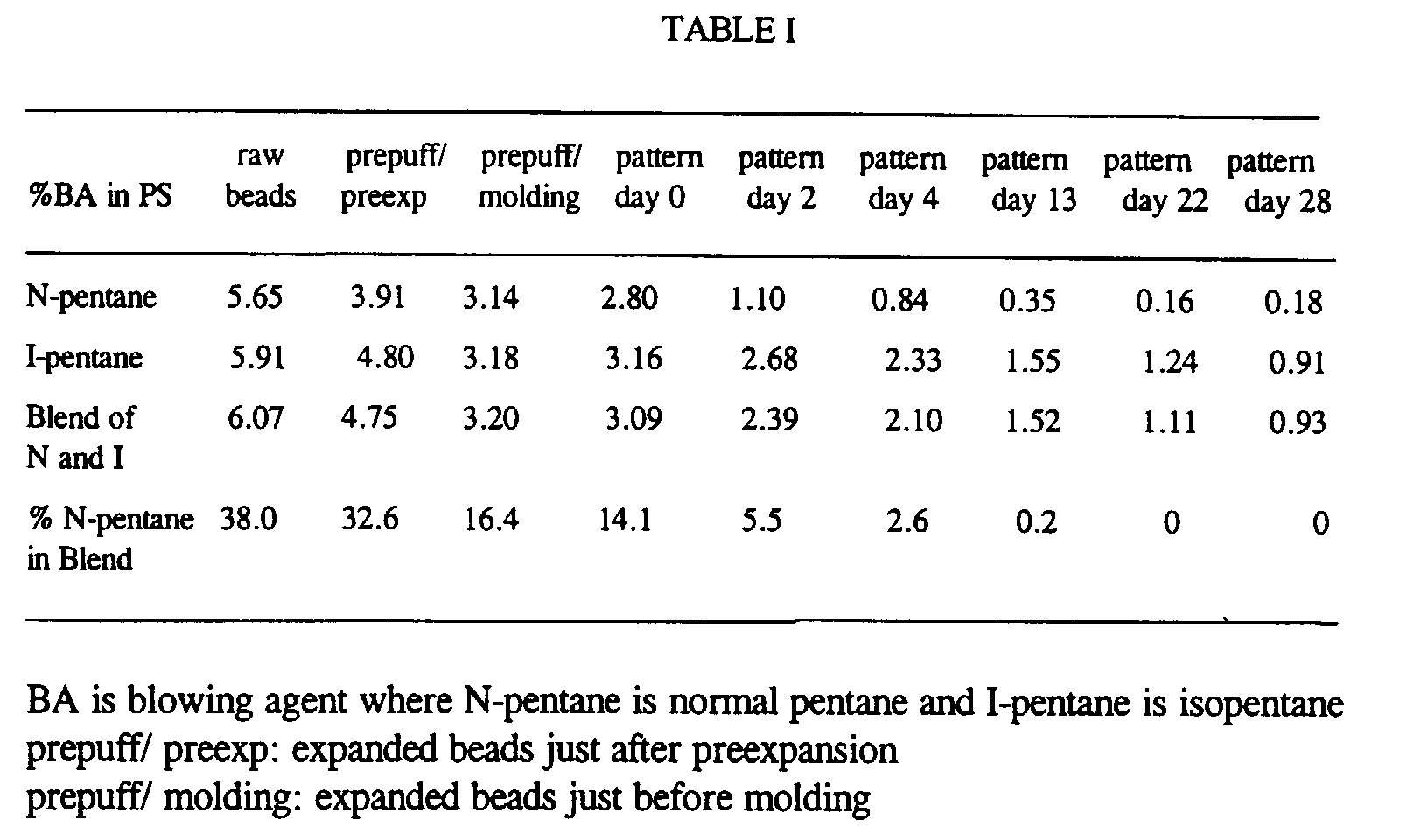
- Table I shows the blowing agent weight percentage as well as percentage of normal pentane in the blend in the raw and pre-expanded polystyrene beads and in the molded patterns as a function of aging time.
- the data of Table I was obtained with a gas chromatograph. The loss of blowing agent out of the patterns is graphically shown in Figure 2.
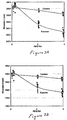
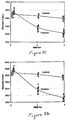
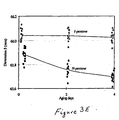
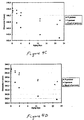
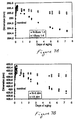
- Figures 3A through 3E and Figures 4A through 4E The changes in the five dimensions with aging at room temperature are shown in Figures 3A through 3E and Figures 4A through 4E.
- Figures 3A-3E include all data points for the 15 patterns for the first four days of aging.
- Figures 4A-4E show the average dimensions for 24 aging days.
- the foam patterns shrink in an exponential manner with aging time, and a strong dependence of shrink rate with blowing agent type was observed.
- the isopentane containing patterns shrink more slowly than the normal pentane containing patterns.
- the molded patterns with the blend of normal pentane and isopentane shrink in a manner similar to the patterns containing the isopentane blowing agent.
- the difference in shrink rates between the isopentane containing patterns and the normal pentane containing patterns is striking for the first 4 days of aging. If one can tolerate the amount of shrinkage that occurs in the normal pentane containing patterns over four aging days, then the isopentane containing patterns could be stored for up to 22 days with the same dimensional change, Figures 4A-4E, thereby providing an extended pattern shelf life as compared to normal pentane containing patterns.
- the change in dimensions of the foam patterns containing normal pentane is over four times greater than the change for foam patterns containing isopentane after four aging days.
- Figures 5A through 5E display graphs of the average pattern dimensions as a function of pattern blowing agent. A linear relationship was observed between naturally aged pattern dimensions and pattern pentane content, confirming that pattern shrinkage is dependent on blowing agent diffusion.
- the blowing agent concentration exerts a strong influence on its diffusion rate. That is, using a slow diffusing isopentane blowing agent is an advantage when one compares shrink rates of the foam patterns with similar levels of other blowing agents.
- concentration of the blowing agent in the expanded beads prior to molding and of the patterns exiting the molding machine was about 3% by weight regardless of the type of blowing agent used.
- concentration of isopentane in pre-expanded beads can be reduced using a pentane reduction step as described in US Patent 5 385 698, the teachings of which are incorporated herein by reference.
- Experimental raw EPS T type beads pursuant to the invention contained isopentane as the blowing agent and were provided by Styrochem International Corporation, Fort Worth, Texas.
- the isopentane concentration of the raw EPS beads was 6.27% by weight.
- the beads were preexpanded in a Styrologic wet preexpander to a density between 1.27 and 1.31 pcf (pounds per cubic foot).
- the preexpanded beads were subjected to a isopentane reduction treatment as described in US Patent 5 385 698 at 170 degrees F for the first three hours and 180 degrees F for the next seven hours.
- the decrease of isopentane content with aging time of the treatment is shown in Figure 6.
- the isopentane concentrations were obtained by comparing the weight of the beads before and after aging at 200 degrees C for 15 minutes.
- the isopentane content was reduced from 5.3% to 3.15% by weight in ten hours. This time can be reduced by use of EPS beads including the 40% by weight normal pentane and 60% by weight isopentane blowing agents described above.
- Water jacket patterns were molded using water jacket tooling for a vehicle cylinder block and were used to compare the initial pattern dimensions and the pattern shrink rates.
- Five EPS water jacket patterns were molded with the expanded beads having isopentane as the blowing agent (3.15% by weight isopentane) and five were molded with the expanded beads having normal pentane as the blowing agent (3.69% by weight normal pentane).
- the patterns were aged at room temperature for eight days, while four dimensions per pattern were monitored as a function of aging time. These dimensions were bore 1 to bore 4 dimension (bore center to bore center in the x-direction), the average length (x dimension), the average height (y dimension), and the avenge width (z dimension).
- An entire cylinder block cluster was assembled for lost foam casting and comprised a waterjacket pattern, a crankcase pattern, a bore pattern, and gating, with the patterns being glued together.
- Four EPS water jackets and four EPS crankcases were molded with the expanded beads having isopentane as the blowing agent (3.15% by weight).
- four EPS water jackets and four EPS crankcases were molded with the expanded beads having the normal pentane as the blowing agent (3.69% by weight).
- the patterns were aged less than a day before being assembled.
- Four clusters were assembled using the isopentane waterjacket and crankcase patterns, and four clusters were assembled using the conventional normal pentane waterjacket and crankcase patterns.
- the bore and gating used in all clusters were molded from conventional normal pentane containing polystyrene beads.
- the clusters were coated with the commercially available refractory coating Borden SK 400 available from Borden Packaging and Industrial Products, Westchester, Illinois.
- the eight coated clusters were embedded in dry foundry sand and gravity cast with molten aluminum alloy LF-319.2 at a melt temperature of 1385 degrees F.
- the average fill times were 39-40 seconds for the clusters including waterjacket and crankcase patterns molded from the EPS beads with isopentane blowing agent versus 37-38 seconds for the clusters including waterjacket and crankcase patterns molded from the EPS beads with normal pentane blowing agent.
- the castings produced using the clusters including waterjacket and crankcase patterns molded from the EPS beads with isopentane blowing agent were equivalent in visual appearance to the castings using the clusters including waterjacket and crankcase patterns molded from the EPS beads with normal pentane blowing agent.
- the present invention provides dimensionally self-stabilized patterns that exhibit an extended shelf life before pattern shrinkage occurs beyond a preselected pattern shrinkage tolerance.
- the patterns can be used in the lost foam casting process during this extended shelf life without the need for any intermediate stabilizing treatment, such as long term ambient aging, accelerated oven aging, or accelerated vacuum treatment, used heretofore to stabilize post-molding pattern dimensions. Alternately, the patterns can be used shortly after molding to produce more accurate or closer tolerance lost foam castings by virtue of the patterns exhibiting reduced shrinkage rate.
- patterns which have been aged for different periods of time for example, 1 day and 5 days, can be assembled with good match at the joint.
Landscapes
- Engineering & Computer Science (AREA)
- Mechanical Engineering (AREA)
- Manufacture Of Porous Articles, And Recovery And Treatment Of Waste Products (AREA)
- Molds, Cores, And Manufacturing Methods Thereof (AREA)
Abstract
Description
An object of the present invention is to provide a method of lost foam casting using an improved dimensionally self-stabilized polystyrene foam pattern that permits direct use of the pattern in the lost foam casting of molten metal without the need for the post-molding, dimension-stabilizing pattern treatments described above.
Claims (14)
- A method of lost foam casting, comprising:molding a foam pattern from polystyrene beads expanded from raw polystyrene beads that have a raw bead diameter from about 0.1 to about 0.6 millimeters and that include a relatively slow-diffusing blowing agent present in an amount of at least about 40% by weight of blowing agent in said raw beads to render said pattern inherently more dimensionally stable over time, andcasting a molten metal or alloy to replace said pattern.
- The method of claim 1 wherein said relatively slow-diffusing blowing agent is present in said raw beads together with a relatively fash-diffusing blowing agent comprising normal pentane.
- The method of claim 1 wherein said slow-diffusing blowing agent comprises about 50% to 70% by weight of blowing agent present in said raw beads.
- The method of claim 1 wherein said slow-diffusing blowing agent comprises about 60% by weight and the fast-diffusing blowing agent comprises about 40% by weight of the total of blowing agent present in said raw beads.
- The method of claim 1 wherein said relatively slow-diffusing blowing agent comprises substantially 100% by weight isopentane.
- The method of claim 1 wherein said relatively slow-diffusing blowing agent is selected from the group consisting essentially of isopentane, 2,2-dimethyl propane (neopentane), cyclopentane, 2,2 di-methylbutane, 2,3 di-methylbutane, hexane, cyclohexane, 2-methyl pentane, 3-methyl pentane and mixtures of one with another.
- A method of lost foam casting, comprising:molding a foam pattern from polystyrene beads expanded from raw polystyrene beads that have a raw bead diameter from about 0.1 to about 0.6 millimeters and that include isopentane blowing agent present in an amount of at least 40% by weight of blowing agent in said raw beads to render said pattern inherently more dimensionally stable over time, andcasting a molten metal or alloy to replace said pattern.
- The method of claim 7 wherein said isopentane blowing agent is present in said raw beads together with a normal pentane blowing agent, said isopentane blowing agent being present in an amount of 40% or more of blowing agent in said raw beads.
- A polystyrene foam pattern for use in lost foam metal casting molded from polystyrene beads expanded from raw polystyrene beads that have a raw bead diameter from about 0.1 to about 0.6 millimeters and that include a relatively slow-diffusing blowing agent present in an amount of at least about 40 % by weight or more of blowing agent in said raw beads.
- The pattern of claim 9 wherein said relatively slow-diffusing blowing agent is present in said raw beads together with a relatively fast-diffusing blowing agent comprising normal pentane.
- The pattern of claim 9 wherein said slow-diffusing blowing agent comprises about 50% to 70% by weight of blowing agent present in said raw beads.
- The pattern of claim 9 wherein said slow-diffusing blowing agent comprises about 60% by weight and the fast-diffusing blowing agent comprises about 40% by weight of the total of the blowing agents present in said raw beads.
- The pattern of claim 9 wherein said relatively slow-diffusing blowing agent comprises substantially 100% by weight isopentane.
- The pattern of claim 9 wherein said relatively slow-diffusing blowing agent is selected from the group consisting essentially of isopentane, 2,2-dimethyl propane (neopentane), cyclopentane, 2,2 di-methylbutane, 2,3 di-methylbutane, hexane, cyclohexane, 2-methyl pentane, 3-methyl pentane and mixtures of one with another.
Applications Claiming Priority (2)
| Application Number | Priority Date | Filing Date | Title |
|---|---|---|---|
| US09/276,857 US6263950B1 (en) | 1999-03-26 | 1999-03-26 | Lost foam casting using dimensionally self-stabilized pattern |
| US276857 | 1999-03-26 |
Publications (3)
| Publication Number | Publication Date |
|---|---|
| EP1038610A2 true EP1038610A2 (en) | 2000-09-27 |
| EP1038610A3 EP1038610A3 (en) | 2004-04-21 |
| EP1038610B1 EP1038610B1 (en) | 2005-10-26 |
Family
ID=23058359
Family Applications (1)
| Application Number | Title | Priority Date | Filing Date |
|---|---|---|---|
| EP00101080A Expired - Lifetime EP1038610B1 (en) | 1999-03-26 | 2000-01-20 | Lost foam casting using dimensionally self-stabilized pattern |
Country Status (3)
| Country | Link |
|---|---|
| US (1) | US6263950B1 (en) |
| EP (1) | EP1038610B1 (en) |
| DE (1) | DE60023382T2 (en) |
Cited By (1)
| Publication number | Priority date | Publication date | Assignee | Title |
|---|---|---|---|---|
| CN110330751A (en) * | 2019-07-16 | 2019-10-15 | 波尔玛(辛集)保温材料有限公司 | A kind of dispellable mould casting expandability gasification mold materials and preparation method thereof |
Families Citing this family (2)
| Publication number | Priority date | Publication date | Assignee | Title |
|---|---|---|---|---|
| GB0206136D0 (en) * | 2002-03-15 | 2002-04-24 | Rolls Royce Plc | Improvements in or relating to cellular materials |
| US10046382B2 (en) | 2013-11-15 | 2018-08-14 | General Electric Company | System and method for forming a low alloy steel casting |
Family Cites Families (16)
| Publication number | Priority date | Publication date | Assignee | Title |
|---|---|---|---|---|
| BE532626A (en) | 1953-11-24 | |||
| US3027334A (en) | 1960-05-19 | 1962-03-27 | Koppers Co Inc | Foamable styrene polymer particles containing isopentane as the blowing agent and method of making same |
| US3060138A (en) | 1960-05-19 | 1962-10-23 | Koppers Co Inc | Foamable polystyrene particles containing isopentane and paraffinic hydrocarbon and process of making same |
| US3027335A (en) | 1960-05-19 | 1962-03-27 | Koppers Co Inc | Foamable styrene polymer particles containing isopentane as the blowing agent and method of making same |
| US3505248A (en) * | 1964-11-16 | 1970-04-07 | Dow Chemical Co | Process for producing expandable styrene polymer particles |
| US4269871A (en) * | 1980-06-30 | 1981-05-26 | Arco Polymers, Inc. | Antilumping expandable styrene polymers |
| AU598026B2 (en) * | 1986-07-28 | 1990-06-14 | Dow Chemical Company, The | Methods for preparing a formed cellular plastic material pattern employed in metal casting |
| US4816199A (en) * | 1986-11-04 | 1989-03-28 | Ford Motor Company | Method of dimensionally stabilizing polystyrene patterns and the like |
| US4840759A (en) * | 1988-04-25 | 1989-06-20 | Arco Chemical Technology, Inc. | Isopentane as blowing agent to improve coffee retention in foam cups molded from expandable polystyrene |
| US5041465A (en) * | 1990-09-17 | 1991-08-20 | Arco Chemical Technology, Inc. | Reducing lustrous carbon in the lost foam process |
| KR100219125B1 (en) * | 1991-03-20 | 1999-09-01 | 알렉산더 피 반 위고 | Resin composition for making expanded thermoplastics patterns, patterns produced therefrom and their use in metal ca |
| US5385698A (en) * | 1992-04-23 | 1995-01-31 | Saturn Corporation | Dimensionally accurate expanded foam casting pattern |
| EP0634444A3 (en) * | 1993-07-12 | 1995-02-01 | Shell Int Research | Expandable beads. |
| JP3171001B2 (en) * | 1994-04-28 | 2001-05-28 | 三菱化学フォームプラスティック株式会社 | Styrenic expandable resin particles and suspension polymerization method for obtaining the same |
| US5591778A (en) * | 1995-08-14 | 1997-01-07 | Basf Aktiengesellschaft | Process for the preparation of expandable polystyrene |
| US5755271A (en) * | 1995-12-28 | 1998-05-26 | Copeland Corporation | Method for casting a scroll |
-
1999
- 1999-03-26 US US09/276,857 patent/US6263950B1/en not_active Expired - Fee Related
-
2000
- 2000-01-20 DE DE60023382T patent/DE60023382T2/en not_active Expired - Lifetime
- 2000-01-20 EP EP00101080A patent/EP1038610B1/en not_active Expired - Lifetime
Cited By (1)
| Publication number | Priority date | Publication date | Assignee | Title |
|---|---|---|---|---|
| CN110330751A (en) * | 2019-07-16 | 2019-10-15 | 波尔玛(辛集)保温材料有限公司 | A kind of dispellable mould casting expandability gasification mold materials and preparation method thereof |
Also Published As
| Publication number | Publication date |
|---|---|
| DE60023382T2 (en) | 2006-07-06 |
| EP1038610A3 (en) | 2004-04-21 |
| EP1038610B1 (en) | 2005-10-26 |
| DE60023382D1 (en) | 2005-12-01 |
| US6263950B1 (en) | 2001-07-24 |
Similar Documents
| Publication | Publication Date | Title |
|---|---|---|
| US4929645A (en) | Expandable and expanded plastic materials and methods for casting metal castings employing such expanded cellular plastic materials | |
| EP1038610B1 (en) | Lost foam casting using dimensionally self-stabilized pattern | |
| US5041465A (en) | Reducing lustrous carbon in the lost foam process | |
| CA1119771A (en) | Method of making and using a ceramic shell mold | |
| US5035275A (en) | Method of controlling the pyrolysis rate of a plastic foam | |
| JPH01205845A (en) | Manufacture of pattern used for manufacturing metallic casting | |
| CA1279454C (en) | Method of dimensionally stabilizing polystyrene patterns and the like | |
| DE69211738T2 (en) | Resin composition for the production of thermoplastic lost models, these models and their use in metal casting | |
| US5053437A (en) | Expandable and expanded plastic materials and methods for casting metal castings employing such expanded cellular plastic materials | |
| EP0149212B1 (en) | Method for the production of lost casting patterns for full mould casting out of expanded foam beads, preferably for the manufacture of mass-produced parts | |
| JPS60158946A (en) | Method and device for manufacturing disappearing mold model for full molding method consisting of expanded foam bead, particularly for manufacturing continuous casting part | |
| EP0535854A1 (en) | Moulds | |
| CA1302647C (en) | Expandable and expanded plastic materials and methods for casting metal castings employing such expanded cellular plastic materials | |
| EP0426372A1 (en) | Controlling pyrolysis rate of plastic foam molding | |
| DE112018000344T5 (en) | CASTED ALUMINUM OR MAGNESIUM CREAM INSERT | |
| US6006818A (en) | Expanded or expansible plastic material for the fabrication of sunk foundry models and sunk models comprised of such material | |
| JPH0227060B2 (en) | ||
| JPS6160239A (en) | Production of casting mold | |
| JPH09182935A (en) | Lost foam pattern for casting, manufacture thereof and casting method | |
| JP2002143985A (en) | Foaming block body for casting lost foam pattern | |
| RU2116862C1 (en) | Method for manufacturing combined investment pattern | |
| US4936762A (en) | Test mold | |
| JP2000290087A (en) | Curing method for concrete products | |
| JP2004114114A (en) | Foamed particle for biodegradable lost pattern, and molding foamed body | |
| JP3865937B2 (en) | Molding method of foam molded article |
Legal Events
| Date | Code | Title | Description |
|---|---|---|---|
| PUAI | Public reference made under article 153(3) epc to a published international application that has entered the european phase |
Free format text: ORIGINAL CODE: 0009012 |
|
| AK | Designated contracting states |
Kind code of ref document: A2 Designated state(s): AT BE CH CY DE DK ES FI FR GB GR IE IT LI LU MC NL PT SE |
|
| AX | Request for extension of the european patent |
Free format text: AL;LT;LV;MK;RO;SI |
|
| PUAL | Search report despatched |
Free format text: ORIGINAL CODE: 0009013 |
|
| RIC1 | Information provided on ipc code assigned before grant |
Ipc: 7C 08J 9/232 B Ipc: 7C 08J 9/14 B Ipc: 7B 22C 7/02 A |
|
| AK | Designated contracting states |
Kind code of ref document: A3 Designated state(s): AT BE CH CY DE DK ES FI FR GB GR IE IT LI LU MC NL PT SE |
|
| AX | Request for extension of the european patent |
Extension state: AL LT LV MK RO SI |
|
| 17P | Request for examination filed |
Effective date: 20040614 |
|
| AKX | Designation fees paid |
Designated state(s): DE |
|
| GRAP | Despatch of communication of intention to grant a patent |
Free format text: ORIGINAL CODE: EPIDOSNIGR1 |
|
| GRAP | Despatch of communication of intention to grant a patent |
Free format text: ORIGINAL CODE: EPIDOSNIGR1 |
|
| GRAS | Grant fee paid |
Free format text: ORIGINAL CODE: EPIDOSNIGR3 |
|
| GRAA | (expected) grant |
Free format text: ORIGINAL CODE: 0009210 |
|
| AK | Designated contracting states |
Kind code of ref document: B1 Designated state(s): DE |
|
| REF | Corresponds to: |
Ref document number: 60023382 Country of ref document: DE Date of ref document: 20051201 Kind code of ref document: P |
|
| PLBE | No opposition filed within time limit |
Free format text: ORIGINAL CODE: 0009261 |
|
| STAA | Information on the status of an ep patent application or granted ep patent |
Free format text: STATUS: NO OPPOSITION FILED WITHIN TIME LIMIT |
|
| 26N | No opposition filed |
Effective date: 20060727 |
|
| PGFP | Annual fee paid to national office [announced via postgrant information from national office to epo] |
Ref country code: DE Payment date: 20110112 Year of fee payment: 12 |
|
| REG | Reference to a national code |
Ref country code: DE Ref legal event code: R081 Ref document number: 60023382 Country of ref document: DE Owner name: GENERAL MOTORS LLC ( N. D. GES. D. STAATES DEL, US Free format text: FORMER OWNER: GENERAL MOTORS COMPANY, DETROIT, US Effective date: 20110428 Ref country code: DE Ref legal event code: R081 Ref document number: 60023382 Country of ref document: DE Owner name: GENERAL MOTORS LLC ( N. D. GES. D. STAATES DEL, US Free format text: FORMER OWNER: GENERAL MOTORS COMPANY, DETROIT, MICH., US Effective date: 20110428 |
|
| PG25 | Lapsed in a contracting state [announced via postgrant information from national office to epo] |
Ref country code: DE Free format text: LAPSE BECAUSE OF NON-PAYMENT OF DUE FEES Effective date: 20120801 |
|
| REG | Reference to a national code |
Ref country code: DE Ref legal event code: R119 Ref document number: 60023382 Country of ref document: DE Effective date: 20120801 |