EP1036812A1 - Method for coating wax or resin particles with metallic soap - Google Patents
Method for coating wax or resin particles with metallic soap Download PDFInfo
- Publication number
- EP1036812A1 EP1036812A1 EP00105546A EP00105546A EP1036812A1 EP 1036812 A1 EP1036812 A1 EP 1036812A1 EP 00105546 A EP00105546 A EP 00105546A EP 00105546 A EP00105546 A EP 00105546A EP 1036812 A1 EP1036812 A1 EP 1036812A1
- Authority
- EP
- European Patent Office
- Prior art keywords
- water
- wax
- dispersion
- resin particles
- particles
- Prior art date
- Legal status (The legal status is an assumption and is not a legal conclusion. Google has not performed a legal analysis and makes no representation as to the accuracy of the status listed.)
- Granted
Links
- 239000002245 particle Substances 0.000 title claims abstract description 171
- 239000000344 soap Substances 0.000 title claims abstract description 120
- 239000011347 resin Substances 0.000 title claims abstract description 97
- 229920005989 resin Polymers 0.000 title claims abstract description 97
- 238000000034 method Methods 0.000 title claims abstract description 71
- 238000000576 coating method Methods 0.000 title claims abstract description 52
- 239000011248 coating agent Substances 0.000 title claims abstract description 51
- 239000006185 dispersion Substances 0.000 claims abstract description 149
- XLYOFNOQVPJJNP-UHFFFAOYSA-N water Substances O XLYOFNOQVPJJNP-UHFFFAOYSA-N 0.000 claims abstract description 106
- 235000014113 dietary fatty acids Nutrition 0.000 claims abstract description 58
- 239000000194 fatty acid Substances 0.000 claims abstract description 58
- 229930195729 fatty acid Natural products 0.000 claims abstract description 58
- 150000004665 fatty acids Chemical class 0.000 claims abstract description 55
- 150000002736 metal compounds Chemical class 0.000 claims abstract description 31
- 239000007864 aqueous solution Substances 0.000 claims abstract description 15
- 238000002156 mixing Methods 0.000 claims description 36
- 239000001993 wax Substances 0.000 description 92
- 239000007788 liquid Substances 0.000 description 35
- 230000000052 comparative effect Effects 0.000 description 20
- 239000000839 emulsion Substances 0.000 description 18
- 239000000203 mixture Substances 0.000 description 16
- -1 alkali metal salt Chemical class 0.000 description 11
- 238000002844 melting Methods 0.000 description 11
- 230000008018 melting Effects 0.000 description 11
- 229910052751 metal Inorganic materials 0.000 description 10
- 239000002184 metal Substances 0.000 description 10
- 229910021645 metal ion Inorganic materials 0.000 description 10
- JMANVNJQNLATNU-UHFFFAOYSA-N oxalonitrile Chemical compound N#CC#N JMANVNJQNLATNU-UHFFFAOYSA-N 0.000 description 10
- 238000013019 agitation Methods 0.000 description 9
- 238000006243 chemical reaction Methods 0.000 description 8
- 238000000635 electron micrograph Methods 0.000 description 8
- 239000000178 monomer Substances 0.000 description 8
- 239000011369 resultant mixture Substances 0.000 description 8
- 239000011859 microparticle Substances 0.000 description 7
- 238000002360 preparation method Methods 0.000 description 7
- IJGRMHOSHXDMSA-UHFFFAOYSA-N Atomic nitrogen Chemical compound N#N IJGRMHOSHXDMSA-UHFFFAOYSA-N 0.000 description 6
- 238000001035 drying Methods 0.000 description 6
- LFQSCWFLJHTTHZ-UHFFFAOYSA-N Ethanol Chemical compound CCO LFQSCWFLJHTTHZ-UHFFFAOYSA-N 0.000 description 5
- SMLXTTLNOGQHHB-UHFFFAOYSA-N [3-docosanoyloxy-2,2-bis(docosanoyloxymethyl)propyl] docosanoate Chemical compound CCCCCCCCCCCCCCCCCCCCCC(=O)OCC(COC(=O)CCCCCCCCCCCCCCCCCCCCC)(COC(=O)CCCCCCCCCCCCCCCCCCCCC)COC(=O)CCCCCCCCCCCCCCCCCCCCC SMLXTTLNOGQHHB-UHFFFAOYSA-N 0.000 description 5
- 239000002253 acid Substances 0.000 description 5
- 230000000903 blocking effect Effects 0.000 description 5
- 238000007796 conventional method Methods 0.000 description 5
- 238000004945 emulsification Methods 0.000 description 5
- 238000004519 manufacturing process Methods 0.000 description 5
- 239000000049 pigment Substances 0.000 description 5
- 238000001291 vacuum drying Methods 0.000 description 5
- VEXZGXHMUGYJMC-UHFFFAOYSA-N Hydrochloric acid Chemical compound Cl VEXZGXHMUGYJMC-UHFFFAOYSA-N 0.000 description 4
- XEEYBQQBJWHFJM-UHFFFAOYSA-N Iron Chemical compound [Fe] XEEYBQQBJWHFJM-UHFFFAOYSA-N 0.000 description 4
- PXHVJJICTQNCMI-UHFFFAOYSA-N Nickel Chemical compound [Ni] PXHVJJICTQNCMI-UHFFFAOYSA-N 0.000 description 4
- PPBRXRYQALVLMV-UHFFFAOYSA-N Styrene Chemical compound C=CC1=CC=CC=C1 PPBRXRYQALVLMV-UHFFFAOYSA-N 0.000 description 4
- 239000000654 additive Substances 0.000 description 4
- 230000000996 additive effect Effects 0.000 description 4
- 125000004432 carbon atom Chemical group C* 0.000 description 4
- 238000010556 emulsion polymerization method Methods 0.000 description 4
- 150000002739 metals Chemical class 0.000 description 4
- 239000000843 powder Substances 0.000 description 4
- 230000008569 process Effects 0.000 description 4
- 150000003839 salts Chemical class 0.000 description 4
- PBWGCNFJKNQDGV-UHFFFAOYSA-N 6-phenylimidazo[2,1-b][1,3]thiazol-5-amine Chemical compound N1=C2SC=CN2C(N)=C1C1=CC=CC=C1 PBWGCNFJKNQDGV-UHFFFAOYSA-N 0.000 description 3
- 229910052783 alkali metal Inorganic materials 0.000 description 3
- 229940090958 behenyl behenate Drugs 0.000 description 3
- 239000011575 calcium Substances 0.000 description 3
- CJZGTCYPCWQAJB-UHFFFAOYSA-L calcium stearate Chemical compound [Ca+2].CCCCCCCCCCCCCCCCCC([O-])=O.CCCCCCCCCCCCCCCCCC([O-])=O CJZGTCYPCWQAJB-UHFFFAOYSA-L 0.000 description 3
- 239000008116 calcium stearate Substances 0.000 description 3
- 235000013539 calcium stearate Nutrition 0.000 description 3
- 239000003795 chemical substances by application Substances 0.000 description 3
- KHAVLLBUVKBTBG-UHFFFAOYSA-N dec-9-enoic acid Chemical compound OC(=O)CCCCCCCC=C KHAVLLBUVKBTBG-UHFFFAOYSA-N 0.000 description 3
- 238000001914 filtration Methods 0.000 description 3
- 239000000314 lubricant Substances 0.000 description 3
- 229910052757 nitrogen Inorganic materials 0.000 description 3
- 150000002894 organic compounds Chemical class 0.000 description 3
- 239000012188 paraffin wax Substances 0.000 description 3
- 239000002002 slurry Substances 0.000 description 3
- 239000012798 spherical particle Substances 0.000 description 3
- 238000010557 suspension polymerization reaction Methods 0.000 description 3
- 230000000007 visual effect Effects 0.000 description 3
- YWWVWXASSLXJHU-AATRIKPKSA-N (9E)-tetradecenoic acid Chemical compound CCCC\C=C\CCCCCCCC(O)=O YWWVWXASSLXJHU-AATRIKPKSA-N 0.000 description 2
- XDOFQFKRPWOURC-UHFFFAOYSA-N 16-methylheptadecanoic acid Chemical compound CC(C)CCCCCCCCCCCCCCC(O)=O XDOFQFKRPWOURC-UHFFFAOYSA-N 0.000 description 2
- SOGAXMICEFXMKE-UHFFFAOYSA-N Butylmethacrylate Chemical compound CCCCOC(=O)C(C)=C SOGAXMICEFXMKE-UHFFFAOYSA-N 0.000 description 2
- FERIUCNNQQJTOY-UHFFFAOYSA-N Butyric acid Chemical compound CCCC(O)=O FERIUCNNQQJTOY-UHFFFAOYSA-N 0.000 description 2
- OYPRJOBELJOOCE-UHFFFAOYSA-N Calcium Chemical compound [Ca] OYPRJOBELJOOCE-UHFFFAOYSA-N 0.000 description 2
- RYGMFSIKBFXOCR-UHFFFAOYSA-N Copper Chemical compound [Cu] RYGMFSIKBFXOCR-UHFFFAOYSA-N 0.000 description 2
- ROSDSFDQCJNGOL-UHFFFAOYSA-N Dimethylamine Chemical compound CNC ROSDSFDQCJNGOL-UHFFFAOYSA-N 0.000 description 2
- QUSNBJAOOMFDIB-UHFFFAOYSA-N Ethylamine Chemical compound CCN QUSNBJAOOMFDIB-UHFFFAOYSA-N 0.000 description 2
- DGAQECJNVWCQMB-PUAWFVPOSA-M Ilexoside XXIX Chemical compound C[C@@H]1CC[C@@]2(CC[C@@]3(C(=CC[C@H]4[C@]3(CC[C@@H]5[C@@]4(CC[C@@H](C5(C)C)OS(=O)(=O)[O-])C)C)[C@@H]2[C@]1(C)O)C)C(=O)O[C@H]6[C@@H]([C@H]([C@@H]([C@H](O6)CO)O)O)O.[Na+] DGAQECJNVWCQMB-PUAWFVPOSA-M 0.000 description 2
- FYYHWMGAXLPEAU-UHFFFAOYSA-N Magnesium Chemical compound [Mg] FYYHWMGAXLPEAU-UHFFFAOYSA-N 0.000 description 2
- BAVYZALUXZFZLV-UHFFFAOYSA-N Methylamine Chemical compound NC BAVYZALUXZFZLV-UHFFFAOYSA-N 0.000 description 2
- KDLHZDBZIXYQEI-UHFFFAOYSA-N Palladium Chemical compound [Pd] KDLHZDBZIXYQEI-UHFFFAOYSA-N 0.000 description 2
- NBIIXXVUZAFLBC-UHFFFAOYSA-N Phosphoric acid Chemical compound OP(O)(O)=O NBIIXXVUZAFLBC-UHFFFAOYSA-N 0.000 description 2
- ZLMJMSJWJFRBEC-UHFFFAOYSA-N Potassium Chemical compound [K] ZLMJMSJWJFRBEC-UHFFFAOYSA-N 0.000 description 2
- BQCADISMDOOEFD-UHFFFAOYSA-N Silver Chemical compound [Ag] BQCADISMDOOEFD-UHFFFAOYSA-N 0.000 description 2
- QAOWNCQODCNURD-UHFFFAOYSA-N Sulfuric acid Chemical compound OS(O)(=O)=O QAOWNCQODCNURD-UHFFFAOYSA-N 0.000 description 2
- ATJFFYVFTNAWJD-UHFFFAOYSA-N Tin Chemical compound [Sn] ATJFFYVFTNAWJD-UHFFFAOYSA-N 0.000 description 2
- HCHKCACWOHOZIP-UHFFFAOYSA-N Zinc Chemical compound [Zn] HCHKCACWOHOZIP-UHFFFAOYSA-N 0.000 description 2
- 230000032683 aging Effects 0.000 description 2
- MBMBGCFOFBJSGT-KUBAVDMBSA-N all-cis-docosa-4,7,10,13,16,19-hexaenoic acid Chemical compound CC\C=C/C\C=C/C\C=C/C\C=C/C\C=C/C\C=C/CCC(O)=O MBMBGCFOFBJSGT-KUBAVDMBSA-N 0.000 description 2
- YZXBAPSDXZZRGB-DOFZRALJSA-N arachidonic acid Chemical compound CCCCC\C=C/C\C=C/C\C=C/C\C=C/CCCC(O)=O YZXBAPSDXZZRGB-DOFZRALJSA-N 0.000 description 2
- 229910052788 barium Inorganic materials 0.000 description 2
- DSAJWYNOEDNPEQ-UHFFFAOYSA-N barium atom Chemical compound [Ba] DSAJWYNOEDNPEQ-UHFFFAOYSA-N 0.000 description 2
- 229910052791 calcium Inorganic materials 0.000 description 2
- 229910052802 copper Inorganic materials 0.000 description 2
- 239000010949 copper Substances 0.000 description 2
- 239000002537 cosmetic Substances 0.000 description 2
- GHVNFZFCNZKVNT-UHFFFAOYSA-N decanoic acid Chemical compound CCCCCCCCCC(O)=O GHVNFZFCNZKVNT-UHFFFAOYSA-N 0.000 description 2
- 238000009826 distribution Methods 0.000 description 2
- UKMSUNONTOPOIO-UHFFFAOYSA-N docosanoic acid Chemical compound CCCCCCCCCCCCCCCCCCCCCC(O)=O UKMSUNONTOPOIO-UHFFFAOYSA-N 0.000 description 2
- POULHZVOKOAJMA-UHFFFAOYSA-N dodecanoic acid Chemical compound CCCCCCCCCCCC(O)=O POULHZVOKOAJMA-UHFFFAOYSA-N 0.000 description 2
- 239000003814 drug Substances 0.000 description 2
- 238000007720 emulsion polymerization reaction Methods 0.000 description 2
- 239000010419 fine particle Substances 0.000 description 2
- XMHIUKTWLZUKEX-UHFFFAOYSA-N hexacosanoic acid Chemical compound CCCCCCCCCCCCCCCCCCCCCCCCCC(O)=O XMHIUKTWLZUKEX-UHFFFAOYSA-N 0.000 description 2
- IPCSVZSSVZVIGE-UHFFFAOYSA-N hexadecanoic acid Chemical compound CCCCCCCCCCCCCCCC(O)=O IPCSVZSSVZVIGE-UHFFFAOYSA-N 0.000 description 2
- FUZZWVXGSFPDMH-UHFFFAOYSA-N hexanoic acid Chemical compound CCCCCC(O)=O FUZZWVXGSFPDMH-UHFFFAOYSA-N 0.000 description 2
- 239000003999 initiator Substances 0.000 description 2
- 229910052742 iron Inorganic materials 0.000 description 2
- 230000001050 lubricating effect Effects 0.000 description 2
- 229910052749 magnesium Inorganic materials 0.000 description 2
- 239000011777 magnesium Substances 0.000 description 2
- WPBNNNQJVZRUHP-UHFFFAOYSA-L manganese(2+);methyl n-[[2-(methoxycarbonylcarbamothioylamino)phenyl]carbamothioyl]carbamate;n-[2-(sulfidocarbothioylamino)ethyl]carbamodithioate Chemical compound [Mn+2].[S-]C(=S)NCCNC([S-])=S.COC(=O)NC(=S)NC1=CC=CC=C1NC(=S)NC(=O)OC WPBNNNQJVZRUHP-UHFFFAOYSA-L 0.000 description 2
- 239000003094 microcapsule Substances 0.000 description 2
- 229910052759 nickel Inorganic materials 0.000 description 2
- WWZKQHOCKIZLMA-UHFFFAOYSA-N octanoic acid Chemical compound CCCCCCCC(O)=O WWZKQHOCKIZLMA-UHFFFAOYSA-N 0.000 description 2
- SECPZKHBENQXJG-FPLPWBNLSA-N palmitoleic acid Chemical compound CCCCCC\C=C/CCCCCCCC(O)=O SECPZKHBENQXJG-FPLPWBNLSA-N 0.000 description 2
- VLTRZXGMWDSKGL-UHFFFAOYSA-N perchloric acid Chemical compound OCl(=O)(=O)=O VLTRZXGMWDSKGL-UHFFFAOYSA-N 0.000 description 2
- 229920001225 polyester resin Polymers 0.000 description 2
- 239000004645 polyester resin Substances 0.000 description 2
- 239000003505 polymerization initiator Substances 0.000 description 2
- 238000006116 polymerization reaction Methods 0.000 description 2
- 229910052700 potassium Inorganic materials 0.000 description 2
- 239000011591 potassium Substances 0.000 description 2
- 229940114930 potassium stearate Drugs 0.000 description 2
- ANBFRLKBEIFNQU-UHFFFAOYSA-M potassium;octadecanoate Chemical compound [K+].CCCCCCCCCCCCCCCCCC([O-])=O ANBFRLKBEIFNQU-UHFFFAOYSA-M 0.000 description 2
- 238000012545 processing Methods 0.000 description 2
- WGYKZJWCGVVSQN-UHFFFAOYSA-N propylamine Chemical compound CCCN WGYKZJWCGVVSQN-UHFFFAOYSA-N 0.000 description 2
- 239000002994 raw material Substances 0.000 description 2
- 239000004576 sand Substances 0.000 description 2
- 229910052709 silver Inorganic materials 0.000 description 2
- 239000004332 silver Substances 0.000 description 2
- 239000011734 sodium Substances 0.000 description 2
- 229910052708 sodium Inorganic materials 0.000 description 2
- BTURAGWYSMTVOW-UHFFFAOYSA-M sodium dodecanoate Chemical compound [Na+].CCCCCCCCCCCC([O-])=O BTURAGWYSMTVOW-UHFFFAOYSA-M 0.000 description 2
- 229940082004 sodium laurate Drugs 0.000 description 2
- RYYKJJJTJZKILX-UHFFFAOYSA-M sodium octadecanoate Chemical compound [Na+].CCCCCCCCCCCCCCCCCC([O-])=O RYYKJJJTJZKILX-UHFFFAOYSA-M 0.000 description 2
- 239000007787 solid Substances 0.000 description 2
- 239000002904 solvent Substances 0.000 description 2
- 239000011135 tin Substances 0.000 description 2
- 229910052718 tin Inorganic materials 0.000 description 2
- QORWJWZARLRLPR-UHFFFAOYSA-H tricalcium bis(phosphate) Chemical compound [Ca+2].[Ca+2].[Ca+2].[O-]P([O-])([O-])=O.[O-]P([O-])([O-])=O QORWJWZARLRLPR-UHFFFAOYSA-H 0.000 description 2
- GETQZCLCWQTVFV-UHFFFAOYSA-N trimethylamine Chemical compound CN(C)C GETQZCLCWQTVFV-UHFFFAOYSA-N 0.000 description 2
- 125000000391 vinyl group Chemical group [H]C([*])=C([H])[H] 0.000 description 2
- 229920002554 vinyl polymer Polymers 0.000 description 2
- 238000001238 wet grinding Methods 0.000 description 2
- 229910052725 zinc Inorganic materials 0.000 description 2
- 239000011701 zinc Substances 0.000 description 2
- LRXTYHSAJDENHV-UHFFFAOYSA-H zinc phosphate Chemical compound [Zn+2].[Zn+2].[Zn+2].[O-]P([O-])([O-])=O.[O-]P([O-])([O-])=O LRXTYHSAJDENHV-UHFFFAOYSA-H 0.000 description 2
- 229910000165 zinc phosphate Inorganic materials 0.000 description 2
- OYHQOLUKZRVURQ-NTGFUMLPSA-N (9Z,12Z)-9,10,12,13-tetratritiooctadeca-9,12-dienoic acid Chemical compound C(CCCCCCC\C(=C(/C\C(=C(/CCCCC)\[3H])\[3H])\[3H])\[3H])(=O)O OYHQOLUKZRVURQ-NTGFUMLPSA-N 0.000 description 1
- WRIDQFICGBMAFQ-UHFFFAOYSA-N (E)-8-Octadecenoic acid Natural products CCCCCCCCCC=CCCCCCCC(O)=O WRIDQFICGBMAFQ-UHFFFAOYSA-N 0.000 description 1
- FRPZMMHWLSIFAZ-UHFFFAOYSA-N 10-undecenoic acid Chemical compound OC(=O)CCCCCCCCC=C FRPZMMHWLSIFAZ-UHFFFAOYSA-N 0.000 description 1
- ZDHCZVWCTKTBRY-UHFFFAOYSA-N 12-hydroxylauric acid Chemical group OCCCCCCCCCCCC(O)=O ZDHCZVWCTKTBRY-UHFFFAOYSA-N 0.000 description 1
- VILCJCGEZXAXTO-UHFFFAOYSA-N 2,2,2-tetramine Chemical compound NCCNCCNCCN VILCJCGEZXAXTO-UHFFFAOYSA-N 0.000 description 1
- HZAXFHJVJLSVMW-UHFFFAOYSA-N 2-Aminoethan-1-ol Chemical compound NCCO HZAXFHJVJLSVMW-UHFFFAOYSA-N 0.000 description 1
- WYGWHHGCAGTUCH-UHFFFAOYSA-N 2-[(2-cyano-4-methylpentan-2-yl)diazenyl]-2,4-dimethylpentanenitrile Chemical compound CC(C)CC(C)(C#N)N=NC(C)(C#N)CC(C)C WYGWHHGCAGTUCH-UHFFFAOYSA-N 0.000 description 1
- WLAMNBDJUVNPJU-UHFFFAOYSA-N 2-methylbutyric acid Chemical compound CCC(C)C(O)=O WLAMNBDJUVNPJU-UHFFFAOYSA-N 0.000 description 1
- LQJBNNIYVWPHFW-UHFFFAOYSA-N 20:1omega9c fatty acid Natural products CCCCCCCCCCC=CCCCCCCCC(O)=O LQJBNNIYVWPHFW-UHFFFAOYSA-N 0.000 description 1
- SCSIKTWVGSGLCV-UHFFFAOYSA-N 4-octadecanoyloxybutyl octadecanoate Chemical compound CCCCCCCCCCCCCCCCCC(=O)OCCCCOC(=O)CCCCCCCCCCCCCCCCC SCSIKTWVGSGLCV-UHFFFAOYSA-N 0.000 description 1
- QSBYPNXLFMSGKH-UHFFFAOYSA-N 9-Heptadecensaeure Natural products CCCCCCCC=CCCCCCCCC(O)=O QSBYPNXLFMSGKH-UHFFFAOYSA-N 0.000 description 1
- YWWVWXASSLXJHU-UHFFFAOYSA-N 9E-tetradecenoic acid Natural products CCCCC=CCCCCCCCC(O)=O YWWVWXASSLXJHU-UHFFFAOYSA-N 0.000 description 1
- 229920000178 Acrylic resin Polymers 0.000 description 1
- 239000004925 Acrylic resin Substances 0.000 description 1
- 235000021357 Behenic acid Nutrition 0.000 description 1
- DPUOLQHDNGRHBS-UHFFFAOYSA-N Brassidinsaeure Natural products CCCCCCCCC=CCCCCCCCCCCCC(O)=O DPUOLQHDNGRHBS-UHFFFAOYSA-N 0.000 description 1
- 239000005632 Capric acid (CAS 334-48-5) Substances 0.000 description 1
- 239000005635 Caprylic acid (CAS 124-07-2) Substances 0.000 description 1
- VYZAMTAEIAYCRO-UHFFFAOYSA-N Chromium Chemical compound [Cr] VYZAMTAEIAYCRO-UHFFFAOYSA-N 0.000 description 1
- RPNUMPOLZDHAAY-UHFFFAOYSA-N Diethylenetriamine Chemical compound NCCNCCN RPNUMPOLZDHAAY-UHFFFAOYSA-N 0.000 description 1
- URXZXNYJPAJJOQ-UHFFFAOYSA-N Erucic acid Natural products CCCCCCC=CCCCCCCCCCCCC(O)=O URXZXNYJPAJJOQ-UHFFFAOYSA-N 0.000 description 1
- PIICEJLVQHRZGT-UHFFFAOYSA-N Ethylenediamine Chemical compound NCCN PIICEJLVQHRZGT-UHFFFAOYSA-N 0.000 description 1
- GYHNNYVSQQEPJS-UHFFFAOYSA-N Gallium Chemical compound [Ga] GYHNNYVSQQEPJS-UHFFFAOYSA-N 0.000 description 1
- 239000013032 Hydrocarbon resin Substances 0.000 description 1
- 239000005639 Lauric acid Substances 0.000 description 1
- YIVJZNGAASQVEM-UHFFFAOYSA-N Lauroyl peroxide Chemical compound CCCCCCCCCCCC(=O)OOC(=O)CCCCCCCCCCC YIVJZNGAASQVEM-UHFFFAOYSA-N 0.000 description 1
- 235000021353 Lignoceric acid Nutrition 0.000 description 1
- CQXMAMUUWHYSIY-UHFFFAOYSA-N Lignoceric acid Natural products CCCCCCCCCCCCCCCCCCCCCCCC(=O)OCCC1=CC=C(O)C=C1 CQXMAMUUWHYSIY-UHFFFAOYSA-N 0.000 description 1
- WHXSMMKQMYFTQS-UHFFFAOYSA-N Lithium Chemical compound [Li] WHXSMMKQMYFTQS-UHFFFAOYSA-N 0.000 description 1
- ZOKXTWBITQBERF-UHFFFAOYSA-N Molybdenum Chemical compound [Mo] ZOKXTWBITQBERF-UHFFFAOYSA-N 0.000 description 1
- GRYLNZFGIOXLOG-UHFFFAOYSA-N Nitric acid Chemical compound O[N+]([O-])=O GRYLNZFGIOXLOG-UHFFFAOYSA-N 0.000 description 1
- IOVCWXUNBOPUCH-UHFFFAOYSA-N Nitrous acid Chemical compound ON=O IOVCWXUNBOPUCH-UHFFFAOYSA-N 0.000 description 1
- 239000005642 Oleic acid Substances 0.000 description 1
- ZQPPMHVWECSIRJ-UHFFFAOYSA-N Oleic acid Natural products CCCCCCCCC=CCCCCCCCC(O)=O ZQPPMHVWECSIRJ-UHFFFAOYSA-N 0.000 description 1
- 235000021314 Palmitic acid Nutrition 0.000 description 1
- 235000021319 Palmitoleic acid Nutrition 0.000 description 1
- 239000004698 Polyethylene Substances 0.000 description 1
- 239000004793 Polystyrene Substances 0.000 description 1
- 239000004372 Polyvinyl alcohol Substances 0.000 description 1
- 235000021355 Stearic acid Nutrition 0.000 description 1
- LSNNMFCWUKXFEE-UHFFFAOYSA-N Sulfurous acid Chemical compound OS(O)=O LSNNMFCWUKXFEE-UHFFFAOYSA-N 0.000 description 1
- RTAQQCXQSZGOHL-UHFFFAOYSA-N Titanium Chemical compound [Ti] RTAQQCXQSZGOHL-UHFFFAOYSA-N 0.000 description 1
- GSEJCLTVZPLZKY-UHFFFAOYSA-N Triethanolamine Chemical compound OCCN(CCO)CCO GSEJCLTVZPLZKY-UHFFFAOYSA-N 0.000 description 1
- 235000010724 Wisteria floribunda Nutrition 0.000 description 1
- QCWXUUIWCKQGHC-UHFFFAOYSA-N Zirconium Chemical compound [Zr] QCWXUUIWCKQGHC-UHFFFAOYSA-N 0.000 description 1
- 238000010521 absorption reaction Methods 0.000 description 1
- 238000004220 aggregation Methods 0.000 description 1
- 230000002776 aggregation Effects 0.000 description 1
- 150000001340 alkali metals Chemical class 0.000 description 1
- 229910052784 alkaline earth metal Inorganic materials 0.000 description 1
- 150000001342 alkaline earth metals Chemical class 0.000 description 1
- 150000003973 alkyl amines Chemical class 0.000 description 1
- DTOSIQBPPRVQHS-PDBXOOCHSA-N alpha-linolenic acid Chemical compound CC\C=C/C\C=C/C\C=C/CCCCCCCC(O)=O DTOSIQBPPRVQHS-PDBXOOCHSA-N 0.000 description 1
- 235000020661 alpha-linolenic acid Nutrition 0.000 description 1
- 229910052782 aluminium Inorganic materials 0.000 description 1
- XAGFODPZIPBFFR-UHFFFAOYSA-N aluminium Chemical compound [Al] XAGFODPZIPBFFR-UHFFFAOYSA-N 0.000 description 1
- 229910000147 aluminium phosphate Inorganic materials 0.000 description 1
- 150000001408 amides Chemical class 0.000 description 1
- 150000001412 amines Chemical class 0.000 description 1
- 150000003863 ammonium salts Chemical class 0.000 description 1
- 239000012736 aqueous medium Substances 0.000 description 1
- 229940114079 arachidonic acid Drugs 0.000 description 1
- 235000021342 arachidonic acid Nutrition 0.000 description 1
- 239000012298 atmosphere Substances 0.000 description 1
- 229940116226 behenic acid Drugs 0.000 description 1
- XMQFTWRPUQYINF-UHFFFAOYSA-N bensulfuron-methyl Chemical compound COC(=O)C1=CC=CC=C1CS(=O)(=O)NC(=O)NC1=NC(OC)=CC(OC)=N1 XMQFTWRPUQYINF-UHFFFAOYSA-N 0.000 description 1
- 229910052790 beryllium Inorganic materials 0.000 description 1
- ATBAMAFKBVZNFJ-UHFFFAOYSA-N beryllium atom Chemical compound [Be] ATBAMAFKBVZNFJ-UHFFFAOYSA-N 0.000 description 1
- 239000002981 blocking agent Substances 0.000 description 1
- 238000007664 blowing Methods 0.000 description 1
- KGBXLFKZBHKPEV-UHFFFAOYSA-N boric acid Chemical compound OB(O)O KGBXLFKZBHKPEV-UHFFFAOYSA-N 0.000 description 1
- 239000004327 boric acid Substances 0.000 description 1
- 230000005587 bubbling Effects 0.000 description 1
- CQEYYJKEWSMYFG-UHFFFAOYSA-N butyl acrylate Chemical compound CCCCOC(=O)C=C CQEYYJKEWSMYFG-UHFFFAOYSA-N 0.000 description 1
- QHIWVLPBUQWDMQ-UHFFFAOYSA-N butyl prop-2-enoate;methyl 2-methylprop-2-enoate;prop-2-enoic acid Chemical compound OC(=O)C=C.COC(=O)C(C)=C.CCCCOC(=O)C=C QHIWVLPBUQWDMQ-UHFFFAOYSA-N 0.000 description 1
- 229910052793 cadmium Inorganic materials 0.000 description 1
- BDOSMKKIYDKNTQ-UHFFFAOYSA-N cadmium atom Chemical compound [Cd] BDOSMKKIYDKNTQ-UHFFFAOYSA-N 0.000 description 1
- 239000001110 calcium chloride Substances 0.000 description 1
- 229910001628 calcium chloride Inorganic materials 0.000 description 1
- 239000001506 calcium phosphate Substances 0.000 description 1
- 229910000389 calcium phosphate Inorganic materials 0.000 description 1
- 235000011010 calcium phosphates Nutrition 0.000 description 1
- BVKZGUZCCUSVTD-UHFFFAOYSA-N carbonic acid Chemical compound OC(O)=O BVKZGUZCCUSVTD-UHFFFAOYSA-N 0.000 description 1
- MMCOUVMKNAHQOY-UHFFFAOYSA-N carbonoperoxoic acid Chemical compound OOC(O)=O MMCOUVMKNAHQOY-UHFFFAOYSA-N 0.000 description 1
- 239000004359 castor oil Substances 0.000 description 1
- 235000019438 castor oil Nutrition 0.000 description 1
- 150000001768 cations Chemical class 0.000 description 1
- 229910052804 chromium Inorganic materials 0.000 description 1
- 239000011651 chromium Substances 0.000 description 1
- SECPZKHBENQXJG-UHFFFAOYSA-N cis-palmitoleic acid Natural products CCCCCCC=CCCCCCCCC(O)=O SECPZKHBENQXJG-UHFFFAOYSA-N 0.000 description 1
- 238000004140 cleaning Methods 0.000 description 1
- 229910017052 cobalt Inorganic materials 0.000 description 1
- 239000010941 cobalt Substances 0.000 description 1
- GUTLYIVDDKVIGB-UHFFFAOYSA-N cobalt atom Chemical compound [Co] GUTLYIVDDKVIGB-UHFFFAOYSA-N 0.000 description 1
- 239000003086 colorant Substances 0.000 description 1
- 229920001577 copolymer Polymers 0.000 description 1
- LDHQCZJRKDOVOX-NSCUHMNNSA-N crotonic acid Chemical compound C\C=C\C(O)=O LDHQCZJRKDOVOX-NSCUHMNNSA-N 0.000 description 1
- 238000011161 development Methods 0.000 description 1
- 230000018109 developmental process Effects 0.000 description 1
- ZBCBWPMODOFKDW-UHFFFAOYSA-N diethanolamine Chemical compound OCCNCCO ZBCBWPMODOFKDW-UHFFFAOYSA-N 0.000 description 1
- HPNMFZURTQLUMO-UHFFFAOYSA-N diethylamine Chemical compound CCNCC HPNMFZURTQLUMO-UHFFFAOYSA-N 0.000 description 1
- WEHWNAOGRSTTBQ-UHFFFAOYSA-N dipropylamine Chemical compound CCCNCCC WEHWNAOGRSTTBQ-UHFFFAOYSA-N 0.000 description 1
- 239000002270 dispersing agent Substances 0.000 description 1
- 229940090949 docosahexaenoic acid Drugs 0.000 description 1
- 235000020669 docosahexaenoic acid Nutrition 0.000 description 1
- 239000003995 emulsifying agent Substances 0.000 description 1
- 239000003822 epoxy resin Substances 0.000 description 1
- DPUOLQHDNGRHBS-KTKRTIGZSA-N erucic acid Chemical compound CCCCCCCC\C=C/CCCCCCCCCCCC(O)=O DPUOLQHDNGRHBS-KTKRTIGZSA-N 0.000 description 1
- 150000002148 esters Chemical class 0.000 description 1
- FARYTWBWLZAXNK-WAYWQWQTSA-N ethyl (z)-3-(methylamino)but-2-enoate Chemical compound CCOC(=O)\C=C(\C)NC FARYTWBWLZAXNK-WAYWQWQTSA-N 0.000 description 1
- 238000011156 evaluation Methods 0.000 description 1
- 229910052733 gallium Inorganic materials 0.000 description 1
- ZEMPKEQAKRGZGQ-XOQCFJPHSA-N glycerol triricinoleate Natural products CCCCCC[C@@H](O)CC=CCCCCCCCC(=O)OC[C@@H](COC(=O)CCCCCCCC=CC[C@@H](O)CCCCCC)OC(=O)CCCCCCCC=CC[C@H](O)CCCCCC ZEMPKEQAKRGZGQ-XOQCFJPHSA-N 0.000 description 1
- LNEPOXFFQSENCJ-UHFFFAOYSA-N haloperidol Chemical compound C1CC(O)(C=2C=CC(Cl)=CC=2)CCN1CCCC(=O)C1=CC=C(F)C=C1 LNEPOXFFQSENCJ-UHFFFAOYSA-N 0.000 description 1
- RBTKNAXYKSUFRK-UHFFFAOYSA-N heliogen blue Chemical compound [Cu].[N-]1C2=C(C=CC=C3)C3=C1N=C([N-]1)C3=CC=CC=C3C1=NC([N-]1)=C(C=CC=C3)C3=C1N=C([N-]1)C3=CC=CC=C3C1=N2 RBTKNAXYKSUFRK-UHFFFAOYSA-N 0.000 description 1
- 229920006270 hydrocarbon resin Polymers 0.000 description 1
- XLYOFNOQVPJJNP-UHFFFAOYSA-M hydroxide Chemical compound [OH-] XLYOFNOQVPJJNP-UHFFFAOYSA-M 0.000 description 1
- 125000002887 hydroxy group Chemical group [H]O* 0.000 description 1
- QWPPOHNGKGFGJK-UHFFFAOYSA-N hypochlorous acid Chemical compound ClO QWPPOHNGKGFGJK-UHFFFAOYSA-N 0.000 description 1
- VKOBVWXKNCXXDE-UHFFFAOYSA-N icosanoic acid Chemical compound CCCCCCCCCCCCCCCCCCCC(O)=O VKOBVWXKNCXXDE-UHFFFAOYSA-N 0.000 description 1
- 230000006872 improvement Effects 0.000 description 1
- 239000012535 impurity Substances 0.000 description 1
- 239000011261 inert gas Substances 0.000 description 1
- QXJSBBXBKPUZAA-UHFFFAOYSA-N isooleic acid Natural products CCCCCCCC=CCCCCCCCCC(O)=O QXJSBBXBKPUZAA-UHFFFAOYSA-N 0.000 description 1
- 229910052747 lanthanoid Inorganic materials 0.000 description 1
- 238000011031 large-scale manufacturing process Methods 0.000 description 1
- 229960004488 linolenic acid Drugs 0.000 description 1
- KQQKGWQCNNTQJW-UHFFFAOYSA-N linolenic acid Natural products CC=CCCC=CCC=CCCCCCCCC(O)=O KQQKGWQCNNTQJW-UHFFFAOYSA-N 0.000 description 1
- 229910052744 lithium Inorganic materials 0.000 description 1
- 238000005259 measurement Methods 0.000 description 1
- QSHDDOUJBYECFT-UHFFFAOYSA-N mercury Chemical compound [Hg] QSHDDOUJBYECFT-UHFFFAOYSA-N 0.000 description 1
- 229910052753 mercury Inorganic materials 0.000 description 1
- 150000007522 mineralic acids Chemical class 0.000 description 1
- 239000011259 mixed solution Substances 0.000 description 1
- 239000003607 modifier Substances 0.000 description 1
- 229910052750 molybdenum Inorganic materials 0.000 description 1
- 239000011733 molybdenum Substances 0.000 description 1
- WQEPLUUGTLDZJY-UHFFFAOYSA-N n-Pentadecanoic acid Natural products CCCCCCCCCCCCCCC(O)=O WQEPLUUGTLDZJY-UHFFFAOYSA-N 0.000 description 1
- RKISUIUJZGSLEV-UHFFFAOYSA-N n-[2-(octadecanoylamino)ethyl]octadecanamide Chemical compound CCCCCCCCCCCCCCCCCC(=O)NCCNC(=O)CCCCCCCCCCCCCCCCC RKISUIUJZGSLEV-UHFFFAOYSA-N 0.000 description 1
- 229910017604 nitric acid Inorganic materials 0.000 description 1
- 239000012299 nitrogen atmosphere Substances 0.000 description 1
- QIQXTHQIDYTFRH-UHFFFAOYSA-N octadecanoic acid Chemical compound CCCCCCCCCCCCCCCCCC(O)=O QIQXTHQIDYTFRH-UHFFFAOYSA-N 0.000 description 1
- OQCDKBAXFALNLD-UHFFFAOYSA-N octadecanoic acid Natural products CCCCCCCC(C)CCCCCCCCC(O)=O OQCDKBAXFALNLD-UHFFFAOYSA-N 0.000 description 1
- 229960002446 octanoic acid Drugs 0.000 description 1
- ZQPPMHVWECSIRJ-KTKRTIGZSA-N oleic acid Chemical compound CCCCCCCC\C=C/CCCCCCCC(O)=O ZQPPMHVWECSIRJ-KTKRTIGZSA-N 0.000 description 1
- 239000003960 organic solvent Substances 0.000 description 1
- 229910052763 palladium Inorganic materials 0.000 description 1
- 150000004968 peroxymonosulfuric acids Chemical class 0.000 description 1
- 239000005011 phenolic resin Substances 0.000 description 1
- ACVYVLVWPXVTIT-UHFFFAOYSA-N phosphinic acid Chemical compound O[PH2]=O ACVYVLVWPXVTIT-UHFFFAOYSA-N 0.000 description 1
- 239000004014 plasticizer Substances 0.000 description 1
- 229920001490 poly(butyl methacrylate) polymer Polymers 0.000 description 1
- 229920006122 polyamide resin Polymers 0.000 description 1
- 229920000768 polyamine Polymers 0.000 description 1
- 229920000647 polyepoxide Polymers 0.000 description 1
- 229920000573 polyethylene Polymers 0.000 description 1
- 229920000642 polymer Polymers 0.000 description 1
- 229920002223 polystyrene Polymers 0.000 description 1
- 229920002451 polyvinyl alcohol Polymers 0.000 description 1
- 229940096992 potassium oleate Drugs 0.000 description 1
- USHAGKDGDHPEEY-UHFFFAOYSA-L potassium persulfate Chemical compound [K+].[K+].[O-]S(=O)(=O)OOS([O-])(=O)=O USHAGKDGDHPEEY-UHFFFAOYSA-L 0.000 description 1
- MLICVSDCCDDWMD-KVVVOXFISA-M potassium;(z)-octadec-9-enoate Chemical compound [K+].CCCCCCCC\C=C/CCCCCCCC([O-])=O MLICVSDCCDDWMD-KVVVOXFISA-M 0.000 description 1
- 239000011541 reaction mixture Substances 0.000 description 1
- WBHHMMIMDMUBKC-XLNAKTSKSA-N ricinelaidic acid Chemical compound CCCCCC[C@@H](O)C\C=C\CCCCCCCC(O)=O WBHHMMIMDMUBKC-XLNAKTSKSA-N 0.000 description 1
- 229960003656 ricinoleic acid Drugs 0.000 description 1
- FEUQNCSVHBHROZ-UHFFFAOYSA-N ricinoleic acid Natural products CCCCCCC(O[Si](C)(C)C)CC=CCCCCCCCC(=O)OC FEUQNCSVHBHROZ-UHFFFAOYSA-N 0.000 description 1
- 229920006395 saturated elastomer Polymers 0.000 description 1
- 235000003441 saturated fatty acids Nutrition 0.000 description 1
- 150000004671 saturated fatty acids Chemical class 0.000 description 1
- 229920002545 silicone oil Polymers 0.000 description 1
- 229940045845 sodium myristate Drugs 0.000 description 1
- JUQGWKYSEXPRGL-UHFFFAOYSA-M sodium;tetradecanoate Chemical compound [Na+].CCCCCCCCCCCCCC([O-])=O JUQGWKYSEXPRGL-UHFFFAOYSA-M 0.000 description 1
- 239000008117 stearic acid Substances 0.000 description 1
- 229910052712 strontium Inorganic materials 0.000 description 1
- CIOAGBVUUVVLOB-UHFFFAOYSA-N strontium atom Chemical compound [Sr] CIOAGBVUUVVLOB-UHFFFAOYSA-N 0.000 description 1
- 239000000725 suspension Substances 0.000 description 1
- 238000010558 suspension polymerization method Methods 0.000 description 1
- ISIJQEHRDSCQIU-UHFFFAOYSA-N tert-butyl 2,7-diazaspiro[4.5]decane-7-carboxylate Chemical compound C1N(C(=O)OC(C)(C)C)CCCC11CNCC1 ISIJQEHRDSCQIU-UHFFFAOYSA-N 0.000 description 1
- TUNFSRHWOTWDNC-HKGQFRNVSA-N tetradecanoic acid Chemical compound CCCCCCCCCCCCC[14C](O)=O TUNFSRHWOTWDNC-HKGQFRNVSA-N 0.000 description 1
- UAXOELSVPTZZQG-UHFFFAOYSA-N tiglic acid Natural products CC(C)=C(C)C(O)=O UAXOELSVPTZZQG-UHFFFAOYSA-N 0.000 description 1
- 229910052719 titanium Inorganic materials 0.000 description 1
- 239000010936 titanium Substances 0.000 description 1
- 229910052723 transition metal Inorganic materials 0.000 description 1
- 150000003624 transition metals Chemical class 0.000 description 1
- 229910000391 tricalcium phosphate Inorganic materials 0.000 description 1
- 229910000406 trisodium phosphate Inorganic materials 0.000 description 1
- WFKWXMTUELFFGS-UHFFFAOYSA-N tungsten Chemical compound [W] WFKWXMTUELFFGS-UHFFFAOYSA-N 0.000 description 1
- 229910052721 tungsten Inorganic materials 0.000 description 1
- 239000010937 tungsten Substances 0.000 description 1
- 229960002703 undecylenic acid Drugs 0.000 description 1
- 235000021122 unsaturated fatty acids Nutrition 0.000 description 1
- 150000004670 unsaturated fatty acids Chemical class 0.000 description 1
- 229910052720 vanadium Inorganic materials 0.000 description 1
- LEONUFNNVUYDNQ-UHFFFAOYSA-N vanadium atom Chemical compound [V] LEONUFNNVUYDNQ-UHFFFAOYSA-N 0.000 description 1
- 238000005406 washing Methods 0.000 description 1
- XOOUIPVCVHRTMJ-UHFFFAOYSA-L zinc stearate Chemical compound [Zn+2].CCCCCCCCCCCCCCCCCC([O-])=O.CCCCCCCCCCCCCCCCCC([O-])=O XOOUIPVCVHRTMJ-UHFFFAOYSA-L 0.000 description 1
- 229910052726 zirconium Inorganic materials 0.000 description 1
Images


Classifications
-
- G—PHYSICS
- G03—PHOTOGRAPHY; CINEMATOGRAPHY; ANALOGOUS TECHNIQUES USING WAVES OTHER THAN OPTICAL WAVES; ELECTROGRAPHY; HOLOGRAPHY
- G03G—ELECTROGRAPHY; ELECTROPHOTOGRAPHY; MAGNETOGRAPHY
- G03G9/00—Developers
- G03G9/08—Developers with toner particles
- G03G9/10—Developers with toner particles characterised by carrier particles
- G03G9/113—Developers with toner particles characterised by carrier particles having coatings applied thereto
- G03G9/1138—Non-macromolecular organic components of coatings
-
- C—CHEMISTRY; METALLURGY
- C08—ORGANIC MACROMOLECULAR COMPOUNDS; THEIR PREPARATION OR CHEMICAL WORKING-UP; COMPOSITIONS BASED THEREON
- C08J—WORKING-UP; GENERAL PROCESSES OF COMPOUNDING; AFTER-TREATMENT NOT COVERED BY SUBCLASSES C08B, C08C, C08F, C08G or C08H
- C08J3/00—Processes of treating or compounding macromolecular substances
- C08J3/12—Powdering or granulating
- C08J3/124—Treatment for improving the free-flowing characteristics
-
- G—PHYSICS
- G03—PHOTOGRAPHY; CINEMATOGRAPHY; ANALOGOUS TECHNIQUES USING WAVES OTHER THAN OPTICAL WAVES; ELECTROGRAPHY; HOLOGRAPHY
- G03G—ELECTROGRAPHY; ELECTROPHOTOGRAPHY; MAGNETOGRAPHY
- G03G9/00—Developers
- G03G9/08—Developers with toner particles
- G03G9/0825—Developers with toner particles characterised by their structure; characterised by non-homogenuous distribution of components
-
- G—PHYSICS
- G03—PHOTOGRAPHY; CINEMATOGRAPHY; ANALOGOUS TECHNIQUES USING WAVES OTHER THAN OPTICAL WAVES; ELECTROGRAPHY; HOLOGRAPHY
- G03G—ELECTROGRAPHY; ELECTROPHOTOGRAPHY; MAGNETOGRAPHY
- G03G9/00—Developers
- G03G9/08—Developers with toner particles
- G03G9/097—Plasticisers; Charge controlling agents
- G03G9/09783—Organo-metallic compounds
- G03G9/09791—Metallic soaps of higher carboxylic acids
-
- G—PHYSICS
- G03—PHOTOGRAPHY; CINEMATOGRAPHY; ANALOGOUS TECHNIQUES USING WAVES OTHER THAN OPTICAL WAVES; ELECTROGRAPHY; HOLOGRAPHY
- G03G—ELECTROGRAPHY; ELECTROPHOTOGRAPHY; MAGNETOGRAPHY
- G03G9/00—Developers
- G03G9/08—Developers with toner particles
- G03G9/10—Developers with toner particles characterised by carrier particles
- G03G9/113—Developers with toner particles characterised by carrier particles having coatings applied thereto
- G03G9/1131—Coating methods; Structure of coatings
-
- C—CHEMISTRY; METALLURGY
- C08—ORGANIC MACROMOLECULAR COMPOUNDS; THEIR PREPARATION OR CHEMICAL WORKING-UP; COMPOSITIONS BASED THEREON
- C08J—WORKING-UP; GENERAL PROCESSES OF COMPOUNDING; AFTER-TREATMENT NOT COVERED BY SUBCLASSES C08B, C08C, C08F, C08G or C08H
- C08J2391/00—Characterised by the use of oils, fats or waxes; Derivatives thereof
- C08J2391/06—Waxes
-
- Y—GENERAL TAGGING OF NEW TECHNOLOGICAL DEVELOPMENTS; GENERAL TAGGING OF CROSS-SECTIONAL TECHNOLOGIES SPANNING OVER SEVERAL SECTIONS OF THE IPC; TECHNICAL SUBJECTS COVERED BY FORMER USPC CROSS-REFERENCE ART COLLECTIONS [XRACs] AND DIGESTS
- Y10—TECHNICAL SUBJECTS COVERED BY FORMER USPC
- Y10T—TECHNICAL SUBJECTS COVERED BY FORMER US CLASSIFICATION
- Y10T428/00—Stock material or miscellaneous articles
- Y10T428/29—Coated or structually defined flake, particle, cell, strand, strand portion, rod, filament, macroscopic fiber or mass thereof
- Y10T428/2982—Particulate matter [e.g., sphere, flake, etc.]
- Y10T428/2991—Coated
Definitions
- the present invention relates to a method for coating wax or resin particles with metallic soap.
- the present invention further relates to metallic-soap-coated wax or resin particles having anti-blocking properties obtained by the method.
- Wax or resin particles are utilized widely as a lubricant, a modifier, an additive or the like.
- wax or resin particles serve as important elements: for example, wax particles are used as an external additive or an internal additive, and resin particles are used as a carrier of toner or a fixing agent.
- the particle size of wax or resin particles used as an additive or toner carrier is also required to be miniaturized to 50 ⁇ m or less or even 25 ⁇ m or less.
- the surfaces of the wax or resin particles are coated using the following methods: a method of coating the particle surfaces with powder metallic soap in a mixing granulating machine such as a High Speed mixer (Mitsui Mining Co., Ltd.) and a Marumerizer (Fuji Paudal Co., Ltd.); and a wet coating method which adds metallic soap in the form of water dispersion to the particles and dries the resultant product so as to coat the surfaces of the particles with the metallic soap (e.g., Japanese Laid-Open Patent Publication Nos. 58-100857, 8-182927, and 9-328559).
- a mixing granulating machine such as a High Speed mixer (Mitsui Mining Co., Ltd.) and a Marumerizer (Fuji Paudal Co., Ltd.)
- a wet coating method which adds metallic soap in the form of water dispersion to the particles and dries the resultant product so as to coat the surfaces of the particles with the metallic soap
- various methods for coating the particle surfaces with metallic soap have been proposed to prevent the blocking of the particles used in photography or other applications.
- proposed methods include a method of coating the particle surfaces with metallic soap with a V-blender so as to produce a developer for an electronic copying machine (Japanese Laid-Open Patent Publication No. 59-229567); a method of coating the surface of a pigment with silicone oil, resin, metallic soap or the like to make the surface of the pigment lipophilic so as to produce color microcapsules (Japanese Laid-Open Patent Publication No. 62-234541); and a method of fixing fatty acid metallic soap to the surface of toner by the method of the mechanical mixing so as to produce microcapsule toner (Japanese Laid-Open Patent Publication No. 6-242627).
- the desirable particle size of the metallic soap added is at least one-fifth or smaller, preferably one-twentieth or smaller than that of the particles to be coated with the metallic soap-
- the particle size of industrially available metallic soap at present is 5 to 50 ⁇ m. Therefore, it is not easy to coat wax or resin particles having a particle size of 100 ⁇ m or smaller by the conventional methods, and it is very difficult to uniformly coat particles having a particle size of 25 ⁇ m or smaller by the conventional methods.
- metallic soap has excellent lubricating properties, release properties, and anti-moisture absorption as an anti-blocking agent, the metallic soap cannot be used for coating the surface of wax or resin particles having a particle size of 50 ⁇ m or smaller or even 25 ⁇ m or smaller. Therefore, the metallic soap cannot be used in the field of toner for high definition electrophotography.
- microparticles covered with a layered or scaly coating of metallic soap can be obtained by mixing a water dispersion of wax or resin particles dispersed in water, using water-soluble fatty acid soap as a dispersant, and an aqueous solution or a dispersion of a polyvalent metal compound.
- the present invention is directed to a method for coating wax or resin particles with metallic soap, wherein (a) a water dispersion of wax or resin particles, the dispersion containing water-soluble fatty acid soap, and (b) an aqueous solution or a water dispersion of a polyvalent metal compound are mixed in such a manner that the equivalent ratio of the polyvalent metal compound to the water-soluble fatty acid soap is 0.5 to 1.5.
- the above-mentioned wax or resin particles are contained in an amount of 0.1 to 50wt% in the water dispersion (a) of wax or resin particles, and the water-soluble fatty acid soap is contained in an amount of 0.1 to 20 parts by weight per 100 parts by weight of the wax or resin particles.
- the polyvalent metal compound is contained in an amount of 0.01 to 30wt% in the aqueous solution or the water dispersion (b).
- the present invention further relates to wax or resin particles coated with metallic soap obtained by the steps of: (i) mixing (a) a water dispersion of wax or resin particles, the dispersion containing water-soluble fatty acid soap, and (b) an aqueous solution or a water dispersion of a polyvalent metal compound in such a mariner that an equivalent ratio of the polyvalent metal compound to the water-soluble fatty acid soap is 0.5 to 1.5; and (ii) recovering the resultant wax or resin particles coated with metallic soap.
- the invention described herein makes possible the advantages of: (1) providing a method for coating fine particles of wax or resin with metallic soap uniformly in order to obtain coated particles which can be used in various industrial fields such as electronics, information, medicine and pharmacy, cosmetics, and resin processing, in particular, in the field of toner for high definition electrophotography; and (2) providing metallic-soap-coated wax or resin particles having anti-blocking properties obtained by the method.
- the water-soluble fatty acid soap used in the present invention is an alkali metal salt, an ammonium salt, or a water-soluble amine salt of fatty acid having, preferably 4 to 30 carbon atoms, more preferably 6 to 22 carbon atoms.
- the water-soluble fatty acid soap can be used alone or in combination.
- the produced metallic soap may be water-soluble so that the wax or resin particles cannot be coated with the metallic soap. Then a fatty acid having more than 30 carbon atoms is used, the water solubility of the fatty acid salt is excessively low, so that the fatty acid salt tends to be hardly dissolved in the water dispersion system.
- the fatty acid include saturated fatty acids such as butyric acid, caproic acid, caprylic acid, capric acid, lauric acid, myristic acid, palmitic acid, stearic acid, arachic acid, behenic acid, lignoceric acid, cerotic acid and montanoic acid; unsaturated fatty acids such as butenoic acid, octenoic acid, caproleic acid, undecylenic acid, myristoleic acid, palmitoleic acid, oleic acid, erucic acid, linoleic acid, linolenic acid, arachidonic acid and docosahexaenoic acid; branched-chain fatty acids such as ⁇ - methylbutyric acid and isostearic acid; and fatty acids having hydroxyl groups such as sabinic acid, ricinoleic acid, and hydrogenated fatty acids from castor oil.
- saturated fatty acids such as butyric acid, caproic
- alkali metals included in the alkali metal salt mentioned above include lithium, sodium, and potassium. Among these, sodium or potassium can be used suitably.
- water-soluble amines included in the water-soluble amine salt mentioned above include water-soluble alkylamines such as methylamine, ethylamine, propylamine, dimethylamine, diethylamine, dipropylamine and trimethylamine; polyethylene polyamines such as ethylenediamine, diethylenetriamine and triethylenetetramine; and alkanolamines such as monoethanolamine, diethanolamine and triethanolamine. Among these, alkanolamines are preferable.
- the water-soluble fatty acid soap is contained in the water dispersion (a) in an amount of 0.1 to 20 parts by weight per 100 parts by weight of the wax or resin particles.
- the water-soluble fatty acid soap is contained in an amount of 1 to 10 parts by weight, more preferably 2 to 8 parts by weight, and most preferably 4 to 5 parts by weight per 100 parts by weight of the wax or resin particles.
- the amount of the water-soluble fatty acid soap is excessively small, the metallic soap layer for coating is excessively thin, so that it is difficult to achieve a uniform coating.
- the amount of the water-soluble fatty acid soap is too large, the metallic soap layer produced on the surfaces of the particles is excessively thick, so that aggregation is caused with adjacent particles, and it is difficult to achieve an efficient coating.
- any organic compound particles can be used, as long as they are insoluble in water.
- the surface of the particles can be coated with the metallic soap uniformly.
- an organic compound include waxes such as paraffin wax, fatty acid, alcohol wax, ester waxes, amide waxes, and natural waxes, and resins such as hydrocarbon resins, acrylic resins, vinyl resins, phenol resin, epoxy resins, polyester resins, polyamide resins, and mixtures thereof.
- the particles of these waxes or resins can be used alone or in combinations of two or more.
- the particles of these waxes or resins can comprise a plasticizer, a lubricant, a pigment or the like in an amount that does not impair the feature of the present invention.
- a typical example thereof is wet toner particles of functional resin containing a lubricant, a pigment, a charge control agent or the like and having lubricating properties itself.
- the particle size of the wax or resin particles used in the present invention Generally, wax or resin particles having a diameter of 1 - 500 ⁇ m can be used. However, the features of the present invention can be distinguished best when particles having a particle size of 25 ⁇ m or less, which are difficult to be coated in the conventional methods, are used.
- the ratio of the wax or resin particles with respect to the total amount of the water dispersion (a) is preferably 0.1 to 50% by weight, more preferably 1 to 30% by weight. Then the ratio of the wax or resin particles is smaller than 0.1% by weight, the production efficiency may deteriorate. When the ratio is larger than 50% by weight, the viscosity of the water dispersion (a) is excessively large, so that the handling may be difficult.
- the polyvalent metal compound included in an aqueous solution or a water-dispersion (b) used in the present invention is an ionic metal compound (e.g., a metal salt) of a bivalent metal or metals with more valences.
- metals forming such a metal compound include alkaline-earth metals such as beryllium, magnesium, calcium, strontium and barium; transition metals such as titanium, vanadium, chromium, manganese, iron, cobalt, nickel, copper, zinc, zirconium, molybdenum, palladium, silver, cadmium, tungsten and mercury; and other metals such as aluminum, gallium, tin, lead, and lanthanoid metals.
- magnesium, calcium, barium, manganese, iron, nickel, copper, zinc, silver and tin are preferable for general production. This is because such a metal in the polyvalent metal compound can be exchanged with a cation formed from the water-soluble fatty acid soap in high velocity in an aqueous medium so that metallic soap can be easily formed in water.
- a metal class used for the present invention can be selected suitably depending on the need of the field where the resultant coated particles are to be used.
- the polyvalent metal compound which is an ionic metal compound, used in the present invention comprises an oxide, a hydroxide or a salt of the above-listed metals.
- the acid forming the salt.
- the acid include inorganic acids such as hydrochloric acid, nitric acid, sulfuric acid, phosphoric acid, boric acid, nitrous acid, sulfurous acid, phosphorous acid, hypochlorous acid, hypophosphorous acid, perchloric acid, persulfuric acid carbonic acid and percarbonic acid.
- the polyvalent metal compound can be used alone or in combination.
- the content of the polyvalent metal compound in the aqueous solution or water dispersion of the polyvalent metal compound (b) is preferably 0.01 to 30% by weight, more preferably 0.05 to 10% by weight, based on the total amount of the aqueous solution or water dispersion (b).
- the content of the polyvalent metal compound is smaller than 0.01% by weight, coating may be insufficient. Moreover, this is economically disadvantageous because large-scale production equipment is required, resulting in low production efficiency.
- the content is larger than 30% by weight, it is difficult to mix it with the water dispersion (a) uniformly for a short period, so that it is difficult to achieve efficient coating.
- the polyvalent metal compound used in the present invention is used in such an amount that the equivalent ratio of the metal ions in the polyvalent metal compound with respect to the water-soluble fatty acid soap is preferably 0.5 to 1.5, more preferably 0.8 to 1.2.
- the equivalent ratio of the metal ions is smaller than 0.5, the water-soluble fatty acid soap is present in the system in a large amount, so that the filtering properties may deteriorate when collecting the wax or resin particles coated with the metallic soap. Then the equivalent ratio is larger than 1.5, complicated operations may be required to remove the residual polyvalent metal compound.
- dispersion (a) There is no limitation regarding the method for preparing the water dispersion of wax or resin particles containing water-soluble fatty acid soap (a) (hereinafter, may be referred to as dispersion (a)).
- a forced dispersion method a wet milling method, an emulsion dispersion method, an emulsion polymerization method or the like can be used.
- the forced dispersion method refers to the following method. Wax or resin is pulverized by a known pulverizer such as a ball mill, a sand mill, or a jet mill into microparticles. Then, the microparticles and a predetermined amount of water-soluble fatty acid soap and a predetermined amount of water are mixed and dispersed by a known dispersing machine' such as a paddle agitator, homogenizer, a ball mill, a sand mill, or a jet mill. Thus, a water-dispersion is prepared.
- a known pulverizer such as a ball mill, a sand mill, or a jet mill into microparticles.
- a known dispersing machine' such as a paddle agitator, homogenizer, a ball mill, a sand mill, or a jet mill.
- the wet milling method refers to the following method. Wax or resin, a predetermined amount of water-soluble fatty acid soap and a predetermined amount of water are fed into a known pulverizer such as a ball mill, pearl mill or disk mill, where the wax or resin is dispersed while being pulverized. Thus, a water dispersion is prepared.
- a known pulverizer such as a ball mill, pearl mill or disk mill
- the emulsion-dispersion method refers to the following method. Predetermined amounts of wax or resin, water-soluble fatty acid soap and water are fed into a container with an emulsion dispersing device, and heated to a temperature equal to or more than the melting point of the wax or resin, preferably more than the melting point) and agitated to produce an O/W emulsion. Then, the emulsion is cooled to a temperature less than the melting point of the wax or resin. Preferably, the emulsion is cooled to a temperature that is lower than the melting point of the wax or resin by 20°C or further lower. Thus, a water-dispersion is prepared.
- Emulsion dispersion utilizing phase inversion emulsification can be performed in the following manner, for example. Wax or resin and water-soluble fatty acid soap are fed into a dispersing container and heated to a temperature equal to or more than the melting point of the wax or resin so that the system becomes liquid. Then, water or warm water drops therein gradually under agitation.
- phase inversion from a W/O emulsion to an O/W emulsion occurs in the system, so that an emulsion having a small particle size and a narrow particle size distribution can be obtained.
- wax or resin is dissolved in a good solvent, then a small amount of water is added so that the resultant mixture is emulsified. Next, water is added thereto to cause phase inversion, and then the solvent is removed.
- the emulsion polymerization method refers to a method where a monomer that can be polymerized in water while keeping the form of an emulsion, e.g., vinyl monomer, is polymerized in water in the form of an emulsion so as to produce a water dispersion of resin particles.
- a water-soluble polymerization initiator are fed into a reaction vessel, and the monomer is emulsified with water-soluble fatty acid soap or another emulsifier in an inert gas atmosphere, such as nitrogen, and heated so that the monomer is polymerized in the form of an emulsion.
- an inert gas atmosphere such as nitrogen
- the monomer is polymerized in the form of a suspension, and a water dispersion comprising resin particles having a relatively large particle size can be obtained.
- the water dispersion of the resin particles obtained by such suspension polymerization can be used as the dispersion (a) used in the present invention.
- the emulsion dispersion method and the emulsion polymerization method are preferable because they can provide a water dispersion of microparticles that have a spherical shape and good handling properties.
- the dispersion (a) and the aqueous solution or the water dispersion of the polyvalent metal compound (b) can be mixed in one of the following two methods: a method of dripping the dispersion (a) and liquid (b) into a reaction vessel (hereinafter, referred to as “dripping method”); and a method of mixing the dispersion (a) and liquid (b) simultaneously and rapidly (hereinafter, referred to as "continuous mixing method").
- the dripping method includes sequential mixing, namely, dripping the liquid (b) into the dispersion (a) in agitation, or dripping and mixing the dispersion (a) into the liquid (b) in agitation; and simultaneous dripping-mixing, namely, dripping and mixing the dispersion (a) and liquid (b) simultaneously.
- the simultaneous dripping-mixing method is preferable, because the surfaces of wax or resin particles can be coated with metallic soap uniformly and densely.
- the method of dripping the dispersion (a) and liquid (b) simultaneously into a reaction vessel is performed more specifically in the following manner.
- the dispersion (a) having a temperature of 0 to 100°C, preferably 20 to 90°C, and the dispersion (b) having a temperature of 10 to 50°C are dripped simultaneously into a reaction vessel, where agitation is performed by a paddle agitator, a homogenizer, a ball mill or other known agitating apparatus.
- the temperature of the mixed system is preferably equal to or less than the melting point of the wax or resin particles present in the dispersion (a).
- the temperature is lower than the melting point of the wax or resin particles by 20°C or further lower. Then the temperature is higher than the melting point, the wax or resin particles becomes liquid, or the surface conditions of the particles are changed, and thus, sufficient coating may not be attained.
- the dripping rate of the dispersion (a) and liquid (b) is adjusted so that the equivalent ratio of the amount of the polyvalent metal ions in the supplied liquid (b) with respect to the amount of the water-soluble fatty acid soap in the supplied dispersion (a) is 0.5 to 1.5, preferably 0.8 to 1.2.
- this simultaneous dripping method in order to perform uniform coating with the metallic soap it is preferable to start dripping the dispersion (a) and liquid (b) simultaneously, drip the dispersion (a) and liquid (b) at a constant dripping period, and end dripping simultaneously. There is no limitation regarding a period of time required by dripping. However, the slower the dripping rate is, the more uniformly the wax or resin particles can be coated with the metallic soap.
- the continuous mixing method employs an apparatus or a tube having at least three openings, i.e., an inlet port for each of the dispersion (a) and liquid (b) and an outlet port for the resultant mixture, and also having a mixing compartment where the dispersion (a) and liquid (b) are mixed momentarily.
- a mixing apparatus include a T-shaped tube, a Y-shaped tube, a line mixer having at least two inlet ports for raw materials, and a line homogenizer having at least two inlet ports for raw materials.
- the dispersion (a) and liquid (b) are supplied to the inlet port for the dispersion (a) and the inlet port for the liquid (b), respectively, by gravitation, suction, pressurization or other methods.
- the temperature of each of the dispersion (a) and liquid (b) is preferably equal to or lower than the melting point of the wax or resin by 20°C or further lower.
- the supply rate is adjusted so that the equivalent ratio of the amount of the polyvalent metal ions in the liquid (b) with respect to the amount of the water-soluble fatty acid soap in the dispersion (a) is 0.5 to 1.5, preferably 0.8 to 1.2.
- the mixing apparatus is a T-shaped tube or a Y-shaped tube
- simply performing supply allows the dispersion (a) and liquid (b) to be mixed momentarily at a portion where the inlet tube for the dispersion (a) meets the inlet tube for the liquid (b).
- power dispersing machines such as a line mixer or a line homogenizer, dispersion is performed and then immediate mixing is performed at the dispersing machine portion.
- the mixture of the dispersion (a) and liquid (b) is discharged from the outlet port sequentially, so that a relatively small apparatus is sufficient for a large amount of mixture.
- continuous mixing is preferable because it is possible to achieve a more uniform coating with wore dense metallic soap, and the mixing apparatus is small and convenient.
- the method that uses the T-shaped tube or the Y-shaped tube as the mixing portion is advantageous in that no agitating apparatus is required, little power is consumed, the mixing apparatus portion is small, and cleaning is easy.
- the mixture of the dispersion (a) and liquid (b) is aged in a container with an agitator, if necessary, and then fed into a known solid-liquid separator such as a filtering machine or a centrifugal separator, and then washed with water or an organic solvent so that unreacted water-soluble fatty acid salt, unreacted polyvalent metal compound, or other impurities are removed. Thus, a washed cake is obtained.
- a solid-liquid separator such as a filtering machine or a centrifugal separator
- the thus obtained washed cake is dried by a known drying method utilizing heat, reduced pressure, or blowing so that the residual moisture is removed.
- the temperature during drying is preferably lower than the lowest melting point of the melting points of the wax or resin and the coating metallic soap. When a temperature equal to or more than that temperature is used, the wax or resin particles coated with the metallic soap are likely to cause blocking.
- reduced pressure drying is preferable, because drying can be performed at a low temperature and swiftly.
- the above-described methods provide the particles coated with the metallic soap.
- the wax or resin particles can be coated with metallic soap uniformly and densely even when the wax or resin particles have a small particle size.
- the obtained metallic-soap-coated wax or resin particles have excellent anti-blocking properties. Therefore, the coated particles can be used in various industrial fields as toners for electrophotography, or in medicine and pharmacy, cosmetics, and resin processing.
- the emulsion was cooled to 20°C over 1 hour so that a water dispersion of wax particles of pentaerythritol tetrabehenate (solid content 10wt%) having an average particle size of 10 ⁇ m was obtained in an amount of 500g. Furthermore, the water dispersion was diluted with water to twice as much so that water dispersion 1 of 5wt% of wax particles, the dispersion containing 0.2wt% of water-soluble fatty acid soap, was obtained.
- Water dispersions 2 and 3 of 5 wt% of wax particles, each dispersion of which contains 0.2wt% of water-soluble fatty acid soap, were prepared in the same manner as the process of preparing the water dispersion 1 by using the wax or resins and the water-soluble fatty acid soaps shown in Nos.2 and 3 respectively in Table 1.
- Water dispersions 5 and 6 of 10wt% of wax or resin particles were prepared in an amount of 500g each in the same manner as the process of preparing water dispersion 4 by using the wax or resins and water-soluble fatty acid soaps shown in 5 and 6 of Table 1.
- Water dispersions 8 to 12 of 5-15wt% of wax or resin particles were prepared in an amount of 500g each in the same manner as the process of preparing water dispersion 7 by using the wax or resins and water-soluble fatty acid soaps shown in 8 to 12 of Table 1.
- styrene 10g of a cyanogen colorant (copper phthalocyanine pigment with an average particle size of 0.3 ⁇ m) and 5g of a negatively-charged control agent (di-tertiary butyl salicylate metal compound with an average particle size of 0.3 ⁇ m) were fed into a 500ml beaker and agitated by TK auto homomixer at 500rpm for 3 hours.
- a cyanogen colorant copper phthalocyanine pigment with an average particle size of 0.3 ⁇ m
- a negatively-charged control agent di-tertiary butyl salicylate metal compound with an average particle size of 0.3 ⁇ m
- n-butyl acrylate, 10g of saturated polyester resin (with a number average molecular weight of about 7000 and an acid number of 16mg/g) and 40g of 1,4-butanediol distearate were added to the obtained mixture, and the mixture was agitated with a paddle agitator for 2 hours while being warmed to 60°C. Thereafter, the agitating apparatus was replaced by a TK auto homomixer and 12g of a polymerization initiator, i.e., 2,2'-azobis(2,4-dimethyl valeronitrile), was added thereto. Then, the resultant mixture was agitated at 200rpm for 1 minute so that a polymeric monomer composition was prepared.
- a polymerization initiator i.e., 2,2'-azobis(2,4-dimethyl valeronitrile
- the polymeric monomer composition was fed into the above-mentioned aqueous mixture, and agitated at 60°C in a nitrogen atmosphere at 10000rpm by TK auto homomixer for 10 minutes so that the particles contained in the polymeric monomer composition was pulverized. Thereafter, the mixture was warmed to 70°C under agitation by a paddle agitator and was subjected to a suspension polymerization reaction for 11 hours so that a styrene-n-butyl acrylate copolymer was formed in the particles.
- the reaction mixture was cooled and hydrochloric acid was added thereto, and the calcium phosphate contained in the resultant mixture was dissolved. Then, filtering, water washing and drying were performed so that wet cake of cyanogen toner particles having an average particle size of 7 ⁇ m were obtained. The surfaces of the cyanogen toner particles were measured by a X-ray micro analyzer, and the measurement had confirmed that no peak based on Ca was detected.
- Table 1 shows the water dispersions 1 to 15 prepared in the above-described manners.
- Wax or resin particles were coated with metallic soap by using 500g of the dispersion (a) obtained in the above-described manners (water dispersions 1 to 15) and 500g of liquid (b) shown in Table 2.
- the temperature of the liquid (b) was equal to the room temperature.
- Table 2 shows the mixing conditions for the coating reaction of the present invention (the polyvalent metal compound used, the equivalent ratio of the polyvalent metal compound to the water-soluble fatty acid soap, the mixing method, and the temperature of the dispersion (a) when the dispersion (a) is mixed with the liquid (b)).
- a 2-liter receptacle with an agitating device having a paddle agitator of a diameter of 6cm was prepared, and the paddle agitator was rotated at 350rpm.
- the dispersion (a) and liquid (b) adjusted to the temperatures shown in Table 2 were fed into this receptacle simultaneously from different directions.
- the feeding of the entire amount was completed in 10 seconds. After the entire amount was fed, aging was performed for 10 minutes while keeping the temperature stable so as to complete the reaction.
- the thus-obtained slurry was filtered. Then, the obtained wet cake was washed with water twice. The washed cake was dried by vacuum drying at 50°C for 6 hours so that dry particles of the coated wax or resin were obtained.
- a pipeline homomixer that can supply the dispersion (a) and liquid (b) separately with a metering pump and mix the two components, and a 2-liter receptacle with an agitating device having a paddle agitator of a diameter of 6cm were prepared, and the paddle agitator was rotated at 350rpm.
- the dispersion (a) adjusted to the temperatures shown in Table 2 and liquid (b) were supplied into the pipeline homomixer separately, and the resultant mixture discharged from the pipeline homomixer was fed into the receptacle.
- the flow rate of the dispersion (a) and liquid (b) was adjusted by the metering pump so that the supply of the dispersion (a) and liquid (b) could end at the same time.
- the thus-obtained slurry was filtered. Then, the obtained wet cake was washed with water twice, and the washed cake was dried by vacuum drying at 50°C for 6 hours so that dry particles of the coated wax or resin were obtained.
- Comparative Example 1 a conventional wet type mixing method
- Comparative Example 2 a conventional dry type mixing method
- Comparative Example 3 a conventional dry type mixing method
- microparticle powders of Examples 1 to 16 and Comparative Examples 1 to 3 were magnified to the 5000-fold size by an electron microscope (Scanning Electron Microscope S-2100 manufactured by Hitachi Ltd.) to observe the surfaces of the wax or resin particles and were evaluated by visual observation.
- Figure 1 is an electron micrograph showing the surface structure of the wax particles in water dispersion 1 without any treatment. The surfaces were smooth.
- Figure 2 is an electron micrograph showing the surface structure when the metallic soap treatment is performed to these wax particles by the method of Example 1. The surfaces of the wax particles obtained in Example 1 were covered with a scaly coating of metallic soap uniformly and satisfactorily.
- the electron micrograph of Figure 3 showing the coating state by the conventional wet type mixing method reveals that the surfaces of the wax particles were only coated partially with metallic soap.
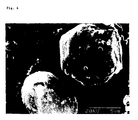
- the electron micrograph of Figure 4 showing the coating state by the conventional dry type mixing method reveals that the metallic soap particles are present among the wax particles. In both the conventional methods, the particle surfaces were not coated uniformly.
- Whether or not the particle surfaces were coated with the metallic soap was evaluated by measuring the particle surfaces with a X-ray microanalyzer (EMAX-1770: S-233 manufactured by HORIBA Ltd.). The evaluation was performed based on the following three criteria by measuring the presence of metal ions. A: Peaks of metal ions derived from the metallic soap that are expected to be produced are significantly detected. B: Peaks of metal ions derived from the metallic soap that are expected to be produced are slightly detected. C: Peaks of metal ions derived from the metallic soap that are expected to be produced are not substantially detected.
- EMAX-1770 S-233 manufactured by HORIBA Ltd.
- the metal ions derived from the metallic soap that are expected to be produced are derived from the polyvalent metal salt (i.e., polyvalent metal compound) that was used in the process of the production, and they are removed when the particles are washed with water. Therefore, if the metallic soap is not produced, the metal ions are not detected.
- polyvalent metal salt i.e., polyvalent metal compound
- Table 3 shows the results of examining the coating states by visual observation through the electron microscope and the presence of the metallic soap. No. Coating state Presence of metallic soap on the surfaces Particle appearance
- Example 1 A A scaly coating Example 2 A A scaly coating Example 3 A A scaly coating Example 4 A A scaly coating Example 5 A A scaly coating Example 6 A A scaly coating Example 7 A A scaly coating Example 8 A A scaly coating Example 9 A A scaly coating Example 10 A A scaly coating Example 11 A A scaly coating Example 12 A A scaly coating Example 13 A A scaly coating Example 14 A A scaly coating Example 15 A A scaly coating Example 16 B A partial scaly coating Comparative example 1 B B partial adherence of metallic soap Comparative example 2 C C metallic soap present among particles Comparative example 3 C C metallic soap present among particles
- the wax or resin particles are coated uniformly with a scaly coating of metallic soap, and especially when the dispersion (a) and liquid (b) are mixed simultaneously, the particles are coated even more uniformly.
- the particles are not sufficiently coated with the metallic soap.
Landscapes
- Physics & Mathematics (AREA)
- General Physics & Mathematics (AREA)
- Chemical & Material Sciences (AREA)
- Spectroscopy & Molecular Physics (AREA)
- Health & Medical Sciences (AREA)
- Chemical Kinetics & Catalysis (AREA)
- Medicinal Chemistry (AREA)
- Polymers & Plastics (AREA)
- Organic Chemistry (AREA)
- Developing Agents For Electrophotography (AREA)
Abstract
Description
- The present invention relates to a method for coating wax or resin particles with metallic soap. The present invention further relates to metallic-soap-coated wax or resin particles having anti-blocking properties obtained by the method.
- Wax or resin particles are utilized widely as a lubricant, a modifier, an additive or the like. In particular, in the field of toners for electrophotography, wax or resin particles serve as important elements: for example, wax particles are used as an external additive or an internal additive, and resin particles are used as a carrier of toner or a fixing agent.
- In this context; in recent years there has been an increasing demand for the improvement of the resolution of an image formed of toner and full colorization of toner, and the dot size has been miniaturized. Under these circumstances, the particle size of wax or resin particles used as an additive or toner carrier is also required to be miniaturized to 50µm or less or even 25µm or less.
- However, since fine particles of wax or resin are likely to cause blocking, some problems, such as failure to form a complete image due to the blocking of the particles, have started to arise with the development of the miniaturization of the particle size.
- In order to prevent this blocking, an attempt to coat the surfaces of wax or resin particles with metallic soap has been made. For example, the surfaces of the wax or resin particles are coated using the following methods: a method of coating the particle surfaces with powder metallic soap in a mixing granulating machine such as a High Speed mixer (Mitsui Mining Co., Ltd.) and a Marumerizer (Fuji Paudal Co., Ltd.); and a wet coating method which adds metallic soap in the form of water dispersion to the particles and dries the resultant product so as to coat the surfaces of the particles with the metallic soap (e.g., Japanese Laid-Open Patent Publication Nos. 58-100857, 8-182927, and 9-328559). Furthermore, various methods for coating the particle surfaces with metallic soap have been proposed to prevent the blocking of the particles used in photography or other applications. Examples of proposed methods include a method of coating the particle surfaces with metallic soap with a V-blender so as to produce a developer for an electronic copying machine (Japanese Laid-Open Patent Publication No. 59-229567); a method of coating the surface of a pigment with silicone oil, resin, metallic soap or the like to make the surface of the pigment lipophilic so as to produce color microcapsules (Japanese Laid-Open Patent Publication No. 62-234541); and a method of fixing fatty acid metallic soap to the surface of toner by the method of the mechanical mixing so as to produce microcapsule toner (Japanese Laid-Open Patent Publication No. 6-242627).
- In order to coat the particles with metallic soap uniformly by these conventional methods, in general, the desirable particle size of the metallic soap added is at least one-fifth or smaller, preferably one-twentieth or smaller than that of the particles to be coated with the metallic soap- However, the particle size of industrially available metallic soap at present is 5 to 50µm. Therefore, it is not easy to coat wax or resin particles having a particle size of 100µm or smaller by the conventional methods, and it is very difficult to uniformly coat particles having a particle size of 25µm or smaller by the conventional methods.
- For this reason, although metallic soap has excellent lubricating properties, release properties, and anti-moisture absorption as an anti-blocking agent, the metallic soap cannot be used for coating the surface of wax or resin particles having a particle size of 50µm or smaller or even 25µm or smaller. Therefore, the metallic soap cannot be used in the field of toner for high definition electrophotography.
- As a result to solve the above-described problems, the inventors of the present invention found that microparticles covered with a layered or scaly coating of metallic soap can be obtained by mixing a water dispersion of wax or resin particles dispersed in water, using water-soluble fatty acid soap as a dispersant, and an aqueous solution or a dispersion of a polyvalent metal compound.
- More specifically, the present invention is directed to a method for coating wax or resin particles with metallic soap, wherein (a) a water dispersion of wax or resin particles, the dispersion containing water-soluble fatty acid soap, and (b) an aqueous solution or a water dispersion of a polyvalent metal compound are mixed in such a manner that the equivalent ratio of the polyvalent metal compound to the water-soluble fatty acid soap is 0.5 to 1.5.
- In a preferred embodiment, the above-mentioned wax or resin particles are contained in an amount of 0.1 to 50wt% in the water dispersion (a) of wax or resin particles, and the water-soluble fatty acid soap is contained in an amount of 0.1 to 20 parts by weight per 100 parts by weight of the wax or resin particles.
- In a preferred embodiment, the polyvalent metal compound is contained in an amount of 0.01 to 30wt% in the aqueous solution or the water dispersion (b).
- The present invention further relates to wax or resin particles coated with metallic soap obtained by the steps of: (i) mixing (a) a water dispersion of wax or resin particles, the dispersion containing water-soluble fatty acid soap, and (b) an aqueous solution or a water dispersion of a polyvalent metal compound in such a mariner that an equivalent ratio of the polyvalent metal compound to the water-soluble fatty acid soap is 0.5 to 1.5; and (ii) recovering the resultant wax or resin particles coated with metallic soap.
- Thus, the invention described herein makes possible the advantages of: (1) providing a method for coating fine particles of wax or resin with metallic soap uniformly in order to obtain coated particles which can be used in various industrial fields such as electronics, information, medicine and pharmacy, cosmetics, and resin processing, in particular, in the field of toner for high definition electrophotography; and (2) providing metallic-soap-coated wax or resin particles having anti-blocking properties obtained by the method.
- These and other advantages of the present invention will become apparent to those skilled in the art upon reading and understanding the following detailed description with reference to the accompanying figures.
- Figure 1 is an electron micrograph showing the surface structure of wax particles in a water dispersion 1 before a metallic soap coating treatment.
- Figure 2 is an electron micrograph showing the surface structure of microparticles coated with metallic soap of the present invention obtained in Example 1.
- Figure 3 is an electron micrograph showing the surface structure of comparative wax particles treated with metallic soap obtained in Comparative Example 1.
- Figure 4 is an electron micrograph showing the surface structure of comparative wax particles treated with metallic soap obtained in Comparative Example 2.
-
- The water-soluble fatty acid soap used in the present invention is an alkali metal salt, an ammonium salt, or a water-soluble amine salt of fatty acid having, preferably 4 to 30 carbon atoms, more preferably 6 to 22 carbon atoms. The water-soluble fatty acid soap can be used alone or in combination.
- When a fatty acid having less than 4 carbon atoms is used, the produced metallic soap may be water-soluble so that the wax or resin particles cannot be coated with the metallic soap. Then a fatty acid having more than 30 carbon atoms is used, the water solubility of the fatty acid salt is excessively low, so that the fatty acid salt tends to be hardly dissolved in the water dispersion system.
- Preferable examples of the fatty acid include saturated fatty acids such as butyric acid, caproic acid, caprylic acid, capric acid, lauric acid, myristic acid, palmitic acid, stearic acid, arachic acid, behenic acid, lignoceric acid, cerotic acid and montanoic acid; unsaturated fatty acids such as butenoic acid, octenoic acid, caproleic acid, undecylenic acid, myristoleic acid, palmitoleic acid, oleic acid, erucic acid, linoleic acid, linolenic acid, arachidonic acid and docosahexaenoic acid; branched-chain fatty acids such as α - methylbutyric acid and isostearic acid; and fatty acids having hydroxyl groups such as sabinic acid, ricinoleic acid, and hydrogenated fatty acids from castor oil.
- Examples of alkali metals included in the alkali metal salt mentioned above include lithium, sodium, and potassium. Among these, sodium or potassium can be used suitably.
- Examples of water-soluble amines included in the water-soluble amine salt mentioned above include water-soluble alkylamines such as methylamine, ethylamine, propylamine, dimethylamine, diethylamine, dipropylamine and trimethylamine; polyethylene polyamines such as ethylenediamine, diethylenetriamine and triethylenetetramine; and alkanolamines such as monoethanolamine, diethanolamine and triethanolamine. Among these, alkanolamines are preferable.
- The water-soluble fatty acid soap is contained in the water dispersion (a) in an amount of 0.1 to 20 parts by weight per 100 parts by weight of the wax or resin particles. Preferably, the water-soluble fatty acid soap is contained in an amount of 1 to 10 parts by weight, more preferably 2 to 8 parts by weight, and most preferably 4 to 5 parts by weight per 100 parts by weight of the wax or resin particles. When the amount of the water-soluble fatty acid soap is excessively small, the metallic soap layer for coating is excessively thin, so that it is difficult to achieve a uniform coating. When the amount of the water-soluble fatty acid soap is too large, the metallic soap layer produced on the surfaces of the particles is excessively thick, so that aggregation is caused with adjacent particles, and it is difficult to achieve an efficient coating.
- In the present invention, as the wax or resin particles that are contained in the water dispersion (a) and are to be coated with metallic soap, any organic compound particles can be used, as long as they are insoluble in water. In particular, particles of an organic compound that is solid at room temperature. When such particles are used, the surface of the particles can be coated with the metallic soap uniformly. Specific examples of such an organic compound include waxes such as paraffin wax, fatty acid, alcohol wax, ester waxes, amide waxes, and natural waxes, and resins such as hydrocarbon resins, acrylic resins, vinyl resins, phenol resin, epoxy resins, polyester resins, polyamide resins, and mixtures thereof.
- The particles of these waxes or resins can be used alone or in combinations of two or more. The particles of these waxes or resins can comprise a plasticizer, a lubricant, a pigment or the like in an amount that does not impair the feature of the present invention. A typical example thereof is wet toner particles of functional resin containing a lubricant, a pigment, a charge control agent or the like and having lubricating properties itself. There is no limitation regarding the particle size of the wax or resin particles used in the present invention. Generally, wax or resin particles having a diameter of 1 - 500µm can be used. However, the features of the present invention can be distinguished best when particles having a particle size of 25µm or less, which are difficult to be coated in the conventional methods, are used.
- The ratio of the wax or resin particles with respect to the total amount of the water dispersion (a) is preferably 0.1 to 50% by weight, more preferably 1 to 30% by weight. Then the ratio of the wax or resin particles is smaller than 0.1% by weight, the production efficiency may deteriorate. When the ratio is larger than 50% by weight, the viscosity of the water dispersion (a) is excessively large, so that the handling may be difficult.
- The polyvalent metal compound included in an aqueous solution or a water-dispersion (b) used in the present invention is an ionic metal compound (e.g., a metal salt) of a bivalent metal or metals with more valences. Examples of metals forming such a metal compound include alkaline-earth metals such as beryllium, magnesium, calcium, strontium and barium; transition metals such as titanium, vanadium, chromium, manganese, iron, cobalt, nickel, copper, zinc, zirconium, molybdenum, palladium, silver, cadmium, tungsten and mercury; and other metals such as aluminum, gallium, tin, lead, and lanthanoid metals.
- Among these, magnesium, calcium, barium, manganese, iron, nickel, copper, zinc, silver and tin are preferable for general production. This is because such a metal in the polyvalent metal compound can be exchanged with a cation formed from the water-soluble fatty acid soap in high velocity in an aqueous medium so that metallic soap can be easily formed in water. A metal class used for the present invention can be selected suitably depending on the need of the field where the resultant coated particles are to be used.
- The polyvalent metal compound, which is an ionic metal compound, used in the present invention comprises an oxide, a hydroxide or a salt of the above-listed metals. There is no limitation regarding the acid forming the salt. Examples of the acid include inorganic acids such as hydrochloric acid, nitric acid, sulfuric acid, phosphoric acid, boric acid, nitrous acid, sulfurous acid, phosphorous acid, hypochlorous acid, hypophosphorous acid, perchloric acid, persulfuric acid carbonic acid and percarbonic acid. The polyvalent metal compound can be used alone or in combination.
- The content of the polyvalent metal compound in the aqueous solution or water dispersion of the polyvalent metal compound (b) is preferably 0.01 to 30% by weight, more preferably 0.05 to 10% by weight, based on the total amount of the aqueous solution or water dispersion (b). When the content of the polyvalent metal compound is smaller than 0.01% by weight, coating may be insufficient. Moreover, this is economically disadvantageous because large-scale production equipment is required, resulting in low production efficiency. When the content is larger than 30% by weight, it is difficult to mix it with the water dispersion (a) uniformly for a short period, so that it is difficult to achieve efficient coating.
- The polyvalent metal compound used in the present invention is used in such an amount that the equivalent ratio of the metal ions in the polyvalent metal compound with respect to the water-soluble fatty acid soap is preferably 0.5 to 1.5, more preferably 0.8 to 1.2.
- Then the equivalent ratio of the metal ions is smaller than 0.5, the water-soluble fatty acid soap is present in the system in a large amount, so that the filtering properties may deteriorate when collecting the wax or resin particles coated with the metallic soap. Then the equivalent ratio is larger than 1.5, complicated operations may be required to remove the residual polyvalent metal compound.
- Hereinafter, a method for producing wax or resin particles coated with the metallic soap of the present invention will be described.
- There is no limitation regarding the method for preparing the water dispersion of wax or resin particles containing water-soluble fatty acid soap (a) (hereinafter, may be referred to as dispersion (a)). For example, a forced dispersion method, a wet milling method, an emulsion dispersion method, an emulsion polymerization method or the like can be used.
- The forced dispersion method refers to the following method. Wax or resin is pulverized by a known pulverizer such as a ball mill, a sand mill, or a jet mill into microparticles. Then, the microparticles and a predetermined amount of water-soluble fatty acid soap and a predetermined amount of water are mixed and dispersed by a known dispersing machine' such as a paddle agitator, homogenizer, a ball mill, a sand mill, or a jet mill. Thus, a water-dispersion is prepared.
- The wet milling method refers to the following method. Wax or resin, a predetermined amount of water-soluble fatty acid soap and a predetermined amount of water are fed into a known pulverizer such as a ball mill, pearl mill or disk mill, where the wax or resin is dispersed while being pulverized. Thus, a water dispersion is prepared.
- The emulsion-dispersion method refers to the following method. Predetermined amounts of wax or resin, water-soluble fatty acid soap and water are fed into a container with an emulsion dispersing device, and heated to a temperature equal to or more than the melting point of the wax or resin, preferably more than the melting point) and agitated to produce an O/W emulsion. Then, the emulsion is cooled to a temperature less than the melting point of the wax or resin. Preferably, the emulsion is cooled to a temperature that is lower than the melting point of the wax or resin by 20°C or further lower. Thus, a water-dispersion is prepared.
- In the emulsion-dispersion method, it is preferable to utilize phase inversion emulsification when it is desired to obtain a water dispersion having a small particle size and a narrow particle size distribution. Emulsion dispersion utilizing phase inversion emulsification can be performed in the following manner, for example. Wax or resin and water-soluble fatty acid soap are fed into a dispersing container and heated to a temperature equal to or more than the melting point of the wax or resin so that the system becomes liquid. Then, water or warm water drops therein gradually under agitation. In this method, as the amount of dropped water increases, phase inversion from a W/O emulsion to an O/W emulsion occurs in the system, so that an emulsion having a small particle size and a narrow particle size distribution can be obtained. In another phase inversion emulsification method, wax or resin is dissolved in a good solvent, then a small amount of water is added so that the resultant mixture is emulsified. Next, water is added thereto to cause phase inversion, and then the solvent is removed.
- The emulsion polymerization method refers to a method where a monomer that can be polymerized in water while keeping the form of an emulsion, e.g., vinyl monomer, is polymerized in water in the form of an emulsion so as to produce a water dispersion of resin particles. In this method, water and a water-soluble polymerization initiator are fed into a reaction vessel, and the monomer is emulsified with water-soluble fatty acid soap or another emulsifier in an inert gas atmosphere, such as nitrogen, and heated so that the monomer is polymerized in the form of an emulsion. Thus, a water dispersion of the polymer can be produced. In the case where the water-soluble fatty acid soap cannot be used during the emulsion polymerization for pH or emulsion stability reasons, a predetermined amount of the water-soluble fatty acid soap can be added after the emulsion polymerization.
- When an oil-soluble initiator is used instead of the water-soluble initiator, the monomer is polymerized in the form of a suspension, and a water dispersion comprising resin particles having a relatively large particle size can be obtained. The water dispersion of the resin particles obtained by such suspension polymerization can be used as the dispersion (a) used in the present invention.
- Among these methods for preparing the dispersion (a), the emulsion dispersion method and the emulsion polymerization method are preferable because they can provide a water dispersion of microparticles that have a spherical shape and good handling properties.
- In the method for coating wax or resin particles with metallic soap of the present invention, the dispersion (a) and the aqueous solution or the water dispersion of the polyvalent metal compound (b) (hereinafter, may be referred to as liquid (b)) can be mixed in one of the following two methods: a method of dripping the dispersion (a) and liquid (b) into a reaction vessel (hereinafter, referred to as "dripping method"); and a method of mixing the dispersion (a) and liquid (b) simultaneously and rapidly (hereinafter, referred to as "continuous mixing method").
- The dripping method includes sequential mixing, namely, dripping the liquid (b) into the dispersion (a) in agitation, or dripping and mixing the dispersion (a) into the liquid (b) in agitation; and simultaneous dripping-mixing, namely, dripping and mixing the dispersion (a) and liquid (b) simultaneously. The simultaneous dripping-mixing method is preferable, because the surfaces of wax or resin particles can be coated with metallic soap uniformly and densely.
- The method of dripping the dispersion (a) and liquid (b) simultaneously into a reaction vessel is performed more specifically in the following manner. The dispersion (a) having a temperature of 0 to 100°C, preferably 20 to 90°C, and the dispersion (b) having a temperature of 10 to 50°C are dripped simultaneously into a reaction vessel, where agitation is performed by a paddle agitator, a homogenizer, a ball mill or other known agitating apparatus. The temperature of the mixed system is preferably equal to or less than the melting point of the wax or resin particles present in the dispersion (a). Preferably, the temperature is lower than the melting point of the wax or resin particles by 20°C or further lower. Then the temperature is higher than the melting point, the wax or resin particles becomes liquid, or the surface conditions of the particles are changed, and thus, sufficient coating may not be attained.
- The dripping rate of the dispersion (a) and liquid (b) is adjusted so that the equivalent ratio of the amount of the polyvalent metal ions in the supplied liquid (b) with respect to the amount of the water-soluble fatty acid soap in the supplied dispersion (a) is 0.5 to 1.5, preferably 0.8 to 1.2. In this simultaneous dripping method, in order to perform uniform coating with the metallic soap it is preferable to start dripping the dispersion (a) and liquid (b) simultaneously, drip the dispersion (a) and liquid (b) at a constant dripping period, and end dripping simultaneously. There is no limitation regarding a period of time required by dripping. However, the slower the dripping rate is, the more uniformly the wax or resin particles can be coated with the metallic soap.
- The continuous mixing method employs an apparatus or a tube having at least three openings, i.e., an inlet port for each of the dispersion (a) and liquid (b) and an outlet port for the resultant mixture, and also having a mixing compartment where the dispersion (a) and liquid (b) are mixed momentarily. Examples of such a mixing apparatus include a T-shaped tube, a Y-shaped tube, a line mixer having at least two inlet ports for raw materials, and a line homogenizer having at least two inlet ports for raw materials.
- For mixing, the dispersion (a) and liquid (b) are supplied to the inlet port for the dispersion (a) and the inlet port for the liquid (b), respectively, by gravitation, suction, pressurization or other methods. The temperature of each of the dispersion (a) and liquid (b) is preferably equal to or lower than the melting point of the wax or resin by 20°C or further lower.
- The supply rate is adjusted so that the equivalent ratio of the amount of the polyvalent metal ions in the liquid (b) with respect to the amount of the water-soluble fatty acid soap in the dispersion (a) is 0.5 to 1.5, preferably 0.8 to 1.2. In the case where the mixing apparatus is a T-shaped tube or a Y-shaped tube, simply performing supply allows the dispersion (a) and liquid (b) to be mixed momentarily at a portion where the inlet tube for the dispersion (a) meets the inlet tube for the liquid (b). In the case of power dispersing machines such as a line mixer or a line homogenizer, dispersion is performed and then immediate mixing is performed at the dispersing machine portion.
- In the continuous mixing method, the mixture of the dispersion (a) and liquid (b) is discharged from the outlet port sequentially, so that a relatively small apparatus is sufficient for a large amount of mixture.
- Among these two mixing methods, continuous mixing is preferable because it is possible to achieve a more uniform coating with wore dense metallic soap, and the mixing apparatus is small and convenient. In particular, the method that uses the T-shaped tube or the Y-shaped tube as the mixing portion is advantageous in that no agitating apparatus is required, little power is consumed, the mixing apparatus portion is small, and cleaning is easy.
- Next, the mixture of the dispersion (a) and liquid (b) is aged in a container with an agitator, if necessary, and then fed into a known solid-liquid separator such as a filtering machine or a centrifugal separator, and then washed with water or an organic solvent so that unreacted water-soluble fatty acid salt, unreacted polyvalent metal compound, or other impurities are removed. Thus, a washed cake is obtained.
- The thus obtained washed cake is dried by a known drying method utilizing heat, reduced pressure, or blowing so that the residual moisture is removed. The temperature during drying is preferably lower than the lowest melting point of the melting points of the wax or resin and the coating metallic soap. When a temperature equal to or more than that temperature is used, the wax or resin particles coated with the metallic soap are likely to cause blocking. Among these drying methods, reduced pressure drying is preferable, because drying can be performed at a low temperature and swiftly.
- The above-described methods provide the particles coated with the metallic soap. By the use of the present method, the wax or resin particles can be coated with metallic soap uniformly and densely even when the wax or resin particles have a small particle size. The obtained metallic-soap-coated wax or resin particles have excellent anti-blocking properties. Therefore, the coated particles can be used in various industrial fields as toners for electrophotography, or in medicine and pharmacy, cosmetics, and resin processing.
- Hereinafter, the present invention will be described by way of examples with reference to the accompanying drawings.
- First, 48g of pentaerythritol tetrabehenate as wax, 2g of sodium stearate as water soluble fatty acid soap, and 450g of water were fed into a 1-liter beaker and waned to 80°C so that the pentaerythritol tetrabehenate was dissolved. Then, emulsion dispersion was performed by an autohomomixer (Type TK; manufactured by Tokushu kika Kogyo KK.; hereinafter, referred to as TK auto homomixer) at 7000rpm for 15 minutes. Thereafter, the emulsion was cooled to 20°C over 1 hour so that a water dispersion of wax particles of pentaerythritol tetrabehenate (solid content 10wt%) having an average particle size of 10µm was obtained in an amount of 500g. Furthermore, the water dispersion was diluted with water to twice as much so that water dispersion 1 of 5wt% of wax particles, the dispersion containing 0.2wt% of water-soluble fatty acid soap, was obtained.
- Water dispersions 2 and 3 of 5 wt% of wax particles, each dispersion of which contains 0.2wt% of water-soluble fatty acid soap, were prepared in the same manner as the process of preparing the water dispersion 1 by using the wax or resins and the water-soluble fatty acid soaps shown in Nos.2 and 3 respectively in Table 1.
- First, 240g of behenyl behenate and 9.6g of sodium myristate were fed into a 1-liter three-necked flask and warmed to 90°C under agitation by a paddle agitator so as to be melted and mixed. Then, phase inversion emulsification was performed by dripping 90°C warm water in an amount of 550.4g over 1 hour. Thereafter, the emulsion was cooled to 20°C over 1 hour so that a water dispersion of 30wt% of particles of behenyl behenate, having an average particle size of 7µm, was obtained in an amount of 800g. Furthermore, 167g of the water dispersion was diluted with 333g of water so that a water dispersion of 10wt% of particles of behenyl behenate, having an average particle size of 7µm, was obtained in an amount of 500g. In this way, water dispersion 4 of 10wt% of wax particles, the dispersion containing 0.4wt% of water-soluble fatty acid soap, was prepared.
- Water dispersions 5 and 6 of 10wt% of wax or resin particles were prepared in an amount of 500g each in the same manner as the process of preparing water dispersion 4 by using the wax or resins and water-soluble fatty acid soaps shown in 5 and 6 of Table 1.
- First, 75g of paraffin wax having an average particle size of 17 µm, 4g of potassium stearate and 421g of water were fed into a 1-liter beaker. Then, the resultant mixture was agitated to prepare a dispersion by TK auto homomixer at 1500rpm for 15 minutes. Thereafter, the resultant dispersion was cooled to 20°C over 1 hour so that a water dispersion of 15wt% of particles of paraffin wax, having an average particle size of 17µm, was obtained in an amount of 500g. Thus, water dispersion 7 of 15wt% of wax particles, the dispersion containing 0.8wt% of water-soluble fatty acid soap, was prepared.
- Water dispersions 8 to 12 of 5-15wt% of wax or resin particles were prepared in an amount of 500g each in the same manner as the process of preparing water dispersion 7 by using the wax or resins and water-soluble fatty acid soaps shown in 8 to 12 of Table 1.
- First, 395.82g of water, 0.18 g of potassium persulfate and 4g of potassium oleate were fed into a 1-liter four-necked flask and warmed to 70°C and 100g of styrene was dripped thereto over 1 hour with bubbling of nitrogen while agitating. Then the mixture was aged for 2 hours to complete polymerization and then cooled to 20°C over 30 minutes so that a water dispersion of 20wt% of particles of polystyrene, having an average particle size of 12µm, was obtained in an amount of 500g. Furthermore, the water dispersion was diluted with water to twice as much so as to produce a 10wt% water dispersion. Thus, water dispersion 13 of 10wt% of resin particles containing 0.4wt% of water-soluble fatty acid soap was prepared.
- First, 370g of water, 125 g of butyl methacrylate, 2g of lauroyl peroxide, 1.5 g of polyvinyl alcohol, and 0.2g of sodium laurate were fed into a 1-liter four-necked flask and warmed to 70°C, and suspension polymerization was caused over 3 hours under a stream of nitrogen while agitating. Thereafter, the resultant mixture was warmed to 80°C and aged for 2 hours. Then, the reaction mixtere was cooled to 60°C under agitation. Then, 1.3g of sodium laurate was added thereto, and the resultant mixture was cooled to 20°C over 30 minutes so that a water dispersion of 25wt% of particles of polybutyl methacrylate, having an average particle size of 80µm, was obtained in an amount of 500g. Thus, water dispersion 14 of 25wt% of resin particles, the dispersion containing 0.3wt% of water-soluble fatty acid soap, was prepared.
- First, 117g of styrene, 10g of a cyanogen colorant (copper phthalocyanine pigment with an average particle size of 0.3µm) and 5g of a negatively-charged control agent (di-tertiary butyl salicylate metal compound with an average particle size of 0.3µm) were fed into a 500ml beaker and agitated by TK auto homomixer at 500rpm for 3 hours. Then, 23g of n-butyl acrylate, 10g of saturated polyester resin (with a number average molecular weight of about 7000 and an acid number of 16mg/g) and 40g of 1,4-butanediol distearate were added to the obtained mixture, and the mixture was agitated with a paddle agitator for 2 hours while being warmed to 60°C. Thereafter, the agitating apparatus was replaced by a TK auto homomixer and 12g of a polymerization initiator, i.e., 2,2'-azobis(2,4-dimethyl valeronitrile), was added thereto. Then, the resultant mixture was agitated at 200rpm for 1 minute so that a polymeric monomer composition was prepared.
- Separately, 710g of ion-exchanged water and 540g of 0.1M-Na3PO4 aqueous solution were fed into a 2-liter separable flask, warmed to 60C and then agitated at 12000rpm by TK auto homomixer. To this mixture, 80g of 1.3M-CaCl2 aqueous solution was added gradually, so that an aqueous mixture containing Ca3(PO4)2 microparticles was prepared.
- The polymeric monomer composition was fed into the above-mentioned aqueous mixture, and agitated at 60°C in a nitrogen atmosphere at 10000rpm by TK auto homomixer for 10 minutes so that the particles contained in the polymeric monomer composition was pulverized. Thereafter, the mixture was warmed to 70°C under agitation by a paddle agitator and was subjected to a suspension polymerization reaction for 11 hours so that a styrene-n-butyl acrylate copolymer was formed in the particles.
- After the polymerization reaction was completed, the reaction mixture was cooled and hydrochloric acid was added thereto, and the calcium phosphate contained in the resultant mixture was dissolved. Then, filtering, water washing and drying were performed so that wet cake of cyanogen toner particles having an average particle size of 7µm were obtained. The surfaces of the cyanogen toner particles were measured by a X-ray micro analyzer, and the measurement had confirmed that no peak based on Ca was detected.
- Then, 75g of the thus-obtained cyanogen toner particles, 2g of potassium stearate and 423g of water were fed into a 1-liter beaker and dispersed by TK auto homomixer at 1500rpm for 15 minutes. Thereafter, the dispersion was cooled to 20°C over one hour so as to produce 500g of a water dispersion of 15wt% of the cyanogen toner particles having an average particle size of 7µm. Thus, water dispersion 15 of 15wt% of toner particles, the dispersion containing 0.4wt% of water-soluble fatty acid soap, was prepared.
- Table 1 shows the water dispersions 1 to 15 prepared in the above-described manners.
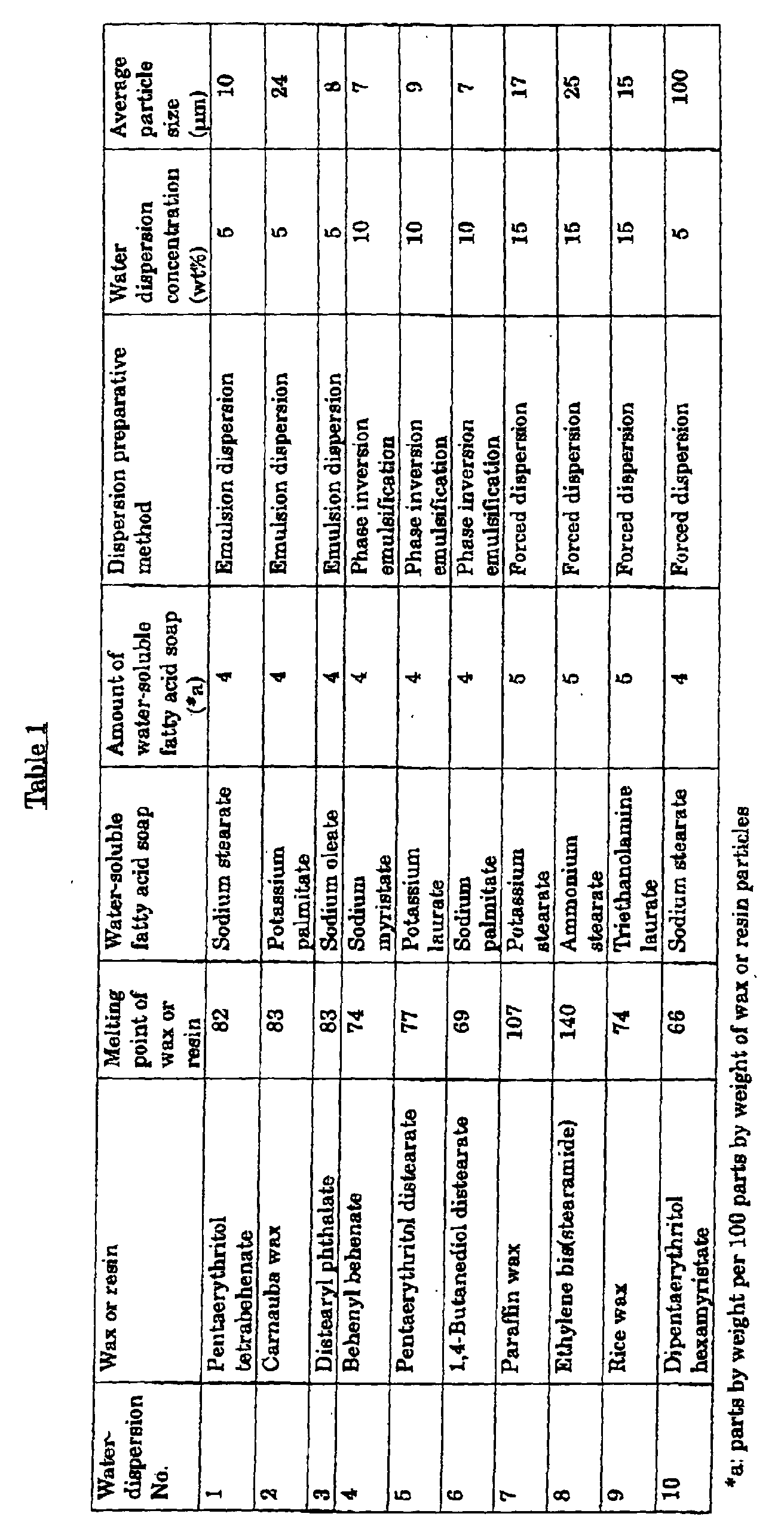

- Wax or resin particles were coated with metallic soap by using 500g of the dispersion (a) obtained in the above-described manners (water dispersions 1 to 15) and 500g of liquid (b) shown in Table 2. The temperature of the liquid (b) was equal to the room temperature. Table 2 shows the mixing conditions for the coating reaction of the present invention (the polyvalent metal compound used, the equivalent ratio of the polyvalent metal compound to the water-soluble fatty acid soap, the mixing method, and the temperature of the dispersion (a) when the dispersion (a) is mixed with the liquid (b)).

- The mixing methods A and B in Examples 1 to 15 shown in Table 2 are as follows.
- A 2-liter receptacle with an agitating device having a paddle agitator of a diameter of 6cm was prepared, and the paddle agitator was rotated at 350rpm. The dispersion (a) and liquid (b) adjusted to the temperatures shown in Table 2 were fed into this receptacle simultaneously from different directions. The feeding of the entire amount was completed in 10 seconds. After the entire amount was fed, aging was performed for 10 minutes while keeping the temperature stable so as to complete the reaction.
- Next, the thus-obtained slurry was filtered. Then, the obtained wet cake was washed with water twice. The washed cake was dried by vacuum drying at 50°C for 6 hours so that dry particles of the coated wax or resin were obtained.
- A pipeline homomixer that can supply the dispersion (a) and liquid (b) separately with a metering pump and mix the two components, and a 2-liter receptacle with an agitating device having a paddle agitator of a diameter of 6cm were prepared, and the paddle agitator was rotated at 350rpm. The dispersion (a) adjusted to the temperatures shown in Table 2 and liquid (b) were supplied into the pipeline homomixer separately, and the resultant mixture discharged from the pipeline homomixer was fed into the receptacle. The flow rate of the dispersion (a) and liquid (b) was adjusted by the metering pump so that the supply of the dispersion (a) and liquid (b) could end at the same time. The mixing of the entire amount was completed in 10 minutes. After the mixed solution was discharged from the outlet port of the pipeline mixer to the receptacle, aging was performed for 10 minutes in the receptacle under agitation while keeping the temperature stable so as to complete the reaction.
- Next, the thus-obtained slurry was filtered. Then, the obtained wet cake was washed with water twice, and the washed cake was dried by vacuum drying at 50°C for 6 hours so that dry particles of the coated wax or resin were obtained.
- The liquid (b) of Example 16 was dripped in the following manner
- First, 500g of water dispersion 1 as the dispersion (a) was fed into a 2-liter beaker, and 500 g of an aqueous solution of zinc phosphate as the liquid (b) (the equivalent ratio of the zinc phosphate with respect to the water-soluble fatty acid soap in the dispersion (a) was 1.03) was dripped thereto at 70°C over 1 hour under agitation. Thereafter, the resultant slurry was filtered, and the obtained wet cake was washed twice. Then, the washed cake was dried by vacuum drying at 50°C for 6 hours so that dried particles were obtained.
- First, 1200g of water dispersion 1 was fed into 9000g of ethanol at 20°C, and the mixture was agitated and filtered. The filtered wet cake was further washed with ethanol in an amount ten times as much and filtered. This operation was repeated three times to prepare a washed cake, and the washed cake was dried by vacuum drying at 50°C for 6 hours. Thus, dried spherical particles of pentaerythritol tetrabehenate free from sodium stearate, which is the water-soluble fatty acid soap, were obtained in an amount of 50g.
- Next, 48g of the dry spherical particles, 2g of calcium stearate (having an average particle size of 7µm) and 360g of water were mixed and dispersed by TK auto homomixer at 1500rpm for 15 minutes. Thus, a 10wt% water dispersion containing 2g of calcium stearate was obtained in an amount of 400g. This water dispersion was filtered, and the resultant wet cake was dried by vacuum drying at 50°C for 6 hours. Thus, dried particles of Comparative Example 1 were obtained.
- In this comparative example, 48g of dry spherical particles of pentaerythritol tetrabehenate obtained in the same manner as in Comparative Example 1 and 2g of calcium stearate (having an average particle size of 7µm) were fed into a mixer for household use and mixed by the mixer at a high rotation rate for 3 minutes. Then, the resultant powder was removed from the mixer to be used as dried particles of Comparative Example 2.
- In this comparative example, 950g of ethylene bis (stearamide) having an average particle size of 25µm and 50g of zinc stearate (with an average particle size of 21µm) were fed into a 10-liter High Speed mixer(Mitsui Mining Co., Ltd.) and agitated at room temperature at 1000rpm for 30 minutes. The resultant powder was removed from the mixer to be used as dried particles of Comparative Example 3.
- Next, it was examined whether or not and how the surfaces of the particles obtained by the above examples and comparative examples were coated with metallic soap. How the surfaces of the particles were coated with metallic soap (i.e., coating state) was observed by visual observation through an electron microscope.
- The microparticle powders of Examples 1 to 16 and Comparative Examples 1 to 3 were magnified to the 5000-fold size by an electron microscope (Scanning Electron Microscope S-2100 manufactured by Hitachi Ltd.) to observe the surfaces of the wax or resin particles and were evaluated by visual observation.
- Figure 1 is an electron micrograph showing the surface structure of the wax particles in water dispersion 1 without any treatment. The surfaces were smooth. Figure 2 is an electron micrograph showing the surface structure when the metallic soap treatment is performed to these wax particles by the method of Example 1. The surfaces of the wax particles obtained in Example 1 were covered with a scaly coating of metallic soap uniformly and satisfactorily. On the other hand, the electron micrograph of Figure 3 showing the coating state by the conventional wet type mixing method reveals that the surfaces of the wax particles were only coated partially with metallic soap. The electron micrograph of Figure 4 showing the coating state by the conventional dry type mixing method reveals that the metallic soap particles are present among the wax particles. In both the conventional methods, the particle surfaces were not coated uniformly.
- The coating states of Examples 1 to 16 and Comparative Examples 1 to 3 were evaluated based on the following three criteria.
- A : The surfaces of the wax or resin particles are coated uniformly with the metallic soap.
- B: The surfaces of the wax or resin particles are coated partially with the metallic soap.
- C: The surfaces of the wax or resin particles are not coated, and the metallic soap particles are present among the wax or resin particles.
-
- Table 3 shows the results.
- Whether or not the particle surfaces were coated with the metallic soap was evaluated by measuring the particle surfaces with a X-ray microanalyzer (EMAX-1770: S-233 manufactured by HORIBA Ltd.). The evaluation was performed based on the following three criteria by measuring the presence of metal ions. A: Peaks of metal ions derived from the metallic soap that are expected to be produced are significantly detected. B: Peaks of metal ions derived from the metallic soap that are expected to be produced are slightly detected. C: Peaks of metal ions derived from the metallic soap that are expected to be produced are not substantially detected.
- The metal ions derived from the metallic soap that are expected to be produced are derived from the polyvalent metal salt (i.e., polyvalent metal compound) that was used in the process of the production, and they are removed when the particles are washed with water. Therefore, if the metallic soap is not produced, the metal ions are not detected.
- Table 3 shows the results of examining the coating states by visual observation through the electron microscope and the presence of the metallic soap.
No. Coating state Presence of metallic soap on the surfaces Particle appearance Example 1 A A scaly coating Example 2 A A scaly coating Example 3 A A scaly coating Example 4 A A scaly coating Example 5 A A scaly coating Example 6 A A scaly coating Example 7 A A scaly coating Example 8 A A scaly coating Example 9 A A scaly coating Example 10 A A scaly coating Example 11 A A scaly coating Example 12 A A scaly coating Example 13 A A scaly coating Example 14 A A scaly coating Example 15 A A scaly coating Example 16 B A partial scaly coating Comparative example 1 B B partial adherence of metallic soap Comparative example 2 C C metallic soap present among particles Comparative example 3 C C metallic soap present among particles - As seen from Table 3, according to the method of the present invention, the wax or resin particles are coated uniformly with a scaly coating of metallic soap, and especially when the dispersion (a) and liquid (b) are mixed simultaneously, the particles are coated even more uniformly. On the other hand, in Comparative Examples 1 to 3, where the metallic soap is added and then mixed with the wax or resin particles from the beginning by the conventional wet or dry type mixing method, the particles are not sufficiently coated with the metallic soap.
- The invention may be embodied in other forms without departing from the spirit or essential characteristics thereof. The embodiments disclosed in this application are to be considered in all respects as illustrative and not limiting. The scope of the invention is indicated by the appended claims rather than by the foregoing description, and all changes which come within the meaning and range of equivalency of the claims are intended to be embraced therein.
Claims (4)
- A method for coating wax or resin particles with metallic soap,
wherein (a) a water dispersion of wax or resin particles, the dispersion containing water-soluble fatty acid soap, and (b) an aqueous solution or a water dispersion of a polyvalent metal compound are mixed in such a manner that an equivalent ratio of the polyvalent metal compound to the water-soluble fatty acid soap is 0.5 to 1.5. - The method for coating wax or resin particles according to claim 1, wherein the wax or resin particles are contained in an amount of 0.1 to 50wt% in the water dispersion (a) of wax or resin particles, and the water-soluble fatty acid soap is contained in an amount of 0.1 to 20 parts by weight per 100 parts by weight of the wax or resin particles.
- The method for coating wax or resin particles according to claim 2, wherein the polyvalent metal compound is contained in an amount of 0.01 to 30wt% in the aqueous solution or the water dispersion (b).
- Wax or resin particles coated with metallic soap obtained by the steps of:mixing (a) a water dispersion of wax or resin particles, the dispersion containing water-soluble fatty acid soap, and (b) an aqueous solution or a water dispersion of a polyvalent metal compound in such a manner that an equivalent ratio of the polyvalent metal compound to the water-soluble fatty acid soap is 0.5 to 1.5; andrecovering the resultant wax or resin particles coated with metallic soap.
Applications Claiming Priority (2)
| Application Number | Priority Date | Filing Date | Title |
|---|---|---|---|
| JP7043899 | 1999-03-16 | ||
| JP7043899 | 1999-03-16 |
Publications (2)
| Publication Number | Publication Date |
|---|---|
| EP1036812A1 true EP1036812A1 (en) | 2000-09-20 |
| EP1036812B1 EP1036812B1 (en) | 2005-02-02 |
Family
ID=13431501
Family Applications (1)
| Application Number | Title | Priority Date | Filing Date |
|---|---|---|---|
| EP00105546A Expired - Lifetime EP1036812B1 (en) | 1999-03-16 | 2000-03-16 | Method for coating wax or resin particles with metallic soap |
Country Status (3)
| Country | Link |
|---|---|
| US (1) | US6310117B1 (en) |
| EP (1) | EP1036812B1 (en) |
| DE (1) | DE60017815T2 (en) |
Families Citing this family (9)
| Publication number | Priority date | Publication date | Assignee | Title |
|---|---|---|---|---|
| US6764612B2 (en) * | 2002-03-22 | 2004-07-20 | Geo Specialty Chemicals, Inc. | Encapsulated peroxide compositions |
| US6699403B2 (en) | 2002-03-22 | 2004-03-02 | Geo Specialty Chemicals, Inc. | Supported peroxides |
| JP2006267516A (en) * | 2005-03-24 | 2006-10-05 | Konica Minolta Business Technologies Inc | Image forming method |
| AU2008100847A4 (en) * | 2007-10-12 | 2008-10-09 | Bluescope Steel Limited | Method of forming textured casting rolls with diamond engraving |
| JP4697310B2 (en) * | 2009-01-19 | 2011-06-08 | 富士ゼロックス株式会社 | Transparent toner for developing electrostatic latent image, electrostatic latent image developer, toner cartridge, process cartridge, image forming apparatus, and image forming method |
| US8785098B2 (en) * | 2009-02-13 | 2014-07-22 | Fuji Xerox Co., Ltd. | Transparent toner for electrostatic latent image development, method for producing the same, electrostatic latent image developer, toner cartridge, process cartridge, and image forming apparatus |
| EP3164003A1 (en) * | 2014-07-03 | 2017-05-10 | Bayer CropScience Aktiengesellschaft | Easy and inexpensive production of a composition containing insecticide-wax particles |
| US20190060245A1 (en) * | 2016-03-04 | 2019-02-28 | Arkema Inc. | Encapsulation of peroxides for skin applications |
| JP6680062B2 (en) * | 2016-04-20 | 2020-04-15 | コニカミノルタ株式会社 | Method for producing toner for developing electrostatic image |
Family Cites Families (11)
| Publication number | Priority date | Publication date | Assignee | Title |
|---|---|---|---|---|
| JPS6023783B2 (en) | 1980-10-03 | 1985-06-10 | 積水化成品工業株式会社 | Improved expandable polystyrene resin particles |
| JPS58100857A (en) | 1981-12-11 | 1983-06-15 | Fuji Photo Film Co Ltd | Capsulated toner |
| JPS59229567A (en) | 1983-02-01 | 1984-12-24 | Fuji Xerox Co Ltd | Developer for electrophotographic copier |
| JPS62234541A (en) | 1986-04-04 | 1987-10-14 | Pola Chem Ind Inc | Production of colored microcapsule |
| JPH0747664B2 (en) | 1990-02-21 | 1995-05-24 | 積水化成品工業株式会社 | Method for producing expandable polystyrene resin particles coated with lubricant |
| US5248581A (en) * | 1990-11-22 | 1993-09-28 | Tomoegawa Paper Co., Ltd. | Toner for electrophotography |
| JPH0791408B2 (en) | 1990-12-20 | 1995-10-04 | 日立化成工業株式会社 | Expandable thermoplastic resin particles and foam molded products |
| JPH06242627A (en) | 1993-02-17 | 1994-09-02 | Fuji Xerox Co Ltd | Microcapsule toner and its surface reforming method and image forming method |
| JP2791747B2 (en) * | 1993-06-30 | 1998-08-27 | 株式会社アサヒペン | Colored particles, method for producing the same, and suede-like coating composition using the colored particles |
| JP3433853B2 (en) | 1994-12-28 | 2003-08-04 | 三菱製紙株式会社 | Powdered microcapsule, method for producing the same, and microcapsule ink using the same |
| CA2196507A1 (en) * | 1996-02-15 | 1997-08-16 | Zeon Chemicals L.P. | Non-agglomerating elastomeric particles |
-
2000
- 2000-03-15 US US09/526,097 patent/US6310117B1/en not_active Expired - Lifetime
- 2000-03-16 DE DE60017815T patent/DE60017815T2/en not_active Expired - Lifetime
- 2000-03-16 EP EP00105546A patent/EP1036812B1/en not_active Expired - Lifetime
Non-Patent Citations (1)
| Title |
|---|
| PATENT ABSTRACTS OF JAPAN * |
Also Published As
| Publication number | Publication date |
|---|---|
| EP1036812B1 (en) | 2005-02-02 |
| DE60017815D1 (en) | 2005-03-10 |
| DE60017815T2 (en) | 2006-01-05 |
| US6310117B1 (en) | 2001-10-30 |
Similar Documents
| Publication | Publication Date | Title |
|---|---|---|
| EP1036812B1 (en) | Method for coating wax or resin particles with metallic soap | |
| CN103105751B (en) | Preparation method of suspension polymerization powdered ink with core-shell structure | |
| EP1890196A2 (en) | Toner Composition | |
| DE112013003295T5 (en) | toner | |
| JPH0547826B2 (en) | ||
| JP3485061B2 (en) | Method for coating wax or resin particles with metal soap | |
| EP0439367B2 (en) | Magnetic toner particles containing iron as the main component and process for producing the same | |
| EP2764039B1 (en) | Method for manufacturing core-shell structure fine particles and toner | |
| EP1669408B1 (en) | Spherical composite composition and process for producing spherical composite composition | |
| JP3156315B2 (en) | Method for producing polymer fine particles | |
| JP2013210458A (en) | Manufacturing method of toner | |
| EP1826181A1 (en) | Nickel hydroxide powder and method for producing same | |
| Tay et al. | Dissolution of a poorly water-soluble drug dry coated with magnesium and sodium stearate | |
| US4861379A (en) | Spherical fine particulate pigment and process for preparing the same | |
| WO2007006780A2 (en) | Toner powders and process for their preparation | |
| JP3235283B2 (en) | Method for producing spherical chitosan fine particles | |
| EP0272649B1 (en) | Spherical fine particulate pigment and process for preparing the same | |
| CN113382777B (en) | Aqueous dispersion of black iron oxide and liquid cosmetics using the same | |
| JPH10133416A (en) | Negative spherical toner for electrophotography | |
| JP5277540B2 (en) | Magnetic polymer particles, production method thereof, water dispersion, cartridge, and image forming apparatus | |
| JP2013210457A (en) | Manufacturing method of toner | |
| JPS61258260A (en) | Production of dry process one-component type electrophotographic developer with less deposit on surface | |
| JPH0747696B2 (en) | Spherical fine particle pigment | |
| JPH04330457A (en) | Capsule toner | |
| JP2007334000A (en) | Toner production method |
Legal Events
| Date | Code | Title | Description |
|---|---|---|---|
| PUAI | Public reference made under article 153(3) epc to a published international application that has entered the european phase |
Free format text: ORIGINAL CODE: 0009012 |
|
| AK | Designated contracting states |
Kind code of ref document: A1 Designated state(s): DE FR GB |
|
| AX | Request for extension of the european patent |
Free format text: AL;LT;LV;MK;RO;SI |
|
| 17P | Request for examination filed |
Effective date: 20010312 |
|
| AKX | Designation fees paid |
Free format text: DE FR GB |
|
| GRAP | Despatch of communication of intention to grant a patent |
Free format text: ORIGINAL CODE: EPIDOSNIGR1 |
|
| GRAS | Grant fee paid |
Free format text: ORIGINAL CODE: EPIDOSNIGR3 |
|
| GRAA | (expected) grant |
Free format text: ORIGINAL CODE: 0009210 |
|
| AK | Designated contracting states |
Kind code of ref document: B1 Designated state(s): DE FR GB |
|
| REG | Reference to a national code |
Ref country code: GB Ref legal event code: FG4D |
|
| REF | Corresponds to: |
Ref document number: 60017815 Country of ref document: DE Date of ref document: 20050310 Kind code of ref document: P |
|
| PLBE | No opposition filed within time limit |
Free format text: ORIGINAL CODE: 0009261 |
|
| STAA | Information on the status of an ep patent application or granted ep patent |
Free format text: STATUS: NO OPPOSITION FILED WITHIN TIME LIMIT |
|
| ET | Fr: translation filed | ||
| 26N | No opposition filed |
Effective date: 20051103 |
|
| REG | Reference to a national code |
Ref country code: FR Ref legal event code: PLFP Year of fee payment: 17 |
|
| REG | Reference to a national code |
Ref country code: FR Ref legal event code: PLFP Year of fee payment: 18 |
|
| REG | Reference to a national code |
Ref country code: FR Ref legal event code: PLFP Year of fee payment: 19 |
|
| PGFP | Annual fee paid to national office [announced via postgrant information from national office to epo] |
Ref country code: GB Payment date: 20190320 Year of fee payment: 20 Ref country code: FR Payment date: 20190322 Year of fee payment: 20 Ref country code: DE Payment date: 20190321 Year of fee payment: 20 |
|
| REG | Reference to a national code |
Ref country code: DE Ref legal event code: R071 Ref document number: 60017815 Country of ref document: DE |
|
| REG | Reference to a national code |
Ref country code: GB Ref legal event code: PE20 Expiry date: 20200315 |
|
| PG25 | Lapsed in a contracting state [announced via postgrant information from national office to epo] |
Ref country code: GB Free format text: LAPSE BECAUSE OF EXPIRATION OF PROTECTION Effective date: 20200315 |