EP1036589A2 - Apparatus and process for producing Epsilon-caprolactam - Google Patents
Apparatus and process for producing Epsilon-caprolactam Download PDFInfo
- Publication number
- EP1036589A2 EP1036589A2 EP00105460A EP00105460A EP1036589A2 EP 1036589 A2 EP1036589 A2 EP 1036589A2 EP 00105460 A EP00105460 A EP 00105460A EP 00105460 A EP00105460 A EP 00105460A EP 1036589 A2 EP1036589 A2 EP 1036589A2
- Authority
- EP
- European Patent Office
- Prior art keywords
- bed reactor
- cyclohexanone oxime
- fluidized bed
- caprolactam
- catalyst
- Prior art date
- Legal status (The legal status is an assumption and is not a legal conclusion. Google has not performed a legal analysis and makes no representation as to the accuracy of the status listed.)
- Withdrawn
Links
Images

Classifications
-
- C—CHEMISTRY; METALLURGY
- C07—ORGANIC CHEMISTRY
- C07D—HETEROCYCLIC COMPOUNDS
- C07D201/00—Preparation, separation, purification or stabilisation of unsubstituted lactams
- C07D201/14—Preparation of salts or adducts of lactams
-
- B—PERFORMING OPERATIONS; TRANSPORTING
- B01—PHYSICAL OR CHEMICAL PROCESSES OR APPARATUS IN GENERAL
- B01J—CHEMICAL OR PHYSICAL PROCESSES, e.g. CATALYSIS OR COLLOID CHEMISTRY; THEIR RELEVANT APPARATUS
- B01J8/00—Chemical or physical processes in general, conducted in the presence of fluids and solid particles; Apparatus for such processes
- B01J8/02—Chemical or physical processes in general, conducted in the presence of fluids and solid particles; Apparatus for such processes with stationary particles, e.g. in fixed beds
-
- B—PERFORMING OPERATIONS; TRANSPORTING
- B01—PHYSICAL OR CHEMICAL PROCESSES OR APPARATUS IN GENERAL
- B01J—CHEMICAL OR PHYSICAL PROCESSES, e.g. CATALYSIS OR COLLOID CHEMISTRY; THEIR RELEVANT APPARATUS
- B01J8/00—Chemical or physical processes in general, conducted in the presence of fluids and solid particles; Apparatus for such processes
- B01J8/18—Chemical or physical processes in general, conducted in the presence of fluids and solid particles; Apparatus for such processes with fluidised particles
- B01J8/24—Chemical or physical processes in general, conducted in the presence of fluids and solid particles; Apparatus for such processes with fluidised particles according to "fluidised-bed" technique
-
- C—CHEMISTRY; METALLURGY
- C07—ORGANIC CHEMISTRY
- C07D—HETEROCYCLIC COMPOUNDS
- C07D201/00—Preparation, separation, purification or stabilisation of unsubstituted lactams
- C07D201/02—Preparation of lactams
- C07D201/04—Preparation of lactams from or via oximes by Beckmann rearrangement
-
- B—PERFORMING OPERATIONS; TRANSPORTING
- B01—PHYSICAL OR CHEMICAL PROCESSES OR APPARATUS IN GENERAL
- B01J—CHEMICAL OR PHYSICAL PROCESSES, e.g. CATALYSIS OR COLLOID CHEMISTRY; THEIR RELEVANT APPARATUS
- B01J2208/00—Processes carried out in the presence of solid particles; Reactors therefor
- B01J2208/00008—Controlling the process
- B01J2208/00017—Controlling the temperature
- B01J2208/00106—Controlling the temperature by indirect heat exchange
-
- Y—GENERAL TAGGING OF NEW TECHNOLOGICAL DEVELOPMENTS; GENERAL TAGGING OF CROSS-SECTIONAL TECHNOLOGIES SPANNING OVER SEVERAL SECTIONS OF THE IPC; TECHNICAL SUBJECTS COVERED BY FORMER USPC CROSS-REFERENCE ART COLLECTIONS [XRACs] AND DIGESTS
- Y02—TECHNOLOGIES OR APPLICATIONS FOR MITIGATION OR ADAPTATION AGAINST CLIMATE CHANGE
- Y02P—CLIMATE CHANGE MITIGATION TECHNOLOGIES IN THE PRODUCTION OR PROCESSING OF GOODS
- Y02P20/00—Technologies relating to chemical industry
- Y02P20/50—Improvements relating to the production of bulk chemicals
- Y02P20/52—Improvements relating to the production of bulk chemicals using catalysts, e.g. selective catalysts
Definitions
- the present invention relates to an apparatus for the production of ⁇ -caprolactam and a process for producing ⁇ -caprolactam using the apparatus. More precisely, the present invention relates to an apparatus for the production of ⁇ -caprolactam which is capable of decreasing the amount of unreacted cyclohexanone oxime remaining in the reaction product ⁇ -caprolactam as an impurity and is capable of increasing the yield of ⁇ -caprolactam, and a process for producing ⁇ -caprolactam using such an apparatus.
- ⁇ -Caprolactam is a key chemical product used as a raw material for Nylon.
- a process has been adopted in which cyclohexanone oxime is subjected to a Beckmann rearrangement reaction using fuming sulfuric acid under liquid phase conditions (liquid phase Beckmann rearrangement process).
- liquid phase Beckmann rearrangement process liquid phase Beckmann rearrangement process
- cyclohexanone oxime is subjected to a Beckmann rearrangement reaction using a solid catalyst under gaseous phase conditions
- gaseous phase Beckmann rearrangement process gaseous phase Beckmann rearrangement process
- examples of the catalyst include a boric acid catalyst (JP-A-53--37686, ibid.
- the conventional liquid phase Beckmann rearrangement process using fuming sulfuric acid which is widely adopted in the industry, has not only the problem that a large amount of sulfuric acid is required but also that a large amount of ammonium sulfate, for example, as much as about 1.7 ton of ammonium sulfate per ton of ⁇ -caprolactam is produced as the by-product since neutralization of the sulfuric acid with ammonia is necessary for recovering ⁇ caprolactam from the reaction product of the Beckmann rearrangement reaction.
- the gaseous phase Beckmann rearrangement process using a solid catalyst has the advantage that no ammonium sulfate is produced.
- gaseous crude ⁇ -caprolactam which is formed at an elevated temperature of 300°C or higher should be cooled to 170°C or lower to be liquefied before reacting with gaseous sulfur dioxide and, therefore, the procedures thereof are troublesome.
- a step for removing sulfur dioxide is also needed.
- JP-A-51-52188 a process is disclosed in which a crude ⁇ -caprolactam obtained by the gaseous phase Beckmann rearrangement reaction is mixed with an acidic mixture obtained by Beckmann rearrangement of cyclohexanone oxime using fuming sulfuric acid.
- the cyclohexanone oxime contained as an impurity may be converted to ⁇ -caprolactam by Beckmann rearrangement with the treatment in a strongly acidic medium. This process, however, is not preferred because ammonium sulfate is produced due to the use of fuming sulfuric acid.
- An object of the present invention is to provide an apparatus and a process for producing ⁇ -caprolactam by the gaseous phase Beckmann rearrangement reaction of cyclohexanone oxime in which the amount of cyclohexanone oxime remaining in the reaction product is small and the yield of ⁇ -caprolactam is improved.
- ⁇ -caprolactam having only a small amount of cyclohexanone oxime is obtained as a reaction product with a high yield of ⁇ -caprolactam when a gaseous phase Beckmann rearrangement reaction is carried out in the presence of a solid catalyst in a fluidized bed reactor to obtain a reaction product containing unreacted cyclohexanone oxime and then the unreacted cyclohexanone oxime contained in the reaction product is subjected to a gaseous phase Beckmann rearrangement reaction in the presence of a solid catalyst in a fixed bed reactor.
- the present invention first provides an apparatus for the production of ⁇ -caprolactam with a gaseous phase Beckmann rearrangement reaction of cyclohexanone oxime using a solid catalyst, which comprises (i) a fluidized bed reactor having a solid catalyst therein for subjecting cyclohexanone oxime to a gaseous phase Beckmann rearrangement reaction to obtain a first reaction product containing unreacted cyclohexanone oxime and (ii) a fixed bed reactor packed with a solid catalyst, which is placed downstream of the fluidized bed reactor, for subjecting the unreacted cyclohexanone oxime contained in the first reaction product to a gaseous phase Beckmann rearrangement reaction to obtain a second reaction product mainly containing ⁇ -caprolactam.
- the present invention provides a process for producing ⁇ -caprolactam which comprises the steps of (i) subjecting cyclohexanone oxime to a gaseous phase Beckmann rearrangement reaction using a solid catalyst in a fluidized bed reacor to obtain a first reaction product containing unreacted cyclohexanone oxime, and then (ii) subjecting the unreacted cyclohexanone oxime contained in the first reaction product to a gaseous phase Beckmann rearrangement reaction using a solid catalyst in a fixed bed reactor to obtain a second reaction product mainly containing ⁇ -caprolactam.
- an apparatus which comprises a fluidized bed reactor and a fixed bed reactor as mentioned above.
- cyclohexanone oxime is first subjected to a gaseous phase Beckmann rearrangement reaction in a fluidized bed reactor having a solid catalyst therein to obtain a gaseous reaction product containing unreacted cyclohexanone oxime. Then, the reaction product containing unreacted cyclohexanone oxime is withdrawn from the fluidized bed reactor and introduced into a fixed bed reactor packed with a solid catalyst to conduct a gaseous Beckmann rearrangement reaction of the unreacted cyclohexanone oxime to obtain a reaction product mainly containing ⁇ -caprolactam.
- ⁇ -caprolactam having a small amount of cyclohexanone oxime is produced as a reaction product with a high yield of ⁇ -caprolactam.
- the rearrangement reaction of cyclohexanone oxime to ⁇ -caprolactam may be conducted in a known manner.
- Cyclohexanone oxime may be used either in a vapor form or in a liquid form, and is usually used in the vapor (gaseous) form.
- Cyclohexanone oxime is introduced into the fluidized bed reactor in which a solid catalyst is kept at the reaction temperature.
- the rearrangement reaction may be carried out at a reaction temperature of from about 250°C to about 450°C, preferably from about 300°C to about 400°C.
- the reaction pressure is not particularly limited and may fall within a range of from about 10 kPa to about 0.5 MPa, preferably from about 50 kPa to about 0.3 MPa.
- the space velocity (WHSV) of cyclohexanone oxime i.e., a feeding rate of cyclohexanone oxime (kg/hour) per weight (kg) of catalyst, in the fluidized bed reactor may fall within a range of from about 0.1h -1 to about 20 h -1 ,preferably within a range of from about 0.2 h -1 to about 10 h -1 .
- a lower alcohol having carbon atoms of 1 to 6 may be used together with cyclohexanone oxime.
- the lower alcohol include methanol, ethanol, n-propanol, isopropanol, n-butanol, sec-butanol, isobutanol, n-amyl alcohol and n-hexanol.
- the lower alcohol is used independently or in combination thereof. Among them, a use of methanol or ethanol is preferred.
- an amount of the lower alcohol to used may fall within a range of from about 0.1 to about 20 times, preferably within a range of from about 0.2 to about 10 times, by weight based on cyclohexanone oxime.
- the use of the lower alcohol exhibits favorable effects on selectivity to ⁇ -caprolactam and catalyst life.
- the amount of water may be 2.5 times the mole amount of cyclohexanone oxime or less.
- the solid catalyst applied in the fluidized bed reactor may be any solid catalyst known in this field.
- the pentasil-type zeolite particularly preferred is MFI zeolite.
- the crystalline zeolites has a skeleton of zeolite which is composed of silicon as a main component and another component (Me).
- the crystalline zeolite include crystalline aluminosolicates and crystalline metallosilicates.
- Examples of the crystalline metallosilicates include those having an atomic ratio Si/Me of usually 5 or more, preferably 500 or more, wherein Me is at least one atom selected from B, Al, Ga, Fe, Ti and Zr.
- the atomic ratio Si/Me can be measured by atomic absorption spectrophotometry, fluorescent X-ray analysis or other methods.
- the crystalline zeolite used in the fluidized bed can be prepared by a known process.
- the process include a method in which a silica source, water, quaternary ammonium and, if necessary, a metal source are mixed and subjected to a hydrothermal reaction in an autoclave to form crystals, followed by being dried, calcined, ion-exchanged with an e.g. an ammonium salt and dried.
- a shape of the solid catalyst used in the fluidized bed reactor is not particularly limited and may be particles having an average diameter of from 20 ⁇ m to 0.3 mm.
- the reaction product containing unreacted cyclohexanone oxime is withdrawn from the fluidized bed reactor and then introduced into a fixed bed reactor so that the unreacted cyclohexanone oxime reacts further.
- a shape of the fixed bed reactor is not particularly limited and a fixed bed commonly known in this field may be utilized.
- a reaction temperature and a reaction pressure in the fixed bed reactor may be within the same ranges as those for the fluidized bed reactor which are described above.
- a solid catalyst applied in the fixed bed reactor may be a zeolite catalyst similar to that for the fluidized bed reactor.
- a pentasil-type zeolite catalyst is preferably used. It is desirable that the solid catalyst for the fixed bed reactor has a high mechanical strength, a large pore volume and a low pressure drop.
- As such a solid catalyst various kinds of shapes such as sphere, pellet, prism, macaroni, profile pellet and profile pellet with profile hollow (for example, honeycomb) and sizes such as an average particle size of from 0.5 mm to 10 mm can be applied.
- any known processes such as extruding, pressing and dish rolling can be adopted as a molding process for producing the molded catalyst.
- the gaseous reaction product mainly containing ⁇ -caprolactam which is withdrawn from the fixed bed reactor obtained after the reaction therein, may be subjected to a separation procedure of ⁇ -caprolactam from reaction product in a known method.
- the gaseous reaction product is cooled to be condensed and then purified by a procedure such as extraction, distillation or crystallization to obtain a purified ⁇ -caprolactam.
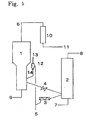
- Fig. 1 is a schematic view of an apparatus of the present invention, for the production of ⁇ -caprolactam by subjecting cyclohexanone oxime to a gaseous phase Beckmann rearrangement reaction in the presence of a solid catalyst, which comprises a fluidized bed reactor and a fixed bed reactor.
- Fig. 1 denotes a fluidized bed reactor, 2 a regenerator for a catalyst in a fluidized bed system, 3 a screw feeder, 4 a control valve, 5,6,7,8,9,11, 13 and 14 a pipe, 10 a fixed bed reactor and 12 a cyclone.
- cyclohexanone oxime may be mixed with an alcohol such as methanol, and is then vaporized, and introduced into a fluidized bed reactor 1 in a gaseous form (referred to as a raw material gas) through a pipe 9.
- a raw material gas a gaseous form
- an inert gas such as nitrogen or argon is introduced into the reactor 1 together with the raw material gas through the pipe 9.
- particles of solid catalyst having a diameter of 0.3 mm or less are placed and fluidized by the raw material gas and the inert gas which are introduced through the pipe 9, and cyclohexanone oxime in the raw material gas is subjected to a Beckmann rearrangement reaction therein to provide a reaction product.
- the space velocity (WHSV) of cyclohexanone oxime i.e., a feeding rate of cyclohexanone oxime (kg/hour) per weight (kg) of catalyst, falls within a range of from about 0.1 h -1 to about 20 h -1 , preferably from about 0.2 h -1 to about 10 h -1 .
- the reaction temperature falls within a range of from 250°C to 450°C, preferably from 300°C to 400°C.
- the reaction pressure falls within a range of from 10 kPa to 0.5 MPa, preferably from 50 kPa to 0.3 MPa.
- the obtained reaction product may contain unreacted cyclohexanone oxime.
- the reaction product obtained in the reactor 1 (in the gaseous form) is withdrawn through a pipe 6 and introduced into a reactor 10 in which the unreacted cyclohexanone oxime in the reaction product is subjected to a Beckmann rearrangement reaction to be converted into ⁇ -caprolactam.
- the reactor 10 is a fixed bed reactor.
- the reaction conditions in the reactor 10 are almost the same as those in the reactor 1 except that the space velocity (WHSV) of the reaction product, i.e., the feeding rate of the reaction product (which contains ⁇ -caprolactam, the unreacted cyclohexanone oxime and by-product impurities) (kg/hour) per weight (kg) of catalyst in the fixed bed, falls within a range of from about 1 h -1 to about 50 h -1 , preferably from about 2 h -1 to about 40 h -1 .
- WHSV space velocity
- the reaction temperature falls within a range of from 300°C to 450°C, preferably from 330°C to 400°C.
- the reaction pressure falls within a range of from 10 kPa to 0.5 MPa, preferably from 50 kPa to 0.3 MPa.
- the resulting reaction product (in a gaseous form) obtained after the completion of the reaction in the reactor 10 may be continuously withdrawn through a pipe 11 and may be treated with a commonly used procedure in order to obtain a purified ⁇ -caprolactam therefrom.
- the reaction product is cooled to be condensed and then subjected to a known purification procedure such as extraction, distillation or crystallization to obtain ⁇ -caprolactam having a desired purity.
- the reactor 1 in the fluidized bed system preferably has a cooler (not shown) for cooling equipped therein so that the catalysts are not exposed to excessively high temperature.
- a so-called adiabatic reactor having no cooler can be utilized, since the amount of cyclohexanone oxime to be reacted in the reactor 10 is small so that the heat release is little. This allows lowering in equipment cost for the reactor 10.
- the amount of cyclohexanone oxime to be introduced into the reactor 10 should be controlled so that an excessive introduction of cyclohexanone oxime is avoided in order to keep the heat load onto the reactor 10 below a certain level. Therefore, it is desirable to adopt reaction conditions in the fluidized bed reactor 1 which allow a conversion of cyclohexanone oxime therein to be 90% or more, preferably 95% or more. It is also possible to provide a cooling apparatus in the fixed bed reactor 10 to control the reaction temperature in the reactor 10. When such an apparatus is provided in the reactor 10, no limitation may be particularly needed onto the conditions (which effect on conversion of cyclohexanone oxime) adopted in the reactor 1.
- the solid catalyst In a process for producing ⁇ -caprolactam by subjecting cyclohexanone oxime to a gaseous phase Beckmann rearrangement reaction using a solid catalyst, the solid catalyst gradually loses its activity due to deposition of carbonaceous substances on the surface of the solid catalyst while the solid catalyst has been used for a long period of time. Therefore, the catalyst should be reused after being regenerated by treating with an oxygen-containing gas so as to burn and remove the carbonaceous substances.
- the regeneration treatment of a solid catalyst used in a fluidized bed reactor is preferably carried out in a regenerator in the fluidized bed system.
- 1, 2 denotes a regenerator for the catalyst in a fluidized bed system and 4 denotes a control valve with a pipe feeding the solid catalyst having a lowered activity from the reactor 1 to the regenerator 2.
- the solid catalyst in a suitable amount is continuously or intermittently fed from the reactor 1 to the regenerator 2 by adjusting an opening of the valve 4.
- an oxygen-containing gas such as air is introduced into the regenerator 2 through a piping 7.
- air is preferably used as it is, while the air having an oxygen concentration of 20% or less may also be used which is obtained after mixing with an inert gas such as nitrogen.
- the temperature for the regeneration treatment falls within a range of 350°C to 700°C, preferably from 400°C to 600°C.
- the temperature is lower than 350°C, the burning of carbonaceous substances deposited on the catalyst tends to be insufficient and the remaining amount of nitrogen component in the catalyst, which is also a substance lowering the activity of the catalyst, tends to be too large and, therefore, the activity of the catalyst may not be sufficiently recovered.
- the temperature is higher than 700°C, the solid catalyst such as zeolite may decompose and the activity and selectivity of the catalyst tends to be gradually lowered.
- the pressure for the regeneration treatment falls within approximately the same range as that for the Beckmann rearrangement reaction.
- the residence time of the catalyst in the regenerator 2 is from 0.5 hour to 500 hours in average.
- a waste gas produced by the burning in the regeneration treatment is discharged through a pipe 8.
- the solid catalyst obtained after the regeneration treatment is withdrawn from the regenerator 2 via a screw feeder 3 which can continuously and quantitatively discharge the solid catalyst.
- Nitrogen gas is introduced from a pipe 5 to a cyclone 12.
- the solid catalyst is separated from the nitrogen gas in the cyclone 12, introduced through a pipe 14 into the reactor 1 and reused in the reactor 1.
- the remaining nitrogen gas is discharged through a pipe 13.
- Fig. 1 shows one embodiment of the present invention in which the reaction product obtained from the fluidized bed reactor 1 is introduced into the fixed bed reactor 10 connected in series to the reactor 1.
- the Beckmann rearrangement reaction in the reactor 1 should be unwillingly interrupted while the solid catalyst is regenerated in the reactor 10. Therefore, it is preferred that more than one fixed bed reactors, preferably two or more fixed bed reactors, are provided per one fluidized bed reactor 1 for the rearrangement reaction.
- Fig. 2 shows another embodiment of the present invention of such a system.
- a plurality of fixed bed reactors such as three fixed bed reactors 10-1, 10-2 and 10-3 are connected in parallel to a fluidized bed reactor 1 downstream of the fluidized bed reactor 1.
- Respective fixed bed reactors can be blocked by sluice valves away from the introduction of the gaseous reaction product, which is withdrawn from the fluidized bed reactor 1 and may be introduced to each fixed bed reactor through a pipe 6.
- the sluice valve for the reactor 10-2 is closed and an oxygen-containing gas is introduced into the reactor 10-2 through a pipe 7-2 so that the catalyst in the reactor 10-2 is subjected to the regeneration treatment, while the gaseous reaction product is introduced into the reactor 10-1 through the pipe 6.
- an inert gas such as nitrogen gas is passed through the pipe 7-2 to replace the interior of the reactor 10-2 with the inert gas.
- the introduction of reaction product produced in the reactor 1 is switched by the sluice valves from the reactor 10-1 to the reactor 10-2, and an oxygen-containing gas is introduced into the reactor 10-1 through a pipe 7-1 so that the catalyst in the reactor 10-1 is subjected to the regeneration treatment.
- the reaction product obtained in the fluidized bed reactor 1 is continuously subjected to the Beckmann rearrangement reaction in one of two fixed bed reactors 10-1 and 10-2 by interchangeably using one of the fixed bed reactors.
- the fixed reactor where the rearrangement reaction is conducted by the introduction of the reaction product obtained in the fluidized bed 1 reactor is changed in turn by switching the sluice valves in the same manner as described above.
- the conditions, i.e. temperature, pressure, oxygen concentration and so on, for the regeneration treatment of the catalyst in the fixed bed reactors may be similar to those for the regeneration treatment of the catalyst in the fluidized bed reactor as described above.
- the period of time required for the regeneration treatment depends on temperature, oxygen concentration and pressure and may be suitably from 10 hours to 30 days.
- ⁇ -caprolactam is obtained with a high yield using an apparatus comprising a fluidized bed reactor and a fixed bed reactor placed downstream of the fluidized bed reactor. Furthermore, according to the present invention, when an apparatus is adopted in which more than one fixed bed reactors are installed per one fluidized bed reactor as illustrated in Fig.
- a catalyst in a form of tablets (3 mm in diameter and 3 mm in length) was obtained by extruding a high-silica MFI zeolite consisting substantially of silicon oxide.
- a stainless steel tube having a diameter of 40 mm and a length of 400 mm was packed 75 g of the catalyst to prepare a fixed bed reactor 10.
- a catalyst in a form of fine powders having a diameter of 0.3 mm or less comprising MFI zeolite as a main component to prepare a regenerator 2.
- the fluidized bed reactor 1, the fixed bed reactor 10 and the regenerator 2 were connected to one another as shown in Fig. 1.
- the particles of the catalyst in the fluidized bed reactor 1 were fluidized by introducing nitrogen gas through a pipe 9 at a rate of 0.4 m 3 /hour.
- the temperature in the fluidized bed reactor 1 was elevated to 350°C.
- air was introduced through a pipe 7 into the regenerator 2 at a rate of 0.2 m 3 /hour and the temperature in the regenerator 2 was elevated to 500°C, to fluidize the catalyst therein at the elevated temperature 500°C.
- cyclohexanone oxime in a gaseous form as a raw material was fed through the pipe 9 into the fluidized bed reactor 1 at a rate of 1,260 g/hour together with gaseous methanol at a rate of 2,240 g/hour.
- nitrogen gas was introduced from a pipe 5 to the cyclone 12 at a rate of 1.0 m 3 /hour.
- the catalyst was circulated from the fluidized bed reactor 1 to the regenerator 2 and from the regenerator 2 to the fluidized bed reactor 1 at a rate of 20 g/hour in terms of the weight of catalyst.
- reaction product contained cyclohexanone oxime at a concentration of 2,000 ppm based on ⁇ -caprolactam therein.
- Example 2 The same reactions and operations as in Example 1 were conducted except that the fixed bed reactor 10 was omitted. After the passage of 67 hours, it was revealed that the reaction product withdrawn through the pipe 11 contained cyclohexanone oxime at the concentration of 4,000 ppm based on ⁇ -caprolactam therein.
- Example 2 The same reactions and operations as in Example 1 were conducted except that the shape of catalyst packed in the fixed bed reactor 10 was changed to macaroni-type tablets having a diameter of 5 mm and a length of 5 mm with a pore having a diameter of 2 mm, and the amount of the catalyst packed in the fixed bed reactor 10 was changed to 80 g. After the passage of 97 hours, it was revealed that the reaction product withdrawn through the pipe 11 contained cyclohexanone oxime at the concentration of 1,000 ppm based on ⁇ -caprolactam therein.
- Example 2 The same reactions and operations as in Example 2 were conducted except that the fixed bed reactor 10 was omitted. After the passage of 97 hours, it was revealed that the reaction product withdrawn through the pipe 11 contained cyclohexanone oxime at the concentration of 4,000 ppm based on ⁇ -caprolactam therein.
Landscapes
- Chemical & Material Sciences (AREA)
- Organic Chemistry (AREA)
- Chemical Kinetics & Catalysis (AREA)
- Engineering & Computer Science (AREA)
- Combustion & Propulsion (AREA)
- Other In-Based Heterocyclic Compounds (AREA)
- Low-Molecular Organic Synthesis Reactions Using Catalysts (AREA)
- Catalysts (AREA)
Abstract
Description
Claims (11)
- An apparatus for the production of ε-caprolactam with a gaseous phase Beckmann rearrangement reaction of cyclohexanone oxime using a solid catalyst, which comprises (i) a fluidized bed reactor having a solid catalyst therein for subjecting cyclohexanone oxime to a gaseous phase Beckmann rearrangement reaction to obtain a first reaction product containing unreacted cyclohexanone oxime and (ii) a fixed bed reactor packed with a solid catalyst, which is placed downstream of said fluidized bed reactor, for subjecting said unreacted cyclohexanone oxime contained in the first reaction product to a gaseous phase Beckmann rearrangement reaction to obtain a second reaction product mainly containing ε-caprolactam.
- The apparatus according to claim 1, wherein not less than one fixed bed reactor is provided per said fluidized bed reactor and arranged so that at least one of said fixed bed reactors is interchangeably used.
- The apparatus according to claim 1, wherein two or more fixed bed reactors are provided per said fluidized bed reactor and arranged so that at least one of said fixed bed reactors is interchangeably used.
- The apparatus according to any one of claims 1 to 3, which further comprises (iii) a fluidized bed reactor for subjecting the solid catalyst used in the fluidized bed reactor (1) to a regeneration treatment with an oxygen-containing gas.
- The apparatus according to any one of claims 1 to 4, wherein said solid catalyst is a pentasil-type zeolite.
- The apparatus according to any one of claims 1 to 5, wherein said fixed bed reactor is of the thermal insulation type.
- A process for producing ε-caprolactam which comprises the steps of (i) subjecting cyclohexanone oxime to a gaseous phase Beckmann rearrangement reaction using a solid catalyst in a fluidized bed reactor to obtain a first reaction product containing unreacted cyclohexanone oxime, and then (ii) subjecting said unreacted cyclohexanone oxime contained in the first reaction product to a gaseous phase Beckmann rearrangement reaction using a solid catalyst in a fixed bed reactor to obtain a second reaction product mainly containing ε-caprolactam.
- The process according to claim 7, which further comprises the steps of (iii) withdrawing the solid catalyst from the fluidized bed reactor in step (1) to introduce the catalyst into another fluidized bed reactor, (iv) treating the catalyst with an oxygen-containing gas and (v) returning the treated catalyst to the fluidized bed reactor in step (i).
- The process according to claim 7 or 8, wherein said solid catalyst is a pentasil-type zeolite.
- The process according to any one of claims 7 to 9, wherein said first reaction product contains unreacted cyclohexanone oxime in an amount of 5% or less based on cyclohexanone oxime which is fed in step (i).
- The process according to any one of claims 7 to 10, wherein said fixed bed reactor is of the thermal insulation type.
Applications Claiming Priority (2)
| Application Number | Priority Date | Filing Date | Title |
|---|---|---|---|
| JP6999999 | 1999-03-16 | ||
| JP6999999 | 1999-03-16 |
Publications (2)
| Publication Number | Publication Date |
|---|---|
| EP1036589A2 true EP1036589A2 (en) | 2000-09-20 |
| EP1036589A3 EP1036589A3 (en) | 2000-12-13 |
Family
ID=13418891
Family Applications (1)
| Application Number | Title | Priority Date | Filing Date |
|---|---|---|---|
| EP00105460A Withdrawn EP1036589A3 (en) | 1999-03-16 | 2000-03-15 | Apparatus and process for producing Epsilon-caprolactam |
Country Status (5)
| Country | Link |
|---|---|
| US (1) | US6258949B1 (en) |
| EP (1) | EP1036589A3 (en) |
| KR (1) | KR20010014595A (en) |
| CN (1) | CN1273971A (en) |
| SG (1) | SG86381A1 (en) |
Cited By (1)
| Publication number | Priority date | Publication date | Assignee | Title |
|---|---|---|---|---|
| SG110097A1 (en) * | 2003-07-08 | 2005-04-28 | Sumitomo Chemical Co | Method for producing epsilon-caprolactam |
Families Citing this family (4)
| Publication number | Priority date | Publication date | Assignee | Title |
|---|---|---|---|---|
| US7022844B2 (en) | 2002-09-21 | 2006-04-04 | Honeywell International Inc. | Amide-based compounds, production, recovery, purification and uses thereof |
| CN101434569B (en) * | 2007-11-15 | 2011-07-20 | 中国石油化工股份有限公司 | Method and equipment for preparing caprolactam from cyclohexanone oxime |
| CN102603633B (en) * | 2012-01-20 | 2013-12-11 | 中国天辰工程有限公司 | Gasification system for preparing cyclohexanone oxime in caprolactam by Beckmann gas phase rearrangement |
| CN112079759A (en) * | 2020-09-02 | 2020-12-15 | 浙江恒澜科技有限公司 | Caprolactam production device and production method |
Family Cites Families (10)
| Publication number | Priority date | Publication date | Assignee | Title |
|---|---|---|---|---|
| US2373358A (en) * | 1943-12-31 | 1945-04-10 | Phillips Petroleum Co | Catalytic process and apparatus |
| GB685181A (en) * | 1950-02-27 | 1952-12-31 | Basf Ag | Improvements in the cracking of hydrocarbons |
| US3821202A (en) | 1971-03-19 | 1974-06-28 | Bayer Ag | Process for purifying lactams |
| DE2443341C3 (en) | 1974-09-11 | 1979-05-17 | Basf Ag, 6700 Ludwigshafen | Process for purifying raw caprolactam |
| DE2641381A1 (en) * | 1976-09-15 | 1978-03-16 | Bayer Ag | USE OF RESIDUES FROM THE CYCLOHEXANONOXIME DISTILLATION FOR THE MANUFACTURE OF EPSILON CAPROLACTAM |
| US4248728A (en) | 1979-02-28 | 1981-02-03 | Chemed Corporation | Liquid scouring cleanser |
| DE2915360A1 (en) * | 1979-04-14 | 1980-10-30 | Basf Ag | METHOD FOR PRODUCING CAPROLACTAM |
| US4968793A (en) * | 1989-01-26 | 1990-11-06 | Sumitomo Chemical Company, Limited | Process for producing ε-caprolactam |
| EP0494535B1 (en) * | 1990-12-26 | 1998-02-18 | Sumitomo Chemical Company Limited | Process for producing epsilon-caprolactam and activating solid catalysts therefor |
| KR100224333B1 (en) * | 1991-11-27 | 1999-10-15 | 고오사이 아끼오 | Process for producing epsilon-caprolactam |
-
2000
- 2000-03-15 EP EP00105460A patent/EP1036589A3/en not_active Withdrawn
- 2000-03-15 SG SG200001445A patent/SG86381A1/en unknown
- 2000-03-16 US US09/526,885 patent/US6258949B1/en not_active Expired - Fee Related
- 2000-03-16 CN CN00107037A patent/CN1273971A/en active Pending
- 2000-03-16 KR KR1020000013297A patent/KR20010014595A/en not_active Withdrawn
Cited By (1)
| Publication number | Priority date | Publication date | Assignee | Title |
|---|---|---|---|---|
| SG110097A1 (en) * | 2003-07-08 | 2005-04-28 | Sumitomo Chemical Co | Method for producing epsilon-caprolactam |
Also Published As
| Publication number | Publication date |
|---|---|
| CN1273971A (en) | 2000-11-22 |
| SG86381A1 (en) | 2002-02-19 |
| KR20010014595A (en) | 2001-02-26 |
| EP1036589A3 (en) | 2000-12-13 |
| US6258949B1 (en) | 2001-07-10 |
Similar Documents
| Publication | Publication Date | Title |
|---|---|---|
| US6265574B1 (en) | Process for producing ε-caprolactam | |
| EP3433226B1 (en) | Improved acrylic acid production process | |
| EP0968184B1 (en) | Process for the preparation of caprolactam in the absence of catalysts by contacting 6-aminocaproic acid derivatives with superheated steam | |
| US6060632A (en) | Process for producing ethylbenzene | |
| EP0380364B1 (en) | Process for producing epsilon-caprolactam | |
| EP2599748B1 (en) | Method for producing zeolite molded article and method for producing epsilon-caprolactam | |
| US5354859A (en) | ε-caprolactam | |
| US6258949B1 (en) | Apparatus and process for producing ε-caprolactam | |
| EP0544530A1 (en) | Process for producing epsilon-caprolactam by Beckmann-rearrangement in the gas phase in the presence of a zeolite catalyst and water | |
| JP2616088B2 (en) | Production method of ε-caprolactam | |
| EP1352902B1 (en) | Process for producing Epsilon-Caprolactam and catalyst for the production | |
| EP1193251B1 (en) | Method for producing Epsilon-caprolactam | |
| EP1361211B1 (en) | Method for producing e-caprolactam | |
| WO2008026887A1 (en) | Process for preparing dimethyl ether | |
| KR100716096B1 (en) | Process for the production of triethylenediamine using ethylenediamine | |
| JP2000327656A (en) | Reactor for producing ε-caprolactam and method for producing ε-caprolactam using the same | |
| KR20120044880A (en) | Method for manufacturing cyclohexanone oxime | |
| Roeseler et al. | Vapour-phase beckmann rearrangement using B-MFI zeolites | |
| JP4981222B2 (en) | Method for producing ε-caprolactam | |
| EP1814836B1 (en) | Continuous process for the preparation of phenol from benzene in a fixed bed reactor | |
| JP4661071B2 (en) | Method for producing ε-caprolactam | |
| JP2003236394A (en) | Method for regenerating catalyst for producing ε-caprolactam and method for producing ε-caprolactam | |
| JP3221021B2 (en) | Method for producing ε-caprolactam | |
| KR100765156B1 (en) | Amelioration of ammonia breakthrough in an alkane ammoxidation process | |
| JPH0416447B2 (en) |
Legal Events
| Date | Code | Title | Description |
|---|---|---|---|
| PUAI | Public reference made under article 153(3) epc to a published international application that has entered the european phase |
Free format text: ORIGINAL CODE: 0009012 |
|
| AK | Designated contracting states |
Kind code of ref document: A2 Designated state(s): BE DE ES IT NL |
|
| AX | Request for extension of the european patent |
Free format text: AL;LT;LV;MK;RO;SI |
|
| PUAL | Search report despatched |
Free format text: ORIGINAL CODE: 0009013 |
|
| AK | Designated contracting states |
Kind code of ref document: A3 Designated state(s): AT BE CH CY DE DK ES FI FR GB GR IE IT LI LU MC NL PT SE |
|
| AX | Request for extension of the european patent |
Free format text: AL;LT;LV;MK;RO;SI |
|
| 17P | Request for examination filed |
Effective date: 20010525 |
|
| AKX | Designation fees paid |
Free format text: BE DE ES IT NL |
|
| STAA | Information on the status of an ep patent application or granted ep patent |
Free format text: STATUS: THE APPLICATION HAS BEEN WITHDRAWN |
|
| 18W | Application withdrawn |
Effective date: 20040611 |