EP1036096B1 - Supported polymerisation catalyst - Google Patents
Supported polymerisation catalyst Download PDFInfo
- Publication number
- EP1036096B1 EP1036096B1 EP98957009A EP98957009A EP1036096B1 EP 1036096 B1 EP1036096 B1 EP 1036096B1 EP 98957009 A EP98957009 A EP 98957009A EP 98957009 A EP98957009 A EP 98957009A EP 1036096 B1 EP1036096 B1 EP 1036096B1
- Authority
- EP
- European Patent Office
- Prior art keywords
- support
- compound
- transition metal
- catalyst
- catalyst according
- Prior art date
- Legal status (The legal status is an assumption and is not a legal conclusion. Google has not performed a legal analysis and makes no representation as to the accuracy of the status listed.)
- Expired - Lifetime
Links
- 0 CC1N(*)[C@@]1C(N=C(*)C*)=C(*)C* Chemical compound CC1N(*)[C@@]1C(N=C(*)C*)=C(*)C* 0.000 description 4
Images



Classifications
-
- C—CHEMISTRY; METALLURGY
- C08—ORGANIC MACROMOLECULAR COMPOUNDS; THEIR PREPARATION OR CHEMICAL WORKING-UP; COMPOSITIONS BASED THEREON
- C08F—MACROMOLECULAR COMPOUNDS OBTAINED BY REACTIONS ONLY INVOLVING CARBON-TO-CARBON UNSATURATED BONDS
- C08F4/00—Polymerisation catalysts
- C08F4/02—Carriers therefor
-
- C—CHEMISTRY; METALLURGY
- C08—ORGANIC MACROMOLECULAR COMPOUNDS; THEIR PREPARATION OR CHEMICAL WORKING-UP; COMPOSITIONS BASED THEREON
- C08F—MACROMOLECULAR COMPOUNDS OBTAINED BY REACTIONS ONLY INVOLVING CARBON-TO-CARBON UNSATURATED BONDS
- C08F4/00—Polymerisation catalysts
- C08F4/06—Metallic compounds other than hydrides and other than metallo-organic compounds; Boron halide or aluminium halide complexes with organic compounds containing oxygen
- C08F4/26—Metallic compounds other than hydrides and other than metallo-organic compounds; Boron halide or aluminium halide complexes with organic compounds containing oxygen of manganese, iron group metals or platinum group metals
-
- Y—GENERAL TAGGING OF NEW TECHNOLOGICAL DEVELOPMENTS; GENERAL TAGGING OF CROSS-SECTIONAL TECHNOLOGIES SPANNING OVER SEVERAL SECTIONS OF THE IPC; TECHNICAL SUBJECTS COVERED BY FORMER USPC CROSS-REFERENCE ART COLLECTIONS [XRACs] AND DIGESTS
- Y10—TECHNICAL SUBJECTS COVERED BY FORMER USPC
- Y10S—TECHNICAL SUBJECTS COVERED BY FORMER USPC CROSS-REFERENCE ART COLLECTIONS [XRACs] AND DIGESTS
- Y10S526/00—Synthetic resins or natural rubbers -- part of the class 520 series
- Y10S526/904—Monomer polymerized in presence of transition metal containing catalyst at least part of which is supported on a polymer, e.g. prepolymerized catalysts
Definitions
- the present invention relates to immobilised supported polymerisation catalysts for atom transfer polymerisation of olefinically unsaturated monomers in which molecular weight control is achieved by the presence of certain transition metal, especially copper, complexes.
- diimines such as 1,4-diaza-1,3-butadienes and 2-pyridinecarbaldehyde imines may be used in place of bipyridines.
- These ligands offer the advantage of homogeneous polymerisation and thus the level of active catalyst can be accurately controlled and only one polymerisation process ensues.
- This class of ligand also enables the control of the relative stability of the transition metal valencies, for example, Cu(I) and Cu(II), by altering ancillary substituents and thus gives control over the nature of the products through control over the appropriate chemical equilibrium.
- Such a system is tolerant to trace impurities, trace levels of O 2 and functional monomers, and may even be conducted in aqueous media.
- This system is the subject of copending patent application number PCT/GB97/01589 (WO97/47661).
- a further advantage of this system is that the presence of free-radical inhibitors traditionally used to inhibit polymerisation of commercial monomers in storage, such as 2, 6-di-tert-butyl-4-methylphenol (topanol), increases the rate of reaction of the invention. This means that lengthy purification of commercial monomers to remove such radical inhibitors is not required. Furthermore, this indicates that the system is not a free-radical process. This is contrary to Matajaszewski and Sawamoto who show free-radical based systems.
- a difficulty identified by the inventors for the commercialisation of the radical polymerisation system of Matajazewski and Sawamoto, and the diimine-based system described above is that high levels of catalysts is required for acceptable rates of polymerisation. This means that catalyst is relatively expensive as it is not recycled/reused and it must be removed by lengthy procedures to prevent contamination of the final product and to keep production costs down.
- the inventors have therefore identified a process for attaching the catalyst to supports which allows the catalyst to be easily recovered and produces products with substantially less contamination than previously described systems.
- Such supported catalysts were expected by the inventors to clump together since each metal ion can coordinate with two-ligands, each of which is attached to a support. This would reduce the effectiveness of such supported systems. However, this has not been observed by the inventors. Furthermore, the metal ion is tightly bound to the ligands and does not leach off into the surrounding solution or product, allowing it to be reused.
- a first aspect of the invention provides a catalyst for the addition polymerisation of olefinically unsaturated monomers comprising a supported ligand of General Formula 1: Formula 1 S ( D ⁇ ) n
- the support is inorganic, such as silica, especially silica gel.
- the support may be organic, especially an organic polymer, especially a cross-linked organic polymer, such as poly(styrene-w-divinylbenzene).
- the support is in the form of beads. This latter form is particularly advantageous because it has a high surface area which allows the attachment of a large number of compounds, whilst presenting a large surface area to the medium to be catalysed.
- the compound (D) may be adsorbed onto the support or covalently attached to the support.
- the compound is an organic compound comprising Schiff base, amine, hydroxyl, phosphine or diimine capable of complexing with a transition metal ion.
- Each Schiff base, amine, hydroxyl, phosphine or diimine is preferably separated from the support by a branched or straight alkyl chain, especially a chain containing 1 to 20 carbon atoms.
- the chain may comprise one or more aromatic groups as part of the alkyl chain.
- One preferred ligand is the use of a support attached to two or more alkyl-amines, such as aminopropyl-, aminobutyl-, aminopentyl-, aminohexyl-, aminoheptyl- or aminooctyl- functionalised support.
- the amine groups are capable of forming a complex with one or more transition metal ions.
- Especially preferred compounds are diimines.
- one of the nitrogens of the diimine is not part of an aromatic ring.
- the diimine is a 1,4-diaza-1,3-butadiene a 2-pyridinecarbaldehyde imine an Oxazolidone or a Quinoline Carbaldehyde
- R 1 , R 2 , R 10 , R 11 , R 12 and R 13 may be a C 1 to C 20 alkyl, hydroxyalkyl or carboxyalkyl, in particular C 1 to C 4 alkyl, especially methyl or ethyl, n-propylisopropyl, n-butyl, sec-butyl, tert-butyl, cyclohexyl, 2-ethylhexyl, octyl decyl or lauryl.
- R 1 , R 2 , R 10 , R 11 , R 12 and R 13 may especially be methyl.
- the compounds may exhibit a chiral centre ⁇ to one of the nitrogen groups. This allows the possibility for polymers having different stereochemistry structures to be produced.
- Compounds of general Formula 3 may comprise one or more fused rings on the pyridine group.
- R 1 and R 3 , R 3 and R 4 , R 4 and R 2 , R 10 and R 9 , R 8 and R 9 , R 8 and R 7 , R 7 and R 6 , R 6 and R 5 groups may be C 5 to C 8 cycloalkyl, cycloalkenyl, polycycloalkyl, polycycloalkenyl or cyclicaryl, such as cyclohexyl, cyclohexenyl or norbornyl.
- the diimine compounds are preferably covalently attached to the support via positions R1, R2, R9, R10, R11, R12 or R13. They may be attached via a linkage group, such as a schiff base to the support.
- Preferred diimines include: and
- the ligands are used to form a catalyst for the addition polymerization of olefinically unsaturated monomers by using them in conjunction with:
- Homolytically cleavable means a bond which breaks without integral charge formation on either atom by homolytic fission. Conventionally this produces a radical on the compound and a halogen atom radical. For example:
- a “free-radical” is defined as an atom or group of atoms having an unpaired valence electron and which is a separate entity without other interactions.
- Transition metals may have different valencies, for example Fe(II) and Fe(III), Cu(I) and Cu(II), a low valency state is the lower of the commonly occurring valencies, i.e. Fe(II) or Cu(I).
- M in Formula 30 is preferably Cu(I), Fe(II), Co(II), Ru(II) or Ni(II), most preferably Cu(I).
- the co-ordinating ligand is (CH 3 CN) 4 .
- Y may be chosen from Cl, Br, F, I, NO 3 , PF 6 , BF 4 , SO 4 , CN, SPh, SCN, SePh or triflate (CF 3 SO 3 ).
- Copper (I) triflate may be in the form of a commercially available benzene complex (CF 3 SO 3 Cu) 2.
- the especially preferred compound used is CuBr.
- the second component (b) is selected from: RX
- the second component (b) may especially be selected from Formulae 43 to 52: where:
- Formula 45 Especially preferred examples of Formula 45 are: Br may be used instead at Cl in Formulae 46A and 46B.
- the transition metal may be precoordinated to the ligand covalently attached to its support.
- a second aspect of the invention provides a catalyst for use in the polymerisation of olefinically unsaturated monomers, especially vinyl monomers comprising a compound of general formula: Formula 52 ( SD ⁇ ) c ⁇ M d + ⁇ A
- M is as defined for Formula 30 above.
- S may be as defined for Formula 1.
- D may be adsorbed or covalently attached to the support.
- D may be a compound as described earlier for the first aspect of the invention.
- D may have one of the nitrogens as not part of a diimine ring.
- D may be a diimine according to Formulae 2-29 as previously defined.
- the catalyst is used with an initiator comprising a homolytically cleavable bond with a halogen atom, as previously defined.
- Preferred initiators are those defined in the first aspect of the invention according to Formulae 31 to 53.
- a third aspect of the invention provides a process for the production of diimine covalently attached to supports, according to the first or second aspects of the invention.
- the invention provides a process for producing a ligand for use In the catalysis of addition polymerisation of olefinically unsaturated monomers, especially vinylic monomers, comprising the steps of:
- the primary amine of the functionalised support reacts with the aldehyde group or ketone group to form a Schiff base.
- the diimine may be produced by providing a ligand precursor with an aldehyde or ketone group replacing one of the imine groups of the final product, the reaction with the primary amine producing the second iimine group. This is shown in the reaction scheme below which shows the reaction of a support functionalised with a primary amine with 2-pyridine carbaldehyde to form a diimine attached to the support. This can then be mixed with copper bromide or copper chloride to form a catalyst.
- an aldehyde or a ketone group may be provided separately on a diimine ligand precusor.
- a suitable precursor is shown in Formula 53
- the primary amine group may alternatively be provided on the ligand precursor and reacted with a ketone or aldehyde functionalised support.
- the support material may be functionalised inorganic material, such as silica, especially silica gel.
- functionalised organic support especially a functionalised cross-linked polymeric support, such as poly(styrene-w-divinylbenzene) may be used.
- Such supports are preferably usually used for adsorbing compounds or in chromatography.
- reaction to form the Schiff base occurs at room temperature.
- the functionalised support is an aminopropyl functional silica and the ligand precursor is 2-pyridine carbaldehyde.
- the supported catalysts of the invention may be used in batch reactions or in continous reactions to polymerise olefinically unsaturated monomers. In the latter case, the supported catalyst may be packed into columns and the reaction mixture passed through.
- the supported catalyst may be conveniently removed from a reaction mixture by for example filtration, precipitation or centrifugation.
- the support may be magnetised beads and the catalyst is removed by means of a magnet.
- the invention also provides the use of the catalyst according to the invention in the addition polymerisation of one or more olefinically unsaturated monomers and the polymerised products of such processes.
- the components may be used together in any order.
- the catalyst will work at a wide variety of temperatures, including room temperature and as low as -15°C. Accordingly, preferably the catalyst is used at a temperature of -20°C to 200°C, especially -20°C to 150°C, 20°C to 130°C, more preferably 90°C.
- the olefinically unsaturated monomer may be a methacrylic, an acrylate, a styrene, methacrylonitrile or a diene such as butadiene.
- olefinically unsaturated monomers examples include methyl methacrylate, vinylacetate, vinyl chloride acylonitonile, methacylamide, acrylamide, ethyl methacrylate, propyl methacrylate (all isomers), butyl methacrylate (all isomers), and other alkyl methacrylates; corresponding acrylates; also functionalised methacrylates and acrylates including glycidyl methacrylate, trimethoxysilyl propyl methacrylate, allyl methacrylate, hydroxyethyl methacrylate, hydroxypropyl methacrylate, dialkylaminoalkyl methacrylates; fluoroalkyl (meth)acrylates; methacrylic acid, acrylic acid; fumaric add (and esters), itaconic acid (and esters), maleic anhydride; styrene, ⁇ -methyl styrene; vinyl halides such as
- the monomers are commercially available and may comprise a free-radical inhibitor such as 2, 6-di-tert-butyl-4-methylpenol or methoxyplenol.
- a free-radical inhibitor such as 2, 6-di-tert-butyl-4-methylpenol or methoxyplenol.
- the co-catalysts are used in the ratios 0.01 to 1000 D : MY, preferably 0.1 to 10, and compound MY : initiator 0.0001 to 1000, preferably 0.1 to 10, where the degree of polymerisation is controlled by the ratio of monomer to (b) (expressed as molar ratios).
- the components of the catalyst of the second aspect of the invention are added at a ratio M:initiator of 3:1 to 1:100.
- the amount of diimine : metal used in the systems is between 1000:1 and 1:1, especially, 100:1 and 1:1, preferably 5:1 to 1:1, more preferably 3:1 to 1:1.
- the ratio of RX:Copper is 1000:1 to 1:1, especially 100:1 to 1:1.
- the reaction may take place with or without the presence of a solvent.
- suitable solvents in which the catalyst, monomer and polymer product are sufficiently soluble for reactions to occur include water, protic and non-protic solvents including propionitrile, hexane, heptane, dimethoxyethane, diethoxyethane, tetrahydrofuran, ethylacetate, diethylether, N,N-dimethylformamide, anisole, acetonitrile, diphenylether, methylisobutyrate, butan-2-one, toluene and xylene.
- Especially preferred solvents are xylene and toluene, preferably the solvents are used at at least 1 % by weight, more preferably at least 10% by weight.
- the concentration of monomer in the solvents is 100% to 1 %, preferably 100% to 5%.
- the reaction may be undertaken under an inert atmosphere such as nitrogen or argon.
- the reaction may be carried out in suspension, emulsion, mini-emulsion or in a dispersion.
- Statistical copolymers may be produced using the catalysts according to the invention. Such copolymers may use 2 or more monomers in a range of ca.0-100°/o by weight of each of the monomers used.
- Block copolymers may also be prepared by sequential addition of monomers to the reaction catalyst.
- Telechelic polymers may be produced using catalysts of the invention.
- a functional initiator such as Formula 21 may be used with transformation of the w-Br group to a functional group such as -OH or -CO 2 H via use of a suitable reactant such as sodium azide.
- Comb and graft copolymers may be produced using the catalysts of the invention to allow, for example, polymers having functional side chains to be produced, by use of suitable reagents.
- Methyl methacrylate (Aldrich, 99%) was purified by passing through a column of activated basic alumina to remove inhibitor. Copper(I) bromide (Aldrich, 98%) was purified according to the method of Keller & Wycoff. Toluene (Fisons, 99.8%) was dried over sodium. Ethyl-bromoisobutyrate (Aldrich, 98%), 2-pyridene carboxaldehyde, 3-aminopropyl-functionalised silica gel (Aldrich, 9% functionalised), silica gel (Merck), and diethyl ether (BDH, 98%) were used as received. Ref: Keller, R.N.; Wycoff, H.D. Inorg. Synth. 2,1 (1946)
- 2-pyridine carboxaldehyde (0.714 g, 6.67 x 10 -3 mol) was added to 3-aminopropylfunctionalised silica gel (3.00 g, 3.15 x 10 -3 mol of active NH 2 ) dispersed in diethyl ether (50 mL) and stirred for 1 hr.
- the diethyl ether was removed and the ligand functionalised silica gel washed with two aliquots of diethyl ether (50 mL), and dried under vacuum.
- the ligand functionalised silica gel was added to a Schlenk flask and purged with nitrogen.
- 2-pyridine carboxaldehyde (0.5 g, 6.67 x 10 -3 ) was added to amino functionalised cross-linked polystyrene beads (1.30g) dispersed in tetrahydrofuran (50mL) and stirred for 1 hr. The tetrahydrofuran was removed and the ligand functionalised polystyrene beads washed with two aliquots of tetrahydrofuran (50mL) and dried under vacuum. The ligand functionalised polystyrene was added to a Schlenk flask and purged with nitrogen.
- the polymerisation reaction was initiated by the addition of ethyl-2-bromoisobutyrate, 0.069 ml (4.65 x 10 -4 mol), and the timer was started.
- Time (min) Conversion Mn Mw PDi 7A 120 6.1 93600 314000 3.35 7B 300 21.5 17900 320000 1.78 7C 1380 68.7 89100 243000 2.72
- the precursor shown in Formula 53 may be produced by reacting 2-pyridine carbaldehyde with an ⁇ -aminocarboxylic acid, such as 8-amino caprylic acid, followed by mild reduction or by coupling of the parent acid through an amide link. It is envisaged that the use of amino acids will allow the incorporation of asymmetry into the system.
- Figure 2 shows infrared spectra for the stepwise synthesis of the pyridyl ligand onto cross-linked polystyrene beads.
- a suspension of chloromethylated cross-linked polystyrene beads (3g, 4 mmol of Cl/g resin, 12 mmol) was shaken in round bottom flask with 15 ml amine during one day at room temperature.
- the polymer was filtered and successively rinsed two times with 10% triethylamine in dimethylformamide, once with DMF, four times with 10% Et3N in tetrahydrofuran, three times with THF and three times with methanol.
- the solid was then dried under vacuum at RT then at 80°C in the vacoven to constant weight.
- Supports S1 to S4 were found to be bright orange solids, although S5 was light yellow and S6 beige. Supports S1 to S5 were easily complexing copper bromide in methanol (black colour of the support). It took time to notice a change of colour for S6, when trying to complex CuBr. Table Comparison of synthesis routes and characterisation of silica supported ligands.
- Step2 method 2 Typically mixture of 3-aminopropyl silica gel (15 g, 15.75 mmol) in toluene (150 ml) with pyridine carbaldehyde (3.6g, 33 mmol).
- annex c 3-aminopropyl silica gel 60 40 4 000 50 850 2.5 240 74 7 410 50 800 2.4 a further data are available in annex c 3-aminopropyl silica gel; here [lig] is equal to the concentration of amine functions on the silica support.
- d Mn(th) ([MMMA]0/[I]0 x MWMMA) x conversion, where MWMMA is the molecular weight of methyl methacrylate and [MMMA]0/[I]0 is the initial concentration ratio of MMA to initiator.
- Figure 3 shows kinetic reproducibility of silica supported atom transfer polymerisation from experiments carried out with different silica supported ligands synthesised at different times.
- c Mn(th) ([MMMA]0/[I]0 x MWMMA) x conversion, where MWMMA is the molecular weight of methyl methacrylate and [MMMA]0/[I]0 is the initial concentration ratio of MMA to initiator.
- c Mn(th) ([MMMA]0/[I]0 x MWMMA) x conversion, where MWMMA is the molecular weight of methyl methacrylate and [MMMA]0/[I]0 is the initial concentration ratio of MMA to initiator.
- the flask is then submitted to three Freeze-Pump-Thaw cycles (FPT).
Landscapes
- Chemical & Material Sciences (AREA)
- Polymers & Plastics (AREA)
- Materials Engineering (AREA)
- Health & Medical Sciences (AREA)
- Chemical Kinetics & Catalysis (AREA)
- Medicinal Chemistry (AREA)
- Engineering & Computer Science (AREA)
- Organic Chemistry (AREA)
- Catalysts (AREA)
- Addition Polymer Or Copolymer, Post-Treatments, Or Chemical Modifications (AREA)
- Transition And Organic Metals Composition Catalysts For Addition Polymerization (AREA)
- Low-Molecular Organic Synthesis Reactions Using Catalysts (AREA)
- Glass Compositions (AREA)
- Organic Low-Molecular-Weight Compounds And Preparation Thereof (AREA)
Abstract
Description
- The present invention relates to immobilised supported polymerisation catalysts for atom transfer polymerisation of olefinically unsaturated monomers in which molecular weight control is achieved by the presence of certain transition metal, especially copper, complexes.
- It is desirable to be able to produce high molecular weight polymers with a low molecular weight distribution by catalysed addition polymerisation, in particular of vinylic monomers. Hitherto this has been achieved by polymerising via ionic processes typically in the presence of organometallics such as alkyl lithium's which are sensitive as regards reaction with water and other protic species. As such monomers containing functional groups are not readily polymerised. The use of ionic systems also precludes the use of solvents which contain protic groups and/or impurities resulting in very stringent reaction conditions and reagent purity being employed.
- More recently atom transfer polymerisation based on the combination of a transition metal halide and alkyl halide have been utilised. For example Matyjasewski (Macromolecules (1995), vol 28, pages 7901-7910 and W096/30421) has described the use of CuX (where X=Cl, Br) in conjunction with bipyridine and an alkyl halide to give polymers of narrow molecular weight distribution and controlled molecular weight. This system suffers from the disadvantage that the copper catalyst is partially soluble in the system and thus a mixture of homogeneous and heterogeneous polymerisation ensues. The level of catalyst which is active in solution is thus difficult to determine. The catalyst residues which are soluble in the reaction medium prove difficult to remove from the product. Percec (Macromolecules, (1995), vol. 28, page 1995) has extended Matyjasewski's work by utilising arenesulphonyl chlorides to replace alkyl chlorides, again this results in a mixture of homogeneous and heterogeneous polymerisation and catalyst residues are difficult to remove from the product. Sawamoto (Macromolecules, (1995), vol. 28, page 1721 and Macromolecules, (1997), vol. 30, page 2244) has also utilised a ruthenium based system for similar polymerisation of methacrylates. This system requires activation of monomer by an aluminium alkyl in order to achieve the best results, itself sensitive to reaction with protic species which is an inherent disadvantage. These systems have been described as proceeding via a free radical mechanism which suffers from the problem that the rate of termination is > 0 due to normal radical-radical combination and disproportionation reactions.
- The inventors have found that the use of diimines such as 1,4-diaza-1,3-butadienes and 2-pyridinecarbaldehyde imines may be used in place of bipyridines. These ligands offer the advantage of homogeneous polymerisation and thus the level of active catalyst can be accurately controlled and only one polymerisation process ensues. This class of ligand also enables the control of the relative stability of the transition metal valencies, for example, Cu(I) and Cu(II), by altering ancillary substituents and thus gives control over the nature of the products through control over the appropriate chemical equilibrium. Such a system is tolerant to trace impurities, trace levels of O2 and functional monomers, and may even be conducted in aqueous media. This system is the subject of copending patent application number PCT/GB97/01589 (WO97/47661).
- A further advantage of this system is that the presence of free-radical inhibitors traditionally used to inhibit polymerisation of commercial monomers in storage, such as 2, 6-di-tert-butyl-4-methylphenol (topanol), increases the rate of reaction of the invention. This means that lengthy purification of commercial monomers to remove such radical inhibitors is not required. Furthermore, this indicates that the system is not a free-radical process. This is contrary to Matajaszewski and Sawamoto who show free-radical based systems.
- A difficulty identified by the inventors for the commercialisation of the radical polymerisation system of Matajazewski and Sawamoto, and the diimine-based system described above is that high levels of catalysts is required for acceptable rates of polymerisation. This means that catalyst is relatively expensive as it is not recycled/reused and it must be removed by lengthy procedures to prevent contamination of the final product and to keep production costs down.
- The inventors have therefore identified a process for attaching the catalyst to supports which allows the catalyst to be easily recovered and produces products with substantially less contamination than previously described systems.
- Such supported catalysts were expected by the inventors to clump together since each metal ion can coordinate with two-ligands, each of which is attached to a support. This would reduce the effectiveness of such supported systems.
However, this has not been observed by the inventors. Furthermore, the metal ion is tightly bound to the ligands and does not leach off into the surrounding solution or product, allowing it to be reused. - A first aspect of the invention provides a catalyst for the addition polymerisation of olefinically unsaturated monomers comprising a supported ligand of General Formula 1:

- where: S is the support.
- D is a compound attached to the support, said compound being capable of complexing with a transition metal ion.
- n is an integer of one or more.
- a) a compound of:

- where: M is a transition metal in a low valency state or a transition metal in a low valency state co-ordinated to at least one co-ordinating non-charged ligand, where the low valency state is the lower of the common occurring valencies for that metal;
- Y is a mono- or polyvalent counter ion; and
- b) an initiator compound comprising a homolytically cleavable bond with a halogen atom.
- Preferably, the support is inorganic, such as silica, especially silica gel. Alternatively the support may be organic, especially an organic polymer, especially a cross-linked organic polymer, such as poly(styrene-w-divinylbenzene). Preferably the support is in the form of beads. This latter form is particularly advantageous because it has a high surface area which allows the attachment of a large number of compounds, whilst presenting a large surface area to the medium to be catalysed.
- The compound (D) may be adsorbed onto the support or covalently attached to the support.
- Preferably the compound is an organic compound comprising Schiff base, amine, hydroxyl, phosphine or diimine capable of complexing with a transition metal ion. Each Schiff base, amine, hydroxyl, phosphine or diimine is preferably separated from the support by a branched or straight alkyl chain, especially a chain containing 1 to 20 carbon atoms. The chain may comprise one or more aromatic groups as part of the alkyl chain.
- One preferred ligand is the use of a support attached to two or more alkyl-amines, such as aminopropyl-, aminobutyl-, aminopentyl-, aminohexyl-, aminoheptyl- or aminooctyl- functionalised support. The amine groups are capable of forming a complex with one or more transition metal ions.
- Especially preferred compounds are diimines.
- Preferably one of the nitrogens of the diimine is not part of an aromatic ring.
- Preferably the diimine is a 1,4-diaza-1,3-butadiene


- Furthermore, the compounds may exhibit a chiral centre α to one of the nitrogen groups. This allows the possibility for polymers having different stereochemistry structures to be produced.
- Compounds of
general Formula 3 may comprise one or more fused rings on the pyridine group. - One or more adjacent R1 and R3, R3 and R4, R4 and R2, R10 and R9, R8 and R9, R8 and R7, R7 and R6, R6 and R5 groups may be C5 to C8 cycloalkyl, cycloalkenyl, polycycloalkyl, polycycloalkenyl or cyclicaryl, such as cyclohexyl, cyclohexenyl or norbornyl.
- The diimine compounds are preferably covalently attached to the support via positions R1, R2, R9, R10, R11, R12 or R13. They may be attached via a linkage group, such as a schiff base to the support.
- Preferred diimines include:


- where: * indicates a chiral centre
- R14 = Hydrogen, C1 to C10 branched chain alkyl, carboxy- or hydroxy- C1 to C10 alkyl.
- The ligands are used to form a catalyst for the addition polymerization of olefinically unsaturated monomers by using them in conjunction with:
- a) a compound of
formula 30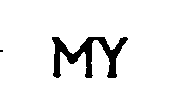
- b) an initiator compound comprising a homolytically cleavable bond with a halogen atom.
- Homolytically cleavable means a bond which breaks without integral charge formation on either atom by homolytic fission. Conventionally this produces a radical on the compound and a halogen atom radical. For example:

- However, the increase in the rate of reaction observed by the inventors with free-radical inhibitors indicates that true free-radicals are not necessarily formed using the catalysts of the invention. It is believed that this possibly occurs in a concerted fashion whereby the monomer is inserted into the bond without formation of a discrete free radical species in the system. That is during propagation this results in the formation at a new carbon-carbon bond and a new carbon-halogen bond without free-radical formation. The mechanism possibly involves bridging halogen atoms such as:

- ML is a transition metal-diimine complex.
- A "free-radical" is defined as an atom or group of atoms having an unpaired valence electron and which is a separate entity without other interactions.
- Transition metals may have different valencies, for example Fe(II) and Fe(III), Cu(I) and Cu(II), a low valency state is the lower of the commonly occurring valencies, i.e. Fe(II) or Cu(I). Hence M in
Formula 30 is preferably Cu(I), Fe(II), Co(II), Ru(II) or Ni(II), most preferably Cu(I). Preferably the co-ordinating ligand is (CH3CN)4.Y may be chosen from Cl, Br, F, I, NO3, PF6, BF4, SO4, CN, SPh, SCN, SePh or triflate (CF3SO3). Copper (I) triflate may be in the form of a commercially available benzene complex (CF3SO3Cu)2.C6H6. The especially preferred compound used is CuBr. - Preferably the second component (b) is selected from:


- where R is independently selectable and is selected from straight, branched or cyclic alkyl, hydrogen, substituted alkyl, hydroxyalkyl, carboxyalkyl or substituted benzyl. Preferably the or each alkyl, hydroxyalkyl or carboxyalkyl contains 1 to 20, especially 1 to 5 carbon atoms.
- X is a halide, especially 1, Br, F or Cl.
- The second component (b) may especially be selected from Formulae 43 to 52:

- X = Br, I or Cl, preferably Br
- R' = -H,
- -(CH2)pR" (where m is a whole number, preferably p = 1 to 20, more preferably 1 to 10, most preferably 1 to 5, R" = H, oH, CooH, halide, NH2, SO3, CoX - where x is Br, I or C) or:

- R111 = -COOH, -COX (where X is Br, I, F or Cl), -OH, -NH2 or -SO3H, especially 2-hydroxyethyl-2'-methy-2' bromopropionate.


- Especially preferred examples of Formula 45 are:


- The careful selection of functional alkyl halides allows the production of terminally functionalised polymers. For example, the selection of a hydroxy containing alkyl bromide allows the production of α-hydroxy terminal polymers. This can be achieved without the need of protecting group chemistry.
- The transition metal may be precoordinated to the ligand covalently attached to its support.
- Accordingly a second aspect of the invention provides a catalyst for use in the polymerisation of olefinically unsaturated monomers, especially vinyl monomers comprising a compound of general formula:

- where: M = a transition metal in a low valency state which is the lower of the commonly occurring valencies for that metal or a transition metal co-ordinated to at least one co-ordinating non-charged ligand.
- S = a support.
- D = a compound attached to the support, the compound being capable of complexing with a transition metal,
- d = an integer of I or 2,
- c = an integer of 1 or 2.
- A = a monovalent or divalent counter ion, such as CI, Br, F, I, NO3, PF6, BF4, SO4, CN, SPh.
- Preferably M is as defined for
Formula 30 above. S may be as defined for Formula 1. - D may be adsorbed or covalently attached to the support.
- D may be a compound as described earlier for the first aspect of the invention.
- D may have one of the nitrogens as not part of a diimine ring.
- D may be a diimine according to Formulae 2-29 as previously defined.
- The catalyst is used with an initiator comprising a homolytically cleavable bond with a halogen atom, as previously defined. Preferred initiators are those defined in the first aspect of the invention according to Formulae 31 to 53.
- A third aspect of the invention provides a process for the production of diimine covalently attached to supports, according to the first or second aspects of the invention.
- The invention provides a process for producing a ligand for use In the catalysis of addition polymerisation of olefinically unsaturated monomers, especially vinylic monomers, comprising the steps of:
- (a) providing a primary amine functionalised support;
- (b) providing a ligand precusor comprising an aldehyde group or ketone group; and
- (c) reacting the primary amine functionalised support with the ligand precursor to form a diimine compound covalently attached to the support.
- The primary amine of the functionalised support reacts with the aldehyde group or ketone group to form a Schiff base. Accordingly the diimine may be produced by providing a ligand precursor with an aldehyde or ketone group replacing one of the imine groups of the final product, the reaction with the primary amine producing the second iimine group. This is shown in the reaction scheme below which shows the reaction of a support functionalised with a primary amine with 2-pyridine carbaldehyde to form a diimine attached to the support. This can then be mixed with copper bromide or copper chloride to form a catalyst.

- Alternatively an aldehyde or a ketone group may be provided separately on a diimine ligand precusor. Such a suitable precursor is shown in Formula 53

- This allows the diimine to be decoupled from the support to allow controlled polymerisation.
- Alternatively the following reaction scheme may be followed:

- The primary amine group may alternatively be provided on the ligand precursor and reacted with a ketone or aldehyde functionalised support.
- The support material may be functionalised inorganic material, such as silica, especially silica gel. Alternatively functionalised organic support, especially a functionalised cross-linked polymeric support, such as poly(styrene-w-divinylbenzene) may be used. Such supports are preferably usually used for adsorbing compounds or in chromatography.
- Preferably the reaction to form the Schiff base occurs at room temperature.
- Preferably the functionalised support is an aminopropyl functional silica and the ligand precursor is 2-pyridine carbaldehyde.
- The supported catalysts of the invention may be used in batch reactions or in continous reactions to polymerise olefinically unsaturated monomers. In the latter case, the supported catalyst may be packed into columns and the reaction mixture passed through.
- The supported catalyst may be conveniently removed from a reaction mixture by for example filtration, precipitation or centrifugation. Alternatively the support may be magnetised beads and the catalyst is removed by means of a magnet.
- The invention also provides the use of the catalyst according to the invention in the addition polymerisation of one or more olefinically unsaturated monomers and the polymerised products of such processes.
- The components may be used together in any order.
- The inventors have unexpectedly found that the catalyst will work at a wide variety of temperatures, including room temperature and as low as -15°C. Accordingly, preferably the catalyst is used at a temperature of -20°C to 200°C, especially -20°C to 150°C, 20°C to 130°C, more preferably 90°C.
- The olefinically unsaturated monomer may be a methacrylic, an acrylate, a styrene, methacrylonitrile or a diene such as butadiene.
- Examples of olefinically unsaturated monomers that may be polymerised include methyl methacrylate, vinylacetate, vinyl chloride acylonitonile, methacylamide, acrylamide, ethyl methacrylate, propyl methacrylate (all isomers), butyl methacrylate (all isomers), and other alkyl methacrylates; corresponding acrylates; also functionalised methacrylates and acrylates including glycidyl methacrylate, trimethoxysilyl propyl methacrylate, allyl methacrylate, hydroxyethyl methacrylate, hydroxypropyl methacrylate, dialkylaminoalkyl methacrylates; fluoroalkyl (meth)acrylates; methacrylic acid, acrylic acid; fumaric add (and esters), itaconic acid (and esters), maleic anhydride; styrene, α-methyl styrene; vinyl halides such as vinyl chloride and vinyl fluoride; acrylonitrile, methacrylonitrile; vinylidene halides of formula CH2 = C(Hal)2 where each halogen is independently Cl or F; optionally substituted butadienes of the formula CH2 = C(R15) C(R15) = CH2 where R15 is independently H, C1 to C10 alkyl, Cl, or F; sulphonic acids or derivatives thereof of formula CH2 = CHSO2OM wherein M is Na, K, Li, N(R16)4 where each R16 is independently H or C1 to C10 alkyl, D is COZ, ON, N(R16)2 or SO2OZ and Z is H, Li, Na, K or N(R16)4; acrylamide or derivatives thereof of formula CH2 = CHCON(R16)2 and methacrylamide or derivative thereof of formula CH2 = C(CH3)CON(R16)2. Mixtures of such monomers may be used.
- Preferably, the monomers are commercially available and may comprise a free-radical inhibitor such as 2, 6-di-tert-butyl-4-methylpenol or methoxyplenol.
- Preferably the co-catalysts are used in the ratios 0.01 to 1000 D : MY, preferably 0.1 to 10, and compound MY : initiator 0.0001 to 1000, preferably 0.1 to 10, where the degree of polymerisation is controlled by the ratio of monomer to (b) (expressed as molar ratios).
- Preferably the components of the catalyst of the second aspect of the invention are added at a ratio M:initiator of 3:1 to 1:100.
- Preferably the amount of diimine : metal used in the systems is between 1000:1 and 1:1, especially, 100:1 and 1:1, preferably 5:1 to 1:1, more preferably 3:1 to 1:1.
- The ratio of RX:Copper is 1000:1 to 1:1, especially 100:1 to 1:1.
- The reaction may take place with or without the presence of a solvent. Suitable solvents in which the catalyst, monomer and polymer product are sufficiently soluble for reactions to occur include water, protic and non-protic solvents including propionitrile, hexane, heptane, dimethoxyethane, diethoxyethane, tetrahydrofuran, ethylacetate, diethylether, N,N-dimethylformamide, anisole, acetonitrile, diphenylether, methylisobutyrate, butan-2-one, toluene and xylene. Especially preferred solvents are xylene and toluene, preferably the solvents are used at at least 1 % by weight, more preferably at least 10% by weight.
- Preferably the concentration of monomer in the solvents is 100% to 1 %, preferably 100% to 5%.
- The reaction may be undertaken under an inert atmosphere such as nitrogen or argon.
- The reaction may be carried out in suspension, emulsion, mini-emulsion or in a dispersion.
- Statistical copolymers may be produced using the catalysts according to the invention. Such copolymers may use 2 or more monomers in a range of ca.0-100°/o by weight of each of the monomers used.
- Block copolymers may also be prepared by sequential addition of monomers to the reaction catalyst.
- Telechelic polymers, may be produced using catalysts of the invention. For example, a functional initiator such as
Formula 21 may be used with transformation of the w-Br group to a functional group such as -OH or -CO2H via use of a suitable reactant such as sodium azide. - Comb and graft copolymers may be produced using the catalysts of the invention to allow, for example, polymers having functional side chains to be produced, by use of suitable reagents.
- Embodiments of the invention will now be described by way of example and with reference to the following figure:
- Figure 1 show the polymerisation of methylmethacrylate for four monomer additions to supported catalyst which has been collected at the end of each previous polymerisation reaction.
- Figure 2 shows infrared spectra for the stepwise synthesis of pyridyl ligand onto cross-linked polystyrene beads.
- Figure 3 shows kinetic reproducibility of silica supported atom transfer polymerisation from experiments carried out with different silica supported ligands synthesised at different times.
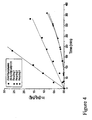
- Figure 4 shows recycling experiments carried out with support S4 using the same conditions:
- [MMA] : [Cu] : [Si-lig] : [E2 BI] = 100 : 1 : 3 : 1
- Figure 5 shows reinitiation of PMMA.
- Methyl methacrylate (Aldrich, 99%) was purified by passing through a column of activated basic alumina to remove inhibitor. Copper(I) bromide (Aldrich, 98%) was purified according to the method of Keller & Wycoff. Toluene (Fisons, 99.8%) was dried over sodium. Ethyl-bromoisobutyrate (Aldrich, 98%), 2-pyridene carboxaldehyde, 3-aminopropyl-functionalised silica gel (Aldrich, 9% functionalised), silica gel (Merck), and diethyl ether (BDH, 98%) were used as received.
Ref: Keller, R.N.; Wycoff, H.D. Inorg. Synth. 2,1 (1946) - Characterisation:
- Conversion was measured by gravimetry, and molecular weight distributions were measured using size exclusion chromatography (SEC) on a system equipped with a guard column, a mixed E column (Polymer Laboratories) and a refractive index detector, using tetrahydrofuran at 1 mL.min-1 as an eluent. Poly(MMA) standards in the range (106 - 200 g.mol-1) were used to calibrate the SEC..
- 2-pyridine carboxaldehyde (0.714 g, 6.67 x 10⁻³ mol) was added to 3-aminopropylfunctionalised silica gel (3.00 g, 3.15 x 10⁻³ mol of active NH 2) dispersed in diethyl ether (50 mL) and stirred for 1 hr. The diethyl ether was removed and the ligand functionalised silica gel washed with two aliquots of diethyl ether (50 mL), and dried under vacuum. The ligand functionalised silica gel was added to a Schlenk flask and purged with nitrogen. To this, a solution of toluene (30g), MMA (10g) and ethyl 2-bromoisobutyrate (0.138g) that was degassed by three freeze-pump-thaw cycles, was added. This was followed by the addition of copper(I) bromide (0.144g). The addition copper(I) bromide results in the SiO2 supported catalyst. Agitation was effected by a magnetic stirrer. The mixture was then placed in an oil bath at 90°C to commence reaction. Samples were taken periodically for conversion and molecular weight analysis. After approximately 20 hr the mixture was cooled to room temperature and the SiO 2 supported catalyst allowed to settle. The polymer solution was removed via cannula, and the SiO 2 supported catalyst washed with two aliquots of toluene (50mL). To this, another solution of toluene, MMA and ethyl 2-bromoisobutyrate was added (concentrations as per previous solution) and the mixture placed in oil bath at 90°C. This procedure was repeated for two more monomer additions, demonstrating that the SiO 2 supported catalyst could be used at least four times for consecutive reactions. The results are shown in table 1 and figure 1.
- 2-pyridine carboxaldehyde (0.5 g, 6.67 x 10⁻³) was added to amino functionalised cross-linked polystyrene beads (1.30g) dispersed in tetrahydrofuran (50mL) and stirred for 1 hr. The tetrahydrofuran was removed and the ligand functionalised polystyrene beads washed with two aliquots of tetrahydrofuran (50mL) and dried under vacuum. The ligand functionalised polystyrene was added to a Schlenk flask and purged with nitrogen. To this, a solution of toluene (12g), MMA (4.0g) and ethyl 2-bromoisobutyrate (0.075g), that was degassed by three freeze-pump-thaw cycles, was added. This was followed by the addition of copper(I) bromide (0.057g). The addition copper(I) bromide produced the polystyrene supported catalyst. Agitation was effected by a magnetic stirrer. The mixture was then placed in an oil bath at 90°C to commence reaction. Samples were taken periodically for conversion and molecular weight analysis. After approximately 20 hr the mixture was cooled to room temperature and the polystyrene supported catalyst allowed to settle. The polymer solution was removed via cannula. The results are shown in table 1 and figure 2.
- A solution of toluene (21g), MMA (7.1 g), ethyl 2-bromoisobutyrate (0.139g) and N-n octyl pyridylmethanimine (0.465g) that was degassed by three freeze-pump-thaw cycles, was added to Schlenk flask containing silica gel (3.0g).
- To this, copper(I) bromide (0.095g) was added. Agitation was effected by a magnetic stirrer. The mixture was then placed in an oil bath at 90°C to commence reaction. Samples were taken periodically for conversion and molecular weight analysis. After approximately 20 hr the mixture was cooled to room temperature and the SiO2 adsorbed catalyst allowed to settle. The polymer solution was removed via cannula. The results are shown in table 1.
- A solution of toluene (21g), MMA (7. 1g), ethyl 2-bromoisobutyrate (0.139g) and N-n octyl pyridylmethanimine (0.465g) that was degassed by three freeze-pump-thaw cycles was added to Schlenk flask containing 3-aminopropyl-functionalised silica gel (3.0g). To this, copper(I) bromide (0.095g) was added. Agitation was effected by a magnetic stirrer. The mixture was then placed in an oil bath at 90oC to commence reaction. Samples were taken periodically for conversion and molecular weight analysis. After approximately 20 hr the mixture was cooled to room temperature and the SiO 2 adsorbed catalyst allowed to settle. The polymer solution was removed via cannula. The results are shown in table 1.
Table 1: Molecular weight and conversion results for examples 1 - 4. Example time /hr Conversion Mn Mw PDI 1A 1.33 0.458 21400 45800 2.14 1B 20 0.980 21000 45600 2.18 1C 26 - - - - 1D 28 0.380 13600 40400 2.97 1E 30.5 0.726 18600 44600 2.39 1F 45 0.976 18700 46300 2.48 1G 49.25 - - - - 1H 51.75 0.149 25000 46100 1.85 1I 70 0.942 24800 49600 2.00 1J 77.25 - - - - 1K 77.83 0.031 21200 38500 1.81 1L 78.75 0.085 18300 37300 2.03 1M 92.5 0.760 11200 32200 2.87 2A 1 0.388 9030 17600 1.95 2B 2.33 0.681 11500 18900 1.64 2C 3.58 0.876 12800 21300 1.67 2D 17.92 0.986 13300 22600 1.70 3A 1 0.446 8950 15000 1.67 3B 2.33 0.666 10600 17000 1.61 3C 3.58 0.753 10200 15200 1.50 3D 17.92 0.817 10600 15800 1.50 4A 1 0.702 11400 20200 1.76 4B 2.33 0.891 5970 19700 3.31 4C 3.58 0.906 11800 21100 1.79 4D 17.92 0.922 11300 20800 1.84 Time mm Conversion Mn Mw PDi 5A 120 59 8600 15400 1.78 5B 300 83 9700 15600 1.61 5C 1380 96 11300 19200 1.70 - 0.14g Ru(PPh3)3 Cl2(1.461 x 10⁻⁴ mol) together with 0.558 g (5.84 x 10⁻⁴ mol) 3-aminopropyl-functionalised silica gel (~ 9% functionalised; ~ 1.05 mmol NH2/gram) was added to a Schlenk and subjected to three vacuum-argon cycles. To this mixture was added 1.5 ml degassed MMA (1.395 x 10⁻² mol) and 5 ml degassed xylene and the mixture heated to 96°C and stirred. The polymerisation reaction was initiated by the addition of ethyl-2-bromoisobutyrate, 0.021 ml (1.430 x 10⁻⁴ mol), and the timer was started.
- Samples were removed at regular intervals and the percentage conversion and molecular weight of the product polymer determined (conversions were by 1H NMR)
- 0.095 g RuCl3 (4.65 x 10⁻⁴ mol) together with 1.86 g (1.395 x 10⁻³ mol) 3-aminopropyl-functionalised silica gel (∼ 9% functionalised; ∼ 1.05 mmol NH2 /gram) was added to a Schlenk and subjected to three vacuum/argon cycles. To this mixture was added 5 ml degassed MMA (4.65 x 10 -2 mol) and 15 ml degassed xylene and the mixture heated to 90°C and stirred. The polymerisation reaction was initiated by the addition of ethyl 2-bromoisobutyrate, 0.069 ml (4.65 x 10⁻⁴ mol), and the timer was started.
Time (min) Conversion % Mn Mw PDi 6A 120 6.9 209000 336000 1.61 6B 300 15.1 192000 341000 1.775 6C 1380 74.2 84700 225000 2.65 - 0.122 g RhCl3 (H2O)3 (4.65 x 10⁻⁴ mol) together with 1.86 g (1.395 x 10⁻³ mol) 3-aminopropyl-functionalised silica gel (~ 9% functionalised; ~ 1.05 mmol NH 2 /gram) was added to a schlenk and subjected to three vacuum.argon cycles. To this mixture was added 5 ml degassed MMA (4.65 x 10⁻² mol) and 15 ml degassed xylene and the mixture heated to 90°C and stirred. The polymerisation reaction was initiated by the addition of ethyl-2-bromoisobutyrate, 0.069 ml (4.65 x 10⁻⁴ mol), and the timer was started.
Time (min) Conversion Mn Mw PDi 7A 120 6.1 93600 314000 3.35 7B 300 21.5 17900 320000 1.78 7C 1380 68.7 89100 243000 2.72 - 0.10g Ag(CF3 CO2) (4.65 x 10⁻⁴ mol) together with 1.86g (1.395 x 10⁻³ mol) 3-aminoproply-functionalised silica gel (~ 9% functionalised; ~1.05 mmol NH2/gram) was added to a Schlenk and subjected to three vacuum/argon cycles. To this mixture was added 5 ml degassed MMA (4.65 x 10⁻² mol) and 15 ml degassed xylene and the mixture heated to 90°C and stirred. The polymerisation reaction was initiated by the addition of ethyl 2-bromoisobutyrate, 0.069 ml (4.65 x 10⁻⁴ mol) and the timer was started.
Time (min) Conversion Mn Mw PDi 8A 120 2.6 61200 226000 3.68 8B 300 13.4 149000 324000 2.18 8C 1380 41.8 148000 299000 2.01 - The precursor shown in Formula 53 may be produced by reacting 2-pyridine carbaldehyde with an α-aminocarboxylic acid, such as 8-amino caprylic acid, followed by mild reduction or by coupling of the parent acid through an amide link. It is envisaged that the use of amino acids will allow the incorporation of asymmetry into the system.
-

Table Comparison of synthesis techniques and characterisation of polystyrene supports synthesised via the pyridyl route. n° type Step1 part1 * Step1 part2 ** Step2 *** n ligand/g by NMR (% vs th) n Cu/g by ICP (% vs theory) % retention between ICP and NMR PS1 PS 1 1 1 1.75 x 10⁻³ 1.38 x 10⁻³ 98.5 (55.7) (63.5) PS2 PS 1 2 2 2.32 x 10⁻³ 5.82 x 10⁻⁴ 33.4 (71) (26.8) PS3 PS 2 2 2 3.09 x 10⁻³ ? ? (98.5) PS4 PSm 2 3 2 1.27 x 10⁻³ ? ? (40.4) PS5 PSp 2 2 2 2.84 x 10⁻³ ? ? (90.7) PS6 PSp 2 2 2 2.77 x 10e-3 1.39 x 10⁻³ 87.8 (88.6) (80.6) PS7 PSp 2 2 2 2.94 x 10⁻³ 1.44 x 10⁻³ 69.9 (94) (66.9) * Step1-part1 : 1=DMF. 50°C; 2=DMF, 110°C
** Step1-part2 : 1=DMF. RT; 2=EtOH. 80°C; 3=DMF, 90°C
*** Step2 : 1=Et2O, RT; 2=Toluene, 130°C, soxhlet; 3=Toluene, RT -
Table. Infrared peak assignments for polystyrene supported ligands synthesised following the pyridyl route Support type functional groups IR peak assignment (cm-1) A chloromethylated CH2-Cl 1250 B Phthalimido functions C=O 1710, 1770 C amino functions NH2 1630, 3200 D ligand functions C=N 1490, 1600, 1650 - Figure 2 shows infrared spectra for the stepwise synthesis of the pyridyl ligand onto cross-linked polystyrene beads.
- To a stirred suspension of cross-linked chloromethylated beads (3 g, 12 mmol) in DMF (100 ml) was added potassium phthalimide (11.19g, 60.4 mmol) and the reaction mixture was heated at 110°C for 7h. After cooling, toluene (100 ml) was added and the reaction mixture was filtrated then washed with water (100 ml), methanol (100 ml) and diethyl ether (100 ml). The solid was dried under vacuum at RT for one day, then at 60°C overnight in a vacoven. Product: white solid (4.15 g).
IR absorption: 1710, 1770 cm-1 (ν C=O).
Elemental analysis: 80.64 %C, 5.85 %H, 3.49 %N (theoretical; 81.43 %C, 5.82 %H, 3.88 %N). - To a stirred suspension of phthalimide derivative (4.07g, 16.3 mmol) in ethanol (150 ml) was added hydrazine monohydrate (4.6 ml, 0.147 mol). The reaction mixture was heated at 80°C for 3h then cooled to room temperature and left overnight (careful, once the hydrazine has been added, you need enough solvent to compensate the swelling of the beads). Then the reaction mixture was filtered and the solid washed with water (100 ml), methanol (50 ml) and diethyl ether (50 ml). The solid was dried under vacuum at RT for one day, then at 60°C overnight in a vacoven. Product: white solid (3.24 g).
IR absorption: 1650, 1600, 1490 cm-1 (ν N-H?).
Elemental analysis: 76.61 %C, 6.56 %H, 8.48 %N (theoretical; 85.7 %C, 8.22 %H, 6.06 %N). - To a suspension of amino derivated support C (1.94 g, 7.74 mmol NH2) in toluene (50 ml) was added pyridine carbaldehyde (1.661 g, 15.3 mmol). The mixture was heated under reflux (130°C) in a soxhlet extractor in which the thimble contained 3A molecular sieves. The support was removed by filtration and washed successively with THF (50 ml), methanol (50 ml) and diethyl ether (50 ml) to give, after drying under reduced pressure at RT and 60°C overnight to constant weight, an orange solid (2.18 g).
IR absorption: 1650, 1600, 1490 cm-1 (ν C=N).
Elemental analysis: 81.06 %C, 6.5 %H, 8.05 %N (theoretical; 84.36 %C, 6.88 %H, 8.75 %N). -
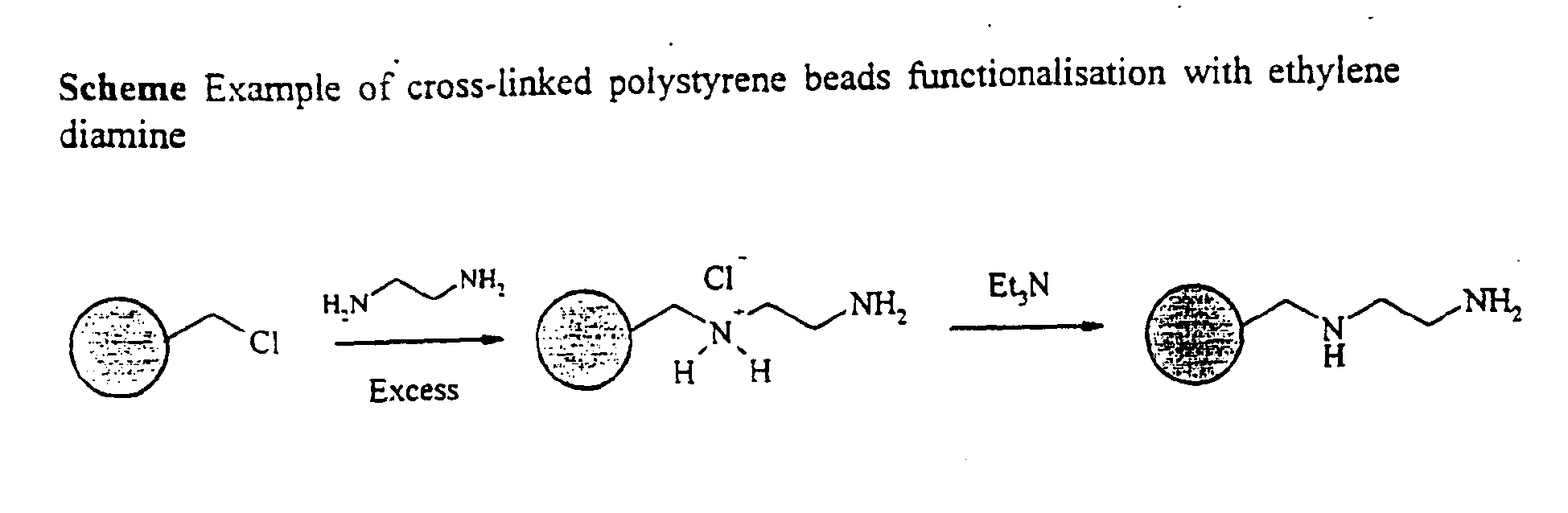

Table. Summary of cross-linked polystyrene supports synthesised following the (di)amine route. Support Support code Amine used Amine functionalisation reaction n ligand/g by NMR (% vs th) E PS-EDA-lig ethylene diamine DA1 2.75 e-3 (99.7) F PS-DETA-lig diethylene triamine DA1 4.02 e-3 (99.5) G PS-TAEA-lig tris(2-aminoethyl)amine DA3 2.63 e-3 (70.8) H PS-HEMDA-lig hexamethylenediamine DA2 ? - A suspension of chloromethylated cross-linked polystyrene beads (3g, 4 mmol of Cl/g resin, 12 mmol) was shaken in round bottom flask with 15 ml amine during one day at room temperature. The polymer was filtered and successively rinsed two times with 10% triethylamine in dimethylformamide, once with DMF, four times with 10% Et3N in tetrahydrofuran, three times with THF and three times with methanol. The solid was then dried under vacuum at RT then at 80°C in the vacoven to constant weight.
- Same as DA1 but the amine is mixed with 100 ml DMF in order to solubilise it.
- A suspension of chloromethylated cross-linked polystyrene beads (3g, 4 mmol of Cl/g resin, 12 mmol) in DMF (100 ml) was shaken in round bottom flask with tris(2-aminoethyl)amine (5 ml, 33.4 mmol) for 6h at 65°C under N2 atmosphere. After cooling to room temperature, the resin was filtered and washed successively with two times with 10% triethylamine in dimethylformamide, once with DMF, four times with 10% Et3N in tetrahydrofuran, three times with THF and three times with methanol. The solid was then dried under vacuum at RT then at 80°C in the vacoven to constant weight.
-

Table. Functionalisation of supports synthesised following the amino-hexanol route Support n ligand/g by NMR (% vs th) n Cu/g by ICP (% vs theory) % retention between ICP and NMR K1 2.13 x 10⁻³ 1.43 x 10⁻³ 87.6 (90) (80.5) K2 2.16 x 10⁻³ 1.12 x 10⁻³ 68 (91) (63.1) L ? 9.25 x 10⁻⁴ ? (52.1) - A solution of 6-amino-1-hexanol (7.54 g, 62.4 mmol) in 15 ml THF was added to a stirred slurry of N-(ethoxycarbonyl)phthalimide (14.08 g, 63 mmol) in 50 ml THF at 0°C (ice-water bath) with a pressure equalising funnel. After 5 minutes, the bath was removed and the mixture stirred overnight at ambient temperature. After removal of the solvent under reduce pressure, the compound was distillated (0.4 Torr) to give ethyl carbamate. The residue was put through a crystallisation procedure from a solution of toluene (25 ml) and hexane (10 ml) but the product stayed oily. The cristallisation started with scratching the product with spatula to give a light brown solid (13.9 g, 90 % yield).
1H NMR: δ =7.81, 7.71 (m, 4H); 3.61 (m, 4H); 2.3 (s, 1H); 1.68, 1.39 (overlapping multiplets, 8H).
Elemental analysis: 67.8 %C, 6.9 %H, 5.7 %N (theoretical; 68 %C, 6.93 %H, 5.66 %N). - To a slurry of potassium hydride (0.81 g, 33.7 mmol) and tetrahydrofuran (100 ml) was added, with stirring, a solution of 6-phthalimido-1-hexanol (5) (5.92 g, 23.9 mmol), dibenzo-18-crown-6 (200 mg, 0.56 mmol) and hexamethylphosphoric triamide (10 ml). After 1 hour at ambient temperature, a slurry of chloromethylated polystyrene beads (3 g, 12 mequiv. Cl) in tetrahydrofuran (50 ml) was added. The reaction mixture was stirred and heated under reflux for 48 hours. The polymer was separated by filtration and washed successively with solutions of tetrahydrofuran/ethanol (1/1), tetrahydrofuran/methanol (1/1) and then with diethyl ether. The polymer was dried under redure pressure to constant weight to give a white solid (4.36 g, ~ 60 %).
IR absorption: 1710,1770 cm-1 (ν C=O),1075 cm-1 (ν C-O-C) - Same procedure as for support C.
- Same procedure as for support D.
IR absorption: 1650 cm-1 (ν C=N). - Same procedure as for support I, replacing phthalimido-hexanol (5) by N-nhexanehydroxy-2-pyridine methanimine (2).
IR absorption: 1650 cm-1 (ν C=N). -

- Supports S1 to S4 were found to be bright orange solids, although S5 was light yellow and S6 beige. Supports S1 to S5 were easily complexing copper bromide in methanol (black colour of the support). It took time to notice a change of colour for S6, when trying to complex CuBr.
Table Comparison of synthesis routes and characterisation of silica supported ligands. Silica support Step2 a n ligand/g by NMR (% vs th) n Cu/g by ICP (% vs theory) % retention between ICP and NMR S1 2 b 1.04 e-3 7.08 e-4 84 (>100) (84) S2 2 1.15 e-3 7.92 e-4 93.8 (>100) (93.8) S3 2 1.16e-3 ? ? (> 100) S4 2 1.16 e-3 7.22 x 10⁻⁴ 85.6 (>100) (85.6) S5 3 9.88 e-4 ? ? (> 100) S6 1 ? ? ? a Step2 : 1=Et2O, RT; 2=Toluene, 130°C, soxhlet; 3=Toluene, RT
b Step2 method 2 : Typically mixture of 3-aminopropyl silica gel (15 g, 15.75 mmol) in toluene (150 ml) with pyridine carbaldehyde (3.6g, 33 mmol). - In a typical SSATP reaction, CuBr (0.134 g, 9.34 x 10⁻⁴ mol) and the support (x grams, depending on the experimentally calculated loading of ligand onto the support; [Si-lig]:[Cu] = n:1, where [Si-lig] is the concentration of ligand anchored to the silica support and n = 1, 2, 3, 4) were placed in a predried Schlenk flask which was evacuated and then flushed with nitrogen three times. Deoxygenated toluene (20 ml, 66% v/v) and deoxygenated methyl methacrylate (10 mL, 9.36 x 10⁻² mol) were added and the suspension stirred. The flask was heated in a thermostatted oil bath at 90 °C and when the temperature had equilibrated ethyl-2-bromoisobutyrate (0.137 mL, 9.34 x 10⁻⁴ mol, [MMA]0:[In]0=100:1) was added. Samples (1-2 ml) were taken periodically after initiator was added. Conversions were calculated by gravimetry heating sample to constant weight overnight at 90°C under vacuum. The polymer was then diluted in THF and passed through basic aluminium oxide in order to remove the copper catalyst which has gone into solution.
Table Silica Supported Atom Transfer Polymerisations of MMA in toluene Type a Support b [lig]/[Cu] Time (min) Conv. (%) Mnthd (g/mol) Mn(SEC) (g/mol) PDI ATP / 2 60 15 1 500 3 430 1.14 360 80 8 010 9 050 1.11 SiNH2 c 1 60 13 1 300 ? ? 300 34 3 400 182 800 2.1 SiNH2 2 60 19 1 900 ? ? 300 52 5 200 146 300 1.94 SSATP S1 1 60 27 2 700 19 700 1.63 360 67 6 700 18 500 1.8 SSATP S2 1 60 33 3 300 12 250 1.59 360 75 7 510 15 950 1.56 SSATP S2 2 60 48 4 800 12 200 1.6 360 98 9 810 14 900 1.68 SSATP S2bis 1 30 29 2 900 12 300 1.65 300 76 7 610 18 200 1.64 SSATP S3 2 30 35 3 500 12 800 1.68 250 86 8 610 15 500 1.71 SSATP S4 2 30 36 3 600 12 800 1.68 260 91 9 110 16 350 1.78 SSATP S5 2 30 30 3 000 18 900 2.1 300 91 9 110 16 500 2.1 SSATP S6 ? 60 40 4 000 50 850 2.5 240 74 7 410 50 800 2.4 a further data are available in annex
c 3-aminopropyl silica gel; here [lig] is equal to the concentration of amine functions on the silica support.
d Mn(th) = ([MMMA]0/[I]0 x MWMMA) x conversion, where MWMMA is the molecular weight of methyl methacrylate and [MMMA]0/[I]0 is the initial concentration ratio of MMA to initiator. - Figure 3 shows kinetic reproducibility of silica supported atom transfer polymerisation from experiments carried out with different silica supported ligands synthesised at different times.
- Recycling experiments, using the same support, have also been carried out. Here, we present the results obtained when support S4 was used (some recycling experiments with support S2 are also available in § VI.3.2). A first polymerisation was carried out using 3 equivalents of silica supported ligand in reference to copper ([MMA]:[Cu]:[Si-lig S4]:[E2BI] = 100:1:3:1), then the solution medium was removed from the Schlenk tube with a syringe. The support, still carrying the transition metal catalyst, was washed three times with degassed toluene introduced and removed from the tube by syringe. The support was then dried under vacuum. During all this procedure, the support stayed in the schlenk tube and was kept under nitrogen in order to avoid any deactivation by contact with air. The washed support was then reused for a new polymerisation by introducing into the Schlenk tube, in the following order : 20 ml of toluene, 10 ml of MMA and 0.137 ml of E2BI (same condition as before : [MMA]:[Cu]:[Si-lig]:[E2BI] = 100:1:3:1). Three recycling polymerisations were experimented with the same support.
- Figure 4 shows recycling experiments carried out with support S4 using the same conditions; [MMA]:[Cu]:[Si-lig]:[E2BI] = 100:1:3:1
- Each recycling experiment shows a decrease of the kinetic rate of polymerisation for MMA. However, recyclings 2 and 3 have the same kinetic behaviour. It seems that the catalyst activity is affected after each polymerisation. Probably, the amount of active species is reduced during the time of the experiment and the time of the washing of the support. This degradation finds a limit after a certain time or a certain number of recycling. The polydispersities still remain the same (around 1.7), even after several use of the support.
Table. Recycling experiments carried out with support S4 for the polymerisation of MMA by silica supported atom transfer polymerisation; [MMA]:[Cu]:[Si-lig]:[E2BI] = 100:1:3:1 Experiment a Time (min) Conversion (%) Mnth (g/mol) Mn(SEC) (g/mol) PDI First polym. 30 41 4 100 11 600 1.76 180 90 9 010 13 800 1.8 Recycling 1 130 43 4 300 13 900 1.75 330 81 8 110 16 850 1.69 Recycling 2130 8 800 360 57 5 700 17 100 1.69 Recycling 3130 8 800 ? ? 310 43 4 300 17 200 1.7 -
Table. Influence of initiator and solvent on silica supported atom transfer polymerisation of MMA Support [lig]/[Cu] Initiator b Solvent Conv.% (6h) Mnth c (g/mol) Mn(SEC) (g/mol) PDI S1 1 E2BI Toluene 67 6 500 18 500 1.79 S1 1 DPB Toluene 25 2 500 8 300 1.74 S1 1 TS Toluene 38 3 800 9 200 1.74 S1 1 E2BI Anisole 60 6 000 14 250 1.68 S1 1 E2BI Phe2O 84 8410 17 580 1.71 b E2BI : ethyl-2-bromoisobutyrate; DPB : 1,1,1-diphenyl methyl bromide; TS : tosyl bromide
c Mn(th) = ([MMMA]0/[I]0 x MWMMA) x conversion, where MWMMA is the molecular weight of methyl methacrylate and [MMMA]0/[I]0 is the initial concentration ratio of MMA to initiator. - In a typical reaction, for example [In]:[Ru]:[SiNH2] = 1:1:2, the ruthenium RuCl2(PPh3)3 (~0.45 g, 4.69 x 10⁻⁴ mol) and the support (~0.90 g, 9.49 x 10⁻⁴) are introduced in a Schlenk tube and subjected to three vacuum/nitrogen cycles. Deoxygenated toluene (15 ml, 75% v/v) and deoxygenated methyl methacrylate (5 ml, 4.67 x 10⁻² mol) were added and the suspension stirred. The flask was heated in a thermostatted oil bath at 90 °C and when the temperature had equilibrated ethyl-2-bromoisobutyrate (0.069 mL, 4.69 x 10⁻⁴ mol, [MMA]0:[In]0=100:1) was added. Samples (1-2 ml) were taken approximately 15, 30, 60, 120, 180, 240 and 300 minutes after initiator was added. Conversions were calculated by gravimetry heating sample to constant weight overnight at 90 °C under vacuum. The polymer was then diluted in THF and passed through basic aluminium oxide in order to remove the ruthenium catalyst which has gone into solution.
Table. Molar ratios of components used in Silica supported-Ruthenium mediated-ATP Experiment [MMA] [E2BI] [RuCl2(PPh3)3] [support]a 1 100 2 1 4 2 100 1 1 4 3 100 0.5 1 4 4 100 1 2 8 5 100 1 0.5 2 6 100 1 1 8 7 100 1 1 2 8 100 1 0.5 silicab 9 100 1 0.5 Al2O3c 10d 100 2 1 4 a concentration of NH2 on 3-aminopropyl functionalised silica gel
b silica gel
c basic alumina
d reused the catalyst from experiment 1Table. Results for silica supported-ruthenium mediated-ATP (SS-Ru-ATP) Experiment t (min) Conversion (%) Mnth (g/mol) Mn (g/mol) PDI 1 30 34 1 700 5 040 1.82 180 90 4 550 6 780 1.56 2 30 40 4 000 6 750 1.76 180 93 9 260 10 700 1.5 3 30 35 7 040 10 300 1.74 240 91 18 200 21 500 1.49 4 30 46 4 600 6 530 1.56 180 98 9 810 11 250 1.54 5 30 23 2 330 6 420 1.97 180 78 7 770 10 500 1.55 6 30 39 3 900 8 000 3.1 120 88 8 850 11 300 2.22 7 30 26 2 600 5 280 1.50 180 75 7 510 8 380 1.47 8 45 18 1 800 5 780 1.51 240 42 4 220 7 850 1.67 9 45 22 2 200 5 850 1.59 180 40 4 000 7 240 1.57 10 30 25 1 250 4 930 2.14 240 88 4 400 6 770 1.73 - In order to confirm the living character of this polymerisation, reinitiations from previously synthesised PMMA (made by silica supported-ruthenium mediated-ATP : SS-Ru-ATP) have been carried out. Two types of macroinitiators PMMA1 and PMMA2 have been synthesised following the conditions from experiments 4 and 7 respectively. They have been used for initiation of MMA and BzMA by SS-Ru-ATP, keeping the same catalyst and support quantities.
Table. molar ratios of components used in silica supported-ruthenium mediated-ATP reinitiation experiments Experiment Macroinitiator a ([ln]) Monomer 2 ([M]) [RuCl2(PPh3)3] [support] b 11 PMMA1 MMA 2 8 (0.317) (100) 12 PMMA1 BzMA 2 8 (0.317) (63) 13 PMMA2 MMA 1 2 (0.338) (100) 14 PMMA2 BzMA 1 2 (0.338) (63) a PMMA1 synthesised following conditions [E2BI]:[Ru]:[NH2] = 1:2:8, experiment 4 PMMA2 synthesised following conditions [E2BI]:[Ru]:[NH2] = 1:1:2, experiment 7
b concentration of NH2 on 3-aminopropyl functionalised silica gelTable. Data for SS-Ru-ATP macroinitiation experiments using different monomers Experiment Mass targeted Time (min) Conv % 2nd pol°Mnth (g/mol) Mnexp (g/mol) PDI 11 41600 0 0 10083 1.37 30 30 20162 15230 1.57 285 85 36736 31013 2.62 12 45040 0 0 10083 1.37 30 60 30548 23262 1.60 180 95 43297 37105 1.88 13 39080 0 0 9465 1.26 30 30 18079 14282 1.37 330 95 37147 29369 1.48 14 42280 0 0 9465 1.26 30 55 27113 18132 1.35 200 90 39535 26969 1.35 - In a typical PS-SATP reaction, CuBr (0.134 g, 9.34 x 10⁻⁴ mol) and the support (x grams, depending on the experimentally calculated loading of ligand onto the support; [PS-lig]:[Cu] = n:1, where [PS-lig] is the concentration of ligand anchored to the polystyrene support and n = 1, 2, 3, 4, etc...) were placed in a predried Schlenk flask which was evacuated and then flushed with nitrogen three times. Deoxygenated toluene (20 ml. 66% v/v) and deoxygenated methyl methacrylate (10 mL. 9.36 x 10⁻² mol) were added and the suspension stirred. The flask was heated in a thermostatted oil bath at 90 °C and when the temperature had equilibrated ethyl-2-bromoisobutyrate (0.137 mL. 9.34 x 10⁻⁴ mol, [MMA]0:[In]0=100:1) was added. Samples (1-2 ml) were taken periodically after initiator was added. Conversions were calculated by gravimetry heating sample to constant weight overnight at 90°C under vacuum. The polymer was then diluted in THF and passed through basic aluminium oxide in order to remove the copper catalyst which has gone into solution.
Table. Polystyrene Supported Atom Transfer Polymerisations of MMA in toluene Type Support [lig]/[Cu] b Time (min) Conv. (%) Mnthc (g/mol) Mn(SEC) (g/mol) PDI ATP / 2 60 15 1 500 3 430 1.14 360 80 8 010 9 050 1.11 PS-SAT P PS2 1.25 33 29.6 2 960 14 020 1.55 83 47.2 4 720 14 760 1.62 120 55.6 5 560 16 510 1.51 185 66.3 6 630 16 520 1.56 245 72.2 7 230 15 500 1.66 300 77.5 7 760 15 590 1.66 363 83.6 8 370 16 230 1.62 PS-SAT P PS4 2 35 25.6 2 600 8 125 1.47 310 84 8 400 11 150 1.63 PS-SAT P PS6 1.25 30 25.1 2 510 7 530 1.45 61 36.7 3 670 8 670 1.54 120 49.4 4 940 10 215 1.51 180 60.1 6 010 11 140 1.53 240 68.6 6 860 11 740 1.51 300 75.2 7 530 11 670 1.56 PS-SAT P PS6 bis 1.25 32 25.1 2 510 6 950 1.41 60 35.5 3 550 8 170 1.41 147 55.1 5 510 9 880 1.41 196 62.6 6 260 10 590 1.41 240 67.5 6 750 10 710 1.43 300 73.5 7 360 11 370 1.42 PS-SAT P PS7 1 31 20.9 2 100 8 320 1.42 300 53.3 5 300 12 050 1.45 PS-SAT P PS7 2 31 28.5 2 800 7 580 1.39 300 70 7 010 11 890 1.39 b Here [lig] is equal to the concentration of ligand functions on the polystyrene support.
c Mn(th) = ([MMMA]0/[I]0 x MWMMA) x conversion, where MWMMA is the molecular weight of methyl methacrylate and [MMMA]0/[I]0 is the initial concentration ratio of MMA to initiator. -
Table. Effect of the amount of polystyrene support on polystyrene supported atom transfer polymerisations of MMA in toluene Support [lig]/[Cu] b Time (min) Conv. (%) Mnthc (g/mol) Mn(SEC) (g/mol) PDI PS7 1 31 20.9 2 090 8 320 1.42 60 28.0 2 800 8 790 1.48 123 38.5 3 850 10 510 1.44 186 45.2 4 520 11 190 1.45 253 50.4 5 040 12 550 1.39 300 53.3 5 330 12 050 1.45 PS7 2 31 28.5 2 850 7 580 1.39 60 35.7 3 570 8 110 1.43 123 50.8 5 080 9 970 1.39 186 59.8 5 980 11 130 1.36 251 63.4 6 340 11 070 1.4 300 70.0 7 010 11 890 1.39 PS7 3 31 34.9 3 490 7 870 1.43 60 45.5 4 550 9 630 1.42 123 60.9 6 090 11 390 1.44 186 69.5 6 950 12 140 1.48 252 78.9 7 900 12 940 1.48 300 82.7 8 280 13 450 1.48 PS7 4 31 37.8 3 780 8 5900 1.55 60 51.0 5 100 9 700 1.63 123 69.7 6 970 11 120 1.68 186 81.1 8 120 12 230 1.66 252 87.2 8 730 13 510 1.59 300 89.2 8 930 13 650 1.59 b Here [lig] is equal to the concentration of ligand functions on the polystyrene support.
c Mn(th) = ([MMMA]0/[I]0 x MWMMA) x conversion, where MWMMA is the molecular weight of methyl methacrylate and [MMMA]0/[I]0 is the initial concentration ratio of MMA to initiator. -
Table. Experimental data for the PS-SATP of MMA mediated by copper catalyst complexed by different supports synthesised following the (di)amine route Support name [Lig]0/[Cu] 0 time (min) Conv. (%) Mn (th) b Mn (SEC) PDI (SEC) E PS-EDA-lig ~3 29 34.0 3 400 7 020 2.43 241 96.0 9 610 13 900 2.09 G PS-TAEA-lig 2.9 36 36.6 3 660 12 375 2.06 312 95.2 9 530 15 890 1.95 H PS-HEMDA- lig 2 30 25.8 2 580 16 050 1.78 180 74.7 7 480 16 250 1.77 292 93.5 9 360 16 150 1.8 F1 PS-DETA-lig ~5 36 44.1 4 410 10 440 2.61 67 62.3 6 230 11 570 2.31 131 83.1 8 320 12 950 2.15 188 92.7 9 280 14 120 2.08 250 99.1 9 920 17 110 1.79 F2 PS-DETA-lig ~5 29 38.6 3 860 9 200 2.02 62 62.0 6 200 11 080 1.92 126 82.2 8 230 13 250 1.86 181 90.9 9 100 14 340 1.86 241 96.6 9 670 14 640 1.89 b Mn(th) = ([MMMA]0/[I]0 x MWMMA) x conversion, where MWMMA is the molecular weight of methyl methacrylate and [MMMA]0/[I]0 is the initial concentration ratio of MMA to initiator. -
Table. Experimental data for the PS-SATP of MMA mediated by copper catalyst complexed by different supports synthesised following the amino-hexanol route Support name [Lig]0/[Cu] 0 time (min) Conv. (%) Mn (th) b Mn (SEC) PDI (SEC) PS7 PS-lig 2 31 28.5 2 850 7 580 1.39 60 35.7 3 570 8 110 1.43 123 50.8 5 080 9 970 1.39 186 59.8 5 980 11 130 1.36 251 63.4 6 340 11 070 1.4 300 70.0 7 010 11 890 1.39 K1 PS-AHO-lig 2 30 27.1 2 710 13 880 1.81 64 42.4 4 240 14 540 1.78 119 58.9 5 890 15 670 1.75 180 70.6 7 070 15 870 1.76 244 79.8 7 990 18 040 1.6 292 85.6 8 570 18 250 1.63 K2 PS-AHO-lig 2 30 26.8 2 680 10 370 1.6 64 44.0 4 400 12 660 1.53 119 61.0 6 100 14 730 1.53 180 72.9 7 300 16 230 1.48 244 82.5 8 260 16 660 1.51 292 87.4 8 750 18 080 1.46 L PS-AHO-lig 2 30 12.9 1 290 26 130 1.8 64 19.1 1 910 26 950 1.81 119 27.3 2 730 29 210 1.79 180 33.9 3 390 29 390 1.83 244 38.1 3 810 30 750 1.78 292 42.9 4 290 29 920 1.84 b Mn(th) = ([MMMA]0/[I]0 x MWMMA) x conversion, where MWMMA is the molecular weight of methyl methacrylate and [MMMA]0/[I]0 is the initial concentration ratio of MMA to initiator. - In a typical reinitiation experiment, CuBr (0.134 g, 9.34 x 10⁻⁴ mol) and the macroinitiator (x grams, depending on the experimental molecular weight obtained from SEC and assuming that PDI = 1, [macroinitiator]:[Cu] = 0.182:1) were placed in a predried Schlenk flask which was evacuated and then flushed with nitrogen three times. Deoxygenated toluene (30 ml, 75% v/v) and deoxygenated methyl methacrylate (10 mL, 9.36 x 10⁻² mol, [MMA]0:[Cu]0=100:1) or deoxygenated benzyl methacrylate (10 ml, 5.92 x 10⁻² mol, [BzMA]0:[Cu]0=63.22:1) were added and the suspension stirred until all the macroinitiator is dissolved. The flask is then submitted to three Freeze-Pump-Thaw cycles (FPT). When the temperature had equilibrated to room temperature, N-npentyl-2-pyridine methanimine ligand (1) (0.36 ml, 1.87 x 10⁻³ mol, [Lig]0:[Cu]0=2:1) is added by syringe and the flask is heated straightforward in a thermostatted oil bath at 90 °C. Samples (1-2 ml) were taken periodically using syringes after the start of the heating. Conversions were calculated by gravimetry heating sample to constant weight overnight at 90°C under vacuum. The polymer was then diluted in THF and passed through basic aluminium oxide in order to remove the copper catalyst which has gone into solution.
Table. molar ratios of components used in reinitiation experiments*** Experiment Macroinitiator a [In] Monomer 2 [MMA] pentyl ligand [Lig] [CuBr] 1 PMMA (A) 0.182 100 2 1 2 PMMA (S) 0.182 100 2 1 3 PMMA (P) 0.182 100 2 1 4 PMMA (L) 0.182 100 2 1 a PMMA (A) synthesised following conditions [MMA]:[CuBr]:[lig]:[E2BI] = 100:1:2:1
PMMA (S) synthesised following conditions [MMA]:[CuBr]:[Si-lig S4]:[E2BI] = 100:1:1:1
PMMA (P) synthesised following conditions [MMA]:[CuBr]:[PS-lig PS6]:[E2BI] = 100:1:1:1
PMMA (L) synthesised following conditions [MMA]:[CuBr]:[Si-lig S4]:[E2BI] = 100:1:2:1 - These results are shown in Figure 5.
Table. Data for macroinitiation experiments using different monomers Experiment Macroinit. Time (min) Conv % 2nd pol°Mnth (g/mol) Mnexp (g/mol) PDI 1 PMMA (A) 0 0 7 616 1.19 34 10.5 13374 12 546 1.17 63 15.1 15898 14 760 1.21 130 22.1 19749 19 230 1.25 61%~3h 186 26.9 22419 22 270 1.3 244 30.6 24419 25 210 1.31 278 32.5 25507 27 570 1.29 2 PMMA (S) 0 0 16 575 1.46 33 10.4 22293 17 130 1.28 62 15.1 24873 22 510 1.39 129 22.2 28761 29 540 1.25 2h 185 26.7 31244 31 330 1.27 241 30.5 33366 34 640 1.25 278 32.7 34534 35 810 1.25 3 PMMA (P) 0 0 13 105 1.25 33 12.1 19773 18 770 1.17 62 17.1 22493 20 510 1.19 129 23.2 25853 23 940 1.20 185 28.2 28608 26 300 1.20 241 31.8 30617 28 440 1.21 278 32.8 31143 29 150 1.22 4 PMMA (L) 0 0 6 896 1.46 33 10.9 12862 12 250 1.19 62 15.7 15508 14340 1.19 129 23.3 19704 18 250 1.18 185 27.3 21901 20 480 1.19 69% 2h 241 30.8 23812 16 130 1.19 278 33.3 25198 24 320 1.19 -
Table. molar ratios of components used in reinitiation experiments Experiment Macroinitiatora [In] Monomer 2 [BzMA] pentyl ligand [Lig] [CuBr] 5 PMMA (A) 0.182 63.22 2 1 6 PMMA (S) 0.182 63.22 2 1 7 PMMA (P) 0.182 63.22 2 1 8 PMMA (L) 0.182 63.22 2 1 a PMMA (A) synthesised following conditions [MMA];[CuBr]:[lig]:[E2BI] = 100:1:2:1
PMMA (S) synthesised following conditions [MMA]:[CuBr]:[Si-lig S4]:[E2BI] = 100:1:1:1
PMMA (P) synthesised following conditions [MMA]:[CuBr]:[PS-lig PS6]:[E2BI] = 100:1:1:1
PMMA (L) synthesised following conditions [MMA]:[CuBr]:[Si-lig S4]:[E2BI] = 100:1:2:1Table. Data for macroinitiation experiments using different monomers Experiment Macroinit. Time (min) Conv % 2nd pol°Mnth (g/mol) Mnexp (g/mol) PDI 5 PMMA 0 0 7 616 1.19 (A) 38 18.4 18890 17536 1.59 64 23.0 21670 19861 1.28 131 34.6 28790 26391 1.34 61%~3h 261 73.0 52308 51028 1.83 309 79.6 56348 45112 1.99 358 80.2 56680 42 580 2.00 6 PMMA (S) 0 0 21 828 1.47 s.2 33 19.9 33985 29395 1.75 59 22.6 35647 30172 1.62 126 35.4 43482 35658 1.58 3h 62% 256 59.6 58283 45600 1.83 304 71.1 65325 54698 1.80 353 75.8 68207 55380 1.79 7 PMMA (P) 0 0 14 676 1.23 35 19.6 26689 24023 1.42 3h 66 29.1 32497 28194 1.51 52% 127 42.7 40790 35295 1.73 257 63.3 53397 44560 1.71 305 77.7 62208 53841 1.63 354 83.8 65984 48 105 1.81 8 PMMA (L) 0 0 6 896 1.46 36 16.7 17097 61 22.5 20673 128 37.0 29552 258 49.1 36922 69% 2h 306 52.2 38844 355 60.7 44070 28 240 1.83 -
Table. Recycling experiments carried out with support PS7 for the polymerisation of MMA by polystyrene supported atom transfer polymerisation; [MMA]:[Cu]:[PS-lig PS7]:[E2BI] = 100:1:2:1 Experiment Time (min) Conversion (%) Mnth (g/mol) Mn(SEC) (g/mol) PDI First polym. 31 28.5 2 850 7 580 1.39 60 35.7 3 570 8 110 1.43 123 50.8 5 080 9 970 1.39 186 59.8 5 980 11 130 1.36 251 63.4 6 340 11 070 1.4 300 70.0 7 010 11 890 1.39 Recycling 1 29 4.06 400 69 7.04 700 134 15.4 1 540 12 000 1.68 172 22.5 2 250 13 810 1.61 255 38.1 3 810 14 760 1.65 329 52.1 5 210 16 560 1.61 365 58.5 5 850 16 880 1.59 Recycling 276 1.90 190 125 4.45 445 176 8.00 801 265 17.1 1714 336 25.7 2575
Claims (21)
- A catalyst for the addition polymerisation of olefinically unsaturated monomers comprising a supported ligand of General Formula 1:
 where: S is the support,D is a compound attached to the support, said compound being capable of complexing with a transition metal ion.n is an integer of one or more.in combination witha) a compound of:
 where: M is a transition metal in a low valency state or a transition metal in a low valency state co-ordinated to at least one co-ordinating non-charged ligand, where the low valency state is the lower of the common occurring valencies for that metal;Y is a mono- or polyvalent counter ion; andb) an initiator compound comprising a homolytically cleavable bond with a halogen atom.
 - A catalyst according to claim 1, wherein the transition metal is selected from Cu(I), Fe(II), Co(II), Ru(II) and Ni(II).
- A catalyst for use in the polymerisation of olefinically unsaturated monomers, comprising a compound of general formula:
 where: M = a transition metal in a low valency state which is the lower of the commonly occurring valencies for that metal or a transition metal co-ordinated to at least one co-ordinating non-charged ligandS = a support,D = a compound attached to the support, the compound being capable of complexing with a transition metal,d = an integer of 1 or 2,c = an integer of 1 or 2,A = a monovalent or divalent counter ion,and an initiator compound having a homolytically cleavable bond with a halogen atom.
 - A catalyst according to claim 3, wherein M is selected from Cu(I), Fe(II) Co(II), Ru(II) and Ni(II).
- A catalyst according to claim 3 or claim 4, wherein the co-ordinating ligand is (CH3CN)4.
- A catalyst according to any preceding claim, wherein the initiator compound is selected from:


 where: R is independently selectable and is selected from straight, branched or cyclic alkyl, hydrogen, substituted alkyl, hydroxyalkyl, carboxyalkyl orbenzyl.X is a halide, especially I, Br, F or Cl.
 - A catalyst according to any preceding claim wherein compound D is a diimine.
- A catalyst according to claim 7 wherein one of the nitrogens of the diimine is not part of an aromatic ring.
- A catalyst according to claims 7 or 8, wherein the diimine is selected from a 1,4-diaza- 1,3-butadiene:


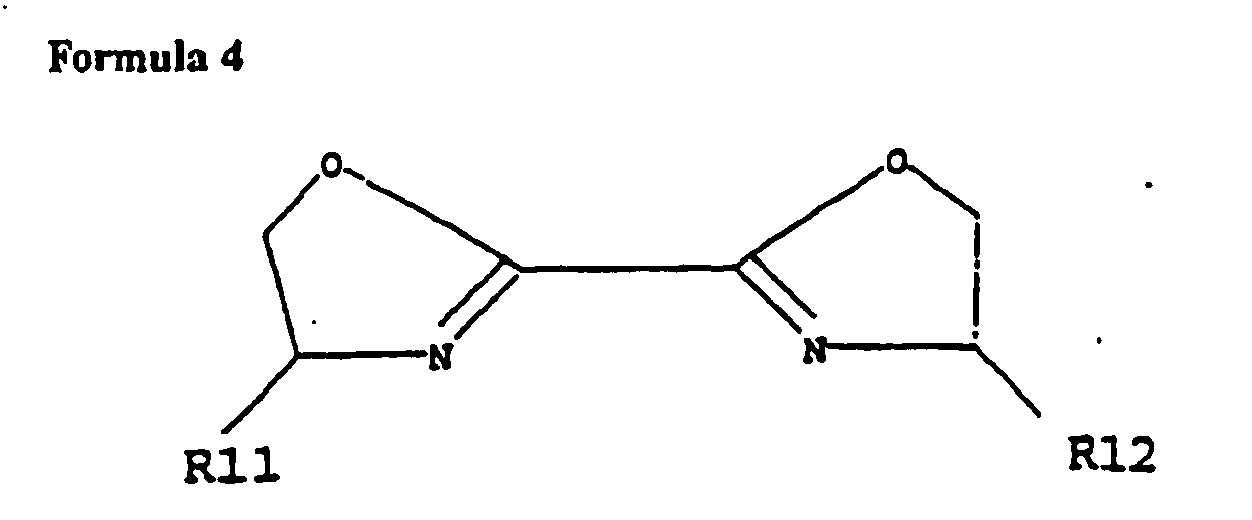
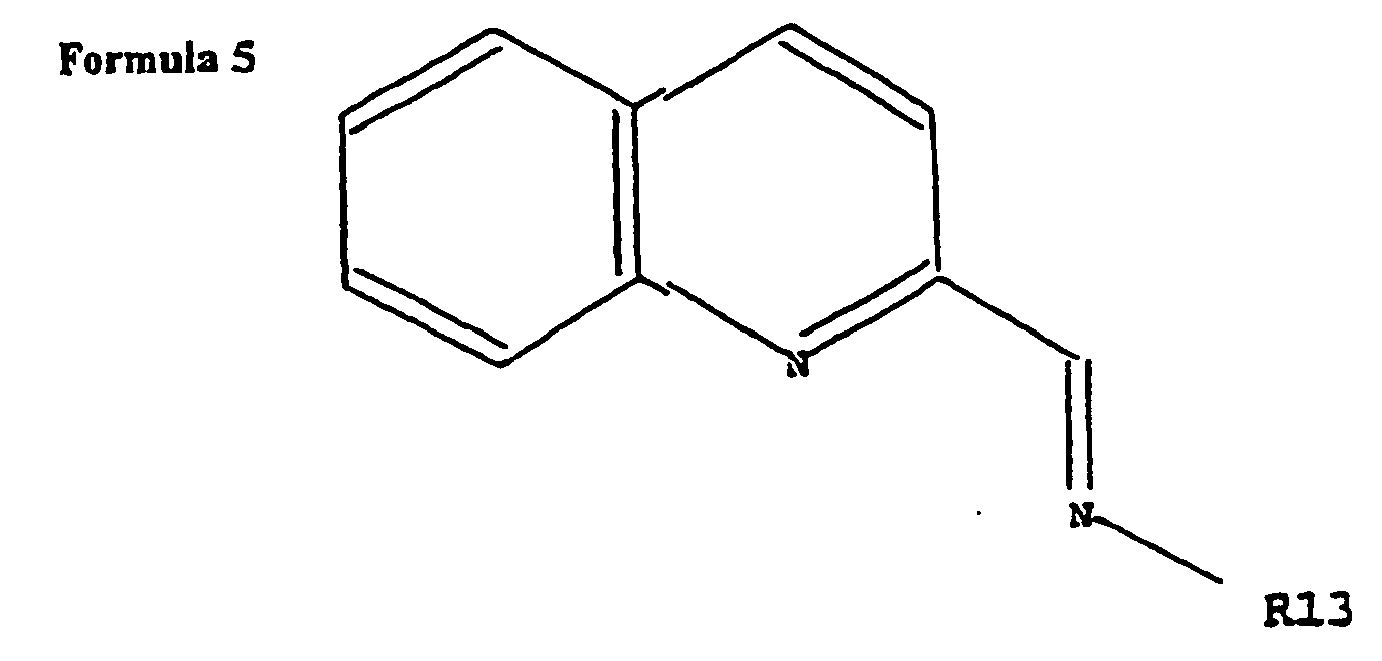
- A catalyst according to any one of claims 7-9 wherein D exhibits a chiral centre a to one of the nitrogen groups.
- A catalyst according to claim 9 or claim 10, wherein D is a compound of general Formula 3 which comprises one or more fused rings on the pyridine group.
- A catalyst according to claim 9 or claim 10, wherein one or more adjacent R1 and R3, R3 and R4, R4 and R2, R10 and R9, R8 and R9, R8 and R7, R7 and R6, R6 and R5 groups are selected from C5 to C8 cycloalkyl, cycloalkenyl, polycycloalkyl, polycycloalkenyl or cyclicaryl, such as cyclohexyl, cyclohexenyl or norbornyl.
- A catalyst according to any one of claims 7 to 12, wherein the diimine compound is covalently attached to the support via positions R1, R2, R9, R10, R11, R12 or R13.
- A process for the production of, a catalyst according to any one of claims 7 to 13 comprising the steps ofa) providing a functionalised support;b) providing a ligand precursor, wherein one of the functionalised support or the ligand precursor comprises a primary amine, and the other of the functionalised support or the ligand precursor comprises an aldehyde or ketone group; andc) reacting the primary amine with the aldehyde or ketone to form a diimine compound covalently attached to the support.
- Process according to claim 14, wherein the diimine compound produced is then mixed with a transition metal halide to produce a diimine co-ordinated to a transition metal.
- Process according to claim 15, wherein the transition metal halide is selected from CuCl and CuBr.
- A process for the addition polymerisation of one or more olefinically unsaturated monomers comprising the use of a catalyst according to any one of claims 1 to 13.
- A process according to claim 17, wherein the olefinically unsaturated monomer is selected from a methacrylate, an acrylate, a styrene, a methacrylonitrile or a diene
- A process according to claim 16 or claim 17, wherein the catalyst is used at a temperature between -20°C and 200°C.
- A process according to any one of claims 17 to 19,additionally comprising the use of a free-radical inhibitor.
- A process according to any one of claims 17 to 19 wherein the amount of D : MY is between 0.01 to 1000 and ratio of MY : initiator is 0.0001 to 1000.
Applications Claiming Priority (3)
| Application Number | Priority Date | Filing Date | Title |
|---|---|---|---|
| GB9725455 | 1997-12-02 | ||
| GBGB9725455.1A GB9725455D0 (en) | 1997-12-02 | 1997-12-02 | Supported polymerisation catalyst |
| PCT/GB1998/003592 WO1999028352A1 (en) | 1997-12-02 | 1998-12-02 | Supported polymerisation catalyst |
Publications (2)
| Publication Number | Publication Date |
|---|---|
| EP1036096A1 EP1036096A1 (en) | 2000-09-20 |
| EP1036096B1 true EP1036096B1 (en) | 2007-03-28 |
Family
ID=10822970
Family Applications (1)
| Application Number | Title | Priority Date | Filing Date |
|---|---|---|---|
| EP98957009A Expired - Lifetime EP1036096B1 (en) | 1997-12-02 | 1998-12-02 | Supported polymerisation catalyst |
Country Status (8)
| Country | Link |
|---|---|
| US (1) | US6664350B1 (en) |
| EP (1) | EP1036096B1 (en) |
| AT (1) | ATE358142T1 (en) |
| AU (1) | AU1343999A (en) |
| CA (1) | CA2312896A1 (en) |
| DE (1) | DE69837446D1 (en) |
| GB (1) | GB9725455D0 (en) |
| WO (1) | WO1999028352A1 (en) |
Families Citing this family (19)
| Publication number | Priority date | Publication date | Assignee | Title |
|---|---|---|---|---|
| AU2817200A (en) * | 1999-03-05 | 2000-09-28 | Dow Corning Corporation | Catalyst composition and method for making a polymer or copolymer |
| WO2001062803A2 (en) * | 2000-02-23 | 2001-08-30 | Mcmaster University | Supported catalysts for use in atom transfer radical polymerization and continuous processes for atom transfer radical polymerization |
| GB0014225D0 (en) * | 2000-06-09 | 2000-08-02 | Univ Warwick | Polymerisation initiator and use |
| DE60125409T2 (en) | 2000-10-06 | 2007-09-27 | Carnegie Mellon University | POLYMERIZATION PROCESS FOR ION MONOMERS |
| US6900153B2 (en) | 2001-03-28 | 2005-05-31 | E.I. Du Pont De Nemours And Company | Supported olefin polymerization catalysts |
| AUPR404801A0 (en) | 2001-03-28 | 2001-04-26 | Polymerat Pty Ltd | A method of polymerization |
| ES2354685T3 (en) * | 2001-04-27 | 2011-03-17 | Sumitomo Chemical Company, Limited | ASYMMETRIC COPPER COMPLEX AND CYCLOPROPANIC REACTION USING THE SAME. |
| DE10215724A1 (en) * | 2002-04-10 | 2003-10-30 | Celanese Ventures Gmbh | Covalently fixed ligand systems, non-metallocenes and catalyst systems, processes for the preparation of these and their use for the polymerization of olefins |
| ATE528320T1 (en) | 2002-05-10 | 2011-10-15 | Bio Layer Pty Ltd | GENERATION OF SURFACE COATING DIVERGENCE |
| GB0314472D0 (en) | 2003-06-20 | 2003-07-23 | Warwick Effect Polymers Ltd | Polymer |
| AU2004296412B2 (en) | 2003-12-12 | 2011-03-10 | Anteo Technologies Pty Ltd | A method for designing surfaces |
| WO2006002472A1 (en) | 2004-07-02 | 2006-01-12 | Bio-Layer Pty Ltd | Use of metal complexes |
| US20080156189A1 (en) * | 2006-05-09 | 2008-07-03 | Synkera Technologies, Inc. | Compositions for carbon monoxide and olefin adsorption |
| WO2009023353A1 (en) | 2007-05-23 | 2009-02-19 | Carnegie Mellon University | Hybrid particle composite structures with reduced scattering |
| US9644042B2 (en) | 2010-12-17 | 2017-05-09 | Carnegie Mellon University | Electrochemically mediated atom transfer radical polymerization |
| US20140275420A1 (en) | 2011-08-22 | 2014-09-18 | Carnegie Mellon University | Atom transfer radical polymerization under biologically compatible conditions |
| US9982070B2 (en) | 2015-01-12 | 2018-05-29 | Carnegie Mellon University | Aqueous ATRP in the presence of an activator regenerator |
| WO2016206777A1 (en) * | 2015-06-26 | 2016-12-29 | Fischerwerke Gmbh & Co. Kg | Aldimines and ketimines as initiators in hardener systems and corresponding resin compositions for uses including fixing technology |
| WO2018132582A1 (en) | 2017-01-12 | 2018-07-19 | Carnegie Mellon University | Surfactant assisted formation of a catalyst complex for emulsion atom transfer radical polymerization processes |
Family Cites Families (6)
| Publication number | Priority date | Publication date | Assignee | Title |
|---|---|---|---|---|
| IT1254224B (en) * | 1992-02-26 | 1995-09-14 | Donegani Guido Ist | NICKEL CATALYST ACTIVE IN HOMO AND COPOLYMERIZATION OF ETHYLENE |
| US6030917A (en) * | 1996-07-23 | 2000-02-29 | Symyx Technologies, Inc. | Combinatorial synthesis and analysis of organometallic compounds and catalysts |
| US5763548A (en) | 1995-03-31 | 1998-06-09 | Carnegie-Mellon University | (Co)polymers and a novel polymerization process based on atom (or group) transfer radical polymerization |
| US5807937A (en) | 1995-11-15 | 1998-09-15 | Carnegie Mellon University | Processes based on atom (or group) transfer radical polymerization and novel (co) polymers having useful structures and properties |
| ATE207082T1 (en) | 1996-06-12 | 2001-11-15 | Univ Warwick | POLYMERIZATION CATALYST AND PROCESS |
| JPH11514012A (en) | 1996-07-23 | 1999-11-30 | サイミックス・テクノロジーズ | Combinatorial synthesis and analysis of organometallic compounds and catalysts |
-
1997
- 1997-12-02 GB GBGB9725455.1A patent/GB9725455D0/en not_active Ceased
-
1998
- 1998-12-02 DE DE69837446T patent/DE69837446D1/en not_active Expired - Lifetime
- 1998-12-02 WO PCT/GB1998/003592 patent/WO1999028352A1/en not_active Ceased
- 1998-12-02 US US09/555,145 patent/US6664350B1/en not_active Expired - Fee Related
- 1998-12-02 EP EP98957009A patent/EP1036096B1/en not_active Expired - Lifetime
- 1998-12-02 CA CA002312896A patent/CA2312896A1/en not_active Abandoned
- 1998-12-02 AT AT98957009T patent/ATE358142T1/en not_active IP Right Cessation
- 1998-12-02 AU AU13439/99A patent/AU1343999A/en not_active Abandoned
Also Published As
| Publication number | Publication date |
|---|---|
| CA2312896A1 (en) | 1999-06-10 |
| WO1999028352A1 (en) | 1999-06-10 |
| GB9725455D0 (en) | 1998-01-28 |
| ATE358142T1 (en) | 2007-04-15 |
| DE69837446D1 (en) | 2007-05-10 |
| EP1036096A1 (en) | 2000-09-20 |
| US6664350B1 (en) | 2003-12-16 |
| AU1343999A (en) | 1999-06-16 |
Similar Documents
| Publication | Publication Date | Title |
|---|---|---|
| US6664350B1 (en) | Supported polymerisation catalyst | |
| US6310149B1 (en) | Polymerization catalyst and process | |
| RU2446177C2 (en) | Method of producing halogen-free atom transfer radical polymerisation products | |
| US6822056B2 (en) | Microgels and process for their preparation | |
| JP3587530B2 (en) | Radical polymerization method | |
| RU2454433C2 (en) | Method of producing polymers with terminal acid groups via atom-transfer radical polymerisation | |
| EP1153043B1 (en) | Process for the preparation of polymers containing n-o terminal groups | |
| WO2000047634A1 (en) | Production of vinylic polymers | |
| AU2001274216B2 (en) | Polymerisation initiator and use | |
| AU2001274216A1 (en) | Polymerisation initiator and use | |
| US7943708B2 (en) | Method for the production of telechelic polymers | |
| WO2000052061A1 (en) | Use of an initiator for controlled polymerisation reactions | |
| WO2000034345A1 (en) | Production of vinylic polymers | |
| CA2365637A1 (en) | Catalyst composition and method for making a polymer or copolymer | |
| US6780811B2 (en) | Catalyst composition for living free radical polymerization and process for polymerizing (meth) acrylic, vinyl, vinylidene, and diene monomers using the catalyst composition | |
| JP2010095623A (en) | Method for recovering iron complex | |
| EP1905786A1 (en) | Novel metal catalysts comprising nitrogen-containing aromatic ligands and use thereof | |
| Honigfort | Copper removal in atom transfer radical polymerization |
Legal Events
| Date | Code | Title | Description |
|---|---|---|---|
| PUAI | Public reference made under article 153(3) epc to a published international application that has entered the european phase |
Free format text: ORIGINAL CODE: 0009012 |
|
| 17P | Request for examination filed |
Effective date: 20000616 |
|
| AK | Designated contracting states |
Kind code of ref document: A1 Designated state(s): AT BE DE DK ES FI FR GB GR IE IT LU NL PT SE |
|
| 17Q | First examination report despatched |
Effective date: 20030929 |
|
| RAP1 | Party data changed (applicant data changed or rights of an application transferred) |
Owner name: WARWICK EFFECT POLYMERS LIMITED |
|
| GRAP | Despatch of communication of intention to grant a patent |
Free format text: ORIGINAL CODE: EPIDOSNIGR1 |
|
| GRAS | Grant fee paid |
Free format text: ORIGINAL CODE: EPIDOSNIGR3 |
|
| GRAA | (expected) grant |
Free format text: ORIGINAL CODE: 0009210 |
|
| AK | Designated contracting states |
Kind code of ref document: B1 Designated state(s): AT BE DE DK ES FI FR GB GR IE IT LU NL PT SE |
|
| PG25 | Lapsed in a contracting state [announced via postgrant information from national office to epo] |
Ref country code: NL Free format text: LAPSE BECAUSE OF FAILURE TO SUBMIT A TRANSLATION OF THE DESCRIPTION OR TO PAY THE FEE WITHIN THE PRESCRIBED TIME-LIMIT Effective date: 20070328 Ref country code: FI Free format text: LAPSE BECAUSE OF FAILURE TO SUBMIT A TRANSLATION OF THE DESCRIPTION OR TO PAY THE FEE WITHIN THE PRESCRIBED TIME-LIMIT Effective date: 20070328 Ref country code: BE Free format text: LAPSE BECAUSE OF FAILURE TO SUBMIT A TRANSLATION OF THE DESCRIPTION OR TO PAY THE FEE WITHIN THE PRESCRIBED TIME-LIMIT Effective date: 20070328 Ref country code: AT Free format text: LAPSE BECAUSE OF FAILURE TO SUBMIT A TRANSLATION OF THE DESCRIPTION OR TO PAY THE FEE WITHIN THE PRESCRIBED TIME-LIMIT Effective date: 20070328 |
|
| REG | Reference to a national code |
Ref country code: GB Ref legal event code: FG4D |
|
| REF | Corresponds to: |
Ref document number: 69837446 Country of ref document: DE Date of ref document: 20070510 Kind code of ref document: P |
|
| REG | Reference to a national code |
Ref country code: IE Ref legal event code: FG4D |
|
| PG25 | Lapsed in a contracting state [announced via postgrant information from national office to epo] |
Ref country code: SE Free format text: LAPSE BECAUSE OF FAILURE TO SUBMIT A TRANSLATION OF THE DESCRIPTION OR TO PAY THE FEE WITHIN THE PRESCRIBED TIME-LIMIT Effective date: 20070628 |
|
| PG25 | Lapsed in a contracting state [announced via postgrant information from national office to epo] |
Ref country code: ES Free format text: LAPSE BECAUSE OF FAILURE TO SUBMIT A TRANSLATION OF THE DESCRIPTION OR TO PAY THE FEE WITHIN THE PRESCRIBED TIME-LIMIT Effective date: 20070709 |
|
| PG25 | Lapsed in a contracting state [announced via postgrant information from national office to epo] |
Ref country code: PT Free format text: LAPSE BECAUSE OF FAILURE TO SUBMIT A TRANSLATION OF THE DESCRIPTION OR TO PAY THE FEE WITHIN THE PRESCRIBED TIME-LIMIT Effective date: 20070828 |
|
| NLV1 | Nl: lapsed or annulled due to failure to fulfill the requirements of art. 29p and 29m of the patents act | ||
| EN | Fr: translation not filed | ||
| PG25 | Lapsed in a contracting state [announced via postgrant information from national office to epo] |
Ref country code: DK Free format text: LAPSE BECAUSE OF FAILURE TO SUBMIT A TRANSLATION OF THE DESCRIPTION OR TO PAY THE FEE WITHIN THE PRESCRIBED TIME-LIMIT Effective date: 20070328 |
|
| PLBE | No opposition filed within time limit |
Free format text: ORIGINAL CODE: 0009261 |
|
| STAA | Information on the status of an ep patent application or granted ep patent |
Free format text: STATUS: NO OPPOSITION FILED WITHIN TIME LIMIT |
|
| 26N | No opposition filed |
Effective date: 20080102 |
|
| PG25 | Lapsed in a contracting state [announced via postgrant information from national office to epo] |
Ref country code: IT Free format text: LAPSE BECAUSE OF FAILURE TO SUBMIT A TRANSLATION OF THE DESCRIPTION OR TO PAY THE FEE WITHIN THE PRESCRIBED TIME-LIMIT Effective date: 20070328 Ref country code: GR Free format text: LAPSE BECAUSE OF FAILURE TO SUBMIT A TRANSLATION OF THE DESCRIPTION OR TO PAY THE FEE WITHIN THE PRESCRIBED TIME-LIMIT Effective date: 20070629 Ref country code: FR Free format text: LAPSE BECAUSE OF FAILURE TO SUBMIT A TRANSLATION OF THE DESCRIPTION OR TO PAY THE FEE WITHIN THE PRESCRIBED TIME-LIMIT Effective date: 20071116 Ref country code: DE Free format text: LAPSE BECAUSE OF FAILURE TO SUBMIT A TRANSLATION OF THE DESCRIPTION OR TO PAY THE FEE WITHIN THE PRESCRIBED TIME-LIMIT Effective date: 20070629 |
|
| GBPC | Gb: european patent ceased through non-payment of renewal fee |
Effective date: 20071202 |
|
| PG25 | Lapsed in a contracting state [announced via postgrant information from national office to epo] |
Ref country code: IE Free format text: LAPSE BECAUSE OF NON-PAYMENT OF DUE FEES Effective date: 20071203 |
|
| PG25 | Lapsed in a contracting state [announced via postgrant information from national office to epo] |
Ref country code: FR Free format text: LAPSE BECAUSE OF FAILURE TO SUBMIT A TRANSLATION OF THE DESCRIPTION OR TO PAY THE FEE WITHIN THE PRESCRIBED TIME-LIMIT Effective date: 20070328 |
|
| PG25 | Lapsed in a contracting state [announced via postgrant information from national office to epo] |
Ref country code: GB Free format text: LAPSE BECAUSE OF NON-PAYMENT OF DUE FEES Effective date: 20071202 |
|
| PG25 | Lapsed in a contracting state [announced via postgrant information from national office to epo] |
Ref country code: LU Free format text: LAPSE BECAUSE OF NON-PAYMENT OF DUE FEES Effective date: 20071202 |