EP1035709A2 - Monitoring of nodes in an Intelligent Network - Google Patents
Monitoring of nodes in an Intelligent Network Download PDFInfo
- Publication number
- EP1035709A2 EP1035709A2 EP00301283A EP00301283A EP1035709A2 EP 1035709 A2 EP1035709 A2 EP 1035709A2 EP 00301283 A EP00301283 A EP 00301283A EP 00301283 A EP00301283 A EP 00301283A EP 1035709 A2 EP1035709 A2 EP 1035709A2
- Authority
- EP
- European Patent Office
- Prior art keywords
- server
- servers
- client
- control messages
- clients
- Prior art date
- Legal status (The legal status is an assumption and is not a legal conclusion. Google has not performed a legal analysis and makes no representation as to the accuracy of the status listed.)
- Withdrawn
Links
Images
Classifications
-
- H—ELECTRICITY
- H04—ELECTRIC COMMUNICATION TECHNIQUE
- H04Q—SELECTING
- H04Q3/00—Selecting arrangements
- H04Q3/0016—Arrangements providing connection between exchanges
- H04Q3/0029—Provisions for intelligent networking
-
- H—ELECTRICITY
- H04—ELECTRIC COMMUNICATION TECHNIQUE
- H04L—TRANSMISSION OF DIGITAL INFORMATION, e.g. TELEGRAPHIC COMMUNICATION
- H04L69/00—Network arrangements, protocols or services independent of the application payload and not provided for in the other groups of this subclass
- H04L69/40—Network arrangements, protocols or services independent of the application payload and not provided for in the other groups of this subclass for recovering from a failure of a protocol instance or entity, e.g. service redundancy protocols, protocol state redundancy or protocol service redirection
-
- H—ELECTRICITY
- H04—ELECTRIC COMMUNICATION TECHNIQUE
- H04L—TRANSMISSION OF DIGITAL INFORMATION, e.g. TELEGRAPHIC COMMUNICATION
- H04L9/00—Cryptographic mechanisms or cryptographic arrangements for secret or secure communications; Network security protocols
- H04L9/40—Network security protocols
-
- H—ELECTRICITY
- H04—ELECTRIC COMMUNICATION TECHNIQUE
- H04L—TRANSMISSION OF DIGITAL INFORMATION, e.g. TELEGRAPHIC COMMUNICATION
- H04L67/00—Network arrangements or protocols for supporting network services or applications
- H04L67/01—Protocols
-
- H—ELECTRICITY
- H04—ELECTRIC COMMUNICATION TECHNIQUE
- H04Q—SELECTING
- H04Q2213/00—Indexing scheme relating to selecting arrangements in general and for multiplex systems
- H04Q2213/13141—Hunting for free outlet, circuit or channel
-
- H—ELECTRICITY
- H04—ELECTRIC COMMUNICATION TECHNIQUE
- H04Q—SELECTING
- H04Q2213/00—Indexing scheme relating to selecting arrangements in general and for multiplex systems
- H04Q2213/13166—Fault prevention
-
- H—ELECTRICITY
- H04—ELECTRIC COMMUNICATION TECHNIQUE
- H04Q—SELECTING
- H04Q2213/00—Indexing scheme relating to selecting arrangements in general and for multiplex systems
- H04Q2213/13167—Redundant apparatus
-
- H—ELECTRICITY
- H04—ELECTRIC COMMUNICATION TECHNIQUE
- H04Q—SELECTING
- H04Q2213/00—Indexing scheme relating to selecting arrangements in general and for multiplex systems
- H04Q2213/13174—Data transmission, file transfer
-
- H—ELECTRICITY
- H04—ELECTRIC COMMUNICATION TECHNIQUE
- H04Q—SELECTING
- H04Q2213/00—Indexing scheme relating to selecting arrangements in general and for multiplex systems
- H04Q2213/13204—Protocols
-
- H—ELECTRICITY
- H04—ELECTRIC COMMUNICATION TECHNIQUE
- H04Q—SELECTING
- H04Q2213/00—Indexing scheme relating to selecting arrangements in general and for multiplex systems
- H04Q2213/13213—Counting, timing circuits
-
- H—ELECTRICITY
- H04—ELECTRIC COMMUNICATION TECHNIQUE
- H04Q—SELECTING
- H04Q2213/00—Indexing scheme relating to selecting arrangements in general and for multiplex systems
- H04Q2213/13242—Broadcast, diffusion, multicast, point-to-multipoint (1 : N)
-
- H—ELECTRICITY
- H04—ELECTRIC COMMUNICATION TECHNIQUE
- H04Q—SELECTING
- H04Q2213/00—Indexing scheme relating to selecting arrangements in general and for multiplex systems
- H04Q2213/1329—Asynchronous transfer mode, ATM
-
- H—ELECTRICITY
- H04—ELECTRIC COMMUNICATION TECHNIQUE
- H04Q—SELECTING
- H04Q2213/00—Indexing scheme relating to selecting arrangements in general and for multiplex systems
- H04Q2213/13345—Intelligent networks, SCP
-
- H—ELECTRICITY
- H04—ELECTRIC COMMUNICATION TECHNIQUE
- H04Q—SELECTING
- H04Q2213/00—Indexing scheme relating to selecting arrangements in general and for multiplex systems
- H04Q2213/13389—LAN, internet
Definitions
- the present invention relates to the field of communications and in particular communications systems wherein one or more clients are connected to one or more servers and ways of detecting failures occurring therein.
- SDP service data points
- SCP service control points
- SCP clients Instead of storing data locally, SCP clients have to contact remote SDP servers for all data functions. Since the SDP is separate from the SCP, the SCP requires a reliable and rapid method of detecting system failures affecting its ability to contact and retrieve data from SDPs. These failures include failure of communications links between the SCP and an associated SDP and partial or total failure of an SDP.
- the window method of flow control works by a client limiting the number of packets it will send to a particular server before receiving a response from that server. If the limit is set at "n" packets, and if "n" packets have been sent with no response, then the client will not send another packet until a response is received to one of the packets already sent. Further packets will then be sent as further responses are received. However if a failure has occurred, either in the destination server or in the route used to access it, all the packets sent in the window will be lost.
- the client may also set a timer to a certain time period during which a response is expected. If no response is received before the expiry of the time period, an error is detected.
- communication speed is such that a large number of other packets may be sent before the time period associated with the first packet has expired. These other packets could therefore be lost in addition to the original packet by being sent along a faulty route or to a faulty server before the fault had been detected.
- the timer method described above can only detect a single failure (i.e. in a single route or SDP interface) at a time.
- each SDP has two interfaces to each SCP. If an SDP fails, both interfaces would have to be tried in turn before the SCP will know that it is the SDP that has failed and not merely one of the routes to it. As a result, an increased number of packets could be lost before the failure of the SDP is detected by the SCP. If a pair of SDPs fail at about the same time then four interfaces would have to be tried by a SCP before it will be possible to identify the extent of the fault. As a result of the accumulated delay in identifying such multiple faults the number of packets that could be lost rises even further. There is therefore a need for a way of rapidly detecting such failures.
- the present invention provides a communications system comprising one or more servers and one or more clients; the servers for connection to the clients, for the provision of information to the clients; each server comprising means for sending control messages to the clients at or above a set rate; each client comprising means for detecting the control messages and monitor means for determining a fault condition if the control messages are not received from each one of the servers at less than predetermined time intervals.
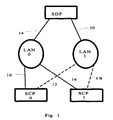
- the Figure shows an embodiment of the present invention as applied to intelligent networks (IN).
- the network of the Figure comprises a server (IN service data point) SDP connected to two clients (IN service control points) SCP0 and SCP1 via two broadcast local area networks (LAN0, LAN1).
- LAN0, LAN1 broadcast local area networks
- Each client and server SDP, SCP0, SCP1 has an interface to a physical connection 10, 12, 14, 16, 18, 20 to each of the networks LAN0, LAN1 between them.
- Each interface on each client and server to each physical connection 10, 12, 14, 16, 18, 20 has a unique internet protocol (IP) address.
- IP internet protocol
- the server is arranged to send (when operating correctly) control messages at regular intervals to each client with which it may be connected.
- the time interval between messages can be very small, eg in the range from a few milliseconds to a few tens of milliseconds.
- the server SDP has a plurality of routes available to each client SCP0, SCP1.
- server SDP may communicate with client SCP0 via physical connection 14, network LAN0 and physical connection 10.
- the server SDP may communicate with the same client SCP0 via physical connection 20, network LAN1 and physical connection 12.
- Each client checks for the receipt of valid control messages from each server with which it may be connected and that each valid control message is received within a predetermined time period or interval of the immediately previous one from the same server. According to a preferred embodiment, the client will check for receipt of valid control messages via each available route from each server with which it may be connected.
- each client is provided with a number of so-called watchdog processes each of the watchdog processes for checking that control messages are received from a particular interface on a particular server.
- the watchdog process comprises a re-settable timer which is arranged to be reset every time a valid control message is received from the appropriate server interface.
- the watchdog timer will continue to count until it reaches a predetermined value or timeout at which the client deems a failure to have occurred. If no message is received from a particular server interface after a certain time (i.e. after expiry of the relevant timeout as determined by the watchdog process) that server interface is considered unusable. If it is the server that has failed then the flow of control messages from that server via all available interfaces will cease. In the arrangement of the present invention clients will automatically detect the lack of control messages via all available interfaces from a failed server without the need to poll alternative routes in turn.
- the duration of the time out may be set to a value corresponding to a time period during which, in normal operation, more than one control message would be received.
- the watchdog process may be made tolerant of transient faults which result in the loss of the odd control message but do not seriously affect the operation of the network.
- a predetermined number of control messages with no error is received from a server interface previously marked as unusable it is marked as being usable again.
- a large value of the pre-determined number may be selected in order to avoid switching back and forth between "usable” and “unusable” states in the presence of an intermittent fault.
- a typical communications system would comprise several servers and clients.
- clients and servers may not be fully meshed, i.e. any server may not be capable of connecting to every client and vice versa.
- non fully-meshed communications system according to a further embodiment of the present invention, various clients and servers will form separate connection groups.
- one or more multi-cast groups are set up connecting the clients SCP0, SCP1 to the servers SDP.
- the multi-cast groups are arranged such that a multi-cast packet sent from a particular server via a particular physical connection (e.g. 14) to a network (e.g. LAN0) will be received on all interfaces (i.e. via all physical connections 10, 16) of all clients reachable from that network.
- the servers send control messages in the form of multi-cast packets, (datagrams), so that each server only needs to send one control message which is then routed to all clients in the multi-cast group rather than sending a separate control message and setting up a separate connection to each client. In fact the server does not even need to know what clients are attached when using the multi-cast approach.
- Each multicast-message comprises an Internet Protocol (IP) host address which indicates to the recipient clients the address of a working interface on a working server. If multi-cast control messages from a particular address stop arriving, this indicates to the clients that the server interface associated with that address is unusable. Obviously, if the reason that the control messages have stopped is that the server has failed, then no control messages will be received from any interfaces on that server. Hence all interfaces on that server will be identified as unusable and the client will stop trying to access it.
- IP Internet Protocol
- the period between sending control messages, e.g. multi-cast messages, and consequently the length of the watchdog timeout at the client can be set to less than the effective duration of the time period or the "window" allowed for the server to respond in the arrangement of the prior art.
- This will result in faster failure detection and fewer packets being sent to failed interfaces or to failed servers.
- failure of a server or an interface will be detected by a client connected to that server or via that interface even if the server is not in use by that client. If a failed interface or server comes back into service it will quickly become obvious to the clients capable of using that interface or server.
- Error detection provides each client with real-time information on all the servers in the network to which it is connected, together with all the interfaces to those servers. This information may be stored in the form of a table. Obviously the present invention will not only detect errors with the server interface but any problem with the route to that interface which results in loss of control messages.
- selection of which server to use by a particular client will be based on availability as identified in the table together with costs associated with various IP addresses i.e. alternative server interfaces..
- every server that the client is able to connect to will be allocated a "cost factor" based on geographical distance or proximity via the network (i.e. whether the server is on the same "local” network as the client or on a different but connected "distant" network). For example, the cost factor associated with a control message could be incremented every time that message traversed a router on its way to the client.
- a client may respond by incrementing the cost factor associated with that server.
- the cost factors may also be stored in tabular form.
- the client will normally use servers associated with a lower cost factor in preference to those servers associated with higher cost factors. It may simply be arranged to only use those servers with the lowest cost factor.
- the costs associated with each route can be used to implement load sharing. For example, when a local server is under overload the cost associated with the route or routes to that local server may be increased to equal that of remote servers. This will result in clients starting to use more remote servers and thus reduce the load on the overloaded local server. Once the overload condition has passed, the local server may have its route cost decreased and the remote servers will as a result no longer be used by those clients.
- Overload may be detected by the client either by virtue of server status information provided by the servers and contained in the control messages or by the client monitoring the performance of a server: for example monitoring the response time of the server or the time between successive control messages.
- the present invention is not limited to applications in intelligent networks but has applications in a large number of networks connecting clients to servers.
- multicast packets are not essential to the present invention but merely a convenient form of addressing clients in certain networks.
- Broadcast packets or single address/destination packets may be substituted for the multi-cast packets described above whilst remaining within the scope of the present invention.
- Broadcast packets are particularly suitable for smaller networks.
- the present invention has application to ATM based networks, amongst others.
- a client could use the control messages to identify (or discover the presence of) servers to which the client has access.
Landscapes
- Engineering & Computer Science (AREA)
- Computer Networks & Wireless Communication (AREA)
- Computer Security & Cryptography (AREA)
- Signal Processing (AREA)
- Computer And Data Communications (AREA)
- Facsimiles In General (AREA)
- Data Exchanges In Wide-Area Networks (AREA)
Abstract
Description
Claims (20)
- A communications system comprising one or more servers and one or more clients; the servers for connection to the clients for the provision of information to the clients;each server comprising means for sending control messages to the clients at or above a set rate;each client comprising means for detecting the control messages and monitor means for determining a fault condition if the control messages are not received from each one of the servers at less than predetermined time intervals.
- The system of Claim 1 in which the messages are multi-cast messages.
- The system of Claim 1 in which the messages are datagrams.
- The system of Claim 1 in which the messages are broadcast.
- The system of any above claim in which each server and each client are comprised in an intelligent network (IN).
- The system of Claim 5 in which each server comprises a service data point (SDP) and each client comprises a service control point (SCP).
- The system of any above claim in which each client comprises means for recording the status of each server for connection to it.
- The system of any above claim in which the control messages comprise an address part containing information on the source of the message.
- The system of any above claim in which each client comprises means for determining the source of a received control message.
- The system of any above claim in which each server comprises means for sending messages over a plurality of interfaces.
- The system of any above claim in which each client comprises means for receiving messages sent via a plurality of interfaces from each server.
- The system of any above claim in which the monitor means comprises a set of resettable timers one for each server in which the monitor means also comprises means for resetting the timer associated with a server on receipt of a control message by the client from that server.
- The system of Claim 12 in which the set of resettable timers comprise one for each server interface.
- The system of any above claim in which at least one of the one or more clients has access to a plurality of the servers for providing the same information; in which the at least one client comprises costing means for allocating a cost value to each of the plurality of the servers and in which the client also comprises server selection means for determining which out of the plurality of the servers to use, based on the cost values.
- The system of Claim 14 in which the costing means comprises means for incrementing the cost value associated with a particular server to reflect the lengths of the time intervals between successive control messages received from that server.
- The system of any one of Claims 14 or 15 in which the server selection means is arranged to implement load sharing.
- The system of any above claim in which the control messages comprise server status information.
- The system of any above claim in which each client comprises an overload handler for detecting an overload condition of at least one of the one or more servers by means of status information comprised in the control messages or by means of the lengths of the time intervals between successive control messages received from that server.
- The system of Claim 18 in which each client comprises means for identifying servers in which the identification is based on information comprised in the control messages sent by the identified servers.
- The system of any one of Claims 12 or 13 in which the monitor means comprises means for inhibiting the resetting of the timer associated with a server or route when a fault condition associated with that server or route has been determined until a predetermined number of the control messages have been received from that server or via that route.
Applications Claiming Priority (2)
| Application Number | Priority Date | Filing Date | Title |
|---|---|---|---|
| GB9905252 | 1999-03-09 | ||
| GB9905252A GB2347832B (en) | 1999-03-09 | 1999-03-09 | Communications system |
Publications (2)
| Publication Number | Publication Date |
|---|---|
| EP1035709A2 true EP1035709A2 (en) | 2000-09-13 |
| EP1035709A3 EP1035709A3 (en) | 2000-11-08 |
Family
ID=10849160
Family Applications (1)
| Application Number | Title | Priority Date | Filing Date |
|---|---|---|---|
| EP00301283A Withdrawn EP1035709A3 (en) | 1999-03-09 | 2000-02-18 | Monitoring of nodes in an Intelligent Network |
Country Status (6)
| Country | Link |
|---|---|
| US (1) | US6816899B1 (en) |
| EP (1) | EP1035709A3 (en) |
| AU (1) | AU2073400A (en) |
| GB (1) | GB2347832B (en) |
| NO (1) | NO20001189L (en) |
| SG (1) | SG82682A1 (en) |
Cited By (1)
| Publication number | Priority date | Publication date | Assignee | Title |
|---|---|---|---|---|
| WO2004010296A3 (en) * | 2002-07-24 | 2004-07-22 | Koninkl Philips Electronics Nv | Forestalling long time-outs in processes |
Families Citing this family (23)
| Publication number | Priority date | Publication date | Assignee | Title |
|---|---|---|---|---|
| US7103810B2 (en) * | 2002-04-18 | 2006-09-05 | International Business Machines Corporation | System for the tracking of errors in a communication network enabling users to selectively bypass system error logs and make real-time responses to detected errors |
| US20060146794A1 (en) * | 2004-12-30 | 2006-07-06 | Motorola, Inc. | Peer network interaction facilitation method |
| US7793158B2 (en) | 2007-08-27 | 2010-09-07 | International Business Machines Corporation | Providing reliability of communication between supernodes of a multi-tiered full-graph interconnect architecture |
| US8108545B2 (en) | 2007-08-27 | 2012-01-31 | International Business Machines Corporation | Packet coalescing in virtual channels of a data processing system in a multi-tiered full-graph interconnect architecture |
| US7958182B2 (en) | 2007-08-27 | 2011-06-07 | International Business Machines Corporation | Providing full hardware support of collective operations in a multi-tiered full-graph interconnect architecture |
| US8014387B2 (en) | 2007-08-27 | 2011-09-06 | International Business Machines Corporation | Providing a fully non-blocking switch in a supernode of a multi-tiered full-graph interconnect architecture |
| US8185896B2 (en) | 2007-08-27 | 2012-05-22 | International Business Machines Corporation | Method for data processing using a multi-tiered full-graph interconnect architecture |
| US7958183B2 (en) | 2007-08-27 | 2011-06-07 | International Business Machines Corporation | Performing collective operations using software setup and partial software execution at leaf nodes in a multi-tiered full-graph interconnect architecture |
| US7769891B2 (en) | 2007-08-27 | 2010-08-03 | International Business Machines Corporation | System and method for providing multiple redundant direct routes between supernodes of a multi-tiered full-graph interconnect architecture |
| US7840703B2 (en) | 2007-08-27 | 2010-11-23 | International Business Machines Corporation | System and method for dynamically supporting indirect routing within a multi-tiered full-graph interconnect architecture |
| US7904590B2 (en) | 2007-08-27 | 2011-03-08 | International Business Machines Corporation | Routing information through a data processing system implementing a multi-tiered full-graph interconnect architecture |
| US8140731B2 (en) | 2007-08-27 | 2012-03-20 | International Business Machines Corporation | System for data processing using a multi-tiered full-graph interconnect architecture |
| US7809970B2 (en) | 2007-08-27 | 2010-10-05 | International Business Machines Corporation | System and method for providing a high-speed message passing interface for barrier operations in a multi-tiered full-graph interconnect architecture |
| US7822889B2 (en) | 2007-08-27 | 2010-10-26 | International Business Machines Corporation | Direct/indirect transmission of information using a multi-tiered full-graph interconnect architecture |
| US7769892B2 (en) | 2007-08-27 | 2010-08-03 | International Business Machines Corporation | System and method for handling indirect routing of information between supernodes of a multi-tiered full-graph interconnect architecture |
| US7827428B2 (en) | 2007-08-31 | 2010-11-02 | International Business Machines Corporation | System for providing a cluster-wide system clock in a multi-tiered full-graph interconnect architecture |
| US7921316B2 (en) | 2007-09-11 | 2011-04-05 | International Business Machines Corporation | Cluster-wide system clock in a multi-tiered full-graph interconnect architecture |
| US8077602B2 (en) | 2008-02-01 | 2011-12-13 | International Business Machines Corporation | Performing dynamic request routing based on broadcast queue depths |
| US7779148B2 (en) | 2008-02-01 | 2010-08-17 | International Business Machines Corporation | Dynamic routing based on information of not responded active source requests quantity received in broadcast heartbeat signal and stored in local data structure for other processor chips |
| US7865785B2 (en) * | 2008-02-13 | 2011-01-04 | Honeywell International Inc. | System and method for improving communications for systems having communications protocol enabled devices |
| US8453013B1 (en) * | 2008-07-09 | 2013-05-28 | Google Inc | System-hang recovery mechanisms for distributed systems |
| US8417778B2 (en) * | 2009-12-17 | 2013-04-09 | International Business Machines Corporation | Collective acceleration unit tree flow control and retransmit |
| US9723063B2 (en) * | 2011-11-28 | 2017-08-01 | Vuclip (Singapore) Pte. Ltd. | Method of determining transport parameters for efficient data transport across a network |
Family Cites Families (18)
| Publication number | Priority date | Publication date | Assignee | Title |
|---|---|---|---|---|
| US5459837A (en) * | 1993-04-21 | 1995-10-17 | Digital Equipment Corporation | System to facilitate efficient utilization of network resources in a computer network |
| JPH0756838A (en) * | 1993-08-11 | 1995-03-03 | Toshiba Corp | Distributed server controller |
| ATE213893T1 (en) * | 1994-06-09 | 2002-03-15 | Siemens Ag | METHOD FOR DISTRIBUTING CALLS IN A COMMUNICATIONS NETWORK |
| US5754787A (en) * | 1994-12-23 | 1998-05-19 | Intel Corporation | System for electronically publishing objects with header specifying minimum and maximum required transport delivery rates and threshold being amount publisher is willing to pay |
| US5774479A (en) * | 1995-03-30 | 1998-06-30 | Motorola, Inc. | Method and system for remote procedure call via an unreliable communication channel using multiple retransmission timers |
| US5870605A (en) * | 1996-01-18 | 1999-02-09 | Sun Microsystems, Inc. | Middleware for enterprise information distribution |
| US6047327A (en) * | 1996-02-16 | 2000-04-04 | Intel Corporation | System for distributing electronic information to a targeted group of users |
| US5796934A (en) * | 1996-05-31 | 1998-08-18 | Oracle Corporation | Fault tolerant client server system |
| US6182139B1 (en) * | 1996-08-05 | 2001-01-30 | Resonate Inc. | Client-side resource-based load-balancing with delayed-resource-binding using TCP state migration to WWW server farm |
| US6072857A (en) * | 1996-12-19 | 2000-06-06 | Bellsouth Intellectual Property Management Corporation | Methods and system for monitoring the operational status of a network component in an advanced intelligent network |
| US6003136A (en) * | 1997-06-27 | 1999-12-14 | Unisys Corporation | Message control system for managing message response in a kerberos environment |
| US6006206A (en) * | 1997-09-08 | 1999-12-21 | Reuters Limited | Data health monitor for financial information communications networks |
| US6442598B1 (en) * | 1997-10-27 | 2002-08-27 | Microsoft Corporation | System and method for delivering web content over a broadcast medium |
| US6594765B2 (en) * | 1998-09-29 | 2003-07-15 | Softvault Systems, Inc. | Method and system for embedded, automated, component-level control of computer systems and other complex systems |
| US6205479B1 (en) * | 1998-04-14 | 2001-03-20 | Juno Online Services, Inc. | Two-tier authentication system where clients first authenticate with independent service providers and then automatically exchange messages with a client controller to gain network access |
| US6456597B1 (en) * | 1998-05-04 | 2002-09-24 | Hewlett Packard Co. | Discovery of unknown MAC addresses using load balancing switch protocols |
| US6496580B1 (en) * | 1999-02-22 | 2002-12-17 | Aspect Communications Corp. | Method and apparatus for servicing queued requests |
| US6570849B1 (en) * | 1999-10-15 | 2003-05-27 | Tropic Networks Inc. | TDM-quality voice over packet |
-
1999
- 1999-03-09 GB GB9905252A patent/GB2347832B/en not_active Expired - Fee Related
-
2000
- 2000-02-18 EP EP00301283A patent/EP1035709A3/en not_active Withdrawn
- 2000-02-24 SG SG200000931A patent/SG82682A1/en unknown
- 2000-03-03 US US09/518,394 patent/US6816899B1/en not_active Expired - Lifetime
- 2000-03-08 AU AU20734/00A patent/AU2073400A/en not_active Abandoned
- 2000-03-08 NO NO20001189A patent/NO20001189L/en unknown
Cited By (1)
| Publication number | Priority date | Publication date | Assignee | Title |
|---|---|---|---|---|
| WO2004010296A3 (en) * | 2002-07-24 | 2004-07-22 | Koninkl Philips Electronics Nv | Forestalling long time-outs in processes |
Also Published As
| Publication number | Publication date |
|---|---|
| HK1027924A1 (en) | 2001-01-23 |
| AU2073400A (en) | 2000-09-14 |
| NO20001189D0 (en) | 2000-03-08 |
| GB9905252D0 (en) | 1999-04-28 |
| EP1035709A3 (en) | 2000-11-08 |
| GB2347832A (en) | 2000-09-13 |
| SG82682A1 (en) | 2001-08-21 |
| US6816899B1 (en) | 2004-11-09 |
| GB2347832B (en) | 2001-04-04 |
| NO20001189L (en) | 2000-09-11 |
Similar Documents
| Publication | Publication Date | Title |
|---|---|---|
| US6816899B1 (en) | Communications system | |
| US7974219B2 (en) | Network troubleshooting using path topology | |
| EP1391079B1 (en) | Method and system for implementing a fast recovery process in a local area network | |
| US8023509B2 (en) | Communication terminal and retransmission request method | |
| CN108123824B (en) | A kind of network fault detection method and device | |
| JP4072158B2 (en) | Method for testing message path and network element in communication network | |
| US10230570B2 (en) | Reliable ISP access cloud state detection method and apparatus | |
| US8687503B2 (en) | Technique for identifying a failed network interface card within a team of network interface cards | |
| US8369229B2 (en) | Methods for monitoring delivery performance of a packet flow between reference nodes | |
| US20090252044A1 (en) | Reliable ISP Access Cloud state detection method and apparatus | |
| CN101471822A (en) | Method and system for locating network fault | |
| EP1547311A2 (en) | Monitoring telecommunication network elements | |
| JPH088975A (en) | Local area network interconnected system and device | |
| CN118353764B (en) | A fault-inducing client retrieval method and system utilizing fault-corresponding edge servers for grouping. | |
| CN108322836A (en) | A kind of method and device of data transmission | |
| CN102281263B (en) | Method for establishing Internet small computer system interface (iSCSI) session and iSCSI initiator | |
| US7813303B2 (en) | Network fault detection apparatus | |
| EP1601140B1 (en) | Method of monitoring a member router in a VRRP group | |
| US20060002306A1 (en) | Failure detection of path information corresponding to a transmission path | |
| US20020129163A1 (en) | Network availability | |
| US7636315B2 (en) | Broadcast traceroute | |
| KR20180093175A (en) | System and method for end-to-end connection checking of SDN network | |
| CN117354196B (en) | Link detection method and device based on network interface | |
| JP2002271371A (en) | Network server and its controlling method | |
| US20070274282A1 (en) | Method for Managing a Group of Network Access Servers |
Legal Events
| Date | Code | Title | Description |
|---|---|---|---|
| PUAI | Public reference made under article 153(3) epc to a published international application that has entered the european phase |
Free format text: ORIGINAL CODE: 0009012 |
|
| AK | Designated contracting states |
Kind code of ref document: A2 Designated state(s): AT BE CH CY DE DK ES FI FR GB GR IE IT LI LU MC NL PT SE |
|
| AX | Request for extension of the european patent |
Free format text: AL;LT;LV;MK;RO;SI |
|
| PUAL | Search report despatched |
Free format text: ORIGINAL CODE: 0009013 |
|
| AK | Designated contracting states |
Kind code of ref document: A3 Designated state(s): AT BE CH CY DE DK ES FI FR GB GR IE IT LI LU MC NL PT SE |
|
| AX | Request for extension of the european patent |
Free format text: AL;LT;LV;MK;RO;SI |
|
| 17P | Request for examination filed |
Effective date: 20010223 |
|
| AKX | Designation fees paid |
Free format text: AT BE CH CY LI |
|
| RBV | Designated contracting states (corrected) |
Designated state(s): DE ES IT SE |
|
| REG | Reference to a national code |
Ref country code: DE Ref legal event code: 8566 |
|
| RBV | Designated contracting states (corrected) |
Designated state(s): AT BE CH DE ES IT LI SE |
|
| RBV | Designated contracting states (corrected) |
Designated state(s): AT BE CH CY DE DK ES FI FR GB GR IE IT LI LU MC NL PT SE |
|
| RAP1 | Party data changed (applicant data changed or rights of an application transferred) |
Owner name: MARCONI UK INTELLECTUAL PROPERTY LTD |
|
| RAP1 | Party data changed (applicant data changed or rights of an application transferred) |
Owner name: M(DGP1) LTD |
|
| RAP1 | Party data changed (applicant data changed or rights of an application transferred) |
Owner name: ERICSSON AB |
|
| 17Q | First examination report despatched |
Effective date: 20060825 |
|
| RAP1 | Party data changed (applicant data changed or rights of an application transferred) |
Owner name: ERICSSON AB |
|
| RAP1 | Party data changed (applicant data changed or rights of an application transferred) |
Owner name: ERICSSON AB |
|
| STAA | Information on the status of an ep patent application or granted ep patent |
Free format text: STATUS: THE APPLICATION HAS BEEN WITHDRAWN |
|
| 18W | Application withdrawn |
Effective date: 20130227 |