EP1035166A1 - Blends of aqueous dispersions of fluoropolymers and aqueous dispersions of ethylene/acid or ionomeric copolymers - Google Patents
Blends of aqueous dispersions of fluoropolymers and aqueous dispersions of ethylene/acid or ionomeric copolymers Download PDFInfo
- Publication number
- EP1035166A1 EP1035166A1 EP00301996A EP00301996A EP1035166A1 EP 1035166 A1 EP1035166 A1 EP 1035166A1 EP 00301996 A EP00301996 A EP 00301996A EP 00301996 A EP00301996 A EP 00301996A EP 1035166 A1 EP1035166 A1 EP 1035166A1
- Authority
- EP
- European Patent Office
- Prior art keywords
- ethylene
- composition
- acid
- weight
- fluoropolymer
- Prior art date
- Legal status (The legal status is an assumption and is not a legal conclusion. Google has not performed a legal analysis and makes no representation as to the accuracy of the status listed.)
- Withdrawn
Links
- 229920002313 fluoropolymer Polymers 0.000 title claims abstract description 63
- 239000004811 fluoropolymer Substances 0.000 title claims abstract description 63
- 239000006185 dispersion Substances 0.000 title claims abstract description 62
- VGGSQFUCUMXWEO-UHFFFAOYSA-N Ethene Chemical compound C=C VGGSQFUCUMXWEO-UHFFFAOYSA-N 0.000 title claims abstract description 38
- 239000005977 Ethylene Substances 0.000 title claims abstract description 38
- 239000002253 acid Substances 0.000 title claims abstract description 23
- 239000000203 mixture Substances 0.000 title claims description 64
- 229920001577 copolymer Polymers 0.000 title claims description 17
- 229920001038 ethylene copolymer Polymers 0.000 claims abstract description 46
- 239000000843 powder Substances 0.000 claims abstract description 35
- 239000002245 particle Substances 0.000 claims abstract description 24
- -1 alkyl methacrylate Chemical compound 0.000 claims abstract description 15
- RAHZWNYVWXNFOC-UHFFFAOYSA-N Sulphur dioxide Chemical compound O=S=O RAHZWNYVWXNFOC-UHFFFAOYSA-N 0.000 claims abstract description 10
- 229910021645 metal ion Inorganic materials 0.000 claims abstract description 7
- UGFAIRIUMAVXCW-UHFFFAOYSA-N Carbon monoxide Chemical compound [O+]#[C-] UGFAIRIUMAVXCW-UHFFFAOYSA-N 0.000 claims abstract description 5
- QYKIQEUNHZKYBP-UHFFFAOYSA-N Vinyl ether Chemical compound C=COC=C QYKIQEUNHZKYBP-UHFFFAOYSA-N 0.000 claims abstract description 5
- 125000005250 alkyl acrylate group Chemical group 0.000 claims abstract description 5
- 229910002091 carbon monoxide Inorganic materials 0.000 claims abstract description 5
- 150000001768 cations Chemical class 0.000 claims abstract description 5
- 238000001035 drying Methods 0.000 claims abstract description 5
- 229920001343 polytetrafluoroethylene Polymers 0.000 claims description 48
- 239000004810 polytetrafluoroethylene Substances 0.000 claims description 48
- 238000000576 coating method Methods 0.000 claims description 27
- 229920000642 polymer Polymers 0.000 claims description 26
- CERQOIWHTDAKMF-UHFFFAOYSA-N Methacrylic acid Chemical compound CC(=C)C(O)=O CERQOIWHTDAKMF-UHFFFAOYSA-N 0.000 claims description 20
- 239000011248 coating agent Substances 0.000 claims description 16
- QHZOMAXECYYXGP-UHFFFAOYSA-N ethene;prop-2-enoic acid Chemical group C=C.OC(=O)C=C QHZOMAXECYYXGP-UHFFFAOYSA-N 0.000 claims description 16
- 239000000758 substrate Substances 0.000 claims description 15
- BAPJBEWLBFYGME-UHFFFAOYSA-N Methyl acrylate Chemical compound COC(=O)C=C BAPJBEWLBFYGME-UHFFFAOYSA-N 0.000 claims description 12
- FJKIXWOMBXYWOQ-UHFFFAOYSA-N ethenoxyethane Chemical compound CCOC=C FJKIXWOMBXYWOQ-UHFFFAOYSA-N 0.000 claims description 10
- 238000000034 method Methods 0.000 claims description 10
- 229910052782 aluminium Inorganic materials 0.000 claims description 9
- XAGFODPZIPBFFR-UHFFFAOYSA-N aluminium Chemical compound [Al] XAGFODPZIPBFFR-UHFFFAOYSA-N 0.000 claims description 9
- UZKWTJUDCOPSNM-UHFFFAOYSA-N 1-ethenoxybutane Chemical compound CCCCOC=C UZKWTJUDCOPSNM-UHFFFAOYSA-N 0.000 claims description 8
- SOGAXMICEFXMKE-UHFFFAOYSA-N Butylmethacrylate Chemical compound CCCCOC(=O)C(C)=C SOGAXMICEFXMKE-UHFFFAOYSA-N 0.000 claims description 8
- CFVWNXQPGQOHRJ-UHFFFAOYSA-N 2-methylpropyl prop-2-enoate Chemical compound CC(C)COC(=O)C=C CFVWNXQPGQOHRJ-UHFFFAOYSA-N 0.000 claims description 6
- CQEYYJKEWSMYFG-UHFFFAOYSA-N butyl acrylate Chemical compound CCCCOC(=O)C=C CQEYYJKEWSMYFG-UHFFFAOYSA-N 0.000 claims description 6
- 239000004812 Fluorinated ethylene propylene Substances 0.000 claims description 4
- VVQNEPGJFQJSBK-UHFFFAOYSA-N Methyl methacrylate Chemical compound COC(=O)C(C)=C VVQNEPGJFQJSBK-UHFFFAOYSA-N 0.000 claims description 4
- 239000002033 PVDF binder Substances 0.000 claims description 4
- 229920001774 Perfluoroether Polymers 0.000 claims description 4
- 229920009638 Tetrafluoroethylene-Hexafluoropropylene-Vinylidenefluoride Copolymer Polymers 0.000 claims description 4
- 238000002156 mixing Methods 0.000 claims description 4
- 150000002762 monocarboxylic acid derivatives Chemical class 0.000 claims description 4
- 229920009441 perflouroethylene propylene Polymers 0.000 claims description 4
- 229920002981 polyvinylidene fluoride Polymers 0.000 claims description 4
- 230000008569 process Effects 0.000 claims description 4
- SMZOUWXMTYCWNB-UHFFFAOYSA-N 2-(2-methoxy-5-methylphenyl)ethanamine Chemical compound COC1=CC=C(C)C=C1CCN SMZOUWXMTYCWNB-UHFFFAOYSA-N 0.000 claims description 3
- NIXOWILDQLNWCW-UHFFFAOYSA-N 2-Propenoic acid Natural products OC(=O)C=C NIXOWILDQLNWCW-UHFFFAOYSA-N 0.000 claims description 3
- 229920006125 amorphous polymer Polymers 0.000 claims description 3
- HQQADJVZYDDRJT-UHFFFAOYSA-N ethene;prop-1-ene Chemical group C=C.CC=C HQQADJVZYDDRJT-UHFFFAOYSA-N 0.000 claims description 3
- 229920006126 semicrystalline polymer Polymers 0.000 claims description 3
- OYPRJOBELJOOCE-UHFFFAOYSA-N Calcium Chemical compound [Ca] OYPRJOBELJOOCE-UHFFFAOYSA-N 0.000 claims description 2
- 239000004716 Ethylene/acrylic acid copolymer Substances 0.000 claims description 2
- DGAQECJNVWCQMB-PUAWFVPOSA-M Ilexoside XXIX Chemical compound C[C@@H]1CC[C@@]2(CC[C@@]3(C(=CC[C@H]4[C@]3(CC[C@@H]5[C@@]4(CC[C@@H](C5(C)C)OS(=O)(=O)[O-])C)C)[C@@H]2[C@]1(C)O)C)C(=O)O[C@H]6[C@@H]([C@H]([C@@H]([C@H](O6)CO)O)O)O.[Na+] DGAQECJNVWCQMB-PUAWFVPOSA-M 0.000 claims description 2
- WHXSMMKQMYFTQS-UHFFFAOYSA-N Lithium Chemical compound [Li] WHXSMMKQMYFTQS-UHFFFAOYSA-N 0.000 claims description 2
- FYYHWMGAXLPEAU-UHFFFAOYSA-N Magnesium Chemical compound [Mg] FYYHWMGAXLPEAU-UHFFFAOYSA-N 0.000 claims description 2
- CERQOIWHTDAKMF-UHFFFAOYSA-M Methacrylate Chemical compound CC(=C)C([O-])=O CERQOIWHTDAKMF-UHFFFAOYSA-M 0.000 claims description 2
- ZLMJMSJWJFRBEC-UHFFFAOYSA-N Potassium Chemical compound [K] ZLMJMSJWJFRBEC-UHFFFAOYSA-N 0.000 claims description 2
- HCHKCACWOHOZIP-UHFFFAOYSA-N Zinc Chemical compound [Zn] HCHKCACWOHOZIP-UHFFFAOYSA-N 0.000 claims description 2
- 239000011575 calcium Substances 0.000 claims description 2
- 229910052791 calcium Inorganic materials 0.000 claims description 2
- 229910052744 lithium Inorganic materials 0.000 claims description 2
- 239000011777 magnesium Substances 0.000 claims description 2
- 229910052749 magnesium Inorganic materials 0.000 claims description 2
- 238000004519 manufacturing process Methods 0.000 claims description 2
- 239000011591 potassium Substances 0.000 claims description 2
- 229910052700 potassium Inorganic materials 0.000 claims description 2
- 239000011734 sodium Substances 0.000 claims description 2
- 229910052708 sodium Inorganic materials 0.000 claims description 2
- 229910052725 zinc Inorganic materials 0.000 claims description 2
- 239000011701 zinc Substances 0.000 claims description 2
- 150000002763 monocarboxylic acids Chemical class 0.000 abstract 1
- 230000000052 comparative effect Effects 0.000 description 18
- 239000000463 material Substances 0.000 description 9
- XLYOFNOQVPJJNP-UHFFFAOYSA-N water Substances O XLYOFNOQVPJJNP-UHFFFAOYSA-N 0.000 description 9
- 239000000178 monomer Substances 0.000 description 8
- 238000002844 melting Methods 0.000 description 6
- 230000008018 melting Effects 0.000 description 6
- 229920002302 Nylon 6,6 Polymers 0.000 description 5
- 239000008188 pellet Substances 0.000 description 5
- 229920005989 resin Polymers 0.000 description 5
- 239000011347 resin Substances 0.000 description 5
- HEMHJVSKTPXQMS-UHFFFAOYSA-M Sodium hydroxide Chemical compound [OH-].[Na+] HEMHJVSKTPXQMS-UHFFFAOYSA-M 0.000 description 4
- 125000004432 carbon atom Chemical group C* 0.000 description 4
- HCDGVLDPFQMKDK-UHFFFAOYSA-N hexafluoropropylene Chemical group FC(F)=C(F)C(F)(F)F HCDGVLDPFQMKDK-UHFFFAOYSA-N 0.000 description 4
- 238000007789 sealing Methods 0.000 description 4
- 238000012360 testing method Methods 0.000 description 4
- KHXKESCWFMPTFT-UHFFFAOYSA-N 1,1,1,2,2,3,3-heptafluoro-3-(1,2,2-trifluoroethenoxy)propane Chemical compound FC(F)=C(F)OC(F)(F)C(F)(F)C(F)(F)F KHXKESCWFMPTFT-UHFFFAOYSA-N 0.000 description 3
- YCKRFDGAMUMZLT-UHFFFAOYSA-N Fluorine atom Chemical compound [F] YCKRFDGAMUMZLT-UHFFFAOYSA-N 0.000 description 3
- 239000000654 additive Substances 0.000 description 3
- UUAGAQFQZIEFAH-UHFFFAOYSA-N chlorotrifluoroethylene Chemical group FC(F)=C(F)Cl UUAGAQFQZIEFAH-UHFFFAOYSA-N 0.000 description 3
- 229920000840 ethylene tetrafluoroethylene copolymer Polymers 0.000 description 3
- 229910052731 fluorine Inorganic materials 0.000 description 3
- 239000011737 fluorine Substances 0.000 description 3
- 239000011521 glass Substances 0.000 description 3
- 239000000314 lubricant Substances 0.000 description 3
- 238000004806 packaging method and process Methods 0.000 description 3
- 230000002829 reductive effect Effects 0.000 description 3
- BQCIDUSAKPWEOX-UHFFFAOYSA-N 1,1-Difluoroethene Chemical compound FC(F)=C BQCIDUSAKPWEOX-UHFFFAOYSA-N 0.000 description 2
- RNFJDJUURJAICM-UHFFFAOYSA-N 2,2,4,4,6,6-hexaphenoxy-1,3,5-triaza-2$l^{5},4$l^{5},6$l^{5}-triphosphacyclohexa-1,3,5-triene Chemical class N=1P(OC=2C=CC=CC=2)(OC=2C=CC=CC=2)=NP(OC=2C=CC=CC=2)(OC=2C=CC=CC=2)=NP=1(OC=1C=CC=CC=1)OC1=CC=CC=C1 RNFJDJUURJAICM-UHFFFAOYSA-N 0.000 description 2
- GVEUEBXMTMZVSD-UHFFFAOYSA-N 3,3,4,4,5,5,6,6,6-nonafluorohex-1-ene Chemical group FC(F)(F)C(F)(F)C(F)(F)C(F)(F)C=C GVEUEBXMTMZVSD-UHFFFAOYSA-N 0.000 description 2
- 125000000217 alkyl group Chemical group 0.000 description 2
- 238000009826 distribution Methods 0.000 description 2
- 238000001125 extrusion Methods 0.000 description 2
- 238000007654 immersion Methods 0.000 description 2
- 238000002347 injection Methods 0.000 description 2
- 239000007924 injection Substances 0.000 description 2
- 239000007788 liquid Substances 0.000 description 2
- 239000011253 protective coating Substances 0.000 description 2
- 230000009467 reduction Effects 0.000 description 2
- 238000000926 separation method Methods 0.000 description 2
- 230000003068 static effect Effects 0.000 description 2
- 239000000126 substance Substances 0.000 description 2
- BFKJFAAPBSQJPD-UHFFFAOYSA-N tetrafluoroethene Chemical group FC(F)=C(F)F BFKJFAAPBSQJPD-UHFFFAOYSA-N 0.000 description 2
- BLTXWCKMNMYXEA-UHFFFAOYSA-N 1,1,2-trifluoro-2-(trifluoromethoxy)ethene Chemical compound FC(F)=C(F)OC(F)(F)F BLTXWCKMNMYXEA-UHFFFAOYSA-N 0.000 description 1
- BZPCMSSQHRAJCC-UHFFFAOYSA-N 1,2,3,3,4,4,5,5,5-nonafluoro-1-(1,2,3,3,4,4,5,5,5-nonafluoropent-1-enoxy)pent-1-ene Chemical compound FC(F)(F)C(F)(F)C(F)(F)C(F)=C(F)OC(F)=C(F)C(F)(F)C(F)(F)C(F)(F)F BZPCMSSQHRAJCC-UHFFFAOYSA-N 0.000 description 1
- QGZKDVFQNNGYKY-UHFFFAOYSA-O Ammonium Chemical compound [NH4+] QGZKDVFQNNGYKY-UHFFFAOYSA-O 0.000 description 1
- VHUUQVKOLVNVRT-UHFFFAOYSA-N Ammonium hydroxide Chemical compound [NH4+].[OH-] VHUUQVKOLVNVRT-UHFFFAOYSA-N 0.000 description 1
- 229920001780 ECTFE Polymers 0.000 description 1
- 229920007925 Ethylene chlorotrifluoroethylene (ECTFE) Polymers 0.000 description 1
- UFHFLCQGNIYNRP-UHFFFAOYSA-N Hydrogen Chemical compound [H][H] UFHFLCQGNIYNRP-UHFFFAOYSA-N 0.000 description 1
- 238000005054 agglomeration Methods 0.000 description 1
- 230000002776 aggregation Effects 0.000 description 1
- 239000000908 ammonium hydroxide Substances 0.000 description 1
- 239000002518 antifoaming agent Substances 0.000 description 1
- 230000009286 beneficial effect Effects 0.000 description 1
- 230000008901 benefit Effects 0.000 description 1
- 206010061592 cardiac fibrillation Diseases 0.000 description 1
- 238000000975 co-precipitation Methods 0.000 description 1
- 230000003247 decreasing effect Effects 0.000 description 1
- 239000008367 deionised water Substances 0.000 description 1
- 229910021641 deionized water Inorganic materials 0.000 description 1
- 230000000694 effects Effects 0.000 description 1
- 229920000295 expanded polytetrafluoroethylene Polymers 0.000 description 1
- 230000002600 fibrillogenic effect Effects 0.000 description 1
- 239000000945 filler Substances 0.000 description 1
- 239000012467 final product Substances 0.000 description 1
- 239000003063 flame retardant Substances 0.000 description 1
- 239000012530 fluid Substances 0.000 description 1
- 239000011888 foil Substances 0.000 description 1
- 229910052736 halogen Inorganic materials 0.000 description 1
- 150000002367 halogens Chemical class 0.000 description 1
- 239000007970 homogeneous dispersion Substances 0.000 description 1
- 229920001519 homopolymer Polymers 0.000 description 1
- 229910052739 hydrogen Inorganic materials 0.000 description 1
- 239000001257 hydrogen Substances 0.000 description 1
- 238000005470 impregnation Methods 0.000 description 1
- 230000006872 improvement Effects 0.000 description 1
- 238000009413 insulation Methods 0.000 description 1
- 229920000554 ionomer Polymers 0.000 description 1
- 238000005259 measurement Methods 0.000 description 1
- 239000000155 melt Substances 0.000 description 1
- 238000010128 melt processing Methods 0.000 description 1
- 229910052751 metal Inorganic materials 0.000 description 1
- 239000002184 metal Substances 0.000 description 1
- 239000003607 modifier Substances 0.000 description 1
- 238000000465 moulding Methods 0.000 description 1
- 229920005548 perfluoropolymer Polymers 0.000 description 1
- 230000000704 physical effect Effects 0.000 description 1
- 229920003023 plastic Polymers 0.000 description 1
- 239000004033 plastic Substances 0.000 description 1
- 229920000728 polyester Polymers 0.000 description 1
- 229920006267 polyester film Polymers 0.000 description 1
- 230000002028 premature Effects 0.000 description 1
- 230000001681 protective effect Effects 0.000 description 1
- 230000000717 retained effect Effects 0.000 description 1
- 239000007787 solid Substances 0.000 description 1
- 239000002904 solvent Substances 0.000 description 1
- 238000003860 storage Methods 0.000 description 1
- 239000004094 surface-active agent Substances 0.000 description 1
- 238000009864 tensile test Methods 0.000 description 1
- 238000010998 test method Methods 0.000 description 1
Images
Classifications
-
- C—CHEMISTRY; METALLURGY
- C09—DYES; PAINTS; POLISHES; NATURAL RESINS; ADHESIVES; COMPOSITIONS NOT OTHERWISE PROVIDED FOR; APPLICATIONS OF MATERIALS NOT OTHERWISE PROVIDED FOR
- C09D—COATING COMPOSITIONS, e.g. PAINTS, VARNISHES OR LACQUERS; FILLING PASTES; CHEMICAL PAINT OR INK REMOVERS; INKS; CORRECTING FLUIDS; WOODSTAINS; PASTES OR SOLIDS FOR COLOURING OR PRINTING; USE OF MATERIALS THEREFOR
- C09D123/00—Coating compositions based on homopolymers or copolymers of unsaturated aliphatic hydrocarbons having only one carbon-to-carbon double bond; Coating compositions based on derivatives of such polymers
- C09D123/02—Coating compositions based on homopolymers or copolymers of unsaturated aliphatic hydrocarbons having only one carbon-to-carbon double bond; Coating compositions based on derivatives of such polymers not modified by chemical after-treatment
- C09D123/04—Homopolymers or copolymers of ethene
- C09D123/08—Copolymers of ethene
- C09D123/0846—Copolymers of ethene with unsaturated hydrocarbons containing other atoms than carbon or hydrogen atoms
- C09D123/0869—Acids or derivatives thereof
- C09D123/0876—Neutralised polymers, i.e. ionomers
-
- C—CHEMISTRY; METALLURGY
- C08—ORGANIC MACROMOLECULAR COMPOUNDS; THEIR PREPARATION OR CHEMICAL WORKING-UP; COMPOSITIONS BASED THEREON
- C08L—COMPOSITIONS OF MACROMOLECULAR COMPOUNDS
- C08L27/00—Compositions of homopolymers or copolymers of compounds having one or more unsaturated aliphatic radicals, each having only one carbon-to-carbon double bond, and at least one being terminated by a halogen; Compositions of derivatives of such polymers
- C08L27/02—Compositions of homopolymers or copolymers of compounds having one or more unsaturated aliphatic radicals, each having only one carbon-to-carbon double bond, and at least one being terminated by a halogen; Compositions of derivatives of such polymers not modified by chemical after-treatment
- C08L27/12—Compositions of homopolymers or copolymers of compounds having one or more unsaturated aliphatic radicals, each having only one carbon-to-carbon double bond, and at least one being terminated by a halogen; Compositions of derivatives of such polymers not modified by chemical after-treatment containing fluorine atoms
- C08L27/18—Homopolymers or copolymers or tetrafluoroethene
-
- C—CHEMISTRY; METALLURGY
- C09—DYES; PAINTS; POLISHES; NATURAL RESINS; ADHESIVES; COMPOSITIONS NOT OTHERWISE PROVIDED FOR; APPLICATIONS OF MATERIALS NOT OTHERWISE PROVIDED FOR
- C09D—COATING COMPOSITIONS, e.g. PAINTS, VARNISHES OR LACQUERS; FILLING PASTES; CHEMICAL PAINT OR INK REMOVERS; INKS; CORRECTING FLUIDS; WOODSTAINS; PASTES OR SOLIDS FOR COLOURING OR PRINTING; USE OF MATERIALS THEREFOR
- C09D127/00—Coating compositions based on homopolymers or copolymers of compounds having one or more unsaturated aliphatic radicals, each having only one carbon-to-carbon double bond, and at least one being terminated by a halogen; Coating compositions based on derivatives of such polymers
- C09D127/02—Coating compositions based on homopolymers or copolymers of compounds having one or more unsaturated aliphatic radicals, each having only one carbon-to-carbon double bond, and at least one being terminated by a halogen; Coating compositions based on derivatives of such polymers not modified by chemical after-treatment
- C09D127/12—Coating compositions based on homopolymers or copolymers of compounds having one or more unsaturated aliphatic radicals, each having only one carbon-to-carbon double bond, and at least one being terminated by a halogen; Coating compositions based on derivatives of such polymers not modified by chemical after-treatment containing fluorine atoms
- C09D127/18—Homopolymers or copolymers of tetrafluoroethene
-
- C—CHEMISTRY; METALLURGY
- C09—DYES; PAINTS; POLISHES; NATURAL RESINS; ADHESIVES; COMPOSITIONS NOT OTHERWISE PROVIDED FOR; APPLICATIONS OF MATERIALS NOT OTHERWISE PROVIDED FOR
- C09J—ADHESIVES; NON-MECHANICAL ASPECTS OF ADHESIVE PROCESSES IN GENERAL; ADHESIVE PROCESSES NOT PROVIDED FOR ELSEWHERE; USE OF MATERIALS AS ADHESIVES
- C09J177/00—Adhesives based on polyamides obtained by reactions forming a carboxylic amide link in the main chain; Adhesives based on derivatives of such polymers
-
- C—CHEMISTRY; METALLURGY
- C08—ORGANIC MACROMOLECULAR COMPOUNDS; THEIR PREPARATION OR CHEMICAL WORKING-UP; COMPOSITIONS BASED THEREON
- C08L—COMPOSITIONS OF MACROMOLECULAR COMPOUNDS
- C08L2205/00—Polymer mixtures characterised by other features
- C08L2205/03—Polymer mixtures characterised by other features containing three or more polymers in a blend
-
- C—CHEMISTRY; METALLURGY
- C08—ORGANIC MACROMOLECULAR COMPOUNDS; THEIR PREPARATION OR CHEMICAL WORKING-UP; COMPOSITIONS BASED THEREON
- C08L—COMPOSITIONS OF MACROMOLECULAR COMPOUNDS
- C08L23/00—Compositions of homopolymers or copolymers of unsaturated aliphatic hydrocarbons having only one carbon-to-carbon double bond; Compositions of derivatives of such polymers
- C08L23/02—Compositions of homopolymers or copolymers of unsaturated aliphatic hydrocarbons having only one carbon-to-carbon double bond; Compositions of derivatives of such polymers not modified by chemical after-treatment
- C08L23/04—Homopolymers or copolymers of ethene
- C08L23/08—Copolymers of ethene
- C08L23/0846—Copolymers of ethene with unsaturated hydrocarbons containing atoms other than carbon or hydrogen
- C08L23/0869—Copolymers of ethene with unsaturated hydrocarbons containing atoms other than carbon or hydrogen with unsaturated acids, e.g. [meth]acrylic acid; with unsaturated esters, e.g. [meth]acrylic acid esters
- C08L23/0876—Salts thereof, i.e. ionomers
-
- C—CHEMISTRY; METALLURGY
- C08—ORGANIC MACROMOLECULAR COMPOUNDS; THEIR PREPARATION OR CHEMICAL WORKING-UP; COMPOSITIONS BASED THEREON
- C08L—COMPOSITIONS OF MACROMOLECULAR COMPOUNDS
- C08L2666/00—Composition of polymers characterized by a further compound in the blend, being organic macromolecular compounds, natural resins, waxes or and bituminous materials, non-macromolecular organic substances, inorganic substances or characterized by their function in the composition
- C08L2666/02—Organic macromolecular compounds, natural resins, waxes or and bituminous materials
Definitions
- the present invention relates to compositions that include fluoropolymers.
- Fluoropolymers are well known materials.
- the term "fluoropolymers” includes polymers which are made from at least one fluorine-containing monomer, but may incorporate monomer(s) which contain no fluorine or other halogen.
- the fluoropolymer preferably contains at least 35 weight percent fluorine.
- fluoropolymers include polymers such as polytetrafluoroethylene (PTFE), perfluoroalkoxy (PFA), fluorinated ethylene propylene (FEP), polyvinylidene fluoride (PVDF), ethylene-tetrafluoroethylene (ETFE), ethylene-chlorotrifluoroethylene (ECTFE), MFA, THV, and mixtures thereof.
- MFA is made from tetrafluoroethylene and perfluoromethylvinylether, and may also include perfluoropropylvinylether monomer. MFA is available from Ausimont S.p.A. THV is made from tetrafluoroethylene, hexafluoropropylene and vinylidene fluoride, and is available from Dyneon. Fluoropolymers possess a unique combination of properties such as high temperature resistance, low electrical conductivity, excellent chemical compatibility, non-stick, low surface tension, and the like. Accordingly, fluoropolymers are often added to other materials, such as other polymers, in order to improve certain physical properties of those materials.
- Fluoropolymer dispersions may be used in applications such as coatings and impregnation, or may be coagulated and dried into powders, and eventually extruded into pellets. These powders or pellets may be made into articles such as tubes or insulation for electrical wire and cables by melt or paste extrusion. Alternatively, these powders or pellets may be used as additives in plastics, coatings, and the like.
- High molecular weight PTFE polymer powder One type of a fluoropolymer that is sometimes added to other polymers is high molecular weight PTFE polymer powder.
- High molecular weight PTFE polymer has a tendency to easily agglomerate and fibrillate under shear and thus is difficult to transport and difficult to feed into host materials. Furthermore, high molecular weight PTFE polymer can not be manufactured in small particle sizes. Generally speaking, the polymer produced in known manufacturing processes has a particle size of well above an average of 30 microns.
- an aqueous dispersion of PTFE is sometimes used.
- the PTFE has average particle sizes of 0.2 to 0.3 microns. If the presence of water is undesirable, then these aqueous dispersions are dried to form fine powder resins. The problem with these powders is that they tend to easily agglomerate and be deformed.
- the average particle size of the powder is at least 300 microns which causes poor distribution of the PTFE within the host, thereby lowering the efficiency of the PTFE and raising the cost of the final product because a greater amount of PTFE is needed in order to obtain its beneficial effects.
- PTFE tends to fibrillate, which makes it useful as a drip suppressant in a burning host polymer.
- the PTFE particles obtained by drying an aqueous dispersion may fibrillate prematurely, decreasing the effectiveness of the PTFE as a drip suppressant.
- Fluoropolymers such as PTFE are also added as coatings to the surface of certain types of films, such as industrial films made of ethylene copolymers, to reduce the friction between the film and processing equipment, thereby increasing the speed of operation of the equipment.
- coatings may be from only a micron to a few microns thick, and the PTFE particles are much larger which leads to roughness of the film, poor distribution of PTFE in the film, and the likelihood that the PTFE will easily come off from the film.
- This invention relates to an aqueous dispersion of (a) from 0.5 to 99.5 weight percent of a fluoropolymer having an average particle size of from 0.01 to 30 microns; and (b) from 0.5 to 99.5 weight percent of an ethylene copolymer. These weight percents are based on the total amounts of (a) and (b) only.
- the ethylene copolymer comprises at least 50% by weight ethylene, 1-35% by weight of an acid-containing unsaturated mono-carboxylic acid, and 0-49% by weight of a moiety selected from at least one of alkyl acrylate, alkyl methacrylate, vinyl ether, carbon monoxide and sulfur dioxide, and further wherein the acid groups are neutralized from 0-100% by a metal ion or other cations.
- the invention may be used in the form of this dispersion, or in the form of a coprecipitate of the dispersion.
- the coprecipitate may be dried to form a dry powder and used in that form or then pelletized to be used as pellets.
- compositions of the invention may be added to a host such as a polymer to make an extruded or molded article or to make a film.
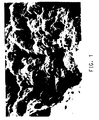
- Figure 1 is a scanning electron microscope picture at a magnification of 500X which shows a co-precipitated dried powder of small particles of PTFE having a thin protective coating of an ethylene copolymer.
- This invention relates to an aqueous dispersion of (a) from 0.5 to 99.5 weight percent of a fluoropolymer having a particle size of from 0.01 to 30 microns; and (b) from 0.5 to 99.5 weight percent of an ethylene copolymer, said weight percents based on the total amounts of (a) and (b) only.
- the invention may be used in the form of the aqueous dispersion, or in the form of a coprecipitate of the aqueous dispersion, or in the form of a dried powder obtained from the aqueous dispersion or coprecipitate.
- the dry powder may be pellitized to be used as pellets.
- Fluoropolymers that can be used in the present invention include non-melt-fabricable fluoropolymer resins having melt viscosity so high, e.g., at least 10 8 Pa ⁇ s, that they cannot readily be shaped by normal melt processing techniques.
- resins include PTFE and TFE polymers (modified PTFE) containing such small concentrations of copolymerizable modifying monomers that the melting point of the resultant polymer is not substantially reduced below that of PTFE, e.g., no lower than 320°C.
- the modifying monomer can be, for example, HFP, PPVE, PEVE, chlorotrifluoroethylene (CTFE), or other monomer that introduces bulky side groups into the molecule.
- the concentration of such modifiers is usually less than 1 wt%, more commonly less than 0.5 wt%.
- Fluoropolymers that can be used in the present invention also include melt-fabricable fluoropolymer resins.
- melt-fabricable fluoropolymer resins have melt viscosity (MV) in the range of 0.5-50 ⁇ 10 3 Pa ⁇ s though viscosities outside this range can be used. More commonly, MV is in the range of 1-25 ⁇ 10 3 Pa ⁇ s. MV is measured according to ASTM D-1238 at the temperature appropriate for the particular fluoropolymer.
- Such fluoropolymers include copolymers of TFE with one or more copolymerizable monomers chosen from perfluoroolefins having 3-8 carbon atoms and perfluoro(alkyl vinyl ethers) (PAVE) in which the linear or branched alkyl group contains 1-5 carbon atoms, with comonomer present in sufficient amount to reduce the melting point substantially below that of PTFE, e.g., to a melting point no greater than 315°C.
- Preferred perfluoropolymers include copolymers of TFE with at least one of hexafluoropropylene (HFP) and PAVE.
- Preferred comonomers include PAVE in which the alkyl group contains 1-3 carbon atoms, especially 2-3 carbon atoms, i.e. perfluoro(ethyl vinyl ether) (PEVE) and perfluoro(propyl vinyl ether) (PPVE).
- Additional fluoropolymers that can be used include copolymers (ETFE) of ethylene with TFE, optionally including minor amounts of one or more modifying comonomer such as perfluorobutyl ethylene (PFBE).
- Other hydrogen-containing fluoropolymers that can be used include copolymers (ECTFE) of ethylene and CTFE, and vinylidene fluoride homopolymers and copolymers.
- fluoropolymers examples include polytetrafluoroethylene, perfluoroalkoxy, fluorinated ethylene propylene, polyvinylidene fluoride, ethylene-tetrafluoroethylene, ethylene-chlorotrifluoroethylene, THV, or mixtures thereof.
- the fluoropolymer has an average particle size of from 0.01 to 30 microns, preferably 0.05 to 2 microns, and more preferably 0.05 to 0.4 microns.
- Ethylene copolymers that may be used in this invention include ethylene copolymers which comprise at least 50% by weight ethylene, 1-35% by weight of an acid-containing unsaturated mono-carboxylic acid, and optionally 0-49% by weight of a moiety selected from at least one of alkyl acrylate, alkyl methacrylate, vinyl ether, carbon monoxide and sulfur dioxide, and further wherein the acid groups are neutralized from 0-100% by a metal ion.
- Preferred ethylene copolymers comprise at least 60% by weight of ethylene, 10-35% by weight of acrylic acid or methacrylic acid and optionally 0-25% by weight of a moiety selected from at least one of methyl acrylate, iso-butyl acrylate and n-butyl acrylate and others as above mentioned, and further wherein the acid groups are neutralized from 0-100%, preferably from 30 to 100%, by at least one metal ion preferably lithium, potassium, sodium, zinc, magnesium, aluminum and calcium, or other cations such as ammonium or amino ions.
- Suitable preferred ethylene copolymers include ethylene/acrylic acid, ethylene/methacrylic acid, ethylene/acrylic acid/n-butyl acrylate, ethylene/methacrylic acid/n-butyl acrylate, ethylene/methacrylic acid/iso-butyl acrylate, ethylene/acrylic acid/iso-butyl acrylate, ethylene/methacrylate acid/ n-butyl methacrylate, ethylene/acrylic acid/methyl methacrylate, ethylene/acrylic acid/ethyl vinyl ether, ethylene/methacrylic acid/butyl vinyl ether, ethylene/acrylic acid/methyl acrylate, ethylene/methacrylic acid/methyl acrylate, ethylene/methacrylic acid/methyl methacrylate, ethylene/acrylic acid/n-butyl methacrylate, ethylene/methacrylic acid/ethyl vinyl ether and ethylene/acrylic acid/butyl vinyl ether or mixtures thereof.
- the ethylene copolymer has an average particle size of from 0.01 to 30 microns, preferable 0.05 to 2 microns, and more preferably 0.05 to 0.4 microns.
- the aqueous dispersion of the invention may be made by preparing the fluoropolymer as an aqueous dispersion, preparing the ethylene copolymer as an aqueous dispersion, and then blending the two aqueous dispersions together.
- This blend of aqueous dispersions may be used as is, or may be coprecipitated and used in that form.
- the aqueous dispersion or the coprecipitate may be dried to provide a dried powder. The dried powder may be pelletized.
- the blends of the invention exhibit excellent compatibility in dispersion form, which makes them useful in storage, transport and application without extra addition of compatibilizers. Because of the small size of the particles and homogeneous aqueous environment, an intimate mixing of the fluoropolymer and the ethylene copolymer is obtained, which is not possible by conventional polymer mixing techniques.
- the blend of the aqueous dispersion of the fluoropolymer and the aqueous dispersion of the ethylene copolymer or its ionomer may be dried to form a coating, a film, an article such as may be made by molding or extrusion, or a powder.
- aqueous dispersion if the aqueous dispersion is dried, such drying should take place above the melting temperature of the ethylene copolymer because it is believed that by doing so the ethylene copolymer forms a protective and binding layer with the fluoropolymer to help prevent the fluoropolymer from agglomerating or becoming deformed.
- the melting point of the ethylene copolymer may be about 70°C, and thus the ethylene copolymer melts before the fluoropolymer.
- the quality of the fluoropolymer does not deteriorate but rather those qualities are retained by the fluoropolymer until it is added to another material and extruded or molded.
- This other material may be, for example, a crystalline or semicrystalline or amorphous polymer that is different from both the fluoropolymer and the ethylene copolymer.
- the aqueous dispersion of the fluoropolymer and the aqueous dispersion of the ethylene copolymer may be used as a dispersion.
- the dispersion is added to a film as a coating.
- fluoropolymers have low surface energy and therefore tend not to stick to the surface of films or other types of substrates.
- the addition of the ethylene copolymer to a fluoropolymer as in the aqueous dispersion of the present invention results in a composition which easily adheres to a film or other substrate thus overcoming the difficulties in the prior art.
- Fluoropolymers are known for both one of the lowest permeation rates to most fluids and excellent resistance to a very wide range of chemicals. These properties make fluoropolymers an important material for use in the packaging industry. Nevertheless the high cost of fluoropolymer films has hindered the use of these materials for use in the packaging industry, with the exception of small and specialized applications.
- the blend of the aqueous dispersions of this invention allow the application of thin coats of fluoropolymers to packaging substrates such as polyester films.
- Polymer coatings on film substrates such as aluminum foil are known to often have poor water resistance, in other words, the coating tends to separate from the substrate when contacted with water.
- the blend of the aqueous dispersions of this invention when applied to such substrates have resulted in significantly improved water resistance of the coating on the aluminum film.
- Powder coatings of substrates such as films is an area of substantial growth because of the absence of solvents or liquid media with additives, and the absence of a need for liquid coating processes which are generally environmentally undesirable. Furthermore powder coatings involving fluoropolymers require high temperatures since, as a rule, the melting points of fluoropolymers is high compared to other polymers. Another negative of using fluoropolymers in powder coatings lies in their high melt viscosity and the difficulty of attaching them to the substrate, which usually requires the use of a primer.
- powders obtained by drying the blends of aqueous dispersions of this invention overcome the problems of the prior art.
- the powders may be applied at lower temperatures, and the application method is simplified due to the good flow characteristics of the powder.
- the need for primers is not required, due to the good adhesion of the system to the substrate.
- composition of this invention which included a fluoropolymer and an ethylene/acid copolymer produced better flame retardancy results than the fluoropolymer alone, the ethylene/acid copolymer alone, or neither the fluoropolymer nor ethylene/acid copolymer.
- a 35% by weight aqueous dispersion of fibrillating PTFE type 3554-N, sold by DuPont was mixed with a 25% by weight aqueous dispersion of an ethylene copolymer, the copolymer being of a 20 % methacrylic acid/80 % ethylene composition, neutralised with sodium hydoxide.
- the quantities of each dispersion were such that the ratio of dry polymers was 75 parts PTFE and 25 parts ethylene copolymer.
- the mixed dispersions were subsequently mechanically agitated at 500 rpm until co-precipitation occurred.
- the composition was dried at a temperature of 105 °C.
- Example 2 a composition of polyamide 6,6, glass, a non-halogenated flame retardant and a lubricant without either PTFE or ethylene acid copolymer was injection molded into test bars which were tested for burning behavior according to UL94.
- a powder of pure PTFE was prepared from the 3554-N dispersion. This type of powder is commercially sold by DuPont as type 669-N. The powder was added to polyamide 6,6 as in comparative Example 2 and tested for burning behavior according to UL94.
- comparative Example 4 a powder of pure ethylene acid copolymer was prepared from the same dispersion as used in example 1. The powder was added to polyamide 6,6 as in comparative Example 2 and tested for burning behavior according to UL94.
- Example 1 achieved a rating of UL V-0 at 1.6 mm.
- the average burn times were 4.0 seconds for the 48h/23°C/50%RH test samples and 2.9 seconds for the 168h/70°C samples, with no bars burning greater than 10 seconds.
- composition of comparative Example 2 achieved a rating of UL V-1 at 1.6 mm. Average burn times were 6.3 seconds for the 48h/23°C/50%RH samples with three bars which burned greater than 10 seconds, and 8.6 seconds for the 168h/70°C samples, with four bars which burned greater than 10 seconds.
- composition of comparative Example 3 achieved a rating of UL V-1 at 1.6 mm. Average burn times were 3.8 seconds for the 48h/23°C/50%RH samples with two bars that burned for greater than 10 seconds, and 4.6 seconds for the 168h/70°C samples, with two bars which burned greater than 10 seconds.
- composition of comparative Example 4 achieved a rating of UL V-1 at 1.6 mm. Average burn times were 6.7 seconds for the 48h/23°C/50%RH samples with four bars that burned for greater than 10 seconds, and 7.9 seconds for the 168h/70°C samples, with four bars that burned greater than 10 seconds.
- the bars were tested according to UL94. For each composition, 10 bars were tested. Five were pretreated 48 hours at 23°C and 50% relative humidity and five were pretreated 168 hours at 70°C. Each bar was subsequently burned twice. Results were graded following the procedure of UL94.
- Example 1 While an improvement in the burning behavior due to the addition of PTFE is obtained in both Example 1 and comparative Example 3 as shown by lower average burning times and more bars with burning times of lower than 10 seconds, only the PTFE/ethylene copolymer composition of Example 1 provided the desired results.
- a substrate was coated with various coatings.
- Industrial films either polymer base such as polyester or metal base such as aluminum, need to be processed at high speeds. Friction between the film and the processing equipment is a problem that limits the speeds and ease of the process. It is well known that various amounts of PTFE and other fluoropolymers on the surface of host films will decrease the friction. Nevertheless, due to the low surface energy of fluoropolymers, these tend not stick to its surface.
- the substrate tested was an aluminum film having a thickness of 40 microns which was coated using a K-hand coater with a bar no. 2.
- the uniform wet thickness of the film applied was 12 microns.
- the coated films were dried in an oven at 110°C for 15 minutes. Subsequently the films were tested for Coefficient of Friction (COF) and Peel Strength.
- COF Coefficient of Friction
- the coating applied to the substrate was an ethylene copolymer dispersion, where the composition of the co-polymer was 80% ethylene and 20% acrylic acid, neutralized with ammonium hydroxide.
- the coating was a mixed dispersion of a PTFE dispersion type 30-N sold by DuPont, with an average particle size of 0.21 microns and a 60% by weight PTFE content and the ethylene acid copolymer dispersion, which had a nominal particle size of 0.1 microns and a copolymer content of 30% by weight.
- the relative amount of PTFE dispersion and the ethylene copolymer dispersion in the mixtures tested is as indicated in Table 2. Before coating the mixed dispersions were diluted with water to a level of 13% total solids of ethylene copolymer.
- the coefficient of friction (COF) of the films was measured according to method DIN-1894-90. Measurements were done with a 20 N force load at a crosshead speed of 152 mm/min. Film to film COF was evaluated by applying a 200 g weight sled on the film wrapped with a coated Al film (coated side to coated side).
- the peel strength of the films made in Comparative Example 5 and Example 7 were measured according to the following test procedure.
- the coated films were heat sealed with a precision bar heat sealer, a Kopp type PK110 at 90 psi pressure for one second.
- Heat sealed sample coated films were peeled apart by a tensile testing machine Zwick type 1435 at a 90° angle in the machine direction (MD) and a crosshead speed of 100 mm/min.
Landscapes
- Chemical & Material Sciences (AREA)
- Organic Chemistry (AREA)
- Wood Science & Technology (AREA)
- Life Sciences & Earth Sciences (AREA)
- Engineering & Computer Science (AREA)
- Materials Engineering (AREA)
- Chemical Kinetics & Catalysis (AREA)
- Health & Medical Sciences (AREA)
- Medicinal Chemistry (AREA)
- Polymers & Plastics (AREA)
- Compositions Of Macromolecular Compounds (AREA)
- Paints Or Removers (AREA)
- Manufacture Of Macromolecular Shaped Articles (AREA)
- Addition Polymer Or Copolymer, Post-Treatments, Or Chemical Modifications (AREA)
- Processes Of Treating Macromolecular Substances (AREA)
Abstract
This invention relates to an aqueous dispersion of (a) from 0.5 to 99.5
weight percent of a fluoropolymer having an average particle size of from 0.01 to
30 microns; and (b) from 0.5 to 99.5 weight percent of an ethylene copolymer
which comprises at least 50% by weight ethylene, 1-35% by weight of an acid-containing
unsaturated mono-carboxylic acid, and optionally 0-49% by weight of
a moiety selected from at least one of alkyl acrylate, alkyl methacrylate, vinyl
ether, carbon monoxide and sulfur dioxide, and further wherein the acid groups
are neutralized from 0-100% by a metal ion or other cations, the weight percents
being based on the total amounts of (a) and (b) only. The invention also relates to
a coprecipate of this aqueous dispersion and a dry powder made by drying the
aqueous dispersion or coprecipitate.
Description
- The present invention relates to compositions that include fluoropolymers.
- Fluoropolymers are well known materials. As used herein the term "fluoropolymers" includes polymers which are made from at least one fluorine-containing monomer, but may incorporate monomer(s) which contain no fluorine or other halogen. The fluoropolymer, however, preferably contains at least 35 weight percent fluorine. Examples of fluoropolymers include polymers such as polytetrafluoroethylene (PTFE), perfluoroalkoxy (PFA), fluorinated ethylene propylene (FEP), polyvinylidene fluoride (PVDF), ethylene-tetrafluoroethylene (ETFE), ethylene-chlorotrifluoroethylene (ECTFE), MFA, THV, and mixtures thereof. These polymers may contain one or more monomers in addition to those named. MFA is made from tetrafluoroethylene and perfluoromethylvinylether, and may also include perfluoropropylvinylether monomer. MFA is available from Ausimont S.p.A. THV is made from tetrafluoroethylene, hexafluoropropylene and vinylidene fluoride, and is available from Dyneon. Fluoropolymers possess a unique combination of properties such as high temperature resistance, low electrical conductivity, excellent chemical compatibility, non-stick, low surface tension, and the like. Accordingly, fluoropolymers are often added to other materials, such as other polymers, in order to improve certain physical properties of those materials.
- Fluoropolymer dispersions may be used in applications such as coatings and impregnation, or may be coagulated and dried into powders, and eventually extruded into pellets. These powders or pellets may be made into articles such as tubes or insulation for electrical wire and cables by melt or paste extrusion. Alternatively, these powders or pellets may be used as additives in plastics, coatings, and the like.
- One type of a fluoropolymer that is sometimes added to other polymers is high molecular weight PTFE polymer powder. High molecular weight PTFE polymer has a tendency to easily agglomerate and fibrillate under shear and thus is difficult to transport and difficult to feed into host materials. Furthermore, high molecular weight PTFE polymer can not be manufactured in small particle sizes. Generally speaking, the polymer produced in known manufacturing processes has a particle size of well above an average of 30 microns.
- In order to obtain a homogeneous dispersion of PTFE in a host such as another polymer, an aqueous dispersion of PTFE is sometimes used. The PTFE has average particle sizes of 0.2 to 0.3 microns. If the presence of water is undesirable, then these aqueous dispersions are dried to form fine powder resins. The problem with these powders is that they tend to easily agglomerate and be deformed. The average particle size of the powder is at least 300 microns which causes poor distribution of the PTFE within the host, thereby lowering the efficiency of the PTFE and raising the cost of the final product because a greater amount of PTFE is needed in order to obtain its beneficial effects. Further, PTFE tends to fibrillate, which makes it useful as a drip suppressant in a burning host polymer. However, the PTFE particles obtained by drying an aqueous dispersion may fibrillate prematurely, decreasing the effectiveness of the PTFE as a drip suppressant.
- Fluoropolymers such as PTFE are also added as coatings to the surface of certain types of films, such as industrial films made of ethylene copolymers, to reduce the friction between the film and processing equipment, thereby increasing the speed of operation of the equipment. However, such coatings may be from only a micron to a few microns thick, and the PTFE particles are much larger which leads to roughness of the film, poor distribution of PTFE in the film, and the likelihood that the PTFE will easily come off from the film.
- What is needed, therefore, is a way to obtain fine powder PTFE particles which do not have the prior art problems of agglomeration, deformation and premature fibrillation and which distribute homogeneously in host materials. Further, there is needed a way to add fine powder PTFE particles to coatings such as films.
- One could incorporate the fluoropolymer in the bulk of the host film, but this would increase the costs substantially and unnecessarily, since the desired effect is exclusively on the surface. Furthermore, the presence of the fluoropolymer tends to lower the sealing strength of the bonded films.
- What is needed, therefore, are ways to add fluoropolymers such as PTFE to other polymers, to films and other substrates taking advantage of the special properties of fluoropolymers.
- This invention relates to an aqueous dispersion of (a) from 0.5 to 99.5 weight percent of a fluoropolymer having an average particle size of from 0.01 to 30 microns; and (b) from 0.5 to 99.5 weight percent of an ethylene copolymer. These weight percents are based on the total amounts of (a) and (b) only. The ethylene copolymer comprises at least 50% by weight ethylene, 1-35% by weight of an acid-containing unsaturated mono-carboxylic acid, and 0-49% by weight of a moiety selected from at least one of alkyl acrylate, alkyl methacrylate, vinyl ether, carbon monoxide and sulfur dioxide, and further wherein the acid groups are neutralized from 0-100% by a metal ion or other cations.
- The invention may be used in the form of this dispersion, or in the form of a coprecipitate of the dispersion. Also, the coprecipitate may be dried to form a dry powder and used in that form or then pelletized to be used as pellets.
- The compositions of the invention may be added to a host such as a polymer to make an extruded or molded article or to make a film.
- Figure 1 is a scanning electron microscope picture at a magnification of 500X which shows a co-precipitated dried powder of small particles of PTFE having a thin protective coating of an ethylene copolymer.
- This invention relates to an aqueous dispersion of (a) from 0.5 to 99.5 weight percent of a fluoropolymer having a particle size of from 0.01 to 30 microns; and (b) from 0.5 to 99.5 weight percent of an ethylene copolymer, said weight percents based on the total amounts of (a) and (b) only. The invention may be used in the form of the aqueous dispersion, or in the form of a coprecipitate of the aqueous dispersion, or in the form of a dried powder obtained from the aqueous dispersion or coprecipitate. The dry powder may be pellitized to be used as pellets.
- Fluoropolymers that can be used in the present invention include non-melt-fabricable fluoropolymer resins having melt viscosity so high, e.g., at least 108 Pa·s, that they cannot readily be shaped by normal melt processing techniques. Such resins include PTFE and TFE polymers (modified PTFE) containing such small concentrations of copolymerizable modifying monomers that the melting point of the resultant polymer is not substantially reduced below that of PTFE, e.g., no lower than 320°C. The modifying monomer can be, for example, HFP, PPVE, PEVE, chlorotrifluoroethylene (CTFE), or other monomer that introduces bulky side groups into the molecule. The concentration of such modifiers is usually less than 1 wt%, more commonly less than 0.5 wt%.
- Fluoropolymers that can be used in the present invention also include melt-fabricable fluoropolymer resins. Generally, melt-fabricable fluoropolymer resins have melt viscosity (MV) in the range of 0.5-50 × 103 Pa·s though viscosities outside this range can be used. More commonly, MV is in the range of 1-25 × 103 Pa·s. MV is measured according to ASTM D-1238 at the temperature appropriate for the particular fluoropolymer. Such fluoropolymers include copolymers of TFE with one or more copolymerizable monomers chosen from perfluoroolefins having 3-8 carbon atoms and perfluoro(alkyl vinyl ethers) (PAVE) in which the linear or branched alkyl group contains 1-5 carbon atoms, with comonomer present in sufficient amount to reduce the melting point substantially below that of PTFE, e.g., to a melting point no greater than 315°C. Preferred perfluoropolymers include copolymers of TFE with at least one of hexafluoropropylene (HFP) and PAVE. Preferred comonomers include PAVE in which the alkyl group contains 1-3 carbon atoms, especially 2-3 carbon atoms, i.e. perfluoro(ethyl vinyl ether) (PEVE) and perfluoro(propyl vinyl ether) (PPVE). Additional fluoropolymers that can be used include copolymers (ETFE) of ethylene with TFE, optionally including minor amounts of one or more modifying comonomer such as perfluorobutyl ethylene (PFBE). Other hydrogen-containing fluoropolymers that can be used include copolymers (ECTFE) of ethylene and CTFE, and vinylidene fluoride homopolymers and copolymers.
- Examples of fluoropolymers that may be used in this invention include polytetrafluoroethylene, perfluoroalkoxy, fluorinated ethylene propylene, polyvinylidene fluoride, ethylene-tetrafluoroethylene, ethylene-chlorotrifluoroethylene, THV, or mixtures thereof.
- The fluoropolymer has an average particle size of from 0.01 to 30 microns, preferably 0.05 to 2 microns, and more preferably 0.05 to 0.4 microns.
- Ethylene copolymers that may be used in this invention include ethylene copolymers which comprise at least 50% by weight ethylene, 1-35% by weight of an acid-containing unsaturated mono-carboxylic acid, and optionally 0-49% by weight of a moiety selected from at least one of alkyl acrylate, alkyl methacrylate, vinyl ether, carbon monoxide and sulfur dioxide, and further wherein the acid groups are neutralized from 0-100% by a metal ion.
- Preferred ethylene copolymers comprise at least 60% by weight of ethylene, 10-35% by weight of acrylic acid or methacrylic acid and optionally 0-25% by weight of a moiety selected from at least one of methyl acrylate, iso-butyl acrylate and n-butyl acrylate and others as above mentioned, and further wherein the acid groups are neutralized from 0-100%, preferably from 30 to 100%, by at least one metal ion preferably lithium, potassium, sodium, zinc, magnesium, aluminum and calcium, or other cations such as ammonium or amino ions.
- Suitable preferred ethylene copolymers include ethylene/acrylic acid, ethylene/methacrylic acid, ethylene/acrylic acid/n-butyl acrylate, ethylene/methacrylic acid/n-butyl acrylate, ethylene/methacrylic acid/iso-butyl acrylate, ethylene/acrylic acid/iso-butyl acrylate, ethylene/methacrylate acid/ n-butyl methacrylate, ethylene/acrylic acid/methyl methacrylate, ethylene/acrylic acid/ethyl vinyl ether, ethylene/methacrylic acid/butyl vinyl ether, ethylene/acrylic acid/methyl acrylate, ethylene/methacrylic acid/methyl acrylate, ethylene/methacrylic acid/methyl methacrylate, ethylene/acrylic acid/n-butyl methacrylate, ethylene/methacrylic acid/ethyl vinyl ether and ethylene/acrylic acid/butyl vinyl ether or mixtures thereof. The most preferred ethylene copolymers for use in the compositions of the present invention are ethylene/methacrylic acid and ethylene/acrylic acid copolymers or mixtures thereof.
- The ethylene copolymer has an average particle size of from 0.01 to 30 microns, preferable 0.05 to 2 microns, and more preferably 0.05 to 0.4 microns.
- The aqueous dispersion of the invention may be made by preparing the fluoropolymer as an aqueous dispersion, preparing the ethylene copolymer as an aqueous dispersion, and then blending the two aqueous dispersions together. This blend of aqueous dispersions may be used as is, or may be coprecipitated and used in that form. Alternatively, the aqueous dispersion or the coprecipitate may be dried to provide a dried powder. The dried powder may be pelletized.
- The blends of the invention exhibit excellent compatibility in dispersion form, which makes them useful in storage, transport and application without extra addition of compatibilizers. Because of the small size of the particles and homogeneous aqueous environment, an intimate mixing of the fluoropolymer and the ethylene copolymer is obtained, which is not possible by conventional polymer mixing techniques.
- These blends overcome the problem present in the prior art where aqueous dispersions of fine powder PTFE particles, when dried, agglomerate, deform and fibrillate prematurely.
- As mentioned above, the blend of the aqueous dispersion of the fluoropolymer and the aqueous dispersion of the ethylene copolymer or its ionomer may be dried to form a coating, a film, an article such as may be made by molding or extrusion, or a powder. In a preferred embodiment, if the aqueous dispersion is dried, such drying should take place above the melting temperature of the ethylene copolymer because it is believed that by doing so the ethylene copolymer forms a protective and binding layer with the fluoropolymer to help prevent the fluoropolymer from agglomerating or becoming deformed. For example, the melting point of the ethylene copolymer may be about 70°C, and thus the ethylene copolymer melts before the fluoropolymer. Thus, the quality of the fluoropolymer does not deteriorate but rather those qualities are retained by the fluoropolymer until it is added to another material and extruded or molded.
- This other material may be, for example, a crystalline or semicrystalline or amorphous polymer that is different from both the fluoropolymer and the ethylene copolymer.
- It should be noted that the aqueous dispersion of the fluoropolymer and the aqueous dispersion of the ethylene copolymer may be used as a dispersion. In one such application the dispersion is added to a film as a coating. As mentioned above, fluoropolymers have low surface energy and therefore tend not to stick to the surface of films or other types of substrates. However, the addition of the ethylene copolymer to a fluoropolymer as in the aqueous dispersion of the present invention results in a composition which easily adheres to a film or other substrate thus overcoming the difficulties in the prior art.
- Fluoropolymers are known for both one of the lowest permeation rates to most fluids and excellent resistance to a very wide range of chemicals. These properties make fluoropolymers an important material for use in the packaging industry. Nevertheless the high cost of fluoropolymer films has hindered the use of these materials for use in the packaging industry, with the exception of small and specialized applications. The blend of the aqueous dispersions of this invention allow the application of thin coats of fluoropolymers to packaging substrates such as polyester films.
- Polymer coatings on film substrates such as aluminum foil are known to often have poor water resistance, in other words, the coating tends to separate from the substrate when contacted with water. The blend of the aqueous dispersions of this invention when applied to such substrates have resulted in significantly improved water resistance of the coating on the aluminum film.
- Powder coatings of substrates such as films is an area of substantial growth because of the absence of solvents or liquid media with additives, and the absence of a need for liquid coating processes which are generally environmentally undesirable. Furthermore powder coatings involving fluoropolymers require high temperatures since, as a rule, the melting points of fluoropolymers is high compared to other polymers. Another negative of using fluoropolymers in powder coatings lies in their high melt viscosity and the difficulty of attaching them to the substrate, which usually requires the use of a primer.
- However, powders obtained by drying the blends of aqueous dispersions of this invention overcome the problems of the prior art. The powders may be applied at lower temperatures, and the application method is simplified due to the good flow characteristics of the powder. Furthermore, the need for primers is not required, due to the good adhesion of the system to the substrate.
- Various amounts and types of conventional additives such as surfactants, antifoam, fillers, and the like may be added to the dispersions and the blends of dispersions of the invention.
- The following examples show that the composition of this invention which included a fluoropolymer and an ethylene/acid copolymer produced better flame retardancy results than the fluoropolymer alone, the ethylene/acid copolymer alone, or neither the fluoropolymer nor ethylene/acid copolymer.
- In example 1, a 35% by weight aqueous dispersion of fibrillating PTFE type 3554-N, sold by DuPont, was mixed with a 25% by weight aqueous dispersion of an ethylene copolymer, the copolymer being of a 20 % methacrylic acid/80 % ethylene composition, neutralised with sodium hydoxide. The quantities of each dispersion were such that the ratio of dry polymers was 75 parts PTFE and 25 parts ethylene copolymer. The mixed dispersions were subsequently mechanically agitated at 500 rpm until co-precipitation occurred. The composition was dried at a temperature of 105 °C. This resulted in a dried powder of particles of PTFE which had a thin protective coating of ethylene copolymer as shown in Fig 1. This powder was mixed with host polyamide 6,6, glass, a non-halogenated flame retardant and a lubricant and was fed into a Werner & Pfleidzer ZSK - 30 mm twin screw extruder. This composition was injection molded into test bars which were tested for burning behavior according to Underwriters Laboratory procedure UL 94. Results are classified either NC (not classified) when failing or V-0, V-1 or V-2 depending on various parameters obtained in the test, V-0 being best while V-2 is worst of all the passing ratings.
- In comparative Example 2, a composition of polyamide 6,6, glass, a non-halogenated flame retardant and a lubricant without either PTFE or ethylene acid copolymer was injection molded into test bars which were tested for burning behavior according to UL94.
- In comparative Example 3, a powder of pure PTFE was prepared from the 3554-N dispersion. This type of powder is commercially sold by DuPont as type 669-N. The powder was added to polyamide 6,6 as in comparative Example 2 and tested for burning behavior according to UL94.
- In comparative Example 4, a powder of pure ethylene acid copolymer was prepared from the same dispersion as used in example 1. The powder was added to polyamide 6,6 as in comparative Example 2 and tested for burning behavior according to UL94.
- The results of Examples 1-4 are summarized in Table 1 below.
Ex. 1 Comp. Ex. 2 Comp. Ex. 3 Comp. Ex. 4 Composition in % PA66 47.70 47.75 47.70 47.70 Glass 20.0 20.0 20.0 20.0 non-halogenated flame retardants 32.0 32.0 32.0 32.0 Lubricant 0.25 0.25 0.25 0.25 PTFE fibrillating powder - - 0.05 - Blend PTFE/Ethylene Copolymer
(75/25)0.05 - - - Ethylene-Acid Copolymer - - - 0.05 UL Burning Classification V-0 V-1 V-1 V-1 - The composition of Example 1 achieved a rating of UL V-0 at 1.6 mm. The average burn times were 4.0 seconds for the 48h/23°C/50%RH test samples and 2.9 seconds for the 168h/70°C samples, with no bars burning greater than 10 seconds.
- The composition of comparative Example 2 achieved a rating of UL V-1 at 1.6 mm. Average burn times were 6.3 seconds for the 48h/23°C/50%RH samples with three bars which burned greater than 10 seconds, and 8.6 seconds for the 168h/70°C samples, with four bars which burned greater than 10 seconds.
- The composition of comparative Example 3 achieved a rating of UL V-1 at 1.6 mm. Average burn times were 3.8 seconds for the 48h/23°C/50%RH samples with two bars that burned for greater than 10 seconds, and 4.6 seconds for the 168h/70°C samples, with two bars which burned greater than 10 seconds.
- The composition of comparative Example 4 achieved a rating of UL V-1 at 1.6 mm. Average burn times were 6.7 seconds for the 48h/23°C/50%RH samples with four bars that burned for greater than 10 seconds, and 7.9 seconds for the 168h/70°C samples, with four bars that burned greater than 10 seconds.
- The bars were tested according to UL94. For each composition, 10 bars were tested. Five were pretreated 48 hours at 23°C and 50% relative humidity and five were pretreated 168 hours at 70°C. Each bar was subsequently burned twice. Results were graded following the procedure of UL94.
- It may be concluded that while an improvement in the burning behavior due to the addition of PTFE is obtained in both Example 1 and comparative Example 3 as shown by lower average burning times and more bars with burning times of lower than 10 seconds, only the PTFE/ethylene copolymer composition of Example 1 provided the desired results.
- In the following examples, a substrate was coated with various coatings. Industrial films, either polymer base such as polyester or metal base such as aluminum, need to be processed at high speeds. Friction between the film and the processing equipment is a problem that limits the speeds and ease of the process. It is well known that various amounts of PTFE and other fluoropolymers on the surface of host films will decrease the friction. Nevertheless, due to the low surface energy of fluoropolymers, these tend not stick to its surface.
- The following Examples 6-8 show that the coefficient of friction of a film was reduced using the compositions of the invention.
- The substrate tested was an aluminum film having a thickness of 40 microns which was coated using a K-hand coater with a bar no. 2. The uniform wet thickness of the film applied was 12 microns. The coated films were dried in an oven at 110°C for 15 minutes. Subsequently the films were tested for Coefficient of Friction (COF) and Peel Strength.
- In Comparative Example 5, the coating applied to the substrate was an ethylene copolymer dispersion, where the composition of the co-polymer was 80% ethylene and 20% acrylic acid, neutralized with ammonium hydroxide. In Examples 6-8, the coating was a mixed dispersion of a PTFE dispersion type 30-N sold by DuPont, with an average particle size of 0.21 microns and a 60% by weight PTFE content and the ethylene acid copolymer dispersion, which had a nominal particle size of 0.1 microns and a copolymer content of 30% by weight. The relative amount of PTFE dispersion and the ethylene copolymer dispersion in the mixtures tested is as indicated in Table 2. Before coating the mixed dispersions were diluted with water to a level of 13% total solids of ethylene copolymer.
- The coefficient of friction (COF) of the films was measured according to method DIN-1894-90. Measurements were done with a 20 N force load at a crosshead speed of 152 mm/min. Film to film COF was evaluated by applying a 200 g weight sled on the film wrapped with a coated Al film (coated side to coated side).
Example No. Ethylene Copolymer plus: Average static COF Average kinetic COF % reduction static COF vs.standard % reduction kinetic COF vs. standard C5 0% PTFE 1.14 0.78 - - 6 1% PTFE 0.85 0.61 25 22 7 5% PTFE 1.04 0.45 9 42 8 10% PTFE 0.59 0.43 48 45 - The results in Table 2 show that the coefficient of friction of a the films was significantly reduced by using a coating of an aqueous dispersion that was a blend of an aqueous dispersion of a fluoropolymer and an aqueous dispersion of a ethylene copolymer compared to a coating of nothing.
- The peel strength of the films made in Comparative Example 5 and Example 7 were measured according to the following test procedure. The coated films were heat sealed with a precision bar heat sealer, a Kopp type PK110 at 90 psi pressure for one second. Heat sealed sample coated films were peeled apart by a tensile testing machine Zwick type 1435 at a 90° angle in the machine direction (MD) and a crosshead speed of 100 mm/min. The sealing strength was measured for various sealing temperatures, and the results have been listed in table 3 below:
Comparative Example 9 Example 10 Sealing Temperature (°C) Average Peel strength
(N/15 mm)
Ethylene Copol., no PTFEAverage Peel strength
(N/15mm)
Ethylene Cop+ 5% PTFE50 0.24 0.10 60 1.41 1.42 70 3.21 3.77 80 6.13 6.97 90 7.50 8.38 100 7.87 8.57 110 7.37 8.33 120 5.70 8.60 - These Examples show that a coating of an aqueous dispersion that was a blend of an aqueous dispersion of a fluoropolymer and an aqueous dispersion of an ethylene copolymer had an improved peel strength compared to a coating of ethylene copolymer alone.
- The water resistance of the films prepared in the same manner as in Comparative Example 5 and Example 7, but where the ethylene copolymer had a composition of 85% ethylene and 15% methacrylic acid, neutralized with sodium hydroxide, was measured in the following manner: the films were immersed in deionized water at room temperature and visually inspected after 8 and 20 days. The observations obtained are listed below in table 4
Comparative Example 11 Example 12 Ethylene Copolymer Ethylene Copolymer + 5% PTFE Aspect after 8 days immersion in water Polymer coating starting to separate from aluminum film No separation observed Aspect after 20 days immersion in water Complete separation of coating from aluminum film Polymer coating starting to separate from aluminum film
Claims (20)
- A composition which comprises an aqueous dispersion ofsaid weight percents based on the total amounts of (a) and (b) only.(a) from 0.5 to 99.5 weight percent of a fluoropolymer having an average particle size of from 0.01 to 30 microns; and(b) from 0.5 to 99.5 weight percent of an ethylene copolymer which comprises at least 50% by weight ethylene, 1-35% by weight of an acid-containing unsaturated mono-carboxylic acid, and 0-49% by weight of a moiety selected from at least one of alkyl acrylate, alkyl methacrylate, vinyl ether, carbon monoxide and sulfur dioxide, and further wherein the acid groups are neutralized from 0-100% by a metal ion or other cations,
- The composition of claim 1 wherein the fluoropolymer is polytetrafluoroethylene, perfluoroalkoxy, fluorinated ethylene propylene, polyvinylidene fluoride, ethylene-tetrafluoroethylene, ethylene-chlorotrifluoroethylene, MFA, THV, or mixtures or copolymers thereof.
- The composition of claim 1 wherein the fluoropolymer has an average particle size of from 0.05 to 2 microns.
- The composition of claim 1 wherein the fluoropolymer has an average particle size of from 0.05 to 0.4 microns.
- The composition of claim 1, wherein the ethylene copolymer comprises at least 60% by weight of ethylene, 10-35% by weight of acrylic acid or methacrylic acid and 0-25% by weight of a moiety selected from at least one of methyl acrylate, iso-butyl acrylate and n-butyl acrylate and others as above mentioned, and further wherein the acid groups are neutralized from 0-100% by at least one metal ion selected from lithium, potassium, sodium, zinc, magnesium, aluminum and calcium.
- The composition of claim 1, wherein the acid groups are neutralized from 30-100%.
- The composition of claim 1, wherein the ethylene copolymer is ethylene/acrylic acid, ethylene/methacrylic acid, ethylene/acrylic acid/n-butyl acrylate, ethylene/methacrylic acid/n-butyl acrylate, ethylene/methacrylic acid/isobutyl acrylate, ethylene/acrylic acid/iso-butyl acrylate, ethylene/methacrylate acid/n-butyl methacrylate, ethylene/acrylic acid/methyl methacrylate, ethylene/acrylic acid/ethyl vinyl ether, ethylene/methacrylic acid/butyl vinyl ether, ethylene/acrylic acid/methyl acrylate, ethylene/methacrylic acid/methyl acrylate, ethylene/methacrylic acid/methyl methacrylate, ethylene/acrylic acid/n-butyl methacrylate, ethylene/methacrylic acid/ethyl vinyl ether, or ethylene/acrylic acid/butyl vinyl ether or mixtures thereof.
- The composition of claim 1, wherein the ethylene copolymer is ethylene/methacrylic acid or an ethylene/acrylic acid copolymer or mixtures thereof.
- The composition of claim 1, wherein the ethylene copolymer has an average particle size of from 0.1 to 30 microns.
- A composition which is a coprecipitate of the composition of claim 1.
- A composition which is a dried powder of the composition of claim 1.
- A polymer composition comprising a crystalline or semi-crystalline or amorphous polymer and the composition of claim 1.
- An article made from the composition of claim 1.
- An article made from the polymer composition of claim 12.
- A coating made from the composition of claim 1.
- A substrate having a coating made from the composition of claim 1.
- A process for preparing a blend of a fluoropolymer and an ethylene copolymer comprising the steps of, providing an aqueous dispersion of a fluoropolymer, providing an aqueous dispersion of an ethylene copolymer which comprises at least 50% by weight ethylene, 1-35% by weight of an acid-containing unsaturated mono-carboxylic acid, and 0-49% by weight of a moiety selected from at least one of alkyl acrylate, alkyl methacrylate, vinyl ether, carbon monoxide and sulfur dioxide, and further wherein the acid groups are neutralized from 0-100% by a metal ion or other cations, blending the two aqueous dispersions together to form a blend of (a) from 0.5 to 99.5 weight percent of a fluoropolymer having an average particle size of from 0.01 to 30 microns and (b) from 0.5 to 99.5 weight percent of an ethylene copolymer, said weight percents based on the total amounts of (a) and (b) only.
- The process of claim 17, further comprising the step of applying said blend of aqueous dispersions to a substrate.
- The process of claim 17, further comprising the step of drying said blend of aqueous dispersions to form a dry powder of fluoropolymer and an ethylene copolymer.
- The process of claim 19, further comprising the steps of adding said dry powder to a crystalline, semi-crystalline or amorphous polymer to make a polymer composition and forming an article from said polymer composition.
Applications Claiming Priority (2)
| Application Number | Priority Date | Filing Date | Title |
|---|---|---|---|
| US266327 | 1999-03-11 | ||
| US09/266,327 US6528574B1 (en) | 1999-03-11 | 1999-03-11 | Blends of aqueous dispersions of fluoropolymers and aqueous dispersions of ethylene/acid or ionomeric copolymers |
Publications (1)
| Publication Number | Publication Date |
|---|---|
| EP1035166A1 true EP1035166A1 (en) | 2000-09-13 |
Family
ID=23014120
Family Applications (1)
| Application Number | Title | Priority Date | Filing Date |
|---|---|---|---|
| EP00301996A Withdrawn EP1035166A1 (en) | 1999-03-11 | 2000-03-10 | Blends of aqueous dispersions of fluoropolymers and aqueous dispersions of ethylene/acid or ionomeric copolymers |
Country Status (3)
| Country | Link |
|---|---|
| US (1) | US6528574B1 (en) |
| EP (1) | EP1035166A1 (en) |
| JP (1) | JP2000273260A (en) |
Cited By (18)
| Publication number | Priority date | Publication date | Assignee | Title |
|---|---|---|---|---|
| WO2005000960A3 (en) * | 2003-06-11 | 2005-02-03 | Teknor Apex Corp | Polyvinyl chloride or polyolefin melt processable compositions containing polytetrafluoroethylene micropowder |
| WO2005021638A3 (en) * | 2003-08-25 | 2005-05-26 | Dow Global Technologies Inc | Aqueous dispersion, its production method, and its use |
| WO2005085331A1 (en) * | 2004-02-27 | 2005-09-15 | Dow Global Technologies Inc. | Aqueous polymer dispersions and products from those dispersions |
| WO2007142888A3 (en) * | 2006-05-31 | 2008-02-21 | Du Pont | Concentrated fluoropolymer dispersions stabilized with anionic polyelectrolyte dispersing agents |
| US7763676B2 (en) | 2003-08-25 | 2010-07-27 | Dow Global Technologies Inc. | Aqueous polymer dispersions and products from those dispersions |
| US7947776B2 (en) | 2003-08-25 | 2011-05-24 | Dow Global Technologies Llc | Aqueous dispersion, its production method, and its use |
| AU2008201547B2 (en) * | 2003-08-25 | 2012-01-19 | Dow Global Technologies Llc | Aqueous dispersion, its production method, and its use |
| US8158711B2 (en) | 2003-08-25 | 2012-04-17 | Dow Global Technologies Llc | Aqueous dispersion, its production method, and its use |
| US8349929B2 (en) | 2003-08-25 | 2013-01-08 | Dow Global Technologies Llc | Coating composition and articles made therefrom |
| US8357749B2 (en) | 2003-08-25 | 2013-01-22 | Dow Global Technologies Llc | Coating composition and articles made therefrom |
| AU2012202311B2 (en) * | 2003-08-25 | 2013-12-05 | Dow Global Technologies Llc | Aqueous dispersion, its production method, and its use |
| US8722787B2 (en) | 2003-08-25 | 2014-05-13 | Dow Global Technologies Llc | Coating composition and articles made therefrom |
| US8779053B2 (en) | 2003-08-25 | 2014-07-15 | Dow Global Technologies Llc | Coating compositions |
| US8946329B2 (en) | 2003-08-25 | 2015-02-03 | Dow Global Technologies Llc | Coating compositions |
| US9169406B2 (en) | 2003-08-25 | 2015-10-27 | Dow Global Technologies Llc | Coating compositions |
| US9422444B2 (en) | 2012-12-28 | 2016-08-23 | Dow Global Technologies Llc | Coating compositions |
| US9938413B2 (en) | 2012-12-28 | 2018-04-10 | Dow Global Technologies Llc | Coating composition and articles made therefrom |
| CN109251412A (en) * | 2018-08-15 | 2019-01-22 | 湖南工业大学 | A kind of super-hydrophobic composite microporous foam of polytetrafluoroethylene (PTFE)/high molecular material and preparation method thereof |
Families Citing this family (9)
| Publication number | Priority date | Publication date | Assignee | Title |
|---|---|---|---|---|
| FR2806088B1 (en) * | 2000-03-07 | 2003-07-18 | Atofina | TRANSPARENT THERMOPLASTIC COMPOSITION CONTAINING POLYTETRAFLUOROETHYLENE PARTICLES AND SHAPED ARTICLES MADE THEREFROM |
| JP4666126B2 (en) * | 2001-03-26 | 2011-04-06 | 旭硝子株式会社 | Aqueous resin composition |
| ITMI20051397A1 (en) * | 2005-07-21 | 2007-01-22 | Solvay Solexis Spa | FINE POWDERS OF FLUOROPOLYMERS |
| JP2009541557A (en) * | 2006-06-26 | 2009-11-26 | ソルヴェイ(ソシエテ アノニム) | Polymer composition having adhesive properties |
| GB2451096A (en) * | 2007-07-17 | 2009-01-21 | Whitford Plastics Ltd | Method of preparing a powdered fluoropolymer blend |
| WO2010042111A1 (en) * | 2008-10-07 | 2010-04-15 | Hewlett-Packard Development Company, L.P. | Treated fluoropolymer particles, methods of making treated fluoropolymer particles, toner compositions, and methods of making toner compositions |
| KR101901123B1 (en) * | 2013-09-30 | 2018-09-27 | 써튼티드 코포레이션 | Stain repellent and voc eliminating coatings and use thereof |
| KR102411230B1 (en) * | 2014-07-01 | 2022-06-21 | 알케마 인코포레이티드 | Stable aqueous fluoropolymer coating composition |
| EP3268117A4 (en) * | 2015-03-09 | 2018-11-14 | Arkema, Inc. | Pvdf powder for liquid slurries |
Citations (2)
| Publication number | Priority date | Publication date | Assignee | Title |
|---|---|---|---|---|
| WO1998038258A1 (en) * | 1997-02-28 | 1998-09-03 | Yuichi Mori | Coating composition, coated object, and coating method |
| US5879804A (en) * | 1996-04-22 | 1999-03-09 | K.K. Seishin Kigyo | Composite powder and manufacturing thereof for forming fluoro resin surface coating |
Family Cites Families (3)
| Publication number | Priority date | Publication date | Assignee | Title |
|---|---|---|---|---|
| US5013792A (en) | 1990-01-04 | 1991-05-07 | E. I. Du Pont De Nemours And Company | Processing aid for polymers |
| US5707569A (en) | 1994-02-15 | 1998-01-13 | E. I. Du Pont De Nemours And Company | Processing aid system for polyolefins |
| US5744539A (en) | 1995-07-28 | 1998-04-28 | Mccoy; Frederic C. | Manufacturing procedures for making high polytetrafluoroethylene content dispersions in oil for lubricant use and the compositions so produced |
-
1999
- 1999-03-11 US US09/266,327 patent/US6528574B1/en not_active Expired - Fee Related
-
2000
- 2000-03-10 EP EP00301996A patent/EP1035166A1/en not_active Withdrawn
- 2000-03-13 JP JP2000069346A patent/JP2000273260A/en active Pending
Patent Citations (3)
| Publication number | Priority date | Publication date | Assignee | Title |
|---|---|---|---|---|
| US5879804A (en) * | 1996-04-22 | 1999-03-09 | K.K. Seishin Kigyo | Composite powder and manufacturing thereof for forming fluoro resin surface coating |
| WO1998038258A1 (en) * | 1997-02-28 | 1998-09-03 | Yuichi Mori | Coating composition, coated object, and coating method |
| EP0964037A1 (en) * | 1997-02-28 | 1999-12-15 | Yuichi Mori | Coating composition, coated object, and coating method |
Cited By (40)
| Publication number | Priority date | Publication date | Assignee | Title |
|---|---|---|---|---|
| US6977280B2 (en) | 2003-06-11 | 2005-12-20 | Teknor Apex Company | Polyvinyl chloride or polyolefin melt processable compositions containing polytetrafluoroethylene micropowder |
| WO2005000960A3 (en) * | 2003-06-11 | 2005-02-03 | Teknor Apex Corp | Polyvinyl chloride or polyolefin melt processable compositions containing polytetrafluoroethylene micropowder |
| US8193275B2 (en) | 2003-08-25 | 2012-06-05 | Dow Global Technologies Llc | Aqueous dispersion, its production method, and its use |
| US8779053B2 (en) | 2003-08-25 | 2014-07-15 | Dow Global Technologies Llc | Coating compositions |
| US9416291B2 (en) | 2003-08-25 | 2016-08-16 | Dow Global Technologies Llc | Coating compositions |
| AU2004269007B2 (en) * | 2003-08-25 | 2008-04-24 | Dow Global Technologies Inc. | Aqueous dispersion, its production method, and its use |
| US9169406B2 (en) | 2003-08-25 | 2015-10-27 | Dow Global Technologies Llc | Coating compositions |
| US7763676B2 (en) | 2003-08-25 | 2010-07-27 | Dow Global Technologies Inc. | Aqueous polymer dispersions and products from those dispersions |
| US7803865B2 (en) | 2003-08-25 | 2010-09-28 | Dow Global Technologies Inc. | Aqueous dispersion, its production method, and its use |
| EP2264098A1 (en) * | 2003-08-25 | 2010-12-22 | Dow Global Technologies Inc. | Method for producing an aqueous dispersion |
| EP2272910A1 (en) * | 2003-08-25 | 2011-01-12 | Dow Global Technologies Inc. | Aqueous dispersion |
| CN102585376B (en) * | 2003-08-25 | 2015-08-12 | 陶氏环球技术有限责任公司 | Water dispersion, its production method and uses thereof |
| US8946329B2 (en) | 2003-08-25 | 2015-02-03 | Dow Global Technologies Llc | Coating compositions |
| US8809448B2 (en) | 2003-08-25 | 2014-08-19 | Dow Global Technologies Llc | Aqueous polymer dispersions and products from those dispersions |
| US7935755B2 (en) | 2003-08-25 | 2011-05-03 | Dow Global Technologies Llc | Aqueous polymer dispersions and products from those dispersions |
| US7947776B2 (en) | 2003-08-25 | 2011-05-24 | Dow Global Technologies Llc | Aqueous dispersion, its production method, and its use |
| US8063128B2 (en) | 2003-08-25 | 2011-11-22 | Dow Global Technologies Llc | Aqueous dispersion, its production method, and its use |
| AU2008201547B2 (en) * | 2003-08-25 | 2012-01-19 | Dow Global Technologies Llc | Aqueous dispersion, its production method, and its use |
| US8158711B2 (en) | 2003-08-25 | 2012-04-17 | Dow Global Technologies Llc | Aqueous dispersion, its production method, and its use |
| US8163837B2 (en) | 2003-08-25 | 2012-04-24 | Dow Global Technologies Llc | Aqueous polymer dispersions and products from those dispersions |
| WO2005021638A3 (en) * | 2003-08-25 | 2005-05-26 | Dow Global Technologies Inc | Aqueous dispersion, its production method, and its use |
| CN102585376A (en) * | 2003-08-25 | 2012-07-18 | 陶氏环球技术有限责任公司 | Aqueous dispersion, its production method, and its use |
| US8722787B2 (en) | 2003-08-25 | 2014-05-13 | Dow Global Technologies Llc | Coating composition and articles made therefrom |
| US8349929B2 (en) | 2003-08-25 | 2013-01-08 | Dow Global Technologies Llc | Coating composition and articles made therefrom |
| US8357749B2 (en) | 2003-08-25 | 2013-01-22 | Dow Global Technologies Llc | Coating composition and articles made therefrom |
| AU2012202311B2 (en) * | 2003-08-25 | 2013-12-05 | Dow Global Technologies Llc | Aqueous dispersion, its production method, and its use |
| AU2012202316B2 (en) * | 2003-08-25 | 2013-12-05 | Dow Global Technologies Llc | Aqueous dispersion, its production method, and its use |
| US8618210B2 (en) | 2003-08-25 | 2013-12-31 | Dow Global Technologies, Llc | Aqueous polymer dispersions and products from those dispersions |
| AU2012202312B2 (en) * | 2003-08-25 | 2014-03-06 | Dow Global Technologies Llc | Aqueous dispersion, its production method, and its use |
| WO2005085331A1 (en) * | 2004-02-27 | 2005-09-15 | Dow Global Technologies Inc. | Aqueous polymer dispersions and products from those dispersions |
| US7871673B2 (en) | 2006-05-31 | 2011-01-18 | E. I. Du Pont De Nemours And Company | Process for forming filled bearings from fluoropolymer dispersions stabilized with anionic polyelectrolyte dispersing agents |
| US7931942B2 (en) | 2006-05-31 | 2011-04-26 | E. I. Du Pont De Nemours And Company | Process for forming filled bearings from fluoropolymer dispersions stabilized with anionic polyelectrolyte dispersing agents |
| US8937112B2 (en) | 2006-05-31 | 2015-01-20 | E I Du Pont De Nemours And Company | Concentrated fluoropolymer dispersions stabilized with anionic polyelectrolyte dispersing agents |
| US7914853B2 (en) | 2006-05-31 | 2011-03-29 | E.I. Du Pont De Nemours And Company | Process for forming filled bearings from fluoropolymer dispersions stabilized with anionic polyelectrolyte dispering agents |
| CN101454413B (en) * | 2006-05-31 | 2012-09-05 | 纳幕尔杜邦公司 | Concentrated fluoropolymer dispersions stabilized with anionic polyelectrolyte dispersing agents |
| US7754287B2 (en) | 2006-05-31 | 2010-07-13 | E. I. Du Pont De Nemours And Company | Process for forming filled bearings from fluoropolymer dispersions stabilized with anionic polyelectrolyte dispersing agents |
| WO2007142888A3 (en) * | 2006-05-31 | 2008-02-21 | Du Pont | Concentrated fluoropolymer dispersions stabilized with anionic polyelectrolyte dispersing agents |
| US9422444B2 (en) | 2012-12-28 | 2016-08-23 | Dow Global Technologies Llc | Coating compositions |
| US9938413B2 (en) | 2012-12-28 | 2018-04-10 | Dow Global Technologies Llc | Coating composition and articles made therefrom |
| CN109251412A (en) * | 2018-08-15 | 2019-01-22 | 湖南工业大学 | A kind of super-hydrophobic composite microporous foam of polytetrafluoroethylene (PTFE)/high molecular material and preparation method thereof |
Also Published As
| Publication number | Publication date |
|---|---|
| US6528574B1 (en) | 2003-03-04 |
| JP2000273260A (en) | 2000-10-03 |
Similar Documents
| Publication | Publication Date | Title |
|---|---|---|
| US6528574B1 (en) | Blends of aqueous dispersions of fluoropolymers and aqueous dispersions of ethylene/acid or ionomeric copolymers | |
| TWI910460B (en) | Melt processible fluororesin composition and injection molded article formed from same | |
| JP5680845B2 (en) | Extrudable fluoropolymer blend | |
| US8158260B2 (en) | Molding method and molded article of fluoropolymer with multilayered particulate structure | |
| EP2021422B1 (en) | A process for forming filled bearings from fluoropolymer dispersions stabilized with anionic polyelectrolyte dispersing agents | |
| WO1994001475A1 (en) | Minute composite fluororesin particle | |
| RU2006116761A (en) | WATER DIPRESSIONS OF POLYTETRAFLUORETHYLENE CONTAINING A SMALL QUANTITY OF A FLUORIFIED SURFACE-ACTIVE SUBSTANCE | |
| JP6278282B2 (en) | Fluorine-containing elastomer composition, method for producing the same, molded product, cross-linked product, and covered electric wire | |
| WO2015046176A1 (en) | Fluorinated elastomer composition and method for producing same, molded article, crosslinked material, and coated electric wire | |
| EP1360233B1 (en) | Melt processible fluoropolymer composition | |
| EP0969045B1 (en) | Fluororesin composition | |
| WO2017155106A1 (en) | Fluororesin composition, molding material, and molded object | |
| JP2000043112A (en) | Functional fluoropolymer product | |
| JPH0473459B2 (en) | ||
| EP1668077B1 (en) | Antistatic articles of melt processible fluoropolymer | |
| JP6876276B2 (en) | Covered wire | |
| US20210277218A1 (en) | Cross-linked thermoplastic polyvinylidene fluoride compositions | |
| AU2018394478A1 (en) | Electric wire, method for producing electric wire and master batch | |
| JPS60262844A (en) | Fluororesin composition for melt processing excellent in abrasion resistance |
Legal Events
| Date | Code | Title | Description |
|---|---|---|---|
| PUAI | Public reference made under article 153(3) epc to a published international application that has entered the european phase |
Free format text: ORIGINAL CODE: 0009012 |
|
| AK | Designated contracting states |
Kind code of ref document: A1 Designated state(s): DE FR GB IT NL |
|
| AX | Request for extension of the european patent |
Free format text: AL;LT;LV;MK;RO;SI |
|
| 17P | Request for examination filed |
Effective date: 20010313 |
|
| AKX | Designation fees paid |
Free format text: DE FR GB IT NL |
|
| 17Q | First examination report despatched |
Effective date: 20050225 |
|
| STAA | Information on the status of an ep patent application or granted ep patent |
Free format text: STATUS: THE APPLICATION IS DEEMED TO BE WITHDRAWN |
|
| 18D | Application deemed to be withdrawn |
Effective date: 20081001 |