EP1035154A2 - Silicone polyethers with arylalkyl groups - Google Patents
Silicone polyethers with arylalkyl groups Download PDFInfo
- Publication number
- EP1035154A2 EP1035154A2 EP00301328A EP00301328A EP1035154A2 EP 1035154 A2 EP1035154 A2 EP 1035154A2 EP 00301328 A EP00301328 A EP 00301328A EP 00301328 A EP00301328 A EP 00301328A EP 1035154 A2 EP1035154 A2 EP 1035154A2
- Authority
- EP
- European Patent Office
- Prior art keywords
- value
- silicone polyether
- silicone
- group
- sio
- Prior art date
- Legal status (The legal status is an assumption and is not a legal conclusion. Google has not performed a legal analysis and makes no representation as to the accuracy of the status listed.)
- Granted
Links
Classifications
-
- A—HUMAN NECESSITIES
- A61—MEDICAL OR VETERINARY SCIENCE; HYGIENE
- A61Q—SPECIFIC USE OF COSMETICS OR SIMILAR TOILETRY PREPARATIONS
- A61Q19/00—Preparations for care of the skin
-
- A—HUMAN NECESSITIES
- A61—MEDICAL OR VETERINARY SCIENCE; HYGIENE
- A61K—PREPARATIONS FOR MEDICAL, DENTAL OR TOILETRY PURPOSES
- A61K8/00—Cosmetics or similar toiletry preparations
- A61K8/18—Cosmetics or similar toiletry preparations characterised by the composition
- A61K8/72—Cosmetics or similar toiletry preparations characterised by the composition containing organic macromolecular compounds
- A61K8/84—Cosmetics or similar toiletry preparations characterised by the composition containing organic macromolecular compounds obtained by reactions otherwise than those involving only carbon-carbon unsaturated bonds
- A61K8/89—Polysiloxanes
- A61K8/891—Polysiloxanes saturated, e.g. dimethicone, phenyl trimethicone, C24-C28 methicone or stearyl dimethicone
- A61K8/894—Polysiloxanes saturated, e.g. dimethicone, phenyl trimethicone, C24-C28 methicone or stearyl dimethicone modified by a polyoxyalkylene group, e.g. cetyl dimethicone copolyol
-
- C—CHEMISTRY; METALLURGY
- C08—ORGANIC MACROMOLECULAR COMPOUNDS; THEIR PREPARATION OR CHEMICAL WORKING-UP; COMPOSITIONS BASED THEREON
- C08G—MACROMOLECULAR COMPOUNDS OBTAINED OTHERWISE THAN BY REACTIONS ONLY INVOLVING UNSATURATED CARBON-TO-CARBON BONDS
- C08G77/00—Macromolecular compounds obtained by reactions forming a linkage containing silicon with or without sulfur, nitrogen, oxygen or carbon in the main chain of the macromolecule
- C08G77/42—Block-or graft-polymers containing polysiloxane sequences
- C08G77/46—Block-or graft-polymers containing polysiloxane sequences containing polyether sequences
-
- C—CHEMISTRY; METALLURGY
- C08—ORGANIC MACROMOLECULAR COMPOUNDS; THEIR PREPARATION OR CHEMICAL WORKING-UP; COMPOSITIONS BASED THEREON
- C08L—COMPOSITIONS OF MACROMOLECULAR COMPOUNDS
- C08L83/00—Compositions of macromolecular compounds obtained by reactions forming in the main chain of the macromolecule a linkage containing silicon with or without sulfur, nitrogen, oxygen or carbon only; Compositions of derivatives of such polymers
- C08L83/04—Polysiloxanes
- C08L83/06—Polysiloxanes containing silicon bound to oxygen-containing groups
-
- C—CHEMISTRY; METALLURGY
- C08—ORGANIC MACROMOLECULAR COMPOUNDS; THEIR PREPARATION OR CHEMICAL WORKING-UP; COMPOSITIONS BASED THEREON
- C08L—COMPOSITIONS OF MACROMOLECULAR COMPOUNDS
- C08L83/00—Compositions of macromolecular compounds obtained by reactions forming in the main chain of the macromolecule a linkage containing silicon with or without sulfur, nitrogen, oxygen or carbon only; Compositions of derivatives of such polymers
- C08L83/10—Block- or graft-copolymers containing polysiloxane sequences
Definitions
- This invention is directed to silicone polyethers with arylalkyl groups preferably 2-phenylpropyl arylalkyl groups, i.e., -CH 2 CH(C 6 H 5 )CH 3 .
- These new silicone polyethers show improved emulsification over silicone polyethers without arylalkyl groups such as 2-phenylpropyl groups.
- they are capable of forming water-in-organic oil or water-in-silicone oil emulsions at lower use levels;
- a third US Patent 5,389,365 also assigned to the same assignee as the present invention, describes silicone terpolymers containing polyether substitution, but the '365 patent does not include silicone terpolymers containing arylalkyl groups such as 2-phenylpropyl groups.
- the present invention relates to novel arylalkyl functional silicone polyethers, their preparation, and stable water-in-silicone oil emulsions prepared with said arylalkyl functional silicone polyethers.
- Such compositions were found to exhibit improved performance over standard commercially available silicone polyethers which did not contain arylalkyl groups such as 2-phenylpropyl groups.
- arylalkyl groups such as 2-phenylpropyl groups.
- they exhibit better performance in low internal phase emulsions, better tolerance to certain esters and are effective at lower active levels.
- This invention is directed to silicone polyethers generally corresponding to the formula R 3 SiO(R 2 SiO) x (RQSiO) y (RQ'SiO) z SiR 3 in which R is an alkyl group, Q is a polyoxyalkylene block containing a linking group and a terminating group, Q' represents an arylalkyl radical, x is 0-500, y is 1-50 and z is 1-50.
- the invention is also directed to emulsions containing these novel types of silicone polyethers.
- Silicone polyethers according to the present invention are described by the formula: R 3 SiO(R 2 SiO) x (RQSiO) y (RQ'SiO) z SiR 3
- R represents an alkyl group containing 1-6 carbon atoms such as methyl, ethyl, propyl and butyl. R is most preferably methyl.
- Q represents a polyoxyalkylene block containing a linking group and a terminating group.
- the polyoxyalkylene block is represented by the formula -R b -O-(C 2 H 4 O) p -(C 3 H 6 O) s -R c .
- the linking group R b is -C m H 2m -.
- the terminating group R c is hydrogen or an alkyl group of one to six carbon atoms.
- m in the linking group has a value of two to eight.
- p and s in the oxyalkylene segment of the block each have a value such that the oxyalkylene segment -(C 2 H 4 O) p -(C 3 H 6 O) s - of the polyoxyalkylene block has a weight average molecular weight in the range of 300 to 5,000.
- the oxyalkylene segment preferably has 50-99 mole percent of oxyethylene units -(C 2 H 4 O) p - and 1-50 mole percent of oxypropylene units -(C 3 H 6 O) s -.
- the terminating group R c is preferably a methyl group.
- m is preferably three or four.
- p and s preferably each have a value to provide a molecular weight for oxyalkylene segment -(C 2 H 4 O) p -(C 3 H 6 O) s - of between 400 to 3,000. Most preferably, p and s each have values of 1 to 28. If desired, however, s can also be equal to zero.
- Q' represents an arylalkyl radical selected from the group consisting of phenylmethyl (benzyl), 1-phenylethyl, 2-phenylethyl, 2-phenylpropyl, 1-phenylbutyl, 4-phenylbutyl and 2-phenylheptyl.
- Q' is 2-phenylpropyl.
- x has a value of 0-500, preferably 1-400, and most preferably 50-200.
- y has a value of 1-50, preferably 1-25, and most preferably 1-10.
- z has a value of 1-50, preferably 1-25, and most preferably 1-10.
- silicone polyethers can be varied and modified, such as to provide silicone polyether polymers, copolymers and terpolymers containing:
- silicone polyethers The methods used to prepare these silicone polyethers are generally known in the art. Thus, one of the methods involves the hydrosilylation of an ⁇ SiH containing siloxane with an alkenylbenzene, in the presence of a platinum catalyst such as chloroplatinic acid, as described in the '200 patent.
- a platinum catalyst such as chloroplatinic acid
- Another method is described in the '365 patent and involves combining stoichiometric amounts of an ⁇ SiH containing siloxane with an alkenyl ether terminated organic oxyalkylene compound in the presence of a platinum catalyst such as chloroplatinic acid.
- a platinum catalyst such as chloroplatinic acid.
- an alkenyl ether terminated organic oxyalkylene compounds which contains at least three to ten carbon atoms in the alkenyl group, examples of which are allyl, isopropenyl, 2-butenyl, 3-butenyl or hexenyl. Allyl is the most preferred alkenyl group.
- the allyl ether terminated organic oxyalkylene compound used was a polyethylene oxide monoallylether containing 7 moles of ethylene oxide.
- a third method involves the preparation of a trimethylsiloxy-endcapped methylhydrogen siloxane via an anhydrous triflic acid, i.e., trifluoromethane sulfonic acid, catalyzed polymerization of hexamethyldisiloxane, tetramethylcyclotetrasiloxane and pentamethylcyclopentasiloxane.
- anhydrous triflic acid i.e., trifluoromethane sulfonic acid
- Step 1 Preparation of Me 3 SiO-(Me 2 SiO) x -(MeHSiO) y -(MeQ'SiO) z -SiMe 3 by acid equilibration
- Q' is 2-phenylpropyl
- x is 69
- y is 1.6
- z is 1.9
- Me is methyl.
- Step 2 Addition of polyether functionality.
- Example 2 Direct hydrosilylation followed by acid equilibration and addition of polyether functionality.
- siloxane component was added and heated to 50°C. and chloroplatinic acid added. Heating was continued to 70°C. and ⁇ -methylstyrene added drop-wise over a 45 min period. Then heating was continued to 120°C. and held until alpha-methylstyrene was consumed. Cool to room temperature.
- Step 3 Addition of polyether functionality.
- Step 1 Acid equilibration of an ethylmethyl/methyl 2-phenylpropyl/siloxane polymer.
- Step 2 Addition of polyether functionality.
- Step 2 in Example 1, or Step 3 in Example 2 was repeated.
- C indicates that the combination of ingredients is compatible and that the combination results in a clear mixture.
- IC indicates that the combination of ingredients is incompatible, and that the combination forms two phases.
- Cloudy means that the combination of ingredients is stable, but that the mixture is cloudy.
- the oil identified as FINSOLV TN in Table 1 is a tradename of Finetex Incorporated, Elmwood Park, New Jersey, for a liquid C 12 to C 15 alkyl benzoate.
- the oil tridecyl neopentanoate is the ester of tridecyl alcohol and neopentanoic acid.
- the oil neopentyl glycol dicaprylate/dicaprate is the diester of neopentyl glycol and a blend of caprylic acid and capric acid.
- emulsifiers of the present invention were dispersed in a cyclic dimethylsiloxane at variable concentrations to facilitate their handling.
- the emulsion formulations were prepared based upon the amount of active emulsifier, i.e., the weight percent of the emulsifier in the dispersion.
- the "active emulsifier" shown in Table 2 as the amount of the dispersion x is the percent of its non-volatile content (NVC).
- the balance of the oil phase in the emulsions was comprised of the cyclic dimethylsiloxane ingredient, which in this case, was decamethylcyclopentasiloxane, shown in Table 2 as D 5 .
- the "Silicone Blend" used in Table 2 was an ultra-high viscosity linear polydimethylsiloxane gum dispersed in the volatile cyclomethicone D 5 fluid.
- Emulsion Formulation 1 shown in Table 2 is a high-viscosity or "cream-type", high internal phase emulsion; whereas the Emulsion Formulation 2 is a low-viscosity or "lotion-type” emulsion.
- emulsions were prepared in 400 and 600 ml beakers using a high speed rotary mixer having a single shaft with double blades set one inch apart, a lower blade that was two inches in diameter, and a top blade that was 2 1/2 inches in diameter.
- the procedure involved weighing components of the water phase in a 400 ml beaker and mixing them until it was homogenous and smooth, avoiding air entrapment.
- the next step was to weigh the components of the oil phase in a 600 ml beaker and mixing until homogenous and smooth, again avoiding air entrapment. With the mixer in the 600 ml beaker containing the oil phase, it was set so that the bottom of blade was just clear of the bottom of the beaker. The speed of the mixer was gradually increased to 1376 RPM.
- the final step was to add the water phase over a 15-20 minute period, and continue mixing the emulsion for an additional period of 15 minutes.
- the viscosity was measured with a Brookfield rotational viscometer with a heliopath stand, and is indicative of the emulsion particle size.
- a high comparative viscosity indicates stability.
- Oven stability was determined and represents accelerated aging and storage of Emulsion Formulations in hot climates. Freeze/thaw cycles were also measured, and the cycles were conducted at temperatures of -20°C. to +22°C. These cycles represent the shipping and storage characteristics of Emulsion Formulations in cold climates. The results can be expressed as the number of cycles before the Emulsion Formulation shows signs of separation. The maximum number of cycles is generally considered to be 5 cycles.
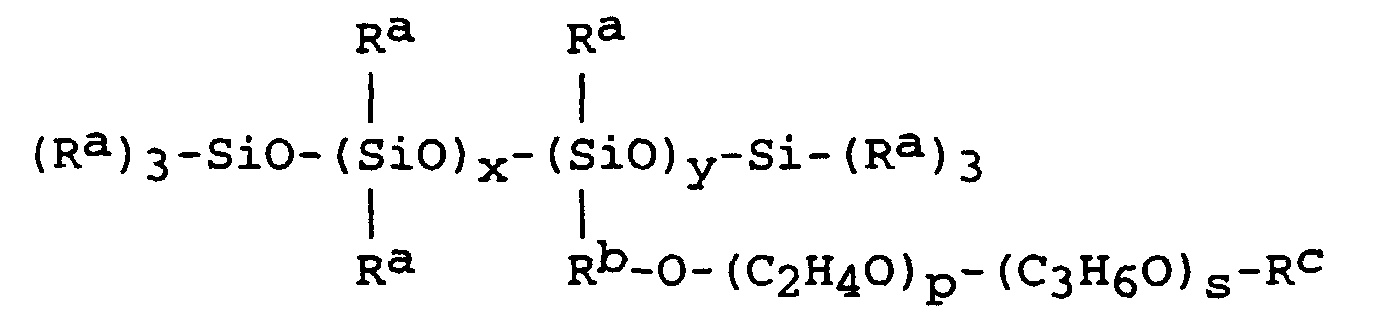
- the Comparative SPE was a species of a genus of siloxane polyethers of approximate structure: where R a is an alkyl group of one to six carbon atoms; R b is - C m H 2m -; R c is hydrogen, an alkyl group of one to six carbon atoms; m has a value of two to eight; p and s have values such that oxyalkylene segment -(C 2 H 4 O) p -(C 3 H 6 O) s - has a weight average molecular weight in the range of 300 to 5,000; the segment preferably having 50-99 mole percent oxyethylene units -(C 2 H 4 O) p - and 1-50 mole percent oxypropylene units -(C 3 H 6 O) s -; x has a value of 80-400; and y has a value of 2-10.
- R a and R c are methyl groups; m is three or four; and the values of p and s are such as to provide a weight average molecular weight of the oxyalkylene segment -(C 2 H 4 O) p -(C 3 H 6 O) s - of between 400 to 3,000. Typically, p and s each have a value of 18 to 28.
- Silicone polyethers of this type are generally known in the art, and are described in numerous patents including US Patents 4,122,029, 4,268,499, 4,311,695, 4,268,499, 5,302,382 and 5,443,760, all of which are assigned to the same assignee as the present invention.
- Silicone polyethers of this type have done well in the market place, and perform particularly well in high viscosity, high internal phase emulsions such as clear gel antiperspirants.
- Such materials are versatile, yet possess shortcomings in specific areas. For example, in low viscosity formulations that are not thickened and have a low internal phase content, emulsions containing such materials tend to cream downward, forming a silicone layer at the top, i.e., a phenomenon know as syneresis.
- Emulsion Formulation 1 As is seen in Table 3, in Emulsion Formulation 1, all of the emulsifiers performed equivalently, and their performances could be evaluated on a scale as being about fair. In Emulsion Formulation 2, the Comparative SPE fell short of perfect stability, whereas some of the 2-phenylpropyl functional silicone polyether emulsifiers of the present invention performed somewhat better, most notably SPE F.
- Emulsion Formulation 1 Emulsion Formulation 2 SPE Initial viscosity mm 2 /s Oven stable 40 °C, months 3 max Oven stable 50 °C, one month cycle Freeze thaw cycle Initial visc, mm 2 /s Oven stable 40°C., months 3 max Oven stable 50°C, 1 month cycle Freeze thaw cycle (Me2)(2-phenylpropyl methyl)(polyether methyl) Terpolymer A 161,000 > 1 P 5 5,000 f f 5 B 137,000 > 1 P 5 6,000 top 5 C 108,000 > 1 P 5 2,100 f f 5 D 135,000 > 1 P 5 2,900 top 5 E 142,000 > 1 P 5 5,000 f f 5 F 270,000 > 1 P 5 3,100 P 5 Comparative SPE 125,000 3 P 5 3,600 top top 4
- P means that the emulsion formulation passed without separation of any type. f means that it failed and indicates the formation of a water layer which is indicative of coalescence of the internal phase. top means that an oil layer was formed indicative of flocculation of the emulsion particles but without coalescence of the internal phase.
- Example 4 The amount of active emulsifier in the emulsion formulation 1 of Table 2 was varied, and the balance of the emulsion formulation was adjusted using volatile cyclomethicone fluid D 5 in order to maintain a constant phase ratio. Otherwise, the procedure carried out in Example 4 was repeated and the results are shown in Table 4.
- emulsions were prepared containing a blend of the volatile cyclomethicone D 5 fluid and the FINSOLV TN C 12 to C 15 alkyl benzoate.
- the emulsion formulations are shown in Table 5 and represent blends of the FINSOLV TN ester and D 5 fluid at ratios of 42:50 and 50:50 FINSOLV TN:D 5 fluid, respectively.
- the phase ratio and the emulsifier level were maintained constant, and the procedure for preparing these emulsion formulations was the same as the procedure used in Example 4.
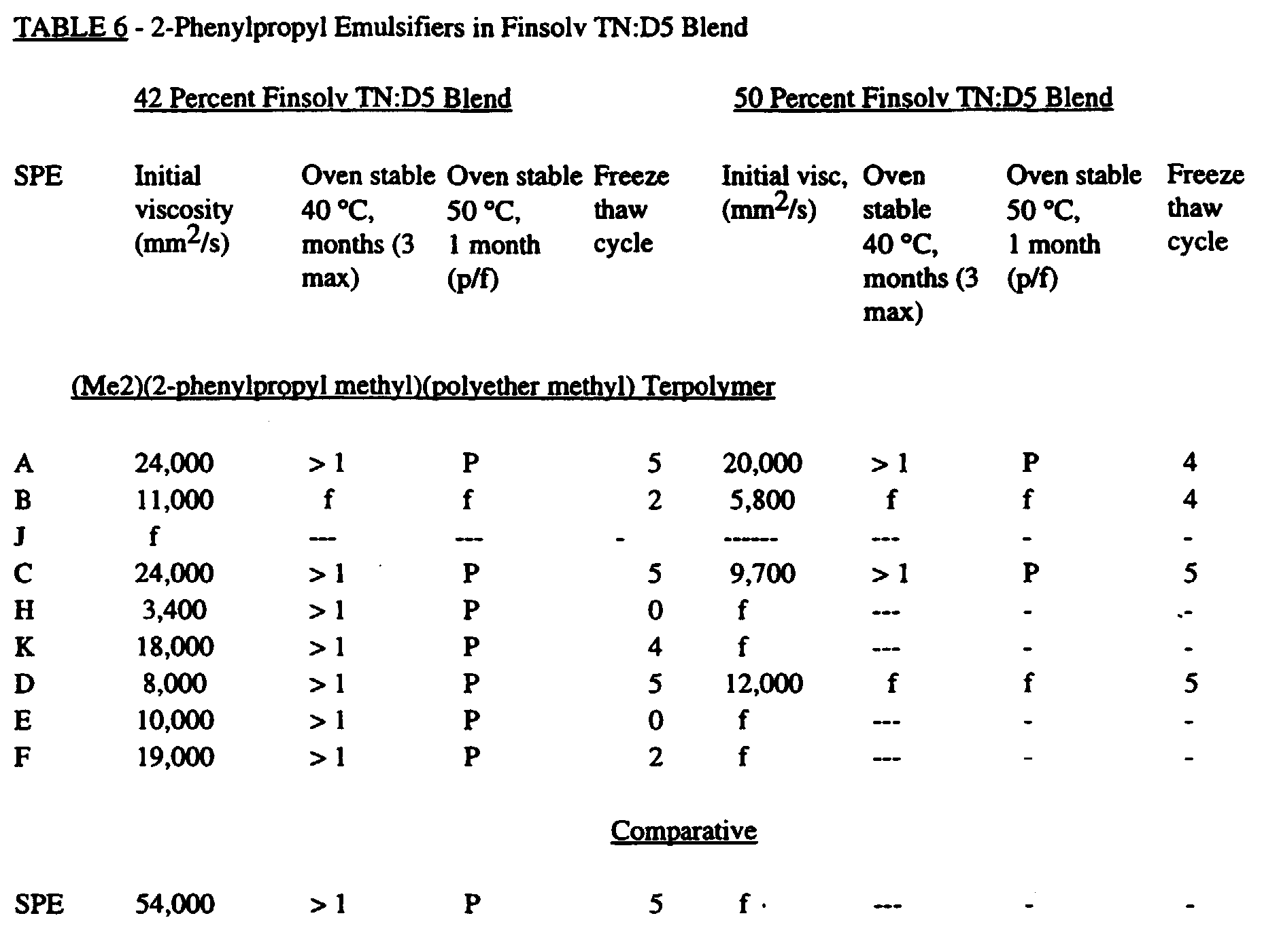
- Emulsion Formulation C according to the present invention performed perfectly at 50 percent and Emulsion Formulation A according to the present invention performed nearly perfectly, as shown in Table 6.
- P means that the emulsion formulation passed without separation of any type.
- f means that it failed and indicates the formation of a water layer which is indicative of coalescence of the internal phase.
- the silicone polyethers and the emulsions containing the silicone polyethers according to this invention are of general utility and application. However, they are particularly useful in and for preparing numerous types of over-the-counter personal care products for hair, skin and the underarm. Thus, they are especially useful and can be used in hair conditioners, hair shampoos, skin care lotions, facial cosmetics, deodorants and antiperspirants.
- personal care products such as skin creams, moisturizers, acne removers, wrinkle removers, facial cleansers, bath oils, perfumes, colognes, sachets, sunscreens, pre-shave lotions, after-shave lotions, liquid soaps, shaving soaps, shaving lathers, hair sprays, mousses, permanents, depilatories, cuticle coats, make-ups, color cosmetics, foundations, blushes, lipsticks, lip balms, eyeliners, mascaras, oil removers, cosmetic removers, delivery systems for oil and water soluble substances, and pressed powders.
- personal care products such as skin creams, moisturizers, acne removers, wrinkle removers, facial cleansers, bath oils, perfumes, colognes, sachets, sunscreens, pre-shave lotions, after-shave lotions, liquid soaps, shaving soaps, shaving lathers, hair sprays, mousses, permanents, depilatories, cuticle coats, make-
Landscapes
- Health & Medical Sciences (AREA)
- Chemical & Material Sciences (AREA)
- Chemical Kinetics & Catalysis (AREA)
- Medicinal Chemistry (AREA)
- Polymers & Plastics (AREA)
- Organic Chemistry (AREA)
- Life Sciences & Earth Sciences (AREA)
- Veterinary Medicine (AREA)
- Animal Behavior & Ethology (AREA)
- General Health & Medical Sciences (AREA)
- Public Health (AREA)
- Epidemiology (AREA)
- Birds (AREA)
- Dermatology (AREA)
- Compositions Of Macromolecular Compounds (AREA)
- Emulsifying, Dispersing, Foam-Producing Or Wetting Agents (AREA)
- Silicon Polymers (AREA)
- Cosmetics (AREA)
Abstract
Description
| Ingredients | Weight % | Gram |
| Hexamethyldisiloxane | 2.80 | 7.1 |
| Dimethylcyclosiloxane | 88.41 | 223.9 |
| Methylhydrogen cyclosiloxane | 1.66 | 4.2 |
| 2-phenylpropylmethyl cyclosiloxane | 7.01 | 17.75 |
| Trifluoromethane sulfonic acid | 0.12 | 0.3 |
| Ingredients | Weight % | Gram |
| Polyethylene oxide monoallylether, 7 mole ethylene oxide | 9.52 | 23.8 |
| Siloxane prepared above | 70.48 | 176.2 |
| 2-propanol | 20 pph | 50 |
| Potassium acetate | 250 ppm | 0.05 |
| Chloroplatinic acid | 10 ppm Pt |
| Ingredients | Weight % | Gram |
| Me3SiO-(Me2SiO)8.7-(MeHSiO)3.7-SiMe3 | 51.6 | 107 |
| α-methylstyrene, C6H5C(CH3)=CH2 | 12.08 | 25 |
| Chloroplatinic acid | 10 ppm Pt |
| Ingredients | Weight % | Gram |
| Hexamethyldisiloxane | 79.3 | 198.3 |
| Siloxane made in Step 1 | 20.7 | 51.75 |
| Trifluoromethane sulfonic acid | 0.09 | 0.3 |
| Ingredients | Weight % | Gram |
| Polyethylene oxide monoallylether, 7 moles ethylene oxide | 11.9 | 23.8 |
| Siloxane prepared above | 88.1 | 176.2 |
| 2-propanol | 25 pph | 50 |
| Potassium acetate | 250 ppm | 0.05 |
| Chloroplatinic acid | 10 ppm Pt |
| Ingredients | A | B | C | D | E | F |
| Ethylmethyl/methyl 2-phenylpropyl siloxane polymer | 132.14 | 132.33 | 171.18 | 93.43 | 44.48 | 93.43 |
| Hexamethyldisiloxane | 0.92 | 4.31 | 1.23 | 2.81 | 2.61 | 2.81 |
| Dimethylcyclosiloxane | 456.63 | 453.09 | 411.32 | 487.43 | 542.55 | 487.43 |
| Methylhydrogen cyclosiloxane | 10.31 | 10.27 | 16.27 | 16.33 | 10.36 | 16.33 |
| Total - Gram | 600.0 | 600.0 | 600.0 | 600.0 | 600.0 | 600.0 |
| Oil Compatibility of 2-Phenylpropyl Siloxane Ratio = Weight of Silicone/Weight of Oil | ||||||
| 90/10 ratio | 50/50 ratio | 10/90 ratio | ||||
| OILS | Dimethyl Siloxane | 2-Phenyl propyl Siloxane | Dimethyl Siloxane | 2-Phenyl propyl Siloxane | Dimethyl Siloxane | 2-Phenyl propyl Siloxane |
| Finsolv TN | C | C | IC | IC | IC | IC |
| Coconut Oil | cloudy | cloudy | IC | IC | cloudy | cloudy |
| Corn Oil | IC | IC | IC | IC | IC | IC |
| Ethanol | IC | IC | IC | IC | IC | IC |
| Jojoba Oil | IC | IC | IC | IC | IC | IC |
| Mineral Oil 8 mm2/s | C | C | IC | C | IC | IC |
| Sunflower Oil | IC | IC | IC | IC | IC | IC |
| Isopropyl palmitate | C | C | C | C | C | C |
| Isopropyl myristate | C | C | C | C | C | C |
| Tridecyl Neo pentanoate | C | C | C | C | C | C |
| Neopentyl Glycol Dicaprylate Dicaprate | C | C | IC | C | IC | IC |
| Emulsion Formulation 1 | Emulsion Formulation 2 | |||
| Oil phase | Weight % | Gram | Weight % | Gram |
| D5 Silicone | balance | balance | balance | balance |
| Blend | 10.0 | 24.0 | 0 | 0 |
| Active Emulsifier | 1.05 | 2.52 | 1.05 | 2.52 |
| Total | 25.0 | 60.0 | 30.0 | 72.0 |
| Water Phase | Weight % | Gram | Weight % | Gram |
| Water | 73.5 | 176.4 | 68.5 | 164.4 |
| Tween 20 | 0.5 | 1.2 | 0.5 | 1.2 |
| NaCl | 1.0 | 2.4 | 1.0 | 2.4 |
| Total | 75.0 | 180.0 | 70.0 | 168.0 |
| Emulsion Formulation 1 | Emulsion Formulation 2 | |||||||
| SPE | Initial viscosity mm2/s | Oven stable 40 °C, months 3 max | Oven stable 50 °C, one month cycle | Freeze thaw cycle | Initial visc, mm2/s | Oven stable 40°C., months 3 max | Oven stable 50°C, 1 month cycle | Freeze thaw cycle |
| (Me2)(2-phenylpropyl methyl)(polyether methyl) Terpolymer | ||||||||
| A | 161,000 | > 1 | P | 5 | 5,000 | f | f | 5 |
| B | 137,000 | > 1 | P | 5 | 6,000 | top | 5 | |
| C | 108,000 | > 1 | P | 5 | 2,100 | f | f | 5 |
| D | 135,000 | > 1 | P | 5 | 2,900 | top | 5 | |
| E | 142,000 | > 1 | P | 5 | 5,000 | f | f | 5 |
| F | 270,000 | > 1 | P | 5 | 3,100 | P | 5 | |
| Comparative | ||||||||
| SPE | 125,000 | 3 | P | 5 | 3,600 | top | top | 4 |
| Emulsifiers at Lower Active Levels in Formulation 1 | ||||
| Composition | A | D | E | Compar.SPE |
| 1.58 Percent Active | ||||
| Initial viscosity, mm2/s | 102,000 | 124,000 | 119,000 | 202,000 |
| Oven stability, 40 °C months (3 max) | > 1 | > 1 | > 1 | > 1 |
| Oven stability, 50 °C 1 month, P/F | P | P | P | P |
| Freeze/thaw cycle | 5 | 5 | 5 | 5 |
| 1.05 Percent Active | ||||
| Initial viscosity, mm2/s | 161,000 | 135,000 | 142,000 | 138,000 |
| Oven stability, 40 °C months (3 max) | > 1 | > 1 | > 1 | 3 |
| Oven stability, 50 °C 1 month, P/F | P | P | P | P |
| Freeze/thaw | 5 | 5 | 5 | 5 |
| 0.8 Percent Active | ||||
| Initial viscosity, mm2/s | 71,000 | 122,000 | 113,000 | 127,000 |
| Oven stability, 40 °C months (3 max) | > 1 | > 1 | > 1 | > 1 |
| Oven stability, 50 °C 1 month, P/F | P | P | P | P |
| Freeze/thaw cycle | 4 | 5 | 5 | 5 |
| 0.55 Percent Active | ||||
| Initial viscosity, mm2/s | 56,000 | 116,000 | 90,000 | 90,000 |
| Oven stability, 40 °C months (3 max) | > 1 | > 1 | > 1 | > 1 |
| Oven stability, 50 °C 1 month, P/F | P | P | P | P |
| Freeze/thaw cycle | 2 | 5 | 5 | 2 |
| 0.3 Percent Active | ||||
| Initial viscosity, mm2/s | fail | 75,000 | 58,000 | 74,000 |
| Oven stability, 40 °C months (3 max) | --- | > 1 | > 1 | > 1 |
| Oven stability, 50 °C 1 month, P/F | --- | P | P | P |
| Freeze/thaw cycle | --- | 5 | 3 | 2 |
| Formulations Containing FINSOLV TN:D5 Blends | ||||
| Emulsion 3 | Emulsion 4 | |||
| Oil phase | Weight % | Gram | Weight % | Gram |
| D5 | 13.2 | 40.02 | 11.4 | 34.50 |
| FINSOLV TN | 9.6 | 28.98 | 11.4 | 34.50 |
| Active Emulsifier | 1.0 | 3.00 | 1.0 | 3.00 |
| Total | 23.8 | 72.00 | 23.8 | 72.00 |
| Water Phase | Weight % | Gram | Weight % | Gram |
| Water | 74.2 | 225.00 | 74.2 | 225.00 |
| Tween 20 | 1.0 | 3.00 | 1.0 | 3.00 |
| NaCl | 1.0 | 3.00 | 1.0 | 3.00 |
| Total | 76.2 | 231.00 | 76.2 | 231.00 |
Claims (10)
- A silicone polyether having the formula:each R is independently an alkyl group containing 1 to 6 carbon atoms;Q represents a polyoxyalkylene block containing a linking group and a terminating group, the polyoxyalkylene block having the formula: -Rb-O-(C2H4O)p-(C3H6O)s-Rc, in which the linking group Rb is -CmH2m-, the terminating group Rc is hydrogen or an alkyl group of one to six carbon atoms, m in the linking group has a value of two to eight, p and s in the oxyalkylene segment of the block each has a value such that the oxyalkylene segment -(C2H4O)p-(C3H6O)s- of the polyoxyalkylene block has a weight average molecular weight in the range of 300 to 5,000;Q' represents an arylalkyl radical selected from phenylmethyl, 1-phenylethyl, 2-phenylethyl, 2-phenylpropyl, 1-phenylbutyl, 4-phenylbutyl and 2-phenylheptyl;x has a value of 0-500;y has a value of 1-50; andz has a value of 1-50.
- A silicone polyether according to claim 1 in which Q' is 2-phenylpropyl.
- A silicone polyether according to claim 1 or 2, wherein R represents a methyl group.
- A silicone polyether according to any of claims 1 to 3, wherein the oxyalkylene segment has 50-99 mole percent of oxyethylene units -(C2H4O)p- and 1-50 mole percent of oxypropylene units -(C3H6O)s-.
- A silicone polyether according to any of claims 1 to 4, wherein the molecular weight of the oxyalkylene segment is from 400 to 3,000.
- A silicone polyether according to any of claims 1 to 5, wherein p and s each have values of 1 to 28.
- A silicone polyether according to any of claims 1 to 6, wherein:x has a value of 1 to 400;y has a value of 1-25; andz has a value of 1-25.
- A silicone polyether according to claim 7, wherein:x has a value of 50 to 200;y has a value of 1 to 10; andz has a value of 1 to 10.
- An emulsion containing a silicone polyether according to any of claims 1 to 8.
- An emulsion according to claim 9, further containing an ester as a component in which the ester component is a liquid C12 to C15 alkyl benzoate.
Applications Claiming Priority (2)
| Application Number | Priority Date | Filing Date | Title |
|---|---|---|---|
| US253926 | 1999-02-22 | ||
| US09/253,926 US6133370A (en) | 1999-02-22 | 1999-02-22 | Silicone polyethers with arylalkyl groups |
Publications (3)
| Publication Number | Publication Date |
|---|---|
| EP1035154A2 true EP1035154A2 (en) | 2000-09-13 |
| EP1035154A3 EP1035154A3 (en) | 2001-07-04 |
| EP1035154B1 EP1035154B1 (en) | 2004-04-28 |
Family
ID=22962246
Family Applications (1)
| Application Number | Title | Priority Date | Filing Date |
|---|---|---|---|
| EP00301328A Expired - Lifetime EP1035154B1 (en) | 1999-02-22 | 2000-02-21 | Use of silicone polyethers with arylalkyl groups in personal care products |
Country Status (4)
| Country | Link |
|---|---|
| US (1) | US6133370A (en) |
| EP (1) | EP1035154B1 (en) |
| JP (1) | JP4652513B2 (en) |
| DE (1) | DE60010165T2 (en) |
Cited By (3)
| Publication number | Priority date | Publication date | Assignee | Title |
|---|---|---|---|---|
| WO2007127004A1 (en) * | 2006-03-31 | 2007-11-08 | Dow Corning Corporation | Process for preparing silicone polyethers |
| US8030363B2 (en) | 2008-01-25 | 2011-10-04 | Momentive Performance Materials Inc. | Polyorganosiloxane demulsifier compositions and methods of making the same |
| WO2015104176A1 (en) * | 2014-01-10 | 2015-07-16 | Wacker Chemie Ag | Surfactant-free organopolysiloxane invert emulsions |
Families Citing this family (14)
| Publication number | Priority date | Publication date | Assignee | Title |
|---|---|---|---|---|
| JP3724988B2 (en) * | 1999-07-30 | 2005-12-07 | 信越化学工業株式会社 | Novel silicone compound and cosmetic comprising the same |
| US6211323B1 (en) * | 1999-10-21 | 2001-04-03 | Dow Corning Corporation | High molecular weight alkylmethyl-alkylaryl siloxane terpolymers having low SiH content and methods for their preparation |
| US6616934B1 (en) * | 2000-05-22 | 2003-09-09 | Dow Corning Corporation | Clear silicone microemulsions |
| DE10301355A1 (en) * | 2003-01-16 | 2004-07-29 | Goldschmidt Ag | Equilibration of siloxanes |
| JP4098116B2 (en) * | 2003-02-26 | 2008-06-11 | モメンティブ・パフォーマンス・マテリアルズ・ジャパン合同会社 | Polyether-modified polyorganosiloxane, method for producing the same, and skin cosmetic |
| ATE454435T1 (en) * | 2003-10-06 | 2010-01-15 | Kaneka Corp | ADHESIVE |
| US7731881B2 (en) | 2003-12-30 | 2010-06-08 | Sabic Innovative Plastics Ip B.V. | Method for making fog resistant thermoplastic articles and articles made therefrom |
| US7220792B2 (en) * | 2003-12-30 | 2007-05-22 | General Electric Company | Water resistant permanent antistatic thermoplastic composition |
| WO2007084266A2 (en) * | 2006-01-19 | 2007-07-26 | Dow Corning Corporation | Silicone adhesive for adhesion to wet surfaces |
| CN101434743B (en) * | 2007-11-14 | 2013-08-14 | 帝人化成株式会社 | Flame retardant polycarbonate resin composition with excellent antistatic property |
| US8524262B2 (en) * | 2011-02-23 | 2013-09-03 | Wacker Chemical Corporation | Amphiphilic high refractive index organopolysiloxanes |
| US9051434B2 (en) | 2013-01-31 | 2015-06-09 | Wacker Chemical Corporation | Amphiphilic organopolysiloxane dendrimers with high refractive index |
| EP3280388A1 (en) | 2015-04-08 | 2018-02-14 | Dow Corning Corporation | Fluid compositions and personal care |
| US20200157279A1 (en) | 2017-06-26 | 2020-05-21 | Dow Silicones Corporation | Silicone-polyether copolymer composition, method of preparing same, and sealant |
Family Cites Families (13)
| Publication number | Priority date | Publication date | Assignee | Title |
|---|---|---|---|---|
| US3657305A (en) * | 1969-12-24 | 1972-04-18 | Edward L Morehouse | Siloxane-polyoxyalkylene block copolymers containing aralkyl groups |
| GB9010525D0 (en) * | 1990-05-10 | 1990-07-04 | Unilever Plc | Cosmetic composition |
| JPH05140320A (en) * | 1991-11-21 | 1993-06-08 | Shin Etsu Chem Co Ltd | Silicone polymer and pasty silicone composition |
| JPH05279439A (en) * | 1992-02-03 | 1993-10-26 | Hitachi Chem Co Ltd | Production of graft copolymer, slightly water-soluble resin composition and paint produced by using the composition |
| US5227200A (en) * | 1992-03-09 | 1993-07-13 | Dow Corning Corporation | Silicone containing automotive vinyl and rubber protectant |
| US5384383A (en) * | 1994-01-31 | 1995-01-24 | Dow Corning Corporation | Pristine phenylpropylalkylsiloxanes |
| US5389365A (en) * | 1994-02-07 | 1995-02-14 | Dow Corning Corporation | Silicone terpolymer containing water-in-oil emulsion derived from unsaturated ethylene oxides |
| US5578692A (en) * | 1995-09-18 | 1996-11-26 | Dow Corning Corporation | Methods of making polysiloxanes |
| US5635165A (en) * | 1995-09-27 | 1997-06-03 | Helene Curtis, Inc. | Antiperspirant deodorant compositions |
| US5620485A (en) * | 1995-12-15 | 1997-04-15 | Dow Corning Corporation | Silicone foam control agents for hydrocarbon liquids |
| JPH09263524A (en) * | 1996-03-29 | 1997-10-07 | Shiseido Co Ltd | Sunscreen cosmetic |
| JPH11158034A (en) * | 1997-11-26 | 1999-06-15 | Kao Corp | Microfiber-containing spray composition |
| JPH11199672A (en) * | 1998-01-14 | 1999-07-27 | Kanegafuchi Chem Ind Co Ltd | Method for producing polyorganosiloxane |
-
1999
- 1999-02-22 US US09/253,926 patent/US6133370A/en not_active Expired - Lifetime
-
2000
- 2000-02-21 EP EP00301328A patent/EP1035154B1/en not_active Expired - Lifetime
- 2000-02-21 DE DE60010165T patent/DE60010165T2/en not_active Expired - Lifetime
- 2000-02-22 JP JP2000044818A patent/JP4652513B2/en not_active Expired - Fee Related
Cited By (9)
| Publication number | Priority date | Publication date | Assignee | Title |
|---|---|---|---|---|
| WO2007127004A1 (en) * | 2006-03-31 | 2007-11-08 | Dow Corning Corporation | Process for preparing silicone polyethers |
| US8008407B2 (en) | 2006-03-31 | 2011-08-30 | Dow Corning Corporation | Process for preparing silicone polyethers |
| US8030363B2 (en) | 2008-01-25 | 2011-10-04 | Momentive Performance Materials Inc. | Polyorganosiloxane demulsifier compositions and methods of making the same |
| US8507565B2 (en) | 2008-01-25 | 2013-08-13 | Momentive Performance Material Inc. | Polyorganosiloxane demulsifier compositions and methods of making same |
| CN105131615A (en) * | 2008-01-25 | 2015-12-09 | 莫门蒂夫性能材料股份有限公司 | Polyorganosiloxane demulsifier compositions and methods of making the same |
| CN105131615B (en) * | 2008-01-25 | 2019-10-25 | 莫门蒂夫性能材料股份有限公司 | Polyorganosiloxane breaker composition and preparation method thereof |
| WO2015104176A1 (en) * | 2014-01-10 | 2015-07-16 | Wacker Chemie Ag | Surfactant-free organopolysiloxane invert emulsions |
| CN105899618A (en) * | 2014-01-10 | 2016-08-24 | 瓦克化学股份公司 | Surfactant-free organopolysiloxane invert emulsions |
| US9452127B2 (en) | 2014-01-10 | 2016-09-27 | Wacker Chemical Corporation | Surfactant-free organopolysiloxane invert emulsions |
Also Published As
| Publication number | Publication date |
|---|---|
| DE60010165D1 (en) | 2004-06-03 |
| EP1035154A3 (en) | 2001-07-04 |
| DE60010165T2 (en) | 2005-01-20 |
| US6133370A (en) | 2000-10-17 |
| EP1035154B1 (en) | 2004-04-28 |
| JP2000239389A (en) | 2000-09-05 |
| JP4652513B2 (en) | 2011-03-16 |
Similar Documents
| Publication | Publication Date | Title |
|---|---|---|
| US6060546A (en) | Non-aqueous silicone emulsions | |
| EP1035154B1 (en) | Use of silicone polyethers with arylalkyl groups in personal care products | |
| US5654362A (en) | Silicone oils and solvents thickened by silicone elastomers | |
| EP1020175B1 (en) | Water-in-oil-in-water emulsion | |
| EP1551923B1 (en) | Silicone elastomers compositions | |
| US6998424B2 (en) | Clear silicone microemulsions formed spontaneously | |
| US6168782B1 (en) | Elastomeric silicone containing an active ingredient | |
| EP0940423B1 (en) | Emulsions of silicones with non-aqueous hydroxylic solvents | |
| JP4805441B2 (en) | Elastomer silicone terpolymer composition | |
| US6221979B1 (en) | Mixtures of silicone elastomers | |
| EP1020494A1 (en) | Entrapment of vitamines with an elastomeric silicone polyether | |
| KR20140106745A (en) | Co-modified organopolysiloxane, emulsifier for water-in-oil emulsion, external use preparation, and cosmetic composition using the same | |
| WO2012165237A1 (en) | Organopolysiloxane elastomer modified with mono-/diglycerin derivative, and use therefor | |
| EP1069150A2 (en) | Oil-in-oil and three-phase emulsions | |
| WO2013103147A1 (en) | Diglycerin derivate-modified silicone, emulsifier for water-in-oil emulsion using the same, external use preparation, and cosmetic composition | |
| US8524262B2 (en) | Amphiphilic high refractive index organopolysiloxanes | |
| EP1230292A1 (en) | Polar solvent compatible polyethersiloxane elastomers | |
| WO2005103117A1 (en) | Silicone polyether block copolymers | |
| WO2005103118A1 (en) | Aqueous dispersions of silicone polyether block copolymers | |
| US6372830B1 (en) | Water-in-oil type silicone emulsion compositions | |
| EP1114635B1 (en) | Water-in-oil type silicone emulsion compositions | |
| JPH05105614A (en) | Water-in-oil type emulsion cosmetic |
Legal Events
| Date | Code | Title | Description |
|---|---|---|---|
| PUAI | Public reference made under article 153(3) epc to a published international application that has entered the european phase |
Free format text: ORIGINAL CODE: 0009012 |
|
| AK | Designated contracting states |
Kind code of ref document: A2 Designated state(s): DE FR GB |
|
| AX | Request for extension of the european patent |
Free format text: AL;LT;LV;MK;RO;SI |
|
| PUAL | Search report despatched |
Free format text: ORIGINAL CODE: 0009013 |
|
| AK | Designated contracting states |
Kind code of ref document: A3 Designated state(s): AT BE CH CY DE DK ES FI FR GB GR IE IT LI LU MC NL PT SE |
|
| AX | Request for extension of the european patent |
Free format text: AL;LT;LV;MK;RO;SI |
|
| 17P | Request for examination filed |
Effective date: 20011121 |
|
| AKX | Designation fees paid |
Free format text: DE FR GB |
|
| 17Q | First examination report despatched |
Effective date: 20030314 |
|
| RTI1 | Title (correction) |
Free format text: USE OF SILICONE POLYETHERS WITH ARYLALKYL GROUPS IN PERSONAL CARE PRODUCTS |
|
| GRAP | Despatch of communication of intention to grant a patent |
Free format text: ORIGINAL CODE: EPIDOSNIGR1 |
|
| RTI1 | Title (correction) |
Free format text: USE OF SILICONE POLYETHERS WITH ARYLALKYL GROUPS IN PERSONAL CARE PRODUCTS |
|
| GRAS | Grant fee paid |
Free format text: ORIGINAL CODE: EPIDOSNIGR3 |
|
| GRAA | (expected) grant |
Free format text: ORIGINAL CODE: 0009210 |
|
| AK | Designated contracting states |
Kind code of ref document: B1 Designated state(s): DE FR GB |
|
| REG | Reference to a national code |
Ref country code: GB Ref legal event code: FG4D |
|
| REF | Corresponds to: |
Ref document number: 60010165 Country of ref document: DE Date of ref document: 20040603 Kind code of ref document: P |
|
| ET | Fr: translation filed | ||
| PLBE | No opposition filed within time limit |
Free format text: ORIGINAL CODE: 0009261 |
|
| STAA | Information on the status of an ep patent application or granted ep patent |
Free format text: STATUS: NO OPPOSITION FILED WITHIN TIME LIMIT |
|
| 26N | No opposition filed |
Effective date: 20050131 |
|
| REG | Reference to a national code |
Ref country code: DE Ref legal event code: R082 Ref document number: 60010165 Country of ref document: DE Representative=s name: FLEISCHER, ENGELS & PARTNER MBB, PATENTANWAELT, DE |
|
| PGFP | Annual fee paid to national office [announced via postgrant information from national office to epo] |
Ref country code: FR Payment date: 20140211 Year of fee payment: 15 |
|
| PGFP | Annual fee paid to national office [announced via postgrant information from national office to epo] |
Ref country code: DE Payment date: 20150218 Year of fee payment: 16 |
|
| PGFP | Annual fee paid to national office [announced via postgrant information from national office to epo] |
Ref country code: GB Payment date: 20150218 Year of fee payment: 16 |
|
| REG | Reference to a national code |
Ref country code: FR Ref legal event code: ST Effective date: 20151030 |
|
| PG25 | Lapsed in a contracting state [announced via postgrant information from national office to epo] |
Ref country code: FR Free format text: LAPSE BECAUSE OF NON-PAYMENT OF DUE FEES Effective date: 20150302 |
|
| REG | Reference to a national code |
Ref country code: DE Ref legal event code: R119 Ref document number: 60010165 Country of ref document: DE |
|
| GBPC | Gb: european patent ceased through non-payment of renewal fee |
Effective date: 20160221 |
|
| PG25 | Lapsed in a contracting state [announced via postgrant information from national office to epo] |
Ref country code: DE Free format text: LAPSE BECAUSE OF NON-PAYMENT OF DUE FEES Effective date: 20160901 Ref country code: GB Free format text: LAPSE BECAUSE OF NON-PAYMENT OF DUE FEES Effective date: 20160221 |