EP1035114A2 - Nitrogen-heterocyclic compounds and process for production thereof - Google Patents

Nitrogen-heterocyclic compounds and process for production thereof Download PDF

Info

Publication number
EP1035114A2
EP1035114A2 EP00104970A EP00104970A EP1035114A2 EP 1035114 A2 EP1035114 A2 EP 1035114A2 EP 00104970 A EP00104970 A EP 00104970A EP 00104970 A EP00104970 A EP 00104970A EP 1035114 A2 EP1035114 A2 EP 1035114A2
Authority
EP
European Patent Office
Prior art keywords
group
general formula
nitrogen
indole
heterocyclic compound
Prior art date
Legal status (The legal status is an assumption and is not a legal conclusion. Google has not performed a legal analysis and makes no representation as to the accuracy of the status listed.)
Granted
Application number
EP00104970A
Other languages
German (de)
French (fr)
Other versions
EP1035114A3 (en
EP1035114B1 (en
Inventor
Makoto Watanabe
Toshihide Yamamoto
Masakazu Nishiyama
Current Assignee (The listed assignees may be inaccurate. Google has not performed a legal analysis and makes no representation or warranty as to the accuracy of the list.)
Tosoh Corp
Original Assignee
Tosoh Corp
Priority date (The priority date is an assumption and is not a legal conclusion. Google has not performed a legal analysis and makes no representation as to the accuracy of the date listed.)
Filing date
Publication date
Application filed by Tosoh Corp filed Critical Tosoh Corp
Publication of EP1035114A2 publication Critical patent/EP1035114A2/en
Publication of EP1035114A3 publication Critical patent/EP1035114A3/en
Application granted granted Critical
Publication of EP1035114B1 publication Critical patent/EP1035114B1/en
Anticipated expiration legal-status Critical
Expired - Lifetime legal-status Critical Current

Links

Classifications

    • CCHEMISTRY; METALLURGY
    • C07ORGANIC CHEMISTRY
    • C07DHETEROCYCLIC COMPOUNDS
    • C07D491/00Heterocyclic compounds containing in the condensed ring system both one or more rings having oxygen atoms as the only ring hetero atoms and one or more rings having nitrogen atoms as the only ring hetero atoms, not provided for by groups C07D451/00 - C07D459/00, C07D463/00, C07D477/00 or C07D489/00
    • C07D491/02Heterocyclic compounds containing in the condensed ring system both one or more rings having oxygen atoms as the only ring hetero atoms and one or more rings having nitrogen atoms as the only ring hetero atoms, not provided for by groups C07D451/00 - C07D459/00, C07D463/00, C07D477/00 or C07D489/00 in which the condensed system contains two hetero rings
    • C07D491/04Ortho-condensed systems
    • CCHEMISTRY; METALLURGY
    • C07ORGANIC CHEMISTRY
    • C07DHETEROCYCLIC COMPOUNDS
    • C07D209/00Heterocyclic compounds containing five-membered rings, condensed with other rings, with one nitrogen atom as the only ring hetero atom
    • C07D209/02Heterocyclic compounds containing five-membered rings, condensed with other rings, with one nitrogen atom as the only ring hetero atom condensed with one carbocyclic ring
    • C07D209/04Indoles; Hydrogenated indoles
    • C07D209/08Indoles; Hydrogenated indoles with only hydrogen atoms or radicals containing only hydrogen and carbon atoms, directly attached to carbon atoms of the hetero ring
    • CCHEMISTRY; METALLURGY
    • C07ORGANIC CHEMISTRY
    • C07DHETEROCYCLIC COMPOUNDS
    • C07D403/00Heterocyclic compounds containing two or more hetero rings, having nitrogen atoms as the only ring hetero atoms, not provided for by group C07D401/00
    • C07D403/02Heterocyclic compounds containing two or more hetero rings, having nitrogen atoms as the only ring hetero atoms, not provided for by group C07D401/00 containing two hetero rings
    • C07D403/04Heterocyclic compounds containing two or more hetero rings, having nitrogen atoms as the only ring hetero atoms, not provided for by group C07D401/00 containing two hetero rings directly linked by a ring-member-to-ring-member bond

Definitions

  • the present invention relates to nitrogen-heterocyclic compounds (nitrogen-containing heterocyclic compounds), and a process for producing the compound. More specifically, the present invention relates to nitrogen-heterocyclic compounds substituted at 1-position by an amino group, including 1-aminoindole derivatives and 1-amino-4H quinoline derivatives, and intermediates therefor.
  • the present invention relates also to a process for producing a nitrogen-heterocyclic compound including indole derivatives and 4H-quinoline derivatives, the process comprising cyclizing intramolecularly a hydrazone derivative having a halogenated aryl group in the presence of a catalyst composed of a phosphine and a palladium compound.
  • the present invention relates further to a process for producing a substituted indole derivative, comprising cyclizing intramolecularly a hydrazone derivative having a halogenated aryl group in the presence of a catalyst composed of a phosphine and a palladium compound, an amine, and a base, and introducing simultaneously an amino group to the non-nitrogen aromatic ring (aromatic ring not containing nitrogen).
  • nitrogen-heterocyclic compounds are useful as a source material for medicines and pesticides, and for electronic materials.
  • Nitrogen-heterocyclic compounds substituted at 1-position by an amino group are disclosed: 1-(pyridylamino)indoles are disclosed as an anancastic disease remedy in JP-A-7-53376 (the term "JP-A" herein means an "unexamined published Japanese patent application"), and 1-(phenylamino)indoles are disclosed in JP-A-60-142955.
  • arylpiperazine structure is important in remedy for brain malfunction such as an antidepressant.
  • arylpiperazines are useful for remedy for brain malfunction such as an antidepressant, and importance of this structure for pharmacological activity are described by R.A. Glennon et al.: Drug Development Research, 22 (1993), pp.25-36; R.M.Pindler et al.: Medicinal Research Reviews, 13 (1993), pp.259-325, and R.A. Glennon et al.: Journal of Medicinal Chemistry, 32 (1989), pp.1921-1926.
  • Diarylamines are described to be useful as the intermediates for medicines and pesticides and for electronic intermediate material in Yuki Gosei Kyokai-Shi (Journal of the Organic Synthesis Society, Japan), Vol.52 (1994) pp.1083-1088.
  • Triarylamines having high electron carrying ability are described to be useful as a hole carrier in organic electroluminescence by Seizo MIYATA ("Organic EL Elements and Industrial Front Thereof", pp.22-27, pp.104-106, NTS Co.).
  • diarylamine or triarylamine structure having a longer conjugation system is superior to the monoarylamine structure in the properties and functions in the aforementioned application fields.
  • the structure of diarylamine, triarylamine, or N-arylazole is essential to the electronic materials such as the hole carrier in organic electroluminescence.
  • the kinds of the substituents on the non-nitrogen aromatic ring are limited, and the position of the substitution is limited to 3- and 5-positions of the indole.
  • the nitrogen-heterocyclic compound is not known which has an amino group at 1-position and has a non-nitrogen aromatic ring substituted by a 1-piperazinyl, arylamino, diarylamino, or azolyl group (the azolyl group including cyclic amino groups such as pyrrolyl and indolyl).
  • the source materials cannot readily be available, and in synthesis of substituted indole, the position of the substituent on the indole ring is limited mainly to 5-, 6-, or 7-position.
  • an indole derivative having a substituent at 4-position only cannot readily be synthesized by the conventional process.
  • the present invention has been made to solve the above problems of the prior art.
  • the present invention intend to provide a heterocyclic compound having, on the non-nitrogen aromatic ring, a substituent such as 1-piperazinyl, arylamino-, diarylamino, azolyl, alkoxy, and nitro.
  • the present invention intends also to provide a nitrogen-heterocyclic compound having a halogen atom on the aromatic ring useful as the source material of the above substituted nitrogen-heterocyclic compound.
  • the present invention intends further to provide a process for synthesizing, in a simple manner, the nitrogen-heterocyclic compound such as indole derivatives and 4H-quinoline derivatives useful as a source material for medicines, pesticides, and electronic materials from readily available source materials.
  • R 1 and R 2 are independently hydrogen, an alkyl group, an aryl group, or a heteroaryl group
  • R 3 is hydrogen or an aryl group
  • R 4 is a substituted amino group, an alkoxy group, a nitro group, or halogen
  • m is an integer from 0 to 2
  • n is 0 or 1.
  • R 1 and R 2 are independently hydrogen, an alkyl group, a phenyl group, a substituted phenyl group, a furyl group, or a thienyl group
  • R 3 is hydrogen or an aryl group
  • R 4 is a substituted amino group
  • m is 1 or 2
  • n is 0 or 1.
  • R 1 and R 2 are independently hydrogen, an alkyl group, an aryl group, or a heteroaryl group
  • R 3 is hydrogen or an aryl group
  • R 5 and R 6 are independently hydrogen, an alkyl group, or an aryl group, and R 5 and R 6 may be linked suitably to form a hetero-ring.
  • the compound represented by General Formula (1) is produced by intramolecular cyclization of a hydrazone compound represented by General Formula (4) below having a halogenated aryl group in the presence of a catalyst containing a phosphine and a palladium compound, and a base: where R 1 and R 2 are independently hydrogen, an alkyl group, an aryl group, or a heteroaryl group; R 3 is hydrogen or an aryl group; R 4 is a substituted amino group, an alkoxy group, a nitro group, or halogen; X is a halogen; m is an integer from 0 to 2; and n is 0 or 1.
  • the alkyl group includes methyl, ethyl, propyl, butyl, and other lower alkyl groups;
  • the aryl group includes phenyl, 4-tolyl, 4-trifluoromethylphenyl, and 4-methoxyphenyl;
  • the heteroazyl group includes 4-pyridyl, 3-pyridyl, 2-pyridyl, 2-furyl, and 2-thienyl.
  • the aryl group includes phenyl, 4-tolyl, 4-trifluoromethylphenyl, 4-methoxyphenyl, and 4-biphenyl.
  • the substituted amino group includes 1-piperazinyl, 4-methyl-1-piperazinyl, 3-methyl-1-piperazinyl, 1-homopiperazinyl, N-phenyl-N-methylamino, diphenylamino, di(p-tolyl)amino, N-(1-naphthyl)-N-phenylamino, N-(2-naphthyl)-N-phenylamino, N-(2-fluorenyl)-N-phenylamino, 1-pyrrolyl, 1-indolyl, and 9-carbazolyl;
  • the alkoxy group includes methoxy, ethoxy, butoxy, 4,5-methylenedioxy, and 5,6-methylenedioxy;
  • the halogen includes fluorine, chlorine, bromine, and iodine.
  • the halogen X includes chlorine, bromine, and iodine.
  • the hydrazone compound represented by General Formula (4) in which n is 0 can be synthesized, for example, through the steps shown by formulas below:
  • a benzyl halide (A) having a halogen X at 2-position and a substituent R 4 is brought into contact with magnesium in ether to form a corresponding benzyl Grignard reagent.
  • This benzyl Grignard reagent is allowed to react with N,N-dimethyl carboxylic acid amide (R 3 CONMe 2 ).
  • the product (B), a benzyl ketone or a benzyl aldehyde (R 3 H), is allowed to react with a hydrazine (R 1 R 2 NNH 2 ) in toluene to obtain a hydrazone derivative (1) (General Formula (4) in which n is 0) which is the source substance of the process of this embodiment.
  • a hydrazone derivative (1) (General Formula (4) in which n is 0) which is the source substance of the process of this embodiment.
  • Various halogen-substituted benzyl halides (A) such as 2-chlorobenzyl chloride, 2,6-dichlorobenzyl chloride, 2,4-dichlorobenzyl chloride, and 2,5-dichlorobenzyl chloride are commercially readily available.
  • 2-Chlorotoluene, methoxy-2-bromotoluene, dichlorotoluenes, and nitro-2-chlorotoluene are also readily available, and the methyl group thereof can be chlorinated or brominated by a conventional method to obtain the halogen-substituted benzyl halide.
  • the source substance hydrazone for this embodiment can be synthesized from a readily available compound.
  • the yield of the hydrazone derivative ranges from 50% to 60% based on the halogenated benzyl halide (A).
  • the hydrazone compound represented by General Formula (4) in which n is 1 can be synthesized, for example, through the steps shown by formulas below:
  • a lithium enamide prepared from lithium diisopropylamide (LDA) and an N-cyclohexylimine (A) of acetaldehyde or an arylmethyl ketone, and a benzyl halide (B) having X at 2-position and a substituent R 4 on the benzene ring are allowed to react in THF to obtain a carbonyl compound (C) having the corresponding substituents.
  • the N-cyclohexylimine (A) and the corresponding lithium enamide can be prepared according to the known method (described in Organic Syntheses, Collective Volume VI, 1988, pp.901-904).
  • the resulting compound (C) is allowed to react with a hydrazine (R 1 R 2 NNH 2 ) in toluene to synthesize the hydrazone derivative (1) (General Formula (4) in which n is 1) which is a source substance of the process of this embodiment.
  • the yield of the hydrazone derivative is in the range from 50% to 70% based on the halogen-substituted benzyl halide (B).
  • a catalyst comprising a palladium compound and a phosphine is added to the reaction system.
  • the catalyst components may be separately added to the reaction system, or may be added thereto as a preliminarily formed complex.
  • the palladium compound used in this embodiment is not specially limited, and includes divalent palladium compounds such as palladium(II) chloride, palladium(II) bromide, palladium(II) acetate, palladium(II) acetylacetonate, dichlorobis(benzonitrile)palladium(II), dichlorobis(acetonitrile)palladium(II), dichlorobis(triphenylphosphine)palladium(II), dichlorotetraammine palladium(II), dichloro(cycloocta-1,5-diene)palladium(II), and palladium(II) trifluoroacetate; and zero-valent palladium compounds such as tris(dibenzylideneacetone) dipalladium(0), tris(dibenzylideneacetone) dipalladium(0) chloroform complex, and tetrakis(triphenylphosphine)palladium
  • palladium acetate particularly preferred are palladium acetate, and tris(dibenzylideneacetone)dipalladium(0).
  • the amount of the palladium compound used for the reaction is not specially limited, but ranges preferably from 0.001 to 10 mole%, more preferably from 0.005 to 7 mole%, still more preferably from 0.005 to 5 mole% in terms of palladium based on the compound represented by General Formula (4).
  • the phosphine used in this embodiment includes specifically phosphines having a t-butyl/phosphorus linkage such as tri-t-butylphosphine, 1-(N,N-dimethylaminomethyl)-2-(di-t-butylphosphino)-ferrocene, 1-(methoxymethyl)-2-(di-t-butylphosphino)ferrocene, 1,1'-bis(di-t-butylphosphino)ferrocene, 2,2'-bis(di-t-butylphosphino)-1,1'-binaphthyl, 2-methoxy-2'-(di-t-butylphosphino)-1,1'-binaphthyl, 2-(di-t-butylphosphino)biphenyl, 2-(di-t-butylphosphino)-2'-dimethylaminobiphenyl, 2-(di-
  • the phosphines having a t-butyl/phosphorus linkage which is capable of improving remarkably the activity and selectivity of the reaction.
  • the amount of the phosphine to be added to the reaction system is not specially limited, but ranges preferably from 0.5 to 10 moles, more preferably from 0.8 to 5 moles, per mole of the palladium compound.
  • the base used in this embodiment is not limited, and may be selected from organic bases and inorganic bases.
  • the preferred base includes specifically sodium hydride, potassium hydride, lithium hydride, sodium amide, potassium amide, lithium amide, potassium carbonate, sodium carbonate, lithium carbonate, rubidium carbonate, cesium carbonate, potassium hydrogencarbonate, sodium hydrogencarbonate, sodium metal, potassium metal, lithium metal, methoxysodium, methoxypotassium, ethoxysodium, ethoxypotassium, ethoxylithium, t-butoxylithium, t-butoxysodium, and t-butoxypotassium.
  • the amount of the base to be added to the reaction system is preferably in the range from 0.7 to 3.2 moles, more preferably from 0.9 to 2.4 moles, per mole of the compound represented by General Formula (4).
  • the above reaction is conducted usually in an inert solvent.
  • the solvent is not limited, provided that the reaction is not significantly retarded.
  • the solvent includes, aromatic hydrocarbon solvents such as benzene, toluene, and xylene; ether solvents such as diethyl ether, tetrahydrofuran, and dioxane; acetonitrile; dimethylformamide; dimethylsulfoxide; and hexamethylphosphoric triamide.
  • aromatic hydrocarbons including benzene, toluene, and xylene.
  • the above reaction is conducted usually at an ordinary pressure in an inert gas atmosphere of nitrogen, argon, or the like, but may be conducted under pressure.
  • the reaction temperature ranges preferably from 20 to 300°C, more preferably from 50 to 200°C.
  • the reaction time ranges from several minutes to 72 hours, depending on the reaction conditions, the compound represented by General Formula (4), the palladium compound, and so forth.
  • the intended compound can be obtained by treating the reaction mixture by a conventional manner.
  • the compound represented by General Formula (1) which can be produced in this embodiment includes indole derivatives such as 1-(dimethylamino)indole, 1-(methylamino)indole, 1-(ethylamino)indole, 1-(phenylamino)indole, 1-(diphenylamino)indole, 1-(N-phenyl-N-methylamino)indole, 1-[(N-(4-pyridyl)-N-methylamino]indole, 1-[(N-(3-pyridyl)-N-methylamino]indole, 1-[(N-(2-pyridyl)-N-methylamino]indole, 1-[(N-(2-furyl)-N-methylamino]indole, 1-[(N-(2-thienyl)-N-methylamino]indole, 1-[(N-(4-trifluoromethylpheny
  • the substituents R 1 and R 2 are, in the present invention, independently hydrogen, an alkyl group, a phenyl group, a substituted phenyl group, a furyl group, or a thienyl group.
  • the alkyl group includes methyl, ethyl, propyl, and butyl.
  • the substituted phenyl includes 4-tolyl, 4-(t-butyl)phenyl, 4-fluorophenyl, 3-trifluoromethylphenyl, and 4-methoxyphenyl.
  • the substituent R 3 is hydrogen, or an aryl group.
  • the aryl group includes specifically phenyl, 4-tolyl, 4-fluorophenyl, 3-trifluoromethylphenyl, 4-methoxyphenyl, and 4-biphenyl.
  • the substituent R 4 is a substituted amino group.
  • the amino group includes specifically 1-piperazinyl, 4-methyl-piperazinyl, 3-methyl-1-piperazinyl, 1-homopiperazinyl, N-phenyl-N-methyl, diphenylamino, di(p-tolyl)amino, N-(1-naphthyl)-N-phenylamino, N-(2-naphthyl)-N-phenylamino, N-(2-fluorenyl)-N-phenylamino, 1-pyrrolyl, 1-indolyl, and 9-carbazolyl.
  • the substituent X is a halogen.
  • the halogen specifically includes fluorine, chlorine, bromine, and iodine.
  • the nitrogen-heterocyclic compound represented by General Formula (2) in the present invention specifically includes indole derivatives such as 4-(1-piperazinyl)-1-(dimethylamino)indole, 4-(1-piperazinyl)-1-(diphenylamino)indole, 4-(1-piperazinyl)-1-(N-phenyl-N-methylamino)indole, 4-(1-piperazinyl)-1-[(N-(2-furyl)-N-methylamino]indole, 4-(1-piperazinyl)-1-[(N-(2-thienyl)-N-methylamino]indole, 4-(1-piperazinyl)-1-[(N-(4-trifluoromethylphenyl)-N-methylamino]indole, 4-(1-piperazinyl)-1-(dimethylamino)-2-phenylindole, 4-(N-phen
  • the halogenated nitrogen-heterocyclic compound represented by General Formula (3) includes specifically indole derivatives such as 4-chloro-1-(dimethylamino)indole, 4-chloro-1-(diphenylamino)indole, 4-chloro-1-(N-phenyl-N-methylamino)indole, 4-chloro-1-[N-(2-furyl)-N-methylamino]indole, 4-chloro-1-[N-(2-thienyl)-N-methylamino]indole, 4-chloro-1-[N-(4-trifluoromethylphenyl)-N-methylamino]indole, 4-chloro-1-(dimethylamino)-2-phenylindole, 4-bromo-1-(dimethylamino)indole, 4-iodo-1-(diphenylamino)indole, 4-fluoro-1-(diphenyla
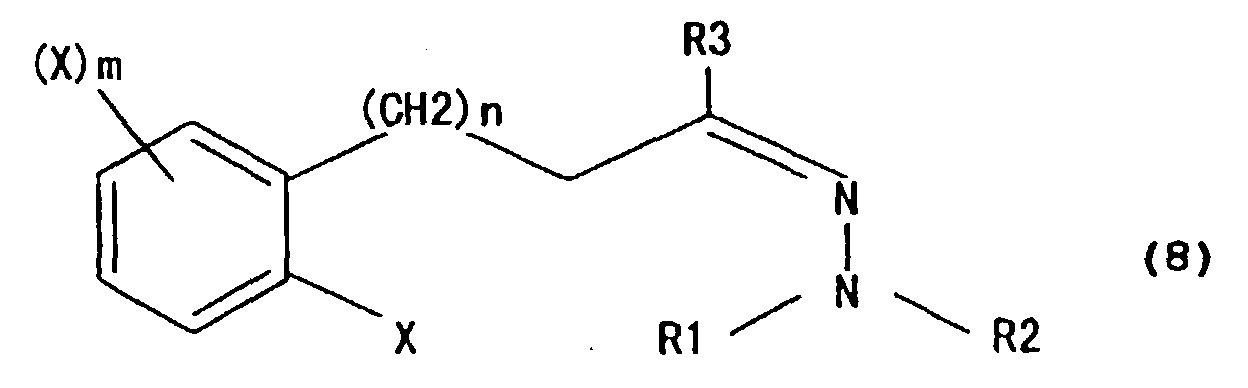
  • a hydrazone derivative represented by General Formula (8) is cyclized intramolecularly in the presence of a catalyst comprising a phosphine and a palladium compound, and a base: where R 1 and R 2 are independently hydrogen, an alkyl group, a phenyl group, a substituted phenyl group, a furyl group, or a thienyl group; R 3 is hydrogen or an aryl group; X is a halogen; m is 1 or 2; and n is 0 or 1.
  • a palladium compound and a phosphine are added in combination as the catalyst into the reaction system.
  • the catalyst components may be separately added to the reaction system, or may be added thereto as a preliminarily formed complex.
  • the palladium compound includes palladium(II) chloride, palladium(II) bromide, palladium(II) acetate, tris(dibenzylideneacetone)dipalladium(0), tris(dibenzylideneacetone)dipalladium(0) chloroform complex, and tetrakis(triphenylphosphine)palladium(0).
  • the amount of the palladium compound used for the reaction ranges preferably from 0.001 to 10 mole%, more preferably from 0.005 to 7 mole%, still more preferably from 0.005 to 5 mole% in terms of palladium based on the compound represented by General Formula (2).
  • the phosphine used in this embodiment includes specifically phosphines having a t-butyl/phosphorus linkage such as tri-t-butylphosphine, 1-(N,N-dimethylaminomethyl)-2-(di-t-butylphosphino)ferrocene, 1-(methoxymethyl)-2-(di-t-butylphosphino)ferrocene, 1,1'-bis(di-t-butylphosphino)ferrocene, 2,2'-bis(di-t-butylphosphino)-1,1'-binaphthyl, 2-methoxy-2'-(di-t-butylphosphino)-1,1'-binaphthyl, 2-(di-t-butylphosphino)biphenyl, 2-(di-t-butylphosphino)-2'-dimethylaminobiphenyl, 2-(di-t
  • the phosphines having a t-butyl/phosphorus linkage which is capable of improving remarkably the activity and selectivity of the reaction.
  • the amount of the phosphine to be added to the reaction system ranges preferably from 0.5 to 10 moles, more preferably from 0.8 to 5 moles, per mole of the palladium compound.
  • the base employed includes carbonates such as potassium carbonate, sodium carbonate, lithium carbonate, rubidium carbonate, and cesium carbonate; t-butoxylithium; t-butoxysodium; and t-butoxypotassium.
  • the base is used in an amount ranging preferably from 0.7 to 3.2 moles, more preferably from 0.9 to 2.4 moles per mole of the compound represented by General Formula (8).
  • the above reaction is conducted usually in an inert solvent.
  • the preferred solvent includes aromatic hydrocarbon solvents such as benzene, toluene, and xylene.
  • the above reaction is conducted under an ordinary pressure in an inert gas atmosphere of nitrogen, argon, or the like, but may be conducted under pressure.
  • the reaction temperature is preferably in the range from 20 to 300°C, more preferably from 50 to 200°C.
  • the reaction time is in the range from several minutes to 72 hours, depending on the reaction conditions, the compound represented by General Formula (3), the palladium compound, and so forth.
  • the intended compound can be obtained by treating the reaction mixture by a conventional manner.
  • the hydrazone compound represented by General Formula (8) which is the source substance of the halogenated nitrogen-heterocyclic compound represented by General formula (3), can be synthesized, for example, through the steps shown below.
  • the hydrazone compound represented by General Formula (8) in which n is 0 can be synthesized, for example, through the steps shown below.
  • a benzyl halide having a halogen X at 2-position and another halogen X on the benzene ring is brought into contact with magnesium in ether to form a corresponding benzyl Grignard reagent.
  • This benzyl Grignard reagent is allowed to react with N,N-dimethyl carboxylic acid amide (R 3 CONMe 2 ).
  • a hydrazine R 1 R 2 NNH 2
  • Various halogen-substituted benzyl halide such as 2,6-dichlorobenzyl chloride, 2,4-dichlorobenzyl chloride, and 2,5-dichlorobenzyl chloride are commercially readily available.
  • a dichlorotoluene which is readily available, can be chlorinated or brominated at the methyl group thereof by a conventional method to obtain the halogen-substituted benzyl halide.
  • the hydrazone the source material in this embodiment, can be synthesized from a readily available compound.
  • the yield of the hydrazone derivative ranges from 50% to 60% based on the halogenated benzyl halide.
  • the hydrazone compound represented by General Formula (8) in which n is 1 can be synthesized, for example, through the steps shown as below.
  • a lithium enamide prepared from lithium diisopropylamide (LDA) and an N-cyclohexylimine of acetaldehyde or an arylmethyl ketone, and a benzyl halide having a halogen X at 2-position and another halogen X on the benzene ring are allowed to react in THF to obtain a carbonyl compound having the corresponding substituents.
  • the N-cyclohexylimine and the corresponding lithium enamide can be prepared also according to the known method (described in Organic Syntheses, Collective Volume VI, 1988, pp.901-904).
  • the yield of the hydrazone derivative ranges from 50% to 70% based on the halogen-substituted benzyl halide (B).
  • the nitrogen-heterocyclic compound represented by General Formula (2) can be synthesized, for example, by reaction of a halogenated nitrogen-heterocyclic compound in the presence of an amine and a base with a catalyst composed of a phosphine and a palladium compound.
  • the amine includes piperazine, 1-methylpiperazine, 2-methylpiperazine, homopiperazine, N-phenyl-N-methylamine, diphenylamine, di(p-tolyl)amine, N-(1-naphthyl)-N-phenylamine, N-(2-naphthyl)-N-phenylamine, N-(2-fluorenyl)-N-phenylamine, pyrrole, indole, and carbazole.
  • the amine is used in an amount ranging usually from 0.7 to 6.0 moles, preferably from 0.7 to 3.2 moles per mole of the compound represented by General Formula (3).
  • the catalyst, the base, and the reaction conditions are the same as in the synthesis of the nitrogen-heterocyclic compound in which R 4 is halogen.
  • the compound represented by General formula (7) can be produced by intramolecular cyclization of a compound represented by General formula (5): (where R 1 and R 2 are independently hydrogen, an alkyl group, an aryl group, or a heteroaryl group; R 3 is hydrogen or an aryl group; and X is a halogen), in the presence of a catalyst comprising a phosphine and a palladium compound, an amine represented by General Formula (6): R 5 R 6 NH (where R 5 and R 6 are independently hydrogen, an alkyl group, or an aryl group, and R 5 and R 6 may be linked to form a hetero-ring), and a base; and simultaneous introduction of an amino group onto the non-nitrogen aromatic ring.
  • the alkyl group as the substituents R 1 and R 2 includes methyl, ethyl, propyl, and butyl;
  • the aryl group as the substituents R 1 to R 3 includes phenyl, 4-tolyl, 4-trifluoromethylphenyl, 4-methoxyphenyl, and 4-biphenyl;
  • the heteroaryl group as the substituents R 1 and R 2 includes 4-pyridyl, 3-pyridyl, 2-pyridyl, 2-furyl, and 2-thienyl; and the halogen X includes chlorine, bromine, and iodine.
  • the process for producing the hydrazone derivative represented by the above General Formula (5) having a halogenated aryl group is not specially limited.
  • the hydrazone derivative, the source material of the production process of the present invention can be synthesized, for example, as below.
  • a benzyl halide having a halogen X at 2-position and another halogen on the aromatic ring are brought into contact with magnesium in ether to form a corresponding benzyl Grignard reagent.
  • This benzyl Grignard reagent is allowed to react with N,N-dimethyl carboxylic acid amide (R 3 CONMe 2 ).
  • a benzyl ketone or a benzyl aldehyde is allowed to react with a hydrazine (R 1 R 2 NNH 2 ) in toluene to obtain a hydrazone derivative which is the source substance of this embodiment.
  • a hydrazine R 1 R 2 NNH 2
  • Various halogen-substituted benzyl halides such as 2,6-dichlorobenzyl chloride, 2,4-dichlorobenzyl chloride, and 2,5-dichlorobenzyl chloride are commercially available readily.
  • dichlorotoluenes which are readily available, can be chlorinated or brominated at the methyl group thereof by a conventional method to obtain the halogen-substituted benzyl halide.
  • the hydrazone derivative the source material in this embodiment, can be synthesized from readily available compounds.
  • the yield of the hydrazone derivative ranges from about 50% to about 60% based on the halogenated benzyl halide.
  • the amine represented by General Formula (6) in this embodiment includes specifically dimethylamine, diethylamine, di(n-butyl)amine, aniline, N-methylaniline, diphenylamine, di(p-tolyl)amine, di(p-methoxyphenyl)amine, di(p-fluorenyl)amine, di[m-(trifluoromethyl)phenyl]amine, m-(trifluormethyl)aniline, piperazine, 4-alkyl-1-piperazine, 3-methylpiperazine, homopiperazine, pyrrole, indole, and carbazole.
  • the amine is used in an amount ranging preferably from 0.7 to 10 moles, more preferably from 0.9 to 6 moles per mole of the compound represented by the above General Formula (5).
  • a palladium compound and a phosphine are added in combination as the catalyst into the reaction system.
  • the catalyst components may be separately added to the reaction system, or may be added thereto as a preliminarily formed complex.
  • the palladium compound used in this embodiment is not specially limited, and includes divalent palladium compounds such as palladium(II) chloride, palladium(II) bromide, palladium(II) acetate, palladium(II) acetylacetonate, dichlorobis(benzonitrile)palladium(II), dichlorobis(acetonitrile)palladium(II), dichlorobis(triphenylphosphine)palladium(II), dichlorotetraammine palladium(II), dichloro(cycloocta-1,5-diene)palladium(II), and palladium(II) trifluoroacetate; and zero-valent palladium compounds such as tris(dibenzylideneacetone)dipalladium(0), tris(dibenzylideneacetone)dipalladium(0) chloroform complex, and tetrakis(triphenylphosphine)palladium
  • palladium acetate particularly preferred are palladium acetate, and tris(dibenzylideneacetone)dipalladium(0).
  • the amount of the palladium compound used for the reaction is not limited, and ranges preferably from 0.001 to 10 mole%, more preferably from 0.005 to 7 mole%, still more preferably from 0.005 to 5 mole% in terms of palladium based on the compound represented by General Formula (5).
  • the phosphine used in this embodiment includes specifically phosphines having a t-butyl-phosphorus linkage such as tri-t-butylphosphine, 1-(N,N-dimethylaminomethyl)-2-(di-t-butylphosphino)ferrocene, 1-(methoxymethyl)-2-(di-t-butylphosphino)ferrocene, 1,1'-bis(di-t-butylphosphino)ferrocene, 2,2'-bis(di-t-butylphosphino)-1,1'-binaphthyl, 2-methoxy-2'-(di-t-butylphosphino)-1,1'-binaphthyl, 2-(di-t-butylphosphino)biphenyl, 2-(di-t-butylphosphino)-2'-dimethylaminobiphenyl, 2-(di-t
  • the phosphines having a t-butyl-phosphorus linkage which is capable of improving remarkably the activity and selectivity of the reaction.
  • the amount of the phosphine to be added to the reaction system is not specially limited, but is preferably in the range from 0.5 to 10 moles, more preferably from 0.8 to 5 moles, per mole of the palladium compound.
  • the base used in this embodiment is not limited, and may be selected from organic bases and inorganic bases.
  • the preferred base includes specifically sodium hydride, potassium hydride, lithium hydride, sodium amide, potassium amide, lithium amide, potassium carbonate, sodium carbonate, lithium carbonate, rubidium carbonate, cesium carbonate, potassium hydrogencarbonate, sodium hydrogencarbonate, sodium metal, potassium metal, lithium metal, methoxysodium, methoxypotassium, ethoxysodium, ethoxypotassium, ethoxylithium, t-butoxylithium, t-butoxysodium, and t-butoxypotassium.
  • the amount of the base to be added to the reaction system is preferably in the range from 0.7 to 5 moles, more preferably from 0.9 to 3 moles, per mole of the compound represented by General Formula (5).
  • the above reaction is conducted usually in an inert solvent.
  • the solvent is not limited, provided that the reaction is not significantly retarded.
  • the solvent includes, aromatic hydrocarbon solvents such as benzene, toluene, and xylene; ether solvents such as diethyl ether, tetrahydrofuran, and dioxane; acetonitrile; dimethylformamide; dimethylsulfoxide; and hexamethylphosphoric triamide.
  • aromatic hydrocarbons including benzene, toluene, and xylene.
  • the above reaction is conducted usually under an ordinary pressure in an inert gas atmosphere of nitrogen, argon, or the like, but may be conducted under pressure.
  • the reaction temperature ranges preferably from 20 to 300°C, more preferably from 50 to 200°C.
  • the reaction time ranges from several minutes to 72 hours, depending on the reaction conditions, the compound represented by General Formula (5), the palladium compound, and so forth.
  • the intended compound can be obtained by treating the reaction mixture by a conventional manner.
  • the substituted indole derivative represented by the above General Formula (7) produced according to the present invention includes specifically indole derivatives such as 4-dimethylamino-1-(dimethylamino)indole, 4-dibutylamino-1-(methylamino)indole, 4-(N-phenyl-N-methylamino)-1-(diphenylamino)indole, 4-(1-piperazinyl)-1-(dimethylamino)indole, 4-(1-piperazinyl)-1-(diphenylamino)indole, 4-(1-piperazinyl)-1-(N-phenyl-N-methylamino)indole, 4-(1-piperazinyl)-1-[(N-(4-pyridyl)-N-methylamino]indole, 4-(1-piperazinyl)-1-[(N-(3-pyridyl)-N-methyla
  • the nitrogen-heterocyclic compound of the present invention is a novel compound having a substituent additionally at 4-position of an indole ring, and are highly useful as the source substance for medicines and pesticides, and for electronic materials.
  • the present invention has made possible the synthesis of the useful nitrogen-heterocyclic compound from a readily available hydrazone derivative having a halogenated aryl group by intramolecular cyclization thereof in the presence of a catalyst composed of a palladium compound and a phosphine, and a base.
  • the nitrogen-heterocyclic compounds including the indoles and the 4H-quinolines produced according to the present invention has a 1-amino structure in which the nitrogen of the amino group is directly bonded to the nitrogen of the ring.
  • the compound having such a structure is disclosed as a useful compound for use for a medicine in JP-A-7-53376. However, it was extremely difficult to prepare the compound by a prior art technique.
  • the present invention has made possible the easy synthesis of the compound.
  • introduction of a substituent selectively to 4-position of the indole ring requires considerable time and labor.
  • the present invention has made possible this selective substituent introduction by use of readily available source substances.
  • the product of the present invention can readily be cleaved at the nitrogen-nitrogen bond by hydrogenation reduction, thereby enabling providing a nitrogen-heterocyclic compound having no substituent on the nitrogen.
  • the product of the present invention includes the one having a halogen on the benzene ring moiety. This halogen can be converted to an amino group, an aryl group, or a substituted vinyl group by use of the palladium-phosphine catalyst. Therefore, the compounds provided by the present invention are highly useful as the intermediate for nitrogen-heterocyclic compounds having various substituents.
  • a 200-mL three-necked flask equipped with a thermometer, a dropping funnel, a three-way stopcock, and a mechanical stirrer was purged with nitrogen. Thereto, were added 1.85 g (76 mmol) of magnesium, and 30 mL of diethyl ether.
  • the dropping funnel was filled with a solution of 13.5 g (69 mmol) of 2,6-dichlorobenzyl chloride (produced by Tokyo Kasei K.K.) in 40 mL of diethyl ether. The solution was added dropwise into the flask by keeping the temperature of the reaction system at about 30°C. Thereafter, the reaction mixture was aged at room temperature for 30 minutes, and cooled with ice.
  • 2,4-Dichlorophenylacetaldehyde N,N-dimethylhydrazone was prepared in the same manner as in Reference Example 1 except that 2,4-dichlorobenzyl chloride (produced by Wako Pure Chemical Co.) was used in place of 2,6-dichlorobenzyl chloride. (Yield: 53% based on 2,4-dichlorobenzyl chloride)
  • Acetaldehyde N-cyclohexylimine (N-ethylidenecyclohexylamine) was prepared in a yield 6.9 g (52.6 mmol) and was allowed to react with lithium diisopropylamide according to the method described in Organic Syntheses, Collective Volume VI, 1988, pp.901-904.
  • the organic phase was dried over anhydrous sodium sulfate, filtered, and concentrated.
  • 10 g of Molecular Sieve 4A was added and the flask was purged with nitrogen.
  • the concentration residue was dissolved by addition of 10 mL of toluene, and was cooled with ice. Thereto, 3.45 g (57.4 mmol) of N,N-dimethylhydrazine was added.
  • the mixture was stirred at room temperature for 3 hours, and filtered. The filtrate was concentrated under a reduced pressure.
  • 1-(Dimethylamino)indole was prepared in the same manner as in Example 1 except that 42.2 mg (0.21 mmol) of tri(t-butyl)phosphine was used in place of 1-(N,N-dimethylaminomethyl)-2-(di-t-butylphosphino)ferrocene, and the reaction was conducted at 120°C for 20 hours. (Yield: 41%)
  • 6-Chloro-1-(dimethylamino)indole was prepared in the same manner as in Example 1 except that 2,4-dichlorophenylacetaldehyde N,N-dimethylhydrazone was used in place of 2-chlorophenylacetaldehyde N,N-dimethylhydrazone, and the reaction was conducted at 120°C for 8 hours. (Yield: 21%)
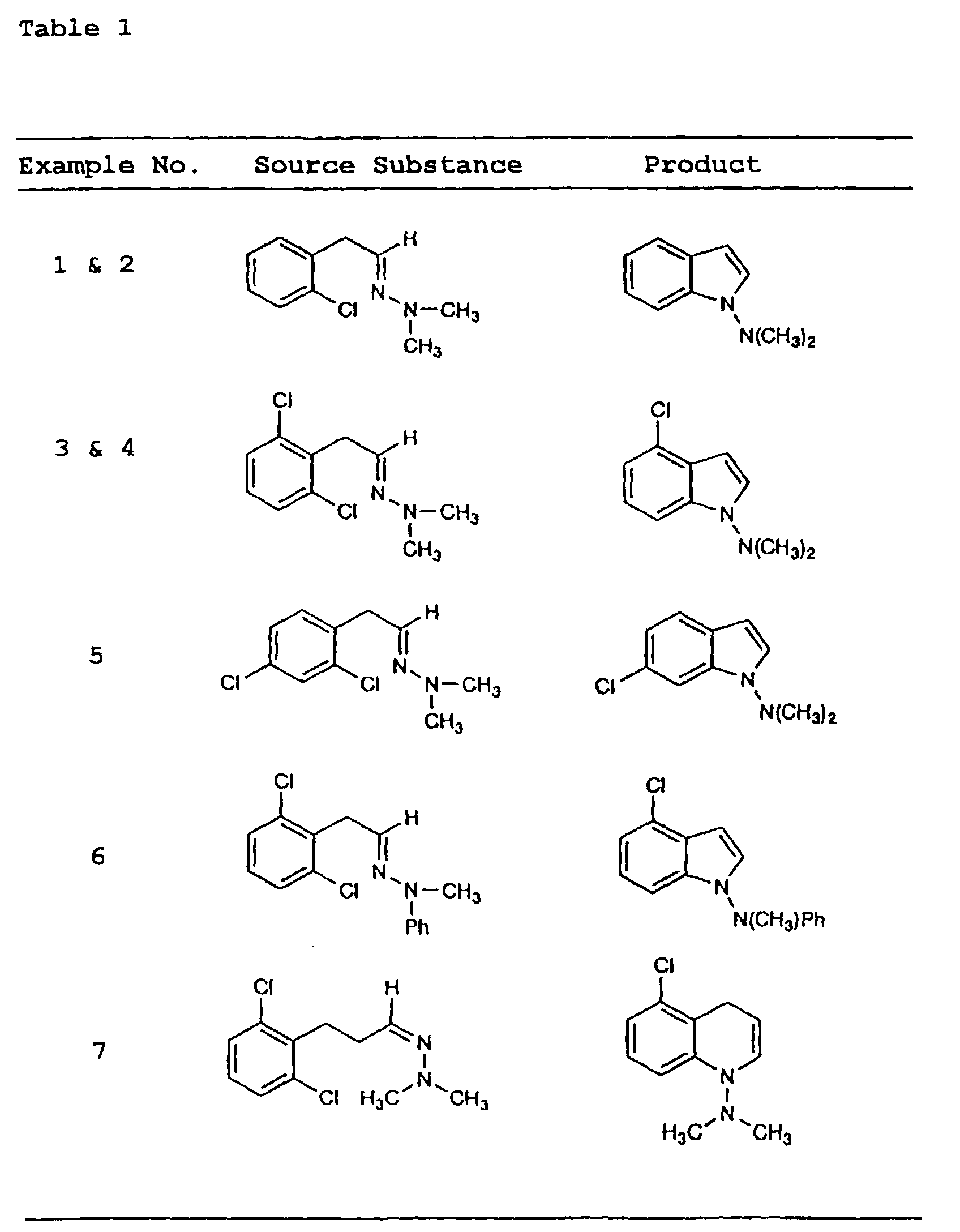
  • Table 1 shows the source substances and the products of Examples 1-7.
  • 4-(1-piperizinyl-1-dimethylamino)indole was prepared in the same manner as in Example 8 except that 4-chloro-1-(dimethylamino)indole synthesized in Example 8 was used in place of 2,6-dichlorophenylacetaldehyde N,N-dimethylhydrazone as the source substance, palladium was used in an amount of 1.0 mol% based on the source substance, piperazine in 4 equivalents to the source substance was added, and the solvent in the alumina column chromatography was changed to ethyl acetate: methanol (10:1 to 5:1). (Yield: 95%)
  • 6-Fluoro-1-(dimethylamino)indole was prepared in the same manner as in Example 8 except that 2-chloro-4-fluorophenylacetaldehyde N,N-dimethylhydrazone was used in place of 2,6-dichlorophenylacetaldehyde N,N-dimethylhydrazone. (Yield: 74%)
  • Table 2 summarizes the source substances and the products in Examples 8-11.
  • 6-(1-piperazinyl)-1-(dimethylamino)indole was prepared in the same manner as in Example 12 except that 2,4-dichlorophenylacetaldehyde N,N-dimethylhydrazone was used in place of 2,6-dichlorophenylacetaldehyde N,N-dimethylhydrazone. (Yield: 30%)
  • 6-(1-pyrrolyl)-1-(dimethylamino)indole was prepared in the same manner as in Example 12 except that 2,4-dichlorophenylacetaldehyde N,N-dimethylhydrazone was used in place of 2,6-dichlorophenylacetaldehyde N,N-dimethylhydrazone, tri(t-butyl)phosphine was used in place of 1-(N,N-dimethylaminomethyl)-2-(di-t-butylphosphino)ferrocens, pyrrole was used in place of piperazine, and rubidium carbonate was used in place of t-butoxysodium. (Yield: 21%)
  • 4-(1-indolyl)-1-(dimethylamino)indole was prepared in the same manner as in Example 16 except that 2,6-dichlorophenylacetaldehyde N,N-dimethylhydrazone was used in place of 2,4-dichlorophenylacetaldehyde N,N-dimethylhydrazone, and indole (212 mg, 1.81 mmol) was used in place of pyrrole. (Yield: 40%)
  • Table 3 shows the source substances and the products in Examples 12-18.
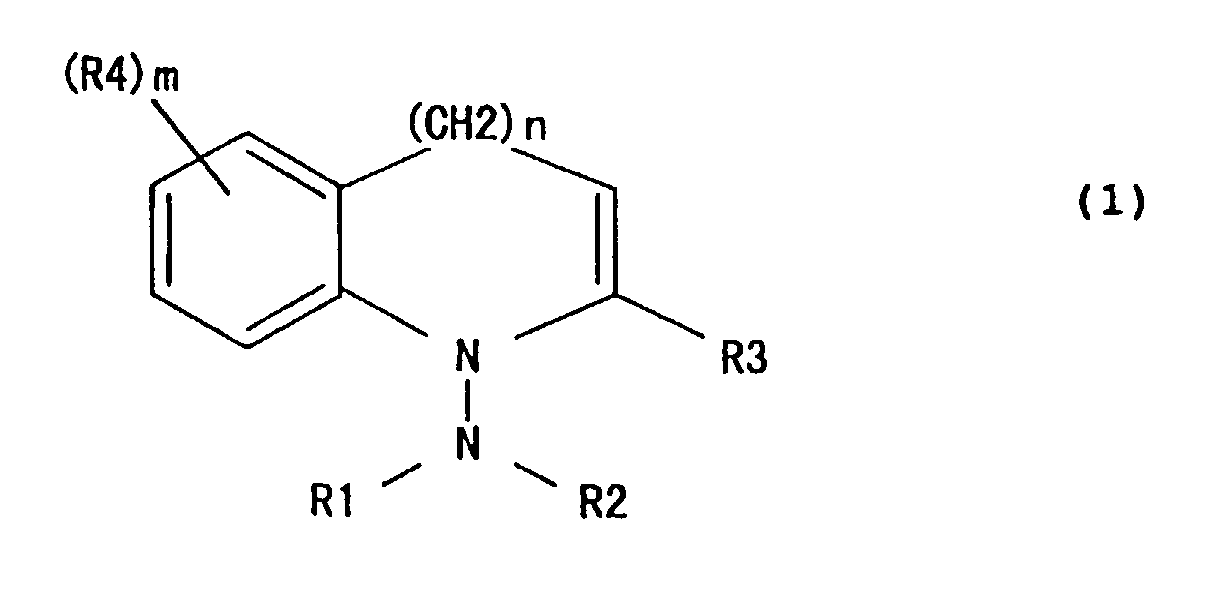
  • a nitrogen-heterocyclic compound which is represented by General Formula (1): where R 1 and R 2 are independently hydrogen, an alkyl group, an aryl group, or a heteroaryl group; R 3 is hydrogen or an aryl group; R 4 is a substituted amino group, an alkoxy group, a nitro group, or halogen; m is an integer from 0 to 2; and n is 0 or 1.
  • R 1 and R 2 are independently hydrogen, an alkyl group, an aryl group, or a heteroaryl group
  • R 3 is hydrogen or an aryl group
  • R 4 is a substituted amino group, an alkoxy group, a nitro group, or halogen
  • m is an integer from 0 to 2
  • n is 0 or 1.

Landscapes

  • Chemical & Material Sciences (AREA)
  • Organic Chemistry (AREA)
  • Indole Compounds (AREA)
  • Plural Heterocyclic Compounds (AREA)
  • Heterocyclic Carbon Compounds Containing A Hetero Ring Having Nitrogen And Oxygen As The Only Ring Hetero Atoms (AREA)

Abstract

A nitrogen-heterocyclic compound is provided which is represented by General Formula (1):
Figure 80000001
where R1 and R2 are independently hydrogen, an alkyl group, an aryl group, or a heteroaryl group; R3 is hydrogen or an aryl group; R4 is a substituted amino group, an alkoxy group, a nitro group, or halogen; m is an integer from 0 to 2; and n is 0 or 1. A process for producing the above compound is also provided. This compound is useful as a source material of medicines, pesticides, electronic materials, and intermediates for other substituted nitrogen-heterocyclic compounds.

Description

Background of the Invention: Field of the Invention:
The present invention relates to nitrogen-heterocyclic compounds (nitrogen-containing heterocyclic compounds), and a process for producing the compound. More specifically, the present invention relates to nitrogen-heterocyclic compounds substituted at 1-position by an amino group, including 1-aminoindole derivatives and 1-amino-4H quinoline derivatives, and intermediates therefor.
The present invention relates also to a process for producing a nitrogen-heterocyclic compound including indole derivatives and 4H-quinoline derivatives, the process comprising cyclizing intramolecularly a hydrazone derivative having a halogenated aryl group in the presence of a catalyst composed of a phosphine and a palladium compound.
The present invention relates further to a process for producing a substituted indole derivative, comprising cyclizing intramolecularly a hydrazone derivative having a halogenated aryl group in the presence of a catalyst composed of a phosphine and a palladium compound, an amine, and a base, and introducing simultaneously an amino group to the non-nitrogen aromatic ring (aromatic ring not containing nitrogen).
These nitrogen-heterocyclic compounds are useful as a source material for medicines and pesticides, and for electronic materials.
Description of the Related Art:
Nitrogen-heterocyclic compounds substituted at 1-position by an amino group are disclosed: 1-(pyridylamino)indoles are disclosed as an anancastic disease remedy in JP-A-7-53376 (the term "JP-A" herein means an "unexamined published Japanese patent application"), and 1-(phenylamino)indoles are disclosed in JP-A-60-142955.
On the other hand, many processes are investigated for the synthesis of nitrogen-heterocyclic compound. In particular, for indole derivatives, various processes are well known such as a Fischer process, a Reissert process, and a Bischler process. In recent years, new processes have been disclosed: a process starting from a nitrostyrene catalyzed by use of palladium-copper-oxygen disclosed in JP-A-3-24055; synthesis of an indole derivative by preparing an indoline compound in the presence of palladium/phosphine catalyst and dehydrogenating it in the presence of palladium carbon (S.L.Buchwald et al.: J.Am.Chem.Soc. 1998, Vol.120, pp.3068-3073); indole synthesis by catalytic cyclization of o-iodoaniline with a ketone in the presence of a palladium catalyst (C. Chen et al.: J. Org. Chem., 1997, Vol.62, pp.2676-2677); indole synthesis by catalytic cyclization of o-iodoaniline with an alkyne in the presence of a palladium catalyst (R.C. Larock et al: J. Org. Chem., 1998, Vol.63, pp.7652-7662): and indole synthesis by reductive cyclization employing an o-nitrotoluene derivative (A.D. Batcho et al.: Organic Syntheses, 1985, Vol.63, pp.214-224).
A process for synthesis of 1-aminoindole is reported in which o-nitrosophenylethylamine is electrochemically converted (B.A.F. Uribe et al.: European Journal of Organic Chemistry, 1999, Vol.2, pp.419-430).
The arylpiperazine structure is important in remedy for brain malfunction such as an antidepressant. For example, arylpiperazines are useful for remedy for brain malfunction such as an antidepressant, and importance of this structure for pharmacological activity are described by R.A. Glennon et al.: Drug Development Research, 22 (1993), pp.25-36; R.M.Pindler et al.: Medicinal Research Reviews, 13 (1993), pp.259-325, and R.A. Glennon et al.: Journal of Medicinal Chemistry, 32 (1989), pp.1921-1926.
Diarylamines are described to be useful as the intermediates for medicines and pesticides and for electronic intermediate material in Yuki Gosei Kyokai-Shi (Journal of the Organic Synthesis Society, Japan), Vol.52 (1994) pp.1083-1088. Triarylamines having high electron carrying ability are described to be useful as a hole carrier in organic electroluminescence by Seizo MIYATA ("Organic EL Elements and Industrial Front Thereof", pp.22-27, pp.104-106, NTS Co.).
As shown above, the diarylamine or triarylamine structure having a longer conjugation system is superior to the monoarylamine structure in the properties and functions in the aforementioned application fields. The structure of diarylamine, triarylamine, or N-arylazole is essential to the electronic materials such as the hole carrier in organic electroluminescence.
However, in the aforementioned known nitrogen-heterocyclic compounds (namely, indole derivatives having an amino group at 1-position), the kinds of the substituents on the non-nitrogen aromatic ring are limited, and the position of the substitution is limited to 3- and 5-positions of the indole. The nitrogen-heterocyclic compound is not known which has an amino group at 1-position and has a non-nitrogen aromatic ring substituted by a 1-piperazinyl, arylamino, diarylamino, or azolyl group (the azolyl group including cyclic amino groups such as pyrrolyl and indolyl).
In the conventional production processes mentioned above, the source materials cannot readily be available, and in synthesis of substituted indole, the position of the substituent on the indole ring is limited mainly to 5-, 6-, or 7-position. For example, an indole derivative having a substituent at 4-position only cannot readily be synthesized by the conventional process.
The present invention has been made to solve the above problems of the prior art.
Summary of the Invention:
The present invention intend to provide a heterocyclic compound having, on the non-nitrogen aromatic ring, a substituent such as 1-piperazinyl, arylamino-, diarylamino, azolyl, alkoxy, and nitro.
The present invention intends also to provide a nitrogen-heterocyclic compound having a halogen atom on the aromatic ring useful as the source material of the above substituted nitrogen-heterocyclic compound.
The present invention intends further to provide a process for synthesizing, in a simple manner, the nitrogen-heterocyclic compound such as indole derivatives and 4H-quinoline derivatives useful as a source material for medicines, pesticides, and electronic materials from readily available source materials.
After comprehensive investigation to solve the above problems, the inventors of the present invention have found the nitrogen-heterocyclic compound of the present invention, and the process for production thereof. Thus the present invention has been completed.
In an aspect of the present invention, there is provided a nitrogen-heterocyclic compound represented by General Formula (1) below:
Figure 00050001
where R1 and R2 are independently hydrogen, an alkyl group, an aryl group, or a heteroaryl group; R3 is hydrogen or an aryl group; R4 is a substituted amino group, an alkoxy group, a nitro group, or halogen; m is an integer from 0 to 2; and n is 0 or 1. A process for producing the above compound is also provided.
In another aspect of the present invention, there is provided a nitrogen-heterocyclic compound represented by General Formula (2) below:
Figure 00060001
where R1 and R2 are independently hydrogen, an alkyl group, a phenyl group, a substituted phenyl group, a furyl group, or a thienyl group; R3 is hydrogen or an aryl group; R4 is a substituted amino group; m is 1 or 2; and n is 0 or 1. An intermediate thereof, and a process for producing the above compound are also provided.
In a further aspect of the present invention, there is provided a process for producing a substituted indole derivative represented by General Formula (7) below:
Figure 00060002
where R1 and R2 are independently hydrogen, an alkyl group, an aryl group, or a heteroaryl group; R3 is hydrogen or an aryl group; R5 and R6 are independently hydrogen, an alkyl group, or an aryl group, and R5 and R6 may be linked suitably to form a hetero-ring.
Detailed Description of the Preferred Embodiments:
The present invention is described below in detail.
1. Nitrogen-Heterocyclic Compound Represented by General Formula (1):
In this embodiment of the present invention, the compound represented by General Formula (1) is produced by intramolecular cyclization of a hydrazone compound represented by General Formula (4) below having a halogenated aryl group in the presence of a catalyst containing a phosphine and a palladium compound, and a base:
Figure 00070001
where R1 and R2 are independently hydrogen, an alkyl group, an aryl group, or a heteroaryl group; R3 is hydrogen or an aryl group; R4 is a substituted amino group, an alkoxy group, a nitro group, or halogen; X is a halogen; m is an integer from 0 to 2; and n is 0 or 1.
As the substitutents R1 and R2 in the hydrazone compound represented by General Formula (4) in the present invention, the alkyl group includes methyl, ethyl, propyl, butyl, and other lower alkyl groups; the aryl group includes phenyl, 4-tolyl, 4-trifluoromethylphenyl, and 4-methoxyphenyl; and the heteroazyl group includes 4-pyridyl, 3-pyridyl, 2-pyridyl, 2-furyl, and 2-thienyl. As the substituent R3, the aryl group includes phenyl, 4-tolyl, 4-trifluoromethylphenyl, 4-methoxyphenyl, and 4-biphenyl. As the substituent R4, the substituted amino group includes 1-piperazinyl, 4-methyl-1-piperazinyl, 3-methyl-1-piperazinyl, 1-homopiperazinyl, N-phenyl-N-methylamino, diphenylamino, di(p-tolyl)amino, N-(1-naphthyl)-N-phenylamino, N-(2-naphthyl)-N-phenylamino, N-(2-fluorenyl)-N-phenylamino, 1-pyrrolyl, 1-indolyl, and 9-carbazolyl; the alkoxy group includes methoxy, ethoxy, butoxy, 4,5-methylenedioxy, and 5,6-methylenedioxy; and the halogen includes fluorine, chlorine, bromine, and iodine. The halogen X includes chlorine, bromine, and iodine.
The method of synthesis of the hydrazone compound represented by General Formula (4) is described below.
The hydrazone compound represented by General Formula (4) in which n is 0 can be synthesized, for example, through the steps shown by formulas below:
Figure 00080001
As shown above, a benzyl halide (A) having a halogen X at 2-position and a substituent R4 is brought into contact with magnesium in ether to form a corresponding benzyl Grignard reagent. This benzyl Grignard reagent is allowed to react with N,N-dimethyl carboxylic acid amide (R3CONMe2). The product (B), a benzyl ketone or a benzyl aldehyde (R3=H), is allowed to react with a hydrazine (R1R2NNH2) in toluene to obtain a hydrazone derivative (1) (General Formula (4) in which n is 0) which is the source substance of the process of this embodiment. Various halogen-substituted benzyl halides (A) such as 2-chlorobenzyl chloride, 2,6-dichlorobenzyl chloride, 2,4-dichlorobenzyl chloride, and 2,5-dichlorobenzyl chloride are commercially readily available. 2-Chlorotoluene, methoxy-2-bromotoluene, dichlorotoluenes, and nitro-2-chlorotoluene are also readily available, and the methyl group thereof can be chlorinated or brominated by a conventional method to obtain the halogen-substituted benzyl halide. In such a manner, the source substance hydrazone for this embodiment can be synthesized from a readily available compound. In this synthesis, the yield of the hydrazone derivative ranges from 50% to 60% based on the halogenated benzyl halide (A).
The hydrazone compound represented by General Formula (4) in which n is 1 can be synthesized, for example, through the steps shown by formulas below:
Figure 00100001
As shown above, a lithium enamide prepared from lithium diisopropylamide (LDA) and an N-cyclohexylimine (A) of acetaldehyde or an arylmethyl ketone, and a benzyl halide (B) having X at 2-position and a substituent R4 on the benzene ring are allowed to react in THF to obtain a carbonyl compound (C) having the corresponding substituents. The N-cyclohexylimine (A) and the corresponding lithium enamide can be prepared according to the known method (described in Organic Syntheses, Collective Volume VI, 1988, pp.901-904). The resulting compound (C) is allowed to react with a hydrazine (R1R2NNH2) in toluene to synthesize the hydrazone derivative (1) (General Formula (4) in which n is 1) which is a source substance of the process of this embodiment. In this synthesis, the yield of the hydrazone derivative is in the range from 50% to 70% based on the halogen-substituted benzyl halide (B).
In the above reactions, a catalyst comprising a palladium compound and a phosphine is added to the reaction system. The catalyst components may be separately added to the reaction system, or may be added thereto as a preliminarily formed complex.
The palladium compound used in this embodiment is not specially limited, and includes divalent palladium compounds such as palladium(II) chloride, palladium(II) bromide, palladium(II) acetate, palladium(II) acetylacetonate, dichlorobis(benzonitrile)palladium(II), dichlorobis(acetonitrile)palladium(II), dichlorobis(triphenylphosphine)palladium(II), dichlorotetraammine palladium(II), dichloro(cycloocta-1,5-diene)palladium(II), and palladium(II) trifluoroacetate; and zero-valent palladium compounds such as tris(dibenzylideneacetone) dipalladium(0), tris(dibenzylideneacetone) dipalladium(0) chloroform complex, and tetrakis(triphenylphosphine)palladium(0). Of these, particularly preferred are palladium acetate, and tris(dibenzylideneacetone)dipalladium(0). The amount of the palladium compound used for the reaction is not specially limited, but ranges preferably from 0.001 to 10 mole%, more preferably from 0.005 to 7 mole%, still more preferably from 0.005 to 5 mole% in terms of palladium based on the compound represented by General Formula (4).
The phosphine used in this embodiment includes specifically phosphines having a t-butyl/phosphorus linkage such as tri-t-butylphosphine, 1-(N,N-dimethylaminomethyl)-2-(di-t-butylphosphino)-ferrocene, 1-(methoxymethyl)-2-(di-t-butylphosphino)ferrocene, 1,1'-bis(di-t-butylphosphino)ferrocene, 2,2'-bis(di-t-butylphosphino)-1,1'-binaphthyl, 2-methoxy-2'-(di-t-butylphosphino)-1,1'-binaphthyl, 2-(di-t-butylphosphino)biphenyl, 2-(di-t-butylphosphino)-2'-dimethylaminobiphenyl, 2-(di-t-butylphosphino)-2'-dimethylamino-1,1'-binaphthyl, (di-t-butylphosphino)ferrocene, and 9,9-dimethyl-4,5-bis(di-t-butylphosphino)xanthene; aromatic phosphines such as tri(o-tolyl)phosphine, 2,2'-bis(diphenylphosphino)-1,1'-binaphthyl, 1-(N,N-dimethylaminomethyl)-2-(diphenylphosphino)ferrocene, and 1-(methoxymethyl)-2-(diphenylphosphino)ferrocene; and 9,9-dimethyl-4,5-bis(diphenylphosphino)xanthene. Of these, preferred are the phosphines having a t-butyl/phosphorus linkage which is capable of improving remarkably the activity and selectivity of the reaction. The amount of the phosphine to be added to the reaction system is not specially limited, but ranges preferably from 0.5 to 10 moles, more preferably from 0.8 to 5 moles, per mole of the palladium compound.
The base used in this embodiment is not limited, and may be selected from organic bases and inorganic bases. The preferred base includes specifically sodium hydride, potassium hydride, lithium hydride, sodium amide, potassium amide, lithium amide, potassium carbonate, sodium carbonate, lithium carbonate, rubidium carbonate, cesium carbonate, potassium hydrogencarbonate, sodium hydrogencarbonate, sodium metal, potassium metal, lithium metal, methoxysodium, methoxypotassium, ethoxysodium, ethoxypotassium, ethoxylithium, t-butoxylithium, t-butoxysodium, and t-butoxypotassium. Of these bases, particularly preferred are t-butoxysodium, and carbonates. The amount of the base to be added to the reaction system is preferably in the range from 0.7 to 3.2 moles, more preferably from 0.9 to 2.4 moles, per mole of the compound represented by General Formula (4).
The above reaction is conducted usually in an inert solvent. The solvent is not limited, provided that the reaction is not significantly retarded. The solvent includes, aromatic hydrocarbon solvents such as benzene, toluene, and xylene; ether solvents such as diethyl ether, tetrahydrofuran, and dioxane; acetonitrile; dimethylformamide; dimethylsulfoxide; and hexamethylphosphoric triamide. Particularly preferred are aromatic hydrocarbons including benzene, toluene, and xylene.
The above reaction is conducted usually at an ordinary pressure in an inert gas atmosphere of nitrogen, argon, or the like, but may be conducted under pressure. The reaction temperature ranges preferably from 20 to 300°C, more preferably from 50 to 200°C. The reaction time ranges from several minutes to 72 hours, depending on the reaction conditions, the compound represented by General Formula (4), the palladium compound, and so forth. After the reaction, the intended compound can be obtained by treating the reaction mixture by a conventional manner.
The compound represented by General Formula (1) which can be produced in this embodiment includes indole derivatives such as 1-(dimethylamino)indole, 1-(methylamino)indole, 1-(ethylamino)indole, 1-(phenylamino)indole, 1-(diphenylamino)indole, 1-(N-phenyl-N-methylamino)indole, 1-[(N-(4-pyridyl)-N-methylamino]indole, 1-[(N-(3-pyridyl)-N-methylamino]indole, 1-[(N-(2-pyridyl)-N-methylamino]indole, 1-[(N-(2-furyl)-N-methylamino]indole, 1-[(N-(2-thienyl)-N-methylamino]indole, 1-[(N-(4-trifluoromethylphenyl)-N-methylamino]indole, 1-[(N-(4-tolyl)-N-methylamino]indole, 1-[(N-(4-methoxyphenyl)-N-methylamino]indole, 1-(dimethylamino)-2-phenylindole, 1-(dimethylamino)-4-chloroindole, 1-(diphenylamino)-4-chloroindole, 1-(dimethylamino)-4-chloro-2-phenylindole, 1-(dimethylamino)-5-chloroindole, 1-(dimethylamino)-6-chloroindole, 1-(dimethylamino)-7-chloroindole, 1-(dimethylamino)-4-fluoroindole, 1-(dimethylamino)-4-bromoindole, 1-(N-phenyl-N-methylamino)-5-chloroindole, 1-(dimethylamino)-4-methoxyindole, 1-(dimethylamino)-4-butoxyindole, 1-(dimethylamino)-4-nitroindole, 1-(dimethylamino)-4,5-methylenedioxyindole, 1-(dimethylamino)-5,6-methylenedioxyindole, 4-(1-piperazinyl)-1-(dimethylamino)indole, 4-(1-piperazinyl)-1-(diphenylamino)indole, 4-(1-piperazinyl)-1-(N-phenyl-N-methylamino)indole, 4-(1-piperazinyl)-1-[(N-(2-furyl)-N-methylamino]indole, 4-(1-piperazinyl)-1-[(N-(2-thienyl)-N-methylamino]indole, 4-(1-piperazinyl)-1-[(N-(4-trifluoromethylphenyl)-N-methylamino]indole, 4-(1-piperazinyl)-1-(dimethylamino)-2-phenylindole, 4-(N-phenyl-N-methylamino)-1-(dimethylamino)indole, 4-(N-phenyl-N-methylamino)-1-(diphenylamino)indole, 4-(diphenylamino)-1-(diphenylamino)indole, 4-[N-(1-naphthyl)-N-phenylamino]-1-(diphenylamino)indole, 4-(1-pyrrolyl)-1-(dimethylamino)indole, 6-(1-pyrrolyl)-1-(dimethylamino)indole, 4-(1-indolyl)-1-(dimethylamino)indole, 6-(1-piperazinyl)-1-(dimethylamino)indole, 4-(1-homopiperazinyl)-1-(dimethylamino)indole, 4-(3-methyl-1-piperazinyl)-1-(dimethylamino)indole, 4-di(p-tolyl)amino-1-(dimethylamino)indole, 6-(9-carbazolyl)-1-(dimethylamino)indole, 4,6-bis(diphenylamino)-1-(dimethylamino)indole, 7-(1-piperazinyl)-1-(dimethylamino)indole, 7-(dimethylamino)-1-(dimethylamino)indole, and 6-fluoro-1-(dimethylamino)indole: and 4H-quinoline derivatives such as 1-(dimethylamino)-4H-quinoline, 1-(methylamino)-4H-quinoline, 1-(N-phenyl-N-methylamino)-4H-quinoline, 1-[(N-(4-pyridyl)-N-methylamino]-4H-quinoline, 1-[(N-(3-pyridyl)-N-methylamino]-4H-quinoline, 1-(dimethylamino)-5-chloro-4H-quinoline, 1-(dimethylamino)-5-nitro-4H-quinoline, 1-(dimethylamino)-5-chloro-2-phenyl-4H-quinoline, 1-(dimethylamino)-7-chloro-4H-quinoline, 1-(dimethylamino)-6-chloro-4H-quinoline, 1-(dimethylamino)-6,7-methylenedioxy-4H-quinoline, 1-(dimethylamino)-5-(1-pyrrolyl)-4H-quinoline, 1-(dimethylamino)-5-(9-carbazolyl)-2-phenyl-4H-quinoline, 1-(dimethylamino)-7-(1-piperizinyl)-4H-quinoline, 1-(dimethylamino)-6-(1-piperizinyl)-4H-quinoline, 1-(dimethylamino)-5-(1-piperizinyl)-4H-quinoline, 1-(dimethylamino)-5-(diphenylamino)-4H-quinoline, 1-(dimethylamino)-5,7-bis(diphenylamino)-2-phenyl-4H-quinoline, 5-fluoro-1-(dimethylamino)-4H-quinoline, and 8-(1-piperazinyl)-1-(dimethylamino)-4H-quinoline.
2. Nitrogen-Heterocyclic Compound Represented by General Formula (2), Intermediate Thereof, and Process for Production Thereof:
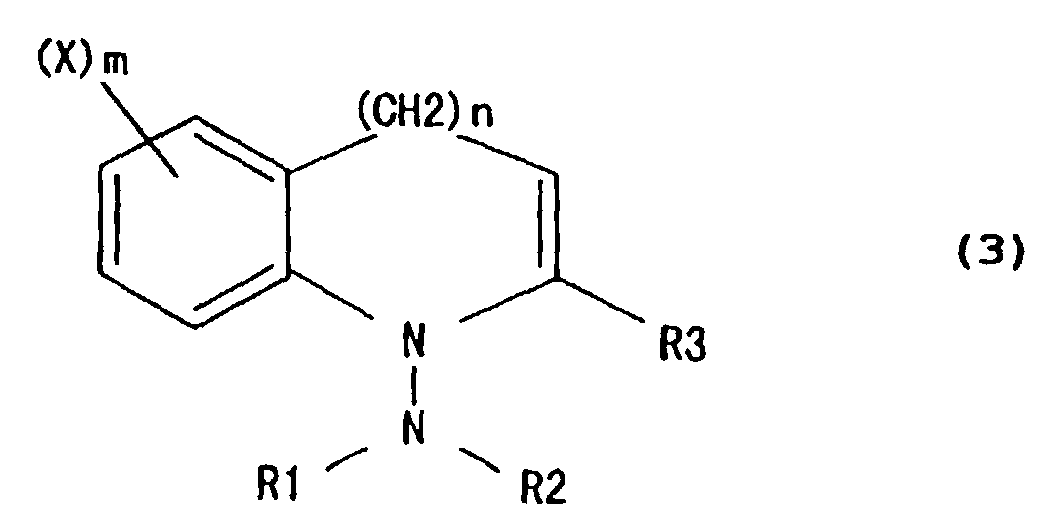
In the nitrogen-heterocyclic compound represented by General Formula (2) shown above or the halogenated nitrogen-heterocyclic compound represented by General Formula (3) below:
Figure 00160001
the substituents R1 and R2 are, in the present invention, independently hydrogen, an alkyl group, a phenyl group, a substituted phenyl group, a furyl group, or a thienyl group. The alkyl group includes methyl, ethyl, propyl, and butyl. The substituted phenyl includes 4-tolyl, 4-(t-butyl)phenyl, 4-fluorophenyl, 3-trifluoromethylphenyl, and 4-methoxyphenyl.
In the nitrogen-heterocyclic compound represented by General Formula (2) shown above or the halogenated nitrogen-heterocyclic compound represented by General Formula (3) above, in the present invention, the substituent R3 is hydrogen, or an aryl group. The aryl group includes specifically phenyl, 4-tolyl, 4-fluorophenyl, 3-trifluoromethylphenyl, 4-methoxyphenyl, and 4-biphenyl.
In the nitrogen-heterocyclic compound represented by General Formula (2), the substituent R4 is a substituted amino group. The amino group includes specifically 1-piperazinyl, 4-methyl-piperazinyl, 3-methyl-1-piperazinyl, 1-homopiperazinyl, N-phenyl-N-methyl, diphenylamino, di(p-tolyl)amino, N-(1-naphthyl)-N-phenylamino, N-(2-naphthyl)-N-phenylamino, N-(2-fluorenyl)-N-phenylamino, 1-pyrrolyl, 1-indolyl, and 9-carbazolyl.
In the halogenated nitrogen-heterocyclic compound represented by General Formula (3), the substituent X is a halogen. The halogen specifically includes fluorine, chlorine, bromine, and iodine.
The nitrogen-heterocyclic compound represented by General Formula (2) in the present invention specifically includes indole derivatives such as 4-(1-piperazinyl)-1-(dimethylamino)indole, 4-(1-piperazinyl)-1-(diphenylamino)indole, 4-(1-piperazinyl)-1-(N-phenyl-N-methylamino)indole, 4-(1-piperazinyl)-1-[(N-(2-furyl)-N-methylamino]indole, 4-(1-piperazinyl)-1-[(N-(2-thienyl)-N-methylamino]indole, 4-(1-piperazinyl)-1-[(N-(4-trifluoromethylphenyl)-N-methylamino]indole, 4-(1-piperazinyl)-1-(dimethylamino)-2-phenylindole, 4-(N-phenyl-N-methylamino)-1-(dimethylamino)indole, 4-(N-phenyl-N-methylamino)-1-(diphenylamino)indole, 4-(N-diphenylamino)-1-(diphenylamino)indole, 4-[N-(1-naphthyl)-N-phenylamino]-1-(diphenylamino)indole, 4-(1-pyrrolyl)-1-(dimethylamino)indole, 6-(1-pyrrolyl)-1-(dimethylamino)indole, 4-(1-indolyl)-1-(dimethylamino)indole, 6-(1-piperazinyl)-1-(dimethylamino)indole, 7-(1-piperazinyl)-1-(dimetylamino)indole, 6-(1-pyrrolyl)-1-(dimethylamino)indole, 4-(1-homopiperizinyl)-1-(dimethylamino)indole, 4-(3-methyl-1-piperazinyl)-1-(dimethylamino)indole, 4-di(p-tolyl)amino-1-(dimethylamino)indole, 6-(9-carbazolyl)-1-(dimethylamino)indole, and 4,6-bis(diphenylamino)-1-(dimethylamino)indole; and 4H-quinoline derivatives such as 1-(dimethylamino)-5-(1-pyrrolyl)-4H-quinoline, 1-(dimethylamino)-5-(9-carbazolyl)-2-phenyl-4H-quinoline, 1-(dimethylamino)-7-(1-piperazinyl)-4H-quinoline, 1-(dimethylamino)-6-(1-piperazinyl)-4H-quinoline, 1-(dimethylamino)-5-(1-piperazinyl)-4H-quinoline, 1-(dimethylamino)-5-(diphenylamino)-4H-quinoline, and 1-(dimethylamino)-5,7-bis(diphenylamino)-2-phenyl-4H-quinoline.
The halogenated nitrogen-heterocyclic compound represented by General Formula (3) includes specifically indole derivatives such as 4-chloro-1-(dimethylamino)indole, 4-chloro-1-(diphenylamino)indole, 4-chloro-1-(N-phenyl-N-methylamino)indole, 4-chloro-1-[N-(2-furyl)-N-methylamino]indole, 4-chloro-1-[N-(2-thienyl)-N-methylamino]indole, 4-chloro-1-[N-(4-trifluoromethylphenyl)-N-methylamino]indole, 4-chloro-1-(dimethylamino)-2-phenylindole, 4-bromo-1-(dimethylamino)indole, 4-iodo-1-(diphenylamino)indole, 4-fluoro-1-(diphenylamino)indole, 6-chloro-1-(diphenylamino)indole, 5-chloro-1-(dimethylamino)indole, 6-bromo-1-(dimethylamino)indole, 7-chloro-1-(dimethylamino)indole, 4,6-dichloro-1-(dimethylamino)indole, 4,6-dibromo-1-(dimethylamino)indole, 4-fluoro-1-(dimethylamino)indole, and 6-fluoro-4-fluoro-1-(dimethylamino)indole; and 4H-quinoline derivatives such as 1-(dimethylamino)-5-chloro-4H-quinoline, 1-(dimethylamino)-5-chloro-2-phenyl-4H-quinoline, 1-(dimethylamino)-7-chloro-4H-quinoline, 1-(dimethylamino)-6-chloro-4H-quinoline, 1-(dimethylamino)-5-bromo-4H-quinoline, 1-(dimethylamino)-5-iodo-4H-quinoline, 1-(dimethylamino)-5,7-dichloro-2-phenyl-4H-quinoline, 5-fluoro-1-(dimethylamino)-4H-quinoline, and 7-fluoro-1-(dimethylamino)-4H-quinoline.
The processes for producing the nitrogen-heterocyclic compound represented by General Formula (2), and for producing the halogenated nitrogen-heterocyclic compound represented by General Formula (3) in the present invention are explained below. Naturally, the process for producing the nitrogen-heterocyclic compound represented by General Formula (2) and the halogenated nitrogen-heterocyclic compound represented by General Formula (3) of the present invention is not limited to that described below.
The halogenated nitrogen-heterocyclic compound represented by General Formula (3) can be synthesized, for example, by the steps shown below. A hydrazone derivative represented by General Formula (8) is cyclized intramolecularly in the presence of a catalyst comprising a phosphine and a palladium compound, and a base:
Figure 00200001
where R1 and R2 are independently hydrogen, an alkyl group, a phenyl group, a substituted phenyl group, a furyl group, or a thienyl group; R3 is hydrogen or an aryl group; X is a halogen; m is 1 or 2; and n is 0 or 1.
In this reaction, a palladium compound and a phosphine are added in combination as the catalyst into the reaction system. The catalyst components may be separately added to the reaction system, or may be added thereto as a preliminarily formed complex.
The palladium compound includes palladium(II) chloride, palladium(II) bromide, palladium(II) acetate, tris(dibenzylideneacetone)dipalladium(0), tris(dibenzylideneacetone)dipalladium(0) chloroform complex, and tetrakis(triphenylphosphine)palladium(0). The amount of the palladium compound used for the reaction ranges preferably from 0.001 to 10 mole%, more preferably from 0.005 to 7 mole%, still more preferably from 0.005 to 5 mole% in terms of palladium based on the compound represented by General Formula (2).
The phosphine used in this embodiment includes specifically phosphines having a t-butyl/phosphorus linkage such as tri-t-butylphosphine, 1-(N,N-dimethylaminomethyl)-2-(di-t-butylphosphino)ferrocene, 1-(methoxymethyl)-2-(di-t-butylphosphino)ferrocene, 1,1'-bis(di-t-butylphosphino)ferrocene, 2,2'-bis(di-t-butylphosphino)-1,1'-binaphthyl, 2-methoxy-2'-(di-t-butylphosphino)-1,1'-binaphthyl, 2-(di-t-butylphosphino)biphenyl, 2-(di-t-butylphosphino)-2'-dimethylaminobiphenyl, 2-(di-t-butylphosphino)-2'-dimethylamino-1,1'-binaphthyl, (di-t-butylphosphino)ferrocene, and 9,9-dimethyl-4,5-bis(di-t-butylphosphino)xanthene; aromatic phosphines such as tri(o-tolyl)phosphine, 2,2'-bis(diphenylphosphino)-1,1'-binaphthyl, 1-(N,N-dimethylaminomethyl)-2-(diphenylphosphino)ferrocene, and 1-(methoxymethyl)-2-(diphenylphosphino)ferrocene; and 9,9-dimethyl-4,5-bis(diphenylphosphino)xanthene. Of these, preferred are the phosphines having a t-butyl/phosphorus linkage which is capable of improving remarkably the activity and selectivity of the reaction. The amount of the phosphine to be added to the reaction system ranges preferably from 0.5 to 10 moles, more preferably from 0.8 to 5 moles, per mole of the palladium compound.
The base employed includes carbonates such as potassium carbonate, sodium carbonate, lithium carbonate, rubidium carbonate, and cesium carbonate; t-butoxylithium; t-butoxysodium; and t-butoxypotassium. The base is used in an amount ranging preferably from 0.7 to 3.2 moles, more preferably from 0.9 to 2.4 moles per mole of the compound represented by General Formula (8).
The above reaction is conducted usually in an inert solvent. The preferred solvent includes aromatic hydrocarbon solvents such as benzene, toluene, and xylene.
The above reaction is conducted under an ordinary pressure in an inert gas atmosphere of nitrogen, argon, or the like, but may be conducted under pressure. The reaction temperature is preferably in the range from 20 to 300°C, more preferably from 50 to 200°C. The reaction time is in the range from several minutes to 72 hours, depending on the reaction conditions, the compound represented by General Formula (3), the palladium compound, and so forth. After the reaction, the intended compound can be obtained by treating the reaction mixture by a conventional manner.
The hydrazone compound represented by General Formula (8), which is the source substance of the halogenated nitrogen-heterocyclic compound represented by General formula (3), can be synthesized, for example, through the steps shown below.
The hydrazone compound represented by General Formula (8) in which n is 0 can be synthesized, for example, through the steps shown below. A benzyl halide having a halogen X at 2-position and another halogen X on the benzene ring is brought into contact with magnesium in ether to form a corresponding benzyl Grignard reagent. This benzyl Grignard reagent is allowed to react with N,N-dimethyl carboxylic acid amide (R3CONMe2). The product (B), a benzyl ketone or a benzyl aldehyde (R3=H), is allowed to react with a hydrazine (R1R2NNH2) in toluene to obtain a hydrazone derivative of n=0 which is the source substance of the process of this embodiment. Various halogen-substituted benzyl halide such as 2,6-dichlorobenzyl chloride, 2,4-dichlorobenzyl chloride, and 2,5-dichlorobenzyl chloride are commercially readily available. Otherwise, a dichlorotoluene, which is readily available, can be chlorinated or brominated at the methyl group thereof by a conventional method to obtain the halogen-substituted benzyl halide. In such a manner, the hydrazone, the source material in this embodiment, can be synthesized from a readily available compound. In this synthesis, the yield of the hydrazone derivative ranges from 50% to 60% based on the halogenated benzyl halide.
The hydrazone compound represented by General Formula (8) in which n is 1 can be synthesized, for example, through the steps shown as below. A lithium enamide prepared from lithium diisopropylamide (LDA) and an N-cyclohexylimine of acetaldehyde or an arylmethyl ketone, and a benzyl halide having a halogen X at 2-position and another halogen X on the benzene ring are allowed to react in THF to obtain a carbonyl compound having the corresponding substituents. The N-cyclohexylimine and the corresponding lithium enamide can be prepared also according to the known method (described in Organic Syntheses, Collective Volume VI, 1988, pp.901-904). The resulting carbonyl compound is allowed to react with a hydrazine (R1R2NNH2) in toluene to synthesize the hydrazone derivative of n=1 which is the source substance of the process of this embodiment. In this synthesis, the yield of the hydrazone derivative ranges from 50% to 70% based on the halogen-substituted benzyl halide (B).
On the other hand, the nitrogen-heterocyclic compound represented by General Formula (2) can be synthesized, for example, by reaction of a halogenated nitrogen-heterocyclic compound in the presence of an amine and a base with a catalyst composed of a phosphine and a palladium compound.
The amine includes piperazine, 1-methylpiperazine, 2-methylpiperazine, homopiperazine, N-phenyl-N-methylamine, diphenylamine, di(p-tolyl)amine, N-(1-naphthyl)-N-phenylamine, N-(2-naphthyl)-N-phenylamine, N-(2-fluorenyl)-N-phenylamine, pyrrole, indole, and carbazole.
The amine is used in an amount ranging usually from 0.7 to 6.0 moles, preferably from 0.7 to 3.2 moles per mole of the compound represented by General Formula (3). The catalyst, the base, and the reaction conditions are the same as in the synthesis of the nitrogen-heterocyclic compound in which R4 is halogen.
3. Process for Producing Substituted Indole Represented by General Formula (7):
The compound represented by General formula (7) can be produced by intramolecular cyclization of a compound represented by General formula (5):
Figure 00250001
(where R1 and R2 are independently hydrogen, an alkyl group, an aryl group, or a heteroaryl group; R3 is hydrogen or an aryl group; and X is a halogen), in the presence of a catalyst comprising a phosphine and a palladium compound, an amine represented by General Formula (6): R5R6NH (where R5 and R6 are independently hydrogen, an alkyl group, or an aryl group, and R5 and R6 may be linked to form a hetero-ring), and a base; and simultaneous introduction of an amino group onto the non-nitrogen aromatic ring.
In the hydrazone derivative represented by General Formula (5) in this embodiment, the alkyl group as the substituents R1 and R2 includes methyl, ethyl, propyl, and butyl; the aryl group as the substituents R1 to R3 includes phenyl, 4-tolyl, 4-trifluoromethylphenyl, 4-methoxyphenyl, and 4-biphenyl; the heteroaryl group as the substituents R1 and R2 includes 4-pyridyl, 3-pyridyl, 2-pyridyl, 2-furyl, and 2-thienyl; and the halogen X includes chlorine, bromine, and iodine.
The process for producing the hydrazone derivative represented by the above General Formula (5) having a halogenated aryl group is not specially limited. The hydrazone derivative, the source material of the production process of the present invention can be synthesized, for example, as below. A benzyl halide having a halogen X at 2-position and another halogen on the aromatic ring are brought into contact with magnesium in ether to form a corresponding benzyl Grignard reagent. This benzyl Grignard reagent is allowed to react with N,N-dimethyl carboxylic acid amide (R3CONMe2). The product, a benzyl ketone or a benzyl aldehyde, is allowed to react with a hydrazine (R1R2NNH2) in toluene to obtain a hydrazone derivative which is the source substance of this embodiment. Various halogen-substituted benzyl halides such as 2,6-dichlorobenzyl chloride, 2,4-dichlorobenzyl chloride, and 2,5-dichlorobenzyl chloride are commercially available readily. Otherwise, dichlorotoluenes, which are readily available, can be chlorinated or brominated at the methyl group thereof by a conventional method to obtain the halogen-substituted benzyl halide. In such a manner, the hydrazone derivative, the source material in this embodiment, can be synthesized from readily available compounds. In this synthesis, the yield of the hydrazone derivative ranges from about 50% to about 60% based on the halogenated benzyl halide.
The amine represented by General Formula (6) in this embodiment includes specifically dimethylamine, diethylamine, di(n-butyl)amine, aniline, N-methylaniline, diphenylamine, di(p-tolyl)amine, di(p-methoxyphenyl)amine, di(p-fluorenyl)amine, di[m-(trifluoromethyl)phenyl]amine, m-(trifluormethyl)aniline, piperazine, 4-alkyl-1-piperazine, 3-methylpiperazine, homopiperazine, pyrrole, indole, and carbazole. The amine is used in an amount ranging preferably from 0.7 to 10 moles, more preferably from 0.9 to 6 moles per mole of the compound represented by the above General Formula (5).
In this reaction, a palladium compound and a phosphine are added in combination as the catalyst into the reaction system. The catalyst components may be separately added to the reaction system, or may be added thereto as a preliminarily formed complex.
The palladium compound used in this embodiment is not specially limited, and includes divalent palladium compounds such as palladium(II) chloride, palladium(II) bromide, palladium(II) acetate, palladium(II) acetylacetonate, dichlorobis(benzonitrile)palladium(II), dichlorobis(acetonitrile)palladium(II), dichlorobis(triphenylphosphine)palladium(II), dichlorotetraammine palladium(II), dichloro(cycloocta-1,5-diene)palladium(II), and palladium(II) trifluoroacetate; and zero-valent palladium compounds such as tris(dibenzylideneacetone)dipalladium(0), tris(dibenzylideneacetone)dipalladium(0) chloroform complex, and tetrakis(triphenylphosphine)palladium(0). Of these, particularly preferred are palladium acetate, and tris(dibenzylideneacetone)dipalladium(0). The amount of the palladium compound used for the reaction is not limited, and ranges preferably from 0.001 to 10 mole%, more preferably from 0.005 to 7 mole%, still more preferably from 0.005 to 5 mole% in terms of palladium based on the compound represented by General Formula (5).
The phosphine used in this embodiment includes specifically phosphines having a t-butyl-phosphorus linkage such as tri-t-butylphosphine, 1-(N,N-dimethylaminomethyl)-2-(di-t-butylphosphino)ferrocene, 1-(methoxymethyl)-2-(di-t-butylphosphino)ferrocene, 1,1'-bis(di-t-butylphosphino)ferrocene, 2,2'-bis(di-t-butylphosphino)-1,1'-binaphthyl, 2-methoxy-2'-(di-t-butylphosphino)-1,1'-binaphthyl, 2-(di-t-butylphosphino)biphenyl, 2-(di-t-butylphosphino)-2'-dimethylaminobiphenyl, 2-(di-t-butylphosphino)-2'-dimethylamino-1,1'-binaphthyl, (di-t-butylphosphino)ferrocene, and 9,9-dimethyl-4,5-bis(di-t-butylphosphino)xanthene; aromatic phosphines such as tri(o-tolyl)phosphine, 2,2'-bis(diphenylphosphino)-1,1'-binaphthyl, 1-(N,N-dimethylaminomethyl)-2-(diphenylphosphino)ferrocene, and 1-(methoxymethyl)-2-(diphenylphosphino)ferrocene; and 9,9-dimethyl-4,5-bis(diphenylphosphino)xanthene. Of these, preferred are the phosphines having a t-butyl-phosphorus linkage which is capable of improving remarkably the activity and selectivity of the reaction. The amount of the phosphine to be added to the reaction system is not specially limited, but is preferably in the range from 0.5 to 10 moles, more preferably from 0.8 to 5 moles, per mole of the palladium compound.
The base used in this embodiment is not limited, and may be selected from organic bases and inorganic bases. The preferred base includes specifically sodium hydride, potassium hydride, lithium hydride, sodium amide, potassium amide, lithium amide, potassium carbonate, sodium carbonate, lithium carbonate, rubidium carbonate, cesium carbonate, potassium hydrogencarbonate, sodium hydrogencarbonate, sodium metal, potassium metal, lithium metal, methoxysodium, methoxypotassium, ethoxysodium, ethoxypotassium, ethoxylithium, t-butoxylithium, t-butoxysodium, and t-butoxypotassium. Of these bases, particularly preferred are t-butoxysodium, and carbonates. The amount of the base to be added to the reaction system is preferably in the range from 0.7 to 5 moles, more preferably from 0.9 to 3 moles, per mole of the compound represented by General Formula (5).
The above reaction is conducted usually in an inert solvent. The solvent is not limited, provided that the reaction is not significantly retarded. The solvent includes, aromatic hydrocarbon solvents such as benzene, toluene, and xylene; ether solvents such as diethyl ether, tetrahydrofuran, and dioxane; acetonitrile; dimethylformamide; dimethylsulfoxide; and hexamethylphosphoric triamide. Particularly preferred are aromatic hydrocarbons including benzene, toluene, and xylene.
The above reaction is conducted usually under an ordinary pressure in an inert gas atmosphere of nitrogen, argon, or the like, but may be conducted under pressure. The reaction temperature ranges preferably from 20 to 300°C, more preferably from 50 to 200°C. The reaction time ranges from several minutes to 72 hours, depending on the reaction conditions, the compound represented by General Formula (5), the palladium compound, and so forth. After the reaction, the intended compound can be obtained by treating the reaction mixture by a conventional manner.
The substituted indole derivative represented by the above General Formula (7) produced according to the present invention includes specifically indole derivatives such as 4-dimethylamino-1-(dimethylamino)indole, 4-dibutylamino-1-(methylamino)indole, 4-(N-phenyl-N-methylamino)-1-(diphenylamino)indole, 4-(1-piperazinyl)-1-(dimethylamino)indole, 4-(1-piperazinyl)-1-(diphenylamino)indole, 4-(1-piperazinyl)-1-(N-phenyl-N-methylamino)indole, 4-(1-piperazinyl)-1-[(N-(4-pyridyl)-N-methylamino]indole, 4-(1-piperazinyl)-1-[(N-(3-pyridyl)-N-methylamino]indole, 4-(1-piperazinyl)-1-[(N-(2-furyl)-N-methylamino]indole, 4-(1-piperazinyl)-1-[(N-(2-thienyl)-N-methylamino]indole, 4-(1-piperazinyl)-1-[(N-(4-trifluoromethylphenyl)-N-methylamino]indole, 4-(1-piperazinyl)-1-(dimethylamino)-2-phenylindole, 4-(1-pyrrolyl)-1-(dimethylamino)indole, 4-(1-indolyl)-1-(dimethylamino)indole, 6-(1-piperazinyl-1-(dimethylamino)indole, 6-(1-pyrrolyl)-1-(dimethylamino)indole, 4-(1-homopiperazinyl)-1-(dimethylamino)indole, 4-(3-methyl-1-piperazinyl)-1-(dimethylamino)indole, and 4-(9-carbazolyl)-1-(dimethylamino)indole.
(Effects of the Invention)
The nitrogen-heterocyclic compound of the present invention is a novel compound having a substituent additionally at 4-position of an indole ring, and are highly useful as the source substance for medicines and pesticides, and for electronic materials.
The present invention has made possible the synthesis of the useful nitrogen-heterocyclic compound from a readily available hydrazone derivative having a halogenated aryl group by intramolecular cyclization thereof in the presence of a catalyst composed of a palladium compound and a phosphine, and a base. The nitrogen-heterocyclic compounds including the indoles and the 4H-quinolines produced according to the present invention has a 1-amino structure in which the nitrogen of the amino group is directly bonded to the nitrogen of the ring. The compound having such a structure is disclosed as a useful compound for use for a medicine in JP-A-7-53376. However, it was extremely difficult to prepare the compound by a prior art technique. The present invention has made possible the easy synthesis of the compound. By prior art techniques, the introduction of a substituent selectively to 4-position of the indole ring requires considerable time and labor. The present invention has made possible this selective substituent introduction by use of readily available source substances.
On the other hand, the product of the present invention can readily be cleaved at the nitrogen-nitrogen bond by hydrogenation reduction, thereby enabling providing a nitrogen-heterocyclic compound having no substituent on the nitrogen. Further, the product of the present invention includes the one having a halogen on the benzene ring moiety. This halogen can be converted to an amino group, an aryl group, or a substituted vinyl group by use of the palladium-phosphine catalyst. Therefore, the compounds provided by the present invention are highly useful as the intermediate for nitrogen-heterocyclic compounds having various substituents.
Examples of the present invention are show below without limiting the invention in any way.
Reference Example 1: (Synthesis of 2,6-dichlorophenylacetaldehyde N,N-dimethylhydrazone)
A 200-mL three-necked flask equipped with a thermometer, a dropping funnel, a three-way stopcock, and a mechanical stirrer was purged with nitrogen. Thereto, were added 1.85 g (76 mmol) of magnesium, and 30 mL of diethyl ether. The dropping funnel was filled with a solution of 13.5 g (69 mmol) of 2,6-dichlorobenzyl chloride (produced by Tokyo Kasei K.K.) in 40 mL of diethyl ether. The solution was added dropwise into the flask by keeping the temperature of the reaction system at about 30°C. Thereafter, the reaction mixture was aged at room temperature for 30 minutes, and cooled with ice. Thereto, 6 g (82 mmol) of N,N-dimethylformamide was added dropwise. The reaction mixture was aged at room temperature for one hour, cooled with ice, and poured into 50 mL of 3N hydrochloric acid solution. The mixture was allowed to separate into phases, and the separated matter was extracted with diethyl ether. The combined organic phase was dried over anhydrous sodium sulfate. After filtration and concentration, 5 mL of methyl t-butyl ether was added to the concentration residue, and the mixture was heated to dissolve the residue. After cooling of the solution to room temperature, the deposited crystalline matter was collected by filtration to obtain 8.1 g (43 mmol) of crystalline 2,6-dichlorophenylacetaldehyde. (Yield: 62%)
A 1.0 g portion of Molecular Sieve 4A was placed in a 30-mL one-necked flask. The flask was purged with nitrogen. Into this flask, 1.01 g (5.3 mmol) of the above obtained 2,6-dichlorophenylacetaldehyde was put, and was dissolved by addition of 4 mL of toluene. With ice cooling, 351 mg (5.8 mmol) of N,N-dimethylhydrazine was added thereto. The mixture was stirred at room temperature for 3 hours. Thereafter, the reaction mixture was filtered, and the filtrate was concentrated. The concentration solution was distilled under a vacuum of 2 mmHg to obtain 1.14 g (4.0 mmol) of 2,6-dichlorophenylacetaldehyde N,N-dimethylhydrazone. (Yield: 93%)
Reference Example 2
2,4-Dichlorophenylacetaldehyde N,N-dimethylhydrazone was prepared in the same manner as in Reference Example 1 except that 2,4-dichlorobenzyl chloride (produced by Wako Pure Chemical Co.) was used in place of 2,6-dichlorobenzyl chloride. (Yield: 53% based on 2,4-dichlorobenzyl chloride)
Reference Example 3
2-Chlorophenylacetaldehyde N,N-dimethylhydrazone was prepared in the same manner as in Reference Example 1 except that 2-chlorobenzyl chloride (produced by Wako Pure Chemical Co.) was used in place of 2,6-dichlorobenzyl chloride. (Yield: 58% based on 2-chlorobenzyl chloride)
Reference Example 4 (Synthesis of 3-(2,6-dichlorophenyl)propionaldehyde N,N-dimethylhydrazone)
Acetaldehyde N-cyclohexylimine (N-ethylidenecyclohexylamine) was prepared in a yield 6.9 g (52.6 mmol) and was allowed to react with lithium diisopropylamide according to the method described in Organic Syntheses, Collective Volume VI, 1988, pp.901-904.
Separately, a 100-mL three-necked flask equipped with a thermometer, a dropping funnel, a three-way stopcock, and a magnetic stirrer was purged with nitrogen. Thereto, were added 10.2 g (52.2 mmol) of 2,6-dichlorobenzyl chloride (produced by Tokyo Kasei K.K), and 25 mL of tetrahydrofuran. To this solution, the above obtained solution of the lithium salt compound was added dropwise by keeping the temperature of the reaction system in the range from 15 to 20°C. The reaction mixture was aged at room temperature for 2 hours, and the cooled with ice. Thereto 3N hydrochloric acid solution was added to stop the reaction. The mixture was extracted with ether. The organic phase was dried over anhydrous sodium sulfate, filtered, and concentrated. To the flask containing the concentration residue, 10 g of Molecular Sieve 4A was added and the flask was purged with nitrogen. The concentration residue was dissolved by addition of 10 mL of toluene, and was cooled with ice. Thereto, 3.45 g (57.4 mmol) of N,N-dimethylhydrazine was added. The mixture was stirred at room temperature for 3 hours, and filtered. The filtrate was concentrated under a reduced pressure. The obtained concentration residue was purified by silica gel chromatography (Solvent: hexane, ratio of hexane:ethyl acetate=20:1) to obtain 7.42 g (30.3 mmol) of 3-(2,6-dichlorophenyl)propionaldehyde N,N-dimethylhydrazone. (Yield: 58% based on 2,6-dichlorobenzyl chloride)
Example 1
A 30-mL three-necked flask equipped with a thermometer, a three-way stopcock, and a magnetic stirrer was purged with nitrogen. Thereto, were added 31.5 mg of tris(dibenzylideneacetone)dipalladium(0) (produced by Strem Co.; 0.069 mmol as palladium, 3.0 mol% based on 2-chlorophenylacetaldehyde N,N-dimethylhydrazone, the source substance), 264 mg (2.74 mmol) of t-butoxysodium, 5 mL of o-xylene, 40.1 mg (0.104 mmol) of 1-(N,N-dimethylaminomethyl)-2-(di-t-butylphosphino)ferrocene, and 450 mg (2.29 mmol) of 2-chlorophenylacetaldehyde N,N-dimethylhydrazone, in the named order. The mixture was heated to 110°C, and stirred at that temperature for 4 hours. The mixture was cooled to room temperature. Thereto, 10 mL of water was added. The mixture was extracted with diethyl ether. The extract solution was dried over anhydrous sodium sulfate, and was concentrated. The concentration residue was purified by alumina column chromatography (solvent; hexane:diethyl ether=50:1). Thereby, 275 mg (1.72 mmol) of the intended product, 1-(dimethylamino)indole. (Yield: 75%, GC purity 99%)
Example 2
1-(Dimethylamino)indole was prepared in the same manner as in Example 1 except that 42.2 mg (0.21 mmol) of tri(t-butyl)phosphine was used in place of 1-(N,N-dimethylaminomethyl)-2-(di-t-butylphosphino)ferrocene, and the reaction was conducted at 120°C for 20 hours. (Yield: 41%)
Example 3
4-Chloro-1-(dimethylamino)indole was prepared in the same manner as in Example 1 except that 2,6-dichlorophenylacetaldehyde N,N-dimethylhydrazone was used in place of 2-chlorophenylacetaldehyde N,N-dimethylhydrozone, and the reaction was conducted at 120°C for 120 hours. (Yield: 35%)
Example 4
4-Chloro-1-(dimethylamino)indole was prepared in the same manner except that cesium carbonate was used in place of t-butoxysodium. (Yield: 33%).
Example 5
6-Chloro-1-(dimethylamino)indole was prepared in the same manner as in Example 1 except that 2,4-dichlorophenylacetaldehyde N,N-dimethylhydrazone was used in place of 2-chlorophenylacetaldehyde N,N-dimethylhydrazone, and the reaction was conducted at 120°C for 8 hours. (Yield: 21%)
Example 6
4-Chloro-1-(N-phenyl-N-methylamino)indole was prepared in the same manner as in Example 1 except that 2,6-dichlorophenylacetaldehyde N-phenyl-N-methylhydrazone was used in place of 2-chlorophenylacetaldehyde N,N-dimethylhydrazone, and the reaction was conducted at 120°C for 8 hours. (Yield: 39%)
Example 7
5-Chloro-1-(dimethylamino)-4H-quinoline was prepared in the same manner as in Example 1 except that 3-(2,6-dichlorophenyl)propionaldehyde N,N-dimethylhydrazone was used in place of 2-chlorophenylacetaldehyde N,N-dimethylhydrazone, cesium carbonate was used in place of t-butoxysodium, and the reaction was conducted at 120°C for 8 hours. (Yield: 35%)
  • 1H NMR (400 MHz, CDCl3, TMS): δ=2.67 (s, 6H), 2.85-2.94 (m, 2H), 3.02-3.08 (m, 2H, 7.19 (t, J=7.4Hz, 1H), 7.31 (d, J=6.7Hz, 1H), 7.63 (d, J=7.4Hz, 1H)
  • 13C NMR (100 MHz, CDCl3, TMS): δ=28.12, 28.50, 46.24, 46.84, 47.61, 120.03, 129.16, 130.74, 140.93, 145.80, 166.88
  • Table 1 shows the source substances and the products of Examples 1-7.
    Figure 00390001
    Example 8
    A 30-mL three-necked flask equipped with a thermometer, a three-way stopcock, and a magnetic stirrer was purged with nitrogen. Thereto, were added 31.5 mg of tris(dibenzylideneacetone)dipalladium(0) (produced by Strem Co.; 0.069 mmol as palladium, 3.0 mol% based on 2,6-dichlorophenylacetaldehhyde N,N-dimethylhydrazone, the source substance), 264 mg (2.74 mmol) of t-butoxysodium, 5 mL of o-xylene, 40.1 mg (0.104 mmol) of 1-(N,N-dimethylaminomethyl)-2-(di-t-butylphosphino)ferrocene, and 529 mg (2.29 mmol) of 2,6-dichlorophenylacetaldehyde N,N-dimethylhydrazone, in the named order. The mixture was heated to 120°C, and stirred at that temperature for 8 hours. The mixture was cooled to room temperature. Thereto, 10 mL of water was added. The mixture was extracted with diethyl ether. The extract solution was dried over anhydrous sodium sulfate, and was concentrated. The concentration residue was purified by alumina column chromatography (solvent; hexane:diethyl ether=80:1). Thereby, 156 mg (0.80 mmol) of the intended product, 4-chloro-1-(dimethylamino)indole was obtained. (Yield: 35%, GC purity: 99%).
  • 1H NMR (400 MHz, CDCl3, TMS): δ=2.89 (s, 6H), 6.58 (d, J=3.4 Hz 1H), 7.05-7.18 (m, 2H), 7.43 (d, J=3.4Hz, 1H), 7.45 (d, J=7.4Hz, 1H)
  • 13C NMR (100 MHz, CDCl3, TMS): δ=47.00, 47.48, 99.07, 108.55, 119.40, 121.83, 122.45, 123.99, 126.04, 135.82
  • Example 9
    4-(1-piperizinyl-1-dimethylamino)indole was prepared in the same manner as in Example 8 except that 4-chloro-1-(dimethylamino)indole synthesized in Example 8 was used in place of 2,6-dichlorophenylacetaldehyde N,N-dimethylhydrazone as the source substance, palladium was used in an amount of 1.0 mol% based on the source substance, piperazine in 4 equivalents to the source substance was added, and the solvent in the alumina column chromatography was changed to ethyl acetate: methanol (10:1 to 5:1). (Yield: 95%)
  • 1H NMR (400 MHz, CDCl3, TMS): δ=1.75 (brs, NH), 2.88 (s, 6H), 3.09 (t, J=4.7Hz, 4H), 3.19 (t, J=4.7Hz, 4H), 6.48 (d, J=3.4Hz, 1H), 6.57 (d, J=7.4Hz, 1H), 7.13 (t, J=7.4Hz, 1H), 7.23 (d, J=8.7Hz, 1H), 7.33 (d, J=4.0Hz, 1H)
  • 13C NMR (100 MHz, CDCl3, TMS): δ=46.48, 47.32, 51.50, 52.15, 52.85, 53.40, 99.19, 104.64, 106.54, 118.72, 119.57, 122.42, 136.07, 146.05
  • Example 10
    6-Fluoro-1-(dimethylamino)indole was prepared in the same manner as in Example 8 except that 2-chloro-4-fluorophenylacetaldehyde N,N-dimethylhydrazone was used in place of 2,6-dichlorophenylacetaldehyde N,N-dimethylhydrazone. (Yield: 74%)
  • 1H NMR (400 MHz, CDCl3, TMS): δ=2.88 (s, 6H), 6.45 (d, J=3.3Hz, 1H), 6.84 (dt, J=2.2Hz, 8.4Hz, 1H), 7.21 (dd, J=2.2Hz, 9.8Hz, 1H), 7.36 (d, J=3.6Hz, 1H), 7.46 (dd, J=8.4Hz, 5.1Hz, 1H)
  • Example 11
    5,6-Methylenedioxy-1-(dimethylamino)indole was prepared in the same manner as in Example 8 except that 2-chloro-4,5-methylenedioxyphenylacetaldehyde N,N-dimethylhydrazone was used in place of 2,6-dichlorophenylacetaldehyde N,N-dimethylhydrazone. (Yield: 30%)
  • 1H NMR (400 MHz, CDCl3, TMS): δ=2.87 (s, 6H), 5.92 (s, 2H). 6.35 (d, J=3.3Hz, 1H), 6.94 (s, 1H), 7.02 (s, 1H), 7.26 (d, J=3.3Hz, 1H)
  • Table 2 summarizes the source substances and the products in Examples 8-11.
    Figure 00430001
    Example 12
    A 30-mL three-necked flask equipped with a thermometer, a three-way stopcock, and a magnetic stirrer was purged with nitrogen. Thereto, were added 521 mg (6.0 mmol) of piperazine, 21.2 mg of tris(dibenzylideneacetone)dipalladium(0) (produced by Strem Co.; 0.046 mmol as palladium, 3.0 mol% based on 2,6-dichlorophenylacetaldehyde N,N-dimethylhydrazone, the source substance), 331 mg (3.44 mmol) of t-butoxysodium, 5 mL of o-xylene, 26.7 mg (0.069 mmol) of 1-(N,N-dimethylaminomethyl)-2-(di-t-butylphosphino)ferrocene, and 350 mg (1.51 mmol) of 2,6-dichlorophenylacetaldehyde N,N-dimethylhydrazone, in the named order. The mixture was heated to 120°C, and stirred at that temperature for 20 hours. The mixture was cooled to room temperature. Thereto, 10 mL of water was added. The mixture was extracted with diethyl ether. The extract solution was dried over anhydrous sodium sulfate, and was concentrated. The concentration residue was purified by alumina column chromatography (solvent; ethyl acetate:methanol=5:1). Thereby, 111 mg (0.45 mmol) of the intended product, 4-(1-piperazinyl)-1-(dimethylamino)indole was obtained. The same NMR spectrum as in Example 9 was obtained. (Yield: 30%).
    Example 13
    4-(1-piperazinyl)-1-(N-phenyl-N-methylamino)indole was prepared in the same manner as in Example 12 except that 2,6-dichlorophenylacetaldehyde N-phenyl-N-methylhydrazone was used in place of 2,6-dichlorophenylacetaldehyde N,N-dimethylhydrazone. (Yield: 32%)
  • 1H NMR (400 MHz, CDCl3, TMS): δ=2.88-2.95 (m, 4H), 3.04-3.10 (m, 4H), 3.20 (s, 3H), 6.84 (t, J=7.3Hz, 1H), 7.00 (t, J=5.8Hz, 1H), 7.03 (t, J=4.8Hz, 1H), 7.14-7.28 (m, 7H)
  • Example 14
    4-(N-phenyl-N-methylamino)-1-(dimethylamino)indole was prepared in the same manner as in Example 12 except that N-methylaniline was used in place of piperazine. (Yield: 34%)
  • 1H NMR (400 MHz, CDCl3, TMS): δ=2.91 (s, 6H), 3.41 (s, 3H), 6.10 (d, J=3.3Hz, 1H), 6.77 (t, J=7.3Hz, 1H), 6.81 (d, J= 7.7Hz, 2H), 6.91 (dd, J=7.3Hz, 1.1Hz, 1H), 7.15-7.22 (m, 3H), 7.27 (d, J=3.6Hz, 1H), 7.38 (d, J=8.0Hz, 1H)
  • Example 15
    6-(1-piperazinyl)-1-(dimethylamino)indole was prepared in the same manner as in Example 12 except that 2,4-dichlorophenylacetaldehyde N,N-dimethylhydrazone was used in place of 2,6-dichlorophenylacetaldehyde N,N-dimethylhydrazone. (Yield: 30%)
    Example 16
    6-(1-pyrrolyl)-1-(dimethylamino)indole was prepared in the same manner as in Example 12 except that 2,4-dichlorophenylacetaldehyde N,N-dimethylhydrazone was used in place of 2,6-dichlorophenylacetaldehyde N,N-dimethylhydrazone, tri(t-butyl)phosphine was used in place of 1-(N,N-dimethylaminomethyl)-2-(di-t-butylphosphino)ferrocens, pyrrole was used in place of piperazine, and rubidium carbonate was used in place of t-butoxysodium. (Yield: 21%)
  • 1H NMR (400 MHz, CDCl3, TMS): δ=2.94 (s, 6H), 6,35 (t, J=2.2Hz, 2H), 6.51 (d, J=3.6Hz, 1H), 7.16 (t, J=2.2Hz, 2H), 7.18 (dd, J=8.4Hz, 1.8Hz, 1H), 7.44 (d, J=3.8Hz, 1H), 7.59 (d, J=8.1Hz, 1H), 7.58 (d, J=1.8Hz, 1H).
  • Example 17
    4-(1-pyrrolyl)-1-(dimethylamino)indole was prepared in the same manner as in Example 16 except that 2,6-dichlorophenylacetaldehyde N,N-dimethylhydrazone was used in place of 2,4-dichlorophenylacetaldehyde N,N-dimethylhydrazone. (Yield: 54%)
  • 1H NMR (400 MHz, CDCl3, TMS): δ=2.94 (s, 6H), 6.38 (t, J=2.2Hz, 2H), 6,65 (6, J=3.3Hz, 1H), 7.07 (d, J=7.3Hz, 1H), 7.17 (t, J=2.2Hz, 2H), 7.25 (t, J=7.3Hz, 1H), 7.45 (d, J=3.3Hz, 1H), 7.51 (d, J=7.3Hz, 1H)
  • Example 18
    4-(1-indolyl)-1-(dimethylamino)indole was prepared in the same manner as in Example 16 except that 2,6-dichlorophenylacetaldehyde N,N-dimethylhydrazone was used in place of 2,4-dichlorophenylacetaldehyde N,N-dimethylhydrazone, and indole (212 mg, 1.81 mmol) was used in place of pyrrole. (Yield: 40%)
  • 1H NMR (400 MHz, CDCl3, TMS): δ=2.96 (s, 6H), 6.36 (d, J=3.3Hz, 1H), 6.71 (d, J=3.3Hz, 1H), 7.12-7.19 (m, 2H), 7.21 (d, J=7.3Hz, 1H), 7.32 (t, J=7.7Hz, 1H), 7.42 (d, J=3.3Hz, 1H), 7.43-7.46 (m, 1H), 7.48 (d, J=3.3Hz, 1H), 7.60 (d, J=8.4Hz, 1H), 7.68-7.73 (m, 1H)
  • Table 3 shows the source substances and the products in Examples 12-18.
    Figure 00470001
    Figure 00480001
    A nitrogen-heterocyclic compound is provided which is represented by General Formula (1):
    Figure 00490001
    where R1 and R2 are independently hydrogen, an alkyl group, an aryl group, or a heteroaryl group; R3 is hydrogen or an aryl group; R4 is a substituted amino group, an alkoxy group, a nitro group, or halogen; m is an integer from 0 to 2; and n is 0 or 1. A process for producing the above compound is also provided. This compound is useful as a source material of medicines, pesticides, electronic materials, and intermediates for other substituted nitrogen-heterocyclic compounds.

    Claims (21)

    1. A nitrogen-heterocyclic compound represented by General Formula (1):
      Figure 00500001
      where R1 and R2 are independently hydrogen, an alkyl group, an aryl group, or a heteroaryl group; R3 is hydrogen or an aryl group; R4 is a substituted amino group, an alkoxy group, a nitro group, or halogen; m is an integer from 0 to 2; and n is 0 or 1.
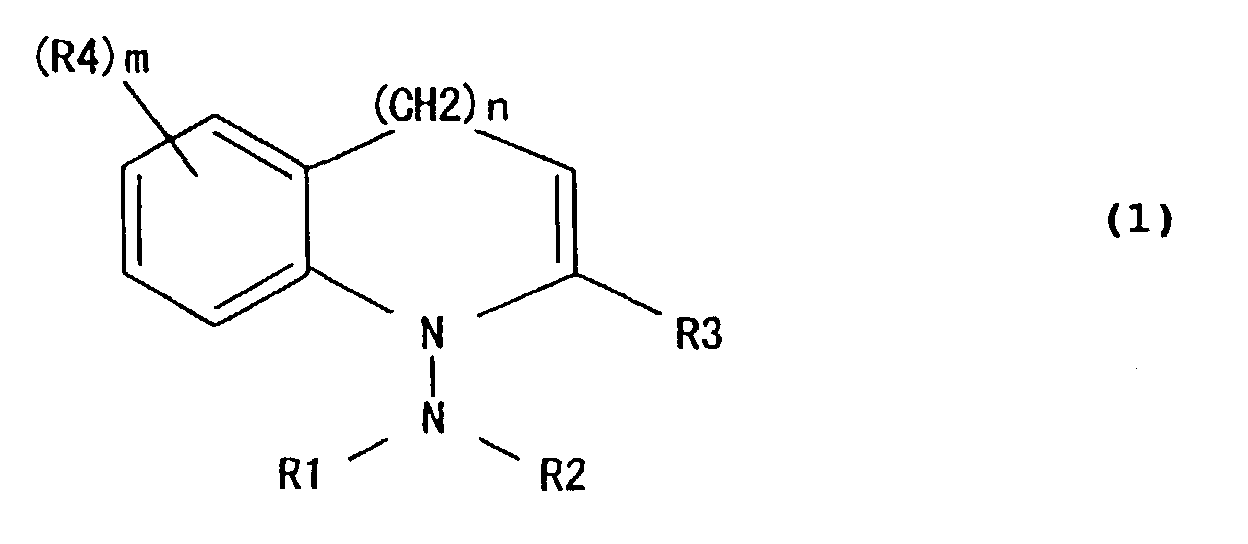
    2. The nitrogen-heterocyclic compound according to claim 1, wherein the nitrogen-heterocyclic compound is represented by General Formula (2):
      Figure 00500002
      where R1 and R2 are independently hydrogen, an alkyl group, a phenyl group, a substituted phenyl group, a furyl group, or a thienyl group; R3 is hydrogen or an aryl group; R4 is a substituted amino group; m is 1 or 2; and n is 0 or 1.
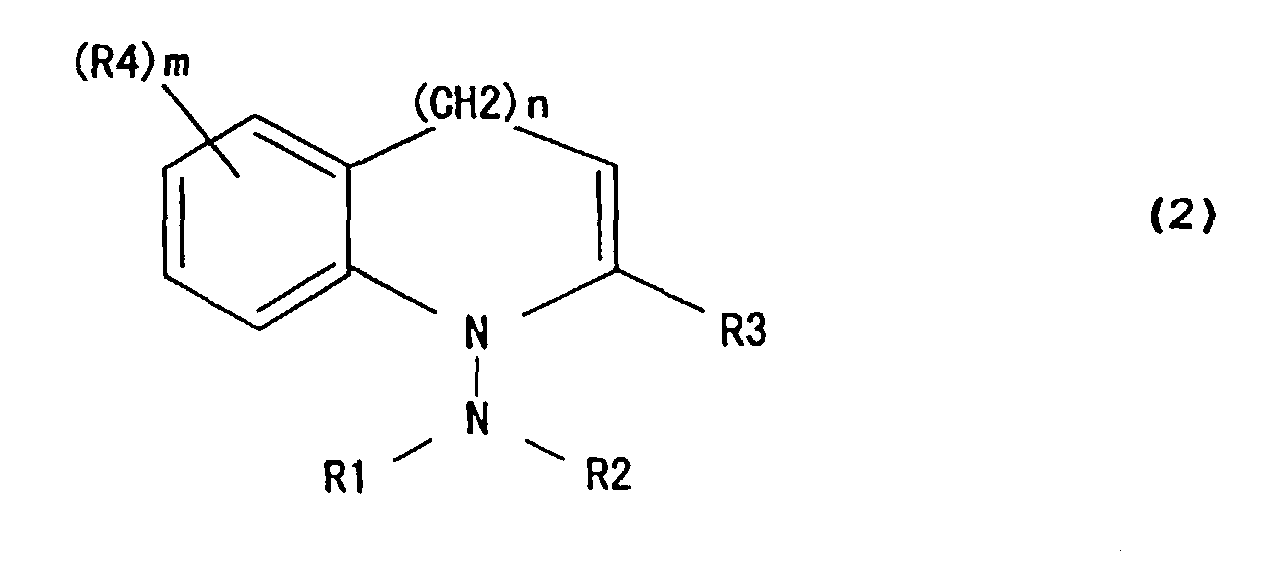
    3. The nitrogen-heterocyclic compound according to claim 2, wherein R1 and R2 in General Formula (2) are independently an alkyl group.
    4. The nitrogen-heterocyclic compound according to claim 2, wherein R1 and R2 in General Formula (2) are independently a phenyl group or a substituted phenyl group.
    5. The nitrogen-heterocyclic compound according to any of claims 2 to 4, wherein m=1, and R4 is at 4-position when n=0, and at 5-position when n=1 in General Formula (2).
    6. The nitrogen-heterocyclic compound according to any of claims 2 to 5, wherein R4 in General Formula (2) is selected from 1-piperazinyl, 4-alkyl-1-piperazinyl, 3-methyl-1-piperazinyl, 1-homopiperazinyl, N-phenyl-N-methylamino, diarylamino, 1-pyrrolyl, 1-indolyl, and 9-carbazolyl.
    7. The nitrogen-heterocyclic compound according to any of claims 2 to 6, wherein m is 1 in General Formula (2).
    8. A halogenated nitrogen-heterocyclic compound represented by General Formula (3):
      Figure 00510001
      where R1 and R2 are independently hydrogen, an alkyl group, a phenyl group, a substituted phenyl group, a furyl group, or a thienyl group; R3 is hydrogen or an aryl group; X is a halogen; m is 1 or 2; and n is 0 or 1.
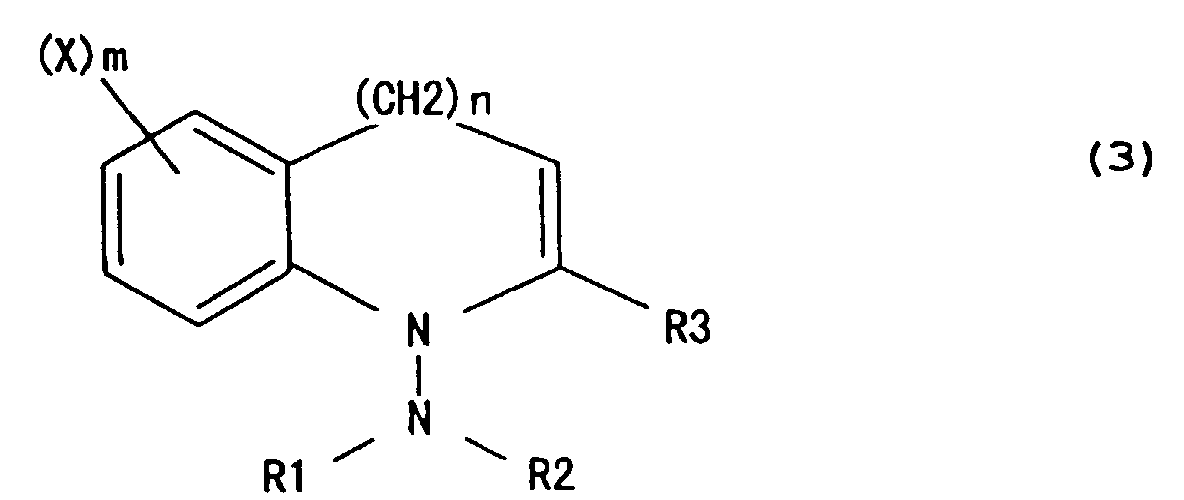
    9. The nitrogen-heterocyclic compound according to claim 8, wherein R1 and R2 in General Formula (3) are independently a phenyl group or a substituted phenyl group.
    10. The nitrogen-heterocyclic compound according to claim 8, wherein R1 and R2 in General Formula (3) are independently an alkyl group.
    11. The nitrogen-heterocyclic compound according to any of claims 8 to 10, wherein m=1, and R4 is at 4-position when n=0, and at 5-position when n=1 in General Formula (3).
    12. The nitrogen-heterocyclic compound according to any of claims 8 to 11, wherein m is 1 in General Formula (3).
    13. A process for producing the nitrogen-heterocyclic compound set forth in claim 1, comprising cyclizing intramolecularly a hydrazone derivative represented by General Formula (4) in the presence of a catalyst comprising a phosphine and a palladium compound, and a base:
      Figure 00520001
      where R1 and R2 are independently hydrogen, an alkyl group, an aryl group, or a heteroaryl group; R3 is hydrogen or an aryl group; R4 is a substituted amino group, an alkoxy group, a nitro group, or halogen; X is a halogen; m is an integer from 0 to 2; and n is 0 or 1.
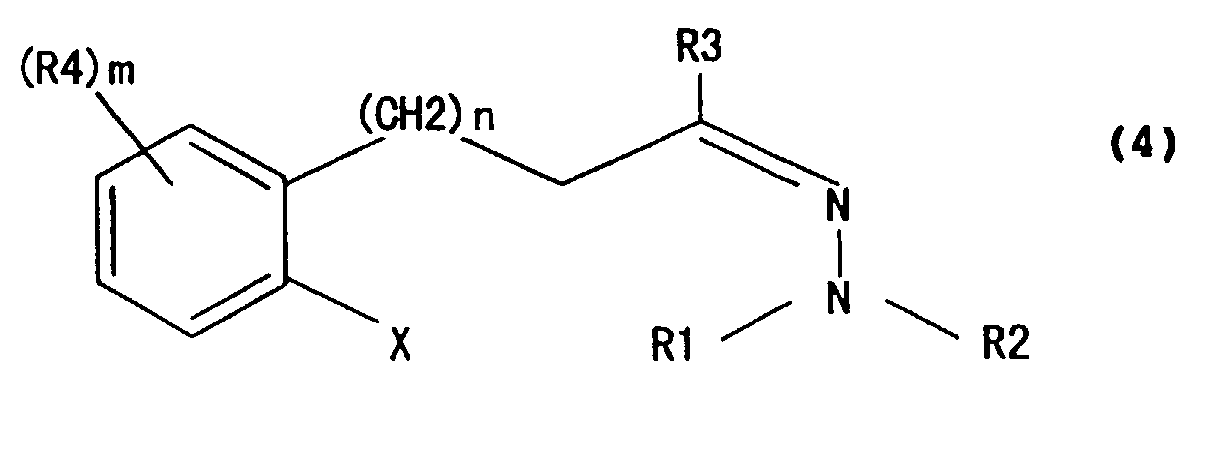
    14. The process according to claim 13, wherein m=1, and R4 is at 4-position when n=0, and at 5-position when n=1 in General Formula (4).
    15. The process according to claim 13 or 14, wherein the phosphine has a t-butyl-phosphorus linkage.
    16. The process according to any of claims 13 to 15, wherein R4 in General Formula (4) is a halogen.
    17. The process according to any of claims 13 to 16, wherein m is 0 or 1 in General Formula (4).
    18. A process for producing a nitrogen-heterocyclic compound set forth in any of claims 2 to 7, comprising reacting a halogenated nitrogen-heterocyclic compound represented by General Formula (3) is allowed to with an amine in the presence of a catalyst comprising a phosphine and a palladium compound, and a base:
      Figure 00530001
      where R1 and R2 are independently hydrogen, an alkyl group, a phenyl group, a substituted phenyl group, a furyl group, or a thienyl group; R3 is hydrogen or an aryl group; X is a halogen; m is 1 or 2; and n is 0 or 1.
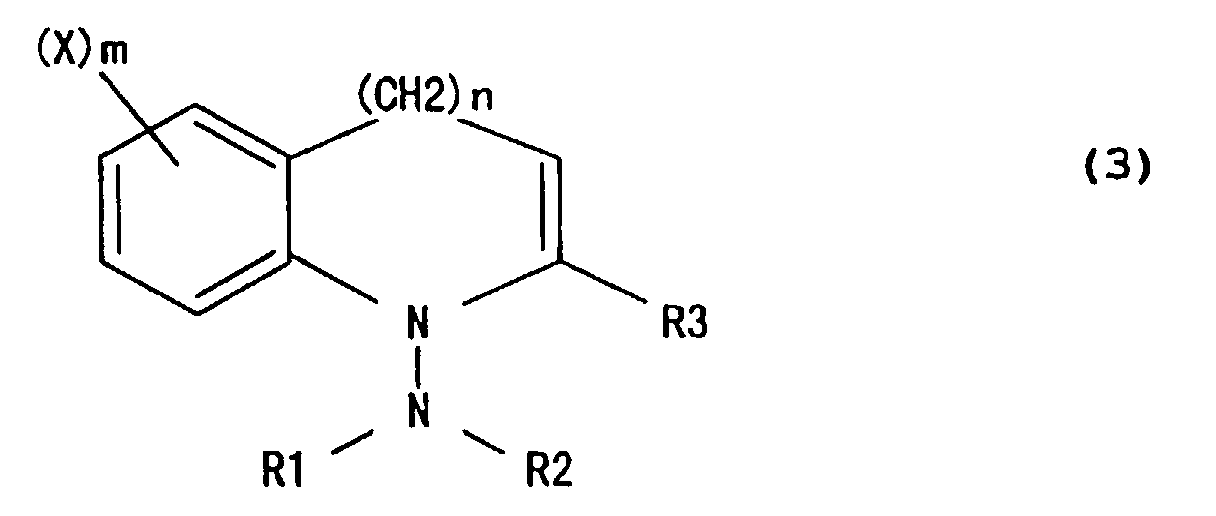
    19. The process according to claim 18, wherein the amine is selected from the group consisting of piperazine, 1-methylpiperazine, 2-methylpiperazine, homopiperazine, N-phenyl-N-methylamine, diphenylamine, di(p-tolyl)amine, N-(1-naphthyl)-N-phenylamine, N-(2-naphthyl)-N-phenylamine, N-(2-fluorenyl)-N-phenylamine, pyrrole, indole, and carbazole, and combination of two or more thereof.
    20. A process for producing a substituted indole derivative represented by General Formula (7):
      Figure 00540001
      where R1 and R2 are independently hydrogen, an alkyl group, an aryl group, or a heteroaryl group; R3 is hydrogen or an aryl group; R5 and R6 are independently hydrogen, an alkyl group, or an aryl group, and R5 and R6 may be bonded suitably to form a hetero-ring,
      said process comprising intramolecular cyclization of a compound represented by General formula (5):
      Figure 00540002
      (where R1 and R2 are independently hydrogen, an alkyl group, an aryl group, or a heteroaryl group; R3 is hydrogen or an aryl group; and X is a halogen), in the presence of a catalyst comprising a phosphine and a palladium compound, an amine represented by General Formula (6): R5R6NH (where R5 and R6 are independently hydrogen, an alkyl group, or an aryl group, and R5 and R6 may be linked to form a hetero-ring), and a base.
    21. The process according to claim 20, wherein the phosphine has a t-butyl-phosphorus linkage.
    EP00104970A 1999-03-10 2000-03-09 Processes for the preparation of nitrogen-heterocyclic compounds Expired - Lifetime EP1035114B1 (en)

    Applications Claiming Priority (6)

    Application Number Priority Date Filing Date Title
    JP6369399 1999-03-10
    JP6369399 1999-03-10
    JP6369299 1999-03-10
    JP6369299 1999-03-10
    JP6369499 1999-03-10
    JP6369499 1999-03-10

    Publications (3)

    Publication Number Publication Date
    EP1035114A2 true EP1035114A2 (en) 2000-09-13
    EP1035114A3 EP1035114A3 (en) 2000-09-20
    EP1035114B1 EP1035114B1 (en) 2004-11-24

    Family

    ID=27298251

    Family Applications (1)

    Application Number Title Priority Date Filing Date
    EP00104970A Expired - Lifetime EP1035114B1 (en) 1999-03-10 2000-03-09 Processes for the preparation of nitrogen-heterocyclic compounds

    Country Status (3)

    Country Link
    US (1) US6346621B1 (en)
    EP (1) EP1035114B1 (en)
    DE (1) DE60016068T2 (en)

    Families Citing this family (1)

    * Cited by examiner, † Cited by third party
    Publication number Priority date Publication date Assignee Title
    KR20100015546A (en) 2007-04-13 2010-02-12 사노피-아벤티스 A transition metal catalyzed synthesis of n-aminoindoles

    Family Cites Families (5)

    * Cited by examiner, † Cited by third party
    Publication number Priority date Publication date Assignee Title
    JPS60142955A (en) * 1983-12-28 1985-07-29 Fuji Photo Film Co Ltd Production of indole derivative
    EP0287982B1 (en) * 1987-04-24 1994-12-07 Hoechst-Roussel Pharmaceuticals Incorporated N-(Pyridinyl)-1H-indol-1-amines, a process for their preparation and their use as medicaments
    US5039811A (en) 1987-04-24 1991-08-13 Hoechst-Roussel Pharmaceuticals Inc. Preparation of N-(pyridinyl)-1H-indol-1-amines
    US5776955A (en) * 1995-07-27 1998-07-07 Hoechst Marion Roussel, Inc. Use of unsubstituted and substituted n-(pyrrol-1-yl)pyridinamines as anticonvulsant agents
    US5929281A (en) * 1996-04-19 1999-07-27 Tosoh Corporation Process for producing heterocyclic aromatic amine or arylamine

    Also Published As

    Publication number Publication date
    EP1035114A3 (en) 2000-09-20
    DE60016068D1 (en) 2004-12-30
    EP1035114B1 (en) 2004-11-24
    US6346621B1 (en) 2002-02-12
    DE60016068T2 (en) 2005-11-03

    Similar Documents

    Publication Publication Date Title
    JP3703829B2 (en) Method for producing quinolinamine
    US5834493A (en) Indole derivatives as 5-HT1A and/or 5-HT2 ligands
    JP5680469B2 (en) Synthesis of amines and intermediates for their synthesis
    KR20020030126A (en) Piperazine Derivatives as 5-HT1B Antagonists
    Patil et al. Recent uses of palladium chemistry in indole synthesis
    CN103626766A (en) Substituted heterocycle fused gamma-carbolines synthesis
    JPH07508759A (en) 5-arylindole derivatives and their use as serotonin (5-HT↓1) agonists
    Tiwari et al. Highly efficient one-pot synthesis of 1-substituted-1, 2, 3, 4-tetrahydropyrazino [1, 2-a] indoles
    JP4879160B2 (en) Palladium-catalyzed indolization of 2-bromo or chloroaniline
    EP1035114B1 (en) Processes for the preparation of nitrogen-heterocyclic compounds
    Hostyn et al. Highly efficient one-pot synthesis of D-ring chloro-substituted neocryptolepines via a condensation—Pd-catalyzed intramolecular direct arylation strategy
    CN101056853B (en) Process for the preparation of isoindole derivatives
    CN1662488A (en) Method for making aryl hydrazines and substituted indoles
    CN110862396B (en) A kind of synthetic method of pyrrolo[3,4-c]carbazole-1,3(2H,6H)-dione compound
    TW402593B (en) Process for preparing 7-amincocarbonyl-tetrabenzodiazepines and intermediates
    JP4779185B2 (en) Nitrogen-containing heterocyclic compound and method for producing the same
    JP4683166B2 (en) Method for producing nitrogen-containing heterocyclic compound
    Qu et al. Unusual rearrangements in activated indoles: Synthesis of indoloquinolines, dibenzonaphthyridines and indolobenzodiazepines
    AU2007286348B2 (en) Arylpiperazine derivatives and uses thereof
    JP4608723B2 (en) Method for producing substituted indole derivatives
    Kuvshinov et al. Synthesis of 2-R-4, 6-Dinitro-2H-indazoles from 2, 4, 6-Trinitrotoluene
    Bergman et al. Acid-induced dimerization of 3-(1 H-indol-3-yl) maleimides. Formation of cyclopentindole derivatives
    Hesse et al. Buchwald-Hartwig amination of β-chloroacroleins by Lactams and Heteroarylamines
    Afsah et al. Mannich bases as synthetic intermediates: Alkylation of amines and diamines with bis-ketonic Mannich bases
    Roshchin et al. Synthesis of 2-phenylindole N-derivatives under conditions of catalysis by palladium complexes

    Legal Events

    Date Code Title Description
    PUAI Public reference made under article 153(3) epc to a published international application that has entered the european phase

    Free format text: ORIGINAL CODE: 0009012

    PUAL Search report despatched

    Free format text: ORIGINAL CODE: 0009013

    AK Designated contracting states

    Kind code of ref document: A2

    Designated state(s): CH DE FR GB LI

    AX Request for extension of the european patent

    Free format text: AL;LT;LV;MK;RO;SI

    AK Designated contracting states

    Kind code of ref document: A3

    Designated state(s): AT BE CH CY DE DK ES FI FR GB GR IE IT LI LU MC NL PT SE

    AX Request for extension of the european patent

    Free format text: AL;LT;LV;MK;RO;SI

    17P Request for examination filed

    Effective date: 20010226

    AKX Designation fees paid

    Free format text: CH DE FR GB LI

    17Q First examination report despatched

    Effective date: 20020705

    GRAP Despatch of communication of intention to grant a patent

    Free format text: ORIGINAL CODE: EPIDOSNIGR1

    RTI1 Title (correction)

    Free format text: PROCESSES FOR THE PREPARATION OF NITROGEN-HETEROCYCLIC COMPOUNDS

    GRAS Grant fee paid

    Free format text: ORIGINAL CODE: EPIDOSNIGR3

    GRAA (expected) grant

    Free format text: ORIGINAL CODE: 0009210

    AK Designated contracting states

    Kind code of ref document: B1

    Designated state(s): CH DE FR GB LI

    REG Reference to a national code

    Ref country code: GB

    Ref legal event code: FG4D

    REG Reference to a national code

    Ref country code: CH

    Ref legal event code: EP

    REG Reference to a national code

    Ref country code: CH

    Ref legal event code: NV

    Representative=s name: BOVARD AG PATENTANWAELTE

    REF Corresponds to:

    Ref document number: 60016068

    Country of ref document: DE

    Date of ref document: 20041230

    Kind code of ref document: P

    ET Fr: translation filed
    PLBE No opposition filed within time limit

    Free format text: ORIGINAL CODE: 0009261

    STAA Information on the status of an ep patent application or granted ep patent

    Free format text: STATUS: NO OPPOSITION FILED WITHIN TIME LIMIT

    26N No opposition filed

    Effective date: 20050825

    REG Reference to a national code

    Ref country code: CH

    Ref legal event code: PFA

    Owner name: TOSOH CORPORATION

    Free format text: TOSOH CORPORATION#4560, KASEI-CHO#SHINNANYO-SHI, YAMAGUCHI-KEN (JP) -TRANSFER TO- TOSOH CORPORATION#4560, KASEI-CHO#SHINNANYO-SHI, YAMAGUCHI-KEN (JP)

    PGFP Annual fee paid to national office [announced via postgrant information from national office to epo]

    Ref country code: CH

    Payment date: 20120313

    Year of fee payment: 13

    Ref country code: FR

    Payment date: 20120319

    Year of fee payment: 13

    PGFP Annual fee paid to national office [announced via postgrant information from national office to epo]

    Ref country code: GB

    Payment date: 20120307

    Year of fee payment: 13

    PGFP Annual fee paid to national office [announced via postgrant information from national office to epo]

    Ref country code: DE

    Payment date: 20120411

    Year of fee payment: 13

    REG Reference to a national code

    Ref country code: CH

    Ref legal event code: PL

    GBPC Gb: european patent ceased through non-payment of renewal fee

    Effective date: 20130309

    REG Reference to a national code

    Ref country code: FR

    Ref legal event code: ST

    Effective date: 20131129

    REG Reference to a national code

    Ref country code: DE

    Ref legal event code: R119

    Ref document number: 60016068

    Country of ref document: DE

    Effective date: 20131001

    PG25 Lapsed in a contracting state [announced via postgrant information from national office to epo]

    Ref country code: LI

    Free format text: LAPSE BECAUSE OF NON-PAYMENT OF DUE FEES

    Effective date: 20130331

    Ref country code: FR

    Free format text: LAPSE BECAUSE OF NON-PAYMENT OF DUE FEES

    Effective date: 20130402

    Ref country code: GB

    Free format text: LAPSE BECAUSE OF NON-PAYMENT OF DUE FEES

    Effective date: 20130309

    Ref country code: CH

    Free format text: LAPSE BECAUSE OF NON-PAYMENT OF DUE FEES

    Effective date: 20130331

    Ref country code: DE

    Free format text: LAPSE BECAUSE OF NON-PAYMENT OF DUE FEES

    Effective date: 20131001