EP1033637A2 - Method and apparatus for optimizing overall characteristic of device, using heuristic method - Google Patents
Method and apparatus for optimizing overall characteristic of device, using heuristic method Download PDFInfo
- Publication number
- EP1033637A2 EP1033637A2 EP00104370A EP00104370A EP1033637A2 EP 1033637 A2 EP1033637 A2 EP 1033637A2 EP 00104370 A EP00104370 A EP 00104370A EP 00104370 A EP00104370 A EP 00104370A EP 1033637 A2 EP1033637 A2 EP 1033637A2
- Authority
- EP
- European Patent Office
- Prior art keywords
- optimizing
- control module
- characteristic
- regular
- optimization
- Prior art date
- Legal status (The legal status is an assumption and is not a legal conclusion. Google has not performed a legal analysis and makes no representation as to the accuracy of the status listed.)
- Withdrawn
Links
- 238000000034 method Methods 0.000 title claims abstract description 339
- 238000011156 evaluation Methods 0.000 claims abstract description 139
- 230000001276 controlling effect Effects 0.000 claims abstract description 22
- 230000003213 activating effect Effects 0.000 claims abstract description 3
- 230000001105 regulatory effect Effects 0.000 claims abstract description 3
- 238000005457 optimization Methods 0.000 claims description 142
- 230000008569 process Effects 0.000 claims description 75
- 230000003252 repetitive effect Effects 0.000 claims description 2
- 239000000446 fuel Substances 0.000 description 77
- 238000004364 calculation method Methods 0.000 description 64
- 230000001133 acceleration Effects 0.000 description 34
- 239000000243 solution Substances 0.000 description 34
- 230000005540 biological transmission Effects 0.000 description 32
- 230000002452 interceptive effect Effects 0.000 description 29
- 238000004422 calculation algorithm Methods 0.000 description 27
- 238000002347 injection Methods 0.000 description 24
- 239000007924 injection Substances 0.000 description 24
- 230000003068 static effect Effects 0.000 description 21
- 238000013528 artificial neural network Methods 0.000 description 14
- 230000004044 response Effects 0.000 description 13
- 230000008859 change Effects 0.000 description 11
- 238000010586 diagram Methods 0.000 description 10
- 238000002922 simulated annealing Methods 0.000 description 9
- 230000008878 coupling Effects 0.000 description 8
- 238000010168 coupling process Methods 0.000 description 8
- 238000005859 coupling reaction Methods 0.000 description 8
- 238000004886 process control Methods 0.000 description 8
- 230000032683 aging Effects 0.000 description 7
- 230000006866 deterioration Effects 0.000 description 7
- 230000008901 benefit Effects 0.000 description 5
- 230000002068 genetic effect Effects 0.000 description 5
- 239000002131 composite material Substances 0.000 description 4
- 239000003795 chemical substances by application Substances 0.000 description 3
- 230000006870 function Effects 0.000 description 3
- 108090000623 proteins and genes Proteins 0.000 description 3
- 238000005295 random walk Methods 0.000 description 3
- 230000009466 transformation Effects 0.000 description 3
- 230000001052 transient effect Effects 0.000 description 3
- 230000009194 climbing Effects 0.000 description 2
- 238000013461 design Methods 0.000 description 2
- 230000004069 differentiation Effects 0.000 description 2
- 239000006185 dispersion Substances 0.000 description 2
- 238000005516 engineering process Methods 0.000 description 2
- 238000002474 experimental method Methods 0.000 description 2
- 230000015654 memory Effects 0.000 description 2
- 230000002787 reinforcement Effects 0.000 description 2
- 239000000470 constituent Substances 0.000 description 1
- 238000007796 conventional method Methods 0.000 description 1
- 239000000498 cooling water Substances 0.000 description 1
- 230000000694 effects Effects 0.000 description 1
- 230000010429 evolutionary process Effects 0.000 description 1
- 230000000977 initiatory effect Effects 0.000 description 1
- 230000003993 interaction Effects 0.000 description 1
- 238000012886 linear function Methods 0.000 description 1
- 238000012986 modification Methods 0.000 description 1
- 230000004048 modification Effects 0.000 description 1
- 230000035772 mutation Effects 0.000 description 1
- 230000001537 neural effect Effects 0.000 description 1
- 238000003825 pressing Methods 0.000 description 1
- 230000008929 regeneration Effects 0.000 description 1
- 238000011069 regeneration method Methods 0.000 description 1
- 238000010187 selection method Methods 0.000 description 1
- 230000007704 transition Effects 0.000 description 1
- 239000002023 wood Substances 0.000 description 1
Images








Classifications
-
- G—PHYSICS
- G05—CONTROLLING; REGULATING
- G05B—CONTROL OR REGULATING SYSTEMS IN GENERAL; FUNCTIONAL ELEMENTS OF SUCH SYSTEMS; MONITORING OR TESTING ARRANGEMENTS FOR SUCH SYSTEMS OR ELEMENTS
- G05B13/00—Adaptive control systems, i.e. systems automatically adjusting themselves to have a performance which is optimum according to some preassigned criterion
- G05B13/02—Adaptive control systems, i.e. systems automatically adjusting themselves to have a performance which is optimum according to some preassigned criterion electric
- G05B13/0265—Adaptive control systems, i.e. systems automatically adjusting themselves to have a performance which is optimum according to some preassigned criterion electric the criterion being a learning criterion
- G05B13/0285—Adaptive control systems, i.e. systems automatically adjusting themselves to have a performance which is optimum according to some preassigned criterion electric the criterion being a learning criterion using neural networks and fuzzy logic
Definitions
- the present invention relates to a method and an apparatus for optimizing a control module for controlling a controlled system, and a cooperative method for optimization in a method for optimizing a characteristic of the control module.
- an evolutionary control system that comprises a basic control module which determines a control output of a controlled system based on predetermined input information, a compensation control module which determines a compensation value for the output of the basic control module, and an evolutionary control module which determines the input-output relationship of the compensation control module by a hereditary algorithm according to the user's intention.
- the system learns as a teacher data the input-output relationship through which the compensation control module is optimized by an optimal control module.
- the system optimizes the input-output relationship of the compensation control module by the evolutionary control module under user's direct instruction as the user's intention, reflecting the compensation control module, which enables each user to obtain a preferred characteristic of the control module in accordance with his feelings.
- the use of a hereditary algorithm realizes a simple and short-time optimization.
- the evolutionary control system had the problem that since the input-output relationship of the compensation control module was optimized by the evolutionary control module and the compensation control module was supposed to learn the optimized input-output relationship, it took some time for learning and it also took some time for the optimized characteristic to be reflected to the controlled variable.
- the system also had the problem that operation was complex.
- the object of the present invention is, by solving the problems in the prior art, to reflect the optimized characteristic to the controlled system in a short period of time and to provide a method and an apparatus for optimizing an overall characteristic which simplify the operation.
- a characteristic optimizing method in prior art has the problem that with regard to a controlled system, a fuel injector, since a plurality of characteristics-fuel consumption performance and drivability performance-are independently optimized, when fuel consumption performance is improved, drivability performance becomes lower, and vice versa, which is a trade-off of optimization of both characteristics.
- a fuel injector since a plurality of characteristics-fuel consumption performance and drivability performance-are independently optimized, when fuel consumption performance is improved, drivability performance becomes lower, and vice versa, which is a trade-off of optimization of both characteristics.
- An object of a cooperative method for optimization in a method for optimizing a characteristic is to solve the disadvantage of the prior art and to provide a method for cooperation in order to optimize a plurality of characteristics despite the presence of a trade-off
- the method optimizes control parameters in a regular control module (i.e., a control module essentially required for controlling a device or system), using an optimization method directly, that determines an output associated with a manipulated variable of a controlled system based on predetermined input information.
- a regular control module i.e., a control module essentially required for controlling a device or system
- an optimization method directly, that determines an output associated with a manipulated variable of a controlled system based on predetermined input information.
- the device can be another control module.
- the method is the optimization method that uses heuristics.
- the method provides an optimal control module for performing said optimization, and after finishing optimal process in said optimal control module, updates the control parameters of the regular control module to the optimized control parameters.
- the method in addition, learns the control parameters optimized to the regular control module.
- the method provides said regular control module with a control module for executing control and a control module for learning, and after said control module for learning has learned the optimized control parameters, switches said control module for executing control for said control module for learning.
- the method provides an optimal control module for outputting the control parameters of the regular control module based on predetermined input information, and optimizes the control parameters of the regular control module by optimizing said optimal control module.
- the method uses an algorithm, when the regular control module changes at least part of the control parameters, that can predict influence to other control parameters by the change, uses an algorithm, when the regular control module changes at least part of the control parameters, that can predict influence to the output of the control module by the change, and uses an algorithm that has a linear input-output relation.
- the method uses an evolutionary calculation method, an adjacent search method and/or an enforced learning method.
- the evolutionary calculation method includes, for example, a hereditary algorithm, an evolutionary strategy or an evolutionary programming.
- the adjacent search method includes, for example, an simulated annealing, a hill climbing, a random walk, and a TABU search.
- the enforced learning method includes, for example, a Q learning or a classifier system.
- Said regular control module is the control module which outputs the manipulated variable of the controlled system based on predetermined input information, and inputs a manipulated variable for a user and outputs a manipulated variable for the controlled system.
- Said controlled system is a means for controlling performance of a final controlled system, and said final controlled system is a motor, a prime mover, or a combination of a motor and a prime mover.
- said regular control module inputs a manipulated variable of a throttle lever and outputs a manipulated variable of an intake air amount changing means.
- Said regular control module has control parameters regarding a static characteristic of the manipulated variable of an intake air amount changing means about the manipulated variable of a throttle lever, and control parameters regarding a dynamic characteristic of the manipulated variable of an intake air amount changing means about the manipulated variable of a throttle lever, as a first-order lag time constant and/or an acceleration compensation coefficient that are/is added.
- Said regular control module is that control module which outputs a compensated value or a compensation ratio regarding the manipulated variable of a controlled system based on predetermined input information.
- Said controlled system is a means for controlling performance of a final controlled system, is a motor, a prime mover, or a combination of a motor and a prime mover, and can be, for example, an electronic control fuel injector or a non-stage transmission.
- said controlled system is an electronic control fuel injector
- said regular control module outputs a compensation value or compensation ratio about a basic fuel injection amount to the injector based on input information.
- said regular control module When a controlled system is a non-stage transmission, said regular control module outputs a compensation value or compensation ratio about a gear ratio of the non-stage transmission based on input information.
- evaluation reference is predetermined, said evaluation reference is set based on a basic characteristic of a controlled system with aging deterioration or regulation about a controlled system.
- evaluation can be combined, by setting beforehand the evaluation reference based on a regulation about a controlled system, preparing for evaluation under user's intention within a range of the evaluation reference, and optimizing the characteristic according to user's preference within the regulation.
- an apparatus for optimizing an overall characteristic of the invention comprises a regular control unit including a regular control module which determines an output associated with a manipulated variable of a controlled system based on predetermined input information, and an optimal process unit for directly optimizing control parameters of said regular control module using an optimization method having heuristics.
- Said optimal process unit includes an optimal operation device which performs operation on a optimization method, and an automatic evaluation device which conducts evaluation on optimal process based on evaluation reference set beforehand, whereby said optimal process controls control parameters obtained from the optimal operation by using the regular control module and optimization is proceeded with the result evaluated by the automatic evaluation device.
- Said optimal process unit includes an optimal operation device which performs operation on a optimization method, and means for inputting evaluation based on user's intention on optimal process, whereby said optimal process controls control parameters obtained from the optimal operation by using the regular control module, and optimization is proceeded with the result evaluated by the automatic evaluation device.
- Said optimal process unit includes an optimal operation device which performs operation on a optimization method, an optimal module for outputting values of the control parameters of the regular control module based on predetermined input information, and an automatic evaluation device which conducts evaluation on optimal process based on evaluation reference set beforehand, whereby said optimal process controls control parameters obtained from the optimal module by using the regular control module, and optimization of the optimal module is proceeded, with the result evaluated by the automatic evaluation device, so that optimal control parameters from the optimal module can be obtained.
- Said optimal process unit includes an optimal operation device which performs operation on a optimization method, an optimal module for outputting values of the control parameters of the regular control module based on predetermined input information, and means for inputting evaluation based on user's intention on optimal process, whereby said optimal process controls control parameters obtained from the optimal module by using the regular control module, and optimization of the optimal module is proceeded, with the result evaluated by the automatic evaluation device, so that optimal control parameters from the optimal module can be obtained.
- Said optimal operation device conducts operation on optimization by using an evolutionary calculation method, an adjacent search method and/or an enforced learning method.
- a cooperative method for optimization in a method for optimizing a characteristic comprises the steps of optimizing each characteristic of a plurality of regular control modules that determine an output associated with a manipulated variable of a controlled system based on predetermined input information, whereas it is advantageous when after optimizing one regular control module, optimizing other regular control modules so that an obtained characteristic can be improved or maintained.
- a cooperative method for optimization in a method for optimizing a characteristic comprising the steps of optimizing each characteristic of a plurality of regular control modules that determine an output associated with a manipulated variable of a controlled system based on predetermined input information, and optimizing a plurality of regular control modules at a interval so that obtained characteristics can be improved or maintained.
- a cooperative method for optimization in a method for optimizing a characteristic comprising the steps of optimizing each characteristic of a plurality of regular control modules that determine an output associated with a manipulated variable of a controlled system based on predetermined input information, and during optimizing one regular control module, optimizing other regular control modules in parallel so that obtained characteristics the regular control module obtained can be improved or maintained.
- a cooperative method for optimization in a method for optimizing a characteristic comprising the steps of optimizing each characteristic of a plurality of regular control modules that determine an output associated with a manipulated variable of a controlled system based on predetermined input information, and optimizing a plurality of regular control modules in parallel so that obtained characteristics can be improved or maintained.
- the cooperative method comprises the steps of, for optimizing at least one of the regular control modules, using an automatic evaluation method which evaluates during optimization based on evaluation reference set beforehand, and for optimizing other regular control modules, using an interactive evaluation method which evaluates during optimization based on evaluation under user's intention.
- said evaluation reference is set based on a reference characteristic of a controlled system having aging deterioration or a regulation of a controlled system.
- evaluation can be combined by beforehand setting the evaluation reference based on the regulation regarding one controlled variable, evaluating within a range of the evaluation reference under user' preference, and optimizing characteristics within a range of a regulation according to user's preference.
- a cooperative method for optimization in a method for optimizing a characteristic comprises the steps of optimizing each of a plurality of characteristics of regular control modules that determine an output associated with a manipulated variable of a controlled system based on predetermined input information, and after optimizing other characteristics, optimizing other regular control modules so that an obtained characteristic can be improved or maintained.
- a cooperative method for optimization in a method for optimizing a characteristic comprises the steps of optimizing each of a plurality characteristics of the regular control modules that determine an output associated with a manipulated variable of a controlled system based on predetermined input information, and optimizing a plurality of characteristics at a interval so that obtained characteristics can be improved or maintained.
- a cooperative method for optimization in a method for optimizing a characteristic comprises the steps of optimizing each of a plurality characteristics of the regular control modules that determine an output associated with a manipulated variable of a controlled system based on predetermined input information, and during optimizing one characteristic, optimizing other characteristics in parallel so that the characteristic can be improved or maintained.
- a cooperative method for optimization in a method for optimizing a characteristic comprises the steps of optimizing each of a plurality of characteristics of the regular control modules that determine an output associated with a manipulated variable of a controlled system based on predetermined input information, and optimizing a plurality of characteristics in parallel so that obtained characteristics can be improved or maintained.
- the cooperative method comprises the steps of, for optimizing at least one of the regular control modules, using an automatic evaluation method which evaluates during optimization based on evaluation reference set beforehand, and for optimizing other regular control modules, using an interactive evaluation method which evaluates during optimization based on evaluation under user's intention.
- said evaluation reference is set based on a reference characteristic of a controlled system having aging deterioration or a regulation of a controlled system.
- evaluation can be combined by beforehand setting the evaluation reference based on the regulation regarding one controlled variable, evaluating within a range of the evaluation reference under user' preference, and optimizing characteristics within a range of a regulation according to user's preference.
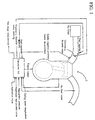
- FIGs. 1-13 show embodiments that apply the invention to a vehicle engine and a non-stage transmission control.
- FIG. 1 is a diagram showing relationship between an engine 1 and a controller 10 that works the invention.
- the controller 10 is constructed so that fuel performance can be improved, obtaining desired drivability and acceleration.
- driving performance means output performance of an engine in response to a throttle operation.
- the controller 10 receives as inputs information of engine speed, intake negative pressure, accelerator manipulated value, atmospheric pressure, intake temperature, and cooling water temperature. Based on the input information, it manipulates a fuel injector, an electronic throttle valve, and a non-stage transmission, and controls fuel injection quantity, intake atmosphere quantity, and gear ratio, which leads to optimum control of drivability performance, acceleration performance, and fuel performance.
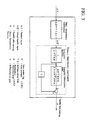
- FIG. 2 is a block diagram of the controller 10.
- the controller 10 comprises an electronic throttle control unit, a non-stage transmission control unit, and a fuel injector control unit.
- the electronic throttle control unit includes an electronic throttle control module that determines an opening of an electronic throttle valve based on predetermined input information, and an optimal process device that optimizes control parameters of the electronic throttle control module.
- the non-stage transmission control unit includes a non-stage transmission control module that determines a basic gear ratio of a non-stage transmission based on predetermined input information (an external information input in FIG. 2), a gear ration compensation module that determines a compensation ratio to the basic gear ratio, and an optimal process device that optimizes the compensation module.
- the fuel injector control unit includes a fuel injector control module that determines a basic fuel injection amount based on predetermined input information (an external information input in FIG. 2), a fuel injection amount compensation module that determines a compensation ratio to the basic fuel injection amount, an optimal process device that optimizes the compensation module, and an evaluation device that evaluates the optimal process device.
- FIG. 3 shows that the electronic throttle control module determines an opening of the electronic throttle valve based on an acceleration manipulated amount by a user.
- the "acceleration manipulated amount” means information of both “an acceleration angle” and “an acceleration variable”.
- the electronic throttle valve has two characteristics: static and dynamic. The former is the one derived from the relationship between the acceleration angle and the electronic throttle valve, which affects stationary running characteristics.
- FIG. 4 is graphs illustrating static characteristics of some throttles, where the different static characteristics are shown.
- static characteristics There are three types of static characteristics: a low-opening sudden-acceleration type which shows that the electronic throttle valve opens large when an acceleration angle is small, and it opens gradually to be frilly open as the acceleration angle gets bigger; a high-opening sudden-acceleration type which shows that the electronic throttle valve opens gradually while the acceleration angle is small, and it opens suddenly to be fully open when the acceleration angle gets bigger; and a linear type which shows that the acceleration angle is proportional to the throttle opening. In this way the same acceleration angle produces different throttle openings.
- These static characteristics should demonstrate that as the acceleration angle gets bigger, the throttle opening increases or is constant, which allows different kinds of functions.
- the static characteristic is optimized, by optimizing throttle valve opening ratio SP 1 when throttle opening is 0-20 % and throttle valve opening ratio SP2 when throttle opening is 20-100 %.
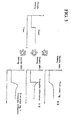
- FIG. 5 shows a dynamic characteristic of some throttles.
- the latter of the electronic throttle valve characteristics i.e., dynamic characteristic is the one derived from changed speeds of the throttle valve to changed speeds of the accelerator, which affects a transient characteristic of a vehicle.
- the characteristic represents changed speeds of the throttle to changed speeds of the accelerator in a combination of first-order lag and incomplete differentiation.
- first-order lag and incomplete differentiation there are provided three types: the low-response type which shows that the throttle opens relatively slowly in response to acceleration manipulation; the high-response type which shows that although some spikes are produced in response to acceleration manipulation, the throttle responds fast and opens; and the type between the aforementioned two types.
- the dynamic characteristic is optimized by optimizing first-order lag time constant DR and acceleration compensation factor AG.
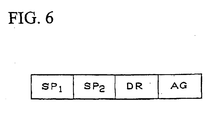
- FIG. 6 shows coding of the control parameters of the electronic throttle control module.
- the optimal process device in the electronic throttle control unit employs, for example, a evolutionary calculation method, and codes as one individual the control parameters (throttle valve opening ratios SP 1 and SP2, first-order lag time constant DR, and acceleration compensation factor AG) of the electronic throttle control module as shown in FIG. 6, which are to be optimized using a evolutionary calculation method. Evaluation of the value of each control parameter during optimal process is conducted based on drivability performance a user feels in a real situation. As a result, each of the control parameters is optimized according to the user's evaluation, which in turn produce the optimum characteristic of the electronic throttle (drivability characteristic) the user desires.
- the non-stage transmission control module outputs a basic gear ratio in response to predetermined inputs (for example, vehicle speed, and throttle valve opening) based on a basic gear ratio map.
- the gear ratio compensation module is comprised of a neural network which outputs a compensation ration to the basic gear ratio in response to predetermined inputs (for example, vehicle speed, and throttle valve opening).
- the optimal process device in the non-stage transmission control unit employs as optimal operation, for example, a evolutionary calculation method, conduct coding of a coupling coefficient of the neural network (control parameter) constituting the gear ratio compensation module to generate individuals, and optimizes the coupling coefficient (control parameter) using the evolutionary calculation method. Evaluation of the value of each control parameter during optimal process is made based on acceleration feeling the user has in a real situation. As a result, the control parameters for the gear ratio compensation module are optimized according to the user's evaluation, which brings about an optimal characteristic of the non-stage transmission (acceleration) the user desires.
- FIG. 7 show a block diagram of the fuel injector control module.
- the fuel injector control module includes an engine forward model that is modeled using a feedforward control logic with learning function, and a fuel injection amount determination device that determines a basic injection amount of the fuel injector based on an output of the engine forward model and an reference air-fuel ratio.
- the reference air-fuel ratio is calculated based on an engine speed and an throttle opening by a reference air-fuel ratio calculation device.
- FIG. 8 (a) shows a neural network constituting a fuel injection amount compensation module.
- the fuel injection amount compensation module consists of a neural network that inputs a throttle opening and an engine speed and outputs a compensated amount.
- the compensated amount obtained is multiplied by the basic fuel injection amount output at the fuel injector control module to obtain a final fuel injection amount.
- FIG. 8 (b) shows encoding of the control parameters of the fuel injection control module.
- the optimal process device in the fuel injector control unit employs as optimal operation, for example, an evolutionary calculation method, encodes the coupling coefficients of the neural network constituting the fuel injection amount compensation module to produce individuals, and optimizes the coefficients (control parameters) using the evolutionary calculation method.
- Evaluation of the value of each control parameter during optimal process is made by a evaluation device in which desired fuel consumption is set.
- the coupling coefficients (control parameters) for the fuel injection amount compensation module are optimized automatically toward the desired fuel consumption, which provides an optimal fuel consumption characteristic.
- the method through which evaluation in optimal operation is done by the evaluation device designed beforehand and optimization is conducted automatically is called an automatic evaluation.
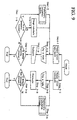
- FIG. 9 is a flowchart showing optimal process of the controller 10.
- the controller 10 uses interactive evaluation the in electronic throttle control unit and the non-stage transmission control unit and automatic evaluation in the fuel injector control unit. Since different evaluation methods produce different optimal processes, the optimal process using interactive evaluation and the optimal process using are explained independently.
- the initial values of the control parameters in the electronic throttle control unit, static characteristics SP 1 and SP2, and dynamic characteristics DR and AG; in the non-stage transmission control unit, coupling coefficients of the neural network
- optimizing the control modules which are a optimal subject in each control unit are determined first at random within a predetermined range, and a first generation comprising a plurality of initial individuals are produced (step 1-1).
- a ride is tried (step 1-2).
- a user inputs an evaluation value to the individual (step 1-3). Based on the evaluation value, it is determined whether desired drivability or acceleration is obtained (step 1-4). If obtained, evolutionary process ends.
- step 1-5 it is determined whether a trial ride and an evaluation for all the individuals of the first generation are finished. If a trial ride and an evaluation for all the individuals are not finished, the parameters of the control module are changed to those of another individual (step 1-6) and a ride is tried once again (step 1-2). When a trial ride and an evaluation for all the individuals are finished, an evolutionary calculation module begins (step 1-7), an individual group of the next generation is produced, and once again a trial ride and an evaluation using the parameters of the individuals are conducted.
- the process is repeated until the desired drivability and acceleration are obtained. Therefore the parameters of the electronic throttle control module and the gear ratio compensation module are optimized.
- An input apparatus for evaluation value manipulable during operation is realized using a button so that a user can go into evolution. After a trial ride, by pressing the button, the user inputs an evaluation value for an individual on which he made a trial ride.
- the evaluation value is determined based on a length of time when the button is being pressed. To be specific, for example, there is a method by which a predetermined constant is multiplied by a reciprocal of time being pressed or a method by fuzzy rules are used for calculation. By doing so, even if there is ambiguity in human evaluation, the evaluation value is obtained to some degree of exactness and the user can come to use an evolutionary method interactively.
- the button When the button is pressed beyond a fixed amount of time, the individual during evaluation can be changed to another individual at that time. By doing so, the user can immediately change individuals with undesired characteristics, which enables faster evolution.
- the change of the individuals can be made only while a vehicle is being stopped, which is effective in excluding the influence by a sudden change of the throttle characteristic during a run.
- the initial values of the control parameters (in the fuel injection amount compensation module, coupling coefficients of the neural network) optimizing the control modules which are a optimal subject in each control unit are determined first at random within a predetermined range, and a first generation comprising a plurality of initial individuals are produced (step 2-1). And fuel consumption of all the individuals in the first generation is calculated (step 2-2). Now the calculation of fuel consumption is explained below.
- the fuel injection control evolution module a plurality of individuals are worked falsely and in parallel by time division, and evaluation values derived from a total of the duration are compared.
- FIG. 10 is a diagram illustrating one example of division methods that evaluates each individual by time-division. To be specific about the comparison of evaluation values, for example, as shown in FIG. 10, ten individuals are controlled for one minute each, and with this as one cycle twenty cycles are repeated. The total running length for a evaluation period is divided by fuel consumption amount to get fuel consumption, i.e., evaluation value. This enables comprehension of the influence by a gear position difference and a slope angle as a total, which allows a fair evaluation of the characteristic of each individual.
- step 2-2 Based on the fuel consumption of each individual (namely, evaluation value) derived from the fuel consumption calculation process (step 2-2), it is judged whether it is an optimal fuel consumption characteristic (step 2-3). As a result of the evaluation, it is determined whether optimal fuel consumption is obtained (step 2-4). If it is, the optimal process is ended; if not, the evolutionary calculation module begins (step 2-5) to produce a group of individuals for a next generation.
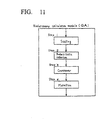
- FIG. 11 is a flowchart illustrating an evolutionary calculation module that uses a hereditary algorithm as a evolutionary calculation method. After completing evaluation of all the individuals of the first generation, the module produces a group of individuals for a next generation when the desired characteristic is not obtained.
- step 1 linear transformation of adaptability is performed so that the ratio of maximum adaptability to average adaptability in an individual group can be constant.
- a roulette selecting system may be employed that selects probabilistically proportional to the user's evaluation value (adaptability), a tournament selecting system may also be used which selects the individual with the best evaluation value among n randomly selected individuals.
- step 3 there are systems which use one point crossing over, two point crossing over, and normal distribution crossing over.
- a selected crossing-over parent happens to be the same individual, but if this situation is left, versatility as an individual group will be lost.
- another selected individual should be replaced to avoid the crossing over of the same individual as much as possible.
- step 4 value of each gene of individuals is changed randomly at a predetermined probability. There is another method which adds perturbation following a normal distribution. In spite of the fact that different individuals are selected as crossing-over parents, when they are quite the same in terms of heredity, mutation for both of the crossing-over parents is produced with a higher probability than usual.
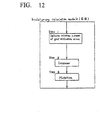
- FIG. 12 is a flowchart illustrating an evolutionary calculation module that uses a evolutionary strategy as an evolutionary calculation method. After completing evaluation of all the individuals of the first generation, the module produce individual groups for a next generation when desired characteristics are not obtained.
- step 1 since selection methods are different depending on the kinds of evolutionary strategy, typical two kinds of method are explained here.
- an evolutionary strategy called ( ⁇ , ⁇ )-ES out of ⁇ child individuals produced by ⁇ parent individuals, the ⁇ individuals are definitely selected in the order of good adaptability.
- an evolutionary strategy called ( ⁇ + ⁇ )-ES out of individual groups in a combination of ⁇ parent individuals and ⁇ child individuals, the ⁇ individuals are definitely selected in the order of good adaptability.
- step 2 there is used a normal distribution crossing over.
- parent values may be inherited for every parameter, and child values may be middle points, interior division points, or exterior division points.
- step 3 perturbation following a normal distribution for each parameter is added.
- a dispersion of the normal distribution can be adjusted for each parameter, and interrelationship among parameters can be established.
- the evolutionary strategy (ES) explained above has the advantage that since each parameter is used as a real value, no transformation from an expression type such as a hereditary algorithm to a gene type is necessary.
- a cross-over method which uses continuity of real numbers such as a normal distribution cross-over can reflect stronger parent characters toward child characters than when binary codes or gray codes, used frequently in a hereditary algorithm, are crossed over at one point or multiple points.
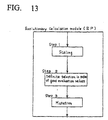
- FIG. 13 is a flowchart of an evolutionary calculation module that uses an evolutionary programming as an evolutionary calculation method.
- step 1 in the case where the number of individuals is ⁇ , independently and randomly selected q individuals are compared with 2 ⁇ individuals, the sum of the individuals which have received perturbation and the individuals which have not. The surpassing number is defined as adaptability of the individuality.
- step 2 With respect to selecting (step 2), ⁇ individuals are selected in the order good adaptability out of individuality groups generated.
- the selection is definite, but since scaling is probabilistic, the selection is substantially probabilistic.
- the evolutionary programming (EP) explained above has the advantage that since each parameter is used as a real number, no transformation from an expression type such as a hereditary algorithm to a gene type is necessary. Since no crossing over is used, there is no limitation in the expression type.
- the hereditary algorithm does not have to make parameters string-shape as evolutionary strategy, and wood structure suffices.
- the embodiment above explains as an optimization method an evolutionary calculation method.
- the optimization method in the optimal process device is not limited to this; instead different methods can be used.
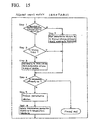
- FIG. 14 is a flowchart illustrating control that employs an adjacent search method in a combination of SA and TABU.
- a initial parameter group is generated within a predetermined range (step 1).
- a trial ride or fuel consumption calculation
- step 2 Using the initial parameter group, a trial ride (or fuel consumption calculation) is made (step 2), and an evaluation value as the result is input (or calculated) (step 3). It is determined whether desired drivability and acceleration are obtained (step 4); if they are not, an adjacent search module begins (step 5).
- FIG. 15 is a flowchart illustrating process of an adjacent search module. Firstly, it is determined whether an evaluation of an perturbation solution is higher than that of an original solution (step 1). If it is, it is determined whether the solution belongs to a forbidden region (TABU) (step 2). If it does not, the perturbation solution is added to a TABU list and moved to the original solution (step 3). Right after the initiation of the optimal process, since there is no original solution and the TABU list is empty, solutions for the initial parameter group are set as original solutions, which are added to the TABU list (step 3). Then it is judged whether temperature is sufficiently low (step 4).
- TABU forbidden region
- a temperature schedule is designed beforehand so that when temperature is high, state transition occurs with a high probability, but when low, it does not easily.
- a search is conducted.
- the temperature schedule is designed so that an initial search area is large and a last search area is small-at a initial state temperature is high, and at a last state temperature gets lower gradually. Therefore, since temperature is high right after beginning the optimal process, forced ending is not made and a perturbation solution is produces (step 5).
- temperature parameters are updated (step 6).
- the perturbation solution is produced by independently adding to each constituent of the present parameter group the perturbation following a normal distribution N (0, ⁇ 2 ) with an average 0 and a dispersion ⁇ 2 .
- ⁇ is constant, but it varies depending on search situations or can be set freely by a user according to situations.
- step 2 When the perturbation solution is produced, using it the processes in FIG. 14, i.e., a trial ride (or fuel consumption calculation) (step 2) and an evaluation (step 3) are executed. If the perturbation solution does not yield the desired drivability and optimal fuel consumption, an adjacent search module begins once again (step 5).
- step 1). it is determined whether an evaluation of the perturbation solution is higher than that of the original solution (step 1). If it is, it is determined whether the perturbation solution is the TABU (step 2). If it is not, it is added to the TABU list and set to the original solution (step 4). It is judged whether temperature is sufficiently low (step 4). If it is, forced end is established; if it is not, a new perturbation solution is yielded.
- step 1 if an evaluation of the perturbation solution is lower than that of the original solution, the perturbation solution is set probabilistically to the original solution according to the temperature. That is, the higher the temperature, the larger the search. Accordingly the search is also moved to the perturbation solution side whose evaluation is lower than the original solution. When the temperature gets lower at a last stage, the search does not move to the perturbation solution side whose evaluation is lower than the original solution since it is small.
- Initial temperature parameter ⁇ 0 is set based on time for which a user wants to optimizes and number of evaluation. When the user wants to evaluate as much as he does, random walk where ⁇ is limitless should be used. In this way, when ⁇ is set to be limitless, moving probability p is always 100 % even if E takes any value, which allows a search not restricted to a small solution.
- the present evaluation of parameter groups is compared with the previous evaluation of parameter groups and the result is input as relative evaluation value ⁇ E. Based on this, the movement of the perturbation solution is determined.
- the method in a combination of simulated annealing and TABU search is explained as an adjacent search method. It is natural that simulated annealing or TABU search can be used independently.
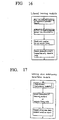
- FIG. 16 is a flowchart illustrating the process of an enforced learning module.
- the reinforced learning module is replaced by the evolutionary calculation module or the adjacent search module in FIG. 9 or 14, respectively.
- the method first selects feasible rules toward inputs from an environment. Next, the rules to be carried out are determined probabilistically (differs depending on types of forced learning) and parameter groups are output based on the rules. Remuneration is given based on the result when the parameter groups are operated, and the rules should be enforced. When this is applied to interactive optimization, evaluation by the user is given as remuneration.
- the reinforced learning has two types: experience reinforcement and environment identification. Since the former respects remuneration, suitable rules have higher probability to be used. Since the latter put respect on environment identification to obtain optimum policy (function that gives rules to be carried out to inputs), the rules not to be used have higher probability to be used.
- FIG. 17 is a flowchart illustrating the process of an learning plus an evolutionary calculation module.
- a combination of a learning algorithm and an evolutionary calculation is used as optimum process.
- the learning plus the evolutionary calculation module is replaced by the evolutionary calculation module or the adjacent search module in FIG. 9 or 14, respectively.
- the method uses the evolutionary calculation or the adjacent search method, optimizes input-output relationship, with coupling coefficients of a neural network, which constitutes a control module inputting a throttle opening and outputting a throttle characteristic, and fuzzy rules of a fuzzy system as a parameter group.
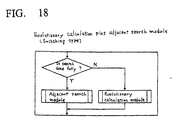
- FIG. 18 is a flowchart illustrating the process of an evolutionary calculation plus an adjacent search switching module.
- the method in a combination of the evolutionary calculation and the adjacent search method is shown as optimal process.
- the evolutionary calculation plus the adjacent search switching module is replaced by the evolutionary calculation module or the adjacent search switching module in FIG. 9 or 14, respectively.
- a large-area search is conducted by the evolutionary calculation, and at the stage where the search is successful, the search is switched to an adjacent search method to conduct a small-area search, which yields an efficient optimization.
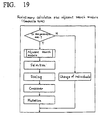
- FIG. 19 is a flowchart illustrating the process of an learning plus an evolutionary calculation composite module.
- the method in a combination of the evolutionary calculation and the adjacent search method is shown as optimal process.
- the learning plus the evolutionary calculation composite module is replaced by the evolutionary calculation module or the adjacent search switching module in FIG. 9 or 14, respectively.
- a small-area search by the adjacent search method is conducted for evolutionary calculation type of individuals, and since evolution using a hereditary algorithm is made regarding the small-area solution obtained as an individual an efficient optimization is possible.
- each optimal process device is provided for each on each control module to be evolved.
- the evaluation method of each optimal process device is not limited to a combination of the embodiments shown above; it may be either a interactive type or an automatic type, or a combination of both.
- control modules When there are a plurality of control modules and an optimal module is provided for each of the modules, some of their characteristics, which depends on the relationship of the controlled system, may be affected mutually, which trades off optimization of the characteristics.
- an engine and a crane in a crane truck do not basically interact their dynamic characteristics. Therefore, even if a control module whose controlled system is an engine fuel injector and another control module whose controlled system is a crane are provided in the same controller, each control module can be optimized independently without interaction.
- optimization can not be traded off among the control modules, and even if a plurality of control modules are provided, optimization can be performed for a short period of time through mutual cooperation.
- a plurality of control modules may be optimized independently and in parallel, which expands optimal diversity and produces original effect.
- the embodiments of the above explains a general characteristic optimization method; from the control parameters of a basic control module (to be specific, for example, the electronic throttle control module in FIG. 2) which determines a manipulated variable for a controlled variable based on a predetermined input, or a compensation control module (to be concrete, for example, the gear ratio compensation module or the fuel injection amount compensation module in FIG. 2) which determines a compensation ratio about a manipulated variable for a controlled variable based on a predetermined input, the initial parameter groups of individuals are produced directly; the control parameters are optimized by a optimization method; the control parameters of the basic control module or the compensation control module are updated to the optimized control parameters one after another.
- the invention is not limited to the above embodiments.
- regular control modules or control parameters of the regular control modules are optimized directly, the invention can be applicable to any method. For example, the following methods can be employed:
- the optimal control module can be constructed in any way.
- the optimal control module is constructed with a neural network that outputs the control parameter of the regular control module in response to a predetermined input
- the coupling coefficient or input-output relationship may be optimized.
- the rules will apply.
- the regular control module in the methods c and d may be the basic control module or compensation control module.
- a method for optimizing an overall characteristic of the invention optimizes the control parameter of the regular control module using a direct optimizing method, the optimized characteristic can be reflected to the controlled system in a short period of time.
- learning in the regular control module is essential to reflect an optimized input-output relationship to the regular control module.
- a method for optimizing an overall characteristic of the invention directly optimizes the control parameter of the regular control module, learning is not essential. When learning is not conducted, operation will be simpler and capacity of memories will also be smaller.
- the manipulated value and input information of the control module are manipulated variables for the throttle lever and the intake atmosphere amount changing means, and the control module is optimized, which reduces spikes and improves fuel consumption and gas exhaustion performance.
- driving characteristic of vehicles can be changed according to the user's preference.
- control module has information on a static characteristic of the manipulated variable of the intake atmosphere amount changing means about the manipulated variable for the throttle lever, and the optimization method optimizes information on the static characteristic, which can optimize a driving characteristic at stationary running.
- the control module has information on a dynamic characteristic of the manipulated variable of the intake atmosphere amount changing means about the manipulated variable for the throttle lever, as an algorithm which adds a first-order lag time constant and/or an acceleration compensation constant to a throttle input.
- the optimization method varies the first-order lag time constant and/or the acceleration compensation constant to optimize information as to the dynamic characteristic, which can optimize a transient movement characteristic.
- control module when the electronic control fuel injector is a controlled system, the control module is constructed so that fuel injection amount in the fuel injector is output in response to predetermined input information and the control module is optimized, which enables optimization of engine performance, fuel consumption performance and gas exhaustion performance.
- control module when a non-stage transmission is a controlled system, input-output information of the control module is provided as a manipulated amount of the throttle lever and a gear ratio in the non-stage transmission and the control module is optimized, which enables optimization of torque output and fuel consumption performance.
- control module when a non-stage transmission is a controlled system, input-output information of the control module is provided as a manipulated amount of the throttle lever and a speed in the non-stage transmission and the control module is optimized, which enables optimization of acceleration feeling of a vehicle.
- the invention of an apparatus for optimizing an overall characteristic produces the following advantages:
- an apparatus for optimizing an overall characteristic comprises a regular control unit including a regular control module which determines an output associated with a manipulated variable of a controlled system based on predetermined input information, and an optimal process unit for directly optimizing control parameters of said regular control module using an optimization method having heuristics, the optimized characteristic can be reflected to the controlled system in a short period of time.
- the manipulated value and input information of the control module are manipulated variables for the throttle lever and the intake atmosphere amount changing means, and the control module is optimized, which reduces spikes and improves fuel consumption and gas exhaustion performance.
- driving characteristic of vehicles can be changed according to the user's preference.
- control module has information on a static characteristic of the manipulated variable of the intake atmosphere amount changing means about the manipulated variable for the throttle lever, and the optimization method optimizes information on the static characteristic, which can optimize a driving characteristic at stationary running.
- the control module has information on a dynamic characteristic of the manipulated variable of the intake atmosphere amount changing means about the manipulated variable for the throttle lever, as an algorithm which adds a first-order lag time constant and/or an acceleration compensation constant to a throttle input.
- the optimization method varies the first-order lag time constant and/or the acceleration compensation constant to optimize information as to the dynamic characteristic, which can optimize a transient movement characteristic.
- the control module is constructed so that fuel injection amount in the fuel injector is output in response to predetermined input information and the control module is optimized, which enables optimization of engine performance, fuel consumption performance and gas exhaustion performance.
- control module when a non-stage transmission is a controlled system, input-output information of the control module is provided as a manipulated amount of the throttle lever and a gear ratio in the non-stage transmission and the control module is optimized, which enables optimization of torque output and fuel consumption performance.
- control module when a non-stage transmission is a controlled system, input-output information of the control module is provided as a manipulated amount of the throttle lever and a speed in the non-stage transmission and the control module is optimized, which enables optimization of acceleration feeling of a vehicle.
- the invention of a cooperative method for optimization in a method for optimizing a characteristic produces the following advantages:
- a cooperative method for optimization in a method for optimizing a characteristic comprises the steps of optimizing each characteristic of a plurality of regular control modules that determine an output associated with a manipulated variable of a controlled system based on predetermined input information, and after optimizing one regular control module, optimizing other regular control modules so that an obtained characteristic can be improved or maintained, the characteristics of the other controlled systems can be optimized within a range of an optimal characteristic of one controlled system
- a cooperative method for optimization in a method for optimizing a characteristic comprising the steps of optimizing each characteristic of a plurality of regular control modules that determine an output associated with a manipulated variable of a controlled system based on predetermined input information, and optimizing a plurality of regular control modules at a interval so that obtained characteristics can be improved or maintained, orientation of optimization of each regular control module is restricted, which enables the characteristic of a plurality of controlled systems to be improved for a period of time.
- a cooperative method for optimization in a method for optimizing a characteristic comprising the steps of optimizing each characteristic of a plurality of regular control modules that determine an output associated with a manipulated variable of a controlled system based on predetermined input information, and during optimizing one regular control module, optimizing other regular control modules in parallel so that obtained characteristics the regular control module obtained can be improved or maintained, with the characteristic of one controlled variable improving, suitable characteristics of other controlled variables can be obtained.
- a cooperative method for optimization in a method for optimizing a characteristic comprising the steps of optimizing each characteristic of a plurality of regular control modules that determine an output associated with a manipulated variable of a controlled system based on predetermined input information, and optimizing a plurality of regular control modules in parallel so that obtained characteristics can be improved or maintained, orientation of optimization of each regular control module is restricted, which enables the characteristic of a plurality of controlled systems to be improved for a period of time.
- the cooperative method of comprises the steps of, for optimizing at least one of the regular control modules, using an automatic evaluation method which evaluates during optimization based on evaluation reference set beforehand, and for optimizing other regular control modules, using an interactive evaluation method which evaluates during optimization based on evaluation under user's intention, when after optimizing one regular control module using an interactive optimization method, optimizing other regular control modules so that an obtained characteristic can be improved or maintained, the characteristics of other controlled systems can be optimized within a range of an optimal characteristic of the controlled system obtained by an interactive optimization method; when after optimizing one regular control module using an automatic evaluation method, optimizing other regular control modules so that an obtained characteristic can be improved or maintained, the characteristics of other controlled systems can be optimized within a range of an optimal characteristic of the controlled system obtained by an automatic evaluation method; when repeating at an interval the optimization of regular control modules using an interactive evaluation method and the optimization of regular control modules using an automatic optimization method so that an obtained characteristic can be improved or maintained, orientation of optimization of each regular control module is restricted, which enables the characteristic of
- the characteristic can be optimized within the regulation according to the user's preference.
- correlations between various inputs and various outputs of the control modules can be determined using existing techniques such as neural networks, fuzzy neural networks, and genetic algorithms if the correlations are highly complex, or using existing techniques such as maps and functional equations if the correlations are rather simple.
- Da Ruan (editor) "Intelligent Hybrid Systems -- Fuzzy Logic, Neural Networks, and Genetic Algorithms --" Kluwer Academic Publishers (1997), J.-S. R. Jang, C.-T. Sun, E. Mizutani, "Neuro-Fuzzy and Soft Computing” Prentice Hall Upper Saddle River, NJ 07458 (1997), C.-T. Lin and C. S.
- genetic programming or other evolutionary computing techniques can be adapted to the present invention (Wolfgang Banzhaf, et al. (editor), "Genetic Programming, An Introduction”, pp. 363-377, 1999, Morgan Kaufmann Publishers, Inc., for example). These techniques are sometimes categorized as "heuristic control” which includes evolution, simulated annealing, and reinforcement learning method (S. Suzuki, et al., “Vision-Based Learning for Real Robot: Towards RoboCup", RoboCup - 97 Workshop, 23, 24, and 29 August, 1997 Nagoya Congress Center, pp. 107-110; K.
Landscapes
- Engineering & Computer Science (AREA)
- Artificial Intelligence (AREA)
- Software Systems (AREA)
- Evolutionary Computation (AREA)
- Physics & Mathematics (AREA)
- Fuzzy Systems (AREA)
- Mathematical Physics (AREA)
- Health & Medical Sciences (AREA)
- Computer Vision & Pattern Recognition (AREA)
- Medical Informatics (AREA)
- General Physics & Mathematics (AREA)
- Automation & Control Theory (AREA)
- Combined Controls Of Internal Combustion Engines (AREA)
- Feedback Control In General (AREA)
- Control Of Steam Boilers And Waste-Gas Boilers (AREA)
Abstract
Description
- after optimizing one control module, by optimizing other control modules so that the characteristic obtained may be improved or maintained, characteristics of other controlled systems are optimized within a range of the optimal characteristic of one controlled system;
- by optimizing a plurality of control modules at a interval so that the characteristic obtained may be improved or maintained, optimal orientation of each control module is limited and the characteristics of a plurality of controlled systems are improved for a short period of time;
- during optimizing one control module, by optimizing other control modules in parallel so that the characteristic the control module obtained may be improved or maintained, suitable characteristics of other controlled systems are obtained improving the characteristic of one controlled system; or
- by optimizing a plurality of control modules in parallel so that the characteristic obtained may be improved or maintained, optimal orientation of each control module is limited and the characteristics of a plurality of controlled systems are improved for a short period of time.
- after optimizing a certain control module in the optimal control module using an interactive optimization method so that the characteristic obtained may be improved or maintained, by optimizing other control modules in the optimal control module using an automatic optimization method, the characteristics of other controlled systems are optimized within a range of the optimal characteristic of the controlled system obtained in the interactive optimization method;
- after optimizing a certain control module in the optimal control module using an automatic optimization method so that the characteristic obtained may be improved or maintained, by optimizing other control modules in the optimal control module using an interactive optimization method, the characteristics of other controlled systems are optimized within a range of the optimal characteristic of the controlled system obtained in the automatic optimization method;
- by repeating at a interval the optimal control module using an interactive optimization method and the optimal control module using an automatic optimization method so that the characteristic obtained may be improved or maintained, optimal orientation of each control module is limited and the characteristics of a plurality of controlled systems are improved for a short period of time;
- during the optimal process in the optimal control module using an interactive optimization method so that the characteristic obtained may be improved or maintained, by doing in parallel the optimal process in the optimal control module using an automatic optimization method, suitable characteristics of other controlled systems in the automatic optimization method are obtained improving the characteristic of one controlled system in the interactive optimization method;
- during the optimal process in the optimal control module using an automatic optimization method so that the characteristic obtained may be improved or maintained, by doing in parallel the optimal process in the optimal control module using an interactive optimization method, suitable characteristics of other controlled systems in the interactive optimization method are obtained improving the characteristic of one controlled system in the automatic optimization method; or
- by optimizing a plurality of control modules in parallel so that the characteristic obtained may be improved or maintained, optimal orientation of each control module is limited and the characteristics of a plurality of controlled systems are improved for a short period of time.
when after optimizing one regular control module using an automatic evaluation method, optimizing other regular control modules so that an obtained characteristic can be improved or maintained, the characteristics of other controlled systems can be optimized within a range of an optimal characteristic of the controlled system obtained by an automatic evaluation method;
when repeating at an interval the optimization of regular control modules using an interactive evaluation method and the optimization of regular control modules using an automatic optimization method so that an obtained characteristic can be improved or maintained, orientation of optimization of each regular control module is restricted, which enables the characteristic of a plurality of controlled systems to be improved for a period of time;
when, during optimizing one regular control module using an interactive evaluation method, optimizing other regular control modules in parallel using an automatic optimization method so that obtained characteristics can be improved or maintained, an automatic optimization method can obtain a suitable characteristic of other controlled systems while an interactive evaluation method improves the characteristic of one controlled system; and
when, during optimizing one regular control module using an automatic evaluation method, optimizing other regular control modules in parallel using an interactive optimization method so that obtained characteristics can be improved or maintained, an interactive optimization method can obtain a suitable characteristic of other controlled systems while an automatic evaluation method improves the characteristic of one controlled system.
Claims (15)
- A method for controlling performance of a device, which performance is controlled essentially by at least one control module having an input-output relationship regulated by control parameters, said method comprising the steps of:(a) preselecting values of the control parameters and activating the device;(b) on-line changing values of the control parameters within predetermined ranges under predetermined coding rules;(c) on-line evaluating the performance of the device based on signals indicative of the performance; and(d) on-line selecting values of the control parameters based on the evaluation outcome.
- Method according to claim 1, characterized by the step(e) repeating steps (b) through (d) while operating the device until desired performance of the device is demonstrated, wherein the at least one control module is optimized.
- Method according to claim 1 or 2, wherein at least two control modules control performance of the device, and optimization by steps (a) through (d) is conducted on each control module in repetitive sequence.
- Method according to at least one of the preceding claims 1 to 3, wherein the device is a control module for controlling another device.
- Method for optimizing an overall characteristic comprising the step of optimizing control parameters in regular control module, using an optimization method directly, that determines an output associated with a manipulated variable of a controlled system based on predetermined input information.
- An apparatus for optimizing an overall characteristic comprising:a regular control unit including a regular control module which determines an output associated with a manipulated variable of a controlled system based on predetermined input information; andan optimal process unit for directly optimizing control parameters of said regular control module using an optimization method having heuristics.
- A cooperative method for optimization in a method for optimizing a characteristic comprising the step of optimizing each characteristic of a plurality of regular control modules that determine an output associated with a manipulated variable of a controlled system based on predetermined input information.
- A cooperative method according to claim 7, comprising the step of after optimizing one regular control module, optimizing the regular control modules so that an obtained characteristic can be improved or maintained.
- A cooperative method according to claim 7, comprising the step of optimizing a plurality of regular control modules at an interval so that obtained characteristics can be improved or maintained.
- A cooperative method according to claim 7, comprising the step of during optimizing one regular control module, optimizing other regular control modules in parallel so that obtained characteristics the regular control module obtained can be improved or maintained.
- A cooperative method according to claim 7, comprising the step of optimizing a plurality of regular control modules in parallel so that obtained characteristics can be improved or maintained.
- A cooperative method according to claim 7, comprising the step of after optimizing other characteristics, optimizing other regular control modules so that an obtained characteristic can be improved or maintained.
- A cooperative method according to claim 7, comprising the step of optimizing a plurality of characteristics at an interval so that obtained characteristics can be improved or maintained.
- A cooperative method according to claim 7, comprising the step of during optimizing one characteristic, optimizing other characteristics in parallel so that the characteristic can be improved or maintained.
- A cooperative method according to claim 7, comprising the step of optimizing a plurality of characteristics in parallel so that obtained characteristics can be improved or maintained.
Applications Claiming Priority (6)
| Application Number | Priority Date | Filing Date | Title |
|---|---|---|---|
| JP11054340A JP2000250603A (en) | 1999-03-02 | 1999-03-02 | Comprehensive characteristics optimization method |
| JP5430999 | 1999-03-02 | ||
| JP5427999 | 1999-03-02 | ||
| JP11054279A JP2000250604A (en) | 1999-03-02 | 1999-03-02 | Optimization coordination method in characteristic optimization method |
| JP5434099 | 1999-03-02 | ||
| JP11054309A JP2000250602A (en) | 1999-03-02 | 1999-03-02 | Comprehensive characteristic optimization device |
Publications (2)
| Publication Number | Publication Date |
|---|---|
| EP1033637A2 true EP1033637A2 (en) | 2000-09-06 |
| EP1033637A3 EP1033637A3 (en) | 2001-05-02 |
Family
ID=27295224
Family Applications (1)
| Application Number | Title | Priority Date | Filing Date |
|---|---|---|---|
| EP00104370A Withdrawn EP1033637A3 (en) | 1999-03-02 | 2000-03-02 | Method and apparatus for optimizing overall characteristic of device, using heuristic method |
Country Status (2)
| Country | Link |
|---|---|
| US (1) | US6549815B1 (en) |
| EP (1) | EP1033637A3 (en) |
Cited By (3)
| Publication number | Priority date | Publication date | Assignee | Title |
|---|---|---|---|---|
| WO2002069257A1 (en) * | 2001-02-23 | 2002-09-06 | Yamaha Hatsudoki Kabushiki Kaisha | Optimal solution search device, device for controlling controlled object by optimizing algorithm, and optimal solution search program |
| US6855020B2 (en) | 2000-10-30 | 2005-02-15 | Yamaha Hatsudoki Kabushiki Kaisha | Running control device for watercraft |
| WO2011041846A1 (en) * | 2009-10-09 | 2011-04-14 | Commonwealth Scientific And Industrial Research Organisation | A dynamically controlled learning system |
Families Citing this family (34)
| Publication number | Priority date | Publication date | Assignee | Title |
|---|---|---|---|---|
| JP2001159903A (en) * | 1999-12-01 | 2001-06-12 | Yamaha Motor Co Ltd | Optimizer for unit equipment for combined finished products |
| US6813390B2 (en) * | 2001-07-25 | 2004-11-02 | Koninklijke Philips Electronics N.V. | Scalable expandable system and method for optimizing a random system of algorithms for image quality |
| DE10135287A1 (en) * | 2001-07-19 | 2003-03-06 | Siemens Ag | Apparatus and method for analyzing the operation of complex systems |
| CA2434115A1 (en) * | 2002-12-05 | 2004-06-05 | Telecommunications Research Laboratories | Method for design of networks based on p-cycles |
| CN1590742A (en) * | 2003-08-29 | 2005-03-09 | 松下电器产业株式会社 | Cogeneration system, operation controller for cogeneration facility, and operation program for cogeneration facility |
| US7398257B2 (en) * | 2003-12-24 | 2008-07-08 | Yamaha Hatsudoki Kabushiki Kaisha | Multiobjective optimization apparatus, multiobjective optimization method and multiobjective optimization program |
| US7280904B2 (en) * | 2005-12-20 | 2007-10-09 | Yamaha Hatsudoki Kabushiki Kaisha | Marine vessel running controlling apparatus, and marine vessel including the same |
| JP4555219B2 (en) * | 2005-12-20 | 2010-09-29 | ヤマハ発動機株式会社 | Navigation control device and ship equipped with the same |
| EP2315142A1 (en) * | 2009-10-01 | 2011-04-27 | Honda Research Institute Europe GmbH | Designing real-world objects using the interaction between multiple design variables and system properties |
| CN103136423B (en) * | 2013-02-21 | 2016-03-16 | 奇瑞汽车股份有限公司 | A kind of engine-cooling system Optimization Design |
| US11403711B1 (en) | 2013-12-23 | 2022-08-02 | Massachusetts Mutual Life Insurance Company | Method of evaluating heuristics outcome in the underwriting process |
| US10489861B1 (en) | 2013-12-23 | 2019-11-26 | Massachusetts Mutual Life Insurance Company | Methods and systems for improving the underwriting process |
| US9328674B2 (en) * | 2014-02-07 | 2016-05-03 | Cummins Inc. | Controls for performance optimization of internal combustion engine systems |
| CN113168137A (en) | 2018-12-12 | 2021-07-23 | 日本电信电话株式会社 | Multi-device cooperative control device, multi-device cooperative control method, multi-device cooperative control program, learning device, learning method, and learning program |
| JP7283320B2 (en) | 2019-09-13 | 2023-05-30 | 富士通株式会社 | Information processing device, information processing program, and information processing method |
| JP6705545B1 (en) | 2019-10-18 | 2020-06-03 | トヨタ自動車株式会社 | Vehicle control data generation method, vehicle control device, vehicle control system, and vehicle learning device |
| US11377084B2 (en) | 2019-10-18 | 2022-07-05 | Toyota Jidosha Kabushiki Kaisha | Vehicle controller, vehicle control system, vehicle learning device, vehicle learning method, and memory medium |
| JP6970156B2 (en) | 2019-10-18 | 2021-11-24 | トヨタ自動車株式会社 | Data generation method used for vehicle control, vehicle control device, vehicle control system, in-vehicle device and vehicle learning device |
| JP6705547B1 (en) * | 2019-10-18 | 2020-06-03 | トヨタ自動車株式会社 | Vehicle control device, vehicle control system, and vehicle learning device |
| JP6705546B1 (en) * | 2019-10-18 | 2020-06-03 | トヨタ自動車株式会社 | Vehicle control device, vehicle control system, and vehicle learning device |
| JP6809587B1 (en) | 2019-10-18 | 2021-01-06 | トヨタ自動車株式会社 | Vehicle control device |
| US11603111B2 (en) | 2019-10-18 | 2023-03-14 | Toyota Jidosha Kabushiki Kaisha | Vehicle controller, vehicle control system, and learning device for vehicle |
| JP6744597B1 (en) | 2019-10-18 | 2020-08-19 | トヨタ自動車株式会社 | Vehicle control data generation method, vehicle control device, vehicle control system, and vehicle learning device |
| JP6705544B1 (en) | 2019-10-18 | 2020-06-03 | トヨタ自動車株式会社 | Vehicle control device, vehicle control system, and vehicle learning device |
| JP6744598B1 (en) | 2019-10-18 | 2020-08-19 | トヨタ自動車株式会社 | Vehicle control system, vehicle control device, and vehicle learning device |
| JP6809588B1 (en) | 2019-10-18 | 2021-01-06 | トヨタ自動車株式会社 | Vehicle control system, vehicle control device, and vehicle learning device |
| JP7287287B2 (en) | 2020-01-09 | 2023-06-06 | トヨタ自動車株式会社 | VEHICLE CONTROL DATA GENERATION METHOD, VEHICLE CONTROL DEVICE, VEHICLE CONTROL SYSTEM, AND VEHICLE LEARNING DEVICE |
| JP7243642B2 (en) | 2020-01-09 | 2023-03-22 | トヨタ自動車株式会社 | VEHICLE CONTROL DATA GENERATION METHOD, VEHICLE CONTROL DEVICE, VEHICLE CONTROL SYSTEM, AND VEHICLE LEARNING DEVICE |
| JP7331704B2 (en) | 2020-01-09 | 2023-08-23 | トヨタ自動車株式会社 | VEHICLE CONTROL DATA GENERATION METHOD, VEHICLE CONTROL DEVICE, AND VEHICLE CONTROL SYSTEM |
| JP7205503B2 (en) | 2020-01-22 | 2023-01-17 | トヨタ自動車株式会社 | Control device for internal combustion engine |
| JP7222366B2 (en) * | 2020-01-27 | 2023-02-15 | トヨタ自動車株式会社 | Control device for internal combustion engine |
| JP7359011B2 (en) | 2020-02-05 | 2023-10-11 | トヨタ自動車株式会社 | Internal combustion engine control device |
| JP2022007027A (en) | 2020-06-25 | 2022-01-13 | トヨタ自動車株式会社 | Vehicle control device, vehicle control system and vehicle learning device |
| JP7331789B2 (en) | 2020-06-25 | 2023-08-23 | トヨタ自動車株式会社 | Vehicle control device, vehicle control system, vehicle learning device, and vehicle learning method |
Family Cites Families (19)
| Publication number | Priority date | Publication date | Assignee | Title |
|---|---|---|---|---|
| US5006992A (en) * | 1987-09-30 | 1991-04-09 | Du Pont De Nemours And Company | Process control system with reconfigurable expert rules and control modules |
| EP0360206A3 (en) * | 1988-09-21 | 1990-12-19 | Hitachi, Ltd. | Self-tuning controller apparatus and process control system |
| US5587896A (en) * | 1990-07-16 | 1996-12-24 | The Foxboro Company | Self-tuning controller |
| US5159562A (en) | 1990-07-31 | 1992-10-27 | Westinghouse Electric Corp. | Optimization of a plurality of multiple-fuel fired boilers using iterated linear programming |
| US5212765A (en) | 1990-08-03 | 1993-05-18 | E. I. Du Pont De Nemours & Co., Inc. | On-line training neural network system for process control |
| DE69225723T2 (en) | 1991-01-22 | 1998-12-03 | Honeywell, Inc., Minneapolis, Minn. | Two-stage system identification device with optimization |
| US5347447A (en) * | 1991-10-28 | 1994-09-13 | Kabushiki Kaisha Toshiba | Adaptive control system and method thereof |
| JPH05128085A (en) * | 1991-11-08 | 1993-05-25 | Toshiba Corp | Method for learning system control |
| JPH07502354A (en) * | 1991-12-18 | 1995-03-09 | ハネウエル・インコーポレーテッド | Closed-loop neural network automatic tuner |
| DE59309141D1 (en) * | 1992-08-01 | 1998-12-24 | Siemens Ag | METHOD AND CONTROL TECHNICAL SYSTEM FOR CONTROLLING, MONITORING AND CONTROLLING, IN PARTICULAR COMPLEX INDUSTRIAL PROCESSES, SUCH AS IN A NUCLEAR POWER PLANT |
| US5402367A (en) * | 1993-07-19 | 1995-03-28 | Texas Instruments, Incorporated | Apparatus and method for model based process control |
| US6041320A (en) * | 1993-08-23 | 2000-03-21 | Fisher Controls International, Inc. | Multi-region fuzzy logic control system with auxiliary variables |
| US5847952A (en) * | 1996-06-28 | 1998-12-08 | Honeywell Inc. | Nonlinear-approximator-based automatic tuner |
| US5818714A (en) * | 1996-08-01 | 1998-10-06 | Rosemount, Inc. | Process control system with asymptotic auto-tuning |
| CA2252512A1 (en) * | 1997-02-21 | 1998-08-27 | Lynn B. Hales | Adaptive object-oriented optimization software system |
| US6055483A (en) * | 1997-05-05 | 2000-04-25 | Honeywell, Inc. | Systems and methods using bridge models to globally optimize a process facility |
| US6122555A (en) * | 1997-05-05 | 2000-09-19 | Honeywell International Inc. | System and methods for globally optimizing a process facility |
| JPH11327606A (en) * | 1998-05-14 | 1999-11-26 | Yamaha Motor Co Ltd | Comprehensive control method |
| US6212466B1 (en) * | 2000-01-18 | 2001-04-03 | Yamaha Hatsudoki Kabushiki Kaisha | Optimization control method for shock absorber |
-
2000
- 2000-03-02 US US09/517,392 patent/US6549815B1/en not_active Expired - Fee Related
- 2000-03-02 EP EP00104370A patent/EP1033637A3/en not_active Withdrawn
Cited By (4)
| Publication number | Priority date | Publication date | Assignee | Title |
|---|---|---|---|---|
| US6855020B2 (en) | 2000-10-30 | 2005-02-15 | Yamaha Hatsudoki Kabushiki Kaisha | Running control device for watercraft |
| WO2002069257A1 (en) * | 2001-02-23 | 2002-09-06 | Yamaha Hatsudoki Kabushiki Kaisha | Optimal solution search device, device for controlling controlled object by optimizing algorithm, and optimal solution search program |
| US7062333B2 (en) | 2001-02-23 | 2006-06-13 | Yamaha Hatsudoki Kabushiki Kaisha | Optimal solution search device, device for controlling controlled object by optimizing algorithm, and optimal solution search program |
| WO2011041846A1 (en) * | 2009-10-09 | 2011-04-14 | Commonwealth Scientific And Industrial Research Organisation | A dynamically controlled learning system |
Also Published As
| Publication number | Publication date |
|---|---|
| EP1033637A3 (en) | 2001-05-02 |
| US6549815B1 (en) | 2003-04-15 |
Similar Documents
| Publication | Publication Date | Title |
|---|---|---|
| US6549815B1 (en) | Method and apparatus for optimizing overall characteristics of device, using heuristic method | |
| US6721606B1 (en) | Method and apparatus for optimizing overall characteristics of device | |
| JP2000250604A (en) | Optimization coordination method in characteristic optimization method | |
| US6895286B2 (en) | Control system of optimizing the function of machine assembly using GA-Fuzzy inference | |
| Lee et al. | Modern heuristic optimization techniques with applications to power systems | |
| US6064996A (en) | Evolutionary controlling system with behavioral simulation | |
| US6901390B2 (en) | Control system for controlling object using pseudo-emotions and pseudo-personality generated in the object | |
| US6549830B2 (en) | Apparatus for controlling watercraft pilot control | |
| Huang et al. | Use of neural fuzzy networks with mixed genetic/gradient algorithm in automated vehicle control | |
| EP1168116B1 (en) | Method for controlling machine with control module optimized by evolutionary computing | |
| US20040078095A1 (en) | Optimal solution search device, device for controlling controlled object by optimizing algorithm, and optimal solution search program | |
| US6529816B1 (en) | Evolutionary controlling system for motor | |
| US6324529B1 (en) | Evolutionary controlling system | |
| JPH11327606A (en) | Comprehensive control method | |
| US6735576B1 (en) | Method of real-time optimization of control device equipped with fuzzy inference system | |
| Jiang et al. | Path tracking control based on Deep reinforcement learning in Autonomous driving | |
| Sugeno et al. | An approach to linguistic instruction based learning | |
| JP2000250603A (en) | Comprehensive characteristics optimization method | |
| JP2000250602A (en) | Comprehensive characteristic optimization device | |
| Hoffmann | Incremental tuning of fuzzy controllers by means of evolution strategy | |
| Tan et al. | On designing fuzzy controllers using genetic algorithms | |
| Kovari et al. | Policy gradient based control of a pneumatic actuator enhanced with Monte Carlo Tree search | |
| Nanayakkara et al. | Evolutionary learning of a fuzzy behavior based controller for a nonholonomic mobile robot in a class of dynamic environments | |
| Tan et al. | More on designing fuzzy controllers using genetic algorithms: guided constrained optimisation | |
| Sadat et al. | A two-timescale reinforcement learning approach for control co-design problems |
Legal Events
| Date | Code | Title | Description |
|---|---|---|---|
| PUAI | Public reference made under article 153(3) epc to a published international application that has entered the european phase |
Free format text: ORIGINAL CODE: 0009012 |
|
| AK | Designated contracting states |
Kind code of ref document: A2 Designated state(s): DE FR GB IT |
|
| AX | Request for extension of the european patent |
Free format text: AL;LT;LV;MK;RO;SI |
|
| PUAL | Search report despatched |
Free format text: ORIGINAL CODE: 0009013 |
|
| AK | Designated contracting states |
Kind code of ref document: A3 Designated state(s): AT BE CH CY DE DK ES FI FR GB GR IE IT LI LU MC NL PT SE |
|
| AX | Request for extension of the european patent |
Free format text: AL;LT;LV;MK;RO;SI |
|
| 17P | Request for examination filed |
Effective date: 20011019 |
|
| AKX | Designation fees paid |
Free format text: DE FR GB IT |
|
| 17Q | First examination report despatched |
Effective date: 20050211 |
|
| STAA | Information on the status of an ep patent application or granted ep patent |
Free format text: STATUS: THE APPLICATION IS DEEMED TO BE WITHDRAWN |
|
| 18D | Application deemed to be withdrawn |
Effective date: 20091001 |