EP1032240A2 - ISDN communication apparatus with fall-back function - Google Patents
ISDN communication apparatus with fall-back function Download PDFInfo
- Publication number
- EP1032240A2 EP1032240A2 EP00103605A EP00103605A EP1032240A2 EP 1032240 A2 EP1032240 A2 EP 1032240A2 EP 00103605 A EP00103605 A EP 00103605A EP 00103605 A EP00103605 A EP 00103605A EP 1032240 A2 EP1032240 A2 EP 1032240A2
- Authority
- EP
- European Patent Office
- Prior art keywords
- channel
- communication mode
- call connection
- predetermined time
- decision
- Prior art date
- Legal status (The legal status is an assumption and is not a legal conclusion. Google has not performed a legal analysis and makes no representation as to the accuracy of the status listed.)
- Granted
Links
- 238000004891 communication Methods 0.000 title claims abstract description 77
- 238000000034 method Methods 0.000 claims description 21
- 238000004590 computer program Methods 0.000 claims 2
- 230000001681 protective effect Effects 0.000 claims 1
- 230000006870 function Effects 0.000 description 5
- 230000005540 biological transmission Effects 0.000 description 2
- 238000010586 diagram Methods 0.000 description 2
- 239000000872 buffer Substances 0.000 description 1
- 230000003287 optical effect Effects 0.000 description 1
Images


Classifications
-
- H—ELECTRICITY
- H04—ELECTRIC COMMUNICATION TECHNIQUE
- H04Q—SELECTING
- H04Q11/00—Selecting arrangements for multiplex systems
- H04Q11/04—Selecting arrangements for multiplex systems for time-division multiplexing
- H04Q11/0428—Integrated services digital network, i.e. systems for transmission of different types of digitised signals, e.g. speech, data, telecentral, television signals
- H04Q11/0435—Details
- H04Q11/0457—Connection protocols
-
- H—ELECTRICITY
- H04—ELECTRIC COMMUNICATION TECHNIQUE
- H04Q—SELECTING
- H04Q2213/00—Indexing scheme relating to selecting arrangements in general and for multiplex systems
- H04Q2213/13103—Memory
-
- H—ELECTRICITY
- H04—ELECTRIC COMMUNICATION TECHNIQUE
- H04Q—SELECTING
- H04Q2213/00—Indexing scheme relating to selecting arrangements in general and for multiplex systems
- H04Q2213/13106—Microprocessor, CPU
-
- H—ELECTRICITY
- H04—ELECTRIC COMMUNICATION TECHNIQUE
- H04Q—SELECTING
- H04Q2213/00—Indexing scheme relating to selecting arrangements in general and for multiplex systems
- H04Q2213/13156—Automatic digit redialling, automatic call retry
-
- H—ELECTRICITY
- H04—ELECTRIC COMMUNICATION TECHNIQUE
- H04Q—SELECTING
- H04Q2213/00—Indexing scheme relating to selecting arrangements in general and for multiplex systems
- H04Q2213/13166—Fault prevention
-
- H—ELECTRICITY
- H04—ELECTRIC COMMUNICATION TECHNIQUE
- H04Q—SELECTING
- H04Q2213/00—Indexing scheme relating to selecting arrangements in general and for multiplex systems
- H04Q2213/13167—Redundant apparatus
-
- H—ELECTRICITY
- H04—ELECTRIC COMMUNICATION TECHNIQUE
- H04Q—SELECTING
- H04Q2213/00—Indexing scheme relating to selecting arrangements in general and for multiplex systems
- H04Q2213/13176—Common channel signaling, CCS7
-
- H—ELECTRICITY
- H04—ELECTRIC COMMUNICATION TECHNIQUE
- H04Q—SELECTING
- H04Q2213/00—Indexing scheme relating to selecting arrangements in general and for multiplex systems
- H04Q2213/13179—Fax, still picture
-
- H—ELECTRICITY
- H04—ELECTRIC COMMUNICATION TECHNIQUE
- H04Q—SELECTING
- H04Q2213/00—Indexing scheme relating to selecting arrangements in general and for multiplex systems
- H04Q2213/13199—Modem, modulation
-
- H—ELECTRICITY
- H04—ELECTRIC COMMUNICATION TECHNIQUE
- H04Q—SELECTING
- H04Q2213/00—Indexing scheme relating to selecting arrangements in general and for multiplex systems
- H04Q2213/13204—Protocols
-
- H—ELECTRICITY
- H04—ELECTRIC COMMUNICATION TECHNIQUE
- H04Q—SELECTING
- H04Q2213/00—Indexing scheme relating to selecting arrangements in general and for multiplex systems
- H04Q2213/13209—ISDN
-
- H—ELECTRICITY
- H04—ELECTRIC COMMUNICATION TECHNIQUE
- H04Q—SELECTING
- H04Q2213/00—Indexing scheme relating to selecting arrangements in general and for multiplex systems
- H04Q2213/13213—Counting, timing circuits
-
- H—ELECTRICITY
- H04—ELECTRIC COMMUNICATION TECHNIQUE
- H04Q—SELECTING
- H04Q2213/00—Indexing scheme relating to selecting arrangements in general and for multiplex systems
- H04Q2213/1327—Release and resetting of connection
Definitions
- the present invention relates to a communication apparatus which can be connected to ISDN (Integrated Services Digital Network), a method for controlling the same, and a computer-readable storage medium storing a program for the control.
- ISDN Integrated Services Digital Network
- a fall-back function has been realized in a conventional facsimile apparatus as an example of such a control method that in a case where a partner apparatus is called with specification of a communication mode (G4 ⁇ unrestricted digital mode, etc.) in a B-channel thereof, if the communication mode matches, the communication goes on, while if call connection with the ISDN fails due to a mismatch in the communication mode, etc., the communication mode is automatically switched to another mode (G3 ⁇ 3.1-kHz audio mode, etc.) to repeat the procedure.
- a communication mode G4 ⁇ unrestricted digital mode, etc.
- a fall-back function switches the communication mode into another (G3 ⁇ 3.1-kHz audio mode, etc.) to immediately shift to the call procedure again, so that it may sometimes take too long a time for the partner apparatus, exchanger, or network to be released and thus the partner cannot respond even when called again (i.e., it is in no condition to respond to the calling), whereby the call connection may be impossible even when the communication mode matches.
- Fig. 1 is a block diagram showing a configuration of a facsimile apparatus related to an embodiment of the present invention.
- a CPU101 is a system control unit for controlling the apparatus as a whole.
- a ROM102 stores a control program for controlling the CPU101.
- the CPU101 and a part of the control program constitute a control means (control step), a decision means (decision step), and a setting means (setting step) in the present invention.
- a RAM103 consists of an SRAM for storing program control variables, etc. It also stores settings registered by an operator, managing data of the apparatus, and various working buffers.
- This RAM103 stores also values which are set by a setting means (setting step) for setting a stand-by time in the present invention.
- the setting means (setting step) may be specifically structured by a method of operator's entry through a keyboard of an operation unit 106 or a method that setting information is transferred from an external apparatus to the present facsimile apparatus via a predetermined interface or network and stored in the RAM103.
- a storage memory 104 consists of a DRAM, etc. for storing image data.
- a display unit 105 consists of LCDs, LEDs, etc. for notifying a user of the display contents.
- the operation unit 106 consists of the keyboard, a touch panel, etc. for permitting the operator to enter various information.
- An image processing unit 107 is used to perform correction processing on image data which is read in and output high-accuracy image data.
- a scanner 108 consists of a CS image sensor, an original-carrier mechanism, etc. for reading out an original optically to convert it into electrical image data.
- a recording unit 109 consists of a printer for recording received images or file data on recording paper.
- a MODEM110 modulates and demodulates reception/transmission signals in G3 ISDN communication.
- An ISDN control unit 111 performs transmission control in the D and B channels for ISDN communication via an ISDN communication line 112.
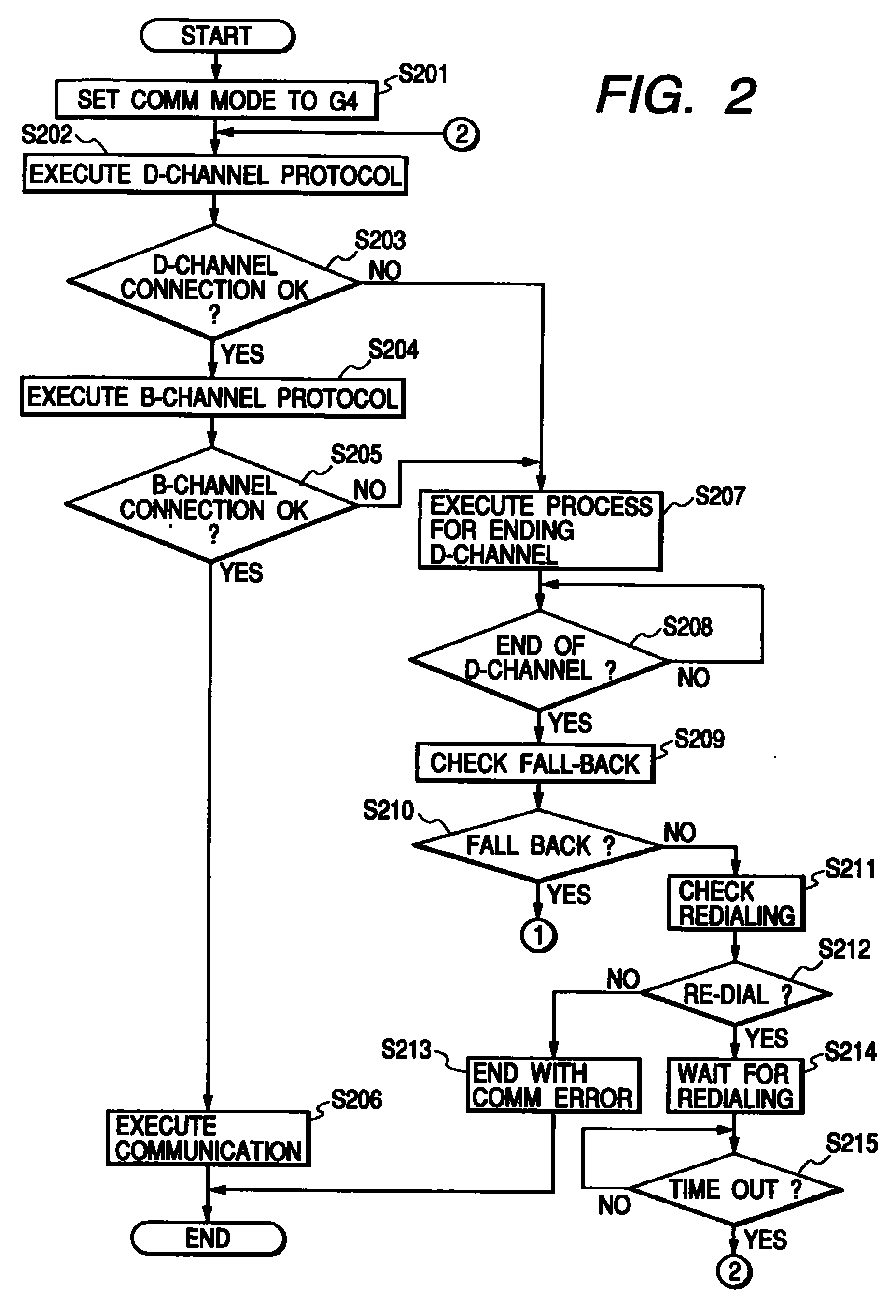
- Fig. 2 is a flowchart showing one example of the facsimile apparatus related to the present invention.
- connection is tried in a communication mode set by using a call control procedure in the D channel.
- it is decided whether a D-channel connection procedure has succeeded at S202.
- a flow goes to S204 to perform B-channel connection.
- This decision is made to estimate a reason for failure in connection and judge whether the fall-back is effective or not based on a reason such as a mismatch in communication mode.
- the fall-back is not effective. In this case, the fall-back is not performed. If the fall-back has been repeated and any other communication mode is not available, the fall-back is impossible.
- Such criterion are specified beforehand by the control program (stored as a program in the ROM102) or specified by the operation unit 106 by selection of a function mode, etc. (i.e., the criterion are input from the operation unit 106 and stored in the RAM103, thus permitting the CPU101 to decide the fall-back based on the criterion stored in the RAM103), for performing the above-mentioned decisions.
- the flow shifts to a re-dial stand-by state (S214) and waiting in executed there for a re-dial stand-by time stored in the RAM103 until the time-out (S215). After the time-out, the flow returns to S202 and goes on. For each redialing here, a counter for counting the number of re-dialing operations, move wants by one.
- a timer (fall-back wait timer) for waiting for a time lapse stored in the RAM103 is started.
- a stand-by time is stored in the RAM103.
- the flow returns to S202 and goes on.
- the present invention can be applied also to a terminal that is used in communication of the same purpose as the above by using as occasion demands a plurality of B-channel protocols in the ISDN.
- a fall-back procedure is performed in an order of G4 to G3 (transmissibility: 3.1-kHz audio) and then to G3 (transmissibility: speech), the fall-back communication modes and the order are not limited to that embodiment.
- Fig. 4 gives setting states of a re-dial timer and a fall-back timer stored in the RAM103.
- the re-dial timer is used at S214 and S215 in Fig. 2, while the fall-back timer is used at S219 and S220 in Fig. 3.
- the re-dial timer can set therein the time of 2 to 10 minutes in units of one minute, while the fall-back timer can set therein the time of zero to 25.5 seconds in units of 100 ms.
- These settings may be given, as mentioned above, by the operator's key-in at the operation unit 106 or transferred from an external apparatus to the present facsimile apparatus via a predetermined interface or network and stored in the RAM103.
- the present invention makes it possible to provide a timer for stand-by waiting for a predetermined time before re-calling by the use of a fall-back function, to enable effective re-calling even to such a partner apparatus, exchanger, or network that takes a long time in releasing processing, thus improving a rate of successful connection.
- the present invention improves probability of success in connection by enabling effective re-calling even for such a partner apparatus, exchanger, or network that takes a long time in releasing processing when a connection protocol fails at calling in G4, the line is disconnected and re-calling is performed in G3 (fall-back).
- a fall-back wait timer is provided for waiting for a predetermined time before re-calling is performed by the fall-back function. With this, at the time of fall-back, next communication can be activated in a sufficient time. Therefore, effective re-calling is possible even for such a partner apparatus, exchanger, or network that takes a long time in releasing processing, whereby the probability of success in connection is improved.
Landscapes
- Engineering & Computer Science (AREA)
- Computer Networks & Wireless Communication (AREA)
- Communication Control (AREA)
- Facsimile Transmission Control (AREA)
- Facsimiles In General (AREA)
- Data Exchanges In Wide-Area Networks (AREA)
- Telephonic Communication Services (AREA)
Abstract
Description
- The present invention relates to a communication apparatus which can be connected to ISDN (Integrated Services Digital Network), a method for controlling the same, and a computer-readable storage medium storing a program for the control.
- In communication by the use of a terminal (G4 facsimile etc.) connected to an ISDN, a fall-back function has been realized in a conventional facsimile apparatus as an example of such a control method that in a case where a partner apparatus is called with specification of a communication mode (G4·unrestricted digital mode, etc.) in a B-channel thereof, if the communication mode matches, the communication goes on, while if call connection with the ISDN fails due to a mismatch in the communication mode, etc., the communication mode is automatically switched to another mode (G3·3.1-kHz audio mode, etc.) to repeat the procedure.
- In the above-mentioned conventional example, however, if call connection with the ISDN fails due to, for example, a mismatch in communication mode (a case where the partner is in a G3·3.1-kHz audio mode when it is called with specification of the G4 non-restricted digital mode, etc.), a fall-back function switches the communication mode into another (G3·3.1-kHz audio mode, etc.) to immediately shift to the call procedure again, so that it may sometimes take too long a time for the partner apparatus, exchanger, or network to be released and thus the partner cannot respond even when called again (i.e., it is in no condition to respond to the calling), whereby the call connection may be impossible even when the communication mode matches.
- In view of the above, it is an object of the present invention to provide a communication apparatus, a method for controlling the same, or a storage medium that enables effective re-calling to a partner terminal, exchanges, or network which takes a long time to be released and that improves a rate of successful connection at the time of re-calling.
-
- Fig. 1 is a block diagram showing one embodiment of the present invention;
- Fig. 2 is a flowchart showing operations of the above-mentioned embodiment;
- Fig. 3 is another flowchart showing the operations of the above-mentioned embodiment; and
- Fig. 4 gives timer settings of the above-mentioned embodiment.
-
- Fig. 1 is a block diagram showing a configuration of a facsimile apparatus related to an embodiment of the present invention.
- A CPU101 is a system control unit for controlling the apparatus as a whole. A ROM102 stores a control program for controlling the CPU101. The CPU101 and a part of the control program constitute a control means (control step), a decision means (decision step), and a setting means (setting step) in the present invention.
- A RAM103 consists of an SRAM for storing program control variables, etc. It also stores settings registered by an operator, managing data of the apparatus, and various working buffers.
- This RAM103 stores also values which are set by a setting means (setting step) for setting a stand-by time in the present invention. The setting means (setting step) may be specifically structured by a method of operator's entry through a keyboard of an
operation unit 106 or a method that setting information is transferred from an external apparatus to the present facsimile apparatus via a predetermined interface or network and stored in the RAM103. - A
storage memory 104 consists of a DRAM, etc. for storing image data. Adisplay unit 105 consists of LCDs, LEDs, etc. for notifying a user of the display contents. - The
operation unit 106 consists of the keyboard, a touch panel, etc. for permitting the operator to enter various information. Animage processing unit 107 is used to perform correction processing on image data which is read in and output high-accuracy image data. - A
scanner 108 consists of a CS image sensor, an original-carrier mechanism, etc. for reading out an original optically to convert it into electrical image data. Arecording unit 109 consists of a printer for recording received images or file data on recording paper. - A MODEM110 modulates and demodulates reception/transmission signals in G3 ISDN communication. An
ISDN control unit 111 performs transmission control in the D and B channels for ISDN communication via an ISDNcommunication line 112. - Fig. 2 is a flowchart showing one example of the facsimile apparatus related to the present invention.
- In Fig. 2, when an operator makes a call via the
operation unit 106, the CPU101 sets an initial communication mode to G4 at S201. - Next, at S202, connection is tried in a communication mode set by using a call control procedure in the D channel. At S203, it is decided whether a D-channel connection procedure has succeeded at S202. When it decides a success at S203, a flow goes to S204 to perform B-channel connection.
- At S205, it is decided whether a B-channel connection procedure has succeeded at S204. When it decides a success at S205, communication is conducted at S206 and the flow terminates.
- If the decision results in failure at S203 or S205, the flow goes to S207 to perform D-channel termination processing. After the D-channel termination processing is ended (S208), it is decided whether a fall-back should be performed at S209 and S210
- This decision is made to estimate a reason for failure in connection and judge whether the fall-back is effective or not based on a reason such as a mismatch in communication mode.
- If, for example, the connection has failed due to a busy state of the partner, the fall-back is not effective. In this case, the fall-back is not performed. If the fall-back has been repeated and any other communication mode is not available, the fall-back is impossible.
- Such criterion are specified beforehand by the control program (stored as a program in the ROM102) or specified by the
operation unit 106 by selection of a function mode, etc. (i.e., the criterion are input from theoperation unit 106 and stored in the RAM103, thus permitting the CPU101 to decide the fall-back based on the criterion stored in the RAM103), for performing the above-mentioned decisions. - If it decides at S210 that the fall-back should not be performed, it is decided at S211 and S212 whether re-dialing should be performed or not. Specifically, it is here decided whether the number of re-dialing operations has already reached a predetermined value. If it is decided at S212 that re-dialing should not be performed, the communication terminates with a communication error at S213.
- If it is decided at S212 that re-dialing should be performed, the flow shifts to a re-dial stand-by state (S214) and waiting in executed there for a re-dial stand-by time stored in the RAM103 until the time-out (S215). After the time-out, the flow returns to S202 and goes on. For each redialing here, a counter for counting the number of re-dialing operations, move wants by one.
- When it is decided at S210 that the fall-back should be performed, it is decided whether the current communication mode is G4. If it is G4, a re-calling communication mode is set to G3 (transmissibility: 3.1-kHz audio) and, otherwise, G3 (transmissibility: speech), and then the flow goes to S219.
- At S219, a timer (fall-back wait timer) for waiting for a time lapse stored in the RAM103 is started. As mentioned above, by operating the
operation unit 106 beforehand, a stand-by time is stored in the RAM103. When the timer times out, the flow returns to S202 and goes on. - Although the above-mentioned operations are performed by the CPU101 based on the programs stored in the ROM102 and the RAM103, according to the present invention, such programs may be stored on a floppy disk, hard disk, optical disk, magneto-optical disk, CD-ROM, memory card, or any other external memory medium, which can be read out by a dedicated read-out apparatus and taken into a facsimile apparatus to be executed by the CPU101.
- Although the above-mentioned embodiment has been described only with respect to a facsimile apparatus, the present invention can be applied also to a terminal that is used in communication of the same purpose as the above by using as occasion demands a plurality of B-channel protocols in the ISDN.
- Although in the above-mentioned embodiment, a fall-back procedure is performed in an order of G4 to G3 (transmissibility: 3.1-kHz audio) and then to G3 (transmissibility: speech), the fall-back communication modes and the order are not limited to that embodiment.
- Fig. 4 gives setting states of a re-dial timer and a fall-back timer stored in the RAM103. The re-dial timer is used at S214 and S215 in Fig. 2, while the fall-back timer is used at S219 and S220 in Fig. 3. The re-dial timer can set therein the time of 2 to 10 minutes in units of one minute, while the fall-back timer can set therein the time of zero to 25.5 seconds in units of 100 ms. These settings may be given, as mentioned above, by the operator's key-in at the
operation unit 106 or transferred from an external apparatus to the present facsimile apparatus via a predetermined interface or network and stored in the RAM103. - As described above, the present invention makes it possible to provide a timer for stand-by waiting for a predetermined time before re-calling by the use of a fall-back function, to enable effective re-calling even to such a partner apparatus, exchanger, or network that takes a long time in releasing processing, thus improving a rate of successful connection.
- The present invention improves probability of success in connection by enabling effective re-calling even for such a partner apparatus, exchanger, or network that takes a long time in releasing processing when a connection protocol fails at calling in G4, the line is disconnected and re-calling is performed in G3 (fall-back).
- A fall-back wait timer is provided for waiting for a predetermined time before re-calling is performed by the fall-back function. With this, at the time of fall-back, next communication can be activated in a sufficient time. Therefore, effective re-calling is possible even for such a partner apparatus, exchanger, or network that takes a long time in releasing processing, whereby the probability of success in connection is improved.
Claims (12)
- A communication apparatus connected to an ISDN which comprises:decision means for, when call connection fails, deciding a reason for the failure in connection;setting means for setting a timer value used to wait for a predetermined time when the decision means decides a mismatch in communication mode; andcontrol means adapted for waiting for the predetermined time in response to the decision of a mismatch in communication mode made by the decision means, and then switching the communication mode to another communication mode to try the call connection again.
- The communication apparatus according to claim 1, whereinthe setting means sets, differently from the timer value, a second timer value used to wait for a second predetermined time when the decision means decides that a partner is busy; andthe control means is adapted to wait for the second predetermined time when the decision means decides that the partner is busy, and then tries the call connection again without switching the communication mode.
- A communication apparatus connected to an ISDN, having a plurality of communication protocols in a B channel, said apparatus including D-channel control means for controlling a call in a D channel, and a plurality of B-channel control means for conducting protective controls corresponding to a plurality of communication modes in the B channel, said apparatus comprising:decision means for, when call connection by the D-channel control means fails, deciding whether or not call connection should be tried by the D-channel control means again after switching a communication mode in the B channel to another communication mode;timer control means for waiting for a predetermined time when the decision means decides that the call connection should be tried by the D-channel control means again after the switching to such another communication mode in the B channel; andcontrol means adapted for switching to said another communication mode in the B channel after waiting for a predetermined time by the timer control means to try the call connection again by the D-channel control means.
- The communication control apparatus according to claim 3, further comprising setting means for setting a time for waiting by the timer control means, when the communication mode is switched to another communication mode in the B channel and it is decided that the call connection should be tried again by the D-channel control means.
- A communication method in an ISDN, comprising the step of:when call connection fails, deciding a reason for the failure in connection;setting a timer value used to wait for a predetermined time when the decision step decides a mismatch in communication mode; andcontrolling adapted for waiting for the predetermined time in response to the decision of a mismatch in communication mode made in the decision step, and then switching the communication mode to another communication mode to try the call connection again.
- The communication method according to claim 5, wherein the setting step sets, differently from the timervalue, a second timer value used to wait for a second predetermined time when the decision step decides that a partner is busy; andthe control step is adapted to wait for the second predetermined time when the decision step decides that the partner is busy, and then tries the call connection again without switching the communication mode.
- A communication method in an ISDN, having a plurality of communication protocols in a B channel, said method including a D-channel control step for controlling a call in a D channel, and a B-channel control step for conducting control corresponding to each of a plurality of communication modes in the B channel, said method comprising the steps of:when call connection by the D-channel control means fails, deciding whether or not call connection should be tried in the D-channel control step again after switching a communication mode in the B channel to another communication mode;controlling a timer for waiting for a predetermined time when the decision step decides that the call connection should be tried in the D-channel control step again after the switching to such another communication mode in the B channel; andcontrolling adapted for switching to said another communication mode in the B channel after waiting for a predetermined time in the timer control step to try the call connection again by the D-channel control means.
- The communication method according to claim 7, further comprising the step of setting a time for waiting in the timer control step, when the communication mode is switched to another communication mode in the B channel and it is decided that the call connection should be tried again in the D-channel control step.
- A storage medium to store a computer program for the implementation of a communication method in an ISDN, comprising the step of:when call connection fails, deciding a reason for the failure in connection;setting a timer value used to wait for a predetermined time when the decision step decides a mismatch in communication mode; andcontrolling adapted for waiting for the predetermined time in response to the decision of a mismatch in communication mode made in the decision step, and then switching the communication mode to another communication mode to try the call connection again.
- The storage medium according to claim 9, whereinthe setting step sets, differently from the timer value, a second timer value used to wait for a second predetermined time when the decision step decides that a partner is busy; andthe control step is adapted to wait for the second predetermined time when the decision step decides that the partner is busy, and then tries the call connection again without switching the communication mode.
- A storage medium to store a computer program for the implementation of a communication method in an ISDN, having a plurality of communication protocols in a B channel, said method including a D-channel control step for controlling a call in a D channel, and a B-channel control step for conducting control corresponding to each of a plurality of communication modes in the B channel, said method comprising the steps of:when call connection by the D-channel control means fails, deciding whether or not call connection should be tried in the D-channel control step again after switching a communication mode in the B channel to another communication mode;controlling a timer for waiting for a predetermined time when the decision step decides that the call connection should be tried in the D-channel control step again after the switching to such another communication mode in the B channel; andcontrolling adapted for switching to said another communication mode in the B channel after waiting for a predetermined time in the timer control step to try the call connection again by the D-channel control means.
- The storage medium according to claim 11, further comprising the step of setting a time for waiting in the timer control step, when the communication mode is switched to another communication mode in the B channel and it is decided that the call connection should be tried again in the D-channel control step.
Applications Claiming Priority (2)
| Application Number | Priority Date | Filing Date | Title |
|---|---|---|---|
| JP4343399 | 1999-02-22 | ||
| JP11043433A JP2000244677A (en) | 1999-02-22 | 1999-02-22 | Communication device and communication control device |
Publications (3)
| Publication Number | Publication Date |
|---|---|
| EP1032240A2 true EP1032240A2 (en) | 2000-08-30 |
| EP1032240A3 EP1032240A3 (en) | 2006-11-29 |
| EP1032240B1 EP1032240B1 (en) | 2010-09-01 |
Family
ID=12663575
Family Applications (1)
| Application Number | Title | Priority Date | Filing Date |
|---|---|---|---|
| EP00103605A Expired - Lifetime EP1032240B1 (en) | 1999-02-22 | 2000-02-21 | ISDN communication apparatus with fall-back function |
Country Status (5)
| Country | Link |
|---|---|
| US (1) | US6891861B1 (en) |
| EP (1) | EP1032240B1 (en) |
| JP (1) | JP2000244677A (en) |
| DE (1) | DE60044887D1 (en) |
| ES (1) | ES2347128T3 (en) |
Cited By (1)
| Publication number | Priority date | Publication date | Assignee | Title |
|---|---|---|---|---|
| CN102546135A (en) * | 2010-12-31 | 2012-07-04 | 富泰华工业(深圳)有限公司 | System and method for switching between active and standby servers |
Families Citing this family (3)
| Publication number | Priority date | Publication date | Assignee | Title |
|---|---|---|---|---|
| JP2002281175A (en) * | 2001-03-19 | 2002-09-27 | Sharp Corp | Communication terminal device and recording medium recording communication control program |
| JP5605118B2 (en) | 2010-09-17 | 2014-10-15 | 富士ゼロックス株式会社 | COMMUNICATION DEVICE, COMMUNICATION SYSTEM, AND PROGRAM |
| JP5408120B2 (en) | 2010-12-22 | 2014-02-05 | ブラザー工業株式会社 | COMMUNICATION DEVICE, COMMUNICATION DEVICE PROGRAM, AND COMMUNICATION DEVICE CONTROL METHOD |
Citations (2)
| Publication number | Priority date | Publication date | Assignee | Title |
|---|---|---|---|---|
| JPH1032630A (en) | 1996-07-18 | 1998-02-03 | Canon Inc | Communication device |
| JPH10327309A (en) | 1997-03-28 | 1998-12-08 | Oki Data:Kk | Facsimile equipment and facsimile communication control method |
Family Cites Families (6)
| Publication number | Priority date | Publication date | Assignee | Title |
|---|---|---|---|---|
| US5276687A (en) * | 1989-04-14 | 1994-01-04 | Fujitsu Limited | Network system having different attributes of terminal equipment devices |
| US5367522A (en) * | 1991-02-21 | 1994-11-22 | Canon Kabushiki Kaisha | Multimedia communicating apparatus |
| FR2686207B1 (en) * | 1992-01-14 | 2001-10-12 | Sagem | VIDEOTEX FAX. |
| CA2107047C (en) * | 1992-12-29 | 1998-04-28 | Alan M. Bentley | Switched circuit connection management over public data networks for wide area networks |
| JP2912844B2 (en) * | 1995-04-06 | 1999-06-28 | 富士通株式会社 | Communication system capable of switching between calling modes and terminal device used in the communication system |
| US5854829A (en) * | 1995-06-02 | 1998-12-29 | Canon Kabushiki Kaisha | ISDN fax routing |
-
1999
- 1999-02-22 JP JP11043433A patent/JP2000244677A/en active Pending
-
2000
- 2000-02-18 US US09/506,941 patent/US6891861B1/en not_active Expired - Fee Related
- 2000-02-21 ES ES00103605T patent/ES2347128T3/en not_active Expired - Lifetime
- 2000-02-21 DE DE60044887T patent/DE60044887D1/en not_active Expired - Lifetime
- 2000-02-21 EP EP00103605A patent/EP1032240B1/en not_active Expired - Lifetime
Patent Citations (2)
| Publication number | Priority date | Publication date | Assignee | Title |
|---|---|---|---|---|
| JPH1032630A (en) | 1996-07-18 | 1998-02-03 | Canon Inc | Communication device |
| JPH10327309A (en) | 1997-03-28 | 1998-12-08 | Oki Data:Kk | Facsimile equipment and facsimile communication control method |
Cited By (2)
| Publication number | Priority date | Publication date | Assignee | Title |
|---|---|---|---|---|
| CN102546135A (en) * | 2010-12-31 | 2012-07-04 | 富泰华工业(深圳)有限公司 | System and method for switching between active and standby servers |
| CN102546135B (en) * | 2010-12-31 | 2016-08-03 | 富泰华工业(深圳)有限公司 | Active/standby server switched system and method |
Also Published As
| Publication number | Publication date |
|---|---|
| EP1032240A3 (en) | 2006-11-29 |
| JP2000244677A (en) | 2000-09-08 |
| EP1032240B1 (en) | 2010-09-01 |
| DE60044887D1 (en) | 2010-10-14 |
| ES2347128T3 (en) | 2010-10-26 |
| US6891861B1 (en) | 2005-05-10 |
Similar Documents
| Publication | Publication Date | Title |
|---|---|---|
| EP0313313B1 (en) | Communication system and communication method | |
| US6891861B1 (en) | Communication apparatus | |
| US7139088B2 (en) | Communication apparatus and communication method | |
| US5781626A (en) | Communication device capable of controlling transmission parameters of outputted DTMF signals | |
| US5721766A (en) | Communication apparatus able to call plural designated destinations | |
| US5428676A (en) | Facsimile machine and re-call control method thereof | |
| US6600576B2 (en) | Facsimile apparatus | |
| JP3367138B2 (en) | Calling device of communication device | |
| JPH0918962A (en) | Data communication equipment | |
| JP2746995B2 (en) | Image communication apparatus and control method thereof | |
| JP3203938B2 (en) | Terminal device | |
| JP3632858B2 (en) | Memory management device | |
| JP2826542B2 (en) | Automatic telephone exchange | |
| JP3276766B2 (en) | Communication terminal | |
| JP3437444B2 (en) | Communication apparatus, control method therefor, and storage medium | |
| JP2950197B2 (en) | Communication device | |
| JP2631893B2 (en) | Incoming terminal recognition method, ISDN network response system, and ISDN terminal device | |
| JP2755797B2 (en) | Data communication device | |
| JP3134284B2 (en) | Facsimile machine | |
| JPH10224583A (en) | Facsimile adapter device | |
| JPH06261096A (en) | Isdn communications equipment | |
| JPH05160979A (en) | Fax machine | |
| JPH053533A (en) | Equipment | |
| JPS6386939A (en) | Communication control device | |
| JPH0595467A (en) | Equipment |
Legal Events
| Date | Code | Title | Description |
|---|---|---|---|
| PUAI | Public reference made under article 153(3) epc to a published international application that has entered the european phase |
Free format text: ORIGINAL CODE: 0009012 |
|
| AK | Designated contracting states |
Kind code of ref document: A2 Designated state(s): AT BE CH CY DE DK ES FI FR GB GR IE IT LI LU MC NL PT SE |
|
| AX | Request for extension of the european patent |
Free format text: AL;LT;LV;MK;RO;SI |
|
| PUAL | Search report despatched |
Free format text: ORIGINAL CODE: 0009013 |
|
| AK | Designated contracting states |
Kind code of ref document: A3 Designated state(s): AT BE CH CY DE DK ES FI FR GB GR IE IT LI LU MC NL PT SE |
|
| AX | Request for extension of the european patent |
Extension state: AL LT LV MK RO SI |
|
| 17P | Request for examination filed |
Effective date: 20070529 |
|
| AKX | Designation fees paid |
Designated state(s): DE ES FR GB IT |
|
| 17Q | First examination report despatched |
Effective date: 20070924 |
|
| GRAP | Despatch of communication of intention to grant a patent |
Free format text: ORIGINAL CODE: EPIDOSNIGR1 |
|
| GRAS | Grant fee paid |
Free format text: ORIGINAL CODE: EPIDOSNIGR3 |
|
| GRAA | (expected) grant |
Free format text: ORIGINAL CODE: 0009210 |
|
| AK | Designated contracting states |
Kind code of ref document: B1 Designated state(s): DE ES FR GB IT |
|
| REG | Reference to a national code |
Ref country code: GB Ref legal event code: FG4D |
|
| REF | Corresponds to: |
Ref document number: 60044887 Country of ref document: DE Date of ref document: 20101014 Kind code of ref document: P |
|
| REG | Reference to a national code |
Ref country code: ES Ref legal event code: FG2A Ref document number: 2347128 Country of ref document: ES Kind code of ref document: T3 |
|
| PLBE | No opposition filed within time limit |
Free format text: ORIGINAL CODE: 0009261 |
|
| STAA | Information on the status of an ep patent application or granted ep patent |
Free format text: STATUS: NO OPPOSITION FILED WITHIN TIME LIMIT |
|
| 26N | No opposition filed |
Effective date: 20110606 |
|
| REG | Reference to a national code |
Ref country code: DE Ref legal event code: R097 Ref document number: 60044887 Country of ref document: DE Effective date: 20110606 |
|
| PGFP | Annual fee paid to national office [announced via postgrant information from national office to epo] |
Ref country code: FR Payment date: 20120312 Year of fee payment: 13 |
|
| PGFP | Annual fee paid to national office [announced via postgrant information from national office to epo] |
Ref country code: DE Payment date: 20120229 Year of fee payment: 13 |
|
| PGFP | Annual fee paid to national office [announced via postgrant information from national office to epo] |
Ref country code: IT Payment date: 20120209 Year of fee payment: 13 Ref country code: GB Payment date: 20120224 Year of fee payment: 13 |
|
| PGFP | Annual fee paid to national office [announced via postgrant information from national office to epo] |
Ref country code: ES Payment date: 20120207 Year of fee payment: 13 |
|
| GBPC | Gb: european patent ceased through non-payment of renewal fee |
Effective date: 20130221 |
|
| REG | Reference to a national code |
Ref country code: FR Ref legal event code: ST Effective date: 20131031 |
|
| REG | Reference to a national code |
Ref country code: DE Ref legal event code: R119 Ref document number: 60044887 Country of ref document: DE Effective date: 20130903 |
|
| PG25 | Lapsed in a contracting state [announced via postgrant information from national office to epo] |
Ref country code: IT Free format text: LAPSE BECAUSE OF NON-PAYMENT OF DUE FEES Effective date: 20130221 |
|
| PG25 | Lapsed in a contracting state [announced via postgrant information from national office to epo] |
Ref country code: GB Free format text: LAPSE BECAUSE OF NON-PAYMENT OF DUE FEES Effective date: 20130221 Ref country code: FR Free format text: LAPSE BECAUSE OF NON-PAYMENT OF DUE FEES Effective date: 20130228 Ref country code: DE Free format text: LAPSE BECAUSE OF NON-PAYMENT OF DUE FEES Effective date: 20130903 |
|
| REG | Reference to a national code |
Ref country code: ES Ref legal event code: FD2A Effective date: 20140408 |
|
| PG25 | Lapsed in a contracting state [announced via postgrant information from national office to epo] |
Ref country code: ES Free format text: LAPSE BECAUSE OF NON-PAYMENT OF DUE FEES Effective date: 20130222 |