EP1032225A1 - Serveur pour faire communiquer n paires de machines, et réseau de télécommunication privé DECT comportant un tel serveur - Google Patents
Serveur pour faire communiquer n paires de machines, et réseau de télécommunication privé DECT comportant un tel serveur Download PDFInfo
- Publication number
- EP1032225A1 EP1032225A1 EP00400387A EP00400387A EP1032225A1 EP 1032225 A1 EP1032225 A1 EP 1032225A1 EP 00400387 A EP00400387 A EP 00400387A EP 00400387 A EP00400387 A EP 00400387A EP 1032225 A1 EP1032225 A1 EP 1032225A1
- Authority
- EP
- European Patent Office
- Prior art keywords
- standard
- machine
- operating according
- private
- switch
- Prior art date
- Legal status (The legal status is an assumption and is not a legal conclusion. Google has not performed a legal analysis and makes no representation as to the accuracy of the status listed.)
- Granted
Links
- 230000006399 behavior Effects 0.000 claims abstract description 3
- 230000011664 signaling Effects 0.000 claims description 14
- 238000000034 method Methods 0.000 claims description 7
- HFQQZARZPUDIFP-UHFFFAOYSA-M sodium;2-dodecylbenzenesulfonate Chemical compound [Na+].CCCCCCCCCCCCC1=CC=CC=C1S([O-])(=O)=O HFQQZARZPUDIFP-UHFFFAOYSA-M 0.000 claims description 6
- 101100510299 Oryza sativa subsp. japonica KIN7A gene Proteins 0.000 claims description 4
- 101150080339 BTS1 gene Proteins 0.000 claims description 3
- 108091006146 Channels Proteins 0.000 description 4
- 239000013256 coordination polymer Substances 0.000 description 2
- 238000012986 modification Methods 0.000 description 2
- 230000004048 modification Effects 0.000 description 2
- 238000006677 Appel reaction Methods 0.000 description 1
- 230000002457 bidirectional effect Effects 0.000 description 1
- 230000001010 compromised effect Effects 0.000 description 1
- 238000010586 diagram Methods 0.000 description 1
Images


Classifications
-
- H—ELECTRICITY
- H04—ELECTRIC COMMUNICATION TECHNIQUE
- H04W—WIRELESS COMMUNICATION NETWORKS
- H04W84/00—Network topologies
- H04W84/02—Hierarchically pre-organised networks, e.g. paging networks, cellular networks, WLAN [Wireless Local Area Network] or WLL [Wireless Local Loop]
- H04W84/10—Small scale networks; Flat hierarchical networks
- H04W84/16—WPBX [Wireless Private Branch Exchange]
Definitions
- the invention relates to a server capable of being cut off between two machines, or n pairs of machines, and capable of analyzing and processing information exchanged between these machines, in order to offer new services to these machines, without modification of these machines.
- a first problem targeted by the invention is the supply of new services in an already existing telecommunications network, without changing the structure of this network.
- a second problem targeted by the invention is the use of terminals GSM in a private DECT network.
- a private DECT network includes a private switch, DECT mobile radiotelephone terminals, and possibly fixed telephone terminals.
- This network includes DECT base stations coupled to this private switch, by means of an interface specific to these DECT base stations.
- Such a network is used in a business. It allows some employee mobility within the premises of a company site. However a company often has several sites. Some employees are therefore led to travel to several sites and outside the company. To be able to be joined almost everywhere, they each carry a radiotelephone terminal GSM benefiting from a subscription to use a public GSM network. They are therefore supposed to use at least two different types of terminal depending on whether they are or not in a company site.
- GSM call authentication and encryption procedures implement cryptographic algorithms and secret keys. These keys cannot be made available to private networks otherwise security communications would be compromised. It wouldn't be acceptable, either, that GSM communications in a private network do not benefit from the security provided by these authentication and encryption procedures.
- the object of the invention is to allow the employees of a company to use their GSM terminals in one site or in several company sites at a reduced cost and with the same services as if they were terminals DECT; to allow duly authorized outside visitors to use their GSM terminals like DECT terminals of the company, to access the fixed public network via the company's private switch, or to be called via the fixed public network; and optionally to allow users external, unidentified, to benefit from the same GSM base station.
- Another aim is to allow employees to benefit in addition from certain telephone and mobility services offered by their subscription GSM, and that the company's DECT private network does not offer them.
- the server thus characterized is transparent to the services offered to the first machine by the second machine of the same pair but it allows the first machine to also benefit from new services offered by a third party machine, which it cannot usually communicate with
- Each SA, SB, SC, SD simulator is linked to each of the others simulators by L links, and is able to communicate with it.
- the server according to the invention can be used to offer new services in a telecommunications network, without requiring modifications sensitive in existing equipment. For example, in a GSM network, messages requesting a particular service can be diverted first mobile service switching center to a second, if the first offers not this service and if the second offers it.
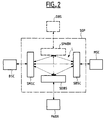
- FIG. 2 represents an exemplary embodiment of the server according to the invention, in the case where it is used to allow GSM terminals to benefit from the services of a private DECT network. It is inserted between two nodes, BSC and MSC, of a public GSM radiotelephony network.
- the BSC node is a GSM base station controller
- the MSC node is a switching center for the GSM radio-mobile service.
- the SGP server is also connected to a PABX switch on a private network, and optionally to a DECT base station, referenced DBS.
- the GSM, BSC, and base station controller switching of the GSM mobile radio service, MSC are two machines that usually communicate with each other using a GSM protocol.
- the PABX private switch usually communicates with the base station DECT according to a DECT protocol. So these are two pairs of machines that usually cannot communicate.
- the SGP server allows GSM terminals to benefit from the services of a PN private network built around the PABX private switch which usually communicates only with DECT terminals.
- the SGP server analyzes all messages from the BSC base station and the service switch radio mobile MSC, and it diverts all messages to the PABX private switch signaling concerning GSM terminals belonging to the PN private network, except those concerning authentication and encryption of GSM calls.
- the GSM terminals which communicate with the BSC base station and which are declared as belonging to the PN private network can thus benefit from these security procedures specific to the GSM network, while benefiting from the services specific to the private network.
- GSM base BTS1, BTS2, BTS3, a GSM base station controller: BSC, and a GSM mobile service switch: MSC, which belong to a network public of portable radiotelephony, PLMN, but which were installed on this site with the company's request.
- the base station controller, BSC can be connected to other GSM base stations: BTS4, BTS5, BTS6, outside the company. In the company's website, there is therefore simultaneously operation: DECT terminals: DT1, DT2, ... and GSM terminals: GT1, GT2, ...
- the PABX private switch is linked in particular to a fixed public network PSTN.
- GSM terminals can be used in the conventional way, i.e. communicate via the public PLMN network, but they can also communicate with the PSTN fixed network via the PABX switch. Furthermore, this allows them to benefit from all the services of the PN private network in which the PABX switch, in particular: local communications with others fixed or mobile terminals of the PN private network, and communications via the PSTN fixed public network; while retaining the services provided by the network GSM.
- a discrimination can be made to reserve the access of the base stations BTS1, BTS2, BTS3, to the employees of the company, even to communicate via the public PLMN network.
- a procedure for declaration to the SGP server allows this right of access to be assigned to employees of the company and certain visitors.
- the input / output of the BSC base station controller and the input / output of the MSC switch which are connected to the C1 card are usually connected between them, in a conventional GSM network, by 2Mb / s lines using a interface called A standardized by GSM, for exchanging information signaling, and speech channels.
- SGP server C1 card inserted on two of these lines, between the BSC base station controller and the MSC switch.
- GSM speech channel signaling is transported by signaling channels according to signaling protocol No. 7 of the interface A and are taken into account by the C1 card.
- This C1 card is seen by the network of signaling n ° 7 as two signaling points. Speech channels counterparts of the C1 card are permanently connected to the BS bus.
- Signage is taken into account by card C2.
- the C2 card converts the GSM protocol, DECT / GAP protocol which is accepted by the switch private PABX.
- the CPU processor converts the DECT / GAP protocol, into GSM protocol which is accepted by the BSC controller.
- the function of the SGP server is to detect and divert messages from GSM terminals, such as GT1 and GT2, which belong to the PN network, except messages regarding authentication, encryption, and mobility in the GSM network.
- GSM terminals benefit from the procedures GSM call authentication and encryption, thanks to the fact that signaling messages concerning these procedures are transmitted in a way transparent, and bidirectional, between the BSC base station controller and the MSC mobile service switch, while all other messages are diverted to PN private network equipment to further benefit from services of this private network.
- Messages concerning other GSM terminals, which do not belong not to the PN network are transmitted transparently between the controller BSC and the MSC mobile radio service switch.
- Messages concerning services not known by the SGP server are transmitted transparently between the BSC controller and the MSC radio-mobile service switch.
Landscapes
- Engineering & Computer Science (AREA)
- Computer Networks & Wireless Communication (AREA)
- Signal Processing (AREA)
- Mobile Radio Communication Systems (AREA)
- Telephonic Communication Services (AREA)
- Sub-Exchange Stations And Push- Button Telephones (AREA)
- Small-Scale Networks (AREA)
- Exchange Systems With Centralized Control (AREA)
Abstract
Description
caractérisé en ce qu'il comporte une paire de simulateur pour chaque paire de machine, une première machine et une seconde machine d'une paire donnée étant reliées respectivement à deux simulateurs simulant respectivement les comportements de la seconde machine et la première machine ;
- La figure 1 représente schématiquement un exemple de réalisation du serveur selon l'invention ;
- La figure 2 représente un exemple de réalisation dans le cas où il est intercalé entre deux noeuds d'un réseau public GSM, pour permettre à des terminaux GSM de bénéficier de bénéficier des services d'un réseau privé DECT ;
- La figure 3 représente le schéma synoptique plus détaillé d'un exemple de réseau privé DECT comportant cet exemple de réalisation du serveur selon l'invention.
- Un simulateur SB, relié à la machine A, pour simuler la machine B, c'est à dire faire croire à la machine A qu'elle est en train de communiquer avec la machine B alors qu'elle est en train de communiquer avec une autre machine, C ou D, avec laquelle est incapable de communiquer directement à cause d'une différence de norme ou de protocole. Ce simulateur SB fait croire à la machine A que certaines ressources d'une machine tierce sont situées dans la machine B. Par conséquent, il lui permet de bénéficier de nouveau services fournis par cette machine tierce.
- Un simulateur SA, relié à la machine B, pour simuler la machine A, c'est à dire faire croire à la machine B qu'elle est en train de communiquer avec la machine B alors qu'elle est en train de communiquer avec une autre machine, C ou D, avec laquelle est incapable de communiquer directement à cause d'une différence de norme ou de protocole. Ce simulateur SA fait croire à la machine B que certaines ressources d'une machine tierce sont situées dans la machine A. Par conséquent, il lui permet de bénéficier de nouveau services fournis par cette machine tierce.
- Un simulateur SD, relié à la machine C, pour simuler la machine D, c'est à dire faire croire à la machine C qu'elle est en train de communiquer avec la machine D alors qu'elle est en train de communiquer avec une autre machine, A ou B, avec laquelle est incapable de communiquer directement à cause d'une différence de norme ou de protocole. Ce simulateur SD fait croire à la machine C que certaines ressources d'une machine tierce sont situées dans la machine D. Par conséquent, il lui permet de bénéficier de nouveau services fournis par cette machine tierce.
- Un simulateur SC, relié à la machine D, pour simuler la machine C, c'est à dire faire croire à la machine D qu'elle est en train de communiquer avec la machine C alors qu'elle est en train de communiquer avec une autre machine, A ou B, avec laquelle est incapable de communiquer directement à cause d'une différence de norme ou de protocole. Ce simulateur SC fait croire à la machine D que certaines ressources d'une machine tierce sont situées dans la machine C. Par conséquent, il lui permet de bénéficier de nouveau services fournis par cette machine tierce.
- Un simulateur SDBS, relié au commutateur privé PABX, et simulant une station de base DECT, pour faire croire au commutateur privé PABX qu'il est relié à des terminaux radiotéléphoniques via des stations de base fonctionnant selon la norme DECT, alors que ce simulateur SDBS reçoit des signaux de signalisation et des signaux vocaux provenant de la station de base BSC fonctionnant selon norme GSM ;
- Un simulateur SMSC simulant le commutateur du service radio mobile, MSC, et fonctionnant selon la norme GSM, pour faire croire à la station de base GSM, BSC, qu'elle est reliée au commutateur du service radio-mobile MSC alors que ce simulateur SMSC reçoit des signaux de signalisation et des signaux vocaux provenant du commutateur privé PABX fonctionnant selon la norme DECT, pour certaines communications ; et pour fournir à cette station de base BSC, des signaux de signalisation et des signaux vocaux provenant effectivement du commutateur MSC, pour d'autres communications ;
- un simulateur SBSC simulant la station de base BSC, pour faire croire au commutateur du service radio mobile MSC qu'il est relié à la station de base BSC, alors qu'il est relié au commutateur privé PABX, à certains moments ; et pour le relier effectivement à la station de base BSC, via le simulateur SMSC pendant le reste du temps ;
- optionnellement, un simulateur SPABX simulant le commutateur privé PABX, pour faire croire à la station de base DBS optionnelle qu'elle est reliée au commutateur privé PABX alors qu'elle est reliée au commutateur du service radio-mobile MSC ou bien à la station de base BSC, à certains moments.
- des stations de base de type DECT : DBS1, DBS2, DBS3, reliées au commutateur privé PABX,
- et le serveur GSM privé, SGP.
- une carte coupleur C1 le relie au contrôleur de stations de base BSC et au commutateur du service mobile MSC,
- une carte coupleur C2 le relie au dispositif de traitement d'appel CP du commutateur privé PABX, selon le protocole DECT/GAP adapté au commutateur PABX.
- l'identité internationale d'abonné mobile IMSI (International mobile subscriber identity), et l'identité temporaire correspondante TMSI (Temporary mobile subscriber identity),
- l'identité DECT appelée IPUI (International Portable User Identity) utilisée dans le commutateur PABX, et le numéro d'annuaire,
- la relation IMSI/numéro d'annuaire,
- la relation IPUI/numéro d'annuaire,
- et optionnellement l'identité de la société propriétaire du terminal.
Claims (4)
- Serveur (F) pour faire communiquer n paire(s) de machines (A-B, C-D), n étant égal ou supérieur à 1 ; les machines d'une même paire étant capables de communiquer entre elles ;
caractérisé en ce qu'il comporte une paire de simulateur (SA, SB) pour chaque paire de machine (A, B), une première machine (A) et une seconde machine (B) d'une paire donnée étant reliées respectivement à deux simulateurs (SB, SA) simulant respectivement les comportements de la seconde machine (B) et la première machine (A) ;en ce qu'il comporte des moyens (L) pour interconnecter tous les simulateurs (SA, SB, SC, SD), chacun étant capable de communiquer avec chacun des autres simulateurs ;et en ce que, pour une paire de machines donnée (A-B), le simulateur (SB) de la seconde machine (B) comporte des moyens pour faire croire à la première machine (A) que certaines ressources d'une machine tierce (C) sont situées dans la seconde machine (B) de la paire considérée. - Serveur selon la revendication 1, permettant d'utiliser des terminaux radiotéléphoniques mobiles (GT1, GT2) fonctionnant selon une première norme dans un réseau de télécommunication privé (PN) fonctionnant selon une seconde norme, ce réseau privé comportant :caractérisé en ce qu'il comporte :un commutateur privé (PABX) fonctionnant selon la seconde norme,des terminaux radiotéléphoniques mobiles (DT1, DT2) fonctionnant selon la seconde norme,des stations de base (DBS1, DBS2, DBS3) fonctionnant selon la seconde norme, ayant des entrées-sorties couplées à des entrées-sorties de ce commutateur privé (PABX), ces entrées-sorties étant munies d'une interface spécifique à la seconde norme ;des stations de base (BTS1, BTS2, BTS3) fonctionnant selon la première norme,un contrôleur (BSC) de stations de base, fonctionnant selon la première norme,un commutateur du service radio-mobile (MSC) fonctionnant selon la première norme ;un premier simulateur (SDBS) simulant une station de base fonctionnant selon la seconde norme, pour faire croire au commutateur privé (PABX) qu'il est relié à des terminaux radiotéléphoniques via des stations de base fonctionnant selon la seconde norme, alors que ce premier simulateur (SDBS) reçoit des signaux de signalisation et des signaux vocaux provenant d'une station de base (BSC) fonctionnant selon la première norme ;un second simulateur (SMSC) simulant un commutateur du service radio mobile, fonctionnant selon la première norme, pour faire croire à la station de base (BSC) fonctionnant selon la première norme qu'elle est reliée à un commutateur du service radio mobile, fonctionnant selon la première norme, alors que ce second simulateur (SMSC) reçoit des signaux de signalisation et des signaux vocaux provenant du commutateur privé (PABX) fonctionnant selon la seconde norme, pour certaines communications ; et pour fournir à cette station de base (BSC), fonctionnant selon la première norme, des signaux de signalisation et des signaux vocaux provenant effectivement du commutateur (MSC) du service radio mobile fonctionnant selon la première norme, pour d'autres communications ;un troisième simulateur (SBSC) simulant une station de base fonctionnant selon la première norme, pour faire croire au commutateur du service radio mobile (MSC) fonctionnant selon la première norme, qu'il est relié à une station de base (BSC) fonctionnant selon la première norme, alors qu'il est relié au commutateur privé (PABX) fonctionnant selon la seconde norme, à certains moments ; et pour le relier effectivement à la station de base (BSC) fonctionnant selon la première norme, via le deuxième simulateur (SMSC) pendant le reste du temps.
- Serveur selon la revendication 2, caractérisé en ce qu'il est transparent pour les messages concernant les procédure d'authentification et de chiffrement d'un appel selon la première norme.
- Réseau de télécommunication privé DECT, caractérisé en ce qu'il comporte un serveur (SGP) selon l'une des revendications 1 à 3, pour permettre à des terminaux GSM de bénéficier des services de ce réseau privé DECT.
Applications Claiming Priority (2)
| Application Number | Priority Date | Filing Date | Title |
|---|---|---|---|
| FR9902249 | 1999-02-23 | ||
| FR9902249A FR2790176B1 (fr) | 1999-02-23 | 1999-02-23 | SERVEUR POUR FAIRE COMMUNIQUER n PAIRES DE MACHINES, ET RESEAU DE TELECOMMUNICATION PRIVE DECT COMPORTANT UN TEL SERVEUR |
Publications (2)
| Publication Number | Publication Date |
|---|---|
| EP1032225A1 true EP1032225A1 (fr) | 2000-08-30 |
| EP1032225B1 EP1032225B1 (fr) | 2003-08-27 |
Family
ID=9542432
Family Applications (1)
| Application Number | Title | Priority Date | Filing Date |
|---|---|---|---|
| EP00400387A Expired - Lifetime EP1032225B1 (fr) | 1999-02-23 | 2000-02-10 | Serveur pour faire communiquer une paire de machines avec une machine tierce, et réseau de télécommunication privé DECT comportant un tel serveur |
Country Status (7)
| Country | Link |
|---|---|
| US (1) | US6526437B1 (fr) |
| EP (1) | EP1032225B1 (fr) |
| JP (1) | JP2000312373A (fr) |
| CN (1) | CN1264999A (fr) |
| AT (1) | ATE248493T1 (fr) |
| DE (1) | DE60004718T2 (fr) |
| FR (1) | FR2790176B1 (fr) |
Cited By (1)
| Publication number | Priority date | Publication date | Assignee | Title |
|---|---|---|---|---|
| KR100308927B1 (ko) * | 1999-10-05 | 2001-11-02 | 서평원 | 디이시티 시스템의 무선 고정장치의 셀 영역 측정 방법 |
Families Citing this family (8)
| Publication number | Priority date | Publication date | Assignee | Title |
|---|---|---|---|---|
| KR100365790B1 (ko) * | 2000-05-24 | 2002-12-26 | 삼성전자 주식회사 | 공중용 및 사설용 이동통신서비스를 위한 시스템 및 방법 |
| JP4713018B2 (ja) * | 2001-06-11 | 2011-06-29 | 大日本印刷株式会社 | 生産計画調整システムおよび方法 |
| JP2007059955A (ja) * | 2003-12-03 | 2007-03-08 | Fujitsu Ltd | 構内移動通信システムおよび構内基地局装置 |
| US20080146194A1 (en) * | 2006-12-15 | 2008-06-19 | Yahoo! Inc. | Automatic data back up and account creation |
| EP3559601B1 (fr) * | 2016-12-22 | 2024-06-12 | Nissan North America, Inc. | Système de service pour véhicules autonomes |
| US11147108B2 (en) * | 2017-12-20 | 2021-10-12 | Telefonaktiebolaget Lm Ericsson (Publ) | Method for performing continuous deployment and feedback from a radio network node |
| US11880422B2 (en) | 2019-02-04 | 2024-01-23 | Cloudflare, Inc. | Theft prevention for sensitive information |
| US10452868B1 (en) | 2019-02-04 | 2019-10-22 | S2 Systems Corporation | Web browser remoting using network vector rendering |
Citations (2)
| Publication number | Priority date | Publication date | Assignee | Title |
|---|---|---|---|---|
| WO1993020642A1 (fr) * | 1992-04-03 | 1993-10-14 | Motorola Inc. | Appareil et methode de desserte d'abonnes en radio-telephonie dans un environnement de lignes filaires |
| EP0589619A2 (fr) * | 1992-09-25 | 1994-03-30 | AT&T Corp. | Architecture pour système de télécommunication sans fil |
Family Cites Families (4)
| Publication number | Priority date | Publication date | Assignee | Title |
|---|---|---|---|---|
| US5544318A (en) * | 1993-04-16 | 1996-08-06 | Accom, Inc., | Asynchronous media server request processing system for servicing reprioritizing request from a client determines whether or not to delay executing said reprioritizing request |
| WO1997018661A1 (fr) * | 1995-11-13 | 1997-05-22 | Answersoft, Inc. | Systeme d'acheminement de l'information intelligent et procede associe |
| US6324492B1 (en) * | 1998-01-20 | 2001-11-27 | Microsoft Corporation | Server stress testing using multiple concurrent client simulation |
| US6345240B1 (en) * | 1998-08-24 | 2002-02-05 | Agere Systems Guardian Corp. | Device and method for parallel simulation task generation and distribution |
-
1999
- 1999-02-23 FR FR9902249A patent/FR2790176B1/fr not_active Expired - Fee Related
-
2000
- 2000-02-10 EP EP00400387A patent/EP1032225B1/fr not_active Expired - Lifetime
- 2000-02-10 AT AT00400387T patent/ATE248493T1/de not_active IP Right Cessation
- 2000-02-10 DE DE60004718T patent/DE60004718T2/de not_active Expired - Fee Related
- 2000-02-18 JP JP2000040629A patent/JP2000312373A/ja active Pending
- 2000-02-22 US US09/507,681 patent/US6526437B1/en not_active Expired - Fee Related
- 2000-02-23 CN CN00102410.8A patent/CN1264999A/zh active Pending
Patent Citations (2)
| Publication number | Priority date | Publication date | Assignee | Title |
|---|---|---|---|---|
| WO1993020642A1 (fr) * | 1992-04-03 | 1993-10-14 | Motorola Inc. | Appareil et methode de desserte d'abonnes en radio-telephonie dans un environnement de lignes filaires |
| EP0589619A2 (fr) * | 1992-09-25 | 1994-03-30 | AT&T Corp. | Architecture pour système de télécommunication sans fil |
Cited By (1)
| Publication number | Priority date | Publication date | Assignee | Title |
|---|---|---|---|---|
| KR100308927B1 (ko) * | 1999-10-05 | 2001-11-02 | 서평원 | 디이시티 시스템의 무선 고정장치의 셀 영역 측정 방법 |
Also Published As
| Publication number | Publication date |
|---|---|
| ATE248493T1 (de) | 2003-09-15 |
| FR2790176B1 (fr) | 2001-05-04 |
| US6526437B1 (en) | 2003-02-25 |
| DE60004718D1 (de) | 2003-10-02 |
| JP2000312373A (ja) | 2000-11-07 |
| DE60004718T2 (de) | 2004-07-08 |
| CN1264999A (zh) | 2000-08-30 |
| FR2790176A1 (fr) | 2000-08-25 |
| EP1032225B1 (fr) | 2003-08-27 |
Similar Documents
| Publication | Publication Date | Title |
|---|---|---|
| TR200000539T2 (tr) | Koşut zamanlı ses ve veri iletimi cihazı ve yöntemi | |
| DE60132591D1 (de) | Arrangieren der datenchiffrierung in einem drahtlosen telekommunikationssystem | |
| PL356991A1 (en) | Method and apparatus for exchange of information in a communication network | |
| DK1327230T3 (da) | System til udveksling af betalingsdata og betalingsterminalindretning anvendt deri | |
| DE69934911D1 (de) | Mobiltelefon auto-pc-logon | |
| EP1463351A1 (fr) | Procédé de déblocage d'un terminal de télécommunication sans fil de type téléphone portable | |
| AU1970699A (en) | Procedure and system for the processing of messages in a telecommunication system | |
| EP1032225B1 (fr) | Serveur pour faire communiquer une paire de machines avec une machine tierce, et réseau de télécommunication privé DECT comportant un tel serveur | |
| CN108243471B (zh) | 一种网络环境切换方法及装置 | |
| FR2814030A1 (fr) | Procede et dispositif de connexion d'un terminal a plusieurs reseaux de telecommunications | |
| FR2790177B1 (fr) | Authentification dans un reseau de radiotelephonie | |
| WO1998031173A3 (fr) | Procede et appareil permettant d'etablir une mediation de la capacite de commutation dans un systeme telephonique mobile | |
| EP1032226B1 (fr) | Dispositif permettant d'utiliser des terminaux radiotéléphoniques mobiles fonctionnant selon une première norme dans un réseau de télécommunication privé fonctionnant selon une seconde norme | |
| EP0334746B1 (fr) | Dispositif pour l'établissement et l'acheminement de communications téléphoniques entre abonnés d'un réseau et/ou d'un réseau téléphonique filaire | |
| ATE225115T1 (de) | Hybride zellulare kommunikationseinrichtung und verfahren dafür | |
| DE69737526D1 (de) | Gebrauch einer mobilstation als schnurloses telefon | |
| EP0892567A1 (fr) | Dispositif pour relier un commutateur téléphonique à un réseau téléphonique fixe via une pluralité de terminaux radiotéléphoniques fixes | |
| EP0931424A1 (fr) | Dispositif pour relier un commutateur telephonique a un reseau telephonique fixe via un reseau radiotelephonique | |
| CN104185160A (zh) | 一种移动业务应用迁移系统及其代理终端 | |
| Yan et al. | Methodology to bridge different domains of trust in mobile communications | |
| RU2376723C2 (ru) | Способ персонального вызова абонента телефонной сети (варианты) и система устройств связи для его осуществления | |
| CN1801807B (zh) | 移动通信设备的安全防护模块及其处理方法 | |
| ATE275781T1 (de) | Übertragung von autorisierungsinformationen | |
| FR2804825A1 (fr) | Reseau telephonique d'entreprise | |
| EP1009178B1 (fr) | Procédé de routage d'appels entrants destinés à un téléphone mobile |
Legal Events
| Date | Code | Title | Description |
|---|---|---|---|
| PUAI | Public reference made under article 153(3) epc to a published international application that has entered the european phase |
Free format text: ORIGINAL CODE: 0009012 |
|
| AK | Designated contracting states |
Kind code of ref document: A1 Designated state(s): AT BE CH CY DE DK ES FI FR GB GR IE IT LI LU MC NL PT SE |
|
| AX | Request for extension of the european patent |
Free format text: AL;LT;LV;MK;RO;SI |
|
| 17P | Request for examination filed |
Effective date: 20010228 |
|
| AKX | Designation fees paid |
Free format text: AT BE CH CY DE DK ES FI FR GB GR IE IT LI LU MC NL PT SE |
|
| 17Q | First examination report despatched |
Effective date: 20020314 |
|
| RTI1 | Title (correction) |
Free format text: SERVER FOR ALLOWING A PAIR OF MACHINERY TO COMMUNICATE WITH A THIRD MACHINERY AND PRIVATE DECT TELECOMMUNICATIONS SYSTEMS COMPRISING SUCH A SERVER |
|
| GRAH | Despatch of communication of intention to grant a patent |
Free format text: ORIGINAL CODE: EPIDOS IGRA |
|
| RTI1 | Title (correction) |
Free format text: SERVER FOR ALLOWING A PAIR OF MACHINERY TO COMMUNICATE WITH A THIRD MACHINERY AND PRIVATE DECT TELECOMMUNICATIONS SYSTEMS |
|
| GRAS | Grant fee paid |
Free format text: ORIGINAL CODE: EPIDOSNIGR3 |
|
| GRAA | (expected) grant |
Free format text: ORIGINAL CODE: 0009210 |
|
| AK | Designated contracting states |
Designated state(s): AT BE CH CY DE DK ES FI FR GB GR IE IT LI LU MC NL PT SE |
|
| PG25 | Lapsed in a contracting state [announced via postgrant information from national office to epo] |
Ref country code: GB Free format text: LAPSE BECAUSE OF FAILURE TO SUBMIT A TRANSLATION OF THE DESCRIPTION OR TO PAY THE FEE WITHIN THE PRESCRIBED TIME-LIMIT Effective date: 20030827 Ref country code: IE Free format text: LAPSE BECAUSE OF FAILURE TO SUBMIT A TRANSLATION OF THE DESCRIPTION OR TO PAY THE FEE WITHIN THE PRESCRIBED TIME-LIMIT Effective date: 20030827 Ref country code: AT Free format text: LAPSE BECAUSE OF FAILURE TO SUBMIT A TRANSLATION OF THE DESCRIPTION OR TO PAY THE FEE WITHIN THE PRESCRIBED TIME-LIMIT Effective date: 20030827 Ref country code: CY Free format text: LAPSE BECAUSE OF FAILURE TO SUBMIT A TRANSLATION OF THE DESCRIPTION OR TO PAY THE FEE WITHIN THE PRESCRIBED TIME-LIMIT Effective date: 20030827 Ref country code: FI Free format text: LAPSE BECAUSE OF FAILURE TO SUBMIT A TRANSLATION OF THE DESCRIPTION OR TO PAY THE FEE WITHIN THE PRESCRIBED TIME-LIMIT Effective date: 20030827 Ref country code: IT Free format text: LAPSE BECAUSE OF FAILURE TO SUBMIT A TRANSLATION OF THE DESCRIPTION OR TO PAY THE FEE WITHIN THE PRESCRIBED TIME-LIMIT;WARNING: LAPSES OF ITALIAN PATENTS WITH EFFECTIVE DATE BEFORE 2007 MAY HAVE OCCURRED AT ANY TIME BEFORE 2007. THE CORRECT EFFECTIVE DATE MAY BE DIFFERENT FROM THE ONE RECORDED. Effective date: 20030827 |
|
| REG | Reference to a national code |
Ref country code: GB Ref legal event code: FG4D Free format text: NOT ENGLISH |
|
| REG | Reference to a national code |
Ref country code: CH Ref legal event code: EP |
|
| REG | Reference to a national code |
Ref country code: CH Ref legal event code: NV Representative=s name: CRONIN INTELLECTUAL PROPERTY |
|
| REG | Reference to a national code |
Ref country code: IE Ref legal event code: FG4D Free format text: FRENCH |
|
| REF | Corresponds to: |
Ref document number: 60004718 Country of ref document: DE Date of ref document: 20031002 Kind code of ref document: P |
|
| PG25 | Lapsed in a contracting state [announced via postgrant information from national office to epo] |
Ref country code: GR Free format text: LAPSE BECAUSE OF FAILURE TO SUBMIT A TRANSLATION OF THE DESCRIPTION OR TO PAY THE FEE WITHIN THE PRESCRIBED TIME-LIMIT Effective date: 20031127 Ref country code: DK Free format text: LAPSE BECAUSE OF FAILURE TO SUBMIT A TRANSLATION OF THE DESCRIPTION OR TO PAY THE FEE WITHIN THE PRESCRIBED TIME-LIMIT Effective date: 20031127 |
|
| PG25 | Lapsed in a contracting state [announced via postgrant information from national office to epo] |
Ref country code: ES Free format text: LAPSE BECAUSE OF FAILURE TO SUBMIT A TRANSLATION OF THE DESCRIPTION OR TO PAY THE FEE WITHIN THE PRESCRIBED TIME-LIMIT Effective date: 20031208 |
|
| REG | Reference to a national code |
Ref country code: SE Ref legal event code: TRGR |
|
| PG25 | Lapsed in a contracting state [announced via postgrant information from national office to epo] |
Ref country code: PT Free format text: LAPSE BECAUSE OF FAILURE TO SUBMIT A TRANSLATION OF THE DESCRIPTION OR TO PAY THE FEE WITHIN THE PRESCRIBED TIME-LIMIT Effective date: 20040127 |
|
| PG25 | Lapsed in a contracting state [announced via postgrant information from national office to epo] |
Ref country code: LU Free format text: LAPSE BECAUSE OF NON-PAYMENT OF DUE FEES Effective date: 20040210 |
|
| GBV | Gb: ep patent (uk) treated as always having been void in accordance with gb section 77(7)/1977 [no translation filed] |
Effective date: 20030827 |
|
| PG25 | Lapsed in a contracting state [announced via postgrant information from national office to epo] |
Ref country code: MC Free format text: LAPSE BECAUSE OF NON-PAYMENT OF DUE FEES Effective date: 20040228 Ref country code: BE Free format text: LAPSE BECAUSE OF NON-PAYMENT OF DUE FEES Effective date: 20040228 |
|
| REG | Reference to a national code |
Ref country code: IE Ref legal event code: FD4D |
|
| PLBE | No opposition filed within time limit |
Free format text: ORIGINAL CODE: 0009261 |
|
| STAA | Information on the status of an ep patent application or granted ep patent |
Free format text: STATUS: NO OPPOSITION FILED WITHIN TIME LIMIT |
|
| 26N | No opposition filed |
Effective date: 20040528 |
|
| BERE | Be: lapsed |
Owner name: *ALCATEL Effective date: 20040228 |
|
| PGFP | Annual fee paid to national office [announced via postgrant information from national office to epo] |
Ref country code: NL Payment date: 20070213 Year of fee payment: 8 Ref country code: SE Payment date: 20070213 Year of fee payment: 8 |
|
| PGFP | Annual fee paid to national office [announced via postgrant information from national office to epo] |
Ref country code: CH Payment date: 20070214 Year of fee payment: 8 |
|
| PGFP | Annual fee paid to national office [announced via postgrant information from national office to epo] |
Ref country code: DE Payment date: 20070216 Year of fee payment: 8 |
|
| REG | Reference to a national code |
Ref country code: FR Ref legal event code: CD |
|
| PGFP | Annual fee paid to national office [announced via postgrant information from national office to epo] |
Ref country code: FR Payment date: 20070212 Year of fee payment: 8 |
|
| REG | Reference to a national code |
Ref country code: CH Ref legal event code: PL |
|
| EUG | Se: european patent has lapsed | ||
| PG25 | Lapsed in a contracting state [announced via postgrant information from national office to epo] |
Ref country code: LI Free format text: LAPSE BECAUSE OF NON-PAYMENT OF DUE FEES Effective date: 20080229 Ref country code: CH Free format text: LAPSE BECAUSE OF NON-PAYMENT OF DUE FEES Effective date: 20080229 |
|
| NLV4 | Nl: lapsed or anulled due to non-payment of the annual fee |
Effective date: 20080901 |
|
| PG25 | Lapsed in a contracting state [announced via postgrant information from national office to epo] |
Ref country code: NL Free format text: LAPSE BECAUSE OF NON-PAYMENT OF DUE FEES Effective date: 20080901 |
|
| REG | Reference to a national code |
Ref country code: FR Ref legal event code: ST Effective date: 20081031 |
|
| PG25 | Lapsed in a contracting state [announced via postgrant information from national office to epo] |
Ref country code: SE Free format text: LAPSE BECAUSE OF NON-PAYMENT OF DUE FEES Effective date: 20080211 Ref country code: DE Free format text: LAPSE BECAUSE OF NON-PAYMENT OF DUE FEES Effective date: 20080902 |
|
| PG25 | Lapsed in a contracting state [announced via postgrant information from national office to epo] |
Ref country code: FR Free format text: LAPSE BECAUSE OF NON-PAYMENT OF DUE FEES Effective date: 20080229 |