EP1031552A1 - Intermediates for the Synthesis of Vitamin D - Google Patents
Intermediates for the Synthesis of Vitamin D Download PDFInfo
- Publication number
- EP1031552A1 EP1031552A1 EP00102948A EP00102948A EP1031552A1 EP 1031552 A1 EP1031552 A1 EP 1031552A1 EP 00102948 A EP00102948 A EP 00102948A EP 00102948 A EP00102948 A EP 00102948A EP 1031552 A1 EP1031552 A1 EP 1031552A1
- Authority
- EP
- European Patent Office
- Prior art keywords
- formula
- catalyst
- methyl
- indene
- dione
- Prior art date
- Legal status (The legal status is an assumption and is not a legal conclusion. Google has not performed a legal analysis and makes no representation as to the accuracy of the status listed.)
- Granted
Links
- VQOIXUDPFMOECD-AXDSSHIGSA-N C[C@@](CC1)(C(CC2)O)C2=CC1=O Chemical compound C[C@@](CC1)(C(CC2)O)C2=CC1=O VQOIXUDPFMOECD-AXDSSHIGSA-N 0.000 description 1
- RMCJPUDBPFRSIF-MHPPCMCBSA-N C[C@](CC1)(C(CC2)CC1=O)C2=O Chemical compound C[C@](CC1)(C(CC2)CC1=O)C2=O RMCJPUDBPFRSIF-MHPPCMCBSA-N 0.000 description 1
- RMCJPUDBPFRSIF-XVKPBYJWSA-N C[C@](CC1)([C@@H](CC2)CC1=O)C2=O Chemical compound C[C@](CC1)([C@@H](CC2)CC1=O)C2=O RMCJPUDBPFRSIF-XVKPBYJWSA-N 0.000 description 1
Classifications
-
- C—CHEMISTRY; METALLURGY
- C07—ORGANIC CHEMISTRY
- C07C—ACYCLIC OR CARBOCYCLIC COMPOUNDS
- C07C49/00—Ketones; Ketenes; Dimeric ketenes; Ketonic chelates
-
- C—CHEMISTRY; METALLURGY
- C07—ORGANIC CHEMISTRY
- C07C—ACYCLIC OR CARBOCYCLIC COMPOUNDS
- C07C45/00—Preparation of compounds having >C = O groups bound only to carbon or hydrogen atoms; Preparation of chelates of such compounds
- C07C45/61—Preparation of compounds having >C = O groups bound only to carbon or hydrogen atoms; Preparation of chelates of such compounds by reactions not involving the formation of >C = O groups
- C07C45/62—Preparation of compounds having >C = O groups bound only to carbon or hydrogen atoms; Preparation of chelates of such compounds by reactions not involving the formation of >C = O groups by hydrogenation of carbon-to-carbon double or triple bonds
-
- C—CHEMISTRY; METALLURGY
- C07—ORGANIC CHEMISTRY
- C07C—ACYCLIC OR CARBOCYCLIC COMPOUNDS
- C07C45/00—Preparation of compounds having >C = O groups bound only to carbon or hydrogen atoms; Preparation of chelates of such compounds
- C07C45/61—Preparation of compounds having >C = O groups bound only to carbon or hydrogen atoms; Preparation of chelates of such compounds by reactions not involving the formation of >C = O groups
- C07C45/63—Preparation of compounds having >C = O groups bound only to carbon or hydrogen atoms; Preparation of chelates of such compounds by reactions not involving the formation of >C = O groups by introduction of halogen; by substitution of halogen atoms by other halogen atoms
Definitions
- the invention relates to the field of vitamin D precursors, such as (3aR,4S,7aS)-4-bromooctahydro-7a-methyl-1H-indene-1,5-dione, and in particular to a process for producing such derivatives.
- vitamin D precursors such as (3aR,4S,7aS)-4-bromooctahydro-7a-methyl-1H-indene-1,5-dione
- the compound (3aR,4S,7aS)-4-bromooctahydro-7a-methyl-1H-indene-1,5-dione (the compound of formula II, below) is a key intermediate in the preparation of 1 ⁇ ,25-dihydroxy-16-ene-23-yne-cholecalciferol (the compound of formula III, below) and 1 ⁇ -fluoro-25-hydroxy-16,23-diene-26,27-bishomo-20-epi-cholecalciferol (the compound of formula IV, below), as well as other vitamin D analogs.
- the preparation of this compound was originally reported by Daniewski, A. R. and Kiegiel, J., J.Org.
- the subject invention provides a process for preparing the compound of formula II (3aR,4S,7aS)-4-bromooctahydro-7a-methyl-1H-indene-1,5-dione.
- This process comprises reducing (S)-( + )-2,3,7,7a-tetrahydro-7a-methyl-1H-indene-1,5(6H)-dione and treating the reductate with a bromine-containing electrophile.
- the (S)-(+)-2,3,7,7a-tetrahydro-7a-methyl-1H-indene-1,5(6H)-dione is reduced by reaction with diisobutylaluminumhydride ("DIBALH”) and hexamethylphosphoric triaminde (“HMPA”) in the presence of a catalyst of the formula R-Cu, wherein R is and R 1 , R 2 and R 3 are each, independently, selected from the group consisting of C 1 - 7 alkyl, phenyl, phenyl substituted by at least one C 1 - 4 alkyl group, benzyl, or benzyl substituted by at least one C 1 - 4 alkyl groups.
- the reductate thus formed is treated with a bromine-containing electrophile to yield (3aR,4S,7aS)-4-bromooctahydro-7a-methyl-1H-indene-1,5-dione.
- the compound of formula II [(3aR,4S,7aS)-4-bromooctahydro-7a-methyl-1H-indene-1,5-dione] was prepared in 70% yield from the compound of formula I [(S)-(+)-2,3,7,7a-tetrahydro-7a-methyl-1H-indene-1,5(6H)dione], which is higher by 13% than that obtained by the previous procedures.
- silylcopper catalysts provide superior regioselectivity when compared with known copper catalysts.
- Trimethylsilylcopper (catalyst C1) is effective in 1,4-reduction of the ketone of formula I and stable when compared to known tert -butylcopper (catalyst P3), presumably because ⁇ -elimination is unfavorable in a silylcopper catalyst due to the high energy of a carbon-silicon double bond.
- catalyst loading can be reduced relative to known copper catalysts.
- the invention relates thus to an improved process for the preparation of (3aR,4S,7aS)-4-bromooctahydro-7a-methyl-1H-indene-1,5-dione of formula II from the ketone of formula I.
- a Reaction Scheme illustrating this process follows. This new process is reproducible and the compound of formula II can be obtained in yields of 70%.
- C 1-7 alkyl denotes an alkyl group having 1 to 7 carbon atoms, including, for example, methyl, ethyl, propyl, isopropyl, butyl, isobutyl and the like.
- phenyl and benzyl substituted by alkyl of 1 to 4 carbon atoms include, for example, methylphenyl, methylbenzyl, ethylphenyl, ethylbenzyl, propylphenyl, propylbenzyl, butylphenyl, butylbenzyl, isopropylphenyl, isopropylbenzyl, isobutylphenyl, isobutylbenzyl, and the like.
- the disilane compounds of formula A, utilized in the process of this invention, are known, compounds or can be prepared according to known procedures. More specifically the dimethylphenylsilylcopper (catalyst C3) was prepared in situ from 1,2-diphenyltetramethyl-disilane, methyllithium and cuprous iodide as shown in the above reaction scheme. The 1,2-diphenyltetramethyldisilane was treated with a substoichiometric amount of methyllithium in order ensure complete consumption of the methyllithium to give dimethylphenylsilyllithium (Inert phenyltrimethylsilane is also produced).
- the silyllithium compound thus formed is then treated with a substoichiometric amount of cuprous iodide to give the desired dimethylphenylsilylcopper(catalyst C3). Any excess cuprous iodide will be converted to copper hydride which catalyzes a non-stereoselective 1,4-reduction.
- RLi reagents or reactants utilized above are known compounds or can be prepared according to known procedures. Examplary of the R 4 Li reagents are methyllthium, butyllithium, and the like.
- CuX reagents wherein X is bromine, chlorine, iodine, or cyano are known compounds and include cuprous iodide, cuprous bromide, and the like.
- the hydride reduction of the compound of formula I is carried out utilizing a reducing agent such as, for example, diisobutylaluminum hydride.
- the solvents which can be utilized in the process of the invention include, for - example, hexamethylphosphoric triamide (HMPA), and equivalent solvents, alone or in combination with other compatible solvents.
- HMPA hexamethylphosphoric triamide
- the electrophiles utilized in the process of the invention include, for example, bromine, N-bromosuccinimid, 1,3-dibromo-5,5-dimethylhydantoin to be used for the preparation of the compound of formula II.
- the process of the invention is typically carried out at temperatures which are in the range of from about 0° to -78°C. While the reaction temperatures are not narrowly critical, lower temperatures are generally preferred to achieve good yields.
- the desired compound of formula II is recovered according to known methods and procedures and preferably carried out as described herein, in Example 1.
- a 2 liter, three-necked flask equipped with a mechanical stirrer, thermometer, septum, dropping funnel and nitrogen bubbler was flashed with nitrogen for 45 minutes and then charged with 13.7 g (50.6 mmol) of 1,2-diphenyltetramethyldisilane, 320 mL of tetrahydrofuran and 120 mL of hexamethylphosphoric triamide. After cooling to -5 °C with an ice-acetone bath, 31 mL (43.4 mmol) of 1.4 M methyllithium in diethyl ether was added.
- diisobutylaluminum hydride prepared separately by adding 132 mL (732 mmol) of diisobutylaluminum hydride (neat) to a mixture of 100 mL of tetrahydrofuran and 176 mL of hexamethylphosphoric triamide at - 10 °C was added via cannula, while maintaining the temperature of the mixture below -68 °C.
- the resulting mixture was stirred for 20 minutes.
- the reaction flask was rinsed with a total of 100 mL of water and the washes were combined to the quenched mixture.
- the resulting emulsion was filtered through a pad of powdered silica gel filtering agent, and the organic layer was separated, dried over sodium sulfate and concentrated to dryness.
- the residue was dried under high vacuum and then triturated with 250 mL of hexane and the supernatant was removed by decantation.
- the residue was triturated again with 50 mL of hexane.
- the resulting solid was dried under reduced pressure in order to remove the residual hexane and triturated with 250 mL of diethyl ether.
Landscapes
- Chemical & Material Sciences (AREA)
- Organic Chemistry (AREA)
- Chemical Kinetics & Catalysis (AREA)
- Organic Low-Molecular-Weight Compounds And Preparation Thereof (AREA)
- Low-Molecular Organic Synthesis Reactions Using Catalysts (AREA)
- Steroid Compounds (AREA)
- Catalysts (AREA)
Abstract

Description
- The invention relates to the field of vitamin D precursors, such as (3aR,4S,7aS)-4-bromooctahydro-7a-methyl-1H-indene-1,5-dione, and in particular to a process for producing such derivatives.
- The compound (3aR,4S,7aS)-4-bromooctahydro-7a-methyl-1H-indene-1,5-dione (the compound of formula II, below) is a key intermediate in the preparation of 1α,25-dihydroxy-16-ene-23-yne-cholecalciferol (the compound of formula III, below) and 1α-fluoro-25-hydroxy-16,23-diene-26,27-bishomo-20-epi-cholecalciferol (the compound of formula IV, below), as well as other vitamin D analogs. The preparation of this compound was originally reported by Daniewski, A. R. and Kiegiel, J., J.Org. Chem., 53: 5534 (1988). The synthesis involved stereoselective 1,4-reduction of the ketone of formula I (see below) in the presence of 38 mol% of tert-butylcopper(I) catalyst (P3) and subsequent bromination of the resulting enolate [Daniewski, A.R. and Kiegiel, J., Synth. Commun., 18: 115 (1988)]. The compound of formula II was isolated in a yield of 57% after purification by silica gel chromatography and crystallization. However, the tert-butylcopper catalyst is unstabile, making this procedure was difficult to reproduce and mandating precise temperature control.

- It is known that reducing the ketone of formula I produces the trans-hydrindan derivative of formula 5, the carbon skeleton of which, although quite common in the structure of many natural products, including vitamin D and steroids, is difficult to synthesize since thermodynamically the corresponding cis-isomer (such as, the compound of formula 6) is strongly favored.
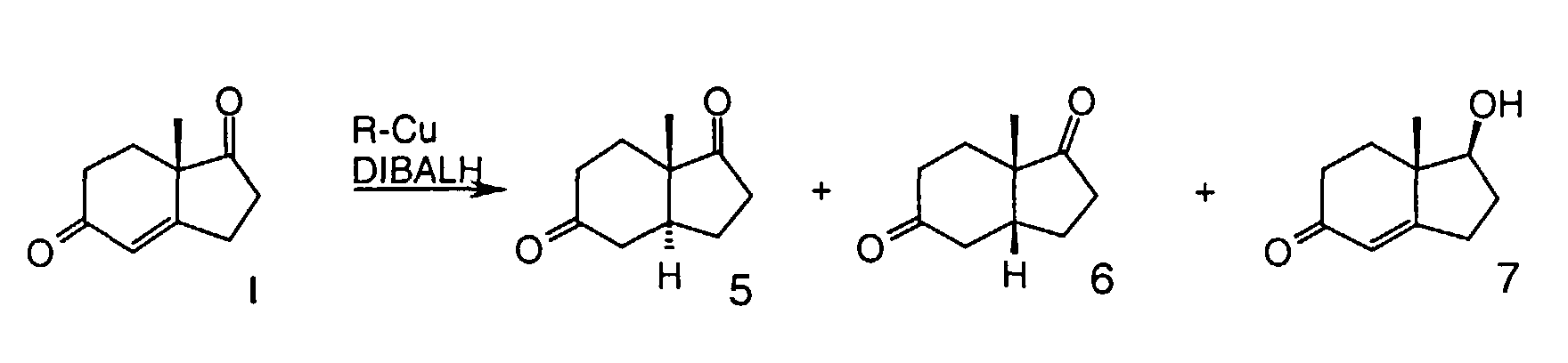
- The reduction of the compound of formula I with diisobutylaluminumhydride ("DIBALH") in the presence of MeCu as a catalyst (P1) was hardly satisfactory, giving a 4:3:3 mixture of the compounds of formulae 5, 6, and 7, respectively. Thus, the stereo- and the regioselectivity were only 55% (the ratio of the compounds of formulae 5 to 6 was 4:3) and 70% (the ratio of the compounds of formulae 5 plus 6 to 7 was 7:3), respectively. Stereoselectivity increased to 66% with n-butylcopper (catalyst P2) and to 90% with tert-butylcopper catalyst. However, regioselectivity remained virtually unchanged and the compound of formula 7 was isolated typically in 30% yield. Accordingly, the isolated yield of the desired bromo-ketone of formula II never exceeds 57% after the reaction is quenched with bromine, even though a high stereoselectivity (90%) has been achieved with the tert-butylcopper (catalyst P3).
Stereo- and Regioselectivities in the Reduction of Ketone (I) using known catalysts. R-Cu mol% 5 (trans) : 6 (cis) 7(1,2-reduct.) Isolated yield of II (P1) MeCu 20 1.2: 1 ca. 30% - (P2) n-BuCu 20 2:1 ca.30% - (P3) t-BuCu 15 10:1 ca.30% 57% - Moreover, the thermal instability of tert-butylcopper due to its tendency to undergo β-elimination to form isobutylene and copper hydride made this reaction difficult to reproduce since the copper hydride thus formed catalyzes a non-stereoselective 1,4-reduction. Accordingly, there was a need in the art for a superior catalyst to carry out this reaction.
- The subject invention provides a process for preparing the compound of formula II (3aR,4S,7aS)-4-bromooctahydro-7a-methyl-1H-indene-1,5-dione. This process comprises reducing (S)-( + )-2,3,7,7a-tetrahydro-7a-methyl-1H-indene-1,5(6H)-dione and treating the reductate with a bromine-containing electrophile. The (S)-(+)-2,3,7,7a-tetrahydro-7a-methyl-1H-indene-1,5(6H)-dione is reduced by reaction with diisobutylaluminumhydride ("DIBALH") and hexamethylphosphoric triaminde ("HMPA") in the presence of a catalyst of the formula R-Cu, wherein R isand R1, R2 and R3 are each, independently, selected from the group consisting of C1-7 alkyl, phenyl, phenyl substituted by at least one C1-4 alkyl group, benzyl, or benzyl substituted by at least one C1-4 alkyl groups. The reductate thus formed is treated with a bromine-containing electrophile to yield (3aR,4S,7aS)-4-bromooctahydro-7a-methyl-1H-indene-1,5-dione.

- When prepared according to the process of the invention the compound of formula II [(3aR,4S,7aS)-4-bromooctahydro-7a-methyl-1H-indene-1,5-dione] was prepared in 70% yield from the compound of formula I [(S)-(+)-2,3,7,7a-tetrahydro-7a-methyl-1H-indene-1,5(6H)dione], which is higher by 13% than that obtained by the previous procedures.
- It was discovered that silylcopper catalysts provide superior regioselectivity when compared with known copper catalysts. Trimethylsilylcopper (catalyst C1) is effective in 1,4-reduction of the ketone of formula I and stable when compared to known tert-butylcopper (catalyst P3), presumably because β-elimination is unfavorable in a silylcopper catalyst due to the high energy of a carbon-silicon double bond. Using the inventive coppersilyl catalysts, catalyst loading can be reduced relative to known copper catalysts. Although the stereoselectivity (85%) using inventive catalyst trimethylsilylcopper was lower than that achieved with the known tert-butylcopper catalyst (catalyst P3) (90%), trimethylsilylcopper exhibits higher regioselectivity (90%) than the tert-butylcopper (catalyst P3) (70%) as shown in Table 1. As the result, the desired bromo-ketone the compound of formula II was isolated in 59% yield by single crystallization. The regioselectivity further improved with triphenylsilylcopper (catalyst C2) to >95%. Use of inventive catalyst dimethylphenylsilylcopper (catalyst C3) resulted in a very high isolated yield of the compound of formula II (70%). The stereo- and regioselectivities with this catalyst were 85% and >95%, respectively.
Stereo- and Regioselectivities in the Reduction of Ketone (I) using inventive catalysts. RCu mol% 5 (trans): 6 (cis) 7 (1,2-reduct.) Isolated yield of II (C1) Me3SiCu 8 7 : 1 ca. 10% 59% (C2) Ph3SiCu 8 5 : 1 Trace 60% (C3) PhMe2SiCu 6.5 7 : 1 Trace 70% - The invention relates thus to an improved process for the preparation of (3aR,4S,7aS)-4-bromooctahydro-7a-methyl-1H-indene-1,5-dione of formula II from the ketone of formula I. A Reaction Scheme illustrating this process follows. This new process is reproducible and the compound of formula II can be obtained in yields of 70%.wherein

- Si
- is silicon,
- X
- is bromine, chlorine, iodine, or cyano,
- R1, R2, and R3,
- each independently, are C1-7alkyl, phenyl, or phenyl or benzyl substituted by one or more alkyl groups of 1-4 carbon atoms, and
- R4
- is methyl, butyl or sec-butyl.
- As used herein, "C1-7 alkyl" denotes an alkyl group having 1 to 7 carbon atoms, including, for example, methyl, ethyl, propyl, isopropyl, butyl, isobutyl and the like. The terms "phenyl and benzyl substituted by alkyl of 1 to 4 carbon atoms" include, for example, methylphenyl, methylbenzyl, ethylphenyl, ethylbenzyl, propylphenyl, propylbenzyl, butylphenyl, butylbenzyl, isopropylphenyl, isopropylbenzyl, isobutylphenyl, isobutylbenzyl, and the like.
- The disilane compounds of formula A, utilized in the process of this invention, are known, compounds or can be prepared according to known procedures. More specifically the dimethylphenylsilylcopper (catalyst C3) was prepared in situ from 1,2-diphenyltetramethyl-disilane, methyllithium and cuprous iodide as shown in the above reaction scheme. The 1,2-diphenyltetramethyldisilane was treated with a substoichiometric amount of methyllithium in order ensure complete consumption of the methyllithium to give dimethylphenylsilyllithium (Inert phenyltrimethylsilane is also produced). The silyllithium compound thus formed is then treated with a substoichiometric amount of cuprous iodide to give the desired dimethylphenylsilylcopper(catalyst C3). Any excess cuprous iodide will be converted to copper hydride which catalyzes a non-stereoselective 1,4-reduction.
- RLi reagents or reactants utilized above are known compounds or can be prepared according to known procedures. Examplary of the R4Li reagents are methyllthium, butyllithium, and the like.
- Similarly, the CuX reagents, wherein X is bromine, chlorine, iodine, or cyano are known compounds and include cuprous iodide, cuprous bromide, and the like.
- The hydride reduction of the compound of formula I is carried out utilizing a reducing agent such as, for example, diisobutylaluminum hydride.
- The solvents which can be utilized in the process of the invention include, for - example, hexamethylphosphoric triamide (HMPA), and equivalent solvents, alone or in combination with other compatible solvents.
- The electrophiles utilized in the process of the invention include, for example, bromine, N-bromosuccinimid, 1,3-dibromo-5,5-dimethylhydantoin to be used for the preparation of the compound of formula II.
- The process of the invention is typically carried out at temperatures which are in the range of from about 0° to -78°C. While the reaction temperatures are not narrowly critical, lower temperatures are generally preferred to achieve good yields.
- The desired compound of formula II, is recovered according to known methods and procedures and preferably carried out as described herein, in Example 1.
- The examples which follow further describe the invention.
-
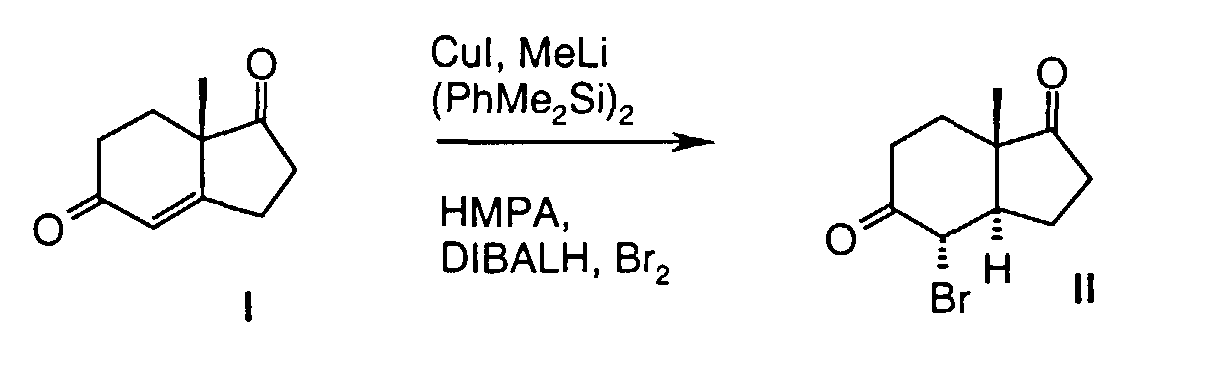
- A 2 liter, three-necked flask equipped with a mechanical stirrer, thermometer, septum, dropping funnel and nitrogen bubbler was flashed with nitrogen for 45 minutes and then charged with 13.7 g (50.6 mmol) of 1,2-diphenyltetramethyldisilane, 320 mL of tetrahydrofuran and 120 mL of hexamethylphosphoric triamide. After cooling to -5 °C with an ice-acetone bath, 31 mL (43.4 mmol) of 1.4M methyllithium in diethyl ether was added.
- The resulting dark brown mixture was stirred at -5 °C to 0 °C for 0.5 hour. After cooling to -60 °C, 7.60 g (40.0 mmol) of cuprous iodide was added in one portion and the funnel was rinsed with 50 mL of tetrahydrofuran. The reaction mixture was slowly warmed to -35 °C over 25 minutes, then stirred at -35 °C to -40 °C for 0.5 hour. During that time black solids precipitated and the supernatant turned almost colorless or pale yellow.
- After cooling to -70 °C, a solution of diisobutylaluminum hydride [prepared separately by adding 132 mL (732 mmol) of diisobutylaluminum hydride (neat) to a mixture of 100 mL of tetrahydrofuran and 176 mL of hexamethylphosphoric triamide at - 10 °C was added via cannula, while maintaining the temperature of the mixture below -68 °C. After cooling to -70 °C, a solution of 100 g (609 mmol) of the ketone of formula I in a mixture of 100 mL of hexamethylphosphoric triamide and 100 mL of tetrahydrofuran was added over 1 hour, while maintaining the temperature of the reaction mixture at -70 °C to -68 °C. Immediately after the addition of the compound of formula I, thin layer chromatography analysis indicated complete reaction. Then, 60 mL (1.16 mol) of bromine was added over 10 minutes. An exotherm ensued that raised the temperature of the mixture to -20 °C. After stirring at -20 °C for 5 minutes, the reaction mixture was poured into 1.3 kg of ice-water containing 80 mL of sulfuric acid.
- The resulting mixture was stirred for 20 minutes. The reaction flask was rinsed with a total of 100 mL of water and the washes were combined to the quenched mixture. The resulting mixture was extracted with 1.5 L +1.0 L = 2.5 L of ethyl acetate and the combined organic layers were washed with 2 x 500 mL = 1 L of 5% sulfuric acid and then with 150 mL of saturated aqueous sodium bicarbonate solution.
- The resulting emulsion was filtered through a pad of powdered silica gel filtering agent, and the organic layer was separated, dried over sodium sulfate and concentrated to dryness. The residue was dried under high vacuum and then triturated with 250 mL of hexane and the supernatant was removed by decantation. The residue was triturated again with 50 mL of hexane. After the supernatant was removed by decantation, the resulting solid was dried under reduced pressure in order to remove the residual hexane and triturated with 250 mL of diethyl ether. After cooling in a freezer for 5 minutes, the solid was collected by filtration, washed with cold diethyl ether and dried by suction to give 106 g (70.9%) of formula II ((3aR,4S,7aS)-4-bromooctahydro-7a-methyl-1H-indene-1,5-dione) as a white solid.
- In process controls: thin layer chromatography (1:1 hexane:ethyl acetate, short-wave UV detection and phosphomolybdic acid stain; RfI = 0.6 and RfII = 0.75) and 1H NMR (CDCl3)
- Upon reading the present specification various alternative embodiments will become obvious to the skilled artisan. These variations are to be considered within the scope and spirit of the subject invention which is only to be limited by the claims that follow and their equivalents.
Claims (7)
- A process for preparing (3aR,4S,7aS)-4-bromooctahydro-7a-methyl-1H-indene-1,5-dione, which comprises:(a)reducing (S)-(+)-2,3,7,7a-tetrahydro-7a-methyl-1H-indene-1,5(6H)-dione by reacting it with diisobutylaluminumhydride and hexamethylphosphoric triaminde in the presence of a catalyst of the formula R-Cu, wherein R isand R1,R2 and R3 are each, independently, selected from the group consisting of C1-7 alkyl, phenyl, phenyl substituted by at least one C1-4 alkyl group, benzyl, or benzyl substituted by at least one C1-4 alkyl groups to form a reductate; and
 (b)treating the reductate with a bromine-containing electrophile to yield (3aR,4S,7aS)-4-bromooctahydro-7a-methyl-1H-indene-1,5-dione.
 - The process in accordance with claim 1, wherein the reducing of step (a) uses a catalyst of formula R-Cu is selected from the group consisting of Me3SiCu, Ph3SiCu, and PhMe2SiCu.
- The process in accordance with claim 2, wherein the reducing of step (a) uses a catalyst of formula R-Cu which is PhMe2SiCu.
- The process in accordance with claim 1, wherein the reducing of step (a) uses a catalyst of the formula R-Cu that is formed in situ.
- The process in accordance with claim 4, wherein the reducing of step (a) uses a catalyst of the formula R-Cu that is formed in situ by reacting a compound of the formulawith CuX, wherein X is bromine, chlorine, iodine, or cyano.

- The process in accordance with claim 5, wherein the reducing of step (a) uses a catalyst of the formula R-Cu that is formed in situ by reacting a compound of the formulawith R4Li,
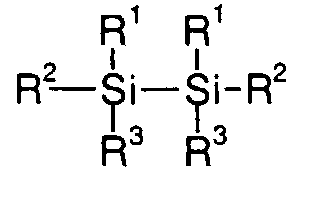
wherein R4 is methyl, butyl, or sec-butyl, to formwhere R4 is as above,
and reactingwith CuX, wherein X is bromine, chlorine, iodine, or cyano, to form the catalyst of the formula R-Cu.
- The process in accordance with claim 1, wherein the reducing of step (a) is performed at a temperature in the range of about 0° C to about -78° C.
Applications Claiming Priority (2)
| Application Number | Priority Date | Filing Date | Title |
|---|---|---|---|
| US12120999P | 1999-02-23 | 1999-02-23 | |
| US121209P | 1999-02-23 |
Publications (2)
| Publication Number | Publication Date |
|---|---|
| EP1031552A1 true EP1031552A1 (en) | 2000-08-30 |
| EP1031552B1 EP1031552B1 (en) | 2003-04-23 |
Family
ID=22395260
Family Applications (1)
| Application Number | Title | Priority Date | Filing Date |
|---|---|---|---|
| EP00102948A Expired - Lifetime EP1031552B1 (en) | 1999-02-23 | 2000-02-14 | Intermediates for the Synthesis of Vitamin D |
Country Status (11)
| Country | Link |
|---|---|
| US (1) | US6284928B1 (en) |
| EP (1) | EP1031552B1 (en) |
| JP (1) | JP3532488B2 (en) |
| KR (1) | KR100367440B1 (en) |
| CN (1) | CN1137076C (en) |
| AT (1) | ATE238262T1 (en) |
| CA (1) | CA2298944C (en) |
| DE (1) | DE60002242T2 (en) |
| DK (1) | DK1031552T3 (en) |
| ES (1) | ES2194635T3 (en) |
| MX (1) | MXPA00001800A (en) |
-
2000
- 2000-02-10 US US09/501,359 patent/US6284928B1/en not_active Expired - Fee Related
- 2000-02-14 AT AT00102948T patent/ATE238262T1/en not_active IP Right Cessation
- 2000-02-14 DE DE60002242T patent/DE60002242T2/en not_active Expired - Lifetime
- 2000-02-14 ES ES00102948T patent/ES2194635T3/en not_active Expired - Lifetime
- 2000-02-14 DK DK00102948T patent/DK1031552T3/en active
- 2000-02-14 EP EP00102948A patent/EP1031552B1/en not_active Expired - Lifetime
- 2000-02-18 CA CA002298944A patent/CA2298944C/en not_active Expired - Fee Related
- 2000-02-21 MX MXPA00001800 patent/MXPA00001800A/en unknown
- 2000-02-21 KR KR10-2000-0008229A patent/KR100367440B1/en not_active Expired - Fee Related
- 2000-02-22 JP JP2000044130A patent/JP3532488B2/en not_active Expired - Fee Related
- 2000-02-22 CN CNB001027867A patent/CN1137076C/en not_active Expired - Fee Related
Non-Patent Citations (8)
| Title |
|---|
| CHEMICAL ABSTRACTS, vol. 110, no. 3, 16 January 1989, Columbus, Ohio, US; abstract no. 023386, DANIEWSKI A R ET AL: "Stereoselective conjugate reduction of (+)-(7aS)-5,6,7,7a-tetrahydr o-7a-methyl-1,5-indandione" XP002139070 * |
| DANIEWSKI A R ET AL: "A simple way to (3aR,4S,7aS)-(Z)-ethylideneoctahydro-7a-methyl-1H-4 -indenol, a synthon for total synthesis of vitamins D", J. ORG. CHEM. (JOCEAH,00223263);1988; VOL.53 (23); PP.5534-5, Pol. Acad. Sci.;Inst. Org. Chem.; Warsaw; 01-224; Pol. (PL), XP002139065 * |
| DANIEWSKI A R ET AL: "Copper(I) iodide-promoted reaction of some electrophiles with the aluminum enolate generated by the stereoselective conjugate reduction of (7aS) -(+)-5,6,7,7a-tetrahydro-7a-methylindan-1,5-dione", LIEBIGS ANN. CHEM. (LACHDL,01702041);1988; (6); PP.593-4, Pol. Acad. Sci.;Inst. Org. Chem.; Warsaw; P1-01-224; Pol. (PL), XP002139066 * |
| ITO H ET AL: "Studies on organosilicon chemistry. 138. Generation of a reducing reagent from copper(I) salt and hydrosilane. New practical method for conjugate reduction", TETRAHEDRON LETT. (TELEAY,00404039);1997; VOL.38 (51); PP.8887-8890, Univ. Tsukuba;Dep. Chem.; Ibaraki; 305; Japan (JP), XP000667161 * |
| SHARMA S ET AL: "Chemical and spectroscopic investigations of (trialkylsilyl)cuprates derived from cuprous cyanide", TETRAHEDRON (TETRAB,00404020);1989; VOL.45 (2); PP.557-68, Simon Fraser Univ.;Dep. Chem.; Burnaby; V5A 1S6; BC; Can. (CA), XP002139067 * |
| SHARMA S ET AL: "Chemistry and composition of (trialkylsilyl)cuprates derived from cuprous halides", J. ORG. CHEM. (JOCEAH,00223263);1989; VOL.54 (22); PP.5383-7, Simon Fraser Univ.;Dep. Chem.; Burnaby; BC; Can. (CA), XP002139068 * |
| SMITH J G ET AL: "Regioselective synthesis of allyltrimethylsilanes from allylic halides and allylic sulfonates. Application to the synthesis of 2,3-bis(trimethylsilyl)alk-1-enes", J. ORG. CHEM. (JOCEAH,00223263);1984; VOL.49 (22); PP.4112-20, Mt. Holyoke Coll.;Dep. Chem.; South Hadley; 01075; MA; USA (US), XP002139069 * |
| SYNTH. COMMUN. (SYNCAV,00397911);1988; VOL.18 (1); PP.115-18, Pol. Acad. Sci.;Inst. Org. Chem.; Warsaw; 01-224; Pol. (PL) * |
Also Published As
| Publication number | Publication date |
|---|---|
| CN1267659A (en) | 2000-09-27 |
| DE60002242T2 (en) | 2004-03-04 |
| US6284928B1 (en) | 2001-09-04 |
| CN1137076C (en) | 2004-02-04 |
| KR100367440B1 (en) | 2003-01-14 |
| CA2298944A1 (en) | 2000-08-23 |
| MX210327B (en) | 2002-09-13 |
| KR20010006669A (en) | 2001-01-26 |
| DE60002242D1 (en) | 2003-05-28 |
| JP3532488B2 (en) | 2004-05-31 |
| ES2194635T3 (en) | 2003-12-01 |
| CA2298944C (en) | 2009-01-13 |
| MXPA00001800A (en) | 2001-01-01 |
| DK1031552T3 (en) | 2003-08-04 |
| JP2000247922A (en) | 2000-09-12 |
| ATE238262T1 (en) | 2003-05-15 |
| EP1031552B1 (en) | 2003-04-23 |
Similar Documents
| Publication | Publication Date | Title |
|---|---|---|
| Smith et al. | Regioselective synthesis of allyltrimethylsilanes from allylic halides and allylic sulfonates. Application to the synthesis of 2, 3-bis (trimethylsilyl) alk-1-enes | |
| CZ20033033A3 (en) | Process for preparing prostaglandin derivatives and stereospecific starting material thereof | |
| EP0722949B1 (en) | Process for the preparation of cyclopentadienyl compounds and compounds obtained therefrom | |
| DE69008851T2 (en) | METHOD FOR PRODUCING 5,6,7, -TRINOR- 4,8, -INTER-m-PHENYLENE PGI, 2 derivatives. | |
| EP1031552B1 (en) | Intermediates for the Synthesis of Vitamin D | |
| Chen et al. | Prostaglandins and congeners. 27. Synthesis of biologically active 16-halomethyl derivatives of 15-deoxy-16-hydroxyprostaglandin E2 | |
| US5055604A (en) | Process for preparing prostaglandin analogs using organozirconium compounds | |
| KR100697491B1 (en) | Method of producing osteoporosis treatment | |
| Yadav et al. | Allylation of Grignard Reagents: Its Application for the Synthesis of (4E, 7Z)-4, 7-Tridecadienyl Acetate, A Sex Pheromone of Potato Tuberworm Moth | |
| Bradbury et al. | Synthesis of analogs of prostacyclin containing a thiazole ring | |
| US4159998A (en) | Process for the preparation of 2-(7-hydroxyalkyl)-4R, 4S or 4RS -hydroxy-cyclopent-2-enone | |
| EP0534582B1 (en) | Methylation or ethylation agent and process for an 1,4-addition of a methyl- or ethylgroup to an alpha, beta-insaturated ketogroup | |
| US4390711A (en) | 16-Hydroxy-5-iodo-prostacyclin analogs of the 1 series | |
| HU197290B (en) | Process for preparing intermediate products for the production of 16-phenoxy- and 16-(substituted phenoxy)-prostatriene acid-derivatives | |
| JP2512451B2 (en) | Hydroxycyclopentanone derivative and its manufacturing method | |
| JP2526810B2 (en) | Hydroxycyclopentanone derivative and method for producing the same | |
| US4922032A (en) | Process for the preparation of optically active 2-methyl-1,2-hexanediols | |
| US4212984A (en) | Prostaglandin precursors | |
| EP1196427B1 (en) | C-19-halogen-substituted steroids of the androst-9(11)-ene-series, methods for the production and use thereof | |
| Gill et al. | Cyclopentanoids from phenol—9: 3-Alkyl-and 3-alkenyl-5-hydroxycyclopent-2-enones | |
| US5079371A (en) | Process for production of prostaglandin intermediates | |
| US5220034A (en) | Protected derivatives of the enone of spectinomycin | |
| Laurent et al. | Improvement of the Synthesis of 1, 2-bis (Methylene) sila-(and germa-) Cycloalkanes | |
| JPH0791218B2 (en) | New prostaglandin I | |
| JPS631930B2 (en) |
Legal Events
| Date | Code | Title | Description |
|---|---|---|---|
| PUAI | Public reference made under article 153(3) epc to a published international application that has entered the european phase |
Free format text: ORIGINAL CODE: 0009012 |
|
| AK | Designated contracting states |
Kind code of ref document: A1 Designated state(s): AT BE CH CY DE DK ES FI FR GB GR IE IT LI LU MC NL PT SE |
|
| AX | Request for extension of the european patent |
Free format text: AL;LT;LV;MK;RO;SI |
|
| 17P | Request for examination filed |
Effective date: 20010228 |
|
| AKX | Designation fees paid |
Free format text: AT BE CH CY DE DK ES FI FR GB GR IE IT LI LU MC NL PT SE |
|
| 17Q | First examination report despatched |
Effective date: 20020201 |
|
| GRAH | Despatch of communication of intention to grant a patent |
Free format text: ORIGINAL CODE: EPIDOS IGRA |
|
| GRAH | Despatch of communication of intention to grant a patent |
Free format text: ORIGINAL CODE: EPIDOS IGRA |
|
| GRAA | (expected) grant |
Free format text: ORIGINAL CODE: 0009210 |
|
| AK | Designated contracting states |
Designated state(s): AT BE CH CY DE DK ES FI FR GB GR IE IT LI LU MC NL PT SE |
|
| PG25 | Lapsed in a contracting state [announced via postgrant information from national office to epo] |
Ref country code: FI Free format text: LAPSE BECAUSE OF FAILURE TO SUBMIT A TRANSLATION OF THE DESCRIPTION OR TO PAY THE FEE WITHIN THE PRESCRIBED TIME-LIMIT Effective date: 20030423 Ref country code: CY Free format text: LAPSE BECAUSE OF FAILURE TO SUBMIT A TRANSLATION OF THE DESCRIPTION OR TO PAY THE FEE WITHIN THE PRESCRIBED TIME-LIMIT Effective date: 20030423 |
|
| REG | Reference to a national code |
Ref country code: GB Ref legal event code: FG4D |
|
| REG | Reference to a national code |
Ref country code: CH Ref legal event code: EP |
|
| REF | Corresponds to: |
Ref document number: 60002242 Country of ref document: DE Date of ref document: 20030528 Kind code of ref document: P |
|
| REG | Reference to a national code |
Ref country code: IE Ref legal event code: FG4D |
|
| PG25 | Lapsed in a contracting state [announced via postgrant information from national office to epo] |
Ref country code: GR Free format text: LAPSE BECAUSE OF FAILURE TO SUBMIT A TRANSLATION OF THE DESCRIPTION OR TO PAY THE FEE WITHIN THE PRESCRIBED TIME-LIMIT Effective date: 20030723 Ref country code: PT Free format text: LAPSE BECAUSE OF FAILURE TO SUBMIT A TRANSLATION OF THE DESCRIPTION OR TO PAY THE FEE WITHIN THE PRESCRIBED TIME-LIMIT Effective date: 20030723 Ref country code: SE Free format text: LAPSE BECAUSE OF FAILURE TO SUBMIT A TRANSLATION OF THE DESCRIPTION OR TO PAY THE FEE WITHIN THE PRESCRIBED TIME-LIMIT Effective date: 20030723 |
|
| REG | Reference to a national code |
Ref country code: DK Ref legal event code: T3 |
|
| ET | Fr: translation filed | ||
| PG25 | Lapsed in a contracting state [announced via postgrant information from national office to epo] |
Ref country code: LU Free format text: LAPSE BECAUSE OF NON-PAYMENT OF DUE FEES Effective date: 20040214 |
|
| PLBE | No opposition filed within time limit |
Free format text: ORIGINAL CODE: 0009261 |
|
| STAA | Information on the status of an ep patent application or granted ep patent |
Free format text: STATUS: NO OPPOSITION FILED WITHIN TIME LIMIT |
|
| PG25 | Lapsed in a contracting state [announced via postgrant information from national office to epo] |
Ref country code: MC Free format text: LAPSE BECAUSE OF NON-PAYMENT OF DUE FEES Effective date: 20040228 |
|
| 26N | No opposition filed |
Effective date: 20040126 |
|
| PGFP | Annual fee paid to national office [announced via postgrant information from national office to epo] |
Ref country code: ES Payment date: 20100216 Year of fee payment: 11 Ref country code: CH Payment date: 20100218 Year of fee payment: 11 Ref country code: DK Payment date: 20100107 Year of fee payment: 11 Ref country code: IE Payment date: 20100114 Year of fee payment: 11 |
|
| PGFP | Annual fee paid to national office [announced via postgrant information from national office to epo] |
Ref country code: IT Payment date: 20100220 Year of fee payment: 11 Ref country code: FR Payment date: 20100222 Year of fee payment: 11 |
|
| PGFP | Annual fee paid to national office [announced via postgrant information from national office to epo] |
Ref country code: GB Payment date: 20100107 Year of fee payment: 11 Ref country code: AT Payment date: 20100107 Year of fee payment: 11 Ref country code: DE Payment date: 20100226 Year of fee payment: 11 |
|
| PGFP | Annual fee paid to national office [announced via postgrant information from national office to epo] |
Ref country code: NL Payment date: 20100208 Year of fee payment: 11 |
|
| PGFP | Annual fee paid to national office [announced via postgrant information from national office to epo] |
Ref country code: BE Payment date: 20100402 Year of fee payment: 11 |
|
| BERE | Be: lapsed |
Owner name: F. *HOFFMANN-LA ROCHE A.G. Effective date: 20110228 |
|
| REG | Reference to a national code |
Ref country code: NL Ref legal event code: V1 Effective date: 20110901 |
|
| REG | Reference to a national code |
Ref country code: CH Ref legal event code: PL |
|
| REG | Reference to a national code |
Ref country code: DK Ref legal event code: EBP |
|
| GBPC | Gb: european patent ceased through non-payment of renewal fee |
Effective date: 20110214 |
|
| PG25 | Lapsed in a contracting state [announced via postgrant information from national office to epo] |
Ref country code: LI Free format text: LAPSE BECAUSE OF NON-PAYMENT OF DUE FEES Effective date: 20110228 Ref country code: CH Free format text: LAPSE BECAUSE OF NON-PAYMENT OF DUE FEES Effective date: 20110228 |
|
| REG | Reference to a national code |
Ref country code: FR Ref legal event code: ST Effective date: 20111102 |
|
| REG | Reference to a national code |
Ref country code: IE Ref legal event code: MM4A |
|
| PG25 | Lapsed in a contracting state [announced via postgrant information from national office to epo] |
Ref country code: AT Free format text: LAPSE BECAUSE OF NON-PAYMENT OF DUE FEES Effective date: 20110214 Ref country code: BE Free format text: LAPSE BECAUSE OF NON-PAYMENT OF DUE FEES Effective date: 20110228 |
|
| PG25 | Lapsed in a contracting state [announced via postgrant information from national office to epo] |
Ref country code: IT Free format text: LAPSE BECAUSE OF NON-PAYMENT OF DUE FEES Effective date: 20110214 Ref country code: NL Free format text: LAPSE BECAUSE OF NON-PAYMENT OF DUE FEES Effective date: 20110901 |
|
| REG | Reference to a national code |
Ref country code: DE Ref legal event code: R119 Ref document number: 60002242 Country of ref document: DE Effective date: 20110901 |
|
| PG25 | Lapsed in a contracting state [announced via postgrant information from national office to epo] |
Ref country code: IE Free format text: LAPSE BECAUSE OF NON-PAYMENT OF DUE FEES Effective date: 20110214 Ref country code: FR Free format text: LAPSE BECAUSE OF NON-PAYMENT OF DUE FEES Effective date: 20110228 |
|
| PG25 | Lapsed in a contracting state [announced via postgrant information from national office to epo] |
Ref country code: GB Free format text: LAPSE BECAUSE OF NON-PAYMENT OF DUE FEES Effective date: 20110214 |
|
| REG | Reference to a national code |
Ref country code: ES Ref legal event code: FD2A Effective date: 20120411 |
|
| PG25 | Lapsed in a contracting state [announced via postgrant information from national office to epo] |
Ref country code: ES Free format text: LAPSE BECAUSE OF NON-PAYMENT OF DUE FEES Effective date: 20110215 |
|
| PG25 | Lapsed in a contracting state [announced via postgrant information from national office to epo] |
Ref country code: DE Free format text: LAPSE BECAUSE OF NON-PAYMENT OF DUE FEES Effective date: 20110901 |