EP1031414A1 - Lithographic printing plate precursor - Google Patents
Lithographic printing plate precursor Download PDFInfo
- Publication number
- EP1031414A1 EP1031414A1 EP00103355A EP00103355A EP1031414A1 EP 1031414 A1 EP1031414 A1 EP 1031414A1 EP 00103355 A EP00103355 A EP 00103355A EP 00103355 A EP00103355 A EP 00103355A EP 1031414 A1 EP1031414 A1 EP 1031414A1
- Authority
- EP
- European Patent Office
- Prior art keywords
- group
- acid
- layer
- polymer
- lithographic printing
- Prior art date
- Legal status (The legal status is an assumption and is not a legal conclusion. Google has not performed a legal analysis and makes no representation as to the accuracy of the status listed.)
- Granted
Links
- 238000007639 printing Methods 0.000 title claims abstract description 212
- 239000002243 precursor Substances 0.000 title claims abstract description 54
- 229920000642 polymer Polymers 0.000 claims abstract description 350
- XLYOFNOQVPJJNP-UHFFFAOYSA-N water Substances O XLYOFNOQVPJJNP-UHFFFAOYSA-N 0.000 claims abstract description 114
- 239000003795 chemical substances by application Substances 0.000 claims abstract description 77
- 239000007864 aqueous solution Substances 0.000 claims abstract description 21
- 230000005660 hydrophilic surface Effects 0.000 claims abstract description 6
- 150000001875 compounds Chemical class 0.000 claims description 189
- 125000000524 functional group Chemical group 0.000 claims description 73
- 230000002209 hydrophobic effect Effects 0.000 claims description 35
- 239000010410 layer Substances 0.000 description 298
- -1 2-ethylhexyl group Chemical group 0.000 description 287
- 229910052782 aluminium Inorganic materials 0.000 description 196
- XAGFODPZIPBFFR-UHFFFAOYSA-N aluminium Chemical compound [Al] XAGFODPZIPBFFR-UHFFFAOYSA-N 0.000 description 196
- 239000000243 solution Substances 0.000 description 156
- ZWEHNKRNPOVVGH-UHFFFAOYSA-N 2-Butanone Chemical compound CCC(C)=O ZWEHNKRNPOVVGH-UHFFFAOYSA-N 0.000 description 121
- 238000006243 chemical reaction Methods 0.000 description 92
- OKKJLVBELUTLKV-UHFFFAOYSA-N Methanol Chemical compound OC OKKJLVBELUTLKV-UHFFFAOYSA-N 0.000 description 90
- 239000005518 polymer electrolyte Substances 0.000 description 87
- 239000000975 dye Substances 0.000 description 69
- 238000000034 method Methods 0.000 description 66
- 239000000178 monomer Substances 0.000 description 65
- CSCPPACGZOOCGX-UHFFFAOYSA-N Acetone Chemical compound CC(C)=O CSCPPACGZOOCGX-UHFFFAOYSA-N 0.000 description 63
- LFQSCWFLJHTTHZ-UHFFFAOYSA-N Ethanol Chemical compound CCO LFQSCWFLJHTTHZ-UHFFFAOYSA-N 0.000 description 63
- ARXJGSRGQADJSQ-UHFFFAOYSA-N 1-methoxypropan-2-ol Chemical compound COCC(C)O ARXJGSRGQADJSQ-UHFFFAOYSA-N 0.000 description 62
- 125000003118 aryl group Chemical group 0.000 description 61
- 125000000217 alkyl group Chemical group 0.000 description 59
- 239000004094 surface-active agent Substances 0.000 description 59
- 239000003513 alkali Substances 0.000 description 58
- 229920005989 resin Polymers 0.000 description 58
- 239000011347 resin Substances 0.000 description 58
- XEKOWRVHYACXOJ-UHFFFAOYSA-N Ethyl acetate Chemical compound CCOC(C)=O XEKOWRVHYACXOJ-UHFFFAOYSA-N 0.000 description 57
- ZMXDDKWLCZADIW-UHFFFAOYSA-N N,N-Dimethylformamide Chemical compound CN(C)C=O ZMXDDKWLCZADIW-UHFFFAOYSA-N 0.000 description 57
- YXFVVABEGXRONW-UHFFFAOYSA-N Toluene Chemical compound CC1=CC=CC=C1 YXFVVABEGXRONW-UHFFFAOYSA-N 0.000 description 57
- 238000000862 absorption spectrum Methods 0.000 description 56
- 238000002360 preparation method Methods 0.000 description 53
- WEVYAHXRMPXWCK-UHFFFAOYSA-N Acetonitrile Chemical compound CC#N WEVYAHXRMPXWCK-UHFFFAOYSA-N 0.000 description 51
- 238000010521 absorption reaction Methods 0.000 description 51
- 125000004432 carbon atom Chemical group C* 0.000 description 50
- 239000011248 coating agent Substances 0.000 description 50
- 238000000576 coating method Methods 0.000 description 50
- 125000001424 substituent group Chemical group 0.000 description 46
- 239000000203 mixture Substances 0.000 description 44
- 239000000049 pigment Substances 0.000 description 44
- XLLIQLLCWZCATF-UHFFFAOYSA-N 2-methoxyethyl acetate Chemical compound COCCOC(C)=O XLLIQLLCWZCATF-UHFFFAOYSA-N 0.000 description 38
- IAZDPXIOMUYVGZ-UHFFFAOYSA-N Dimethylsulphoxide Chemical compound CS(C)=O IAZDPXIOMUYVGZ-UHFFFAOYSA-N 0.000 description 38
- ISWSIDIOOBJBQZ-UHFFFAOYSA-N Phenol Chemical compound OC1=CC=CC=C1 ISWSIDIOOBJBQZ-UHFFFAOYSA-N 0.000 description 38
- WYURNTSHIVDZCO-UHFFFAOYSA-N Tetrahydrofuran Chemical compound C1CCOC1 WYURNTSHIVDZCO-UHFFFAOYSA-N 0.000 description 38
- JHIVVAPYMSGYDF-UHFFFAOYSA-N cyclohexanone Chemical compound O=C1CCCCC1 JHIVVAPYMSGYDF-UHFFFAOYSA-N 0.000 description 38
- LZCLXQDLBQLTDK-UHFFFAOYSA-N ethyl 2-hydroxypropanoate Chemical compound CCOC(=O)C(C)O LZCLXQDLBQLTDK-UHFFFAOYSA-N 0.000 description 38
- 239000007787 solid Substances 0.000 description 38
- VEXZGXHMUGYJMC-UHFFFAOYSA-N Hydrochloric acid Chemical compound Cl VEXZGXHMUGYJMC-UHFFFAOYSA-N 0.000 description 36
- 239000002904 solvent Substances 0.000 description 36
- 235000010724 Wisteria floribunda Nutrition 0.000 description 35
- WSFSSNUMVMOOMR-UHFFFAOYSA-N Formaldehyde Chemical compound O=C WSFSSNUMVMOOMR-UHFFFAOYSA-N 0.000 description 34
- 239000002245 particle Substances 0.000 description 34
- 239000000126 substance Substances 0.000 description 34
- 239000002253 acid Substances 0.000 description 32
- 239000012153 distilled water Substances 0.000 description 32
- 230000035945 sensitivity Effects 0.000 description 32
- 239000002250 absorbent Substances 0.000 description 31
- 230000002745 absorbent Effects 0.000 description 31
- 150000002500 ions Chemical group 0.000 description 31
- HEMHJVSKTPXQMS-UHFFFAOYSA-M Sodium hydroxide Chemical compound [OH-].[Na+] HEMHJVSKTPXQMS-UHFFFAOYSA-M 0.000 description 30
- 230000008569 process Effects 0.000 description 30
- 239000004065 semiconductor Substances 0.000 description 30
- 238000011161 development Methods 0.000 description 29
- 230000018109 developmental process Effects 0.000 description 29
- 238000011282 treatment Methods 0.000 description 28
- YCKRFDGAMUMZLT-UHFFFAOYSA-N Fluorine atom Chemical compound [F] YCKRFDGAMUMZLT-UHFFFAOYSA-N 0.000 description 27
- 229910052731 fluorine Inorganic materials 0.000 description 27
- 239000011737 fluorine Substances 0.000 description 27
- 229910052751 metal Inorganic materials 0.000 description 27
- 239000002184 metal Substances 0.000 description 27
- QAOWNCQODCNURD-UHFFFAOYSA-N Sulfuric acid Chemical compound OS(O)(=O)=O QAOWNCQODCNURD-UHFFFAOYSA-N 0.000 description 26
- 239000004793 Polystyrene Substances 0.000 description 24
- 238000007598 dipping method Methods 0.000 description 23
- 125000003342 alkenyl group Chemical group 0.000 description 21
- 238000004132 cross linking Methods 0.000 description 20
- 238000005530 etching Methods 0.000 description 20
- 125000004435 hydrogen atom Chemical class [H]* 0.000 description 20
- WSLDOOZREJYCGB-UHFFFAOYSA-N 1,2-Dichloroethane Chemical compound ClCCCl WSLDOOZREJYCGB-UHFFFAOYSA-N 0.000 description 19
- ZNQVEEAIQZEUHB-UHFFFAOYSA-N 2-ethoxyethanol Chemical compound CCOCCO ZNQVEEAIQZEUHB-UHFFFAOYSA-N 0.000 description 19
- LPEKGGXMPWTOCB-UHFFFAOYSA-N 8beta-(2,3-epoxy-2-methylbutyryloxy)-14-acetoxytithifolin Natural products COC(=O)C(C)O LPEKGGXMPWTOCB-UHFFFAOYSA-N 0.000 description 19
- FXHOOIRPVKKKFG-UHFFFAOYSA-N N,N-Dimethylacetamide Chemical compound CN(C)C(C)=O FXHOOIRPVKKKFG-UHFFFAOYSA-N 0.000 description 19
- SBZXBUIDTXKZTM-UHFFFAOYSA-N diglyme Chemical compound COCCOCCOC SBZXBUIDTXKZTM-UHFFFAOYSA-N 0.000 description 19
- 229960001760 dimethyl sulfoxide Drugs 0.000 description 19
- ODQWQRRAPPTVAG-GZTJUZNOSA-N doxepin Chemical compound C1OC2=CC=CC=C2C(=C/CCN(C)C)/C2=CC=CC=C21 ODQWQRRAPPTVAG-GZTJUZNOSA-N 0.000 description 19
- 229940093499 ethyl acetate Drugs 0.000 description 19
- 229940116333 ethyl lactate Drugs 0.000 description 19
- 229940057867 methyl lactate Drugs 0.000 description 19
- LLHKCFNBLRBOGN-UHFFFAOYSA-N propylene glycol methyl ether acetate Chemical compound COCC(C)OC(C)=O LLHKCFNBLRBOGN-UHFFFAOYSA-N 0.000 description 19
- YLQBMQCUIZJEEH-UHFFFAOYSA-N tetrahydrofuran Natural products C=1C=COC=1 YLQBMQCUIZJEEH-UHFFFAOYSA-N 0.000 description 19
- XNWFRZJHXBZDAG-UHFFFAOYSA-N 2-METHOXYETHANOL Chemical compound COCCO XNWFRZJHXBZDAG-UHFFFAOYSA-N 0.000 description 18
- 230000008859 change Effects 0.000 description 18
- 239000003921 oil Substances 0.000 description 18
- 150000003839 salts Chemical group 0.000 description 18
- 125000000304 alkynyl group Chemical group 0.000 description 17
- 239000002585 base Substances 0.000 description 17
- 239000000470 constituent Substances 0.000 description 17
- 125000000547 substituted alkyl group Chemical group 0.000 description 17
- 150000001408 amides Chemical class 0.000 description 16
- 230000015572 biosynthetic process Effects 0.000 description 16
- 125000001997 phenyl group Chemical group [H]C1=C([H])C([H])=C(*)C([H])=C1[H] 0.000 description 16
- 238000012545 processing Methods 0.000 description 16
- 150000003459 sulfonic acid esters Chemical class 0.000 description 16
- NBIIXXVUZAFLBC-UHFFFAOYSA-N Phosphoric acid Chemical compound OP(O)(O)=O NBIIXXVUZAFLBC-UHFFFAOYSA-N 0.000 description 15
- 238000010438 heat treatment Methods 0.000 description 15
- 229920003169 water-soluble polymer Polymers 0.000 description 15
- YEJRWHAVMIAJKC-UHFFFAOYSA-N 4-Butyrolactone Chemical compound O=C1CCCO1 YEJRWHAVMIAJKC-UHFFFAOYSA-N 0.000 description 14
- QGZKDVFQNNGYKY-UHFFFAOYSA-O ammonium group Chemical group [NH4+] QGZKDVFQNNGYKY-UHFFFAOYSA-O 0.000 description 14
- 229920001577 copolymer Polymers 0.000 description 14
- 230000000694 effects Effects 0.000 description 14
- 125000002887 hydroxy group Chemical group [H]O* 0.000 description 14
- LSNNMFCWUKXFEE-UHFFFAOYSA-M Bisulfite Chemical compound OS([O-])=O LSNNMFCWUKXFEE-UHFFFAOYSA-M 0.000 description 13
- 125000002947 alkylene group Chemical group 0.000 description 13
- 230000000052 comparative effect Effects 0.000 description 13
- 239000003431 cross linking reagent Substances 0.000 description 13
- 238000003786 synthesis reaction Methods 0.000 description 13
- ROVRRJSRRSGUOL-UHFFFAOYSA-N victoria blue bo Chemical compound [Cl-].C12=CC=CC=C2C(NCC)=CC=C1C(C=1C=CC(=CC=1)N(CC)CC)=C1C=CC(=[N+](CC)CC)C=C1 ROVRRJSRRSGUOL-UHFFFAOYSA-N 0.000 description 13
- KWYUFKZDYYNOTN-UHFFFAOYSA-M Potassium hydroxide Chemical compound [OH-].[K+] KWYUFKZDYYNOTN-UHFFFAOYSA-M 0.000 description 12
- 125000005843 halogen group Chemical group 0.000 description 12
- 150000003949 imides Chemical class 0.000 description 12
- 239000010954 inorganic particle Substances 0.000 description 12
- 125000003107 substituted aryl group Chemical group 0.000 description 12
- 125000003545 alkoxy group Chemical group 0.000 description 11
- 150000001450 anions Chemical class 0.000 description 11
- 239000008151 electrolyte solution Substances 0.000 description 11
- 239000000463 material Substances 0.000 description 11
- LVHBHZANLOWSRM-UHFFFAOYSA-N methylenebutanedioic acid Natural products OC(=O)CC(=C)C(O)=O LVHBHZANLOWSRM-UHFFFAOYSA-N 0.000 description 11
- PSZYNBSKGUBXEH-UHFFFAOYSA-N naphthalene-1-sulfonic acid Chemical compound C1=CC=C2C(S(=O)(=O)O)=CC=CC2=C1 PSZYNBSKGUBXEH-UHFFFAOYSA-N 0.000 description 11
- 150000002989 phenols Chemical class 0.000 description 11
- 230000001235 sensitizing effect Effects 0.000 description 11
- 238000005406 washing Methods 0.000 description 11
- 229910019142 PO4 Inorganic materials 0.000 description 10
- PPBRXRYQALVLMV-UHFFFAOYSA-N Styrene Chemical compound C=CC1=CC=CC=C1 PPBRXRYQALVLMV-UHFFFAOYSA-N 0.000 description 10
- 239000001257 hydrogen Substances 0.000 description 10
- 229910052739 hydrogen Inorganic materials 0.000 description 10
- 125000005462 imide group Chemical group 0.000 description 10
- FQPSGWSUVKBHSU-UHFFFAOYSA-N methacrylamide Chemical class CC(=C)C(N)=O FQPSGWSUVKBHSU-UHFFFAOYSA-N 0.000 description 10
- 125000001624 naphthyl group Chemical group 0.000 description 10
- IWDCLRJOBJJRNH-UHFFFAOYSA-N p-cresol Chemical compound CC1=CC=C(O)C=C1 IWDCLRJOBJJRNH-UHFFFAOYSA-N 0.000 description 10
- 239000010452 phosphate Substances 0.000 description 10
- 125000002467 phosphate group Chemical group [H]OP(=O)(O[H])O[*] 0.000 description 10
- 235000011121 sodium hydroxide Nutrition 0.000 description 10
- 125000000542 sulfonic acid group Chemical group 0.000 description 10
- 125000000391 vinyl group Chemical group [H]C([*])=C([H])[H] 0.000 description 10
- KFZMGEQAYNKOFK-UHFFFAOYSA-N Isopropanol Chemical compound CC(C)O KFZMGEQAYNKOFK-UHFFFAOYSA-N 0.000 description 9
- GRYLNZFGIOXLOG-UHFFFAOYSA-N Nitric acid Chemical compound O[N+]([O-])=O GRYLNZFGIOXLOG-UHFFFAOYSA-N 0.000 description 9
- ZMANZCXQSJIPKH-UHFFFAOYSA-N Triethylamine Chemical compound CCN(CC)CC ZMANZCXQSJIPKH-UHFFFAOYSA-N 0.000 description 9
- 125000004849 alkoxymethyl group Chemical group 0.000 description 9
- 238000002048 anodisation reaction Methods 0.000 description 9
- 125000004429 atom Chemical group 0.000 description 9
- 125000003178 carboxy group Chemical group [H]OC(*)=O 0.000 description 9
- 229910017604 nitric acid Inorganic materials 0.000 description 9
- 125000000449 nitro group Chemical group [O-][N+](*)=O 0.000 description 9
- 239000011146 organic particle Substances 0.000 description 9
- 238000010186 staining Methods 0.000 description 9
- UHOVQNZJYSORNB-UHFFFAOYSA-N Benzene Chemical group C1=CC=CC=C1 UHOVQNZJYSORNB-UHFFFAOYSA-N 0.000 description 8
- 239000004677 Nylon Substances 0.000 description 8
- 239000004115 Sodium Silicate Substances 0.000 description 8
- 230000002378 acidificating effect Effects 0.000 description 8
- 239000010407 anodic oxide Substances 0.000 description 8
- 230000007423 decrease Effects 0.000 description 8
- 239000006185 dispersion Substances 0.000 description 8
- 229920001778 nylon Polymers 0.000 description 8
- NTHWMYGWWRZVTN-UHFFFAOYSA-N sodium silicate Chemical compound [Na+].[Na+].[O-][Si]([O-])=O NTHWMYGWWRZVTN-UHFFFAOYSA-N 0.000 description 8
- 229910052911 sodium silicate Inorganic materials 0.000 description 8
- 125000002130 sulfonic acid ester group Chemical group 0.000 description 8
- PXHVJJICTQNCMI-UHFFFAOYSA-N Nickel Chemical compound [Ni] PXHVJJICTQNCMI-UHFFFAOYSA-N 0.000 description 7
- VYPSYNLAJGMNEJ-UHFFFAOYSA-N Silicium dioxide Chemical compound O=[Si]=O VYPSYNLAJGMNEJ-UHFFFAOYSA-N 0.000 description 7
- XSTXAVWGXDQKEL-UHFFFAOYSA-N Trichloroethylene Chemical group ClC=C(Cl)Cl XSTXAVWGXDQKEL-UHFFFAOYSA-N 0.000 description 7
- 125000004453 alkoxycarbonyl group Chemical group 0.000 description 7
- 229910000147 aluminium phosphate Inorganic materials 0.000 description 7
- 239000007900 aqueous suspension Substances 0.000 description 7
- 150000001732 carboxylic acid derivatives Chemical class 0.000 description 7
- 125000002843 carboxylic acid group Chemical group 0.000 description 7
- 238000009792 diffusion process Methods 0.000 description 7
- 238000005516 engineering process Methods 0.000 description 7
- 125000004029 hydroxymethyl group Chemical group [H]OC([H])([H])* 0.000 description 7
- 125000005647 linker group Chemical group 0.000 description 7
- 125000002496 methyl group Chemical group [H]C([H])([H])* 0.000 description 7
- 229920003986 novolac Polymers 0.000 description 7
- 230000002829 reductive effect Effects 0.000 description 7
- 150000003440 styrenes Chemical class 0.000 description 7
- 229960002415 trichloroethylene Drugs 0.000 description 7
- UBOXGVDOUJQMTN-UHFFFAOYSA-N trichloroethylene Natural products ClCC(Cl)Cl UBOXGVDOUJQMTN-UHFFFAOYSA-N 0.000 description 7
- 229920001567 vinyl ester resin Polymers 0.000 description 7
- SOGAXMICEFXMKE-UHFFFAOYSA-N Butylmethacrylate Chemical compound CCCCOC(=O)C(C)=C SOGAXMICEFXMKE-UHFFFAOYSA-N 0.000 description 6
- XEEYBQQBJWHFJM-UHFFFAOYSA-N Iron Chemical compound [Fe] XEEYBQQBJWHFJM-UHFFFAOYSA-N 0.000 description 6
- PEEHTFAAVSWFBL-UHFFFAOYSA-N Maleimide Chemical compound O=C1NC(=O)C=C1 PEEHTFAAVSWFBL-UHFFFAOYSA-N 0.000 description 6
- BAPJBEWLBFYGME-UHFFFAOYSA-N Methyl acrylate Chemical compound COC(=O)C=C BAPJBEWLBFYGME-UHFFFAOYSA-N 0.000 description 6
- MUBZPKHOEPUJKR-UHFFFAOYSA-N Oxalic acid Chemical compound OC(=O)C(O)=O MUBZPKHOEPUJKR-UHFFFAOYSA-N 0.000 description 6
- QYKIQEUNHZKYBP-UHFFFAOYSA-N Vinyl ether Chemical class C=COC=C QYKIQEUNHZKYBP-UHFFFAOYSA-N 0.000 description 6
- 125000005396 acrylic acid ester group Chemical group 0.000 description 6
- 125000002252 acyl group Chemical group 0.000 description 6
- 125000004414 alkyl thio group Chemical group 0.000 description 6
- 125000003277 amino group Chemical group 0.000 description 6
- 125000004093 cyano group Chemical group *C#N 0.000 description 6
- 125000004122 cyclic group Chemical group 0.000 description 6
- 238000009826 distribution Methods 0.000 description 6
- 150000002430 hydrocarbons Chemical group 0.000 description 6
- XMBWDFGMSWQBCA-UHFFFAOYSA-N hydrogen iodide Chemical group I XMBWDFGMSWQBCA-UHFFFAOYSA-N 0.000 description 6
- 239000002923 metal particle Substances 0.000 description 6
- 125000005397 methacrylic acid ester group Chemical group 0.000 description 6
- 125000001476 phosphono group Chemical group [H]OP(*)(=O)O[H] 0.000 description 6
- 230000009257 reactivity Effects 0.000 description 6
- 238000002791 soaking Methods 0.000 description 6
- QGKMIGUHVLGJBR-UHFFFAOYSA-M (4z)-1-(3-methylbutyl)-4-[[1-(3-methylbutyl)quinolin-1-ium-4-yl]methylidene]quinoline;iodide Chemical compound [I-].C12=CC=CC=C2N(CCC(C)C)C=CC1=CC1=CC=[N+](CCC(C)C)C2=CC=CC=C12 QGKMIGUHVLGJBR-UHFFFAOYSA-M 0.000 description 5
- SMZOUWXMTYCWNB-UHFFFAOYSA-N 2-(2-methoxy-5-methylphenyl)ethanamine Chemical compound COC1=CC=C(C)C=C1CCN SMZOUWXMTYCWNB-UHFFFAOYSA-N 0.000 description 5
- NIXOWILDQLNWCW-UHFFFAOYSA-N 2-Propenoic acid Natural products OC(=O)C=C NIXOWILDQLNWCW-UHFFFAOYSA-N 0.000 description 5
- 125000003903 2-propenyl group Chemical group [H]C([*])([H])C([H])=C([H])[H] 0.000 description 5
- 239000004593 Epoxy Substances 0.000 description 5
- UFHFLCQGNIYNRP-UHFFFAOYSA-N Hydrogen Chemical compound [H][H] UFHFLCQGNIYNRP-UHFFFAOYSA-N 0.000 description 5
- CERQOIWHTDAKMF-UHFFFAOYSA-N Methacrylic acid Chemical compound CC(=C)C(O)=O CERQOIWHTDAKMF-UHFFFAOYSA-N 0.000 description 5
- VVQNEPGJFQJSBK-UHFFFAOYSA-N Methyl methacrylate Chemical compound COC(=O)C(C)=C VVQNEPGJFQJSBK-UHFFFAOYSA-N 0.000 description 5
- JUJWROOIHBZHMG-UHFFFAOYSA-N Pyridine Chemical compound C1=CC=NC=C1 JUJWROOIHBZHMG-UHFFFAOYSA-N 0.000 description 5
- 150000003926 acrylamides Chemical class 0.000 description 5
- 125000004423 acyloxy group Chemical group 0.000 description 5
- 239000000654 additive Substances 0.000 description 5
- 150000001491 aromatic compounds Chemical group 0.000 description 5
- 150000001768 cations Chemical class 0.000 description 5
- 125000001309 chloro group Chemical group Cl* 0.000 description 5
- 125000006165 cyclic alkyl group Chemical group 0.000 description 5
- 238000006073 displacement reaction Methods 0.000 description 5
- 230000009881 electrostatic interaction Effects 0.000 description 5
- 125000002485 formyl group Chemical group [H]C(*)=O 0.000 description 5
- 150000002576 ketones Chemical class 0.000 description 5
- 238000007788 roughening Methods 0.000 description 5
- 239000000758 substrate Substances 0.000 description 5
- 125000000565 sulfonamide group Chemical group 0.000 description 5
- 150000003460 sulfonic acids Chemical class 0.000 description 5
- 238000004381 surface treatment Methods 0.000 description 5
- 229920001169 thermoplastic Polymers 0.000 description 5
- 125000004974 2-butenyl group Chemical group C(C=CC)* 0.000 description 4
- QTWJRLJHJPIABL-UHFFFAOYSA-N 2-methylphenol;3-methylphenol;4-methylphenol Chemical compound CC1=CC=C(O)C=C1.CC1=CC=CC(O)=C1.CC1=CC=CC=C1O QTWJRLJHJPIABL-UHFFFAOYSA-N 0.000 description 4
- IWTYTFSSTWXZFU-UHFFFAOYSA-N 3-chloroprop-1-enylbenzene Chemical compound ClCC=CC1=CC=CC=C1 IWTYTFSSTWXZFU-UHFFFAOYSA-N 0.000 description 4
- JLBJTVDPSNHSKJ-UHFFFAOYSA-N 4-Methylstyrene Chemical compound CC1=CC=C(C=C)C=C1 JLBJTVDPSNHSKJ-UHFFFAOYSA-N 0.000 description 4
- HRPVXLWXLXDGHG-UHFFFAOYSA-N Acrylamide Chemical compound NC(=O)C=C HRPVXLWXLXDGHG-UHFFFAOYSA-N 0.000 description 4
- 235000011960 Brassica ruvo Nutrition 0.000 description 4
- RYGMFSIKBFXOCR-UHFFFAOYSA-N Copper Chemical compound [Cu] RYGMFSIKBFXOCR-UHFFFAOYSA-N 0.000 description 4
- KCXZNSGUUQJJTR-UHFFFAOYSA-N Di-n-hexyl phthalate Chemical compound CCCCCCOC(=O)C1=CC=CC=C1C(=O)OCCCCCC KCXZNSGUUQJJTR-UHFFFAOYSA-N 0.000 description 4
- ROSDSFDQCJNGOL-UHFFFAOYSA-N Dimethylamine Chemical compound CNC ROSDSFDQCJNGOL-UHFFFAOYSA-N 0.000 description 4
- VZCYOOQTPOCHFL-OWOJBTEDSA-N Fumaric acid Chemical compound OC(=O)\C=C\C(O)=O VZCYOOQTPOCHFL-OWOJBTEDSA-N 0.000 description 4
- 125000005118 N-alkylcarbamoyl group Chemical group 0.000 description 4
- 229910018830 PO3H Inorganic materials 0.000 description 4
- ZFOZVQLOBQUTQQ-UHFFFAOYSA-N Tributyl citrate Chemical compound CCCCOC(=O)CC(O)(C(=O)OCCCC)CC(=O)OCCCC ZFOZVQLOBQUTQQ-UHFFFAOYSA-N 0.000 description 4
- 125000004442 acylamino group Chemical group 0.000 description 4
- 150000004703 alkoxides Chemical class 0.000 description 4
- 229910045601 alloy Inorganic materials 0.000 description 4
- 239000000956 alloy Substances 0.000 description 4
- 125000004397 aminosulfonyl group Chemical group NS(=O)(=O)* 0.000 description 4
- 150000003863 ammonium salts Chemical class 0.000 description 4
- 125000005161 aryl oxy carbonyl group Chemical group 0.000 description 4
- 125000005110 aryl thio group Chemical group 0.000 description 4
- 125000004104 aryloxy group Chemical group 0.000 description 4
- 125000006267 biphenyl group Chemical group 0.000 description 4
- IISBACLAFKSPIT-UHFFFAOYSA-N bisphenol A Chemical compound C=1C=C(O)C=CC=1C(C)(C)C1=CC=C(O)C=C1 IISBACLAFKSPIT-UHFFFAOYSA-N 0.000 description 4
- 125000004799 bromophenyl group Chemical group 0.000 description 4
- 125000003917 carbamoyl group Chemical group [H]N([H])C(*)=O 0.000 description 4
- 150000007942 carboxylates Chemical group 0.000 description 4
- 150000001733 carboxylic acid esters Chemical class 0.000 description 4
- 125000000068 chlorophenyl group Chemical group 0.000 description 4
- 125000000490 cinnamyl group Chemical group C(C=CC1=CC=CC=C1)* 0.000 description 4
- 238000007334 copolymerization reaction Methods 0.000 description 4
- 229910052802 copper Inorganic materials 0.000 description 4
- 239000010949 copper Substances 0.000 description 4
- 229930003836 cresol Natural products 0.000 description 4
- 125000002592 cumenyl group Chemical group C1(=C(C=CC=C1)*)C(C)C 0.000 description 4
- 125000000113 cyclohexyl group Chemical group [H]C1([H])C([H])([H])C([H])([H])C([H])(*)C([H])([H])C1([H])[H] 0.000 description 4
- 239000012954 diazonium Substances 0.000 description 4
- 150000001989 diazonium salts Chemical class 0.000 description 4
- DOIRQSBPFJWKBE-UHFFFAOYSA-N dibutyl phthalate Chemical compound CCCCOC(=O)C1=CC=CC=C1C(=O)OCCCC DOIRQSBPFJWKBE-UHFFFAOYSA-N 0.000 description 4
- FLKPEMZONWLCSK-UHFFFAOYSA-N diethyl phthalate Chemical compound CCOC(=O)C1=CC=CC=C1C(=O)OCC FLKPEMZONWLCSK-UHFFFAOYSA-N 0.000 description 4
- 125000001495 ethyl group Chemical group [H]C([H])([H])C([H])([H])* 0.000 description 4
- 125000000623 heterocyclic group Chemical group 0.000 description 4
- 229920001477 hydrophilic polymer Polymers 0.000 description 4
- 229920001600 hydrophobic polymer Polymers 0.000 description 4
- 125000004464 hydroxyphenyl group Chemical group 0.000 description 4
- 239000012535 impurity Substances 0.000 description 4
- 239000003999 initiator Substances 0.000 description 4
- RLSSMJSEOOYNOY-UHFFFAOYSA-N m-cresol Chemical compound CC1=CC=CC(O)=C1 RLSSMJSEOOYNOY-UHFFFAOYSA-N 0.000 description 4
- 229920002521 macromolecule Polymers 0.000 description 4
- FDZZZRQASAIRJF-UHFFFAOYSA-M malachite green Chemical compound [Cl-].C1=CC(N(C)C)=CC=C1C(C=1C=CC=CC=1)=C1C=CC(=[N+](C)C)C=C1 FDZZZRQASAIRJF-UHFFFAOYSA-M 0.000 description 4
- FPYJFEHAWHCUMM-UHFFFAOYSA-N maleic anhydride Chemical compound O=C1OC(=O)C=C1 FPYJFEHAWHCUMM-UHFFFAOYSA-N 0.000 description 4
- HNEGQIOMVPPMNR-NSCUHMNNSA-N mesaconic acid Chemical compound OC(=O)C(/C)=C/C(O)=O HNEGQIOMVPPMNR-NSCUHMNNSA-N 0.000 description 4
- 229910044991 metal oxide Inorganic materials 0.000 description 4
- 150000004706 metal oxides Chemical class 0.000 description 4
- 229910052759 nickel Inorganic materials 0.000 description 4
- 230000000269 nucleophilic effect Effects 0.000 description 4
- 150000007524 organic acids Chemical class 0.000 description 4
- GYDSPAVLTMAXHT-UHFFFAOYSA-N pentyl 2-methylprop-2-enoate Chemical compound CCCCCOC(=O)C(C)=C GYDSPAVLTMAXHT-UHFFFAOYSA-N 0.000 description 4
- ULDDEWDFUNBUCM-UHFFFAOYSA-N pentyl prop-2-enoate Chemical compound CCCCCOC(=O)C=C ULDDEWDFUNBUCM-UHFFFAOYSA-N 0.000 description 4
- 125000000394 phosphonato group Chemical group [O-]P([O-])(*)=O 0.000 description 4
- 238000006116 polymerization reaction Methods 0.000 description 4
- 229920002223 polystyrene Polymers 0.000 description 4
- BWHMMNNQKKPAPP-UHFFFAOYSA-L potassium carbonate Chemical compound [K+].[K+].[O-]C([O-])=O BWHMMNNQKKPAPP-UHFFFAOYSA-L 0.000 description 4
- 235000011118 potassium hydroxide Nutrition 0.000 description 4
- WVIICGIFSIBFOG-UHFFFAOYSA-N pyrylium Chemical class C1=CC=[O+]C=C1 WVIICGIFSIBFOG-UHFFFAOYSA-N 0.000 description 4
- 238000003860 storage Methods 0.000 description 4
- 125000000020 sulfo group Chemical group O=S(=O)([*])O[H] 0.000 description 4
- 125000001273 sulfonato group Chemical group [O-]S(*)(=O)=O 0.000 description 4
- JOXIMZWYDAKGHI-UHFFFAOYSA-N toluene-4-sulfonic acid Chemical compound CC1=CC=C(S(O)(=O)=O)C=C1 JOXIMZWYDAKGHI-UHFFFAOYSA-N 0.000 description 4
- 125000003944 tolyl group Chemical group 0.000 description 4
- VZCYOOQTPOCHFL-UHFFFAOYSA-N trans-butenedioic acid Natural products OC(=O)C=CC(O)=O VZCYOOQTPOCHFL-UHFFFAOYSA-N 0.000 description 4
- 229930195735 unsaturated hydrocarbon Natural products 0.000 description 4
- 125000005023 xylyl group Chemical group 0.000 description 4
- IUSXXDHQFMPZQX-UHFFFAOYSA-N (2-hydroxyphenyl) prop-2-enoate Chemical compound OC1=CC=CC=C1OC(=O)C=C IUSXXDHQFMPZQX-UHFFFAOYSA-N 0.000 description 3
- GWENLLRIMBJBRA-NSCUHMNNSA-N (e)-4-amino-3-methyl-4-oxobut-2-enoic acid Chemical class NC(=O)C(/C)=C/C(O)=O GWENLLRIMBJBRA-NSCUHMNNSA-N 0.000 description 3
- NQQRXZOPZBKCNF-NSCUHMNNSA-N (e)-but-2-enamide Chemical class C\C=C\C(N)=O NQQRXZOPZBKCNF-NSCUHMNNSA-N 0.000 description 3
- 125000004973 1-butenyl group Chemical group C(=CCC)* 0.000 description 3
- CISIJYCKDJSTMX-UHFFFAOYSA-N 2,2-dichloroethenylbenzene Chemical compound ClC(Cl)=CC1=CC=CC=C1 CISIJYCKDJSTMX-UHFFFAOYSA-N 0.000 description 3
- PWESSVUYESFKBH-UHFFFAOYSA-N 2,2-dimethoxyethenylbenzene Chemical compound COC(OC)=CC1=CC=CC=C1 PWESSVUYESFKBH-UHFFFAOYSA-N 0.000 description 3
- SBYMUDUGTIKLCR-UHFFFAOYSA-N 2-chloroethenylbenzene Chemical compound ClC=CC1=CC=CC=C1 SBYMUDUGTIKLCR-UHFFFAOYSA-N 0.000 description 3
- GPOGMJLHWQHEGF-UHFFFAOYSA-N 2-chloroethyl 2-methylprop-2-enoate Chemical compound CC(=C)C(=O)OCCCl GPOGMJLHWQHEGF-UHFFFAOYSA-N 0.000 description 3
- WHBAYNMEIXUTJV-UHFFFAOYSA-N 2-chloroethyl prop-2-enoate Chemical compound ClCCOC(=O)C=C WHBAYNMEIXUTJV-UHFFFAOYSA-N 0.000 description 3
- MENUHMSZHZBYMK-UHFFFAOYSA-N 2-cyclohexylethenylbenzene Chemical compound C1CCCCC1C=CC1=CC=CC=C1 MENUHMSZHZBYMK-UHFFFAOYSA-N 0.000 description 3
- KBKNKFIRGXQLDB-UHFFFAOYSA-N 2-fluoroethenylbenzene Chemical compound FC=CC1=CC=CC=C1 KBKNKFIRGXQLDB-UHFFFAOYSA-N 0.000 description 3
- OMIGHNLMNHATMP-UHFFFAOYSA-N 2-hydroxyethyl prop-2-enoate Chemical compound OCCOC(=O)C=C OMIGHNLMNHATMP-UHFFFAOYSA-N 0.000 description 3
- OZPOYKXYJOHGCW-UHFFFAOYSA-N 2-iodoethenylbenzene Chemical compound IC=CC1=CC=CC=C1 OZPOYKXYJOHGCW-UHFFFAOYSA-N 0.000 description 3
- CTHJQRHPNQEPAB-UHFFFAOYSA-N 2-methoxyethenylbenzene Chemical compound COC=CC1=CC=CC=C1 CTHJQRHPNQEPAB-UHFFFAOYSA-N 0.000 description 3
- BTOVVHWKPVSLBI-UHFFFAOYSA-N 2-methylprop-1-enylbenzene Chemical compound CC(C)=CC1=CC=CC=C1 BTOVVHWKPVSLBI-UHFFFAOYSA-N 0.000 description 3
- HKADMMFLLPJEAG-UHFFFAOYSA-N 3,3,3-trifluoroprop-1-enylbenzene Chemical compound FC(F)(F)C=CC1=CC=CC=C1 HKADMMFLLPJEAG-UHFFFAOYSA-N 0.000 description 3
- BLRZZXLJCJKJII-UHFFFAOYSA-N 3-carbamoylbut-3-enoic acid Chemical class NC(=O)C(=C)CC(O)=O BLRZZXLJCJKJII-UHFFFAOYSA-N 0.000 description 3
- VCYDIDJFXXIUCY-UHFFFAOYSA-N 3-ethoxyprop-1-enylbenzene Chemical compound CCOCC=CC1=CC=CC=C1 VCYDIDJFXXIUCY-UHFFFAOYSA-N 0.000 description 3
- ZTHJQCDAHYOPIK-UHFFFAOYSA-N 3-methylbut-2-en-2-ylbenzene Chemical compound CC(C)=C(C)C1=CC=CC=C1 ZTHJQCDAHYOPIK-UHFFFAOYSA-N 0.000 description 3
- 229910000838 Al alloy Inorganic materials 0.000 description 3
- 102100026291 Arf-GAP with SH3 domain, ANK repeat and PH domain-containing protein 2 Human genes 0.000 description 3
- 101710112065 Arf-GAP with SH3 domain, ANK repeat and PH domain-containing protein 2 Proteins 0.000 description 3
- RWSOTUBLDIXVET-UHFFFAOYSA-N Dihydrogen sulfide Chemical class S RWSOTUBLDIXVET-UHFFFAOYSA-N 0.000 description 3
- JIGUQPWFLRLWPJ-UHFFFAOYSA-N Ethyl acrylate Chemical compound CCOC(=O)C=C JIGUQPWFLRLWPJ-UHFFFAOYSA-N 0.000 description 3
- WOBHKFSMXKNTIM-UHFFFAOYSA-N Hydroxyethyl methacrylate Chemical compound CC(=C)C(=O)OCCO WOBHKFSMXKNTIM-UHFFFAOYSA-N 0.000 description 3
- WMFOQBRAJBCJND-UHFFFAOYSA-M Lithium hydroxide Chemical group [Li+].[OH-] WMFOQBRAJBCJND-UHFFFAOYSA-M 0.000 description 3
- BPQQTUXANYXVAA-UHFFFAOYSA-N Orthosilicate Chemical compound [O-][Si]([O-])([O-])[O-] BPQQTUXANYXVAA-UHFFFAOYSA-N 0.000 description 3
- OFOBLEOULBTSOW-UHFFFAOYSA-N Propanedioic acid Natural products OC(=O)CC(O)=O OFOBLEOULBTSOW-UHFFFAOYSA-N 0.000 description 3
- 229910006069 SO3H Inorganic materials 0.000 description 3
- XUIMIQQOPSSXEZ-UHFFFAOYSA-N Silicon Chemical compound [Si] XUIMIQQOPSSXEZ-UHFFFAOYSA-N 0.000 description 3
- HCHKCACWOHOZIP-UHFFFAOYSA-N Zinc Chemical compound [Zn] HCHKCACWOHOZIP-UHFFFAOYSA-N 0.000 description 3
- YMOONIIMQBGTDU-VOTSOKGWSA-N [(e)-2-bromoethenyl]benzene Chemical compound Br\C=C\C1=CC=CC=C1 YMOONIIMQBGTDU-VOTSOKGWSA-N 0.000 description 3
- XQAXGZLFSSPBMK-UHFFFAOYSA-M [7-(dimethylamino)phenothiazin-3-ylidene]-dimethylazanium;chloride;trihydrate Chemical compound O.O.O.[Cl-].C1=CC(=[N+](C)C)C=C2SC3=CC(N(C)C)=CC=C3N=C21 XQAXGZLFSSPBMK-UHFFFAOYSA-M 0.000 description 3
- 229910052910 alkali metal silicate Inorganic materials 0.000 description 3
- VUEDNLCYHKSELL-UHFFFAOYSA-N arsonium Chemical class [AsH4+] VUEDNLCYHKSELL-UHFFFAOYSA-N 0.000 description 3
- 125000000732 arylene group Chemical group 0.000 description 3
- 239000000987 azo dye Substances 0.000 description 3
- AOJOEFVRHOZDFN-UHFFFAOYSA-N benzyl 2-methylprop-2-enoate Chemical compound CC(=C)C(=O)OCC1=CC=CC=C1 AOJOEFVRHOZDFN-UHFFFAOYSA-N 0.000 description 3
- 125000001797 benzyl group Chemical group [H]C1=C([H])C([H])=C(C([H])=C1[H])C([H])([H])* 0.000 description 3
- GCTPMLUUWLLESL-UHFFFAOYSA-N benzyl prop-2-enoate Chemical compound C=CC(=O)OCC1=CC=CC=C1 GCTPMLUUWLLESL-UHFFFAOYSA-N 0.000 description 3
- MPMBRWOOISTHJV-UHFFFAOYSA-N but-1-enylbenzene Chemical compound CCC=CC1=CC=CC=C1 MPMBRWOOISTHJV-UHFFFAOYSA-N 0.000 description 3
- CQEYYJKEWSMYFG-UHFFFAOYSA-N butyl acrylate Chemical compound CCCCOC(=O)C=C CQEYYJKEWSMYFG-UHFFFAOYSA-N 0.000 description 3
- 125000003262 carboxylic acid ester group Chemical group [H]C([H])([*:2])OC(=O)C([H])([H])[*:1] 0.000 description 3
- 229910001914 chlorine tetroxide Inorganic materials 0.000 description 3
- KRVSOGSZCMJSLX-UHFFFAOYSA-L chromic acid Substances O[Cr](O)(=O)=O KRVSOGSZCMJSLX-UHFFFAOYSA-L 0.000 description 3
- WJSDHUCWMSHDCR-UHFFFAOYSA-N cinnamyl acetate Chemical compound CC(=O)OCC=CC1=CC=CC=C1 WJSDHUCWMSHDCR-UHFFFAOYSA-N 0.000 description 3
- 239000011247 coating layer Substances 0.000 description 3
- 239000003086 colorant Substances 0.000 description 3
- LDHQCZJRKDOVOX-NSCUHMNNSA-N crotonic acid Chemical compound C\C=C\C(O)=O LDHQCZJRKDOVOX-NSCUHMNNSA-N 0.000 description 3
- ZXJXZNDDNMQXFV-UHFFFAOYSA-M crystal violet Chemical compound [Cl-].C1=CC(N(C)C)=CC=C1[C+](C=1C=CC(=CC=1)N(C)C)C1=CC=C(N(C)C)C=C1 ZXJXZNDDNMQXFV-UHFFFAOYSA-M 0.000 description 3
- 125000000753 cycloalkyl group Chemical group 0.000 description 3
- OIWOHHBRDFKZNC-UHFFFAOYSA-N cyclohexyl 2-methylprop-2-enoate Chemical compound CC(=C)C(=O)OC1CCCCC1 OIWOHHBRDFKZNC-UHFFFAOYSA-N 0.000 description 3
- UAOMVDZJSHZZME-UHFFFAOYSA-N diisopropylamine Chemical compound CC(C)NC(C)C UAOMVDZJSHZZME-UHFFFAOYSA-N 0.000 description 3
- 238000004090 dissolution Methods 0.000 description 3
- 238000004945 emulsification Methods 0.000 description 3
- SUPCQIBBMFXVTL-UHFFFAOYSA-N ethyl 2-methylprop-2-enoate Chemical compound CCOC(=O)C(C)=C SUPCQIBBMFXVTL-UHFFFAOYSA-N 0.000 description 3
- 125000002534 ethynyl group Chemical group [H]C#C* 0.000 description 3
- AWJWCTOOIBYHON-UHFFFAOYSA-N furo[3,4-b]pyrazine-5,7-dione Chemical compound C1=CN=C2C(=O)OC(=O)C2=N1 AWJWCTOOIBYHON-UHFFFAOYSA-N 0.000 description 3
- 125000005842 heteroatom Chemical group 0.000 description 3
- 238000006460 hydrolysis reaction Methods 0.000 description 3
- MOFVSTNWEDAEEK-UHFFFAOYSA-M indocyanine green Chemical compound [Na+].[O-]S(=O)(=O)CCCCN1C2=CC=C3C=CC=CC3=C2C(C)(C)C1=CC=CC=CC=CC1=[N+](CCCCS([O-])(=O)=O)C2=CC=C(C=CC=C3)C3=C2C1(C)C MOFVSTNWEDAEEK-UHFFFAOYSA-M 0.000 description 3
- 229910052742 iron Inorganic materials 0.000 description 3
- FSQQTNAZHBEJLS-UPHRSURJSA-N maleamic acid Chemical class NC(=O)\C=C/C(O)=O FSQQTNAZHBEJLS-UPHRSURJSA-N 0.000 description 3
- 239000011976 maleic acid Substances 0.000 description 3
- 238000004519 manufacturing process Methods 0.000 description 3
- QSHDDOUJBYECFT-UHFFFAOYSA-N mercury Chemical compound [Hg] QSHDDOUJBYECFT-UHFFFAOYSA-N 0.000 description 3
- 229910052753 mercury Inorganic materials 0.000 description 3
- WSFSSNUMVMOOMR-NJFSPNSNSA-N methanone Chemical compound O=[14CH2] WSFSSNUMVMOOMR-NJFSPNSNSA-N 0.000 description 3
- 125000004184 methoxymethyl group Chemical group [H]C([H])([H])OC([H])([H])* 0.000 description 3
- JESXATFQYMPTNL-UHFFFAOYSA-N mono-hydroxyphenyl-ethylene Natural products OC1=CC=CC=C1C=C JESXATFQYMPTNL-UHFFFAOYSA-N 0.000 description 3
- UUORTJUPDJJXST-UHFFFAOYSA-N n-(2-hydroxyethyl)prop-2-enamide Chemical compound OCCNC(=O)C=C UUORTJUPDJJXST-UHFFFAOYSA-N 0.000 description 3
- ICWPRFNZEBFLPT-UHFFFAOYSA-N n-(2-hydroxyphenyl)-2-methylprop-2-enamide Chemical compound CC(=C)C(=O)NC1=CC=CC=C1O ICWPRFNZEBFLPT-UHFFFAOYSA-N 0.000 description 3
- KIQBVKPQYARZTK-UHFFFAOYSA-N n-(2-hydroxyphenyl)prop-2-enamide Chemical compound OC1=CC=CC=C1NC(=O)C=C KIQBVKPQYARZTK-UHFFFAOYSA-N 0.000 description 3
- SWPMNMYLORDLJE-UHFFFAOYSA-N n-ethylprop-2-enamide Chemical compound CCNC(=O)C=C SWPMNMYLORDLJE-UHFFFAOYSA-N 0.000 description 3
- BPCNEKWROYSOLT-UHFFFAOYSA-N n-phenylprop-2-enamide Chemical compound C=CC(=O)NC1=CC=CC=C1 BPCNEKWROYSOLT-UHFFFAOYSA-N 0.000 description 3
- 125000004433 nitrogen atom Chemical group N* 0.000 description 3
- XNGIFLGASWRNHJ-UHFFFAOYSA-N o-dicarboxybenzene Natural products OC(=O)C1=CC=CC=C1C(O)=O XNGIFLGASWRNHJ-UHFFFAOYSA-N 0.000 description 3
- KHMYONNPZWOTKW-UHFFFAOYSA-N pent-1-enylbenzene Chemical compound CCCC=CC1=CC=CC=C1 KHMYONNPZWOTKW-UHFFFAOYSA-N 0.000 description 3
- PNJWIWWMYCMZRO-UHFFFAOYSA-N pent‐4‐en‐2‐one Natural products CC(=O)CC=C PNJWIWWMYCMZRO-UHFFFAOYSA-N 0.000 description 3
- VLTRZXGMWDSKGL-UHFFFAOYSA-M perchlorate Chemical compound [O-]Cl(=O)(=O)=O VLTRZXGMWDSKGL-UHFFFAOYSA-M 0.000 description 3
- 150000004714 phosphonium salts Chemical class 0.000 description 3
- 238000006303 photolysis reaction Methods 0.000 description 3
- 239000004014 plasticizer Substances 0.000 description 3
- 238000005498 polishing Methods 0.000 description 3
- NHARPDSAXCBDDR-UHFFFAOYSA-N propyl 2-methylprop-2-enoate Chemical compound CCCOC(=O)C(C)=C NHARPDSAXCBDDR-UHFFFAOYSA-N 0.000 description 3
- 125000001436 propyl group Chemical group [H]C([*])([H])C([H])([H])C([H])([H])[H] 0.000 description 3
- PNXMTCDJUBJHQJ-UHFFFAOYSA-N propyl prop-2-enoate Chemical compound CCCOC(=O)C=C PNXMTCDJUBJHQJ-UHFFFAOYSA-N 0.000 description 3
- 230000002285 radioactive effect Effects 0.000 description 3
- 239000012487 rinsing solution Substances 0.000 description 3
- SPVXKVOXSXTJOY-UHFFFAOYSA-O selenonium Chemical class [SeH3+] SPVXKVOXSXTJOY-UHFFFAOYSA-O 0.000 description 3
- 229910052710 silicon Inorganic materials 0.000 description 3
- 239000010703 silicon Substances 0.000 description 3
- 125000005017 substituted alkenyl group Chemical group 0.000 description 3
- 125000004426 substituted alkynyl group Chemical group 0.000 description 3
- 125000003396 thiol group Chemical group [H]S* 0.000 description 3
- YRHRIQCWCFGUEQ-UHFFFAOYSA-N thioxanthen-9-one Chemical group C1=CC=C2C(=O)C3=CC=CC=C3SC2=C1 YRHRIQCWCFGUEQ-UHFFFAOYSA-N 0.000 description 3
- 125000002023 trifluoromethyl group Chemical group FC(F)(F)* 0.000 description 3
- LWIHDJKSTIGBAC-UHFFFAOYSA-K tripotassium phosphate Chemical compound [K+].[K+].[K+].[O-]P([O-])([O-])=O LWIHDJKSTIGBAC-UHFFFAOYSA-K 0.000 description 3
- 239000011701 zinc Substances 0.000 description 3
- 229910052725 zinc Inorganic materials 0.000 description 3
- GQYQBIVGRVCCGG-UHFFFAOYSA-N (2,2-dihydroxy-2-phenylethyl) 2-methylprop-2-enoate Chemical compound CC(=C)C(=O)OCC(O)(O)C1=CC=CC=C1 GQYQBIVGRVCCGG-UHFFFAOYSA-N 0.000 description 2
- YCGKGGDGSZYZEV-UHFFFAOYSA-N (2,2-dihydroxy-2-phenylethyl) prop-2-enoate Chemical compound C=CC(=O)OCC(O)(O)C1=CC=CC=C1 YCGKGGDGSZYZEV-UHFFFAOYSA-N 0.000 description 2
- YKZMWXJHPKWFLS-UHFFFAOYSA-N (2-chlorophenyl) 2-methylprop-2-enoate Chemical compound CC(=C)C(=O)OC1=CC=CC=C1Cl YKZMWXJHPKWFLS-UHFFFAOYSA-N 0.000 description 2
- GOUZWCLULXUQSR-UHFFFAOYSA-N (2-chlorophenyl) prop-2-enoate Chemical compound ClC1=CC=CC=C1OC(=O)C=C GOUZWCLULXUQSR-UHFFFAOYSA-N 0.000 description 2
- KVVOEGSKSBXLOB-UHFFFAOYSA-N (2-hydroxy-2-phenylethyl) 2-methylprop-2-enoate Chemical compound CC(=C)C(=O)OCC(O)C1=CC=CC=C1 KVVOEGSKSBXLOB-UHFFFAOYSA-N 0.000 description 2
- NSIHCJDYMGWYKW-UHFFFAOYSA-N (2-hydroxy-2-phenylethyl) prop-2-enoate Chemical compound C=CC(=O)OCC(O)C1=CC=CC=C1 NSIHCJDYMGWYKW-UHFFFAOYSA-N 0.000 description 2
- HZBSQYSUONRRMW-UHFFFAOYSA-N (2-hydroxyphenyl) 2-methylprop-2-enoate Chemical compound CC(=C)C(=O)OC1=CC=CC=C1O HZBSQYSUONRRMW-UHFFFAOYSA-N 0.000 description 2
- RDJHJYJHQKPTKS-UHFFFAOYSA-N (2-sulfamoylphenyl) 2-methylprop-2-enoate Chemical compound CC(=C)C(=O)OC1=CC=CC=C1S(N)(=O)=O RDJHJYJHQKPTKS-UHFFFAOYSA-N 0.000 description 2
- RPCKQZVEAKXDED-UHFFFAOYSA-N (2-sulfamoylphenyl) prop-2-enoate Chemical compound NS(=O)(=O)C1=CC=CC=C1OC(=O)C=C RPCKQZVEAKXDED-UHFFFAOYSA-N 0.000 description 2
- ZIHOLHBXIRCXMQ-ONEGZZNKSA-N (e)-3-methyl-4-(methylamino)-4-oxobut-2-enoic acid Chemical compound CNC(=O)C(\C)=C\C(O)=O ZIHOLHBXIRCXMQ-ONEGZZNKSA-N 0.000 description 2
- CNLCYALBWWWEQC-SNAWJCMRSA-N (e)-4-(dimethylamino)-3-methyl-4-oxobut-2-enoic acid Chemical compound CN(C)C(=O)C(\C)=C\C(O)=O CNLCYALBWWWEQC-SNAWJCMRSA-N 0.000 description 2
- UWVCKXVPDINNHW-ONEGZZNKSA-N (e)-4-(dimethylamino)-4-oxobut-2-enoic acid Chemical compound CN(C)C(=O)\C=C\C(O)=O UWVCKXVPDINNHW-ONEGZZNKSA-N 0.000 description 2
- SKXODXVLSXTAKY-SNAWJCMRSA-N (e)-4-(ethylamino)-3-methyl-4-oxobut-2-enoic acid Chemical compound CCNC(=O)C(\C)=C\C(O)=O SKXODXVLSXTAKY-SNAWJCMRSA-N 0.000 description 2
- HBQGCOWNLUOCBU-ONEGZZNKSA-N (e)-4-(ethylamino)-4-oxobut-2-enoic acid Chemical compound CCNC(=O)\C=C\C(O)=O HBQGCOWNLUOCBU-ONEGZZNKSA-N 0.000 description 2
- DFQUBYCHLQAFOW-NSCUHMNNSA-N (e)-4-(methylamino)-4-oxobut-2-enoic acid Chemical compound CNC(=O)\C=C\C(O)=O DFQUBYCHLQAFOW-NSCUHMNNSA-N 0.000 description 2
- FSQQTNAZHBEJLS-OWOJBTEDSA-N (e)-4-amino-4-oxobut-2-enoic acid Chemical class NC(=O)\C=C\C(O)=O FSQQTNAZHBEJLS-OWOJBTEDSA-N 0.000 description 2
- UTOVMEACOLCUCK-SNAWJCMRSA-N (e)-4-butoxy-4-oxobut-2-enoic acid Chemical compound CCCCOC(=O)\C=C\C(O)=O UTOVMEACOLCUCK-SNAWJCMRSA-N 0.000 description 2
- AYAUWVRAUCDBFR-ONEGZZNKSA-N (e)-4-oxo-4-propoxybut-2-enoic acid Chemical compound CCCOC(=O)\C=C\C(O)=O AYAUWVRAUCDBFR-ONEGZZNKSA-N 0.000 description 2
- UWVCKXVPDINNHW-ARJAWSKDSA-N (z)-4-(dimethylamino)-4-oxobut-2-enoic acid Chemical compound CN(C)C(=O)\C=C/C(O)=O UWVCKXVPDINNHW-ARJAWSKDSA-N 0.000 description 2
- HBQGCOWNLUOCBU-ARJAWSKDSA-N (z)-4-(ethylamino)-4-oxobut-2-enoic acid Chemical compound CCNC(=O)\C=C/C(O)=O HBQGCOWNLUOCBU-ARJAWSKDSA-N 0.000 description 2
- DFQUBYCHLQAFOW-IHWYPQMZSA-N (z)-4-(methylamino)-4-oxobut-2-enoic acid Chemical compound CNC(=O)\C=C/C(O)=O DFQUBYCHLQAFOW-IHWYPQMZSA-N 0.000 description 2
- MYRTYDVEIRVNKP-UHFFFAOYSA-N 1,2-Divinylbenzene Chemical compound C=CC1=CC=CC=C1C=C MYRTYDVEIRVNKP-UHFFFAOYSA-N 0.000 description 2
- 125000004972 1-butynyl group Chemical group [H]C([H])([H])C([H])([H])C#C* 0.000 description 2
- UZKWTJUDCOPSNM-UHFFFAOYSA-N 1-ethenoxybutane Chemical compound CCCCOC=C UZKWTJUDCOPSNM-UHFFFAOYSA-N 0.000 description 2
- JLIDVCMBCGBIEY-UHFFFAOYSA-N 1-penten-3-one Chemical compound CCC(=O)C=C JLIDVCMBCGBIEY-UHFFFAOYSA-N 0.000 description 2
- 125000006017 1-propenyl group Chemical group 0.000 description 2
- 125000000530 1-propynyl group Chemical group [H]C([H])([H])C#C* 0.000 description 2
- HGOUNPXIJSDIKV-UHFFFAOYSA-N 2,2-bis(hydroxymethyl)butyl 2-methylprop-2-enoate Chemical compound CCC(CO)(CO)COC(=O)C(C)=C HGOUNPXIJSDIKV-UHFFFAOYSA-N 0.000 description 2
- SYENVBKSVVOOPS-UHFFFAOYSA-N 2,2-bis(hydroxymethyl)butyl prop-2-enoate Chemical compound CCC(CO)(CO)COC(=O)C=C SYENVBKSVVOOPS-UHFFFAOYSA-N 0.000 description 2
- RSZXXBTXZJGELH-UHFFFAOYSA-N 2,3,4-tri(propan-2-yl)naphthalene-1-sulfonic acid Chemical compound C1=CC=CC2=C(C(C)C)C(C(C)C)=C(C(C)C)C(S(O)(=O)=O)=C21 RSZXXBTXZJGELH-UHFFFAOYSA-N 0.000 description 2
- IRLYGRLEBKCYPY-UHFFFAOYSA-N 2,5-dimethylbenzenesulfonic acid Chemical compound CC1=CC=C(C)C(S(O)(=O)=O)=C1 IRLYGRLEBKCYPY-UHFFFAOYSA-N 0.000 description 2
- MHISRJALZKKCNN-UHFFFAOYSA-N 2-(2-methylprop-2-enoyloxy)ethyl 2-hydroxybenzoate Chemical compound CC(=C)C(=O)OCCOC(=O)C1=CC=CC=C1O MHISRJALZKKCNN-UHFFFAOYSA-N 0.000 description 2
- JAHNSTQSQJOJLO-UHFFFAOYSA-N 2-(3-fluorophenyl)-1h-imidazole Chemical compound FC1=CC=CC(C=2NC=CN=2)=C1 JAHNSTQSQJOJLO-UHFFFAOYSA-N 0.000 description 2
- YEVQZPWSVWZAOB-UHFFFAOYSA-N 2-(bromomethyl)-1-iodo-4-(trifluoromethyl)benzene Chemical compound FC(F)(F)C1=CC=C(I)C(CBr)=C1 YEVQZPWSVWZAOB-UHFFFAOYSA-N 0.000 description 2
- GOXQRTZXKQZDDN-UHFFFAOYSA-N 2-Ethylhexyl acrylate Chemical compound CCCCC(CC)COC(=O)C=C GOXQRTZXKQZDDN-UHFFFAOYSA-N 0.000 description 2
- XFCMNSHQOZQILR-UHFFFAOYSA-N 2-[2-(2-methylprop-2-enoyloxy)ethoxy]ethyl 2-methylprop-2-enoate Chemical compound CC(=C)C(=O)OCCOCCOC(=O)C(C)=C XFCMNSHQOZQILR-UHFFFAOYSA-N 0.000 description 2
- 125000000069 2-butynyl group Chemical group [H]C([H])([H])C#CC([H])([H])* 0.000 description 2
- 125000001340 2-chloroethyl group Chemical group [H]C([H])(Cl)C([H])([H])* 0.000 description 2
- WBIQQQGBSDOWNP-UHFFFAOYSA-N 2-dodecylbenzenesulfonic acid Chemical compound CCCCCCCCCCCCC1=CC=CC=C1S(O)(=O)=O WBIQQQGBSDOWNP-UHFFFAOYSA-N 0.000 description 2
- WDQMWEYDKDCEHT-UHFFFAOYSA-N 2-ethylhexyl 2-methylprop-2-enoate Chemical compound CCCCC(CC)COC(=O)C(C)=C WDQMWEYDKDCEHT-UHFFFAOYSA-N 0.000 description 2
- VHSHLMUCYSAUQU-UHFFFAOYSA-N 2-hydroxypropyl methacrylate Chemical compound CC(O)COC(=O)C(C)=C VHSHLMUCYSAUQU-UHFFFAOYSA-N 0.000 description 2
- GWZMWHWAWHPNHN-UHFFFAOYSA-N 2-hydroxypropyl prop-2-enoate Chemical compound CC(O)COC(=O)C=C GWZMWHWAWHPNHN-UHFFFAOYSA-N 0.000 description 2
- KXGFMDJXCMQABM-UHFFFAOYSA-N 2-methoxy-6-methylphenol Chemical compound [CH]OC1=CC=CC([CH])=C1O KXGFMDJXCMQABM-UHFFFAOYSA-N 0.000 description 2
- BGPDQWZQYUDVCY-UHFFFAOYSA-N 2-methyl-n-(2-methylphenyl)prop-2-enamide Chemical compound CC(=C)C(=O)NC1=CC=CC=C1C BGPDQWZQYUDVCY-UHFFFAOYSA-N 0.000 description 2
- VXPNHCXCUJEOKI-UHFFFAOYSA-N 2-methyl-n-(2-methylphenyl)sulfonylprop-2-enamide Chemical compound CC(=C)C(=O)NS(=O)(=O)C1=CC=CC=C1C VXPNHCXCUJEOKI-UHFFFAOYSA-N 0.000 description 2
- NGYXHOXRNFKMRL-UHFFFAOYSA-N 2-methyl-n-(2-sulfamoylphenyl)prop-2-enamide Chemical compound CC(=C)C(=O)NC1=CC=CC=C1S(N)(=O)=O NGYXHOXRNFKMRL-UHFFFAOYSA-N 0.000 description 2
- IJSVVICYGLOZHA-UHFFFAOYSA-N 2-methyl-n-phenylprop-2-enamide Chemical compound CC(=C)C(=O)NC1=CC=CC=C1 IJSVVICYGLOZHA-UHFFFAOYSA-N 0.000 description 2
- 125000003229 2-methylhexyl group Chemical group [H]C([H])([H])C([H])([H])C([H])([H])C([H])([H])C([H])(C([H])([H])[H])C([H])([H])* 0.000 description 2
- 125000004135 2-norbornyl group Chemical group [H]C1([H])C([H])([H])C2([H])C([H])([H])C1([H])C([H])([H])C2([H])* 0.000 description 2
- 125000000094 2-phenylethyl group Chemical group [H]C1=C([H])C([H])=C(C([H])=C1[H])C([H])([H])C([H])([H])* 0.000 description 2
- PHYRSPFFFIPRNC-UHFFFAOYSA-N 2-prop-2-enoyloxyethyl 2-hydroxybenzoate Chemical compound OC1=CC=CC=C1C(=O)OCCOC(=O)C=C PHYRSPFFFIPRNC-UHFFFAOYSA-N 0.000 description 2
- 125000001494 2-propynyl group Chemical group [H]C#CC([H])([H])* 0.000 description 2
- VNPXNIBWDKBNRL-UHFFFAOYSA-N 3-(dimethylcarbamoyl)but-3-enoic acid Chemical compound CN(C)C(=O)C(=C)CC(O)=O VNPXNIBWDKBNRL-UHFFFAOYSA-N 0.000 description 2
- SYIHZNJRLWJZAS-UHFFFAOYSA-N 3-(ethylcarbamoyl)but-3-enoic acid Chemical compound CCNC(=O)C(=C)CC(O)=O SYIHZNJRLWJZAS-UHFFFAOYSA-N 0.000 description 2
- BXXMPZZQPXKKAX-UHFFFAOYSA-N 3-(methylcarbamoyl)but-3-enoic acid Chemical compound CNC(=O)C(=C)CC(O)=O BXXMPZZQPXKKAX-UHFFFAOYSA-N 0.000 description 2
- 125000000474 3-butynyl group Chemical group [H]C#CC([H])([H])C([H])([H])* 0.000 description 2
- VVBLNCFGVYUYGU-UHFFFAOYSA-N 4,4'-Bis(dimethylamino)benzophenone Chemical compound C1=CC(N(C)C)=CC=C1C(=O)C1=CC=C(N(C)C)C=C1 VVBLNCFGVYUYGU-UHFFFAOYSA-N 0.000 description 2
- NPFYZDNDJHZQKY-UHFFFAOYSA-N 4-Hydroxybenzophenone Chemical compound C1=CC(O)=CC=C1C(=O)C1=CC=CC=C1 NPFYZDNDJHZQKY-UHFFFAOYSA-N 0.000 description 2
- WFDIJRYMOXRFFG-UHFFFAOYSA-N Acetic anhydride Chemical compound CC(=O)OC(C)=O WFDIJRYMOXRFFG-UHFFFAOYSA-N 0.000 description 2
- NLHHRLWOUZZQLW-UHFFFAOYSA-N Acrylonitrile Chemical compound C=CC#N NLHHRLWOUZZQLW-UHFFFAOYSA-N 0.000 description 2
- ATRRKUHOCOJYRX-UHFFFAOYSA-N Ammonium bicarbonate Chemical group [NH4+].OC([O-])=O ATRRKUHOCOJYRX-UHFFFAOYSA-N 0.000 description 2
- XKRFYHLGVUSROY-UHFFFAOYSA-N Argon Chemical compound [Ar] XKRFYHLGVUSROY-UHFFFAOYSA-N 0.000 description 2
- CIWBSHSKHKDKBQ-JLAZNSOCSA-N Ascorbic acid Chemical compound OC[C@H](O)[C@H]1OC(=O)C(O)=C1O CIWBSHSKHKDKBQ-JLAZNSOCSA-N 0.000 description 2
- WKBOTKDWSSQWDR-UHFFFAOYSA-N Bromine atom Chemical compound [Br] WKBOTKDWSSQWDR-UHFFFAOYSA-N 0.000 description 2
- KAKZBPTYRLMSJV-UHFFFAOYSA-N Butadiene Chemical compound C=CC=C KAKZBPTYRLMSJV-UHFFFAOYSA-N 0.000 description 2
- MQIUGAXCHLFZKX-UHFFFAOYSA-N Di-n-octyl phthalate Natural products CCCCCCCCOC(=O)C1=CC=CC=C1C(=O)OCCCCCCCC MQIUGAXCHLFZKX-UHFFFAOYSA-N 0.000 description 2
- PQUCIEFHOVEZAU-UHFFFAOYSA-N Diammonium sulfite Chemical compound [NH4+].[NH4+].[O-]S([O-])=O PQUCIEFHOVEZAU-UHFFFAOYSA-N 0.000 description 2
- XTHFKEDIFFGKHM-UHFFFAOYSA-N Dimethoxyethane Chemical compound COCCOC XTHFKEDIFFGKHM-UHFFFAOYSA-N 0.000 description 2
- BRLQWZUYTZBJKN-UHFFFAOYSA-N Epichlorohydrin Chemical compound ClCC1CO1 BRLQWZUYTZBJKN-UHFFFAOYSA-N 0.000 description 2
- QUSNBJAOOMFDIB-UHFFFAOYSA-N Ethylamine Chemical compound CCN QUSNBJAOOMFDIB-UHFFFAOYSA-N 0.000 description 2
- KRHYYFGTRYWZRS-UHFFFAOYSA-N Fluorane Chemical compound F KRHYYFGTRYWZRS-UHFFFAOYSA-N 0.000 description 2
- DHMQDGOQFOQNFH-UHFFFAOYSA-N Glycine Chemical compound NCC(O)=O DHMQDGOQFOQNFH-UHFFFAOYSA-N 0.000 description 2
- QIGBRXMKCJKVMJ-UHFFFAOYSA-N Hydroquinone Chemical compound OC1=CC=C(O)C=C1 QIGBRXMKCJKVMJ-UHFFFAOYSA-N 0.000 description 2
- DGAQECJNVWCQMB-PUAWFVPOSA-M Ilexoside XXIX Chemical compound C[C@@H]1CC[C@@]2(CC[C@@]3(C(=CC[C@H]4[C@]3(CC[C@@H]5[C@@]4(CC[C@@H](C5(C)C)OS(=O)(=O)[O-])C)C)[C@@H]2[C@]1(C)O)C)C(=O)O[C@H]6[C@@H]([C@H]([C@@H]([C@H](O6)CO)O)O)O.[Na+] DGAQECJNVWCQMB-PUAWFVPOSA-M 0.000 description 2
- UQSXHKLRYXJYBZ-UHFFFAOYSA-N Iron oxide Chemical compound [Fe]=O UQSXHKLRYXJYBZ-UHFFFAOYSA-N 0.000 description 2
- RRHGJUQNOFWUDK-UHFFFAOYSA-N Isoprene Chemical compound CC(=C)C=C RRHGJUQNOFWUDK-UHFFFAOYSA-N 0.000 description 2
- BAVYZALUXZFZLV-UHFFFAOYSA-N Methylamine Chemical compound NC BAVYZALUXZFZLV-UHFFFAOYSA-N 0.000 description 2
- YNAVUWVOSKDBBP-UHFFFAOYSA-N Morpholine Chemical compound C1COCCN1 YNAVUWVOSKDBBP-UHFFFAOYSA-N 0.000 description 2
- OAICVXFJPJFONN-UHFFFAOYSA-N Phosphorus Chemical compound [P] OAICVXFJPJFONN-UHFFFAOYSA-N 0.000 description 2
- 239000004698 Polyethylene Substances 0.000 description 2
- 239000002202 Polyethylene glycol Substances 0.000 description 2
- 239000004743 Polypropylene Substances 0.000 description 2
- ZLMJMSJWJFRBEC-UHFFFAOYSA-N Potassium Chemical group [K] ZLMJMSJWJFRBEC-UHFFFAOYSA-N 0.000 description 2
- 239000004111 Potassium silicate Substances 0.000 description 2
- CDBYLPFSWZWCQE-UHFFFAOYSA-L Sodium Carbonate Chemical group [Na+].[Na+].[O-]C([O-])=O CDBYLPFSWZWCQE-UHFFFAOYSA-L 0.000 description 2
- UIIMBOGNXHQVGW-UHFFFAOYSA-M Sodium bicarbonate Chemical group [Na+].OC([O-])=O UIIMBOGNXHQVGW-UHFFFAOYSA-M 0.000 description 2
- YSMRWXYRXBRSND-UHFFFAOYSA-N TOTP Chemical compound CC1=CC=CC=C1OP(=O)(OC=1C(=CC=CC=1)C)OC1=CC=CC=C1C YSMRWXYRXBRSND-UHFFFAOYSA-N 0.000 description 2
- KKEYFWRCBNTPAC-UHFFFAOYSA-N Terephthalic acid Chemical compound OC(=O)C1=CC=C(C(O)=O)C=C1 KKEYFWRCBNTPAC-UHFFFAOYSA-N 0.000 description 2
- BOTDANWDWHJENH-UHFFFAOYSA-N Tetraethyl orthosilicate Chemical compound CCO[Si](OCC)(OCC)OCC BOTDANWDWHJENH-UHFFFAOYSA-N 0.000 description 2
- LCXXNKZQVOXMEH-UHFFFAOYSA-N Tetrahydrofurfuryl methacrylate Chemical compound CC(=C)C(=O)OCC1CCCO1 LCXXNKZQVOXMEH-UHFFFAOYSA-N 0.000 description 2
- GWEVSGVZZGPLCZ-UHFFFAOYSA-N Titan oxide Chemical compound O=[Ti]=O GWEVSGVZZGPLCZ-UHFFFAOYSA-N 0.000 description 2
- XTXRWKRVRITETP-UHFFFAOYSA-N Vinyl acetate Chemical compound CC(=O)OC=C XTXRWKRVRITETP-UHFFFAOYSA-N 0.000 description 2
- XLOMVQKBTHCTTD-UHFFFAOYSA-N Zinc monoxide Chemical compound [Zn]=O XLOMVQKBTHCTTD-UHFFFAOYSA-N 0.000 description 2
- MCMNRKCIXSYSNV-UHFFFAOYSA-N Zirconium dioxide Chemical compound O=[Zr]=O MCMNRKCIXSYSNV-UHFFFAOYSA-N 0.000 description 2
- APZPSKFMSWZPKL-UHFFFAOYSA-N [3-hydroxy-2,2-bis(hydroxymethyl)propyl] 2-methylprop-2-enoate Chemical compound CC(=C)C(=O)OCC(CO)(CO)CO APZPSKFMSWZPKL-UHFFFAOYSA-N 0.000 description 2
- ZCZFEIZSYJAXKS-UHFFFAOYSA-N [3-hydroxy-2,2-bis(hydroxymethyl)propyl] prop-2-enoate Chemical compound OCC(CO)(CO)COC(=O)C=C ZCZFEIZSYJAXKS-UHFFFAOYSA-N 0.000 description 2
- DQVUUGHMHQPVSI-UHFFFAOYSA-N [chloro(phenyl)methyl] 2-methylprop-2-enoate Chemical compound CC(=C)C(=O)OC(Cl)C1=CC=CC=C1 DQVUUGHMHQPVSI-UHFFFAOYSA-N 0.000 description 2
- IXJPGVLRLBAGGW-UHFFFAOYSA-N [chloro(phenyl)methyl] prop-2-enoate Chemical compound C=CC(=O)OC(Cl)C1=CC=CC=C1 IXJPGVLRLBAGGW-UHFFFAOYSA-N 0.000 description 2
- HOZQTWFWBVTMHC-UHFFFAOYSA-N [hydroxy(phenyl)methyl] 2-methylprop-2-enoate Chemical compound CC(=C)C(=O)OC(O)C1=CC=CC=C1 HOZQTWFWBVTMHC-UHFFFAOYSA-N 0.000 description 2
- PGRNFDOACBCSDX-UHFFFAOYSA-N [hydroxy(phenyl)methyl] prop-2-enoate Chemical compound C=CC(=O)OC(O)C1=CC=CC=C1 PGRNFDOACBCSDX-UHFFFAOYSA-N 0.000 description 2
- CQKFNTMINDWGKB-UHFFFAOYSA-N [methoxy(phenyl)methyl] 2-methylprop-2-enoate Chemical compound CC(=C)C(=O)OC(OC)C1=CC=CC=C1 CQKFNTMINDWGKB-UHFFFAOYSA-N 0.000 description 2
- CXSXCWXUCMJUGI-UHFFFAOYSA-N [methoxy(phenyl)methyl] prop-2-enoate Chemical compound C=CC(=O)OC(OC)C1=CC=CC=C1 CXSXCWXUCMJUGI-UHFFFAOYSA-N 0.000 description 2
- 125000004062 acenaphthenyl group Chemical group C1(CC2=CC=CC3=CC=CC1=C23)* 0.000 description 2
- 125000001539 acetonyl group Chemical group [H]C([H])([H])C(=O)C([H])([H])* 0.000 description 2
- 125000005035 acylthio group Chemical group 0.000 description 2
- 230000000996 additive effect Effects 0.000 description 2
- 230000001070 adhesive effect Effects 0.000 description 2
- WNLRTRBMVRJNCN-UHFFFAOYSA-N adipic acid Chemical compound OC(=O)CCCCC(O)=O WNLRTRBMVRJNCN-UHFFFAOYSA-N 0.000 description 2
- 238000007754 air knife coating Methods 0.000 description 2
- 125000004466 alkoxycarbonylamino group Chemical group 0.000 description 2
- 125000005138 alkoxysulfonyl group Chemical group 0.000 description 2
- 125000004644 alkyl sulfinyl group Chemical group 0.000 description 2
- 125000004390 alkyl sulfonyl group Chemical group 0.000 description 2
- 125000005332 alkyl sulfoxy group Chemical group 0.000 description 2
- 239000001099 ammonium carbonate Chemical group 0.000 description 2
- 125000005428 anthryl group Chemical group [H]C1=C([H])C([H])=C2C([H])=C3C(*)=C([H])C([H])=C([H])C3=C([H])C2=C1[H] 0.000 description 2
- 125000001204 arachidyl group Chemical group [H]C([*])([H])C([H])([H])C([H])([H])C([H])([H])C([H])([H])C([H])([H])C([H])([H])C([H])([H])C([H])([H])C([H])([H])C([H])([H])C([H])([H])C([H])([H])C([H])([H])C([H])([H])C([H])([H])C([H])([H])C([H])([H])C([H])([H])C([H])([H])[H] 0.000 description 2
- 150000004945 aromatic hydrocarbons Chemical group 0.000 description 2
- 125000003710 aryl alkyl group Chemical group 0.000 description 2
- 125000005162 aryl oxy carbonyl amino group Chemical group 0.000 description 2
- 125000005142 aryl oxy sulfonyl group Chemical group 0.000 description 2
- 125000005135 aryl sulfinyl group Chemical group 0.000 description 2
- 125000004391 aryl sulfonyl group Chemical group 0.000 description 2
- 239000011324 bead Substances 0.000 description 2
- 125000004618 benzofuryl group Chemical group O1C(=CC2=C1C=CC=C2)* 0.000 description 2
- WPYMKLBDIGXBTP-UHFFFAOYSA-N benzoic acid Chemical compound OC(=O)C1=CC=CC=C1 WPYMKLBDIGXBTP-UHFFFAOYSA-N 0.000 description 2
- 229960003237 betaine Drugs 0.000 description 2
- BJQHLKABXJIVAM-UHFFFAOYSA-N bis(2-ethylhexyl) phthalate Chemical compound CCCCC(CC)COC(=O)C1=CC=CC=C1C(=O)OCC(CC)CCCC BJQHLKABXJIVAM-UHFFFAOYSA-N 0.000 description 2
- 125000005997 bromomethyl group Chemical group 0.000 description 2
- 244000309464 bull Species 0.000 description 2
- FUSUHKVFWTUUBE-UHFFFAOYSA-N buten-2-one Chemical compound CC(=O)C=C FUSUHKVFWTUUBE-UHFFFAOYSA-N 0.000 description 2
- 125000000484 butyl group Chemical group [H]C([*])([H])C([H])([H])C([H])([H])C([H])([H])[H] 0.000 description 2
- UTOVMEACOLCUCK-PLNGDYQASA-N butyl maleate Chemical compound CCCCOC(=O)\C=C/C(O)=O UTOVMEACOLCUCK-PLNGDYQASA-N 0.000 description 2
- 125000001951 carbamoylamino group Chemical group C(N)(=O)N* 0.000 description 2
- 125000000609 carbazolyl group Chemical group C1(=CC=CC=2C3=CC=CC=C3NC12)* 0.000 description 2
- 125000002837 carbocyclic group Chemical group 0.000 description 2
- 239000006229 carbon black Substances 0.000 description 2
- 150000001735 carboxylic acids Chemical class 0.000 description 2
- 239000003054 catalyst Substances 0.000 description 2
- 229920001727 cellulose butyrate Polymers 0.000 description 2
- 239000007795 chemical reaction product Substances 0.000 description 2
- 229910052801 chlorine Inorganic materials 0.000 description 2
- 125000004218 chloromethyl group Chemical group [H]C([H])(Cl)* 0.000 description 2
- WBYWAXJHAXSJNI-UHFFFAOYSA-N cinnamic acid Chemical compound OC(=O)C=CC1=CC=CC=C1 WBYWAXJHAXSJNI-UHFFFAOYSA-N 0.000 description 2
- FCSHDIVRCWTZOX-DVTGEIKXSA-N clobetasol Chemical compound C1CC2=CC(=O)C=C[C@]2(C)[C@]2(F)[C@@H]1[C@@H]1C[C@H](C)[C@@](C(=O)CCl)(O)[C@@]1(C)C[C@@H]2O FCSHDIVRCWTZOX-DVTGEIKXSA-N 0.000 description 2
- 239000000084 colloidal system Substances 0.000 description 2
- 239000002131 composite material Substances 0.000 description 2
- 239000013078 crystal Substances 0.000 description 2
- 238000007766 curtain coating Methods 0.000 description 2
- 125000004802 cyanophenyl group Chemical group 0.000 description 2
- 125000002993 cycloalkylene group Chemical group 0.000 description 2
- KBLWLMPSVYBVDK-UHFFFAOYSA-N cyclohexyl prop-2-enoate Chemical compound C=CC(=O)OC1CCCCC1 KBLWLMPSVYBVDK-UHFFFAOYSA-N 0.000 description 2
- 125000001511 cyclopentyl group Chemical group [H]C1([H])C([H])([H])C([H])([H])C([H])(*)C1([H])[H] 0.000 description 2
- 125000002704 decyl group Chemical group [H]C([H])([H])C([H])([H])C([H])([H])C([H])([H])C([H])([H])C([H])([H])C([H])([H])C([H])([H])C([H])([H])C([H])([H])* 0.000 description 2
- 238000003618 dip coating Methods 0.000 description 2
- WTIFDVLCDRBEJK-VAWYXSNFSA-N diphenyl (e)-but-2-enedioate Chemical compound C=1C=CC=CC=1OC(=O)/C=C/C(=O)OC1=CC=CC=C1 WTIFDVLCDRBEJK-VAWYXSNFSA-N 0.000 description 2
- BJZIJOLEWHWTJO-UHFFFAOYSA-H dipotassium;hexafluorozirconium(2-) Chemical compound [F-].[F-].[F-].[F-].[F-].[F-].[K+].[K+].[Zr+4] BJZIJOLEWHWTJO-UHFFFAOYSA-H 0.000 description 2
- DSTWFRCNXMNXTR-WAYWQWQTSA-N dipropyl (z)-but-2-enedioate Chemical compound CCCOC(=O)\C=C/C(=O)OCCC DSTWFRCNXMNXTR-WAYWQWQTSA-N 0.000 description 2
- POULHZVOKOAJMA-UHFFFAOYSA-N dodecanoic acid Chemical compound CCCCCCCCCCCC(O)=O POULHZVOKOAJMA-UHFFFAOYSA-N 0.000 description 2
- GMSCBRSQMRDRCD-UHFFFAOYSA-N dodecyl 2-methylprop-2-enoate Chemical compound CCCCCCCCCCCCOC(=O)C(C)=C GMSCBRSQMRDRCD-UHFFFAOYSA-N 0.000 description 2
- 125000003438 dodecyl group Chemical group [H]C([H])([H])C([H])([H])C([H])([H])C([H])([H])C([H])([H])C([H])([H])C([H])([H])C([H])([H])C([H])([H])C([H])([H])C([H])([H])C([H])([H])* 0.000 description 2
- 229940060296 dodecylbenzenesulfonic acid Drugs 0.000 description 2
- 238000001035 drying Methods 0.000 description 2
- 238000002848 electrochemical method Methods 0.000 description 2
- 238000005868 electrolysis reaction Methods 0.000 description 2
- 125000006575 electron-withdrawing group Chemical group 0.000 description 2
- FJKIXWOMBXYWOQ-UHFFFAOYSA-N ethenoxyethane Chemical compound CCOC=C FJKIXWOMBXYWOQ-UHFFFAOYSA-N 0.000 description 2
- MEGHWIAOTJPCHQ-UHFFFAOYSA-N ethenyl butanoate Chemical compound CCCC(=O)OC=C MEGHWIAOTJPCHQ-UHFFFAOYSA-N 0.000 description 2
- JVICFMRAVNKDOE-UHFFFAOYSA-M ethyl violet Chemical compound [Cl-].C1=CC(N(CC)CC)=CC=C1C(C=1C=CC(=CC=1)N(CC)CC)=C1C=CC(=[N+](CC)CC)C=C1 JVICFMRAVNKDOE-UHFFFAOYSA-M 0.000 description 2
- 238000011156 evaluation Methods 0.000 description 2
- 125000003983 fluorenyl group Chemical group C1(=CC=CC=2C3=CC=CC=C3CC12)* 0.000 description 2
- 125000001207 fluorophenyl group Chemical group 0.000 description 2
- XLYMOEINVGRTEX-UHFFFAOYSA-N fumaric acid monoethyl ester Natural products CCOC(=O)C=CC(O)=O XLYMOEINVGRTEX-UHFFFAOYSA-N 0.000 description 2
- NKHAVTQWNUWKEO-UHFFFAOYSA-N fumaric acid monomethyl ester Natural products COC(=O)C=CC(O)=O NKHAVTQWNUWKEO-UHFFFAOYSA-N 0.000 description 2
- DWXAVNJYFLGAEF-UHFFFAOYSA-N furan-2-ylmethyl 2-methylprop-2-enoate Chemical compound CC(=C)C(=O)OCC1=CC=CO1 DWXAVNJYFLGAEF-UHFFFAOYSA-N 0.000 description 2
- 125000002541 furyl group Chemical group 0.000 description 2
- 239000000499 gel Substances 0.000 description 2
- 239000011521 glass Substances 0.000 description 2
- KWIUHFFTVRNATP-UHFFFAOYSA-N glycine betaine Chemical compound C[N+](C)(C)CC([O-])=O KWIUHFFTVRNATP-UHFFFAOYSA-N 0.000 description 2
- 229920000578 graft copolymer Polymers 0.000 description 2
- 229910052736 halogen Inorganic materials 0.000 description 2
- 150000002367 halogens Chemical class 0.000 description 2
- 125000003187 heptyl group Chemical group [H]C([*])([H])C([H])([H])C([H])([H])C([H])([H])C([H])([H])C([H])([H])C([H])([H])[H] 0.000 description 2
- 150000002391 heterocyclic compounds Chemical class 0.000 description 2
- JTHNLKXLWOXOQK-UHFFFAOYSA-N hex-1-en-3-one Chemical compound CCCC(=O)C=C JTHNLKXLWOXOQK-UHFFFAOYSA-N 0.000 description 2
- VXJCGWRIPCFWIB-UHFFFAOYSA-N hexadecasodium tetrasilicate Chemical compound [Na+].[Na+].[Na+].[Na+].[Na+].[Na+].[Na+].[Na+].[Na+].[Na+].[Na+].[Na+].[Na+].[Na+].[Na+].[Na+].[O-][Si]([O-])([O-])[O-].[O-][Si]([O-])([O-])[O-].[O-][Si]([O-])([O-])[O-].[O-][Si]([O-])([O-])[O-] VXJCGWRIPCFWIB-UHFFFAOYSA-N 0.000 description 2
- LNCPIMCVTKXXOY-UHFFFAOYSA-N hexyl 2-methylprop-2-enoate Chemical compound CCCCCCOC(=O)C(C)=C LNCPIMCVTKXXOY-UHFFFAOYSA-N 0.000 description 2
- 125000004051 hexyl group Chemical group [H]C([H])([H])C([H])([H])C([H])([H])C([H])([H])C([H])([H])C([H])([H])* 0.000 description 2
- LNMQRPPRQDGUDR-UHFFFAOYSA-N hexyl prop-2-enoate Chemical compound CCCCCCOC(=O)C=C LNMQRPPRQDGUDR-UHFFFAOYSA-N 0.000 description 2
- 229920001519 homopolymer Polymers 0.000 description 2
- 230000007062 hydrolysis Effects 0.000 description 2
- 125000003454 indenyl group Chemical group C1(C=CC2=CC=CC=C12)* 0.000 description 2
- 230000003993 interaction Effects 0.000 description 2
- 125000000959 isobutyl group Chemical group [H]C([H])([H])C([H])(C([H])([H])[H])C([H])([H])* 0.000 description 2
- 125000004491 isohexyl group Chemical group C(CCC(C)C)* 0.000 description 2
- 125000001972 isopentyl group Chemical group [H]C([H])([H])C([H])(C([H])([H])[H])C([H])([H])C([H])([H])* 0.000 description 2
- QQVIHTHCMHWDBS-UHFFFAOYSA-N isophthalic acid Chemical compound OC(=O)C1=CC=CC(C(O)=O)=C1 QQVIHTHCMHWDBS-UHFFFAOYSA-N 0.000 description 2
- 125000001449 isopropyl group Chemical group [H]C([H])([H])C([H])(*)C([H])([H])[H] 0.000 description 2
- 150000003951 lactams Chemical class 0.000 description 2
- 150000002596 lactones Chemical class 0.000 description 2
- PBOSTUDLECTMNL-UHFFFAOYSA-N lauryl acrylate Chemical compound CCCCCCCCCCCCOC(=O)C=C PBOSTUDLECTMNL-UHFFFAOYSA-N 0.000 description 2
- 229940107698 malachite green Drugs 0.000 description 2
- 150000002688 maleic acid derivatives Chemical class 0.000 description 2
- 150000002739 metals Chemical class 0.000 description 2
- 125000005394 methallyl group Chemical group 0.000 description 2
- 125000001434 methanylylidene group Chemical group [H]C#[*] 0.000 description 2
- 125000004092 methylthiomethyl group Chemical group [H]C([H])([H])SC([H])([H])* 0.000 description 2
- 229960000907 methylthioninium chloride Drugs 0.000 description 2
- 150000007522 mineralic acids Chemical class 0.000 description 2
- LNOPIUAQISRISI-UHFFFAOYSA-N n'-hydroxy-2-propan-2-ylsulfonylethanimidamide Chemical compound CC(C)S(=O)(=O)CC(N)=NO LNOPIUAQISRISI-UHFFFAOYSA-N 0.000 description 2
- LGCYBCHJTSUDRE-UHFFFAOYSA-N n,2-dimethyl-n-phenylprop-2-enamide Chemical compound CC(=C)C(=O)N(C)C1=CC=CC=C1 LGCYBCHJTSUDRE-UHFFFAOYSA-N 0.000 description 2
- WFKDPJRCBCBQNT-UHFFFAOYSA-N n,2-dimethylprop-2-enamide Chemical compound CNC(=O)C(C)=C WFKDPJRCBCBQNT-UHFFFAOYSA-N 0.000 description 2
- QRWZCJXEAOZAAW-UHFFFAOYSA-N n,n,2-trimethylprop-2-enamide Chemical compound CN(C)C(=O)C(C)=C QRWZCJXEAOZAAW-UHFFFAOYSA-N 0.000 description 2
- 229940088644 n,n-dimethylacrylamide Drugs 0.000 description 2
- YLGYACDQVQQZSW-UHFFFAOYSA-N n,n-dimethylprop-2-enamide Chemical compound CN(C)C(=O)C=C YLGYACDQVQQZSW-UHFFFAOYSA-N 0.000 description 2
- BSCJIBOZTKGXQP-UHFFFAOYSA-N n-(2-hydroxyethyl)-2-methylprop-2-enamide Chemical compound CC(=C)C(=O)NCCO BSCJIBOZTKGXQP-UHFFFAOYSA-N 0.000 description 2
- KJWDFJXMZXZWTC-UHFFFAOYSA-N n-(2-hydroxyethyl)-n,2-dimethylprop-2-enamide Chemical compound OCCN(C)C(=O)C(C)=C KJWDFJXMZXZWTC-UHFFFAOYSA-N 0.000 description 2
- VYHUMZYFJVMWRC-UHFFFAOYSA-N n-(2-hydroxyethyl)-n-methylprop-2-enamide Chemical compound OCCN(C)C(=O)C=C VYHUMZYFJVMWRC-UHFFFAOYSA-N 0.000 description 2
- RULNGIPWAOXQFQ-UHFFFAOYSA-N n-(2-methylphenyl)prop-2-enamide Chemical compound CC1=CC=CC=C1NC(=O)C=C RULNGIPWAOXQFQ-UHFFFAOYSA-N 0.000 description 2
- HRYBIIIEFYMJOM-UHFFFAOYSA-N n-(2-methylphenyl)sulfonylprop-2-enamide Chemical compound CC1=CC=CC=C1S(=O)(=O)NC(=O)C=C HRYBIIIEFYMJOM-UHFFFAOYSA-N 0.000 description 2
- KFAUOAKHHDYZPL-UHFFFAOYSA-N n-(2-sulfamoylphenyl)prop-2-enamide Chemical compound NS(=O)(=O)C1=CC=CC=C1NC(=O)C=C KFAUOAKHHDYZPL-UHFFFAOYSA-N 0.000 description 2
- NQAWGTOHYUGFGZ-UHFFFAOYSA-N n-(benzenesulfonyl)-2-methylprop-2-enamide Chemical compound CC(=C)C(=O)NS(=O)(=O)C1=CC=CC=C1 NQAWGTOHYUGFGZ-UHFFFAOYSA-N 0.000 description 2
- RFXLKFXZQNHLFW-UHFFFAOYSA-N n-(benzenesulfonyl)prop-2-enamide Chemical compound C=CC(=O)NS(=O)(=O)C1=CC=CC=C1 RFXLKFXZQNHLFW-UHFFFAOYSA-N 0.000 description 2
- CEBFLGHPYLIZSC-UHFFFAOYSA-N n-benzyl-2-methylprop-2-enamide Chemical compound CC(=C)C(=O)NCC1=CC=CC=C1 CEBFLGHPYLIZSC-UHFFFAOYSA-N 0.000 description 2
- OHLHOLGYGRKZMU-UHFFFAOYSA-N n-benzylprop-2-enamide Chemical compound C=CC(=O)NCC1=CC=CC=C1 OHLHOLGYGRKZMU-UHFFFAOYSA-N 0.000 description 2
- VQGWOOIHSXNRPW-UHFFFAOYSA-N n-butyl-2-methylprop-2-enamide Chemical compound CCCCNC(=O)C(C)=C VQGWOOIHSXNRPW-UHFFFAOYSA-N 0.000 description 2
- ZIWDVJPPVMGJGR-UHFFFAOYSA-N n-ethyl-2-methylprop-2-enamide Chemical compound CCNC(=O)C(C)=C ZIWDVJPPVMGJGR-UHFFFAOYSA-N 0.000 description 2
- IZXGMKHVTNJFAA-UHFFFAOYSA-N n-methyl-n-phenylprop-2-enamide Chemical compound C=CC(=O)N(C)C1=CC=CC=C1 IZXGMKHVTNJFAA-UHFFFAOYSA-N 0.000 description 2
- YPHQUSNPXDGUHL-UHFFFAOYSA-N n-methylprop-2-enamide Chemical compound CNC(=O)C=C YPHQUSNPXDGUHL-UHFFFAOYSA-N 0.000 description 2
- 125000001971 neopentyl group Chemical group [H]C([*])([H])C(C([H])([H])[H])(C([H])([H])[H])C([H])([H])[H] 0.000 description 2
- 125000001400 nonyl group Chemical group [H]C([*])([H])C([H])([H])C([H])([H])C([H])([H])C([H])([H])C([H])([H])C([H])([H])C([H])([H])C([H])([H])[H] 0.000 description 2
- 229940065472 octyl acrylate Drugs 0.000 description 2
- 125000002347 octyl group Chemical group [H]C([*])([H])C([H])([H])C([H])([H])C([H])([H])C([H])([H])C([H])([H])C([H])([H])C([H])([H])[H] 0.000 description 2
- ANISOHQJBAQUQP-UHFFFAOYSA-N octyl prop-2-enoate Chemical compound CCCCCCCCOC(=O)C=C ANISOHQJBAQUQP-UHFFFAOYSA-N 0.000 description 2
- 230000003287 optical effect Effects 0.000 description 2
- 235000006408 oxalic acid Nutrition 0.000 description 2
- 238000007254 oxidation reaction Methods 0.000 description 2
- GIPDEPRRXIBGNF-KTKRTIGZSA-N oxolan-2-ylmethyl (z)-octadec-9-enoate Chemical compound CCCCCCCC\C=C/CCCCCCCC(=O)OCC1CCCO1 GIPDEPRRXIBGNF-KTKRTIGZSA-N 0.000 description 2
- 125000004430 oxygen atom Chemical group O* 0.000 description 2
- LPNBBFKOUUSUDB-UHFFFAOYSA-N p-toluic acid Chemical compound CC1=CC=C(C(O)=O)C=C1 LPNBBFKOUUSUDB-UHFFFAOYSA-N 0.000 description 2
- 239000003973 paint Substances 0.000 description 2
- 125000000913 palmityl group Chemical group [H]C([*])([H])C([H])([H])C([H])([H])C([H])([H])C([H])([H])C([H])([H])C([H])([H])C([H])([H])C([H])([H])C([H])([H])C([H])([H])C([H])([H])C([H])([H])C([H])([H])C([H])([H])C([H])([H])[H] 0.000 description 2
- 125000001147 pentyl group Chemical group C(CCCC)* 0.000 description 2
- 150000002978 peroxides Chemical class 0.000 description 2
- 125000005561 phenanthryl group Chemical group 0.000 description 2
- 229920001568 phenolic resin Polymers 0.000 description 2
- QIWKUEJZZCOPFV-UHFFFAOYSA-N phenyl 2-methylprop-2-enoate Chemical compound CC(=C)C(=O)OC1=CC=CC=C1 QIWKUEJZZCOPFV-UHFFFAOYSA-N 0.000 description 2
- WRAQQYDMVSCOTE-UHFFFAOYSA-N phenyl prop-2-enoate Chemical compound C=CC(=O)OC1=CC=CC=C1 WRAQQYDMVSCOTE-UHFFFAOYSA-N 0.000 description 2
- 125000005496 phosphonium group Chemical group 0.000 description 2
- 229910052698 phosphorus Inorganic materials 0.000 description 2
- 239000011574 phosphorus Substances 0.000 description 2
- 230000015843 photosynthesis, light reaction Effects 0.000 description 2
- 230000000704 physical effect Effects 0.000 description 2
- 239000002985 plastic film Substances 0.000 description 2
- 229920006255 plastic film Polymers 0.000 description 2
- 238000006068 polycondensation reaction Methods 0.000 description 2
- 229920000573 polyethylene Polymers 0.000 description 2
- 229920001223 polyethylene glycol Polymers 0.000 description 2
- 230000000379 polymerizing effect Effects 0.000 description 2
- 229920001155 polypropylene Polymers 0.000 description 2
- 239000011591 potassium Chemical group 0.000 description 2
- 229910052700 potassium Inorganic materials 0.000 description 2
- 229960003975 potassium Drugs 0.000 description 2
- 229910000027 potassium carbonate Inorganic materials 0.000 description 2
- 235000011181 potassium carbonates Nutrition 0.000 description 2
- NNHHDJVEYQHLHG-UHFFFAOYSA-N potassium silicate Chemical compound [K+].[K+].[O-][Si]([O-])=O NNHHDJVEYQHLHG-UHFFFAOYSA-N 0.000 description 2
- 229910052913 potassium silicate Inorganic materials 0.000 description 2
- 235000019353 potassium silicate Nutrition 0.000 description 2
- FBCQUCJYYPMKRO-UHFFFAOYSA-N prop-2-enyl 2-methylprop-2-enoate Chemical compound CC(=C)C(=O)OCC=C FBCQUCJYYPMKRO-UHFFFAOYSA-N 0.000 description 2
- QTECDUFMBMSHKR-UHFFFAOYSA-N prop-2-enyl prop-2-enoate Chemical compound C=CCOC(=O)C=C QTECDUFMBMSHKR-UHFFFAOYSA-N 0.000 description 2
- BDERNNFJNOPAEC-UHFFFAOYSA-N propan-1-ol Chemical compound CCCO BDERNNFJNOPAEC-UHFFFAOYSA-N 0.000 description 2
- JFLRBGOBOJWPHI-UHFFFAOYSA-N pyridin-1-ium-1-sulfonate Chemical compound [O-]S(=O)(=O)[N+]1=CC=CC=C1 JFLRBGOBOJWPHI-UHFFFAOYSA-N 0.000 description 2
- 125000004076 pyridyl group Chemical group 0.000 description 2
- WQGWDDDVZFFDIG-UHFFFAOYSA-N pyrogallol Chemical compound OC1=CC=CC(O)=C1O WQGWDDDVZFFDIG-UHFFFAOYSA-N 0.000 description 2
- 125000005493 quinolyl group Chemical group 0.000 description 2
- 239000007870 radical polymerization initiator Substances 0.000 description 2
- 150000003254 radicals Chemical group 0.000 description 2
- 229920003987 resole Polymers 0.000 description 2
- PYWVYCXTNDRMGF-UHFFFAOYSA-N rhodamine B Chemical compound [Cl-].C=12C=CC(=[N+](CC)CC)C=C2OC2=CC(N(CC)CC)=CC=C2C=1C1=CC=CC=C1C(O)=O PYWVYCXTNDRMGF-UHFFFAOYSA-N 0.000 description 2
- 229940043267 rhodamine b Drugs 0.000 description 2
- 239000010731 rolling oil Substances 0.000 description 2
- 125000002914 sec-butyl group Chemical group [H]C([H])([H])C([H])([H])C([H])(*)C([H])([H])[H] 0.000 description 2
- 125000003548 sec-pentyl group Chemical group [H]C([H])([H])C([H])([H])C([H])([H])C([H])(*)C([H])([H])[H] 0.000 description 2
- 229910002027 silica gel Inorganic materials 0.000 description 2
- 239000000741 silica gel Substances 0.000 description 2
- 239000011734 sodium Substances 0.000 description 2
- 229910052708 sodium Inorganic materials 0.000 description 2
- 239000001488 sodium phosphate Substances 0.000 description 2
- 239000007921 spray Substances 0.000 description 2
- 238000005507 spraying Methods 0.000 description 2
- 125000004079 stearyl group Chemical group [H]C([*])([H])C([H])([H])C([H])([H])C([H])([H])C([H])([H])C([H])([H])C([H])([H])C([H])([H])C([H])([H])C([H])([H])C([H])([H])C([H])([H])C([H])([H])C([H])([H])C([H])([H])C([H])([H])C([H])([H])C([H])([H])[H] 0.000 description 2
- HXJUTPCZVOIRIF-UHFFFAOYSA-N sulfolane Chemical compound O=S1(=O)CCCC1 HXJUTPCZVOIRIF-UHFFFAOYSA-N 0.000 description 2
- 125000005420 sulfonamido group Chemical group S(=O)(=O)(N*)* 0.000 description 2
- RWSOTUBLDIXVET-UHFFFAOYSA-O sulfonium group Chemical group [SH3+] RWSOTUBLDIXVET-UHFFFAOYSA-O 0.000 description 2
- 125000004434 sulfur atom Chemical group 0.000 description 2
- 230000002194 synthesizing effect Effects 0.000 description 2
- MUTNCGKQJGXKEM-UHFFFAOYSA-N tamibarotene Chemical compound C=1C=C2C(C)(C)CCC(C)(C)C2=CC=1NC(=O)C1=CC=C(C(O)=O)C=C1 MUTNCGKQJGXKEM-UHFFFAOYSA-N 0.000 description 2
- 125000000999 tert-butyl group Chemical group [H]C([H])([H])C(*)(C([H])([H])[H])C([H])([H])[H] 0.000 description 2
- 229940072958 tetrahydrofurfuryl oleate Drugs 0.000 description 2
- 238000005979 thermal decomposition reaction Methods 0.000 description 2
- 239000010936 titanium Substances 0.000 description 2
- ZFDIRQKJPRINOQ-UHFFFAOYSA-N transbutenic acid ethyl ester Natural products CCOC(=O)C=CC ZFDIRQKJPRINOQ-UHFFFAOYSA-N 0.000 description 2
- STCOOQWBFONSKY-UHFFFAOYSA-N tributyl phosphate Chemical compound CCCCOP(=O)(OCCCC)OCCCC STCOOQWBFONSKY-UHFFFAOYSA-N 0.000 description 2
- 125000002889 tridecyl group Chemical group [H]C([*])([H])C([H])([H])C([H])([H])C([H])([H])C([H])([H])C([H])([H])C([H])([H])C([H])([H])C([H])([H])C([H])([H])C([H])([H])C([H])([H])C([H])([H])[H] 0.000 description 2
- GETQZCLCWQTVFV-UHFFFAOYSA-N trimethylamine Chemical compound CN(C)C GETQZCLCWQTVFV-UHFFFAOYSA-N 0.000 description 2
- ZDPHROOEEOARMN-UHFFFAOYSA-N undecanoic acid Chemical compound CCCCCCCCCCC(O)=O ZDPHROOEEOARMN-UHFFFAOYSA-N 0.000 description 2
- 125000002948 undecyl group Chemical group [H]C([*])([H])C([H])([H])C([H])([H])C([H])([H])C([H])([H])C([H])([H])C([H])([H])C([H])([H])C([H])([H])C([H])([H])C([H])([H])[H] 0.000 description 2
- KOZCZZVUFDCZGG-UHFFFAOYSA-N vinyl benzoate Chemical compound C=COC(=O)C1=CC=CC=C1 KOZCZZVUFDCZGG-UHFFFAOYSA-N 0.000 description 2
- NTHRHRINERQNSR-UHFFFAOYSA-N (3-hydroxyphenyl) 2-methylprop-2-enoate Chemical compound CC(=C)C(=O)OC1=CC=CC(O)=C1 NTHRHRINERQNSR-UHFFFAOYSA-N 0.000 description 1
- DRZPXZMMDBMTHL-UHFFFAOYSA-N (3-hydroxyphenyl) prop-2-enoate Chemical compound OC1=CC=CC(OC(=O)C=C)=C1 DRZPXZMMDBMTHL-UHFFFAOYSA-N 0.000 description 1
- YJSCOYMPEVWETJ-UHFFFAOYSA-N (3-sulfamoylphenyl) 2-methylprop-2-enoate Chemical compound CC(=C)C(=O)OC1=CC=CC(S(N)(=O)=O)=C1 YJSCOYMPEVWETJ-UHFFFAOYSA-N 0.000 description 1
- MUTGBJKUEZFXGO-OLQVQODUSA-N (3as,7ar)-3a,4,5,6,7,7a-hexahydro-2-benzofuran-1,3-dione Chemical compound C1CCC[C@@H]2C(=O)OC(=O)[C@@H]21 MUTGBJKUEZFXGO-OLQVQODUSA-N 0.000 description 1
- FUFGBQJYEYVJMP-UHFFFAOYSA-N (4,4-dihydroxycyclohexa-1,5-dien-1-yl)-(2-hydroxyphenyl)methanone Chemical compound OC1=CC=CC=C1C(=O)C1=CCC(O)(O)C=C1 FUFGBQJYEYVJMP-UHFFFAOYSA-N 0.000 description 1
- PJMXUSNWBKGQEZ-UHFFFAOYSA-N (4-hydroxyphenyl) 2-methylprop-2-enoate Chemical compound CC(=C)C(=O)OC1=CC=C(O)C=C1 PJMXUSNWBKGQEZ-UHFFFAOYSA-N 0.000 description 1
- NIUHGYUFFPSEOW-UHFFFAOYSA-N (4-hydroxyphenyl) prop-2-enoate Chemical compound OC1=CC=C(OC(=O)C=C)C=C1 NIUHGYUFFPSEOW-UHFFFAOYSA-N 0.000 description 1
- AJBNATQKPUVWOM-ZPYUXNTASA-N (E)-but-2-enoic acid 2-ethyl-2-(hydroxymethyl)propane-1,3-diol Chemical compound C\C=C\C(O)=O.CCC(CO)(CO)CO AJBNATQKPUVWOM-ZPYUXNTASA-N 0.000 description 1
- WQSRAJXSDZDCLX-VQHVLOKHSA-N (e)-3-methyl-4-(2-methylanilino)-4-oxobut-2-enoic acid Chemical compound OC(=O)\C=C(/C)C(=O)NC1=CC=CC=C1C WQSRAJXSDZDCLX-VQHVLOKHSA-N 0.000 description 1
- HNQMWFQRWQSFJM-CMDGGOBGSA-N (e)-3-methyl-4-(n-methylanilino)-4-oxobut-2-enoic acid Chemical compound OC(=O)/C=C(\C)C(=O)N(C)C1=CC=CC=C1 HNQMWFQRWQSFJM-CMDGGOBGSA-N 0.000 description 1
- TZIDCGYNBOBMFM-VQHVLOKHSA-N (e)-3-methyl-4-[(2-methylphenyl)sulfonylamino]-4-oxobut-2-enoic acid Chemical compound OC(=O)\C=C(/C)C(=O)NS(=O)(=O)C1=CC=CC=C1C TZIDCGYNBOBMFM-VQHVLOKHSA-N 0.000 description 1
- GFVZDPNGAJFTJY-VOTSOKGWSA-N (e)-3-methyl-4-oxo-4-(2-sulfamoylanilino)but-2-enoic acid Chemical compound OC(=O)\C=C(/C)C(=O)NC1=CC=CC=C1S(N)(=O)=O GFVZDPNGAJFTJY-VOTSOKGWSA-N 0.000 description 1
- ULCZZAZTMPLEOV-VOTSOKGWSA-N (e)-4-(2-hydroxyanilino)-3-methyl-4-oxobut-2-enoic acid Chemical compound OC(=O)\C=C(/C)C(=O)NC1=CC=CC=C1O ULCZZAZTMPLEOV-VOTSOKGWSA-N 0.000 description 1
- HCNVCDRKIVGJOO-AATRIKPKSA-N (e)-4-(2-hydroxyanilino)-4-oxobut-2-enoic acid Chemical compound OC(=O)\C=C\C(=O)NC1=CC=CC=C1O HCNVCDRKIVGJOO-AATRIKPKSA-N 0.000 description 1
- HEGYKJNDKVJWGM-SNAWJCMRSA-N (e)-4-(2-hydroxyethylamino)-3-methyl-4-oxobut-2-enoic acid Chemical compound OC(=O)\C=C(/C)C(=O)NCCO HEGYKJNDKVJWGM-SNAWJCMRSA-N 0.000 description 1
- YWZDWRATWVGEFU-OWOJBTEDSA-N (e)-4-(2-hydroxyethylamino)-4-oxobut-2-enoic acid Chemical compound OCCNC(=O)\C=C\C(O)=O YWZDWRATWVGEFU-OWOJBTEDSA-N 0.000 description 1
- RGFQVACBIDGKBN-VOTSOKGWSA-N (e)-4-(2-methylanilino)-4-oxobut-2-enoic acid Chemical compound CC1=CC=CC=C1NC(=O)\C=C\C(O)=O RGFQVACBIDGKBN-VOTSOKGWSA-N 0.000 description 1
- BKUJVWJPCXQOSH-BQYQJAHWSA-N (e)-4-(benzenesulfonamido)-3-methyl-4-oxobut-2-enoic acid Chemical compound OC(=O)\C=C(/C)C(=O)NS(=O)(=O)C1=CC=CC=C1 BKUJVWJPCXQOSH-BQYQJAHWSA-N 0.000 description 1
- XNGXOFNJTYDTCH-VOTSOKGWSA-N (e)-4-(benzenesulfonamido)-4-oxobut-2-enoic acid Chemical compound OC(=O)\C=C\C(=O)NS(=O)(=O)C1=CC=CC=C1 XNGXOFNJTYDTCH-VOTSOKGWSA-N 0.000 description 1
- HPBKFWLIRVQXOD-VQHVLOKHSA-N (e)-4-(benzylamino)-3-methyl-4-oxobut-2-enoic acid Chemical compound OC(=O)\C=C(/C)C(=O)NCC1=CC=CC=C1 HPBKFWLIRVQXOD-VQHVLOKHSA-N 0.000 description 1
- BHWGQIYJCMMSNM-VOTSOKGWSA-N (e)-4-(benzylamino)-4-oxobut-2-enoic acid Chemical compound OC(=O)\C=C\C(=O)NCC1=CC=CC=C1 BHWGQIYJCMMSNM-VOTSOKGWSA-N 0.000 description 1
- DGYPFFQJGDMQMT-BQYQJAHWSA-N (e)-4-(n-methylanilino)-4-oxobut-2-enoic acid Chemical compound OC(=O)/C=C/C(=O)N(C)C1=CC=CC=C1 DGYPFFQJGDMQMT-BQYQJAHWSA-N 0.000 description 1
- LRAFCXGJUBUVFY-VOTSOKGWSA-N (e)-4-[(2-methylphenyl)sulfonylamino]-4-oxobut-2-enoic acid Chemical compound CC1=CC=CC=C1S(=O)(=O)NC(=O)\C=C\C(O)=O LRAFCXGJUBUVFY-VOTSOKGWSA-N 0.000 description 1
- SLTOXQVNNRWKNE-AATRIKPKSA-N (e)-4-[2-hydroxyethyl(methyl)amino]-3-methyl-4-oxobut-2-enoic acid Chemical compound OCCN(C)C(=O)C(\C)=C\C(O)=O SLTOXQVNNRWKNE-AATRIKPKSA-N 0.000 description 1
- UBJZAFIBUDSNOV-NSCUHMNNSA-N (e)-4-[2-hydroxyethyl(methyl)amino]-4-oxobut-2-enoic acid Chemical compound OCCN(C)C(=O)\C=C\C(O)=O UBJZAFIBUDSNOV-NSCUHMNNSA-N 0.000 description 1
- FSQQTNAZHBEJLS-OWOJBTEDSA-M (e)-4-amino-4-oxobut-2-enoate Chemical compound NC(=O)\C=C\C([O-])=O FSQQTNAZHBEJLS-OWOJBTEDSA-M 0.000 description 1
- VAJPJRSEWCFQPT-BQYQJAHWSA-N (e)-4-anilino-3-methyl-4-oxobut-2-enoic acid Chemical compound OC(=O)\C=C(/C)C(=O)NC1=CC=CC=C1 VAJPJRSEWCFQPT-BQYQJAHWSA-N 0.000 description 1
- WHZLCOICKHIPRL-VOTSOKGWSA-N (e)-4-anilino-4-oxobut-2-enoic acid Chemical compound OC(=O)\C=C\C(=O)NC1=CC=CC=C1 WHZLCOICKHIPRL-VOTSOKGWSA-N 0.000 description 1
- XLYMOEINVGRTEX-ONEGZZNKSA-N (e)-4-ethoxy-4-oxobut-2-enoic acid Chemical compound CCOC(=O)\C=C\C(O)=O XLYMOEINVGRTEX-ONEGZZNKSA-N 0.000 description 1
- KHQSLWZUOXCTJE-AATRIKPKSA-N (e)-4-oxo-4-(2-sulfamoylanilino)but-2-enoic acid Chemical compound NS(=O)(=O)C1=CC=CC=C1NC(=O)\C=C\C(O)=O KHQSLWZUOXCTJE-AATRIKPKSA-N 0.000 description 1
- QKUGKZFASYQCGO-VOTSOKGWSA-N (e)-4-oxo-4-phenylmethoxybut-2-enoic acid Chemical compound OC(=O)\C=C\C(=O)OCC1=CC=CC=C1 QKUGKZFASYQCGO-VOTSOKGWSA-N 0.000 description 1
- VPFXWMDVXYAJGV-SNAWJCMRSA-N (e)-n,n-dimethylbut-2-enamide Chemical compound C\C=C\C(=O)N(C)C VPFXWMDVXYAJGV-SNAWJCMRSA-N 0.000 description 1
- XUSCNIKMXDGQQQ-ONEGZZNKSA-N (e)-n-(2-hydroxyethyl)-n-methylbut-2-enamide Chemical compound C\C=C\C(=O)N(C)CCO XUSCNIKMXDGQQQ-ONEGZZNKSA-N 0.000 description 1
- URUQZMBSURPJJV-NSCUHMNNSA-N (e)-n-(2-hydroxyethyl)but-2-enamide Chemical compound C\C=C\C(=O)NCCO URUQZMBSURPJJV-NSCUHMNNSA-N 0.000 description 1
- FGWWXRUBYYQQCB-GORDUTHDSA-N (e)-n-(2-hydroxyphenyl)but-2-enamide Chemical compound C\C=C\C(=O)NC1=CC=CC=C1O FGWWXRUBYYQQCB-GORDUTHDSA-N 0.000 description 1
- UQAKKCXZGIJXLU-ZZXKWVIFSA-N (e)-n-(2-methylphenyl)but-2-enamide Chemical compound C\C=C\C(=O)NC1=CC=CC=C1C UQAKKCXZGIJXLU-ZZXKWVIFSA-N 0.000 description 1
- BXELKGHTTHKWNG-ZZXKWVIFSA-N (e)-n-(2-methylphenyl)sulfonylbut-2-enamide Chemical compound C\C=C\C(=O)NS(=O)(=O)C1=CC=CC=C1C BXELKGHTTHKWNG-ZZXKWVIFSA-N 0.000 description 1
- XKDLLLUPZDCREM-GORDUTHDSA-N (e)-n-(2-sulfamoylphenyl)but-2-enamide Chemical compound C\C=C\C(=O)NC1=CC=CC=C1S(N)(=O)=O XKDLLLUPZDCREM-GORDUTHDSA-N 0.000 description 1
- WJHCRDQXLZNBJJ-QHHAFSJGSA-N (e)-n-(benzenesulfonyl)but-2-enamide Chemical compound C\C=C\C(=O)NS(=O)(=O)C1=CC=CC=C1 WJHCRDQXLZNBJJ-QHHAFSJGSA-N 0.000 description 1
- QLDAZEKDPMBLOR-QHHAFSJGSA-N (e)-n-benzylbut-2-enamide Chemical compound C\C=C\C(=O)NCC1=CC=CC=C1 QLDAZEKDPMBLOR-QHHAFSJGSA-N 0.000 description 1
- ILZUEDQCWIOLLZ-HWKANZROSA-N (e)-n-ethylbut-2-enamide Chemical compound CCNC(=O)\C=C\C ILZUEDQCWIOLLZ-HWKANZROSA-N 0.000 description 1
- NULYBZJUSXRPGA-XVNBXDOJSA-N (e)-n-methyl-n-phenylbut-2-enamide Chemical compound C\C=C\C(=O)N(C)C1=CC=CC=C1 NULYBZJUSXRPGA-XVNBXDOJSA-N 0.000 description 1
- XYLJOGVVSQGQIY-ONEGZZNKSA-N (e)-n-methylbut-2-enamide Chemical compound CNC(=O)\C=C\C XYLJOGVVSQGQIY-ONEGZZNKSA-N 0.000 description 1
- BZSYYMAHNJHZCB-QHHAFSJGSA-N (e)-n-phenylbut-2-enamide Chemical compound C\C=C\C(=O)NC1=CC=CC=C1 BZSYYMAHNJHZCB-QHHAFSJGSA-N 0.000 description 1
- HCNVCDRKIVGJOO-WAYWQWQTSA-N (z)-4-(2-hydroxyanilino)-4-oxobut-2-enoic acid Chemical compound OC(=O)\C=C/C(=O)NC1=CC=CC=C1O HCNVCDRKIVGJOO-WAYWQWQTSA-N 0.000 description 1
- YWZDWRATWVGEFU-UPHRSURJSA-N (z)-4-(2-hydroxyethylamino)-4-oxobut-2-enoic acid Chemical compound OCCNC(=O)\C=C/C(O)=O YWZDWRATWVGEFU-UPHRSURJSA-N 0.000 description 1
- RGFQVACBIDGKBN-SREVYHEPSA-N (z)-4-(2-methylanilino)-4-oxobut-2-enoic acid Chemical compound CC1=CC=CC=C1NC(=O)\C=C/C(O)=O RGFQVACBIDGKBN-SREVYHEPSA-N 0.000 description 1
- XNGXOFNJTYDTCH-SREVYHEPSA-N (z)-4-(benzenesulfonamido)-4-oxobut-2-enoic acid Chemical compound OC(=O)\C=C/C(=O)NS(=O)(=O)C1=CC=CC=C1 XNGXOFNJTYDTCH-SREVYHEPSA-N 0.000 description 1
- BHWGQIYJCMMSNM-SREVYHEPSA-N (z)-4-(benzylamino)-4-oxobut-2-enoic acid Chemical compound OC(=O)\C=C/C(=O)NCC1=CC=CC=C1 BHWGQIYJCMMSNM-SREVYHEPSA-N 0.000 description 1
- DGYPFFQJGDMQMT-FPLPWBNLSA-N (z)-4-(n-methylanilino)-4-oxobut-2-enoic acid Chemical compound OC(=O)\C=C/C(=O)N(C)C1=CC=CC=C1 DGYPFFQJGDMQMT-FPLPWBNLSA-N 0.000 description 1
- UBJZAFIBUDSNOV-IHWYPQMZSA-N (z)-4-[2-hydroxyethyl(methyl)amino]-4-oxobut-2-enoic acid Chemical compound OCCN(C)C(=O)\C=C/C(O)=O UBJZAFIBUDSNOV-IHWYPQMZSA-N 0.000 description 1
- WHZLCOICKHIPRL-SREVYHEPSA-N (z)-4-anilino-4-oxobut-2-enoic acid Chemical compound OC(=O)\C=C/C(=O)NC1=CC=CC=C1 WHZLCOICKHIPRL-SREVYHEPSA-N 0.000 description 1
- QKUGKZFASYQCGO-SREVYHEPSA-N (z)-4-oxo-4-phenylmethoxybut-2-enoic acid Chemical compound OC(=O)\C=C/C(=O)OCC1=CC=CC=C1 QKUGKZFASYQCGO-SREVYHEPSA-N 0.000 description 1
- KMOUUZVZFBCRAM-UHFFFAOYSA-N 1,2,3,6-tetrahydrophthalic anhydride Chemical compound C1C=CCC2C(=O)OC(=O)C21 KMOUUZVZFBCRAM-UHFFFAOYSA-N 0.000 description 1
- JYEUMXHLPRZUAT-UHFFFAOYSA-N 1,2,3-triazine Chemical compound C1=CN=NN=C1 JYEUMXHLPRZUAT-UHFFFAOYSA-N 0.000 description 1
- JIHQDMXYYFUGFV-UHFFFAOYSA-N 1,3,5-triazine Chemical class C1=NC=NC=N1 JIHQDMXYYFUGFV-UHFFFAOYSA-N 0.000 description 1
- HMLSBRLVTDLLOI-UHFFFAOYSA-N 1-(dimethylamino)ethyl 2-methylprop-2-enoate Chemical compound CN(C)C(C)OC(=O)C(C)=C HMLSBRLVTDLLOI-UHFFFAOYSA-N 0.000 description 1
- NFTVTXIQFYRSHF-UHFFFAOYSA-N 1-(dimethylamino)ethyl prop-2-enoate Chemical compound CN(C)C(C)OC(=O)C=C NFTVTXIQFYRSHF-UHFFFAOYSA-N 0.000 description 1
- HXKKHQJGJAFBHI-UHFFFAOYSA-N 1-aminopropan-2-ol Chemical compound CC(O)CN HXKKHQJGJAFBHI-UHFFFAOYSA-N 0.000 description 1
- XXCVIFJHBFNFBO-UHFFFAOYSA-N 1-ethenoxyoctane Chemical compound CCCCCCCCOC=C XXCVIFJHBFNFBO-UHFFFAOYSA-N 0.000 description 1
- OVGRCEFMXPHEBL-UHFFFAOYSA-N 1-ethenoxypropane Chemical compound CCCOC=C OVGRCEFMXPHEBL-UHFFFAOYSA-N 0.000 description 1
- 125000006039 1-hexenyl group Chemical group 0.000 description 1
- 125000006019 1-methyl-1-propenyl group Chemical group 0.000 description 1
- XOFJVBPJIAVGHN-AATRIKPKSA-N 1-o-ethyl 4-o-propyl (e)-but-2-enedioate Chemical compound CCCOC(=O)\C=C\C(=O)OCC XOFJVBPJIAVGHN-AATRIKPKSA-N 0.000 description 1
- XOFJVBPJIAVGHN-WAYWQWQTSA-N 1-o-ethyl 4-o-propyl (z)-but-2-enedioate Chemical compound CCCOC(=O)\C=C/C(=O)OCC XOFJVBPJIAVGHN-WAYWQWQTSA-N 0.000 description 1
- KBNGEPXXHHDBFV-UHFFFAOYSA-N 1-o-ethyl 4-o-propyl 2-methylidenebutanedioate Chemical compound CCCOC(=O)CC(=C)C(=O)OCC KBNGEPXXHHDBFV-UHFFFAOYSA-N 0.000 description 1
- JZVAJEKUWCBLKD-SNAWJCMRSA-N 1-o-methyl 4-o-propyl (e)-but-2-enedioate Chemical compound CCCOC(=O)\C=C\C(=O)OC JZVAJEKUWCBLKD-SNAWJCMRSA-N 0.000 description 1
- JZVAJEKUWCBLKD-PLNGDYQASA-N 1-o-methyl 4-o-propyl (z)-but-2-enedioate Chemical compound CCCOC(=O)\C=C/C(=O)OC JZVAJEKUWCBLKD-PLNGDYQASA-N 0.000 description 1
- DYHUWDXFNFWZPB-UHFFFAOYSA-N 1-o-methyl 4-o-propyl 2-methylidenebutanedioate Chemical compound CCCOC(=O)CC(=C)C(=O)OC DYHUWDXFNFWZPB-UHFFFAOYSA-N 0.000 description 1
- 125000006023 1-pentenyl group Chemical group 0.000 description 1
- KUIZKZHDMPERHR-UHFFFAOYSA-N 1-phenylprop-2-en-1-one Chemical compound C=CC(=O)C1=CC=CC=C1 KUIZKZHDMPERHR-UHFFFAOYSA-N 0.000 description 1
- MEKOFIRRDATTAG-UHFFFAOYSA-N 2,2,5,8-tetramethyl-3,4-dihydrochromen-6-ol Chemical compound C1CC(C)(C)OC2=C1C(C)=C(O)C=C2C MEKOFIRRDATTAG-UHFFFAOYSA-N 0.000 description 1
- HTQNYBBTZSBWKL-UHFFFAOYSA-N 2,3,4-trihydroxbenzophenone Chemical compound OC1=C(O)C(O)=CC=C1C(=O)C1=CC=CC=C1 HTQNYBBTZSBWKL-UHFFFAOYSA-N 0.000 description 1
- WFRRFDJCNOJPQJ-UHFFFAOYSA-N 2,4,5-tris(hydroxymethyl)phenol Chemical compound OCC1=CC(CO)=C(CO)C=C1O WFRRFDJCNOJPQJ-UHFFFAOYSA-N 0.000 description 1
- LXFQSRIDYRFTJW-UHFFFAOYSA-N 2,4,6-trimethylbenzenesulfonic acid Chemical compound CC1=CC(C)=C(S(O)(=O)=O)C(C)=C1 LXFQSRIDYRFTJW-UHFFFAOYSA-N 0.000 description 1
- PIGJZPZYWKFDBR-UHFFFAOYSA-N 2,5-dimethyl-1-(4-methylpyridin-2-yl)pyrrole-3-carbaldehyde Chemical compound CC1=CC(C=O)=C(C)N1C1=CC(C)=CC=N1 PIGJZPZYWKFDBR-UHFFFAOYSA-N 0.000 description 1
- JHZLLXXZMYEPHT-UHFFFAOYSA-N 2-(2-cyclohexyloxy-2-oxoethyl)-2-hydroxybutanedioic acid Chemical compound OC(=O)CC(O)(C(O)=O)CC(=O)OC1CCCCC1 JHZLLXXZMYEPHT-UHFFFAOYSA-N 0.000 description 1
- ZVLLQUBSTZNYIC-UHFFFAOYSA-N 2-(2-hydroxyphenyl)ethyl 2-methylprop-2-enoate Chemical compound CC(=C)C(=O)OCCC1=CC=CC=C1O ZVLLQUBSTZNYIC-UHFFFAOYSA-N 0.000 description 1
- RPPRJKFWAFVNCM-UHFFFAOYSA-N 2-(2-hydroxyphenyl)ethyl prop-2-enoate Chemical compound OC1=CC=CC=C1CCOC(=O)C=C RPPRJKFWAFVNCM-UHFFFAOYSA-N 0.000 description 1
- MMGKTUMISPTYHW-UHFFFAOYSA-N 2-(3-hydroxyphenyl)ethyl 2-methylprop-2-enoate Chemical compound CC(=C)C(=O)OCCC1=CC=CC(O)=C1 MMGKTUMISPTYHW-UHFFFAOYSA-N 0.000 description 1
- OIBGDBUEOOFAFY-UHFFFAOYSA-N 2-(3-hydroxyphenyl)ethyl prop-2-enoate Chemical compound OC1=CC=CC(CCOC(=O)C=C)=C1 OIBGDBUEOOFAFY-UHFFFAOYSA-N 0.000 description 1
- MXLVVOUBPBBRDE-UHFFFAOYSA-N 2-(4-hydroxyphenyl)ethyl 2-methylprop-2-enoate Chemical compound CC(=C)C(=O)OCCC1=CC=C(O)C=C1 MXLVVOUBPBBRDE-UHFFFAOYSA-N 0.000 description 1
- YSUGIEHWIVGUDE-UHFFFAOYSA-N 2-(4-hydroxyphenyl)ethyl prop-2-enoate Chemical compound OC1=CC=C(CCOC(=O)C=C)C=C1 YSUGIEHWIVGUDE-UHFFFAOYSA-N 0.000 description 1
- HZAXFHJVJLSVMW-UHFFFAOYSA-N 2-Aminoethan-1-ol Chemical compound NCCO HZAXFHJVJLSVMW-UHFFFAOYSA-N 0.000 description 1
- UUNIOFWUJYBVGQ-UHFFFAOYSA-N 2-amino-4-(3,4-dimethoxyphenyl)-10-fluoro-4,5,6,7-tetrahydrobenzo[1,2]cyclohepta[6,7-d]pyran-3-carbonitrile Chemical compound C1=C(OC)C(OC)=CC=C1C1C(C#N)=C(N)OC2=C1CCCC1=CC=C(F)C=C12 UUNIOFWUJYBVGQ-UHFFFAOYSA-N 0.000 description 1
- IVLXQGJVBGMLRR-UHFFFAOYSA-N 2-aminoacetic acid;hydron;chloride Chemical compound Cl.NCC(O)=O IVLXQGJVBGMLRR-UHFFFAOYSA-N 0.000 description 1
- VUIWJRYTWUGOOF-UHFFFAOYSA-N 2-ethenoxyethanol Chemical compound OCCOC=C VUIWJRYTWUGOOF-UHFFFAOYSA-N 0.000 description 1
- LINJIWJIUXFXHS-VMPITWQZSA-N 2-ethylhexyl (e)-but-2-enoate Chemical compound CCCCC(CC)COC(=O)\C=C\C LINJIWJIUXFXHS-VMPITWQZSA-N 0.000 description 1
- DILXLMRYFWFBGR-UHFFFAOYSA-N 2-formylbenzene-1,4-disulfonic acid Chemical compound OS(=O)(=O)C1=CC=C(S(O)(=O)=O)C(C=O)=C1 DILXLMRYFWFBGR-UHFFFAOYSA-N 0.000 description 1
- ZRUOTKQBVMWMDK-UHFFFAOYSA-N 2-hydroxy-6-methylbenzaldehyde Chemical compound CC1=CC=CC(O)=C1C=O ZRUOTKQBVMWMDK-UHFFFAOYSA-N 0.000 description 1
- UBYWYEGPDNYPHZ-NSCUHMNNSA-N 2-hydroxyethyl (e)-but-2-enoate Chemical compound C\C=C\C(=O)OCCO UBYWYEGPDNYPHZ-NSCUHMNNSA-N 0.000 description 1
- ZWMJUBVSXUPLKD-UHFFFAOYSA-N 2-hydroxypentyl 2-methylprop-2-enoate Chemical compound CCCC(O)COC(=O)C(C)=C ZWMJUBVSXUPLKD-UHFFFAOYSA-N 0.000 description 1
- FQLZCZIQXBTZGB-UHFFFAOYSA-N 2-hydroxypentyl prop-2-enoate Chemical compound CCCC(O)COC(=O)C=C FQLZCZIQXBTZGB-UHFFFAOYSA-N 0.000 description 1
- 125000006026 2-methyl-1-butenyl group Chemical group 0.000 description 1
- 125000006020 2-methyl-1-propenyl group Chemical group 0.000 description 1
- JITOHJHWLTXNCU-UHFFFAOYSA-N 2-methyl-n-(4-methylphenyl)sulfonylprop-2-enamide Chemical compound CC(=C)C(=O)NS(=O)(=O)C1=CC=C(C)C=C1 JITOHJHWLTXNCU-UHFFFAOYSA-N 0.000 description 1
- NQRAOOGLFRBSHM-UHFFFAOYSA-N 2-methyl-n-(4-sulfamoylphenyl)prop-2-enamide Chemical compound CC(=C)C(=O)NC1=CC=C(S(N)(=O)=O)C=C1 NQRAOOGLFRBSHM-UHFFFAOYSA-N 0.000 description 1
- VRWOCLJWLOZDAI-UHFFFAOYSA-N 2-methyl-n-propanoylprop-2-enamide Chemical compound CCC(=O)NC(=O)C(C)=C VRWOCLJWLOZDAI-UHFFFAOYSA-N 0.000 description 1
- CCIDRBFZPRURMU-UHFFFAOYSA-N 2-methyl-n-propylprop-2-enamide Chemical compound CCCNC(=O)C(C)=C CCIDRBFZPRURMU-UHFFFAOYSA-N 0.000 description 1
- ZXQOBTQMLMZFOW-UHFFFAOYSA-N 2-methylhex-2-enamide Chemical compound CCCC=C(C)C(N)=O ZXQOBTQMLMZFOW-UHFFFAOYSA-N 0.000 description 1
- GASMGDMKGYYAHY-UHFFFAOYSA-N 2-methylidenehexanamide Chemical compound CCCCC(=C)C(N)=O GASMGDMKGYYAHY-UHFFFAOYSA-N 0.000 description 1
- YICILWNDMQTUIY-UHFFFAOYSA-N 2-methylidenepentanamide Chemical compound CCCC(=C)C(N)=O YICILWNDMQTUIY-UHFFFAOYSA-N 0.000 description 1
- KUDZDPMCQYHSSJ-UHFFFAOYSA-N 2-pentylidenebutanedioic acid Chemical compound CCCCC=C(C(O)=O)CC(O)=O KUDZDPMCQYHSSJ-UHFFFAOYSA-N 0.000 description 1
- XLLXMBCBJGATSP-UHFFFAOYSA-N 2-phenylethenol Chemical compound OC=CC1=CC=CC=C1 XLLXMBCBJGATSP-UHFFFAOYSA-N 0.000 description 1
- WJQOZHYUIDYNHM-UHFFFAOYSA-N 2-tert-Butylphenol Chemical compound CC(C)(C)C1=CC=CC=C1O WJQOZHYUIDYNHM-UHFFFAOYSA-N 0.000 description 1
- DAUAQNGYDSHRET-UHFFFAOYSA-N 3,4-dimethoxybenzoic acid Chemical compound COC1=CC=C(C(O)=O)C=C1OC DAUAQNGYDSHRET-UHFFFAOYSA-N 0.000 description 1
- MCOIFMVLKKPATG-UHFFFAOYSA-N 3-(2-hydroxyethylcarbamoyl)but-3-enoic acid Chemical compound OCCNC(=O)C(=C)CC(O)=O MCOIFMVLKKPATG-UHFFFAOYSA-N 0.000 description 1
- UPMYKLGQLXIVFN-UHFFFAOYSA-N 3-(benzenesulfonylcarbamoyl)but-3-enoic acid Chemical compound OC(=O)CC(=C)C(=O)NS(=O)(=O)C1=CC=CC=C1 UPMYKLGQLXIVFN-UHFFFAOYSA-N 0.000 description 1
- KNXDXWXUMBUHFF-UHFFFAOYSA-N 3-(benzylcarbamoyl)but-3-enoic acid Chemical compound OC(=O)CC(=C)C(=O)NCC1=CC=CC=C1 KNXDXWXUMBUHFF-UHFFFAOYSA-N 0.000 description 1
- URGDMJNTFLLXGN-UHFFFAOYSA-N 3-(phenylcarbamoyl)but-3-enoic acid Chemical compound OC(=O)CC(=C)C(=O)NC1=CC=CC=C1 URGDMJNTFLLXGN-UHFFFAOYSA-N 0.000 description 1
- XLHJTCPPBKNBSR-UHFFFAOYSA-N 3-[(2-hydroxyphenyl)carbamoyl]but-3-enoic acid Chemical compound OC(=O)CC(=C)C(=O)NC1=CC=CC=C1O XLHJTCPPBKNBSR-UHFFFAOYSA-N 0.000 description 1
- FAWLCWKKFKTAMU-UHFFFAOYSA-N 3-[(2-methylphenyl)sulfonylcarbamoyl]but-3-enoic acid Chemical compound CC1=CC=CC=C1S(=O)(=O)NC(=O)C(=C)CC(O)=O FAWLCWKKFKTAMU-UHFFFAOYSA-N 0.000 description 1
- LYPGTHGYIKPUPZ-UHFFFAOYSA-N 3-[(2-sulfamoylphenyl)carbamoyl]but-3-enoic acid Chemical compound NS(=O)(=O)C1=CC=CC=C1NC(=O)C(=C)CC(O)=O LYPGTHGYIKPUPZ-UHFFFAOYSA-N 0.000 description 1
- REEBWSYYNPPSKV-UHFFFAOYSA-N 3-[(4-formylphenoxy)methyl]thiophene-2-carbonitrile Chemical compound C1=CC(C=O)=CC=C1OCC1=C(C#N)SC=C1 REEBWSYYNPPSKV-UHFFFAOYSA-N 0.000 description 1
- BKUWRXSWQHWOAX-UHFFFAOYSA-N 3-[2-hydroxyethyl(methyl)carbamoyl]but-3-enoic acid Chemical compound OCCN(C)C(=O)C(=C)CC(O)=O BKUWRXSWQHWOAX-UHFFFAOYSA-N 0.000 description 1
- UVDFYEBEZLUJDX-UHFFFAOYSA-N 3-[methyl(phenyl)carbamoyl]but-3-enoic acid Chemical compound OC(=O)CC(=C)C(=O)N(C)C1=CC=CC=C1 UVDFYEBEZLUJDX-UHFFFAOYSA-N 0.000 description 1
- QDWTXRWOKORYQH-UHFFFAOYSA-N 3-bromobenzenesulfonic acid Chemical compound OS(=O)(=O)C1=CC=CC(Br)=C1 QDWTXRWOKORYQH-UHFFFAOYSA-N 0.000 description 1
- IQOJIHIRSVQTJJ-UHFFFAOYSA-N 3-chlorobenzenesulfonic acid Chemical compound OS(=O)(=O)C1=CC=CC(Cl)=C1 IQOJIHIRSVQTJJ-UHFFFAOYSA-N 0.000 description 1
- YNGIFMKMDRDNBQ-UHFFFAOYSA-N 3-ethenylphenol Chemical compound OC1=CC=CC(C=C)=C1 YNGIFMKMDRDNBQ-UHFFFAOYSA-N 0.000 description 1
- OFNISBHGPNMTMS-UHFFFAOYSA-N 3-methylideneoxolane-2,5-dione Chemical compound C=C1CC(=O)OC1=O OFNISBHGPNMTMS-UHFFFAOYSA-N 0.000 description 1
- QZYCWJVSPFQUQC-UHFFFAOYSA-N 3-phenylfuran-2,5-dione Chemical compound O=C1OC(=O)C(C=2C=CC=CC=2)=C1 QZYCWJVSPFQUQC-UHFFFAOYSA-N 0.000 description 1
- QUEPLWQMCBQXGI-UHFFFAOYSA-N 3-phenylmethoxycarbonylbut-3-enoic acid Chemical compound OC(=O)CC(=C)C(=O)OCC1=CC=CC=C1 QUEPLWQMCBQXGI-UHFFFAOYSA-N 0.000 description 1
- LKVFCSWBKOVHAH-UHFFFAOYSA-N 4-Ethoxyphenol Chemical compound CCOC1=CC=C(O)C=C1 LKVFCSWBKOVHAH-UHFFFAOYSA-N 0.000 description 1
- NWIVYGKSHSJHEF-UHFFFAOYSA-N 4-[(4-amino-3,5-diethylphenyl)methyl]-2,6-diethylaniline Chemical compound CCC1=C(N)C(CC)=CC(CC=2C=C(CC)C(N)=C(CC)C=2)=C1 NWIVYGKSHSJHEF-UHFFFAOYSA-N 0.000 description 1
- WFCQTAXSWSWIHS-UHFFFAOYSA-N 4-[bis(4-hydroxyphenyl)methyl]phenol Chemical compound C1=CC(O)=CC=C1C(C=1C=CC(O)=CC=1)C1=CC=C(O)C=C1 WFCQTAXSWSWIHS-UHFFFAOYSA-N 0.000 description 1
- MPFIISCRTZAMEQ-UHFFFAOYSA-N 4-chloro-n-(2-methylprop-2-enoyl)benzamide Chemical compound CC(=C)C(=O)NC(=O)C1=CC=C(Cl)C=C1 MPFIISCRTZAMEQ-UHFFFAOYSA-N 0.000 description 1
- KFDVPJUYSDEJTH-UHFFFAOYSA-N 4-ethenylpyridine Chemical compound C=CC1=CC=NC=C1 KFDVPJUYSDEJTH-UHFFFAOYSA-N 0.000 description 1
- RTTAGBVNSDJDTE-UHFFFAOYSA-N 4-ethoxy-2-methylidene-4-oxobutanoic acid Chemical compound CCOC(=O)CC(=C)C(O)=O RTTAGBVNSDJDTE-UHFFFAOYSA-N 0.000 description 1
- FUGYGGDSWSUORM-UHFFFAOYSA-N 4-hydroxystyrene Chemical compound OC1=CC=C(C=C)C=C1 FUGYGGDSWSUORM-UHFFFAOYSA-N 0.000 description 1
- OIYTYGOUZOARSH-UHFFFAOYSA-N 4-methoxy-2-methylidene-4-oxobutanoic acid Chemical compound COC(=O)CC(=C)C(O)=O OIYTYGOUZOARSH-UHFFFAOYSA-N 0.000 description 1
- BTJIUGUIPKRLHP-UHFFFAOYSA-N 4-nitrophenol Chemical compound OC1=CC=C([N+]([O-])=O)C=C1 BTJIUGUIPKRLHP-UHFFFAOYSA-N 0.000 description 1
- ZDTXQHVBLWYPHS-UHFFFAOYSA-N 4-nitrotoluene-2-sulfonic acid Chemical compound CC1=CC=C([N+]([O-])=O)C=C1S(O)(=O)=O ZDTXQHVBLWYPHS-UHFFFAOYSA-N 0.000 description 1
- JDOZUYVDIAKODH-SNAWJCMRSA-N 4-o-ethyl 1-o-methyl (e)-but-2-enedioate Chemical compound CCOC(=O)\C=C\C(=O)OC JDOZUYVDIAKODH-SNAWJCMRSA-N 0.000 description 1
- JDOZUYVDIAKODH-PLNGDYQASA-N 4-o-ethyl 1-o-methyl (z)-but-2-enedioate Chemical compound CCOC(=O)\C=C/C(=O)OC JDOZUYVDIAKODH-PLNGDYQASA-N 0.000 description 1
- QSSQDVQKBZEBNP-UHFFFAOYSA-N 4-o-ethyl 1-o-methyl 2-methylidenebutanedioate Chemical compound CCOC(=O)CC(=C)C(=O)OC QSSQDVQKBZEBNP-UHFFFAOYSA-N 0.000 description 1
- XNCNNYXFGGTEMT-UHFFFAOYSA-N 4-propan-2-yl-1,3-oxazolidine-2,5-dione Chemical compound CC(C)C1NC(=O)OC1=O XNCNNYXFGGTEMT-UHFFFAOYSA-N 0.000 description 1
- CDSULTPOCMWJCM-UHFFFAOYSA-N 4h-chromene-2,3-dione Chemical compound C1=CC=C2OC(=O)C(=O)CC2=C1 CDSULTPOCMWJCM-UHFFFAOYSA-N 0.000 description 1
- YLKCHWCYYNKADS-UHFFFAOYSA-N 5-hydroxynaphthalene-1-sulfonic acid Chemical compound C1=CC=C2C(O)=CC=CC2=C1S(O)(=O)=O YLKCHWCYYNKADS-UHFFFAOYSA-N 0.000 description 1
- YGTVWCBFJAVSMS-UHFFFAOYSA-N 5-hydroxypentyl 2-methylprop-2-enoate Chemical compound CC(=C)C(=O)OCCCCCO YGTVWCBFJAVSMS-UHFFFAOYSA-N 0.000 description 1
- INRQKLGGIVSJRR-UHFFFAOYSA-N 5-hydroxypentyl prop-2-enoate Chemical compound OCCCCCOC(=O)C=C INRQKLGGIVSJRR-UHFFFAOYSA-N 0.000 description 1
- YCPXWRQRBFJBPZ-UHFFFAOYSA-N 5-sulfosalicylic acid Chemical compound OC(=O)C1=CC(S(O)(=O)=O)=CC=C1O YCPXWRQRBFJBPZ-UHFFFAOYSA-N 0.000 description 1
- HWTDMFJYBAURQR-UHFFFAOYSA-N 80-82-0 Chemical compound OS(=O)(=O)C1=CC=CC=C1[N+]([O-])=O HWTDMFJYBAURQR-UHFFFAOYSA-N 0.000 description 1
- FCNCGHJSNVOIKE-UHFFFAOYSA-N 9,10-diphenylanthracene Chemical compound C1=CC=CC=C1C(C1=CC=CC=C11)=C(C=CC=C2)C2=C1C1=CC=CC=C1 FCNCGHJSNVOIKE-UHFFFAOYSA-N 0.000 description 1
- MTRFEWTWIPAXLG-UHFFFAOYSA-N 9-phenylacridine Chemical compound C1=CC=CC=C1C1=C(C=CC=C2)C2=NC2=CC=CC=C12 MTRFEWTWIPAXLG-UHFFFAOYSA-N 0.000 description 1
- 239000004925 Acrylic resin Substances 0.000 description 1
- 229920000178 Acrylic resin Polymers 0.000 description 1
- 239000005995 Aluminium silicate Substances 0.000 description 1
- 229910000013 Ammonium bicarbonate Inorganic materials 0.000 description 1
- VHUUQVKOLVNVRT-UHFFFAOYSA-N Ammonium hydroxide Chemical group [NH4+].[OH-] VHUUQVKOLVNVRT-UHFFFAOYSA-N 0.000 description 1
- 241000490494 Arabis Species 0.000 description 1
- 102100024003 Arf-GAP with SH3 domain, ANK repeat and PH domain-containing protein 1 Human genes 0.000 description 1
- 229910017048 AsF6 Inorganic materials 0.000 description 1
- NOWKCMXCCJGMRR-UHFFFAOYSA-N Aziridine Chemical compound C1CN1 NOWKCMXCCJGMRR-UHFFFAOYSA-N 0.000 description 1
- 239000005711 Benzoic acid Substances 0.000 description 1
- BVKZGUZCCUSVTD-UHFFFAOYSA-M Bicarbonate Chemical compound OC([O-])=O BVKZGUZCCUSVTD-UHFFFAOYSA-M 0.000 description 1
- ZOXJGFHDIHLPTG-UHFFFAOYSA-N Boron Chemical compound [B] ZOXJGFHDIHLPTG-UHFFFAOYSA-N 0.000 description 1
- DPUOLQHDNGRHBS-UHFFFAOYSA-N Brassidinsaeure Natural products CCCCCCCCC=CCCCCCCCCCCCC(O)=O DPUOLQHDNGRHBS-UHFFFAOYSA-N 0.000 description 1
- GFIVOXLLUJNZGN-UHFFFAOYSA-N C1(=C(C=CC=C1)NC(C(=C)CC(=O)O)=O)C Chemical compound C1(=C(C=CC=C1)NC(C(=C)CC(=O)O)=O)C GFIVOXLLUJNZGN-UHFFFAOYSA-N 0.000 description 1
- LRAFCXGJUBUVFY-UHFFFAOYSA-N C1(=C(C=CC=C1)S(=O)(=O)NC(C=C/C(=O)O)=O)C Chemical compound C1(=C(C=CC=C1)S(=O)(=O)NC(C=C/C(=O)O)=O)C LRAFCXGJUBUVFY-UHFFFAOYSA-N 0.000 description 1
- OKTJSMMVPCPJKN-UHFFFAOYSA-N Carbon Chemical compound [C] OKTJSMMVPCPJKN-UHFFFAOYSA-N 0.000 description 1
- 229920001747 Cellulose diacetate Polymers 0.000 description 1
- DQEFEBPAPFSJLV-UHFFFAOYSA-N Cellulose propionate Chemical compound CCC(=O)OCC1OC(OC(=O)CC)C(OC(=O)CC)C(OC(=O)CC)C1OC1C(OC(=O)CC)C(OC(=O)CC)C(OC(=O)CC)C(COC(=O)CC)O1 DQEFEBPAPFSJLV-UHFFFAOYSA-N 0.000 description 1
- 229920002284 Cellulose triacetate Polymers 0.000 description 1
- ZAMOUSCENKQFHK-UHFFFAOYSA-N Chlorine atom Chemical compound [Cl] ZAMOUSCENKQFHK-UHFFFAOYSA-N 0.000 description 1
- VOPWNXZWBYDODV-UHFFFAOYSA-N Chlorodifluoromethane Chemical compound FC(F)Cl VOPWNXZWBYDODV-UHFFFAOYSA-N 0.000 description 1
- VYZAMTAEIAYCRO-UHFFFAOYSA-N Chromium Chemical class [Cr] VYZAMTAEIAYCRO-UHFFFAOYSA-N 0.000 description 1
- IEPRKVQEAMIZSS-UHFFFAOYSA-N Di-Et ester-Fumaric acid Natural products CCOC(=O)C=CC(=O)OCC IEPRKVQEAMIZSS-UHFFFAOYSA-N 0.000 description 1
- IEPRKVQEAMIZSS-WAYWQWQTSA-N Diethyl maleate Chemical compound CCOC(=O)\C=C/C(=O)OCC IEPRKVQEAMIZSS-WAYWQWQTSA-N 0.000 description 1
- WQEXBUQDXKPVHR-SNAWJCMRSA-N Dimethyl citraconate Chemical compound COC(=O)\C=C(/C)C(=O)OC WQEXBUQDXKPVHR-SNAWJCMRSA-N 0.000 description 1
- SNRUBQQJIBEYMU-UHFFFAOYSA-N Dodecane Natural products CCCCCCCCCCCC SNRUBQQJIBEYMU-UHFFFAOYSA-N 0.000 description 1
- URXZXNYJPAJJOQ-UHFFFAOYSA-N Erucic acid Natural products CCCCCCC=CCCCCCCCCCCCC(O)=O URXZXNYJPAJJOQ-UHFFFAOYSA-N 0.000 description 1
- ZFDIRQKJPRINOQ-HWKANZROSA-N Ethyl crotonate Chemical compound CCOC(=O)\C=C\C ZFDIRQKJPRINOQ-HWKANZROSA-N 0.000 description 1
- XLYMOEINVGRTEX-ARJAWSKDSA-N Ethyl hydrogen fumarate Chemical compound CCOC(=O)\C=C/C(O)=O XLYMOEINVGRTEX-ARJAWSKDSA-N 0.000 description 1
- KIWBPDUYBMNFTB-UHFFFAOYSA-N Ethyl hydrogen sulfate Chemical compound CCOS(O)(=O)=O KIWBPDUYBMNFTB-UHFFFAOYSA-N 0.000 description 1
- PIICEJLVQHRZGT-UHFFFAOYSA-N Ethylenediamine Chemical compound NCCN PIICEJLVQHRZGT-UHFFFAOYSA-N 0.000 description 1
- 239000004471 Glycine Substances 0.000 description 1
- MZNHUHNWGVUEAT-XBXARRHUSA-N Hexyl crotonate Chemical compound CCCCCCOC(=O)\C=C\C MZNHUHNWGVUEAT-XBXARRHUSA-N 0.000 description 1
- 101100380306 Homo sapiens ASAP1 gene Proteins 0.000 description 1
- 101000692259 Homo sapiens Phosphoprotein associated with glycosphingolipid-enriched microdomains 1 Proteins 0.000 description 1
- 239000005639 Lauric acid Substances 0.000 description 1
- 229920000877 Melamine resin Polymers 0.000 description 1
- GYCMBHHDWRMZGG-UHFFFAOYSA-N Methylacrylonitrile Chemical compound CC(=C)C#N GYCMBHHDWRMZGG-UHFFFAOYSA-N 0.000 description 1
- 229920000881 Modified starch Polymers 0.000 description 1
- CNCOEDDPFOAUMB-UHFFFAOYSA-N N-Methylolacrylamide Chemical compound OCNC(=O)C=C CNCOEDDPFOAUMB-UHFFFAOYSA-N 0.000 description 1
- WHNWPMSKXPGLAX-UHFFFAOYSA-N N-Vinyl-2-pyrrolidone Chemical compound C=CN1CCCC1=O WHNWPMSKXPGLAX-UHFFFAOYSA-N 0.000 description 1
- 229910002651 NO3 Inorganic materials 0.000 description 1
- 229930192627 Naphthoquinone Natural products 0.000 description 1
- 239000000020 Nitrocellulose Substances 0.000 description 1
- ZCQWOFVYLHDMMC-UHFFFAOYSA-N Oxazole Chemical compound C1=COC=N1 ZCQWOFVYLHDMMC-UHFFFAOYSA-N 0.000 description 1
- 101150003633 PAG2 gene Proteins 0.000 description 1
- QLZHNIAADXEJJP-UHFFFAOYSA-N Phenylphosphonic acid Chemical compound OP(O)(=O)C1=CC=CC=C1 QLZHNIAADXEJJP-UHFFFAOYSA-N 0.000 description 1
- 102100026066 Phosphoprotein associated with glycosphingolipid-enriched microdomains 1 Human genes 0.000 description 1
- NRCMAYZCPIVABH-UHFFFAOYSA-N Quinacridone Chemical compound N1C2=CC=CC=C2C(=O)C2=C1C=C1C(=O)C3=CC=CC=C3NC1=C2 NRCMAYZCPIVABH-UHFFFAOYSA-N 0.000 description 1
- KHQSLWZUOXCTJE-UHFFFAOYSA-N S(N)(=O)(=O)C1=C(C=CC=C1)NC(C=C/C(=O)O)=O Chemical compound S(N)(=O)(=O)C1=C(C=CC=C1)NC(C=C/C(=O)O)=O KHQSLWZUOXCTJE-UHFFFAOYSA-N 0.000 description 1
- 235000010842 Sarcandra glabra Nutrition 0.000 description 1
- 240000004274 Sarcandra glabra Species 0.000 description 1
- 239000006087 Silane Coupling Agent Substances 0.000 description 1
- BQCADISMDOOEFD-UHFFFAOYSA-N Silver Chemical compound [Ag] BQCADISMDOOEFD-UHFFFAOYSA-N 0.000 description 1
- IYFATESGLOUGBX-YVNJGZBMSA-N Sorbitan monopalmitate Chemical compound CCCCCCCCCCCCCCCC(=O)OC[C@@H](O)[C@H]1OC[C@H](O)[C@H]1O IYFATESGLOUGBX-YVNJGZBMSA-N 0.000 description 1
- PRXRUNOAOLTIEF-ADSICKODSA-N Sorbitan trioleate Chemical compound CCCCCCCC\C=C/CCCCCCCC(=O)OC[C@@H](OC(=O)CCCCCCC\C=C/CCCCCCCC)[C@H]1OC[C@H](O)[C@H]1OC(=O)CCCCCCC\C=C/CCCCCCCC PRXRUNOAOLTIEF-ADSICKODSA-N 0.000 description 1
- 239000004147 Sorbitan trioleate Substances 0.000 description 1
- LSNNMFCWUKXFEE-UHFFFAOYSA-N Sulfurous acid Chemical compound OS(O)=O LSNNMFCWUKXFEE-UHFFFAOYSA-N 0.000 description 1
- UCKMPCXJQFINFW-UHFFFAOYSA-N Sulphide Chemical compound [S-2] UCKMPCXJQFINFW-UHFFFAOYSA-N 0.000 description 1
- 101000987219 Sus scrofa Pregnancy-associated glycoprotein 1 Proteins 0.000 description 1
- RTAQQCXQSZGOHL-UHFFFAOYSA-N Titanium Chemical compound [Ti] RTAQQCXQSZGOHL-UHFFFAOYSA-N 0.000 description 1
- GSEJCLTVZPLZKY-UHFFFAOYSA-N Triethanolamine Chemical compound OCCN(CCO)CCO GSEJCLTVZPLZKY-UHFFFAOYSA-N 0.000 description 1
- 229920001807 Urea-formaldehyde Polymers 0.000 description 1
- GPVDHNVGGIAOQT-UHFFFAOYSA-N Veratric acid Natural products COC1=CC=C(C(O)=O)C(OC)=C1 GPVDHNVGGIAOQT-UHFFFAOYSA-N 0.000 description 1
- 229910021536 Zeolite Inorganic materials 0.000 description 1
- IJCWFDPJFXGQBN-RYNSOKOISA-N [(2R)-2-[(2R,3R,4S)-4-hydroxy-3-octadecanoyloxyoxolan-2-yl]-2-octadecanoyloxyethyl] octadecanoate Chemical compound CCCCCCCCCCCCCCCCCC(=O)OC[C@@H](OC(=O)CCCCCCCCCCCCCCCCC)[C@H]1OC[C@H](O)[C@H]1OC(=O)CCCCCCCCCCCCCCCCC IJCWFDPJFXGQBN-RYNSOKOISA-N 0.000 description 1
- NNLVGZFZQQXQNW-ADJNRHBOSA-N [(2r,3r,4s,5r,6s)-4,5-diacetyloxy-3-[(2s,3r,4s,5r,6r)-3,4,5-triacetyloxy-6-(acetyloxymethyl)oxan-2-yl]oxy-6-[(2r,3r,4s,5r,6s)-4,5,6-triacetyloxy-2-(acetyloxymethyl)oxan-3-yl]oxyoxan-2-yl]methyl acetate Chemical compound O([C@@H]1O[C@@H]([C@H]([C@H](OC(C)=O)[C@H]1OC(C)=O)O[C@H]1[C@@H]([C@@H](OC(C)=O)[C@H](OC(C)=O)[C@@H](COC(C)=O)O1)OC(C)=O)COC(=O)C)[C@@H]1[C@@H](COC(C)=O)O[C@@H](OC(C)=O)[C@H](OC(C)=O)[C@H]1OC(C)=O NNLVGZFZQQXQNW-ADJNRHBOSA-N 0.000 description 1
- FJWGYAHXMCUOOM-QHOUIDNNSA-N [(2s,3r,4s,5r,6r)-2-[(2r,3r,4s,5r,6s)-4,5-dinitrooxy-2-(nitrooxymethyl)-6-[(2r,3r,4s,5r,6s)-4,5,6-trinitrooxy-2-(nitrooxymethyl)oxan-3-yl]oxyoxan-3-yl]oxy-3,5-dinitrooxy-6-(nitrooxymethyl)oxan-4-yl] nitrate Chemical compound O([C@@H]1O[C@@H]([C@H]([C@H](O[N+]([O-])=O)[C@H]1O[N+]([O-])=O)O[C@H]1[C@@H]([C@@H](O[N+]([O-])=O)[C@H](O[N+]([O-])=O)[C@@H](CO[N+]([O-])=O)O1)O[N+]([O-])=O)CO[N+](=O)[O-])[C@@H]1[C@@H](CO[N+]([O-])=O)O[C@@H](O[N+]([O-])=O)[C@H](O[N+]([O-])=O)[C@H]1O[N+]([O-])=O FJWGYAHXMCUOOM-QHOUIDNNSA-N 0.000 description 1
- CHWRCJNWOWXBLG-NSCUHMNNSA-N [3-hydroxy-2,2-bis(hydroxymethyl)propyl] (e)-but-2-enoate Chemical compound C\C=C\C(=O)OCC(CO)(CO)CO CHWRCJNWOWXBLG-NSCUHMNNSA-N 0.000 description 1
- NACUKFIFISCLOQ-UHFFFAOYSA-N [Mg].[Cr] Chemical compound [Mg].[Cr] NACUKFIFISCLOQ-UHFFFAOYSA-N 0.000 description 1
- YKTSYUJCYHOUJP-UHFFFAOYSA-N [O--].[Al+3].[Al+3].[O-][Si]([O-])([O-])[O-] Chemical compound [O--].[Al+3].[Al+3].[O-][Si]([O-])([O-])[O-] YKTSYUJCYHOUJP-UHFFFAOYSA-N 0.000 description 1
- DHKHKXVYLBGOIT-UHFFFAOYSA-N acetaldehyde Diethyl Acetal Natural products CCOC(C)OCC DHKHKXVYLBGOIT-UHFFFAOYSA-N 0.000 description 1
- 150000001241 acetals Chemical class 0.000 description 1
- UGZICOVULPINFH-UHFFFAOYSA-N acetic acid;butanoic acid Chemical compound CC(O)=O.CCCC(O)=O UGZICOVULPINFH-UHFFFAOYSA-N 0.000 description 1
- 125000003668 acetyloxy group Chemical group [H]C([H])([H])C(=O)O[*] 0.000 description 1
- 238000005903 acid hydrolysis reaction Methods 0.000 description 1
- 150000007513 acids Chemical class 0.000 description 1
- 125000003647 acryloyl group Chemical group O=C([*])C([H])=C([H])[H] 0.000 description 1
- 230000009471 action Effects 0.000 description 1
- 230000003213 activating effect Effects 0.000 description 1
- 239000001361 adipic acid Substances 0.000 description 1
- 235000011037 adipic acid Nutrition 0.000 description 1
- 230000032683 aging Effects 0.000 description 1
- 125000001931 aliphatic group Chemical group 0.000 description 1
- 229910052783 alkali metal Inorganic materials 0.000 description 1
- 150000001340 alkali metals Chemical class 0.000 description 1
- 229910052784 alkaline earth metal Inorganic materials 0.000 description 1
- 150000001342 alkaline earth metals Chemical class 0.000 description 1
- 125000004450 alkenylene group Chemical group 0.000 description 1
- 125000005250 alkyl acrylate group Chemical group 0.000 description 1
- XYLMUPLGERFSHI-UHFFFAOYSA-N alpha-Methylstyrene Chemical compound CC(=C)C1=CC=CC=C1 XYLMUPLGERFSHI-UHFFFAOYSA-N 0.000 description 1
- BJEPYKJPYRNKOW-UHFFFAOYSA-N alpha-hydroxysuccinic acid Natural products OC(=O)C(O)CC(O)=O BJEPYKJPYRNKOW-UHFFFAOYSA-N 0.000 description 1
- AZDRQVAHHNSJOQ-UHFFFAOYSA-N alumane Chemical class [AlH3] AZDRQVAHHNSJOQ-UHFFFAOYSA-N 0.000 description 1
- 235000012211 aluminium silicate Nutrition 0.000 description 1
- 235000012538 ammonium bicarbonate Nutrition 0.000 description 1
- 235000012501 ammonium carbonate Nutrition 0.000 description 1
- 239000000908 ammonium hydroxide Chemical group 0.000 description 1
- 125000000129 anionic group Chemical group 0.000 description 1
- 125000005577 anthracene group Chemical group 0.000 description 1
- PYKYMHQGRFAEBM-UHFFFAOYSA-N anthraquinone Natural products CCC(=O)c1c(O)c2C(=O)C3C(C=CC=C3O)C(=O)c2cc1CC(=O)OC PYKYMHQGRFAEBM-UHFFFAOYSA-N 0.000 description 1
- 239000001000 anthraquinone dye Substances 0.000 description 1
- 150000004056 anthraquinones Chemical class 0.000 description 1
- 239000002518 antifoaming agent Substances 0.000 description 1
- 229910052786 argon Inorganic materials 0.000 description 1
- 235000010323 ascorbic acid Nutrition 0.000 description 1
- 229960005070 ascorbic acid Drugs 0.000 description 1
- 239000011668 ascorbic acid Substances 0.000 description 1
- 239000000981 basic dye Substances 0.000 description 1
- SRSXLGNVWSONIS-UHFFFAOYSA-N benzenesulfonic acid Chemical compound OS(=O)(=O)C1=CC=CC=C1 SRSXLGNVWSONIS-UHFFFAOYSA-N 0.000 description 1
- 229940092714 benzenesulfonic acid Drugs 0.000 description 1
- 235000010233 benzoic acid Nutrition 0.000 description 1
- VBICKXHEKHSIBG-UHFFFAOYSA-N beta-monoglyceryl stearate Natural products CCCCCCCCCCCCCCCCCC(=O)OCC(O)CO VBICKXHEKHSIBG-UHFFFAOYSA-N 0.000 description 1
- 239000011230 binding agent Substances 0.000 description 1
- 239000004305 biphenyl Substances 0.000 description 1
- 235000010290 biphenyl Nutrition 0.000 description 1
- ZPOLOEWJWXZUSP-AATRIKPKSA-N bis(prop-2-enyl) (e)-but-2-enedioate Chemical compound C=CCOC(=O)\C=C\C(=O)OCC=C ZPOLOEWJWXZUSP-AATRIKPKSA-N 0.000 description 1
- ZPOLOEWJWXZUSP-WAYWQWQTSA-N bis(prop-2-enyl) (z)-but-2-enedioate Chemical compound C=CCOC(=O)\C=C/C(=O)OCC=C ZPOLOEWJWXZUSP-WAYWQWQTSA-N 0.000 description 1
- 229910052797 bismuth Inorganic materials 0.000 description 1
- JCXGWMGPZLAOME-UHFFFAOYSA-N bismuth atom Chemical compound [Bi] JCXGWMGPZLAOME-UHFFFAOYSA-N 0.000 description 1
- 238000012661 block copolymerization Methods 0.000 description 1
- 239000001055 blue pigment Substances 0.000 description 1
- 229910021538 borax Inorganic materials 0.000 description 1
- KGBXLFKZBHKPEV-UHFFFAOYSA-N boric acid Chemical compound OB(O)O KGBXLFKZBHKPEV-UHFFFAOYSA-N 0.000 description 1
- 239000004327 boric acid Substances 0.000 description 1
- 229910052796 boron Inorganic materials 0.000 description 1
- GDTBXPJZTBHREO-UHFFFAOYSA-N bromine Substances BrBr GDTBXPJZTBHREO-UHFFFAOYSA-N 0.000 description 1
- SISAYUDTHCIGLM-UHFFFAOYSA-N bromine dioxide Inorganic materials O=Br=O SISAYUDTHCIGLM-UHFFFAOYSA-N 0.000 description 1
- 229910052794 bromium Inorganic materials 0.000 description 1
- 239000001058 brown pigment Substances 0.000 description 1
- HQABUPZFAYXKJW-UHFFFAOYSA-N butan-1-amine Chemical compound CCCCN HQABUPZFAYXKJW-UHFFFAOYSA-N 0.000 description 1
- 239000006227 byproduct Substances 0.000 description 1
- UIZLQMLDSWKZGC-UHFFFAOYSA-N cadmium helium Chemical compound [He].[Cd] UIZLQMLDSWKZGC-UHFFFAOYSA-N 0.000 description 1
- 239000000378 calcium silicate Substances 0.000 description 1
- 229910052918 calcium silicate Inorganic materials 0.000 description 1
- OYACROKNLOSFPA-UHFFFAOYSA-N calcium;dioxido(oxo)silane Chemical compound [Ca+2].[O-][Si]([O-])=O OYACROKNLOSFPA-UHFFFAOYSA-N 0.000 description 1
- 229910052799 carbon Inorganic materials 0.000 description 1
- 125000005626 carbonium group Chemical group 0.000 description 1
- 125000002091 cationic group Chemical group 0.000 description 1
- 229920006218 cellulose propionate Polymers 0.000 description 1
- 239000013522 chelant Substances 0.000 description 1
- 238000003486 chemical etching Methods 0.000 description 1
- 239000003638 chemical reducing agent Substances 0.000 description 1
- 239000000460 chlorine Substances 0.000 description 1
- OSVXSBDYLRYLIG-UHFFFAOYSA-N chlorine dioxide Inorganic materials O=Cl=O OSVXSBDYLRYLIG-UHFFFAOYSA-N 0.000 description 1
- TVWHTOUAJSGEKT-UHFFFAOYSA-N chlorine trioxide Chemical compound [O]Cl(=O)=O TVWHTOUAJSGEKT-UHFFFAOYSA-N 0.000 description 1
- QBWCMBCROVPCKQ-UHFFFAOYSA-N chlorous acid Chemical compound OCl=O QBWCMBCROVPCKQ-UHFFFAOYSA-N 0.000 description 1
- 229910052804 chromium Inorganic materials 0.000 description 1
- 239000011651 chromium Chemical class 0.000 description 1
- 239000004927 clay Substances 0.000 description 1
- 239000002734 clay mineral Substances 0.000 description 1
- 229910017052 cobalt Inorganic materials 0.000 description 1
- 239000010941 cobalt Chemical class 0.000 description 1
- GUTLYIVDDKVIGB-UHFFFAOYSA-N cobalt atom Chemical class [Co] GUTLYIVDDKVIGB-UHFFFAOYSA-N 0.000 description 1
- 229910052681 coesite Inorganic materials 0.000 description 1
- 238000007796 conventional method Methods 0.000 description 1
- 229910052906 cristobalite Inorganic materials 0.000 description 1
- ZUMGBVSYIVKLDH-QHHAFSJGSA-N cyclohexyl (e)-but-2-enoate Chemical compound C\C=C\C(=O)OC1CCCCC1 ZUMGBVSYIVKLDH-QHHAFSJGSA-N 0.000 description 1
- BCSMZYFLSVSIJH-UHFFFAOYSA-N cyclohexyl 4-bromobenzenesulfonate Chemical compound C1=CC(Br)=CC=C1S(=O)(=O)OC1CCCCC1 BCSMZYFLSVSIJH-UHFFFAOYSA-N 0.000 description 1
- 238000006114 decarboxylation reaction Methods 0.000 description 1
- GTBGXKPAKVYEKJ-UHFFFAOYSA-N decyl 2-methylprop-2-enoate Chemical compound CCCCCCCCCCOC(=O)C(C)=C GTBGXKPAKVYEKJ-UHFFFAOYSA-N 0.000 description 1
- FWLDHHJLVGRRHD-UHFFFAOYSA-N decyl prop-2-enoate Chemical compound CCCCCCCCCCOC(=O)C=C FWLDHHJLVGRRHD-UHFFFAOYSA-N 0.000 description 1
- 238000000586 desensitisation Methods 0.000 description 1
- AUTNMGCKBXKHNV-UHFFFAOYSA-P diazanium;3,7-dioxido-2,4,6,8,9-pentaoxa-1,3,5,7-tetraborabicyclo[3.3.1]nonane Chemical group [NH4+].[NH4+].O1B([O-])OB2OB([O-])OB1O2 AUTNMGCKBXKHNV-UHFFFAOYSA-P 0.000 description 1
- BOHSWXANLVKJHN-NTCAYCPXSA-N dibenzyl (E)-2-methylbut-2-enedioate Chemical compound c1ccccc1COC(=O)C(/C)=C/C(=O)OCc1ccccc1 BOHSWXANLVKJHN-NTCAYCPXSA-N 0.000 description 1
- CPZVJYPXOWWFSW-VAWYXSNFSA-N dibenzyl (e)-but-2-enedioate Chemical compound C=1C=CC=CC=1COC(=O)/C=C/C(=O)OCC1=CC=CC=C1 CPZVJYPXOWWFSW-VAWYXSNFSA-N 0.000 description 1
- CPZVJYPXOWWFSW-QXMHVHEDSA-N dibenzyl (z)-but-2-enedioate Chemical compound C=1C=CC=CC=1COC(=O)\C=C/C(=O)OCC1=CC=CC=C1 CPZVJYPXOWWFSW-QXMHVHEDSA-N 0.000 description 1
- WZAPMKYCDNQBOC-UHFFFAOYSA-N dibenzyl 2-methylidenebutanedioate Chemical compound C=1C=CC=CC=1COC(=O)C(=C)CC(=O)OCC1=CC=CC=C1 WZAPMKYCDNQBOC-UHFFFAOYSA-N 0.000 description 1
- ZBCBWPMODOFKDW-UHFFFAOYSA-N diethanolamine Chemical compound OCCNCCO ZBCBWPMODOFKDW-UHFFFAOYSA-N 0.000 description 1
- YPTLFOZCUOHVFO-VOTSOKGWSA-N diethyl (e)-2-methylbut-2-enedioate Chemical compound CCOC(=O)\C=C(/C)C(=O)OCC YPTLFOZCUOHVFO-VOTSOKGWSA-N 0.000 description 1
- ZEFVHSWKYCYFFL-UHFFFAOYSA-N diethyl 2-methylidenebutanedioate Chemical compound CCOC(=O)CC(=C)C(=O)OCC ZEFVHSWKYCYFFL-UHFFFAOYSA-N 0.000 description 1
- XSBSXJAYEPDGSF-UHFFFAOYSA-N diethyl 3,5-dimethyl-1h-pyrrole-2,4-dicarboxylate Chemical compound CCOC(=O)C=1NC(C)=C(C(=O)OCC)C=1C XSBSXJAYEPDGSF-UHFFFAOYSA-N 0.000 description 1
- IEPRKVQEAMIZSS-AATRIKPKSA-N diethyl fumarate Chemical compound CCOC(=O)\C=C\C(=O)OCC IEPRKVQEAMIZSS-AATRIKPKSA-N 0.000 description 1
- HPNMFZURTQLUMO-UHFFFAOYSA-N diethylamine Chemical compound CCNCC HPNMFZURTQLUMO-UHFFFAOYSA-N 0.000 description 1
- LVTYICIALWPMFW-UHFFFAOYSA-N diisopropanolamine Chemical compound CC(O)CNCC(C)O LVTYICIALWPMFW-UHFFFAOYSA-N 0.000 description 1
- 229940043276 diisopropanolamine Drugs 0.000 description 1
- 229940043279 diisopropylamine Drugs 0.000 description 1
- 239000000539 dimer Substances 0.000 description 1
- ZWWQRMFIZFPUAA-UHFFFAOYSA-N dimethyl 2-methylidenebutanedioate Chemical compound COC(=O)CC(=C)C(=O)OC ZWWQRMFIZFPUAA-UHFFFAOYSA-N 0.000 description 1
- LDCRTTXIJACKKU-ONEGZZNKSA-N dimethyl fumarate Chemical compound COC(=O)\C=C\C(=O)OC LDCRTTXIJACKKU-ONEGZZNKSA-N 0.000 description 1
- 229960004419 dimethyl fumarate Drugs 0.000 description 1
- LDCRTTXIJACKKU-ARJAWSKDSA-N dimethyl maleate Chemical compound COC(=O)\C=C/C(=O)OC LDCRTTXIJACKKU-ARJAWSKDSA-N 0.000 description 1
- VVYDVQWJZWRVPE-UHFFFAOYSA-L dimethyltin(2+);diiodide Chemical compound C[Sn](C)(I)I VVYDVQWJZWRVPE-UHFFFAOYSA-L 0.000 description 1
- 230000003292 diminished effect Effects 0.000 description 1
- PPSZHCXTGRHULJ-UHFFFAOYSA-N dioxazine Chemical compound O1ON=CC=C1 PPSZHCXTGRHULJ-UHFFFAOYSA-N 0.000 description 1
- 125000002084 dioxo-lambda(5)-bromanyloxy group Chemical group *OBr(=O)=O 0.000 description 1
- HNPSIPDUKPIQMN-UHFFFAOYSA-N dioxosilane;oxo(oxoalumanyloxy)alumane Chemical compound O=[Si]=O.O=[Al]O[Al]=O HNPSIPDUKPIQMN-UHFFFAOYSA-N 0.000 description 1
- NAPZWBMEGHXRJS-UHFFFAOYSA-N diphenyl 2-methylidenebutanedioate Chemical compound C=1C=CC=CC=1OC(=O)C(=C)CC(=O)OC1=CC=CC=C1 NAPZWBMEGHXRJS-UHFFFAOYSA-N 0.000 description 1
- ASMQGLCHMVWBQR-UHFFFAOYSA-M diphenyl phosphate Chemical compound C=1C=CC=CC=1OP(=O)([O-])OC1=CC=CC=C1 ASMQGLCHMVWBQR-UHFFFAOYSA-M 0.000 description 1
- ZPWVASYFFYYZEW-UHFFFAOYSA-L dipotassium hydrogen phosphate Chemical compound [K+].[K+].OP([O-])([O-])=O ZPWVASYFFYYZEW-UHFFFAOYSA-L 0.000 description 1
- 229910000396 dipotassium phosphate Inorganic materials 0.000 description 1
- 235000019797 dipotassium phosphate Nutrition 0.000 description 1
- BNIILDVGGAEEIG-UHFFFAOYSA-L disodium hydrogen phosphate Chemical compound [Na+].[Na+].OP([O-])([O-])=O BNIILDVGGAEEIG-UHFFFAOYSA-L 0.000 description 1
- 229910000397 disodium phosphate Inorganic materials 0.000 description 1
- 235000019800 disodium phosphate Nutrition 0.000 description 1
- 238000012674 dispersion polymerization Methods 0.000 description 1
- 238000004070 electrodeposition Methods 0.000 description 1
- 238000010894 electron beam technology Methods 0.000 description 1
- 230000008030 elimination Effects 0.000 description 1
- 238000003379 elimination reaction Methods 0.000 description 1
- 230000007613 environmental effect Effects 0.000 description 1
- 125000003700 epoxy group Chemical group 0.000 description 1
- 239000003822 epoxy resin Substances 0.000 description 1
- DPUOLQHDNGRHBS-KTKRTIGZSA-N erucic acid Chemical compound CCCCCCCC\C=C/CCCCCCCCCCCC(O)=O DPUOLQHDNGRHBS-KTKRTIGZSA-N 0.000 description 1
- 150000002148 esters Chemical class 0.000 description 1
- XGZNHFPFJRZBBT-UHFFFAOYSA-N ethanol;titanium Chemical compound [Ti].CCO.CCO.CCO.CCO XGZNHFPFJRZBBT-UHFFFAOYSA-N 0.000 description 1
- NHOGGUYTANYCGQ-UHFFFAOYSA-N ethenoxybenzene Chemical compound C=COC1=CC=CC=C1 NHOGGUYTANYCGQ-UHFFFAOYSA-N 0.000 description 1
- XJELOQYISYPGDX-UHFFFAOYSA-N ethenyl 2-chloroacetate Chemical compound ClCC(=O)OC=C XJELOQYISYPGDX-UHFFFAOYSA-N 0.000 description 1
- 125000001301 ethoxy group Chemical group [H]C([H])([H])C([H])([H])O* 0.000 description 1
- 125000003754 ethoxycarbonyl group Chemical group C(=O)(OCC)* 0.000 description 1
- 125000005745 ethoxymethyl group Chemical group [H]C([H])([H])C([H])([H])OC([H])([H])* 0.000 description 1
- IVJISJACKSSFGE-UHFFFAOYSA-N formaldehyde;1,3,5-triazine-2,4,6-triamine Chemical class O=C.NC1=NC(N)=NC(N)=N1 IVJISJACKSSFGE-UHFFFAOYSA-N 0.000 description 1
- 239000001530 fumaric acid Substances 0.000 description 1
- RNOSZJQXPVHHLQ-DUXPYHPUSA-N furan-2-ylmethyl (e)-but-2-enoate Chemical compound C\C=C\C(=O)OCC1=CC=CO1 RNOSZJQXPVHHLQ-DUXPYHPUSA-N 0.000 description 1
- ANSXAPJVJOKRDJ-UHFFFAOYSA-N furo[3,4-f][2]benzofuran-1,3,5,7-tetrone Chemical compound C1=C2C(=O)OC(=O)C2=CC2=C1C(=O)OC2=O ANSXAPJVJOKRDJ-UHFFFAOYSA-N 0.000 description 1
- 238000007429 general method Methods 0.000 description 1
- VOZRXNHHFUQHIL-UHFFFAOYSA-N glycidyl methacrylate Chemical compound CC(=C)C(=O)OCC1CO1 VOZRXNHHFUQHIL-UHFFFAOYSA-N 0.000 description 1
- 229960002449 glycine Drugs 0.000 description 1
- 229960001269 glycine hydrochloride Drugs 0.000 description 1
- 239000001056 green pigment Substances 0.000 description 1
- 229940093915 gynecological organic acid Drugs 0.000 description 1
- 150000004820 halides Chemical class 0.000 description 1
- 125000001188 haloalkyl group Chemical group 0.000 description 1
- LNEPOXFFQSENCJ-UHFFFAOYSA-N haloperidol Chemical compound C1CC(O)(C=2C=CC(Cl)=CC=2)CCN1CCCC(=O)C1=CC=C(F)C=C1 LNEPOXFFQSENCJ-UHFFFAOYSA-N 0.000 description 1
- 239000008233 hard water Substances 0.000 description 1
- 230000020169 heat generation Effects 0.000 description 1
- CPBQJMYROZQQJC-UHFFFAOYSA-N helium neon Chemical compound [He].[Ne] CPBQJMYROZQQJC-UHFFFAOYSA-N 0.000 description 1
- DOBPEHKISOHXTE-RUDMXATFSA-N heptyl (e)-but-2-enoate Chemical compound CCCCCCCOC(=O)\C=C\C DOBPEHKISOHXTE-RUDMXATFSA-N 0.000 description 1
- MDNFYIAABKQDML-UHFFFAOYSA-N heptyl 2-methylprop-2-enoate Chemical compound CCCCCCCOC(=O)C(C)=C MDNFYIAABKQDML-UHFFFAOYSA-N 0.000 description 1
- SCFQUKBBGYTJNC-UHFFFAOYSA-N heptyl prop-2-enoate Chemical compound CCCCCCCOC(=O)C=C SCFQUKBBGYTJNC-UHFFFAOYSA-N 0.000 description 1
- 125000001165 hydrophobic group Chemical group 0.000 description 1
- 230000002401 inhibitory effect Effects 0.000 description 1
- 230000005764 inhibitory process Effects 0.000 description 1
- 229910001389 inorganic alkali salt Inorganic materials 0.000 description 1
- 229910010272 inorganic material Inorganic materials 0.000 description 1
- 239000011147 inorganic material Substances 0.000 description 1
- 229910052500 inorganic mineral Inorganic materials 0.000 description 1
- 239000001023 inorganic pigment Substances 0.000 description 1
- 239000011229 interlayer Substances 0.000 description 1
- 238000011835 investigation Methods 0.000 description 1
- 238000010884 ion-beam technique Methods 0.000 description 1
- 230000001678 irradiating effect Effects 0.000 description 1
- PXZQEOJJUGGUIB-UHFFFAOYSA-N isoindolin-1-one Chemical compound C1=CC=C2C(=O)NCC2=C1 PXZQEOJJUGGUIB-UHFFFAOYSA-N 0.000 description 1
- NLYAJNPCOHFWQQ-UHFFFAOYSA-N kaolin Chemical compound O.O.O=[Al]O[Si](=O)O[Si](=O)O[Al]=O NLYAJNPCOHFWQQ-UHFFFAOYSA-N 0.000 description 1
- 229910052743 krypton Inorganic materials 0.000 description 1
- DNNSSWSSYDEUBZ-UHFFFAOYSA-N krypton atom Chemical compound [Kr] DNNSSWSSYDEUBZ-UHFFFAOYSA-N 0.000 description 1
- 239000011133 lead Substances 0.000 description 1
- 230000031700 light absorption Effects 0.000 description 1
- 239000007788 liquid Substances 0.000 description 1
- VZCYOOQTPOCHFL-UPHRSURJSA-N maleic acid Chemical compound OC(=O)\C=C/C(O)=O VZCYOOQTPOCHFL-UPHRSURJSA-N 0.000 description 1
- 239000001630 malic acid Substances 0.000 description 1
- 235000011090 malic acid Nutrition 0.000 description 1
- WPBNNNQJVZRUHP-UHFFFAOYSA-L manganese(2+);methyl n-[[2-(methoxycarbonylcarbamothioylamino)phenyl]carbamothioyl]carbamate;n-[2-(sulfidocarbothioylamino)ethyl]carbamodithioate Chemical compound [Mn+2].[S-]C(=S)NCCNC([S-])=S.COC(=O)NC(=S)NC1=CC=CC=C1NC(=S)NC(=O)OC WPBNNNQJVZRUHP-UHFFFAOYSA-L 0.000 description 1
- 238000010297 mechanical methods and process Methods 0.000 description 1
- DZVCFNFOPIZQKX-LTHRDKTGSA-M merocyanine Chemical compound [Na+].O=C1N(CCCC)C(=O)N(CCCC)C(=O)C1=C\C=C\C=C/1N(CCCS([O-])(=O)=O)C2=CC=CC=C2O\1 DZVCFNFOPIZQKX-LTHRDKTGSA-M 0.000 description 1
- 150000002736 metal compounds Chemical class 0.000 description 1
- 229910001507 metal halide Inorganic materials 0.000 description 1
- 150000005309 metal halides Chemical class 0.000 description 1
- 125000000956 methoxy group Chemical group [H]C([H])([H])O* 0.000 description 1
- 125000001160 methoxycarbonyl group Chemical group [H]C([H])([H])OC(*)=O 0.000 description 1
- MCVVUJPXSBQTRZ-ONEGZZNKSA-N methyl (e)-but-2-enoate Chemical compound COC(=O)\C=C\C MCVVUJPXSBQTRZ-ONEGZZNKSA-N 0.000 description 1
- NKHAVTQWNUWKEO-IHWYPQMZSA-N methyl hydrogen fumarate Chemical compound COC(=O)\C=C/C(O)=O NKHAVTQWNUWKEO-IHWYPQMZSA-N 0.000 description 1
- HNEGQIOMVPPMNR-UHFFFAOYSA-N methylfumaric acid Natural products OC(=O)C(C)=CC(O)=O HNEGQIOMVPPMNR-UHFFFAOYSA-N 0.000 description 1
- 239000011707 mineral Substances 0.000 description 1
- 235000010755 mineral Nutrition 0.000 description 1
- 238000012986 modification Methods 0.000 description 1
- 230000004048 modification Effects 0.000 description 1
- 235000019426 modified starch Nutrition 0.000 description 1
- 229940074369 monoethyl fumarate Drugs 0.000 description 1
- NKHAVTQWNUWKEO-NSCUHMNNSA-N monomethyl fumarate Chemical compound COC(=O)\C=C\C(O)=O NKHAVTQWNUWKEO-NSCUHMNNSA-N 0.000 description 1
- 229940005650 monomethyl fumarate Drugs 0.000 description 1
- PMHOLXNNEPPFNZ-UHFFFAOYSA-N n-(3-hydroxyphenyl)prop-2-enamide Chemical compound OC1=CC=CC(NC(=O)C=C)=C1 PMHOLXNNEPPFNZ-UHFFFAOYSA-N 0.000 description 1
- XZSZONUJSGDIFI-UHFFFAOYSA-N n-(4-hydroxyphenyl)-2-methylprop-2-enamide Chemical compound CC(=C)C(=O)NC1=CC=C(O)C=C1 XZSZONUJSGDIFI-UHFFFAOYSA-N 0.000 description 1
- POVITWJTUUJBNK-UHFFFAOYSA-N n-(4-hydroxyphenyl)prop-2-enamide Chemical compound OC1=CC=C(NC(=O)C=C)C=C1 POVITWJTUUJBNK-UHFFFAOYSA-N 0.000 description 1
- MXDDRENDTSVWLG-UHFFFAOYSA-N n-(4-methylphenyl)sulfonylprop-2-enamide Chemical compound CC1=CC=C(S(=O)(=O)NC(=O)C=C)C=C1 MXDDRENDTSVWLG-UHFFFAOYSA-N 0.000 description 1
- RINSWHLCRAFXEY-UHFFFAOYSA-N n-(4-sulfamoylphenyl)prop-2-enamide Chemical compound NS(=O)(=O)C1=CC=C(NC(=O)C=C)C=C1 RINSWHLCRAFXEY-UHFFFAOYSA-N 0.000 description 1
- OJBZOTFHZFZOIJ-UHFFFAOYSA-N n-acetyl-2-methylprop-2-enamide Chemical compound CC(=O)NC(=O)C(C)=C OJBZOTFHZFZOIJ-UHFFFAOYSA-N 0.000 description 1
- YRVUCYWJQFRCOB-UHFFFAOYSA-N n-butylprop-2-enamide Chemical compound CCCCNC(=O)C=C YRVUCYWJQFRCOB-UHFFFAOYSA-N 0.000 description 1
- PMJFVKWBSWWAKT-UHFFFAOYSA-N n-cyclohexylprop-2-enamide Chemical compound C=CC(=O)NC1CCCCC1 PMJFVKWBSWWAKT-UHFFFAOYSA-N 0.000 description 1
- BNTUIAFSOCHRHV-UHFFFAOYSA-N n-ethyl-n-phenylprop-2-enamide Chemical compound C=CC(=O)N(CC)C1=CC=CC=C1 BNTUIAFSOCHRHV-UHFFFAOYSA-N 0.000 description 1
- FYCBGURDLIKBDA-UHFFFAOYSA-N n-hexyl-2-methylprop-2-enamide Chemical compound CCCCCCNC(=O)C(C)=C FYCBGURDLIKBDA-UHFFFAOYSA-N 0.000 description 1
- NXURUGRQBBVNNM-UHFFFAOYSA-N n-nitro-2-phenylprop-2-enamide Chemical compound [O-][N+](=O)NC(=O)C(=C)C1=CC=CC=C1 NXURUGRQBBVNNM-UHFFFAOYSA-N 0.000 description 1
- CHDKQNHKDMEASZ-UHFFFAOYSA-N n-prop-2-enoylprop-2-enamide Chemical compound C=CC(=O)NC(=O)C=C CHDKQNHKDMEASZ-UHFFFAOYSA-N 0.000 description 1
- WDFKEEALECCKTJ-UHFFFAOYSA-N n-propylprop-2-enamide Chemical compound CCCNC(=O)C=C WDFKEEALECCKTJ-UHFFFAOYSA-N 0.000 description 1
- KKFHAJHLJHVUDM-UHFFFAOYSA-N n-vinylcarbazole Chemical compound C1=CC=C2N(C=C)C3=CC=CC=C3C2=C1 KKFHAJHLJHVUDM-UHFFFAOYSA-N 0.000 description 1
- 150000002791 naphthoquinones Chemical class 0.000 description 1
- 229920001220 nitrocellulos Polymers 0.000 description 1
- 229910052757 nitrogen Inorganic materials 0.000 description 1
- 125000000018 nitroso group Chemical group N(=O)* 0.000 description 1
- 239000012457 nonaqueous media Substances 0.000 description 1
- LKEDKQWWISEKSW-UHFFFAOYSA-N nonyl 2-methylprop-2-enoate Chemical compound CCCCCCCCCOC(=O)C(C)=C LKEDKQWWISEKSW-UHFFFAOYSA-N 0.000 description 1
- MDYPDLBFDATSCF-UHFFFAOYSA-N nonyl prop-2-enoate Chemical compound CCCCCCCCCOC(=O)C=C MDYPDLBFDATSCF-UHFFFAOYSA-N 0.000 description 1
- HULBECQFWZPEBI-ONNFQVAWSA-N octyl (e)-but-2-enoate Chemical compound CCCCCCCCOC(=O)\C=C\C HULBECQFWZPEBI-ONNFQVAWSA-N 0.000 description 1
- NZIDBRBFGPQCRY-UHFFFAOYSA-N octyl 2-methylprop-2-enoate Chemical compound CCCCCCCCOC(=O)C(C)=C NZIDBRBFGPQCRY-UHFFFAOYSA-N 0.000 description 1
- 239000013307 optical fiber Substances 0.000 description 1
- 239000001053 orange pigment Substances 0.000 description 1
- 235000005985 organic acids Nutrition 0.000 description 1
- 150000002896 organic halogen compounds Chemical class 0.000 description 1
- 229920000620 organic polymer Polymers 0.000 description 1
- 239000003960 organic solvent Substances 0.000 description 1
- 150000007978 oxazole derivatives Chemical class 0.000 description 1
- 230000003647 oxidation Effects 0.000 description 1
- RPQRDASANLAFCM-UHFFFAOYSA-N oxiran-2-ylmethyl prop-2-enoate Chemical compound C=CC(=O)OCC1CO1 RPQRDASANLAFCM-UHFFFAOYSA-N 0.000 description 1
- TWNQGVIAIRXVLR-UHFFFAOYSA-N oxo(oxoalumanyloxy)alumane Chemical compound O=[Al]O[Al]=O TWNQGVIAIRXVLR-UHFFFAOYSA-N 0.000 description 1
- 125000000619 oxo-lambda(3)-bromanyloxy group Chemical group *OBr=O 0.000 description 1
- 229910052760 oxygen Inorganic materials 0.000 description 1
- 230000036961 partial effect Effects 0.000 description 1
- UCUUFSAXZMGPGH-UHFFFAOYSA-N penta-1,4-dien-3-one Chemical class C=CC(=O)C=C UCUUFSAXZMGPGH-UHFFFAOYSA-N 0.000 description 1
- PWYYERNADDIMJR-QPJJXVBHSA-N pentyl (e)-but-2-enoate Chemical compound CCCCCOC(=O)\C=C\C PWYYERNADDIMJR-QPJJXVBHSA-N 0.000 description 1
- 230000000737 periodic effect Effects 0.000 description 1
- 150000004968 peroxymonosulfuric acids Chemical class 0.000 description 1
- TXSXJLMEOQAASX-QHHAFSJGSA-N phenyl (e)-but-2-enoate Chemical compound C\C=C\C(=O)OC1=CC=CC=C1 TXSXJLMEOQAASX-QHHAFSJGSA-N 0.000 description 1
- CMPQUABWPXYYSH-UHFFFAOYSA-N phenyl phosphate Chemical compound OP(O)(=O)OC1=CC=CC=C1 CMPQUABWPXYYSH-UHFFFAOYSA-N 0.000 description 1
- ZUOUZKKEUPVFJK-UHFFFAOYSA-N phenylbenzene Natural products C1=CC=CC=C1C1=CC=CC=C1 ZUOUZKKEUPVFJK-UHFFFAOYSA-N 0.000 description 1
- 125000000286 phenylethyl group Chemical group [H]C1=C([H])C([H])=C(C([H])=C1[H])C([H])([H])C([H])([H])* 0.000 description 1
- MLCHBQKMVKNBOV-UHFFFAOYSA-N phenylphosphinic acid Chemical compound OP(=O)C1=CC=CC=C1 MLCHBQKMVKNBOV-UHFFFAOYSA-N 0.000 description 1
- NBIIXXVUZAFLBC-UHFFFAOYSA-K phosphate Chemical compound [O-]P([O-])([O-])=O NBIIXXVUZAFLBC-UHFFFAOYSA-K 0.000 description 1
- 235000021317 phosphate Nutrition 0.000 description 1
- 150000003009 phosphonic acids Chemical class 0.000 description 1
- 150000003014 phosphoric acid esters Chemical class 0.000 description 1
- LGRFSURHDFAFJT-UHFFFAOYSA-N phthalic anhydride Chemical compound C1=CC=C2C(=O)OC(=O)C2=C1 LGRFSURHDFAFJT-UHFFFAOYSA-N 0.000 description 1
- IEQIEDJGQAUEQZ-UHFFFAOYSA-N phthalocyanine Chemical compound N1C(N=C2C3=CC=CC=C3C(N=C3C4=CC=CC=C4C(=N4)N3)=N2)=C(C=CC=C2)C2=C1N=C1C2=CC=CC=C2C4=N1 IEQIEDJGQAUEQZ-UHFFFAOYSA-N 0.000 description 1
- 239000001007 phthalocyanine dye Substances 0.000 description 1
- 229920003023 plastic Polymers 0.000 description 1
- 239000004033 plastic Substances 0.000 description 1
- 229920000447 polyanionic polymer Polymers 0.000 description 1
- 239000004417 polycarbonate Substances 0.000 description 1
- 229920000515 polycarbonate Polymers 0.000 description 1
- 229920000647 polyepoxide Polymers 0.000 description 1
- 229920000139 polyethylene terephthalate Polymers 0.000 description 1
- 239000005020 polyethylene terephthalate Substances 0.000 description 1
- 229920001228 polyisocyanate Polymers 0.000 description 1
- 239000005056 polyisocyanate Substances 0.000 description 1
- 239000002861 polymer material Substances 0.000 description 1
- ODGAOXROABLFNM-UHFFFAOYSA-N polynoxylin Chemical compound O=C.NC(N)=O ODGAOXROABLFNM-UHFFFAOYSA-N 0.000 description 1
- XAEFZNCEHLXOMS-UHFFFAOYSA-M potassium benzoate Chemical compound [K+].[O-]C(=O)C1=CC=CC=C1 XAEFZNCEHLXOMS-UHFFFAOYSA-M 0.000 description 1
- 239000011736 potassium bicarbonate Chemical group 0.000 description 1
- 235000015497 potassium bicarbonate Nutrition 0.000 description 1
- 229910000028 potassium bicarbonate Inorganic materials 0.000 description 1
- TYJJADVDDVDEDZ-UHFFFAOYSA-M potassium hydrogencarbonate Chemical group [K+].OC([O-])=O TYJJADVDDVDEDZ-UHFFFAOYSA-M 0.000 description 1
- 229940086066 potassium hydrogencarbonate Drugs 0.000 description 1
- 239000000843 powder Substances 0.000 description 1
- 238000002203 pretreatment Methods 0.000 description 1
- ZHDCHCTZRODSEN-HWKANZROSA-N propyl (e)-but-2-enoate Chemical compound CCCOC(=O)\C=C\C ZHDCHCTZRODSEN-HWKANZROSA-N 0.000 description 1
- 125000002568 propynyl group Chemical group [*]C#CC([H])([H])[H] 0.000 description 1
- 125000006239 protecting group Chemical group 0.000 description 1
- 239000008262 pumice Substances 0.000 description 1
- JEXVQSWXXUJEMA-UHFFFAOYSA-N pyrazol-3-one Chemical compound O=C1C=CN=N1 JEXVQSWXXUJEMA-UHFFFAOYSA-N 0.000 description 1
- UMJSCPRVCHMLSP-UHFFFAOYSA-N pyridine Natural products COC1=CC=CN=C1 UMJSCPRVCHMLSP-UHFFFAOYSA-N 0.000 description 1
- 229940079877 pyrogallol Drugs 0.000 description 1
- IZMJMCDDWKSTTK-UHFFFAOYSA-N quinoline yellow Chemical compound C1=CC=CC2=NC(C3C(C4=CC=CC=C4C3=O)=O)=CC=C21 IZMJMCDDWKSTTK-UHFFFAOYSA-N 0.000 description 1
- 239000001008 quinone-imine dye Substances 0.000 description 1
- 238000010526 radical polymerization reaction Methods 0.000 description 1
- 239000002994 raw material Substances 0.000 description 1
- 239000001054 red pigment Substances 0.000 description 1
- 238000006479 redox reaction Methods 0.000 description 1
- 230000009467 reduction Effects 0.000 description 1
- 238000006722 reduction reaction Methods 0.000 description 1
- GHMLBKRAJCXXBS-UHFFFAOYSA-N resorcinol Chemical compound OC1=CC=CC(O)=C1 GHMLBKRAJCXXBS-UHFFFAOYSA-N 0.000 description 1
- 229960001755 resorcinol Drugs 0.000 description 1
- 239000004576 sand Substances 0.000 description 1
- 229920006395 saturated elastomer Polymers 0.000 description 1
- 150000003335 secondary amines Chemical class 0.000 description 1
- 150000003346 selenoethers Chemical class 0.000 description 1
- RMAQACBXLXPBSY-UHFFFAOYSA-N silicic acid Chemical compound O[Si](O)(O)O RMAQACBXLXPBSY-UHFFFAOYSA-N 0.000 description 1
- 239000000377 silicon dioxide Substances 0.000 description 1
- 235000012239 silicon dioxide Nutrition 0.000 description 1
- 229910052814 silicon oxide Inorganic materials 0.000 description 1
- 229920002050 silicone resin Polymers 0.000 description 1
- 229910052709 silver Inorganic materials 0.000 description 1
- 239000004332 silver Substances 0.000 description 1
- 239000002002 slurry Substances 0.000 description 1
- 239000000344 soap Substances 0.000 description 1
- 229910000030 sodium bicarbonate Inorganic materials 0.000 description 1
- 235000017557 sodium bicarbonate Nutrition 0.000 description 1
- 229910000029 sodium carbonate Inorganic materials 0.000 description 1
- 235000017550 sodium carbonate Nutrition 0.000 description 1
- 159000000000 sodium salts Chemical class 0.000 description 1
- 235000010339 sodium tetraborate Nutrition 0.000 description 1
- XFTALRAZSCGSKN-UHFFFAOYSA-M sodium;4-ethenylbenzenesulfonate Chemical compound [Na+].[O-]S(=O)(=O)C1=CC=C(C=C)C=C1 XFTALRAZSCGSKN-UHFFFAOYSA-M 0.000 description 1
- 238000005063 solubilization Methods 0.000 description 1
- 230000007928 solubilization Effects 0.000 description 1
- 230000003381 solubilizing effect Effects 0.000 description 1
- 239000001570 sorbitan monopalmitate Substances 0.000 description 1
- 235000011071 sorbitan monopalmitate Nutrition 0.000 description 1
- 229940031953 sorbitan monopalmitate Drugs 0.000 description 1
- 235000019337 sorbitan trioleate Nutrition 0.000 description 1
- 229960000391 sorbitan trioleate Drugs 0.000 description 1
- 239000001589 sorbitan tristearate Substances 0.000 description 1
- 235000011078 sorbitan tristearate Nutrition 0.000 description 1
- 229960004129 sorbitan tristearate Drugs 0.000 description 1
- 229910052682 stishovite Inorganic materials 0.000 description 1
- RINCXYDBBGOEEQ-UHFFFAOYSA-N succinic anhydride Chemical compound O=C1CCC(=O)O1 RINCXYDBBGOEEQ-UHFFFAOYSA-N 0.000 description 1
- KZNICNPSHKQLFF-UHFFFAOYSA-N succinimide Chemical compound O=C1CCC(=O)N1 KZNICNPSHKQLFF-UHFFFAOYSA-N 0.000 description 1
- 229960002317 succinimide Drugs 0.000 description 1
- 125000000446 sulfanediyl group Chemical group *S* 0.000 description 1
- 150000003455 sulfinic acids Chemical class 0.000 description 1
- 229940124530 sulfonamide Drugs 0.000 description 1
- 150000003456 sulfonamides Chemical class 0.000 description 1
- 229910052717 sulfur Inorganic materials 0.000 description 1
- CXVGEDCSTKKODG-UHFFFAOYSA-N sulisobenzone Chemical compound C1=C(S(O)(=O)=O)C(OC)=CC(O)=C1C(=O)C1=CC=CC=C1 CXVGEDCSTKKODG-UHFFFAOYSA-N 0.000 description 1
- 230000003746 surface roughness Effects 0.000 description 1
- 238000010558 suspension polymerization method Methods 0.000 description 1
- 239000000454 talc Substances 0.000 description 1
- 229910052623 talc Inorganic materials 0.000 description 1
- XSOKHXFFCGXDJZ-UHFFFAOYSA-N telluride(2-) Chemical compound [Te-2] XSOKHXFFCGXDJZ-UHFFFAOYSA-N 0.000 description 1
- XKXIQBVKMABYQJ-UHFFFAOYSA-M tert-butyl carbonate Chemical compound CC(C)(C)OC([O-])=O XKXIQBVKMABYQJ-UHFFFAOYSA-M 0.000 description 1
- AUHHYELHRWCWEZ-UHFFFAOYSA-N tetrachlorophthalic anhydride Chemical compound ClC1=C(Cl)C(Cl)=C2C(=O)OC(=O)C2=C1Cl AUHHYELHRWCWEZ-UHFFFAOYSA-N 0.000 description 1
- LFQCEHFDDXELDD-UHFFFAOYSA-N tetramethyl orthosilicate Chemical compound CO[Si](OC)(OC)OC LFQCEHFDDXELDD-UHFFFAOYSA-N 0.000 description 1
- JOUDBUYBGJYFFP-FOCLMDBBSA-N thioindigo Chemical compound S\1C2=CC=CC=C2C(=O)C/1=C1/C(=O)C2=CC=CC=C2S1 JOUDBUYBGJYFFP-FOCLMDBBSA-N 0.000 description 1
- 150000007944 thiolates Chemical class 0.000 description 1
- OKYDCMQQLGECPI-UHFFFAOYSA-N thiopyrylium Chemical class C1=CC=[S+]C=C1 OKYDCMQQLGECPI-UHFFFAOYSA-N 0.000 description 1
- 229910052719 titanium Inorganic materials 0.000 description 1
- 239000004408 titanium dioxide Substances 0.000 description 1
- LDHQCZJRKDOVOX-UHFFFAOYSA-N trans-crotonic acid Natural products CC=CC(O)=O LDHQCZJRKDOVOX-UHFFFAOYSA-N 0.000 description 1
- 229910052905 tridymite Inorganic materials 0.000 description 1
- 125000004953 trihalomethyl group Chemical group 0.000 description 1
- RKBCYCFRFCNLTO-UHFFFAOYSA-N triisopropylamine Chemical compound CC(C)N(C(C)C)C(C)C RKBCYCFRFCNLTO-UHFFFAOYSA-N 0.000 description 1
- 239000013638 trimer Substances 0.000 description 1
- 125000002077 trioxo-lambda(7)-bromanyloxy group Chemical group *O[Br](=O)(=O)=O 0.000 description 1
- WUUHFRRPHJEEKV-UHFFFAOYSA-N tripotassium borate Chemical group [K+].[K+].[K+].[O-]B([O-])[O-] WUUHFRRPHJEEKV-UHFFFAOYSA-N 0.000 description 1
- 229910000404 tripotassium phosphate Inorganic materials 0.000 description 1
- 235000019798 tripotassium phosphate Nutrition 0.000 description 1
- BSVBQGMMJUBVOD-UHFFFAOYSA-N trisodium borate Chemical group [Na+].[Na+].[Na+].[O-]B([O-])[O-] BSVBQGMMJUBVOD-UHFFFAOYSA-N 0.000 description 1
- RYFMWSXOAZQYPI-UHFFFAOYSA-K trisodium phosphate Chemical compound [Na+].[Na+].[Na+].[O-]P([O-])([O-])=O RYFMWSXOAZQYPI-UHFFFAOYSA-K 0.000 description 1
- 229910000406 trisodium phosphate Inorganic materials 0.000 description 1
- 235000019801 trisodium phosphate Nutrition 0.000 description 1
- 229920002554 vinyl polymer Polymers 0.000 description 1
- 229910052724 xenon Inorganic materials 0.000 description 1
- FHNFHKCVQCLJFQ-UHFFFAOYSA-N xenon atom Chemical compound [Xe] FHNFHKCVQCLJFQ-UHFFFAOYSA-N 0.000 description 1
- 239000001052 yellow pigment Substances 0.000 description 1
- 239000010457 zeolite Substances 0.000 description 1
- 239000011787 zinc oxide Substances 0.000 description 1
Classifications
-
- B—PERFORMING OPERATIONS; TRANSPORTING
- B41—PRINTING; LINING MACHINES; TYPEWRITERS; STAMPS
- B41C—PROCESSES FOR THE MANUFACTURE OR REPRODUCTION OF PRINTING SURFACES
- B41C1/00—Forme preparation
- B41C1/10—Forme preparation for lithographic printing; Master sheets for transferring a lithographic image to the forme
- B41C1/1008—Forme preparation for lithographic printing; Master sheets for transferring a lithographic image to the forme by removal or destruction of lithographic material on the lithographic support, e.g. by laser or spark ablation; by the use of materials rendered soluble or insoluble by heat exposure, e.g. by heat produced from a light to heat transforming system; by on-the-press exposure or on-the-press development, e.g. by the fountain of photolithographic materials
- B41C1/1016—Forme preparation for lithographic printing; Master sheets for transferring a lithographic image to the forme by removal or destruction of lithographic material on the lithographic support, e.g. by laser or spark ablation; by the use of materials rendered soluble or insoluble by heat exposure, e.g. by heat produced from a light to heat transforming system; by on-the-press exposure or on-the-press development, e.g. by the fountain of photolithographic materials characterised by structural details, e.g. protective layers, backcoat layers or several imaging layers
-
- B—PERFORMING OPERATIONS; TRANSPORTING
- B41—PRINTING; LINING MACHINES; TYPEWRITERS; STAMPS
- B41C—PROCESSES FOR THE MANUFACTURE OR REPRODUCTION OF PRINTING SURFACES
- B41C2201/00—Location, type or constituents of the non-imaging layers in lithographic printing formes
- B41C2201/06—Backcoats; Back layers
-
- B—PERFORMING OPERATIONS; TRANSPORTING
- B41—PRINTING; LINING MACHINES; TYPEWRITERS; STAMPS
- B41C—PROCESSES FOR THE MANUFACTURE OR REPRODUCTION OF PRINTING SURFACES
- B41C2201/00—Location, type or constituents of the non-imaging layers in lithographic printing formes
- B41C2201/10—Location, type or constituents of the non-imaging layers in lithographic printing formes characterised by inorganic compounds, e.g. pigments
-
- B—PERFORMING OPERATIONS; TRANSPORTING
- B41—PRINTING; LINING MACHINES; TYPEWRITERS; STAMPS
- B41C—PROCESSES FOR THE MANUFACTURE OR REPRODUCTION OF PRINTING SURFACES
- B41C2210/00—Preparation or type or constituents of the imaging layers, in relation to lithographic printing forme preparation
- B41C2210/02—Positive working, i.e. the exposed (imaged) areas are removed
-
- B—PERFORMING OPERATIONS; TRANSPORTING
- B41—PRINTING; LINING MACHINES; TYPEWRITERS; STAMPS
- B41C—PROCESSES FOR THE MANUFACTURE OR REPRODUCTION OF PRINTING SURFACES
- B41C2210/00—Preparation or type or constituents of the imaging layers, in relation to lithographic printing forme preparation
- B41C2210/04—Negative working, i.e. the non-exposed (non-imaged) areas are removed
-
- B—PERFORMING OPERATIONS; TRANSPORTING
- B41—PRINTING; LINING MACHINES; TYPEWRITERS; STAMPS
- B41C—PROCESSES FOR THE MANUFACTURE OR REPRODUCTION OF PRINTING SURFACES
- B41C2210/00—Preparation or type or constituents of the imaging layers, in relation to lithographic printing forme preparation
- B41C2210/08—Developable by water or the fountain solution
-
- B—PERFORMING OPERATIONS; TRANSPORTING
- B41—PRINTING; LINING MACHINES; TYPEWRITERS; STAMPS
- B41C—PROCESSES FOR THE MANUFACTURE OR REPRODUCTION OF PRINTING SURFACES
- B41C2210/00—Preparation or type or constituents of the imaging layers, in relation to lithographic printing forme preparation
- B41C2210/22—Preparation or type or constituents of the imaging layers, in relation to lithographic printing forme preparation characterised by organic non-macromolecular additives, e.g. dyes, UV-absorbers, plasticisers
-
- B—PERFORMING OPERATIONS; TRANSPORTING
- B41—PRINTING; LINING MACHINES; TYPEWRITERS; STAMPS
- B41C—PROCESSES FOR THE MANUFACTURE OR REPRODUCTION OF PRINTING SURFACES
- B41C2210/00—Preparation or type or constituents of the imaging layers, in relation to lithographic printing forme preparation
- B41C2210/24—Preparation or type or constituents of the imaging layers, in relation to lithographic printing forme preparation characterised by a macromolecular compound or binder obtained by reactions involving carbon-to-carbon unsaturated bonds, e.g. acrylics, vinyl polymers
-
- B—PERFORMING OPERATIONS; TRANSPORTING
- B41—PRINTING; LINING MACHINES; TYPEWRITERS; STAMPS
- B41C—PROCESSES FOR THE MANUFACTURE OR REPRODUCTION OF PRINTING SURFACES
- B41C2210/00—Preparation or type or constituents of the imaging layers, in relation to lithographic printing forme preparation
- B41C2210/26—Preparation or type or constituents of the imaging layers, in relation to lithographic printing forme preparation characterised by a macromolecular compound or binder obtained by reactions not involving carbon-to-carbon unsaturated bonds
- B41C2210/262—Phenolic condensation polymers, e.g. novolacs, resols
Definitions
- the present invention relates to a lithographic printing plate precursor comprising a support having a hydrophilic surface, and an ink-receptive image-forming layer (recording layer). More specifically, this invention relates to a lithographic printing plate precursor capable of plate-making a plate by scan exposure based on digital signals, ensuring high sensitivity and long press life, and providing a printed matter free of residual color or staining.
- the lithographic printing plate precursor is suitable for the development with water or an aqueous solution or can be mounted and subjected to printing in a printing machine without passing through development.
- the printing plate comprises an ink-receptive image area for receiving ink during the printing process and a hydrophilic non-image area for receiving fountain solution.
- a PS plate comprising a hydrophilic support having provided thereon an ink-receptive photosensitive resin layer (recording layer) has heretofore been widely used.
- a plate is subjected to mask exposure through a lith. film and then the non-image area is dissolved and removed with a developer to obtain a desired printing plate.
- an on-press developing system where a photosensitive layer capable of allowing the non-image area of the printing plate precursor to be removed in the usual printing process is used, the plate is developed after the exposure on a printing press without passing through a development step to obtain a final printing plate.
- a conventional PS plate is applied to a printing plate in the on-press developing system, the printing plate precursor must be stored under completely light-shielding and/or constant temperature conditions until it is mounted on a printing press because the photosensitive layer of the printing plate precursor is not fixed after the exposure.
- JP-A-52-37104 (the term "JP-A” as used herein means an "unexamined published Japanese patent application") and JP-A-52-118427 propose a method of providing an aluminum oxide layer having a predetermined thickness or more on the support surface so as to reduce the heat diffusion. This method certainly has an effect but the effect is still insufficient and cannot eliminate the residual film of heat-mode positive printing plate.
- the object of the present invention is to provide a lithographic printing plate precursor capable of plate-making by scan exposure, having high sensitivity and good press life, and free of generation of stains.
- Another object of the present invention is to provide a lithographic printing plate precursor developable with water or an aqueous solution or capable of being mounted in a printing press as it is without passing through development and subjected to printing.
- the present inventors have found the above-described objects can be attained by using the following lithographic printing plate precursor (sometimes, called the lithographic printing original plate).
- the present invention has been accomplished based on this finding.
- the present invention provides:
- the term "water and an aqueous solution” as used for the lithographic printing plate precursor (hereinafter, called the lithographic printing original plate) of the present invention is described below.
- the "water” may be pure water, may contain other components, or may be a fountain solution supplied together with ink at the printing, as long as it can dissolve the non-image area.
- the “aqueous solution” includes the above-described fountain solution and when the recording layer contains an aqueous alkali solution-soluble resin (irrespective of positive or negative), additionally includes conventionally well-known alkali developers.
- the fountain solution may be "water” or "aqueous solution”.
- Layer B of the exposed area is imagewise solubilized (rendered positive) or insolubilized (rendered negative) by the heat generated due to light-heat conversion after the exposure.
- a light-heat converting agent is present in Layer A
- the change in solubility of Layer B in a developer proceeds from the interface between Layer A and Layer B.
- the change in solubility renders Layer B positive
- the dissolution proceeds from the interface and the adhesive property between Layer A and Layer B deteriorates, as a result, Layer B can be completely removed even if the layer is not solubilized.
- Layer B when Layer B is rendered negative, the insolubilization proceeds from the interface and the adhesive property between Layer A and Layer B increases, as a result, Layer B can be completely free from removal even if the layer is wholly insolubilized.
- Layer A contains a light-heat converting agent
- Layer B needs not be entirely changed in the solubility and a high-sensitivity printing plate can be obtained.
- both Layer A and Layer B contain a light-heat converting agent
- the above-described two effects can be simultaneously brought out by appropriately adjusting the content of light-heat converting agent.
- Layer A or both Layer A and Layer B contain a light-heat converting agent.
- Layer B is imagewise removed.
- Layer A is not removed by the developer because the polymer complex is insoluble in a solvent such as pure water, aqueous alkali solution, methanol, acetone, MEK, MFG, isopropanol and acetonitrile. Therefore, the surface of Layer A works out to the non-image area of a printing plate obtained.
- Layer A is removed like stripping of a film due to external force such as rubbing by a plate cylinder during the printing process. As a result, the hydrophilic surface of support is exposed and thus, a good non-image area free of scumming (i.e., staining) is formed.
- Layer A itself may form a good non-image area free of scumming.
- Layer B is present on Layer A, accordingly, Layer A is not removed like stripping of a film due to external force during the printing.
- the effect obtained by providing Layer A such that the sensitivity can be elevated and the solubility of Layer B can be completely changed, may also be obtained by using a polymer capable of dissolving in a developer, such as water-soluble polymer, in place of the polymer complex.
- a polymer capable of dissolving in a developer such as water-soluble polymer
- the portion in contact with the substrate, which contributes to the press life, is reduced (thinned) and the image area becomes weak.
- Layer A gradually dissolves due to fountain solution during the printing and the press life is more shortened.
- the polymer complex is insoluble in various solvents, therefore, Layer A using the polymer complex is not dissolved by a developer or a fountain solution during the printing.
- the image area can have high strength, in other words, good press life can be obtained.
- the lithographic printing original plate comprising Layer A and Layer B can attain the plate-making directly from digital data of a computer or the like by applying image recording thereto using a solid laser or semiconductor laser which emits an infrared ray, and the lithographic printing plate obtained can have high sensitivity and long press life and also can be free of generation of scumming.
- the lithographic printing original plate (i.e., the lithographic printing plate precursor) of the present invention comprises a support having sequentially formed thereon a polymer complex layer (Layer A) and a recording layer capable of being thermally solubilized or insolubilized in at least one of water and a developer (Layer B), the support having a hydrophilic surface and at least one of Layer A and Layer B containing a light-heat converting gent.
- polymer complex layer means a layer containing at least a polymer complex which is described below.
- the polymer complex for use in the present invention is a composite of a polymer and a molecule or ion bonded to the polymer by the interaction exclusive of covalent bonding and includes those insoluble in water or solvent.
- the polymer complex which can be suitably used include polymer electrolyte complexes, hydrogen-bonding polymer-to-polymer complexes, stereo complexes, electric charge transfer-type polymer-to-polymer complexes, side chain coordinate bond-type polymer metal complexes, multidentate coordination bond-type polymer metal complexes, stacked polymer metal complexes, imbedded polymer metal complexes, organic metal polymer complexes, ion bond-type polymer metal complexes, metal colloid dispersion complexes and interlayer compound polymer metal complexes described in Koji Abe, Kobunshi Science One Point - 5 Kobunshi Complex (Polymer Science One Point - 5 Polymer Complex) , compiled by Kobunshi Gakkai (1994) and Advances in Poly
- the polymer electrolyte complex is a polymer aggregate resulting from polymer electrolytes having opposite charges (a polycation having cation and a polyanion having anion) being combined by the electrostatic interaction while releasing the micro counter ions, or a polymer aggregate resulting from polymer electrolytes each having cation and anion within the same molecule being combined by the electrostatic interaction while releasing the micro counter ions.
- the polymer electrolyte complex has a structure such that polymers are cross-linked by the electrostatic interaction, therefore, the polymer complex is generally insoluble in a solvent such as water, methanol, ethanol, tetrahydrofuran, ethylene dichloride, cyclohexanone, methyl ethyl ketone, acetone, ethylene glycol monoethyl ether, 2-methoxyethyl acetate, diethylene glycol dimethyl ether, 1-methoxy-2-propyl acetate, N,N-dimethylformamide, N,N-dimethylacetamide, toluene, ethyl acetate, ethyl lactate, methyl lactate and dimethyl sulfoxide.
- a solvent such as water, methanol, ethanol, tetrahydrofuran, ethylene dichloride, cyclohexanone, methyl ethyl ketone, acetone, ethylene glycol monoethy
- Examples of the monomer which can be suitably used for synthesizing those polymer electrolytes include monomers having a functional group described above, and monomers having a functional group capable of deriving the above-described functional group.
- monomers having a functional group described above include monomers having a functional group described above, and monomers having a functional group capable of deriving the above-described functional group.
- the polymer electrolyte for use in the present invention may be obtained by polymerizing the above-described monomer alone or by copolymerizing two or more thereof.
- various chemical reaction treatments may be performed, if desired, after the polymerization or the formation of polymer complex layer to derive the above-described functional group and thereby obtain the polymer electrolyte, such as hydrolysis reaction, thermal decomposition reaction, photolysis reaction, oxidation reaction, reduction reaction and displacement reaction.
- the polymer electrolyte for use in the present invention is not particularly limited as long as it has the above-described functional group.
- a copolymer with a monomer having no the above-described functional group may also be suitably used within the range of not impairing the effect of the present invention.
- the monomer for use in the synthesis of the copolymer any monomer having neither the above-described functional group nor a group capable of deriving the functional group may be suitably used. Specific examples of the monomer are described below.
- Examples of the other monomer for use in the synthesis of the copolymer include known monomers such as styrenes, unsaturated hydrocarbons, vinyl ethers, vinyl esters and ⁇ , ⁇ -unsaturated ketones.
- styrenes include styrene, methylstyrene, dimethylstyrene, trimethylstyrene, ethylstyrene, propylstyrene, cyclohexylstyrene, chloromethylstyrene, trifluoromethylstyrene, ethoxymethylstyrene, acetoxymethylstyrene, methoxystyrene, dimethoxystyrene, chlorostyrene, dichlorostyrene, bromostyrene, iodostyrene and fluorostyrene.
- unsaturated hydrocarbons include the following compounds:
- vinyl ethers include the following compounds:
- vinyl esters include the following compounds:
- ⁇ , ⁇ -unsaturated ketones include the following compounds:
- the monomer having the above-described specific functional group or a monomer having a functional group capable of deriving the specific functional group is preferably used in a ratio of 10 wt% or more, more preferably 40 wt% or more. If the monomer ratio is less than 10 wt%, the number of functional groups capable of causing electrostatic interaction is reduced and the cross-linking by the electrostatic interaction between polymer electrolytes is weakened, as a result, the polymer electrolyte complex increases in the solubility and dissolves in a solvent described above.
- the copolymerizable other monomer can be used in any ratio as long as the monomer having the specific functional group is used in a preferred ratio.
- the copolymerizable other polymers may be used either individually or in combination of two or more thereof.
- polymer electrolyte precursor the polymer compound capable of deriving the polymer electrolyte by a chemical reaction treatment
- the polymer electrolyte or polymer electrolyte precursor for use in the lithographic printing original plate of the present invention preferably has a weight average molecular weight measured by GPC of 2,000 or more, more preferably from 5,000 to 300,000, and a number average molecular weight of 800 or more, more preferably from 1,000 to 250,000.
- the polydispersion degree (weight average molecular weight/number average molecular weight) is preferably 1 or more, more preferably from 1.1 to 10.
- the polymer electrolyte or polymer electrolyte precursor may be any of a random polymer, a block polymer and a graft polymer, but a random polymer is preferred.
- Examples of the solvent used in the synthesis of polymer electrolyte or polymer electrolyte precursor for use in the present invention include tetrahydrofuran, ethylene dichloride, cyclohexanone, methyl ethyl ketone, acetone, methanol, ethanol, ethylene glycol monomethyl ether, ethylene glycol monoethyl ether, 2-methoxyethyl acetate, diethylene glycol dimethyl ether, 1-methoxy-2-propanol, 1-methoxy-2-propyl acetate, N,N-dimethylformamide, N,N-dimethylacetamide, toluene, ethyl acetate, ethyl lactate, methyl lactate, dimethyl sulfoxide and water. These solvents may be used either individually or in combination of two or more thereof.
- the radical polymerization initiator used in the synthesis of polymer electrolyte or polymer electrolyte precursor for use in the present invention may be a known compound such as azo-based initiator and peroxide initiator.
- polymer electrolyte is contained in the polymer complex layer
- either a sole polymer electrolyte or a mixture of two or more polymer electrolytes may be used as long as a polymer electrolyte complex can be formed.
- the ratio of polymer complex contained in the polymer complex layer is preferably 40 wt% or more, more preferably 50 wt% or more. If the ratio is less than 40 wt%, the image strength is diminished and the press life is shortened.
- the polymer complex layer may contain a solid particle, a light-heat converting agent, an acid-generating agent, a sensitizing dye, a surface active agent and other constituent components.
- the light-heat converting agent, acid-generating agent, sensitizing dye and surface active agent can be contained in a recording layer which is described later, therefore, these are described in detail later in connection with the recording layer.
- the polymer complex layer of the present invention may contain a solid particle in addition to the light-heat converting agent.
- the solid particle is preferably a particle capable of increasing the removability of polymer complex layer and varying the thermal conductivity distribution to efficiently use the heat generated in Layer A and/or Layer B.
- Examples of the solid particle include an inorganic particle, an organic particle and a metal particle.
- the inorganic particle which can be used include metal oxides such as zinc oxide, titanium dioxide, iron oxide and zirconia; silicon-containing oxides called white carbon which itself has not absorption in the visible region, such as silicic acid anhydride, hydrous calcium silicate and hydrous aluminum silicate; and clay mineral particles such as clay, talc, kaolin and zeolite.
- metal oxides such as zinc oxide, titanium dioxide, iron oxide and zirconia
- clay mineral particles such as clay, talc, kaolin and zeolite.
- the metal particle examples include aluminum, copper, nickel, silver and iron.
- the inorganic particle or metal particle preferably has an average particle size of 10 mm or less, preferably from 0.01 to 10 mm, more preferably from 0.1 to 5 mm.
- the average particle size of inorganic or metal particle is less than 0.01 mm, the removability of polymer complex layer and the change in heat conductivity distribution are not so improved to exhibit the effect, whereas if it exceeds 10 mm, the resolving degree of printed matter is deteriorated or the adhesion to support is extremely reduced, as a result, the strength of image area decreases.
- the inorganic particle or metal particle may be used in any content as long as the polymer complex is used in a preferred content, however, if contained, the content is preferably from 2 to 90 wt%, more preferably from 5 to 80 wt%. If the particle content is less than 2 wt%, the removability of polymer complex layer and the change in heat conductivity distribution are not so improved to exhibit the effect, whereas if it exceeds 90 wt%, the resolving degree of printed matter is deteriorated or the adhesion to support is extremely reduced, as a result, the strength of image area decreases.
- an organic particle may also be used.
- the organic particle is not particularly limited as long as it can increase the removability of polymer complex layer and vary the thermal conductivity distribution to enable efficient use of the heat generated in Layer A and/or Layer B.
- a resin particle may be used, however, must be used by taking cares of the following matters. In the case of using a solvent at the dispersion of resin particles, a resin particle incapable of dissolving in the solvent or a solvent incapable of dissolving the resin particle must be selected. In the case of dispersing resin particles using a thermoplastic polymer and heat, a resin particle which does not melt, deform or decompose by heat at the dispersion must be selected.
- a cross-linked resin particle may be preferably used.
- the organic particle has an average particle size of from 0.01 to 10 mm, preferably from 0.05 to 10 mm, more preferably from 0.1 to 5 mm. If the average particle size of organic particle is less than 0.01 mm, the removability of polymer complex layer and the change in heat conductivity distribution are not so improved to exhibit the effect, whereas if it exceeds 10 mm, the resolving degree of printed matter is deteriorated or the adhesion to support is extremely reduced, as a result, the strength of image area decreases.
- the organic particle may be used in any content as long as the polymer complex is used in a preferred content, however, if the organic particle is contained, the content is preferably from 2 to 90 wt%, more preferably from 5 to 80 wt%. If the particle content is less than 2 wt%, the removability of polymer complex layer and the change in heat conductivity distribution are not so improved to exhibit the effect, whereas if it exceeds 90 wt%, the resolving degree of printed matter is deteriorated or the adhesion to support is extremely reduced, as a result, the strength of image area decreases.
- Examples of the organic particle include polystyrene particle (particle size: 4 to 10 mm) and silicone resin particle (particle size: 2 to 4 mm).
- Examples of the cross-linked resin particle include micro gel (particle size: 0.01 to 1 mm) comprising two or more ethylenically unsaturated monomers, cross-linked resin particle (particle size: 4 to 10 mm) comprising styrene and divinylbenzene, and cross-linked resin particle (particle size: 4 to 10 mm) comprising methyl methacrylate and diethylene glycol dimethacrylate, more specifically, micro gel of acrylic resin, cross-linked polystyrene, and cross-linked methyl methacrylate.
- These may be prepared by a general method such as emulsification polymerization method, soap-free emulsification polymerization method, seed emulsification polymerization method, dispersion polymerization method and suspension polymerization method.
- the inorganic particle may be prepared from a solution. For example, by adding a metal lower alkoxide to a solvent such as ethanol and in the presence of water and acid or alkali, an inorganic particle containing the metal is obtained. By adding the inorganic particle solution obtained to a solvent-soluble thermoplastic polymer solution, an inorganic particle dispersion solution may be prepared. Or, the inorganic particle containing the metal may also be obtained by previously adding the metal lower alkoxide to a thermoplastic polymer solution and thereafter adding water and acid or alkali.
- a solvent such as ethanol
- an inorganic particle dispersion solution may be prepared.
- the inorganic particle containing the metal may also be obtained by previously adding the metal lower alkoxide to a thermoplastic polymer solution and thereafter adding water and acid or alkali.
- a composite of polymer and inorganic material is obtained at the time of converting the polymer precursor into a thermoplastic polymer by heat.
- the metal lower alkoxide which can be used include tetraethoxysilane and tetraethoxytitanium.
- the polymer complex layer may additionally contain, if desired, a plasticizer for imparting flexibility to the coating.
- a plasticizer for imparting flexibility to the coating.
- the plasticizer include polyethylene glycol, tributyl citrate, diethyl phthalate, dibutyl phthalate, dihexyl phthalate, dioctyl phthalate, tricresyl phosphate, tributyl phosphate, trioctyl phosphate, tetrahydrofurfuryl oleate, and oligmers and polymers of acrylic acid or methacrylic acid.
- the polymer complex layer of the lithographic printing original plate of the present invention may be usually produced by dissolving the above-described respective components in a solvent, coating the solution on an appropriate support and if desired, applying various treatments such as acid hydrolysis, base hydrolysis, thermal decomposition, photolysis, oxidation and reduction.
- solvent used here examples include tetrahydrofuran, ethylene dichloride, cyclohexanone, methyl ethyl ketone, acetone, methanol, ethanol, propanol, ethylene glycol monomethyl ether, ethylene glycol monoethyl ether, 2-methoxyethyl acetate, diethylene glycol dimethyl ether, 1-methoxy-2-propanol, 1-methoxy-2-propyl acetate, dimethoxyethane, N,N-dimethylformamide, N,N-dimethylacetamide, toluene, ethyl acetate, ethyl lactate, methyl lactate, dimethyl sulfoxide, water, sulfolane and ⁇ -butyrolactone, however, the present invention is by no means limited thereto.
- the concentration of the polymer complex layer constituent components (all solids content including additives) in the solvent is preferably from 1 to 50 wt%.
- the coating solution may be coated by various known methods such as bar coater coating, rotation coating, spray coating, curtain coating, dip coating, air knife coating, blade coating and roll coating.
- the polymer complex layer may contain a surface active agent so as to improve the coatability, such as a fluorine-based surface active agent described, for example, in JP-A-62-170950.
- the amount of the surface active agent added is preferably from 0.01 to 1 wt%, more preferably from 0.05 to 0.5 wt%, based on all solids content in the polymer complex layer.
- the coated amount (solid content) of polymer complex layer obtained after the coating and drying varies depending on the use, however, in the case of a general lithographic printing original plate, it is from 0.1 to 1.0 g/m 2 , preferably from 0.1 to 5.0 g/m 2 , more preferably from 0.2 to 1.5 g/m 2 .
- any layer may be used as long as the layer is imagewise solubilized (rendered positive) or insolubilized (rendered negative) in a developer by heat generated due to light-heat conversion after the exposure.
- a layer containing a hydrophobic polymer compound capable of becoming hydrophilic by heat hereinafter sometimes called a "positive polar conversion polymer compound" or a layer containing an aqueous alkali solution-soluble resin is preferred.
- a layer containing a hydrophilic polymer compound capable of becoming hydrophobic by heat hereinafter sometimes called a "negative polar conversion polymer compound" or a layer containing a compound cross-likable with an aqueous alkali solution-soluble resin is preferred.
- the "layer containing a positive polar conversion polymer compound" for use in the lithographic printing original plate of the present invention means a layer containing at least a positive polar conversion polymer compound described below.
- the positive polar conversion polymer compound for use in the present invention is, as described above, a hydrophobic polymer compound capable of becoming hydrophilic by heat.
- a hydrophobic polymer compound capable of becoming hydrophilic by heat.
- examples of such a polymer compound include a hydrophobic polymer compound having on the side chain thereof a hydrophobic functional group capable of becoming hydrophilic by heat. This change must be on such a degree that when a polymer compound which does not exhibit hydrophilicity at an ordinary temperature, for example, does not dissolve in or swell with water, is applied with heat due to light-heat conversion after the laser exposure, a part or all of polar conversion functional groups on the side chain of the compound are changed by heat, as a result, the compound exhibits hydrophilicity, for example, dissolves in or swells with water.
- hydrophobic functional group on the side chain of a hydrophobic polymer compound becoming hydrophilic by heat two processes may be considered. One is a process where the originally hydrophobic functional group on the side chain causes reaction by heat and thereby becomes hydrophilic, and another is a process where the originally hydrophobic functional group on the side chain decomposes by heat to lose the hydrophobic functional group and thereby becomes hydrophilic.
- hydrophobic group As the former process of the hydrophobic group becoming hydrophilic as a result of reaction caused by heat, a process where the hydrophobic functional group reacts with another functional group within the polymer due to heat and becomes hydrophilic and a process where the hydrophobic functional group reacts with another compound outside the polymer due to heat and becomes hydrophilic may be considered.
- the functional group may be rendered hydrophilic through a combination of these two kinds of processes.
- all polar conversion functional groups on the side chain of the polar conversion polymer compound become hydrophilic, however, this is not particularly limited and not all of the hydrophobic functional groups are necessary to become hydrophilic as long as the polar conversion polymer compound can exhibit hydrophilicity, for example, can dissolve in or swell with water.
- the alkyl group includes a linear, branched or cyclic alkyl group having from 1 to 20 carbon atoms. Specific examples thereof include a methyl group, an ethyl group, a propyl group, a butyl group, a pentyl group, a hexyl group, a heptyl group, an octyl group, a nonyl group, a decyl group, an undecyl group, a dodecyl group, a tridecyl group, a hexadecyl group, an octadecyl group, an eicosyl group, an isopropyl group, an isobutyl group, an sec-butyl group, a tert-butyl group, an isopentyl group, a neopentyl group, a 1-methylbutyl group,
- R 1 , R 2 , R 3 and R 4 each represents a substituted alkyl group
- the substituent is a monovalent nonmetallic atom group exclusive of hydrogen.
- Preferred examples of the substituent include a halogen atom (e.g., -F, -Br, -Cl, -I), a hydroxyl group, an alkoxy group, an aryloxy group, a mercapto group, an alkylthio group, an arylthio group, an alkyldithio group, an aryldithio group, an amino group, an N-alkylamino group, an N,N-dialkylamino group, an N-arylamino group, an N,N-diarylamino group, an N-alkyl-N-arylamino group, an acyloxy group, a carbamoyloxy group, an N-alkylcarbamoyloxy group, an N-arylcarbamoyl
- alkyl group in these substituents include the above-described alkyl groups and specific examples of the aryl group include a phenyl group, a biphenyl group, a naphthyl group, a tolyl group, a xylyl group, a mesityl group, a cumenyl group, a chlorophenyl group, a bromophenyl group, a chloromethylphenyl group, a hydroxyphenyl group, a methoxyphenyl group, an ethoxyphenyl group, a phenoxyphenyl group, an acetoxyphenyl group, a benzoyloxyphenyl group, a methylthiophenyl group, a phenylthiophenyl group, a methylaminophenyl group, a dimethylaminophenyl group, an acetylaminophenyl group, a carboxyphenyl group, a methoxy
- alkenyl group examples include a vinyl group, a 1-propenyl group, a 1-butenyl group, a cinnamyl group and a 2-chloro-1-ethenyl group and examples of the alkynyl group include an ethynyl group, a 1-propynyl group, a 1-butynyl group and a trimethylsilylethynyl group.
- R 5 in the acyl group (R 5 CO-) includes hydrogen and the above-described alkyl and aryl groups.
- a halogen atom (-F, -Br, -Cl, -I), an alkoxy group, an aryloxy group, an alkylthio group, an arylthio group, an N-alkylamino group, an N,N-dialkylamino group, an acyloxy group, an N-alkylcarbamoyloxy group, an N-arylcarbamoyloxy group, an acylamino group, a formyl group, an acyl group, a carboxyl group, an alkoxycarbonyl group, an aryloxycarbonyl group, a carbamoyl group, an N-alkylcarbamoyl group, an N,N-dialkylcarbamoyl group, an N-arylcarbamoyl group, an N-alkyl-N-arylcarbamoyl group, a sulfo group, a sulf
- the alkylene group in the substituted alkyl group is a divalent organic residue resulting from releasing any one of hydrogen atoms on the above-described alkyl group having from 1 to 20 carbon atoms, preferably a linear alkylene group having from 1 to 12 carbon atoms, a branched alkylene group having from 3 to 12 carbon atoms or a cyclic alkylene group having from 5 to 10 carbon atoms.
- substituted alkyl group obtained by combining the substituent and the alkylene group include a chloromethyl group, a bromomethyl group, a 2-chloroethyl group, a trifluoromethyl group, a methoxymethyl group, a methoxyethoxyethyl group, an allyloxymethyl group, a phenoxymethyl group, a methylthiomethyl group, a tolylthiomethyl group, an ethylaminoethyl group, a diethylaminopropyl group, a morpholinopropyl group, an acetyloxymethyl group, a benzoyloxymethyl group, an N-cyclohexylcarbamoyloxyethyl group, an N-phenylcarbamoyloxyethyl group, an acetylaminoethyl group, an N-methylbenzoylaminopropyl group, a 2-oxoethy
- the aryl group includes a condensed ring formed from 1 to 3 benzene rings and a condensed ring formed from a benzene ring and a 5-membered unsaturated ring.
- Specific examples thereof include a phenyl group, a naphthyl group, an anthryl group, a phenanthryl group, an indenyl group, an acenaphthenyl group and a fluorenyl group.
- a phenyl group and a naphthyl group are preferred.
- the aryl group also includes a heterocyclic (hetero)aryl group in addition to the above-described carbocyclic aryl group.
- heterocyclic aryl group include a pyridyl group, a furyl group, and a condensed ring thereof having from 3 to 20 carbon atoms and from 1 to 5 hetero atoms with a benzene ring, such as quinolyl group, benzofuryl group, thioxanthone group and carbazole group.
- the substituted aryl group includes the above-described aryl groups having a monovalent nonmetallic atom group exclusive of hydrogen as a substituent on the ring-forming carbon atoms.
- Preferred examples of the substituent include the above-described alkyl groups, substituted alkyl groups and substituents of the substituted alkyl group.
- the substituted aryl group include a biphenyl group, a tolyl group, a xylyl group, a mesityl group, a cumenyl group, a chlorophenyl group, a bromophenyl group, a fluorophenyl group, a chloro-methylphenyl group, a trifluoromethylphenyl group, a hydroxyphenyl group, a methoxyphenyl group, a methoxyethoxyphenyl group, an allyloxyphenyl group, a phenoxyphenyl group, a methylthiophenyl group, a tolylthiophenyl group, an ethylaminophenyl group, a diethylaminophenyl group, a morpholinophenyl group, an acetyloxyphenyl group, a benzoyloxyphenyl group, an N-cyclohexylcarbamoyl group, an
- R 6 to R 9 include a hydrogen atom, a halogen atom, an alkyl group, a substituted alkyl group, an aryl group and a substituted aryl group. Specific examples thereof include those described above.
- the substituents R 6 to R 9 each is more preferably a hydrogen atom, a halogen atom or a linear, branched or cyclic alkyl group having from 1 to 10 carbon atoms.
- alkenyl group, the substituted alkenyl group, the alkynyl group and the substituted alkynyl group include a vinyl group, a 1-butenyl group, a 1-pentenyl group, a 1-hexenyl group, a 1-octenyl group, a 1-methyl-1-propenyl group, a 2-methyl-1-propenyl group, a 2-methyl-1-butenyl group, a 2-phenyl-1-ethenyl group, a 2-chloro-1-ethenyl group, an ethynyl group, a propynyl group and a phenylethyl group.
- R 1 and R 3 each is preferably an alkyl group, a substituted alkyl group, an aryl group or a substituted aryl group
- R 2 and R 4 each is preferably hydrogen, an alkyl group, a substituted alkyl group, an aryl group or a substituted aryl group.
- the counter anion represented by E - is an anion having a negative charge and forms an ion pair with the positive charge in the ammonium group (-N + R 1 R 2 R 3 ) which is a hydrophilic functional group. Accordingly, the counter anion represented by E - is present in a molar number necessary for giving an electric charge equal to the positive charge present in the ammonium group.
- the counter anion examples include F - , Cl - , Br - , I - , HO - , CN - , SO 4 2- , HSO 4 - , SO 3 2- , HSO 3 - , NO 3 - , CO 3 2- , HCO 3 - , PF 6 - , BF 4 - , ClO 4 - , ClO 3 - , ClO 2 - , ClO - , BrO 4 - , BrO 3 - , BrO 2 - , BrO - , BrO 3 - , BrO 2 - , BrO - , IO 4 - , IO 3 - , IO 2 - , IO - , sulfonate anion, carboxylate anion, phosphonate anion and phosphate anion.
- Cl - , Br - , I - , CN - , SO 4 2- , PF 6 - , BF 4 - , ClO 4 - , sulfonate anion, carboxylate anion, phosphonate anion and phosphate anion are preferred as the anion for use in the present invention.
- hydrophobic functional groups capable of becoming hydrophilic by the heat, particularly preferred in view of reactivity, storage stability and discrimination between hydrophilicity and hydrophobicity are the functional groups represented by the following formulae (1) to (5): wherein L represents a polyvalent linking group comprising a nonmetallic atom, R 1 represents an alkyl group, an aryl group, an alkenyl group, an alkynyl group or a cyclic imide group, R 2 and R 3 each represents an alkyl group, an aryl group, an alkenyl group or an alkynyl group, R 4 represents an alkyl group, an aryl group, an alkenyl group, an alkynyl group or -SO 2 -R 11 , R 5 , R 6 and R 7 each independently represents an alkyl group, an aryl group, an alkenyl group or an alkynyl group, one of R 8 and R 9 represents hydrogen and the other represents hydrogen, an alkyl group, an aryl group
- R 1 to R 11 each represents an alkyl group
- the alkyl group include the above-described functional groups.
- R 1 to R 11 each represents a substituted alkyl group
- the substituent thereof include the above-described functional groups.
- R 1 to R 9 and R 11 each represents an aryl group
- the aryl group include the above-described functional groups.
- R 1 to R 9 and R 11 each represents a substituted aryl group
- the substituted aryl group include the above-described functional groups.
- R 13 to R 16 include a hydrogen atom, a halogen atom, an alkyl group, a substituted alkyl group, an aryl group and a substituted aryl group. Specific examples thereof include those described above.
- the cyclic imide group includes those having from 4 to 20 carbon atoms, such as succinic acid imide, phthalic acid imide, cyclohexanedicarboxylic acid imide and norbornenedicarboxylic acid imide.
- R 1 is more preferably an alkyl group, a substituted alkyl group or a cyclic imide group.
- R 2 , R 3 , R 4 and R 11 each is more preferably an alkyl group substituted by an electron withdrawing group such as halogen, cyano or nitro, an aryl group substituted by an electron withdrawing group such as halogen, cyano or nitro, or a secondary or tertiary branched alkyl group.
- R 5 to R 9 each is preferably an alkyl group, a substituted alkyl group, an aryl group or a substituted aryl group
- R 10 is preferably an alkyl group or a substituted alkyl group, provided that any two or three of R 5 , R 6 and R 7 form a ring or that R 8 and R 10 or R 9 and R 10 form a ring.
- the polyvalent linking group comprising a nonmetallic atom group, represented by L comprises from 1 to 60 carbon atoms, from 0 to 10 nitrogen atoms, from 0 to 50 oxygen atoms, from 1 to 100 hydrogen atoms and from 0 to 20 sulfur atoms. More specifically, the linking group includes those comprising a combination of the following structural units.
- the polyvalent linking group has a substituent
- substituents which can be used include an alkyl group having from 1 to 20 carbon atoms, such as methyl group and ethyl group, an aryl group having from 6 to 16 carbon atoms, such as phenyl group and naphthyl group, an acyloxy group having from 1 to 6 carbon atoms, such as hydroxyl group, carboxyl group, sulfonamido group, N-sulfonylamido group and acetoxy group, an alkoxy group having from 1 to 6 carbon atoms, such as methoxy group and ethoxy group, a halogen atom such as chlorine and bromine, an alkoxycarbonyl group having from 2 to 7 carbon atoms, such as methoxycarbonyl group, ethoxycarbonyl group and cyclohexyloxycarbonyl group, a cyano group and a carboxylic acid ester group such as tert-butyl carbonate
- radically polymerizable monomer having a hydrophobic functional group capable of becoming hydrophilic by heat which is suitably used for the synthesis of positive polar conversion polymer compound for use in the present invention, are set forth below, however, the present invention is by no means limited thereto.
- the positive polar conversion polymer compound for use in the present invention is not particularly limited as long as it has at least on a part of the side chain thereof a hydrophobic functional group capable of becoming hydrophilic by heat.
- a functional group other than the hydrophobic functional group capable of becoming hydrophilic by heat may also be present on the side chain. Therefore, even a copolymer with a monomer having a functional group other than a hydrophobic functional group capable of becoming hydrophilic by heat may also be suitably used as long as it does not inhibit the effect of the present invention.
- Examples of the radically polymerizable monomer having such a side chain include the following monomers.
- Examples of the other radically polymerizable monomer for use in the copolymer include known monomers such as acrylic acid, acrylic acid esters, acrylamides, methacrylic acid, methacrylic acid esters, methacrylamides, maleic acid, maleic acid anhydride, maleic acid esters, maleic acid amides, maleic acid imides, itaconic acid, itaconic acid anhydride, itaconic acid esters, itaconic acid amides, itaconic acid imides, crotonic acid, crotonic acid esters, crotonic acid amides, fumaric acid, fumaric acid esters, fumaric acid amides, mesaconic acid, mesaconic acid esters, mesaconic acid amides, ⁇ , ⁇ -unsaturated lactones, ⁇ , ⁇ -unsaturated lactams, unsaturated hydrocarbons, vinyl ethers, vinyl esters, ⁇ , ⁇ -unsaturated ketones and
- acrylic acid esters include methyl acrylate, ethyl acrylate, (n- or i-)propyl acrylate, (n-, i-, sec- or tert-)butyl acrylate, pentyl acrylate, hexyl acrylate, heptyl acrylate, octyl acrylate, nonyl acrylate, decyl acrylate, amyl acrylate, 2-ethylhexyl acrylate, dodecyl acrylate, chloroethyl acrylate, 2-hydroxyethyl acrylate, 2-hydroxypropyl acrylate, 5-hydroxypentyl acrylate, cyclohexyl acrylate, allyl acrylate, trimethylolpropane monoacrylate, pentaerythritol monoacrylate, benzyl acrylate, methoxybenzyl acrylate, chlorobenzyl acrylate, hydroxybenzyl acrylate
- acrylamides include acrylamide, N-methylacrylamide, N-ethylacrylamide, N-(n- or i-)propylacrylamide, N-(n-, i-, sec- or tert-)butyl acrylamide, N-benzylacrylamide, N-hydroxyethylacrylamide, N-phenylacrylamide, N-tolylacrylamide, N-(hydroxyphenyl)acrylamide, N-(sulfamoylphenyl)acrylamide, N-(phenylsulfonyl)acrylamide, N-(tolylsulfonyl)acrylamide, N,N-dimethylacrylamide, N-methyl-N-phenylacrylamide and N-hydroxyethyl-N-methylacrylamide.
- methacrylic acid esters include methyl methacrylate, ethyl methacrylate, (n- or i-)propyl methacrylate, (n-, i-, sec- or tert-)butyl methacrylate, pentyl methacrylate, hexyl methacrylate, heptyl methacrylate, octyl methacrylate, nonyl methacrylate, decyl methacrylate, amyl methacrylate, 2-ethylhexyl methacrylate, dodecyl methacrylate, chloroethyl methacrylate, 2-hydroxyethyl methacrylate, 2-hydroxypropyl methacrylate, 5-hydroxypentyl methacrylate, cyclohexyl methacrylate, allyl methacrylate, trimethylolpropane monomethacrylate, pentaerythritol monomethacrylate, benzyl methacrylate,
- methacrylamides include methacrylamide, N-methylmethacrylamide, N-ethylmethacrylamide, N-(n- or i-)propylmethacrylamide, N-(n-, i-, sec- or tert-)butylmethacrylamide, N-benzylmethacrylamide, N-hydroxyethylmethacrylamide, N-phenylmethacrylamide, N-tolylmethacrylamide, N-(hydroxyphenyl)methacrylamide, N-(sulfamoylphenyl)methacrylamide, N-(phenylsulfonyl)methacrylamide, N-(tolylsulfonyl)methacrylamide, N,N-dimethylmethacrylamide, N-methyl-N-phenylmethacrylamide and N-hydroxyethyl-N-methylmethacrylamide.
- crotonic acid esters include methyl crotonate, ethyl crotonate, (n- or i-)propyl crotonate, (n-, i-, sec- or tert-)butyl crotonate, pentyl crotonate, hexyl crotonate, heptyl crotonate, octyl crotonate, nonyl crotonate, decyl crotonate, amyl crotonate, 2-ethylhexyl crotonate, dodecyl crotonate, chloroethyl crotonate, 2-hydroxyethyl crotonate, 2-hydroxypropyl crotonate, 5-hydroxypentyl crotonate, cyclohexyl crotonate, allyl crotonate, trimethylolpropane monocrotonate, pent
- crotonic acid amides include crotonic acid amide, N-methylcrotonic acid amide, N-ethylcrotonic acid amide, N-(n- or i-)propylcrotonic acid amide, N-(n-, i-, sec- or tert-)butylcrotonic acid amide, N-benzylcrotonic acid amide, N-hydroxyethylcrotonic acid amide, N-phenylcrotonic acid amide, N-tolylcrotonic acid amide, N-(hydroxyphenyl)crotonic acid amide, N-(sulfamoylphenyl)crotonic acid amide, N-(phenylsulfonyl)crotonic acid amide, N-(tolylsulfonyl)crotonic acid amide, N,N-dimethylcrotonic acid amide, N-methyl-N-phenylcrotonic acid amide and N-hydroxyethyl
- maleic acid esters examples include dimethyl maleate, diethyl maleate, di(n- or i-)propyl maleate, di(n-, i-, sec- or tert-)butyl maleate, diphenyl maleate, diallyl maleate, monomethyl maleate, monoethyl maleate, mono(n- or i-)propyl maleate, mono(n-, i-, sec- or tert-)butyl maleate, dibenzyl maleate, monobenzyl maleate, methyl ethyl maleate, methyl propyl maleate and ethyl propyl maleate.
- maleic acid amides include maleic acid amide, N-methylmaleic acid amide, N-ethylmaleic acid amide, N-(n- or i-)propylmaleic acid amide, N-(n-, i-, sec- or tert-)butylmaleic acid amide, N-benzylmaleic acid amide, N-hydroxyethylmaleic acid amide, N-phenylmaleic acid amide, N-tolylmaleic acid amide, N-(hydroxyphenyl)maleic acid amide, N-(sulfamoylphenyl)maleic acid amide, N-(phenylsulfonyl)maleic acid amide, N-(tolylsulfonyl)maleic acid amide, N,N-dimethylmaleic acid amide, N-methyl-N-phenylmaleic acid amide, N-hydroxyethyl-N-methylmaleic acid amide, N-methylmaleic acid monoamide
- maleic acid imides include maleic acid imide, N-methylmaleic acid imide, N-ethylmaleic acid imide, N-(n- or i-)propylmaleic acid imide, N-(n-, i-, sec- or tert-)butylmaleic acid imide, N-benzylmaleic acid imide, N-hydroxyethylmaleic acid imide, N-phenylmaleic acid imide, N-tolylmaleic acid imide, N-(hydroxyphenyl)maleic acid imide, N-(sulfamoylphenyl)maleic acid imide, N-(phenylsulfonyl)maleic acid imide and N-(tolylsulfonyl)maleic acid imide.
- the itaconic acid esters include dimethyl itaconate, diethyl itaconate, di(n- or i-)propyl itaconate, di(n-, i-, sec- or tert-)butyl itaconate, diphenyl itaconate, diallyl itaconate, monomethyl itaconate, monoethyl itaconate, mono(n- or i-)propyl itaconate, mono(n-, i-, sec- or tert-)butyl itaconate, dibenzyl itaconate, monobenzyl itaconate, methyl ethyl itaconate, methyl propyl itaconate and ethyl propyl itaconate.
- the itaconic acid amides include itaconic acid amide, N-methylitaconic acid amide, N-ethylitaconic acid amide, N-(n- or i-)propylitaconic acid amide, N-(n-, i-, sec- or tert-)butylitaconic acid amide, N-benzylitaconic acid amide, N-hydroxyethylitaconic acid amide, N-phenylitaconic acid amide, N-tolylitaconic acid amide, N-(hydroxyphenyl)itaconic acid amide, N-(sulfamoylphenyl)itaconic acid amide, N-(phenylsulfonyl)itaconic acid amide, N-(tolylsulfonyl)itaconic acid amide, N,N-dimethylitaconic acid amide, N-methyl-N-phenylitaconic acid amide, N-benz
- the itaconic acid imides include itaconic acid imide, N-methylitaconic acid imide, N-ethylitaconic acid imide, N-(n- or i-)propylitaconic acid imide, N-(n-, i-, sec- or tert-)butylitaconic acid imide, N-benzylitaconic acid imide, N-hydroxyethylitaconic acid imide, N-phenylitaconic acid imide, N-tolylitaconic acid imide, N-(hydroxyphenyl)itaconic acid imide, N-(sulfamoylphenyl)itaconic acid imide, N-(phenylsulfonyl)itaconic acid imide and N-(tolylsulfonyl)itaconic acid imide.
- fumaric acid esters include dimethyl fumarate, diethyl fumarate, di(n- or i-)propyl fumarate, di(n-, i-, sec- or tert-)butyl fumarate, diphenyl fumarate, diallyl fumarate, monomethyl fumarate, monoethyl fumarate, mono(n- or i-)propyl fumarate, mono(n-, i-, sec-or tert-)butyl fumarate, dibenzyl fumarate, monobenzyl fumarate, methyl ethyl fumarate, methyl propyl fumarate and ethyl propyl fumarate.
- fumaric acid amides include fumaric acid amide, N-methylfumaric acid amide, N-ethylfumaric acid amide, N-(n- or i-)propylfumaric acid amide, N-(n-, i-, sec- or tert-)butylfumaric acid amide, N-benzylfumaric acid amide, N-hydroxyethylfumaric acid amide, N-phenylfumaric acid amide, N-tolylfumaric acid amide, N-(hydroxyphenyl)fumaric acid amide, N-(sulfamoylphenyl)fumaric acid amide, N-(phenylsulfonyl)fumaric acid amide, N-(tolylsulfonyl)fumaric acid amide, N,N-dimethylfumaric acid amide, N-methyl-N-phenylfuma
- mesaconic acid esters include dimethyl mesaconate, diethyl mesaconate, di(n- or i-)propyl mesaconate, di(n-, i-, sec- or tert-)butyl mesaconate, diphenyl mesaconate, diallyl mesaconate, monomethyl mesaconate, monoethyl mesaconate, mono(n- or i-)propyl mesaconate, mono(n-, i-, sec- or tert-)butyl mesaconate, dibenzyl mesaconate, monobenzyl mesaconate, methyl ethyl mesaconate, methyl propyl mesaconate and ethyl propyl mesaconate.
- mesaconic acid amides include mesaconic acid amide, N-methylmesaconic acid amide, N-ethylmesaconic acid amide, N-(n- or i-)propylmesaconic acid amide, N-(n-, i-, sec- or tert-)butylmesaconic acid amide, N-benzylmesaconic acid amide, N-hydroxyethylmesaconic acid amide, N-phenylmesaconic acid amide, N-tolylmesaconic acid amide, N-(hydroxyphenyl)mesaconic acid amide, N-(sulfamoylphenyl)mesaconic acid amide, N-(phenylsulfonyl)mesaconic acid amide, N-(tolylsulfonyl)mesaconic acid amide, N,N-dimethylmesaconic acid amide, N-methyl-N-pheny
- styrenes include styrene, methylstyrene, dimethylstyrene, trimethylstyrene, ethylstyrene, propylstyrene, cyclohexylstyrene, chloromethylstyrene, trifluoromethylstyrene, ethoxymethylstyrene, acetoxymethylstyrene, methoxystyrene, dimethoxystyrene, chlorostyrene, dichlorostyrene, bromostyrene, iodostyrene, fluorostyrene, carboxystyrene and sodium 4-vinylbenzene sulfonate.
- ⁇ , ⁇ -unsaturated lactones include the following compounds.
- ⁇ , ⁇ -unsaturated lactams include the following compounds.
- unsaturated hydrocarbons include the compounds described above.
- vinyl ethers include the compounds described above.
- vinyl esters include the compounds described above.
- ⁇ , ⁇ -unsaturated ketones include the compounds described above.
- the ratio of the monomer having a hydrophobic functional group capable of becoming hydrophilic by heat used in the synthesis of the positive polar conversion polymer compound for use in the present invention is preferably 5 wt% or more, more preferably from 10 to 95 wt%. If the ratio of this monomer is less than 5 wt%, even if the hydrophobic functional group on the side chain becomes hydrophilic, the positive polar conversion polymer compound does not become hydrophilic, as a result, the non-image area is scummed.
- the copolymerizable other monomer may be used in any ratio as long as the monomer having the specific functional group is used in a preferred ratio.
- the copolymerizable other monomers may be used either individually or in combination of two or more thereof.
- the positive polar conversion polymer compound for use in the lithographic printing original plate of the present invention preferably has a weight average molecular weight measured by GPC of 2,000 or more, more preferably from 5,000 to 300,000, and preferably has a number average molecular weight of 800 or more, more preferably from 1,000 to 250,000.
- the polydispersion degree (weight average molecular weight/number average molecular weight) is preferably 1 or more, preferably from 1.1 to 10.
- the positive polar conversion polymer compound may be any of a random polymer, a block polymer and a graft polymer but is preferably a random polymer.
- Examples of the solvent used in the synthesis of the positive polar conversion polymer compound for use in the present invention include tetrahydrofuran, ethylene dichloride, cyclohexanone, methyl ethyl ketone, acetone, methanol, ethanol, ethylene glycol monomethyl ether, ethylene glycol monoethyl ether, 2-methoxyethyl acetate, diethylene glycol dimethyl ether, 1-methoxy-2-propanol, 1-methoxy-2-propyl acetate, N,N-dimethylformamide, N,N-dimethylacetamide, toluene, ethyl acetate, ethyl lactate, methyl lactate, dimethyl sulfoxide and water. These solvents may be used either individually or in combination of two or more thereof.
- radical polymerization initiator used in the synthesis of the positive polar conversion polymer compound for use in the present invention known compounds such as azo-based initiator and peroxide initiator may be used.
- a sole positive polar conversion polymer compound may be used or a mixture of two or more positive polar conversion polymer compounds may be used.
- the ratio of positive polar conversion polymer compound contained in the layer containing a positive polar conversion polymer compound is preferably 40 wt% or more, more preferably 50 wt% or more. If the added amount is less than 40 wt%, the image strength decreases and the press life becomes low.
- the constituent components other than the positive polar conversion polymer compound, which can be contained in the layer containing a positive polar conversion polymer compound, are described below.
- Light-heat converting agents described later may be suitably used as the light-heat converting agent added to the ink-receptive layer (Layer B) containing a positive polar conversion polymer compound for use in the present invention.
- Acid-generating agents described later may be suitably used as the acid-generating agent added to the ink-receptive layer containing a positive polar conversion polymer compound for use in the present invention.
- Sensitizing dyes described later may be suitably used as the sensitizing dye added to the ink-receptive layer containing a positive polar conversion polymer compound for use in the present invention.
- Surface active agents described later may be suitably used as the surface active agent added to the ink-receptive layer containing a positive polar conversion polymer compound for use in the present invention.
- the ink-receptive layer containing a positive polar conversion polymer compound for use in the present invention may further contain various additives, if desired.
- various additives for example, an onium salt, an aromatic sulfone compound, an aromatic sulfonic acid ester compound or the like act is preferably added because the salt or compound acts as a thermally decomposing substance and improves the effect of inhibiting dissolution of the image area in a developer.
- Examples of the onium salt include diazonium salts, ammonium salts, phosphonium salts, iodonium salts, sulfonium salts, selenonium salts and arsonium salts.
- Suitable examples of the onium salt for use in the present invention include diazonium salts described in S.I. Schlesinger, Photogr. Sci. Eng. , 18, 387 (1974), T.S. Bal et al., Polymer , 21, 423 (1980) and JP-A-5-158230, ammonium salts described in U.S. Patents 4,069,055 and 4,069,056 and JP-A-3-140140, phosphonium salts described in D.C.
- Suitable examples of the counter anion to the onium salt include boron tetrafluoride, phosphorus hexafluoride, triisopropylnaphthalenesulfonic acid, 5-nitro-o-toluenesulfonic acid, 5-sulfosalicylic acid, 2,5-dimethylbenzenesulfonic acid, 2,4,6-trimethylbenzenesulfonic acid, 2-nitrobenzenesulfonic acid, 3-chlorobenzenesulfonic acid, 3-bromobenzenesulfonic acid, 2-fluorocaprylnaphthalenesulfonic acid, dodecylbenzenesulfonic acid, 1-naphthol-5-sulfonic acid, 2-methoxy-4-hydroxy-5-benzoyl-benzenesulfonic acid and p-toluenesulfonic acid.
- phosphorus hexafluoride triisopropylnaphthalenes
- the amount of the onium salt added as an additive is preferably from 1 to 50 wt%, more preferably from 5 to 30 wt%, still more preferably from 10 to 30 wt%.
- the additive and the binder are preferably incorporated into the same layer.
- a cyclic acid anhydride, a phenol or an organic acid may also be used in combination.
- the cyclic acid anhydrides which can be used include phthalic acid anhydride, tetrahydrophthalic acid anhydride, hexahydrophthalic anhydride, 3,6-endoxy- ⁇ 4 -tetrahydrophthalic acid anhydride, tetrachlorophthalic anhydride, maleic acid anhydride, chloromaleic acid anhydride, ⁇ -phenylmaleic acid anhydride, succinic acid anhydride and pyromellitic acid anhydride, described in U.S. Patent 4,115,128.
- phenols examples include bisphenol A, p-nitrophenol, p-ethoxyphenol, 2,4',4'-trihydroxybenzophenone, 2,3,4-trihydroxybenzophenone, 4-hydroxybenzophenone, 4,4',4''-trihydroxytriphenylmethane and 4,4',3'',4''-tetrahydroxy-3,5,3',5'-tetramethyltriphenylmethane.
- organic acids examples include sulfonic acids, sulfinic acids, alkylsulfuric acids, phosphonic acids, phosphoric acid esters and carboxylic acids, described in JP-A-60-88942 and JP-A-2-96755.
- Specific examples thereof include p-toluenesulfonic acid, dodecylbenzenesulfonic acid, p-toluenesulfinic acid, ethylsulfuric acid, phenylphosphonic acid, phenylphosphinic acid, phenyl phosphate, diphenyl phosphate, benzoic acid, isophthalic acid, adipic acid, p-toluylic acid, 3,4-dimethoxybenzoic acid, phthalic acid, terephthalic acid, 4-cylohexene-1,2-dicarboxylic acid, erucic acid, lauric acid, n-undecanoic acid and ascorbic acid.
- the ratio of the cyclic acid anhydride, phenol or organic acid occupying the ink-receptive layer is preferably from 0.05 to 20 wt%, more preferably from 0.1 to 15 wt%, still more preferably from 0.1 to 10 wt%.
- the ink-receptive layer containing a positive polar conversion polymer compound for use in the present invention may contain a printing out agent for obtaining a visible image immediately after the heating by exposure or a dye or pigment as an image coloring agent.
- a representative example of the printing out agent is a combination of a compound capable of releasing an acid by the heat on exposure (photoacid releasing agent) and an organic dye capable of forming a salt.
- a compound capable of releasing an acid by the heat on exposure photoacid releasing agent
- organic dye capable of forming a salt include a combination of o-naphthoquinonediazide-4-sulfonic acid halogenide and a salt-forming organic dye described in JP-A-50-36209 and JP-A-53-8128, and a combination of a trihalomethyl compound and a salt-forming organic dye described in JP-A-53-36223, JP-A-54-74728, JP-A-60-3626, JP-A-61-143748, JP-A-61-151644 and JP-A-63-58440.
- the trihalomethyl compound includes an oxazole-based compound and a triazine-based compound. Either compound has excellent
- dyes other than the above-described salt-forming organic dyes may be used.
- Suitable dyes including the salt-forming organic dye are an oil-soluble dye and a basic dye. Specific examples thereof include Oil Yellow #101, Oil Yellow #103, Oil Pink #312, Oil Green BG, Oil Blue BOS, Oil Blue #603, Oil Black BY, Oil Black BS, Oil Black T-505 (all produced by Orient Kagaku Kogyo K.K.), Victoria Pure Blue, Crystal Violet (CI42555), Methyl Violet (CI42535), Ethyl Violet, Rhodamine B (CI45170B), Malachite Green (CI42000) and Methylene Blue (CI52015). Dyes described in JP-A-62-293247 are more preferred.
- the dye may be added to the ink-receiving layer in a ratio of from 0.01 to 10 wt%, preferably from 0.1 to 3 wt%.
- the ink-receiving layer for use in the present invention may further contain, if desired, a plasticizer for imparting flexibility to the coating film.
- a plasticizer for imparting flexibility to the coating film.
- examples thereof include butylphthalyl, polyethylene glycol, tributyl citrate, diethyl phthalate, dibutyl phthalate, dihexyl phthalate, dioctyl phthalate, tricresyl phosphate, tributyl phosphate, trioctyl phosphate, tetrahydrofurfuryl oleate, and oligomers and polymers of an acrylic acid or methacrylic acid.
- an epoxy compound, a vinyl ether, a phenol compound having a hydroxymethyl group and a phenol compound having an alkoxymethyl group described in JP-A-8-276558, and a dissolution inhibition increasing cross-linking agent described in JP-A-11-160860 previously filed by the present inventors may be appropriately added according to the purpose.
- the "layer containing an aqueous alkali solution-soluble resin" for use in the lithographic printing original plate of the present invention means a layer containing at least an aqueous alkali solution-soluble resin described below.
- alkali water-soluble polymer compound (b) for use in the present invention indicates those having the following acid radical structure on the main chain or side chain of a polymer compound:
- Ar represents a dihydric aryl group which may have a substituent
- R represents a hydrocarbon group which may have a substituent
- preferred acid radicals are (b-1) phenolic hydroxyl group, (b-2) sulfonamide group and (b-3) active imide group.
- an aqueous alkali solution-soluble resin having (b-1) a phenolic hydroxyl group (hereinafter referred to as "a resin having a phenolic hydroxyl group”) is most preferred.
- Examples of the polymer compound having (b-1) a phenolic hydroxyl group include novolak resins such as a condensed polymer of phenol with formaldehyde (hereinafter referred to as "phenol formaldehyde resin”), a condensed polymer of m-cresol with formaldehyde (hereinafter referred to as "m-cresol formaldehyde resin”), a condensed polymer of p-cresol with formaldehyde, a condensed polymer of m,p-mixed cresol with formaldehyde, and a condensed polymer of phenol, cresol (any of m-cresol, p-cresol and m,p-cresol) and formaldehyde, and condensed polymers of pyrogallol and acetone.
- novolak resins such as a condensed polymer of phenol with formaldehyde (hereinafter referred to as "phenol formaldehyde resin”), a
- a copolymer obtained by copolymerizing a monomer having a phenol group on the side chain may be used.
- the monomer having a phenol group include acrylamide, methacrylamide, acrylic acid ester, methacrylic acid ester and hydroxystyrene each having a phenol group.
- the monomer which can be suitably used include N-(2-hydroxyphenyl)acrylamide, N-(3-hydroxyphenyl)acrylamide, N-(4-hydroxyphenyl)acrylamide, N-(2-hydroxyphenyl)methacrylamide, N-(3-hydroxyphenyl), methacrylamide, N-(4-hydroxyphenyl)methacrylamide, o-hydroxyphenyl acrylate, m-hydroxyphenyl acrylate, p-hydroxyphenyl acrylate, o-hydroxyphenyl mechacrylate, m-hydroxyphenyl methacrylate, p-hydroxyphenyl methacrylate, o-hydroxystyrene, m-hydroxystyrene, p-hydroxystyrene, 2-(2-hydroxyphenyl)ethyl acrylate, 2-(3-hydroxyphenyl)ethyl acrylate, 2-(4-hydroxyphenyl)ethyl acrylate, 2-(2-hydroxyphenyl)ethyl
- the polymer preferably has a weight average molecular weight of from 5.0 ⁇ 10 2 to 2.0 ⁇ 10 4 and a number average molecular weight of from 2.0 ⁇ 10 2 to 1.0 ⁇ 10 4 .
- These resins may be used either individually or in combination of two or more thereof.
- a condensed polymer of phenol having an alkyl group having from 3 to 8 carbon atoms as a substituent with formaldehyde may be used in combination, such as a condensed polymer of tert-butylphenol with formaldehyde and a condensed polymer of octylphenol with formaldehyde described in U.S. Patent 4,123,279.
- the resin having a phenolic hydroxyl group preferably has a weight average molecular weight of from 500 to 20,000 and a number average molecular weight of from 200 to 10,000.
- alkali water-soluble polymer compound having (b-2) a sulfonamide group examples include polymer compounds obtained by the homopolymerization of a polymerizable monomer having (b-2) a sulfonamide group, which is a main monomer constituting the polymer compound, or by the copolymerization of this monomer with another polymerizable monomer.
- the polymerizable monomer having a sulfonamide group include monomers comprising a low molecular compound having one or more sulfonamide group containing at least one hydrogen atom on the nitrogen atom (-NH-SO 2 -) and one or more polymerizable unsaturated bond.
- monomers comprising a low molecular compound having an acryloyl group, an allyl group or a vinyloxy group, and a substituted or mono-substituted aminosulfonyl group or a substituted sulfonylimino group are preferred.
- Examples of the compound include the compounds represented by the following formulae (6) to (10). wherein X 1 and X 2 each represents -O- or -NR 27 -, R 21 and R 24 each represents hydrogen atom or -CH 3 , R 22 , R 25 , R 29 , R 32 and R 36 each represents an alkylene group having from 1 to 12 carbon atoms, which may have a substituent, a cycloalkylene group which may have a substituent, an arylene group which may have a substituent or an aralkylene group which may have a substituent, R 23 , R 27 and R 33 each represents a hydrogen atom, an alkyl group having from 1 to 12 carbon atoms, which may have a substituent, a cycloalkyl group which may have a substituent, an aryl group which may have a substituent or an aralkyl group which may have a substituent, R 26 and R 37 each represents an alkyl group having from 1 to 12 carbon atoms, which may
- this compound which can be suitably used, include m-aminosulfonylphenyl methacrylate, N-(p-aminosulfonylphenyl)methacrylamide and N-(p-aminosulfonylphenyl)acrylamide.
- the alkali water-soluble polymer compound having (b-3) an active imide group is a compound having an active imide group represented by the following formula within the molecule.
- the compound include polymer compounds obtained by copolymerizing the monomer having (b-3) an active imide group, which is the main monomer constituting the polymer compound and which is a monomer comprising one or more active imide group represented by the following formula and one or more polymerizable unsaturated bond within one molecule.
- this compound which can be suitably used, include N-(p-toluenesulfonyl)methacrylamide and N-(p-toluenesulfonyl)acrylamide.
- the alkali water-soluble copolymer for use in the present invention is not limited to those obtained by copolymerizing one monomer having an acidic group (b-1), (b-2) or (b-3) but those obtained by copolymerizing two or more monomers having the same acidic group or two or more monomers having different acidic groups may also be used.
- the copolymerization may be performed by using a conventionally known method such as graft copolymerization, block copolymerization and random copolymerization.
- the copolymer preferably contains 10 mol% or more, more preferably 20 mol% or more, of the monomer having an acidic group (b-1), (b-2) or (b-3) as the copolymerizing component. If the copolymerizing component is less than 10 mol%, the interaction with the resin having a phenolic hydroxyl group insufficiently proceeds and the effect of improving the development latitude, which is advantageously brought out by the use of the copolymerizing component, cannot be obtained satisfactorily.
- the copolymer may contain other copolymerizing component in addition to the monomer having an acidic group (b-1), (b-2) or (b-3).
- Examples of the monomer which can be used as the other copolymerizing component include the following monomers (1) to (12):
- the alkali water-soluble polymer compound for use in the present invention preferably has, irrespective of homopolymer or copolymer, a weight average molecular weight of 2,000 or more and a number average molecular weight of 500 or more.
- the alkali water-soluble polymer compound more preferably has a weight average molecular weight of from 5,000 to 300,000, a number average molecular weight of from 800 to 250,000, and a dispersion degree (weight average molecular weight/number average molecular weight) of from 1.1 to 10.
- the weight ratio of the monomer having an acidic group (b-1), (b-2) or (b-3) to the other monomer blended is preferably from 50:50 to 5:95, more preferably from 40:60 to 10:90, in view of the development latitude.
- alkali water-soluble polymer compounds may be used either individually or in combination of two or more thereof.
- the alkali water-soluble polymer compound is added in an amount of from 30 to 99 wt%, preferably from 40 to 95 wt%, more preferably from 50 to 90 wt%, based on the all solids content of the recording layer. If the amount of alkali-soluble polymer compound added is less than 30 wt%, the recording layer is deteriorated in the durability, whereas if it exceeds 99 wt%, disadvantageous results come out both in the sensitivity and the durability.
- the constituent components other than the aqueous alkali solution-soluble resin, which can be contained in the layer containing an aqueous alkali solution-soluble resin are described below.
- Light-heat converting agents described later may be suitably used as the light-heat converting agent added to the layer containing an aqueous alkali solution-soluble resin for use in the present invention.
- Surface active agents described later may be suitably used as the surface active agent added to the layer containing an aqueous alkali solution-soluble resin for use in the present invention.
- the same components as the other constituent components which can be added to the layer containing a positive polar conversion polymer compound may be suitably used.
- the "layer containing a negative polar conversion polymer compound" for use in the lithographic printing original plate of the present invention means a layer containing at least a negative polar conversion polymer compound described below.
- the negative polar conversion polymer compound for use in the present invention is, as described above, a hydrophilic polymer compound capable of becoming hydrophobic by heat.
- a hydrophilic polymer compound capable of becoming hydrophobic by heat.
- examples of such a polymer compound include a hydrophilic polymer compound having on the side chain thereof a hydrophilic functional group capable of becoming hydrophobic by heat. This change must be on such a degree that when a polymer compound which exhibits hydrophilicity at an ordinary temperature, for example, dissolve in or swell with water, is applied with heat due to light-heat conversion after the laser exposure, a part or all of polar conversion functional groups on the side chain of the compound are changed by heat, as a result, the compound does not exhibit hydrophilicity, for example, does not dissolve in or swells with water.
- hydrophilic functional group on the side chain of a hydrophilic polymer compound becoming hydrophobic by heat two processes may be considered. One is a process where the originally hydrophilic functional group on the side chain causes reaction by heat and thereby becomes hydrophobic, and another is a process where the originally hydrophilic functional group on the side chain decomposes by heat to lose the hydrophilic functional group and thereby becomes hydrophobic.
- hydrophilic group As the former process of the hydrophilic group becoming hydrophobic as a result of reaction by heat, a process where the hydrophilic functional group reacts with another functional group within the polymer due to heat and becomes hydrophobic and a process where the hydrophilic functional group reacts with another compound outside the polymer due to heat and becomes hydrophobic may be considered.
- the functional group may become hydrophobic through a combination of these two kinds of processes.
- all polar conversion functional groups on the side chain of the polar conversion polymer compound become hydrophobic, however, this is not particularly limited and not all of the hydrophilic functional groups are necessary to become hydrophobic as long as the polar conversion polymer compound is changed and does not exhibit hydrophilicity, for example, does not dissolve in or swell with water.
- the functional group is particularly preferably a carboxylic acid group or a carboxylate group represented by the following formula (11) or (12).
- X represents an element of Groups 4 to 6 in the periodic table or an oxide, sulfide, selenide or telluride thereof
- P represents a polymer main chain
- -L- represents a divalent linking group
- R 1 and R 2 which may be the same or different, each represents a monovalent group
- M represents an alkali metal, an alkaline earth metal or an onium
- R 1 and R 2 each is preferably a linear, branched or cyclic alkyl group having from 1 to 20 carbon atoms. Specific examples include a methyl group, an ethyl group, a propyl group, a butyl group, a pentyl group, a hexyl group, a heptyl group, an octyl group, a nonyl group, a decyl group, an undecyl group, a dodecyl group, a tridecyl group, a hexadecyl group, an octadecyl group, an eicosyl group, an isopropyl group, an isobutyl group, a sec-butyl group, a tert-butyl group, an isopentyl group, a neopentyl group, a 1-methylbutyl group, an isohexyl group, a 2-ethylhex
- a linear alkyl group having from 1 to 12 carbon atoms a branched alkyl group having from 3 to 12 carbon atoms, and a cyclic alkyl group having from 5 to 10 carbon atoms are more preferred.
- These alkyl groups may have a substituent.
- the substituent of the above alkyl group is a monovalent nonmetallic atom group exclusive of hydrogen.
- Preferred examples thereof include a halogen atom (e.g., -F, -Br, -Cl, -I), a hydroxyl group, an alkoxy group, an aryloxy group, a mercapto group, an alkylthio group, an arylthio group, an alkyldithio group, an aryldithio group, an amino group, an N-alkylamino group, an N,N-dialkylamino group, an N-alkyl-N-arylamino group, an acyloxy group, a carbamoyloxy group, an N-alkylcarbamoyloxy group, an N-arylcarbamoyloxy group, an N,N-dialkylcarbamoyloxy group, an N,N-diarylcarbamoyloxy group, an N-alky
- alkyl group in these substituents include the above-described alkyl groups and specific examples of the aryl group include a phenyl group, a biphenyl group, a naphthyl group, a tolyl group, a xylyl group, a mesityl group, a cumenyl group, a chlorophenyl group, a bromophenyl group, a chloromethylphenyl group, a hydroxyphenyl group, a methoxyphenyl group, an ethoxyphenyl group, a phenoxyphenyl group, an acetoxyphenyl group, a benzoyloxyphenyl group, a methylthiophenyl group, a phenylthiophenyl group, a methylaminophenyl group, a dimethylaminophenyl group, an acetylaminophenyl group, a carboxyphenyl group, a methoxy
- alkenyl group examples include a vinyl group, a 1-propenyl group, a 1-butenyl group, a cinnamyl group and a 2-chloro-1-ethenyl group.
- alkynyl group examples include an ethynyl group, a 1-propynyl group, a 1-butynyl group and a trimethylsilylethynyl group.
- G 1 in the acyl group includes a hydrogen atom and the above-described alkyl and aryl groups.
- substituents more preferred are a halogen atom (e.g., -F, -Br, -Cl, -I), an alkoxy group, an aryloxy group, an alkylthio group, an arylthio group, an N-alkylamino group, an N,N-dialkylamino group, an acyloxy group, an N-alkylcarbamoyloxy group, an N-arylcarbamoyloxy group, an acylamino group, a formyl group, an acyl group, a carboxyl group, an alkoxycarbonyl group, an aryloxycarbonyl group, a carbamoyl group, an N-alkylcarbamoyl group, an N,N-dialkylcarbamoyl group, an N-arylcar
- the alkylene group in the substituted alkyl group is a divalent organic residue resulting from releasing any one of hydrogen atoms on the above-described alkyl group having from 1 to 20 carbon atoms, preferably a linear alkylene group having from 1 to 12 carbon atoms, a branched alkylene group having from 3 to 12 carbon atoms or a cyclic alkylene group having from 5 to 10 carbon atoms.
- substituted alkyl group obtained by combining the above-described substituent and the alkylene group include a chloromethyl group, a bromomethyl group, a 2-chloroethyl group, a trifluoromethyl group, a methoxymethyl group, a methoxyethoxyethyl group, an allyloxymethyl group, a phenoxymethyl group, a methylthiomethyl group, a tolylthiomethyl group, an ethylaminoethyl group, a diethylaminopropyl group, a morpholinopropyl group, an acetyloxymethyl group, a benzoyloxymethyl group, an N-cyclohexylcarbamoyloxyethyl group, an N-phenylcarbamoyloxyethyl group, an acetylaminoethyl group, an N-methylbenzoylaminopropyl group, a 2-ox
- the aryl group includes a condensed ring formed from 1 to 3 benzene rings and a condensed ring formed from a benzene ring and a 5-membered unsaturated ring. Specific examples thereof include a phenyl group, a naphthyl group, an anthryl group, a phenanthryl group, an indenyl group, an acenaphthenyl group and a fluorenyl group. Among these, a phenyl group and a naphthyl group are more preferred. In addition to these carbocyclic aryl groups, the aryl group include a heterocyclic aryl group.
- heterocyclic aryl group examples include a pyridyl group, a furyl group and a benzene ring-condensed aryl group containing from 3 to 20 carbon atoms and from 1 to 5 hetero atoms, such as quinolyl group, benzofuryl group, thioxanthone group and carbazole group.
- the substituted aryl group includes the above-described aryl groups having on the ring-forming carbon atoms thereof a monovalent nonmetallic atom group exclusive of hydrogen as a substituent.
- Preferred examples of the substituent include the above-described alkyl groups, substituted alkyl groups and substituents of the substituted alkyl group.
- the substituted aryl group include a biphenyl group, a tolyl group, a xylyl group, a mesityl group, a cumenyl group, a chlorophenyl group, a bromophenyl group, a fluorophenyl group, a chloromethylphenyl group, a trifluoromethylphenyl group, a hydroxyphenyl group, a methoxyphenyl group, a methoxyethoxyphenyl group, an allyloxyphenyl group, a phenoxyphenyl group, a methylthiophenyl group, a tolylthiophenyl group, an ethylaminophenyl group, a diethylaminophenyl group, a morpholinophenyl group, an acetyloxyphenyl group, a benzoyloxyphenyl group, an N-cyclohexylcarbamoyloxy
- -X- include -O-, -S-, -Se-, -NR 3 -, -CO-, -SO-, -SO 2 - and -PO-.
- -CO-, -SO- and -SO 2 - are more preferred.
- R 3 may be the same or different with R 1 or R 2 and may be selected from specific examples of R 1 and R 2 .
- the polyvalent linking group comprising a nonmetallic atom, represented by L is constituted by from 1 to 60 carbon atoms, from 0 to 10 nitrogen atoms, from 0 to 50 oxygen atoms, from 1 to 100 hydrogen atoms and from 0 to 20 sulfur atoms.
- Specific examples of the linking group include those constituted by combining the following structural units.
- M is not particularly limited as long as it is cation, however, M is preferably a mono-, di-, tri- or tetravalent metal cation or an ammonium salt represented by the following formula (13): (wherein R 4 , R 5 , R 6 and R 7 , which may be the same or different, each represents a monovalent group).
- Examples of the mono-, di-, tri- or tetravalent metal cation represented by M include Li + , Na + , K + , Rb + , Cs + , Fr + , Be 2+ , Mg 2+ , Ca 2+ , Sr 2+ , Ba 2+ , Ra 2+ , Cu + , Cu 2+ , Ag + , Zn 2+ , Al 3+ , Fe 2+ , Fe 3+ , Co 2+ , Ni 2+ , Ti 4+ and Zr 4+ .
- ammonium ion represented by formula (13) specific examples of the groups represented by R 4 to R 7 include the same groups described above for R 1 to R 3 . Specific examples of the ammonium ion represented by formula (13) are set forth below.
- the polymer main chain represented by P is at least one selected from the group consisting of partial structural monomers represented by the following formulae:
- the polymer having at least one group selected from group consisting of a carboxylic acid group and a carboxylate group for use in the present invention may be a homopolymer of only one monomer or may be a copolymer of two or more monomers. A copolymer with other monomer may also be used.
- Examples of the other monomer which can be used include known monomers such as acrylic acid esters, methacrylic acid esters, acrylamides, methacrylamides, vinyl esters, styrenes, acrylic acid, methacrylic acid, acrylonitrile, maleic acid anhydride and malic acid imide.
- monomers such as acrylic acid esters, methacrylic acid esters, acrylamides, methacrylamides, vinyl esters, styrenes, acrylic acid, methacrylic acid, acrylonitrile, maleic acid anhydride and malic acid imide.
- acrylic acid esters include methyl acrylate, ethyl acrylate, (n- or i-)propyl acrylate, (n-, i-, sec- or tert-)butyl acrylate, amyl acrylate, 2-ethylhexyl acrylate, dodecyl acrylate, chloroethyl acrylate, 2-hydroxyethyl acrylate, 2-hydroxypropyl acrylate, 2-hydroxypentyl acrylate, cyclohexyl acrylate, allyl acrylate, trimethylolpropane monoacrylate, pentaerythritol mono-acrylate, benzyl acrylate, methoxybenzyl acrylate, chlorobenzyl acrylate, hydroxybenzyl acrylate, hydroxyphenethyl acrylate, dihydroxyphenethyl acrylate, furfuryl acrylate, tetrahydrofurfuryl acrylate, phen
- methacrylic acid esters include methyl methacrylate, ethyl methacrylate, (n- or i-)propyl methacrylate, (n-, i-, sec- or tert-)butyl methacrylate, amyl methacrylate, 2-ethylhexyl methacrylate, dodecyl methacrylate, chloroethyl methacrylate, 2-hydroxyethyl methacrylate, 2-hydroxypropyl methacrylate, 2-hydroxypentyl methacrylate, cyclohexyl methacrylate, allyl methacrylate, trimethylolpropane monomethacrylate, pentaerythritol monomethacrylate, benzyl methacrylate, methoxybenzyl methacrylate, chlorobenzyl methacrylate, hydroxybenzyl methacrylate, hydroxyphenethyl methacrylate, dihydroxyphenethyl methacrylate
- acrylamides include acrylamide, N-methylacrylamide, N-ethylacrylamide, N-propylacrylamide, N-butylacrylamide, N-benzylacrylamide, N-hydroxyethylacrylamide, N-phenylacrylamide, N-tolylacrylamide, N-(hydroxyphenyl)acrylamide, N-(sulfamoylphenyl)acrylamide, N-(phenylsulfonyl)acrylamide, N-(tolylsulfonyl)acrylamide, N,N-dimethylacrylamide, N-methyl-N-phenylacrylamide and N-hydroxyethyl-N-methylacrylamide.
- methacrylamides include methacrylamide, N-methylmethacrylamide, N-ethylmethacrylamide, N-propylmethacrylamide, N-butylmethacrylamide, N-benzylmethacrylamide, N-hydroxyethylmethacrylamide, N-phenylmethacrylamide, N-tolylmethacrylamide, N-(hydroxyphenyl)methacrylamide, N-(sulfamoylphenyl)methacrylamide, N-(phenylsulfonyl)methacrylamide, N-(tolylsulfonyl)methacrylamide, N,N-dimethylmethacrylamide, N-methyl-N-phenylmethacrylamide and N-hydroxyethyl-N-methylmethacrylamide.
- vinyl esters include vinyl acetate, vinyl butyrate and vinyl benzoate.
- styrenes include styrene, methylstyrene, dimethylstyrene, trimethylstyrene, ethylstyrene, propylstyrene, cyclohexylstyrene, chloromethylstyrene, trifluoromethylstyrene, ethoxymethylstyrene, acetoxymethylstyrene, methoxystyrene, dimethoxystyrene, chlorostyrene, dichlorostyrene, bromostyrene, iodostyrene, fluorostyrene and carboxystyrene.
- the ratio of this other monomer for use in the synthesis of copolymer must be highly enough to improve various physical properties, however, if the ratio is excessively high, the monomer containing a carboxylic acid or a carboxylate insufficiently functions. Accordingly, the total ratio of other monomers is preferably 80 wt% or less, more preferably 50 wt% or less.
- polymer having a carboxylic acid or carboxylate capable of causing decarboxylation by heat for use in the present invention, are set forth below.
- the constituent components other than the negative polar conversion polymer compound, which can be contained in the layer containing a negative polar conversion polymer compound, are described below.
- Light-heat converting agents described later may be suitably used as the light-heat converting agent added to the layer containing a negative polar conversion polymer compound for use in the present invention.
- Surface active agents described later may be suitably used as the surface active agent added to the layer containing a negative polar conversion polymer compound for use in the present invention.
- the same components as the other constituent components which can be added to the layer containing a positive polar conversion polymer compound may be suitably used.
- the "layer containing a compound capable of cross-linking with an aqueous alkali solution-soluble resin” for use in the lithographic printing original plate of the present invention means a layer containing at least the above-described aqueous alkali solution-soluble resin and a compound capable of crosslinking (with the alkali aqueous soluble resin) described below.
- the compound capable of cross-linking (with the aqueous alkali solution) (hereinafter sometimes simply referred to as a "cross-linking compound or cross-linking agent”) for use in the present invention is a compound capable of reacting with the polymer compound to form a cross-linking between polymer compounds. Accordingly, the cross-linking compound must have two or more functional groups capable of reacting with the polymer compounds. Any of such compounds can be suitably used in the present invention but in particular, compounds having two or more functional groups capable of reacting with an aqueous alkali solution-soluble resin are preferred.
- cross-linking agents (i) to (iii) which can be used in the present invention each is used in an amount of from 5 to 80 wt%, preferably from 10 to 75 wt%, more preferably from 20 to 70 wt%, based on the total solid content of recording layer. If the amount of cross-linking agent added is less than 5 wt%, the recording layer obtained has bad durability, whereas if it exceeds 80 wt%, the storage stability decreases.
- a phenol derivative represented by the following formula (18) is also preferably used as the cross-linking agent.
- Ar 1 represents an aromatic hydrocarbon ring having a substituent.
- the aromatic hydrocarbon ring is preferably a benzene ring, a naphthalene ring or an anthracene ring.
- the substituent is preferably a halogen atom, a hydrocarbon group having 12 or less carbon atoms, an alkoxy group having 12 or less carbon atoms, an alkylthio group having 12 or less carbon atoms, a cyano group, a nitro group or a trifluoromethyl group.
- Ar 1 is preferably a benzene or naphthalene ring having no substituent, or a benzene or naphthalene ring having a halogen atom, a hydrocarbon group having 6 or less carbon atoms, an alkoxy group having 6 or less carbon atoms, an alkylthio group having 6 or less carbon atoms or a nitro group as the substituent.
- R 31 and R 32 which may be the same or different, each represents hydrogen atom or a hydrocarbon group having 12 or less carbon atoms. In particular, from the reason that the synthesis is easy, R 31 and R 32 each is preferably hydrogen atom or a methyl group.
- R 33 represents hydrogen atom or a hydrocarbon group having 12 or less carbon atoms. In particular, from the reason that the sensitivity is high, R 33 is preferably a hydrocarbon group having 7 or less carbon atoms, such as methyl group, ethyl group, propyl group, cyclohexyl group or a benzyl group.
- m represents an integer of from 2 to 4.
- n represents an integer of from 1 to 3.
- [KZ-1] may be synthesized through a route shown below as "Reaction Formula 1", where phenol, formaldehyde and a secondary amine such as dimethylamine or morpholine, are reacted, the tri(dialkylaminomethyl)phenol obtained is reacted with acetic acid anhydride and then with ethanol in the presence of a weak alkali substance such as potassium carbonate.
- the phenol derivatives may also be synthesized by a different method.
- [KZ-1] can be synthesized through a route shown below as "Reaction Formula 2", where phenol and formaldehyde or p-formaldehyde are reacted in the presence of an alkali such as KOH, the 2,4,5-trihydroxymethylphenol obtained is subsequently reacted with ethanol in the presence of an acid such as sulfuric acid.
- the phenol derivative may be used either individually or in combination of two or more thereof. At the time of synthesizing these phenol derivatives, phenol derivatives may be condensed with each other to generate impurities such as dimer and trimer as by-products, but the phenol derivative containing these impurities may be used as it is. Even in this case, the content of impurities is preferably 30% or less, more preferably 20% or less.
- the phenol derivative is added to the recording layer in an amount of from 5 to 70 wt%, preferably from 10 to 50 wt%, based on the solid content of the recording layer. If the amount of phenol derivative added as a cross-linking agent is less than 5 wt%, the layer strength subjected to image recording deteriorates in the image area, whereas it it exceeds 70 wt%, the storage stability disadvantageously decreases.
- the constituent components other than the aqueous alkali solution-soluble resin and the cross-linking compound, which can be contained in the layer containing an aqueous alkali solution-soluble resin and a cross-linking compound, are described below.
- Light-heat converting agents described later may be suitably used as the light-heat converting agent added to the layer containing an aqueous alkali solution-soluble resin and a cross-linking compound for use in the present invention.
- Acid-generating agents described later may be suitably used as the acid-generating agent added to the layer containing an aqueous alkali solution-soluble resin and a cross-linking compound for use in the present invention.
- the same sensitizing dyes as those which can be added to the layer containing a positive polar conversion polymer compound may be suitably used.
- Surface active agents described later may be suitably used as the surface active agent added to the layer containing an aqueous alkali solution-soluble resin and a cross-linking compound for use in the present invention.
- the same components as the other constituent components which can be added to the layer containing a positive polar conversion polymer compound may be suitably used.
- the recording layer of the lithographic printing original plate of the present invention may be usually produced by dissolving the above-described components in a solvent and coating the resulting solution on an appropriate support having coated thereon a polymer complex layer.
- the solvent used here include tetrahydrofuran, ethylene dichloride, cyclohexanone, methyl ethyl ketone, acetone, methanol, propanol, ethylene glycol monomethyl ether, ethylene glycol monoethyl ether, 2-methoxyethyl acetate, diethylene glycol dimethyl ether, 1-methoxy-2-propanol, 1-methoxy-2-propyl acetate, dimethoxyethane, N,N-dimethylformamide, N,N-dimethylacetamide, toluene, ethyl acetate, ethyl lactate, methyl lactate, dimethyl sulfoxide, water, sulfolane and ⁇ -butyrol
- the concentration of the recording layer constituent components (all solids content including additives) in the solvent is preferably from 1 to 50 wt%.
- the coating solution may be coated by various known methods such as bar coater coating, rotation coating, spray coating, curtain coating, dip coating, air knife coating, blade coating and roll coating.
- the recording layer may contain a surface active agent so as to improve the coatability, such as a fluorine-based surface active agent described, for example, in JP-A-62-170950.
- a surface active agent so as to improve the coatability, such as a fluorine-based surface active agent described, for example, in JP-A-62-170950.
- the amount of surface active agent added is preferably from 0.01 to 1 wt%, more preferably from 0.05 to 0.5 wt%.
- the coated amount (solid content) of recording layer obtained after the coating and drying varies depending on the use, however, in the case of a general lithographic printing original plate, it is preferably from 0.5 to 5.0 g/m 2 , more preferably from 0.5 to 1.5 g/m 2 .
- the light-heat converting agent, the acid-generating agent and the surface active agent contained in the polymer complex layer and the recording layer for use in the present invention are described in detail.
- the light-heat converting agent capable of absorbing a laser ray and converting it into heat which can be contained in the polymer complex layer and the recording layer of the lithographic printing original plate of the present invention, is described below.
- the light-heat converting agent for use in the present invention is preferably a dye or pigment capable of effectively absorbing light at the wavelength of from 760 to 1,200 nm, more preferably a dye or pigment having an absorption maximum at the wavelength of from 760 to 1,200 nm.
- dyes commercially available dyes and known dyes described in publications (for example, Senryo Binran (Handbook of Dyes) , compiled by Yuki Gosei Kagaku Kyokai (1970)) may be used. Specific examples thereof include azo dyes, metal complex salt azo dyes, pyrazolone azo dyes, anthraquinone dyes, phthalocyanine dyes, carbonium dyes, quinoneimine dyes, methine dyes, cyanine dyes and metal thiolate complex dyes.
- Preferred examples of the dye include cyanine dyes, methine dyes, naphthoquinone dyes and squarylium dyes.
- near infrared absorbing sensitizers may be suitably used and pyrylium compounds such as substituted arylbenzo(thio)pyrylium salts, trimethine thiapyrylium salts, pyrylium-based compounds, cyanine dyes and pentamethine thiopyrylium salts may also be preferably used.
- pyrylium compounds such as substituted arylbenzo(thio)pyrylium salts, trimethine thiapyrylium salts, pyrylium-based compounds, cyanine dyes and pentamethine thiopyrylium salts may also be preferably used.
- dyes include near infrared absorbing dyes described as formulae (I) and (II) in U.S. Patent 4,756,993.
- cyanine dyes preferred are cyanine dyes, squarylium dyes, pyrylium dyes and nickel thiolate complexes.
- pigments and pigments described in Color Index (C.I.) Binran (C.I. Handbook) , Saishin Ganryo Binran (Handbook of Latest Pigments) , compiled by Nippon Ganryo Gijutsu Kyokai (1977), Saishin Ganryo Oyo Gijutsu (Up-To-Date Pigment Application Technology) , CMC (1986), and Insatsu Ink Gijutsu (Printing Ink Technology) , CMC (1984) may be used.
- the kind of pigment includes black pigment, yellow pigment, orange pigment, brown pigment, red pigment, ultraviolet pigment, blue pigment, green pigment, fluorescent pigment, metal powder pigment and polymer bond pigment.
- Specific examples of the pigment which can be used include insoluble azo pigments, azo lake pigments, condensed azo pigments, chelate azo pigments, phthalocyanine-based pigments, anthraquinone-based pigments, perylene- and perynone-based pigments, thioindigo-based pigments, quinacridone-based pigments, dioxazine-based pigments, isoindolinone-based pigments, quinophthalone-based pigments, dyed lake pigments, azine pigments, nitroso pigments, nitro pigments, natural pigments, fluorescent pigments, inorganic pigments and carbon black.
- preferred is carbon black.
- These pigments may be surface treated or may not be surface treated before use.
- a method of coating resin or wax on the surface a method of attaching a surface active agent and a method of bonding a reactive substance (for example, silane coupling agent, an epoxy compound and polyisocyanate) to the pigment surface may be used.
- a reactive substance for example, silane coupling agent, an epoxy compound and polyisocyanate
- the pigment preferably has a particle size of from 0.01 to 10 ⁇ m, more preferably from 0.05 to 1 ⁇ m, still more preferably from 0.1 to 1 ⁇ m. If the particle size of pigment is less than 0.01 ⁇ m, the dispersion is not stable in the coating solution for polymer complex layer or recording layer, whereas if it exceeds 10 ⁇ m, a homogeneous polymer complex layer or recording layer may not be formed by the coating.
- dispersing the pigment For dispersing the pigment, a known dispersion technique for use in the production of ink or toner may be used.
- the disperser include ultrasonic disperser, sand mill, attritor, pearl mill, super-mill, ball mill, impeller, disperser, KD mill, colloid mill, dynatron, three roll mill and pressure kneader. These are described in detail in Saishin Ganryo Oyo Gijutsu (Up-To- Date Pigment Application Technology) , CMC (1986).
- the dye or pigment may be added to the polymer complex layer and the recording layer of the lithographic printing original plate of the present invention in an amount of from 0.01 to 50 wt%, preferably from 0.1 to 10 wt%, in the case of a dye, more preferably from 0.5 to 10 wt% and in the case of a pigment, more preferably from 1.0 to 10 wt%, based on all solids content. If the amount of pigment or dye added is less than 0.01 wt%, the sensitivity decreases, whereas if it exceeds 50 wt%, scumming is readily generated in the non-image area at the printing.
- the lithographic printing original plate of the present invention is used as a lithographic printing original plate for forming an image by laser exposure, it is preferred to add a compound capable of generating an acid by light or heat (hereinafter referred to as "acid-generating agent") to the polymer complex layer and the recording layer of the lithographic printing original plate.
- acid-generating agent a compound capable of generating an acid by light or heat
- the polar conversion polymer compound described above sometimes generates an acid by itself due to heat and may exert a function as an acid-generating agent. In such a case, an image can be formed without using other acid-generating agent in particular, thus, the acid-generating agent is not essential.
- the acid-generating agent for use in the present invention may be selected from the following known compounds.
- the acid-generating agent examples include onium salts such as diazonium salt, ammonium salt, phosphonium salt, iodonium salt, selenonium salt and arsonium salt, organic halogen compounds, organic metals/organic halides, acid-generating agents having o-nitrobenzyl type protective group, compounds capable of generating a sulfonic acid by the photolysis represented by iminosulfonate, disulfone compounds, o-naphthoquinonediazide-4-sulfonic acid halides, and o-naphthoquinonediazide compounds.
- onium salts such as diazonium salt, ammonium salt, phosphonium salt, iodonium salt, selenonium salt and arsonium salt
- organic halogen compounds organic metals/organic halides
- acid-generating agents having o-nitrobenzyl type protective group compounds capable of generating a sulfonic acid by the photolysis represented by iminosulf
- acid-generating agent examples include cyclohexyl citrate, sulfonic acid alkyl esters such as cyclohexyl p-acetoaminobenzenesulfonate and cyclohexyl p-bromobenzenesulfonate, and alkylsulfonic acid esters represented by the following structural formula described in JP-A-10-282672 previously filed by the present inventors:
- the content of acid-generating agent is usually from 0.01 to 50 wt%, preferably from 0.1 to 40 wt%, more preferably from 0.5 to 30 wt%, based on all solids content in the image-forming layer of the lithographic printing original plate of the present invention.
- the acid-generating layer is contained in the coating solution for polymer complex layer, which contains a polymer electrolyte precursor, the coating solution is coated on a support which is described later, and the coated layer is entirely exposed or heated to bring out the action of acid-generating layer and thereby form the polymer complex layer.
- the acid-generating agent is deactivated even before the lithographic printing original plate of the present invention is subjected to image recording.
- the acid-generating agent plays a different role from the acid-generating agent contained in the recording layer.
- the acid-generating agent contained in the ink-receptive layer containing a positive polar conversion polymer compound does not have sensitivity in the range of from ultraviolet region to visible region
- various sensitizing dyes for acid-generating agent may be used for activating the acid-generating agent to the light of from ultraviolet region to visible region.
- sensitizing dye examples include pyrane-based dyes, cyanine dyes, squarylium-based dyes, merocyanine-based dyes, pyrylium dyes, Michler's ketone, thioxanthone, ketocoumarin dyes and 9-phenylacridine.
- polynuclear aromatic compounds such as bisbenzilidene ketone dye and 9,10-diphenylanthracene.
- a dye having large absorption in the visible light region may be used as the coloring agent for an image.
- Oil Yellow #101, Oil Yellow #103, Oil Pink #312, Oil Green BG, Oil Blue BOS, Oil Blue #603, Oil Black BY, Oil Black BS, Oil Black T-505 (all produced by Orient Kagaku Kogyo K.K.), Victoria Pure Blue, Crystal Violet (C.I. 42555), Methyl Violet (C.I. 42535), Ethyl Violet, Rhodamine B (C.I. 45170B), Malachite Green (C.I. 42000) and Methylene Blue (C.I. 52015).
- Dyes described in JP-A-62-293247 may also be used.
- the amount of dye added is from 0.01 to 10 wt% based on all solids content in the ink-receptive layer of the lithographic printing original plate of the present invention.
- the polymer complex layer of the lithographic printing plate of the present invention may contain a nonionic surface active agent described in JP-A-62-251740 and JP-A-3-208514 or an amphoteric surface active agent described in JP-A-59-121044 and JP-A-4-13149 so as to broaden the stability to the printing conditions.
- nonionic surface active agent examples include sorbitan tristearate, sorbitan monopalmitate, sorbitan trioleate, stearic acid monoglyceride and polyoxyethylene nonylphenyl ether.
- amphoteric surface active agent examples include alkyldi(aminoethyl)glycine, alkylpolyaminoethyl glycine hydrochloride, 2-alkyl-N-carboxyethyl-N-hydroxyethylimidazolinium betaine and N-tetradecyl-N,N-betaine type (for example, AMORGEN K, trade name, produced by Daiichi Kogyo K.K.).
- the ratio of nonionic surface active agent or amphoteric surface active agent occupying the polymer complex layer is preferably from 0.05 to 15 wt%, more preferably from 0.1 to 5 wt%, based on all solids content.
- the support (substrate) for use in the lithographic printing original plate of the present invention, where the polymer complex layer and the recording layer are coated, is a plate material having good dimensional stability and any known material heretofore used as a support of printing plates can be suitably used.
- the support examples include paper, paper laminated with plastic (for example, polyethylene, polypropylene or polystyrene), metal plates such as aluminum (including aluminum alloy), zinc, iron and copper, plastic film such as cellulose diacetate, cellulose triacetate, cellulose propionate, cellulose butyrate, cellulose butyrate acetate, cellulose nitrate, polyethylene terephthalate, polyethylene, polystyrene, polypropylene, polycarbonate and polyvinyl acetal, and paper or plastic film having laminated or deposited thereon the above-described metal.
- plastic for example, polyethylene, polypropylene or polystyrene
- metal plates such as aluminum (including aluminum alloy), zinc, iron and copper
- plastic film such as cellulose diacetate, cellulose triacetate, cellulose propionate, cellulose butyrate, cellulose butyrate acetate, cellulose nitrate, polyethylene terephthalate, polyethylene, polystyrene, polypropylene, polycarbonate
- the aluminum alloy various alloys may be used and for example, alloys of aluminum with a metal such as silicon, copper, manganese, magnesium chromium, zinc, lead, bismuth or nickel may be used.
- the alloy composition is allowed to contain a negligible amount of impurities in addition to some iron and titanium.
- the support is subjected to a surface treatment, if desired.
- a surface treatment for example, in the manufacture of a lithographic printing original plate, the support surface is subjected to a hydrophilization treatment in advance of the coating of polymer complex layer and recording layer.
- the support is preferably subjected to a surface treatment such as graining, soaking in an aqueous solution of sodium silicate, potassium fluorozirconate or phosphate, or anodization.
- a surface treatment such as graining, soaking in an aqueous solution of sodium silicate, potassium fluorozirconate or phosphate, or anodization.
- An aluminum plate subjected to graining and then to soaking in an aqueous sodium silicate solution described in U.S. Patent 2,714,066, and an aluminum plate subjected to anodization and then to soaking in an aqueous alkali metal silicate solution described in U.S. Patent 3,181,461 may be suitably used.
- the anodization is performed by passing a current using the aluminum plate as an anode in an electrolytic solution comprising, for example, an aqueous or non-aqueous solution of an inorganic acid such as phosphoric acid, chromic acid, sulfuric acid or boric acid, or an organic acid such as oxalic acid or sulfamic acid.
- an electrolytic solution comprising, for example, an aqueous or non-aqueous solution of an inorganic acid such as phosphoric acid, chromic acid, sulfuric acid or boric acid, or an organic acid such as oxalic acid or sulfamic acid.
- the silicate electrodeposition described in U.S. Patent 3,658,662 is also an effective surface treatment.
- hydrophilization treatments are performed not only to render the support surface hydrophilic but also to prevent harmful reaction with the polymer complex layer coated thereon or to improve the adhesion to the layer.
- the surface may be subjected to a pre-treatment, if desired, so as to remove the rolling oil on the surface or reveal the clean aluminum surface.
- a solvent such as trichlene or a surface active agent is usually used.
- an alkali etching agent such as sodium hydroxide and potassium hydroxide is widely used.
- any of mechanical, chemical and electrochemical methods may be effectively used.
- the mechanical method includes ball polishing, blast polishing and brush polishing of rubbing a water dispersion slurry of abrasive such as pumice by a nylon brush.
- As the chemical method a method of soaking the plate in a saturated aqueous solution of mineral acid aluminum salt described in JP-A-54-31187 is suitable.
- As the electrochemical method a.c. electrolysis in an acidic electrolytic solution such as hydrochloric acid or nitric acid is preferred.
- a surface roughening treatment using a combination of mechanical surface roughening and electrochemical surface roughening described in JP-A-55-137993 is preferred because the polymer complex layer or the ink-receptive image can firmly adhere to the support.
- the graining by the above-described methods is preferably performed so that the center line surface roughness (Ra) on the aluminum plate surface can be from 0.3 to 1.0 ⁇ m.
- the grained aluminum plate as above is, if desired, washed with water and subjected to chemical etching.
- the etching solution is usually selected from aqueous solutions of base or acid capable of dissolving aluminum.
- the coating formed on the etched surface must be different from the aluminum derived from the etching solution component.
- Preferred examples of the etching agent include, as a basic substance, sodium hydroxide, potassium hydroxide, trisodium phosphate, disodium phosphate, tripotassium phosphate and dipotassium phosphate; and as an acidic substance, sulfuric acid, persulfuric acid, phosphoric acid, hydrochloric acid and salts thereof.
- metals with lower ionization tendency than aluminum such as salts of zinc, chromium, cobalt, nickel or copper, are not preferred because an unnecessary film is formed on the etching surface.
- the etching agent is most preferably used such that the aluminum or alloy used dissolves at a rate of from 0.3 to 40 g/m 2 per the soaking time of 1 minute at the concentration and the temperature used, but may be used in excess or lower than that.
- Etching is performed by soaking the aluminum plate in the above-described etching solution or coating the etching solution on the aluminum plate, and the etching treatment is preferably performed to have an etching amount of from 0.5 to 1.0 g/m 2 .
- the etching agent an aqueous solution of base is preferably used because of its high etching rate. In this case, smut is generated, therefore, the plate is usually subjected to a desmutting treatment.
- the acid for use in the desmutting treatment include nitric acid, sulfuric acid, phosphoric acid, chromic acid, hydrofluoric acid and borofluoric acid.
- the etched aluminum plate is, if desired, subjected to water washing and anodization.
- the anodization may be performed by a method conventionally used in this field. To speak specifically, by passing a d.c. or a.c. current to the aluminum in an aqueous or non-aqueous solution of sulfuric acid, phosphoric acid, chromic acid, oxalic acid, sulfamic acid, benzenesulfonic acid or a combination of two or more thereof, an anodic oxide film can be formed on the aluminum support surface.
- the anodization treatment conditions vary depending on the electrolytic solution used and cannot be indiscriminately specified, however, suitable conditions are generally such that the electrolytic solution concentration is from 1 to 80 wt%, the liquid temperature is from 5 to 70°C, the current density is from 0.5 to 60 A/dm 2 , the voltage is from 1 to 100 V, and the electrolysis time is from 30 seconds to 50 minutes.
- the surface roughened and further anodized aluminum plate may be hydrophylized, if desired.
- Preferred examples of the hydrophilization method include a treatment with an alkali metal silicate such as an aqueous sodium silicate solution disclosed in U.S. Patent 2,714,066 and 3,181,461, and a treatment with potassium fluorozirconate disclosed in JP-B-36-22063 (the term "JP-B” as used herein means an "Japanese examined patent publication") or with polyvinylphosphonic acid disclosed in U.S. Patent 4,153,461.
- a backcoat is provided, if desired.
- a coating layer comprising an organic polymer compound described in JP-A-5-45885 or a metal oxide obtained by the hydrolysis or polycondensation of an organic or inorganic metal compound described in JP-A-6-35174 may be preferably used.
- a coating layer comprising a metal oxide obtained from an alkoxy compound of silicon, such as Si(OCH 3 ) 4 , Si(OC 2 H 5 ) 4 , Si(OC 3 H 7 ) 4 and Si(OC 4 H 9 ) 4 , is preferred because the compound is inexpensive and easily available and the coating layer has excellent hydrophilicity.
- the method for manufacturing a lithographic printing plate from the lithographic printing original plate of the present invention is described below.
- the image recording of this lithographic printing original plate is performed directly by the imagewise heat-sensitive recording using a thermal recording head or the like or by the imagewise exposure to light.
- Examples of the light source for an active ray used in the imagewise exposure include a mercury lamp, a metal halide lamp, xenon lamp, a chemical lamp and a carbon arc lamp.
- Examples of the radioactive ray include an electron beam, an X ray, an ion beam and a far infrared ray.
- g ray, i ray, Deep-UV ray and high-density energy beam (laser beam) may be used.
- a helium-neon laser, an argon laser, a krypton laser, a helium-cadmium laser, a KrF eximer laser, a solid laser and a semiconductor laser may be used.
- a solid laser and a semiconductor laser which irradiates an infrared ray at the wavelength of from 760 to 1,200 nm, are preferred.
- the lithographic printing original plate of the present invention is preferably heat treated so as to improve the sensitivity at the recording.
- the heat treatment is preferably performed at from 80 to 160°C for from 10 seconds to 5 minutes. By applying this heat treatment, the energy necessary for the recording can be reduced at the exposure using the above-described light source.
- the lithographic printing original plate of the present invention subjected to the above-described image recording is then developed with a developer and if desired, subjected to gumming or burning, and the resulting plate may be mounted in a printing press and subjected to printing.
- the lithographic printing original plate of the present invention comprises a recording layer containing a polar conversion polymer compound
- the plate may be mounted in a printing press immediately after the image recording (without passing through the development process) and subjected to printing.
- the heated area or exposed area swells with fountain solution and the swelled area is removed at the initial stage of printing, thereby forming a lithographic printing plate.
- a lithographic printing plate can be manufactured without particularly passing development or other treatments.
- the recording layer of the lithographic printing original plate of the present invention is a layer containing an alkali-soluble resin or an alkali-soluble resin and a cross-linking compound
- the plate must be subjected to wet development.
- the developer or the replenisher thereof used in this processing conventionally known aqueous alkali solution or pure water may be used.
- alkali agent examples include inorganic alkali salts such as sodium silicate, potassium silicate, sodium tertiary phosphate, potassium tertiary phosphate, ammonium tertiary phosphate, sodium secondary phosphate, potassium secondary phosphate, ammonium secondary phosphate, sodium carbonate, potassium carbonate, ammonium carbonate, sodium hydrogencarbonate, potassium hydrogencarbonate, ammonium hydrogencarbonate, sodium borate, potassium borate, ammonium borate, sodium hydroxide, ammonium hydroxide, potassium hydroxide and lithium hydroxide.
- inorganic alkali salts such as sodium silicate, potassium silicate, sodium tertiary phosphate, potassium tertiary phosphate, ammonium tertiary phosphate, sodium secondary phosphate, potassium secondary phosphate, ammonium secondary phosphate, sodium carbonate, potassium carbonate, ammonium carbonate, sodium hydrogencarbonate, potassium hydrogencarbonate, ammonium hydrogencarbonate, sodium borate, potassium borate,
- organic alkali agents such as monomethylamine, dimethylamine, trimethylamine, monoethylamine, diethylamine, triethylamine, monoisoproylamine, diisopropylamine, triisopropylamine, n-butylamine, monoethanolamine, diethanolamine, triethanolamine, monoisopropanolamine, diisopropanolamine, ethyleneimine, ethylenediamine and pyridine, may also be used.
- alkali agents may be used either individually or in combination of two or more thereof.
- an aqueous solution of silicate such as sodium silicate and potassium silicate is particularly preferred. This is because the developability can be controlled by the ratio of silicon oxide SiO 2 as a component of the silicate to a metal oxide M 2 O.
- Alkali metal silicates described, for example, in JP-A-54-62004 and JP-B-57-7427 may be effectively used.
- aqueous solution having an alkali intensity higher than that of developer
- this replenishing system is preferably used.
- the developer or replenisher may contain, if desired, various surface active agents and organic solvents so as to accelerate or prevent the development, disperse the development scum or enhance the ink-receptivity in the image area of the printing plate.
- Preferred surface active agents include anionic, cationic, nonionic and amphoteric surface active agents.
- the developer or replenisher may further contain, if desired, a reducing agent such as sodium salt or potassium salt of an inorganic acid (e.g., hydroquinone, resorcin, sulfurous acid, hydrosulfurous acid), and additionally an organic carboxylic acid, a defoaming agent and a hard water softener.
- a reducing agent such as sodium salt or potassium salt of an inorganic acid (e.g., hydroquinone, resorcin, sulfurous acid, hydrosulfurous acid), and additionally an organic carboxylic acid, a defoaming agent and a hard water softener.
- the printing plate developed using the above-described developer or replenisher is after-treated with washing water, a rinsing solution containing a surface active agent or the like, or a desensitizing solution containing gum arabi or a starch derivative.
- the after treatment may be performed by combining those treatments.
- an automatic developing machine for printing plates is widely used for rationalizing and standardizing the plate-making work in the plate-making and printing art.
- This automatic developing machine generally comprises a development part and an after-treatment part and comprises a printing plate conveying unit, respective processing solution tanks and a spray unit, where while horizontally conveying an exposed printing plate, each processing solution pumped up is sprayed on the plate through a spray nozzle to develop the plate.
- a method of processing the printing plate while dipping and conveying it though processing solution tanks filled with respective processing solutions by means of guide rolls provided in the solution is also known.
- the processing may be performed while supplying the replenisher to each processing solution according to the amount processed or the operation time.
- a so-called disposable processing system where the plate is processed with a substantially unused processing solution, may also be applied.
- the lithographic printing original plate having a polymer complex layer and a recording layer of the present invention is imagewise exposed, developed, water washed and/or rinsed and/or gummed, and when an unnecessary image area (for example, film edge mark of the original film) is present on the lithographic printing plate obtained, the unnecessary image area is eliminated.
- This elimination is preferably performed by a method of coating an eliminating solution on the unnecessary image area, allowing the plate to stand for a predetermined time and then washing it with water.
- a method of irradiating an active ray guided by an optical fiber on the unnecessary image area and then developing it may also be used.
- the thus-obtained lithographic printing plate is, if desired, coated with a desensitizing gum and then subjected to printing process.
- the plate is subjected to a burning treatment.
- the lithographic printing plate is preferably treated with a surface controlling solution described in JP-B-61-2518, JP-B-55-28062, JP-A-62-31859 and JP-A-61-159655 before the burning treatment.
- a method of coating the surface controlling solution on the lithographic printing plate using a sponge or developing pad impregnated with the solution a method of dipping the printing plate in a vat filled with the surface controlling solution and thereby coating the solution, or a method of coating the solution using an automatic coater may be used.
- the amount of surface controlling solution coated is preferably rendered uniform using a squeegee or a squeegee roller. By doing so, more advantageous results can be obtained.
- the amount of surface controlling solution coated is suitably from 0.03 to 0.8 g/m 2 (dry weight).
- the lithographic printing plate is dried, if desired, and then heated to a high temperature by a burning processor (for example, a burning processor "BP-1300", available from Fuji Photo Film Co., Ltd.).
- a burning processor for example, a burning processor "BP-1300", available from Fuji Photo Film Co., Ltd.
- the heating temperature and the heating time preferably from 180 to 300°C and from 1 to 20 minutes, respectively, though it may vary depending on the kind of components constituting the image.
- the lithographic printing plate may be appropriately subjected to, if desired, conventional treatments such as water washing and gumming.
- conventional treatments such as water washing and gumming.
- a so-called desensitization treatment such as gumming may be omitted.
- the lithographic printing plate obtained through these treatments is mounted on an off-set printer or the like and used for printing a large number of sheets.
- a 0.30 mm-thick aluminum plate (constructive material 1050) was degreased by washing the plate with trichloroethylene, subjected to graining of the surface thereof using a nylon blush and a water suspension of 400-mesh Purmicestone, and then washed with water.
- This plate was etched by dipping it in a 25 wt% aqueous sodium hydroxide solution at 45°C for 9 seconds, washed with water, dipped in 2% nitric acid for 20 seconds, and again washed with water. At this time, the etching amount on the grained surface was about 3 g/m 2 . Thereafter, this plate was d.c.
- Solution [1] prepared to have the following composition was applied by rotation coating at a rotation number of 150 rpm and then dried at 80°C for 3 minutes. At this time, the amount of solid contents coated was 1.2 g/m 2 .
- the aluminum plate obtained was measured on the infrared ray absorption spectrum, then, absorption assignable to sulfonic acid ester was observed at from 1,400 to 1,300 cm -1 .
- the aluminum plate obtained as above was heated at 170°C for 3 minutes, then, the absorption assignable to sulfonic acid ester at from 1,400 to 1,300 cm -1 disappeared and absorption assignable to sulfonic acid appeared at from 1,100 to 950 cm -1 .
- the heat-treated aluminum plate was dipped in tetrahydrofuran, ethylene dichloride, cyclohexanone, methyl ethyl ketone, acetone, methanol, ethanol, ethylene glycol monomethyl ether, ethylene glycol monoethyl ether, 2-methoxyethyl acetate, diethylene glycol dimethyl ether, 1-methoxy-2-propanol, 1-methoxy-2-propyl acetate, N,N-dimethylformamide, N,N-dimethylacetamide, toluene, ethyl acetate, ethyl lactate, methyl lactate, dimethyl sulfoxide, distilled water, developer DP-4 produced by Fuji Photo Film Co., Ltd./distilled water (1/6) diluted solution, or 1N hydrochloric acid, for 1 minute and again measured on the infrared ray absorption spectrum. Then, the infrared ray absorption spectrum was not changed by the dipping
- the contact angle with water on the surface of polymer complex layer of Aluminum Plate [1] having a polymer complex layer was measured and found to be 68° at 23°C. Also, an appropriate amount of negative PS developing ink produced by Fuji Photo Film Co., Ltd. was placed on the surface of polymer complex layer of the same aluminum plate and rubbed with a sponge. Then, the surface was inked when weakly rubbed but the polymer complex layer came off like the stripping of a film and was not inked when strongly rubbed. The aluminum plate failed in inking was measured on the infrared ray absorption spectrum, as a result, absorption originated in the polymer complex layer was not observed.
- Solution [2] prepared to have the following composition was applied by rotation coating at a rotation number of 150 rpm and then dried at 80°C for 3 minutes. At this time, the amount of solid contents coated was 0.8 g/m 2 .
- the aluminum plate obtained was measured on the infrared ray absorption spectrum, then, absorption assignable to sulfonic acid ester was observed at from 1,400 to 1,300 cm -1 .
- the aluminum plate obtained as above was heated at 130°C for 3 minutes, then, the absorption assignable to sulfonic acid ester at from 1,400 to 1,300 cm -1 disappeared and absorption assignable to sulfonic acid appeared at from 1,100 to 950 cm -1 .
- the heat-treated aluminum plate was dipped in tetrahydrofuran, ethylene dichloride, cyclohexanone, methyl ethyl ketone, acetone, methanol, ethanol, ethylene glycol monomethyl ether, ethylene glycol monoethyl ether, 2-methoxyethyl acetate, diethylene glycol dimethyl ether, 1-methoxy-2-propanol, 1-methoxy-2-propyl acetate, N,N-dimethylformamide, N,N-dimethylacetamide, toluene, ethyl acetate, ethyl lactate, methyl lactate, dimethyl sulfoxide, distilled water, developer DP-4 produced by Fuji Photo Film Co., Ltd./distilled water (1/6) diluted solution, or 1N hydrochloric acid, for 1 minute and again measured on the infrared ray absorption spectrum. Then, the infrared ray absorption spectrum was not changed by the dipping
- the contact angle with water on the surface of polymer complex layer of Aluminum Plate [2] having a polymer complex layer was measured and found to be 62° at 23°C. Also, an appropriate amount of negative PS developing ink produced by Fuji Photo Film Co., Ltd. was placed on the surface of polymer complex layer of the same aluminum plate and rubbed with a sponge. Then, the surface was inked when weakly rubbed but the polymer complex layer came off like the stripping of a film and was not inked when strongly rubbed. The aluminum plate failed in inking was measured on the infrared ray absorption spectrum, as a result, absorption originated in the polymer complex layer was not observed.
- Solution [3] prepared to have the following composition was applied by rotation coating at a rotation number of 150 rpm and then dried at 80°C for 3 minutes. At this time, the amount of solid contents coated was 1.0 g/m 2 .
- the aluminum plate obtained was measured on the infrared ray absorption spectrum, then, absorption assignable to carboxylic acid ester was observed at from 1,800 to 1,700 cm -1 and from 1,300 to 1,200 cm -1 .
- Polymer Electrolyte (3) 2.01 g Polymer Electrolyte Precursor (1) 1.55 g Infrared Absorbent (2) 0.236 g Acid-generating agent: 0.10 g Diphenyliodonium anthraquinone sulfonate Acetonitrile 30 g Distilled water 18 g
- the aluminum plate obtained as above was entirely exposed by a high-pressure mercury lamp and then heated at 120°C for 3 minutes, then, the absorption assignable to carboxylic acid ester at from 1,800 to 1,700 cm -1 and from 1,300 to 1,200 cm -1 disappeared and absorption assignable to carboxylic acid appeared at from 1,800 to 1,700 cm -1 .
- the heat-treated aluminum plate was dipped in tetrahydrofuran, ethylene dichloride, cyclohexanone, methyl ethyl ketone, acetone, methanol, ethanol, ethylene glycol monomethyl ether, ethylene glycol monoethyl ether, 2-methoxyethyl acetate, diethylene glycol dimethyl ether, 1-methoxy-2-propanol, 1-methoxy-2-propyl acetate, N,N-dimethylformamide, N,N-dimethylacetamide, toluene, ethyl acetate, ethyl lactate, methyl lactate, dimethyl sulfoxide, distilled water, developer DP-4 produced by Fuji Photo Film Co., Ltd./distilled water (1/6) diluted solution, or 1N hydrochloric acid, for 1 minute and again measured on the infrared ray absorption spectrum. Then, the infrared ray absorption spectrum was not changed by the dipping
- the contact angle with water on the surface of polymer complex layer of Aluminum Plate [3] having a polymer complex layer was measured and found to be 65° at 23°C. Also, an appropriate amount of negative PS developing ink produced by Fuji Photo Film Co., Ltd. was placed on the surface of polymer complex layer of the same aluminum plate and rubbed with a sponge. Then, the surface was inked when weakly rubbed but the polymer complex layer came off like the stripping of a film and was not inked when strongly rubbed. The aluminum plate failed in inking was measured on the infrared ray absorption spectrum, as a result, absorption originated in the polymer complex layer was not observed.
- Solution [4] prepared to have the following composition was applied by rotation coating at a rotation number of 150 rpm and then dried at 120°C for 3 minutes.
- Polymer Electrolyte Precursor (2) 0.128 g Polymer Electrolyte Precursor (3) 0.276 g Infrared Absorbent IR-125 (produced by Wako Junyaku K.K.) 0.236 g Fluorine-based surface active agent: 0.06 g Megafac F-177, produced by Dai-Nippon Ink & Chemicals, Inc. Acetonitrile 48 g
- the aluminum plate obtained as above was measured on the infrared ray absorption spectrum, then, absorption assignable to sulfonic acid salt was observed at from 1,100 to 950 cm -1 .
- the dried aluminum plate was dipped in tetrahydrofuran, ethylene dichloride, cyclohexanone, methyl ethyl ketone, acetone, methanol, ethanol, ethylene glycol monomethyl ether, ethylene glycol monoethyl ether, 2-methoxyethyl acetate, diethylene glycol dimethyl ether, 1-methoxy-2-propanol, 1-methoxy-2-propyl acetate, N,N-dimethylformamide, N,N-dimethylacetamide, toluene, ethyl acetate, ethyl lactate, methyl lactate, dimethyl sulfoxide, distilled water, developer DP-4 produced by Fuji Photo Film Co., Ltd./distilled water (1/6) diluted solution
- Solution [5] prepared to have the following composition was applied by means of Rod Bar #10 and then dried at 120°C for 3 minutes.
- the aluminum plate obtained as above was measured on the infrared ray absorption spectrum, then, absorption assignable to sulfonic acid salt was observed at from 1,100 to 950 cm -1 .
- the dried aluminum plate was dipped in tetrahydrofuran, ethylene dichloride, cyclohexanone, methyl ethyl ketone, acetone, methanol, ethanol, ethylene glycol monomethyl ether, ethylene glycol monoethyl ether, 2-methoxyethyl acetate, diethylene glycol dimethyl ether, 1-methoxy-2-propanol, 1-methoxy-2-propyl acetate, N,N-dimethylformamide, N,N-dimethylacetamide, toluene, ethyl acetate, ethyl lactate, methyl lactate, dimethyl sulfoxide, distilled water, developer DP-4 produced by Fuji Photo Film Co., Ltd./distilled water (1/6) diluted solution
- Solution [6] prepared to have the following composition and shook in a paint shaker for 1 hour was applied by means of Rod Bar #10 and then dried at 80°C for 3 minutes. At this time, the amount of solid contents coated was 1.2 g/m 2 .
- the thus-obtained aluminum plate was measured on the infrared absorption spectrum, then, absorption assignable to sulfonic acid ester was observed at from 1,400 to 1,300 cm -1 .
- the aluminum plate obtained as above was heated at 170°C for 3 minutes, then, absorption assignable to sulfonic acid ester at from 1,400 to 1,300 cm -1 disappeared and absorption assignable to sulfonic acid appeared at from 1,100 to 950 cm -1 .
- the heat-treated aluminum plate was dipped in tetrahydrofuran, ethylene dichloride, cyclohexanone, methyl ethyl ketone, acetone, methanol, ethanol, ethylene glycol monomethyl ether, ethylene glycol monoethyl ether, 2-methoxyethyl acetate, diethylene glycol dimethyl ether, 1-methoxy-2-propanol, 1-methoxy-2-propyl acetate, N,N-dimethylformamide, N,N-dimethylacetamide, toluene, ethyl acetate, ethyl lactate, methyl lactate, dimethyl sulfoxide, distilled water, developer DP-4 produced by Fuji Photo Film Co., Ltd./distilled water (1/6) diluted solution, or 1N hydrochloric acid, for 1 minute and again measured on the infrared ray absorption spectrum. Then, the infrared ray absorption spectrum was not changed by the dipping
- the contact angle with water on the surface of polymer complex layer of Aluminum Plate [6] having a polymer complex layer was measured and found to be 72° at 23°C. Also, an appropriate amount of negative PS developing ink produced by Fuji Photo Film Co., Ltd. was placed on the surface of polymer complex layer of the same aluminum plate and rubbed with a sponge. Then, the surface was inked when weakly rubbed but the polymer complex layer came off like the stripping of a film and was not inked when strongly rubbed. The aluminum plate failed in inking was measured on the infrared ray absorption spectrum, as a result, absorption originated in the polymer complex layer was not observed.
- Solution [7] prepared to have the following composition was applied by rotation coating at a rotation number of 150 rpm and then dried at 80°C for 3 minutes. At this time, the amount of solid contents coated was 0.4 g/m 2 .
- the thus-obtained aluminum plate was measured on the infrared absorption spectrum, then, absorption assignable to sulfonic acid ester was observed at from 1,400 to 1,300 cm -1 .
- the aluminum plate obtained as above was heated at 130°C for 3 minutes, then, absorption assignable to sulfonic acid ester at from 1,400 to 1,300 cm -1 disappeared and absorption assignable to sulfonic acid appeared at from 1,100 to 950 cm -1 .
- the heat-treated aluminum plate was dipped in tetrahydrofuran, ethylene dichloride, cyclohexanone, methyl ethyl ketone, acetone, methanol, ethanol, ethylene glycol monomethyl ether, ethylene glycol monoethyl ether, 2-methoxyethyl acetate, diethylene glycol dimethyl ether, 1-methoxy-2-propanol, 1-methoxy-2-propyl acetate, N,N-dimethylformamide, N,N-dimethylacetamide, toluene, ethyl acetate, ethyl lactate, methyl lactate, dimethyl sulfoxide, distilled water, developer DP-4 produced by Fuji Photo Film Co., Ltd./distilled water (1/6) diluted solution, or 1N hydrochloric acid, for 1 minute and again measured on the infrared ray absorption spectrum. Then, the infrared ray absorption spectrum was not changed by the dipping
- Aluminum Plate [7] having a polymer complex layer was prepared.
- the contact angle with water on the surface of polymer complex layer of Aluminum Plate [7] having a polymer complex layer was measured and found to be 67° at 23°C.
- an appropriate amount of negative PS developing ink produced by Fuji Photo Film Co., Ltd. was placed on the surface of polymer complex layer of the same aluminum plate and rubbed with a sponge. Then, the surface was inked when weakly rubbed but the polymer complex layer came off like the stripping of a film and was not inked when strongly rubbed.
- the aluminum plate failed in inking was measured on the infrared ray absorption spectrum, as a result, absorption originated in the polymer complex layer was not observed.
- a 0.30 mm-thick aluminum plate (constructive material 1050) was degreased by washing the plate with trichloroethylene, subjected to graining of the surface thereof using a nylon blush and a water suspension of 400-mesh Purmicestone, and then thoroughly washed with water.
- This plate was etched by dipping it in a 25 wt% aqueous sodium hydroxide solution at 45°C for 9 seconds, washed with water, dipped in 2% nitric acid for 20 seconds, and again washed with water. At this time, the etching amount on the grained surface was about 3 g/m 2 . Thereafter, this plate was d.c. anodized at a current density of 15 A/dm 2 in 7% sulfuric acid as the electrolytic solution to form an anodic oxide film of 3 g/m 2 , and then washed with water and dried.
- Solution [8] prepared to have the following composition was applied by rotation coating at a rotation number of 150 rpm and then dried at 80°C for 3 minutes. At this time, the amount of solid contents coated was 1.2 g/m 2 .
- the aluminum plate obtained was measured on the infrared ray absorption spectrum, then, absorption assignable to sulfonic acid ester was observed at from 1,400 to 1,300 cm -1 .
- the aluminum plate obtained as above was heated at 170°C for 3 minutes, then, the absorption assignable to sulfonic acid ester at from 1,400 to 1,300 cm -1 disappeared and absorption assignable to sulfonic acid appeared at from 1,100 to 950 cm -1 .
- the heat-treated aluminum plate was dipped in tetrahydrofuran, ethylene dichloride, cyclohexanone, methyl ethyl ketone, acetone, methanol, ethanol, ethylene glycol monomethyl ether, ethylene glycol monoethyl ether, 2-methoxyethyl acetate, diethylene glycol dimethyl ether, 1-methoxy-2-propanol, 1-methoxy-2-propyl acetate, N,N-dimethylformamide, N,N-dimethylacetamide, toluene, ethyl acetate, ethyl lactate, methyl lactate, dimethyl sulfoxide, distilled water, developer DP-4 produced by Fuji Photo Film Co., Ltd./distilled water (1/6) diluted solution, or 1N hydrochloric acid, for 1 minute and again measured on the infrared ray absorption spectrum. Then, the infrared ray absorption spectrum was not changed by the dipping
- the contact angle with water on the surface of polymer complex layer of Aluminum Plate [8] having a polymer complex layer was measured and found to be 68° at 23°C. Also, an appropriate amount of negative PS developing ink produced by Fuji Photo Film Co., Ltd. was placed on the surface of polymer complex layer of the same aluminum plate and rubbed with a sponge. Then, the surface was inked when weakly rubbed but the polymer complex layer came off like the stripping of a film and was not inked when strongly rubbed. The aluminum plate failed in inking was measured on the infrared ray absorption spectrum, as a result, absorption originated in the polymer complex layer was not observed.
- Solution [9] prepared to have the following composition was applied by rotation coating at a rotation number of 150 rpm and then dried at 80°C for 3 minutes. At this time, the amount of solid contents coated was 0.8 g/m 2 .
- the aluminum plate obtained was measured on the infrared ray absorption spectrum, then, absorption assignable to sulfonic acid ester was observed at from 1,400 to 1,300 cm -1 .
- the aluminum plate obtained as above was heated at 130°C for 3 minutes, then, the absorption assignable to sulfonic acid ester at from 1,400 to 1,300 cm -1 disappeared and absorption assignable to sulfonic acid appeared at from 1,100 to 950 cm -1 .
- the heat-treated aluminum plate was dipped in tetrahydrofuran, ethylene dichloride, cyclohexanone, methyl ethyl ketone, acetone, methanol, ethanol, ethylene glycol monomethyl ether, ethylene glycol monoethyl ether, 2-methoxyethyl acetate, diethylene glycol dimethyl ether, 1-methoxy-2-propanol, 1-methoxy-2-propyl acetate, N,N-dimethylformamide, N,N-dimethylacetamide, toluene, ethyl acetate, ethyl lactate, methyl lactate, dimethyl sulfoxide, distilled water, developer DP-4 produced by Fuji Photo Film Co., Ltd./distilled water (1/6) diluted solution, or 1N hydrochloric acid, for 1 minute and again measured on the infrared ray absorption spectrum. Then, the infrared ray absorption spectrum was not changed by the dipping
- the contact angle with water on the surface of polymer complex layer of Aluminum Plate [9] having a polymer complex layer was measured and found to be 62° at 23°C. Also, an appropriate amount of negative PS developing ink produced by Fuji Photo Film Co., Ltd. was placed on the surface of polymer complex layer of the same aluminum plate and rubbed with a sponge. Then, the surface was inked when weakly rubbed but the polymer complex layer came off like the stripping of a film and was not inked when strongly rubbed. The aluminum plate failed in inking was measured on the infrared ray absorption spectrum, as a result, absorption originated in the polymer complex layer was not observed.
- Solution [10] prepared to have the following composition was applied by rotation coating at a rotation number of 150 rpm and then dried at 80°C for 3 minutes. At this time, the amount of solid contents coated was 1.0 g/m 2 .
- the aluminum plate obtained was measured on the infrared ray absorption spectrum, then, absorption assignable to carboxylic acid ester was observed at from 1,800 to 1,700 cm -1 and from 1,300 to 1,200 cm -1 .
- Polymer Electrolyte (3) 2.01 g Polymer Electrolyte Precursor (1) 1.55 g Infrared Absorbent (2) 0.236 g Acid-generating agent: 0.10 g Diphenyliodonium anthraquinone sulfonate Acetonitrile 30 g Distilled water 18 g
- the aluminum plate obtained as above was entirely exposed by a high-pressure mercury lamp and then heated at 120°C for 3 minutes, then, the absorption assignable to carboxylic acid ester at from 1,800 to 1,700 cm -1 and from 1,300 to 1,200 cm -1 disappeared and absorption assignable to carboxylic acid appeared at from 1,800 to 1,700 cm -1 .
- the heat-treated aluminum plate was dipped in tetrahydrofuran, ethylene dichloride, cyclohexanone, methyl ethyl ketone, acetone, methanol, ethanol, ethylene glycol monomethyl ether, ethylene glycol monoethyl ether, 2-methoxyethyl acetate, diethylene glycol dimethyl ether, 1-methoxy-2-propanol, 1-methoxy-2-propyl acetate, N,N-dimethylformamide, N,N-dimethylacetamide, toluene, ethyl acetate, ethyl lactate, methyl lactate, dimethyl sulfoxide, distilled water, developer DP-4 produced by Fuji Photo Film Co., Ltd./distilled water (1/6) diluted solution, or 1N hydrochloric acid, for 1 minute and again measured on the infrared ray absorption spectrum. Then, the infrared ray absorption spectrum was not changed by the dipping
- the contact angle with water on the surface of polymer complex layer of Aluminum Plate [10] having a polymer complex layer was measured and found to be 65° at 23°C. Also, an appropriate amount of negative PS developing ink produced by Fuji Photo Film Co., Ltd. was placed on the surface of polymer complex layer of the same aluminum plate and rubbed with a sponge. Then, the surface was inked when weakly rubbed but the polymer complex layer came off like the stripping of a film and was not inked when strongly rubbed. The aluminum plate failed in inking was measured on the infrared ray absorption spectrum, as a result, absorption originated in the polymer complex layer was not observed.
- Solution [11] prepared to have the following composition was applied by rotation coating at a rotation number of 150 rpm and then dried at 120°C for 3 minutes.
- Polymer Electrolyte Precursor (2) 0.128 g Polymer Electrolyte Precursor (3) 0.276 g Infrared Absorbent IR-125 (produced by Wako Junyaku K.K.) 0.236 g Fluorine-based surface active agent: 0.06 g Megafac F-177, produced by Dai-Nippon Ink & Chemicals, Inc. Acetonitrile 48 g
- the aluminum plate obtained as above was measured on the infrared ray absorption spectrum, then, absorption assignable to sulfonic acid salt was observed at from 1,100 to 950 cm -1 .
- the dried aluminum plate was dipped in tetrahydrofuran, ethylene dichloride, cyclohexanone, methyl ethyl ketone, acetone, methanol, ethanol, ethylene glycol monomethyl ether, ethylene glycol monoethyl ether, 2-methoxyethyl acetate, diethylene glycol dimethyl ether, 1-methoxy-2-propanol, 1-methoxy-2-propyl acetate, N,N-dimethylformamide, N,N-dimethylacetamide, toluene, ethyl acetate, ethyl lactate, methyl lactate, dimethyl sulfoxide, distilled water, developer DP-4 produced by Fuji Photo Film Co., Ltd./distilled water (1/6) diluted solution
- Solution [12] prepared to have the following composition was applied by means of Rod Bar #10 and then dried at 120°C for 3 minutes.
- the aluminum plate obtained as above was measured on the infrared ray absorption spectrum, then, absorption assignable to sulfonic acid salt was observed at from 1,100 to 950 cm -1 .
- the dried aluminum plate was dipped in tetrahydrofuran, ethylene dichloride, cyclohexanone, methyl ethyl ketone, acetone, methanol, ethanol, ethylene glycol monomethyl ether, ethylene glycol monoethyl ether, 2-methoxyethyl acetate, diethylene glycol dimethyl ether, 1-methoxy-2-propanol, 1-methoxy-2-propyl acetate, N,N-dimethylformamide, N,N-dimethylacetamide, toluene, ethyl acetate, ethyl lactate, methyl lactate, dimethyl sulfoxide, distilled water, developer DP-4 produced by Fuji Photo Film Co., Ltd./distilled water (1/6) diluted solution
- Solution [13] prepared to have the following composition and shook in a paint shaker for 1 hour was applied by means of Rod Bar #10 and then dried at 80°C for 3 minutes. At this time, the amount of solid contents coated was 1.2 g/m 2 .
- the thus-obtained aluminum plate was measured on the infrared absorption spectrum, then, absorption assignable to sulfonic acid ester was observed at from 1,400 to 1,300 cm -1 .
- the aluminum plate obtained as above was heated at 170°C for 3 minutes, then, absorption assignable to sulfonic acid ester at from 1,400 to 1,300 cm -1 disappeared and absorption assignable to sulfonic acid appeared at from 1,100 to 950 cm -1 .
- the heat-treated aluminum plate was dipped in tetrahydrofuran, ethylene dichloride, cyclo hexanone, methyl ethyl ketone, acetone, methanol, ethanol, ethylene glycol monomethyl ether, ethylene glycol monoethyl ether, 2-methoxyethyl acetate, diethylene glycol dimethyl ether, 1-methoxy-2-propanol, 1-methoxy-2-propyl acetate, N,N-dimethylformamide, N,N-dimethylacetamide, toluene, ethyl acetate, ethyl lactate, methyl lactate, dimethyl sulfoxide, distilled water, developer DP-4 produced by Fuji Photo Film Co., Ltd./distilled water (1/6) diluted solution, or 1N hydrochloric acid, for 1 minute and again measured on the infrared ray absorption spectrum. Then, the infrared ray absorption spectrum was not changed by the
- the contact angle with water on the surface of polymer complex layer of Aluminum Plate [13] having a polymer complex layer was measured and found to be 72° at 23°C. Also, an appropriate amount of negative PS developing ink produced by Fuji Photo Film Co., Ltd. was placed on the surface of polymer complex layer of the same aluminum plate and rubbed with a sponge. Then, the surface was inked when weakly rubbed but the polymer complex layer came off like the stripping of a film and was not inked when strongly rubbed. The aluminum plate failed in inking was measured on the infrared ray absorption spectrum, as a result, absorption originated in the polymer complex layer was not observed.
- Solution [14] prepared to have the following composition was applied by rotation coating at a rotation number of 150 rpm and then dried at 80°C for 3 minutes. At this time, the amount of solid contents coated was 0.4 g/m 2 .
- the thus-obtained aluminum plate was measured on the infrared absorption spectrum, then, absorption assignable to sulfonic acid ester was observed at from 1,400 to 1,300 cm -1 .
- the aluminum plate obtained as above was heated at 130°C for 3 minutes, then, absorption assignable to sulfonic acid ester at from 1,400 to 1,300 cm -1 disappeared and absorption assignable to sulfonic acid appeared at from 1,100 to 950 cm -1 .
- the heat-treated aluminum plate was dipped in tetrahydrofuran, ethylene dichloride, cyclohexanone, methyl ethyl ketone, acetone, methanol, ethanol, ethylene glycol monomethyl ether, ethylene glycol monoethyl ether, 2-methoxyethyl acetate, diethylene glycol dimethyl ether, 1-methoxy-2-propanol,1-methoxy-2-propylacetate, N,N-dimethylformamide, N,N-dimethylacetamide, toluene, ethyl acetate, ethyl lactate, methyl lactate, dimethyl sulfoxide, distilled water, developer DP-4 produced by Fuji Photo Fil Co., Ltd./distilled water (1/6) diluted solution, or 1N hydrochloric acid, for 1 minute and again measured on the infrared ray absorption spectrum. Then, the infrared ray absorption spectrum was not changed by the dipping in
- the contact angle with water on the surface of polymer complex layer of Aluminum Plate [14] having a polymer complex layer was measured and found to be 67° at 23°C. Also, an appropriate amount of negative PS developing ink produced by Fuji Photo Film Co., Ltd. was placed on the surface of polymer complex layer of the same aluminum plate and rubbed with a sponge. Then, the surface was inked when weakly rubbed but the polymer complex layer came off like the stripping of a film and was not inked when strongly rubbed. The aluminum plate failed in inking was measured on the infrared ray absorption spectrum, as a result, absorption originated in the polymer complex layer was not observed.
- Solution [A] prepared to have the following composition was applied by rotation coating at a rotation number of 150 rpm and dried at 80°C for 3 minutes. The dry coated weight was 1.0 g/m 2 . Thus, Lithographic Printing Original Plate (1) was obtained.
- Solution [B] prepared to have the following composition was applied by rotation coating at a rotation number of 150 rpm and dried at 80°C for 3 minutes. The dry coated weight was 1.0 g/m 2 . Thus, Lithographic Printing Original Plate (2) was obtained.
- Solution [C] prepared to have the following composition was applied by rotation coating at a rotation number of 150 rpm and dried at 80°C for 3 minutes. The dry coated weight was 1.0 g/m 2 . Thus, Lithographic Printing Original Plate (3) was obtained.
- Solution [D] prepared to have the following composition was applied by rotation coating at a rotation number of 150 rpm and dried at 80°C for 3 minutes. The dry coated weight was 1.0 g/m 2 . Thus, Lithographic Printing Original Plate (4) was obtained.
- Solution [E] prepared to have the following composition was applied by rotation coating at a rotation number of 150 rpm and dried at 80°C for 3 minutes. The dry coated weight was 1.2 g/m 2 . Thus, Lithographic Printing Original Plate (5) was obtained.
- Solution [F] prepared to have the following composition was applied by means of Rod Bar #10 and dried at 80°C for 3 minutes. The dry coated weight was 1.2 g/m 2 . Thus, Lithographic Printing Original Plate (6) was obtained.
- Solution [G] prepared to have the following composition was applied by means of Rod Bar #10 and dried at 80°C for 3 minutes. The dry coated weight was 0.9 g/m 2 . Thus, Lithographic Printing Original Plate (7) was obtained.
- Solution [H] prepared to have the following composition was applied by rotation coating at a rotation number of 150 rpm and dried at 80°C for 3 minutes. The dry coated weight was 1.2 g/m 2 . Thus, Lithographic Printing Original Plate (8) was obtained.
- Solution [I] prepared to have the following composition was applied by rotation coating at a rotation number of 150 rpm and dried at 80°C for 3 minutes. The dry coated weight was 1.2 g/m 2 . Thus, Lithographic Printing Original Plate (9) was obtained.
- Solution [J] prepared to have the following composition was applied to have a coated amount of 1.0 g/m 2 .
- Lithographic Printing Original Plate (10) was obtained.
- m,p-Cresol novolak (m/p ratio: 6/4, weight 1.0 g average molecular weight: 3,500, containing 0.5 wt% of unreacted cresol) 1.0 g * aqueous alkali solution-soluble polymer compound Dye obtained by converting the counter ion of Victoria Pure Blue BOH into 1-naphthalene-sulfonic acid 0.02 g Fluorine-based surface active agent: 0.05 g Megafac F-177, produced by Dai-Nippon Ink & Chemicals, Inc. ⁇ -Butyrolactone 3 g Methyl ethyl ketone 8 g 1-Methoxy-2-propanol 7 g
- Alkali Aqueous Solution-Soluble Polymer Compound (1) 11.0 g Infrared Absorbent (2) 0.1 g Dye obtained by converting the counter ion of Victoria Pure Blue BOH into 1-naphthalene-sulfonic acid 0.02 g Fluorine-based surface active agent: 0.05 g Megafac F-177, produced by Dai-Nippon Ink & Chemicals, Inc. ⁇ -Butyrolactone 8 g Methyl ethyl ketone 8 g 1-Methoxy-2-propanol 4 g
- m,p-Cresol novolak (m/p ratio: 6/4, weight average molecular weight: 3,500, containing 0.5 wt% of unreacted cresol) 1.0 g * aqueous alkali solution-soluble polymer compound Infrared Absorbent IR-125 (produced by Wako Junyaku K.K.) 0.2 g Dye obtained by converting the counter ion of Victoria Pure Blue BOH into 1-naphthalene-sulfonic acid 0.02 g Fluorine-based surface active agent: 0.05 g Megafac F-177, produced by Dai-Nippon Ink & Chemicals, Inc. ⁇ -Butyrolactone 3 g Methyl ethyl ketone 8 g 1-Methoxy-2-propanol 7 g
- Alkali Aqueous Solution-Soluble Polymer Compound (1) 11.0 g Infrared Absorbent (2) 0.1 g Dye obtained by converting the counter ion of Victoria Pure Blue BOH into 1-naphthalene-sulfonic acid 0.02 g Fluorine-based surface active agent: 0.05 g Megafac F-177, produced by Dai-Nippon Ink & Chemicals, Inc. ⁇ -Butyrolactone 8 g Methyl ethyl ketone 8 g 1-Methoxy-2-propanol 4 g
- Negative Polar Conversion Polymer Compound (1) 1.0 g Fluorine-based surface active agent: 0.05 g Megafac F-177, produced by Dai-Nippon Ink & Chemicals, Inc. Methyl ethyl ketone 20 g Methanol 7 g
- Negative Polar Conversion Polymer Compound (2) 1.0 g Infrared Absorbent (2) 0.15 g Fluorine-based surface active agent: 0.05 g Megafac F-177, produced by Dai-Nippon Ink & Chemicals, Inc. Methyl ethyl ketone 20 g Methanol 7 g
- Solution [P] prepared to have the following composition was applied and dried at 100°C for 2 minutes. The dry coated weight was 1.0 g/m 2 . Thus, Lithographic Printing Original Plate (16) was obtained.
- Negative Polar Conversion Polymer Compound (3) 1.0 g Infrared Absorbent (2) 0.15 g Fluorine-based surface active agent: 0.05 g Megafac F-177, produced by Dai-Nippon Ink & Chemicals, Inc. Methyl ethyl ketone 20 g Methanol 7 g
- Solution [Q] prepared to have the following composition was applied and dried at 100°C for 2 minutes. The dry coated weight was 1.2 g/m 2 . Thus, Lithographic Printing Original Plate (17) was obtained.
- Negative Polar Conversion Polymer Compound (4) 1.0 g Fluorine-based surface active agent: 0.05 g Megafac F-177, produced by Dai-Nippon Ink & Chemicals, Inc. Methyl ethyl ketone 20 g Methanol 7 g
- Solution [R] prepared to have the following composition was applied and dried at 100°C for 2 minutes. The dry coated weight was 1.0 g/m 2 . Thus, Lithographic Printing Original Plate (18) was obtained.
- Negative Polar Conversion Polymer Compound (5) 1.0 g Dye obtained by converting the counter ion of Victoria Pure Blue BOH into 1-naphthalene-sulfonic acid 0.05 g Fluorine-based surface active agent: 0.05 g Megafac F-177, produced by Dab-Nippon Ink & Chemicals, Inc. Methyl ethyl ketone 20 g Methanol 7 g
- Solution [S] prepared to have the following composition was applied and dried at 100°C for 1 minute.
- the dry coated weight was 1.2 g/m 2 .
- Lithographic Printing Original Plate (19) was obtained.
- Solution [T] prepared to have the following composition was applied and dried at 100°C for 1 minute.
- the dry coated weight was 1.2 g/m 2 .
- Lithographic Printing Original Plate (20) was obtained.
- Solution [U] prepared to have the following composition was applied and dried at 100°C for 1 minute.
- the dry coated weight was 1.2 g/m 2 .
- Lithographic Printing Original Plate (21) was obtained.
- Novolak resin obtained from phenol and formaldehyde (weight average molecular weight: 10,000) 1.5 g * aqueous alkali solution-soluble resin Cross-Linking Agent (1) 0.50 g Infrared Absorbent (2) 0.10 g Acid-Generating Agent (1) 0.15 g Fluorine-based surface active agent: 0.03 g Megafac F-177, produced by Dai-Nippon Ink & Chemicals, Inc. Methyl ethyl ketone 15 g 1-Methoxy-2-propanol 10 g Fluorine-based surface active agent: 0.03 g Negafac F-177, produced by Dai-Nippon Ink & Chemicals, Inc. Methanol 5 g
- a 0.30 mm-thick aluminum plate (constructive material 1050) was degreased by washing the plate with trichloroethylene, subjected to graining of the surface thereof using a nylon blush and a water suspension of 400-mesh Purmicestone, and then thoroughly washed with water.
- This plate was etched by dipping it in a 25 wt% aqueous sodium hydroxide solution at 45°C for 9 seconds, washed with water, dipped in 2% nitric acid for 20 seconds, and again washed with water. At this time, the etching amount on the grained surface was about 3 g/m 2 . Thereafter, this plate was d.c.
- Solution [V] prepared to have the following composition was applied by rotation coating at a rotation number of 150 rpm and then dried at 80°C for 3 minutes. At this time, the amount of solid contents coated was 1.2 g/m 2 . Thus, Lithographic Printing Original Plate (22) was obtained.
- a 0.30 mm-thick aluminum plate (constructive material 1050) was degreased by washing the plate with trichloroethylene, subjected to graining of the surface thereof using a nylon blush and a water suspension of 400-mesh Purmicestone, and then thoroughly washed with water.
- This plate was etched by dipping it in a 25 wt% aqueous sodium hydroxide solution at 45°C for 9 seconds, washed with water, dipped in 2% nitric acid for 20 seconds, and again washed with water. At this time, the etching amount on the grained surface was about 3 g/m 2 . Thereafter, this plate was d.c. anodized at a current density of 15 A/dm 2 in 7% sulfuric acid as the electrolytic solution to form an anodic oxide film of 3 g/m 2 , and then washed with water and dried.
- Alkali Aqueous Solution-Soluble Polymer Compound (1) 11.0 g Infrared Absorbent (2) 0.1 g Dye obtained by converting the counter ion of Victoria Pure Blue BOH into 1-naphthalene-sulfonic acid 0.02 g Fluorine-based surface active agent: 0.05 g Megafac F-177, produced by Dai-Nippon Ink & Chemicals, Inc. ⁇ -Butyrolactone 7 g Methyl ethyl ketone 8 g 1-Methoxy-2-propanol 4 g
- a 0.30 mm-thick aluminum plate (constructive material 1050) was degreased by washing the plate with trichloroethylene, subjected to graining of the surface thereof using a nylon blush and a water suspension of 400-mesh Purmistone, and then thoroughly washed with water.
- This plate was etched by dipping it in a 25 wt% aqueous sodium hydroxide solution at 45°C for 9 seconds, washed with water, dipped in 2% nitric acid for 20 seconds, and again washed with water. At this time, the etching amount on the grained surface was about 3 g/m 2 . Thereafter, this plate was d.c. anodized at a current density of 15 A/dm 2 in 7% sulfuric acid as the electrolytic solution to form an anodic oxide film of 3 g/m 2 , and then washed with water and dried.
- Solution [X] prepared to have the following composition was applied and then dried at 100°C for 2 minutes. At this time, the amount of solid contents coated was 1.1 g/m 2 . Thus, Lithographic Printing Original Plate (24) was obtained.
- Negative Polar Conversion Polymer Compound (1) 1.0 g Infrared Absorbent (2) 0.1r g Fluorine-based surface active agent: 0.05 g Megafac F-177, produced by Dai-Nippon Ink & Chemicals, Inc. Methyl ethyl ketone 20 g Methanol 7 g
- a 0.30 mm-thick aluminum plate (constructive material 1050) was degreased by washing the plate with trichloroethylene, subjected to graining of the surface thereof using a nylon blush and a water suspension of 400-mesh Purmistone, and then thoroughly washed with water.
- This plate was etched by dipping it in a 25 wt% aqueous sodium hydroxide solution at 45°C for 9 seconds, washed with water, dipped in 2% nitric acid for 20 seconds, and again washed with water. At this time, the etching amount on the grained surface was about 3 g/m 2 . Thereafter, this plate was d.c. anodized at a current density of 15 A/dm 2 in 7% sulfuric acid as the electrolytic solution to form an anodic oxide film of 3 g/m 2 , and then washed with water and dried.
- Solution [Y] prepared to have the following composition was applied and then dried at 100°C for 1 minute. At this time, the amount of solid contents coated was 1.1 g/m 2 . Thus, Lithographic Printing Original Plate (25) was obtained.
- Novolak resin obtained from phenol and formaldehyde (weight average molecular weight: 10,000) 1.5 g * aqueous alkali solution-soluble resin Cross-Linking Agent (1) 0.50 g Infrared Absorbent (2) 0.10 g Acid-Generating Agent (1) 0.15 g Fluorine-based surface active agent: 0.03 g Megafac F-177, produced by Dai-Nippon Ink & Chemicals, Inc. Methyl ethyl ketone 15 g 1-Methoxy-2-propanol 10 g Fluorine-based surface active agent: 0.03 g Megafac F-177, produced by Dai-Nippon Ink & Chemicals, Inc. Methanol 5 g
- a 0.30 mm-thick aluminum plate (constructive material 1050) was degreased by washing the plate with trichloro ethylene, subjected to graining of the surface thereof using a nylon blush and a water suspension of 400-mesh Purmicestone, and then thoroughly washed with water.
- This plate was etched by dipping it in a 25 wt% aqueous sodium hydroxide solution at 45°C for 9 seconds, washed with water, dipped in 2% nitric acid for 20 seconds, and again washed with water. At this time, the etching amount on the grained surface was about 3 g/m 2 . Thereafter, this plate was d.c.
- Solution [15] prepared to have the following composition was applied and then dried at 100°C for 3 minutes. At this time, the amount of solid contents coated was 0.4 g/m 2 .
- Water-Soluble Polymer (1) 0.404 g Infrared Absorbent (1) 0.404 g Fluorine-based surface active agent: 0.03 g Megafac F-177, produced by Dai-Nippon Ink & Chemicals, Inc. 2-Propanol 8 g Distilled water 40 g
- Solution [Z] prepared to have the following composition was applied and then dried at 80°C for 3 minutes. At this time, the amount of solid contents coated was 1.0 g/m 2 . Thus, Lithographic Printing Original Plate (26) was obtained.
- polymer electrolytes polymer electrolyte precursors, infrared absorbent, positive polar conversion polymer compounds, aqueous alkali solution-soluble polymer compounds, negative polar conversion polymer compounds, acid-generating agent, cross-linking agent and water-soluble polymer used above in the preparation of lithographic printing original plates are shown below.
- Lithographic Printing Original Plates (1) to (9), (22) and (26) obtained were exposed by a semiconductor laser capable of emitting an infrared ray at the wavelength of 840 nm or a YAG laser capable of emitting an infrared ray at the wavelength of 1,064 nm, at a main scanning rate of 2.0 m/s. After the exposure, the plates each was dipped in distilled water for 1 minute and the line width in the non-image area was observed by an optical microscope. The laser irradiation energy corresponding to the line width was determined and used as the sensitivity.
- Lithographic Printing Original Plates (1) to (9), (22) and (26) were exposed in the same manner as above by a semiconductor laser capable of emitting an infrared ray at the wavelength of 840 nm or a YAG laser capable of emitting an infrared ray at the wavelength of 1,064 nm, at a main scanning rate of 2.0 m/s or 4.0 m/s and thereafter, subjected to ordinary printing in Hidel KOR-D printing machine without passing through any treatment.
- the evaluation was made on whether staining was generated in the non-image area of 3,000th sheet of printed matter and how many sheets of good printed matter could be obtained. The results are shown in Table 1 below.
- Lithographic Printing Original Plate (22) of Comparative Example 1 was a lithographic printing original plate having only a recording layer on the aluminum support.
- the sensitivity was slightly low and when exposed at a scanning rate of 2.0 m/s, no staining was generated in the non-image area of 3,000th sheet of printed matter and 45,000 sheets of good printed matters were obtained, however, when exposed at a scanning rate of 4.0 m/s, staining was generated in the non-image area of 500th sheet of printed matter.
- Lithographic Printing Original Plate (26) of Comparative Example 2 was a lithographic printing original plate having on the aluminum support a layer containing an infrared absorbent and a water-soluble polymer and a recording layer.
- this lithographic printing original plate the line width sensitivity and the staining in the non-image area of 3,000th sheet of printed matter were almost on the same level as the lithographic printing original plates of Examples 1 to 9.
- the layer containing an infrared absorbent and a water-soluble polymer exerted effects of water solubilizing the recording layer from the lower part and thereby preventing heat diffusion to the aluminum support, which are a part of the effects of the polymer complex layer, and thereby the recording layer could be removed even if the recording layer was not entirely water solubilized.
- the layer containing an infrared absorbent and a water-soluble polymer was gradually dissolved by fountain solution during the printing, therefore, the image area came off and only 20,000 sheets of good printed matters could be obtained.
- Lithographic Printing Original Plates (10) to (13) and (23) obtained were exposed by a semiconductor laser capable of emitting an infrared ray at the wavelength of 840 nm or a YAG laser capable of emitting an infrared ray at the wavelength of 1,064 nm.
- the plates each was developed using an automatic developing machine ("PS Processor 900VR" manufactured by Fuji Photo Film Co., Ltd.) having charged therein Developer DP-4 and Rinsing Solution FR-3 (1:7) produced by Fuji Photo Film Co., Ltd.
- PS Processor 900VR manufactured by Fuji Photo Film Co., Ltd.
- Developer DP-4 and Rinsing Solution FR-3 (1:7) produced by Fuji Photo Film Co., Ltd.
- 2 levels of developer DP-4 were used, one was diluted at 1:6 and another was diluted at 1:12.
- the line width in the non-image areas obtained with respective developers was measured and the laser irradiation energy corresponding to the line width was determined and used as the sensitivity.
- the difference in the sensitivity between the 1:6 diluted developer as a standard and a 1:12 diluted developer was recorded. The smaller the difference is, the better the development latitude is. Latitude of 20 mJ/cm 2 or less is on the practicable level. The results obtained are shown in Table 2 below.
- Lithographic Printing Original Plate Sensitivity (mJ/cm 2 ) Development latitude Laser for Exposure Example 10 (10) 120 10 mJ/cm 2 Semiconductor 11 (11) 110 5 mJ/cm 2 Semiconductor 12 (12) 105 5 mJ/cm 2 YAG 13 (13) 110 5 mJ/cm 2 Semiconductor Comparative Example 3 (23) 140 30 mJ/cm 2 Semiconductor
- Lithographic Printing Original Plates (14) to (18) and (24) obtained were exposed by a semiconductor laser capable of emitting an infrared ray at the wavelength of 840 nm or a YAG laser capable of emitting an infrared ray at the wavelength of 1,064 nm, at a main scanning rate of 2.0 m/s.
- the plates each was dipped in an aqueous solution (water: 84.7%, isopropanol: 10%, triethylamine: 5%, concentrated hydrochloric acid: 0.3%) having a pH of 8.8 and then, the line width in the image area was observed by an optical microscope.
- the laser irradiation energy corresponding to the line width was determined and used as the sensitivity.
- Lithographic Printing Original Plates (14) to (18) and (24) were exposed in the same manner as above by a semiconductor laser capable of emitting an infrared ray at the wavelength of 840 nm or a YAG laser capable of emitting an infrared ray at the wavelength of 1,064 nm, at a main scanning rate of 2.0 m/s or 4.0 m/s and thereafter, subjected to ordinary printing in Hidel KOR-D printing machine without passing through any treatment.
- the conditions of fountain solution for this printing are shown below.
- Lithographic Printing Original Plates (19) to (21) and (25) obtained were exposed by a semiconductor laser capable of emitting an infrared ray at the wavelength of 840 nm. After the exposure, the plates each was heated in an oven at 140°C for 1 minute and then developed using an automatic developing machine ("PS Processor 900VR" manufactured by Fuji Photo Film Co., Ltd.) having charged therein Developer DP-4 and Rinsing Solution FR-3 (1:7) produced by Fuji Photo Film Co., Ltd. At this time, 2 levels of developer DP-4 were used, one was diluted at 1:6 and another was diluted at 1:12. The line width in the non-image areas obtained with respective developers was measured and the laser irradiation energy corresponding to the line width was determined and used as the sensitivity.
- PS Processor 900VR manufactured by Fuji Photo Film Co., Ltd.
- Lithographic Printing Original Plate (25) of Comparative Example 3 which was a lithographic printing original plate having only a recording layer on the aluminum support, the sensitivity was slightly low and the development latitude did not reach the practical level.
- the lithographic printing original plate of the present invention has a polymer complex layer on the support, therefore, the diffusion of heat to the support is prevented at the time of heat-mode image recording, as a result, high sensitivity can be attained and a printed matter free of residual color or staining can be obtained.
- the lithographic printing original plate can attain plate-making directly from digital data by applying image recording thereto using a solid laser or semiconductor laser which emits an infrared ray.
- a lithographic printing original plate capable of water development or dispensable with a particular treatment after the writing of an image, such as wet development or rubbing, and having very simple practicability can be provided.
Landscapes
- Physics & Mathematics (AREA)
- Optics & Photonics (AREA)
- Thermal Sciences (AREA)
- Engineering & Computer Science (AREA)
- Manufacturing & Machinery (AREA)
- Photosensitive Polymer And Photoresist Processing (AREA)
- Materials For Photolithography (AREA)
- Printing Plates And Materials Therefor (AREA)
Abstract
Description
- The present invention relates to a lithographic printing plate precursor comprising a support having a hydrophilic surface, and an ink-receptive image-forming layer (recording layer). More specifically, this invention relates to a lithographic printing plate precursor capable of plate-making a plate by scan exposure based on digital signals, ensuring high sensitivity and long press life, and providing a printed matter free of residual color or staining. The lithographic printing plate precursor is suitable for the development with water or an aqueous solution or can be mounted and subjected to printing in a printing machine without passing through development.
- In general, the printing plate comprises an ink-receptive image area for receiving ink during the printing process and a hydrophilic non-image area for receiving fountain solution. For the plate precursor of such a lithographic printing plate, a PS plate comprising a hydrophilic support having provided thereon an ink-receptive photosensitive resin layer (recording layer) has heretofore been widely used. According to the plate-making process in usual, a plate is subjected to mask exposure through a lith. film and then the non-image area is dissolved and removed with a developer to obtain a desired printing plate.
- In recent years, digitization technology of electrically processing, storing and outputting image information using a computer has been popularized. To cope with the digitization technology, various new methods for outputting an image have been proposed and are actually used. In pace with this tendency, demands are increasing for a computer-to-plate technique where a printing plate can be directly produced by scanning a radioactive ray having high directivity, such as laser ray, according to digitized image information and a lithographic film can be dispensed with. Thus, it is an important technical problem to obtain a printing plate precursor suitable therefor.
- In the plate-making process of conventional PS plates, the step of dissolving and removing the non-image area after the exposure is indispensable. This additional wet processing as an indispensable step is another problem requested for conventional techniques to overcome. Particularly in recent years, discretion to the global environment is a great concern in industry as a whole. From both of the environmental aspect and the process rationalization aspect to keep up with the digitization, demands for the simple processing, dry processing or no processing are more keenly increasing.
- From this standpoint, an on-press developing system has been proposed, where a photosensitive layer capable of allowing the non-image area of the printing plate precursor to be removed in the usual printing process is used, the plate is developed after the exposure on a printing press without passing through a development step to obtain a final printing plate. However, if a conventional PS plate is applied to a printing plate in the on-press developing system, the printing plate precursor must be stored under completely light-shielding and/or constant temperature conditions until it is mounted on a printing press because the photosensitive layer of the printing plate precursor is not fixed after the exposure.
- On the other hand, in a high power density exposure system using a high output solid laser such as semiconductor laser and YAG laser, development different from the photoreaction being used in photosensitive materials for the low to medium power density exposure is available. More specifically, various developments using the structural change such as chemical change, phase change or morphology change can be performed. This recording system by high power density exposure is called "heat-mode recording".
- Conventional printing plate precursors of heat-mode positive system have a problem in that the change in solubility in the image-forming layer upon exposure is small near the support as compared with the change near the surface of the image-forming layer. In the printing plate precursor of heat-mode system, heat generation at the heat-mode exposure is attributable to light absorption of a light absorbent in the recording layer. Therefore, the quantity of heat generated is large on the surface of recording layer and small near the support. As a result, the degree of change in solubility of the recording layer is relatively low near the support. In addition, when a metal support having high thermal conductivity preferred in view of suitability for printing, such as Al, is used, the increase of temperature is more prevented near the support due to thermal diffusion (i.e., heat diffusion).
- For solving the problems due to thermal diffusion to the support upon exposure in the heat-mode printing plate, for example, JP-A-52-37104 (the term "JP-A" as used herein means an "unexamined published Japanese patent application") and JP-A-52-118427 propose a method of providing an aluminum oxide layer having a predetermined thickness or more on the support surface so as to reduce the heat diffusion. This method certainly has an effect but the effect is still insufficient and cannot eliminate the residual film of heat-mode positive printing plate.
- Accordingly, the object of the present invention is to provide a lithographic printing plate precursor capable of plate-making by scan exposure, having high sensitivity and good press life, and free of generation of stains.
- Another object of the present invention is to provide a lithographic printing plate precursor developable with water or an aqueous solution or capable of being mounted in a printing press as it is without passing through development and subjected to printing.
- As a result of extensive investigations, the present inventors have found the above-described objects can be attained by using the following lithographic printing plate precursor (sometimes, called the lithographic printing original plate). The present invention has been accomplished based on this finding.
- That is, the present invention provides:
- (1) a lithographic printing plate precursor comprising a support having sequentially formed thereon a layer containing a polymer complex (Layer A) and a recording layer thermally variable in the solubility in at least one of water and an aqueous solution (Layer B), the support having a hydrophilic surface and at least one of Layer A and Layer B containing a light-heat converting agent;
- (2) the lithographic printing plate precursor as described in (1) above, wherein the amount of polymer complex-containing layer (Layer A) coated is from 0.1 to 1.0 g/m2 and the absorbency at the wavelength of laser for drawing an image is 0.3 or more; and
- (3) the lithographic printing plate precursor as described in (1) above, wherein the recording layer (Layer B) contains a polymer compound having a hydrophobic functional group thermally variable in the hydrophilicity.
-
- The term "water and an aqueous solution" as used for the lithographic printing plate precursor (hereinafter, called the lithographic printing original plate) of the present invention is described below. When the recording layer of the lithographic printing original plate contains a polar conversion polymer compound (irrespective of positive or negative), the "water" may be pure water, may contain other components, or may be a fountain solution supplied together with ink at the printing, as long as it can dissolve the non-image area.
- The "aqueous solution" includes the above-described fountain solution and when the recording layer contains an aqueous alkali solution-soluble resin (irrespective of positive or negative), additionally includes conventionally well-known alkali developers. As such, the fountain solution may be "water" or "aqueous solution".
- In the lithographic printing original plate of the present invention, Layer B of the exposed area is imagewise solubilized (rendered positive) or insolubilized (rendered negative) by the heat generated due to light-heat conversion after the exposure. At this time, when a light-heat converting agent is present in Layer A, the change in solubility of Layer B in a developer proceeds from the interface between Layer A and Layer B. When the change in solubility renders Layer B positive, the dissolution proceeds from the interface and the adhesive property between Layer A and Layer B deteriorates, as a result, Layer B can be completely removed even if the layer is not solubilized. On the other hand, when Layer B is rendered negative, the insolubilization proceeds from the interface and the adhesive property between Layer A and Layer B increases, as a result, Layer B can be completely free from removal even if the layer is wholly insolubilized. In other words, when Layer A contains a light-heat converting agent, Layer B needs not be entirely changed in the solubility and a high-sensitivity printing plate can be obtained.
- When a light-heat converting agent is present in Layer B, the change in solubility of Layer B in a developer proceeds from the surface of Layer B. In this case, when Layer A is present, Layer B in the portion near the substrate is prevented from heat diffusion to the substrate and satisfactorily heated to a temperature necessary for the change in solubility. Accordingly, when Layer B is rendered positive, a residual film is not generated, whereas when Layer B is rendered negative, adhesion to the substrate increases. In other words, by virtue of the presence of Layer A, the change in solubility of Layer B can completely proceed.
- When both Layer A and Layer B contain a light-heat converting agent, the above-described two effects can be simultaneously brought out by appropriately adjusting the content of light-heat converting agent. On taking account of sensitivity, adhesion, printing suitability, cost and the like, it is preferred that Layer A or both Layer A and Layer B contain a light-heat converting agent.
- By developing the thus-obtained printing plate, Layer B is imagewise removed. Layer A is not removed by the developer because the polymer complex is insoluble in a solvent such as pure water, aqueous alkali solution, methanol, acetone, MEK, MFG, isopropanol and acetonitrile. Therefore, the surface of Layer A works out to the non-image area of a printing plate obtained. Layer A is removed like stripping of a film due to external force such as rubbing by a plate cylinder during the printing process. As a result, the hydrophilic surface of support is exposed and thus, a good non-image area free of scumming (i.e., staining) is formed.
- Some of polymer complexes swell by absorbing water and thereby exhibit ink repellency, thus, Layer A itself may form a good non-image area free of scumming.
- In the image area, Layer B is present on Layer A, accordingly, Layer A is not removed like stripping of a film due to external force during the printing. The effect obtained by providing Layer A such that the sensitivity can be elevated and the solubility of Layer B can be completely changed, may also be obtained by using a polymer capable of dissolving in a developer, such as water-soluble polymer, in place of the polymer complex. However, if such a polymer is used, Layer A is removed by the development. In the image area, Layer B is present on Layer A, therefore, the development proceeds at a higher rate than in the non-image area but the image area is still laterally dissolved. As a result, the portion in contact with the substrate, which contributes to the press life, is reduced (thinned) and the image area becomes weak. In particular, when a water-soluble polymer is used, Layer A gradually dissolves due to fountain solution during the printing and the press life is more shortened. On the other hand, the polymer complex is insoluble in various solvents, therefore, Layer A using the polymer complex is not dissolved by a developer or a fountain solution during the printing. Thus, when a polymer complex layer is used, the image area can have high strength, in other words, good press life can be obtained.
- The lithographic printing original plate comprising Layer A and Layer B can attain the plate-making directly from digital data of a computer or the like by applying image recording thereto using a solid laser or semiconductor laser which emits an infrared ray, and the lithographic printing plate obtained can have high sensitivity and long press life and also can be free of generation of scumming.
- The present invention is described in detail below.
- The lithographic printing original plate (i.e., the lithographic printing plate precursor) of the present invention comprises a support having sequentially formed thereon a polymer complex layer (Layer A) and a recording layer capable of being thermally solubilized or insolubilized in at least one of water and a developer (Layer B), the support having a hydrophilic surface and at least one of Layer A and Layer B containing a light-heat converting gent.
- The term "polymer complex layer" as used in the present invention means a layer containing at least a polymer complex which is described below.
- The polymer complex for use in the present invention is a composite of a polymer and a molecule or ion bonded to the polymer by the interaction exclusive of covalent bonding and includes those insoluble in water or solvent. Examples of the polymer complex which can be suitably used include polymer electrolyte complexes, hydrogen-bonding polymer-to-polymer complexes, stereo complexes, electric charge transfer-type polymer-to-polymer complexes, side chain coordinate bond-type polymer metal complexes, multidentate coordination bond-type polymer metal complexes, stacked polymer metal complexes, imbedded polymer metal complexes, organic metal polymer complexes, ion bond-type polymer metal complexes, metal colloid dispersion complexes and interlayer compound polymer metal complexes described in Koji Abe, Kobunshi Science One Point - 5 Kobunshi Complex (Polymer Science One Point - 5 Polymer Complex), compiled by Kobunshi Gakkai (1994) and Advances in Polymer Science, Springer-Verlag Berlin Heidelberg New York (1982). Among these, polymer electrolyte complexes and ion bond-type polymer metal complexes are preferred in the present invention, and polymer electrolyte complexes are more preferred.
- The polymer electrolyte complex is a polymer aggregate resulting from polymer electrolytes having opposite charges (a polycation having cation and a polyanion having anion) being combined by the electrostatic interaction while releasing the micro counter ions, or a polymer aggregate resulting from polymer electrolytes each having cation and anion within the same molecule being combined by the electrostatic interaction while releasing the micro counter ions. The polymer electrolyte complex has a structure such that polymers are cross-linked by the electrostatic interaction, therefore, the polymer complex is generally insoluble in a solvent such as water, methanol, ethanol, tetrahydrofuran, ethylene dichloride, cyclohexanone, methyl ethyl ketone, acetone, ethylene glycol monoethyl ether, 2-methoxyethyl acetate, diethylene glycol dimethyl ether, 1-methoxy-2-propyl acetate, N,N-dimethylformamide, N,N-dimethylacetamide, toluene, ethyl acetate, ethyl lactate, methyl lactate and dimethyl sulfoxide.
- Examples of the polymer electrolyte which can form the above-described polymer electrolyte complexes include polymers having within the molecule at least one functional group selected from a carboxylic acid (salt) group, a sulfonic acid (salt) group and a phosphoric acid (salt) group, polymers having within the molecule at least one functional group selected from an ammonium group, a sulfonium group, a phosphonium group, an iodonium group and an amino group, and polymers having within the molecule at least one functional group selected from a carboxylic acid (salt) group, a sulfonic acid (salt) group and a phosphoric acid (salt) group, and at least one functional group selected from an ammonium group, a sulfonium group, a phosphonium group, an iodonium group and an amino group,
- Examples of the monomer which can be suitably used for synthesizing those polymer electrolytes include monomers having a functional group described above, and monomers having a functional group capable of deriving the above-described functional group. Among such monomers, specific examples of the monomer having an ethylenically unsaturated double bond, which is suitably used for radical polymerization, are set forth below, however, the present invention is by no means limited thereto.

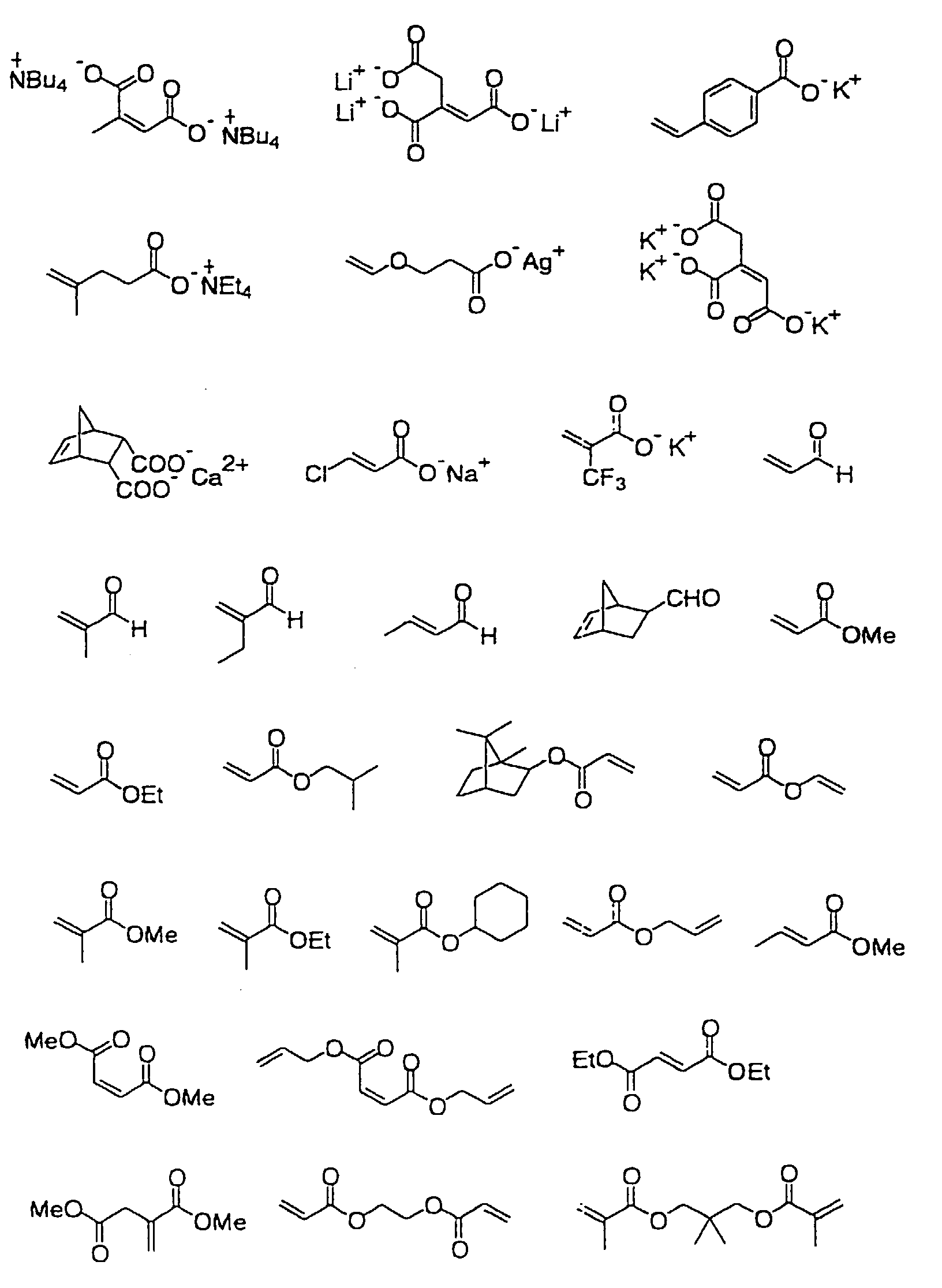
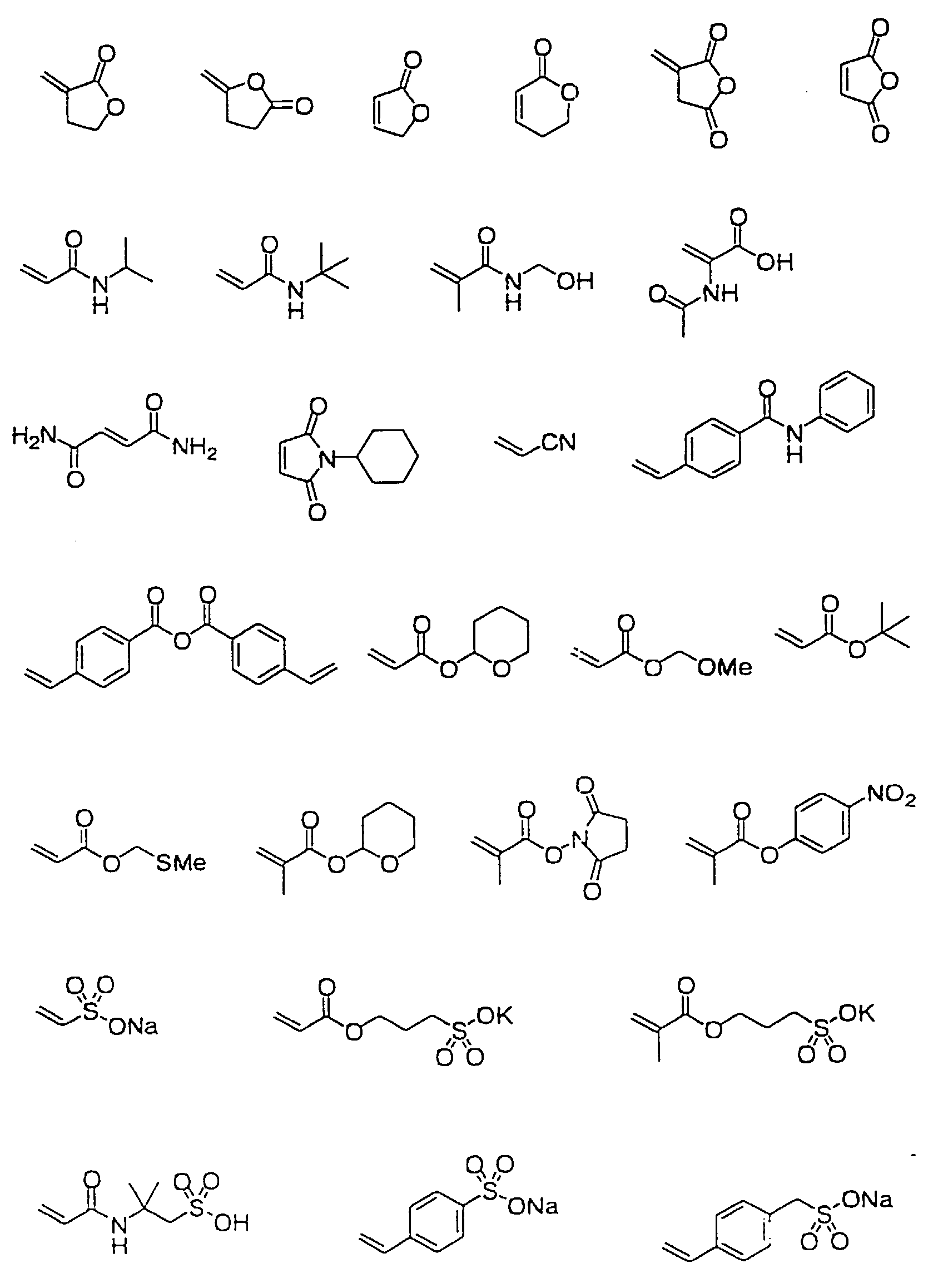

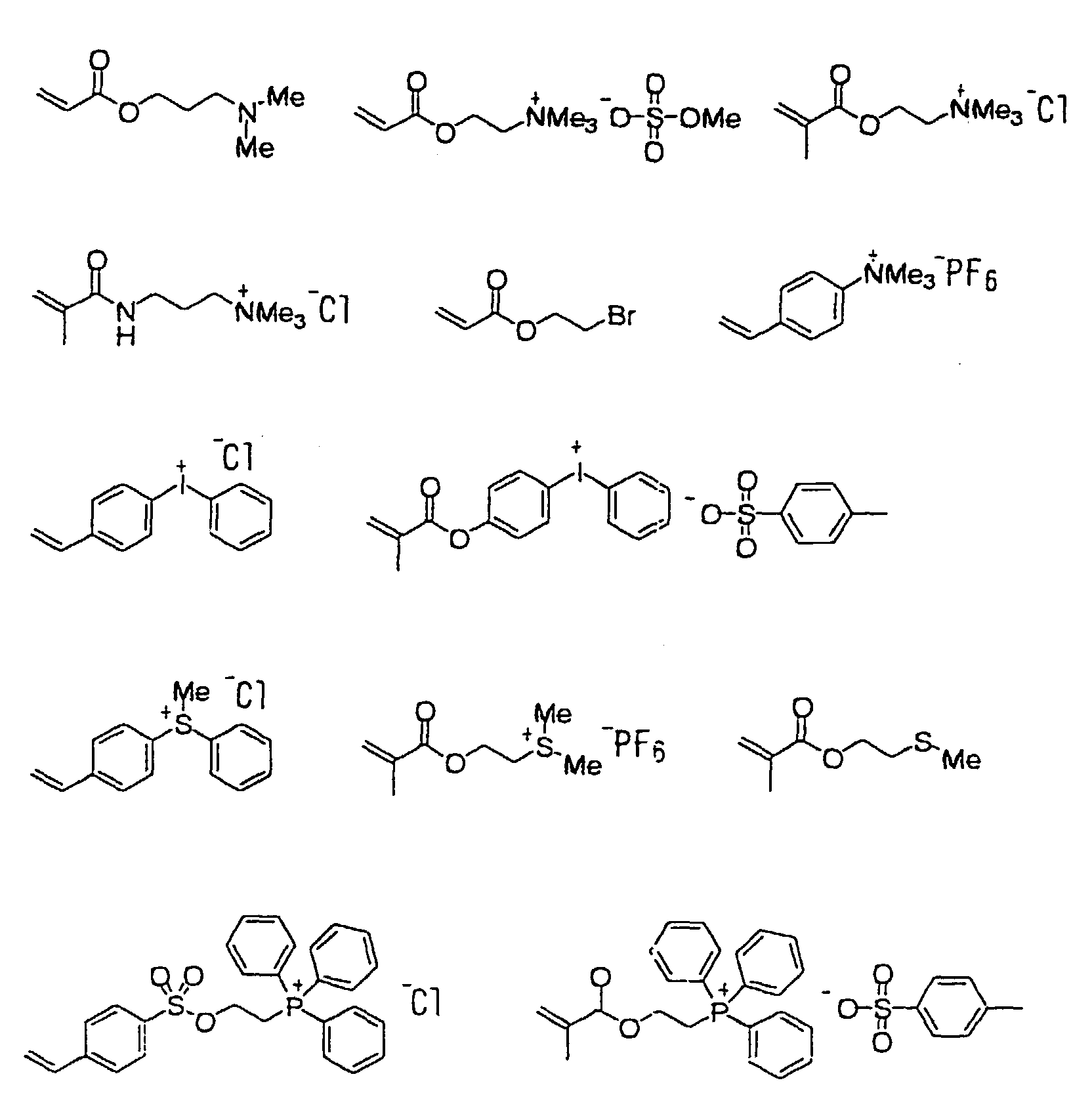
- The polymer electrolyte for use in the present invention may be obtained by polymerizing the above-described monomer alone or by copolymerizing two or more thereof. In the case of polymerizing a monomer having a functional group capable of deriving the above-described functional group, various chemical reaction treatments may be performed, if desired, after the polymerization or the formation of polymer complex layer to derive the above-described functional group and thereby obtain the polymer electrolyte, such as hydrolysis reaction, thermal decomposition reaction, photolysis reaction, oxidation reaction, reduction reaction and displacement reaction.
- The polymer electrolyte for use in the present invention is not particularly limited as long as it has the above-described functional group. Also, a copolymer with a monomer having no the above-described functional group may also be suitably used within the range of not impairing the effect of the present invention. As the monomer for use in the synthesis of the copolymer, any monomer having neither the above-described functional group nor a group capable of deriving the functional group may be suitably used. Specific examples of the monomer are described below.
- Examples of the other monomer for use in the synthesis of the copolymer include known monomers such as styrenes, unsaturated hydrocarbons, vinyl ethers, vinyl esters and α,β-unsaturated ketones.
- Specific examples of styrenes include styrene, methylstyrene, dimethylstyrene, trimethylstyrene, ethylstyrene, propylstyrene, cyclohexylstyrene, chloromethylstyrene, trifluoromethylstyrene, ethoxymethylstyrene, acetoxymethylstyrene, methoxystyrene, dimethoxystyrene, chlorostyrene, dichlorostyrene, bromostyrene, iodostyrene and fluorostyrene.
- Specific examples of unsaturated hydrocarbons include the following compounds:

- Specific examples of vinyl ethers include the following compounds:

- Specific examples of vinyl esters include the following compounds:
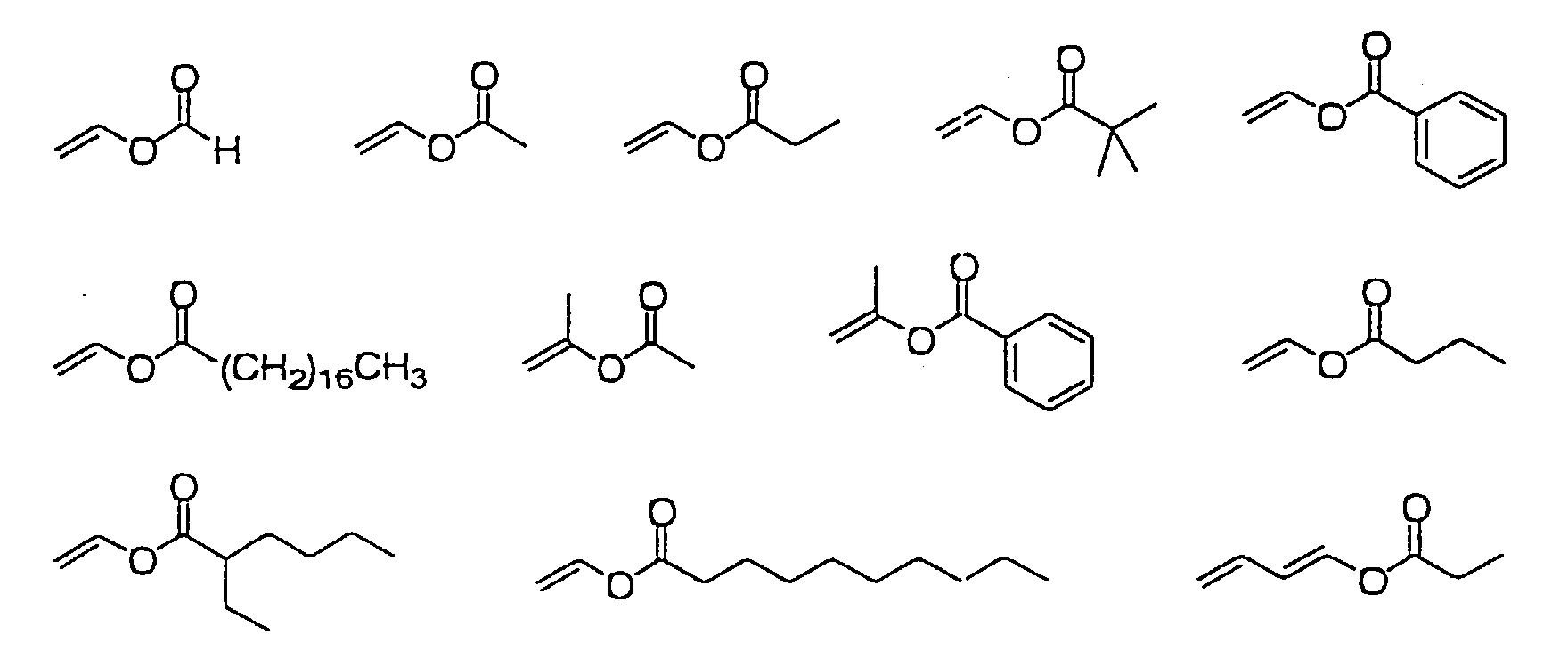
- Specific examples of α,β-unsaturated ketones include the following compounds:
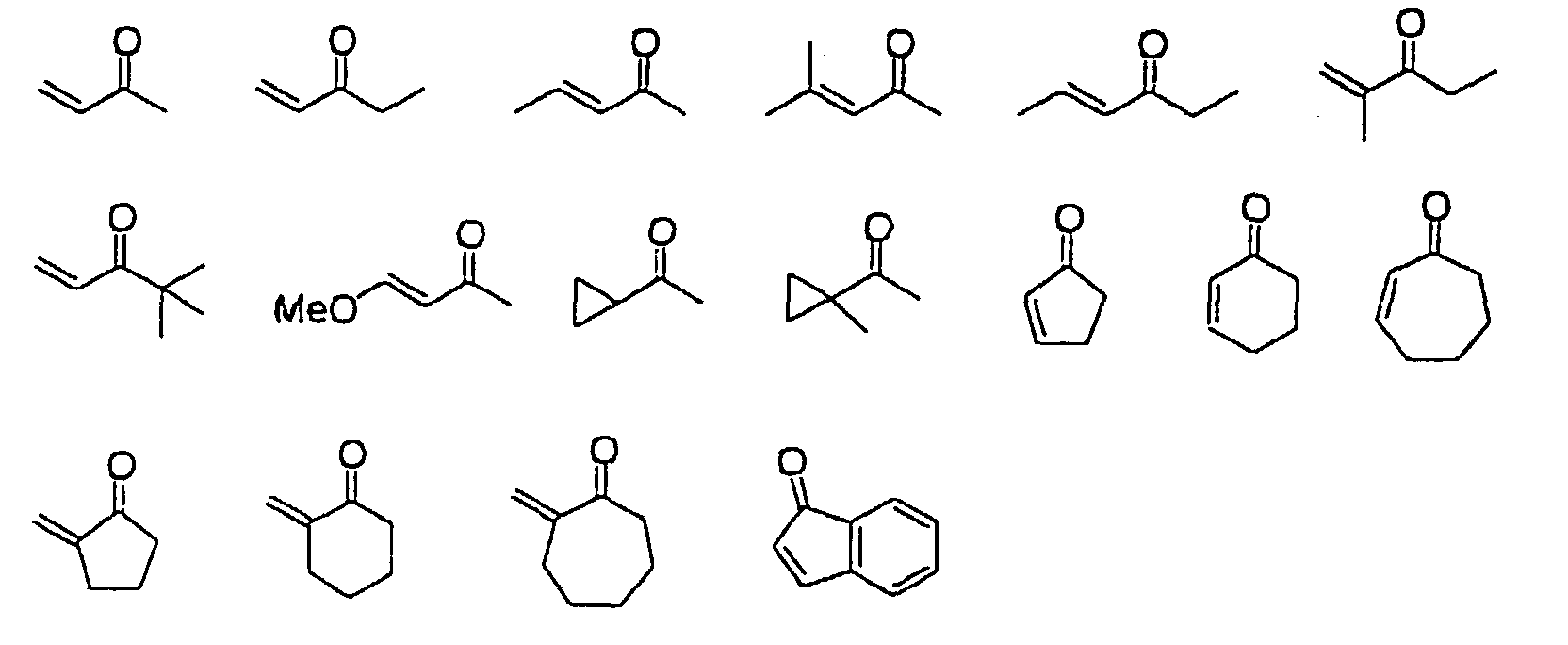
- In the synthesis of polymer electrolyte for use in the present invention, the monomer having the above-described specific functional group or a monomer having a functional group capable of deriving the specific functional group is preferably used in a ratio of 10 wt% or more, more preferably 40 wt% or more. If the monomer ratio is less than 10 wt%, the number of functional groups capable of causing electrostatic interaction is reduced and the cross-linking by the electrostatic interaction between polymer electrolytes is weakened, as a result, the polymer electrolyte complex increases in the solubility and dissolves in a solvent described above. In the case of the above-described other monomer is used in the synthesis of polymer electrolyte for use in the present invention, the copolymerizable other monomer can be used in any ratio as long as the monomer having the specific functional group is used in a preferred ratio. The copolymerizable other polymers may be used either individually or in combination of two or more thereof.
- Specific examples of the polymer electrolyte and the polymer compound capable of deriving the polymer electrolyte by a chemical reaction treatment (hereinafter sometimes called "polymer electrolyte precursor") are set forth below, however, the present invention is by no means limited thereto.


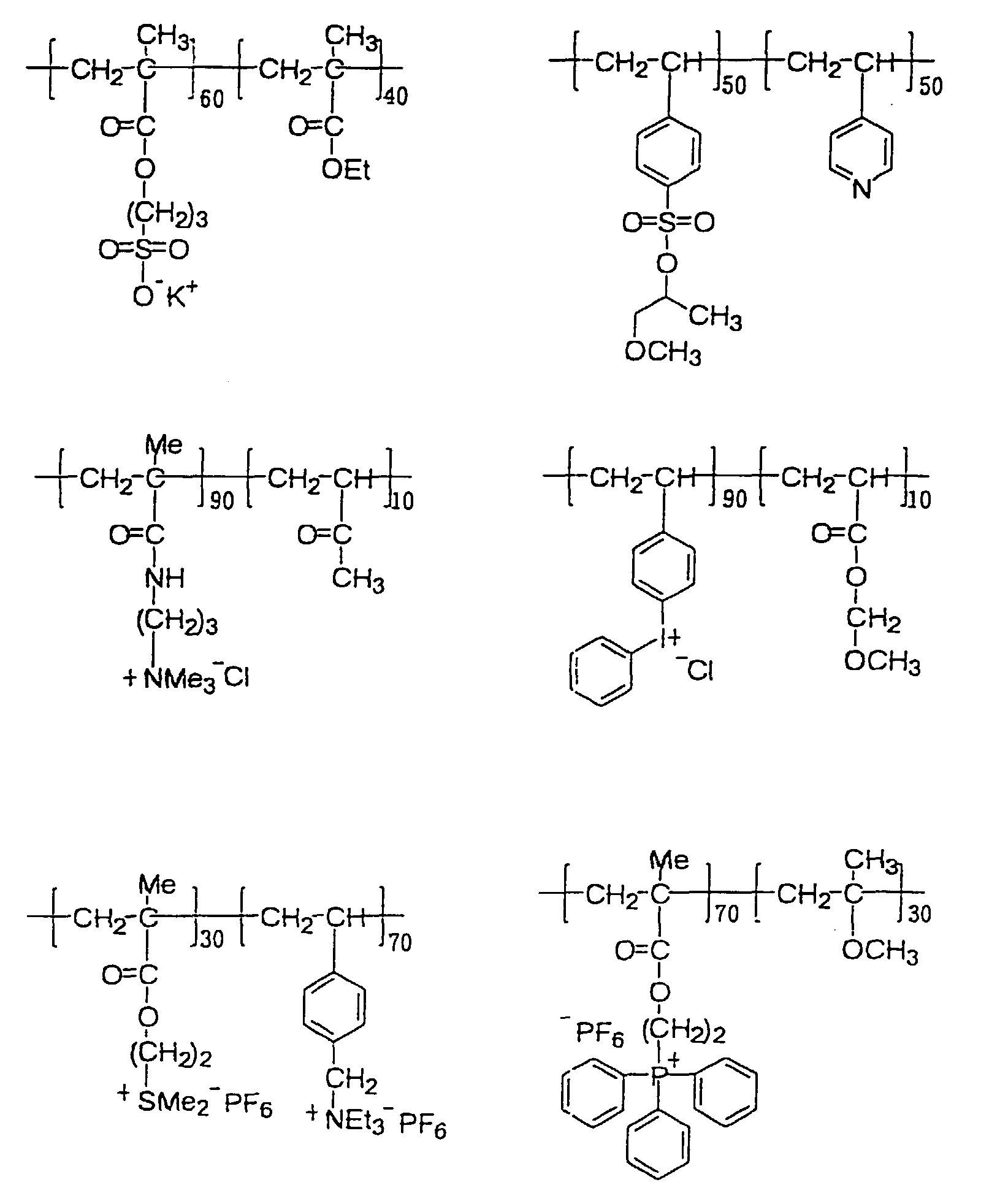
- The polymer electrolyte or polymer electrolyte precursor for use in the lithographic printing original plate of the present invention preferably has a weight average molecular weight measured by GPC of 2,000 or more, more preferably from 5,000 to 300,000, and a number average molecular weight of 800 or more, more preferably from 1,000 to 250,000. The polydispersion degree (weight average molecular weight/number average molecular weight) is preferably 1 or more, more preferably from 1.1 to 10.
- The polymer electrolyte or polymer electrolyte precursor may be any of a random polymer, a block polymer and a graft polymer, but a random polymer is preferred.
- Examples of the solvent used in the synthesis of polymer electrolyte or polymer electrolyte precursor for use in the present invention include tetrahydrofuran, ethylene dichloride, cyclohexanone, methyl ethyl ketone, acetone, methanol, ethanol, ethylene glycol monomethyl ether, ethylene glycol monoethyl ether, 2-methoxyethyl acetate, diethylene glycol dimethyl ether, 1-methoxy-2-propanol, 1-methoxy-2-propyl acetate, N,N-dimethylformamide, N,N-dimethylacetamide, toluene, ethyl acetate, ethyl lactate, methyl lactate, dimethyl sulfoxide and water. These solvents may be used either individually or in combination of two or more thereof.
- The radical polymerization initiator used in the synthesis of polymer electrolyte or polymer electrolyte precursor for use in the present invention may be a known compound such as azo-based initiator and peroxide initiator.
- In the case where the polymer electrolyte is contained in the polymer complex layer, either a sole polymer electrolyte or a mixture of two or more polymer electrolytes may be used as long as a polymer electrolyte complex can be formed.
- The ratio of polymer complex contained in the polymer complex layer is preferably 40 wt% or more, more preferably 50 wt% or more. If the ratio is less than 40 wt%, the image strength is diminished and the press life is shortened.
- In addition to the polymer complex, the polymer complex layer may contain a solid particle, a light-heat converting agent, an acid-generating agent, a sensitizing dye, a surface active agent and other constituent components.
- The light-heat converting agent, acid-generating agent, sensitizing dye and surface active agent can be contained in a recording layer which is described later, therefore, these are described in detail later in connection with the recording layer.
- The polymer complex layer of the present invention may contain a solid particle in addition to the light-heat converting agent. The solid particle is preferably a particle capable of increasing the removability of polymer complex layer and varying the thermal conductivity distribution to efficiently use the heat generated in Layer A and/or Layer B. Examples of the solid particle include an inorganic particle, an organic particle and a metal particle.
- Examples of the inorganic particle which can be used include metal oxides such as zinc oxide, titanium dioxide, iron oxide and zirconia; silicon-containing oxides called white carbon which itself has not absorption in the visible region, such as silicic acid anhydride, hydrous calcium silicate and hydrous aluminum silicate; and clay mineral particles such as clay, talc, kaolin and zeolite.
- Examples of the metal particle include aluminum, copper, nickel, silver and iron. The inorganic particle or metal particle preferably has an average particle size of 10 mm or less, preferably from 0.01 to 10 mm, more preferably from 0.1 to 5 mm.
- If the average particle size of inorganic or metal particle is less than 0.01 mm, the removability of polymer complex layer and the change in heat conductivity distribution are not so improved to exhibit the effect, whereas if it exceeds 10 mm, the resolving degree of printed matter is deteriorated or the adhesion to support is extremely reduced, as a result, the strength of image area decreases.
- The inorganic particle or metal particle may be used in any content as long as the polymer complex is used in a preferred content, however, if contained, the content is preferably from 2 to 90 wt%, more preferably from 5 to 80 wt%. If the particle content is less than 2 wt%, the removability of polymer complex layer and the change in heat conductivity distribution are not so improved to exhibit the effect, whereas if it exceeds 90 wt%, the resolving degree of printed matter is deteriorated or the adhesion to support is extremely reduced, as a result, the strength of image area decreases.
- Other than the inorganic particle and the metal particle, an organic particle may also be used. The organic particle is not particularly limited as long as it can increase the removability of polymer complex layer and vary the thermal conductivity distribution to enable efficient use of the heat generated in Layer A and/or Layer B. As a granular organic particle, a resin particle may be used, however, must be used by taking cares of the following matters. In the case of using a solvent at the dispersion of resin particles, a resin particle incapable of dissolving in the solvent or a solvent incapable of dissolving the resin particle must be selected. In the case of dispersing resin particles using a thermoplastic polymer and heat, a resin particle which does not melt, deform or decompose by heat at the dispersion must be selected.
- For lightening the load of these matters to be taken care of, a cross-linked resin particle may be preferably used. The organic particle has an average particle size of from 0.01 to 10 mm, preferably from 0.05 to 10 mm, more preferably from 0.1 to 5 mm. If the average particle size of organic particle is less than 0.01 mm, the removability of polymer complex layer and the change in heat conductivity distribution are not so improved to exhibit the effect, whereas if it exceeds 10 mm, the resolving degree of printed matter is deteriorated or the adhesion to support is extremely reduced, as a result, the strength of image area decreases.
- The organic particle may be used in any content as long as the polymer complex is used in a preferred content, however, if the organic particle is contained, the content is preferably from 2 to 90 wt%, more preferably from 5 to 80 wt%. If the particle content is less than 2 wt%, the removability of polymer complex layer and the change in heat conductivity distribution are not so improved to exhibit the effect, whereas if it exceeds 90 wt%, the resolving degree of printed matter is deteriorated or the adhesion to support is extremely reduced, as a result, the strength of image area decreases.
- Examples of the organic particle include polystyrene particle (particle size: 4 to 10 mm) and silicone resin particle (particle size: 2 to 4 mm). Examples of the cross-linked resin particle include micro gel (particle size: 0.01 to 1 mm) comprising two or more ethylenically unsaturated monomers, cross-linked resin particle (particle size: 4 to 10 mm) comprising styrene and divinylbenzene, and cross-linked resin particle (particle size: 4 to 10 mm) comprising methyl methacrylate and diethylene glycol dimethacrylate, more specifically, micro gel of acrylic resin, cross-linked polystyrene, and cross-linked methyl methacrylate. These may be prepared by a general method such as emulsification polymerization method, soap-free emulsification polymerization method, seed emulsification polymerization method, dispersion polymerization method and suspension polymerization method.
- Also, the inorganic particle may be prepared from a solution. For example, by adding a metal lower alkoxide to a solvent such as ethanol and in the presence of water and acid or alkali, an inorganic particle containing the metal is obtained. By adding the inorganic particle solution obtained to a solvent-soluble thermoplastic polymer solution, an inorganic particle dispersion solution may be prepared. Or, the inorganic particle containing the metal may also be obtained by previously adding the metal lower alkoxide to a thermoplastic polymer solution and thereafter adding water and acid or alkali.
- In the case of preparing an inorganic particle by adding a metal lower alkoxide to a precursor solution of thermoplastic polymer, a composite of polymer and inorganic material is obtained at the time of converting the polymer precursor into a thermoplastic polymer by heat. Examples of the metal lower alkoxide which can be used include tetraethoxysilane and tetraethoxytitanium.
- In the lithographic printing original plate of the present invention, the polymer complex layer may additionally contain, if desired, a plasticizer for imparting flexibility to the coating. Examples of the plasticizer include polyethylene glycol, tributyl citrate, diethyl phthalate, dibutyl phthalate, dihexyl phthalate, dioctyl phthalate, tricresyl phosphate, tributyl phosphate, trioctyl phosphate, tetrahydrofurfuryl oleate, and oligmers and polymers of acrylic acid or methacrylic acid.
- The polymer complex layer of the lithographic printing original plate of the present invention may be usually produced by dissolving the above-described respective components in a solvent, coating the solution on an appropriate support and if desired, applying various treatments such as acid hydrolysis, base hydrolysis, thermal decomposition, photolysis, oxidation and reduction. Examples of the solvent used here include tetrahydrofuran, ethylene dichloride, cyclohexanone, methyl ethyl ketone, acetone, methanol, ethanol, propanol, ethylene glycol monomethyl ether, ethylene glycol monoethyl ether, 2-methoxyethyl acetate, diethylene glycol dimethyl ether, 1-methoxy-2-propanol, 1-methoxy-2-propyl acetate, dimethoxyethane, N,N-dimethylformamide, N,N-dimethylacetamide, toluene, ethyl acetate, ethyl lactate, methyl lactate, dimethyl sulfoxide, water, sulfolane and γ-butyrolactone, however, the present invention is by no means limited thereto.
- These solvents may be used either individually or in combination. In the case of preparing a coating solution, the concentration of the polymer complex layer constituent components (all solids content including additives) in the solvent is preferably from 1 to 50 wt%.
- The coating solution may be coated by various known methods such as bar coater coating, rotation coating, spray coating, curtain coating, dip coating, air knife coating, blade coating and roll coating.
- In the lithographic printing original plate of the present invention, the polymer complex layer may contain a surface active agent so as to improve the coatability, such as a fluorine-based surface active agent described, for example, in JP-A-62-170950. The amount of the surface active agent added is preferably from 0.01 to 1 wt%, more preferably from 0.05 to 0.5 wt%, based on all solids content in the polymer complex layer.
- The coated amount (solid content) of polymer complex layer obtained after the coating and drying varies depending on the use, however, in the case of a general lithographic printing original plate, it is from 0.1 to 1.0 g/m2, preferably from 0.1 to 5.0 g/m2, more preferably from 0.2 to 1.5 g/m2.
- For the recording layer (Layer B) used in the lithographic printing original plate of the present invention, any layer may be used as long as the layer is imagewise solubilized (rendered positive) or insolubilized (rendered negative) in a developer by heat generated due to light-heat conversion after the exposure. In the case of Layer B undergoing positive conversion, a layer containing a hydrophobic polymer compound capable of becoming hydrophilic by heat (hereinafter sometimes called a "positive polar conversion polymer compound") or a layer containing an aqueous alkali solution-soluble resin is preferred. In the case of Layer B undergoing negative conversion, a layer containing a hydrophilic polymer compound capable of becoming hydrophobic by heat (hereinafter sometimes called a "negative polar conversion polymer compound") or a layer containing a compound cross-likable with an aqueous alkali solution-soluble resin is preferred.
- The "layer containing a positive polar conversion polymer compound" for use in the lithographic printing original plate of the present invention means a layer containing at least a positive polar conversion polymer compound described below.
- The positive polar conversion polymer compound for use in the present invention is, as described above, a hydrophobic polymer compound capable of becoming hydrophilic by heat. Examples of such a polymer compound include a hydrophobic polymer compound having on the side chain thereof a hydrophobic functional group capable of becoming hydrophilic by heat. This change must be on such a degree that when a polymer compound which does not exhibit hydrophilicity at an ordinary temperature, for example, does not dissolve in or swell with water, is applied with heat due to light-heat conversion after the laser exposure, a part or all of polar conversion functional groups on the side chain of the compound are changed by heat, as a result, the compound exhibits hydrophilicity, for example, dissolves in or swells with water.
- With respect to the process of the hydrophobic functional group on the side chain of a hydrophobic polymer compound becoming hydrophilic by heat, two processes may be considered. One is a process where the originally hydrophobic functional group on the side chain causes reaction by heat and thereby becomes hydrophilic, and another is a process where the originally hydrophobic functional group on the side chain decomposes by heat to lose the hydrophobic functional group and thereby becomes hydrophilic.
- As the former process of the hydrophobic group becoming hydrophilic as a result of reaction caused by heat, a process where the hydrophobic functional group reacts with another functional group within the polymer due to heat and becomes hydrophilic and a process where the hydrophobic functional group reacts with another compound outside the polymer due to heat and becomes hydrophilic may be considered. The functional group may be rendered hydrophilic through a combination of these two kinds of processes.
- Among the above-described processes, in view of reactivity, a process where the originally hydrophobic functional group on the side chain decomposes due to heat to lose the hydrophobic functional group and thereby becomes hydrophilic is preferred.
- In the present invention, it is preferred that all polar conversion functional groups on the side chain of the polar conversion polymer compound become hydrophilic, however, this is not particularly limited and not all of the hydrophobic functional groups are necessary to become hydrophilic as long as the polar conversion polymer compound can exhibit hydrophilicity, for example, can dissolve in or swell with water.
- Specific examples of the hydrophobic functional group for use in the present invention include the following functional groups:(wherein R1 and R3 each represents an alkyl group, an aryl group, an alkenyl group or an alkynyl group, R2 and R4 each represents hydrogen, an alkyl group, an aryl group, an alkenyl group or an alkynyl group, and R1 and R2, R1 and R3 or R1 and R4 may form a ring).

- Specific examples of the hydrophilic functional group for use in the present invention include the following functional groups:(wherein R1, R2 and R3 each represents hydrogen, an alkyl group, an aryl group, an alkenyl group or an alkynyl group, any two of R1, R2 and R3 may form a ring, and E- represents a counter anion).
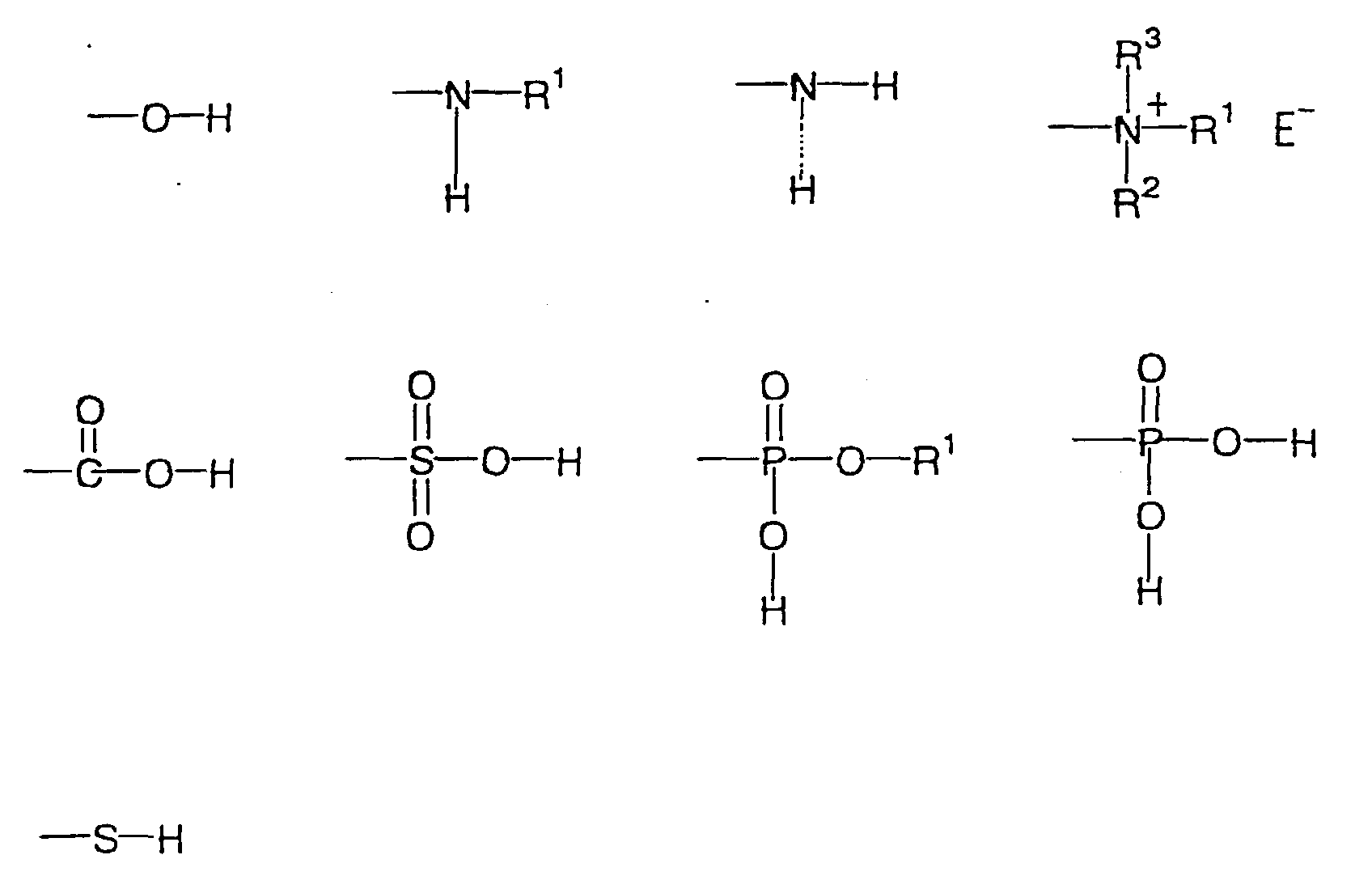
- When R1, R2, R3 and R4 each represents an alkyl group, the alkyl group includes a linear, branched or cyclic alkyl group having from 1 to 20 carbon atoms. Specific examples thereof include a methyl group, an ethyl group, a propyl group, a butyl group, a pentyl group, a hexyl group, a heptyl group, an octyl group, a nonyl group, a decyl group, an undecyl group, a dodecyl group, a tridecyl group, a hexadecyl group, an octadecyl group, an eicosyl group, an isopropyl group, an isobutyl group, an sec-butyl group, a tert-butyl group, an isopentyl group, a neopentyl group, a 1-methylbutyl group, an isohexyl group, a 2-ethylhexyl group, a 2-methylhexyl group, a cyclohexyl group, a cyclopentyl group and a 2-norbornyl group. Among these, a linear alkyl group having from 1 to 12 carbon atoms, a branched alkyl group having from 3 to 12 carbon atoms and a cyclic alkyl group having from 5 to 10 carbon atoms are preferred.
- When R1, R2, R3 and R4 each represents a substituted alkyl group, the substituent is a monovalent nonmetallic atom group exclusive of hydrogen. Preferred examples of the substituent include a halogen atom (e.g., -F, -Br, -Cl, -I), a hydroxyl group, an alkoxy group, an aryloxy group, a mercapto group, an alkylthio group, an arylthio group, an alkyldithio group, an aryldithio group, an amino group, an N-alkylamino group, an N,N-dialkylamino group, an N-arylamino group, an N,N-diarylamino group, an N-alkyl-N-arylamino group, an acyloxy group, a carbamoyloxy group, an N-alkylcarbamoyloxy group, an N-arylcarbamoyloxy group, an N,N-dialkylcarbamoyloxy group, an N,N-diarylcarbamoyloxy group, an N-alkyl-N-arylcarbamoyloxy group, an alkylsulfoxy group, an arylsulfoxy group, an acylthio group, an acylamino group, an N-alkylacylamino group, an N-arylacylamino group, a ureido group, an N'-alkylureido group, an N',N'-dialkylureido group, an N'-arylureido group, an N',N'-diarylureido group, an N'-alkyl-N'-arylureido group, an N-alkylureido group, an N-arylureido group, an N'-alkyl-N-alkylureido group, an N'-alkyl-N-arylureido group, an N',N'-dialkyl-N-alkylureido group, an N',N'-dialkyl-N-arylureido group, an N'-aryl-N-alkylureido group, an N'-aryl-N-arylureido group, an N',N'-diaryl-N-alkylureido group, an N',N'-diaryl-N-arylureido group, an N'-alkyl-N'-aryl-N-alkylureido group, an N'-alkyl-N'-aryl-N-arylureido group, an alkoxycarbonylamino group, an aryloxycarbonylamino group, an N-alkyl-N-alkoxycarbonylamino group, an N-alkyl-N-aryloxycarbonylamino group, an N-aryl-N-alkoxycarbonylamino group, an N-aryl-N-aryloxycarbonylamino group, a formyl group, an acyl group, a carboxyl group, an alkoxycarbonyl group, an aryloxycarbonyl group, a carbamoyl group, an N-alkylcarbamoyl group, an N,N-dialkylcarbamoyl group, an N-arylcarbamoyl group, an N,N-diarylcarbamoyl group, an N-alkyl-N-arylcarbamoyl group, an alkylsulfinyl group, an arylsulfinyl group, an alkylsulfonyl group, an arylsulfonyl group, a sulfo group (-SO3H) and a conjugate base group thereof (hereinafter referred to as a sulfonato group), an alkoxysulfonyl group, an aryloxysulfonyl group, a sulfinamoyl group, an N-alkylsulfinamoyl group, an N,N-dialkylsulfinamoyl group, an N-arylsulfinamoyl group, an N,N-diarylsulfinamoyl group, an N-alkyl-N-arylsulfinamoyl group, a sulfamoyl group, an N-alkylsulfamoyl group, an N,N-dialkylsulfamoyl group, an N-arylsulfamoyl group, an N,N-diarylsulfamoyl group, an N-alkyl-N-arylsulfamoyl group, a phosphono group (-PO3H2) and a conjugate base group thereof (hereinafter referred to as a phosphonato group), a dialkylphosphono group (-PO3(alkyl)2), a diarylphosphono group (-PO3(aryl)2), an alkylarylphosphono group (-PO3(alkyl)(aryl)), a monoalkylphosphono group (-PO3H(alkyl)) and a conjugate base group thereof (hereinafter referred to as an alkylphosphonato group), a monoarylphosphono group (-PO3H(aryl)) and a conjugate base group thereof (hereinafter referred to as an arylphosphonato group), a phosphonooxy group (-OPO3H2) and a conjugate base group thereof (hereinafter referred to as a phosphonatooxy group), a dialkylphosphonooxy group (-OPO3(alkyl)2), a diarylphosphonooxy group (-OPO3(aryl)2), an alkylarylphosphonooxy group (-OPO3(alkyl)(aryl)), a monoalkylphosphonooxy group (-OPO3H(alkyl)) and a conjugate base group thereof (hereinafter referred to as an alkylphosphonatooxy group), a monoarylphosphonooxy group (-OPO3H(aryl)) and a conjugate base group thereof (hereinafter referred to as an arylphosphonatooxy group), a cyano group, a nitro group, an aryl group, an alkenyl group and an alkynyl group.
- Specific examples of the alkyl group in these substituents include the above-described alkyl groups and specific examples of the aryl group include a phenyl group, a biphenyl group, a naphthyl group, a tolyl group, a xylyl group, a mesityl group, a cumenyl group, a chlorophenyl group, a bromophenyl group, a chloromethylphenyl group, a hydroxyphenyl group, a methoxyphenyl group, an ethoxyphenyl group, a phenoxyphenyl group, an acetoxyphenyl group, a benzoyloxyphenyl group, a methylthiophenyl group, a phenylthiophenyl group, a methylaminophenyl group, a dimethylaminophenyl group, an acetylaminophenyl group, a carboxyphenyl group, a methoxycarbonylphenyl group, an ethoxyphenylcarbonyl group, a phenoxycarbonylphenyl group, an N-phenylcarbamoylphenyl group, a phenyl group, a cyanophenyl group, a sulfophenyl group, a sulfonatophenyl group, a phosphonophenyl group and a phosphonatophenyl group.
- Examples of the alkenyl group include a vinyl group, a 1-propenyl group, a 1-butenyl group, a cinnamyl group and a 2-chloro-1-ethenyl group and examples of the alkynyl group include an ethynyl group, a 1-propynyl group, a 1-butynyl group and a trimethylsilylethynyl group. R5 in the acyl group (R5CO-) includes hydrogen and the above-described alkyl and aryl groups.
- Among these substituents, more preferred are a halogen atom (-F, -Br, -Cl, -I), an alkoxy group, an aryloxy group, an alkylthio group, an arylthio group, an N-alkylamino group, an N,N-dialkylamino group, an acyloxy group, an N-alkylcarbamoyloxy group, an N-arylcarbamoyloxy group, an acylamino group, a formyl group, an acyl group, a carboxyl group, an alkoxycarbonyl group, an aryloxycarbonyl group, a carbamoyl group, an N-alkylcarbamoyl group, an N,N-dialkylcarbamoyl group, an N-arylcarbamoyl group, an N-alkyl-N-arylcarbamoyl group, a sulfo group, a sulfonato group, a sulfamoyl group, an N-alkylsulfamoyl group, an N,N-dialkylsulfamoyl group, an N-arylsulfamoyl group, an N-alkyl-N-arylsulfamoyl group, a phosphono group, a phosphonato group, a dialkylphosphono group, a diarylphosphono group, a monoalkylphosphono group, an alkylphosphonato group, a monoarylphosphono group, an arylphosphonato group, a phosphonooxy group, a phosphonatooxy group, an aryl group and an alkenyl group.
- The alkylene group in the substituted alkyl group is a divalent organic residue resulting from releasing any one of hydrogen atoms on the above-described alkyl group having from 1 to 20 carbon atoms, preferably a linear alkylene group having from 1 to 12 carbon atoms, a branched alkylene group having from 3 to 12 carbon atoms or a cyclic alkylene group having from 5 to 10 carbon atoms. Specific preferred examples of the substituted alkyl group obtained by combining the substituent and the alkylene group include a chloromethyl group, a bromomethyl group, a 2-chloroethyl group, a trifluoromethyl group, a methoxymethyl group, a methoxyethoxyethyl group, an allyloxymethyl group, a phenoxymethyl group, a methylthiomethyl group, a tolylthiomethyl group, an ethylaminoethyl group, a diethylaminopropyl group, a morpholinopropyl group, an acetyloxymethyl group, a benzoyloxymethyl group, an N-cyclohexylcarbamoyloxyethyl group, an N-phenylcarbamoyloxyethyl group, an acetylaminoethyl group, an N-methylbenzoylaminopropyl group, a 2-oxoethyl group, a 2-oxopropyl group, a carboxypropyl group, a methoxycarbonylethyl group, an allyloxycarbonylbutyl group, a chlorophenoxycarbonylmethyl group, a carbamoylmethyl group, an N-methylcarbamoylethyl group, an N,N-dipropylcarbamoylmethyl group, an N-(methoxyphenyl)carbamoylethyl group, an N-methyl-N-(sulfophenyl)carbamoylmethyl group, a sulfobutyl group, a sulfonatobutyl group, a sulfamoylbutyl group, an N-ethylsulfamoylmethyl group, an N,N-dipropylsulfamoylpropyl group, an N-tolylsulfamoylpropyl group, an N-methyl-N-(phosphonophenyl)sulfamoyloctyl group, a phosphonobutyl group, a phosphonatohexyl group, a diethylphosphonobutyl group, a diphenylphosphonopropyl group, a methylphosphonobutyl group, a methylphosphonatobutyl group, a tolylphosphonohexyl group, a tolylphosphonatohexyl group, a phosphonooxypropyl group, a phosphonatooxybutyl group, a benzyl group, a phenethyl group, an α-methylbenzyl group, a 1-methyl-1-phenylethyl group, a p-methylbenzyl group, a cinnamyl group, an allyl group, a 1-propenylmethyl group, a 2-butenyl group, a 2-methylallyl group, a 2-methylpropenylmethyl group, a 2-propynyl group, a 2-butynyl group and a 3-butynyl group.
- When R1, R2, R3 and R4 each represents an aryl group, the aryl group includes a condensed ring formed from 1 to 3 benzene rings and a condensed ring formed from a benzene ring and a 5-membered unsaturated ring. Specific examples thereof include a phenyl group, a naphthyl group, an anthryl group, a phenanthryl group, an indenyl group, an acenaphthenyl group and a fluorenyl group. Among these, a phenyl group and a naphthyl group are preferred. The aryl group also includes a heterocyclic (hetero)aryl group in addition to the above-described carbocyclic aryl group. Examples of the heterocyclic aryl group include a pyridyl group, a furyl group, and a condensed ring thereof having from 3 to 20 carbon atoms and from 1 to 5 hetero atoms with a benzene ring, such as quinolyl group, benzofuryl group, thioxanthone group and carbazole group.
- When R1, R2, R3 and R4 each represents a substituted aryl group, the substituted aryl group includes the above-described aryl groups having a monovalent nonmetallic atom group exclusive of hydrogen as a substituent on the ring-forming carbon atoms. Preferred examples of the substituent include the above-described alkyl groups, substituted alkyl groups and substituents of the substituted alkyl group.
- Specific preferred examples of the substituted aryl group include a biphenyl group, a tolyl group, a xylyl group, a mesityl group, a cumenyl group, a chlorophenyl group, a bromophenyl group, a fluorophenyl group, a chloro-methylphenyl group, a trifluoromethylphenyl group, a hydroxyphenyl group, a methoxyphenyl group, a methoxyethoxyphenyl group, an allyloxyphenyl group, a phenoxyphenyl group, a methylthiophenyl group, a tolylthiophenyl group, an ethylaminophenyl group, a diethylaminophenyl group, a morpholinophenyl group, an acetyloxyphenyl group, a benzoyloxyphenyl group, an N-cyclohexylcarbamoyloxyphenyl group, an N-phenylcarbamoyloxyphenyl group, an acetylaminophenyl group, an N-methylbenzoylaminophenyl group, a carboxyphenyl group, a methoxycarbonylphenyl group, an allyloxycarbonylphenyl group, a chlorophenoxycarbonylphenyl group, a carbamoylphenyl group, an N-methylcarbamoylphenyl group, an N,N-dipropylcarbamoylphenyl group, an N-(methoxyphenyl)carbamoylphenyl group, an N-methyl-N-(sulfophenyl)carbamoylphenyl group, a sulfophenyl group, a sulfonatophenyl group, a sulfamoylphenyl group, an N-ethylsulfamoylphenyl group, an N,N-dipropylsulfamoylphenyl group, an N-tolylsulfamoylphenyl group, an N-methyl-N-(phosphonophenyl)sulfamoylphenyl group, a phosphonophenyl group, a phosphonatophenyl group, a diethylphosphonophenyl group, a diphenylphosphonophenyl group, a methylphosphonophenyl group, a methylphosphonatophenyl group, a tolylphosphonophenyl group, a tolylphosphonatophenyl group, an allyl group, a 1-propenylmethyl group, 2-butenyl group, a 2-methylallylphenyl group, a 2-methylpropenylphenyl group, a 2-propynylphenyl group, a 2-butynylphenyl group and a 3-butynylphenyl group.
- When R1, R2, R3 and R4 each represents an alkenyl group, a substituted alkenyl group [-C(R6)=C(R7)(R8)], an alkynyl group or a substituted alkynyl group [-C≡C(R9)], R6 to R9 each may be a monovalent nonmetallic atom group.
- Preferred examples of R6 to R9 include a hydrogen atom, a halogen atom, an alkyl group, a substituted alkyl group, an aryl group and a substituted aryl group. Specific examples thereof include those described above. The substituents R6 to R9 each is more preferably a hydrogen atom, a halogen atom or a linear, branched or cyclic alkyl group having from 1 to 10 carbon atoms.
- Specific examples of the alkenyl group, the substituted alkenyl group, the alkynyl group and the substituted alkynyl group include a vinyl group, a 1-butenyl group, a 1-pentenyl group, a 1-hexenyl group, a 1-octenyl group, a 1-methyl-1-propenyl group, a 2-methyl-1-propenyl group, a 2-methyl-1-butenyl group, a 2-phenyl-1-ethenyl group, a 2-chloro-1-ethenyl group, an ethynyl group, a propynyl group and a phenylethyl group.
- R1 and R3 each is preferably an alkyl group, a substituted alkyl group, an aryl group or a substituted aryl group, and R2 and R4 each is preferably hydrogen, an alkyl group, a substituted alkyl group, an aryl group or a substituted aryl group.
- The counter anion represented by E- is an anion having a negative charge and forms an ion pair with the positive charge in the ammonium group (-N+R1R2R3) which is a hydrophilic functional group. Accordingly, the counter anion represented by E- is present in a molar number necessary for giving an electric charge equal to the positive charge present in the ammonium group.
- Specific examples of the counter anion include F-, Cl-, Br-, I-, HO-, CN-, SO4 2-, HSO4 -, SO3 2-, HSO3 -, NO3 -, CO3 2-, HCO3 -, PF6 -, BF4 -, ClO4 -, ClO3 -, ClO2 -, ClO-, BrO4 -, BrO3 -, BrO2 -, BrO-, IO4 -, IO3 -, IO2 -, IO-, sulfonate anion, carboxylate anion, phosphonate anion and phosphate anion.
- Specific examples of the sulfonate anion are set forth below, however, the present invention is by no means limited thereto.


- Specific examples of the carboxylate anion are set forth below, however, the present invention is by no means limited thereto.
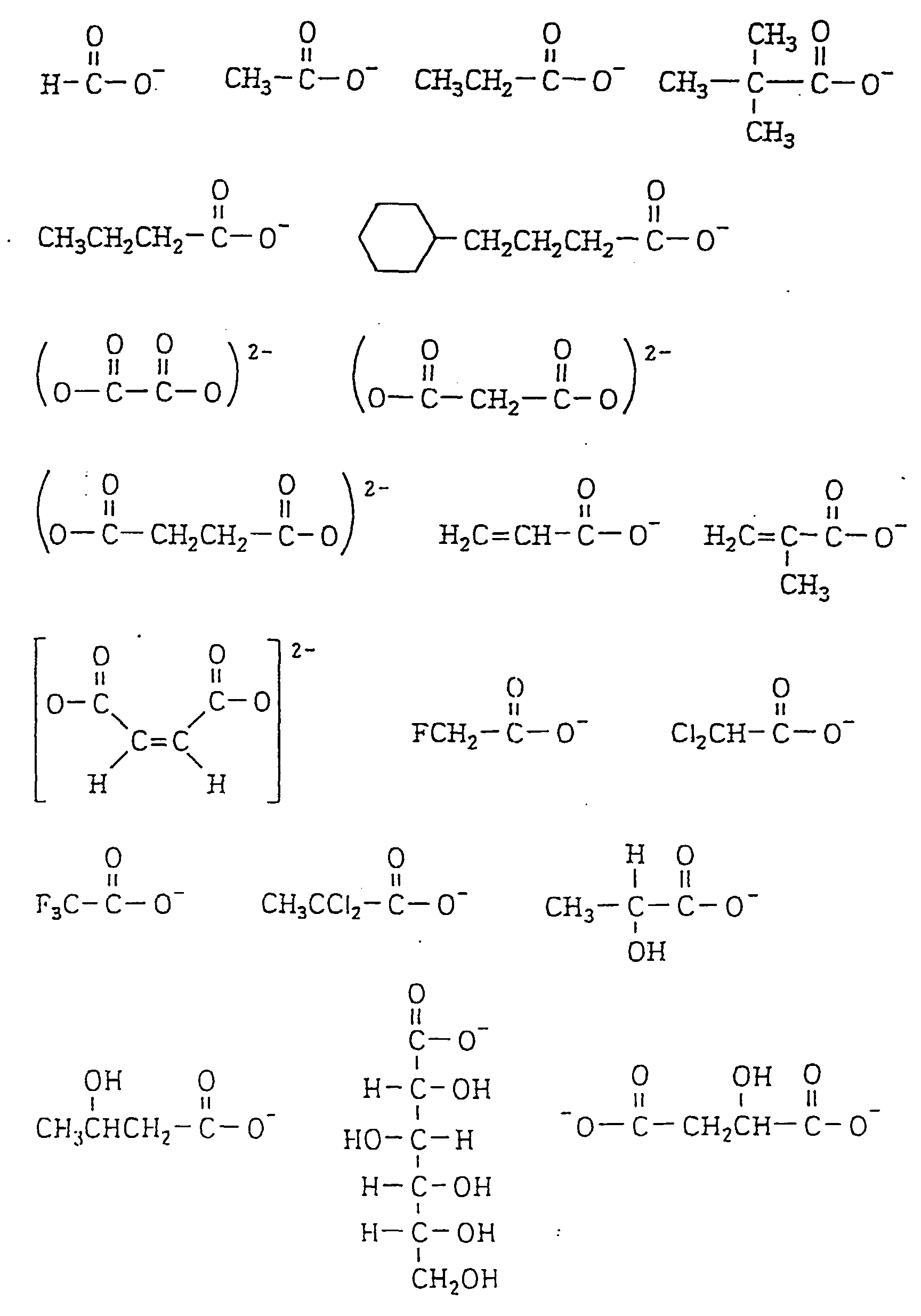

- Specific examples of the phosphonate anion are set forth below, however, the present invention is by no means limited thereto.

- Specific examples of the phosphate anion are set forth below, however, the present invention is by no means limited thereto.

- Among these anions, Cl-, Br-, I-, CN-, SO4 2-, PF6 -, BF4 -, ClO4 -, sulfonate anion, carboxylate anion, phosphonate anion and phosphate anion are preferred as the anion for use in the present invention.
- Among these hydrophobic functional groups capable of becoming hydrophilic by the heat, particularly preferred in view of reactivity, storage stability and discrimination between hydrophilicity and hydrophobicity are the functional groups represented by the following formulae (1) to (5):wherein L represents a polyvalent linking group comprising a nonmetallic atom, R1 represents an alkyl group, an aryl group, an alkenyl group, an alkynyl group or a cyclic imide group, R2 and R3 each represents an alkyl group, an aryl group, an alkenyl group or an alkynyl group, R4 represents an alkyl group, an aryl group, an alkenyl group, an alkynyl group or -SO2-R11, R5, R6 and R7 each independently represents an alkyl group, an aryl group, an alkenyl group or an alkynyl group, one of R8 and R9 represents hydrogen and the other represents hydrogen, an alkyl group, an aryl group, an alkenyl group or an alkynyl group, R10 represents an alkyl group, an alkenyl group or an alkynyl group, R11 represents an alkyl group, an aryl group, an alkenyl group or an alkynyl group, any two or three of R5, R6 and R7 may form a ring, R8 and R10 or R9 and R10 may form a ring, and X represents O or S.

- When R1 to R11 each represents an alkyl group, the alkyl group include the above-described functional groups.
- When R1 to R11 each represents a substituted alkyl group, the substituent thereof include the above-described functional groups.
- When R1 to R9 and R11 each represents an aryl group, the aryl group include the above-described functional groups.
- When R1 to R9 and R11 each represents a substituted aryl group, the substituted aryl group include the above-described functional groups.
- When R1 to R11 each represents an alkenyl group, a substituted alkenyl group [-C(R13)=C(R14)(R15)], an alkynyl group or a substituted alkynyl group [-C≡C(R16)], R13 to R16 each may be a monovalent nonmetallic atom group.
- Preferred examples of R13 to R16 include a hydrogen atom, a halogen atom, an alkyl group, a substituted alkyl group, an aryl group and a substituted aryl group. Specific examples thereof include those described above.
- When R1 represents a cyclic imide group, the cyclic imide group includes those having from 4 to 20 carbon atoms, such as succinic acid imide, phthalic acid imide, cyclohexanedicarboxylic acid imide and norbornenedicarboxylic acid imide.
- R1 is more preferably an alkyl group, a substituted alkyl group or a cyclic imide group.
- R2, R3, R4 and R11 each is more preferably an alkyl group substituted by an electron withdrawing group such as halogen, cyano or nitro, an aryl group substituted by an electron withdrawing group such as halogen, cyano or nitro, or a secondary or tertiary branched alkyl group.
- R5 to R9 each is preferably an alkyl group, a substituted alkyl group, an aryl group or a substituted aryl group, and R10 is preferably an alkyl group or a substituted alkyl group, provided that any two or three of R5, R6 and R7 form a ring or that R8 and R10 or R9 and R10 form a ring.
- The polyvalent linking group comprising a nonmetallic atom group, represented by L, comprises from 1 to 60 carbon atoms, from 0 to 10 nitrogen atoms, from 0 to 50 oxygen atoms, from 1 to 100 hydrogen atoms and from 0 to 20 sulfur atoms. More specifically, the linking group includes those comprising a combination of the following structural units.
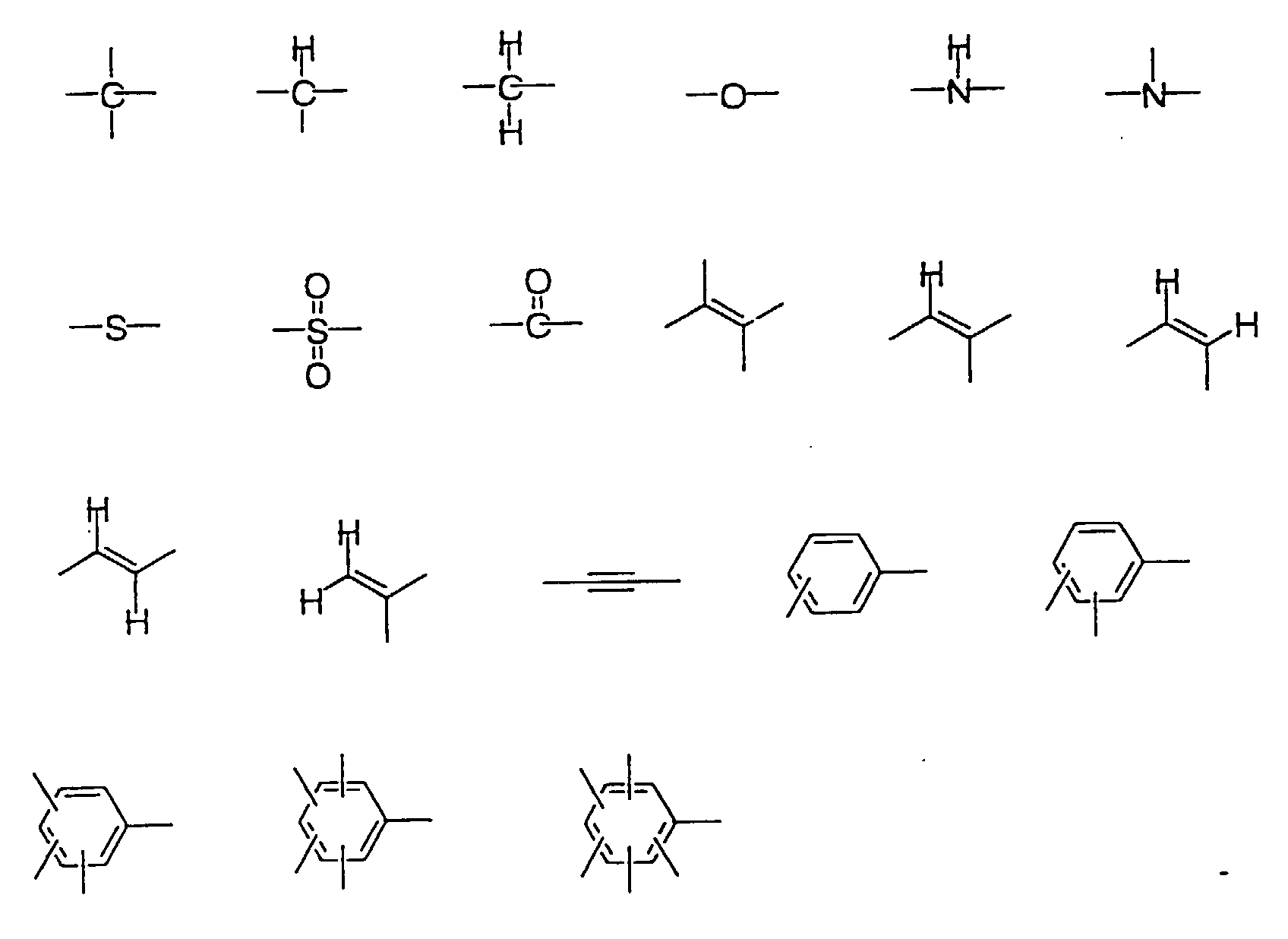
- When the polyvalent linking group has a substituent, examples of the substituent which can be used include an alkyl group having from 1 to 20 carbon atoms, such as methyl group and ethyl group, an aryl group having from 6 to 16 carbon atoms, such as phenyl group and naphthyl group, an acyloxy group having from 1 to 6 carbon atoms, such as hydroxyl group, carboxyl group, sulfonamido group, N-sulfonylamido group and acetoxy group, an alkoxy group having from 1 to 6 carbon atoms, such as methoxy group and ethoxy group, a halogen atom such as chlorine and bromine, an alkoxycarbonyl group having from 2 to 7 carbon atoms, such as methoxycarbonyl group, ethoxycarbonyl group and cyclohexyloxycarbonyl group, a cyano group and a carboxylic acid ester group such as tert-butyl carbonate.
- Specific examples of the radically polymerizable monomer having a hydrophobic functional group capable of becoming hydrophilic by heat, which is suitably used for the synthesis of positive polar conversion polymer compound for use in the present invention, are set forth below, however, the present invention is by no means limited thereto.


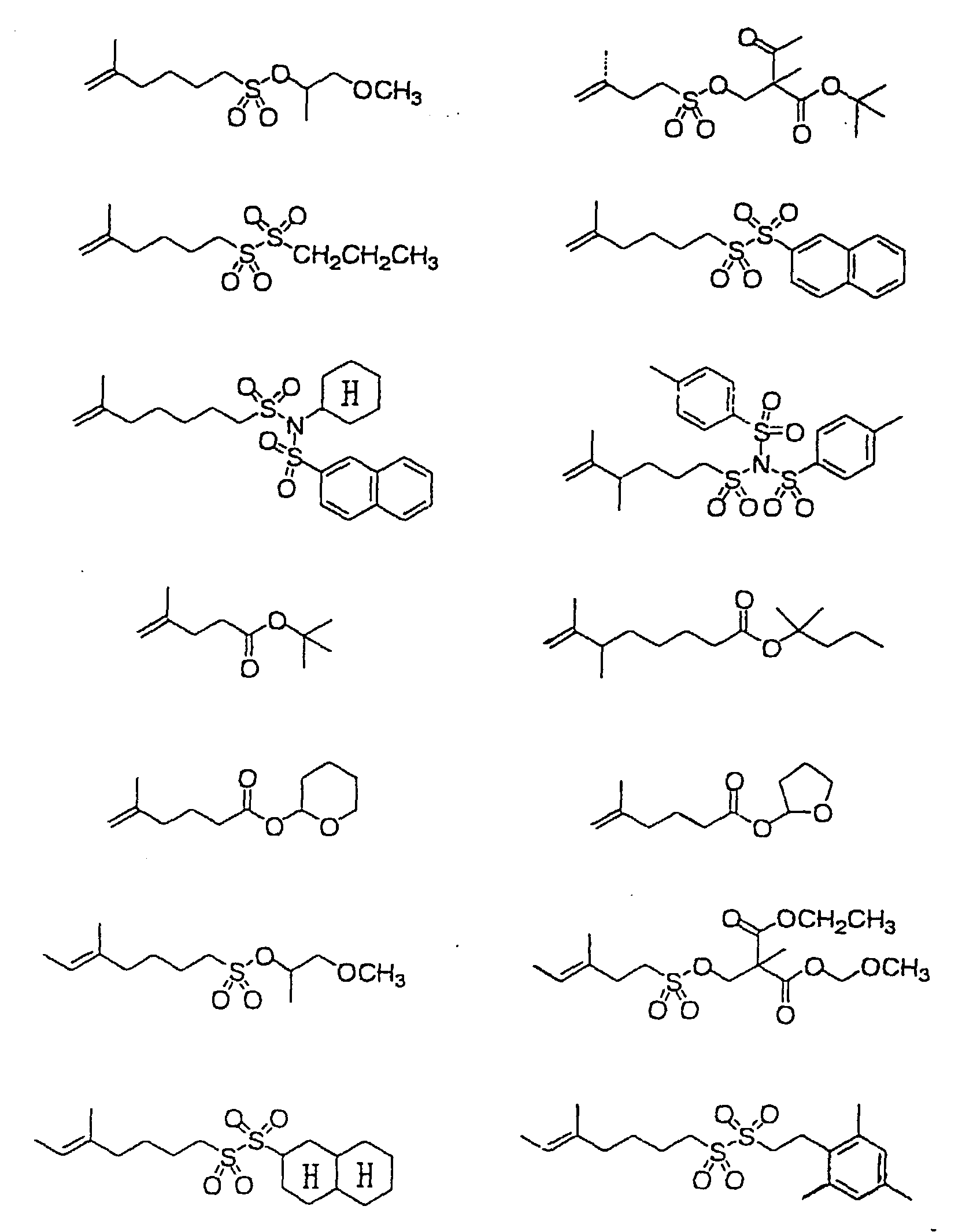
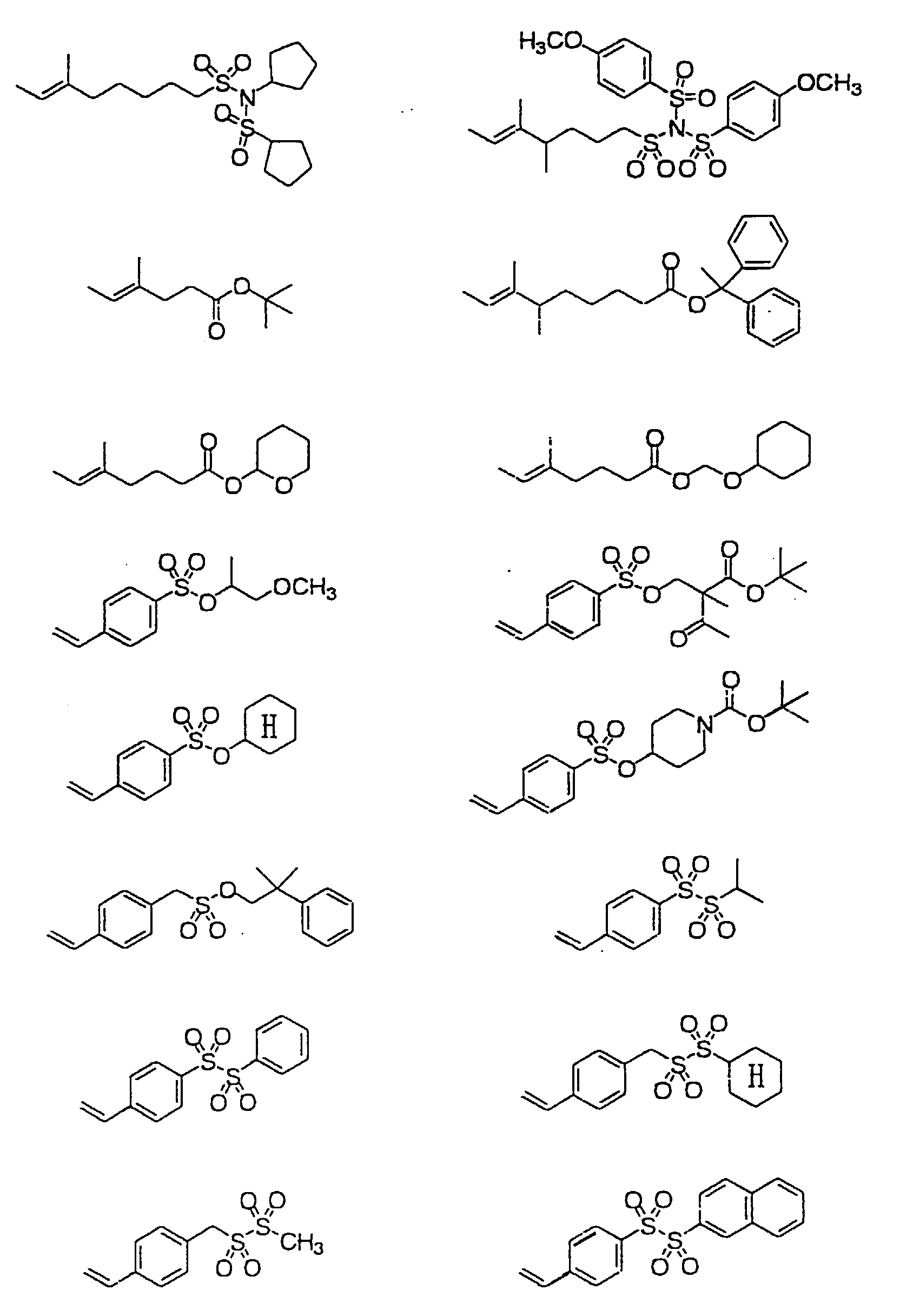
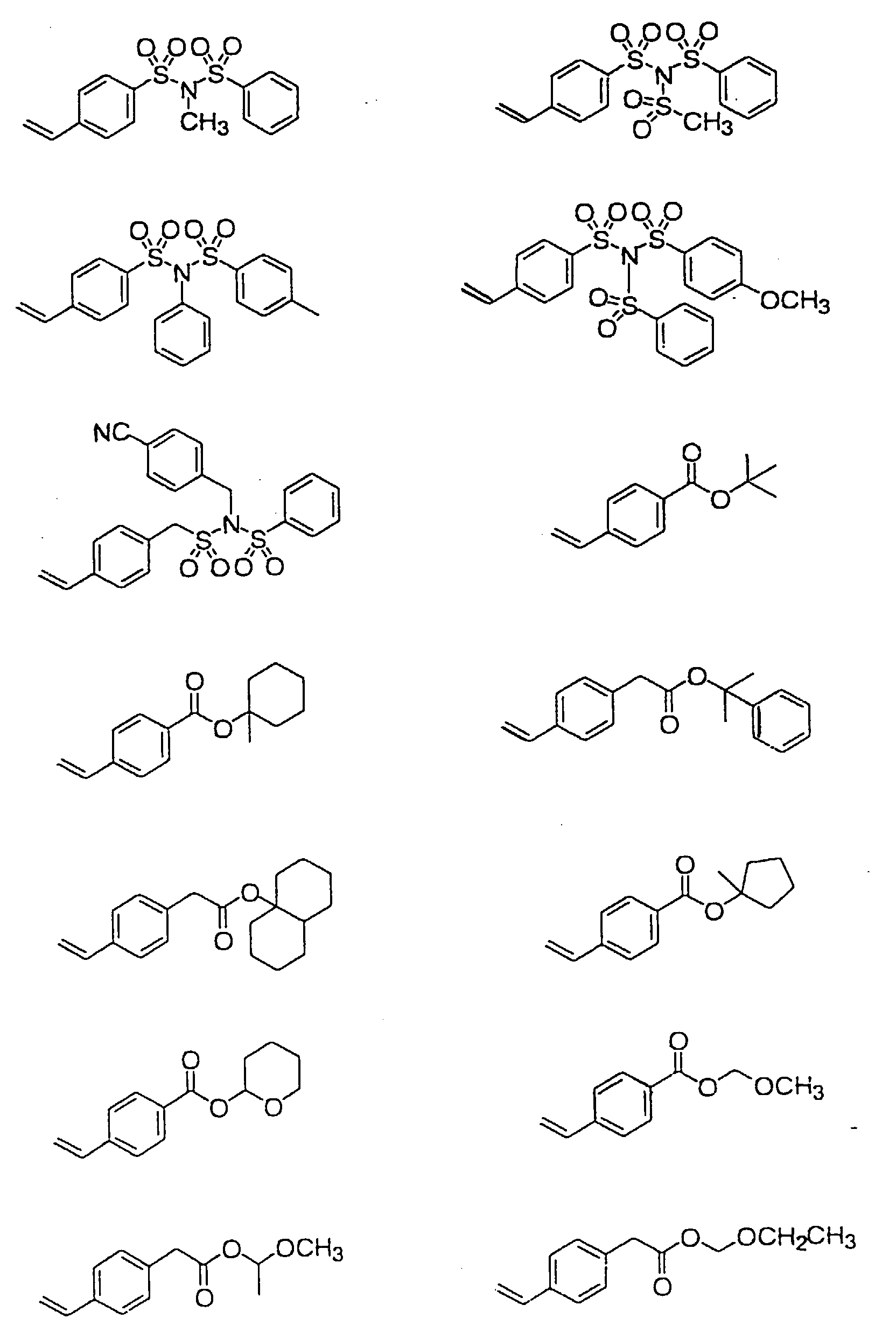
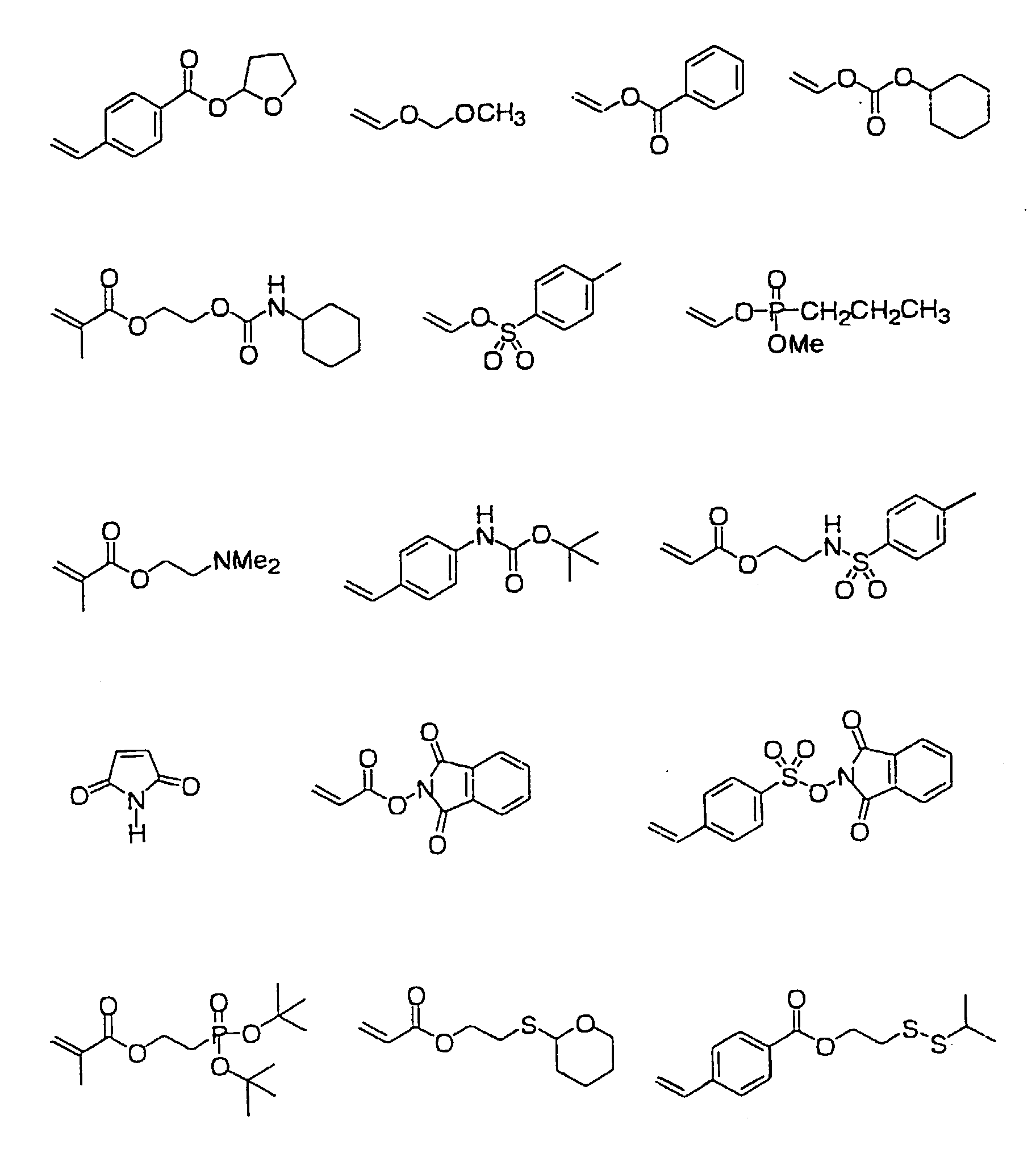
- The positive polar conversion polymer compound for use in the present invention is not particularly limited as long as it has at least on a part of the side chain thereof a hydrophobic functional group capable of becoming hydrophilic by heat. A functional group other than the hydrophobic functional group capable of becoming hydrophilic by heat may also be present on the side chain. Therefore, even a copolymer with a monomer having a functional group other than a hydrophobic functional group capable of becoming hydrophilic by heat may also be suitably used as long as it does not inhibit the effect of the present invention. Examples of the radically polymerizable monomer having such a side chain include the following monomers.
- Examples of the other radically polymerizable monomer for use in the copolymer include known monomers such as acrylic acid, acrylic acid esters, acrylamides, methacrylic acid, methacrylic acid esters, methacrylamides, maleic acid, maleic acid anhydride, maleic acid esters, maleic acid amides, maleic acid imides, itaconic acid, itaconic acid anhydride, itaconic acid esters, itaconic acid amides, itaconic acid imides, crotonic acid, crotonic acid esters, crotonic acid amides, fumaric acid, fumaric acid esters, fumaric acid amides, mesaconic acid, mesaconic acid esters, mesaconic acid amides, α,β-unsaturated lactones, α,β-unsaturated lactams, unsaturated hydrocarbons, vinyl ethers, vinyl esters, α,β-unsaturated ketones and styrenes.
- Specific examples of the acrylic acid esters include methyl acrylate, ethyl acrylate, (n- or i-)propyl acrylate, (n-, i-, sec- or tert-)butyl acrylate, pentyl acrylate, hexyl acrylate, heptyl acrylate, octyl acrylate, nonyl acrylate, decyl acrylate, amyl acrylate, 2-ethylhexyl acrylate, dodecyl acrylate, chloroethyl acrylate, 2-hydroxyethyl acrylate, 2-hydroxypropyl acrylate, 5-hydroxypentyl acrylate, cyclohexyl acrylate, allyl acrylate, trimethylolpropane monoacrylate, pentaerythritol monoacrylate, benzyl acrylate, methoxybenzyl acrylate, chlorobenzyl acrylate, hydroxybenzyl acrylate, hydroxyphenethyl acrylate, dihydroxyphenethyl acrylate, furfuryl acrylate, tetrahydrofurfuryl acrylate, phenyl acrylate, hydroxyphenyl acrylate, chlorophenyl acrylate, sulfamoylphenyl acrylate and 2-(hydroxyphenylcarbonyloxy)ethyl acrylate.
- Specific examples of the acrylamides include acrylamide, N-methylacrylamide, N-ethylacrylamide, N-(n- or i-)propylacrylamide, N-(n-, i-, sec- or tert-)butyl acrylamide, N-benzylacrylamide, N-hydroxyethylacrylamide, N-phenylacrylamide, N-tolylacrylamide, N-(hydroxyphenyl)acrylamide, N-(sulfamoylphenyl)acrylamide, N-(phenylsulfonyl)acrylamide, N-(tolylsulfonyl)acrylamide, N,N-dimethylacrylamide, N-methyl-N-phenylacrylamide and N-hydroxyethyl-N-methylacrylamide.
- Specific examples of the methacrylic acid esters include methyl methacrylate, ethyl methacrylate, (n- or i-)propyl methacrylate, (n-, i-, sec- or tert-)butyl methacrylate, pentyl methacrylate, hexyl methacrylate, heptyl methacrylate, octyl methacrylate, nonyl methacrylate, decyl methacrylate, amyl methacrylate, 2-ethylhexyl methacrylate, dodecyl methacrylate, chloroethyl methacrylate, 2-hydroxyethyl methacrylate, 2-hydroxypropyl methacrylate, 5-hydroxypentyl methacrylate, cyclohexyl methacrylate, allyl methacrylate, trimethylolpropane monomethacrylate, pentaerythritol monomethacrylate, benzyl methacrylate, methoxybenzyl methacrylate, chlorobenzyl methacrylate, hydroxybenzyl methacrylate, hydroxyphenethyl methacrylate, dihydroxyphenethyl methacrylate, furfuryl methacrylate, tetrahydrofurfuryl methacrylate, phenyl methacrylate, hydroxyphenyl methacrylate, chlorophenyl methacrylate, sulfamoylphenyl methacrylate and 2-(hydroxyphenylcarbonyloxy)ethyl methacrylate.
- Specific examples of the methacrylamides include methacrylamide, N-methylmethacrylamide, N-ethylmethacrylamide, N-(n- or i-)propylmethacrylamide, N-(n-, i-, sec- or tert-)butylmethacrylamide, N-benzylmethacrylamide, N-hydroxyethylmethacrylamide, N-phenylmethacrylamide, N-tolylmethacrylamide, N-(hydroxyphenyl)methacrylamide, N-(sulfamoylphenyl)methacrylamide, N-(phenylsulfonyl)methacrylamide, N-(tolylsulfonyl)methacrylamide, N,N-dimethylmethacrylamide, N-methyl-N-phenylmethacrylamide and N-hydroxyethyl-N-methylmethacrylamide.
- Specific examples of the crotonic acid esters include methyl crotonate, ethyl crotonate, (n- or i-)propyl crotonate, (n-, i-, sec- or tert-)butyl crotonate, pentyl crotonate, hexyl crotonate, heptyl crotonate, octyl crotonate, nonyl crotonate, decyl crotonate, amyl crotonate, 2-ethylhexyl crotonate, dodecyl crotonate, chloroethyl crotonate, 2-hydroxyethyl crotonate, 2-hydroxypropyl crotonate, 5-hydroxypentyl crotonate, cyclohexyl crotonate, allyl crotonate, trimethylolpropane monocrotonate, pentaerythritol monocrotonate, benzyl crotonate, methoxybenzyl crotonate, chlorobenzyl crotonate, hydroxybenzyl crotonate, hydroxyphenethyl crotonate, dihydroxyphenethyl crotonate, furfuryl crotonate, tetrahydrofurfuryl crotonate, phenyl crotonate, hydroxyphenyl crotonate, chlorophenyl crotonate, sulfamoylphenyl crotonate and 2-(hydroxyphenylcarbonyloxy)ethyl crotonate.
- Specific examples of the crotonic acid amides include crotonic acid amide, N-methylcrotonic acid amide, N-ethylcrotonic acid amide, N-(n- or i-)propylcrotonic acid amide, N-(n-, i-, sec- or tert-)butylcrotonic acid amide, N-benzylcrotonic acid amide, N-hydroxyethylcrotonic acid amide, N-phenylcrotonic acid amide, N-tolylcrotonic acid amide, N-(hydroxyphenyl)crotonic acid amide, N-(sulfamoylphenyl)crotonic acid amide, N-(phenylsulfonyl)crotonic acid amide, N-(tolylsulfonyl)crotonic acid amide, N,N-dimethylcrotonic acid amide, N-methyl-N-phenylcrotonic acid amide and N-hydroxyethyl-N-methylcrotonic acid amide.
- Examples of the maleic acid esters include dimethyl maleate, diethyl maleate, di(n- or i-)propyl maleate, di(n-, i-, sec- or tert-)butyl maleate, diphenyl maleate, diallyl maleate, monomethyl maleate, monoethyl maleate, mono(n- or i-)propyl maleate, mono(n-, i-, sec- or tert-)butyl maleate, dibenzyl maleate, monobenzyl maleate, methyl ethyl maleate, methyl propyl maleate and ethyl propyl maleate.
- Specific examples of the maleic acid amides include maleic acid amide, N-methylmaleic acid amide, N-ethylmaleic acid amide, N-(n- or i-)propylmaleic acid amide, N-(n-, i-, sec- or tert-)butylmaleic acid amide, N-benzylmaleic acid amide, N-hydroxyethylmaleic acid amide, N-phenylmaleic acid amide, N-tolylmaleic acid amide, N-(hydroxyphenyl)maleic acid amide, N-(sulfamoylphenyl)maleic acid amide, N-(phenylsulfonyl)maleic acid amide, N-(tolylsulfonyl)maleic acid amide, N,N-dimethylmaleic acid amide, N-methyl-N-phenylmaleic acid amide, N-hydroxyethyl-N-methylmaleic acid amide, N-methylmaleic acid monoamide, N-ethylmaleic acid monoamide, N,N-dimethylmaleic acid monoamide, N-methyl-N'-ethylmaleic acid amide and N-methyl-N'-phenylmaleic acid amide.
- Specific examples of the maleic acid imides include maleic acid imide, N-methylmaleic acid imide, N-ethylmaleic acid imide, N-(n- or i-)propylmaleic acid imide, N-(n-, i-, sec- or tert-)butylmaleic acid imide, N-benzylmaleic acid imide, N-hydroxyethylmaleic acid imide, N-phenylmaleic acid imide, N-tolylmaleic acid imide, N-(hydroxyphenyl)maleic acid imide, N-(sulfamoylphenyl)maleic acid imide, N-(phenylsulfonyl)maleic acid imide and N-(tolylsulfonyl)maleic acid imide.
- Specific examples of the itaconic acid esters include dimethyl itaconate, diethyl itaconate, di(n- or i-)propyl itaconate, di(n-, i-, sec- or tert-)butyl itaconate, diphenyl itaconate, diallyl itaconate, monomethyl itaconate, monoethyl itaconate, mono(n- or i-)propyl itaconate, mono(n-, i-, sec- or tert-)butyl itaconate, dibenzyl itaconate, monobenzyl itaconate, methyl ethyl itaconate, methyl propyl itaconate and ethyl propyl itaconate.
- Specific examples of the itaconic acid amides include itaconic acid amide, N-methylitaconic acid amide, N-ethylitaconic acid amide, N-(n- or i-)propylitaconic acid amide, N-(n-, i-, sec- or tert-)butylitaconic acid amide, N-benzylitaconic acid amide, N-hydroxyethylitaconic acid amide, N-phenylitaconic acid amide, N-tolylitaconic acid amide, N-(hydroxyphenyl)itaconic acid amide, N-(sulfamoylphenyl)itaconic acid amide, N-(phenylsulfonyl)itaconic acid amide, N-(tolylsulfonyl)itaconic acid amide, N,N-dimethylitaconic acid amide, N-methyl-N-phenylitaconic acid amide, N-hydroxyethyl-N-methylitaconic acid amide, N-methylitaconic acid monoamide, N-ethylitaconic acid monoamide, N,N-dimethylitaconic acid monoamide, N-methyl-N'-ethylitaconic acid amide and N-methyl-N'-phenylitaconic acid amide.
- Specific examples of the itaconic acid imides include itaconic acid imide, N-methylitaconic acid imide, N-ethylitaconic acid imide, N-(n- or i-)propylitaconic acid imide, N-(n-, i-, sec- or tert-)butylitaconic acid imide, N-benzylitaconic acid imide, N-hydroxyethylitaconic acid imide, N-phenylitaconic acid imide, N-tolylitaconic acid imide, N-(hydroxyphenyl)itaconic acid imide, N-(sulfamoylphenyl)itaconic acid imide, N-(phenylsulfonyl)itaconic acid imide and N-(tolylsulfonyl)itaconic acid imide.
- Specific examples of the fumaric acid esters include dimethyl fumarate, diethyl fumarate, di(n- or i-)propyl fumarate, di(n-, i-, sec- or tert-)butyl fumarate, diphenyl fumarate, diallyl fumarate, monomethyl fumarate, monoethyl fumarate, mono(n- or i-)propyl fumarate, mono(n-, i-, sec-or tert-)butyl fumarate, dibenzyl fumarate, monobenzyl fumarate, methyl ethyl fumarate, methyl propyl fumarate and ethyl propyl fumarate.
- Specific examples of the fumaric acid amides include fumaric acid amide, N-methylfumaric acid amide, N-ethylfumaric acid amide, N-(n- or i-)propylfumaric acid amide, N-(n-, i-, sec- or tert-)butylfumaric acid amide, N-benzylfumaric acid amide, N-hydroxyethylfumaric acid amide, N-phenylfumaric acid amide, N-tolylfumaric acid amide, N-(hydroxyphenyl)fumaric acid amide, N-(sulfamoylphenyl)fumaric acid amide, N-(phenylsulfonyl)fumaric acid amide, N-(tolylsulfonyl)fumaric acid amide, N,N-dimethylfumaric acid amide, N-methyl-N-phenylfumaric acid amide, N-hydroxyethyl-N-methylfumaric acid amide, N-methylfumaric acid monoamide, N-ethylfumaric acid monoamide, N,N-dimethylfumaric acid monoamide, N-methyl-N'-ethylfumaric acid amide and N-methyl-N'-phenylfumaric acid amide.
- Specific examples of the mesaconic acid esters include dimethyl mesaconate, diethyl mesaconate, di(n- or i-)propyl mesaconate, di(n-, i-, sec- or tert-)butyl mesaconate, diphenyl mesaconate, diallyl mesaconate, monomethyl mesaconate, monoethyl mesaconate, mono(n- or i-)propyl mesaconate, mono(n-, i-, sec- or tert-)butyl mesaconate, dibenzyl mesaconate, monobenzyl mesaconate, methyl ethyl mesaconate, methyl propyl mesaconate and ethyl propyl mesaconate.
- Specific examples of the mesaconic acid amides include mesaconic acid amide, N-methylmesaconic acid amide, N-ethylmesaconic acid amide, N-(n- or i-)propylmesaconic acid amide, N-(n-, i-, sec- or tert-)butylmesaconic acid amide, N-benzylmesaconic acid amide, N-hydroxyethylmesaconic acid amide, N-phenylmesaconic acid amide, N-tolylmesaconic acid amide, N-(hydroxyphenyl)mesaconic acid amide, N-(sulfamoylphenyl)mesaconic acid amide, N-(phenylsulfonyl)mesaconic acid amide, N-(tolylsulfonyl)mesaconic acid amide, N,N-dimethylmesaconic acid amide, N-methyl-N-phenylmesaconic acid amide, N-hydroxyethyl-N-methylmesaconic acid amide, N-methylmesaconic acid monoamide, N-ethylmesaconic acid monoamide, N,N-dimethylmesaconic acid monoamide, N-methyl-N'-ethylmesaconic acid amide and N-methyl-N'-phenylmesaconic acid amide.
- Specific examples of the styrenes include styrene, methylstyrene, dimethylstyrene, trimethylstyrene, ethylstyrene, propylstyrene, cyclohexylstyrene, chloromethylstyrene, trifluoromethylstyrene, ethoxymethylstyrene, acetoxymethylstyrene, methoxystyrene, dimethoxystyrene, chlorostyrene, dichlorostyrene, bromostyrene, iodostyrene, fluorostyrene, carboxystyrene and sodium 4-vinylbenzene sulfonate.
- Specific examples of the α,β-unsaturated lactones include the following compounds.
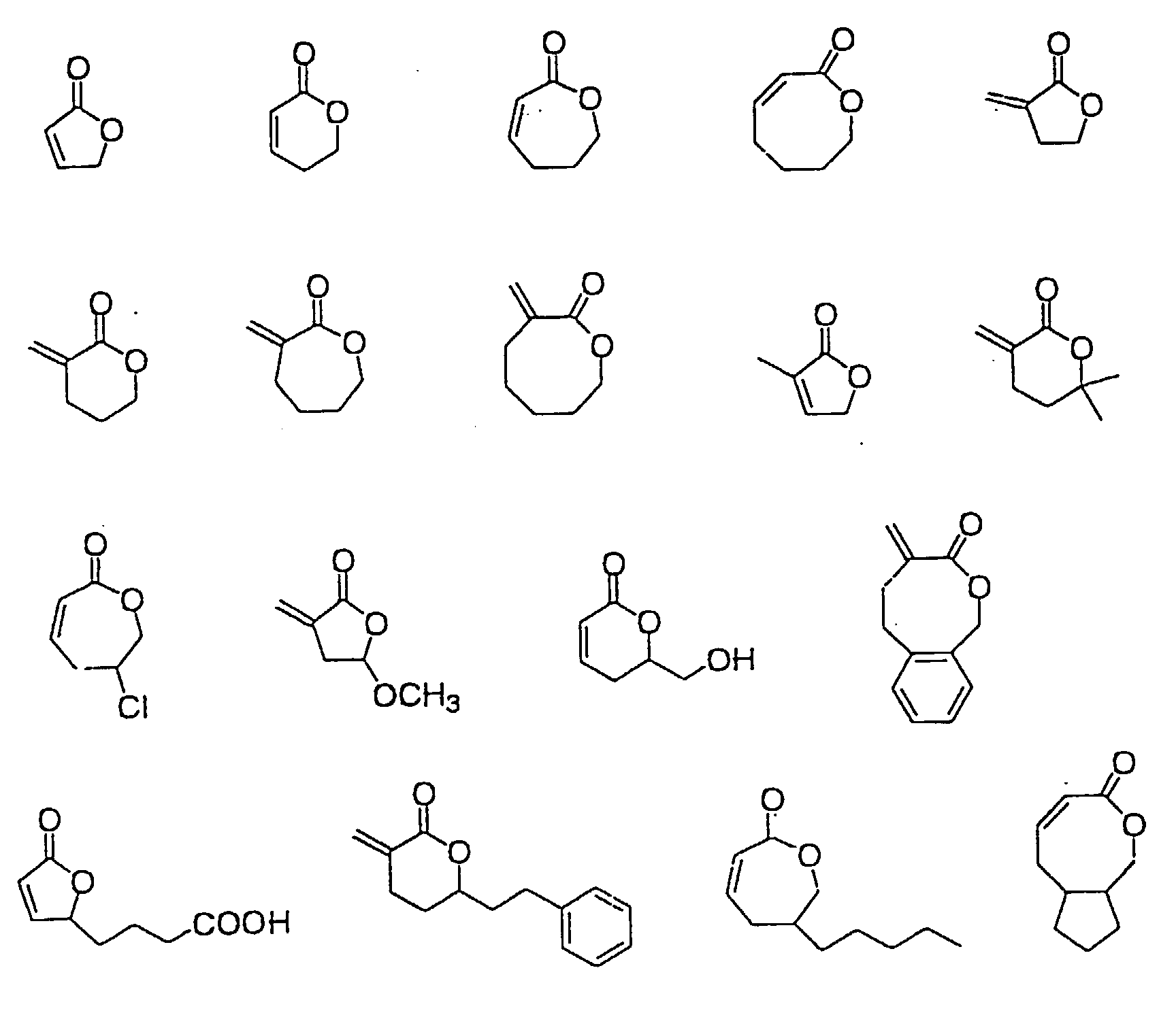
- Specific examples of the α,β-unsaturated lactams include the following compounds.

- Specific examples of the unsaturated hydrocarbons include the compounds described above.
- Specific examples of the vinyl ethers include the compounds described above.
- Specific examples of the vinyl esters include the compounds described above.
- Specific examples of the α,β-unsaturated ketones include the compounds described above.
- The ratio of the monomer having a hydrophobic functional group capable of becoming hydrophilic by heat used in the synthesis of the positive polar conversion polymer compound for use in the present invention, is preferably 5 wt% or more, more preferably from 10 to 95 wt%. If the ratio of this monomer is less than 5 wt%, even if the hydrophobic functional group on the side chain becomes hydrophilic, the positive polar conversion polymer compound does not become hydrophilic, as a result, the non-image area is scummed. In the case of using the above-described other monomer in the synthesis of the positive polar conversion polymer compound for use in the present invention, the copolymerizable other monomer may be used in any ratio as long as the monomer having the specific functional group is used in a preferred ratio. The copolymerizable other monomers may be used either individually or in combination of two or more thereof.
- Specific examples of the positive polar conversion polymer compound for use in the present invention are set forth below, however, the present invention is by no means limited thereto.


- The positive polar conversion polymer compound for use in the lithographic printing original plate of the present invention preferably has a weight average molecular weight measured by GPC of 2,000 or more, more preferably from 5,000 to 300,000, and preferably has a number average molecular weight of 800 or more, more preferably from 1,000 to 250,000. The polydispersion degree (weight average molecular weight/number average molecular weight) is preferably 1 or more, preferably from 1.1 to 10.
- The positive polar conversion polymer compound may be any of a random polymer, a block polymer and a graft polymer but is preferably a random polymer.
- Examples of the solvent used in the synthesis of the positive polar conversion polymer compound for use in the present invention include tetrahydrofuran, ethylene dichloride, cyclohexanone, methyl ethyl ketone, acetone, methanol, ethanol, ethylene glycol monomethyl ether, ethylene glycol monoethyl ether, 2-methoxyethyl acetate, diethylene glycol dimethyl ether, 1-methoxy-2-propanol, 1-methoxy-2-propyl acetate, N,N-dimethylformamide, N,N-dimethylacetamide, toluene, ethyl acetate, ethyl lactate, methyl lactate, dimethyl sulfoxide and water. These solvents may be used either individually or in combination of two or more thereof.
- As the radical polymerization initiator used in the synthesis of the positive polar conversion polymer compound for use in the present invention, known compounds such as azo-based initiator and peroxide initiator may be used.
- In the case where the above-described positive polar conversion polymer compound is contained in the layer containing a positive polar conversion polymer compound, a sole positive polar conversion polymer compound may be used or a mixture of two or more positive polar conversion polymer compounds may be used.
- The ratio of positive polar conversion polymer compound contained in the layer containing a positive polar conversion polymer compound is preferably 40 wt% or more, more preferably 50 wt% or more. If the added amount is less than 40 wt%, the image strength decreases and the press life becomes low.
- The constituent components other than the positive polar conversion polymer compound, which can be contained in the layer containing a positive polar conversion polymer compound, are described below.
- Light-heat converting agents described later may be suitably used as the light-heat converting agent added to the ink-receptive layer (Layer B) containing a positive polar conversion polymer compound for use in the present invention.
- Acid-generating agents described later may be suitably used as the acid-generating agent added to the ink-receptive layer containing a positive polar conversion polymer compound for use in the present invention.
- Sensitizing dyes described later may be suitably used as the sensitizing dye added to the ink-receptive layer containing a positive polar conversion polymer compound for use in the present invention.
- Surface active agents described later may be suitably used as the surface active agent added to the ink-receptive layer containing a positive polar conversion polymer compound for use in the present invention.
- The ink-receptive layer containing a positive polar conversion polymer compound for use in the present invention may further contain various additives, if desired. For example, an onium salt, an aromatic sulfone compound, an aromatic sulfonic acid ester compound or the like act is preferably added because the salt or compound acts as a thermally decomposing substance and improves the effect of inhibiting dissolution of the image area in a developer.
- Examples of the onium salt include diazonium salts, ammonium salts, phosphonium salts, iodonium salts, sulfonium salts, selenonium salts and arsonium salts. Suitable examples of the onium salt for use in the present invention include diazonium salts described in S.I. Schlesinger, Photogr. Sci. Eng., 18, 387 (1974), T.S. Bal et al., Polymer, 21, 423 (1980) and JP-A-5-158230, ammonium salts described in U.S. Patents 4,069,055 and 4,069,056 and JP-A-3-140140, phosphonium salts described in D.C. Necker et al., Macromolecules, 17, 2468 (1984), C.S. Wen et al., Teh. Proc. Conf. Rad. Curing, ASIA, Tokyo, Oct., p. 478 (1988), and U.S. Patents 4,069,055 and 4,069,056, iodonium salts described in J.V. Crivello et al., Macromolecules, 10(6), 1307 (1977), Chem. & Eng. News, Nov. 28, p. 31 (1988), European Patent No. 104,143, U.S. Patents 339,049 and 410,201, JP-A-2-150848 and JP-A-2-296514, sulfonium salts described in J.V. Crivello et al., Polymer J., 17, 73 (1985), J.V. Crivello et al., J. Org. Chem., 43, 3055 (1978), W.R. Watt et al., J. Polymer Sci., Polymer Chem. Ed., 22, 1789 (1984), J.V. Crivello et al., Polymer Bull., 14, 279 (1985), J.V. Crivello et al., Macromolecules, 14(5), 1141 (1981), J.V. Crivello et al., J. Polymer Sci., Polymer Chem. Ed., 17, 2877 (1979), European Patent Nos. 370,693, 233,567, 297,443 and 297,442, U.S. Patents 4,933,377, 3,902,114, 410,201, 339,049, 4,760,013, 4,734,444 and 2,833,827, and German Patent Nos. 2,904,626, 3,604,580 and 3,604,581, selenonium salts described in J.V. Crivello et al., Macromolecules, 10(6), 1307 (1977), J. V. Crivello et al., J. Polymer Sci., and Polymer Chemich., 17, 1047 (1979), and arsonium salts described in C.S. Wen et al., Teh, Proc., Conf. Rad. Curing ASIA, Tokyo, Oct., p. 478 (1988).
- Suitable examples of the counter anion to the onium salt include boron tetrafluoride, phosphorus hexafluoride, triisopropylnaphthalenesulfonic acid, 5-nitro-o-toluenesulfonic acid, 5-sulfosalicylic acid, 2,5-dimethylbenzenesulfonic acid, 2,4,6-trimethylbenzenesulfonic acid, 2-nitrobenzenesulfonic acid, 3-chlorobenzenesulfonic acid, 3-bromobenzenesulfonic acid, 2-fluorocaprylnaphthalenesulfonic acid, dodecylbenzenesulfonic acid, 1-naphthol-5-sulfonic acid, 2-methoxy-4-hydroxy-5-benzoyl-benzenesulfonic acid and p-toluenesulfonic acid. Among these, phosphorus hexafluoride, triisopropylnaphthalenesulfonic acid and alkyl aromatic sulfonic acid such as 2,5-dimethylbenzenesulfonic acid are more preferred.
- The amount of the onium salt added as an additive is preferably from 1 to 50 wt%, more preferably from 5 to 30 wt%, still more preferably from 10 to 30 wt%. In the present invention, the additive and the binder are preferably incorporated into the same layer.
- For the purpose of further improving the sensitivity, a cyclic acid anhydride, a phenol or an organic acid may also be used in combination. Examples of the cyclic acid anhydrides which can be used include phthalic acid anhydride, tetrahydrophthalic acid anhydride, hexahydrophthalic anhydride, 3,6-endoxy-Δ4-tetrahydrophthalic acid anhydride, tetrachlorophthalic anhydride, maleic acid anhydride, chloromaleic acid anhydride, α-phenylmaleic acid anhydride, succinic acid anhydride and pyromellitic acid anhydride, described in U.S. Patent 4,115,128. Examples of the phenols include bisphenol A, p-nitrophenol, p-ethoxyphenol, 2,4',4'-trihydroxybenzophenone, 2,3,4-trihydroxybenzophenone, 4-hydroxybenzophenone, 4,4',4''-trihydroxytriphenylmethane and 4,4',3'',4''-tetrahydroxy-3,5,3',5'-tetramethyltriphenylmethane.
- Examples of the organic acids include sulfonic acids, sulfinic acids, alkylsulfuric acids, phosphonic acids, phosphoric acid esters and carboxylic acids, described in JP-A-60-88942 and JP-A-2-96755. Specific examples thereof include p-toluenesulfonic acid, dodecylbenzenesulfonic acid, p-toluenesulfinic acid, ethylsulfuric acid, phenylphosphonic acid, phenylphosphinic acid, phenyl phosphate, diphenyl phosphate, benzoic acid, isophthalic acid, adipic acid, p-toluylic acid, 3,4-dimethoxybenzoic acid, phthalic acid, terephthalic acid, 4-cylohexene-1,2-dicarboxylic acid, erucic acid, lauric acid, n-undecanoic acid and ascorbic acid.
- The ratio of the cyclic acid anhydride, phenol or organic acid occupying the ink-receptive layer is preferably from 0.05 to 20 wt%, more preferably from 0.1 to 15 wt%, still more preferably from 0.1 to 10 wt%.
- The ink-receptive layer containing a positive polar conversion polymer compound for use in the present invention may contain a printing out agent for obtaining a visible image immediately after the heating by exposure or a dye or pigment as an image coloring agent.
- A representative example of the printing out agent is a combination of a compound capable of releasing an acid by the heat on exposure (photoacid releasing agent) and an organic dye capable of forming a salt. Specific examples thereof include a combination of o-naphthoquinonediazide-4-sulfonic acid halogenide and a salt-forming organic dye described in JP-A-50-36209 and JP-A-53-8128, and a combination of a trihalomethyl compound and a salt-forming organic dye described in JP-A-53-36223, JP-A-54-74728, JP-A-60-3626, JP-A-61-143748, JP-A-61-151644 and JP-A-63-58440. The trihalomethyl compound includes an oxazole-based compound and a triazine-based compound. Either compound has excellent aging stability and gives a sharp printed image.
- As the image coloring agent, dyes other than the above-described salt-forming organic dyes may be used. Suitable dyes including the salt-forming organic dye are an oil-soluble dye and a basic dye. Specific examples thereof include Oil Yellow #101, Oil Yellow #103, Oil Pink #312, Oil Green BG, Oil Blue BOS, Oil Blue #603, Oil Black BY, Oil Black BS, Oil Black T-505 (all produced by Orient Kagaku Kogyo K.K.), Victoria Pure Blue, Crystal Violet (CI42555), Methyl Violet (CI42535), Ethyl Violet, Rhodamine B (CI45170B), Malachite Green (CI42000) and Methylene Blue (CI52015). Dyes described in JP-A-62-293247 are more preferred. The dye may be added to the ink-receiving layer in a ratio of from 0.01 to 10 wt%, preferably from 0.1 to 3 wt%.
- The ink-receiving layer for use in the present invention may further contain, if desired, a plasticizer for imparting flexibility to the coating film. Examples thereof include butylphthalyl, polyethylene glycol, tributyl citrate, diethyl phthalate, dibutyl phthalate, dihexyl phthalate, dioctyl phthalate, tricresyl phosphate, tributyl phosphate, trioctyl phosphate, tetrahydrofurfuryl oleate, and oligomers and polymers of an acrylic acid or methacrylic acid.
- In addition, an epoxy compound, a vinyl ether, a phenol compound having a hydroxymethyl group and a phenol compound having an alkoxymethyl group described in JP-A-8-276558, and a dissolution inhibition increasing cross-linking agent described in JP-A-11-160860 previously filed by the present inventors, may be appropriately added according to the purpose.
- The "layer containing an aqueous alkali solution-soluble resin" for use in the lithographic printing original plate of the present invention means a layer containing at least an aqueous alkali solution-soluble resin described below.
- The "alkali water-soluble polymer compound (b) for use in the present invention indicates those having the following acid radical structure on the main chain or side chain of a polymer compound:
- phenolic hydroxyl group (-Ar-OH), carboxylic acid group (-CO2H), sulfonic acid group (-SO3H), phosphoric acid group (-OPO3H), sulfonamido group (-SO2NH-R) and substituted sulfonamide-based acid group (active imide group) (-SO2NHCOR, -SO2NHSO2R, -CONHSO2R).
-
- In these formulae, Ar represents a dihydric aryl group which may have a substituent, and R represents a hydrocarbon group which may have a substituent.
- Among these, preferred acid radicals are (b-1) phenolic hydroxyl group, (b-2) sulfonamide group and (b-3) active imide group. In particular, an aqueous alkali solution-soluble resin having (b-1) a phenolic hydroxyl group (hereinafter referred to as "a resin having a phenolic hydroxyl group") is most preferred.
- Examples of the polymer compound having (b-1) a phenolic hydroxyl group include novolak resins such as a condensed polymer of phenol with formaldehyde (hereinafter referred to as "phenol formaldehyde resin"), a condensed polymer of m-cresol with formaldehyde (hereinafter referred to as "m-cresol formaldehyde resin"), a condensed polymer of p-cresol with formaldehyde, a condensed polymer of m,p-mixed cresol with formaldehyde, and a condensed polymer of phenol, cresol (any of m-cresol, p-cresol and m,p-cresol) and formaldehyde, and condensed polymers of pyrogallol and acetone. Also, a copolymer obtained by copolymerizing a monomer having a phenol group on the side chain may be used. Examples of the monomer having a phenol group include acrylamide, methacrylamide, acrylic acid ester, methacrylic acid ester and hydroxystyrene each having a phenol group.
- Specific examples of the monomer which can be suitably used include N-(2-hydroxyphenyl)acrylamide, N-(3-hydroxyphenyl)acrylamide, N-(4-hydroxyphenyl)acrylamide, N-(2-hydroxyphenyl)methacrylamide, N-(3-hydroxyphenyl), methacrylamide, N-(4-hydroxyphenyl)methacrylamide, o-hydroxyphenyl acrylate, m-hydroxyphenyl acrylate, p-hydroxyphenyl acrylate, o-hydroxyphenyl mechacrylate, m-hydroxyphenyl methacrylate, p-hydroxyphenyl methacrylate, o-hydroxystyrene, m-hydroxystyrene, p-hydroxystyrene, 2-(2-hydroxyphenyl)ethyl acrylate, 2-(3-hydroxyphenyl)ethyl acrylate, 2-(4-hydroxyphenyl)ethyl acrylate, 2-(2-hydroxyphenyl)ethyl methacrylate, 2-(3-hydroxyphenyl)ethyl methacrylate and 2-(4-hydroxyphenyl)ethyl methacrylate.
- In view of the image forming property, the polymer preferably has a weight average molecular weight of from 5.0×10² to 2.0×10⁴ and a number average molecular weight of from 2.0×10² to 1.0×10⁴. These resins may be used either individually or in combination of two or more thereof. In the case of using a combination of resins, a condensed polymer of phenol having an alkyl group having from 3 to 8 carbon atoms as a substituent with formaldehyde may be used in combination, such as a condensed polymer of tert-butylphenol with formaldehyde and a condensed polymer of octylphenol with formaldehyde described in U.S. Patent 4,123,279.
- The resin having a phenolic hydroxyl group preferably has a weight average molecular weight of from 500 to 20,000 and a number average molecular weight of from 200 to 10,000.
- Examples of the alkali water-soluble polymer compound having (b-2) a sulfonamide group include polymer compounds obtained by the homopolymerization of a polymerizable monomer having (b-2) a sulfonamide group, which is a main monomer constituting the polymer compound, or by the copolymerization of this monomer with another polymerizable monomer. Examples of the polymerizable monomer having a sulfonamide group include monomers comprising a low molecular compound having one or more sulfonamide group containing at least one hydrogen atom on the nitrogen atom (-NH-SO2-) and one or more polymerizable unsaturated bond. Among these, monomers comprising a low molecular compound having an acryloyl group, an allyl group or a vinyloxy group, and a substituted or mono-substituted aminosulfonyl group or a substituted sulfonylimino group are preferred.
- Examples of the compound include the compounds represented by the following formulae (6) to (10).wherein X1 and X2 each represents -O- or -NR27-, R21 and R24 each represents hydrogen atom or -CH3, R22, R25, R29, R32 and R36 each represents an alkylene group having from 1 to 12 carbon atoms, which may have a substituent, a cycloalkylene group which may have a substituent, an arylene group which may have a substituent or an aralkylene group which may have a substituent, R23, R27 and R33 each represents a hydrogen atom, an alkyl group having from 1 to 12 carbon atoms, which may have a substituent, a cycloalkyl group which may have a substituent, an aryl group which may have a substituent or an aralkyl group which may have a substituent, R26 and R37 each represents an alkyl group having from 1 to 12 carbon atoms, which may have a substituent, a cycloalkyl group which may have a substituent, an aryl group which may have a substituent or an aralkyl group which may have a substituent, R28, R30 and R34 each represents a hydrogen atom or -CH3, R31 and R35 each represents a single bond, an alkylene group having from 1 to 12 carbon atoms, which may have a substituent, a cycloalkylene group which may have a substituent, an arylene group which may have a substituent or an aralkylene group which may have a substituent, and Y1 and Y2 each represents a single bond or -CO-.
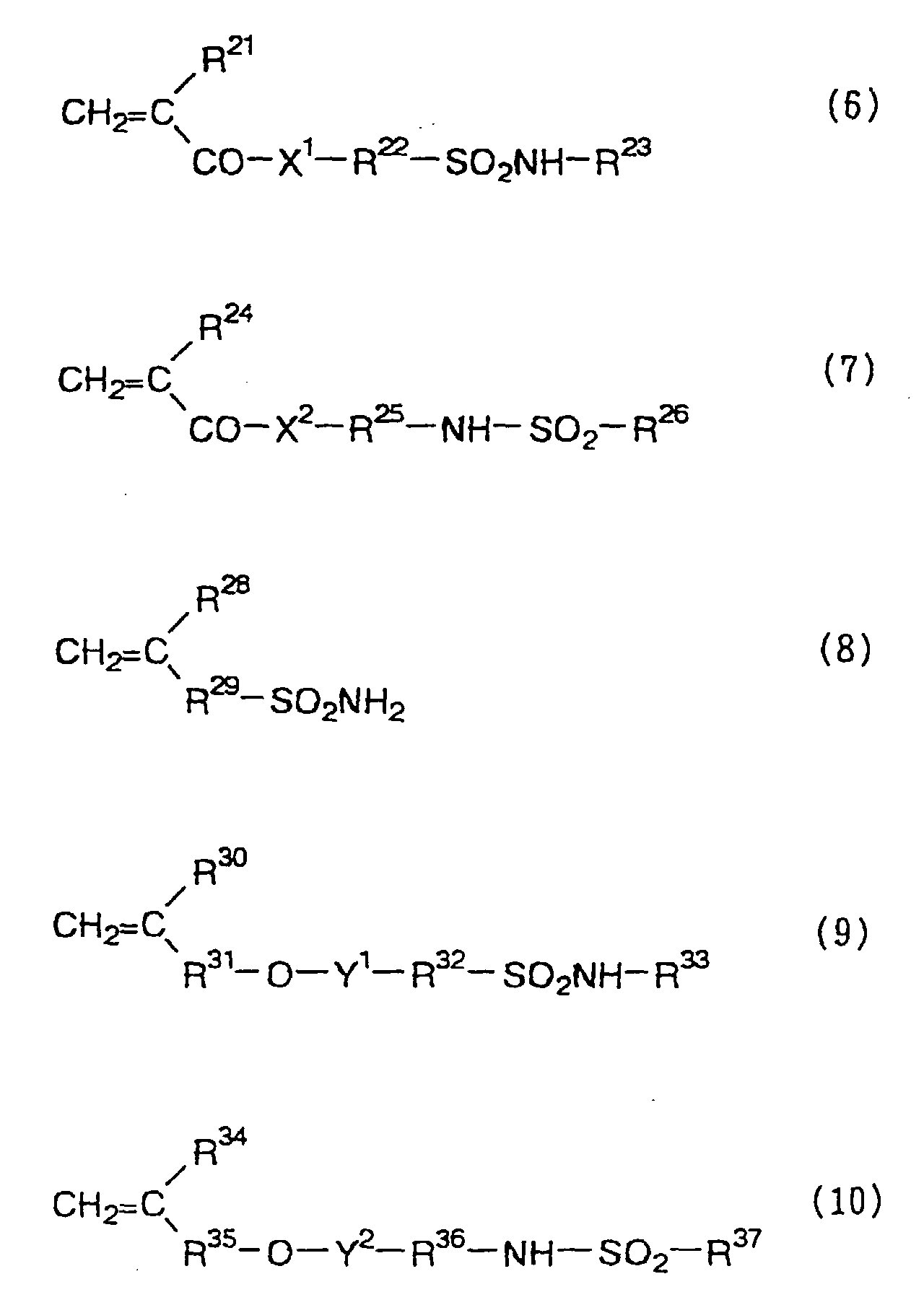
- Specific examples of this compound, which can be suitably used, include m-aminosulfonylphenyl methacrylate, N-(p-aminosulfonylphenyl)methacrylamide and N-(p-aminosulfonylphenyl)acrylamide.
- The alkali water-soluble polymer compound having (b-3) an active imide group is a compound having an active imide group represented by the following formula within the molecule. Examples of the compound include polymer compounds obtained by copolymerizing the monomer having (b-3) an active imide group, which is the main monomer constituting the polymer compound and which is a monomer comprising one or more active imide group represented by the following formula and one or more polymerizable unsaturated bond within one molecule.
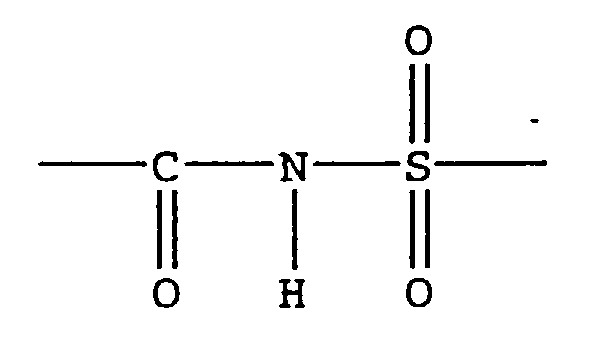
- Specific examples of this compound, which can be suitably used, include N-(p-toluenesulfonyl)methacrylamide and N-(p-toluenesulfonyl)acrylamide.
- The alkali water-soluble copolymer for use in the present invention is not limited to those obtained by copolymerizing one monomer having an acidic group (b-1), (b-2) or (b-3) but those obtained by copolymerizing two or more monomers having the same acidic group or two or more monomers having different acidic groups may also be used.
- The copolymerization may be performed by using a conventionally known method such as graft copolymerization, block copolymerization and random copolymerization.
- The copolymer preferably contains 10 mol% or more, more preferably 20 mol% or more, of the monomer having an acidic group (b-1), (b-2) or (b-3) as the copolymerizing component. If the copolymerizing component is less than 10 mol%, the interaction with the resin having a phenolic hydroxyl group insufficiently proceeds and the effect of improving the development latitude, which is advantageously brought out by the use of the copolymerizing component, cannot be obtained satisfactorily.
- The copolymer may contain other copolymerizing component in addition to the monomer having an acidic group (b-1), (b-2) or (b-3).
- Examples of the monomer which can be used as the other copolymerizing component include the following monomers (1) to (12):
- (1) acrylic acid esters and methacrylic acid esters, having an aliphatic hydroxyl group, such as 2-hydroxyethyl acrylate and 2-hydroxyethyl methacrylate;
- (2) alkyl acrylates such as methyl acrylate, ethyl acrylate, propyl acrylate, butyl acrylate, amyl acrylate, hexyl acrylate, octyl acrylate, benzyl acrylate, 2-chloroethyl acrylate, glycidyl acrylate and N-dimethylaminoethyl acrylate;
- (3) alkyl methacrylates such as methyl methacrylate, ethyl methacrylate, propyl methacrylate, butyl methacrylate, amyl methacrylate, hexyl methacrylate, cyclohexyl methacrylate, benzyl methacrylate, 2-chloroethyl methacrylate, glycidyl methacrylate and N-dimethylaminoethyl methacrylate;
- (4) acrylamides and methacrylamides, such as acrylamide, methacrylamide, N-methylolacrylamide, N-ethylacrylamide, N-hexylmethacrylamide, N-cyclohexylacrylamide, N-hydroxyethylacrylamide, N-phenylacrylamide, N-nitrophenylacrylamide and N-ethyl-N-phenylacrylamide;
- (5) vinyl ethers such as ethyl vinyl ether, 2-chloroethyl vinyl ether, hydroxyethyl vinyl ether, propyl vinyl ether, butyl vinyl ether, octyl vinyl ether and phenyl vinyl ether;
- (6) vinyl esters such as vinyl acetate, vinyl chloroacetate, vinyl butyrate and vinyl benzoate;
- (7) styrenes such as styrene, α-methylstyrene, methylstyrene and chloromethylstyrene;
- (8) vinyl ketones such as methyl vinyl ketone, ethyl vinyl ketone, propyl vinyl ketone and phenyl vinyl ketone;
- (9) olafins such as ethylene, propylene, isobutylene, butadiene and isoprene;
- (10) N-vinylpyrrolidone, N-vinylcarbazole, 4-vinylpyridine, acrylonitrile and methacrylonitrile;
- (11) unsaturated imides such as maleimide, N-acryloylacrylamide, N-acetylmethacrylamide, N-propionylmethacrylamide and N-(p-chlorobenzoyl)methacrylamide; and
- (12) unsaturated carboxylic acids such as acrylic acid, methacrylic acid, maleic acid anhydride and itaconic acid.
-
- In view of the layer strength, the alkali water-soluble polymer compound for use in the present invention preferably has, irrespective of homopolymer or copolymer, a weight average molecular weight of 2,000 or more and a number average molecular weight of 500 or more. The alkali water-soluble polymer compound more preferably has a weight average molecular weight of from 5,000 to 300,000, a number average molecular weight of from 800 to 250,000, and a dispersion degree (weight average molecular weight/number average molecular weight) of from 1.1 to 10.
- In the copolymer, the weight ratio of the monomer having an acidic group (b-1), (b-2) or (b-3) to the other monomer blended is preferably from 50:50 to 5:95, more preferably from 40:60 to 10:90, in view of the development latitude.
- These alkali water-soluble polymer compounds may be used either individually or in combination of two or more thereof. The alkali water-soluble polymer compound is added in an amount of from 30 to 99 wt%, preferably from 40 to 95 wt%, more preferably from 50 to 90 wt%, based on the all solids content of the recording layer. If the amount of alkali-soluble polymer compound added is less than 30 wt%, the recording layer is deteriorated in the durability, whereas if it exceeds 99 wt%, disadvantageous results come out both in the sensitivity and the durability.
- The constituent components other than the aqueous alkali solution-soluble resin, which can be contained in the layer containing an aqueous alkali solution-soluble resin are described below.
- Light-heat converting agents described later may be suitably used as the light-heat converting agent added to the layer containing an aqueous alkali solution-soluble resin for use in the present invention.
- Surface active agents described later may be suitably used as the surface active agent added to the layer containing an aqueous alkali solution-soluble resin for use in the present invention.
- As the constituent components other than those described above, which can be added to the layer containing an aqueous alkali solution-soluble resin for use in the present invention, the same components as the other constituent components which can be added to the layer containing a positive polar conversion polymer compound may be suitably used.
- The "layer containing a negative polar conversion polymer compound" for use in the lithographic printing original plate of the present invention means a layer containing at least a negative polar conversion polymer compound described below.
- The negative polar conversion polymer compound for use in the present invention is, as described above, a hydrophilic polymer compound capable of becoming hydrophobic by heat. Examples of such a polymer compound include a hydrophilic polymer compound having on the side chain thereof a hydrophilic functional group capable of becoming hydrophobic by heat. This change must be on such a degree that when a polymer compound which exhibits hydrophilicity at an ordinary temperature, for example, dissolve in or swell with water, is applied with heat due to light-heat conversion after the laser exposure, a part or all of polar conversion functional groups on the side chain of the compound are changed by heat, as a result, the compound does not exhibit hydrophilicity, for example, does not dissolve in or swells with water.
- With respect to the process of the hydrophilic functional group on the side chain of a hydrophilic polymer compound becoming hydrophobic by heat, two processes may be considered. One is a process where the originally hydrophilic functional group on the side chain causes reaction by heat and thereby becomes hydrophobic, and another is a process where the originally hydrophilic functional group on the side chain decomposes by heat to lose the hydrophilic functional group and thereby becomes hydrophobic.
- As the former process of the hydrophilic group becoming hydrophobic as a result of reaction by heat, a process where the hydrophilic functional group reacts with another functional group within the polymer due to heat and becomes hydrophobic and a process where the hydrophilic functional group reacts with another compound outside the polymer due to heat and becomes hydrophobic may be considered. The functional group may become hydrophobic through a combination of these two kinds of processes.
- Among the above-described processes, in view of reactivity, a process where the originally hydrophilic functional group on the side chain decomposes due to heat to lose the hydrophobic functional group and thereby becomes hydrophobic is preferred.
- In the present invention, it is preferred that all polar conversion functional groups on the side chain of the polar conversion polymer compound become hydrophobic, however, this is not particularly limited and not all of the hydrophilic functional groups are necessary to become hydrophobic as long as the polar conversion polymer compound is changed and does not exhibit hydrophilicity, for example, does not dissolve in or swell with water.
- Among these hydrophilic functional groups capable of becoming hydrophobic by heat, in view of reactivity, storage stability and discrimination between hydrophilicity and hydrophobicity, the functional group is particularly preferably a carboxylic acid group or a carboxylate group represented by the following formula (11) or (12).(wherein X represents an element of Groups 4 to 6 in the periodic table or an oxide, sulfide, selenide or telluride thereof, P represents a polymer main chain, -L- represents a divalent linking group, R1 and R2, which may be the same or different, each represents a monovalent group, and M represents an alkali metal, an alkaline earth metal or an onium).

- R1 and R2 each is preferably a linear, branched or cyclic alkyl group having from 1 to 20 carbon atoms. Specific examples include a methyl group, an ethyl group, a propyl group, a butyl group, a pentyl group, a hexyl group, a heptyl group, an octyl group, a nonyl group, a decyl group, an undecyl group, a dodecyl group, a tridecyl group, a hexadecyl group, an octadecyl group, an eicosyl group, an isopropyl group, an isobutyl group, a sec-butyl group, a tert-butyl group, an isopentyl group, a neopentyl group, a 1-methylbutyl group, an isohexyl group, a 2-ethylhexyl group, a 2-methylhexyl group, a cyclohexyl group, a cyclopentyl group and 2-norbornyl group. Among these, a linear alkyl group having from 1 to 12 carbon atoms, a branched alkyl group having from 3 to 12 carbon atoms, and a cyclic alkyl group having from 5 to 10 carbon atoms are more preferred. These alkyl groups may have a substituent.
- The substituent of the above alkyl group is a monovalent nonmetallic atom group exclusive of hydrogen. Preferred examples thereof include a halogen atom (e.g., -F, -Br, -Cl, -I), a hydroxyl group, an alkoxy group, an aryloxy group, a mercapto group, an alkylthio group, an arylthio group, an alkyldithio group, an aryldithio group, an amino group, an N-alkylamino group, an N,N-dialkylamino group, an N-alkyl-N-arylamino group, an acyloxy group, a carbamoyloxy group, an N-alkylcarbamoyloxy group, an N-arylcarbamoyloxy group, an N,N-dialkylcarbamoyloxy group, an N,N-diarylcarbamoyloxy group, an N-alkyl-N-arylcarbamoyloxy group, an alkylsulfoxy group, an arylsulfoxy group, an acylthio group, an acylamino group, an N-alkylacylamino group, an N-arylacylamino group, a ureido group, an N'-alkylureido group, an N',N'-dialkylureido group, an N'-arylureido group, an N',N'-diarylureido group, an N'-alkyl-N'-arylureido group, an N-alkylureido group, an N-arylureido group, N'-alkyl-N-alkylureido group, an N'-alkyl-N-arylureido group, an N',N'-dialkyl-N-alkylureido group, an N',N'-dialkyl-N-arylureido group, an N'-aryl-N-alkylureido group, an N'-aryl-N-arylureido group, an N',N'-diaryl-N-alkylureido group, an N',N'-diaryl-N-arylureido group, an N'-alkyl-N'-aryl-N-alkylureido group, an N'-alkyl-N'-aryl-N-arylureido group, an alkoxycarbonylamino group, an aryloxycarbonylamino group, an N-alkyl-N-alkoxycarbonylamino group, an N-alkyl-N-aryloxycarbonylamino group, an N-aryl-N-alkoxycarbonylamino group, an N-aryl-N-aryloxycarbonylamino group, a formyl group, an acyl group, a carboxyl group, an alkoxycarbonyl group, an aryloxycarbonyl group, a carbamoyl group, an N-alkylcarbamoyl group, an N,N-dialkylcarbamoyl group, an N-arylcarbamoyl group, an N,N-diarylcarbamoyl group, an N-alkyl-N-arylcarbamoyl group, an alkylsulfinyl group, an arylsulfinyl group, an alkylsulfonyl group, an arylsulfonyl group, a sulfo group (-SO3H) and a conjugate base group thereof (hereinafter referred to as a sulfonato group), an alkoxysulfonyl group, an aryloxysulfonyl group, a sulfinamoyl group, an N-alkylsulfinamoyl group, an N,N-dialkylsulfinamoyl group, an N-arylsulfinamoyl group, an N,N-diarylsulfinamoyl group, an N-alkyl-N-arylsulfinamoyl group, a sulfamoyl group, an N-alkylsulfamoyl group, an N,N-dialkylsulfamoyl group, an N-arylsulfamoyl group, an N,N-diarylsulfamoyl group, an N-alkyl-N-arylsulfamoyl group, a phosphono group (-PO3H2) and a conjugate base group thereof (hereinafter referred to as a phosphonato group), a dialkylphosphono group (-PO3(alkyl)2, a diarylphosphono group (-PO3(aryl)2), an alkylarylphosphono group (-PO3(alkyl)(aryl)), a monoalkylphosphono group (-PO3H(alkyl)) and a conjugate base group thereof (hereinafter referred to as an alkylphosphonato group), a monoarylphosphono group (-PO3H(aryl)) and a conjugate base group thereof (hereinafter referred to as an arylphosphonato group), a phosphonooxy group (-OPO3H2) and a conjugate base group thereof (hereinafter referred to as a phosphonatooxy group), a dialkylphosphonooxy group (-OPO3(alkyl)2), a diarylphosphonooxy group (-OPO3(aryl)2), an alkylarylphosphonooxy group (-OPO3(alkyl)(aryl)), a monoalkylphosphonooxy group (-OPO3H(alkyl)) and a conjugate base group thereof (hereinafter referred to as an alkylphosphonatooxy group), a monoarylphosphonooxy group (-OPO3H(aryl)) and a conjugate base group thereof (hereinafter referred to as an arylphosphonatooxy group), a cyano group, a nitro group, an aryl group, an alkenyl group and an alkynyl group.
- Specific examples of the alkyl group in these substituents include the above-described alkyl groups and specific examples of the aryl group include a phenyl group, a biphenyl group, a naphthyl group, a tolyl group, a xylyl group, a mesityl group, a cumenyl group, a chlorophenyl group, a bromophenyl group, a chloromethylphenyl group, a hydroxyphenyl group, a methoxyphenyl group, an ethoxyphenyl group, a phenoxyphenyl group, an acetoxyphenyl group, a benzoyloxyphenyl group, a methylthiophenyl group, a phenylthiophenyl group, a methylaminophenyl group, a dimethylaminophenyl group, an acetylaminophenyl group, a carboxyphenyl group, a methoxycarbonylphenyl group, an ethoxyphenylcarbonyl group, a phenoxycarbonylphenyl group, an N-phenylcarbamoylphenyl group, a phenyl group, a cyanophenyl group, a sulfophenyl group, a sulfonatophenyl group, a phosphonophenyl group and a phosphonatophenyl group. Examples of the alkenyl group include a vinyl group, a 1-propenyl group, a 1-butenyl group, a cinnamyl group and a 2-chloro-1-ethenyl group. Examples of the alkynyl group include an ethynyl group, a 1-propynyl group, a 1-butynyl group and a trimethylsilylethynyl group.
- G1 in the acyl group (G1CO-) includes a hydrogen atom and the above-described alkyl and aryl groups. Among these substituents, more preferred are a halogen atom (e.g., -F, -Br, -Cl, -I), an alkoxy group, an aryloxy group, an alkylthio group, an arylthio group, an N-alkylamino group, an N,N-dialkylamino group, an acyloxy group, an N-alkylcarbamoyloxy group, an N-arylcarbamoyloxy group, an acylamino group, a formyl group, an acyl group, a carboxyl group, an alkoxycarbonyl group, an aryloxycarbonyl group, a carbamoyl group, an N-alkylcarbamoyl group, an N,N-dialkylcarbamoyl group, an N-arylcarbamoyl group, an N-alkyl-N-arylcarbamoyl group, a sulfo group, a sulfonato group, a sulfamoyl group, an N-alkylsulfamoyl group, an N,N-dialkylsulfamoyl group, an N-arylsulfamoyl group, an N-alkyl-N-arylsulfamoyl group, a phosphono group, a phosphonato group, a dialkylphosphono group, a diarylphosphono group, a monoalkylphosphono group, an alkylphosphonato group, a monoarylphosphono group, an arylphosphonato group, a phosphonooxy group, a phosphonatooxy group, an aryl group and an alkenyl group. The alkylene group in the substituted alkyl group is a divalent organic residue resulting from releasing any one of hydrogen atoms on the above-described alkyl group having from 1 to 20 carbon atoms, preferably a linear alkylene group having from 1 to 12 carbon atoms, a branched alkylene group having from 3 to 12 carbon atoms or a cyclic alkylene group having from 5 to 10 carbon atoms.
- Specific preferred examples of the substituted alkyl group obtained by combining the above-described substituent and the alkylene group include a chloromethyl group, a bromomethyl group, a 2-chloroethyl group, a trifluoromethyl group, a methoxymethyl group, a methoxyethoxyethyl group, an allyloxymethyl group, a phenoxymethyl group, a methylthiomethyl group, a tolylthiomethyl group, an ethylaminoethyl group, a diethylaminopropyl group, a morpholinopropyl group, an acetyloxymethyl group, a benzoyloxymethyl group, an N-cyclohexylcarbamoyloxyethyl group, an N-phenylcarbamoyloxyethyl group, an acetylaminoethyl group, an N-methylbenzoylaminopropyl group, a 2-oxoethyl group, a 2-oxopropyl group, a carboxypropyl group, a methoxycarbonylethyl group, an allyloxycarbonylbutyl group, a chlorophenoxycarbonylmethyl group, a carbamoylmethyl group, an N-methylcarbamoylethyl group, an N,N-dipropylcarbamoylmethyl group, an N-(methoxyphenyl)carbamoylethyl group, an N-methyl-N-(sulfophenyl)carbamoylmethyl group, a sulfobutyl group, a sulfonatobutyl group, a sulfamoylbutyl group, an N-ethylsulfamoylmethyl group, an N,N-dipropylsulfamoylpropyl group, an N-tolylsulfamoylpropyl group, an N-methyl-N-(phosphonophenyl)sulfamoyloctyl group, a phosphonobutyl group, a phosphonatohexyl group, a diethylphosphonobutyl group, a diphenylphosphonopropyl group, a methylphosphonobutyl group, a methylphosphonatobutyl group, a tolylphosphonohexyl group, a tolylphosphonatohexyl group, a phosphonooxypropyl group, a phosphonatooxybutyl group, a benzyl group, a phenethyl group, an α-methylbenzyl group, a 1-methyl-1-phenylethyl group, a p-methylbenzyl group, a cinnamyl group, an allyl group, a 1-propenylmethyl group, a 2-butenyl group, a 2-methylallyl group, a 2-methylpropenylmethyl group, a 2-propynyl group, a 2-butynyl group and a 3-butynyl group.
- The aryl group includes a condensed ring formed from 1 to 3 benzene rings and a condensed ring formed from a benzene ring and a 5-membered unsaturated ring. Specific examples thereof include a phenyl group, a naphthyl group, an anthryl group, a phenanthryl group, an indenyl group, an acenaphthenyl group and a fluorenyl group. Among these, a phenyl group and a naphthyl group are more preferred. In addition to these carbocyclic aryl groups, the aryl group include a heterocyclic aryl group. Examples of the heterocyclic aryl group include a pyridyl group, a furyl group and a benzene ring-condensed aryl group containing from 3 to 20 carbon atoms and from 1 to 5 hetero atoms, such as quinolyl group, benzofuryl group, thioxanthone group and carbazole group.
- The substituted aryl group includes the above-described aryl groups having on the ring-forming carbon atoms thereof a monovalent nonmetallic atom group exclusive of hydrogen as a substituent. Preferred examples of the substituent include the above-described alkyl groups, substituted alkyl groups and substituents of the substituted alkyl group. Specific preferred examples of the substituted aryl group include a biphenyl group, a tolyl group, a xylyl group, a mesityl group, a cumenyl group, a chlorophenyl group, a bromophenyl group, a fluorophenyl group, a chloromethylphenyl group, a trifluoromethylphenyl group, a hydroxyphenyl group, a methoxyphenyl group, a methoxyethoxyphenyl group, an allyloxyphenyl group, a phenoxyphenyl group, a methylthiophenyl group, a tolylthiophenyl group, an ethylaminophenyl group, a diethylaminophenyl group, a morpholinophenyl group, an acetyloxyphenyl group, a benzoyloxyphenyl group, an N-cyclohexylcarbamoyloxyphenyl group, an N-phenylcarbamoyloxyphenyl group, an acetylaminophenyl group, an N-methylbenzoylaminophenyl group, a carboxyphenyl group, a methoxycarbonylphenyl group, an allyloxycarbonylphenyl group, a chlorophenoxycarbonylphenyl group, a carbamoylphenyl group, an N-methylcarbamoylphenyl group, an N,N-dipropylcarbamoylphenyl group, an N-(methoxyphenyl)carbamoylphenyl group, an N-methyl-N-(sulfophenyl)carbamoylphenyl group, a sulfophenyl group, a sulfonatophenyl group, a sulfamoylphenyl group, an N-ethylsulfamoylphenyl group, an N,N-dipropylsulfamoylphenyl group, an N-tolylsulfamoylphenyl group, an N-methyl-N-(phosphonophenyl)sulfamoylphenyl group, a phosphonophenyl group, a phosphonatophenyl group, a diethylphosphonophenyl group, a diphenylphosphonophenyl group, a methylphosphonophenyl group, a methylphosphonatophenyl group, a tolylphosphonophenyl group, a tolylphosphonatophenyl group, an allyl group, a 1-propenylmethylphenyl group, 2-butenyl group, a 2-methylallylphenyl group, a 2-methylpropenylphenyl group, a 2-propenylphenyl group, a 2-butynylphenyl group and a 3-butynylphenyl group.
- Specific preferred examples of -X- include -O-, -S-, -Se-, -NR3-, -CO-, -SO-, -SO2- and -PO-. Among these, in view of thermal reactivity, -CO-, -SO- and -SO2- are more preferred.
- Specific preferred examples of R3 may be the same or different with R1 or R2 and may be selected from specific examples of R1 and R2.
- The polyvalent linking group comprising a nonmetallic atom, represented by L, is constituted by from 1 to 60 carbon atoms, from 0 to 10 nitrogen atoms, from 0 to 50 oxygen atoms, from 1 to 100 hydrogen atoms and from 0 to 20 sulfur atoms. Specific examples of the linking group include those constituted by combining the following structural units.

- M is not particularly limited as long as it is cation, however, M is preferably a mono-, di-, tri- or tetravalent metal cation or an ammonium salt represented by the following formula (13):(wherein R4, R5, R6 and R7, which may be the same or different, each represents a monovalent group).
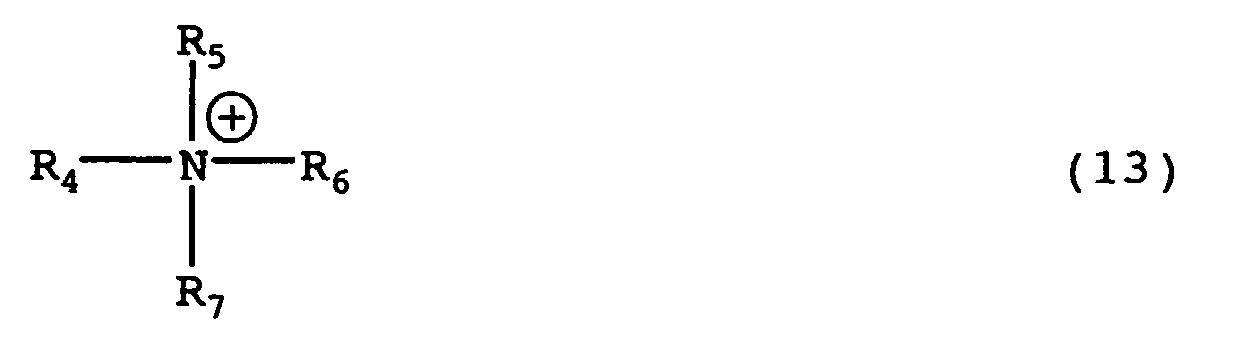
- Examples of the mono-, di-, tri- or tetravalent metal cation represented by M include Li+, Na+, K+, Rb+, Cs+, Fr+, Be2+, Mg2+, Ca2+, Sr2+, Ba2+, Ra2+, Cu+, Cu2+, Ag+, Zn2+, Al3+, Fe2+, Fe3+, Co2+, Ni2+, Ti4+ and Zr4+. Among these, Li+, Na+, K+, Rb+, Cs+, Fr+, Cu+ and Ag+.
- In the ammonium ion represented by formula (13), specific examples of the groups represented by R4 to R7 include the same groups described above for R1 to R3. Specific examples of the ammonium ion represented by formula (13) are set forth below.
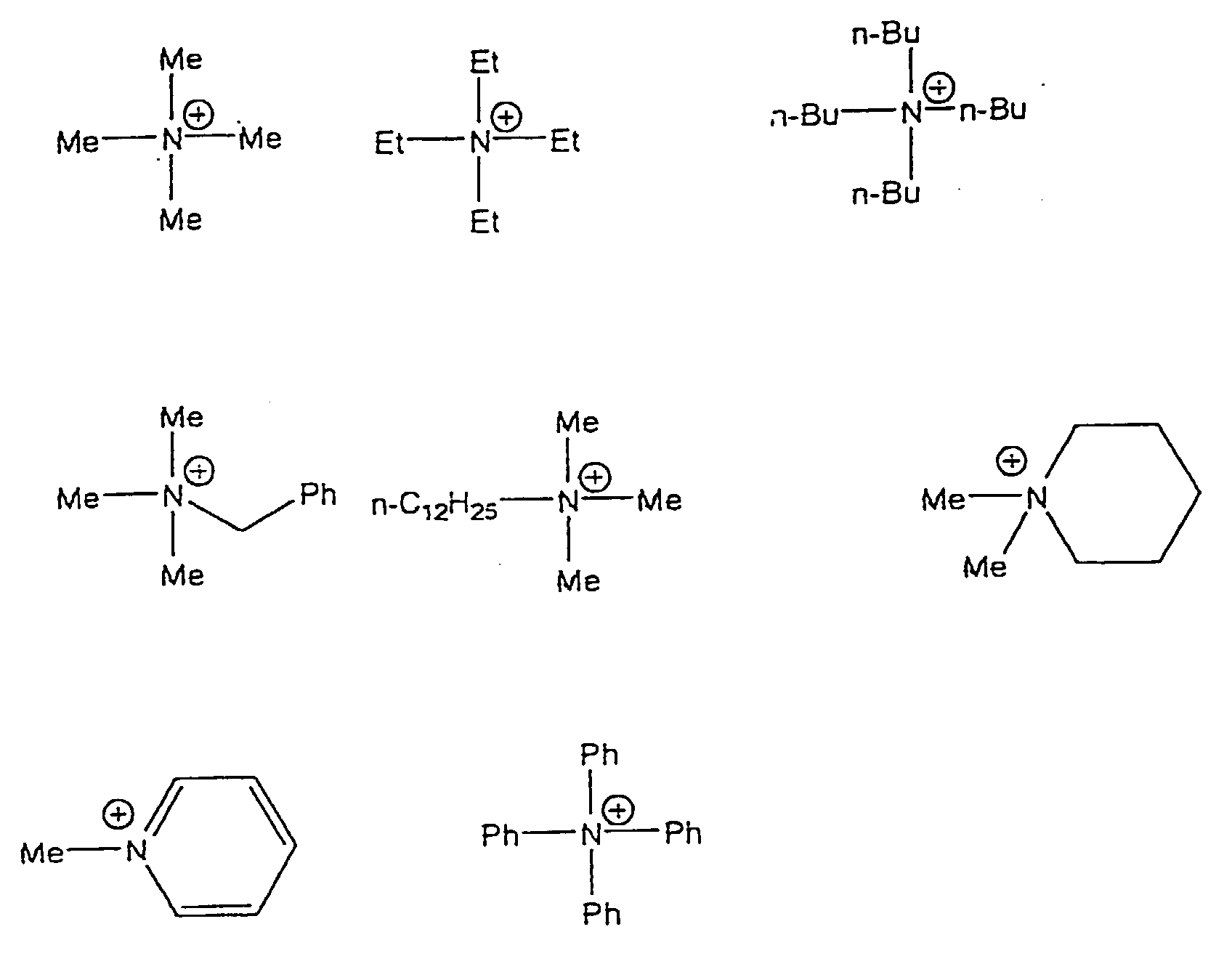
- The polymer main chain represented by P is at least one selected from the group consisting of partial structural monomers represented by the following formulae:

- The polymer having at least one group selected from group consisting of a carboxylic acid group and a carboxylate group for use in the present invention may be a homopolymer of only one monomer or may be a copolymer of two or more monomers. A copolymer with other monomer may also be used.
- Examples of the other monomer which can be used include known monomers such as acrylic acid esters, methacrylic acid esters, acrylamides, methacrylamides, vinyl esters, styrenes, acrylic acid, methacrylic acid, acrylonitrile, maleic acid anhydride and malic acid imide. By copolymerizing such a monomer, various physical properties such as film forming property, film strength, hydrophilicity, hydrophobicity, reactivity and stability can be improved.
- Specific examples of the acrylic acid esters include methyl acrylate, ethyl acrylate, (n- or i-)propyl acrylate, (n-, i-, sec- or tert-)butyl acrylate, amyl acrylate, 2-ethylhexyl acrylate, dodecyl acrylate, chloroethyl acrylate, 2-hydroxyethyl acrylate, 2-hydroxypropyl acrylate, 2-hydroxypentyl acrylate, cyclohexyl acrylate, allyl acrylate, trimethylolpropane monoacrylate, pentaerythritol mono-acrylate, benzyl acrylate, methoxybenzyl acrylate, chlorobenzyl acrylate, hydroxybenzyl acrylate, hydroxyphenethyl acrylate, dihydroxyphenethyl acrylate, furfuryl acrylate, tetrahydrofurfuryl acrylate, phenyl acrylate, hydroxyphenyl acrylate, chlorophenyl acrylate, sulfamoylphenyl acrylate and 2-(hydroxyphenylcarbonyloxy)ethyl acrylate.
- Specific examples of the methacrylic acid esters include methyl methacrylate, ethyl methacrylate, (n- or i-)propyl methacrylate, (n-, i-, sec- or tert-)butyl methacrylate, amyl methacrylate, 2-ethylhexyl methacrylate, dodecyl methacrylate, chloroethyl methacrylate, 2-hydroxyethyl methacrylate, 2-hydroxypropyl methacrylate, 2-hydroxypentyl methacrylate, cyclohexyl methacrylate, allyl methacrylate, trimethylolpropane monomethacrylate, pentaerythritol monomethacrylate, benzyl methacrylate, methoxybenzyl methacrylate, chlorobenzyl methacrylate, hydroxybenzyl methacrylate, hydroxyphenethyl methacrylate, dihydroxyphenethyl methacrylate, furfuryl methacrylate, tetrahydrofurfuryl methacrylate, phenyl methacrylate, hydroxyphenyl methacrylate, chlorophenyl methacrylate, sulfamoylphenyl methacrylate and 2-(hydroxyphenylcarbonyloxy)ethyl methacrylate.
- Specific examples of the acrylamides include acrylamide, N-methylacrylamide, N-ethylacrylamide, N-propylacrylamide, N-butylacrylamide, N-benzylacrylamide, N-hydroxyethylacrylamide, N-phenylacrylamide, N-tolylacrylamide, N-(hydroxyphenyl)acrylamide, N-(sulfamoylphenyl)acrylamide, N-(phenylsulfonyl)acrylamide, N-(tolylsulfonyl)acrylamide, N,N-dimethylacrylamide, N-methyl-N-phenylacrylamide and N-hydroxyethyl-N-methylacrylamide.
- Specific examples of the methacrylamides include methacrylamide, N-methylmethacrylamide, N-ethylmethacrylamide, N-propylmethacrylamide, N-butylmethacrylamide, N-benzylmethacrylamide, N-hydroxyethylmethacrylamide, N-phenylmethacrylamide, N-tolylmethacrylamide, N-(hydroxyphenyl)methacrylamide, N-(sulfamoylphenyl)methacrylamide, N-(phenylsulfonyl)methacrylamide, N-(tolylsulfonyl)methacrylamide, N,N-dimethylmethacrylamide, N-methyl-N-phenylmethacrylamide and N-hydroxyethyl-N-methylmethacrylamide.
- Specific examples of the vinyl esters include vinyl acetate, vinyl butyrate and vinyl benzoate.
- Specific examples of the styrenes include styrene, methylstyrene, dimethylstyrene, trimethylstyrene, ethylstyrene, propylstyrene, cyclohexylstyrene, chloromethylstyrene, trifluoromethylstyrene, ethoxymethylstyrene, acetoxymethylstyrene, methoxystyrene, dimethoxystyrene, chlorostyrene, dichlorostyrene, bromostyrene, iodostyrene, fluorostyrene and carboxystyrene.
- The ratio of this other monomer for use in the synthesis of copolymer must be highly enough to improve various physical properties, however, if the ratio is excessively high, the monomer containing a carboxylic acid or a carboxylate insufficiently functions. Accordingly, the total ratio of other monomers is preferably 80 wt% or less, more preferably 50 wt% or less.
- Specific examples of the polymer having a carboxylic acid or carboxylate capable of causing decarboxylation by heat, for use in the present invention, are set forth below.
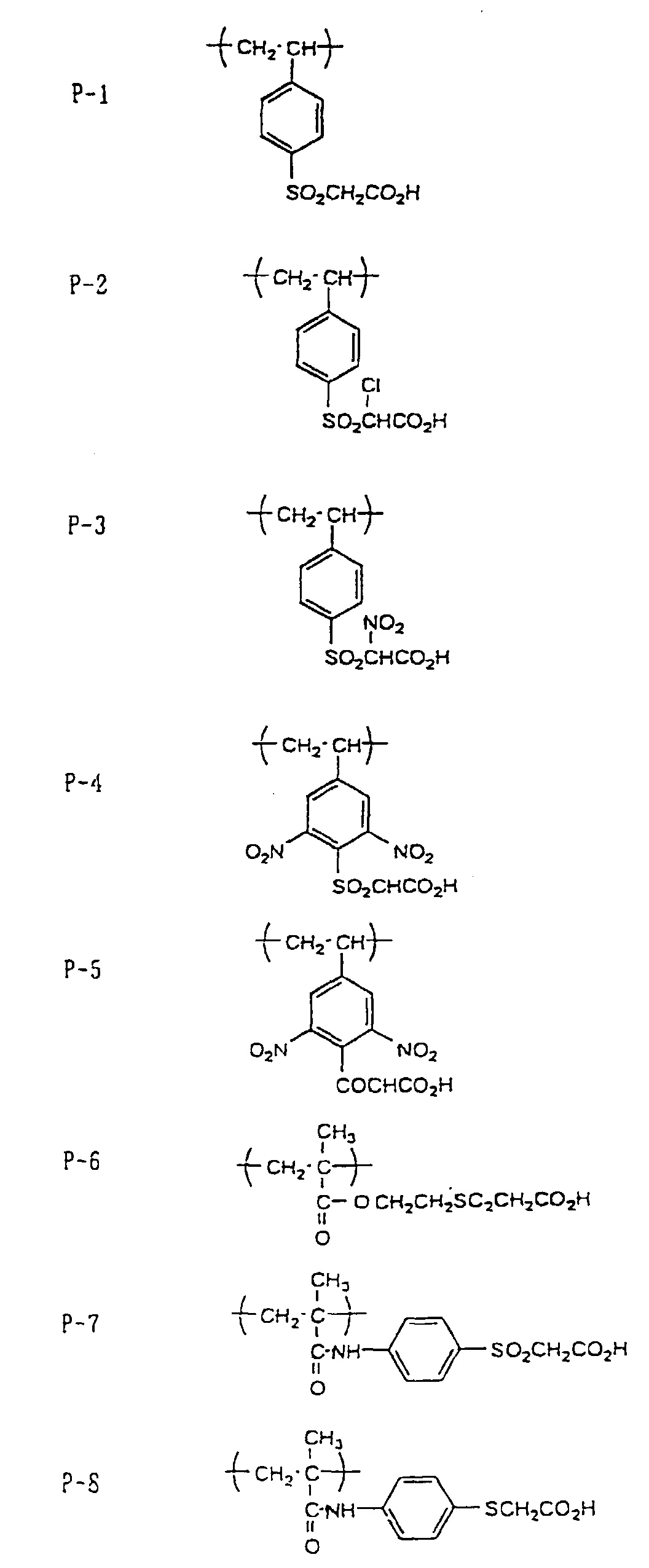


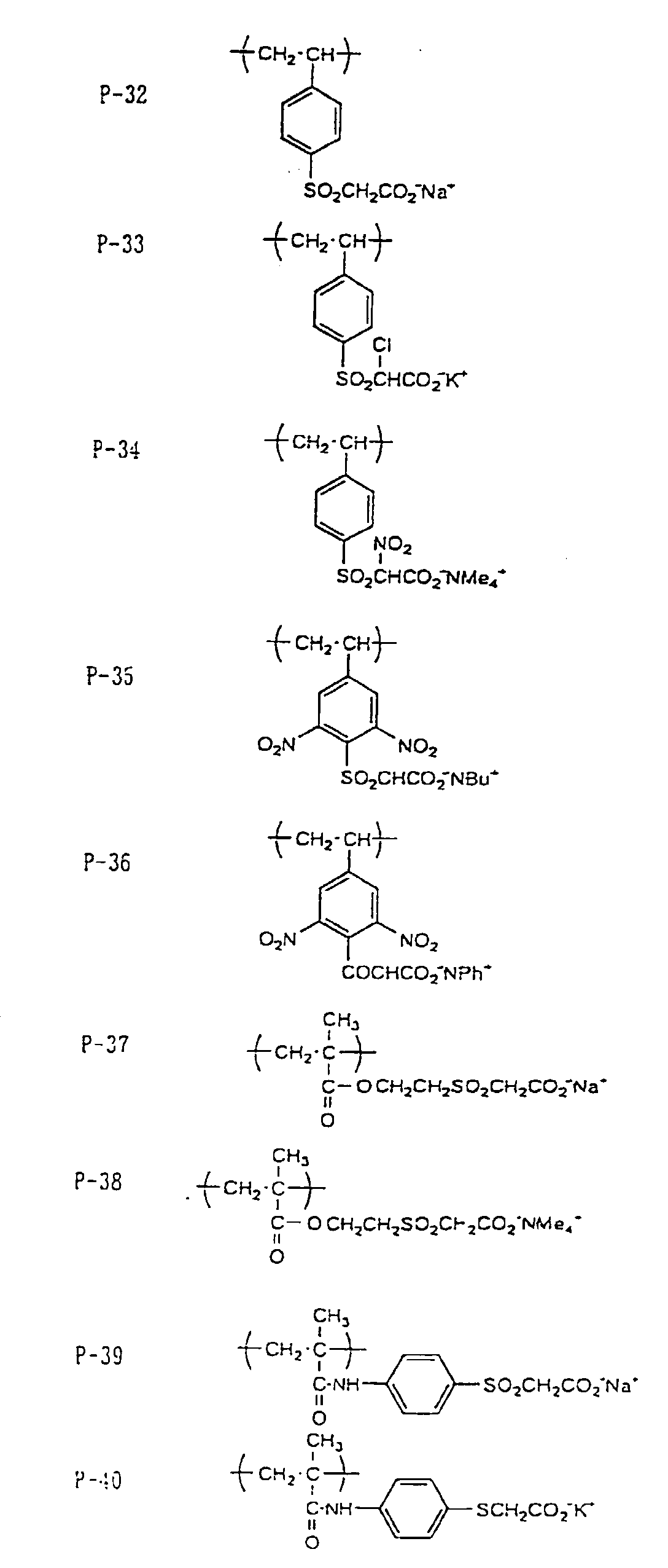
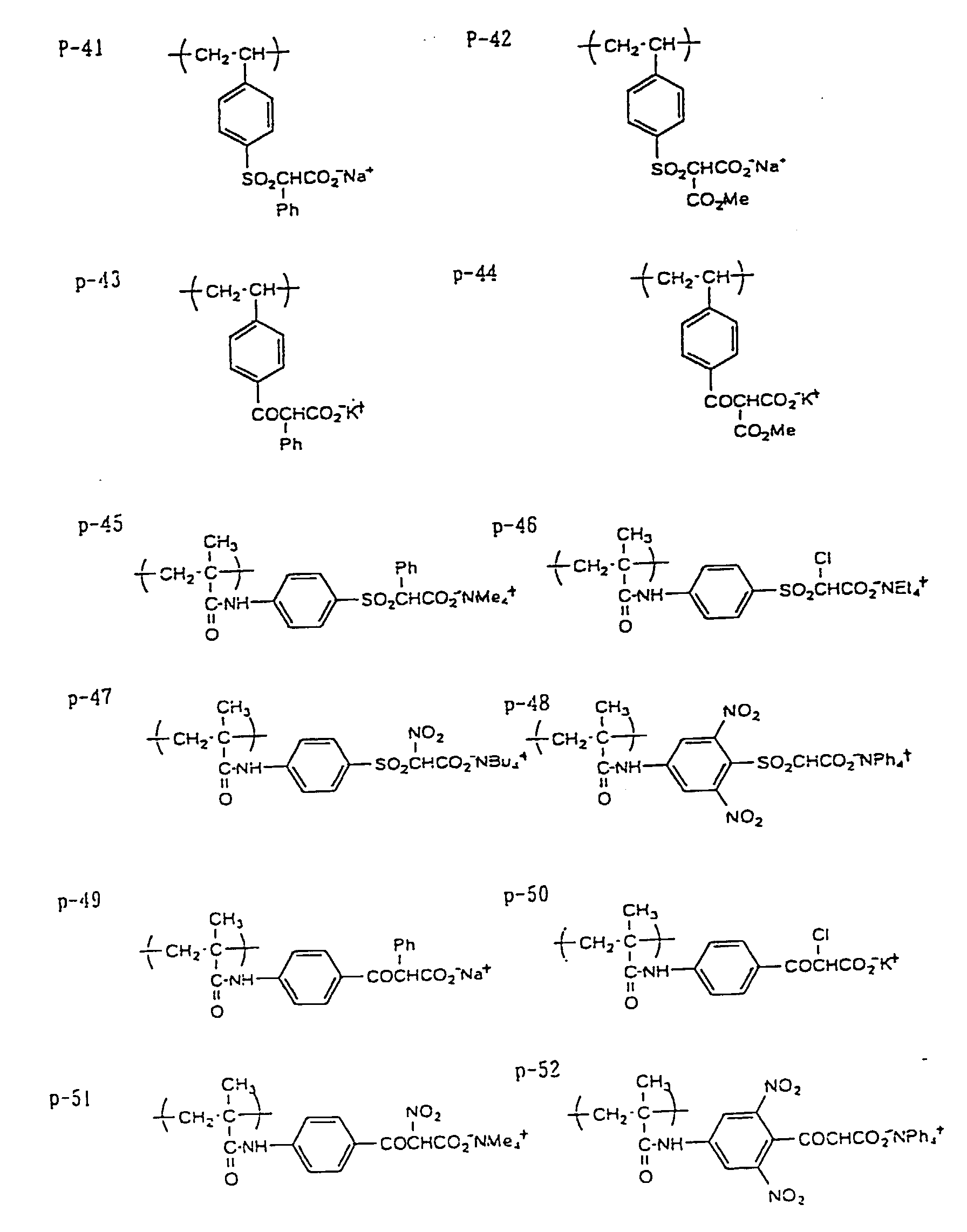
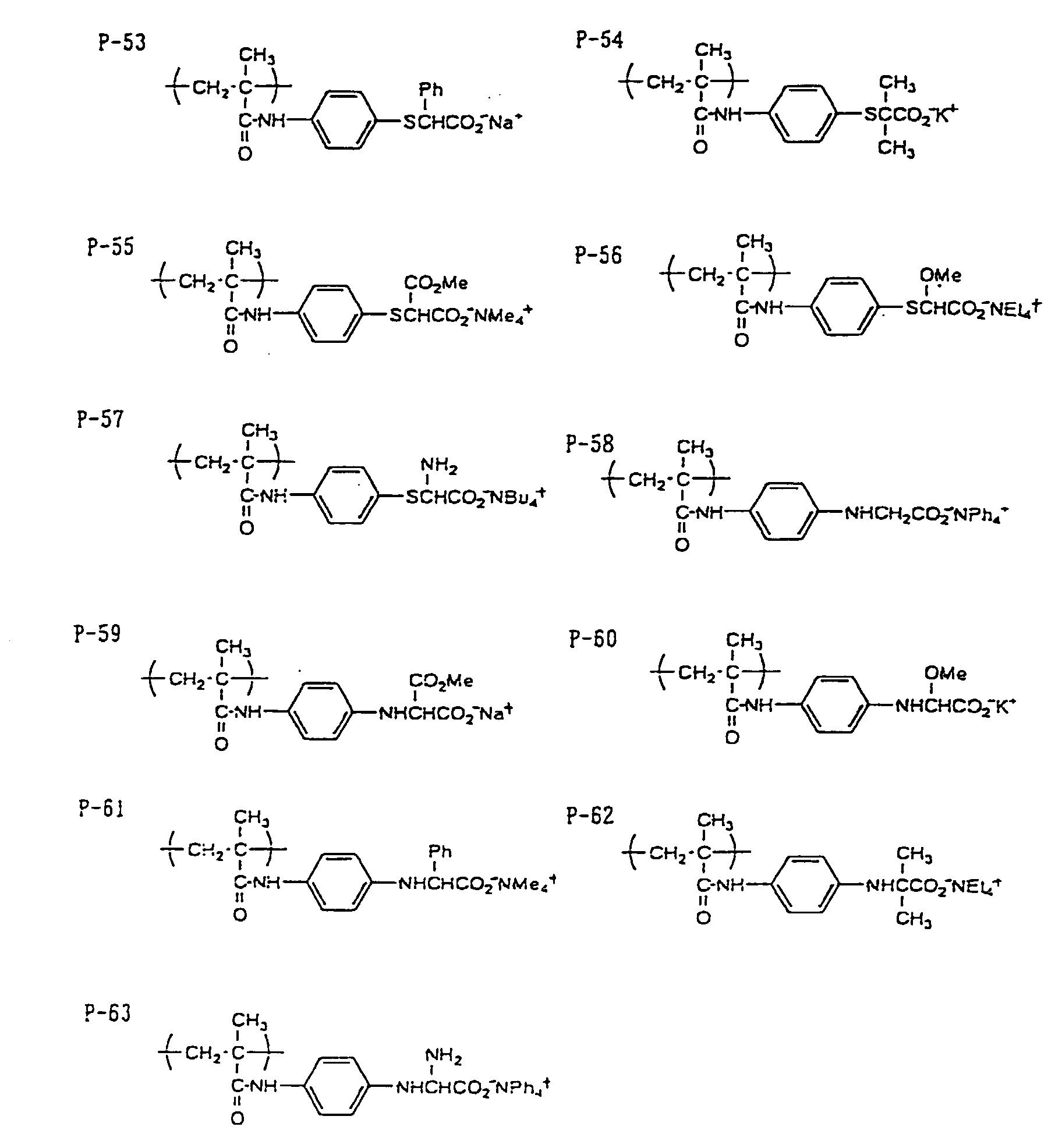
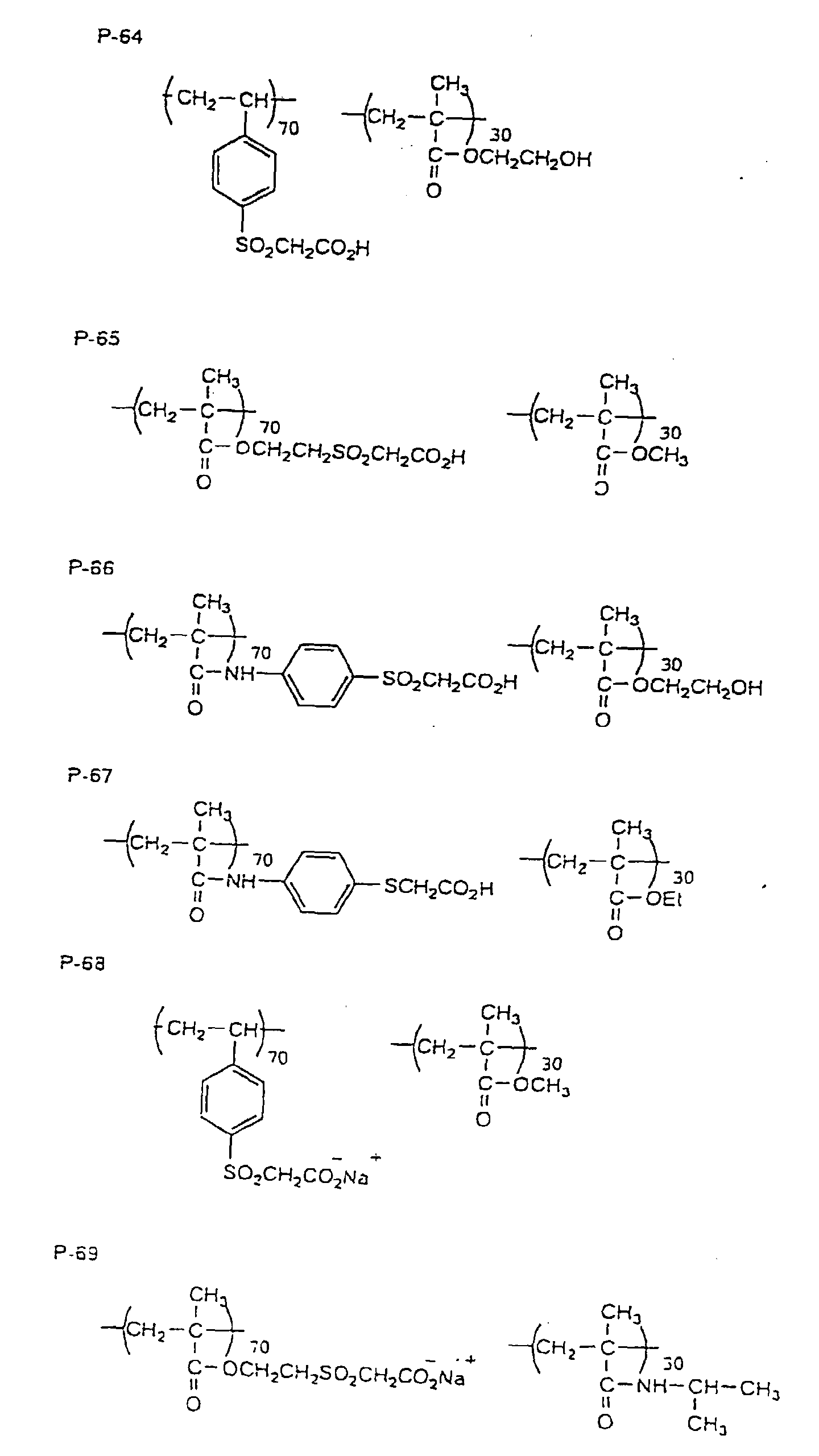
- The constituent components other than the negative polar conversion polymer compound, which can be contained in the layer containing a negative polar conversion polymer compound, are described below.
- Light-heat converting agents described later may be suitably used as the light-heat converting agent added to the layer containing a negative polar conversion polymer compound for use in the present invention.
- Surface active agents described later may be suitably used as the surface active agent added to the layer containing a negative polar conversion polymer compound for use in the present invention.
- As the constituent components other than those described above, which can be added to the layer containing a negative polar conversion polymer compound for use in the present invention, the same components as the other constituent components which can be added to the layer containing a positive polar conversion polymer compound may be suitably used.
- The "layer containing a compound capable of cross-linking with an aqueous alkali solution-soluble resin" for use in the lithographic printing original plate of the present invention means a layer containing at least the above-described aqueous alkali solution-soluble resin and a compound capable of crosslinking (with the alkali aqueous soluble resin) described below.
- The compound capable of cross-linking (with the aqueous alkali solution) (hereinafter sometimes simply referred to as a "cross-linking compound or cross-linking agent") for use in the present invention is a compound capable of reacting with the polymer compound to form a cross-linking between polymer compounds. Accordingly, the cross-linking compound must have two or more functional groups capable of reacting with the polymer compounds. Any of such compounds can be suitably used in the present invention but in particular, compounds having two or more functional groups capable of reacting with an aqueous alkali solution-soluble resin are preferred.
- Examples of the cross-linking agent which can be preferably used in the present invention include the followings:
- (i) aromatic compounds substituted by an alkoxymethyl group or a hydroxymethyl group,
- (ii) compounds having an N-hydroxymethyl group, an N-alkoxymethyl group or an N-acyloxymethyl group, and
- (iii) epoxy compounds.
-
- These are described in detail below.
- (i) Examples of the aromatic compound substituted
by an alkoxymethyl group or a hydroxymethyl group include
aromatic compounds and heterocyclic compounds poly-substituted
by a hydroxymethyl group, an acetoxymethyl
group or an alkoxymethyl group, but exclude resinous
compounds obtained by the polycondensation of a phenol and
an aldehyde under basic conditions, which are known as
resol resin. The resol resin has excellent cross-linking
property, however, its thermal stability is not
sufficiently high and particularly when the resin is
contained in a photosensitive material and stored for a
long period of time at high temperatures, uniform
development is disadvantageously hard to attain.
Among the aromatic and heterocyclic compounds poly-substituted
by an alkoxymethyl group or a hydroxymethyl
group, compounds having a hydroxymethyl group or an
alkoxymethyl group at the site adjacent to a hydroxy group
are preferred. When the compound has an alkoxymethyl group,
the alkoxymethyl group preferably has 18 or less carbon
atoms. More preferred examples of the compound include
those represented by the following formulae (14) to (17):
 wherein L1 to L5 each independently represents a hydroxymethyl group or an alkoxymethyl group, substituted by an alkoxy group having 18 or less carbon atoms, such as methoxymethyl and ethoxymethyl. These compounds are preferred because they have high cross-linking efficiency and can improve the press life. The above-described cross-linking compounds may be used either individually or in combination of two or more thereof.
- (ii) Examples of the compound having an N-hydroxymethyl group, an N-alkoxymethyl group or an N-acyloxymethyl group include monomer and oligomer-melamine-formaldehyde condensates and urea-formaldehyde condensates disclosed in EP-A-0133216 (the term "EP-A" as used herein means an "unexamined European patent publication") and West German Patents 3,634,671 and 3,711,264, an alkoxy-substituted compounds disclosed in EP-A-0212482. Furthermore, preferred examples thereof include melamine-formaldehyde derivatives having at least two groups of free N-hydroxymethyl groups, free N-alkoxymethyl groups or free N-acyloxymethyl groups. Among these, N-alkoxymethyl derivatives are more preferred.
- (iii) The epoxy compound includes monomer-, dimer-, oligomer- or polymer-type epoxy compounds having one or more epoxy groups. Examples thereof include reaction products of bisphenol A and epichlorohydrin, and reaction products of low molecular weight phenol-formaldehyde resin and epichlorohydrin. In addition, epoxy resins described and used in U.S. Patent 4,026,705 and British Patent 1,539,192 may be used.
-
- The cross-linking agents (i) to (iii) which can be used in the present invention each is used in an amount of from 5 to 80 wt%, preferably from 10 to 75 wt%, more preferably from 20 to 70 wt%, based on the total solid content of recording layer. If the amount of cross-linking agent added is less than 5 wt%, the recording layer obtained has bad durability, whereas if it exceeds 80 wt%, the storage stability decreases.
- In the present invention, (iv) a phenol derivative represented by the following formula (18) is also preferably used as the cross-linking agent.

- In formula (18), Ar1 represents an aromatic hydrocarbon ring having a substituent. In view of easy availability of the raw materials, the aromatic hydrocarbon ring is preferably a benzene ring, a naphthalene ring or an anthracene ring. The substituent is preferably a halogen atom, a hydrocarbon group having 12 or less carbon atoms, an alkoxy group having 12 or less carbon atoms, an alkylthio group having 12 or less carbon atoms, a cyano group, a nitro group or a trifluoromethyl group. In particular, from the reason that the sensitivity is high, Ar1 is preferably a benzene or naphthalene ring having no substituent, or a benzene or naphthalene ring having a halogen atom, a hydrocarbon group having 6 or less carbon atoms, an alkoxy group having 6 or less carbon atoms, an alkylthio group having 6 or less carbon atoms or a nitro group as the substituent.
- R31 and R32, which may be the same or different, each represents hydrogen atom or a hydrocarbon group having 12 or less carbon atoms. In particular, from the reason that the synthesis is easy, R31 and R32 each is preferably hydrogen atom or a methyl group. R33 represents hydrogen atom or a hydrocarbon group having 12 or less carbon atoms. In particular, from the reason that the sensitivity is high, R33 is preferably a hydrocarbon group having 7 or less carbon atoms, such as methyl group, ethyl group, propyl group, cyclohexyl group or a benzyl group. m represents an integer of from 2 to 4. n represents an integer of from 1 to 3.
- Specific examples of the phenol derivative represented by formula (18) which can be suitably used in the present invention (Cross-Linking Agents [KZ-1] to [KZ-8) are set forth below, however, the present invention is by no means limited thereto.
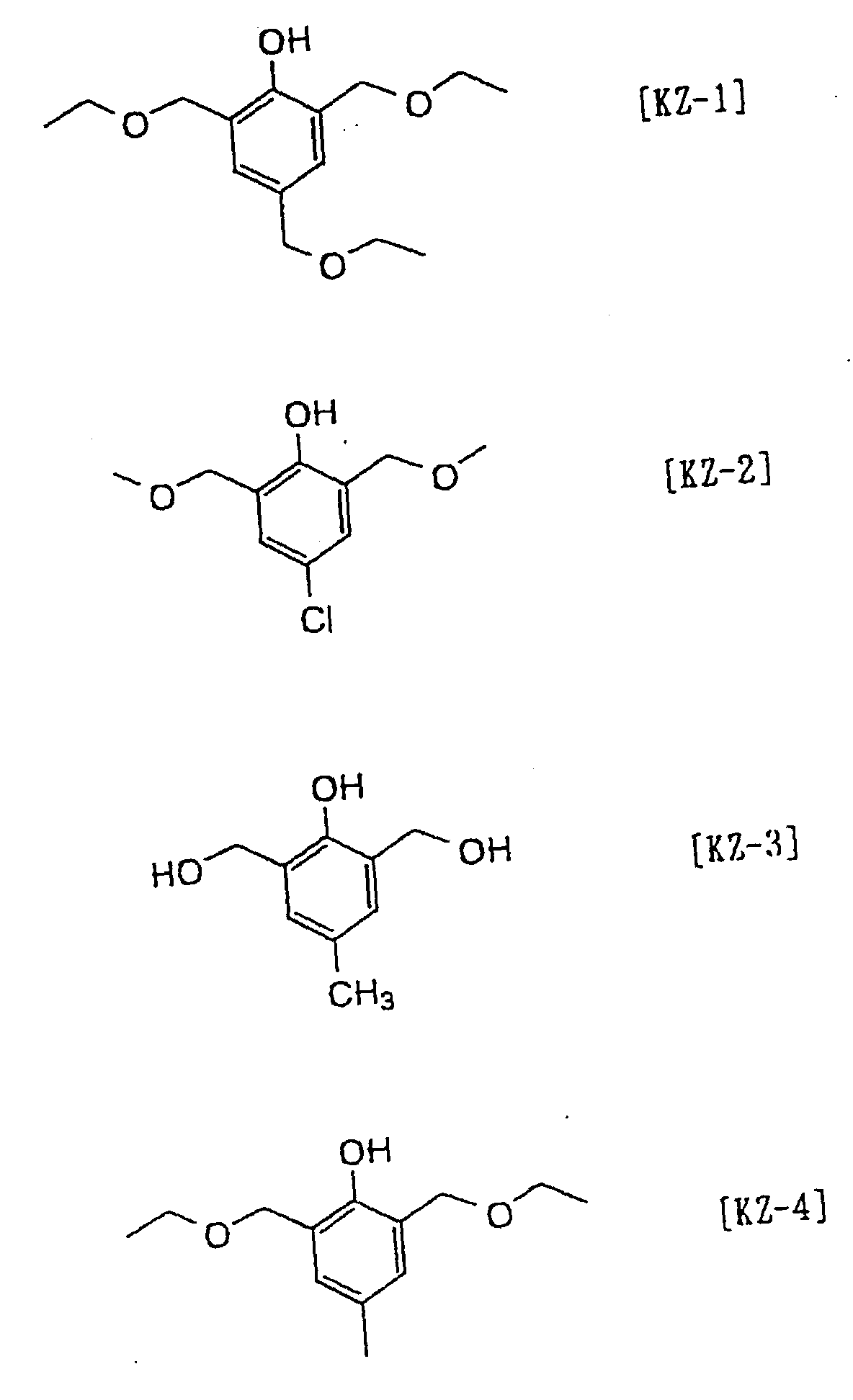
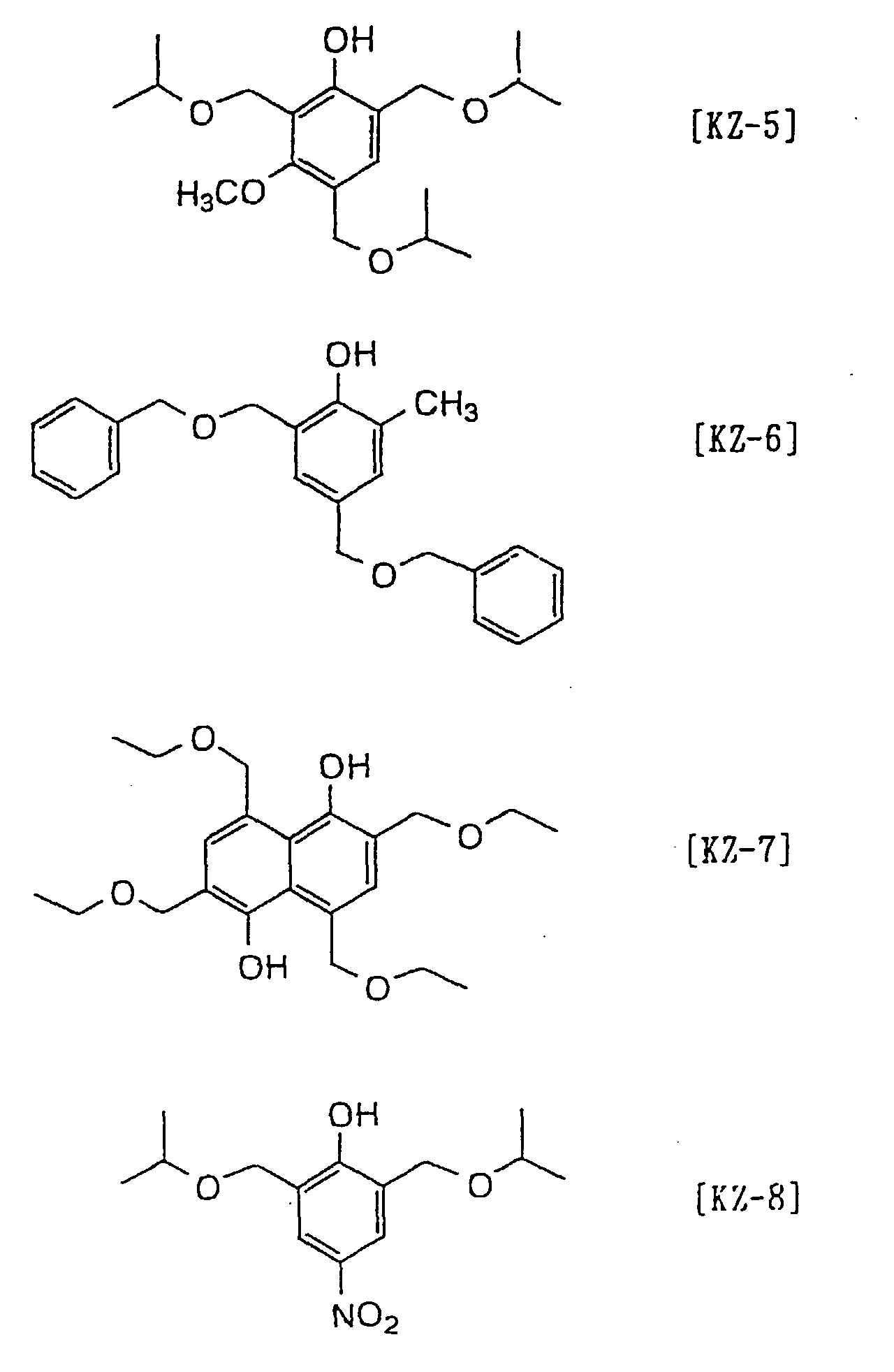
- These phenol derivatives can be synthesized by a conventionally known method. For example, [KZ-1] may be synthesized through a route shown below as "Reaction Formula 1", where phenol, formaldehyde and a secondary amine such as dimethylamine or morpholine, are reacted, the tri(dialkylaminomethyl)phenol obtained is reacted with acetic acid anhydride and then with ethanol in the presence of a weak alkali substance such as potassium carbonate.
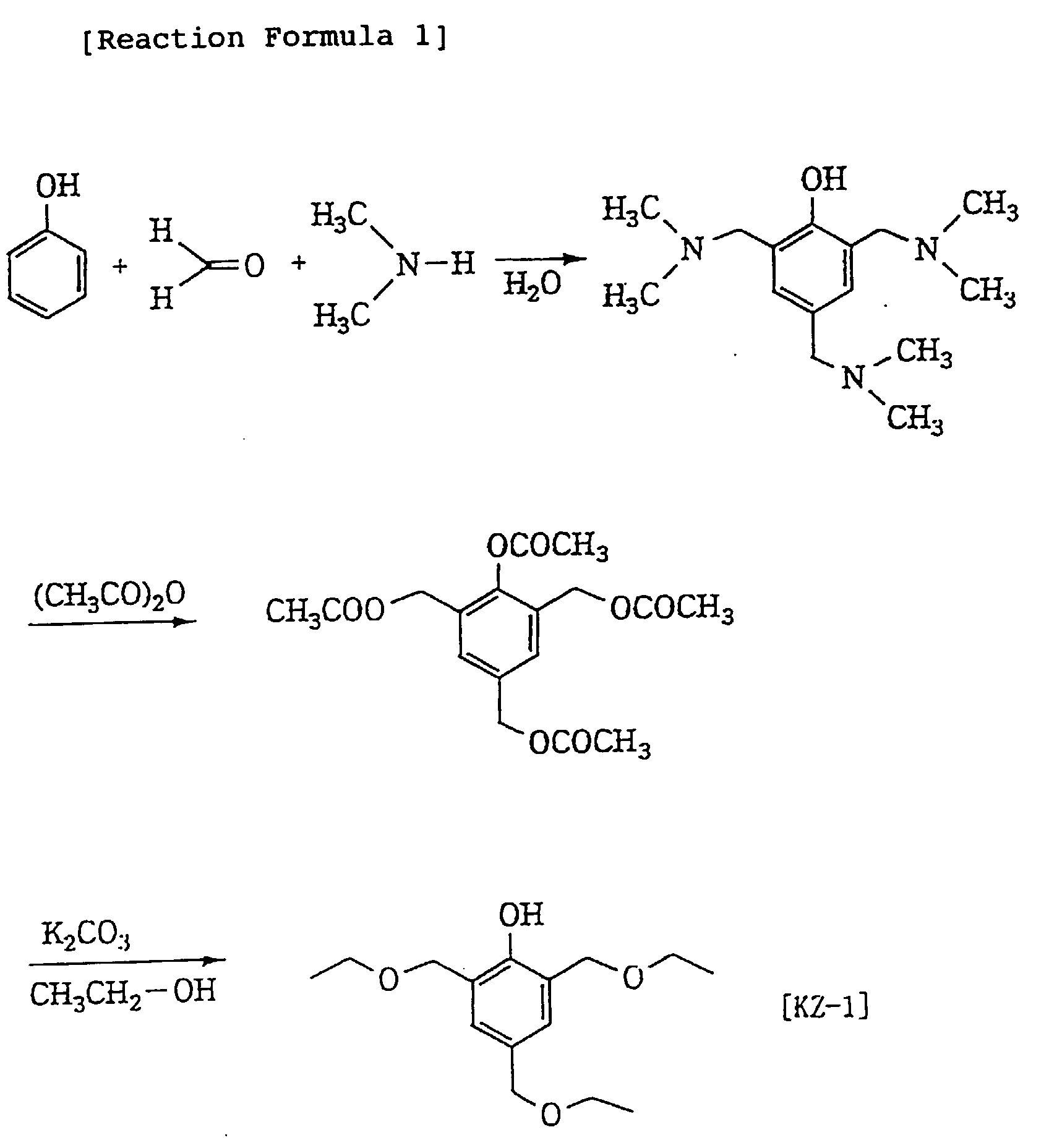
- The phenol derivatives may also be synthesized by a different method. For example, [KZ-1] can be synthesized through a route shown below as "Reaction Formula 2", where phenol and formaldehyde or p-formaldehyde are reacted in the presence of an alkali such as KOH, the 2,4,5-trihydroxymethylphenol obtained is subsequently reacted with ethanol in the presence of an acid such as sulfuric acid.
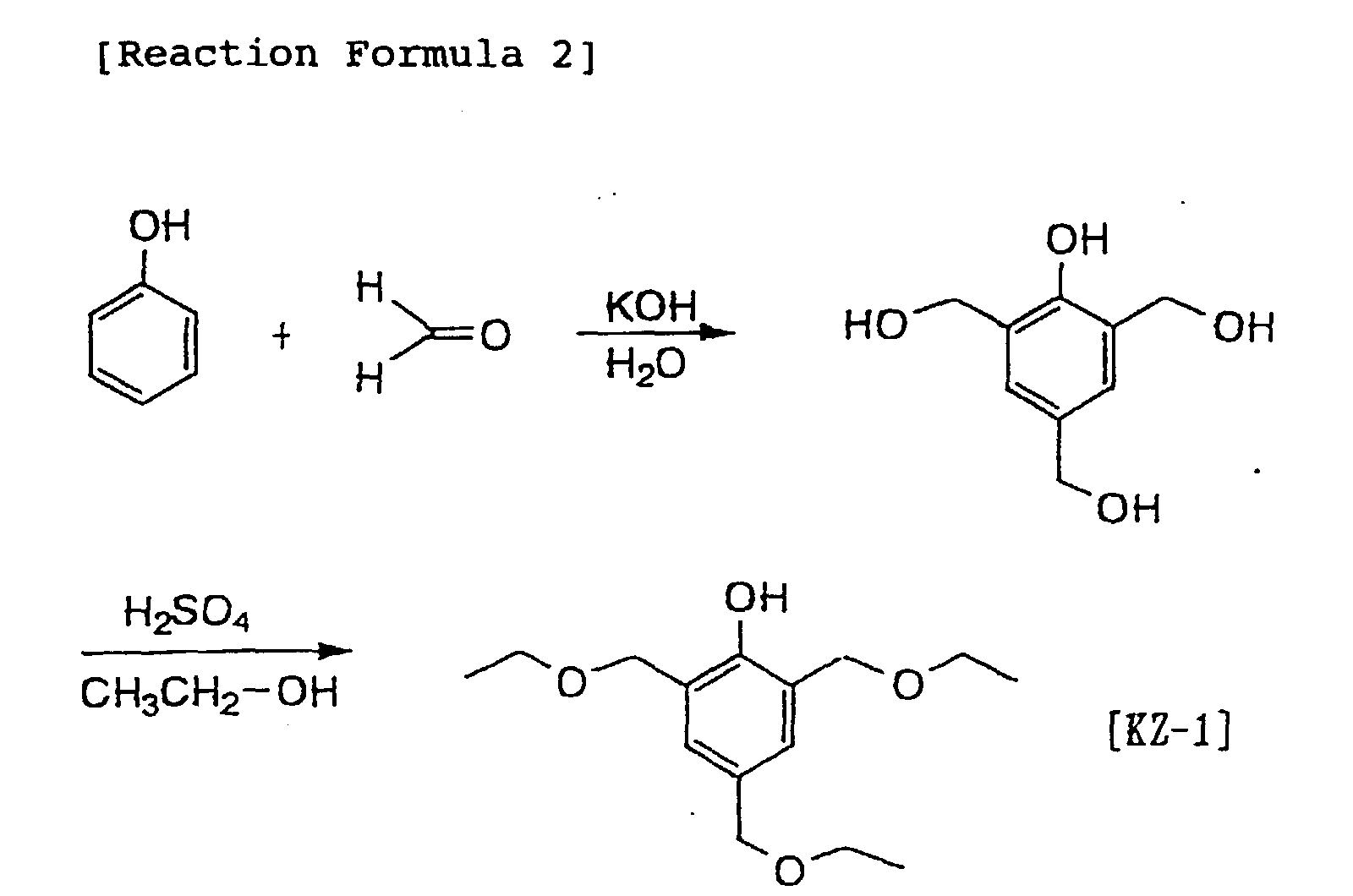
- The phenol derivative may be used either individually or in combination of two or more thereof. At the time of synthesizing these phenol derivatives, phenol derivatives may be condensed with each other to generate impurities such as dimer and trimer as by-products, but the phenol derivative containing these impurities may be used as it is. Even in this case, the content of impurities is preferably 30% or less, more preferably 20% or less.
- In the present invention, the phenol derivative is added to the recording layer in an amount of from 5 to 70 wt%, preferably from 10 to 50 wt%, based on the solid content of the recording layer. If the amount of phenol derivative added as a cross-linking agent is less than 5 wt%, the layer strength subjected to image recording deteriorates in the image area, whereas it it exceeds 70 wt%, the storage stability disadvantageously decreases.
- The constituent components other than the aqueous alkali solution-soluble resin and the cross-linking compound, which can be contained in the layer containing an aqueous alkali solution-soluble resin and a cross-linking compound, are described below.
- Light-heat converting agents described later may be suitably used as the light-heat converting agent added to the layer containing an aqueous alkali solution-soluble resin and a cross-linking compound for use in the present invention.
- Acid-generating agents described later may be suitably used as the acid-generating agent added to the layer containing an aqueous alkali solution-soluble resin and a cross-linking compound for use in the present invention.
- As the sensitizing dye which can be added to the layer containing an aqueous alkali solution-soluble resin and a cross-linking compound for use in the present invention, the same sensitizing dyes as those which can be added to the layer containing a positive polar conversion polymer compound may be suitably used.
- Surface active agents described later may be suitably used as the surface active agent added to the layer containing an aqueous alkali solution-soluble resin and a cross-linking compound for use in the present invention.
- As the constituent components other than those described above, which can be added to the layer containing an aqueous alkali solution-soluble resin and a cross-linking compound for use in the present invention, the same components as the other constituent components which can be added to the layer containing a positive polar conversion polymer compound may be suitably used.
- The recording layer of the lithographic printing original plate of the present invention may be usually produced by dissolving the above-described components in a solvent and coating the resulting solution on an appropriate support having coated thereon a polymer complex layer. Examples of the solvent used here include tetrahydrofuran, ethylene dichloride, cyclohexanone, methyl ethyl ketone, acetone, methanol, propanol, ethylene glycol monomethyl ether, ethylene glycol monoethyl ether, 2-methoxyethyl acetate, diethylene glycol dimethyl ether, 1-methoxy-2-propanol, 1-methoxy-2-propyl acetate, dimethoxyethane, N,N-dimethylformamide, N,N-dimethylacetamide, toluene, ethyl acetate, ethyl lactate, methyl lactate, dimethyl sulfoxide, water, sulfolane and γ-butyrolactone.
- These solvents may be used either individually or in combination. In the case of preparing a coating solution, the concentration of the recording layer constituent components (all solids content including additives) in the solvent is preferably from 1 to 50 wt%.
- The coating solution may be coated by various known methods such as bar coater coating, rotation coating, spray coating, curtain coating, dip coating, air knife coating, blade coating and roll coating.
- In the lithographic printing original plate of the present invention, the recording layer may contain a surface active agent so as to improve the coatability, such as a fluorine-based surface active agent described, for example, in JP-A-62-170950. The amount of surface active agent added is preferably from 0.01 to 1 wt%, more preferably from 0.05 to 0.5 wt%.
- The coated amount (solid content) of recording layer obtained after the coating and drying varies depending on the use, however, in the case of a general lithographic printing original plate, it is preferably from 0.5 to 5.0 g/m2, more preferably from 0.5 to 1.5 g/m2.
- The light-heat converting agent, the acid-generating agent and the surface active agent contained in the polymer complex layer and the recording layer for use in the present invention are described in detail.
- The light-heat converting agent capable of absorbing a laser ray and converting it into heat, which can be contained in the polymer complex layer and the recording layer of the lithographic printing original plate of the present invention, is described below.
- The light-heat converting agent for use in the present invention is preferably a dye or pigment capable of effectively absorbing light at the wavelength of from 760 to 1,200 nm, more preferably a dye or pigment having an absorption maximum at the wavelength of from 760 to 1,200 nm.
- As the dye, commercially available dyes and known dyes described in publications (for example, Senryo Binran (Handbook of Dyes), compiled by Yuki Gosei Kagaku Kyokai (1970)) may be used. Specific examples thereof include azo dyes, metal complex salt azo dyes, pyrazolone azo dyes, anthraquinone dyes, phthalocyanine dyes, carbonium dyes, quinoneimine dyes, methine dyes, cyanine dyes and metal thiolate complex dyes.
- Preferred examples of the dye include cyanine dyes, methine dyes, naphthoquinone dyes and squarylium dyes.
- Furthermore, near infrared absorbing sensitizers may be suitably used and pyrylium compounds such as substituted arylbenzo(thio)pyrylium salts, trimethine thiapyrylium salts, pyrylium-based compounds, cyanine dyes and pentamethine thiopyrylium salts may also be preferably used.
- Other preferred examples of the dye include near infrared absorbing dyes described as formulae (I) and (II) in U.S. Patent 4,756,993.
- Among these dyes, preferred are cyanine dyes, squarylium dyes, pyrylium dyes and nickel thiolate complexes.
- As the pigment for use in the present invention, commercially available pigments and pigments described in Color Index (C.I.) Binran (C.I. Handbook), Saishin Ganryo Binran (Handbook of Latest Pigments), compiled by Nippon Ganryo Gijutsu Kyokai (1977), Saishin Ganryo Oyo Gijutsu (Up-To-Date Pigment Application Technology), CMC (1986), and Insatsu Ink Gijutsu (Printing Ink Technology), CMC (1984) may be used.
- The kind of pigment includes black pigment, yellow pigment, orange pigment, brown pigment, red pigment, ultraviolet pigment, blue pigment, green pigment, fluorescent pigment, metal powder pigment and polymer bond pigment. Specific examples of the pigment which can be used include insoluble azo pigments, azo lake pigments, condensed azo pigments, chelate azo pigments, phthalocyanine-based pigments, anthraquinone-based pigments, perylene- and perynone-based pigments, thioindigo-based pigments, quinacridone-based pigments, dioxazine-based pigments, isoindolinone-based pigments, quinophthalone-based pigments, dyed lake pigments, azine pigments, nitroso pigments, nitro pigments, natural pigments, fluorescent pigments, inorganic pigments and carbon black. Among these pigments, preferred is carbon black.
- These pigments may be surface treated or may not be surface treated before use. For the surface treatment, a method of coating resin or wax on the surface, a method of attaching a surface active agent and a method of bonding a reactive substance (for example, silane coupling agent, an epoxy compound and polyisocyanate) to the pigment surface may be used. These surface treatment methods are described in Kinzoku Sekken no Seishitsu to Oyo (Properties and Application of Metal Soap), Saiwai Shobo, Insatsu Ink Gijutsu (Printing Ink Technology), CMC (1984), and Saishin Ganryo Oyo Gijutsu (Up-To-Date Pigment Application Technology), CMC (1986).
- The pigment preferably has a particle size of from 0.01 to 10 µm, more preferably from 0.05 to 1 µm, still more preferably from 0.1 to 1 µm. If the particle size of pigment is less than 0.01 µm, the dispersion is not stable in the coating solution for polymer complex layer or recording layer, whereas if it exceeds 10 µm, a homogeneous polymer complex layer or recording layer may not be formed by the coating.
- For dispersing the pigment, a known dispersion technique for use in the production of ink or toner may be used. Examples of the disperser include ultrasonic disperser, sand mill, attritor, pearl mill, super-mill, ball mill, impeller, disperser, KD mill, colloid mill, dynatron, three roll mill and pressure kneader. These are described in detail in Saishin Ganryo Oyo Gijutsu (Up-To- Date Pigment Application Technology), CMC (1986).
- The dye or pigment may be added to the polymer complex layer and the recording layer of the lithographic printing original plate of the present invention in an amount of from 0.01 to 50 wt%, preferably from 0.1 to 10 wt%, in the case of a dye, more preferably from 0.5 to 10 wt% and in the case of a pigment, more preferably from 1.0 to 10 wt%, based on all solids content. If the amount of pigment or dye added is less than 0.01 wt%, the sensitivity decreases, whereas if it exceeds 50 wt%, scumming is readily generated in the non-image area at the printing.
- In the case where the lithographic printing original plate of the present invention is used as a lithographic printing original plate for forming an image by laser exposure, it is preferred to add a compound capable of generating an acid by light or heat (hereinafter referred to as "acid-generating agent") to the polymer complex layer and the recording layer of the lithographic printing original plate. However, the polar conversion polymer compound described above sometimes generates an acid by itself due to heat and may exert a function as an acid-generating agent. In such a case, an image can be formed without using other acid-generating agent in particular, thus, the acid-generating agent is not essential.
- The acid-generating agent for use in the present invention may be selected from the following known compounds.
- Examples of the acid-generating agent include onium salts such as diazonium salt, ammonium salt, phosphonium salt, iodonium salt, selenonium salt and arsonium salt, organic halogen compounds, organic metals/organic halides, acid-generating agents having o-nitrobenzyl type protective group, compounds capable of generating a sulfonic acid by the photolysis represented by iminosulfonate, disulfone compounds, o-naphthoquinonediazide-4-sulfonic acid halides, and o-naphthoquinonediazide compounds.
- Other examples of the acid-generating agent which can be used include cyclohexyl citrate, sulfonic acid alkyl esters such as cyclohexyl p-acetoaminobenzenesulfonate and cyclohexyl p-bromobenzenesulfonate, and alkylsulfonic acid esters represented by the following structural formula described in JP-A-10-282672 previously filed by the present inventors:

- Among the above-described compounds capable of decomposing upon irradiation of light, heat or radioactive ray and thereby generating an acid, particularly effective compounds are described below.
- (1) Oxazole derivative represented by the following
formula (PAG1) and S-triazine derivative represented by
formula (PAG2), substituted by a trihalomethyl group:
wherein R1 represents a substituted or unsubstituted aryl or alkenyl group, R2 represents a substituted or unsubstituted aryl, alkenyl or alkyl group or -CY3, and Y represents a chlorine atom or a bromine atom. Specific examples of the compound are set forth below, however, the present invention is by no means limited thereto.


- (2) Iodonium salt represented by the following
formula (PAG3), sulfonium salt represented by formula
(PAG4) and diazonium salt:
In formula (PAG3), Ar1 and Ar2 each independently represents a substituted or unsubstituted aryl group. Preferred examples of the substituent include an alkyl group, a haloalkyl group, a cycloalkyl group, an aryl group, an alkoxy group, a nitro group, a carboxyl group, an alkoxycarbonyl group, a hydroxy group, a mercapto group and a halogen atom.In formula (PAG4), R3, R4 and R5 each independently represents a substituted or unsubstituted alkyl or aryl group, preferably an aryl group having from 6 to 14 carbon atoms, an alkyl group having from 1 to 8 carbon atoms or a substituted derivative thereof. Preferred examples of the substituent for the aryl group include an alkoxy group having from 1 to 8 carbon atoms, an alkyl group having from 1 to 8 carbon atoms, a nitro group, a carboxyl group, a hydroxy group and a halogen atom, and for the alkyl group include an alkoxy group having from 1 to 8 carbon atoms, a carboxyl group and an alkoxycarbonyl group.Z- represents a counter anion. Examples thereof include perfluoroalkane sulfonate anion such as BF4 -, AsF6 -, PF6 -, SbF6 -, Si2F2 -, ClO4 - and CF3SO3 -;; bonded polynuclear aromatic sulfonate anion such as pentafluorobenzene sulfonate anion and naphthalene-1-sulfonate anion; anthraquinone sulfonate anion; and sulfonic acid group-containing dyes, however, the present invention is by no means limited thereto.Two of R3, R4 and R5 or Ar1 and Ar2 may be combined through respective single bonds or a substituent.Specific examples include the following compounds, however, the present invention is by no means limited thereto.
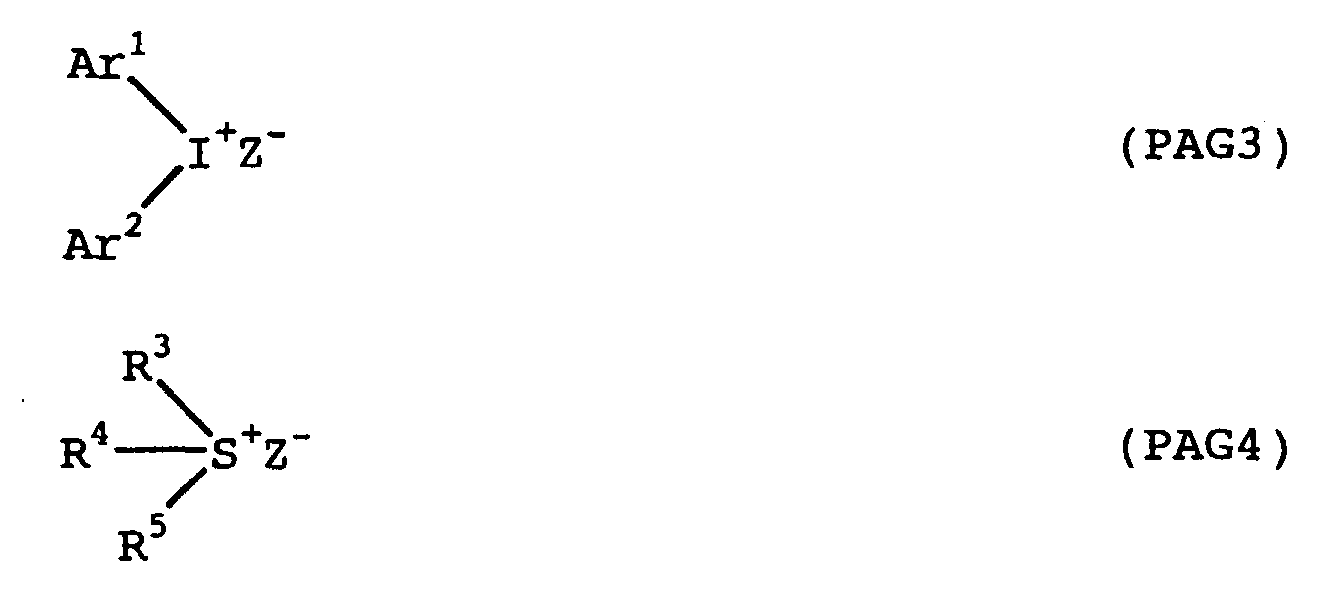
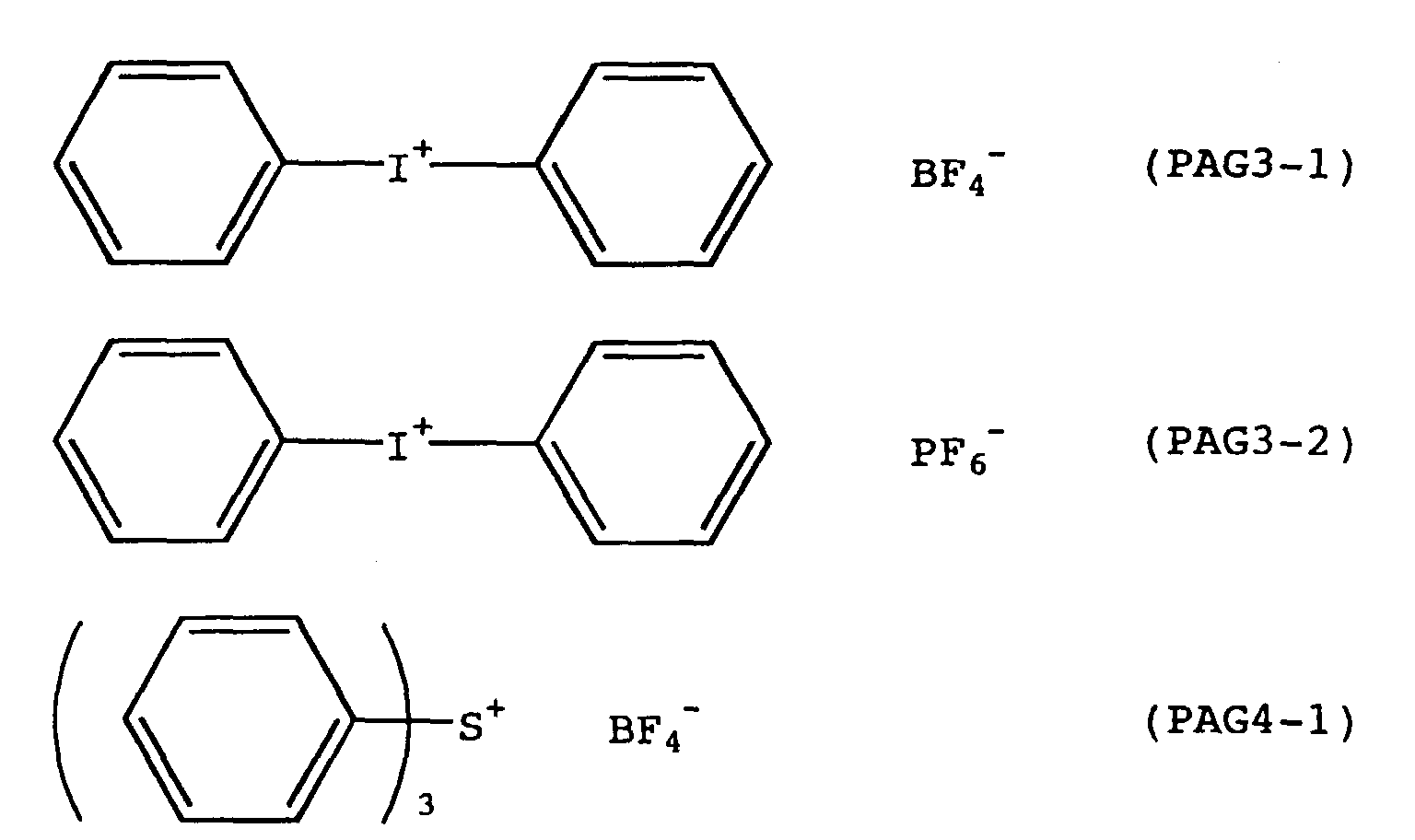 These onium salts represented by formulae (PAG3) and (PAG4) are known and can be synthesized by the methods described, for example, in J.W. Knapczyk et al., J. Am. Chem. Soc., 91, 145 (1969), A.L. Maycok et al., J. Org. Chem., 35, 2532 (1970), B. Goethas et al., Bull. Soc. Chem. Belg., 73, 546 (1964), H.M. Leicester, J. Am. chem. Soc., 51, 3587 (1929), J.V. Crivello et al., J. Polym. Chem., Ed. 18, 2677 (1980), U.S. Patents 2,807,648 and 4,247,473, and JP-A-53-101331.
- (3) Disulfone derivatives represented by the
following formula (PAG5) and iminosulfonate derivatives
represented by formula (PAG6):
wherein Ar3 and Ar4 each independently represents a substituted or unsubstituted aryl group, R6 represents a substituted or unsubstituted alkyl or aryl group, and A represents a substituted or unsubstituted alkylene, alkenylene or arylene group.
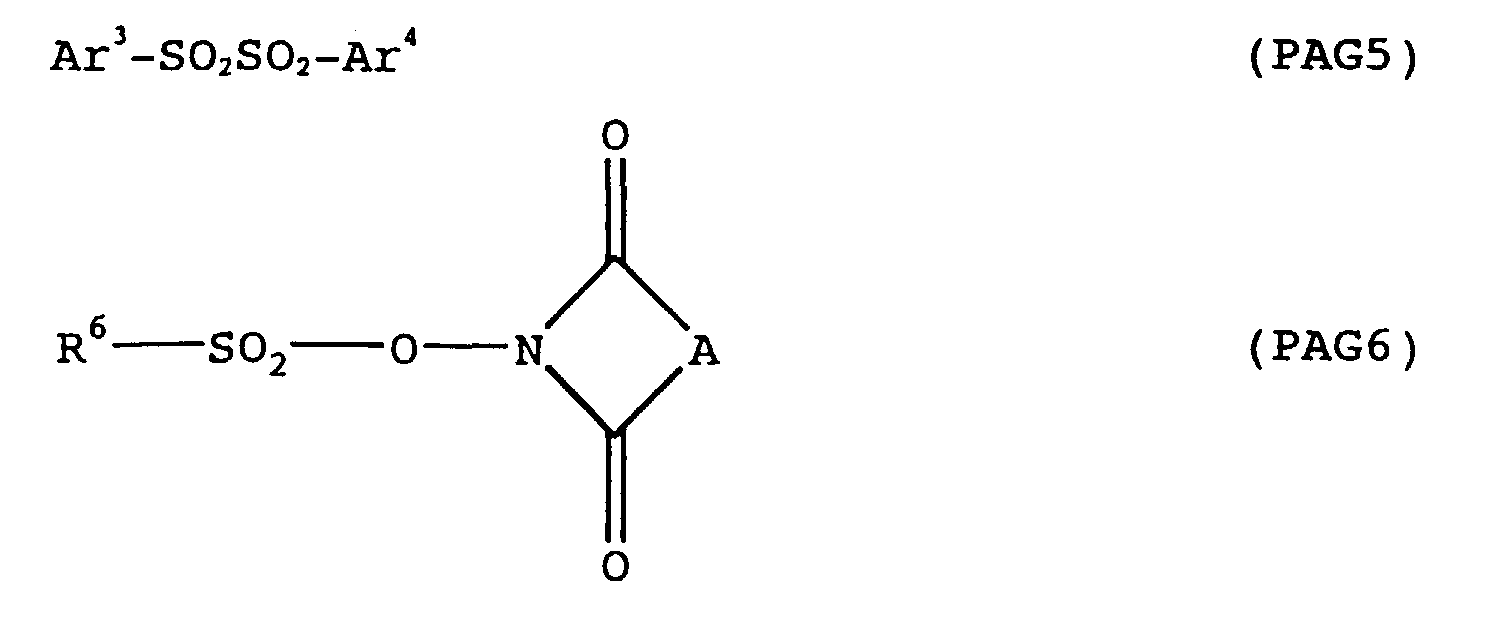
-
- Specific examples include the following compounds, however, the present invention is by no means limited thereto.
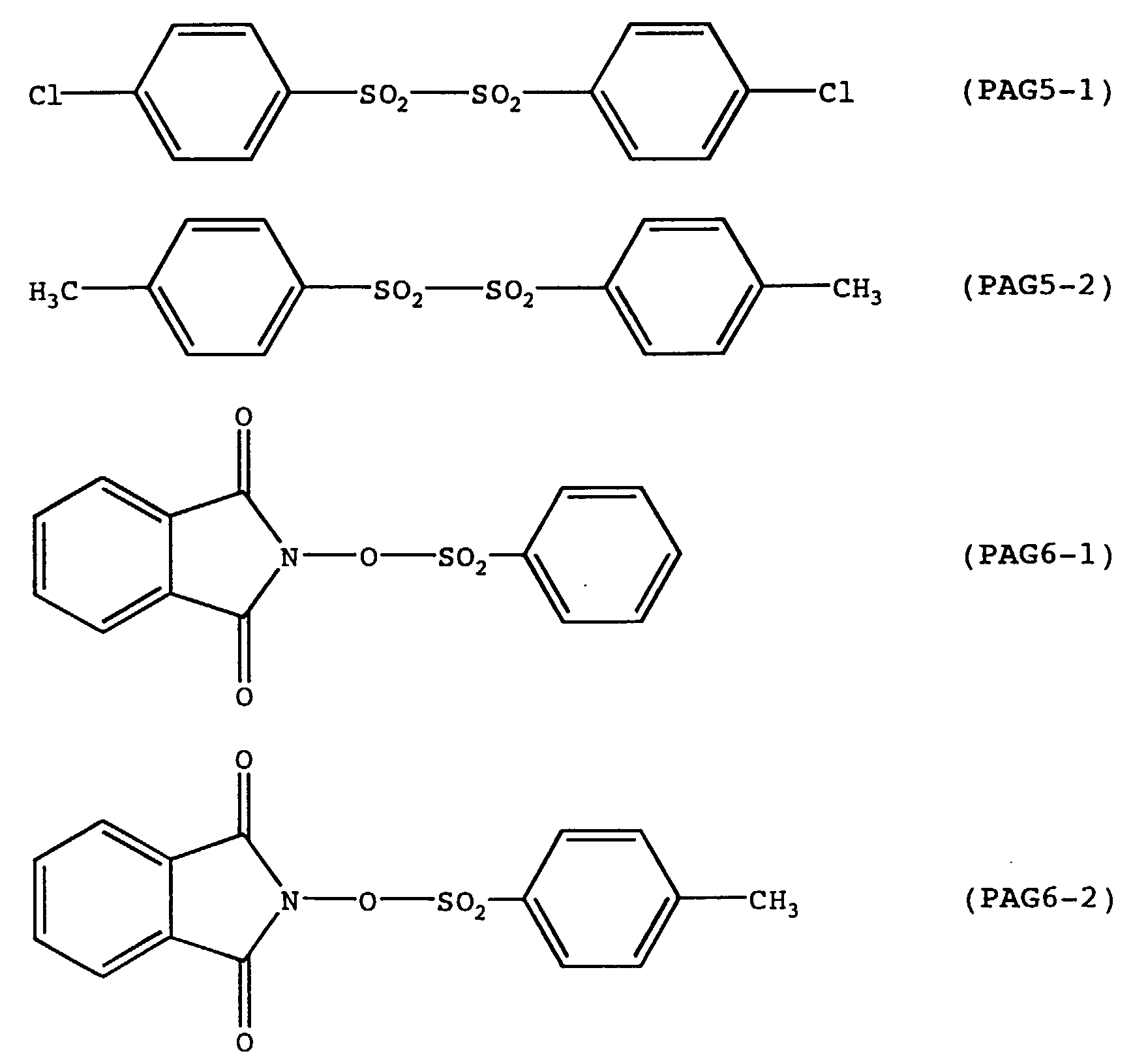
- The content of acid-generating agent is usually from 0.01 to 50 wt%, preferably from 0.1 to 40 wt%, more preferably from 0.5 to 30 wt%, based on all solids content in the image-forming layer of the lithographic printing original plate of the present invention.
- In the case where the acid-generating agent is contained in the polymer complex layer, the acid-generating layer is contained in the coating solution for polymer complex layer, which contains a polymer electrolyte precursor, the coating solution is coated on a support which is described later, and the coated layer is entirely exposed or heated to bring out the action of acid-generating layer and thereby form the polymer complex layer.
- Therefore, after the formation of polymer complex layer, the acid-generating agent is deactivated even before the lithographic printing original plate of the present invention is subjected to image recording. Thus, the acid-generating agent plays a different role from the acid-generating agent contained in the recording layer.
- In the case where the acid-generating agent contained in the ink-receptive layer containing a positive polar conversion polymer compound does not have sensitivity in the range of from ultraviolet region to visible region, various sensitizing dyes for acid-generating agent may be used for activating the acid-generating agent to the light of from ultraviolet region to visible region.
- Examples of the sensitizing dye which can be effectively used to this purpose include pyrane-based dyes, cyanine dyes, squarylium-based dyes, merocyanine-based dyes, pyrylium dyes, Michler's ketone, thioxanthone, ketocoumarin dyes and 9-phenylacridine. In addition, polynuclear aromatic compounds such as bisbenzilidene ketone dye and 9,10-diphenylanthracene.
- As other components, for example, a dye having large absorption in the visible light region may be used as the coloring agent for an image.
- Specific examples thereof include Oil Yellow #101, Oil Yellow #103, Oil Pink #312, Oil Green BG, Oil Blue BOS, Oil Blue #603, Oil Black BY, Oil Black BS, Oil Black T-505 (all produced by Orient Kagaku Kogyo K.K.), Victoria Pure Blue, Crystal Violet (C.I. 42555), Methyl Violet (C.I. 42535), Ethyl Violet, Rhodamine B (C.I. 45170B), Malachite Green (C.I. 42000) and Methylene Blue (C.I. 52015). Dyes described in JP-A-62-293247 may also be used.
- The amount of dye added is from 0.01 to 10 wt% based on all solids content in the ink-receptive layer of the lithographic printing original plate of the present invention.
- The polymer complex layer of the lithographic printing plate of the present invention may contain a nonionic surface active agent described in JP-A-62-251740 and JP-A-3-208514 or an amphoteric surface active agent described in JP-A-59-121044 and JP-A-4-13149 so as to broaden the stability to the printing conditions.
- Specific examples of the nonionic surface active agent include sorbitan tristearate, sorbitan monopalmitate, sorbitan trioleate, stearic acid monoglyceride and polyoxyethylene nonylphenyl ether.
- Specific examples of the amphoteric surface active agent include alkyldi(aminoethyl)glycine, alkylpolyaminoethyl glycine hydrochloride, 2-alkyl-N-carboxyethyl-N-hydroxyethylimidazolinium betaine and N-tetradecyl-N,N-betaine type (for example, AMORGEN K, trade name, produced by Daiichi Kogyo K.K.).
- The ratio of nonionic surface active agent or amphoteric surface active agent occupying the polymer complex layer is preferably from 0.05 to 15 wt%, more preferably from 0.1 to 5 wt%, based on all solids content.
- The support (substrate) for use in the lithographic printing original plate of the present invention, where the polymer complex layer and the recording layer are coated, is a plate material having good dimensional stability and any known material heretofore used as a support of printing plates can be suitably used. Examples of the support include paper, paper laminated with plastic (for example, polyethylene, polypropylene or polystyrene), metal plates such as aluminum (including aluminum alloy), zinc, iron and copper, plastic film such as cellulose diacetate, cellulose triacetate, cellulose propionate, cellulose butyrate, cellulose butyrate acetate, cellulose nitrate, polyethylene terephthalate, polyethylene, polystyrene, polypropylene, polycarbonate and polyvinyl acetal, and paper or plastic film having laminated or deposited thereon the above-described metal. Among these, an aluminum plate is preferred. The aluminum plate includes pure aluminum plate and aluminum alloy plate. As the aluminum alloy, various alloys may be used and for example, alloys of aluminum with a metal such as silicon, copper, manganese, magnesium chromium, zinc, lead, bismuth or nickel may be used. The alloy composition is allowed to contain a negligible amount of impurities in addition to some iron and titanium.
- The support is subjected to a surface treatment, if desired. For example, in the manufacture of a lithographic printing original plate, the support surface is subjected to a hydrophilization treatment in advance of the coating of polymer complex layer and recording layer.
- In the case of a support having a metal surface, particularly aluminum surface, the support is preferably subjected to a surface treatment such as graining, soaking in an aqueous solution of sodium silicate, potassium fluorozirconate or phosphate, or anodization. An aluminum plate subjected to graining and then to soaking in an aqueous sodium silicate solution described in U.S. Patent 2,714,066, and an aluminum plate subjected to anodization and then to soaking in an aqueous alkali metal silicate solution described in U.S. Patent 3,181,461 may be suitably used. The anodization is performed by passing a current using the aluminum plate as an anode in an electrolytic solution comprising, for example, an aqueous or non-aqueous solution of an inorganic acid such as phosphoric acid, chromic acid, sulfuric acid or boric acid, or an organic acid such as oxalic acid or sulfamic acid. These aqueous or non-aqueous solutions may be used individually or in combination of two or more thereof.
- The silicate electrodeposition described in U.S. Patent 3,658,662 is also an effective surface treatment.
- These hydrophilization treatments are performed not only to render the support surface hydrophilic but also to prevent harmful reaction with the polymer complex layer coated thereon or to improve the adhesion to the layer.
- In advance of the surface roughening by graining of the aluminum plate, the surface may be subjected to a pre-treatment, if desired, so as to remove the rolling oil on the surface or reveal the clean aluminum surface. For the removal of rolling oil and the like, a solvent such as trichlene or a surface active agent is usually used. For revealing the clean surface, a method of using an alkali etching agent such as sodium hydroxide and potassium hydroxide is widely used.
- As the graining method, any of mechanical, chemical and electrochemical methods may be effectively used. The mechanical method includes ball polishing, blast polishing and brush polishing of rubbing a water dispersion slurry of abrasive such as pumice by a nylon brush. As the chemical method, a method of soaking the plate in a saturated aqueous solution of mineral acid aluminum salt described in JP-A-54-31187 is suitable. As the electrochemical method, a.c. electrolysis in an acidic electrolytic solution such as hydrochloric acid or nitric acid is preferred. Among these surface roughening methods, a surface roughening treatment using a combination of mechanical surface roughening and electrochemical surface roughening described in JP-A-55-137993 is preferred because the polymer complex layer or the ink-receptive image can firmly adhere to the support.
- The graining by the above-described methods is preferably performed so that the center line surface roughness (Ra) on the aluminum plate surface can be from 0.3 to 1.0 µm. The grained aluminum plate as above is, if desired, washed with water and subjected to chemical etching.
- The etching solution is usually selected from aqueous solutions of base or acid capable of dissolving aluminum. In this case, the coating formed on the etched surface must be different from the aluminum derived from the etching solution component. Preferred examples of the etching agent include, as a basic substance, sodium hydroxide, potassium hydroxide, trisodium phosphate, disodium phosphate, tripotassium phosphate and dipotassium phosphate; and as an acidic substance, sulfuric acid, persulfuric acid, phosphoric acid, hydrochloric acid and salts thereof. However, metals with lower ionization tendency than aluminum, such as salts of zinc, chromium, cobalt, nickel or copper, are not preferred because an unnecessary film is formed on the etching surface.
- The etching agent is most preferably used such that the aluminum or alloy used dissolves at a rate of from 0.3 to 40 g/m2 per the soaking time of 1 minute at the concentration and the temperature used, but may be used in excess or lower than that.
- Etching is performed by soaking the aluminum plate in the above-described etching solution or coating the etching solution on the aluminum plate, and the etching treatment is preferably performed to have an etching amount of from 0.5 to 1.0 g/m2.
- As the etching agent, an aqueous solution of base is preferably used because of its high etching rate. In this case, smut is generated, therefore, the plate is usually subjected to a desmutting treatment. Examples of the acid for use in the desmutting treatment include nitric acid, sulfuric acid, phosphoric acid, chromic acid, hydrofluoric acid and borofluoric acid.
- The etched aluminum plate is, if desired, subjected to water washing and anodization. The anodization may be performed by a method conventionally used in this field. To speak specifically, by passing a d.c. or a.c. current to the aluminum in an aqueous or non-aqueous solution of sulfuric acid, phosphoric acid, chromic acid, oxalic acid, sulfamic acid, benzenesulfonic acid or a combination of two or more thereof, an anodic oxide film can be formed on the aluminum support surface.
- The anodization treatment conditions vary depending on the electrolytic solution used and cannot be indiscriminately specified, however, suitable conditions are generally such that the electrolytic solution concentration is from 1 to 80 wt%, the liquid temperature is from 5 to 70°C, the current density is from 0.5 to 60 A/dm2, the voltage is from 1 to 100 V, and the electrolysis time is from 30 seconds to 50 minutes.
- Among the anodization treatments, the method of performing anodization at a high current density in sulfuric acid described in British Patent 1,412,768 and the method of anodization using phosphoric acid as the electrolytic bath described in U.S. Patent 3,511,661 are preferred.
- The surface roughened and further anodized aluminum plate may be hydrophylized, if desired. Preferred examples of the hydrophilization method include a treatment with an alkali metal silicate such as an aqueous sodium silicate solution disclosed in U.S. Patent 2,714,066 and 3,181,461, and a treatment with potassium fluorozirconate disclosed in JP-B-36-22063 (the term "JP-B" as used herein means an "Japanese examined patent publication") or with polyvinylphosphonic acid disclosed in U.S. Patent 4,153,461.
- On the back surface of support, a backcoat is provided, if desired. As the backcoat, a coating layer comprising an organic polymer compound described in JP-A-5-45885 or a metal oxide obtained by the hydrolysis or polycondensation of an organic or inorganic metal compound described in JP-A-6-35174 may be preferably used.
- In particular, a coating layer comprising a metal oxide obtained from an alkoxy compound of silicon, such as Si(OCH3)4, Si(OC2H5)4, Si(OC3H7)4 and Si(OC4H9)4, is preferred because the compound is inexpensive and easily available and the coating layer has excellent hydrophilicity.
- The method for manufacturing a lithographic printing plate from the lithographic printing original plate of the present invention is described below. The image recording of this lithographic printing original plate is performed directly by the imagewise heat-sensitive recording using a thermal recording head or the like or by the imagewise exposure to light.
- Examples of the light source for an active ray used in the imagewise exposure include a mercury lamp, a metal halide lamp, xenon lamp, a chemical lamp and a carbon arc lamp. Examples of the radioactive ray include an electron beam, an X ray, an ion beam and a far infrared ray. Also, g ray, i ray, Deep-UV ray and high-density energy beam (laser beam) may be used. For the laser beam, a helium-neon laser, an argon laser, a krypton laser, a helium-cadmium laser, a KrF eximer laser, a solid laser and a semiconductor laser may be used.
- In the present invention, a solid laser and a semiconductor laser, which irradiates an infrared ray at the wavelength of from 760 to 1,200 nm, are preferred.
- After the above-described image recording by light, even when the development processing may or may not be performed, the lithographic printing original plate of the present invention is preferably heat treated so as to improve the sensitivity at the recording. The heat treatment is preferably performed at from 80 to 160°C for from 10 seconds to 5 minutes. By applying this heat treatment, the energy necessary for the recording can be reduced at the exposure using the above-described light source.
- The lithographic printing original plate of the present invention subjected to the above-described image recording is then developed with a developer and if desired, subjected to gumming or burning, and the resulting plate may be mounted in a printing press and subjected to printing. In the case where the lithographic printing original plate of the present invention comprises a recording layer containing a polar conversion polymer compound, the plate may be mounted in a printing press immediately after the image recording (without passing through the development process) and subjected to printing. In this case, the heated area or exposed area swells with fountain solution and the swelled area is removed at the initial stage of printing, thereby forming a lithographic printing plate. In other words, in the plate-making process using the lithographic printing original plate of the present invention, when a recording layer in a preferred embodiment is used, a lithographic printing plate can be manufactured without particularly passing development or other treatments.
- In the case where the recording layer of the lithographic printing original plate of the present invention is a layer containing an alkali-soluble resin or an alkali-soluble resin and a cross-linking compound, the plate must be subjected to wet development. As the developer or the replenisher thereof used in this processing, conventionally known aqueous alkali solution or pure water may be used. Examples of the alkali agent include inorganic alkali salts such as sodium silicate, potassium silicate, sodium tertiary phosphate, potassium tertiary phosphate, ammonium tertiary phosphate, sodium secondary phosphate, potassium secondary phosphate, ammonium secondary phosphate, sodium carbonate, potassium carbonate, ammonium carbonate, sodium hydrogencarbonate, potassium hydrogencarbonate, ammonium hydrogencarbonate, sodium borate, potassium borate, ammonium borate, sodium hydroxide, ammonium hydroxide, potassium hydroxide and lithium hydroxide. In addition, organic alkali agents such as monomethylamine, dimethylamine, trimethylamine, monoethylamine, diethylamine, triethylamine, monoisoproylamine, diisopropylamine, triisopropylamine, n-butylamine, monoethanolamine, diethanolamine, triethanolamine, monoisopropanolamine, diisopropanolamine, ethyleneimine, ethylenediamine and pyridine, may also be used.
- These alkali agents may be used either individually or in combination of two or more thereof.
- Among these alkali agents for use in the developer, an aqueous solution of silicate such as sodium silicate and potassium silicate is particularly preferred. This is because the developability can be controlled by the ratio of silicon oxide SiO2 as a component of the silicate to a metal oxide M2O. Alkali metal silicates described, for example, in JP-A-54-62004 and JP-B-57-7427 may be effectively used.
- In the case of developing the plate using an automatic developing machine, it is known that when an aqueous solution (replenisher) having an alkali intensity higher than that of developer is added, a large number of PS plates can be treated without exchanging the developer in the developing tank for a long time. Also in the present invention, this replenishing system is preferably used. The developer or replenisher may contain, if desired, various surface active agents and organic solvents so as to accelerate or prevent the development, disperse the development scum or enhance the ink-receptivity in the image area of the printing plate. Preferred surface active agents include anionic, cationic, nonionic and amphoteric surface active agents.
- The developer or replenisher may further contain, if desired, a reducing agent such as sodium salt or potassium salt of an inorganic acid (e.g., hydroquinone, resorcin, sulfurous acid, hydrosulfurous acid), and additionally an organic carboxylic acid, a defoaming agent and a hard water softener.
- The printing plate developed using the above-described developer or replenisher is after-treated with washing water, a rinsing solution containing a surface active agent or the like, or a desensitizing solution containing gum arabi or a starch derivative. In the case where the lithographic printing original plate having a polymer complex layer and a recording layer of the present invention is subjected to the image formation and used as a printing plate, the after treatment may be performed by combining those treatments.
- In recent years, an automatic developing machine for printing plates is widely used for rationalizing and standardizing the plate-making work in the plate-making and printing art. This automatic developing machine generally comprises a development part and an after-treatment part and comprises a printing plate conveying unit, respective processing solution tanks and a spray unit, where while horizontally conveying an exposed printing plate, each processing solution pumped up is sprayed on the plate through a spray nozzle to develop the plate. Furthermore, a method of processing the printing plate while dipping and conveying it though processing solution tanks filled with respective processing solutions by means of guide rolls provided in the solution is also known. In this automatic development, the processing may be performed while supplying the replenisher to each processing solution according to the amount processed or the operation time.
- Also, a so-called disposable processing system where the plate is processed with a substantially unused processing solution, may also be applied.
- The lithographic printing original plate having a polymer complex layer and a recording layer of the present invention is imagewise exposed, developed, water washed and/or rinsed and/or gummed, and when an unnecessary image area (for example, film edge mark of the original film) is present on the lithographic printing plate obtained, the unnecessary image area is eliminated. This elimination is preferably performed by a method of coating an eliminating solution on the unnecessary image area, allowing the plate to stand for a predetermined time and then washing it with water. However, a method of irradiating an active ray guided by an optical fiber on the unnecessary image area and then developing it may also be used.
- The thus-obtained lithographic printing plate is, if desired, coated with a desensitizing gum and then subjected to printing process. For obtaining a lithographic printing plate having a longer press life, the plate is subjected to a burning treatment.
- In the case of applying a burning treatment, the lithographic printing plate is preferably treated with a surface controlling solution described in JP-B-61-2518, JP-B-55-28062, JP-A-62-31859 and JP-A-61-159655 before the burning treatment.
- For this treatment, a method of coating the surface controlling solution on the lithographic printing plate using a sponge or developing pad impregnated with the solution, a method of dipping the printing plate in a vat filled with the surface controlling solution and thereby coating the solution, or a method of coating the solution using an automatic coater may be used. After the coating, the amount of surface controlling solution coated is preferably rendered uniform using a squeegee or a squeegee roller. By doing so, more advantageous results can be obtained.
- In general, the amount of surface controlling solution coated is suitably from 0.03 to 0.8 g/m2 (dry weight).
- After the coating of surface controlling agent, the lithographic printing plate is dried, if desired, and then heated to a high temperature by a burning processor (for example, a burning processor "BP-1300", available from Fuji Photo Film Co., Ltd.). At this time, the heating temperature and the heating time preferably from 180 to 300°C and from 1 to 20 minutes, respectively, though it may vary depending on the kind of components constituting the image.
- After the burning treatment, the lithographic printing plate may be appropriately subjected to, if desired, conventional treatments such as water washing and gumming. However, in the case of using a surface controlling solution containing a water-soluble polymer compound or the like, a so-called desensitization treatment such as gumming may be omitted.
- The lithographic printing plate obtained through these treatments is mounted on an off-set printer or the like and used for printing a large number of sheets.
- The present invention is described in greater detail below by referring to the Examples, however, the present invention should not be construed as being limited thereto.
- A 0.30 mm-thick aluminum plate (constructive material 1050) was degreased by washing the plate with trichloroethylene, subjected to graining of the surface thereof using a nylon blush and a water suspension of 400-mesh Purmicestone, and then washed with water. This plate was etched by dipping it in a 25 wt% aqueous sodium hydroxide solution at 45°C for 9 seconds, washed with water, dipped in 2% nitric acid for 20 seconds, and again washed with water. At this time, the etching amount on the grained surface was about 3 g/m2. Thereafter, this plate was d.c. anodized at a current density of 15 A/dm2 in 7% sulfuric acid as the electrolytic solution to form an anodic oxide film of 3 g/m2, and then washed with water and dried. The aluminum plate obtained was dipped in a 2.5 wt% aqueous solution of No.3 sodium silicate(i.e., sodium tetra-silicate) (70°C) for 14 seconds and then washed with water and dried.
- On the thus-treated aluminum plate, Solution [1] prepared to have the following composition was applied by rotation coating at a rotation number of 150 rpm and then dried at 80°C for 3 minutes. At this time, the amount of solid contents coated was 1.2 g/m2. The aluminum plate obtained was measured on the infrared ray absorption spectrum, then, absorption assignable to sulfonic acid ester was observed at from 1,400 to 1,300 cm-1.
-
Polymer Electrolyte (1) 1.288 g Infrared Absorbent (1) 0.236 g Acetonitrile 48 g - The aluminum plate obtained as above was heated at 170°C for 3 minutes, then, the absorption assignable to sulfonic acid ester at from 1,400 to 1,300 cm-1 disappeared and absorption assignable to sulfonic acid appeared at from 1,100 to 950 cm-1. The heat-treated aluminum plate was dipped in tetrahydrofuran, ethylene dichloride, cyclohexanone, methyl ethyl ketone, acetone, methanol, ethanol, ethylene glycol monomethyl ether, ethylene glycol monoethyl ether, 2-methoxyethyl acetate, diethylene glycol dimethyl ether, 1-methoxy-2-propanol, 1-methoxy-2-propyl acetate, N,N-dimethylformamide, N,N-dimethylacetamide, toluene, ethyl acetate, ethyl lactate, methyl lactate, dimethyl sulfoxide, distilled water, developer DP-4 produced by Fuji Photo Film Co., Ltd./distilled water (1/6) diluted solution, or 1N hydrochloric acid, for 1 minute and again measured on the infrared ray absorption spectrum. Then, the infrared ray absorption spectrum was not changed by the dipping in any solvent.
- From these results, it is considered that the sulfonic acid ester group in Polymer Electrolyte (1) was decomposed by the heat treatment and became sulfonic acid group and this sulfonic acid group formed an ion pair with the ammonium group present in Polymer Electrolyte (1), whereby Polymer Electrolytes (1) were ion bridged. Thus, Aluminum Plate [1] having a polymer complex layer was prepared.
- The contact angle with water on the surface of polymer complex layer of Aluminum Plate [1] having a polymer complex layer was measured and found to be 68° at 23°C. Also, an appropriate amount of negative PS developing ink produced by Fuji Photo Film Co., Ltd. was placed on the surface of polymer complex layer of the same aluminum plate and rubbed with a sponge. Then, the surface was inked when weakly rubbed but the polymer complex layer came off like the stripping of a film and was not inked when strongly rubbed. The aluminum plate failed in inking was measured on the infrared ray absorption spectrum, as a result, absorption originated in the polymer complex layer was not observed.
- On an aluminum plate treated in the same manner as in the preparation of Aluminum Plate [1] having a polymer complex layer, Solution [2] prepared to have the following composition was applied by rotation coating at a rotation number of 150 rpm and then dried at 80°C for 3 minutes. At this time, the amount of solid contents coated was 0.8 g/m2. The aluminum plate obtained was measured on the infrared ray absorption spectrum, then, absorption assignable to sulfonic acid ester was observed at from 1,400 to 1,300 cm-1.
-
Polymer Electrolyte (2) 2.78 g Acetonitrile 48 g - The aluminum plate obtained as above was heated at 130°C for 3 minutes, then, the absorption assignable to sulfonic acid ester at from 1,400 to 1,300 cm-1 disappeared and absorption assignable to sulfonic acid appeared at from 1,100 to 950 cm-1. The heat-treated aluminum plate was dipped in tetrahydrofuran, ethylene dichloride, cyclohexanone, methyl ethyl ketone, acetone, methanol, ethanol, ethylene glycol monomethyl ether, ethylene glycol monoethyl ether, 2-methoxyethyl acetate, diethylene glycol dimethyl ether, 1-methoxy-2-propanol, 1-methoxy-2-propyl acetate, N,N-dimethylformamide, N,N-dimethylacetamide, toluene, ethyl acetate, ethyl lactate, methyl lactate, dimethyl sulfoxide, distilled water, developer DP-4 produced by Fuji Photo Film Co., Ltd./distilled water (1/6) diluted solution, or 1N hydrochloric acid, for 1 minute and again measured on the infrared ray absorption spectrum. Then, the infrared ray absorption spectrum was not changed by the dipping in any solvent. Thus, Aluminum Plate [2] having a polymer complex layer was prepared.
- The contact angle with water on the surface of polymer complex layer of Aluminum Plate [2] having a polymer complex layer was measured and found to be 62° at 23°C. Also, an appropriate amount of negative PS developing ink produced by Fuji Photo Film Co., Ltd. was placed on the surface of polymer complex layer of the same aluminum plate and rubbed with a sponge. Then, the surface was inked when weakly rubbed but the polymer complex layer came off like the stripping of a film and was not inked when strongly rubbed. The aluminum plate failed in inking was measured on the infrared ray absorption spectrum, as a result, absorption originated in the polymer complex layer was not observed.
- On an aluminum plate treated in the same manner as in the preparation of Aluminum Plate [1] having a polymer complex layer, Solution [3] prepared to have the following composition was applied by rotation coating at a rotation number of 150 rpm and then dried at 80°C for 3 minutes. At this time, the amount of solid contents coated was 1.0 g/m2. The aluminum plate obtained was measured on the infrared ray absorption spectrum, then, absorption assignable to carboxylic acid ester was observed at from 1,800 to 1,700 cm-1 and from 1,300 to 1,200 cm-1.
-
Polymer Electrolyte (3) 2.01 g Polymer Electrolyte Precursor (1) 1.55 g Infrared Absorbent (2) 0.236 g Acid-generating agent: 0.10 g Diphenyliodonium anthraquinone sulfonate Acetonitrile 30 g Distilled water 18 g - The aluminum plate obtained as above was entirely exposed by a high-pressure mercury lamp and then heated at 120°C for 3 minutes, then, the absorption assignable to carboxylic acid ester at from 1,800 to 1,700 cm-1 and from 1,300 to 1,200 cm-1 disappeared and absorption assignable to carboxylic acid appeared at from 1,800 to 1,700 cm-1. The heat-treated aluminum plate was dipped in tetrahydrofuran, ethylene dichloride, cyclohexanone, methyl ethyl ketone, acetone, methanol, ethanol, ethylene glycol monomethyl ether, ethylene glycol monoethyl ether, 2-methoxyethyl acetate, diethylene glycol dimethyl ether, 1-methoxy-2-propanol, 1-methoxy-2-propyl acetate, N,N-dimethylformamide, N,N-dimethylacetamide, toluene, ethyl acetate, ethyl lactate, methyl lactate, dimethyl sulfoxide, distilled water, developer DP-4 produced by Fuji Photo Film Co., Ltd./distilled water (1/6) diluted solution, or 1N hydrochloric acid, for 1 minute and again measured on the infrared ray absorption spectrum. Then, the infrared ray absorption spectrum was not changed by the dipping in any solvent.
- From these results, it is considered that the carboxylic acid ester group in Polymer Electrolyte Precursor (1) was thermally decomposed by the heat treatment using the acid generated from the acid-generating agent as a catalyst and became carboxylic acid group and this carboxylic acid group formed an ion pair with the ammonium group present in Polymer Electrolyte (3), whereby polymer electrolytes were ion bridged. Thus, Aluminum Plate [3] having a polymer complex layer was prepared.
- The contact angle with water on the surface of polymer complex layer of Aluminum Plate [3] having a polymer complex layer was measured and found to be 65° at 23°C. Also, an appropriate amount of negative PS developing ink produced by Fuji Photo Film Co., Ltd. was placed on the surface of polymer complex layer of the same aluminum plate and rubbed with a sponge. Then, the surface was inked when weakly rubbed but the polymer complex layer came off like the stripping of a film and was not inked when strongly rubbed. The aluminum plate failed in inking was measured on the infrared ray absorption spectrum, as a result, absorption originated in the polymer complex layer was not observed.
- On an aluminum plate treated in the same manner as in the preparation of Aluminum Plate [1] having a polymer complex layer, Solution [4] prepared to have the following composition was applied by rotation coating at a rotation number of 150 rpm and then dried at 120°C for 3 minutes.
-
Polymer Electrolyte Precursor (2) 0.128 g Polymer Electrolyte Precursor (3) 0.276 g Infrared Absorbent IR-125 (produced by Wako Junyaku K.K.) 0.236 g Fluorine-based surface active agent: 0.06 g Megafac F-177, produced by Dai-Nippon Ink & Chemicals, Inc. Acetonitrile 48 g - The aluminum plate obtained as above was measured on the infrared ray absorption spectrum, then, absorption assignable to sulfonic acid salt was observed at from 1,100 to 950 cm-1. The dried aluminum plate was dipped in tetrahydrofuran, ethylene dichloride, cyclohexanone, methyl ethyl ketone, acetone, methanol, ethanol, ethylene glycol monomethyl ether, ethylene glycol monoethyl ether, 2-methoxyethyl acetate, diethylene glycol dimethyl ether, 1-methoxy-2-propanol, 1-methoxy-2-propyl acetate, N,N-dimethylformamide, N,N-dimethylacetamide, toluene, ethyl acetate, ethyl lactate, methyl lactate, dimethyl sulfoxide, distilled water, developer DP-4 produced by Fuji Photo Film Co., Ltd./distilled water (1/6) diluted solution, or 1N hydrochloric acid, for 1 minute and again measured on the infrared ray absorption spectrum. Then, the infrared ray absorption spectrum was not changed by the dipping in any solvent.
- From these results, it is considered that the sulfonic acid ester group in Polymer Electrolyte Precursor (3) and the pyridine group in Polymer Electrolyte Precursor (2) undertook a nucleophilic displacement reaction by the heat treatment to form pyridinium sulfonate and thereby polymer electrolytes were ion bridged. Thus, Aluminum Plate [4] having a polymer complex layer was prepared.
- An appropriate amount of negative PS developing ink produced by Fuji Photo Film Co., Ltd. was placed on the surface of polymer complex layer of Aluminum Plate [4] having a polymer complex layer and rubbed with a sponge. Then, the surface was inked when weakly rubbed but the polymer complex layer came off like the stripping of a film and was not inked when strongly rubbed. The aluminum plate failed in inking was measured on the infrared ray absorption spectrum, as a result, absorption originated in the polymer complex layer was not observed.
- On an aluminum plate treated in the same manner as in the preparation of Aluminum Plate [1] having a polymer complex layer, Solution [5] prepared to have the following composition was applied by means of Rod Bar #10 and then dried at 120°C for 3 minutes.
-
Polymer Electrolyte Precursor (4) 1.218 g Polymer Electrolyte Precursor (5) 0.810 g Infrared Absorbent (1) 0.236 g Fluorine-based surface active agent: 0.06 g Megafac F-177, produced by Dai-Nippon Ink & Chemicals, Inc. Acetonitrile 48 g - The aluminum plate obtained as above was measured on the infrared ray absorption spectrum, then, absorption assignable to sulfonic acid salt was observed at from 1,100 to 950 cm-1. The dried aluminum plate was dipped in tetrahydrofuran, ethylene dichloride, cyclohexanone, methyl ethyl ketone, acetone, methanol, ethanol, ethylene glycol monomethyl ether, ethylene glycol monoethyl ether, 2-methoxyethyl acetate, diethylene glycol dimethyl ether, 1-methoxy-2-propanol, 1-methoxy-2-propyl acetate, N,N-dimethylformamide, N,N-dimethylacetamide, toluene, ethyl acetate, ethyl lactate, methyl lactate, dimethyl sulfoxide, distilled water, developer DP-4 produced by Fuji Photo Film Co., Ltd./distilled water (1/6) diluted solution, or 1N hydrochloric acid, for 1 minute and again measured on the infrared ray absorption spectrum. Then, the infrared ray absorption spectrum was not changed by the dipping in any solvent.
- From these results, it is considered that the sulfonic acid ester group in Polymer Electrolyte Precursor (4) and the amino group in Polymer Electrolyte Precursor (5) undertook a nucleophilic displacement reaction by the heat treatment to form ammonium sulfonate and thereby polymer electrolytes were ion bridged. Thus, Aluminum Plate [5] having a polymer complex layer was prepared.
- An appropriate amount of negative PS developing ink produced by Fuji Photo Film Co., Ltd. was placed on the surface of polymer complex layer of Aluminum Plate [5] having a polymer complex layer and rubbed with a sponge. Then, the surface was inked when weakly rubbed but the polymer complex layer came off like the stripping of a film and was not inked when strongly rubbed. The aluminum plate failed in inking was measured on the infrared ray absorption spectrum, as a result, absorption originated in the polymer complex layer was not observed.
- On an aluminum plate treated in the same manner as in the preparation of Aluminum Plate [1] having a polymer complex layer, Solution [6] prepared to have the following composition and shook in a paint shaker for 1 hour was applied by means of Rod Bar #10 and then dried at 80°C for 3 minutes. At this time, the amount of solid contents coated was 1.2 g/m2. The thus-obtained aluminum plate was measured on the infrared absorption spectrum, then, absorption assignable to sulfonic acid ester was observed at from 1,400 to 1,300 cm-1.
-
Polymer Electrolyte (1) 3.56 g Infrared Absorbent (2) 0.236 g Silica gel particle Silysia #445 (produced by Fuji Silysia Chemical Co., Ltd.) 0.5 g Glass beads 5.0 g Acetonitrile 48 g - The aluminum plate obtained as above was heated at 170°C for 3 minutes, then, absorption assignable to sulfonic acid ester at from 1,400 to 1,300 cm-1 disappeared and absorption assignable to sulfonic acid appeared at from 1,100 to 950 cm-1. The heat-treated aluminum plate was dipped in tetrahydrofuran, ethylene dichloride, cyclohexanone, methyl ethyl ketone, acetone, methanol, ethanol, ethylene glycol monomethyl ether, ethylene glycol monoethyl ether, 2-methoxyethyl acetate, diethylene glycol dimethyl ether, 1-methoxy-2-propanol, 1-methoxy-2-propyl acetate, N,N-dimethylformamide, N,N-dimethylacetamide, toluene, ethyl acetate, ethyl lactate, methyl lactate, dimethyl sulfoxide, distilled water, developer DP-4 produced by Fuji Photo Film Co., Ltd./distilled water (1/6) diluted solution, or 1N hydrochloric acid, for 1 minute and again measured on the infrared ray absorption spectrum. Then, the infrared ray absorption spectrum was not changed by the dipping in any solvent.
- From these results, it is considered that the sulfonic acid ester group in Polymer Electrolyte (1) was decomposed by the heat treatment and became sulfonic acid group and this sulfonic acid group formed an ion pair with the ammonium group present in Polymer Electrolyte (1), whereby Polymer Electrolytes (1) were ion bridged. Thus, Aluminum Plate [6] having a polymer complex layer was prepared.
- The contact angle with water on the surface of polymer complex layer of Aluminum Plate [6] having a polymer complex layer was measured and found to be 72° at 23°C. Also, an appropriate amount of negative PS developing ink produced by Fuji Photo Film Co., Ltd. was placed on the surface of polymer complex layer of the same aluminum plate and rubbed with a sponge. Then, the surface was inked when weakly rubbed but the polymer complex layer came off like the stripping of a film and was not inked when strongly rubbed. The aluminum plate failed in inking was measured on the infrared ray absorption spectrum, as a result, absorption originated in the polymer complex layer was not observed.
- On an aluminum plate treated in the same manner as in the preparation of Aluminum Plate [1] having a polymer complex layer, Solution [7] prepared to have the following composition was applied by rotation coating at a rotation number of 150 rpm and then dried at 80°C for 3 minutes. At this time, the amount of solid contents coated was 0.4 g/m2. The thus-obtained aluminum plate was measured on the infrared absorption spectrum, then, absorption assignable to sulfonic acid ester was observed at from 1,400 to 1,300 cm-1.
-
Polymer Electrolyte Precursor (6) 0.533 g Polymer Electrolyte (4) 0.755 g Infrared Absorbent (1) 0.236 g Acetonitrile 48 g - The aluminum plate obtained as above was heated at 130°C for 3 minutes, then, absorption assignable to sulfonic acid ester at from 1,400 to 1,300 cm-1 disappeared and absorption assignable to sulfonic acid appeared at from 1,100 to 950 cm-1. The heat-treated aluminum plate was dipped in tetrahydrofuran, ethylene dichloride, cyclohexanone, methyl ethyl ketone, acetone, methanol, ethanol, ethylene glycol monomethyl ether, ethylene glycol monoethyl ether, 2-methoxyethyl acetate, diethylene glycol dimethyl ether, 1-methoxy-2-propanol, 1-methoxy-2-propyl acetate, N,N-dimethylformamide, N,N-dimethylacetamide, toluene, ethyl acetate, ethyl lactate, methyl lactate, dimethyl sulfoxide, distilled water, developer DP-4 produced by Fuji Photo Film Co., Ltd./distilled water (1/6) diluted solution, or 1N hydrochloric acid, for 1 minute and again measured on the infrared ray absorption spectrum. Then, the infrared ray absorption spectrum was not changed by the dipping in any solvent.
- Thus, Aluminum Plate [7] having a polymer complex layer was prepared. The contact angle with water on the surface of polymer complex layer of Aluminum Plate [7] having a polymer complex layer was measured and found to be 67° at 23°C. Also, an appropriate amount of negative PS developing ink produced by Fuji Photo Film Co., Ltd. was placed on the surface of polymer complex layer of the same aluminum plate and rubbed with a sponge. Then, the surface was inked when weakly rubbed but the polymer complex layer came off like the stripping of a film and was not inked when strongly rubbed. The aluminum plate failed in inking was measured on the infrared ray absorption spectrum, as a result, absorption originated in the polymer complex layer was not observed.
- A 0.30 mm-thick aluminum plate (constructive material 1050) was degreased by washing the plate with trichloroethylene, subjected to graining of the surface thereof using a nylon blush and a water suspension of 400-mesh Purmicestone, and then thoroughly washed with water. This plate was etched by dipping it in a 25 wt% aqueous sodium hydroxide solution at 45°C for 9 seconds, washed with water, dipped in 2% nitric acid for 20 seconds, and again washed with water. At this time, the etching amount on the grained surface was about 3 g/m2. Thereafter, this plate was d.c. anodized at a current density of 15 A/dm2 in 7% sulfuric acid as the electrolytic solution to form an anodic oxide film of 3 g/m2, and then washed with water and dried.
- On the thus-treated aluminum plate, Solution [8] prepared to have the following composition was applied by rotation coating at a rotation number of 150 rpm and then dried at 80°C for 3 minutes. At this time, the amount of solid contents coated was 1.2 g/m2. The aluminum plate obtained was measured on the infrared ray absorption spectrum, then, absorption assignable to sulfonic acid ester was observed at from 1,400 to 1,300 cm-1.
-
Polymer Electrolyte (1) 1.288 g Infrared Absorbent (1) 0.236 g Acetonitrile 48 g - The aluminum plate obtained as above was heated at 170°C for 3 minutes, then, the absorption assignable to sulfonic acid ester at from 1,400 to 1,300 cm-1 disappeared and absorption assignable to sulfonic acid appeared at from 1,100 to 950 cm-1. The heat-treated aluminum plate was dipped in tetrahydrofuran, ethylene dichloride, cyclohexanone, methyl ethyl ketone, acetone, methanol, ethanol, ethylene glycol monomethyl ether, ethylene glycol monoethyl ether, 2-methoxyethyl acetate, diethylene glycol dimethyl ether, 1-methoxy-2-propanol, 1-methoxy-2-propyl acetate, N,N-dimethylformamide, N,N-dimethylacetamide, toluene, ethyl acetate, ethyl lactate, methyl lactate, dimethyl sulfoxide, distilled water, developer DP-4 produced by Fuji Photo Film Co., Ltd./distilled water (1/6) diluted solution, or 1N hydrochloric acid, for 1 minute and again measured on the infrared ray absorption spectrum. Then, the infrared ray absorption spectrum was not changed by the dipping in any solvent.
- From these results, it is considered that the sulfonic acid ester group in Polymer Electrolyte (1) was decomposed by the heat treatment and became sulfonic acid group and this sulfonic acid group formed an ion pair with the ammonium group present in Polymer Electrolyte (1), whereby Polymer Electrolytes (1) were ion bridged. Thus, Aluminum Plate [8] having a polymer complex layer was prepared.
- The contact angle with water on the surface of polymer complex layer of Aluminum Plate [8] having a polymer complex layer was measured and found to be 68° at 23°C. Also, an appropriate amount of negative PS developing ink produced by Fuji Photo Film Co., Ltd. was placed on the surface of polymer complex layer of the same aluminum plate and rubbed with a sponge. Then, the surface was inked when weakly rubbed but the polymer complex layer came off like the stripping of a film and was not inked when strongly rubbed. The aluminum plate failed in inking was measured on the infrared ray absorption spectrum, as a result, absorption originated in the polymer complex layer was not observed.
- On an aluminum plate treated in the same manner as in the preparation of Aluminum Plate [8] having a polymer complex layer, Solution [9] prepared to have the following composition was applied by rotation coating at a rotation number of 150 rpm and then dried at 80°C for 3 minutes. At this time, the amount of solid contents coated was 0.8 g/m2. The aluminum plate obtained was measured on the infrared ray absorption spectrum, then, absorption assignable to sulfonic acid ester was observed at from 1,400 to 1,300 cm-1.
-
Polymer Electrolyte (2) 2.78 g Acetonitrile 48 g - The aluminum plate obtained as above was heated at 130°C for 3 minutes, then, the absorption assignable to sulfonic acid ester at from 1,400 to 1,300 cm-1 disappeared and absorption assignable to sulfonic acid appeared at from 1,100 to 950 cm-1. The heat-treated aluminum plate was dipped in tetrahydrofuran, ethylene dichloride, cyclohexanone, methyl ethyl ketone, acetone, methanol, ethanol, ethylene glycol monomethyl ether, ethylene glycol monoethyl ether, 2-methoxyethyl acetate, diethylene glycol dimethyl ether, 1-methoxy-2-propanol, 1-methoxy-2-propyl acetate, N,N-dimethylformamide, N,N-dimethylacetamide, toluene, ethyl acetate, ethyl lactate, methyl lactate, dimethyl sulfoxide, distilled water, developer DP-4 produced by Fuji Photo Film Co., Ltd./distilled water (1/6) diluted solution, or 1N hydrochloric acid, for 1 minute and again measured on the infrared ray absorption spectrum. Then, the infrared ray absorption spectrum was not changed by the dipping in any solvent. Thus, Aluminum Plate [9] having a polymer complex layer was prepared.
- The contact angle with water on the surface of polymer complex layer of Aluminum Plate [9] having a polymer complex layer was measured and found to be 62° at 23°C. Also, an appropriate amount of negative PS developing ink produced by Fuji Photo Film Co., Ltd. was placed on the surface of polymer complex layer of the same aluminum plate and rubbed with a sponge. Then, the surface was inked when weakly rubbed but the polymer complex layer came off like the stripping of a film and was not inked when strongly rubbed. The aluminum plate failed in inking was measured on the infrared ray absorption spectrum, as a result, absorption originated in the polymer complex layer was not observed.
- On an aluminum plate treated in the same manner as in the preparation of Aluminum Plate [8] having a polymer complex layer, Solution [10] prepared to have the following composition was applied by rotation coating at a rotation number of 150 rpm and then dried at 80°C for 3 minutes. At this time, the amount of solid contents coated was 1.0 g/m2. The aluminum plate obtained was measured on the infrared ray absorption spectrum, then, absorption assignable to carboxylic acid ester was observed at from 1,800 to 1,700 cm-1 and from 1,300 to 1,200 cm-1.
-
Polymer Electrolyte (3) 2.01 g Polymer Electrolyte Precursor (1) 1.55 g Infrared Absorbent (2) 0.236 g Acid-generating agent: 0.10 g Diphenyliodonium anthraquinone sulfonate Acetonitrile 30 g Distilled water 18 g - The aluminum plate obtained as above was entirely exposed by a high-pressure mercury lamp and then heated at 120°C for 3 minutes, then, the absorption assignable to carboxylic acid ester at from 1,800 to 1,700 cm-1 and from 1,300 to 1,200 cm-1 disappeared and absorption assignable to carboxylic acid appeared at from 1,800 to 1,700 cm-1. The heat-treated aluminum plate was dipped in tetrahydrofuran, ethylene dichloride, cyclohexanone, methyl ethyl ketone, acetone, methanol, ethanol, ethylene glycol monomethyl ether, ethylene glycol monoethyl ether, 2-methoxyethyl acetate, diethylene glycol dimethyl ether, 1-methoxy-2-propanol, 1-methoxy-2-propyl acetate, N,N-dimethylformamide, N,N-dimethylacetamide, toluene, ethyl acetate, ethyl lactate, methyl lactate, dimethyl sulfoxide, distilled water, developer DP-4 produced by Fuji Photo Film Co., Ltd./distilled water (1/6) diluted solution, or 1N hydrochloric acid, for 1 minute and again measured on the infrared ray absorption spectrum. Then, the infrared ray absorption spectrum was not changed by the dipping in any solvent.
- From these results, it is considered that the carboxylic acid ester group in Polymer Electrolyte Precursor (1) was thermally decomposed by the heat treatment using the acid generated from the acid-generating agent as a catalyst and became carboxylic acid group and this carboxylic acid group formed an ion pair with the ammonium group present in Polymer Electrolyte (3), whereby polymer electrolytes were ion bridged. Thus, Aluminum Plate [10] having a polymer complex layer was prepared.
- The contact angle with water on the surface of polymer complex layer of Aluminum Plate [10] having a polymer complex layer was measured and found to be 65° at 23°C. Also, an appropriate amount of negative PS developing ink produced by Fuji Photo Film Co., Ltd. was placed on the surface of polymer complex layer of the same aluminum plate and rubbed with a sponge. Then, the surface was inked when weakly rubbed but the polymer complex layer came off like the stripping of a film and was not inked when strongly rubbed. The aluminum plate failed in inking was measured on the infrared ray absorption spectrum, as a result, absorption originated in the polymer complex layer was not observed.
- On an aluminum plate treated in the same manner as in the preparation of Aluminum Plate [8] having a polymer complex layer, Solution [11] prepared to have the following composition was applied by rotation coating at a rotation number of 150 rpm and then dried at 120°C for 3 minutes.
-
Polymer Electrolyte Precursor (2) 0.128 g Polymer Electrolyte Precursor (3) 0.276 g Infrared Absorbent IR-125 (produced by Wako Junyaku K.K.) 0.236 g Fluorine-based surface active agent: 0.06 g Megafac F-177, produced by Dai-Nippon Ink & Chemicals, Inc. Acetonitrile 48 g - The aluminum plate obtained as above was measured on the infrared ray absorption spectrum, then, absorption assignable to sulfonic acid salt was observed at from 1,100 to 950 cm-1. The dried aluminum plate was dipped in tetrahydrofuran, ethylene dichloride, cyclohexanone, methyl ethyl ketone, acetone, methanol, ethanol, ethylene glycol monomethyl ether, ethylene glycol monoethyl ether, 2-methoxyethyl acetate, diethylene glycol dimethyl ether, 1-methoxy-2-propanol, 1-methoxy-2-propyl acetate, N,N-dimethylformamide, N,N-dimethylacetamide, toluene, ethyl acetate, ethyl lactate, methyl lactate, dimethyl sulfoxide, distilled water, developer DP-4 produced by Fuji Photo Film Co., Ltd./distilled water (1/6) diluted solution, or 1N hydrochloric acid, for 1 minute and again measured on the infrared ray absorption spectrum. Then, the infrared ray absorption spectrum was not changed by the dipping in any solvent.
- From these results, it is considered that the sulfonic acid ester group in Polymer Electrolyte Precursor (3) and the pyridine group in Polymer Electrolyte Precursor (2) undertook a nucleophilic displacement reaction by the heat treatment to form pyridinium sulfonate and thereby polymer electrolytes were ion bridged. Thus, Aluminum Plate [11] having a polymer complex layer was prepared.
- An appropriate amount of negative PS developing ink produced by Fuji Photo Film Co., Ltd. was placed on the surface of polymer complex layer of Aluminum Plate [11] having a polymer complex layer and rubbed with a sponge. Then, the surface was inked when weakly rubbed but the polymer complex layer came off like the stripping of a film and was not inked when strongly rubbed. The aluminum plate failed in inking was measured on the infrared ray absorption spectrum, as a result, absorption originated in the polymer complex layer was not observed.
- On an aluminum plate treated in the same manner as in the preparation of Aluminum Plate [8] having a polymer complex layer, Solution [12] prepared to have the following composition was applied by means of Rod Bar #10 and then dried at 120°C for 3 minutes.
-
Polymer Electrolyte Precursor (4) 1.218 g Polymer Electrolyte Precursor (5) 0.810 g Infrared Absorbent (1) 0.236 g Fluorine-based surface active agent: 0.06 g Megafac F-177, produced by Dai-Nippon Ink & Chemicals, Inc. Acetonitrile 48 g - The aluminum plate obtained as above was measured on the infrared ray absorption spectrum, then, absorption assignable to sulfonic acid salt was observed at from 1,100 to 950 cm-1. The dried aluminum plate was dipped in tetrahydrofuran, ethylene dichloride, cyclohexanone, methyl ethyl ketone, acetone, methanol, ethanol, ethylene glycol monomethyl ether, ethylene glycol monoethyl ether, 2-methoxyethyl acetate, diethylene glycol dimethyl ether, 1-methoxy-2-propanol, 1-methoxy-2-propyl acetate, N,N-dimethylformamide, N,N-dimethylacetamide, toluene, ethyl acetate, ethyl lactate, methyl lactate, dimethyl sulfoxide, distilled water, developer DP-4 produced by Fuji Photo Film Co., Ltd./distilled water (1/6) diluted solution, or 1N hydrochloric acid, for 1 minute and again measured on the infrared ray absorption spectrum. Then, the infrared ray absorption spectrum was not changed by the dipping in any solvent.
- From these results, it is considered that the sulfonic acid ester group in Polymer Electrolyte Precursor (4) and the amino group in Polymer Electrolyte Precursor (5) undertook a nucleophilic displacement reaction by the heat treatment to form ammonium sulfonate and thereby polymer electrolytes were ion bridged. Thus, Aluminum Plate [12] having a polymer complex layer was prepared.
- An appropriate amount of negative PS developing ink produced by Fuji Photo Film Co., Ltd. was placed on the surface of polymer complex layer of Aluminum Plate [12] having a polymer complex layer and rubbed with a sponge. Then, the surface was inked when weakly rubbed but the polymer complex layer came off like the stripping of a film and was not inked when strongly rubbed. The aluminum plate failed in inking was measured on the infrared ray absorption spectrum, as a result, absorption originated in the polymer complex layer was not observed.
- On an aluminum plate treated in the same manner as in the preparation of Aluminum Plate [8] having a polymer complex layer, Solution [13] prepared to have the following composition and shook in a paint shaker for 1 hour was applied by means of Rod Bar #10 and then dried at 80°C for 3 minutes. At this time, the amount of solid contents coated was 1.2 g/m2. The thus-obtained aluminum plate was measured on the infrared absorption spectrum, then, absorption assignable to sulfonic acid ester was observed at from 1,400 to 1,300 cm-1.
-
Polymer Electrolyte (1) 3-56 g Infrared Absorbent (2) 0.236 g Silica gel particle Silysia #445 (produced by Fuji Silysia Chemical Co., Ltd.) 0.5 g Glass beads 5.0 g Acetonitrile 48 g - The aluminum plate obtained as above was heated at 170°C for 3 minutes, then, absorption assignable to sulfonic acid ester at from 1,400 to 1,300 cm-1 disappeared and absorption assignable to sulfonic acid appeared at from 1,100 to 950 cm-1. The heat-treated aluminum plate was dipped in tetrahydrofuran, ethylene dichloride, cyclo hexanone, methyl ethyl ketone, acetone, methanol, ethanol, ethylene glycol monomethyl ether, ethylene glycol monoethyl ether, 2-methoxyethyl acetate, diethylene glycol dimethyl ether, 1-methoxy-2-propanol, 1-methoxy-2-propyl acetate, N,N-dimethylformamide, N,N-dimethylacetamide, toluene, ethyl acetate, ethyl lactate, methyl lactate, dimethyl sulfoxide, distilled water, developer DP-4 produced by Fuji Photo Film Co., Ltd./distilled water (1/6) diluted solution, or 1N hydrochloric acid, for 1 minute and again measured on the infrared ray absorption spectrum. Then, the infrared ray absorption spectrum was not changed by the dipping in any solvent.
- From these results, it is considered that the sulfonic acid ester group in Polymer Electrolyte (1) was decomposed by the heat treatment and became sulfonic acid group and this sulfonic acid group formed an ion pair with the ammonium group present in Polymer Electrolyte (1), whereby Polymer Electrolytes (1) were ion bridged. Thus, Aluminum Plate [13] having a polymer complex layer was prepared.
- The contact angle with water on the surface of polymer complex layer of Aluminum Plate [13] having a polymer complex layer was measured and found to be 72° at 23°C. Also, an appropriate amount of negative PS developing ink produced by Fuji Photo Film Co., Ltd. was placed on the surface of polymer complex layer of the same aluminum plate and rubbed with a sponge. Then, the surface was inked when weakly rubbed but the polymer complex layer came off like the stripping of a film and was not inked when strongly rubbed. The aluminum plate failed in inking was measured on the infrared ray absorption spectrum, as a result, absorption originated in the polymer complex layer was not observed.
- On an aluminum plate treated in the same manner as in the preparation of Aluminum Plate [8] having a polymer complex layer, Solution [14] prepared to have the following composition was applied by rotation coating at a rotation number of 150 rpm and then dried at 80°C for 3 minutes. At this time, the amount of solid contents coated was 0.4 g/m2. The thus-obtained aluminum plate was measured on the infrared absorption spectrum, then, absorption assignable to sulfonic acid ester was observed at from 1,400 to 1,300 cm-1.
-
Polymer Electrolyte Precursor (6) 0.533 g Polymer Electrolyte (4) 0.755 g Infrared Absorbent (1) 0.236 g Accetonitrile 48 g - The aluminum plate obtained as above was heated at 130°C for 3 minutes, then, absorption assignable to sulfonic acid ester at from 1,400 to 1,300 cm-1 disappeared and absorption assignable to sulfonic acid appeared at from 1,100 to 950 cm-1. The heat-treated aluminum plate was dipped in tetrahydrofuran, ethylene dichloride, cyclohexanone, methyl ethyl ketone, acetone, methanol, ethanol, ethylene glycol monomethyl ether, ethylene glycol monoethyl ether, 2-methoxyethyl acetate, diethylene glycol dimethyl ether, 1-methoxy-2-propanol,1-methoxy-2-propylacetate, N,N-dimethylformamide, N,N-dimethylacetamide, toluene, ethyl acetate, ethyl lactate, methyl lactate, dimethyl sulfoxide, distilled water, developer DP-4 produced by Fuji Photo Fil Co., Ltd./distilled water (1/6) diluted solution, or 1N hydrochloric acid, for 1 minute and again measured on the infrared ray absorption spectrum. Then, the infrared ray absorption spectrum was not changed by the dipping in any solvent. Thus, Aluminum Plate [14] having a polymer complex layer was prepared.
- The contact angle with water on the surface of polymer complex layer of Aluminum Plate [14] having a polymer complex layer was measured and found to be 67° at 23°C. Also, an appropriate amount of negative PS developing ink produced by Fuji Photo Film Co., Ltd. was placed on the surface of polymer complex layer of the same aluminum plate and rubbed with a sponge. Then, the surface was inked when weakly rubbed but the polymer complex layer came off like the stripping of a film and was not inked when strongly rubbed. The aluminum plate failed in inking was measured on the infrared ray absorption spectrum, as a result, absorption originated in the polymer complex layer was not observed.
- On Aluminum Plate [1] having a polymer complex layer prepared as above, Solution [A] prepared to have the following composition was applied by rotation coating at a rotation number of 150 rpm and dried at 80°C for 3 minutes. The dry coated weight was 1.0 g/m2. Thus, Lithographic Printing Original Plate (1) was obtained.
-
Positive Polar Conversion Polymer Compound (1) 2.36 g Methyl ethyl ketone 30 g - On Aluminum Plate [2] having a polymer complex layer prepared as above, Solution [B] prepared to have the following composition was applied by rotation coating at a rotation number of 150 rpm and dried at 80°C for 3 minutes. The dry coated weight was 1.0 g/m2. Thus, Lithographic Printing Original Plate (2) was obtained.
-
Positive Polar Conversion Polymer Compound (2) 3.65 g Infrared Absorbent (2) 0.236 g Acid-generating agent 0.10 g Diphenyliodonium anthraquinone sulfonate Methyl ethyl ketone 30 g 1-Methoxy-2-Propanol 18 g - On Aluminum Plate [3] having a polymer complex layer prepared as above, Solution [C] prepared to have the following composition was applied by rotation coating at a rotation number of 150 rpm and dried at 80°C for 3 minutes. The dry coated weight was 1.0 g/m2. Thus, Lithographic Printing Original Plate (3) was obtained.
-
Positive Polar Conversion Polymer Compound (3) 3.65 g Methyl ethyl ketone 48 g - On Aluminum Plate [4] having a polymer complex layer prepared as above, Solution [D] prepared to have the following composition was applied by rotation coating at a rotation number of 150 rpm and dried at 80°C for 3 minutes. The dry coated weight was 1.0 g/m2. Thus, Lithographic Printing Original Plate (4) was obtained.
-
Positive Polar Conversion Polymer Compound (4) 3.65 g Acid-generating agent 0.10 g Diphenyliodonium anthraquinone sulfonate Methyl ethyl ketone 30 g 1-Methoxy-2-Propanol 18 g - On Aluminum Plate [5] having a polymer complex layer prepared as above, Solution [E] prepared to have the following composition was applied by rotation coating at a rotation number of 150 rpm and dried at 80°C for 3 minutes. The dry coated weight was 1.2 g/m2. Thus, Lithographic Printing Original Plate (5) was obtained.
-
Positive Polar Conversion Polymer Compound (5) 3.65 g Dye obtained by converting the counter ion of Victoria Pure Blue BOH into 1-naphthalene-sulfonic acid 0.05 g Acetonitrile 48 g - On Aluminum Plate [6] having a polymer complex layer prepared as above, Solution [F] prepared to have the following composition was applied by means of Rod Bar #10 and dried at 80°C for 3 minutes. The dry coated weight was 1.2 g/m2. Thus, Lithographic Printing Original Plate (6) was obtained.
-
Positive Polar Conversion Polymer Compound (6) 3.65 g Dye obtained by converting the counter ion of Victoria Pure Blue BOH into 1-naphthalene-sulfonic acid 0.05 g Methyl ethyl ketone 30 g 1-Methoxy-2-propanol 1.8 g - On Aluminum Plate [7] having a polymer complex layer prepared as above, Solution [G] prepared to have the following composition was applied by means of Rod Bar #10 and dried at 80°C for 3 minutes. The dry coated weight was 0.9 g/m2. Thus, Lithographic Printing Original Plate (7) was obtained.
-
Positive Polar Conversion Polymer Compound (1) 2.78 g Dye obtained by converting the counter ion of Victoria Pure Blue BOH into 1-naphthalene-sulfonic acid 0.05 g Fluorine-based surface active agent: 0.05 g Megafac F-177, produced by Dai-Nippon Ink & Chemicals, Inc. Methyl ethyl ketone 30 g 1-Methoxy-2-propanol 18 g - On Aluminum Plate [8] having a polymer complex layer prepared as above, Solution [H] prepared to have the following composition was applied by rotation coating at a rotation number of 150 rpm and dried at 80°C for 3 minutes. The dry coated weight was 1.2 g/m2. Thus, Lithographic Printing Original Plate (8) was obtained.
-
Positive Polar Conversion Polymer Compound (5) 3.65 g Dye obtained by converting the counter ion of Victoria Pure Blue BOH into 1-naphthalene-sulfonic acid 0.05 g Acetonitrile 48 g - On Aluminum Plate [1] having a polymer complex layer prepared as above, Solution [I] prepared to have the following composition was applied by rotation coating at a rotation number of 150 rpm and dried at 80°C for 3 minutes. The dry coated weight was 1.2 g/m2. Thus, Lithographic Printing Original Plate (9) was obtained.
-
Positive Polar Conversion Polymer Compound (1) 3.65 g Infrared Absorbent (1) 0.10 g Dye obtained by converting the counter ion of Victoria Pure Blue BOH into 1-naphthalene-sulfonic acid 0.05 g Acetonitrile 48 g - On Aluminum Plate [10] having a polymer complex layer prepared as above, Solution [J] prepared to have the following composition was applied to have a coated amount of 1.0 g/m2. Thus, Lithographic Printing Original Plate (10) was obtained.
-
m,p-Cresol novolak (m/p ratio: 6/4, weight 1.0 g average molecular weight: 3,500, containing 0.5 wt% of unreacted cresol) 1.0 g * aqueous alkali solution-soluble polymer compound Dye obtained by converting the counter ion of Victoria Pure Blue BOH into 1-naphthalene-sulfonic acid 0.02 g Fluorine-based surface active agent: 0.05 g Megafac F-177, produced by Dai-Nippon Ink & Chemicals, Inc. γ-Butyrolactone 3 g Methyl ethyl ketone 8 g 1-Methoxy-2-propanol 7 g - On Aluminum Plate [9] having a polymer complex layer prepared as above, Solution [K] prepared to have the following composition was applied to have a coated amount of 1.8 g/m2. Thus, Lithographic Printing Original Plate (11) was obtained.
-
Alkali Aqueous Solution-Soluble Polymer Compound (1) 11.0 g Infrared Absorbent (2) 0.1 g Dye obtained by converting the counter ion of Victoria Pure Blue BOH into 1-naphthalene-sulfonic acid 0.02 g Fluorine-based surface active agent: 0.05 g Megafac F-177, produced by Dai-Nippon Ink & Chemicals, Inc. γ-Butyrolactone 8 g Methyl ethyl ketone 8 g 1-Methoxy-2-propanol 4 g - On Aluminum Plate [11] having a polymer complex layer prepared as above, Solution [L] prepared to have the following composition was applied to have a coated amount of 1.0 g/m2. Thus, Lithographic Printing Original Plate (12) was obtained.
-
m,p-Cresol novolak (m/p ratio: 6/4, weight average molecular weight: 3,500, containing 0.5 wt% of unreacted cresol) 1.0 g * aqueous alkali solution-soluble polymer compound Infrared Absorbent IR-125 (produced by Wako Junyaku K.K.) 0.2 g Dye obtained by converting the counter ion of Victoria Pure Blue BOH into 1-naphthalene-sulfonic acid 0.02 g Fluorine-based surface active agent: 0.05 g Megafac F-177, produced by Dai-Nippon Ink & Chemicals, Inc. γ-Butyrolactone 3 g Methyl ethyl ketone 8 g 1-Methoxy-2-propanol 7 g - On Aluminum Plate [5] having a polymer complex layer prepared as above, Solution [M] prepared to have the following composition was applied to have a coated amount of 1.8 g/m2. Thus, Lithographic Printing Original Plate (13) was obtained.
-
Alkali Aqueous Solution-Soluble Polymer Compound (1) 11.0 g Infrared Absorbent (2) 0.1 g Dye obtained by converting the counter ion of Victoria Pure Blue BOH into 1-naphthalene-sulfonic acid 0.02 g Fluorine-based surface active agent: 0.05 g Megafac F-177, produced by Dai-Nippon Ink & Chemicals, Inc. γ-Butyrolactone 8 g Methyl ethyl ketone 8 g 1-Methoxy-2-propanol 4 g - On Aluminum Plate [1] having a polymer complex layer prepared as above, Solution [N] prepared to have the following composition was applied and dried at 100°C for 2 minutes. The dry coated weight was 1.1 g/m2. Thus, Lithographic Printing Original Plate (14) was obtained.
-
Negative Polar Conversion Polymer Compound (1) 1.0 g Fluorine-based surface active agent: 0.05 g Megafac F-177, produced by Dai-Nippon Ink & Chemicals, Inc. Methyl ethyl ketone 20 g Methanol 7 g - On Aluminum Plate [2] having a polymer complex layer prepared as above, Solution [O] prepared to have the following composition was applied and dried at 100°C for 2 minutes. The dry coated weight was 1.1 g/m2. Thus, Lithographic Printing Original Plate (15) was obtained.
-
Negative Polar Conversion Polymer Compound (2) 1.0 g Infrared Absorbent (2) 0.15 g Fluorine-based surface active agent: 0.05 g Megafac F-177, produced by Dai-Nippon Ink & Chemicals, Inc. Methyl ethyl ketone 20 g Methanol 7 g - On Aluminum Plate [3] having a polymer complex layer prepared as above, Solution [P] prepared to have the following composition was applied and dried at 100°C for 2 minutes. The dry coated weight was 1.0 g/m2. Thus, Lithographic Printing Original Plate (16) was obtained.
-
Negative Polar Conversion Polymer Compound (3) 1.0 g Infrared Absorbent (2) 0.15 g Fluorine-based surface active agent: 0.05 g Megafac F-177, produced by Dai-Nippon Ink & Chemicals, Inc. Methyl ethyl ketone 20 g Methanol 7 g - On Aluminum Plate [4] having a polymer complex layer prepared as above, Solution [Q] prepared to have the following composition was applied and dried at 100°C for 2 minutes. The dry coated weight was 1.2 g/m2. Thus, Lithographic Printing Original Plate (17) was obtained.
-
Negative Polar Conversion Polymer Compound (4) 1.0 g Fluorine-based surface active agent: 0.05 g Megafac F-177, produced by Dai-Nippon Ink & Chemicals, Inc. Methyl ethyl ketone 20 g Methanol 7 g - On Aluminum Plate [7] having a polymer complex layer prepared as above, Solution [R] prepared to have the following composition was applied and dried at 100°C for 2 minutes. The dry coated weight was 1.0 g/m2. Thus, Lithographic Printing Original Plate (18) was obtained.
-
Negative Polar Conversion Polymer Compound (5) 1.0 g Dye obtained by converting the counter ion of Victoria Pure Blue BOH into 1-naphthalene-sulfonic acid 0.05 g Fluorine-based surface active agent: 0.05 g Megafac F-177, produced by Dab-Nippon Ink & Chemicals, Inc. Methyl ethyl ketone 20 g Methanol 7 g - On Aluminum Plate [12] having a polymer complex layer prepared as above, Solution [S] prepared to have the following composition was applied and dried at 100°C for 1 minute. The dry coated weight was 1.2 g/m2. Thus, Lithographic Printing Original Plate (19) was obtained.
-
Novolak resin obtained from phenol and formaldehyde (weight average molecular weight: 10,000) 1.5 g * aqueous alkali solution-soluble resin Cross-Linking Agent (1) 0.50 g Acid-Generating Agent (1) 0.15 g Fluorine-based surface active agent: 0.03 g Megafac F-177, produced by Dai-Nippon Ink & Chemicals, Inc. Methyl ethyl ketone 15 g 1-Methoxy-2-propanol 10 g Fluorine-based surface active agent: 0.03 g Megafac F-177, produced by Dai-Nippon Ink & Chemicals, Inc. Methanol 5 g - On Aluminum Plate [13] having a polymer complex layer prepared as above, Solution [T] prepared to have the following composition was applied and dried at 100°C for 1 minute. The dry coated weight was 1.2 g/m2. Thus, Lithographic Printing Original Plate (20) was obtained.
-
Novolak resin obtained from phenol and formaldehyde (weight average molecular weight: 10,000) 1.5 g * aqueous alkali solution-soluble resin Cross-Linking Agent (1) 0.50 g Acid-Generating Agent (1) 0.15 g Fluorine-based surface active agent: 0.03 g Megafac F-177, produced by Dai-Nippon Ink & Chemicals, Inc. Methyl ethyl ketone 15 g 1-Methoxy-2-propanol 10 g Fluorine-based surface active agent: 0.03 g Megafac F-177, produced by Dai-Nippon Ink & Chemicals, Inc. Methanol 5 g - On Aluminum Plate [14] having a polymer complex layer prepared as above, Solution [U] prepared to have the following composition was applied and dried at 100°C for 1 minute. The dry coated weight was 1.2 g/m2. Thus, Lithographic Printing Original Plate (21) was obtained.
-
Novolak resin obtained from phenol and formaldehyde (weight average molecular weight: 10,000) 1.5 g * aqueous alkali solution-soluble resin Cross-Linking Agent (1) 0.50 g Infrared Absorbent (2) 0.10 g Acid-Generating Agent (1) 0.15 g Fluorine-based surface active agent: 0.03 g Megafac F-177, produced by Dai-Nippon Ink & Chemicals, Inc. Methyl ethyl ketone 15 g 1-Methoxy-2-propanol 10 g Fluorine-based surface active agent: 0.03 g Negafac F-177, produced by Dai-Nippon Ink & Chemicals, Inc. Methanol 5 g - A 0.30 mm-thick aluminum plate (constructive material 1050) was degreased by washing the plate with trichloroethylene, subjected to graining of the surface thereof using a nylon blush and a water suspension of 400-mesh Purmicestone, and then thoroughly washed with water. This plate was etched by dipping it in a 25 wt% aqueous sodium hydroxide solution at 45°C for 9 seconds, washed with water, dipped in 2% nitric acid for 20 seconds, and again washed with water. At this time, the etching amount on the grained surface was about 3 g/m2. Thereafter, this plate was d.c. anodized at a current density of 15 A/dm2 in 7% sulfuric acid as the electrolytic solution to form an anodic oxide film of 3 g/m2, and then washed with water and dried. The aluminum plate obtained was dipped in a 2.5 wt% aqueous solution of No. 3 sodium silicate (i.e., sodium tetrasilicate)(70°C) for 14 seconds and then washed with water and dried.
- On the thus-treated aluminum plate, Solution [V] prepared to have the following composition was applied by rotation coating at a rotation number of 150 rpm and then dried at 80°C for 3 minutes. At this time, the amount of solid contents coated was 1.2 g/m2. Thus, Lithographic Printing Original Plate (22) was obtained.
-
Positive Polar Conversion Polymer Compound (1) 3.65 g Infrared Absorbent (2) 0.236 g Methyl ethyl ketone 24 g Acetonitrile 24 g - A 0.30 mm-thick aluminum plate (constructive material 1050) was degreased by washing the plate with trichloroethylene, subjected to graining of the surface thereof using a nylon blush and a water suspension of 400-mesh Purmicestone, and then thoroughly washed with water. This plate was etched by dipping it in a 25 wt% aqueous sodium hydroxide solution at 45°C for 9 seconds, washed with water, dipped in 2% nitric acid for 20 seconds, and again washed with water. At this time, the etching amount on the grained surface was about 3 g/m2. Thereafter, this plate was d.c. anodized at a current density of 15 A/dm2 in 7% sulfuric acid as the electrolytic solution to form an anodic oxide film of 3 g/m2, and then washed with water and dried.
- On the thus-treated aluminum plate, Solution [W] prepared to have the following composition was applied and then dried at 100°C for 1 minute. At this time, the amount of solid contents coated was 1.8 g/m2. Thus, Lithographic Printing Original Plate (23) was obtained.
-
Alkali Aqueous Solution-Soluble Polymer Compound (1) 11.0 g Infrared Absorbent (2) 0.1 g Dye obtained by converting the counter ion of Victoria Pure Blue BOH into 1-naphthalene-sulfonic acid 0.02 g Fluorine-based surface active agent: 0.05 g Megafac F-177, produced by Dai-Nippon Ink & Chemicals, Inc. γ-Butyrolactone 7 g Methyl ethyl ketone 8 g 1-Methoxy-2-propanol 4 g - A 0.30 mm-thick aluminum plate (constructive material 1050) was degreased by washing the plate with trichloroethylene, subjected to graining of the surface thereof using a nylon blush and a water suspension of 400-mesh Purmistone, and then thoroughly washed with water. This plate was etched by dipping it in a 25 wt% aqueous sodium hydroxide solution at 45°C for 9 seconds, washed with water, dipped in 2% nitric acid for 20 seconds, and again washed with water. At this time, the etching amount on the grained surface was about 3 g/m2. Thereafter, this plate was d.c. anodized at a current density of 15 A/dm2 in 7% sulfuric acid as the electrolytic solution to form an anodic oxide film of 3 g/m2, and then washed with water and dried.
- On the thus-treated aluminum plate, Solution [X] prepared to have the following composition was applied and then dried at 100°C for 2 minutes. At this time, the amount of solid contents coated was 1.1 g/m2. Thus, Lithographic Printing Original Plate (24) was obtained.
-
Negative Polar Conversion Polymer Compound (1) 1.0 g Infrared Absorbent (2) 0.1r g Fluorine-based surface active agent: 0.05 g Megafac F-177, produced by Dai-Nippon Ink & Chemicals, Inc. Methyl ethyl ketone 20 g Methanol 7 g - A 0.30 mm-thick aluminum plate (constructive material 1050) was degreased by washing the plate with trichloroethylene, subjected to graining of the surface thereof using a nylon blush and a water suspension of 400-mesh Purmistone, and then thoroughly washed with water. This plate was etched by dipping it in a 25 wt% aqueous sodium hydroxide solution at 45°C for 9 seconds, washed with water, dipped in 2% nitric acid for 20 seconds, and again washed with water. At this time, the etching amount on the grained surface was about 3 g/m2. Thereafter, this plate was d.c. anodized at a current density of 15 A/dm2 in 7% sulfuric acid as the electrolytic solution to form an anodic oxide film of 3 g/m2, and then washed with water and dried.
- On the thus-treated aluminum plate, Solution [Y] prepared to have the following composition was applied and then dried at 100°C for 1 minute. At this time, the amount of solid contents coated was 1.1 g/m2. Thus, Lithographic Printing Original Plate (25) was obtained.
-
Novolak resin obtained from phenol and formaldehyde (weight average molecular weight: 10,000) 1.5 g * aqueous alkali solution-soluble resin Cross-Linking Agent (1) 0.50 g Infrared Absorbent (2) 0.10 g Acid-Generating Agent (1) 0.15 g Fluorine-based surface active agent: 0.03 g Megafac F-177, produced by Dai-Nippon Ink & Chemicals, Inc. Methyl ethyl ketone 15 g 1-Methoxy-2-propanol 10 g Fluorine-based surface active agent: 0.03 g Megafac F-177, produced by Dai-Nippon Ink & Chemicals, Inc. Methanol 5 g - A 0.30 mm-thick aluminum plate (constructive material 1050) was degreased by washing the plate with trichloro ethylene, subjected to graining of the surface thereof using a nylon blush and a water suspension of 400-mesh Purmicestone, and then thoroughly washed with water. This plate was etched by dipping it in a 25 wt% aqueous sodium hydroxide solution at 45°C for 9 seconds, washed with water, dipped in 2% nitric acid for 20 seconds, and again washed with water. At this time, the etching amount on the grained surface was about 3 g/m2. Thereafter, this plate was d.c. anodized at a current density of 15 A/dm2 in 7% sulfuric acid as the electrolytic solution to form an anodic oxide film of 3 g/m2, and then washed with water and dried. The aluminum plate obtained was dipped in a 2.5 wt% aqueous solution of No. 3 sodium silicate (70°C) for 14 seconds and then washed with water and dried.
- On the thus-treated aluminum plate, Solution [15] prepared to have the following composition was applied and then dried at 100°C for 3 minutes. At this time, the amount of solid contents coated was 0.4 g/m2.
-
Water-Soluble Polymer (1) 0.404 g Infrared Absorbent (1) 0.404 g Fluorine-based surface active agent: 0.03 g Megafac F-177, produced by Dai-Nippon Ink & Chemicals, Inc. 2-Propanol 8 g Distilled water 40 g - On the thus-obtained aluminum plate, Solution [Z] prepared to have the following composition was applied and then dried at 80°C for 3 minutes. At this time, the amount of solid contents coated was 1.0 g/m2. Thus, Lithographic Printing Original Plate (26) was obtained.
-
Positive Polar Conversion Polymer Compound (1) 3.56 g Infrared Absorbent (2) 0.236 g Methyl ethyl ketone 24 g Acetonitrile 24 g - The polymer electrolytes, polymer electrolyte precursors, infrared absorbent, positive polar conversion polymer compounds, aqueous alkali solution-soluble polymer compounds, negative polar conversion polymer compounds, acid-generating agent, cross-linking agent and water-soluble polymer used above in the preparation of lithographic printing original plates are shown below.
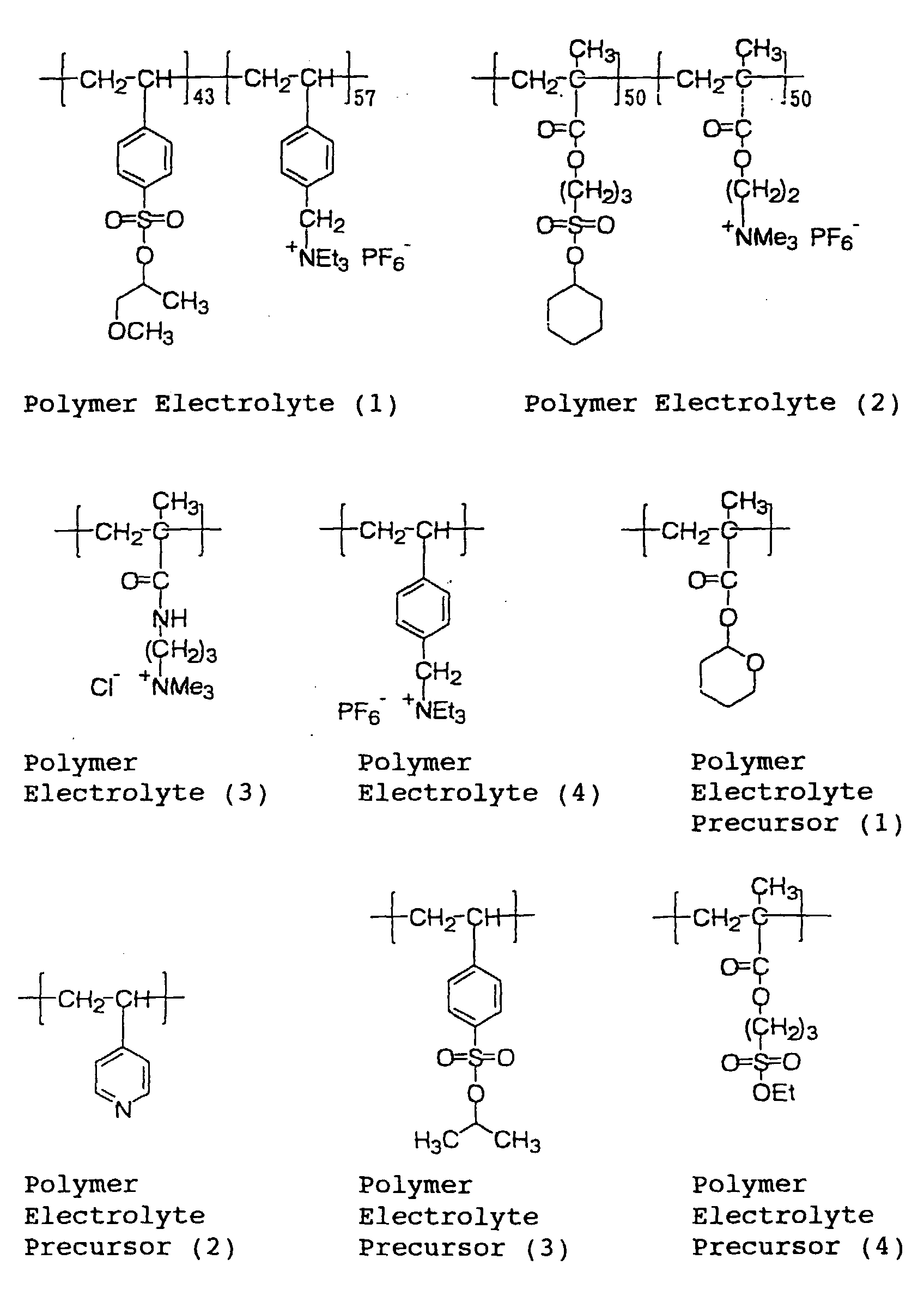
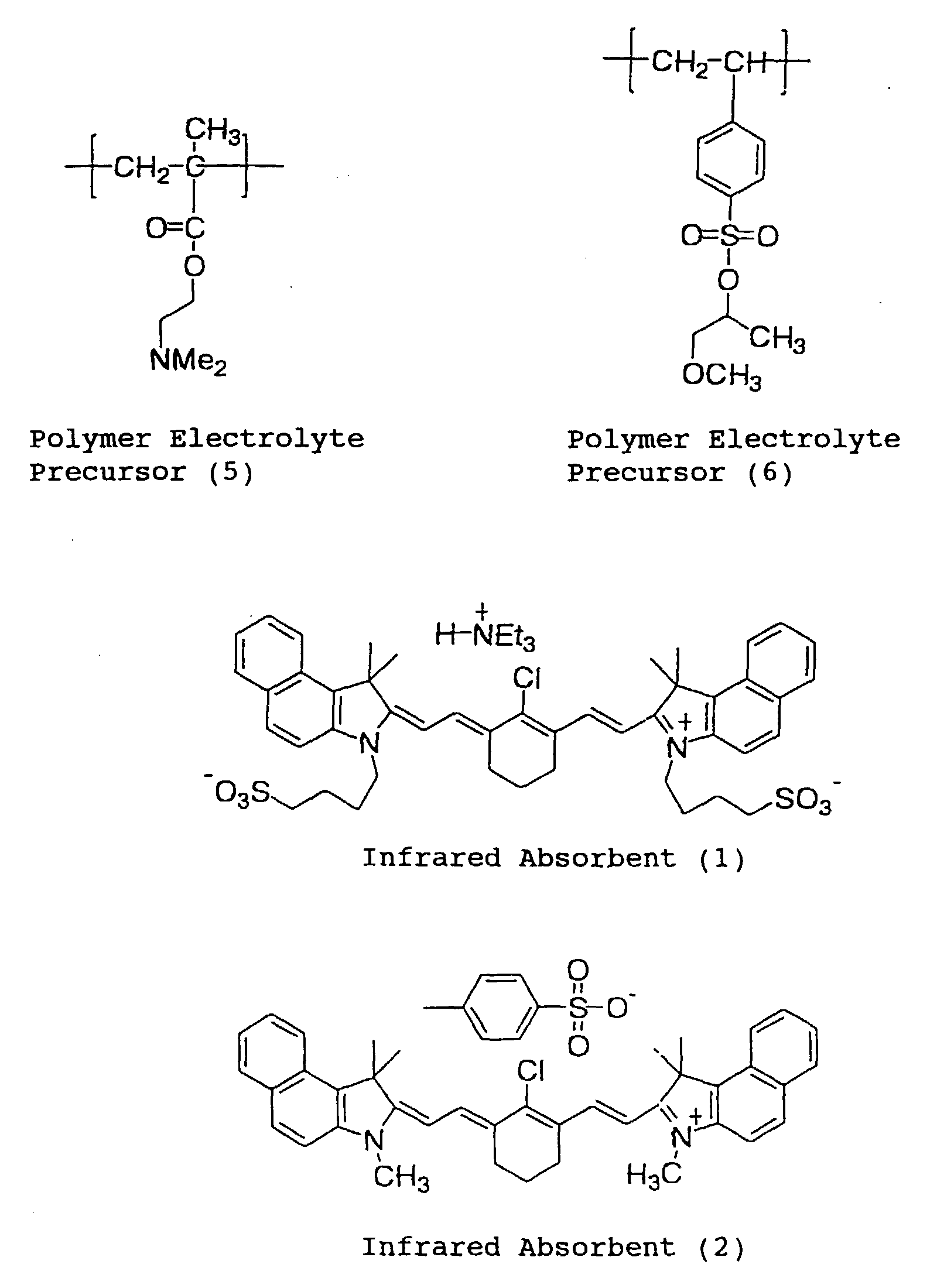

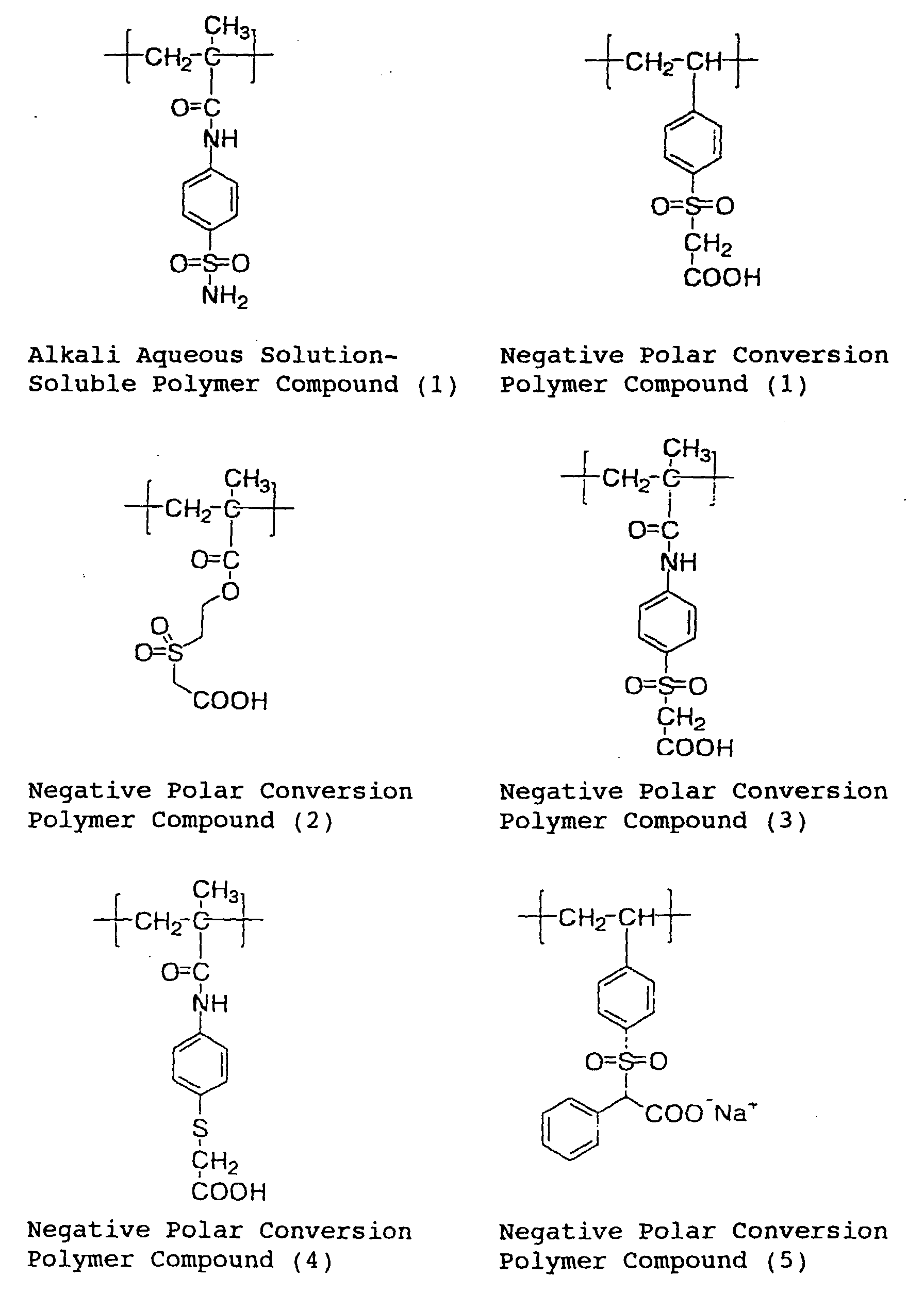
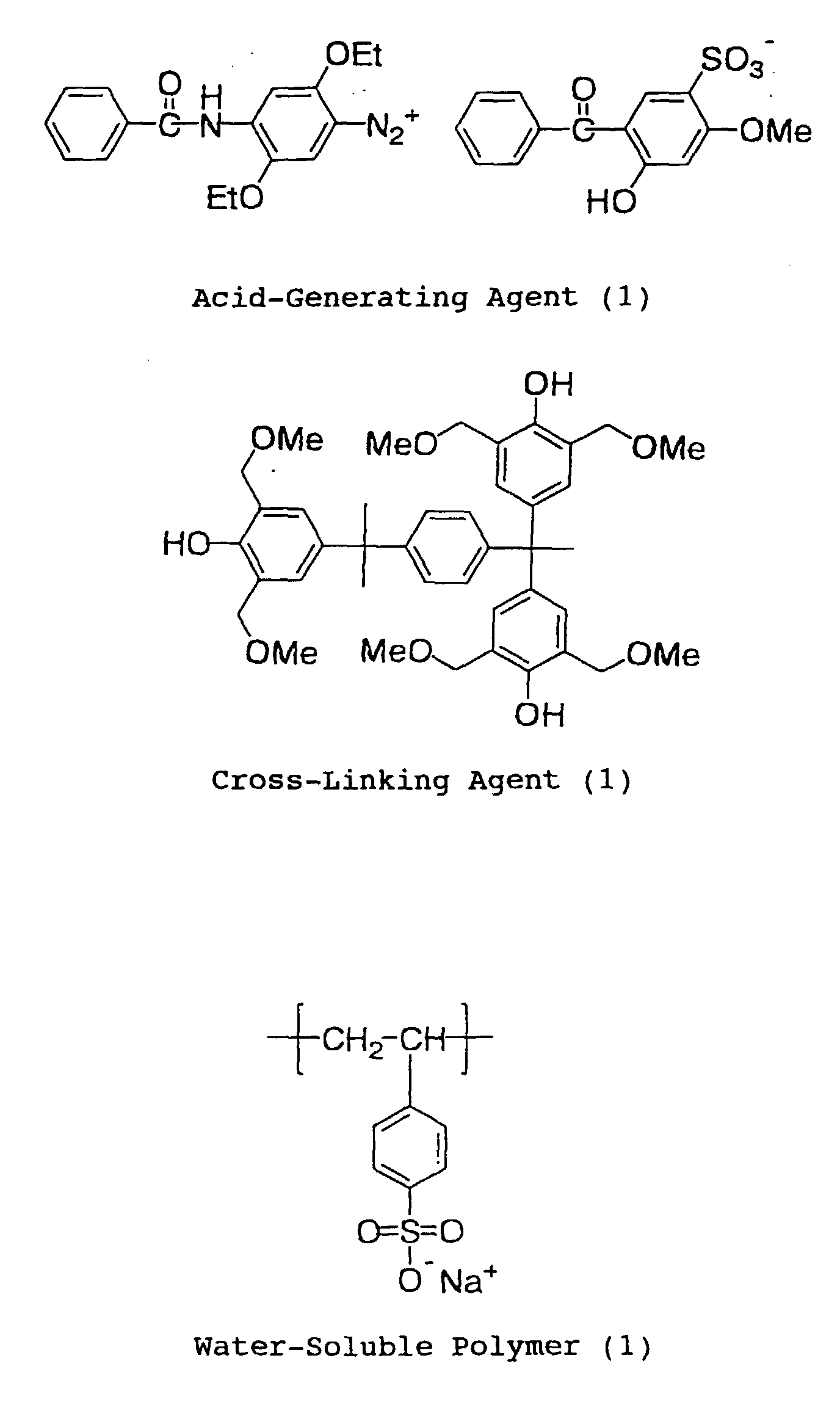
- Lithographic Printing Original Plates (1) to (9), (22) and (26) obtained were exposed by a semiconductor laser capable of emitting an infrared ray at the wavelength of 840 nm or a YAG laser capable of emitting an infrared ray at the wavelength of 1,064 nm, at a main scanning rate of 2.0 m/s. After the exposure, the plates each was dipped in distilled water for 1 minute and the line width in the non-image area was observed by an optical microscope. The laser irradiation energy corresponding to the line width was determined and used as the sensitivity.
- Separately, Lithographic Printing Original Plates (1) to (9), (22) and (26) were exposed in the same manner as above by a semiconductor laser capable of emitting an infrared ray at the wavelength of 840 nm or a YAG laser capable of emitting an infrared ray at the wavelength of 1,064 nm, at a main scanning rate of 2.0 m/s or 4.0 m/s and thereafter, subjected to ordinary printing in Hidel KOR-D printing machine without passing through any treatment. The evaluation was made on whether staining was generated in the non-image area of 3,000th sheet of printed matter and how many sheets of good printed matter could be obtained. The results are shown in Table 1 below.
Lithographic Printing Original Plate Laser for Exposure Line Width Sensitivity (mJ/cm2) Staining in Non-Image Area Number of Sheets of Good Printed Matter 2.0 m/s 4.0 m/s 2.0 m/s 4.0 m/s Example 1 (1) semiconductor 170 none none 50000 50000 2 (2) semiconductor 170 none none 65000 65000 3 (3) semiconductor 180 none none 60000 60000 4 (4) YAG 170 none none 45000 45000 5 (5) semiconductor 190 none none 55000 55000 6 (6) semiconductor 190 none none 63000 63000 7 (7) semiconductor 180 none none 49000 49000 8 (8) semiconductor 170 none none 57000 57000 9 (9) semiconductor 150 none none 55000 55000 Comparative Example 1 (22) semiconductor 230 none stained 45000 500 2 (26) semiconductor 160 none none 20000 20000 - In any case of Lithographic Printing Original Plates (1) to (9) using a polymer complex layer, the sensitivity was high and no staining was generated in the non-image area of 3,000th sheet of printed matter whichever the scanning rate at the exposure was 2.0 m/s or 4.0 m/s.
- Lithographic Printing Original Plate (22) of Comparative Example 1 was a lithographic printing original plate having only a recording layer on the aluminum support. In the case of this lithographic printing original plate, the sensitivity was slightly low and when exposed at a scanning rate of 2.0 m/s, no staining was generated in the non-image area of 3,000th sheet of printed matter and 45,000 sheets of good printed matters were obtained, however, when exposed at a scanning rate of 4.0 m/s, staining was generated in the non-image area of 500th sheet of printed matter. This resulted because in Lithographic Printing Original Plate (22), the water solubilization of recording layer proceeded from the surface of recording layer and when the scanning rate is high (4.0 m/s), the recording layer could not be entirely water solubilized and film remaining of the recording layer was caused.
- Lithographic Printing Original Plate (26) of Comparative Example 2 was a lithographic printing original plate having on the aluminum support a layer containing an infrared absorbent and a water-soluble polymer and a recording layer. In the case of this lithographic printing original plate, the line width sensitivity and the staining in the non-image area of 3,000th sheet of printed matter were almost on the same level as the lithographic printing original plates of Examples 1 to 9. This resulted because the layer containing an infrared absorbent and a water-soluble polymer exerted effects of water solubilizing the recording layer from the lower part and thereby preventing heat diffusion to the aluminum support, which are a part of the effects of the polymer complex layer, and thereby the recording layer could be removed even if the recording layer was not entirely water solubilized. However, the layer containing an infrared absorbent and a water-soluble polymer was gradually dissolved by fountain solution during the printing, therefore, the image area came off and only 20,000 sheets of good printed matters could be obtained.
- Lithographic Printing Original Plates (10) to (13) and (23) obtained were exposed by a semiconductor laser capable of emitting an infrared ray at the wavelength of 840 nm or a YAG laser capable of emitting an infrared ray at the wavelength of 1,064 nm. After the exposure, the plates each was developed using an automatic developing machine ("PS Processor 900VR" manufactured by Fuji Photo Film Co., Ltd.) having charged therein Developer DP-4 and Rinsing Solution FR-3 (1:7) produced by Fuji Photo Film Co., Ltd. At this time, 2 levels of developer DP-4 were used, one was diluted at 1:6 and another was diluted at 1:12. The line width in the non-image areas obtained with respective developers was measured and the laser irradiation energy corresponding to the line width was determined and used as the sensitivity. The difference in the sensitivity between the 1:6 diluted developer as a standard and a 1:12 diluted developer was recorded. The smaller the difference is, the better the development latitude is. Latitude of 20 mJ/cm2 or less is on the practicable level. The results obtained are shown in Table 2 below.
Lithographic Printing Original Plate Sensitivity (mJ/cm2) Development latitude Laser for Exposure Example 10 (10) 120 10 mJ/cm2 Semiconductor 11 (11) 110 5 mJ/cm2 Semiconductor 12 (12) 105 5 mJ/cm2 YAG 13 (13) 110 5 mJ/cm2 Semiconductor Comparative Example 3 (23) 140 30 mJ/cm2 Semiconductor - In any case of Lithographic Printing original Plates (10) to (13) using a polymer complex layer, the sensitivity was high and the development latitude was on the practical level.
- On the other hand, in the case of Lithographic Printing Original Plate (23) of Comparative Example 3 which was a lithographic printing original plate having only a recording layer on the aluminum support, the sensitivity was slightly low and the development latitude did not reach the practical level.
- Lithographic Printing Original Plates (14) to (18) and (24) obtained were exposed by a semiconductor laser capable of emitting an infrared ray at the wavelength of 840 nm or a YAG laser capable of emitting an infrared ray at the wavelength of 1,064 nm, at a main scanning rate of 2.0 m/s. After the exposure, the plates each was dipped in an aqueous solution (water: 84.7%, isopropanol: 10%, triethylamine: 5%, concentrated hydrochloric acid: 0.3%) having a pH of 8.8 and then, the line width in the image area was observed by an optical microscope. The laser irradiation energy corresponding to the line width was determined and used as the sensitivity.
- Separately, Lithographic Printing Original Plates (14) to (18) and (24) were exposed in the same manner as above by a semiconductor laser capable of emitting an infrared ray at the wavelength of 840 nm or a YAG laser capable of emitting an infrared ray at the wavelength of 1,064 nm, at a main scanning rate of 2.0 m/s or 4.0 m/s and thereafter, subjected to ordinary printing in Hidel KOR-D printing machine without passing through any treatment. The conditions of fountain solution for this printing are shown below.
-
- pH: 8.8 (water: 84.7%, isopropanol: 10%, triethylamine: 5%, concentrated hydrochloric acid: 0.3%)
-
- The evaluation was made on whether the image area of 10,000th sheet of printed matter was sufficiently inked and how many sheets of good printed matter could be obtained. The results are shown in Table 3 below.
Lithographic Printing Original Plate Laser for Exposure Line Width Sensitivity (mJ/cm2) Inking Property in Image Area Number of Sheets of Good Printed Matter 2.0 m/s 4.0 m/s 2.0 m/s 4.0 m/s Example 14 (14) Semiconductor 300 good good 32000 32000 15 (15) Semiconductor 280 good good 40000 40000 16 (16) Semiconductor 270 good good 45000 45000 17 (17) YAG 290 good good 35000 35000 18 (18) Semiconductor 310 good good 32000 32000 Comparative Example 4 (24) Semiconductor 350 good bad 30000 0 - In any case of Lithographic Printing Original Plates (14) to (18) using a polymer complex layer, the sensitivity was high and the inking property of image are was good.
- On the other hand, in the case of Lithographic Printing Original Plate (24) of Comparative Example 4, when exposed at a high scanning rate (4.0 m/s), the sensitivity was slightly low and the inking property in the image area was bad. Furthermore, even one sheet of good printed matter could not be obtained.
- Lithographic Printing Original Plates (19) to (21) and (25) obtained were exposed by a semiconductor laser capable of emitting an infrared ray at the wavelength of 840 nm. After the exposure, the plates each was heated in an oven at 140°C for 1 minute and then developed using an automatic developing machine ("PS Processor 900VR" manufactured by Fuji Photo Film Co., Ltd.) having charged therein Developer DP-4 and Rinsing Solution FR-3 (1:7) produced by Fuji Photo Film Co., Ltd. At this time, 2 levels of developer DP-4 were used, one was diluted at 1:6 and another was diluted at 1:12. The line width in the non-image areas obtained with respective developers was measured and the laser irradiation energy corresponding to the line width was determined and used as the sensitivity. The difference in the sensitivity between the 1:6 diluted developer as a standard and a 1:12 diluted developer was recorded. The smaller the difference is, the better the development latitude is. Latitude of 20 mJ/cm2 or less is on the practicable level. The results obtained are shown in Table 4 below.
Lithographic Printing Original Plate Sensitivity (mJ/cm2) Development latitude Example 19 (19) 210 10 mJ/cm2 20 (20) 220 10 mJ/cm2 21 (21) 200 5 mJ/cm2 Comparative Example 5 (25) 260 30 mJ/cm2 - In any case of Lithographic Printing Original Plates (19) to (21) using a polymer complex layer, the sensitivity was high and the development latitude was on the practical level.
- On the other hand, in the case of Lithographic Printing Original Plate (25) of Comparative Example 3 which was a lithographic printing original plate having only a recording layer on the aluminum support, the sensitivity was slightly low and the development latitude did not reach the practical level.
- The lithographic printing original plate of the present invention has a polymer complex layer on the support, therefore, the diffusion of heat to the support is prevented at the time of heat-mode image recording, as a result, high sensitivity can be attained and a printed matter free of residual color or staining can be obtained. In particular, the lithographic printing original plate can attain plate-making directly from digital data by applying image recording thereto using a solid laser or semiconductor laser which emits an infrared ray.
- Furthermore, by using a polar conversion polymer compound (irrespective of positive or negative) in the recording layer, a lithographic printing original plate capable of water development or dispensable with a particular treatment after the writing of an image, such as wet development or rubbing, and having very simple practicability can be provided.
- While the invention has been described in detail and with reference to specific embodiments thereof, it will be apparent to one skilled in the art that various changes and modifications can be made therein without departing from the spirit and scope thereof.
Claims (3)
- A lithographic printing plate precursor comprising a support having sequentially formed thereon a layer containing a polymer complex (Layer A) and a recording layer thermally variable in the solubility in at least one of water and an aqueous solution (Layer B), the support having a hydrophilic surface and at least one of Layer A and Layer B containing a light-heat converting agent.
- The lithographic printing plate precursor as claimed in claim 1, wherein the amount of said layer containing a polymer complex (Layer A) coated is from 0.1 to 1.0 g/m2 and the absorbency at the wavelength of laser for drawing an image is 0.3 or more.
- The lithographic printing plate precursor as claimed in claim 1, wherein said recording layer (Layer B) contains a polymer compound having a hydrophobic functional group thermally variable in the hydrophilicity.
Applications Claiming Priority (2)
| Application Number | Priority Date | Filing Date | Title |
|---|---|---|---|
| JP04259199A JP3775634B2 (en) | 1999-02-22 | 1999-02-22 | Master for lithographic printing plate |
| JP4259199 | 1999-02-22 |
Publications (2)
| Publication Number | Publication Date |
|---|---|
| EP1031414A1 true EP1031414A1 (en) | 2000-08-30 |
| EP1031414B1 EP1031414B1 (en) | 2004-06-16 |
Family
ID=12640318
Family Applications (1)
| Application Number | Title | Priority Date | Filing Date |
|---|---|---|---|
| EP00103355A Expired - Lifetime EP1031414B1 (en) | 1999-02-22 | 2000-02-22 | Lithographic printing plate precursor |
Country Status (4)
| Country | Link |
|---|---|
| US (1) | US6509132B1 (en) |
| EP (1) | EP1031414B1 (en) |
| JP (1) | JP3775634B2 (en) |
| DE (1) | DE60011490T2 (en) |
Cited By (8)
| Publication number | Priority date | Publication date | Assignee | Title |
|---|---|---|---|---|
| EP1155820A3 (en) * | 2000-05-17 | 2003-09-24 | Fuji Photo Film Co., Ltd. | Planographic printing plate |
| EP1203659A3 (en) * | 2000-10-03 | 2004-02-04 | Fuji Photo Film Co., Ltd. | Lithographic printing plate precursor |
| EP1235105A3 (en) * | 2001-02-15 | 2004-02-04 | Fuji Photo Film Co., Ltd. | Planographic printing plate precursor |
| US9780518B2 (en) | 2012-04-18 | 2017-10-03 | Cynosure, Inc. | Picosecond laser apparatus and methods for treating target tissues with same |
| US10245107B2 (en) | 2013-03-15 | 2019-04-02 | Cynosure, Inc. | Picosecond optical radiation systems and methods of use |
| US10434324B2 (en) | 2005-04-22 | 2019-10-08 | Cynosure, Llc | Methods and systems for laser treatment using non-uniform output beam |
| US10849687B2 (en) | 2006-08-02 | 2020-12-01 | Cynosure, Llc | Picosecond laser apparatus and methods for its operation and use |
| US11418000B2 (en) | 2018-02-26 | 2022-08-16 | Cynosure, Llc | Q-switched cavity dumped sub-nanosecond laser |
Families Citing this family (7)
| Publication number | Priority date | Publication date | Assignee | Title |
|---|---|---|---|---|
| US6649324B1 (en) * | 2000-08-14 | 2003-11-18 | Kodak Polychrome Graphics Llc | Aqueous developer for lithographic printing plates |
| CN1324403C (en) * | 2000-11-10 | 2007-07-04 | 富士胶片株式会社 | Photosensitive lithographic printing plate |
| EP1211096A1 (en) * | 2000-12-01 | 2002-06-05 | Fuji Photo Film Co., Ltd. | Base material for lithographic printing plate and lithographic printing plate using the same |
| JP4584478B2 (en) * | 2001-03-19 | 2010-11-24 | コダック株式会社 | Image forming method |
| US20050170282A1 (en) * | 2004-01-23 | 2005-08-04 | Fuji Photo Film Co., Ltd. | Lithographic printing plate precursor and lithographic printing method |
| JP4792326B2 (en) * | 2005-07-25 | 2011-10-12 | 富士フイルム株式会社 | Planographic printing plate preparation method and planographic printing plate precursor |
| EP1974914B1 (en) * | 2007-03-29 | 2014-02-26 | FUJIFILM Corporation | Method of preparing lithographic printing plate |
Citations (6)
| Publication number | Priority date | Publication date | Assignee | Title |
|---|---|---|---|---|
| US3912844A (en) * | 1973-06-01 | 1975-10-14 | Canon Kk | Thermal recording method |
| GB2077452A (en) * | 1980-04-22 | 1981-12-16 | Konishiroku Photo Ind | A heat mode recording material and a recording method using it |
| JPH1069089A (en) * | 1996-08-28 | 1998-03-10 | Fuji Photo Film Co Ltd | Negative plate for planographic printing plate |
| EP0855267A2 (en) * | 1997-01-24 | 1998-07-29 | Fuji Photo Film Co., Ltd. | Planographic printing plate |
| EP0864420A1 (en) * | 1997-03-11 | 1998-09-16 | Agfa-Gevaert N.V. | Heat-sensitive imaging element for making positive working printing plates |
| JPH10329443A (en) * | 1997-04-01 | 1998-12-15 | Toray Ind Inc | Laser-sensitive lithographic printing plate precursor |
Family Cites Families (13)
| Publication number | Priority date | Publication date | Assignee | Title |
|---|---|---|---|---|
| US6022667A (en) * | 1997-05-27 | 2000-02-08 | Agfa-Gevaert, N.V. | Heat sensitive imaging element and a method for producing lithographic plates therewith |
| US6106996A (en) * | 1997-05-27 | 2000-08-22 | Agfa-Gevaert, N.V. | Heat sensitive imaging element and a method for producing lithographic plates therewith |
| DE19739299A1 (en) * | 1997-09-08 | 1999-03-11 | Agfa Gevaert Ag | White light-insensitive, thermally imageable material and process for the production of printing forms for offset printing |
| US6004728A (en) * | 1997-10-08 | 1999-12-21 | Agfa-Gevaert, N.V. | Method for making positive working printing plates from a heat mode sensitive image element |
| US6153352A (en) | 1997-12-10 | 2000-11-28 | Fuji Photo Film Co., Ltd. | Planographic printing plate precursor and a method for producing a planographic printing plate |
| US6165691A (en) * | 1997-12-19 | 2000-12-26 | Agfa-Gevaert, N.V. | Method for lithographic printing by use of a lithographic printing plate provided by a heat sensitive non-ablatable wasteless imaging element and a fountain containing water-insoluble compounds |
| US6165679A (en) * | 1997-12-19 | 2000-12-26 | Agfa-Gevaert, N.V. | Heat-sensitive non-ablatable wasteless imaging element for providing a lithographic printing plate |
| US6153353A (en) * | 1998-03-14 | 2000-11-28 | Agfa-Gevaert, N.V. | Method for making positive working printing plates from a heat mode sensitive imaging element |
| US6096471A (en) * | 1998-05-25 | 2000-08-01 | Agfa-Gevaert, N.V. | Heat sensitive imaging element for providing a lithographic printing plate |
| US6214515B1 (en) * | 1998-05-25 | 2001-04-10 | Agfa-Gevaert | Heat sensitive imaging element for providing a lithographic printing plate |
| US5985514A (en) * | 1998-09-18 | 1999-11-16 | Eastman Kodak Company | Imaging member containing heat sensitive thiosulfate polymer and methods of use |
| US6190831B1 (en) * | 1998-09-29 | 2001-02-20 | Kodak Polychrome Graphics Llc | Processless direct write printing plate having heat sensitive positively-charged polymers and methods of imaging and printing |
| US6162578A (en) * | 1998-12-18 | 2000-12-19 | Eastman Kodak Company | Imaging member containing heat sensitive hyperbranched polymer and methods of use |
-
1999
- 1999-02-22 JP JP04259199A patent/JP3775634B2/en not_active Expired - Lifetime
-
2000
- 2000-02-14 US US09/503,210 patent/US6509132B1/en not_active Expired - Lifetime
- 2000-02-22 EP EP00103355A patent/EP1031414B1/en not_active Expired - Lifetime
- 2000-02-22 DE DE60011490T patent/DE60011490T2/en not_active Expired - Lifetime
Patent Citations (6)
| Publication number | Priority date | Publication date | Assignee | Title |
|---|---|---|---|---|
| US3912844A (en) * | 1973-06-01 | 1975-10-14 | Canon Kk | Thermal recording method |
| GB2077452A (en) * | 1980-04-22 | 1981-12-16 | Konishiroku Photo Ind | A heat mode recording material and a recording method using it |
| JPH1069089A (en) * | 1996-08-28 | 1998-03-10 | Fuji Photo Film Co Ltd | Negative plate for planographic printing plate |
| EP0855267A2 (en) * | 1997-01-24 | 1998-07-29 | Fuji Photo Film Co., Ltd. | Planographic printing plate |
| EP0864420A1 (en) * | 1997-03-11 | 1998-09-16 | Agfa-Gevaert N.V. | Heat-sensitive imaging element for making positive working printing plates |
| JPH10329443A (en) * | 1997-04-01 | 1998-12-15 | Toray Ind Inc | Laser-sensitive lithographic printing plate precursor |
Non-Patent Citations (2)
| Title |
|---|
| DATABASE WPI Section Ch Week 199820, Derwent World Patents Index; Class E19, AN 1998-226149, XP002134541 * |
| PATENT ABSTRACTS OF JAPAN vol. 1999, no. 03 31 March 1999 (1999-03-31) * |
Cited By (24)
| Publication number | Priority date | Publication date | Assignee | Title |
|---|---|---|---|---|
| US6972167B2 (en) | 2000-05-17 | 2005-12-06 | Fuji Photo Film Co., Ltd. | Planographic printing plate |
| EP1155820A3 (en) * | 2000-05-17 | 2003-09-24 | Fuji Photo Film Co., Ltd. | Planographic printing plate |
| EP1203659A3 (en) * | 2000-10-03 | 2004-02-04 | Fuji Photo Film Co., Ltd. | Lithographic printing plate precursor |
| US6824946B2 (en) | 2000-10-03 | 2004-11-30 | Fuji Photo Film Co., Ltd. | Lithographic printing plate precursor |
| US6939658B2 (en) | 2000-10-03 | 2005-09-06 | Fuji Photo Film Co., Ltd. | Lithographic printing plate precursor |
| EP1235105A3 (en) * | 2001-02-15 | 2004-02-04 | Fuji Photo Film Co., Ltd. | Planographic printing plate precursor |
| US10434324B2 (en) | 2005-04-22 | 2019-10-08 | Cynosure, Llc | Methods and systems for laser treatment using non-uniform output beam |
| US11712299B2 (en) | 2006-08-02 | 2023-08-01 | Cynosure, LLC. | Picosecond laser apparatus and methods for its operation and use |
| US10966785B2 (en) | 2006-08-02 | 2021-04-06 | Cynosure, Llc | Picosecond laser apparatus and methods for its operation and use |
| US10849687B2 (en) | 2006-08-02 | 2020-12-01 | Cynosure, Llc | Picosecond laser apparatus and methods for its operation and use |
| US11664637B2 (en) | 2012-04-18 | 2023-05-30 | Cynosure, Llc | Picosecond laser apparatus and methods for treating target tissues with same |
| US10581217B2 (en) | 2012-04-18 | 2020-03-03 | Cynosure, Llc | Picosecond laser apparatus and methods for treating target tissues with same |
| US12431683B2 (en) | 2012-04-18 | 2025-09-30 | Cynosure, Llc | Picosecond laser apparatus and methods for treating target tissues with same |
| US10305244B2 (en) | 2012-04-18 | 2019-05-28 | Cynosure, Llc | Picosecond laser apparatus and methods for treating target tissues with same |
| US12068571B2 (en) | 2012-04-18 | 2024-08-20 | Cynosure, Llc | Picosecond laser apparatus and methods for treating target tissues with same |
| US11095087B2 (en) | 2012-04-18 | 2021-08-17 | Cynosure, Llc | Picosecond laser apparatus and methods for treating target tissues with same |
| US9780518B2 (en) | 2012-04-18 | 2017-10-03 | Cynosure, Inc. | Picosecond laser apparatus and methods for treating target tissues with same |
| US11446086B2 (en) | 2013-03-15 | 2022-09-20 | Cynosure, Llc | Picosecond optical radiation systems and methods of use |
| US10245107B2 (en) | 2013-03-15 | 2019-04-02 | Cynosure, Inc. | Picosecond optical radiation systems and methods of use |
| US10285757B2 (en) | 2013-03-15 | 2019-05-14 | Cynosure, Llc | Picosecond optical radiation systems and methods of use |
| US12193734B2 (en) | 2013-03-15 | 2025-01-14 | Cynosure, Llc | Picosecond optical radiation systems and methods of use |
| US10765478B2 (en) | 2013-03-15 | 2020-09-08 | Cynosurce, Llc | Picosecond optical radiation systems and methods of use |
| US11418000B2 (en) | 2018-02-26 | 2022-08-16 | Cynosure, Llc | Q-switched cavity dumped sub-nanosecond laser |
| US11791603B2 (en) | 2018-02-26 | 2023-10-17 | Cynosure, LLC. | Q-switched cavity dumped sub-nanosecond laser |
Also Published As
| Publication number | Publication date |
|---|---|
| US6509132B1 (en) | 2003-01-21 |
| JP2000238453A (en) | 2000-09-05 |
| DE60011490D1 (en) | 2004-07-22 |
| DE60011490T2 (en) | 2005-06-23 |
| JP3775634B2 (en) | 2006-05-17 |
| EP1031414B1 (en) | 2004-06-16 |
Similar Documents
| Publication | Publication Date | Title |
|---|---|---|
| US6824946B2 (en) | Lithographic printing plate precursor | |
| US6153352A (en) | Planographic printing plate precursor and a method for producing a planographic printing plate | |
| EP1093934A1 (en) | Photosensitive composition and planographic printing plate using the same | |
| US6331375B1 (en) | Photosensitive lithographic form plate using an image-forming material | |
| EP1031414B1 (en) | Lithographic printing plate precursor | |
| US6096479A (en) | Photosensitive lithographic form plate using an image-forming material | |
| EP0938972B1 (en) | Photosensitive lithographic form plate using an image-forming material | |
| EP1038668B1 (en) | Photosensitive composition and planographic printing plate precursor using same | |
| EP1371500B1 (en) | Lithographic printing plate precursor | |
| US6455224B1 (en) | Lithographic printing plate precursor | |
| JP2004276603A (en) | Support for lithographic printing plate | |
| EP0945264B1 (en) | Anionic infrared-ray absorbing agent, photosensitive composition and planographic printing plate precursor using same | |
| JP2004045869A (en) | Image forming material | |
| JP4210424B2 (en) | Master for lithographic printing plate | |
| JP3920457B2 (en) | Positive photosensitive lithographic printing plate | |
| JP3741342B2 (en) | Original plate for lithographic printing plates | |
| JP4004651B2 (en) | Planographic printing plate precursor and lithographic printing plate manufacturing method | |
| JP3698391B2 (en) | On-press development type lithographic printing plate precursor | |
| JP3761127B2 (en) | Original plate for lithographic printing plates | |
| JP2002174895A (en) | Original plate for planographic printing plate |
Legal Events
| Date | Code | Title | Description |
|---|---|---|---|
| PUAI | Public reference made under article 153(3) epc to a published international application that has entered the european phase |
Free format text: ORIGINAL CODE: 0009012 |
|
| AK | Designated contracting states |
Kind code of ref document: A1 Designated state(s): AT BE CH CY DE DK ES FI FR GB GR IE IT LI LU MC NL PT SE |
|
| AX | Request for extension of the european patent |
Free format text: AL;LT;LV;MK;RO;SI |
|
| 17P | Request for examination filed |
Effective date: 20001020 |
|
| AKX | Designation fees paid |
Free format text: DE GB |
|
| RBV | Designated contracting states (corrected) |
Designated state(s): AT BE CH CY DE DK ES FI FR GB GR IE IT LI LU MC NL PT SE |
|
| GRAP | Despatch of communication of intention to grant a patent |
Free format text: ORIGINAL CODE: EPIDOSNIGR1 |
|
| RBV | Designated contracting states (corrected) |
Designated state(s): DE GB |
|
| GRAS | Grant fee paid |
Free format text: ORIGINAL CODE: EPIDOSNIGR3 |
|
| GRAA | (expected) grant |
Free format text: ORIGINAL CODE: 0009210 |
|
| AK | Designated contracting states |
Kind code of ref document: B1 Designated state(s): DE GB |
|
| REG | Reference to a national code |
Ref country code: GB Ref legal event code: FG4D |
|
| REF | Corresponds to: |
Ref document number: 60011490 Country of ref document: DE Date of ref document: 20040722 Kind code of ref document: P |
|
| REG | Reference to a national code |
Ref country code: IE Ref legal event code: FG4D |
|
| PLBE | No opposition filed within time limit |
Free format text: ORIGINAL CODE: 0009261 |
|
| STAA | Information on the status of an ep patent application or granted ep patent |
Free format text: STATUS: NO OPPOSITION FILED WITHIN TIME LIMIT |
|
| 26N | No opposition filed |
Effective date: 20050317 |
|
| REG | Reference to a national code |
Ref country code: GB Ref legal event code: 732E |
|
| PGFP | Annual fee paid to national office [announced via postgrant information from national office to epo] |
Ref country code: GB Payment date: 20190220 Year of fee payment: 20 Ref country code: DE Payment date: 20190212 Year of fee payment: 20 |
|
| REG | Reference to a national code |
Ref country code: DE Ref legal event code: R071 Ref document number: 60011490 Country of ref document: DE |
|
| REG | Reference to a national code |
Ref country code: GB Ref legal event code: PE20 Expiry date: 20200221 |
|
| PG25 | Lapsed in a contracting state [announced via postgrant information from national office to epo] |
Ref country code: GB Free format text: LAPSE BECAUSE OF EXPIRATION OF PROTECTION Effective date: 20200221 |