EP1030735B1 - Gas storage carbon with enhanced thermal conductivity - Google Patents
Gas storage carbon with enhanced thermal conductivity Download PDFInfo
- Publication number
- EP1030735B1 EP1030735B1 EP99951440A EP99951440A EP1030735B1 EP 1030735 B1 EP1030735 B1 EP 1030735B1 EP 99951440 A EP99951440 A EP 99951440A EP 99951440 A EP99951440 A EP 99951440A EP 1030735 B1 EP1030735 B1 EP 1030735B1
- Authority
- EP
- European Patent Office
- Prior art keywords
- thermal conductivity
- monolith
- hybrid
- carbon
- carbon fiber
- Prior art date
- Legal status (The legal status is an assumption and is not a legal conclusion. Google has not performed a legal analysis and makes no representation as to the accuracy of the status listed.)
- Expired - Lifetime
Links
Images

Classifications
-
- B—PERFORMING OPERATIONS; TRANSPORTING
- B01—PHYSICAL OR CHEMICAL PROCESSES OR APPARATUS IN GENERAL
- B01J—CHEMICAL OR PHYSICAL PROCESSES, e.g. CATALYSIS OR COLLOID CHEMISTRY; THEIR RELEVANT APPARATUS
- B01J20/00—Solid sorbent compositions or filter aid compositions; Sorbents for chromatography; Processes for preparing, regenerating or reactivating thereof
- B01J20/02—Solid sorbent compositions or filter aid compositions; Sorbents for chromatography; Processes for preparing, regenerating or reactivating thereof comprising inorganic material
- B01J20/20—Solid sorbent compositions or filter aid compositions; Sorbents for chromatography; Processes for preparing, regenerating or reactivating thereof comprising inorganic material comprising free carbon; comprising carbon obtained by carbonising processes
-
- B—PERFORMING OPERATIONS; TRANSPORTING
- B01—PHYSICAL OR CHEMICAL PROCESSES OR APPARATUS IN GENERAL
- B01J—CHEMICAL OR PHYSICAL PROCESSES, e.g. CATALYSIS OR COLLOID CHEMISTRY; THEIR RELEVANT APPARATUS
- B01J20/00—Solid sorbent compositions or filter aid compositions; Sorbents for chromatography; Processes for preparing, regenerating or reactivating thereof
- B01J20/28—Solid sorbent compositions or filter aid compositions; Sorbents for chromatography; Processes for preparing, regenerating or reactivating thereof characterised by their form or physical properties
- B01J20/28014—Solid sorbent compositions or filter aid compositions; Sorbents for chromatography; Processes for preparing, regenerating or reactivating thereof characterised by their form or physical properties characterised by their form
- B01J20/28023—Fibres or filaments
-
- B—PERFORMING OPERATIONS; TRANSPORTING
- B01—PHYSICAL OR CHEMICAL PROCESSES OR APPARATUS IN GENERAL
- B01J—CHEMICAL OR PHYSICAL PROCESSES, e.g. CATALYSIS OR COLLOID CHEMISTRY; THEIR RELEVANT APPARATUS
- B01J20/00—Solid sorbent compositions or filter aid compositions; Sorbents for chromatography; Processes for preparing, regenerating or reactivating thereof
- B01J20/28—Solid sorbent compositions or filter aid compositions; Sorbents for chromatography; Processes for preparing, regenerating or reactivating thereof characterised by their form or physical properties
- B01J20/28014—Solid sorbent compositions or filter aid compositions; Sorbents for chromatography; Processes for preparing, regenerating or reactivating thereof characterised by their form or physical properties characterised by their form
- B01J20/28042—Shaped bodies; Monolithic structures
-
- F—MECHANICAL ENGINEERING; LIGHTING; HEATING; WEAPONS; BLASTING
- F17—STORING OR DISTRIBUTING GASES OR LIQUIDS
- F17C—VESSELS FOR CONTAINING OR STORING COMPRESSED, LIQUEFIED OR SOLIDIFIED GASES; FIXED-CAPACITY GAS-HOLDERS; FILLING VESSELS WITH, OR DISCHARGING FROM VESSELS, COMPRESSED, LIQUEFIED, OR SOLIDIFIED GASES
- F17C11/00—Use of gas-solvents or gas-sorbents in vessels
-
- B—PERFORMING OPERATIONS; TRANSPORTING
- B01—PHYSICAL OR CHEMICAL PROCESSES OR APPARATUS IN GENERAL
- B01D—SEPARATION
- B01D2253/00—Adsorbents used in seperation treatment of gases and vapours
- B01D2253/10—Inorganic adsorbents
- B01D2253/102—Carbon
-
- B—PERFORMING OPERATIONS; TRANSPORTING
- B01—PHYSICAL OR CHEMICAL PROCESSES OR APPARATUS IN GENERAL
- B01D—SEPARATION
- B01D2253/00—Adsorbents used in seperation treatment of gases and vapours
- B01D2253/30—Physical properties of adsorbents
- B01D2253/34—Specific shapes
- B01D2253/342—Monoliths
-
- B—PERFORMING OPERATIONS; TRANSPORTING
- B01—PHYSICAL OR CHEMICAL PROCESSES OR APPARATUS IN GENERAL
- B01D—SEPARATION
- B01D53/00—Separation of gases or vapours; Recovering vapours of volatile solvents from gases; Chemical or biological purification of waste gases, e.g. engine exhaust gases, smoke, fumes, flue gases, aerosols
- B01D53/02—Separation of gases or vapours; Recovering vapours of volatile solvents from gases; Chemical or biological purification of waste gases, e.g. engine exhaust gases, smoke, fumes, flue gases, aerosols by adsorption, e.g. preparative gas chromatography
-
- Y—GENERAL TAGGING OF NEW TECHNOLOGICAL DEVELOPMENTS; GENERAL TAGGING OF CROSS-SECTIONAL TECHNOLOGIES SPANNING OVER SEVERAL SECTIONS OF THE IPC; TECHNICAL SUBJECTS COVERED BY FORMER USPC CROSS-REFERENCE ART COLLECTIONS [XRACs] AND DIGESTS
- Y10—TECHNICAL SUBJECTS COVERED BY FORMER USPC
- Y10T—TECHNICAL SUBJECTS COVERED BY FORMER US CLASSIFICATION
- Y10T428/00—Stock material or miscellaneous articles
- Y10T428/249921—Web or sheet containing structurally defined element or component
- Y10T428/249924—Noninterengaged fiber-containing paper-free web or sheet which is not of specified porosity
- Y10T428/249928—Fiber embedded in a ceramic, glass, or carbon matrix
-
- Y—GENERAL TAGGING OF NEW TECHNOLOGICAL DEVELOPMENTS; GENERAL TAGGING OF CROSS-SECTIONAL TECHNOLOGIES SPANNING OVER SEVERAL SECTIONS OF THE IPC; TECHNICAL SUBJECTS COVERED BY FORMER USPC CROSS-REFERENCE ART COLLECTIONS [XRACs] AND DIGESTS
- Y10—TECHNICAL SUBJECTS COVERED BY FORMER USPC
- Y10T—TECHNICAL SUBJECTS COVERED BY FORMER US CLASSIFICATION
- Y10T428/00—Stock material or miscellaneous articles
- Y10T428/249921—Web or sheet containing structurally defined element or component
- Y10T428/249924—Noninterengaged fiber-containing paper-free web or sheet which is not of specified porosity
- Y10T428/249928—Fiber embedded in a ceramic, glass, or carbon matrix
- Y10T428/249929—Fibers are aligned substantially parallel
-
- Y—GENERAL TAGGING OF NEW TECHNOLOGICAL DEVELOPMENTS; GENERAL TAGGING OF CROSS-SECTIONAL TECHNOLOGIES SPANNING OVER SEVERAL SECTIONS OF THE IPC; TECHNICAL SUBJECTS COVERED BY FORMER USPC CROSS-REFERENCE ART COLLECTIONS [XRACs] AND DIGESTS
- Y10—TECHNICAL SUBJECTS COVERED BY FORMER USPC
- Y10T—TECHNICAL SUBJECTS COVERED BY FORMER US CLASSIFICATION
- Y10T428/00—Stock material or miscellaneous articles
- Y10T428/249921—Web or sheet containing structurally defined element or component
- Y10T428/249924—Noninterengaged fiber-containing paper-free web or sheet which is not of specified porosity
- Y10T428/24994—Fiber embedded in or on the surface of a polymeric matrix
-
- Y—GENERAL TAGGING OF NEW TECHNOLOGICAL DEVELOPMENTS; GENERAL TAGGING OF CROSS-SECTIONAL TECHNOLOGIES SPANNING OVER SEVERAL SECTIONS OF THE IPC; TECHNICAL SUBJECTS COVERED BY FORMER USPC CROSS-REFERENCE ART COLLECTIONS [XRACs] AND DIGESTS
- Y10—TECHNICAL SUBJECTS COVERED BY FORMER USPC
- Y10T—TECHNICAL SUBJECTS COVERED BY FORMER US CLASSIFICATION
- Y10T428/00—Stock material or miscellaneous articles
- Y10T428/249921—Web or sheet containing structurally defined element or component
- Y10T428/249924—Noninterengaged fiber-containing paper-free web or sheet which is not of specified porosity
- Y10T428/24994—Fiber embedded in or on the surface of a polymeric matrix
- Y10T428/249942—Fibers are aligned substantially parallel
- Y10T428/249945—Carbon or carbonaceous fiber
-
- Y—GENERAL TAGGING OF NEW TECHNOLOGICAL DEVELOPMENTS; GENERAL TAGGING OF CROSS-SECTIONAL TECHNOLOGIES SPANNING OVER SEVERAL SECTIONS OF THE IPC; TECHNICAL SUBJECTS COVERED BY FORMER USPC CROSS-REFERENCE ART COLLECTIONS [XRACs] AND DIGESTS
- Y10—TECHNICAL SUBJECTS COVERED BY FORMER USPC
- Y10T—TECHNICAL SUBJECTS COVERED BY FORMER US CLASSIFICATION
- Y10T428/00—Stock material or miscellaneous articles
- Y10T428/249921—Web or sheet containing structurally defined element or component
- Y10T428/249924—Noninterengaged fiber-containing paper-free web or sheet which is not of specified porosity
- Y10T428/24994—Fiber embedded in or on the surface of a polymeric matrix
- Y10T428/249949—Two or more chemically different fibers
-
- Y—GENERAL TAGGING OF NEW TECHNOLOGICAL DEVELOPMENTS; GENERAL TAGGING OF CROSS-SECTIONAL TECHNOLOGIES SPANNING OVER SEVERAL SECTIONS OF THE IPC; TECHNICAL SUBJECTS COVERED BY FORMER USPC CROSS-REFERENCE ART COLLECTIONS [XRACs] AND DIGESTS
- Y10—TECHNICAL SUBJECTS COVERED BY FORMER USPC
- Y10T—TECHNICAL SUBJECTS COVERED BY FORMER US CLASSIFICATION
- Y10T428/00—Stock material or miscellaneous articles
- Y10T428/249921—Web or sheet containing structurally defined element or component
- Y10T428/249953—Composite having voids in a component [e.g., porous, cellular, etc.]
-
- Y—GENERAL TAGGING OF NEW TECHNOLOGICAL DEVELOPMENTS; GENERAL TAGGING OF CROSS-SECTIONAL TECHNOLOGIES SPANNING OVER SEVERAL SECTIONS OF THE IPC; TECHNICAL SUBJECTS COVERED BY FORMER USPC CROSS-REFERENCE ART COLLECTIONS [XRACs] AND DIGESTS
- Y10—TECHNICAL SUBJECTS COVERED BY FORMER USPC
- Y10T—TECHNICAL SUBJECTS COVERED BY FORMER US CLASSIFICATION
- Y10T428/00—Stock material or miscellaneous articles
- Y10T428/249921—Web or sheet containing structurally defined element or component
- Y10T428/249953—Composite having voids in a component [e.g., porous, cellular, etc.]
- Y10T428/249967—Inorganic matrix in void-containing component
-
- Y—GENERAL TAGGING OF NEW TECHNOLOGICAL DEVELOPMENTS; GENERAL TAGGING OF CROSS-SECTIONAL TECHNOLOGIES SPANNING OVER SEVERAL SECTIONS OF THE IPC; TECHNICAL SUBJECTS COVERED BY FORMER USPC CROSS-REFERENCE ART COLLECTIONS [XRACs] AND DIGESTS
- Y10—TECHNICAL SUBJECTS COVERED BY FORMER USPC
- Y10T—TECHNICAL SUBJECTS COVERED BY FORMER US CLASSIFICATION
- Y10T428/00—Stock material or miscellaneous articles
- Y10T428/29—Coated or structually defined flake, particle, cell, strand, strand portion, rod, filament, macroscopic fiber or mass thereof
- Y10T428/2913—Rod, strand, filament or fiber
- Y10T428/2918—Rod, strand, filament or fiber including free carbon or carbide or therewith [not as steel]
-
- Y—GENERAL TAGGING OF NEW TECHNOLOGICAL DEVELOPMENTS; GENERAL TAGGING OF CROSS-SECTIONAL TECHNOLOGIES SPANNING OVER SEVERAL SECTIONS OF THE IPC; TECHNICAL SUBJECTS COVERED BY FORMER USPC CROSS-REFERENCE ART COLLECTIONS [XRACs] AND DIGESTS
- Y10—TECHNICAL SUBJECTS COVERED BY FORMER USPC
- Y10T—TECHNICAL SUBJECTS COVERED BY FORMER US CLASSIFICATION
- Y10T428/00—Stock material or miscellaneous articles
- Y10T428/30—Self-sustaining carbon mass or layer with impregnant or other layer
Definitions
- the present invention relates to a porous gas storage carbon fiber carbon matrix hybrid adsorbent monolith with enhanced thermal conductivity.
- Granular activated carbons are widely used for gas separation and storage.
- GAC beds can develop large temperature gradients that reduce the efficiency of the adsorption or storage system in which they are operating. The magnitude of this temperature gradient depends upon the heat of adsorption of the gas being adsorbed or desorbed, the thermal conductivity of the GAC bed, and the heat transfer coefficient of the containment vessel. Typically, the temperature drop in a packed carbon bed during desorption of a gas is several tens of degrees.
- Barbosa Mota reports that for a natural gas storage vessel discharged from a pressure of 35 atmospheres (atm.) to 1.2 atm (3535 to 121 kPa), over a period of 1.6 hours, the bed temperature dropped from 20° to -19°C, a drop of 39°C. Since the volume of gas desorbed at a given pressure decreases as the GAC temperature decreases, a large amount of gas is retained on the carbon and is thus not available for use.
- the thermal conductivity of GAC is inherently low because of the disordered structure of the carbon, and its low bulk density (typically 0.4 - 1.0 g/cm 3 ). The thermal conductivity of a packed bed of GAC is even lower because of the low pack density of the bed (typically 0.4-0.6 g/cm 3 ) and the additional particle to particle contact resistance.
- Thermal conductivity data for GAC in packed beds are somewhat limited. Gurgel and Grenier [2] report thermal conductivity measurements made using a steady state method on a packed bed of commercial GAC (AC 35 supplied by CECA) in the presence of methanol. The reported packed carbon bed conductivity varied with methanol pressure over the range 0-110 millibar, from 0.14 W/m•K to 0.17 W/m•K at a packing density of 0.65 g/cm 3 . The derived grain conductivity for the GAC was 0.61 - 0.65 W/m•K for methanol adsorbate concentrations from 0 to 0.3 g/g.
- Thermal conductivity of 0.25-0.3 W/m•K found in the instant invention is a significant improvement over the thermal conductivity of conventional packed carbon beds (0.14 - 0.19 W/m•K) [2-4].
- the thermal conductivity of the CFCMS monolith is further increased by the addition of highly conductive carbon fibers.
- the use of a hybrid monolith with enhanced thermal conductivity reduces the temperature gradients in a gas storage or separation vessel and thus results in process efficiency improvements.
- a series of high density hybrid adsorbent monoliths were manufactured from blends of isotropic pitch derived carbon fibers (type P-400 supplied by the Anshan East Asia Carbon Company, Anshan, China) and mespohase pitch derived carbon fibers (type DKDX supplied by Amoco Performance Products, Alpharetta, GA).
- the manufacturing process was similar to that previously disclosed in US-A-6030698 entitled Activated Carbon Fiber Composite Material and Method of Making except that (i) a blend of fibers was used, and (ii) the hybrid monoliths manufactured were hot pressed at 300°C at low pressures.
- the binder used was a powdered phenolic resin.
- the hybrid monoliths were carbonized at 650°C in a nitrogen atmosphere.
- Table 1 reports the composition, dimensions and densities of the hybrid monoliths produced. Carbon fiber adsorbent hybrid monolith formulations and densities (post carbonization).
- SPECIMEN MASS g
- DIAMETER cm
- LENGTH cm
- DENSITY g/cm 3
- MASS FRACTION OF CONSTITUENTS IN MONOLITH % RESIN CHAR ISOTROPIC PITCH FIBER MESOPHASE PITCH FIBER K0-A 243.83 11.46 3.94 0.60 11 89 0 K1-A 246.46 11.48 4.23 0.56 11 84 5 K2-A 256.81 11.48 3.86 0.64 11 78 11 K3-A 246.94 11.46 3.66 0.65 11 71 18
- Improved thermal conductivity of the hybrid monoliths compared to standard CFCMS can be attributed to the following: (i) isotropic pitch derived carbon fibers have a higher density than GAC, thus they can be expected to have a greater thermal conductivity; (ii) the DKDX mesophase pitch derived fibers have a thermal conductivity of 500 - 700 W/m•K; (iii) the thermal conductivity increases with increasing bulk density because there is physically more carbon available to conduct the heat; (iv) there is increased connectivity between the fibers in the high density monoliths and hybrids.
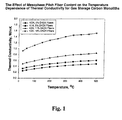
- the temperature dependence of the thermal conductivity of the adsorbent hybrid monoliths is shown in Fig. 1.
- the thermal conductivity increases with density and DKDX fiber content for the reasons discussed above.
- the increase in thermal conductivity with temperature is due to increased in-pore radiation of heat at higher temperatures.
- Tables 3 and 4 show that the hybrid monoliths activate in a similar fashion to standard CFCMS.
- SMW-3 (Table 4) has a burn-off of 9.4% and a BET surface area of 528 m 2 /g compared with K1B (Table 3) with an identical burn-off and a BET surface area of 540 m 2 /g.
- the DR micropore volumes are very similar for the two materials. BET surface area and DR micropore volume data for standard CFCMS material [6].
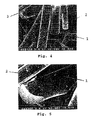
- Figures 2 through 5 show electron micrographs of Specimen K3A comprising isotropic pitch derived carbon fibers 1 and mesophase pitch derived carbon fibers 2.
- This specimen contains 18% by weight of the DKDX mesophase fibers 2 .
- the isotropic pitch derived fibers 1 are distinguishable by their larger diameter.
- the mesophase pitch fibers 2 have an observable texture (see the two higher magnification pictures), whereas the isotropic pitch fibers 1 are featureless.
Landscapes
- Chemical & Material Sciences (AREA)
- Analytical Chemistry (AREA)
- Organic Chemistry (AREA)
- Chemical Kinetics & Catalysis (AREA)
- Engineering & Computer Science (AREA)
- Mechanical Engineering (AREA)
- Inorganic Chemistry (AREA)
- General Engineering & Computer Science (AREA)
- Solid-Sorbent Or Filter-Aiding Compositions (AREA)
- Carbon And Carbon Compounds (AREA)
- Inorganic Fibers (AREA)
- Nonwoven Fabrics (AREA)
- Filling Or Discharging Of Gas Storage Vessels (AREA)
Abstract
Description
| Carbon fiber adsorbent hybrid monolith formulations and densities (post carbonization). | |||||||
| SPECIMEN | MASS (g) | DIAMETER (cm) | LENGTH (cm) | DENSITY (g/cm3) | MASS FRACTION OF CONSTITUENTS IN MONOLITH (%) | ||
| RESIN CHAR | ISOTROPIC PITCH FIBER | MESOPHASE PITCH FIBER | |||||
| K0-A | 243.83 | 11.46 | 3.94 | 0.60 | 11 | 89 | 0 |
| K1-A | 246.46 | 11.48 | 4.23 | 0.56 | 11 | 84 | 5 |
| K2-A | 256.81 | 11.48 | 3.86 | 0.64 | 11 | 78 | 11 |
| K3-A | 246.94 | 11.46 | 3.66 | 0.65 | 11 | 71 | 18 |
| Room temperature thermal conductivity of carbon fiber based adsorbent hybrid monoliths | |||
| SPECIMEN | DKDX FIBER CONTENT (%) | DENSITY (g/cm3) | THERMAL CONDUCTIVITY (W/m•K) |
| K0- | 0 | 0.606 | 0.250 |
| K2- | 11 | 0.645 | 0.485 |
| K3- | 18 | 0.634 | 0.930 |
| BET surface area and DR micropore volume data for carbon fiber based hybrid adsorbent monoliths | ||||
| SPECIMEN | DKDX FIBER CONTENT (%) | BURN-OFF (%) | BET SURFACE AREA (m2/g) | DR MICROPORE VOLUME (cm3/g) |
| K0- | 0 | 5.5 | 429 | 0.16 |
| K1- | 5 | 7.2 | 406 | 0.16 |
| K3- | 18 | 4.3 | 307 | 0.12 |
| | 0 | 5.6 | 445 | 0.16 |
| | 5 | 9.4 | 540 | 0.21 |
| | 18 | 5.3 | 429 | 0.17 |
| BET surface area and DR micropore volume data for standard CFCMS material [6]. | |||
| SPECIMEN ID | BURN-OFF | BET SURFACE AREA (m2/g) | DR MICROPORE VOLUME (cm3/g) |
| SMW-1 | 10 | 496 | 0.22 |
| SMW-3 | 9.4 | 528 | 0.20 |
| SMW-4 | 8.5 | 714 | 0.27 |
| SMW-8 | 13.4 | 574 | 0.22 |
| Micropore data and NG storage capacities for high density, high thermal conductivity monoliths | |||||
| Monolith Identity | Final Density (g/cm3) | Burn-off (%) | BET Surface Area (m2/g) | DR Micropore Volume (cm3/g) | NG Storage Capacity (STP V/V @ 500 psi) |
| SMS-2B | 0.47 | 3.20 | 941 | 0.36 | 76 |
| SMS-3B | 0.40 | 32.0 | 1283 | 0.49 | 84 |
| SMS-5A | 0.50 | 38.4 | 1608 | 0.60 | 104 |
Claims (1)
- A porous activated carbon fiber carbon matrix hybrid monolith comprising: 71% to 89% of a first isotropic pitch derived carbon fiber, up to 18% of a second mesophase pitch derived carbon fiber, up to 29% of a carbonizable organic binder, and said monolith having a thermal conductivity in the range of 0.25 to 0.93 W/m•K.
Applications Claiming Priority (3)
| Application Number | Priority Date | Filing Date | Title |
|---|---|---|---|
| US151920 | 1998-09-11 | ||
| US09/151,920 US6090477A (en) | 1998-09-11 | 1998-09-11 | Gas storage carbon with enhanced thermal conductivity |
| PCT/US1999/020973 WO2000015330A1 (en) | 1998-09-11 | 1999-09-10 | Gas storage carbon with enhanced thermal conductivity |
Publications (2)
| Publication Number | Publication Date |
|---|---|
| EP1030735A1 EP1030735A1 (en) | 2000-08-30 |
| EP1030735B1 true EP1030735B1 (en) | 2003-07-23 |
Family
ID=22540811
Family Applications (1)
| Application Number | Title | Priority Date | Filing Date |
|---|---|---|---|
| EP99951440A Expired - Lifetime EP1030735B1 (en) | 1998-09-11 | 1999-09-10 | Gas storage carbon with enhanced thermal conductivity |
Country Status (7)
| Country | Link |
|---|---|
| US (1) | US6090477A (en) |
| EP (1) | EP1030735B1 (en) |
| AT (1) | ATE245481T1 (en) |
| AU (1) | AU6387999A (en) |
| CA (1) | CA2309720C (en) |
| DE (1) | DE69909737T2 (en) |
| WO (1) | WO2000015330A1 (en) |
Families Citing this family (29)
| Publication number | Priority date | Publication date | Assignee | Title |
|---|---|---|---|---|
| US6475411B1 (en) | 1998-09-11 | 2002-11-05 | Ut-Battelle, Llc | Method of making improved gas storage carbon with enhanced thermal conductivity |
| US6686035B2 (en) | 1999-02-05 | 2004-02-03 | Waters Investments Limited | Porous inorganic/organic hybrid particles for chromatographic separations and process for their preparation |
| WO2001079694A1 (en) | 2000-04-13 | 2001-10-25 | Sun Microsystems, Inc. | Electro-desorption compressor |
| US6375716B1 (en) * | 2000-12-13 | 2002-04-23 | Ut-Battelle, Llc | Device for separating CO2 from fossil-fueled power plant emissions |
| US6528167B2 (en) * | 2001-01-31 | 2003-03-04 | Waters Investments Limited | Porous hybrid particles with organic groups removed from the surface |
| EP1417366A4 (en) * | 2001-08-09 | 2010-10-27 | Waters Technologies Corp | Porous inorganic/organic hybrid monolith materials for chromatographic separations and process for their preparation |
| WO2004041398A2 (en) | 2002-10-30 | 2004-05-21 | Waters Investments Limited | Porous inorganic/organic hybrid materials and preparation thereof |
| US6991671B2 (en) | 2002-12-09 | 2006-01-31 | Advanced Technology Materials, Inc. | Rectangular parallelepiped fluid storage and dispensing vessel |
| US8002880B2 (en) | 2002-12-10 | 2011-08-23 | Advanced Technology Materials, Inc. | Gas storage and dispensing system with monolithic carbon adsorbent |
| US6743278B1 (en) * | 2002-12-10 | 2004-06-01 | Advanced Technology Materials, Inc. | Gas storage and dispensing system with monolithic carbon adsorbent |
| US7370657B2 (en) * | 2003-04-02 | 2008-05-13 | Philip Morris Usa Inc. | Activated carbon-containing sorbent |
| US6814786B1 (en) | 2003-04-02 | 2004-11-09 | Philip Morris Usa Inc. | Filters including segmented monolithic sorbent for gas-phase filtration |
| DE112005000269T5 (en) * | 2004-02-17 | 2007-01-25 | Waters Investments Ltd., New Castle | Porous hybrid monolith materials with surface removed organic groups |
| US10773186B2 (en) | 2004-07-30 | 2020-09-15 | Waters Technologies Corporation | Porous inorganic/organic hybrid materials with ordered domains for chromatographic separations and processes for their preparation |
| US8658277B2 (en) * | 2004-07-30 | 2014-02-25 | Waters Technologies Corporation | Porous inorganic/organic hybrid materials with ordered domains for chromatographic separations and processes for their preparation |
| US7503960B2 (en) * | 2005-03-15 | 2009-03-17 | Philip Morris Usa Inc. | Smoking articles and filters with carbon fiber composite molecular sieve sorbent |
| JP2010515804A (en) | 2007-01-12 | 2010-05-13 | ウオーターズ・テクノロジーズ・コーポレイシヨン | Porous carbon-heteroatom-silicon hybrid inorganic / organic material for chromatographic separation and method for its preparation |
| CA2753610C (en) | 2009-02-27 | 2016-07-26 | Andre Boulet | Parallel passage fluid contactor structure |
| EP2437882A4 (en) | 2009-06-01 | 2016-11-23 | Waters Technologies Corp | HYBRID MATERIAL FOR CHROMATOGRAPHIC SEPARATIONS |
| US11439977B2 (en) | 2009-06-01 | 2022-09-13 | Waters Technologies Corporation | Hybrid material for chromatographic separations comprising a superficially porous core and a surrounding material |
| US12623205B2 (en) | 2010-07-26 | 2026-05-12 | Waters Technologies Corporation | Superficially porous materials comprising a substantially nonporous hybrid core having narrow particle size distribution |
| EP3834927B1 (en) | 2010-07-26 | 2026-03-25 | Waters Technologies Corporation | Method for preparing a superficially porous material |
| US8679231B2 (en) | 2011-01-19 | 2014-03-25 | Advanced Technology Materials, Inc. | PVDF pyrolyzate adsorbent and gas storage and dispensing system utilizing same |
| US9126139B2 (en) | 2012-05-29 | 2015-09-08 | Entegris, Inc. | Carbon adsorbent for hydrogen sulfide removal from gases containing same, and regeneration of adsorbent |
| US8687836B2 (en) | 2012-08-31 | 2014-04-01 | Bose Corporation | Loudspeaker system |
| US8794373B1 (en) * | 2013-03-15 | 2014-08-05 | Bose Corporation | Three-dimensional air-adsorbing structure |
| US9330876B2 (en) | 2013-11-06 | 2016-05-03 | General Electric Company | Systems and methods for regulating pressure of a filled-in gas |
| US9557009B2 (en) | 2013-11-06 | 2017-01-31 | General Electric Company | Gas reservoir and a method to supply gas to plasma tubes |
| CN121869327A (en) | 2016-03-06 | 2026-04-17 | 沃特世科技公司 | Porous material with controlled porosity for chromatographic separations, method for the production thereof, and use thereof |
Family Cites Families (12)
| Publication number | Priority date | Publication date | Assignee | Title |
|---|---|---|---|---|
| JPS58117649A (en) * | 1981-12-29 | 1983-07-13 | Kureha Chem Ind Co Ltd | Manufacture of electrode substrate of fuel cell |
| JPH02216221A (en) * | 1989-02-13 | 1990-08-29 | Unitika Ltd | High strength, high modulus activated carbon fiber |
| JP2717232B2 (en) * | 1990-01-12 | 1998-02-18 | 群栄化学工業株式会社 | Activated carbon fiber structure and method for producing the same |
| EP0517189A1 (en) * | 1991-06-03 | 1992-12-09 | Kuraray Co., Ltd. | Sheet containing activated carbon fiber, process for producing the same and use of the same |
| JPH0617321A (en) * | 1992-06-25 | 1994-01-25 | Morinobu Endo | Pitch-based activated carbon fiber |
| CA2124158C (en) * | 1993-06-14 | 2005-09-13 | Daniel H. Hecht | High modulus carbon and graphite articles and method for their preparation |
| EP0651452A1 (en) * | 1993-11-01 | 1995-05-03 | Osaka Gas Co., Ltd. | Porous carbonaceous material and a method for producing the same |
| JPH08157273A (en) * | 1994-12-01 | 1996-06-18 | Tonen Corp | Unidirectional carbon fiber reinforced carbon composite material and method for producing the same |
| US5744075A (en) * | 1995-05-19 | 1998-04-28 | Martin Marietta Energy Systems, Inc. | Method for rapid fabrication of fiber preforms and structural composite materials |
| US5846639A (en) * | 1996-02-13 | 1998-12-08 | Mega-Carbon Company | Monolithic activated carbon |
| US5827355A (en) * | 1997-01-31 | 1998-10-27 | Lockheed Martin Energy Research Corporation | Carbon fiber composite molecular sieve electrically regenerable air filter media |
| US5912424A (en) * | 1997-03-31 | 1999-06-15 | Lockheed Martin Energy Research Corporation | Electrical swing adsorption gas storage and delivery system |
-
1998
- 1998-09-11 US US09/151,920 patent/US6090477A/en not_active Expired - Fee Related
-
1999
- 1999-09-10 WO PCT/US1999/020973 patent/WO2000015330A1/en not_active Ceased
- 1999-09-10 CA CA 2309720 patent/CA2309720C/en not_active Expired - Fee Related
- 1999-09-10 AU AU63879/99A patent/AU6387999A/en not_active Abandoned
- 1999-09-10 AT AT99951440T patent/ATE245481T1/en not_active IP Right Cessation
- 1999-09-10 DE DE1999609737 patent/DE69909737T2/en not_active Expired - Fee Related
- 1999-09-10 EP EP99951440A patent/EP1030735B1/en not_active Expired - Lifetime
Also Published As
| Publication number | Publication date |
|---|---|
| WO2000015330A1 (en) | 2000-03-23 |
| EP1030735A1 (en) | 2000-08-30 |
| US6090477A (en) | 2000-07-18 |
| WO2000015330A8 (en) | 2001-02-22 |
| DE69909737D1 (en) | 2003-08-28 |
| CA2309720A1 (en) | 2000-03-23 |
| CA2309720C (en) | 2003-08-12 |
| DE69909737T2 (en) | 2004-06-03 |
| ATE245481T1 (en) | 2003-08-15 |
| AU6387999A (en) | 2000-04-03 |
Similar Documents
| Publication | Publication Date | Title |
|---|---|---|
| US6090477A (en) | Gas storage carbon with enhanced thermal conductivity | |
| KR950014208B1 (en) | Air separation by pressure swing adsorption with ahigh capacity carbon molecular sieve | |
| US8231712B2 (en) | Carbon-based sorbent for gas storage, and method for preparation thereof | |
| JP5030691B2 (en) | Canister | |
| JP6879914B2 (en) | Microporous carbon adsorbent from natural carbohydrates | |
| US5827355A (en) | Carbon fiber composite molecular sieve electrically regenerable air filter media | |
| US6113673A (en) | Gas storage using fullerene based adsorbents | |
| KR950000880B1 (en) | High Capacity Coconut Shell Char for Carbon Molecular Sieve | |
| US4360505A (en) | Recovering hydrogen from gas stream using metal hydride | |
| WO1998044289A1 (en) | Gas storage and delivery system with an electrically conductive adsorbent | |
| AU2008291697A1 (en) | Article for extracting a component from a fluid stream, methods and systems including same | |
| CA2248218A1 (en) | Porous carbon stock material and method of manufacturing same | |
| EP3311912A1 (en) | Activated carbon molded body, method for manufacturing activated carbon molded body, and absorbent material and storage material using activated carbon molded body | |
| Nandi et al. | Carbon molecular sieves for the concentration of oxygen from air | |
| US6475411B1 (en) | Method of making improved gas storage carbon with enhanced thermal conductivity | |
| Nuraisyah et al. | Soil with high porosity as an excellent carbon dioxide adsorbent carbon-rich soil as an effective adsorbent for carbon dioxide | |
| CA2347009C (en) | Carbon fiber composite molecular sieve electrically regenerable air filter media | |
| JPH0584415A (en) | Gas adsorption processing device | |
| JP4203702B2 (en) | Digestive gas adsorbent | |
| CN114843111A (en) | Multilevel-structure carbon nanocomposite and preparation method and application thereof | |
| JP2000143224A (en) | Method for producing porous carbon material and porous carbon material obtained thereby | |
| CA2393937A1 (en) | Gas storage using fullerene based adsorbents | |
| JPH07277716A (en) | Activated carbon | |
| CN1050403A (en) | Adsorbent for separating carbon monoxide and ethylene by pressure swing adsorption method | |
| Burchell | Porous carbon fiber-carbon binder composites |
Legal Events
| Date | Code | Title | Description |
|---|---|---|---|
| PUAI | Public reference made under article 153(3) epc to a published international application that has entered the european phase |
Free format text: ORIGINAL CODE: 0009012 |
|
| 17P | Request for examination filed |
Effective date: 20000605 |
|
| AK | Designated contracting states |
Kind code of ref document: A1 Designated state(s): AT BE CH CY DE DK ES FI FR GB GR IE IT LI LU MC NL PT SE |
|
| RAP1 | Party data changed (applicant data changed or rights of an application transferred) |
Owner name: UT-BATTELLE, LLC |
|
| GRAH | Despatch of communication of intention to grant a patent |
Free format text: ORIGINAL CODE: EPIDOS IGRA |
|
| GRAH | Despatch of communication of intention to grant a patent |
Free format text: ORIGINAL CODE: EPIDOS IGRA |
|
| GRAA | (expected) grant |
Free format text: ORIGINAL CODE: 0009210 |
|
| AK | Designated contracting states |
Designated state(s): AT BE CH CY DE DK ES FI FR GB GR IE IT LI LU MC NL PT SE |
|
| PG25 | Lapsed in a contracting state [announced via postgrant information from national office to epo] |
Ref country code: NL Free format text: LAPSE BECAUSE OF FAILURE TO SUBMIT A TRANSLATION OF THE DESCRIPTION OR TO PAY THE FEE WITHIN THE PRESCRIBED TIME-LIMIT Effective date: 20030723 Ref country code: LI Free format text: LAPSE BECAUSE OF FAILURE TO SUBMIT A TRANSLATION OF THE DESCRIPTION OR TO PAY THE FEE WITHIN THE PRESCRIBED TIME-LIMIT Effective date: 20030723 Ref country code: FI Free format text: LAPSE BECAUSE OF FAILURE TO SUBMIT A TRANSLATION OF THE DESCRIPTION OR TO PAY THE FEE WITHIN THE PRESCRIBED TIME-LIMIT Effective date: 20030723 Ref country code: CH Free format text: LAPSE BECAUSE OF FAILURE TO SUBMIT A TRANSLATION OF THE DESCRIPTION OR TO PAY THE FEE WITHIN THE PRESCRIBED TIME-LIMIT Effective date: 20030723 Ref country code: BE Free format text: LAPSE BECAUSE OF FAILURE TO SUBMIT A TRANSLATION OF THE DESCRIPTION OR TO PAY THE FEE WITHIN THE PRESCRIBED TIME-LIMIT Effective date: 20030723 |
|
| REG | Reference to a national code |
Ref country code: GB Ref legal event code: FG4D |
|
| REG | Reference to a national code |
Ref country code: CH Ref legal event code: EP |
|
| REG | Reference to a national code |
Ref country code: IE Ref legal event code: FG4D |
|
| REF | Corresponds to: |
Ref document number: 69909737 Country of ref document: DE Date of ref document: 20030828 Kind code of ref document: P |
|
| PG25 | Lapsed in a contracting state [announced via postgrant information from national office to epo] |
Ref country code: CY Free format text: LAPSE BECAUSE OF FAILURE TO SUBMIT A TRANSLATION OF THE DESCRIPTION OR TO PAY THE FEE WITHIN THE PRESCRIBED TIME-LIMIT Effective date: 20030910 |
|
| PG25 | Lapsed in a contracting state [announced via postgrant information from national office to epo] |
Ref country code: SE Free format text: LAPSE BECAUSE OF FAILURE TO SUBMIT A TRANSLATION OF THE DESCRIPTION OR TO PAY THE FEE WITHIN THE PRESCRIBED TIME-LIMIT Effective date: 20031023 Ref country code: GR Free format text: LAPSE BECAUSE OF FAILURE TO SUBMIT A TRANSLATION OF THE DESCRIPTION OR TO PAY THE FEE WITHIN THE PRESCRIBED TIME-LIMIT Effective date: 20031023 Ref country code: DK Free format text: LAPSE BECAUSE OF FAILURE TO SUBMIT A TRANSLATION OF THE DESCRIPTION OR TO PAY THE FEE WITHIN THE PRESCRIBED TIME-LIMIT Effective date: 20031023 |
|
| PG25 | Lapsed in a contracting state [announced via postgrant information from national office to epo] |
Ref country code: ES Free format text: LAPSE BECAUSE OF FAILURE TO SUBMIT A TRANSLATION OF THE DESCRIPTION OR TO PAY THE FEE WITHIN THE PRESCRIBED TIME-LIMIT Effective date: 20031103 |
|
| PGFP | Annual fee paid to national office [announced via postgrant information from national office to epo] |
Ref country code: MC Payment date: 20031120 Year of fee payment: 5 Ref country code: IE Payment date: 20031120 Year of fee payment: 5 |
|
| NLV1 | Nl: lapsed or annulled due to failure to fulfill the requirements of art. 29p and 29m of the patents act | ||
| PGFP | Annual fee paid to national office [announced via postgrant information from national office to epo] |
Ref country code: LU Payment date: 20031215 Year of fee payment: 5 |
|
| PG25 | Lapsed in a contracting state [announced via postgrant information from national office to epo] |
Ref country code: PT Free format text: LAPSE BECAUSE OF FAILURE TO SUBMIT A TRANSLATION OF THE DESCRIPTION OR TO PAY THE FEE WITHIN THE PRESCRIBED TIME-LIMIT Effective date: 20031223 |
|
| REG | Reference to a national code |
Ref country code: CH Ref legal event code: PL |
|
| ET | Fr: translation filed | ||
| PLBE | No opposition filed within time limit |
Free format text: ORIGINAL CODE: 0009261 |
|
| STAA | Information on the status of an ep patent application or granted ep patent |
Free format text: STATUS: NO OPPOSITION FILED WITHIN TIME LIMIT |
|
| 26N | No opposition filed |
Effective date: 20040426 |
|
| PG25 | Lapsed in a contracting state [announced via postgrant information from national office to epo] |
Ref country code: LU Free format text: LAPSE BECAUSE OF NON-PAYMENT OF DUE FEES Effective date: 20040910 Ref country code: IE Free format text: LAPSE BECAUSE OF NON-PAYMENT OF DUE FEES Effective date: 20040910 |
|
| PG25 | Lapsed in a contracting state [announced via postgrant information from national office to epo] |
Ref country code: MC Free format text: LAPSE BECAUSE OF NON-PAYMENT OF DUE FEES Effective date: 20040930 |
|
| REG | Reference to a national code |
Ref country code: IE Ref legal event code: MM4A |
|
| PGFP | Annual fee paid to national office [announced via postgrant information from national office to epo] |
Ref country code: AT Payment date: 20060807 Year of fee payment: 8 |
|
| PGFP | Annual fee paid to national office [announced via postgrant information from national office to epo] |
Ref country code: FR Payment date: 20060810 Year of fee payment: 8 |
|
| PGFP | Annual fee paid to national office [announced via postgrant information from national office to epo] |
Ref country code: GB Payment date: 20060811 Year of fee payment: 8 |
|
| PGFP | Annual fee paid to national office [announced via postgrant information from national office to epo] |
Ref country code: DE Payment date: 20060815 Year of fee payment: 8 |
|
| PGFP | Annual fee paid to national office [announced via postgrant information from national office to epo] |
Ref country code: IT Payment date: 20060930 Year of fee payment: 8 |
|
| GBPC | Gb: european patent ceased through non-payment of renewal fee |
Effective date: 20070910 |
|
| PG25 | Lapsed in a contracting state [announced via postgrant information from national office to epo] |
Ref country code: AT Free format text: LAPSE BECAUSE OF NON-PAYMENT OF DUE FEES Effective date: 20070910 |
|
| PG25 | Lapsed in a contracting state [announced via postgrant information from national office to epo] |
Ref country code: DE Free format text: LAPSE BECAUSE OF NON-PAYMENT OF DUE FEES Effective date: 20080401 |
|
| REG | Reference to a national code |
Ref country code: FR Ref legal event code: ST Effective date: 20080531 |
|
| PG25 | Lapsed in a contracting state [announced via postgrant information from national office to epo] |
Ref country code: FR Free format text: LAPSE BECAUSE OF NON-PAYMENT OF DUE FEES Effective date: 20071001 |
|
| PG25 | Lapsed in a contracting state [announced via postgrant information from national office to epo] |
Ref country code: GB Free format text: LAPSE BECAUSE OF NON-PAYMENT OF DUE FEES Effective date: 20070910 |
|
| PG25 | Lapsed in a contracting state [announced via postgrant information from national office to epo] |
Ref country code: IT Free format text: LAPSE BECAUSE OF NON-PAYMENT OF DUE FEES Effective date: 20070910 |