EP1029017B1 - Monocarboxylic acid based antifreeze composition - Google Patents
Monocarboxylic acid based antifreeze composition Download PDFInfo
- Publication number
- EP1029017B1 EP1029017B1 EP98958505A EP98958505A EP1029017B1 EP 1029017 B1 EP1029017 B1 EP 1029017B1 EP 98958505 A EP98958505 A EP 98958505A EP 98958505 A EP98958505 A EP 98958505A EP 1029017 B1 EP1029017 B1 EP 1029017B1
- Authority
- EP
- European Patent Office
- Prior art keywords
- corrosion
- formula
- antifreeze
- weight percent
- acid
- Prior art date
- Legal status (The legal status is an assumption and is not a legal conclusion. Google has not performed a legal analysis and makes no representation as to the accuracy of the status listed.)
- Expired - Lifetime
Links
- 239000000203 mixture Substances 0.000 title claims description 89
- 230000002528 anti-freeze Effects 0.000 title claims description 40
- 150000002762 monocarboxylic acid derivatives Chemical class 0.000 title 1
- LYCAIKOWRPUZTN-UHFFFAOYSA-N Ethylene glycol Chemical compound OCCO LYCAIKOWRPUZTN-UHFFFAOYSA-N 0.000 claims description 79
- 238000005260 corrosion Methods 0.000 claims description 58
- 230000007797 corrosion Effects 0.000 claims description 52
- CMGDVUCDZOBDNL-UHFFFAOYSA-N 4-methyl-2h-benzotriazole Chemical compound CC1=CC=CC2=NNN=C12 CMGDVUCDZOBDNL-UHFFFAOYSA-N 0.000 claims description 18
- KWYUFKZDYYNOTN-UHFFFAOYSA-M Potassium hydroxide Chemical compound [OH-].[K+] KWYUFKZDYYNOTN-UHFFFAOYSA-M 0.000 claims description 18
- XLYOFNOQVPJJNP-UHFFFAOYSA-N water Substances O XLYOFNOQVPJJNP-UHFFFAOYSA-N 0.000 claims description 17
- DGAQECJNVWCQMB-PUAWFVPOSA-M Ilexoside XXIX Chemical compound C[C@@H]1CC[C@@]2(CC[C@@]3(C(=CC[C@H]4[C@]3(CC[C@@H]5[C@@]4(CC[C@@H](C5(C)C)OS(=O)(=O)[O-])C)C)[C@@H]2[C@]1(C)O)C)C(=O)O[C@H]6[C@@H]([C@H]([C@@H]([C@H](O6)CO)O)O)O.[Na+] DGAQECJNVWCQMB-PUAWFVPOSA-M 0.000 claims description 11
- 229910052708 sodium Inorganic materials 0.000 claims description 11
- 239000011734 sodium Substances 0.000 claims description 11
- 238000001816 cooling Methods 0.000 claims description 10
- OBETXYAYXDNJHR-SSDOTTSWSA-M (2r)-2-ethylhexanoate Chemical compound CCCC[C@@H](CC)C([O-])=O OBETXYAYXDNJHR-SSDOTTSWSA-M 0.000 claims description 9
- OBETXYAYXDNJHR-UHFFFAOYSA-N alpha-ethylcaproic acid Natural products CCCCC(CC)C(O)=O OBETXYAYXDNJHR-UHFFFAOYSA-N 0.000 claims description 9
- RWVGQQGBQSJDQV-UHFFFAOYSA-M sodium;3-[[4-[(e)-[4-(4-ethoxyanilino)phenyl]-[4-[ethyl-[(3-sulfonatophenyl)methyl]azaniumylidene]-2-methylcyclohexa-2,5-dien-1-ylidene]methyl]-n-ethyl-3-methylanilino]methyl]benzenesulfonate Chemical compound [Na+].C1=CC(OCC)=CC=C1NC1=CC=C(C(=C2C(=CC(C=C2)=[N+](CC)CC=2C=C(C=CC=2)S([O-])(=O)=O)C)C=2C(=CC(=CC=2)N(CC)CC=2C=C(C=CC=2)S([O-])(=O)=O)C)C=C1 RWVGQQGBQSJDQV-UHFFFAOYSA-M 0.000 claims description 8
- BPQQTUXANYXVAA-UHFFFAOYSA-N Orthosilicate Chemical compound [O-][Si]([O-])([O-])[O-] BPQQTUXANYXVAA-UHFFFAOYSA-N 0.000 claims description 5
- 238000002485 combustion reaction Methods 0.000 claims description 3
- 239000002826 coolant Substances 0.000 description 46
- -1 aliphatic dicarboxylic acids Chemical class 0.000 description 42
- 238000009472 formulation Methods 0.000 description 39
- 238000012360 testing method Methods 0.000 description 35
- MEFBJEMVZONFCJ-UHFFFAOYSA-N molybdate Chemical compound [O-][Mo]([O-])(=O)=O MEFBJEMVZONFCJ-UHFFFAOYSA-N 0.000 description 31
- 229910052782 aluminium Inorganic materials 0.000 description 28
- XAGFODPZIPBFFR-UHFFFAOYSA-N aluminium Chemical compound [Al] XAGFODPZIPBFFR-UHFFFAOYSA-N 0.000 description 28
- DNIAPMSPPWPWGF-UHFFFAOYSA-N Propylene glycol Chemical compound CC(O)CO DNIAPMSPPWPWGF-UHFFFAOYSA-N 0.000 description 18
- CXMXRPHRNRROMY-UHFFFAOYSA-N sebacic acid Chemical compound OC(=O)CCCCCCCCC(O)=O CXMXRPHRNRROMY-UHFFFAOYSA-N 0.000 description 18
- 229910000679 solder Inorganic materials 0.000 description 18
- 239000002253 acid Substances 0.000 description 15
- 229910052751 metal Inorganic materials 0.000 description 15
- 239000002184 metal Substances 0.000 description 15
- RYGMFSIKBFXOCR-UHFFFAOYSA-N Copper Chemical compound [Cu] RYGMFSIKBFXOCR-UHFFFAOYSA-N 0.000 description 14
- OFOBLEOULBTSOW-UHFFFAOYSA-N Malonic acid Chemical compound OC(=O)CC(O)=O OFOBLEOULBTSOW-UHFFFAOYSA-N 0.000 description 14
- 239000010949 copper Substances 0.000 description 14
- 229910052802 copper Inorganic materials 0.000 description 14
- 230000005764 inhibitory process Effects 0.000 description 14
- 229910001369 Brass Inorganic materials 0.000 description 13
- 239000010951 brass Substances 0.000 description 13
- 150000007933 aliphatic carboxylic acids Chemical class 0.000 description 10
- 239000007788 liquid Substances 0.000 description 9
- 239000010959 steel Substances 0.000 description 9
- 229910001018 Cast iron Inorganic materials 0.000 description 8
- LFQSCWFLJHTTHZ-UHFFFAOYSA-N Ethanol Chemical compound CCO LFQSCWFLJHTTHZ-UHFFFAOYSA-N 0.000 description 8
- 239000003112 inhibitor Substances 0.000 description 8
- 230000004580 weight loss Effects 0.000 description 8
- 229910000831 Steel Inorganic materials 0.000 description 7
- 150000002739 metals Chemical class 0.000 description 7
- 239000000243 solution Substances 0.000 description 7
- XEEYBQQBJWHFJM-UHFFFAOYSA-N Iron Chemical compound [Fe] XEEYBQQBJWHFJM-UHFFFAOYSA-N 0.000 description 6
- ZOKXTWBITQBERF-UHFFFAOYSA-N Molybdenum Chemical compound [Mo] ZOKXTWBITQBERF-UHFFFAOYSA-N 0.000 description 6
- MTHSVFCYNBDYFN-UHFFFAOYSA-N diethylene glycol Chemical compound OCCOCCO MTHSVFCYNBDYFN-UHFFFAOYSA-N 0.000 description 6
- 229910052750 molybdenum Inorganic materials 0.000 description 6
- 239000011733 molybdenum Substances 0.000 description 6
- 239000000654 additive Substances 0.000 description 5
- 239000004615 ingredient Substances 0.000 description 5
- 150000003839 salts Chemical class 0.000 description 5
- 230000004584 weight gain Effects 0.000 description 5
- 235000019786 weight gain Nutrition 0.000 description 5
- 229910019142 PO4 Inorganic materials 0.000 description 4
- 150000007513 acids Chemical class 0.000 description 4
- 125000001931 aliphatic group Chemical group 0.000 description 4
- 230000008901 benefit Effects 0.000 description 4
- 239000008233 hard water Substances 0.000 description 4
- WGCNASOHLSPBMP-UHFFFAOYSA-N hydroxyacetaldehyde Natural products OCC=O WGCNASOHLSPBMP-UHFFFAOYSA-N 0.000 description 4
- 230000002401 inhibitory effect Effects 0.000 description 4
- 235000021317 phosphate Nutrition 0.000 description 4
- 239000002244 precipitate Substances 0.000 description 4
- 239000007787 solid Substances 0.000 description 4
- 239000000126 substance Substances 0.000 description 4
- 238000012546 transfer Methods 0.000 description 4
- 229910000838 Al alloy Inorganic materials 0.000 description 3
- KFZMGEQAYNKOFK-UHFFFAOYSA-N Isopropanol Chemical compound CC(C)O KFZMGEQAYNKOFK-UHFFFAOYSA-N 0.000 description 3
- HEMHJVSKTPXQMS-UHFFFAOYSA-M Sodium hydroxide Chemical compound [OH-].[Na+] HEMHJVSKTPXQMS-UHFFFAOYSA-M 0.000 description 3
- 239000013530 defoamer Substances 0.000 description 3
- 239000012895 dilution Substances 0.000 description 3
- 238000010790 dilution Methods 0.000 description 3
- 230000003628 erosive effect Effects 0.000 description 3
- 229910052742 iron Inorganic materials 0.000 description 3
- 150000003013 phosphoric acid derivatives Chemical class 0.000 description 3
- 150000003852 triazoles Chemical class 0.000 description 3
- 229910001208 Crucible steel Inorganic materials 0.000 description 2
- VGGSQFUCUMXWEO-UHFFFAOYSA-N Ethene Chemical compound C=C VGGSQFUCUMXWEO-UHFFFAOYSA-N 0.000 description 2
- 230000003466 anti-cipated effect Effects 0.000 description 2
- 150000003851 azoles Chemical class 0.000 description 2
- WPYMKLBDIGXBTP-UHFFFAOYSA-N benzoic acid Chemical compound OC(=O)C1=CC=CC=C1 WPYMKLBDIGXBTP-UHFFFAOYSA-N 0.000 description 2
- QRUDEWIWKLJBPS-UHFFFAOYSA-N benzotriazole Chemical compound C1=CC=C2N[N][N]C2=C1 QRUDEWIWKLJBPS-UHFFFAOYSA-N 0.000 description 2
- 239000012964 benzotriazole Substances 0.000 description 2
- 239000003139 biocide Substances 0.000 description 2
- 239000003795 chemical substances by application Substances 0.000 description 2
- 150000001875 compounds Chemical class 0.000 description 2
- 239000000470 constituent Substances 0.000 description 2
- 230000007812 deficiency Effects 0.000 description 2
- 230000000994 depressogenic effect Effects 0.000 description 2
- 239000000975 dye Substances 0.000 description 2
- 238000005516 engineering process Methods 0.000 description 2
- 238000011156 evaluation Methods 0.000 description 2
- 238000007710 freezing Methods 0.000 description 2
- 230000008014 freezing Effects 0.000 description 2
- 230000007774 longterm Effects 0.000 description 2
- 238000004519 manufacturing process Methods 0.000 description 2
- 238000002156 mixing Methods 0.000 description 2
- 150000002826 nitrites Chemical class 0.000 description 2
- 150000007524 organic acids Chemical class 0.000 description 2
- 235000005985 organic acids Nutrition 0.000 description 2
- 238000013021 overheating Methods 0.000 description 2
- NBIIXXVUZAFLBC-UHFFFAOYSA-K phosphate Chemical compound [O-]P([O-])([O-])=O NBIIXXVUZAFLBC-UHFFFAOYSA-K 0.000 description 2
- 239000010452 phosphate Substances 0.000 description 2
- 229920001983 poloxamer Polymers 0.000 description 2
- 238000001556 precipitation Methods 0.000 description 2
- 238000002360 preparation method Methods 0.000 description 2
- 230000001681 protective effect Effects 0.000 description 2
- 150000004760 silicates Chemical class 0.000 description 2
- 239000011684 sodium molybdate Substances 0.000 description 2
- 235000015393 sodium molybdate Nutrition 0.000 description 2
- TVXXNOYZHKPKGW-UHFFFAOYSA-N sodium molybdate (anhydrous) Chemical compound [Na+].[Na+].[O-][Mo]([O-])(=O)=O TVXXNOYZHKPKGW-UHFFFAOYSA-N 0.000 description 2
- 150000003623 transition metal compounds Chemical class 0.000 description 2
- KAESVJOAVNADME-UHFFFAOYSA-N 1H-pyrrole Natural products C=1C=CNC=1 KAESVJOAVNADME-UHFFFAOYSA-N 0.000 description 1
- 108010053481 Antifreeze Proteins Proteins 0.000 description 1
- 239000005711 Benzoic acid Substances 0.000 description 1
- BTBUEUYNUDRHOZ-UHFFFAOYSA-N Borate Chemical compound [O-]B([O-])[O-] BTBUEUYNUDRHOZ-UHFFFAOYSA-N 0.000 description 1
- 239000005977 Ethylene Substances 0.000 description 1
- XMEKHKCRNHDFOW-UHFFFAOYSA-N O.O.[Na].[Na] Chemical compound O.O.[Na].[Na] XMEKHKCRNHDFOW-UHFFFAOYSA-N 0.000 description 1
- XUIMIQQOPSSXEZ-UHFFFAOYSA-N Silicon Chemical compound [Si] XUIMIQQOPSSXEZ-UHFFFAOYSA-N 0.000 description 1
- 150000001298 alcohols Chemical class 0.000 description 1
- 239000003513 alkali Substances 0.000 description 1
- 229910001963 alkali metal nitrate Inorganic materials 0.000 description 1
- 239000012670 alkaline solution Substances 0.000 description 1
- 150000001412 amines Chemical class 0.000 description 1
- 235000010233 benzoic acid Nutrition 0.000 description 1
- 230000015572 biosynthetic process Effects 0.000 description 1
- 150000001642 boronic acid derivatives Chemical class 0.000 description 1
- 150000007942 carboxylates Chemical class 0.000 description 1
- 150000001732 carboxylic acid derivatives Chemical class 0.000 description 1
- 239000003518 caustics Substances 0.000 description 1
- 239000002738 chelating agent Substances 0.000 description 1
- 239000012141 concentrate Substances 0.000 description 1
- 230000003247 decreasing effect Effects 0.000 description 1
- 238000011161 development Methods 0.000 description 1
- 150000001991 dicarboxylic acids Chemical class 0.000 description 1
- 230000009429 distress Effects 0.000 description 1
- 230000002708 enhancing effect Effects 0.000 description 1
- 125000001495 ethyl group Chemical group [H]C([H])([H])C([H])([H])* 0.000 description 1
- 238000002474 experimental method Methods 0.000 description 1
- 239000012530 fluid Substances 0.000 description 1
- 150000002334 glycols Chemical class 0.000 description 1
- XLYOFNOQVPJJNP-ZSJDYOACSA-N heavy water Substances [2H]O[2H] XLYOFNOQVPJJNP-ZSJDYOACSA-N 0.000 description 1
- 229910052500 inorganic mineral Inorganic materials 0.000 description 1
- 230000000670 limiting effect Effects 0.000 description 1
- 238000011068 loading method Methods 0.000 description 1
- 238000012423 maintenance Methods 0.000 description 1
- OKKJLVBELUTLKV-UHFFFAOYSA-N methanol Natural products OC OKKJLVBELUTLKV-UHFFFAOYSA-N 0.000 description 1
- 125000002496 methyl group Chemical group [H]C([H])([H])* 0.000 description 1
- 239000011707 mineral Substances 0.000 description 1
- 235000010755 mineral Nutrition 0.000 description 1
- VLAPMBHFAWRUQP-UHFFFAOYSA-L molybdic acid Chemical compound O[Mo](O)(=O)=O VLAPMBHFAWRUQP-UHFFFAOYSA-L 0.000 description 1
- 150000002763 monocarboxylic acids Chemical class 0.000 description 1
- BDERNNFJNOPAEC-UHFFFAOYSA-N n-propyl alcohol Natural products CCCO BDERNNFJNOPAEC-UHFFFAOYSA-N 0.000 description 1
- 150000002823 nitrates Chemical class 0.000 description 1
- 150000002832 nitroso derivatives Chemical class 0.000 description 1
- 239000002736 nonionic surfactant Substances 0.000 description 1
- 238000004806 packaging method and process Methods 0.000 description 1
- 238000011056 performance test Methods 0.000 description 1
- 230000000704 physical effect Effects 0.000 description 1
- 229920001296 polysiloxane Polymers 0.000 description 1
- XAEFZNCEHLXOMS-UHFFFAOYSA-M potassium benzoate Chemical compound [K+].[O-]C(=O)C1=CC=CC=C1 XAEFZNCEHLXOMS-UHFFFAOYSA-M 0.000 description 1
- JSQJZOLOODQKCL-UHFFFAOYSA-M potassium;2-ethylhexanoate;hydrate Chemical compound O.[K+].CCCCC(CC)C([O-])=O JSQJZOLOODQKCL-UHFFFAOYSA-M 0.000 description 1
- 230000001376 precipitating effect Effects 0.000 description 1
- 230000002265 prevention Effects 0.000 description 1
- 239000000047 product Substances 0.000 description 1
- 230000002035 prolonged effect Effects 0.000 description 1
- 125000001436 propyl group Chemical group [H]C([*])([H])C([H])([H])C([H])([H])[H] 0.000 description 1
- 230000002829 reductive effect Effects 0.000 description 1
- 230000008439 repair process Effects 0.000 description 1
- 229910052710 silicon Inorganic materials 0.000 description 1
- 239000010703 silicon Substances 0.000 description 1
- 230000035882 stress Effects 0.000 description 1
- 239000004094 surface-active agent Substances 0.000 description 1
- 230000002195 synergetic effect Effects 0.000 description 1
- 239000011885 synergistic combination Substances 0.000 description 1
- 239000008399 tap water Substances 0.000 description 1
- 235000020679 tap water Nutrition 0.000 description 1
- 229910052723 transition metal Inorganic materials 0.000 description 1
Images

Classifications
-
- C—CHEMISTRY; METALLURGY
- C09—DYES; PAINTS; POLISHES; NATURAL RESINS; ADHESIVES; COMPOSITIONS NOT OTHERWISE PROVIDED FOR; APPLICATIONS OF MATERIALS NOT OTHERWISE PROVIDED FOR
- C09K—MATERIALS FOR MISCELLANEOUS APPLICATIONS, NOT PROVIDED FOR ELSEWHERE
- C09K5/00—Heat-transfer, heat-exchange or heat-storage materials, e.g. refrigerants; Materials for the production of heat or cold by chemical reactions other than by combustion
- C09K5/20—Antifreeze additives therefor, e.g. for radiator liquids
-
- C—CHEMISTRY; METALLURGY
- C23—COATING METALLIC MATERIAL; COATING MATERIAL WITH METALLIC MATERIAL; CHEMICAL SURFACE TREATMENT; DIFFUSION TREATMENT OF METALLIC MATERIAL; COATING BY VACUUM EVAPORATION, BY SPUTTERING, BY ION IMPLANTATION OR BY CHEMICAL VAPOUR DEPOSITION, IN GENERAL; INHIBITING CORROSION OF METALLIC MATERIAL OR INCRUSTATION IN GENERAL
- C23F—NON-MECHANICAL REMOVAL OF METALLIC MATERIAL FROM SURFACE; INHIBITING CORROSION OF METALLIC MATERIAL OR INCRUSTATION IN GENERAL; MULTI-STEP PROCESSES FOR SURFACE TREATMENT OF METALLIC MATERIAL INVOLVING AT LEAST ONE PROCESS PROVIDED FOR IN CLASS C23 AND AT LEAST ONE PROCESS COVERED BY SUBCLASS C21D OR C22F OR CLASS C25
- C23F11/00—Inhibiting corrosion of metallic material by applying inhibitors to the surface in danger of corrosion or adding them to the corrosive agent
- C23F11/08—Inhibiting corrosion of metallic material by applying inhibitors to the surface in danger of corrosion or adding them to the corrosive agent in other liquids
Definitions
- This invention relates to an acid based antifreeze formulation for inhibition and prevention erosion and corrosion of aluminum and the corrosion of other metals exposed to an aqueous liquid in automotive coolant systems.
- the formulation further inhibits mineral scale.
- antifreeze/coolant is sold at nearly one-hundred percent glycol content. This concentrated packaging allows for flexibility so that the user can dilute the antifreeze/coolant, as needed, with available water to obtain the required freeze/boil protection. However, corrosion protection is needed over the entire dilution range.
- Automotive engine cooling systems consist of many metals including aluminum, steel, cast iron, brass, copper and solder. Engine coolants must not only provide freeze protection but corrosion inhibition as well. Often the components are thin walled for improved heat transfer making them more vulnerable to corrosive attack and subsequent failure. Corrosion products and deposits can interfere with heat transfer. Ultimately overheating and engine failure from thermal related stresses are possible.
- Patent 4, 946, 616 Falla teaches a mixture of two aliphatic dicarboxylic acids with a hydrocarbyl triazole.
- U.S. Patent 4, 587, 028 Darden discloses two to five weight percent of an aromatic monocarboxylic acid, benzoic acid, with 0.5 to 1.5 weight percent of a C 8 to C 12 aliphatic carboxylic acid and an alkali metal nitrate.
- Patent 4,382,008 Boreland has combined an aromatic monocarboxylic acid with C 7 to C 13 dibasic organic acids and conventional inhibitors such as borate and silicate to prepare formulations.
- conventional inhibitors such as borate and silicate.
- the use of these additives increase the overall cost of the formulation.
- the present invention has met the above-described need by providing a silicate free antifreeze corrosion inhibited antifreeze composition for use in the cooling system of a water cooled internal combustion engine consisting of 93.56 weight percent of ethylene glycol, 3.00 weight percent of 2-ethylhexanoic acid, 2.70 weight percent of potassium hydroxide (45%), 0.20 weight percent of sodium molybdate dihydrate, 0.50 weight percent of sodium tolyltriazole (50%), 0.04 weight percent defoamers, whereby the composition has a pH of 8.5, which reduce the corrosion over the entire dilution range without creating precipitates.
- Example 2 does not fall within the scope of protection but served for illustrative purposes only.
- This composition is soluble in water, alcohol, and alcohol/water mixtures, is compatible with other commonly used antifreeze/coolant components, does not corrode or damage automotive cooling systems and is effective at relatively low concentrations.
- the present corrosion inhibition formulations are effective in reducing corrosion in the entire range of cooling system metals, including heat rejecting aluminum, aluminum alloys, copper, steel, cast iron, brass, solder and the like.
- the instant antifreeze formulation having a mixture of ethylene, glycol, 2-ethylhexanoic acid, sodium tolyl-triazole, and low levels of sodium molybdate dihydrate may also provide a synergistic protective effect against the cavitation corrosion of aluminum in aqueous liquids reducing the corrosion rate which is effective at relatively low concentrations and varying pH ranges.
- the combination of monobasic aliphatic organic acid, hydrocarbyl tolytriazole, and low levels of molybdates not only significantly reduces glycol based coolant cavitation erosion-corrosion, heat rejecting aluminum corrosion, and hard water precipitates and scale, it has been discovered that the combination leads to improvement in aluminum corrosion protection and coolant life when utilized with selected amounts of the above-identified additives.
- the formulation is particularly suitable for automotive gasoline and diesel engine coolant applications.
- 2-Ethylhexanoic acid is used with 0.20 weight percent so of molybdate and 0.5 weigth percent of sodium tolyl-triazole in 93.56 weight percent ethylene glycol mixtures to produce a well balanced antifreeze corrosion inhibiting formulation with very low solids to minimize potential deposits and surprising long life characteristics in engine testing.
- the formulation according to the instant invention lead to improvement in aluminum corrosion protection and prolonged coolant life as compared to conventional silicon based coolants.
- the present corrosion inhibition formulations are effective in reducing corrosion in the entire range of cooling system metals, including heat rejecting aluminum, aluminum alloys, copper, steel, cast iron, brass, solder and the like. This formulation is soluble in alcohol, alcohol/water mixtures and in water alone and exhibits excellent stability characteristics.
- the most preferred antif reeze/coolant composition is an acid-based composition having a pH of about 6.0 to about 12.0 and having about 93% antifreeze grade glycols and about 4 to 7 percent corrosion inhibitors, with the balance being water.
- the freezing point depressant utilized in the antifreeze compositions of the invention is ethylene glycol.
- Ethylene glycol or propylene glycol is preferred as the freezing point depressant and especially the commercially available mixtures containing largely ethylene glycol and a small amount of diethylene glycol.
- the commercial mixture generally contains at least 85 to 95 percent by weight of ethylene glycol with the remainder being diethylene glycol and small amounts of substances which are incidentally present such as water.
- Other water-soluble liquid alcohol can be admixed with ethylene glycol but such mixtures usually are not preferred.
- Inexpensive commercially available water soluble alcohols can also be used such as methyl, ethyl, propyl, and isopropyl alcohol alone or in mixtures.
- the concentrated corrosion inhibitor formulations of the present invention is a water-based mixture of 2-ethyl hexanoic acid, sodium tolyl triazole, and 0.20 weight prevent of sodium molybdate dihydrate
- other components including defoamers, dyes, bittering agents, biocides, and the like may be added to the present formulation.
- the azoles include tolytriazole, benzotriazole, mercaptobenzothizole including mixtures and other substituted azoles.
- Suitable defoamers include PLURONIC ® L-61, PATCOTE ® 415 and other surfactants including silicone types.
- the corrosion inhibitor formulations are compatible with other commonly used antifreeze/coolant components and are effective at relatively low concentrations.
- the monobasic acid component of the above-identified antifreeze formulation is 2-ethyl hexanoic acid potassium hydroxide is used to form the monobasic salt
- the 2-ethylhexanoic acid or potassium salt component of the present invention is present in a concentration of 30 weight percent, based upon the total weight of the concentrate composition (the weight percent calculated based upon the free acid).
- Sodium tolyl triazole is present in the formulation to inhibit corrosion of yellow metal like copper and brass. Brass thermostats and radiator caps are common as well as copper and brass radiators.
- the azole compound is providing protection for copper and brass from corrosion.
- sodium tolyl-triazole is used in a fifty percent solution in caustic.
- sodium tolytriazole 50% is used in an amount of 0.5 parts by weight, based on 100 parts by weight of the aqueous liquid.
- the water-soluble molybdate which is preferred for use in the aqueous systems of the present invention is sodium molybdate dihydrate.
- molybdate ion is 0.20 parts by weight per 100 parts by weight of aqueous liquid can be employed, whereby concentrations of molybdate ion above this limit normally do not provide significant improvements in the inhibitive characteristics or the aqueous system and are undesirable for economic reasons; however, in the instant invention it is believed that the molybdenum aids in the attachment and formation of the protective film upon the surface of the metal requiring protection. Particularly under rapid corrosion conditions such as the cavitation erosion corrosion of aluminum.
- the Transition metal compound suitable for use in the present invention is the disodium salt dihydrate of molybdic acid or sodium molybdate 2H 2 O.
- Transition metal acids are used to inhibit corrosion in formulations of the present invention.
- the transition metal compound is present in the formulation in an amount of 0.20 percent by weight.
- the molybdate ion is employed in amounts so as to provide a concentration in the aqueous system of 0.20 parts by weight per 100 parts by weight of aqueous liquid.
- the addition of a selected amount of molybdate to the present composition provides a means for obtaining an acid based antifreeze coolant composition at a decreased cost as compared to other aliphatic monobasic antifreeze formulations.
- acid based antifreeze compositions are very aggressive with respect to lead solder whereby a selected amount of molybdenum as exhibited by the instant invention serves to minimize if not to eliminate the deficiency of acid based composition with respect to lead solder.
- the preferred embodiment of the silicate free antifreeze composition uses potassium hydroxide at 45 percent concentration in 2.70 weight percent, 1.0 to 5.0 weight percent, and most preferably from about 2.5 to 3.0 weight percent to achieve the desired ph of about 6.0 to 12.0, and preferably from between about 8.0 , whereby the composition has a pH of 8.5.
- Suitable defoamers include, for example, PLURONIC ® L-61 non-ionic surfactant (commercially available from BASF ® Corporation) or PATCOTE ® 415 liquid defoamer (commercially available from Patco Specialty Chemicals Division, American Ingredients Company). The defoamer may be present in an amount of 0.04 percent by weight.
- additives such as bittering agents, dyes, tracers, or biocides may be added to the antifreeze coolant solution.
- Formula "B” with Linear Aliphatic Carboxylic Acid Ingredient (Weight Percent) (Weight Percent) Ethylene Glycol 93.56 93.76 2-ethylhexanoic Acid 3.00 3.00 Potassium Hydroxide 45% 2.70 2.70 Sodium Molybdate Dihydrate 0.20 0.00 Sodium Tolytriazole 50% 0.50 0.50 Defoamers 0.04 0.04 pH nominal 8.5 8.5
- Formula "A” utilizing a monobasic aliphatic organic acid with low levels of molybdate and a hydrocarbyl triazole in ethylene glycol is compared to Formula "B" utilizing the same chemical constituents without the molybdate.
- the components can be combined in almost any order with reasonable mixing. Except for the molybdate, all compounds are liquids which facilitates preparation both in the laboratory and in production. These formulations were tested by the ASTM D1384 glassware test.
- the negative numbers represent weight gain.
- the small amount of added molybdenum allows Formula A to protect high lead solder while Formula B containing the linear aliphatic carboxylic acid alone does not protect the high lead solder.
- Formula B can be used in limited passenger car applications, Formula A has broader utility for use in automobiles as well as heavy equipment, equipment utilizing diesel engines, and industrial uses.
- Formula "C” utilizes a monobasic aliphatic organic acid with low levels of molybdate and a hydrocarbyl triazole; however, propylene glycol has been substituted for ethylene glycol.
- the negative numbers represent weight gain.
- the small amount of added molybdenum allows Formula A to protect high lead solder.
- the present invention deletes sebacic acid, a linear aliphatic dicarboxylic acid and adds molybdenum with better results in ASTM D 1384 corrosion tests on high lead solder.
- the performance of the single monoacid is as good as the mono/diacid blend of Darden on aluminum in direct contrast to the teachings of Darden's U.S. Patent 4,647,392 .
- the results of Formula "D” based on Darken's patent is almost identical to the results obtained using Formula "B” .
- Formula "E” contained no molybdenum or inorganic additives and is similar to antifreeze composition derivatives set forth and described in British Standard TS10177 (Al39) from 1978.
- the Ford BL2-2 engine dynamometer test was conducted under standard conditions on each coolant.
- Table 1 the instant invention comprising the Formula "A” composition was compared to the Formula "E” composition.
- the tests were extended to 1728 hours, the equivalent of 120,000 miles of highway driving. The test is very stressful on engine coolants, often breaking them down in a standard 672 hour test.
- the corrosion coupon bundles were changed in 96 hour intervals and cleaned and weighed in accordance with ASTM D1384. Coupon averages less than 10 mg and single coupons under 30 mg are indicative of excellent performance. Trends in time can be significant. Outlyers can be disregarded. In each test, the engines ran properly and post test evaluation showed that the engine and cooling system components to be well protected with each coolant. The weight loss results of each test in mg/coupon are reported in Tables 1 and 2.
- Table 1 shows the data resulting from a coupon weight test using the novel antifreeze composition as set forth in Formula "A” comprising a monobasic aliphatic organic acid with molybdate and a hydrocarbyl triazole under standard test conditions utilizing a Ford BL2-2 engine dynamometer test.
- Table 2 shows the data resulting from a Ford BL2-2 engine dynamometer test conducted under standard conditions using the ethylene glycol based antifreeze coolant composition Formula "E" utilizing an ethylene glycol based dicarboxylic acid composition including sebacic acid and tolytriazole.
- the data from Table 1 shows that the Formula "A" composition passed the ASTM D1384 including high lead solder.
- the present invention utilizing a monobasic aliphatic organic acid with low levels of molybdate and a hydrocarbyl triazole in ethylene glycol gave high losses on copper, but passivated with time. This was also exhibited by the control coupon to a lesser degree and is common in this test.
- the corrosion coupon results of Table 1 also show that the instant invention containing a monobasic aliphatic organic acid with low levels of molybdate and a hydrocarbyl triazole has superior long term performance on cast iron and steel than the dicarboxylic acid based coolant as seen by the results set forth in Table 2.
- test data clearly shows that the monocarboxylic acid, sodium molybdate and tolytriazole exhibits advantages over the dicarboxylic acid formula when used as an enhanced engine coolant in ethylene and propylene glycol based antifreeze for providing an extended lifetime in excess of 1728 hours.
- the antifreeze Formula "A” composition of the present invention containing the monobasic aliphatic organic acid with molybdate and a hydrocarbyl triazole was also compared to the ethylene glycol based antifreeze coolant composition, Formula "E", containing an ethylene glycol based dicarboxylic acid composition including sebacic acid.and tolytriazole in vehicle service tests.
- Engines used in the test were either new or rebuilt. Cooling systems were flushed and cleaned with a chelator type cleaner prior to test fluid introduction..The copper radiators and heater cores had approximately 25,000 miles at test inception. Aluminum water pumps and timing covers were replaced. The test coolant was mixed 50% with tap water. A gallon of pre-diluted top off coolant was placed in each vehicle and care was taken to keep each vehicle properly topped off. Maintenance logs were kept for all vehicle repairs and concerns. Coolant samples of two (2) to four (4) ounces were taken at 8,000 mile intervals. Engines were removed, destructively evaluated and photographed at test end.
- the engine water pumps and timing covers protected with the Formula "A" composition of the instant invention containing the monobasic aliphatic organic acid with molybdate and a hydrocarbyl triazole show the aluminum to be well protected with no pitting, blackening or corrosion being observed.
Landscapes
- Chemical & Material Sciences (AREA)
- Engineering & Computer Science (AREA)
- Materials Engineering (AREA)
- Organic Chemistry (AREA)
- Physics & Mathematics (AREA)
- Chemical Kinetics & Catalysis (AREA)
- Combustion & Propulsion (AREA)
- Thermal Sciences (AREA)
- Mechanical Engineering (AREA)
- Metallurgy (AREA)
- Preventing Corrosion Or Incrustation Of Metals (AREA)
Description
- This invention relates to an acid based antifreeze formulation for inhibition and prevention erosion and corrosion of aluminum and the corrosion of other metals exposed to an aqueous liquid in automotive coolant systems. The formulation further inhibits mineral scale.
- Traditionally antifreeze/coolant is sold at nearly one-hundred percent glycol content. This concentrated packaging allows for flexibility so that the user can dilute the antifreeze/coolant, as needed, with available water to obtain the required freeze/boil protection. However, corrosion protection is needed over the entire dilution range.
- In modern automotive engineering, many engine components are fabricated from aluminum. Engine coolants, primarily ethylene glycol or propylene glycol based solutions, must transfer heat from operating aluminum engines while inhibiting corrosion. Older automotive engines did not have aluminum components and thus, the traditional antifreeze/coolant compositions may produce corrosion in heat rejecting aluminum or aluminum alloy components. The cavitation erosion-corrosion of aluminum water pumps upon exposure to aqueous systems such as water-cooled internal combustion engine coolants is a relatively new development.
- Automotive engine cooling systems consist of many metals including aluminum, steel, cast iron, brass, copper and solder. Engine coolants must not only provide freeze protection but corrosion inhibition as well. Often the components are thin walled for improved heat transfer making them more vulnerable to corrosive attack and subsequent failure. Corrosion products and deposits can interfere with heat transfer. Ultimately overheating and engine failure from thermal related stresses are possible.
- Traditionally engine coolants based on inorganic components like silicates, phosphates, nitrates, borates and nitrites have been used. Concerns due to inhibitor depletion, particularly silicates have lead to concerns about lifetime. Also, high solids loading from inorganic salts presents potential deposit issues. Amine and nitrite compounds, which are often employed as corrosion inhibitors in antifreeze formulations may form potentially dangerous nitroso compounds when used together. Antifreeze formulations containing phosphates are often diluted with hard water which results in precipitation of insoluble alkali earth phosphate salts from the aqueous antifreeze solution. The precipitation may cause depletion of the phosphate in solution and a decrease in corrosion protection with the antifreeze solution. The precipitating solids may scale and plug passages within the engine coolant system. Moreover, several European automobile manufacturers have banned the use of phosphate-containing antifreeze based on silicate formulations due to hard water compatibility problems.
- Recently the automotive industry has developed engine coolants based primarily on carboxylic acid technology. Many U.S. and foreign patent references disclose the use of various monobasic or dibasic acids or salts as corrosion inhibitors. For example, in
U.S. Patent 4,647,392 , Darden teaches a synergistic combination of 0.1 to 15 weight percent of C5 to C6 aliphatic monobasic acid with the same amount of C5 to C6 dicarboxylic acid and 0.1 to 0.5 weight percent of a hydrocarbonyl triazole. The triazole is typically tolytriazole or benzotriazole. The acids are present as salts in an alkaline solution. InU.S. Patent 4, 946, 616 , Falla teaches a mixture of two aliphatic dicarboxylic acids with a hydrocarbyl triazole. InU.S. Patent 4, 587, 028 , Darden discloses two to five weight percent of an aromatic monocarboxylic acid, benzoic acid, with 0.5 to 1.5 weight percent of a C8 to C12 aliphatic carboxylic acid and an alkali metal nitrate. British military specification TS 10177 (Al39), March of 1978, call for 4 to 4.5 weight percent of sebacic acid(aliphatic dicarboxylate) and 0.25 to 0.30 weight percent of benzoytriazole. InU.S. Patent 4,382,008 , Boreland has combined an aromatic monocarboxylic acid with C7 to C13 dibasic organic acids and conventional inhibitors such as borate and silicate to prepare formulations. However, the use of these additives increase the overall cost of the formulation. - In summary, a wide number of organic acids have been successfully used in various combinations among themselves and with more common components. Typically acids are used at the several percent level if common inhibitors are not present. The presence of hydrocarbyl triazoles indicates that yellow metals such as copper and brass, and solder must be protected separately. The carboxylates are primarily inhibiting fous metals and aluminum in these formulations. Despite the successful lab data reported, questions remain about the ability of full acid technologies like Darden and Falla to protect solder and prevent cavitation erosion-corrosion on aluminum in engine applications. Further, the addition of large quantities of inorganic salts to correct these deficiencies negates the low solids benefit.
- The present invention has met the above-described need by providing a silicate free antifreeze corrosion inhibited antifreeze composition for use in the cooling system of a water cooled internal combustion engine consisting of 93.56 weight percent of ethylene glycol, 3.00 weight percent of 2-ethylhexanoic acid, 2.70 weight percent of potassium hydroxide (45%), 0.20 weight percent of sodium molybdate dihydrate, 0.50 weight percent of sodium tolyltriazole (50%), 0.04 weight percent defoamers, whereby the composition has a pH of 8.5, which reduce the corrosion over the entire dilution range without creating precipitates.
- PS: Example 2 does not fall within the scope of protection but served for illustrative purposes only.
- This composition is soluble in water, alcohol, and alcohol/water mixtures, is compatible with other commonly used antifreeze/coolant components, does not corrode or damage automotive cooling systems and is effective at relatively low concentrations. In addition, the present corrosion inhibition formulations are effective in reducing corrosion in the entire range of cooling system metals, including heat rejecting aluminum, aluminum alloys, copper, steel, cast iron, brass, solder and the like.
- The instant antifreeze formulation having a mixture of ethylene, glycol, 2-ethylhexanoic acid, sodium tolyl-triazole, and low levels of sodium molybdate dihydrate may also provide a synergistic protective effect against the cavitation corrosion of aluminum in aqueous liquids reducing the corrosion rate which is effective at relatively low concentrations and varying pH ranges. The combination of monobasic aliphatic organic acid, hydrocarbyl tolytriazole, and low levels of molybdates not only significantly reduces glycol based coolant cavitation erosion-corrosion, heat rejecting aluminum corrosion, and hard water precipitates and scale, it has been discovered that the combination leads to improvement in aluminum corrosion protection and coolant life when utilized with selected amounts of the above-identified additives. Thus, the formulation is particularly suitable for automotive gasoline and diesel engine coolant applications.
- It is an object of the present invention to provide corrosion inhibition formulations for antifreeze/coolant compositions for reducing glycol based coolant cavitation erosion-corrosion.
- It is another object of the present invention to provide corrosion inhibition formulations for antifreeze/coolant compositions utilizing an acid based formula for enhancing coolant stability providing an improvement in coolant life.
- It is another object of the present invention to provide corrosion inhibition formulations which reduce corrosion over the entire dilution range of antifreeze/coolant compositions without creating precipitates.
- It is an additional object of the present invention to provide corrosion inhibition formulations which are effective in reducing corrosion in the entire range of cooling system metals.
- It is an additional object of the present invention to provide corrosion inhibition formulations which are effective in reducing heat rejecting aluminum corrosion.
- It is an additional object of the present invention to provide corrosion inhibition formulations which are effective in reducing hard water precipitates and scale.
- It is a further object of the present invention to provide corrosion inhibition formulations which are soluble in alcohol, alcohol/water mixtures and water alone.
- It is an object of the present invention to provide corrosion inhibition formulations which are compatible with commonly used antifreeze/coolant components.
- It is another object of the present invention to provide corrosion inhibition formulations which are effective at relatively low concentrations.
- It is an additional object of the present invention to utilize a monobasic aliphatic organic acid a d an hydrocarbyl triazole to allow a low level of molybdate to be utilized in the corrosion inhibition formulations to reduce the corrosion.
- It is a further object of the present invention to maximize the protection of ferrous metals and minimize pitting thereof.
- It is a further object of the present invention to utilize molybdate to protect against erosion and cavitation of aluminum.
- These and other objects of the present invention will be more fully understood from the following description of the invention.
- 2-Ethylhexanoic acid is used with 0.20 weight percent so of molybdate and 0.5 weigth percent of sodium tolyl-triazole in 93.56 weight percent ethylene glycol mixtures to produce a well balanced antifreeze corrosion inhibiting formulation with very low solids to minimize potential deposits and surprising long life characteristics in engine testing.
Moreover, the formulation according to the instant invention lead to improvement in aluminum corrosion protection and prolonged coolant life as compared to conventional silicon based coolants. In addition, the present corrosion inhibition formulations are effective in reducing corrosion in the entire range of cooling system metals, including heat rejecting aluminum, aluminum alloys, copper, steel, cast iron, brass, solder and the like. This formulation is soluble in alcohol, alcohol/water mixtures and in water alone and exhibits excellent stability characteristics. - The most preferred antif reeze/coolant composition is an acid-based composition having a pH of about 6.0 to about 12.0 and having about 93% antifreeze grade glycols and about 4 to 7 percent corrosion inhibitors, with the balance being water.
- The freezing point depressant utilized in the antifreeze compositions of the invention is ethylene glycol.
- Ethylene glycol or propylene glycol is preferred as the freezing point depressant and especially the commercially available mixtures containing largely ethylene glycol and a small amount of diethylene glycol. The commercial mixture generally contains at least 85 to 95 percent by weight of ethylene glycol with the remainder being diethylene glycol and small amounts of substances which are incidentally present such as water. Other water-soluble liquid alcohol can be admixed with ethylene glycol but such mixtures usually are not preferred. Inexpensive commercially available water soluble alcohols can also be used such as methyl, ethyl, propyl, and isopropyl alcohol alone or in mixtures.
- The concentrated corrosion inhibitor formulations of the present invention is a water-based mixture of 2-ethyl hexanoic acid, sodium tolyl triazole, and 0.20 weight prevent of sodium molybdate dihydrate Optionally, other components including defoamers, dyes, bittering agents, biocides, and the like may be added to the present formulation. The azoles include tolytriazole, benzotriazole, mercaptobenzothizole including mixtures and other substituted azoles. Suitable defoamers include PLURONIC® L-61, PATCOTE® 415 and other surfactants including silicone types. The corrosion inhibitor formulations are compatible with other commonly used antifreeze/coolant components and are effective at relatively low concentrations.
- The most important preferred ingredients of the antifreeze formulation, whether mandatory or optional, is discussed below:
- The monobasic acid component of the above-identified antifreeze formulation is 2-ethyl hexanoic acid potassium hydroxide is used to form the monobasic salt The 2-ethylhexanoic acid or potassium salt component of the present invention is present in a concentration of 30 weight percent, based upon the total weight of the concentrate composition (the weight percent calculated based upon the free acid).
- Sodium tolyl triazole is present in the formulation to inhibit corrosion of yellow metal like copper and brass. Brass thermostats and radiator caps are common as well as copper and brass radiators. The azole compound is providing protection for copper and brass from corrosion. Typically, sodium tolyl-triazole is used in a fifty percent solution in caustic.
- Generally, sodium tolytriazole 50% is used in an amount of 0.5 parts by weight, based on 100 parts by weight of the aqueous liquid.
- The water-soluble molybdate which is preferred for use in the aqueous systems of the present invention is sodium molybdate dihydrate. molybdate ion is 0.20 parts by weight per 100 parts by weight of aqueous liquid can be employed, whereby concentrations of molybdate ion above this limit normally do not provide significant improvements in the inhibitive characteristics or the aqueous system and are undesirable for economic reasons; however, in the instant invention it is believed that the molybdenum aids in the attachment and formation of the protective film upon the surface of the metal requiring protection. Particularly under rapid corrosion conditions such as the cavitation erosion corrosion of aluminum.
- The Transition metal compound suitable for use in the present invention is the disodium salt dihydrate of molybdic acid or sodium molybdate 2H2O.
- Transition metal acids are used to inhibit corrosion in formulations of the present invention. The transition metal compound is present in the formulation in an amount of 0.20 percent by weight. The molybdate ion is employed in amounts so as to provide a concentration in the aqueous system of 0.20 parts by weight per 100 parts by weight of aqueous liquid.
- The addition of a selected amount of molybdate to the present composition provides a means for obtaining an acid based antifreeze coolant composition at a decreased cost as compared to other aliphatic monobasic antifreeze formulations. Moreover, acid based antifreeze compositions are very aggressive with respect to lead solder whereby a selected amount of molybdenum as exhibited by the instant invention serves to minimize if not to eliminate the deficiency of acid based composition with respect to lead solder.
- The preferred embodiment of the silicate free antifreeze composition uses potassium hydroxide at 45 percent concentration in 2.70 weight percent, 1.0 to 5.0 weight percent, and most preferably from about 2.5 to 3.0 weight percent to achieve the desired ph of about 6.0 to 12.0, and preferably from between about 8.0 , whereby the composition has a pH of 8.5.
- Any suitable defoamer, well known in the art, is suitable for the present formulations. Suitable defoamers include, for example, PLURONIC® L-61 non-ionic surfactant (commercially available from BASF® Corporation) or PATCOTE® 415 liquid defoamer (commercially available from Patco Specialty Chemicals Division, American Ingredients Company). The defoamer may be present in an amount of 0.04 percent by weight.
- Other additives such as bittering agents, dyes, tracers, or biocides may be added to the antifreeze coolant solution.
- The following examples are presented to illustrate the claimed invention and are not intended to be otherwise limiting:
-
Formula "A" with Linear Aliphatic Carboxylic Acid with Molybdate and Hydrocarbyl triazole Formula "B" with Linear Aliphatic Carboxylic Acid Ingredient (Weight Percent) (Weight Percent) Ethylene Glycol 93.56 93.76 2-ethylhexanoic Acid 3.00 3.00 Potassium Hydroxide 45% 2.70 2.70 Sodium Molybdate Dihydrate 0.20 0.00 Sodium Tolytriazole 50% 0.50 0.50 Defoamers 0.04 0.04 pH nominal 8.5 8.5 - In EXAMPLE 1, Formula "A" utilizing a monobasic aliphatic organic acid with low levels of molybdate and a hydrocarbyl triazole in ethylene glycol is compared to Formula "B" utilizing the same chemical constituents without the molybdate. The components can be combined in almost any order with reasonable mixing. Except for the molybdate, all compounds are liquids which facilitates preparation both in the laboratory and in production. These formulations were tested by the ASTM D1384 glassware test.
- The results are as follows:
Formula "A" with Linear Aliphatic Carboxylic Acid with Molybdate and Hydrocarbyl triazole Formula "B" with Linear Aliphatic Carboxylic Acid Metal Weight Loss (mg/coupon) Weight Loss (mg/coupon) Passing Aluminum -6.4 -4.7 30 Iron -1.1 -0.7 10 Steel 0.3 0.1 10 Brass 3.3 3.7 10 Solder 70/30 5.5 7.1 30 Modine 95/5 12.6 93.0 30 Copper 2.0 1.2 10 - The negative numbers represent weight gain. In this example, the small amount of added molybdenum allows Formula A to protect high lead solder while Formula B containing the linear aliphatic carboxylic acid alone does not protect the high lead solder. While Formula B can be used in limited passenger car applications, Formula A has broader utility for use in automobiles as well as heavy equipment, equipment utilizing diesel engines, and industrial uses.
EXAMPLE 2 Formula "C" with Linear Aliphatic Carboxylic Acid with Molybdate and Hydrocarbyl triazole Ingredient (Weight Percent) Propylene Glycol 93.56 2-ethylhexanoic Acid 3.00 Potassium Hydroxide 45% 2.70 Sodium Molybdate Dihydrate 0.20 Sodium Tolytriazole 50% 0.50 Defoamers 0.04 pH nominal 8.5 - In EXAMPLE 2, Formula "C" utilizes a monobasic aliphatic organic acid with low levels of molybdate and a hydrocarbyl triazole; however, propylene glycol has been substituted for ethylene glycol.
- The components can be combined in almost any order with reasonable mixing. Except for the molybdate, all compounds are liquids which facilitates preparation both in the laboratory and in production. These formulations were tested by the ASTM D1384 glassware test. The results are as follows:
Formula "C" with Linear Aliphatic Carboxylic Acid with Molybdate and Hyrocarbyl triazole Weight Loss Metal (mg/coupon) Passing Aluminum -3.8 30 Iron 2.8 10 Steel -2.8 10 Brass -1.5 10 Solder 70/30 -2.5 30 Modine 95/5 -23.9 30 Copper -0.7 10 - The negative numbers represent weight gain. These results show that Formula "C" substituting propylene glycol or the ethylene glycol of Formula "A" passes the ASTM D1384 test even on high lead solder.
-
Formula "A" with Formula "A" with Linear Aliphatic Carboxylic Acid with Molybdate and Hydrocarbyl triazole Formula "D" with Formula "D" with Darden's U.S. Patent 4,647,392 with Sebacic Acid without MolybdateIngredient (Weight Percent) (Weight Percent) Ethylene Glycol 93.56 Balance Sebacic Acid 0.00 0.30 2-ethylhexanoic Acid 3.00 3.00 Potassium Hydroxide 45% 2.70 2.70 Sodium Molybdate Dihydrate 0.20 0.00 Sodium Tolytriazole 50% 0.50 0.50 Defoamers 0.04 Present pH nominal 8.5 8.53 - In EXAMPLE 3, Formula "A" utilizing a monobasic aliphatic organic acid with low levels of molybdate and a hydrocarbyl triazole in ethylene glycol is compared to Formula "D" based on
Darden's U.S. Patent 4,647,392 utilizing similar chemical constituents without the molybdate, but including sebacic acid. - These formulations were tested by the ASTM D1384 glassware test. The results are as follows:
Formula "A" with Linear Aliphatic Carboxylic Acid with Molybdate and Hydrocarbyl triazole Weight Loss Formula "D" with Darden's U.S. Patent 4,647,392 with Sebacic Acid without Molybdate Weight LossMetal (mg/coupon) (mg/coupon) Passing Aluminum -6.4 2.9 30 Iron -1.1 0.5 10 Steel 0.3 0.1 10 Brass 3.3 1.8 10 Solder 70/30 5.5 3.2 30 Modine 95/5 12.6 91.4 30 Copper 2.0 1.5 10 - The negative numbers represent weight gain. In this example, the small amount of added molybdenum allows Formula A to protect high lead solder. Compared to Formula "D" based on Darden's formulation, the present invention deletes sebacic acid, a linear aliphatic dicarboxylic acid and adds molybdenum with better results in ASTM D 1384 corrosion tests on high lead solder. Surprisingly, the performance of the single monoacid is as good as the mono/diacid blend of Darden on aluminum in direct contrast to the teachings of
Darden's U.S. Patent 4,647,392 . The results of Formula "D" based on Darken's patent is almost identical to the results obtained using Formula "B" . - A comparison study was conducted between the instant invention for an antifreeze composition as set forth in Formula "A" comprising a monobasic aliphatic carboxylic acid with molybdate and a hydrocarbyl triazole, and an ethylene glycol based antifreeze coolant composition, Formula "E", containing an ethylene glycol based dicarboxylic acid composition including sebacic acid and tolytriazole.
- The acids were neutralized with sodium hydroxide to a pH of about 8.5. Formula "E" contained no molybdenum or inorganic additives and is similar to antifreeze composition derivatives set forth and described in British Standard TS10177 (Al39) from 1978.
- Both the invention set forth in Formula "A" and the dicarboxylic acid Formula "E" met the requirements of ASTM D3306 and ASTM D4985 tests which encompass a battery of industry standard coolant corrosion tests, physical property tests, and performance tests.
- The Ford BL2-2 engine dynamometer test was conducted under standard conditions on each coolant. In Table 1, the instant invention comprising the Formula "A" composition was compared to the Formula "E" composition. The tests were extended to 1728 hours, the equivalent of 120,000 miles of highway driving. The test is very stressful on engine coolants, often breaking them down in a standard 672 hour test.
- Parameters for the test were as follows:
- Engine
- 1.9L Ford Escort
- Radiator
- Contour/Mystique
- Speed
- 2400 RPM (revolutions per minute)
- Torque
- 83 NM (28 BHP)
- Cycle
- 16 hours on, 8 hours off
- Coolant
- 45%
- Radiator Input
- 225°F
- Radiator Delta
- 35°F
- The corrosion coupon bundles were changed in 96 hour intervals and cleaned and weighed in accordance with ASTM D1384. Coupon averages less than 10 mg and single coupons under 30 mg are indicative of excellent performance. Trends in time can be significant. Outlyers can be disregarded. In each test, the engines ran properly and post test evaluation showed that the engine and cooling system components to be well protected with each coolant. The weight loss results of each test in mg/coupon are reported in Tables 1 and 2.
- Table 1 shows the data resulting from a coupon weight test using the novel antifreeze composition as set forth in Formula "A" comprising a monobasic aliphatic organic acid with molybdate and a hydrocarbyl triazole under standard test conditions utilizing a Ford BL2-2 engine dynamometer test.
TABLE 1 Weight Loss (mg/coupon) (-) =weight gain Hours Copper Solder Brass Steel Cast Iron Cast Aluminum 96 180.9 0.4 5.0 1.0 2.8 1.6 192 58.3 2.0 10.7 1.4 2.6 13.0 288 14.3 1.8 15.0 -0.1 -0.4 9.5 384 6.4 7.7 5.9 -0.4 -0.4 32.6 480 4.4 7.0 3.9 0.1 1.0 31.3 576 0.9 8.5 0.8 0.3 1.4 35.5 672 1.9 14.7 1.1 0.0 1.2 23.8 0-672 38.2 6.0 6.1 0.2 1.1 21.0 768 0.4 22.3 0.6 0.5 0.3 35.3 864 1.2 5.6 -3.0 0.0 1.1 28.4 960 2.8 6.6 3.5 -0.1 1.8 16.8 1056 5.1 2.0 6.7 0.0 0.5 12.8 1152 4.6 1.9 4.5 -0.3 0.6 11.5 1248 3.5 3.3 3.2 -0.1 0.0 10.3 1344 1.9 1.4 4.0 0.6 0.5 9.2 672-1344 2.8 6.2 3.6 0.1 0.7 17.8 1440 1.8 1.4 3.0 1.4 1.4 4.1 1536 2.3 1.2 3.1 0.9 0.5 7.2 1632 2.3 1.5 2.8 1.2 0.9 3.4 1728 2.1 2.7 1.8 1.0 0.3 10.4 1440-1728 2.1 1.7 2.7 1.1 0.8 6.3 0-1728 16.4 5.1 4.1 0.4 0.9 16.5 - Table 2 shows the data resulting from a Ford BL2-2 engine dynamometer test conducted under standard conditions using the ethylene glycol based antifreeze coolant composition Formula "E" utilizing an ethylene glycol based dicarboxylic acid composition including sebacic acid and tolytriazole.
TABLE 2 WEIGHT LOSS (mg/coupon) Coupons Copper Solder Brass Steel Cast Iron Cast Aluminum Hours 96 32.2 10.2 19.2 -1.5 -0.3 5.2 192 1.4 0.6 2.6 -0.6 1.7 27.5 288 2.1 2.6 4.4 -1 0.1 32.3 384 1.6 4.6 3.6 -1.2 4.9 225.8 480 0.6 3.5 1.7 -1.1 -0.6 22.1 576 1.7 4.5 2.3 1.8 11.3 19.2 672 0.4 1.2 2.1 -0.9 4.7 17.3 0-672 5.71 3.89 5.13 -0.64 3.11 21.34 768 0.5 3.3 0.3 83.1 37.3 25.1 864 0.8 2.3 0.8 -1.1 3.3 16.7 960 -0.1 0.4 -1.2 -1.7 2.1 3.2 1056 -0.2 2 -0.1 -1 2 14.9 1152 -0.7 0.7 1.8 -1 -4.5 11.9 1248 0.1 4.2 2.2 0.7 -1.7 10.1 1344 1.8 0 2.9 311.6 207.5 7.3 672.1344 0.31 1.84 0.96 55.80 35.14 12.74 1440 0.7 1.3 1.5 -1 1.2 8.5 1536 2.5 0.1 2 251.2 235.6 16.7 1632 -0.2 1.1 2.3 115.1 90.2 13.5 1728 -0.8 2.2 1.4 274.3 202.6 9.7 0-1728 2.52 253 2.79 54.04 41.78 16.05 ( - ) = Weight Gain - As set forth in Tables 1 and 2, the data resulting from the' Ford BL2-2 engine dynamometer test conducted under standard conditions, shows that Formula "A" containing the monobasic aliphatic organic acid with molybdate and a hydrocarbyl triazole exhibit superior long term performance on cast iron and steel than Formula "E" based on the ethylene glycol based dicarboxylic acid antifreeze coolant composition of Table 2 utilizing a dicarboxylic acid composition with tolytriazole.
- The data from Table 1 shows that the Formula "A" composition passed the ASTM D1384 including high lead solder. The present invention utilizing a monobasic aliphatic organic acid with low levels of molybdate and a hydrocarbyl triazole in ethylene glycol gave high losses on copper, but passivated with time. This was also exhibited by the control coupon to a lesser degree and is common in this test. The corrosion coupon results of Table 1 also show that the instant invention containing a monobasic aliphatic organic acid with low levels of molybdate and a hydrocarbyl triazole has superior long term performance on cast iron and steel than the dicarboxylic acid based coolant as seen by the results set forth in Table 2. Although the ferrous metals in the engine were well protected using both formulas the ability to protect new metal is reduced near the end of the test for Formula "E" containing the dicarboxylic acids as set forth in Table 2. This begins at about 1384 hours with losses of 311.6 on steel and 207.5 on cast iron. This level of loss continues for the duration of the test.
- The test data clearly shows that the monocarboxylic acid, sodium molybdate and tolytriazole exhibits advantages over the dicarboxylic acid formula when used as an enhanced engine coolant in ethylene and propylene glycol based antifreeze for providing an extended lifetime in excess of 1728 hours.
- The antifreeze Formula "A" composition of the present invention containing the monobasic aliphatic organic acid with molybdate and a hydrocarbyl triazole was also compared to the ethylene glycol based antifreeze coolant composition, Formula "E", containing an ethylene glycol based dicarboxylic acid composition including sebacic acid.and tolytriazole in vehicle service tests.
- Chrysler vans with the 5.9 liter (360 cu.in.) engines were tested in the Colorado rocky Mountains. The vehicles were used to transfer skiers between Denver International Airport and Vale, Colorado. the trip is 110 miles each way. The driving is mixed with highway and city inputs; however, idling in traffic is common. The vans operated eighteen (18) hours per day on and six (6) hours off, seven days a week. In three weeks, it is possible to accumulate 8,000 miles. Vans completing the test accumulated approximately 100,000 miles in roughly one year. Ten vans were operated on each test coolant.
- Engines used in the test were either new or rebuilt. Cooling systems were flushed and cleaned with a chelator type cleaner prior to test fluid introduction..The copper radiators and heater cores had approximately 25,000 miles at test inception. Aluminum water pumps and timing covers were replaced. The test coolant was mixed 50% with tap water. A gallon of pre-diluted top off coolant was placed in each vehicle and care was taken to keep each vehicle properly topped off. Maintenance logs were kept for all vehicle repairs and concerns. Coolant samples of two (2) to four (4) ounces were taken at 8,000 mile intervals. Engines were removed, destructively evaluated and photographed at test end.
- For each coolant the engines and cooling system components were well protected from corrosion. No vehicles had operating problems; however, distress was observed in the water pumps of the vehicle engines containing the dicarboxylic acid Formula "E" based coolant in all cases.
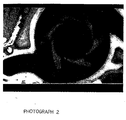
- As shown in
Figure 1 , the engine water pumps and timing covers protected with the Formula "A" composition of the instant invention containing the monobasic aliphatic organic acid with molybdate and a hydrocarbyl triazole show the aluminum to be well protected with no pitting, blackening or corrosion being observed. - As shown in
Figure 2 , the aluminum of the engines protected with the Formula "E" dicarboxylic acid based formula was darkened with corrosion. The aluminum timing covers of the engines protected with the Formula "E" dicarboxylic acid based coolant showed similar cavitation erosion-corrosion. - These tests are indicative of anticipated problems with the performance of the engines associated with the dicarboxylic acid based coolant solutions. The results are important because at a higher milage the damaged pumps can be expected to leak and fail if not replaced soon thereafter. It is also anticipated that problems associated with volumetric efficiency will be experienced possibly causing over heating of the vehicles. Thus, the experiment further demonstrates the benefit and advantages exhibited by the Formula "A" composition comprising a monobasic aliphatic organic acid with molybdate and a hydrocarbyl triazole in preventing cavitation erosion-corrosion damage.
- Reference to documents made in the specification, is intended to result in such patents or literature cited are expressly incorporated herein by reference, including any patents or other literature references cited within such documents as if fully set forth in this specification.
- The foregoing detailed description is given primarily for clearness of understanding and no unnecessary limitations are to be understood therefrom. Accordingly, this invention is not intended to be limited by the specific exemplifications presented hereinabove.
Claims (1)
- A silicate free antifreeze corrosion inhibited antifreeze composition for use in the cooling system of a water cooled internal combustion engine consisting of 93.56 weight percent of ethylene glycol, 3.00 weight percent of 2-ethylhexanoic acid, 2.70 weight percent of potassium hydroxide (45%), 0.20 weight percent of sodium molybdate dihydrate, 0.50 weight percent of sodium tolyltriazole (50%), 0.04 weight percent defoamers, whereby the composition has a pH of 8.5.
Applications Claiming Priority (5)
| Application Number | Priority Date | Filing Date | Title |
|---|---|---|---|
| US6459697P | 1997-11-06 | 1997-11-06 | |
| US64596P | 1997-11-06 | ||
| US09/135,138 US6126852A (en) | 1997-11-06 | 1998-08-17 | Monocarboxylic acid based antifreeze composition |
| US135138 | 1998-08-17 | ||
| PCT/US1998/023876 WO1999024524A1 (en) | 1997-11-06 | 1998-11-05 | Silicate free antifreeze composition |
Publications (3)
| Publication Number | Publication Date |
|---|---|
| EP1029017A1 EP1029017A1 (en) | 2000-08-23 |
| EP1029017A4 EP1029017A4 (en) | 2001-01-24 |
| EP1029017B1 true EP1029017B1 (en) | 2009-01-14 |
Family
ID=26744678
Family Applications (1)
| Application Number | Title | Priority Date | Filing Date |
|---|---|---|---|
| EP98958505A Expired - Lifetime EP1029017B1 (en) | 1997-11-06 | 1998-11-05 | Monocarboxylic acid based antifreeze composition |
Country Status (9)
| Country | Link |
|---|---|
| US (1) | US6126852A (en) |
| EP (1) | EP1029017B1 (en) |
| CN (1) | CN1150291C (en) |
| AR (1) | AR016674A1 (en) |
| AT (1) | ATE420936T1 (en) |
| AU (1) | AU1453699A (en) |
| CA (1) | CA2308195C (en) |
| DE (1) | DE69840482D1 (en) |
| WO (1) | WO1999024524A1 (en) |
Families Citing this family (16)
| Publication number | Priority date | Publication date | Assignee | Title |
|---|---|---|---|---|
| SE511264C2 (en) * | 1998-01-22 | 1999-09-06 | Aspen Petroleum Ab | Freeze-resistant heat / coolant containing a corrosion inhibitor |
| DE19930682B4 (en) * | 1999-07-02 | 2005-03-24 | Clariant Gmbh | Silicate-, borate- and phosphate-free cooling fluids based on glycols with improved corrosion behavior |
| KR101300541B1 (en) | 2005-06-24 | 2013-09-02 | 프레스톤 프로닥츠 코포레이션 | Method for inhibiting corrosion in brazed metal surfaces and coolants and additives for use therein |
| WO2009043814A1 (en) * | 2007-10-03 | 2009-04-09 | Basf Se | Antifreeze compositions |
| EP2312019B1 (en) * | 2009-10-01 | 2013-02-27 | Rhein Chemie Rheinau GmbH | Use of anticorrosion additives to protect aluminum and /or aluminum alloys in a finishing process |
| KR101322919B1 (en) * | 2011-09-23 | 2013-10-29 | 극동제연공업 주식회사 | Compositions of Antifreezing Liquid or Cooling Liquid with Improvements in Anticorrosion of Cavitation Erosion and Crevice |
| US9994755B2 (en) * | 2012-09-07 | 2018-06-12 | Prestone Products Corporation | Heat transfer fluids and corrosion inhibitor formulations for use thereof |
| US9023235B2 (en) * | 2012-09-07 | 2015-05-05 | Prestone Products Corporation | Heat transfer fluid additive composition |
| US9567507B2 (en) * | 2012-09-07 | 2017-02-14 | Prestone Products Corporation | Heat transfer fluids and corrosion inhibitor formulations for use thereof |
| US8613866B1 (en) * | 2012-09-07 | 2013-12-24 | Prestone Products Corporation | Heat transfer fluids and corrosion inhibitor formulations for use thereof |
| US8617416B1 (en) * | 2012-09-07 | 2013-12-31 | Prestone Products Corporation | Heat transfer fluids and corrosion inhibitor formulations for use thereof |
| US9051515B2 (en) | 2013-03-15 | 2015-06-09 | Ashland Licensing And Intellectual Property Llc. | Engine coolant additive |
| US9540558B2 (en) | 2013-06-12 | 2017-01-10 | Ashland Licensing And Intellectual Property, Llc | Extended operation engine coolant composition |
| PT3265535T (en) * | 2015-03-04 | 2020-05-11 | Prestone Products Corp | Super concentrate additive solution composition |
| CN105274535A (en) * | 2015-11-10 | 2016-01-27 | 黄忠波 | Metal surface anticorrosion protective agent |
| CN106398655A (en) * | 2016-08-30 | 2017-02-15 | 天津箭牌石油化工有限公司 | Nonaqueous antifreezing solution and preparation method thereof |
Family Cites Families (16)
| Publication number | Priority date | Publication date | Assignee | Title |
|---|---|---|---|---|
| JPS5456041A (en) * | 1977-10-01 | 1979-05-04 | Otsuka Chem Co Ltd | Metal corrosion preventing composition |
| US4455248A (en) * | 1982-06-01 | 1984-06-19 | Shell Oil Company | Antifreeze compositions |
| US4561990A (en) * | 1984-10-04 | 1985-12-31 | Texaco Inc. | High lead solder corrosion inhibitors |
| US4587028A (en) * | 1984-10-15 | 1986-05-06 | Texaco Inc. | Non-silicate antifreeze formulations |
| US4588513A (en) * | 1984-11-19 | 1986-05-13 | Texaco, Inc. | Non-borate, non-phosphate antifreeze formulations containing dibasic acid salts as corrosion inhibitors |
| US4647392A (en) * | 1985-12-27 | 1987-03-03 | Texaco Inc. | Monobasic-dibasic acid/salt antifreeze corrosion inhibitor |
| US4657689A (en) * | 1986-04-01 | 1987-04-14 | Texaco Inc. | Corrosion-inhibited antifreeze/coolant composition containing hydrocarbyl sulfonate |
| US4851145A (en) * | 1986-06-30 | 1989-07-25 | S.A. Texaco Petroleum Nv | Corrosion-inhibited antifreeze/coolant composition |
| US4759864A (en) * | 1987-09-04 | 1988-07-26 | Texaco Inc. & S.A. Texaco Petro, N.V. | Corrosion-inhibited antifreeze formulation |
| US4946616A (en) * | 1988-11-14 | 1990-08-07 | The Dow Chemical Company | Heat transfer fluids containing dicarboxylic acid mixtures as corrosion inhibitors |
| US5422026A (en) * | 1990-12-14 | 1995-06-06 | Arco Chemical Technology, L.P. | Phosphate-free antifreeze formulation |
| DE4204809A1 (en) * | 1992-02-18 | 1993-08-19 | Basf Ag | HARDWATER-STABLE, PHOSPHATE-CONTAINING REFRIGERANT BLENDS |
| ES2103888T3 (en) * | 1992-04-06 | 1997-10-01 | Texaco Services Europ Ltd | CORROSION INHIBITING ANTIFREEZE FORMULATIONS. |
| JPH0820763A (en) * | 1994-07-06 | 1996-01-23 | Seiken Kagaku Kogyo Kk | Amine-free antifreeze |
| US5741436A (en) * | 1995-12-05 | 1998-04-21 | Prestone Products Corp. | Antifreeze concentrates and compositions comprising neodecanoic acid corrosion inhibitors |
| US5925173A (en) * | 1997-08-11 | 1999-07-20 | Prestone Products Corporation | Method of inhibiting corrosion of flux-treated metal surfaces |
-
1998
- 1998-08-17 US US09/135,138 patent/US6126852A/en not_active Expired - Lifetime
- 1998-11-05 AU AU14536/99A patent/AU1453699A/en not_active Abandoned
- 1998-11-05 CN CNB988129116A patent/CN1150291C/en not_active Expired - Lifetime
- 1998-11-05 DE DE69840482T patent/DE69840482D1/en not_active Expired - Lifetime
- 1998-11-05 WO PCT/US1998/023876 patent/WO1999024524A1/en not_active Ceased
- 1998-11-05 AT AT98958505T patent/ATE420936T1/en not_active IP Right Cessation
- 1998-11-05 EP EP98958505A patent/EP1029017B1/en not_active Expired - Lifetime
- 1998-11-05 CA CA002308195A patent/CA2308195C/en not_active Expired - Lifetime
- 1998-11-06 AR ARP980105627A patent/AR016674A1/en active IP Right Grant
Also Published As
| Publication number | Publication date |
|---|---|
| DE69840482D1 (en) | 2009-03-05 |
| EP1029017A4 (en) | 2001-01-24 |
| AU1453699A (en) | 1999-05-31 |
| WO1999024524A9 (en) | 2000-07-20 |
| ATE420936T1 (en) | 2009-01-15 |
| CN1150291C (en) | 2004-05-19 |
| CA2308195C (en) | 2005-06-07 |
| US6126852A (en) | 2000-10-03 |
| EP1029017A1 (en) | 2000-08-23 |
| CN1284984A (en) | 2001-02-21 |
| CA2308195A1 (en) | 1999-05-20 |
| WO1999024524A1 (en) | 1999-05-20 |
| AR016674A1 (en) | 2001-07-25 |
Similar Documents
| Publication | Publication Date | Title |
|---|---|---|
| US7407599B2 (en) | Acid based antifreeze composition | |
| EP0865474B1 (en) | Neoacid corrosion inhibitors | |
| EP0308037B1 (en) | Corrosion - inhibited antifreeze formulation | |
| US4851145A (en) | Corrosion-inhibited antifreeze/coolant composition | |
| US6802988B1 (en) | Antifreeze concentrates based on dicarboxylic acids, molybdate and triazoles or thiazoles, and coolant compositions comprising them | |
| AU2002256500A1 (en) | Monocarboxylic acid based antifreeze composition | |
| CA2308195C (en) | Silicate free antifreeze composition | |
| IL121093A (en) | Silicate-, borate and nitrate-free antifreeze concentrates and coolant compositions comprising them | |
| JPH06116764A (en) | Antifreeze composition | |
| US6235217B1 (en) | Monocarboxylic acid based antifreeze composition | |
| KR19990077315A (en) | Use of quaternized imidazoles as nonferrous metal corrosion inhibitors, concentrated antifreeze and coolant compositions containing depressants | |
| JPH0885782A (en) | Antifreeze composition | |
| JP2958690B2 (en) | Cooling antifreeze composition | |
| WO2000050532A1 (en) | Monocarboxylic acid based antifreeze composition for diesel engines | |
| US6290870B1 (en) | Monocarboxylic acid based antifreeze composition for diesel engines | |
| CA2246443C (en) | Coolant inhibitor concentrate | |
| AU772428B2 (en) | Monocarboxylic acid based antifreeze composition for diesel engines | |
| JP4119622B2 (en) | Coolant composition | |
| AU771582B2 (en) | Monocarboxylic acid based antifreeze composition | |
| JP3651939B2 (en) | Antifreeze composition | |
| IE49106B1 (en) | Antifreeze agents | |
| MXPA00004372A (en) | Silicate free antifreeze composition | |
| HK1016210B (en) | Neoacid corrosion inhibitors |
Legal Events
| Date | Code | Title | Description |
|---|---|---|---|
| PUAI | Public reference made under article 153(3) epc to a published international application that has entered the european phase |
Free format text: ORIGINAL CODE: 0009012 |
|
| 17P | Request for examination filed |
Effective date: 20000505 |
|
| AK | Designated contracting states |
Kind code of ref document: A1 Designated state(s): AT BE CH CY DE DK ES FI FR GB GR IE IT LI LU MC NL PT SE |
|
| A4 | Supplementary search report drawn up and despatched |
Effective date: 20001212 |
|
| AK | Designated contracting states |
Kind code of ref document: A4 Designated state(s): AT BE CH CY DE DK ES FI FR GB GR IE IT LI LU MC NL PT SE |
|
| RIC1 | Information provided on ipc code assigned before grant |
Free format text: 7C 09K 5/00 A, 7C 23F 11/08 B |
|
| 17Q | First examination report despatched |
Effective date: 20020416 |
|
| APBN | Date of receipt of notice of appeal recorded |
Free format text: ORIGINAL CODE: EPIDOSNNOA2E |
|
| APBR | Date of receipt of statement of grounds of appeal recorded |
Free format text: ORIGINAL CODE: EPIDOSNNOA3E |
|
| APAA | Appeal reference recorded |
Free format text: ORIGINAL CODE: EPIDOS REFN |
|
| APAF | Appeal reference modified |
Free format text: ORIGINAL CODE: EPIDOSCREFNE |
|
| APAF | Appeal reference modified |
Free format text: ORIGINAL CODE: EPIDOSCREFNE |
|
| APBT | Appeal procedure closed |
Free format text: ORIGINAL CODE: EPIDOSNNOA9E |
|
| 17Q | First examination report despatched |
Effective date: 20020416 |
|
| RTI1 | Title (correction) |
Free format text: MONOCARBOXYLIC ACID BASED ANTIFREEZE COMPOSITION |
|
| GRAP | Despatch of communication of intention to grant a patent |
Free format text: ORIGINAL CODE: EPIDOSNIGR1 |
|
| GRAS | Grant fee paid |
Free format text: ORIGINAL CODE: EPIDOSNIGR3 |
|
| GRAA | (expected) grant |
Free format text: ORIGINAL CODE: 0009210 |
|
| AK | Designated contracting states |
Kind code of ref document: B1 Designated state(s): AT BE CH CY DE DK ES FI FR GB GR IE IT LI LU MC NL PT SE |
|
| REG | Reference to a national code |
Ref country code: GB Ref legal event code: FG4D |
|
| REG | Reference to a national code |
Ref country code: CH Ref legal event code: EP |
|
| REG | Reference to a national code |
Ref country code: IE Ref legal event code: FG4D |
|
| REF | Corresponds to: |
Ref document number: 69840482 Country of ref document: DE Date of ref document: 20090305 Kind code of ref document: P |
|
| PG25 | Lapsed in a contracting state [announced via postgrant information from national office to epo] |
Ref country code: NL Free format text: LAPSE BECAUSE OF FAILURE TO SUBMIT A TRANSLATION OF THE DESCRIPTION OR TO PAY THE FEE WITHIN THE PRESCRIBED TIME-LIMIT Effective date: 20090114 |
|
| NLV1 | Nl: lapsed or annulled due to failure to fulfill the requirements of art. 29p and 29m of the patents act | ||
| PG25 | Lapsed in a contracting state [announced via postgrant information from national office to epo] |
Ref country code: FI Free format text: LAPSE BECAUSE OF FAILURE TO SUBMIT A TRANSLATION OF THE DESCRIPTION OR TO PAY THE FEE WITHIN THE PRESCRIBED TIME-LIMIT Effective date: 20090114 Ref country code: ES Free format text: LAPSE BECAUSE OF FAILURE TO SUBMIT A TRANSLATION OF THE DESCRIPTION OR TO PAY THE FEE WITHIN THE PRESCRIBED TIME-LIMIT Effective date: 20090425 |
|
| PG25 | Lapsed in a contracting state [announced via postgrant information from national office to epo] |
Ref country code: SE Free format text: LAPSE BECAUSE OF FAILURE TO SUBMIT A TRANSLATION OF THE DESCRIPTION OR TO PAY THE FEE WITHIN THE PRESCRIBED TIME-LIMIT Effective date: 20090414 Ref country code: PT Free format text: LAPSE BECAUSE OF FAILURE TO SUBMIT A TRANSLATION OF THE DESCRIPTION OR TO PAY THE FEE WITHIN THE PRESCRIBED TIME-LIMIT Effective date: 20090615 Ref country code: AT Free format text: LAPSE BECAUSE OF FAILURE TO SUBMIT A TRANSLATION OF THE DESCRIPTION OR TO PAY THE FEE WITHIN THE PRESCRIBED TIME-LIMIT Effective date: 20090114 |
|
| PG25 | Lapsed in a contracting state [announced via postgrant information from national office to epo] |
Ref country code: BE Free format text: LAPSE BECAUSE OF FAILURE TO SUBMIT A TRANSLATION OF THE DESCRIPTION OR TO PAY THE FEE WITHIN THE PRESCRIBED TIME-LIMIT Effective date: 20090114 |
|
| PG25 | Lapsed in a contracting state [announced via postgrant information from national office to epo] |
Ref country code: DK Free format text: LAPSE BECAUSE OF FAILURE TO SUBMIT A TRANSLATION OF THE DESCRIPTION OR TO PAY THE FEE WITHIN THE PRESCRIBED TIME-LIMIT Effective date: 20090114 |
|
| PLBE | No opposition filed within time limit |
Free format text: ORIGINAL CODE: 0009261 |
|
| STAA | Information on the status of an ep patent application or granted ep patent |
Free format text: STATUS: NO OPPOSITION FILED WITHIN TIME LIMIT |
|
| 26N | No opposition filed |
Effective date: 20091015 |
|
| PG25 | Lapsed in a contracting state [announced via postgrant information from national office to epo] |
Ref country code: MC Free format text: LAPSE BECAUSE OF NON-PAYMENT OF DUE FEES Effective date: 20091130 |
|
| REG | Reference to a national code |
Ref country code: CH Ref legal event code: PL |
|
| GBPC | Gb: european patent ceased through non-payment of renewal fee |
Effective date: 20091105 |
|
| REG | Reference to a national code |
Ref country code: FR Ref legal event code: ST Effective date: 20100730 |
|
| PG25 | Lapsed in a contracting state [announced via postgrant information from national office to epo] |
Ref country code: LI Free format text: LAPSE BECAUSE OF NON-PAYMENT OF DUE FEES Effective date: 20091130 Ref country code: IE Free format text: LAPSE BECAUSE OF NON-PAYMENT OF DUE FEES Effective date: 20091105 Ref country code: GR Free format text: LAPSE BECAUSE OF FAILURE TO SUBMIT A TRANSLATION OF THE DESCRIPTION OR TO PAY THE FEE WITHIN THE PRESCRIBED TIME-LIMIT Effective date: 20090415 Ref country code: FR Free format text: LAPSE BECAUSE OF NON-PAYMENT OF DUE FEES Effective date: 20091130 Ref country code: CH Free format text: LAPSE BECAUSE OF NON-PAYMENT OF DUE FEES Effective date: 20091130 |
|
| PG25 | Lapsed in a contracting state [announced via postgrant information from national office to epo] |
Ref country code: GB Free format text: LAPSE BECAUSE OF NON-PAYMENT OF DUE FEES Effective date: 20091105 |
|
| PG25 | Lapsed in a contracting state [announced via postgrant information from national office to epo] |
Ref country code: IT Free format text: LAPSE BECAUSE OF FAILURE TO SUBMIT A TRANSLATION OF THE DESCRIPTION OR TO PAY THE FEE WITHIN THE PRESCRIBED TIME-LIMIT Effective date: 20090114 |
|
| PG25 | Lapsed in a contracting state [announced via postgrant information from national office to epo] |
Ref country code: LU Free format text: LAPSE BECAUSE OF NON-PAYMENT OF DUE FEES Effective date: 20091105 |
|
| PG25 | Lapsed in a contracting state [announced via postgrant information from national office to epo] |
Ref country code: CY Free format text: LAPSE BECAUSE OF FAILURE TO SUBMIT A TRANSLATION OF THE DESCRIPTION OR TO PAY THE FEE WITHIN THE PRESCRIBED TIME-LIMIT Effective date: 20090114 |
|
| REG | Reference to a national code |
Ref country code: DE Ref legal event code: R082 Ref document number: 69840482 Country of ref document: DE Representative=s name: MEISSNER BOLTE PATENTANWAELTE RECHTSANWAELTE P, DE Ref country code: DE Ref legal event code: R081 Ref document number: 69840482 Country of ref document: DE Owner name: VALVOLINE LICENSING AND INTELLECTUAL PROPERTY , US Free format text: FORMER OWNER: ASHLAND, INC., LEXINGTON, KY., US |
|
| PGFP | Annual fee paid to national office [announced via postgrant information from national office to epo] |
Ref country code: DE Payment date: 20171130 Year of fee payment: 20 |
|
| REG | Reference to a national code |
Ref country code: DE Ref legal event code: R071 Ref document number: 69840482 Country of ref document: DE |