EP1028967B1 - Process for preparing cyclic phosphines - Google Patents
Process for preparing cyclic phosphines Download PDFInfo
- Publication number
- EP1028967B1 EP1028967B1 EP98952862A EP98952862A EP1028967B1 EP 1028967 B1 EP1028967 B1 EP 1028967B1 EP 98952862 A EP98952862 A EP 98952862A EP 98952862 A EP98952862 A EP 98952862A EP 1028967 B1 EP1028967 B1 EP 1028967B1
- Authority
- EP
- European Patent Office
- Prior art keywords
- process according
- alkylating agent
- phosphine
- cyclic
- formula
- Prior art date
- Legal status (The legal status is an assumption and is not a legal conclusion. Google has not performed a legal analysis and makes no representation as to the accuracy of the status listed.)
- Expired - Lifetime
Links
- -1 cyclic phosphines Chemical class 0.000 title claims description 9
- 238000004519 manufacturing process Methods 0.000 title description 3
- XYFCBTPGUUZFHI-UHFFFAOYSA-N Phosphine Chemical compound P XYFCBTPGUUZFHI-UHFFFAOYSA-N 0.000 claims abstract description 51
- 125000004122 cyclic group Chemical group 0.000 claims abstract description 22
- 229910000073 phosphorus hydride Inorganic materials 0.000 claims abstract description 22
- 239000002168 alkylating agent Substances 0.000 claims abstract description 19
- 229940100198 alkylating agent Drugs 0.000 claims abstract description 19
- 238000002360 preparation method Methods 0.000 claims abstract description 17
- 239000000203 mixture Substances 0.000 claims abstract description 15
- 230000001588 bifunctional effect Effects 0.000 claims abstract description 9
- 239000007795 chemical reaction product Substances 0.000 claims abstract description 5
- 125000000524 functional group Chemical group 0.000 claims abstract description 5
- 230000029936 alkylation Effects 0.000 claims abstract description 3
- 238000005804 alkylation reaction Methods 0.000 claims abstract description 3
- 238000006073 displacement reaction Methods 0.000 claims abstract description 3
- 238000000034 method Methods 0.000 claims description 33
- 230000008569 process Effects 0.000 claims description 29
- MZRVEZGGRBJDDB-UHFFFAOYSA-N N-Butyllithium Chemical group [Li]CCCC MZRVEZGGRBJDDB-UHFFFAOYSA-N 0.000 claims description 19
- QAOWNCQODCNURD-UHFFFAOYSA-L Sulfate Chemical compound [O-]S([O-])(=O)=O QAOWNCQODCNURD-UHFFFAOYSA-L 0.000 claims description 11
- WGOPGODQLGJZGL-UHFFFAOYSA-N lithium;butane Chemical compound [Li+].CC[CH-]C WGOPGODQLGJZGL-UHFFFAOYSA-N 0.000 claims description 8
- 125000000217 alkyl group Chemical group 0.000 claims description 7
- 125000003118 aryl group Chemical group 0.000 claims description 6
- DKFDVEXWZZOMGS-UHFFFAOYSA-N (2-phosphanylphenyl)phosphane Chemical compound PC1=CC=CC=C1P DKFDVEXWZZOMGS-UHFFFAOYSA-N 0.000 claims description 5
- 125000002877 alkyl aryl group Chemical group 0.000 claims description 4
- 125000003710 aryl alkyl group Chemical group 0.000 claims description 4
- 125000000753 cycloalkyl group Chemical group 0.000 claims description 4
- 229910021653 sulphate ion Inorganic materials 0.000 claims description 4
- FWFZRPMNAAFGBA-UHFFFAOYSA-N 2-phosphanylethylphosphane Chemical compound PCCP FWFZRPMNAAFGBA-UHFFFAOYSA-N 0.000 claims description 3
- 125000002524 organometallic group Chemical group 0.000 claims description 3
- VURFVHCLMJOLKN-UHFFFAOYSA-N diphosphane Chemical compound PP VURFVHCLMJOLKN-UHFFFAOYSA-N 0.000 claims 2
- 125000004169 (C1-C6) alkyl group Chemical group 0.000 claims 1
- 229910052744 lithium Inorganic materials 0.000 claims 1
- OKKJLVBELUTLKV-UHFFFAOYSA-N Methanol Chemical compound OC OKKJLVBELUTLKV-UHFFFAOYSA-N 0.000 description 27
- WYURNTSHIVDZCO-UHFFFAOYSA-N Tetrahydrofuran Chemical compound C1CCOC1 WYURNTSHIVDZCO-UHFFFAOYSA-N 0.000 description 26
- RTZKZFJDLAIYFH-UHFFFAOYSA-N Diethyl ether Chemical compound CCOCC RTZKZFJDLAIYFH-UHFFFAOYSA-N 0.000 description 24
- 239000002904 solvent Substances 0.000 description 22
- 239000003446 ligand Substances 0.000 description 17
- OFBQJSOFQDEBGM-UHFFFAOYSA-N Pentane Chemical compound CCCCC OFBQJSOFQDEBGM-UHFFFAOYSA-N 0.000 description 16
- YLQBMQCUIZJEEH-UHFFFAOYSA-N tetrahydrofuran Natural products C=1C=COC=1 YLQBMQCUIZJEEH-UHFFFAOYSA-N 0.000 description 13
- VLKZOEOYAKHREP-UHFFFAOYSA-N n-Hexane Chemical class CCCCCC VLKZOEOYAKHREP-UHFFFAOYSA-N 0.000 description 11
- 238000006243 chemical reaction Methods 0.000 description 10
- 239000000047 product Substances 0.000 description 8
- RVZJVYCTFGOEHX-UHFFFAOYSA-N phosphetane Chemical compound C1CPC1 RVZJVYCTFGOEHX-UHFFFAOYSA-N 0.000 description 7
- XLYOFNOQVPJJNP-UHFFFAOYSA-N water Substances O XLYOFNOQVPJJNP-UHFFFAOYSA-N 0.000 description 7
- IJGRMHOSHXDMSA-UHFFFAOYSA-N Atomic nitrogen Chemical compound N#N IJGRMHOSHXDMSA-UHFFFAOYSA-N 0.000 description 6
- UHOVQNZJYSORNB-UHFFFAOYSA-N Benzene Chemical compound C1=CC=CC=C1 UHOVQNZJYSORNB-UHFFFAOYSA-N 0.000 description 6
- 239000012044 organic layer Substances 0.000 description 6
- RPGWZZNNEUHDAQ-UHFFFAOYSA-N phenylphosphine Chemical compound PC1=CC=CC=C1 RPGWZZNNEUHDAQ-UHFFFAOYSA-N 0.000 description 6
- DLEDOFVPSDKWEF-UHFFFAOYSA-N lithium butane Chemical compound [Li+].CCC[CH2-] DLEDOFVPSDKWEF-UHFFFAOYSA-N 0.000 description 5
- 238000003756 stirring Methods 0.000 description 5
- 238000001035 drying Methods 0.000 description 4
- 230000007717 exclusion Effects 0.000 description 4
- 239000012299 nitrogen atmosphere Substances 0.000 description 4
- 239000012258 stirred mixture Substances 0.000 description 4
- 239000007832 Na2SO4 Substances 0.000 description 3
- PMZURENOXWZQFD-UHFFFAOYSA-L Sodium Sulfate Chemical compound [Na+].[Na+].[O-]S([O-])(=O)=O PMZURENOXWZQFD-UHFFFAOYSA-L 0.000 description 3
- 238000009876 asymmetric hydrogenation reaction Methods 0.000 description 3
- 239000003054 catalyst Substances 0.000 description 3
- 229910052757 nitrogen Inorganic materials 0.000 description 3
- 150000003003 phosphines Chemical class 0.000 description 3
- 229910052938 sodium sulfate Inorganic materials 0.000 description 3
- 238000010626 work up procedure Methods 0.000 description 3
- LLXIGVGFZQLRES-VXGBXAGGSA-N (2r,4r)-2,4-diethyl-1-phenylphosphetane Chemical compound CC[C@@H]1C[C@@H](CC)P1C1=CC=CC=C1 LLXIGVGFZQLRES-VXGBXAGGSA-N 0.000 description 2
- AJNZWRKTWQLAJK-KLHDSHLOSA-N (2r,5r)-1-[2-[(2r,5r)-2,5-dimethylphospholan-1-yl]phenyl]-2,5-dimethylphospholane Chemical compound C[C@@H]1CC[C@@H](C)P1C1=CC=CC=C1P1[C@H](C)CC[C@H]1C AJNZWRKTWQLAJK-KLHDSHLOSA-N 0.000 description 2
- QOLRLVPABLMMKI-XSLAGTTESA-N (2s,5s)-1-[2-[(2s,5s)-2,5-diethylphospholan-1-yl]ethyl]-2,5-diethylphospholane Chemical compound CC[C@H]1CC[C@H](CC)P1CCP1[C@@H](CC)CC[C@@H]1CC QOLRLVPABLMMKI-XSLAGTTESA-N 0.000 description 2
- AJNZWRKTWQLAJK-VGWMRTNUSA-N (2s,5s)-1-[2-[(2s,5s)-2,5-dimethylphospholan-1-yl]phenyl]-2,5-dimethylphospholane Chemical compound C[C@H]1CC[C@H](C)P1C1=CC=CC=C1P1[C@@H](C)CC[C@@H]1C AJNZWRKTWQLAJK-VGWMRTNUSA-N 0.000 description 2
- 150000000190 1,4-diols Chemical class 0.000 description 2
- BZLVMXJERCGZMT-UHFFFAOYSA-N Methyl tert-butyl ether Chemical compound COC(C)(C)C BZLVMXJERCGZMT-UHFFFAOYSA-N 0.000 description 2
- QAOWNCQODCNURD-UHFFFAOYSA-N Sulfuric acid Chemical compound OS(O)(=O)=O QAOWNCQODCNURD-UHFFFAOYSA-N 0.000 description 2
- HEDRZPFGACZZDS-MICDWDOJSA-N Trichloro(2H)methane Chemical compound [2H]C(Cl)(Cl)Cl HEDRZPFGACZZDS-MICDWDOJSA-N 0.000 description 2
- 238000007068 beta-elimination reaction Methods 0.000 description 2
- 230000015572 biosynthetic process Effects 0.000 description 2
- 239000003153 chemical reaction reagent Substances 0.000 description 2
- 150000001875 compounds Chemical class 0.000 description 2
- 238000001816 cooling Methods 0.000 description 2
- 239000013078 crystal Substances 0.000 description 2
- BLQZKBOWCXSEAF-UHFFFAOYSA-N cyclopenta-2,4-dien-1-ylphosphane iron(2+) Chemical compound [Fe++].P[c-]1cccc1.P[c-]1cccc1 BLQZKBOWCXSEAF-UHFFFAOYSA-N 0.000 description 2
- 238000004821 distillation Methods 0.000 description 2
- 239000000463 material Substances 0.000 description 2
- FVWCDFMLOYFXCE-UHFFFAOYSA-N naphthalen-1-ylphosphane Chemical compound C1=CC=C2C(P)=CC=CC2=C1 FVWCDFMLOYFXCE-UHFFFAOYSA-N 0.000 description 2
- 125000001979 organolithium group Chemical group 0.000 description 2
- 239000002243 precursor Substances 0.000 description 2
- 239000000376 reactant Substances 0.000 description 2
- 238000001953 recrystallisation Methods 0.000 description 2
- 238000007086 side reaction Methods 0.000 description 2
- 125000001273 sulfonato group Chemical group [O-]S(*)(=O)=O 0.000 description 2
- 238000003786 synthesis reaction Methods 0.000 description 2
- 125000000999 tert-butyl group Chemical group [H]C([H])([H])C(*)(C([H])([H])[H])C([H])([H])[H] 0.000 description 2
- CZYRKLJSTHZZQJ-STQMWFEESA-N (2s,5s)-2,5-dimethyl-1-naphthalen-1-ylphospholane Chemical compound C[C@H]1CC[C@H](C)P1C1=CC=CC2=CC=CC=C12 CZYRKLJSTHZZQJ-STQMWFEESA-N 0.000 description 1
- 150000000185 1,3-diols Chemical class 0.000 description 1
- 238000004679 31P NMR spectroscopy Methods 0.000 description 1
- HBAQYPYDRFILMT-UHFFFAOYSA-N 8-[3-(1-cyclopropylpyrazol-4-yl)-1H-pyrazolo[4,3-d]pyrimidin-5-yl]-3-methyl-3,8-diazabicyclo[3.2.1]octan-2-one Chemical class C1(CC1)N1N=CC(=C1)C1=NNC2=C1N=C(N=C2)N1C2C(N(CC1CC2)C)=O HBAQYPYDRFILMT-UHFFFAOYSA-N 0.000 description 1
- NLXLAEXVIDQMFP-UHFFFAOYSA-N Ammonia chloride Chemical class [NH4+].[Cl-] NLXLAEXVIDQMFP-UHFFFAOYSA-N 0.000 description 1
- 239000004215 Carbon black (E152) Substances 0.000 description 1
- PXHVJJICTQNCMI-UHFFFAOYSA-N Nickel Chemical compound [Ni] PXHVJJICTQNCMI-UHFFFAOYSA-N 0.000 description 1
- 238000003800 Staudinger reaction Methods 0.000 description 1
- 230000002411 adverse Effects 0.000 description 1
- 150000001412 amines Chemical class 0.000 description 1
- 125000000129 anionic group Chemical group 0.000 description 1
- 230000008901 benefit Effects 0.000 description 1
- MUALRAIOVNYAIW-UHFFFAOYSA-N binap Chemical compound C1=CC=CC=C1P(C=1C(=C2C=CC=CC2=CC=1)C=1C2=CC=CC=C2C=CC=1P(C=1C=CC=CC=1)C=1C=CC=CC=1)C1=CC=CC=C1 MUALRAIOVNYAIW-UHFFFAOYSA-N 0.000 description 1
- 230000002210 biocatalytic effect Effects 0.000 description 1
- 238000009835 boiling Methods 0.000 description 1
- 238000006555 catalytic reaction Methods 0.000 description 1
- 239000006184 cosolvent Substances 0.000 description 1
- 230000008878 coupling Effects 0.000 description 1
- 238000010168 coupling process Methods 0.000 description 1
- 238000005859 coupling reaction Methods 0.000 description 1
- 239000002178 crystalline material Substances 0.000 description 1
- 238000002425 crystallisation Methods 0.000 description 1
- 230000005595 deprotonation Effects 0.000 description 1
- 238000010537 deprotonation reaction Methods 0.000 description 1
- SBZXBUIDTXKZTM-UHFFFAOYSA-N diglyme Chemical compound COCCOCCOC SBZXBUIDTXKZTM-UHFFFAOYSA-N 0.000 description 1
- SMBQBQBNOXIFSF-UHFFFAOYSA-N dilithium Chemical compound [Li][Li] SMBQBQBNOXIFSF-UHFFFAOYSA-N 0.000 description 1
- 150000002009 diols Chemical class 0.000 description 1
- GPAYUJZHTULNBE-UHFFFAOYSA-N diphenylphosphine Chemical compound C=1C=CC=CC=1PC1=CC=CC=C1 GPAYUJZHTULNBE-UHFFFAOYSA-N 0.000 description 1
- 238000004090 dissolution Methods 0.000 description 1
- 230000000694 effects Effects 0.000 description 1
- 238000001704 evaporation Methods 0.000 description 1
- 239000000706 filtrate Substances 0.000 description 1
- 238000001914 filtration Methods 0.000 description 1
- 239000012847 fine chemical Substances 0.000 description 1
- 239000000796 flavoring agent Substances 0.000 description 1
- 235000019634 flavors Nutrition 0.000 description 1
- 229930195733 hydrocarbon Natural products 0.000 description 1
- 150000002430 hydrocarbons Chemical class 0.000 description 1
- 239000012535 impurity Substances 0.000 description 1
- INHCSSUBVCNVSK-UHFFFAOYSA-L lithium sulfate Inorganic materials [Li+].[Li+].[O-]S([O-])(=O)=O INHCSSUBVCNVSK-UHFFFAOYSA-L 0.000 description 1
- 230000001404 mediated effect Effects 0.000 description 1
- 125000002496 methyl group Chemical group [H]C([H])([H])* 0.000 description 1
- 230000001473 noxious effect Effects 0.000 description 1
- 238000010534 nucleophilic substitution reaction Methods 0.000 description 1
- 230000037361 pathway Effects 0.000 description 1
- 239000012450 pharmaceutical intermediate Substances 0.000 description 1
- 238000011112 process operation Methods 0.000 description 1
- 230000000750 progressive effect Effects 0.000 description 1
- 230000002035 prolonged effect Effects 0.000 description 1
- 238000000746 purification Methods 0.000 description 1
- 239000011541 reaction mixture Substances 0.000 description 1
- 230000035484 reaction time Effects 0.000 description 1
- 230000009467 reduction Effects 0.000 description 1
- 238000006722 reduction reaction Methods 0.000 description 1
- 239000011369 resultant mixture Substances 0.000 description 1
- 229910052703 rhodium Inorganic materials 0.000 description 1
- 239000010948 rhodium Substances 0.000 description 1
- MHOVAHRLVXNVSD-UHFFFAOYSA-N rhodium atom Chemical compound [Rh] MHOVAHRLVXNVSD-UHFFFAOYSA-N 0.000 description 1
- 150000003303 ruthenium Chemical class 0.000 description 1
- 150000003839 salts Chemical class 0.000 description 1
- 238000000926 separation method Methods 0.000 description 1
- 239000007787 solid Substances 0.000 description 1
- 238000000935 solvent evaporation Methods 0.000 description 1
- 239000000126 substance Substances 0.000 description 1
- 238000006467 substitution reaction Methods 0.000 description 1
- 239000000758 substrate Substances 0.000 description 1
- RBTVSNLYYIMMKS-UHFFFAOYSA-N tert-butyl 3-aminoazetidine-1-carboxylate;hydrochloride Chemical compound Cl.CC(C)(C)OC(=O)N1CC(N)C1 RBTVSNLYYIMMKS-UHFFFAOYSA-N 0.000 description 1
- 238000005406 washing Methods 0.000 description 1
Classifications
-
- C—CHEMISTRY; METALLURGY
- C07—ORGANIC CHEMISTRY
- C07F—ACYCLIC, CARBOCYCLIC OR HETEROCYCLIC COMPOUNDS CONTAINING ELEMENTS OTHER THAN CARBON, HYDROGEN, HALOGEN, OXYGEN, NITROGEN, SULFUR, SELENIUM OR TELLURIUM
- C07F9/00—Compounds containing elements of Groups 5 or 15 of the Periodic Table
- C07F9/02—Phosphorus compounds
- C07F9/28—Phosphorus compounds with one or more P—C bonds
- C07F9/50—Organo-phosphines
- C07F9/505—Preparation; Separation; Purification; Stabilisation
- C07F9/5063—Preparation; Separation; Purification; Stabilisation from compounds having the structure P-H or P-Heteroatom, in which one or more of such bonds are converted into P-C bonds
- C07F9/5072—Preparation; Separation; Purification; Stabilisation from compounds having the structure P-H or P-Heteroatom, in which one or more of such bonds are converted into P-C bonds from starting materials having the structure P-H
-
- C—CHEMISTRY; METALLURGY
- C07—ORGANIC CHEMISTRY
- C07F—ACYCLIC, CARBOCYCLIC OR HETEROCYCLIC COMPOUNDS CONTAINING ELEMENTS OTHER THAN CARBON, HYDROGEN, HALOGEN, OXYGEN, NITROGEN, SULFUR, SELENIUM OR TELLURIUM
- C07F17/00—Metallocenes
- C07F17/02—Metallocenes of metals of Groups 8, 9 or 10 of the Periodic Table
-
- C—CHEMISTRY; METALLURGY
- C07—ORGANIC CHEMISTRY
- C07F—ACYCLIC, CARBOCYCLIC OR HETEROCYCLIC COMPOUNDS CONTAINING ELEMENTS OTHER THAN CARBON, HYDROGEN, HALOGEN, OXYGEN, NITROGEN, SULFUR, SELENIUM OR TELLURIUM
- C07F9/00—Compounds containing elements of Groups 5 or 15 of the Periodic Table
- C07F9/02—Phosphorus compounds
- C07F9/547—Heterocyclic compounds, e.g. containing phosphorus as a ring hetero atom
- C07F9/6564—Heterocyclic compounds, e.g. containing phosphorus as a ring hetero atom having phosphorus atoms, with or without nitrogen, oxygen, sulfur, selenium or tellurium atoms, as ring hetero atoms
- C07F9/6568—Heterocyclic compounds, e.g. containing phosphorus as a ring hetero atom having phosphorus atoms, with or without nitrogen, oxygen, sulfur, selenium or tellurium atoms, as ring hetero atoms having phosphorus atoms as the only ring hetero atoms
- C07F9/65683—Heterocyclic compounds, e.g. containing phosphorus as a ring hetero atom having phosphorus atoms, with or without nitrogen, oxygen, sulfur, selenium or tellurium atoms, as ring hetero atoms having phosphorus atoms as the only ring hetero atoms the ring phosphorus atom being part of a phosphine
Definitions
- This invention relates to processes suitable for the large-scale preparation of enantiomerically-enriched cyclic phosphines, especially those useful as ligands in asymmetric hydrogenation catalysts.
- Chiral cyclic phosphines are useful ligands for asymmetric catalysis.
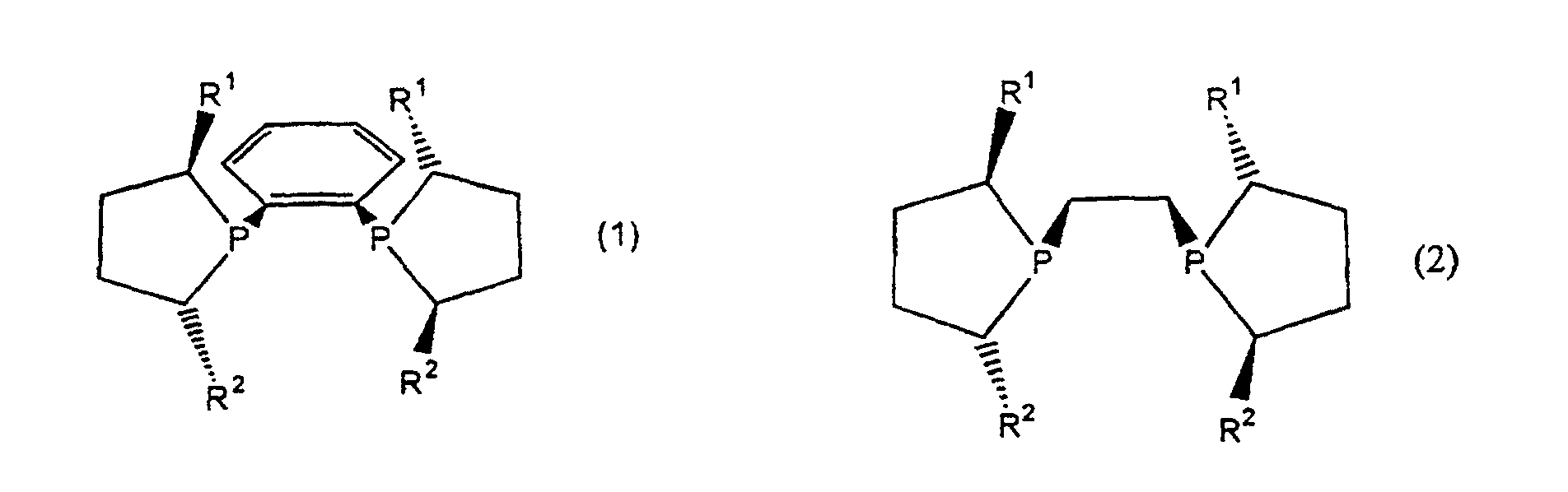
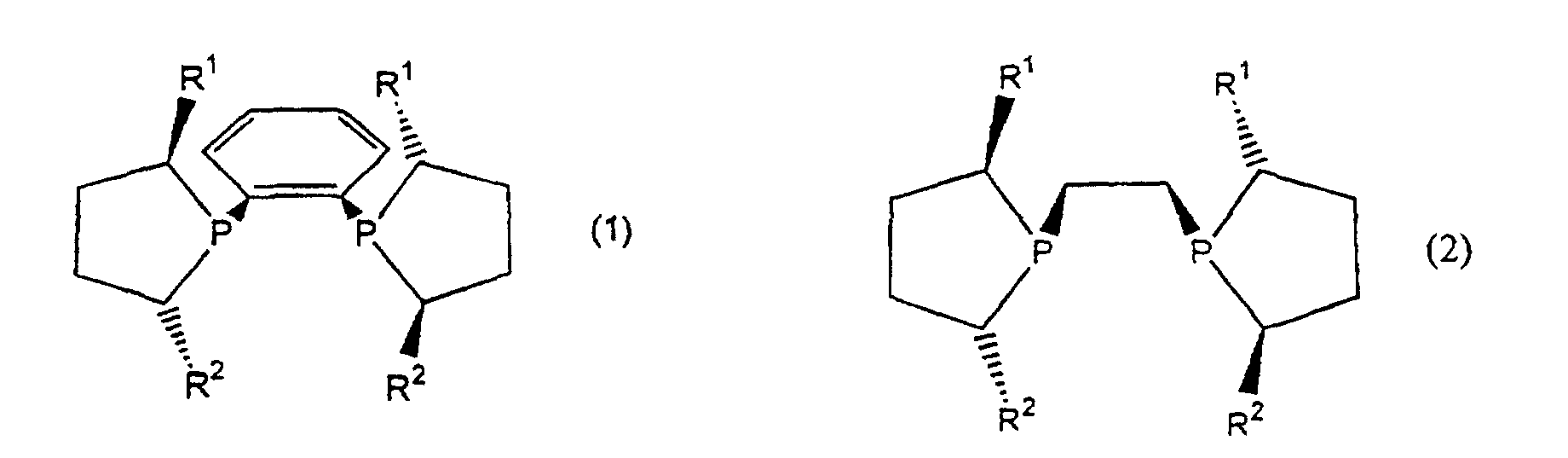
- chiral ligands of the DuPHOS and BPE series respectively represented by formulae ( 1 ) and (2) wherein R 1 and R 2 are typically C 1-6 linear or branched alkyl, and enantiomeric forms thereof, can be used to prepare rhodium and ruthenium complexes, which are effective and versatile catalysts for asymmetric hydrogenation of a diverse range of substrate types.
- Such catalysts are eminently suitable for industrial applications, especially for the provision of chiral pharmaceutical intermediates in high enantiomeric purity.
- the development of manufacturing processes requires in turn large amounts of a ligand ( 1 ) or (2), e.g. in kilogramme quantity or greater.
- a ligand ( 1 ) or (2) e.g. in kilogramme quantity or greater.
- US-A-5532395 describes the preparation of ( S,S )-methyl DuPHOS from 0.8 g of 1,2-bis(phosphino)benzene, in which a yield of 78% is achieved.
- the yield of methyl DuPHOS can fall to below 30%. Overall, such lowering of yield has an adverse effect on the economics of the process.
- Wilson and Pasternak, Synlett 4:199-200 discloses the preparation of chiral phosphines for use in an asymmetric Staudinger reaction.
- US-A-5399771 discloses the preparation of BINAP using diphenylphosphine, an amine base and a nickel catalyst.
- GB-A-2262284 discloses the preparation of tertiary phosphines.
- This invention is based on the discovery that an efficient, high-yielding preparation of a cyclic phosphine is facilitated by a new mode of reagent addition. More specifically, a process for the preparation of a cyclic phosphine from the corresponding primary phosphine and a bifunctional alkylating agent, wherein alkylation, and displacement of each functional group, occurs in the presence of a strong base, comprises adding the strong base, in an amount sufficient for cyclisation, to a preformed mixture or reaction product of the primary phosphine and alkylating agent.
- the bifunctional alkylating agent is susceptible to ⁇ -elimination by reaction with a strong base.
- ⁇ -elimination is not observed as a major reaction pathway.
- this process allows the preparation of phosphines bearing very hindered functional groups such as tert -butyl through substitution at neopentyl-like centres of the alkylating agent.
- the process of this invention preferably comprises the addition of at least 2m equivalents of a strong base to a mixture or reaction product of the primary phosphine and at least m equivalents of the bifunctional alkylating agent.
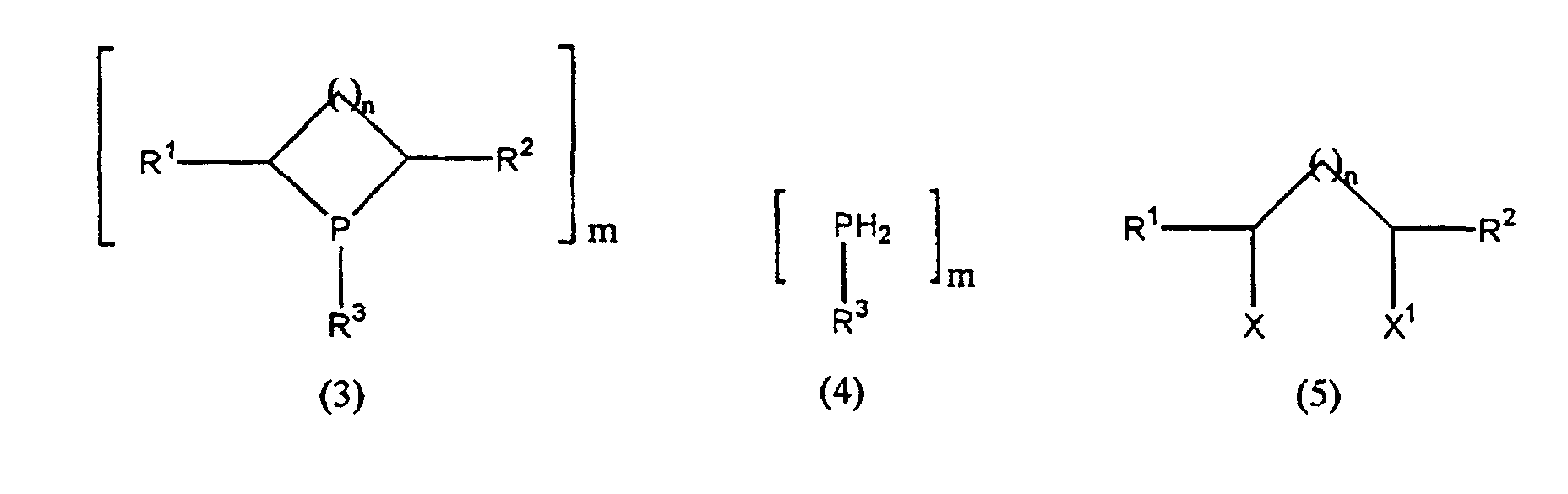
- the cyclic phosphine, the primary phosphine and the bifunctional alkylating agent that are used in this invention are preferably respectively of formula ( 3 ), ( 4 ) and ( 5 )
- R 1 and R 2 are independently H, alkyl, cycloalkyl, aryl, aralkyl or alkaryl, provided that both are not H, R 3 is aryl, alkyl, cycloalkyl, aralkyl, alkaryl, or an organometallic residue such as ferrocenyl; m is 1 or 2; n is in the range 1-4; and X and X 1 are the same or different nucleofugal leaving groups, optionally linked to form a ring.
- the cyclic phosphine ring in ( 3 ) may optionally form part of a fused polycyclic ring system.
- any base capable of effecting complete deprotonation of a P-H bond is suitable for use in the novel process.
- Commercially available organolithium bases are ideal for this purpose and alkyllithiums are preferred, especially n-butyllithium and sec-butyllithium.
- a variety of solvents may be used, particularly ethereal solvents such as tetrahydrofuran (THF), diglyme, diethyl ether or t-butyl methyl ether.
- THF tetrahydrofuran
- hydrocarbon solvents e.g. hexanes, such as might be used for dissolution of an organolithium base, are compatible as cosolvents.
- a preferred embodiment of the present invention is a process for preparation of enantiomerically-enriched ligands offormula ( 3 ), from enantimerically-enriched alkylating agents of formula ( 5 ).
- the degree of enrichment is typically at least 70% ee, preferably at least 80% ee, more preferably at least 90% ee, and most preferably at least 95% ee.
- R 1 and R 2 are orientated trans to one another. Usually, although not necessarily, R 1 and R 2 are the same. This encompasses ligands of the DuPHOS ( 1 ) and BPE ( 2 ) series and monophosphospholane variants thereof. Further, it includes the use of phosphetane ligands, as disclosed in WO 98/02445, of formula ( 6 )
- the process of the present invention is especially advantageous, since transfer of a solution of lithiated phenylphosphine between reaction vessels is avoided, thereby reducing the exposure risk to this noxious and foul-smelling substance.
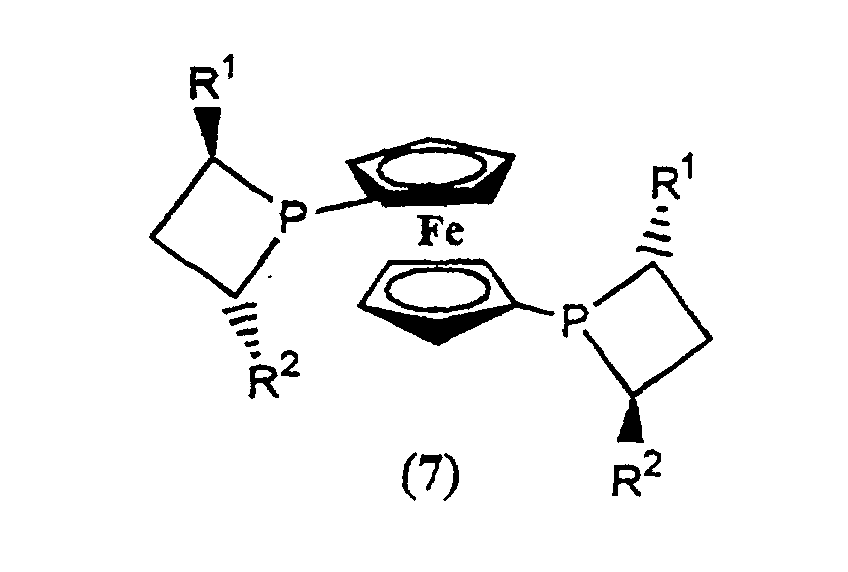
- the preparation of novel ferrocenyl bisphosphetanes of formula ( 7 ) and opposite enantiomers thereof, wherein R 1 and R 2 are linear or branched alkyl demonstrates functional group compatibility.
- controlled nucleophilic substitution at neopentyl-like centres may be achieved.
- preferred bifunctional alkylating agents are those prepared from the corresponding single enantiomer 1,3- and 1,4-diols.
- Cyclic sulphate derivatives are preferred, although bis(aryl)sulphonates or bis(alkyl)sulphonates, such as ditosylates, can be used with equal facility.
- 1,4-Diol precursors ofphospholane ligands ( 1 ) and ( 2 ) can be prepared either by electrochemical Kolbe coupling [see Burk et al , Organometallics (1990) 9:2653] or more conveniently via biocatalytic resolution of racemic diols [Berens, Proceedings of Chiral Europe 1996 (Spring Innovations Ltd.), p. 13].
- 1,3-Diol precursors of phosphetanes (6) are easily accessible by asymmetric hydrogenation of the corresponding 1,3-diketones (for lead references, see WO 98/02445).
- 1,2-Bis(phosphino)ethane (12.0 g, 0.1276 mol) was added to a solution of the cyclic sulfate (4 R ,7 R )-4,7-diethyl-2,2-dioxo-1,3,2-dioaxathiepane (55.9g, 0.2683 mol, 5% excess) in 1 L of THF, under nitrogen.
- a solution of 2.5 N n-BuLi (211.3 ml, 0.528 mol) in ether (300 ml) was added under rapid stirring within 120 minutes, while the internal temperature was maintained at 10°C by cooling with an ice bath. After the complete addition of the BuLi there was no colour, thus more BuLi (ca.
- 1,1'-bis(phosphino)ferrocene (2.0 g, 8 mmol) was added via syringe to the solution of the cyclic sulfate (no stirring), and then the solution of sec-BuLi was added at 0°C under rapid stirring within one hour.
- the addition of the sec-BuLi was complete, the mixture was stirred for another 2 minutes and then the excess base was quenched by the addition of 2 mL of MeOH.
- the solvent was then removed on the rotavapor, and the residue was dissolved in water/saturated NH 4 Cl (100/50mL). This mixture was extracted twice with petrol ether (bp. 40-60°C, 100 and 50 mL).
- 1,1'-bis(phosphino)ferrocene (2.0 g, 8 mmol) was added via syringe to the solution of the cyclic sulfate (no stirring), and then the solution of sec-BuLi was added at 0°C under rapid stirring within one hour. After the complete addition of the sec-BuLi the mixture was stirred for another 10 minutes and then the excess base was quenched by the addition of methanol. The solvent was then removed on the rotavapor, and the residue was distributed between water/pentane (100 and 2 x 50mL of pentane). The combined organic layer was dried (Na 2 SO 4 ), and removal of the solvent gave 3.4 g of a bright yellow-orange solid. The material was recrystallised from methanol (ca. 50 mL) and gave, after two recrystallisations, 1.12g (25%) of the product.
Landscapes
- Chemical & Material Sciences (AREA)
- Organic Chemistry (AREA)
- Health & Medical Sciences (AREA)
- Life Sciences & Earth Sciences (AREA)
- Biochemistry (AREA)
- General Health & Medical Sciences (AREA)
- Molecular Biology (AREA)
- Crystallography & Structural Chemistry (AREA)
Abstract
Description


Claims (19)
- A process for the preparation of a cyclic phosphine from the corresponding primary phosphine and a bifunctional alkylating agent, wherein alkylation, and displacement of each functional group, occurs in the presence of a strong base, which comprises adding the strong base, in an amount sufficient for cyclisation, to a preformed mixture or reaction product of the primary phosphine and the alkylating agent.
- A process according to claim 1, which comprises the addition of at least 2m equivalents of the strong base to a mixture or reaction product of the primary phosphine and at least m equivalents of the bifunctional alkylating agent.
- A process according to claim 1 or claim 2, wherein the cyclic phosphine is of formula (3), the primary phosphine is of formula (4) and the alkylating agent is of formula (5)wherein m and n are positive integers, the various groups R are each any non-intefering radical, and X and X1 are each nucleofugal leaving groups, optionally linked to form a ring.

- A process according to claim 3, for the preparation of an enantiomerically-enriched cyclic phosphine (3) from an enantiomerically-enriched alkylating agent (5).
- A process according to claim 3 or claim 4, wherein the orientation of R1 and R2 in the phosphine (3) is trans.
- A process according to any of claims 3 to 5, wherein R1 and R2 are independently H, alkyl, cycloalkyl, aryl, aralkyl or alkaryl, provided that both are not H, R3 is aryl, alkyl, cycloalkyl, aralkyl, alkaryl or an organometallic residue; m is 1 or 2; n is an integer of 1-4; and wherein the cyclic phosphine ring in (3) optionally forms part of a fused polycyclic ring system.
- A process according to claim 6, wherein R1=R2 and n is 1 or 2.
- A process according to claim 7, wherein n is 2.
- A process according to claim 8, wherein m is 2.
- A process according to claim 9, wherein the primary phosphine (4) is 1,2-bis(phosphino)benzene or 1,2-bis(phosphino)ethane, for the preparation of a cyclic diphosphine of formula (1) or (2)or the opposite enantiomer thereof, wherein R1=R2=linear or branched C1-6 alkyl.
- A process according to claim 8, wherein m is 1 and R3 is aryl.
- A process according to claim 7, wherein n is 1.
- A process according to claim 12, wherein m is 2.
- A process according to claim 13, wherein R3 is ferrocenyl.
- A process according to claim 12, wherein m is 1 and R3 is aryl.
- A process according to any preceding claim, wherein the bifunctional alkylating agent is obtainable from the corresponding alkanediol, i.e. X=X1=OH if the alkylating agent is of formula (5).
- A process according to any preceding claim, wherein the alkylating agent is a cyclic sulphate, i.e. X and X1 are linked if the alkylating agent is of formula (5).
- A process according to any preceding claim, wherein the base is an alkyl or aryl lithium.
- A process according to claim 18, wherein the base is n-butyllithium or sec-butyllithium.
Applications Claiming Priority (5)
| Application Number | Priority Date | Filing Date | Title |
|---|---|---|---|
| GB9723583 | 1997-11-07 | ||
| GBGB9723583.2A GB9723583D0 (en) | 1997-11-07 | 1997-11-07 | Process for cyclic phosphines |
| US6867597P | 1997-12-24 | 1997-12-24 | |
| US68675P | 1997-12-24 | ||
| PCT/GB1998/003321 WO1999024444A1 (en) | 1997-11-07 | 1998-11-05 | Process for preparing cyclic phosphines |
Publications (2)
| Publication Number | Publication Date |
|---|---|
| EP1028967A1 EP1028967A1 (en) | 2000-08-23 |
| EP1028967B1 true EP1028967B1 (en) | 2001-09-26 |
Family
ID=26312567
Family Applications (1)
| Application Number | Title | Priority Date | Filing Date |
|---|---|---|---|
| EP98952862A Expired - Lifetime EP1028967B1 (en) | 1997-11-07 | 1998-11-05 | Process for preparing cyclic phosphines |
Country Status (9)
| Country | Link |
|---|---|
| US (1) | US6545183B1 (en) |
| EP (1) | EP1028967B1 (en) |
| JP (1) | JP4397524B2 (en) |
| AT (1) | ATE206128T1 (en) |
| AU (1) | AU1041099A (en) |
| CA (1) | CA2307192A1 (en) |
| DE (1) | DE69801841T2 (en) |
| ES (1) | ES2162473T3 (en) |
| WO (1) | WO1999024444A1 (en) |
Families Citing this family (14)
| Publication number | Priority date | Publication date | Assignee | Title |
|---|---|---|---|---|
| WO2000000498A1 (en) * | 1998-06-30 | 2000-01-06 | Chirotech Technology Limited | The preparation of arylphosphines |
| GB9814170D0 (en) | 1998-06-30 | 1998-08-26 | Chirotech Technology Ltd | The preparation of arylphosphines |
| GB9823716D0 (en) * | 1998-10-29 | 1998-12-23 | Isis Innovation | Diphosphines |
| JP4397528B2 (en) * | 1998-11-05 | 2010-01-13 | カイロテック・テクノロジー・リミテッド | Chiral ligands for asymmetric catalysts |
| ATE291028T1 (en) * | 2000-12-13 | 2005-04-15 | Warner Lambert Co | P-CHIRAL BISPHOSPHOLANE LIGANDS, THEIR TRANSITION METAL COMPLEXES |
| DE10106348A1 (en) * | 2001-02-09 | 2002-08-14 | Basf Ag | Compound suitable as a catalyst or for producing a catalyst system |
| CN1608074B (en) * | 2001-11-09 | 2011-09-07 | 宾夕法尼亚州研究基金会 | P-chiral phospholanes and phosphocyclic compounds and their use in asymmetric catalytic reactions |
| US7169953B2 (en) * | 2001-11-09 | 2007-01-30 | The Penn State Research Foundation | P-chiral phospholanes and phosphocyclic compounds and their use in asymmetric catalytic reactions |
| ITMI20020415A1 (en) | 2002-03-01 | 2003-09-01 | Chemi Spa | METAL CATALYSTS FOR CHEMO-REGIO-STEREO-SELECTIVE REACTION PRECURSORS |
| EP1650217A4 (en) * | 2003-07-28 | 2006-07-26 | Nippon Chemical Ind | NOVEL OPTICALLY ACTIVE PHOSPHOROUS CHIRAL DIPHOSPHETANES, INTERMEDIATES THEREOF, AND TRANSITION METAL COMPLEXES CONTAINING THESE DIPHOSPHETANES AS LIGAND |
| DE10353831A1 (en) * | 2003-11-18 | 2005-06-23 | Degussa Ag | Process for the preparation of bisphospholane ligands |
| US7767833B2 (en) * | 2004-08-12 | 2010-08-03 | Sigma-Aldrich Co. | Stabilized borane-tetrahydrofuran complex |
| WO2006116344A2 (en) * | 2005-04-22 | 2006-11-02 | Dow Global Technologies Inc. | Asymmetric hydroformylation process |
| US7750168B2 (en) * | 2006-02-10 | 2010-07-06 | Sigma-Aldrich Co. | Stabilized deuteroborane-tetrahydrofuran complex |
Family Cites Families (4)
| Publication number | Priority date | Publication date | Assignee | Title |
|---|---|---|---|---|
| US5171892A (en) * | 1991-07-02 | 1992-12-15 | E. I. Du Pont De Nemours And Company | Chiral phospholanes via chiral 1,4-diol cyclic sulfates |
| DE4141299C2 (en) | 1991-12-14 | 2000-09-21 | Celanese Chem Europe Gmbh | Process for the preparation of tertiary phosphines |
| US5399771A (en) | 1994-06-01 | 1995-03-21 | Merck & Co., Inc. | Process of synthesizing binaphthyl derivatives |
| DE69715418T2 (en) | 1996-07-15 | 2003-04-17 | Chirotech Technology Ltd., Cambridge | LIGANDS FOR ASYMMETRIC CATALYSIS |
-
1998
- 1998-05-11 US US09/530,845 patent/US6545183B1/en not_active Expired - Lifetime
- 1998-11-05 EP EP98952862A patent/EP1028967B1/en not_active Expired - Lifetime
- 1998-11-05 AU AU10410/99A patent/AU1041099A/en not_active Abandoned
- 1998-11-05 CA CA002307192A patent/CA2307192A1/en not_active Abandoned
- 1998-11-05 JP JP2000520453A patent/JP4397524B2/en not_active Expired - Fee Related
- 1998-11-05 DE DE69801841T patent/DE69801841T2/en not_active Expired - Lifetime
- 1998-11-05 AT AT98952862T patent/ATE206128T1/en not_active IP Right Cessation
- 1998-11-05 ES ES98952862T patent/ES2162473T3/en not_active Expired - Lifetime
- 1998-11-05 WO PCT/GB1998/003321 patent/WO1999024444A1/en not_active Ceased
Also Published As
| Publication number | Publication date |
|---|---|
| JP2001522855A (en) | 2001-11-20 |
| US6545183B1 (en) | 2003-04-08 |
| JP4397524B2 (en) | 2010-01-13 |
| ES2162473T3 (en) | 2001-12-16 |
| DE69801841D1 (en) | 2001-10-31 |
| CA2307192A1 (en) | 1999-05-20 |
| WO1999024444A1 (en) | 1999-05-20 |
| DE69801841T2 (en) | 2002-05-16 |
| EP1028967A1 (en) | 2000-08-23 |
| AU1041099A (en) | 1999-05-31 |
| ATE206128T1 (en) | 2001-10-15 |
Similar Documents
| Publication | Publication Date | Title |
|---|---|---|
| US6545183B1 (en) | Process for preparing cyclic phosphines | |
| US5463097A (en) | Ferrocenyl diphosphines as ligands for homogeneous catalysts | |
| US5171892A (en) | Chiral phospholanes via chiral 1,4-diol cyclic sulfates | |
| JP3723241B2 (en) | Optically active phosphorus compound | |
| US5008457A (en) | Chiral phospholane transition metal catalysts | |
| JP2002533351A (en) | Complexes for selective hydrogenation of ligands and enantiomers | |
| EP0582668B1 (en) | Chiral tridentate bis(phospholane) ligands | |
| EP2212339A1 (en) | Bidentate chiral ligands for use in catalytic asymmetric addition reactions | |
| US7407910B2 (en) | Ligands for asymmetric reactions | |
| JP4397528B2 (en) | Chiral ligands for asymmetric catalysts | |
| EP0912583B1 (en) | Ligands for asymmetric catalysis | |
| US4393240A (en) | Optically active phosphines | |
| US5177230A (en) | Chiral phospholane transistor metal catalysts | |
| JP2008505162A (en) | Tetradentate ferrocene ligands and their use | |
| JP2008540377A (en) | Ferrocenyl ligands, preparation and use thereof | |
| ES2291983T3 (en) | FERROCENYL-1, 2-DIPHOSPHINES, ITS OBTAINING AND USE. | |
| EP1692149B1 (en) | Method for producing orthometalated and orthosubstituted aromatic compounds | |
| AU2006205652B2 (en) | Metallocene-based phosphorus chiral phosphines | |
| US5206398A (en) | Chiral phospholane transition metal catalysts |
Legal Events
| Date | Code | Title | Description |
|---|---|---|---|
| PUAI | Public reference made under article 153(3) epc to a published international application that has entered the european phase |
Free format text: ORIGINAL CODE: 0009012 |
|
| 17P | Request for examination filed |
Effective date: 20000504 |
|
| AK | Designated contracting states |
Kind code of ref document: A1 Designated state(s): AT BE CH DE DK ES FI FR GB GR IE IT LI LU NL PT SE |
|
| GRAG | Despatch of communication of intention to grant |
Free format text: ORIGINAL CODE: EPIDOS AGRA |
|
| 17Q | First examination report despatched |
Effective date: 20001212 |
|
| GRAG | Despatch of communication of intention to grant |
Free format text: ORIGINAL CODE: EPIDOS AGRA |
|
| GRAH | Despatch of communication of intention to grant a patent |
Free format text: ORIGINAL CODE: EPIDOS IGRA |
|
| GRAH | Despatch of communication of intention to grant a patent |
Free format text: ORIGINAL CODE: EPIDOS IGRA |
|
| GRAA | (expected) grant |
Free format text: ORIGINAL CODE: 0009210 |
|
| AK | Designated contracting states |
Kind code of ref document: B1 Designated state(s): AT BE CH DE DK ES FI FR GB GR IE IT LI LU NL PT SE |
|
| PG25 | Lapsed in a contracting state [announced via postgrant information from national office to epo] |
Ref country code: FI Free format text: LAPSE BECAUSE OF FAILURE TO SUBMIT A TRANSLATION OF THE DESCRIPTION OR TO PAY THE FEE WITHIN THE PRESCRIBED TIME-LIMIT Effective date: 20010926 Ref country code: BE Free format text: LAPSE BECAUSE OF FAILURE TO SUBMIT A TRANSLATION OF THE DESCRIPTION OR TO PAY THE FEE WITHIN THE PRESCRIBED TIME-LIMIT Effective date: 20010926 Ref country code: AT Free format text: LAPSE BECAUSE OF FAILURE TO SUBMIT A TRANSLATION OF THE DESCRIPTION OR TO PAY THE FEE WITHIN THE PRESCRIBED TIME-LIMIT Effective date: 20010926 |
|
| REF | Corresponds to: |
Ref document number: 206128 Country of ref document: AT Date of ref document: 20011015 Kind code of ref document: T |
|
| REG | Reference to a national code |
Ref country code: CH Ref legal event code: EP |
|
| REF | Corresponds to: |
Ref document number: 69801841 Country of ref document: DE Date of ref document: 20011031 |
|
| REG | Reference to a national code |
Ref country code: IE Ref legal event code: FG4D |
|
| PG25 | Lapsed in a contracting state [announced via postgrant information from national office to epo] |
Ref country code: LU Free format text: LAPSE BECAUSE OF NON-PAYMENT OF DUE FEES Effective date: 20011105 |
|
| REG | Reference to a national code |
Ref country code: CH Ref legal event code: NV Representative=s name: MOINAS & SAVOYE SA |
|
| REG | Reference to a national code |
Ref country code: ES Ref legal event code: FG2A Ref document number: 2162473 Country of ref document: ES Kind code of ref document: T3 |
|
| PG25 | Lapsed in a contracting state [announced via postgrant information from national office to epo] |
Ref country code: PT Free format text: LAPSE BECAUSE OF FAILURE TO SUBMIT A TRANSLATION OF THE DESCRIPTION OR TO PAY THE FEE WITHIN THE PRESCRIBED TIME-LIMIT Effective date: 20011226 Ref country code: DK Free format text: LAPSE BECAUSE OF FAILURE TO SUBMIT A TRANSLATION OF THE DESCRIPTION OR TO PAY THE FEE WITHIN THE PRESCRIBED TIME-LIMIT Effective date: 20011226 |
|
| PG25 | Lapsed in a contracting state [announced via postgrant information from national office to epo] |
Ref country code: GR Free format text: LAPSE BECAUSE OF FAILURE TO SUBMIT A TRANSLATION OF THE DESCRIPTION OR TO PAY THE FEE WITHIN THE PRESCRIBED TIME-LIMIT Effective date: 20011228 |
|
| REG | Reference to a national code |
Ref country code: GB Ref legal event code: IF02 |
|
| ET | Fr: translation filed | ||
| PLBE | No opposition filed within time limit |
Free format text: ORIGINAL CODE: 0009261 |
|
| STAA | Information on the status of an ep patent application or granted ep patent |
Free format text: STATUS: NO OPPOSITION FILED WITHIN TIME LIMIT |
|
| 26N | No opposition filed | ||
| PGFP | Annual fee paid to national office [announced via postgrant information from national office to epo] |
Ref country code: SE Payment date: 20021106 Year of fee payment: 5 |
|
| PG25 | Lapsed in a contracting state [announced via postgrant information from national office to epo] |
Ref country code: SE Free format text: LAPSE BECAUSE OF NON-PAYMENT OF DUE FEES Effective date: 20031106 |
|
| EUG | Se: european patent has lapsed | ||
| REG | Reference to a national code |
Ref country code: CH Ref legal event code: NV Representative=s name: FIAMMENGHI-FIAMMENGHI |
|
| PGFP | Annual fee paid to national office [announced via postgrant information from national office to epo] |
Ref country code: ES Payment date: 20121119 Year of fee payment: 15 Ref country code: IT Payment date: 20121029 Year of fee payment: 15 |
|
| REG | Reference to a national code |
Ref country code: DE Ref legal event code: R082 Ref document number: 69801841 Country of ref document: DE Representative=s name: MEISSNER BOLTE PATENTANWAELTE RECHTSANWAELTE P, DE Ref country code: DE Ref legal event code: R082 Ref document number: 69801841 Country of ref document: DE Representative=s name: MEISSNER, BOLTE & PARTNER GBR, DE |
|
| REG | Reference to a national code |
Ref country code: DE Ref legal event code: R082 Ref document number: 69801841 Country of ref document: DE Representative=s name: MEISSNER, BOLTE & PARTNER GBR, DE |
|
| PG25 | Lapsed in a contracting state [announced via postgrant information from national office to epo] |
Ref country code: IT Free format text: LAPSE BECAUSE OF NON-PAYMENT OF DUE FEES Effective date: 20131105 |
|
| REG | Reference to a national code |
Ref country code: ES Ref legal event code: FD2A Effective date: 20150407 |
|
| PG25 | Lapsed in a contracting state [announced via postgrant information from national office to epo] |
Ref country code: ES Free format text: LAPSE BECAUSE OF NON-PAYMENT OF DUE FEES Effective date: 20131106 |
|
| REG | Reference to a national code |
Ref country code: FR Ref legal event code: PLFP Year of fee payment: 18 |
|
| REG | Reference to a national code |
Ref country code: FR Ref legal event code: PLFP Year of fee payment: 19 |
|
| PGFP | Annual fee paid to national office [announced via postgrant information from national office to epo] |
Ref country code: GB Payment date: 20170905 Year of fee payment: 20 |
|
| REG | Reference to a national code |
Ref country code: FR Ref legal event code: PLFP Year of fee payment: 20 |
|
| PGFP | Annual fee paid to national office [announced via postgrant information from national office to epo] |
Ref country code: NL Payment date: 20171130 Year of fee payment: 20 Ref country code: FR Payment date: 20171122 Year of fee payment: 20 Ref country code: DE Payment date: 20171130 Year of fee payment: 20 |
|
| PGFP | Annual fee paid to national office [announced via postgrant information from national office to epo] |
Ref country code: CH Payment date: 20171004 Year of fee payment: 20 |
|
| PGFP | Annual fee paid to national office [announced via postgrant information from national office to epo] |
Ref country code: IE Payment date: 20180530 Year of fee payment: 20 |
|
| REG | Reference to a national code |
Ref country code: DE Ref legal event code: R071 Ref document number: 69801841 Country of ref document: DE |
|
| REG | Reference to a national code |
Ref country code: NL Ref legal event code: MK Effective date: 20181104 |
|
| REG | Reference to a national code |
Ref country code: CH Ref legal event code: PL |
|
| REG | Reference to a national code |
Ref country code: GB Ref legal event code: PE20 Expiry date: 20181104 |
|
| REG | Reference to a national code |
Ref country code: IE Ref legal event code: MK9A |
|
| PG25 | Lapsed in a contracting state [announced via postgrant information from national office to epo] |
Ref country code: IE Free format text: LAPSE BECAUSE OF EXPIRATION OF PROTECTION Effective date: 20181105 |
|
| PG25 | Lapsed in a contracting state [announced via postgrant information from national office to epo] |
Ref country code: GB Free format text: LAPSE BECAUSE OF EXPIRATION OF PROTECTION Effective date: 20181104 |