EP1027093B1 - Apparatus for applying 5-aminolevulinic acid - Google Patents
Apparatus for applying 5-aminolevulinic acid Download PDFInfo
- Publication number
- EP1027093B1 EP1027093B1 EP98956205A EP98956205A EP1027093B1 EP 1027093 B1 EP1027093 B1 EP 1027093B1 EP 98956205 A EP98956205 A EP 98956205A EP 98956205 A EP98956205 A EP 98956205A EP 1027093 B1 EP1027093 B1 EP 1027093B1
- Authority
- EP
- European Patent Office
- Prior art keywords
- applicator
- ala
- compartment
- liquid diluent
- container
- Prior art date
- Legal status (The legal status is an assumption and is not a legal conclusion. Google has not performed a legal analysis and makes no representation as to the accuracy of the status listed.)
- Expired - Lifetime
Links
Images

Classifications
-
- A—HUMAN NECESSITIES
- A61—MEDICAL OR VETERINARY SCIENCE; HYGIENE
- A61M—DEVICES FOR INTRODUCING MEDIA INTO, OR ONTO, THE BODY; DEVICES FOR TRANSDUCING BODY MEDIA OR FOR TAKING MEDIA FROM THE BODY; DEVICES FOR PRODUCING OR ENDING SLEEP OR STUPOR
- A61M35/00—Devices for applying media, e.g. remedies, on the human body
- A61M35/003—Portable hand-held applicators having means for dispensing or spreading integral media
-
- A—HUMAN NECESSITIES
- A61—MEDICAL OR VETERINARY SCIENCE; HYGIENE
- A61J—CONTAINERS SPECIALLY ADAPTED FOR MEDICAL OR PHARMACEUTICAL PURPOSES; DEVICES OR METHODS SPECIALLY ADAPTED FOR BRINGING PHARMACEUTICAL PRODUCTS INTO PARTICULAR PHYSICAL OR ADMINISTERING FORMS; DEVICES FOR ADMINISTERING FOOD OR MEDICINES ORALLY; BABY COMFORTERS; DEVICES FOR RECEIVING SPITTLE
- A61J1/00—Containers specially adapted for medical or pharmaceutical purposes
- A61J1/14—Details; Accessories therefor
- A61J1/20—Arrangements for transferring or mixing fluids, e.g. from vial to syringe
- A61J1/2003—Accessories used in combination with means for transfer or mixing of fluids, e.g. for activating fluid flow, separating fluids, filtering fluid or venting
- A61J1/202—Separating means
- A61J1/2027—Separating means having frangible parts
-
- A—HUMAN NECESSITIES
- A61—MEDICAL OR VETERINARY SCIENCE; HYGIENE
- A61J—CONTAINERS SPECIALLY ADAPTED FOR MEDICAL OR PHARMACEUTICAL PURPOSES; DEVICES OR METHODS SPECIALLY ADAPTED FOR BRINGING PHARMACEUTICAL PRODUCTS INTO PARTICULAR PHYSICAL OR ADMINISTERING FORMS; DEVICES FOR ADMINISTERING FOOD OR MEDICINES ORALLY; BABY COMFORTERS; DEVICES FOR RECEIVING SPITTLE
- A61J1/00—Containers specially adapted for medical or pharmaceutical purposes
- A61J1/14—Details; Accessories therefor
- A61J1/20—Arrangements for transferring or mixing fluids, e.g. from vial to syringe
- A61J1/2093—Containers having several compartments for products to be mixed
-
- A—HUMAN NECESSITIES
- A61—MEDICAL OR VETERINARY SCIENCE; HYGIENE
- A61K—PREPARATIONS FOR MEDICAL, DENTAL OR TOILETRY PURPOSES
- A61K31/00—Medicinal preparations containing organic active ingredients
- A61K31/185—Acids; Anhydrides, halides or salts thereof, e.g. sulfur acids, imidic, hydrazonic or hydroximic acids
- A61K31/19—Carboxylic acids, e.g. valproic acid
- A61K31/195—Carboxylic acids, e.g. valproic acid having an amino group
- A61K31/197—Carboxylic acids, e.g. valproic acid having an amino group the amino and the carboxyl groups being attached to the same acyclic carbon chain, e.g. gamma-aminobutyric acid [GABA], beta-alanine, epsilon-aminocaproic acid or pantothenic acid
-
- A—HUMAN NECESSITIES
- A61—MEDICAL OR VETERINARY SCIENCE; HYGIENE
- A61K—PREPARATIONS FOR MEDICAL, DENTAL OR TOILETRY PURPOSES
- A61K41/00—Medicinal preparations obtained by treating materials with wave energy or particle radiation ; Therapies using these preparations
- A61K41/0057—Photodynamic therapy with a photosensitizer, i.e. agent able to produce reactive oxygen species upon exposure to light or radiation, e.g. UV or visible light; photocleavage of nucleic acids with an agent
- A61K41/0061—5-aminolevulinic acid-based PDT: 5-ALA-PDT involving porphyrins or precursors of protoporphyrins generated in vivo from 5-ALA
-
- A—HUMAN NECESSITIES
- A61—MEDICAL OR VETERINARY SCIENCE; HYGIENE
- A61K—PREPARATIONS FOR MEDICAL, DENTAL OR TOILETRY PURPOSES
- A61K9/00—Medicinal preparations characterised by special physical form
- A61K9/08—Solutions
Definitions
- the present invention relates to an apparatus for supplying, mixing and applying 5-aminolevulinic acid, also known as 5-amino-4-oxo-pentanoic acid (hereinafter referred to as ALA), in a simple, cost effective manner. More particularly, the present invention relates to an apparatus for supplying a two component system comprising ALA and a liquid diluent, wherein the two components are inhibited from contact with each other, as well as contact with light, moisture and air, until just prior to use, when they are mixed.
- Topically applied ALA in association with irradiation with light, has been clinically tested in the treatment of pre-cancerous lesions such as actinic keratosis.
- ALA is degraded in aqueous solution.
- the inventor has further found that ALA turns brown, and presumably is degraded, in all sorts of topical vehicles such as creams, ointments and solid vehicles.
- topical vehicles such as creams, ointments and solid vehicles.
- the inventor found it necessary to employ a means to store ALA until ready for treatment in topical applications, as well as to mix the ALA just prior to use, and to focus the area of application to the skin.
- Haber United States Patent 5,490,736 to Haber et al. discloses a topical applicator having a barrier interposed between a dry medication and a diluent.
- the barrier which partitions an applicator body shared in common by the medication and diluent, is ruptured or displaced by pressure on the applicator body.
- Haber discloses several means for exposing a medicine saturated swab within the applicator body for topical treatment of acne.
- the ALA applicator according to the present invention allows storage of the ALA for long periods of time by hermetically sealing essentially anhydrous ALA in the applicator, thus separating the ALA and other components from each other and minimizing exposure to moisture and air, before mixing the components and then applying them to the skin.
- frangible includes any arrangement which releases the contents of a compartment by disrupting the form of the compartment.
- the essentially frangible compartment comprises a glass ampule or vial. Squeezing the container disrupts, e.g. crushes, the compartment (or compartments if the liquid diluent is similarly contained), allowing the ALA and liquid diluent components to mix just prior to use.
- the ALA is controllably applied directly onto a topical surface by a point applicator portion of the container.
- the topical surface is an external surface such as the skin.
- internal surfaces such as vaginal, rectal, or oral surfaces may also be treated according to the present invention.
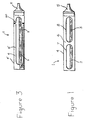
- FIG. 1 is an exemplary embodiment according to the present invention showing an applicator apparatus 1 which comprises two separate essentially frangible compartments 7,8 within a deformable container 4.
- One compartment 8 contains essentially anhydrous ALA 3 and the other compartment 7 contains a liquid diluent 2 for the essentially anhydrous ALA 3.
- the container 4 has a point applicator 5 provided at one end thereof.
- the compartment 8 containing the essentially anhydrous ALA 3 is relatively proximate to the point applicator 5, and the compartment 7 containing the liquid diluent 2 is relatively distant to the point applicator 5.
- the point applicator 5 may be removably insertable into the container 4 to facilitate manufacture of the applicator.
- An air space 6 may also be provided within the deformable container 4.
- the container 4 is preferably made of a plastic material which is deformable enough so that when squeezed its side walls can contact side walls of the essentially frangible compartments 7,8 and exert enough pressure to release the contents, e.g. by crushing, from the compartments 7,8.
- the container 4 must also be resistant to interaction with ALA.
- the container 4 is preferably composed of low density polyethylene (LDPE), however, high density polyethylene, polypropylene, butyrate or propylene copolymers and other equivalent materials may also be used. Disrupting the compartment 7 releases the liquid diluent 2 into the deformable container 4.
- LDPE low density polyethylene
- the deformable container 4 is resistant to puncture and preferably resistant to scoring, such as from broken glass fragments resulting from crushing compartments 7,8.
- the ALA 3 is essentially anhydrous, which means that it contains no more water than would permit degradation of the ALA 3 under normal conditions of use or storage, typically one to two years or more.
- the ALA 3 and its environment are water free.
- One particularly useful diluent used in conjunction with the applicators of the present invention is an alcohol/water solution.
- the solution may also comprise a wetting agent and/or a humectant.
- a range of weight/weight percentages for a preferred solution are 39.9-48.8 Alcohol (USP or SDA 40-2), 39.1-47.8 Purified Water USP, 5.9-7.4 LAURETH-4, 3.5-4.3 Isopropyl Alcohol USP, and 1.5-1.8 Polyethylene Glycol 400 NF.
- the weight/weight percentages of a particularly preferred diluent are 44.37 Alcohol (USP or SDA 40-2), 43.46 Purified Water USP, 6.59 LAURETH-4, 3.93 Isopropyl Alcohol USP, and 1.65 Polyethylene Glycol 400 NF. It is envisioned that various other alcohol/water percentages could be used, various surfactants could be substituted for the LAURETH-4 (e.g. sodium lauryl sulfate, as well as other ionic or non-ionic surfactants), and propylene glycol or glycerin could be substituted for the polyethylene glycol.
- surfactants e.g. sodium lauryl sulfate, as well as other ionic or non-ionic surfactants
- propylene glycol or glycerin could be substituted for the polyethylene glycol.
- the compartments 7,8 may contain just enough essentially anhydrous ALA 3 and diluent 2 for a single topical treatment of a lesion, e.g. a pre-cancerous lesion on the skin. Since the ALA has a short useful life of less than 24 hours after exposure to air and moisture, aliquots in excess of that which would be used in a single treatment would be wasted. Preferably, only as much ALA as a practitioner would use during a single treatment is provided within each applicator. Volumes from less than 1/10 of a cubic centimeter to more than a cubic centimeter of ALA solution may be held within the container 4.
- the essentially anhydrous ALA 3 and diluent 2 are provided in predetermined proportions, usually in an approximate 1:1 ratio.
- the compartment 8 may be topped with nitrogen, an inert gas, or evacuated before being hermetically sealed.
- Hermetic sealing of compartment 8 is important to prevent exposing the essentially anhydrous ALA 3 to air, moisture or the diluent 2, which would degrade the essentially anhydrous ALA 3.
- hermetic sealing results in less than 0.5% water and 1% oxygen in the compartment 8, and preferably less than 0.05% water and 0.1% oxygen, and more preferably less than 0.005% water and 0.01% oxygen.
- the container 4 includes a point applicator 5 occluding the dispensing end of the container 4.
- Figure 2 shows a preferred point applicator 5 according to the present invention for controlling the distribution of ALA directly on an afflicted portion of a patient's skin.
- distribution control is proportional to the amount of force a practitioner uses pressing the point applicator 5.against the topical surface.
- approximately 1-2 mg/cm 2 of ALA admixed with approximately 10-20 ⁇ l/cm 2 of diluent is distributed. Treatment is most effective when the point applicator 5 distributes a quantity of the ALA solution which is at least sufficient with respect to the lighting conditions during subsequent irradiation with light.
- the preferred point applicator 5 illustrated in Figure 2 comprises a tubular body 10 configured to receive a resiliently biased valve 11 and a liquid permeable cover 12.
- the tubular body 10 includes an outer cylindrical surface adapted to matingly engage a corresponding inner cylindrical surface of the container 4.
- the valve 11 is received within an inner cylindrical surface of the tubular body 10.
- a coil type spring 15 is shown biasing the valve 11 against the tubular body 10, any equivalent resilient element can be substituted for the coil type spring 15.
- Cover 12 is secured over the outlet end of the tubular body 10. At least one filter element 13 ensures that any particles of the disrupted compartments 7,8 are maintained within the container 4.
- a hollow element 14 generally extends between the cover 12 and the valve 11.
- the force exerted by the practitioner pressing the exterior surface of the cover 12 against a lesion displaces hollow element 14, which in turn creates a gap between the valve 11 and the tubular body 10 through which ALA may flow to the cover 12.
- the maximum size of the gap is a function of the length of the hollow element 14.
- FIG. 3 An alternate embodiment of an applicator 1 according to the present invention is shown in Figure 3.
- a container 4' similarly encloses at least one compartment 8' which contains essentially anhydrous ALA 3.
- the liquid diluent 2 is not contained within a separate compartment as discussed with respect to Figure 1. Instead, the liquid diluent 2 is contained directly within the container 4' by means of a seal 20 interposed between the compartment 8' and the container 4'.
- a two part seal 20 is shown with a raised annular rib on the inner cylindrical surface of the container 4' matingly engaging a corresponding raised annular rib on the outer surface of the compartment 8'.
- the applicator apparatus 1 is held upright with the point applicator 5 pointing up. With a cardboard sleeve (not shown) surrounding the deformable container 4, the diluent compartment 7 (if present) is first disrupted releasing the diluent 2, then the ALA compartment 8(8') is disrupted to release the essentially anhydrous ALA 3. While maintaining the applicator apparatus 1 in the upright position, the applicator apparatus 1 is shaken for approximately three minutes to completely dissolve the essentially anhydrous ALA 3 in the liquid diluent 2. The applicator apparatus 1 is now ready for treatment, and the solution should be applied immediately after admixture.
- the applicator apparatus 1 is tilted to so that the ALA topical solution flows toward the point applicator 5.
- ALA topical solution distribution is accomplished by pressing and releasing the point applicator 5 against the lesions to be treated.
- the lesion, and not the surrounding skin is uniformly wetted and then allowed to dry. After the original application has dried, the treatment may be repeated, preferably for a total of two applications.
- One method of treating patients with ALA includes providing a ALA applicator as described above, deforming the deformable container so as to exert enough force to first crush the diluent compartment then the ALA compartment, admixing the ALA and diluent, and dispensing the ALA from the point applicator.
- the essentially anhydrous ALA 3 and liquid diluent 2 are admixed by crushing glass compartments 7,8 (or glass compartment 8') in the deformable container 4. Shaking the deformable container 4(4') dissolves the essentially anhydrous ALA 3 in the liquid diluent 2.
- the resulting ALA topical solution is applied directly to target actinic keratosis lesions by gentle dabbing with the point applicator 5.
- the ALA topical solution is applied in sufficient volume to uniformly wet the lesion surface, without excess running or dripping.
- a second application may be made in the same manner to assure that complete and uniform coverage of the lesion surface has been accomplished.
- the ALA topical solution contains alcohol and dries quickly after application. Therefore, the ALA topical solution is carefully applied with the point applicator 5 only to skin areas to be treated, in a quantity adequate to wet the area thoroughly, but not enough to allow dripping or running. The solution is applied, allowed to dry, applied again and allowed to dry before proceeding. Prior to subsequent irradiation with light, the surface of all treated lesions may be rinsed with water to remove residual ALA and allowed to dry.
- the apparatus according to the present invention are also useful for other applications of ALA to flora and fauna in addition to the treatment of humans.
Landscapes
- Health & Medical Sciences (AREA)
- Life Sciences & Earth Sciences (AREA)
- Chemical & Material Sciences (AREA)
- Animal Behavior & Ethology (AREA)
- General Health & Medical Sciences (AREA)
- Public Health (AREA)
- Veterinary Medicine (AREA)
- Pharmacology & Pharmacy (AREA)
- Medicinal Chemistry (AREA)
- Epidemiology (AREA)
- Biochemistry (AREA)
- Molecular Biology (AREA)
- Physics & Mathematics (AREA)
- Fluid Mechanics (AREA)
- Engineering & Computer Science (AREA)
- Anesthesiology (AREA)
- Biomedical Technology (AREA)
- Heart & Thoracic Surgery (AREA)
- Hematology (AREA)
- Organic Low-Molecular-Weight Compounds And Preparation Thereof (AREA)
- Medicinal Preparation (AREA)
- Agricultural Chemicals And Associated Chemicals (AREA)
- Acyclic And Carbocyclic Compounds In Medicinal Compositions (AREA)
- Catching Or Destruction (AREA)
- Medical Preparation Storing Or Oral Administration Devices (AREA)
- Media Introduction/Drainage Providing Device (AREA)
- Coating Apparatus (AREA)
Abstract
Description
Claims (15)
- An applicator for dispensing 5-aminolevulinic acid, said applicator comprising:a first essentially frangible compartment (8) containing essentially anhydrous 5-aminolevulinic acid (3); anda deformable container (4) enclosing said first compartment (8) and a liquid diluent (2) for 5-aminolevulinic acid.
- The applicator as defined in claim 1, wherein said first compartment (8) is essentially hermetically sealed.
- The applicator as defined in claims 1 or 2, further comprising:a second essentially frangible compartment (7) containing said liquid diluent (2), said deformable container (4) enclosing said second essentially frangible compartment (7).
- The applicator as defined in claims 1-3, further comprising:a point applicator (5) for controlling dispersion of 5-aminolevulinic acid from said container.
- The applicator as defined in claim 4, wherein said first essentially frangible compartment (8) is interposed between said liquid diluent (2) and said point applicator (5).
- The applicator as defined in claim 4, wherein said point applicator includes:wherein depressing said cover (12) creates a gap between said valve (11) and said tubular body (10) for distributing the 5-aminolevulinic acid.a tubular body (10) having an inner cylindrical surface and an outer cylindrical surface, said outer cylindrical surface contiguously confronting an inner cylindrical surface of said container;a resiliently biased valve (11) for normally occluding a first end of said tubular body; anda liquid permeable cover (12) for covering said first end of said tubular body;
- The applicator as defined in claim 6, further comprising:a seal (20) interposed between said first essentially frangible compartment (8') and said container (4').
- The applicator as defined in claim 7, wherein said seal (20) includes a raised annular rib on at least one of said compartment (8') outer surface and said container (4') inner cylindrical surface.
- The applicator as defined in claim 1, wherein said liquid diluent (2) comprises an alcohol/water solution.
- The applicator as defined in claim 9, wherein said liquid diluent (2) further comprises a wetting agent.
- The applicator as defined in claim 10, wherein said wetting agent is a surfactant.
- The applicator as defined in claim 9, wherein said liquid diluent (2) further comprises a humectant.
- The applicator as defined in claim 12, wherein said humectant is a polyalcohol.
- The applicator as defined in claims 12 or 13, wherein said humectant is selected from the group consisting of polyethylene glycol, propylene glycol and glycerin.
- The applicator according to claim 1, wherein the anhydrous 5-aminolevulinic acid is stored in the applicator in a sealed environment prior to mixing of the 5-aminolevulinic acid and the liquid diluent.
Priority Applications (2)
| Application Number | Priority Date | Filing Date | Title |
|---|---|---|---|
| DK98956205T DK1027093T3 (en) | 1997-10-31 | 1998-10-30 | Apparatus for applying 5-aminolevulinic acid |
| SI9830705T SI1027093T1 (en) | 1997-10-31 | 1998-10-30 | Apparatus for applying 5-aminolevulinic acid |
Applications Claiming Priority (3)
| Application Number | Priority Date | Filing Date | Title |
|---|---|---|---|
| US08/962,294 US5954703A (en) | 1997-10-31 | 1997-10-31 | Method and apparatus for applying 5-aminolevulinic acid |
| US962294 | 1997-10-31 | ||
| PCT/US1998/022645 WO1999022802A1 (en) | 1997-10-31 | 1998-10-30 | Method and apparatus for applying 5-aminolevulinic acid |
Publications (2)
| Publication Number | Publication Date |
|---|---|
| EP1027093A1 EP1027093A1 (en) | 2000-08-16 |
| EP1027093B1 true EP1027093B1 (en) | 2004-08-04 |
Family
ID=25505677
Family Applications (1)
| Application Number | Title | Priority Date | Filing Date |
|---|---|---|---|
| EP98956205A Expired - Lifetime EP1027093B1 (en) | 1997-10-31 | 1998-10-30 | Apparatus for applying 5-aminolevulinic acid |
Country Status (18)
| Country | Link |
|---|---|
| US (1) | US5954703A (en) |
| EP (1) | EP1027093B1 (en) |
| KR (1) | KR100504014B1 (en) |
| AT (1) | ATE272422T1 (en) |
| AU (1) | AU738070B2 (en) |
| BR (1) | BR9813887A (en) |
| DE (1) | DE69825464T2 (en) |
| DK (1) | DK1027093T3 (en) |
| ES (1) | ES2226188T3 (en) |
| HU (1) | HUP0004737A3 (en) |
| IL (1) | IL135850A (en) |
| NO (1) | NO319662B1 (en) |
| NZ (1) | NZ504366A (en) |
| PL (1) | PL340298A1 (en) |
| PT (1) | PT1027093E (en) |
| SI (1) | SI1027093T1 (en) |
| TR (1) | TR200001185T2 (en) |
| WO (1) | WO1999022802A1 (en) |
Families Citing this family (16)
| Publication number | Priority date | Publication date | Assignee | Title |
|---|---|---|---|---|
| DE10003620A1 (en) * | 2000-01-28 | 2001-08-02 | Asat Ag Applied Science & Tech | 5-aminolevulinic acid formulation in non-aqueous solvents |
| CZ295986B6 (en) * | 2000-07-28 | 2005-12-14 | Science For Life, S. R. O. | Process for preparing sterile crystals of 5-aminolevulinic acid and derivatives thereof employable for medical diagnostic and therapeutic purposes |
| GB0823472D0 (en) * | 2008-12-23 | 2009-01-28 | Photocure Asa | Product |
| CN102482023A (en) * | 2009-01-12 | 2012-05-30 | 阿克蒂弗派克股份有限公司 | Packaged products, inserts and compartments for aseptic mixing of substances, along with methods for use therewith |
| JP2013521251A (en) * | 2010-03-01 | 2013-06-10 | フォトキュア エイエスエイ | Beauty composition |
| CA2824768A1 (en) * | 2011-01-13 | 2012-07-19 | Qlt Inc. | Pharmaceutical compositions for topical delivery of photosensitizers and uses thereof |
| CZ307444B6 (en) | 2015-04-22 | 2018-08-29 | Jakub Rak | Mucoadhesive polymer film for photosensitive therapy in the oral cavity containing photosensitizers |
| WO2017066270A1 (en) | 2015-10-15 | 2017-04-20 | Dusa Pharmaceuticals, Inc. | Adjustable illuminator for photodynamic therapy and diagnosis |
| US10603508B2 (en) | 2015-10-15 | 2020-03-31 | Dusa Pharmaceuticals, Inc. | Adjustable illuminators and methods for photodynamic therapy and diagnosis |
| US10117847B2 (en) | 2015-12-04 | 2018-11-06 | Ventis Pharma | Extended duration local anesthetic formulation |
| US10814114B2 (en) * | 2015-12-08 | 2020-10-27 | Dusa Pharmaceuticals, Inc. | Method and apparatus for applying a topical solution |
| US10357567B1 (en) | 2018-01-12 | 2019-07-23 | Dusa Pharmaceuticals, Inc. | Methods for photodynamic therapy |
| CA3235710A1 (en) | 2021-10-19 | 2023-04-27 | Pradeep Sanghvi | Topical compositions and methods for photodynamic therapy |
| US20230145771A1 (en) | 2021-11-05 | 2023-05-11 | Dusa Pharmaceuticals, Inc. | Photodynamic therapy illuminator devices and methods |
| JP2025537694A (en) | 2022-11-04 | 2025-11-20 | サン ファーマシューティカル インダストリーズ,インコーポレイテッド | Photodynamic therapy methods |
| WO2025235557A2 (en) | 2024-05-07 | 2025-11-13 | Sun Pharmaceutical Industries, Inc. | Photodynamic therapy illuminator and photodynamic therapy methods |
Family Cites Families (16)
| Publication number | Priority date | Publication date | Assignee | Title |
|---|---|---|---|---|
| US2195675A (en) * | 1935-12-07 | 1940-04-02 | Lewis Rosemarie | Medicament dispenser |
| US3324855A (en) * | 1965-01-12 | 1967-06-13 | Henry J Heimlich | Surgical sponge stick |
| US3876314A (en) * | 1974-05-17 | 1975-04-08 | Int Paper Co | Pre-filled applicator or scrubber |
| US3891331A (en) * | 1974-06-14 | 1975-06-24 | Marion Health & Safety Inc | Unit for dispensing liquid from a frangible ampoule |
| DE2659828A1 (en) * | 1975-09-03 | 1977-06-23 | Kenneth Martin Grout | PRODUCTS FOR THE TREATMENT OF INSECT BITES |
| US4578055A (en) * | 1979-07-25 | 1986-03-25 | Fischer Dan E | Controlled diffusion medicament applicator |
| USD272091S (en) | 1981-03-23 | 1984-01-03 | Kaufman Jack W | Disposable swab applicator package with standby reservoir |
| US4925327A (en) * | 1985-11-18 | 1990-05-15 | Minnesota Mining And Manufacturing Company | Liquid applicator with metering insert |
| US4838851A (en) * | 1986-11-26 | 1989-06-13 | Shabo Alan L | Applicator and package therefor |
| US4850729A (en) * | 1987-04-07 | 1989-07-25 | David N. Kramer | Decontaminating composition and delivery system therefor |
| JPH0621745Y2 (en) * | 1987-05-08 | 1994-06-08 | 三菱鉛筆株式会社 | Valve device for writing or applying liquid material |
| US5098297A (en) * | 1988-10-04 | 1992-03-24 | John O. Butler Company | Apparatus for application of a tooth desensitizing composition |
| US5019033A (en) * | 1989-12-18 | 1991-05-28 | Warner-Lambert Company | Ointment applicator and method of using |
| US5171149A (en) * | 1991-05-28 | 1992-12-15 | Jeneric/Pentron Incorporated | Method and apparatus for applying dentin conditioning system and dental restoration kit comprising the apparatus |
| US5490736A (en) * | 1994-09-08 | 1996-02-13 | Habley Medical Technology Corporation | Stylus applicator for a rehydrated multi-constituent medication |
| USD377978S (en) | 1994-12-12 | 1997-02-11 | Habley Medical Technology Corporation | Topical astringent disinfectant applicator with cover |
-
1997
- 1997-10-31 US US08/962,294 patent/US5954703A/en not_active Expired - Lifetime
-
1998
- 1998-10-30 TR TR200001185T patent/TR200001185T2/en unknown
- 1998-10-30 WO PCT/US1998/022645 patent/WO1999022802A1/en not_active Ceased
- 1998-10-30 AU AU12783/99A patent/AU738070B2/en not_active Expired
- 1998-10-30 IL IL13585098A patent/IL135850A/en not_active IP Right Cessation
- 1998-10-30 PT PT98956205T patent/PT1027093E/en unknown
- 1998-10-30 SI SI9830705T patent/SI1027093T1/en unknown
- 1998-10-30 DK DK98956205T patent/DK1027093T3/en active
- 1998-10-30 BR BR9813887-1A patent/BR9813887A/en not_active IP Right Cessation
- 1998-10-30 EP EP98956205A patent/EP1027093B1/en not_active Expired - Lifetime
- 1998-10-30 HU HU0004737A patent/HUP0004737A3/en unknown
- 1998-10-30 NZ NZ504366A patent/NZ504366A/en not_active IP Right Cessation
- 1998-10-30 ES ES98956205T patent/ES2226188T3/en not_active Expired - Lifetime
- 1998-10-30 PL PL98340298A patent/PL340298A1/en unknown
- 1998-10-30 KR KR10-2000-7004740A patent/KR100504014B1/en not_active Expired - Lifetime
- 1998-10-30 AT AT98956205T patent/ATE272422T1/en active
- 1998-10-30 DE DE69825464T patent/DE69825464T2/en not_active Expired - Lifetime
-
2000
- 2000-04-28 NO NO20002295A patent/NO319662B1/en not_active IP Right Cessation
Also Published As
| Publication number | Publication date |
|---|---|
| DK1027093T3 (en) | 2004-12-06 |
| US5954703A (en) | 1999-09-21 |
| DE69825464D1 (en) | 2004-09-09 |
| SI1027093T1 (en) | 2005-02-28 |
| NZ504366A (en) | 2002-12-20 |
| KR20010031679A (en) | 2001-04-16 |
| HUP0004737A3 (en) | 2001-05-28 |
| AU1278399A (en) | 1999-05-24 |
| AU738070B2 (en) | 2001-09-06 |
| KR100504014B1 (en) | 2005-07-27 |
| ATE272422T1 (en) | 2004-08-15 |
| ES2226188T3 (en) | 2005-03-16 |
| DE69825464T2 (en) | 2005-09-15 |
| HUP0004737A2 (en) | 2001-04-28 |
| NO319662B1 (en) | 2005-09-05 |
| BR9813887A (en) | 2000-09-26 |
| TR200001185T2 (en) | 2000-09-21 |
| WO1999022802A1 (en) | 1999-05-14 |
| PL340298A1 (en) | 2001-01-29 |
| NO20002295L (en) | 2000-06-28 |
| PT1027093E (en) | 2004-12-31 |
| IL135850A0 (en) | 2001-05-20 |
| NO20002295D0 (en) | 2000-04-28 |
| IL135850A (en) | 2005-05-17 |
| EP1027093A1 (en) | 2000-08-16 |
Similar Documents
| Publication | Publication Date | Title |
|---|---|---|
| US5954703A (en) | Method and apparatus for applying 5-aminolevulinic acid | |
| EP0681558B1 (en) | Stable sulfide compositions, uses, and process for preparation thereof | |
| EP0681546B1 (en) | Biostable treatment delivery system | |
| US5460620A (en) | Method of applying in-tandem applicator pads for transdermal delivery of a therapeutic agent | |
| EP0212332A2 (en) | Adhesive bandage | |
| US20130243884A1 (en) | Medical Treatment Kit and Methods of Use Thereof | |
| AU5541594A (en) | Vaginal sponge delivery system | |
| CA2172493A1 (en) | Use of angiotensin iii and analogs thereof in tissue repair | |
| BR9810985A (en) | Topical application of a combination of benzoyl peroxide and a second active ingredient | |
| CA2358813A1 (en) | Method for applying a medicament and swab applicator for uses therewith | |
| NZ223558A (en) | Acne treatment composition | |
| US5770583A (en) | Stable sulfide compositions uses and process for preparation thereof | |
| EP4167974A1 (en) | Dermal patches and glass swabs for application of topical immunosensitizers | |
| IE60778B1 (en) | Topical drug release system | |
| CZ20001537A3 (en) | A method and apparatus for applying 5-aminolevulinic acid | |
| HK1001256B (en) | Stable sulfide compositions, uses, and process for preparation thereof | |
| FR2451938A1 (en) | Powder dispersed in gelled liq. - to prevent powder compacting and subsequent blocking of disseminating appts. |
Legal Events
| Date | Code | Title | Description |
|---|---|---|---|
| PUAI | Public reference made under article 153(3) epc to a published international application that has entered the european phase |
Free format text: ORIGINAL CODE: 0009012 |
|
| 17P | Request for examination filed |
Effective date: 20000530 |
|
| AK | Designated contracting states |
Kind code of ref document: A1 Designated state(s): AT BE CH CY DE DK ES FI FR GB GR IE IT LI LU MC NL PT SE |
|
| AX | Request for extension of the european patent |
Free format text: AL PAYMENT 20000530;LT PAYMENT 20000530;LV PAYMENT 20000530;MK PAYMENT 20000530;RO PAYMENT 20000530;SI PAYMENT 20000530 |
|
| 17Q | First examination report despatched |
Effective date: 20030206 |
|
| GRAP | Despatch of communication of intention to grant a patent |
Free format text: ORIGINAL CODE: EPIDOSNIGR1 |
|
| RTI1 | Title (correction) |
Free format text: APPARATUS FOR APPLYING 5-AMINOLEVULINIC ACID |
|
| RTI1 | Title (correction) |
Free format text: APPARATUS FOR APPLYING 5-AMINOLEVULINIC ACID |
|
| GRAS | Grant fee paid |
Free format text: ORIGINAL CODE: EPIDOSNIGR3 |
|
| GRAA | (expected) grant |
Free format text: ORIGINAL CODE: 0009210 |
|
| RAP1 | Party data changed (applicant data changed or rights of an application transferred) |
Owner name: DUSA PHARMACEUTICALS, INC. |
|
| AK | Designated contracting states |
Kind code of ref document: B1 Designated state(s): AT BE CH CY DE DK ES FI FR GB GR IE IT LI LU MC NL PT SE |
|
| AX | Request for extension of the european patent |
Extension state: AL LT LV MK RO SI |
|
| REG | Reference to a national code |
Ref country code: GB Ref legal event code: FG4D |
|
| REG | Reference to a national code |
Ref country code: CH Ref legal event code: EP |
|
| REG | Reference to a national code |
Ref country code: IE Ref legal event code: FG4D |
|
| REF | Corresponds to: |
Ref document number: 69825464 Country of ref document: DE Date of ref document: 20040909 Kind code of ref document: P |
|
| REG | Reference to a national code |
Ref country code: CH Ref legal event code: NV Representative=s name: SCHMAUDER & PARTNER AG PATENTANWALTSBUERO |
|
| REG | Reference to a national code |
Ref country code: SE Ref legal event code: TRGR |
|
| REG | Reference to a national code |
Ref country code: DK Ref legal event code: T3 |
|
| REG | Reference to a national code |
Ref country code: GR Ref legal event code: EP Ref document number: 20040403739 Country of ref document: GR |
|
| REG | Reference to a national code |
Ref country code: PT Ref legal event code: SC4A Free format text: AVAILABILITY OF NATIONAL TRANSLATION Effective date: 20041028 |
|
| REG | Reference to a national code |
Ref country code: ES Ref legal event code: FG2A Ref document number: 2226188 Country of ref document: ES Kind code of ref document: T3 |
|
| PLBE | No opposition filed within time limit |
Free format text: ORIGINAL CODE: 0009261 |
|
| STAA | Information on the status of an ep patent application or granted ep patent |
Free format text: STATUS: NO OPPOSITION FILED WITHIN TIME LIMIT |
|
| ET | Fr: translation filed | ||
| 26N | No opposition filed |
Effective date: 20050506 |
|
| REG | Reference to a national code |
Ref country code: CH Ref legal event code: PCAR Free format text: SCHMAUDER & PARTNER AG PATENT- UND MARKENANWAELTE VSP;ZWAENGIWEG 7;8038 ZUERICH (CH) |
|
| REG | Reference to a national code |
Ref country code: FR Ref legal event code: PLFP Year of fee payment: 18 |
|
| REG | Reference to a national code |
Ref country code: FR Ref legal event code: PLFP Year of fee payment: 19 |
|
| REG | Reference to a national code |
Ref country code: FR Ref legal event code: PLFP Year of fee payment: 20 |
|
| PGFP | Annual fee paid to national office [announced via postgrant information from national office to epo] |
Ref country code: LU Payment date: 20171019 Year of fee payment: 20 |
|
| PGFP | Annual fee paid to national office [announced via postgrant information from national office to epo] |
Ref country code: FR Payment date: 20171024 Year of fee payment: 20 Ref country code: DK Payment date: 20171019 Year of fee payment: 20 Ref country code: MC Payment date: 20171013 Year of fee payment: 20 Ref country code: FI Payment date: 20171020 Year of fee payment: 20 Ref country code: DE Payment date: 20171019 Year of fee payment: 20 |
|
| PGFP | Annual fee paid to national office [announced via postgrant information from national office to epo] |
Ref country code: IT Payment date: 20171023 Year of fee payment: 20 Ref country code: SE Payment date: 20171019 Year of fee payment: 20 Ref country code: NL Payment date: 20171019 Year of fee payment: 20 Ref country code: PT Payment date: 20171027 Year of fee payment: 20 Ref country code: CH Payment date: 20171019 Year of fee payment: 20 Ref country code: GB Payment date: 20171019 Year of fee payment: 20 Ref country code: IE Payment date: 20171025 Year of fee payment: 20 Ref country code: GR Payment date: 20171013 Year of fee payment: 20 Ref country code: ES Payment date: 20171121 Year of fee payment: 20 Ref country code: AT Payment date: 20171020 Year of fee payment: 20 Ref country code: BE Payment date: 20171019 Year of fee payment: 20 |
|
| PGFP | Annual fee paid to national office [announced via postgrant information from national office to epo] |
Ref country code: CY Payment date: 20171018 Year of fee payment: 20 |
|
| REG | Reference to a national code |
Ref country code: DE Ref legal event code: R071 Ref document number: 69825464 Country of ref document: DE |
|
| REG | Reference to a national code |
Ref country code: NL Ref legal event code: MK Effective date: 20181029 |
|
| REG | Reference to a national code |
Ref country code: DK Ref legal event code: EUP Effective date: 20181030 |
|
| REG | Reference to a national code |
Ref country code: CH Ref legal event code: PL |
|
| REG | Reference to a national code |
Ref country code: GB Ref legal event code: PE20 Expiry date: 20181029 |
|
| REG | Reference to a national code |
Ref country code: IE Ref legal event code: MK9A |
|
| REG | Reference to a national code |
Ref country code: SE Ref legal event code: EUG |
|
| REG | Reference to a national code |
Ref country code: BE Ref legal event code: MK Effective date: 20181030 |
|
| REG | Reference to a national code |
Ref country code: AT Ref legal event code: MK07 Ref document number: 272422 Country of ref document: AT Kind code of ref document: T Effective date: 20181030 |
|
| PG25 | Lapsed in a contracting state [announced via postgrant information from national office to epo] |
Ref country code: PT Free format text: LAPSE BECAUSE OF EXPIRATION OF PROTECTION Effective date: 20181107 Ref country code: IE Free format text: LAPSE BECAUSE OF EXPIRATION OF PROTECTION Effective date: 20181030 |
|
| PG25 | Lapsed in a contracting state [announced via postgrant information from national office to epo] |
Ref country code: GB Free format text: LAPSE BECAUSE OF EXPIRATION OF PROTECTION Effective date: 20181029 |
|
| REG | Reference to a national code |
Ref country code: ES Ref legal event code: FD2A Effective date: 20201201 |
|
| PG25 | Lapsed in a contracting state [announced via postgrant information from national office to epo] |
Ref country code: ES Free format text: LAPSE BECAUSE OF EXPIRATION OF PROTECTION Effective date: 20181031 |