EP1026852A2 - Show-thru prevention and user authentication of uplink bursts without overhead - Google Patents
Show-thru prevention and user authentication of uplink bursts without overhead Download PDFInfo
- Publication number
- EP1026852A2 EP1026852A2 EP00101777A EP00101777A EP1026852A2 EP 1026852 A2 EP1026852 A2 EP 1026852A2 EP 00101777 A EP00101777 A EP 00101777A EP 00101777 A EP00101777 A EP 00101777A EP 1026852 A2 EP1026852 A2 EP 1026852A2
- Authority
- EP
- European Patent Office
- Prior art keywords
- codeword
- secret
- cover sequence
- reversible function
- covered
- Prior art date
- Legal status (The legal status is an assumption and is not a legal conclusion. Google has not performed a legal analysis and makes no representation as to the accuracy of the status listed.)
- Withdrawn
Links
- 230000002265 prevention Effects 0.000 title 1
- 230000002441 reversible effect Effects 0.000 claims abstract description 41
- 238000000034 method Methods 0.000 claims abstract description 34
- 230000006870 function Effects 0.000 claims description 35
- 230000005540 biological transmission Effects 0.000 claims description 17
- 238000004891 communication Methods 0.000 claims description 11
- 238000012545 processing Methods 0.000 description 16
- 238000010586 diagram Methods 0.000 description 4
- 238000012937 correction Methods 0.000 description 2
- 230000003247 decreasing effect Effects 0.000 description 2
- 230000000116 mitigating effect Effects 0.000 description 2
- 238000012986 modification Methods 0.000 description 2
- 230000004048 modification Effects 0.000 description 2
- 230000001419 dependent effect Effects 0.000 description 1
- 230000000694 effects Effects 0.000 description 1
- 238000012546 transfer Methods 0.000 description 1
- 238000010200 validation analysis Methods 0.000 description 1
Images

Classifications
-
- H—ELECTRICITY
- H04—ELECTRIC COMMUNICATION TECHNIQUE
- H04L—TRANSMISSION OF DIGITAL INFORMATION, e.g. TELEGRAPHIC COMMUNICATION
- H04L9/00—Cryptographic mechanisms or cryptographic arrangements for secret or secure communications; Network security protocols
- H04L9/32—Cryptographic mechanisms or cryptographic arrangements for secret or secure communications; Network security protocols including means for verifying the identity or authority of a user of the system or for message authentication, e.g. authorization, entity authentication, data integrity or data verification, non-repudiation, key authentication or verification of credentials
- H04L9/3236—Cryptographic mechanisms or cryptographic arrangements for secret or secure communications; Network security protocols including means for verifying the identity or authority of a user of the system or for message authentication, e.g. authorization, entity authentication, data integrity or data verification, non-repudiation, key authentication or verification of credentials using cryptographic hash functions
-
- H—ELECTRICITY
- H04—ELECTRIC COMMUNICATION TECHNIQUE
- H04L—TRANSMISSION OF DIGITAL INFORMATION, e.g. TELEGRAPHIC COMMUNICATION
- H04L9/00—Cryptographic mechanisms or cryptographic arrangements for secret or secure communications; Network security protocols
- H04L9/08—Key distribution or management, e.g. generation, sharing or updating, of cryptographic keys or passwords
- H04L9/0894—Escrow, recovery or storing of secret information, e.g. secret key escrow or cryptographic key storage
- H04L9/0897—Escrow, recovery or storing of secret information, e.g. secret key escrow or cryptographic key storage involving additional devices, e.g. trusted platform module [TPM], smartcard or USB
-
- H—ELECTRICITY
- H04—ELECTRIC COMMUNICATION TECHNIQUE
- H04L—TRANSMISSION OF DIGITAL INFORMATION, e.g. TELEGRAPHIC COMMUNICATION
- H04L9/00—Cryptographic mechanisms or cryptographic arrangements for secret or secure communications; Network security protocols
- H04L9/14—Cryptographic mechanisms or cryptographic arrangements for secret or secure communications; Network security protocols using a plurality of keys or algorithms
Definitions
- the present invention relates generally to authentication methods, and more particularly, to a method for authenticating information transmitted to a receiver.
- Cryptography techniques provide both encryption and authentication.
- Authentication refers to the process of identifying the sender of the message, analogous to the way one's handwritten signature provides authentication of an executed document.
- the sender of a message typically "signs" the message with a digital signature and appends it to the message.
- This digital signature is a bit pattern that is formed by an authorized user by hashing a commonly known variable ("hashing variable") using a secret key known only to the user and satellite.
- the hashing variable is any variable that is known to both the sender and recipient.
- the uplink frame or slot number may be used as the hashing variable.
- the digital signature is then placed as an overhead item in the uplink burst (typically by appending the signature to the data stream).
- the satellite validates the digital signature by reversing the hashing operation using the secret key and commonly known variable. If the burst fails validation, it may be discarded.
- existing authentication methods provide increased security, they do so at the expense of information throughput.
- Past systems employing authentication schemes also suffered from a phenomenon known as show-thru. For example, a burst that is sent in one beam (beam B) may appear, due to antenna sidelobe effects in another beam's receiver (e.g., a receiver for beam A). When there is no burst present in beam A, beam A is said to be in a quiescent condition. Show-thru occurs when the beam A receiver, in the quiescent condition, collects enough energy from beam B to allow the beam A receiver to decode beam B.
- Show-thru occurs when the beam A receiver, in the quiescent condition, collects enough energy from beam B to allow the beam A receiver to decode beam B.
- a method and apparatus for authenticating information transmitted to a receiver First, an information block is encoded to form a raw codeword. Next, a secret cover sequence S is generated and applied through a reversible function to the raw codeword to form a covered codeword. The covered codeword is transmitted and received at a receiver as an observable. The receiver applies a secret cover sequence R through a reversible function to the observable to form an uncovered observable. The uncovered observable is then applied to a decoder capable of producing a resultant decoded block and an error count associated with the decoding process.
- the decoded block may then be discarded if the error count exceeds a predetermined threshold, or otherwise forwarded to an end user.
- a predetermined threshold As will be explained in more detail below, because the secret cover sequence S (for beam B) differs from the secret cover sequence R (for beam A), the decoder error rate will exceed the predetermined threshold during show-thru and thereby prevent unauthorized access to beam B.
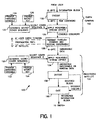
- Fig. 1 shows a block diagram 100 of a method of user authentication according to a particular embodiment of the present invention.
- Fig. 1 illustrates the processes occurring at an earth terminal 102 and a processing satellite 104.
- the earth terminal 102 generally performs the steps of encoding 120, generating a secret cover sequence 122, and applying a reversible function 128.
- the processing satellite 104 generally applies the steps of generating a secret cover sequence R 150, applying a reversible function 156, decoding 158, and gating 160.
- an information block of K bytes is provided by a user.
- the user may be transmitting from an earth terminal, another processing satellite (not shown), or any other transmitter.
- the K-byte information block is encoded to form a raw codeword having a length of N-bytes.
- the encoding step 120 performs Reed-Solomon encoding, however any error control code that robustly protects against random noise may be employed. For example, any forward error correction codes that are members of the BCH family are also suitable.
- a secret cover sequence is generated at step 122 by hashing a hashing variable (provided at step 124) using a secret key (provided at step 126) to form the secret cover sequence S.
- a secret cover sequence is a unique, beam-dependent sequence created by an authorized user.
- the hashing variable may be formed from the uplink frame or slot number, or alternatively from any other variable that is commonly known to both the user and the processing satellite.
- the secret key is a unique digital signature that identifies a particular authorized user.
- the digital signature may be created by any number of encryption and authentication techniques, such as, for example, those based on the RSA algorithm.
- a reversible function is applied at step 128 to the secret cover sequence S and the raw codeword to form a covered codeword.
- the reversible function step 128 performs an exclusive-OR (XOR) operation.
- the secret cover sequence S is applied through a reversible function (e.g., XORed) to the N-byte raw codeword.
- the reversible function step 128 may perform any operation or combination of operations that can be reapplied to remove the sender's secret cover sequence.
- the output of the reversible function 128 is a covered codeword.
- the covered codeword has the additional characteristic of being encrypted, because the operation, ([secret cover sequence] XOR [raw codeword]), renders the resultant covered codeword nearly impossible to decipher without knowledge of the secret key.
- the covered codeword is communicated (at step 130) to a processing satellite 104 through an uplink channel assigned to the earth terminal 102.
- the processing satellite 104 may include numerous uplinks and downlinks which define separate coverage areas and may further employ frequency reuse techniques.
- the processing satellite 104 may also switch uplink data after the uplink data has been demodulated and decoded, for separate transmission on the downlinks. After switching, the data is generally recoded and remodulated prior to transmission.
- the decoding function will permit unauthorized or random data (e.g., data present as a result of show-thru) to be discarded before being transmitted to another receiver.
- the processing satellite 104 may, thereby, act like a filter to remove unauthorized or random data.
- N-bytes of observable data appear at the satellite. It is understood that after transmission, the observable data may include transmission errors.
- the observable data may be either data present at the receiver as a result of show-thru, (including a covered codeword) or may be data actually intended for the receiver with or without transmission errors.
- a secret cover sequence is generated at step 150 by hashing a hashing variable (provided at step 152) with a secret key (provided at step 154) to form secret cover sequence R.
- the reversible functioning step 156 performs a reversible operation on the secret cover sequence R and the observable data. As stated previously, in a preferred embodiment, an exclusive-OR operation is applied through the secret cover sequence R to the observable data. However, any reversible operation or combination of operations may be employed instead at the transmitter and receiver. Regardless of the operation chosen, the reversible functioning 156 performs an operation capable of reconstructing the original codeword (differing by any transmission errors), provided the secret cover sequence R is the same as the secret cover sequence S.
- the secret cover sequence R is the same as the secret cover sequence S
- the raw codeword originally generated results. Otherwise, random data results.
- the output (which contains either the codeword plus errors or random data) of the reversible function step 156 is decoded using Reed-Solomon decoding 158.
- the Reed-Solomon decoding step 158 employs a (236, 212) code which has an undetected-error probability on the order of one part per billion and is particularly suited for ATM (Asynchronous Transfer Mode Cells) cells.
- Random data will present at the decoding step 158, with very high probability, more errors than the decoder can fix, a condition known as "decoder failure.”
- the decoded error measure e.g., the number of errors actually determined by the decoder
- the predetermined error threshold is one that exceeds the 12-byte error correcting capability of the (232,212) code.
- Decoder failure may occur in several situations. For example, when there is simply too much noise present in the transmission channel and thus too many errors in the received observable, (regardless of whether the cover sequences match) decoder failure will result. Second, decoder failure may occur when an unauthorized user attempts to use the uplink channel.
- decoder failure may occur during a show-thru event.
- show-thru occurs when burst in one beam is sufficiently strong in another quiescent beam's receiver as to be decodable at the satellite.
- the present invention mitigates or eliminates show-thru again because the secret cover sequence R would not match the secret cover sequence S. Accordingly, the original codeword would not be uncovered at the reversible function step 156. Again, the random data presented to the decoder will cause decoder failure.
- the decoded block is gated at step 160.
- the gating 160 operates to block unauthorized or random data prior to transmission. If decoder failure occurs, for example, the gating may block the decoded block by discarding it. Otherwise, the decoded block passes through for subsequent transmission.
- FIG. 2 generally illustrates an earth terminal 202 and a processing satellite 204.
- the earth terminal 202 includes preferably, a Reed-Solomon encoder 220, a secret cover sequence generator 222, and a reversible function processor 228.
- the processing satellite 204 generally includes a secret cover sequence generator 250, a reversible function processor 256, a Reed-Solomon decoder 258, and a gate 260.
- an informatibn block of K bytes is provided by a user, which may be transmitting from an earth terminal or another processing satellite (not shown), for example.
- the information block is encoded to form a raw codeword having a length of N-bytes.
- the encoder is a Reed-Solomon encoder 220, however, as emphasized earlier, any other robust error control code may be employed instead of the Reed-Solomon code.
- a secret cover sequence generator 222 hashes a hashing variable 224 using a secret key 226 to form a secret cover sequence S.
- the hashing variable 224 may be formed from the uplink frame or slot number, or from any other variable that is commonly known to both the user and the processing satellite.
- the secret cover sequence S and the raw codeword are provided as inputs to a reversible function processor 228.
- the reversible function processor 228 applies a reversible cipher operation through secret cover sequence S to the raw codeword to form a covered codeword.
- the reversible function processor 228 performs an exclusive-OR operation.
- the reversible function processor 228 may perform any operation or combination of operations that can be reapplied to reconstruct the original raw codeword.
- the output of the reversible function processor 228 is a covered codeword.
- the covered codeword is transmitted to a processing satellite 204 in the uplink channel 230 assigned to the earth terminal 202. After transmission, N-bytes of observable data appear at the processing satellite 204. As explained previously, the observable data may include transmission errors.
- a secret cover sequence generator 250 hashes a hashing variable 252 with a secret key 254 to form secret cover sequence R.
- the reversible function processor 256 performs a reversible operation through secret cover sequence R to the observable data.
- an exclusive-OR operation is applied through the secret cover sequence R to the observable data.
- the original raw codeword which may include one or more transmission errors, results. Otherwise, random data results.
- the output of the reversible function processor 256 (which contains either the codeword plus errors or random data) is decoded by a Reed-Solomon decoder 258.
- decoder failure results with near certainty.
- the conditions under which decoder failure may result were described previously in connection with Fig. 1.
- the decoded block is passed through a gate 260.
- the gate 260 operates to block unauthorized or random data prior to transmission. If decoder failure occurs, the gate 260 blocks the decoded block by discarding it. Otherwise, the data passes through the gate 260 to subsequent transmission circuitry.
- the secret cover sequence generators 222 and 250 and the reversible function processors 228 and 256 may be implemented using combinatorial logic, ASICs, through software executed by a CPU, a DSP chip, or the like.
- the foregoing hardware elements may be part of hardware that is used to perform other operational functions at the earth terminal 202 or processing satellite 204.
- the hashing variables 224 and 252 and the secret keys 226 and 254 may be stored in registers, RAM, ROM, or the like, and may be generated through software, through a data structure located in a memory device such as RAM or ROM, and so forth.
- the reversible function processors 228 and 256 are exclusive-OR logic circuits having at least two inputs (one for a secret cover sequences and the other for the raw data to be exclusive-Ored), and at least one output for outputting the resultant exclusive-Ored codeword.
- the secret cover sequence generator may be an ASIC programmed to hash a hashing variable 224 or 252 and a secret key 226 or 254 to form a secret cover sequence.
- the present invention thus provides user authentication virtually guaranteed by operation of the reversible function processor and by exploiting the robust error control coding employed in processing satellites. Additionally, show-thru mitigation is achieved, for example, by exploiting decoder failure which, when it occurs, indicates with very high probability that unauthorized or random data is present at the receiver. Furthermore, the benefits of user authentication and show-thru mitigation are achieved by the present invention without generating overhead. Instead of being appended to the information block as an overhead item, the user authentication information is incorporated into the information block itself by, for example, XORing an encoded codeword with a secret cover sequence.
Landscapes
- Engineering & Computer Science (AREA)
- Computer Security & Cryptography (AREA)
- Computer Networks & Wireless Communication (AREA)
- Signal Processing (AREA)
- Mobile Radio Communication Systems (AREA)
- Radio Relay Systems (AREA)
- Detection And Prevention Of Errors In Transmission (AREA)
- Error Detection And Correction (AREA)
Abstract
Description
Claims (16)
- A method for generating authenticable information for transmission to a receiver, the method comprising the steps of:encoding an information block to form a raw codeword;generating a secret cover sequence S;applying said secret cover sequence through a reversible function to said raw codeword to form a covered codeword; andtransmitting said covered codeword to a receiver.
- The method of claim 1 further comprising the step of authenticating said covered codeword according to the following substeps:receiving said covered codeword at a receiver;generating at said receiver a secret cover sequence R;applying said secret cover sequence R through said reversible function to said covered codeword to form an uncovered codeword; and decoding said uncovered codeword to form a decoded uncovered codeword and an associated decoded error measure.
- The method of claim 2 further comprising the steps of:establishing an error threshold; anddiscarding said decoded uncovered codeword when said error measure exceeds said error threshold.
- The method of claim 1 wherein said applying step comprises applying said secret cover sequence through said reversible function to said raw codeword to generate a covered codeword of the same size as said raw codeword.
- The method of claim 1, wherein said encoding step comprises Reed-Solomon encoding.
- The method of claim 1, wherein said applying step comprises applying an exclusive-OR reversible function.
- The method of claim 1, further comprising the step of storing a plurality of secret keys.
- The method of claim 7, wherein said generating step further comprises the steps of:providing a hashing variable and one of said secret keys; andhashing said hashing variable using said secret key to form said secret cover sequence.
- The method of claim 7, wherein said storing step comprises storing an uplink frame number.
- The method of claim 7, wherein said storing step comprises storing a slot number.
- A communications system for generating authenticable information, said system comprising:a transmitter comprising:a block encoder for encoding an information block to form a raw codeword;a secret cover sequence generator for generating a secret cover sequence S; anda reversible function processor for applying said secret cover sequence through a reversible function to said raw codeword to form a covered codeword.
- The communications system of claim 11 for further authenticating said covered codeword, said system comprising:a receiver for receiving said covered codeword,a secret cover sequence generator for generating a secret cover sequence R;a reversible function processor for applying said secret cover sequence R through said reversible function to said raw codeword to form an uncovered codeword; anda decoder for decoding said uncovered codeword to form a decoded uncovered codeword and an associated error measure.
- The communications system of claim 12, wherein said decoder includes an error threshold and further comprising a gate for discarding said decoded uncovered codeword when said error measure exceeds said error threshold.
- The communications system of claim 13 further comprising a memory for storing at least one hashing variable and at least one secret key.
- The communications system of claim 11, wherein said reversible function processor comprises an exclusive-OR operator.
- The communications system of claim 11 further comprising a memory for storing a plurality of secret keys.
Applications Claiming Priority (2)
| Application Number | Priority Date | Filing Date | Title |
|---|---|---|---|
| US24316499A | 1999-02-02 | 1999-02-02 | |
| US243164 | 1999-02-02 |
Publications (2)
| Publication Number | Publication Date |
|---|---|
| EP1026852A2 true EP1026852A2 (en) | 2000-08-09 |
| EP1026852A3 EP1026852A3 (en) | 2002-08-07 |
Family
ID=22917594
Family Applications (1)
| Application Number | Title | Priority Date | Filing Date |
|---|---|---|---|
| EP00101777A Withdrawn EP1026852A3 (en) | 1999-02-02 | 2000-01-28 | Show-thru prevention and user authentication of uplink bursts without overhead |
Country Status (3)
| Country | Link |
|---|---|
| EP (1) | EP1026852A3 (en) |
| JP (1) | JP2000227754A (en) |
| CA (1) | CA2296967A1 (en) |
Families Citing this family (3)
| Publication number | Priority date | Publication date | Assignee | Title |
|---|---|---|---|---|
| US5841768A (en) | 1996-06-27 | 1998-11-24 | Interdigital Technology Corporation | Method of controlling initial power ramp-up in CDMA systems by using short codes |
| US7702910B2 (en) * | 2002-10-24 | 2010-04-20 | Telefonaktiebolaget L M Ericsson (Publ) | Message authentication |
| JP4781890B2 (en) * | 2006-04-11 | 2011-09-28 | 日本電信電話株式会社 | Communication method and communication system |
Family Cites Families (7)
| Publication number | Priority date | Publication date | Assignee | Title |
|---|---|---|---|---|
| WO1990014735A1 (en) * | 1989-05-24 | 1990-11-29 | Motorola, Inc. | Apparatus and method for enhancing the reliability of digital messages |
| US5546464A (en) * | 1994-09-16 | 1996-08-13 | Ericsson Inc. | Method of and apparatus for selective resynchronization in a digital cellular communications system |
| US5689568A (en) * | 1995-06-29 | 1997-11-18 | Hughes Electronics | Medium access control for a mobile satellite system |
| SE506619C2 (en) * | 1995-09-27 | 1998-01-19 | Ericsson Telefon Ab L M | Method for encrypting information |
| EP0851628A1 (en) * | 1996-12-23 | 1998-07-01 | ICO Services Ltd. | Key distribution for mobile network |
| US5764766A (en) * | 1996-06-11 | 1998-06-09 | Digital Equipment Corporation | System and method for generation of one-time encryption keys for data communications and a computer program product for implementing the same |
| WO1998047258A2 (en) * | 1997-03-10 | 1998-10-22 | Fielder Guy L | Bilateral authentication and encryption system |
-
2000
- 2000-01-25 CA CA 2296967 patent/CA2296967A1/en not_active Abandoned
- 2000-01-28 EP EP00101777A patent/EP1026852A3/en not_active Withdrawn
- 2000-02-02 JP JP2000024855A patent/JP2000227754A/en active Pending
Also Published As
| Publication number | Publication date |
|---|---|
| EP1026852A3 (en) | 2002-08-07 |
| CA2296967A1 (en) | 2000-08-02 |
| JP2000227754A (en) | 2000-08-15 |
Similar Documents
| Publication | Publication Date | Title |
|---|---|---|
| US6266412B1 (en) | Encrypting speech coder | |
| Bakhtiari et al. | Cryptographic hash functions: A survey | |
| EP0511420B1 (en) | A cryptographic system based on information difference | |
| US7680273B2 (en) | System and method for optimizing error detection to detect unauthorized modification of transmitted data | |
| US8213616B2 (en) | Systems and methods for providing opportunistic security for physical communication channels | |
| US11528260B2 (en) | Transmitting device and transmitting method, and receiving device and receiving method | |
| EP1192752B1 (en) | Modulated message authentication system and method | |
| JP2628660B2 (en) | Encryption / decryption method and apparatus | |
| CN114844728A (en) | Serialized data secure communication method and big data platform | |
| US6707916B1 (en) | Mitigation of false co-channel uplink reception in a processing satellite communication system using scrambling sequences | |
| WO2002011361A2 (en) | Data encryption and decryption using error correction methodologies | |
| US7774677B2 (en) | Method and device for transmitting information with verification of unintentional and intentional transmission errors | |
| CA2296967A1 (en) | Show-thru prevention and user authentication of uplink bursts without overhead | |
| US20030215089A1 (en) | Method and apparatus for encrypting and decrypting messages based on boolean matrices | |
| Yamamura et al. | Error detection and authentication in quantum key distribution | |
| KR100797106B1 (en) | Encryption and Decryption Method of Packets Transmitted and Received in WLAN | |
| RU2180469C2 (en) | Encryption/decryption key generation process | |
| Klima et al. | Side channel attacks on CBC encrypted messages in the PKCS# 7 format | |
| Mihaljevic | A Framework for Stream Ciphers Based on Pseudorandomness, Randomness and Coding. | |
| CA2300645C (en) | Apparatus and method for integrating error control and authentication for satellite uplinks | |
| RU2171012C1 (en) | Procedure forming encoding/decoding key | |
| Riek | Observations on the application of error correcting codes to public key encryption | |
| Field | An improved method for secure and reliable cryptosystem message transmission: a thesis in Computer Engineering | |
| Bakhtiari et al. | Practical Message Authentication Schemes | |
| Lee | Cryptographic techniques for satellite networks |
Legal Events
| Date | Code | Title | Description |
|---|---|---|---|
| PUAI | Public reference made under article 153(3) epc to a published international application that has entered the european phase |
Free format text: ORIGINAL CODE: 0009012 |
|
| AK | Designated contracting states |
Kind code of ref document: A2 Designated state(s): AT BE CH CY DE DK ES FI FR GB GR IE IT LI LU MC NL PT SE |
|
| AX | Request for extension of the european patent |
Free format text: AL;LT;LV;MK;RO;SI |
|
| PUAL | Search report despatched |
Free format text: ORIGINAL CODE: 0009013 |
|
| AK | Designated contracting states |
Kind code of ref document: A3 Designated state(s): AT BE CH CY DE DK ES FI FR GB GR IE IT LI LU MC NL PT SE |
|
| AX | Request for extension of the european patent |
Free format text: AL;LT;LV;MK;RO;SI |
|
| RIC1 | Information provided on ipc code assigned before grant |
Free format text: 7H 04L 9/32 A, 7H 04L 9/18 B |
|
| STAA | Information on the status of an ep patent application or granted ep patent |
Free format text: STATUS: THE APPLICATION HAS BEEN WITHDRAWN |
|
| 18W | Application withdrawn |
Effective date: 20021216 |