EP1026767A1 - Lithium battery, polymer electrolyte, electrolyte material, di(meth)acrylic ester, and di(meth)acrylate polymer - Google Patents
Lithium battery, polymer electrolyte, electrolyte material, di(meth)acrylic ester, and di(meth)acrylate polymer Download PDFInfo
- Publication number
- EP1026767A1 EP1026767A1 EP99937020A EP99937020A EP1026767A1 EP 1026767 A1 EP1026767 A1 EP 1026767A1 EP 99937020 A EP99937020 A EP 99937020A EP 99937020 A EP99937020 A EP 99937020A EP 1026767 A1 EP1026767 A1 EP 1026767A1
- Authority
- EP
- European Patent Office
- Prior art keywords
- formula
- polymer
- compound
- expressed
- metha
- Prior art date
- Legal status (The legal status is an assumption and is not a legal conclusion. Google has not performed a legal analysis and makes no representation as to the accuracy of the status listed.)
- Withdrawn
Links
Images


Classifications
-
- H—ELECTRICITY
- H01—ELECTRIC ELEMENTS
- H01M—PROCESSES OR MEANS, e.g. BATTERIES, FOR THE DIRECT CONVERSION OF CHEMICAL ENERGY INTO ELECTRICAL ENERGY
- H01M10/00—Secondary cells; Manufacture thereof
- H01M10/05—Accumulators with non-aqueous electrolyte
- H01M10/056—Accumulators with non-aqueous electrolyte characterised by the materials used as electrolytes, e.g. mixed inorganic/organic electrolytes
- H01M10/0564—Accumulators with non-aqueous electrolyte characterised by the materials used as electrolytes, e.g. mixed inorganic/organic electrolytes the electrolyte being constituted of organic materials only
- H01M10/0565—Polymeric materials, e.g. gel-type or solid-type
-
- C—CHEMISTRY; METALLURGY
- C07—ORGANIC CHEMISTRY
- C07C—ACYCLIC OR CARBOCYCLIC COMPOUNDS
- C07C69/00—Esters of carboxylic acids; Esters of carbonic or haloformic acids
- C07C69/96—Esters of carbonic or haloformic acids
-
- C—CHEMISTRY; METALLURGY
- C08—ORGANIC MACROMOLECULAR COMPOUNDS; THEIR PREPARATION OR CHEMICAL WORKING-UP; COMPOSITIONS BASED THEREON
- C08F—MACROMOLECULAR COMPOUNDS OBTAINED BY REACTIONS ONLY INVOLVING CARBON-TO-CARBON UNSATURATED BONDS
- C08F20/00—Homopolymers and copolymers of compounds having one or more unsaturated aliphatic radicals, each having only one carbon-to-carbon double bond, and only one being terminated by only one carboxyl radical or a salt, anhydride, ester, amide, imide or nitrile thereof
- C08F20/02—Monocarboxylic acids having less than ten carbon atoms, Derivatives thereof
- C08F20/10—Esters
- C08F20/26—Esters containing oxygen in addition to the carboxy oxygen
- C08F20/28—Esters containing oxygen in addition to the carboxy oxygen containing no aromatic rings in the alcohol moiety
-
- C—CHEMISTRY; METALLURGY
- C08—ORGANIC MACROMOLECULAR COMPOUNDS; THEIR PREPARATION OR CHEMICAL WORKING-UP; COMPOSITIONS BASED THEREON
- C08F—MACROMOLECULAR COMPOUNDS OBTAINED BY REACTIONS ONLY INVOLVING CARBON-TO-CARBON UNSATURATED BONDS
- C08F22/00—Homopolymers and copolymers of compounds having one or more unsaturated aliphatic radicals each having only one carbon-to-carbon double bond, and at least one being terminated by a carboxyl radical and containing at least one other carboxyl radical in the molecule; Salts, anhydrides, esters, amides, imides or nitriles thereof
- C08F22/10—Esters
- C08F22/12—Esters of phenols or saturated alcohols
- C08F22/20—Esters containing oxygen in addition to the carboxy oxygen
-
- H—ELECTRICITY
- H01—ELECTRIC ELEMENTS
- H01B—CABLES; CONDUCTORS; INSULATORS; SELECTION OF MATERIALS FOR THEIR CONDUCTIVE, INSULATING OR DIELECTRIC PROPERTIES
- H01B1/00—Conductors or conductive bodies characterised by the conductive materials; Selection of materials as conductors
- H01B1/06—Conductors or conductive bodies characterised by the conductive materials; Selection of materials as conductors mainly consisting of other non-metallic substances
- H01B1/12—Conductors or conductive bodies characterised by the conductive materials; Selection of materials as conductors mainly consisting of other non-metallic substances organic substances
- H01B1/122—Ionic conductors
-
- H—ELECTRICITY
- H01—ELECTRIC ELEMENTS
- H01M—PROCESSES OR MEANS, e.g. BATTERIES, FOR THE DIRECT CONVERSION OF CHEMICAL ENERGY INTO ELECTRICAL ENERGY
- H01M10/00—Secondary cells; Manufacture thereof
- H01M10/05—Accumulators with non-aqueous electrolyte
- H01M10/052—Li-accumulators
-
- H—ELECTRICITY
- H01—ELECTRIC ELEMENTS
- H01M—PROCESSES OR MEANS, e.g. BATTERIES, FOR THE DIRECT CONVERSION OF CHEMICAL ENERGY INTO ELECTRICAL ENERGY
- H01M2300/00—Electrolytes
- H01M2300/0085—Immobilising or gelification of electrolyte
-
- H—ELECTRICITY
- H01—ELECTRIC ELEMENTS
- H01M—PROCESSES OR MEANS, e.g. BATTERIES, FOR THE DIRECT CONVERSION OF CHEMICAL ENERGY INTO ELECTRICAL ENERGY
- H01M6/00—Primary cells; Manufacture thereof
- H01M6/22—Immobilising of electrolyte
-
- Y—GENERAL TAGGING OF NEW TECHNOLOGICAL DEVELOPMENTS; GENERAL TAGGING OF CROSS-SECTIONAL TECHNOLOGIES SPANNING OVER SEVERAL SECTIONS OF THE IPC; TECHNICAL SUBJECTS COVERED BY FORMER USPC CROSS-REFERENCE ART COLLECTIONS [XRACs] AND DIGESTS
- Y02—TECHNOLOGIES OR APPLICATIONS FOR MITIGATION OR ADAPTATION AGAINST CLIMATE CHANGE
- Y02E—REDUCTION OF GREENHOUSE GAS [GHG] EMISSIONS, RELATED TO ENERGY GENERATION, TRANSMISSION OR DISTRIBUTION
- Y02E60/00—Enabling technologies; Technologies with a potential or indirect contribution to GHG emissions mitigation
- Y02E60/10—Energy storage using batteries
Definitions
- This invention relates to a lithium battery utilizing a gel electrolyte, and further to a polyelectrolyte, an electrolyte material, a di(metha)-acrylic ester and a di(metha)-acrylate polymer.
- a battery utilizing the polymeric solid electrolyte provides high reliability and safety owing to its non-leakage property of electrolyte as compared with conventional battery utilizing a liquid electrolyte.
- this battery enables thinning of film, simplification of package and decrease in weight. For this reason, a large expectation is placed on the polymeric solid electrolyte.
- the polymeric solid electrolyte those described in the Published Patent Application (KOKAI) No. 5-25353 and the Published Patent Application (KOKAI) No. 6-223842 are well known.
- the polymeric solid electrolyte is generally composed of a composite of polymeric compound and alkali metal salt, and its ion conduction mechanism is one which utilizes a molecular motion of the polymeric compound.
- the polymeric solid electrolyte has, in general, a small ion conductivity as compared with the liquid electrolyte.
- the battery using the polymeric solid electrolyte has included such a problem that its charge/discharge current density has been limited as compared with the battery using the liquid electrolyte.
- a polyelectrolyte having a comparatively high ion conductivity can be obtained in such a way that a crosslink polyalkylene oxide is used for the polymeric compound and an organic solvent is contained in the composite of the polymeric compound and the alkali metal salt.
- a polyelectrolyte containing the organic solvent is called as a gel electrolyte and its application to a lithium battery is actively examined at present.
- gel electrolytes are also examined which utilize polyacrylonitrile (PAN), polyvinylidene fluoride (PVdF) or similar compound of them as the polymeric compound, in place of the crosslink polyalkylene oxide.
- the gel electrolyte using the PAN can not maintain its state of film at high temperature because the polymeric compound is apt to become fluidic with an increase in its temperature, so that it is inferior in its form stability at high temperature.
- the gel electrolyte using the PVdF is inferior in its liquid electrolyte holding ability because the PVdF presents its slight solubility against the liquid electrolyte.
- the gel electrolyte using the crosslink polyalkylene oxide as the polymeric compound has a high liquid electrolyte holding ability because the polymeric compound presents its compatibility with the liquid electrolyte, and its form can be maintained over a wide range of temperature because the polymeric compound has a crosslink structure.
- the gel electrolyte using the crosslink polyalkylene oxide when used for the lithium battery, can improve a reliability and safety of battery because the gel electrolyte is superior in the liquid electrolyte holding ability and the form stability.
- the lithium battery equipped with the gel electrolyte using the crosslink polyalkylene oxide is not superior in its low-temperature property and high-rate property during charging and discharging, and its battery performance is inferior to those of the lithium battery equipped with the gel electrolyte using the PAN and the PVdF.
- a cause of this problem may be supposed as follows.
- lithium ion preferentially coordinates with the crosslink polyalkylene oxide forming the polymeric compound as compared with an organic solvent such as a generally used cyclic ester carbonate.
- an organic solvent such as a generally used cyclic ester carbonate.
- the lithium ion is not restricted by the polymeric compound and the decrease in the mobility of lithium ion is controlled because a lithium salt is slightly soluble or not soluble to the polymeric compound.
- the gel electrolyte using the PAN includes such a problem that it is inferior in the form stability at high temperature and the gel electrolyte using the PVdF includes such a problem that it is inferior in the liquid electrolyte holding ability.
- a first object of this application is to provide a lithium battery which is able to improve its reliability and safety, and further to improve its low-temperature property and high-rate property during charging and discharging.
- a second object of this application is to provide a polyelectrolyte which is superior in its ion conductivity and also in its electrochemical stability.
- a third object of this application is to provide an electrolyte material which is able to compose the polyelectrolyte of the above second object.
- a fourth object of this application is to provide a di(metha)-acrylic ester and a di(metha)-acrylate polymer forming an useful novel compound.
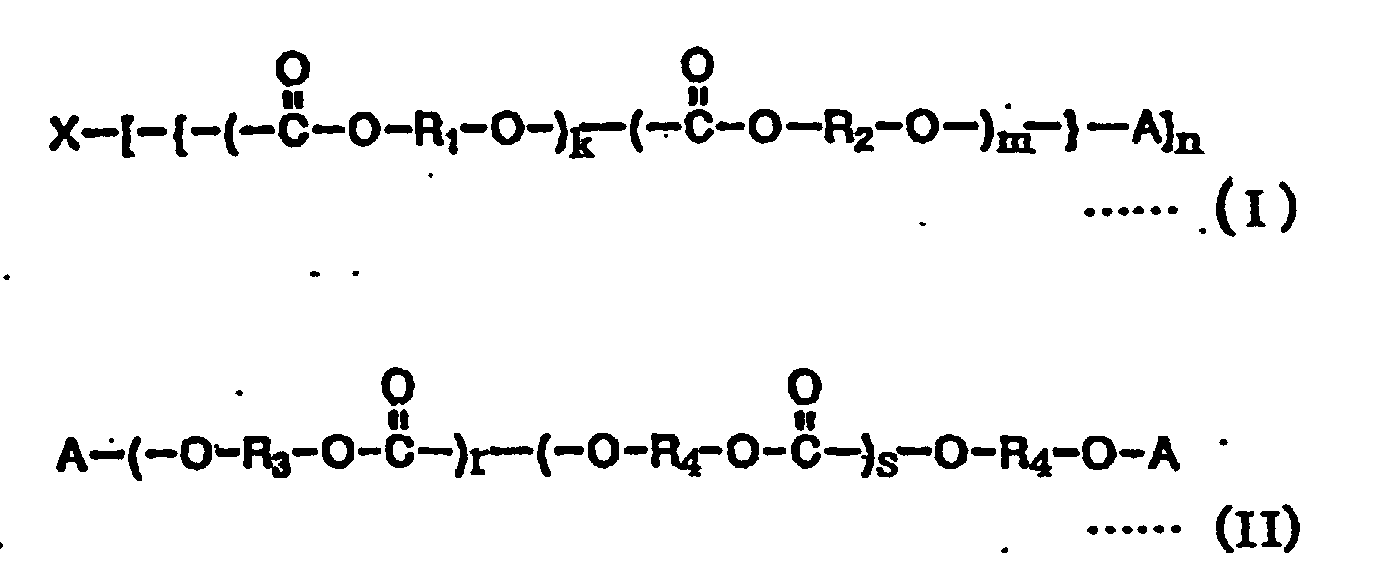
- a first invention of this application is characterised in that a lithium battery equipped with a positive electrode, a negative electrode and a gel electrolyte, the gel electrolyte is composed of at least an ester-group or ether-group aprotic polar solvent, a lithium salt and a polymeric compound; and this polymeric compound comprises a polymer of at least one compound among those expressed by a formula (I) and a formula (II).
- the low-temperature property and high-rate property during charging and discharging can be improved because the gel electrolyte can exert a high lithium ion mobility.
- a reason of this fact may be considered as follows.
- the polymer of compound expressed by the formula (I) and the polymer of compound expressed by the formula (II) have structural characteristics inferior in their lithium ion coordination property as compared with the crosslink polyaklylene oxide. These structural characteristics are caused by the number of carbon atom sandwiched by two oxygen atoms. Therefore, in the gel electrolyte of this invention, the lithium ion coordinates to about the same extent with the polymeric compound and the ester-group or ether-group aprotic polar solvent.
- the gel electrolyte of this invention a percentage of the lithium ion restricted by the polymeric compound is reduced as compared with a case of the gel electrolyte using the crosslink polyalkylene oxide. Therefore, the gel electrolyte of this invention can exert a high lithium ion mobility as compared with the case of the gel electrolyte using the crosslink polyalkylene oxide.
- the lithium battery of this invention is highly reliable because the gel electrolyte is superior in the liquid electrolyte holding ability.
- a reason may be considered as follows.
- the polymer of compound expressed by the formula (I) and the polymer of compound expressed by the formula (II) have structural characteristics superior in its compatibility with the ester-group or ether-group aprotic polar solvent. Therefore, the gel electrolyte of this invention is superior in the liquid electrolyte holding ability.
- the lithium battery of this invention has high safety because the gel electrolyte is superior in its form stability.
- a reason may be considered as follows.
- the polymer of compound expressed by the formula (I) and the polymer of compound expressed by the formula (II) can maintain their forms over a wide range of temperature because these polymers have the crosslink structure. Therefore, the gel electrolyte of this invention is superior in its form stability.
- ester-group or ether-group aprotic polar solvent following solvents may be mentioned: cyclic ester carbonates such as ethylene carbonate and propylene carbonate etc.; cyclic carboxylic esters such as ⁇ - butyrolactone etc.; cyclic ethers such as tetrahydrofuran and 1,3-dioxolan etc.; chain ethers such as 1,2-dimethoxy ethane etc.; chain ester carbonates such as dimethyl carbonate and ethyl methyl carbonate etc.; chain carboxylic ester such as propionic methyl etc.
- a solvent may be used which are prepared by mixing two or more kinds of solvents.
- LiPF 6 , LiBF 4 , LiN(SO 2 CF 3 ) 2 and LiOSO 2 CF 3 etc. may be used for the lithium salt. However, it is not limited to these salts.
- Polyvinylidene flouride, polyacrylonitrile, polyvinylalcohol, silicone resin and methacrylic resin etc. may be mentioned for another polymeric compounds. However, they are not limited to these compounds.
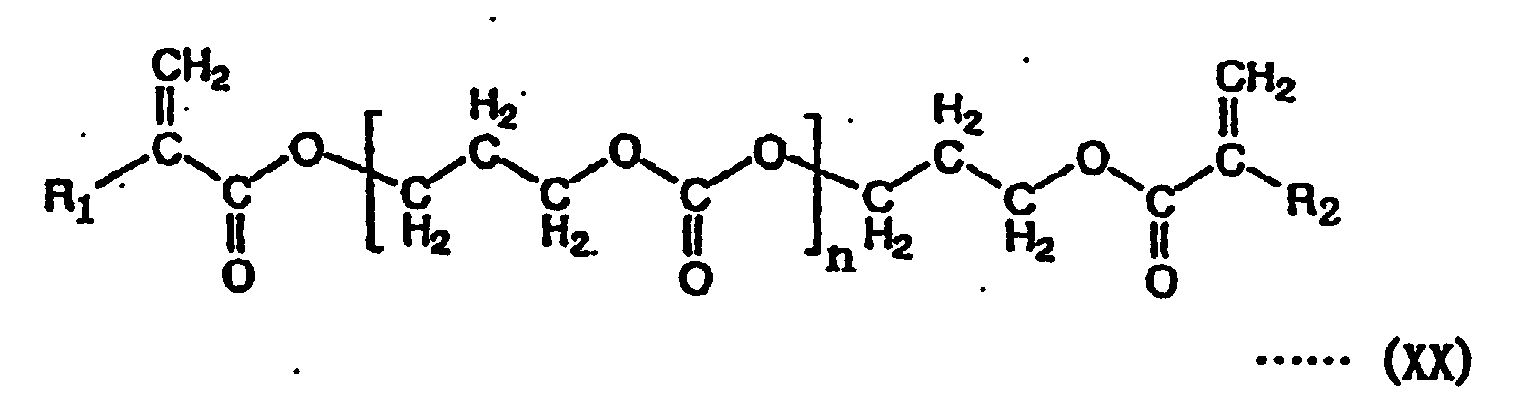
- a second invention of this application comprises a polyelectrolyte which contains at least a polymer of a compound expressed by a formula (XX).
- R 1 & R 2 H or CH 3 (R 1 may be same with or differ from R 2 ), n: integer ranging from 1 to 1,000)
- the polyelectrolyte of the second invention contains the polymer of the compound expressed by the formula (XX), it provides a high ion conductivity and is superior in its electrochemical stability too.
- a third invention of this application comprises an electrolyte material which is the compound expressed by the formula (XX), and a fourth invention of this application is an electrolyte material which is the polymer of the compound expressed by the formula (XX) (R 1 & R 2 : H or CH 3 (R 1 may be same with or differ from R 2 ), n: integer ranging from 1 to 1,000)
- a fifth invention of this application comprises a di(metha)-acrylic ester expressed by the formula (XX), and a sixth invention of this application comprises a di(metha)-acrylate polymer of the compound expressed by the formula (XX).
- R 1 & R 2 H or CH 3 (R 1 may be same with or differ from R 2 ), n: integer ranging from 1 to 1,000)
- the compound expressed by the formula (XX) in the second through sixth inventions will be described hereunder.
- the compound expressed by the formula (XX) is a novel compound.
- the "(metha)-acrylic acid” means an acrylic acid or methacrylic acid
- the "(metha)-acrylate” means an acrylate or methacrylate
- the compound expressed by the formula (XX) is a di(metha)-acrylic ester.
- R 1 may be same with or differ from R 2 .
- n is an integer ranging from 1 to 1,000, however, it preferably ranging from 5 to 500.
- the di(metha)-acrylic ester expressed by the formula (XX) is an ester of the poly(1,3-propylene carbonate) expressed by the formula (XXI) with the (metha)-acrylic acid. (n: integer ranging from 1 to 1,000)
- the poly (1,3-propylene carbonate) is obtained by making react a 1,3-propanediol with a carbonyl component through the well-known method.
- Diester carbonates such as dimethyl carbonate, diethyl carbonate, diisopropyl carbonate, diphenyl carbonate, ethylene carbonate and propylene carbonate etc.
- chloroformic esters such as chloroformic methyl, chloroformic ethyl and chloroformic phenyl etc.
- phosgene etc. may be used for the carbonyl component. It is desired to use such a carbonyl component at a ratio of 0.5 to 2 molar amount in relation to 1 mole of 1,3-propanediol.
- a number-average molecular weight of the poly(1,3-propylene carbonate) ranges from 200 to 100,000. It preferably ranges from 500 to 50,000, and more preferably ranges from 1,000 to 50,000.
- the di(metha)-acrylate polymer is obtained by polymerizing the foregoing di(metha)-acrylate ester through irradiation of ultraviolet rays or radiation, or by applying heat. In this instance, the polymerizing reaction takes place in a structural unit of the (metha)-acrylate acid.
- This di(metha)-acrylate polymer can be used as the polyelectrolyte.
- a photosensitizer In case of the polymerization through the irradiation of ultraviolet rays, a photosensitizer can be used. Benzophenone, acetophenone, 2,2-dimethoxy-2-phenyl acetophenone etc. may be used for the photosensitizer.
- a thermal polymerization initiator In case of the polymerization by using heat, a thermal polymerization initiator can be used. Peroxides such as benzoyl peroxide, peroxy-dicarbonate etc.; azo compounds such as 2,2'-azobisisobutyronitrile etc.; nucleophilic reagents such as alkali metal etc.; electrophilic reagents such as Lewis acid etc. may be used for the thermal polymerization initiator by itself or in combination, according to a type of polymerization.
- Peroxides such as benzoyl peroxide, peroxy-dicarbonate etc.; azo compounds such as 2,2'-azobisisobutyronitrile etc.; nucleophilic reagents such as alkali metal etc.; electrophilic reagents such as Lewis acid etc.
- the di(metha)-acrylate polymer may be a single-polymer of di(metha)-acrylic ester, or a copolymer of two or more kinds of di(metha)-acrylic esters, or a copolymer of the di(metha)-acrylic ester with another monomers.
- Vinyl monomer, vinylidene monomer, vinylene monomer etc. may be used for the another monomers for use in the copolymerization.
- Vinyl ester, vinyl ether, (metha)-acrylic ester, allyl ether, and allyl ester may preferably be used for the vinyl monomer.
- (metha)-acrylic ethyl, (metha)-acrylic ethoxyethyl, (metha)-acrylic ethoxyethoxyethyl, poly(ethylene glycol)-(metha)-acrylate, allyl alcohol, vinyl acetate, stylene, ⁇ -methyl-stylene, vinyl chloride, vinylidene chloride, vinyl fluoride, vinylidene fluoride, acrylonitrile, cyanoacetic vinyl, allyl amine, isopropyl acrylic amide, vinylene carbonate, and maleic anhydride may be mentioned.
- such another monomers are generally contained in the di(metha)-acrylic ester polymer at a weight percentage ranging from 0.1 to 90 wt%, and preferably ranging from 1 to 50 wt%.
- the polyelectrolyte of this invention may contain a metal salt listed in Ia-group of periodic table. LiBr, LiI, LiBF 4 , LiPF 6 , LiN(SO 2 CF 3 ) 2 , NaBr, NaSCN, NaClO 4 , KBr, KSCN, KClO 4 etc. may be mentioned for such a metal salt.
- a metal salt listed in Ia-group of periodic table. LiBr, LiI, LiBF 4 , LiPF 6 , LiN(SO 2 CF 3 ) 2 , NaBr, NaSCN, NaClO 4 , KBr, KSCN, KClO 4 etc.
- a polyelectrolyte uniformly containing the metal salt can be obtained with the di(metha)-acrylate polymer utilized as a matrix.
- a polyelectrolyte uniformly containing the metal salt can be obtained even when a liquid electrolyte dissolved with the metal salt is impregnated after poly
- the polyelectrolyte of this invention may contain nonaqueous solvent other than the metal salt listed in Ia-group of periodic table.
- the nonaqueous solvent is preferably used at a weight part of zero to 1,000, and more preferably at a weight part of 100 to 700, in relation to 100 weight parts of the di(metha)-acrylate polymer.
- a polyelectrolyte containing the nonaqueous solvent can be obtained.
- the polyelectrolyte containing the nonaqueous solvent can be obtained even when the nonaqueous solvent is impregnated after polymerizing the di(metha)-acrylic ester.
- Ester carbonate or lactone may preferably used for the nonaqueous solvent.
- Ethylene carbonate, propylene carbonate, dimethyl carbonate, ethyl methyl carbonate, diethyl carbonate, dipropyl carbonate etc. may be used for the ester carbonate.
- ⁇ -butyrolactone, ⁇ -valerolactone, ⁇ -caprolactone etc. may be used for the lactone.
- the polyelectrolyte of this invention provides a high ion conductivity and is stable in electrochemical aspect, it can be used effectively for electrochemical elements such as a primary battery, a secondary battery, a condenser, an electrochlomic indication element etc ., and for a medical actuator etc.
- the polyelectrolyte of this invention can be used as an alternative for an organic liquid electrolyte.
- the polyelectrolyte of this invention can be utilized as a binder for dispersing and fixing a powdery electrode reagent into a form of current collector.
- a battery using the polyelectrolyte of this invention can be manufactured by forming the polyelectrolyte of this invention into a form of film and by sandwiching it between a positive electrode and a negative electrode.
- a process in which the liquid electrolyte is impregnated after forming a three-layer structure of the positive electrode, the separator and the negative electrode; in place of the liquid electrolyte, a process may be used wherein the polymerization is done after impregnating a solution composed of the di(metha)-acrylic ester, the metal salt listed in Ia-group of periodic table and the nonaqueous solution. According to this method, a remodeling of process can be restricted to a minimum.
- the di(metha)-acrylic ester and the di(metha)-acrylate polymer of this invention may preferably used for a material of the polyelectrolyte.
- a polycarbonate-(metha)-acrylate polymer is used for a matrix of the polyelectrolyte of the lithium ion secondary battery, for example, a lithium ion secondary battery superior in its battery performance can be obtained.
- the evaluation cell shown in Fig. 1 is composed of current collectors 1 & 5 comprising stainless steel, lithium foils 2 & 4 of 4 cm 2 , an external package 6 and an evaluated gel electrolyte 3. Evaluation was carried out in such a way that a current was flown between the lithium foil 2 and the lithium foil 4, and a voltage change between the two electrodes caused by a current change was measured. The measurement was done under an atmosphere of temperature of 20°C.
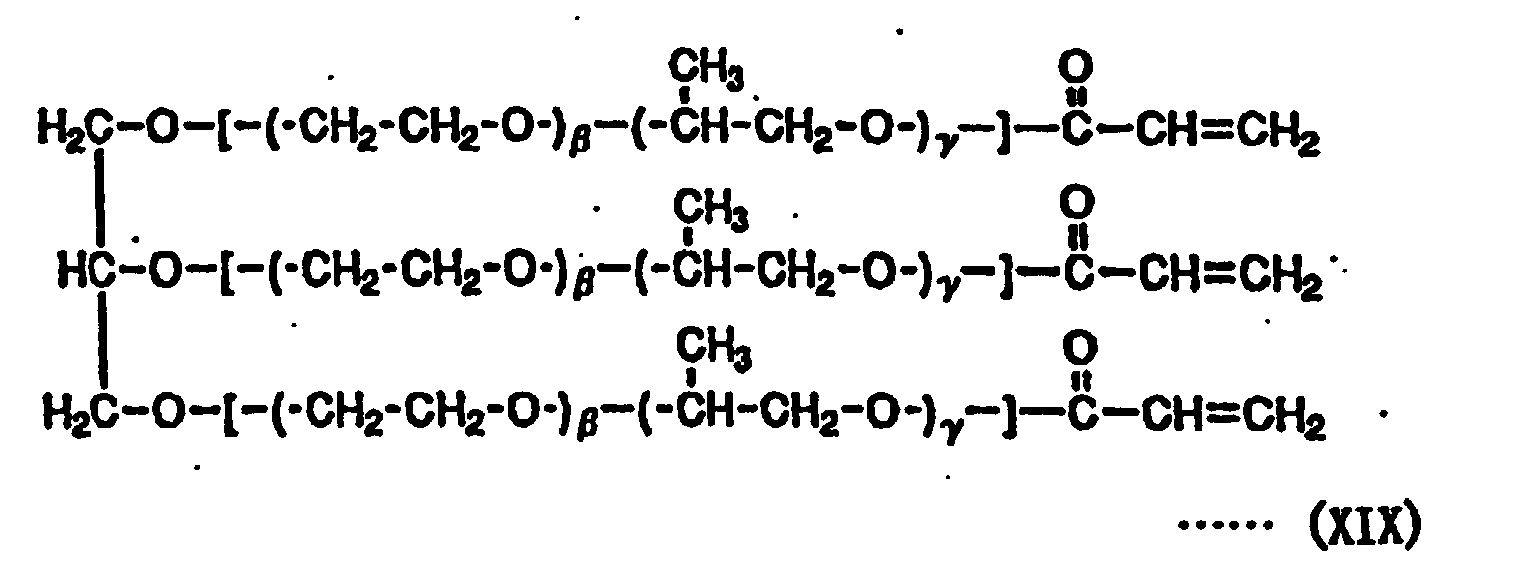
- Macromonomer of weight-average molecular weights of about 4,600 (number-average molecular weights of about 1,600) expressed by a formula (XVIII), ethylene carbonate (EC) and ⁇ -butyrolactone ( ⁇ BL) were mixed with weight ratios of 21.2:34.8:44.0, and then LiBF 4 was dissolved in the mixture so as to realize 1 mol/litter.
- This mixed solvent was impregnated in a non-woven cloth which was in turn sandwiched between two films of poly(ethylene terephthalate) (PET), and the obtained piece was irradiated with electron beams to polymerize the macromonomer so that a gel electrolyte was made up.
- a thickness of this gel electrolyte was 150 ⁇ m.
- the non-woven cloth was used for a supporting member of the gel electrolyte in this instance, however, it is not necessary to use the non-woven cloth and a fine-porous film etc.
- polymeric compounds such as the PVdF etc may be added.
- This mixed solvent was treated in the same way as the embodiment 1, so that a gel electrolyte was made up. A thickness of this gel electrolyte was 150 ⁇ m.
- Fig. 2 shows evaluation results of lithium ion mobilities for respective gel electrolytes of the embodiment 1 and the comparison embodiment 1.
- Its axis of abscissa represents a current density and its axis of ordinate represents a voltage between two electrodes.
- the gel electrolyte of embodiment 1 provides a low voltage between two electrodes even at a high current density, as compared with the gel electrolyte of comparison embodiment 1.
- Such a difference between the voltage changes between two electrodes reflects the lithium ion mobilities, and suggests that the lithium ion mobility is larger in the gel electrolyte of embodiment 1 than in those of the comparison embodiment 1. Consequently, it can be expected that charging and discharging at higher current density become possible in a battery using the gel electrolyte of embodiment 1.
- Fig. 3 is the sectional view of the battery using the gel electrolyte.
- This battery is composed of a current collector 7 comprising aluminum, a positive electrode 8, a current collector 11 comprising copper, a negative electrode 10, an external package 12 and a gel electrolyte 9.
- a battery having a battery capacity of about 9.45 mAh shown in Fig. 3 was made up using the gel electrolyte of embodiment 1.
- a thickness of the gel electrolyte 9 was 30 ⁇ m.
- a positive electrode 8 was composed of an active material of LiCoO 2 , an acetylene black (AB) forming a conductive agent, a PVdF forming a binder, and a gel electrolyte.
- a negative electrode 10 was composed of a carbon, a PVdF forming a binder and a gel electrolyte.
- Fig. 4 shows results of discharge tests for respective batteries of an embodiment 2 and a comparison embodiment 2. Its axis of abscissa represents a discharge current and its axis of ordinate represents a discharge capacity. As seen from Fig. 4, at a discharge current of up to 5 mA, approximately similar discharge capacities were obtained for both the batteries of embodiment 2 and comparison embodiment 2. At a discharge current of 10 mA, however, a difference in discharge capacity was produced between the two batteries. It can be understood from this fact that the battery of embodiment 1 is superior in its high-rate characteristic as compared with the battery of comparison embodiment 2.
- This embodiment relates to the diacrylic ester.
- the mixture was held at a temperature of 150 through 155 °C under a reduced pressure of 5 mmHg and 210 g of 1,3-propanediol produced in the polymerizing reaction were removed, so that 1,127 grams of poly(1,3-propylene carbonate) were obtained as a consistent oil.
- a number-average molecular weights of the obtained poly(1,3-propylene carbonate) was 2,400 when measured by a gel permeation chromatography.
- the reacted solution was filtered, the filtered solution was washed by saturated salt water and dried by nonaqueous magnesium sulfate.
- the prepared product was condensed to obtain a target product: 84 grams of diacrylic ester in a form of light-yellow consistent oil.
- a 1 H-NMR chart of the obtained diacrylic ester is shown in Fig. 5.
- This embodiment relates to the dimethacrylic ester.
- the reacted solution was filtered, the filtered solution was washed by saturated salt water and dried by nonaqueous magnesium sulfate.
- the prepared product was condensed to obtain a target product: 87 grams of dimethacrylic ester in a form of light-yellow consistent oil.
- a 1 H-NMR chart of the obtained dimethacrylic ester 1 is shown in Fig. 6.
- This embodiment relates to the polyelectrolyte.
- the prepared polyelectrolyte was punched into a disc having a diameter of 10 mm to make up a test piece, and this test piece was subjected to measurements of ion conductivity and voltage resistance.
- the test piece was sandwiched between electrodes of conductivity measuring holder.
- the electrodes were controlled at 25 °C by a Peltier element, under this state a complex impedance was measured (measurement voltage: 10 mV) and analyzed by using an impedance analyzer (Type: HP4285A, Maker: Hewlett Packard).
- the ion conductivity was 2.83 S/cm 2 .
- the polyelectrolyte of this embodiment provides a high ion conductivity.
- the polyelectrolyte of this embodiment is superior in its electrochemical stability.
- a polyelectrolyte was manufactured in the same way as the embodiment 5, except that the dimethacrylic ester manufactured in the embodiment 4 was used in place of the ester diacrylate.
- the prepared polyelectrolyte was subjected to measurements of ion conductivity and voltage resistance in the same way as the embodiment 5.
- the ion conductivity was 3.20 mS/cm 2 and the voltage resistance was 4.5 V. Accordingly, the polyelectrolyte of this embodiment provides a high ion conductivity and is superior in its electrochemical stability.
- This application can provide a lithium battery superior in its reliability, safety and charge/discharge characteristics, and can provide a polyelectrolyte effectively used for an electrochemical element. Therefore, it is very useful especially in the battery industry.
Landscapes
- Chemical & Material Sciences (AREA)
- Organic Chemistry (AREA)
- Chemical Kinetics & Catalysis (AREA)
- Manufacturing & Machinery (AREA)
- Engineering & Computer Science (AREA)
- Medicinal Chemistry (AREA)
- Physics & Mathematics (AREA)
- Polymers & Plastics (AREA)
- General Chemical & Material Sciences (AREA)
- Electrochemistry (AREA)
- Health & Medical Sciences (AREA)
- Condensed Matter Physics & Semiconductors (AREA)
- Inorganic Chemistry (AREA)
- General Physics & Mathematics (AREA)
- Dispersion Chemistry (AREA)
- Spectroscopy & Molecular Physics (AREA)
- Secondary Cells (AREA)
Abstract
Description





- 1, 5, 7, 11
- Current collector
- 2, 4
- Lithium foil
- 3, 9
- Gel electrolyte
- 6, 12
- External package
- 8
- Positive electrode
- 10
- Negative electrode
Claims (10)
- A lithium battery comprising a positive electrode, a negative electrode and a gel electrolyte, in which the gel electrolyte is composed of at least an ester-group or ether-group aprotic polar solvent, a lithium salt and a polymeric compound, and
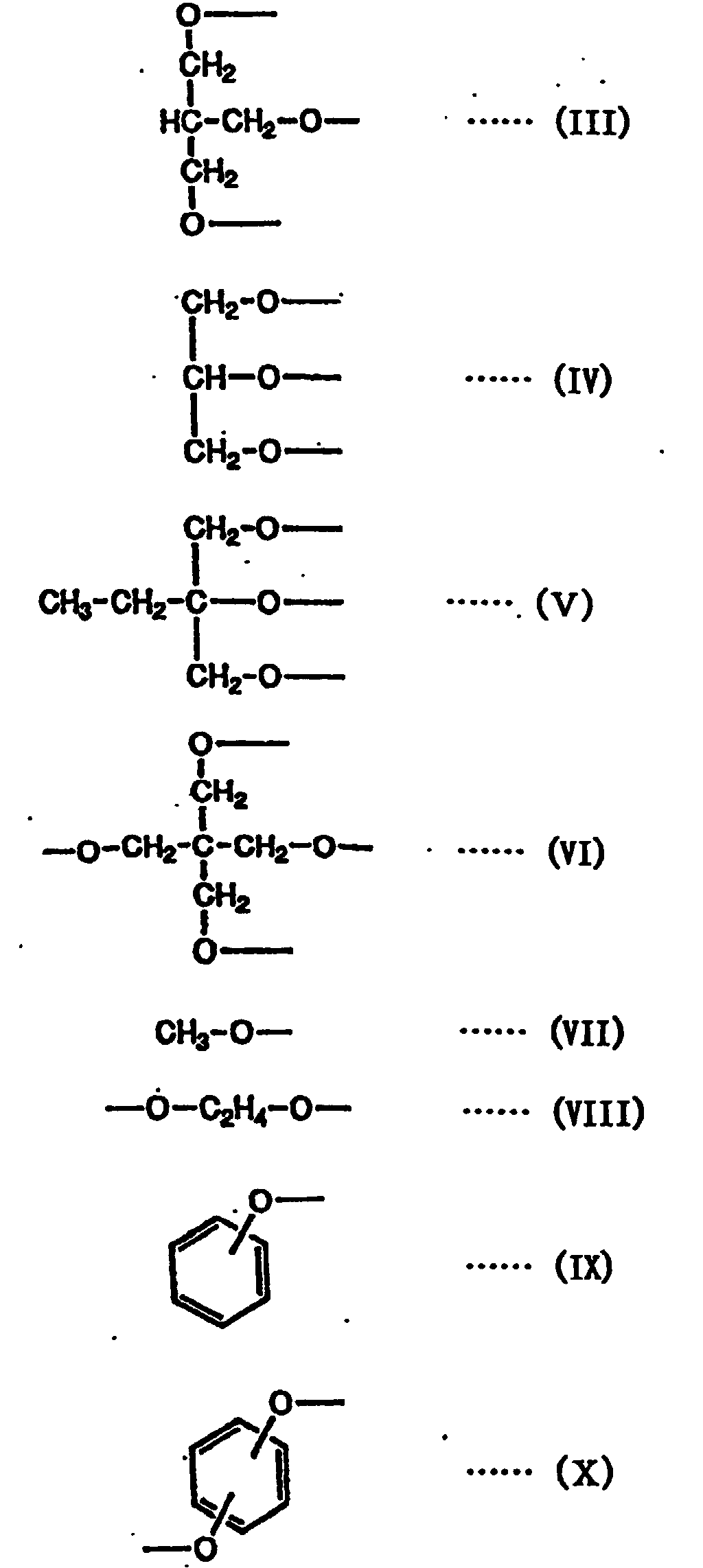
the polymeric compound comprises a polymer of at least one compound among those expressed by a formula (I) and a formula (II).(k: zero or number of 1 or more, m: number of 1 or more, R1:CpH2p, R2:CqH2q, p≠q, p & q: integer of 1 or more, A: CH2=CH-CO- or CH2=C(CH3)-CO-, X: n-valent combination group (n: integer ranging from 1 to 4), r: zero or number of 1 or more, s: number of 1 or more, R3: CtH2t, R4: CuH2u, t≠u, t & u: integer of 1 or more)
- A lithium battery as set forth in claim 1, in which a number-average molecular weight of the compound expressed by the formula (I) ranges from 160 to 100,000.
- A lithium battery as set forth in claim 1, in which a number-average molecular weight of the compound expressed by the formula (II) ranges from 228 to 100,000.
- A lithium battery as set forth in claim 1, in which the polymeric compound comprises a copolymer of at least one compound among those expressed by the formula (I) and the formula (II), with an another monomer, and
a content of the compound expressed by the equation (I) and the equation (II) in the copolymer is larger than or equal to 50 wt%. - A lithium battery as set forth in claim 1, in which the polymeric compound comprises a polymer alloy of at least a polymer of one compound among those expressed by the formula (I) and the formula (II), with an another polymeric compound, and
a content of the polymer of the compound expressed by the formula (I) and the formula (II) in the polymer alloy is larger than or equal to 50 wt%. - A polyelectrolyte containing at least a polymer of a compound expressed by an equation (XX).(R1 & R2: H or CH3 (R1 may be same with or differ from R2), n: integer ranging from 1 to 1,000)

- An electrolyte material comprising a compound expressed by a formula (XX).(R1 & R2: H or CH3 (R1 may be same with or differ from R2), n: integer ranging from 1 to 1,000)

- An electrolyte material comprising a polymer of a compound expressed by a formula (XX).(R1 & R2: H or CH3 (R1 may be same with or differ from R2), n: integer ranging from 1 to 1,000)

- A di(metha)-acrylic ester expressed by a formula (XX).(R1 & R2: H or CH3 (R1 may be same with or differ from R2), n: integer ranging from 1 to 1,000)

- A di(metha)-acrylate polymer forming a polymer of a compound expressed by a formula (XX).(R1 & R2: H or CH3 (R1 may be same with or differ from R2), n: integer ranging from 1 to 1,000)

Applications Claiming Priority (5)
| Application Number | Priority Date | Filing Date | Title |
|---|---|---|---|
| JP22678898A JP4238386B2 (en) | 1998-08-11 | 1998-08-11 | Gel electrolyte battery |
| JP22678898 | 1998-08-11 | ||
| JP12921599A JP4214615B2 (en) | 1999-05-10 | 1999-05-10 | Di (meth) acrylate for polymer solid electrolyte matrix and di (meth) acrylate polymer for polymer solid electrolyte matrix. |
| JP12921599 | 1999-05-10 | ||
| PCT/JP1999/004339 WO2000010213A1 (en) | 1998-08-11 | 1999-08-11 | Lithium battery, polymer electrolyte, electrolyte material, di(meth)acrylic ester, and di(meth)acrylate polymer |
Publications (2)
| Publication Number | Publication Date |
|---|---|
| EP1026767A1 true EP1026767A1 (en) | 2000-08-09 |
| EP1026767A4 EP1026767A4 (en) | 2008-03-26 |
Family
ID=26464678
Family Applications (1)
| Application Number | Title | Priority Date | Filing Date |
|---|---|---|---|
| EP99937020A Withdrawn EP1026767A4 (en) | 1998-08-11 | 1999-08-11 | Lithium battery, polymer electrolyte, electrolyte material, di(meth)acrylic ester, and di(meth)acrylate polymer |
Country Status (3)
| Country | Link |
|---|---|
| US (1) | US6569572B1 (en) |
| EP (1) | EP1026767A4 (en) |
| WO (1) | WO2000010213A1 (en) |
Cited By (13)
| Publication number | Priority date | Publication date | Assignee | Title |
|---|---|---|---|---|
| WO2003069700A3 (en) * | 2002-02-12 | 2004-08-26 | Eveready Battery Inc | Flexible thin printed battery with gelled electrolyte and method of manufacturing same |
| US8029927B2 (en) | 2005-03-22 | 2011-10-04 | Blue Spark Technologies, Inc. | Thin printable electrochemical cell utilizing a “picture frame” and methods of making the same |
| US8441411B2 (en) | 2007-07-18 | 2013-05-14 | Blue Spark Technologies, Inc. | Integrated electronic device and methods of making the same |
| US8574754B2 (en) | 2007-12-19 | 2013-11-05 | Blue Spark Technologies, Inc. | High current thin electrochemical cell and methods of making the same |
| US8722235B2 (en) | 2004-04-21 | 2014-05-13 | Blue Spark Technologies, Inc. | Thin printable flexible electrochemical cell and method of making the same |
| US8722233B2 (en) | 2005-05-06 | 2014-05-13 | Blue Spark Technologies, Inc. | RFID antenna-battery assembly and the method to make the same |
| US8765284B2 (en) | 2012-05-21 | 2014-07-01 | Blue Spark Technologies, Inc. | Multi-cell battery |
| US9027242B2 (en) | 2011-09-22 | 2015-05-12 | Blue Spark Technologies, Inc. | Cell attachment method |
| US9399701B2 (en) | 2010-08-27 | 2016-07-26 | Novomer, Inc. | Polymer compositions and methods |
| US9444078B2 (en) | 2012-11-27 | 2016-09-13 | Blue Spark Technologies, Inc. | Battery cell construction |
| US9693689B2 (en) | 2014-12-31 | 2017-07-04 | Blue Spark Technologies, Inc. | Body temperature logging patch |
| US9782082B2 (en) | 2012-11-01 | 2017-10-10 | Blue Spark Technologies, Inc. | Body temperature logging patch |
| US10849501B2 (en) | 2017-08-09 | 2020-12-01 | Blue Spark Technologies, Inc. | Body temperature logging patch |
Families Citing this family (7)
| Publication number | Priority date | Publication date | Assignee | Title |
|---|---|---|---|---|
| IL135078A0 (en) * | 1999-03-17 | 2001-05-20 | Noboru Oyama | Polymer electrolyte |
| JP2002025559A (en) * | 2000-07-03 | 2002-01-25 | Sony Corp | Battery |
| JP3932511B2 (en) * | 2003-04-09 | 2007-06-20 | ソニー株式会社 | battery |
| US7959657B1 (en) * | 2004-07-07 | 2011-06-14 | Harsy Douglas R | Portable thermal therapeutic apparatus and method |
| KR100570702B1 (en) * | 2004-11-29 | 2006-04-12 | 삼성에스디아이 주식회사 | Polymer electrolyte composition for lithium secondary battery and lithium secondary battery manufactured using same |
| CN110289446B (en) * | 2018-03-19 | 2021-05-14 | 深圳新宙邦科技股份有限公司 | A polymer electrolyte for lithium ion battery and polymer battery |
| WO2021171711A1 (en) * | 2020-02-25 | 2021-09-02 | 株式会社村田製作所 | Electrolyte solution for secondary batteries, and secondary battery |
Family Cites Families (18)
| Publication number | Priority date | Publication date | Assignee | Title |
|---|---|---|---|---|
| CH674308A5 (en) * | 1985-03-29 | 1990-05-31 | Pentron Corp | Resin adhesive for dental use |
| US4783544A (en) * | 1985-06-19 | 1988-11-08 | Nippon Kayaku Kabushiki Kaisha | Di-(meth)acrylic acid ester, resin composition comprising the same and coating agent comprising the same |
| JPS6230148A (en) * | 1985-07-31 | 1987-02-09 | Nissan Chem Ind Ltd | Novel ion conductive high polymer complex |
| JPS62207240A (en) * | 1986-03-07 | 1987-09-11 | Nippon Kayaku Co Ltd | Di(meth)acrylic acid ester, resin composition and coating agent |
| JPS6394563A (en) | 1986-10-09 | 1988-04-25 | Ube Ind Ltd | solid electrolyte battery |
| JPH0725839B2 (en) * | 1989-05-15 | 1995-03-22 | 富士写真フイルム株式会社 | Polymer solid electrolyte |
| JP2978290B2 (en) | 1991-07-18 | 1999-11-15 | 松下電器産業株式会社 | Polymer solid electrolyte |
| JPH05178948A (en) * | 1991-12-27 | 1993-07-20 | Yuasa Corp | Ionically conductive polymer compound |
| JP3235157B2 (en) * | 1991-12-27 | 2001-12-04 | 株式会社ユアサコーポレーション | Ion conductive polymer electrolyte |
| JPH05303980A (en) * | 1992-04-24 | 1993-11-16 | Yuasa Corp | Ion-conductive polymer compound and method for producing the same |
| JP3677782B2 (en) | 1992-10-24 | 2005-08-03 | ソニー株式会社 | Polymer solid electrolyte |
| JP3499916B2 (en) * | 1994-05-30 | 2004-02-23 | 三洋電機株式会社 | Polymer solid electrolyte battery and manufacturing method thereof |
| JPH0922727A (en) * | 1995-07-06 | 1997-01-21 | Toshiba Battery Co Ltd | Manufacture of lithium secondary battery of hybrid solid polymer electrolyte type |
| JP3312836B2 (en) * | 1995-11-28 | 2002-08-12 | 松下電器産業株式会社 | Non-aqueous electrolyte secondary battery |
| JPH1077320A (en) * | 1996-07-10 | 1998-03-24 | Mitsui Petrochem Ind Ltd | Novel acrylate (co) polymer and polymer solid electrolyte |
| KR19990082202A (en) * | 1996-12-03 | 1999-11-25 | 나까니시 히로유끼 | Polymer gel electrolyte |
| US6190805B1 (en) * | 1997-09-10 | 2001-02-20 | Showa Denko Kabushiki Kaisha | Polymerizable compound, solid polymer electrolyte using the same and use thereof |
| US6235433B1 (en) * | 1997-12-19 | 2001-05-22 | Nec Corporation | High molecular gel electrolyte and secondary battery using the same |
-
1999
- 1999-08-11 US US09/529,273 patent/US6569572B1/en not_active Expired - Lifetime
- 1999-08-11 WO PCT/JP1999/004339 patent/WO2000010213A1/en not_active Ceased
- 1999-08-11 EP EP99937020A patent/EP1026767A4/en not_active Withdrawn
Cited By (21)
| Publication number | Priority date | Publication date | Assignee | Title |
|---|---|---|---|---|
| CN100367539C (en) * | 2002-02-12 | 2008-02-06 | 永备电池有限公司 | Flexible thin printed battery and device and method of manufacturing the same |
| US7348096B2 (en) | 2002-02-12 | 2008-03-25 | Eveready Battery Company, Inc. | Flexible thin printed battery and device and method of manufacturing same |
| US7625664B2 (en) | 2002-02-12 | 2009-12-01 | Eveready Battery Co., Inc. | Flexible thin printed battery and device and method of manufacturing same |
| US7727290B2 (en) | 2002-02-12 | 2010-06-01 | Eveready Battery Company, Inc. | Flexible thin printed battery and device and method of manufacturing same |
| WO2003069700A3 (en) * | 2002-02-12 | 2004-08-26 | Eveready Battery Inc | Flexible thin printed battery with gelled electrolyte and method of manufacturing same |
| US8722235B2 (en) | 2004-04-21 | 2014-05-13 | Blue Spark Technologies, Inc. | Thin printable flexible electrochemical cell and method of making the same |
| US8029927B2 (en) | 2005-03-22 | 2011-10-04 | Blue Spark Technologies, Inc. | Thin printable electrochemical cell utilizing a “picture frame” and methods of making the same |
| US8268475B2 (en) | 2005-03-22 | 2012-09-18 | Blue Spark Technologies, Inc. | Thin printable electrochemical cell and methods of making the same |
| US8722233B2 (en) | 2005-05-06 | 2014-05-13 | Blue Spark Technologies, Inc. | RFID antenna-battery assembly and the method to make the same |
| US8734980B2 (en) | 2005-05-06 | 2014-05-27 | Blue Spark Technologies, Inc. | Electrical device-battery assembly and the method to make the same |
| US8441411B2 (en) | 2007-07-18 | 2013-05-14 | Blue Spark Technologies, Inc. | Integrated electronic device and methods of making the same |
| US8574754B2 (en) | 2007-12-19 | 2013-11-05 | Blue Spark Technologies, Inc. | High current thin electrochemical cell and methods of making the same |
| US9399701B2 (en) | 2010-08-27 | 2016-07-26 | Novomer, Inc. | Polymer compositions and methods |
| US9027242B2 (en) | 2011-09-22 | 2015-05-12 | Blue Spark Technologies, Inc. | Cell attachment method |
| US8765284B2 (en) | 2012-05-21 | 2014-07-01 | Blue Spark Technologies, Inc. | Multi-cell battery |
| US9782082B2 (en) | 2012-11-01 | 2017-10-10 | Blue Spark Technologies, Inc. | Body temperature logging patch |
| US10617306B2 (en) | 2012-11-01 | 2020-04-14 | Blue Spark Technologies, Inc. | Body temperature logging patch |
| US9444078B2 (en) | 2012-11-27 | 2016-09-13 | Blue Spark Technologies, Inc. | Battery cell construction |
| US9693689B2 (en) | 2014-12-31 | 2017-07-04 | Blue Spark Technologies, Inc. | Body temperature logging patch |
| US10631731B2 (en) | 2014-12-31 | 2020-04-28 | Blue Spark Technologies, Inc. | Body temperature logging patch |
| US10849501B2 (en) | 2017-08-09 | 2020-12-01 | Blue Spark Technologies, Inc. | Body temperature logging patch |
Also Published As
| Publication number | Publication date |
|---|---|
| WO2000010213A1 (en) | 2000-02-24 |
| US6569572B1 (en) | 2003-05-27 |
| EP1026767A4 (en) | 2008-03-26 |
Similar Documents
| Publication | Publication Date | Title |
|---|---|---|
| US6569572B1 (en) | Lithium battery, polymer electrolyte, electrolyte material, di(meth)acrylic ester, and di(meth)acrylate polymer | |
| US6025437A (en) | Block-graft copolymer, self-crosslinked polymer solid electrolyte and composite solid electrolyte manufactured through use of the block-graft copolymer, and solid cell employing the composite solid electrolyte | |
| US6096234A (en) | Cross-linked polymer solid electrolyte, method of manufacturing cross-linked solid polymer electrolyte, composite solid electrolyte, and thin solid cell employing composite solid electrolyte | |
| EP1082358B1 (en) | Ionomers and ionically conductive compositions | |
| KR100605060B1 (en) | Non-aqueous electrolyte battery | |
| EP0842216B1 (en) | Rechargeable battery polymeric electrolyte | |
| EP1715542B1 (en) | Polymer electrolyte for a lithium secondary battery | |
| US6506523B1 (en) | Solid electrolyte secondary battery | |
| KR101358474B1 (en) | Organic solid electrolyte and secondary battery | |
| JP4418139B2 (en) | Polymer electrolyte and lithium secondary battery including the same | |
| US5965300A (en) | Polymer solid electrolyte, method for manufacturing polymer solid electrolyte, and lithium secondary cell adopting polymer solid electrolyte | |
| EP2306556B1 (en) | Solid-electrolyte secondary battery | |
| KR20030032258A (en) | Fluoride copolymer, polymer electrolyte comprising the same and lithium battery employing the polymer electrolyte | |
| KR20180000942A (en) | Polymer electrolyte, preparing method thereof, and lithium metal battery including the same | |
| EP0896340A1 (en) | Gel-form solid polymer electrolyte | |
| KR100528933B1 (en) | Organic electrolytic solution and lithium battery employing the same | |
| US7094501B2 (en) | Graft oligomeric electrolytes | |
| JP4214615B2 (en) | Di (meth) acrylate for polymer solid electrolyte matrix and di (meth) acrylate polymer for polymer solid electrolyte matrix. | |
| CN116632334A (en) | Solid electrolyte and preparation method thereof, and solid lithium battery and preparation method thereof | |
| US20040029016A1 (en) | Polymer electrolyte for lithium-sulfur battery and lithium-sulfur battery comprising same | |
| JP4985959B2 (en) | Organic solid electrolyte and secondary battery using the same | |
| JP3683086B2 (en) | Polymer solid electrolyte | |
| JP3843505B2 (en) | Polymer electrolyte and battery | |
| JP2002158037A5 (en) | ||
| JP3458049B2 (en) | Ion conductive polymer solid electrolyte and electrochemical device containing the solid electrolyte |
Legal Events
| Date | Code | Title | Description |
|---|---|---|---|
| PUAI | Public reference made under article 153(3) epc to a published international application that has entered the european phase |
Free format text: ORIGINAL CODE: 0009012 |
|
| 17P | Request for examination filed |
Effective date: 20000419 |
|
| AK | Designated contracting states |
Kind code of ref document: A1 Designated state(s): AT BE CH CY DE DK ES FI FR GB GR IE IT LI LU MC NL PT SE |
|
| RAP1 | Party data changed (applicant data changed or rights of an application transferred) |
Owner name: MITSUI CHEMICALS, INC. Owner name: YUASA CORPORATION |
|
| RAP1 | Party data changed (applicant data changed or rights of an application transferred) |
Owner name: MITSUI CHEMICALS, INC. Owner name: GS YUASA CORPORATION |
|
| A4 | Supplementary search report drawn up and despatched |
Effective date: 20080227 |
|
| STAA | Information on the status of an ep patent application or granted ep patent |
Free format text: STATUS: THE APPLICATION HAS BEEN WITHDRAWN |
|
| 18W | Application withdrawn |
Effective date: 20080508 |