EP1026678A2 - Recording/reproducing apparatus and information medium transfer method - Google Patents
Recording/reproducing apparatus and information medium transfer method Download PDFInfo
- Publication number
- EP1026678A2 EP1026678A2 EP00102343A EP00102343A EP1026678A2 EP 1026678 A2 EP1026678 A2 EP 1026678A2 EP 00102343 A EP00102343 A EP 00102343A EP 00102343 A EP00102343 A EP 00102343A EP 1026678 A2 EP1026678 A2 EP 1026678A2
- Authority
- EP
- European Patent Office
- Prior art keywords
- recording
- reproducing
- information
- medium
- reproducing means
- Prior art date
- Legal status (The legal status is an assumption and is not a legal conclusion. Google has not performed a legal analysis and makes no representation as to the accuracy of the status listed.)
- Granted
Links
Images





Classifications
-
- G—PHYSICS
- G11—INFORMATION STORAGE
- G11B—INFORMATION STORAGE BASED ON RELATIVE MOVEMENT BETWEEN RECORD CARRIER AND TRANSDUCER
- G11B17/00—Guiding record carriers not specifically of filamentary or web form, or of supports therefor
- G11B17/22—Guiding record carriers not specifically of filamentary or web form, or of supports therefor from random access magazine of disc records
- G11B17/228—Control systems for magazines
Definitions
- the present invention relates to a recording/reproducing apparatus having a plurality of recording and/or reproducing means for performing at least one of recording and reproducing with an information medium, and to an information medium transfer method for transferring a medium into the recording and/or reproducing means.
- An example of such a recording/reproducing apparatus includes a plurality of recording/reproducing means, a medium stocking means (also called a stocker) for stocking a plurality of information media such as optomagnetic disks (so-called MDs), audio or video cassettes storing a tape-shaped magnetic recording medium in a cassette, or optical disks (so-called CDs and LDs), and a medium transfer means (so-called carrier) for selectively transferring a desired recording medium from the stocker to a certain recording/reproducing means.
- a medium stocking means also called a stocker
- information media such as optomagnetic disks (so-called MDs), audio or video cassettes storing a tape-shaped magnetic recording medium in a cassette, or optical disks (so-called CDs and LDs)
- carrier medium transfer means
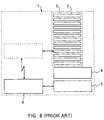
- FIG. 6 is a schematic block diagram showing an example of the above-described recording/reproducing apparatus.
- a recording/reproducing apparatus 1 includes a stocker 3 for stocking information media 2, a first recording/reproducing means 4, a second recording/reproducing means 5, and a carrier 6.
- the carrier 6 transfers the information media 2 up and down or to the left and to the right towards the first recording/reproducing means 4 and the second recording/reproducing means 5 inside the recording/reproducing apparatus, and loads the information media 2 into the desired recording/reproducing means 4 or 5.
- Step S701 the desired information medium 2 is moved from the stocker 3 to the carrier 6 (Step S701).
- the carrier 6 is moved to the height of the second recording/reproducing means 5 (Step S702), and the information medium 2 is loaded from the carrier 6 into the second information recording/reproducing means (Step S703).
- Step S704 the recording/reproducing of the information medium 2 is performed (Step S704), and after the recording/reproducing is terminated (Step S705), the information medium 2 is moved from the second recording/reproducing means 5 to the carrier 6 (Step S706).
- the carrier 6 is moved to the height of the stocker 3 (Step S707), and the information medium 2 is moved from the carrier 6 to the stocker 3 (Step S708).
- This operation sequence is performed with the control means as shown in Fig. 8, operating the carrier 6 to transfer the information medium 2 from the stocker 3, and randomly loading it with a selection means 6b into the first recording/reproducing means 4 or the second recording/reproducing means 5 to perform recording/reproducing.
- recording/reproducing apparatuses having a plurality of recordable information media, and first and second recording/reproducing means for recording/reproducing information, which select an information medium for recording information with an external controlling means such as a computer.
- an external controlling means instructs the selection out of a plurality of information media
- such an instruction is not more than the selection of an information medium based on the remaining capacity for recording information. Consequently, it does not solve the problem of using one recording/reproducing means more than the others when recording/reproducing with these information media.
- the external control means has the function to control the recording/reproducing apparatus and the instructions from the external controlling means include specifics on the recording and reproducing means into which the information medium is loaded, if the selection criterion is simply the usage order of the recording/reproducing means, and if there are differences in the amount of information recorded/reproduced in one recording/reproducing operation, these differences accumulate.
- the external controlling means is exchanged or disconnected, the information determining the recording/reproducing means with which a recording should be performed is lost, and the problem remains that a certain recording/reproducing means is used more than the others.
- a recording/reproducing apparatus in accordance with the present invention includes a plurality of recording and/or reproducing means for performing at least one of recording an information signal and reproducing an information signal; a medium transfer means for transferring an information medium and loading it selectively into one of the recording and/or reproducing means; and a selection means for selecting the recording and/or reproducing means to be loaded with the information medium by the medium transfer means.
- the selection means selects the recording and/or reproducing means with the currently shortest usage history from the plurality of recording and/or reproducing means.
- the usage frequency of the recording and/or reproducing means used for recording or reproducing can be equalized, and the lifetime of the entire recording/reproducing apparatus can be prolonged up to the combined lifetime of all recording and/or reproducing means. That is to say, it can be avoided that the lifetime of the entire recording/reproducing apparatus is limited to the lifetime of one recording and/or reproducing means due to the fact that this one recording and/or reproducing means is used more than the other recording and/or reproducing means.
- the apparatus is provided with a storage means (memory) for storing a usage history of each of the recording anchor reproducing means.
- a storage means memory
- information media can be transferred appropriately and without losing the usage history of the recording anchor reproducing means included in the recording/reproducing apparatus, even when the usage environment of the recording/reproducing apparatus is changed, for example, by moving the recording/reproducing apparatus or diversification of the information input/output means.
- the recording/reproducing apparatus further includes a judgement means for judging, based on usage histories stored in the storage means, which recording and/or reproducing means is to be selected with the selection means.
- a selection of the optimal recording and/or reproducing means can be guaranteed even when the usage environment of the recording/reproducing apparatus is changed, for example, by moving the recording/reproducing apparatus or diversification of the information input/output means, and the combined lifetime of the plurality of recording and/or reproducing means can be utilized effectively and reliably by the recording/reproducing apparatus itself
- the usage history can be divided into recording history and reproducing history independently.
- the recording/reproducing apparatus further includes a medium stocking means for stocking a plurality of information media; and a moving means for moving one desired information medium of the plurality of information media from the medium stocking means to the medium transfer means.
- the recording/reproducing apparatus further includes a medium selection means for selecting, from the medium stocking means, an information medium used for recording certain information with a selected recording and/or reproducing means, the selecting being in accordance with a kind of the information.
- a suitable information medium can be selected from the medium stocking means, in accordance with the kind of information signal to be recorded (for example, depending on whether the information signal to be recorded consists of audio signals only or includes video information), the length of the information signal (for example, the program time when programming the recording of audio or video), or the field of the information (for example, information relating to entertainment or business). Consequently, it can be avoided that a single piece of information is recorded spanning a plurality of information media, and the information medium can be selected suitably depending on the information signal.
- An information medium transfer method in accordance with the present invention is intended to transfer an information medium to load it selectively into one of a plurality of recording and/or reproducing means for performing at least one of recording an information signal and reproducing an information signal.
- the method includes a step of comparing, with a usage history judgement means, usage histories obtained from a storage means for storing usage histories of the recording and/or reproducing means; a step of selecting, with a selection means, one of the plurality of recording and/or reproducing means, which the usage history judgement means has judged to have the shortest usage history; and a step of transferring the information medium with a transfer means to the recording and/or reproducing means selected with the selection means.
- the lifetime of a recording/reproducing apparatus including a plurality of recording and/or reproducing means can be increased, because information media are transferred equally to the plurality of recording and/or reproducing means.
- FIG. 1 is a schematic drawing of a recording/reproducing apparatus in accordance with one embodiment of the present invention.
- a recording/reproducing apparatus 7 has a first recording/reproducing means 8 and a second recording/reproducing means 9.
- the first recording/reproducing means 8 and the second recording/reproducing means 9 can be loaded for recording or reproducing with information media 10a, 10b or 10c.
- the information medium 10a may be, for example, a recordable/reproducible information medium such as a DVD-RAM.
- the information medium 10b may be a read-only information medium based on the recording/reproducing principle similar to the information medium 10a, such as a CD-ROM.
- the information medium 10c may be a recordable/reproducible information medium based on a recording/reproducing principle different from the information medium 10a, such as an audio cassette tape or a video cassette tape.
- the information media 10a, 10b, or 10c is loaded selectively to the first recording/reproducing means 8 or the second recording/reproducing means 9 which is suitable for the medium with respect to the recording/reproducing principle. If the first recording/reproducing means 8 or the second recording/reproducing means 9 is adapted to record or reproduce all of the information media 10a, 10b, and 10c based on the recording/reproducing principles different from each other, each of the information media can be loaded to the same recording/reproducing means.
- the information media 10a, 10b, or 10c is inserted through an insertion port 11 into a media transfer means 12. Either the first recording/reproducing means 8 or the second recording/reproducing means 9 is selected with a selection means described below.
- the media transfer means 12 transfers the information media 10a, 10b, or 10c into the selected first or second recording/reproducing means 8 or 9, which perform recording or reproducing. After the recording or reproducing is finished, the information medium can be retrieved from the selected recording/reproducing means, if necessary.
- the structures shown in Figs. 2, 3 and 4 can be used to control the operation of the recording/reproducing apparatus.
- the usage history of the first recording/reproducing means 8 and the second recording/reproducing means 9 is stored in an external storage means 18, through an external judgement means 19.
- a usage history signal stored in the external storage means 18 is entered into a usage history judgement means 15 included in the external judgement means 19.
- a recording/reproducing means selection signal is entered from the usage history judgement means 15 into a selection means 16 in the recording/reproducing apparatus 7A. Based on the recording/reproducing means selection signal, the selection means 16 selects either the first recording/reproducing means 8 or the second recording/reproducing means 9 to perform recording or reproducing with the information medium, and transfers the information medium to the medium transfer means 12.
- the advantage of the recording/reproducing apparatus 7A in Fig. 2 is the fact that it has a selection means 16, which selects the recording/reproducing means with the shorter usage history based on the prior usage history of the recording/reproducing means. This equalizes the usage frequency of the first recording/reproducing means 8 and the second recording/reproducing means 9. Consequently, the problem is solved that using one of the recording/reproducing means more than the others leads to a restriction of the lifetime of the recording/reproducing apparatus 7A to the lifetime of the recording/reproducing means (8 or 9) used most, and is shortened.
- the external judgement means 19 is composed of a circuit having the function to receive the usage history of the first recording/reproducing means 8 and the second recording/reproducing means 9, the function to output the usage history as a signal to the external storage means 18, where it is accumulated, and the function to enter a judgement signal of the usage history judgement means 15 into the selection means 16.
- the usage history can be compensated as follows: For example, when a new external judgement means 19 and a new external storage means 18 have been connected to the recording/reproducing apparatus 7A, a dummy signal is sent to the first recording/reproducing means 8 and the second recording/reproducing means 9. The dummy signal causes them to perform pseudo-recording or pseudo-reproducing. Thereby the usage histories of the first recording/reproducing means 8 and the second recording/reproducing means 9 are guessed and the guessed information is newly stored in the external storage means 18 connected to the recording/reproducing apparatus 7. Thus the previously described operation is performed.
- the pseudo-recording or pseudo-reproducing is not an actual recording or reproducing, but it is an operation for causing a laser diode to emit light for detecting a relation between electric current supplied to the laser diode and power of the emitted light. Based on change of the relation, the usage history of the recording/reproducing means can be guessed. In order to do so, the power of the emitted light is monitored, while a predetermined electric current is supplied to the laser diode. Or, the electric current supplied to the laser diode is monitored, while the power of the emitted light is kept at a predetermined value. Also a relation between a current supplied to a disk motor and a rotation speed thereof may be used for guessing the usage history.
- the recording/reproducing means selected by the selection means 16 is decided beforehand based on the preceding operation, and the information medium is recorded or reproduced with the recording/reproducing means that has been preliminarily decided. In order to do so, when the external storage means 18 have been disconnected, information about a state of the preceding operation is held by, for example, some mechanical element such as relay. The usage history of the selected recording/reproducing means is guessed and stored in the external storage means. For the recording or reproducing of another information medium, the selection means 16 selects the other recording/reproducing means, and recording or reproducing is performed with this other recording/reproducing means. When the recording or reproducing is finished, the usage history of this other recording/reproducing means is guessed and stored in the external storage means 18. For the recording or reproducing of still another information medium, the usage history judgment means 15 compares the guessed usage histories stored in the external storage means and send the resultant signal to the selection means 16, so that the recording or reproducing is performed with the suitable recording/reproducing means.
- Fig. 2 the input path of the usage history signal into the external storage means 18 is shown as going through the external judgement means 19, but it is also possible that the usage history signal is entered directly from the recording/reproducing apparatus 7A into the external storage means 18.
- Fig. 3A is a block diagram showing a recording/reproducing apparatus 7B in accordance with another embodiment of the present invention.
- the recording/reproducing apparatus 7B includes a storage means 17 for accumulating the usage history of the first recording/reproducing means 8 and the second recording/reproducing means 9.
- the recording/reproducing means for recording or reproducing the information medium is determined, and a corresponding instruction is given out to the selection means 16.
- the external judgement means 19 shown in Fig. 3 is composed of a circuit having the function to input the usage history of the first recording/reproducing means 8 and the second recording/reproducing means 9 accumulated by the storage means 17 into the usage history judgement means 14, and the function to input a judgement signal of the usage history judgement means 14 into the selection means 16.
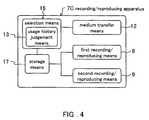
- Fig. 4 is a block diagram showing a recording/reproducing apparatus 7C according to yet another embodiment of the present invention.
- the recording/reproducing apparatus 7C includes a storage means 17 for accumulating the usage history of the first recording/reproducing means 8 and the second recording/reproducing means 9, and a usage history judgement means 13.
- the functions of the external judgement means 19 in the configuration of Figs. 2 or 3 can be fulfilled by the selection means 16.
- the recording/reproducing apparatuses 7A, B, and C of the present invention as explained with the Figs. 2 to 4 can be selected and used in accordance with their usage conditions.
- the usage history of the recording/reproducing means stored in the external storage means 18 or the storage means 17 is divided into recording history and reproduction history of the recording/reproducing means. If the usage history is divided in this manner, the usage history judgement means 13, 14, or 15 may be configured so as to give the instruction whether a certain information medium is recorded or reproduced, to the selection means 16. Thereby the selection means 16 can select a recording/reproducing means with a usage history that is suitable for recording or a recording/reproducing means with a usage history that is suitable for reproducing. Consequently, the life-time of the recording/reproducing apparatus can be prolonged to the recording limit and the reproduction limit of the recording/reproducing means.
- this copying operation is called "dubbing"
- a recording/reproducing means that is optimal for reproduction and a recording/reproducing means that is optimal for recording can be selected, which enhances the reliability of the copying operation.
- a moving means not shown in the drawings
- the information medium is transferred to the recording/reproducing means selected by the selection means 16
- the recording and/or the reproducing lifetime of a recording/reproducing apparatus handling large amounts of information on a plurality of information media can be extended. Therefore the information media stocked in the medium stocking means can be used more effectively.
- the selection means after the moving means it is also possible to use the moving means after the selection means.
- a media selection means can be provided for selecting the information medium in accordance with the information signal to be recorded.
- the difference between the embodiments of the present invention and a conventional configuration including the function of selecting a medium based on an instruction with, for example, a computer, is that in a recording/reproducing apparatus of the present invention, the medium selection means is provided inside the apparatus, whereas conventional configurations are operated by instructions from external control means and do not include medium selection means inside the recording/reproducing apparatus. Consequently, as mentioned above, in conventional configurations, the selection depends only on the empty capacity, and it is essential to provide the external control means with a medium selection instruction function.
- the recording/reproducing apparatus can automatically select the optimal information medium, so that the user can select and record the optimal information medium simply by entering attributes (such as class or origin) of the information signal to be recorded into the recording/reproducing apparatus.
- attributes such as class or origin
- the recording/reproducing apparatus of the present invention for example in case of programming a video recording, an information medium that records one kind of information can be produced simply by entering information such as date, day of the week, and program genre. Consequently, the access time necessary when reproducing this information can be shortened, and the information can be recorded neatly sorted on the information media.
- a plurality of recording/reproducing means or a plurality of information media stocked in a medium stocking means can be used even if their recording principle, reproducing principle, recording/reproducing principle, format, or amount of information on the medium is different and regardless of whether they use a cartridge or not.
- the recording/reproducing means with the shortest usage history is selected from the plurality of recording/reproducing means, and the information medium is transferred to the selected recording/reproducing means.
- the wear evaluation value L of the first recording/reproducing means is expressed as follows.
- L in 1 is the wear evaluation value of the tray transfer mechanism
- k in 1 is the wear factor of the tray transfer mechanism
- n in 1 is the total number of tray transfers
- L ld 1 is the wear evaluation value of the laser diode
- k ldr 1 is the recording wear factor of the laser diode
- t ldr 1 is the entire recording time
- k ldp 1 is the reproducing wear factor
- t ldp 1 is the total reproducing time
- L dm 1 is the wear evaluation value of the disk motor
- k dmst 1 is the start/stop wear factor of the disk motor
- n dmst 1 is the total number of times of starts and stops
- k dmro 1 is the rotation wear factor of the disk motor
- t dmro 1 is the total rotation time
- the above evaluation factors are merely examples, and it is equally possible to devise evaluation factors for the other structural elements of the recording/reproducing means (for example the traverse mechanism of the head, the focus/tracking mechanism, etc.).
- the evaluation factors L to be applied are selected as suitable, the wear factors are set for all recording/reproducing means using the selected L, and the usage history can be established by updating the wear evaluation values every time a recording/reproducing means is used.
- a method can be applied where the laser diode wear evaluation value is separated into a laser diode recording wear evaluation value and a laser diode reproducing evaluation value. It is also possible to use wear factors for recording, reproducing and deleting, separately or in combination.
- the wear evaluation value of a magnetic recording/reproducing means using an audio or video tape is expressed by the following manner.
- the magnetic recording/reproducing means is positioned as the second recording/reproducing means.
- L mh 2 is the wear evaluation value of a magnetic head
- k mh 2 is the recording wear factor (based on physical wear) of the magnetic head
- t mhr 2 is the entire recording time
- t mhp 2 is the total reproducing time
- L tm 2 is the wear evaluation value of a tape driving motor
- k tmst 2 is the start/stop wear factor of the tape driving motor
- n tmst 2 is the total number of times of starts and stops
- k tmro 2 is the rotation wear factor of the tape driving motor
- t tmro 2 is the total rotation time
- the above evaluation factors are merely examples, and it is equally possible to devise evaluation factors for the other structural elements of the recording/reproducing means (for example the traverse mechanism of the head, the focus/tracking mechanism, etc.).
- the evaluation factors L to be applied are selected as suitable, the wear factors are set for all recording/reproducing means using the selected L, and the usage history can be established by updating the wear evaluation values every time a recording/reproducing means is used. It should be noted that a method can be applied where the magnetic head wear evaluation value is separated into a magnetic head recording wear evaluation value and a magnetic head reproducing evaluation value.
- the number of usages guaranteed by the maker which contains a security factor, is used for the wear factors of the recording/reproducing means, recording or reproducing with a high reliability is possible within the number of times guaranteed by the maker. It eliminates problems, for example, that when a backup of information stored on a computer's hard disk is made, after the long processing time for the backup, an instruction is given out that there was a problem with the backup operation, or that when recording is performed due to the programming, recording of the programmed programs fails due to some trouble with the recording/reproducing apparatus.
- the recording/reproducing apparatus of the present invention in which the control is performed based on the usage history of the recording/reproducing means, it is possible to apply a usage method, which issues a warning when one of the recording/reproducing means has been used more times than guaranteed by the maker, the warning is ignored and the recording/reproducing means is used to the usage limit.
- a usage method which issues a warning when one of the recording/reproducing means has been used more times than guaranteed by the maker, the warning is ignored and the recording/reproducing means is used to the usage limit.
- the reliability is somewhat downgraded, but the lifetime of the recording/reproducing means can be extended to the usage limit of the recording/reproducing means.
- This case can be adopted by substituting the wear factors with the usage limits of the structural elements, or setting two kinds, namely the number guaranteed by the maker and the usage limit.
- the recording/reproducing is performed with a recording/reproducing means at the limit or beyond the limit, and when the information is important, then the recording/reproducing is performed with a recording/reproducing means within the number guaranteed by the maker, which prolongs the lifetime of the recording/reproducing apparatus.
- the wear evaluation value of the tray transfer mechanism for example is adopted as the usage history; the number guaranteed by the maker is 200,000 usages of the tray transfer mechanism, and the usage limit number is 2,000,000 usages, then the following wear evaluation value results.
- L in (n) n in n ⁇ 1/20,000 (for the number guaranteed by the maker)
- L in (n) n in n ⁇ 1/200,000 (for the usage limit number) (wherein 1 ⁇ n ⁇ N).
- the tray transfer mechanisms of the recording/reproducing apparatus are used within the guarantee of the maker. That is to say, 20,000 ⁇ N operations of recording/reproducing an information medium can be performed, and if the tray transfer mechanisms of the recording/reproducing means are used to the limit, then 200,000 ⁇ N recording/reproducing operations can be performed with information recording media.
- the tray transfer operation is inhibited to operate and the entire recording/reproducing apparatus becomes inoperable.
- the reliability decreases. In that case, there is the possibility that some kind of trouble occurs when loading with the tray, and the recording/reproducing operation cannot be performed properly, or that the information medium is damaged.
- the conventional example may be configured in a manner that the operation is possible for the number exceeding that guaranteed by the maker, but when the usage limit of 200,000 times is reached, the tray transfer is inhibited to operate and the entire recording/reproducing apparatus becomes inoperable.
- the number of operations that can be guaranteed by the maker is between 200,000 and 200,000 ⁇ N, but in practice, 200,000 ⁇ N usages are impossible.
- 200,000 ⁇ N usages can be reached, and the same can be said for the usage limit.
- reproduction usually is performed as well when recording, and considering that the lifetime for recording is shorter than that for reproducing, if a certain recording/reproducing means is used when recording the information medium and if this recording/reproducing means reaches the recording limit, but has not yet reached the reproducing limit, it is possible to dedicate this recording/reproducing means to reproduction, and use another recording/reproducing means for recording.
- Fig. 5 is a flowchart showing one embodiment of a transfer method of the present invention.
- the present invention is realized with a recording/reproducing apparatus having two recording/reproducing means, but the same idea can be applied to apparatuses with three or more recording/reproducing means as well.
- the wear evaluation value L 1 of the first recording/reproducing means is compared with the wear evaluation value L 2 of the second recording/reproducing means (Step S501). If L 1 is larger than L 2 , (i.e., if the usage history of the first recording/reproducing means is longer than that of the second recording/reproducing means), the information medium is transferred to the second recording/reproducing means, and recording or reproducing is performed with the second recording/reproducing means (Step S505). After the operation is finished (Step S506), the wear evaluation value L 2 of the second recording/reproducing means is updated (Step S507), and the information medium can be retrieved from the recording/reproducing apparatus, if necessary.
- Step S508 the first recording/reproducing means is used (Steps S508, S509), and the wear evaluation value L 1 of the first recording/reproducing means is updated (Step S510). If the usage histories of the first recording/reproducing means and the second recording/reproducing means are identical (for example, when the recording/reproducing apparatus is used for the first time), either one of the first and the second recording/reproducing means is used (Steps S502, S503), and the wear evaluation value (L 1 or L 2 ) of the used recording/reproducing means is updated (Step S504).
- the wear evaluation values of the usage history of the recording/reproducing means can be calculated, for example, with the usage history judgement means 13, 14, or 15 shown in Figs. 2 to 4. That is to say, a wear evaluation circuit or a wear evaluation software can be built into the usage history judgement means 13, 14, or 15.
- a recording/reproducing apparatus of the present invention includes a plurality of recording/reproducing means, and because the selection of the recording/reproducing means for recording/reproducing an information medium is based on the usage histories of the recording/reproducing means, the lifetime of the recording/reproducing apparatus can become as long as the combined lifetime of these recording/reproducing means, thereby prolonging the lifetime of the recording/reproducing apparatus.
Landscapes
- Automatic Disk Changers (AREA)
- Indexing, Searching, Synchronizing, And The Amount Of Synchronization Travel Of Record Carriers (AREA)
- Signal Processing For Digital Recording And Reproducing (AREA)
Abstract
Description
Claims (6)
- A recording/reproducing apparatus comprising:a plurality of recording and/or reproducing means for performing at least one of recording an information signal and reproducing an information signal;a medium transfer means for transferring an information medium and loading it selectively into one of said recording and/or reproducing means;a selection means for selecting the recording and/or reproducing means to be loaded with the information medium by said medium transfer means;
wherein said selection means selects the recording and/or reproducing means with the currently shortest usage history from said plurality of recording and/or reproducing means. - The recording/reproducing apparatus according to Claim 1, further comprising a storage means for storing the usage history of each of the recording and/or reproducing means.
- The recording/reproducing apparatus according to Claim 2, further comprising a judgement means for judging, based on the usage histories stored in the storage means, which recording and/or reproducing means is to be selected with the selection means.
- The recording/reproducing apparatus according to Claim 1, further comprising a medium stocking means for stocking a plurality of information media; anda moving means for moving one desired information medium of the plurality of information media from said medium stocking means to said medium transfer means.
- The recording/reproducing apparatus according to Claim 4, further comprising a medium selection means for selecting, from said medium stocking means, an information medium used for recording certain information with a selected recording and/or reproducing means, the selecting being in accordance with a kind of the information.
- An information medium transfer method for transferring an information medium to load it selectively into one of a plurality of recording and/or reproducing means for performing at least one of recording an information signal and reproducing an information signal, the method comprising:comparing, with a usage history judgement means, usage histories obtained from a storage means for storing usage histories of the recording and/or reproducing means;selecting, with a selection means, one of the plurality of recording and/or reproducing means, which said usage history judgement means has judged to have the shortest usage history; andtransferring the information medium with a transfer means to the recording and/or reproducing means selected with the selection means.
Applications Claiming Priority (2)
| Application Number | Priority Date | Filing Date | Title |
|---|---|---|---|
| JP2584199 | 1999-02-03 | ||
| JP2584199 | 1999-02-03 |
Publications (3)
| Publication Number | Publication Date |
|---|---|
| EP1026678A2 true EP1026678A2 (en) | 2000-08-09 |
| EP1026678A3 EP1026678A3 (en) | 2001-05-16 |
| EP1026678B1 EP1026678B1 (en) | 2004-01-14 |
Family
ID=12177089
Family Applications (1)
| Application Number | Title | Priority Date | Filing Date |
|---|---|---|---|
| EP00102343A Expired - Lifetime EP1026678B1 (en) | 1999-02-03 | 2000-02-03 | Recording/reproducing apparatus and information medium transfer method |
Country Status (3)
| Country | Link |
|---|---|
| US (1) | US6157768A (en) |
| EP (1) | EP1026678B1 (en) |
| DE (1) | DE60007669T2 (en) |
Cited By (1)
| Publication number | Priority date | Publication date | Assignee | Title |
|---|---|---|---|---|
| EP1653460A1 (en) * | 2004-11-02 | 2006-05-03 | Samsung Electronics Co., Ltd. | Combined recording apparatus with automatic selection of a recording apparatus and corresponding method |
Families Citing this family (2)
| Publication number | Priority date | Publication date | Assignee | Title |
|---|---|---|---|---|
| AU2003216637A1 (en) * | 2002-04-29 | 2003-11-17 | Koninklijke Philips Electronics N.V. | A method and apparatus for recording and reproducing event signals |
| WO2008086382A1 (en) * | 2007-01-09 | 2008-07-17 | Pharos Systems Interational, Inc. | Document processing system providing job attribute control features and related methods |
Family Cites Families (7)
| Publication number | Priority date | Publication date | Assignee | Title |
|---|---|---|---|---|
| JP2849161B2 (en) * | 1989-10-14 | 1999-01-20 | 三菱電機株式会社 | Information playback device |
| US5504873A (en) * | 1989-11-01 | 1996-04-02 | E-Systems, Inc. | Mass data storage and retrieval system |
| EP0464551A3 (en) * | 1990-06-25 | 1992-11-19 | Kabushiki Kaisha Toshiba | Method and apparatus for controlling drives coupled to a computer system |
| JP2702844B2 (en) * | 1992-03-30 | 1998-01-26 | 富士通株式会社 | Control method for magnetic disk drive |
| EP0580361B1 (en) * | 1992-07-21 | 2000-02-02 | Pioneer Electronic Corporation | Disc player and method of reproducing information of the same |
| JP3099930B2 (en) * | 1993-07-16 | 2000-10-16 | 株式会社東芝 | Disk array device |
| US5894376A (en) * | 1996-06-25 | 1999-04-13 | Spectra Logic Corporation | Apparatus and method for monitoring read/write reliability of data storage device |
-
2000
- 2000-02-01 US US09/495,571 patent/US6157768A/en not_active Expired - Fee Related
- 2000-02-03 EP EP00102343A patent/EP1026678B1/en not_active Expired - Lifetime
- 2000-02-03 DE DE60007669T patent/DE60007669T2/en not_active Expired - Fee Related
Cited By (1)
| Publication number | Priority date | Publication date | Assignee | Title |
|---|---|---|---|---|
| EP1653460A1 (en) * | 2004-11-02 | 2006-05-03 | Samsung Electronics Co., Ltd. | Combined recording apparatus with automatic selection of a recording apparatus and corresponding method |
Also Published As
| Publication number | Publication date |
|---|---|
| US6157768A (en) | 2000-12-05 |
| EP1026678A3 (en) | 2001-05-16 |
| EP1026678B1 (en) | 2004-01-14 |
| DE60007669D1 (en) | 2004-02-19 |
| DE60007669T2 (en) | 2004-12-02 |
Similar Documents
| Publication | Publication Date | Title |
|---|---|---|
| EP1346355B1 (en) | Power failure recovery mechanism for a recording and reproducing device | |
| EP1236203B1 (en) | A method of disaster recovery for re-writable disk media | |
| JP2005538491A (en) | Defect management method and apparatus | |
| EP0942419B1 (en) | Reproducing apparatus, recording apparatus and recording/reproducing apparatus | |
| JP4151197B2 (en) | Recording / reproducing apparatus and recording / reproducing method | |
| US7333411B2 (en) | Optical recording method and optical recording device | |
| KR20050086810A (en) | Apparatus for managing removable storage media that can be connected thereto, and method, program, and system lsi for managing removable storage media | |
| EP1542229A2 (en) | Method and apparatus for controlling data recording, recording medium, and computer program | |
| EP1026678B1 (en) | Recording/reproducing apparatus and information medium transfer method | |
| US20050185557A1 (en) | Reproducing apparatus | |
| US5943468A (en) | Apparatus for reproducing data from a memory device integrally provided with a plurality of kinds of recording media | |
| RU2384897C2 (en) | Method and device for recording data onto recording medium | |
| US20030007783A1 (en) | Recording/reproducingdisk control device and disc apparatus comprising the same | |
| US5179543A (en) | Dubbing apparatus for audio equipment | |
| JP2000293917A (en) | Recording / reproducing apparatus and information medium transport method | |
| KR100563685B1 (en) | How to manage playlists on rewritable recording media | |
| KR100618732B1 (en) | Firmware update method of recording / reproducing apparatus | |
| JP2814568B2 (en) | Recording and playback device | |
| JP2827989B2 (en) | Control method of disk autochanger device | |
| JP3400488B2 (en) | File management device | |
| KR100412484B1 (en) | optical writing apparatus enables continuously write the files at both sides of a optical writing media | |
| EP1672639B1 (en) | Information recording/reproducing device | |
| KR20060056522A (en) | Recording method in digital compound recorder | |
| KR100577272B1 (en) | Loss recording area management and recovery method for rewritable optical discs | |
| KR100565661B1 (en) | Optical disc recording method |
Legal Events
| Date | Code | Title | Description |
|---|---|---|---|
| PUAI | Public reference made under article 153(3) epc to a published international application that has entered the european phase |
Free format text: ORIGINAL CODE: 0009012 |
|
| AK | Designated contracting states |
Kind code of ref document: A2 Designated state(s): DE FR GB |
|
| AX | Request for extension of the european patent |
Free format text: AL;LT;LV;MK;RO;SI |
|
| PUAL | Search report despatched |
Free format text: ORIGINAL CODE: 0009013 |
|
| AK | Designated contracting states |
Kind code of ref document: A3 Designated state(s): AT BE CH CY DE DK ES FI FR GB GR IE IT LI LU MC NL PT SE |
|
| AX | Request for extension of the european patent |
Free format text: AL;LT;LV;MK;RO;SI |
|
| 17P | Request for examination filed |
Effective date: 20010831 |
|
| AKX | Designation fees paid |
Free format text: DE FR GB |
|
| 17Q | First examination report despatched |
Effective date: 20020214 |
|
| GRAP | Despatch of communication of intention to grant a patent |
Free format text: ORIGINAL CODE: EPIDOSNIGR1 |
|
| GRAS | Grant fee paid |
Free format text: ORIGINAL CODE: EPIDOSNIGR3 |
|
| GRAA | (expected) grant |
Free format text: ORIGINAL CODE: 0009210 |
|
| AK | Designated contracting states |
Kind code of ref document: B1 Designated state(s): DE FR GB |
|
| REG | Reference to a national code |
Ref country code: GB Ref legal event code: FG4D |
|
| REF | Corresponds to: |
Ref document number: 60007669 Country of ref document: DE Date of ref document: 20040219 Kind code of ref document: P |
|
| ET | Fr: translation filed | ||
| PLBE | No opposition filed within time limit |
Free format text: ORIGINAL CODE: 0009261 |
|
| STAA | Information on the status of an ep patent application or granted ep patent |
Free format text: STATUS: NO OPPOSITION FILED WITHIN TIME LIMIT |
|
| 26N | No opposition filed |
Effective date: 20041015 |
|
| PGFP | Annual fee paid to national office [announced via postgrant information from national office to epo] |
Ref country code: DE Payment date: 20090129 Year of fee payment: 10 |
|
| PGFP | Annual fee paid to national office [announced via postgrant information from national office to epo] |
Ref country code: GB Payment date: 20090128 Year of fee payment: 10 |
|
| PGFP | Annual fee paid to national office [announced via postgrant information from national office to epo] |
Ref country code: FR Payment date: 20090213 Year of fee payment: 10 |
|
| GBPC | Gb: european patent ceased through non-payment of renewal fee |
Effective date: 20100203 |
|
| REG | Reference to a national code |
Ref country code: FR Ref legal event code: ST Effective date: 20101029 |
|
| PG25 | Lapsed in a contracting state [announced via postgrant information from national office to epo] |
Ref country code: FR Free format text: LAPSE BECAUSE OF NON-PAYMENT OF DUE FEES Effective date: 20100301 |
|
| PG25 | Lapsed in a contracting state [announced via postgrant information from national office to epo] |
Ref country code: DE Free format text: LAPSE BECAUSE OF NON-PAYMENT OF DUE FEES Effective date: 20100901 |
|
| PG25 | Lapsed in a contracting state [announced via postgrant information from national office to epo] |
Ref country code: GB Free format text: LAPSE BECAUSE OF NON-PAYMENT OF DUE FEES Effective date: 20100203 |