BACKGROUND OF THE INVENTION
Field of the Invention
The present invention relates to a temperature indicating
material suited for the formation of a temperature monitoring
label or the like used for the monitoring of an environmental
temperature. This invention relates to a temperature monitoring
member which is produced using a temperature indicating member
which undergoes color changes with temperature and is used for
the temperature monitoring of vegetables and fruits, perishable
foods and the like.
Description of the Prior Art
As a temperature indicating material which undergoes color
changes with temperature, thermochromic organic pigments, for
example, ethylene derivatives substituted with a condensed
aromatic ring such as spiropirans bianthrone or dixanthylene,
crystals of a metal complex salt composed of CoCl2·2(CH2)6N4·10H2O,
combinations of an electron donating compound, an electron
accepting compound and a polar organic compound and the like
have conventionally been put on the market. Upon use of a
temperature monitoring label prepared from such a temperature
indicating material, color changes with temperature are judged
visually.
Roughly speaking, there are two types of temperature
indicating materials, that is, a reversible type and irreversible
type. In the former one, the color changes unlimitedly in
response to a temperature increase or decrease, while in the
latter one, the color which has once changed at a certain
temperature does not show any further change.
The reversible type material is used for indicating the
time good for drinking of beer or the like, or for visually
attracting attentions to a temperature change.
The irreversible type material is used for the temperature
monitoring of fruits and vegetables, or perishable foods. The
temperature indicating material which has stored its thermal
history is disclosed in Japanese Patent Publication No. SHO
58-10709, wherein an ink having a viscosity changeable with
temperature (for example, an ink which has a pigment dissolved
in oleyl alcohol) penetrates in a penetration material and the
length of the ink penetrated in the material indicates how long
it is exposed to a temperature not lower than a predetermined
temperature. In addition, there is an irreversible temperature
indicating material for temperature monitoring which has a
plurality of layers formed on a label. These plurality of layers
are an ink layer, a separate layer, a porous layer and an indicator
and they are stacked one after another. The separate layer is
removed when the temperature monitoring is started, while the
porous layer controls the penetration time of the ink from the
ink layer until it reaches the indicator. For such a temperature
monitoring member, a storing device (separator or the like) prior
to the starting of temperature monitoring is important, but it
is expensive and in addition, has such a complex structure that
a desired printing pattern cannot be adopted. Moreover, this
material needs a cumbersome operation such as removal of the
separator or the like upon initiation of the temperature
monitoring.
As an improved process, a process using a rewritable
material is disclosed in Japanese Patent Application Laid-Open
No. 197853/1996, wherein the glass transition point of the
material is used as a preset temperature and temperature
monitoring is effected by making use of the fact that a drastic
change in the diffusion rate of molecules occurs at a temperature
exceeding the glass transition point.
The phase separation controller described in this Japanese
Patent Application Laid-Open No. 197853/1996 is employed for
accelerating the color developing rate at high temperatures,
but cannot improve the properties necessary as thermochromic
characteristics (characteristics of accelerating color
development at a temperature not lower than a preset temperature
in spite of slow color development at a temperature not higher
than the preset temperature).
The problems of such a prior art will next be described.
In the process using a rewritable material, a system which shows
a drastic change in a color developing rate at a temperature
not lower than the glass transition point after initial
decolorization is utilized. The temperature monitoring
material in this case has a mechanism of developing color owing
to the association of a developer which has been diffused as
a result of the phase separation between a reversal material
and the developer with a leuco dye so that color development
gradually proceeds even at a temperature not higher than the
glass transition point. A density change with temperature is
however small, so it is necessary to heighten the sensitivity
in practical use. The phase separation controller for raising
the color developing rate at high temperatures cannot serve as
a temperature indicating material, since it has a high color
developing rate even at low temperatures. In addition, the color
density upon decolorization is not complete and a density ratio
(S/N ratio) of decolorized state to color-developed state by
temperature is low.
SUMMARY OF THE INVENTION
An object of the present invention is therefore to provide
a temperature indicating material which has thermochromic
characteristics sensitive at an environmental temperature and
has a high S/N ratio.
In one aspect of the present invention, there is thus
provided a temperature indicating material which comprises an
electron donating compound, an electron accepting compound and
a reversal material and undergoes color change with temperature
and time, characterized in that said temperature indicating
material further comprises a thermochromism controller which
plays a role of changing a rate from crystal to amorphous or
from phase separation to non-phase-separation and upon
discoloration by an environmental temperature, crystallizes or
undergoes phase separation to provide a place for reaction,
thereby contributing to the discoloration of the temperature
indicating material.
In another aspect of the present invention, there is also
provided a temperature monitoring member which is prepared using
a temperature indicating member obtained by incorporating, in
a material which comprises an electron donating compound, an
electron accepting compound and a reversal material, is
initialized upon initiation of temperature monitoring and
undergoes color changes with temperature and time, a cycloalkanol
or cycloalkane diol which has stable crystalline conditions
within a temperature monitoring range; and by printing or coating
information to a base material.
BRIEF DESCRIPTION OF THE DRAWINGS
A more complete appreciation of the present invention and
many attendant advantages thereof will be readily obtained as
the same becomes better understood by reference to the following
detailed description when considered in connection with the
accompanying drawings, in which:
DETAILED DESCRIPTION OF THE PREFERRED EMBODIMENTS
The embodiments of the present invention will next be
described based on the drawings. The temperature indicating
materials according to these embodiments each has a system as
shown in FIG. 1 and is obtained by adding, to a rewritable basic
system composed of an electron donating compound A (which will
hereinafter be called "leuco dye A"), an electron accepting
compound B (which will hereinafter be called "developer B") and
a reversal material C, a thermochromism controller D and a binder
resin. The reversal material means a material that causes
reversible transformation between crystal and amorphous with
respect to a part or all of the composition system, or reversible
transformation between phase separation and
non-phase-separation.
In these embodiments, crystal violet lactone (CVL), propyl
gallate (PG), pregnenolone (PRN) and cyclododecanol (CD) are
used as the leuco dye A, developer B, reversal material C and
thermochromism controller D, respectively. The propyl gallate
(PG) employed here is soluble in molten cyclododecanol (CD).
In a decolorized mode, the mutual action between the leuco dye
A and developer B is small, while the developer has heightened
mutual action with the reversal material C and thermochromism
controller D. In a color development mode, on the other hand,
the mutual action between the leuco dye A and developer B is
strong, while that between the developer B with the reversal
material and thermochromism controller D is small. By heating
and quenching, the developer B is absorbed in the reversal
material C and thermochromism controller D which are molten at
the time of heating and the reversal material C and thermochromism
controller D are solidified by quenching while absorbing therein
the developer B. Since the solidified condition is amorphous
and is therefore not stable, the phase separation between the
developer B and the thermochromism controller D and reversal
material C proceeds, depending on temperature and time. The
thermochromism controller D which undergoes phase separation
crystallizes at an environmental temperature because of its
stable crystal condition. The crystallized thermochromism
controller D provides a place for the reaction between the leuco
dye A and developer B, while maintaining weak mutual action with
the developer B, and accelerates the association of the leuco
dye A with the developer B. The term "place for the reaction"
as used herein means a place where the reaction between the leuco
dye A and the developer B is allowed to proceed on the surface
of the thermochromism controller D.
A description will next be made of the action in the place
for the reaction. When the thermochromism controller D becomes
amorphous (decolorized) while heightening the mutual action with
the reversal material C and developer B and then undergoes phase
separation by exposure to high temperatures, the surface energy
on the surface of the thermochromism controller D is largely
activated and heightens the mutual action with the developer
B which has also undergone phase separation. Owing to stable
crystal conditions, the thermochromism controller D has reduced
surface energy during the progress of the crystal growth, whereby
the developer B is separated from the thermochromism controller
D and bound to the leuco dye A to bring about color development.
In other words, the thermochromism controller D which has
undergone phase separation is presumed to serve as an accelerator
of the color development after exposure to high temperatures
in order to provide a place for association (a place for reaction)
of the leuco dye A with the developer B.
When the leuco dye A, developer B and thermochromism
controller D are mixed in a solid form, a place for reaction
is provided for the leuco dye A and developer B so that color
development is observed. In a similar method, it is possible
to confirm whether another material can provide the place for
reaction.
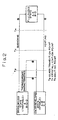
A description will next be made of the thermodynamic
reversibility of this system with reference to FIG. 2. Under
the color developed condition, the developer B and leuco A have
strong mutual action, while the reversal material C and
thermochromism controller D exists independently in the crystal
form. Heating of this temperature indicating material to the
melting point Tm or higher (shown by 1 ○) fluidizes the material,
which lowers the mutual action between the developer B and the
leuco dye A while heightens the mutual action of the developer
B with the thermochromism controller D and reversal material
C which have been molten by heating, resulting in decolorization.
By quenching (as shown by 2 ○) thereafter, the developer B
solidifies in the amorphous state while being absorbed in the
reversal material C and thermochromism controller D and the
decolorized state is maintained. Heating (as shown by 3 ○) to
a temperature not lower than the glass transition point Tg then
causes separation of the developer D from the reversal material
C and thermochromism controller D, followed by the initiation
of drastic diffusion, whereby color development proceeds. The
diffusion rate of the developer B shows a drastic change at a
temperature around the glass transition point Tg. Since the
reversal material C and thermochromism controller D have stable
crystal conditions, color development proceeds even at a
temperature not higher than the glass transition point Tg (as
shown in 4 ○) and in this area, the material exhibits time- and
temperature-dependent thermochromism. Crystallization of the
thermochromism controller D, which undergoes phase separation
from the amorphous condition of the developer B, reversal
material C and thermochromism controller D in the area having
thermochromism at around or not higher than Tg, proceeds, since
the crystal condition is stable under the measuring environment.
The thermochromism controller D provides a place for the
association, that is, a place for the reaction of the similarly
separated developer B with the leuco dye A, thereby accelerating
the progress of color development. The color developing rate
accelerated by the thermochromism controller D is higher than
that caused by the diffusion of the developer B and leuco dye
A by the binder resin.
Since the mutual action among three components, that is,
developer B, reversal material C and thermochromism controller
D is large at the time of decolorization, the use of the developer
B soluble in the thermochromism controller D facilitates the
reaction among the three components, which makes it possible
to carry out complete decolorization. Moreover, owing to the
large mutual action between the thermochromism controller D and
developer B, phase separation does not occur easily when the
temperature is low. The progress of the color development of
the temperature indicating material according to the present
invention at low temperatures is slower than that of a temperature
indicating material free of a thermochromism controller D. When
exposed to high temperatures, the thermochromism controller D
crystallizes relatively promptly, losing mutual action with the
reversal material C and developer B, since the thermochromism
controller D has a crystallizing point and melting point lower
than those of the reversal material C. During crystallization,
the thermochromism controller D provides a place for reaction,
which increases the number of the chances to associate the
developer B, which has undergone phase separation, with the leuco
dye A, thereby accelerating the progress of the color development.
In this manner, the thermochromism controller D is sensitive
to temperature, more specifically, retards the progress of color
development at low temperatures, but accelerates the progress
of color development at high temperatures.
In the system of these embodiments, reflectance upon
decolorization is improved by adding, as the thermochromism
controller D, cyclododecanol (CD) to a rewritable temperature
indicating material and employing an electron donating compound
(developer B) which dissolves therein an electron accepting
compound (developer B). When the temperature indicating
material is exposed to high temperatures after decolorization,
phase separation of the thermochromism controller D occurs and
it provides a place for the reaction, which makes it possible
to proceed the color development sufficiently.
A temperature monitoring material makes use of the color
development mechanism of the temperature indicating material
as follows: thermal energy is applied to the temperature
indicating material, which is under a color developing condition,
as shown in FIG. 1 by heating means such as thermal head to a
temperature not lower than the melting point of the temperature
indicating material; the electron donating compound (leuco dye
A) and electron accepting compound (developer B) are solidified
by quenching while being separated from each other; the material
is initialized to be a transparent condition; and the color
development degree of the initialized part changes, depending
on the reaction amount of the electron donating compound (leuco
dye A) with the electron accepting compound (developer B) which
varies with temperature and time.
In general, the strength of reflected light can be
represented by the following equation:
I = RI0 · e-2εcd
wherein, I0: irradiated light, ε: molar absorption coefficient,
c: molar concentration, d: ink film thickness and R: reflectance
of substrate. ε shows a time- and temperature-dependent change
after decolorization and this fact is utilized by a temperature
indicating material.
The present invention will hereinafter be described more
specifically by examples. The temperature indicating material
is composed of a leuco dye A, a developer B, a reversal material
C, a thermochromism controller D (cyclododecanol) and a binder
resin.
〈Embodiment 1〉
〈Example 1〉
| * Leuco Dye A: "GN-2" (trade name; product of Yamamoto Chemicals, Inc.) |
1 part by weight |
| * Developer B: PG (Propyl gallate) |
1 part by weight |
| * Reversal material C: PRN (pregnenolone) |
10 parts by weight |
| * Thermochromism controller D: CD (cyclododecanol) |
5 parts by weight |
| * Binder resin: A-91 (styrene-methacrylic acid copolymer, methacrlic acid: 10%) |
4 parts by weight |
〈Comparative Example 1〉
| * Leuco Dye A: "GN-2" (trade name; product of Yamamoto Chemicals, Inc.) |
1 part by weight |
| * Developer B: PG (Propyl gallate) |
1 part by weight |
| * Reversal material C: PRN (pregnenolone) |
10 parts by weight |
| * Phase separation controller: DOC (1-docosanol) |
5 parts by weight |
| * Binder resin: A-91 (styrene-methacrylic acid copolymer, methacrylic acid: 10%) |
4 parts by weight |
〈Comparative Example 2〉
| * Leuco Dye A: "GN-2" (trade name; product of Yamamoto Chemicals, Inc.) |
1 part by weight |
| * Developer B: PG (Propyl gallate) |
1 part by weight |
| * Reversal material C: PRN (pregnenolone) |
10 parts by weight |
| * Phase separation controller: SA (stearic acid) |
5 parts by weight |
| * Binder resin: A-91 (styrene-methacrylic acid copolymer, methacrylic acid: 10%) |
4 parts by weight |
〈Comparative Example 3〉
| * Leuco Dye A: "GN-2" (trade name; product of Yamamoto Chemicals, Inc.) |
1 part by weight |
| * Developer B: PG (Propyl gallate) |
1 part by weight |
| * Reversal material C: PRN (pregnenolone) |
10 parts by weight |
| * Phase separation: (thermochromism controller) |
Not added |
| * Binder resin: A-91 (styrene-methacrylic acid copolymer, methacrylic acid: 10%) |
4 parts by weight |
Each of the temperature indicating materials is prepared
as follows: first, a coating solution is prepared by completely
dissolving a binder resin in 84 parts by weight of a 4:1 mixed
solvent of toluene and cyclohexanone, adding GN-2, PG, PRN, CD
(or DOC or SA) to the resulting resin solution, charging glass
beads of about ⊘ 3 mm to the resulting mixture to a height of
the liquid surface, and stirring the mixture for about 2 hours
in a paint shaker.
The coating solution thus obtained is applied to PET of
38 µm thick by a bar coater #40, followed by distillation of
the solvent at about 70°C, whereby the temperature indicating
material is prepared.
Evaluation was carried out on the temperature monitoring
material prepared from the resulting temperature indicating
material. Each of the temperature monitoring materials was
prepared, as shown in FIG. 3, by successively adhering, to a
white PET base 2, a thermal diffusion preventive layer 3 and
temperature indicating material 4 by using "My Tack Paper ML-10"
(trade name; product of Nichiban Co., Ltd.). PEN (polyethylene
naphthalate) 5 added with a sticking preventive layer 6 was
laminated as a protecting layer against the discoloration by
a thermal head. The sticking preventive layer 6 was formed by
applying "TS-100" (trade name; product of Kuboko Paint Co., Ltd.),
which had been diluted 5 times, by a bar coater #3, followed
by drying at 80°C (whereby the solvent was removed). Evaluated
were discolorization characteristics (initialization) and
thermochromism (after discolorization, reflectance of each
sample was measured at 0, 10, 25 and 40°C, respectively, by a
colorimeter (product of Minolta) and in addition, the reflectance
of the sample of Example 1 was measured at 15 and 20°C). In
addition, presence or absence of color development was confirmed
by weighing each of the leuco dye A, developer B, reversal material
C and thermochromism controller D or phase separation controller
in a sample bottle, sealing and shaking it and then allowing
it to stand for a while, in order to confirm whether a place
for the reaction is provided. When the color development is
observed, it means that the thermochromism controller D or phase
separation controller has provided the place for reaction (no
color development was observed in Comparative Example 3 which
was free of the thermochromism controller D or phase separation
controller).
〈Decolorization Characteristics〉
The decolorization characteristics of Example 1 and
Comparative Examples 1 to 3 are shown in FIG. 4. In Comparative
Example 3, the reflectance upon decolorization is saturated at
around 1 mJ/dot, while color decolorization of the cyclododecanol
(CD)-added temperature monitoring material prepared in Example
1 can be carried out by lower energy than that of Comparative
Example 3, indicating that the reflectance upon decolorization
is improved by the addition of cyclododecanol (CD) when the energy
applied is the same. The temperature monitoring materials
prepared in Comparative Examples 1 and 2 each needs an equal
level of energy to that of Comparative Example 3 and reflectance
upon decolorization is low (no complete decolorization).
〈Thermochromic characteristics〉
Thermochromic characteristics of each of the temperature
monitoring materials prepared in Example 1 and Comparative
Examples 1 to 3 are shown in FIG. 5. The reflectance after 24
hours at each temperature is shown in FIG. 5. In Comparative
Example 3 free of the thermochromism controller D, the
reflectance shows a substantially linear decrease at 0 to 25°C
and is about 25% at 40°C. Thus, the material is not sensitive
to temperature. When a phase separation controller is added,
the reflectance approaches about 40% even at a low temperature,
which indicates that the color development progresses (the
temperature monitoring material having 2,3,4,4'BHP, whose color
development shows a relatively slow progress, as a developer
B is omitted from the description, because it exhibited similar
characteristics to the material prepared in Comparative Example
3 which does not develop color so much at high temperatures even
if a phase separation controller is added). When a component
material is selected so as to retard the color development at
low temperatures, the color development at high temperatures
inevitably becomes slow, while when the color development at
high temperatures is accelerated, the color development at low
temperatures inevitably proceeds. Thus, it is impossible to
satisfy both of the requirements. On the contrary, the
thermochromism controller D (CD) of Example 1 easily absorbs
the developer B and at the same time, it provides a place for
reaction after phase separation, so that color development tends
to proceed as soon as the temperature becomes higher than that
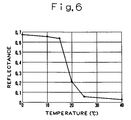
causing separation of CD. In FIG. 6, thermochromic
characteristics of Example 1 are shown. From the drawing, it
can be understood that the temperature indicating material of
Example 1 has a reaction temperature between about 15°C to 20°C.
In FIGS. 7(A) and 7(B), the results of DSC (differential scanning
calorimetry) of Example 1 are shown. The glass transition point
Tg was about 20°C and crystallization point Tc was 66°C. The
reaction proceeds at a temperature not higher than the glass
transition point of 20°C. From these drawings, it has been found
that at temperatures not lower than the glass transition point
Tg, the association probability of the developer B with the leuco
dye A increases by the addition of the thermochromism controller
D (CD).
In Table 1, results of the evaluation whether a place for
the reaction is provided or not and a ratio of the reflectance
at 10°C to that at 25°C are shown.
| | Place for reaction | Ratio of reflectance at 10°C to 25°C |
| Example 1 | Provided | 9 |
| Comp. Ex. 1 | Not provided | 1.3 |
| Comp. Ex. 2 | Not provided | 4.3 |
| Comp. Ex. 3 | Not provided | 1.2 |
From Table 1, it has been found that in Comparative Examples,
the thermochromism controller D cannot provide a place for
reaction and a ratio of the reflectance at 10°C to that at 25°C
is small, indicating that the materials obtained in Comparative
examples are not sensitive to temperature.
As the thermochromism controller D, CD was employed in the
above-described embodiment. Cyclododecane diol can also be
employed as the thermochromism controller D. No limitation is
imposed on the thermochromism controller D insofar as it, under
molten state, permits the dissolution of the developer B therein
at a high solubility and can provide a place for reaction after
phase separation. As the reversal material C, it is possible
to employ, in addition to PRN, cholesterol, stigma stylol,
stanolone, β-sitosterol, methyl androstendiol, estradiol,
benzoate, pregnenolone acetate, androsterone, 11α
-hydroxyprogesterone acetate, or esmilagenin.
〈Embodiment 2〉
In Embodiment 1, described was a temperature indicating
material which contains a thermochromism controller D capable
of providing a place for reaction.
The material according to Embodiment 2 is obtained by adding,
to a rewritable temperature indicating member, cyclododecanol
or cyclododecane diol as the cycloalkanol or cycloalkane diol,
in an amount not less than 1 part by weight but not greater than
20 parts by weight, preferably not less than 2.5 parts by weight
but not greater than 10 parts by weight, each based on the electron
accepting compound.
〈Example 2〉
The present invention will hereinafter be described more
specifically by the following example. The temperature
indicating member comprises a leuco dye A, a developer B, a
reversal material C, an alicyclic alcohol D for controlling the
thermochromic characteristics and a binder resin.
Temperature indicating member:
(1) Preparation of a coating solution and temperature indicating
member
| * Leuco Dye A: "GN-2" (trade name; product of Yamamoto Chemicals, Inc.) |
1 part by weight |
| * Developer B: PG (Propyl gallate) |
1 part by weight |
| * Reversal material C: PRN (pregnenolone) |
10 parts by weight |
| * Alicyclic alcohol D: CD (cyclododecanol) |
5 parts by weight |
| * Binder resin: A-91 (styrene-methacrylic acid copolymer, methacrylic acid: 10%) |
4 parts by weight |
A coating solution is prepared by completely dissolving
a binder resin in 84 parts by weight of a 4:1 mixed solvent of
toluene and cyclohexanone, adding GN-2, PG, PRN and CD to the
resulting resin solution, charging glass beads of about ⊘ 3 mm
to the resulting mixture to a height of the liquid surface, and
stirring the mixture for about 2 hours in a paint shaker.
The coating solution thus obtained in (1) is applied to
PET of 38 µm thick by a bar coater #40, followed by distillation
of the solvent at about 70°C, whereby a temperature indicating
is prepared.
(2) Preparation of a temperature monitoring member
A temperature monitoring member 1 was prepared, as shown
in FIG. 3, by successively adhering, to a white PET base 2, a
thermal diffusion preventive layer 3 and temperature indicating
material 4 by using "My Tack Paper ML-10" (trade name; product
of Nichiban Co., Ltd.). PEN (polyethylene naphthalate) 5 added
with a sticking preventive layer 6 was laminated as a protecting
layer against decolorization by a thermal head. The sticking
preventive layer 6 was formed by applying "TS-100" (trade name;
product of Kuboko Paint Co., Ltd.), which had been diluted 5
times, by a bar coater #3, followed by drying at 80°C (whereby
solvent was removed). The temperature monitoring member 1 was
formed into a card as shown in FIG. 3 and evaluated with regards
to the following items.
〈Color Development Characteristics〉
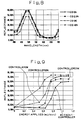
In FIG. 8, illustrated is a distribution of reflectance
upon color development, depending on the content of
cyclododecanol. The reflectance was measured using "CM-503C"
(trade name; product of Minolta). As can be seen from this drawing,
the reflectance of the temperature monitoring material
containing cyclododecanol (CD) was substantially similar to that
of the temperature monitoring material free of cyclododecanol
(CD) at around 630 nm to 670 nm which is a wavelength read by
a bar code. Thus, the color development properties are free
from the influence of cyclododecanol (CD).
〈Decolorization Characteristics〉
The decolorization characteristics of the temperature
monitoring material 1 are shown in FIG. 9. The reflectance of
the material free of the controller upon decolorization is
saturated at around 1 mJ/dot. In the graph, reflectance of each
of the materials which had been added with 2.5 to 10 parts by
weights of cyclododecanol is illustrated. From the graph, it
has been found that decolorization can be carried out at a lower
energy when cyclododecanol (CD) is added and when the same energy
is applied, the reflectance upon decolorization becomes higher
with the amount of the cyclododecanol (CD).
〈Thermochromic characteristics〉
Thermochromic characteristics of the temperature
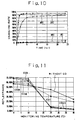
monitoring material are shown in FIGS. 10 and 11. FIG. 11
illustrates the relationship between time and changing ratio
in the case where 5 parts by weight of cyclododecanol (CD) is
added to 1 part by weight of the developer B and the resulting
material is stored at each temperature.
The changing ratio can be calculated based on the following
equation:
Changing ratio (%) = (Reflectance upon initialization - Reflectance upon measurement)(Reflectance upon initialization - Reflectance upon application of a coating solution) x 100
From the graph, it has been found that at 10°C or lower,
color development hardly proceeded even after 24 hours, while
at 25°C or higher, it substantially proceeded after 24 hours.
When the temperature monitoring material 1 stored at 25°C and
that stored at 40°C are compared, color development reaches
saturation in about 5 hours at 25°C, but 2 hours at 40°C. In
FIG. 11, plotted are temperature and reflectance after 24 hours
when cyclododecanol (CD) is added in an amount of 0, 1 (CD1),
2.5 (CD2.5), 5 (CD5), 10 (CD10) and 20 (CD20) parts by weight
per 1 part by weight of the developer B. From this drawing,
it has been found that the relationship between temperature and
reflectance shows a linear change at 10°C or higher when
cyclododecanol (CD) is not added. The temperature monitoring
material 1 free of cyclododecanol is not sensitive to temperature
and it is therefore impossible to know definitely what
environmental temperature it is exposed to. On the other hand,
when cyclododecanol (CD) is added in an amount not less than
1 part by weight but not greater than 20 parts by weight, there
exists a point between 10 to 25°C at which the color development
rate shows a drastic change, indicating that the material is
more sensitive to temperature than that free of the alicyclic
alcohol D. Thus, the thermochromic characteristics can be
improved by the addition of cyclododecanol (CD). In addition,
this drawing suggests that color development does not proceed
so much at low temperatures and reflectance of the material added
with cyclododecanol upon decolorization is larger than that of
the material free of cyclododecanol.
Addition of cyclododecanol (CD) in an amount less than 1
part by weight per 1 part by weight of the developer B does not
bring about any effect and no change can be found in the
thermochromic characteristics. When cyclododecanol (CD) is
added in an amount exceeding 20 parts by weight, the ink film
loses adhesion and separation of it from the PET film 2 occurs.
It is therefore desired to carry out improvement in the
thermochromic characteristics and decolorization
characteristics by adding cyclododecanol (CD) in an amount of
1 to 20 parts by weights, preferably 2.5 to 10 parts by weight.
In these examples, cyclododecanol (CD) was used as the
alicyclic alcohol D. Similar effects were available by the use
of cyclododecane diol.
〈Embodiment 3〉
The present invention will be described more specifically
by the following example. The temperature indicating member
comprises a leuco dye A, a developer B, a reversal material C,
a cycloalkanol or cycloalkane diol as the thermochromism
controller D for controlling the thermochromic characteristics
and a binder resin.
(1) Preparation of a coating solution and temperature indicating
member
| * Leuco Dye A: "GN-2" (trade name; product of Yamamoto Chemicals, Inc.) |
1 part by weight |
| * Developer B: PG (Propyl gallate) |
1 part by weight |
| * Reversal material C: PRN (pregnenolone) |
10 parts by weight |
| * Thermochromism controller D (cyclododecanol) |
X parts by weight |
| * Binder resin: A-91 (styrene-methacrylic acid copolymer, methacrylic acid: 10%) |
4 parts by weight |
A coating solution was prepared by completely dissolving
a binder resin in 84 parts by weight of a 4:1 mixed solvent of
toluene and cyclohexanone, adding GN-2, PG, PRN and CD to the
resulting resin solution, charging glass beads of about ⊘ 3 mm
to the resulting mixture to a height of the liquid surface, and
stirring the mixture for about 2 hours in a paint shaker. The
coating solution thus obtained was applied to PET of 38 µm thick
by a bar coater #40, followed by drying, whereby a temperature
indicating member was prepared.
〈Solubility〉
The solubility of propyl gallate (PG) in molten
cyclododecanol (CD) was studied. In 1 g of cyclododecanol (CD),
at least 0.8 g of propyl gallate (PG) was dissolved, indicating
that an amount of cyclododecanol (CD) permitting dissolution
of twice the amount of 1 part by weight of propyl gallate (PG)
is at least 2.5 parts by weight. Here, temperature indicating
members were prepared by adding cylododecanol (CD) in an amount
permitting dissolution of 8 times the amount (Example 3), 4 times
the amount (Example 4), twice the amount (Example 5), 1.2 times
the amount (Example 6) and 0.8 time the amount (Example 7) of
1 part by weight of propyl gallate (PG), respectively. As shown
in Table 1, the amounts of cyclododecanol (CD) practically added
were, relative to 1 part by weight of propyl gallate (PG), 10
parts by weight in Example 3, 5 parts by weight in Example 4,
2.5 parts by weight in Example 5, 1.5 parts by weight in Example
6 and 1 part by weight in Example 7, respectively. As comparative
examples, a temperature indicating material free of
cyclododecanol (CD) and that containing 5 parts by weight of
1-docosanol, which is a linear saturated alcohol, instead of
cyclododecanol (CD) were prepared in Comparative Example 4 and
Comparative Example 5, respectively.
| | Amount of CD | Amount of PG soluble in CD | Decolorization concentration (%) | 10°C/25 °C | Characteristics |
| Example 3 | 10 | 8 times | 73.6 | 9.5 | A |
| Example 4 | 5 | 4 times | 69.1 | 8.9 | A |
| Example 5 | 2.5 | 2 times | 66.1 | 7.1 | A |
| Example 6 | 1.5 | 1.2 times | 64.5 | 3.4 | B |
| Example 7 | 1 | 0.8 time | 63.7 | 1.8 | B |
| Comp. Ex. 4 | 0 | - | 60.5 | 1.2 | C |
| Comp. Ex. 5 | (5) | 1 time | 48.3 | 1.3 | C |
Evaluation was carried out using temperature monitoring
members prepared from the resulting temperature indicating
members. Described specifically, the temperature monitoring
material 1 was prepared, as shown in FIG. 3, by successively
adhering, to a white PET base 2, a thermal diffusion preventive
layer 3 and temperature indicating material 4 by using "My Tack
Paper ML-10" (trade name; product of Nichiban Co., Ltd.). PEN
(polyethylene naphthalate) 5 added with a sticking preventive
layer 6 was laminated as a protecting layer against the
decolorization by a thermal head. The sticking preventive layer
6 was formed by applying "TS-100" (trade name; product of Kuboko
Paint Co., Ltd.), which had been diluted 5 times, by a bar coater
#3, followed by drying at 80°C (whereby the solvent was removed).
The temperature monitoring member 1 was formed into a card as
shown in FIG. 3 and evaluated with regards to the following items.
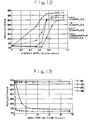
〈Decolorization Characteristics〉
Decolorization characteristics of the temperature
monitoring materials of Examples 3 to 5 and Comparative Example
4 are shown in FIG. 12. In Comparative Example 4, reflectance
upon decolorization shows saturation at about 1 mJ/dot. The
temperature monitoring materials of Examples 3 to 5 added with
cyclododecanol (CD), on the other hand, can be decolorized at
lower energy. From the graph, it has been found that when the
same energy is applied, reflectance upon decolorization is higher
with an increase in the amount of cyclododecanol (CD).
〈Thermochromic characteristics〉
In FIG. 13, relationship between monitoring time and
reflectance in Example 4 is shown. From the graph, it has been
found that color development hardly proceeded at 10°C or lower
even after 24 hours, while it substantially proceeded at 25°C
or higher after 24 hours. When the temperature monitoring
materials 1 stored under environments at 25°C and at 40°C are
compared, it takes 5 to 8 hours for saturation at 25°C, while
color development substantially reaches saturation in about 1
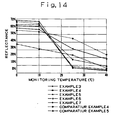
hour at 40°C. In FIG. 14, relationship between monitoring
temperature and reflectance after 24 hours in each of Examples
3 to 7 and Comparative Examples 4 and 5 is shown. From the drawing,
it has been found that in Comparative Example 4 wherein no
cyclododecanol was added, relationship between temperature and
reflectance showed a linear change at 10°C or higher, indicating
that the temperature monitoring material free of cyclododecanol
is not sensitive to temperature and it is therefore impossible
to know definitely what environmental temperature it is exposed
to. When 5 parts by weight of 1-docosanol is added (Comparative
Example 5), color development proceeded in any temperature range
and the relationship between temperature and reflectance is
linear, indicating that the material is not sensitive to
temperature. On the other hand, when cyclododecanol (CD) is
added, there exists a point between 10 to 25°C at which the color
development rate shows a drastic change, indicating that addition
of cyclododecanol makes the material more sensitive to
temperature than that free of cyclododecanol (CD). In addition,
this drawing suggests that color development does not proceed
so much at low temperatures and reflectance of the material added
with cyclododecanol is larger than that of the material free
of cyclododecanol upon decolorization. When cyclododecanol
(CD) is added in an amount of at least 2.5 parts by weight (Examples
3 to 5), reflectances of the materials at the monitoring
temperature of 25°C after 24 hours are not affected by the amount
of cyclododecanol (CD) and therefore, do not differ largely and
also do not differ from the reflectance at the monitoring
temperature of 40°C. In short, complete decolorization occurs
at the monitoring temperature of 25°C after 24 hours when
cyclododecanol (CD) is added in an amount of at least 25 parts
by weight. At amounts of cyclododecanol (CD) not higher than
1.5 parts by weight (Examples 4 and 5), the reflectance at the
monitoring temperature of 25°C is high (indicating incomplete
color development) and differs largely from reflectance at the
monitoring temperature of 40°C after 24 hours. Color
development is not complete at the monitoring temperature of
25°C for 24 hours, indicating that the sensitivity to temperature
depends on the amount of cyclododecanol (CD).
In Table 2, the relationship among the amount of
cyclododecanol (CD), reflectance upon decolorization and
thermochromic characteristics is shown. When the amount of
cyclododecanol is 1 part by weight (Example 7), only 0.8 part
by weight of 1 part by weight of the developer B is dissolved
therein, in other words, the dissolution of the developer B is
not complete, leading to a low reflectance upon decolorization.
In addition, mutual action among three components, that is,
developer B, reversal material C and cyclododecanol (CD) is not
so strong so that a ratio of reflectance at 10°C to 25°C after
24 hours is only 1.8. Cyclododecanol (CD) added in an amount
of 1.5 parts by weight (Example 6) per 1 part by weight of the
developer B can dissolve therein 1.2 parts by weight of the
developer B so that complete dissolution of 1 part by weight
of the developer B can be attained theoretically. It is however
impossible to incorporate the whole amount of the developer B
in cyclododecanol (CD) owing to diffusion-wise problem of the
developer B under a fluid state and therefore, the effects of
cyclododecanol are not complete. The reflectance upon
decolorization is not so much improved and a ratio of reflectance
at 10°C to 25°C after 24 hours is only 3.4. When cyclododecanol
(CD) is added in an amount of 2.5 parts by weight or greater
(Examples 3 to 5) relative to 1 part by weight of the developer
B, it can dissolve therein at least twice the amount of the
developer B (1 part by weight) so that the whole amount of the
developer B can be incorporated in molten cyclododecanol. Its
effects are stable. The reflectance upon decolorization is
improved by about 10% compared with that of the material free
of cyclododecanol (CD) and a ratio of reflectance at 10°C to
25°C after 24 hours is at least 7. If the reflectance upon
decolorization is at least 65% and a ratio of reflectance at
10°C to 25°C after 24 hours is not less than 5, an improvement
in the S/N ratio and sensitivity to temperature become definite
and can be recognized visually so that addition of cyclododecanol
(CD) in an amount not less than 2.5 parts by weight is desired.
By adding cyclododecanol (CD) which can dissolve therein
the developer B when melted by heating, reflectance upon
decolorization can be heightened and sensitivity to temperature
can be improved. More preferably, relative to 1 part by weight
of the developer B, cyclododecanol (CD) is added in an amount
permitting the dissolution of at least twice the amount of the
developer B.
A solubility in a molten cycloalkanol or cycloalkane diol
varies, depending on the nature of the developer B added. In
Table 3, shown is a solubility, in molten cyclododecanol (CD),
of propyl gallate (PG), lauryl gallate (LG), bisphenol A (HBA)
and 2,3,4,4'-tetrahydroxybenzophenone (2344) added as the
developer B. Any developer B is soluble in molten cyclododecanol
(CD) so that it is possible to improve the reflectance upon
decolorization and sensitivity to temperature. To 1 part of
propyl gallate (PG) added as the developer B1, at least 2.5 parts
by weight (amount permitting dissolution of twice the amount
of the developer B) of cyclododecanol (CD) must be added to bring
about desired effects, which equally applies to another developer
B. To 1 part of lauryl gallate (LG), at least 2 parts by weight
(amount permitting dissolution of twice the amount of the
developer B) of cyclododecanol (CD) must be added to bring about
desired effects, judging from the solubility of lauryl gallate.
Similarly, to 1 part of bisphenol A (HBA) and
2,3,4,4'-tetrahydroxybenzophenone (2344), at least 6.7 parts
by weight and at least 10 parts by weight of cyclododecanol (CD)
must be added, respectively. Thus, the amount of cyclododecanol
(CD) which is effective for increasing the reflectance upon
decolorization, thereby bringing about an improvement in the
S/N ratio and sensitivity to temperature differs with the
developer B. The amount of cyclododecanol (CD) is adjusted,
depending on the nature of the developer B in order to bring
about the above-described effects.
| | PG | LG | HBA | 2344 |
| Solubility | 8 | 10 | 3 | 2 |
| Necessity | 2.5 | 2 | 6.7 | 10 |
As the reversal material (C), not only PRN but also
cholesterol, stigma stylol, stanolone, β-sitosterol, methyl
androstendiol, estradiol, benzoate, pregnenolone acetate,
androsterone, 11α-hydroxyprogesterone acetate, or esmilagenin
can be used.
As the electron donating compound, not only leuco dye A
(GN-2) but also materials capable of absorbing, upon color
development, an irradiated light of a reader for bar code can
be employed. More specifically, when a red light source is
employed, leuco dye A which develops blue, black or bluish green
color can be used.
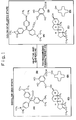
As the leuco dye A for black color, the following ones can
be used (not limited thereto):
As the leuco dye A for blue color, the following ones are
usable (not limited thereto).
As the leuco dye A for bluish green color, the following
ones are usable (not limited thereto).
Dyes of red or yellow color can be used if the wavelength
of the light source of the reader is changed. The dyes may be
used either singly or in combination.
As an example of the developer B which acts as an electron
accepting compound in the present examples, PG was mentioned.
The developer B is not limited thereto but usable examples include
oxides of a phenol, a metal salt of a phenol, a metal salt of
carboxylic acid, sulfonic acid, a sulfonate, phosphoric acid,
a metal salt of phosphoric acid, an acid phosphate ester, a metal
salt of an acid phosphate ester, a phosphite or a metal salt
of phosphorous acid. Specific examples include
2,4-dihydroxyacetophenone (2,4-HAP),2,5-HAP, 2,6-HAP, 3,5-HAP,
2,3,4-HAP, 2,4-dhydroxybenzophenone (2,4-HBP), 4,4'-HBP,
2,3,4-HBP,2,4,4'-HBP,2,2',4,4'-HBP,2,3-dihydrobenzoic acid,
methyl 3,5-dihydrobenzoate, 4,4'-biphenol and
2,3,4,4'-tetrahydroxybenzophenone.
The electron accepting compound largely affects the color
development rate. Described specifically, the time from the
separation of the electron accepting compound from the reversal
material and thermochromism controller to the association with
the electron donating compound and color development can be
changed largely by the nature of the electron accepting compound.
Temperature characteristics can be changed by selecting its
material. A binder resin is selected according to the desired
temperature characteristics. Examples of the binder resin
include ethylene copolymers such as polyethylene, chlorinated
polyethylene, ethylene·vinyl acetate copolymer and
ethylene·acrylic acid·maleic anhydride copolymer,
polybutadienes, polyesters such as polyethylene terephthalate,
polybutylene terephthalate and polyethylene naphthalate,
polypropylenes, polyisobutylenes, polyvinyl chlorides,
polyvinylidene chlorides, polyvinyl acetates, polyvinyl
alcohols, polyvinyl acetals, polyvinyl butyrals, fluorine
resins, acrylic resins, methacrylic resins, acrylonitrile
copolymers, styrene copolymers such as polystyrene, halogenated
polystyrene and styrene methacrylic acid copolymer, acetal
resins, polyamides such as nylon 66, polycarbonates, cellulose
resins, phenol resins, urea resins, epoxy resins, polyurethane
resins, diaryl phthalate resins, silicone resins, polyimide
amides, polyether sulfones, polymethyl pentenes, polyether
imides, polyvinyl carbazoles and amorphous polyolefin. These
resins may be used either singly or in combination.
In these examples, PET is used as a base material, but the
base material is not limited thereto. In this example, the
temperature monitoring material is in the form of a label, but
it can be used in the form of a thermal transfer ink ribbon or
in the form of a thermosensible paper having, thereon, a
temperature indicating member and a diffusion layer therefor.
The temperature monitoring member 1 becomes sensitive to
a predetermined temperature and has improved reflectance upon
decolorization and therefore has an improved S/N ratio by using
a temperature indicating material which has been obtained by
adding to a mixture of an electron donating compound A, an electron
accepting compound B and a reversal material C, a cycloalkanol
or cycloalkane diol as a thermochromism controller D and by
employing as the electron accepting compound B that permitting
complete dissolution of it in molten cycloalkanol or cycloalkane
diol.
As described above, the temperature indicating material
according to the present invention is obtained by incorporating,
in a rewritable base system which is composed of an electron
donating compound, an electron accepting compound and a reversal
material and undergoes color changes with time and temperature,
a thermochromism controller for changing a rate of crystal to
amorphous or phase separation to non phase separation. When
the temperature indicating material undergoes color changes at
an environmental temperature, the thermochromism controller
provides a place for reaction after crystallization or phase
separation, thereby contributing to the color change of the
temperature indicating material. This makes it possible to
improve the reflectance upon decolorization and in addition,
owing to the place for reaction provided after phase separation,
an area sensitive to the thermochromic characteristics appears,
leading to an improvement an S/N ratio. The place for reaction
upon decolorization due to an environmental temperature can be
provided easily by the use of a cyclododecanol or
cyclododecanediol as the therochromism controller.
The temperature monitoring member according to the present
invention is prepared by using a temperature indicating member
which contains an electron donating compound, an electron
accepting compound and a reversal material, is initialized at
the starting time of temperature monitoring and undergoes color
changes with temperature and time and by printing or coating
information to a base material. By incorporating, in the
temperature indicating member, a cycloalkanol or cycloalkane
dial which exhibits stable crystalline condition within a
temperature monitoring range, the resulting temperature
monitoring member becomes sensitive to temperature, which makes
it possible to determine an environmental temperature for storage,
though roughly. In addition, a reflectance upon decolorization
is improved, which improves an S/N ratio when the condition upon
color development is read mechanically. Even when the condition
must be confirmed visually, the color development by exposure
to high temperatures can be detected easily. Addition of the
cycloalkanol or cycloalkane diol in an amount not less than 1
part by weight but not greater than 20 parts by weight based
on 1 part by weight of the electron accepting compound makes
it possible to determine the lower limit permitting the
exhibition of thermochromic characteristics and moreover, makes
it possible to determine the upper limit permitting the continued
adhesion of an ink film of the temperature indicating material
to the base material when the temperature monitoring member is
formed as a label. If the dissolution of the electron accepting
compound and the melting of the cycloalkanol or cycloalkane dial
by heating are conducted simultaneously, reflectance upon
decolorization is improved, which makes it possible to improve
the S/R ratio when the color development is read mechanically.
Even if the condition is visually confirmed, it becomes possible
to easily detect the color development upon exposure to high
temperatures and to specifically determine an environmental
temperature for storage owing to the improved sensitivity to
temperature. By controlling the amount of a cycloalkanol or
cycloalkane diol depending on the nature of the electron
accepting compound, the temperature indicating material thus
obtained has increased sensitivity to temperature and can acquire
a function of specifically determining an environmental
temperature for storage.
The present invention may be embodied in other specific
forms without departing from the spirit or essential
characteristics thereof. The present embodiment is therefore
to be considered in all respects as illustrative and not
restrictive, the scope of the present invention being indicated
by the appended claims rather than by the foregoing description
and all changes which come within the meaning and range of
equivalency of the claims are therefore intended to be embraced
therein.
The present application is based on Japanese Priority
Document Hei 11-028288 filed on February 5, 1999, Hei 11-143316
filed on May 24, 1999, Hei 11-143317 filed on May 24, 1999 and
Hei 11-362883 filed on December 21, 1999 the content of which
are incorporated herein by reference.