EP1026147B1 - Compounds useful as intermediates in the production of piperidine derivatives - Google Patents
Compounds useful as intermediates in the production of piperidine derivatives Download PDFInfo
- Publication number
- EP1026147B1 EP1026147B1 EP00200419A EP00200419A EP1026147B1 EP 1026147 B1 EP1026147 B1 EP 1026147B1 EP 00200419 A EP00200419 A EP 00200419A EP 00200419 A EP00200419 A EP 00200419A EP 1026147 B1 EP1026147 B1 EP 1026147B1
- Authority
- EP
- European Patent Office
- Prior art keywords
- formula
- mixture
- substantially pure
- regioisomers
- pure regioisomer
- Prior art date
- Legal status (The legal status is an assumption and is not a legal conclusion. Google has not performed a legal analysis and makes no representation as to the accuracy of the status listed.)
- Expired - Lifetime
Links
- 150000001875 compounds Chemical class 0.000 title claims abstract description 19
- 238000004519 manufacturing process Methods 0.000 title claims description 4
- 239000000543 intermediate Substances 0.000 title abstract description 4
- 150000003053 piperidines Chemical class 0.000 title description 18
- 238000000034 method Methods 0.000 claims abstract description 34
- 125000000217 alkyl group Chemical group 0.000 claims abstract description 13
- 125000002887 hydroxy group Chemical group [H]O* 0.000 claims abstract description 12
- 229910052736 halogen Inorganic materials 0.000 claims abstract description 11
- 150000002367 halogens Chemical class 0.000 claims abstract description 11
- 229910052739 hydrogen Inorganic materials 0.000 claims abstract description 10
- 239000001257 hydrogen Substances 0.000 claims abstract description 10
- 125000004432 carbon atom Chemical group C* 0.000 claims abstract description 7
- 125000001424 substituent group Chemical group 0.000 claims abstract description 7
- 239000002841 Lewis acid Substances 0.000 claims abstract description 6
- 150000007517 lewis acids Chemical class 0.000 claims abstract description 6
- 125000003178 carboxy group Chemical group [H]OC(*)=O 0.000 claims abstract description 5
- 125000003545 alkoxy group Chemical group 0.000 claims abstract description 4
- 239000000203 mixture Substances 0.000 claims description 53
- -1 alkali metal salt Chemical class 0.000 claims description 26
- 150000003839 salts Chemical class 0.000 claims description 12
- 239000002585 base Substances 0.000 claims description 11
- VSCWAEJMTAWNJL-UHFFFAOYSA-K aluminium trichloride Chemical compound Cl[Al](Cl)Cl VSCWAEJMTAWNJL-UHFFFAOYSA-K 0.000 claims description 10
- 230000007062 hydrolysis Effects 0.000 claims description 7
- 238000006460 hydrolysis reaction Methods 0.000 claims description 7
- KMPWYEUPVWOPIM-KODHJQJWSA-N cinchonidine Chemical compound C1=CC=C2C([C@H]([C@H]3[N@]4CC[C@H]([C@H](C4)C=C)C3)O)=CC=NC2=C1 KMPWYEUPVWOPIM-KODHJQJWSA-N 0.000 claims description 5
- KMPWYEUPVWOPIM-UHFFFAOYSA-N cinchonidine Natural products C1=CC=C2C(C(C3N4CCC(C(C4)C=C)C3)O)=CC=NC2=C1 KMPWYEUPVWOPIM-UHFFFAOYSA-N 0.000 claims description 5
- 239000007858 starting material Substances 0.000 claims description 5
- 238000005727 Friedel-Crafts reaction Methods 0.000 claims description 4
- 238000002425 crystallisation Methods 0.000 claims description 3
- 230000008025 crystallization Effects 0.000 claims description 3
- 150000002431 hydrogen Chemical class 0.000 claims description 3
- UFHFLCQGNIYNRP-UHFFFAOYSA-N Hydrogen Chemical compound [H][H] UFHFLCQGNIYNRP-UHFFFAOYSA-N 0.000 claims description 2
- 229910052783 alkali metal Inorganic materials 0.000 claims description 2
- 150000003863 ammonium salts Chemical class 0.000 claims description 2
- 239000003054 catalyst Substances 0.000 claims description 2
- 230000002140 halogenating effect Effects 0.000 claims description 2
- 230000003301 hydrolyzing effect Effects 0.000 claims description 2
- 238000002360 preparation method Methods 0.000 abstract description 16
- 125000004435 hydrogen atom Chemical class [H]* 0.000 abstract description 5
- XEKOWRVHYACXOJ-UHFFFAOYSA-N Ethyl acetate Chemical compound CCOC(C)=O XEKOWRVHYACXOJ-UHFFFAOYSA-N 0.000 description 65
- OKKJLVBELUTLKV-UHFFFAOYSA-N Methanol Chemical compound OC OKKJLVBELUTLKV-UHFFFAOYSA-N 0.000 description 58
- 239000002904 solvent Substances 0.000 description 29
- 235000019439 ethyl acetate Nutrition 0.000 description 28
- YMWUJEATGCHHMB-UHFFFAOYSA-N Dichloromethane Chemical compound ClCCl YMWUJEATGCHHMB-UHFFFAOYSA-N 0.000 description 26
- LFQSCWFLJHTTHZ-UHFFFAOYSA-N Ethanol Chemical compound CCO LFQSCWFLJHTTHZ-UHFFFAOYSA-N 0.000 description 26
- KFZMGEQAYNKOFK-UHFFFAOYSA-N Isopropanol Chemical compound CC(C)O KFZMGEQAYNKOFK-UHFFFAOYSA-N 0.000 description 26
- YXFVVABEGXRONW-UHFFFAOYSA-N Toluene Chemical compound CC1=CC=CC=C1 YXFVVABEGXRONW-UHFFFAOYSA-N 0.000 description 21
- HEMHJVSKTPXQMS-UHFFFAOYSA-M Sodium hydroxide Chemical compound [OH-].[Na+] HEMHJVSKTPXQMS-UHFFFAOYSA-M 0.000 description 18
- HEDRZPFGACZZDS-UHFFFAOYSA-N Chloroform Chemical compound ClC(Cl)Cl HEDRZPFGACZZDS-UHFFFAOYSA-N 0.000 description 16
- LRHPLDYGYMQRHN-UHFFFAOYSA-N N-Butanol Chemical compound CCCCO LRHPLDYGYMQRHN-UHFFFAOYSA-N 0.000 description 16
- CSNNHWWHGAXBCP-UHFFFAOYSA-L Magnesium sulfate Chemical compound [Mg+2].[O-][S+2]([O-])([O-])[O-] CSNNHWWHGAXBCP-UHFFFAOYSA-L 0.000 description 14
- 125000000468 ketone group Chemical group 0.000 description 13
- QGJOPFRUJISHPQ-UHFFFAOYSA-N Carbon disulfide Chemical compound S=C=S QGJOPFRUJISHPQ-UHFFFAOYSA-N 0.000 description 12
- 239000007787 solid Substances 0.000 description 12
- 238000006243 chemical reaction Methods 0.000 description 10
- BWHMMNNQKKPAPP-UHFFFAOYSA-L potassium carbonate Chemical compound [K+].[K+].[O-]C([O-])=O BWHMMNNQKKPAPP-UHFFFAOYSA-L 0.000 description 10
- 238000010992 reflux Methods 0.000 description 10
- XLYOFNOQVPJJNP-UHFFFAOYSA-N water Chemical compound O XLYOFNOQVPJJNP-UHFFFAOYSA-N 0.000 description 10
- UHOVQNZJYSORNB-UHFFFAOYSA-N Benzene Chemical compound C1=CC=CC=C1 UHOVQNZJYSORNB-UHFFFAOYSA-N 0.000 description 9
- RTZKZFJDLAIYFH-UHFFFAOYSA-N Diethyl ether Chemical compound CCOCC RTZKZFJDLAIYFH-UHFFFAOYSA-N 0.000 description 9
- ZMXDDKWLCZADIW-UHFFFAOYSA-N N,N-Dimethylformamide Chemical compound CN(C)C=O ZMXDDKWLCZADIW-UHFFFAOYSA-N 0.000 description 9
- NQRYJNQNLNOLGT-UHFFFAOYSA-N Piperidine Chemical compound C1CCNCC1 NQRYJNQNLNOLGT-UHFFFAOYSA-N 0.000 description 9
- GUGOEEXESWIERI-UHFFFAOYSA-N Terfenadine Chemical compound C1=CC(C(C)(C)C)=CC=C1C(O)CCCN1CCC(C(O)(C=2C=CC=CC=2)C=2C=CC=CC=2)CC1 GUGOEEXESWIERI-UHFFFAOYSA-N 0.000 description 9
- NLKNQRATVPKPDG-UHFFFAOYSA-M potassium iodide Chemical compound [K+].[I-] NLKNQRATVPKPDG-UHFFFAOYSA-M 0.000 description 9
- UIIMBOGNXHQVGW-UHFFFAOYSA-M Sodium bicarbonate Chemical compound [Na+].OC([O-])=O UIIMBOGNXHQVGW-UHFFFAOYSA-M 0.000 description 8
- 238000005804 alkylation reaction Methods 0.000 description 8
- VEXZGXHMUGYJMC-UHFFFAOYSA-N Hydrochloric acid Chemical compound Cl VEXZGXHMUGYJMC-UHFFFAOYSA-N 0.000 description 7
- VYPSYNLAJGMNEJ-UHFFFAOYSA-N Silicium dioxide Chemical compound O=[Si]=O VYPSYNLAJGMNEJ-UHFFFAOYSA-N 0.000 description 7
- 229910052943 magnesium sulfate Inorganic materials 0.000 description 7
- 239000000047 product Substances 0.000 description 7
- 238000006722 reduction reaction Methods 0.000 description 7
- 229960000351 terfenadine Drugs 0.000 description 7
- KWYUFKZDYYNOTN-UHFFFAOYSA-M Potassium hydroxide Chemical compound [OH-].[K+] KWYUFKZDYYNOTN-UHFFFAOYSA-M 0.000 description 6
- WYURNTSHIVDZCO-UHFFFAOYSA-N Tetrahydrofuran Chemical compound C1CCOC1 WYURNTSHIVDZCO-UHFFFAOYSA-N 0.000 description 6
- ZMANZCXQSJIPKH-UHFFFAOYSA-N Triethylamine Chemical compound CCN(CC)CC ZMANZCXQSJIPKH-UHFFFAOYSA-N 0.000 description 6
- MVPPADPHJFYWMZ-UHFFFAOYSA-N chlorobenzene Chemical compound ClC1=CC=CC=C1 MVPPADPHJFYWMZ-UHFFFAOYSA-N 0.000 description 6
- 239000012279 sodium borohydride Substances 0.000 description 6
- 229910000033 sodium borohydride Inorganic materials 0.000 description 6
- CSRZQMIRAZTJOY-UHFFFAOYSA-N trimethylsilyl iodide Chemical compound C[Si](C)(C)I CSRZQMIRAZTJOY-UHFFFAOYSA-N 0.000 description 6
- QTBSBXVTEAMEQO-UHFFFAOYSA-N Acetic acid Chemical compound CC(O)=O QTBSBXVTEAMEQO-UHFFFAOYSA-N 0.000 description 5
- 239000005456 alcohol based solvent Substances 0.000 description 5
- 125000003118 aryl group Chemical group 0.000 description 5
- 150000002148 esters Chemical class 0.000 description 5
- OFYSAFPKXXTYLU-UHFFFAOYSA-N ethyl 2-methyl-2-phenylpropanoate Chemical compound CCOC(=O)C(C)(C)C1=CC=CC=C1 OFYSAFPKXXTYLU-UHFFFAOYSA-N 0.000 description 5
- 150000007529 inorganic bases Chemical class 0.000 description 5
- 239000010410 layer Substances 0.000 description 5
- 229910000027 potassium carbonate Inorganic materials 0.000 description 5
- JUJWROOIHBZHMG-UHFFFAOYSA-N Pyridine Chemical compound C1=CC=NC=C1 JUJWROOIHBZHMG-UHFFFAOYSA-N 0.000 description 4
- FAPWRFPIFSIZLT-UHFFFAOYSA-M Sodium chloride Chemical compound [Na+].[Cl-] FAPWRFPIFSIZLT-UHFFFAOYSA-M 0.000 description 4
- 239000012043 crude product Substances 0.000 description 4
- 230000000694 effects Effects 0.000 description 4
- 238000001640 fractional crystallisation Methods 0.000 description 4
- CNGVICCYOZELBE-UHFFFAOYSA-N methyl 2-[4-(4-iodobutanoyl)phenyl]-2-methylpropanoate Chemical compound COC(=O)C(C)(C)C1=CC=C(C(=O)CCCI)C=C1 CNGVICCYOZELBE-UHFFFAOYSA-N 0.000 description 4
- 239000003921 oil Substances 0.000 description 4
- 229920006395 saturated elastomer Polymers 0.000 description 4
- 229910000030 sodium bicarbonate Inorganic materials 0.000 description 4
- ZWEHNKRNPOVVGH-UHFFFAOYSA-N 2-Butanone Chemical compound CCC(C)=O ZWEHNKRNPOVVGH-UHFFFAOYSA-N 0.000 description 3
- NGAKDIWPTMPPFP-UHFFFAOYSA-N 2-[4-[4-[4-[hydroxy(diphenyl)methyl]piperidin-1-yl]butanoyl]phenyl]-2-methylpropanoic acid Chemical compound C1=CC(C(C)(C(O)=O)C)=CC=C1C(=O)CCCN1CCC(C(O)(C=2C=CC=CC=2)C=2C=CC=CC=2)CC1 NGAKDIWPTMPPFP-UHFFFAOYSA-N 0.000 description 3
- 239000004215 Carbon black (E152) Substances 0.000 description 3
- CTQNGGLPUBDAKN-UHFFFAOYSA-N O-Xylene Chemical compound CC1=CC=CC=C1C CTQNGGLPUBDAKN-UHFFFAOYSA-N 0.000 description 3
- PMZURENOXWZQFD-UHFFFAOYSA-L Sodium Sulfate Chemical compound [Na+].[Na+].[O-]S([O-])(=O)=O PMZURENOXWZQFD-UHFFFAOYSA-L 0.000 description 3
- 230000003197 catalytic effect Effects 0.000 description 3
- LOUPRKONTZGTKE-UHFFFAOYSA-N cinchonine Natural products C1C(C(C2)C=C)CCN2C1C(O)C1=CC=NC2=CC=C(OC)C=C21 LOUPRKONTZGTKE-UHFFFAOYSA-N 0.000 description 3
- 239000012141 concentrate Substances 0.000 description 3
- 238000001816 cooling Methods 0.000 description 3
- 125000001495 ethyl group Chemical group [H]C([H])([H])C([H])([H])* 0.000 description 3
- 150000008282 halocarbons Chemical class 0.000 description 3
- 229930195733 hydrocarbon Natural products 0.000 description 3
- 150000002430 hydrocarbons Chemical class 0.000 description 3
- 239000005453 ketone based solvent Substances 0.000 description 3
- ZEUXAIYYDDCIRX-UHFFFAOYSA-N losartan carboxylic acid Chemical compound CCCCC1=NC(Cl)=C(C(O)=O)N1CC1=CC=C(C=2C(=CC=CC=2)C2=NNN=N2)C=C1 ZEUXAIYYDDCIRX-UHFFFAOYSA-N 0.000 description 3
- GOUQSHOAAGQXNJ-UHFFFAOYSA-N methyl 2-[4-[1-hydroxy-4-[4-[hydroxy(diphenyl)methyl]piperidin-1-yl]butyl]phenyl]-2-methylpropanoate Chemical compound C1=CC(C(C)(C)C(=O)OC)=CC=C1C(O)CCCN1CCC(C(O)(C=2C=CC=CC=2)C=2C=CC=CC=2)CC1 GOUQSHOAAGQXNJ-UHFFFAOYSA-N 0.000 description 3
- PGQMZSGBFIPEKX-UHFFFAOYSA-N methyl 2-[4-[4-[4-[hydroxy(diphenyl)methyl]piperidin-1-yl]butanoyl]phenyl]-2-methylpropanoate Chemical compound C1=CC(C(C)(C)C(=O)OC)=CC=C1C(=O)CCCN1CCC(C(O)(C=2C=CC=CC=2)C=2C=CC=CC=2)CC1 PGQMZSGBFIPEKX-UHFFFAOYSA-N 0.000 description 3
- RSFYLBVXPMDBIF-UHFFFAOYSA-N methyl 2-[4-[4-[4-[hydroxy-bis(4-methylphenyl)methyl]piperidin-1-yl]butanoyl]phenyl]-2-methylpropanoate Chemical compound C1=CC(C(C)(C)C(=O)OC)=CC=C1C(=O)CCCN1CCC(C(O)(C=2C=CC(C)=CC=2)C=2C=CC(C)=CC=2)CC1 RSFYLBVXPMDBIF-UHFFFAOYSA-N 0.000 description 3
- 125000002496 methyl group Chemical group [H]C([H])([H])* 0.000 description 3
- VLKZOEOYAKHREP-UHFFFAOYSA-N n-Hexane Chemical compound CCCCCC VLKZOEOYAKHREP-UHFFFAOYSA-N 0.000 description 3
- 239000012044 organic layer Substances 0.000 description 3
- 235000011181 potassium carbonates Nutrition 0.000 description 3
- FVAUCKIRQBBSSJ-UHFFFAOYSA-M sodium iodide Chemical compound [Na+].[I-] FVAUCKIRQBBSSJ-UHFFFAOYSA-M 0.000 description 3
- 229910052938 sodium sulfate Inorganic materials 0.000 description 3
- YLQBMQCUIZJEEH-UHFFFAOYSA-N tetrahydrofuran Natural products C=1C=COC=1 YLQBMQCUIZJEEH-UHFFFAOYSA-N 0.000 description 3
- 239000008096 xylene Substances 0.000 description 3
- QPFMBZIOSGYJDE-UHFFFAOYSA-N 1,1,2,2-tetrachloroethane Chemical compound ClC(Cl)C(Cl)Cl QPFMBZIOSGYJDE-UHFFFAOYSA-N 0.000 description 2
- RYHBNJHYFVUHQT-UHFFFAOYSA-N 1,4-Dioxane Chemical compound C1COCCO1 RYHBNJHYFVUHQT-UHFFFAOYSA-N 0.000 description 2
- LOWWEULESZKQRF-UHFFFAOYSA-N 2-[4-(cyclopropanecarbonyl)phenyl]-2-methylpropanoic acid Chemical compound C1=CC(C(C)(C(O)=O)C)=CC=C1C(=O)C1CC1 LOWWEULESZKQRF-UHFFFAOYSA-N 0.000 description 2
- LMPCSCOVKHFVKE-UHFFFAOYSA-N 2-[4-[1-hydroxy-4-[4-[hydroxy-bis(4-methylphenyl)methyl]piperidin-1-yl]butyl]phenyl]-2-methylpropanoic acid Chemical compound C1=CC(C)=CC=C1C(O)(C=1C=CC(C)=CC=1)C1CCN(CCCC(O)C=2C=CC(=CC=2)C(C)(C)C(O)=O)CC1 LMPCSCOVKHFVKE-UHFFFAOYSA-N 0.000 description 2
- CDIIZULDSLKBKV-UHFFFAOYSA-N 4-chlorobutanoyl chloride Chemical compound ClCCCC(Cl)=O CDIIZULDSLKBKV-UHFFFAOYSA-N 0.000 description 2
- CSCPPACGZOOCGX-UHFFFAOYSA-N Acetone Chemical compound CC(C)=O CSCPPACGZOOCGX-UHFFFAOYSA-N 0.000 description 2
- 0 CC(C)(*)c1ccc(CC(C)=O)cc1 Chemical compound CC(C)(*)c1ccc(CC(C)=O)cc1 0.000 description 2
- ULGZDMOVFRHVEP-RWJQBGPGSA-N Erythromycin Chemical compound O([C@@H]1[C@@H](C)C(=O)O[C@@H]([C@@]([C@H](O)[C@@H](C)C(=O)[C@H](C)C[C@@](C)(O)[C@H](O[C@H]2[C@@H]([C@H](C[C@@H](C)O2)N(C)C)O)[C@H]1C)(C)O)CC)[C@H]1C[C@@](C)(OC)[C@@H](O)[C@H](C)O1 ULGZDMOVFRHVEP-RWJQBGPGSA-N 0.000 description 2
- 238000005863 Friedel-Crafts acylation reaction Methods 0.000 description 2
- NTIZESTWPVYFNL-UHFFFAOYSA-N Methyl isobutyl ketone Chemical compound CC(C)CC(C)=O NTIZESTWPVYFNL-UHFFFAOYSA-N 0.000 description 2
- UIHCLUNTQKBZGK-UHFFFAOYSA-N Methyl isobutyl ketone Natural products CCC(C)C(C)=O UIHCLUNTQKBZGK-UHFFFAOYSA-N 0.000 description 2
- KDLHZDBZIXYQEI-UHFFFAOYSA-N Palladium Chemical compound [Pd] KDLHZDBZIXYQEI-UHFFFAOYSA-N 0.000 description 2
- LOUPRKONTZGTKE-WZBLMQSHSA-N Quinine Chemical compound C([C@H]([C@H](C1)C=C)C2)C[N@@]1[C@@H]2[C@H](O)C1=CC=NC2=CC=C(OC)C=C21 LOUPRKONTZGTKE-WZBLMQSHSA-N 0.000 description 2
- CDBYLPFSWZWCQE-UHFFFAOYSA-L Sodium Carbonate Chemical compound [Na+].[Na+].[O-]C([O-])=O CDBYLPFSWZWCQE-UHFFFAOYSA-L 0.000 description 2
- UIIMBOGNXHQVGW-DEQYMQKBSA-M Sodium bicarbonate-14C Chemical compound [Na+].O[14C]([O-])=O UIIMBOGNXHQVGW-DEQYMQKBSA-M 0.000 description 2
- 239000002253 acid Substances 0.000 description 2
- 230000001387 anti-histamine Effects 0.000 description 2
- 239000000739 antihistaminic agent Substances 0.000 description 2
- RWCCWEUUXYIKHB-UHFFFAOYSA-N benzophenone Chemical class C=1C=CC=CC=1C(=O)C1=CC=CC=C1 RWCCWEUUXYIKHB-UHFFFAOYSA-N 0.000 description 2
- 239000004305 biphenyl Substances 0.000 description 2
- QGJOPFRUJISHPQ-NJFSPNSNSA-N carbon disulfide-14c Chemical compound S=[14C]=S QGJOPFRUJISHPQ-NJFSPNSNSA-N 0.000 description 2
- 238000010531 catalytic reduction reaction Methods 0.000 description 2
- 239000003638 chemical reducing agent Substances 0.000 description 2
- IJOOHPMOJXWVHK-UHFFFAOYSA-N chlorotrimethylsilane Chemical compound C[Si](C)(C)Cl IJOOHPMOJXWVHK-UHFFFAOYSA-N 0.000 description 2
- 229910052681 coesite Inorganic materials 0.000 description 2
- 229910052906 cristobalite Inorganic materials 0.000 description 2
- RWTNPBWLLIMQHL-UHFFFAOYSA-N fexofenadine Chemical compound C1=CC(C(C)(C(O)=O)C)=CC=C1C(O)CCCN1CCC(C(O)(C=2C=CC=CC=2)C=2C=CC=CC=2)CC1 RWTNPBWLLIMQHL-UHFFFAOYSA-N 0.000 description 2
- 238000001914 filtration Methods 0.000 description 2
- 239000006260 foam Substances 0.000 description 2
- 239000012280 lithium aluminium hydride Substances 0.000 description 2
- 239000000463 material Substances 0.000 description 2
- LQNUZADURLCDLV-UHFFFAOYSA-N nitrobenzene Chemical compound [O-][N+](=O)C1=CC=CC=C1 LQNUZADURLCDLV-UHFFFAOYSA-N 0.000 description 2
- 239000012038 nucleophile Substances 0.000 description 2
- 150000007530 organic bases Chemical class 0.000 description 2
- 239000012071 phase Substances 0.000 description 2
- RJUAEBLXGFKZMS-UHFFFAOYSA-N piperidin-1-ylmethanol Chemical compound OCN1CCCCC1 RJUAEBLXGFKZMS-UHFFFAOYSA-N 0.000 description 2
- BASFCYQUMIYNBI-UHFFFAOYSA-N platinum Chemical compound [Pt] BASFCYQUMIYNBI-UHFFFAOYSA-N 0.000 description 2
- 239000011736 potassium bicarbonate Substances 0.000 description 2
- 235000015497 potassium bicarbonate Nutrition 0.000 description 2
- 229910000028 potassium bicarbonate Inorganic materials 0.000 description 2
- IOLCXVTUBQKXJR-UHFFFAOYSA-M potassium bromide Chemical compound [K+].[Br-] IOLCXVTUBQKXJR-UHFFFAOYSA-M 0.000 description 2
- TYJJADVDDVDEDZ-UHFFFAOYSA-M potassium hydrogencarbonate Chemical compound [K+].OC([O-])=O TYJJADVDDVDEDZ-UHFFFAOYSA-M 0.000 description 2
- UMJSCPRVCHMLSP-UHFFFAOYSA-N pyridine Natural products COC1=CC=CN=C1 UMJSCPRVCHMLSP-UHFFFAOYSA-N 0.000 description 2
- LOUPRKONTZGTKE-LHHVKLHASA-N quinidine Chemical compound C([C@H]([C@H](C1)C=C)C2)C[N@@]1[C@H]2[C@@H](O)C1=CC=NC2=CC=C(OC)C=C21 LOUPRKONTZGTKE-LHHVKLHASA-N 0.000 description 2
- 239000011541 reaction mixture Substances 0.000 description 2
- 238000007142 ring opening reaction Methods 0.000 description 2
- 239000000377 silicon dioxide Substances 0.000 description 2
- 235000017557 sodium bicarbonate Nutrition 0.000 description 2
- JHJLBTNAGRQEKS-UHFFFAOYSA-M sodium bromide Chemical compound [Na+].[Br-] JHJLBTNAGRQEKS-UHFFFAOYSA-M 0.000 description 2
- 239000011780 sodium chloride Substances 0.000 description 2
- 235000011152 sodium sulphate Nutrition 0.000 description 2
- 229910052682 stishovite Inorganic materials 0.000 description 2
- VZGDMQKNWNREIO-UHFFFAOYSA-N tetrachloromethane Chemical compound ClC(Cl)(Cl)Cl VZGDMQKNWNREIO-UHFFFAOYSA-N 0.000 description 2
- 238000004809 thin layer chromatography Methods 0.000 description 2
- 125000005270 trialkylamine group Chemical group 0.000 description 2
- 229910052905 tridymite Inorganic materials 0.000 description 2
- XMAYWYJOQHXEEK-OZXSUGGESA-N (2R,4S)-ketoconazole Chemical compound C1CN(C(=O)C)CCN1C(C=C1)=CC=C1OC[C@@H]1O[C@@](CN2C=NC=C2)(C=2C(=CC(Cl)=CC=2)Cl)OC1 XMAYWYJOQHXEEK-OZXSUGGESA-N 0.000 description 1
- SCYULBFZEHDVBN-UHFFFAOYSA-N 1,1-Dichloroethane Chemical compound CC(Cl)Cl SCYULBFZEHDVBN-UHFFFAOYSA-N 0.000 description 1
- 238000005160 1H NMR spectroscopy Methods 0.000 description 1
- KVQJVAOMYWTLEO-UHFFFAOYSA-N 2-chlorobutanoyl chloride Chemical compound CCC(Cl)C(Cl)=O KVQJVAOMYWTLEO-UHFFFAOYSA-N 0.000 description 1
- ZCYVEMRRCGMTRW-UHFFFAOYSA-N 7553-56-2 Chemical compound [I] ZCYVEMRRCGMTRW-UHFFFAOYSA-N 0.000 description 1
- WKBOTKDWSSQWDR-UHFFFAOYSA-N Bromine atom Chemical compound [Br] WKBOTKDWSSQWDR-UHFFFAOYSA-N 0.000 description 1
- UNMYWSMUMWPJLR-UHFFFAOYSA-L Calcium iodide Chemical compound [Ca+2].[I-].[I-] UNMYWSMUMWPJLR-UHFFFAOYSA-L 0.000 description 1
- ZAMOUSCENKQFHK-UHFFFAOYSA-N Chlorine atom Chemical compound [Cl] ZAMOUSCENKQFHK-UHFFFAOYSA-N 0.000 description 1
- 235000001258 Cinchona calisaya Nutrition 0.000 description 1
- XDTMQSROBMDMFD-UHFFFAOYSA-N Cyclohexane Chemical compound C1CCCCC1 XDTMQSROBMDMFD-UHFFFAOYSA-N 0.000 description 1
- XTHFKEDIFFGKHM-UHFFFAOYSA-N Dimethoxyethane Chemical compound COCCOC XTHFKEDIFFGKHM-UHFFFAOYSA-N 0.000 description 1
- DGAQECJNVWCQMB-PUAWFVPOSA-M Ilexoside XXIX Chemical compound C[C@@H]1CC[C@@]2(CC[C@@]3(C(=CC[C@H]4[C@]3(CC[C@@H]5[C@@]4(CC[C@@H](C5(C)C)OS(=O)(=O)[O-])C)C)[C@@H]2[C@]1(C)O)C)C(=O)O[C@H]6[C@@H]([C@H]([C@@H]([C@H](O6)CO)O)O)O.[Na+] DGAQECJNVWCQMB-PUAWFVPOSA-M 0.000 description 1
- FYYHWMGAXLPEAU-UHFFFAOYSA-N Magnesium Chemical compound [Mg] FYYHWMGAXLPEAU-UHFFFAOYSA-N 0.000 description 1
- 239000007832 Na2SO4 Substances 0.000 description 1
- ZLMJMSJWJFRBEC-UHFFFAOYSA-N Potassium Chemical compound [K] ZLMJMSJWJFRBEC-UHFFFAOYSA-N 0.000 description 1
- 239000007868 Raney catalyst Substances 0.000 description 1
- 229910000564 Raney nickel Inorganic materials 0.000 description 1
- NPXOKRUENSOPAO-UHFFFAOYSA-N Raney nickel Chemical compound [Al].[Ni] NPXOKRUENSOPAO-UHFFFAOYSA-N 0.000 description 1
- DWAQJAXMDSEUJJ-UHFFFAOYSA-M Sodium bisulfite Chemical compound [Na+].OS([O-])=O DWAQJAXMDSEUJJ-UHFFFAOYSA-M 0.000 description 1
- 230000002159 abnormal effect Effects 0.000 description 1
- AKUNRPXJLWGUSM-UHFFFAOYSA-N acetonitrile;formamide Chemical compound CC#N.NC=O AKUNRPXJLWGUSM-UHFFFAOYSA-N 0.000 description 1
- 230000010933 acylation Effects 0.000 description 1
- 238000005917 acylation reaction Methods 0.000 description 1
- 230000001476 alcoholic effect Effects 0.000 description 1
- 230000029936 alkylation Effects 0.000 description 1
- AZDRQVAHHNSJOQ-UHFFFAOYSA-N alumane Chemical class [AlH3] AZDRQVAHHNSJOQ-UHFFFAOYSA-N 0.000 description 1
- SMZOGRDCAXLAAR-UHFFFAOYSA-N aluminium isopropoxide Chemical compound [Al+3].CC(C)[O-].CC(C)[O-].CC(C)[O-] SMZOGRDCAXLAAR-UHFFFAOYSA-N 0.000 description 1
- 238000004458 analytical method Methods 0.000 description 1
- 239000000538 analytical sample Substances 0.000 description 1
- 238000010171 animal model Methods 0.000 description 1
- 230000001466 anti-adreneric effect Effects 0.000 description 1
- 230000001705 anti-serotonergic effect Effects 0.000 description 1
- 239000000043 antiallergic agent Substances 0.000 description 1
- 239000003429 antifungal agent Substances 0.000 description 1
- 229940125715 antihistaminic agent Drugs 0.000 description 1
- 239000008346 aqueous phase Substances 0.000 description 1
- 238000007080 aromatic substitution reaction Methods 0.000 description 1
- 230000003115 biocidal effect Effects 0.000 description 1
- 150000001638 boron Chemical class 0.000 description 1
- GDTBXPJZTBHREO-UHFFFAOYSA-N bromine Substances BrBr GDTBXPJZTBHREO-UHFFFAOYSA-N 0.000 description 1
- 229910052794 bromium Inorganic materials 0.000 description 1
- 229940124630 bronchodilator Drugs 0.000 description 1
- 239000000168 bronchodilator agent Substances 0.000 description 1
- RRKTZKIUPZVBMF-IBTVXLQLSA-N brucine Chemical compound O([C@@H]1[C@H]([C@H]2C3)[C@@H]4N(C(C1)=O)C=1C=C(C(=CC=11)OC)OC)CC=C2CN2[C@@H]3[C@]41CC2 RRKTZKIUPZVBMF-IBTVXLQLSA-N 0.000 description 1
- RRKTZKIUPZVBMF-UHFFFAOYSA-N brucine Natural products C1=2C=C(OC)C(OC)=CC=2N(C(C2)=O)C3C(C4C5)C2OCC=C4CN2C5C31CC2 RRKTZKIUPZVBMF-UHFFFAOYSA-N 0.000 description 1
- 229910052792 caesium Inorganic materials 0.000 description 1
- TVFDJXOCXUVLDH-UHFFFAOYSA-N caesium atom Chemical compound [Cs] TVFDJXOCXUVLDH-UHFFFAOYSA-N 0.000 description 1
- LYQFWZFBNBDLEO-UHFFFAOYSA-M caesium bromide Chemical compound [Br-].[Cs+] LYQFWZFBNBDLEO-UHFFFAOYSA-M 0.000 description 1
- XQPRBTXUXXVTKB-UHFFFAOYSA-M caesium iodide Chemical compound [I-].[Cs+] XQPRBTXUXXVTKB-UHFFFAOYSA-M 0.000 description 1
- 229910001622 calcium bromide Inorganic materials 0.000 description 1
- WGEFECGEFUFIQW-UHFFFAOYSA-L calcium dibromide Chemical compound [Ca+2].[Br-].[Br-] WGEFECGEFUFIQW-UHFFFAOYSA-L 0.000 description 1
- 229910001640 calcium iodide Inorganic materials 0.000 description 1
- 229940046413 calcium iodide Drugs 0.000 description 1
- 159000000007 calcium salts Chemical class 0.000 description 1
- 150000001732 carboxylic acid derivatives Chemical class 0.000 description 1
- 150000001733 carboxylic acid esters Chemical class 0.000 description 1
- 150000001735 carboxylic acids Chemical class 0.000 description 1
- 230000000747 cardiac effect Effects 0.000 description 1
- ZEDZJUDTPVFRNB-UHFFFAOYSA-K cerium(3+);triiodide Chemical compound I[Ce](I)I ZEDZJUDTPVFRNB-UHFFFAOYSA-K 0.000 description 1
- 239000000460 chlorine Substances 0.000 description 1
- 229910052801 chlorine Inorganic materials 0.000 description 1
- 238000004440 column chromatography Methods 0.000 description 1
- 239000013078 crystal Substances 0.000 description 1
- 230000018044 dehydration Effects 0.000 description 1
- 238000006297 dehydration reaction Methods 0.000 description 1
- ZOGHDTBRWUEJDP-UHFFFAOYSA-N diethylalumanylium;cyanide Chemical compound N#[C-].CC[Al+]CC ZOGHDTBRWUEJDP-UHFFFAOYSA-N 0.000 description 1
- YNLAOSYQHBDIKW-UHFFFAOYSA-M diethylaluminium chloride Chemical compound CC[Al](Cl)CC YNLAOSYQHBDIKW-UHFFFAOYSA-M 0.000 description 1
- 150000004683 dihydrates Chemical class 0.000 description 1
- 229920001971 elastomer Polymers 0.000 description 1
- 238000007345 electrophilic aromatic substitution reaction Methods 0.000 description 1
- 229960003276 erythromycin Drugs 0.000 description 1
- 150000002170 ethers Chemical class 0.000 description 1
- NQQITLVKOMJPDY-UHFFFAOYSA-N ethyl 2-[4-(4-chlorobutanoyl)phenyl]-2-methylpropanoate Chemical compound CCOC(=O)C(C)(C)C1=CC=C(C(=O)CCCCl)C=C1 NQQITLVKOMJPDY-UHFFFAOYSA-N 0.000 description 1
- UAIZDWNSWGTKFZ-UHFFFAOYSA-L ethylaluminum(2+);dichloride Chemical compound CC[Al](Cl)Cl UAIZDWNSWGTKFZ-UHFFFAOYSA-L 0.000 description 1
- 238000002474 experimental method Methods 0.000 description 1
- 239000000284 extract Substances 0.000 description 1
- 238000010579 first pass effect Methods 0.000 description 1
- 125000005843 halogen group Chemical group 0.000 description 1
- 230000026030 halogenation Effects 0.000 description 1
- 238000005658 halogenation reaction Methods 0.000 description 1
- 238000004128 high performance liquid chromatography Methods 0.000 description 1
- 239000003485 histamine H2 receptor antagonist Substances 0.000 description 1
- 238000000338 in vitro Methods 0.000 description 1
- 238000001727 in vivo Methods 0.000 description 1
- 230000001939 inductive effect Effects 0.000 description 1
- 229910052740 iodine Inorganic materials 0.000 description 1
- 239000011630 iodine Substances 0.000 description 1
- KQNPFQTWMSNSAP-UHFFFAOYSA-N isobutyric acid Chemical group CC(C)C(O)=O KQNPFQTWMSNSAP-UHFFFAOYSA-N 0.000 description 1
- 238000002955 isolation Methods 0.000 description 1
- JMMWKPVZQRWMSS-UHFFFAOYSA-N isopropanol acetate Natural products CC(C)OC(C)=O JMMWKPVZQRWMSS-UHFFFAOYSA-N 0.000 description 1
- 229940011051 isopropyl acetate Drugs 0.000 description 1
- GWYFCOCPABKNJV-UHFFFAOYSA-N isovaleric acid Chemical compound CC(C)CC(O)=O GWYFCOCPABKNJV-UHFFFAOYSA-N 0.000 description 1
- 229960004125 ketoconazole Drugs 0.000 description 1
- 208000019423 liver disease Diseases 0.000 description 1
- 239000011777 magnesium Substances 0.000 description 1
- 229910052749 magnesium Inorganic materials 0.000 description 1
- OTCKOJUMXQWKQG-UHFFFAOYSA-L magnesium bromide Chemical compound [Mg+2].[Br-].[Br-] OTCKOJUMXQWKQG-UHFFFAOYSA-L 0.000 description 1
- 229910001623 magnesium bromide Inorganic materials 0.000 description 1
- ZLNQQNXFFQJAID-UHFFFAOYSA-L magnesium carbonate Chemical compound [Mg+2].[O-]C([O-])=O ZLNQQNXFFQJAID-UHFFFAOYSA-L 0.000 description 1
- 239000001095 magnesium carbonate Substances 0.000 description 1
- 229910000021 magnesium carbonate Inorganic materials 0.000 description 1
- BLQJIBCZHWBKSL-UHFFFAOYSA-L magnesium iodide Chemical compound [Mg+2].[I-].[I-] BLQJIBCZHWBKSL-UHFFFAOYSA-L 0.000 description 1
- 229910001641 magnesium iodide Inorganic materials 0.000 description 1
- 159000000003 magnesium salts Chemical class 0.000 description 1
- QWYFOIJABGVEFP-UHFFFAOYSA-L manganese(ii) iodide Chemical compound [Mn+2].[I-].[I-] QWYFOIJABGVEFP-UHFFFAOYSA-L 0.000 description 1
- FQXXSQDCDRQNQE-UHFFFAOYSA-N markiertes Thebain Natural products COC1=CC=C2C(N(CC3)C)CC4=CC=C(OC)C5=C4C23C1O5 FQXXSQDCDRQNQE-UHFFFAOYSA-N 0.000 description 1
- 238000010907 mechanical stirring Methods 0.000 description 1
- 230000002503 metabolic effect Effects 0.000 description 1
- 239000002207 metabolite Substances 0.000 description 1
- 239000012299 nitrogen atmosphere Substances 0.000 description 1
- 125000001037 p-tolyl group Chemical group [H]C1=C([H])C(=C([H])C([H])=C1*)C([H])([H])[H] 0.000 description 1
- 229910052763 palladium Inorganic materials 0.000 description 1
- 230000037361 pathway Effects 0.000 description 1
- 239000008194 pharmaceutical composition Substances 0.000 description 1
- 125000001997 phenyl group Chemical group [H]C1=C([H])C([H])=C(*)C([H])=C1[H] 0.000 description 1
- 230000036470 plasma concentration Effects 0.000 description 1
- 229910052697 platinum Inorganic materials 0.000 description 1
- 229910052700 potassium Inorganic materials 0.000 description 1
- 239000011591 potassium Substances 0.000 description 1
- 159000000001 potassium salts Chemical class 0.000 description 1
- 229960001404 quinidine Drugs 0.000 description 1
- 229960000948 quinine Drugs 0.000 description 1
- SBYHFKPVCBCYGV-UHFFFAOYSA-N quinuclidine Chemical compound C1CC2CCN1CC2 SBYHFKPVCBCYGV-UHFFFAOYSA-N 0.000 description 1
- 230000035484 reaction time Effects 0.000 description 1
- 238000011084 recovery Methods 0.000 description 1
- 229910052703 rhodium Inorganic materials 0.000 description 1
- 239000010948 rhodium Substances 0.000 description 1
- MHOVAHRLVXNVSD-UHFFFAOYSA-N rhodium atom Chemical compound [Rh] MHOVAHRLVXNVSD-UHFFFAOYSA-N 0.000 description 1
- 230000033764 rhythmic process Effects 0.000 description 1
- 230000001624 sedative effect Effects 0.000 description 1
- 238000000926 separation method Methods 0.000 description 1
- 239000000741 silica gel Substances 0.000 description 1
- 229910002027 silica gel Inorganic materials 0.000 description 1
- 150000003377 silicon compounds Chemical class 0.000 description 1
- 239000011734 sodium Substances 0.000 description 1
- 229910052708 sodium Inorganic materials 0.000 description 1
- 229910000029 sodium carbonate Inorganic materials 0.000 description 1
- 235000010267 sodium hydrogen sulphite Nutrition 0.000 description 1
- 235000009518 sodium iodide Nutrition 0.000 description 1
- 238000010561 standard procedure Methods 0.000 description 1
- 238000003756 stirring Methods 0.000 description 1
- 238000005556 structure-activity relationship Methods 0.000 description 1
- FQXXSQDCDRQNQE-VMDGZTHMSA-N thebaine Chemical compound C([C@@H](N(CC1)C)C2=CC=C3OC)C4=CC=C(OC)C5=C4[C@@]21[C@H]3O5 FQXXSQDCDRQNQE-VMDGZTHMSA-N 0.000 description 1
- 229930003945 thebaine Natural products 0.000 description 1
- JLTRXTDYQLMHGR-UHFFFAOYSA-N trimethylaluminium Chemical compound C[Al](C)C JLTRXTDYQLMHGR-UHFFFAOYSA-N 0.000 description 1
Classifications
-
- C—CHEMISTRY; METALLURGY
- C07—ORGANIC CHEMISTRY
- C07D—HETEROCYCLIC COMPOUNDS
- C07D211/00—Heterocyclic compounds containing hydrogenated pyridine rings, not condensed with other rings
- C07D211/04—Heterocyclic compounds containing hydrogenated pyridine rings, not condensed with other rings with only hydrogen or carbon atoms directly attached to the ring nitrogen atom
- C07D211/06—Heterocyclic compounds containing hydrogenated pyridine rings, not condensed with other rings with only hydrogen or carbon atoms directly attached to the ring nitrogen atom having no double bonds between ring members or between ring members and non-ring members
- C07D211/08—Heterocyclic compounds containing hydrogenated pyridine rings, not condensed with other rings with only hydrogen or carbon atoms directly attached to the ring nitrogen atom having no double bonds between ring members or between ring members and non-ring members with hydrocarbon or substituted hydrocarbon radicals directly attached to ring carbon atoms
- C07D211/18—Heterocyclic compounds containing hydrogenated pyridine rings, not condensed with other rings with only hydrogen or carbon atoms directly attached to the ring nitrogen atom having no double bonds between ring members or between ring members and non-ring members with hydrocarbon or substituted hydrocarbon radicals directly attached to ring carbon atoms with substituted hydrocarbon radicals attached to ring carbon atoms
- C07D211/20—Heterocyclic compounds containing hydrogenated pyridine rings, not condensed with other rings with only hydrogen or carbon atoms directly attached to the ring nitrogen atom having no double bonds between ring members or between ring members and non-ring members with hydrocarbon or substituted hydrocarbon radicals directly attached to ring carbon atoms with substituted hydrocarbon radicals attached to ring carbon atoms with hydrocarbon radicals, substituted by singly bound oxygen or sulphur atoms
-
- A—HUMAN NECESSITIES
- A61—MEDICAL OR VETERINARY SCIENCE; HYGIENE
- A61P—SPECIFIC THERAPEUTIC ACTIVITY OF CHEMICAL COMPOUNDS OR MEDICINAL PREPARATIONS
- A61P11/00—Drugs for disorders of the respiratory system
- A61P11/08—Bronchodilators
-
- A—HUMAN NECESSITIES
- A61—MEDICAL OR VETERINARY SCIENCE; HYGIENE
- A61P—SPECIFIC THERAPEUTIC ACTIVITY OF CHEMICAL COMPOUNDS OR MEDICINAL PREPARATIONS
- A61P27/00—Drugs for disorders of the senses
-
- A—HUMAN NECESSITIES
- A61—MEDICAL OR VETERINARY SCIENCE; HYGIENE
- A61P—SPECIFIC THERAPEUTIC ACTIVITY OF CHEMICAL COMPOUNDS OR MEDICINAL PREPARATIONS
- A61P27/00—Drugs for disorders of the senses
- A61P27/02—Ophthalmic agents
- A61P27/14—Decongestants or antiallergics
-
- A—HUMAN NECESSITIES
- A61—MEDICAL OR VETERINARY SCIENCE; HYGIENE
- A61P—SPECIFIC THERAPEUTIC ACTIVITY OF CHEMICAL COMPOUNDS OR MEDICINAL PREPARATIONS
- A61P37/00—Drugs for immunological or allergic disorders
- A61P37/08—Antiallergic agents
-
- C—CHEMISTRY; METALLURGY
- C07—ORGANIC CHEMISTRY
- C07C—ACYCLIC OR CARBOCYCLIC COMPOUNDS
- C07C59/00—Compounds having carboxyl groups bound to acyclic carbon atoms and containing any of the groups OH, O—metal, —CHO, keto, ether, groups, groups, or groups
- C07C59/40—Unsaturated compounds
- C07C59/76—Unsaturated compounds containing keto groups
- C07C59/86—Unsaturated compounds containing keto groups containing six-membered aromatic rings and other rings
-
- C—CHEMISTRY; METALLURGY
- C07—ORGANIC CHEMISTRY
- C07C—ACYCLIC OR CARBOCYCLIC COMPOUNDS
- C07C69/00—Esters of carboxylic acids; Esters of carbonic or haloformic acids
- C07C69/66—Esters of carboxylic acids having esterified carboxylic groups bound to acyclic carbon atoms and having any of the groups OH, O—metal, —CHO, keto, ether, acyloxy, groups, groups, or in the acid moiety
- C07C69/73—Esters of carboxylic acids having esterified carboxylic groups bound to acyclic carbon atoms and having any of the groups OH, O—metal, —CHO, keto, ether, acyloxy, groups, groups, or in the acid moiety of unsaturated acids
- C07C69/738—Esters of keto-carboxylic acids or aldehydo-carboxylic acids
-
- C—CHEMISTRY; METALLURGY
- C07—ORGANIC CHEMISTRY
- C07D—HETEROCYCLIC COMPOUNDS
- C07D211/00—Heterocyclic compounds containing hydrogenated pyridine rings, not condensed with other rings
- C07D211/04—Heterocyclic compounds containing hydrogenated pyridine rings, not condensed with other rings with only hydrogen or carbon atoms directly attached to the ring nitrogen atom
- C07D211/06—Heterocyclic compounds containing hydrogenated pyridine rings, not condensed with other rings with only hydrogen or carbon atoms directly attached to the ring nitrogen atom having no double bonds between ring members or between ring members and non-ring members
- C07D211/08—Heterocyclic compounds containing hydrogenated pyridine rings, not condensed with other rings with only hydrogen or carbon atoms directly attached to the ring nitrogen atom having no double bonds between ring members or between ring members and non-ring members with hydrocarbon or substituted hydrocarbon radicals directly attached to ring carbon atoms
- C07D211/18—Heterocyclic compounds containing hydrogenated pyridine rings, not condensed with other rings with only hydrogen or carbon atoms directly attached to the ring nitrogen atom having no double bonds between ring members or between ring members and non-ring members with hydrocarbon or substituted hydrocarbon radicals directly attached to ring carbon atoms with substituted hydrocarbon radicals attached to ring carbon atoms
- C07D211/20—Heterocyclic compounds containing hydrogenated pyridine rings, not condensed with other rings with only hydrogen or carbon atoms directly attached to the ring nitrogen atom having no double bonds between ring members or between ring members and non-ring members with hydrocarbon or substituted hydrocarbon radicals directly attached to ring carbon atoms with substituted hydrocarbon radicals attached to ring carbon atoms with hydrocarbon radicals, substituted by singly bound oxygen or sulphur atoms
- C07D211/22—Heterocyclic compounds containing hydrogenated pyridine rings, not condensed with other rings with only hydrogen or carbon atoms directly attached to the ring nitrogen atom having no double bonds between ring members or between ring members and non-ring members with hydrocarbon or substituted hydrocarbon radicals directly attached to ring carbon atoms with substituted hydrocarbon radicals attached to ring carbon atoms with hydrocarbon radicals, substituted by singly bound oxygen or sulphur atoms by oxygen atoms
-
- C—CHEMISTRY; METALLURGY
- C07—ORGANIC CHEMISTRY
- C07D—HETEROCYCLIC COMPOUNDS
- C07D211/00—Heterocyclic compounds containing hydrogenated pyridine rings, not condensed with other rings
- C07D211/04—Heterocyclic compounds containing hydrogenated pyridine rings, not condensed with other rings with only hydrogen or carbon atoms directly attached to the ring nitrogen atom
- C07D211/06—Heterocyclic compounds containing hydrogenated pyridine rings, not condensed with other rings with only hydrogen or carbon atoms directly attached to the ring nitrogen atom having no double bonds between ring members or between ring members and non-ring members
- C07D211/08—Heterocyclic compounds containing hydrogenated pyridine rings, not condensed with other rings with only hydrogen or carbon atoms directly attached to the ring nitrogen atom having no double bonds between ring members or between ring members and non-ring members with hydrocarbon or substituted hydrocarbon radicals directly attached to ring carbon atoms
- C07D211/18—Heterocyclic compounds containing hydrogenated pyridine rings, not condensed with other rings with only hydrogen or carbon atoms directly attached to the ring nitrogen atom having no double bonds between ring members or between ring members and non-ring members with hydrocarbon or substituted hydrocarbon radicals directly attached to ring carbon atoms with substituted hydrocarbon radicals attached to ring carbon atoms
- C07D211/30—Heterocyclic compounds containing hydrogenated pyridine rings, not condensed with other rings with only hydrogen or carbon atoms directly attached to the ring nitrogen atom having no double bonds between ring members or between ring members and non-ring members with hydrocarbon or substituted hydrocarbon radicals directly attached to ring carbon atoms with substituted hydrocarbon radicals attached to ring carbon atoms with hydrocarbon radicals, substituted by doubly bound oxygen or sulfur atoms or by two oxygen or sulfur atoms singly bound to the same carbon atom
- C07D211/32—Heterocyclic compounds containing hydrogenated pyridine rings, not condensed with other rings with only hydrogen or carbon atoms directly attached to the ring nitrogen atom having no double bonds between ring members or between ring members and non-ring members with hydrocarbon or substituted hydrocarbon radicals directly attached to ring carbon atoms with substituted hydrocarbon radicals attached to ring carbon atoms with hydrocarbon radicals, substituted by doubly bound oxygen or sulfur atoms or by two oxygen or sulfur atoms singly bound to the same carbon atom by oxygen atoms
Definitions
- the present invention relates to the preparation of compounds useful in the production of piperidine derivatives.
- Terfenadine 1-(p-tert-butylphenyl)-4-[4'-( ⁇ -hydroxydiphenylmethyl)-1'-piperidinyl]-butanol is a non-sedating anti-histamine. It is reported to be a specific H 2 -receptor antagonist that is also devoid of any anticholingeric, anti-serotoninergic, and anti-adrenergic effects both in vitro and in vivo. See D. McTavish, K.L. Goa, M. Ferrill, Drugs , 1990, 39, 552; C.R. Kingsolving, N.L. Monroe, A.A. Carr, Pharmacologist , 1973, 15, 221; J.K.
- Terfenadine has been linked to potentially fatal abnormal heart rhythms in some patients with liver disease or who also take the antifungal drug ketoconazole or the antibiotic erythromycin.
- terfenadine was shown to undergo high first-pass effect, which results in readily measurable plasma concentrations of the major metabolite 4-[4-[4-(hydroxydiphenylmethyl)-1-piperidinyl]-1-hydroxybutyl]- ⁇ , ⁇ -dimethylphenylacetic acid, also known as terfenadine carboxylic acid metabolite.
- the terfenadine carboxylic acid metabolite also possesses anti-histaminic activity in animal models and may lack the cardiac side effects seen with terfenadine.
- ⁇ -haloalkyl substituted phenyl ketone wherein Z is hydrogen are prepared by reacting an appropriate straight or branched lower alkyl C 1-6 ester of ⁇ - ⁇ -dimethylphenylacetic acid with the compound of the following formula; under the general conditions of a Friedel-Crafts acylation, wherein halo and m are described in column 11 of U.S. Patent No. 4,254,129. The reaction is carried out in carbon disulfide as the preferred solvent.
- the inductive electronic withdrawing effect of the carboxylic ester of ethyl ⁇ , ⁇ -dimethylphenylacetate counteracts the expected alkyl electron donating effect, resulting in no significant directing effect for the aromatic substitution reaction.
- a statistical mixture of meta to para regioisomers results, with the two meta positions predominating.
- the above second mixture of regioisomers can be converted to a third mixture of regioisomers of formula:
- the second mixture of regioisomers and the third mixture of regioisomers can be analyzed by HPLC experiments, a practical separation to obtain gram quantities of substantially pure regioisomers has not been achieved.
- Each mixture (including the first), would be expected to contain 33% of the para isomer and 67% of the meta isomer. Since these components are inseparable, it has not been possible to obtain either of the regioisomers in each mixture in substantially pure form.
- the present invention relates to a process for preparing a substantially pure regioisomer of the formula I, wherein
- A is the substituents of its ring, each of which may be different or the same, and are selected from the group consisting of hydrogen, halogens, alkyl, hydroxy or alkoxy, said process comprising recovering, by crystallization, the substantially pure regioisomer of the formula I from a mixture of regioisomers of the formula III:
- the regioisomer of the formula I is useful in the preparation of substantially pure piperidine derivative compounds of the formulae: or wherein
- the piperidine derivative compound is prepared by a process which is initiated by providing a substantially pure regioisomer of the following formula:
- the substantially pure regioisomer is converted to the piperidine derivative having a keto group with a piperidine compound of the formula:
- a number of synthetic pathways for preparing the substantially pure regioisomer and for reacting it with the piperidine compound having a keto group are disclosed.
- the piperidine derivative having a keto group can be converted to the above piperidine derivative having a hydroxyl group by reduction.
- piperidine derivatives can be produced from the products of the process of the present invention, it is particularly useful in forming a hydroxylated piperidine derivative of the formula:
- the process can be used to produce a piperidine derivative with a keto group of the following formula:
- the present invention is a process for providing a substantially pure regioisomer of the following formula: which may then be converted to piperidine derivative compounds having a keto group with a piperidine compound of the formula:
- the resulting piperidine derivative compounds with a keto group can be converted by reduction to piperidine compounds with a hydroxyl group.
- the substantially pure regioisomer is formed by initially acylating a starting compound of the formula: wherein
- the first mixture of regioisomers can be hydrolyzed under conditions effective to form a second mixture of regioisomers of the formula:
- This reaction is carried out by base hydrolysis procedures which are well known in the art.
- the first mixture of regioisomers can be treated with an inorganic base, such as, sodium hydroxide or potassium hydroxide, in an aqueous lower alcohol solvent.
- suitable solvents include aqueous methanol, ethanol, isopropanol, or n-butanol solutions.
- Hydrolysis is carried out at reflux temperatures of the solvent for 1/2 to 12 hours..
- the substantially pure regioisomer of the formula: is recovered from the second mixture of regioisomers.
- Such recovery is carried out by crystallizing the substantially pure regioisomer salt of the formula: wherein L + is a Lewis Acid
- Such crystallization is carried out by fractional crystallization techniques known in the art. Generally, such procedures involve dissolving the second mixture of regioisomers in a solvent containing a salt at temperatures of 20°C to the reflux temperature of the solvent. The resulting solution is then slowly cooled to temperatures of -20° to 25°C.
- Suitable solvents for fractional crystallization include: alcohol solvents, like methanol, ethanol, isopropyl alcohol, and n-butanol; ketone solvents, such as acetone or methyl ethyl ketone; ester-containing solvents, like ethyl acetate or isopropyl acetate; ethereal solvents such as tetrahydrofuran; acetonitrile; and dimethylformamide. Ethyl acetate is preferred.
- Suitable salts for fractional crystallization are those where X + is an alkali metal salt, like sodium and potassium salts, or, more preferably, ammonium salts.
- the salt can also be cinchonidine, quinine, quinidine, quinuclidine, brucine, thebaine, or cinchonine. Of these salt complexes, cinchonidine is preferred.
- the substantially pure regioisomer salt is then isolated by filtration and converted to the substantially pure regioisomer of the formula: by procedures well known in the art. Typically, such conversion is accomplished by treatment with acid.
- the substantially pure regioisomer is produced by acylating a starting compound of the formula: wherein
- the substantially pure regioisomer salt is recovered by fractional crystallization, isolation, and converting, as described above with reference to Process One for Producing Substantially Pure Regioisomers.
- the substantially pure regioisomer can be halogenated under conditions effective to form a first intermediate compound of the formula: wherein X is a halogen.
- Suitable halogens include chlorine, bromine, and iodine.
- Suitable conditions for carrying out such halogenating include reacting the substantially pure regioisomer with a halogen nucleophile and a Lewis Acid.
- the ring opening reaction is carried out in a suitable solvent, optionally in the presence of a catalytic amount of base for about 0.5 to 24 hours and a temperature of about -40 degrees C to the reflux temperature of the solvent.
- Suitable halogen nucleophiles include sodium iodide, sodium bromide, potassium iodide, potassium bromide, cesium iodide, cesium bromide, trimethylsilyl iodide, manganese iodide, cerium iodide, magnesium bromide, magnesium iodide, magnesium carbonate, calcium bromide, and calcium iodide.
- Suitable Lewis Acids include silicon compounds such as trimethylsilyl chloride and trimethylsilyl iodide; aluminum compounds such as aluminum chloride, trimethyl aluminum, diethyl aluminum chloride, ethyl aluminum dichloride, and diethyl aluminum cyanide; magnesium salts; and boron salts.
- Suitable solvents for the ring opening reaction include hydrocarbon solvents, such as, benzene, toluene, xylene, or cyclohexane; ethereal solvents such as ether, tetrahydrofuran, dioxane, or dimethoxyethane; or halogenated hydrocarbons, such as, chlorobenzene, methylene chloride, carbon tetrachloride, chloroform, or dichloroethane.
- hydrocarbon solvents such as, benzene, toluene, xylene, or cyclohexane
- ethereal solvents such as ether, tetrahydrofuran, dioxane, or dimethoxyethane
- halogenated hydrocarbons such as, chlorobenzene, methylene chloride, carbon tetrachloride, chloroform, or dichloroethane.
- the first intermediate compound is reacted with a piperidine compound of the formula: under conditions effective to form the piperidine derivative compound having a keto group of the formula:
- This alkylation reaction is carried out in a suitable solvent preferably in the presence of a base and, optionally, in the presence of a catalytic amount of potassium iodide for about 4 to 120 hours at a temperature of about 70°C to the reflux temperature of the solvent.
- Suitable solvents for the alkylation reaction include alcohol solvents, such as, methanol, ethanol, isopropyl alcohol, or n-butanol; ketone solvents, such as, methyl isobutyl ketone; hydrocarbon solvents, such as, benzene, toluene, or xylene; halogenated hydrocarbons, such as, chlorobenzene or methylene chloride; or dimethylformamide.
- Suitable bases for the alkylation reaction include inorganic bases, for example, sodium bicarbonate, potassium carbonate, or potassium bicarbonate or organic bases, such as a trialkylamine, for example, triethylamine or pyridine, or an excess of the piperidine compound can be used.
- R 3 is -COOalkyl
- base hydrolysis involves treatment of the substantially pure piperidine derivative with an inorganic base, such as, sodium hydroxide in an aqueous lower alcohol solvent, such as, aqueous methanol, ethanol, isopropyl alcohol, or n-butanol at reflux temperature for about 1/2 hour to 12 hours.
- an inorganic base such as, sodium hydroxide in an aqueous lower alcohol solvent, such as, aqueous methanol, ethanol, isopropyl alcohol, or n-butanol at reflux temperature for about 1/2 hour to 12 hours.
- Piperidine compounds where each of R 1 and R 2 is hydrogen or wherein R 1 is hydroxy and R 2 is hydrogen are commercially available or may be prepared according to procedures well known in the art (e.g. F.J. McCarty, C.H. Tilford, M.G. Van Campen, J. Am. Chem. Soc. , 1961, 26, 4084). Piperidine compounds wherein R 1 and R 2 form a second bond between the carbon atoms bearing R 1 and R 2 may be prepared by dehydration of the corresponding compound wherein R 1 is hydroxy by procedures generally known in the art.
- the substantially pure regioisomer of the formula: is reacted directly with a piperidine compound of the formula: under conditions effective to form the piperidine derivative compound having a keto group of the formula:
- This alkylation reaction is carried out in a suitable solvent preferably in the presence of a base and optionally in the presence of a Lewis Acid such as magnesium, cesium, or calcium salts or trimethylsilyl chloride or in the presence of a catalytic amount of potassium iodide for about 4 to 120 hours at a temperature of about 70°C to the reflux temperature of the solvent.
- Suitable solvents for the alkylation reaction include alcohol solvents, such as, methanol, ethanol, isopropyl alcohol, or n-butanol; ketone solvents, such as, methyl isobutyl ketone; hydrocarbon solvents, such as, benzene, toluene, or xylene; and halogenated hydrocarbons, such as, chlorobenzene or methylene chloride; or dimethylformamide.
- alcohol solvents such as, methanol, ethanol, isopropyl alcohol, or n-butanol
- ketone solvents such as, methyl isobutyl ketone
- hydrocarbon solvents such as, benzene, toluene, or xylene
- halogenated hydrocarbons such as, chlorobenzene or methylene chloride; or dimethylformamide.
- Suitable bases of the alkylation reaction include inorganic bases, for example, sodium bicarbonate, potassium carbonate, or potassium bicarbonate or organic bases, such as, a trialkylamine, for example, triethylamine or pyridine, or an excess of a compound of the piperidine compound may be used.
- inorganic bases for example, sodium bicarbonate, potassium carbonate, or potassium bicarbonate or organic bases, such as, a trialkylamine, for example, triethylamine or pyridine, or an excess of a compound of the piperidine compound may be used.
- the process of the present invention is useful in producing substantially pure piperidine derivatives with either a keto group or a hydroxyl group.
- Derivatives with keto groups can be converted to similar compounds with hydroxyl groups by reduction reactions which are well known in the art.
- Reduction can be carried out with sodium borohydride or potassium borohydride in lower alcohol solvents, such as, methanol, ethanol, isopropyl alcohol, or n-butanol.
- lower alcohol solvents such as, methanol, ethanol, isopropyl alcohol, or n-butanol.
- suitable solvents are ethers, for example, diethyl ether, tetrahydrofuran, or dioxane. These reduction reactions are carried out at temperatures ranging from about 0°C to the reflux temperature of the solvent, and the reaction time varies from about 0.5 to 8 hours.
- Catalytic reduction may also be employed using, for example, Raney nickel, palladium, platinum or rhodium catalysts in lower alcohol solvents, such as, methanol, ethanol, isopropyl alcohol, or n-butanol or acetic acid or their aqueous mixtures, or by the use of aluminum isopropoxide in isopropyl alcohol.
- Reduction using sodium borohydride is generally preferred over catalytic reduction when forming carboxylic acids or esters.
- the starting material is an ester
- lithium aluminum hydride is the preferred reducing agent, while diborane is preferred when starting with an acid.
- base hydrolysis can be used to produce a carboxylic acid.
- Such procedures are well known and generally involve treatment with an inorganic base, such as, sodium hydroxide or potassium hydroxide, in an aqueous lower alcoholic solvent, such as aqueous methanol, ethanol, isopropyl alcohol, or n-butanol.
- Base hydrolysis is carried out at about the solvent reflux temperature for about 1/2 hour to 12 hours.
- the aqueous layer was extracted with ethyl acetate, the combined organic layers were dried with sodium sulfate, and the ethyl acetate was removed in vacuo to provide 6.9 g of a dark colored foam.
- the resultant material was purified by column chromatography (Davisil grade 633 silica gel, packed in methylene chloride, material applied in chloroform, and eluted with a gradient of 2% methanol to methylene chloride to 5% methanol to methylene chloride) to afford 5.3 g (77%) of methyl 4-[4-[4-(bis(4-methylphenyl)hydroxymethyl)-1-piperidinyl]-1-hydroxybutyl]- ⁇ , ⁇ -dimethylphenylacetate.
Landscapes
- Organic Chemistry (AREA)
- Chemical & Material Sciences (AREA)
- Health & Medical Sciences (AREA)
- Pharmacology & Pharmacy (AREA)
- Nuclear Medicine, Radiotherapy & Molecular Imaging (AREA)
- Bioinformatics & Cheminformatics (AREA)
- Chemical Kinetics & Catalysis (AREA)
- General Chemical & Material Sciences (AREA)
- Medicinal Chemistry (AREA)
- Life Sciences & Earth Sciences (AREA)
- Veterinary Medicine (AREA)
- Engineering & Computer Science (AREA)
- Public Health (AREA)
- Animal Behavior & Ethology (AREA)
- General Health & Medical Sciences (AREA)
- Pulmonology (AREA)
- Immunology (AREA)
- Ophthalmology & Optometry (AREA)
- Hydrogenated Pyridines (AREA)
- Pharmaceuticals Containing Other Organic And Inorganic Compounds (AREA)
- Organic Low-Molecular-Weight Compounds And Preparation Thereof (AREA)
- Plural Heterocyclic Compounds (AREA)
Abstract
Description
- The present invention relates to the preparation of compounds useful in the production of piperidine derivatives.
- Terfenadine, 1-(p-tert-butylphenyl)-4-[4'-(α-hydroxydiphenylmethyl)-1'-piperidinyl]-butanol is a non-sedating anti-histamine. It is reported to be a specific H2-receptor antagonist that is also devoid of any anticholingeric, anti-serotoninergic, and anti-adrenergic effects both in vitro and in vivo. See D. McTavish, K.L. Goa, M. Ferrill, Drugs, 1990, 39, 552; C.R. Kingsolving, N.L. Monroe, A.A. Carr, Pharmacologist, 1973, 15, 221; J.K. Woodward, N.L. Munro, Arzneim-Forsch, 1982, 32, 1154; K.V. Mann, K.J. Tietze, Clin. Pharm. 1989, 6, 331. A great deal of effort has been made investigating structure-activity relationships of terfenadine analogs, and this is reflected in the large number of U.S. patents disclosing this compound and related structures as follows:
- U.S. Patent No. 3,687,956 to Zivkovic
- U.S. Patent No. 3,806,526 to Carr, et. al.
- U.S. Patent No. 3,829,433 to Carr, et. al.
- U.S. Patent No. 3,862,173 to Carr, et. al.
- U.S. Patent No. 3,878,217 to Carr, et. al.
- U.S. Patent No. 3,922,276 to Duncan, et. al.
- U.S. Patent No. 3,931,197 to Carr, et. al.
- U.S. Patent No. 3,941,795 to Carr, et. al.
- U.S. Patent No. 3,946,022 to Carr, et. al.
- U.S. Patent No. 3,956,296 to Duncan, et. al.
- U.S. Patent No. 3,965,257 to Carr, et. al.
- U.S. Patent No. 4,742,175 to Fawcett, et. al.
-
- Terfenadine has been linked to potentially fatal abnormal heart rhythms in some patients with liver disease or who also take the antifungal drug ketoconazole or the antibiotic erythromycin. In animal and human metabolic studies, terfenadine was shown to undergo high first-pass effect, which results in readily measurable plasma concentrations of the major metabolite 4-[4-[4-(hydroxydiphenylmethyl)-1-piperidinyl]-1-hydroxybutyl]-α,α-dimethylphenylacetic acid, also known as terfenadine carboxylic acid metabolite. The terfenadine carboxylic acid metabolite also possesses anti-histaminic activity in animal models and may lack the cardiac side effects seen with terfenadine.
- Piperidine derivatives related to the terfenadine carboxylic acid metabolite are disclosed in the following U.S. patents:
- U.S. Patent No. 4,254,129 to Carr, et. al.
- U.S. Patent No. 4,254,130 to Carr, et. al.
- U.S. Patent No. 4,285,957 to Carr, et. al.
- U.S. Patent No. 4,285,958 to Carr, et. al.
-
- In these patents, 4-[4-[4-(hydroxydiphenylmethyl)-1-piperidinyl]-1-hydroxybutyl)-α,α-dimethylbenzeneacetic acid and related compounds are prepared by alkylation of a substituted piperidine derivative of the formula:with an ω-haloalkyl substituted phenyl ketone of the formula:
 wherein the substituents halo, R1, R2, n, z, and R6 are described in column 6 of U.S. Patent No. 4,254,130.
- It is further described that the ω-haloalkyl substituted phenyl ketone wherein Z is hydrogen are prepared by reacting an appropriate straight or branched lower alkyl C1-6 ester of α-α-dimethylphenylacetic acid with the compound of the following formula;under the general conditions of a Friedel-Crafts acylation, wherein halo and m are described in column 11 of U.S. Patent No. 4,254,129. The reaction is carried out in carbon disulfide as the preferred solvent.

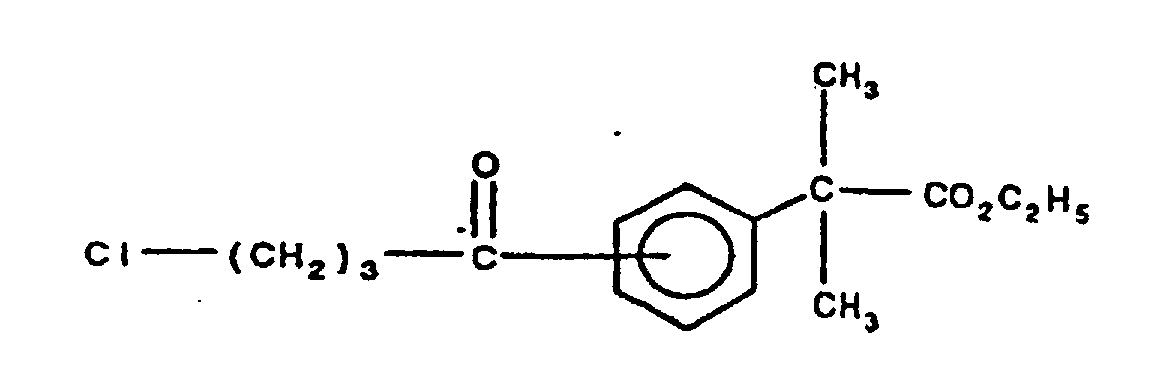
- Applicant has discovered that the preparation of ethyl 4-(4-chloro-1-oxobutyl)-α,α-dimethylphenylacetate by reaction of 4-chlorobutyryl chloride, aluminum chloride, and ethyl α,α-dimethylphenylacetate in carbon disulfide, as described in Example 1 of U.S. Patent Nos. 4,254,130 and 4,285,958 provides an inseparable mixture of monosubstituted aromatic regioisomers of the formula:wherein the chlorobutyryl substituent is attached at either of the three aromatic carbons which are meta or para to the dimethylacetate substituent. These regioisomers are not separable by standard techniques of thin layer chromatography, or column chromatography, and low field proton nuclear magnetic resonance spectroscopy is inconclusive in identifying the product of this reaction as a mixture. When the mixture of monosubstituted aromatic regioisomers of the preceding formula is reacted with a piperidine of the formula:
 a second mixture of aromatic regioisomers is obtained of the formula:
 wherein the monosubstituted meta, para mixture of regioisomers is obtained.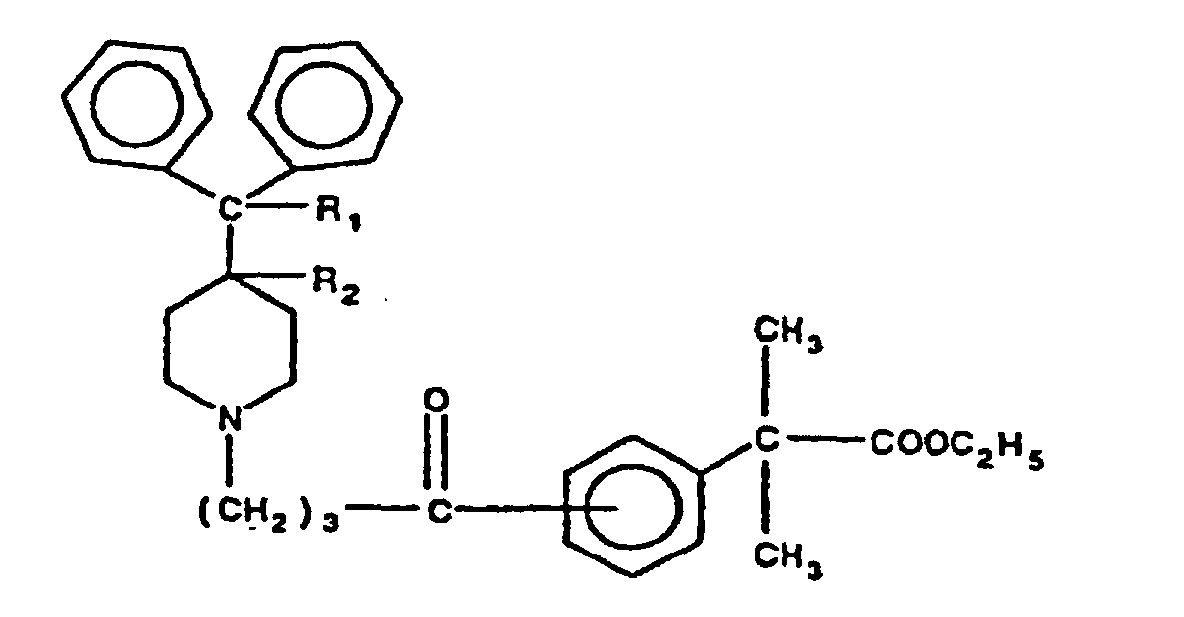
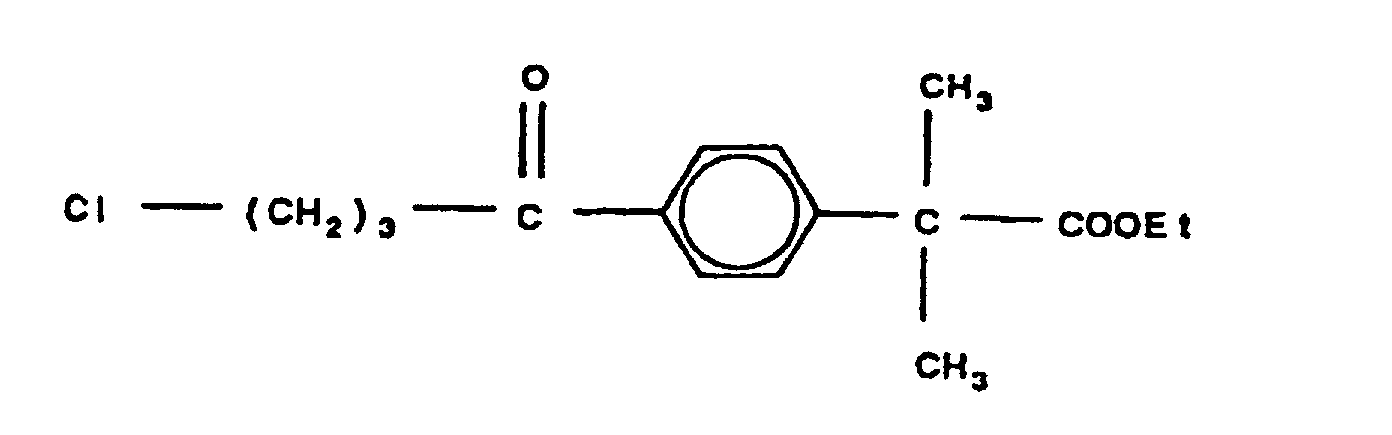
- It is known in the art that a monoalkyl substituent on a benzene ring is ortho, para directing in electrophilic aromatic substitution reactions such as a Friedel-Crafts reaction. Thus, it would be expected that the Friedel-Crafts reaction of α-chlorobutyryl chloride with ethyl α,α-dimethylphenylacetate would yield predominantly the para substituted product of the formula:because of the electron donating, para-directing character of the dimethylalkyl substituent combined with the steric hindrance associated with reaction of the ortho positions. In practice, the inductive electronic withdrawing effect of the carboxylic ester of ethyl α,α-dimethylphenylacetate counteracts the expected alkyl electron donating effect, resulting in no significant directing effect for the aromatic substitution reaction. For the described reaction, a statistical mixture of meta to para regioisomers results, with the two meta positions predominating.
- The above second mixture of regioisomers can be converted to a third mixture of regioisomers of formula:Although the second mixture of regioisomers and the third mixture of regioisomers can be analyzed by HPLC experiments, a practical separation to obtain gram quantities of substantially pure regioisomers has not been achieved. Each mixture (including the first), would be expected to contain 33% of the para isomer and 67% of the meta isomer. Since these components are inseparable, it has not been possible to obtain either of the regioisomers in each mixture in substantially pure form.

- The present invention relates to a process for preparing a substantially pure regioisomer of the formula I,wherein

- R3 is -COOH or -COOR4;
- R4 is an alkyl with 1 to 6 carbon atoms;
-
- A is the substituents of its ring, each of which may be different or the same, and are selected from the group consisting of hydrogen, halogens, alkyl, hydroxy or alkoxy,
said process comprising recovering, by crystallization, the substantially pure regioisomer of the formula I from a mixture of regioisomers of the formula III:The regioisomer of the formula I is useful in the preparation of substantially pure piperidine derivative compounds of the formulae: or
or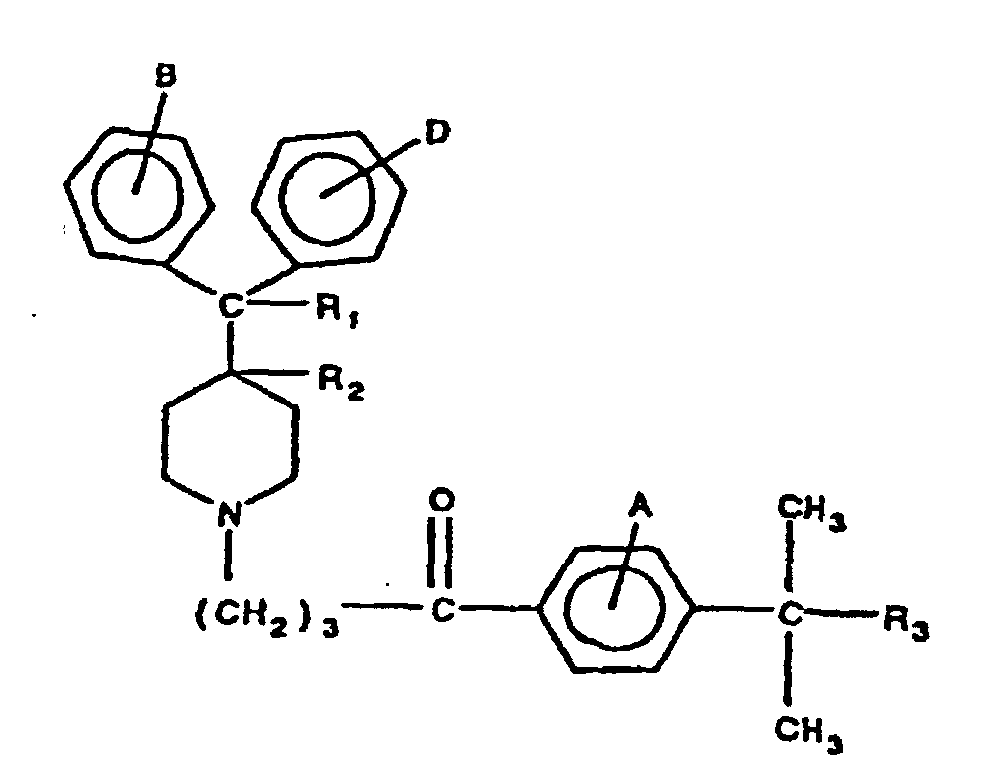 wherein
- R1 is hydrogen or hydroxy;
- R2 is hydrogen;
or R1 and R2 taken together form a second bond between the carbon atoms bearing R1 and R2; - R3 is ―COOH or ―COOR4;
- R4 is an alkyl with 1 to 6 carbon atoms;
- A, B, and D are the substituents of their rings, each of which may be different or the same, and are selected from the group consisting of hydrogen, halogens, alkyl, hydroxy, or alkoxy, or a salt thereof. These compounds are useful in pharmaceutical compositions, particularly as antihistamines, antiallergy agents, and bronchodilators.
-
- The piperidine derivative compound is prepared by a process which is initiated by providing a substantially pure regioisomer of the following formula:The substantially pure regioisomer is converted to the piperidine derivative having a keto group with a piperidine compound of the formula:
 A number of synthetic pathways for preparing the substantially pure regioisomer and for reacting it with the piperidine compound having a keto group are disclosed. The piperidine derivative having a keto group can be converted to the above piperidine derivative having a hydroxyl group by reduction.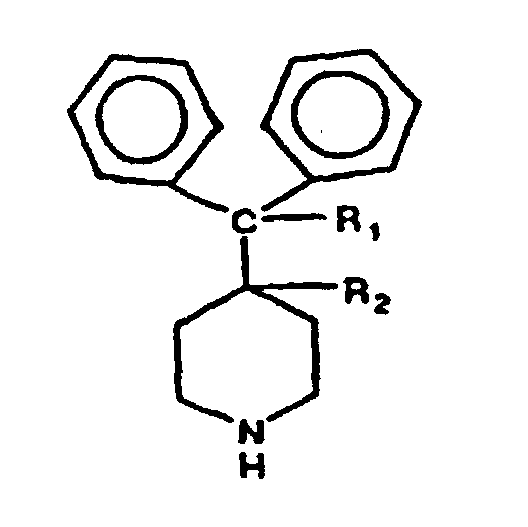
- Although a wide variety of piperidine derivatives can be produced from the products of the process of the present invention, it is particularly useful in forming a hydroxylated piperidine derivative of the formula:Alternatively, the process can be used to produce a piperidine derivative with a keto group of the following formula:


- The present invention is a process for providing a substantially pure regioisomer of the following formula:which may then be converted to piperidine derivative compounds having a keto group with a piperidine compound of the formula:
 The resulting piperidine derivative compounds with a keto group can be converted by reduction to piperidine compounds with a hydroxyl group.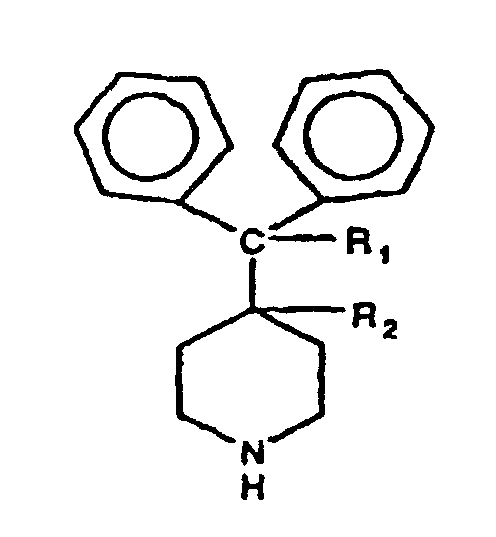
- There are several techniques of providing these substantially pure regioisomers.
- In one embodiment of the present invention, the substantially pure regioisomer is formed by initially acylating a starting compound of the formula:wherein
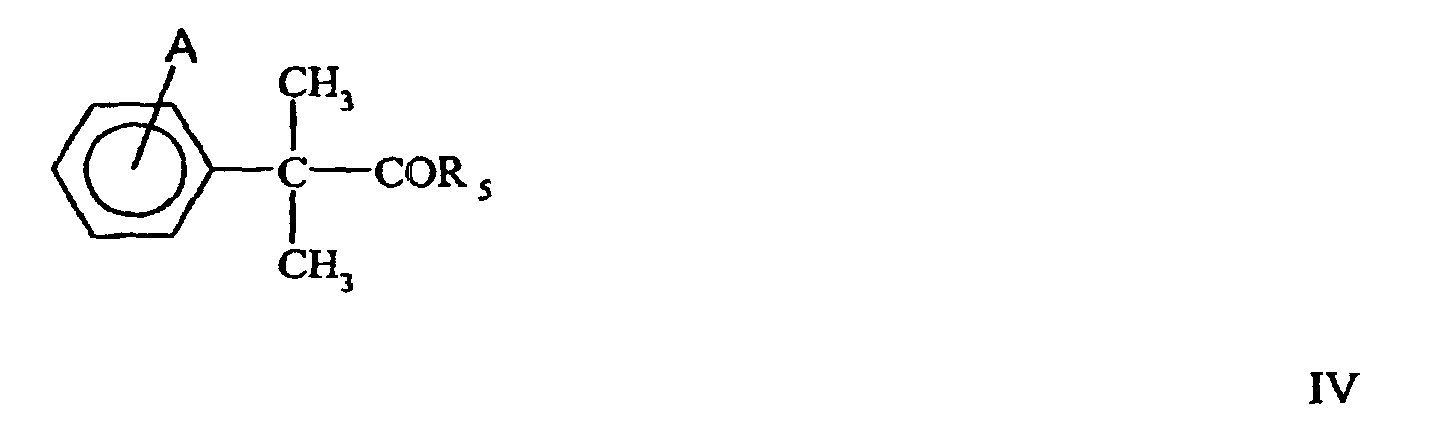
- R5 is ―OR6, ―N(R6)2, and ―SR6, and
- R6 is an alkyl with 1 to 6 carbons, with a compound of the formula:
-
- The first mixture of regioisomers can be hydrolyzed under conditions effective to form a second mixture of regioisomers of the formula:This reaction is carried out by base hydrolysis procedures which are well known in the art. For example, the first mixture of regioisomers can be treated with an inorganic base, such as, sodium hydroxide or potassium hydroxide, in an aqueous lower alcohol solvent. Suitable solvents include aqueous methanol, ethanol, isopropanol, or n-butanol solutions. Hydrolysis is carried out at reflux temperatures of the solvent for 1/2 to 12 hours..
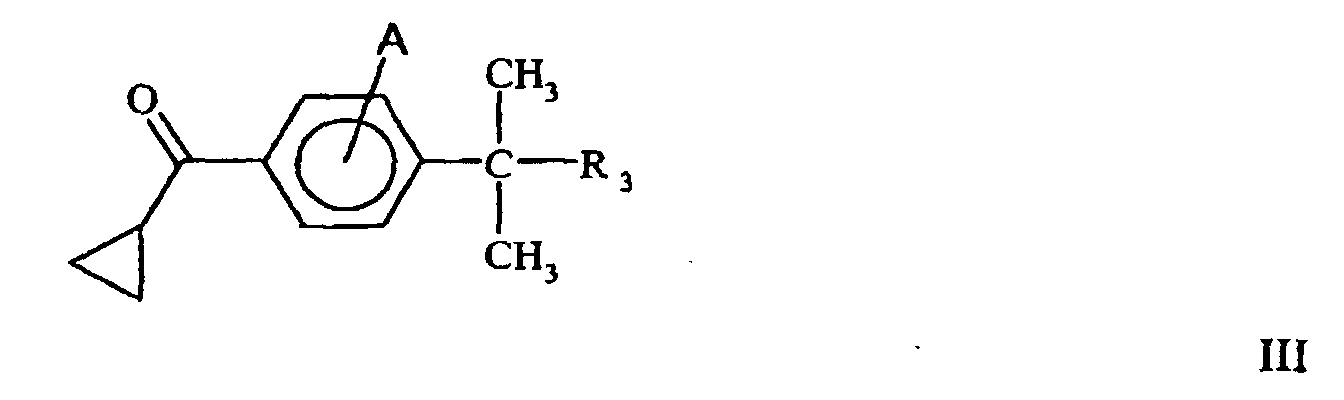
- Following such hydrolyzation, the substantially pure regioisomer of the formula:is recovered from the second mixture of regioisomers. Such recovery is carried out by crystallizing the substantially pure regioisomer salt of the formula:
 wherein
L+ is a Lewis Acid Such crystallization is carried out by fractional crystallization techniques known in the art. Generally, such procedures involve dissolving the second mixture of regioisomers in a solvent containing a salt at temperatures of 20°C to the reflux temperature of the solvent. The resulting solution is then slowly cooled to temperatures of -20° to 25°C. - Suitable solvents for fractional crystallization include: alcohol solvents, like methanol, ethanol, isopropyl alcohol, and n-butanol; ketone solvents, such as acetone or methyl ethyl ketone; ester-containing solvents, like ethyl acetate or isopropyl acetate; ethereal solvents such as tetrahydrofuran; acetonitrile; and dimethylformamide. Ethyl acetate is preferred.
- Suitable salts for fractional crystallization are those where X+ is an alkali metal salt, like sodium and potassium salts, or, more preferably, ammonium salts. The salt can also be cinchonidine, quinine, quinidine, quinuclidine, brucine, thebaine, or cinchonine. Of these salt complexes, cinchonidine is preferred.
- The substantially pure regioisomer salt is then isolated by filtration and converted to the substantially pure regioisomer of the formula:by procedures well known in the art. Typically, such conversion is accomplished by treatment with acid.
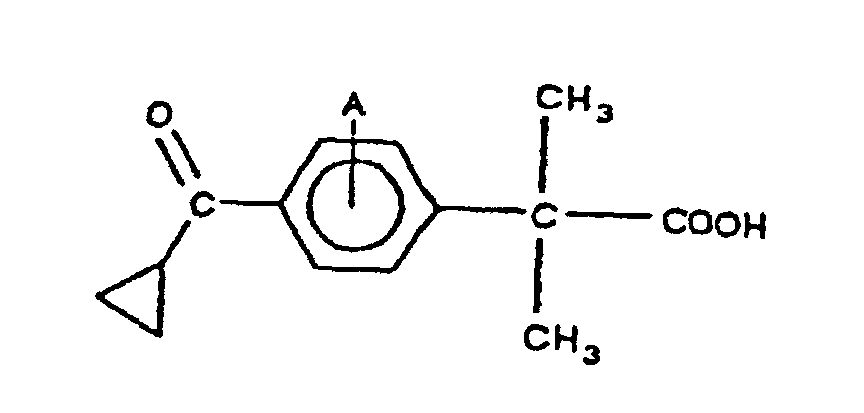
- In another embodiment of the process of the present invention, the substantially pure regioisomer is produced by acylating a starting compound of the formula:wherein

- R5 is -OR6, -N(R6)2, and -SR6, and
- R6 is an alkyl with 1 to 6 carbon atoms with a compound of the formula:
-
- The substantially pure regioisomer salt is recovered by fractional crystallization, isolation, and converting, as described above with reference to Process One for Producing Substantially Pure Regioisomers.
- Once the substantially pure regioisomer of the present invention is produced by one of the above (or some other) process, there are a number of procedures for using that compound to produce piperidine derivatives.
- The substantially pure regioisomer can be halogenated under conditions effective to form a first intermediate compound of the formula:wherein X is a halogen. Suitable halogens include chlorine, bromine, and iodine. Suitable conditions for carrying out such halogenating include reacting the substantially pure regioisomer with a halogen nucleophile and a Lewis Acid. The ring opening reaction is carried out in a suitable solvent, optionally in the presence of a catalytic amount of base for about 0.5 to 24 hours and a temperature of about -40 degrees C to the reflux temperature of the solvent. Suitable halogen nucleophiles include sodium iodide, sodium bromide, potassium iodide, potassium bromide, cesium iodide, cesium bromide, trimethylsilyl iodide, manganese iodide, cerium iodide, magnesium bromide, magnesium iodide, magnesium carbonate, calcium bromide, and calcium iodide. Suitable Lewis Acids include silicon compounds such as trimethylsilyl chloride and trimethylsilyl iodide; aluminum compounds such as aluminum chloride, trimethyl aluminum, diethyl aluminum chloride, ethyl aluminum dichloride, and diethyl aluminum cyanide; magnesium salts; and boron salts. Suitable solvents for the ring opening reaction include hydrocarbon solvents, such as, benzene, toluene, xylene, or cyclohexane; ethereal solvents such as ether, tetrahydrofuran, dioxane, or dimethoxyethane; or halogenated hydrocarbons, such as, chlorobenzene, methylene chloride, carbon tetrachloride, chloroform, or dichloroethane.
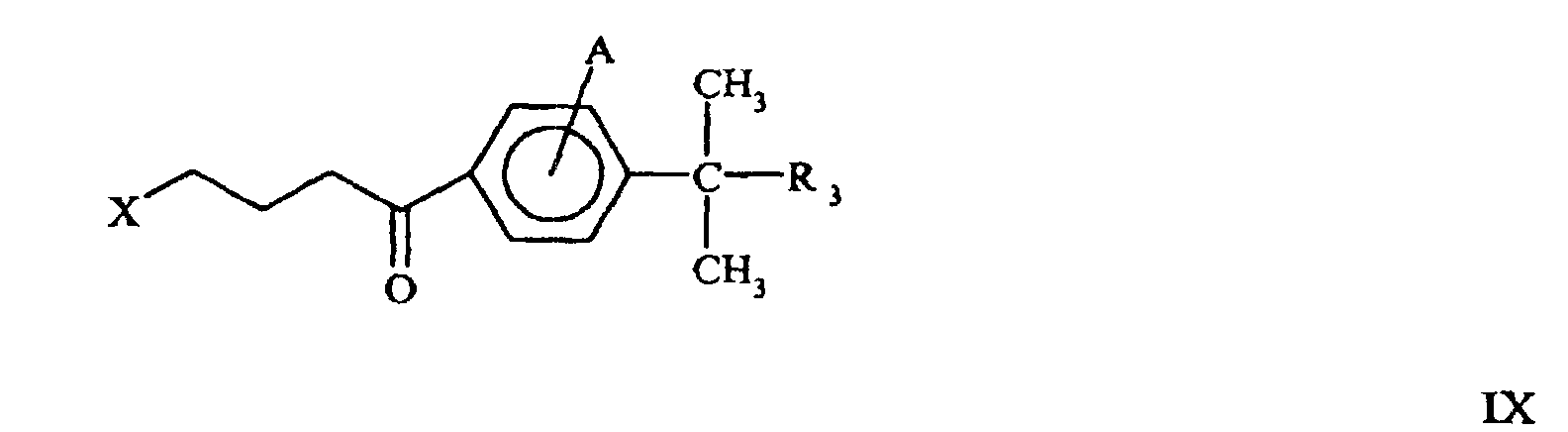
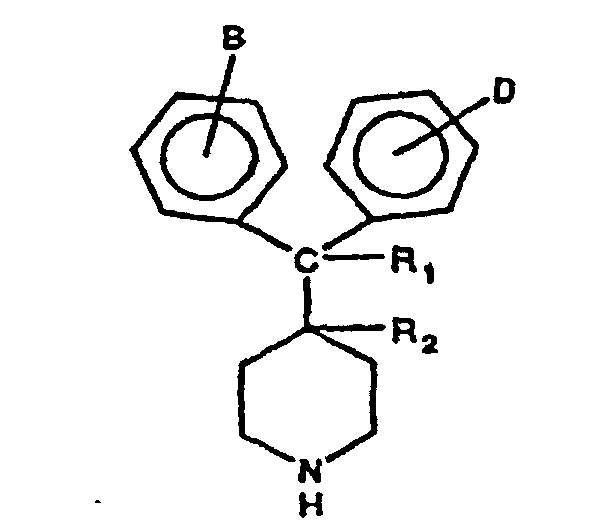
- After such halogenation, the first intermediate compound is reacted with a piperidine compound of the formula:under conditions effective to form the piperidine derivative compound having a keto group of the formula:
 This alkylation reaction is carried out in a suitable solvent preferably in the presence of a base and, optionally, in the presence of a catalytic amount of potassium iodide for about 4 to 120 hours at a temperature of about 70°C to the reflux temperature of the solvent. Suitable solvents for the alkylation reaction include alcohol solvents, such as, methanol, ethanol, isopropyl alcohol, or n-butanol; ketone solvents, such as, methyl isobutyl ketone; hydrocarbon solvents, such as, benzene, toluene, or xylene; halogenated hydrocarbons, such as, chlorobenzene or methylene chloride; or dimethylformamide. Suitable bases for the alkylation reaction include inorganic bases, for example, sodium bicarbonate, potassium carbonate, or potassium bicarbonate or organic bases, such as a trialkylamine, for example, triethylamine or pyridine, or an excess of the piperidine compound can be used.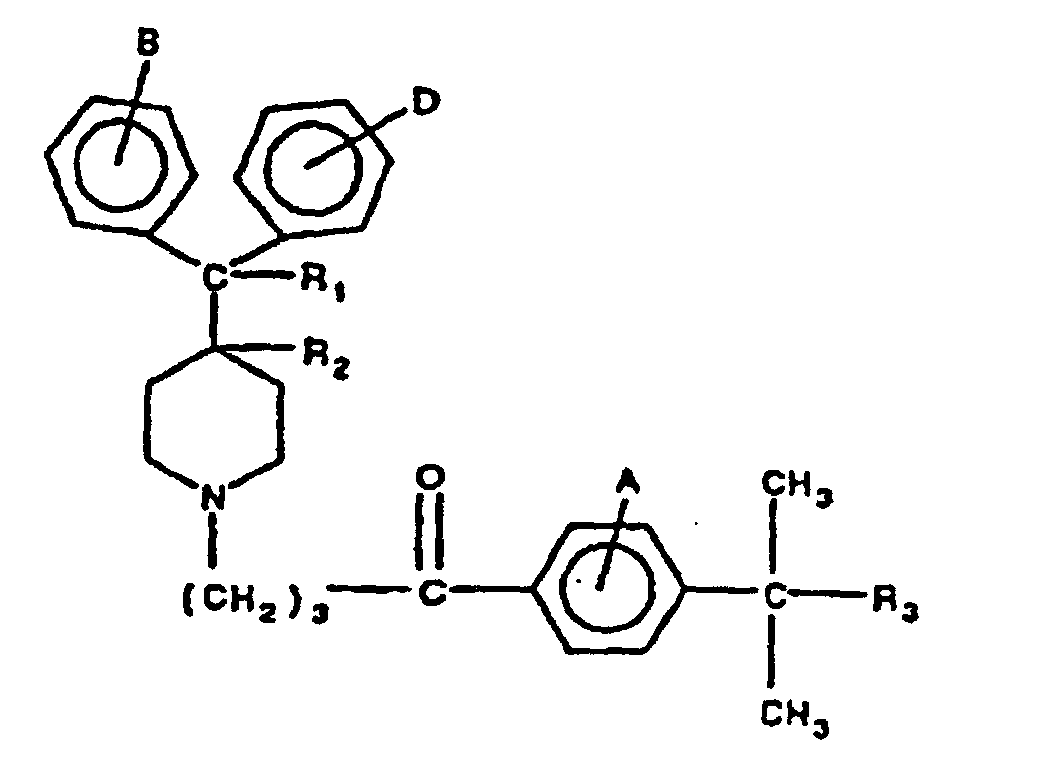
- When R3 is -COOalkyl, the alkylation reaction is followed by base hydrolysis to convert R3 substituents that are -COOalkyl groups to -COOH groups. Such base hydrolysis involves treatment of the substantially pure piperidine derivative with an inorganic base, such as, sodium hydroxide in an aqueous lower alcohol solvent, such as, aqueous methanol, ethanol, isopropyl alcohol, or n-butanol at reflux temperature for about 1/2 hour to 12 hours.
- Piperidine compounds where each of R1 and R2 is hydrogen or wherein R1 is hydroxy and R2 is hydrogen are commercially available or may be prepared according to procedures well known in the art (e.g. F.J. McCarty, C.H. Tilford, M.G. Van Campen, J. Am. Chem. Soc., 1961, 26, 4084). Piperidine compounds wherein R1 and R2 form a second bond between the carbon atoms bearing R1 and R2 may be prepared by dehydration of the corresponding compound wherein R1 is hydroxy by procedures generally known in the art.
- In another process, the substantially pure regioisomer of the formula:is reacted directly with a piperidine compound of the formula:
 under conditions effective to form the piperidine derivative compound having a keto group of the formula:
 This alkylation reaction is carried out in a suitable solvent preferably in the presence of a base and optionally in the presence of a Lewis Acid such as magnesium, cesium, or calcium salts or trimethylsilyl chloride or in the presence of a catalytic amount of potassium iodide for about 4 to 120 hours at a temperature of about 70°C to the reflux temperature of the solvent. Suitable solvents for the alkylation reaction include alcohol solvents, such as, methanol, ethanol, isopropyl alcohol, or n-butanol; ketone solvents, such as, methyl isobutyl ketone; hydrocarbon solvents, such as, benzene, toluene, or xylene; and halogenated hydrocarbons, such as, chlorobenzene or methylene chloride; or dimethylformamide. Suitable bases of the alkylation reaction include inorganic bases, for example, sodium bicarbonate, potassium carbonate, or potassium bicarbonate or organic bases, such as, a trialkylamine, for example, triethylamine or pyridine, or an excess of a compound of the piperidine compound may be used.
- As discussed above, the process of the present invention is useful in producing substantially pure piperidine derivatives with either a keto group or a hydroxyl group. Derivatives with keto groups can be converted to similar compounds with hydroxyl groups by reduction reactions which are well known in the art.
- Reduction can be carried out with sodium borohydride or potassium borohydride in lower alcohol solvents, such as, methanol, ethanol, isopropyl alcohol, or n-butanol.
- When lithium aluminum hydride or diborane are used as reducing agents, suitable solvents are ethers, for example, diethyl ether, tetrahydrofuran, or dioxane. These reduction reactions are carried out at temperatures ranging from about 0°C to the reflux temperature of the solvent, and the reaction time varies from about 0.5 to 8 hours.
- Catalytic reduction may also be employed using, for example, Raney nickel, palladium, platinum or rhodium catalysts in lower alcohol solvents, such as, methanol, ethanol, isopropyl alcohol, or n-butanol or acetic acid or their aqueous mixtures, or by the use of aluminum isopropoxide in isopropyl alcohol. Reduction using sodium borohydride is generally preferred over catalytic reduction when forming carboxylic acids or esters. When the starting material is an ester, lithium aluminum hydride is the preferred reducing agent, while diborane is preferred when starting with an acid.
- When esters with hydroxyl groups have been formed, base hydrolysis can be used to produce a carboxylic acid. Such procedures are well known and generally involve treatment with an inorganic base, such as, sodium hydroxide or potassium hydroxide, in an aqueous lower alcoholic solvent, such as aqueous methanol, ethanol, isopropyl alcohol, or n-butanol. Base hydrolysis is carried out at about the solvent reflux temperature for about 1/2 hour to 12 hours.
- Aluminum chloride (44 g; 0.33 mol) was added slowly in portions to a solution of freshly distilled 4-chlorobutyryl chloride (17 mL; 0.15 mol) in 460 mL of carbon disulfide at - 10°C under a nitrogen atmosphere. The mixture was stirred for 15 minutes, then the cooling bath was removed and the mixture was allowed to warm to ambient temperature. The mixture was stirred then for 15 minutes more, then cooled again to -10°C and a solution of ethyl α,α-dimethylphenyl acetate (26.6 g; 0.14 mol) in 70 mL of carbon disulfide was added dropwise. The mixture was maintained with stirring for 3 hr, then stirred overnight at room temperature.
- The reaction mixture was partitioned between H2O and CHCl3. The combined organic portions were washed with saturated aqueous NaHCO3 solution, dried over MgSO4, filtered and concentrated in vacuo. The residue was dissolved in CH2Cl2 and filtered through a plug of SiO2, eluting with 10% EtOAc in hexane. Concentration of the product-containing fractions afforded 39.4 g of ethyl 3- and 4-(4-chloro-1-oxobutyl)-α,α-dimethylphenylacetate as a mixture of aromatic regioisomers.
- To a solution of 39.4 g of ethyl 3- and 4-(4-chloro-1-oxobutyl)-α,α-dimethylphenylacetate obtained in Example 1 dissolved in 800 mL of CH3OH and 200 mL of H2O was added 40 g of NaOH. The resulting mixture was refluxed for one hour. The cooled mixture was then concentrated in vacuo to remove the CH3OH. The concentrate was diluted with H2O and washed with two portions of EtOAc. The aqueous layer was acidified with concentrated HCl and extracted with two portions of EtOAc. The extracts were dried over MgSO4, filtered, and concentrated in vacuo to afford 30.3 g of crude product.
- The crude product was dissolved in 600 mL of EtOAc, 38 g of cinchonidine was added, and the mixture was stirred overnight. The resulting solids were filtered and washed with EtOAc and sucked dry under a rubber dam to afford 25 g of a tan solid.
- The solids were partitioned between EtOAc and 2N HCl. The aqueous layer was extracted with EtOAc. The combined organics were dried over MgSO4, filtered, and concentrated in vacuo to afford 10.6 g of an oil (33% from ethyl α,α-dimethyl-phenylacetate).
- A solution of 10.5 g of 4-(cyclopropyl-oxo-methyl)-α,α-dimethylphenylacetic acid, prepared in accordance with Example 2, in 250 mL of CH2Cl2 was cooled in an ice-MeOH bath and 25 g of trimethylsilyliodide was then added rapidly via pipette. The mixture was stirred in the ice bath for one hour, warmed to ambient temperature, and stirred for one hour. A solution of aqueous sodium bisulfite was then added and the mixture was stirred well. The phases were partitioned and the aqueous layer was extracted with CH2Cl2. The combined organics were washed with saturated aqueous NaCl, dried over MgSO4, filtered, and concentrated in vacuo to afford 12.6 g (77%) of 4-(4-iodo-1-oxobutyl)-α,α-dimethylphenylacetic acid.
- To a solution of 12.6 g of 4-(4-iodo-1-oxobutyl)-α,α-dimethylphenylacetic acid, prepared in accordance with Example 3, in 100 mL of Et2O cooled in an ice bath, was added 40 mL of ethereal CH2N2. The mixture was stirred at 0°C for few minutes, then let stand for 2 hr. A few drops of AcOH were added to decompose excess CH2N2, then the mixture was filtered and stripped to afford 12.6 g (96%) of methyl 4-(4-iodo-1-oxobutyl)-α,α-dimethylphenylacetate.
- A solution of 12.6 g of methyl 4-(4-iodo-1-oxobutyl)-α,α-dimethylphenylacetate, prepared in accordance with Example 4, in 500 mL of toluene in a one liter three neck flask with mechanical stirring was added 8.8 g of 4-(α,α-diphenyl)piperidinemethanol and 23 g of K2CO3 and the mixture was refluxed for 7 hr. The cooled reaction mixture was then filtered and concentrated in vacuo. The residue was dissolved in Et2O and treated with excess ethereal HCl. The mixture was then concentrated to a solid. The solid was treated with EtOAc and collected by filtration. The product was then partitioned between EtOAc and 2N Na2CO3. The organics were dried over MgSO4, filtered, and concentrated in vacuo to afford 13.5 g (79%) of methyl 4-[4-[4-(hydroxydiphenylmethyl)-1-piperidinyl]-1-oxobutyl]-α,α-dimethylphenylacetate.
- A solution of 13.5 g of methyl 4-[4-[4-(hydroxydiphenylmethyl)-1-piperidinyl]-1-oxobutyl]-α,α-dimethylphenylacetate, prepared in accordance with Example 5, in 250 mL of CH3OH was cooled in an ice- CH3OH bath and 1.8 g of NaBH4 was added in portions. After 1 hr, the mixture was concentrated to a solid. The residue was partitioned between EtOAc and saturated aqueous NaHCO3. The aqueous portion was extracted with EtOAc. The combined organics were washed with saturated aqueous NaCl, dried over MgSO4, filtered, and concentrated in vacuo to afford 9.5 g (70%) of methyl 4-[4-[4-(hydroxydiphenylmethyl)-1-piperidinyl]-1-hydroxybutyl]-α,α-dimethylphenylacetate as a foam.
- To a solution of 9.5 g of methyl-4-[4-[4-(hydroxydiphenylmethyl)-1-piperidinyl]-1-hydroxybutyl]-α,α-dimethylphenylacetate, prepared in accordance with Example 6, in 300 mL of CH3OH and 150 mL of H2O was added 10 g of NaOH. The mixture was refluxed for 1hr, then cooled. The CH3OH was removed in vacuo. The concentrate was diluted with H2O and CHCl3 and the pH adjusted to approximately 5.5 to 6.0. The phases were separated and the aqueous phase was extracted with CHCl3. The combined organics were dried over MgSO4, filtered, and stripped to afford 9.0 g of crude product.
- The crude product was dissolved in CH2Cl2 and chromatographed on Davisil Grade 633 SiO2 eluting with a gradient of CHCl3, to 10% CH3OH in CHCl3, to 25% CH3OH in CHCl3. The product containing fractions were concentrated to afford 5.2 g of white crystals. An analytical sample was prepared by treatment of the product with EtOAc, mp 199-203°C. Calc. for C32H39NO4: C, 76.62; H, 7.84; N, 2.79. Found: C, 76.24; H, 7.76; N, 2.75.
- To a solution of 6.4 g (0.017 mol) of methyl 4-(4-iodo-1-oxobutyl)-α,α-dimethylphenylacetate, prepared in accordance with Example 4, in 500 mL of toluene in a one liter round bottom flask equipped with a mechanical stirrer was added 5.1 g (0.017 mol) of 4-(α,α-bis(4-methylphenyl)-piperidinemethanol, followed by 11.8 g (0.086 mol) of solid potassium carbonate. The solution was heated to reflux for 24 hr. After cooling, the mixture was filtered and the toluene was removed in vacuo. The residue was partitioned between ethyl acetate and 2 N sodium bicarbonate solution. The aqueous layer was extracted twice with ethyl acetate, the combined organic layers were dried with sodium sulfate and the ethyl acetate was removed in vacuo to provide 6.8 g (73%) of methyl 4-[4-[4-(bis(4-methylphenyl)hydroxymethyl)-1-piperidinyl]-1-oxobutyl]-α,α-dimethylphenylacetate as a viscous, dark colored oil.
- To a ―10°C solution of 6.8 g (0.013 mol) of methyl 4-[4-[4-(bis(4-methylphenyl)hydroxymethyl)-1-piperidinyl]-1-oxobutyl]-α,α-dimethylphenylacetate, prepared in accordance with Example 8, in 150 mL of methanol in a 500 mL round bottom flask equipped with a mechanical stirrer was slowly added 0.86 g (0.023 mol) of sodium borohydride, and the reaction was stirred for 2 hr. The methanol was removed in vacuo and the residue was partitioned between ethyl acetate and aqueous sodium bicarbonate solution. The aqueous layer was extracted with ethyl acetate, the combined organic layers were dried with sodium sulfate, and the ethyl acetate was removed in vacuo to provide 6.9 g of a dark colored foam. The resultant material was purified by column chromatography (Davisil grade 633 silica gel, packed in methylene chloride, material applied in chloroform, and eluted with a gradient of 2% methanol to methylene chloride to 5% methanol to methylene chloride) to afford 5.3 g (77%) of methyl 4-[4-[4-(bis(4-methylphenyl)hydroxymethyl)-1-piperidinyl]-1-hydroxybutyl]-α,α-dimethylphenylacetate.
- To 350 mL of methanol in a 1 L round bottom flask equipped with a mechanical stirrer was added 5.3 g (9.8 mmol) of methyl 4-[4-[4-(bis(4-methylphenyl)hydroxymethyl)-1-piperidinyl]-1-hydroxybutyl]-α,α-dimethylphenylacetate, prepared in accordance with Example 9, 5.1 g (0.13 mol) of solid sodium hydroxide, and 100 mL of water. The mixture was heated to reflux for 3 hr. After cooling, the methanol was removed in vacuo, and 6 N hydrochloric acid was added dropwise until the solution was no longer basic (pH = 7). The solution was extracted three times with ethyl acetate. The organic layers were combined and a white crystalline solid precipitated out of solution. The solid was washed with ether to provide 1.8 g (34%) of 4-[4-[4-(bis(4-methylphenyl)hydroxymethyl)-1-piperidinyl]-1-hydroxybutyl]-α,α-dimethylphenylacetic acid, as the dihydrate, mp 208-215°C. Analysis. Calcd. for C34H43NO4-2(H2O): C, 72.18; H, 8.37; N, 2.47. Found: C, 72.02; H, 8.36; N, 2.41.
- To a solution of 50 mg of 4-(4-iodo-1-oxobutyl)-α,α-dimethylphenylacetic acid, prepared in accordance with Example 3, in 3 mL of methanol was added 50 mg of NaBH4. The mixture was stirred for 30 minutes, acidified with 2N HCl, and the methanol removed in vacuo. The concentrate was extracted with EtOAc. The organics were dried over Na2SO4, filtered, and concentrated to afford 40 mg of 4-(1-hydroxy-4-iodobutyl)-α,α-dimethylphenylacetic acid.
- A mixture of 800 mg of 4-(4-iodo-1-oxobutyl)-α,α-dimethylphenylacetic acid, prepared in accordance with Example 3, 800 mg of 4-(α,α-diphenyl)piperidinemethanol, and 2.4 g of K2CO3 in 25 mL of toluene was stirred for 48 hours at room temperature. The mixture was concentrated in vacuo. The residue was treated with EtOAc, filtered, and concentrated to afford 4-[4-[4-(hydroxydiphenylmethyl)-1-piperidinyl]-1-oxobutyl]-α,α-dimethylphenylacetic acid.
- A mixture of 4-[4-[4-(hydroxydiphenylmethyl)-1-piperidinyl]-1-oxobutyl]-α,α-dimethylphenylacetic acid, prepared in accordance with Example 12, and 300 mg of NaBH4 in 25 mL of CH3OH was stirred overnight at room temperature. The mixture was then concentrated in vacuo. The residue was partitioned between EtOAc and H2O. The aqueous portion was treated with concentrated HCl until pH 6, then extracted with EtOAc. The organics were concentrated in vacuo. The residue was dissolved in EtOAc, filtered, and concentrated in vacuo to an oil. The oil was dissolved in CH3OH and concentrated to a solid. The solid was slurried with EtOAc, filtered, and rinsed with EtOAc to afford 4-[4-[4-hydroxydiphenylmethyl)-1-piperidinyl]-1-hydroxybutyl]-α,α-dimethylphenylacetic acid.

X is a halogen,
under conditions effective to produce a first mixture of regioisomers of the formula:


Typically, such acylation is carried out by a Friedel-Crafts reaction, as described above in Process One for Producing Substantially Pure Regioisomers.
Claims (8)
- A process for preparing a substantially pure regioisomer of the formula I,wherein
 said process comprising recovering, by crystallization, the substantially pure regioisomer of the formula I from a mixture of regioisomers of the formula III:R3 is -COOH or -COOR4;R4 is an alkyl with 1 to 6 carbon atoms;A is the substituents of its ring, each of which may be different or the same, and are selected from the group consisting of hydrogen, halogens, alkyl, hydroxy or alkoxy,
- A process according to Claim 1, wherein the mixture of regioisomers is prepared by:whereinacylating a starting compound of the formula IV:
 with a compound of the formula V:R5 is -OR6, -N(R6)2 and -SR6, andR6 is an alkyl with 1 to 6 carbons,wherein
X is a halogen,
to produce a mixture of regioisomers of the formula VI:and subjecting the mixture of regioisomers of formula VI to base hydrolysis.
- A process according to Claim 2, wherein said acylating of the compound of formula IV is carried out by a Friedel-Crafts reaction using an AlCl3 catalyst
- A process according to Claim 1, wherein the mixture of regioisomers of formula III is prepared by acylating a starting compound of the formula IV, as defined in Claim 2, with a compound of the formula VII:to produce a mixture of regioisomers of the formula VIII:
 and hydrolysing the mixture of regioisomers of the formula VIII.
- A process according to any one of Claims 1 to 4, wherein the substantially pure regioisomer of formula I is recovered by crystallizing from the mixture of regioisomers of formula III a substantially pure regioisomer salt of the formula II:
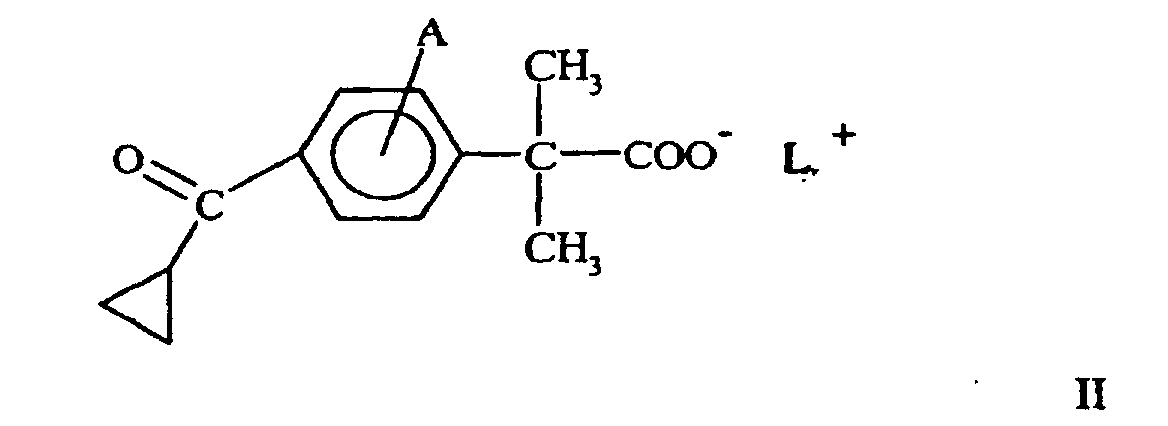 wherein L+ is a Lewis acid and A is as defined above,isolating the substantially pure regioisomer salt; andconverting the substantially pure regioisomer salt to the substantially pure regioisomer of the formula I.
 - A process according to Claim 5, wherein the salt of formula II is an alkali metal salt or an ammonium salt.
- A process according to Claim 5, wherein L+ is cinchonidine and A is hydrogen.
- A process according to any preceding claim, further comprising halogenating the substantially pure regioisomer of formula I so as to form a substantially pure regioisomer of the formula IX:wherein R3 and A are as defined in Claim 1, and X is as defined in Claim 2.

Priority Applications (2)
| Application Number | Priority Date | Filing Date | Title |
|---|---|---|---|
| DK03077245T DK1369409T3 (en) | 1993-06-24 | 1994-06-21 | Process for the preparation of compounds useful as intermediates |
| EP03077245A EP1369409B1 (en) | 1993-06-24 | 1994-06-21 | Process for preparing compounds useful as intermediates |
Applications Claiming Priority (4)
| Application Number | Priority Date | Filing Date | Title |
|---|---|---|---|
| US8310293A | 1993-06-24 | 1993-06-24 | |
| US83102 | 1993-06-24 | ||
| EP96200338A EP0723958A1 (en) | 1993-06-24 | 1994-06-21 | Synthesis of substantially pure terfenadine derivatives |
| EP94920762A EP0703902B1 (en) | 1993-06-24 | 1994-06-21 | Process for the production of piperidine derivatives |
Related Parent Applications (1)
| Application Number | Title | Priority Date | Filing Date |
|---|---|---|---|
| EP96200338A Division EP0723958A1 (en) | 1993-06-24 | 1994-06-21 | Synthesis of substantially pure terfenadine derivatives |
Related Child Applications (1)
| Application Number | Title | Priority Date | Filing Date |
|---|---|---|---|
| EP03077245A Division EP1369409B1 (en) | 1993-06-24 | 1994-06-21 | Process for preparing compounds useful as intermediates |
Publications (2)
| Publication Number | Publication Date |
|---|---|
| EP1026147A1 EP1026147A1 (en) | 2000-08-09 |
| EP1026147B1 true EP1026147B1 (en) | 2003-11-19 |
Family
ID=22176189
Family Applications (4)
| Application Number | Title | Priority Date | Filing Date |
|---|---|---|---|
| EP03077245A Expired - Lifetime EP1369409B1 (en) | 1993-06-24 | 1994-06-21 | Process for preparing compounds useful as intermediates |
| EP96200338A Ceased EP0723958A1 (en) | 1993-06-24 | 1994-06-21 | Synthesis of substantially pure terfenadine derivatives |
| EP00200419A Expired - Lifetime EP1026147B1 (en) | 1993-06-24 | 1994-06-21 | Compounds useful as intermediates in the production of piperidine derivatives |
| EP94920762A Expired - Lifetime EP0703902B1 (en) | 1993-06-24 | 1994-06-21 | Process for the production of piperidine derivatives |
Family Applications Before (2)
| Application Number | Title | Priority Date | Filing Date |
|---|---|---|---|
| EP03077245A Expired - Lifetime EP1369409B1 (en) | 1993-06-24 | 1994-06-21 | Process for preparing compounds useful as intermediates |
| EP96200338A Ceased EP0723958A1 (en) | 1993-06-24 | 1994-06-21 | Synthesis of substantially pure terfenadine derivatives |
Family Applications After (1)
| Application Number | Title | Priority Date | Filing Date |
|---|---|---|---|
| EP94920762A Expired - Lifetime EP0703902B1 (en) | 1993-06-24 | 1994-06-21 | Process for the production of piperidine derivatives |
Country Status (16)
| Country | Link |
|---|---|
| US (9) | US5750703A (en) |
| EP (4) | EP1369409B1 (en) |
| JP (4) | JP3034047B2 (en) |
| KR (2) | KR100387347B1 (en) |
| AT (3) | ATE174589T1 (en) |
| AU (1) | AU670004B2 (en) |
| CA (1) | CA2147126C (en) |
| DE (3) | DE69433346T2 (en) |
| DK (3) | DK1369409T3 (en) |
| ES (3) | ES2261871T3 (en) |
| FI (1) | FI109691B (en) |
| HU (1) | HU226559B1 (en) |
| NO (2) | NO308599B1 (en) |
| NZ (1) | NZ268513A (en) |
| PT (2) | PT1026147E (en) |
| WO (1) | WO1995000482A1 (en) |
Families Citing this family (59)
| Publication number | Priority date | Publication date | Assignee | Title |
|---|---|---|---|---|
| FI950467A7 (en) * | 1992-08-03 | 1995-03-31 | Sepracor Inc | Terfenadine metabolites and their optically pure isomers for the treatment of allergic diseases |
| US20020007068A1 (en) | 1999-07-16 | 2002-01-17 | D'ambra Thomas E. | Piperidine derivatives and process for their production |
| HU226559B1 (en) * | 1993-06-24 | 2009-03-30 | Amr Technology | Process for the production of piperidine derivatives |
| EP1953142A1 (en) | 1993-06-25 | 2008-08-06 | Aventis Inc. | Process for the preparation of antihistaminic 4-diphenylmethyl piperidine derivatives |
| CA2449419C (en) * | 1994-05-18 | 2011-09-06 | Aventis Pharmaceuticals Inc. | Processes for preparing anhydrous and hydrate forms of antihistaminic piperidine derivatives, polymorphs and pseudomorphs thereof |
| US20030045722A1 (en) * | 1994-05-18 | 2003-03-06 | Henton Daniel R. | Processes for preparing anhydrous and hydrate forms of antihistaminic piperidine derivatives, polymorphs and pseudomorphs thereof |
| EP0812195B1 (en) | 1995-02-28 | 2002-10-30 | Aventis Pharmaceuticals Inc. | Pharmaceutical composition for piperidinoalkanol compounds |
| US6153754A (en) * | 1995-12-21 | 2000-11-28 | Albany Molecular Research, Inc. | Process for production of piperidine derivatives |
| US6201124B1 (en) | 1995-12-21 | 2001-03-13 | Albany Molecular Research, Inc. | Process for production of piperidine derivatives |
| US5925761A (en) * | 1997-02-04 | 1999-07-20 | Sepracor Inc. | Synthesis of terfenadine and derivatives |
| ZA985939B (en) * | 1997-07-08 | 2000-01-10 | Aristocrat Leisure Ind Pty Ltd | Slot machine game and system with improved jackpot feature. |
| NZ501248A (en) * | 1997-08-26 | 2001-06-29 | Aventis Pharma Inc | Pharmaceutical composition for combination of piperidinoalkanol-decongestant |
| US6194431B1 (en) | 1998-04-14 | 2001-02-27 | Paul D. Rubin | Methods and compositions using terfenadine metabolites in combination with leukotriene inhibitors |
| CN101311165B (en) * | 1998-07-02 | 2011-05-18 | 安万特第二分公司 | Novel antihistaminic piperidine derivatives and intermediates for the preparation thereof |
| US6683094B2 (en) | 1998-07-02 | 2004-01-27 | Aventis Pharmaceuticals Inc. | Antihistaminic piperidine derivatives and intermediates for the preparation thereof |
| US6673933B2 (en) | 1998-07-02 | 2004-01-06 | Aventis Pharmaceutical Inc. | Antihistaminic piperidine derivatives and intermediates for the preparation thereof |
| AU2007200674C1 (en) * | 1998-07-02 | 2011-02-24 | Aventisub Llc | Novel antihistaminic piperidine derivatives and intermediates for the preparation thereof |
| US6362375B1 (en) | 1999-12-03 | 2002-03-26 | College Of The Holy Cross | Process for the preparation of aryl ketones generating reduced amounts of toxic byproducts |
| US6613906B1 (en) | 2000-06-06 | 2003-09-02 | Geneva Pharmaceuticals, Inc. | Crystal modification |
| GB0018691D0 (en) * | 2000-07-28 | 2000-09-20 | Rolabo Sl | Process |
| US6613907B2 (en) | 2000-11-08 | 2003-09-02 | Amr Technology, Inc. | Process for the production of piperidine derivatives with microorganisms |
| US20030021849A1 (en) * | 2001-04-09 | 2003-01-30 | Ben-Zion Dolitzky | Polymorphs of fexofenadine hydrochloride |
| CZ20033019A3 (en) * | 2001-04-09 | 2004-07-14 | Teva Pharmaceutical Industries Ltd. | Polymorphs of fexofenadine hydrochloride |
| US6743941B2 (en) * | 2001-06-15 | 2004-06-01 | Aventis Pharma Deutschland Gmbh | Process for the production of piperidine derivatives |
| SI21232A (en) * | 2001-06-25 | 2003-12-31 | Aurobindo Pharma Limited | Process for the preparation of a highly pure pharmaceutical intermediate, 4-(cyclo-propylcarbonyl)-alpha,alpha-dimethylphenylacetic acid |
| US6593499B2 (en) * | 2001-08-29 | 2003-07-15 | Council Of Scientific & Industrial Research | Process for the preparation of phenyl ketones |
| CA2465913A1 (en) * | 2001-11-08 | 2003-05-15 | Judith Aronhime | Polymorphs of fexofenadine base |
| IL163666A0 (en) | 2002-02-22 | 2005-12-18 | New River Pharmaceuticals Inc | Active agent delivery systems and methods for protecting and administering active agents |
| EP1474392A1 (en) * | 2002-06-10 | 2004-11-10 | Teva Pharmaceutical Industries Ltd. | Polymorphic form xvi of fexofenadine hydrochloride |
| US20050065183A1 (en) * | 2003-07-31 | 2005-03-24 | Indranil Nandi | Fexofenadine composition and process for preparing |
| US20050026890A1 (en) * | 2003-07-31 | 2005-02-03 | Robinson Cynthia B. | Combination of dehydroepiandrosterone or dehydroepiandrosterone-sulfate with an antihistamine for treatment of asthma or chronic obstructive pulmonary disease |
| GB0319935D0 (en) | 2003-08-26 | 2003-09-24 | Cipla Ltd | Polymorphs |
| TW200517114A (en) | 2003-10-15 | 2005-06-01 | Combinatorx Inc | Methods and reagents for the treatment of immunoinflammatory disorders |
| KR20070007196A (en) * | 2004-04-26 | 2007-01-12 | 테바 파마슈티컬 인더스트리즈 리미티드 | Crystalline Forms of Fexofenadine Hydrochloride and Methods for Making the Same |
| ITMI20041568A1 (en) * | 2004-07-30 | 2004-10-30 | Dipharma Spa | "BASE FEXOFENADINA POLYMORPHS" |
| US7498443B2 (en) * | 2004-09-17 | 2009-03-03 | Albany Molecular Research, Inc. | Process for production of carebastine |
| US7498345B2 (en) * | 2004-09-17 | 2009-03-03 | Albany Molecular Research, Inc. | Process for production of piperidine derivatives |
| JP2008514641A (en) * | 2004-09-28 | 2008-05-08 | テバ ファーマシューティカル インダストリーズ リミティド | Crystalline fexofenadine and method for its preparation |
| US7568973B2 (en) | 2005-09-09 | 2009-08-04 | Igt | Server based gaming system having multiple progressive awards |
| US7841939B2 (en) | 2005-09-09 | 2010-11-30 | Igt | Server based gaming system having multiple progressive awards |
| ZA200804550B (en) | 2005-11-09 | 2009-08-26 | Combinatorx Inc | Methods, compositions, and kits for the treatment of medical conditions |
| US7780520B2 (en) | 2006-03-15 | 2010-08-24 | Igt | Gaming device having multiple different types of progressive awards |
| WO2007135693A2 (en) * | 2006-05-18 | 2007-11-29 | Ind-Swift Laboratories Limited | Intermediates useful for the preparation of antihistaminic piperidine derivative |
| ITMI20061492A1 (en) * | 2006-07-27 | 2008-01-28 | Archimica Srl | PROCESS FOR THE PREPARATION OF FEXOPHENADINE. |
| US8070597B2 (en) | 2006-08-03 | 2011-12-06 | Igt | Gaming device and method having multiple progressive award levels and a secondary game for advancing through the progressive award levels |
| US9047733B2 (en) | 2006-11-08 | 2015-06-02 | Igt | Gaming system and method for providing multiple level progressive awards with increased odds of winning higher level progressive awards |
| EP2105134A1 (en) | 2008-03-24 | 2009-09-30 | Ranbaxy Laboratories Limited | Stable amorphous fexofenadine hydrochloride |
| WO2009136412A2 (en) * | 2008-04-25 | 2009-11-12 | Matrix Laboratories Limited | PROCESS FOR PREPARATION OF 4-[4-(4-(HYDROXYDIPHENYLMETHYL)- 1-PIPERIDINYL]-1-OXOBUTYL]-α,α-DIMETHYLBENZENE ACETIC ACID METHYL ESTER AND USE THEREOF |
| HUE030372T2 (en) * | 2008-05-07 | 2017-05-29 | Cardioxyl Pharmaceuticals Inc | Novel nitroso compounds as nitroxyl donors and methods of use thereof |
| EP2288355A1 (en) * | 2008-05-30 | 2011-03-02 | Fairfield Clinical Trials LLC | Method and composition for skin inflammation and discoloration |
| WO2010021681A2 (en) * | 2008-08-18 | 2010-02-25 | Combinatorx (Singapore) Pte. Ltd. | Compositions and methods for treatment of viral diseases |
| EP2289867A3 (en) | 2009-08-19 | 2012-04-25 | Jubilant Organosys Limited | A process for producing 4-(4-halo-1-oxybutyl)-alpha,alpha-dimethylbenzene acetic acid or alkyl esters thereof |
| US20110130711A1 (en) * | 2009-11-19 | 2011-06-02 | Follica, Inc. | Hair growth treatment |
| CN102070512B (en) * | 2009-11-21 | 2014-11-19 | 浙江华海药业股份有限公司 | Synthesizing route and preparation method of high-purity fexofenadine and intermediate thereof |
| WO2011063339A1 (en) * | 2009-11-23 | 2011-05-26 | Cardioxyl Pharmaceuticals, Inc. | Nitroxyl donors for the treatment of pulmonary hypertension |
| CN102962288A (en) * | 2012-11-21 | 2013-03-13 | 苏州江南航天机电工业有限公司 | Process for splicing arc-shaped large board and straight board |
| ITMI20131652A1 (en) | 2013-10-07 | 2015-04-08 | Dipharma Francis Srl | PROCEDURE FOR THE PURIFICATION OF DERIVATIVES OF 2-PHENYL-2-METHYL-PROPANOIC ACID |
| WO2017068129A1 (en) | 2015-10-22 | 2017-04-27 | Sanofi-Aventis Deutschland Gmbh | Process for the preparation of fexofenadine and of intermediates used therein |
| CN116178222B (en) * | 2021-11-29 | 2025-04-25 | 上海晓明检测技术服务有限公司 | Preparation method of tembotrione metabolite M9 |
Family Cites Families (29)
| Publication number | Priority date | Publication date | Assignee | Title |
|---|---|---|---|---|
| US4028404A (en) * | 1967-07-31 | 1977-06-07 | Allen & Hanburys Limited | Acetic acid derivatives |
| GB1242169A (en) * | 1969-04-09 | 1971-08-11 | Ucb Sa | Piperidine derivatives |
| US3839431A (en) * | 1970-07-13 | 1974-10-01 | Squibb & Sons Inc | Cyclopropylmethylphenylacetic acids and derivatives |
| US3898271A (en) * | 1971-06-08 | 1975-08-05 | Squibb & Sons Inc | Cyclopropylmethylphenylacetic acids and derivatives |
| US3806526A (en) * | 1972-01-28 | 1974-04-23 | Richardson Merrell Inc | 1-aroylalkyl-4-diphenylmethyl piperidines |
| US3878217A (en) * | 1972-01-28 | 1975-04-15 | Richardson Merrell Inc | Alpha-aryl-4-substituted piperidinoalkanol derivatives |
| BE794596A (en) * | 1972-01-28 | 1973-05-16 | Richardson Merrell Inc | SUBSTITUTED PIPERIDINOALCANONE OXIMES AND THEIR PREPARATION PROCESS |
| US3965257A (en) * | 1972-01-28 | 1976-06-22 | Richardson-Merrell Inc. | Compositions and methods for the treatment of the symptoms of histamine induced allergic reactions |
| BE794598A (en) * | 1972-01-28 | 1973-05-16 | Richardson Merrell Inc | NEW OLEFINIC DERIVATIVES OF PIPERIDINES SUBSTITUTED IN 4 AND THEIR PREPARATION PROCESS |
| US3931197A (en) * | 1974-02-08 | 1976-01-06 | Richardson-Merrell Inc. | Substituted piperidine derivatives |
| US3941795A (en) * | 1974-02-08 | 1976-03-02 | Richardson-Merrell Inc. | α-ARYL-4-SUBSTITUTED PIPERIDINOALKANOL DERIVATIVES |
| US3946022A (en) * | 1974-03-04 | 1976-03-23 | Richardson-Merrell Inc. | Piperidine derivatives |
| US3922276A (en) * | 1974-12-11 | 1975-11-25 | Robins Co Inc A H | 1-Substituted-4-benzylidenepiperidines |
| US3956296A (en) * | 1974-12-11 | 1976-05-11 | A. H. Robins Company, Incorporated | 1-Substituted-4-benzylpiperidines |
| DD141422A5 (en) * | 1978-01-27 | 1980-04-30 | Schering Ag | PROCESS FOR THE PREPARATION OF PHENYL ACID DERIVATIVES |
| US4285958A (en) * | 1979-04-10 | 1981-08-25 | Richardson-Merrell Inc. | 1-Piperidine-alkylene ketones, pharmaceutical compositions thereof and method of use thereof |
| US4285957A (en) * | 1979-04-10 | 1981-08-25 | Richardson-Merrell Inc. | 1-Piperidine-alkanol derivatives, pharmaceutical compositions thereof, and method of use thereof |
| US4254130A (en) * | 1979-04-10 | 1981-03-03 | Richardson-Merrell Inc. | Piperidine derivatives |
| US4254129A (en) * | 1979-04-10 | 1981-03-03 | Richardson-Merrell Inc. | Piperidine derivatives |
| GB8321157D0 (en) * | 1983-08-05 | 1983-09-07 | Fordonal Sa | Piperidine derivatives |
| IT1200123B (en) | 1985-09-27 | 1989-01-05 | Ind Chimica Srl | PROCESS FOR ALPHA PREPARATION |
| US4742175A (en) * | 1986-05-07 | 1988-05-03 | Merrell Dow Pharmaceuticals Inc. | Preparation of polymorphically pure terfenadine |
| HU226561B1 (en) * | 1992-04-10 | 2009-04-28 | Merrell Dow Pharma | Process for preparation 4-diphenylmethyl piperidine derivatives and the novel intermediates thereof |
| FI950467A7 (en) * | 1992-08-03 | 1995-03-31 | Sepracor Inc | Terfenadine metabolites and their optically pure isomers for the treatment of allergic diseases |
| HU226559B1 (en) | 1993-06-24 | 2009-03-30 | Amr Technology | Process for the production of piperidine derivatives |
| US20020007068A1 (en) * | 1999-07-16 | 2002-01-17 | D'ambra Thomas E. | Piperidine derivatives and process for their production |
| EP1953142A1 (en) * | 1993-06-25 | 2008-08-06 | Aventis Inc. | Process for the preparation of antihistaminic 4-diphenylmethyl piperidine derivatives |
| US6147216A (en) | 1993-06-25 | 2000-11-14 | Merrell Pharmaceuticals Inc. | Intermediates useful for the preparation of antihistaminic piperidine derivatives |
| WO2002028814A2 (en) * | 2000-10-06 | 2002-04-11 | Regents Of The University Of California | Nmda receptor channel blocker with neuroprotective activity |
-
1994
- 1994-06-21 HU HU9503719A patent/HU226559B1/en unknown
- 1994-06-21 DE DE69433346T patent/DE69433346T2/en not_active Expired - Lifetime
- 1994-06-21 CA CA002147126A patent/CA2147126C/en not_active Expired - Lifetime
- 1994-06-21 NZ NZ268513A patent/NZ268513A/en not_active IP Right Cessation
- 1994-06-21 AT AT94920762T patent/ATE174589T1/en active
- 1994-06-21 KR KR1019950705909A patent/KR100387347B1/en not_active Expired - Lifetime
- 1994-06-21 DK DK03077245T patent/DK1369409T3/en active
- 1994-06-21 ES ES03077245T patent/ES2261871T3/en not_active Expired - Lifetime
- 1994-06-21 EP EP03077245A patent/EP1369409B1/en not_active Expired - Lifetime
- 1994-06-21 EP EP96200338A patent/EP0723958A1/en not_active Ceased
- 1994-06-21 AU AU71748/94A patent/AU670004B2/en not_active Expired
- 1994-06-21 ES ES00200419T patent/ES2211444T3/en not_active Expired - Lifetime
- 1994-06-21 EP EP00200419A patent/EP1026147B1/en not_active Expired - Lifetime
- 1994-06-21 JP JP7502981A patent/JP3034047B2/en not_active Expired - Lifetime
- 1994-06-21 AT AT03077245T patent/ATE322473T1/en active
- 1994-06-21 AT AT00200419T patent/ATE254594T1/en active
- 1994-06-21 DK DK00200419T patent/DK1026147T3/en active
- 1994-06-21 PT PT00200419T patent/PT1026147E/en unknown
- 1994-06-21 EP EP94920762A patent/EP0703902B1/en not_active Expired - Lifetime
- 1994-06-21 KR KR10-2002-7009756A patent/KR100387348B1/en not_active Expired - Lifetime
- 1994-06-21 DE DE69434696T patent/DE69434696T2/en not_active Expired - Lifetime
- 1994-06-21 DK DK94920762T patent/DK0703902T3/en active
- 1994-06-21 DE DE69415319T patent/DE69415319T2/en not_active Expired - Lifetime
- 1994-06-21 PT PT03077245T patent/PT1369409E/en unknown
- 1994-06-21 WO PCT/US1994/006873 patent/WO1995000482A1/en not_active Ceased
- 1994-06-21 ES ES94920762T patent/ES2129130T3/en not_active Expired - Lifetime
-
1995
- 1995-02-02 US US08/382,649 patent/US5750703A/en not_active Expired - Lifetime
- 1995-02-02 US US08/382,425 patent/US5589487A/en not_active Expired - Lifetime
- 1995-05-31 US US08/456,273 patent/US5578610A/en not_active Expired - Lifetime
- 1995-05-31 US US08/455,991 patent/US5581011A/en not_active Expired - Lifetime
- 1995-12-12 NO NO19955023A patent/NO308599B1/en not_active IP Right Cessation
- 1995-12-27 FI FI956270A patent/FI109691B/en not_active IP Right Cessation
-
1996
- 1996-08-08 US US08/700,556 patent/US5663412A/en not_active Expired - Lifetime
-
1997
- 1997-12-19 US US08/994,357 patent/US5994549A/en not_active Expired - Lifetime
-
1998
- 1998-09-24 JP JP26960698A patent/JP3195297B2/en not_active Expired - Lifetime
-
1999
- 1999-09-21 NO NO994582A patent/NO994582D0/en not_active Application Discontinuation
-
2000
- 2000-08-01 JP JP2000233271A patent/JP3658291B2/en not_active Expired - Lifetime
-
2001
- 2001-11-15 JP JP2001350148A patent/JP4124998B2/en not_active Expired - Lifetime
-
2005
- 2005-10-14 US US11/250,924 patent/US7238834B2/en not_active Expired - Fee Related
-
2006
- 2006-06-19 US US11/455,531 patent/US7390906B2/en not_active Expired - Fee Related
-
2008
- 2008-05-29 US US12/128,799 patent/US20080227983A1/en not_active Abandoned
Also Published As
Similar Documents
| Publication | Publication Date | Title |
|---|---|---|
| EP0703902B1 (en) | Process for the production of piperidine derivatives | |
| EP0877733B1 (en) | Process for production of piperidine derivatives | |
| US6797826B2 (en) | Piperidine derivatives and process for their production | |
| CA2181089C (en) | Piperidine derivatives and process for their production | |
| AU729549B2 (en) | Piperidine derivatives and process for their production | |
| AU699799B2 (en) | Piperidine derivatives and process for their production | |
| HK1062672A (en) | Process for preparing compounds useful as intermediates | |
| NZ286116A (en) | Substantially pure diphenylmethyl piperidin-1-yl substituted dimethylphenylacetic acid and esters; pharmaceutical compositions |
Legal Events
| Date | Code | Title | Description |
|---|---|---|---|
| PUAI | Public reference made under article 153(3) epc to a published international application that has entered the european phase |
Free format text: ORIGINAL CODE: 0009012 |
|
| 17P | Request for examination filed |
Effective date: 20000209 |
|
| AC | Divisional application: reference to earlier application |
Ref document number: 703902 Country of ref document: EP Ref document number: 723958 Country of ref document: EP |
|
| AK | Designated contracting states |
Kind code of ref document: A1 Designated state(s): AT BE CH DE DK ES FR GB GR IE IT LI LU MC NL PT SE |
|
| RIN1 | Information on inventor provided before grant (corrected) |
Inventor name: D'AMBRA, THOMAS E. |
|
| AKX | Designation fees paid |
Free format text: AT BE CH DE DK ES FR GB GR IE IT LI LU MC NL PT SE |
|
| 17Q | First examination report despatched |
Effective date: 20010919 |
|
| GRAH | Despatch of communication of intention to grant a patent |
Free format text: ORIGINAL CODE: EPIDOS IGRA |
|
| GRAS | Grant fee paid |
Free format text: ORIGINAL CODE: EPIDOSNIGR3 |
|
| GRAA | (expected) grant |
Free format text: ORIGINAL CODE: 0009210 |
|
| AC | Divisional application: reference to earlier application |
Ref document number: 0703902 Country of ref document: EP Kind code of ref document: P Ref document number: 0723958 Country of ref document: EP Kind code of ref document: P |
|
| AK | Designated contracting states |
Kind code of ref document: B1 Designated state(s): AT BE CH DE DK ES FR GB GR IE IT LI LU MC NL PT SE |
|
| REG | Reference to a national code |
Ref country code: GB Ref legal event code: FG4D |
|
| REG | Reference to a national code |
Ref country code: CH Ref legal event code: EP |
|
| REF | Corresponds to: |
Ref document number: 69433346 Country of ref document: DE Date of ref document: 20031224 Kind code of ref document: P |
|
| REG | Reference to a national code |
Ref country code: IE Ref legal event code: FG4D |
|
| REG | Reference to a national code |
Ref country code: CH Ref legal event code: NV Representative=s name: GERHARD ALTHOFF PATENTANWALT |
|
| REG | Reference to a national code |
Ref country code: SE Ref legal event code: TRGR |
|
| REG | Reference to a national code |
Ref country code: GR Ref legal event code: EP Ref document number: 20040400334 Country of ref document: GR |
|
| REG | Reference to a national code |
Ref country code: DK Ref legal event code: T3 |
|
| REG | Reference to a national code |
Ref country code: PT Ref legal event code: SC4A Free format text: AVAILABILITY OF NATIONAL TRANSLATION Effective date: 20040216 |
|
| REG | Reference to a national code |
Ref country code: ES Ref legal event code: FG2A Ref document number: 2211444 Country of ref document: ES Kind code of ref document: T3 |
|
| ET | Fr: translation filed | ||
| REG | Reference to a national code |
Ref country code: GB Ref legal event code: 732E |
|
| PLBE | No opposition filed within time limit |
Free format text: ORIGINAL CODE: 0009261 |
|
| STAA | Information on the status of an ep patent application or granted ep patent |
Free format text: STATUS: NO OPPOSITION FILED WITHIN TIME LIMIT |
|
| RAP2 | Party data changed (patent owner data changed or rights of a patent transferred) |
Owner name: AMR TECHNOLOGY, INC. |
|
| 26N | No opposition filed |
Effective date: 20040820 |
|
| NLT2 | Nl: modifications (of names), taken from the european patent patent bulletin |
Owner name: AMR TECHNOLOGY, INC. |
|
| NLS | Nl: assignments of ep-patents |
Owner name: AMR TECHNOLOGY, INC. |
|
| REG | Reference to a national code |
Ref country code: FR Ref legal event code: TP |
|
| REG | Reference to a national code |
Ref country code: CH Ref legal event code: PUE Owner name: AMR TECHNOLOGY, INC. Free format text: ALBANY MOLECULAR RESEARCH, INC.#21 CORPORATE CIRCLE#ALBANY, NY 12203 (US) -TRANSFER TO- AMR TECHNOLOGY, INC.#5429 MAIN STREET P.O. BOX 2587#MANCHESTER CENTER, VT 05255-2587 (US) |
|
| REG | Reference to a national code |
Ref country code: CH Ref legal event code: PFA Owner name: ALBANY MOLECULAR RESEARCH, INC. Free format text: AMR TECHNOLOGY, INC.#5429 MAIN STREET P.O. BOX 2587#MANCHESTER CENTER, VT 05255-2587 (US) -TRANSFER TO- ALBANY MOLECULAR RESEARCH, INC.#26 CORPORATE CIRCLE#ALBANY, NY 12203-0289 (US) |
|
| REG | Reference to a national code |
Ref country code: GB Ref legal event code: 732E Free format text: REGISTERED BETWEEN 20100930 AND 20101006 |
|
| REG | Reference to a national code |
Ref country code: NL Ref legal event code: SD Effective date: 20101111 |
|
| REG | Reference to a national code |
Ref country code: FR Ref legal event code: TP |
|
| REG | Reference to a national code |
Ref country code: ES Ref legal event code: PC2A Owner name: ALBANY MOLECULAR RESEARCH,INC. Effective date: 20110216 |
|
| REG | Reference to a national code |
Ref country code: DE Ref legal event code: R081 Ref document number: 69433346 Country of ref document: DE Owner name: ALBANY MOLECULAR RESEARCH, INC. (N.D.GES.D. ST, US Free format text: FORMER OWNER: AMR TECHNOLOGY,INC., MANCHESTER CENTER, US Effective date: 20110912 Ref country code: DE Ref legal event code: R081 Ref document number: 69433346 Country of ref document: DE Owner name: ALBANY MOLECULAR RESEARCH, INC. (N.D.GES.D. ST, US Free format text: FORMER OWNER: BASELL POLIOLEFINE ITALIA S.R.L., MILANO, IT Effective date: 20110823 |
|
| PGFP | Annual fee paid to national office [announced via postgrant information from national office to epo] |
Ref country code: ES Payment date: 20120726 Year of fee payment: 19 |
|
| PGFP | Annual fee paid to national office [announced via postgrant information from national office to epo] |
Ref country code: AT Payment date: 20120529 Year of fee payment: 19 |
|
| PGFP | Annual fee paid to national office [announced via postgrant information from national office to epo] |
Ref country code: DE Payment date: 20130619 Year of fee payment: 20 Ref country code: IE Payment date: 20130611 Year of fee payment: 20 Ref country code: MC Payment date: 20130426 Year of fee payment: 20 Ref country code: CH Payment date: 20130612 Year of fee payment: 20 Ref country code: LU Payment date: 20130627 Year of fee payment: 20 Ref country code: SE Payment date: 20130612 Year of fee payment: 20 Ref country code: DK Payment date: 20130611 Year of fee payment: 20 Ref country code: GB Payment date: 20130619 Year of fee payment: 20 |
|
| PGFP | Annual fee paid to national office [announced via postgrant information from national office to epo] |
Ref country code: IT Payment date: 20130619 Year of fee payment: 20 Ref country code: GR Payment date: 20130514 Year of fee payment: 20 Ref country code: FR Payment date: 20130624 Year of fee payment: 20 Ref country code: PT Payment date: 20130621 Year of fee payment: 20 Ref country code: NL Payment date: 20130608 Year of fee payment: 20 |
|
| PGFP | Annual fee paid to national office [announced via postgrant information from national office to epo] |
Ref country code: BE Payment date: 20130614 Year of fee payment: 20 |
|
| REG | Reference to a national code |
Ref country code: DK Ref legal event code: EUP Effective date: 20140621 |
|
| REG | Reference to a national code |
Ref country code: DE Ref legal event code: R071 Ref document number: 69433346 Country of ref document: DE |
|
| BE20 | Be: patent expired |
Owner name: ALBANY MOLECULAR RESEARCH INC. Effective date: 20140621 |
|
| REG | Reference to a national code |
Ref country code: CH Ref legal event code: PL |
|
| REG | Reference to a national code |
Ref country code: PT Ref legal event code: MM4A Free format text: MAXIMUM VALIDITY LIMIT REACHED Effective date: 20140621 |
|
| REG | Reference to a national code |
Ref country code: NL Ref legal event code: V4 Effective date: 20140621 |
|
| REG | Reference to a national code |
Ref country code: GB Ref legal event code: PE20 Expiry date: 20140620 |
|
| REG | Reference to a national code |
Ref country code: SE Ref legal event code: EUG |
|
| REG | Reference to a national code |
Ref country code: IE Ref legal event code: MK9A |
|
| PG25 | Lapsed in a contracting state [announced via postgrant information from national office to epo] |
Ref country code: GB Free format text: LAPSE BECAUSE OF EXPIRATION OF PROTECTION Effective date: 20140620 |
|
| REG | Reference to a national code |
Ref country code: AT Ref legal event code: MK07 Ref document number: 254594 Country of ref document: AT Kind code of ref document: T Effective date: 20140621 |
|
| PG25 | Lapsed in a contracting state [announced via postgrant information from national office to epo] |
Ref country code: DE Free format text: LAPSE BECAUSE OF EXPIRATION OF PROTECTION Effective date: 20140624 |
|
| REG | Reference to a national code |
Ref country code: GR Ref legal event code: MA Ref document number: 20040400334 Country of ref document: GR Effective date: 20140622 |
|
| REG | Reference to a national code |
Ref country code: ES Ref legal event code: FD2A Effective date: 20140905 |
|
| PG25 | Lapsed in a contracting state [announced via postgrant information from national office to epo] |
Ref country code: IE Free format text: LAPSE BECAUSE OF EXPIRATION OF PROTECTION Effective date: 20140621 |
|
| PG25 | Lapsed in a contracting state [announced via postgrant information from national office to epo] |
Ref country code: ES Free format text: LAPSE BECAUSE OF EXPIRATION OF PROTECTION Effective date: 20140622 |
|
| PG25 | Lapsed in a contracting state [announced via postgrant information from national office to epo] |
Ref country code: PT Free format text: LAPSE BECAUSE OF EXPIRATION OF PROTECTION Effective date: 20140701 |