EP1024439A2 - Data transfer method, apparatus, and recording medium for use in hierarchical system - Google Patents
Data transfer method, apparatus, and recording medium for use in hierarchical system Download PDFInfo
- Publication number
- EP1024439A2 EP1024439A2 EP00300410A EP00300410A EP1024439A2 EP 1024439 A2 EP1024439 A2 EP 1024439A2 EP 00300410 A EP00300410 A EP 00300410A EP 00300410 A EP00300410 A EP 00300410A EP 1024439 A2 EP1024439 A2 EP 1024439A2
- Authority
- EP
- European Patent Office
- Prior art keywords
- item
- data
- current system
- manager
- information
- Prior art date
- Legal status (The legal status is an assumption and is not a legal conclusion. Google has not performed a legal analysis and makes no representation as to the accuracy of the status listed.)
- Granted
Links
Images










Classifications
-
- G—PHYSICS
- G06—COMPUTING OR CALCULATING; COUNTING
- G06F—ELECTRIC DIGITAL DATA PROCESSING
- G06F16/00—Information retrieval; Database structures therefor; File system structures therefor
- G06F16/20—Information retrieval; Database structures therefor; File system structures therefor of structured data, e.g. relational data
- G06F16/28—Databases characterised by their database models, e.g. relational or object models
- G06F16/282—Hierarchical databases, e.g. IMS, LDAP data stores or Lotus Notes
Definitions
- the present invention relates generally to a data transfer method, a data transfer apparatus, and data recording medium for use in hierarchical systems.
- FIG. 1 there is shown a system in which a managed system returns static information (namely, unique information having little change in result) to a requirement by a manager system for information acquisition.
- static information namely, unique information having little change in result
- an information acquisition requirement by a manager system (101) is sent to a managed system (106) through submanager systems (102 through 105) in a relay manner.
- a response result to the information acquisition requirement is also returned to the manager system through the submanager systems in a relay manner. At this time, an information acquisition requirement and its response result are not transferred over different routes.
- each of the submanager systems (202 through 205) is composed of a manager capability and a submanager capability and may issue an information acquisition requirement like the manager system, performing the same information acquisition requirement operation as with the case of the manager system.
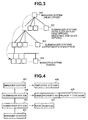
- a system having the above-mentioned characteristics is a system in a hierarchical configuration for acquiring the property information on a submanager system from a manager system as shown in FIG. 3.
- the present invention executes the following means. If an information acquisition requirement is made from the manager system to a managed system, it is determined in the submanager systems on the routes to that managed system whether or not to issue a same information acquisition requirement.
- the submanager systems acquire the response result if it is necessary, and pass the response result to the manager system.
- This configuration can prevent same data from flowing over a route in a duplicated, redundant manner.
- the submanager system can pass the stored response result to a particular information acquisition requirement to the manager system or a submanager system in an upper layer that issued the requirement. Consequently, this configuration reduces the data traffic on the route from that submanager system to the managed system.
- systems are used for example for managing the property information of managed systems in a multilayer network environment as shown in FIG. 3 (although not shown in FIG. 3, business hubs such as business offices, branches, and sales offices and the departments in each of these hubs also have multiple submanager systems and managed systems) . It is assumed here that the submanager systems in the multilayer network environment be subordinate to the manager system and the submanager systems in every layers does not depend on the information about the other submanager systems in that layer. The following outlines the flow of processing.
- the manager system issues an information acquisition requirement, and by repeating the merging of the items of required information and downloading item files in the submanager systems, the manager system requires information from the managed system.
- a file containing the result of property information inputted in the managed system is uploaded into the manager system through the submanager systems.
- each submanager system updates the information with respect to the items defined by itself and uploads the other items to the upper submanager system.
- the submanager system comprises a main manager program (802), a merge processing block (hereafter referred to as merge-process) (805) that receives an item file composed of item groups downloaded from the upper-layer manager system and merges the received items, an update processing block (hereafter referred to as update-process) (804) that receives a result file composed of the items and property information from the lower-layer system (the lower-layer manager system or the managed system) and updates the property information, an edit processing block (hereafter referred to as edit-process) (803) that edits items managed in its own system, a user terminal (801) on which information display and operation are executed, and a DB (Database) (806) storing the items and property information.
- the structure of the DB is as shown in FIG. 7 in which each item has an attribute field.
- one of three statuses is set: "0" an item managed by the system in a current layer (hereafter also referred to as “this system") indicative that the item is managed in the layer of this current system; "1" an item managed by upper system indicative that the item is managed by the upper system; and "2" a common item indicative that this item is common to this system and the upper system.
- this system an item managed by the system in a current layer
- the submanager system in each layer can be realized by the similar configuration to that of the submanager systems in the other layers.
- the program of the manager system at the top of the multilayer environment has no merge-process.
- edit-process the contents of the DB of this system are displayed and edited.
- the output of edit-process can also be directed to a file or a printer in a free form in addition to the display device of the user terminal.
- edit-process addition and deletion of items and attribute change of items can be performed.
- FIG. 9 shows one example of the edit screen.
- FIGS. 10 and 11 show flowcharts indicative of the edit operation. A list of items and their attributes are displayed on the display device of the user terminal (S301) and the system wait for an input operation by the user (S302).
- this system extracts the items from the DB of this system and downloads the item file containing the extracted items to the lower submanager system or the managed system directed connected to this system (S304), upon which the editing is ended. If no editing has been performed, the file downloading is not performed. If the addition of an item is instructed (S305), this system adds the specified item to its DB, specifies the attribute of the added item as the item managed by this system ("0") (S306), and waits for another operation to be inputted by the user (S302).
- this system deletes the specified item from its DB directly provided that the attribute of the item to be deleted is the item managed by this system ("0") (the property information is also deleted if it is set for the item) (S309). If the attribute is the item managed by upper system (“1"), this system outputs an error message (S311). If the attribute is the common item ("2"), this system changes the attributes to the item managed by upper system (“1") (S310).
- this system waits for an operation to be inputted by the user (S302). If the change of an item attribute is instructed (S312), the attribute of that item is changed from the item managed by upper system ("1") to the common item ("2"), or if the instruction is vice verse, the attribute of that item is changed (S314) from the common item ("2") to the item managed by upper system (“1"), outputs error message (S315) and waits for operation to be inputted by the user.
- this system outputs error message (S316) and waits for operation to be inputted by the user (S302). It is practicable to determine particular button operations that will cause an error and deactivate the buttons concerned in advance to prevent the user from operating them.
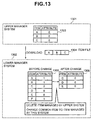
- merge-process is performed in a lower manager system shown in the transition diagrams. In the initial state, this manager system is waiting for the downloading of data from the upper manager system or the manager system (S001). At this moment, the items in the DBs of the upper and lower manager systems are as shown in FIG. 12.
- this lower manager system deletes all items having the attribute of the item managed by upper system ("1") (S002).
- this system changes the common item ("0") to the item managed by this system (“0") (S003).
- the states of the items in the DBs of the upper and lower manager systems are shown in FIG. 13.
- this lower manager system opens the downloaded item file (1304) and reads the items (S004).
- this system prepares an item file containing the extracted item data from its own DB and downloads the prepared item file to the directly connected submanager system or managed system (S008) in lower layer and waits for another downloading operation (S008 to S001).
- This submanager system reads the items one by one in the item file (1304) and checks its own DB for any same item (S006). If the same item is found, this system updates its DB by changing the attribute of the same item to the common item ("2") and starts reading the next items (S009 to S004). If there is no same item, this system adds the read items to its DB and sets the attribute of the read item to the item managed by upper system ("1") and starts reading the next items (S007 to S004).
- FIG. 14 shows one example of the DB update operation performed in accordance with the flowchart of merge-process.
- item A, item B, and item C are downloaded to this system (lower manager system) from its upper manager system to be merged with item C, item D, and item E held in this system, the result of merge-process being displayed in the after-change table.
- item C through item B are downloaded to the system in further lower layer connected to this system.
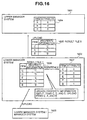
- this system opens the uploaded result file 1 (1606) and reads the items and property information contained in the file (S102).
- this system searches its DB for the read item. If the attribute of the detected item is the item managed by upper system ("1") (S104), then this system writes the item and the property information in the result file 1 to a result file 2 (1605) to upload it to the upper manager system (S105) and starts reading next item and property information (S102). If the attribute of the detected item is other than the item managed by upper system (“1") (S104), this system updates the property information of the item concerned in the DB of this system (S107).
- this system If the attribute of the detected item is the common item ("2") (S108), this system writes the item and property information in the result file 1 (1606) to the result file 2 (1605) to upload it to its upper manager system and starts reading next item and property information (S102). When this system has read all items and property information, it uploads the prepared result file 2 (1605) to the upper manager system (S106) and then waits again for the uploading of the result file 1 (1606) from the lower-layer system (S101).
- FIG. 16 shows that the property information about item C, item D, and item E of the result file 1 (1606) are reflected on the DB, and item A, item B, and item C have been uploaded to the upper system.
- the attribute of item C is the common item, it is reflected (updated) on the DB and uploaded to the upper system, thereby preventing the duplication of item C from being occurred.
- the above-mentioned method prevents data of any same item between the manager system and the managed system from being transferred in a duplicated manner, thereby enhancing the efficiency of the data transfer.
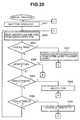
- the processing to be performed is generally in the same manner as that of the embodiment 1, except for the implementation method and merge-process. Therefore, the following describes mainly Merger-Process with reference to the state transition diagrams shown in FIGS. 18 and 19 and the flowchart shown in FIG. 20. The other processing will be described only in the portions different from those of the embodiment 1.
- this system attaches an operation flag to each item to be downloaded. To this operation flag indicating operation status, either "A" indicative of addition or "D" indicative of deletion is set (1805).
- the upper manager system stores the information edited in edit-process of items (processing for storing operation history is added behind each operation processing described in the flowcharts shown in FIGS. 10 and 11) and adds the operation flag to each item in the item file (1805) to be downloaded upon completion of edit-process (only the items manipulated in S304 of FIG. 10 are extracted and item adding processing is performed for the item preparing processing).
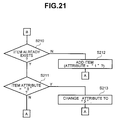
- this system changes the attribute from the common item to the item managed by this system ("0") and reads a next item (step S204, S205, S206, S209, A). If the operation flag is addition (“A") and there is no item, this system adds an item to the DB, sets the attributes of this item to the item managed by upper system (“1"), and reads a next item (S204, S210, S212, A).
- this system sets the attribute of this item to the common item ("2") and reads a next item (S204, S210, S211, S213, A). Then, for the other combinations of statuses than those mentioned above, this system does nothing but reading a next item (A).
- this system downloads the item file that was received from the upper manager system to all the submanager systems and managed systems in the lower layer connected thereto without change (S207) and waits for the downloading of another item file from the upper manager system (S207 to C).
- FIG. 19 shows that item A deleted by the upper manager system and item D and item X added by the upper manager system are downloaded, the downloaded items are merged with the items held in the lower manager system, item D is newly added as the item managed by upper system, and the attribute of item X is changed to the common item.
- the second embodiment prevents a same item from being transferred in a duplicated manner and requires only a constant size of the item file to be downloaded which is a difference equivalent to the change made to the file.
- each manager system has only the items that are managed by this system (on its own) only and has no attribute information, and each of the managed systems holds a requirement system (the program configuration for the embodiment 3 is the same as that of the embodiment 1).
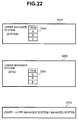
- the states of the items in the DB of each manager system are as shown in FIG. 22.
- "SYSTEM” is set to the upper manager system and "SITE" to this lower manager system.
- the upper system holds items A, B, and C and this system holds items C, D, and E.
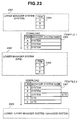
- Each item file to be downloaded is composed of items and manager system names for managing these items as shown in FIG. 23.
- an item file 1 (2305) has been downloaded from the upper manager system to this system in the download-waiting state (S401), this system reads an item and its manager system name from the downloaded file (S402).
- this system adds the name of this system as a manager system to the duplicating name and its manager system name and writes the result to an item file 2 (2307) to be downloaded to the lower-layer system (S408). If no duplicating item is found, this system writes the items and their manager system names to the item file 2 (2307) without change, to be downloaded to the lower-layer system (S405).
- this system extracts the items managed by this system that are not duplicating, adds the name of this system to each of these items as the manager system name, writes these items to the item file 2 (2307) to be downloaded to the lower-layer system (S406), downloads the prepared item file 2 (2307) to the lower-layer system (S407), and waits for the downloading of the item file 1 (2305) from the upper manager system (S401).
- FIG. 23 shows the downloading of the item files. Because item C is duplicated in both the upper manger system (SYSTEM) and the lower manager system (SITE), system names "SYSTEM” and "SITE" are set as manager system names. Each managed system holds the item file in the form of an item file to be downloaded (in other words, the managed system holds the information about which item is to be returned to which manager system).
- SYSTEM upper manger system
- SITE lower manager system
- a result file is prepared in combinations of item, property information, and manager system name.
- the prepared result file is uploaded to the upper system of the managed system.
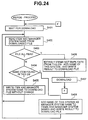
- this system In the initial state, this system (SITE) is waiting for the uploading of a result file 1 (2505)(SS01) from the system immediately below.
- a result file 1 2505)(SS01) from the system immediately below.
- this system opens it and reads the items, property information, and manager system names for one entry (S502).
- this system updates the property information in its DB (S507), deleting the name of this system from the manager system names (S508). If another system name exists in the manager system names (S509), this system writes the entry with the name of this system removed to a result file 2 (2507) to be uploaded as a result file to its upper manager system (S505).
- this system does not update the entry and writes the entry as it is to the result file 2 (2507) (S505).
- this system Upon reading all entries (S503), this system uploads the prepared result file 2 (2507) to its upper manager system (S506) and waits again until the result file 1 (2505) is uploaded from its lower-layer system (S501).
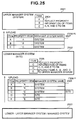
- FIG. 25 shows the flow of the result files, in which property items A, B, C, D, and E are uploaded as a result from its lower-layer system and this system (SITE) updates its DB with respect to items C, D, and E, uploading the result file containing items A, B, and C to its upper manager system (SYSTEM).
- SITE system
- SYSTEM upper manager system
- edit-process is executed only to edit the items of this system and therefore no special processing is executed. For this reason, the description of edit-process is skipped.
- the embodiment 3 prevents the duplicated transfer of items common to the manager system and the managed system to realize efficient data transmission in a method different from those of the embodiments 1 and 2.
- This embodiment in addition to the capabilities of embodiment 1, provides a capability of allowing each submanager system to define in advance default items and their property information. The following describes this method with reference to FIGS. 27 through 29.
- FIG. 27 shows the initial states of the manager system and submanager systems in which the manager system of the head office prepares items "business office code", “department code”, "name”, “extension number”, the submanager system of the business office defines "business office code” and the submanager system of the department defines "department code” as defaults. Addition and deletion of default items can be executed as a part of edit-process.
- FIG. 28 shows a processing flow in which an item file is downloaded to each system.
- An item file (2805) is downloaded from the manager system of the head office to the submanager system of the business office.
- the submanager system of the business office compares the item names in the item file with the default item names. If a matching name is found, the submanager system stores the matching item and its property information into the default DB. Then, the submanager system of the business office downloads an item file (2808) of "department code,” "name”, and "extension number” with "business office code” removed therefrom to the submanager system of the department.
- the submanager system of the department processes "department code” in the same manner and downloads an item file (2811) composed of "name” and “extension number” and sets property information for that item. It should be noted that the items and their property information stored in the default DB are deleted when new items are downloaded from the upper manager system.
- FIG. 29 shows the processing flow in which result files are uploaded.
- the managed system uploads a result file to the submanager system of the department.
- the submanager system of the department adds the item and property information in the default DB to the result file and uploads it to the submanager system of the business office.
- the submanager system of the business office carries out the same processing as described above, uploading the result file to the manager system of the head office, the result file storing the property information of all items.
- the current embodiment can be actually implemented by adding particular processing to the processing flow of embodiment 1.
- this system adds processing in which the contents of the default DB are all deleted upon downloading of an item file (this processing is added under S003 of FIG. 15).
- This system checks the downloaded items for an default item. After entering property information of the same time as the default item into the default DB. This system adds processing in which no file is downloaded to the lower-layer system (this processing is added under S005 of FIG. 15). Then, when the information is uploaded in update-process, this system adds processing in which the items and their default values are additionally written to the result file to be uploaded to the upper manager system (this processing is added so that it is executed when the file has all been read in S103 of FIG. 17).
- embodiment 4 can reduce the amount of data transfer by the items defined by default.
- this system determines in the method of embodiment 4 whether there is any default item in the items downloaded by the submanager system to this system. If a default item is found, this system enters the property information of the same item into the default DB. Then, if there is no more item to be downloaded to the manager system or the managed system in lower layer (if this system has set the default items for all items), this system extracts the items and property information from the default DB, prepares a result file, and uploads it to the upper manager system.
- embodiment 5 can be realized by adding particular processing to the flow of embodiment 1 on which the capabilities of embodiment 4 are implemented.
- this system determines whether there is any item file which is downloaded to the lower-layer manager system or the managed system. If such an item file is found, this system downloads it. If no such item file is found, this system adds processing in which all contents of the default DB are extracted, a result file is prepared to be uploaded to the upper manager system, and uploads the prepared result file to the upper system (this processing is added under S008 of FIG. 15).
- the method of embodiment 5 can prevent the data transfer from the submanager system which has completed the input of property information by items defined by default to the managed system.
- this method enhances the efficiency of data transfer over one route of network in a hierarchical network environment, which in turn realizing the efficient data transfer over the entire network.
Landscapes
- Engineering & Computer Science (AREA)
- Databases & Information Systems (AREA)
- Theoretical Computer Science (AREA)
- Data Mining & Analysis (AREA)
- Physics & Mathematics (AREA)
- General Engineering & Computer Science (AREA)
- General Physics & Mathematics (AREA)
- Information Retrieval, Db Structures And Fs Structures Therefor (AREA)
- Data Exchanges In Wide-Area Networks (AREA)
Abstract
Description
Claims (20)
- A method of data transfer in a hierarchical network comprising the steps of:receiving first data including an item from an upper system;updating attribute information corresponding to said item held in a current system and adding second data held in said current system to said first data; andsending said first data and said second data to a lower system.
- The method of data transfer as claimed in claim 1, further comprising the steps of:if said item included in said received first data exists in said current system, updating said existing item;changing attribute information for said item held in said current system to a value indicative of common data;if said item does not exist in said current system, adding said item to said current system; andchanging said attribute information for said item held in said current system to a value indicative of data which is prepared by said upper system.
- The method of data transfer as claimed in claim 1, still further comprising the steps of:receiving at least one of edit requirements for addition and deletion of said item; andchanging attribute information for said item held in said current system according to the change of said item and item content of said current system corresponding to said item.
- A method of data transfer in a hierarchical network comprising the steps of:receiving an item and data stored in first data coming from a lower system;if said item exists in a database of said current system and attribute information corresponding to said item indicates a value managed by an upper system, reading data included in said first data and storing the read data into second data; andsending said second data to said upper system.
- The method of data transfer as claimed in claim 4, wherein, if said attribute information corresponding to said item indicates a value not managed by said upper system, said data is stored in said current system.
- The method of data transfer as claimed in claim 1, wherein said first data includes an operation flag indicative of either one of item addition or item deletion, and addition of said item to said current system is determined on the basis of said operation flag and information indicative of existence or absence of said item in said current system.
- The method of data transfer as claimed in claim 1, wherein said second data holds manager system information indicative of that said item is the data associated with said current system and whether said item is processed or not is determined on the basis of said manager system information.
- A method of data transfer in a hierarchical network comprising the steps of:receiving from a lower system an item and data included in first data and manager system information indicative of whether said item is the data associated with a current system;if said manager system information is the data associated with said current system, updating a content of an item held in said current system by use of said data;if said manager system information has information indicative of another system, deleting the information indicative of said current system;forming second data by said item, said data, and the manager system information with the information indicative of said current system deleted; andsending said second data to an upper system.
- A method of data transfer in a hierarchical network comprising the steps of:receiving first data from a lower system;forming second data by an item corresponding to default information held in a current system and data included in said first data; andsending said second data to an upper system.
- A method of data transfer in a hierarchical network comprising the steps of:receiving first data from an upper system;storing into a current system an item included in said first data, said item corresponding to default information held in said current system;storing data with said item corresponding to said default information of said current system deleted from said first data into second data; andsending said second data to a lower system.
- The method of data transfer as claimed in claim 10, wherein data to be sent to said upper system forms said second data when there is no more data to be sent to said lower system after deleting said item corresponding to said default information of said current system from said first data and said second data is sent to said upper system.
- A data transfer apparatus for use in a hierarchical network comprising:a receiving block for receiving first data including an item from an upper system;a merge processing block for updating attribute information corresponding to said item and held in a current system and adding second data held in said current system to said first data; anda sending block for sending said first data and said second data to a lower system.
- The data transfer apparatus as claimed in claim 12, wherein said merge processing block updates said existing item, if said item included in said received first data exists in said current system; changes attribute information for said item held in said current system to a value indicative of common data; adds said item to said current system, if said item does not exist in said current system; and changes said attribute information for said item held in said current system to a value indicative of data which is prepared by said upper system.
- The data transfer apparatus as claimed in claim 12, further comprising:an edit processing block for receiving at least one of edit requirements for addition and deletion of said item and changing attribute information for said item held in current system according to the change of said item and item content of said current system corresponding to said item.
- A data transfer apparatus for use in a hierarchical network comprising:a receiving block for receiving an item and data stored in first data coming from a lower system;an update processing block for, if said item exists in a database of a current system and attribute information corresponding to said item indicates a value managed by an upper system, reading said data included in said first data and storing the read data into second data; anda sending block for sending said second data to said upper system.
- The data transfer apparatus as claimed in claim 15, wherein, if said attribute information corresponding to said item is a value indicative of common manager item, said updating processing block stores said data into said current system.
- The data transfer apparatus as claimed in claim 12, wherein said first data includes an operation flag indicative of either one of item addition or item deletion, and said merge processing block determines whether or not to add said item to said current system on the basis of said operation flag.
- The data transfer apparatus as claimed in claim 12, wherein said second data holds manager system information indicating that said item is data associated with said current system and said merge processing block determines whether or not to process said item on the basis of said manager system information.
- A recording medium readable by a computer storing a program for executing the data transfer method cited in claim 1.
- A recording medium readable by a computer storing a program for executing the data transfer method cited in claim 2.
Applications Claiming Priority (2)
| Application Number | Priority Date | Filing Date | Title |
|---|---|---|---|
| JP1801199 | 1999-01-27 | ||
| JP1801199 | 1999-01-27 |
Publications (3)
| Publication Number | Publication Date |
|---|---|
| EP1024439A2 true EP1024439A2 (en) | 2000-08-02 |
| EP1024439A3 EP1024439A3 (en) | 2003-09-24 |
| EP1024439B1 EP1024439B1 (en) | 2009-03-11 |
Family
ID=11959744
Family Applications (1)
| Application Number | Title | Priority Date | Filing Date |
|---|---|---|---|
| EP00300410A Expired - Lifetime EP1024439B1 (en) | 1999-01-27 | 2000-01-20 | Data transfer method, apparatus and recording medium for use in a hierarchical system |
Country Status (3)
| Country | Link |
|---|---|
| US (1) | US7702769B2 (en) |
| EP (1) | EP1024439B1 (en) |
| DE (1) | DE60041732D1 (en) |
Cited By (2)
| Publication number | Priority date | Publication date | Assignee | Title |
|---|---|---|---|---|
| US7380078B2 (en) | 2003-11-21 | 2008-05-27 | Hitachi, Ltd. | Method of monitoring status information of remote storage and storage subsystem |
| US7467234B2 (en) | 2004-06-09 | 2008-12-16 | Hitachi, Ltd. | Computer system |
Families Citing this family (3)
| Publication number | Priority date | Publication date | Assignee | Title |
|---|---|---|---|---|
| JP4696025B2 (en) * | 2006-05-25 | 2011-06-08 | 富士通株式会社 | Computing system and data update method |
| US9003018B2 (en) * | 2011-09-15 | 2015-04-07 | Ca, Inc. | System and method for data set synchronization and replication |
| US9584367B2 (en) * | 2013-11-05 | 2017-02-28 | Solarwinds Worldwide, Llc | Node de-duplication in a network monitoring system |
Family Cites Families (28)
| Publication number | Priority date | Publication date | Assignee | Title |
|---|---|---|---|---|
| US4638425A (en) * | 1982-09-29 | 1987-01-20 | International Business Machines Corporation | Peripheral data storage having access controls with error recovery |
| JPH01243168A (en) | 1988-03-24 | 1989-09-27 | Nec Corp | System for managing directory |
| US5408610A (en) * | 1988-05-18 | 1995-04-18 | Canon Kabushiki Kaisha | Communication control apparatus which communicates management information in a communication system |
| JPH0362257A (en) * | 1989-07-31 | 1991-03-18 | Toshiba Corp | Network monitoring system |
| US5673252A (en) * | 1990-02-15 | 1997-09-30 | Itron, Inc. | Communications protocol for remote data generating stations |
| GB9222884D0 (en) * | 1992-10-30 | 1992-12-16 | Massachusetts Inst Technology | System for administration of privatization in newly democratic nations |
| US5655118A (en) * | 1994-03-21 | 1997-08-05 | Bell Communications Research, Inc. | Methods and apparatus for managing information on activities of an enterprise |
| US5765155A (en) * | 1994-05-11 | 1998-06-09 | Nec Corporation | Master data managing method |
| JP3085141B2 (en) | 1994-05-11 | 2000-09-04 | 日本電気株式会社 | Master data management method |
| JP3569827B2 (en) | 1994-06-20 | 2004-09-29 | 株式会社日立製作所 | Network system status diagnosis / monitoring device |
| JP3512866B2 (en) * | 1994-09-19 | 2004-03-31 | 富士通株式会社 | Grouping of nodes in network and data transfer method |
| US5721914A (en) * | 1995-09-14 | 1998-02-24 | Mci Corporation | System and method for hierarchical data distribution |
| US5751914A (en) * | 1995-10-10 | 1998-05-12 | International Business Machines Corporation | Method and system for correlating a plurality of events within a data processing system |
| US5706431A (en) * | 1995-12-29 | 1998-01-06 | At&T | System and method for distributively propagating revisions through a communications network |
| JP3609562B2 (en) * | 1996-11-15 | 2005-01-12 | 株式会社日立製作所 | Network management system |
| US5812773A (en) * | 1996-07-12 | 1998-09-22 | Microsoft Corporation | System and method for the distribution of hierarchically structured data |
| WO1998012650A1 (en) * | 1996-09-18 | 1998-03-26 | Mci Communications Corporation | System and method for hierarchical data distribution |
| US5924116A (en) * | 1997-04-02 | 1999-07-13 | International Business Machines Corporation | Collaborative caching of a requested object by a lower level node as a function of the caching status of the object at a higher level node |
| JP3028783B2 (en) * | 1997-04-25 | 2000-04-04 | 日本電気株式会社 | Network monitoring method and device |
| JP3080034B2 (en) | 1997-05-07 | 2000-08-21 | 日本電気株式会社 | Network communication system and method, network terminal device, information storage medium |
| US6161145A (en) * | 1997-05-08 | 2000-12-12 | International Business Machines Corporation | Updating server-related data at a client |
| US6085193A (en) * | 1997-09-29 | 2000-07-04 | International Business Machines Corporation | Method and system for dynamically prefetching information via a server hierarchy |
| US6061692A (en) * | 1997-11-04 | 2000-05-09 | Microsoft Corporation | System and method for administering a meta database as an integral component of an information server |
| FR2777723B1 (en) * | 1998-04-15 | 2000-06-23 | Bull Sa | METHOD AND SYSTEM FOR ADMINISTERING NETWORKS AND SYSTEMS |
| US6360222B1 (en) * | 1998-05-06 | 2002-03-19 | Oracle Corporation | Method and system thereof for organizing and updating an information directory based on relationships between users |
| US6338117B1 (en) * | 1998-08-28 | 2002-01-08 | International Business Machines Corporation | System and method for coordinated hierarchical caching and cache replacement |
| US6516327B1 (en) * | 1998-12-24 | 2003-02-04 | International Business Machines Corporation | System and method for synchronizing data in multiple databases |
| US6370618B1 (en) * | 1999-11-09 | 2002-04-09 | International Business Machines Corporation | Method and system for allocating lower level cache entries for data castout from an upper level cache |
-
2000
- 2000-01-20 EP EP00300410A patent/EP1024439B1/en not_active Expired - Lifetime
- 2000-01-20 DE DE60041732T patent/DE60041732D1/en not_active Expired - Lifetime
-
2005
- 2005-02-28 US US11/066,281 patent/US7702769B2/en not_active Expired - Fee Related
Cited By (5)
| Publication number | Priority date | Publication date | Assignee | Title |
|---|---|---|---|---|
| US7380078B2 (en) | 2003-11-21 | 2008-05-27 | Hitachi, Ltd. | Method of monitoring status information of remote storage and storage subsystem |
| US7380079B2 (en) | 2003-11-21 | 2008-05-27 | Hitachi, Ltd. | Method of monitoring status information of remote storage and storage subsystem |
| US7769969B2 (en) | 2003-11-21 | 2010-08-03 | Hitachi, Ltd. | Method of monitoring status information of remote storage and storage subsystem |
| US7467234B2 (en) | 2004-06-09 | 2008-12-16 | Hitachi, Ltd. | Computer system |
| US7739371B2 (en) | 2004-06-09 | 2010-06-15 | Hitachi, Ltd. | Computer system |
Also Published As
| Publication number | Publication date |
|---|---|
| US20050154791A1 (en) | 2005-07-14 |
| US7702769B2 (en) | 2010-04-20 |
| EP1024439B1 (en) | 2009-03-11 |
| DE60041732D1 (en) | 2009-04-23 |
| EP1024439A3 (en) | 2003-09-24 |
Similar Documents
| Publication | Publication Date | Title |
|---|---|---|
| US7035853B2 (en) | Document management method and document management device | |
| US8566729B2 (en) | Joint editing of an on-line document | |
| JPH0934763A (en) | Device and method for managing file | |
| JP2000040104A (en) | Workflow management method | |
| JP2009116806A (en) | Progress management method, program, and progress management device | |
| EP1024439B1 (en) | Data transfer method, apparatus and recording medium for use in a hierarchical system | |
| US5734381A (en) | Cancel undo method and system for tree structure data edition based on hierarchical menu inquiry | |
| JPH1063751A (en) | Workflow system and work division method | |
| JP3970205B2 (en) | Project information management apparatus and program | |
| JPH10105616A (en) | Process flow creation / editing device | |
| US6799183B2 (en) | Operation assistance method and system and recording medium for storing operation assistance method | |
| JP3871794B2 (en) | E-mail system and program storage medium thereof | |
| JP3446693B2 (en) | Data transfer method and recording medium | |
| JP4385643B2 (en) | Data transfer method, apparatus and recording medium | |
| JP4360089B2 (en) | Data transfer method, apparatus and recording medium | |
| JPH09204465A (en) | Organization chart output device | |
| JP3736467B2 (en) | Cable management system and management method | |
| KR200206675Y1 (en) | System to posting post at internet board automatically | |
| JPH0687225B2 (en) | File service request processing method and apparatus | |
| JP2907174B2 (en) | User interface system for supervisory control system | |
| JP3143930B2 (en) | Data processing device | |
| JPH0762842B2 (en) | Document management device | |
| JP2002109166A (en) | Document approval system | |
| CN114880316A (en) | Client data processing method, system, electronic device and readable storage medium | |
| JPH0626429B2 (en) | Facsimile transmitter |
Legal Events
| Date | Code | Title | Description |
|---|---|---|---|
| PUAI | Public reference made under article 153(3) epc to a published international application that has entered the european phase |
Free format text: ORIGINAL CODE: 0009012 |
|
| 17P | Request for examination filed |
Effective date: 20000209 |
|
| AK | Designated contracting states |
Kind code of ref document: A2 Designated state(s): AT BE CH CY DE DK ES FI FR GB GR IE IT LI LU MC NL PT SE |
|
| AX | Request for extension of the european patent |
Free format text: AL;LT;LV;MK;RO;SI |
|
| PUAL | Search report despatched |
Free format text: ORIGINAL CODE: 0009013 |
|
| AK | Designated contracting states |
Kind code of ref document: A3 Designated state(s): AT BE CH CY DE DK ES FI FR GB GR IE IT LI LU MC NL PT SE |
|
| AX | Request for extension of the european patent |
Extension state: AL LT LV MK RO SI |
|
| 17Q | First examination report despatched |
Effective date: 20031126 |
|
| AKX | Designation fees paid |
Designated state(s): DE FR GB |
|
| 17Q | First examination report despatched |
Effective date: 20031126 |
|
| GRAP | Despatch of communication of intention to grant a patent |
Free format text: ORIGINAL CODE: EPIDOSNIGR1 |
|
| RTI1 | Title (correction) |
Free format text: DATA TRANSFER METHOD, APPARATUS AND RECORDING MEDIUM FOR USE IN A HIERARCHICAL SYSTEM |
|
| GRAS | Grant fee paid |
Free format text: ORIGINAL CODE: EPIDOSNIGR3 |
|
| GRAA | (expected) grant |
Free format text: ORIGINAL CODE: 0009210 |
|
| AK | Designated contracting states |
Kind code of ref document: B1 Designated state(s): DE FR GB |
|
| REG | Reference to a national code |
Ref country code: GB Ref legal event code: FG4D |
|
| REF | Corresponds to: |
Ref document number: 60041732 Country of ref document: DE Date of ref document: 20090423 Kind code of ref document: P |
|
| PLBE | No opposition filed within time limit |
Free format text: ORIGINAL CODE: 0009261 |
|
| STAA | Information on the status of an ep patent application or granted ep patent |
Free format text: STATUS: NO OPPOSITION FILED WITHIN TIME LIMIT |
|
| 26N | No opposition filed |
Effective date: 20091214 |
|
| PGFP | Annual fee paid to national office [announced via postgrant information from national office to epo] |
Ref country code: FR Payment date: 20120202 Year of fee payment: 13 |
|
| PGFP | Annual fee paid to national office [announced via postgrant information from national office to epo] |
Ref country code: DE Payment date: 20120118 Year of fee payment: 13 |
|
| PGFP | Annual fee paid to national office [announced via postgrant information from national office to epo] |
Ref country code: GB Payment date: 20120118 Year of fee payment: 13 |
|
| GBPC | Gb: european patent ceased through non-payment of renewal fee |
Effective date: 20130120 |
|
| REG | Reference to a national code |
Ref country code: FR Ref legal event code: ST Effective date: 20130930 |
|
| PG25 | Lapsed in a contracting state [announced via postgrant information from national office to epo] |
Ref country code: DE Free format text: LAPSE BECAUSE OF NON-PAYMENT OF DUE FEES Effective date: 20130801 |
|
| REG | Reference to a national code |
Ref country code: DE Ref legal event code: R119 Ref document number: 60041732 Country of ref document: DE Effective date: 20130801 |
|
| PG25 | Lapsed in a contracting state [announced via postgrant information from national office to epo] |
Ref country code: FR Free format text: LAPSE BECAUSE OF NON-PAYMENT OF DUE FEES Effective date: 20130131 Ref country code: GB Free format text: LAPSE BECAUSE OF NON-PAYMENT OF DUE FEES Effective date: 20130120 |