EP1024432A2 - Performance counter for monitoring multiple events - Google Patents
Performance counter for monitoring multiple events Download PDFInfo
- Publication number
- EP1024432A2 EP1024432A2 EP00300454A EP00300454A EP1024432A2 EP 1024432 A2 EP1024432 A2 EP 1024432A2 EP 00300454 A EP00300454 A EP 00300454A EP 00300454 A EP00300454 A EP 00300454A EP 1024432 A2 EP1024432 A2 EP 1024432A2
- Authority
- EP
- European Patent Office
- Prior art keywords
- events
- monitoring
- monitoring period
- sub
- storage
- Prior art date
- Legal status (The legal status is an assumption and is not a legal conclusion. Google has not performed a legal analysis and makes no representation as to the accuracy of the status listed.)
- Withdrawn
Links
Images



Classifications
-
- G—PHYSICS
- G06—COMPUTING OR CALCULATING; COUNTING
- G06F—ELECTRIC DIGITAL DATA PROCESSING
- G06F11/00—Error detection; Error correction; Monitoring
- G06F11/30—Monitoring
- G06F11/34—Recording or statistical evaluation of computer activity, e.g. of down time, of input/output operation ; Recording or statistical evaluation of user activity, e.g. usability assessment
- G06F11/3409—Recording or statistical evaluation of computer activity, e.g. of down time, of input/output operation ; Recording or statistical evaluation of user activity, e.g. usability assessment for performance assessment
-
- G—PHYSICS
- G06—COMPUTING OR CALCULATING; COUNTING
- G06F—ELECTRIC DIGITAL DATA PROCESSING
- G06F11/00—Error detection; Error correction; Monitoring
- G06F11/30—Monitoring
- G06F11/34—Recording or statistical evaluation of computer activity, e.g. of down time, of input/output operation ; Recording or statistical evaluation of user activity, e.g. usability assessment
- G06F11/3466—Performance evaluation by tracing or monitoring
-
- G—PHYSICS
- G06—COMPUTING OR CALCULATING; COUNTING
- G06F—ELECTRIC DIGITAL DATA PROCESSING
- G06F2201/00—Indexing scheme relating to error detection, to error correction, and to monitoring
- G06F2201/86—Event-based monitoring
-
- G—PHYSICS
- G06—COMPUTING OR CALCULATING; COUNTING
- G06F—ELECTRIC DIGITAL DATA PROCESSING
- G06F2201/00—Indexing scheme relating to error detection, to error correction, and to monitoring
- G06F2201/87—Monitoring of transactions
-
- G—PHYSICS
- G06—COMPUTING OR CALCULATING; COUNTING
- G06F—ELECTRIC DIGITAL DATA PROCESSING
- G06F2201/00—Indexing scheme relating to error detection, to error correction, and to monitoring
- G06F2201/88—Monitoring involving counting
-
- G—PHYSICS
- G06—COMPUTING OR CALCULATING; COUNTING
- G06F—ELECTRIC DIGITAL DATA PROCESSING
- G06F2201/00—Indexing scheme relating to error detection, to error correction, and to monitoring
- G06F2201/885—Monitoring specific for caches
Definitions
- This invention generally relates to hardware performance counters and, more specifically, to performance counters that provide two-dimensional monitoring capabilities.
- SMP symmetric multiprocessor
- an SMP computer system comprises multiple processors connected through a cache hierarchy to a shared bus. Additionally connected to the bus is a memory, which is also shared among the processors in the system.
- processors are often configured with internal caches, and one or more caches are typically included in the cache hierarchy between the processors and the shred bus in an SMP computer system. Multiple copies of data residing at a particular main memory address may be stored in these caches.
- shared bus computer systems employ cache coherency. These systems, as well as other complex computer systems, typically employ complex protocols for purposes such as optimizing the system overall performance.
- Bottleneck conditions may significantly alter the total time (i.e. the speed) that is needed to complete the execution of a set of instructions or a computation task. Further bottleneck conditions may occur in more than one component in the computer system. The occurrence and severity of bottleneck conditions depend on several factors such as the characteristics of the computer system, the task being performed, and the type of instructions being executed.
- Performance counters have been used to identify bottleneck conditions in computer systems. They may be used to evaluate a system's performance and subsequently to optimize its performance. Performance counters can be implemented either hardware or software. Both hardware and/or software performance counters have been used in evaluating and optimizing the performance of computer systems.
- Software performance counters typically monitor a particular component through the execution of a set of instructions. Since the software performance counter has itself to be executed by the computer system, an operating aspect of the component being monitored may be needed to execute the software. Therefore software performance counters have a potential to interfere with the operation of the component being monitored. Such interference may affect the accuracy of the evaluation results that are sought by employing the software performance counter.
- Hardware performance counters may be employed to monitor specific signals associated with the operation of a component. Hardware performance counters may be designed as embedded units within the components to be monitored or within the computer system. Typically, no execution of software is needed to operate the hardware performance counter. Accordingly, they tend to interfere less with the operation of the components being monitored when compared to software performance counters.
- the hardware performance counter may be set to monitor the occurrence of a specific event within the component for a specific period of time, or monitoring period.
- the monitoring data obtained by such performance counters typically does not provide enough information to precisely and thoroughly evaluate bottleneck and/or other operating conditions. Therefore, the designer may have insufficient information to modify the system for optimal performance, or may otherwise consume much time and effort to optimize the system design. Accordingly, a hardware performance counter is desired to provide a more comprehensive evaluation of a computer system component
- the performance counter to monitor a plurality of events that may occur in a component within a computer system during a monitoring period or testing period.
- the monitoring results may be used to provide histogram representations of the component performance.
- the performance counter comprises a first storage, a second storage, programmable control logic, and a counting mechanism.
- the first storage is configured to store information indicative of a plurality of events to be monitored and the monitoring period for each event.
- the second storage is configured to store counting results obtained during the testing period.
- a counting mechanism which is coupled to the second storage, is configured to monitor the occurrence of the events in the component under test.
- the counting mechanism is coupled to the control logic and the control logic is coupled to the first storage.
- the control logic is configured to control the counting mechanism based upon the information stored in the first storage such that two or more events are counted during the monitoring period.
- the counting results include a count for each event from the events being monitored during the monitoring period.
- the count is indicative of a frequency of occurrence of the corresponding event
- the performance counter provides two-dimensional data on the performance of the component under test. Accordingly, the monitoring data may be used to develop a histogram performance representation that provides the designer with accurate and precise evaluations of the system performance.
- the performance counter may be embedded within a system memory, a cache, a cache controller, a bus, a buffer, an interconnect, a queue, a snoop controller, a processor, an input/output device, or other component within the computer system. Further, two or more performance counters may be employed to monitor two or more components within the computer system during the same monitoring or testing period.
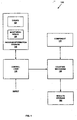
- Figure 1 a block diagram of a histogrammic performance counter is shown in Figure 1 that enables monitoring of bottleneck conditions in a component within a computer system during a monitoring period.
- Figure 1A shows the relationship between a plurality of events that may be monitored by the performance counter system 100 and the corresponding results that may be used to identify bottleneck conditions within the component under test.
- the performance counter system 100 includes control logic 110, program information storage 120, counting mechanism 150, and results storage 160. Also shown in Figure 1 is a component 130 to be monitored by the histogrammic performance counter 100.
- the control logic 110 is coupled to the program information storage 120 and the counting mechanism 150.
- the program information storage 120 may be programmed, through the control logic 110, to store program information (Fig. 1A) about the events to be monitored and about the monitoring period for each of those events. For illustration, Figure 1 shows the content of the program information storage 120 to include the events 124 and the monitoring period 126.
- the counting mechanism 150 is coupled to the results storage 160. Further, the counting mechanism 150 is coupled to the component to be monitored, i.e. the component 130 as shown in Figure 1.
- the component 130 may be any hardware that is used to process, store, or move data in a computer system.
- the component 130 may be a first-in first-out (FIFO) queue, a reissue queue, a data cache, an instruction cache, a cache controller, a snoop controller, a bus, a global interconnect, a buffer, an input/output device, an interface, or a system memory within the computer system.
- FIFO first-in first-out
- an event is defined as an occurrence of a particular state (or condition) in the component being monitored.
- Figure 1A shows the events E1 to En programmed into the program information storage 120.
- the event of interest may be the number of entries in the queue. If the queue is designed to hold a maximum often entries, the queue is full if the number of entries at any point of time during its operation is ten. The queue is empty if the number of entries at any point of time during its operation is zero, and the queue is half-full if the number of entries at any point of time during its operation is five.
- the plurality of events 124 (to be stored in the program information storage 120) may be defined based on the number of entries in the queue. Thus, ten entries in the queue may be defined as event 1, zero entries in the queue may be defined as event 2, and five entries in the queue may be defined as event 3, and so on.
- events of interest may be a cache hit or cache miss for a specific address that corresponds to a data line in the cache. Accordingly, an occurrence of a cache hit on a line that corresponds to address A may be defined as event 1. Similarly, an occurrence of a cache hit on a data line that corresponds to address B may be defined as event 2. An occurrence of a cache miss on the line that corresponds to address A may be defined as event 3, and the occurrence of a cache miss on the line that corresponds to address B may be defined as event 4, and so on.
- n is the total number of events 124 of interest, i.e. the events that are stored in the program information storage 120 to be monitored during the monitoring period 126 as shown in Figure 1A.
- the events 124 are E1 and E2, where E1 and E2 are the occurrence of cache miss on address A and address B, respectively.
- the monitoring period 126 (that is stored within the program information storage 120) is defined as the period over which the component 130 is monitored.
- the monitoring period 126 includes a plurality of monitoring cycles (or sub-monitoring periods), t1 to tn, over which the monitoring of component 130 is performed.
- the monitoring period 126 (or any of the plurality of sub-monitoring periods) may directly or indirectly represent time.
- each sub-period (t1 to tn) of the monitoring period 126 may be a quantity of clock time (such as 10 seconds), or may be a number of bus cycles (such as 1000 cycles).
- the event E1 may be monitored during the sub-period t1
- the event E2 may be monitored during the sub-period t2
- the event En may be monitored during the sub-period tn, and so on.
- the arrow in Figure 1A illustrates the counting process for each event E1-En during the corresponding period t1-tn. Upon completion of the counting of each event, the total count for that event is stored. Accordingly, the monitoring of the events E1-En, during the sub-period t1-tn, results in the counts C1-Cn; respectively.
- the program information storage 120 may be any type storage that enables storing (or holding) of the events 124 and the monitoring period 126.
- the program information storage 120 is programmable such that events 124 and the monitoring period 126 are programmed prior to starting the performance monitoring.
- the information content of the program information counter 120 may be inputted through the control logic 110. However, it should be noted that any data inputting procedure or method may be used to input data into the program information storage 120.
- the control logic 110 provides the control signals necessary to control the operation of the performance counter 100.
- the control logic 110 may be coupled to a time indicator unit or a bus cycle counter.
- the control logic 110 is configured to control the counting mechanism 150 such that monitoring and counting of the component 130 are performed according to the information stored with the program information storage 120. Accordingly, the counting mechanism 150 may be viewed as being programmable to provide monitoring and counting functions during the performance testing of the component 130 based on the information stored within the program information storage 120.
- the monitoring period 126 that is programmed in the performance counter 100 includes equal sub-monitoring periods.
- the latter may be a constant period of time for each sub-monitoring period or a constant number of cycles for each sub-monitoring period.
- each of the events 124 within the program information storage 120 may be monitored for an equal share of the monitoring period 126.
- the events 124 may include E1 to E10, wherein each of the plurality E1-E10 is monitored for a 0.01 second or for a 1000-cycle.
- the monitoring period 126 that is programmed in the performance counter 100 may include unequal sub-monitoring periods.
- the latter may be a variable period of time for each sub-monitoring period or a variable number of cycles for each sub-monitoring period.
- the plurality of the events 124 within the program information storage 120 may be monitored for unequal shares of the monitoring period 126.
- the events 124 may include E1 to E5, wherein E1, E2, E3, E4, and E5 are monitored for 0.01, 0.02, 0.01, 0.03, and 0.03 second; respectively.
- control logic 110 may be configured to cause the counting mechanism 150 to monitor and count the events 124 in a specific sequence according to a predetermined criterion.
- the events (E1, E2, E3, E4, E5 ⁇ may be monitored in the sequence E1, E2, E3, E4, and E5 relative to the starting of the monitoring testing.
- the events ⁇ E1, E2, E3, E4, E5 ⁇ may be monitored in another sequence such as E2, E3, E1, E5, and E4 according to the predetermined criterion, and so on.
- the predetermined criterion may be programmed into the control logic 110.
- the predetermined criterion may be inherently implemented by the same sequence in which the events 124 are stored within the program information storage 120.
- the counting mechanism 150 is configured to monitor the events in the component 130 and to count the number of each event that occurs during the monitoring period.
- the counting mechanism 150 may be any hardware counting device, system, or apparatus that enables counting of an event in a component such as the component 130 of the embodiment of Figure 1.
- the counting mechanism 150 is coupled to the results storage 160.
- the results storage 160 may be any register, or other storage, which is usable to accumulate and store counts.
- the content of the results storage 160 is retrievable at least at the conclusion of the monitoring period 126.
- the results register 160 may include a plurality of storage locations such that the number of storage locations is equal to the number of the events 124 that are stored in the program information storage 120.
- Each of the storage locations within the results storage 160 may be used to store the total count that corresponds to one of the events 124.
- the value in each of the results storage 160 locations is set to zero at the start of the performance testing. The latter may be achieved by a reset signal that is generated by the control logic 110.
- the content of the result storage 160 provides the number of counts for each of the events 124 that occurred in the component 130 over the monitoring period 126. Accordingly, a histogram representation may be obtained for the distribution of the frequency of occurrence for the events of interest during the monitoring period.
- a histogram plot is obtained showing the events and their corresponding frequencies. If the ratio of each event frequency over the overall frequency of events is plotted on the ordinate, the histogram plot shows the relative frequency distribution of events over the monitoring period. Similarly, a corresponding portion of the monitoring period 126 (such as time period or a number of cycles) for a particular event may be plotted on the abscissa. Accordingly, the data provided by the performance counter 100 may be used to measure the performance characteristics of a component to identify bottleneck conditions and to generally optimize the component
- FIG. 1B is a block diagram of another embodiment of a histogrammic performance counter 200. Circuit portions that correspond to those of Figure 1 are numbered identically for simplicity and clarity.
- the counting mechanism 150 includes a plurality of counters 150A to 150N.
- the events 24 that are programmed into the program information storage 120 are assigned to the plurality of counters 150A to 150N.
- Each counter within the counting mechanism 150 may be controlled to monitor a specific event from the plurality of events 124.
- the counter 150A may be set to count the event E1
- the counter 150B may be set to count the event E2
- the counter 150N may be set to count the event En, and so on.
- all the counters within the counting mechanism 150 are set active during the monitoring period 126.
- the monitoring period 126 does not include sub-periods that are assigned to the events 124, since the events are assigned to the counters.
- the corresponding counter increments the results storage 160 value maintained for that event by one count. For example, when the event E1 occurs, the corresponding counter 150A increments the count C1. Similarly, when the event En occurs, the corresponding counter 150N increments the count Cn, and so on.
- Figure 1C shows the relationship between content of the program information storage 120 and the results register 160 for the histogrammic performance counter 200 of Figure 1B. As shown in the figure, all the events 124 are monitored during the whole monitoring period 126, which is referred to as "t". Each event is monitored by one of the plurality of the counters. At the conclusion of the monitoring period t, the results register 160 contains all the counts of the events that were monitored during the monitoring period t.
- two or more of the performance counters may be used to monitor a plurality of events in two or more components within a computer system. Since the histogrammic performance counter is programmable, different sets of events may be monitored in the components to be monitored. For example, two histogrammic performance counters 100 may be used, one to monitor an in-queue and the other to monitor an out-queue, within a system interface as discussed below.
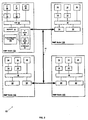
- FIG. 2 a block diagram of a histogrammic performance counter 100 is shown implemented within an SMP node of a distributed computer system 10.
- the computer system 10 includes multiple SMP nodes 12A-12D interconnected by a network 14.
- each SMP node 12 includes multiple processors 16, caches 18, a bus 20, a memory 22, and the system interface 24.
- the interface 24 includes two pipeline transaction queues: in-queue 25 for incoming transactions into node 12A and out queue 29 for outgoing transactions from node 12A.
- the histogrammic performance counter 300 is configured to monitor the in-queue 25 and the out-queue 29 within the interface 24 in node 12A.
- the in-queue 25 is used to pipeline transactions that are presented upon the network 14 and addressed to the node 12A.
- the out-queue 29 is used to pipeline transactions generated in the node 12A which need to be transmitted to the other nodes through the network 14. Knowledge of the number of transactions (or the number of entries) pending within the in-queue 25 and within the out-queue 29 during operation of the system is important to the designer in making optimizations.
- Figure 3 illustrates an alternative embodiment wherein a histogrammic performance counter is used to measure the performance of a cache memory 18B.
- the histogrammic performance counter 300 may be used to monitor the hits that occur in the cache memory 18B with respect to access particular address locations.
Landscapes
- Engineering & Computer Science (AREA)
- General Engineering & Computer Science (AREA)
- Theoretical Computer Science (AREA)
- Computer Hardware Design (AREA)
- Quality & Reliability (AREA)
- Physics & Mathematics (AREA)
- General Physics & Mathematics (AREA)
- Debugging And Monitoring (AREA)
Abstract
Description
Claims (20)
- A performance counter for counting occurrences of two or more events in a component within a computer system during a monitoring period, said performance counter comprising:a first storage configured to store information indicative of said two or more events to be monitored;a second storage configured to store counting results of said occurrences of said two or more events;a counting mechanism coupled to said second storage; andcontrol logic coupled to said first storage and configured to control said counting mechanism based upon said information in said first storage such that said occurrences of said two or more events are counted during said monitoring period.
- The performance counter as recited in claim 1, wherein said counting results include a total count for each of said two or more events during said monitoring period.
- The performance counter as recited in claim 1 or 2, wherein said counting mechanism increments a count value maintained for a particular event upon each occurrence of said particular event during said monitoring period.
- The performance counter as recited in claim 1, 2 or 3, wherein said monitoring period is a period of time.
- The performance counter as recited in claim 1, 2 or 3, wherein said monitoring period is a number of cycles within said computer system.
- The performance counter as recited in claim 1, 2 or 3, wherein said monitoring period further includes a plurality of sub-monitoring periods, wherein a particular event of said two or more events is counted during one of said plurality of sub-monitoring periods.
- The performance counter as recited in claim 6, wherein a first event of said two or more events is counted during a first sub-monitoring period of said plurality of sub-monitoring periods and wherein a second event of said two or more events is counted during a second sub-monitoring period of said plurality of sub-monitoring periods.
- A method for performance monitoring to count two or more events that are occurring in a component within a computer system during a monitoring period, said method comprising:storing in a first storage information indicative of said two or more events to be monitored;controlling a counting mechanism based upon said information in said first storage such that occurrences of each of said two or more events are counted during said monitoring period, andstoring in a second storage counting results of each of said two or more events which occur in said component.
- The method as recited in claim 8, wherein said counting results include a total count for each of said two or more events during said monitoring period.
- The method as recited in claim 8 or 9, wherein said counting mechanism increments a count value maintained for a particular event upon each occurrence of said particular event.
- The method as recited in claim 8, wherein said monitoring period is a period of time.
- The method as recited in claim 8, 9 or 10, wherein said monitoring period is a number of cycles within said computer system.
- The method as recited in claim 8, 9 or 10, wherein said monitoring period further includes a plurality of sub-monitoring periods, wherein a particular event of said two or more events is counted during one of said plurality of sub-monitoring periods.
- The method as recited in claim 13, wherein a first event of said two or more events is counted during a first sub-monitoring period of said plurality of sub-monitoring periods and wherein a second event of said two or more events is counted during a second sub-monitoring period of said plurality of sub-monitoring periods.
- A multiprocessing computer system comprising:a plurality of processing nodes interconnected through a network, wherein a first processing node of said plurality of processing nodes includes:a transaction queue for storing pending transactions being conveyed between said first processing node and said network, anda performance counter coupled to said transaction queue and configured to count occurrences of two or more events in said transaction queue during a monitoring period, wherein said performance counter comprises:a first storage configured to store information indicative of said two or more events to be monitored;a second storage configured to store counting results of said occurrences of said two or more events;a counting mechanism coupled to said second storage; andcontrol logic coupled to said first storage and configured to control said counting mechanism based upon said information in said first storage such that said occurrences of said two or more events are counted during said monitoring period.
- The multiprocessing computer system as recited in claim 15, wherein said counting results include a total count for each of said two or more events during said monitoring period.
- The multiprocessing computer system as recited in claim 15 or 16, wherein said counting mechanism increments a count value maintained for a particular event upon each occurrence of said particular event during said monitoring period.
- The multiprocessing computer system as recited in claim 15, 16 or 17 wherein said monitoring period is one of a period of time and a number of cycles within said multiprocessing computer system.
- The multiprocessing computer system as recited in claim 15, 16 or 17, wherein said monitoring period further includes a plurality of sub-monitoring periods, wherein a particular event of said two or more events is counted during one of said plurality of sub-monitoring periods.
- The multiprocessing computer system as recited in claim 19, wherein a first event of said two or more events is counted during a first sub-monitoring period of said plurality of sub-monitoring periods and wherein a second event of said two or more events is counted during a second sub-monitoring period of said plurality of sub-monitoring periods.
Applications Claiming Priority (2)
| Application Number | Priority Date | Filing Date | Title |
|---|---|---|---|
| US09/238,246 US6360337B1 (en) | 1999-01-27 | 1999-01-27 | System and method to perform histogrammic counting for performance evaluation |
| US238246 | 1999-01-27 |
Publications (2)
| Publication Number | Publication Date |
|---|---|
| EP1024432A2 true EP1024432A2 (en) | 2000-08-02 |
| EP1024432A3 EP1024432A3 (en) | 2002-11-06 |
Family
ID=22897083
Family Applications (1)
| Application Number | Title | Priority Date | Filing Date |
|---|---|---|---|
| EP00300454A Withdrawn EP1024432A3 (en) | 1999-01-27 | 2000-01-21 | Performance counter for monitoring multiple events |
Country Status (3)
| Country | Link |
|---|---|
| US (1) | US6360337B1 (en) |
| EP (1) | EP1024432A3 (en) |
| JP (1) | JP2000222254A (en) |
Cited By (5)
| Publication number | Priority date | Publication date | Assignee | Title |
|---|---|---|---|---|
| WO2001082085A3 (en) * | 2000-04-24 | 2003-01-09 | Sun Microsystems Inc | Method and apparatus for multiplexing hardware performance indicators |
| US6647546B1 (en) | 2000-05-03 | 2003-11-11 | Sun Microsystems, Inc. | Avoiding gather and scatter when calling Fortran 77 code from Fortran 90 code |
| WO2006120196A1 (en) * | 2005-05-10 | 2006-11-16 | International Business Machines Corporation | Monitoring and reporting normalized device system performance |
| WO2011057059A1 (en) * | 2009-11-06 | 2011-05-12 | Advanced Micro Devices, Inc. | Controlling performance state by tracking probe activity level |
| US8566628B2 (en) | 2009-05-06 | 2013-10-22 | Advanced Micro Devices, Inc. | North-bridge to south-bridge protocol for placing processor in low power state |
Families Citing this family (49)
| Publication number | Priority date | Publication date | Assignee | Title |
|---|---|---|---|---|
| US6880108B1 (en) * | 1999-07-29 | 2005-04-12 | International Business Machines Corporation | Risk assessment methodology for AIX-based computer systems |
| US6912676B1 (en) * | 1999-09-02 | 2005-06-28 | International Business Machines | Automated risk assessment tool for AIX-based computer systems |
| US6530042B1 (en) * | 1999-11-08 | 2003-03-04 | International Business Machines Corporation | Method and apparatus for monitoring the performance of internal queues in a microprocessor |
| US6701447B1 (en) * | 2000-09-06 | 2004-03-02 | International Business Machines Corporation | System for delaying the counting of occurrences of a plurality of events occurring in a processor until the disposition of the event has been determined |
| US6658584B1 (en) * | 2000-09-06 | 2003-12-02 | International Business Machines Corporation | Method and structure for managing large counter arrays |
| US6654915B1 (en) * | 2000-09-11 | 2003-11-25 | Unisys Corporation | Automatic fault management system utilizing electronic service requests |
| US20020103770A1 (en) * | 2001-02-01 | 2002-08-01 | Pitney Bowes Incorporated | Performance counters for mail handling systems |
| US6569061B2 (en) * | 2001-02-28 | 2003-05-27 | Kenneth W. Stearns | Methods and apparatus for linking arm exercise motion to leg exercise motion |
| US6970809B2 (en) * | 2001-08-29 | 2005-11-29 | International Business Machines Corporation | Automated configuration of on-circuit facilities |
| JP4123914B2 (en) * | 2002-11-26 | 2008-07-23 | 株式会社日立製作所 | Monitoring method and monitoring program for program operating state |
| US7275191B2 (en) * | 2003-05-09 | 2007-09-25 | Hewlett-Packard Development Company, L.P. | Coverage decoder circuit for performance counter |
| US7415643B2 (en) * | 2003-05-09 | 2008-08-19 | Hewlett-Packard Development Company, L.P. | Coverage circuit for performance counter |
| US7430696B2 (en) * | 2003-05-09 | 2008-09-30 | Hewlett-Packard Development Company, L.P. | Zeroing circuit for performance counter |
| US7424397B2 (en) * | 2003-05-09 | 2008-09-09 | Hewlett-Packard Development Company, L.P. | General purpose performance counter |
| US7475301B2 (en) * | 2003-05-09 | 2009-01-06 | Hewlett-Packard Development Company, L.P. | Increment/decrement circuit for performance counter |
| US7404112B2 (en) * | 2003-05-09 | 2008-07-22 | Hewlett-Packard Development Company, L.P. | Data selection circuit for performance counter |
| US7331003B2 (en) * | 2003-05-09 | 2008-02-12 | Hewlett-Packard Development Company, L.P. | Match circuit for performance counter |
| EP1498336B1 (en) * | 2003-07-18 | 2005-09-07 | Alcatel | Method and counting unit for determining the occupation of a track section |
| US7475302B2 (en) * | 2003-08-06 | 2009-01-06 | Hewlett-Packard Development Company, L.P. | Decoded match circuit for performance counter |
| US20050071688A1 (en) * | 2003-09-25 | 2005-03-31 | International Business Machines Corporation | Hardware CPU utilization meter for a microprocessor |
| US7272754B2 (en) * | 2003-09-27 | 2007-09-18 | International Business Machines Corporation | Implementation-efficient multiple-counter value hardware performance counter |
| US20050183065A1 (en) * | 2004-02-13 | 2005-08-18 | Wolczko Mario I. | Performance counters in a multi-threaded processor |
| US8826241B2 (en) * | 2004-02-16 | 2014-09-02 | Oracle America, Inc. | Instruction sampling in a multi-threaded processor |
| US20050188186A1 (en) * | 2004-02-23 | 2005-08-25 | Wolczko Mario I. | Obtaining execution path information in an instruction sampling system |
| US7624319B2 (en) * | 2004-06-03 | 2009-11-24 | Hewlett-Packard Development Company, L.P. | Performance monitoring system |
| US20050283669A1 (en) * | 2004-06-03 | 2005-12-22 | Adkisson Richard W | Edge detect circuit for performance counter |
| US7676530B2 (en) * | 2004-06-03 | 2010-03-09 | Hewlett-Packard Development Company, L.P. | Duration minimum and maximum circuit for performance counter |
| US7346824B2 (en) * | 2004-06-03 | 2008-03-18 | Hewlett-Packard Development Company, L.P. | Match circuit for performing pattern recognition in a performance counter |
| US20060005083A1 (en) * | 2004-06-30 | 2006-01-05 | International Business Machines Corporation | Performance count tracing |
| US7373565B2 (en) * | 2005-08-23 | 2008-05-13 | Hewlett-Packard Development Company, L.P. | Start/stop circuit for performance counter |
| US7548964B2 (en) * | 2005-10-11 | 2009-06-16 | International Business Machines Corporation | Performance counters for virtualized network interfaces of communications networks |
| US7861068B2 (en) * | 2006-03-07 | 2010-12-28 | Intel Corporation | Method and apparatus for using dynamic workload characteristics to control CPU frequency and voltage scaling |
| US7532700B2 (en) * | 2006-08-21 | 2009-05-12 | International Business Machines Corporation | Space and power efficient hybrid counters array |
| US7426253B2 (en) * | 2006-08-21 | 2008-09-16 | International Business Machines Corporation | Low latency counter event indication |
| US7461383B2 (en) * | 2006-08-21 | 2008-12-02 | International Business Machines Corporation | Method and apparatus for efficient performance monitoring of a large number of simultaneous events |
| US7340378B1 (en) * | 2006-11-30 | 2008-03-04 | International Business Machines Corporation | Weighted event counting system and method for processor performance measurements |
| US8443287B2 (en) * | 2007-09-28 | 2013-05-14 | International Business Machines Corporation | Interactive tool for visualizing performance data in real-time to enable adaptive performance optimization and feedback |
| US8874722B2 (en) * | 2007-09-28 | 2014-10-28 | International Business Machines Corporation | Interactive tool for visualizing performance data in real-time to enable adaptive performance optimization and feedback |
| US20100008464A1 (en) * | 2008-07-11 | 2010-01-14 | Infineon Technologies Ag | System profiling |
| RU2424564C2 (en) * | 2008-09-24 | 2011-07-20 | Корпорация "САМСУНГ ЭЛЕКТРОНИКС К., Лтд." | Method of monitoring computer system |
| US8572581B2 (en) | 2009-03-26 | 2013-10-29 | Microsoft Corporation | Measurement and reporting of performance event rates |
| JP2010244393A (en) * | 2009-04-08 | 2010-10-28 | Renesas Electronics Corp | Performance evaluation apparatus and performance evaluation method |
| US8578382B2 (en) * | 2009-05-19 | 2013-11-05 | Qualcomm Incorporated | Associating data for events occurring in software threads with synchronized clock cycle counters |
| US10169187B2 (en) | 2010-08-18 | 2019-01-01 | International Business Machines Corporation | Processor core having a saturating event counter for making performance measurements |
| US9298651B2 (en) | 2013-06-24 | 2016-03-29 | International Business Machines Corporation | Continuous in-memory accumulation of hardware performance counter data |
| US10075352B2 (en) * | 2014-12-09 | 2018-09-11 | Ca, Inc. | Monitoring user terminal applications using performance statistics for combinations of different reported characteristic dimensions and values |
| US9600336B1 (en) | 2015-08-28 | 2017-03-21 | International Business Machines Corporation | Storing service level agreement compliance data |
| US10002063B2 (en) | 2015-10-20 | 2018-06-19 | International Business Machines Corporation | Monitoring performance of multithreaded workloads |
| US10540251B2 (en) | 2017-05-22 | 2020-01-21 | International Business Machines Corporation | Accuracy sensitive performance counters |
Family Cites Families (9)
| Publication number | Priority date | Publication date | Assignee | Title |
|---|---|---|---|---|
| US4872121A (en) | 1987-08-07 | 1989-10-03 | Harris Corporation | Method and apparatus for monitoring electronic apparatus activity |
| US5537541A (en) * | 1994-08-16 | 1996-07-16 | Digital Equipment Corporation | System independent interface for performance counters |
| US5682328A (en) * | 1996-09-11 | 1997-10-28 | Bbn Corporation | Centralized computer event data logging system |
| US5835702A (en) * | 1996-10-21 | 1998-11-10 | International Business Machines Corporation | Performance monitor |
| US5796939A (en) | 1997-03-10 | 1998-08-18 | Digital Equipment Corporation | High frequency sampling of processor performance counters |
| FR2763712B1 (en) * | 1997-05-26 | 2001-07-13 | Bull Sa | INSTRUMENTATION DEVICE FOR MACHINE WITH NON-UNIFORM ACCESS MEMORY |
| US5991808A (en) * | 1997-06-02 | 1999-11-23 | Digital Equipment Corporation | Task processing optimization in a multiprocessor system |
| US6000044A (en) | 1997-11-26 | 1999-12-07 | Digital Equipment Corporation | Apparatus for randomly sampling instructions in a processor pipeline |
| US6233531B1 (en) | 1997-12-19 | 2001-05-15 | Advanced Micro Devices, Inc. | Apparatus and method for monitoring the performance of a microprocessor |
-
1999
- 1999-01-27 US US09/238,246 patent/US6360337B1/en not_active Expired - Lifetime
-
2000
- 2000-01-21 EP EP00300454A patent/EP1024432A3/en not_active Withdrawn
- 2000-01-27 JP JP2000018352A patent/JP2000222254A/en active Pending
Cited By (9)
| Publication number | Priority date | Publication date | Assignee | Title |
|---|---|---|---|---|
| WO2001082085A3 (en) * | 2000-04-24 | 2003-01-09 | Sun Microsystems Inc | Method and apparatus for multiplexing hardware performance indicators |
| US6546359B1 (en) | 2000-04-24 | 2003-04-08 | Sun Microsystems, Inc. | Method and apparatus for multiplexing hardware performance indicators |
| US6647546B1 (en) | 2000-05-03 | 2003-11-11 | Sun Microsystems, Inc. | Avoiding gather and scatter when calling Fortran 77 code from Fortran 90 code |
| WO2006120196A1 (en) * | 2005-05-10 | 2006-11-16 | International Business Machines Corporation | Monitoring and reporting normalized device system performance |
| US7493234B2 (en) | 2005-05-10 | 2009-02-17 | International Business Machines Corporation | Monitoring and reporting normalized device system performance |
| US7664617B2 (en) | 2005-05-10 | 2010-02-16 | International Business Machines Corporation | Monitoring and reporting normalized device system performance |
| US8566628B2 (en) | 2009-05-06 | 2013-10-22 | Advanced Micro Devices, Inc. | North-bridge to south-bridge protocol for placing processor in low power state |
| WO2011057059A1 (en) * | 2009-11-06 | 2011-05-12 | Advanced Micro Devices, Inc. | Controlling performance state by tracking probe activity level |
| US9021209B2 (en) | 2009-11-06 | 2015-04-28 | Advanced Micro Devices, Inc. | Cache flush based on idle prediction and probe activity level |
Also Published As
| Publication number | Publication date |
|---|---|
| US6360337B1 (en) | 2002-03-19 |
| JP2000222254A (en) | 2000-08-11 |
| EP1024432A3 (en) | 2002-11-06 |
Similar Documents
| Publication | Publication Date | Title |
|---|---|---|
| US6360337B1 (en) | System and method to perform histogrammic counting for performance evaluation | |
| US11921611B2 (en) | Synchronous hardware event collection | |
| US8904392B2 (en) | Shared performance monitor in a multiprocessor system | |
| KR100280732B1 (en) | Performance monitoring method and apparatus of data processing system | |
| US9009541B2 (en) | Efficient trace capture buffer management | |
| US7979750B2 (en) | Synchronizing triggering of multiple hardware trace facilities using an existing system bus | |
| US7571076B2 (en) | Performance monitor device, data collecting method and program for the same | |
| US5675729A (en) | Method and apparatus for performing on-chip measurement on a component | |
| US5832304A (en) | Memory queue with adjustable priority and conflict detection | |
| US5727167A (en) | Thresholding support in performance monitoring | |
| US7913123B2 (en) | Concurrently sharing a memory controller among a tracing process and non-tracing processes using a programmable variable number of shared memory write buffers | |
| US7844860B2 (en) | Apparatus and computer program product in a processor for performing in-memory tracing using existing communication paths | |
| US8438442B2 (en) | Method and apparatus for testing a data processing system | |
| US20090031173A1 (en) | Method, Apparatus, and Computer Program Product in a Processor for Dynamically During Runtime Allocating Memory for In-Memory Hardware Tracing | |
| US6278959B1 (en) | Method and system for monitoring the performance of a data processing system | |
| US8335881B2 (en) | Method and apparatus for handling an interrupt during testing of a data processing system | |
| US20060184837A1 (en) | Method, apparatus, and computer program product in a processor for balancing hardware trace collection among different hardware trace facilities | |
| US6298394B1 (en) | System and method for capturing information on an interconnect in an integrated circuit | |
| US8015565B2 (en) | Preventing livelocks in processor selection of load requests | |
| GB2409907A (en) | Stress testing a computer system using harassing transactions triggered by counting bus cycles | |
| US12158795B2 (en) | Intelligent exposure of hardware latency statistics within an electronic device or system | |
| CN119782253B (en) | Data processing method, system, device and readable storage medium | |
| US11941250B2 (en) | Optimizing application execution based on memory-level parallelism (MLP)-based metrics | |
| KR19990082745A (en) | Method for deadlock resolution and computer system deadlock request resolution | |
| JP2000010816A (en) | Trace device for debugging |
Legal Events
| Date | Code | Title | Description |
|---|---|---|---|
| PUAI | Public reference made under article 153(3) epc to a published international application that has entered the european phase |
Free format text: ORIGINAL CODE: 0009012 |
|
| AK | Designated contracting states |
Kind code of ref document: A2 Designated state(s): AT BE CH CY DE DK ES FI FR GB GR IE IT LI LU MC NL PT SE |
|
| AX | Request for extension of the european patent |
Free format text: AL;LT;LV;MK;RO;SI |
|
| PUAL | Search report despatched |
Free format text: ORIGINAL CODE: 0009013 |
|
| AK | Designated contracting states |
Kind code of ref document: A3 Designated state(s): AT BE CH CY DE DK ES FI FR GB GR IE IT LI LU MC NL PT SE |
|
| AX | Request for extension of the european patent |
Free format text: AL;LT;LV;MK;RO;SI |
|
| AKX | Designation fees paid | ||
| REG | Reference to a national code |
Ref country code: DE Ref legal event code: 8566 |
|
| STAA | Information on the status of an ep patent application or granted ep patent |
Free format text: STATUS: THE APPLICATION IS DEEMED TO BE WITHDRAWN |
|
| 18D | Application deemed to be withdrawn |
Effective date: 20030507 |