EP1024135A1 - Aryl and heteroarylcyclopropyl oxime ethers and their use as fungicides and insecticides - Google Patents
Aryl and heteroarylcyclopropyl oxime ethers and their use as fungicides and insecticides Download PDFInfo
- Publication number
- EP1024135A1 EP1024135A1 EP00300232A EP00300232A EP1024135A1 EP 1024135 A1 EP1024135 A1 EP 1024135A1 EP 00300232 A EP00300232 A EP 00300232A EP 00300232 A EP00300232 A EP 00300232A EP 1024135 A1 EP1024135 A1 EP 1024135A1
- Authority
- EP
- European Patent Office
- Prior art keywords
- halo
- alkyl
- alkenyl
- alkynyl
- methyl
- Prior art date
- Legal status (The legal status is an assumption and is not a legal conclusion. Google has not performed a legal analysis and makes no representation as to the accuracy of the status listed.)
- Withdrawn
Links
- 125000003118 aryl group Chemical group 0.000 title claims abstract description 20
- -1 oxime ethers Chemical class 0.000 title claims description 85
- 239000000417 fungicide Substances 0.000 title description 12
- 239000002917 insecticide Substances 0.000 title description 5
- 150000001875 compounds Chemical class 0.000 claims abstract description 104
- 125000004400 (C1-C12) alkyl group Chemical group 0.000 claims abstract description 42
- 125000004648 C2-C8 alkenyl group Chemical group 0.000 claims abstract description 37
- 125000004649 C2-C8 alkynyl group Chemical group 0.000 claims abstract description 31
- 229910052739 hydrogen Inorganic materials 0.000 claims abstract description 26
- 239000001257 hydrogen Substances 0.000 claims abstract description 26
- 125000006272 (C3-C7) cycloalkyl group Chemical group 0.000 claims abstract description 25
- 125000000623 heterocyclic group Chemical group 0.000 claims abstract description 24
- 125000004178 (C1-C4) alkyl group Chemical group 0.000 claims abstract description 18
- 125000003710 aryl alkyl group Chemical group 0.000 claims abstract description 16
- 125000000229 (C1-C4)alkoxy group Chemical group 0.000 claims abstract description 13
- 125000004435 hydrogen atom Chemical group [H]* 0.000 claims abstract description 13
- 230000000855 fungicidal effect Effects 0.000 claims abstract description 11
- 229910052717 sulfur Inorganic materials 0.000 claims abstract description 11
- UFHFLCQGNIYNRP-UHFFFAOYSA-N Hydrogen Chemical compound [H][H] UFHFLCQGNIYNRP-UHFFFAOYSA-N 0.000 claims abstract description 10
- 125000004093 cyano group Chemical group *C#N 0.000 claims abstract description 9
- 229910052760 oxygen Inorganic materials 0.000 claims abstract description 7
- 125000004453 alkoxycarbonyl group Chemical group 0.000 claims abstract description 6
- 125000004642 (C1-C12) alkoxy group Chemical group 0.000 claims abstract description 3
- 125000004448 alkyl carbonyl group Chemical group 0.000 claims abstract description 3
- 125000001475 halogen functional group Chemical group 0.000 claims abstract 46
- 150000002431 hydrogen Chemical class 0.000 claims abstract 3
- 239000000203 mixture Substances 0.000 claims description 46
- 229910052757 nitrogen Inorganic materials 0.000 claims description 17
- 241000238631 Hexapoda Species 0.000 claims description 13
- 238000000034 method Methods 0.000 claims description 13
- 125000002496 methyl group Chemical group [H]C([H])([H])* 0.000 claims description 13
- 125000001997 phenyl group Chemical group [H]C1=C([H])C([H])=C(*)C([H])=C1[H] 0.000 claims description 12
- 125000002924 primary amino group Chemical group [H]N([H])* 0.000 claims description 8
- 150000003839 salts Chemical class 0.000 claims description 5
- 241000233866 Fungi Species 0.000 claims description 4
- 125000004182 2-chlorophenyl group Chemical group [H]C1=C([H])C(Cl)=C(*)C([H])=C1[H] 0.000 claims description 3
- 125000004198 2-fluorophenyl group Chemical group [H]C1=C([H])C(F)=C(*)C([H])=C1[H] 0.000 claims description 3
- 125000004179 3-chlorophenyl group Chemical group [H]C1=C([H])C(*)=C([H])C(Cl)=C1[H] 0.000 claims description 3
- 125000004180 3-fluorophenyl group Chemical group [H]C1=C([H])C(*)=C([H])C(F)=C1[H] 0.000 claims description 3
- 125000001255 4-fluorophenyl group Chemical group [H]C1=C([H])C(*)=C([H])C([H])=C1F 0.000 claims description 3
- 125000003854 p-chlorophenyl group Chemical group [H]C1=C([H])C(*)=C([H])C([H])=C1Cl 0.000 claims description 3
- 125000004201 2,4-dichlorophenyl group Chemical group [H]C1=C([H])C(*)=C(Cl)C([H])=C1Cl 0.000 claims 2
- YNNUSGIPVFPVBX-UHFFFAOYSA-N 2-[2-[1-(4-chlorophenyl)-1-phenylethoxy]ethyl]-1-methylpyrrolidine Chemical compound CN1CCCC1CCOC(C)(C=1C=CC(Cl)=CC=1)C1=CC=CC=C1 YNNUSGIPVFPVBX-UHFFFAOYSA-N 0.000 claims 2
- 125000004199 4-trifluoromethylphenyl group Chemical group [H]C1=C([H])C(=C([H])C([H])=C1*)C(F)(F)F 0.000 claims 2
- 125000000219 ethylidene group Chemical group [H]C(=[*])C([H])([H])[H] 0.000 claims 2
- 230000003032 phytopathogenic effect Effects 0.000 claims 2
- HBAQYPYDRFILMT-UHFFFAOYSA-N 8-[3-(1-cyclopropylpyrazol-4-yl)-1H-pyrazolo[4,3-d]pyrimidin-5-yl]-3-methyl-3,8-diazabicyclo[3.2.1]octan-2-one Chemical class C1(CC1)N1N=CC(=C1)C1=NNC2=C1N=C(N=C2)N1C2C(N(CC1CC2)C)=O HBAQYPYDRFILMT-UHFFFAOYSA-N 0.000 claims 1
- 230000000749 insecticidal effect Effects 0.000 abstract description 5
- 241000196324 Embryophyta Species 0.000 description 41
- XLYOFNOQVPJJNP-UHFFFAOYSA-N water Substances O XLYOFNOQVPJJNP-UHFFFAOYSA-N 0.000 description 41
- OKKJLVBELUTLKV-UHFFFAOYSA-N Methanol Chemical compound OC OKKJLVBELUTLKV-UHFFFAOYSA-N 0.000 description 36
- 238000002360 preparation method Methods 0.000 description 31
- RTZKZFJDLAIYFH-UHFFFAOYSA-N Diethyl ether Chemical compound CCOCC RTZKZFJDLAIYFH-UHFFFAOYSA-N 0.000 description 30
- HEDRZPFGACZZDS-MICDWDOJSA-N Trichloro(2H)methane Chemical compound [2H]C(Cl)(Cl)Cl HEDRZPFGACZZDS-MICDWDOJSA-N 0.000 description 28
- 125000005843 halogen group Chemical group 0.000 description 28
- HEMHJVSKTPXQMS-UHFFFAOYSA-M sodium hydroxide Substances [OH-].[Na+] HEMHJVSKTPXQMS-UHFFFAOYSA-M 0.000 description 27
- 239000000243 solution Substances 0.000 description 27
- FAPWRFPIFSIZLT-UHFFFAOYSA-M Sodium chloride Chemical compound [Na+].[Cl-] FAPWRFPIFSIZLT-UHFFFAOYSA-M 0.000 description 24
- ZMXDDKWLCZADIW-UHFFFAOYSA-N N,N-Dimethylformamide Chemical compound CN(C)C=O ZMXDDKWLCZADIW-UHFFFAOYSA-N 0.000 description 23
- 238000006243 chemical reaction Methods 0.000 description 22
- 201000010099 disease Diseases 0.000 description 21
- 208000037265 diseases, disorders, signs and symptoms Diseases 0.000 description 21
- 239000002585 base Substances 0.000 description 20
- CSCPPACGZOOCGX-UHFFFAOYSA-N Acetone Chemical compound CC(C)=O CSCPPACGZOOCGX-UHFFFAOYSA-N 0.000 description 19
- ZWEHNKRNPOVVGH-UHFFFAOYSA-N 2-Butanone Chemical compound CCC(C)=O ZWEHNKRNPOVVGH-UHFFFAOYSA-N 0.000 description 18
- IJGRMHOSHXDMSA-UHFFFAOYSA-N Atomic nitrogen Chemical compound N#N IJGRMHOSHXDMSA-UHFFFAOYSA-N 0.000 description 18
- YXFVVABEGXRONW-UHFFFAOYSA-N Toluene Chemical compound CC1=CC=CC=C1 YXFVVABEGXRONW-UHFFFAOYSA-N 0.000 description 18
- VLKZOEOYAKHREP-UHFFFAOYSA-N n-Hexane Chemical compound CCCCCC VLKZOEOYAKHREP-UHFFFAOYSA-N 0.000 description 18
- 150000002576 ketones Chemical class 0.000 description 17
- KWYUFKZDYYNOTN-UHFFFAOYSA-M Potassium hydroxide Chemical compound [OH-].[K+] KWYUFKZDYYNOTN-UHFFFAOYSA-M 0.000 description 16
- 229920006395 saturated elastomer Polymers 0.000 description 16
- XEKOWRVHYACXOJ-UHFFFAOYSA-N Ethyl acetate Chemical compound CCOC(C)=O XEKOWRVHYACXOJ-UHFFFAOYSA-N 0.000 description 15
- 238000005481 NMR spectroscopy Methods 0.000 description 15
- 239000002904 solvent Substances 0.000 description 15
- 238000005160 1H NMR spectroscopy Methods 0.000 description 14
- 240000008067 Cucumis sativus Species 0.000 description 14
- 241000209140 Triticum Species 0.000 description 14
- 238000004458 analytical method Methods 0.000 description 14
- 239000012259 ether extract Substances 0.000 description 14
- 239000000047 product Substances 0.000 description 14
- IAZDPXIOMUYVGZ-UHFFFAOYSA-N Dimethylsulphoxide Chemical class CS(C)=O IAZDPXIOMUYVGZ-UHFFFAOYSA-N 0.000 description 13
- 235000021307 Triticum Nutrition 0.000 description 13
- 239000007921 spray Substances 0.000 description 13
- CSNNHWWHGAXBCP-UHFFFAOYSA-L Magnesium sulfate Chemical compound [Mg+2].[O-][S+2]([O-])([O-])[O-] CSNNHWWHGAXBCP-UHFFFAOYSA-L 0.000 description 12
- VYPSYNLAJGMNEJ-UHFFFAOYSA-N Silicium dioxide Chemical compound O=[Si]=O VYPSYNLAJGMNEJ-UHFFFAOYSA-N 0.000 description 12
- 238000009472 formulation Methods 0.000 description 12
- 239000011780 sodium chloride Substances 0.000 description 12
- LFQSCWFLJHTTHZ-UHFFFAOYSA-N Ethanol Chemical compound CCO LFQSCWFLJHTTHZ-UHFFFAOYSA-N 0.000 description 11
- 150000001299 aldehydes Chemical class 0.000 description 11
- 235000010799 Cucumis sativus var sativus Nutrition 0.000 description 10
- 239000007788 liquid Substances 0.000 description 10
- 239000003921 oil Substances 0.000 description 10
- 150000002923 oximes Chemical class 0.000 description 10
- 150000002825 nitriles Chemical class 0.000 description 9
- 241000221785 Erysiphales Species 0.000 description 8
- BAVYZALUXZFZLV-UHFFFAOYSA-N Methylamine Chemical compound NC BAVYZALUXZFZLV-UHFFFAOYSA-N 0.000 description 8
- NINIDFKCEFEMDL-UHFFFAOYSA-N Sulfur Chemical compound [S] NINIDFKCEFEMDL-UHFFFAOYSA-N 0.000 description 8
- 239000007787 solid Substances 0.000 description 8
- 239000011593 sulfur Substances 0.000 description 8
- 239000000725 suspension Substances 0.000 description 8
- 239000004480 active ingredient Substances 0.000 description 7
- 239000000543 intermediate Substances 0.000 description 7
- 239000001965 potato dextrose agar Substances 0.000 description 7
- 238000010992 reflux Methods 0.000 description 7
- 239000002689 soil Substances 0.000 description 7
- NLXLAEXVIDQMFP-UHFFFAOYSA-N Ammonia chloride Chemical compound [NH4+].[Cl-] NLXLAEXVIDQMFP-UHFFFAOYSA-N 0.000 description 6
- WYURNTSHIVDZCO-UHFFFAOYSA-N Tetrahydrofuran Chemical compound C1CCOC1 WYURNTSHIVDZCO-UHFFFAOYSA-N 0.000 description 6
- 241000607479 Yersinia pestis Species 0.000 description 6
- 230000015572 biosynthetic process Effects 0.000 description 6
- 239000012230 colorless oil Substances 0.000 description 6
- 229960001760 dimethyl sulfoxide Drugs 0.000 description 6
- 125000001424 substituent group Chemical group 0.000 description 6
- 0 CO*=C(C(OC)=O)c1c(CON=C(*)C2(*)C(*)C2)cccc1 Chemical compound CO*=C(C(OC)=O)c1c(CON=C(*)C2(*)C(*)C2)cccc1 0.000 description 5
- 240000007594 Oryza sativa Species 0.000 description 5
- 240000003768 Solanum lycopersicum Species 0.000 description 5
- 125000000217 alkyl group Chemical group 0.000 description 5
- 239000003795 chemical substances by application Substances 0.000 description 5
- BIPUHAHGLJKIPK-UHFFFAOYSA-N dicyclopropylmethanone Chemical compound C1CC1C(=O)C1CC1 BIPUHAHGLJKIPK-UHFFFAOYSA-N 0.000 description 5
- 230000002538 fungal effect Effects 0.000 description 5
- 229910052736 halogen Inorganic materials 0.000 description 5
- 208000015181 infectious disease Diseases 0.000 description 5
- 239000000741 silica gel Substances 0.000 description 5
- 229910002027 silica gel Inorganic materials 0.000 description 5
- 238000005507 spraying Methods 0.000 description 5
- 239000000126 substance Substances 0.000 description 5
- 238000012360 testing method Methods 0.000 description 5
- ANGRPGLHZGQFPV-UHFFFAOYSA-N 2-cyclopropyl-1-phenylcyclopropane-1-carbonitrile Chemical compound C=1C=CC=CC=1C1(C#N)CC1C1CC1 ANGRPGLHZGQFPV-UHFFFAOYSA-N 0.000 description 4
- 240000005979 Hordeum vulgare Species 0.000 description 4
- 235000007340 Hordeum vulgare Nutrition 0.000 description 4
- 235000007688 Lycopersicon esculentum Nutrition 0.000 description 4
- 235000007164 Oryza sativa Nutrition 0.000 description 4
- 241000233679 Peronosporaceae Species 0.000 description 4
- JUJWROOIHBZHMG-UHFFFAOYSA-N Pyridine Chemical compound C1=CC=NC=C1 JUJWROOIHBZHMG-UHFFFAOYSA-N 0.000 description 4
- DKGAVHZHDRPRBM-UHFFFAOYSA-N Tert-Butanol Chemical compound CC(C)(C)O DKGAVHZHDRPRBM-UHFFFAOYSA-N 0.000 description 4
- 240000006365 Vitis vinifera Species 0.000 description 4
- 239000002671 adjuvant Substances 0.000 description 4
- 125000002344 aminooxy group Chemical group [H]N([H])O[*] 0.000 description 4
- 229940041514 candida albicans extract Drugs 0.000 description 4
- 125000004432 carbon atom Chemical group C* 0.000 description 4
- 239000004495 emulsifiable concentrate Substances 0.000 description 4
- 150000002367 halogens Chemical class 0.000 description 4
- 125000005842 heteroatom Chemical group 0.000 description 4
- 239000000463 material Substances 0.000 description 4
- 239000003595 mist Substances 0.000 description 4
- 239000000575 pesticide Substances 0.000 description 4
- BWHMMNNQKKPAPP-UHFFFAOYSA-L potassium carbonate Chemical compound [K+].[K+].[O-]C([O-])=O BWHMMNNQKKPAPP-UHFFFAOYSA-L 0.000 description 4
- 239000000843 powder Substances 0.000 description 4
- 235000009566 rice Nutrition 0.000 description 4
- 238000003786 synthesis reaction Methods 0.000 description 4
- 239000004563 wettable powder Substances 0.000 description 4
- 239000012138 yeast extract Substances 0.000 description 4
- FJUCEELPGJLTOO-UHFFFAOYSA-N 1,3-bis(1-phenylcyclopropyl)propan-2-one Chemical compound C1CC1(C=1C=CC=CC=1)CC(=O)CC1(C=2C=CC=CC=2)CC1 FJUCEELPGJLTOO-UHFFFAOYSA-N 0.000 description 3
- MWDVWHPFYWYMFI-UHFFFAOYSA-N 1,3-bis(2-cyclopropyl-1-phenylcyclopropyl)propan-2-one Chemical compound C1C(C2CC2)C1(C=1C=CC=CC=1)CC(=O)CC1(C=2C=CC=CC=2)CC1C1CC1 MWDVWHPFYWYMFI-UHFFFAOYSA-N 0.000 description 3
- ZHFURHRJUWYDKG-UHFFFAOYSA-N 1-phenylcyclopropane-1-carbonitrile Chemical compound C=1C=CC=CC=1C1(C#N)CC1 ZHFURHRJUWYDKG-UHFFFAOYSA-N 0.000 description 3
- 229920001817 Agar Polymers 0.000 description 3
- RVWUVRWOWJXIET-FMIVXFBMSA-N CO\N=C(\C(O)=O)C1=CC=CC=C1CON Chemical compound CO\N=C(\C(O)=O)C1=CC=CC=C1CON RVWUVRWOWJXIET-FMIVXFBMSA-N 0.000 description 3
- 241000462639 Epilachna varivestis Species 0.000 description 3
- KEAYESYHFKHZAL-UHFFFAOYSA-N Sodium Chemical compound [Na] KEAYESYHFKHZAL-UHFFFAOYSA-N 0.000 description 3
- 241001454293 Tetranychus urticae Species 0.000 description 3
- 150000008360 acrylonitriles Chemical class 0.000 description 3
- 239000008272 agar Substances 0.000 description 3
- 239000003513 alkali Substances 0.000 description 3
- 150000008044 alkali metal hydroxides Chemical class 0.000 description 3
- 235000019270 ammonium chloride Nutrition 0.000 description 3
- 239000007900 aqueous suspension Substances 0.000 description 3
- QVGXLLKOCUKJST-UHFFFAOYSA-N atomic oxygen Chemical compound [O] QVGXLLKOCUKJST-UHFFFAOYSA-N 0.000 description 3
- AGEZXYOZHKGVCM-UHFFFAOYSA-N benzyl bromide Chemical compound BrCC1=CC=CC=C1 AGEZXYOZHKGVCM-UHFFFAOYSA-N 0.000 description 3
- 125000001797 benzyl group Chemical group [H]C1=C([H])C([H])=C(C([H])=C1[H])C([H])([H])* 0.000 description 3
- SIPUZPBQZHNSDW-UHFFFAOYSA-N bis(2-methylpropyl)aluminum Chemical compound CC(C)C[Al]CC(C)C SIPUZPBQZHNSDW-UHFFFAOYSA-N 0.000 description 3
- 125000001246 bromo group Chemical group Br* 0.000 description 3
- 239000006185 dispersion Substances 0.000 description 3
- 239000000706 filtrate Substances 0.000 description 3
- 238000001914 filtration Methods 0.000 description 3
- 230000009969 flowable effect Effects 0.000 description 3
- XLYOFNOQVPJJNP-UHFFFAOYSA-M hydroxide Chemical compound [OH-] XLYOFNOQVPJJNP-UHFFFAOYSA-M 0.000 description 3
- WTDHULULXKLSOZ-UHFFFAOYSA-N hydroxylamine hydrochloride Substances Cl.ON WTDHULULXKLSOZ-UHFFFAOYSA-N 0.000 description 3
- 238000011081 inoculation Methods 0.000 description 3
- 239000002054 inoculum Substances 0.000 description 3
- PQXGSXSWDSXVJT-UHFFFAOYSA-N methyl (2E)-2-methoxyimino-2-[2-[[1-(1-phenylcyclopropyl)ethylideneamino]oxymethyl]phenyl]acetate Chemical compound C1(=CC=CC=C1)C1(CC1)C(C)=NOCC1=C(C=CC=C1)C(C(=O)OC)=N/OC PQXGSXSWDSXVJT-UHFFFAOYSA-N 0.000 description 3
- 239000001301 oxygen Substances 0.000 description 3
- FAQJJMHZNSSFSM-UHFFFAOYSA-N phenylglyoxylic acid Chemical compound OC(=O)C(=O)C1=CC=CC=C1 FAQJJMHZNSSFSM-UHFFFAOYSA-N 0.000 description 3
- 239000012312 sodium hydride Substances 0.000 description 3
- 229910000104 sodium hydride Inorganic materials 0.000 description 3
- YLQBMQCUIZJEEH-UHFFFAOYSA-N tetrahydrofuran Natural products C=1C=COC=1 YLQBMQCUIZJEEH-UHFFFAOYSA-N 0.000 description 3
- NEVJKDXHDOEMIL-UHFFFAOYSA-N (2E)-2-[2-[[1-(2-cyclopropyl-1-phenylcyclopropyl)ethylideneamino]oxymethyl]phenyl]-2-methoxyimino-N-methylacetamide Chemical class C1(CC1)C1C(C1)(C1=CC=CC=C1)C(C)=NOCC1=C(C=CC=C1)C(C(=O)NC)=N/OC NEVJKDXHDOEMIL-UHFFFAOYSA-N 0.000 description 2
- CFMZSMGAMPBRBE-UHFFFAOYSA-N 2-hydroxyisoindole-1,3-dione Chemical compound C1=CC=C2C(=O)N(O)C(=O)C2=C1 CFMZSMGAMPBRBE-UHFFFAOYSA-N 0.000 description 2
- 125000000094 2-phenylethyl group Chemical group [H]C1=C([H])C([H])=C(C([H])=C1[H])C([H])([H])C([H])([H])* 0.000 description 2
- ONBGZIPIYSCYID-UHFFFAOYSA-N 3-cyclopropyl-2-phenylprop-2-enenitrile Chemical compound C=1C=CC=CC=1C(C#N)=CC1CC1 ONBGZIPIYSCYID-UHFFFAOYSA-N 0.000 description 2
- 244000105624 Arachis hypogaea Species 0.000 description 2
- 241001465180 Botrytis Species 0.000 description 2
- 241000123650 Botrytis cinerea Species 0.000 description 2
- 240000004160 Capsicum annuum Species 0.000 description 2
- 241000222235 Colletotrichum orbiculare Species 0.000 description 2
- OAKJQQAXSVQMHS-UHFFFAOYSA-N Hydrazine Chemical compound NN OAKJQQAXSVQMHS-UHFFFAOYSA-N 0.000 description 2
- DGAQECJNVWCQMB-PUAWFVPOSA-M Ilexoside XXIX Chemical compound C[C@@H]1CC[C@@]2(CC[C@@]3(C(=CC[C@H]4[C@]3(CC[C@@H]5[C@@]4(CC[C@@H](C5(C)C)OS(=O)(=O)[O-])C)C)[C@@H]2[C@]1(C)O)C)C(=O)O[C@H]6[C@@H]([C@H]([C@@H]([C@H](O6)CO)O)O)O.[Na+] DGAQECJNVWCQMB-PUAWFVPOSA-M 0.000 description 2
- 241000736122 Parastagonospora nodorum Species 0.000 description 2
- 244000046052 Phaseolus vulgaris Species 0.000 description 2
- 235000010627 Phaseolus vulgaris Nutrition 0.000 description 2
- ZLMJMSJWJFRBEC-UHFFFAOYSA-N Potassium Chemical compound [K] ZLMJMSJWJFRBEC-UHFFFAOYSA-N 0.000 description 2
- WQDUMFSSJAZKTM-UHFFFAOYSA-N Sodium methoxide Chemical compound [Na+].[O-]C WQDUMFSSJAZKTM-UHFFFAOYSA-N 0.000 description 2
- 241001521235 Spodoptera eridania Species 0.000 description 2
- 235000009754 Vitis X bourquina Nutrition 0.000 description 2
- 235000012333 Vitis X labruscana Nutrition 0.000 description 2
- 235000014787 Vitis vinifera Nutrition 0.000 description 2
- 239000013543 active substance Substances 0.000 description 2
- 239000000853 adhesive Substances 0.000 description 2
- 230000001070 adhesive effect Effects 0.000 description 2
- 150000001335 aliphatic alkanes Chemical class 0.000 description 2
- 125000003342 alkenyl group Chemical group 0.000 description 2
- 150000004703 alkoxides Chemical class 0.000 description 2
- 230000029936 alkylation Effects 0.000 description 2
- 238000005804 alkylation reaction Methods 0.000 description 2
- 238000007098 aminolysis reaction Methods 0.000 description 2
- DSAJWYNOEDNPEQ-UHFFFAOYSA-N barium atom Chemical compound [Ba] DSAJWYNOEDNPEQ-UHFFFAOYSA-N 0.000 description 2
- 229910001863 barium hydroxide Inorganic materials 0.000 description 2
- 229910052799 carbon Inorganic materials 0.000 description 2
- 239000012876 carrier material Substances 0.000 description 2
- 235000013351 cheese Nutrition 0.000 description 2
- 125000001309 chloro group Chemical group Cl* 0.000 description 2
- 239000004927 clay Substances 0.000 description 2
- 239000012141 concentrate Substances 0.000 description 2
- 238000009833 condensation Methods 0.000 description 2
- 230000005494 condensation Effects 0.000 description 2
- 235000009508 confectionery Nutrition 0.000 description 2
- 238000007796 conventional method Methods 0.000 description 2
- JYIMWRSJCRRYNK-UHFFFAOYSA-N dialuminum;disodium;oxygen(2-);silicon(4+);hydrate Chemical compound O.[O-2].[O-2].[O-2].[O-2].[O-2].[O-2].[Na+].[Na+].[Al+3].[Al+3].[Si+4] JYIMWRSJCRRYNK-UHFFFAOYSA-N 0.000 description 2
- 239000002270 dispersing agent Substances 0.000 description 2
- 239000012153 distilled water Substances 0.000 description 2
- 239000000428 dust Substances 0.000 description 2
- 230000000694 effects Effects 0.000 description 2
- 239000003995 emulsifying agent Substances 0.000 description 2
- 239000000839 emulsion Substances 0.000 description 2
- 230000007613 environmental effect Effects 0.000 description 2
- 150000002148 esters Chemical class 0.000 description 2
- 125000001495 ethyl group Chemical group [H]C([H])([H])C([H])([H])* 0.000 description 2
- 239000004744 fabric Substances 0.000 description 2
- 239000011521 glass Substances 0.000 description 2
- 125000001072 heteroaryl group Chemical group 0.000 description 2
- IKDUDTNKRLTJSI-UHFFFAOYSA-N hydrazine hydrate Chemical compound O.NN IKDUDTNKRLTJSI-UHFFFAOYSA-N 0.000 description 2
- 150000002430 hydrocarbons Chemical group 0.000 description 2
- 238000001727 in vivo Methods 0.000 description 2
- 238000011534 incubation Methods 0.000 description 2
- 239000002198 insoluble material Substances 0.000 description 2
- 125000002346 iodo group Chemical group I* 0.000 description 2
- JEIPFZHSYJVQDO-UHFFFAOYSA-N iron(III) oxide Inorganic materials O=[Fe]O[Fe]=O JEIPFZHSYJVQDO-UHFFFAOYSA-N 0.000 description 2
- HQKMJHAJHXVSDF-UHFFFAOYSA-L magnesium stearate Chemical compound [Mg+2].CCCCCCCCCCCCCCCCCC([O-])=O.CCCCCCCCCCCCCCCCCC([O-])=O HQKMJHAJHXVSDF-UHFFFAOYSA-L 0.000 description 2
- NXPHGHWWQRMDIA-UHFFFAOYSA-M magnesium;carbanide;bromide Chemical compound [CH3-].[Mg+2].[Br-] NXPHGHWWQRMDIA-UHFFFAOYSA-M 0.000 description 2
- 229910052987 metal hydride Inorganic materials 0.000 description 2
- 150000004681 metal hydrides Chemical class 0.000 description 2
- GYVIKYIIPRPYMZ-SBQLYIRZSA-N methyl (2e)-2-[2-[[1-(2-cyclopropyl-1-phenylcyclopropyl)ethylideneamino]oxymethyl]phenyl]-2-methoxyiminoacetate Chemical compound CO\N=C(\C(=O)OC)C1=CC=CC=C1CON=C(C)C1(C=2C=CC=CC=2)C(C2CC2)C1 GYVIKYIIPRPYMZ-SBQLYIRZSA-N 0.000 description 2
- MGUDGDSNHPKOLL-DHZHZOJOSA-N methyl (e)-2-[2-(bromomethyl)phenyl]-3-methoxyprop-2-enoate Chemical compound CO\C=C(\C(=O)OC)C1=CC=CC=C1CBr MGUDGDSNHPKOLL-DHZHZOJOSA-N 0.000 description 2
- LDPXOYHMGOQPIV-UHFFFAOYSA-N methyl 2-[2-(bromomethyl)phenyl]-2-methoxyiminoacetate Chemical compound CON=C(C(=O)OC)C1=CC=CC=C1CBr LDPXOYHMGOQPIV-UHFFFAOYSA-N 0.000 description 2
- 230000011987 methylation Effects 0.000 description 2
- 238000007069 methylation reaction Methods 0.000 description 2
- 238000002156 mixing Methods 0.000 description 2
- 239000002808 molecular sieve Substances 0.000 description 2
- 125000000449 nitro group Chemical group [O-][N+](*)=O 0.000 description 2
- AMZORBZSQRUXNC-UHFFFAOYSA-N o-Tolyl acetate Chemical compound CC(=O)OC1=CC=CC=C1C AMZORBZSQRUXNC-UHFFFAOYSA-N 0.000 description 2
- 235000020232 peanut Nutrition 0.000 description 2
- 230000000361 pesticidal effect Effects 0.000 description 2
- SUSQOBVLVYHIEX-UHFFFAOYSA-N phenylacetonitrile Chemical compound N#CCC1=CC=CC=C1 SUSQOBVLVYHIEX-UHFFFAOYSA-N 0.000 description 2
- 235000010482 polyoxyethylene sorbitan monooleate Nutrition 0.000 description 2
- 229920000053 polysorbate 80 Polymers 0.000 description 2
- 229910000027 potassium carbonate Inorganic materials 0.000 description 2
- UMJSCPRVCHMLSP-UHFFFAOYSA-N pyridine Natural products COC1=CC=CN=C1 UMJSCPRVCHMLSP-UHFFFAOYSA-N 0.000 description 2
- 239000011541 reaction mixture Substances 0.000 description 2
- 239000000377 silicon dioxide Substances 0.000 description 2
- URGAHOPLAPQHLN-UHFFFAOYSA-N sodium aluminosilicate Chemical compound [Na+].[Al+3].[O-][Si]([O-])=O.[O-][Si]([O-])=O URGAHOPLAPQHLN-UHFFFAOYSA-N 0.000 description 2
- 239000004094 surface-active agent Substances 0.000 description 2
- 230000009885 systemic effect Effects 0.000 description 2
- IOGXOCVLYRDXLW-UHFFFAOYSA-N tert-butyl nitrite Chemical compound CC(C)(C)ON=O IOGXOCVLYRDXLW-UHFFFAOYSA-N 0.000 description 2
- 238000004809 thin layer chromatography Methods 0.000 description 2
- 231100000167 toxic agent Toxicity 0.000 description 2
- 239000003440 toxic substance Substances 0.000 description 2
- 125000004953 trihalomethyl group Chemical group 0.000 description 2
- BPLKQGGAXWRFOE-UHFFFAOYSA-M trimethylsulfoxonium iodide Chemical compound [I-].C[S+](C)(C)=O BPLKQGGAXWRFOE-UHFFFAOYSA-M 0.000 description 2
- 229930195735 unsaturated hydrocarbon Natural products 0.000 description 2
- 239000000080 wetting agent Substances 0.000 description 2
- XERJKGMBORTKEO-VZUCSPMQSA-N (1e)-2-(ethylcarbamoylamino)-n-methoxy-2-oxoethanimidoyl cyanide Chemical compound CCNC(=O)NC(=O)C(\C#N)=N\OC XERJKGMBORTKEO-VZUCSPMQSA-N 0.000 description 1
- FBHJUBAMBPQURB-GXDHUFHOSA-N (2e)-2-[2-(bromomethyl)phenyl]-2-methoxyimino-n-methylacetamide Chemical compound CNC(=O)C(=N\OC)\C1=CC=CC=C1CBr FBHJUBAMBPQURB-GXDHUFHOSA-N 0.000 description 1
- PPDBOQMNKNNODG-NTEUORMPSA-N (5E)-5-(4-chlorobenzylidene)-2,2-dimethyl-1-(1,2,4-triazol-1-ylmethyl)cyclopentanol Chemical compound C1=NC=NN1CC1(O)C(C)(C)CC\C1=C/C1=CC=C(Cl)C=C1 PPDBOQMNKNNODG-NTEUORMPSA-N 0.000 description 1
- 125000006526 (C1-C2) alkyl group Chemical group 0.000 description 1
- 125000006273 (C1-C3) alkyl group Chemical group 0.000 description 1
- QNBTYORWCCMPQP-JXAWBTAJSA-N (Z)-dimethomorph Chemical compound C1=C(OC)C(OC)=CC=C1C(\C=1C=CC(Cl)=CC=1)=C/C(=O)N1CCOCC1 QNBTYORWCCMPQP-JXAWBTAJSA-N 0.000 description 1
- APQIUTYORBAGEZ-UHFFFAOYSA-N 1,1-dibromoethane Chemical compound CC(Br)Br APQIUTYORBAGEZ-UHFFFAOYSA-N 0.000 description 1
- PAAZPARNPHGIKF-UHFFFAOYSA-N 1,2-dibromoethane Chemical compound BrCCBr PAAZPARNPHGIKF-UHFFFAOYSA-N 0.000 description 1
- 125000003070 2-(2-chlorophenyl)ethyl group Chemical group [H]C1=C([H])C(Cl)=C(C([H])=C1[H])C([H])([H])C([H])([H])* 0.000 description 1
- 125000000301 2-(3-chlorophenyl)ethyl group Chemical group [H]C1=C([H])C(=C([H])C(Cl)=C1[H])C([H])([H])C([H])([H])* 0.000 description 1
- OWDLFBLNMPCXSD-UHFFFAOYSA-N 2-chloro-N-(2,6-dimethylphenyl)-N-(2-oxotetrahydrofuran-3-yl)acetamide Chemical compound CC1=CC=CC(C)=C1N(C(=O)CCl)C1C(=O)OCC1 OWDLFBLNMPCXSD-UHFFFAOYSA-N 0.000 description 1
- 125000006282 2-chlorobenzyl group Chemical group [H]C1=C([H])C(Cl)=C(C([H])=C1[H])C([H])([H])* 0.000 description 1
- 125000004847 2-fluorobenzyl group Chemical group [H]C1=C([H])C(F)=C(C([H])=C1[H])C([H])([H])* 0.000 description 1
- 125000002941 2-furyl group Chemical group O1C([*])=C([H])C([H])=C1[H] 0.000 description 1
- 125000006179 2-methyl benzyl group Chemical group [H]C1=C([H])C(=C(C([H])=C1[H])C([H])([H])*)C([H])([H])[H] 0.000 description 1
- 125000000175 2-thienyl group Chemical group S1C([*])=C([H])C([H])=C1[H] 0.000 description 1
- 125000004211 3,5-difluorophenyl group Chemical group [H]C1=C(F)C([H])=C(*)C([H])=C1F 0.000 description 1
- 125000003852 3-chlorobenzyl group Chemical group [H]C1=C([H])C(=C([H])C(Cl)=C1[H])C([H])([H])* 0.000 description 1
- 125000006284 3-fluorobenzyl group Chemical group [H]C1=C([H])C(=C([H])C(F)=C1[H])C([H])([H])* 0.000 description 1
- 125000003682 3-furyl group Chemical group O1C([H])=C([*])C([H])=C1[H] 0.000 description 1
- 125000006180 3-methyl benzyl group Chemical group [H]C1=C([H])C(=C([H])C(=C1[H])C([H])([H])[H])C([H])([H])* 0.000 description 1
- 125000006201 3-phenylpropyl group Chemical group [H]C1=C([H])C([H])=C(C([H])=C1[H])C([H])([H])C([H])([H])C([H])([H])* 0.000 description 1
- 125000001541 3-thienyl group Chemical group S1C([H])=C([*])C([H])=C1[H] 0.000 description 1
- 125000004800 4-bromophenyl group Chemical group [H]C1=C([H])C(*)=C([H])C([H])=C1Br 0.000 description 1
- 125000006283 4-chlorobenzyl group Chemical group [H]C1=C([H])C(=C([H])C([H])=C1Cl)C([H])([H])* 0.000 description 1
- 125000004176 4-fluorobenzyl group Chemical group [H]C1=C([H])C(=C([H])C([H])=C1F)C([H])([H])* 0.000 description 1
- 125000006181 4-methyl benzyl group Chemical group [H]C1=C([H])C(=C([H])C([H])=C1C([H])([H])[H])C([H])([H])* 0.000 description 1
- 125000001318 4-trifluoromethylbenzyl group Chemical group [H]C1=C([H])C(=C([H])C([H])=C1C([H])([H])*)C(F)(F)F 0.000 description 1
- 241000238876 Acari Species 0.000 description 1
- NLHHRLWOUZZQLW-UHFFFAOYSA-N Acrylonitrile Chemical compound C=CC#N NLHHRLWOUZZQLW-UHFFFAOYSA-N 0.000 description 1
- 239000005995 Aluminium silicate Substances 0.000 description 1
- 235000017060 Arachis glabrata Nutrition 0.000 description 1
- 235000010777 Arachis hypogaea Nutrition 0.000 description 1
- 235000018262 Arachis monticola Nutrition 0.000 description 1
- 239000005730 Azoxystrobin Substances 0.000 description 1
- 239000005734 Benalaxyl Substances 0.000 description 1
- 241001480061 Blumeria graminis Species 0.000 description 1
- 235000008534 Capsicum annuum var annuum Nutrition 0.000 description 1
- BVKZGUZCCUSVTD-UHFFFAOYSA-L Carbonate Chemical compound [O-]C([O-])=O BVKZGUZCCUSVTD-UHFFFAOYSA-L 0.000 description 1
- 241000254173 Coleoptera Species 0.000 description 1
- 229920000742 Cotton Polymers 0.000 description 1
- 241000371644 Curvularia ravenelii Species 0.000 description 1
- 239000005756 Cymoxanil Substances 0.000 description 1
- 239000005758 Cyprodinil Substances 0.000 description 1
- KRZUZYJEQBXUIN-UHFFFAOYSA-N Cyprofuram Chemical compound ClC1=CC=CC(N(C2C(OCC2)=O)C(=O)C2CC2)=C1 KRZUZYJEQBXUIN-UHFFFAOYSA-N 0.000 description 1
- GSNUFIFRDBKVIE-UHFFFAOYSA-N DMF Natural products CC1=CC=C(C)O1 GSNUFIFRDBKVIE-UHFFFAOYSA-N 0.000 description 1
- 239000005761 Dimethomorph Substances 0.000 description 1
- XTHFKEDIFFGKHM-UHFFFAOYSA-N Dimethoxyethane Chemical compound COCCOC XTHFKEDIFFGKHM-UHFFFAOYSA-N 0.000 description 1
- 241000255925 Diptera Species 0.000 description 1
- SNRUBQQJIBEYMU-UHFFFAOYSA-N Dodecane Natural products CCCCCCCCCCCC SNRUBQQJIBEYMU-UHFFFAOYSA-N 0.000 description 1
- 241000510928 Erysiphe necator Species 0.000 description 1
- 239000004606 Fillers/Extenders Substances 0.000 description 1
- 239000005781 Fludioxonil Substances 0.000 description 1
- 239000005785 Fluquinconazole Substances 0.000 description 1
- 241000258937 Hemiptera Species 0.000 description 1
- 241001466007 Heteroptera Species 0.000 description 1
- AVXURJPOCDRRFD-UHFFFAOYSA-N Hydroxylamine Chemical compound ON AVXURJPOCDRRFD-UHFFFAOYSA-N 0.000 description 1
- 241000257303 Hymenoptera Species 0.000 description 1
- 206010061217 Infestation Diseases 0.000 description 1
- 229930194542 Keto Natural products 0.000 description 1
- 239000005800 Kresoxim-methyl Substances 0.000 description 1
- 241000255777 Lepidoptera Species 0.000 description 1
- 239000005868 Metconazole Substances 0.000 description 1
- 241000862466 Monilinia laxa Species 0.000 description 1
- 241000238814 Orthoptera Species 0.000 description 1
- 241000233622 Phytophthora infestans Species 0.000 description 1
- 241001281803 Plasmopara viticola Species 0.000 description 1
- 239000005821 Propamocarb Substances 0.000 description 1
- 241001281805 Pseudoperonospora cubensis Species 0.000 description 1
- 241001123569 Puccinia recondita Species 0.000 description 1
- 241000221535 Pucciniales Species 0.000 description 1
- 241000231139 Pyricularia Species 0.000 description 1
- 239000005828 Pyrimethanil Substances 0.000 description 1
- 206010039509 Scab Diseases 0.000 description 1
- 241000209056 Secale Species 0.000 description 1
- 235000007238 Secale cereale Nutrition 0.000 description 1
- DWAQJAXMDSEUJJ-UHFFFAOYSA-M Sodium bisulfite Chemical compound [Na+].OS([O-])=O DWAQJAXMDSEUJJ-UHFFFAOYSA-M 0.000 description 1
- 241000579741 Sphaerotheca <fungi> Species 0.000 description 1
- 239000005837 Spiroxamine Substances 0.000 description 1
- 241001414989 Thysanoptera Species 0.000 description 1
- 239000005857 Trifloxystrobin Substances 0.000 description 1
- 239000005859 Triticonazole Substances 0.000 description 1
- 241000219094 Vitaceae Species 0.000 description 1
- 240000008042 Zea mays Species 0.000 description 1
- 235000005824 Zea mays ssp. parviglumis Nutrition 0.000 description 1
- 235000002017 Zea mays subsp mays Nutrition 0.000 description 1
- 238000007259 addition reaction Methods 0.000 description 1
- 239000000443 aerosol Substances 0.000 description 1
- 230000009418 agronomic effect Effects 0.000 description 1
- 238000005882 aldol condensation reaction Methods 0.000 description 1
- 125000005360 alkyl sulfoxide group Chemical group 0.000 description 1
- 125000004414 alkyl thio group Chemical group 0.000 description 1
- 125000000304 alkynyl group Chemical group 0.000 description 1
- 229910052782 aluminium Inorganic materials 0.000 description 1
- XAGFODPZIPBFFR-UHFFFAOYSA-N aluminium Chemical compound [Al] XAGFODPZIPBFFR-UHFFFAOYSA-N 0.000 description 1
- 235000012211 aluminium silicate Nutrition 0.000 description 1
- 150000001450 anions Chemical class 0.000 description 1
- 230000000844 anti-bacterial effect Effects 0.000 description 1
- 239000002518 antifoaming agent Substances 0.000 description 1
- 239000007864 aqueous solution Substances 0.000 description 1
- 125000004429 atom Chemical group 0.000 description 1
- WFDXOXNFNRHQEC-GHRIWEEISA-N azoxystrobin Chemical compound CO\C=C(\C(=O)OC)C1=CC=CC=C1OC1=CC(OC=2C(=CC=CC=2)C#N)=NC=N1 WFDXOXNFNRHQEC-GHRIWEEISA-N 0.000 description 1
- 239000003899 bactericide agent Substances 0.000 description 1
- 239000003637 basic solution Substances 0.000 description 1
- CJZGTCYPCWQAJB-UHFFFAOYSA-L calcium stearate Chemical compound [Ca+2].CCCCCCCCCCCCCCCCCC([O-])=O.CCCCCCCCCCCCCCCCCC([O-])=O CJZGTCYPCWQAJB-UHFFFAOYSA-L 0.000 description 1
- 235000013539 calcium stearate Nutrition 0.000 description 1
- 239000008116 calcium stearate Substances 0.000 description 1
- 239000002775 capsule Substances 0.000 description 1
- 150000004649 carbonic acid derivatives Chemical class 0.000 description 1
- RXDMAYSSBPYBFW-UHFFFAOYSA-N carpropamid Chemical compound C=1C=C(Cl)C=CC=1C(C)NC(=O)C1(CC)C(C)C1(Cl)Cl RXDMAYSSBPYBFW-UHFFFAOYSA-N 0.000 description 1
- 239000005018 casein Substances 0.000 description 1
- BECPQYXYKAMYBN-UHFFFAOYSA-N casein, tech. Chemical compound NCCCCC(C(O)=O)N=C(O)C(CC(O)=O)N=C(O)C(CCC(O)=N)N=C(O)C(CC(C)C)N=C(O)C(CCC(O)=O)N=C(O)C(CC(O)=O)N=C(O)C(CCC(O)=O)N=C(O)C(C(C)O)N=C(O)C(CCC(O)=N)N=C(O)C(CCC(O)=N)N=C(O)C(CCC(O)=N)N=C(O)C(CCC(O)=O)N=C(O)C(CCC(O)=O)N=C(O)C(COP(O)(O)=O)N=C(O)C(CCC(O)=N)N=C(O)C(N)CC1=CC=CC=C1 BECPQYXYKAMYBN-UHFFFAOYSA-N 0.000 description 1
- 235000021240 caseins Nutrition 0.000 description 1
- 239000001913 cellulose Substances 0.000 description 1
- 229920002678 cellulose Polymers 0.000 description 1
- 239000004464 cereal grain Substances 0.000 description 1
- 235000013339 cereals Nutrition 0.000 description 1
- 239000003153 chemical reaction reagent Substances 0.000 description 1
- 230000001055 chewing effect Effects 0.000 description 1
- 238000004587 chromatography analysis Methods 0.000 description 1
- 229910052570 clay Inorganic materials 0.000 description 1
- GKIRPKYJQBWNGO-OCEACIFDSA-N clomifene Chemical compound C1=CC(OCCN(CC)CC)=CC=C1C(\C=1C=CC=CC=1)=C(\Cl)C1=CC=CC=C1 GKIRPKYJQBWNGO-OCEACIFDSA-N 0.000 description 1
- 239000000470 constituent Substances 0.000 description 1
- 235000005822 corn Nutrition 0.000 description 1
- 238000005888 cyclopropanation reaction Methods 0.000 description 1
- JMYVMOUINOAAPA-UHFFFAOYSA-N cyclopropanecarbaldehyde Chemical compound O=CC1CC1 JMYVMOUINOAAPA-UHFFFAOYSA-N 0.000 description 1
- 150000001942 cyclopropanes Chemical class 0.000 description 1
- AUQDITHEDVOTCU-UHFFFAOYSA-N cyclopropyl cyanide Chemical compound N#CC1CC1 AUQDITHEDVOTCU-UHFFFAOYSA-N 0.000 description 1
- 125000001559 cyclopropyl group Chemical group [H]C1([H])C([H])([H])C1([H])* 0.000 description 1
- HAORKNGNJCEJBX-UHFFFAOYSA-N cyprodinil Chemical compound N=1C(C)=CC(C2CC2)=NC=1NC1=CC=CC=C1 HAORKNGNJCEJBX-UHFFFAOYSA-N 0.000 description 1
- 125000002704 decyl group Chemical group [H]C([H])([H])C([H])([H])C([H])([H])C([H])([H])C([H])([H])C([H])([H])C([H])([H])C([H])([H])C([H])([H])C([H])([H])* 0.000 description 1
- 239000008367 deionised water Substances 0.000 description 1
- 229910021641 deionized water Inorganic materials 0.000 description 1
- 239000003599 detergent Substances 0.000 description 1
- 230000001627 detrimental effect Effects 0.000 description 1
- 238000011161 development Methods 0.000 description 1
- 239000003085 diluting agent Substances 0.000 description 1
- 238000010790 dilution Methods 0.000 description 1
- 239000012895 dilution Substances 0.000 description 1
- DKWOHBPRFZIUQL-UHFFFAOYSA-N dimethyl-methylidene-oxo-$l^{6}-sulfane Chemical compound C[S+](C)([CH2-])=O DKWOHBPRFZIUQL-UHFFFAOYSA-N 0.000 description 1
- 125000003438 dodecyl group Chemical group [H]C([H])([H])C([H])([H])C([H])([H])C([H])([H])C([H])([H])C([H])([H])C([H])([H])C([H])([H])C([H])([H])C([H])([H])C([H])([H])C([H])([H])* 0.000 description 1
- 238000010410 dusting Methods 0.000 description 1
- 235000013399 edible fruits Nutrition 0.000 description 1
- 229920001971 elastomer Polymers 0.000 description 1
- FKLFBQCQQYDUAM-UHFFFAOYSA-N fenpiclonil Chemical compound ClC1=CC=CC(C=2C(=CNC=2)C#N)=C1Cl FKLFBQCQQYDUAM-UHFFFAOYSA-N 0.000 description 1
- 239000003337 fertilizer Substances 0.000 description 1
- 235000013312 flour Nutrition 0.000 description 1
- MUJOIMFVNIBMKC-UHFFFAOYSA-N fludioxonil Chemical compound C=12OC(F)(F)OC2=CC=CC=1C1=CNC=C1C#N MUJOIMFVNIBMKC-UHFFFAOYSA-N 0.000 description 1
- 125000001153 fluoro group Chemical group F* 0.000 description 1
- IJJVMEJXYNJXOJ-UHFFFAOYSA-N fluquinconazole Chemical compound C=1C=C(Cl)C=C(Cl)C=1N1C(=O)C2=CC(F)=CC=C2N=C1N1C=NC=N1 IJJVMEJXYNJXOJ-UHFFFAOYSA-N 0.000 description 1
- 239000011888 foil Substances 0.000 description 1
- 235000013305 food Nutrition 0.000 description 1
- 230000037406 food intake Effects 0.000 description 1
- 231100000162 fungitoxic Toxicity 0.000 description 1
- 230000002464 fungitoxic effect Effects 0.000 description 1
- 239000007903 gelatin capsule Substances 0.000 description 1
- 239000008187 granular material Substances 0.000 description 1
- 235000021021 grapes Nutrition 0.000 description 1
- 150000004795 grignard reagents Chemical class 0.000 description 1
- 125000000262 haloalkenyl group Chemical group 0.000 description 1
- 125000001188 haloalkyl group Chemical group 0.000 description 1
- 125000004970 halomethyl group Chemical group 0.000 description 1
- 239000004009 herbicide Substances 0.000 description 1
- 150000004678 hydrides Chemical class 0.000 description 1
- 230000007062 hydrolysis Effects 0.000 description 1
- 238000006460 hydrolysis reaction Methods 0.000 description 1
- XNXVOSBNFZWHBV-UHFFFAOYSA-N hydron;o-methylhydroxylamine;chloride Chemical compound Cl.CON XNXVOSBNFZWHBV-UHFFFAOYSA-N 0.000 description 1
- 150000004679 hydroxides Chemical class 0.000 description 1
- 125000002883 imidazolyl group Chemical group 0.000 description 1
- 239000004615 ingredient Substances 0.000 description 1
- 230000000266 injurious effect Effects 0.000 description 1
- 229910052806 inorganic carbonate Inorganic materials 0.000 description 1
- 229910052909 inorganic silicate Inorganic materials 0.000 description 1
- OWFXIOWLTKNBAP-UHFFFAOYSA-N isoamyl nitrite Chemical compound CC(C)CCON=O OWFXIOWLTKNBAP-UHFFFAOYSA-N 0.000 description 1
- 125000001972 isopentyl group Chemical group [H]C([H])([H])C([H])(C([H])([H])[H])C([H])([H])C([H])([H])* 0.000 description 1
- 125000001449 isopropyl group Chemical group [H]C([H])([H])C([H])(*)C([H])([H])[H] 0.000 description 1
- 125000005956 isoquinolyl group Chemical group 0.000 description 1
- 125000001786 isothiazolyl group Chemical group 0.000 description 1
- 125000000842 isoxazolyl group Chemical group 0.000 description 1
- NLYAJNPCOHFWQQ-UHFFFAOYSA-N kaolin Chemical compound O.O.O=[Al]O[Si](=O)O[Si](=O)O[Al]=O NLYAJNPCOHFWQQ-UHFFFAOYSA-N 0.000 description 1
- 125000000468 ketone group Chemical group 0.000 description 1
- ZOTBXTZVPHCKPN-HTXNQAPBSA-N kresoxim-methyl Chemical compound CO\N=C(\C(=O)OC)C1=CC=CC=C1COC1=CC=CC=C1C ZOTBXTZVPHCKPN-HTXNQAPBSA-N 0.000 description 1
- 239000000314 lubricant Substances 0.000 description 1
- 235000019359 magnesium stearate Nutrition 0.000 description 1
- XWPZUHJBOLQNMN-UHFFFAOYSA-N metconazole Chemical compound C1=NC=NN1CC1(O)C(C)(C)CCC1CC1=CC=C(Cl)C=C1 XWPZUHJBOLQNMN-UHFFFAOYSA-N 0.000 description 1
- LDPXOYHMGOQPIV-RAXLEYEMSA-N methyl (2z)-2-[2-(bromomethyl)phenyl]-2-methoxyiminoacetate Chemical compound CO\N=C(/C(=O)OC)C1=CC=CC=C1CBr LDPXOYHMGOQPIV-RAXLEYEMSA-N 0.000 description 1
- QMJRGFDWGOXABE-UHFFFAOYSA-N methyl 2-(2-methylphenyl)-2-oxoacetate Chemical compound COC(=O)C(=O)C1=CC=CC=C1C QMJRGFDWGOXABE-UHFFFAOYSA-N 0.000 description 1
- BLEMRRXGTKTJGT-UHFFFAOYSA-N methyl 2-(2-methylphenyl)acetate Chemical compound COC(=O)CC1=CC=CC=C1C BLEMRRXGTKTJGT-UHFFFAOYSA-N 0.000 description 1
- YCINJZQUXAFTQD-UHFFFAOYSA-N methyl 2-methoxyimino-2-(2-methylphenyl)acetate Chemical compound CON=C(C(=O)OC)C1=CC=CC=C1C YCINJZQUXAFTQD-UHFFFAOYSA-N 0.000 description 1
- CJPQIRJHIZUAQP-UHFFFAOYSA-N methyl N-(2,6-dimethylphenyl)-N-(phenylacetyl)alaninate Chemical compound CC=1C=CC=C(C)C=1N(C(C)C(=O)OC)C(=O)CC1=CC=CC=C1 CJPQIRJHIZUAQP-UHFFFAOYSA-N 0.000 description 1
- CIEXPHRYOLIQQD-UHFFFAOYSA-N methyl N-(2,6-dimethylphenyl)-N-2-furoylalaninate Chemical compound CC=1C=CC=C(C)C=1N(C(C)C(=O)OC)C(=O)C1=CC=CO1 CIEXPHRYOLIQQD-UHFFFAOYSA-N 0.000 description 1
- HIIRDDUVRXCDBN-OBGWFSINSA-N metominostrobin Chemical compound CNC(=O)C(=N\OC)\C1=CC=CC=C1OC1=CC=CC=C1 HIIRDDUVRXCDBN-OBGWFSINSA-N 0.000 description 1
- 239000002480 mineral oil Substances 0.000 description 1
- 235000010446 mineral oil Nutrition 0.000 description 1
- 125000004108 n-butyl group Chemical group [H]C([H])([H])C([H])([H])C([H])([H])C([H])([H])* 0.000 description 1
- 125000003136 n-heptyl group Chemical group [H]C([H])([H])C([H])([H])C([H])([H])C([H])([H])C([H])([H])C([H])([H])C([H])([H])* 0.000 description 1
- 125000001280 n-hexyl group Chemical group C(CCCCC)* 0.000 description 1
- SQDFHQJTAWCFIB-UHFFFAOYSA-N n-methylidenehydroxylamine Chemical group ON=C SQDFHQJTAWCFIB-UHFFFAOYSA-N 0.000 description 1
- 125000000740 n-pentyl group Chemical group [H]C([H])([H])C([H])([H])C([H])([H])C([H])([H])C([H])([H])* 0.000 description 1
- 125000004123 n-propyl group Chemical group [H]C([H])([H])C([H])([H])C([H])([H])* 0.000 description 1
- 239000005645 nematicide Substances 0.000 description 1
- 125000001400 nonyl group Chemical group [H]C([*])([H])C([H])([H])C([H])([H])C([H])([H])C([H])([H])C([H])([H])C([H])([H])C([H])([H])C([H])([H])[H] 0.000 description 1
- 235000014571 nuts Nutrition 0.000 description 1
- 125000003261 o-tolyl group Chemical group [H]C1=C([H])C(*)=C(C([H])=C1[H])C([H])([H])[H] 0.000 description 1
- 239000002420 orchard Substances 0.000 description 1
- 238000006053 organic reaction Methods 0.000 description 1
- 239000003960 organic solvent Substances 0.000 description 1
- 150000002898 organic sulfur compounds Chemical class 0.000 description 1
- 125000001979 organolithium group Chemical group 0.000 description 1
- 125000002524 organometallic group Chemical group 0.000 description 1
- 125000001715 oxadiazolyl group Chemical group 0.000 description 1
- UWVQIROCRJWDKL-UHFFFAOYSA-N oxadixyl Chemical compound CC=1C=CC=C(C)C=1N(C(=O)COC)N1CCOC1=O UWVQIROCRJWDKL-UHFFFAOYSA-N 0.000 description 1
- 125000002971 oxazolyl group Chemical group 0.000 description 1
- 125000001037 p-tolyl group Chemical group [H]C1=C([H])C(=C([H])C([H])=C1*)C([H])([H])[H] 0.000 description 1
- 239000003090 pesticide formulation Substances 0.000 description 1
- 125000000951 phenoxy group Chemical group [H]C1=C([H])C([H])=C(O*)C([H])=C1[H] 0.000 description 1
- LPNYRYFBWFDTMA-UHFFFAOYSA-N potassium tert-butoxide Chemical compound [K+].CC(C)(C)[O-] LPNYRYFBWFDTMA-UHFFFAOYSA-N 0.000 description 1
- WZZLDXDUQPOXNW-UHFFFAOYSA-N propamocarb Chemical compound CCCOC(=O)NCCCN(C)C WZZLDXDUQPOXNW-UHFFFAOYSA-N 0.000 description 1
- 239000011814 protection agent Substances 0.000 description 1
- 230000001681 protective effect Effects 0.000 description 1
- 238000000425 proton nuclear magnetic resonance spectrum Methods 0.000 description 1
- 125000003373 pyrazinyl group Chemical group 0.000 description 1
- 125000002098 pyridazinyl group Chemical group 0.000 description 1
- ZLIBICFPKPWGIZ-UHFFFAOYSA-N pyrimethanil Chemical compound CC1=CC(C)=NC(NC=2C=CC=CC=2)=N1 ZLIBICFPKPWGIZ-UHFFFAOYSA-N 0.000 description 1
- 125000000246 pyrimidin-2-yl group Chemical group [H]C1=NC(*)=NC([H])=C1[H] 0.000 description 1
- 125000004527 pyrimidin-4-yl group Chemical group N1=CN=C(C=C1)* 0.000 description 1
- 125000004528 pyrimidin-5-yl group Chemical group N1=CN=CC(=C1)* 0.000 description 1
- 125000000168 pyrrolyl group Chemical group 0.000 description 1
- 125000005493 quinolyl group Chemical group 0.000 description 1
- 230000002829 reductive effect Effects 0.000 description 1
- 238000011160 research Methods 0.000 description 1
- 239000003128 rodenticide Substances 0.000 description 1
- 125000002914 sec-butyl group Chemical group [H]C([H])([H])C([H])([H])C([H])(*)C([H])([H])[H] 0.000 description 1
- 238000007873 sieving Methods 0.000 description 1
- 150000004760 silicates Chemical class 0.000 description 1
- 235000012239 silicon dioxide Nutrition 0.000 description 1
- CDBYLPFSWZWCQE-UHFFFAOYSA-L sodium carbonate Substances [Na+].[Na+].[O-]C([O-])=O CDBYLPFSWZWCQE-UHFFFAOYSA-L 0.000 description 1
- 229910000029 sodium carbonate Inorganic materials 0.000 description 1
- 235000010267 sodium hydrogen sulphite Nutrition 0.000 description 1
- 229920005552 sodium lignosulfonate Polymers 0.000 description 1
- 238000001228 spectrum Methods 0.000 description 1
- PUYXTUJWRLOUCW-UHFFFAOYSA-N spiroxamine Chemical compound O1C(CN(CC)CCC)COC11CCC(C(C)(C)C)CC1 PUYXTUJWRLOUCW-UHFFFAOYSA-N 0.000 description 1
- 239000003381 stabilizer Substances 0.000 description 1
- 239000007858 starting material Substances 0.000 description 1
- 238000003756 stirring Methods 0.000 description 1
- 125000003107 substituted aryl group Chemical group 0.000 description 1
- 238000010189 synthetic method Methods 0.000 description 1
- 238000010998 test method Methods 0.000 description 1
- 125000001113 thiadiazolyl group Chemical group 0.000 description 1
- 125000000335 thiazolyl group Chemical group 0.000 description 1
- WOSNCVAPUOFXEH-UHFFFAOYSA-N thifluzamide Chemical compound S1C(C)=NC(C(F)(F)F)=C1C(=O)NC1=C(Br)C=C(OC(F)(F)F)C=C1Br WOSNCVAPUOFXEH-UHFFFAOYSA-N 0.000 description 1
- 231100000331 toxic Toxicity 0.000 description 1
- 230000002588 toxic effect Effects 0.000 description 1
- 125000001425 triazolyl group Chemical group 0.000 description 1
- ONCZDRURRATYFI-TVJDWZFNSA-N trifloxystrobin Chemical compound CO\N=C(\C(=O)OC)C1=CC=CC=C1CO\N=C(/C)C1=CC=CC(C(F)(F)F)=C1 ONCZDRURRATYFI-TVJDWZFNSA-N 0.000 description 1
- 125000002948 undecyl group Chemical group [H]C([*])([H])C([H])([H])C([H])([H])C([H])([H])C([H])([H])C([H])([H])C([H])([H])C([H])([H])C([H])([H])C([H])([H])C([H])([H])[H] 0.000 description 1
- 239000007164 v-8 juice agar Substances 0.000 description 1
- 238000003828 vacuum filtration Methods 0.000 description 1
- 235000013311 vegetables Nutrition 0.000 description 1
- 238000011179 visual inspection Methods 0.000 description 1
- 238000002424 x-ray crystallography Methods 0.000 description 1
Classifications
-
- A—HUMAN NECESSITIES
- A01—AGRICULTURE; FORESTRY; ANIMAL HUSBANDRY; HUNTING; TRAPPING; FISHING
- A01N—PRESERVATION OF BODIES OF HUMANS OR ANIMALS OR PLANTS OR PARTS THEREOF; BIOCIDES, e.g. AS DISINFECTANTS, AS PESTICIDES OR AS HERBICIDES; PEST REPELLANTS OR ATTRACTANTS; PLANT GROWTH REGULATORS
- A01N37/00—Biocides, pest repellants or attractants, or plant growth regulators containing organic compounds containing a carbon atom having three bonds to hetero atoms with at the most two bonds to halogen, e.g. carboxylic acids
- A01N37/44—Biocides, pest repellants or attractants, or plant growth regulators containing organic compounds containing a carbon atom having three bonds to hetero atoms with at the most two bonds to halogen, e.g. carboxylic acids containing at least one carboxylic group or a thio analogue, or a derivative thereof, and a nitrogen atom attached to the same carbon skeleton by a single or double bond, this nitrogen atom not being a member of a derivative or of a thio analogue of a carboxylic group, e.g. amino-carboxylic acids
- A01N37/50—Biocides, pest repellants or attractants, or plant growth regulators containing organic compounds containing a carbon atom having three bonds to hetero atoms with at the most two bonds to halogen, e.g. carboxylic acids containing at least one carboxylic group or a thio analogue, or a derivative thereof, and a nitrogen atom attached to the same carbon skeleton by a single or double bond, this nitrogen atom not being a member of a derivative or of a thio analogue of a carboxylic group, e.g. amino-carboxylic acids the nitrogen atom being doubly bound to the carbon skeleton
-
- A—HUMAN NECESSITIES
- A01—AGRICULTURE; FORESTRY; ANIMAL HUSBANDRY; HUNTING; TRAPPING; FISHING
- A01N—PRESERVATION OF BODIES OF HUMANS OR ANIMALS OR PLANTS OR PARTS THEREOF; BIOCIDES, e.g. AS DISINFECTANTS, AS PESTICIDES OR AS HERBICIDES; PEST REPELLANTS OR ATTRACTANTS; PLANT GROWTH REGULATORS
- A01N37/00—Biocides, pest repellants or attractants, or plant growth regulators containing organic compounds containing a carbon atom having three bonds to hetero atoms with at the most two bonds to halogen, e.g. carboxylic acids
- A01N37/36—Biocides, pest repellants or attractants, or plant growth regulators containing organic compounds containing a carbon atom having three bonds to hetero atoms with at the most two bonds to halogen, e.g. carboxylic acids containing at least one carboxylic group or a thio analogue, or a derivative thereof, and a singly bound oxygen or sulfur atom attached to the same carbon skeleton, this oxygen or sulfur atom not being a member of a carboxylic group or of a thio analogue, or of a derivative thereof, e.g. hydroxy-carboxylic acids
-
- C—CHEMISTRY; METALLURGY
- C07—ORGANIC CHEMISTRY
- C07C—ACYCLIC OR CARBOCYCLIC COMPOUNDS
- C07C251/00—Compounds containing nitrogen atoms doubly-bound to a carbon skeleton
- C07C251/32—Oximes
- C07C251/50—Oximes having oxygen atoms of oxyimino groups bound to carbon atoms of substituted hydrocarbon radicals
- C07C251/60—Oximes having oxygen atoms of oxyimino groups bound to carbon atoms of substituted hydrocarbon radicals of hydrocarbon radicals substituted by carboxyl groups
-
- C—CHEMISTRY; METALLURGY
- C07—ORGANIC CHEMISTRY
- C07C—ACYCLIC OR CARBOCYCLIC COMPOUNDS
- C07C2601/00—Systems containing only non-condensed rings
- C07C2601/02—Systems containing only non-condensed rings with a three-membered ring
Definitions
- the present invention relates to certain aryl cyclopropyl oxime ether structures, compositions containing these compounds and methods for controlling fungi and insects by the use of a fungitoxic or insecticidal amount of these compounds.
- novel cyclopropyl oxime ethers of the present invention have the Formula (I) wherein X is N or CH; Y is O, S, or NR 7 ;
- the aforementioned (C 1 -C 4 )alkyl, (C 1 -C 12 )alkyl, (C 2 -C 8 )alkenyl, (C 2 -C 8 )alkynyl and (C 3 - C 7 )cycloalkyl groups may be optionally substituted with up to three substituents selected from the group consisting of nitro, halomethyl, (C 1 -C 4 )alkoxycarbonyl, and cyano.
- alkyl includes both branched and straight chain alkyl groups from 1 to 12 carbon atoms.
- Typical alkyl groups are methyl, ethyl, n-propyl, iso-propyl, n-butyl, sec-butyl, isobutyl,t-butyl, n-pentyl, isopentyl, n-hexyl, n-heptyl, isooctyl, nonyl, decyl, undecyl, dodecyl and the like.
- haloalkyl refers to an alkyl group substituted with 1 to 3 halogens.
- alkenyl refers to an ethylenically unsaturated hydrocarbon group, straight or branched, having a chain length of 2 to 8 carbon atoms and 1 or 2 ethylenic bonds.
- haloalkenyl refers to an alkenyl group substituted with 1 to 3 halogen atoms.
- alkynyl refers to an unsaturated hydrocarbon group, straight or branched, having a chain length of 2 to 12 carbon atoms and 1 or 2 acetylenic bonds.
- aryl includes phenyl or napthyl, which maybe substituted with up to three substituents independently selected from the group consisting of halogen, cyano, trihalomethyl, phenyl, phenoxy, (C 1 -C 3 )alkyl, (C 1 -C 4 )alkylthio, (C 1 -C 4 )alkylsulfoxide, and halo(C 1 -C 4 )alkyl.
- Typical aryl substituents include but are not limited to 2-chlorophenyl, 3-chlorophenyl, 4-chlorophenyl, 2-fluorophenyl, 3-fluorophenyl, 4-fluorophenyl, 4-bromophenyl, , 2-methylphenyl, 3-methyphenyl, 4-methylphenyl, 2,4-dibromophenyl, 3,5-difluorophenyl, 2,4,6-trichlorophenyl, 2-chloronapthyl, 3-(trifluoromethyl)phenyl, 4-(trifluoromethyl)phenyl and 2-iodo-4-methylphenyl.
- heterocyclic refers to a substituted or unsubstituted 6 membered unsaturated ring containing one , two or three heteroatoms, preferably selected from oxygen, nitrogen and sulfur, or to a bicyclic unsaturated ring system containing up to 10 atoms including one heteroatom selected from oxygen, nitrogen, and sulfur.
- heterocyclic also refers to a 5 membered unsaturated ring containing one, two or three heteroatoms, preferably two heteroatoms independently selected from oxygen, nitrogen or sulfur.
- heterocycles include but are not limited to 2-, 3- or 4-pyridinyl, pyrazinyl, 2-, 4-, or 5-pyrimidinyl, pyridazinyl, triazolyl, imidazolyl, 2 or 3-thienyl, 2 or 3-furyl, pyrrolyl, oxazolyl, isoxazolyl, thiazolyl, isothiazolyl, oxadiazolyl, thiadiazolyl, quinolyl and isoquinolyl.
- the heterocyclic ring may be optionally substituted with up to two substituents independently selected from (C 1 -C 2 ) alkyl, halogen, cyano, nitro and trihalomethyl.
- aralkyl is used to describe a group wherein the alkyl chain is from 1 to 10 carbon atoms and can be branched or straight chain, preferably a straight chain, with the aryl portion, as defined above, forming a terminal portion of the aralkyl moiety.
- Typical aralkyl moieties are optionally substituted benzyl, phenethyl, phenpropyl and phenbutyl moieties.
- Typical benzyl moieties are 2-chlorobenzyl, 3-chlorobenzyl, 4-chlorobenzyl, 2-fluorobenzyl, 3-fluorobenzyl, 4-fluorobenzyl, 4-trifluoromethylbenzyl, 2,4-dichlorobenzyl, 2,4-dibromobenzyl, 2-methylbenzyl, 3-methylbenzyl, and 4-methylbenzyl.
- Typical phenethyl moieties are 2-(2-chlorophenyl)ethyl, 2-(3-chlorophenyl)ethyl, 2-(4-chlorophenyl)ethyl, 2-(2-fluorophenyl)ethyl, 2-(3-fluorophenyl)ethyl, 2-(4-fluorophenyl)ethyl, 2-(2-methylphenyl)ethyl, 2-(3-methyl-phenyl)ethyl, 2-(4-methylphenyl)ethyl, 2-(4-trifluoromethylphenyl)ethyl, 2-(2,4-dichlorophenyl)ethyl, 2-(3,5-dimethoxyphenyl)ethyl.
- Typical phenpropyl moieties are 3-phenylpropyl, 3-(2-chlorophenyl)propyl, 3-(3-chlorophenyl)propyl, 3-(4-chlorophenyl)propyl, 3-(2,4-dichloro-phenyl)propyl, 3-(2-fluorophenyl)propyl, 3-(3-fluorophenyl)propyl, 3-(4-fluorophenyl)propyl, 3-(2-methylphenyl)propyl, 3-(3-methylphenyl)propyl, 3-(4-methylphenyl)ethyl, 3-(4-trifluoromethylphenyl)propyl, 3-(2,4-dichlorophenyl) propyl and 3-(3,5-dimethylphenyl)propyl.
- Typical phenbutyl moities include are 4-phenylbutyl, 4-(2-chlorophenyl)butyl, 4-(3-chlorophenyl)butyl, 4-(4-chlorophenyl)butyl, 4-(2-fluorophenyl)butyl, 4-(3-fluorophenyl)butyl, 4-(4-fluorophenyl)butyl, 4-(2-methylphenyl)butyl, 4-(3-methylphenyl)butyl, 4-(4-methylphenyl)butyl and 4-(2,4-dichlorophenyl)butyl.
- Halogen or halo is meant to include iodo, fluoro, bromo, and chloro moieties.
- novel compounds of the general Formula I may be obtained in preparation as E/Z isomeric mixtures. These isomers can be separated into individual components by conventional means.
- the cyclopropanes of Formula I may be obtained in preparation as cis and trans isomeric mixtures which can be separated into individual components by conventional means. Both the individual isomeric compounds and mixtures thereof form subjects of the invention and can be used as fungicides and insecticides.
- the present invention also includes the enantiomorphs, salts and complexes of Formula (I).
- a preferred embodiment of this invention are the compounds, enantiomorphs, salts and complexes of Formula (I') where A is hydrogen, R 1 is (C 1 -C 4 )alkyl, R 2 and R 7 are hydrogen or (C 1 -C 4 )alkyl, R 4 , R 5 and R 6 are hydrogen and R 3 is aryl, aralkyl, and heterocyclic.
- a more preferred embodiment of this invention are the compounds, enantiomorphs, salts and complexes of Formula (I'') where X is N, Y is NH, R 7 is hydrogen, R 2 is methyl and R 3 is aryl.
- Ph is understood to be phenyl.
- Scheme A describes the preparation of compounds of the Formula (I). where X is CH or N, and Y is O (compounds of formula IV and V).
- the cyclopropyl oximes (III) are reacted with the appropriately substituted benzyl derivatives (II) where Z is a halogen, such as bromo, chloro or iodo, preferably a benzyl bromide.
- a cyclopropyl substituted oxime represented by the general formula (III) is treated, at room temperature, with an appropriate base to form an anion, followed by the addition of the benzyl bromides (II).
- Typical bases employed are metal hydrides such as sodium hydride, alkoxides such as sodium methoxide and hydroxide bases such as sodium or potassium hydroxide and alkali bases such as sodium or potassium carbonate.
- Typical solvents employed with hydride bases are N,N-dimethylformamide (DMF) and tetrahydrofuran (THF); with hydroxide bases DMF, THF, methyl ethyl ketone (MEK) and acetone and with alkali bases solvents such as DMF, acetone, and MEK.
- Methyl 2-(bromomethyl)phenylglyoxylate O-methyl-oxime is prepared from methyl 2-methylphenyl-acetate by treatment with an alkyl nitrite under basic conditions to provide after methylation, methyl 2-methylphenyl-glyoxalate O-methyl oxime which can also be prepared from methyl 2-methyl-phenylglyoxalate by treatment with 2-hydroxylamine hydrochloride and methylation or by treatment with methoxylamine hydrochloride.
- compounds of formula VII (X is N) can be prepared by the aminolysis of oximinoacetate (V).
- the aminolysis of oximinoacetate to oximinoacetamides is known to those skilled in the art and has been described in US Patent Numbers 5,185,342, cols. 22, 48 and 57, 5,221,691, cols. 26-27 and 5,407,902 , col. 8.
- compounds of Table 2 of formula V where X is N and Y is O are treated with 40% aqueous methylamine in methanol to provide compounds of Table 3 of formula VII where Y is NH.
- the oximes of the general formula (III) can be obtained, as shown in scheme C, by reacting the corresponding cyclopropyl aldehyde or ketone (VIII) with hydroxylamine hydrochloride from room temperature to reflux, preferably at room temperature, in an appropriate solvent such as methanol or ethanol in the presence of an appropriate alkali such as sodium hydroxide, potassium carbonate or pyridine.
- an appropriate solvent such as methanol or ethanol
- an appropriate alkali such as sodium hydroxide, potassium carbonate or pyridine.
- the oximes of the general formula (III) when obtained as a mixture of syn or anti oxime isomers can be separated into individual isomers and alkylated as described in scheme A and B.
- a mixture of oximes of the general formula (III) are used in Scheme A and B the compounds of the formula IV, V and VII can be separated into their individual isomers by conventional chromatographic techniques.
- the cyclopropyl aldehydes or ketones (VIII) can be prepared by conventional techniques.
- the unsaturated intermediate IX (scheme D) is reacted with a sulfur ylide, prepared from a dimethylsulfoxonium salt in the presence of a base, resulting in the substituted acyl cyclopropanes, VIII.
- the chemistry of sulfur ylides is described in Trost and Melvin, Sulfur Ylids , Academic Press, New York, NY 1975 and in Block, Reactions of Organosulfur Compounds , pp. 91-123, Academic Press, New York, NY 1978.
- Typical reaction conditions for sulfur ylide formation from a dimethylsulfoxonium salt utilizes bases such as hydroxides, metal hydrides and alkoxides in solvents such as dimethoxy-ethane, dimethylsufoxide and water depending on the base employed.
- the reactions are conducted from 0 to 20°C preferably from 10-15°C and preferably with alkali metal hydroxides in dimethylsulfoxide.
- dimethylsulfoxonium methylide is prepared from trimethylsulfoxonium iodide in dimethylsulfoxide in the presence of powdered sodium hydroxide at room temperature. Cyclopropyl aldehydes or ketones are added dropwise to the ylide and stirred at room temperature.
- the ⁇ -hydroxyimino cyclopropylketones XI are alkylated to the ⁇ -(substituted)oximino cyclopropylketones XII.
- the keto cyclopropyloxime XII are treated as in Scheme C to provide the bisoximes III'.
- the ⁇ , ⁇ -unsaturated aldehydes or ketones IX can be prepared by conventional condensation techniques. A extensive description of the synthesis of ⁇ , ⁇ -unsaturated aldehydes or ketones (enones) is described in March, Advanced Organic Chemistry , 4th Ed, pp. 937-955 and references therein. For example Organic Reactions , Volume 16 describes the general aldol condensation of ketones and aldehydes.
- the ketones or aldehydes can be R 7 COR 6 where R 7 and R 6 are defined previously.
- the ketones can be R 2 COCH 2 R 3 where R 2 and R 3 are described previously.
- the ketone, R 2 COCH 2 R 3 is dissolved in a hydroxylic solvent, such as methanol or ethanol, to which is added dropwise the aldehyde R 7 COR 6 followed by the base or alternatively a solution of the aldehyde in an aqueous basic solution is added.
- a hydroxylic solvent such as methanol or ethanol
- the typical bases used can be alkali metal hydroxides, such as barium, potassium or sodium hydroxide and the dropwise addition is conducted from 0°C to 35°C preferably at ambient temperature.
- the ⁇ , ⁇ -unsaturated cyclopropyl ketones VIII can be prepared from cyclopropyl nitriles XIV which are prepared via cyclopropanation of the acrylonitriles XIII as is described in Scheme F.
- the acrylonitriles XIII starting materials, shown in Scheme F can be prepared by conventional synthetic methods as described in March, Advanced Organic Chemistry, 4th Ed, pp. 937-955 and references therein.
- the nitrile derivative R 3 CH 2 CN is condensed with the ketone or aldehyde R 7 COR 6 , in the presence of a base to provide the acrylonitriles XIII.
- R 3 in R 3 CH 2 CN is an aryl or heteroaryl group as defined previously for R 3 .
- the nitrile is dissolved in a solvent such as ethanol and water to which is added the aldehyde or ketone followed by a base.
- Typical bases used can be alkali metal hydroxides, such as barium, potassium or sodium hydroxide and the mixture is stirred typically at ambient temperature.
- the acrylonitrile XIII is treated as is described in Scheme D with a sulfur ylide to provide the cyclopropyl nitriles XIV.
- the cyclopropyl nitriles XIV can also be prepared by the reaction of R 3 CH 2 CN with a 1,2-dihalosubstituted alkane where halo is preferably bromo and R 3 is defined previously and is preferably an aryl or heteroaryl moiety.
- the 1,2-dibromosubstituted alkane, BrC(R 4 R 5 )C(R 6 R 7 )Br, when R 4 ,R 5 , R 6 , R 7 is hydrogen is 1,2-dibromoethane.
- the nitrile is treated with a base such as sodium hydride in a solvent such as DMF followed by the addition of the dibromoalkane with stirring at room temperature.
- R 4 ,R 5 , R 6 , R 7 H
- cyclopropyl nitriles XIV and XIV' are transformed to the cyclopropyl ketones, VIII, by organometallic addition to the nitrile followed by hydrolysis.
- organometallic addition to the nitrile followed by hydrolysis For example the standard Grignard reagents R 2 MgX or organolithium reagents, R 2 Li add to the nitrile functionality to provide the ketones VIII'.
- the addition reaction to nitriles is described in March, Advanced Organic Chemistry, 4th Ed, pp.935-936 and references cited therein.
- the cyclopropyl nitrile XIV can be transformed to the cyclopropyl aldehydes VIII' (where R 2 is H) by standard reductive methods such as with diisobutylaluminum hydride (DiBAL).
- DIBAL diisobutylaluminum hydride
- a direct synthesis of compounds of the formula V or VII is shown in Scheme G.
- Compounds of the Formula V or VII can be prepared directly from the functionalized cyclopropyl ketones or aldehydes, VIII, by condensation with the aminoxy intermediate XV.
- the preparation of aminoxy intermediate XV is described in US 5,194,662.
- the aminoxy intermediate XV is prepared in a two step sequence by the alkylation of II (where X is N) with N-hydroxyphthalimide which is treated with hydrazine to provide XV.
- the aminoxy intermediate XV is condensed with ketones or aldehydes VIII to provide V and specifically with the cyclopropane ketones XII to provide V'.
- the compounds of the formula V are treated as scheme B to provide VII.
- the ether extract was washed with 100 mls of saturated aqueous sodium bisulfite solution, followed by 100 mls of water, and 100 mls of saturated aqueous sodium chloride solution.
- the ether extract was then dried over anhydrous magnesium sulfate, filtered and concentrated on a rotary evaporator to afford 4.4 g of a pale yellow liquid (100% isolated yield) which was consistent with the desired product, 3-cyclopropyl-2-phenylacrylonitrile upon analysis by 300 MHz 1 H NMR.
- the reaction mixture was then poured into 200 mls of water and extracted with 3 x 100 mls of ethyl ether.
- the ether extract was washed with 2 x 100 mls of water, and 100 mls of saturated aqueous sodium chloride solution.
- the ether extract was dried over anhydrous magnesium sulfate, filtered and concentrated on a rotary evaporator to afford 4.1 g of a thick yellow liquid (88% isolated yield) which was consistent with the desired product, 2-cyclopropyl-1-phenylcyclopropanecarbonitrile upon analysis by 300 MHz 1 H NMR.
- the filtrate was poured into 100 mls of water and extracted with 3 x 50 mls of ether.
- the ether extract was then washed with 2 x 100 mls of water, 100 mls of saturated aqueous sodium chloride solution, dried over anhydrous magnesium sulfate, filtered, and concentrated on a rotary evaporator to afford 1.3 g of a thick reddish liquid which was chromatographed on silica gel with 20 % ethyl acetate, 80% hexane.
- the reaction was cooled and carefully quenched with 100 mls of saturated aqueous ammonium chloride solution, then extracted with 3 x 100 mls of ethyl ether.
- the ether extract was washed with 2 x 100 mls of water and 100 mls of saturated aqueous sodium chloride solution, then dried over anhydrous magnesium sulfate, filtered, and concentrated on a rotary evaporator to afford a yellow oil which was chromatographed on silica gel with 10 % ethyl acetate, 90% hexane.
- the ether extract was then washed with 2 x 100 mls of water, 100 mls of saturated aqueous sodium chloride solution, dried over anhydrous magnesium sulfate, filtered, and concentrated on a rotary evaporator to afford 0.8 g of a thick yellow oil which was chromatographed on silica gel with 25 % ethyl acetate, 75% hexane.
- the ether extract was then washed with 2 x 100 mls of water, 100 mls of saturated aqueous sodium chloride solution, dried over anhydrous magnesium sulfate, filtered, and concentrated on a rotary evaporator to afford 1.8 g of a thick yellow liquid which was chromatographed on silica gel with 10 % ethyl acetate, 90% hexane.
- Proton NMR data (300MHz) are provided in Table 7 for typical examples of Tables 1 to 6 and are illustrative of the present invention.
- Numerous compounds of this invention were tested for fungicidal activity in vivo against the diseases described below.
- the compounds were dissolved in a 1:1 mixture of acetone and methanol 2:1:1 or N,N-dimethylformamide and diluted with a 2:1:1 mixture of water, acetone and methanol (by volume) to achieve the appropriate concentration.
- the solution was sprayed onto the plants and allowed to dry for two hours. Then the plants were inoculated with fungal spores. Each test utilized control plants which were sprayed with the appropriate solvent and inoculated. For these protective tests, the plants were inoculated one day after treating the plants with the compounds of this invention.
- Puccinia recondita was cultured on 7-day old wheat (cultivar Fielder) over a 12-day period in the greenhouse. Spores were collected from the leaves by settling on aluminum foil. The spores were cleaned by sieving through a 250-micron opening screen and stored dry. The dried spored were used within one month..
- a spore suspension was prepared from dry uredia by adding 20 mg (9.5 million spores) per ml of Soltrol oil. The suspension was dispensed into gelatin capsules (0.7 ml capacity) which attach to the oil atomizers. One capsule is used per flat of twenty 2-inch square pots of 7-day old plants, cultivar Fielder. After waiting for at least 15 minutes for the oil to evaporate from the wheat leaves, the plants were placed in a dark mist chamber (18-20°C and 100% relative humidity) for 24 hours. The plants were then placed in the greenhouse and evaluated after 12 days for disease.
- the inoculated plants were placed in a humidity cabinet at 20°C with alternating 12 hours of light and 12 hours of darkness for 7 days.
- the inoculated seedlings were then moved to a controlled environment room at 20°C for 2 days of incubation. Disease control values were recorded as percent control.
- Erysiphe graminis (f. sp. tritici ) was cultured on wheat seedlings, cultivar Fielder, in a controlled temperature room at 18°C. Mildew spores were shaken from the culture plants onto 7-day old wheat seedlings which had been previously sprayed with the fungicide compound. The inoculated seedlings were kept in a controlled temperature room at 18°C and subirrigated. The percent disease control was rated 7 days after the inoculation. Disease control values were recorded as percent control.
- Sphaerotheca fulginea was maintained on cucumber plants, cultivar Bush Champion, in the greenhouse.
- Inoculum was prepared by placing five to ten heavily mildewed leaves in a glass jar with 500ml of water containing 1 drop of Tween 80 per 100 ml. After shaking the liquid and leaves, the inoculum was filtered through cheese cloth and misted onto the plants with a squirt bottle mister. The spore count was 100,000 spores/ml. The plants were then placed in the greenhouse for infection and incubation. The plants were scored seven days after inoculation. Disease control values were recorded as percent control.
- TLB Tomato Late Blight
- Plasmopara viticola was maintained, leaves of grape plants, cultivar Delaware, in a controlled temperature chamber at 20°C in humid air with moderate light intensity for 7 to 8 days. A water suspension of the spores from infested leaves was obtained and the spore concentration was adjusted to about 3 x 10 5 per ml of water. Delaware grape plants were inoculated by spraying the underside of leaves with a De Vilbiss atomizer until small drops were observed on the leaves. The inoculated plants were incubated in a mist chamber for 24 hours at 20°C. The plants were then removed to a controlled environmental room at 20°C. Disease control values were recorded as percent control seven days after inoculation.
- Cucumber plants were maintained in the greenhouse. Large, fully expanded leaves were collected from the plates. The stems were wrapped with cotton, the leaves were placed in a large petri plate (15-cm. diameter) and the leaves were supported by glass rods. The upper cover of the plate was removed and the upper surface of the detached cucumber leaf was sprayed with the compounds of the present invention. The leaf was allowed to dry in the air for approximately 2 hours. The cultures of Pseudoperonospora cubensis were maintained on cucumber plants. After extracting the spores by shaking the leaves in water, the lower surface of the treated cucumber leaves were sprayed with a spore concentration of 100,000 spores per ml. The plates were returned to a controlled environmental chamber at 20°C and 90% humidity for five days. After this time, leaves were examined for disease development. Disease control values were recorded as percent control.
- the fungal pathogen Colletotrichum lagenarium was cultured on potato dextrose agar (PDA) in the dark at 22 C for a period of 8 to 14 days. Spores of C . lagenarium were removed from the PDA plates by flooding the plate surface with distilled water, amended with 0.5% v/w of yeast extract. The upper surface of the fungal colony was scraped with a blunt instrument until most of the spores were released into the aqueous environment. The spore suspension was filtered though cheesecloth, and the spore count was adjusted by adding more water, containing the yeast extract, until 3.0 x 10 6 spores per ml was achieved.
- PDA potato dextrose agar
- the chemically-treated cucumber plants were 15-days old, cultivar Bush Champion.
- the upper leaf surface of the plants were sprayed with the spore suspension until runoff, using a hand-held pump spray bottle.
- the plants were placed in a fluorescent-lighted mist chamber (12 hr light, 12 hr dark) for 48 hours. After that infection period, the plants were placed in a growth chamber for 3 days at 25 C and 90% humidity. The treated plants were then evaluated for disease control. Disease control values were recorded as percent control.
- the fungal pathogen Botrytis cinerea was cultured on potato dextrose agar (PDA) under fluorescent lights (12 hr on, 12 hr off) for a period of 2 to 3 weeks. Spores of B . cinerea were removed from the PDA plates by flooding the plate surface with distilled water, amended with 0.5% v/w of yeast extract. The upper surface of the fungal colony was scraped with a rubber instrument until most of the spores were released into the aqueous environment. The spore suspension was filtered though cheesecloth, and the spore count was adjusted by adding more water, containing the yeast extract, until 3.0 x 10 6 spores per ml was achieved.
- Chemically-treated sweet bell pepper plants were 19-days old, cultivar California Wonder. The entire leaf surface of the plants were sprayed with the spore suspension until runoff, using a DeVilbiss atomizer. The plants were placed in a low light mist chamber (12 hr light, 12 hr dark) at 22 C for 4 or 5 days. The treated plants were then evaluated for disease control. Disease control values were recorded as percent control.
- the compounds of this invention are useful as agricultural fungicides and, as such, can be applied to various loci such as the seed, the soil or the foliage of plants to be protected.
- the compounds of this invention can be applied as fungicidal sprays by methods commonly employed, such as conventional high-volume hydraulic sprays, low-volume sprays, air-blast ] ⁇ spray, aerial sprays and dusts.
- the dilution and rate of application will depend upon the type of equipment employed, the method of application, plants to be treated and diseases to be controlled.
- the compounds of this invention will be applied in amount of from about 0.005 kilogram to about 50 kilograms per hectare and preferably from about 0.025 to about 25 kilograms per hectare of the active ingredient.
- the amount of toxicant coated on the seed is usually at a dosage rate of from about 0.05 to about 20, preferably from about 0.05 to about 4, and more preferably from about 0.1 to about 1 grams per hundred kilograms of seed.
- the chemical can be incorporated in the soil or applied to the surface usually at a rate of from about 0.02 to about 20, preferably from about 0.05 to about 10, and more preferably from about 0.1 to about 5 kilograms per hectare.
- the toxicant is usually applied to growing plants at a rate of from about 0.01 to about 10, preferably from about 0.02 to 5, and more preferably from about 0.25 to about 1 kilograms per hectare.
- fungicidal activity displays fungicidal activity
- these compounds can be combined with other known fungicides to provide broad spectrum activity.
- Suitable fungicides include, but are not limited to, those compounds listed in U.S. Patent Number 5,252,594 (see in particular columns 14 and 15).
- fungicides which an be combined with the compounds of this invention are dimethomorph, cymoxanil, thifluzamide, furalaxyl, ofurace, benalaxyl, oxadixyl, propamocarb, cyprofuram, fenpiclonil, fludioxonil, pyrimethanil, cyprodinil, triticonazole, fluquinconazole, metconazole, spiroxamine, carpropamid, azoxystrobin, kresoxim-methyl, metominostrobin and trifloxystrobin.
- the compounds of this invention can be advantageously employed in various ways. Since these compounds possess broad spectrum fungicidal activity, they can be employed in the storage of cereal grain. These compounds can also be employed as fungicides in cereals including wheat, barley and rye, in rice, peanuts, beans and grapes, on turf, in fruit, nut and vegetable orchards, and for golf course applications.
- diseases against which the compounds of the invention are useful include helminthosporium of corn and barley, wheat and barley powdery mildew, wheat leaf and stem rusts, barley stripe and leaf rust, tomato early blight, tomato late blight, peanut early leaf spot, grape powdery mildew, grape black rot, apple scab, apple powdery mildew, cucumber powdery mildew, brown rot of fruits, botrytis, bean powdery mildew, cucumber anthracnose, wheat septoria nodorum, rice sheath blight and rice blast
- Numerous compounds of this invention were tested for insecticidal activity in vivo against the insects described below.
- the following test method was used to evaluate compounds of the present invention for insecticidal activity.
- the compound to be evaluated was dissolved in an appropriate solvent, usually a mix of acetone, methanol and water, and sprayed over three excised leaf disks using a flat fan nozzle. After spraying, the leaf disks were allowed to dry. Two disks were infested with the leaf chewing insects (southern armyworm and Mexican bean beetle) and the third leaf disk was already infested with the two-spotted spider mite prior to spraying.
- the tested insect species were:
- compositions and compounds of this invention can be applied directly to the locus to be protected, as for example, the area around or upon economic plants infected with insects or to plants on which infestation is to be prevented.
- injurious insects belong to the orders Lepidoptera , Coleoptera , Diptera , Thysanoptera , Hymenoptera , Heteroptera , Homoptera , Orthoptera , and Acarina .
- the compounds and compositions may be used either as contact or systemic pesticides.
- the compounds of the invention are applied to the insect's habitat at a rate of 0.0005 to 10 kilograms per hectare, preferably 0.05 to 5 and most preferably from 0.1 to 1 kilogram per hectare.
- the active compound may be applied to the soil or foliage where it is absorbed by the plant, translocated to other plant parts and ultimately ingested by the pest or insects by means of ingestion of the plant pan(s).
- This means of application is referred to as systemic application.
- the active compound may be applied to the soil and contacted therein with the insects and other pests to be controlled. This means of application is referred to as soil application.
- the active compound may be foliarly applied to the plants to be freed from insects and other pests which feed on the foliage.
- compositions and formulations according to the present invention may also include known pesticidal compounds. This expands the spectrum of activity of the preparation and may give rise to synergism.
- Suitable insecticides known in the art include those listed in U.S. Patent 5,075,471, see in particular columns 14 and 15.
- the compounds of the present invention can be used in the form of compositions or formulations.
- Examples of the preparation of compositions and formulations can be found in the American Chemical Society publication “Pesticidal Formulation Research,” (1969), Advances in Chemistry Series No. 86, written by Wade Van Valkenburg; and the Marcel Dekker, Inc. publication “Pesticide Formulations”, (1973) edited by Wade Van Valkenburg.
- the active substance is mixed with conventional inert agronomically acceptable (i.e., plant compatible and/or pesticidally inert) pesticide diluents or extenders such as solid carrier material or liquid carrier material, of the type usable in conventional pesticide compositions or formulations.
- agronomically acceptable carrier any substance which can be used to dissolve, disperse of diffuse the active ingredient in the composition without impairing the active ingredient's effectiveness and which by itself has no significant detrimental effect on the soil, equipment, desirable plants, or agronomic environment.
- adjuvants such as surfactants, stabilizers, antifoam agents and anti-drift agents may also be combined.
- compositions and formulations according to the invention are aqueous solutions and dispersions, oily solutions and oil dispersions, pastes, dusting powders, wettable powders, emulsifiable concentrates, flowables, granules, baits, invert emulsions, aerosol compositions and fumigating candles.
- Wettable powders, pastes, flowables and emulsifiable concentrates are concentrated preparations which are diluted with water before or during use. In such formulations, the compounds are extended with a liquid or solid carrier and, when desired, suitable surfactants are incorporated.
- Baits are preparations generally comprising a food or other substance attractive to insects, that includes at least one compound of the instant invention.
- adjuvants such as wetting agents, spreading agents, dispersing agents, stickers, adhesive and the like in accordance with agricultural practices.
- adjuvants such as wetting agents, spreading agents, dispersing agents, stickers, adhesive and the like in accordance with agricultural practices.
- a listing of such adjuvants commonly used in the art, and a discussion of adjuvants, can be found in many references, such as in the John W. McCutcheon, Inc. publication "Detergents and Emulsifiers, Annual.”
- the active compounds of the present invention may be employed alone or in the form of mixtures with one another and/or with such solid and/or liquid dispersible carrier vehicles and/or with other known compatible active agents, especially plant protection agents, such as other insecticides, arthropodicides, nematicides, fungicides, bactericides, rodenticides, herbicides, fertilizers, growth-regulating agents, synergists.
- plant protection agents such as other insecticides, arthropodicides, nematicides, fungicides, bactericides, rodenticides, herbicides, fertilizers, growth-regulating agents, synergists.
- the active compound is present in an amount substantially between about 0.0001 (1:999,999) -99 (99:1) % by weight.
- the amount of active ingredient is preferably between about 0.5 (1:199) -90(9:1) % by weight, and more preferably between about 1 (1:99) -75 (3:1) % by weight of the mixture.
- compositions suitable for direct application or field application generally contain the active compound in an amount substantially between about 0.0001 (1:999,999) -95 (19:1) %, preferably between about 0.0005 (1:199,999) -90 (9:1) % by weight, and more preferably between about 0.001 (1:99,999) -75 (3:1) % by weight of the mixture.
- the composition can also be stated as a ratio of the compound to the carrier.
- the weight ratio of these materials (active compound/carrier) can vary from 99:1 (99%) to 1:4 (20%) and more preferably from 10:1 (91%) to 1:3 (25%).
- the compounds of this invention can be dissolved in certain solvents such as acetone, methanol, ethanol, dimethylformamide, pyridine or dimethyl sulfoxide and such solutions can be diluted with water.
- concentrations of the solution can vary from about 1% to about 90% with a preferred range being from about 5% to about 50%.
- the compound can be dissolved in suitable organic solvents, or a mixture of solvents, together with an emulsifying agent to enhance dispersion of the compound in water.
- concentration of the active ingredient in emulsifiable concentrates is usually from about 10% to about 90%, and in flowable emulsion concentrates, can be as high as about 75%.
- Wettable powders suitable for spraying can be prepared by admixing the compound with a finely divided solid, such as clay, inorganic silicate and carbonate, and silica and incorporating wetting agents, sticking agents, and/or dispersing agents in such mixtures.
- concentration of active ingredients in such formulations is usually in the range of from about 20% to about 99%, preferably from about 40% to about 75%.
- a typical wettable powder is made by blending 50 parts of a compound of Formula I, 45 parts of a synthetic precipitated hydrated silicon dioxide, such as that sold under the trademark Hi-Sil®, and 5 parts of sodium lignosulfonate.
- a kaolin type (Barden) clay is used in place of the Hi-Sil® in the above wettable powder, and in another such preparation 25% of the Hi-Sil® is replaced with a synthetic sodium silicoaluminate sold under the trademark Zeolex®3.
- Dusts are prepared by mixing compounds of Formula I, or the enantiomorphs, salts and complexes thereof with finely divided inert solids which can be organic or inorganic in nature.
- Materials useful for this purpose include botanical flours, silicas, silicates, carbonates and clays.
- One convenient method of preparing a dust is to dilute a wettable powder with a finely divided carrier. Dust concentrates containing from about 20% to about 80% of the active ingredient are commonly made and are subsequently diluted to from about 1% to about 10% use concentration.
- the active compounds can be applied as insecticide sprays by methods commonly employed, such as conventional high-gallonage hydraulic sprays, low gallonage sprays, ultra-low-volume sprays, airblast spray, aerial sprays, and dusts.
- the present invention also contemplates methods of killing, combatting or controlling pests which comprises contacting pests with a combative or toxic amount (i.e. a pesticidally effective amount) of at least one active compound of the invention alone or together with a carrier vehicle (composition or formulation) as noted above.
- a combative or toxic amount i.e. a pesticidally effective amount
- a carrier vehicle composition or formulation
- the term "contacting" as employed in the specification and claims means applying to at least one of (a) such pests and (b) the corresponding habit at thereof (i.e., the locus to be protected, for example, to a growing crop or to an area where a crop is to be grown) the active compound of this invention alone or as a constituent of a composition or formulation.
- the preparations according to the invention may also contain other substances commonly used in preparations of this kind.
- a lubricant such as calcium stearate or magnesium stearate
- a wettable powder or to a mixture to be granulated may be added to a wettable powder or to a mixture to be granulated.
- adheresives such as polyvinylalcohol-cellulose derivatives or other colloidal materials, such as casein, to improve the adherence of the pesticide to the surface to be protected
Landscapes
- Life Sciences & Earth Sciences (AREA)
- Organic Chemistry (AREA)
- Chemical & Material Sciences (AREA)
- Health & Medical Sciences (AREA)
- Environmental Sciences (AREA)
- Engineering & Computer Science (AREA)
- Dentistry (AREA)
- General Health & Medical Sciences (AREA)
- Wood Science & Technology (AREA)
- Zoology (AREA)
- Plant Pathology (AREA)
- Pest Control & Pesticides (AREA)
- Agronomy & Crop Science (AREA)
- Organic Low-Molecular-Weight Compounds And Preparation Thereof (AREA)
- Agricultural Chemicals And Associated Chemicals (AREA)
- Heterocyclic Compounds Containing Sulfur Atoms (AREA)
- Furan Compounds (AREA)
- Pyridine Compounds (AREA)
Abstract

Description
- The present invention relates to certain aryl cyclopropyl oxime ether structures, compositions containing these compounds and methods for controlling fungi and insects by the use of a fungitoxic or insecticidal amount of these compounds.
- It is known that compounds having certain oxime ether structures have been disclosed in U.S. Patent No. 5,194,662 and 5,292,759. We have discovered certain new cyclopropyl oxime ethers which possess a substituted aryl and heterocyclic moieties. These novel derivatives possess broad spectrum fungicidal and insecticidal properties.
- The novel cyclopropyl oxime ethers of the present invention have the Formula (I)wherein X is N or CH; Y is O, S, or NR7;

- A is selected from the group consisting of hydrogen, halo, cyano, (C1-C12)alkyl, and (C1-C12)alkoxy;
- R1 and R8 are each independently selected from the group consisting of hydrogen, and (C1-C4)alkyl;
- R2 is selected from the group consisting of hydrogen, (C1-C12)alkyl, halo(C1-C12)alkyl, (C3-C7)cycloalkyl, halo(C3-C7)cycloalkyl, (C2-C8)alkenyl, halo(C2-C8)alkenyl, (C2-C8)alkynyl, halo(C2-C8)alkynyl, aryl, aralkyl, heterocyclic, heterocyclic(C1-C4)alkyl, and C(R10)=N-OR9;
- R3 is selected from the group consisting of aryl, aralkyl, heterocyclic and heterocyclic(C1-C4)alkyl;
- R4 and R5 are each independently selected from the group consisting of hydrogen, (C1-C12)alkyl, halo(C1-C12)alkyl, (C3-C7)cycloalkyl, halo(C3-C7)cycloalkyl, (C2-C8)alkenyl, halo(C2-C8)alkenyl, (C2-C8)alkynyl, halo(C2-C8)alkynyl, halo, cyano, and (C1-C4)alkoxycarbonyl;
- R6 and R7 are each independently selected from the group consisting of hydrogen, (C1-C12)alkyl, halo(C1-C12)alkyl, (C3-C7)cycloalkyl, halo(C3-C7)cycloalkyl, (C2-C8)alkenyl, halo(C2-C8)alkenyl, (C2-C8)alkynyl, halo(C2-C8)alkynyl, (C1-C4)alkoxy(C1-C12)alkyl, halo(C1-C4)alkoxy(C1-C12)alkyl, (C1-C4)alkoxy(C2-C8)alkenyl, and halo(C1-C4)alkoxy(C2-C8)alkenyl;
- R9 is selected from the group consisting of hydrogen, (C1-C12)alkyl, halo(C1-C12)alkyl, (C2-C8)alkenyl, halo(C2-C8)alkenyl, (C2-C8)alkynyl, halo(C2-C8)alkynyl, (C1-C4)alkylcarbonyl, (C1-C4)alkoxycarbonyl, aryl, and aralkyl;
- R10 is selected from the group consisting of hydrogen, (C1-C12)alkyl, halo(C1-C12)alkyl, (C3-C7)cycloalkyl, halo(C3-C7)cycloalkyl, (C2-C8)alkenyl, halo(C2-C8)alkenyl, (C2-C8)alkynyl, halo(C2-C8)alkynyl, aryl, aralkyl, heterocyclic, and heterocyclic(C1-C4)alkyl.
-
- The aforementioned (C1-C4)alkyl, (C1-C12)alkyl, (C2-C8)alkenyl, (C2-C8)alkynyl and (C3- C7)cycloalkyl groups may be optionally substituted with up to three substituents selected from the group consisting of nitro, halomethyl, (C1-C4)alkoxycarbonyl, and cyano.
- The following definitions apply to the terms used herein, if the terms are otherwise unqualified.
- The term alkyl includes both branched and straight chain alkyl groups from 1 to 12 carbon atoms. Typical alkyl groups are methyl, ethyl, n-propyl, iso-propyl, n-butyl, sec-butyl, isobutyl,t-butyl, n-pentyl, isopentyl, n-hexyl, n-heptyl, isooctyl, nonyl, decyl, undecyl, dodecyl and the like. The term haloalkyl refers to an alkyl group substituted with 1 to 3 halogens.
- The term alkenyl refers to an ethylenically unsaturated hydrocarbon group, straight or branched, having a chain length of 2 to 8 carbon atoms and 1 or 2 ethylenic bonds. The term haloalkenyl refers to an alkenyl group substituted with 1 to 3 halogen atoms. The term alkynyl refers to an unsaturated hydrocarbon group, straight or branched, having a chain length of 2 to 12 carbon atoms and 1 or 2 acetylenic bonds.
- The term aryl includes phenyl or napthyl, which maybe substituted with up to three substituents independently selected from the group consisting of halogen, cyano, trihalomethyl, phenyl, phenoxy, (C1-C3)alkyl, (C1-C4)alkylthio, (C1-C4)alkylsulfoxide, and halo(C1-C4)alkyl.
- Typical aryl substituents include but are not limited to 2-chlorophenyl, 3-chlorophenyl, 4-chlorophenyl, 2-fluorophenyl, 3-fluorophenyl, 4-fluorophenyl, 4-bromophenyl, , 2-methylphenyl, 3-methyphenyl, 4-methylphenyl, 2,4-dibromophenyl, 3,5-difluorophenyl, 2,4,6-trichlorophenyl, 2-chloronapthyl, 3-(trifluoromethyl)phenyl, 4-(trifluoromethyl)phenyl and 2-iodo-4-methylphenyl.
- The term heterocyclic refers to a substituted or unsubstituted 6 membered unsaturated ring containing one , two or three heteroatoms, preferably selected from oxygen, nitrogen and sulfur, or to a bicyclic unsaturated ring system containing up to 10 atoms including one heteroatom selected from oxygen, nitrogen, and sulfur. The term heterocyclic also refers to a 5 membered unsaturated ring containing one, two or three heteroatoms, preferably two heteroatoms independently selected from oxygen, nitrogen or sulfur. Examples of heterocycles include but are not limited to 2-, 3- or 4-pyridinyl, pyrazinyl, 2-, 4-, or 5-pyrimidinyl, pyridazinyl, triazolyl, imidazolyl, 2 or 3-thienyl, 2 or 3-furyl, pyrrolyl, oxazolyl, isoxazolyl, thiazolyl, isothiazolyl, oxadiazolyl, thiadiazolyl, quinolyl and isoquinolyl. The heterocyclic ring may be optionally substituted with up to two substituents independently selected from (C1-C2) alkyl, halogen, cyano, nitro and trihalomethyl.
- The term aralkyl is used to describe a group wherein the alkyl chain is from 1 to 10 carbon atoms and can be branched or straight chain, preferably a straight chain, with the aryl portion, as defined above, forming a terminal portion of the aralkyl moiety. Typical aralkyl moieties are optionally substituted benzyl, phenethyl, phenpropyl and phenbutyl moieties. Typical benzyl moieties are 2-chlorobenzyl, 3-chlorobenzyl, 4-chlorobenzyl, 2-fluorobenzyl, 3-fluorobenzyl, 4-fluorobenzyl, 4-trifluoromethylbenzyl, 2,4-dichlorobenzyl, 2,4-dibromobenzyl, 2-methylbenzyl, 3-methylbenzyl, and 4-methylbenzyl. Typical phenethyl moieties are 2-(2-chlorophenyl)ethyl, 2-(3-chlorophenyl)ethyl, 2-(4-chlorophenyl)ethyl, 2-(2-fluorophenyl)ethyl, 2-(3-fluorophenyl)ethyl, 2-(4-fluorophenyl)ethyl, 2-(2-methylphenyl)ethyl, 2-(3-methyl-phenyl)ethyl, 2-(4-methylphenyl)ethyl, 2-(4-trifluoromethylphenyl)ethyl, 2-(2,4-dichlorophenyl)ethyl, 2-(3,5-dimethoxyphenyl)ethyl. Typical phenpropyl moieties are 3-phenylpropyl, 3-(2-chlorophenyl)propyl, 3-(3-chlorophenyl)propyl, 3-(4-chlorophenyl)propyl, 3-(2,4-dichloro-phenyl)propyl, 3-(2-fluorophenyl)propyl, 3-(3-fluorophenyl)propyl, 3-(4-fluorophenyl)propyl, 3-(2-methylphenyl)propyl, 3-(3-methylphenyl)propyl, 3-(4-methylphenyl)ethyl, 3-(4-trifluoromethylphenyl)propyl, 3-(2,4-dichlorophenyl) propyl and 3-(3,5-dimethylphenyl)propyl. Typical phenbutyl moities include are 4-phenylbutyl, 4-(2-chlorophenyl)butyl, 4-(3-chlorophenyl)butyl, 4-(4-chlorophenyl)butyl, 4-(2-fluorophenyl)butyl, 4-(3-fluorophenyl)butyl, 4-(4-fluorophenyl)butyl, 4-(2-methylphenyl)butyl, 4-(3-methylphenyl)butyl, 4-(4-methylphenyl)butyl and 4-(2,4-dichlorophenyl)butyl.
- Halogen or halo is meant to include iodo, fluoro, bromo, and chloro moieties.
- Because of the C=C or C=N double bonds , the novel compounds of the general Formula I may be obtained in preparation as E/Z isomeric mixtures. These isomers can be separated into individual components by conventional means. The cyclopropanes of Formula I may be obtained in preparation as cis and trans isomeric mixtures which can be separated into individual components by conventional means. Both the individual isomeric compounds and mixtures thereof form subjects of the invention and can be used as fungicides and insecticides.
- The present invention also includes the enantiomorphs, salts and complexes of Formula (I).
- A preferred embodiment of this invention are the compounds, enantiomorphs, salts and complexes of Formula (I') where A is hydrogen, R1 is (C1-C4)alkyl, R2 and R7 are hydrogen or (C1-C4)alkyl, R4, R5 and R6 are hydrogen and R3 is aryl, aralkyl, and heterocyclic.A more preferred embodiment of this invention are the compounds, enantiomorphs, salts and complexes of Formula (I'') where X is N, Y is NH, R7 is hydrogen, R2 is methyl and R3 is aryl.


- Typical compounds encompassed by the present invention of Formula I (where A =R4=R5=R6=H) include those compounds presented in Table 1 of Formula IV (X=CH and Y is O) where R2, R3, and R7 are defined in Table 1.


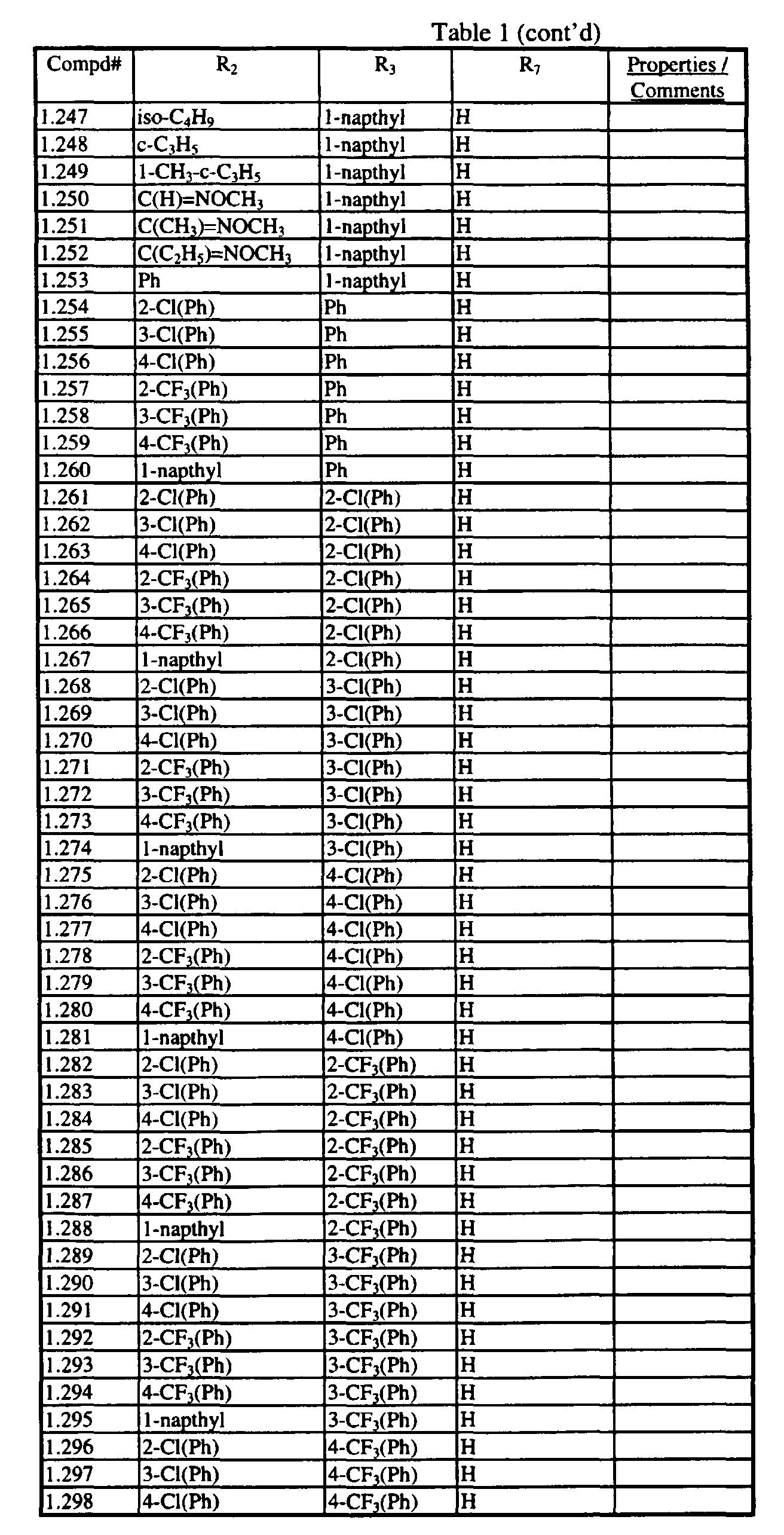

- Typical compounds encompassed by the present invention of Formula I (where A =R4=R5=R6=H) include those compounds presented in Table 2 of Formula V (X=N and Y = O) where, R2, R3, and R7 are defined in Table 2.


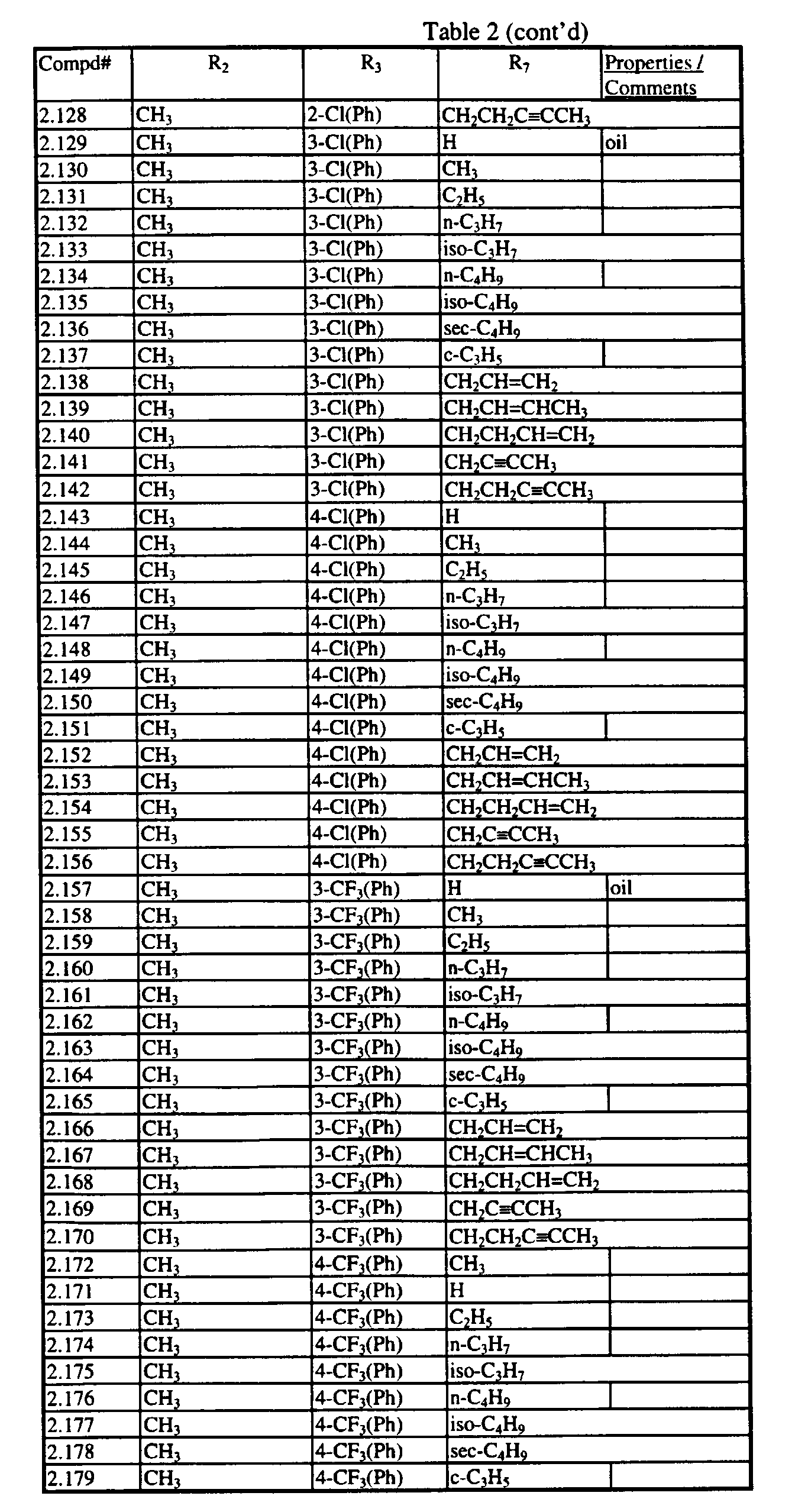


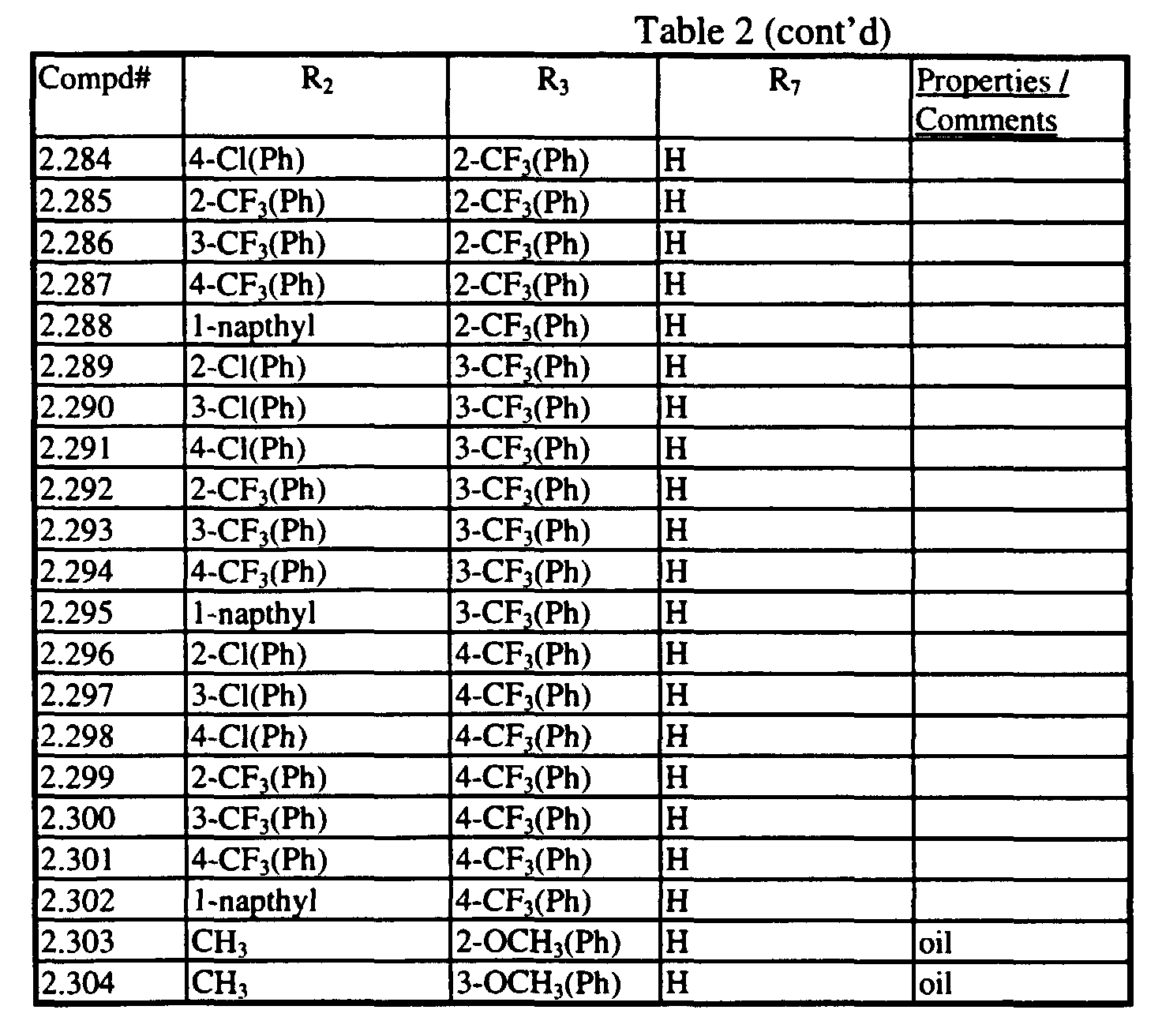
- Typical compounds encompassed by the present invention of Formula I (where A =R4=R5=R6=H) include those compounds presented in Table 3 of Formula VII (X=N and Y=NH) where R2, R3, and R7 are defined in Table 3.
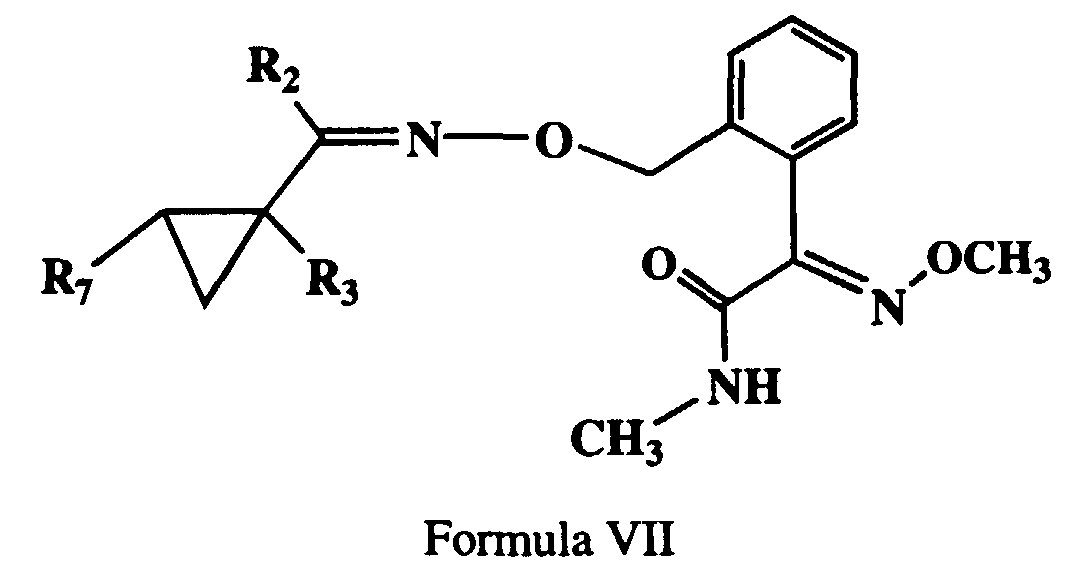
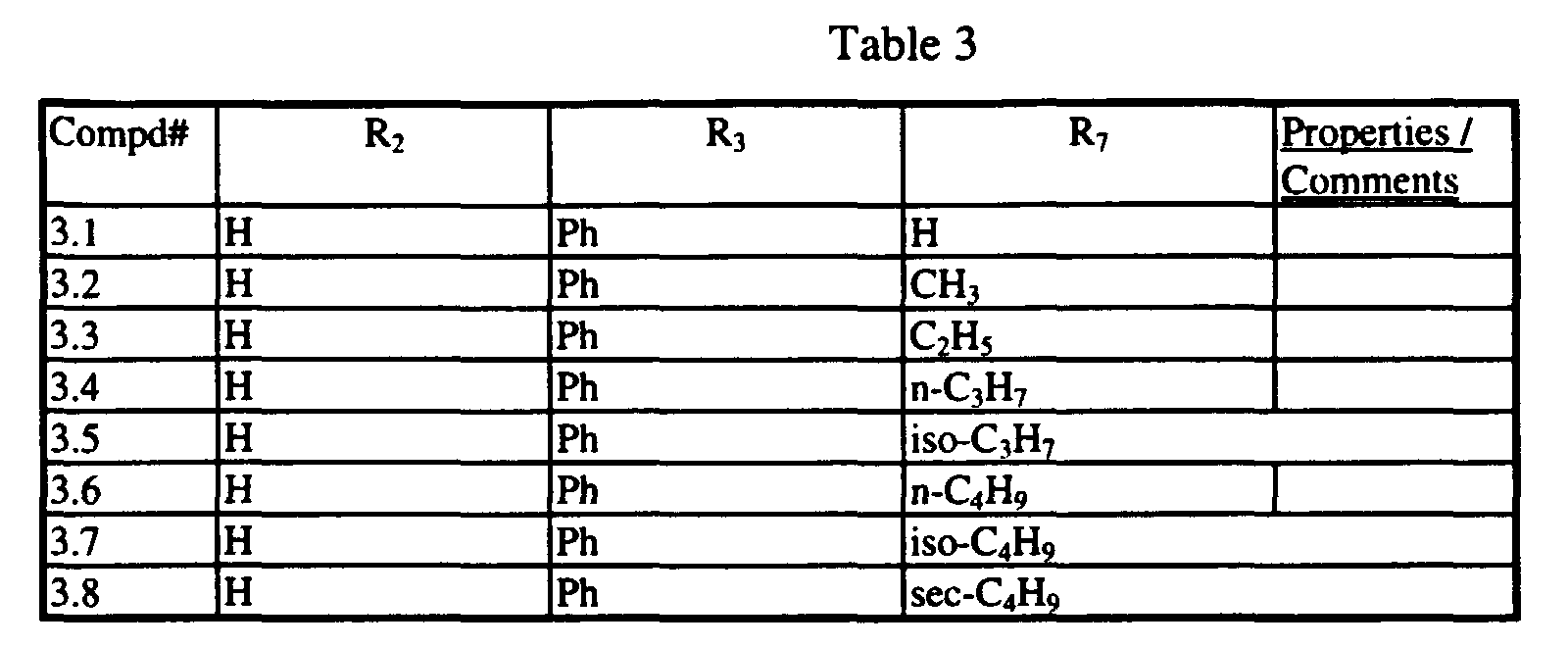

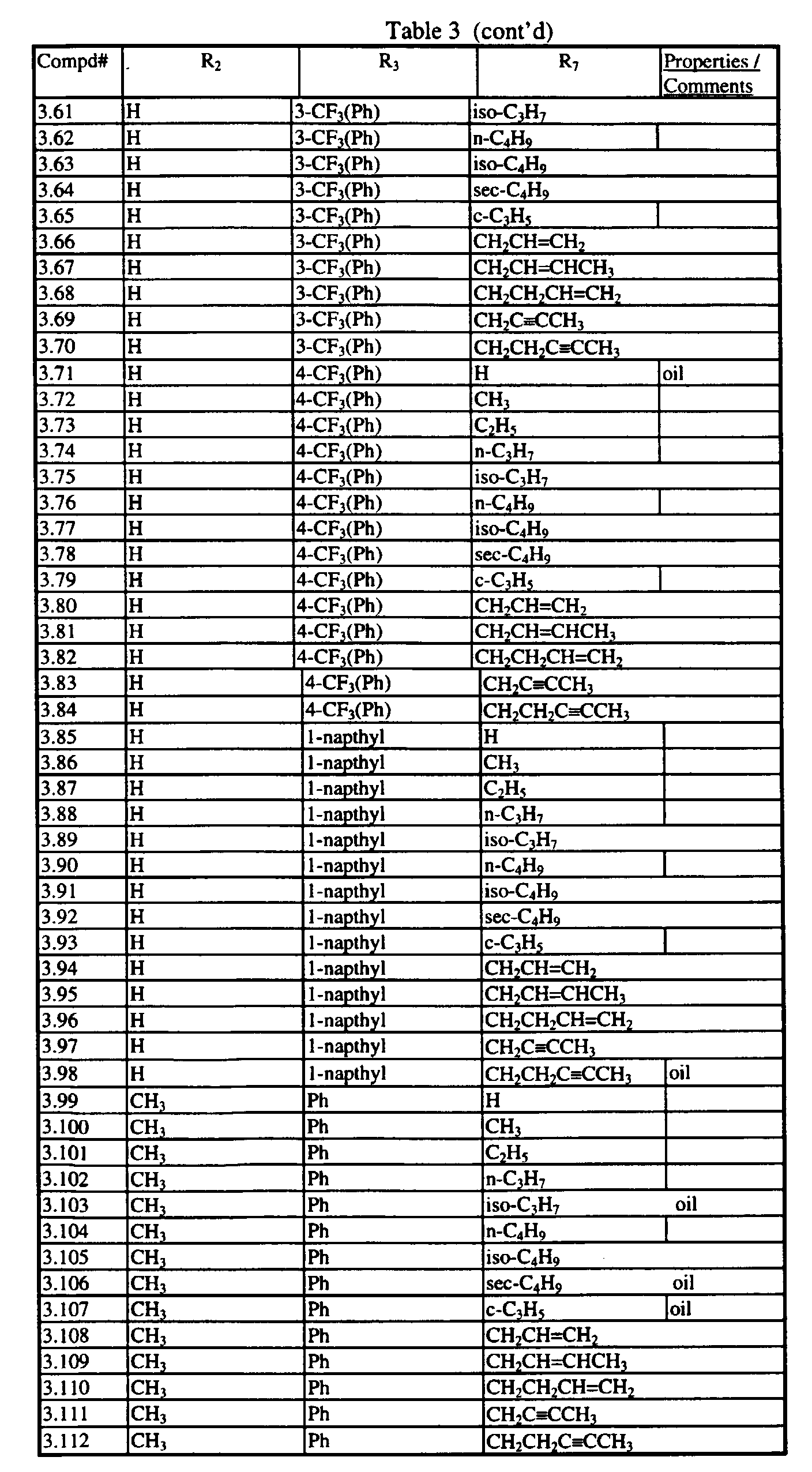

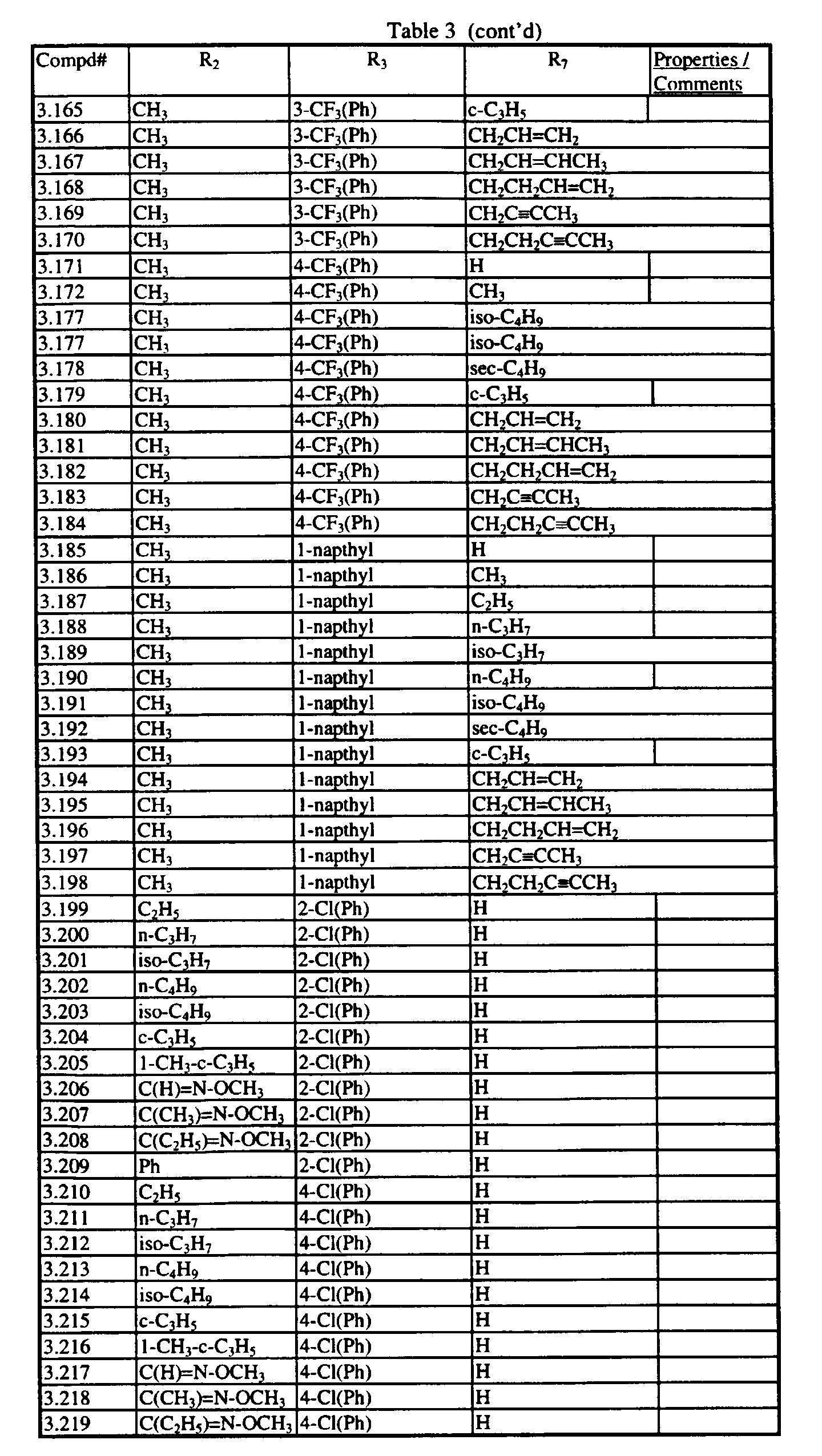


- Typical compounds encompassed by the present invention of Formula I (where A =R4=R5=R6=H) include those compounds presented in Table 4 of Formula IV (X=CH and Y=O) where R2, R3, and R7 are defined in Table 4.
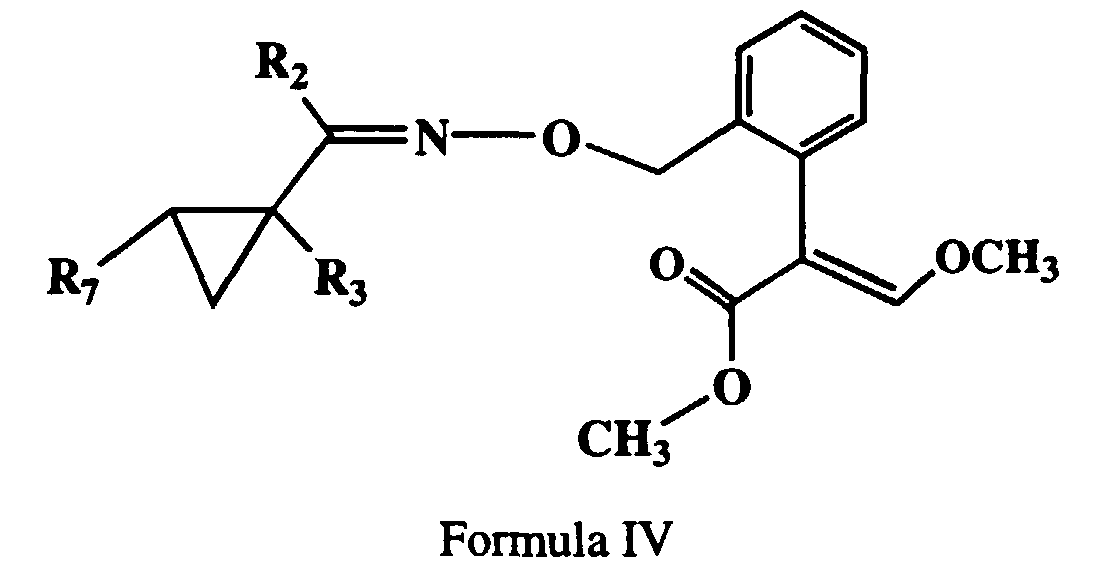
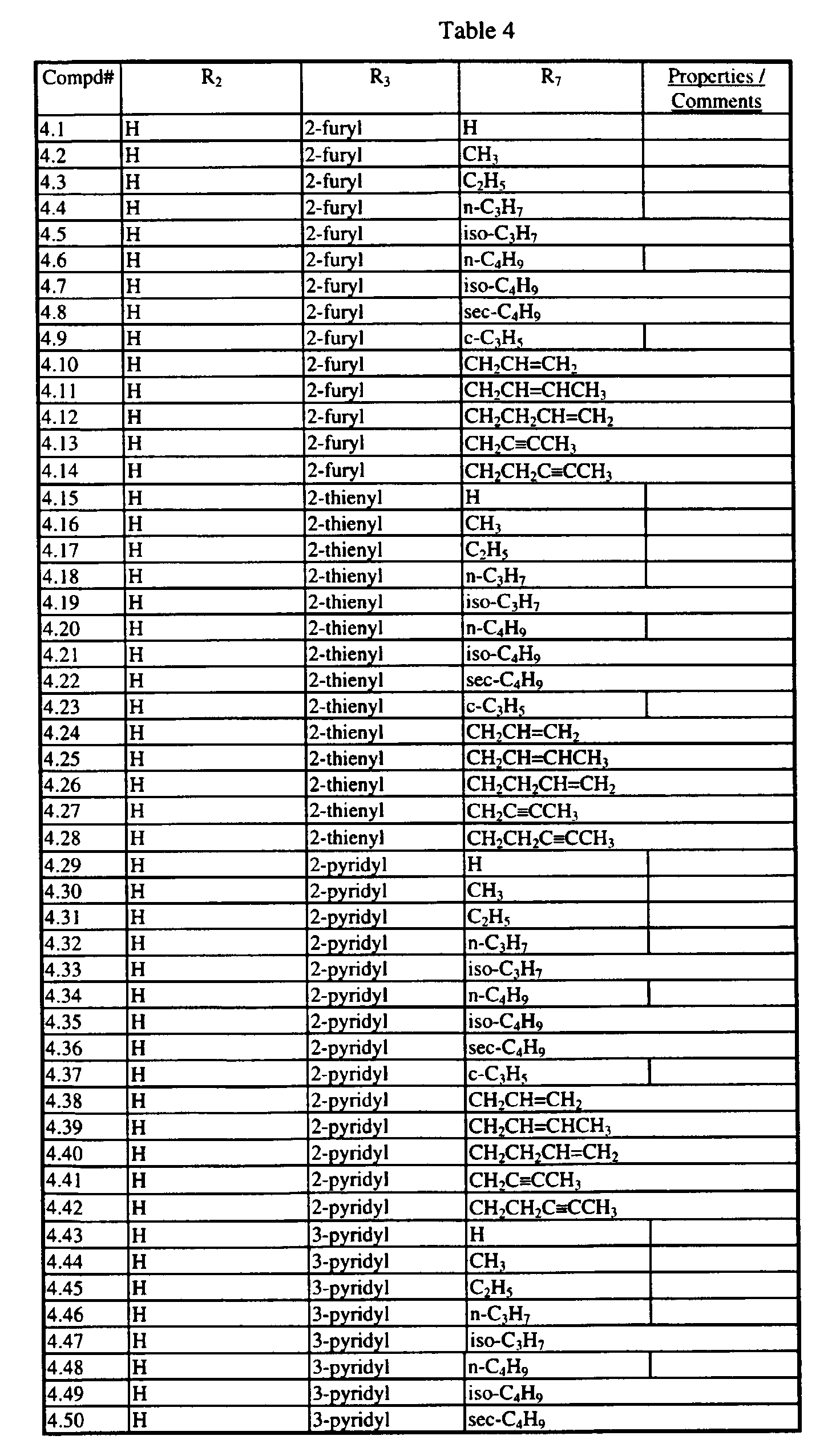

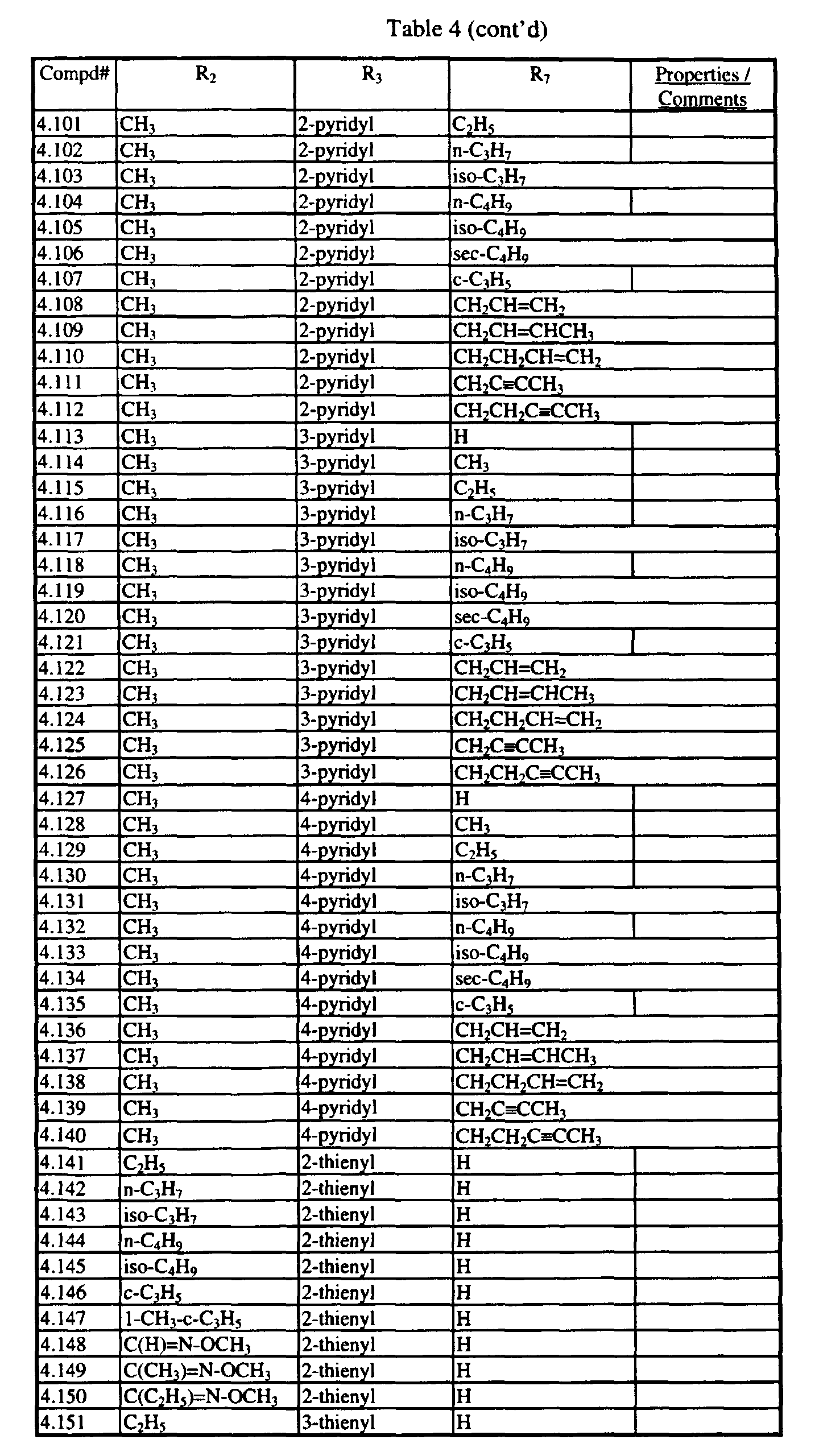


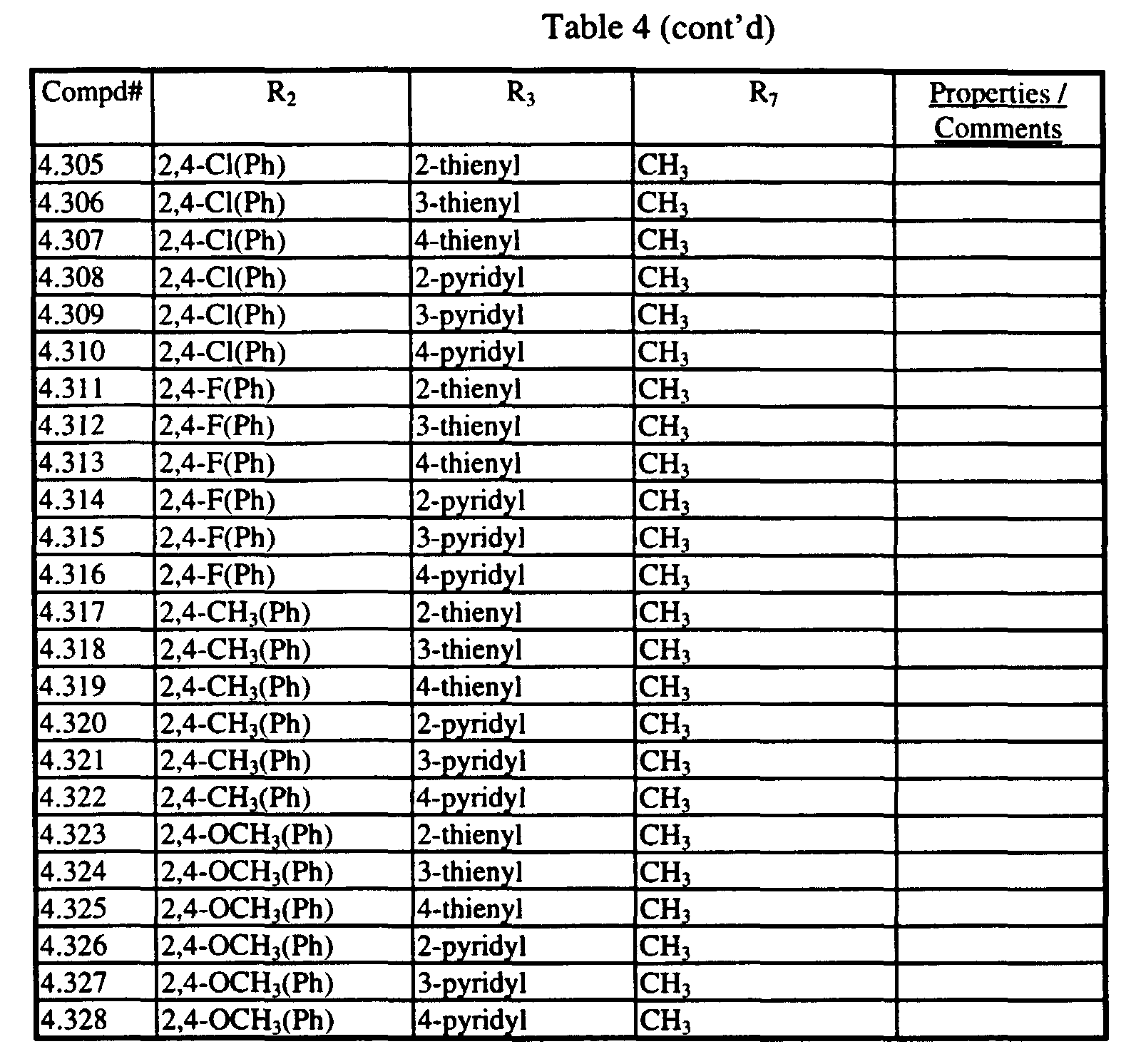
Compounds 5.001 to 5.328 are compounds of Formula V (X=N and Y=O) the substituents R2, R3, and R7 are defined as in Table 4. Compounds 6.001 to 6.328 are compounds of Formula VII (X=N and Y=NH) the substituents R2, R3, and, R7 are defined in Table 4. - As used in Tables 1 to 6, Ph is understood to be phenyl.
- Scheme A describes the preparation of compounds of the Formula (I). where X is CH or N, and Y is O (compounds of formula IV and V). The cyclopropyl oximes (III) are reacted with the appropriately substituted benzyl derivatives (II) where Z is a halogen, such as bromo, chloro or iodo, preferably a benzyl bromide. A cyclopropyl substituted oxime represented by the general formula (III) is treated, at room temperature, with an appropriate base to form an anion, followed by the addition of the benzyl bromides (II). Typical bases employed are metal hydrides such as sodium hydride, alkoxides such as sodium methoxide and hydroxide bases such as sodium or potassium hydroxide and alkali bases such as sodium or potassium carbonate. Typical solvents employed with hydride bases are N,N-dimethylformamide (DMF) and tetrahydrofuran (THF); with hydroxide bases DMF, THF, methyl ethyl ketone (MEK) and acetone and with alkali bases solvents such as DMF, acetone, and MEK.
- As shown in Scheme A, the N-O bond in C(R2)=N-O-, appears in the E position (assumingis the larger substituent), it should be recognized that the Z isomer can also be produced as well as mixtures. When isomers are produced they are designated isomer A (higher Rf on thin layer chromatography) and isomer B (lower Rf on thin layer chromatography). The determination of which isomer, A or B possesses the E or Z geometry can be made by such conventional techniques as X ray crystallography or by spectroscopic means such as nuclear magnetic resonance spectroscopy.
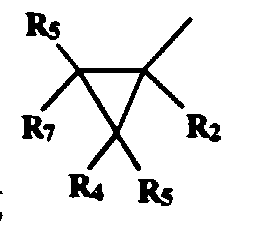

- Compounds of formula IV (X is CH) are prepared by alkylation with methyl E-α-(2-bromomethylphenyl)-β-methoxyacrylate in the presence of a base, preferably NaOH or KOH, in a solvent, preferably acetone or methyl ethyl ketone. Methyl E-α-(2-bromomethylphenyl)-β-methoxyacrylate, as a single E isomer, can be prepared in two steps from 2-methylphenylacetate as known to those skilled in the art and as described previously in US Patent Number 4,914,128 , columns 3-4. Compounds of formula V (X=N) are prepared by the reaction with methyl E-2-(bromomethyl)phenylglyoxylate O-methyloxime in the presence of a base, preferably NaOH or KOH, in a solvent, preferably acetone or methyl ethyl ketone. The preparation of Methyl 2-(bromomethyl)phenylglyoxylate O-methyloxime is known to those skilled in the art and is described in US Patent Numbers 4,999,042, columns 17-18 and 5,157,144, columns 17-18. Methyl 2-(bromomethyl)phenylglyoxylate O-methyl-oxime is prepared from methyl 2-methylphenyl-acetate by treatment with an alkyl nitrite under basic conditions to provide after methylation, methyl 2-methylphenyl-glyoxalate O-methyl oxime which can also be prepared from methyl 2-methyl-phenylglyoxalate by treatment with 2-hydroxylamine hydrochloride and methylation or by treatment with methoxylamine hydrochloride.

- As shown in scheme B compounds of formula VII (X is N) can be prepared by the aminolysis of oximinoacetate (V). The aminolysis of oximinoacetate to oximinoacetamides is known to those skilled in the art and has been described in US Patent Numbers 5,185,342, cols. 22, 48 and 57, 5,221,691, cols. 26-27 and 5,407,902 , col. 8. For example, compounds of Table 2 of formula V where X is N and Y is O are treated with 40% aqueous methylamine in methanol to provide compounds of Table 3 of formula VII where Y is NH. Alternatively, as is shown in scheme B intermediate unsaturated oximes (III) are reacted with N-Methyl (E)-2-methoxyimino-2-[2-(bromomethyl)phenyl]acetamide in the presence of a base such as an hydroxide base preferably in a solvent such as acetone or methyl ethyl ketone to provide compounds of Table II of formula (VII). N-Methyl (E)-2-methoxy-imino-2-[2-(bromomethyl)phenyl]acetamide is well known and described in US Patent Number 5,387,714, col. 13.
- The oximes of the general formula (III) can be obtained, as shown in scheme C, by reacting the corresponding cyclopropyl aldehyde or ketone (VIII) with hydroxylamine hydrochloride from room temperature to reflux, preferably at room temperature, in an appropriate solvent such as methanol or ethanol in the presence of an appropriate alkali such as sodium hydroxide, potassium carbonate or pyridine. A general description of the synthesis of oximes with hydroxylamine is described in March, Advanced Organic Chemistry, 4th Ed, pp. 906-907 and references therein. The oximes of the general formula (III) when obtained as a mixture of syn or anti oxime isomers can be separated into individual isomers and alkylated as described in scheme A and B. When a mixture of oximes of the general formula (III) are used in Scheme A and B the compounds of the formula IV, V and VII can be separated into their individual isomers by conventional chromatographic techniques.
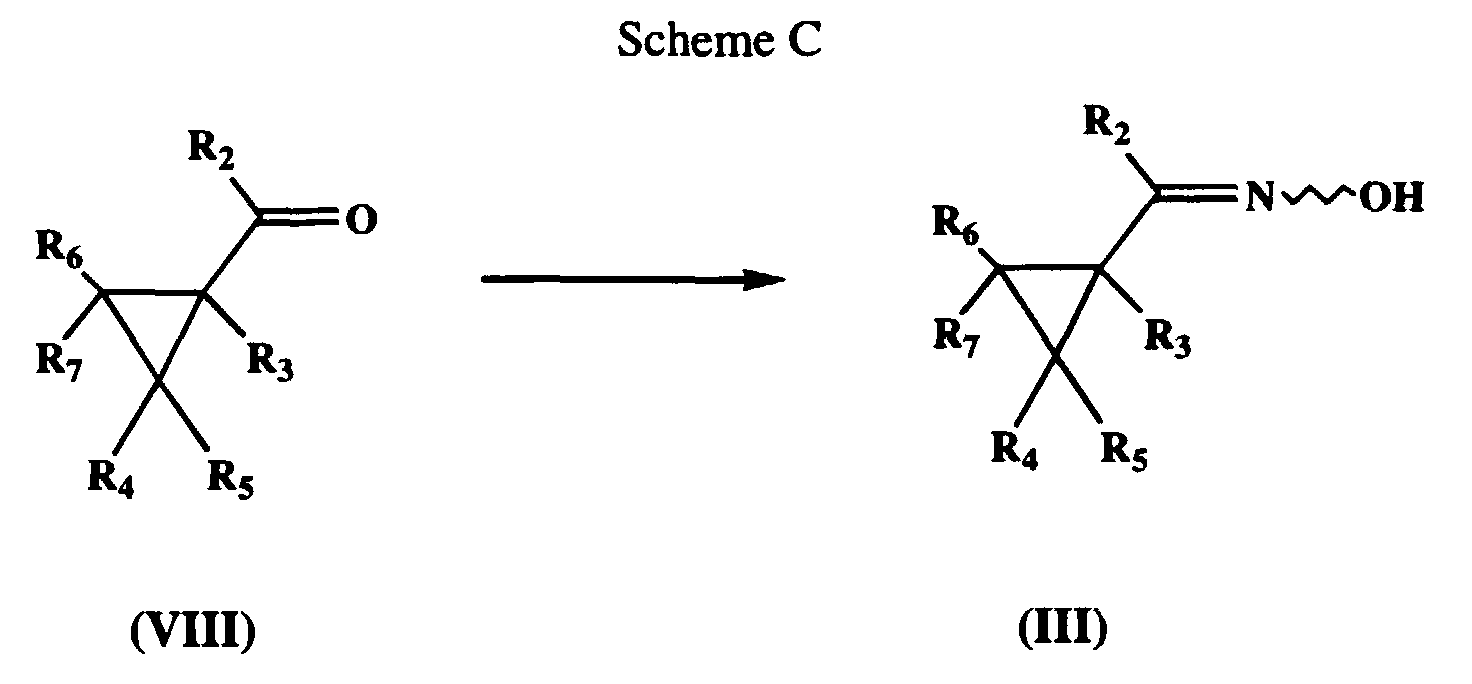
- The cyclopropyl aldehydes or ketones (VIII) can be prepared by conventional techniques. The unsaturated intermediate IX (scheme D) is reacted with a sulfur ylide, prepared from a dimethylsulfoxonium salt in the presence of a base, resulting in the substituted acyl cyclopropanes, VIII. The chemistry of sulfur ylides is described in Trost and Melvin, Sulfur Ylids , Academic Press, New York, NY 1975 and in Block, Reactions of Organosulfur Compounds, pp. 91-123, Academic Press, New York, NY 1978. Typical reaction conditions for sulfur ylide formation from a dimethylsulfoxonium salt utilizes bases such as hydroxides, metal hydrides and alkoxides in solvents such as dimethoxy-ethane, dimethylsufoxide and water depending on the base employed. The reactions are conducted from 0 to 20°C preferably from 10-15°C and preferably with alkali metal hydroxides in dimethylsulfoxide. Typically dimethylsulfoxonium methylide is prepared from trimethylsulfoxonium iodide in dimethylsulfoxide in the presence of powdered sodium hydroxide at room temperature. Cyclopropyl aldehydes or ketones are added dropwise to the ylide and stirred at room temperature.
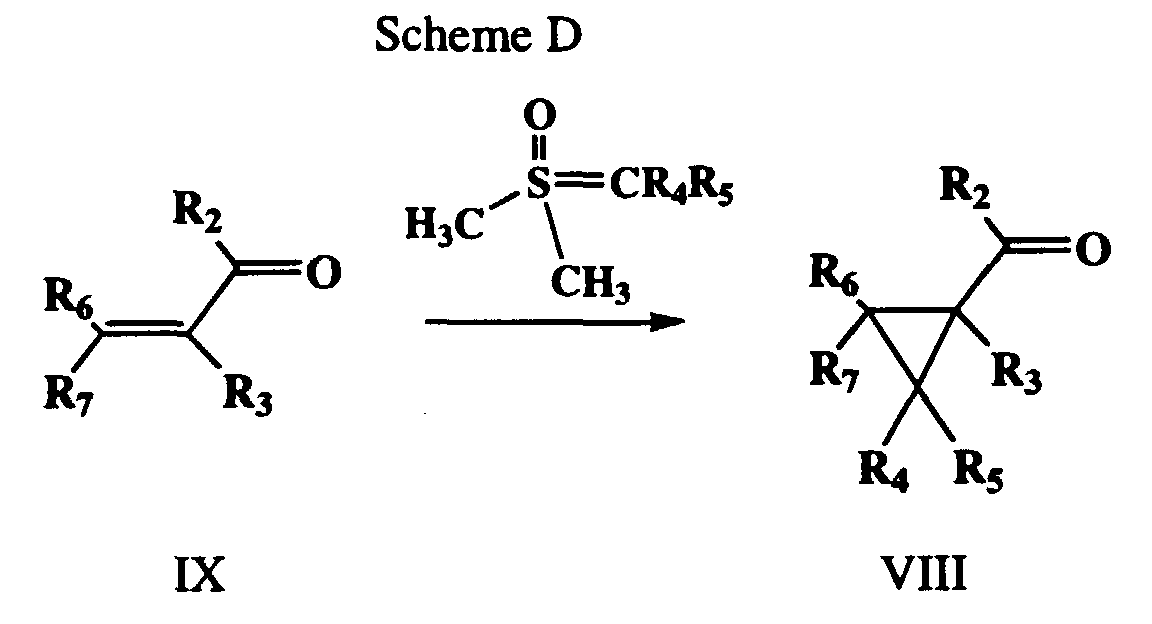
- The oximes of the general formula (III') in which R2 is C(R10)=N-OR9, can be obtained, as shown in scheme E. The ketones, R10 is not H, or the aldeydes, R10 is H, X are reacted with an alkyl nitrite such as t-butylnitrite or isoamylnitrite under basic conditions to provide the corresponding α-oximino cyclopropylketones XI. Typically the cyclopropyl ketone or aldeyhdes in a solvent such as t-butanol and the alkyl nitrite, typically t-butylnitrite, is added to a solution t-butanol containing a base such as potassium t-butoxide and is stirred at room temperature. The α-hydroxyimino cyclopropylketones XI are alkylated to the α-(substituted)oximino cyclopropylketones XII. The keto cyclopropyloxime XII are treated as in Scheme C to provide the bisoximes III'.
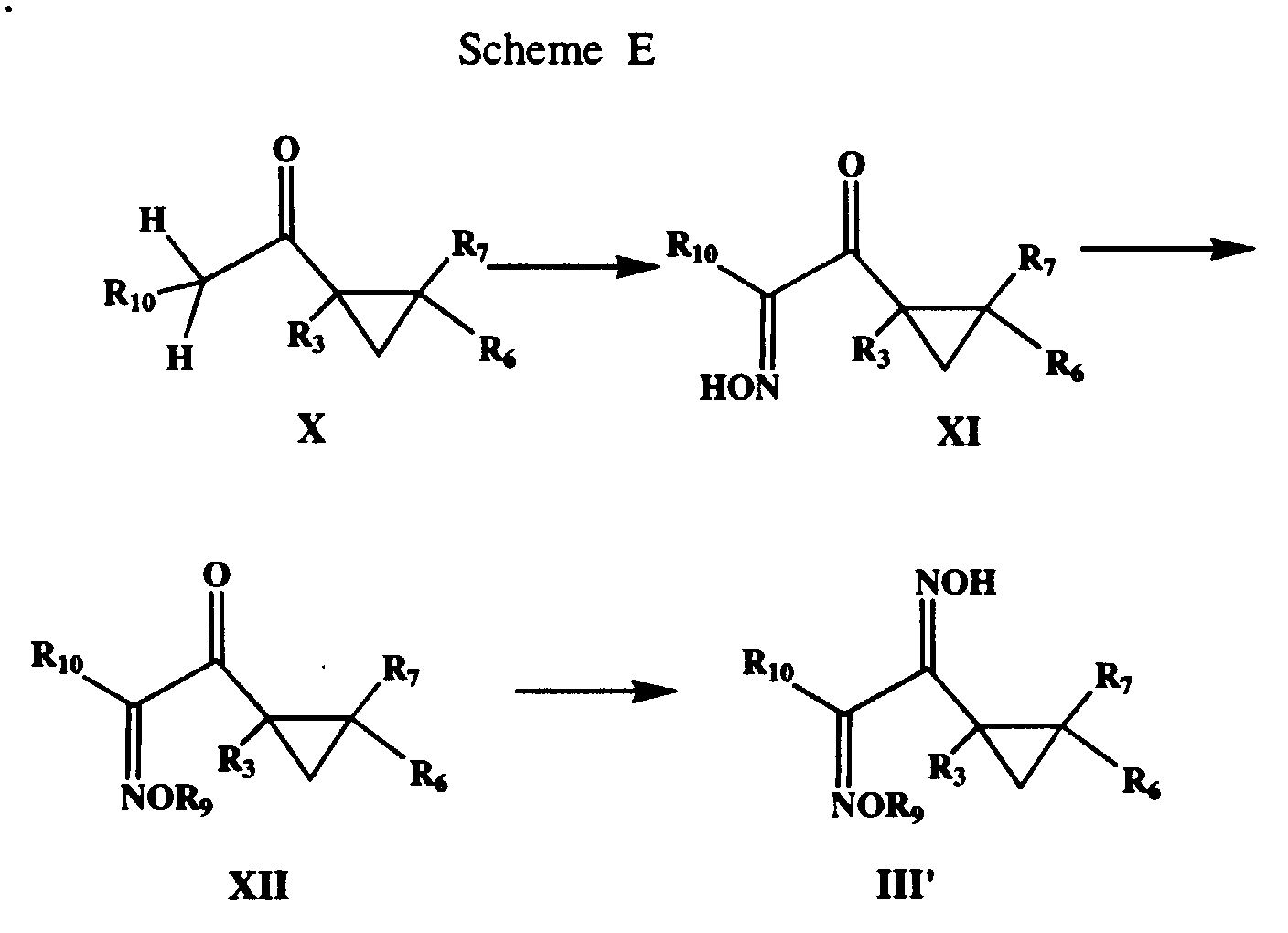
- The α,β-unsaturated aldehydes or ketones IX can be prepared by conventional condensation techniques. A extensive description of the synthesis of α,β-unsaturated aldehydes or ketones (enones) is described in March, Advanced Organic Chemistry, 4th Ed, pp. 937-955 and references therein. For example Organic Reactions, Volume 16 describes the general aldol condensation of ketones and aldehydes. For intermediates of formula IX of this invention, in general the ketones or aldehydes can be R7COR6 where R7 and R6 are defined previously. The ketones can be R2COCH2R3 where R2 and R3 are described previously. Typically the ketone, R2COCH2R3, is dissolved in a hydroxylic solvent, such as methanol or ethanol, to which is added dropwise the aldehyde R7COR6 followed by the base or alternatively a solution of the aldehyde in an aqueous basic solution is added. The typical bases used can be alkali metal hydroxides, such as barium, potassium or sodium hydroxide and the dropwise addition is conducted from 0°C to 35°C preferably at ambient temperature.

- Alternatively the α,β-unsaturated cyclopropyl ketones VIII can be prepared from cyclopropyl nitriles XIV which are prepared via cyclopropanation of the acrylonitriles XIII as is described in Scheme F. The acrylonitriles XIII starting materials, shown in Scheme F can be prepared by conventional synthetic methods as described in March, Advanced Organic Chemistry, 4th Ed, pp. 937-955 and references therein. For example the nitrile derivative R3CH2CN is condensed with the ketone or aldehyde R7COR6, in the presence of a base to provide the acrylonitriles XIII. Preferably R3 in R3CH2CN is an aryl or heteroaryl group as defined previously for R3. Typically the nitrile is dissolved in a solvent such as ethanol and water to which is added the aldehyde or ketone followed by a base. Typical bases used can be alkali metal hydroxides, such as barium, potassium or sodium hydroxide and the mixture is stirred typically at ambient temperature. The acrylonitrile XIII is treated as is described in Scheme D with a sulfur ylide to provide the cyclopropyl nitriles XIV.
- The cyclopropyl nitriles XIV can also be prepared by the reaction of R3CH2CN with a 1,2-dihalosubstituted alkane where halo is preferably bromo and R3 is defined previously and is preferably an aryl or heteroaryl moiety. The 1,2-dibromosubstituted alkane, BrC(R4R5)C(R6R7)Br, when R4,R5, R6, R7 is hydrogen is 1,2-dibromoethane. Typically the nitrile is treated with a base such as sodium hydride in a solvent such as DMF followed by the addition of the dibromoalkane with stirring at room temperature.when R4,R5, R6, R7 = H
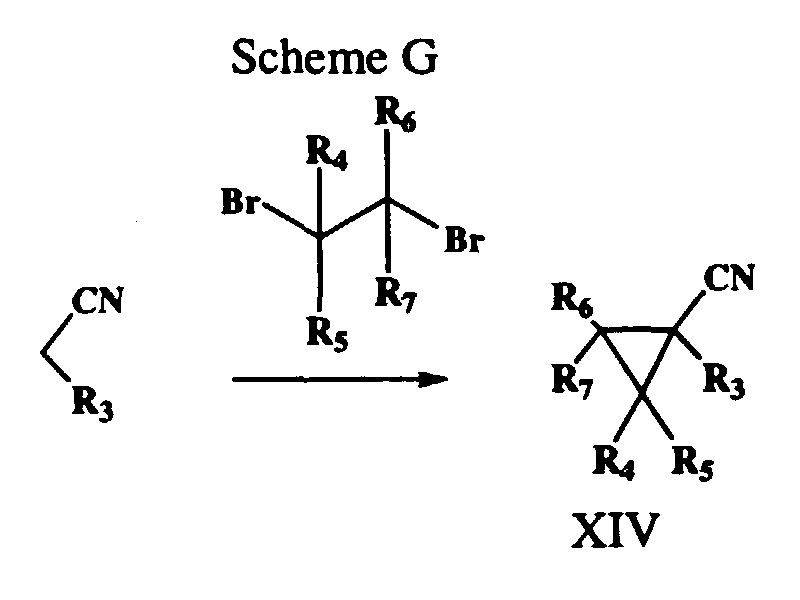
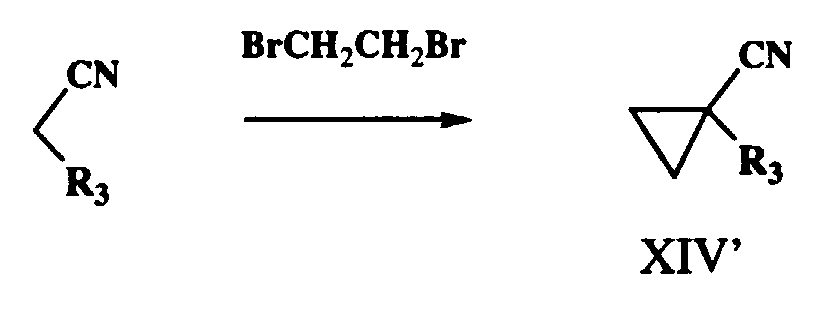
- The cyclopropyl nitriles XIV and XIV' are transformed to the cyclopropyl ketones, VIII, by organometallic addition to the nitrile followed by hydrolysis. For example the standard Grignard reagents R2MgX or organolithium reagents, R2Li add to the nitrile functionality to provide the ketones VIII'. The addition reaction to nitriles is described in March, Advanced Organic Chemistry, 4th Ed, pp.935-936 and references cited therein.
- The cyclopropyl nitrile XIV can be transformed to the cyclopropyl aldehydes VIII' (where R2 is H) by standard reductive methods such as with diisobutylaluminum hydride (DiBAL). The formation of aldehydes from the reduction of nitriles is described in March, Advanced Organic Chemistry, 4th Ed, pp.919-920 and references cited therein.
- A direct synthesis of compounds of the formula V or VII is shown in Scheme G. Compounds of the Formula V or VII can be prepared directly from the functionalized cyclopropyl ketones or aldehydes, VIII, by condensation with the aminoxy intermediate XV. The preparation of aminoxy intermediate XV is described in US 5,194,662. The aminoxy intermediate XV is prepared in a two step sequence by the alkylation of II (where X is N) with N-hydroxyphthalimide which is treated with hydrazine to provide XV. The aminoxy intermediate XV is condensed with ketones or aldehydes VIII to provide V and specifically with the cyclopropane ketones XII to provide V'. The compounds of the formula V are treated as scheme B to provide VII.

- The compounds of this invention can be made according to the the following procedures:
- To a 250 ml round bottom flask equipped with magnetic stirrer was charged 3.0 g (0.0256 moles, 1.0eq.) of benzylcyanide, 150 mls of ethanol, and 50 mls of water. The cyclopropane carboxaldehyde (1.8 g, 0.0256 moles, 1.0eq.) was added in one portion, followed by 0.2 g of 85% potassium hydroxide. The flask was stoppered and stirred overnight at ambient temperature. The reaction mixture was then poured into 200 mls of water and extracted with 3 x 100 mls of ethyl ether. The ether extract was washed with 100 mls of saturated aqueous sodium bisulfite solution, followed by 100 mls of water, and 100 mls of saturated aqueous sodium chloride solution. The ether extract was then dried over anhydrous magnesium sulfate, filtered and concentrated on a rotary evaporator to afford 4.4 g of a pale yellow liquid (100% isolated yield) which was consistent with the desired product, 3-cyclopropyl-2-phenylacrylonitrile upon analysis by 300 MHz 1H NMR.
NMR (300 MHz, 1H, CDCl3, TMS=0 ppm) 0.75 (m, 2H), 1.1 (m, 2H), 2.2 (m, 1H), 6.1 (d, 1H), 7.2-7.5 (m, 5H). - To a 500 ml round bottom flask equipped with magnetic stirrer, nitrogen inlet, and pressure equalized addition funnel was charged 5.6 g (0.0254 moles, 1.0eq.) of trimethylsulfoxonium iodide, 1.0 g (0.0254 moles, 1.0eq.) of powdered sodium hydroxide, and 150 mls of dimethylsulfoxide. The solution was stirred at ambient temperature for 30 minutes, followed by the dropwise addition of the 3-cyclopropyl-2-phenylacrylonitrile in 100 mls of dimethylsulfoxide. The reaction was then stirred overnight at ambient temperature. The reaction mixture was then poured into 200 mls of water and extracted with 3 x 100 mls of ethyl ether. The ether extract was washed with 2 x 100 mls of water, and 100 mls of saturated aqueous sodium chloride solution. The ether extract was dried over anhydrous magnesium sulfate, filtered and concentrated on a rotary evaporator to afford 4.1 g of a thick yellow liquid (88% isolated yield) which was consistent with the desired product, 2-cyclopropyl-1-phenylcyclopropanecarbonitrile upon analysis by 300 MHz 1H NMR.
NMR (300 MHz, 1H, CDCl3, TMS=0 ppm) 0.4 (m, 2H), 0.7 (m, 2H), 1.1 (m, 1H), 1.6 (m, 3H), 7.3 (m, 5H). - To a dry 500 ml round bottom flask equipped with magnetic stirrer, nitrogen inlet, reflux condenser, and side arm addition funnel was charged 1.5 g (0.0082 moles, 1.0eq.) of the nitrile 2-cyclopropyl-1-phenylcyclopropanecarbonitrile and 150 ml of anhydrous toluene. The methylmagnesium bromide (0.0165 moles, 2.0eq., 5.5 mls of 3.0 M solution in ether) was then added dropwise, and the reaction was refluxed for two hours. The reaction was cooled and carefully quenched with 100 mls of saturated aqueous ammonium chloride solution, then extracted with 3 X 100 mls of ethyl ether. The ether extract was washed with 2 x 100 mls of water and 100 mls of saturated aqueous sodium chloride solution, then dried over anhydrous magnesium sulfate, filtered, and concentrated on a rotary evaporator to afford 1.3 g of a thick clear yellow liquid (79% isolated yield) which was consistent with the desired product, 2-cyclopropyl-1-phenyl-cyclopropylmethyl ketone upon analysis by 300 MHz 1H NMR.
NMR (300 MHz, 1H, CDCl3, TMS=0 ppm) 0.3 (m, 2H), 0.6 (m, 3H), 1.0 (m, 1H), 1.3 (m, 1H), 1.4 (m, 1H), 2.0 (s, 3H), 7.3 (m, 5H). - To a 50 ml round bottom flask equipped with magnetic stirrer and reflux condenser was charged the 0.8 g (0.004 moles, 1.0eq.) of the 2-cyclopropyl-1-phenyl-cyclopropylmethyl ketone, 50 mls of anhydrous toluene, approximately 20 4A molecular sieves, and 1.1 g (0.0044 moles, 1.1eq.) of (E)-2-(aminooxymethyl)phenylglyoxylate O-methyloxime. The reaction was refluxed for a total of 2.5 hours, then cooled, and filtered through filter paper to remove the insoluble material. The filtrate was poured into 100 mls of water and extracted with 3 x 50 mls of ether. The ether extract was then washed with 2 x 100 mls of water, 100 mls of saturated aqueous sodium chloride solution, dried over anhydrous magnesium sulfate, filtered, and concentrated on a rotary evaporator to afford 1.3 g of a thick reddish liquid which was chromatographed on silica gel with 20 % ethyl acetate, 80% hexane. The pure fractions were combined and concentrated on a rotary evaporator to afford 160 mg of a thick clear colorless oil (9.5% isolated yield) consistent with the desired product, (E)-methyl 2-(2-((((1-(2-cyclopropyl-1-phenylcyclopropyl)ethylidene)-amino)oxy)methyl)phenyl]-2-methoxyiminoacetate upon analysis by 300 MHz 1H NMR.
NMR (300 MHz, 1H, CDCl3, TMS=0 ppm) 0.2 (m, 2H), 0.4 (m, 1H), 0.5 (m, 2H), 0.9 (m, 1H), 1.3 (m, 1H), 1.4 (m, 1H), 1.8 (s, 3H), 3.8 (s, 3H), 4.0 (s, 3H), 5.0 (s, 2H), 7.1-7.4 (m, 6H), 7.5 (m, 2H), 7.6 (d, 1H). - To a dry 500 ml round bottom flask equipped with magnetic stirrer, and nitrogen inlet was charged 5.1 g (0.0315 moles) of N-hydroxyphthalimide, 1.3 g (0.0315 moles) of sodium hydroxide, and 300 ml of anhydrous dimethylformamide. The dark red solution was stirred at ambient temperature for 20 min., followed by the addition of the benzyl bromide (15 g, 60% pure, 0.0315 moles) in one portion. The reaction was stirred at ambient temperature over the weekend, then poured into 800 mls of water and stirred for 1 hour to afford a white solid which was collected by vacuum filtration and washed with water, hexane, and dried under vacuum at 40°C overnight.. Isolated 11.5g of a white solid (98% isolated yield) which was consistent with the desired product, methyl (E)-2-(O-phthalimidoxymethyl)phenyl glyoxylate O-methyloxime, upon analysis by 300 MHz 1H NMR.
NMR (300 MHz, 1H, CDCl3, TMS=0 ppm) 3.8 (s, 3H), 3.95 (s, 3H), 5.0 (s, 2H), 7.1 (d, 1H), 7.5 (m, 2H), 7.7-7.9 (m, 5H). - To a 250ml rb flask equipped with magnetic stirrer was charged 11.4 g (0.031 moles)of methyl (E)-2-(O-phthalimidoxymethyl)phenyl glyoxylate O-methyloxime 100 mls of anhydrous methanol, and 1.9 g (0.034 moles)of hydrazine monohydrate. The flask was stoppered, and the reaction was stirred at ambient temperature for 2 hours. The resulting solid was removed by filtration and the filtrate was concentrated on the rotary evaporator. The residue was dissolved in 100 mls of ether, filtered, and stripped to afford 7.4 g of a thick yellow oil (100% isolated yield). which was consistent with the desired product methyl (E)-2-(aminooxymethyl)phenyl glyoxylate O-methyloxime upon analysis by 300 MHz 1H NMR. Stored at -20°C until needed for future synthesis.
NMR (300 MHz, 1H, CDCl3, TMS=0 ppm) 3.87 (s, 3H), 4.03 (s, 3H), 4.6 (s, 2H), 4.9-5.4 (br s, 2H), 7.2 (m, 1H), 7.4-7.5 (m, 3H). - To a dry 100ml round bottom flask equipped with magnetic stirrer was charged 80 mg (0.19 mmoles, 1.0eq.) of the oxime ester (E)-methyl 2-[2-((((1-(2-cyclopropyl-1-phenyl-cyclopropyl)ethylidene)amino)oxy)methyl)phenyl]-2-methoxyiminoacetate 10 mls of methanol, and 1.0 ml (12.9 mmoles) of 40% aqueous methyl amine. The flask was stoppered and stirred overnight at ambient temperature. The reaction was then poured into 100 mls of water and extracted with 3 x 50 mls of ethyl ether. The ether extract was washed with 2 x 50 mls of water, and 50 mls of saturated aqueous sodium chloride solution, dried over anhydrous magnesium sulfate, filtered, and concentrated on a rotary evaporator to afford 70 mg of a thick clear colorless oil (88% isolated yield) consistent with the desired product, (E)-N-methyl 2-[2-((((1-(2-cyclopropyl-1-phenylcyclopropyl)-ethylidene)-amino)oxy)methyl)phenyl]-2-methoxyiminoacetamide upon analysis by 300 MHz 1H NMR.
NMR (300 MHz, 1H, CDCl3, TMS=0 ppm) 0.2 (m, 2H), 0.4 (m, 1H), 0.5 (m, 2H), 0.9 (m, 1H), 1.3 (m, 1H), 1.4 (m, 1H), 1.75 (s, 3H), 2.75 (d, 3H), 3.9 (s, 3H), 5.0 (m, 2H), 6.6 (bs, 1H), 7.1-7.4 (m, 6H), 7.5 (m, 2H), 7.6 (d, 1H). - To a dry 250 ml round bottom flask equipped with magnetic stirrer, nitrogen inlet, reflux condenser, and side arm addition funnel was charged 1.5 g (0.0082 moles, 1.0eq.) of 2-cyclopropyl-1-phenylcyclopropanecarbonitrile and 100 ml of anhydrous toluene. The diisobutyl aluminum hydride (0.0163 moles, 2.0eq., 16.3 mls of 1.0 M solution in toluene) was then added dropwise, and the reaction was refluxed for two hours, then overnight at ambient temperature. The reaction was cooled and carefully quenched with 100 mls of saturated aqueous ammonium chloride solution, then extracted with 3 x 100 mls of ethyl ether. The ether extract was washed with 2 x 100 mls of water and 100 mls of saturated aqueous sodium chloride solution, then dried over anhydrous magnesium sulfate, filtered, and concentrated on a rotary evaporator to afford a yellow oil which was chromatographed on silica gel with 10 % ethyl acetate, 90% hexane. The pure fractions were combined and concentrated on a rotary evaporator to afford 0.8 g of a thick clear pale yellow oil (53% isolated yield) consistent with the desired product, 2-cyclopropyl-1-phenylcyclopropylcarboxaldeyhde upon analysis by 300 MHz 1H NMR.
NMR (300 MHz, 1H, CDCl3, TMS=0 ppm) 0.1-0.4 (m, 2H), 0.6 (m, 2H), 1.0 (m, 1H), 1.5 (m, 1H), 1.6 (m, 1H), 1.8 (m, 1H), 7.2-7.4 (m, 5H), 9.6 (s, 1H). - To a 250 ml round bottom flask equipped with magnetic stirrer and reflux condenser was charged the 0.4 g (0.0021 moles, 1.0eq.) of 2-cyclopropyl-1-phenylcyclopropylcarboxaldeyhde, 50 mls of anhydrous methanol, and 0.5 g (0.0021 moles, 1.0eq.) (E)-2-(aminooxymethyl)phenylglyoxylate O-methyloxime. The reaction was stirred overnight at ambient temperature, then poured into 100 mls of water and extracted with 3 X 50 mls of ether. The ether extract was then washed with 2 x 100 mls of water, 100 mls of saturated aqueous sodium chloride solution, dried over anhydrous magnesium sulfate, filtered, and concentrated on a rotary evaporator to afford 0.8 g of a thick yellow oil which was chromatographed on silica gel with 25 % ethyl acetate, 75% hexane. The pure fractions were combined and concentrated on a rotary evaporator to afford 610 mg of a thick clear yellow oil (72% isolated yield) consistent with the desired product, (E)-methyl 2-[2-((((2-cyclopropyl-1-phenylcyclopropyl)methylidene)amino)oxy)methyl)-phenyl]-2-methoxy-iminoacetate upon analysis by 300 MHz 1H NMR.
NMR (300 MHz, 1H, CDCl3, TMS=0 ppm) 0.2 (m, 2H), 0.5 (m, 2H), 0.7 (m, 1H), 1.2 (m, 2H), 1.3 (m, 1H), 3.8 (s, 3H), 4.0 (s, 3H), 4.9 (s, 2H), 7.1-7.6 (m, 9H), 7.7 (s, 1H). - To a dry 100ml round bottom flask equipped with magnetic stirrer was charged 300 mg (0.74mmoles, 1.0eq.) of (E)-methyl2-[2-((((2-cyclopropyl-1-phenylcyclopropyl)methylidene)amino)oxy)methyl)-phenyl]-2-methoxy-iminoacetate 10 mls of methanol, and 1.0 ml (12.9 mmoles) of 40% aqueous methyl amine. The flask was stoppered and stirred overnight at ambient temperature. The reaction was then poured into 100 mls of water and extracted with 3 x 50 mls of ethyl ether. The ether extract was washed with 2 x 50 mls of water, and 50 mls of saturated aqueous sodium chloride solution, dried over anhydrous magnesium sulfate, filtered, and concentrated on a rotary evaporator to afford 280 mg of a thick clear colorless oil (93% isolated yield) consistent with the desired product, (E)-methyl 2-[2-((((2-cyclopropyl-1-phenylcyclopropyl)methylidene)amino)-oxy)methyl)-phenyl]-2-methoxy-iminoacetate upon analysis by 300 MHz 1H NMR.
NMR (300 MHz, 1H, CDCl3, TMS=0 ppm) 0.2 (m, 2H), 0.5 (m, 2H), 0.7 (m, 1H), 1.2 (m, 2H), 1.3 (m, 1H), 2.8 (d, 3H), 3.9 (s, 3H), 4.9 (s, 2H), 6.6 (bs, 1H), 7.1-7.5 (m, 9H), 7.6 (s, 1H). - To a dry 250 ml round bottom flask equipped with magnetic stirrer, side arm addition funnel and nitrogen inlet was charged 2.7 g (0.068 moles, 2.0eq) of 60% sodium hydride in mineral oil, and 100 mls of dry dimethylformamide. The benzyl cyanide (4.0 g, 0.034 moles, 1.0eq.) was then added dropwise and the flask was stirred at ambient temperature for 30 min. The dibromoethane (8.0 g, 0.034 moles, 1.0eq.) was then added dropwise, and the reaction was stirred at ambient temperature for 3 hours. The reaction was carefully quenched with 200 mls of water. and extracted with 3 x100 mls of ethyl ether. The ether extract was washed with 2 x 100 mls of water, 100 mls of saturated aqueous sodium chloride solution, dried over anhydrous magnesium sulfate, filtered, and concentrated on a rotary evaporator to afford 4.9 g of a clear reddish liquid (100% isolated yield.consistent) with the desired product, 1-phenylcyclopropanecarbonitrile, upon analysis by 300 MHz 1H NMR.
NMR (300 MHz, 1H, CDCl3, TMS=0 ppm) 1.45 (m, 2H), 1.8 (m, 2H), 7.2-7.5 (m, 5H). - To a dry 250 ml round bottom flask equipped with magnetic stirrer, nitrogen inlet, reflux condenser, and side arm addition funnel was charged 2.8 g (0.0195 moles, 1.0eq.) of the nitrile 1-phenylcyclopropanecarbonitrile and 100 ml of anhydrous toluene. The methylmagnesium bromide (0.0391 moles, 2.0eq., 13 mls of 3.0 M solution in ether) was then added dropwise, and the reaction was refluxed for two hours. The reaction was cooled and carefully quenched with 100 mls of saturated aqueous ammonium chloride solution, then extracted with 3 x 100 mls of ethyl ether. The ether extract was washed with 2 x 100 mls of water and 100 mls of saturated aqueous sodium chloride solution, then dried over anhydrous magnesium sulfate, filtered, and concentrated on a rotary evaporator to afford a reddish oil which was chromatographed on silica gel with 15 % ethyl acetate, 85% hexane. The pure fractions were combined and concentrated on a rotary evaporator to afford 1.7 g of a thick clear colorless oil (55% isolated yield) consistent with the desired product, 1-phenyl-cyclopropylmethyl ketone, upon analysis by 300 MHz 1H NMR. NMR (300 MHz, 1H, CDCl3, TMS=0 ppm) 1.2 (m, 2H), 1.4 (m, 2H), 1.9 (s, 3H), 7.2-7.4 (m, 5H).
- To a 250 ml round bottom flask equipped with magnetic stirrer and reflux condenser was charged the 1.0 g (0.00625 moles) of 1-phenyl-cyclopropylmethyl ketone, 70 mls of anhydrous toluene, approximately 20 4A molecular sieves, and 1.5 g (0.00625 moles) of (E)-2-(aminooxymethyl)phenylglyoxylate O-methyloxime. The reaction was refluxed for a total of 3 hours, then cooled, and filtered through filter paper to remove the insoluble material. The filtrate was poured into 100 mls of water and extracted with 3 x 50 mls of ether. The ether extract was then washed with 2 x 100 mls of water, 100 mls of saturated aqueous sodium chloride solution, dried over anhydrous magnesium sulfate, filtered, and concentrated on a rotary evaporator to afford 1.8 g of a thick yellow liquid which was chromatographed on silica gel with 10 % ethyl acetate, 90% hexane. The pure fractions were combined and concentrated on a rotary evaporator to afford 450 mg of a thick clear colorless oil (19% isolated yield) consistent with the desired product, (E)-Methyl 2-[2-((((1-(1-phenylcyclopropyl)ethylidene)amino)oxy)methyl)phenyl]-2-methoxyimino-acetate upon analysis by 300 MHz 1H NMR.
NMR (300 MHz, 1H, CDCl3, TMS=0 ppm) 1.0 (m, 2H), 1.2 (m, 2H), 1.75 (s, 3H), 3.62 (s, 3H), 4.0 (s, 3H), 5.0 (s, 2H), 7.1-7.3 (m, 6H), 7.5 (m, 3H). - To a dry 100ml round bottom flask equipped with magnetic stirrer was charged 300 mg (0.79 mmoles, 1.0eq.) of the oxime ester (E)-Methyl 2-[2-((((1-(1-phenylcyclopropyl)ethylidene)amino)oxy)methyl)phenyl]-2-methoxyimino-acetate 10 mls of methanol, and 1.0 ml (12.9 mmoles) of 40% aqueous methyl amine. The flask was stoppered and stirred overnight at ambient temperature. The reaction was then poured into 100 mls of water and extracted with 3 x 50 mls of ethyl ether. The ether extract was washed with 2 x 50 mls of water, and 50 mls of saturated aqueous sodium chloride solution, dried over anhydrous magnesium sulfate, filtered, and concentrated on a rotary evaporator to afford 240 mg of a thick clear colorless oil (80% isolated yield). consistent with the desired product, E)-N-methyl2-[2-((((1-(1-phenylcyclopropyl)ethylidene)amino)oxy)methyl)phenyl]-2-methoxyiminoacetamide upon analysis by 300Mz 1H NMR.
NMR (300 MHz, 1H, CDCl3, TMS=0 ppm) 1.0 (m, 2H), 1.3 (m, 2H), 1.75 (s, 3H), 2.85 (d, 3H), 4.0 (s, 3H), 5.0 (s, 2H), 6.65 (bs, 1H), 7.1-7.3 (m, 6H), 7.5 (m, 3H). - Proton NMR data (300MHz) are provided in Table 7 for typical examples of Tables 1 to 6 and are illustrative of the present invention.

- Numerous compounds of this invention were tested for fungicidal activity in vivo against the diseases described below. The compounds were dissolved in a 1:1 mixture of acetone and methanol 2:1:1 or N,N-dimethylformamide and diluted with a 2:1:1 mixture of water, acetone and methanol (by volume) to achieve the appropriate concentration. The solution was sprayed onto the plants and allowed to dry for two hours. Then the plants were inoculated with fungal spores. Each test utilized control plants which were sprayed with the appropriate solvent and inoculated. For these protective tests, the plants were inoculated one day after treating the plants with the compounds of this invention. The remainder of the technique of each of the tests is given below along with the results for various compounds described herein by the Compound # against the various fungi at a dose of 100 or 150 grams per hectare. The results are percent disease control as compared to the untreated check wherein one hundred was rated as complete disease control and zero as no disease control. The application of the test fungal spores to the test plants was as follows:
- Puccinia recondita (f. sp. tritici ) was cultured on 7-day old wheat (cultivar Fielder) over a 12-day period in the greenhouse. Spores were collected from the leaves by settling on aluminum foil. The spores were cleaned by sieving through a 250-micron opening screen and stored dry. The dried spored were used within one month.. A spore suspension was prepared from dry uredia by adding 20 mg (9.5 million spores) per ml of Soltrol oil. The suspension was dispensed into gelatin capsules (0.7 ml capacity) which attach to the oil atomizers. One capsule is used per flat of twenty 2-inch square pots of 7-day old plants, cultivar Fielder. After waiting for at least 15 minutes for the oil to evaporate from the wheat leaves, the plants were placed in a dark mist chamber (18-20°C and 100% relative humidity) for 24 hours. The plants were then placed in the greenhouse and evaluated after 12 days for disease.
- Cultures of Septoria nodorum was maintained on Czapek-Dox V-8 juice agar plates in an incubator at 20°C with alternating periods of 12 hours of light and 12 hours of darkness for 2 weeks. A water suspension of the spores was obtained by shaking the portion of the plate with fungal material in deionized water and filtering through cheesecloth. The spore-containing water suspension was diluted to a spore concentration of 3.0 x 10⁶ spores per ml. The inoculum was dispersed by a DeVilbiss atomizer over one-week old Fielder wheat plants which had been previously sprayed with the fungicide compound. The inoculated plants were placed in a humidity cabinet at 20°C with alternating 12 hours of light and 12 hours of darkness for 7 days. The inoculated seedlings were then moved to a controlled environment room at 20°C for 2 days of incubation. Disease control values were recorded as percent control.
- Erysiphe graminis (f. sp. tritici) was cultured on wheat seedlings, cultivar Fielder, in a controlled temperature room at 18°C. Mildew spores were shaken from the culture plants onto 7-day old wheat seedlings which had been previously sprayed with the fungicide compound. The inoculated seedlings were kept in a controlled temperature room at 18°C and subirrigated. The percent disease control was rated 7 days after the inoculation. Disease control values were recorded as percent control.
- Sphaerotheca fulginea was maintained on cucumber plants, cultivar Bush Champion, in the greenhouse. Inoculum was prepared by placing five to ten heavily mildewed leaves in a glass jar with 500ml of water containing 1 drop of Tween 80 per 100 ml. After shaking the liquid and leaves, the inoculum was filtered through cheese cloth and misted onto the plants with a squirt bottle mister. The spore count was 100,000 spores/ml. The plants were then placed in the greenhouse for infection and incubation. The plants were scored seven days after inoculation. Disease control values were recorded as percent control.
- Cultures of Phytophthora infestans were maintained on green pea-amended agar for two to three weeks. The spores were washed from the agar with water and dipsersed with a DeVilbiss atomizer over the leaves of 3-week old Pixie tomato plants which had been previously treated with compound of the present invention. The inoculated plants were placed in a humidity cabinet at 20°C for 24 hours for infection. The plants were then removed to a controlled environment room at 20°C and 90% humidity. The plants were scored for disease control after five days.
- Plasmopara viticola was maintained, leaves of grape plants, cultivar Delaware, in a controlled temperature chamber at 20°C in humid air with moderate light intensity for 7 to 8 days. A water suspension of the spores from infested leaves was obtained and the spore concentration was adjusted to about 3 x 10⁵ per ml of water. Delaware grape plants were inoculated by spraying the underside of leaves with a De Vilbiss atomizer until small drops were observed on the leaves. The inoculated plants were incubated in a mist chamber for 24 hours at 20°C. The plants were then removed to a controlled environmental room at 20°C. Disease control values were recorded as percent control seven days after inoculation.
- Cultures of Pyricularia oyrzae were maintained on potato dextrose agar for two to three week. The spores were washed from the agar with water containing 1 drop of Tween 80 per 100 After filtering the spore suspension through two layers of cheese cloth, the spore count was adjusted to 5 x 10⁵. The spore suspension was sprayed onto 12-day old rice plants, cultivar M-1, using a DeVilbiss atomizer. The inoculated plants were placed in a humidity at chamber 20°C for 36 hours to allow for infection.. After the infection period the plants were placed in the greenhouse. After 6 days, the plants were scored for disease control. Disease control values were recorded as percent control.
- Cucumber plants were maintained in the greenhouse. Large, fully expanded leaves were collected from the plates. The stems were wrapped with cotton, the leaves were placed in a large petri plate (15-cm. diameter) and the leaves were supported by glass rods. The upper cover of the plate was removed and the upper surface of the detached cucumber leaf was sprayed with the compounds of the present invention. The leaf was allowed to dry in the air for approximately 2 hours. The cultures of Pseudoperonospora cubensis were maintained on cucumber plants. After extracting the spores by shaking the leaves in water, the lower surface of the treated cucumber leaves were sprayed with a spore concentration of 100,000 spores per ml. The plates were returned to a controlled environmental chamber at 20°C and 90% humidity for five days. After this time, leaves were examined for disease development. Disease control values were recorded as percent control.
- The fungal pathogen Colletotrichum lagenarium was cultured on potato dextrose agar (PDA) in the dark at 22 C for a period of 8 to 14 days. Spores of C. lagenarium were removed from the PDA plates by flooding the plate surface with distilled water, amended with 0.5% v/w of yeast extract. The upper surface of the fungal colony was scraped with a blunt instrument until most of the spores were released into the aqueous environment. The spore suspension was filtered though cheesecloth, and the spore count was adjusted by adding more water, containing the yeast extract, until 3.0 x 10⁶ spores per ml was achieved.
- The chemically-treated cucumber plants were 15-days old, cultivar Bush Champion. The upper leaf surface of the plants were sprayed with the spore suspension until runoff, using a hand-held pump spray bottle. The plants were placed in a fluorescent-lighted mist chamber (12 hr light, 12 hr dark) for 48 hours. After that infection period, the plants were placed in a growth chamber for 3 days at 25 C and 90% humidity. The treated plants were then evaluated for disease control. Disease control values were recorded as percent control.
- The fungal pathogen Botrytis cinerea was cultured on potato dextrose agar (PDA) under fluorescent lights (12 hr on, 12 hr off) for a period of 2 to 3 weeks. Spores of B. cinerea were removed from the PDA plates by flooding the plate surface with distilled water, amended with 0.5% v/w of yeast extract. The upper surface of the fungal colony was scraped with a rubber instrument until most of the spores were released into the aqueous environment. The spore suspension was filtered though cheesecloth, and the spore count was adjusted by adding more water, containing the yeast extract, until 3.0 x 10⁶ spores per ml was achieved.
- Chemically-treated sweet bell pepper plants were 19-days old, cultivar California Wonder. The entire leaf surface of the plants were sprayed with the spore suspension until runoff, using a DeVilbiss atomizer. The plants were placed in a low light mist chamber (12 hr light, 12 hr dark) at 22 C for 4 or 5 days. The treated plants were then evaluated for disease control. Disease control values were recorded as percent control.
- When tested against wheat leaf rust at a dose of 150 grams per hectare compounds 2.99, 2.129, 2.157, 3.99 and 3.157 exhibited 90% or better control.
- When tested against wheat leaf blotch at a dose of 150 grams per hectare compounds 2.99 and 3.99 exhibited 85% or better control.
- When tested against wheat powdery mildew at a dose of 150 grams per hectare compounds 2.129, 2.99, 2.157 and 3.157 exhibited 90% or better control.
- When tested against cucumber powdery mildew at a dose of 150 grams per hectare compounds 2.129, 2.157 and 3.157 exhibited 85% or better control.
- When tested against tomato late blight at a dose of 150 grams per hectare compounds 2.99 and 3.99 exhibited 90% or better control,
- When tested against grape downy mildew at a dose of 150 grams per hectare compounds 2.129 and 3.157 exhibited 75% or better control.
- When tested against rice blast at a dose of 150 grams per hectare compounds 2.99, 2.107, 2.157 and 2.129 exhibited 85% or better control.
- When tested against cucumber downy mildew at a dose of 150 grams per hectare compounds 2.99, 3.99, 3.103, 3.106 and 3.107 exhibited 90% or better control.
- When tested against sweet bell pepper botrytis at a dose of 150 grams per hectare compound 2.99 exhibited 80% or better control.
- When tested against cucumber anthracnose at a dose of 150 grams per hectare compounds 2.99 and 3.99 exhibited 75% or better control.
- The compounds of this invention are useful as agricultural fungicides and, as such, can be applied to various loci such as the seed, the soil or the foliage of plants to be protected.
- The compounds of this invention can be applied as fungicidal sprays by methods commonly employed, such as conventional high-volume hydraulic sprays, low-volume sprays, air-blast ]\spray, aerial sprays and dusts. The dilution and rate of application will depend upon the type of equipment employed, the method of application, plants to be treated and diseases to be controlled. Generally, the compounds of this invention will be applied in amount of from about 0.005 kilogram to about 50 kilograms per hectare and preferably from about 0.025 to about 25 kilograms per hectare of the active ingredient.
- As a seed protectant, the amount of toxicant coated on the seed is usually at a dosage rate of from about 0.05 to about 20, preferably from about 0.05 to about 4, and more preferably from about 0.1 to about 1 grams per hundred kilograms of seed. As a soil fungicide the chemical can be incorporated in the soil or applied to the surface usually at a rate of from about 0.02 to about 20, preferably from about 0.05 to about 10, and more preferably from about 0.1 to about 5 kilograms per hectare. As a foliar fungicide, the toxicant is usually applied to growing plants at a rate of from about 0.01 to about 10, preferably from about 0.02 to 5, and more preferably from about 0.25 to about 1 kilograms per hectare.
- Inasmuch as the compounds of this invention display fungicidal activity, these compounds can be combined with other known fungicides to provide broad spectrum activity. Suitable fungicides include, but are not limited to, those compounds listed in U.S. Patent Number 5,252,594 (see in particular columns 14 and 15). Other known fungicides which an be combined with the compounds of this invention are dimethomorph, cymoxanil, thifluzamide, furalaxyl, ofurace, benalaxyl, oxadixyl, propamocarb, cyprofuram, fenpiclonil, fludioxonil, pyrimethanil, cyprodinil, triticonazole, fluquinconazole, metconazole, spiroxamine, carpropamid, azoxystrobin, kresoxim-methyl, metominostrobin and trifloxystrobin.
- The compounds of this invention can be advantageously employed in various ways. Since these compounds possess broad spectrum fungicidal activity, they can be employed in the storage of cereal grain. These compounds can also be employed as fungicides in cereals including wheat, barley and rye, in rice, peanuts, beans and grapes, on turf, in fruit, nut and vegetable orchards, and for golf course applications.
- Examples of diseases against which the compounds of the invention are useful include helminthosporium of corn and barley, wheat and barley powdery mildew, wheat leaf and stem rusts, barley stripe and leaf rust, tomato early blight, tomato late blight, peanut early leaf spot, grape powdery mildew, grape black rot, apple scab, apple powdery mildew, cucumber powdery mildew, brown rot of fruits, botrytis, bean powdery mildew, cucumber anthracnose, wheat septoria nodorum, rice sheath blight and rice blast
- Numerous compounds of this invention were tested for insecticidal activity in vivo against the insects described below. The following test method was used to evaluate compounds of the present invention for insecticidal activity. The compound to be evaluated was dissolved in an appropriate solvent, usually a mix of acetone, methanol and water, and sprayed over three excised leaf disks using a flat fan nozzle. After spraying, the leaf disks were allowed to dry. Two disks were infested with the leaf chewing insects (southern armyworm and Mexican bean beetle) and the third leaf disk was already infested with the two-spotted spider mite prior to spraying. The tested insect species were:
- AW
- southern armyworm Spodoptera eridamia
- BB
- Mexican bean beetle Epilachna varivestis
- MTA
- two-spotted spider mite Teranychus uricate
- When tested against Mexican bean beetle at 150 grams/hectare 2.99, 2.304 and 3.99 provided 90% or better control.
- When tested against two-spotted spider mite at 150 grams/hectare hectare 2.99, 2.157, 2.304, 3.99 and 3.304 provided 90% or better control.
- The compositions and compounds of this invention can be applied directly to the locus to be protected, as for example, the area around or upon economic plants infected with insects or to plants on which infestation is to be prevented. Examples of injurious insects belong to the orders Lepidoptera, Coleoptera, Diptera, Thysanoptera, Hymenoptera, Heteroptera, Homoptera, Orthoptera, and Acarina. The compounds and compositions may be used either as contact or systemic pesticides. The compounds of the invention are applied to the insect's habitat at a rate of 0.0005 to 10 kilograms per hectare, preferably 0.05 to 5 and most preferably from 0.1 to 1 kilogram per hectare.
- In the practice of the method of the invention, the active compound may be applied to the soil or foliage where it is absorbed by the plant, translocated to other plant parts and ultimately ingested by the pest or insects by means of ingestion of the plant pan(s). This means of application is referred to as systemic application. Alternatively, the active compound may be applied to the soil and contacted therein with the insects and other pests to be controlled. This means of application is referred to as soil application. In another alternative, the active compound may be foliarly applied to the plants to be freed from insects and other pests which feed on the foliage.
- Compositions and formulations according to the present invention may also include known pesticidal compounds. This expands the spectrum of activity of the preparation and may give rise to synergism. Suitable insecticides known in the art include those listed in U.S. Patent 5,075,471, see in particular columns 14 and 15.
- The compounds of the present invention can be used in the form of compositions or formulations. Examples of the preparation of compositions and formulations can be found in the American Chemical Society publication "Pesticidal Formulation Research," (1969), Advances in Chemistry Series No. 86, written by Wade Van Valkenburg; and the Marcel Dekker, Inc. publication "Pesticide Formulations", (1973) edited by Wade Van Valkenburg. In these compositions and formulations, the active substance is mixed with conventional inert agronomically acceptable (i.e., plant compatible and/or pesticidally inert) pesticide diluents or extenders such as solid carrier material or liquid carrier material, of the type usable in conventional pesticide compositions or formulations. By "agronomically acceptable carrier" is meant any substance which can be used to dissolve, disperse of diffuse the active ingredient in the composition without impairing the active ingredient's effectiveness and which by itself has no significant detrimental effect on the soil, equipment, desirable plants, or agronomic environment. If desired, adjuvants such as surfactants, stabilizers, antifoam agents and anti-drift agents may also be combined.
- Examples of compositions and formulations according to the invention are aqueous solutions and dispersions, oily solutions and oil dispersions, pastes, dusting powders, wettable powders, emulsifiable concentrates, flowables, granules, baits, invert emulsions, aerosol compositions and fumigating candles. Wettable powders, pastes, flowables and emulsifiable concentrates are concentrated preparations which are diluted with water before or during use. In such formulations, the compounds are extended with a liquid or solid carrier and, when desired, suitable surfactants are incorporated. Baits are preparations generally comprising a food or other substance attractive to insects, that includes at least one compound of the instant invention.
- It is usually desirable, particularly in the case of foliar spray formulations, to include adjuvants, such as wetting agents, spreading agents, dispersing agents, stickers, adhesive and the like in accordance with agricultural practices. A listing of such adjuvants commonly used in the art, and a discussion of adjuvants, can be found in many references, such as in the John W. McCutcheon, Inc. publication "Detergents and Emulsifiers, Annual."
- The active compounds of the present invention may be employed alone or in the form of mixtures with one another and/or with such solid and/or liquid dispersible carrier vehicles and/or with other known compatible active agents, especially plant protection agents, such as other insecticides, arthropodicides, nematicides, fungicides, bactericides, rodenticides, herbicides, fertilizers, growth-regulating agents, synergists.
- In the compositions of the invention, the active compound is present in an amount substantially between about 0.0001 (1:999,999) -99 (99:1) % by weight. For compositions suitable for storage or transportation, the amount of active ingredient is preferably between about 0.5 (1:199) -90(9:1) % by weight, and more preferably between about 1 (1:99) -75 (3:1) % by weight of the mixture. Compositions suitable for direct application or field application generally contain the active compound in an amount substantially between about 0.0001 (1:999,999) -95 (19:1) %, preferably between about 0.0005 (1:199,999) -90 (9:1) % by weight, and more preferably between about 0.001 (1:99,999) -75 (3:1) % by weight of the mixture. The composition can also be stated as a ratio of the compound to the carrier. In the present invention the weight ratio of these materials (active compound/carrier) can vary from 99:1 (99%) to 1:4 (20%) and more preferably from 10:1 (91%) to 1:3 (25%).
- In general, the compounds of this invention can be dissolved in certain solvents such as acetone, methanol, ethanol, dimethylformamide, pyridine or dimethyl sulfoxide and such solutions can be diluted with water. The concentrations of the solution can vary from about 1% to about 90% with a preferred range being from about 5% to about 50%.
- For the preparation of emulsifiable concentrates, the compound can be dissolved in suitable organic solvents, or a mixture of solvents, together with an emulsifying agent to enhance dispersion of the compound in water. The concentration of the active ingredient in emulsifiable concentrates is usually from about 10% to about 90%, and in flowable emulsion concentrates, can be as high as about 75%.
- Wettable powders suitable for spraying, can be prepared by admixing the compound with a finely divided solid, such as clay, inorganic silicate and carbonate, and silica and incorporating wetting agents, sticking agents, and/or dispersing agents in such mixtures. The concentration of active ingredients in such formulations is usually in the range of from about 20% to about 99%, preferably from about 40% to about 75%. A typical wettable powder is made by blending 50 parts of a compound of Formula I, 45 parts of a synthetic precipitated hydrated silicon dioxide, such as that sold under the trademark Hi-Sil®, and 5 parts of sodium lignosulfonate. In another preparation a kaolin type (Barden) clay is used in place of the Hi-Sil® in the above wettable powder, and in another such preparation 25% of the Hi-Sil® is replaced with a synthetic sodium silicoaluminate sold under the trademark Zeolex®3.
- Dusts are prepared by mixing compounds of Formula I, or the enantiomorphs, salts and complexes thereof with finely divided inert solids which can be organic or inorganic in nature. Materials useful for this purpose include botanical flours, silicas, silicates, carbonates and clays. One convenient method of preparing a dust is to dilute a wettable powder with a finely divided carrier. Dust concentrates containing from about 20% to about 80% of the active ingredient are commonly made and are subsequently diluted to from about 1% to about 10% use concentration.
- The active compounds can be applied as insecticide sprays by methods commonly employed, such as conventional high-gallonage hydraulic sprays, low gallonage sprays, ultra-low-volume sprays, airblast spray, aerial sprays, and dusts.
- The present invention also contemplates methods of killing, combatting or controlling pests which comprises contacting pests with a combative or toxic amount (i.e. a pesticidally effective amount) of at least one active compound of the invention alone or together with a carrier vehicle (composition or formulation) as noted above. The term "contacting" as employed in the specification and claims means applying to at least one of (a) such pests and (b) the corresponding habit at thereof (i.e., the locus to be protected, for example, to a growing crop or to an area where a crop is to be grown) the active compound of this invention alone or as a constituent of a composition or formulation.
- In addition to the aforementioned ingredients the preparations according to the invention may also contain other substances commonly used in preparations of this kind. For example, a lubricant, such as calcium stearate or magnesium stearate, may be added to a wettable powder or to a mixture to be granulated. Furthermore there may, for example, be added "adhesives" such as polyvinylalcohol-cellulose derivatives or other colloidal materials, such as casein, to improve the adherence of the pesticide to the surface to be protected
Claims (10)
- A compound of the formula:wherein X is N or CH; Y is O, S, or NR7;
 A is independently selected from the group consisting of hydrogen, halo, cyano, (C1-C12)alkyl, and (C1-C12)alkoxy;R1 and R8 are each independently selected from the group consisting of hydrogen and (C1-C4)alkyl;R2 is selected from the group consisting of hydrogen, (C1-C12)alkyl, halo(C1-C12)alkyl, (C3-C7)cycloalkyl, halo(C3-C7)cycloalkyl, (C2-C8)alkenyl, halo(C2-C8)alkenyl, (C2-C8)alkynyl, halo(C2-C8)alkynyl, aryl, aralkyl, heterocyclic, heterocyclic(C1-C4)alkyl and C(R10)=N-OR9;R3 is selected from the group consisting of aryl, aralkyl, heterocyclic and heterocyclic(C1-C4)alkyl;R4 and R5 are each independently selected from the group consisting of hydrogen, (C1-C12)alkyl, halo(C1-C12)alkyl, (C3-C7)cycloalkyl, halo(C3-C7)cycloalkyl, (C2-C8)alkenyl, halo(C2-C8)alkenyl, (C2-C8)alkynyl, halo(C2-C8)alkynyl, halo, cyano and (C1-C4)alkoxy;R6 and R7 are each independently selected from the group consisting of hydrogen, (C1-C12)alkyl, halo(C1-C12)alkyl, (C3-C7)cycloalkyl, halo(C3-C7)cycloalkyl, (C2-C8)alkenyl, halo(C2-C8)alkenyl, (C2-C8)alkynyl, halo(C2-C8)alkynyl, (C1-C4)alkoxy(C1-C12)alkyl, halo(C1-C4)alkoxy(C1-C12)alkyl, (C1-C4)alkoxy(C2-C8)alkenyl and halo(C1-C4)alkoxy(C2-C8)alkenyl;R9 is selected from the group consisting of hydrogen, (C1-C12)alkyl, halo(C1-C12)alkyl, (C2-C8)alkenyl, halo(C2-C8)alkenyl, (C2-C8)alkynyl, halo(C2-C8)alkynyl, (C1-C4)alkylcarbonyl, (C1-C4)alkoxycarbonyl, aryl, and aralkyl; andR10 is selected from the group consisting of hydrogen, (C1-C12)alkyl, halo(C1-C12)alkyl, (C3-C7)cycloalkyl, halo(C3-C7)cycloalkyl, (C2-C8)alkenyl, halo(C2-C8)alkenyl, (C2-C8)alkynyl, halo(C2-C8)alkynyl, aryl, aralkyl, heterocyclic, and heterocyclic(C1-C4)alkyl;and enantiomers, stereoisomers, and agronomically acceptable salts thereof.
 - The compound of claim 1 wherein X is CH, Y is O, R2 is (C1-C12)alkyl, and R6 and R7 are each independently H or (C1-C4)alkyl.
- The compound of claim 2 wherein R3 is selected from the group consisting of phenyl, 2-chlorophenyl, 2-fluorophenyl, 2-trifluoromethylphenyl, 3-chlorophenyl, 3-fluorophenyl, 3-trifluoromethylphenyl, 4-chlorophenyl, 4-fluorophenyl, 4-trifluoromethylphenyl and 2,4-dichlorophenyl.
- The compound of claim 1 wherein X is N, Y is O or NH, R2 is (C1-C12)alkyl and R6 and R7 are each independently H or (C1-C4)alkyl.
- The compound of claim 4 wherein R3 is selected from the group consisting of phenyl, 2-chlorophenyl, 2-fluorophenyl, 2-trifluoromethylphenyl, 3-chlorophenyl, 3-fluorophenyl, 3-trifluoromethylphenyl, 4-chlorophenyl, 4-fluorophenyl, 4-trifluoromethylphenyl and 2,4-dichlorophenyl.
- The compound of claim 1 where the compound is N-methyl-2-[2-((((1-(1-(3'-trifluoromethylphenyl)cyclopropyl)ethylidene)amino)oxy)-methyl)phenyl]-2-methoxyiminoacetamide.
- The compound of claim 1 where the compound is N-methyl -2-[2-((((1-(1-(4'-chlorophenyl)cyclopropyl)ethylidene)amino)oxy)methyl)phenyl]-2-methoxyiminoacetamide.
- A fungicidal composition for controlling phytopathogenic fungi which comprises an agronomically acceptable carrier and the compound of claim 1 wherein the ratio of the carrier to the compound is between 99:1 and 1:4.
- A method for controlling phytopathogenic fungi which comprises applying the compound of claim 1 to the locus where control is desired, at a rate of from 0.005 to 50 kilograms per hectare.
- A method for controlling insects which comprises applying to the insect's habitat the compound of claim 1 at a rate of from 0.005 to 10 kilograms per hectare.
Applications Claiming Priority (2)
| Application Number | Priority Date | Filing Date | Title |
|---|---|---|---|
| US23820099A | 1999-01-27 | 1999-01-27 | |
| US238200 | 1999-01-27 |
Publications (1)
| Publication Number | Publication Date |
|---|---|
| EP1024135A1 true EP1024135A1 (en) | 2000-08-02 |
Family
ID=22896901
Family Applications (1)
| Application Number | Title | Priority Date | Filing Date |
|---|---|---|---|
| EP00300232A Withdrawn EP1024135A1 (en) | 1999-01-27 | 2000-01-14 | Aryl and heteroarylcyclopropyl oxime ethers and their use as fungicides and insecticides |
Country Status (6)
| Country | Link |
|---|---|
| EP (1) | EP1024135A1 (en) |
| JP (1) | JP2000212149A (en) |
| KR (1) | KR20000076525A (en) |
| CN (1) | CN1262270A (en) |
| AU (1) | AU1007400A (en) |
| BR (1) | BR0000175A (en) |
Cited By (1)
| Publication number | Priority date | Publication date | Assignee | Title |
|---|---|---|---|---|
| EP1857437A1 (en) * | 2006-05-18 | 2007-11-21 | INTERNATIONAL FLAVORS & FRAGRANCES, INC. | 1-Phenyl-spiro[2.5]octane-1-carbonitrile analogues and their use in fragrance formulations |
Families Citing this family (1)
| Publication number | Priority date | Publication date | Assignee | Title |
|---|---|---|---|---|
| CN107954898A (en) * | 2017-12-01 | 2018-04-24 | 西北农林科技大学 | Salicylaldoxime ester type compound and preparation method thereof, purposes |
Citations (7)
| Publication number | Priority date | Publication date | Assignee | Title |
|---|---|---|---|---|
| EP0370629A1 (en) * | 1988-11-21 | 1990-05-30 | Zeneca Limited | Fungicides |
| WO1990007493A1 (en) * | 1988-12-29 | 1990-07-12 | F. Hoffmann-La Roche Ag | Methyl esters of aldimino- or ketimino-oxy-ortho-tolylacrylic acid, manufacturing process and fungicides containing them |
| WO1992018494A1 (en) * | 1991-04-19 | 1992-10-29 | Ciba-Geigy Ag | Methyl esters of aldimino- or ketimino-oxy-orthotolylacrylic acid, manufacturing process and fungicides containing them |
| WO1995018789A1 (en) * | 1994-01-05 | 1995-07-13 | Ciba-Geigy Ag | Pesticides |
| WO1996011183A1 (en) * | 1994-10-07 | 1996-04-18 | Novartis Ag | N-(ortho-substituted benzyloxy)imine derivatives and their use as fungicides, acaricides or insecticides |
| WO1997000012A1 (en) * | 1995-06-16 | 1997-01-03 | Novartis Ag | Crop protection compositions |
| WO1998047886A1 (en) * | 1997-04-18 | 1998-10-29 | Basf Aktiengesellschaft | Substituted benzyl oximino compounds |
-
2000
- 2000-01-13 AU AU10074/00A patent/AU1007400A/en not_active Abandoned
- 2000-01-14 EP EP00300232A patent/EP1024135A1/en not_active Withdrawn
- 2000-01-25 CN CN00100651A patent/CN1262270A/en active Pending
- 2000-01-26 KR KR1020000003724A patent/KR20000076525A/en not_active Withdrawn
- 2000-01-26 BR BR0000175-9A patent/BR0000175A/en not_active IP Right Cessation
- 2000-01-27 JP JP19296A patent/JP2000212149A/en not_active Withdrawn
Patent Citations (7)
| Publication number | Priority date | Publication date | Assignee | Title |
|---|---|---|---|---|
| EP0370629A1 (en) * | 1988-11-21 | 1990-05-30 | Zeneca Limited | Fungicides |
| WO1990007493A1 (en) * | 1988-12-29 | 1990-07-12 | F. Hoffmann-La Roche Ag | Methyl esters of aldimino- or ketimino-oxy-ortho-tolylacrylic acid, manufacturing process and fungicides containing them |
| WO1992018494A1 (en) * | 1991-04-19 | 1992-10-29 | Ciba-Geigy Ag | Methyl esters of aldimino- or ketimino-oxy-orthotolylacrylic acid, manufacturing process and fungicides containing them |
| WO1995018789A1 (en) * | 1994-01-05 | 1995-07-13 | Ciba-Geigy Ag | Pesticides |
| WO1996011183A1 (en) * | 1994-10-07 | 1996-04-18 | Novartis Ag | N-(ortho-substituted benzyloxy)imine derivatives and their use as fungicides, acaricides or insecticides |
| WO1997000012A1 (en) * | 1995-06-16 | 1997-01-03 | Novartis Ag | Crop protection compositions |
| WO1998047886A1 (en) * | 1997-04-18 | 1998-10-29 | Basf Aktiengesellschaft | Substituted benzyl oximino compounds |
Cited By (2)
| Publication number | Priority date | Publication date | Assignee | Title |
|---|---|---|---|---|
| EP1857437A1 (en) * | 2006-05-18 | 2007-11-21 | INTERNATIONAL FLAVORS & FRAGRANCES, INC. | 1-Phenyl-spiro[2.5]octane-1-carbonitrile analogues and their use in fragrance formulations |
| US7390772B2 (en) | 2006-05-18 | 2008-06-24 | International Flavor & Fragrances Inc. | 1-phenyl-spiro[2.5]octane-1-carbonitrile analogues their use in fragrance formulations |
Also Published As
| Publication number | Publication date |
|---|---|
| KR20000076525A (en) | 2000-12-26 |
| CN1262270A (en) | 2000-08-09 |
| BR0000175A (en) | 2000-09-19 |
| AU1007400A (en) | 2000-08-03 |
| JP2000212149A (en) | 2000-08-02 |
Similar Documents
| Publication | Publication Date | Title |
|---|---|---|
| EP0936213B1 (en) | Unsaturated oxime ethers and their use as fungicides and insecticides | |
| EP1035122B1 (en) | Heterocyclic subsituted isoxazolidines and their use as fungicides | |
| US6177462B1 (en) | Unsaturated oxime ethers and their use as fungicides and insecticides | |
| US6348627B1 (en) | Aryl and heteroarylcyclopropyl oxime ethers and their use as fungicides | |
| EP1026151B1 (en) | Aryl and heteroarylcyclopropyl oxime ethers and their use as fungicides and insecticides | |
| EP0811608B1 (en) | Benzyloxy substituted aromatics containing an acrylyl moiety and their use as fungicides and insecticides | |
| EP1120403B1 (en) | Aryl and heteroarylcyclopropyl oxime ethers and their use as fungicides and insecticides | |
| US6313339B1 (en) | Aryl and heteroarylcylopropyl oxime ethers and their use as fungicides and insecticides | |
| EP0889024B1 (en) | Benzyloxy substituted aromatics and their use as fungicides and insecticides | |
| EP1050528B1 (en) | Fungicidal and insecticidal benzyloxy cyclopropyl substituted aromatic compounds | |
| AU1007400A (en) | Aryl and heteroarylcyclopropyl oxime ethers and their use as fungicides and insecticides | |
| EP0919545B1 (en) | Benzyloxy substituted aromatics and their use as fungicides | |
| MXPA00000967A (en) | Aryl and heteroarylcyclopropyl oxime ethers and their use as fungicides and insecticides | |
| MXPA00000969A (en) | Aryl and heteroarylcyclopropyl oxime ethers and their use as fungicides and insecticides | |
| EP0924197A1 (en) | Substituted cyclopropyl phenoxymethyl phenyl carbamates and their use as fungicides |
Legal Events
| Date | Code | Title | Description |
|---|---|---|---|
| PUAI | Public reference made under article 153(3) epc to a published international application that has entered the european phase |
Free format text: ORIGINAL CODE: 0009012 |
|
| 17P | Request for examination filed |
Effective date: 20000208 |
|
| AK | Designated contracting states |
Kind code of ref document: A1 Designated state(s): DE ES FR GB IT |
|
| AX | Request for extension of the european patent |
Free format text: AL;LT;LV;MK;RO;SI |
|
| AKX | Designation fees paid |
Free format text: DE ES FR GB IT |
|
| 17Q | First examination report despatched |
Effective date: 20010615 |
|
| RAP1 | Party data changed (applicant data changed or rights of an application transferred) |
Owner name: DOW AGROSCIENCES LLC |
|
| STAA | Information on the status of an ep patent application or granted ep patent |
Free format text: STATUS: THE APPLICATION IS DEEMED TO BE WITHDRAWN |
|
| 18D | Application deemed to be withdrawn |
Effective date: 20021126 |