EP1024122A1 - Barium titanate particles with surface deposition of rare earth element - Google Patents
Barium titanate particles with surface deposition of rare earth element Download PDFInfo
- Publication number
- EP1024122A1 EP1024122A1 EP00400189A EP00400189A EP1024122A1 EP 1024122 A1 EP1024122 A1 EP 1024122A1 EP 00400189 A EP00400189 A EP 00400189A EP 00400189 A EP00400189 A EP 00400189A EP 1024122 A1 EP1024122 A1 EP 1024122A1
- Authority
- EP
- European Patent Office
- Prior art keywords
- barium titanate
- particles
- rare earth
- earth element
- water
- Prior art date
- Legal status (The legal status is an assumption and is not a legal conclusion. Google has not performed a legal analysis and makes no representation as to the accuracy of the status listed.)
- Granted
Links
- JRPBQTZRNDNNOP-UHFFFAOYSA-N barium titanate Chemical compound [Ba+2].[Ba+2].[O-][Ti]([O-])([O-])[O-] JRPBQTZRNDNNOP-UHFFFAOYSA-N 0.000 title claims abstract description 100
- 229910002113 barium titanate Inorganic materials 0.000 title claims abstract description 100
- 239000002245 particle Substances 0.000 title claims abstract description 98
- 229910052761 rare earth metal Inorganic materials 0.000 title claims abstract description 58
- 230000008021 deposition Effects 0.000 title abstract description 8
- 229910052727 yttrium Inorganic materials 0.000 claims abstract description 22
- VWQVUPCCIRVNHF-UHFFFAOYSA-N yttrium atom Chemical compound [Y] VWQVUPCCIRVNHF-UHFFFAOYSA-N 0.000 claims abstract description 21
- XSQUKJJJFZCRTK-UHFFFAOYSA-N Urea Chemical compound NC(N)=O XSQUKJJJFZCRTK-UHFFFAOYSA-N 0.000 claims abstract description 18
- 239000004202 carbamide Substances 0.000 claims abstract description 18
- 238000002360 preparation method Methods 0.000 claims abstract description 16
- 238000001354 calcination Methods 0.000 claims abstract description 12
- 239000011246 composite particle Substances 0.000 claims description 28
- BVKZGUZCCUSVTD-UHFFFAOYSA-L Carbonate Chemical compound [O-]C([O-])=O BVKZGUZCCUSVTD-UHFFFAOYSA-L 0.000 claims description 25
- 238000000034 method Methods 0.000 claims description 23
- 239000007900 aqueous suspension Substances 0.000 claims description 20
- 150000003839 salts Chemical class 0.000 claims description 15
- 239000000725 suspension Substances 0.000 claims description 14
- 238000010438 heat treatment Methods 0.000 claims description 12
- 238000005253 cladding Methods 0.000 claims description 9
- QGZKDVFQNNGYKY-UHFFFAOYSA-N Ammonia Chemical compound N QGZKDVFQNNGYKY-UHFFFAOYSA-N 0.000 claims description 8
- 230000001590 oxidative effect Effects 0.000 claims description 6
- 239000007864 aqueous solution Substances 0.000 claims description 5
- 150000001875 compounds Chemical class 0.000 claims description 5
- 229910021529 ammonia Inorganic materials 0.000 claims description 4
- 238000009835 boiling Methods 0.000 claims description 4
- 239000007771 core particle Substances 0.000 claims description 3
- VHUUQVKOLVNVRT-UHFFFAOYSA-N Ammonium hydroxide Chemical compound [NH4+].[OH-] VHUUQVKOLVNVRT-UHFFFAOYSA-N 0.000 claims description 2
- 235000011114 ammonium hydroxide Nutrition 0.000 claims description 2
- XLYOFNOQVPJJNP-UHFFFAOYSA-M hydroxide Chemical compound [OH-] XLYOFNOQVPJJNP-UHFFFAOYSA-M 0.000 claims 3
- 229910002651 NO3 Inorganic materials 0.000 claims 1
- NHNBFGGVMKEFGY-UHFFFAOYSA-N nitrate group Chemical group [N+](=O)([O-])[O-] NHNBFGGVMKEFGY-UHFFFAOYSA-N 0.000 claims 1
- 239000000843 powder Substances 0.000 abstract description 31
- 238000009826 distribution Methods 0.000 abstract description 26
- SIWVEOZUMHYXCS-UHFFFAOYSA-N oxo(oxoyttriooxy)yttrium Chemical compound O=[Y]O[Y]=O SIWVEOZUMHYXCS-UHFFFAOYSA-N 0.000 abstract description 18
- -1 rare earth compound Chemical class 0.000 abstract description 10
- 239000000203 mixture Substances 0.000 abstract description 9
- 239000003985 ceramic capacitor Substances 0.000 abstract description 8
- 238000006460 hydrolysis reaction Methods 0.000 abstract description 7
- 150000003746 yttrium Chemical class 0.000 abstract description 7
- 239000012736 aqueous medium Substances 0.000 abstract description 6
- 239000002131 composite material Substances 0.000 abstract description 4
- QVOIJBIQBYRBCF-UHFFFAOYSA-H yttrium(3+);tricarbonate Chemical compound [Y+3].[Y+3].[O-]C([O-])=O.[O-]C([O-])=O.[O-]C([O-])=O QVOIJBIQBYRBCF-UHFFFAOYSA-H 0.000 abstract description 4
- 239000000463 material Substances 0.000 abstract description 3
- 230000007062 hydrolysis Effects 0.000 abstract description 2
- 229910001404 rare earth metal oxide Inorganic materials 0.000 description 15
- 239000010936 titanium Substances 0.000 description 12
- RTAQQCXQSZGOHL-UHFFFAOYSA-N Titanium Chemical compound [Ti] RTAQQCXQSZGOHL-UHFFFAOYSA-N 0.000 description 10
- 229910052788 barium Inorganic materials 0.000 description 10
- DSAJWYNOEDNPEQ-UHFFFAOYSA-N barium atom Chemical compound [Ba] DSAJWYNOEDNPEQ-UHFFFAOYSA-N 0.000 description 10
- 229910052719 titanium Inorganic materials 0.000 description 10
- 238000004833 X-ray photoelectron spectroscopy Methods 0.000 description 8
- 239000002002 slurry Substances 0.000 description 8
- 238000006243 chemical reaction Methods 0.000 description 7
- 239000002609 medium Substances 0.000 description 6
- XLYOFNOQVPJJNP-UHFFFAOYSA-N water Substances O XLYOFNOQVPJJNP-UHFFFAOYSA-N 0.000 description 6
- 238000004458 analytical method Methods 0.000 description 5
- 238000000151 deposition Methods 0.000 description 5
- 230000000052 comparative effect Effects 0.000 description 4
- 238000002156 mixing Methods 0.000 description 4
- NGDQQLAVJWUYSF-UHFFFAOYSA-N 4-methyl-2-phenyl-1,3-thiazole-5-sulfonyl chloride Chemical compound S1C(S(Cl)(=O)=O)=C(C)N=C1C1=CC=CC=C1 NGDQQLAVJWUYSF-UHFFFAOYSA-N 0.000 description 3
- 239000008367 deionised water Substances 0.000 description 3
- 229910021641 deionized water Inorganic materials 0.000 description 3
- 239000010410 layer Substances 0.000 description 3
- 239000000523 sample Substances 0.000 description 3
- 239000002344 surface layer Substances 0.000 description 3
- CURLTUGMZLYLDI-UHFFFAOYSA-N Carbon dioxide Chemical compound O=C=O CURLTUGMZLYLDI-UHFFFAOYSA-N 0.000 description 2
- VYPSYNLAJGMNEJ-UHFFFAOYSA-N Silicium dioxide Chemical compound O=[Si]=O VYPSYNLAJGMNEJ-UHFFFAOYSA-N 0.000 description 2
- 238000013019 agitation Methods 0.000 description 2
- PNEYBMLMFCGWSK-UHFFFAOYSA-N aluminium oxide Inorganic materials [O-2].[O-2].[O-2].[Al+3].[Al+3] PNEYBMLMFCGWSK-UHFFFAOYSA-N 0.000 description 2
- QVGXLLKOCUKJST-UHFFFAOYSA-N atomic oxygen Chemical compound [O] QVGXLLKOCUKJST-UHFFFAOYSA-N 0.000 description 2
- 230000015572 biosynthetic process Effects 0.000 description 2
- BVKZGUZCCUSVTD-UHFFFAOYSA-N carbonic acid Chemical compound OC(O)=O BVKZGUZCCUSVTD-UHFFFAOYSA-N 0.000 description 2
- 239000000470 constituent Substances 0.000 description 2
- 230000000694 effects Effects 0.000 description 2
- 238000010894 electron beam technology Methods 0.000 description 2
- 239000000706 filtrate Substances 0.000 description 2
- 238000001914 filtration Methods 0.000 description 2
- 150000002823 nitrates Chemical class 0.000 description 2
- 229910052760 oxygen Inorganic materials 0.000 description 2
- 239000001301 oxygen Substances 0.000 description 2
- 239000002244 precipitate Substances 0.000 description 2
- 239000011541 reaction mixture Substances 0.000 description 2
- 238000000926 separation method Methods 0.000 description 2
- DEXZEPDUSNRVTN-UHFFFAOYSA-K yttrium(3+);trihydroxide Chemical compound [OH-].[OH-].[OH-].[Y+3] DEXZEPDUSNRVTN-UHFFFAOYSA-K 0.000 description 2
- 150000001242 acetic acid derivatives Chemical class 0.000 description 1
- 229910002092 carbon dioxide Inorganic materials 0.000 description 1
- 239000001569 carbon dioxide Substances 0.000 description 1
- 150000001805 chlorine compounds Chemical class 0.000 description 1
- 238000010908 decantation Methods 0.000 description 1
- 230000007812 deficiency Effects 0.000 description 1
- 230000001419 dependent effect Effects 0.000 description 1
- 239000002612 dispersion medium Substances 0.000 description 1
- 238000005516 engineering process Methods 0.000 description 1
- 239000004744 fabric Substances 0.000 description 1
- 239000004615 ingredient Substances 0.000 description 1
- 229910017053 inorganic salt Inorganic materials 0.000 description 1
- 238000011835 investigation Methods 0.000 description 1
- 239000007788 liquid Substances 0.000 description 1
- 238000003801 milling Methods 0.000 description 1
- 238000009725 powder blending Methods 0.000 description 1
- 238000001556 precipitation Methods 0.000 description 1
- 239000000047 product Substances 0.000 description 1
- 239000013074 reference sample Substances 0.000 description 1
- 235000012239 silicon dioxide Nutrition 0.000 description 1
- 239000000377 silicon dioxide Substances 0.000 description 1
- 239000007787 solid Substances 0.000 description 1
- 238000004544 sputter deposition Methods 0.000 description 1
- 150000003467 sulfuric acid derivatives Chemical class 0.000 description 1
- 238000005979 thermal decomposition reaction Methods 0.000 description 1
- 238000009827 uniform distribution Methods 0.000 description 1
Images



Classifications
-
- C—CHEMISTRY; METALLURGY
- C04—CEMENTS; CONCRETE; ARTIFICIAL STONE; CERAMICS; REFRACTORIES
- C04B—LIME, MAGNESIA; SLAG; CEMENTS; COMPOSITIONS THEREOF, e.g. MORTARS, CONCRETE OR LIKE BUILDING MATERIALS; ARTIFICIAL STONE; CERAMICS; REFRACTORIES; TREATMENT OF NATURAL STONE
- C04B35/00—Shaped ceramic products characterised by their composition; Ceramics compositions; Processing powders of inorganic compounds preparatory to the manufacturing of ceramic products
- C04B35/622—Forming processes; Processing powders of inorganic compounds preparatory to the manufacturing of ceramic products
- C04B35/626—Preparing or treating the powders individually or as batches ; preparing or treating macroscopic reinforcing agents for ceramic products, e.g. fibres; mechanical aspects section B
- C04B35/628—Coating the powders or the macroscopic reinforcing agents
- C04B35/62802—Powder coating materials
- C04B35/62805—Oxide ceramics
- C04B35/62815—Rare earth metal oxides
-
- C—CHEMISTRY; METALLURGY
- C04—CEMENTS; CONCRETE; ARTIFICIAL STONE; CERAMICS; REFRACTORIES
- C04B—LIME, MAGNESIA; SLAG; CEMENTS; COMPOSITIONS THEREOF, e.g. MORTARS, CONCRETE OR LIKE BUILDING MATERIALS; ARTIFICIAL STONE; CERAMICS; REFRACTORIES; TREATMENT OF NATURAL STONE
- C04B35/00—Shaped ceramic products characterised by their composition; Ceramics compositions; Processing powders of inorganic compounds preparatory to the manufacturing of ceramic products
- C04B35/01—Shaped ceramic products characterised by their composition; Ceramics compositions; Processing powders of inorganic compounds preparatory to the manufacturing of ceramic products based on oxide ceramics
- C04B35/46—Shaped ceramic products characterised by their composition; Ceramics compositions; Processing powders of inorganic compounds preparatory to the manufacturing of ceramic products based on oxide ceramics based on titanium oxides or titanates
- C04B35/462—Shaped ceramic products characterised by their composition; Ceramics compositions; Processing powders of inorganic compounds preparatory to the manufacturing of ceramic products based on oxide ceramics based on titanium oxides or titanates based on titanates
- C04B35/465—Shaped ceramic products characterised by their composition; Ceramics compositions; Processing powders of inorganic compounds preparatory to the manufacturing of ceramic products based on oxide ceramics based on titanium oxides or titanates based on titanates based on alkaline earth metal titanates
- C04B35/468—Shaped ceramic products characterised by their composition; Ceramics compositions; Processing powders of inorganic compounds preparatory to the manufacturing of ceramic products based on oxide ceramics based on titanium oxides or titanates based on titanates based on alkaline earth metal titanates based on barium titanates
- C04B35/4682—Shaped ceramic products characterised by their composition; Ceramics compositions; Processing powders of inorganic compounds preparatory to the manufacturing of ceramic products based on oxide ceramics based on titanium oxides or titanates based on titanates based on alkaline earth metal titanates based on barium titanates based on BaTiO3 perovskite phase
-
- C—CHEMISTRY; METALLURGY
- C04—CEMENTS; CONCRETE; ARTIFICIAL STONE; CERAMICS; REFRACTORIES
- C04B—LIME, MAGNESIA; SLAG; CEMENTS; COMPOSITIONS THEREOF, e.g. MORTARS, CONCRETE OR LIKE BUILDING MATERIALS; ARTIFICIAL STONE; CERAMICS; REFRACTORIES; TREATMENT OF NATURAL STONE
- C04B35/00—Shaped ceramic products characterised by their composition; Ceramics compositions; Processing powders of inorganic compounds preparatory to the manufacturing of ceramic products
- C04B35/622—Forming processes; Processing powders of inorganic compounds preparatory to the manufacturing of ceramic products
- C04B35/626—Preparing or treating the powders individually or as batches ; preparing or treating macroscopic reinforcing agents for ceramic products, e.g. fibres; mechanical aspects section B
- C04B35/628—Coating the powders or the macroscopic reinforcing agents
-
- C—CHEMISTRY; METALLURGY
- C04—CEMENTS; CONCRETE; ARTIFICIAL STONE; CERAMICS; REFRACTORIES
- C04B—LIME, MAGNESIA; SLAG; CEMENTS; COMPOSITIONS THEREOF, e.g. MORTARS, CONCRETE OR LIKE BUILDING MATERIALS; ARTIFICIAL STONE; CERAMICS; REFRACTORIES; TREATMENT OF NATURAL STONE
- C04B35/00—Shaped ceramic products characterised by their composition; Ceramics compositions; Processing powders of inorganic compounds preparatory to the manufacturing of ceramic products
- C04B35/622—Forming processes; Processing powders of inorganic compounds preparatory to the manufacturing of ceramic products
- C04B35/626—Preparing or treating the powders individually or as batches ; preparing or treating macroscopic reinforcing agents for ceramic products, e.g. fibres; mechanical aspects section B
- C04B35/628—Coating the powders or the macroscopic reinforcing agents
- C04B35/62886—Coating the powders or the macroscopic reinforcing agents by wet chemical techniques
-
- C—CHEMISTRY; METALLURGY
- C04—CEMENTS; CONCRETE; ARTIFICIAL STONE; CERAMICS; REFRACTORIES
- C04B—LIME, MAGNESIA; SLAG; CEMENTS; COMPOSITIONS THEREOF, e.g. MORTARS, CONCRETE OR LIKE BUILDING MATERIALS; ARTIFICIAL STONE; CERAMICS; REFRACTORIES; TREATMENT OF NATURAL STONE
- C04B35/00—Shaped ceramic products characterised by their composition; Ceramics compositions; Processing powders of inorganic compounds preparatory to the manufacturing of ceramic products
- C04B35/622—Forming processes; Processing powders of inorganic compounds preparatory to the manufacturing of ceramic products
- C04B35/626—Preparing or treating the powders individually or as batches ; preparing or treating macroscopic reinforcing agents for ceramic products, e.g. fibres; mechanical aspects section B
- C04B35/628—Coating the powders or the macroscopic reinforcing agents
- C04B35/62897—Coatings characterised by their thickness
-
- C—CHEMISTRY; METALLURGY
- C09—DYES; PAINTS; POLISHES; NATURAL RESINS; ADHESIVES; COMPOSITIONS NOT OTHERWISE PROVIDED FOR; APPLICATIONS OF MATERIALS NOT OTHERWISE PROVIDED FOR
- C09C—TREATMENT OF INORGANIC MATERIALS, OTHER THAN FIBROUS FILLERS, TO ENHANCE THEIR PIGMENTING OR FILLING PROPERTIES ; PREPARATION OF CARBON BLACK ; PREPARATION OF INORGANIC MATERIALS WHICH ARE NO SINGLE CHEMICAL COMPOUNDS AND WHICH ARE MAINLY USED AS PIGMENTS OR FILLERS
- C09C1/00—Treatment of specific inorganic materials other than fibrous fillers; Preparation of carbon black
- C09C1/36—Compounds of titanium
- C09C1/3607—Titanium dioxide
- C09C1/3653—Treatment with inorganic compounds
- C09C1/3661—Coating
-
- H—ELECTRICITY
- H01—ELECTRIC ELEMENTS
- H01G—CAPACITORS; CAPACITORS, RECTIFIERS, DETECTORS, SWITCHING DEVICES, LIGHT-SENSITIVE OR TEMPERATURE-SENSITIVE DEVICES OF THE ELECTROLYTIC TYPE
- H01G4/00—Fixed capacitors; Processes of their manufacture
- H01G4/002—Details
- H01G4/018—Dielectrics
- H01G4/06—Solid dielectrics
- H01G4/08—Inorganic dielectrics
- H01G4/12—Ceramic dielectrics
- H01G4/1209—Ceramic dielectrics characterised by the ceramic dielectric material
- H01G4/1218—Ceramic dielectrics characterised by the ceramic dielectric material based on titanium oxides or titanates
- H01G4/1227—Ceramic dielectrics characterised by the ceramic dielectric material based on titanium oxides or titanates based on alkaline earth titanates
-
- C—CHEMISTRY; METALLURGY
- C01—INORGANIC CHEMISTRY
- C01P—INDEXING SCHEME RELATING TO STRUCTURAL AND PHYSICAL ASPECTS OF SOLID INORGANIC COMPOUNDS
- C01P2004/00—Particle morphology
- C01P2004/01—Particle morphology depicted by an image
-
- C—CHEMISTRY; METALLURGY
- C01—INORGANIC CHEMISTRY
- C01P—INDEXING SCHEME RELATING TO STRUCTURAL AND PHYSICAL ASPECTS OF SOLID INORGANIC COMPOUNDS
- C01P2004/00—Particle morphology
- C01P2004/01—Particle morphology depicted by an image
- C01P2004/03—Particle morphology depicted by an image obtained by SEM
-
- C—CHEMISTRY; METALLURGY
- C01—INORGANIC CHEMISTRY
- C01P—INDEXING SCHEME RELATING TO STRUCTURAL AND PHYSICAL ASPECTS OF SOLID INORGANIC COMPOUNDS
- C01P2004/00—Particle morphology
- C01P2004/51—Particles with a specific particle size distribution
-
- C—CHEMISTRY; METALLURGY
- C01—INORGANIC CHEMISTRY
- C01P—INDEXING SCHEME RELATING TO STRUCTURAL AND PHYSICAL ASPECTS OF SOLID INORGANIC COMPOUNDS
- C01P2004/00—Particle morphology
- C01P2004/60—Particles characterised by their size
- C01P2004/61—Micrometer sized, i.e. from 1-100 micrometer
-
- C—CHEMISTRY; METALLURGY
- C01—INORGANIC CHEMISTRY
- C01P—INDEXING SCHEME RELATING TO STRUCTURAL AND PHYSICAL ASPECTS OF SOLID INORGANIC COMPOUNDS
- C01P2004/00—Particle morphology
- C01P2004/60—Particles characterised by their size
- C01P2004/62—Submicrometer sized, i.e. from 0.1-1 micrometer
-
- C—CHEMISTRY; METALLURGY
- C01—INORGANIC CHEMISTRY
- C01P—INDEXING SCHEME RELATING TO STRUCTURAL AND PHYSICAL ASPECTS OF SOLID INORGANIC COMPOUNDS
- C01P2004/00—Particle morphology
- C01P2004/80—Particles consisting of a mixture of two or more inorganic phases
- C01P2004/82—Particles consisting of a mixture of two or more inorganic phases two phases having the same anion, e.g. both oxidic phases
- C01P2004/84—Particles consisting of a mixture of two or more inorganic phases two phases having the same anion, e.g. both oxidic phases one phase coated with the other
-
- C—CHEMISTRY; METALLURGY
- C04—CEMENTS; CONCRETE; ARTIFICIAL STONE; CERAMICS; REFRACTORIES
- C04B—LIME, MAGNESIA; SLAG; CEMENTS; COMPOSITIONS THEREOF, e.g. MORTARS, CONCRETE OR LIKE BUILDING MATERIALS; ARTIFICIAL STONE; CERAMICS; REFRACTORIES; TREATMENT OF NATURAL STONE
- C04B2235/00—Aspects relating to ceramic starting mixtures or sintered ceramic products
- C04B2235/02—Composition of constituents of the starting material or of secondary phases of the final product
- C04B2235/30—Constituents and secondary phases not being of a fibrous nature
- C04B2235/32—Metal oxides, mixed metal oxides, or oxide-forming salts thereof, e.g. carbonates, nitrates, (oxy)hydroxides, chlorides
- C04B2235/3224—Rare earth oxide or oxide forming salts thereof, e.g. scandium oxide
- C04B2235/3225—Yttrium oxide or oxide-forming salts thereof
-
- C—CHEMISTRY; METALLURGY
- C04—CEMENTS; CONCRETE; ARTIFICIAL STONE; CERAMICS; REFRACTORIES
- C04B—LIME, MAGNESIA; SLAG; CEMENTS; COMPOSITIONS THEREOF, e.g. MORTARS, CONCRETE OR LIKE BUILDING MATERIALS; ARTIFICIAL STONE; CERAMICS; REFRACTORIES; TREATMENT OF NATURAL STONE
- C04B2235/00—Aspects relating to ceramic starting mixtures or sintered ceramic products
- C04B2235/02—Composition of constituents of the starting material or of secondary phases of the final product
- C04B2235/30—Constituents and secondary phases not being of a fibrous nature
- C04B2235/32—Metal oxides, mixed metal oxides, or oxide-forming salts thereof, e.g. carbonates, nitrates, (oxy)hydroxides, chlorides
- C04B2235/3231—Refractory metal oxides, their mixed metal oxides, or oxide-forming salts thereof
- C04B2235/3232—Titanium oxides or titanates, e.g. rutile or anatase
- C04B2235/3234—Titanates, not containing zirconia
- C04B2235/3236—Alkaline earth titanates
-
- C—CHEMISTRY; METALLURGY
- C04—CEMENTS; CONCRETE; ARTIFICIAL STONE; CERAMICS; REFRACTORIES
- C04B—LIME, MAGNESIA; SLAG; CEMENTS; COMPOSITIONS THEREOF, e.g. MORTARS, CONCRETE OR LIKE BUILDING MATERIALS; ARTIFICIAL STONE; CERAMICS; REFRACTORIES; TREATMENT OF NATURAL STONE
- C04B2235/00—Aspects relating to ceramic starting mixtures or sintered ceramic products
- C04B2235/02—Composition of constituents of the starting material or of secondary phases of the final product
- C04B2235/30—Constituents and secondary phases not being of a fibrous nature
- C04B2235/44—Metal salt constituents or additives chosen for the nature of the anions, e.g. hydrides or acetylacetonate
- C04B2235/442—Carbonates
-
- C—CHEMISTRY; METALLURGY
- C04—CEMENTS; CONCRETE; ARTIFICIAL STONE; CERAMICS; REFRACTORIES
- C04B—LIME, MAGNESIA; SLAG; CEMENTS; COMPOSITIONS THEREOF, e.g. MORTARS, CONCRETE OR LIKE BUILDING MATERIALS; ARTIFICIAL STONE; CERAMICS; REFRACTORIES; TREATMENT OF NATURAL STONE
- C04B2235/00—Aspects relating to ceramic starting mixtures or sintered ceramic products
- C04B2235/02—Composition of constituents of the starting material or of secondary phases of the final product
- C04B2235/30—Constituents and secondary phases not being of a fibrous nature
- C04B2235/44—Metal salt constituents or additives chosen for the nature of the anions, e.g. hydrides or acetylacetonate
- C04B2235/443—Nitrates or nitrites
-
- C—CHEMISTRY; METALLURGY
- C04—CEMENTS; CONCRETE; ARTIFICIAL STONE; CERAMICS; REFRACTORIES
- C04B—LIME, MAGNESIA; SLAG; CEMENTS; COMPOSITIONS THEREOF, e.g. MORTARS, CONCRETE OR LIKE BUILDING MATERIALS; ARTIFICIAL STONE; CERAMICS; REFRACTORIES; TREATMENT OF NATURAL STONE
- C04B2235/00—Aspects relating to ceramic starting mixtures or sintered ceramic products
- C04B2235/02—Composition of constituents of the starting material or of secondary phases of the final product
- C04B2235/50—Constituents or additives of the starting mixture chosen for their shape or used because of their shape or their physical appearance
- C04B2235/54—Particle size related information
- C04B2235/5418—Particle size related information expressed by the size of the particles or aggregates thereof
- C04B2235/5436—Particle size related information expressed by the size of the particles or aggregates thereof micrometer sized, i.e. from 1 to 100 micron
-
- Y—GENERAL TAGGING OF NEW TECHNOLOGICAL DEVELOPMENTS; GENERAL TAGGING OF CROSS-SECTIONAL TECHNOLOGIES SPANNING OVER SEVERAL SECTIONS OF THE IPC; TECHNICAL SUBJECTS COVERED BY FORMER USPC CROSS-REFERENCE ART COLLECTIONS [XRACs] AND DIGESTS
- Y10—TECHNICAL SUBJECTS COVERED BY FORMER USPC
- Y10T—TECHNICAL SUBJECTS COVERED BY FORMER US CLASSIFICATION
- Y10T428/00—Stock material or miscellaneous articles
- Y10T428/29—Coated or structually defined flake, particle, cell, strand, strand portion, rod, filament, macroscopic fiber or mass thereof
- Y10T428/2982—Particulate matter [e.g., sphere, flake, etc.]
- Y10T428/2991—Coated
Definitions
- the present invention relates to barium titanate particles with surface deposition of a rare earth element such as yttrium or, more particularly, to barium titanate particles bearing a water-insoluble compound of a rare earth element such as oxides or water-insoluble salts of the rare earth element as well as to a method for the preparation of such barium titanate particles.
- powders of barium titanate are widely employed long since as a material of ceramic capacitors. It is also known and practiced to admix the barium titanate powder with a compound of a rare earth element such as a rare earth oxide or, in particular, yttrium oxide in the preparation of barium titanate-based ceramic capacitors with an object to improve performance of the ceramic capacitor.
- a typical procedure of admixing a rare earth compound to a barium titanate powder is that a rare earth oxide powder is blended with the barium titanate powder and the powder blend is thoroughly agitated in a suitable powder-blending machine such as ball mills to give a uniform mixture of barium titanate particles and rare earth oxide particles usable in the preparation of ceramic capacitors.
- the above mentioned powder blend of barium titanate particles and rare earth oxide particles is also required to have increased uniformity of blending in addition to the requirement for a smaller and smaller particle diameter of the barium titanate particles as well as of the rare earth oxide particles. Since the rare earth oxide powder products available on the market usually have an average particle diameter exceeding the sub-micron range and a highly uniform powder blend can hardly be obtained from such a rare earth oxide powder with a barium titanate powder, full improvement of the performance of thin-layered or compact-size ceramic capacitors cannot be accomplished by the admixture of a rare earth oxide powder to a barium titanate powder.
- the present invention accordingly has an object, in order to overcome the above described problems in the prior art, to provide a powder based on barium titanate particles containing a rare earth compound with microscopically high uniformity of mixing.
- the present invention provides barium titanate particles bearing a water-insoluble salt or an oxide of a rare earth element deposited on the surface of the particles.
- the invention also provides a method for the preparation of the above defined barium titanate-based particles which comprises the steps of:
- the basic carbonate of the rare earth element deposited on the surface of the barium titanate particles can be converted, in step (d), to a rare earth oxide by calcining the powder at a temperature of 600°C or higher in an oxidizing atmosphere to give a barium titanate powder containing a rare earth oxide with high uniformity.
- Figure 1 is a photograph showing distribution of titanium obtained by the electron beam microprobe analysis (EMPA) on the surface of the barium titanate particles having surface deposition of yttrium oxide prepared in the Example.
- EMPA electron beam microprobe analysis
- Figure 2 is an EMPA photograph showing distribution of barium in the same view field as in Figure 1.
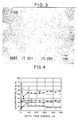
- Figure 3 is an EMPA photograph showing distribution of yttrium in the same view field as in Figure 1.
- Figure 4 is a graph showing distribution of titanium (curve Ti), barium (curve Ba), yttrium (curve Y) and oxygen (curve O) in the direction of depth from the surface of a particle taken from the same sample as in Figures 1 to 3 as determined by the method of X-ray photoelectron spectroscopy (XPS).
- Ti titanium
- Ba barium
- Y yttrium
- O oxygen
- Figure 5 is an EMPA photograph showing distribution of titanium obtained by the EMPA on the surface of the powder blend barium titanate prepared in the Comparative Example.
- Figure 6 is an EMPA photograph showing distribution of barium in the same view field as in Figure 5.
- Figure 7 is an EMPA photograph showing distribution of yttrium in the same view field as in Figure 5.
- Figure 8 is a graph showing distribution of titanium (curve Ti), barium (curve Ba), yttrium (curve Y) and oxygen (curve O) in the direction of depth from the surface of a particle taken from the same sample as in Figures 5 to 7 as determined by the XPS method.
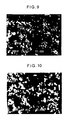
- Figures 9 and 10 are each a scanning electron microscopic photograph of the barium titanate-based composite particles prepared in Example and in Comparative Example, respectively.
- the inventor previously disclosed, in Japanese Patent Kokai 11-21124, a method for the preparation of yttrium oxide/alumina composite particles involving a step of deposition of a basic carbonate of yttrium on the surface of alumina particles.
- the present invention has been established as a result of the inventor's further continued investigations for the preparation of yttrium oxide/barium titanate composite particles.
- step (a) of the above described inventive method an aqueous suspension or aqueous slurry of barium titanate particles is prepared in an aqueous solution containing a water-soluble salt of a rare earth element and urea dissolved therein as a suspension or dispersion medium.
- step (b) of the inventive method the above prepared aqueous suspension of barium titanate particles is heated under agitation at a temperature of 70°C or higher so that the urea contained in the aqueous medium is hydrolyzed into ammonia and carbon dioxide or carbonic acid to deposit a basic carbonate of the rare earth element uniformly on the surface of the barium titanate particles.
- step (c) the barium titanate particles thus coated with the basic carbonate of the rare earth element are separated from the aqueous suspension medium. It is usual that the thus obtained barium titanate-based composite particles are subjected to a calcination treatment at a temperature of 600°C or higher in an oxidizing atmosphere so that the basic carbonate of the rare earth element is decomposed and converted into the rare earth oxide to give rare earth oxide/barium titanate composite particles.
- the basic carbonate of the rare earth element is deposited on the surface of the barium titanate particles so uniformly that the resultant rare earth oxide/barium titanate composite particles have uniform distribution of the rare earth element to the extent of the diameter of the barium titanate particles.
- the particle size of the barium titanate particles is a limiting factor on the uniformity of the rare earth element so that the barium titanate particles should have an average particle diameter selected depending on the particular object of using the composite particles.
- the barium titanate particles preferably have an average particle diameter in the range from 0.1 to 2.0 ⁇ m. It is of course that distribution of the particle diameter should be as uniform as possible.
- the rare earth element to which the present invention is applicable includes yttrium and the elements having an atomic number in the range from 57 to 71 without particular limitations.
- the water-soluble rare earth salt to be dissolved in the aqueous suspension medium is preferably an inorganic salt, such as nitrates, sulfates and chlorides or an organic salt such as acetates, of which nitrates of the rare earth element are usually preferred.
- the concentrations or contents of the respective ingredients In the aqueous suspension prepared in step (a) of the inventive method are as follows.
- the amount of the barium titanate powder added to the aqueous suspension medium is not limitative provided that the resultant aqueous suspension or slurry can be easily and thoroughly agitated in the reaction vessel.
- the amount of the water-soluble yttrium salt dissolved in the aqueous medium naturally depends on the desired content of yttrium oxide in the barium titanate-based composite oxide particles so that the amount of the salt can readily be calculated from stoichiometry relative to the amount of the barium titanate particles.
- the amount of the water-soluble yttrium salt is preferably in the range from 0.5 to 10% by weight relative to the amount of the barium titanate powder.
- the amount of urea to be dissolved in the aqueous medium together with the yttrium nitrate should be at least 3 moles or, preferably, in the range from 12 to 20 moles per mole of the water-soluble yttrium salt or yttrium nitrate.
- the aqueous suspension or slurry of barium titanate particles prepared in step (a) of the inventive method is then, in step (b), heated to effect hydrolysis reaction of urea.
- the temperature of heating should be 70°C or higher or, preferably, 80°C or higher or, more preferably, 90°C or higher up to the boiling point of the suspension which may be somewhat higher than 100°C depending on the concentration of the solutes in the aqueous suspension medium although the heating treatment conducted at the boiling point is not always desirable in respect of stability of the hydrolysis reaction of urea under such a boiling condition.
- the heating temperature is too low, the rate of the hydrolysis reaction is so low as a matter of course that an unduly long time is taken for completion of the reaction.
- urea When the hydrolysis reaction of urea is undertaken under adequately controlled conditions, urea is hydrolyzed to form ammonia and carbonic acid which in turn react with the yttrium ions to form a basic carbonate of yttrium. Since this reaction proceeds predominantly on the surface of the barium titanate particles, the basic carbonate as formed is deposited onto the surface of the barium titanate particles to give composite particles having a cladding/core structure.
- the length of time taken for this heating treatment in step (b) of the inventive method naurally depends on various factors such as the concentrations of the yttrium salt and urea dissolved in the aqueous medium and heating temperature. Assuming that the concentration of the yttrium salt is 0.05 mole/liter, the concentration of urea is 0.75 mole/liter and the heating temperature is 95°C, the heating treatment of the aqueous slurry for about 60 minutes is usually sufficient to give a satisfactory result.
- Completion of the precipitation reaction of the basic carbonate can readily be detected by periodically taking a small portion of the reaction mixture followed by filtration to give a clear filtrate which is alkalified for the formation of white precipitates of yttrium hydroxide in an occasion of incomplete reaction of the yttrium salt.
- the solid particles suspended in the aqueous slurry are collected by subjecting the aqueous slurry to a conventional solid-liquid separation method such as filtration through a filter paper or cloth on a Buchner funnel, centrifugal separation, centrifugal settling and decantation to give a wet cake of the composite particles which is washed with water, dried and, if necessary, disintegrated to give a powder of composite particles consisting of barium titanate as the core and basic carbonate of yttrium as the cladding on the core.
- a conventional solid-liquid separation method such as filtration through a filter paper or cloth on a Buchner funnel, centrifugal separation, centrifugal settling and decantation to give a wet cake of the composite particles which is washed with water, dried and, if necessary, disintegrated to give a powder of composite particles consisting of barium titanate as the core and basic carbonate of yttrium as the cladding on the core.
- composite particles of barium titanate and basic carbonate of yttrium are then subjected to a calcination treatment in an oxidizing atmosphere such as air at a temperature of 600°C or higher so that the basic carbonate of yttrium is thermally decomposed and converted into yttrium oxide to give composite particles consisting of barium titanate as the core and yttrium oxide as the cladding deposited on the core surface.
- an oxidizing atmosphere such as air
- the calcination temperature is lower than 600°C or the atmosphere for calcination is insufficiently oxidizing, the thermal decomposition reaction of basic yttrium carbonate into yttrium oxide cannot be complete sometimes resulting in the formation of a carbonaceous matter.
- the calcination treatment is conducted usually for at least 30 minutes in an oxidizing atmosphere.
- barium titanate-based composite particles bearing surface deposition of a water-insoluble salt or oxide of a rare earth element have a cladding/core structure in which the distribution of the cladding layer on the core particles of barium titanate is very uniform even in the case where the content of the rare earth compound is 50% by weight or even higher.
- barium titanate particles bearing a cladding layer of a rare earth oxide can be obtained by a method in which a rare earth hydroxide is deposited on the surface of the barium titanate particles in an aqueous medium containing a water-soluble rare earth salt in the presence of ammonia followed by calcination of the rare earth hydroxide-coated barium titanate particles.
- An aqueous suspension was prepared by adding 100 g of a barium titanate powder having an average particle diameter of about 1.0 ⁇ m to and by dissolving 0.05 mole of yttrium nitrate in deionized water followed by addition of deionized water to make up a total volume of 10 liters.
- the suspension was further admixed with 45 g (0.75 mole) of urea to be dissolved therein.
- the aqueous suspension was heated under agitation at about 95°C for a period of 60 minutes. Completion of the reaction could be detected by taking a small portion of the suspension which was filtered to give a clear filtrate followed by the addition of ammonia water to find absolutely no precipitates of yttrium hydroxide.
- the whole volume of the reaction mixture was filtered by using a Buchner funnel to give a cake of the particles which was thoroughly washed with water, dried and disintegrated.
- the thus obtained powder was subjected to a calcination treatment at 700°C for about 2 hours in an atmosphere of air.
- the thus obtained composite particles of barium titanate and yttrium oxide were subjected to the analysis of distribution of the constituent elements by the methods of electron beam microprobe analysis (EMPA) and X-ray photoelectron spectroscopy (XPS).
- EMPA electron beam microprobe analysis
- XPS X-ray photoelectron spectroscopy
- Figures 1 to 3 are each a photograph showing the result of EMPA, of which Figure 1 is for the distribution of titanium, Figure 2 is for the distribution of barium and Figure 3 is for the distribution of yttrium within the same view field. Comparison of these photographs for the distribution of darkened areas, i.e. areas rich in the content of the respective element, supports the conclusion that the distribution of yttrium in the cladding layers is substantially identical to that of titanium and barium forming the barium titanate particles.
- Figure 4 is a graph showing the result of the XPS analysis for the distributions of the respective constituent elements along the direction of depth from the surface of a particle taken from the same sample lot as used in EMPA shown in Figures 1 to 3. This graph indicates that the distribution of yttrium is localized within a surface layer of about 100 nm thickness while deficiency in the concentration of titanium and barium in this surface layer evidences that the core of the particles is formed from barium titanate.
- the depth scale in this XPS analysis was calibrated by utilizing the sputtering rate of silicon dioxide as a reference sample.
- Figure 9 is a scanning electron microscopic photograph of the yttrium oxide/barium titanate composite particles prepared in this Example.
- An aqueous slurry was prepared by thoroughly milling, in a ball mill for 24 hours, a mixture of 100 g of a barium titanate powder having an average particle diameter of about 1.0 ⁇ m, 5.645 g of a yttrium oxide powder having an average particle diameter of about 0.3 ⁇ m, 100 g of deionized water and a small amount of a deflocculant.
- the thus prepared aqueous slurry was dried by heating to evaporate water to dryness giving about 100 g of the powder blend.
- Figure 10 is a scanning electron microscopic photograph of the above prepared powder blend of barium titanate particles and yttrium oxide particles.
Landscapes
- Chemical & Material Sciences (AREA)
- Engineering & Computer Science (AREA)
- Ceramic Engineering (AREA)
- Manufacturing & Machinery (AREA)
- Materials Engineering (AREA)
- Organic Chemistry (AREA)
- Inorganic Chemistry (AREA)
- Structural Engineering (AREA)
- Power Engineering (AREA)
- Microelectronics & Electronic Packaging (AREA)
- Chemical Kinetics & Catalysis (AREA)
- General Chemical & Material Sciences (AREA)
- Inorganic Compounds Of Heavy Metals (AREA)
Abstract
Description
- The present invention relates to barium titanate particles with surface deposition of a rare earth element such as yttrium or, more particularly, to barium titanate particles bearing a water-insoluble compound of a rare earth element such as oxides or water-insoluble salts of the rare earth element as well as to a method for the preparation of such barium titanate particles.
- As is well known, powders of barium titanate are widely employed long since as a material of ceramic capacitors. It is also known and practiced to admix the barium titanate powder with a compound of a rare earth element such as a rare earth oxide or, in particular, yttrium oxide in the preparation of barium titanate-based ceramic capacitors with an object to improve performance of the ceramic capacitor. A typical procedure of admixing a rare earth compound to a barium titanate powder is that a rare earth oxide powder is blended with the barium titanate powder and the powder blend is thoroughly agitated in a suitable powder-blending machine such as ball mills to give a uniform mixture of barium titanate particles and rare earth oxide particles usable in the preparation of ceramic capacitors.
- In compliance with the trend in recent years in the field of electronic technology that ceramic capacitors are required to be more and more compact in size or smaller and smaller in thickness, the above mentioned powder blend of barium titanate particles and rare earth oxide particles is also required to have increased uniformity of blending in addition to the requirement for a smaller and smaller particle diameter of the barium titanate particles as well as of the rare earth oxide particles. Since the rare earth oxide powder products available on the market usually have an average particle diameter exceeding the sub-micron range and a highly uniform powder blend can hardly be obtained from such a rare earth oxide powder with a barium titanate powder, full improvement of the performance of thin-layered or compact-size ceramic capacitors cannot be accomplished by the admixture of a rare earth oxide powder to a barium titanate powder.
- The present invention accordingly has an object, in order to overcome the above described problems in the prior art, to provide a powder based on barium titanate particles containing a rare earth compound with microscopically high uniformity of mixing.
- Thus, the present invention provides barium titanate particles bearing a water-insoluble salt or an oxide of a rare earth element deposited on the surface of the particles.
- The invention also provides a method for the preparation of the above defined barium titanate-based particles which comprises the steps of:
- (a) dispersing particles of barium titanate in an aqueous solution as a suspension medium containing a water-soluble salt of a rare earth element and urea dissolved therein to give an aqueous suspension;
- (b) heating the aqueous suspension of barium titanate particles prepared in step (a) at a temperature of 70°C or higher to effect hydrolysis of urea and to deposit a basic carbonate of the rare earth element on the surface of the barium titanate particles; and
- (c) separating the barium titanate particles having surface deposition of the basic carbonate of the rare earth element from the suspension medium.
-
- The basic carbonate of the rare earth element deposited on the surface of the barium titanate particles can be converted, in step (d), to a rare earth oxide by calcining the powder at a temperature of 600°C or higher in an oxidizing atmosphere to give a barium titanate powder containing a rare earth oxide with high uniformity.
- Figure 1 is a photograph showing distribution of titanium obtained by the electron beam microprobe analysis (EMPA) on the surface of the barium titanate particles having surface deposition of yttrium oxide prepared in the Example.
- Figure 2 is an EMPA photograph showing distribution of barium in the same view field as in Figure 1.
- Figure 3 is an EMPA photograph showing distribution of yttrium in the same view field as in Figure 1.
- Figure 4 is a graph showing distribution of titanium (curve Ti), barium (curve Ba), yttrium (curve Y) and oxygen (curve O) in the direction of depth from the surface of a particle taken from the same sample as in Figures 1 to 3 as determined by the method of X-ray photoelectron spectroscopy (XPS).
- Figure 5 is an EMPA photograph showing distribution of titanium obtained by the EMPA on the surface of the powder blend barium titanate prepared in the Comparative Example.
- Figure 6 is an EMPA photograph showing distribution of barium in the same view field as in Figure 5.
- Figure 7 is an EMPA photograph showing distribution of yttrium in the same view field as in Figure 5.
- Figure 8 is a graph showing distribution of titanium (curve Ti), barium (curve Ba), yttrium (curve Y) and oxygen (curve O) in the direction of depth from the surface of a particle taken from the same sample as in Figures 5 to 7 as determined by the XPS method.
- Figures 9 and 10 are each a scanning electron microscopic photograph of the barium titanate-based composite particles prepared in Example and in Comparative Example, respectively.
- The inventor previously disclosed, in Japanese Patent Kokai 11-21124, a method for the preparation of yttrium oxide/alumina composite particles involving a step of deposition of a basic carbonate of yttrium on the surface of alumina particles. The present invention has been established as a result of the inventor's further continued investigations for the preparation of yttrium oxide/barium titanate composite particles.
- In step (a) of the above described inventive method, an aqueous suspension or aqueous slurry of barium titanate particles is prepared in an aqueous solution containing a water-soluble salt of a rare earth element and urea dissolved therein as a suspension or dispersion medium. In step (b) of the inventive method, the above prepared aqueous suspension of barium titanate particles is heated under agitation at a temperature of 70°C or higher so that the urea contained in the aqueous medium is hydrolyzed into ammonia and carbon dioxide or carbonic acid to deposit a basic carbonate of the rare earth element uniformly on the surface of the barium titanate particles. In step (c), the barium titanate particles thus coated with the basic carbonate of the rare earth element are separated from the aqueous suspension medium. It is usual that the thus obtained barium titanate-based composite particles are subjected to a calcination treatment at a temperature of 600°C or higher in an oxidizing atmosphere so that the basic carbonate of the rare earth element is decomposed and converted into the rare earth oxide to give rare earth oxide/barium titanate composite particles.
- According to the above described preparation method, the basic carbonate of the rare earth element is deposited on the surface of the barium titanate particles so uniformly that the resultant rare earth oxide/barium titanate composite particles have uniform distribution of the rare earth element to the extent of the diameter of the barium titanate particles. This is a great advantage of the present invention over the prior art method of mechanical blending of barium titanate particles and rare earth oxide particles in which uniformity of blending is limited by the contacting of particles of different kinds at the best.
- The particle size of the barium titanate particles is a limiting factor on the uniformity of the rare earth element so that the barium titanate particles should have an average particle diameter selected depending on the particular object of using the composite particles. Generally, the barium titanate particles preferably have an average particle diameter in the range from 0.1 to 2.0 µm. It is of course that distribution of the particle diameter should be as uniform as possible.
- The rare earth element to which the present invention is applicable includes yttrium and the elements having an atomic number in the range from 57 to 71 without particular limitations. The water-soluble rare earth salt to be dissolved in the aqueous suspension medium is preferably an inorganic salt, such as nitrates, sulfates and chlorides or an organic salt such as acetates, of which nitrates of the rare earth element are usually preferred. Following description is given by taking yttrium as a typical example of the rare earth element and nitrare of the element as an example of the water-soluble salt although the scope of the present invention is never limited by these examples.
- The concentrations or contents of the respective ingredients In the aqueous suspension prepared in step (a) of the inventive method are as follows. The amount of the barium titanate powder added to the aqueous suspension medium is not limitative provided that the resultant aqueous suspension or slurry can be easily and thoroughly agitated in the reaction vessel. The amount of the water-soluble yttrium salt dissolved in the aqueous medium naturally depends on the desired content of yttrium oxide in the barium titanate-based composite oxide particles so that the amount of the salt can readily be calculated from stoichiometry relative to the amount of the barium titanate particles. When the intended use of the yttrium oxide/barium titanate composite oxide powder is as a base material of ceramic capacitors, in particular, the amount of the water-soluble yttrium salt is preferably in the range from 0.5 to 10% by weight relative to the amount of the barium titanate powder. The amount of urea to be dissolved in the aqueous medium together with the yttrium nitrate should be at least 3 moles or, preferably, in the range from 12 to 20 moles per mole of the water-soluble yttrium salt or yttrium nitrate.
- The aqueous suspension or slurry of barium titanate particles prepared in step (a) of the inventive method is then, in step (b), heated to effect hydrolysis reaction of urea. The temperature of heating should be 70°C or higher or, preferably, 80°C or higher or, more preferably, 90°C or higher up to the boiling point of the suspension which may be somewhat higher than 100°C depending on the concentration of the solutes in the aqueous suspension medium although the heating treatment conducted at the boiling point is not always desirable in respect of stability of the hydrolysis reaction of urea under such a boiling condition. When the heating temperature is too low, the rate of the hydrolysis reaction is so low as a matter of course that an unduly long time is taken for completion of the reaction.
- When the hydrolysis reaction of urea is undertaken under adequately controlled conditions, urea is hydrolyzed to form ammonia and carbonic acid which in turn react with the yttrium ions to form a basic carbonate of yttrium. Since this reaction proceeds predominantly on the surface of the barium titanate particles, the basic carbonate as formed is deposited onto the surface of the barium titanate particles to give composite particles having a cladding/core structure.
- The length of time taken for this heating treatment in step (b) of the inventive method naurally depends on various factors such as the concentrations of the yttrium salt and urea dissolved in the aqueous medium and heating temperature. Assuming that the concentration of the yttrium salt is 0.05 mole/liter, the concentration of urea is 0.75 mole/liter and the heating temperature is 95°C, the heating treatment of the aqueous slurry for about 60 minutes is usually sufficient to give a satisfactory result. Completion of the precipitation reaction of the basic carbonate can readily be detected by periodically taking a small portion of the reaction mixture followed by filtration to give a clear filtrate which is alkalified for the formation of white precipitates of yttrium hydroxide in an occasion of incomplete reaction of the yttrium salt.
- After completion of the hydrolysis reaction of urea to form basic yttrium carbonate, the solid particles suspended in the aqueous slurry are collected by subjecting the aqueous slurry to a conventional solid-liquid separation method such as filtration through a filter paper or cloth on a Buchner funnel, centrifugal separation, centrifugal settling and decantation to give a wet cake of the composite particles which is washed with water, dried and, if necessary, disintegrated to give a powder of composite particles consisting of barium titanate as the core and basic carbonate of yttrium as the cladding on the core.
- The thus obtained composite particles of barium titanate and basic carbonate of yttrium are then subjected to a calcination treatment in an oxidizing atmosphere such as air at a temperature of 600°C or higher so that the basic carbonate of yttrium is thermally decomposed and converted into yttrium oxide to give composite particles consisting of barium titanate as the core and yttrium oxide as the cladding deposited on the core surface. When the calcination temperature is lower than 600°C or the atmosphere for calcination is insufficiently oxidizing, the thermal decomposition reaction of basic yttrium carbonate into yttrium oxide cannot be complete sometimes resulting in the formation of a carbonaceous matter. Though dependent on the temperature, conditions of the atmosphere and other factors, the calcination treatment is conducted usually for at least 30 minutes in an oxidizing atmosphere.
- The thus obtained barium titanate-based composite particles bearing surface deposition of a water-insoluble salt or oxide of a rare earth element have a cladding/core structure in which the distribution of the cladding layer on the core particles of barium titanate is very uniform even in the case where the content of the rare earth compound is 50% by weight or even higher.
- As an alternative method, barium titanate particles bearing a cladding layer of a rare earth oxide can be obtained by a method in which a rare earth hydroxide is deposited on the surface of the barium titanate particles in an aqueous medium containing a water-soluble rare earth salt in the presence of ammonia followed by calcination of the rare earth hydroxide-coated barium titanate particles.
- In the following, a more detailed description is given of the present invention by way of an Example and a Comparative Example. Example.
- An aqueous suspension was prepared by adding 100 g of a barium titanate powder having an average particle diameter of about 1.0 µm to and by dissolving 0.05 mole of yttrium nitrate in deionized water followed by addition of deionized water to make up a total volume of 10 liters. The suspension was further admixed with 45 g (0.75 mole) of urea to be dissolved therein. The aqueous suspension was heated under agitation at about 95°C for a period of 60 minutes. Completion of the reaction could be detected by taking a small portion of the suspension which was filtered to give a clear filtrate followed by the addition of ammonia water to find absolutely no precipitates of yttrium hydroxide. Upon completion of the reaction thus confirmed, the whole volume of the reaction mixture was filtered by using a Buchner funnel to give a cake of the particles which was thoroughly washed with water, dried and disintegrated. The thus obtained powder was subjected to a calcination treatment at 700°C for about 2 hours in an atmosphere of air.
- The thus obtained composite particles of barium titanate and yttrium oxide were subjected to the analysis of distribution of the constituent elements by the methods of electron beam microprobe analysis (EMPA) and X-ray photoelectron spectroscopy (XPS). The results were that the distribution of yttrium was in good overlapping with the distributions of barium and titanium elements forming the barium titanate particles according to EMPA and distribution of yttrium was limited to the surface layer of the particles having a thickness of 100 nm or smaller according to XPS.
- Figures 1 to 3 are each a photograph showing the result of EMPA, of which Figure 1 is for the distribution of titanium, Figure 2 is for the distribution of barium and Figure 3 is for the distribution of yttrium within the same view field. Comparison of these photographs for the distribution of darkened areas, i.e. areas rich in the content of the respective element, supports the conclusion that the distribution of yttrium in the cladding layers is substantially identical to that of titanium and barium forming the barium titanate particles.
- Figure 4 is a graph showing the result of the XPS analysis for the distributions of the respective constituent elements along the direction of depth from the surface of a particle taken from the same sample lot as used in EMPA shown in Figures 1 to 3. This graph indicates that the distribution of yttrium is localized within a surface layer of about 100 nm thickness while deficiency in the concentration of titanium and barium in this surface layer evidences that the core of the particles is formed from barium titanate. The depth scale in this XPS analysis was calibrated by utilizing the sputtering rate of silicon dioxide as a reference sample.
- Figure 9 is a scanning electron microscopic photograph of the yttrium oxide/barium titanate composite particles prepared in this Example.
- An aqueous slurry was prepared by thoroughly milling, in a ball mill for 24 hours, a mixture of 100 g of a barium titanate powder having an average particle diameter of about 1.0 µm, 5.645 g of a yttrium oxide powder having an average particle diameter of about 0.3 µm, 100 g of deionized water and a small amount of a deflocculant. The thus prepared aqueous slurry was dried by heating to evaporate water to dryness giving about 100 g of the powder blend.
- Particles of the thus obtained dry powder were subjected to the EMPA in the same manner as in Example to give the results shown in the EMPA photographs of Figures 5 to 7, of which Figure 5 is for the distribution of titanium, Figure 6 is for the distribution of barium and Figure 7 is for the distribution of yttrium. Comparison of these photographs indicates that the barium titanate particles and yttrium oxide particles are discretely isolated each from the others as is evidenced by the great difference in the pattern distribution between Figures 5 and 6 for titanium and barium and that of Figure 7 for yttrium.
- Figure 10 is a scanning electron microscopic photograph of the above prepared powder blend of barium titanate particles and yttrium oxide particles.
Claims (13)
- Composite particles of barium titanate bearing a water-insoluble compound of a rare earth element deposited on the surface of the particle.
- The composite particles of barium titanate as claimed in claim 1 in which the water-insoluble compound of a rare earth element is a basic carbonate of the rare earth element.
- The composite particles of barium titanate as claimed in claim 1 in which the water-insoluble compound of a rare earth element is an oxide of the rare earth element.
- The composite particles of barium titanate as claimed in claim 1 in which the rare earth element is yttrium.
- The composite particles of barium titanate as claimed in claim 1 in which each particle has a cladding/core structure consisting of a core particle of barium titanate and a cladding layer of a water-insoluble salt or oxide of a rare earth element uniformly deposited on the core particle.
- A method for the preparation of composite particles of barium titanate bearing a basic carbonate of a rare earth element deposited on the surface of the particles which comprises the steps of:(a) dispersing particles of barium titanate in an aqueous solution as a suspension medium containing a water-soluble salt of the rare earth element and urea to form an aqueous suspension of the particles of barium titanate;(b) heating the aqueous suspension of the particles of barium titanate at a temperature of 70°C or higher to deposit a basic carbonate of the rare earth element on the surface of the particles of barium titanate; and(c) separating the particles of barium titanate bearing a basic carbonate of the rare earth element deposited on the surface from the suspension medium.
- The method for the preparation of composite particles of barium titanate bearing a basic carbonate of a rare earth element deposited on the surface of the particles as claimed in claim 6 in which the amount of urea dissolved in the suspension medium is at least 3 moles per mole of the water-soluble salt of the rare earth element.
- The method for the preparation of composite particles of barium titanate bearing a basic carbonate of a rare earth element deposited on the surface of the particles as claimed in claim 7 in which the amount of urea dissolved in the suspension medium is in the range from 12 to 20 moles per mole of the water-soluble salt of the rare earth element.
- The method for the preparation of composite particles of barium titanate bearing a basic carbonate of a rare earth element deposited on the surface of the particles as claimed in claim 6 in which the water-soluble salt of a reare earth element is a nitrate of the rare earth element.
- The method for the preparation of composite particles of barium titanate bearing a basic carbonate of a rare earth element deposited on the surface of the particles as claimed in claim 6 in which the temperature of heating in step (b) is 90°C or higher but lower than the boiling temperature of the aqueous suspension.
- A method for the preparation of composite particles of barium titanate bearing an oxide of a rare earth element deposited on the surface of the particles which comprises the steps of:(a) dispersing particles of barium titanate in an aqueous solution as a suspension medium containing a water-soluble salt of the rare earth element and urea to form an aqueous suspension of the particles of barium titanate;(b) heating the aqueous suspension of the particles of barium titanate at a temperature of 70°C or higher to deposit a basic carbonate of the rare earth element on the surface of the particles of barium titanate;(c) separating the particles of barium titanate bearing a basic carbonate of the rare earth element deposited on the surface from the suspension medium; and(d) calcining the particles of barium titanate bearing a basic carbonate of the rare earth element deposited on the surface at a temperature of 600°C or higher in an atmosphere of an oxidizing gas.
- The method for the preparation of composite particles of barium titanate bearing an oxide of a rare earth element deposited on the surface of the particles as claimed in claim 11 in which the length of time for the calcination in step (d) is at least 30 minutes.
- A method for the preparation of composite particles of barium titanate bearing an oxide of a rare earth element deposited on the surface of the particles which comprises the steps of:(a) dispersing particles of barium titanate in an aqueous solution as a suspension medium containing a water-soluble salt of the rare earth element to form an aqueous suspension of the particles of barium titanate;(b) admixing the aqueous suspension of the particles of barium titanate with ammonia or ammonia water to deposit a hydroxide of the rare earth element on the surface of the barium titanate particles;(c) separating the particles of barium titanate bearing a hydroxide of the rare earth element deposited on the surface from the suspension medium; and(d) calcining the particles of barium titanate bearing a hydroxide of the rare earth element deposited on the surface at a temperature of 600°C or higher.
Applications Claiming Priority (2)
| Application Number | Priority Date | Filing Date | Title |
|---|---|---|---|
| JP1953699 | 1999-01-28 | ||
| JP1953699 | 1999-01-28 |
Publications (2)
| Publication Number | Publication Date |
|---|---|
| EP1024122A1 true EP1024122A1 (en) | 2000-08-02 |
| EP1024122B1 EP1024122B1 (en) | 2004-08-04 |
Family
ID=12002058
Family Applications (1)
| Application Number | Title | Priority Date | Filing Date |
|---|---|---|---|
| EP00400189A Expired - Lifetime EP1024122B1 (en) | 1999-01-28 | 2000-01-25 | Barium titanate particles with surface deposition of rare earth element |
Country Status (3)
| Country | Link |
|---|---|
| US (1) | US6447910B1 (en) |
| EP (1) | EP1024122B1 (en) |
| DE (1) | DE60012591T2 (en) |
Cited By (1)
| Publication number | Priority date | Publication date | Assignee | Title |
|---|---|---|---|---|
| CN109305814A (en) * | 2018-12-21 | 2019-02-05 | 广州天极电子科技有限公司 | A kind of preparation method of ceramic capacitor |
Families Citing this family (16)
| Publication number | Priority date | Publication date | Assignee | Title |
|---|---|---|---|---|
| MXPA02001885A (en) * | 1999-08-23 | 2002-11-04 | Cabot Corp | Silicate based sintering aid and method. |
| US7595109B2 (en) * | 2001-04-12 | 2009-09-29 | Eestor, Inc. | Electrical-energy-storage unit (EESU) utilizing ceramic and integrated-circuit technologies for replacement of electrochemical batteries |
| US7914755B2 (en) * | 2001-04-12 | 2011-03-29 | Eestor, Inc. | Method of preparing ceramic powders using chelate precursors |
| US7729811B1 (en) | 2001-04-12 | 2010-06-01 | Eestor, Inc. | Systems and methods for utility grid power averaging, long term uninterruptible power supply, power line isolation from noise and transients and intelligent power transfer on demand |
| US20110170232A1 (en) * | 2004-08-13 | 2011-07-14 | Eestor, Inc. | Electrical energy storage unit and methods for forming same |
| US7466536B1 (en) | 2004-08-13 | 2008-12-16 | Eestor, Inc. | Utilization of poly(ethylene terephthalate) plastic and composition-modified barium titanate powders in a matrix that allows polarization and the use of integrated-circuit technologies for the production of lightweight ultrahigh electrical energy storage units (EESU) |
| KR100631846B1 (en) | 2004-10-05 | 2006-10-09 | 삼성전기주식회사 | Method for producing barium calcium titanate powder, barium calcium titanate powder, multilayer ceramic capacitor |
| US7648687B1 (en) | 2006-06-15 | 2010-01-19 | Eestor, Inc. | Method of purifying barium nitrate aqueous solution |
| US8853116B2 (en) * | 2006-08-02 | 2014-10-07 | Eestor, Inc. | Method of preparing ceramic powders |
| US7993611B2 (en) * | 2006-08-02 | 2011-08-09 | Eestor, Inc. | Method of preparing ceramic powders using ammonium oxalate |
| US8145362B2 (en) * | 2006-08-04 | 2012-03-27 | Eestor, Inc. | Utility grid power averaging and conditioning |
| CN101274848B (en) * | 2007-03-30 | 2011-03-30 | 鸿富锦精密工业(深圳)有限公司 | Preparation for monodisperse metallic titanium |
| CN102333724A (en) * | 2009-02-27 | 2012-01-25 | 埃斯托股份有限公司 | The reaction tubes and the hydrothermal treatment consists that are used for the wet-chemical co-precipitation of oxide powder |
| EP2528867A4 (en) * | 2010-01-20 | 2013-10-30 | Eestor Inc | PURIFYING A BARIUM ION SOURCE |
| WO2014077176A2 (en) | 2012-11-13 | 2014-05-22 | 関東電化工業株式会社 | Coated barium titanate particulate and production method for same |
| CN117623764A (en) * | 2023-12-07 | 2024-03-01 | 西安稀有金属材料研究院有限公司 | A rare earth oxide low-loading coated barium titanate composite ceramic material and its preparation method |
Citations (3)
| Publication number | Priority date | Publication date | Assignee | Title |
|---|---|---|---|---|
| US5082811A (en) * | 1990-02-28 | 1992-01-21 | E. I. Du Pont De Nemours And Company | Ceramic dielectric compositions and method for enhancing dielectric properties |
| WO1998035920A1 (en) * | 1997-02-18 | 1998-08-20 | Cabot Corporation | Dispersible, metal oxide-coated, barium titanate materials |
| EP0889005A1 (en) * | 1997-07-02 | 1999-01-07 | Shin-Etsu Chemical Co., Ltd. | Yttrium oxide-aluminum oxide composite particles and method for the preparation thereof |
Family Cites Families (9)
| Publication number | Priority date | Publication date | Assignee | Title |
|---|---|---|---|---|
| US4014822A (en) * | 1968-08-13 | 1977-03-29 | Murata Manufacturing Co., Ltd. | Semiconductor ceramic composition |
| GB2097778B (en) * | 1981-05-06 | 1984-11-21 | Toyoda Chuo Kenkyusho Kk | Barium titanate composition |
| US4606906A (en) * | 1984-11-15 | 1986-08-19 | The United States Of America As Represented By The Secretary Of Commerce | Process of synthesizing mixed BaO-TiO2 based powders for ceramic applications |
| US4863883A (en) * | 1986-05-05 | 1989-09-05 | Cabot Corporation | Doped BaTiO3 based compositions |
| US5219811A (en) * | 1989-08-31 | 1993-06-15 | Central Glass Company, Limited | Powder composition for sintering into modified barium titanate semiconductive ceramic |
| US5523065A (en) * | 1993-09-27 | 1996-06-04 | Alfred University | Process for making ultra-fine barium titanate particles |
| DE19737324A1 (en) * | 1997-08-28 | 1999-03-04 | Philips Patentverwaltung | Multi-layer capacitor with silver and rare earth doped barium titanate |
| US6071842A (en) * | 1997-09-05 | 2000-06-06 | Tdk Corporation | Barium titanate-based semiconductor ceramic |
| KR20010034928A (en) * | 1998-06-23 | 2001-04-25 | 마싸 앤 피네간 | Barium Titanate Dispersions |
-
2000
- 2000-01-25 DE DE60012591T patent/DE60012591T2/en not_active Expired - Fee Related
- 2000-01-25 EP EP00400189A patent/EP1024122B1/en not_active Expired - Lifetime
- 2000-01-28 US US09/493,093 patent/US6447910B1/en not_active Expired - Fee Related
Patent Citations (3)
| Publication number | Priority date | Publication date | Assignee | Title |
|---|---|---|---|---|
| US5082811A (en) * | 1990-02-28 | 1992-01-21 | E. I. Du Pont De Nemours And Company | Ceramic dielectric compositions and method for enhancing dielectric properties |
| WO1998035920A1 (en) * | 1997-02-18 | 1998-08-20 | Cabot Corporation | Dispersible, metal oxide-coated, barium titanate materials |
| EP0889005A1 (en) * | 1997-07-02 | 1999-01-07 | Shin-Etsu Chemical Co., Ltd. | Yttrium oxide-aluminum oxide composite particles and method for the preparation thereof |
Cited By (1)
| Publication number | Priority date | Publication date | Assignee | Title |
|---|---|---|---|---|
| CN109305814A (en) * | 2018-12-21 | 2019-02-05 | 广州天极电子科技有限公司 | A kind of preparation method of ceramic capacitor |
Also Published As
| Publication number | Publication date |
|---|---|
| DE60012591D1 (en) | 2004-09-09 |
| US6447910B1 (en) | 2002-09-10 |
| EP1024122B1 (en) | 2004-08-04 |
| DE60012591T2 (en) | 2005-07-14 |
Similar Documents
| Publication | Publication Date | Title |
|---|---|---|
| US6447910B1 (en) | Barium titanate particles with surface deposition of rare earth element | |
| Ciftci et al. | Hydrothermal precipitation and characterization of nanocrystalline BaTiO3 particles | |
| DE3813731C2 (en) | Composition with zirconia and process for its manufacture | |
| KR101323697B1 (en) | Zirconium oxide and method for the production thereof | |
| EP0641740B1 (en) | Process for the synthesis of crystalline ceramic powders of perovskite compounds | |
| EP1204597B1 (en) | Method of producing aluminum oxides and products obtained on the basis thereof | |
| Yamamura et al. | Preparation of barium titanate by oxalate method in ethanol solution | |
| CN114466823B (en) | Iron oxide magnetic powder and its production method | |
| EP1205440B1 (en) | Spherical tetragonal barium titanate particles and process for producing the same | |
| DE102007009075A1 (en) | Cerium-zirconium mixed oxide and process for its preparation | |
| JPS63103827A (en) | Manufacture of barium titanate | |
| JP2004517795A (en) | Coated barium titanate-based particles and manufacturing method | |
| EP0212935A2 (en) | Titanates of barium and strontium, and process for preparing the same | |
| EP0842898B1 (en) | Method for the preparation of fine globular particles of yttrium oxide | |
| US4627966A (en) | Formation of fine particle sinterable ceramic powders | |
| EP0889005B1 (en) | Yttrium oxide-aluminum oxide composite particles and method for the preparation thereof | |
| EP1484282B1 (en) | Cerium based composite oxide, sintered product thereof and method for preparation thereof | |
| US5439656A (en) | Method for the preparation of a rare earth oxide powder | |
| McHale et al. | Nanocrystalline BaTiO3 from freeze-dried nitrate solutions | |
| US8431109B2 (en) | Process for production of composition | |
| JP2003507318A (en) | Silicate-based sintering aid and manufacturing method | |
| EP0650927B1 (en) | Method for the preparation of lanthanum manganite powder | |
| EP0156491A2 (en) | Formation of fine particle sinterable ceramic powders | |
| Vold et al. | Hydrothermal synthesis of lead doped barium titanate | |
| WO2004092071A1 (en) | Method for producing barium titanate powder |
Legal Events
| Date | Code | Title | Description |
|---|---|---|---|
| PUAI | Public reference made under article 153(3) epc to a published international application that has entered the european phase |
Free format text: ORIGINAL CODE: 0009012 |
|
| AK | Designated contracting states |
Kind code of ref document: A1 Designated state(s): DE FR GB |
|
| AX | Request for extension of the european patent |
Free format text: AL;LT;LV;MK;RO;SI |
|
| 17P | Request for examination filed |
Effective date: 20000915 |
|
| AKX | Designation fees paid |
Free format text: DE FR GB |
|
| 17Q | First examination report despatched |
Effective date: 20010910 |
|
| GRAP | Despatch of communication of intention to grant a patent |
Free format text: ORIGINAL CODE: EPIDOSNIGR1 |
|
| GRAS | Grant fee paid |
Free format text: ORIGINAL CODE: EPIDOSNIGR3 |
|
| GRAA | (expected) grant |
Free format text: ORIGINAL CODE: 0009210 |
|
| AK | Designated contracting states |
Kind code of ref document: B1 Designated state(s): DE FR GB |
|
| REG | Reference to a national code |
Ref country code: GB Ref legal event code: FG4D |
|
| REF | Corresponds to: |
Ref document number: 60012591 Country of ref document: DE Date of ref document: 20040909 Kind code of ref document: P |
|
| ET | Fr: translation filed | ||
| PLBE | No opposition filed within time limit |
Free format text: ORIGINAL CODE: 0009261 |
|
| STAA | Information on the status of an ep patent application or granted ep patent |
Free format text: STATUS: NO OPPOSITION FILED WITHIN TIME LIMIT |
|
| 26N | No opposition filed |
Effective date: 20050506 |
|
| PGFP | Annual fee paid to national office [announced via postgrant information from national office to epo] |
Ref country code: DE Payment date: 20090123 Year of fee payment: 10 |
|
| PGFP | Annual fee paid to national office [announced via postgrant information from national office to epo] |
Ref country code: GB Payment date: 20090121 Year of fee payment: 10 |
|
| PGFP | Annual fee paid to national office [announced via postgrant information from national office to epo] |
Ref country code: FR Payment date: 20090113 Year of fee payment: 10 |
|
| GBPC | Gb: european patent ceased through non-payment of renewal fee |
Effective date: 20100125 |
|
| REG | Reference to a national code |
Ref country code: FR Ref legal event code: ST Effective date: 20100930 |
|
| PG25 | Lapsed in a contracting state [announced via postgrant information from national office to epo] |
Ref country code: FR Free format text: LAPSE BECAUSE OF NON-PAYMENT OF DUE FEES Effective date: 20100201 |
|
| PG25 | Lapsed in a contracting state [announced via postgrant information from national office to epo] |
Ref country code: DE Free format text: LAPSE BECAUSE OF NON-PAYMENT OF DUE FEES Effective date: 20100803 |
|
| PG25 | Lapsed in a contracting state [announced via postgrant information from national office to epo] |
Ref country code: GB Free format text: LAPSE BECAUSE OF NON-PAYMENT OF DUE FEES Effective date: 20100125 |